Category: Transport

  • MIL-OSI Global: Mr Smith or Gary? Why some teachers ask students to call them by their first name

    Source: The Conversation – Global Perspectives – By Nicole Brownlie, Lecturer in Education, University of Southern Queensland

    Johnny Greig/ Getty Images

    When you went to school, did you call your teacher Mrs, Ms or Mr, followed by their surname? Perhaps you even called them Sir or Miss.

    The tradition of addressing teachers in a formal manner goes back centuries. For many of us, calling a teacher by their first name would have been unthinkable.

    But that’s not automatically the case anymore. Some teachers in mainstream schools now ask students to call them by their first name.

    Why is this? And what impact can teachers’ names have in the classroom?

    There’s no rule

    There’s no official rule in Australia on what students should call teachers.
    Naming is usually decided by schools or individual teachers. This is no official training on this topic before teachers start in classrooms.

    Some primary school teachers now use first names or a less formal name such as “Mr D”. Teachers say this helps break down barriers, especially for young students or those who are learning English as an additional language.

    High schools are more likely to stick with tradition, partly to maintain structure and boundaries, especially with teenagers. Using formal titles can also support early-career teachers or those from minority
    backgrounds
    assert their authority in a classroom.

    But even so, some high school teachers are using their first names to foster a sense of trust and encourage students to see them as a partner in learning, rather than simply an authority figure.

    What does the research say?

    Research – which is mainly from the United States – suggests names have an impact on how students perceive their teachers and feel about school.

    In one study of US high school students, teenagers described teachers they addressed with formal titles as more distant and harder to connect with. Teachers who invited students to use their first name were seen as more supportive, approachable and trustworthy.

    A secondary school principal in the state of Maryland reported students felt more included and respected when they could use teachers’ first names. It made classrooms feel less hierarchical and more collaborative.

    A 2020 US study on teaching students doing practical placements found those who used their first name observed greater student engagement than those who did not. This came as a surprise to the student teachers who expected students would not respect them if they used their first names.

    These findings don’t necessarily mean titles are bad. Rather, they show first names can support stronger teacher-student relationships.

    It’s important to note society in general has become less formal in recent decades in terms of how we address and refer to each other.

    So, what should students call their teachers?

    What works in one school, or even one classroom, may not work in another.

    For example, for Indigenous students or students from non-English speaking households, name practices that show cultural respect and mutual choice can be vital. They help create a sense of safety and inclusion.

    But for other teachers, being called by their title may be a key part of their professional persona.

    That’s why it’s important for naming decisions to be thoughtful and based on the needs of the teacher, students and broader school community.

    The key is to treat naming as part of the broader relationship, not just a habit or automatic tradition. Whether students say “Mrs Lee” or “Jess” matters less than whether they feel safe, respected and included. It’s about the tone and relationship behind the name, not simply what someone is called.

    Nicole Brownlie does not work for, consult, own shares in or receive funding from any company or organisation that would benefit from this article, and has disclosed no relevant affiliations beyond their academic appointment.

    ref. Mr Smith or Gary? Why some teachers ask students to call them by their first name – https://theconversation.com/mr-smith-or-gary-why-some-teachers-ask-students-to-call-them-by-their-first-name-259790
    MIL OSI – Global Reports

  • MIL-OSI Global: RFK Junior is stoking fears about vaccine safety. Here’s why he’s wrong – and the impact it could have

    Source: The Conversation – Global Perspectives – By Julie Leask, Professor, School of Public Health, University of Sydney

    The United States used to be a leader in vaccine research, development and policymaking. Now US Secretary of Health Robert F. Kennedy Jr is undermining the country’s vaccine program at the highest level and supercharging vaccine skepticism.

    Two weeks ago, RFK Jr sacked the entire Advisory Committee on Immunization Practices responsible for reviewing the latest scientific evidence on vaccines. RFK Jr alleged conflicts of interest and hand-picked a replacement panel.

    On Wednesday, RFK Jr announced the US would stop funding the global vaccine alliance, Gavi, because he claimed that “when the science was inconvenient today, Gavi ignored the science”. RFK Jr questioned the safety of COVID vaccines for pregnant women, as well as the diphtheria, tetanus and pertussis vaccine.

    On Thursday, when the new Advisory Committee on Immunization Practices met, the person who first drew RFK Jr into vaccine scepticism, Lyn Redwood, shared disproved claims about a chemical called thimerosal in flu vaccines being harmful.

    The undermining of regulation, advisory processes and funding changes will have global impacts, as debunked claims are given new levels of apparent legitimacy. Some of these impacts will be slow and insidious.

    So what should we make of these latest claims and funding cuts?

    Thiomersal is a distraction

    Thiomersal (thimerosal in the the US) is a safe and effective preservative that prevents bacterial and fungal contamination of the vaccine contained in a multi-dose vial. It’s a salt that contains a tiny amount of mercury in a safe form.

    Thiomersal is no longer used as a preservative in any vaccines routinely given in Australia. But it’s still used in the Q fever vaccine.

    Other countries use multi-dose vials with thiomersal when single-dose vials are too expensive.

    In the US, just 4% of adult influenza vaccines contain thiomersal. So focusing on removing vaccines containing thimerosal is a distraction for the committee.

    COVID vaccines in pregnancy prevent severe illness

    On Wednesday, RFK criticised Gavi’s encouragement of pregnant women to receive COVID-19 vaccines.

    A COVID-19 infection before and during pregnancy can increase the risk of miscarriage two- to four-fold, even if it’s only a mild infection.

    Conversely, there is good evidence vaccination during pregnancy is safe and can reduce the chance of hospitalisation of pregnant people and of infants by passing antibodies through the placenta.

    In Australia, pregnant people who have never received a primary COVID-19 vaccine are recommended to have one. However, they are not generally recommended to have booster unless they have underlying risk conditions or prefer to have one. This is due to population immunity.

    COVID-19 vaccine advice should adapt to changes in disease risk and vaccine benefit. It doesn’t mean previous decisions were wrong, nor that vaccine boosters are unsafe.

    RFK’s criticism of COVID-19 vaccines in pregnancy may influence choices individuals make in other countries, even when unvaccinated pregnant women are encouraged to consider vaccination.

    The diphtheria, tetanus and pertussis vaccine is safe

    RFK Jr also questioned the safety of the combined diphtheria, tetanus and pertussis (DTP) vaccine as he announced the withdrawal of US funding support for Gavi.

    In the early 2000s, three community-based observational studies reported a possible association between increased chance of death in infants and use of the DTP vaccine.

    A few subsequent studies also reported associations, with higher risk in girls, prompting a World Health Organization (WHO) review of safety.

    Real world studies are complicated and the data can be difficult to interpret correctly. Often, the very factors that influence whether someone gets vaccinated can also be associated with other health risks.

    When the WHO committee reviewed all the studies on DTP safety in 2014, it did not indicate serious adverse events. It concluded there was substantial evidence against these claims.

    What will de-funding Gavi mean for vaccination rates?

    Gavi, the vaccine alliance, supports vaccine purchasing in low-income countries.

    The US has historically accounted for 13% of all donor funds.

    However, RFK Jr said Gavi needed to re-earn the public trust and “consider the best science available” before the US would contribute funding again.

    Gavi predicted in March that the impact of US funding cuts could result in one million deaths through missed vaccines.

    Could something like this happen in Australia?

    Australia is fortunate to be buffered from these impacts.

    Our vaccine advisory body, the Australian Technical Advisory Group on Immunisation, has people with deep expertise in vaccination. We have robust decision processes that weigh evidence critically and make careful recommendations to government.

    Our governments remain committed to vaccination. The federal government released the National Immunisation Strategy in mid-June with a comprehensive plan to continue to strengthen our program.

    The federal government also announced A$386 million to support the work of Gavi from 2026 to 2030.

    All of this keeps our vaccine policies strong, preventing disease and increasing life expectancy here and overseas.

    But to mitigate the possible influence of the US in Australia, our governments, health professionals and the public need to be ready to rapidly tackle the misinformation, distortions and half-truths RFK Jr cleverly packages – with quality information.

    Julie Leask receives research funding from NHMRC, WHO, US CDC, NSW Ministry of Health. She received funding from Sanofi for travel to an overseas meeting in 2024. She has consulting fees from RTI International and the Task Force for Global Health.

    Catherine Bennett has received honoraria for contributing to independent advisory panels for Moderna and AstraZeneca, and has received NHMRC, VicHealth and MRFF funding for unrelated projects. She was the health lead on the Independent Inquiry into the Australian Government COVID-19 Response .

    ref. RFK Junior is stoking fears about vaccine safety. Here’s why he’s wrong – and the impact it could have – https://theconversation.com/rfk-junior-is-stoking-fears-about-vaccine-safety-heres-why-hes-wrong-and-the-impact-it-could-have-259986

    MIL OSI – Global Reports

  • MIL-OSI Global: RFK Junior is stoking fears about vaccine safety. Here’s why he’s wrong – and the impact it could have

    Source: The Conversation – Global Perspectives – By Julie Leask, Professor, School of Public Health, University of Sydney

    The United States used to be a leader in vaccine research, development and policymaking. Now US Secretary of Health Robert F. Kennedy Jr is undermining the country’s vaccine program at the highest level and supercharging vaccine skepticism.

    Two weeks ago, RFK Jr sacked the entire Advisory Committee on Immunization Practices responsible for reviewing the latest scientific evidence on vaccines. RFK Jr alleged conflicts of interest and hand-picked a replacement panel.

    On Wednesday, RFK Jr announced the US would stop funding the global vaccine alliance, Gavi, because he claimed that “when the science was inconvenient today, Gavi ignored the science”. RFK Jr questioned the safety of COVID vaccines for pregnant women, as well as the diphtheria, tetanus and pertussis vaccine.

    On Thursday, when the new Advisory Committee on Immunization Practices met, the person who first drew RFK Jr into vaccine scepticism, Lyn Redwood, shared disproved claims about a chemical called thimerosal in flu vaccines being harmful.

    The undermining of regulation, advisory processes and funding changes will have global impacts, as debunked claims are given new levels of apparent legitimacy. Some of these impacts will be slow and insidious.

    So what should we make of these latest claims and funding cuts?

    Thiomersal is a distraction

    Thiomersal (thimerosal in the the US) is a safe and effective preservative that prevents bacterial and fungal contamination of the vaccine contained in a multi-dose vial. It’s a salt that contains a tiny amount of mercury in a safe form.

    Thiomersal is no longer used as a preservative in any vaccines routinely given in Australia. But it’s still used in the Q fever vaccine.

    Other countries use multi-dose vials with thiomersal when single-dose vials are too expensive.

    In the US, just 4% of adult influenza vaccines contain thiomersal. So focusing on removing vaccines containing thimerosal is a distraction for the committee.

    COVID vaccines in pregnancy prevent severe illness

    On Wednesday, RFK criticised Gavi’s encouragement of pregnant women to receive COVID-19 vaccines.

    A COVID-19 infection before and during pregnancy can increase the risk of miscarriage two- to four-fold, even if it’s only a mild infection.

    Conversely, there is good evidence vaccination during pregnancy is safe and can reduce the chance of hospitalisation of pregnant people and of infants by passing antibodies through the placenta.

    In Australia, pregnant people who have never received a primary COVID-19 vaccine are recommended to have one. However, they are not generally recommended to have booster unless they have underlying risk conditions or prefer to have one. This is due to population immunity.

    COVID-19 vaccine advice should adapt to changes in disease risk and vaccine benefit. It doesn’t mean previous decisions were wrong, nor that vaccine boosters are unsafe.

    RFK’s criticism of COVID-19 vaccines in pregnancy may influence choices individuals make in other countries, even when unvaccinated pregnant women are encouraged to consider vaccination.

    The diphtheria, tetanus and pertussis vaccine is safe

    RFK Jr also questioned the safety of the combined diphtheria, tetanus and pertussis (DTP) vaccine as he announced the withdrawal of US funding support for Gavi.

    In the early 2000s, three community-based observational studies reported a possible association between increased chance of death in infants and use of the DTP vaccine.

    A few subsequent studies also reported associations, with higher risk in girls, prompting a World Health Organization (WHO) review of safety.

    Real world studies are complicated and the data can be difficult to interpret correctly. Often, the very factors that influence whether someone gets vaccinated can also be associated with other health risks.

    When the WHO committee reviewed all the studies on DTP safety in 2014, it did not indicate serious adverse events. It concluded there was substantial evidence against these claims.

    What will de-funding Gavi mean for vaccination rates?

    Gavi, the vaccine alliance, supports vaccine purchasing in low-income countries.

    The US has historically accounted for 13% of all donor funds.

    However, RFK Jr said Gavi needed to re-earn the public trust and “consider the best science available” before the US would contribute funding again.

    Gavi predicted in March that the impact of US funding cuts could result in one million deaths through missed vaccines.

    Could something like this happen in Australia?

    Australia is fortunate to be buffered from these impacts.

    Our vaccine advisory body, the Australian Technical Advisory Group on Immunisation, has people with deep expertise in vaccination. We have robust decision processes that weigh evidence critically and make careful recommendations to government.

    Our governments remain committed to vaccination. The federal government released the National Immunisation Strategy in mid-June with a comprehensive plan to continue to strengthen our program.

    The federal government also announced A$386 million to support the work of Gavi from 2026 to 2030.

    All of this keeps our vaccine policies strong, preventing disease and increasing life expectancy here and overseas.

    But to mitigate the possible influence of the US in Australia, our governments, health professionals and the public need to be ready to rapidly tackle the misinformation, distortions and half-truths RFK Jr cleverly packages – with quality information.

    Julie Leask receives research funding from NHMRC, WHO, US CDC, NSW Ministry of Health. She received funding from Sanofi for travel to an overseas meeting in 2024. She has consulting fees from RTI International and the Task Force for Global Health.

    Catherine Bennett has received honoraria for contributing to independent advisory panels for Moderna and AstraZeneca, and has received NHMRC, VicHealth and MRFF funding for unrelated projects. She was the health lead on the Independent Inquiry into the Australian Government COVID-19 Response .

    ref. RFK Junior is stoking fears about vaccine safety. Here’s why he’s wrong – and the impact it could have – https://theconversation.com/rfk-junior-is-stoking-fears-about-vaccine-safety-heres-why-hes-wrong-and-the-impact-it-could-have-259986

    MIL OSI – Global Reports

  • MIL-OSI Global: Scientists look to black holes to know exactly where we are in the Universe. But phones and wifi are blocking the view

    Source: The Conversation – Global Perspectives – By Lucia McCallum, Senior Scientist in Geodesy, University of Tasmania

    ESA / Hubble / L. Calçada (ESO), CC BY

    The scientists who precisely measure the position of Earth are in a bit of trouble. Their measurements are essential for the satellites we use for navigation, communication and Earth observation every day.

    But you might be surprised to learn that making these measurements – using the science of geodesy – depends on tracking the locations of black holes in distant galaxies.

    The problem is, the scientists need to use specific frequency lanes on the radio spectrum highway to track those black holes.

    And with the rise of wifi, mobile phones and satellite internet, travel on that highway is starting to look like a traffic jam.

    Why we need black holes

    Satellites and the services they provide have become essential for modern life. From precision navigation in our pockets to measuring climate change, running global supply chains and making power grids and online banking possible, our civilisation cannot function without its orbiting companions.

    To use satellites, we need to know exactly where they are at any given time. Precise satellite positioning relies on the so-called “global geodesy supply chain”.

    This supply chain starts by establishing a reliable reference frame as a basis for all other measurements. Because satellites are constantly moving around Earth, Earth is constantly moving around the Sun, and the Sun is constantly moving through the galaxy, this reference frame needs to be carefully calibrated via some relatively fixed external objects.

    As it turns out, the best anchor points for the system are the black holes at the hearts of distant galaxies, which spew out streams of radiation as they devour stars and gas.

    These black holes are the most distant and stable objects we know. Using a technique called very long baseline interferometry, we can use a network of radio telescopes to lock onto the black hole signals and disentangle Earth’s own rotation and wobble in space from the satellites’ movement.

    Different lanes on the radio highway

    We use radio telescopes because we want to detect the radio waves coming from the black holes. Radio waves pass cleanly through the atmosphere and we can receive them during day and night and in all weather conditions.

    Radio waves are also used for communication on Earth – including things such as wifi and mobile phones. The use of different radio frequencies – different lanes on the radio highway – is closely regulated, and a few narrow lanes are reserved for radio astronomy.

    However, in previous decades the radio highway had relatively little traffic. Scientists commonly strayed from the radio astronomy lanes to receive the black hole signals.

    To reach the very high precision needed for modern technology, geodesy today relies on more than just the lanes exclusively reserved for astronomy.

    Radio traffic on the rise

    In recent years, human-made electromagnetic pollution has vastly increased. When wifi and mobile phone services emerged, scientists reacted by moving to higher frequencies.

    However, they are running out of lanes. Six generations of mobile phone services (each occupying a new lane) are crowding the spectrum, not to mention internet connections directly sent by a fleet of thousands of satellites.

    Today, the multitude of signals are often too strong for geodetic observatories to see through them to the very weak signals emitted by black holes. This puts many satellite services at risk.

    What can be done?

    To keep working into the future – to maintain the services on which we all depend – geodesy needs some more lanes on the radio highway. When the spectrum is divided up via international treaties at world radio conferences, geodesists need a seat at the table.

    Other potential fixes might include radio quiet zones around our essential radio telescopes. Work is also underway with satellite providers to avoid pointing radio emissions directly at radio telescopes.

    Any solution has to be global. For our geodetic measurements, we link radio telescopes together from all over the world, allowing us to mimic a telescope the size of Earth. The radio spectrum is primarily regulated by each nation individually, making this a huge challenge.

    But perhaps the first step is increasing awareness. If we want satellite navigation to work, our supermarkets to be stocked and our online money transfers arriving safely, we need to make sure we have a clear view of those black holes in distant galaxies – and that means clearing up the radio highway.

    Lucia McCallum does not work for, consult, own shares in or receive funding from any company or organisation that would benefit from this article, and has disclosed no relevant affiliations beyond their academic appointment.

    ref. Scientists look to black holes to know exactly where we are in the Universe. But phones and wifi are blocking the view – https://theconversation.com/scientists-look-to-black-holes-to-know-exactly-where-we-are-in-the-universe-but-phones-and-wifi-are-blocking-the-view-259977

    MIL OSI – Global Reports

  • MIL-OSI Global: Scientists look to black holes to know exactly where we are in the Universe. But phones and wifi are blocking the view

    Source: The Conversation – Global Perspectives – By Lucia McCallum, Senior Scientist in Geodesy, University of Tasmania

    ESA / Hubble / L. Calçada (ESO), CC BY

    The scientists who precisely measure the position of Earth are in a bit of trouble. Their measurements are essential for the satellites we use for navigation, communication and Earth observation every day.

    But you might be surprised to learn that making these measurements – using the science of geodesy – depends on tracking the locations of black holes in distant galaxies.

    The problem is, the scientists need to use specific frequency lanes on the radio spectrum highway to track those black holes.

    And with the rise of wifi, mobile phones and satellite internet, travel on that highway is starting to look like a traffic jam.

    Why we need black holes

    Satellites and the services they provide have become essential for modern life. From precision navigation in our pockets to measuring climate change, running global supply chains and making power grids and online banking possible, our civilisation cannot function without its orbiting companions.

    To use satellites, we need to know exactly where they are at any given time. Precise satellite positioning relies on the so-called “global geodesy supply chain”.

    This supply chain starts by establishing a reliable reference frame as a basis for all other measurements. Because satellites are constantly moving around Earth, Earth is constantly moving around the Sun, and the Sun is constantly moving through the galaxy, this reference frame needs to be carefully calibrated via some relatively fixed external objects.

    As it turns out, the best anchor points for the system are the black holes at the hearts of distant galaxies, which spew out streams of radiation as they devour stars and gas.

    These black holes are the most distant and stable objects we know. Using a technique called very long baseline interferometry, we can use a network of radio telescopes to lock onto the black hole signals and disentangle Earth’s own rotation and wobble in space from the satellites’ movement.

    Different lanes on the radio highway

    We use radio telescopes because we want to detect the radio waves coming from the black holes. Radio waves pass cleanly through the atmosphere and we can receive them during day and night and in all weather conditions.

    Radio waves are also used for communication on Earth – including things such as wifi and mobile phones. The use of different radio frequencies – different lanes on the radio highway – is closely regulated, and a few narrow lanes are reserved for radio astronomy.

    However, in previous decades the radio highway had relatively little traffic. Scientists commonly strayed from the radio astronomy lanes to receive the black hole signals.

    To reach the very high precision needed for modern technology, geodesy today relies on more than just the lanes exclusively reserved for astronomy.

    Radio traffic on the rise

    In recent years, human-made electromagnetic pollution has vastly increased. When wifi and mobile phone services emerged, scientists reacted by moving to higher frequencies.

    However, they are running out of lanes. Six generations of mobile phone services (each occupying a new lane) are crowding the spectrum, not to mention internet connections directly sent by a fleet of thousands of satellites.

    Today, the multitude of signals are often too strong for geodetic observatories to see through them to the very weak signals emitted by black holes. This puts many satellite services at risk.

    What can be done?

    To keep working into the future – to maintain the services on which we all depend – geodesy needs some more lanes on the radio highway. When the spectrum is divided up via international treaties at world radio conferences, geodesists need a seat at the table.

    Other potential fixes might include radio quiet zones around our essential radio telescopes. Work is also underway with satellite providers to avoid pointing radio emissions directly at radio telescopes.

    Any solution has to be global. For our geodetic measurements, we link radio telescopes together from all over the world, allowing us to mimic a telescope the size of Earth. The radio spectrum is primarily regulated by each nation individually, making this a huge challenge.

    But perhaps the first step is increasing awareness. If we want satellite navigation to work, our supermarkets to be stocked and our online money transfers arriving safely, we need to make sure we have a clear view of those black holes in distant galaxies – and that means clearing up the radio highway.

    Lucia McCallum does not work for, consult, own shares in or receive funding from any company or organisation that would benefit from this article, and has disclosed no relevant affiliations beyond their academic appointment.

    ref. Scientists look to black holes to know exactly where we are in the Universe. But phones and wifi are blocking the view – https://theconversation.com/scientists-look-to-black-holes-to-know-exactly-where-we-are-in-the-universe-but-phones-and-wifi-are-blocking-the-view-259977

    MIL OSI – Global Reports

  • MIL-OSI China: Norris fends off Piastri for Austrian GP victory

    Source: People’s Republic of China – State Council News

    McLaren’s Lando Norris shrugged off the heartache of retirement last time out in Canada to beat teammate Oscar Piastri to victory in Sunday’s F1 Austrian Grand Prix, as Red Bull’s Max Verstappen failed to finish after being hit by Kimi Antonelli on lap 1.

    Starting from pole position in searing heat at the Red Bull Ring, Norris was made to work hard for the win. Piastri started third but immediately overtook Charles Leclerc at the first corner, and kept relentless pressure on the Briton throughout the race.

    The first potential flashpoint came on lap 11, when Piastri capitalized on a DRS opportunity to briefly snatch the lead into Turn 3. But Norris struck back almost immediately, reclaiming the position later in the lap.

    From there, Norris maintained a slender but crucial advantage, managing the gap while negotiating backmarkers and battling minor front wing damage in the closing stages. Despite Piastri’s pace and several moments where the Australian appeared poised to launch another attack, McLaren made clear over team radio that both drivers were free to race, but with the understanding that both cars needed to come home cleanly.

    Norris ultimately crossed the line 2.7 seconds ahead of Piastri to take his third victory of the season and reduce his points deficit to the Australian to just 15.

    The win marked an emphatic turnaround for Norris after his Canadian Grand Prix ended with him crashing into the back of Piastri during a late-race battle for fourth position. That incident, which Norris admitted was his fault, not only cost him a points finish but also handed Piastri momentum in their championship fight.

    Sunday’s victory allowed Norris to trim Piastri’s lead in the standings to 15 points, breathing new life into the title race ahead of Norris’s home Grand Prix at Silverstone next weekend.

    The Austrian race began in chaotic fashion. Carlos Sainz’s Williams stalled on the formation lap, forcing an aborted start and reducing the race distance from 71 to 70 laps.

    When the lights finally went out, Mercedes’ Antonelli misjudged his braking point and collided with Verstappen at Turn 3, taking both cars out of the race. The collision ended Verstappen’s 31-race points streak, disappointing the legions of fans who had thronged to support him at the Red Bull-owned circuit.

    Behind the dominant McLarens, Ferrari’s Leclerc emerged as best of the rest, finishing a distant third for his fourth podium finish of the season. Teammate Lewis Hamilton followed in a lonely fourth place, with Mercedes’ George Russell rounding out the top five.

    Further down the order, Racing Bulls’ Liam Lawson and Aston Martin’s Fernando Alonso both maximized one-stop strategies to score valuable points in sixth and seventh. Gabriel Bortoleto finished a strong weekend to score his first ever F1 points in eighth, ahead of Sauber teammate Nico Hulkenberg, while Esteban Ocon delivered the final point for Haas in tenth.

    In the updated Drivers’ championship standings, Piastri leads with 216 points, with Norris closing in on 201 and Verstappen remaining on 155.

    In the Constructors’ standings, McLaren’s total now stands at 417 points, with Ferrari moving up to second on 210, one point ahead of Mercedes.

    F1 now heads to Silverstone for next weekend’s British Grand Prix – a race that neither Norris nor Piastri has previously won.

    MIL OSI China News

  • MIL-OSI China: Calvert-Lewin confirms departure from Everton

    Source: People’s Republic of China – State Council News

    Everton forward Dominic Calvert-Lewin announced on Sunday that he will leave the club as a free agent when his contract expires at the end of June.

    The news ends the 28-year-old’s nine seasons at the club after 71 goals in 274 appearances.

    Calvert-Lewin announced his decision in an open letter published on social media.

    Chelsea’s Andreas Christensen (L) challenges for a header with Dominic Calvert-Lewin of Everton during a Premier League match in London, March 8, 2021. (Xinhua)

    “To Everton Football Club and the Evertonians. After nine remarkable years at this club, I’ve made the incredibly difficult decision, together with my family, to begin a new chapter in my career.”

    “This isn’t something I chose lightly. Everton has been my home since I was 19 years old. It’s the place that saw potential in me, challenged me to grow, and shaped me both as a footballer and as a man.”

    “This choice to move on was not simply about me – it was a decision my family and I spent a long time considering together.”

    “We believe it’s the right moment to seek a new challenge and continue growing, but that doesn’t lessen the bond I’ll always have with Everton,” he wrote.

    The striker enjoyed his two best seasons with Everton in the 2019-20 and 2020-21 campaigns, but has struggled with injuries since, making only 34 league appearances and netting just seven goals. Last season, he played 26 times in the Premier League with 19 starts.

    MIL OSI China News

  • MIL-Evening Report: Fiji’s Dr Prasad unveils $4.8b budget as deficit widens

    By Kaya Selby, RNZ Pacific journalist

    The Fiji government is spending big on this year’s budget.

    The country’s Deputy Prime Minister and Minister for Finance, Biman Prasad, unveiled a FJ$4.8 billion (about NZ$3.5 billion) spending package, complete with cost of living measures and fiscal stimulus, to the Fijian Parliament on Friday.

    This is about F$280 million more than last year, with the deficit widening to around $886 million.

    Dr Prasad told Parliament that his government had guided the country to a better economic position than where he found it.

    “When we came into office we were in a precarious economic crossroad . . . our first priority was to restore macroeconomic stability, rebuild trust in policymaking institutions, and chart a path towards sustainable and inclusive growth.”

    The 2025/2026 budget consisted of a spending increase across almost every area, with education, the largest area of spending, up $69 million to $847 million overall.

    The health sector received $611.6 million, the Fijian Roads Authority $388 million, and the Police force $240.3 million, all increases.

    A package of cost of living measures costing the government $800 million has also been announced. This includes a value-added tax (VAT) cut from 15 percent to 12.5 percent on goods and services.

    Various import duties, which firms pay for goods from overseas, have been cut, such as  chicken pieces and parts (from 42 to 15 percent) and frozen fish (from 15 to 0 percent).

    A subsidy to reduce bus fares by 10 percent was announced, alongside a 3 percent increase in salaries for civil servants, both beginning in August.

    Drastic international conditions
    In a news conference, Dr Prasad said that responding to difficult global economic shocks was the primary rationale behind the budget.

    “This is probably one of the most uncertain global economic environments that we have gone through. There has been no resolution on the tariffs by the United States and the number of countries, big or small,” he said.

    “We have never had this kind of interest in Fiji from overseas investors or diaspora, and we are doing a lot more work to get our diaspora to come back.”

    When asked why the VAT was cut, reducing government revenue and widening the deficit, Dr Prasad said there was a need to encourage consumer spending.

    “If the Middle East crisis deepens and oil prices go up, the first thing that will be affected will be the supply chain . . . prices could go up, people could be affected more.”

    On building resilience from global shocks, Dr Prasad said the budget would reduce Fiji’s reliance on tourism, remittances, and international supply chains, by building domestic industry.

    “It kills two birds in one [stone]. It addresses any big shock we might get . . .  plus it also helps the people who would be affected.”

    In their Pacific Economic Update, the World Bank projected economic growth of 2.6 percent in 2025, after a slump from 7.5 percent in 2023 to 3.8 percent in 2024.

    Senior World Bank economist Ekaterine Vashakmadze told RNZ that Fiji was an interesting case.

    “Fiji is one of the countries that suffered the sharpest shock [post-covid] . . .  because tourism stopped.”

    “On the other hand, Fiji was one of the first countries in the Pacific to recover fully in terms of the output to pre-pandemic level.”

    Deficit too high — opposition
    Opposition members have hit out at the government over the scale of the spend, and whether it would translate into outcomes.

    Opposition MP Alvick Maharaj, in a statement to local media outlet Duavata News, referred to the larger deficit as “deeply troubling”.

    “The current trajectory is concerning, and the government must change its fiscal strategy to one that is truly sustainable.”

    “The way the budget is being presented, it’s like the government is trying to show that in one year Fiji will become a developed country.”

    MP Ketal Lal on social media called the budget “a desperate cloak for scandal” designed to appeal to voters ahead of elections in 2026.

    “This is what happens when a government governs by pressure instead of principle. The people have been crying out for years. The Opposition has consistently raised concerns about the crushing cost of living but they only act when it becomes politically necessary. And even then, it’s never enough.”

    He also pointed out, regarding the 3 percent increase in civil servants salaries, that someone earning $30,000 a year would only see a pay increase of $900 per year.

    This article is republished under a community partnership agreement with RNZ.

    MIL OSI AnalysisEveningReport.nz

  • MIL-Evening Report: Fiji’s Dr Prasad unveils $4.8b budget as deficit widens

    By Kaya Selby, RNZ Pacific journalist

    The Fiji government is spending big on this year’s budget.

    The country’s Deputy Prime Minister and Minister for Finance, Biman Prasad, unveiled a FJ$4.8 billion (about NZ$3.5 billion) spending package, complete with cost of living measures and fiscal stimulus, to the Fijian Parliament on Friday.

    This is about F$280 million more than last year, with the deficit widening to around $886 million.

    Dr Prasad told Parliament that his government had guided the country to a better economic position than where he found it.

    “When we came into office we were in a precarious economic crossroad . . . our first priority was to restore macroeconomic stability, rebuild trust in policymaking institutions, and chart a path towards sustainable and inclusive growth.”

    The 2025/2026 budget consisted of a spending increase across almost every area, with education, the largest area of spending, up $69 million to $847 million overall.

    The health sector received $611.6 million, the Fijian Roads Authority $388 million, and the Police force $240.3 million, all increases.

    A package of cost of living measures costing the government $800 million has also been announced. This includes a value-added tax (VAT) cut from 15 percent to 12.5 percent on goods and services.

    Various import duties, which firms pay for goods from overseas, have been cut, such as  chicken pieces and parts (from 42 to 15 percent) and frozen fish (from 15 to 0 percent).

    A subsidy to reduce bus fares by 10 percent was announced, alongside a 3 percent increase in salaries for civil servants, both beginning in August.

    Drastic international conditions
    In a news conference, Dr Prasad said that responding to difficult global economic shocks was the primary rationale behind the budget.

    “This is probably one of the most uncertain global economic environments that we have gone through. There has been no resolution on the tariffs by the United States and the number of countries, big or small,” he said.

    “We have never had this kind of interest in Fiji from overseas investors or diaspora, and we are doing a lot more work to get our diaspora to come back.”

    When asked why the VAT was cut, reducing government revenue and widening the deficit, Dr Prasad said there was a need to encourage consumer spending.

    “If the Middle East crisis deepens and oil prices go up, the first thing that will be affected will be the supply chain . . . prices could go up, people could be affected more.”

    On building resilience from global shocks, Dr Prasad said the budget would reduce Fiji’s reliance on tourism, remittances, and international supply chains, by building domestic industry.

    “It kills two birds in one [stone]. It addresses any big shock we might get . . .  plus it also helps the people who would be affected.”

    In their Pacific Economic Update, the World Bank projected economic growth of 2.6 percent in 2025, after a slump from 7.5 percent in 2023 to 3.8 percent in 2024.

    Senior World Bank economist Ekaterine Vashakmadze told RNZ that Fiji was an interesting case.

    “Fiji is one of the countries that suffered the sharpest shock [post-covid] . . .  because tourism stopped.”

    “On the other hand, Fiji was one of the first countries in the Pacific to recover fully in terms of the output to pre-pandemic level.”

    Deficit too high — opposition
    Opposition members have hit out at the government over the scale of the spend, and whether it would translate into outcomes.

    Opposition MP Alvick Maharaj, in a statement to local media outlet Duavata News, referred to the larger deficit as “deeply troubling”.

    “The current trajectory is concerning, and the government must change its fiscal strategy to one that is truly sustainable.”

    “The way the budget is being presented, it’s like the government is trying to show that in one year Fiji will become a developed country.”

    MP Ketal Lal on social media called the budget “a desperate cloak for scandal” designed to appeal to voters ahead of elections in 2026.

    “This is what happens when a government governs by pressure instead of principle. The people have been crying out for years. The Opposition has consistently raised concerns about the crushing cost of living but they only act when it becomes politically necessary. And even then, it’s never enough.”

    He also pointed out, regarding the 3 percent increase in civil servants salaries, that someone earning $30,000 a year would only see a pay increase of $900 per year.

    This article is republished under a community partnership agreement with RNZ.

    MIL OSI AnalysisEveningReport.nz

  • MIL-OSI New Zealand: Whānau Ora focused on serving greatest need

    Source: New Zealand Government

    New Zealanders will soon benefit from strengthened Whānau Ora support services with a renewed focus on those in greatest need, Whānau Ora Minister Tama Potaka says.

    Four new Whānau Ora commissioning agencies – Rangitāmiro, Te Rūnanga o Toa Rangatira, Te Tauraki (a subsidiary of Te Runanga o Ngai Tahu), and the Cause Collective (operating as The Tātou Collective) – will begin commissioning services from providers starting 1 July.

    Mr Potaka attended the launch event for Te Rūnanga o Toa Rangatira’s Whānau Ora Commissioning Agency at Hongoeka Marae in Plimmerton this morning.

    “Today, we acknowledge and celebrate the success of Whānau Ora and the great legacy of the late Kahurangi (Dame) Tariana Turia, which will be carried forward by the new commissioning agencies from tomorrow.

    “Since National helped launch Whānau Ora in 2010, the model has become a trusted foundation for whanau-centred services. It’s now time to further strengthen that foundation with a focused plan to better meet whānau needs as well as a more robust data framework to support ongoing improvement.

    “National backed a bright future for Whānau Ora in last year’s Budget by providing a $179 million investment for this 2025/26 year and out years. Starting tomorrow, funding for the four new commissioning agencies will be clearly allocated to regions of greatest need based on the Census 2023 Deprivation Index.

    “These Iwi and agencies know the needs of their communities and are eager to get started supporting whānau aspirations. They are committed to:

    • Expanding the reach of Whānau Ora to engage with more whānau most in need;
    • Strengthening the evidence that Whānau Ora delivers for whānau;
    • Introducing a data driven approach to strategic and investment planning, with Investment Boards to better ensure input from local communities drives investment decisions;
    • Having improved transparency for the use of public funding for delivery outcomes;
    • Developing and investing in the navigator workforce to develop the capability and retention of navigator kaimahi working with whānau; and
    • Increasing capacity for identifying whānau in high-risk situations, and the ability to support whānau through these times.

    “All four commissioning agencies have networks in place to ensure service providers and navigators – local kaimahi employed to work with whānau to identify services and support required to meet their goals, are delivering services on the ground.

    “We know Whānau Ora services can have long-term, life-changing impacts. More consistent data collection will allow us to better measure these impacts and in time provide the foundation for greater, more targeted and evidence-based investment.

    “As a part of our changes, anonymous Whānau Ora data will be further linked to the Stats NZ Integrated Data Infrastructure database, providing key information on the benefits of Whānau Ora.

    “This is consistent with the Government’s broader social investment approach, delivering better outcomes for all New Zealanders.”

    Overview of each incoming Commissioning Agency:

    • National Hauora Coalition, Te Tiratū and Ngaa Pou Hauora o Taamaki Makaurau Consortium operating as Rangitāmiro, which will commission Whānau Ora services in the North Island, down to Taupō (Region 1).
    • Te Rūnanga o Toa Rangatira, which will commission Whānau Ora services in the North Island, south of Taupō and east to Bay of Plenty and the East Coast (Region 2).
    • Te Tauraki Limited, a subsidiary of Te Rūnanga o Ngāi Tahu, which will commission Whānau Ora services in the South Island (Region 3).
    • The Cause Collective, operating as The Tātou Collective, which will commission Whānau Ora services across Aotearoa focussed on delivery methodologies that can deliver for Pacific peoples (Region 4). 

    MIL OSI New Zealand News

  • MIL-Evening Report: Tahiti prepares for its first Matari’i public holiday

    RNZ Te Manu Korihi

    Tahiti will mark Matari’i as a national public holiday for the first time in November, following in the footsteps of Matariki in Aotearoa New Zealand.

    Matari’i refers to the same star cluster as Matariki. And for Tahitians, November 20 will mark the start of Matari’i i ni’a — the “season of abundance” — which lasts for six months to be followed by Matari’i i raro, the “season of scarcity”.

    Te Māreikura Whakataka-Brightwell is a New Zealand artist who was born in Tahiti and raised in Tūranganui-a-Kiwa, Gisborne, with whakapapa links to both countries. He spoke to RNZ’s Matariki programme from the island of Moorea.

    His father was the master carver Matahi Whakataka-Brightwell, and his grandfather was the renowned Tahitian navigator Francis Puara Cowan.

    In Tahiti, there has been a series of cultural revival practices, and with the support of the likes of Professor Rangi Mātāmua, there is hope to bring these practices out into the public arena, he said.

    The people of Tahiti had always lived in accordance with Matari’i i ni’a and Matari’i i raro, with six months of abundance and six months of scarcity, he said.

    “Bringing that back into the public space is good to sort of recognise the ancestral practice of not only Matariki in terms of the abundance but also giving more credence to our tūpuna kōrero and mātauranga tuku iho.”

    Little controversy
    Whakataka-Brightwell said there had been a little controversy around the new holiday as it replaced another public holiday, Internal Autonomy Day, on June 29, which marked the French annexation of Tahiti.

    But he said a lot of people in Tahiti liked the shift towards having local practices represented in a holiday.

    There would be several public celebrations organised for the inaugural public holiday but most people on the islands would be holding more intimate ceremonies at home, he said.

    “A lot of people already had practices of celebrating Matariki which was more about now marking the season of abundance, so I think at a whānau level people will continue to do that, I think this will be a little bit more of an incentive for everything else to align to those sorts of celebrations.”

    Many of the traditions surrounding Matari’i related to the Arioi clan, whose ranks included artists, priests, navigators and diplomats who would celebrate the rituals of Matari’i, he said.

    “Tahiti is an island of artists, it’s an island of rejuvenation, so I’m pretty sure they’ll be doing a lot of that and basing some of those traditions on the Arioi traditions.”

    Whakataka-Brightwell encouraged anyone with Māori heritage to make the pilgrimage to Tahiti at some point in their lives, as the place where many of the waka that carried Māori ancestors were launched.

    “I’ve always been a firm believer of particular people with whakapapa Māori to come back, hoki mai ki te whenua o Tahiti roa, Tahiti pāmamao.

    “Those connections still exist, I mean, people still have the same last names as people in Aotearoa, and it’s not very far away, so I would encourage everybody to explore their own connections but also hoki mai ki te whenua (return to the land).”

    This article is republished under a community partnership agreement with RNZ.

    MIL OSI AnalysisEveningReport.nz

  • MIL-Evening Report: Cities are heating up the planet – how they can do more to fight climate change

    Source: The Conversation (Au and NZ) – By Anna Hurlimann, Associate Professor in Urban Planning, The University of Melbourne

    Quality Stock Arts/Shutterstock

    Cities have a central role to play tackling climate change. They contribute 67–72% of the greenhouse gas emissions which are heating up the planet.

    At the same time, cities are increasingly at risk from global warming. Flood, fire and drought are affecting everything from the cost of insuring homes and businesses, through to impacts on health and safety.

    This is critical given 90% of Australians live in urban areas. Globally, cities are home to more than four billion people.

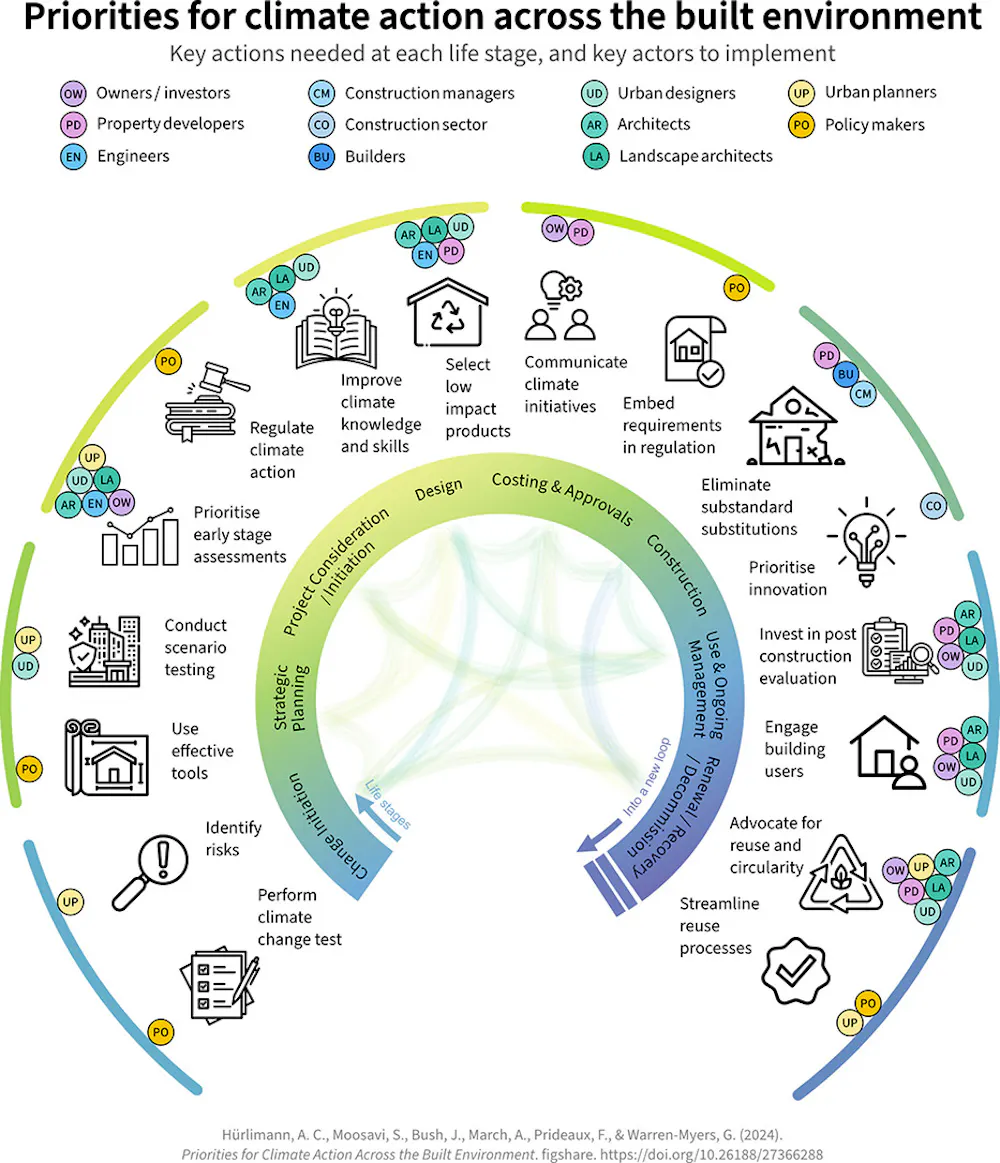
    Our new study identifies 16 priority actions to address climate change in the construction and management of cities.

    Building smarter

    Climate change must be a key consideration when designing, building and managing our cities. The emissions generated need to be minimised and eventually eliminated.

    We must build in locations, and in ways, that reduce climate risks. But policies governing how our cities are designed and constructed don’t achieve this.

    A recent study of three local government areas identified only limited action on adaptation and mitigation. Other research has found few urban development policies include carbon reduction goals that meet international targets.

    The National Housing Accord will see more than one million houses built by 2029. These new homes must address the climate challenge.

    16 areas for priority action

    The priority areas in our new study were informed by interviews with more than 150 stakeholders working in urban planning, architecture, landscape architecture, urban design, sustainability, construction and property.

    Priority areas for minimising damaging emissions generated by cities.
    CC BY

    The actions they identified cover the entire life cycle of the built environment.

    One of the first barriers to overcome is the perceived lack of agency among industry professionals to initiate or demand climate action. They perceive others, such as property owners or clients, to have more influence.

    Climate change risks should be identified in the early stages of planning new developments, backed up by effective tools to make risk identification and action easier:

    There were areas that were identified as being flood prone or risk prone. But there was no strategy to deal with what happens to those areas – An urban planner

    Once specific projects are being considered it is important to prioritise early stage climate assessments, supported by policies which mandate climate action:

    Everyone has good intentions but without big formal legislation around it, everyone’s just sort of making their way in the dark – A construction industry professional

    In the design stage, steps to improve the climate knowledge and skills of the workforce beyond disciplinary boundaries is critical. The selection of low-impact products and materials will also help ensure design is more climate responsive.

    Climate action must be embedded in all stages of design and construction of Australian cities.
    GagliardiPhotography/Shutterstock

    The highest number of hurdles to climate action were found to occur during the costing and approvals stage. Participants spoke of a highly competitive building industry. If climate change initiatives introduced at an earlier stage aren’t required by law, they are likely to be cut.

    unless there’s something in it for them in terms of return on investment, it’s going to be hard to get them to do it, unless we make them – An urban planner

    During the construction phase, product and material substitutions that have detrimental environmental impact should be eliminated. Innovation should be encouraged:

    If you want to push the envelope a little bit in terms of using recycled materials […] that’s a bit of a barrier. To push innovation is difficult – A landscape architect

    Post-construction

    Once construction is complete and buildings and public spaces are being used, it is important to invest in a thorough evaluation process. Building users should be involved to ensure buildings are maintained for optimal climate outcomes:

    [We] tried to achieve the six star rating […] the client has to maintain it [the building] for a year, and that’s when things start to fall off – An architect

    When it comes to area upgrades or building renewals, advocating for reuse and materials circularity is important. But the custom of demolishing and building anew, is hard to shift:

    The reuse of the existing building obviously generates significantly less waste and involves less material. So, design decisions and strategic decisions around using existing buildings is really important – An urban designer

    Working together

    This is a time of significant change in our urban areas.

    We need to make sure climate action is embedded in every stage of decision making. This may mean more efficient use, and reuse, of the existing built stock. This will require an overhaul of policies regarding building retrofits, and a change in mindsets.

    The priority actions to address climate change in cities can be implemented across a range of levels for:

    • individual professionals – pursue development of their climate change skills, including opportunities provided by professional associations

    • professional practices – review internal processes to ensure climate action is mainstreamed across projects, and in company decision making

    • universities teaching built environment professional degrees – embed climate change knowledge, skills, and competencies across the curriculum

    • governments at all levels – review policy settings to mandate mitigation and adaption.

    By addressing these actions, we can collectively work towards achieving our emission reduction targets and making sure our cities minimise climate change risks.

    Anna Hurlimann received funding for the research reported in this article from the Australian Research Council – Discovery Grant DP200101378, with co-chief investigators Georgia Warren-Myers, Alan March, Sareh Moosavi and Judy Bush. She is a member of the Planning Institute of Australia.

    Sareh Moosavi received funding for the research reported in this article from the Australian Research Council – Discovery Grant DP200101378, with co-chief investigators Anna Hurlimann, Georgia Warren-Myers, Alan March, and Judy Bush.

    ref. Cities are heating up the planet – how they can do more to fight climate change – https://theconversation.com/cities-are-heating-up-the-planet-how-they-can-do-more-to-fight-climate-change-259391

    MIL OSI AnalysisEveningReport.nz

  • MIL-OSI Submissions: Gaza: Deadly Israeli-US supply distribution scheme must be dismantled and siege lifted – MSF

    Source: Médecins Sans Frontières (MSF)

    28 June, Gaza: The Israeli-US food distribution scheme in Gaza, launched one month ago, is degrading Palestinians by design, forcing them to choose between starvation or risking their lives for minimal supplies. With over 500 people killed and nearly 4,000 wounded while seeking food, this scheme is slaughter masquerading as humanitarian aid and must be immediately dismantled. Médecins Sans Frontières (MSF) calls on the Israeli authorities and their allies to lift the siege on food, fuel, medical, and humanitarian supplies and to revert to the pre-existing principled humanitarian system, coordinated by the UN.

    This disaster has been orchestrated by the Israeli-US proxy operating under the name Gaza Humanitarian Foundation (GHF). The way supplies are distributed forces thousands of Palestinians, who have been starved by an over 100 day-long Israeli siege, to walk long distances to reach the four distribution sites and fight for scraps of food supplies. These sites hinder women, children, the elderly, and people with disabilities from accessing aid and people are killed and wounded in the chaotic process. Yet each renewed atrocity now happens with barely a shrug, let alone condemnation, from an international community seemingly resigned to its role in allowing and perpetuating a campaign consistent with patterns of genocide. This cannot be allowed to continue.

    “The four distribution sites, all located in areas under the full control of Israeli forces after people had been forcibly displaced from there, are the size of football fields surrounded by watch points, mounds of earth and barbed wire. The fenced entrance gives only one access point in or out,” says Aitor Zabalgogeazkoa, MSF emergency coordinator in Gaza. “GHF workers drop the pallets and the boxes of food and open the fences, allowing thousands in all at once to fight down to the last grain of rice.

    “If people arrive early and approach the checkpoints, they get shot. If they arrive on time, but there is an overflow and they jump over the mounds and the wires, they get shot,” says Zabalgogeazkoa. “If they arrive late, they shouldn’t be there because it is an ‘evacuated zone’, they get shot.”

    Every day, MSF teams see patients who have been killed or wounded trying to get food at one of these sites.

    “A lot of people were getting directly shot at. This is not aid – it’s a death trap,” says Hani Abu Soud, a community member at Al-Mawasi primary healthcare centre. “They were going to kill us one by one.  We were hungry, we were just trying to feed our children. What else can I do?  A bag of lentils costs around 30-40 shekels [€6 – €10]”.

    “We do not have that kind of money. Death has become cheaper than survival.”

    As the distributions have continued, medical teams have noticed a stark increase in the number of patients with gunshot wounds. In the MSF field hospital in Deir Al-Balah the number of patients with gunshot wounds increased by 190 per cent the week of 8 June, compared to the week before. The still barely functioning hospitals in Gaza are devastated; running on minimal supplies of pain relief, anaesthetic and blood. Fully functioning hospitals would struggle to cope with such a high number of trauma patients flooding emergency rooms every day.

    Injured patients seek help at basic healthcare clinics or field hospitals, since larger hospitals better equipped to provide treatment for violent trauma have been damaged by Israel’s attacks on healthcare facilities, with many no longer functioning. The MSF clinic in Al Mawasi, which is not typically equipped to treat trauma patients, has received 423 people wounded from the distribution sites since 7 June.  Ten or more patients with violent injuries arrive from distribution sites each day. These injuries require immediate life-saving treatment, like blood transfusions or surgery, that our medical teams cannot provide in a basic healthcare clinic. Patients are referred to the few remaining hospitals still functioning like Nasser hospital, but with healthcare so scarce, MSF has received reports of people wounded at aid distribution sites dying from their injuries before they can receive treatment.

    With no food in the tent he shared with his family, seventeen-year-old Ashraf went to a distribution site on 23 June. “I told him it was too dangerous. He said he wanted to get something for his sister,” says Hanan, Ashraf’s mother. “Thirty minutes later he called me, crying for help. He had been shot. This ‘aid’ is soaked in blood.”

    Ashraf was being treated at Al Mawasi basic healthcare clinic.

    Aid must not be controlled by a warring party to further its military objectives. The Israeli authorities have used a deliberate tactic of food deprivation against Palestinians in Gaza. They have weaponised food supply by denying it to people, then by limiting it to a trickle, in a complete violation of international humanitarian law. Humanitarian principles exist to enable the facilitation of aid to those who need it most, with dignity. Aid must be delivered at scale, consistent with these principles. The people of Gaza are in vital and immediate need of the re-establishment of a genuine aid system, and a sustained ceasefire, for their very survival.

    MSF is an international, medical, humanitarian organisation that delivers medical care to people in need, regardless of their origin, religion, or political affiliation. MSF has been working in Haiti for over 30 years, offering general healthcare, trauma care, burn wound care, maternity care, and care for survivors of sexual violence. MSF Australia was established in 1995 and is one of 24 international MSF sections committed to delivering medical humanitarian assistance to people in crisis. In 2022, more than 120 project staff from Australia and New Zealand worked with MSF on assignment overseas. MSF delivers medical care based on need alone and operates independently of government, religion or economic influence and irrespective of race, religion or gender. For more information visit msf.org.au  

    MIL OSI – Submitted News

  • MIL-OSI Submissions: Gaza: Deadly Israeli-US supply distribution scheme must be dismantled and siege lifted – MSF

    Source: Médecins Sans Frontières (MSF)

    28 June, Gaza: The Israeli-US food distribution scheme in Gaza, launched one month ago, is degrading Palestinians by design, forcing them to choose between starvation or risking their lives for minimal supplies. With over 500 people killed and nearly 4,000 wounded while seeking food, this scheme is slaughter masquerading as humanitarian aid and must be immediately dismantled. Médecins Sans Frontières (MSF) calls on the Israeli authorities and their allies to lift the siege on food, fuel, medical, and humanitarian supplies and to revert to the pre-existing principled humanitarian system, coordinated by the UN.

    This disaster has been orchestrated by the Israeli-US proxy operating under the name Gaza Humanitarian Foundation (GHF). The way supplies are distributed forces thousands of Palestinians, who have been starved by an over 100 day-long Israeli siege, to walk long distances to reach the four distribution sites and fight for scraps of food supplies. These sites hinder women, children, the elderly, and people with disabilities from accessing aid and people are killed and wounded in the chaotic process. Yet each renewed atrocity now happens with barely a shrug, let alone condemnation, from an international community seemingly resigned to its role in allowing and perpetuating a campaign consistent with patterns of genocide. This cannot be allowed to continue.

    “The four distribution sites, all located in areas under the full control of Israeli forces after people had been forcibly displaced from there, are the size of football fields surrounded by watch points, mounds of earth and barbed wire. The fenced entrance gives only one access point in or out,” says Aitor Zabalgogeazkoa, MSF emergency coordinator in Gaza. “GHF workers drop the pallets and the boxes of food and open the fences, allowing thousands in all at once to fight down to the last grain of rice.

    “If people arrive early and approach the checkpoints, they get shot. If they arrive on time, but there is an overflow and they jump over the mounds and the wires, they get shot,” says Zabalgogeazkoa. “If they arrive late, they shouldn’t be there because it is an ‘evacuated zone’, they get shot.”

    Every day, MSF teams see patients who have been killed or wounded trying to get food at one of these sites.

    “A lot of people were getting directly shot at. This is not aid – it’s a death trap,” says Hani Abu Soud, a community member at Al-Mawasi primary healthcare centre. “They were going to kill us one by one.  We were hungry, we were just trying to feed our children. What else can I do?  A bag of lentils costs around 30-40 shekels [€6 – €10]”.

    “We do not have that kind of money. Death has become cheaper than survival.”

    As the distributions have continued, medical teams have noticed a stark increase in the number of patients with gunshot wounds. In the MSF field hospital in Deir Al-Balah the number of patients with gunshot wounds increased by 190 per cent the week of 8 June, compared to the week before. The still barely functioning hospitals in Gaza are devastated; running on minimal supplies of pain relief, anaesthetic and blood. Fully functioning hospitals would struggle to cope with such a high number of trauma patients flooding emergency rooms every day.

    Injured patients seek help at basic healthcare clinics or field hospitals, since larger hospitals better equipped to provide treatment for violent trauma have been damaged by Israel’s attacks on healthcare facilities, with many no longer functioning. The MSF clinic in Al Mawasi, which is not typically equipped to treat trauma patients, has received 423 people wounded from the distribution sites since 7 June.  Ten or more patients with violent injuries arrive from distribution sites each day. These injuries require immediate life-saving treatment, like blood transfusions or surgery, that our medical teams cannot provide in a basic healthcare clinic. Patients are referred to the few remaining hospitals still functioning like Nasser hospital, but with healthcare so scarce, MSF has received reports of people wounded at aid distribution sites dying from their injuries before they can receive treatment.

    With no food in the tent he shared with his family, seventeen-year-old Ashraf went to a distribution site on 23 June. “I told him it was too dangerous. He said he wanted to get something for his sister,” says Hanan, Ashraf’s mother. “Thirty minutes later he called me, crying for help. He had been shot. This ‘aid’ is soaked in blood.”

    Ashraf was being treated at Al Mawasi basic healthcare clinic.

    Aid must not be controlled by a warring party to further its military objectives. The Israeli authorities have used a deliberate tactic of food deprivation against Palestinians in Gaza. They have weaponised food supply by denying it to people, then by limiting it to a trickle, in a complete violation of international humanitarian law. Humanitarian principles exist to enable the facilitation of aid to those who need it most, with dignity. Aid must be delivered at scale, consistent with these principles. The people of Gaza are in vital and immediate need of the re-establishment of a genuine aid system, and a sustained ceasefire, for their very survival.

    MSF is an international, medical, humanitarian organisation that delivers medical care to people in need, regardless of their origin, religion, or political affiliation. MSF has been working in Haiti for over 30 years, offering general healthcare, trauma care, burn wound care, maternity care, and care for survivors of sexual violence. MSF Australia was established in 1995 and is one of 24 international MSF sections committed to delivering medical humanitarian assistance to people in crisis. In 2022, more than 120 project staff from Australia and New Zealand worked with MSF on assignment overseas. MSF delivers medical care based on need alone and operates independently of government, religion or economic influence and irrespective of race, religion or gender. For more information visit msf.org.au  

    MIL OSI – Submitted News

  • MIL-OSI New Zealand: Crash and court a costly night for driver

    Source: New Zealand Police

    It was pricey night for one dangerous driver who dented his pride and joy and landed himself in court.

    Police in Papakura observed a vehicle travelling at speed on Clevedon Road just before 11pm.

    Counties Manukau South Area Prevention Manager, Inspector Matt Hoyes, says officers signalled for the vehicle to stop.

    “The driver has initially pulled over on Broadway, however, as officers began talking to him about his speed, he has accelerated away along Elliot Street.”

    Inspector Hoyes says staff then located the vehicle crashed into a light pole on the corner of Elliot Street and observed the driver fleeing on foot.

    “Officer have quickly pursued him and taken him into custody without further incident.

    “Unfortunately this man has ended up with a costly repair bill and a trip to court, which could have been prevented if he had made different decisions.”

    A 27-year-old man will appear in Papakura District Court today charged with dangerous driving, failing to remain stopped and driving with excess breath alcohol.

    ENDS.

    Holly McKay/NZ Police

    MIL OSI New Zealand News

  • MIL-OSI New Zealand: Northland Regional Council News – 30 June 2025

    Source: Northland Regional Council

    NOMINATIONS FOR NRC OPEN 04 JULY
    People keen to stand for one of nine places on the Northland Regional Council at this year’s local body elections in October can get their nominations in from Friday 04 July until noon on Friday 01 August 2025.
    Anyone aged 18 and over can stand for election provided they’re a New Zealand citizen, enrolled on the Parliamentary electoral roll and are nominated by two electors whose names appear on the electoral roll within the constituency the candidate is standing for.
    Printed nomination forms and a candidate handbook will be available from 04 July from any regional council office, by phoning (0800) 002 004, from www.nrc.govt.nz or by downloading from esp.electionservices.co.nz/lge2025/NRC
    SECOND FEEDBACK PERIOD ON NAVIGATION SAFETY BYLAW
    Northlanders now have a further chance to have their say on Northland Regional Council’s Navigation Safety Bylaw, which sets the rules for keeping people safe on the water.
    After a first feedback period during May, the council is now running a second feedback period, recognising the need to provide more detail on key proposals and ensure there is sufficient time for people to have their say.
    The provisions in the draft bylaw remain the same, with key proposals including a new requirement to carry two forms of communication on a vessel; amending the requirements for wearing a lifejacket; and removing a clause prohibiting wind-powered board sports in the Ruakākā and Waipū estuaries.
    The feedback period runs until Monday 28 July. More detail can be found at www.nrc.govt.nz/bylawreview

    MIL OSI New Zealand News

  • MIL-OSI New Zealand: Hong Kong: National Security Law analysis shows vast majority unjustly arrested

    Source: Amnesty International


    More than 80% of people convicted under Hong Kong’s National Security Law (NSL) have been wrongly criminalized and should never have been charged in the first place, according to new research by Amnesty International published on the fifth anniversary of the law being enacted.


    The organization’s analysis of 255 individuals targeted under national security legislation in Hong Kong since 30 June 2020 also showed that bail was denied in almost 90% of cases where charges were brought, and that those denied bail were forced to spend an average of 11 months in detention before facing trial.


    “Five years after the enactment of the National Security Law, our alarming findings show that the fears we raised about this law in 2020 have been realized. The Hong Kong government must stop using the pretext of ‘national security’ to punish legitimate expression,” Amnesty International’s China Director Sarah Brooks said.


    “This draconian law, and the other national security legislation it spawned, has corroded key legal safeguards that once formed the foundation for protecting human rights and the rule of law in Hong Kong. The result has been a devastation of Hongkongers’ ability to express themselves without fear of arrest.”


    Amnesty’s briefing paper analyses patterns in arrests, bail decisions and prosecutions under the NSL and other national security legislation. In particular, the research highlights three major concerns: the criminalization of the legitimate exercise of the human right to freedom of expression, the low bail grant rates in these cases, and the de facto long-term incarceration of most accused.


    The analysis found that of the 78 concluded cases under the NSL at least 66 (84.6%) involved legitimate expression that should not have been criminalized according to international standards, with no evidence of violent conduct or incitement.


    When concluded cases under Article 23 and pre-Article 23 “sedition” offences are also counted, at least 108 out of a total of 127 cases (85%) involved similarly legitimate forms of expression which were unjustly prosecuted. These cases fall well short of the high threshold required for criminalization under international standards.


    Meanwhile, according to Amnesty’s data, the courts denied bail in 129 national security cases, or 89% of those in which individuals were charged.


    Among the 129 cases where bail was denied, the average length of detention was 328 days. Fifty-two cases (40.3%) involved detentions lasting one year or more before trial or a guilty plea.


    “In five years, the National Security Law has transformed Hong Kong from a city of tolerance and open debate into a city of repression and self-censorship. Our analysis shows that Hong Kong’s national security framework is not just a flagrant violation of international human rights standards on paper but that authorities misuse it to target opposition voices and foster an environment of fear,” Sarah Brooks said.


    “This research demonstrates that the vast majority of those charged with national security offences have acted entirely within their rights. Meanwhile, prosecutors have continued to bring cases under this flawed national security architecture and appealed the rare acquittals awarded by courts. Other governments should step up and use their influence to urgently press the Hong Kong and Chinese authorities to repeal the law.


    “In the interim, the Hong Kong government should stop applying national security legislation immediately. At the very least they need to reinstate the presumption of bail in favour of release pending trial. No one should be made to languish in jail simply for exercising their right to freedom of expression.”


    Background


    Since the imposition of the NSL on 30 June 2020, the human rights landscape in Hong Kong has deteriorated at an alarming pace. Civil society has been effectively dismantled, while long-standing rights — including the rights to freedom of expression, peaceful assembly and association — have been severely curtailed.


    Amnesty International’s analysis covered the cases of 255 individuals who, between 30 June 2020 and 31 May 2025, were arrested for and/or charged with any offences under the NSL; Part 1 and 2 of the city’s Crimes Ordinance that define the colonial-era offence of “sedition”; and the Article 23 law (also known as the Safeguarding National Security Ordinance), which replaced Part 1 and 2 of the Crimes Ordinance when it entered into force on 23 March 2024.


    Amnesty International sent its briefing to the Hong Kong government, which dismissed the findings as a “distortion of the reality” and said the NSL “has restored the enjoyment of rights and freedoms” in Hong Kong.

    MIL OSI New Zealand News

  • MIL-OSI USA: Myth vs. Fact: The One Big Beautiful Bill

    US Senate News:

    Source: US Whitehouse
    While Democrats spend the day launching desperate, hollow attacks in a last-ditch effort to block President Trump’s One Big Beautiful Bill, the FACTS speak for themselves.
    MYTH: The One Big Beautiful Bill is “just a tax break for billionaires.”FACT: The One Big Beautiful Bill delivers the largest middle- and working-class tax cut in U.S. history. The President’s legislation will put more than $10,000 a year back in the pockets of typical hardworking families. This is the most pro-growth, pro-worker, pro-family legislation ever crafted.
    MYTH: The One Big Beautiful Bill “takes from the poor to give to the rich.”FACT: The lowest-income workers receive the largest percentage tax cuts. The One Big Beautiful Bill delivers the largest tax cut in history for working-and -middle class Americans.
    MYTH: The One Big Beautiful Bill “makes life more unaffordable.”FACT: The bill delivers bigger paychecks, expanding take-home pay by over $10,000 per year for a typical family.
    MYTH: The One Big Beautiful Bill “hurts low-income families.”FACT: The One Big Beautiful Bill is the most pro-family legislation ever crafted. It will deliver bigger paychecks, giving more than a $10,000 boost annually to everyday families. We are also expanding Opportunity Zones, expanding childcare access, increasing the child tax credit, and creating newborn savings accounts.
    MYTH: The One Big Beautiful Bill “is just a handout to corporations.”FACT: This bill drives a Blue-Collar BOOM with tax relief for workers, support for small businesses, and investments in American manufacturing. The One Big Beautiful Bill delivers the largest middle- and working-class tax cut in U.S. history.
    MYTH: The One Big Beautiful Bill “leaves American workers behind.”FACT: This is the most pro-American worker bill in history. The One Big Beautiful Bill boosts pay for millions—and with no tax on tips or overtime, those working hourly and service jobs receive additional tax relief.
    MYTH: The One Big Beautiful Bill “hurts small businesses.”FACT: The One Big Beautiful Bill will make the Trump Tax Cuts permanent, including the small business deduction—helping Main Street grow and hire. Failure to pass this legislation would result in a $4 trillion tax hike.
    MYTH: The One Big Beautiful Bill “kicks American families off Medicaid.”FACT: As the President has said numerous times, there will be no cuts to Medicaid. The One Big Beautiful Bill protects and strengthens Medicaid for those who rely on it—pregnant women, children, seniors, people with disabilities, and low-income families—while eliminating waste, fraud, and abuse. The One Big Beautiful Bill removes illegal aliens, enforces work requirements, and protects Medicaid for the truly vulnerable.
    MYTH: The One Big Beautiful Bill “cuts Medicare.”FACT: Medicare has not been touched in this bill— absolutely nothing in the bill reduces spending on Medicare benefits. This legislation does not make a single cut to welfare programs—it safeguards and protects these programs for all eligible Americans.
    MYTH: The One Big Beautiful Bill “will close rural hospitals.”FACT: Rural hospitals comprise just 7% of all hospital spending on Medicaid, illustrating that they have not benefited from the massive increase in waste, fraud, and abuse under the Biden administration. By strengthening Medicaid, we are making more resources available for vulnerable populations and safety net providers, like rural hospitals. We are expanding rural hospital protection, providing targeted funds for rural care, and giving states flexibility to support local providers.
    MYTH: “People will literally die” from the One Big Beautiful Bill — “and millions will be kicked off their healthcare.”FACT: This is one of the most egregious, deranged attacks from the Left peddling fear over the facts. The One Big Beautiful Bill protects eligible Americans on federal welfare – including Medicaid. By strengthening the integrity of Medicaid by eliminating waste, fraud, and abuse, its resources can be refocused on providing better care for those whom the program was designed to serve: pregnant women, children, people with disabilities, low-income seniors, and other vulnerable low-income families.
    MYTH: The One Big Beautiful Bill “will hurt people with disabilities.”FACT: The One Big Beautiful Bill protects and strengthens Medicaid for Americans with disabilities. Rest assured, those with disabilities receiving Medicaid will receive no loss or change in coverage.
    MYTH: The One Big Beautiful Bill “punishes vulnerable Americans with work requirements to receive their benefits.”FACT: Not true. The 20-hour weekly work requirement applies only to able-bodied adults without young children and promotes dignity, stability, and better health outcomes for families. The One Big Beautiful Bill restores the dignity of work with historically bipartisan work requirements for able-bodied Americans. We are implementing commonsense, Clinton-era work, volunteer, education, or training requirements with broad bipartisan support.
    MYTH: “There’s no fraud in Medicaid — Republicans are just taking coverage away from vulnerable populations.”FACT: In the last 10 years, CMS admitted that improper payments for Medicaid have exceeded HALF A TRILLION dollars. In just the past year, taxpayers spent $56 billion on benefits for able-bodied adults abusing the system—and over a million illegal aliens are receiving free health care on the backs of taxpayers. The One Big Beautiful Bill removes illegal aliens, enacts work requirements for able-bodied adults, and protects Medicaid for the truly vulnerable.
    MYTH: “SNAP work requirements are unnecessary.”FACT: Only 28% of able-bodied adults on SNAP work. The One Big Beautiful Bill promotes work, responsibility, and restores SNAP to serve the truly needy. SNAP enrollment remains high even in a strong economy, including millions of able-bodied adults who could work. In fact, almost three-quarters of able-bodied adults without dependents on SNAP have no earned income. The mission of the program has failed. SNAP was intended to be temporary help for those who encounter tough times—we are strengthening this program to serve those who need it most.
    MYTH: “Illegal aliens don’t get federal benefits.”FACT: Illegals burden taxpayers with billions in costs for free health care and welfare benefits. The One Big Beautiful Bill ends Medicaid and SNAP fraud and ensures these programs serve only eligible Americans.
    MYTH: The One Big Beautiful Bill “doesn’t actually end taxes on Social Security.”FACT: The One Big Beautiful Bill delivers historic tax relief to seniors, with a new tax deduction that, combined with other deductions, ensures the average Social Security beneficiary will pay zero taxes on Social Security.
    MYTH: The One Big Beautiful Bill “increases the deficit.”FACT: The One Big Beautiful Bill reduces deficits by over $2 trillion by increasing economic growth and cutting waste, fraud, and abuse across government programs at an unprecedented rate. This legislation delivers historic levels of mandatory savings. President Trump’s pro-growth economic formula will reduce the deficit, increase wages, deliver American jobs, and drive down the cost of living.
    MYTH: “But the CBO says….”FACT: The Crooked Budget Office has a terrible record with its predictions and hasn’t earned the attention the media gives it. The CBO misreads the economic consequences of not extending the Trump Tax Cuts. The One Big Beautiful Bill delivers real savings that will unleash our economy and prevent the largest tax hike in history, resulting in historic prosperity, while lowering the debt burden.
    MYTH: “There’s too much ‘pork’ in this bill.”FACT: There’s no pork in the bill. Every single provision in the One Big Beautiful Bill is a campaign promise the American people elected President Trump to deliver. The only new spending in the bill is to secure the homeland of the United States and save American sovereignty — which is fully paid for by increased visa fees on foreigners.
    MYTH: “The One Big Beautiful Bill won’t strengthen national security.”FACT: The One Big Beautiful Bill delivers on President Trump’s Peace Through Strength agenda by funding the Golden Dome missile defense system and modernizing our military to prioritize lethality and readiness. It fully equips our war fighters with the resources they need while modernizing and revolutionizing our equipment and technology.
    MYTH: The One Big Beautiful Bill “helps ‘Big Oil’ and locks up U.S. energy resources.”FACT: Quite the opposite. It unleashes American energy, refills the Strategic Petroleum Reserve, and repeals the Green New Scam policies. The One Big Beautiful Bill unleashes clean, American-made energy and will reduce the cost of living for Americans nationwide.
    MYTH: “Manufacturing jobs will still go overseas.”FACT: The One Big Beautiful Bill delivers 100% expensing for new domestic factories, revitalizes Opportunity Zones, and incentivizes companies to keep jobs in America.
    MYTH: The One Big Beautiful Bill “neglects rural America.”FACT: This bill invests in rural communities, expands market access, and delivers historic support to farm families. The One Big Beautiful Bill provides the certainty America’s farm families need to continue operating and producing the affordable, safe, and abundant supply of food, fuel, and fiber that our nation relies on.
    MYTH: “SNAP is being gutted and cutting food stamps for families, causing them to go hungry.”FACT: The One Big Beautiful Bill protects and strengthens SNAP. Right now, almost three-quarters of able-bodied adults without dependents on SNAP have no earned income and the fraud rate is high. The mission of the program has failed: SNAP was intended to be temporary help for those who encounter tough times. Now, it’s become so bloated that it is leaving fewer resources for those who truly need help. We are committed to preserving SNAP for the truly needy.
    MYTH: “Republicans are shutting Democrats out of the legislative process.”FACT: This is not a partisan bill—Democrats shut themselves out by supporting higher taxes, open borders, and giveaways to illegal immigrants. The One Big Beautiful Bill delivers on Republican promises to lower taxes, secure the border, cut spending, and put Americans first.
    MYTH: The One Big Beautiful Bill “border package is not necessary since President Trump has secured the border.”FACT: We must ensure that the invasion we witnessed as a nation under Joe Biden and Kamala Harris never happens again. The One Big Beautiful Bill’s historic investment in our border security ensures we permanently secure our border and protect our homeland by finishing the border wall, hiring 10,000 new ICE officers, and funding efforts to stop the flow of fentanyl.

    MIL OSI USA News

  • MIL-OSI USA: McCaul Hosts Ceremony in Bastrop to Dedicate Post Office in Sergeant Major Billy D. Waugh’s Honor

    Source: United States House of Representatives – Congressman Michael McCaul (10th District of Texas)

    McCaul’s bill to dedicate the post office in honor of Sergeant Waugh became law in 2024

    Bastrop, Texas  Today, U.S. Congressman Michael McCaul (R-Texas) honored a U.S. Army veteran and American military hero, Sergeant Major Billy D. Waugh, at a ceremony to officially dedicate the facility of the United States Postal Service located at 1106 Main Street in Bastrop as the “Sergeant Major Billy D. Waugh Post Office.” McCaul hosted the event in conjunction with the family of Sergeant Waugh and the United States Postal Service.

    “A member of the Greatest Generation, Sergeant Major Billy D. Waugh was a true American hero who dedicated himself to a life of courage, patriotism, and self-sacrifice,” said Rep. McCaul. “I’m amazed and inspired by the longevity of his service, which included time in the Special Forces — where he gained eight purple hearts — the Central Intelligence Agency, and even the United States Postal Service. Throughout his impressive career, he never lost his sense of duty, his patriotism, or his enduring love of freedom. I am proud to officially dedicate the Bastrop Post Office in his honor so all Texans can remember his incredible life of service and pay homage to this great American Hero.”

    McCaul delivers remarks at ceremony

    McCaul with Sergeant Waugh’s family members

    Background:

    During the 118th Congress, Rep. McCaul introduced a bill to designate the United States Postal Service located at 1106 Main Street in Bastrop, Texas, as the “Sergeant Major Billy D Waugh Post Office,” which passed Congress unanimously late last year. 

    Sergeant Major Billy D. Waugh was born December 1929 and raised in Bastrop, Texas. He served his country as an Army paratrooper and Special Forces soldier from 1948 to 1972, including seven years in combat during the Korean and Vietnam wars. He also was part of the first high-altitude, low-opening (HALO) combat parachute assault in military history. 

    For his service, Mr. Waugh received dozens of awards and medals, including eight Purple Hearts for his combat wounds — placing him third on the list of most Purple Hearts ever received. After retirement, he joined the United States Postal Service. Then, he once again served his country as a paramilitary operations officer in the Central Intelligence Agency, where he successfully pursued terrorists including Carlos the Jackal and Osama Bin Laden.

    He eventually returned to his hometown of Bastrop and passed away in April 2023 at the age of 93.

    ###

    MIL OSI USA News

  • MIL-OSI Australia: Major milestone for Canberra’s first light rail bridge

    Source: Australian National Party


    As part of ACT Government’s ‘One Government, One Voice’ program, we are transitioning this website across to our . You can access everything you need through this website while it’s happening.


    Released 18/06/2025

    Construction is set to begin on Canberra’s first light rail bridge, a major milestone in connecting the city to Commonwealth Park and Acton Waterfront.

    The new rail bridge – spanning Parkes Way between the existing Commonwealth Avenue road bridges – has been designed to carry two fully loaded light rail vehicles at once – the equivalent of about 70 cars.

    The new bridge will be a vital connection between the city, Commonwealth Park and the Acton Waterfront, forming a key piece of infrastructure for the future light rail network.

    Bridge piling works for the foundations will begin in late June, paving the way for the installation of massive steel girder frames later in the year, using an 800-tonne crane stationed in the Parkes Way median – a significant engineering feat.

    To ensure piling works can be undertaken safely, Parkes Way will be closed under Commonwealth Avenue in both directions between Coranderrk Street and the Glenloch Interchange from 8pm on Friday 27 June until 5am on Monday 30 June, and potentially from 8pm on Friday 4 July until 5am on Monday 7 July.

    Traffic controls and signage will be put in place to safely direct motorists along alternative routes.

    Eastbound traffic will be directed along either Caswell Drive or Lady Denman Drive, while westbound traffic will be diverted across Commonwealth Avenue.

    Works have been scheduled to take place over weekends to minimise the impact to Canberra’s road network. Public transport may experience some delays during these works.

    Additional road closures will be required in the coming months as construction continues on this vital asset.

    The community will be notified in advance about any potential impacts and traffic changes.

    We apologise for any inconvenience and thank you for your patience and understanding.

    More details on road changes and other impacts relating to the construction of light rail are available on the online construction impacts map.

    To view the map and stay up to date visit https://www.builtforcbr.act.gov.au/travel-impacts.

    – Statement ends –

    Infrastructure Canberra | Media Releases

    «ACT Government Media Releases | «Directorate Media Releases

    MIL OSI News

  • MIL-OSI New Zealand: Rare slab hut refurbishment keeps traditional ways alive

    Source: NZ Department of Conservation

    Date:  30 June 2025

    The historic Slaty Creek Hut, in the Grey Valley, was originally built as a winter project in 1952 by deer cullers. The hut was built with timber milled with hand tools using logs from the beech forest surrounding the site. It’s now used by recreational hunters, trampers and climbers.

    Slab huts are a surviving form of the slab houses which European settlers built in 19th century New Zealand to accommodate themselves in a practical and cost-effective way, using a material found readily in many areas – trees.

    Before the introduction of water and steam powered sawmills, trees were dissembled by splitting, sawing or hewing, and it is these techniques that were carried on into the 20th century in building slab huts for deer cullers, musterers and gold fossickers in rural areas of New Zealand.

    Because of the impermanence of wood due to rot, and that slab houses were only seen by settlers as temporary housing until something more permanent could be built when resources allowed, very few slab houses or buildings remain, making slab huts like Slaty Creek Hut a real link to the past. There are 12 slab huts on public conservation land in the South Island.

    Because so few people still have the skills to hew timber from logs with hand tools, maintaining historic huts like Slaty Creek is becoming more difficult -which is why rangers spent time learning about the techniques.

    The rangers spent a day breaking down beech logs and hewing these into hand shaped timber, which was used to replace boards and framing on Slaty Creek Hut. While the rangers were at Slaty Creek they also replaced the hearth of the fire, installed a new sub floor structure, dug drainage channels around the hut and gave it a good spruce up.

    Ranger Casey Rhodes, who has been on the team restoring the hut says, “We went in six months ago and scoped it out and worked out which boards needed to be replaced and made a list, so we’re only replacing the minimum to try and keep as much heritage factor as we can”.

    Mike Gillies, a Senior Heritage Advisor who is sharing his skills in these historic building methods, says it’s important to maintain traditions of how huts and structures were built.

    “We could use modern methods and materials on the hut, but you pretty soon lose authenticity, whereas doing it using the same tools and techniques ensures that craft and those traditions stay alive. So the guys are using axes and draw knifes and wedges and mauls, the same way people have been building for hundreds of years.

    “It’s the best feeling in the world, compared to a modern building site where there are lots of power tools and you are working with treated timber. It’s very quiet, all you can hear are the axes and adzes hewing. It’s a real privilege to be able to continue this tradition and this craft that’s been passed down for a really long time.”

    Background information

    Slaty Creek Hut is a backcountry hut and there is no formed track leading to it. Anyone wanting to visit should be experienced and well equipped, with suitable route finding and navigational skills.

    The hut is on the Amuri Pass tramping route, an advanced multi-day trip which follows a historic route between the West Coast and Canterbury which was once used to move stock.

    Contact

    For media enquiries contact:

    Email: media@doc.govt.nz

    MIL OSI New Zealand News

  • MIL-OSI New Zealand: Serious crash, Cambridge Road, Waipa district

    Source: New Zealand Police

    Emergency services are at the scene of a crash that has blocked Cambridge Road in Waipa district.

    The crash involves a car and a truck, and was reported about 11.25am.

    One person is reported to be injured.

    Cambridge Road is closed between Storey Road and Cox Road and motorists should expect delays while traffic management is arranged.

    ENDS

    Issued by the Police Media Centre

    MIL OSI New Zealand News

  • MIL-OSI United Kingdom: Island resilience fund opens

    Source: Scottish Government

    £4.4 million targeted support for businesses.

    A funding package developed to support island businesses affected by ferry disruption is now ready to accept applications.

    Businesses from eligible sectors on South Uist, Colonsay, North Uist, Eriskay, Benbecula, Berneray, Grimsay and Arran can apply.

    Eligible sectors include those that rely on tourism and those that are engaged in the manufacture or movement of perishable goods, such as seafood.

    £4.4 million has been allocated to the Islands Business Resilience Fund (IBRF) which was established to help address issues, such as travel disruption, that can have a disproportionate impact on people and businesses living, and operating on Scotland’s islands.

    Highlands and Islands Enterprise will manage the IBRF on behalf of the Scottish Government. Applications will be accepted from 2 July until 12 noon 1 September 2025 with decisions and payments expected by 31 October 2025.

    Funding awards will be based on demand and the scale size of organisations that apply for support but awards are expected to range between £3,000 and £35,000

    Islands Secretary Mairi Gougeon said:

    “We know that Scotland’s island communities face distinct challenges, not least in terms of their economic and social resilience. People and businesses require ferry services running reliably and frequently to support their livelihoods.

    “We worked with Highlands and Islands Enterprise to refine the eligibility criteria and identify how this money can make a real difference to the businesses who need it most.

    “Reliable and regular ferry services are key to this connectivity for people and businesses and we know that the current situation of delays and ongoing maintenance to some vessels has created real difficulties for some. We are determined to do everything we can to support islands, their local businesses and employers through these challenging times.”

    Rachel Hunter, HIE’s director of enterprise and community support, said:

    “Island businesses and social enterprises make an important contribution to local economies and provide vital rural employment that helps sustain many communities. Those operating in tourism and production or movement of perishable foods are particularly vulnerable to disruption such as we’ve seen in recent years.

    “This fund is about strengthening the resilience of those organisations operating in the sectors and islands most affected. Our focus will be assessing applications promptly so that funding can be awarded as soon as possible after the closing date.”

    Background

    The application form and guidance will be available on the Highlands and Islands Enterprise website from 12 noon on 2 July.

    Highlands and Islands Enterprise carried out detailed analysis of information and statistics provided by Transport Scotland and CalMac relating to ferry disruption.

    The islands of South Uist, Colonsay, North Uist, Eriskay, Benbecula, Berneray, Grimsay and Arran were chosen as eligible for the Islands Business Resilience Fund as they each had more than 15% ferry disruption over the last three seasons. The average cancellations of ferry services across the Calmac network is during that time has been around 7%. 

    MIL OSI United Kingdom

  • MIL-OSI Australia: Horses lead the way in helping children heal from trauma

    Source:

    30 June 2025

    A new Australian study is shining a spotlight on the healing power of horses, revealing that equine-assisted therapy could help address the growing mental health crisis among children.

    As childhood mental illness rates spiral, compounded by lengthy waiting times for counsellors and the limitations of many conventional treatments, some social workers are turning to horses for the answers.

    University of South Australia researchers have captured the lived experiences of 10 social workers and mental health practitioners delivering equine-assisted interventions (EAI) to children. Their findings are published in the Journal of Social Work Practice.

    EAI is a type of on-ground therapy involving horses, offered by qualified health practitioners in conjunction with highly-skilled equine practitioners.

    The evidence in its favour is compelling, with practitioners describing how a child’s emotional world can be transformed through working with horses in a natural setting.

    UniSA Social Work graduate Morgyn Stacy, who led the study as part of her Honours project, says that many children don’t respond to sitting in a room with a therapist or clinician, which can be intimidating.

    “But give them the space to be outside, to connect with a horse, and something powerful happens. They begin to feel safe, calm, and ready to open up,” Morgyn says.

    The research shows that horses are highly sensitive to human emotions and body language, allowing them to mirror and respond to a child’s emotional state. They offer a natural, non-judgemental environment, helping to build trust and emotional safety.

    One practitioner described the experience as “being seen through the eyes of a horse,” a moment of emotional connection that can be life-changing.

    And it’s not just the horses that help. The natural, open-air setting – often in paddocks surrounded by trees and wildlife – helps children feel relaxed and grounded.

    Practitioners spoke of using sensory-rich activities like walking barefoot in sand, observing animal tracks, or simply standing quietly with a horse to promote mindfulness and connection.

    “The benefits go beyond mental health,” Morgyn says. “Children often gain confidence, improve communication skills, and build stronger emotional resilience.”

    Even children who were initially afraid of horses found strength in overcoming their fears, with therapists carefully matching each child to the right animal.

    Senior UniSA researcher and qualified social worker, Dr Fatin Shabbar, says equine-assisted therapy is particularly effective for children who have experienced trauma, including those in the child protection system.

    “Practitioners in the study described deeply moving examples of children bonding with horses in ways that sparked emotional breakthroughs where other therapies had failed,” Dr Shabbar says.

    But while this approach is gaining popularity, it’s not yet widely accessible. Sessions can be expensive due to the cost of caring for horses and maintaining rural properties. Unless families receive funding from bodies such as the NDIS and child protection agencies, many are forced to pay out of pocket, or miss out altogether.

    “Another concern is the lack of regulation in Australia,” Dr Shabbar says. “Without clear guidelines, unqualified practitioners may offer equine-assisted services without appropriate training, which puts both children and the animals at risk.”

    And those practitioners who are highly qualified still face an uphill battle to gain recognition of equine-assisted therapy as an evidence-based practice.”

    The researchers say the findings are a strong call to action for professional bodies like the Australian Association of Social Workers (AASW) to provide clearer guidance and ethical standards for working with animals in therapy.

    “This research shows that equine-assisted therapy can be a deeply healing experience. But for it to reach more children, we need formal recognition, ethical guidelines and proper funding.”

    Healing in relationships, the power of equine-assisted mental health interventions” is published in the Journal of Social Work Practice. 10.1080/02650533.2025.2495741

    …………………………………………………………………………………………………………………………

    Media contact: Candy Gibson M: +61 434 605 142 E: candy.gibson@unisa.edu.au

    MIL OSI News

  • MIL-OSI USA: Statement from Senator Thom Tillis

    US Senate News:

    Source: United States Senator for North Carolina Thom Tillis
    WASHINGTON, D.C. – Today, North Carolina U.S. Senator Thom Tillis issued the following statement:
    “It has been a blessing to go on a journey from living in a trailer park and making minimum wage as a young man to having the honor of serving as U.S. Senator for North Carolina. 
    “I am proud of my career in public service, including hard-fought victories like passing historic tax reform as North Carolina Speaker, and working in the Senate to help pass the Tax Cuts and Jobs Act and confirm three conservative Supreme Court justices and counting.  
    “What I’m most proud of are the bipartisan victories: passing the first-in-the-nation eugenics compensation as Speaker, and working across the aisle in the Senate to pass the largest investment in mental health in American history, passing the Respect for Marriage Act and monumental infrastructure investments, and reestablishing the Senate NATO Observer Group. Sometimes those bipartisan initiatives got me into trouble with my own party, but I wouldn’t have changed a single one.  
    “In Washington over the last few years, it’s become increasingly evident that leaders who are willing to embrace bipartisanship, compromise, and demonstrate independent thinking are becoming an endangered species.  
    “Democrats recently lost two such leaders who were dedicated to making the Senate more of a functional and productive legislative body. They got things done. But they were shunned after they courageously refused to cave to their party bosses to nuke the filibuster for the sake of political expediency. They ultimately retired and their presence in the Senate chamber has been sorely missed every day since. 
    “It underscores the greatest form of hypocrisy in American politics. When people see independent thinking on the other side, they cheer. But when those very same people see independent thinking coming from their side, they scorn, ostracize, and even censure them. 
    “Too many elected officials are motivated by pure raw politics who really don’t give a damn about the people they promised to represent on the campaign trail. After they get elected, they don’t bother to do the hard work to research the policies they seek to implement and understand the consequences those policies could have on that young adult living in a trailer park, struggling to make ends meet. 
    “As many of my colleagues have noticed over the last year, and at times even joked about, I haven’t exactly been excited about running for another term. That is true since the choice is between spending another six years navigating the political theatre and partisan gridlock in Washington or spending that time with the love of my life Susan, our two children, three beautiful grandchildren, and the rest of our extended family back home. It’s not a hard choice, and I will not be seeking re-election. 
    “I am beyond grateful for the friends I’ve made over the years in North Carolina and our nation’s capital, as well as my amazing staff who are among the very best the Senate has to offer.  
    “I still look forward to continuing to serve North Carolina over the next 18 months. I look forward to solely focusing on producing meaningful results without the distraction of raising money or campaigning for another election. I look forward to having the pure freedom to call the balls and strikes as I see fit and representing the great people of North Carolina to the best of my ability.” 

    MIL OSI USA News

  • MIL-OSI USA: Congressman Jonathan L. Jackson Reintroduces Bipartisan Bill, The Marshall “Major” Taylor Congressional Gold Medal Act

    Source: United States House of Representatives – Representative Jonathan Jackson – Illinois (1st District)

    FOR IMMEDIATE RELEASE

    WASHINGTON, D.C. — U.S. Representatives Jonathan L. Jackson (D-IL-01) and Jim Baird (R-IN-04) led 43 of their colleagues in reintroducing the bipartisan Marshall “Major” Taylor Congressional Gold Medal Act. This legislation would posthumously award a Congressional Gold Medal to Marshall Walter “Major” Taylor — America’s first Black sports star, recognizing his significance to the nation as a trailblazing athlete. 

    Taylor managed to become the first African American world champion in any sport and earned the title of “world’s fastest man” despite the extraordinary challenges of the Jim Crow era. He endured attempts by white promoters in both the North and South to exclude him from races. White riders, too, subjected Taylor to curses, insults, and even physical harm during competitions. Despite these adversities, Taylor’s exceptional talent and tenacity turned him into a sensation, drawing tens of thousands at races across the United States, Europe, and Australia.

    “It is without question that Marshall ‘Major’ Taylor was a man before his time, a stellar athlete, a leader in the field of cycling, and a trailblazer,” said Rep. Jackson. “I believe it is fitting that Congress award the ‘world’s fastest man’ one of our nation’s most prestigious honors.”

    “Even when compared to today’s athletes, Marshall ‘Major’ Taylor is among the greatest cyclists of all time,” said Rep. Baird. “His accomplishments are especially impressive considering the challenges he faced on his climb to cycling greatness. Marshall Taylor is one of the greatest athletes in Indiana history, and I can think of no one better suited to receive the Congressional Gold Medal.”

    “Marshall W. ‘Major’ Taylor challenged both the odds and the adversity of his time with dignity and determination, and he went on to ultimately triumph,” said Karen Brown Donovan, the great-granddaughter of Major Taylor. “The awarding of a posthumous Congressional Gold Medal would be a significant achievement towards honoring his life and legacy.”

    Supporting Individuals and Groups

    119th Congress

    Co-lead: Jim Baird (R-IN-04)

    Original Cosponsors (44 total): Shontel Brown (D-OH-11), LaMonica McIver (D-NJ-10), Bonnie Watson Coleman (D-NJ-12), Raja Krishnamoorthi (D-IL-08), Stacey Plaskett (D-VI-AL), Marc Veasey (D-TX-33), Kweisi Mfume (D-MD-07), David Scott (D-GA-13), Sanford Bishop (D-GA-02),  Delia Ramirez (D-IL-03), Frederica Wilson (D-FL-24), Sharice Davis (D-KS-03),  Jan Schakowsky (D-IL-09),  Robin Kelly (D-IL-02), Maxwell Frost (D-FL-10), Hank Johnson (D-GA-04),  Eleanor Holmes Norton (D-DC),  Mikie Sherrill (D-NJ-11), Gwen Moore (D-WI-04), Debbie Dingell (D-MI-06), Maxine Waters (D-CA-43), Sean Casten (D-IL-06), Danny Davis (D-IL-07),  Rashida Tlaib (D-MI-12),  Shri Thanedar (D-MI-13), Cleo Fields (D-LA-06),  Jim McGovern (D-MA-02), Andre Carson (D-IN-07), Jasmine Crockett (D-TX-30), Ro Khanna (D-CA-17), John Garamendi (D-CA-08), Ayanna Pressley (D-MA-07), Ted Lieu (D-CA-36), Becca Balint (D-VT-AL), Timothy Kennedy (D-NY-26), Nanette Barragan (D-CA-44), Troy Carter (D-LA-02),  Terri Sewell (D-AL-07), Brad Sherman (D-CA-32), Robert Garcia (D-CA-42), Dina Titus (D-NV-01), Steven Horsford (D-NV-04), Shomari Figures (D-AL-02).

    Supporting Organizations: Washington Area Bicyclist Association, The League of American Bicyclists, Major Taylor Association, Bike to the Beach, and Black Girls Do Bike, Inc.

    118th Congress

    Co-lead: Jim Baird (R-IN-04)

    Original Cosponsors (32 total): Danny Davis (D-IL-07), Robin Kelly (D-IL-02), André Carson (D-IN-07), Henry “Hank” Johnson (D-GA-04), Barbara Lee (D-CA-12), Eleanor Holmes-Norton (D-DC), Janice Schakowsky (D-IL-09), Mike Quigley (D-IL-05), Earl Blumenauer (D-WA-03), James McGovern (D-MA-02), David Scott (D-GA-13), Gwen Moore (D-WI-04), Sheila Jackson-Lee (D-TX-18), Mike Thompson (D-CA-04), Jasmine Crockett (D-TX-30), Raul Grijalva (D-AZ-07), Alma Adams (D-NC-12), Al Green (D-TX-09), Rashida Tlaib (D-MI-12), Raja Krishnamoorthi (D-IL-08), Sheila Cherfilus-McCormick (D-FL-20), Chuy Garcia (D-IL-04), David Trone (D-MD-06), Ann Kuster (D-NH-02), John Duarte (R-CA-13), Frederica Wilson (D-FL-24), Tony Gonzales (R-TX-23), Debbie Dingell (D-MI-06), Ted Lieu (D-CA-36), Maxwell Frost (D-FL-10), Joe Wilson (R-SC-02). 

    Supporting Organizations: Bronzeville Trail Task Force, Inc., Major Taylor Association, Washington Area Bicyclist Association, League of American Bicyclists, ADD Impact Network & Bike to the Beach, and Black Girls Do Bike, Inc. 

    About Major Taylor

    Taylor, the son of a veteran who fought in the Civil War, was born in 1878. Despite racial tension, Taylor was educated and viewed as an adopted son by an affluent white family from Indianapolis, Indiana, who also employed his father, Gilbert Taylor. Due to his relationship with the family, Taylor received gifts, including his first bicycle. Upon receiving the bicycle, Taylor displayed natural talent. 

    Taylor received the nickname “Major” as a child while performing bicycle tricks outside of his workplace at Hay & Willits Manufacturing, Indiana Bicycle Co., in Indianapolis. His employer was so impressed with his abilities that the company enrolled him in his first race, which he won at the age of eleven. Taylor moved to Worcester, Massachusetts, with his employer, mentor, and racing manager, Louis D. “Birdie” Munger, in 1895, because Munger was forced out of his Indianapolis-based firm due to his mentorship of Taylor. 

    In 1896, at the age of eighteen, Taylor received a professional racing license from the League of American Wheelmen, despite the league’s 1894 “white only” rule for amateur membership. This membership led to his eventual professional debut.  

    Later that year, Taylor gained notoriety in his first professional contest by competing in the “Six Day Race” at Madison Square Garden in New York City. This race was considered a test of endurance, where cyclists would test both their mental and physical ability in front of a packed house at the Garden. At the conclusion of day six, Taylor finished eighth out of twenty-six and cycled roughly 1,732 miles. 

    In 1899, Taylor would win the world one-mile sprint championship in Montréal, becoming the first Black American and the second Black athlete to win a world title. Taylor would go on to set seven cycling records and become the first Black world champion, which led to his being considered the first international superstar. Taylor would even revolutionize the sport by creating an innovative adjustable handlebar stem, which to date is called the “Major Taylor Stem.”

    While experiencing racial prejudice throughout his career, Taylor became one of the first Black athletes to secure corporate sponsorships. He represented bicycle brands such as Iver Johnson, Sager, Stearns, and Orient, eventually becoming one of the wealthiest Black men in America. Due to his devout commitment to his faith, Taylor refused to race on Sundays, which led to him turning down a significant number of lucrative offers to race in Europe. However, once he achieved international superstardom, Taylor was able to negotiate “no Sundays” provisions in his European racing contracts. 

    Taylor retired from racing in 1910 and started many business ventures. In 1928, he published his autobiography “The Fastest Bicycle Rider in the World” with the intent of impacting justice, equal rights, and the ‘square deal’ for African Americans in sports. 

    About the Congressional Gold Medal

    Since the late 1700s, Congress has expressed public gratitude to individuals and groups by awarding medals and other similar decorations. The Continental Congress awarded the first Congressional Gold Medals. Since that time, Congress has awarded gold medals to express public gratitude for distinguished contributions, dramatize the virtues of patriotism, and perpetuate the remembrance of great events. Two-thirds of both the House and Senate must cosponsor the legislation to advance it.

    MIL OSI USA News

  • MIL-OSI USA: Congressman Jonathan L. Jackson on the Second Anniversary of the Supreme Court’s Decision in Students for Fair Admissions

    Source: United States House of Representatives – Representative Jonathan Jackson – Illinois (1st District)

    FOR IMMEDIATE RELEASE

    WASHINGTON, D.C. – Congressman Jonathan L. Jackson issued the following statement on the second anniversary of the Supreme Court’s decision in Students for Fair Admissions, Inc. v. President and Fellows of Harvard College and Students for Fair Admissions, Inc. v. University of North Carolina, which struck down the use of race in college admissions and reversed decades of precedent supporting affirmative action:

    “Two years ago today, the Supreme Court turned its back on a long-standing commitment to diversity and equal opportunity in higher education. The decision to eliminate affirmative action was a regressive step that erased hard-won progress in the fight for educational equity.

    Affirmative action was never about giving anyone an unfair advantage; it was about acknowledging the barriers students of color face and working to level the playing field. It reflects the teachings of Reverend Martin Luther King, Jr., serving to right the scales of justice. By banning even the consideration of race as one of many factors in admissions, the Court ignored the reality of systemic inequality that continues to shape educational access and outcomes.

    This ruling has already had a chilling effect. Data shows a sharp decline in Black, Latino, and Native student admissions at top universities. Without intentional efforts to foster inclusion, we risk resegregating our campuses and narrowing the pipeline of future leaders from historically underrepresented communities.

    I remain committed to ensuring students of all races and backgrounds have a fair shot at opportunity. Congress must explore legislative avenues to promote equity, including increased support for HBCUs, targeted outreach, and race-conscious strategies that comply with the Court’s ruling. We must not let this decision be the final word on diversity in higher education.”

    Since the Supreme Court’s June 2023 ruling, data from 59 selective colleges show that the average share of Black freshmen dropped from 7% to 6%, while Hispanic enrollment fell from roughly 14% to 13%—the largest one-year declines for these groups since 2010. Asian and white student proportions remained largely steady, and the percentage of students not reporting race doubled from 2% to 4%. 

    In response to growing attacks on inclusive values, Congressman Jackson co-founded the Congressional Diversity, Equity, and Inclusion (DEI) Caucus to protect workers’ rights, defend inclusive policies, and raise awareness among lawmakers about the urgent need to embrace diversity across every sector of society. Through the DEI Caucus and ongoing collaboration with colleagues, community leaders, and students, he continues to address the lasting impact of the Supreme Court’s decision and to advance equitable, inclusive policies throughout the education system.

    ###

    MIL OSI USA News

  • MIL-OSI Australia: Does your business pay contractors?

    Source: New places to play in Gungahlin

    If your business pays contractors to deliver any of these services on your behalf, you may need to lodge a Taxable payments annual report (TPAR) online by 28 August:

    • building and construction
    • cleaning
    • courier and road freight
    • information technology (IT)
    • security, investigation or surveillance.

    TPAR help us keep things fair for all businesses by making sure contractors report all their income.

    On your TPAR, you need to record the:

    • contractor’s name, address and ABN
    • total amount you paid them for the previous financial year – including any GST and cash payments.

    You can find these details on your contractor’s invoice. It’s the same information you use to claim income tax deductions through your tax return, and GST credits through your business activity statement.

    Lodging your TPAR online is quick and easy using SBR-enabled softwareExternal Link or through Online services for business. Your registered tax professional can also lodge on your behalf.

    Penalties may apply for overdue TPAR. We’ll no longer be accepting paper lodgments after 28 August 2025, so it’s important to make sure you’re set up for online lodgment.

    Need help?

    For more information on lodging your TPAR, visit ato.gov.au/TPAR or speak to your registered tax professional. You can also watch our Essentials to strengthen your small business TPAR courseExternal Link to help you understand your TPAR obligations.

    Keep up to date

    We’ve set up tailored communication channels for small businesses. They will keep you updated on important information and changes.

    Read more articles in our Small business newsroom.

    Subscribe to our free to our monthly Small business email newsletterExternal Link.

    Get email notifications about new and updated information on our website. You can choose to receive updates that matter to you. Select the ‘Business and organisations’ category. This way, your subscription will get notifications for more Small business newsroom articles like this one.

    MIL OSI News

  • MIL-OSI USA: SBA Opened Business Recovery Centers in Tennessee to Assist Small Businesses, Private Nonprofits and Residents Affected by Adverse Weather

    Source: United States Small Business Administration

    ATLANTA – The U.S. Small Business Administration (SBA) opened Business Recovery Centers (BRCs) in Davidson and McNairy Counties to assist small businesses, private nonprofits and residents affected by severe storms, straight-line winds, tornadoes and flooding occurring on April 2-24, 2025.

    SBA customer service representatives will be on hand at the BRCs to answer questions about SBA’s disaster loan program, explain the application process and help individuals complete their application. Walk-ins are accepted, but you can schedule an in-person appointment in advance at appointment.sba.gov. The BRCs hours of operation are listed below.

    Business Recovery Center (BRC)  

    Davidson County  

    SBA District Office, Nashville

    2 International Plaza  

    Nashville, TN 37217

    Hours:    Monday – Sunday, 8 a.m. to 6 p.m.  

     Temporary Closed:   Friday, July, 4th  

    in observance of 4th of July Holiday  

    Business Recovery Center (BRC)  

    McNairy County  

     The Latta Theatre

    205 W Court Ave.  

    Selmer, TN 38375

    Hours:   Monday – Sunday, 8 a.m. to 6 p.m.  

     Temporary Closed:   Friday, July, 4th  

    in observance of 4th of July Holiday  

    “SBA’s Business Recovery Centers have consistently proven their value to business owners following a disaster,” said Chris Stallings, associate administrator of the Office of Disaster Recovery and Resilience at the SBA. “Business owners can visit these centers to meet face-to-face with specialists who will guide them through the disaster loan application process and connect them with resources to support their recovery.”

    The SBA’s Economic Injury Disaster Loan (EIDL) program is available to small businesses, small agricultural cooperatives and private nonprofit (PNP) organizations with financial losses directly related to the disaster. The SBA is unable to provide disaster loans to agricultural producers, farmers, or ranchers, except for small aquaculture enterprises.

    EIDLs are available for working capital needs caused by the disaster and are available even if the business or PNP did not suffer any physical damage. The loans may be used to pay fixed debts, payroll, accounts payable, and other bills not paid due to the disaster.

    Businesses and nonprofits are eligible to apply for business physical disaster loans and may borrow up to $2 million to repair or replace disaster-damaged or destroyed real estate, machinery and equipment, inventory, and other business assets.

    Homeowners and renters are eligible to apply for home and personal property loans and may borrow up to $100,000 to replace or repair personal property, such as clothing, furniture, cars, and appliances. Homeowners may apply for up to $500,000 to replace or repair their primary residence.

    Applicants may also be eligible for a loan increase of up to 20% of their physical damage, as verified by the SBA, for mitigation purposes. Eligible mitigation improvements include strengthening structures to protect against high wind damage, upgrading to wind rated garage doors, and installing a safe room or storm shelter to help protect property and occupants from future damage.

    Interest rates are as low as 4% for small businesses, 3.625% for PNPs, and 2.75% for homeowners and renters, with terms up to 30 years. Interest does not begin to accrue, and payments are not due until 12 months from the date of the first loan disbursement. The SBA sets loan amounts and terms based on each applicant’s financial condition.

    Disaster survivors should not wait to settle with their insurance company before applying for a disaster loan. If a survivor does not know how much of their loss will be covered by insurance or other sources, SBA can make a low-interest disaster loan for the total loss up to its loan limits, provided the borrower agrees to use insurance proceeds to reduce or repay the loan.

    With the changes to FEMA’s Sequence of Delivery, survivors are now encouraged to simultaneously apply for FEMA grants and the SBA low-interest disaster loan assistance to fully recover.  FEMA grants are intended to cover necessary expenses and serious needs not paid by insurance or other sources. The SBA disaster loan program is designed for your long-term recovery, to make you whole and get you back to your pre-disaster condition.

    To apply online, visit sba.gov/disaster. Applicants may also call SBA’s Customer Service Center at (800) 659-2955 or email disastercustomerservice@sba.gov for more information on SBA disaster assistance. For people who are deaf, hard of hearing, or have a speech disability, please dial 7-1-1 to access telecommunications relay services.

    The filing deadline to return applications for physical property damage is Aug. 19, 2025. The deadline to return economic injury applications is March 19, 2026.

    ###

    About the U.S. Small Business Administration

    The U.S. Small Business Administration helps power the American dream of business ownership. As the only go-to resource and voice for small businesses backed by the strength of the federal government, the SBA empowers entrepreneurs and small business owners with the resources and support they need to start, grow or expand their businesses, or recover from a declared disaster. It delivers services through an extensive network of SBA field offices and partnerships with public and private organizations. To learn more, visit www.sba.gov. 

    MIL OSI USA News

  • MIL-OSI USA: Cantwell, Red State Leaders Warn Entire Communities Will Suffer if Residents Lose Health Insurance Due to Medicaid Cuts

    US Senate News:

    Source: United States Senator for Washington Maria Cantwell
    06.29.25
    Cantwell, Red State Leaders Warn Entire Communities Will Suffer if Residents Lose Health Insurance Due to Medicaid Cuts
    Misguided legislation would leave 16 million Americans without health insurance; Officials on the ground in MO, UT, and NC say fewer federal resources means more uninsured Americans, cuts in services, and even hospital closures – with states & counties left to pick up the slack
    WASHINGTON, D.C. – Today, U.S. Senator Maria Cantwell (D-WA), ranking member of the Senate Committee on Commerce, Science, and Transportation and senior member of the Senate Finance Committee, joined local leaders from red states for a virtual press conference to warn that cutting 16 million Americans off of health insurance will put a dramatic strain on the budgets and health of their communities.
    “Policies in this legislation hamper the abilities for states to fund their Medicaid programs,” said Sen. Cantwell. “To make up for lost federal dollars, state governments will have to consider cutting reimbursements to providers, cutting types of services, cutting people from Medicaid rolls, or raising everyone’s taxes. All these decisions lead to poor health outcomes. They increase the cost for taxpayers and strain our healthcare system.”
    “We have a dramatic shortage of mental health beds in our state, and our jails have come become the largest repository for individuals,” said Steve Hobbs, Missouri Association of Counties Executive Director and former Missouri State Representative (R-21), who called into the virtual presser from inside a skid steer at his farm. “Any changes to the premium tax would have a huge impact on our rural hospitals — all of our hospitals, our nursing homes, and so we’re really concerned about those changes as well.”
    “No one knows exactly where the shrapnel will fall, but it will be a very large change to our state budget and the services that we can provide. So I’m really hoping we can find some other, better way forward,” said Utah State Representative Ray Ward (R-19).
    In total, 16 million Americans – including over 300,000 Washingtonians –  will lose the health care coverage they need to get regular check-ups, behavioral health care, family planning services, long-term care, urgent care, and more if the pending reconciliation bill passes the U.S. Senate and is signed into law. Those living in rural areas – which have a higher proportion of residents who rely on Medicaid for health insurance coverage, and where smaller hospitals operate on slimmer margins – would be hit hardest.
    People without health insurance tend to wait until their health problem is an emergency before seeking care in local hospitals. This leads to more crowded emergency rooms for everyone. And hospitals must factor the uncompensated cost of additional uninsured patients into already strained finances – finances which are especially strained at rural hospitals.
    The additional stress and costs to the system will be shared by everyone as premiums rise, hospitals close or cut services, and localities increase taxes to keep up with greater demand for first responders and law enforcement.
    The Congressional Budget Office (CBO) published its updated analysis, available here, after the House of Representatives narrowly passed their budget reconciliation bill with over $800 billion in cuts and significant changes to Medicaid. A Joint Economic Committee (JEC) fact sheet, available here, provides updated estimates for all 50 states and D.C. of the estimated number of people losing their health insurance. The JEC data broken down by Congressional District is available here.
    Sen. Cantwell was joined at today’s virtual press conference by:
    Steve Hobbs, Missouri Association of Counties Executive Director and former Missouri State Representative [link to footage]
    Ray Ward, Utah State Representative (R-19) [link to footage]
    Kevin Leonard, North Carolina Association of County Commissioners Executive Director [link to footage]
    Wendy Sisk, CEO of Peninsula Behavioral Health
    Tristan Twohig, Emergency Department Registered Nurse at Providence Sacred Heart Medical Center in Spokane
     Video of today’s virtual press conference is available HERE; a transcript is available HERE.

    MIL OSI USA News