Category: Transport

  • MIL-OSI NGOs: MSF denounces deliberate humanitarian catastrophe caused by siege on Gaza

    Source: Médecins Sans Frontières –

    The US-Israel proposition to control the distribution of supplies in Gaza, Palestine, under the guise of humanitarian aid raises grave humanitarian, ethical, security and legal concerns, says Médecins Sans Frontières (MSF). Making aid conditional on forced displacement and vetting of the population is another tool in the ongoing campaign of ethnic cleansing of the Palestinian population. MSF firmly rejects and condemns any plan that further reduces availability of aid and subjugates it to Israeli military occupation objectives.

    We are witnessing, in real time, the creation of conditions for the eradication of Palestinian lives in Gaza, says MSF.

    The obstruction of humanitarian aid is a direct violation of UN Security Council Resolution 2720, which calls for the unimpeded delivery of humanitarian aid to civilians. Claims that aid is being diverted by Hamas remain unverified and in no way justify such measures. As the occupying power, Israel must facilitate impartial humanitarian assistance for the population in need.

    UN, EU member states, and all those with influence over Israel must urgently use their political and economic leverage to stop the instrumentalisation of aid. Humanitarian supplies, food, fuel and medicines must be allowed to reach the population of Gaza now.

    Since Israel’s resumption of attacks and its total blockade of aid on 2 March, Gaza has become a hell on earth for Palestinians. The survival of Palestinians lies at the mercy of Israeli authorities, who are denying the entire population access to food, water, medical care and shelter. Israel continues to pursue its campaign of ethnic cleansing by deliberately destroying the conditions necessary for life.

    Organisations including World Central Kitchen and the World Food Programme (WFP) have announced that they have no more food stocks available in Gaza: most community kitchens and bakeries have closed. MSF medical teams in Gaza City have seen a 32 per cent increase in the number of patients presenting with malnutrition over the past two weeks.

    Dwindling fuel stocks are limiting the ability to desalinate and distribute water. Those health facilities that still function – already critically inadequate in number and capacity for the population – are still being attacked and are suffering from rapidly diminishing stocks of medications and other essential supplies. MSF teams in Gaza have received no supplies for 11 weeks and face critical shortages of essential medical items such as sterile compresses and sterile gloves.

    Israel’s evacuation orders and established no-go military zones now cover 70 per cent of Gaza. The population has been forcibly transferred from one place to another, while not a single area of Gaza has been spared from attacks. The desperateness of the situation is such that MSF teams have treated and discharged patients only to see them return with new injuries.

    Israel’s plan to instrumentalise aid is a cynical response to the very humanitarian crisis they created. If they wished, Israel and its allies could lift the blockade today and let humanitarian aid reach all those in Gaza whose survival depends on it.

    MIL OSI NGO

  • MIL-OSI Global: Social platform Stocktwits and other sources of ‘alternative data’ may be hurting financial analysts’ long-term forecasts

    Source: The Conversation – France – By Thierry Foucault, Professeur de Finance, HEC Paris Business School

    Since the beginning of the century, the number of satellites orbiting Earth has increased more than 800%, from less than 1,000 to more than 9,000. This profusion has had a number of strange and disturbing repercussions. One of them is that companies are selling data from satellite images of parking lots to financial analysts. Analysts then use this information to help gauge a store’s foot traffic, compare a retailer to competitors and estimate its revenue.

    This is just one example of the new information, or “alternative data”, that is now available to analysts to help them make their predictions about future stock performance. In the past, analysts would make predictions based on firms’ public financial statements.


    A weekly e-mail in English featuring expertise from scholars and researchers. It provides an introduction to the diversity of research coming out of the continent and considers some of the key issues facing European countries. Get the newsletter!

    According to our research, the plethora of new sources of data has improved short-term predictions but worsened long-term analysis, which could have profound consequences.

    Tweets, twits and credit card data

    In a paper on alternative data’s effect on financial forecasting, we counted more than 500 companies that sold alternative data in 2017, a number that ballooned from less than 50 in 1996. Today, the alternative data broker Datarade lists more than 3,000 alternative datasets for sale.

    In addition to satellite images, sources of new information include Google, credit card statistics and social media such as X or Stocktwits, a popular X-like platform where investors share ideas about the market. For instance, Stocktwits users share charts showing the evolution of the price of a given stock (e.g. Apple stock) and explanations of why the evolution predicts a price increase or decrease. Users also mention the launch of a new product by a firm and whether it makes them bullish or bearish about the firm’s stock.

    Using data from the Institutional Brokers’ Estimate System (I/B/E/S) and regression analyses, we measured the quality of 65 million equity analysts’ forecasts from 1983 to 2017 by comparing analysts’ predictions with the actual earnings per share of companies’ stock.

    We found, as others had, that the availability of more data explains why stock analysts have become progressively better at making short-term projections. We went further, however, by asking how this alternative data affected long-term projections. And we found that over the same period that saw a rise in accuracy of short-term projections, there was a drop in validity of long-term forecasts.

    More data, but limited attention

    Because of its nature, alternative data – information about firms in the moment – is useful mostly for short-term forecasts. Longer-term analysis – from one to five years into the future – is a much more important judgment.

    Previous papers have proved the common-sense proposition that analysts have a limited amount of attention. If analysts have a large portfolio of firms to cover, for example, their scattered concentration begins to yield diminishing returns.

    We wanted to know whether the increased accuracy of short-term forecasts and declining accuracy of long-term predictions – which we had observed in our analysis of the I/B/E/S data – was due to a concomitant proliferation of alternative sources for financial information.

    To investigate this proposition, we analyzed all discussions of stocks on Stocktwits that took place between 2009 and 2017. As might be expected, certain stocks like Apple, Google or Walmart generated much more discussion than those of small companies that aren’t even listed on the Nasdaq.

    We conjectured that analysts who followed stocks that were heavily discussed on the platform – and so, who were exposed to a lot of alternative data – would experience a larger decline in the quality of their long-term forecasts than analysts who followed stocks that were little discussed. And after controlling for factors such as firms’ size, years in business and sales growth, that’s exactly what we found.

    We inferred that because analysts had easy access to information for short-term analysis, they directed their energy there, which meant they had less attention for long-term forecasting.

    The broader consequences of poor long-term forecasting

    The consequences of this inundation of alternative data may be profound. When assessing a stock’s value, investors must take into account both short- and long-term forecasts. If the quality of long-term forecasts deteriorates, there is a good chance that stock prices will not accurately reflect a firm’s value.

    Moreover, a firm would like to see the value of its decisions reflected in the price of its stock. But if a firm’s long-term decisions are incorrectly taken into account by analysts, it might be less willing to make investments that will only pay off years away.

    In the mining industry, for instance, it takes time to build a new mine. It’s going to take maybe nine, 10 years for an investment to start producing cash flows. Companies might be less willing to make such investments if, say, their stocks may be undervalued because market participants have less accurate forecasts of these investments’ impacts on firms’ cash flows – the subject of another paper we are working on.

    The example of investment in carbon reduction is even more alarming. That kind of investment also tends to pay off in the long run, when global warming will be an even bigger issue. Firms may have less incentive to make the investment if the worth of that investment is not quickly reflected in their valuation.

    Practical applications

    The results of our research suggest that it might be wise for financial firms to separate teams that research short-term results and those that make long-term forecasts. This would alleviate the problem of one person or team being flooded with data relevant to short-term forecasting and then also expected to research long-term results. Our findings are also noteworthy for investors looking for bargains: though there are downsides to poor long-term forecasting, it could present an opportunity for those able to identify undervalued firms.

    Thierry Foucault a reçu des financements du European Research Council (ERC).

    ref. Social platform Stocktwits and other sources of ‘alternative data’ may be hurting financial analysts’ long-term forecasts – https://theconversation.com/social-platform-stocktwits-and-other-sources-of-alternative-data-may-be-hurting-financial-analysts-long-term-forecasts-244102

    MIL OSI – Global Reports

  • MIL-OSI Global: Bitter Honey by Lola Akinmade Åkerström explores how mothers carry their histories into their daughters’ lives

    Source: The Conversation – UK – By Olumayokun Ogunde, PhD Candidate in English, City St George’s, University of London

    In Bitter Honey, novelist Lola Akinmade Åkerström explores the emotional undercurrents of motherhood and daughterhood. The novel reflects on how the past bears down on the present. How mothers carry their histories into their daughters’ lives – often uninvited, sometimes unrecognised.

    My research is concerned with narratives that crack open the heart of African motherhood, stories that strive not only to expose pain, but to understand it. Bitter Honey gestures towards this emotional terrain.

    One particular line is emblematic of this exploration: “‘When I was your age, I moved to Sweden without my mother. With nobody.’ Tina has heard this story a million times.” It captures both the weariness of inherited trauma and the fragility of the desire for understanding that threads through the novel.

    Bitter Honey begins with the promise of protagonist Tina’s rising stardom. Alone in a dressing room, navigating fame and the sudden reappearance of her absentee father, Tina’s story has all the markings of a Bildungsroman (a coming-of-age novel shaped by psychological and moral growth). But the novel’s emotional nucleus is not fame, nor even fatherhood – it’s Tina’s mother, Nancy. Or at least, it wants to be.


    Looking for something good? Cut through the noise with a carefully curated selection of the latest releases, live events and exhibitions, straight to your inbox every fortnight, on Fridays. Sign up here.


    Nancy’s story is one of deep and curdled regret. Akinmade crafts a portrait of a woman who once stood at the cusp of a glamorous new world, having fallen in love with Malik, an ambassador’s son who offers her access to elite circles, state dinners and the Swedish prime minister. But it is Lars, her white Swedish professor, who slowly unpicks the seams of her life.

    The novel promises a sense of romantic tension, inviting the reader to feel torn between Malik’s genuine warmth and Lars’s sophistication. But no such ambivalence materialises.

    Lars is not charming. He is jealous, controlling and ultimately predatory. Akinmade’s portrayal of Lars makes it clear: he is not a romantic dilemma, he is a colonising force. Nancy’s life with him is one of slow suffocation, and her daughter Tina is born of that rupture.

    Throughout the novel, there are subtle allusions and at times more overt depictions of Tina’s struggle with her mixed heritage. However, these moments feel overwritten, particularly in lines such as Tina’s desire to “fully wear her mixed skin”.

    While the phrasing may aim for poetic resonance, for me, it comes across as reductive. The metaphor inadvertently simplifies a complex and embodied experience, raising uneasy questions. Can identity be worn? Is it something that can be adorned, removed or chosen at will?

    Akinmade appears to be engaging with the constructedness of race and the illusion of agency within African diasporic identity. But Tina’s exploration of these themes lacks depth. There remains a striking incongruity between how she understands herself and how the world perceives her.

    At times her lack of critical self-awareness is jarring. Particularly when set against the more richly developed and emotionally layered portrayal of Nancy.

    Love and regret

    Where Akinmade excels is in her rendering of Nancy. Her character is more vividly drawn, more emotionally accessible than Tina’s. We see her consumed by grief and fear, mothering from a place of survival rather than nurture.

    “She would have resisted him. Even if it meant Tobias and Tina vanishing into thin air, never existing.” This is the agonising truth of Nancy’s lifetime: that her children are reminders of her own loss of agency. Her love is knotted with regret.

    There’s an urgent question running through Bitter Honey. What does it mean to parent when your life has been violently derailed by structures beyond your control?

    This legacy of cultural dislocation is a theme Akinmade touches on but stops short of fully exploring. Nancy, as an immigrant mother, carries a kind of preemptive grief. Her decisions are shaped not just by personal trauma but by a constant anticipation of harm. The immigrant mother often exists in survival mode, where care is expressed not through softness, but vigilance.

    “You figured I have no agency without him?” A line Tina delivers in a moment of confrontation typifies the novel’s uneven dialogue. Akinmade at times stumbles into phrasing that feels stilted or overwrought, reducing what could be moments of real emotional depth into awkward exchanges. Yet her broader ambition, to map generational wounds and diasporic complexity, is clear.

    The novel’s scope is wide. We move between Sweden and the United States, from the 70s to 2006, witnessing how each locale produces different shades of diasporic identity.

    Akinmade is particularly attuned to how Gambian communities shift across contexts – Gambians in Sweden are not like those in London or in New York. This specificity highlights that place informs not only experience but the perception of self.

    Ultimately, Bitter Honey is at its most compelling when it slows down, when it allows Nancy’s grief to speak plainly. One of the novel’s most poignant lines arrives when Nancy warns Tina before she signs with an American label that brands her the “Swedish siren”.

    “The world gives you your heart’s desires, then violently rips it away from your hands when you’re most vulnerable. Please stay vigilant.” Here, Akinmade captures the cruel irony of diasporic ambition, the way success can echo colonial exploitation, offering visibility at the cost of safety.

    Through Tina, the reader is kept at a remove from the raw reality of Nancy. The moments where we begin to glimpse the true texture of her life, her regret, her protectiveness, her survival, are all too fleeting.

    What would their lives look like without this fear? This is the novel’s quiet, unanswered question. Are these maternal guardrails protection or shackles? Bitter Honey doesn’t offer a resolution. But in asking, it reveals the aching legacy that mothers like Nancy pass down: not just trauma, but the impossible task of surviving without softness.

    Olumayokun Ogunde does not work for, consult, own shares in or receive funding from any company or organisation that would benefit from this article, and has disclosed no relevant affiliations beyond their academic appointment.

    ref. Bitter Honey by Lola Akinmade Åkerström explores how mothers carry their histories into their daughters’ lives – https://theconversation.com/bitter-honey-by-lola-akinmade-akerstrom-explores-how-mothers-carry-their-histories-into-their-daughters-lives-254527

    MIL OSI – Global Reports

  • MIL-OSI Global: Mrs Dalloway at 100: Virginia Woolf’s timeless novel is a work of pandemic fiction

    Source: The Conversation – UK – By Anna Snaith, Professor of Twentieth-Century Literature, King’s College London

    Virginia Woolf’s Mrs Dalloway, set on a June day in 1923, is unusual in that its two protagonists – society hostess Clarissa Dalloway and shell-shocked veteran Septimus Smith – never meet.

    Published 100 years ago on May 14 1925, the novel follows Clarissa as she prepares to host a party. She is visited by a former suitor, Peter Walsh, who has just returned from India. Her movements on London’s streets are intertwined with those of her husband, Richard, and daughter, Elizabeth, as well as a host of minor characters.

    Simultaneously, Septimus is experiencing what we would now understand as post-traumatic stress disorder (PTSD) caused by his service in the first world war. His sense of London as an apocalyptic war zone is exacerbated by his treatment at the hands of his doctors and their refusal to “hear” his trauma.

    Mrs Dalloway has inspired and continues to inspire numerous creative responses and reworkings, such as Michael Cunningham’s novel The Hours (1998) and Wayne McGregor’s triptych ballet Woolf Works (2015). The novel now has its own biography by Mark Hussey due to be published next month and DallowayDay celebrations that echo James Joyce’s Bloomsday.

    A century on, Mrs Dalloway speaks in so many ways to our own moment of militarisation, neo-imperialism and political crisis. In her diary, Woolf wrote that she wanted to “criticise the social system and to show it at work” and the novel offers an often excoriating critique of the military industrial complex of interwar Britain.


    This article is part of Rethinking the Classics. The stories in this series offer insightful new ways to think about and interpret classic books and artworks. This is the canon – with a twist.


    In her representation of returned soldier Septimus Smith’s PTSD, Woolf complicates the characters’ refrain that the “war is over” and the collective refusal to acknowledge the trauma of trench warfare. She was ahead of her time as a woman writing about war and in her literary depiction of the term and experience of “shell shock” so soon after the conflict when the condition was still often understood to be cowardice and malingering.

    Septimus’s trauma connects to the unspecified “illness” experienced by Clarissa, wife of a Conservative MP, preparing to host a party that evening. Woolf takes this privileged figure, who appears in her first novel The Voyage Out (1915) as a satirical cameo, and in this iteration offers the reader her rich inner life: her complex stream of thoughts, sensations and philosophical musings.

    The original book jacket.
    Wiki Commons

    Woolf’s acquaintance Kitty Maxse may have been the model for Clarissa. Kitty fell down the stairs to her death, raising the possibility of suicide. Instead, Woolf has Septimus commit suicide when he is faced with the threat of incarceration and the “rest cure”. News of the tragedy interrupts Clarissa’s party, but she understands his act: “Death was defiance. Death was an attempt to communicate … Somehow it was her disaster – her disgrace.”

    Clarissa feels herself, like Septimus, to be expendable: “She had the oddest sense of being herself invisible; unseen; unknown; there being no more marrying; no more having of children … this being Mrs Dalloway; not even Clarissa anymore.”

    Clarissa is 52 and, while the menopause is not mentioned directly, Woolf touches here in such a prescient way on the medicalisation and pathologising of women’s health. The novel is radical in its centring of a middle-aged protagonist – the novel form bends as it is uncoupled from the marriage plot. Woolf’s complex treatment of ageing – “she felt very young; at the same time unspeakably aged” – and the sense of both loss and possibility is acutely felt.

    Clarissa’s conformity to social expectations includes the suppression of her queer desires. Alone in her upstairs room, she reminisces about her “falling in love with women” and more specifically, her kiss with Sally Seton: “the most exquisite moment of her whole life … the whole world might have turned upside down!” Again, in her representation of queer lives, Woolf overturned the status quo.

    Mrs Dalloway and the pandemic

    In its engagement with feminist and queer politics, then, the novel has enduring appeal. But its post-COVID appreciation as a pandemic novel has meant that the novel has been read afresh by a whole new audience. Woolf and Clarissa are both survivors of the post-first world war influenza pandemic (known as the Spanish flu), which infected a third of the global population and caused an estimated 50-100 million deaths.

    We learn that Clarissa had “grown very white since her illness”, “her heart, affected, they said, by influenza”. Her sheer joy at walking London’s summer streets and mixing with crowds of passersby is a legacy of the pandemic as is the sense of loss and tolling of bells that echo through the novel.

    Critic Elizabeth Outka in Viral Modernism: the Influenza Pandemic and Interwar Literature (2019) has read the pandemic into the novel’s mobile and multifarious perspective.

    [It has] a narrative perspective that could move as nimbly among bodies as a virus, a plot defined less by linear timelines and more by temporal and experiential fluidity, and a structure that could express the delirious, hallucinatory reality that infused the culture.

    Clarissa has a poignant sense of the horror (“it was very, very dangerous to live even one day”) and joy (“in the triumph and the jingle … was what she loved; life; London; this moment of June”) of existence.

    The legacy of the war is present not only in Septimus’s trauma but in a wider civilian trepidation. In one scene, a skywriting aeroplane recalls the aerial and aural threat of wartime air raids over London. In another, a backfiring car sounds to Clarissa like a “violent explosion” or a pistol shot.

    The novel both registers the collective trauma of war but finds solace in the noisy, connective dynamism and diversity of urban life. Perhaps it is in Woolf’s acknowledgement of both the enormity and the minutiae of daily existence that this novel continues to speak to a contemporary readership.


    Looking for something good? Cut through the noise with a carefully curated selection of the latest releases, live events and exhibitions, straight to your inbox every fortnight, on Fridays. Sign up here.


    Anna Snaith does not work for, consult, own shares in or receive funding from any company or organisation that would benefit from this article, and has disclosed no relevant affiliations beyond their academic appointment.

    ref. Mrs Dalloway at 100: Virginia Woolf’s timeless novel is a work of pandemic fiction – https://theconversation.com/mrs-dalloway-at-100-virginia-woolfs-timeless-novel-is-a-work-of-pandemic-fiction-256642

    MIL OSI – Global Reports

  • MIL-OSI Global: From boomers to Gen Z: How to solve the public sector succession crisis

    Source: The Conversation – Canada – By W. Dominika Wranik, Professor, Faculty of Management, Dalhousie University

    Public servants are the backbone of Canadian government. Canadians expect them to act in the best interest of society, to uphold Canadian democratic institutions, to steward public monies and to deliver programs and services.

    But as retirements surge, how can governments attract young people to work for them? It’s difficult when governments suffer from poor reputations, low public trust and offer working conditions that may not appeal to young people.

    What do young Canadians want from their careers, and what will it take for public service to win them over?

    This issue, among others concerning Canadian public servants, are currently being studied at the Professional Motivations Research Lab at Dalhousie University. The lab is led by the lead author of this piece, Dominika Wranik, whose work focuses on measuring and explaining the motivations of professionals in the public service.

    The lab’s insights shed light on the factors that influence how young people make decisions about whether to work for the public sector.

    Looming labour shortage

    In 1966, there were 7.7 working-age individuals for every senior in Canada. But in 2022, the ratio dropped to 3.4 and is projected to drop further over the next decade.

    A labour shortage will create increased competition for top talent between the public and private sector, an issue for governments as research has shown a growing disinterest among youth in pursuing civil service careers.

    Recruitment to the public service is further complicated by declining perceptions of competence and trust in Canadian public institutions. With studies demonstrating that applicants’ perceptions of an organization’s competence affect their attraction to working there, Canadian governments also run the risk of losing potential applicants who don’t view Canada’s public institutions as being competent or trustworthy.

    These challenges come as young Canadians enter the workforce with more career options than ever before, and different expectations from previous generations.

    Salary not the sole motivator

    Young Canadians are not solely interested in high incomes, but also in workplaces that provide a healthy work/life balance and align with their values.

    Data collected in 2024, for example, shows that 87 per cent of British Columbians between the ages of 18 and 34 prefer employers that are socially and environmentally responsible, with 61 per cent stating they would only work for such companies.

    This means Canadian governments are currently finding themselves in a perilous situation, where rising suspicion about their trustworthiness and competence, paired with growing disinterest in the public sector as a whole, means they’re not positioned well to navigate an impending labour shortage.

    Strengthening their capacity to attract and recruit the next generation of workers is therefore imperative, not only for upholding public institutions, but also for rebuilding trust in government.

    In the effort to resolve this issue and enhance recruitment to the public service, Canadian government officials must pore over existing research into the factors that determine why youth and those just entering the labour market — people between the ages of 13 to 27, known as Gen Z — pursue or refrain from pursing public service jobs.

    Some research suggests the three variables that potentially predict whether a member of Gen Z is inclined to pursue a career in the public sector are:

    Perceptions

    In terms of perceptions of the public sector, a recent study found that when choosing between the public and private sectors, university students in Norway and Poland were most influenced by their views of the public sector.

    The more positive the outlook — for example, that public sector work is considered less bureaucratic and less inefficient — the higher the preference to work in the public sector, and vice versa.

    This finding was echoed by racialized minorities in the United States. A 2022 study found that Black, Asian and Latinx young adults between the ages of 18-36 were largely turned off by government work due to perceptions that they weren’t represented or well-served by their “largely white, male and wealthy” local, state or federal government representatives.

    In Canada, a study led by the Public Policy Forum discovered that perceptions of the nature of government work also had a significant impact on a student’s decision to pursue a career in the public sector. Students who chose to enter the public service cited “opportunities to examine a wide range of complex challenges and help create policy solutions that can have a positive impact on many communities.”

    Motivations

    In terms of having public service motivation (PSM) — which refers to an individual’s inclination to serve the public interest — studies have found that members of Gen Z are more likely to be drawn to the public sector if they are high in PSM.

    Specifically, a study of Gen Z students in criminal justice programs found that those who identified with PSM tenets — such as “meaningful public service is very important to me” and “making a difference in society means more to me than personal achievements” — had a significantly higher likelihood of choosing the public sector over the private sector.

    Similarly, an interdisciplinary sample of undergraduate students with higher levels of PSM — and who therefore identified with the PSM dimensions of self-sacrifice, compassion and commitment to public values — were more likely to have a preference for the public sector.

    Job attributes

    Preferred job attributes also influence the employment choices of members of Gen Z. The aforementioned research on Norwegian and Polish youth and another 2017 study by Canada’s Public Policy Forum (2017) find that when Gen Z students are interested in public sector work, it’s due to the semblance of financial and job security.

    Given the growing disinterest among the Canadian population in pursuing employment in the public sector, new insights about what attracts Gen Z workers to the public sector should be required reading by governments across Canada.


    Read more:
    Public service reflections: Why the role of civil servants must evolve to ensure public trust


    Understanding Gen Z’s misgiving about public sector work will help better position governments to compete with the private sector to recruit the next generation of employees.

    With perceptions of government competence and trustworthiness continuing to fall, it is imperative that Canadian public policymakers take significant steps to engage with Gen Z students and workers to create employment conditions that are attractive and aligned with their values.

    The next generation of government leaders in Canada are currently in high school, college or university classrooms across the country, meaning that research centred in educational institutions is uniquely positioned to uncover valuable regarding how public sector employment is perceived.

    Therefore, government-led engagement that is conducted through town halls, workshops and focus groups can help strengthen trust in government while familiarizing Gen Z students with government careers.

    W. Dominika Wranik receives funding from the Social Sciences and Humanities Research Council. In the past, she has held funding from the Canadian Institutes of Health Research, Mitacs, Research Nova Scotia, and the EU Horizon 2020, as well as short-term funding from several provincial and federal government departments. Dr. Wranik serves as an expert consultant for Canada’s Drug Agency (CDA-AMC).

    Alec Brooks and Payton Nicol do not work for, consult, own shares in or receive funding from any company or organisation that would benefit from this article, and have disclosed no relevant affiliations beyond their academic appointment.

    ref. From boomers to Gen Z: How to solve the public sector succession crisis – https://theconversation.com/from-boomers-to-gen-z-how-to-solve-the-public-sector-succession-crisis-255077

    MIL OSI – Global Reports

  • MIL-OSI Global: Trump’s tariff threat to foreign films overlooks the value of multilingual cinema

    Source: The Conversation – Canada – By Gaelle Planchenault, Associate Professor of French Media, Culture, and Applied Linguistics, Simon Fraser University

    With the 78th Cannes International Film Festival underway this week, there is little doubt that one topic will be central to conversations among filmmakers, sales agents and journalists: United States President Donald Trump’s threat to impose a 100 per cent tax on foreign-made films.

    Amid an ongoing tariff war, Trump’s proposal — which may ultimately remain an empty threat — goes beyond economic protectionism. It is cultural protectionism. It also reflects language ideologies that have long constrained the American film industry and American engagement with multilingual cinema.

    Experts have offered various theories about the motivations behind this threat, as well as why it may ultimately prove unwise. In the rush to brace for impact, we often forget the values behind these extreme positions aren’t new. More importantly, we must also remember why it’s vital to protect these cultural expressions.

    As a linguist, I see a clear connection between this proposal and one of the administration’s actions earlier this year, when Trump signed an executive order designating English as the country’s sole official language. This move reflected a deeply rooted monolingual ideology that has long influenced both the U.S. language policy and education systems.


    Read more:
    Trump’s English language order upends America’s long multilingual history


    Monolingual ideology

    Such language ideology reflects a belief in the superiority of monolingualism, a view that American linguist Rosina Lippi-Green links to the “myth of Standard American English.”

    This myth is grounded in the subordination by one dialect, believed to be of higher quality and status, over other languages and dialects. According to Lippi-Green, the enforcement of this ideology follows a systematic process: language is mystified, authority is claimed and a series of negative consequences ensue. Misinformation is generated, targeted languages are trivialized, non-conformers are vilified or marginalized and threats are made.

    Such authority and threats are recognizable in this most recent threat to make access to foreign films difficult. The issue is not just about the economic dimension of foreign-made films. It is also about the perceived threat posed by the presence and influence of other languages. At its core, this reflects a fear or rejection of linguistic diversity.

    In the film industry, this monolingual ideology is closely tied to glottophobic attitudes, also referred to by some scholars as linguicism. These terms define the misrepresentation and negative stereotyping of speakers of languages other than English.

    Hollywood, in particular, has a long history of portraying foreign or heritage languages in stereotypical and often derogatory ways. Consider, for instance, the German-speaking characters in Second World War films, or more recent depictions of Arabic, Mexican Spanish or Russian speakers.

    These portrayals illustrate a tendency to depict other languages as menacing — a point that was also made in the American president’s claim that foreign films pose a “threat” because they constitute “messaging and propaganda.”

    Linguistic stereotyping

    It’s not just characters who speak other languages who have been misrepresented in American films. Those who speak English as a second language — that is with an accent or with a syntax that is marked by their first language — were often played by white actors and subject to similar derogatory stereotypes.

    Linguists have identified patterns in these linguistic representations, referring to them as Injun English, Mock Spanish or yellow voices, among others.

    Lippi-Green has famously argued that such linguistic depictions are ways to reinforce standard language ideologies through linguistic stereotyping in media, including popular Disney cartoons. They effectively teach American children how to discriminate.

    In my work, I examined French-accented English to demonstrate that these representations reflect broader cultural anxieties. Ultimately, this rhetoric reveals more about the U.S. relationship with linguistic diversity than it does about the communities being portrayed.

    Trump has made reference to “any and all movies coming into our country that are produced in foreign lands.” But it remains unclear how such measures would impact streaming platforms and the diverse range of films they currently offer.

    Hollywood has come a long way since the heydays of linguicism, gradually embracing a more inclusive and multilingual cinematic landscape. Today, films that present a more diverse linguistic landscape are increasingly common. And audiences are accustomed to having access to a wide selection of international content.

    The global success of the French series Call My Agent is just one example. Among others are popular French spy thrillers and romances, Swedish thrillers, Japanese anime and Korean dystopian series.

    The pleasure of watching foreign films

    For years, foreign language films have been recognized as an invaluable resource for language learning. This fact is supported by language learning apps that increasingly recommend users to view TV programs or movies to support learning. Movies and TV provide access to a variety of dialects as well as authentic forms of language.

    As a professor of French media and linguistics, I often use films to teach students about French language and culture. But beyond their educational benefits, foreign-language films offer unique esthetic and emotional pleasures.

    A press image for the show Call My Agent.
    Netflix

    Watching a film is to engage with sound and image. The language itself enhances the immersive experience, contributing to the authenticity of the storytelling. For example, one of my students told me he enjoys turning on closed captions in French. These are also known as SDH: Subtitles for the Deaf and Hard-of-Hearing. He does this not just for the dialogue but because they capture the full cinematic experience, including the naming of sounds.

    Restricting access to these cultural products would trap viewers in an ideological echo chamber, where only one language is heard and validated.

    Fictional representations play a powerful role in shaping and reinforcing real-world attitudes. Monolingual representations potentially foster linguistic discrimination and intolerance toward any word uttered with an accent or in another language. In short, such restrictions could pave the way for a partial and stunted society.

    Gaelle Planchenault does not work for, consult, own shares in or receive funding from any company or organisation that would benefit from this article, and has disclosed no relevant affiliations beyond their academic appointment.

    ref. Trump’s tariff threat to foreign films overlooks the value of multilingual cinema – https://theconversation.com/trumps-tariff-threat-to-foreign-films-overlooks-the-value-of-multilingual-cinema-256323

    MIL OSI – Global Reports

  • MIL-OSI Asia-Pac: CE: Middle East visit yields fruitful results and elevates Hong Kong’s relations with Qatar and Kuwait to new level (with photos/videos)

    Source: Hong Kong Government special administrative region

         â€‹The Chief Executive, Mr John Lee, today (May 14) led a business delegation comprising representatives from Hong Kong and Mainland enterprises to continue its visit programme to Kuwait. He met with representatives of the Kuwait Direct Investment Promotion Authority (KDIPA) and exchanged views with local political and business leaders. He witnessed the achievement of multiple outcomes of co-operation between government departments, enterprises and organisations of Hong Kong, the Mainland and Kuwait, including the signing of Memoranda of Understanding (MOUs). He also visited a local enterprise.
     
    In the morning, Mr Lee met with the Director General of the KDIPA, Dr Meshaal Jaber Al-Ahmad Al-Sabah, to learn about Kuwait’s strategies and achievements in attracting business and investment. Mr Lee noted that last year, Kuwait was Hong Kong’s sixth-largest trading partner in the Middle East, and both places have significant room for development in trade and business between the two places. Hong Kong will continue to serve as a bridge to assist enterprises in going global and attracting external investment, welcoming Kuwaiti enterprises to leverage Hong Kong’s world-class financing support and professional services to explore international markets.
     
    Mr Lee later attended a business luncheon cohosted by the Hong Kong Economic and Trade Office in Dubai and the Hong Kong Trade Development Council, where he delivered a speech to near 300 local business leaders promoting Hong Kong’s business advantages and development opportunities. He highlighted that the merchandise trade between Hong Kong and the Cooperation Council for the Arab States of the Gulf (GCC) reached nearly US$20 billion last year, an increase of over 53 per cent in the past four years, while Hong Kong’s merchandise trade with Kuwait last year amounted to US$200 million, up more than 20 per cent from the previous year. Hong Kong is an international financial centre and the world’s largest offshore Renminbi business hub. Hong Kong and Mainland enterprises can complement each other’s strengths. Hong Kong will give full play to its role as a “super connector” and “super value-adder” to deepen international exchanges and co-operation. Mr Lee added that he believes the ties and co-operation between Hong Kong and Kuwait will continue to flourish.
     
    At the luncheon, government departments, enterprises, and organisations from Hong Kong, the Mainland, and Kuwait exchanged and announced 24 MOUs and co-operation agreements, covering areas such as economy and trade, investment, financial services, technology, legal co-operation, cargo clearance and flow, aviation, and post-secondary education.
     
    In the afternoon, Mr Lee and the delegation visited Zain Group, a major mobile telecommunications company, to learn about its business in innovative technologies and digital communications, and exchanged views with company representatives on topics such as drones, AI, and smart city development. Mr Lee remarked that Hong Kong is actively developing into an international innovation and technology centre, and he welcomes the company to invest and pursue co-operation opportunities in Hong Kong.
     
    In the evening, Mr Lee will host a dinner for members of the business delegation comprising representatives from Hong Kong and Mainland enterprises to thank them for their active participation in the programme of the past four days and for working together to explore co-operation opportunities for Hong Kong and the Mainland in the Middle East.
     
    Concluding the visit, Mr Lee said that the business delegation comprising representatives from Hong Kong and Mainland enterprises, which he led to visit Qatar and Kuwait, has yielded fruitful results. He mentioned that the Middle East visit successfully made achievements in six areas, namely:

    1. further strengthening the relationship between the Hong Kong Special Administrative Region (HKSAR) Government and the governments of Qatar and Kuwait, and building consensus for collaboration;
    2. reaching a total of 59 MOUs and agreements, laying a diversified foundation;
    3. leveraging Hong Kong’s strengths under the “one country, two systems” principle in connecting the Mainland and the world, deepening international exchanges and co-operation, and demonstrating the synergistic power of the complementary advantages between Hong Kong and the Mainland;
    4. further building relations with the GCC countries to explore greater business opportunities;
    5. deepening mutual understanding and strengthening commercial and trading networks; and
    6. further enhancing cultural exchanges with the GCC countries.

     
    Mr Lee said that Hong Kong has the distinctive advantages of enjoying strong support of the motherland and being closely connected to the world, noting that the Middle East countries are actively diversifying risks and seeking investment opportunities in China and the HKSAR, which aligns with the global economic shift towards the East. The opportunities in Hong Kong are limitless. This Middle East visit has elevated Hong Kong’s relations with Qatar and Kuwait to a new level, bringing more business opportunities to Hong Kong.
     
    Mr Lee will return to Hong Kong tomorrow (May 15).

    MIL OSI Asia Pacific News

  • MIL-OSI Global: M&S cyberattacks used a little-known but dangerous technique

    Source: The Conversation – UK – By Paul Rincon, Commissioning Editor, Science, Technology and Business

    Richard OD / Shutterstock

    The cyberattack that has targeted Marks & Spencer’s (M&S) is the latest in a growing wave of cases involving something called sim-swap fraud. While the full technical details remain under investigation, a report in the Times suggests that cyber attackers used this method to access M&S internal systems, possibly by taking control of an employee’s mobile number and convincing IT staff to reset critical login credentials.

    Sim-swap fraud is not a new phenomenon, but it is becoming increasingly dangerous
    and more prevalent. According to CIFAS, the UK’s national fraud prevention service, Sim-swap incidents have surged from under 300 in 2022 to almost 3,000 in 2023. What had been mainly a risk to cryptocurrency investors or online influencers is now much more prevalent.

    This form of cyberattack shows how major companies and ordinary people can be compromised through a tactic that exploits human factors, such as trust and how we have built our digital identities around mobile phones.

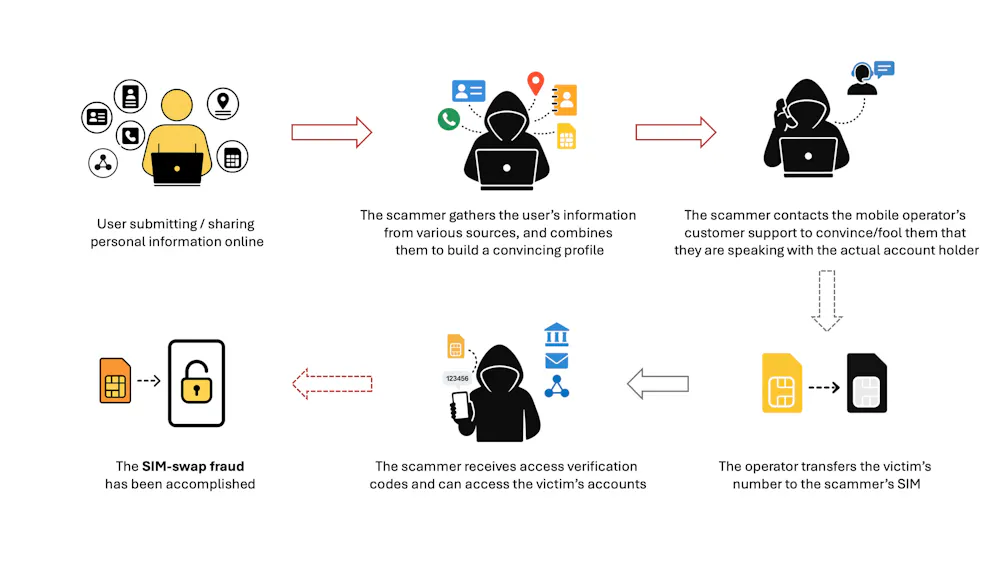
    Sim-swap fraud begins when a scammer convinces a mobile operator to transfer a victim’s number to a new sim card, or even an esim (one that’s embedded in the device), under the scammer’s control.

    This can be done over the phone, through an online chat, or even with the help of a
    bribed insider. Once the number is transferred, all calls and texts intended for the victim are redirected to the scammer. This includes those crucial verification codes used for logging into email, banking, messaging apps such as WhatsApp, and government services such as HMRC.

    This alone would be dangerous. But what makes sim-swap fraud so influential is
    that the cyber scammer often already has access to a patchwork of personal data
    about their target. That information may have been collected from data breaches,
    phishing attacks, low-reputation websites, or even the victim’s social media.

    People often underestimate the extent to which they reveal themselves online: a birthday posted on Instagram, a phone number included in a job posting, or a home address used in an online giveaway. Scammers combine this data to build a convincing profile, enough to fool a mobile operator’s customer service staff into believing they’re talking to the real account holder.

    How the sim-swap fraud works

    Once the scammer gains control of a number, the consequences are extensive.
    Attackers can access sensitive information, including personal documents and
    request and receive password reset links for the user’s other accounts. They can log in to WhatsApp or Telegram accounts, read private messages, impersonate the user, and even contact friends or family members to conduct further scams.

    The victims might see false messages posted in their names or fraudulent transactions made from their accounts. This can lead to financial loss, reputation damage, as well as emotional and mental health issues on the part of the victims.

    In the case of M&S, attackers apparently used this access to manipulate internal
    processes and gain access to sensitive systems. This highlights a broader risk:
    many companies still rely on phone numbers as a secondary verification method for
    staff, making their systems vulnerable to the same cyberattack used against
    individuals.

    How sim-Swap fraud works.
    Hossein Abroshan

    Reducing the risk

    While real-time detection of mobile number hijacking remains difficult, taking specific steps can significantly reduce the likelihood of being targeted and victimised. People should avoid sharing personal data unnecessarily, especially across multiple platforms and, very importantly, on unknown or untrusted websites.

    Many attackers don’t obtain all the necessary information from a single source. Instead, they collect it incrementally, using public profiles, marketing databases and past leaks to form a comprehensive picture.

    Being mindful of where you share your phone number, birthday or other identifiers can make it harder for others to impersonate you. It is also crucial to learn how phishing works and how to recognise it, so you will not submit your sensitive information to phishing or fake websites.

    Avoiding SMS-based authentication, where possible, is another key step. Many
    services now support authenticator apps, such as Google Authenticator, Microsoft Authenticator, Due or Authy, which are not tied to your mobile number. For mobile
    accounts themselves, setting up a unique pin or password to your account, which
    must be provided to authorise any changes, can add an extra layer of protection. This makes it harder for someone to initiate a sim swap without that code. However, users alone cannot fulfil this duty.

    Mobile network operators must strengthen identity verification practices, moving beyond basic questions about names and addresses that can be easily gathered or guessed. Banks and other financial institutions should reconsider using SMS or, at the very least, SMS-only as the default method for sensitive authentication. And companies, particularly those handling personal data or financial assets, need to train their IT and customer service teams to recognise the signs of identity based attacks.

    Sim-swap fraud is effective not because it’s highly technical, but because it exploits our trust in phone numbers for identity verification. The M&S case and similar examples show how fragile that trust can be – and why securing our mobile identities is no longer optional.

    ref. M&S cyberattacks used a little-known but dangerous technique – https://theconversation.com/mands-cyberattacks-used-a-little-known-but-dangerous-technique-256601

    MIL OSI – Global Reports

  • MIL-OSI: Bitget Wallet Launches In-App Crypto Shopping Across 300+ Global Brands

    Source: GlobeNewswire (MIL-OSI)

    SAN SALVADOR, El Salvador, May 14, 2025 (GLOBE NEWSWIRE) — Bitget Wallet, the leading non-custodial crypto wallet, has launched “Shop with Crypto,” a new in-app marketplace enabling users to spend cryptocurrencies directly on goods and services. The service removes the need for fiat conversion, offering a streamlined crypto-native checkout experience from within the wallet.

    The in-app shop grants access to more than 300 global brands, spanning digital wallet top-ups, mobile recharges, e-commerce gift cards, gaming, entertainment and travel. Users can make purchases directly using crypto through global merchants such as Amazon, Walmart, Google Play, Steam, Shopee, Tmall, and JD.com and more—with no need to off-ramp to fiat. The integration significantly broadens crypto’s practical utility and underscores Bitget Wallet’s commitment to real-world adoption.

    “Bitget Wallet is the only self-custodial wallet offering maximum spending flexibility—users will be able to scan QR codes, tap cards, or shop in-app across hundreds of brands,” said Alvin Kan, COO of Bitget Wallet. “We’ve built a simple, seamless, and secure experience that bridges digital assets with everyday spending.” Kan added that the company plans to extend Shop with Crypto to include lifestyle subscriptions, additional travel options, and an expanded roster of merchant integrations.

    To access the service, users navigate to the “Shop with Crypto” section in the Discovery tab of the app. Purchases can be completed directly with the Bitget Wallet balance, and redemption instructions are sent via email immediately after checkout. The entire process is designed to offer a user experience comparable to mainstream e-commerce, but crypto-native at its core.

    A central offering of the new marketplace is its gaming feature, launched in partnership with DotMart. Users can purchase in-game credits for titles such as PUBG Mobile, Free Fire MAX, and Mobile Legends at prices up to 30% lower than buying directly in-game. Transactions are completed via the DotMall app within Shop with Crypto, with codes redeemable instantly.

    For more information, please visit Bitget Wallet blog.

    About Bitget Wallet
    Bitget Wallet is a non-custodial crypto wallet designed to make crypto simple, seamless and secure for everyone. With over 60 million users, it brings together a full suite of crypto services, including swaps, market insights, staking, rewards, a DApp browser, and payment solutions. Supporting 130+ blockchains and a million tokens, Bitget Wallet enables seamless multi-chain trading across hundreds of DEXs and cross-chain bridges. Backed by a $300+ million user protection fund, it ensures the highest level of security for users’ assets.

    For more information, visit: XTelegramInstagramYouTubeLinkedInTikTokDiscordFacebook

    For media inquiries, please contact media.web3@bitget.com

    A photo accompanying this announcement is available at https://www.globenewswire.com/NewsRoom/AttachmentNg/158f36b1-b391-46e3-a2c2-a37d2b932aea

    The MIL Network

  • MIL-OSI Russia: Among the winners of the second competition of student research papers on Moscow studies is a postgraduate student of the Higher School of Economics

    Translation. Region: Russian Federal

    Source: State University Higher School of Economics – State University Higher School of Economics –

    Stepan Orlov, Elizaveta Novokreshchenova, Irina Martusevich

    Photo: MGD

    How reports Moscow City Duma (MCD) website, On May 13, the A.S. Pushkin Library and Reading Room hosted an awards ceremony for the participants of the Second Student Research Paper Competition. The competition was held as part of the V annual scientific and practical conference “History of Moscow: Methodology, Source Studies, Historiography, Popularization.” The initiator and main organizer was the Moscow City Duma. The winners included a postgraduate student Faculty of Humanities HSE University Elizaveta Novokreshchenova.

    Deputy Chairman of the Moscow City Duma, head of the working group on Moscow studies and development of the Parliamentary Library of the Moscow City Duma Stepan Orlov (United Russia faction) shared his impressions of the competition with the Moscow City Duma website. “The history of Moscow is very important for the formation of a true patriot, a citizen,” he emphasized. “Of course, we want our students, and even better, schoolchildren, to be interested in the history of their hometown. You can’t be a patriot and a citizen if you don’t know and don’t love the history of the place where you were born and where you live.”

    This time, 12 higher education institutions of Moscow took part in the competition — these are the best capital universities; 51 works were submitted to the competition, Stepan Orlov told the Moscow City Duma website. “We had a very authoritative jury. And here in the old building, in the A.S. Pushkin Library and Reading Room, which was created before the revolution, we awarded the best of the best, the students who took prize places. But I believe that everyone is a winner,” he said. The students did not just write some papers, but prepared real scientific works, the Deputy Chairman of the Moscow City Duma emphasized.

    On May 15, the winners of the competition will be able to present their work at a scientific and practical conference at the Museum of Moscow together with academics, professors, teachers of leading Moscow universities and research fellows. The reports of the winners of the student work competition will also be included in the conference collection of scientific papers.

    In an interview with the Moscow City Duma website, member of the expert council of the competition, candidate of historical sciences Elena Maksimenko, noted that the competition is not simply engaged in historical research and the preservation of historical traditions of universities. “We are engaged in the preservation of historical memory – the memory of those people who lived in Moscow, of those places that they created for us and that exist to this day, having a long history. They left us the beauty of Moscow, its history, and we support this memory and this tradition,” she said.

    “I am very happy to take part in the award ceremony, which is taking place in the beautiful mansion of the A.S. Pushkin Library and Reading Room,” HSE Vice-Rector Irina Martusevich shared with the Moscow City Duma website. “I sincerely love Moscow architecture and I want to note that in addition to the fact that we walk with you every day along the most diverse streets of the capital, the city speaks to us in different languages – the languages of the names of its districts and streets. That is, we talk with architecture too. It is great that you are full participants in this dialogue and understand what is happening in our home city. Even if we become Muscovites for the time of our studies at university or graduate school, it is especially pleasant when the city becomes a part of us. We become friends for many years.

    Therefore, I sincerely support this competition. I hope that we will expand and multiply this initiative. And of course, I congratulate the participants of the competition, who, in conditions of such high competition, were able to reach the final and become winners.”

    The winner of the first place, postgraduate student of the Faculty of Humanities at the Higher School of Economics Elizaveta Novokreshchenova, participated in the competition for the first time. She presented a work entitled “The polisher of the Kremlin Palace Yegor Borisov – an attempt to reconstruct his biography.” An appeal to the documents of the Moscow Palace Fund of the Russian State Archive of Ancient Acts showed that it is possible to study the biography of this representative of the palace servants using the lists of palace servants, meeting logs, and inventories of destroyed files, Elizaveta noted in an interview with the Moscow City Duma website. “Thus, as part of the study, I was able to establish the names of his wife and children, the date of death, and trace his career path – from a freelance to a full-time polisher,” says the HSE postgraduate student. “The research conducted shows that the Moscow Palace Fund contains a sufficient number of documents to trace the life path of the lowest rank of palace servants, which, in turn, makes it possible to study their social portrait and further scientific generalizations. I am happy with the first place in the competition, but I think that I still have something to strive for with this scientific work. I cannot help but mention the venue of the award ceremony – a beautiful mansion. It was nice that they arranged a real celebration for us with a concert. This victory is very significant for me.”

    Please note: This information is raw content directly from the source of the information. It is exactly what the source states and does not reflect the position of MIL-OSI or its clients.

    MIL OSI Russia News

  • MIL-OSI USA: Senator Welch, Oregon Governor Kotek, Sens. Klobuchar, Luján, Wyden, and Merkley Host Press Call on Republicans’ Attack on SNAP, Nutrition Programs

    US Senate News:

    Source: United States Senator Peter Welch (D-Vermont)
    WASHINGTON, D.C. — U.S. Senator Peter Welch (D-Vt.), Ranking Member of the Senate Agriculture Committee Subcommittee on Rural Development, Energy, and Credit, Senator Amy Klobuchar (D-Minn.), Ranking Member of the Senate Agriculture Committee, Senator Ben Ray Luján (D-N.M.), Ranking Member of the Senate Agriculture Committee Subcommittee on Nutrition and Specialty Crops, Senators Ron Wyden (D-Ore.), Jeff Merkley (D-Ore.), Oregon Governor Tina Kotek, and Hunger Free Vermont this week hosted a press call on Republicans’ efforts to gut the Supplemental Nutrition Assistance Program (SNAP), a critical anti-hunger program that helps more than 41.6 million Americans.  
    Tuesday night and Wednesday morning, the House Agriculture Committee held a markup on the Republican tax bill, which will cut $290 billion in SNAP benefits  
    “We’re at the moment of truth—it’s the time for action and no longer just talk. Here’s the truth: Republicans’ plan is about taking things away from people who need them and depend on them. In Vermont, about 1 in 10 Vermonters are receiving SNAP benefits. And that is our poorest Vermonters, low-income folks, kids—it makes a huge difference in their life that they can have access to SNAP,” said Senator Welch. “Now, our Republican colleagues are talking about taking about $290 billion out of the SNAP program. This is really about taking away basic nutritional security that is so absolutely essential to the wellbeing of our families and our kids in Vermont and in every single state across the nation.” 
    Watch a livestream of the press call here. 
    “Instead of working with Democrats to lower costs from President Trump’s across-the-board tariffs, House Republicans have decided to pull the rug out from under families by cutting the SNAP benefits that 42 million Americans rely on to put food on the table – all to fund a tax cut for billionaires. That’s shameful,” said Ranking Member Klobuchar. 
    “Something that we all know to be true is everyone deserves to have access to affordable, healthy, nutritious food, and make sure it’s on the table. In my state, 1 in 4 people rely on SNAP, many of whom are children. If this program is cut at that $230 billion level, it devastates it,” said Senator Luján. “Republicans are not looking out for their constituents who depend on federal programs—they’re looking out for the wealthiest Americans and corporate interests, plain and simple.” 
    “The combination of less food assistance for seniors and kids and Republican cuts in Medicaid is a prescription for a sicker America. This is health care 101: you need access to food to be healthy, and you need access to timely health care when you’re ill. Under the Republican program, more people are going to get sicker,” said Senator Wyden. “We are all in on this battle—we’ll be damned if we’re going to see access to nutrition and health care lost in order to give tax breaks to people at the top.” 
    “This Republican reconciliation bill is clear: families lose, billionaires win,” said Senator Merkley. “Millions of children will lose health care and go hungry—there’s a good chance that lots of kids won’t even be able to study in school. Nobody learns anything when they’re hungry. It’s pretty outrageous—we need to say, ‘hell no’ to this.” 
    “SNAP is one of the most effective anti-poverty and pro-health programs we have in America. It helps over 700,000 Oregonians, more than half of them children, seniors, or people with disabilities, put food on the table. When you cut SNAP, you’re not cutting bureaucracy—you’re cutting a child’s breakfast, their dinner, and their family’s dignity,” said Governor Tina Kotek. “These changes are not just unsustainable cost shift to states – they are an attack on the food security of millions of hard-working Americans. They make it harder for states like mine to do our jobs, to meet urgent needs, and to plan responsibly. Instead of this shortsighted plan, we need to invest in American families and the food security that we know strengthens communities, supports our economies, and reflects the basic decency we owe one another.” 
    “Every day, one in ten Vermonters—85% of which are children, older adults, or people with disabilities—rely on SNAP not only to afford groceries but to build better lives. Even the possibility of SNAP cuts is creating real harm, and we’re hearing worries from Vermonters who are already budgeting every dollar about losing this vital support. Proposals to make deep, devastating cuts to SNAP can’t be justified ever, and even less so now, when food prices are rising and families are already stretched thin. SNAP is a lifeline that must be protected, not slashed,” said Ivy Enoch, SNAP Policy & Training Lead, Hunger Free Vermont. 
    Senator Welch has been a leading advocate for protecting and expanding access to nutrition programs in the Senate. Last week, Senator Welch joined Senator Kirsten Gillibrand (D-N.Y.) in introducing the Improving Access to Nutrition Act of 2025, legislation to help more Americans access SNAP by lifting Republicans’ punitive time limits on SNAP eligibility requirements. Learn more about the bill here. 

    MIL OSI USA News

  • MIL-OSI USA: Jefferson, Economic Outlook

    Source: US State of New York Federal Reserve

    Thank you, President Williams. It is wonderful to be back in New York, and it is an honor to speak to you, the directors and advisers to the Second District. You all play an extremely important role for the Federal Reserve Bank of New York and, indeed, for the entirety of the Federal Reserve System. You, and your peers around the country, inform President Williams and the other Bank presidents about how you see the economy unfolding in your communities and in your industries. The presidents, in turn, share that vital information with all the members of the Federal Open Market Committee (FOMC) so that we can make the best monetary policy decisions to benefit all Americans. Thank you for the important contributions.1

    In the spirit of sharing information, I thought it would be helpful to share with you my economic outlook. First, I will discuss how I see recent economic activity. Next, I will talk about developments pertaining to both sides of our dual mandate, maximum employment and price stability. Finally, I will offer my current view of monetary policy.
    Economic ActivityWhile the economy entered a period of heightened uncertainty this year, the underlying data through the first quarter showed resilience. As you can see in figure 1, gross domestic product (GDP) contracted slightly by 0.3 percent in the first quarter, on an annualized basis, after expanding at a 2.4 percent rate in the fourth quarter of 2024. That change, however, overstates the deceleration in activity. A surge in imports apparently ahead of anticipated changes to trade policy did not seem to be reflected fully in inventory or spending data. That misalignment complicated the interpretation of measured GDP data. Private domestic final purchases, which exclude government spending, inventory investment, and net exports, usually gives a better read than GDP on the underlying momentum in the economy. That came in at a 3 percent rate in the first quarter, consistent with readings from last year.
    Looking at figure 2, you can see that inflation-adjusted consumer spending was strong much of last year. Spending eased at the start of 2025, which could in part reflect poor weather and seasonal adjustment challenges. Spending bounced back in March, perhaps reflecting some purchases ahead of expected trade policy changes.
    Of course, those observations of first-quarter economic activity are now in the rearview mirror. Tariff announcements and heightened uncertainty about government policies in general are the dominant economic developments of more recent weeks and have caused me to look carefully at my forecasts. It is not my role to express views on policies coming from the Administration or Congress, but I do study the implications of those policies on economic activity and inflation.
    Various surveys show a decline in business sentiment related to trade policy. The Beige Book reported that some retailers are expecting to raise prices in response to tariffs, which could then limit spending, especially by the most price-sensitive consumers. Manufacturers saw risks of supply chain disruptions related to trade policy changes. Moreover, uncertainty is quite high. As a result, I have adjusted down my expectations for economic growth this year, but I see the U.S. economy as continuing to expand. Of course, trade policy is still evolving, so its ultimate economic implications are not known, and I will be following developments carefully.
    Labor MarketTurning to the labor market, conditions continue to be solid. As you can see in figure 3, the unemployment rate was 4.2 percent in April. It has fluctuated within a narrow and historically low range between 4 and 4.2 percent since the middle of last year. U.S. employers added 177,000 jobs to payrolls last month, effectively matching the average growth over the past six months. Payrolls have been rising at a pace consistent with a stable unemployment rate and a flat labor force participation rate. Hiring has slowed from the rapid pace recorded earlier in the current expansion, but layoffs remain historically low. That can be seen in figure 4. New applications for unemployment benefits this year remain in the same low range recorded over the previous three years.
    Looking at figure 5, you can see the ratio of job vacancies to unemployed workers was at 1 in March, well down from a peak of 2 in 2022. The measure is consistent with a labor market that looks to be in balance and is not a source of inflationary pressure. Looking ahead, I am watching for signs that the labor market could cool as tariff increases begin to weigh on economic activity.
    InflationRegarding inflation, recent data are consistent with further progress toward our 2 percent inflation target; however, that goal has not yet been reached. Looking at figure 6, the blue line shows inflation as measured by the price index for personal consumption expenditures (PCE) has trended down from a peak above 7 percent in mid-2022. In March, PCE prices advanced 2.3 percent from a year earlier. Core PCE inflation, which excludes volatile consumer energy and food prices and is usually a better indicator of future inflation, the dashed red line, was at 2.6 percent. Figure 7 shows the components of core PCE inflation, which can provide insight into sources of inflationary pressures. Housing services inflation, the purple dotted line, has fallen notably since early 2023 and could continue to provide support to the disinflation process. Core services inflation, the dashed red line, has largely moved sideways since the early part of last year, contributing little to further disinflation, and I largely expect that pattern to continue as well. In contrast, goods inflation, outside of food and energy, the blue line, has picked up a bit this year.
    There is much uncertainty, however, around the future path of inflation. If the increases in tariffs announced so far are sustained, they are likely to interrupt progress on disinflation and generate at least a temporary rise in inflation. Whether tariffs create persistent upward pressure on inflation will depend on how trade policy is implemented, the pass-through to consumer prices, the reaction of supply chains, and the performance of the economy. Short-term inflation expectations have increased in both survey- and market-based measures, but I think it is notable that most measures of longer-run inflation expectations have been largely stable, suggesting that the American people understand the Federal Reserve’s commitment to return inflation to our 2 percent target.
    While trade policy has received the bulk of recent attention, I remain focused on the aggregate effect from the totality of different government policy changes, including trade, immigration, regulatory, and fiscal policies, as well as their net effects on the economy. This net effect will likely remain uncertain for some time.
    Monetary PolicyLast week I supported the FOMC’s decision to hold the federal funds rate at current levels as the best policy to achieve our dual mandate of maximum employment and price stability. As you can see in figure 8, the FOMC acted last year to reduce the policy rate by a full percentage point. Over the past several meetings, the rate has been held at what I view as a moderately restrictive level. I view the current stance of policy as well positioned to respond to developments that may arise.
    With respect to the path of the policy rate going forward, I will carefully assess incoming data, the evolving outlook, and the balance of risks. Various measures of consumer and business sentiment have declined sharply this year, and I will be watching very carefully for signs of weakening economic activity in hard data. At the same time, higher tariffs could lead to higher inflation this year. It is uncertain whether inflationary pressures would be temporary or persistent. Our monetary policy actions are guided by our dual mandate to promote maximum employment and stable prices for the American people. With the increased risks to both sides of our mandate, I believe that the current stance of monetary policy is well positioned to respond in a timely way to potential economic developments.
    ConclusionThe uncertain economic outlook presents a challenge for monetary policymakers. It is critical that we have the best available information from a broad cross section of sources, which is again why your efforts to keep President Williams and other monetary policymakers informed are so critical. Effective policymaking starts with hearing from people in every corner of this country—including New York, New Jersey, Connecticut, Puerto Rico, and the U.S. Virgin Islands. Directors and advisers like you make that possible. Thank you again.

    1. The views expressed here are my own and not necessarily those of my colleagues on the Federal Open Market Committee. Return to text

    MIL OSI USA News

  • MIL-OSI United Kingdom: Council welcomes extra £2 million potholes cash as highways improvements ramp up

    Source: City of Wolverhampton

    The council had already committed to a £9.7 million highways capital programme, including a raft of road repairs across the city.

    Now an extra £2 million has been secured from the City Region Sustainable Transport Settlement (CRSTS) via West Midlands Combined Authority, meaning even more potholes can be filled and surface works carried out.

    As part of council work that was already planned, crews will be in action around the city this spring and summer – including resurfacing Cannock Road at the end of July.

    Other roads to be resurfaced in the coming weeks include: Merridale Road, Wellington Road, Millfields Road, Wood End Road, Lichfield Street, Hall Lane, Wrottesely Road, Ruskin Avenue, Whitgreave Avenue, Prestwood Road and Neachells Lane.

    The full list of roads in line for repairs to date can be seen below. More roads will be added to the programme and people will be kept updated on progress.

    With more than 460 miles of road and over 800 miles of footway to maintain, the City of Wolverhampton Council, like all other authorities in the country, must prioritise where to focus.

    It does this through examining data from condition surveys and road inspections, determining where resurfacing or other surface treatments can make the most difference.

    The programme follows a preventative approach aimed at reducing the need for thousands of pothole repairs the council carries out every year.

    Councillor Qaiser Azeem, Cabinet Member for Transport and Green City at City of Wolverhampton Council, said: “We know how important keeping our roads in a good condition is to people.

    “That is why we are investing in more highways improvements and people will see even more work taking place across the city over the coming weeks and months.

    “We welcome this additional funding, and we will make sure it’s put to use tackling more potholes on our city’s roads.

    “We take responsibility of maintaining our highways network very seriously and understand how an efficient, safe and smooth flowing highway network for all modes of transport is important for economic productivity and social connection.”

    As well as road resurfacing and pothole repairs the council’s highways capital programme for 2025/26 also includes resurfacing footpaths, car park and streetlighting upgrades, road safety schemes and more.

    This budget includes an additional £500,000 investment from the council as part of its commitment to addressing the issue of potholes.

    People can report potholes in Wolverhampton by visiting Report a pothole
    https://www.wolverhampton.gov.uk/parking-and-roads/roads/report-pothole here Report a pothole | City Of Wolverhampton Council

    From graffiti, fly posting and flytipping to potholes and faulty streetlights, people can also report issues, details and locations quickly and easily via Love Clean Streets App
    https://www.wolverhampton.gov.uk/contact-us/love-clean-streets-app Love Clean Streets App | City Of Wolverhampton Council Photographs can also be submitted.

    Planned road resurfacing
    Cannock Road from Stafford Steet to Springfield Road
    Merridale Road from Chapel Ash to Oaks Crescent Park/Graiseley
    Lichfield Street from Bow Street to Mount Pleasant
    A41 Wellington Road from Prouds Lane to Mount Pleasant
    Neachells Lane, including Planetary Road to Wednesfield Way, Wednesfield Way to Alfred Squire Road and Alfred Squire Road to High Street
    Wrottesley Road from Wergs Road to Chilgrove Gardens
    Wood End Road – Roundabout to Amos Lane
    A4039 Millfields Road
    Whitgreave Avenue to the roundabout at Leacroft Avenue
    Ruskin Avenue – Entire length
    Hall Lane from Hurst Road to Robert Wynd
    Prestwood Road from Bushbury Road to Thorneycroft Lane
    Planned surface treatment
    Fairview Road
    Blackhalve Lane from Cannock Road to City boundary
    A449 Penn Road from southbound roundabout Penn Road to the end of the dual carriageway near Lonsdale Road
    Birches Barn Road from Bradmore Road to roundabout Stubbs Road
    Rookery Street from roundabout at Well Lane to Rookery Bridge
    Springhill Lane from Warstones Road to city boundary (Wynne Crescent)
    Bhylls Lane from Langley Road to Castlecroft Road
    B4484 – Pear Tree Lane from roundabout Blackhalve Lane to Cannock Road
    Birchfield Avenue and Nethy Drive
    Cockshutts Lane
    Downing Close
    Bilston Road from Moseley Road to Keyway
    Elston Hall Lane from Short Road to Three Tuns Lane
    Millfields Road from Manor Road to Tarmac Road
    Wellington Road from no.121 to Stowheath Lane East Park
    Moseley Road from Willenhall Road to Waite Road
    A41 Bilston Road from eastbound roundabout Ring Road to Commercial Road
    A459 Dudley Road from Goldthorn Hill to Bromley Street
    A4123 Birmingham Road from Cockshutts Lane to Grove Street
    Darlaston Lane from city boundary to Bilston Road
    Warstones Road from Coalway Road to the roundabout at Stourbridge Road
    Earl Croft Road and Enville Road and back of footway Warstones Drive
    Codsall Road from city boundary to roundabout at Pendeford Avenue
    Kirby Close to King Street 
    B4161 – Henwood Road and Tettenhall Road
    B4163 – Salop Street – Oxford Street – Bank Street
    A41 – Wellington Road to Prouds Lane
    Cumberland Road – Cumberland Road – Prouds Lane and back of footway Central Avenue

    MIL OSI United Kingdom

  • MIL-OSI Security: Rioter Sentenced for Damaging U.S. Government Property During Protest at Union Station

    Source: Federal Bureau of Investigation (FBI) State Crime Alerts (b)

    Defendant destroyed an American flag by setting it on fire in front of Union Station in the District as a crowd surrounded him chanting, “Burn that sh–.”

    WASHINGTON – Michael Snow Jr., 25, of Durham, North Carolina, was sentenced today in U.S. District Court to four months of probation, 40 hours of community service, and ordered to pay $525 in restitution for destruction of federal property. On July 24, 2024, Snow destroyed an American flag, which was property of the U.S. government, by setting it on fire in front of Union Station in the District as a crowd surrounded him chanting, “Burn that sh–.”

    The sentencing was announced by U.S. Attorney Edward R. Martin Jr., Acting Special Agent in Charge Courtland Rae of the FBI Washington Field Office Counterterrorism Division, and Chief Jessica M. E. Taylor of the U.S. Park Police (USPP).

    Snow pleaded guilty on Feb. 11 to destruction of government property (less than $1,000).

    According to court documents, on July 24, 2024, an organization was granted a permit to demonstrate in the area of Columbus Circle, located at Massachusetts Avenue. and E St. NE, directly in front of Union Station. From about 3 p.m. until 5 p.m., demonstrators gathered in Columbus Circle. They pulled down flags affixed to the flagpoles, burned the flags and other objects, sprayed graffiti on multiple statues and structures, and interfered with law enforcement trying to place the vandals under arrest.

    The flags, the statues and structures in Columbus Circle, are all property of the federal government. The National Park Service estimated the total cost to clean up and repair the site at $11,282.23.

    Open-source and surveillance video captured images of two individuals lowering an American flag affixed to the eastern flagpole in Columbus Circle. The flag fell to the ground still attached to its halyard. A man later identified as Snow grabbed the flag and carried it into the crowd of protesters.

    He threw the flag onto the ground, produced a lighter, and attempted to set the flag ablaze. Unsuccessful, he yelled: I need a better lighter! The crowd surrounding the man chanted, Burn that sh–!

    Someone handed Snow a bottle of charcoal lighter fluid. Snow doused the flag with the fluid, then, along with an unidentified individual from the crowd, used lighters to torch it.

    On July 25, 2024, a user on the social media platform X posted pictures of the incident. As a result, law enforcement located a driver’s license photograph of Snow.

    The case was investigated by the FBI Washington Field Office and the USPP’s Intelligence and Counterterrorism Unit, with assistance from the FBI Charlotte Field Office, Raleigh Resident Agency. It is being prosecuted by Assistant U.S. Attorneys Sarah Martin and Brendan Horan.

    Screen shot from a closed-circuit camera shows Snow (circled in yellow) as he grabbed the fallen American flag from the halyard.

    Screenshot from open-source video shows Snow (circled in yellow) and another individual (circled in blue) lighting the flag on fire.

    Screenshot from open-source footage depicts Snow (circled in yellow) on the flag pedestal while the other individual (circled in blue) parades around the burning American flag.

    ##

    MIL Security OSI

  • MIL-OSI: First Busey Corporation Prices Depositary Share Offering

    Source: GlobeNewswire (MIL-OSI)

    LEAWOOD, Kan., May 14, 2025 (GLOBE NEWSWIRE) — First Busey Corporation (“Busey”) (Nasdaq: BUSE), the holding company for Busey Bank and CrossFirst Bank, announced the pricing of an underwritten public offering of 8,000,000 depositary shares, each representing a 1/40th ownership interest in a share of its 8.25% Fixed Rate Series B Non-Cumulative Perpetual Preferred Stock (the “Series B preferred stock”), with a liquidation preference of $1,000 per share (equivalent to $25.00 per depositary share).

    When, as, and if declared by the board of directors of Busey, dividends will be payable on the Series B preferred stock from the date of issuance at a rate of 8.25% per annum, payable quarterly in arrears, on March 1, June 1, September 1 and December 1 of each year, beginning on September 1, 2025. Busey may redeem the Series B preferred stock at its option at a redemption price equal to $25.00 per depositary share, as described in the prospectus supplement and accompanying prospectus relating to the offering.

    Net proceeds from the offering are expected to be used to redeem Busey’s 5.25% Fixed-to-Floating Rate Subordinated Notes due 2030, and for general corporate purposes including to support balance sheet growth of Busey Bank.

    Busey intends to apply to list the depositary shares on the Nasdaq Global Select Market under the symbol “BUSEP.”

    Piper Sandler & Co., Morgan Stanley & Co. LLC and Keefe, Bruyette & Woods, Inc. are serving as joint bookrunning managers for the offering, and Janney Montgomery Scott LLC is acting as the co-manager.

    The Company expects to close the offering, subject to customary conditions, on or about May 20, 2025.

    The Company filed a “shelf” registration statement (File No. 333-274620) (including a base prospectus (the “Base Prospectus”)) on September 21, 2023 and the related preliminary prospectus supplement on May 13, 2025 (the “Preliminary Prospectus Supplement”) with the Securities and Exchange Commission (“SEC”) for the offering to which this communication relates. You may obtain these documents for free by visiting EDGAR on the SEC’s website at www.sec.gov. Alternatively, Busey, any underwriter or any dealer participating in the offering will arrange to send you the Base Prospectus and the Preliminary Prospectus Supplement if you request it by emailing Piper Sandler & Co. at fsg-dcm@psc.com or calling Morgan Stanley & Co. LLC toll-free at 1-866-718-1649 or Keefe, Bruyette & Woods, A Stifel Company at 1-800-966-1559.

    This news release shall not constitute an offer to sell, or the solicitation of an offer to buy any securities, nor shall there be any offer or sale of these securities in any jurisdiction in which such offer, solicitation, or sale would be unlawful prior to registration or qualification under the securities laws of any such jurisdiction.

    Corporate Profile
    As of March 31, 2025, First Busey Corporation (Nasdaq: BUSE) was a $19.46 billion financial holding company headquartered in Leawood, Kansas.

    Busey Bank, a wholly-owned bank subsidiary of First Busey Corporation headquartered in Champaign, Illinois, had total assets of $11.98 billion as of March 31, 2025. Busey Bank currently has 62 banking centers, with 21 in Central Illinois markets, 17 in suburban Chicago markets, 20 in the St. Louis Metropolitan Statistical Area, three in Southwest Florida, and one in Indianapolis. More information about Busey Bank can be found at busey.com.

    CrossFirst Bank, a wholly-owned bank subsidiary of First Busey Corporation headquartered in Leawood, Kansas, had total assets of $7.45 billion as of March 31, 2025. CrossFirst Bank currently has 16 banking centers located across Arizona, Colorado, Kansas, Missouri, New Mexico, Oklahoma, and Texas. More information about CrossFirst Bank can be found at crossfirstbank.com. It is anticipated that CrossFirst Bank will be merged with and into Busey Bank on June 20, 2025.

    Through Busey’s Wealth Management division, the Company provides a full range of asset management, investment, brokerage, fiduciary, philanthropic advisory, tax preparation, and farm management services to individuals, businesses, and foundations. Assets under care totaled $13.68 billion as of March 31, 2025. More information about Busey’s Wealth Management services can be found at busey.com/wealth-management.

    Busey Bank’s wholly-owned subsidiary, FirsTech, specializes in the evolving financial technology needs of small and medium-sized businesses, highly regulated enterprise industries, and financial institutions. FirsTech provides comprehensive and innovative payment technology solutions, including online, mobile, and voice-recognition bill payments; money and data movement; merchant services; direct debit services; lockbox remittance processing for payments made by mail; and walk-in payments at retail agents. Additionally, FirsTech simplifies client workflows through integrations enabling support with billing, reconciliation, bill reminders, and treasury services. More information about FirsTech can be found at firstechpayments.com.

    For the fourth consecutive year, Busey was named among 2025’s America’s Best Banks by Forbes. Ranked 88th overall, Busey was one of seven banks headquartered in Illinois included on this year’s list. Busey was also named among the 2024 Best Banks to Work For by American Banker, the 2024 Best Places to Work in Money Management by Pensions and Investments, the 2024 Best Places to Work in Illinois by Daily Herald Business Ledger, the 2025 Best Places to Work in Indiana by the Indiana Chamber of Commerce, and the 2024 Best Companies to Work For in Florida by Florida Trend magazine. We are honored to be consistently recognized globally, nationally and locally for our engaged culture of integrity and commitment to community development.

    First Busey Corporation Contacts
    For Financials:  For Media:
    Scott Phillips, Interim CFO Amy L. Randolph, EVP & COO
    First Busey Corporation  First Busey Corporation
    (239) 689-7167 (217) 365-4049
    scott.phillips@busey.com amy.randolph@busey.com
       

    Forward-Looking Statements
    This press release may contain “forward-looking statements” within the meaning of the Private Securities Litigation Reform Act of 1995 with respect to Busey’s financial condition, results of operations, plans, objectives, future performance, and business. Forward-looking statements, which may be based upon beliefs, expectations, and assumptions of Busey’s management and on information currently available to management, are generally identifiable by the use of words such as “believe,” “expect,” “anticipate,” “plan,” “intend,” “estimate,” “may,” “will,” “would,” “could,” “should,” “position,” or other similar expressions. Additionally, all statements in this document, including forward-looking statements, speak only as of the date they are made, and Busey undertakes no obligation to update any statement in light of new information or future events.

    A number of factors, many of which are beyond Busey’s ability to control or predict, could cause actual results to differ materially from those in any forward-looking statements. These factors include, among others, the following: (1) the strength of the local, state, national, and international economies and financial markets (including effects of inflationary pressures, the threat or implementation of tariffs, trade wars, and changes to immigration policy); (2) changes in, and the interpretation and prioritization of, local, state, and federal laws, regulations, and governmental policies (including those concerning Busey’s general business); (3) the economic impact of any future terrorist threats or attacks, widespread disease or pandemics, or other adverse external events that could cause economic deterioration or instability in credit markets (including Russia’s invasion of Ukraine and the conflict in the Middle East); (4) unexpected results of acquisitions, including the acquisition of CrossFirst Bankshares, Inc., which may include the failure to realize the anticipated benefits of the acquisitions and the possibility that the transaction and integration costs may be greater than anticipated; (5) the imposition of tariffs or other governmental policies impacting the value of products produced by Busey’s commercial borrowers; (6) new or revised accounting policies and practices as may be adopted by state and federal regulatory banking agencies, the Financial Accounting Standards Board, the Securities and Exchange Commission, or the Public Company Accounting Oversight Board; (7) changes in interest rates and prepayment rates of Busey’s assets (including the impact of sustained elevated interest rates); (8) increased competition in the financial services sector (including from non-bank competitors such as credit unions and fintech companies) and the inability to attract new customers; (9) changes in technology and the ability to develop and maintain secure and reliable electronic systems; (10) the loss of key executives or associates, talent shortages, and employee turnover; (11) unexpected outcomes and costs of existing or new litigation, investigations, or other legal proceedings, inquiries, and regulatory actions involving Busey (including with respect to Busey’s Illinois franchise taxes); (12) fluctuations in the value of securities held in Busey’s securities portfolio, including as a result of changes in interest rates; (13) credit risk and risk from concentrations (by type of borrower, geographic area, collateral, and industry), within Busey’s loan portfolio and large loans to certain borrowers (including commercial real estate loans); (14) the concentration of large deposits from certain clients who have balances above current Federal Deposit Insurance Corporation insurance limits and may withdraw deposits to diversify their exposure; (15) the level of non-performing assets on Busey’s balance sheets; (16) interruptions involving information technology and communications systems or third-party servicers; (17) breaches or failures of information security controls or cybersecurity-related incidents; (18) the economic impact on Busey and its customers of climate change, natural disasters, and exceptional weather occurrences such as tornadoes, hurricanes, floods, blizzards, and droughts; (19) the ability to successfully manage liquidity risk, which may increase dependence on non-core funding sources such as brokered deposits, and may negatively impact Busey’s cost of funds; (20) the ability to maintain an adequate level of allowance for credit losses on loans; (21) the effectiveness of Busey’s risk management framework; and (22) the ability of Busey to manage the risks associated with the foregoing. These risks and uncertainties should be considered in evaluating forward-looking statements and undue reliance should not be placed on such statements.

    The MIL Network

  • MIL-OSI: Micropolis Begins Testing Phase in AI and Robotics Infrastructure for SEE Holding’s Sustainable City 2.0

    Source: GlobeNewswire (MIL-OSI)

    DUBAI, United Arab Emirates, May 14, 2025 (GLOBE NEWSWIRE) — Micropolis Holding Co. (“Micropolis” or the “Company”) (NYSE: MCRP), a pioneer in unmanned ground vehicles and AI-driven security solutions, today announced it has commenced the testing phase of its collaboration with SEE Holding Ltd at The Sustainable City 2.0 (TSC 2.0) to deploy Micropolis’s advanced robotics platforms, AI-powered surveillance systems, smart mobility applications, and edge computing nodes across the next generation of Sustainable City projects.

    The Sustainable City is SEE Holding’s globally recognized model of a next-generation city designed to harness intelligent systems to enhance performance, efficiency, and everyday lifestyle and to provide a framework for achieving net zero emissions by 2050.

    This is the latest step in the strategic collaboration between Micropolis and SEE Holding following the Memorandum of Understanding signed in April. The deployment will encompass integrated command systems for security operation, autonomous fleets and smart mobility applications, edge computing, and computer vision technologies.

    “Deploying our technologies throughout The Sustainable City 2.0 marks a significant milestone for our company,” said Fareed Aljawhari, CEO of Micropolis Holding Co. “This initial phase will demonstrate how our AI-driven solutions can seamlessly integrate with net-zero principles, enhancing safety, efficiency, and quality of life for residents.”

    A joint R&D program is also underway to advance Micropolis’s sustainable urban technologies, aimed at driving operational efficiency, resident experience, and environmental performance across SEE Holding’s global sustainable city projects.

    About Micropolis Holding Co.
    Micropolis is a UAE-based company specializing in the design, development, and manufacturing of unmanned ground vehicles (UGVs), AI systems, and smart infrastructure for urban, security, and industrial applications. The Company’s vertically integrated capabilities cover everything from mechatronics and embedded systems to AI software and high-level autonomy.

    For more information please visit www.micropolis.ai.

    About SEE Holding
    SEE Holding, is a UAE-based sustainably focused global holding group that designs, invests in, and builds sustainable infrastructures and cities through its three operational verticals: SEE Solutions, SEE Developers, and SEE Engineering.

    Driven by its purpose of spearheading a net zero emissions future and achieving the 2050 UN targets, SEE Holding develops inclusive and sustainable communities that prioritize education, sports, healthcare, and overall well-being as part of its commitment to social, environmental and economic impact. SEE Holding currently has projects in the UAE across Dubai, Abu Dhabi and Sharjah, as well as in Oman.

    For more information, please visit us on: https://seeholding.com

    Forward-Looking Statements
    This press release contains “forward-looking statements” within the meaning of the “safe harbor” provisions of the Private Securities Litigation Reform Act of 1995. You can identify forward-looking statements by the fact that they do not relate strictly to historical or current facts. These statements may include words such as “anticipate”, “estimate”, “expect”, “project”, “plan”, “intend”, “believe”, “may”, “will”, “should”, “can have”, “likely” and other words and terms of similar meaning. Forward-looking statements represent Micropolis’ current expectations regarding future events and are subject to known and unknown risks and uncertainties that could cause actual results to differ materially from those implied by the forward-looking statements. These statements are subject to uncertainties and risks including, but not limited to, the uncertainties related to market conditions and other factors discussed in the “Risk Factors” section of the registration statement filed by the Company with the SEC. For these reasons, among others, investors are cautioned not to place undue reliance upon any forward-looking statements in this press release. Additional factors are discussed in the Company’s filings with the SEC, which are available for review at www.sec.gov. The Company undertakes no obligation to publicly revise these forward-looking statements to reflect events or circumstances that arise after the date hereof.

    Investor Contact:
    KCSA Strategic Communications
    Valter Pinto, Managing Director
    PH: (212) 896-1254
    Valter@KCSA.com

    Media Contact:
    Jessica Starman
    media@elev8newmedia.com

    A photo accompanying this announcement is available at https://www.globenewswire.com/NewsRoom/AttachmentNg/6ebe2e39-9f87-4709-bd4f-cae5804c2b03

    The MIL Network

  • MIL-OSI: Alternative Ballistics Advances Less-Lethal Innovation Through V2 Global Partnership

    Source: GlobeNewswire (MIL-OSI)

    Las Vegas, Nevada, May 14, 2025 (GLOBE NEWSWIRE) — Alternative Ballistics Corporation, an innovative safety technology company, is pleased to announce its engagement with V2 Global, a distinguished advisory consulting firm specializing in risk mitigation, business intelligence, public safety advisory, and security solutions.

    This partnership represents a pivotal advancement in Alternative Ballistics’ mission to broaden the reach and impact of its innovative, life-saving technology. As part of the collaboration, Don De Lucca—Partner at V2 Global and a former Chief of Police with more than 30 years of leadership in law enforcement and public safety—will work closely with the Alternative Ballistics team to help guide strategic growth and implementation.

    “We’re excited to partner with V2 Global and to welcome Don De Lucca’s leadership and expertise,” said Steve Luna, CEO of Alternative Ballistics. “His extensive experience in policing and public safety will be invaluable as we continue to scale our efforts and bring life-saving technologies to agencies both in the U.S. and abroad.”

    De Lucca also shared his enthusiasm for the partnership: “Alternative Ballistics has created a groundbreaking tool that enhances both officer and public safety. I’m honored to support their mission and help further the adoption of more responsible and effective force alternatives in modern policing.”

    This collaboration marks a key milestone in Alternative Ballistics’ commitment to advancing innovative, less-lethal solutions that bridge the crucial gap between preserving life and protecting officers.

    About Alternative Ballistics Corp.

    Alternative Ballistics Corporation (“ABC”) produces an innovative less-lethal product known as The Alternative® which features patented bullet capture technology. The product is used by law enforcement as a de-escalation tool in critical incidents when encountering a non-compliant subject in crisis, in possession of a weapon other than a firearm, who presents a threat to themselves, to officers, or to bystanders. A lightweight, easy-to-carry docking unit, The Alternative® efficiently attaches to a service weapon to convert a fired bullet into a kinetic impact round that, when deployed from a safe distance, travels downrange with non-penetrating energy, and temporarily incapacitates an individual with low risk of critical injury or death. Once deployed, the service weapon reverts to standard use. The Alternative® may also be available in the future in the commercial market as a self-defense tool for the purpose of protecting life and property. It is the only less-lethal product in either the law enforcement or commercial market that works with a service weapon or semi-automatic handgun for seamless protective cover and doesn’t require transition to a separate device, allowing the user to keep eyes and weapon on the threat at all times.

    About V2 Global

    V2 Global is a risk mitigation and relationship management consulting firm delivering Business Intelligence, Crisis Management & Strategic Advisory Services, Public Safety Advisory and Security Solutions. V2 specializes in identifying, remediating and monitoring risk across your enterprise. Clients are C-Suite executives, law firms and their clients, general counsels and high-profile individuals. V2 Global’s success is based on the ability to rapidly assemble a team anywhere on the globe to identify, resolve and mitigate business issues. Additional information can be found at their website https://www.v2-global.com/about-v2.

    Forward-Looking Statements

    This document contains forward-looking statements. In addition, from time to time, we or our representatives may make forward-looking statements orally or in writing. We base these forward-looking statements on our expectations and projections about future events, which we derive from the information currently available to us. In evaluating these forward-looking statements, you should consider various factors, including: our ability to advance the direction of the Company; our ability to keep pace with new technology and changing market needs; and the competitive environment of our business. These and other factors may cause our actual results to differ materially from any forward-looking statement.

    Company Contact:
    info@alternativeballistics.com
    www.alternativeballistics.com

    For Investor Inquiries, please contact:
    Hanover International, Inc.
    Kathy Cusumano, President
    ka@hanoverintlinc.com

    The MIL Network

  • MIL-OSI: Pushpay Unveils New Strategic Partnerships and Integrations to Support Church Growth and Engagement

    Source: GlobeNewswire (MIL-OSI)

    New product integrations with Mailchimp and StudioC, and a partnership with VisitorReach, help ministries improve communication, outreach and foster deeper discipleship

    REDMOND, Wash., May 14, 2025 (GLOBE NEWSWIRE) — Pushpay, the leading payments and engagement solutions provider for mission-driven organizations, today announces three new strategic partnerships and product integrations designed to further equip churches in their mission to build community and deepen connections for a greater Kingdom impact. The latest additions reflect Pushpay’s continued investment in innovation and delivering an expansive product ecosystem that supports the evolving needs of modern ministry.

    Pushpay’s new partnership with VisitorReach enables churches to connect with their congregation more effortlessly through VisitorTap—a tap-to-engage technology designed specifically for churches. By using NFC technology, VisitorTap allows guests to simply tap their phones to instantly access giving platforms, digital connect cards, event sign-ups, and ministry opportunities. This seamless experience makes guest engagement easier, faster, and more intuitive. Pushpay customers receive an exclusive discount on VisitorTap, including free setup and the first 100 VisitorTap cards at no cost.

    “We’re proud to expand our integration ecosystem, which is a part of a broader strategy to equip and empower ministry leaders with the tools they need to lead in a digitally connected world,” said Gruia Pitigoi-Aron, Pushpay’s Chief Product Officer. “Investing in a robust partnership and integration network helps our customers remove technology barriers, allowing them to focus more time on what matters most: their people.”

    According to the company’s 2025 State of Church Technology report, 86% of church leaders agree technology helps strengthen connection in their community. Yet, communication remains the top challenge, with 51% saying it’s the area they most want technology to improve. Several of the company’s new integrations are designed to help solve that challenge:

    • Mailchimp Integration: A new integration with Mailchimp will enable churches to connect their ChMS data directly to Mailchimp—eliminating time-consuming manual exports and improving message targeting. Saved Searches, Groups, and Process Queues within Pushpay’s ChMS can now be synced to Mailchimp tags or audiences, allowing churches to send more personalized and timely communications. The integration will be available in late May.
    • StudioC Integration: Pushpay’s enhanced mobile app experience now includes integration with StudioC, a technology company that helps churches strengthen discipleship and engagement through data-driven communication. The new mobile app integration helps churches guide people more intuitively through their spiritual journey by providing relevant content and next steps—helping churches deliver the right content, to the right people, at the right time.

    “We’re thrilled to collaborate with Pushpay. Our integration is about empowering churches to communicate with clarity, compassion, and strategic impact,” said Blue Van Dyke, founder of StudioC. “Pushpay customers can now engage their congregations with personalized, data-driven messaging—right in the palm of their hands. Together, we’re not just enhancing digital tools, we’re reimagining how churches connect, disciple, and grow in a mobile-first world.”

    With over 80 integrations, Pushpay integrates with the majority of the top software solutions used by churches today, delivering a comprehensive and connected technology ecosystem for its more than 15,000 customers. For more information about today’s announcement, or Pushpay’s growing integration ecosystem, visit www.pushpay.com/integrations.

    About Pushpay
    Pushpay empowers mission-based organizations to engage their communities. We exist to bring people together and help people be known. Through our innovative suite of products, we cultivate generosity by streamlining donation processes, enhancing communication, and strengthening connection. Whether managing donations, organizing events, or connecting with community members, Pushpay’s integrated tools enable ministry leaders to focus on what matters most – growing their ministry and deepening engagement. For more information visit www.pushpay.com.

    US Media / PR Contact: Chelsea Looney PR@pushpay.com

    The MIL Network

  • MIL-OSI: ibex Wave iX Wins Gold Stevie® Award at The 23rd Annual American Business Awards®

    Source: GlobeNewswire (MIL-OSI)

    WASHINGTON, May 14, 2025 (GLOBE NEWSWIRE) — ibex (NASDAQ: IBEX), a leading global provider of business process outsourcing (BPO) and AI-powered customer engagement technology solutions, today announced that ibex Wave iX has earned the Gold Stevie® Award in the Achievement in Technology Innovation category for The 23rd Annual American Business Awards®. This honor emphasizes the success of ibex’s AI-powered Wave iX solution platform in transforming the customer experience for leading brands around the world.

    “We are proud to be recognized by The Stevie® Awards for The Annual American Business Awards®,” said Carl O’Neil, EVP and GM of Wave iX, Augment, and ibex CX. “AI is transforming the customer experience landscape, and ibex is leading this evolution by creating groundbreaking AI-powered CX solutions that redefine how businesses engage with their customers.”

    ibex takes a solutions-driven approach to align with specific business needs and deliver real solutions for transformative outcomes. ibex Wave iX fuses cutting-edge technology with unmatched CX expertise to enable the next generation of AI and agent-assisted customer experience.

    “ibex Wave iX solutions drive true digital transformation and empower businesses of all sizes with advanced, customer-facing self-service capabilities as they adapt to deliver smarter, more personalized interactions,” O’Neil said. “Rather than forcing one-size-fits-all tools, we work closely with our clients to create customized, AI-powered CX solutions that produce meaningful, transformative results.”

    The American Business Awards complimented the impressive achievements of ibex Wave iX on multiple levels. The judges commended how ibex’s innovative approach to digital marketing and customer acquisition is transforming the industry. ibex is additionally recognized as an ideal strategic partner that executes the goals of their clients with excellent customer satisfaction.

    Explore the full suite of ibex Wave iX solutions here.

    “Organizations across the United States continue to demonstrate resilience and innovation,” said Stevie Awards president Maggie Miller. “The 2025 Stevie winners have helped drive that success through their innovation, persistence and hard work.”

    About the Stevie Awards
    Stevie Awards are conferred in nine programs: the Asia-Pacific Stevie Awards, the German Stevie Awards, the Middle East & North Africa Stevie Awards, The American Business Awards®, The International Business Awards®, the Stevie Awards for Women in Business, the Stevie Awards for Great Employers, the Stevie Awards for Sales & Customer Service, and the Stevie Awards for Technology Excellence. Stevie Awards competitions receive more than 12,000 entries each year from organizations in more than 70 nations. Honoring organizations of all types and sizes and the people behind them, the Stevies recognize outstanding performances in the workplace worldwide. Learn more about the Stevie Awards at http://www.StevieAwards.com.

    About ibex
    ibex delivers innovative business process outsourcing (BPO), smart digital marketing, online acquisition technology, and end-to-end customer engagement solutions to help companies acquire, engage and retain valuable customers. Today, ibex operates a global CX delivery center model consisting of approximately 30 operations facilities around the world, while deploying next generation technology to drive superior customer experiences for many of the world’s leading companies across retail, e-commerce, healthcare, fintech, utilities and logistics.

    ibex leverages its diverse global team of more than 31,000 employees together with industry-leading technology, including its AI-powered ibex Wave iX solutions suite, to manage nearly 175 million critical customer interactions, adding over $2.2B in lifetime customer revenue each year and driving a truly differentiated customer experience. To learn more, visit our website at ibex.co and connect with us on LinkedIn.

    Media Contact:
    Dan Burris
    ibex
    Daniel.Burris@ibex.co

    A photo accompanying this announcement is available at https://www.globenewswire.com/NewsRoom/AttachmentNg/4f2882e7-814b-4215-b4a0-caa2e4d988ec

    The MIL Network

  • MIL-OSI: Texas Capital Foundation Awards $250,000 to Texas Nonprofits

    Source: GlobeNewswire (MIL-OSI)

    DALLAS, May 14, 2025 (GLOBE NEWSWIRE) — Texas Capital Bancshares, Inc. (NASDAQ: TCBI), the parent company of Texas Capital, today announced the recipients of its 2025 Honors Awards. Launched in 2022, the Honors Awards are a signature initiative of the Texas Capital Foundation, awarding $250,000 in total annually to four organizations dedicated to addressing community needs across the state.

    “We are proud to honor four nonprofits as the recipients of this year’s Honors Awards for their dedication to improving the lives of Texans,” said Rob C. Holmes, Chairman, President & CEO of Texas Capital. “Through the Texas Capital Foundation, we are able to shine a light on organizations that are shaping a better future for all of Texas.”

    The Texas Capital Foundation’s approach to grantmaking focuses on nonprofit organizations that operate in areas within the firm’s footprint. Through the Honors Awards, the Texas Capital Foundation aims to fund small to mid-sized organizations that serve the greatest needs of communities through a competitive grant application process.

    The third annual Honors Awards recipients are:

    • The Art Station, a Fort Worth-based nonprofit focused on improving mental health through art therapy. The Art Station is using its grant to hire additional art therapists and expand services by offering a second location to increase accessibility to mental health services for individuals and families across Tarrant County.
    • Center for Applied Science and Technology (CAST) Schools, a San Antonio-based nonprofit network of schools that prepare students for the future through hands-on, project-based learning rooted in science, technology, engineering, arts and math. The grant will be used to bolster the drone program across the CAST STEM High School and CAST Imagine Middle School.
    • ScholarShot, a Dallas-based nonprofit focused on increasing college graduation rates for first-generation students will use the grant to hire an additional Academic Manager to expand support for students through academic support, mentorship and career guidance – increasing the number of Scholars served from 160 to 200.
    • STAR Award (Supporting our Troops Active and Remembered): Folds of Honor is a national nonprofit, with a strong presence in Central Texas and Houston, dedicated to providing educational scholarships to the spouses and children of America’s fallen or disabled military service members and first responders. The organization plans to use the STAR Award to expand its operations and provide college scholarships for 20 Texas families in Houston and Austin, covering tuition, fees, housing, meal plans and textbooks.

    For more information about the Honors Awards, visit the Texas Capital Foundation website.

    About Texas Capital
    Texas Capital Bancshares, Inc. (NASDAQ®: TCBI), a member of the Russell 2000® Index and the S&P MidCap 400®, is the parent company of Texas Capital Bank (“TCB”). Texas Capital is the collective brand name for TCB and its separate, non-bank affiliates and wholly owned subsidiaries. Texas Capital is a full-service financial services firm that delivers customized solutions to businesses, entrepreneurs and individual customers. Founded in 1998, the institution is headquartered in Dallas with offices in Austin, Houston, San Antonio and Fort Worth, and has built a network of clients across the country. With the ability to service clients through their entire lifecycles, Texas Capital has established commercial banking, consumer banking, investment banking and wealth management capabilities. All services are subject to applicable laws, regulations, and service terms. Deposit and lending products and services are offered by TCB. For deposit products, member FDIC. For more information, please visit www.texascapital.com.

    The MIL Network

  • MIL-OSI: Traliant launches groundbreaking TV-inspired Code of Conduct training and ethics report to help organizations bridge policy and practice

    Source: GlobeNewswire (MIL-OSI)

    NEW YORK, May 14, 2025 (GLOBE NEWSWIRE) — Traliant, a leader in online compliance training, today unveiled a reimagined Code of Conduct training featuring The Code – a cinematic TV series that helps employees see how their organization’s Code connects to the choices they make every day. Alongside the training, Traliant also released its 2025 Code of Conduct Report, offering new insights on how employees perceive and navigate ethical situations in the workplace.

    Training that helps turn policy into practice
    Designed to make Code of Conduct training both engaging and effective, The Code delivers short, bingeworthy episodes that immerse employees in realistic ethical dilemmas – from conflicts of interest, accepting gifts and bribery risks to protecting confidential information and reporting misconduct. Paired with a companion podcast that unpacks the learning and shares additional “Code Confessions” scenarios, the experience challenges employees to reflect, relate and apply the lessons long after the course ends.

    “A Code of Conduct is only as effective as an employees’ ability to apply it,” said Mike Dahir, CEO of Traliant. “To reduce risk and foster a culture of ethics, organizations need more than awareness – they need to equip employees with the confidence to make the right call, especially in gray areas when the right course of action isn’t always clear. That’s exactly what our training is designed to do.”

    With a modular, customizable format, employers can select from a library of pre-recorded risk-based topics that matter most to their organization and even incorporate real stories from within the organization into podcast segments – creating a highly personalized training experience more relevant and aligned with company values.

    Insights from the 2025 Code of Conduct Report
    In tandem with the course launch, Traliant’s 2025 Code of Conduct Report surveyed over 1,000 US employees to explore how well they understand and act on ethical principles in the workplace. The findings highlight a troubling gap between awareness and action, with more than one-third of respondents (37%) reporting they were unsure how to proceed when faced with an ethical situation in the workplace.

    The report uncovers additional key findings pointing to why employers need to better align their Code of Conduct training with the everyday challenges employees face, including:

    • More than half (57%) of those surveyed observed behavior at work that seemed like a potential violation of their company’s Code of Conduct.
    • While 72% of Baby Boomers reported never encountering an ethical dilemma where they were unsure what to do, only 51% of Gen Z respondents shared that level of confidence.
    • 22% of respondents have been in a situation where they later realized or learned their actions may have violated the Code of Conduct. 
    • 54% of respondents said ethical decision-making at their company could be improved with clearer examples and scenarios in training that reflect everyday situations.

    “These survey findings reinforce why traditional, checkbox training falls short,” adds Dahir. “Organizations need modern, relatable training that helps employees understand what the Code looks like in action – and empowers them to act ethically when it matters most.”

    For more details on Traliant’s Code of Conduct training and report findings, go to www.traliant.com.

    Methodology 
    The independent market research firm Researchscape conducted the online survey in March 2025. Respondents included 1,032 US-employed adults working in hospitality, healthcare, retail, industrial/manufacturing, and in-office/professional settings in other industries with 100+ employees.

    About Traliant
    Traliant, a leader in compliance training, is on a mission to help make workplaces better, for everyone. Committed to a customer promise of “compliance you can trust, training you will love,” Traliant delivers continuously compliant online courses, backed by an unparalleled in-house legal team, with engaging, story-based training designed to create truly enjoyable learning experiences.
      
    Traliant supports over 14,000 organizations worldwide with a library of curated essential courses to broaden employee perspectives, achieve compliance and elevate workplace culture, including sexual harassment training, inclusion training, code of conduct training, and many more.  
      
    Backed by PSG, a leading growth equity firm, Traliant holds a coveted position on Inc.’s 5000 fastest-growing private companies in America for four consecutive years, along with numerous awards for its products and workplace culture. For more information, visit http://www.traliant.com and follow us on LinkedIn

    Contact
    Reagan Bennet
    traliant@v2comms.com

    The MIL Network

  • MIL-OSI: Farmers & Merchants Bancorp (FMCB) Increases Cash Dividend for the 60th Consecutive Year

    Source: GlobeNewswire (MIL-OSI)

    LODI, Calif., May 14, 2025 (GLOBE NEWSWIRE) — Farmers & Merchants Bancorp (OTCQX: FMCB) (the “Company” or “FMCB”), the parent company of Farmers & Merchants Bank of Central California (the “Bank” or “F&M Bank”), the Board of Directors declared a mid-year cash dividend of $9.30 per share, an increase of 5.7% over the $8.80 per share paid in July of 2024. The cash dividend is payable on July 1, 2025, to shareholders of record on June 10, 2025. Net income over the trailing twelve months was $88.7 million compared with $87.5 million for the same trailing period a year earlier. Diluted earnings per share over the trailing twelve months totaled $123.32, up 5.97% compared with $116.37 for the same trailing period a year ago.

    For the quarter ended March 31, 2025, Farmers & Merchants Bancorp reported net income of $23.0 million, or $32.86 per diluted common share, compared with $22.7 million, or $30.56 per diluted common share for the first quarter of 2024. Annualized return on average assets for the first quarter of 2025 was 1.70% and return on average equity was 15.65%. Total assets at quarter-end were $5.7 billion. The Company’s credit quality remained solid with only $193,000 in non-accrual loans and leases as of March 31, 2025 and a negligible delinquency ratio of 0.01% of total loans and leases. At quarter-end, the Company’s allowance for credit losses was $75.4 million, or 2.10% of total loans and leases. The Company’s common equity tier 1 ratio was 13.75% at March 31, 2025, and the total risk-based capital ratio was 15.23%. All F&M Bank capital ratios exceeded the regulatory requirements to be classified as “well-capitalized”. For further details on our first quarter results please see our press release dated April 16, 2025.

    Kent A. Steinwert, Chairman, President and CEO noted, “The Board is very pleased with the Company’s strong first quarter 2025 and record full-year 2024 financial results and unanimously approved the cash dividend. This year marks the 90th consecutive year that Farmers & Merchants Bancorp has paid cash dividends and the 60th consecutive year we have increased dividends. As a result of the reliability of our cash dividends over many decades, we remain a member of a select group of only 55 publicly traded companies designated as “Dividend Kings” by Sure Dividend where Farmers & Merchants Bancorp is currently ranked 17th.”

    About Farmers & Merchants Bancorp

    Farmers & Merchants Bancorp, trades on the OTCQX under the symbol FMCB, and is the parent company of Farmers & Merchants Bank of Central California, also known as F&M Bank. Founded in 1916, F&M Bank is a locally owned and operated community bank, which proudly serves California through 33 convenient locations. F&M Bank is financially strong, with $5.7 billion in assets, and is consistently recognized as one of the nation’s safest banks by national bank rating firms. The Bank has maintained a 5-Star rating from BauerFinancial for 35 consecutive years, longer than any other commercial bank in the State of California.

    Farmers & Merchants Bancorp has paid dividends for 90 consecutive years and has increased dividends for 60 consecutive years. As a result, Farmers & Merchants Bancorp is a member of a select group of only 55 publicly traded companies referred to as “Dividend Kings,” and is ranked 17th in that group based on consecutive years of dividend increases. A “Dividend King” is a stock with 50 or more consecutive years of dividend increase.

    In August 2024, Farmers & Merchants Bancorp was named by Bank Director’s Magazine as the #2 best performing bank in the nation across all asset categories in their annual “Ranking Banking” study of the top performing banks for 2023. In August 2023, the Bank was named by Bank Director’s Magazine as the #1 best performing bank in the nation across all asset categories in their annual “Ranking Banking” study of the top performing banks for 2022.

    In April 2024, F&M Bank was ranked 6th on Forbes Magazine’s list of “America’s Best Banks” in 2023. Forbes’ annual “America’s Best Banks” list looks at ten metrics measuring growth, credit quality, profitability, and capital for the 2023 calendar year, as well as stock performance in the 12 months through March 18, 2024.

    In December 2023, F&M Bank was ranked 4th on S&P Global Market Intelligence’s “Top 50 List of Best-Performing Community Banks” in the US with assets between $3.0 billion and $10.0 billion for 2023. S&P Global Market Intelligence ranks financial institutions based on several key factors including financial returns, growth, and balance sheet risk profile.

    In October 2021, F&M Bank was named the “Best Community Bank in California” by Newsweek magazine. Newsweek’s ranking recognizes those financial institutions that best serve their customers’ needs in each state. This recognition speaks to the superior customer service the F&M Bank team members provide to its clients.

    F&M Bank is the 15th largest bank lender to agriculture in the United States. F&M Bank operates in the mid-Central Valley of California, including Sacramento, San Joaquin, Solano, Stanislaus, and Merced counties and the east region of the San Francisco Bay Area, including Napa, Alameda and Contra Costa counties.

    F&M Bank was inducted into the National Agriculture Science Center’s “Ag Hall of Fame” at the end of 2021 for providing resources, financial advice, guidance, and support to the agribusiness communities as well as to students in the next generation of agribusiness workforce. F&M Bank is dedicated to helping California remain the premier agricultural region in the world and will continue to work with the next generation of farmers, ranchers, and processors. F&M Bank remains committed to servicing the needs of agribusiness in California as has been the case since its founding over 109 years ago.

    F&M Bank offers a full complement of loan, deposit, equipment leasing and treasury management products to businesses, as well as a full suite of consumer banking products. The FDIC awarded F&M Bank the highest possible rating of “Outstanding” in their last Community Reinvestment Act (“CRA”) evaluation.

    Forward-Looking Statements

    This press release may contain certain forward-looking statements that are based on management’s current expectations regarding the Company’s financial performance. Forward-looking statements can be identified by the fact that they do not relate strictly to historical or current facts. They often include words such as “believe,” “expect,” “intend,” “estimate” or words of similar meaning, or future or conditional verbs such as “will,” “would,” “should,” “could” or “may.” Forward-looking statements in this press release include, without limitation, statements regarding loan and deposit production levels of net interest margin, the ability to control costs and expenses, the competitive environment, financial and regulatory policies of the United States government, general economic conditions, inflation, recessions, tariffs, economic uncertainty in the United States, and changes in interest rates. Forward-looking statements in this press release include matters that involve known and unknown risks, uncertainties and other factors that may cause actual results to differ materially from results expressed or implied by such forward-looking statements. Such risk factors include, among others: the effects of and changes in monetary and fiscal policies, including the interest rate policies of the Federal Reserve Board and their effects on inflation risk; political and economic uncertainty, including any decline in global, domestic or local economic conditions or the stability of credit and financial markets; and other relevant risks detailed in the Company’s Form 10-K, Form 10-Qs, and various other securities law filings made periodically by the Company, copies of which are available from the Company’s website. All such factors are difficult to predict and are beyond the Company’s ability to control or predict. There also may be additional risks that the Company does not presently know, or that the Company currently believes to be immaterial, that could also cause actual results to differ materially and adversely from those contained in these forward-looking statements. The Company undertakes no obligation to publicly update or revise any forward-looking statements, whether as a result of new information, future events or circumstances after the date of this press release or otherwise, except as may be required by applicable law.

    For more information about Farmers & Merchants Bancorp and F&M Bank, visit fmbonline.com.

    Investor Relations Contact

    Farmers & Merchants Bancorp
    Bart R. Olson
    Executive Vice President and Chief Financial Officer

    Phone: 209-367-2485
    bolson@fmbonline.com

    The MIL Network

  • MIL-OSI: Euronet’s Money Transfer Segment Adds Visa Direct to Expand Its Industry-Leading Dandelion Real-Time Payments Network

    Source: GlobeNewswire (MIL-OSI)

    BUENA PARK, Calif., May 14, 2025 (GLOBE NEWSWIRE) — Euronet (NASDAQ: EEFT), a global leader in payments processing and cross-border transactions, and its Money Transfer segment (Ria Money Transfer, Xe and Dandelion) announced today a collaboration with Visa, a world leader in digital payments, to make Visa Direct available to its customers. Through this partnership, Dandelion extends its network as an industry leader, expanding its digital payout capabilities, which includes more than 3.2 billion mobile wallet accounts, 4 billion bank accounts, and 624,000 locations across nearly 200 countries and territories, to include 4 billion Visa debit cards.

    According to the World Bank, 52.8% of people aged 15 and above have a debit card. As such, debit card usage has become increasingly prevalent, with expansion being led by financial inclusion initiatives and the adoption of contactless payments.

    The Nilson Report estimates that debit and prepaid card transactions to purchase goods and services will reach USD$1.1 trillion worldwide by 2029. With this service expansion, Euronet’s Money Transfer segment continues to embrace evolving consumer trends by providing customers with an unmatched digital payout offering.

    With the partnership, Euronet’s Money Transfer customers can send funds within minutes to 4 billion Visa debit cards by simply providing the recipient’s name and debit card number. In addition, payment and account data information is dually safeguarded by Visa’s payment security infrastructure and Euronet’s robust compliance framework, offering both convenience and peace of mind for senders and receivers.

    “The shared mission of Euronet’s Money Transfer segment is to enable customers to manage their money movement however they prefer through straight-forward and convenient cross-border payment solutions,” said Juan Bianchi, Euronet’s EVP & CEO Money Transfer segment. “Thanks to this new relationship with Visa, we are now able to expand and enhance our digital offering while upholding the high security standards and impeccable delivery promise our cross-border, real-time payments network is known for.”

    “Visa supports our clients with innovative solutions for simple and secure money transfers. By integrating Visa Direct, Euronet’s Money Transfer segment is poised to further digitize its remittance offering with fast, secure and transparent push-to-card payments,” said Vera Platonova, Chief Revenue Officer and Global Head of Sales and Solutioning Teams, Visa Direct. “This partnership underscores our mutual commitment to delivering exceptional cross-border remittance services for end users around the globe.”

    This is the first step in Euronet and Visa’s collaboration, as both companies remain committed to fostering growth and driving innovation worldwide.

    About Euronet

    Starting in Central Europe in 1994 and growing to a global real-time digital and cash payments network with millions of touchpoints today, Euronet now moves money in all the ways consumers and businesses depend upon. This includes money transfers, credit/debit card processing, ATMs, point-of-sale (POS) services, branded payments, foreign currency exchange and more. With products and services in more than 200 countries and territories provided through its own brand and branded business segments, Euronet and its financial technologies and networks make participation in the global economy easier, faster and more secure for everyone. 

    A leading global financial technology solutions and payments provider, Euronet has developed an extensive global payments network that includes 55,512 installed ATMs, approximately 1,214,000 EFT POS terminals and a growing portfolio of outsourced debit and credit card services which are under management in 69 countries; card software solutions; a prepaid processing network of approximately 735,000 POS terminals at approximately 358,000 retailer locations in 64 countries; and a global money transfer network of approximately 624,000 locations serving 199 countries and territories with digital connections to 4 billion bank accounts, 3.2 billion digital wallet accounts and 4 billion Visa debit cards through Visa Direct. Euronet serves clients from its corporate headquarters in Leawood, Kansas, USA, and 67 offices worldwide. For more information, please visit the Company’s website at www.euronetworldwide.com.

    The MIL Network

  • MIL-OSI: Sprout Social Unveils New Innovations in its Care Solution, Empowering Brands to Drive Business with Proactive Social Care

    Source: GlobeNewswire (MIL-OSI)

    • Innovations to Care by Sprout will enable marketers to provide proactive, secure and insights-driven customer care on social.
    • New releases, available today, include additional bot channels, customizable workflows, compliance and governance capabilities, as well as more holistic reporting functionality.
    • Sprout announces its upcoming AI agent integration to resolve inquiries in seconds and free teams from repetitive tasks using a trained bot deployed across multiple channels.

    CHICAGO, May 14, 2025 (GLOBE NEWSWIRE) — Sprout Social (Nasdaq: SPT), an industry-leading provider of cloud-based social media management software, today announced a set of new innovations to its Care by Sprout Social solution. Designed to help brands meet rising customer expectations, the new features empower teams to deliver more proactive, secure and insights-driven social care–elevating support from a reactive necessity to a strategic business driver. Sprout Social also announced an upcoming AI agent integration, which will further enhance the care experience for customers and drive even more efficiency and impact for brands.

    Social media has become central to product discovery and purchasing, which means brands must deliver fast, personalized social care across platforms or risk losing vital customer trust and business. In fact, 73% of consumers say they will buy from a competitor if a brand doesn’t reply to them on social. While reactive support is expected, the new innovations in Care by Sprout empower brands to deliver proactive care, turning positive interactions into business assets that build loyalty and attract new customers.

    “We’re entering a new era where social care is a key differentiator, influencing purchasing decisions and shaping brand loyalty,” said Scott Morris, Sprout Social’s Chief Marketing Officer. “These latest innovations give brands the tools to not only meet but exceed customer expectations, turning care into a powerful driver of business outcomes across the organization. As technology and expectations continue to accelerate, our focus remains on building an adaptable, powerful platform that keeps our customers ahead of the curve.”

    Key Innovations in Care by Sprout:

    • Harness the Power of AI: Sprout’s upcoming AI agent integration will quickly resolve routine care inquiries, allowing human agents to dedicate their time on more complex, meaningful tasks.
    • Automate for Efficiency: New bot channels, such as Instagram and WhatsApp, along with enhanced flexibility features like Queue Customizations, empower teams to engage customers across more platforms, streamline agent workflows, and allow brands to tailor social care programs to their specific needs.
    • Proactively Protect Your Brand: New governance and compliance capabilities enable brands to manage more complex social care cases within social—eliminating the need to deflect to traditional channels. With secure forms and data masking, customer data stays protected, while access controls and blocked word settings help teams maintain security and brand integrity.
    • Unlock Actionable Insights: New Cases API allows brands to easily connect social care data to broader datasets for more holistic insights, while features like goal time reporting help brands better understand their team operations and trends over time.

    “At ScottsMiracle-Gro, we’ve realized that social care isn’t just a support function but a strategic imperative that the success of our entire organization relies on,” said Sara Smith, Manager of Consumer Services at ScottsMiracle-Gro. “Sprout Social has helped us embrace this shift by providing an intuitive platform that brings our social and care teams together, enabling us to connect more effectively with our audiences and strengthen customer relationships. Social is now where critical engagement happens, and with Sprout, we’re navigating this new era of care as a united front that’s always ready to show up for our customers.”

    These enhancements further build on Sprout’s innovative care solution, which features AI capabilities, intuitive workflows and an industry-leading integration with Salesforce Service Cloud. The updates will be featured in today’s Breaking Ground, Sprout’s quarterly showcase of the company’s latest product updates and cutting-edge industry insights.

    For more information on Care by Sprout Social, please visit https://sproutsocial.com/social-customer-service/

    Social Media Profiles:
    www.x.com/SproutSocial
    www.x.com/SproutSocialIR
    www.facebook.com/SproutSocialInc
    www.linkedin.com/company/sprout-social-inc-/
    www.instagram.com/sproutsocial

    Contact
    Media:
    Kaitlyn Gronek
    Email: pr@sproutsocial.com
    Phone: (773) 904-9674

    Investors:
    Lexi Johnson
    Email: lexi.johnson@sproutsocial.com
    Phone: (312) 528-9166

    About Sprout Social

    Sprout Social is a global leader in social media management and analytics software, built on the belief that All Business is Social℠. Sprout’s intuitive platform puts powerful social data into the hands of approximately 30,000 brands so they can deliver smarter, faster business impact. Named the #1 Best Software Product by G2’s 2024 Best Software Award, Sprout offers comprehensive publishing and engagement functionality, customer care, influencer marketing, advocacy, and AI-powered business intelligence. Sprout’s software operates across all major social media networks and digital platforms. For more information about Sprout Social (NASDAQ: SPT), visit sproutsocial.com.

    Forward-Looking Statements

    This press release contains “forward-looking statements” within the meaning of Section 27A of the Securities Act of 1933, as amended, and Section 21E of the Securities Exchange Act of 1934, as amended. In some cases, you can identify forward-looking statements by terms such as “anticipate,” “believe,” “can,” “continue,” “could,” “enables,” “estimate,” “expect,” “explore,” “intend,” “long-term model,” “may,” “might” “outlook,” “plan,” “potential,” “predict,” “project,” “should,” “strategy,” “target,” “will,” “would,” or the negative of these terms, and similar expressions intended to identify forward-looking statements. However, not all forward-looking statements contain these identifying words. These statements may relate to the success, performance, and effect on our business and customers of our product features, our market size and growth strategy, our estimated and projected costs, margins, revenue, expenditures and customer and financial growth rates, our plans and objectives for future operations, growth, initiatives or strategies. By their nature, these statements are subject to numerous uncertainties and risks, including factors beyond our control, that could cause actual results, performance or achievement to differ materially and adversely from those anticipated or implied in the forward-looking statements. These assumptions, uncertainties and risks include that, among others: we may not be able to sustain our revenue and customer growth rate in the future; price increases have and may continue to negatively impact demand for our products, customer acquisition and retention and reduce the total number of customers or customer additions; our business would be harmed by any significant interruptions, delays or outages in services from our platform, our API providers, or certain social media platforms; if we are unable to attract potential customers through unpaid channels, convert this traffic to free trials or convert free trials to paid subscriptions, our business and results of operations may be adversely affected; we may be unable to successfully enter new markets, manage our international expansion and comply with any applicable international laws and regulations; we may be unable to integrate acquired businesses or technologies successfully or achieve the expected benefits of such acquisitions and investments; unstable market, economic, and political conditions, such as recession risks, effects of inflation, trade tensions, changes in government spending, labor shortages, supply chain issues, high interest rates, and the impacts of current and potential future bank failures and impacts of ongoing overseas conflicts, could adversely impact our business and that of our existing and prospective customers, which may result in reduced demand for our products; we may not be able to generate sufficient cash to service our indebtedness; covenants in our credit agreement may restrict our operations, and if we do not effectively manage our business to comply with these covenants, our financial condition could be adversely impacted; any cybersecurity-related attack, significant data breach or disruption of the information technology systems or networks on which we rely could negatively affect our business; and changing regulations relating to privacy, information security and data protection could increase our costs, affect or limit how we collect and use personal information and harm our brand. Additional risks and uncertainties that could cause actual outcomes and results to differ materially from those contemplated by the forward-looking statements are included under the caption “Risk Factors” and elsewhere in our filings with the Securities and Exchange Commission (the “SEC”), including our Annual Report on Form 10-K for the year ended December 31, 2024 filed with the SEC on February 26, 2025, and our Quarterly Report on Form 10-Q for the quarter ended March 31, 2025 filed with the SEC on May 8, 2025, as well as any future reports that we file with the SEC. Moreover, you should interpret many of the risks identified in those reports as being heightened as a result of the current instability in market, economic, and political conditions. Forward-looking statements speak only as of the date the statements are made and are based on information available to Sprout Social at the time those statements are made and/or management’s good faith belief as of that time with respect to future events. Sprout Social assumes no obligation to update forward-looking statements to reflect events or circumstances after the date they were made, except as required by law.

    The MIL Network

  • MIL-OSI: insightsoftware Unveils New Leadership and Expands Business Unit Model to Accelerate Innovation for the Office of the CFO

    Source: GlobeNewswire (MIL-OSI)

    RALEIGH, N.C., May 14, 2025 (GLOBE NEWSWIRE) — insightsoftware, the most comprehensive provider of solutions for the Office of the CFO, recently finalized a strategic realignment into four dedicated business units: ERP Reporting & BI, EPM, Controllership, and Data & Analytics. This new structure mirrors how modern finance teams operate, enabling insightsoftware to align with the evolving needs of CFOs and their organizations. By aligning to key functional areas within the Office of the CFO, the company is deepening its market focus, accelerating AI-powered product innovation, and enhancing the customer experience across its global footprint.

    “As we scale and adapt to market demands, we’ve refined our organizational structure to help us move faster and remain close to our customers,” said Mike Sullivan, CEO of insightsoftware. “Expanding to four business units sharpens our focus on innovation, accelerates product development, and creates new opportunities to enhance how we work with customers and partners. Our newly appointed leaders will play a key role in delivering the speed, agility, and insight that today’s CFOs demand.”

    As part of this evolution, insightsoftware is also announcing new Executive Leadership Team members:

    Jennifer Warawa joins as General Manager of the Controllership business unit. With more than 25 years of experience in the Office of the CFO landscape, Jennifer brings a proven track record of operational excellence and customer-centric product development. Most recently, she served as president of North America at QuickFee, a payment technology platform. Prior to that, she held executive roles at Sage, where she focused on commercial strategy, partner development, and driving innovation across global markets. In her new role, Jennifer will oversee the equity management, lease lifecycle management, and tax reporting solutions, enhancing insightsoftware’s ability to deliver trusted and effective solutions for its customers.

    Chad Theule joins insightsoftware as Chief Customer Officer. He is a seasoned executive with more than 25 years of experience in customer success, leadership, and sales. Chad’s background includes serving as Vice President of Go-To-Market success at UKG, where he led initiatives to improve customer outcomes and expand relationships with key partners. At insightsoftware, Chad will focus on enhancing the customer experience, optimizing customer success strategies, and deepening relationships with customers.

    Lindsey Paschal has been promoted to Chief Marketing Officer. Since joining insightsoftware in 2020, Lindsey has been instrumental in shaping and scaling the Marketing organization, most recently as SVP, Global Growth Marketing. She has been a pillar of the department, leading rapid expansion of the team and helping to realign Marketing with the company’s evolving business unit structure. Previously, Lindsey held leadership positions at Relias, a B2B software company serving healthcare organizations, where she led product marketing teams and stood up a corporate marketing function. As CMO of insightsoftware, she will drive global marketing initiatives, focusing on brand growth, customer engagement, and driving impactful results that push the company toward its strategic objectives.

    Finance teams are under immense pressure to make high-stakes decisions with speed and precision. With extensive financial reporting solutions that drive efficiency, ensure compliance, and enhance agility, insightsoftware is empowering teams to build the resilience required to navigate any environment. As insightsoftware continues to scale and innovate, its strategic realignment and leadership appointments strengthen the company’s ability to deliver cutting-edge solutions and exceptional service to the Office of the CFO.

    Learn more about how insightsoftware is redefining the way finance teams operate at insightsoftware.com.

    About insightsoftware
    insightsoftware is a global provider of comprehensive solutions for the Office of the CFO. We believe an actionable business strategy begins and ends with accessible financial data. With solutions across financial planning and analysis (FP&A), accounting, and operations, we transform how teams operate, empowering leaders to make timely and informed decisions. With data at the heart of everything we do, insightsoftware enables automated processes, delivers trusted insights, boosts predictability, and increases productivity. Learn more at insightsoftware.com.

    Media Contacts
    Inkhouse for insightsoftware
    insightsoftware@inkhouse.com

    Daniel Tummeley
    Corporate Communications Manager
    PR@insightsoftware.com

    The MIL Network

  • MIL-OSI: Gregg Wheeler joins TXI as Chief Revenue Officer

    Source: GlobeNewswire (MIL-OSI)

    CHICAGO, May 14, 2025 (GLOBE NEWSWIRE) — TXI, a Chicago-based digital consultancy that helps companies turn complex data into usable digital tools, has appointed Gregg Wheeler as its new Chief Revenue Officer (CRO). Wheeler joins the team as TXI deepens its focus on digital transformation in industrial sectors and the rising demand for data- and AI-driven solutions.

    Wheeler brings more than 25 years of experience leading revenue strategy and business development at consulting and technology firms. He previously held leadership roles at Distillery, Solstice, and Kin + Carta, where he built growth teams, secured multimillion-dollar engagements, and led client partnerships across financial services, manufacturing, logistics, fintech, and agtech.

    As CRO, Wheeler is shaping how TXI brings its work to market. He’s refining sales processes, formalizing business development operations, and helping the company scale in a way that aligns with its approach: collaboratively, cross-functionally, and with long-term client success in mind.

    “Gregg brings the kind of steady, systems-minded leadership that helps teams grow with clarity and intention,” said Mark Rickmeier, CEO of TXI. “He leads our go-to-market strategy, refines sales operations and aligns our growth approach with evolving client needs—helping us scale in a way that stays true to how we work and what we value. That’s especially important as we continue to expand our work in emerging technologies and high-impact data initiatives.”

    Wheeler has worked alongside TXI’s executive team for years and understands how the company solves problems. His collaborative style fits naturally with TXI’s close-knit, high-trust approach to working internally and with clients.

    “What drew me to TXI was the rare combination of purpose, skill, and integrity,” said Wheeler. “It’s a team that tackles complex challenges with care and rigor and values how the work gets done just as much as the outcomes. I’ve respected TXI for years and am excited to help grow the business in a way that stays true to that mindset.”

    Wheeler’s appointment is part of TXI’s broader effort to bring more structure to its growth and modernize industry through data, AI, and emerging tech—while staying true to its founding values.

    About TXI
    TXI is an award-winning digital product agency headquartered in Chicago. For over 20 years, our team of strategists, designers, engineers, and delivery experts have created experience-led data products from concept to execution. Within the manufacturing, logistics, healthcare and education sectors, TXI partners with clients from startups to Fortune 100s to fuel growth by giving users the digital products they want to use. We blend product, design and engineering across web, mobile, IoT, and data into an integrated approach that is critical to our partners’ success. To learn more about TXI, visit txidigital.com.

    Media Contact:
    Rachel Morrison
    Rachel@Propllr.com

    The MIL Network

  • MIL-OSI: Silynxcom Announces Record Annual Revenue of Approximately $9.1 million in 2024

    Source: GlobeNewswire (MIL-OSI)

    Netanya, Israel, May 14, 2025 (GLOBE NEWSWIRE) — Silynxcom Ltd. (NYSE American: SYNX) (“Silynxcom” or the “Company”), a manufacturer and developer of ruggedized tactical communication headset devices, has released its consolidated financial results for the full year period ended December 31, 2024. 

    Key Financial Highlights for 2024:

    • Revenues for the year ended December 31, 2024 increased to a record of $9.1 million, up approximately 18% from the previous year. This growth reflects the Company’s ongoing expansion and product adoption.
       
    • Cash and cash equivalents as of December 31, 2024 totaled $3.2 million.
       
    • Gross profit for the year ended December 31, 2024 amounted to approximately $3.8 million, up 17% compared to $3.2 million from the same period in the previous year.

    Recent Corporate Highlights:

    • On April 2, 2025, the Company announced the closing of underwritten public offering of, for gross proceeds of approximately $2.9 million, before deducting underwriting discounts and offering expenses.
       
    • Entry into drone detection technology- the Company introduced an armored personnel carrier headset that enhances battlefield awareness by detecting drone noise while maintaining hearing protection.
       
    • Received $10 Million in orders from the Israel Defense Forces Since October 7, 2023.
       
    • Asia Pacific Growth- expanded sales operations in the Asia Pacific region.
       
    • Enhanced its position as a market innovator with new orders from militaries, special units and police departments worldwide.
       
    • Advanced its revolutionary in-ear communication solution with real-time vital signs monitoring.
       
    • Successfully completed field trials for its innovative product, aimed at boosting situational awareness and safety for armored personnel carrier crews and other heavy military vehicles, with a military force in Asia.

    The Company has filed its Annual Report on Form 20-F for the year ended December 31, 2024 (the “Annual Report”) with the U.S. Securities and Exchange Commission (“SEC”), which can be accessed on its website at https://www.silynxcom.com/. Shareholders may request, free of charge, a hard copy of the Annual Report, which includes Silynxcom’s complete audited consolidated financial statements for the year ended December 31, 2024, by contacting ir@silynxcom.com.

    About Silynxcom Ltd.

    Silynxcom Ltd. develops, manufactures, markets, and sells ruggedized tactical communication headset devices as well as other communication accessories, all of which have been field-tested and combat-proven. The Company’s in-ear headset devices, or In-Ear Headsets, are used in combat, the battlefield, riot control, demonstrations, weapons training courses, and on the factory floor. The In-Ear Headsets seamlessly integrate with third party manufacturers of professional-grade ruggedized radios that are used by soldiers in combat or by police officers in leading military and law enforcements units. The Company’s In-Ear Headsets also fit tightly into the protective gear to enable users to speak and hear clearly and precisely while they are protected from the hazardous sounds of combat, riots or dangerous situations. The sleek, lightweight, In-Ear Headsets include active sound protection to eliminate unsafe sounds, while maintaining ambient environmental awareness, giving their customers 360° situational awareness. The Company works closely with its customers and seek to improve the functionality and quality of the Company’s products based on actual feedback from soldiers and police officers “in the field.” The Company sells its In-Ear Headsets and communication accessories directly to military forces, police and other law enforcement units. The Company also deals with specialized networks of local distributors in each locale in which it operates and has developed key strategic partnerships with radio equipment manufacturers.

    For additional information about the company please visit: https://silynxcom.com

    Forward-Looking Statements

    This press release contains “forward-looking statements” within the meaning of the “safe harbor” provisions of the Private Securities Litigation Reform Act of 1995 and other federal securities laws and are subject to substantial risks and uncertainties. Forward-looking statements contained in this press release may be identified by the use of words such as “anticipate,” “believe,” “contemplate,” “could,” “estimate,” “expect,” “intend,” “seek,” “may,” “might,” “plan,” “potential,” “predict,” “project,” “target,” “aim,” “should,” “will” “would,” or the negative of these words or other similar expressions, although not all forward-looking statements contain these words. Further, certain forward-looking statements are based on assumptions as to future events that may not prove to be accurate. These and other risks and uncertainties are described more fully in the section titled “Risk Factors” in the Company’s Annual Report on Form 20-F for the year ended December 31, 2024 filed with the U.S. Securities and Exchange Commission (the “SEC”) on May 13, 2025, and other documents filed with or furnished to the SEC which are available on the SEC’s website, www.sec.gov. The Company cautions you not to place undue reliance on any forward-looking statements, which speak only as of the date they are made. The Company undertakes no obligation to update these statements for revisions or changes after the date of this release, except as required by law.

    Capital Markets & IR Contact

    Michal Efraty
    ir@silynxcom.com

    The MIL Network

  • MIL-OSI: Form 8.3 – [GLOBALDATA PLC – 13 05 2025] – (CGWL)

    Source: GlobeNewswire (MIL-OSI)

    FORM 8.3

    PUBLIC OPENING POSITION DISCLOSURE/DEALING DISCLOSURE BY
    A PERSON WITH INTERESTS IN RELEVANT SECURITIES REPRESENTING 1% OR MORE
    Rule 8.3 of the Takeover Code (the “Code”)

    1.        KEY INFORMATION

    (a)   Full name of discloser: CANACCORD GENUITY WEALTH LIMITED (for Discretionary clients)
    (b)   Owner or controller of interests and short positions disclosed, if different from 1(a):
            The naming of nominee or vehicle companies is insufficient. For a trust, the trustee(s), settlor and beneficiaries must be named.
    N/A
    (c)   Name of offeror/offeree in relation to whose relevant securities this form relates:
            Use a separate form for each offeror/offeree
    GLOBALDATA PLC
    (d)   If an exempt fund manager connected with an offeror/offeree, state this and specify identity of offeror/offeree: N/A
    (e)   Date position held/dealing undertaken:
            For an opening position disclosure, state the latest practicable date prior to the disclosure
    13 MAY 2025
    (f)   In addition to the company in 1(c) above, is the discloser making disclosures in respect of any other party to the offer?
            If it is a cash offer or possible cash offer, state “N/A”
    N/A

    2.        POSITIONS OF THE PERSON MAKING THE DISCLOSURE

    If there are positions or rights to subscribe to disclose in more than one class of relevant securities of the offeror or offeree named in 1(c), copy table 2(a) or (b) (as appropriate) for each additional class of relevant security.

    (a)      Interests and short positions in the relevant securities of the offeror or offeree to which the disclosure relates following the dealing (if any)

    Class of relevant security: 0.01p ORDINARY
      Interests Short positions
    Number % Number %
    (1)   Relevant securities owned and/or controlled: 11,073,280 1.3729    
    (2)   Cash-settled derivatives:        
    (3)   Stock-settled derivatives (including options) and agreements to purchase/sell:        
    TOTAL: 11,073,280 1.3729    

    All interests and all short positions should be disclosed.

    Details of any open stock-settled derivative positions (including traded options), or agreements to purchase or sell relevant securities, should be given on a Supplemental Form 8 (Open Positions).

    (b)      Rights to subscribe for new securities (including directors’ and other employee options)

    Class of relevant security in relation to which subscription right exists:  
    Details, including nature of the rights concerned and relevant percentages:  

    3.        DEALINGS (IF ANY) BY THE PERSON MAKING THE DISCLOSURE

    Where there have been dealings in more than one class of relevant securities of the offeror or offeree named in 1(c), copy table 3(a), (b), (c) or (d) (as appropriate) for each additional class of relevant security dealt in.

    The currency of all prices and other monetary amounts should be stated.

    (a)        Purchases and sales

    Class of relevant security Purchase/sale Number of securities Price per unit
    0.01p ORDINARY SALE 7,000 192.15p

    (b)        Cash-settled derivative transactions

    Class of relevant security Product description
    e.g. CFD
    Nature of dealing
    e.g. opening/closing a long/short position, increasing/reducing a long/short position
    Number of reference securities Price per unit
    NONE        

    (c)        Stock-settled derivative transactions (including options)

    (i)        Writing, selling, purchasing or varying

    Class of relevant security Product description e.g. call option Writing, purchasing, selling, varying etc. Number of securities to which option relates Exercise price per unit Type
    e.g. American, European etc.
    Expiry date Option money paid/ received per unit
    NONE              

    (ii)        Exercise

    Class of relevant security Product description
    e.g. call option
    Exercising/ exercised against Number of securities Exercise price per unit

    (d)        Other dealings (including subscribing for new securities)

    Class of relevant security Nature of dealing
    e.g. subscription, conversion
    Details Price per unit (if applicable)
    NONE      

    4.        OTHER INFORMATION

    (a)        Indemnity and other dealing arrangements

    Details of any indemnity or option arrangement, or any agreement or understanding, formal or informal, relating to relevant securities which may be an inducement to deal or refrain from dealing entered into by the person making the disclosure and any party to the offer or any person acting in concert with a party to the offer:
    Irrevocable commitments and letters of intent should not be included. If there are no such agreements, arrangements or understandings, state “none”

    NONE

    (b)        Agreements, arrangements or understandings relating to options or derivatives

    Details of any agreement, arrangement or understanding, formal or informal, between the person making the disclosure and any other person relating to:
    (i)   the voting rights of any relevant securities under any option; or
    (ii)   the voting rights or future acquisition or disposal of any relevant securities to which any derivative is referenced:
    If there are no such agreements, arrangements or understandings, state “none”

    NONE

    (c)        Attachments

    Is a Supplemental Form 8 (Open Positions) attached? NO
    Date of disclosure: 14 MAY 2025
    Contact name: MARK ELLIOTT
    Telephone number: 01253 376539

    Public disclosures under Rule 8 of the Code must be made to a Regulatory Information Service.

    The Panel’s Market Surveillance Unit is available for consultation in relation to the Code’s disclosure requirements on +44 (0)20 7638 0129.

    The Code can be viewed on the Panel’s website at www.thetakeoverpanel.org.uk.

    The MIL Network

  • MIL-OSI Global: The US and China have reached a temporary truce in the trade wars, but more turbulence lies ahead

    Source: The Conversation – Global Perspectives – By Peter Draper, Professor, and Executive Director: Institute for International Trade, and Jean Monnet Chair of Trade and Environment, University of Adelaide

    Defying expectations, the United States and China have announced an important agreement to de-escalate bilateral trade tensions after talks in Geneva, Switzerland.

    The good, the bad and the ugly

    The good news is their recent tariff increases will be slashed. The US has cut tariffs on Chinese imports from 145% to 30%, while China has reduced levies on US imports from 125% to 10%. This greatly eases major bilateral trade tensions, and explains why financial markets rallied.

    The bad news is twofold. First, the remaining tariffs are still high by modern standards. The US average trade-weighted tariff rate was 2.2% on January 1 2025, while it is now estimated to be up to 17.8%. This makes it the highest tariff wall since the 1930s.

    Overall, it is very likely a new baseline has been set. Bilateral tariff-free trade belongs to a bygone era.

    Second, these tariff reductions will be in place for 90 days, while negotiations continue. Talks will likely include a long list of difficult-to-resolve issues. China’s currency management policy and industrial subsidies system dominated by state-owned enterprises will be on the table. So will the many non-tariff barriers Beijing can turn on and off like a tap.

    China is offering to purchase unspecified quantities of US goods – in a repeat of a US-China “Phase 1 deal” from Trump’s first presidency that was not implemented. On his first day in office in January, amid a blizzard of executive orders, Trump ordered a review of that deal’s implementation. The review found China didn’t follow through on the agriculture, finance and intellectual property protection commitments it had made.

    Unless the US has now decided to capitulate to Beijing’s retaliatory actions, it is difficult to see the US being duped again.

    Failure to agree on these points would reveal the ugly truth that both countries continue to impose bilateral export controls on goods deemed sensitive, such as semiconductors (from the US to China) and processed critical minerals (from China to the US).

    Moreover, in its so-called “reciprocal” negotiations with other countries, the US is pressing trading partners to cut certain sensitive China-sourced goods from their exports destined for US markets. China is deeply unhappy about these US demands and has threatened to retaliate against trading partners that adopt them.

    A temporary truce

    Overall, the announcement is best viewed as a truce that does not shift the underlying structural reality that the US and China are locked into a long-term cycle of escalating strategic competition.


    Read more:
    Why Trump fails to understand China’s trade war tactics, and what his negotiators should be reading


    That cycle will have its ups (the latest announcement) and downs (the tariff wars that preceded it). For now, both sides have agreed to announce victory and focus on other matters.

    For the US, this means ensuring there will be consumer goods on the shelves in time for Halloween and Christmas, albeit at inflated prices. For China, it means restoring some export market access to take pressure off its increasingly ailing economy.

    As neither side can vanquish the other, the likely long-term result is a frozen conflict. This will be punctuated by attempts to achieve “escalation dominance”, as that will determine who emerges with better terms. Observers’ opinions on where the balance currently lies are divided.

    Along the way, and to use a quote widely attributed to Winston Churchill, to “jaw-jaw is better than to war-war”. Fasten your seat belts, there is more turbulence to come.

    Where does this leave the rest of us?

    Significantly, the US has not (so far) changed its basic goals for all its bilateral trade deals.

    Its overarching aim is to cut the goods trade deficit by reducing goods imports and eliminating non-tariff barriers it says are “unfairly” prohibiting US exports. The US also wants to remove barriers to digital trade and investments by tech giants and “derisk” certain imports that it deems sensitive for national security reasons.

    The agreement between the US and UK last week clearly reflects these goals in operation. While the UK received some concessions, the remaining tariffs are higher, at 10% overall, than on April 2 and subject to US-imposed import quotas. Furthermore, the UK must open its market for certain goods while removing China-originating content from steel and pharmaceutical products destined for the US.

    For Washington’s Pacific defence treaty allies, including Australia, nothing has changed. Potentially difficult negotiations with the Trump administration lie ahead, particularly if the US decides to use our security dependencies as leverage to wring concessions in trade. Japan has already disavowed linking security and trade, and their progress should be closely watched.

    The US has previously paused high tariffs on manufacturing nations in South-East Asia, particularly those used by other nations as export platforms to avoid China tariffs. Vietnam, Cambodia and others will face sustained uncertainty and increasingly difficult balancing acts. The economic stakes are higher for them.

    They, like the Japanese, are long-practised in the subtle arts of balancing the two giants. Still, juggling ties with both Washington and Beijing will become the act of an increasingly high-wire trapeze artist.

    The authors do not work for, consult, own shares in or receive funding from any company or organisation that would benefit from this article, and have disclosed no relevant affiliations beyond their academic appointment.

    ref. The US and China have reached a temporary truce in the trade wars, but more turbulence lies ahead – https://theconversation.com/the-us-and-china-have-reached-a-temporary-truce-in-the-trade-wars-but-more-turbulence-lies-ahead-256448

    MIL OSI – Global Reports

  • MIL-OSI Global: Lady Gaga bomb plot: Thwarted plan lifts veil on the gamification of hate and gendered nature of online radicalization

    Source: The Conversation – Global Perspectives – By David Nemer, Associate Professor in the Department of Media Studies, University of Virginia

    Lady Gaga performs at Copacabana Beach on May 3, 2025, in Rio de Janeiro, Brazil. Kevin Mazur/WireImage for Live Nation

    The more than 2 million people who attended Lady Gaga’s free concert on Copacabana Beach on May 3, 2025, had no idea of a plot that, if successful, would have turned the event into a tragedy fueled by hate. Just hours before a sea of admirers waved fans in sync with the singer during the event, the Rio de Janeiro Civil Police thwarted a planned attack involving Molotov cocktails and improvised bombs – and targeting the American singer’s LGBTQ following.

    Two people have since been arrested over the plot, which was organized by users of digital platforms such as Discord. The intent, authorities say, was radicalizing and recruiting teenagers to carry out the planned attack.

    Those responsible hoped to entice these young people into actions that would gain online notoriety.

    More than 2 million people are said to have attended the Lady Gaga concert in Rio.
    Daniel Ramalho/AFP via Getty Images

    Although authorities were able to prevent the attack, the incident stands as a stark warning about the growth of hate networks among youth − and how platforms fuel the radicalization of teenagers, especially boys and young men.

    As experts in the anthropology of technology and information science, we see something deeply generational about this phenomenon. The recent Netflix series “Adolescence” broke viewership records by portraying an environment in which young people live in hyperconnected online spheres, absent of state oversight and parental supervision. In these spheres, bullying toxic masculinity permeates, and violence – often targeted at women and sexual minorities – is normalized.

    The show was set in the U.K., but it holds up a mirror to the world. Data from polling company Gallup reveals a growing ideological divide between young men and women in Gen Z across the globe. Too often, that divide, in which young men and boys are turning against progressive values, is being expressed through actions associated with the “manosphere,” such as misogyny and incel behavior.

    Platforms for hate

    In the United States, women aged 18 to 30 are now 30 percentage points more liberal than their male counterparts, according to Gallup’s surveys. In Germany, where a right-wing coalition recently won national elections and the extreme-right AfD party is rising in popularity at an alarming rate, the gap is also 30 points. In Poland, although the far-right left power at the end of 2023 after eight years, nearly half of men ages 18 to 21 support far-right parties − compared with just one-sixth of women in the same age range.

    This polarization is emerging just as online platforms such as Discord, TikTok and Reddit have become formative spaces of identity.

    Instead of promoting diversity, however, many of these platforms have been used as machines for producing and spreading hate. The 2021 study Mapping Discord’s Darkside, published in the journal New Media & Society, shows that despite marketing efforts to distance itself from the far right, Discord hosts thousands of servers associated with neo-Nazi, misogynistic, racist, transphobic and conspiratorial discourse. Researchers identified 2,741 such servers − with more than 850,000 active members.

    These networks end up functioning as recruitment hubs, where young people − especially boys − are lured in by edgy memes, promises of belonging and identity games based on excluding others. Discord’s structure, which prioritizes privacy and decentralization, has become fertile ground for the emergence of what scholar Adrienne Massanari calls “toxic technocultures.”

    Services such as Disboard − an informal search engine for Discord servers − are used to recruit teens into communities that glorify Nazism, encourage hatred toward women and people from the LGBTQ+ community, and even offer “services” for coordinated attacks on other servers. And this appears to be the case in the thwarted attack on the Lady Gaga concert.

    Presenting a challenge

    A significant factor in the success of these radicalizing environments is gamification − the use of gamelike elements such as challenges, rewards and leaderboards in nongame contexts. When applied to social networks and extremist forums, gamification turns engagement into competition and hate speech into a playful challenge.

    This practice makes the entrance into extremism more palatable for young, impressionable people by masking violence behind seemingly harmless mechanics. As noted in the European Commission’s 2021 report Gamification and Online Hate Speech, gamification has become a powerful tool for normalizing and spreading hate, particularly among young people seeking recognition and belonging.

    This process, known as “bottom-up gamification,” occurs when users create the rules, symbolic rewards and challenges. For example, by turning hate speech into “challenges” that involve humiliating women or people from the LGBTQ+ community online, the dehumanization of targets is presented in playful, viral ways.

    Turning hate into entertainment

    The investigation into the foiled attack on Lady Gaga’s Copacabana concert revealed exactly this mechanism: The attack was treated as a “collective challenge,” with youths recruited to build Molotov cocktails and explosive backpacks in order to gain notoriety on social media.

    The logic of gamification also creates a structure of “achievement” and “scoring” that fosters competition and reinforces radical ideology. As shown in the 2022 study by criminologists Suraj Lakhani and Susann Wiedlitzka, attacks such as the 2019 mosque attack in Christchurch, New Zealand, in which 51 people were killed, were planned and executed with strong inspiration from gaming, including live broadcasts similar to “Let’s Play” sessions, in which people offer live commentary during walk-throughs of games, typically first-person shooting games, and viewer comments that treat the number of deaths as a “score.”

    More than 50 people were killed in the terrorist attack on Christchurch mosques in New Zealand on March 15, 2019.
    Omer Kablan/Anadolu Agency via Getty Images

    This aestheticization of violence serves as a bonding element among young men in digital spaces, especially those who already feel marginalized or frustrated and who find in these games of hate a sense of belonging and affirmation. In this way, gamification transforms hate into entertainment, strengthening ties in toxic communities and making it harder to recognize the behavior as extremism.

    Turning a generation off hate

    Society is, we believe, facing a dual challenge: the need for moderation of platforms and for support for measures preventing men and boys from being drawn into toxic digital spaces.

    The gender divide within Gen Z is no small matter, too. It reflects, in broad terms, a rift between a generation of young women who, empowered by #MeToo and other feminist movements, have embraced progressive causes, and a generation of men who, threatened by their perceived diminished power in this new environment, are being co-opted by far-right and misogynistic discourse in digital spaces.

    This gap has real consequences in personal relationships, in schools and for democracy at large. But it also reveals something that we believe must be stated clearly: Platform regulation is not just a technical issue. The future of a generation cannot be built on algorithms that reward hate and radicalization.

    This article is a translated and adapted version of a story that was originally published by The Conversation Brazil on May 8, 2025.

    The authors do not work for, consult, own shares in or receive funding from any company or organization that would benefit from this article, and have disclosed no relevant affiliations beyond their academic appointment.

    ref. Lady Gaga bomb plot: Thwarted plan lifts veil on the gamification of hate and gendered nature of online radicalization – https://theconversation.com/lady-gaga-bomb-plot-thwarted-plan-lifts-veil-on-the-gamification-of-hate-and-gendered-nature-of-online-radicalization-256199

    MIL OSI – Global Reports