Category: United Kingdom

  • MIL-OSI Security: NPCC response to stalking super-complaint

    Source: United Kingdom National Police Chiefs Council

    Deputy Chief Constable Paul Mills responds to HMICFRS, IPOC and College of Policing’s findings into a super-complaint on stalking.

    Today (27 September), His Majesty’s Inspectorate of Constabulary and Fire & Rescue Services, the Independent Office for Police Conduct and College of Policing have published their findings into a super-complaint on stalking. The report makes recommendations for policing and wider criminal justice agencies to improve the response to victims of stalking.

    In 2022, the Suzy Lamplugh Trust, on behalf of the National Stalking Consortium, submitted a super-complaint that raised concerns around the police response to stalking in England and Wales, including identifying and investigating stalking behaviours and ensuring protections for victims. 

    Deputy Chief Constable Paul Mills, National Police Chiefs’ Council lead for stalking, said: “We welcome the recommendations made in the super-complaint and remain committed to doing everything possible to improve the policing response for victims of stalking. 

    “Stalking and harassment can have a devastating impact on victims. Our criminal justice system must recognise the damage and harm perpetrators cause and protect victims at the earliest opportunity. 

    “To effectively do this, policing must respond as part of a wider system approach. As the report highlights, police forces that have integrated multi-agency models to respond to reports of stalking have seen the best success at disrupting perpetrator behaviour and safeguarding victims.  

    “We must continue to drive best practice nationally across forces and ensure that police officers and staff have the right skills and resources to identify and investigate reports and provide support for victims through the criminal justice process.  

    “We are carefully working through the recommendations made for policing and will work closely with our partners across the criminal justice system and beyond to further improve and standardise the service victims receive.” 

    Policing is working hard to improve its response to stalking and harassment, which accounts for 40% of all offences related to violence against women and girls.

    • Each force has a dedicated stalking lead, and many have specialist advisors to support victims through the reporting stage and investigative process. 
    • Updated training and guidance for officers and staff has been implemented nationally, which focuses on better understanding stalking and harassment behaviours, the impact on victims and maximising existing police powers to effectively pursue offenders and safeguard victims. 
    • The introduction of a national stalking screening tool for front line officers – following a period of trial in selected forces – this new tool has been designed to support police responders to better identify whether a stalking crime is being presented, as opposed to a harassment, coercive and controlling behaviour, or malicious communications, to initiate urgent investigative action, implement safeguarding measures and safety planning processes, and to ensure referrals to the most appropriate support services are offered. 
    • We have been working with the Home Office to further embed Stalking Protection Orders with updated statutory guidance in relation to the standard of proof thresholds and improve the access to official SPO data on a more regular basis.
    • Working with Chief Constables and PCC’s to share the learning from multi-agency perpetrator programmes. 
    • Working in partnership with the Crown Prosecution Service (CPS) to improve prosecution rates by refreshing the joint protocol on the appropriate handling of stalking or harassment offences between the National Police Chiefs’ Council and the CPS and supporting the development of the Domestic Abuse Joint Justice Plan principles to improve the response to both domestic and non-domestic stalking. 
    • Improving the available data concerning the incidence of stalking, to help target further improvement activity. 
    • We are working closely with stalking charities to better understand the experience of victims and drive improvements in the police response. 

    MIL Security OSI

  • MIL-OSI United Kingdom: More Changing Places

    Source: City of Sunderland

    New Changing Places toilets are opening across Sunderland helping to make sports, leisure, libraries and parks more accessible for people with disabilities.

    The venues and work programme for the toilets were backed by the City Council and the full list of more than a dozen Sunderland facilities is at: Changing Places Toilets (changing-places.org)

    All the toilets are designed for people with disabilities and complex needs who require extra facilities that are not offered by standard accessible toilets. Changing Places toilets are bigger with room for one or two carers, and include equipment and support that is needed by people who may have limited mobility, such as a hoist, privacy screens and an adult-sized changing bench.

    Sunderland City Council’s Deputy Leader and Cabinet Member for Health, Wellbeing and Safer Communities, Councillor Kelly Chequer said: “Getting the funding, completing the fitting-out work, plus of course opening and registering the toilets has all been very important work.

    “The new facilities show how much we as a City Council are determined to have opportunities and access for all. Changing Places aligns to our ongoing plans for a healthier, vibrant city and to make public venues more accessible to all our residents and visitors. I know how these are greatly welcomed and appreciated.”

    Money came from the national Changing Places funding programme that granted £330,000 for the works. The new facilities are at:

    • Herrington Country Park
    • Hetton Community Pool and Wellness Centre (Everyone Active)
    • Houghton Sports and Wellness Centre (Everyone Active)
    • Raich Carter (Everyone Active)
    • Roker Park
    • Silksworth Community Pool Tennis and Wellness Centre (Everyone Active)
    • Washington Library and Customer Service Centre

    A facility at the Elemore Park Garden and Visitor Centre was also completed last year.

    Everyone Active’s contract manager, Ian Bradgate, said: “We aim to serve people across the local community and want to ensure everyone feels welcome and included at our centres. These accessible toilets will ensure those with disabilities and complex needs who require extra facilities are fully catered for.”

    It’s been estimated that there are around quarter of a million people in the UK who cannot use standard accessible toilets.

    Cllr Chequer added: “Changing Places is about opening up more public places for children or adults with complex needs who need carer support, appropriate equipment and more space. Standard accessible toilets cannot meet these needs and were designed for people who can use them independently. As we increase the number of Changing Places toilets, we are living up to its name and bringing very positive change to places all across our city.”

    Karen Hoe, MDUK Changing Places Manager, said: “Changing Places toilets are life-changing facilities required by over a quarter of a million people in the UK – not including their family carers. The new Changing Places toilets in Sunderland will make a huge difference to disabled people and their families and will mean that they can enjoy all that the venues and area has to offer.”

    MIL OSI United Kingdom

  • MIL-OSI United Kingdom: Investigations into deaths of native species in Northumberland

    Source: United Kingdom – Executive Government & Departments

    The Environment Agency is investigating the deaths of endangered native white clawed crayfish.

    An image of a Crayfish.

    Around 70 crayfish from the internationally important River Wansbeck population – one of the last remaining strongholds of the species – have been found dead.

    Testing has already ruled out the listed diseases white spot syndrome virus as well as crayfish plague, and water quality testing has ruled out pollution.

    Further testing is being carried out by the Centre for Environment, Fisheries and Aquaculture Science (CEFAS) on crayfish taken from affected locations to understand if an infectious aquatic animal disease has caused the deaths.

    An Environment Agency officer surveying for Crayfish.

    All evidence presently points to the mortalities only affecting white clawed crayfish. As such, it is unlikely to cause a risk to humans, pets or other wildlife.

    People are now being urged to play their part to help limit the spread of any potential infection to currently unaffected areas.  

    The Environment Agency – supported by other members of the Northumberland Crayfish Partnership – is working to minimise the impact on the crayfish population. 

    The public and especially river users are being urged to follow advice to prevent any potential infection from spreading across the catchment, and to other nearby catchments such as the Tyne and Blyth, which also have healthy populations of the native species.  

    Public urged to check, clean, dry

    Sarah Jennings, Environment Agency Area Environment Manager, said:  

    The Wansbeck is such a great home for the white clawed crayfish, which play a really important role in the river’s ecosystem. It’s one of the most abundant populations of the species in Europe, estimated to be in the hundreds of thousands or more.

    Everyone has a part to play to limit the spread of any infection which may be affecting them. Advice includes thoroughly cleaning boots and equipment and anything else that has been in or around the river and its tributaries. 

    If you see any crayfish, alive or dead, leave it where it is and report it immediately to the Environment Agency.

    Over the past five years since its launch, the Northumberland Crayfish Partnership, which includes the Environment Agency, Northumberland Rivers Trust, Northumberland Wildlife Trust, Northumberland Zoo and the National Trust, has already done a significant amount of work to safeguard the future of this population. 

    This includes creating secure breeding areas and safe ‘ark’ sites across Northumberland to support conservation efforts and ensure the crayfish survives into the future.  

    Field surveys are currently being carried out by Environment Agency officers to understand the extent of the deaths across the catchment.  

    The Environment Agency is calling on people to play their part by making sure they Check, Clean and Dry to prevent the spread of any infection.  

    • Check clothing and equipment for mud, aquatic animals or plant material. Remove anything found and leave it at the site.  

    • Clean everything thoroughly as soon as possible, paying attention to areas that are damp or hard to access and using hot water if possible. 

    • Dry everything for as long as possible before using elsewhere. Waterbourne diseases can remain on damp footwear and equipment for 48 hours.  

    Rosie Hails, National Trust Director of Science and Nature said:  

    We are saddened to hear of the recent deaths of native white clawed crayfish in the River Wansbeck in Northumberland. The river flows through the Wallington estate cared for by the National Trust, where we’ve been undertaking a significant conservation project to protect the species, which has included the creation of two ‘Ark’ sites since 2022.

    Whilst we wait to hear the cause of these deaths and the impact on the population, the work that has been undertaken alongside other organisations in the Northumberland Crayfish Partnership has put us in a strong position to react and respond effectively.

    We will continue to work closely with the Environment Agency and partners to help limit the spread of infection and safeguard the future of this vital crayfish population. We ask that anyone visiting the Wallington estate follows the CHECK-CLEAN-DRY set of principles if you have been in water.

    More information on check, clean, dry can be found on the invasive non-native species website.

    If people see any crayfish, alive or dead, leave it where it is and report it immediately to the Environment Agency on 0800 807060.

    It is illegal to handle or remove crayfish from the water without the correct licences.

    Updates to this page

    Published 27 September 2024

    MIL OSI United Kingdom

  • MIL-OSI United Kingdom: World Trade Organization: Kazakhstan’s TPR, September 2024. UK Statement

    Source: United Kingdom – Executive Government & Departments 3

    The UK’s Permanent Representative to the WTO and UN in Geneva, Simon Manley, gave a statement during Kazakhstan’s first WTO Trade Policy Review.

    1. Thank you very much, Chair. First of all, let me offer a really warm welcome to the Minister and all his team from Astana. Great to have you here. Great to have you back, Ambassador Zanar Aitzhan, really lovely to see you. Let me thank you, Chair, as ever, for your introduction, the WTO Secretariat for your report and, of course, our Ambassador Sophia Boza Martinez, Ambassador and, of course, Professor. Thank you for your presentation this morning.

    2. As this is the first Trade Policy Review since Kazakhstan’s accession 10 years ago, obviously, today, this week, indeed offers a really unique opportunity to reflect upon Kazakhstan’s trade policies over the last decade. And thank you, Minister, for your presentation to kick us off this morning, but also for the role that trade policy has played not just in Kazakhstan’s development, which you explained, but also in this organisation and in our work over the last 10 years.

    3. Chair, I think probably is not a surprise to you or to most of the people in this room, but the UK is a great believer in the virtues and benefits of WTO accession. And I think they’re demonstrated by Kazakhstan’s economic performance over the last 10 years: trade growth from 57% of GDP back in 2017 to 62% last year, Most Favoured Nation tariff decrease from almost 8% in 2016 to 6% now.

    4. During that same period, again, as the Minister related at the beginning, Kazakhstan has faced the shock, political, economic shock of the pandemic, but showed significant broad-based economic resilience. And we think that is, in part, the fruit of being a member of this organization. We particularly recognize the success of the ‘Digital Kazakhstan’ programme, which has facilitated the growth of so many Kazakh SMEs (Small and Medium-Sized Enterprises).

    5. The UK is, again, both the Minister and Sophia mentioned, a strong believer in the Kazakhstan’s economy. We are one of Kazakhstan’s top six investors, with an annual trade turnover of almost £ 3 billion, which reflects, in our view, a strategic partnership which we have nurtured since Kazakhstan’s independence back in 1991. And that partnership stretches across many areas, from business and education to climate and biodiversity and all the way from Astana and the Caspian Sea to the shores of Lake Geneva here in Switzerland.

    6. For instance, Kazakhstan’s national airline Air Astana was successfully floated on the London Stock Exchange earlier this year; British universities, including Coventry and De Montfort, have opened campuses in Kazakhstan and offered dual degree programmes; British companies have made significant investments in flagship oil and gas projects and Kazakhstan’s mining sector. And here in Geneva, we are close partners, not just here in this organization, but also in the Human Rights Council, where we are proud to work with Kazakhstan as an elected member of that body.

    7. We welcome Kazakhstan’s commitment to continue broadening and deepening that bilateral relationship. We look forward to hosting our annual Intergovernmental Commission on Trade and Investment in London this autumn, and that 11th session of the Commission will provide an important opportunity to discuss how we can further strengthen that relationship for the future, with the first meeting since we signed the UK-Kazakhstan Strategic Partnership and Cooperation Agreement.

    8. Our engagement with this Trade Policy Review has been motivated by a desire to build upon that bilateral progress. Kazakhstan’s constructive answers to our Advanced Written Questions, thank you, should provide clarity, and we hope ease trade for UK and Kazakh businesses.

    9. Most of all, Chair, Minister, we’d welcome progress in tackling one key Market Access Barrier that is faced by British businesses, and that is the use of subsidies favouring domestic agricultural machinery over imported “like” machinery. We fully understand the importance of increasing domestic manufacturing for Kazakhstan’s economy, but we do believe that those subsidies negatively impact Kazakhstan’s agricultural sector development, responsible for over 4% of GDP, pricing, we’d argue, the best technology out of the market. We’d also venture to suggest that those subsidies are not compliant with WTO rules. So, going forward, we would really like Kazakhstan to comply with those rules and take steps to modify or eliminate those subsidies.

    10. We would also, I have to say, welcome Kazakhstan’s accession to the Government Procurement Agreement, as it suggested it would do during the WTO accession process. We maintain an offer of bilateral assistance, should you desire to take forward that process of accession.

    11. More generally, let me pay tribute, as so many others have done this morning, to the role that Kazakhstan has played within this organisation since its accession. Minister, you touched on it, as did Sophia, most significantly the pivotal role you played in chairing the MC12 negotiations, even if we were denied the opportunity, sadly, by the Pandemic of a visit to Astana. It was a great privilege to work with Ambassador Aitzhan, who led the charge for the delivery, not just of that Ministerial Conference, but also for the Services paragraph, and it has been a great tribune for services in trade in this organisation as Chair of the Council for Trade in Services in Special Session. Your work is not being left unfinished. We need to push forward with ensuring that we give due recognition in this organization to the rapidly growing global services in trade, which offer such opportunities for countries in both the developed and developing world.

    12. We also welcome Kazakhstan’s participation within a whole range of other plurilateral initiatives, as others have said this morning, including those on Investment Facilitation for Development, E-commerce and Services Domestic Regulation, all really important initiatives which we wish to see brought within the framework of this organisation.

    13. And it would be remiss of me as one of the co-chairs of the Informal Working Group on Trade and Gender, not to mention, as my Ukrainian colleague did, Kazakhstan’s commitment not just to that Working Group, but to the cause of trade and gender equality, particularly through enhancing women’s employment and entrepreneurial skills. So, I would really love Kazakhstan to come to that Working Group to share its experiences in supporting women in trade, including the Business Roadmap 2020-25 initiative, at one of our future meetings.

    14. Finally, let me commend the Minister and is delegation, who had to face the WTO internal deadline of the 30th of August for submitting Advanced Written Questions, coinciding with their most important national holiday, the Constitution Day. I hope that they found time to have their own belated celebrations, if they haven’t done so far. And I hope that, at the end of this week, they will celebrate in style in this fair city.

    Thank you.

    Updates to this page

    Published 27 September 2024

    MIL OSI United Kingdom

  • MIL-OSI Global: How to get Britain back to work

    Source: The Conversation – UK – By Pete Robertson, Professor of Career Guidance, Edinburgh Napier University

    BasPhoto/Shutterstock

    Addressing his party conference as prime minister for the first time, Keir Starmer made it clear that moving people into work is a priority for his government. He said even the long-term sick should be looking for a job where possible.

    In the last fourteen years, progressively more demands have been made on UK benefit claimants to prove that they are looking for a job. This approach is not based on evidence but rather rooted in an ideology with international reach. (Similar approaches have been seen in places like Australia and Ireland).

    This involves a simplistic carrot-and-stick model of human motivation to work, and a “work-first” doctrine of getting people into the first available job irrespective of its appropriateness or sustainability.

    But as a new report makes clear, looking at people’s lives in a more holistic, long-term way, with a sensitivity to the barriers they face is more likely to get results. Rather than work-first, we need a career-first approach.

    Since the start of the COVID pandemic, levels of economic inactivity
    in the UK have grown significantly. Fewer workers are entering the labour market and more older people are leaving the workforce early. The number of people not working because of long-term illness has also risen substantially.

    This isn’t great news for the new Labour government that is counting on economic growth to get the country into better financial health. It is hard to grow the economy with improved efficiency because that requires investment. A much easier route is to increase the size of the workforce.

    Recognising the risks of economic inactivity, the Commission for the Future of Employment Support was launched in December 2022 by the thinktank the Institute for Employment Studies to review the public services that help people to find a job and employers to find staff.

    Its newly released report places employment support in the wider context of the challenges in the UK labour market and its effect on economic growth. With the UK government ruling out raising the three main taxes, it must prioritise economic growth. This is why economic inactivity in the workforce really matters.


    Read more:
    Three ways politicians always promise to raise money without increasing taxes – and why they rarely deliver


    The commission reserves its strongest criticism for the extent to which employment support has become entangled with welfare conditionality. That is, making behavioural demands on claimants, using surveillance to ensure they comply, and using sanctions – typically withholding benefit payments.

    Adults lead complicated lives, and they are unemployed for a reason (or more often, for multiple reasons). This may be to do with skills, confidence, health, local geography, the needs of dependants or many other factors. These issues will not go away if a service fails to address them. So effective career support must consider the whole person and pathways to sustainable work.

    A jobs and careers service

    The report’s recommendations are aligned with the Labour party promise to create a jobs and careers service, one of its manifesto pledges to kickstart economic growth. Labour has suggested bringing the Jobcentre Plus network together with the National Careers Service.

    The commission recommends three modes of delivery: local offices, an online service and outreach for those facing the most significant barriers. It also recommends entitlement-to-employment advice, and drawing a clearer distinction between employment support and welfare benefit administration.

    But will it work? It is hard to disagree with the recommendations – the rationale is sound and well argued. It is based on historical experience, international comparison, economic analysis and service evaluation. If a reimagined jobs and career service was provided along the lines described by the commission, then its success will probably depend on sticking closely to this vision.

    To make it happen, there are three inter-related problems to overcome. The first is financial pressures on the UK government, which limit its ability to invest.

    Second, if service users are seen as a reserve pool of labour that the government can activate in pursuit of economic growth, this may undermine reform.

    Third, career development is a professional service involving person-centred counselling and an educational approach. This requires staff trained to a professional level, with a code of ethics, who put the service user first. Previous experience of integrating career guidance in public employment services in Europe suggests that their professionalism can be undermined by the host agency.

    Now, the ball will be in the court of the Department for Work and Pensions, specifically work and pensions secretary Liz Kendall and minister Alison McGovern.

    The devolved governments of Wales, Scotland and Northern Ireland may also have a role, as these matters are at least partially in their remit. The report argues for a more complete and consistent devolution of powers for employment support to the UK nations.

    Local labour market partnerships in England are also part of this vision. This means bringing the jobs and career service together with local government, skills agencies, employers, trade unions, voluntary and community organisations and health services. Given the enormous geographical variation in labour markets, it makes sense for local areas to develop their own structures for cooperation between services.

    The main issue is that employment support policy has tended to see unemployed people as units that could and should be contributing to the economy. This needs to be flipped so that services become about helping people to get the economy to work for them, and to build a decent life with some dignity in the process. Unless this is deep in the DNA of the new service, it won’t be that new after all.

    Pete Robertson is the President of the Career Development Institute (CDI). This is the UK professional body for career development practitioners.

    ref. How to get Britain back to work – https://theconversation.com/how-to-get-britain-back-to-work-239678

    MIL OSI – Global Reports

  • MIL-OSI Global: UK election: Reform and Green members campaigned more online – but pounded the pavements less

    Source: The Conversation – UK – By Tim Bale, Professor of Politics, Queen Mary University of London

    It’s party conference season in Britain, a chance for members to meet and talk through their successes and failures from the election campaign – and start talking strategy for the next.

    Perhaps inevitably after it suffered such a crushing defeat and the resignation of its leader, the Conservative party conference in Birmingham risks taking on the air of a wake. Quite a contrast, then, with the Lib Dem bash down in Brighton, which, complete with jet skis and beach volleyball, was very much a celebratory affair.

    Admittedly, Labour’s get-together in Liverpool, plagued as it was by newspaper stories about supposedly dodgy donations and the row over winter fuel allowances, wasn’t quite as upbeat as one might expect from a party that has just won a sizeable majority.

    Whatever the outcome, many (though by no means all) members of all the parties worked hard to help deliver MPs to parliament. True, the evidence that campaigning by party members makes much of a difference to election results is hardly overwhelming.

    But it can obviously make a difference in the closest of constituency contests. Examples in 2024 would surely include Hendon, won by Labour by just 15 votes, Basildon and Billericay, won by the Tories by 20, South Basildon and East Thurrock, won by Reform by 98, and even Ely and East Cambridgeshire, won by the Lib Dems by 495.

    The party members project, run out of Queen Mary University of London and Sussex University, has been surveying party members about their activities after every election since 2015 and has just completed the 2024 exercise. And it appears that, following a decline in election campaigning in 2017 and 2019, there was a slight uptick overall this time round.

    A simple way of looking at this is to note the proportion of respondents who told us they’d spent no time at all campaigning for their party (see Table 1). This rose considerably in 2017 and even more so in 2019 but dropped noticeably this year, suggesting the grassroots are getting a little more active, even if they’re still spending way less time campaigning for their parties than they were a decade ago.

    Table 1: Percentage of party members saying they spent no time campaigning during the 2024 general election:

    Party members who didn’t campaign. NB: Figures in the Reform column cover Reform in 2024, UKIP in 2015 and 2017 and the Brexit Party in 2019.
    Party Members Project, CC BY-ND

    However, the uptick was due largely to the time put in by members of the smaller parties rather than by those belonging to the Conservatives or Labour – although it should be said that members almost certainly tend to overestimate the time they put in.

    Indeed, worryingly for Keir Starmer, Labour members actually appear to have been no more active (and in some respects perhaps somewhat less active) than they were five years ago. This is possibly owing to the departure of many of those fired up by Jeremy Corbyn’s leadership in 2017 and 2019.

    On the other hand, if we dig into the type of activities members got involved in, a slightly different picture emerges. Members of the smaller parties may be putting in the work, but they’re doing it from the comfort of their homes rather than pounding the pavements.

    If we exclude the admittedly large number of party members who told us they either did nothing for their party or just hit “don’t know”, a whopping 71% of Reform members and 67% of Green members who were active said they spent time campaigning on social media in 2024. Just 45% of Conservative members who had done at least something for their party during the campaign said the same.

    However, Reform and to some extent Green members too, were less likely than members of the Conservative, Labour and Liberal Democrat parties to do some of what, in the jargon, is known as high-intensity activity – the stuff that involves direct contact with voters (or at least their letterboxes).

    Table 2: What active party members got up to in the 2024 election campaign (percentages):

    What members got up to.
    Party Members Project, CC BY-ND

    Interestingly, the members of the “old” parties appear to have done less on social media than they did in 2019. Instead they put their efforts into activities that, research suggests, do sometimes make a difference, such as leafleting. The Lib Dems (as ever) emerged as the champions when it came to this activity, with 59% of members who did something for the party during the election stuffing campaign literature through British households’ letterboxes. Whether it got read on its journey from front door to recycling bin, of course, is another matter.

    But what also comes through strongly is that, worryingly for whoever takes over as leader from Rishi Sunak, Conservative members seem to be lagging further and further behind their main rivals – Labour and (especially) the Lib Dems – on campaign activities overall (see Table 3).

    Table 3: Average number of activities (out of a total of nine) done by all members of each party during the 2024 general election campaign:

    Lib Dems come out on top for average number of activities.
    Party Members Project, CC BY-ND

    Now, nobody would argue, of course, that this was the main reason the Conservatives lost the election so badly. Nor should anyone imagine that simply recruiting and enthusing more members – something each of the candidates vying to become Tory leader has vowed to do – will rapidly reverse the epic defeat the party suffered this summer. But it certainly wouldn’t do it any harm in the long term.

    After all, the Tories almost certainly have a very long and very hard road ahead of them in opposition. Persuading more people to join the party, and encouraging as many of those who do join to get out “on the doorstep” (or even just to go online if that’s all they feel up to), might not make that road much shorter. But it might make it feel just that little bit easier.

    The Party Membership Project received Talent and Stabilization funding from Research England, via QMUL, for this survey research.

    Paul Webb has previously received funding from the ESRC to conduct research on political parties.

    Stavroula Chrona does not work for, consult, own shares in or receive funding from any company or organisation that would benefit from this article, and has disclosed no relevant affiliations beyond their academic appointment.

    ref. UK election: Reform and Green members campaigned more online – but pounded the pavements less – https://theconversation.com/uk-election-reform-and-green-members-campaigned-more-online-but-pounded-the-pavements-less-239570

    MIL OSI – Global Reports

  • MIL-OSI United Kingdom: Countdown to Christmas begins as Wolverhampton light switch on dates announced

    Source: City of Wolverhampton

    There will be fun for all the family at a series of events across the city, starting with the city centre switch on in Queen Square on Saturday 16 November.

    The festivities start at 3pm with a funfair, real reindeer, face painting, food and drink and much more! Get set for a full afternoon of entertainment that you won’t want to miss with the lights switch on as the finale.

    The Grinch and Cindy Lou will be there entertaining the crowds throughout the event before X Factor and musical theatre star Niki Colwell and Jake Nelson Music take to the stage performing an array of songs.

    They will then be joined by the Mayor of Wolverhampton, Councillor Linda Leach, and Father Christmas to switch on the lights at 6pm.

    The city centre fun is not the only festive celebration in Wolverhampton – Christmas lights will also be switched on at Wednesfield, Tettenhall, Bilston and Bantock House with Father Christmas and the Mayor of Wolverhampton doing the honours, plus entertainment from local artists and Wolverhampton’s very own Dicky Dodd.  

    Councillor Chris Burden, Cabinet Member for City Development, Jobs and Skills said: “It’s been another fantastic year of events in the city, and the Christmas lights is a great way to end what has been a busy events season.

    “Thousands of families year on year attend our light switch ons to mark the start of the countdown to Christmas – they are great free events for all the family.”

    Wolverhampton based not for profit Health Cash Plan provider Paycare –which gives policy holders the chance to claim back up to 100% of what they spend on healthcare, as well as access to an online GP app, support helpline and discounts on everyday spending – have been announced as headline sponsor for the five events.

    Anna Bamford, Paycare Marketing Manager, said: “We’re delighted to support such a wonderful set of festive events, bringing together our wonderful communities to share in the light and cheer of the holiday season!

    “Paycare are on a mission to make our communities happier and healthier, so we are delighted to be sponsoring the Christmas lights that bring so much pleasure and joy to the city and surrounding areas.”

    The full list of switch on events is as follows:

    • Saturday 16 November: Wolverhampton City Centre, Queen Square – event 3pm to 7pm, lights switch on at 6pm
    • Thursday 21 November: Wednesfield, High Street – event 4.30pm to 7pm, lights switch on at 6.30pm 
    • Friday 22 November: Bilston, Church Street – event 4.30pm to 7pm, lights switch on at 6.30pm  
    • Saturday 23 November: Tettenhall, Upper Green – event 4.30pm to 7pm, lights switch on at 6.30pm  
    • Sunday 24 November: Bantock House, Finchfield Road – event 4.30pm to 7pm, lights switch on at 6.30pm  

    To find out more about Christmas in the City of Wolverhampton, including details on local artists performing at each of the switch on events, visit Christmas in Wolverhampton.

    MIL OSI United Kingdom

  • MIL-OSI United Kingdom: Scottish Tory leadership election shows they will hold onto the title of nasty party

    Source: Scottish Greens

    Support for Liz Truss, attacks on Scottish democracy, and the undermining of climate action. The Scottish Conservative’s new leader plays all the old hits.

    The election of Russell Findlay as leader of the Scottish Conservatives shows their determination to hold onto the title of the nasty party, says Scottish Greens co-leader Patrick Harvie.

    After a contentious leadership contest where his supporters were accused of lying to members about other candidates, Russell Findlay was elected with 61.7% of the vote.

    Patrick Harvie MSP said:

    “I’d obviously congratulate Russell Findlay on his election, but it does seem to confirm that the Scottish Tories are determined to hold on to the title of the nasty party, and to lurch ever further to the right.

    “Like his colleagues, he was a cheerleader for Liz Truss, urging the Scottish Government to copy her disastrous plans. He backed the undermining of the Scottish Parliament through Section 35 and the new Internal Market Act. He’d rather cut taxes on the rich than fund public services. He’s an enthusiastic supporter of the Tory culture war agenda, punching down against marginalised people at every opportunity. And in the midst of the climate emergency he wants to hand multinational corporations more licences to drill for fossil fuel – something the world’s scientists are screaming at us to stop doing.

    “In short, he’s probably a good fit for all the worst instincts of the Conservative Party.

    “We’ve all seen the catastrophic consequences of Tory leadership over the last 14 years. Whether it’s Douglas Ross or Russell Findlay, I’m confident Scotland will continue its long and proud history of rejecting them at the ballot box.”

    MIL OSI United Kingdom

  • MIL-OSI United Kingdom: Council recognised as a Play Streets Beacon for work helping bring communities together

    Source: City of Wolverhampton

    The authority has accepted an invitation from the Playing Out initiative to become a Play Streets Beacon.

    Playing Out is a resident led organisation allowing people to apply for temporary road closures with help from their local councils, so that neighbours and children can come together as a community.

    Through working with the city council, many Wolverhampton streets have successfully held Playing Out days allowing children to play outside their homes in a safe and inclusive environment.

    Councillor Obaida Ahmed, City of Wolverhampton Council cabinet member for digital and community, said: “I have seen the positive impact that Playing Out can have on an area.

    “It is not just brilliant for children; it can have a positive impact on the entire community.

    “Many residents have noted how Play Streets have brought their streets together, strengthening relationships and fostering a greater sense of belonging.

    “We are delighted to accept the invitation to become a Play Streets Beacon and look forward to sharing our expertise in this field with others.”

    Councillor Jasbir Jaspal, City of Wolverhampton Council cabinet member for adults and wellbeing, said: “This is a fantastic way of supporting our physical activity strategy by inspiring young people to move more in fun events right on their doorstep

    “We have an ambition to increase physical activity participation rates across the city and initiatives such as Playing Out days will help us to realise that.”

    The Beacon recognition highlights City of Wolverhampton Council as an example of best practice, and it will now share its experience and knowledge of Playing Out events with other organisations and residents.

    As a Play Streets Beacon, the council will:

    Residents organising an event receive a free promotional pack containing hi-vis vests, guidance on organising a Play Street, a giant skipping rope and chalks.

    Applications for a road closure must be made at least 8 weeks before the date of the event.

    Some roads within Wolverhampton, such as main roads or roads which are on a bus route, may not be suitable.

    More information about Playing Out can be found at Playing Out.

    MIL OSI United Kingdom

  • MIL-OSI United Kingdom: Making Sheffield fairer and healthier – launch of 10-year plan Making Sheffield fairer and healthier – launch of 10-year plan The city now has … 27 September 2024

    Source: City of Sheffield

    Making Sheffield fairer and healthier – launch of 10-year plan

    The city now has a 10-year plan to create a fairer and healthier Sheffield.

    The Fair and Healthy Sheffield Plan, launched this week at The Sheffield Joint Health and Wellbeing Board, intends to close the unfair gaps in length and quality of life by prioritising improvements to the health and wellbeing of those who need it the most first.

    The plan highlights the need for ‘brave and compassionate leadership’, recognises that good health and wellbeing depends on many aspects of people’s lives and emphasises how important it is for people to know how they can be part of making the changes that they want to see.

    The Sheffield City Goals show that fairness and health really matter to Sheffield as a city and that the current situation is not fair. Some people in Sheffield die younger and have worse health than others for many reasons including the impact of racism and discrimination, living in poverty, not getting a good education, having low-paying and insecure jobs, living in poor housing, the accessibility of quality food, the support from family and friends, what their local area is like, and how easy it is to access health and social care.

    Greg Fell, Director of Public Health and Integrated Commissioning for Sheffield, said: “People consistently tell me how important good health is to them and we know that the unfair gaps we have here don’t have to exist. We can do something about it.

    “Everyone in the city needs to do things differently to make Sheffield fairer and heathier. There’s plenty to do, working together across sectors and with communities. Greater and fairer investment in creating health and wellbeing and preventing illness is needed and of course, being on top of the data we hold, keeping it up to date, measuring and reporting back on the changing Sheffield picture over time is how we will really make progress and keep on track. It’s essential we get this right and that we review constantly based on our learning and people’s feedback.

    “All of this will help us to create a different future, and we must do it together.”

    The Sheffield Joint Health and Wellbeing Board is made up of organisations from across Sheffield, working together to make Sheffield fairer and healthier. These include Sheffield City Council, the NHS, Healthwatch, the University of Sheffield, Sheffield Hallam University, the Voluntary and Community sector, and South Yorkshire Police. Every member is an equal partner as everyone brings an important point of view.

    Councillor Angela Argenzio, Co-Chair of The Sheffield Joint Health and Wellbeing Board and Chair of the Adult Health and Social Care Policy Committee at Sheffield City Council, said: “Now that we have approved this plan today, we can act on the commitments set out in the plan. The main message from all of us is that we must do what needs to be done together. We will only be successful if we take this approach. Already there is excellent work taking place in our communities and we must build on that using the ‘building blocks’ talked about at the Board meeting yesterday.

    “I urge people to get involved with the work of the Board, it’s there for you to attend and engage with it and we know that doing things together will mean that we do things much better.

    “Constant feedback is required. We’re asking you to tell us what we’re doing well, what isn’t so good and what changes you would like to see. We intend to update the priorities in the plan every three years, and you can help us do that properly.

    “We want to be responsive and highlight the opportunities that there are for you to be part of making a difference in your life, family, or your community. Please talk with us about what matters to you so that you can have a healthier life and if you have lived experiences about any aspect of health and wellbeing and what that means to you, come to the Board and talk with us.”

    Helen Sims, Chief Executive of Voluntary Action Sheffield, said: “In the community and voluntary sector, we work with communities by listening to people and making sure that people with the greatest barriers to health are empowered to build care and support around them. People working together in communities through social action are so powerful. It’s incredible what people can achieve when they have a common belief and goal and opportunity to participate in creating good health.

    “This plan will hopefully make it easier for our communities to connect with the Board so that it can support them in different ways and connect them with others who are working towards similar goals. At VAS, we will be working with voluntary sector partners out in our communities, to talk about this plan and the City Goals so that people understand the city’s current and future challenges. We’ll invite their feedback and comments and discuss at the Board, and welcome greater participation of people directly at Board meetings to talk about their experiences, concerns, and action.”

    Zak McMurray, Co-Chair of The Sheffield Joint Health and Wellbeing Board and Sheffield place Medical Director within the South Yorkshire Integrated Care Board, said: “I welcome the approach outlined in this new 10-year plan. Creating better health in our neighbourhoods and communities is key and we must do it together. Creating and improving our health is something we need to do as individuals as far as we can and to do that in conjunction where needed with those who can support our health, such as GPs, health services and prevention services.

    “We must shift our focus from being done ‘to’ when it comes to health and instead focus on creating health ‘with’ others, our communities, our health providers. It’s a two-way thing. That said, how services are set up and run affects the unfair gaps in health and wellbeing between different groups of people, and that’s where the health organisations in the city must work hard to make it as easy as possible for those who need NHS and social care services to access them.”

    The Fair and Healthy Sheffield Plan and information about The Sheffield Joint Health and Wellbeing Board meetings and events is at https://health-wellbeing.sheffield.gov.uk

    MIL OSI United Kingdom

  • MIL-OSI United Kingdom: ​​​​​​​It’s ‘goodbye’ to Staffordshire Wildlife Trust as Council talks with new tenants for city beauty spot.

    Source: City of Stoke-on-Trent

    Published: Friday, 27th September 2024

    After 15 years running the popular café at Westport Lake, Staffordshire Wildlife Trust is moving on, but say it’s been the best experience getting to serve the local community.

    After 15 years running the popular café at Westport Lake, Staffordshire Wildlife Trust is moving on, but say it’s been the best experience getting to serve the local community.

    The charity will officially stop trading at the site’s café on Sunday (September 29) following their decision to streamline their activities and focus on other nature restoration and community engagement projects across the City.

    The council has been working behind the scenes to help limit the impact on visitors and is now in talks with new tenants who are due to take on the lease early next year.

    Prior to any further announcement there will be some remedial works the council will need to carry out as part of the new lease arrangements.

    Leader of the Council, Councillor Jane Ashworth, said: “We want to thank Staffordshire Wildlife Trust for all their dedication and hard work over the years and they will be sadly missed.

    “Westport Lake is a local beauty spot that is close to my heart and we will be doing everything we can to ensure that new tenants keep this special place vibrant for visitors to enjoy.

    “Westport Lake is a unique and wonderful escape for visitors and is a magnet for wildlife, all the more reason for ensuring that we maintain this attraction as a place where people want to spend time to relax and appreciate nature.

    “The council will now be working hard to ensure the premises are suitable for the new tenant who will be revealed once all the necessary agreements are in place.

    “Stoke-on-Trent City Council would like to wish Staffordshire Wildlife Trust all the best in their future endeavours, and the work they do locally to protect the county’s wildlife and wild places.”

    Staffordshire Wildlife Trust Chief Executive Julian Woolford said: “We’re sad to be leaving Westport Lake Visitor Centre. It’s been a great base for the Trust, and over the years it has enabled us to connect with many thousands of people from the local community. 

    “While we’re leaving this site, we’ll still be in Stoke running lots of events as part of our community outreach. We continue to work in schools and we are also scoping out further river restoration work with partners. We’re also excited to be working with Stoke-on-Trent City Council to explore how nature can be included in the centenary celebrations next year. 

    “I would like to say a personal thank you to all the café staff for their hard work and dedication over the years, and their professionalism since the closure was announced. Finally thank you to all the customers who visited.”

    While Staffordshire Wildlife Trust vacate the building, the café toilets will be out of action. However, the Council will be installing temporary toilets for visitors to use from Monday 30 September, which will be available to visitors until the café facilities reopen in the new year.

    MIL OSI United Kingdom

  • MIL-OSI Global: Autoworkers, Boeing machinists, cannabis drivers: Labor unions are mobilizing in new and old industries alike

    Source: The Conversation – USA – By Robert Forrant, Professor of U.S. History and Labor Studies, UMass Lowell

    Members and supporters of an International Association of Machinists and Aerospace Workers union district local convene in Seattle on July 17, 2024. Jason Redmond/AFP via Getty Images

    What do violinists, grocery store clerks, college dorm counselors, nurses, teachers, hotel housekeepers, dockworkers, TV writers, autoworkers, Amazon warehouse workers and Boeing workers have in common?

    In the past year or so, they’ve all gone on strike, tried to get co-workers to join a union, or threatened to walk off the job over an array of issues that include retirement plans, technology replacing workers and lagging wages as inflation increased.

    The array of Americans who are organizing unions extends to the tech, digital media and cannabis industries. Even climbing gym employees have formed a union.

    This is happening as U.S. workers in general are finding themselves in an increasingly precarious position. As a labor historian, I believe mobilization is the result of economic disruption caused by the relocation of jobs, the impact of new technologies on work and the erosion of income stability. It’s become very unlikely that today’s workers will have the same employer for decades, as my father and many men and women of his generation did.

    Greatest generation of jobs

    My father, a butcher, worked for the same company for 40 years and raised a family of seven on his union-secured wages and benefits. While back in the 1950s and 1960s many working-class Americans took that kind of job security for granted, it’s no longer the case. Some career coaches consider keeping a job for many years as a character flaw.

    The upsurge in labor organizing is in part a way for workers to gain some sort of say about what happens to their jobs. It’s also helping employees plan for the future.

    Union members are increasingly using strikes to demand higher wages, better benefits and increased job security. Why should it be, some low-income earners are asking, that in my family we must hold down two or three jobs to make ends meet, while CEO pay goes through the stratosphere?

    There were 33 major strikes involving nearly a half-million workers in 2023, the most since 2000. Many labor scholars attribute much of this uptick in organizing to several long-term trends. They include stagnating wages, high out-of-pocket health spending costs – even for those with insurance coverage – and growing concerns over job insecurity caused by the expanded use of labor-saving technology.

    Hundreds of Los Angeles County workers rally on Sept. 24, 2024, to show support for their union, SEIU, to hold a strike. Many held signs regarding alleged unfair labor practices, abbreviated to ULP.
    Genaro Molina/Los Angeles Times via Getty Images

    Precarious work

    In many industries, large numbers of the reliable jobs that paid enough for workers to be in the middle class have dwindled. That’s largely due to technological advances that replaced labor with automation and manufacturers moving to lower-income places, including Mexico, China and other foreign countries, as well as southern states such as Alabama and Tennessee. These trends have left behind a Rust Belt strewn with decaying buildings that once housed bustling factories and increasing numbers of what are sometimes called “precarious” jobs, which are poorly paid and lack sick leave, vacation time and other basic protections.

    This isn’t new.

    I’ve researched how New England’s textile industry fled cities such as Lowell, Massachusetts, as early as the 1920s for nonunion locations in South Carolina, while precision metalworking plants in Springfield, Massachusetts, sent work to Mississippi and South Carolina starting in the 1950s.

    But faced with mounting economic uncertainty, public support for unions is increasing. A 2024 Gallup Poll found that 70% of Americans approve of them – close to the 71% level seen in 2022, which was the highest approval rating that unions had gotten in half a century.

    Support is even rising among Americans who identify as Republicans, a political party that has historically frowned on organized labor: Gallup found it stood at 49% in 2024, down from 56% two years earlier but up from a low point of 26% in 2011.

    Hotel workers strike

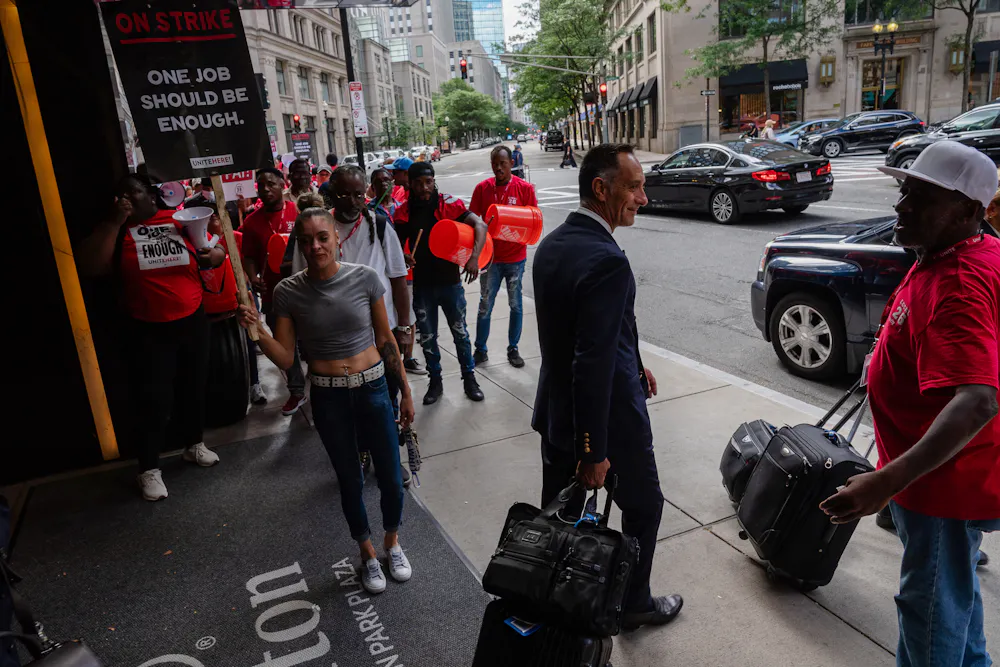
    On Labor Day weekend in 2024, more than 10,000 hotel workers represented by the UNITE HERE union and employed by 24 hotels from Boston to the West Coast to Hawaii went on strike. Their labor actions disrupted travel plans during a busy time.

    Most hotel work stoppages lasted for three days and intended to pressure the companies that own hotels as part of a larger labor contract negotiation strategy. Later in September, workers kept walking off the job at other hotels to pressure management to improve pay, expand health insurance coverage, boost retirement benefits and agree to resolve important job security issues.

    Although the hotel industry has been booming since 2023, UNITE HERE contends that employment has decreased by nearly 40%, while wages have stagnated. On the picket line, workers have described living paycheck to paycheck and working one or two additional jobs to cover recent rent hikes.

    Hotel workers have more bargaining power today because, according to an industry study, 79% of the 450 hotels surveyed looking to hire people said they could not fill open jobs.

    That strike shows no sign of ending. Thousands more hotel workers were joining in by late September.

    Striking hotel workers make way for an airline crew while picketing outside of the Hilton Boston Park Plaza in Boston, Mass., on Sept. 2, 2024.
    Sophie Park/The Washington Post via Getty Images

    Boeing strike

    Unlike the hotel workers’ brief rolling work stoppages, the Boeing strike hasn’t let up since it began on Sept. 13, 2024. About 32,000 workers, mainly in Seattle, Washington, and Portland, Oregon, have walked off the job.

    Boeing workers declared the strike even though the International Association of Machinists District 751 leadership in Seattle wanted to accept a deal from Boeing’s management. But on Sept. 12, 94.6% of all rank-and-file workers rejected the tentative contract their leadership recommended the union accept.

    The Boeing strike started the next day; it could last a long time. On Sept. 25, the workers rejected what the company had called its “best and final offer” to settle the strike.

    This is the eighth time these workers have gone on strike since their union formed in the 1930s. Its two most recent strikes, in 2008 and 2005, lasted 57 days and 28 days, respectively. Boeing’s management, already reeling from the company’s numerous operational and safety problems, has announced several cost-cutting measures, including furloughs for some nonunion employees.

    Boeing’s nonunion backup plan

    Boeing has assured its shareholders and the public that the strike would not hinder production of the 787 Dreamliner jets at the company’s nonunion factory in South Carolina.

    International Association of Machinists union members have never forgiven Boeing for deciding to build that assembly plant. Operational since 2011, it now employs roughly 6,000 workers. Most of them would have been union members had Boeing built that plant or expanded production in Washington or Oregon, because the existing labor agreement would have covered the new workers.

    However, the agreement did not extend to South Carolina.

    At the time of the decision, a Boeing spokesperson said, its contract with the machinists’ union “acknowledges our right to locate work elsewhere, and that’s what we chose to do in this case because we just couldn’t get the terms from them that we needed.”

    Dockworkers could be next

    The timing of the hotel and Boeing strikes makes them perhaps more visible than they might have been because union members’ votes are coveted by both major parties in the 2024 presidential election.

    Meanwhile, 25,000 dockworkers who belong to the International Longshoremen’s Association are planning a possible shutdown of ports from Boston to Houston on Oct. 1, over the union’s concern for job loss due to automation.

    How job security issues are addressed following this wave of strikes could set the tone for what other hospitality, manufacturing and transportation unions seek when their contracts are up for negotiation again.

    Robert Forrant does not work for, consult, own shares in or receive funding from any company or organization that would benefit from this article, and has disclosed no relevant affiliations beyond their academic appointment.

    ref. Autoworkers, Boeing machinists, cannabis drivers: Labor unions are mobilizing in new and old industries alike – https://theconversation.com/autoworkers-boeing-machinists-cannabis-drivers-labor-unions-are-mobilizing-in-new-and-old-industries-alike-239371

    MIL OSI – Global Reports

  • MIL-OSI United Kingdom: A fiery end to ESA’s Cluster satellite Salsa

    Source: United Kingdom – Executive Government & Departments

    Earlier this month ESA’s satellite ‘Salsa’ landed in the South Pacific. Learn more about how NSpOC tracks re-entries from space using Salsa as a case study.

    An artist’s impression of a Cluster spacecraft breaking apart during reentry. Credit: ESA/David Ducross

    As space becomes increasingly crowded with operational satellites and space debris, monitoring satellite re-entries is crucial for helping to ensure the safety of people and property on Earth.

    The National Space Operations Centre (NSpOC) plays a key role in this effort through our re-entry tracking and early warning capability, which monitors re-entry incidents and where relevant provides warnings to response agencies to minimise any associated risk to the UK or the UK Overseas Territories.

    On 8 September 2024, The European Space Agency (ESA) undertook the safe de-orbit of their Cluster 2 satellite named ‘Salsa’. The spacecraft re-entered at 6.47pm GMT into a designated region in the South Pacific as planned. NSpOC analysts monitored the event, as it does with every re-entry globally, to ensure potential risks to the UK were assessed and addressed. In this article, we’ll explain how our re-entry tracking and early warning capability works, using ESA’s Salsa as a case study, and highlight the key contributions of the satellite to both government operations and academic research.

    NSpOC’s Re-entry Tracking and Warning Capability: Monitoring Re-entries Like Salsa

    NSpOC’s re-entry tracking and warning capability operates 365 days a year and is dedicated to monitoring the re-entry of satellites and other space objects that could pose a risk to the UK and UK Overseas Territories, as well as the re-entry of objects for which the UK holds liability. On average, NSpOC monitors around 40 uncontrolled re-entry incidents per month, warning UK response agencies when there is a risk to the UK or our Overseas Territories.

    How does the capability work?

    As part of our space hazards warning and protection services, NSpOC continuously monitors space objects in orbit, providing early warnings when satellites begin their descent. In the case of uncontrolled re-entries, and semi-controlled re-entries such as ESA’s Salsa, orbital analysts assess the object’s trajectory and predict when and where it will re-enter the atmosphere. This data is shared with response agencies and government departments to ensure preparedness.

    Real-Time Monitoring and Modelling

    36 hours before a re-entry event, NSpOC’s team of orbital analysts start to monitor the object in more detail, using a global network of sensors and data streams which provide information on its path. In uncontrolled re-entry events, data on the last known position of the object as well as its predicted Centre of Impact Window (COIW) is provided by the US   in the form of Tracking and Impact Predictions (TIPs). This TIP is a single point which can come with high levels of uncertainty. To better understand the probability of where, within that window, the event may occur, UK Space Agency analysts run an extra re-entry assessment model using Monte Carlo simulations (see below for an explanation).

    Monte Carlo simulations incorporate additional data sets, for example forecasted atmospheric density over the re-entry period, to allow for more accurate predictions of where surviving objects might land. The model runs 30,000 times with slight adjustments to values for each variable.

    Rather than a single point of re-entry, this results in a probabilistic output of potential re-entry locations; shown visually on a map by red dots, with each red dot representing a potential re-entry location. The denser the collection of red-dots, the greater the likelihood of the object re-entering in that location.

    In the case of ESA’s Salsa satellite, ephemeris (positional data) was provided rather than TIPs and our analysts converted this to a Two-Line Element (TLE) to extract the orbit, and ran the Monte Carlo simulation to produce a visual prediction of re-entry.  

    For Salsa, our analysts closely monitored the descent, predicting that the majority of the satellite would burn up in the atmosphere, with any surviving fragments expected to land in a remote region of the South Pacific – the likely re-entry path is shown via the red dots in the images below, starting 36 hours in advance on Friday 6 September.

    Re-entry map generated by NSpOC analysts on Friday 6 September

    As the time to the re-entry gets closer, more observations on the object are received by global networks. This results in new data which can be input into the Monte Carlo simulation, producing a more accurate assessment of re-entry locations.

    Re-entry map generated by NSpOC analysts on Saturday 7 September

    Final re-entry map generated by NSpOC analysts on Sunday 8 September before the event

    Post-Re-entry Assessment

    After the satellite re-enters, NSpOC conducts a post-event analysis to confirm the re-entry location and assess any potential impact. It is not always possible to receive tracking data confirming the location of a re-entry, but in the case of Salsa, ESA were tracking the re-entry event closely, even with sensors on an aeroplane, to confirm that it re-entered in the South Pacific. 

    The re-entry location is shared with relevant stakeholders to ensure transparency and public safety. In the case of Salsa, the risk to human life and infrastructure on Earth was extremely low because of the semi-controlled nature of the re-entry bringing it down in an unpopulated location.

    Why Monitoring Re-entries is Important

    Whilst risk from re-entering satellites is very low, with the majority of satellites burning up upon re-entry, large objects or those with dense components will survive the re-entry process, posing a risk to wherever the object makes landfall. Since most re-entries are uncontrolled, there is a risk to populated areas and so warning authorities when there is a risk is important for both safety and to ensure we take responsibility for any space debris for which the UK is liable. Each re-entry incident provides valuable data that helps improve our ability to track and monitor future re-entering objects.

    By responsibly managing satellite re-entries, such as ESA’s Salsa, operators can reduce the amount of debris left in orbit, making space safer for future operations. Later this year, NSpOC will launch a new digital service on our Monitor Space Hazards platform, called ‘Track Re-entry Events’, which will provide government users with real-time updates and enhanced analytics for monitoring satellite re-entries. You can find out more about upcoming features on our website.

    Angus Stewart, Joint Head of NSpOC said: “By managing satellite re-entries responsibly, as is the case with this event, operators reduce space debris and make space safer for future missions. Tracking re-entering space objects is a critical mission for the UK National Space Operations Centre”

    The ESA Cluster Salsa Mission: why was it significant?

    Launched as part of the ESA Cluster mission in July 2000, the Salsa satellite provided critical data that advanced our understanding of Earth’s magnetic environment and space weather over its 24-year operational life.

    Salsa’s contributions to space weather research were invaluable. The satellite’s data helped improve predictive models that assist in safeguarding critical infrastructure such as electrical power grids, pipelines, and satellite communications systems. By studying how solar winds and geomagnetic storms interact with Earth’s magnetic field, Salsa provided insights that helped operational teams understand and mitigate the impacts of space weather on essential services.

    Salsa was part of a constellation of four satellites which was crucial because it allowed scientists to gather data from multiple points in space simultaneously, giving researchers a 3D view of Earth’s magnetic environment.

    Met Office Space Weather Manager Simon Machin said: “Cluster has been a key contributor to advancing space weather science in recent decades. By advancing what we know about the near-Earth environment at multiple scales, this mission pushed forward research understanding, which underpins global space weather operations. Cluster’s observations are a unique resource and will continue to provide considerable value in the years to come.”

    Conclusion

    The ESA Cluster 2 Salsa re-entry provides a clear example of how NSpOC monitors re-entries, ensuring the safety of the UK and its Overseas Territories. As satellites continue to play an increasingly important role in both government operations and academic research, NSpOC’s re-entry capability will remain vital to ensuring the safe and responsible use of space for future missions.

    Updates to this page

    Published 27 September 2024

    MIL OSI United Kingdom

  • MIL-OSI NGOs: Northern Ireland: Failure of Martin O’Hagan murder investigation has created ‘an environment of impunity’

    Source: Amnesty International –

    Martin O’Hagan with the NUJ banner on May Day in Belfast 2001 © Kevin Cooper/Photoline NUJ

    Amnesty International backs calls by NUJ for a fresh investigation into the killing

    No-one convicted in 23 years since murder of journalist

    The failure to bring to justice those responsible for the murder of Martin O’Hagan has helped create an environment of impunity for those who continue to threaten journalists in Northern Ireland today, Amnesty International has said on the eve of the twenty-third anniversary of the killing of the reporter.

    On September 28 2001, Sunday World journalist Martin O’Hagan was shot dead in Lurgan by members of an illegal paramilitary group. To this day, no one has been held to account for his brutal murder.

    Amnesty has backed National Union of Journalists (NUJ) calls for a fresh investigation into the killing.

    Journalists in Northern Ireland, particularly those covering activities by paramilitary and organised crime groups, are regularly subject to threats of violence.

    Patrick Corrigan, Amnesty International’s Northern Ireland Director, said:

    “The public execution of Martin O’Hagan was designed to send a clear message to journalists in Northern Ireland that they are not safe.

    “It is simply unacceptable that, in the twenty-three years since Martin O’Hagan was shot dead, not a single person has been held accountable.

    “This failure has created an environment of impunity for those who continue to threaten journalists in Northern Ireland today.

    “It is notable that, in 2024, threats of serious violence continue to be directed at journalists from the very same sort of armed groups which killed Martin O’Hagan.

    “We support calls from the National Union of Journalists for a fresh investigation into the killing. Press freedom must be resolutely defended.”

    View latest press releases

    MIL OSI NGO

  • MIL-OSI United Kingdom: Advocate General for Scotland, Catherine Smith KC, sworn in

    Source: United Kingdom – Executive Government & Departments

    Appointment marks the first time Scotland’s three law officers have all been female

    Catherine Smith KC was sworn in as Advocate General for Scotland at a ceremony at the Court of Session in Edinburgh today (Friday 27 September).

    Ms Smith’s appointment means that for the first time, Scotland’s three law officers are all female, following Dorothy Bain KC and Ruth Charteris KC being appointed Lord Advocate and Solicitor General of Scotland respectively in 2021.

    Ms Smith said: “It is a privilege to be sworn in as Advocate General for Scotland. As a Law Officer in the UK Government, I have a responsibility, along with the Attorney General and the Solicitor General for England and Wales, to uphold and promote the rule of law in government. 

    “I look forward to collaborating with the Lord Advocate and Solicitor General for Scotland on areas of shared interest. I am honoured to join them as a Scottish Law Officer, the first time that the three offices have been concurrently held by women.”

    Ms Smith was called to the Bar in 2007 and took silk in 2021. She acted as a part-time Sheriff and sat on the Scottish Civil Justice Council. She was Standing Junior Counsel to the Advocate General from 2012 – 2021 and conducted many cases representing the UK Government. She is one of only two advocates in Scotland to have acted as Counsel to the Investigatory Powers Tribunal and was on the Equality and Human Rights Commission Panel of Counsel. 

    Ms Smith has had a varied career at the Bar, specialising in criminal law in the early years and later working in public law, personal injury and clinical negligence. She has also conducted public inquiries, including representing COSLA and 29 of the 32 Scottish local authorities in the UK and Scottish Covid Inquiries.

    She is also a founding member and former Deputy Chair of JUSTICE Scotland. She has travelled extensively in the post-Soviet states to support human rights focused activities, including visiting Kyiv and Warsaw in the last year.

    Updates to this page

    Published 27 September 2024

    MIL OSI United Kingdom

  • MIL-OSI United Kingdom: Smouldering rubbish spotted by quick-thinking crew

    Source: City of Canterbury

    A quick-thinking waste collection crew that spotted rubbish smouldering in the back of their refuse collection vehicle have been praised. 

    The team from the council’s contractor Canenco grabbed a fire extinguisher and took action before a serious fire could take hold while emptying bins in Glenside, Whitstable on Tuesday (24 September). 

    The incident was caused by some lithium-ion batteries left in a cardboard box which were taken back to the depot by a supervisor. 

    The near miss comes almost a year to day when a car battery caused a serious fire in a refuse collection vehicle in Valley Road, Canterbury (below).

    Firefighters were called to put out the blaze and had to cut the roof off. 

    And in February last year, we reported fires in three refuse lorries over a period of weeks (below).

    Cllr Charlotte Cornell, Cabinet Member for Cabinet Member for Council Services, Culture and Heritage, said: “It’s a massive well done from me to the crew for spotting the danger and dealing with it in such a cool and calm manner.

    “But they shouldn’t have to. Everyone needs to dispose of batteries properly – they cannot go in your normal bin.

    “By being a little bit lazy, some residents are putting the lives of crews at risk, risk diverting firefighters from other emergencies, could be responsible for the release of harmful chemicals and, quite frankly, could disrupt other people’s collections and destroy expensive equipment.”

    Used batteries from household items such as children’s toys, mobile phones, remote controls, laptops and watches cannot be thrown away in domestic waste bins because they can cause fires once damaged and the chemicals inside them are released.

    Being crushed by a refuse lorry compactor is a really good example.

    Batteries used for domestic purposes can be taken to:

    • local household waste recycling centres (aka ‘the tip’)
    • supermarkets
    • electrical shops
    • participating libraries
    • participating schools

    Car batteries should be taken to your local household waste recycling centre, also known as the tip.

    Find your nearest battery recycling point at takecharge.org.uk.

    David Maidman, Canenco’s Managing Director, said: “There are some simple things we can all do to limit the damage caused by batteries including removing batteries from products to recycle them separately, using rechargeable batteries and selling or donating working battery-powered electronic items instead of throwing them away.

    “For advice on what items of waste go in which bin or need to be taken to the tip, use our online where to put your waste tool.”

    Published: 27 September 2024

    MIL OSI United Kingdom

  • MIL-OSI: Results for the Period Ended 30 June 2024

    Source: GlobeNewswire (MIL-OSI)

    Octopus Future Generations VCT plc

    Results for the Period Ended 30 June 2024

    Octopus Future Generations VCT plc (‘Future Generations VCT’ or the ‘Company’) is backing businesses that aim to address society’s biggest challenges, providing an opportunity for investors to share in the growth of ambitious, purpose‑driven companies.

    The Company is managed by Octopus AIF Management Limited (the ‘Manager’), who has delegated investment management to Octopus Investments Limited (‘Octopus’ or ‘Portfolio Manager’) via its investment team Octopus Ventures.

    The Company today announces the unaudited financial report for the twelve months ended 30 June 2024.

    Chair’s statement

    Highlights

    • £46.1m in total net assets
    • 86.8p Net Asset Value (NAV) per share
    • 36 portfolio companies 

    I am pleased to present the unaudited financial report and accounts for the Company for the twelve months to 30 June 2024.

    I would like to welcome all new shareholders to the Company. Future Generations VCT invests in exciting early-stage companies which aspire to address current environmental and societal issues.

    The NAV per share at 30 June 2024 was 86.8p, which represents a net decrease of 6.9p per share from 31 December 2023, the latest released NAV. In the twelve months to 30 June 2024, we utilised £8.3 million of our cash resources, including £7.2 million which was invested into 13 new portfolio companies. The cash balance of £17.5 million as at 30 June 2024 represents 37.8% of net assets at that date. The loss made in the period to 30 June 2024 was £4.0 million. This decline is mainly caused by the downward movements in some portfolio company valuations. It is reflective of some company specific performance challenges and the difficult funding conditions in the early stage space. Given the Company is still a new VCT, many of its portfolio companies are at the beginning of their journey and will likely require further funding to succeed, so it is to be expected to see under performance or even failures before any growth in value of companies which are ultimately successful.

    Fundraise
    On 31 January 2024 we launched a new offer to raise up to £15 million, and to date we have raised £3.2 million. The offer will close for new applications on 27 January 2025, or earlier at the Board’s discretion. We would like to take this opportunity to thank all shareholders for their continued support.

    As investors will be aware, the intention is to invest in businesses which meet one of three key themes, which we believe demonstrate good investment prospects as well as having the potential to transform the world we live in for the better.

    VCT qualification
    I am pleased to report that in April 2024, the Company met the requirement for 80% of the Company’s funds to be invested in VCT qualifying holdings by 1 July 2024 (for funds raised up to 30 June 2022). The remainder will be invested in permitted non-VCT qualifying investments or cash.

    In November 2023, a ten-year extension was announced to the ‘sunset clause’ (a retirement date for the VCT scheme), meaning VCT tax reliefs will be available until 5 April 2035. This extension passed through Parliament in February 2024 and on 3 September the Treasury brought into effect the extension through The Finance Act 2024.

    Principal risks and uncertainties
    The Board continues to review the risk environment in which the Company operates on a regular basis. The principal risks as described on pages 32 to 34 of the Annual Report for the year ended 30 June 2023 remain, however there is increased exposure to investment performance and loss of key people These will be reported on in detail in the annual report to 31 December 2024.

    Change to year end
    In 2023, the Board reviewed and approved a proposal to move the Company’s year-end from 30 June to 31 December. This change is largely being driven by operational efficiency gains by aligning year-end periods with other funds with which the Company co-invests. As a result, shareholders will receive an annual report for 31 December 2024 covering an extended 18-month period. After this, the normal cadence of reporting will resume.

    Board of Directors
    As announced in our half-yearly report to 31 December 2023, Ajay Chowdhury was appointed as an independent Non-Executive Director on 1 March 2024. Ajay is a serial entrepreneur, venture capitalist and author, and recently retired from his role as senior partner at the Boston Consulting Group. We look forward to benefitting from his wealth of experience in the early-stage venture ecosystem.

    AGM
    The AGM will take place on 10 December 2024 from 10:00am and will be held at the offices of Octopus Investments Limited, 33 Holborn, London, EC1N 2HT. Full details of the business to be conducted at the AGM are given in the Notice of AGM.

    Shareholders’ views are important, and the Board encourages shareholders to vote on the resolutions within the Notice of AGM using the proxy form, or electronically at www.investorcentre.co.uk/eproxy. The Board has carefully considered the business to be approved at the AGM and recommends shareholders to vote in favour of all the resolutions being proposed, as the Board will be doing.

    Outlook
    The decline in the NAV is disappointing, with some of the portfolio companies struggling to scale, secure customer wins and successfully fundraise meaning they are not achieving the milestones set at the time the Company invested. With companies not able to prove their business models, we will unfortunately see companies fail. The Board is mindful that it is not an unusual outcome for a Company at this stage of its investment life cycle, with any failures likely preceding valuation growth which is expected once the portfolio matures. While the Company continues to add to its portfolio, there is also currently a greater concentration of value in fewer companies, so performance will be more sensitive to valuation movements in the underlying holdings than if the portfolio was larger.

    The decline has been amplified by challenging global economic conditions which have characterised the last few years particularly impacting on growth and early-stage businesses. We are hopeful that there are signs of recovery on the horizon, with the Bank of England cutting interest rates for the first time since 2020 and the conclusion of the UK General Election bringing more political certainty and stability. The exit environment is also starting to show signs of recovery, with Initial Public Offerings (IPOs) having their strongest start to the year since the peak of 2021, bringing renewed optimism in the market1. Together, this gives us some confidence that the challenging environment our portfolio companies are operating in will start to improve, and with diversification across the three investment themes, it should mean the Company is well positioned to generate long-term value for shareholders.

    I would like to conclude by thanking both my Board colleagues and the Octopus team on behalf of all shareholders for their hard work. The Board’s long-term view of early-stage venture capital remains positive, and I am looking forward to seeing what the remainder of the year brings for your Company.

    Helen Sinclair
    Chair
    27 September 2024

    1 Pitchbook, European Venture Report Q2 2024 https://pitchbook.com/news/reports/q2-2024-european-venture-report#:~:text=Our%20Q2%202024%20European%20Venture,most%2Dactive%20vertical%20after%20SaaS.

    Portfolio Manager’s review

    Focus on Future Generations VCT’s investments
    Below is a breakdown of the 36 investments held as at 30 June 2024, showing the proportion and value of the portfolio in each investment theme:

    Proportion by number of portfolio companies in each theme
    Revitalising healthcare: 50%
    Empowering people: 31%
    Building a sustainable planet: 19%

    Value of the portfolio in each theme
    Revitalising healthcare: £12.3m
    Empowering people: £10.4m
    Building a sustainable planet: £5.9m

    Overview of investments
    The Company completed 7 new investments in the six months to 30 June 2024 (comprising a total of £5.2 million) and 2 further investments after the reporting date totalling £0.5 million. More information on three of these businesses can be found below:

    A selection of our completed investments

    Empowering people
    Swiipr
    Swiipr has developed a digital payments platform specifically for the airline industry. The platform enables airlines to instantly compensate passengers in cases of disrupted or cancelled flights, using virtual or pre-paid cards. Swiipr aims to streamline payment processing for airlines and improve the reimbursement experience for affected passengers.

    Building a sustainable planet
    Drift
    Drift Energy is designing sailing vessels and the routing algorithms required to capture deep water wind energy and convert it into onboard hydrogen gas. This would then be transported back to shore using a fully integrated desalination, electrolysis and storage system.

    Revitalising healthcare
    Manual
    Manual is looking to become the go-to global platform to increase healthy lifespan and build a series of direct-to-consumer health brands for high importance, non-critical areas of health. To achieve this, it will provide easy to access advice and medical support for diagnosis, custom treatment plans and holistic care to induce long-term behaviour change.

    Top ten investments

    Portfolio company Cost Valuation at
    30 June 2024
    Investment theme
    1. Perk Finance, S.L. (t/a* Cobee) £2.6m £3.7m Empowering people
    2. HelloSelf Limited £2.6m £2.6m Revitalising healthcare
    3. Neat SAS £0.8m £2.2m Building a sustainable planet
    4. Infinitopes Ltd £1.6m £1.6m Revitalising healthcare
    5. TYTN Ltd (t/a TitanML) £0.5m £1.5m Building a sustainable planet
    6. Mr & Mrs Oliver Ltd (t/a Skin + Me) £1.0m £1.4m Revitalising healthcare
    7. Apheris AI GmbH £1.2m £1.2m Empowering people
    8. Remofirst, Inc. £1.2m £1.2m Empowering people
    9. Intrinsic Semiconductor Technologies Ltd £0.9m £1.0m Empowering people
    10. Inflow Holdings Inc. £1.0m £1.0m Revitalising healthcare

    * Trading as
      

    Portfolio engagement – D&I and carbon emission measurement
    As part of our strategy, we require portfolio companies to put in place a Diversity and Inclusion policy (D&I) and an Anti-Harassment policy. We also engage with each company to help them understand their greenhouse gas emissions and support them to take action to minimise them. You can see how we are progressing with these goals below, as at the date of this report:

    D&I policy status
    Policy in place: 36
    In progress: 0

    Engaged in monitoring 2023 greenhouse gas emissions
    Signed up: 12
    Introduced: 22
    In progress: 2

    Focus on performance
    The NAV of 86.8p per share at 30 June 2024 represents a decrease of 6.9p per share versus a NAV of 93.7p per share as at 31 December 2023. The decline in valuation over the six-month period has been driven by the downward valuation movements across 13 companies which saw a collective decrease in valuation of £6.5 million. The businesses that contributed most significantly to this were Tympa Health, Pear Bio and Elo Health. In the six months, the Company further invested into Tympa Health as this was the committed second tranche of the original investment case from 2023. During the investment period, Tympa Health over-invested in growth and has now had to make significant cost cuts and changes to senior management whilst running a fundraise process. It has successfully secured an external lead investor, but at a reduced valuation and the Company now sits behind a large preference stack, meaning that other investors get paid back first before the Company would see any returns. Pear Bio has also had to significantly reduced its cash burn but has limited runway and needs to further fundraise, so the valuation has been reduced to reflect this risk. Elo Health has struggled to find a market fit and execute on the investment thesis, so to extend its cash runway it has had to raise an investment round at a reduced valuation. These three valuation movements account for 87.6% of the total decline in the six months.

    Octopus Ventures believes that some of the companies which have seen decreased valuations in the year have the potential to overcome the issues they face and get their growth plans back on track. Octopus Ventures will continue to work with them to help them realise their ambitions. In some cases, if a company is achieving
    its performance milestones, the support offered could include further funding, to ensure a business has the capital it needs to execute on its strategy.

    Conversely, 6 companies saw an increase in valuation in the period, delivering a collective increase in valuation of £2.9 million. These valuation increases reflect businesses which have successfully concluded further funding rounds, grown revenues or met certain important milestones. Notable strong performers in the portfolio include Neat and TitanML, both of which have shown impressive capital efficient growth. These strong performers demonstrate that there are opportunities available for companies to scale.

    At this early stage of the Company’s life cycle, it is to be anticipated that failures will likely precede valuation growth, which takes longer as the portfolio companies have to achieve their agreed milestones and mature.

    The gain on Future Generation’s uninvested cash reserves was £0.9 million in the twelve months to 30 June 2024 (31 December 2023: gain of £0.5 million), driven by returns on money market funds. The Board’s objective for these investments is to generate sufficient returns through the cycle to cover costs, at limited risk to capital.

    Outlook
    We are pleased to report the Company’s first disposal as it was agreed that Cobee (an employee benefits and engagement platform) will be acquired by Pluxee Group as part of its strategic growth plan. The transaction is subject to approval by the Spanish regulatory authorities over the coming months, so we look forward to reporting further after completion has taken place. The transaction is a great result for the Company at such an early point in its investment lifecycle and a good proof point of the investment strategy.

    The decline in NAV over the six-month period is disappointing but attributable to both the stage of the Company and the headwinds the portfolio companies have been facing. We continue to closely monitor the portfolio to ensure support and resources are being directed in the most impactful way, both through Octopus-appointed non-executive directors or monitors on the Boards and our in-house People and Talent team. This team works directly with the portfolio company management teams, offering training and recruitment support to ensure the best talent pool is being explored to help drive success in this more challenging climate.

    We are excited to have the opportunity to continue to scale the Company, support its ambition to make the world a better place for future generations, and hope to deliver attractive returns to shareholders.

    Directors’ responsibilities statement

    The Directors confirm that to the best of their knowledge:

    • the financial statements for the twelve months ended 30 June 2024 have been prepared in accordance with ‘Financial Reporting Standard 104: Interim Financial Reporting’ issued by the Financial Reporting Council;
    • the financial statements give a true and fair view of the assets, liabilities, financial position and profit or loss of the Company;
    • the report includes a fair review of the information required by the Financial Conduct Authority Disclosure Guidance and Transparency Rules, being:
      • we have disclosed an indication of the important events that have occurred during the twelve months of the period and their impact on the set of financial statements;
      • we have disclosed a description of the principal risks and uncertainties for the remaining six months of the period; and
      • we have disclosed a description of related party transactions that have taken place in the twelve months of the current financial period, that may have materially affected the financial position or performance of the Company during that period and any changes in the related party transactions described in the last annual report that could do so.

    By order of the Board

    Helen Sinclair
    Chair
    27 September 2024

    Income statement

      Unaudited Unaudited Audited
      Twelve months to 30 June 2024 Six months to 31 December 2023 Year to 30 June 2023
      Revenue Capital Total Revenue Capital Total Revenue Capital Total
      £’000 £’000 £’000 £’000 £’000 £’000 £’000 £’000 £’000
    Net loss on valuation of fixed asset
    investments
    (3,495) (3,495) (136) (136) (6) (6)
    Investment management fees (238) (712) (950) (117) (350) (467) (174) (522) (696)
    Investment income 973 973 515 515 424 424
    Other expenses (535) (535) (246) (246) (500) (500)
    Profit/ (loss) before tax 200 (4,207) (4,007) 152 (486) (334) (250) (528) (778)
    Tax
    Profit/ (loss) after tax 200 (4,207) (4,007) 152 (486) (334) (250) (528) (778)
    Earnings per share – basic and diluted 0.4p (8.4)p (8.0)p 0.3p (1.0)p (0.7)p (0.6)p (1.3)p (1.9)p
    • The ‘Total’ column of this statement is the profit and loss account of Future Generations VCT; the supplementary revenue return and capital return columns have been prepared under guidance published by the Association of Investment Companies.
    • All revenue and capital items in the above statement derive from continuing operations.
    • Future Generations VCT has only one class of business and derives its income from investments made in shares and securities and from bank and money market funds. Future Generations VCT has no other comprehensive income for the period.

    The accompanying notes form an integral part of the financial statements.

    Balance sheet

      Unaudited Unaudited Audited
      As at 30 June 2024 As at 31 December 2023 As at 30 June 2023
      £’000 £’000 £’000 £’000 £’000 £’000
    Fixed asset investments   28,566   26,729   24,895
    Current assets:            
    Applications cash* 153   100   370  
    Debtors 212   240   379  
    Cash at bank 192   107   152  
    Money market funds 17,265   19,998   20,140  
        17,822   20,445   21,041
    Creditors: amounts falling due within one year (256)   (177)   (518)  
    Net current assets   17,566   20,268   20,523
                 
    Net assets   46,132   46,997   45,418
                 
    Share capital   53   50   48
    Share premium   51,177   48,372   46,461
    Capital reserve realised   (1,352)   (990)   (640)
    Capital reserve unrealised   (3,492)   (133)   3
    Revenue reserve   (254)   (302)   (454)
    Total equity shareholders’ funds   46,132   46,997   45,418
    Net asset value per share   86.8p   93.7p   94.3p

    * Cash received from investors but not yet allotted.

    The accompanying notes form an integral part of the financial statements.

    The statements were approved by the Directors and authorised for issue on 27 September 2024 and are signed on their behalf by:

    Helen Sinclair
    Chair
    Company Number: 13750143

    Statement of changes in equity

      Share capital £’000 Share premium £’000 Capital reserve realised
    £’000
    Capital reserve unrealised
    £’000
    Revenue reserve
    £’000
    Total
    £’000
    As at 1 July 2023 48 46,461 (640) 3 (454) 45,418
    Comprehensive income for the year:            
    Management fees allocated as capital expenditure (712) (712)
    Net loss on fair value of fixed asset investments (3,495) (3,495)
    Profit after tax 200 200
    Total comprehensive income for the year (712) (3,495) 200 (4,007)
    Contributions by and distributions to owners:            
    Shares issued 5 4,814 4,819
    Share issue costs (98) (98)
    Total contributions by and distributions to owners 5 4,716 4,721
    Balance as at 30 June 2024 53 51,177 (1,352) (3,492) (254) 46,132

    The accompanying notes form an integral part of the financial statements.

      Share capital £’000 Share premium £’000 Capital reserve realised
    £’000
    Capital reserve unrealised
    £’000
    Revenue reserve
    £’000
    Total
    £’000
    As at 1 July 2023 48 46,461 (640) 3 (454) 45,418
    Comprehensive income for the year:            
    Management fees allocated as capital expenditure (350) (350)
    Net loss on fair value of fixed asset investments (136) (136)
    Profit after tax 152 152
    Total comprehensive income for the year (350) (136) 152 (334)
    Contributions by and distributions to owners:            
    Shares issued 2 1,971 1,973
    Share issue costs (60) (60)
    Total contributions by and distributions to owners 2 1,911 1,913
    Balance as at 31 December 2023 50 48,372 (990) (133) (302) 46,997

    The accompanying notes form an integral part of the financial statements.

      Share capital £’000 Share premium £’000 Capital reserve realised
    £’000
    Capital reserve unrealised
    £’000
    Revenue reserve
    £’000
    Total
    £’000
    As at 1 July 2022 33 31,572 (118) 9 (204) 31,292
    Comprehensive income for the year:            
    Management fees allocated as capital expenditure (522) (522)
    Net loss on fair value of fixed asset investments (6) (6)
    Loss after tax (250) (250)
    Total comprehensive income for the year (522) (6) (250) (778)
    Contributions by and distributions to owners:            
    Shares issued 15 15,164 15,179
    Share issue costs (275) (275)
    Total contributions by and distributions to owners 15 14,889 14,904
    Balance as at 30 June 2023 48 46,461 (640) 3 (454) 45,418

    The accompanying notes form an integral part of the financial statements.

    Cash flow statement

      Unaudited Unaudited Audited
      Twelve months to Six months
    to
    Year
    to
      30 June 31 December 30 June
      2024 2023 2023
      £’000 £’000 £’000
    Cash flows from operating activities      
    Loss before tax (4,007) (334) (778)
    Loss on valuation of fixed asset investments 3,495 136 6
    Decrease/(increase) in debtors 167 138 (103)
    Decrease in creditors (45) (71) (325)
    Outflow from operating activities (390) (131) (1,200)
    Cash flows from investing activities      
    Purchase of fixed asset investments (7,166) (1,970) (23,238)
    Outflow from investing activities (7,166) (1,970) (23,238)
    Cash flows from financing activities      
    Application account inflow 4,602 1,685 13,634
    Application account outflow
    Proceed from share issues
    (4,819)
    4,819
    (1,955)
    1,955
    (15,179)
    15,179
    Share issue costs (98) (41) (275)
    Inflow from financing activities 4,504 1,644 13,359
    Decrease in cash and cash equivalents (3,052) (456) (11,079)
    Opening cash and cash equivalents 20,662 20,662 31,741
    Closing cash and cash equivalents 17,610 20,206 20,662
    Cash and cash equivalents comprise      
    Money Market Funds 17,265 19,998 20,140
    Cash at Bank
    Applications cash
    192
    153
    107
            100
    152
    370
    Closing cash and cash equivalents 17,610 20,205 20,662

    The accompanying notes form an integral part of the financial statements.

    Condensed notes to the financial report

    1. Basis of preparation
    The unaudited results which cover the twelve months to 30 June 2024 have been prepared in accordance with the Financial Reporting Council’s (FRC) Financial Reporting Standard 104 Interim Financial Reporting (January 2022) and the Statement of Recommended Practice (SORP) for Investment Companies re-issued by the Association of Investment Companies in July 2022.

    The Directors consider it appropriate to adopt the going concern basis of accounting. The Directors have not identified any material uncertainties to the Company’s ability to continue to adopt the going concern basis over a period of at least twelve months from the date of approval of the financial statements. In reaching this conclusion, the Directors have taken into account the potential impact on the economy including inflation and the recession.

    The principal accounting policies have remained unchanged from those set out in the Company’s 2023 Annual Report and Accounts.

    2. Publication of non-statutory accounts
    The unaudited financial report for the twelve months ended 30 June 2024 does not constitute Statutory Accounts within the meaning of s.415 of the Companies Act 2006 and has not been delivered to the Registrar of Companies. The comparative figures for the year ended 30 June 2023 have been extracted from the audited financial statements for that year, which have been delivered to the Registrar of Companies. The independent auditor’s report on those financial statements, in accordance with Chapter 3, Part 16 of the Companies Act 2006, was unqualified. This financial report has not been reviewed by the Company’s auditor.

    3. Earnings per share
    The loss per share is based on 50,107,452 Ordinary shares (30 June 2023: 40,987,288, 31 December 2023: 48,725,532) being the weighted average number of shares in issue during the period. There are no potentially dilutive capital instruments in issue and so no diluted returns per share figures are relevant. The basic and diluted earnings per share are therefore identical.

    4. Net asset value per share

      30 June 2024 31 December 2023 30 June 2023
    Net assets (£’000) 46,132 46,997 45,418
    Shares in issue 53,160,670 50,165,822 48,138,337
    Net asset value per share (p) 86.8 93.7 94.3

    5. Allotments
    During the twelve months to 30 June 2024, 5,022,333 shares were issued at a weighted average price of 95.2p (30 June 2023: 15,569,169 shares at a weighted average price of 98.6p, 31 December 2023: 2,027,485 shares at a weighted average price of 97.3p per share).

    6. Transactions with the Manager and Portfolio Manager
    Future Generations VCT is classified as a full-scope Alternative Investment Fund (AIF) under the Alternative Investment Fund Management Directive (the ‘AIFM Directive’). Future Generations VCT has appointed Octopus AIF Management Limited to provide the services of an Alternative Investment Fund Manager (AIFM) of a full scope AIF. In accordance with its power to do so under AIFMD, Octopus AIF Management Limited has delegated portfolio management to Octopus Investments Limited, whilst retaining the obligations of a risk manager.

    Future Generations VCT paid Octopus AIF Management Limited £950,000 in the period as a management fee (30 June 2023: £696,000, 31 December 2023: £467,000). The annual management charge (AMC) is based on 2% of Future Generations VCT’s NAV. The AMC is payable quarterly in advance and calculated using the latest published NAV of Future Generations VCT and the number of shares in issue at each quarter end. Once the quarter has ended, an adjustment will be made if the NAV at the end of the current quarter is calculated and which differs from the NAV as at the end of the previous quarter.

    Octopus also provides Non-Investment Services to Future Generations VCT, payable quarterly in advance. The fee is 0.3% of Future Generations VCT’s NAV, calculated at quarterly intervals. The Non-Investment Services Agreement (NISA) fee is calculated using the latest published NAV of Future Generations VCT and the number of shares in issue at each quarter end. As with the AMC, an adjustment will be made once the quarter has ended if the NAV at the end of the current quarter is calculated and which differs from the NAV as at the end of the previous quarter. During the period £143,000 was paid to Octopus for Non-Investment Services (30 June 2023: £122,000, 31 December 2023: £70,000).

    In addition, Octopus is entitled to performance-related incentive fees, subject to Future Generations VCT’s total return at year end exceeding the total return at the previous year end when an incentive fee was paid or 97p if the first incentive fee has not yet been paid (the ‘Excess’), equal to 20% of the Excess. Future Generations VCT’s total return at year end exceeded the total return at the previous year end when an incentive fee was paid or 97p if the first incentive fee has not yet been paid (the ‘Excess’), equal to 20% of the Excess. No performance fee will be paid prior to the financial period ending 30 June 2025, dividends (paid or declared) being equal to or greater than 10p per Ordinary share and the total return exceeding 120p.

    The cap relating to Future Generations VCT’s total expense ratio, that is the regular, recurring costs of Future Generations VCT expressed as a percentage of its NAV, above which Octopus have agreed to pay, is 3.0%, and is calculated in accordance with the AIC Guidelines.

    7. Related party transactions
    Several members of the Octopus investment team hold non-executive directorships as part of their monitoring roles in Future Generations VCT’s portfolio companies, but they have no controlling interests in those companies.

    Emma Davies, a former Non-Executive Director of Future Generations VCT, previously held the role of co-CEO of Octopus Ventures. On 24 March 2023, Emma Davies ceased to be employed by Octopus Capital Limited and therefore she is no longer considered a related party. Emma retired as a Non-Executive Director of Future Generations VCT on 31 March 2024.

    No dividends have been paid to the Directors of Future Generations VCT.

    8. Voting rights and equity management
    The following table shows the percentage voting rights held by Future Generations VCT in each of the top ten investments, on a fully diluted basis.


    Investments

    30 June 2024
    % voting rights held by
    Future Generations VCT
    Perk Finance, S.L. t/a Cobee 2.8%
    HelloSelf Limited 4.1%
    Neat SAS 3.2%
    Infinitopes Ltd 4.4%
    TYTN Ltd (t/a TitanML) 4.2%
    Mr & Mrs Oliver Ltd (t/a Skin + Me) 0.6%
    Apheris AI GmbH 3.2%
    Remofirst, Inc. 1.4%
    Intrinsic Semiconductor Technologies Ltd 5.1%
    Inflow Holdings Inc. 1.9%

    9. Post balance sheet events
    The following events occurred between the balance sheet date and the signing of this financial report:
    ● 2 new investments completed totalling £0.5 million.
      

    10. Financial Report
    The unaudited results which cover the twelve months to 30 June 2024 will shortly be available to view at https://octopusinvestments.com/our-products/venture-capital-trusts/octopus-future-generations-vct/ . 
    A copy of the report will be submitted to the National Storage Mechanism and will shortly be available for inspection at: https://data.fca.org.uk/#/nsm/nationalstoragemechanism

    For further information please contact:

    Rachel Peat  
    Octopus Company Secretarial Services Limited
    Tel: +44 (0)80 0316 2067

    LEI: 213800AL71Z7N2O58N66

    The MIL Network

  • MIL-OSI Global: Five classic concept albums that will take you on a sonic road-trip across America

    Source: The Conversation – UK – By David Scott, Head of Division, School of Business and Creative Industries, University of the West of Scotland

    The concept album is often viewed as an art form that is primarily focused on lyrical storytelling. But in these five key records, musical ambition, performance and production combine to take the listener on a road-trip through America.

    1. Gunfighter Ballads and Trail Songs by Marty Robbins (1959)

    Gunfighter Ballads and Trail Songs, by Marty Robbins, has rightly been lauded as one of the most important artworks of the 20th century – indeed it was preserved in the Library of Congress in 2017.

    The thematic album transports the listener into a mythical west. Each song tells its own story, but there is a distinct unity of characterisation. The tearful convict awaiting death in They’re Hanging Me Tonight might well be an alter ego of the desert rider, hallucinating and desperate in Cool Water. Or even the ebullient narrator celebrating his own American dream in A Hundred and Sixty Acres.

    Marty Robbins performing El Paso.

    The album’s arrangements are mostly simple and stripped back, allowing Robbins’ extraordinary vocal performances and expressive backing vocal arrangements to fly. This reaches a stylistic peak in his greatest song, the white-knuckle ride of El Paso, wherein our protagonist willingly throws himself into a living hell.

    2. Smile by Brian Wilson (2004)

    The Beach Boys released 15 studio albums in the 1960s. Their voluminous output represented one of the most supercharged evolutions in contemporary music – fired by the imagination, energy and ambition of Brian Wilson.

    In 1965, in partnership with lyricist Mike Love, Wilson was extolling the virtues of California girls. Just a few months later, he was creating the mature, introspective humanity of Pet Sounds with collaborator Tony Asher. From there Wilson engaged lyricist Van Dyke Parks to help him realise an “American gothic trip”. Smile describes a journey across the country on the “ribbon of concrete”, or along the railroad with the early settlers.

    Heroes and Villains by Brian Wilson, from Smile.

    One key track on Smile, Heroes and Villains, took its narrative cue directly from Marty Robbins’ El Paso. But others – Cabin Essence and Surf’s Up – painted a new old west and still feel revolutionary today. However, the album became most famous for being left unfinished for 34 years, with snippets appearing piecemeal before its completion as a new recording by Brian Wilson in 2004.

    Van Dyke Park’s lyrics remain intriguing and unique. But I’d argue the real conceptual unity of Smile comes from its musical design. This is an album about American music as much as it is about America. It’s a kaleidoscope of Gershwin, Ives, Bernstein and goofy doo-wop, scaffolded by unexpected and rich textural juxtapositions (double bass, banjo and backing vocals going “boing boing” anyone?). And, of course, there’s the peerless vocal performances of The Beach Boys.

    3. The Delta Sweete by Bobbie Gentry (1968)

    Bobbie Gentry’s The Delta Sweete is another concept album that looks at both America (in this case the Mississippi Delta) and American music.

    Gentry first found fame with Ode to Billie Joe, a narrative ballad that became a major hit single. In The Delta Sweete, Gentry blended her own distinctive vignettes of southern life with skilfully curated covers of classics, like Mose Allison’s Parchman Farm.

    In Reunion, Gentry invites listeners into the front parlour of an alternately loving and warring southern family. She illustrates the scene by interweaving dialogue, vocal chants and rhythmic solo cello. Elsewhere we meet the swaggering, comedic Okolona River Bottom Band and experience a southern gothic nightmare in Refractions.

    Bobbie Gentry performs Courtyard.

    The sense of journey is enhanced by a series of orchestral pieces that link each of the 12 tracks. So when we finally alight on the solitude of the closing track, Courtyard, there is a feeling of coming home.

    The ambition of The Delta Sweete was not met with commercial success, but Gentry never quite gave up the conceptual flame. Her follow up – Local Gentry, in 1968 – shared some of the same approach to musical portraiture. And in her final studio album, Patchwork (1971), she returned to a series of vignettes with orchestral links. All make for essential listening.

    4. What’s Going On by Marvin Gaye (1971)

    From a journey across America, to a journey across the Mississippi Delta, we turn now to the streets of 1971 inner-city America, via Marvin Gaye’s masterly record, What’s Going On.

    This album represented a clear shift in Gaye’s artistic voice towards commentary, question and critique, against the will of Motown Records boss Berry Gordy resulting in a standoff during which Gaye threatened never to record for the label again. What’s Going On is perhaps most famous for its engagement with the social and political issues of the day, but the ambition of the music, performance and sound stand up thrillingly, 55 years after its release.

    A new music video for What’s Going On by Marvin Gaye, released in 2019.

    Motown Records house arranger David Van De Pitte set congas and guiros against sweeping orchestral arrangements, glockenspiel, choirs and jazz influences. The juxtaposition of tempo and feel created by transitions between the tracks hold you there as listener, walking around Gaye’s landscape, and seeing it through his eyes.

    The key sound of What’s Going On though – and the element that most solidifies its status as a conceptual album – is the approach taken with the vocals. Different takes of the same song overlap, and different ad libs collide and diverge as choral passages peek out from the background. These are the voices talking to Gaye during his walk through the inner city of What’s Going On.

    5. Cowboy Carter by Beyoncé (2024)

    Cowboy Carter’s conceptual birth sprang from the artist’s performance at the 2016 Country Association Awards, where prejudiced questions were raised (in the room and online) about Beyonce’s legitimacy and place in the context of a country music performance. Her ultimate response was this detailed exploration, celebration and critique that gets under the skin of American music itself. Beyoncé creates a searing and detailed a commentary on, and road-map to, American music.


    Read more:
    The genius of Cowboy Carter is Beyoncé’s accent – a musicologist explains


    Jolene by Beyoncé.

    Big questions around the origin and evolution of genre are asked via the medium of a Jolene cover, use of the banjo, impressionistic music arrangements and flights of performative imagination.

    There are spoken inserts (from Linda Martell, Willie Nelson and Dolly Parton) and striking musical juxtapositions. Like other albums on this list, Cowboy Carter’s conceptual veracity springs as much from this kaleidoscopic approach to sound as from the central narrative at its heart.

    In this collage we hear new songs, interpretations of classic songs and quotes from American classics, including one from The Beach Boys’ Smile – Good Vibrations.


    Looking for something good? Cut through the noise with a carefully curated selection of the latest releases, live events and exhibitions, straight to your inbox every fortnight, on Fridays. Sign up here.


    David Scott does not work for, consult, own shares in or receive funding from any company or organisation that would benefit from this article, and has disclosed no relevant affiliations beyond their academic appointment.

    ref. Five classic concept albums that will take you on a sonic road-trip across America – https://theconversation.com/five-classic-concept-albums-that-will-take-you-on-a-sonic-road-trip-across-america-239011

    MIL OSI – Global Reports

  • MIL-OSI United Kingdom: Appointment of Professor Kirstie Blair and Rupert Morley as Trustees of the Kennedy Memorial Trust: 27 September 2024

    Source: United Kingdom – Government Statements

    The Prime Minister has appointed Professor Kirstie Blair and Rupert Morley as Trustees of the Kennedy Memorial Trust.

    The Prime Minister has approved the appointments of Professor Kirstie Blair and Rupert Morley as Trustees of the Kennedy Memorial Trust, for a term of five years from 30 September 2024.

    Professor Kirstie Blair

    Kirstie Blair is Dean of the Faculty of Arts and Humanities at the University of Sterling. She holds an undergraduate degree from the University of Cambridge, and MPhil and DPhil degrees from the University of Oxford. She studied at Harvard University as a Kennedy Scholar.

    Rupert Morley

    Rupert is Chairman of Pershing Square Holdings, a FTSE 100 company, Chair of Bremont Watches and Trustee for Comic Relief. Rupert holds a degree in economics from Cambridge University and an MBA from Harvard Business School, which he attended as a Kennedy Scholar.

    Note for editors

    The Kennedy Memorial Trust was established in 1964 to administer monies raised in the United Kingdom as a tribute to the late President John Kennedy. Part of the fund was used to create and maintain the Kennedy Memorial site at Runnymede. The remaining capital is used to provide Kennedy Scholarships which enable British postgraduate students to study at Harvard and the Massachusetts Institute of Technology.

    Trustees are responsible for the selection process for those scholarships and for managing the maintenance of the Kennedy Memorial at Runnymede.

    Updates to this page

    Published 27 September 2024

    MIL OSI United Kingdom

  • MIL-OSI United Kingdom: Piano man comic David O’Doherty to make welcome return to The Alley

    Source: Northern Ireland – City of Derry

    Piano man comic David O’Doherty to make welcome return to The Alley

    27 September 2024

    Award-winning comedian, author and musician David O’Doherty is bringing his brand new show ‘Tiny Piano Man’ to The Alley Theatre, Strabane on Friday 25th October 2024

    The show features a lot of talking and a few songs on a glued-together plastic keyboard from 1986.

    David has previously appeared on TV shows such as Live at the Apollo and 8 out of 10 Cats does Countdown, as well as writing a children’s book, hosted various radio shows and plays.

    With over 20 years’ experience entertaining audiences worldwide, O’Doherty is looking forward to impressing the Strabane audience with his hilarious new show.

    He first walked out on stage at Dublin’s Comedy Cellar in 1998 and in that time has won the Perrier Award for Best Newcomer and the Main Award.
    He thrilled crowds at The Alley last year when performing his ‘Whoa Is Me’ tour to a packed house.

    Tickets are selling fast so get yours now at www.alley-theatre.com or call 028 71 384444. Tickets are £20.


    MIL OSI United Kingdom

  • MIL-OSI United Kingdom: Press release: Appointment of Professor Kirstie Blair and Rupert Morley as Trustees of the Kennedy Memorial Trust: 27 September 2024

    Source: United Kingdom – Prime Minister’s Office 10 Downing Street

    The Prime Minister has appointed Professor Kirstie Blair and Rupert Morley as Trustees of the Kennedy Memorial Trust.

    The Prime Minister has approved the appointments of Professor Kirstie Blair and Rupert Morley as Trustees of the Kennedy Memorial Trust, for a term of five years from 30 September 2024.

    Professor Kirstie Blair

    Kirstie Blair is Dean of the Faculty of Arts and Humanities at the University of Sterling. She holds an undergraduate degree from the University of Cambridge, and MPhil and DPhil degrees from the University of Oxford. She studied at Harvard University as a Kennedy Scholar.

    Rupert Morley

    Rupert is Chairman of Pershing Square Holdings, a FTSE 100 company, Chair of Bremont Watches and Trustee for Comic Relief. Rupert holds a degree in economics from Cambridge University and an MBA from Harvard Business School, which he attended as a Kennedy Scholar.

    Note for editors

    The Kennedy Memorial Trust was established in 1964 to administer monies raised in the United Kingdom as a tribute to the late President John Kennedy. Part of the fund was used to create and maintain the Kennedy Memorial site at Runnymede. The remaining capital is used to provide Kennedy Scholarships which enable British postgraduate students to study at Harvard and the Massachusetts Institute of Technology.

    Trustees are responsible for the selection process for those scholarships and for managing the maintenance of the Kennedy Memorial at Runnymede.

    Updates to this page

    Published 27 September 2024

    MIL OSI United Kingdom

  • MIL-OSI United Kingdom: Ministry of Defence analyses future global strategic trends

    Source: United Kingdom – Executive Government & Departments

    The seventh edition of Ministry of Defence’s analysis of the long-term future global strategic context and possible futures has been published today, covering a range of global trends including defence and technological advances.

    • Global Strategic Trends: Out to 2055 describes key drivers of change.
    • Long-term document forms seventh edition of strategic foresight analysis.
    • Analysis highlights possible future opportunities and challenges.

    Global Strategic Trends: Out to 2055 describes key drivers of change and illustrates alternative future worlds to test planning assumptions and help decision-makers prepare for an uncertain world.

    The findings and deductions do not represent the official policy of the UK government or that of the MOD, but the findings will be considered as part of the Strategic Defence Review, which will make sure our Armed Forces are bolstered and that our country has the capabilities needed to ensure the UK’s resilience for the long term.

    The document indicates an abundance of opportunities, alongside new and existing challenges in the global outlook. Notable areas of potential future trends for Defence include: 

    • A highly uncertain future for Russia, with the outcome of its war in Ukraine and the implications of this being key to its future power and status.
    • China will continue to use economic interdependencies, underpinned by military strength, as core means to achieve its objectives.
    • In an age of increasing uncertainty, the need to build resilience, agility and new forms of deterrence will be paramount.
    • An expansion in the number of nuclear-armed states fielding more powerful weapons, combined with new weapons of mass effect, could create new challenges.
    • Military shaping power will remain one of the ultimate levers of power. Space and cyberspace will increasingly be a key factor in battlefield success.

    This edition marks more than 20 years of strategic foresight analysis conducted by the MOD’s internal think tank. The authors gathered a diverse range of insights and research to present a global view of the long-term future, focusing on key areas such as social, economic, environmental and security factors.

    Chief of the Defence Staff, Admiral Sir Tony Radakin, said:

    The need to examine the implications of these future trends in a more openly contested and volatile world, as well as the possible shocks that may emerge, is a crucial task to assist policy makers and senior leaders.

    Commander Strategic Command, General Sir Jim Hockenhull, said:

    I am delighted to release this latest edition of Global Strategic Trends. All seven publications, over the last 20 years, have promoted an open-minded approach to understanding the context and conduct of Defence and Security.

    This rich and diverse programme of work, by Strategic Command, deliberately does not represent UK policy, instead it provides policymakers with a future strategic context to aid long-term decision-making, capability planning and strategy development.

    Its key conclusions indicate an abundance of opportunities but also highlight the combination of new and existing challenges that will redefine the contours of economies, societal structures, governance and defence.

    The work identifies six key interconnected drivers of change that are most likely to determine what the future might look like. These are: global power competition; demographic pressures; climate change and pressure on the environment; technological advances and connectivity; economic transformation and energy transition; and inequality and pressure on governance.

    ‘Global Strategic Trends: Out to 2055’ has been produced with cross-government support and international collaboration. Thousands of individuals were engaged during the research and writing process along with numerous national governments and several multilateral organisations, including NATO.

    Background

    • The first edition of GST, published in 2003, was designed to support the development of the MOD’s Future Strategic Context for Defence and subsequent White Papers. Since then, each edition has served to inform the various iterations of top-level strategic documents.

    Updates to this page

    Published 27 September 2024

    MIL OSI United Kingdom

  • MIL-OSI United Kingdom: Review of EU Citizens’ voting rights

    Source: City of Derby

    Changes to the law mean Derby City Council needs to review its electoral register, and if you are from the European Union, this could affect you.

    Following the UK’s departure from the European Union, The Elections Act 2022 brought with it changes to elections where EU citizens can vote, or stand as a candidate.

    Derby City Council will now conduct a review to determine who can remain on the electoral register, and may have to contact you for further information. This will by post or email, and you will receive the outcome of your review in writing.

    The changes apply to local and mayoral elections in England from 7 May 2024. If you’re an EU citizen, you will now only be able to register, vote or stand as a candidate if you meet one of the following criteria:

    • Citizens of Ireland, Cyprus and Malta living in the UK are unaffected by the changes and can vote and stand as candidates in all UK elections.
    • Citizens of Denmark, Luxembourg, Poland, Portugal, and Spain living in the UK can still stand and vote in local elections but not UK Parliament elections.
    • Citizens of EU countries who were legally resident in the UK on or before 31 December 2020 with permission to enter or stay in the UK, Channel Islands, or Isle of Man. This status must have continued without interruption.

    Emily Feenan, Electoral Registration Officer for Derby City Council, said: 

    “This review is an important part of keeping our electoral register up to date following recent legislation changes.

    “We understand that these changes may cause some concern, but we’re here to support our residents through this process and ensure everyone who is eligible can exercise their right to vote.”

    For more detailed information about changes to EU citizen’s voting and candidacy rights please see the Electoral Commission website. If you have any questions or concerns, please contact the Elections Team at elections@derby.gov.uk

    MIL OSI United Kingdom

  • MIL-OSI United Kingdom: Deputy Mayor approves planning application for All England Lawn Tennis Club

    Source: Mayor of London

    Following a public hearing today at City Hall, Jules Pipe, the Deputy Mayor for Planning, Regeneration and the Fire Service, has approved the planning application for All England Lawn Tennis Club (AELTC) to transform the former Wimbledon Park golf course.

    The plans will see an additional 38 grass courts, as well as a new Show Court, allowing the AELTC to bring the Wimbledon Qualifying event on-site for the first time – with the tournament bringing a wide range of economic and social benefits to London and nationally. 

    At today’s public hearing, GLA officers provided a detailed update on the proposals. Jules Pipe then heard views from Merton and Wandsworth Councils, and a range of supporters and objectors who had registered to speak. 

    The plans include:

    • An additional 27 acre (11.1 hectares) of public park, the site of a former private golf course, to be publicly accessible, managed and maintained as parkland.
    • Improvements to Wimbledon Park Lake and the creation of a new 3km boardwalk for the public. This is together with over £10 million of further improvements to the existing public park to include the provision of an enhanced multipurpose sports and leisure facility, drainage improvements to the sports fields, improved footpaths and new toilets, alongside a range of other recreational and heritage enhancement works.
    • A minimum of seven new Championship standard grass tennis courts open for community use.
    • The planting of 1500 new trees and an increase to the extent and quality of biodiversity across the land, with a suggested measurable biodiversity net gain of at least 10 per cent. 
    • Increased provision of tickets to the Championships to the local community and schools, including 450 tickets per day prioritised for Merton and Wandsworth residents at face value and 50 made available free of charge through the Wimbledon Foundation. 1000 free qualifying tickets for the Qualifying Event will also be made available for school children in Merton and Wandsworth.

    The GLA considered the benefits and disadvantages of the proposals in relation to a range of areas including environmental, design, transport, social, economic and cultural. While the plans have a significant effect on the use of metropolitan open land, the GLA considered the overall benefits to outweigh any harm in this area – including the provision of 11.1 hectares of publicly accessible parkland that will be managed and maintained.

    The GLA found that the total economic impact of the Championships, incorporating these plans, are projected to be worth in the region of £336 million to the UK economy each year, of which it is estimated that £326 million would occur within London. These plans will support 40 new jobs across the year and more than 250 new jobs during the Championships. Additionally, the plans will employ an average of between 50 to 400 construction workers per day between 2025 and 2033. 

    The very significant public benefits of the scheme, including enhancements to open space and recreation, economic, employment and heritage were therefore deemed to clearly outweigh the harm identified and allow for planning permission to be granted.

    Jules Pipe CBE, Deputy Mayor for Planning, Regeneration and the Fire Service, said: “These plans for the site of a former private golf course will bring significant benefits to the local area, the wider capital and the UK economy, providing increased access to open green space and sport, new parkland and a host of new jobs. Hosting qualifying events on the same site as the Championships will put Wimbledon on a global footing with other Grand Slam tournaments and ensure it remains one of the world’s top sporting events. The scheme brings a huge range of economic, social and cultural benefits which will contribute to building a fairer, greener and more prosperous London for everyone.”

    MIL OSI United Kingdom