Category: Universities

  • MIL-OSI Global: Kwame Akoto-Bamfo: the Ghanaian artist using work about slavery to find justice and healing

    Source: The Conversation – Africa – By Rachel Ama Asaa Engmann, Associate Professor and Director of Christiansborg Archaeological Heritage Project, Associate Graduate Faculty, Rutgers University

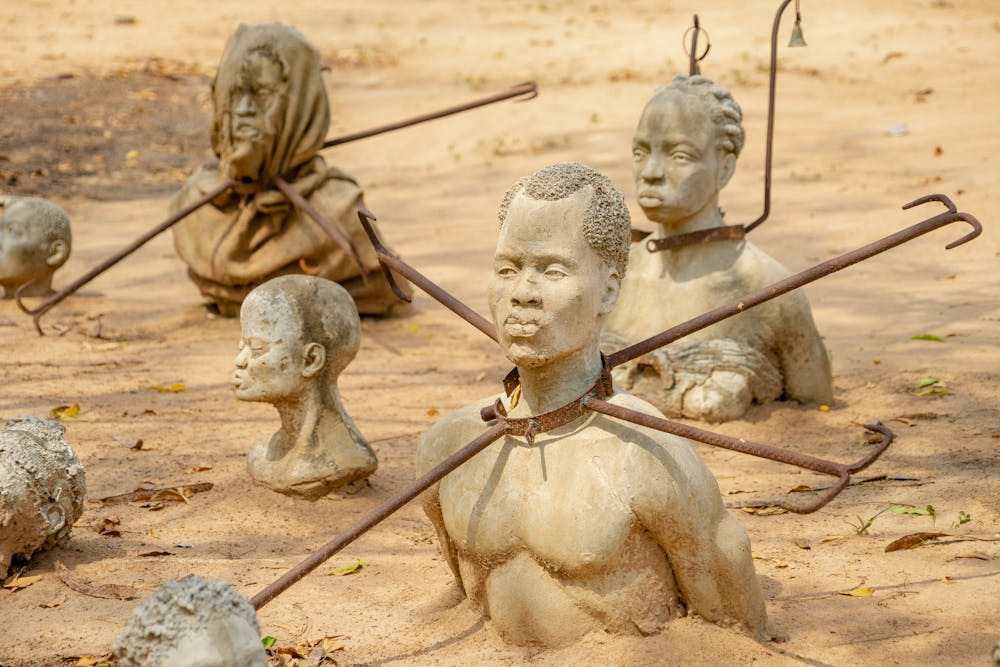
    Thousands of sculpted heads – captive African men, women, and children – meticulously created by the artist Kwame Akoto-Bamfo, emerge from the soil at the Nkyinkyim Museum, as a sacred gathering of ancestors. Together, they form a powerful monument to the horror, violence, and resistance to enslavement, as well as the ongoing work of remembrance and healing.

    Kwame Akoto-Bamfo is a Ghanaian multidisciplinary artist who engages with the histories and legacies of the transatlantic slave trade and colonialism at home and, increasingly, internationally, on both sides of the Atlantic.

    As an archaeologist who works in the field of critical heritage studies, Akoto-Bamfo’s work is important for its powerful engagement with memory, material culture and restorative justice. I feature it in a chapter of a new book that I co-edited called Architectures of Slavery: Ruins and Reconstructions.

    Who is Kwame Akoto-Bamfo?

    Akoto-Bamfo studied at the Kwame Nkrumah University of Science and Technology in Kumasi. He obtained his bachelor’s and master of fine arts degrees, both in sculpture. After graduating, the artist worked as a school teacher and a university lecturer.

    In 2015, Akoto-Bamfo rose to international fame through a series of large-scale installations. He called it ‘Nkyinkyim’ (“twisting” in the Ghanaian Twi language, as in the proverb, “Life’s journey is twisted”).


    Read more:
    Book review: how Africa was central to the making of the modern world


    Four years later, he established the ‘Nkyinkyim Museum’, a non-profit organisation known as the ‘Ancestor Project’. This open-air museum is located in Nuhalenya-Ada, a two-hour drive from Accra. It has become a space for people of African descent to engage in restorative healing through art and education.

    Nkyinkyim Museum

    At the site’s entrance, three twenty-five-foot monuments are displayed. They are made of stone, concrete and wood. The first is inspired by North and Eastern Africa, and the second by Sudano-Sahelian architecture. The third is inspired by the Forest regions in Central and West Africa.

    The collection includes multiple installations in collaboration with the local community. They illustrate “the diversity in our narratives surrounding history, philosophy, and religious beliefs”. The artist himself, demonstrates a mastery of multimedia art forms, working in cement, terracotta, brass, copper, and wood, noting “one can reach different heights with different technologies.”

    Today, the museum features a sacred healing space with a compelling display of thousands of unique concrete life size heads and 7,000 terracotta miniature sculpted heads. They include captive Africans abducted, sold and forcibly trafficked during the transatlantic slave trade.

    His sculptures capture captives’ shock, horror, anger, distress and fear—emotions. This is communicated through their facial expressions in an installation that is disturbingly evocative and profoundly haunting. It is inspired by ‘nsodie’, an Akan funerary sculpture tradition, that dates back to approximately the twelfth century. Akoto-Bamfo explains during our conversations relating to the research for book:

    I wanted to draw upon Akan belief in commemoration and remembrance after death in order to honour the young, old, men and women, who originated from various ethnic groups and who died in the Atlantic Ocean during the Middle Passage and did not get that chance.

    Each year, the annual ‘Ancestor Veneration’ ceremony takes place under the guidance of chiefs, priests, and priestess from various ethnic groups.

    Visitors are invited to participate in certain Akan rites and ceremonies – free from photography and selfies that undermine or commercialise sacred funerary art practices. Says Akoto-Bamfo:

    I am Akan, so initially I began with Akan traditional rites, but now our ceremonies welcome other African ethnic groups including the Ga-Dangme, Ewe, and Yoruba, from Ghana and Nigeria, as well as African descendant people in the African diaspora.

    In contrast, the ‘Freedom Parade Festival’ allows participants to creatively express and contribute to an evolving heritage tradition, without the specified observances. For example, painted bodily adornment applied directly onto the skin, yet without the necessary spiritual rites.

    A protest monument

    Akoto-Bamfo’s sculptures have also gained recognition beyond Ghana’s borders. For instance, the permanent installation at the Legacy Museum and National Museum for Peace and Justice in Montgomery, Alabama in the US.

    More recently, in 2021, his Blank Slate Project Monument toured throughout the United States. This included stops at Times Square in New York and the King Center in Atlanta. It depicts an enslaved ancestor, bent forward with his hands behind his back, head turned sideways, face on the ground, with a booted foot on his head.

    Akoto-Bamfo describes this work as “a noisy one — a protest piece that speaks against racist Civil War monuments.” The work was completed prior to the police killing of George Floyd that led to widespread protests in the US in 2020. It was first unveiled in a private viewing in Ghana, prior to its shipment to the United States.

    He says:

    We had a lot of discussions among those involved in the project: some feared it might incite violence, others said that it was a prediction.

    The work is interactive. It holds a removable placard that invites viewers to inscribe their reactions to the statue, which are then exhibited. Akoto-Bamfo emphasises:

    I wanted ordinary people, both individuals and communities, to relate, and to contribute to, not only towards my artwork but also to the wider ongoing discussions. As an artist, I believe that I do not have the sole right to speak. I wanted ordinary Americans to add their voices because I am already contributing.

    In Europe too, his work is featured at the 169 Museum in Germany.

    In Ghana, Akoto-Bamfo’s work was initially seen as too controversial. The artist shares:

    At first, I had to be extremely resilient because my work was concerned with the slave trade, slavery, colonialism, racism, and human rights. I embraced uncomfortable dialogue. Yet these were difficult topics for galleries and the art world at that time in Ghana.

    He adds:

    Today, however, some even view me as a spiritual leader… but I have always had an innate antipathy towards injustice. My work is not only about the past but what is unfolding now.

    Akoto-Bamfo offers a closing reflection on why this kind of memory work matters:

    I just want to use the little knowledge that I have to contribute towards the work of restorative and transformative justice.

    Rachel Ama Asaa Engmann does not work for, consult, own shares in or receive funding from any company or organisation that would benefit from this article, and has disclosed no relevant affiliations beyond their academic appointment.

    ref. Kwame Akoto-Bamfo: the Ghanaian artist using work about slavery to find justice and healing – https://theconversation.com/kwame-akoto-bamfo-the-ghanaian-artist-using-work-about-slavery-to-find-justice-and-healing-259184

    MIL OSI – Global Reports

  • MIL-OSI Global: Kwame Akoto-Bamfo: the Ghanaian artist using work about slavery to find justice and healing

    Source: The Conversation – Africa – By Rachel Ama Asaa Engmann, Associate Professor and Director of Christiansborg Archaeological Heritage Project, Associate Graduate Faculty, Rutgers University

    Thousands of sculpted heads – captive African men, women, and children – meticulously created by the artist Kwame Akoto-Bamfo, emerge from the soil at the Nkyinkyim Museum, as a sacred gathering of ancestors. Together, they form a powerful monument to the horror, violence, and resistance to enslavement, as well as the ongoing work of remembrance and healing.

    Kwame Akoto-Bamfo is a Ghanaian multidisciplinary artist who engages with the histories and legacies of the transatlantic slave trade and colonialism at home and, increasingly, internationally, on both sides of the Atlantic.

    As an archaeologist who works in the field of critical heritage studies, Akoto-Bamfo’s work is important for its powerful engagement with memory, material culture and restorative justice. I feature it in a chapter of a new book that I co-edited called Architectures of Slavery: Ruins and Reconstructions.

    Who is Kwame Akoto-Bamfo?

    Akoto-Bamfo studied at the Kwame Nkrumah University of Science and Technology in Kumasi. He obtained his bachelor’s and master of fine arts degrees, both in sculpture. After graduating, the artist worked as a school teacher and a university lecturer.

    In 2015, Akoto-Bamfo rose to international fame through a series of large-scale installations. He called it ‘Nkyinkyim’ (“twisting” in the Ghanaian Twi language, as in the proverb, “Life’s journey is twisted”).


    Read more:
    Book review: how Africa was central to the making of the modern world


    Four years later, he established the ‘Nkyinkyim Museum’, a non-profit organisation known as the ‘Ancestor Project’. This open-air museum is located in Nuhalenya-Ada, a two-hour drive from Accra. It has become a space for people of African descent to engage in restorative healing through art and education.

    Nkyinkyim Museum

    At the site’s entrance, three twenty-five-foot monuments are displayed. They are made of stone, concrete and wood. The first is inspired by North and Eastern Africa, and the second by Sudano-Sahelian architecture. The third is inspired by the Forest regions in Central and West Africa.

    The collection includes multiple installations in collaboration with the local community. They illustrate “the diversity in our narratives surrounding history, philosophy, and religious beliefs”. The artist himself, demonstrates a mastery of multimedia art forms, working in cement, terracotta, brass, copper, and wood, noting “one can reach different heights with different technologies.”

    Today, the museum features a sacred healing space with a compelling display of thousands of unique concrete life size heads and 7,000 terracotta miniature sculpted heads. They include captive Africans abducted, sold and forcibly trafficked during the transatlantic slave trade.

    His sculptures capture captives’ shock, horror, anger, distress and fear—emotions. This is communicated through their facial expressions in an installation that is disturbingly evocative and profoundly haunting. It is inspired by ‘nsodie’, an Akan funerary sculpture tradition, that dates back to approximately the twelfth century. Akoto-Bamfo explains during our conversations relating to the research for book:

    I wanted to draw upon Akan belief in commemoration and remembrance after death in order to honour the young, old, men and women, who originated from various ethnic groups and who died in the Atlantic Ocean during the Middle Passage and did not get that chance.

    Each year, the annual ‘Ancestor Veneration’ ceremony takes place under the guidance of chiefs, priests, and priestess from various ethnic groups.

    Visitors are invited to participate in certain Akan rites and ceremonies – free from photography and selfies that undermine or commercialise sacred funerary art practices. Says Akoto-Bamfo:

    I am Akan, so initially I began with Akan traditional rites, but now our ceremonies welcome other African ethnic groups including the Ga-Dangme, Ewe, and Yoruba, from Ghana and Nigeria, as well as African descendant people in the African diaspora.

    In contrast, the ‘Freedom Parade Festival’ allows participants to creatively express and contribute to an evolving heritage tradition, without the specified observances. For example, painted bodily adornment applied directly onto the skin, yet without the necessary spiritual rites.

    A protest monument

    Akoto-Bamfo’s sculptures have also gained recognition beyond Ghana’s borders. For instance, the permanent installation at the Legacy Museum and National Museum for Peace and Justice in Montgomery, Alabama in the US.

    More recently, in 2021, his Blank Slate Project Monument toured throughout the United States. This included stops at Times Square in New York and the King Center in Atlanta. It depicts an enslaved ancestor, bent forward with his hands behind his back, head turned sideways, face on the ground, with a booted foot on his head.

    Akoto-Bamfo describes this work as “a noisy one — a protest piece that speaks against racist Civil War monuments.” The work was completed prior to the police killing of George Floyd that led to widespread protests in the US in 2020. It was first unveiled in a private viewing in Ghana, prior to its shipment to the United States.

    He says:

    We had a lot of discussions among those involved in the project: some feared it might incite violence, others said that it was a prediction.

    The work is interactive. It holds a removable placard that invites viewers to inscribe their reactions to the statue, which are then exhibited. Akoto-Bamfo emphasises:

    I wanted ordinary people, both individuals and communities, to relate, and to contribute to, not only towards my artwork but also to the wider ongoing discussions. As an artist, I believe that I do not have the sole right to speak. I wanted ordinary Americans to add their voices because I am already contributing.

    In Europe too, his work is featured at the 169 Museum in Germany.

    In Ghana, Akoto-Bamfo’s work was initially seen as too controversial. The artist shares:

    At first, I had to be extremely resilient because my work was concerned with the slave trade, slavery, colonialism, racism, and human rights. I embraced uncomfortable dialogue. Yet these were difficult topics for galleries and the art world at that time in Ghana.

    He adds:

    Today, however, some even view me as a spiritual leader… but I have always had an innate antipathy towards injustice. My work is not only about the past but what is unfolding now.

    Akoto-Bamfo offers a closing reflection on why this kind of memory work matters:

    I just want to use the little knowledge that I have to contribute towards the work of restorative and transformative justice.

    Rachel Ama Asaa Engmann does not work for, consult, own shares in or receive funding from any company or organisation that would benefit from this article, and has disclosed no relevant affiliations beyond their academic appointment.

    ref. Kwame Akoto-Bamfo: the Ghanaian artist using work about slavery to find justice and healing – https://theconversation.com/kwame-akoto-bamfo-the-ghanaian-artist-using-work-about-slavery-to-find-justice-and-healing-259184

    MIL OSI – Global Reports

  • MIL-OSI Global: One year on: South Africa’s coalition government boosted optimism, but will it last?

    Source: The Conversation – Africa – By Matthias Krönke, Lecturer, University of Reading

    For the first time since the end of apartheid in 1994, the ruling African National Congress lost its parliamentary majority in 2024. After 30 years in power, it had to form a coalition with 10 other political parties to govern the country. The creation of the “government of national unity” marked a turning point in the country’s democracy.

    This development appears to have rekindled hope and positive sentiment among South Africans about the country’s future and its democratic processes.

    The period leading up to the 2024 elections was characterised by widespread pessimism. Years of economic stagnation, high unemployment, severe electricity shortages, and high-level corruption cases had taken their toll on public trust and satisfaction with the ANC’s governance. Previous analyses by Afrobarometer (a research network that conducts public attitude surveys) had consistently shown declining satisfaction with the country’s direction and the functioning of democracy.

    We are political scientists who have worked with public opinion data in South Africa for almost a decade. We analysed data from a special Afrobarometer survey just before and after the country’s 2024 election. The results show a sharp turnaround in attitudes on three issues: the direction of the country, government performance, and views on democracy.

    One of the most significant findings is the shift in citizens’ perceptions about the general direction of the country. Before the election, a mere 14% of South Africans believed the country was heading in the right direction. Post-election, this figure surged to 39%.

    South Africans’ renewed optimism after the formation of the unity government underscores the importance of electoral processes in shaping citizen perceptions of democracy and governance. Whether these sentiments are sustained will depend on a few things, including the coalition government’s ability to meet citizen expectations and address their most pressing concerns.

    The post-election optimism boost

    Afrobarometer interviewed the same group of adult South Africans before (April/May 2024) and after (August/September 2024) the election. This allowed us to track which respondents changed their views and in which direction. Here, we focus on citizens’ views of the overall direction of the country (optimism), government performance, and views on democracy.

    A surge in optimism: The data show that 35% of the population became more positive in their outlook after the election. This was consistent across gender, age, and education levels. At the same time, 4% of the population maintained their positive outlook on the country’s trajectory.

    About half (48%) continued to say that South Africa was going in the wrong direction after the election. A further 10% moved towards a negative outlook.

    Renewed faith in democratic processes: Beyond general optimism, there was a resurgence in pro-democratic attitudes. The proportion of South Africans who believe democracy is preferable to any other form of government increased from 45% before the election to 55% after. Satisfaction with the way democracy works in South Africa jumped from 36% to 59%. These levels of support for and satisfaction with democracy were the highest recorded by Afrobarometer in South Africa since 2018 and 2011, respectively.

    We found that three in 10 (29%) respondents were newly in favour of democracy after the elections. About four in 10 (39%) shifted from dissatisfaction or a neutral opinion before the election to stating they were “fairly” or “very” satisfied with the country’s democracy afterwards.

    Where are the sore losers?: In both the case of support for and satisfaction with democracy, we found that a greater proportion of poorer citizens shifted their opinions, compared to their wealthier counterparts. In contrast, there were no clear patterns of opinion change by respondents’ gender, age, level of education, or race.

    When examining the same question by party affiliation, the outcome was interesting. The share of partisans who preferred democracy increased among supporters of the ANC, the Economic Freedom Fighters and the MK Party after the election. A majority of supporters from the four major parties were satisfied with how democracy worked in the country.

    Even ANC supporters remained largely satisfied with democracy despite the party’s electoral losses. Collectively, these findings suggest a post-electoral vote of confidence in multiparty competition.

    Expectations of the new government: Citizens also appeared more hopeful about the new coalition government’s ability to tackle some of the nation’s most pressing issues. Pre-election evaluations of government performance on key services were overwhelmingly negative. The post-election wave showed some modest increases in optimism.

    Two-thirds (67%) of South Africans felt the government of national unity would be more effective in the critical area of electricity provision. There was also hope for progress in other areas; 42% expected the new government to be more effective in creating jobs. Another 41% believed it would be more successful in fighting corruption.

    Over the past year, the government seems to have met citizens’ expectations. South Africa has not experienced prolonged periods of power cuts over the past 12 months. However, the unemployment rate has remained unchanged, at 32.9%.

    Looking ahead

    The 2024 elections in South Africa seem to have served as an inflection point. It is contributing to a revival of optimism and pro-democratic sentiment. The shift from pre-election pessimism to post-election hope was palpable. Maintaining renewed public confidence, however, relies on a government’s ability to meet citizens’ expectations and deliver tangible improvements on their concerns.

    The ongoing skirmishes between the ANC and the Democratic Alliance illustrate the coalition government’s difficulty in translating agreement on a broad agenda into specific outcomes.

    The coming months and years will tell whether the unity government’s infighting ultimately squanders citizens’ goodwill.

    Matthias Krönke works for the University of Reading and consults for Afrobarometer.

    Rorisang Lekalake is affiliated with Afrobarometer.

    ref. One year on: South Africa’s coalition government boosted optimism, but will it last? – https://theconversation.com/one-year-on-south-africas-coalition-government-boosted-optimism-but-will-it-last-258497

    MIL OSI – Global Reports

  • MIL-OSI Global: One year on: South Africa’s coalition government boosted optimism, but will it last?

    Source: The Conversation – Africa – By Matthias Krönke, Lecturer, University of Reading

    For the first time since the end of apartheid in 1994, the ruling African National Congress lost its parliamentary majority in 2024. After 30 years in power, it had to form a coalition with 10 other political parties to govern the country. The creation of the “government of national unity” marked a turning point in the country’s democracy.

    This development appears to have rekindled hope and positive sentiment among South Africans about the country’s future and its democratic processes.

    The period leading up to the 2024 elections was characterised by widespread pessimism. Years of economic stagnation, high unemployment, severe electricity shortages, and high-level corruption cases had taken their toll on public trust and satisfaction with the ANC’s governance. Previous analyses by Afrobarometer (a research network that conducts public attitude surveys) had consistently shown declining satisfaction with the country’s direction and the functioning of democracy.

    We are political scientists who have worked with public opinion data in South Africa for almost a decade. We analysed data from a special Afrobarometer survey just before and after the country’s 2024 election. The results show a sharp turnaround in attitudes on three issues: the direction of the country, government performance, and views on democracy.

    One of the most significant findings is the shift in citizens’ perceptions about the general direction of the country. Before the election, a mere 14% of South Africans believed the country was heading in the right direction. Post-election, this figure surged to 39%.

    South Africans’ renewed optimism after the formation of the unity government underscores the importance of electoral processes in shaping citizen perceptions of democracy and governance. Whether these sentiments are sustained will depend on a few things, including the coalition government’s ability to meet citizen expectations and address their most pressing concerns.

    The post-election optimism boost

    Afrobarometer interviewed the same group of adult South Africans before (April/May 2024) and after (August/September 2024) the election. This allowed us to track which respondents changed their views and in which direction. Here, we focus on citizens’ views of the overall direction of the country (optimism), government performance, and views on democracy.

    A surge in optimism: The data show that 35% of the population became more positive in their outlook after the election. This was consistent across gender, age, and education levels. At the same time, 4% of the population maintained their positive outlook on the country’s trajectory.

    About half (48%) continued to say that South Africa was going in the wrong direction after the election. A further 10% moved towards a negative outlook.

    Renewed faith in democratic processes: Beyond general optimism, there was a resurgence in pro-democratic attitudes. The proportion of South Africans who believe democracy is preferable to any other form of government increased from 45% before the election to 55% after. Satisfaction with the way democracy works in South Africa jumped from 36% to 59%. These levels of support for and satisfaction with democracy were the highest recorded by Afrobarometer in South Africa since 2018 and 2011, respectively.

    We found that three in 10 (29%) respondents were newly in favour of democracy after the elections. About four in 10 (39%) shifted from dissatisfaction or a neutral opinion before the election to stating they were “fairly” or “very” satisfied with the country’s democracy afterwards.

    Where are the sore losers?: In both the case of support for and satisfaction with democracy, we found that a greater proportion of poorer citizens shifted their opinions, compared to their wealthier counterparts. In contrast, there were no clear patterns of opinion change by respondents’ gender, age, level of education, or race.

    When examining the same question by party affiliation, the outcome was interesting. The share of partisans who preferred democracy increased among supporters of the ANC, the Economic Freedom Fighters and the MK Party after the election. A majority of supporters from the four major parties were satisfied with how democracy worked in the country.

    Even ANC supporters remained largely satisfied with democracy despite the party’s electoral losses. Collectively, these findings suggest a post-electoral vote of confidence in multiparty competition.

    Expectations of the new government: Citizens also appeared more hopeful about the new coalition government’s ability to tackle some of the nation’s most pressing issues. Pre-election evaluations of government performance on key services were overwhelmingly negative. The post-election wave showed some modest increases in optimism.

    Two-thirds (67%) of South Africans felt the government of national unity would be more effective in the critical area of electricity provision. There was also hope for progress in other areas; 42% expected the new government to be more effective in creating jobs. Another 41% believed it would be more successful in fighting corruption.

    Over the past year, the government seems to have met citizens’ expectations. South Africa has not experienced prolonged periods of power cuts over the past 12 months. However, the unemployment rate has remained unchanged, at 32.9%.

    Looking ahead

    The 2024 elections in South Africa seem to have served as an inflection point. It is contributing to a revival of optimism and pro-democratic sentiment. The shift from pre-election pessimism to post-election hope was palpable. Maintaining renewed public confidence, however, relies on a government’s ability to meet citizens’ expectations and deliver tangible improvements on their concerns.

    The ongoing skirmishes between the ANC and the Democratic Alliance illustrate the coalition government’s difficulty in translating agreement on a broad agenda into specific outcomes.

    The coming months and years will tell whether the unity government’s infighting ultimately squanders citizens’ goodwill.

    Matthias Krönke works for the University of Reading and consults for Afrobarometer.

    Rorisang Lekalake is affiliated with Afrobarometer.

    ref. One year on: South Africa’s coalition government boosted optimism, but will it last? – https://theconversation.com/one-year-on-south-africas-coalition-government-boosted-optimism-but-will-it-last-258497

    MIL OSI – Global Reports

  • MIL-OSI Global: Kenya’s police still kill with impunity – what needs to be done to stop them

    Source: The Conversation – Africa – By Kamau Wairuri, Lecturer in criminology, Edinburgh Napier University

    Weeks ahead of the first anniversary in Kenya of the Gen Z-led anti-government protests that resulted in at least 60 deaths and displays of police brutality, news broke that Albert Ojwang, a young Kenyan blogger, had died in police detention. Kamau Wairuri who has studied the politics of policing in Kenya, sets out why these events aren’t outliers, what efforts have been made to reform Kenya’s security forces, and what still needs to be done.

    When did this all begin?

    Recent events are part of a long history of police brutality in Kenya that can be traced back to colonial times.

    Historians (colonial and post-colonial Kenya) such as David Anderson and Caroline Elkins present gruesome details of how state authorities brutalised indigenous Africans during colonial times.

    The colonial origins of the police – largely modelled along the approaches of the Royal Ulster Constabulary known for its brutality in Ireland – partly explains why Kenya’s policing is the way it is. The police force was never designed for service. It was designed to safeguard the interests of the white minority ruling elite.

    While there have been important changes in the architecture of policing since independence, subsequent post-colonial Kenyan regimes have adopted the same brutal approaches to stay in power. My previous work demonstrates this use of state security apparatuses to enhance the capacity of incumbents to crack down on opposition protests.

    The brutal policing experienced under the current Kenya Kwanza regime falls within this broader historical trajectory.

    The ruling elite see and use the police as their last line of defence against challenges to their misrule.

    But police brutality goes beyond the policing of politics to everyday crime control. Police violence is a common occurrence, especially against poor young men.

    What’s changed

    Kenya’s history has been marked by strong agitation for justice and reform. Again, this goes back to colonial times.

    There have been important legal and institutional changes since independence. The most important was the disbandment of the Special Branch in 1998, an intelligence unit of the police responsible for political repression. It was replaced by the National Security Intelligence Service. This then became the National Intelligence Service.

    The most important changes came about through the constitutional reform of 2010. This saw a change in the architecture of the police, including:

    Internal Affairs, a unit within the police service, is supposed to investigate police misconduct. The policing oversight agency is a civilian-led institutions with a similar mandate. Ideally, the two institutions should work together in executing crucial investigations. Internal affairs should provide access to information from within the police service that would be difficult for outsiders to access.

    The National Police Service Commission was set up to handle the management of personnel. It’s mandated to address the challenges of corruption, nepotism and negative ethnicity that have characterised recruitment into the police service.

    But it’s clear from the continued police brutality that these institutions aren’t achieving the intended effect. This means that police officers can expect to continue acting with relative impunity despite the control measures in place.

    What still needs to be done

    Policing is often imagined as the investigation of crimes, arresting suspects, and presenting them to court for prosecution and punishment if guilty. In Kenya, the actions of the police often appear to substitute for the entire criminal justice system.

    In many cases, officers go beyond the metaphor of judge, jury and executioner to also become the complainant, mortician and undertaker. For instance, Mbaraka Karanja died in police custody in 1987 and officers proceeded to incinerate his body.

    In my view, the brutality won’t end until the following steps have been taken.

    First, the National Police Service Commission needs to reclaim its mandate. It seems to have completely abdicated duty, transferring crucial responsibilities back to the inspector general of the police service. As the human resource unit of the police, the commission has an important role of professionalising the service and maintaining discipline. It’s presently not doing so.

    Second, the Internal Affairs Unit needs to be strengthened and given more autonomy. So far, it has been difficult to assess the effectiveness the unit given the secrecy that characterises the police service. A better-resourced unit will enhance investigations of police misconduct. It would unearth obscure squads within the police service and reveal evidence to help identify perpetrators.

    Third, the Independent Policing Oversight Authority needs to defend its independence and develop popular legitimacy. With its limited success in prosecuting police officers – despite the prevalence of police abuse – many Kenyans have lost confidence in it. Crucially, the authority has failed in it’s deterrence role.

    Fourth, the independence of the National Police Service needs to be safeguarded. The police service leadership continues to serve at the pleasure of the prevailing regime. This in turn shapes the priorities of the service. Inspectors-general have been forced to resign. President William Ruto confessed to having fired the director of criminal investigations when he took power. Ruto had initially claimed that the director had resigned.

    Crucially, and in fifth place, there needs to be a change in policing culture alongside broader governance culture in Kenya. Impunity is rampant across the public service. Kenya won’t have a highly accountable police force while other agencies and senior officials are operating with significant impunity.

    Identifying the levers of cultural change isn’t easy. There are many proposals to alter policing culture. These include a complete redesign of Kenya’s Penal Code to dislodge its colonial roots, transforming the training of police officers, and strengthening the policing oversight authority’s capacity to investigate cases.

    But, in my mind, a crucial starting point is citizen agitation and demand for accountability. The light that Gen Z protesters, the media and civil society organisations are shining on police abuses should be encouraged. A clear signal that Kenyans will no longer tolerate police abuse is crucial for culture change within the service and among the political elite.

    However, this needs to be understood within the reality that many Kenyans support police violence, believing it to be the most effective way of dealing with crime as my earlier research demonstrates. In another study, I note how police abuse is endorsed by politicians and religious leaders as a way of responding to crime and punishing groups of people they don’t like.

    Combined with ineffective accountability mechanisms, this popular support for police violence, both tacit and explicit, gives the police the belief that they are the thin blue line between order and chaos. That they have the popular mandate to use any means they consider necessary – often brutal violence – to keep society safe.

    In other words, the conversation on police reform requires a fundamental reframing to kick start the journey towards democratic policing. At present, we’re not only way off the mark, we seem to be heading in the wrong direction.

    Kamau Wairuri does not work for, consult, own shares in or receive funding from any company or organisation that would benefit from this article, and has disclosed no relevant affiliations beyond their academic appointment.

    ref. Kenya’s police still kill with impunity – what needs to be done to stop them – https://theconversation.com/kenyas-police-still-kill-with-impunity-what-needs-to-be-done-to-stop-them-259326

    MIL OSI – Global Reports

  • MIL-OSI Africa: Kwame Akoto-Bamfo: the Ghanaian artist using work about slavery to find justice and healing

    Source: The Conversation – Africa – By Rachel Ama Asaa Engmann, Associate Professor and Director of Christiansborg Archaeological Heritage Project, Associate Graduate Faculty, Rutgers University

    Thousands of sculpted heads – captive African men, women, and children – meticulously created by the artist Kwame Akoto-Bamfo, emerge from the soil at the Nkyinkyim Museum, as a sacred gathering of ancestors. Together, they form a powerful monument to the horror, violence, and resistance to enslavement, as well as the ongoing work of remembrance and healing.

    Kwame Akoto-Bamfo.

    Kwame Akoto-Bamfo is a Ghanaian multidisciplinary artist who engages with the histories and legacies of the transatlantic slave trade and colonialism at home and, increasingly, internationally, on both sides of the Atlantic.

    As an archaeologist who works in the field of critical heritage studies, Akoto-Bamfo’s work is important for its powerful engagement with memory, material culture and restorative justice. I feature it in a chapter of a new book that I co-edited called Architectures of Slavery: Ruins and Reconstructions.

    Who is Kwame Akoto-Bamfo?

    Akoto-Bamfo studied at the Kwame Nkrumah University of Science and Technology in Kumasi. He obtained his bachelor’s and master of fine arts degrees, both in sculpture. After graduating, the artist worked as a school teacher and a university lecturer.

    In 2015, Akoto-Bamfo rose to international fame through a series of large-scale installations. He called it ‘Nkyinkyim’ (“twisting” in the Ghanaian Twi language, as in the proverb, “Life’s journey is twisted”).


    Read more: Book review: how Africa was central to the making of the modern world


    Four years later, he established the ‘Nkyinkyim Museum’, a non-profit organisation known as the ‘Ancestor Project’. This open-air museum is located in Nuhalenya-Ada, a two-hour drive from Accra. It has become a space for people of African descent to engage in restorative healing through art and education.

    Nkyinkyim Museum

    At the site’s entrance, three twenty-five-foot monuments are displayed. They are made of stone, concrete and wood. The first is inspired by North and Eastern Africa, and the second by Sudano-Sahelian architecture. The third is inspired by the Forest regions in Central and West Africa.

    Sculptures at the museum entrance. Kwame Akoto-Bamfo

    The collection includes multiple installations in collaboration with the local community. They illustrate “the diversity in our narratives surrounding history, philosophy, and religious beliefs”. The artist himself, demonstrates a mastery of multimedia art forms, working in cement, terracotta, brass, copper, and wood, noting “one can reach different heights with different technologies.”

    Today, the museum features a sacred healing space with a compelling display of thousands of unique concrete life size heads and 7,000 terracotta miniature sculpted heads. They include captive Africans abducted, sold and forcibly trafficked during the transatlantic slave trade.

    An installation of the heads of enslaved people. Kwame Akoto-Bamfo

    His sculptures capture captives’ shock, horror, anger, distress and fear—emotions. This is communicated through their facial expressions in an installation that is disturbingly evocative and profoundly haunting. It is inspired by ‘nsodie’, an Akan funerary sculpture tradition, that dates back to approximately the twelfth century. Akoto-Bamfo explains during our conversations relating to the research for book:

    I wanted to draw upon Akan belief in commemoration and remembrance after death in order to honour the young, old, men and women, who originated from various ethnic groups and who died in the Atlantic Ocean during the Middle Passage and did not get that chance.

    Each year, the annual ‘Ancestor Veneration’ ceremony takes place under the guidance of chiefs, priests, and priestess from various ethnic groups.

    The museum displays 7,000 terracotta sculpted heads. Kwame Akoto-Bamfo

    Visitors are invited to participate in certain Akan rites and ceremonies – free from photography and selfies that undermine or commercialise sacred funerary art practices. Says Akoto-Bamfo:

    I am Akan, so initially I began with Akan traditional rites, but now our ceremonies welcome other African ethnic groups including the Ga-Dangme, Ewe, and Yoruba, from Ghana and Nigeria, as well as African descendant people in the African diaspora.

    In contrast, the ‘Freedom Parade Festival’ allows participants to creatively express and contribute to an evolving heritage tradition, without the specified observances. For example, painted bodily adornment applied directly onto the skin, yet without the necessary spiritual rites.

    A protest monument

    Akoto-Bamfo’s sculptures have also gained recognition beyond Ghana’s borders. For instance, the permanent installation at the Legacy Museum and National Museum for Peace and Justice in Montgomery, Alabama in the US.

    More recently, in 2021, his Blank Slate Project Monument toured throughout the United States. This included stops at Times Square in New York and the King Center in Atlanta. It depicts an enslaved ancestor, bent forward with his hands behind his back, head turned sideways, face on the ground, with a booted foot on his head.

    The Blank Slate Monument in New York. Roshi Sariaslan

    Akoto-Bamfo describes this work as “a noisy one — a protest piece that speaks against racist Civil War monuments.” The work was completed prior to the police killing of George Floyd that led to widespread protests in the US in 2020. It was first unveiled in a private viewing in Ghana, prior to its shipment to the United States.

    He says:

    We had a lot of discussions among those involved in the project: some feared it might incite violence, others said that it was a prediction.

    The work is interactive. It holds a removable placard that invites viewers to inscribe their reactions to the statue, which are then exhibited. Akoto-Bamfo emphasises:

    I wanted ordinary people, both individuals and communities, to relate, and to contribute to, not only towards my artwork but also to the wider ongoing discussions. As an artist, I believe that I do not have the sole right to speak. I wanted ordinary Americans to add their voices because I am already contributing.

    In Europe too, his work is featured at the 169 Museum in Germany.

    The effects of enslavement are still felt today. Kwame Akoto-Bamfo

    In Ghana, Akoto-Bamfo’s work was initially seen as too controversial. The artist shares:

    At first, I had to be extremely resilient because my work was concerned with the slave trade, slavery, colonialism, racism, and human rights. I embraced uncomfortable dialogue. Yet these were difficult topics for galleries and the art world at that time in Ghana.

    He adds:

    Today, however, some even view me as a spiritual leader… but I have always had an innate antipathy towards injustice. My work is not only about the past but what is unfolding now.

    Akoto-Bamfo offers a closing reflection on why this kind of memory work matters:

    I just want to use the little knowledge that I have to contribute towards the work of restorative and transformative justice.

    – Kwame Akoto-Bamfo: the Ghanaian artist using work about slavery to find justice and healing
    – https://theconversation.com/kwame-akoto-bamfo-the-ghanaian-artist-using-work-about-slavery-to-find-justice-and-healing-259184

    MIL OSI Africa

  • MIL-OSI Africa: One year on: South Africa’s coalition government boosted optimism, but will it last?

    Source: The Conversation – Africa – By Matthias Krönke, Lecturer, University of Reading

    For the first time since the end of apartheid in 1994, the ruling African National Congress lost its parliamentary majority in 2024. After 30 years in power, it had to form a coalition with 10 other political parties to govern the country. The creation of the “government of national unity” marked a turning point in the country’s democracy.

    This development appears to have rekindled hope and positive sentiment among South Africans about the country’s future and its democratic processes.

    The period leading up to the 2024 elections was characterised by widespread pessimism. Years of economic stagnation, high unemployment, severe electricity shortages, and high-level corruption cases had taken their toll on public trust and satisfaction with the ANC’s governance. Previous analyses by Afrobarometer (a research network that conducts public attitude surveys) had consistently shown declining satisfaction with the country’s direction and the functioning of democracy.

    We are political scientists who have worked with public opinion data in South Africa for almost a decade. We analysed data from a special Afrobarometer survey just before and after the country’s 2024 election. The results show a sharp turnaround in attitudes on three issues: the direction of the country, government performance, and views on democracy.

    One of the most significant findings is the shift in citizens’ perceptions about the general direction of the country. Before the election, a mere 14% of South Africans believed the country was heading in the right direction. Post-election, this figure surged to 39%.

    South Africans’ renewed optimism after the formation of the unity government underscores the importance of electoral processes in shaping citizen perceptions of democracy and governance. Whether these sentiments are sustained will depend on a few things, including the coalition government’s ability to meet citizen expectations and address their most pressing concerns.

    The post-election optimism boost

    Afrobarometer interviewed the same group of adult South Africans before (April/May 2024) and after (August/September 2024) the election. This allowed us to track which respondents changed their views and in which direction. Here, we focus on citizens’ views of the overall direction of the country (optimism), government performance, and views on democracy.

    A surge in optimism: The data show that 35% of the population became more positive in their outlook after the election. This was consistent across gender, age, and education levels. At the same time, 4% of the population maintained their positive outlook on the country’s trajectory.

    About half (48%) continued to say that South Africa was going in the wrong direction after the election. A further 10% moved towards a negative outlook.

    Renewed faith in democratic processes: Beyond general optimism, there was a resurgence in pro-democratic attitudes. The proportion of South Africans who believe democracy is preferable to any other form of government increased from 45% before the election to 55% after. Satisfaction with the way democracy works in South Africa jumped from 36% to 59%. These levels of support for and satisfaction with democracy were the highest recorded by Afrobarometer in South Africa since 2018 and 2011, respectively.

    We found that three in 10 (29%) respondents were newly in favour of democracy after the elections. About four in 10 (39%) shifted from dissatisfaction or a neutral opinion before the election to stating they were “fairly” or “very” satisfied with the country’s democracy afterwards.

    Where are the sore losers?: In both the case of support for and satisfaction with democracy, we found that a greater proportion of poorer citizens shifted their opinions, compared to their wealthier counterparts. In contrast, there were no clear patterns of opinion change by respondents’ gender, age, level of education, or race.

    When examining the same question by party affiliation, the outcome was interesting. The share of partisans who preferred democracy increased among supporters of the ANC, the Economic Freedom Fighters and the MK Party after the election. A majority of supporters from the four major parties were satisfied with how democracy worked in the country.

    Even ANC supporters remained largely satisfied with democracy despite the party’s electoral losses. Collectively, these findings suggest a post-electoral vote of confidence in multiparty competition.

    Expectations of the new government: Citizens also appeared more hopeful about the new coalition government’s ability to tackle some of the nation’s most pressing issues. Pre-election evaluations of government performance on key services were overwhelmingly negative. The post-election wave showed some modest increases in optimism.

    Two-thirds (67%) of South Africans felt the government of national unity would be more effective in the critical area of electricity provision. There was also hope for progress in other areas; 42% expected the new government to be more effective in creating jobs. Another 41% believed it would be more successful in fighting corruption.

    Over the past year, the government seems to have met citizens’ expectations. South Africa has not experienced prolonged periods of power cuts over the past 12 months. However, the unemployment rate has remained unchanged, at 32.9%.

    Looking ahead

    The 2024 elections in South Africa seem to have served as an inflection point. It is contributing to a revival of optimism and pro-democratic sentiment. The shift from pre-election pessimism to post-election hope was palpable. Maintaining renewed public confidence, however, relies on a government’s ability to meet citizens’ expectations and deliver tangible improvements on their concerns.

    The ongoing skirmishes between the ANC and the Democratic Alliance illustrate the coalition government’s difficulty in translating agreement on a broad agenda into specific outcomes.

    The coming months and years will tell whether the unity government’s infighting ultimately squanders citizens’ goodwill.

    – One year on: South Africa’s coalition government boosted optimism, but will it last?
    – https://theconversation.com/one-year-on-south-africas-coalition-government-boosted-optimism-but-will-it-last-258497

    MIL OSI Africa

  • MIL-OSI Africa: Kenya’s police still kill with impunity – what needs to be done to stop them

    Source: The Conversation – Africa – By Kamau Wairuri, Lecturer in criminology, Edinburgh Napier University

    Weeks ahead of the first anniversary in Kenya of the Gen Z-led anti-government protests that resulted in at least 60 deaths and displays of police brutality, news broke that Albert Ojwang, a young Kenyan blogger, had died in police detention. Kamau Wairuri who has studied the politics of policing in Kenya, sets out why these events aren’t outliers, what efforts have been made to reform Kenya’s security forces, and what still needs to be done.

    When did this all begin?

    Recent events are part of a long history of police brutality in Kenya that can be traced back to colonial times.

    Historians (colonial and post-colonial Kenya) such as David Anderson and Caroline Elkins present gruesome details of how state authorities brutalised indigenous Africans during colonial times.

    The colonial origins of the police – largely modelled along the approaches of the Royal Ulster Constabulary known for its brutality in Ireland – partly explains why Kenya’s policing is the way it is. The police force was never designed for service. It was designed to safeguard the interests of the white minority ruling elite.

    While there have been important changes in the architecture of policing since independence, subsequent post-colonial Kenyan regimes have adopted the same brutal approaches to stay in power. My previous work demonstrates this use of state security apparatuses to enhance the capacity of incumbents to crack down on opposition protests.

    The brutal policing experienced under the current Kenya Kwanza regime falls within this broader historical trajectory.

    The ruling elite see and use the police as their last line of defence against challenges to their misrule.

    But police brutality goes beyond the policing of politics to everyday crime control. Police violence is a common occurrence, especially against poor young men.

    What’s changed

    Kenya’s history has been marked by strong agitation for justice and reform. Again, this goes back to colonial times.

    There have been important legal and institutional changes since independence. The most important was the disbandment of the Special Branch in 1998, an intelligence unit of the police responsible for political repression. It was replaced by the National Security Intelligence Service. This then became the National Intelligence Service.

    The most important changes came about through the constitutional reform of 2010. This saw a change in the architecture of the police, including:

    Internal Affairs, a unit within the police service, is supposed to investigate police misconduct. The policing oversight agency is a civilian-led institutions with a similar mandate. Ideally, the two institutions should work together in executing crucial investigations. Internal affairs should provide access to information from within the police service that would be difficult for outsiders to access.

    The National Police Service Commission was set up to handle the management of personnel. It’s mandated to address the challenges of corruption, nepotism and negative ethnicity that have characterised recruitment into the police service.

    But it’s clear from the continued police brutality that these institutions aren’t achieving the intended effect. This means that police officers can expect to continue acting with relative impunity despite the control measures in place.

    What still needs to be done

    Policing is often imagined as the investigation of crimes, arresting suspects, and presenting them to court for prosecution and punishment if guilty. In Kenya, the actions of the police often appear to substitute for the entire criminal justice system.

    In many cases, officers go beyond the metaphor of judge, jury and executioner to also become the complainant, mortician and undertaker. For instance, Mbaraka Karanja died in police custody in 1987 and officers proceeded to incinerate his body.

    In my view, the brutality won’t end until the following steps have been taken.

    First, the National Police Service Commission needs to reclaim its mandate. It seems to have completely abdicated duty, transferring crucial responsibilities back to the inspector general of the police service. As the human resource unit of the police, the commission has an important role of professionalising the service and maintaining discipline. It’s presently not doing so.

    Second, the Internal Affairs Unit needs to be strengthened and given more autonomy. So far, it has been difficult to assess the effectiveness the unit given the secrecy that characterises the police service. A better-resourced unit will enhance investigations of police misconduct. It would unearth obscure squads within the police service and reveal evidence to help identify perpetrators.

    Third, the Independent Policing Oversight Authority needs to defend its independence and develop popular legitimacy. With its limited success in prosecuting police officers – despite the prevalence of police abuse – many Kenyans have lost confidence in it. Crucially, the authority has failed in it’s deterrence role.

    Fourth, the independence of the National Police Service needs to be safeguarded. The police service leadership continues to serve at the pleasure of the prevailing regime. This in turn shapes the priorities of the service. Inspectors-general have been forced to resign. President William Ruto confessed to having fired the director of criminal investigations when he took power. Ruto had initially claimed that the director had resigned.

    Crucially, and in fifth place, there needs to be a change in policing culture alongside broader governance culture in Kenya. Impunity is rampant across the public service. Kenya won’t have a highly accountable police force while other agencies and senior officials are operating with significant impunity.

    Identifying the levers of cultural change isn’t easy. There are many proposals to alter policing culture. These include a complete redesign of Kenya’s Penal Code to dislodge its colonial roots, transforming the training of police officers, and strengthening the policing oversight authority’s capacity to investigate cases.

    But, in my mind, a crucial starting point is citizen agitation and demand for accountability. The light that Gen Z protesters, the media and civil society organisations are shining on police abuses should be encouraged. A clear signal that Kenyans will no longer tolerate police abuse is crucial for culture change within the service and among the political elite.

    However, this needs to be understood within the reality that many Kenyans support police violence, believing it to be the most effective way of dealing with crime as my earlier research demonstrates. In another study, I note how police abuse is endorsed by politicians and religious leaders as a way of responding to crime and punishing groups of people they don’t like.

    Combined with ineffective accountability mechanisms, this popular support for police violence, both tacit and explicit, gives the police the belief that they are the thin blue line between order and chaos. That they have the popular mandate to use any means they consider necessary – often brutal violence – to keep society safe.

    In other words, the conversation on police reform requires a fundamental reframing to kick start the journey towards democratic policing. At present, we’re not only way off the mark, we seem to be heading in the wrong direction.

    – Kenya’s police still kill with impunity – what needs to be done to stop them
    – https://theconversation.com/kenyas-police-still-kill-with-impunity-what-needs-to-be-done-to-stop-them-259326

    MIL OSI Africa

  • MIL-Evening Report: Muted response from Albanese government on US attack on Iran

    Source: The Conversation (Au and NZ) – By Michelle Grattan, Professorial Fellow, University of Canberra

    The Albanese government has given a tepid response to the United States’ bombing of Iran’s nuclear facilities.

    The Prime Minister’s Office issued a statement from a government spokesperson, but there were no plans on Sunday afternoon for Anthony Albanese or any minister to front the media.

    This contrasted with the full support given by the opposition, which said, “the Coalition stands with the United States of America today. We can never allow the Iranian regime the capacity to enact its objectives of the destruction of the United States and Israel.”

    The government has constantly urged deescalation of the Middle East conflict.

    The government spokesperson’s statement recognised the threat posed by Iran’s nuclear program but did not specifically refer to the American military action.

    It said: “we have been clear that Iran’s nuclear and ballistic missile program has been a threat to international peace and security.”

    “We note the US President’s statement that now is the time for peace.

    “The security situation in the region is highly volatile.

    “We continue to call for de-escalation, dialogue and diplomacy.

    “Australians in Israel and Iran and the region should continue to monitor public safety information provided by local authorities, including to shelter in place when required.

    “The Department of Foreign Affairs and Trade will be communicating directly with registered Australians about preparations for assisted departures.”

    Earlier, Defence Minister Richard Marles, interviewed before news of the US bombing, said the Australian government was making it clear it saw the Iranian program as a threat to the peace and stability of the region and the world.

    “What we’re saying in relation to this specific conflict is that we are worried about its prospect for escalation,” he said.

    Marles, who will attend this week NATO summit at The Hague, declined to say whether he had conversations or communication with US Defence Secretary Pete Hegseth in the last week or so to discuss the American position.

    But he told Sky: “America is considering its position. So, exactly where America stands is a matter which is under consideration right now”.

    He said the US had been holding a defensive posture in support of their assets and people in the region.

    “We obviously understand that. And they too have been making arguments in relation to there being greater dialogue around this question and in this moment.”

    Opposition Leader Sussan Ley and acting Shadow Foreign Affairs Minister Andrew Hastie released a statement saying,

    “The world can never accept a nuclear-armed Iranian regime and today the United States military has taken proactive action to ensure that we never need to.

    “A nuclear armed Iranian regime would be a serious and direct threat to world peace and stability, especially as it continues to engage in terrorism including by supporting its proxies: Hamas in Gaza, Hezbollah in southern Lebanon and the Houthis in Yemen.”

    Michelle Grattan does not work for, consult, own shares in or receive funding from any company or organisation that would benefit from this article, and has disclosed no relevant affiliations beyond their academic appointment.

    ref. Muted response from Albanese government on US attack on Iran – https://theconversation.com/muted-response-from-albanese-government-on-us-attack-on-iran-259510

    MIL OSI AnalysisEveningReport.nz

  • MIL-Evening Report: What is a ‘bunker buster’? An expert explains what the US dropped on Iran – and what might happen now

    Source: The Conversation (Au and NZ) – By James Dwyer, Lecturer, School of Social Sciences, University of Tasmania

    The jagged silhouette of a B2 stealth bomber seen during a 2015 flyover in the US. Jonathan Daniel / Getty Images

    Late on Saturday night, local time, the United States carried out strikes against Iranian nuclear enrichment sites at Fordow, Natanz and Isfahan, marking its open participation in the conflict between Iran and Israel.

    The US says it fired 30 submarine-launched missiles at the sites in Natanz and Isfahan, as well as dropping more than a dozen “bunker buster” bombs at Fordow and Natanz.

    The kind of bomb in question is the extremely destructive GBU-57 Massive Ordance Penetrator, or MOP, which weighs around 13.5 tonnes.

    The attacks raise a lot of questions. What are these enormous bombs? Why did the US feel it had to get involved in the conflict? And, going forward, what does it mean for Iran’s nuclear ambitions?

    What are ‘bunker busters’, and why are they used?

    Bunker busters are weapons designed to destroy heavily protected facilities such as bunkers deep underground, beyond the reach of normal bombs.

    Bunker busters are designed to bury themselves into the ground before detonating. This allows more of the explosive force to penetrate into the ground, rather than travelling through the air or across the surface.

    Iran’s nuclear enrichment sites at Fordow, Natanz and Isfahan are built deep underground. Estimates suggest that Fordow for example could be 80m beneath the surface, and capped with layers of reinforced concrete and soil.

    What is the MOP?

    The bunker buster used in this particular operation is the largest in the US arsenal. Leaving aside nuclear weapons, the MOP is the largest known buster buster in the world.

    Weighing some 13.5 tonnes, the MOP is believed to be able to penetrate up to 60 metres below ground in the right conditions. It is not known how many the US possesses, but the numbers are thought to be small (perhaps 20 or so in total).

    We also don’t know exactly how many were used in Iran, though some reports say it was 14. However, it is likely to be a significant portion of the US MOP arsenal.

    Why does only the US possess this capability?

    The US is not the only state with bunker-busting weaponry. However, the size of MOP means it requires very specialised bombers to carry and drop it.

    Only the B2 stealth bomber is currently able to deploy the MOP. Each B2 can carry at most two MOPs at a time. Around seven of America’s 19 operational B2s were used in the Iran operation.

    There has been some consideration whether large transport aircraft such as the C-130 Hercules could be modified to carry and drop the MOP from its rear cargo doors. While this would allow other countries (including Israel) to deploy the MOP, it is for now purely hypothetical.

    Why has the US (apparently) used them in Iran

    The Trump administration claims Iran may be only a few weeks from possessing a nuclear weapon, and that it needed to act now to destroy Iranian nuclear enrichment sites. This claim is notably at odds with published assessments from the US intelligence community.

    However, Israel lacks bunker busting weaponry sufficient to damage the deeply buried and fortified enrichment sites at Fordow, Natanz and Isfahan.

    An F-15E Strike Eagle releases a GBU-28 ‘bunker buster’ laser-guided bomb, a smaller equivalewnt of the 13,600 kg GBU-57 ‘Massive Ordnance Penetrator’ believed to have been used in Iran.
    Michael Ammons / US Air Force

    Only the MOP could do the job (short of using nuclear weapons). Even then, multiple MOPs would have been required to ensure sufficient damage to the underground facilities.

    The US has claimed that these sites have been utterly destroyed. We cannot conclusively say whether this is true.

    Iran may also have other, undeclared nuclear sites elsewhere in the country.

    Iran’s reaction

    The US has reportedly reached out to Iran via diplomatic channels to emphasise that this attack was a one-off, not part of a larger project of regime change. It is hard to say what will happen in the next few weeks.

    Iran may retaliate with large strikes against Israel or against US forces in the region. It could also interrupt shipping in the Strait of Hormuz, which would affect a large portion of global oil shipments, with profound economic implications.

    Alternatively, Iran could capitulate and take steps to demonstrate it is ending its nuclear program. However, capitulation would not necessarily mean the end of Iran’s nuclear ambitions.

    The value of nuclear weapons

    Perhaps a greater concern is that the attack will reinforce Iran’s desire to go nuclear. Without nuclear weapons, Iran was unable to threaten the US enough to deter today’s attack.

    Iran may take lessons from the fate of other states. Ukraine (in)famously surrendered its stockpile of former Soviet nuclear weapons in the early 1990s. Russia has since felt emboldened to annex Crimea in 2014 and launch an ongoing invasion in 2022. Other potential nuclear states, such as Iraq and Gadaffi’s regime in Libya, also suffered from military intervention.

    By contrast, North Korea successfully tested its first nuclear weapon in 2006. Since then there has been no serious consideration of military intervention in North Korea.

    Iran may yet have the ability to produce useful amounts of weapons-grade uranium. It may now aim to buy itself time to assemble a relatively small nuclear device, similar in scale to the bombs used in Hiroshima and Nagasaki.

    Depending on what facilities and resources have survive the US strikes, the attack has likely reinforced that the only way the Iranian regime can guarantee its survival is to possess nuclear weapons.

    James Dwyer does not work for, consult, own shares in or receive funding from any company or organisation that would benefit from this article, and has disclosed no relevant affiliations beyond their academic appointment.

    ref. What is a ‘bunker buster’? An expert explains what the US dropped on Iran – and what might happen now – https://theconversation.com/what-is-a-bunker-buster-an-expert-explains-what-the-us-dropped-on-iran-and-what-might-happen-now-259508

    MIL OSI AnalysisEveningReport.nz

  • MIL-OSI Russia: Day of Remembrance and Sorrow

    Translation. Region: Russian Federal

    Source: State University of Management – Official website of the State –

    June 22, 1941 is a day that will forever remain in the memory of our people.

    At 4:15 a.m., when the world was still asleep, Nazi Germany, violating all agreements, unleashed a war against the Soviet Union. This moment marked the beginning of the Great Patriotic War – one of the most tragic periods in the history of our country.

    Alarms woke people up. Many could not believe what was happening. The morning skies turned fiery as German planes began bombing towns and villages. The world that seemed stable collapsed in a second.

    Hundreds of thousands of soldiers and civilians found themselves in the epicenter of horror. Bombing, destruction, fear, death – all this became a reality that people had to face.

    But despite heavy losses and terrible suffering, the people showed incredible resilience.

    From the first days of the war, people gathered in self-defense units, signed up for the army, prepared to defend their homeland. This day marked the beginning of a long and difficult journey, in which everyone united from the southern seas to the polar region, regardless of gender, age, nationality or profession.

    The Moscow Engineering and Economic Institute (today GUU) contributed to the common Victory. Many employees went to the front, fought in the 7th division of the people’s militia, the 3rd Moscow Communist Division and other formations. During the war years, the university continued to work on training specialists who were needed by the country’s economy more than ever. When the enemy approached the capital, university representatives participated in defense activities: they built fortifications, worked in logging, and organized subsidiary farming.

    June 22, 1941 is not just a date. It is a symbol of courage and unity that became the basis for victory in a war that took millions of lives but did not break the spirit of the people.

    We remember and honor those who fought, who gave their lives for freedom and independence. Eternal memory to the heroes!

    Please note: This information is raw content directly from the source of the information. It is exactly what the source states and does not reflect the position of MIL-OSI or its clients.

    MIL OSI Russia News

  • MIL-OSI United Kingdom: expert reaction to a real-time rapid analysis of heat-related excess mortality for 19-22 June 2025

    Source: United Kingdom – Executive Government & Departments

    Scientists comment on a real-time forecast of heat related deaths during the 19-22 June 2025 heatwave.

    Prof Hannah Cloke, Professor of Hydrology, University of Reading, said:

    “This is a simple, rapid analysis that uses an already understood relationship between heat and excess mortality, and applies the numbers from the ECMWF forecast for average daily temperatures for this weekend. While this isn’t peer reviewed science, it does highlight something we already understand well, that hot weather over a long period kills people. Every one of these figures is an individual person, with a family and a community that will be devastated by their early death. This is no less a tragedy than a plane crash or an outbreak of a deadly disease.

    “Climate change is making heatwaves more common, longer and hotter in the UK, but no-one should die because they are unprepared for hot weather or because their home heats up and kills them. While we should urgently curb emissions to reduce the heating of our planet, saving lives in the future, we can save lives now by adapting our homes and practices so that people don’t die needlessly in hot weather. With better planning, building regulations, and early warnings leading to action, we can stop people from getting dangerously overheated and dying.

    “The study notes a limitation that it does not consider temporal attenuation of temperature. Hot weather is less dangerous if you are able to cool off. You could save a life by checking on a vulnerable or elderly person and helping them to cool down, if just for a few hours. Shading windows or changing your plans to avoid the fiercest daytime heat could be the difference between life and death.”


    Dr Chloe Brimicombe, Climate Scientist and Heat Specialist and Freelance Consultant, said: 

    “This real time analysis although alarming is accurate and can be taken into account through syndromic surveillance (real time tracking) by the health service. It is consistent with patterns we see with other UK heatwaves and is good to see this transparency. 

    “Heatwaves might be silent killers but they also subtly impact every part of our society from how we shop to hospital admissions to productivity and our pets and wildlife too. And we need a policy response that brings everyone together and tackles it across society not just the health sector.” 

    Real-time forecast of heat-related excess mortality during the 19-22 June 2025 heatwave in England and Wales’ by Garyfallos Konstantinoudis et al. was published at 00:01 UK time on Saturday 21 June.

    Declared interests

    Prof Hannah Cloke: “works with and advises the Met Office and Environment Agency and a Fellow of ECMWF which provided the forecast data used in the study.”

    Dr Chloe Brimicombe: No disclosure. 

    MIL OSI United Kingdom

  • MIL-OSI Canada: Premier’s, minister’s statements on National Indigenous Peoples Day

    Source: Government of Canada regional news

    Premier David Eby has issued the following statement celebrating National Indigenous Peoples Day:

    “Today, people throughout the province and country are coming together to celebrate the rich cultures and many contributions of First Nations, Inuit and Métis Peoples.

    “Indigenous Peoples have stewarded the lands and waters of this country for millennia. They have made important contributions to all areas of civic life, from arts and culture to science and law. They continue to create positive change in their communities and beyond. And they have done it all while healing from past harms.

    “National Indigenous Peoples Day is an opportunity to honour this strength, bravery and resilience. It is an invitation to learn more about the past, present and future of Indigenous Peoples. And it is a call to action to stand up against Indigenous-specific racism, including residential school denialism. We all have a role to play.

    “Our government is committed to working toward a future rooted in reconciliation, respect and the recognition of Indigenous rights.

    “In partnership with Indigenous Peoples, our government continues to lead Canada in our work to implement the Declaration on the Rights of Indigenous Peoples Act. We are also working together to advance shared priorities, such as improving access to health care, building more homes and growing a stronger, more diversified economy.

    “Today is also the summer solstice, which holds cultural significance for Indigenous Peoples who welcome the longest day of the year with traditional ceremonies and celebrations. Many Indigenous communities generously invite neighbouring communities to join them on this special day. From festivals and powwows to films and art exhibits, there are many family-friendly events to enjoy throughout the province.

    “As we celebrate National Indigenous Peoples Day, I encourage everyone to take the opportunity to get out in their community and learn about the Indigenous Peoples who call it home. Today, as we enjoy the most daylight of the year, we can all help build a brighter future for everyone.”

    Christine Boyle, Minister of Indigenous Relations and Reconciliation, said:

    “On this National Indigenous Peoples Day, we honour the many ways in which the leadership of Indigenous Peoples continues to shape B.C. for the better. From the celebrations at Royal Roads University on Vancouver Island to the community event at Lheidli T’enneh Memorial Park in Prince George to the block party at the Carnegie Community Centre in Vancouver, let’s come together in celebration and reflection. Today, let’s ask ourselves what each of us can do to advance, collectively, in a good way, now and for future generations.”

    MIL OSI Canada News

  • MIL-OSI Global: Assisted dying – medical anthropolgist on the complex practical and ethical road ahead

    Source: The Conversation – UK – By Erica Borgstrom, Professor of Medical Anthropology, The Open University

    Steve Travelguide/Shutterstock

    The House of Commons narrowly passed the terminally ill adults (end of life) bill on June 20, a significant step toward legalising assisted dying in England and Wales. The bill must still pass through the House of Lords before it can become law. So far, the debate has centred on a key question: should people already facing a terminal prognosis have the legal right to choose when to end their lives?

    The discussions, both in Parliament and among the wider public, have often focused on personal stories of dying – some shared as examples of a “good” death, others as cautionary tales of suffering. When speaking to the BBC after the bill passed, MP Kim Leadbeater, who introduced the legislation, described the current situation as a “failing status quo.” She argued that the law must change to offer more control and compassion at the end of life.

    More than 530,000 people die in England each year, and it’s estimated that around 90% of them could benefit from palliative care. Yet many are still dying in pain, with thousands experiencing unmet needs in their final months. Some supporters of the bill argue that access to assisted dying could offer an escape from anticipated suffering and loss of dignity, especially when palliative care falls short.

    What is a “good” death?

    The concept of a “good” death already shapes the country’s end-of-life care policy. Current practice encourages patient choice, comfort and dignity usually guided by the question: what matters most to you?

    Through advance care planning, patients can express preferences for their care, such as refusing resuscitation or declining further treatment. But these choices are usually framed in terms of what not to do. Assisted dying, by contrast, introduces a new ethical dimension: it’s not about withholding treatment, but about actively intervening to end life.

    View from the clinic – and bedside

    Over the past 15 years of conducting ethnographic research on end-of-life care in England, I’ve seen just how deeply people are affected when asked to contemplate their future – or the future of someone they love.


    Read more:
    Is the UK really the best place in the world to die?


    Some patients are decisive: they know what they don’t want, and they say so clearly. Others apologise for being a burden. Some find it too difficult to plan at all. In fact, fewer than 3% of UK adults have documented advance care plans.

    Clinicians, too, face challenges. I’ve seen doctors wish patients would recognise when treatment has become futile – and patients, in turn, hope doctors will take the decision to “just stop”. There can be deep mistrust, with some fearing they’ll be “given up on”. These tensions are unlikely to disappear if assisted dying is legalised; in fact, they may become more pronounced.

    Who would be eligible?

    In England, the legal definition of “terminal illness” is a life expectancy of six months or less, and that’s the threshold used in this bill. It excludes people with incurable but long-term conditions who may be suffering, but aren’t likely to die within half a year.

    This six-month cut-off also assumes that doctors can accurately predict how long someone has left. But Marie Curie, the end of life charity, called that definition “outdated” and “arbitrary,” highlighting how it fails to reflect clinical reality.


    Read more:
    The assisted dying debate has been about safety not sanctity – here’s why I think the bill passed the test


    More recently, research examining nearly 100,000 patient records from London found that prognosis is least reliable when predicting survival over the “weeks to months” time-frame – exactly the bracket covered by the bill. Doctors are more confident estimating if someone has less than two weeks or more than a year. Anything in between is often described, quite literally, as “the length of a piece of string”.

    A step forward – with complexities ahead

    The bill’s passage in the Commons reflects a growing desire to give people more choice, control and clarity at the end of life. For many, it marks a long-overdue recognition of both suffering and the right to self-determination.

    Yet while the vote signals strong support for greater autonomy in dying, the everyday realities of predicting prognosis and navigating complex end-of-life decisions remain uncertain. The practical and ethical challenges are far from resolved.

    Erica Borgstrom receives/has received funding for her research from the National Institute of Health Research, the UKRI Economic and Social Research Council, Marie Curie, the Foundation for the Sociology of Health and Illness, NHS England & NHS Innovation, and End of Life Doula UK.

    ref. Assisted dying – medical anthropolgist on the complex practical and ethical road ahead – https://theconversation.com/assisted-dying-medical-anthropolgist-on-the-complex-practical-and-ethical-road-ahead-259478

    MIL OSI – Global Reports

  • MIL-OSI Global: Assisted dying – medical anthropolgist on the complex practical and ethical road ahead

    Source: The Conversation – UK – By Erica Borgstrom, Professor of Medical Anthropology, The Open University

    Steve Travelguide/Shutterstock

    The House of Commons narrowly passed the terminally ill adults (end of life) bill on June 20, a significant step toward legalising assisted dying in England and Wales. The bill must still pass through the House of Lords before it can become law. So far, the debate has centred on a key question: should people already facing a terminal prognosis have the legal right to choose when to end their lives?

    The discussions, both in Parliament and among the wider public, have often focused on personal stories of dying – some shared as examples of a “good” death, others as cautionary tales of suffering. When speaking to the BBC after the bill passed, MP Kim Leadbeater, who introduced the legislation, described the current situation as a “failing status quo.” She argued that the law must change to offer more control and compassion at the end of life.

    More than 530,000 people die in England each year, and it’s estimated that around 90% of them could benefit from palliative care. Yet many are still dying in pain, with thousands experiencing unmet needs in their final months. Some supporters of the bill argue that access to assisted dying could offer an escape from anticipated suffering and loss of dignity, especially when palliative care falls short.

    What is a “good” death?

    The concept of a “good” death already shapes the country’s end-of-life care policy. Current practice encourages patient choice, comfort and dignity usually guided by the question: what matters most to you?

    Through advance care planning, patients can express preferences for their care, such as refusing resuscitation or declining further treatment. But these choices are usually framed in terms of what not to do. Assisted dying, by contrast, introduces a new ethical dimension: it’s not about withholding treatment, but about actively intervening to end life.

    View from the clinic – and bedside

    Over the past 15 years of conducting ethnographic research on end-of-life care in England, I’ve seen just how deeply people are affected when asked to contemplate their future – or the future of someone they love.


    Read more:
    Is the UK really the best place in the world to die?


    Some patients are decisive: they know what they don’t want, and they say so clearly. Others apologise for being a burden. Some find it too difficult to plan at all. In fact, fewer than 3% of UK adults have documented advance care plans.

    Clinicians, too, face challenges. I’ve seen doctors wish patients would recognise when treatment has become futile – and patients, in turn, hope doctors will take the decision to “just stop”. There can be deep mistrust, with some fearing they’ll be “given up on”. These tensions are unlikely to disappear if assisted dying is legalised; in fact, they may become more pronounced.

    Who would be eligible?

    In England, the legal definition of “terminal illness” is a life expectancy of six months or less, and that’s the threshold used in this bill. It excludes people with incurable but long-term conditions who may be suffering, but aren’t likely to die within half a year.

    This six-month cut-off also assumes that doctors can accurately predict how long someone has left. But Marie Curie, the end of life charity, called that definition “outdated” and “arbitrary,” highlighting how it fails to reflect clinical reality.


    Read more:
    The assisted dying debate has been about safety not sanctity – here’s why I think the bill passed the test


    More recently, research examining nearly 100,000 patient records from London found that prognosis is least reliable when predicting survival over the “weeks to months” time-frame – exactly the bracket covered by the bill. Doctors are more confident estimating if someone has less than two weeks or more than a year. Anything in between is often described, quite literally, as “the length of a piece of string”.

    A step forward – with complexities ahead

    The bill’s passage in the Commons reflects a growing desire to give people more choice, control and clarity at the end of life. For many, it marks a long-overdue recognition of both suffering and the right to self-determination.

    Yet while the vote signals strong support for greater autonomy in dying, the everyday realities of predicting prognosis and navigating complex end-of-life decisions remain uncertain. The practical and ethical challenges are far from resolved.

    Erica Borgstrom receives/has received funding for her research from the National Institute of Health Research, the UKRI Economic and Social Research Council, Marie Curie, the Foundation for the Sociology of Health and Illness, NHS England & NHS Innovation, and End of Life Doula UK.

    ref. Assisted dying – medical anthropolgist on the complex practical and ethical road ahead – https://theconversation.com/assisted-dying-medical-anthropolgist-on-the-complex-practical-and-ethical-road-ahead-259478

    MIL OSI – Global Reports

  • MIL-OSI Security: NATO and Armenia strengthen cooperation in support to defence reform

    Source: NATO

    Representatives from NATO’s Defence and Security Cooperation Directorate met with Armenia’s Deputy Chief of Defence, Major General Arthur Yeroyan, and the leadership of the Armenian Armed Forces’ education institutions in Yerevan, on 9 and 10 June 2025. Following a request from Armenia’s Ministry of Defence, a team of experts of NATO’s Defence Education Enhancement Programme (DEEP) conducted an assessment of the Armenian military education system, earlier this year. During the visit in June the DEEP team presented the assessment’s results and recommendations to the Armenian Deputy Chief of Defence.

    Armenia is currently developing a new military education concept and doctrinal basis for its armed forces, in line with Western standards. NATO and Armenia will prioritise their cooperation on doctrine development, the approach to combined arms, strategic leadership, and on the drafting of a human resources concept for all different officer ranks and career paths.

    NATO’s Defence Education Enhancement Programme is supporting the continued professionalisation of the Armenian security and defence structures, through institution building and faculty development activities, including by modernising the Language Centre and establishing an eLearning Centre in the national Military Academy. Additional efforts are being carried out to consolidate the National Defence Research University as strategic level military education institution and to boost the development of a NCO corps, with the aim to enhance the ability of Armenian personnel to work alongside NATO. 

    Armenian Deputy Chief of Defence, Major General Arthur Yeroyan, underscored that the support provided by NATO through its Defence Education Enhancement Programme is key for the ongoing modernisation efforts of the Armenian forces and defence institutions.

    MIL Security OSI

  • MIL-OSI Russia: Modern Chinese archaeological technologies facilitate joint training of personnel with Uzbekistan

    Translation. Region: Russian Federal

    Source: People’s Republic of China in Russian –

    Source: People’s Republic of China – State Council News

    BEIJING, June 21 (Xinhua) — The Samarkand branch of the China-Central Asia Belt and Road Joint Laboratory for Humanity and Environment Studies recently successfully held its second course on Chinese-Uzbek archaeological technology, according to the website of the Institute of Cultural Heritage of Northwest China University (Shaanxi Province, northwest China).

    The event was organized by the above-mentioned university and the International University of Tourism and Cultural Heritage “Silk Road” of Uzbekistan /hereinafter referred to as the Silk Road University/. The course was attended by 32 teachers and students from the Silk Road University, Samarkand State University, Samarkand Archaeological Institute and Samarkand State University of Architecture and Civil Engineering.

    The course participants were given lectures by Chinese archaeologists. They told the participants about the principles of analysis of osteochemical and molecular paleobiological technologies, as well as their application and the latest achievements in the field of studying the life models of the ancient population of Central Asia, human migration and genetic evolution, as well as the origin and spread of domesticated animals. Subsequently, in the joint laboratory, Chinese archaeologists familiarized the participants in detail with the procedures for processing samples and the basics of working with devices, conducting practical classes on sample preparation using the bone remains of animals discovered by the joint Chinese-Uzbek archaeological team.

    At the end of the course, Professor Wang Jianxin, Chief Researcher of the Silk Road Joint Archaeological Research Center of Northwest University of China, and Professor Mastura Sidikova, Dean of the Faculty of History and Cultural Heritage of Silk Road University, presented certificates to the participants. Wang Jianxin noted that modern scientific methods make it possible to extract rich historical and cultural information from archaeological sites. He expressed hope that the course would enable the participants to gain a basic understanding of the principles and standards of archaeological technology, awaken interest in this field and the desire to devote themselves to the protection of cultural heritage and archaeological research in Uzbekistan in order to become experts in this field. He also invited the participants to study and exchange experiences at Northwest University of China.

    Mastura Sidikova thanked Northwestern University for establishing an international joint laboratory at the Silk Road University, deepening academic cooperation and organizing major international scientific conferences that have caused a wide resonance in academic circles. She was sincerely pleased with the increase in the number of participants in the current course and expressed hope for strengthening cooperation to create more advanced platforms and opportunities in the field of training international talents. -0-

    MIL OSI Russia News

  • MIL-OSI Asia-Pac: Acting Commissioner for Census and Statistics officiates at prize presentation ceremony of 2024/25 Statistical Project Competition for Secondary School Students (with photos)

    Source: Hong Kong Government special administrative region

    The Acting Commissioner for Census and Statistics, Mr Tim Chau, officiated at the prize presentation ceremony of the 2024/25 Statistical Project Competition (SPC) for Secondary School Students of the Hong Kong Statistical Society today (June 21). Principal Assistant Secretary for Education Ms Edith Tse also attended as an officiating guest. The President of the Hong Kong Statistical Society, Professor Chan Ngai-hang; the Chief Adjudicator of the competition, Professor Cheung Ka-chun; the Chief Strategy Officer of Hang Seng Indexes Company Limited (sponsor of the competition), Ms Candy Lam; representative of the Department of Decision Analytics and Operations of the City University of Hong Kong (sponsor of the thematic prize), Ms Teresa Ng; and representative of the Division of Science, Engineering and Health Studies of the College of Professional and Continuing Education of the Hong Kong Polytechnic University (sponsor of the thematic prize), Dr Anthony Loh, also presented prizes to the winning teams and extended their congratulations to every member of the teams.
     
    In his address at the prize presentation ceremony, Mr Chau emphasised that it is even more important for students to learn how to discern the reliability of statistical figures in today’s era of information explosion. Statistical knowledge not only helps students interpret data but also enables them to identify potential biases and misleading information within the data. He pointed out that quality statistical results are usually based on scientific statistical theories and methods, as well as logical analysis. He encouraged students to contribute to society by fully utilising their statistical knowledge as a valuable technical resource, and by harnessing their analytical capabilities and creative thinking.
     
         This edition of the competition received an encouraging response of 221 statistical projects from about 850 secondary school students, covering a broad spectrum of topics. Participating students were able to utilise official statistics as the main source of data to analyse and interpret social and economic issues in Hong Kong.
     
         The 2024/25 SPC, co-organised by the Hong Kong Statistical Society and the Education Bureau, is the 39th edition of the competition. The Commissioner for Census and Statistics is the patron of the competition. Over the past years, many statistician-grade staff members of the Census and Statistics Department (C&SD) have actively participated in the organisation and professional adjudication of the SPC in the capacity of members of the Hong Kong Statistical Society, with the aim of improving statistical literacy among secondary school students and promoting the application and importance of statistics in society. This fully demonstrates that the C&SD attaches great importance and commitment to nurturing young talent.
     
         The key objectives of the competition are to promote the interest of secondary school students in research methods, statistics and statistical techniques; encourage students to understand the local community in a scientific and objective manner through the proper use of statistics; and promote a sense of civic awareness.
     
         Members of the public are welcome to visit the webpage of the competition for the list of winners this year (www.hkss.org.hk/index.php/spc$en).

    MIL OSI Asia Pacific News

  • MIL-OSI Russia: Kazakh schoolchildren immerse themselves in Chinese culture at summer camp in northwest China

    Translation. Region: Russian Federal

    Source: People’s Republic of China in Russian – People’s Republic of China in Russian –

    Source: People’s Republic of China – State Council News

    LANZHOU, June 21 (Xinhua) — Sixteen high school students from Kazakhstan are currently participating in a summer camp at Lanzhou University.

    During the ten days, the students will attend Chinese language classes, participate in local special cultural activities such as cooking beef noodles and making hand-made fans, and take tours along the Yellow River route and Danxia Landform, etc.

    Ermek Talaptanov, a graduate of Lanzhou University, became a counselor for high school students from Kazakhstan.

    Ermek Talaptanov studied Chinese at Lanzhou University for two years and after completing his studies, returned to Kazakhstan to teach Chinese and popularize Chinese culture.

    Li Chunlin, dean of the Institute of International Cultural Exchanges of Lanzhou University, said that the training activities and exchanges began on June 17. He hopes that Kazakh youth will make full use of this opportunity to gain new knowledge, experience culture and make friends, and become a new generation of envoys to promote friendship between the two countries in the future. -0-

    MIL OSI Russia News

  • MIL-OSI Russia: The Belarusian State University hosted a ceremony to present a special issue of the New Economy magazine dedicated to China

    Translation. Region: Russian Federal

    Source: People’s Republic of China in Russian – People’s Republic of China in Russian –

    Source: People’s Republic of China – State Council News

    MINSK, June 21 /Xinhua/ — The Faculty of Economics of the Belarusian State University (BSU) held a ceremony on Wednesday to present a special issue of the New Economy magazine dedicated to the PRC, the faculty’s press service reported.

    This edition publishes the results of dissertation research in economic sciences. The special issue includes scientific articles by students, postgraduates and teachers of the economic faculty of BSU on Belarusian-Chinese economic relations. The authors of the studies included in it were awarded the first copies of the special issue.

    During the ceremony, the Dean of the Faculty of Economics of BSU Anna Koroleva emphasized the importance of academic interaction within the framework of international scientific cooperation and the development of applied research in the field of the Chinese economy.

    The Cultural Advisor of the Chinese Embassy in Belarus, Xia Guangyuan, congratulated the students, postgraduates and their academic supervisors on the publication. “The special issue, containing 35 in-depth scientific articles, is not only a comprehensive analysis of the complex modern economic picture, but also a rich fruit of the joint efforts of Chinese and Belarusian scientists in the intellectual sphere,” the diplomat noted.

    He stressed that the two countries are facing unprecedented pressures and choices in the face of global uncertainty, but it is precisely in the challenges that new opportunities for restructuring and development lie.

    The magazine’s editor-in-chief, Viktor Saevich, noted that the Chinese economy is open, inclusive and dynamic, and that studying the Chinese economic model is of reference value for all countries in the world.

    The ceremony was attended by representatives of the Faculty of Economics and the Rectorate of BSU, the Embassy of China in Belarus, the magazine “New Economy”, as well as partners of the faculty and the publication. –0–

    MIL OSI Russia News

  • MIL-Evening Report: ER Report: A Roundup of Significant Articles on EveningReport.nz for June 21, 2025

    ER Report: Here is a summary of significant articles published on EveningReport.nz on June 21, 2025.

    Former New Zealand PM Helen Clark blames Cook Islands for crisis
    By Lydia Lewis, RNZ Pacific presenter/producer Former New Zealand Prime Minister Helen Clark believes the Cook Islands, a realm of New Zealand, caused a crisis for itself by not consulting Wellington before signing a deal with China. The New Zealand government has paused more than $18 million in development assistance to the Cook Islands after

    View from The Hill: Albanese decides against pursuing Donald Trump to NATO
    Source: The Conversation (Au and NZ) – By Michelle Grattan, Professorial Fellow, University of Canberra Anthony Albanese, just back from the G7 and his cancelled meeting with Donald Trump, has abandoned the idea of going to next week’s NATO meeting in pursuit of face time with the elusive president. The word was that the prime

    Britain’s support for AUKUS is unwavering – but its capacity to deliver is another matter
    Source: The Conversation (Au and NZ) – By Tom Howe, PhD candidate in International Relations, Monash University A recently announced Pentagon review of the AUKUS pact has sparked a renewed bout of debate in Australia. Led by the “AUKUS-agnostic” US Undersecretary of Defense Elbridge Colby, the review raises serious questions over whether Australia will receive

    ‘I was in a semi-breaking-down sort of place’: new study sheds light on the emotional toll for emergency volunteers
    Source: The Conversation (Au and NZ) – By Natalie Roche, PhD Candidate, Centre for Ergonomics and Human Factors, La Trobe University Sergey Dolgikh/Getty Images In Australia, there are around 235,000 emergency service volunteers who help communities respond and recover after natural disasters and other traumatic events. These include volunteers with metropolitan and rural fire services

    Australia wants more foreign investment. That’s why a $29 billion bid for Santos puts the Treasurer in a tricky position
    Source: The Conversation (Au and NZ) – By Shumi Akhtar, Associate Professor, University of Sydney Marlon Trottmann/Shutterstock The Australian origins of Santos have made an indelible mark on the company’s very name. The energy giant was first incorporated in 1954 under the acronym for “South Australia Northern Territory Oil Search”. It was publicly listed on

    15 months after ‘flour massacre’ shock, Israel commits daily Gaza food aid killings
    BEARING WITNESS: By Cole Martin in occupied Bethlehem Kia ora koutou,  I’m a Kiwi journo in occupied Bethlehem, here’s a brief summary of today’s events across the Palestinian and Israeli territories from on the ground. At least 16 killed by Israeli airstrike on al-Shati refugee camp in northern Gaza. 92 killed across Gaza in total,

    ER Report: A Roundup of Significant Articles on EveningReport.nz for June 20, 2025
    ER Report: Here is a summary of significant articles published on EveningReport.nz on June 20, 2025.

    ER Report: A Roundup of Significant Articles on EveningReport.nz for June 20, 2025
    ER Report: Here is a summary of significant articles published on EveningReport.nz on June 20, 2025.

    MIL OSI AnalysisEveningReport.nz

  • Yoga for One Earth, One Health: PM Modi to lead grand 11th International Day of Yoga celebrations from Visakhapatnam

    Source: Government of India

    Source: Government of India (4)

    The 11th International Day of Yoga (IDY) is set to be celebrated on a grand scale on Saturday, with Prime Minister Narendra Modi leading the national event in Visakhapatnam, Andhra Pradesh.

    The theme for this year is “Yoga for One Earth, One Health,” which echoes India’s vision of global wellness and reflects the integrated vision of well-being. It emphasises the interconnectedness of human and planetary health, drawing from the Indian ethos of “Sarve Santu Niramaya” (May all be free from disease).

    PM Modi arrived in Visakhapatnam on Friday evening and was received by Andhra Pradesh Chief Minister N. Chandrababu Naidu.

    “#InternationalYogaDay On behalf of the people of Andhra Pradesh, I welcome Hon’ble Prime Minister Shri @narendramodi Ji to our state for the celebration of International Yoga Day tomorrow. All the districts of Andhra Pradesh are geared up to participate in the grand culmination of #Yogandhra!” the Andhra CM said in a post on X.

    According to the Ministry of AYUSH, the Prime Minister will perform the Common Yoga Protocol (CYP) with over 3 lakh participants at the Visakhapatnam venue, synchronised with over 10 lakh locations across the country under the ‘Yoga Sangam’ initiative.

    The mass demonstration will be held from 6:30 to 7:45 AM and is expected to attract unprecedented participation from across the country.

    He will be joined by Union Minister of State (IC) for AYUSH and Minister of State for Health and Family Welfare Prataprao Jadhav, along with Andhra Pradesh Chief Minister N. Chandrababu Naidu, in a massive demonstration of India’s global wellness vision.

    More than 2 crore people are expected to participate in yoga sessions at over 1 lakh locations across the state.

    The Government of Andhra Pradesh is also coordinating a Guinness World Record attempt to mark the occasion.

    Additionally, the Andhra Pradesh government will award over 50 lakh yoga certificates to registered participants, making this decadal edition of IDY a truly historic moment in India’s health and wellness journey.

    As part of the celebrations in Visakhapatnam, a remarkable Surya Namaskar programme was organised at Andhra University today, where around 25,000 tribal children performed 108 Surya Namaskars in 108 minutes. This unique initiative highlighted the enthusiastic participation of tribal communities and reflected yoga’s deepening reach at the grassroots level.

    Delhi, too, is set to actively participate in the national celebration. Yoga events will be held at 109 locations across the capital, including a grand programme at the historic Red Fort on Saturday.

    Organised by Brahma Kumaris in collaboration with the Ministry of AYUSH, and supported by the Morarji Desai National Institute of Yoga and the Archaeological Survey of India, the Red Fort event will highlight the theme “Yoga for One Earth, One Health.”

    To ensure the inclusive reach of yoga’s benefits, Prime Minister Narendra Modi addressed a letter to all Gram Pradhans, noting, “It is a matter of pride that yoga has positively transformed lives not only in India but across the world.”

    As in previous editions of IDY, the Prime Minister’s message has infused Gram Panchayats with renewed enthusiasm, resulting in a significant rise in yoga-related activities at the grassroots level, particularly in Panchayats, Anganwadis, and Community Health Centres. The introduction of 10 Signature Events to encourage public participation for IDY 2025 has elicited an unprecedented response from across the country and abroad.

    Against the target of 1 lakh registrations for the June 21 event, more than 11 lakh organisations and groups have registered for the Yoga Sangam event at their respective places through the Yoga portal of the Ministry of AYUSH.

    Rajasthan topped the list with 2.25 lakh registrations, followed by three more states that crossed the 1 lakh registration mark.

    To honour this milestone year, the Ministry of AYUSH has conceptualised 10 Signature Events, rolled out over 100 days. These events cater to different sections of society and showcase the evolving landscape of yoga in India and abroad.

    They include Yoga Sangam, which involves mass yoga demonstrations across over 1,00,000 locations alongside the national event; Yoga Bandhan, which includes international collaborations and the exchange of yoga delegations; Harit Yoga, which integrates yoga with environmental actions like tree plantations and cleanliness drives; and Yoga Park, which involves upgrading public parks into dedicated yoga spaces.

    It also includes Yoga Samavesh, an inclusive yoga outreach with customised protocols for marginalised groups; Yoga Prabhava, a comprehensive 10-year impact report on IDY and its societal outcomes; Yoga Connect, a global online yoga summit held on June 14, featuring global experts and policymakers; Yoga Unplugged, youth-centric campaigns combining tech, trends, and traditional yoga; Yoga Maha Kumbh, a series of large-scale events celebrating yoga’s cultural and spiritual dimensions; and Samyoga, which showcases the integration of yoga evidence with modern healthcare practices.

    The decadal celebration is being coordinated through a Whole-of-Government approach, involving ministries, departments, state governments, urban local bodies, and Indian missions abroad.

    Preparatory activities have been ongoing for weeks, with special drives, yoga camps, and competitions organised by various government bodies.

    Globally, Indian embassies and cultural centres are actively conducting yoga demonstrations and awareness campaigns, further strengthening India’s cultural diplomacy and leadership in wellness. With its strong foundation over the past ten years and enthusiastic participation from all sectors, IDY 2025 is poised to be a landmark moment in India’s wellness journey.

    The message is clear — yoga is not only a gift from India to the world but also a pathway to a healthier, more harmonious, and sustainable future for all. 

    (ANI)

  • MIL-OSI Security: ICE Arrests Criminal Illegal Alien Tren de Aragua Gang Member for Attempting to Murder an ICE Officer

    Source: US Department of Homeland Security

    This criminal illegal alien faces federal charges including attempted murder of a federal officer and assault of a federal officer with infliction of bodily injury

    WASHINGTON – Today, the Department of Homeland Security (DHS) announced the arrest of Gabriel Hurtado-Cariaco, a criminal illegal alien and Tren de Aragua gang member who violently attacked a U.S. Immigration and Customs Enforcement (ICE) special agent and an FBI special agent.  

    “This Venezuelan national is a criminal illegal alien and Tren de Aragua gang member who violently attacked an ICE and FBI agent and has been charged with attempted murder,” said Assistant Secretary Tricia McLaughlin. “Unfortunately, this is not an isolated incident. Our ICE agents are facing a 500% increase surge in assaults against them. Our brave law enforcement puts their lives on the line every day to arrest terrorists, gang members, and other violent criminals that the previous administration released into American communities. Secretary Noem has been clear: anyone who assaults an ICE law enforcement officer will be prosecuted to the fullest extent of the law.”  

    On June 18, ICE Homeland Security Investigations (HSI) in Omaha led an operation to arrest Gabriel Hurtado-Cariaco, a known Tren de Aragua terrorist, in Bellevue, Nebraska. As ICE and their law enforcement partners attempted to take him into custody, Hurtado-Cariaco launched a brutal and premeditated assault on an ICE HSI special agent.  

    During the attack, the illegal alien threw the ICE agent to the ground, slammed her head into the pavement, ripped off her body armor, and made repeated and physical violent contact. The agent sustained serious injuries to her head and arm and was immediately transported to the University of Nebraska Medical Center for treatment. The agent has since been released from the hospital and is recovering at home. Hurtado-Cariaco also assaulted an FBI agent during the incident.  

    Following the attack, Hurtado-Cariaco fled the scene but was apprehended approximately an hour later in the immediate area by ICE and coordinated law enforcement teams. 

    The Department of Justice charged Gabriel Hurtado-Cariaco—an illegal alien from Venezuela—with attempted murder of a federal officer and assault of a federal officer with infliction of bodily injury.  

    Hurtado-Cariaco entered the U.S. illegally in 2023—and Border Patrol removed him. In 2024—under the Biden administration—he re-entered the U.S. illegally and was released into the country with a notice to appear. 

    # # #

    MIL Security OSI

  • MIL-OSI Security: ICE Arrests Criminal Illegal Alien Tren de Aragua Gang Member for Attempting to Murder an ICE Officer

    Source: US Department of Homeland Security

    This criminal illegal alien faces federal charges including attempted murder of a federal officer and assault of a federal officer with infliction of bodily injury

    WASHINGTON – Today, the Department of Homeland Security (DHS) announced the arrest of Gabriel Hurtado-Cariaco, a criminal illegal alien and Tren de Aragua gang member who violently attacked a U.S. Immigration and Customs Enforcement (ICE) special agent and an FBI special agent.  

    “This Venezuelan national is a criminal illegal alien and Tren de Aragua gang member who violently attacked an ICE and FBI agent and has been charged with attempted murder,” said Assistant Secretary Tricia McLaughlin. “Unfortunately, this is not an isolated incident. Our ICE agents are facing a 500% increase surge in assaults against them. Our brave law enforcement puts their lives on the line every day to arrest terrorists, gang members, and other violent criminals that the previous administration released into American communities. Secretary Noem has been clear: anyone who assaults an ICE law enforcement officer will be prosecuted to the fullest extent of the law.”  

    On June 18, ICE Homeland Security Investigations (HSI) in Omaha led an operation to arrest Gabriel Hurtado-Cariaco, a known Tren de Aragua terrorist, in Bellevue, Nebraska. As ICE and their law enforcement partners attempted to take him into custody, Hurtado-Cariaco launched a brutal and premeditated assault on an ICE HSI special agent.  

    During the attack, the illegal alien threw the ICE agent to the ground, slammed her head into the pavement, ripped off her body armor, and made repeated and physical violent contact. The agent sustained serious injuries to her head and arm and was immediately transported to the University of Nebraska Medical Center for treatment. The agent has since been released from the hospital and is recovering at home. Hurtado-Cariaco also assaulted an FBI agent during the incident.  

    Following the attack, Hurtado-Cariaco fled the scene but was apprehended approximately an hour later in the immediate area by ICE and coordinated law enforcement teams. 

    The Department of Justice charged Gabriel Hurtado-Cariaco—an illegal alien from Venezuela—with attempted murder of a federal officer and assault of a federal officer with infliction of bodily injury.  

    Hurtado-Cariaco entered the U.S. illegally in 2023—and Border Patrol removed him. In 2024—under the Biden administration—he re-entered the U.S. illegally and was released into the country with a notice to appear. 

    # # #

    MIL Security OSI

  • MIL-Evening Report: Former New Zealand PM Helen Clark blames Cook Islands for crisis

    By Lydia Lewis, RNZ Pacific presenter/producer

    Former New Zealand Prime Minister Helen Clark believes the Cook Islands, a realm of New Zealand, caused a crisis for itself by not consulting Wellington before signing a deal with China.

    The New Zealand government has paused more than $18 million in development assistance to the Cook Islands after the latter failed to provide satisfactory answers to Aotearoa’s questions about its partnership agreement with Beijing.

    The Cook Islands is in free association with New Zealand and governs its own affairs. But New Zealand provides assistance with foreign affairs (upon request), disaster relief, and defence.

    Helen Clark (middle) . . . Cook Islands caused a crisis for itself by not consulting Wellington before signing a deal with China. Image: RNZ Pacific montage

    The 2001 Joint Centenary Declaration signed between the two nations requires them to consult each other on defence and security, which Foreign Minister Winston Peters said had not been honoured.

    Peters and Cook Islands Prime Minister Mark Brown both have a difference of opinion on the level of consultation required between the two nations on such matters.

    “There is no way that the 2001 declaration envisaged that Cook Islands would enter into a strategic partnership with a great power behind New Zealand’s back,” Clark told RNZ Pacific on Thursday.

    Clark was a signatory of the 2001 agreement with the Cook Islands as New Zealand prime minister at the time.

    “It is the Cook Islands government’s actions which have created this crisis,” she said.

    Urgent need for dialogue
    “The urgent need now is for face-to-face dialogue at a high level to mend the NZ-CI relationship.”

    Prime Minister Christopher Luxon has downplayed the pause in funding to the Cook Islands during his second day of his trip to China.

    Brown told Parliament on Thursday (Wednesday, Cook Islands time) that his government knew the funding cut was coming.

    He also suggested a double standard, pointing out that New Zealand had also entered deals with China that the Cook Islands was not “privy to or being consulted on”.

    Prime Minister Mark Brown and China’s Ambassador to the Pacific Qian Bo last year. Image: RNZ Pacific/ Lydia Lewis

    A Pacific law expert says that, while New Zealand has every right to withhold its aid to the Cook Islands, the way it is going about it will not endear it to Pacific nations.

    Auckland University of Technology senior law lecturer and a former Pacific Islands Forum advisor Sione Tekiteki told RNZ Pacific that for Aotearoa to keep highlighting that it is “a Pacific country and yet posture like the United States gives mixed messages”.

    “Obviously, Pacific nations in true Pacific fashion will not say much, but they are indeed thinking it,” Tekiteki said.

    Misunderstanding of agreement
    Since day dot there has been a misunderstanding on what the 2001 agreement legally required New Zealand and Cook Islands to consult on, and the word consultation has become somewhat of a sticking point.

    The latest statement from the Cook Islands government confirms it is still a discrepancy both sides want to hash out.

    “There has been a breakdown and difference in the interpretation of the consultation requirements committed to by the two governments in the 2001 Joint Centenary Declaration,” the Ministry for Foreign Affairs and Immigration (MFAI) said.

    “An issue that the Cook Islands is determined to address as a matter of urgency”.

    Tekiteki said that, unlike a treaty, the 2001 declaration was not “legally binding” per se but serves more to express the intentions, principles and commitments of the parties to work together in “recognition of the close traditional, cultural and social ties that have existed between the two countries for many hundreds of years”.

    He said the declaration made it explicitly clear that Cook Islands had full conduct of its foreign affairs, capacity to enter treaties and international agreements in its own right and full competence of its defence and security.

    However, he added that there was a commitment of the parties to “consult regularly”.

    This, for Clark, the New Zealand leader who signed the all-important agreement more than two decades ago, is where Brown misstepped.

    Clark previously labelled the Cook Islands-China deal “clandestine” which has “damaged” its relationship with New Zealand.

    RNZ Pacific contacted the Cook Islands Ministry of Foreign Affairs for comment but was advised by the MFAI secretary that they are not currently accommodating interviews.

    This article is republished under a community partnership agreement with RNZ.

    MIL OSI AnalysisEveningReport.nz

  • MIL-OSI: Global AI Spotlight: DataGlobal Hub Assembles Hundreds of Industry Leaders for GDAI 2025, The Largest Global Virtual AI & Data Conference

    Source: GlobeNewswire (MIL-OSI)

    PHOENIX, June 20, 2025 (GLOBE NEWSWIRE) — DataGlobal Hub, a fast-growing global media platform at the forefront of Data and Artificial Intelligence (AI) news and insights, is proud to officially unveil the top speakers for Global Data & AI Virtual Tech Conference (GDAI 2025), a highly anticipated global summit convening the brightest minds in technology, innovation, and data leadership.

    GDAI 2025 is scheduled for August 22nd to 24th, 2025, with the theme, “AI, Data, and the Future of Innovation,” bringing together thought leaders, professionals, and trailblazing creators from around the world to spotlight emerging technologies, transformative enterprise strategies, and the societal shifts shaping tomorrow’s workplace.

    One Global Conversation: Three Tracks

    GDAI 2025 will deliver practical value through three tailored conference tracks that reflect the evolving realities of data, business, and human potential:

    • AI and Data Innovation: Uncover the latest breakthroughs in tech—from advanced large language models and automation to the exciting frontier of generative AI.
    • Enterprise Data Strategy & Leadership: Delve into essential topics such as data governance, ROI, ethics, and data monetization, empowering you to lead with confidence in the digital age.
    • The Future of Work & AI in Society: Engage with thought leaders on the evolving landscape of work, the impact of AI regulation, and the creative shifts driving today’s job market.

    What to Expect at GDAI 2025

    • Visionary Keynotes: Hear from AI pioneers, business executives, and future-thinkers on the possibilities ahead
    • Breakout Panels & Fireside Chats: Candid conversations and debates on real-world challenges and emerging trends
    • Live Demos & Product Showcases: Get front-row access to the tools, platforms, and AI systems shaping the next decade
    • Hands-On Masterclasses: Expert-led workshops with real applications and live feedback
    • Global Networking & VIP Sessions: Curated virtual spaces to connect, collaborate, and grow

    Introducing conference speakers

    GDAI 2025 is a global platform for possibility.

    With over 100 top speakers expected, GDAI 2025 will feature dynamic keynotes, powerful panel discussions, and interactive tools designed to transform your thinking. Some of our speakers include industry leaders from top organizations like OpenAI, MetaAI, Nvidia, CNN, NBC and more

    • Vijaykumar Jangamashetti: Senior Google Cloud Consulting Architect, Trusted Advisor, Keynote Speaker & Research Scholar. 38k+ LinkedIn Followers
    • Sheena Yap Chan: Wall Street Journal & Publishers Weekly Bestselling Author, Keynote Speaker, featured on FOX, NBC News, MindValley, Manila Times, delivered speeches for NASA, Live Nation, UKG. 31k+ LinkedIn Followers
    • Brenton House: 519k+ Youtube Subscribers, Principal Cybersecurity & AI Advisor, IBM WebMethods, Keynote Speaker, LinkedIn TopVoice, 22k+ LinkedIn Followers
    • Shikhar Kwatra: Youngest Indian Master Inventor, Partner Solutions Architect at OpenAI, 500+ Patents. Former Senior AI/ML Partner Solutions Architect AWS, Former Data & AI Architect IBM, Author, Einstein Visa Green Card Recipient, 27k+ LinkedIn Followers
    • Chris McGraw: National Director for Permanent Placement Practice, Lorien, Cybersecurity & Cloud Infrastructure Expert, Speaker.
    • Pamela Paterson: Two Times International Best-Selling Author, Keynote Speaker, Business Systems Analyst, Project Manager. Pamela has worked with over 100 organizations globally and authored 10 books
    • Erich Archer: Emmy-Award Winning Producer, Founder, CGA Creative, AI Media Strategist & Storytelling Consultant. 15k+ LinkedIn Followers.
    • Khuyen Tran: Founder of CodeCut, Senior Developer Advocate at Nixtla, Ex-Senior Data Engineer at Accenture, Ex Technical Writer at NVIDIA. 109K+ LinkedIn Followers
    • Joe Perez: Amazon Best-Selling Author, Keynote Speaker, Executive Board Member, Digital Directors Network. 19K+ LinkedIn Followers
    • Queen Smith: Vice President & Enterprise Coach, Citibank, Founder & CEO AgileCentric, Former Senior Consultant, Deloitte
    • Jarrett Albritton: VP of Strategy at WriteSea, Ex Senior Enterprise Account Executive at IBM, Featured on Nasdaq, Conference Speaker, Soken at DIVERSITECH, AfroTech. 16K+ LinkedIn Followers
    • Sneha Singla: Director of Software Engineering at Salesforce. 4K+ LinkedIn Followers
    • Vishal Ganagarapu: Executive Director, Finance Data & Analytics at Mizhuo Financial Group, Fmr VP, Finance Data Architecture & Transformation at Goldman Sachs, Fmr Pricing Transformation Consultant at Dell Technologies
    • Mary Grygleski: Director of Emerging Technologies at Callibrity, TEDx Speaker, President of Chicago Java Users Group, Chicago Chapter Organizer- Gen AI Collective, Chicago Chapter Co-Lead-AICamp, Fmr Senior Developer Advocate at DataStax
    • Einat Orr: CEO & Co-Founder of LakeFS, Forbes Business Council Member. 19K+ LinkedIn Followers
    • Ritesh Modi: Principal AI Engineer at Microsoft, Best-Selling Author of 10 books, Public Speaker. 12K+ LinkedIn Followers
    • Arthur Kaza: Head of Tech Academy & Data Science at AKIENI, Google Developer Expert-AI, AI Research Scientist at Woxsen University 21K+ LinkedIn Followers
    • Isaac Agya Koomson: Founder & CEO of KIA-START UP CONSULT
    • Shankar Narayanan SGS: Principal Architect at Microsoft, Author, Top 10% of programmers on HackerEarth, ONCON ICON TOP 10 DATA & ANALYTICS PROFESSIONAL 2024, Snowflake Data Superhero, 8K+ LinkedIn Followers
    • Kamal Gupta: CNN’s Ex-Senior Staff Software Engineer, Software Development Engineer at Amazon.
    • Jayita Bhattacharyya: Data Scientist at Deloitte, Ex-Application Developer at IBM, Software Engineer, Hackathon Wizard, Spoken at NVIDIA AI Inference Day by Collabnix, Codebasics AI & Data Fest 2025, FOSS United Hyderabad 2025, GDG Durgapur Developer Summit 2024. 13K+ LinikedIn Followers
    • Siddharth Parakh: Director of Engineering at Medable, Ex-Software Development Manager III at Amazon, IEEE Sr Member and member of IEEE Computer Society, Author of 5+ books on Technology by Manning Publication, Judged Multiple Awards such as Globee, Business Intelligence etc…
    • Enudeme Jonathan: CEO & Founder of Zummit Africa, Co-Founder of Data Rango, Board Member International Law Association of Nigeria (ILA)- Committee on AI and Technology Law. Featured on Business Insider, Yahoo Finance and Arise News.
    • Vivekanandan Srinivasan: Senior Manager-GenAI Enablement at Verizon, Ex-BI Solutions Architect at Lumel, Top 1 percentile globally in Kaggle Kernels.
    • Ayoade Adegbite; Specialized Data Analytics Mentor at CareerFouny, Analytics Engineer, Ex-Data Analyst Engineer at WirePick.
    • Felipe Cabrini: Senior Software Architect & Specialist, Cloud Architect at Pagseguro Pagbank, JAVA Instructor at FIAP, Sao Paulo
    • Roisin Benett: Chief AI Officer, Founder & CEO MarketingMentors, Perplexity AI Business Fellow. Empowering Small Businesses to Grow Smarter with AI. 11K+ LinkedIn Followers
    • Etibar Aliyev: Team Lead – AI at Google, AI Expert & Leader Advisor at Packt, Member of Leaders Excellence at Harvard Square, AI Frontier Network, International Association of Algorithmic Auditors (IAAA), AI Consultant at AI IXX, AI Advisor at AlphaSense. 12K+ LinkedIn Followers.
    • Fatima-Bint Ibrahim: Bayobab Core Network Engineer, Organizer of Ghana Data Science Summit(IndabaX Ghana), Ex-Huawei Associate Core Network Engineer, Python Ghana Co-Lead User Groups, AI & ML Researcher.
    • Partha Pritam Deka: Senior Staff Engineer & Data Science Leader at Intel, Fmr Staff Data Scientist at General Electrics, Ex-Data Engineer at Cisco, Best-Selling Machine Learning Book Author, NeurIPS/ICML Reviewer, Keynote Speaker, CSCMP Innovation Award – AI Solution.
    • Mikhail Lvovskii: Founder & Principal Consultant at BonaMente, Chief Transformational Officer at Guidi Consulting, 12K+ LinkedIn Followers
    • Rahul PrasadFounder of RSTech Softwares, Public Speaker, Strategist.
    • Ferry Haris: CEO of FEHA & CyberSecurity Advocate.
    • Pooja RayChaudhuri: Software Engineer at C3 AI, Ex-Software Engineer at TikTok.
    • Samantha St-Louis(Allegrini): CEO & Technical Trainer at CloudFirst AI, CEO & Founder, AI Strategist at BeBaby, AI Engineer & Cloud Solutions Architect at Smarter Consulting, Public Speaker & Technical Writer
    • Knut Relbe-Moe: Chief Technology Officer at Dapt AS, Product Manager & Founder of DocsNode, Partner Relationship Manager at Lightning Tools, Microsoft MVP, Public Speaker.
    • Edward Morgan: “Founder & CTO at Gordian Knot, Ex-Associate Director of Engineering at Chewy, C100 Award Recipient, Recognized by the Harvard Kennedy School of Government.”
    • “Madhuri Koripalli: Software Engineer II at Microsoft, Ex-Senior Software Engineer Specialist at DELL EMC, Ex-Software Engineer at Verizon, Ex-Web Application Developer at TESLA
    • Alison Cossette: Data Science Strategist, Founder of Partrun Inc, Developer Advocate at Neo4j specializing in Graph Data Science. 6K+ LinkedIn Followers
    • Aquayemi-Claude Akinsanya: CEO & Founder of Garnetts Clothing Brand & Range, Public Relations Volunteer at United Nations, Inclusion Thematic Lead at The Queen’s Commonwealth Trust, Regional & Country Representative of Global Network of Persons with Disabilities, Author, Environment Advocate, Ex-Jury Judge Panel Member of the Telly Awards. 5K+ LinkedIn Followers
    • Chinazor Vivian Kalu: UK Black Tech Resident Technologist, Senior Programme Manager at Niyo Group, Nominee 2023 50 Most Influential Women in UK Tech Award, Women in Data Science Ambassador at Stanford UniversityWorld’s Top 100 Chief Data Officers (2023, 2024), Top 100 Data Influencers (2024), and Top 40 Chief AI/Analytics Officers, Chief Hat at Data Hat AI, Ex-Chief Data Officer at OneFootball. 9K+ LinkedIn Followers
    • Rishi Nareshbhai Lad:
    • Kshitij Kumar: Principal Integration Engineer at ModernaTx, Inc, Recipient of Titan Business Technology Award for excellence in integration engineering, and the Globee Award for technological innovation in healthcare,
    • Barkha Herman: Founder of WiTVoices, South Florida Women in Technology, Ex-Developer Advocate at StarTree, Speaker, Technologist, Podcaster
    • Bhaskar Goyal: Software Engineer III at Google, Ex-Software Engineer II at Goldman Sachs, Expedia Group, AI & ML Specialist. Recipient of the IEEE Richard E. Merwin Award
    • Alfred Ojukwu: Senior Virtualization Specialist at Microsoft, Ex-chair of Blacks at Microsoft(BAM) worldwide 9K+ Followers on LinkedIn
    • Olubayo Adekanmbi: Founder & CEO Data Science Nigeria, CEO & CO-Founder EqualyzAI
    • Paula García Esteban: Top Voice LinkedIn Data Visualization, Data Visualization & AI Specialist, ML Instructor at LinkedIn Learning, 14K+ LinkedIn Followers
    • Lianne Potter: Award-Winning Digital and Cyber Anthropologist, Cybersecurity Operations and Technology Leader, Podcast Host, Author, Keynote Speaker. 15K+ LinkedIn Followers
    • Sharanya Vasudev Prasad: Cybersecurity, Networking and AI Product Manager at Cisco
    • Tarun Parmar: Principal Software Engineer at Skyworks Solutions, Ex-Senior Data Engineer at Tesla, Ex-Senior Engineer- Data Scientist at Samsung
    • Matthew Livesey: Principal, Lead Engineering & Analytics DK at ADC Consulting, Ex-Data Solutions Cloud Lead at Danske Bank
    • Aldan Creo: Technology Research Specialist at Accenture Lab, Grand Prize Winner, HackUPC(Biggest Hackathon in Europe) May 2024, Recipient of the Fulbright Foreign Student Program sponsored by the U.S. Department of State and administered by the Institute of International Education- July 2024.
    • Angus Allan: “Senior Product Leader at CreateFuture, Governance Group Member of the Scottish AI Alliance, Keynote Speaker Featured on Forbes, WIRED, ITPro, LeadDev, Digital Leaders’ 2024 “”AI Experts of the Year”
    • Andrew Park: Founder of Edensoft Labs, VP- Software Engineering at G3 Technologies Inc
    • David Melamed: CTO & Co-Founder of Jit, Ex-Snr Tech Lead, CloudSecurity CTO Office at Cisco
    • Naveen Reddy Dendi: META’s Software Engineering Manager, Ex-Netflix Engineering Leader, Ex-Coinbase Engineering Manager, Ex-Facebook Software Engineer, Ex-Amazon Software Engineer.
    • Victor Agboli: PhD Researcher at the University of Florida, Public Health Data Scientist, Ex-Research Analyst at Bamboo. 5K+ LinkedIn Followers.
    • Vaishnavi Gudur: Senior Software Engineer at Microsoft, Ambassador of AI Frontier, Peer Reviewer.
    • Samuel Iheagwam: Senior Data Developer & DataBase Administrator at Qore Technologies
    • Er. Ms. Kritika: Gold & Silver Medallist, International Olympiad of Mathematics, Young Engineer Award 2024, Best researcher Award (2024) and the Young Researcher Award 2023, Cybersecurity Researcher, Author
    • Hridesh Sharma: Software Engineer at Brudite Private Limited, Principal Solution Architect, AWS & Python Specialist
    • Emmanuel Boniface: Machine Learning Mentor at Aifinite Learning, Machine Learning Researcher at University of Nigeria, Nsukka, Founder & President of Algorithmic Explorers
    • Simon Müller: Managing Director & CTO at watxx, Co-Founder of triebwerk, Lecturer at IU University of Applied Sciences
    • Mary Njoki Waweru; AI Trainer, Specialist & Strategist
    • Taeyang Kim: Machine Learning Engineer, Pattern Inc
    • Savi Grover: NBC’s Software Quality Assurance Engineer, Ex-Ford Senior Software Quality Engineer.
    • Shari Oswald: Microsoft 365 Solutions Architect & Consultant, LinkedIn Author & Instructor
    • Kayode Makinde: AI Researcher, Data Scientist
    • Shahzeb Akhtar: Director of IP Strategy & Technology at UnitedLex

    Be Part of the Future; Join the Movement

    GDAI 2025 invites organizations, researchers, students, AI practitioners, and data enthusiasts to contribute to this global dialogue by registering for the conference.

    Scholarship Award

    Jori Glover is one of our outstanding scholarship recipients, she’s the nation’s top-ranked track and field hurdler and a D1. Jori is also a celebrated Hackathon champion, blending athletic excellence with emerging tech leadership. She was awarded our prestigious tech scholarships at the University of Southern California (USC), where she plans to pursue a major in Robotics and Gaming starting in 2026 as part of the Class of 2030.

    About DataGlobal Hub

    DataGlobal Hub is a global media organization dedicated to advancing data literacy and AI awareness through compelling content, thought leadership, and world-class events. Our mission is to empower individuals and organizations to thrive in an AI-driven world by connecting them with the right tools, stories, and communities.

    Call to Action

    We invite speakers, organizations, students, enthusiasts, and professionals to be part of this global conversation.

    • Want to partner with us? Apply here: https://dataglobalhub.org/events/gdai/partnership
    • Registration: Secure your spot now: https://dataglobalhub.org/events/gdai/register

    Learn More About DataGlobal Hub:

    Website: https://dataglobalhub.org

    Instagram: https://www.instagram.com/dataglobalhub?igsh=YzljYTk1ODg3Zg==

    LinkedIn: https://www.linkedin.com/company/dataglobal-hub/

    X (Twitter) : https://x.com/DataGlobalHub

    Media Contact

    Company Name: DataGlobal Hub

    Website: https://www.dataglobalhub.org/

    Contact Person: Mojeed Abisiga, CEO

    Email: abisigadamilola@gmail.com

    Photos accompanying this announcement are available at

    https://www.globenewswire.com/NewsRoom/AttachmentNg/5e28b935-621c-4851-ab49-5e358cd6edca

    https://www.globenewswire.com/NewsRoom/AttachmentNg/cf8c05a0-628c-4563-8296-8874c14a1ea6

    The MIL Network

  • MIL-OSI Economics: IDEV Highlights Role of Evaluation in Unlocking Africa’s Financial Capital at AfDB 2025 Annual Meetings

    Source: African Development Bank Group

    (L-R) Rufus N. Darkortey, Executive Director at the African Development Bank representing The Gambia, Ghana, Liberia, Sierra Leone and Sudan, alongside Neil Cole, Financing Manager for South Africa’s Just Energy Transition Project Management Unit, Office of the President, Guillaume Le Bris, Head of Infrastructure and Energy, ILX Fund Management, Karen Rot-Münstermann, Evaluator General at African Development Bank Group, Adesoji Adelaja, John A. Hannah Distinguished Professor in Land Policy, Michigan State University and Global Fellow, Woodrow Wilson Center, David Kevin (DKL) Lumbila, Division Manager at the African Development Bank, Dr. Eric Kehinde Ogunleye as Director of African Development Institute, African Development Bank, during AM2025: Harnessing Africa’s Financial Capital.

    Independent evaluations are essential to unlocking Africa’s domestic financial capital and driving reforms that deliver real development impact. This was the central message from a side event organized by the Independent Development Evaluation (IDEV) function of the African Development Bank Group, held during the Bank’s 2025 Annual Meetings in Abidjan.

    The event, titled “Harnessing Africa’s Financial Capital for Development: Evidence from Independent Evaluations,” brought together evaluators, policymakers, economists, finance professionals, and private sector actors to explore how evaluation findings can strengthen resource mobilization, public financial management, and the efficient use of capital.

    Opening the session, Karen Rot-Münstermann, Evaluator General of the Bank, emphasized the urgency of tapping Africa’s vast domestic capital in light of declining foreign aid and investment flows. Drawing from the Bank’s 2025 African Economic Outlook, she cited an annual loss of around $600 billion due to illicit financial flows and inefficiencies, while underscoring Africa’s potential to mobilize and retain up to about $1.43 trillion annually through better policies. “There is money in Africa,” she said, quoting AfDB Vice President and Chief Economist, Professor Kevin Urama. “It’s about mobilizing and valorizing it.”

    Madhusoodhanan Mampuzhasseril, Division Manager at IDEV, presented key findings from three recent evaluations: a synthesis on public financial management, an impact evaluation of a public finance modernization project in the Democratic Republic of Congo (DRC), and an evaluation of the Bank’s use of its public-private partnership mechanism. These findings emphasized the need for robust legal frameworks, effective IT systems, strong coordination mechanisms, and adaptation to local contexts.

    A panel discussion moderated by Dr. Eric Ogunleye, Director of the Bank’s African Development Institute, featured diverse perspectives.

    Rufus N. Darkortey, Executive Director at the Bank, illustrated how evaluation has driven impactful reforms in his constituency including The Gambia and Liberia, where it supported reforms that doubled the tax-to-GDP ratio and improved fiscal management. “All of that would not have been possible if evaluation had not been playing a driving role,” he emphasized.

    Neil Cole, representing South Africa’s Just Energy Transition Unit, emphasized that resource mobilization must be matched with effective absorption and alignment with national priorities. “Evaluation helps us detect capacity gaps before we act,” he noted, calling for reforms grounded in evidence and institutional realities.

    Representing the private sector, Guillaume Le Bris of the ILX Fund emphasized that pension-backed investments rely on credible data and institutional trust. “Evaluation is essential to de-risking investment and aligning capital with development outcomes,” he said. ILX, which has mobilized over $1.7 billion from Dutch and Danish pension funds, co-invests exclusively with multilateral development banks in emerging markets. Le Bris noted that robust evaluation systems are essential to attracting and retaining large-scale private capital.

    Kevin Lumbila, Division Manager in the Bank’s Governance and Economic Reforms Department, shared results from a public finance modernization project in the DRC where integrated financial systems, new tax offices, and improved working conditions for staff led to better service delivery and a 10 percent average annual increase in revenue in participating provinces. “When citizens saw improvements like roads and waste collection, their willingness to pay taxes grew,” he explained. These outcomes, later captured in IDEV’s evaluation, demonstrate the power of adaptive, context-aware design in driving reform.

    Prof. Soji Adelaja of Michigan State University, emphasized that evaluation must be embedded from the design stage, enabling meaningful adaptation. “You can’t evaluate what you didn’t set up to learn from,” he said, describing evaluation as not only a tool for accountability but also a strategic instrument for storytelling that builds public trust and boosts both public and private financing.

    Panelists discussed the role of civil society and high-net-worth individuals in financing development. Prof Adelaja pointed to Nigeria’s successful raising of $340 million in a single day from private citizens, citing trust and transparency as key enablers.

    Closing the session, Dr. Ogunleye urged stronger domestic resource mobilization and institutional capacity, noting that no country has developed solely on external aid. “Evaluation is not a luxury—it is a necessity. Smarter policies, better implementation, and fairer outcomes all begin with evidence,” he stressed.

    The session made a compelling case for elevating evaluation as a central pillar in Africa’s financial reform agenda. It reaffirmed IDEV’s commitment to connecting evaluation with action that enhances Africa’s financial resilience and development effectiveness.

    MIL OSI Economics

  • MIL-OSI USA: Rep. Gabe Vasquez Champions Food Security, LGBTQ+ Rights, and Education Pathways in Las Cruces

    Source: US Representative Gabe Vasquez’s (NM-02)

    LAS CRUCES, N.M. – On June 16, 2025, U.S. Representative Gabe Vasquez (NM-02) engaged with communities across Las Cruces and the surrounding areas to address urgent issues facing rural New Mexico, including food insecurity amid SNAP cuts, challenges impacting LGBTQ+ residents, and expanding college access for first-generation students.

    “Families in Hatch shouldn’t have to wonder where their next meal is coming from. LGBTQ+ communities deserve to live with dignity and without fear, and every student — no matter their zip code — should have a real pathway to higher education,” said Vasquez. “At a time when federal investments in New Mexico are on the chopping block, I’m not sitting on the sidelines. I’m showing up, listening closely, and fighting for the resources, respect, and opportunities our communities deserve.”

    Rep. Vasquez began the day by visiting Slim’s Food Pantry, which received FY2024 Community Project Funding to build a permanent facility in rural Doña Ana County. As proposed SNAP cuts threaten to worsen the food insecurity crisis across southern New Mexico, Vasquez underscored the urgency of protecting food access for working families and reaffirmed his commitment to defending federal nutrition programs and delivering resources that directly support local communities.

    Vasquez also visited the 2025 Summer Aggie Academy, part of New Mexico State University’s TRiO Upward Bound Program, which supports nearly 100 first-generation and low-income students from school districts like Alamogordo, Gadsden, Las Cruces, and Hatch Valley. Speaking directly with students, Vasquez shared his journey as a first-generation Mexican-American college student and emphasized the importance of education, showing young New Mexicans that their dreams are important and within reach. Vasquez has championed the TRIO program through the Appropriations process for the last two years. With the administration threatening to end funding for TRIO, Vasquez reiterated that he will continue to champion this critical program.

    Lastly, Vasquez convened an LGBTQ+ advocacy roundtable to hear firsthand from local leaders and activists about increasing threats and attacks targeting the LGBTQ+ community, including rolling back civil rights protections as well as cuts to gender affirming care, HIV programs, and reproductive health services. In a powerful dialogue, advocates shared stories of resilience and called for stronger protections. Vasquez reiterated his solidarity and pledged to continue pushing back against discrimination and standing up for the dignity and safety of all New Mexicans.

    ###

    MIL OSI USA News

  • MIL-OSI USA: Wicker Announces over $21 Million in Airports Grants

    US Senate News:

    Source: United States Senator for Mississippi Roger Wicker

    WASHINGTON – U.S. Senator Roger Wicker, R-Miss., released the following statement after the Federal Aviation Administration awarded Mississippi with a total of $21.48 million in 52 grants. These funds will support critical improvements such as runway construction, lighting, signage, and terminal improvements to ensure the continued efficiency and safety of the national airspace system.

    “Upgrading local air travel is an investment in the future of Mississippi. This funding will bring necessary advancements to our airport systems and provide more business opportunities for Mississippians. I look forward to these improvements being made to spur economic development in our great state,” said Senator Wicker.

    List of FY25 Airport Improvement Program Funding totaling to $11,582,235:

    1. City of Hattiesburg – $233,510
    2. City of Columbus – $150,000
    3. City of Carthage and County of Leake – $404,519
    4. Cities of Drew & Ruleville & Sunflower County – $506,988
    5. City of Grenada – $595,646
    6. City of Madison – $185,725
    7. Clarksdale-Coahoma County Airport Board – $150,000
    8. City of Prentiss – $600,000
    9. City of Houston – $300,000
    10. County of Calhoun – $412,290
    11. City of Lexington – $106,099
    12. City of Indianola – $97,800
    13. County of Columbia & Marion – $809,984
    14. City of Magee – $544,091
    15. City of Greenville – $186,000
    16. University of Mississippi – $150,000
    17. Jackson Municipal Airport Authority and City of Jackson – $3,208,417
    18. Jackson Municipal Airport Authority and City of Jackson – $122,400
    19. County of Prentiss – $250,000
    20. County of Pontotoc – $583,469
    21. Holly Springs-Marshall County Airport Board – $419,577
    22. County of Tishomingo – $53,675
    23. Gulfport Biloxi Regional Airport Authority – $89,775
    24. Jackson Municipal Airport Authority and City of Jackson – $158,334
    25. County of Jackson – $330,653
    26. Hinds Community College – $450,000
    27. Gulfport Biloxi Regional Airport Authority – $142,253
    28. Tishomingo Districts 1, 2, 3 – $159,000

    List of FY25 Airport Infrastructure Grant Funding totaling to $9,895,282:

    1. County of Calhoun – $215,000
    2. Jackson Municipal Airport Authority and City of Jackson – $749,000
    3. Hattiesburg-Laurel Regional Airport Authority – $941,918
    4. City of Kosciusko – $247,928
    5. City of Carthage and County of Leake – $536,000
    6. County of Prentiss – $333,788
    7. County of Walthall – $100,000
    8. Clarke County Board of Supervisors – $260,263
    9. Clarksdale-Coahoma County Airport Board – $95,000
    10. City of Grenada – $300,000
    11. City of Houston – $228,939
    12. City of New Albany and County of Union – $99,370
    13. City of Magee – $380,550
    14. Holly Springs-Marshall County Airport Board – $110,000
    15. University of Mississippi – $182,500
    16. City of Corinth / County of Alcorn – $313,263
    17. County of Pontotoc – $204,369
    18. City of Prentiss – $110,000
    19. City of Winona and County of Montgomery – $281,000
    20. City of Olive Branch – $546,374
    21. Tupelo Airport Authority – $977,770
    22. County of Tunica & Tunica County Airport Commission – $475,603
    23. County of Tishomingo – $120,936
    24. Cities of Drew & Ruleville & Sunflower County – $444,000

    MIL OSI USA News

  • MIL-OSI USA: Crapo Welcomes Summer 2025 Interns

    US Senate News:

    Source: United States Senator for Idaho Mike Crapo

    Washington, D.C.–Eight interns joined U.S. Senator Mike Crapo’s (R-Idaho) offices in Washington, D.C., and Boise for the Summer 2025 term.

    “These young individuals joining my office for the summer will directly experience the inner workings of the U.S. Senate during President Trump’s historic second term,” said Crapo.  “They will actively engage with Idaho’s constituents, expand their knowledge of the federal policymaking process and grow hard and soft skills important for their next career step.  I am delighted to have them on board for this summer and look forward to their success.”

    Five interns are serving in the Washington, D.C., Office:

    1. Erika Amaral-Pelayo is a native of Kuna, Idaho, entering her junior year at the University of Idaho.  She is majoring in political science with minors in Spanish and business economics. 
    1. Jaden Tilley is a native of Orofino, Idaho, and a student at Brigham Young University.  He is majoring in political science.
    1. Ethan Gilpin is a native of Montana and is currently attending Montana State University.  He is studying economics and finance.
    1. Kylie Keysor is a native of north California and is enrolled at Brigham Young University.  She is majoring in business.
    1. Catherine Lucia is a native of Virginia with family in Preston, Idaho.  She is a junior at Brigham Young University, studying communication disorders with a political science minor.

    Three interns are serving in the Boise Office:

    1. Lucy Ford is a native of Hailey, Idaho, starting her junior year at Boise State University.  She is studying government with aspirations of attending graduate school. 
    1. Michael McCurry is a native of Boise, Idaho, and a U.S. Army veteran, entering his senior year at Boise State University.  He is majoring in political science.
    1. Ryan Collins is a native of Kuna, Idaho, and a U.S. Marine Corps veteran.  He earned his B.S. in political science from Arizona State University and is interested in attending law school.

    Crapo hosts interns in his Washington, D.C., office as well as in the various regional offices throughout Idaho.  The applications for the spring 2026 term close on October 15, 2025.  Students interested in positions for the spring, summer or fall semesters can find more information about the application process, internship expectations and deadlines for applying on the Senator’s official website at: https://www.crapo.senate.gov/services/for-students/internships.

    MIL OSI USA News