Category: Universities

  • MIL-Evening Report: Police aren’t properly trained for mental health crises – but they’re often the first responders. Here’s what works better

    Source: The Conversation (Au and NZ) – By Panos Karanikolas, Research officer, Melbourne Social Equity Institute, The University of Melbourne

    Rosie Marinelli/Shutterstock

    In an emergency, police are often the first called to the scene. But they are rarely equipped to deal with complex mental health crises.

    Following recent parliamentary inquiries and royal commissions there has been a push – led by researchers, advocates and some senior police officials – for a shift to a health-led and paramedic-first response.

    South Australia is one of a number of states trialling a program based on a “co-responder” model. This means trained specialists accompany police to some mental health call-outs in the community.

    So, how do co-responder programs work? And are they effective? Here’s what the evidence says.

    The current situation

    Mental health legislation in all states and territories gives police the power to use “reasonable force” to transport people who “appear to have a mental illness” to hospital to prevent harm.

    In most cases, this involves police taking people experiencing mental health crises to hospital emergency departments, without help from mental health clinicians or paramedics.

    Overburdened emergency departments have long wait times for mental health and are often inadequate at responding to people experiencing distress.

    Those who need mental health support may not need a hospital stay.

    One study found only one in five (23%) of those taken to emergency by police – usually after expressing intention to self-harm – were admitted.

    The strain on police resources is also significant. For example, in New South Wales, police now respond to triple zero calls about mental health crises in the community every nine minutes (in Victoria it’s every ten).

    Criminalising mental health

    The mere presence of police alone can escalate already heightened emotional situations.

    Police frequently lack training in mental health, with combative police culture and the militarisation of police training presenting significant problems.

    Police often acknowledge they are ill-equipped to intervene in a mental health crisis.

    Yet, about one in ten people who access mental health services have previously interacted with police.

    These encounters can be risky and even deadly.

    People who experience mental health issues are over-represented in incidents of police use of force and fatal shootings.

    Police involvement can also lead to the criminalisation of people with mental health issues and disability, as they are more likely to be issued with charges and fines or be arrested.

    Yet the main reason police take people to hospital is for self-harm or suicidal distress, and most are not deemed to be of risk to others.

    What do people with mental health issues want instead?

    In our research, conducted in 2021–2022, we interviewed 20 people across Australia who’d had police intervene when they had a mental health crisis.

    Those we spoke to often had multiple experiences of police call-outs over their lifetime.

    They told us excessive use of force by police had traumatising and long-term effects. Many were subject to pepper spray, tasers, police dogs, batons, handcuffs and restraints, despite not being accused of committing criminal offences.

    For example, Alex*, said:

    I was having an anxiety attack, and they pepper sprayed me. I had bruises all over my hands from the handcuffs they put on really roughly, even though I wasn’t under arrest. Then they took me to hospital.

    In our study, people with mental health issues said they would prefer an ambulance-led response wherever possible, without police attending at all.

    They also wanted to be linked to therapeutic and community-based services, including mental health peer support, housing, disability support and family violence services.

    What are co-responder programs?

    Co-responder programs aim to de-escalate mental health incidents, reduce the number of emergency department presentations and link people experiencing mental health crises with services.

    These programs, such as the one being trialled in South Australia, mean mental health clinicians (for example, social workers, counsellors or psychologists) attend some mental health incidents alongside police.

    Peer-reviewed research shows these kinds of responses can be effective when compared to traditional police-led interventions.

    An evaluation of a co-response program in Victoria found the mental health response was quicker and higher quality than when police attended alone.

    The success of programs in the United States and Canada shows many mental health crises can safely managed without police involvement, for example by addressing issues such as homelessness and addiction with health workers, and reducing the number of arrests.

    Limited by a lack of resources

    While the evidence shows co-responder schemes are valued by people with lived experience, they are often limited by under-resourcing.

    Co-responder programs are not universally available. Often, they do not operate after usual business hours or across regions.

    There is also a lack of long-term evaluations of these programs. This means what we understand about their implementation, design and effectiveness over time can be mixed.

    More broadly, the mental health sector is facing significant and ongoing labour shortages across Australia, posing another resourcing challenge.

    How can responses to mental health crises be improved?

    Last year, the final report from the Royal Commission into Victoria’s Mental Health System recommended paramedics should act as first responders in mental health crises wherever possible, instead of police, diverting triple zero calls to Ambulance Victoria.

    However that reform has been delayed, with no indication of when it may be implemented.

    A 2023 NSW parliamentary inquiry also remarked on the need to explore reducing police involvement.

    Co-responder and ambluance-first models offer an improvement.

    But our research suggests people with lived experience of mental health issues want more than ambulances replacing the police as crisis responders.

    They need a mental health system that supports them and provides what they needed, when they need it: compassionate, timely and non-coercive responses.

    *Name has been changed.

    If this article has raised issues for you, or if you’re concerned about someone you know, call Lifeline on 13 11 14.

    Panos Karanikolas is a member of the Victorian Mental Illness Awareness Council (VMIAC). He received funding for this research from the National Disability Research Partnership as part of a partnership with VMIAC.

    Chris Maylea receives funding from the Australian Research Council, National Health and Medical Research Council, and national and state legal aid commissions.

    Hamilton Kennedy does not work for, consult, own shares in or receive funding from any company or organisation that would benefit from this article, and has disclosed no relevant affiliations beyond their academic appointment.

    ref. Police aren’t properly trained for mental health crises – but they’re often the first responders. Here’s what works better – https://theconversation.com/police-arent-properly-trained-for-mental-health-crises-but-theyre-often-the-first-responders-heres-what-works-better-257641
    MIL OSI AnalysisEveningReport.nz

  • MIL-Evening Report: Three years after the Jenkins report, there is still work to be done on improving parliament culture

    Source: The Conversation (Au and NZ) – By Maria Maley, Senior Lecturer in Politics, School of Politics and International Relations, Australian National University

    Three and a half years ago, then-sex discrimination commissioner Kate Jenkins’ Set the Standard report was handed to federal parliament, commissioned after Brittany Higgins’ allegations of sexual assault in Parliament House, which had shocked the public and politicians alike. Since then, work has been underway to implement its 28 recommendations.

    The report found unacceptable levels of sexual harassment, bullying and misconduct in parliamentary workplaces, and laid out a radical plan to create a standards regime. The plan would provide tools to deal with such conduct, and try to prevent it by changing the culture of parliament.

    In 2025, parliament’s implementation of the Jenkins review is due to be evaluated by an external independent reviewer. Have the recommendations been implemented? What are the prospects for continued reform of conduct in the parliamentary workplace? Will the election of an historic number of women into parliament create pressure for further reform?

    Action after the review

    On February 8 2022, the first sitting day of federal parliament after the Jenkins review had been handed down, both houses of parliament made an historic statement of acknowledgement and apology to the victims of misconduct in its workplace. It stated:

    We say sorry. […] This place and its members are committed to bringing about lasting and meaningful change to both culture and practice within our workplaces. We today declare our personal and collective commitment to make the changes required.

    Parliamentarians committed to implement all 28 recommendations of the Jenkins review. A cross-party body was created to lead the implementation process.

    Known as the Parliamentary Leadership Taskforce, it had members from both houses of parliament, ministers and legislators, Labor, the Coalition, the Greens and one independent parliamentarian. It worked hard for three years to design and put in place the rules and mechanisms laid out in the Jenkins review, before disbanding in September 2024.

    The magnitude of the changes parliament had to make should not be understated. Among many ground-breaking reforms, it involved developing codes of conduct and a body to enforce them by investigating complaints about breaches of the code.

    In February 2023, both houses of parliament agreed on codes of conduct. In October 2024, an Independent Parliamentary Standards Commission was established to receive complaints, investigate and make findings about misconduct. There are seven commissioners, appointed from outside parliament, who are lawyers, former public servants, tribunal members and ex-ombudsmen. For the first time, there will be external independent review of parliamentarians’ conduct.

    An independent human resources body for the parliamentary workplace was also created, known as the Parliamentary Workplace Support Service. These are huge achievements and represent historic reforms.

    In line with Jenkins’ recommendations, the taskforce committed to an external independent review of parliament’s implementation of the Jenkins report.

    But has it been effective?

    It is hard to evaluate new rules, systems and bodies that are in their infancy, but one part of the new standards architecture does not represent best practice. After the Independent Parliamentary Standards Commission has completed an investigation of a parliamentarian’s conduct, made findings and recommended sanctions, it will hand its report to the privileges committee in each house.

    The privileges committees are made up of parliamentarians, almost exclusively members of the major parties. It is up to these committees to decide on any action to be taken. We won’t know if they depart from the commission’s recommendations, as standards commission reports are not public.

    In the United Kingdom House of Commons, which represents best practice in this area, independent investigation reports are handed to a parliamentary committee called the Committee on Standards. Half the members of that committee are MPs, but half are “lay members” – that is, appointed members of the community, including lawyers and HR professionals.

    The House of Commons established its standards regime in 2018, and has reviewed and improved it over time. Lay members were placed on the committee because it was evident MPs found it difficult to judge the conduct of their peers and struggled to hold them accountable.

    Unfortunately Australia’s new standards system leaves decisions in the hands of parliamentarians, without the corrective and robustness that members of the public would provide. Will the federal parliament continue to reform and reshape its arrangements if they prove not to be robust enough?

    Ongoing leadership is needed if parliament is to continue to address conduct issues, drive culture change and refine and develop its new standards regime. Some believe the culture of parliament has improved since the Jenkins review. Others disagree.

    There are still recommendations of the review that have not been addressed. These include developing a ten-year strategy to increase diversity in the workplace, establishing a health and wellbeing service in parliament, and introducing an alcohol policy. Now that the Parliamentary Leadership Taskforce has disbanded, who will continue to advance the reform process?

    In October 2024, parliament decided to create a Parliamentary Joint Committee on Parliamentary Standards. Its functions include reviewing the operation of the new codes and the Independent Parliamentary Standards Commission.

    This committee should play a leadership role on conduct and culture issues, but its membership is tightly restricted. The government dominates positions and all members must also be members of the privileges committees. Presiding officers are not permitted to sit on the committee, despite their important leadership roles and responsibilities in parliament. Crossbenchers and independent parliamentarians are largely locked out of the committee (only two positions are reserved for them), despite the fact they have often been the leading voices calling for culture change.

    With the influx of many more women and new faces into the parliament after the election, there is an opportunity to press for continued reform and for membership of the joint committee to include diverse voices from across the parliament.

    In 2021 Maria Maley worked as a consultant to the Jenkins Review.

    ref. Three years after the Jenkins report, there is still work to be done on improving parliament culture – https://theconversation.com/three-years-after-the-jenkins-report-there-is-still-work-to-be-done-on-improving-parliament-culture-257810

    MIL OSI AnalysisEveningReport.nz

  • MIL-OSI United Kingdom: expert reaction to randomised trial on physical exercise and reduced risk of recurrence of colon cancer

    Source: United Kingdom – Executive Government & Departments

    A randomised trial published in The New England Journal of Medicine and a conference abstract presented at the American Society of Clinical Oncology meeting 2025 (ASCO) looks at physical exercise and colon cancer recurrence. 

    Dr Marco Gerlinger, Professor of Gastrointestinal Cancer Medicine and Consultant Medical Oncologist, Barts Cancer Institute, Queen Mary University of London, said:

    “This is a really important study. It’s the first randomised trial showing that physical exercise can reduce the risk of recurrences, new cancer diagnoses and death in patients who had surgery followed by chemotherapy for an early-stage colon cancer. Major confounders such as baseline physical activity, tumour stage, comorbidities or age did not differ between the groups in this randomised trial. I could not find information on the exact N stage of patients in the two groups which is a slight limitation. The paper shows that the same proportion of patients in the two groups had stage 3 disease which tumours where local lymph nodes were involved. But it does not show if the proportion of patients with N1 (up to 3 nodes positive), N2a (4-6) and N2b (7 and more) was similar. The recurrence risk of N2 is quite a bit higher than N1, and imbalance may hence lead to a difference. Maybe this data is somewhere in the supplements but that was not available to me. All patients had chemotherapy after their surgery and an exercise program that added activities such as jogging for 30 minutes three times a week or brisk walking for an hour three times per week led to a 30% further reduction in the risk of cancer recurrence and death. This indicates that exercise has a similarly strong effect as previously shown for chemotherapy, which is really quite impressive. One of the commonest questions from patients is what they can do to reduce the risk that their cancer comes back. Oncologists can now make a very clear evidence based recommendation for patients who just completed their chemotherapy for bowel cancer and are fit enough for such an exercise program. I think that support from their doctor and a physiotherapist or trainer will almost certainly be necessary to make this effective for the majority of patients.”


    Professor Amy Berrington, Team Leader in Clinical Cancer Epidemiology at The Institute of Cancer Research, London, said:

    “There have been several observational studies that suggested that exercise after colorectal diagnosis could reduce the risk of colorectal cancer mortality by about 25 per cent for 10 MET/hours per week.

    “The findings from this large well-conducted trial are quite consistent with those previous observational studies – the trial found a 28 per cent reduction in disease-free survival with an exercise programme designed to increase exercise by 10 MET/hours per week.

    “The two treatment groups were well balanced with respect to potential confounders through the randomisation. The programme was quite intensive, and adherence decreased over the three years, but the amount of exercise remained higher in the structured exercise programme group.

    “It would be important to know how expensive these types of behaviour support programs are to evaluate the cost-effectiveness.  Also, the recruitment was very slow, suggesting that it was difficult to find patients willing to commit to this long programme, but hopefully these very positive results will help convince more patients to try what looks like a very promising safe and effective ‘treatment’.”      

    The abstract ‘A randomized phase III trial of the impact of a structured exercise program on disease–free survival (DFS) in stage 3 or high-risk stage 2 colon cancer: Canadian Cancer Trials Group (CCTG) CO.21 (CHALLENGE)’ was presented at the American Society of Clinical Oncology meeting 2025, and the paper ‘Structured Exercise after Adjuvant Chemotherapy for Colon Cancer’ by Kerry S. Courneya et al. was published in The New England Journal of Medicine at 13:00 UK time Sunday 1 June 2025. 

    DOI: 10.1056/NEJMoa2502760

    Declared interests

    No reply to our request for DOIs was received.

    MIL OSI United Kingdom

  • Study finds common gene variant that doubles dementia risk for men

    Source: Government of India

    Source: Government of India (4)

    Australian researchers have identified a common genetic variant that significantly increases the risk of dementia in men, potentially paving the way for more personalised approaches to prevention and treatment.

    The research team from Curtin University found that a variant of the HFE gene, known as H63D, is carried by approximately one in three people in a single copy and by one in 36 in a double-copy form.

    Published in the journal Neurology, the study revealed that men who carry two copies of the H63D variant are more than twice as likely to develop dementia in their lifetime compared to women with the same genetic profile.

    The study analysed data from 19,114 healthy older adults across Australia and the United States to determine whether mutations in the HFE gene—which regulates iron levels in the body—could influence dementia risk.

    “Having just one copy of this gene variant does not impact a person’s health or increase their risk of dementia. However, having two copies more than doubled the risk of dementia in men, but not in women,” said Professor John Olynyk from the Curtin Medical School.

    While the gene itself cannot be altered, Olynyk said the brain pathways it affects—and which ultimately cause damage leading to dementia—could be targets for future treatment.

    The reason why this variant affects men more than women remains unclear. “Further research is needed to understand why this genetic variant increases dementia risk specifically in males,” Olynyk added.

    The HFE gene is commonly tested in Western countries, including Australia, when screening for hemochromatosis—a disorder where the body absorbs too much iron. The researchers suggest that broader screening, especially for men, could be considered in light of these findings.

    Interestingly, although the HFE gene influences iron regulation, the team found no direct link between elevated iron levels in the blood and dementia risk among men with the variant.

    “This suggests other mechanisms may be involved, possibly including increased inflammation and cell damage in the brain,” Olynyk noted.

    The findings offer promising insights into more targeted dementia prevention strategies and highlight the need for gender-specific research in understanding the genetic underpinnings of neurodegenerative diseases.

    —IANS

  • Mediterranean diet may help relieve IBS symptoms: study

    Source: Government of India

    Source: Government of India (4)

    A team of US researchers has found that the Mediterranean diet may offer symptom relief for individuals suffering from irritable bowel syndrome (IBS), offering a less restrictive alternative to traditional dietary approaches.

    IBS affects an estimated 4–11 per cent of the global population, and many patients prefer managing symptoms through dietary changes rather than medication.

    While the low FODMAP diet is widely recommended and shown to improve symptoms in over half of IBS patients, it is known to be restrictive, costly, and difficult to follow. To address these challenges, researchers at Michigan Medicine have been exploring simpler and more accessible dietary strategies.

    In a new study published in the journal Neurogastroenterology & Motility, participants were randomly assigned to either a Mediterranean diet group or a low FODMAP diet group.

    According to the findings, 73 per cent of those on the Mediterranean diet reported symptom improvement, compared to 81.8 per cent of those on the low FODMAP diet.

    “Restrictive diets like the low FODMAP plan can be hard for patients to adopt due to concerns about nutritional deficiencies, disordered eating, and the time and cost involved,” said Dr. Prashant Singh, gastroenterologist at Michigan Medicine and lead author of the study. “The Mediterranean diet is not an elimination diet and may overcome several of these challenges.”

    Although both diets led to symptom relief, the low FODMAP group reported slightly better outcomes in terms of abdominal pain and overall symptom severity.

    Still, researchers said the Mediterranean diet shows promise as a more sustainable option. “This study adds to a growing body of evidence suggesting that the Mediterranean diet could be a valuable, evidence-based option for managing IBS,” said Dr. William Chey, Chief of Gastroenterology at the University of Michigan.

    Already well-regarded for its cardiovascular, cognitive, and general health benefits, the Mediterranean diet may now hold new potential for IBS patients seeking relief through more balanced and less restrictive eating plans.

    —IANS

  • MIL-OSI Global: ‘Pax Americana’ in Toronto: How speculative art can help us navigate threats

    Source: The Conversation – Canada – By Pascal Michelberger, Postdoctoral Scholar, Western Academy for Advanced Research, Western University

    Artist Dara Vandor’s futuristic, commemorative historical plaques on Toronto streets project a U.S.-annexed Canada. (Dara Vandor)

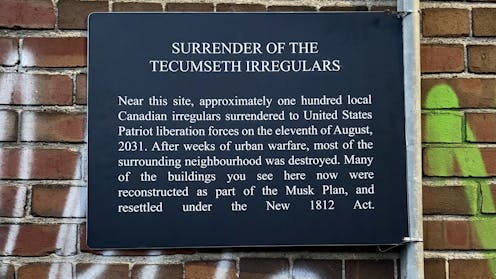
    As part of her ongoing public art series, Pax Americana, Toronto visual artist Dara Vandor has been posting aluminum signs in public spaces.

    These are plaques that reimagine, as the artist writes, the city as “a site of future conflict and occupation” by the United States. The signage, in the style of commemorative historical markers, echoes U.S. President Donald Trump’s recent and repeated threats to annex Canada and “is meant to serve as a dark warning, inviting contemplation on the fragility of nationhood.”

    For example, one plaque, posted on a bridge on Spadina Ave., informs passersby:

    “This spot served as the center of operations for United States Army snipers during Operation McKinley, the campaign to liberate the northern territory formerly known as Canada. From February to May 2035, this site, code-named ‘The Hot Dog Stand,’ served as a concealed sniper’s nest, providing precision fire support, disrupting insurgent movements, and protecting advancing American units.”

    Vandor’s thought-provoking project, which she told CBC News was sparked by anger at Trump’s threats to Canadian sovereignty, underlines how storytelling can be a powerful tool in times of conflict, especially when it affords itself the artistic freedom to envision potential futures before they can become reality.

    Psychological effects

    In order to understand how exactly stories such as the one portrayed on Vandor’s plaques can make a real impact on the way we navigate moments of crisis, we can turn to the work of conflict analysis experts such as Solon Simmons.

    In his recent book on conflict storytelling, Simmons introduces the concept of post-plot pressure.

    The term describes the psychological effect that a story can have on its readers after they finish reading. As Simmons puts it:

    “What makes stories so important (as opposed to just interesting or entertaining) is the effect of the story, and this effect doesn’t end when the story ends. It leaves the viewer/reader/listener with a feeling.”

    Simmons also explains that the kind and amount of post-plot pressure placed upon an audience depends on the type of story being told.

    Projected unhappy ending exerts pressure

    A story, for example, featuring a struggle in which the antagonist eventually triumphs over the protagonist is what Simmons calls a “satirical struggle story.”

    “Satirical” in this context does not necessarily mean that stories of this kind include elements of mockery or sarcasm. Rather, the label goes back to the influential research contributions of Canadian literary theorist Northrop Frye and American historian Hayden White, from which Simmons derives his own framework.

    This is exactly how to understand the story told over its several episodes on Vandor’s Pax Americana plaques: the U.S., as the story’s antagonist, abuses its power and ends up getting away with it, defeating Canadian resistance and annexing what is now only referred to as the “northern territory.”

    As Simmons suggests, conflict stories like this one, where what is viewed as injustice is allowed to prevail, exercise a relatively high level of post-plot pressure. This is mainly because the unhappy ending leaves audiences dissatisfied and with a sense of loss to grapple with.

    Reader reactions

    Simmons also explains that not all readers react to this particular kind of post-plot pressure in the same way. Vandor’s project, for example, has brought out some critical and upset responses.

    As the artist told Toronto Today, some people have called the plaques pro-American propaganda; one online commenter said they should be taken down.

    Julian Bleecker — a researcher, author, designer and engineer with a PhD in history of consciousness whose design studio offers services around future imagining and planning — voiced his objection to the project in a blog post.

    In his opinion, the antagonistic and fatalistic vision of the future portrayed on the plaques runs the risk of “playing into the hands of the very forces that are at work to make the world a less habitable place.”


    Read more:
    The theatre we want in 2040? We used ‘strategic foresight’ to plan on the Prairies


    But, as Simmons argues, conflict stories in which the happy ending never comes can also leave readers with a productive sense of post-plot pressure. In that case, feeling dissatisfied with the story’s outcome can instead motivate people to mobilize and strategize against the perceived injustice.

    Seen in this light, the plaques’ imagined collapse of Canadian sovereignty can therefore also serve as a stark and urgent inspiration, begging response.

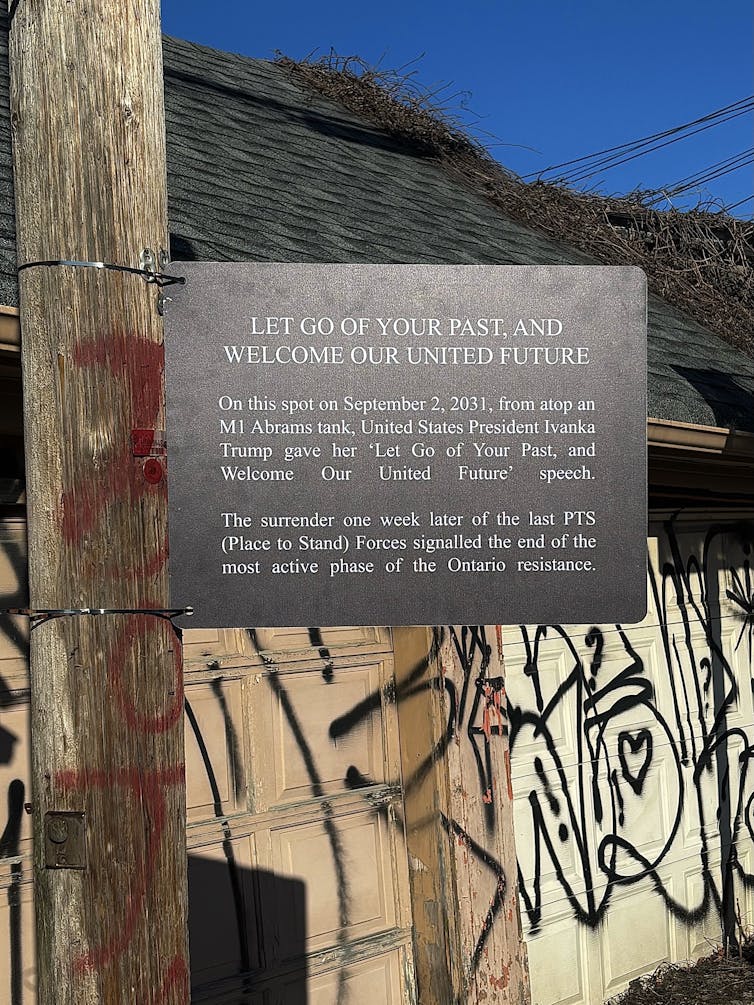
    A sign in an alleyway says 'let go of your past, and welcome to our united future.'
    In Dara Vandor’s speculative future, U.S. President Ivanka Trump, standing on a tank, exhorts Torontonians to ‘Let go of your past, and welcome to our united future.’
    (Dara Vandor)

    A cautionary tale

    Fictional storytelling is often viewed as a useful tool that allows us to make sense of real moments of conflict that happened in the past. Think, for example, of Erich Maria Remarque’s famous war novel All Quiet on the Western Front, which was turned into an Oscar-winning film directed by Edward Berger in 2022.

    Our understanding of these kinds of stories as useful comes with the acknowledgement that there is nothing we can do to prevent past conflict. At the same time, the underlying assumption here is that by learning about the past, we can learn from the past and hopefully stop similar crises from ever happening again.


    Read more:
    How stories about alternate worlds can help us imagine a better future: Don’t Call Me Resilient EP 7 transcript


    What makes Vandor’s ongoing project especially valuable is that it moves its reflections on the past into an imagined future. The actual conflict that the plaques refer to is still part of the present, and its future still undecided. Whatever lessons we draw from their cautionary tale about Canadian annexation, we still have time to act upon them before that imagined future can become reality.

    Importance of resistance in the present

    This is exactly what leads historian Camille Bégin to conclude that the project’s appeal to the importance of resistance in the present is particularly strong:

    “It really shows us that the future is not written, that it’s in our hands to act in the present to forge the future that we want.”

    Even though Vandor’s project tells a story of Canadian defeat, it also highlights that Canadians did resist, a thought that should appeal to anyone opposed to Trump’s vision of territorial expansion.

    Or, and this is perhaps the most hopeful reflection coming out of the project, if Canadians come together and resist now, Trump’s threat of annexation may never get that far.

    The Conversation

    Pascal Michelberger does not work for, consult, own shares in or receive funding from any company or organisation that would benefit from this article, and has disclosed no relevant affiliations beyond their academic appointment.

    ref. ‘Pax Americana’ in Toronto: How speculative art can help us navigate threats – https://theconversation.com/pax-americana-in-toronto-how-speculative-art-can-help-us-navigate-threats-256755

    MIL OSI – Global Reports

  • MIL-OSI Global: Experimenting with generative AI to kibbitz and futz towards more inclusive futures

    Source: The Conversation – Canada – By Nathaniel Laywine, Assistant Professor, Communication and Media Studies, York University, Canada

    Generative AI draws from limited datasets, often reproducing errors and bias. (Shutterstock)

    What does it mean to think, act and work as a Jewish professor when human freedoms are under siege and authoritarian power gains ground? And how can we draw on our Jewish identities to navigate the sweeping encroachment of new technologies like AI?

    As communication scholars, colleagues and collaborators, we have spent a lot of time trying to answer these questions in our scholarship by taking cues from the intellectual lineage of our shared culture.


    Read more:
    Philosopher Hannah Arendt provokes us to rethink what education is for in the era of AI


    Lately, Donald Trump’s administration has demonstrated a heavy investment in cataloguing and categorizing Jewish professors. In April, the Equal Employment Opportunity Commission (EEOC) sent text messages to the personal cellphones of faculty and staff at Barnard College, asking them to self-identify as Jewish and/or Israeli. The text message also asked them to disclose any instances of antisemitic discrimination or harassment they had experienced.

    Presumably, the text message inquiry itself was not recognized by its senders as an instance of such harassment.

    We do not believe being a Jewish professor means silencing our students as they protest atrocities in Gaza, and it certainly doesn’t mean revoking their visas or deporting them. Rather, it means drawing upon the tools of our forebears to question systems of oppression, wherever and however they may arise.

    We simultaneously occupy both privileged and marginal positions within the university and North American society at large. This makes us acutely aware of how fragile conditional tolerance is, and how quickly a list of names can be used to justify repression or violence.

    Collection and use of data

    As communication and media scholars, we’re often critical of how data are aggregated, stored and disseminated. The EEOC questionnaire concerns us because it reduces the complexities of Jewish identity and the profound harms of antisemitism to a handful of abstract and ideologically determined data points.

    Our recent research on generative AI (genAI) and its incompatibility with Jewish cultural expression shows that meaningful efforts to combat antisemitism — and other forms of oppression — must centre the knowledge and experiences of affected communities.

    Our research found that outputs of chatbots such as ChatGPT are unable to tell jokes in a Jewish comedic style without resorting to offensive tropes. In another forthcoming study, we argue that genAI is equally incapable of representing the multifaceted “intersectional identities” of Jewish people except by smashing together rudimentary cultural signifiers (such as rainbows for queerness or bagels for Jewishness).

    In each case, these platforms rely on datasets to determine what Jewishness is, and these datasets originate from the narratives that other people tell about Jewish people, rather than the ones we tell about ourselves.

    Futzing is a Yiddish word that means messing around via hands-on experimentation.
    (Shutterstock)

    Critical strategies

    These platforms have increasingly become parts of daily life and communicative infrastructure. To investigate them, we adopted two critical strategies from our shared heritage as Ashkenazi Jews: kibbitzing and futzing.

    Both terms are Yiddish. Kibbitzing is a lively, informal way of thinking and talking together. It’s somewhere between joking, arguing and exchanging ideas. It is grounded in our relationships, histories and biases; kibbitzing is how we make shared meaning together through many voices.

    Kibbitzing values contradiction, humour and the messiness of human conversation. Unlike AI chatbots, which follow scripted, dialogic, question-and-answer routines based on quantifiable patterns in data, kibbitzing is unpredictable, non-linear and intentionally disorganized.

    When we kibbitz, we build understanding by challenging one another and reflecting on what each of us brings to the table. In the age of genAI, kibbitzing offers a way to talk that is full of friction, laughter and deep, collective insight.

    Futzing means messing around via hands-on experimentation, with no set agenda and no official guidance. This unstructured inquiry is an acknowledgement of Jews’ historical role as outsiders within European society. As we write in our forthcoming article, these practices reflect what social theorist Michel de Certeau calls “making do,” a tactical means of collective empowerment in a hostile society.

    Using futzing as a methodology, we started exploring genAI, drawing on our curiosity to see what might happen by playing, testing and responding in real time.

    Futz first, then kibbitz

    Each of us futzed on our own at first, with no ambition to crack the code or reverse-engineer the algorithm. Later, when we began kibbitzing together, we realized our scattered efforts were actually circling around shared concerns. Futzing helped us see patterns, surprises and contradictions — things we might have missed with a more rigid approach. Kibbitzing helped us connect those patterns and reconcile the contradictions.

    Drawing on our culture this way allows us to imagine inclusive, anti-oppressive Jewish epistemologies that respond to the complexity of the current political moment. Jewish identity — like all identities — is porous and resistant to fixed form. Our shared North American Ashkenazi identity is just one of many possible perspectives that comprise a broader identity of Jewishness.

    That is not a problem to be solved. Rather, it is a strength and a bond between us. Readers may well see their own cultural traditions, vernaculars and ancestral practices in this light too, as techniques of resilience and joy in the face of hardship and oppression.

    There is an irony here. The deeper we dig into the intellectual roots of our own culture, the more common ground we might discover with everyone else’s. And that makes us feel a whole lot safer than getting a text from the EEOC ever could.

    The authors do not work for, consult, own shares in or receive funding from any company or organisation that would benefit from this article, and have disclosed no relevant affiliations beyond their academic appointment.

    ref. Experimenting with generative AI to kibbitz and futz towards more inclusive futures – https://theconversation.com/experimenting-with-generative-ai-to-kibbitz-and-futz-towards-more-inclusive-futures-252553

    MIL OSI – Global Reports

  • MIL-OSI Global: ‘Pax Americana’ in Toronto? Speculative art can help us navigate threats

    Source: The Conversation – Canada – By Pascal Michelberger, Postdoctoral Scholar, Western Academy for Advanced Research, Western University

    Artist Dara Vandor’s futuristic, commemorative historical plaques on Toronto streets project a U.S.-annexed Canada. (Dara Vandor)

    As part of her ongoing public art series, Pax Americana, Toronto visual artist Dara Vandor has been posting aluminum signs in public spaces.

    These are plaques that reimagine, as the artist writes, the city as “a site of future conflict and occupation” by the United States. The signage, in the style of commemorative historical markers, echoes U.S. President Donald Trump’s recent and repeated threats to annex Canada and “is meant to serve as a dark warning, inviting contemplation on the fragility of nationhood.”

    For example, one plaque, posted on a bridge on Spadina Ave., informs passersby:

    “This spot served as the center of operations for United States Army snipers during Operation McKinley, the campaign to liberate the northern territory formerly known as Canada. From February to May 2035, this site, code-named ‘The Hot Dog Stand,’ served as a concealed sniper’s nest, providing precision fire support, disrupting insurgent movements, and protecting advancing American units.”

    Vandor’s thought-provoking project, which she told CBC News was sparked by anger at Trump’s threats to Canadian sovereignty, underlines how storytelling can be a powerful tool in times of conflict, especially when it affords itself the artistic freedom to envision potential futures before they can become reality.

    Psychological effects

    In order to understand how exactly stories such as the one portrayed on Vandor’s plaques can make a real impact on the way we navigate moments of crisis, we can turn to the work of conflict analysis experts such as Solon Simmons.

    In his recent book on conflict storytelling, Simmons introduces the concept of post-plot pressure.

    The term describes the psychological effect that a story can have on its readers after they finish reading. As Simmons puts it:

    “What makes stories so important (as opposed to just interesting or entertaining) is the effect of the story, and this effect doesn’t end when the story ends. It leaves the viewer/reader/listener with a feeling.”

    Simmons also explains that the kind and amount of post-plot pressure placed upon an audience depends on the type of story being told.

    Projected unhappy ending exerts pressure

    A story, for example, featuring a struggle in which the antagonist eventually triumphs over the protagonist is what Simmons calls a “satirical struggle story.”

    “Satirical” in this context does not necessarily mean that stories of this kind include elements of mockery or sarcasm. Rather, the label goes back to the influential research contributions of Canadian literary theorist Northrop Frye and American historian Hayden White, from which Simmons derives his own framework.

    This is exactly how to understand the story told over its several episodes on Vandor’s Pax Americana plaques: the U.S., as the story’s antagonist, abuses its power and ends up getting away with it, defeating Canadian resistance and annexing what is now only referred to as the “northern territory.”

    As Simmons suggests, conflict stories like this one, where what is viewed as injustice is allowed to prevail, exercise a relatively high level of post-plot pressure. This is mainly because the unhappy ending leaves audiences dissatisfied and with a sense of loss to grapple with.

    Reader reactions

    Simmons also explains that not all readers react to this particular kind of post-plot pressure in the same way. Vandor’s project, for example, has brought out some critical and upset responses.

    As the artist told Toronto Today, some people have called the plaques pro-American propaganda; one online commenter said they should be taken down.

    Julian Bleecker — a researcher, author, designer and engineer with a PhD in history of consciousness whose design studio offers services around future imagining and planning — voiced his objection to the project in a blog post.

    In his opinion, the antagonistic and fatalistic vision of the future portrayed on the plaques runs the risk of “playing into the hands of the very forces that are at work to make the world a less habitable place.”


    Read more:
    The theatre we want in 2040? We used ‘strategic foresight’ to plan on the Prairies


    But, as Simmons argues, conflict stories in which the happy ending never comes can also leave readers with a productive sense of post-plot pressure. In that case, feeling dissatisfied with the story’s outcome can instead motivate people to mobilize and strategize against the perceived injustice.

    Seen in this light, the plaques’ imagined collapse of Canadian sovereignty can therefore also serve as a stark and urgent inspiration, begging response.

    In Dara Vandor’s speculative future, U.S. President Ivanka Trump, standing on a tank, exhorts Torontonians to ‘Let go of your past, and welcome to our united future.’
    (Dara Vandor)

    A cautionary tale

    Fictional storytelling is often viewed as a useful tool that allows us to make sense of real moments of conflict that happened in the past. Think, for example, of Erich Maria Remarque’s famous war novel All Quiet on the Western Front, which was turned into an Oscar-winning film directed by Edward Berger in 2022.

    Our understanding of these kinds of stories as useful comes with the acknowledgement that there is nothing we can do to prevent past conflict. At the same time, the underlying assumption here is that by learning about the past, we can learn from the past and hopefully stop similar crises from ever happening again.


    Read more:
    How stories about alternate worlds can help us imagine a better future: Don’t Call Me Resilient EP 7 transcript


    What makes Vandor’s ongoing project especially valuable is that it moves its reflections on the past into an imagined future. The actual conflict that the plaques refer to is still part of the present, and its future still undecided. Whatever lessons we draw from their cautionary tale about Canadian annexation, we still have time to act upon them before that imagined future can become reality.

    Importance of resistance in the present

    This is exactly what leads historian Camille Bégin to conclude that the project’s appeal to the importance of resistance in the present is particularly strong:

    “It really shows us that the future is not written, that it’s in our hands to act in the present to forge the future that we want.”

    Even though Vandor’s project tells a story of Canadian defeat, it also highlights that Canadians did resist, a thought that should appeal to anyone opposed to Trump’s vision of territorial expansion.

    Or, and this is perhaps the most hopeful reflection coming out of the project, if Canadians come together and resist now, Trump’s threat of annexation may never get that far.

    Pascal Michelberger does not work for, consult, own shares in or receive funding from any company or organisation that would benefit from this article, and has disclosed no relevant affiliations beyond their academic appointment.

    ref. ‘Pax Americana’ in Toronto? Speculative art can help us navigate threats – https://theconversation.com/pax-americana-in-toronto-speculative-art-can-help-us-navigate-threats-256755

    MIL OSI – Global Reports

  • MIL-OSI Global: Kids care deeply about our planet, so adults need to start listening

    Source: The Conversation – Canada – By Jen Kostuchuk, PhD Candidate, Sociology, University of Victoria

    “I wish adults knew that I really care about the environment and want to help, but I sometimes feel like my ideas don’t matter because I’m just a kid.”

    This is what a nine-year-old respondent told us when we asked how they feel about the environment.

    In today’s current political climate, many adults seem resigned to climate catastrophe and even dabble in climate change denialism. However, our survey of 1,000 youth aged eight to 14 from Canada and the United States found that children care deeply about the planet and are ready to take action.

    The findings from our report were produced as part of an ongoing study with the Humanity in Motion Society, a Canadian non-profit organization focused on engaging youth as key stakeholders in advancing environmental stewardship.

    Almost 90 per cent of the kids we spoke to recognize climate change as a real and urgent problem, calling for intergenerational collaboration and bolder environmental mitigation and adaptation commitments.

    It turns out that our nine-year-old respondent speaks for many children. Kids know what’s at stake, want a seat at the table and need adults to act with them.

    What kids told us

    Some of the kids in the survey talk about the action they want adults to take to tackle climate change. (Humanity in Motion Society)

    Many of the kids told us they regularly take action to mitigate their carbon footprint, including recycling, embracing reusable items and conserving energy. Their accounts are consistent with numerous academic studies on youth involvement in environmental citizenship.

    However, many understand individual action alone is not enough. In fact, most kids recognize that systemic accountability is necessary to tackle the climate crisis. As one kid in Grade 6 shared:

    “I wish big industry and governments would stop asking us to do something when they continue to fly in private jets [and] drill for oil and more; we are asked to recycle.”

    Kids have a deep understanding of current political issues, including the cost-of-living crisis and the harmful “drill baby drill” sentiments, but also underscore a stark disconnect: while we instil environmentally responsible values in our children, elected leaders remain consistently inactive on these very same issues.


    Read more:
    The oil and gas industry has been lying about global warming for decades — accountability is long overdue


    Kids play active roles in knowledge sharing

    The kids in this study display impressive knowledge about the steps that need to be taken to address the climate crisis. Our findings demonstrate that youth are not just passive recipients of knowledge but, rather, play an active role in being climate communicators.

    For example, two thirds of our respondents say their friends learn about climate change directly from them. Even though many children note that they do not have climate clubs at school, they are curious about the role of big oil, deforestation and corporate greed in the ongoing climate crisis.

    In addition to teachers and parents being the most influential sources of knowledge for children, social media content has an impact on kids’ environmental behaviour and feelings of empowerment.

    Specifically, our data shows that talking to others online has a significant positive relationship with reported sustainable behaviour, and that watching videos has a significant positive relationship with how much kids feel they can make a difference. One young girl reflected on using Tiktok for insights on climate change while also capturing an awareness among her generation:

    “I would say if there’s a really big issue, like, I know there’s something called the Climate Clock in New York…I mean, the thing with social media, you never know what’s true and untrue, but that thing [Climate Clock] came on my ‘For You’ page…and everybody in the comments, they were saying ‘this is very real, we have to do something about it.’”

    This shows that kids would benefit greatly from spaces to continue in-person environmental discussions with adults in the room. One young respondent captured the potential for meaningful engagement:

    “There are a lot of things that can be done, curriculum integrations…sustainable skills like critical thinking, problem-solving, collaboration, and maybe explore the ecosystems and biodiversities and actually encourage students to design and implement climate-friendly projects and carry out field trips and organize visits to renewable energy sites or environmental organizations and sometimes, maybe occasionally, the school can invite climate experts, activists or scientists.”

    These ideas were shared by others who called on adults to lead more experiential approaches to climate education inside the classroom and beyond.

    Adults can help by providing opportunities in the classroom and beyond for kids to discuss cliamte change.
    (Shutterstock)


    Read more:
    Teachers need bolder action from our school boards to educate in and for a climate emergency


    Five calls to action

    Here are five ways to help bring about change:

    1. Adults need to step up. Adults play a critical role in shaping how youth engage in climate action. Our report found that teachers and parents, in addition to the internet, are among the most influential learning sources for youth today. Kids often take pro-environmental values, actions and cues from their parents.

    2. Apathy is not an option if we want change. Youth are looking to leaders and elected officials to invest heavily in infrastructure and education to improve our environment.

    3. Intergenerational collaboration promotes better environmental values. Despite the consequences of climate change, youth share a sense of optimism and emphasize the need for intergenerational responsibility.

    4. Provide spaces for youth to take leadership roles and engage in climate dialogue. Kids want to do more to build a sustainable future, but don’t know where to begin. Providing opportunities in the classroom and beyond are critical next steps to raise the next generation of climate leaders.

    5. Promote bold action. Kids should be able to answer the call of many climate activists who recognize the need to pursue a greener economy by working together.

    Our survey findings highlight a hopeful message about young people’s engagement in climate action, underscoring their impressive knowledge of the systemic changes required to address the crisis.

    As adults across the political spectrum bicker about climate policy, young people are growing impatient and hoping to lead the way. Our results refocus attention on the future we’re creating and challenge us to listen seriously to children when they seek to address what may be their generation’s greatest crisis.

    Sean Lyons has received funding from Mitacs in support of an earlier iteration of the study discussed here.

    Erik Steiner and Jen Kostuchuk do not work for, consult, own shares in or receive funding from any company or organisation that would benefit from this article, and have disclosed no relevant affiliations beyond their academic appointment.

    ref. Kids care deeply about our planet, so adults need to start listening – https://theconversation.com/kids-care-deeply-about-our-planet-so-adults-need-to-start-listening-257304

    MIL OSI – Global Reports

  • MIL-OSI Global: Preventing urinary tract infections after menopause: What every woman should know

    Source: The Conversation – Canada – By Erin A. Brennand, Gynecologist & Associate Professor, Cumming School of Medicine, University of Calgary

    There is more information available about urinary tract infections today than ever before. (Shutterstock)

    After menopause, urinary tract infections (UTIs) can be more frequent, yet most Canadian women (82 per cent in a recent survey) don’t realize the two are associated.

    At the Sex, Gender and Women’s Health Research Hub, our team’s advocacy aims to increase awareness and highlight proven strategies to help prevent UTIs for women later in life.

    Why are UTIs more common after menopause?

    The main culprit for increased UTIs in menopausal women is the drop in estrogen levels. Estrogen plays a crucial role in maintaining urinary tract tissue health.

    As estrogen declines, the lining of the urethra — the tube through which urine flows out of the body — becomes thinner and more fragile. Also, there are fewer infection-fighting blood cells in the urinary tract, and mucosal immunity — the specialized immune defences present at the mucosal surfaces lining the urinary tract that include physical and chemical barriers, cellular receptors and antibodies — is reduced.

    This weakens the local immune response, making it easier for bacteria to cause infections. Additionally, changes in vaginal flora — the bacteria that naturally protect against infections — results in the urinary tract being vulnerable.

    Knowledge is power during menopause.
    Servier Medical Art, CC BY

    Other factors can contribute to UTI risk at this stage of life, too. Women whose bladder muscles have weakened with age, or who have developed pelvic organ prolapse, can experience incomplete bladder emptying. This leads to urine retention and an increased chance of bacterial growth.


    Read more:
    Women having surgery to treat pelvic organ prolapse don’t always need a hysterectomy


    Similarly, if women experience urinary incontinence, the leakage and moisture on incontinence pads or underwear can create an environment where bacteria thrive. And while sexual activity itself does not directly cause UTIs, it can introduce bacteria into the urinary tract, increasing the risk of infection.

    Signs of a UTI

    Bacteria in the urine without symptoms is called asymptomatic bacteriuria. It is not a UTI and should not be treated; a UTI is only diagnosed when bacteria and symptoms are both present. The most obvious symptoms include:

    • A new, strong, persistent urge to urinate;
    • A burning sensation while urinating;
    • Frequent urination in small amounts;
    • Pelvic discomfort or pressure.

    In severe cases, UTIs can lead to kidney infections, so when symptoms include fever, chills and back pain, it is essential to seek immediate medical attention.

    For women in their 80s or older, or sometimes younger women who are living with medical conditions such as dementia, urinary tract infections can manifest as behavioural changes such as confusion, withdrawal or reduced appetite. However, new onset delirium should always be investigated by a medical team rather than assumed to be a UTI.

    Evidence-based strategies to prevent UTIs

    Several medical and lifestyle interventions can make a significant difference:

    1. Vaginal estrogen therapy

    One of the most effective ways to prevent recurrent UTIs in postmenopausal women is vaginal estrogen therapy, which delivers small doses of estrogen directly to the vaginal tissues through creams, tablets or rings. Studies have shown that vaginal estrogen can restore the natural protective barrier of the urinary tract, reducing UTI risk significantly. It can be used by breast cancer survivors as it does not have the same risks associated with menopause hormone therapy (MHT).

    2. Non-antibiotic prevention

    Methenamine hippurate (one gram orally, twice-a-day) is effective in reducing UTIs by creating an environment that prevents bacterial growth. In Canada, women need to obtain this medication from a compounding pharmacy.

    3. Low-dose antibiotic
    Doctors may prescribe low-dose antibiotics – about half the standard dose – for several months. If sexual activity is a trigger for UTIs, antibiotics can be used episodically after sex. However, antibiotics can cause side-effects and create antibiotic-resistant bacteria.
    4. Diet supplements
    Scientific evidence on consuming cranberry-based products to prevent UTIs is mixed. Some studies suggest that certain compounds in cranberries (proanthocyanidins, or PACs) prevent bacteria from adhering to the bladder lining, while others show no benefit. If trying these products, women should choose brands with high concentrations of PACs, the active ingredient.

    Similarly, probiotics, especially those containing Lactobacillus strains, may help maintain a healthy vaginal microbiome, which in turn can lower UTI risk. However, research is still evolving.

    5. Hygiene and lifestyle habits
    Though there is limited evidence, simple everyday habits may help in preventing UTIs:

    • Staying hydrated – Drinking water helps to flush bacteria from the urinary tract. For women who drink a low volume of fluids each day (less than 1.5 litres), increasing water intake may help.
    • Urinating regularly – Avoid holding urine for long periods and aim to void every three to four hours during the day.
    • Urinating after sex – This helps clear bacteria introduced during intercourse.
    • Choosing breathable underwear – Cotton underwear and loose-fitting clothes reduce build up of moisture, which in turn reduces bacterial growth.

    More innovations on the horizon

    Vaccines are one of the most promising developments for preventing recurrent UTIs. In one early trial, overall recurrences decreased by 75 per cent for women given an oral vaccine, with no major side-effects reported.

    Trials are currently under way in Canada, and researchers hope vaccines will provide a more effective and long-term solution.

    Treatment and support for UTIs.
    People illustrations by Storyset, CC BY

    When to see a doctor

    Any woman who is experiencing frequent UTIs — defined as two infections in six months or three in a year — in menopause should talk to their doctor or primary care provider. Together, they can determine the best preventive targeted strategies.

    Knowledge is power, and there is more information available today than ever before. UTIs are not an inevitable part of aging. With the right combination of medical treatments and lifestyle changes, women can reduce postmenopausal risk.

    Erin A. Brennand receives funding from the Canadian Institutes of Health Research, Social Sciences and Humanities Research Council, the Calgary Health Foundation, and the MSI Foundation (all paid to institution).

    Jayna Holroyd-Leduc has received funding from CIHR and Alberta Innovates. She holds the BSF Chair in Geriatric Medicine at the University of Calgary.

    Pauline McDonagh Hull does not work for, consult, own shares in or receive funding from any company or organisation that would benefit from this article, and has disclosed no relevant affiliations beyond their academic appointment.

    ref. Preventing urinary tract infections after menopause: What every woman should know – https://theconversation.com/preventing-urinary-tract-infections-after-menopause-what-every-woman-should-know-255762

    MIL OSI – Global Reports

  • MIL-OSI Global: Blind box toys are booming: Are they just child’s play or something more concerning?

    Source: The Conversation – Canada – By Eugene Y. Chan, Associate Professor of Marketing, Toronto Metropolitan University

    Collectible figurines on display at Pop Mart in Ivano-Frankivsk, Ukraine, on April 29, 2025. (Shutterstock)

    If you’ve seen videos of people tearing into tiny toy packages online, or noticed teens obsessing over pastel-coloured figurines at the mall, you’ve probably encountered the global craze for blind box toys.

    These small collectibles — usually figures of cartoonish characters — are sold in sealed packaging that hides which specific item is inside. You might get the one you want, or you might not. That uncertainty is part of the thrill.

    Unlike traditional toys, these figures are marketed as collectibles. Many are part of themed series, with some designs labelled as “rare” or “secret,” appearing in as few as one in every 144 boxes. This sense of exclusivity fuels repeat purchases and has spawned a resale market where rare figures can command hundreds of dollars.

    Popular among children and adults alike, blind box toys have grown into a billion-dollar industry. One of the more popular brands is Pop Mart, a Chinese toy company founded in 2010 known for its collectible designer toys sold in mystery packs.

    Gen Z consumers, in particular, have embraced blind box toys both as a nostalgic pastime and as a form of legitimate collecting. The proliferation of unboxing videos on platforms like TikTok and YouTube, where creators open dozens of blind boxes on camera, has added to their appeal.

    For many fans, these toys offer more than just cuteness: they also provide suspense, surprise and a rush of dopamine with every box opened. But how did this niche product become a global obsession?

    From Tokyo streets to western malls

    The origins of blind box toys trace back to East Asia. Capsule toy vending machines called gashapon originated in Japan in the 1960s. By the 1980s, they had become a cultural fixture. These machines dispense small toys in opaque plastic balls, with customers never quite sure which item they’ll receive.

    In the early 2010s, Chinese companies like Pop Mart adapted the gashapon model for the mainstream retail space. Instead of vending machines, they began selling artist-designed vinyl toys in blind boxes at dedicated boutiques.

    A tourist uses a gashapon machine in Osaka, Japan, in 2024. Gashapon machines are similar to the coin-operated toy vending machines seen outside grocery stores and other retailers in North America.
    (Shutterstock)

    Pop Mart’s success helped transform the blind box into a mainstream commercial phenomenon. Characters like Molly, Skullpanda and Dimoo became instant hits, combining Japanese kawaii esthetics with western pop art sensibilities.

    Pop Mart figures have since developed a cult-like following. Many consumers treat the toys as affordable art objects, displayed in cabinets, on purses or traded online.

    Today, blind box retail stores have expanded globally from Asia to Europe and North America. In October 2024, Pop Mart opened its first store in the Midwestern United States, located on Chicago’s Magnificent Mile at The Shops at North Bridge. The store offers exclusive products and taps into the growing demand for collectibles among American consumers.

    The psychology behind the mystery

    What makes blind box toys so hard to resist?

    Their success relies on a psychological principle known as variable-ratio reinforcement — the same reward pattern that makes slot machines so addictive.

    You never know exactly when you’ll score the item you’re after, but the possibility that the next box might contain it keeps people coming back. This unpredictability keeps people engaged, especially when the potential reward is framed as rare or valuable.

    Cconsumer psychology research also suggests that anticipation plays a major role. Studies show that dopamine, the brain’s reward chemical, spikes not just when we get what we want, but when we anticipate it. The sealed packaging, the suspense of unwrapping and the hope for a rare figure all heighten this effect.

    Sonny Angels on display in a store in Shenzhen, China, in March 2019.
    (Shutterstock)

    For younger collectors, the excitement of “the chase” can foster compulsive buying habits. This effect is amplified by the social influence of watching unboxings online or seeing friends complete their sets, and it becomes a powerful loop.

    Even when buyers don’t get the figure they want, the sunk cost fallacy — the feeling that they’ve already invested too much time or money to walk away — keeps them buying more.

    The hidden costs of blind boxes

    As blind box toys surge in popularity, they have drawn criticism from consumer advocates, psychologists and environmentalists alike.

    Some worry that blind boxes normalize gambling-like behaviours, especially among children. The randomness, excitement and promise of rare rewards closely mirror the mechanisms behind loot boxes in video games — another product that has sparked global concern over youth exposure to gambling psychology.

    Several countries, including Belgium and the Netherlands, have regulated loot boxes under gambling laws. Blind boxes, though currently unregulated, may be next in line for scrutiny.


    Read more:
    Blind bags: how toy makers are making a fortune with child gambling


    There are also environmental concerns. Many blind box toys come in excessive packaging — plastic wraps, foil bags, cardboard boxes — most of which is discarded immediately. The collectibles themselves are often made of non-recyclable plastics, raising questions about sustainability in an era of rising consumer awareness over waste.

    Even among adult fans, some critics question whether blind boxes are designed less to bring joy and more to trigger compulsive consumption. The joy of collecting, they argue, is increasingly overshadowed by the mechanics of engineered desire.

    What should we make of the blind box boom?

    Blind box toys are not inherently harmful, and for many, they’re a source of fun, nostalgia and self-expression. They also offer an accessible way for consumers to engage with designer art in a collectible, miniature form, as many of them are created by individual artists.

    But blind box toys also raise deeper questions about how modern marketing leverages psychological triggers associated with gambling, especially when it comes to children.

    As these toys continue to gain traction in the West, it’s worth asking more critical questions, like: are we buying into mystery or are we being sold obsession and compulsion?

    The blind box trend reflects broader shifts in how products are marketed, how value is perceived and how consumer behaviour is shaped in a digital, attention-driven economy. Understanding the forces at play may be the first step toward more informed — and perhaps more mindful — collecting.

    Eugene Y. Chan does not work for, consult, own shares in or receive funding from any company or organisation that would benefit from this article, and has disclosed no relevant affiliations beyond their academic appointment.

    ref. Blind box toys are booming: Are they just child’s play or something more concerning? – https://theconversation.com/blind-box-toys-are-booming-are-they-just-childs-play-or-something-more-concerning-257611

    MIL OSI – Global Reports

  • MIL-OSI Africa: President Ramaphosa pays tribute to Ma Shope

    Source: South Africa News Agency

    President Cyril Ramaphosa has described the late Ma Gertrude Shope as a pillar of the nation, a matriarch of the revolution, and a torchbearer of women’s emancipation.

    President Ramaphosa delivered a moving eulogy at her Special Official Funeral held at the Great Hall of the University of the Witwatersrand on Saturday.

    Ma Shope, who passed away last week at the age of 99 at her home in Gauteng, was laid to rest with honours befitting her immense contributions to South Africa’s liberation and to the global fight for justice and gender equality. 

    READ | Special Official Funeral Category 1 declared in honour of Ma Gertrude Shope

    President Ramaphosa paid tribute to Shope’s life of commitment to the struggle against apartheid and the advancement of women’s rights. 

    “We are here to bed farewell to Mama Gertrude Shope, Isithwalandwe, freedom fighter, trade unionist, icon of the women’s movement. 

    “Her passing comes less than a week after we buried Cde Lungi Mngaga-Gcabashe, the Deputy President of the ANC Women’s League. To have lost two women leaders – izintsika (pillars) – in such close succession is a great loss. And yet, even amidst our grief we take comfort in the legacies they left behind,” the President said. 

    President Ramaphosa said Ma Gertrude will not only be remembered by her name but her legacy that she left behind. 

    “We gather not just to remember the name Getrude Shope. We gather to honour a life that helped to shape our country’s democracy.

    “Mama Getrude Shope’s life is and was intertwined in the fabric of our of democracy. Hers was a life that was quietly and unshakably committed to the struggle for our people’s liberation,” the President said. 
    A former teacher who became an outspoken opponent of Bantu Education in the 1950s, Shope joined the African National Congress (ANC) and played a pivotal role in organising women against the apartheid state. 

    She was among the leaders who mobilised the historic 1956 Women’s March to the Union Buildings, helping galvanise more than 20000 women to demand an end to the pass laws.

    “To witness the dehumanising of black children in the classroom struck her to the core. She refused to accept the dictates of her role to impart inferior education that prepared black children for little more than a life of menial labour,” said the President.

    Forced into exile in 1966, Shope worked across Africa and the globe to build solidarity for the anti-apartheid movement. As head of the ANC Women’s Section in exile and later President of the ANC Women’s League, she pushed for the centrality of gender equality in the liberation struggle and in the country’s post-apartheid constitutional framework.

    Quoting from an interview Shope gave in the early 1980s, the President reminded the nation of her enduring message: “We are not declaring war on men… men are also victims. Together, men and women must change their attitudes to each other.”

    Women’s rights

    The President acknowledged the progress South Africa has made in advancing women’s rights, noting that the World Economic Forum’s Gender Gap Report recently referred to the country as a “beacon of hope.” 

    “This progress was not achieved by chance. Gertrude Shope and others made it happen. She birthed and mothered it. She nurtured it with discipline, wisdom and responsibility.

    “This progress is the result of deliberate policies implemented by successive democratic governments since 1994,” he said. 

    However, the President also cautioned that despite South Africa having made progress in advancing women’s rights, persistent inequalities, violence against women, and economic disparities continue to threaten that progress.

    “Women are still more likely to be poor than men. Women are still more likely to be unemployed than men. Women are the primary victims of intimate partner violence, abuse, rape and other forms of sexual violence.

    “Ma Shope’s life’s work is not yet complete. It is up to us to take forward women’s struggles for full equality, for freedom from violence, and for the right to live in security, comfort and peace. And like Ma Shope said all those years ago, this is not a struggle that must be waged by women alone. Men must be at the frontlines of the fight for gender equality,”the President said. 

    Ma Shope’s legacy, the President said, endures not only in institutions like the ANC Women’s League and the Gertrude Shope Peacebuilding Programme, but also in the daily activism of countless women and girls across the country.

    In closing, President Ramaphosa repeated Ma Shope’s call to action: “The time for women to be found in the kitchen is long past. Let us, together with our menfolk, correct the wrongs and ills of our society.” – SAnews.gov.za

    MIL OSI Africa

  • MIL-OSI Global: Airbnb scams: new book explores thriving criminal activity on big tech platforms

    Source: The Conversation – Africa – By Julie Reid, Professor, University of South Africa

    Big tech sharing economy platforms like Airbnb and Uber are marketed as trustworthy, but a new book by a South African media scholar argues that they are highly vulnerable to scammers who spread delusive speech (a form of disinformation, designed to deceive by criminal intent).

    Julie Reid draws from first-hand accounts and over 600 cases from around the world of victims lured into scams or physical danger by fake Airbnb reviews and listings, providing a detailed case study. We asked her five questions about her book.


    How do the scams work?

    Airbnb is the world’s largest accommodation-sharing platform. It connects property owners who want to rent out their homes with travellers looking for alternatives to traditional hotels. The company recently expanded its offering and now facilitates the booking of other services like personal trainers or caterers along with accommodation rentals.

    Airbnb scams happen in several ways. The most obvious is the phantom listing scam. The scammer constructs a fake but attractive listing on Airbnb and accepts payments from unsuspecting guests. It’s only when guests arrive at the address that they discover the property doesn’t exist. Scammers have also learnt to navigate around Airbnb’s review system. Fake positive reviews are produced by scam host networks, making them appear to be authentic.

    Bait and switch scams are also common. Here the scam “host” contacts the guest on check-in day claiming the reserved property is suddenly unavailable. They offer alternative accommodation, which the guest later discovers is not as good as the original property they’ve paid for (which is often fictional). The guest pays for a premium rental but is forced to stay in a property that might be unsafe, unclean, or missing amenities.

    Scam hosts use misleading, plagiarised, or AI-generated property images and fake descriptions along with fake personal profiles and aliases.

    Delusive tactics also redirect guests away from the secure Airbnb payment portal to alternative payment methods. The scammer disappears with the money.

    But the danger isn’t limited to financial crimes. The platform’s business model is premised on staying in a stranger’s private property, which can put guests’ personal safety at risk.

    Criminal hosts can lure targets into dangerous environments. Once checked in, guests are isolated from public view, housed in a property to which the host has access.

    I’ve assessed multiple cases where Airbnb guests were assaulted, robbed with no signs of forced entry, raped, murdered, made victims of sexploitation, extortion or human trafficking, or held hostage.

    How does the disinformation work?

    I consider delusive speech a subset of disinformation because it presents intentionally misleading content at scale. But it differs from disinformation in its intentions. It isn’t done to promote a particular cause or gain ideological, military, or political advantage. Delusive speech is motivated purely by criminal intent or nefarious financial gain.


    Read more:
    The sharing economy can expose you to liability risks – here’s how to protect yourself


    Delusive speech works by hiding in plain sight on platforms we think we can trust, like Airbnb, Booking.com, Uber and others. Often, it’s indistinguishable from honest and genuine content. When users browse Airbnb listings for holiday accommodation, they’re presented with numerous options. A fake property listing looks, sounds and feels exactly the same as a genuine one.

    This happens on a platform that has built its brand narrative around the concept of trust. Scammers exploit these digital contexts of pre-established trust. When users log on to popular e-commerce or sharing economy platforms, they’re already primed to pay for something. It becomes relatively easy for scammers to delude targets into parting with their money.

    What can Airbnb do about it?

    Airbnb already has several trust and safety mechanisms in place. They include rapid response teams, an expert Trust and Safety Advisory Coalition and travel insurance for guests. The company claims to be trying to stop fake listings with machine learning technology.

    Sadly, none of these mechanisms work perfectly. While Airbnb promises to verify properties and host identities, my analysis exposes flaws in these systems. Scammers easily bypass verification tiers through aliases, forged documents and AI-generated material. Airbnb has admitted it needs to address the failures of its verification processes.


    Read more:
    How to stay safe in cyberspace: 5 essential reads


    My analysis uncovered how scammed guests are routinely denied the opportunity to post reviews of problematic rentals. Opaque terms of service and content policies allow Airbnb customer service agents and executives to justify censoring negative but honest guest reviews.

    This means dangerous and fraudulent activity goes publicly unreported and unreviewed, leaving future guests vulnerable. I argue that Airbnb’s review curation mechanisms should be revamped according to internationally recognised human rights frameworks that protect freedom of speech. This would allow for more honest accounts of guest experiences and create a safer online environment.

    Perhaps the most common complaint I encountered was that Airbnb doesn’t remove offending listings from its platform, even after a scammed guest provides evidence that the listing was posted by a fraudster. Airbnb must develop an urgent protocol for swiftly removing offending listings when discovered, to protect future guests from falling victim to the same scam trap.

    What can users do to protect themselves?

    Travellers can protect themselves by being extra cautious. Ask around. Seek recommendations from people you know and trust, and who can verify that the property you are booking actually exists and that the host is trustworthy.

    If that isn’t an option, consider an established hotel instead, but book directly with the hotel and not via third party sites like Booking.com where listings can easily be faked. Check on Google Street View to make sure the property is where it claims to be.

    Either way, have a Plan B in case things go wrong. Prepare ahead of your trip by deciding what you will do if you find yourself in an unsafe situation. And always, always, buy travel insurance.

    Is it part of a bigger problem?

    I assessed several digitally initiated scam categories in this book. While my main case study focused on Airbnb, the problem of delusive speech online isn’t unique to this platform. Delusive speech is now carried by all major tech platforms integral to everyday life.


    Read more:
    How Airbnb is reshaping our cities


    In the book, I also highlight how scammers operate in every corner of the internet, including dating apps like Grindr, Tinder and Hinge; ride-sharing services like Uber, Lyft and Bolt; travel sites like Booking.com and Hotels.com; and social media platforms like Facebook, Instagram and YouTube, among others.

    I hope that these examples will boost awareness of the risks of using these apps and sites.

    Julie Reid does not work for, consult, own shares in or receive funding from any company or organisation that would benefit from this article, and has disclosed no relevant affiliations beyond their academic appointment.

    ref. Airbnb scams: new book explores thriving criminal activity on big tech platforms – https://theconversation.com/airbnb-scams-new-book-explores-thriving-criminal-activity-on-big-tech-platforms-256806

    MIL OSI – Global Reports

  • MIL-OSI Global: Sexism in science: 7 women whose trailblazing work shattered stereotypes

    Source: The Conversation – Africa – By Christa Kuljian, Research Associate, WiSER, University of the Witwatersrand

    Seven women were part of a trailblazing network of feminist scientists in the 1970s, 1980s, and 1990s in the Boston area in the US. Christa Kuljian is a science writer and historian of science who focuses much of her research on issues of science and society, gender and race. She is the author of two previous books of narrative nonfiction – Sanctuary and Darwin’s Hunch. In her new book Our Science, Ourselves she focuses on the life stories of the seven women. We asked her about her book.

    How did you choose the scientists you focused on in the book?

    I grew up in the Boston area in the 1970s, and in high school, my parents gave me a copy of the revolutionary guide to women’s health, Our Bodies, Ourselves, which was published by the Boston Women’s Health Book Collective. In the early 1980s, I studied the history of science at Harvard and took a course with Ruth Hubbard called Bio 109: Biology and Women’s Issues.

    Hubbard, in 1974, was the first woman to achieve tenure in biology at Harvard, and she features in the book. Her course taught about how scientists, including Charles Darwin, promoted stereotypes and myths about women’s biology. The idea for Our Science, Ourselves grew from that formative experience in Hubbard’s course.

    But it also had roots in another, more recent experience. In 2016, I published Darwin’s Hunch: Science, Race and the Search for Human Origins, about the history of palaeoanthropology in South Africa. The book explores questions that some of my history of science professors might have asked. What influence did the social and political context of colonialism and apartheid have on the search for human origins?

    After it was published, I was struck by several stories that brought science and sexism into the popular media. In July 2017, James Damore at Google wrote that “the gender gap in tech” likely existed because of biological differences between men and women, and he received support from popular psychologist Jordan Peterson.

    In September 2018, an Italian physicist, Alessandro Strumia, said that the low number of women in physics was proof that women were innately less capable than men. He suggested that male scientists were being discriminated against to give opportunities to women.

    These statements reminded me of what former Harvard president Larry Summers had said back in 2005. Drawing on the work of psychologist and popular writer Steven Pinker, Summers spoke of women having a “different availability of aptitude” in science and math.

    Why were these myths about women’s biology still having an impact in the 21st century? I decided to go back to my class notes and look more closely at Hubbard’s research. Who had she worked with at the time? What were other scientists with a feminist awareness saying in the 1970s and 1980s?

    As a result of many interviews, and research in the archives, I discovered a fascinating network of women, all of whom contributed to feminist critiques of science, and ultimately to the field of feminist science studies.

    Our Science, Ourselves follows the lives of Ruth Hubbard, Rita Arditti, Evelyn Fox Keller, Evelynn Hammonds, Anne Fausto-Sterling, Banu Subramaniam and Nancy Hopkins.

    None of these women scientists were born in Boston, but they all moved there to study, take a job, conduct research, or network with other scientists. Part of what made Boston interesting to me was the critical mass of colleges, universities and scientists, but also the presence of social movements that influenced these women, including Science for the People, the Combahee River Collective and others.

    Could you tell us about one or two of these women’s stories?

    One of them is Rita Arditti. An Argentinian geneticist at Harvard Medical School, she led a protest in December 1969 at the annual conference of the American Association for the Advancement of Science in Boston. Along with 12 colleagues carrying posters and pamphlets, she arrived unannounced at a special luncheon for women scientists, calling for an end to discrimination against women in science. Most of the women ignored Arditti, but Hubbard was in the audience and paid attention. The protest did have a ripple effect on the association.

    Over time, Arditti and Hubbard became friends, became active in a new organisation called Science for the People, and began to write not only about discrimination against women scientists, but also about how science portrayed women’s biology in stereotypical ways.

    Another is Evelynn Hammonds, who studied physics at Spelman College, a historically Black women’s college in Atlanta. In 1976, she read an important report, The Double Bind: The Price of Being a Minority Woman in Science, co-authored by Shirley Malcom and published by the American Association for the Advancement of Science.

    With Malcom’s encouragement, Hammonds applied to and was accepted at MIT in the Boston area. Over time, she joined a growing network of women who were critiquing their science. She became a teaching assistant for Hubbard and rented an apartment from Arditti, and became a foundational influence in gender, race and the history of science.

    Hammonds emphasised that when speaking out against scientific sexism it was important to speak out against scientific racism as well, and that it was critical to address both.

    How do the current US administration policies on science and diversity relate to your book?

    Sudip Parikh, the CEO of the American Association for the Advancement of Science, said in testimony before the US Senate appropriations committee on 30 April 2025:

    The scientific community is in paralysis right now.

    The current attack on science has had a major impact, ending funding for important scientific research. Young scientists and science students are concerned for their future. The US administration’s policy of cutting funds to any programmes related to diversity or equity is an onslaught on decades of progress in this area, and will have a grave impact on the scientific research agenda.

    There is a growing list of words that have been scrubbed from US government websites and documents, including “women”, “race”, “racism”, “feminism”, “activist” and “bias”. The use of any of these words in scientific research proposals can result in federal funding being cut. For example, the US Food and Drug Administration published an announcement in mid-2024 that discussed the importance of diversity in clinical trials. That document is no longer available on the website.

    The women in Our Science, Ourselves made important contributions by highlighting how scientific institutions historically have been exclusionary. They also shone a light on how scientific research questions and analysis can be biased (rather than always neutral or objective), thereby affecting the knowledge they produce.

    The tools that feminist science studies has developed are critical to the sciences because they ask new questions, and develop new methodologies that help science account for gender and racial bias. Who is doing science? Who decides on the research questions? Who offers analysis and who benefits?

    The US administration’s actions are a major setback for science and scientific research, as well as gender, race and sexuality studies, which have made vital contributions to science, medicine and technology. The history of these fields and the life stories of some of the dynamic women in them, can offer readers inspiration for the present moment.

    Our Science, Ourselves is available from University of Massachusetts Press and Amazon in the US, on Kindle, and from Love Books in Johannesburg, South Africa.

    Christa Kuljian received research funding from Harvard University’s Schlesinger Library on the History of Women in America and from the Consortium for History of Science, Technology and Medicine (CHSTM) in Philadelphia. She is a member of the History of Science Society.

    ref. Sexism in science: 7 women whose trailblazing work shattered stereotypes – https://theconversation.com/sexism-in-science-7-women-whose-trailblazing-work-shattered-stereotypes-257265

    MIL OSI – Global Reports

  • MIL-OSI China: Zambia hosts national final of Chinese language proficiency competition

    Source: People’s Republic of China – State Council News

    Two students wait for the final of the 18th “Chinese Bridge” Chinese Proficiency Competition for Foreign Secondary School Students in Zambia, in Lusaka, Zambia, May 30, 2025. The Confucius Institute at the University of Zambia on Friday hosted the final round of the Chinese language proficiency competition.

    The event featured 10 students competing in the final of the 24th “Chinese Bridge” Chinese Proficiency Competition for Foreign College Students in Zambia, and nine students in the 18th “Chinese Bridge” Chinese Proficiency Competition for Foreign Secondary School Students in Zambia. (Xinhua/Peng Lijun)

    The Confucius Institute at the University of Zambia on Friday hosted the final round of the Chinese language proficiency competition.

    The event featured 10 students competing in the final of the 24th “Chinese Bridge” Chinese Proficiency Competition for Foreign College Students in Zambia, and nine students in the 18th “Chinese Bridge” Chinese Proficiency Competition for Foreign Secondary School Students in Zambia.

    Participants demonstrated their proficiency in the Chinese language and showcased their knowledge of Chinese culture through poetry recitations and performances of Chinese pop songs.

    Speaking at the opening of the event, Wang Sheng, minister counselor at the Chinese Embassy in Zambia, said the Chinese Bridge competition serves not only as a platform for language and cultural expression, but also as a bridge connecting China with the rest of the world.

    He encouraged the students to use the competition as a springboard for continuous personal development and cultural exchange. “I hope that through the Chinese Bridge competition, more and more Zambian youth will develop a passion for the Chinese language, master it, and gain a deeper appreciation of China from a multidimensional and comprehensive perspective,” he said.

    Wang further said China and Zambia are all-weather friends and that cooperation in all sectors, including people-to-people exchanges, has grown, guided by the principles of mutual respect, equality, and common development.

    He urged young people to embrace the development opportunities brought about by the friendship between the two countries through learning the Chinese language.

    Felix Masiye, acting vice-chancellor of the University of Zambia, praised the Chinese language for being a vital bridge that connects nations and cultures, facilitates access to technology and business, and fosters people-to-people relationships.

    Masiye commended the Confucius Institute for its role in promoting the learning of Chinese in Zambia and for training local teachers. He said such efforts would significantly contribute to the widespread teaching and adoption of the language across the country.

    Mubanga Museba, a student at Kasama Girls Secondary School in northern Zambia, emerged victorious in the secondary school category. She expressed her joy over the victory, noting that the outcome was unexpected given the high level of competition among the contestants.

    Museba said she began learning Chinese out of love and passion for the language, as well as a desire for self-development.

    MIL OSI China News

  • MIL-OSI Africa: Airbnb scams: new book explores thriving criminal activity on big tech platforms

    Source: The Conversation – Africa – By Julie Reid, Professor, University of South Africa

    Big tech sharing economy platforms like Airbnb and Uber are marketed as trustworthy, but a new book by a South African media scholar argues that they are highly vulnerable to scammers who spread delusive speech (a form of disinformation, designed to deceive by criminal intent).

    Julie Reid draws from first-hand accounts and over 600 cases from around the world of victims lured into scams or physical danger by fake Airbnb reviews and listings, providing a detailed case study. We asked her five questions about her book.


    How do the scams work?

    Airbnb is the world’s largest accommodation-sharing platform. It connects property owners who want to rent out their homes with travellers looking for alternatives to traditional hotels. The company recently expanded its offering and now facilitates the booking of other services like personal trainers or caterers along with accommodation rentals.

    Routledge

    Airbnb scams happen in several ways. The most obvious is the phantom listing scam. The scammer constructs a fake but attractive listing on Airbnb and accepts payments from unsuspecting guests. It’s only when guests arrive at the address that they discover the property doesn’t exist. Scammers have also learnt to navigate around Airbnb’s review system. Fake positive reviews are produced by scam host networks, making them appear to be authentic.

    Bait and switch scams are also common. Here the scam “host” contacts the guest on check-in day claiming the reserved property is suddenly unavailable. They offer alternative accommodation, which the guest later discovers is not as good as the original property they’ve paid for (which is often fictional). The guest pays for a premium rental but is forced to stay in a property that might be unsafe, unclean, or missing amenities.

    Scam hosts use misleading, plagiarised, or AI-generated property images and fake descriptions along with fake personal profiles and aliases.

    Delusive tactics also redirect guests away from the secure Airbnb payment portal to alternative payment methods. The scammer disappears with the money.

    But the danger isn’t limited to financial crimes. The platform’s business model is premised on staying in a stranger’s private property, which can put guests’ personal safety at risk.

    Criminal hosts can lure targets into dangerous environments. Once checked in, guests are isolated from public view, housed in a property to which the host has access.

    I’ve assessed multiple cases where Airbnb guests were assaulted, robbed with no signs of forced entry, raped, murdered, made victims of sexploitation, extortion or human trafficking, or held hostage.

    How does the disinformation work?

    I consider delusive speech a subset of disinformation because it presents intentionally misleading content at scale. But it differs from disinformation in its intentions. It isn’t done to promote a particular cause or gain ideological, military, or political advantage. Delusive speech is motivated purely by criminal intent or nefarious financial gain.


    Read more: The sharing economy can expose you to liability risks – here’s how to protect yourself


    Delusive speech works by hiding in plain sight on platforms we think we can trust, like Airbnb, Booking.com, Uber and others. Often, it’s indistinguishable from honest and genuine content. When users browse Airbnb listings for holiday accommodation, they’re presented with numerous options. A fake property listing looks, sounds and feels exactly the same as a genuine one.

    This happens on a platform that has built its brand narrative around the concept of trust. Scammers exploit these digital contexts of pre-established trust. When users log on to popular e-commerce or sharing economy platforms, they’re already primed to pay for something. It becomes relatively easy for scammers to delude targets into parting with their money.

    What can Airbnb do about it?

    Airbnb already has several trust and safety mechanisms in place. They include rapid response teams, an expert Trust and Safety Advisory Coalition and travel insurance for guests. The company claims to be trying to stop fake listings with machine learning technology.

    Sadly, none of these mechanisms work perfectly. While Airbnb promises to verify properties and host identities, my analysis exposes flaws in these systems. Scammers easily bypass verification tiers through aliases, forged documents and AI-generated material. Airbnb has admitted it needs to address the failures of its verification processes.


    Read more: How to stay safe in cyberspace: 5 essential reads


    My analysis uncovered how scammed guests are routinely denied the opportunity to post reviews of problematic rentals. Opaque terms of service and content policies allow Airbnb customer service agents and executives to justify censoring negative but honest guest reviews.

    This means dangerous and fraudulent activity goes publicly unreported and unreviewed, leaving future guests vulnerable. I argue that Airbnb’s review curation mechanisms should be revamped according to internationally recognised human rights frameworks that protect freedom of speech. This would allow for more honest accounts of guest experiences and create a safer online environment.

    Perhaps the most common complaint I encountered was that Airbnb doesn’t remove offending listings from its platform, even after a scammed guest provides evidence that the listing was posted by a fraudster. Airbnb must develop an urgent protocol for swiftly removing offending listings when discovered, to protect future guests from falling victim to the same scam trap.

    What can users do to protect themselves?

    Travellers can protect themselves by being extra cautious. Ask around. Seek recommendations from people you know and trust, and who can verify that the property you are booking actually exists and that the host is trustworthy.

    If that isn’t an option, consider an established hotel instead, but book directly with the hotel and not via third party sites like Booking.com where listings can easily be faked. Check on Google Street View to make sure the property is where it claims to be.

    Either way, have a Plan B in case things go wrong. Prepare ahead of your trip by deciding what you will do if you find yourself in an unsafe situation. And always, always, buy travel insurance.

    Is it part of a bigger problem?

    I assessed several digitally initiated scam categories in this book. While my main case study focused on Airbnb, the problem of delusive speech online isn’t unique to this platform. Delusive speech is now carried by all major tech platforms integral to everyday life.


    Read more: How Airbnb is reshaping our cities


    In the book, I also highlight how scammers operate in every corner of the internet, including dating apps like Grindr, Tinder and Hinge; ride-sharing services like Uber, Lyft and Bolt; travel sites like Booking.com and Hotels.com; and social media platforms like Facebook, Instagram and YouTube, among others.

    I hope that these examples will boost awareness of the risks of using these apps and sites.

    – Airbnb scams: new book explores thriving criminal activity on big tech platforms
    – https://theconversation.com/airbnb-scams-new-book-explores-thriving-criminal-activity-on-big-tech-platforms-256806

    MIL OSI Africa

  • MIL-OSI Africa: Sexism in science: 7 women whose trailblazing work shattered stereotypes

    Source: The Conversation – Africa – By Christa Kuljian, Research Associate, WiSER, University of the Witwatersrand

    Seven women were part of a trailblazing network of feminist scientists in the 1970s, 1980s, and 1990s in the Boston area in the US. Christa Kuljian is a science writer and historian of science who focuses much of her research on issues of science and society, gender and race. She is the author of two previous books of narrative nonfiction – Sanctuary and Darwin’s Hunch. In her new book Our Science, Ourselves she focuses on the life stories of the seven women. We asked her about her book.

    How did you choose the scientists you focused on in the book?

    I grew up in the Boston area in the 1970s, and in high school, my parents gave me a copy of the revolutionary guide to women’s health, Our Bodies, Ourselves, which was published by the Boston Women’s Health Book Collective. In the early 1980s, I studied the history of science at Harvard and took a course with Ruth Hubbard called Bio 109: Biology and Women’s Issues.

    Hubbard, in 1974, was the first woman to achieve tenure in biology at Harvard, and she features in the book. Her course taught about how scientists, including Charles Darwin, promoted stereotypes and myths about women’s biology. The idea for Our Science, Ourselves grew from that formative experience in Hubbard’s course.

    But it also had roots in another, more recent experience. In 2016, I published Darwin’s Hunch: Science, Race and the Search for Human Origins, about the history of palaeoanthropology in South Africa. The book explores questions that some of my history of science professors might have asked. What influence did the social and political context of colonialism and apartheid have on the search for human origins?

    After it was published, I was struck by several stories that brought science and sexism into the popular media. In July 2017, James Damore at Google wrote that “the gender gap in tech” likely existed because of biological differences between men and women, and he received support from popular psychologist Jordan Peterson.

    In September 2018, an Italian physicist, Alessandro Strumia, said that the low number of women in physics was proof that women were innately less capable than men. He suggested that male scientists were being discriminated against to give opportunities to women.

    These statements reminded me of what former Harvard president Larry Summers had said back in 2005. Drawing on the work of psychologist and popular writer Steven Pinker, Summers spoke of women having a “different availability of aptitude” in science and math.

    Why were these myths about women’s biology still having an impact in the 21st century? I decided to go back to my class notes and look more closely at Hubbard’s research. Who had she worked with at the time? What were other scientists with a feminist awareness saying in the 1970s and 1980s?

    As a result of many interviews, and research in the archives, I discovered a fascinating network of women, all of whom contributed to feminist critiques of science, and ultimately to the field of feminist science studies.

    Our Science, Ourselves follows the lives of Ruth Hubbard, Rita Arditti, Evelyn Fox Keller, Evelynn Hammonds, Anne Fausto-Sterling, Banu Subramaniam and Nancy Hopkins.

    None of these women scientists were born in Boston, but they all moved there to study, take a job, conduct research, or network with other scientists. Part of what made Boston interesting to me was the critical mass of colleges, universities and scientists, but also the presence of social movements that influenced these women, including Science for the People, the Combahee River Collective and others.

    Could you tell us about one or two of these women’s stories?

    One of them is Rita Arditti. An Argentinian geneticist at Harvard Medical School, she led a protest in December 1969 at the annual conference of the American Association for the Advancement of Science in Boston. Along with 12 colleagues carrying posters and pamphlets, she arrived unannounced at a special luncheon for women scientists, calling for an end to discrimination against women in science. Most of the women ignored Arditti, but Hubbard was in the audience and paid attention. The protest did have a ripple effect on the association.

    Rita Arditti in the lab circa late 1960s. Courtesy Federicho Muchnik.

    Over time, Arditti and Hubbard became friends, became active in a new organisation called Science for the People, and began to write not only about discrimination against women scientists, but also about how science portrayed women’s biology in stereotypical ways.

    Ruth Hubbard and student Kathy Kleeman in the lab, circa early 1970s. Photography by Starr Ockenga, courtesy Schlesinger Library, Harvard University.

    Another is Evelynn Hammonds, who studied physics at Spelman College, a historically Black women’s college in Atlanta. In 1976, she read an important report, The Double Bind: The Price of Being a Minority Woman in Science, co-authored by Shirley Malcom and published by the American Association for the Advancement of Science.

    Evelynn Hammonds at the podium, 1994. Courtesy MIT Museum.

    With Malcom’s encouragement, Hammonds applied to and was accepted at MIT in the Boston area. Over time, she joined a growing network of women who were critiquing their science. She became a teaching assistant for Hubbard and rented an apartment from Arditti, and became a foundational influence in gender, race and the history of science.

    Hammonds emphasised that when speaking out against scientific sexism it was important to speak out against scientific racism as well, and that it was critical to address both.

    How do the current US administration policies on science and diversity relate to your book?

    Sudip Parikh, the CEO of the American Association for the Advancement of Science, said in testimony before the US Senate appropriations committee on 30 April 2025:

    The scientific community is in paralysis right now.

    The current attack on science has had a major impact, ending funding for important scientific research. Young scientists and science students are concerned for their future. The US administration’s policy of cutting funds to any programmes related to diversity or equity is an onslaught on decades of progress in this area, and will have a grave impact on the scientific research agenda.

    There is a growing list of words that have been scrubbed from US government websites and documents, including “women”, “race”, “racism”, “feminism”, “activist” and “bias”. The use of any of these words in scientific research proposals can result in federal funding being cut. For example, the US Food and Drug Administration published an announcement in mid-2024 that discussed the importance of diversity in clinical trials. That document is no longer available on the website.

    The women in Our Science, Ourselves made important contributions by highlighting how scientific institutions historically have been exclusionary. They also shone a light on how scientific research questions and analysis can be biased (rather than always neutral or objective), thereby affecting the knowledge they produce.

    The tools that feminist science studies has developed are critical to the sciences because they ask new questions, and develop new methodologies that help science account for gender and racial bias. Who is doing science? Who decides on the research questions? Who offers analysis and who benefits?

    The US administration’s actions are a major setback for science and scientific research, as well as gender, race and sexuality studies, which have made vital contributions to science, medicine and technology. The history of these fields and the life stories of some of the dynamic women in them, can offer readers inspiration for the present moment.

    Our Science, Ourselves is available from University of Massachusetts Press and Amazon in the US, on Kindle, and from Love Books in Johannesburg, South Africa.

    – Sexism in science: 7 women whose trailblazing work shattered stereotypes
    – https://theconversation.com/sexism-in-science-7-women-whose-trailblazing-work-shattered-stereotypes-257265

    MIL OSI Africa

  • MIL-OSI China: Fiscal, financial reforms to boost China’s development zones: Expert

    Source: People’s Republic of China – State Council News

    China’s national-level economic and technological development zones (ETDZs), long recognized as crucial drivers of economic growth and technological innovation, are set to undergo a significant upgrade, according to Luo Weijie, an economist focusing on macroeconomy and fiscal policies. 

    On May 21, the Ministry of Commerce released a work plan aimed at deepening reform and innovation in the country’s ETDZs. The plan outlines 16 targeted measures across four key areas, including encouraging foreign investment in sectors such as biomedicine and high-end equipment manufacturing, and supporting the export of digital services.

    Luo Weijie, associate professor of economics at Beijing International Studies University, pointed out that the new fiscal and financial support measures for ETDZs are expected to play a greater role in driving economic growth, attracting investment and promoting innovation. Once in place, the measures will facilitate the ETDZs to achieve high-quality development and contribute to China’s broader economic strategy. 

    One of the key measures is supporting entities that are involved in the construction and operation of development zones in going public to raise funds. According to Luo, this will provide the entities with more capital to accelerate infrastructure construction and improve the carrying capacity of the zones. He cites the Suzhou Industrial Park’s development entity, China-Singapore Suzhou Industrial Park Development Group Co. Ltd.’s successful public listing on the A-share market, as a prime example of how such financing can provide robust support for the development of ETDZs.

    Another measure outlined in the plan is providing more precise financial support to small- and medium-sized enterprises (SMEs) based on their contributions to innovation, which is important because SMEs frequently face difficulties in obtaining financing, despite often serving as the driving force behind innovation and job creation. Luo emphasized that through targeted financial support, these SMEs will have more resources to invest in R&D, technology upgrades and market expansion, thereby enhancing their competitiveness and contributing to the overall innovation ecosystem of the development zones.

    The plan allows local governments to use special-purpose bonds and other funds more flexibly to support the development of national-level ETDZs. As such, local governments will be able to allocate these funds to key areas such as infrastructure construction, public service platforms and major industrial projects within the zones, which Luo explained will boost the overall investment environment and attractiveness of the zones. For instance, in the first three months of 2025, local governments in China issued new bonds worth nearly 1.24 trillion yuan, including around 960 billion yuan in special-purpose bonds. This kind of financial support can significantly boost the development of ETDZs by providing them with the necessary capital for projects that can drive economic growth and job creation.

    In line with China’s commitment to green development, the plan encourages ETDZs to develop green financial services to support the growth of green, low-carbon and circular industries. By integrating green finance into the development of ETDZs, China aims to promote sustainable economic growth while addressing environmental challenges. According to Luo, this will not only help to reduce the carbon footprint of the zones, but also create new opportunities for green industries and technologies in the global transition toward a low-carbon economy.

    On May 27, the State Council Information Office hosted a policy briefing on the work plan, providing detailed data regarding the achievements of the zones. At the briefing, Ling Ji, vice minister of commerce and deputy China international trade representative, highlighted the critical role that ETDZs are playing in opening up and development. 

    Ling pointed out that China has so far established more than 230 national-level ETDZs. In 2024, these zones collectively achieved $27.2 billion in actual foreign direct investment (FDI), or 23.4% of the national total, which demonstrates the significant role these zones play in attracting investment and driving economic growth.

    As China continues to leverage ETDZs as key platforms for economic development, Luo anticipates that these zones will likely have a profound impact on both the domestic and global economic landscapes.

    MIL OSI China News

  • MIL-OSI Asia-Pac: Smart devices slash water waste

    Source: Hong Kong Information Services

    With the launch of the Water Smart Taskforce Programme, the Water Supplies Department (WSD) is on track this year to save a large amount of precious water with the use of smart meter readers and data analytics.

    The department knows that water is an integral part of our daily lives given that each Hong Kong resident currently consumes an average of about 130 litres of water per day.

    Detecting waste

    In order to strengthen the promotion of water conservation, the WSD has commissioned the Centre for Water Technology & Policy at the University of Hong Kong to carry out the programme, from February this year until early next year.

    The department is inviting about 1,000 domestic and non-domestic customers of high water consumption in phases to join the programme that enables a taskforce to conduct detailed “water-usage check-ups” for such customers, helping them to understand their water consumption habits.

    According to department’s big data analytics, about 1% of domestic customers account for over 15% of the city’s total domestic water consumption.

    WSD Senior Engineer (Water Conservation) Peter Fung explained how the programme detects such water wastage.  

    “To analyse the causes for high consumption, the taskforce uses a smart water meter reader with high precision and artificial intelligence (AI)-powered technologies to analyse customers’ water usage data. For example, the taskforce can identify whether domestic water usage is mainly for cooking, laundry or showering, and compare these findings with the averages of other households.”

    He highlighted that the programme will help customers understand their water usage habits or even identify potential leaks, enabling them to take early and appropriate actions to reduce their water bills. The programme aims to reduce water usage by 500,000 cubic metres this year, which is equivalent to 200 Olympic-sized swimming pools.

    Precision diagnostics

    Customers participating in the programme will engage in an eight-week water conservation campaign. The taskforce will install smart water meter readers on the existing meters, without requiring any pipe modifications or affecting the water supply. The data will then be transmitted to the University of Hong Kong (HKU) for AI-driven analysis, detecting abnormalities and potential leaks.

    HKU’s Centre for Water Technology & Policy Executive Director Fredrick Lee shared more information on how the programme works.

    “In the third week of the water conservation campaign, we will make use of AI technologies to analyse the water usage data that we have collected by the smart water meter readers, and should we determine any abnormalities in the water usage pattern, we will make use of an algorithm developed in-house to look into the root causes and problems. We will give midterm reports with personalised water-saving advice to the programme participants and they can then change their water usage behaviour accordingly.”

    By the end of the eight-week programme, final reports will be provided to the participants, from that they can understand clearly how their water conservation efforts are taking effect.

    Mr Lee emphasised that among the first batch of the programme participants in the domestic sector, more than 80% of them were able to reduce their water consumption.

    Corporate participation

    A company with three hotels, which consistently experiences high water consumption, has been invited to participate in the programme. The head of the company’s sustainability department believes the programme can help them to gain a more comprehensive understanding of their hotels’ water consumption patterns and distribution.

    Property & Hotel Group Sustainability Department General Manager Amie Lai described their experience as a win-win once they put the programme to the test.

    “The smart water meter readers continuously monitor the water consumption in the hotels, providing granular data for analysis and visualisation on the cloud platform. The system facilitates improvements and allows our colleagues to implement specific and effective actions promptly.”

    She added that the programme empowers their hotels to uncover water-saving opportunities, slash utility costs and enhance sustainable water management, thereby advancing their sustainability goals.

    MIL OSI Asia Pacific News

  • MIL-OSI Global: Forecasters expect a busy 2025 hurricane season – a storm scientist explains why and what meteorologists are watching

    Source: The Conversation – USA – By Colin Zarzycki, Associate Professor of Meteorology and Climate Dynamics, Penn State

    U.S. forecasters with the National Oceanic and Atmospheric Administration are expecting an above-normal 2025 Atlantic hurricane season, with 13 to 19 named storms, and 6 to 10 of those becoming hurricanes.

    But, how do they know what’s likely to happen months in the future?

    I’m an atmospheric scientist who studies extreme weather. Let’s take a look at what Atlantic hurricane forecasts are based on and why those forecasts can shift during the season, which runs from June 1 to Nov. 30.

    What goes into a seasonal forecast

    Think of the preseason hurricane forecast as the 30,000-foot view: It can’t predict if or when a storm will hit a particular location, but it can offer insight into how many storms are likely to form throughout the entire Atlantic, and how active the season overall might be.

    These outlooks rely heavily on two large-scale climate factors.

    The first is the sea surface temperature in areas where tropical cyclones tend to form and grow. Hurricanes draw their energy from warm ocean water. So when the Atlantic is unusually warm, as it has been in recent years, it provides more fuel for storms to form and intensify.

    Once water temperatures are 79 degrees Fahrenheit (26 degrees Celsius), hurricanes can form. Most of the Gulf was above that by late May 2025.
    NOAA/NESDIS

    The second key ingredient that meteorologists have their eye on is the El Niño–Southern Oscillation, which forecasters refer to as ENSO. ENSO is a climate cycle that shifts every few years between three main phases: El Niño, La Niña, and a neutral space that lives somewhere in between.

    During El Niño, winds over the Atlantic high up in the troposphere – roughly 25,000 to 40,000 feet – strengthen and can disrupt storms and hurricanes. La Niña, on the other hand, tends to reduce these winds, making it easier for storms to form and grow. When you look over the historical hurricane record, La Niña years have tended to be busier than their El Niño counterparts, as we saw from 2020 through 2023.

    We’re in the neutral phase as the 2025 hurricane season begins, and probably will be for at least a few more months. That means upper-level winds aren’t particularly hostile to hurricanes, but they’re not exactly rolling out the red carpet either.

    At the same time, sea surface temperatures are running warmer than the 30-year average, but not quite at the record-breaking levels seen in some recent seasons.

    Taken together, these conditions point to a moderately above-average hurricane season.

    It’s important to emphasize that these factors merely load the dice, tilting the odds toward more or fewer storms, but not guaranteeing an outcome. A host of other variables influence whether a storm actually forms, how strong it becomes, and whether it ever threatens land.

    The smaller influences forecasters can’t see yet

    Once hurricane season is underway, forecasters start paying close attention to shorter-term influences.

    These subseasonal factors evolve quickly enough that they don’t shape the entire season. However, they can noticeably raise or lower the chances for storms developing in the coming two to four weeks.

    One factor is dust lofted from the Sahara Desert by strong winds and carried from east to west across the Atlantic.

    These dust plumes tend to suppress hurricanes by drying out the atmosphere and reducing sunlight that reaches the ocean surface. Dust outbreaks are next-to-impossible to predict months in advance, but satellite observations of growing plumes can give forecasters a heads-up a couple weeks before the dust reaches the primary hurricane development region off the coast of Africa.

    Dust blowing in from the Sahara Desert can tamp down hurricane activities by shading the ocean over the main development region for hurricanes and drying out the atmosphere, just off the African coast. This plume spread over 2,000 miles in June 2020.
    NASA

    Another key ingredient that doesn’t go into seasonal forecasts but becomes important during the season are African easterly waves. These “waves” are clusters of thunderstorms that roll off the West African coast, tracking from east to west across the ocean. Most major storms in the Atlantic basin, especially in the peak months of August and September, can trace their origins back to one of these waves.

    Forecasters monitor strong waves as they begin their westward journey across the Atlantic, knowing they can provide some insight about potential risks to U.S. interests one to two weeks in advance.

    Also in this subseasonal mix is the Madden–Julian Oscillation. The MJO is a wave-like pulse of atmospheric activity that moves slowly around the tropics every 30 to 60 days. When the MJO is active over the Atlantic, it enhances the formation of thunderstorms associated with hurricanes. In its suppressed phase, storm activity tends to die down. The MJO doesn’t guarantee storms – or a lack of them – but it turns up or down the odds. Its phase and position can be tracked two or three weeks in advance.

    Lastly, forecasters will talk about the Loop Current, a deep river of warm water that flows from the Caribbean into the Gulf of Mexico.

    When storms pass over the Loop Current or its warm eddies, they can rapidly intensify because they are drawing energy from not just the warm surface water but from warm water that’s tens of meters deep. The Loop Current has helped power several historic Gulf storms, including Hurricanes Katrina in 2005 and Ida in 2021.

    The Loop Current stretched well into the Gulf in May 2022. The scale, in meters, shows the maximum depth at which temperatures were 78 F (26 C) or greater.
    Nick Shay/University of Miami, CC BY-ND

    But the Loop Current is always shifting. Its strength and location in early summer may look very different by late August or September.

    Combined, these subseasonal signals help forecasters fine-tune their outlooks as the season unfolds.

    Where hurricanes form shifts over the months

    Where storms are most likely to form and make landfall also changes as the pages of the calendar turn.

    In early summer, the Gulf of Mexico warms up faster than the open Atlantic, making it a notable hotspot for early-season tropical storm development, especially in June and July. The Texas coast, Louisiana, and the Florida Panhandle often face a higher early-season risk than locations along the Eastern seaboard.

    These are generally the busiest areas during each month of hurricane season, but that doesn’t mean hurricanes won’t make landfall elsewhere.
    NOAA

    By August and September, the season reaches its peak. This is when those waves moving off the coast of Africa become a primary source of storm activity. These long-track storms are sometimes called “Cape Verde hurricanes” because they originate near the Cape Verde Islands off the African coast. While many stay over open water, others can gather steam and track toward the Caribbean, Florida or the Carolinas.

    Later in the hurricane season, storms are more likely to form in the western Atlantic or Caribbean, where waters are still warm and upper-level winds remain favorable. These late-season systems have a higher probability of following atypical paths, as Sandy did in 2012 when it struck the New York City region and Milton did in 2024 before making landfall in Florida.

    At the end of the day, the safest way to think about hurricane season is this: If you live along the coast, don’t let your guard down. Areas susceptible to hurricanes are never totally immune from hurricanes, and it only takes one to make it a dangerous – and unforgettable – season.

    Colin Zarzycki’s research lab receives funding from the U.S. National Science Foundation, Department of Energy, and National Oceanic and Atmospheric Administration.

    ref. Forecasters expect a busy 2025 hurricane season – a storm scientist explains why and what meteorologists are watching – https://theconversation.com/forecasters-expect-a-busy-2025-hurricane-season-a-storm-scientist-explains-why-and-what-meteorologists-are-watching-257223

    MIL OSI – Global Reports

  • MIL-OSI USA: Safeguarding Long Island’s Public Hospital

    Source: US State of New York

    overnor Kathy Hochul today announced four appointments to the newly restructured Board of Directors for the Nassau Health Care Corporation (NHCC), which oversees the Nassau University Medical Center (NUMC), Nassau County’s only public hospital. The appointments coincide with the implementation of a new state law, taking effect June 1, 2025, that significantly reforms NHCC governance, enhances state oversight and sets a path forward for strengthening NUMC’s financial and operational stability. Governor Hochul also designated Stuart Rabinowitz, Esq., former President of Hofstra University and a longtime leader in higher education and public policy, as Chair of the Board.

    “NUMC is a vital lifeline for so many on Long Island, and today we are taking long-overdue steps to ensure it has the leadership and oversight it needs to thrive,” Governor Hochul said. “These new appointments, and the new authority granted to the state and NIFA, will help ensure accountability, responsible fiscal management and high-quality care for the communities NUMC serves. Stuart Rabinowitz is a respected and visionary leader, and I can’t think of a better person to help lead this next chapter for NUMC.”

    Nassau University Medical Center Board Chair Stuart Rabinowitz said, “NUMC is a critical safety-net institution that has suffered from years of dysfunction and mismanagement. I’m grateful to Governor Hochul for the trust she’s placed in me, and I’m eager to get to work with my fellow board members to restore public confidence, implement long-overdue reforms and put this hospital back on a path to stability and excellence.”

    About the Governance Reforms Taking Effect June 1:

    • The NHCC Board of 11 members will include six appointed by the Governor (one each upon recommendation of the Assembly Speaker and Senate Temporary President), two by the Nassau County Executive, two by the majority of the Nassau County Legislature, and one by the minority.
    • The Governor will designate the Board Chair.
    • The Nassau County Executive will no longer have approval authority over the NHCC CEO.
    • The Nassau Interim Finance Authority (NIFA) will have enhanced oversight, including the power to approve NHCC contracts exceeding $1 million and, under specific conditions, the authority to declare a control period over NHCC.
    • NHCC is required to conduct and submit a study by December 1, 2026, exploring options to strengthen NUMC.

    Governor Hochul’s two remaining appointments, one each recommended by the Speaker of the Assembly and the Temporary President of the Senate, will be announced in coordination with legislative leaders. Once the appointments take effect on June 1, the new board is expected to call a special meeting to set NHCC on a path toward stability.

    Governor Hochul’s Appointees to the NHCC Board:

    Stuart Rabinowitz, Esq. (Chair)

    Stuart Rabinowitz is Senior Counsel at Meltzer, Lippe, Goldstein & Breitstone, LLP, where he focuses on state and federal litigation, constitutional law, civil rights, and education law. He served for over 20 years as President of Hofstra University, where he significantly expanded the institution’s academic footprint, including the creation of a medical school, and raised its national profile by hosting three U.S. presidential debates. A former constitutional law professor and nationally recognized policy leader, he holds a J.D., magna cum laude, from Columbia Law School and is a member of Phi Beta Kappa. His decades of experience leading large public-serving institutions make him uniquely qualified to help guide NUMC’s revitalization.

    Amy Flores

    Amy Flores is an experienced executive with more than 15 years in financial services, public administration, and economic development. She currently serves as Community Manager at JPMorgan Chase, where she leads initiatives focused entirely on collaborating with local leaders across sectors to understand and address community challenges. She previously served as Executive Director of the Nassau County Office of Hispanic Affairs and has held senior roles in banking. Amy serves on the boards of CARECEN and Círculo de la Hispanidad and has been recognized by City & State and Long Island Business News as one of Long Island’s most influential civic leaders. Amy holds a Bachelor of Business Administration (BBA) degree from Hofstra University and Certificate of Completion with Honors from Hofstra University’s ABA Accredited Paralegal Studies Program.

    Dean Mihaltses, RPh, BPS, MPA

    Dean Mihaltses is a veteran health care executive and licensed pharmacist with over 40 years of experience in hospital operations, public health policy, and clinical pharmacy services. He most recently served as Interim CEO and COO at NYC Health + Hospitals/Queens, where he managed hospital operations, emergency preparedness and strategic initiatives in one of the city’s busiest public hospitals. Earlier roles included Director of Pharmacy Services at Jacobi & Elmhurst hospitals and health care consultant for skilled nursing and developmental disability facilities. He is a Fellow of several national professional associations and continues to mentor future health professionals.

    Lisa Warren

    Lisa Warren is President of Placid, LLC, a Long Island-based real estate investment and management firm, and a civic leader with a dedicated record of leadership and engagement, including as a Commissioner on the Nassau County Planning Commission. With over 30 years of experience in business and philanthropy, she supports youth development, education and the arts across Nassau County. She is especially active in expanding access to youth sports and serves on the boards of the Long Island Children’s Museum and Ice Hockey in Harlem. She holds degrees from Hofstra and Duke Universities and a diploma from the French Culinary Institute.

    MIL OSI USA News

  • MIL-OSI: Afognak Native Corporation Hires New CEO

    Source: GlobeNewswire (MIL-OSI)

    KODIAK, Alaska, May 31, 2025 (GLOBE NEWSWIRE) — Afognak Native Corporation’s Board of Directors is pleased to announce the hiring of Daniel “Dan” M. Corbett as Chief Executive Officer, leading Afognak into its next phase of growth and business advancement.

    Corbett is a strategic and accomplished leader with a demonstrated track record of success in both business and community impact. Most recently, Corbett served as CEO of Valiant Integrated Services, where within 18 months he generated over $2 billion in new business growth, including expansion into the US intelligence and linguist sectors. Recognizing the importance of talent development, Corbett launched initiatives like Valiant University to improve benefits and attract and retain specialized talent—resulting in a workforce in which 25% are US veterans. He also helped establish the Valiant Foundation to support veterans and their families through scholarships, humanitarian relief, and disaster response efforts, demonstrating a commitment to corporate social responsibility.​

    Corbett also previously held leadership roles at PAE and Lockheed Martin. As Vice President and General Manager of PAE’s Global Stability and Development business unit, he led a $1B+ portfolio with over 9,000 employees worldwide. His tenure was marked by significant organic growth, with revenue expanding from $650M to over $1B and the launch of new business lines such as medical services. He led critical responses to global challenges, including the Ebola outbreak in Liberia and COVID-19 response efforts for the Navajo Nation. Corbett holds a Bachelor of Finance degree from Siena College and an MBA from Rensselaer Polytechnic Institute.

    Corbett assumes the role of CEO on May 31, 2025, as CEO/President Greg Hambright retires as CEO. The Board is grateful that Hambright will serve as Interim President during this important transition.

    Kristy Clement, Chair of Afognak’s Board of Directors, shared, “Dan joins Afognak at a pivotal moment in our journey, and we’re excited to welcome him as our new CEO. He brings valuable experience and a thoughtful approach to leadership and growth. The Board is confident in Dan’s ability to guide Afognak into its next chapter. We look forward to working closely with Dan to expand opportunities, serve our Shareholders, support our team, and continue building a corporation we can all be proud of.”

    Corbett remarked, “I’m honored to lead Afognak Native Corporation and committed to advancing sustainable growth that benefits our Shareholders and communities—guided always by the strength of the Alutiiq values and cultural heritage.”

    Malia Villegas
    (907) 222-9587

    The MIL Network

  • Trump administration orders enhanced vetting of all Harvard University-linked visa applicants

    Source: Government of India

    Source: Government of India (4)

    The U.S. State Department ordered all its consular missions overseas to begin additional vetting of visa applicants looking to travel to Harvard University for any purpose, according to an internal cable seen by Reuters on Friday, in move that significantly expands President Donald Trump’s crackdown against the academic institution.

    In a cable dated May 30 and sent to all U.S. diplomatic and consular posts, U.S. Secretary of State Marco Rubio instructed the immediate start of “additional vetting of any non-immigrant visa applicant seeking to travel to Harvard University for any purpose.”

    Such applicants include but are not limited to prospective students, students, faculty, employees, contractors, guest speakers, and tourists, the cable said. The word “any” in the cable text is written in bold format and underlined.

    Harvard University failed to maintain “a campus environment free from violence and anti-Semitism”, the cable said, and that the enhanced vetting measures were aimed at helping consular officers identify visa applicants “with histories of anti-Semitic harassment and violence.”

    While the U.S. has previously required additional vetting of visa applicants from particular countries, applying such procedures against Harvard appears to be an unprecedented use of the visa process against a university that has fallen out of favor with the administration.

    The additional measures for Harvard-linked applicants were first reported by Fox News, but the cable itself has not been previously reported.

    The State Department does not comment on its internal documents or communications, a department spokesperson said in an email when asked about the cable.

    The Trump administration has launched a multifront attack on the nation’s oldest and wealthiest university, freezing billions of dollars in grants and other funding, proposing to end its tax-exempt status and opening an investigation into whether it discriminated against white, Asian, male or straight employees or job applicants.

    Trump alleges top U.S. universities are cradles of anti-American movements. In a dramatic escalation, his administration last week revoked Harvard‘s ability to enroll foreign students, a move later blocked by a federal judge.

    Harvard argues the Trump administration is retaliating against it for refusing to accede to its demands to control the school’s governance, curriculum and the ideology of its faculty and students.

    PRIVATE SOCIAL MEDIA ACCOUNTS

    The move is also part of the Trump administration’s intensifying immigration crackdown and follows Rubio’s order to stop scheduling new appointments for student and exchange visitor visa applicants.

    The top U.S. diplomat also said earlier this week that Washington will start revoking the visas of Chinese students with links to the Chinese Communist Party and those who are studying in critical areas.

    Implementation of this order will also serve as a “pilot for expanded screening and vetting of visa applicants,” the cable adds, raising the possibility of the measures taken against Harvard and visa applicants being used as a template for other universities.

    The order also directs consular officers to consider questioning the credibility of the applicant if the individual’s social media accounts are private, as that may be reflective of “evasiveness,” and instructs them to ask applicants to set their accounts to public.

    The officers can remind the applicant that “limited access to or visibility of social media activity could be construed as an effort to evade or hide certain activity,” the cable said.

    The cable instructs the consular officers to consider any information about the applicant that does not raise to the level of inadmissibility to ensure that the applicant’s claimed purpose of travel is consistent with the visa they are seeking.

    “If you are not personally and completely satisfied that the applicant, during his time in the United States, will engage in activities consistent with his non-immigrant visa status, you should refuse the visa…,” the cable said.

    Such a recommendation would follow comments from Rubio in recent months saying he has personally revoked the visas of hundreds, perhaps thousands of people, including students, because they got involved in activities that go against U.S. foreign policy priorities.

    “If you’re coming here to create problems, you’re probably going to have a problem,” Rubio told reporters on April 7. “We’re not going to continue to be stupid enough to let people into our country who are coming here to tear things up.”

    (Reuters)

  • MIL-OSI Global: Investors are calling Trump a chicken – here’s why that matters

    Source: The Conversation – UK – By Alex Dryden, PhD Student in Economics, Department of Economics, SOAS, University of London

    Calling someone “chicken” might sound like a playground insult, but it’s exactly the label some financial investors have begun attaching to US president Donald Trump. The “Taco” trade, short for “Trump Always Chickens Out”, has gained traction in financial circles in recent weeks, as investors come to believe that whenever markets begin to slide as a result of one of his policy decisions, Trump tends to retreat.

    The jibe appears to have struck a nerve. When a reporter asked him about the “chicken” reputation this week, Trump bristled. “Oh isn’t that nice – I chicken out. I’ve never heard that,” he snapped. The president returned to the topic later to criticise the “nasty” question and insisted that he was no such thing.

    Policy reversals have been a hallmark of both Trump’s first and second terms. During the 2018-19 trade wars, he frequently threatened sweeping tariffs only to water them down in subsequent rounds of negotiation.

    A similar pattern has emerged this year. In early April, Trump’s “liberation day” announcement triggered a sharp sell-off, with the S&P 500 falling more than 12% over the following week.

    However, as market volatility surged, the administration softened its positioned and opted to delay the tariffs for 90 days. As the tariff plans were softened, markets rebounded. The index is now 4% higher than it was before the announcement and up 0.7% year-to-date.

    To the president’s supporters, these policy U-turns reflect his shrewd negotiating tactics designed to extract concessions or cajole reluctant governments into striking trade deals. But to many investors, the pattern looks less like strategy and more like retreat. And while the Taco nickname might sound like a playground insult, for financial investors the jibe has a real impact on navigating financial markets.

    Credibility is currency

    When investors call a politician or policymaker a “chicken”, it’s not just a jab at their courage. It’s a much more serious insult that calls into question their credibility. And in financial markets, that’s one of the most valuable assets a leader can have.

    As a policymaker or politician, communicating successfully with markets depends on trust. Investors allocate capital based on expectations about the future – inflation, trade flows, interest rates, fiscal spending – and those expectations are influenced not only by what policymakers do, but by what they say.

    If a leader regularly threatens sweeping economic action but repeatedly backs down at the first sign of trouble, their credibility begins to erode.

    Once that doubt takes hold, it changes the dynamic. Investors begin to ignore warnings as threats are brushed off and policymakers’ influence loses its force.

    The erosion of a leader’s credibility among investors is likely initially to dampen market volatility as investors begin to ignore the words of politicians and policymakers. They assume that the status quo will remain in place as a leader is unwilling or unable to instigate the changes they had initially proposed, leading to little change in financial markets. This weakens a leader’s ability to steer market expectations and, by extension, the broader economy.

    However, the Taco mindset could be dangerous if it takes hold in markets. Once investors start to assume that Trump will always blink, they build their portfolios around that expectation. Talk of sweeping economic changes or significant increases in tariffs begin to be ignored as investors lean into risky positions in the belief that escalation will be avoided at the last minute. This can create a false sense of calm that holds only as long as Trump plays to type.

    ‘It’s called negotiating.’ Trump was clearly angered by the chicken jibe.

    But the “chicken” jibe has clearly angered the president. He may well be looking for an opportunity to change investors’ minds. If Trump decides to hold the line by pushing through tariffs without compromise even in the face of legal action, or let a standoff over the US debt ceiling run hot, this could catch complacent investors off-guard.

    The resulting repricing is likely to be sharp and disorderly. Volatility could spike, not because Trump changed, but because investors assumed he never would and then overreact when he does. In that sense, the real risk of the Taco mindset isn’t that it insults Trump – it’s that it provokes a stubborn response. A president who digs his heels in and ploughs ahead with risky policies despite all the warning signs would be bad news for the whole world – and the global economy.

    Alex Dryden does not work for, consult, own shares in or receive funding from any company or organisation that would benefit from this article, and has disclosed no relevant affiliations beyond their academic appointment.

    ref. Investors are calling Trump a chicken – here’s why that matters – https://theconversation.com/investors-are-calling-trump-a-chicken-heres-why-that-matters-257926

    MIL OSI – Global Reports

  • MIL-OSI Global: Kyiv’s allies have lifted restrictions on Ukraine attacking targets inside Russia – here’s what that means for the war

    Source: The Conversation – UK – By Matthew Powell, Teaching Fellow in Strategic and Air Power Studies, University of Portsmouth

    The frontlines in the Russo-Ukrainian conflict have largely been bogged down, with little significant movement on either side. It was reported recently that Russian troops had only advanced about 25 miles in the eastern sector near Donetsk in one year, at a huge cost in terms of casualties. As a result, both sides have sought different ways of trying to gain a strategic advantage over their opponent.

    Air power has long been a recognised way of restoring a degree of mobility to the battlefield. But in Ukraine, neither side has been able to achieve control of the air, thanks to the quality of their air defences. So instead, both sides are using drones for “tactical” (small-scale) effect.

    At this point, it’s worth focusing on the three levels of warfare: tactical, operational and strategic. The chart below, taken from the US Military Review, illustrates how these levels work – operating as a “distinct hierarchy with marginally overlapping areas between the strategic and the operational, and between the tactical and the operational”.

    The three levels of war: tactical, operational and strategic.
    Army University Press

    The tactical level is where small actions are planned and executed. At the operational level, major operations and campaigns are planned with a view to achieving strategic objectives. The strategic level involves longer-term ways to achieve the overarching political objectives of a conflict.

    Russia’s ability to deploy long-range missiles and longer-range drones (such as the Shahed 136) that can strike targets – both military and civilian – deep inside Ukraine, has given it a strategic advantage.

    There are two strategic aims to these strikes. The first is to reduce Ukraine’s capacity to produce military equipment through its domestic industrial base. The second is to target urban areas and civilian populations to undermine public morale – although how effective this is has long been a matter for debate.

    Advantage Russia

    The prohibition on Ukraine using weapons supplied by its allies to strike targets in Russia has put it at a considerable disadvantage – meaning that Ukraine’s military has been unable to exploit these weapons’ full potential. So, Russia has been able to build a considerable military/industrial base without threat of attack.

    But now, the decision to lift these restrictions by the UK, US and, most recently, Germany will allow Ukraine to attack a wider range of targets and create more strategic difficulties for Russian political and military leadership.

    In particular, it’s worth highlighting the recent statement by the German chancellor, Friedrich Merz, who announced on May 28 that Berlin would help Kyiv develop new long-range weapons that can hit targets in Russian territory.

    To what extent Ukraine will be able to exploit this greater latitude to attack targets inside Russia remains to be seen. But the prospect of long-range missiles being used against its cities – the German Taurus missiles have a range of more than 500km – could give Ukraine a degree of leverage in any fresh peace talks.

    The lifting of these restrictions is unlikely to make much difference on the ground for some time, though. While theoretically, Ukraine will be able to strike at some of Russia’s military production sites, Russia has dramatically overhauled its arms production capacity. Nato’s top US commander is reported to have recently told a Senate Armed Services Committee that Russia is “on track to build a stockpile three times greater than the United States and Europe combined”.

    No restrictions – for now

    It’s also worth noting that both the US and UK signalled their willingness to allow their long-range missiles to strike at missile launchers inside Russia late last year as a defensive measure – but on a limited scale and only using domestically produced weapons, in contrast to the attacks conducted by Russia.

    What is different in the most recent announcement is the lifting of restrictions on what can be targeted with weapons provided by western allies, rather than those domestically produced by the Ukrainian defence industry. This is an extension of an initial lifting of restrictions in late 2024
    by the US and UK, further broadening the targets that can be attacked.

    But the relaxation of these restrictions could be reversed very quickly if Ukraine launches large-scale strikes against civilian populations – which could generate highly adverse publicity for Ukraine and the countries that supplied the weapons.

    Russia’s targeting of Kyiv in recent weeks has been bitterly criticised by the US president, Donald Trump, who posted on his TruthSocial website recently: “[Vladimir Putin] has gone absolutely crazy. Needlessly killing a lot of people.”

    But Kyiv’s allies will also be wary of how Russia may react. Russia has always threatened dire consequences if Ukraine uses western-supplied weapons to launch attacks within Russia.

    Indeed, the political ramifications of the lifting of restrictions are likely to be more consequential than the military outcomes – for now, at least.

    Matthew Powell does not work for, consult, own shares in or receive funding from any company or organisation that would benefit from this article, and has disclosed no relevant affiliations beyond their academic appointment.

    ref. Kyiv’s allies have lifted restrictions on Ukraine attacking targets inside Russia – here’s what that means for the war – https://theconversation.com/kyivs-allies-have-lifted-restrictions-on-ukraine-attacking-targets-inside-russia-heres-what-that-means-for-the-war-257841

    MIL OSI – Global Reports

  • MIL-OSI China: Ancient Silk Road hub inspires global dialogue

    Source: People’s Republic of China – State Council News

    LANZHOU, May 31 — As dusk falls over the Gobi Desert, the golden hues of the Mogao Caves seem to whisper tales of a bygone era. Yet within these ancient grottoes lies something extraordinary: cutting-edge technology now breathes new life into millennia-old art.

    At the ongoing fourth Dialogue on Exchanges and Mutual Learning among Civilizations in Dunhuang, northwest China’s Gansu Province, this fusion of past and future has emerged as a central theme, positioning Dunhuang as both a guardian of heritage and a pioneer of 21st-century cultural innovation and cultural exchange.

    The “Digital Dunhuang” project, a decade-long endeavor to create virtual replicas of caves and murals, has drawn particular attention. Delegates examined 3D-printed replicas of eroded statues and augmented reality projections that restore faded pigments to their original brilliance.

    Jointly hosted by the Chinese People’s Association for Friendship with Foreign Countries and the Gansu Provincial Government, the dialogue gathered nearly 400 participants, including foreign political leaders, scholars, and representatives from international organizations.

    Marking the first time the dialogue has been held outside Beijing since its 2019 inception, the choice of Dunhuang — a UNESCO World Heritage site — underscores its enduring role as a bridge between civilizations.

    “It is interesting for this symposium to take place in Dunhuang, as part of the Silk Road where so many different items and ideas were traded for so very long,” said Christopher Merrill, director of the International Writing Program at the University of Iowa. “When people come together and exchange ideas, poems, and stories, they come away with different understandings not only of the culture they are exposed to, but of their very own ways of thinking about the world.”

    For centuries, Dunhuang’s Mogao Caves stood as a melting pot of Buddhist art, Persian motifs, and Hellenistic influences. Today, its frescoes tell timeless tales: Western traders with aquiline noses leading camels meet East Asian merchants; Hindu apsaras (celestial beings) mingle with Chinese mythological figures like Fuxi and Nuwa.

    “Dunhuang is where civilizations began to converse,” remarked Eliso Elisashvili, president of Georgian International University, marveling at the city’s “beautiful, magnetic” blend of histories.

    The dialogue’s agenda — spanning topics from AI-era cultural shifts to museum collaborations — reflects modern challenges. Delegates from Nepal, Egypt, and beyond emphasized that mutual respect for diversity must be the foundation of global discourse.

    “Dunhuang offers a blueprint for dialogue,” said one participant after touring the caves’ vibrant murals.

    “Dunhuang’s openness remains instructive,” noted Lee Kang-bum, professor emeritus and specialist in Confucian classics and classical Chinese texts at Chung-Ang University in the Republic of Korea.

    “In the digital age, we no longer depend solely on a singular ancient Silk Road, but instead embrace countless ‘digital Silk Roads’ that connect billions globally. Artificial intelligence is also reshaping the methods and depth of cross-cultural exchanges,” German sinologist Martin Woesler added.

    Fan Jinshi, the honorary president of Dunhuang Academy, said: “In today’s era, as nations worldwide share the mission of pursuing peaceful development, we hope countries can draw lessons from the Silk Road’s historical legacy of civilizational integration and cultural dialogue to advance the Silk Road Economic Belt and promote the flourishing of diverse cultures across the globe.”

    MIL OSI China News

  • MIL-OSI Global: US labels QRIS a trade barrier – what’s next for Indonesia’s digital payment system?

    Source: The Conversation – Indonesia – By Farhan Mutaqin, PhD Researcher, University of Edinburgh

    The United States has recently called out Indonesia’s national digital payment system QRIS (Quick Response Code Indonesian Standard) for being unfair. The Office of the US Trade Representative (USTR) assessed QRIS as a trade barrier in its the National Trade Estimate Report 2025. The report – which includes broader trade concerns – underpins the Trump administration’s plan to impose 32% tariff duty for Indonesian products as of July 2025.

    QRIS synchronises Indonesia’s electronic money payments, digital wallets, and mobile banking into one national standard system. By scanning a QR code, payment takes only a matter of seconds, allowing a swift cashless transaction compared to using cards.

    USTR report criticises how QRIS implementation limits access for international stakeholders — particularly US companies — and creates an imbalance in Indonesia’s digital payments market.

    The report also cites Indonesia’s National Payment Gateway (GPN) as less transparent and limits foreign ownership. The card, which is for domestic use only, eases administrative financial burdens, encourages cashless payment and facilitate social disbursement of social assistance.

    Putting the trade assessment aside, QRIS helps small businesses and low-income groups in Indonesia to access modern payment facilities, closing the gap that Visa and Mastercard cannot provide. Throughout 2024, more than 30 million small businesses and merchants across Indonesia have made transactions via QRIS.

    Here are what readers need to know about QRIS and what may come for Indonesia after its labelling as a trade barrier.

    How significant is QRIS?

    QRIS transaction value and popularity have skyrocketed since the central bank, Bank Indonesia, introduced it to the market in August 2019, months away before COVID-19 entered Indonesia. Throughout 2024 QRIS has recorded 2.2 billion transactions with a total value of Rp 242 trillion (around US$14.9 billion). This figure increased by 188% compared to the previous year.

    In the first quarter of 2025, Bank Indonesia’s latest report noted that QRIS transactions surged to 2.6 billion with a transaction value reaching Rp 262 trillion (US$16 billion).

    So, why does QRIS have such a huge reputation?

    Massive digital adoption and user convenience factors triggered its growth, contributing to financial inclusion and supporting the growth and productivity of the Indonesian economy.

    According to 2024 survey, the main reasons Indonesians use QRIS are its simplicity (49%) and transaction speed (42%). Promotion factors (33%) and the habit of not carrying cash (28%) also add to its appeal.

    Wide outlet coverage (23%) and perceived security (22%) are also factors causing QRIS to be increasingly in demand. This practicality and growing digital habits in Indonesia are the main drivers of QRIS adoption.

    From the merchant’s perspective, QRIS has advantages over card payments. The card system requires expensive EDC machines that cost Rp 3–5 million (US$180-310) per device.

    Meanwhile, the merchant can receive payments via QRIS with just a single printed QR code, without needing extra equipment. QRIS transaction fees are also much lower at around 0.3% of transactions (even 0% for micro merchants), compared to 2–3% on cards.

    QRIS is also compatible with all Indonesian and most of ASEAN countries e-wallets.

    According to the Indonesian Payment System Association QRIS has become “the king of digital payment” channels for local transactions. Meanwhile, Visa–Mastercard’s position remains dominant for cross-border payments.

    Risk of QRIS blocking

    The USTR claims developed without input from international stakeholders may serve as an empty accusation.

    Bank Indonesia designed QRIS to meet domestic needs while aligning with international standards like EMVCo standards carried by Europay, Mastercard, and Visa (EMV). The three global payment giants are also members of Indonesian Payment System Association and were involved in QRIS drafting process, accompanying the government and the central bank. Given how strictly regulated digital payment systems are, it’s hard to believe the US lacks information about QRIS.

    However, the label of “trade barriers” has already been attached by the US and could ruin Indonesia’s negotiation process with other countries.

    First, this issue could potentially hamper QRIS adoption in other countries. While Singapore, Malaysia, and Thailand have already facilitated QRIS into their national payment systems, further expansion into India and South Korea could be hampered by concerns about creating friction with Washington.

    Second, the classification of QRIS as a trade barrier could also hinder the expansion of Indonesian small businesses into overseas markets. In fact, this standard was designed so that micro and small business actors can speed up the transaction process, including cross-border transactions with foreign buyers.

    Advantage or disadvantage?

    Both. It brings opportunities and challenges. The impact of USTR claim for Indonesia will depend largely on its negotiating strategy in the coming terms.

    For now, the 32%-tariff sanction – affecting products from shoes, textiles, to nickel components – has been suspended until early July 2025. The two countries are continuing negotiations, including technical discussions on QRIS access since the US complaint aired.

    But Indonesia can turn the US protest into an opportunity. The threat of tariffs forced the two countries into a two-month negotiation window.

    Indonesia could trade off small adjustments to QRIS rules for larger rewards —such as lower tariffs on nickel products or new investment commitments from the US, especially in the fields of technology or the latest financial systems.

    At least, Bank Indonesia has stated that “If America is ready, we are ready,” – a nod for possibility to prepare clearer guidelines for both countries. Arranging such documents will benefit all parties, including foreign and local business.

    At last, Indonesia needs to share the success story of QRIS more widely. Currently, QRIS has served 56 million users, supports payments at more than 33 million outlets, and is seamlessly connected to several countries such as Malaysia, Singapore, and Thailand. This shows that the payment system is open, beneficial, and contributes to financial integration across countries and regions.

    QRIS’s rapid growth, along with how the US feels threatened by it, shows huge potential for Indonesia’s digital finance. This can actually contribute to its bargaining position in the international arena in this digital era.


    This article was originally published in Indonesian, translated into English with the help of machine translator and further edited by human editors.

    Para penulis tidak bekerja, menjadi konsultan, memiliki saham atau menerima dana dari perusahaan atau organisasi mana pun yang akan mengambil untung dari artikel ini, dan telah mengungkapkan bahwa ia tidak memiliki afiliasi di luar afiliasi akademis yang telah disebut di atas.

    ref. US labels QRIS a trade barrier – what’s next for Indonesia’s digital payment system? – https://theconversation.com/us-labels-qris-a-trade-barrier-whats-next-for-indonesias-digital-payment-system-257616

    MIL OSI – Global Reports

  • MIL-OSI Russia: GUU student wins 1 million rubles in music show

    Translation. Region: Russian Federal

    Source: State University of Management – Official website of the State –

    A student of the State University of Management, Aidar Minaev, together with his team, won 1 million rubles in the show “Catch Me If You Can” on the Russia 1 channel.

    The teams “Stars” and “Participants” faced off in the fight for the main prize.

    18 guys from different cities of our country performed on stage, singing popular songs first to a soundtrack, and then live.

    The team of stars had to guess which of the participants couldn’t sing over the course of three rounds. The more correct answers, the more points. The opposing team received points for incorrect guesses. As a result, the team that scored more points would be able to compete in the final round for one million rubles.

    Aidar Minaev performed a song by Dima Bilan as part of a trio, dressed as the singer himself. The star team of Igor Nikolaev, Katya Lel, Yan Tsapnik, and Klara Novikova couldn’t figure out which of the guys could really sing until they heard their voices live.

    As a result, the “Participants” team reached the final, was able to guess the vocal abilities of the “dark horse” and won one million rubles.

    “Back in the first season, I participated in the creation of this show and voiced the voices of pop stars for the non-singing participants. And this season, I managed to transform into Dima Bilan. Thanks to the Russia 1 TV channel for the invitation and the opportunity to win. Our team won, and we plan to spend the winnings on developing creativity,” shared Aidar Minaev.

    Let us recall that last year the singer from GUU took part in the show “Brighter than the Stars” on the TNT TV channel, where he performed as Leonid Agutin.

    Please note: This information is raw content directly from the source of the information. It is exactly what the source states and does not reflect the position of MIL-OSI or its clients.

    MIL OSI Russia News

  • Colombia withdraws statement condoling terrorists killed in ‘Operation Sindoor’

    Source: Government of India

    Source: Government of India (4)

    Colombia’s Vice Minister of Foreign Affairs, Rosa Yolanda Villavicencio, on Friday said that Bogota was withdrawing an earlier statement expressing condolences for those killed in Pakistan during India’s counter-terror operation, ‘Operation Sindoor’.

    The statement came after a meeting with an Indian parliamentary delegation led by Congress MP Shashi Tharoor, who said Colombia had “fully understood India’s position” on the matter.

    “The Vice Minister very graciously mentioned that they have withdrawn the statement we had expressed concern about, and that they fully understand our position on the matter, which is something we really value,” Tharoor told reporters after the meeting.

    Earlier, India had expressed disappointment over the Colombian statement, which appeared to equate terrorists killed in the Indian strike with the victims of the Pahalgam terror attack, carried out by The Resistance Front — an affiliate of Pakistan-based Lashkar-e-Taiba.

    Standing alongside Tharoor, Villavicencio said: “We are very confident that with the explanations we received today, and the detailed information we now have regarding the real situation in Kashmir, we can continue the dialogue.”

    Colombia’s course correction comes as it prepares to join the UN Security Council next year, where it is running unopposed for the Latin American seat.

    Speaking to local media on Thursday, Tharoor said India had been “a little disappointed” that Colombia had issued condolences for those killed in Pakistan “rather than sympathising with the victims of terrorism” in Jammu and Kashmir.

    Colombia acted promptly on India’s concerns. Former President Cesar Augusto Gaviria Trujillo, leader of the country’s largest political party, said, “Colombia has solidarity with India. We check any kind of terrorism, and under any circumstances, we will be on your side.”

    Following the meeting with Villavicencio, BJP MP Tejasvi Surya, in a post on X, said that the Indian delegation had briefed her “on the sequence of events, from the Pahalgam terror attack to India’s calibrated response under Operation Sindoor.”

    The MPs also met members of Colombia’s Congress, including Alejandro Toro, president of the Second Commission, which handles international relations, and Jaime Raul.

    During their visit, Colombian leaders gifted Tharoor a wool poncho and traditional hat. The delegation also interacted with the Consejo Colombiano de Relaciones Internacionales (CORI), a leading foreign affairs think tank, and paid tribute at the Mahatma Gandhi statue at Tadeo University.

    Tharoor is leading a cross-party Indian delegation that includes BJP’s Tejasvi Surya, Bhubaneswar Kalita, and Shashank Mani Tripathi; GM Harish Balayogi of the Telugu Desam Party; Milind Murli Deora of the Shiv Sena; Sarfaraz Ahmad of the Jharkhand Mukti Morcha; and Shambhavi of the Lok Janshakti Party (Ram Vilas).

    The delegation has already visited Guyana and Panama — both non-permanent members of the Security Council — and will next travel to Brazil and then Washington, DC.

    IANS

  • MIL-OSI Russia: Bishkek hosts event to mark Duanwu Festival

    Translation. Region: Russian Federal

    Source: People’s Republic of China in Russian – People’s Republic of China in Russian –

    Source: People’s Republic of China – State Council News

    BISHKEK, May 31 (Xinhua) — A themed event to mark the Duanwu (Dragon Boat Festival) was held at Bishkek State University (BSU) in Kyrgyzstan on Friday.

    The event, organized by the Chinese Embassy in Kyrgyzstan and the Confucius Institute at BSU, was attended by more than 200 people, including representatives of the Chinese diaspora and enterprises with Chinese capital in Kyrgyzstan, Confucius Institutes, Chinese students studying in Kyrgyzstan, as well as people from other circles of society.

    During her speech, Chinese Ambassador to Kyrgyzstan Liu Jiangping spoke in detail about the long history and rich content of the Duanwu Festival. The diplomat also highly appreciated the fruitful results of Chinese-Kyrgyz relations, fully recognizing the contribution of the Chinese diaspora to strengthening the friendship between the two peoples, and stressed that the embassy will continue to make every effort to provide the necessary services.

    Chairman of the Kyrgyzstan-China Friendship Society Medetbek Bukuev congratulated the friendly Chinese people on the holiday. According to him, Duanwu is not only a traditional holiday of the Chinese people, but also a common holiday for all of humanity. He expressed hope that the friendship between Kyrgyzstan and China will constantly grow stronger in the process of mutual study of civilizations.

    The event included a concert featuring Chinese and Kyrgyz dances, music on the Kyrgyz folk musical instrument komuz, Xinjiang songs, etc. At the same time, the Confucius Institute at BSU organized various cultural events, such as making “zongzi” /a traditional dish made from glutinous rice with various fillings, wrapped in bamboo or reed leaves/, tasting Chinese tea, calligraphy, felt embroidery, and dressing up in traditional Chinese costumes. Numerous local residents happily took part in the organized events and gained new impressions.

    Bermet Myktybekova, a second-year student at BSU majoring in International Relations, is very interested in the Chinese language and Chinese culture. “Our Chinese teacher invited us to this event,” she said, adding that she learned about Duanwu for the first time, but found the event very interesting and exciting. “I hope to deepen my knowledge of this holiday in the future,” she noted.

    Duanwu Festival falls on the fifth day of the fifth month of the Chinese lunar calendar. This year, it is celebrated on May 31. Three days from May 31 to June 2 are declared holidays in China. –0–

    MIL OSI Russia News