Category: Universities

  • MIL-OSI Global: Do shorter prison sentences make society less safe? What the evidence says

    Source: The Conversation – UK – By Daniel Alge, Senior Lecturer in Criminology & Criminal Justice, Brunel University of London

    The final report of the Independent Sentencing Review has proposed the most significant reform of sentencing and punishment in England and Wales since the 1990s.

    The review, chaired by former Conservative justice secretary David Gauke, calls for a number of changes to address the crisis of overcrowding in prisons. These include using fewer and shorter prison sentences, enhanced opportunities for early release based on good behaviour, and more use of community sentences.

    The government has already accepted most of the recommendations in principle, though many will require legislation to bring them into effect. The justice secretary, Shabana Mahmood, has said that the most serious offenders should not be eligible for an earlier release under the proposals.

    Prisons in England and Wales have been at or near capacity for a number of years, and frequently exceed their safe capacity. Official data shows that the current adult prison population is estimated to be around 87,700, compared with a maximum operational capacity of around 88,800. However, maximum capacity figures are only recorded annually, and the poor conditions of the prison estate mean the usable maximum may often be lower at any given time.

    Without reforms to sentencing, the prison population is projected to increase to up to 105,000 by 2029.


    Want more politics coverage from academic experts? Every week, we bring you informed analysis of developments in government and fact check the claims being made.

    Sign up for our weekly politics newsletter, delivered every Friday.


    In September 2024, prison overcrowding resulted in the emergency early release of around 1,700 prisoners serving sentences of less than five years who had served 40% of their sentence. They would ordinarily have not been eligible for early release until they had served 50% of their sentences.

    The Gauke review was commissioned to create a more sustainable solution to prevent further emergency measures. However, both the review and the emergency measures have come under criticism, namely that dangerous offenders will be released and communities and victims will be at risk. The shadow home secretary, Robert Jenrick, has claimed that the most recent proposals will “spark a crime wave”.

    So, will shorter sentences make communities less safe?

    What does the evidence say?

    A core recommendation is that custody should be used only as last resort. It calls for sentences of less than 12 months to only be given in exceptional circumstances, for example, where the offender is known to pose a high level of risk to a specific victim despite being sentenced for a less serious offence.

    The research on short-term imprisonment consistently shows that it is ineffective for a number of reasons. Short prison sentences are disproportionately expensive, especially when compared with community sentences. The offenders serving them have committed relatively minor offences, so pose a low risk other than in exceptional cases.

    Perhaps the most significant finding is the fact that the shorter the sentence, the higher the reoffending rate. Reoffending is around 55% for prisoners sentenced to less than 12 months, compared with an overall rate of 27.5%. If reoffending can be reduced by using more effective sentences, communities will be safer.


    Read more:
    How a doubling of sentence lengths helped pack England’s prisons to the rafters


    Another key proposal is the “earned progression model”. Under this, most prisoners (except those sentenced for specified serious sexual or violent offences) would be eligible for release after serving one-third of their sentence. They must have engaged constructively with the prison regime.

    They would then be supervised intensively in the community by probation services until they had served two-thirds of their sentence. After this, they would not be actively supervised.

    Prisoners who fail to engage constructively would not be eligible for release until the halfway point of their sentence. Under the early release policy introduced by the government in September 2024, these prisoners would be released after serving just 40% of their sentences.

    There is a sound evidence base for incentivising good behaviour in prison, rather than simply punishing bad behaviour. It is shown to help prisoners develop a sense of autonomy and accountability for their actions. This can help them abstain from reoffending once released.

    A focus on effective rehabilitation, rather than punishment alone, runs through the review. For example, recommendations for improved and targeted substance abuse and mental health treatment.

    There is widespread evidence across jurisdictions which suggests that a focus on rehabilitation, and not longer prisons sentences, is what reduces overall crime levels and makes communities safer. It also makes economic sense.

    The chief inspector of prisons, Charlie Taylor, made clear in his most recent annual report in September 2024 that a fundamental reorientation of prisons towards rehabilitation is needed in order to reduce overall crime levels.

    The Howard League for Penal Reform has also welcomed the proposals in the sentencing review.

    Concerns

    Victims groups have raised concerns about the risk of sex offenders or domestic abusers being released early, even under the current regime. The review recommends strengthening protections for victims, for example by expanding specialist domestic abuse courts and tagging for all perpetrators of violence against women and girls.

    More controversially, it recommends increasing trials into the use of voluntary chemical castration for serious sex offenders. The justice secretary is reported to be considering the use of mandatory chemical castration.

    Other questions remain around the implementation of the reforms, not least how they would be funded in the current economic climate. The chief inspector of probation, Martin Jones, has warned that without better funding and other reforms in the probation service, the proposals in the Gauke review would be “catastrophic”. The review recommends investing in the strained probation service, and bringing in third-sector organisations to support it.


    Read more:
    How to stop released prisoners reoffending: what the evidence says


    These are ambitious reforms that would require a considerable investment in the probation service, prisons, community rehabilitation and technology. There are also emerging human rights concerns about the adoption of advanced AI by probation services, as is recommended by the review.

    Ultimately, there is little evidence to suggest that fewer prisoners and shorter sentences will make communities less safe. It is ineffective rehabilitation leading to reoffending which comes at a considerable social and economic cost.

    Daniel Alge does not work for, consult, own shares in or receive funding from any company or organisation that would benefit from this article, and has disclosed no relevant affiliations beyond their academic appointment.

    ref. Do shorter prison sentences make society less safe? What the evidence says – https://theconversation.com/do-shorter-prison-sentences-make-society-less-safe-what-the-evidence-says-257279

    MIL OSI – Global Reports

  • MIL-OSI Russia: China urges US not to politicize educational cooperation

    Translation. Region: Russian Federal

    Source: People’s Republic of China in Russian – People’s Republic of China in Russian –

    Source: People’s Republic of China – State Council News

    BEIJING, May 23 (Xinhua) — Education cooperation between China and the United States is mutually beneficial, Chinese Foreign Ministry spokesperson Mao Ning said Friday, stressing that China always opposes the politicization of cooperation in education.

    The Chinese diplomat made the remarks at a regular press conference, responding to a question about the Trump administration’s decision to stop Harvard University from accepting foreign students.

    Mao Ning noted that such actions by the American side damage the image and international reputation of the United States itself. China will firmly protect the legitimate rights and interests of its students and scholars abroad, she added.

    The Foreign Ministry spokeswoman reiterated that China opposes groundless accusations, attacks and smear campaigns against it, calling on Washington to lift illegal sanctions against China as soon as possible. -0-

    MIL OSI Russia News

  • MIL-OSI China: China to send largest-ever delegation to Asian Athletics Championships

    Source: People’s Republic of China – State Council News

    BEIJING, May 23 — China will send a record-sized squad in both athlete numbers and event participation to the 26th Asian Athletics Championships which will take place from May 27 to 31 in Gumi, South Korea.

    According to the Chinese Athletics Association, 62 athletes – 30 men and 32 women – will compete in 43 events, making it the largest contingent the country has ever dispatched to the continental championships. The Chinese team has an average age of 24, with the oldest athlete aged 32 and the youngest just 17.

    While the roster features many up-and-coming athletes, it also includes established stars such as 2020 Olympic silver medalist Zhu Yaming in the men’s triple jump, and 2024 Olympic runner-up Feng Bin in the women’s discus.

    At a recent pre-event rally held by the Chinese Athletics Association at the national team’s training base at Beijing Sport University, sprinter Liang Xiaojing spoke on behalf of the athletes, emphasizing the team’s commitment to competing with integrity and determination.

    “We will not shy away from challenges. We will give our all on the track and field to showcase the spirit and strength of Chinese athletics,” said Liang. “We are determined to bring glory to our country and stand firmly against doping.”

    MIL OSI China News

  • MIL-OSI Global: US solar manufacturers lag skyrocketing market demand

    Source: The Conversation – USA – By Mojtaba Akhavan-Tafti, Associate Research Scientist, University of Michigan

    Americans continue to want solar energy. AP Photo/Sue Ogrocki

    U.S. consumer demand for renewable energy continues to grow, with more solar panel capacity installed in 2024 than in 2023, which saw more than in 2022. But U.S. trade policy is in flux, and high tariffs have been imposed on imported solar panels, which may cause shortages.

    I am a scholar who studies the Sun, as well as an entrepreneur who is working to harness its power here on Earth by creating new designs for generating solar electricity. As part of that effort, I’ve studied market trends and manufacturing capabilities in the U.S. and abroad. Right now, U.S. manufacturers do not produce enough solar panels to meet the nation’s demand, but industry investments and federal tax incentives have been making progress, though recent federal moves have created uncertainty.

    In 2024, U.S. installers put up enough solar panels to generate 50 gigawatts of electricity – enough to power New York City for a year.

    U.S. manufacturers made only a small fraction of that – 4.2 GW of solar modules in the first half of 2024. That was a big boost, though – a 75% increase compared with the same period in 2023. And the prices were roughly three times the cost of imports.

    A look at recent imports

    In 2024, the U.S. imported far more panels than the country needed, suggesting developers may be stockpiling panels for future projects.

    Most of those imported panels were made in Asia, particularly Malaysia, Vietnam and Thailand. In fact, nearly all of the U.S.-made panels used at least some components from overseas. China currently makes about 97% of the world’s supply of photovoltaic wafers, which are building blocks of solar panels.

    The effects of proposed U.S. trade policies on the solar industry remain unclear. Through 2024, manufacturing continued a yearslong ramp-up to take advantage of government policies favoring domestic manufacturing. And imported panels seem slated to suffer from ever-increasing tariffs, which drive up costs.

    Domestic production rises

    Since 2010, U.S. solar panel production has increased about eightfold. But U.S.-made panels are more expensive than imported alternatives. In 2024, U.S.-made panels typically cost 31 cents per watt, but imported panels, even including tariffs that existed before President Donald Trump’s second term, cost about one-third of that: 11 cents per watt.

    But domestic manufacturers are bringing costs down by ramping up production while relying on the government to maintain or increase tariffs on imports, which may make U.S. panels more competitive domestically in the future.

    Reliance on overseas sources

    Despite that increase in domestic production, U.S. demand for solar panels has grown even faster. To meet demand, the U.S. imports a substantial portion of its solar photovoltaic modules.

    Tariffs, including a 30% tariff on solar cells and solar panels starting in 2018, aimed to boost domestic manufacturing.

    But those tariffs and falling global prices made solar installations more costly in the U.S. than in the rest of the world. The average global cost of installed solar systems dropped from $1.15 per watt in 2012 to $0.72 per watt in 2016, nearly half that of U.S. installations.

    The 2018 tariffs, as well as earlier rounds in 2012 and 2014, have shifted the source of U.S. imports of solar panels – from China and Taiwan to Malaysia and South Korea. Manufacturers are also building solar panels in Singapore and Germany to maintain access to the U.S. market. And Chinese companies are even investing in U.S. solar manufacturers to take advantage of federal incentives and avoid tariffs.

    New tariffs emerge

    Trump’s proposal for new tariffs on foreign-made solar goods, including panels and components, particularly target Chinese-owned companies in Southeast Asia.

    They could include a potential 375% tariff on Thai products – nearly quadrupling prices – and a 3,500% tariff on products from Cambodia.

    In contrast, U.S.-made solar panels will be cheaper. But a reduced supply of solar panels will raise prices even of domestic-made panels, at least until U.S. manufacturing can catch up with the demand. Some developers have begun to delay or cancel solar installations to address rising costs.

    Domestic investment

    Due in large part to the Biden administration’s Inflation Reduction Act, enacted in 2022, the U.S. solar panel industry has seen significant investments.

    Since the law’s enactment, more than 95 GW of manufacturing capability have been added across the solar supply chain in the U.S., including new facilities that in a year can construct enough solar panels to produce nearly 42 GW, beyond existing manufacturing levels. This growth in manufacturing capabilities is largely located in Texas and Georgia.

    Still, the new administration’s shifting priorities and trade policies make the landscape uncertain. Before Trump began discussing various solar-related trade policies, the industry projected it would install an average of 45 GW of solar panels every year for the next decade.

    Mojtaba Akhavan-Tafti owns shares in APT Solar Solutions Inc. in Ann Arbor, Michigan. He receives funding from public and private organizations to develop and commercialize three-dimensional solar modules.

    ref. US solar manufacturers lag skyrocketing market demand – https://theconversation.com/us-solar-manufacturers-lag-skyrocketing-market-demand-256944

    MIL OSI – Global Reports

  • MIL-OSI Global: In 2025, Tornado Alley has become almost everything east of the Rockies − and it’s been a violent year

    Source: The Conversation – USA – By Daniel Chavas, Associate Professor of Atmospheric Science, Purdue University

    A deadly tornado hit London, Ky., on May 16, 2025, just a few weeks after another tornado outbreak in the state. Allison Joyce/AFP/Getty Images

    Violent tornado outbreaks, like the storms that tore through parts of St. Louis and London, Kentucky, on May 16, have made 2025 seem like an especially active, deadly and destructive year for tornadoes.

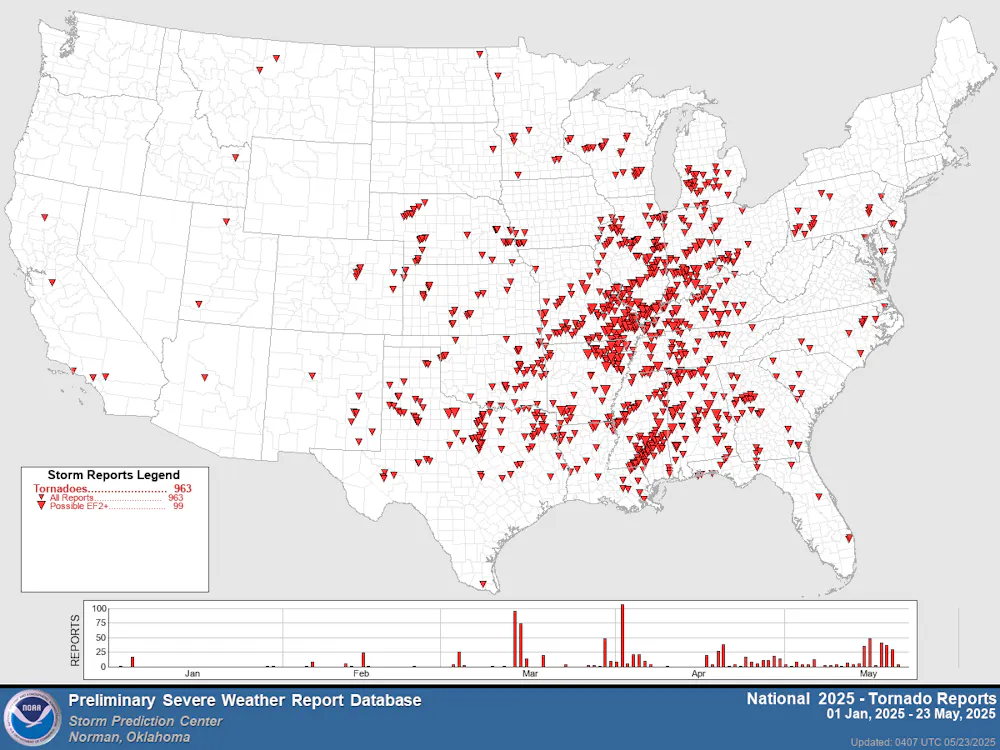
    The U.S. has had more reported tornadoes than normal – over 960 as of May 22, according to the National Weather Service’s preliminary count.

    That’s well above the national average of around 660 tornadoes reported by that point over the past 15 years, and it’s similar to 2024 – the second-most active year over that same period.

    The National Weather Service tracks reported tornadoes based on local storm reports, allowing for comparisons throughout the year. The red line shows 2025 through May 22.
    NOAA National Storm Prediction Center

    I’m an atmospheric scientist who studies natural hazards. What stands out about 2025 so far isn’t just the number of tornadoes, but how Tornado Alley has encompassed just about everything east of the Rockies, and how tornado season is becoming all year.

    Why has 2025 been so active?

    The high tornado count in 2025 has a lot to do with the weather in March, which broke records with 299 reported tornadoes – far exceeding the average of 80 for that month over the past three decades.

    March’s numbers were driven by two large tornado outbreaks: about 115 tornadoes swept across more than a dozen states March 14-16, stretching from Arkansas to Pennsylvania; and 145 tornadoes hit March 31 to April 1, primarily in a swath from Arkansas to Iowa and eastward. The 2025 numbers are preliminary pending final analyses.

    While meteorologists don’t know for sure why March was so active, there were a couple of ingredients that favor tornadoes:

    By April and May, however, those ingredients had faded. The weak La Niña ended and the Gulf waters were closer to normal.

    April and May also produced tornado outbreaks, but the preliminary count over most of this period, since the March 31-April 1 outbreak, has actually been close to the average, though things could still change.

    A tornado on May 18, 2025, tore apart homes in Bennett, Colorado.
    Helen H. Richardson/MediaNews Group/The Denver Post via Getty Images

    What has stood out in April and May is persistence: The jet stream has remained wavy, bringing with it the normal ebb and flow of stormy low-pressure weather systems mixed with sunny high-pressure systems. In May alone, tornadoes were reported in Colorado, Minnesota, Delaware, Florida and just about every state in between.

    Years with fewer tornadoes often have calm periods of a couple of weeks or longer when a sunny high-pressure system is parked over the central U.S. However, the U.S. didn’t really get one of those calm periods in spring 2025.

    Tornado Alley shifts eastward

    The locations of these storms have also been notable: The 2025 tornadoes through May have been widespread but clustered near the lower and central Mississippi Valley, stretching from Illinois to Mississippi.

    That’s well to the east of traditional Tornado Alley, typically seen as stretching from Texas through Nebraska, and farther east than normal. April through May is still peak season for the Mississippi Valley, though it is usually on the eastern edge of activity rather than at the epicenter. The normal seasonal cycle of tornadoes moves inland from near the Gulf Coast in winter to the upper Midwest and Great Plains by summer.

    Where local forecast centers reported tornadoes in 2025, through May 22. Data is preliminary, pending final analysis.
    NOAA Storm Prediction Center

    Over the past few decades, the U.S. has seen a broad shift in tornadoes in three ways: to the east, earlier in the year and clustered into larger outbreaks.

    Winter tornadoes have become more frequent over the eastern U.S., from the southeast, dubbed Dixie Alley for its tornado activity in recent years, to the Midwest, particularly Kentucky, Illinois and Indiana.

    Meanwhile, there has been a steady and stark decline in tornadoes in the “traditional” tornado season and region: spring and summer in general, especially across the Great Plains.

    It may come as a surprise that the U.S. has actually seen a decrease in overall U.S. tornado activity over the past several decades, especially for intense tornadoes categorized as EF2 and above. There have been fewer days with a tornado. However, those tornado days have been producing more tornadoes. These trends may have stabilized over the past decade.

    Deadlier tornadoes

    This eastward shift is likely making tornadoes deadlier.

    Tornadoes in the Southeastern U.S. are more likely to strike overnight, when people are asleep and cannot quickly protect themselves, which makes these events dramatically more dangerous. The tornado that hit London, Kentucky, struck after 11 p.m. Many of the victims were over age 65.

    The shift toward more winter tornadoes has also left people more vulnerable. Since they may not expect tornadoes at that time of year, they are likely to be less prepared. Tornado detection and forecasting is rapidly improving and has saved thousands of lives over the past 50-plus years, but forecasts can save lives only if people are able to receive them.

    Average number of tornadoes by month, 2000-2024. Source: NOAA

    This shift in tornadoes to the east and earlier in the year is very similar to how scientists expect severe thunderstorms to change as the world warms. However, researchers don’t know whether the overall downward trend in tornadoes is driven by warming or will continue into the future. Field campaigns studying how tornadoes form may help us better answer this question.

    Remember that it only takes one

    For safety, it’s time to stop focusing on spring as tornado season and the Great Plains as Tornado Alley.

    Tornado Alley is really all of the U.S. east of the Rockies and west of the Appalachians for most of the year. The farther south you live, the longer your tornado season lasts.

    Forecasters say it every year for hurricanes, and we badly need to start saying it for tornadoes too: It only takes one to make it a bad season for you or your community. Just ask the residents of London, Kentucky; St. Louis; Plevna and Grinnell, Kansas; and McNairy County, Tennessee.

    Listen to your local meteorologists so you will know when your region is facing a tornado risk. And if you hear sirens or are under a tornado warning, immediately go to your safe space. A tornado may already be on the ground, and you may have only seconds to protect yourself.

    Daniel Chavas receives funding from the National Science Foundation, NASA, and NOAA. He is a member of the American Geophysical Union and American Meteorological Society.

    ref. In 2025, Tornado Alley has become almost everything east of the Rockies − and it’s been a violent year – https://theconversation.com/in-2025-tornado-alley-has-become-almost-everything-east-of-the-rockies-and-its-been-a-violent-year-257169

    MIL OSI – Global Reports

  • MIL-OSI Global: How abortion laws focusing on fetal viability miss the mark on women’s experiences

    Source: The Conversation – USA – By Katrina Kimport, Professor of Sociology, University of California, San Francisco

    Abortion policy in the U.S. often focuses on fetal viability and fails to address the concerns of actual pregnant people. John Fedele/Tetra Images via GettyImages

    During the 2024 presidential campaign, politicians and their surrogates repeatedly raised concerns about abortion later in pregnancy. The topic grabbed media attention and continues to inspire strong emotions, but most of the discussions include numerous misunderstandings.

    These debates tend to focus almost exclusively on the status of a presumed healthy fetus: Does it have a heartbeat? Can it feel pain? Can it survive outside of the pregnant person’s body? Laws in the U.S. routinely use these fetal development markers to restrict abortion rights.

    The problem with this framing, however, is that the preoccupation with these fetal development markers originated in law and politics, not in science or medicine. And, most importantly, not from the lives, needs and experiences of pregnant people.

    We are medical sociologists who specialize in research on abortion. We noticed that fetal development markers shape the experience of pregnant patients. But that doesn’t mean these markers feel meaningful to people who get abortions.

    We wanted to understand how patients who have abortions later in pregnancy, including from states with laws banning abortion after specified markers like “viability,” thought about their pregnancy and abortion. Do they think about abortion in terms of the development of their fetus? We analyzed interviews with 30 women who obtained abortions later in pregnancy to answer this question.

    A history of limitations

    Long before the 2022 U.S. Supreme Court’s Dobbs v. Jackson Women’s Health Organization decision overturned the constitutional right to abortion, thousands of people each year in the U.S. were denied abortion services. Often, this was because they were beyond the pregnancy gestational limit imposed by their state’s abortion laws.

    These limits were rooted in fetal development markers. For instance, some states such as Maine and Washington allow abortion until a particular developmental point, such as presumed fetal viability. This is the point in pregnancy when the fetus might survive outside the uterus. Even in states considered supportive of abortion rights, such as California and Illinois, limits based on fetal development are still in force today.

    Since the Dobbs ruling, more abortion seekers are being denied the chance to get the procedure or facing long delays because of laws based on ideas about fetal development markers. But in fact, laws focused on fetal markers often end up jeopardizing the life and health of pregnant patients and furthering suffering, our study shows.

    Fetal development markers explained

    Fetal development markers sound like they are established clinical terms, but they aren’t. Some, like “potential fetal viability,” are concepts that started in legal thinking in the early 1970s. Then, when they were incorporated into limits on legal abortion, clinicians had to figure out how to apply them in a health care setting.

    Laws premised on fetal development markers around the U.S. have led to a host of lawsuits and general confusion among medical practitioners, as the language they use often doesn’t translate into medical contexts.

    It’s worth noting that common shorthand is to assign a specific gestation to a particular marker – for example, saying that viability starts at 24 weeks. But this ignores the fact that fetal viability depends on many factors, including fetal weight, sex, genetics and availability of neonatal intensive care resources.

    Only about half of infants born at 24 weeks of gestation will even survive long enough to be discharged from the hospital. Among infants born at 28 weeks, that rises to more than 90%. And of course, just looking at whether a baby was discharged from the hospital does not capture the acute impairments that babies born this prematurely experience and ongoing medical care they will require for much, if not all, of their lives.

    Focusing on the fetus’s viability overlooks the baby’s viability

    When we interviewed women who had abortions after 24 weeks of pregnancy, it became evident that these legal definitions were entirely irrelevant to the realities of their fetuses’ health.

    Some described carrying a fetus with a serious health issue that doctors told them would lead to its death soon after birth, just not during pregnancy. For instance, one woman we interviewed learned that a child with her fetus’s diagnosis would be born alive but would have regular seizures, cognitive disabilities and an inability to control its own movement.

    “I couldn’t imagine bringing a child into this world who would suffer and not have cognition of why, or be able to understand a good day from a bad day,” she said. To her, having an abortion was a way to protect her son: “I can’t give him that life of pain if I have a choice.”

    Women in similar situations struggled with the way their states’ laws focused on fetal viability but ignored the fact that the life their baby would have would be very brief and characterized by deep, sometimes constant pain. To them, the law reduced “viability” to the ability to survive birth, without consideration of the quality of their child’s life and the degree of its suffering.

    Overlooking women’s health

    Research and journalism have documented harrowing obstetric emergencies and their physical consequences in states where abortion has been banned. These traumatic events are often directly linked to laws that, in effect, leave little to no room to protect the pregnant patient’s life and health. The women in our study repeatedly highlighted that when a state’s law emphasizes “fetal viability” at the time an abortion is sought, the pregnant patient’s future health – both emotional and physical – takes a back seat.

    One woman we interviewed explained that she was so desperate not to be pregnant that she considered suicide because the fetal development-based law in her state meant she would not have access to a needed abortion. She had to travel out of state for her abortion. In her interview, she said the staff at the abortion clinic “saved my life. They definitely did. If it wasn’t for them, I probably wouldn’t be here.”

    We also interviewed a woman who had a medical condition that made pregnancy and laboring very dangerous for her, but she decided to take that risk to start a family. Once it was clear that her fetus had a serious health issue and would die in utero or shortly after birth, she no longer wanted to risk her own health.

    “Never mind the suffering, like needless suffering for the baby — I would also have to go through a cesarean surgery for that,” she said. But in her state, a fetal development-based law prohibited her from receiving an abortion. She, too, had to travel in order to get one.

    Ultimately, the women we interviewed found the laws based in fetal development markers to be nonsensical and cruel when applied to their pregnancies. One woman we interviewed, whose fetus’s severe medical condition was only diagnosable by doctors after her state’s 24-week viability cutoff, put the issue in stark terms.

    She was denied an abortion even after multiple specialists told her there was “100% certainty” her baby would have a bad outcome – an outcome that one specialist gently told her “no parent wants.” She had to fly halfway across the country to get the abortion she needed, far away from her support system.

    She said, “What sense does that make? I can’t imagine anybody looking at that and saying, ‘Yes, that was the desired outcome of this policy.’”

    Katrina Kimport receives funding from the Society of Family Planning and an anonymous private foundation.

    Tracy A. Weitz receives funding from the Society of Family Planning, Education Foundation of America, and William and Flora Hewlett Foundation. She is affiliated with Cambridge Reproductive Health Consultants, Fund Access Forward, Democracy Forward, Abortion Bridge Collaborative (Women’s Donors Network), Breast Cancer Action.

    ref. How abortion laws focusing on fetal viability miss the mark on women’s experiences – https://theconversation.com/how-abortion-laws-focusing-on-fetal-viability-miss-the-mark-on-womens-experiences-245998

    MIL OSI – Global Reports

  • MIL-OSI Global: Like many populist leaders, Trump accuses judges of being illegitimate obstacles to safety and democracy

    Source: The Conversation – USA – By Michael Gregory, Assistant Professor of Philosophy, Clemson University

    The front entrance of the E. Barrett Prettyman United States Court House, the workplace of Judge James Boasberg, along with other federal and appeals court judges, is seen in Washington, D.C. Philip Yabut/Getty Images

    Federal judges and at times Supreme Court justices have repeatedly challenged – and blocked – President Donald Trump’s attempts to reshape fundamental aspects of American government.

    Many of Trump’s more than 150 executive orders, including one aimed at eliminating the Department of Education, have been blocked by injunctions and lawsuits.

    When a majority of Supreme Court justices ruled on May 16, 2025, that the Trump administration could not deport a group of Venezuelan immigrants without first giving them the right to due process in court, Trump attacked the court.

    “The Supreme Court of the United States is not allowing me to do what I was elected to do,” Trump wrote on Truth Social. “This is a bad and dangerous day for America!” he continued in the post.

    As the Trump administration faces other orders blocking its plans, the president and his team are framing judges not just as political opponents but as enemies of democracy.

    Trump, for example, has called for the impeachment of James Boasberg, a federal judge who also issued orders blocking the deportation of immigrants in the U.S. to El Salvador. Attorney General Pam Bondi has said that Boasberg was “trying to protect terrorists who invaded our country over American citizens,” and Trump has also called Boasberg and other judges who ruled against him or his administration “left-wing activists.”

    “We cannot allow a handful of communist, radical-left judges to obstruct the enforcement of our laws and assume the duties that belong solely to the president of the United States,” Trump said at a rally in April 2025. “Judges are trying to take away the power given to the president to keep our country safe.”

    As a scholar of legal and political theory, I believe this kind of talk about judges and the judicial system is not just misleading, it’s dangerous. It mirrors a pattern seen across many populist movements worldwide, where leaders cast independent courts and judges as illegitimate obstacles to what they see as the will of the people.

    By confusing the idea that the people’s will must prevail with what the law actually says, these leaders justify intimidating judges and their sound legal rulings, a move that ultimately undermines democracy.

    President Donald Trump shakes hands with Supreme Court Chief Justice John Roberts at his inauguration on Jan. 20, 2025, in Washington, D.C.
    Chip Somodevilla/Getty Images

    Thwarting ‘the will of the American people’?

    In the face of judicial rulings against them, Trump and other administration officials have suggested on multiple occasions that judges are antagonistic to what the American people voted for.

    Yet these rulings are merely a reflection of the rule of law.

    Trump and supporters such as Elon Musk have characterized the rulings as a sign that a group of elite judges are abusing their power and acting against the will of the American people. The rulings that enforce the law, according to this argument, stand in opposition to the popular mandate American voters give to elected officials like the president.

    “If ANY judge ANYWHERE can stop EVERY Presidential action EVERYWHERE, we do NOT live in a democracy,” Elon Musk posted on X in February 2025. “When judges egregiously undermine the democratic will of the people, they must be fired,” Musk added.

    And U.S. Rep. Mike Johnson, the Republican speaker of the House of Representatives, said in March 2025, “We do have the authority over the federal courts, as you know. We can eliminate an entire district court.”

    Framing judges as enemies of democracy or as obstacles to the people’s will departs sharply from the traditional view – held across political lines – that the judiciary is an essential, nonpartisan part of the American constitutional system.

    While previous presidents have expressed frustration with specific court decisions or judges’ political leanings, their critiques mostly focused on specific legal reasoning.

    Supreme Court Justice Ketanji Brown Jackson warned against the Trump administration’s charge that judges were actively undermining democracy. In late April 2025, she said during a conference for judges that “relentless attacks on judges are an attack on democracy.”

    So, are judges obstructing democracy – or protecting it?

    Are unelected judges a sign of democracy?

    The U.S. Constitution established an independent judiciary as a coequal branch of government, alongside the legislative and executive branches. Federal judges are appointed for life and cannot be removed for political reasons. The country’s founders thought this protection could insulate judges from political pressures and ensure that courts uphold the Constitution, not the popularity of a given policy.

    Yet as the federal judiciary has expanded in size and power, the arguments about the relationship between democracy and judicial independence have become louder among some political scientists and legal philosophers.

    Some critics take issue with the fact that federal judges are appointed by politicians, not elected to their positions – a fact that others argue contributes to their independence.

    Federal judges often serve longer on the bench than many elected officials.

    Why, some critics argue, should a small group of unelected experts be allowed to overturn decisions made by elected officials?

    Other democratic theorists, however, say that federal judges can act as a check on elected leaders who may misuse or abuse their power, or pass laws that violate people’s legal rights. This indirectly strengthens democracy by giving people a meaningful way to have recourse against laws that go against their rights and what they actually voted for.

    A common story across countries

    The argument that judges are an enemy to democracy is not unique to the U.S.

    Authoritarian leaders from across the world have used similar language to justify undermining the courts.

    In the Philippines, then-President Rodrigo Duterte in 2018 told Maria Lourdes Sereno, a top judge who was an outspoken critic of Duterte’s war on drugs, “I am now your enemy.” Shortly after, the Philippines Supreme Court voted to oust Sereno from the court. These judges cited Sereno’s failure to disclose personal financial information when she was first appointed to the court as the reason for her removal.

    Filipino protesters and outside critics alike viewed Sereno’s removal as politically motivated and said it undermined the country’s judicial independence.

    El Salvador President Nayib Bukele’s allies in the legislative assembly similarly voted in May 2021 to remove the government’s attorney general as well all five top judges for obstructing Bukele’s plans to imprison, without proper due process, large numbers of people. Bukele replaced the attorney general and judges with political loyalists, violating constitutional procedure.

    Kamala Harris, then vice president of the U.S., was among the international observers who said the removal of judges in El Salvador made her concerned about El Salvador’s democracy. Bukele justified the judges’ removal by saying he was right and that he refused to “listen to the enemies of the people” who wanted him to do otherwise.

    And in April 2024, a minister in Israeli Prime Minister Benjamin Netanyahu’s Cabinet called Attorney General Gali Baharav-Miara an “enemy of the people,” blaming her for protests outside Netanyahu’s home. This disparagement was part of Netanyahu’s broader efforts to weaken judges’ role and independence and to remove judicial constraints on executive power.

    Judge James Boasberg is one example of a judge who was personally attacked by President Donald Trump for issuing various rulings on the administration’s plans to deport Venezuelan immigrants.
    Drew Angerer/AFP via Getty Images

    Pushing against democracy

    In the name of weakening what they call undemocratic institutions, these and other leaders try to discredit independent judges. This attempt helps these leaders gain power and silence dissent.

    Their attempts to disparage and discredit judges misrepresent judges’ work by asserting that it is political in nature – and thus subject to political criticism and even intimidation. But in the U.S., judges’ constitutionally mandated work takes place in the realm of law, not politics.

    By confusing the idea that the people’s will must prevail with what the law actually says, these leaders justify intimidating judges and their rulings, a move that ultimately undermines democracy.

    Independent judges may not always make perfect decisions, and concerns about their interpretations or potential biases are legitimate. Judges sometimes make decisions that are objectionable from a moral and legal standpoint.

    But when political leaders portray judges as the problem, I believe it’s crucial to ask: Who truly benefits from silencing judges?

    Michael Gregory does not work for, consult, own shares in or receive funding from any company or organization that would benefit from this article, and has disclosed no relevant affiliations beyond their academic appointment.

    ref. Like many populist leaders, Trump accuses judges of being illegitimate obstacles to safety and democracy – https://theconversation.com/like-many-populist-leaders-trump-accuses-judges-of-being-illegitimate-obstacles-to-safety-and-democracy-255472

    MIL OSI – Global Reports

  • MIL-OSI Global: From furry friends to fish, turning up the heat helps animals fight germs − how Mother Nature’s cure offers humans a lesson on fever

    Source: The Conversation – USA – By Phil Starks, Associate Professor of Biology, Tufts University

    Sick animals often move to warmer places to raise their body temperature. GK Hart/Vikki Hart/Stone via Getty Images

    Why do people get fevers when we get sick?

    It’s a common misconception that pathogens, such as SARS-CoV-2 or the flu, cause fevers. But as biology professors, we know it’s not that simple. Pathogens cause fevers only indirectly.

    When your immune system detects harmful microbes, your body raises its internal temperature to create a hostile environment. Turning up the heat suppresses the proliferation of invaders. In short, the fever is the body’s way of fighting back.

    Although many people don’t understand fever’s purpose, animals certainly utilize it. Even so-called “simple creatures,” such as lizards, fish and insects, use fever to recover from illness.

    The body’s response

    Suppose you catch a virus. The immune system responds by releasing molecules called pyrogens, which induce fever. They signal the brain’s hypothalamus to raise the body’s set point temperature – like adjusting a thermostat.

    Normal body temperature hovers around 98.6 degrees Fahrenheit (37 degrees Celsius), but fevers commonly increase temperatures to 100.4-104 F (38-40 C).

    When that happens, your muscles contract, causing shivers, and blood vessels constrict to retain heat. You’ll feel cold until your body reaches the new set point, often prompting you to add clothes or snuggle into blankets. When the infection subsides, pyrogens decrease and the hypothalamus resets the temperature. You sweat, your blood vessels dilate, and you cool off. You’re feeling better.

    There’s a reason why you shiver when you have a fever.
    Edwin Tan/E+ via Getty Images

    Mammals, lizards, fish and insects

    Humans are not special in this regard; all mammals are capable of generating fevers. Even without taking their temperature, you might recognize the signs in a familiar companion. When dogs have a fever, they often lose their appetite, become lethargic and may shiver − behaviors that closely resemble how people respond when they’re running a fever.

    This adaptive response to infection is widespread in nature. Even cold-blooded animals, which rely on the environment for warmth, raise their temperature behaviorally.

    Lizards move to warmer areas when sick. If they’re blocked from doing so − or given fever-reducing drugs − their survival rates drop. Zebrafish swim to warmer waters during infection; a rise of just 5.4 F (3 C) correlates with improved gene expression, stronger antiviral responses and higher survival. Naked mole rats – a social, subterranean cold-blooded mammal that looks like a hot dog with teeth – generate fevers in response to infection, despite their unusual physiology.

    Insects, too, show remarkable responses. Desert locusts elevate their body temperature when infected, doing so in a dose-dependent manner: more pathogen, higher temperature. This behavior increases their chance of survival and reproduction.

    Honeybees have a unique way of fighting a fever.
    Joannis S. Duran/Moment via Getty Images

    Honeybees are among the most sophisticated. These social insects regulate brood temperature with extraordinary precision, keeping it between 90-95 F (32-35 C). They warm the hive by contracting flight muscles and cool it by fanning wings, sometimes spreading water on the comb to induce evaporative cooling.

    If their larvae are exposed to heat-sensitive fungal spores, the colony raises the temperature − essentially giving itself a fever. The increased heat prevents spore germination and protects the next generation. Once the threat has passed, the bees restore their normal hive temperature.

    If fevers don’t wind down within 24 to 36 hours, it’s time to see a doctor.

    Treating a fever

    These examples show that evolution has favored the fever response. Yet when humans get a fever, our instinct is often to bring it down – using aspirin, removing blankets or applying cold compresses. And sometimes that’s appropriate. Adults should seek medical attention if fever exceeds 103 F (39.4 C); children at 102 F (38.9 C); and infants younger than three months at 100.4 F (38 C).

    But mild to moderate fevers often help more than they hurt. Reducing a fever too soon − via medication or environmental cooling − may interfere with the body’s natural defense, prolonging illness.

    This isn’t a new idea. Nearly a century ago, Austrian physician Julius Wagner-Jauregg pioneered an extreme method called malariotherapy: infecting syphilis patients with malaria. The high fever induced by malaria killed the syphilis-causing bacteria. Once the bacteria was eliminated, doctors treated the malaria with quinine.

    The approach was risky but effective enough to win Wagner-Jauregg the Nobel Prize in 1927. Although some patients died from the treatment, and many others relapsed, it remained in use for about two decades, until replaced by penicillin. Think of Wagner-Jauregg’s treatment like using a sledgehammer to drive a nail; it worked, though the wall didn’t always survive.

    Much remains to be discovered about how fever affects the immune response. Still, the underlying message holds: Fever fights infection.

    The fact that so many diverse creatures developed similar fever responses suggests a powerful pattern known as convergent evolution − when different species with enormously complex evolutionary histories converge on a similar solution. Despite different evolutionary paths, all these organisms faced the same challenge − infection − and arrived at the same solution: fever.

    Phil Starks received past funding from the NSF for providing research experiences for undergraduates (REU).

    Harry Bernheim had grants from the NIH in the 1980’s.

    ref. From furry friends to fish, turning up the heat helps animals fight germs − how Mother Nature’s cure offers humans a lesson on fever – https://theconversation.com/from-furry-friends-to-fish-turning-up-the-heat-helps-animals-fight-germs-how-mother-natures-cure-offers-humans-a-lesson-on-fever-229078

    MIL OSI – Global Reports

  • MIL-OSI Global: Five ways to inspire ocean connection: reflections from my 40-year marine ecology career

    Source: The Conversation – UK – By Martin Attrill, Professor of Marine Ecology, University of Plymouth

    For 40 years, I’ve worked as a marine ecologist and, since 1992, I’ve been based in Plymouth, Devon – a global hub for coastal marine research and teaching. As I think back to how our understanding of life in our oceans has changed over that time, here are five lessons I have learnt.

    1. Start with the basics

    Back in the 1970s, the band America wrote: “The ocean is a desert with its life underground, and the perfect disguise above”. Many people I speak to actually don’t see much beyond that grey-blue surface.

    Back in 2014 my colleagues and I were quite shocked at the response to a big survey we did on public perception of the marine environment in the UK, particularly when we break out of our marine bubbles. If an organism was remotely colourful or interesting, most people assumed it didn’t live in UK waters.

    That reminded me not to underestimate how little most people know, or care, about UK seas. Make no assumptions.

    While Blue Planet and other beautiful TV series have undoubtedly helped raise the profile of the world’s seas, some have potentially reinforced this view of local waters – that you have to travel to far-off exotic locations to find any interesting and spectacular life.

    2. Inspire deep connection

    Research shows the almost unparalleled restorative power of being in, on, under or by the sea. You do not need to dive to feel a strong ocean connection – building sandcastles, catching crabs on a line in a harbour, skimming stones or letting the cold water wash over your feet can work wonders.

    Rockpooling is also an incredible window into the underwater world – suddenly all this weird and wonderful life opens up to us in a small, simple and accessible puddle.

    Rockpooling is a fun and easy way to explore marine life.
    Laura Schwormstedt/Shutterstock

    People need to be given more opportunities to form lasting connections with the ocean. Organisations such as Plymouth’s Ocean Conservation Trust and Devon Wildlife Trust are bringing young people to the sea, sometimes for the first time.

    Enabling ocean connection is just as important for people who don’t have the chance or ability to physically be there, for example through virtual reality. I’ve also been involved in transforming Plymouth Sound into the UK’s first national marine park – this concept is all about engaging people with this stretch of coastline, getting them connected to the ocean and inspiring them to care. And the marine park model could be replicated around the UK.


    Local science, global stories.

    This article is part of a series, Secrets of the Sea, exploring how marine scientists are developing climate solutions.

    In collaboration with the BBC, Anna Turns travels around the West Country coastline to meet ocean experts making exciting discoveries beneath the waves.


    3. Take the pressure off

    If you leave the ocean alone, it can recover. Very few shallow areas of our global ocean remain untouched. But, as demonstrated so well in David Attenborough’s latest film, Ocean, if you remove all the most damaging impacts (particularly physical fishing damage), then the sea has great powers of recovery.

    In the UK, bluefin tuna and humpback whales have returned as the pressure to hunt them has been better managed. The cold water reefs on the seabed in Lyme Bay off the south coast of England have recovered remarkably just four years after a ban on towed fishing gear was introduced.

    Today, there are so few properly protected areas where all damaging or extractive activities are completely removed to give nature a chance, particularly in the UK. Some habitats may need a bit of help from us – active restoration or replanting of seagrass beds and oyster reefs will help kickstart regrowth.

    What is seagrass? The Ocean Conservation Trust explains.

    4. Plastic is a distraction

    The flow of plastics into the ocean must certainly be stopped. But I worry that the plastic pollution problem is a bandwagon that so many businesses, media outlets and governments have jumped on. Has a decade-long focus on “solving” the plastic crisis been a troublesome distraction? Banning single-use straws can seem like an easy win because leaders can be seen to be taking action – but it does little to solve the ocean’s biggest problems.

    Meanwhile, the most complex and hard to resolve activities that seriously harm our seas, such as industrial overfishing, are still not being dealt with. The most damaging fishing practices such as trawling and dredging continue legally, astonishingly even within designated marine protected areas. Such highly damaging activities have no place near sensitive habitats and this has been so well demonstrated in Ocean.

    The recent UK ban on sandeel fishing gives me hope. This landmark decision was made to benefit nature (protecting food supply for seabirds), restricting a fishery that does not even supply food for humans. Sandeels are used to make fishmeal and fish oil to feed farmed fish and livestock.

    Yet, damaging fishing practices such as trawling and dredging continue legally, even within designated marine protected areas. Such highly damaging activities have no place near sensitive habitats.

    I firmly believe that the most effective and straightforward solution for the UK is to prohibit all towed fishing gear from within at least three miles of the coast – including developing a series of fully protected marine reserves.

    In Lyme Bay, this approach has led to a real win-win because the seas are now recovering, and local fishers, holidaymakers and coastal communities are benefiting too.


    Read more:
    David Attenborough’s Ocean reveals how bottom trawling is hurting sealife in horrifying detail


    5. Add a dose of ocean optimism

    Rising eco-anxiety, particularly in younger people, is not surprising given the state of the world. Faced with the nature and climate crisis, it is easy to feel utter despair.

    Climate change will undoubtedly change our planet. Yet, without oceans absorbing most of the carbon (while producing half the oxygen we breathe), this planet would already be uninhabitable for human civilisation. Making our oceans as healthy and resilient as possible is therefore crucial.

    Right now, we need some ocean optimism. Sharing the stories of progress and innovation that show how patches of the sea are recovering can demonstrate what’s possible and inspire further positive action. By showcasing areas now rich with diverse marine life now that industrial-scale damage has been stopped or whale populations that are booming now that harpoons are a thing of the past, a vision for a better, bluer future can become reality at scale.

    Listen to episode one of Secrets of the Sea here on BBC Sounds, presented by Anna Turns for The Conversation.


    Don’t have time to read about climate change as much as you’d like?

    Get a weekly roundup in your inbox instead. Every Wednesday, The Conversation’s environment editor writes Imagine, a short email that goes a little deeper into just one climate issue. Join the 45,000+ readers who’ve subscribed so far.


    Martin Attrill receives and has received funding from a series of government, NGO and private sector bodies, all of which is directed to the University of Plymouth, not personally. Current and recent funding includes from UK Government (NEIRF), Heritage Lottery Fund, Natural Environmental Research Council, EU INTERREG and ERDF. He is affiliated with Ocean Conservation Trust (Chief Scientific Advisor) and a trustee of the Manta Trust.

    ref. Five ways to inspire ocean connection: reflections from my 40-year marine ecology career – https://theconversation.com/five-ways-to-inspire-ocean-connection-reflections-from-my-40-year-marine-ecology-career-250162

    MIL OSI – Global Reports

  • MIL-OSI Global: West Nile virus found in the UK for the first time – what you need to know

    Source: The Conversation – UK – By Paul Hunter, Professor of Medicine, University of East Anglia

    Kwangmoozaa/Shutterstock.com

    For the first time, traces of the West Nile virus have been found in mosquitoes in the UK, according to a report published this week by the UK Health Security Agency.

    Here’s what you need to know about the virus and the disease it causes.

    What is West Nile virus?

    West Nile virus is a mosquito-borne virus first identified in Uganda in 1937. It belongs to the same viral family as dengue and yellow fever. The virus is most commonly transmitted by Culex mosquitoes, particularly the species Culex pipiens, which mainly feeds on birds.

    Birds are the primary host for West Nile virus, and the virus spreads in a cycle from infected birds to mosquitoes and then back to birds. Occasionally, mosquitoes can transmit the virus to humans or other animals.

    Most human infections – around 80% – cause no symptoms. When symptoms do occur, they are usually mild: fever, fatigue, headaches, body aches and sometimes nausea. But in rare cases, around one in 150 infections, the virus can cause severe illness, including encephalitis (inflammation of the brain) or meningitis. Older adults, especially those over 50, are most at risk of serious complications.

    The virus cannot normally be spread from person to person, though rare cases of transmission have occurred through blood transfusions or from mother to baby during pregnancy.


    Get your news from actual experts, straight to your inbox. Sign up to our daily newsletter to receive all The Conversation UK’s latest coverage of news and research, from politics and business to the arts and sciences.


    How did it get to the UK?

    Although the exact route isn’t known, experts believe the virus may have arrived in the UK via migratory birds infected elsewhere. The mosquitoes probably picked up the virus after feeding on these birds during their northward journey.

    The detection was made as part of a routine mosquito surveillance programme run by the Animal and Plant Health Agency. Mosquitoes collected from marshlands in south-east England tested positive in PCR (polymerase chain reaction) tests, which detect fragments of the virus’s genetic material.

    It’s important to note that a positive PCR test doesn’t necessarily mean the virus is infectious. After a mosquito becomes infected, the virus needs time – several days – to multiply inside the mosquito before it can be transmitted. And this process is highly temperature dependent.

    Can the virus spread in the UK?

    The UK’s relatively cool climate has, until now, helped keep mosquito-borne diseases at bay. At summer temperatures of around 15°C, it can take up to 100 days for the virus to develop inside a mosquito – longer than the insect’s lifespan. In contrast, in hotter climates (above 30°C), this process can take just a few days.

    For a local outbreak to occur, there would need to be a critical mass of infected birds and mosquitoes, with enough warm weather to sustain multiple cycles of transmission. So far, that hasn’t happened in the UK.

    But climate change could alter the equation. With rising global temperatures and longer, hotter summers, the conditions that allow viruses such as West Nile to spread may become more common in the UK.

    What’s happening elsewhere?

    West Nile virus was once limited to Africa and the Middle East but has spread significantly in recent decades. Large outbreaks have been recorded in countries including Greece, Romania, Israel, Russia and the US.

    The US outbreak began in New York City in 1999 when an unusual number of birds were found dead in a city zoo. A veterinary pathologist at the Bronx Zoo, Tracey McNamara, helped link the bird deaths to the human illnesses being reported.

    Since then, the virus has spread across most of the US, Canada and parts of South America, resulting in over 60,000 reported human cases, 28,000 hospitalisations and more than 3,000 deaths.

    In 2024, 19 European countries reported a total of 1,436 local cases, most in men over 65, with 125 deaths. Most were in Italy, Greece and Spain – countries with hot, mosquito-friendly summers.

    Outbreaks were also reported in birds and horses, which are both susceptible to the virus.

    Should UK residents be concerned?

    While the detection of West Nile virus in UK mosquitoes is noteworthy, experts emphasise that the public health risk remains very low. No human cases have been reported in the UK to date, and current summer temperatures are not yet conducive to sustained transmission.

    The greater risk for most British people probably comes from travel – particularly to southern Europe, where cases are rising.

    Travellers are advised to take standard mosquito precautions: wear light-coloured clothing, long sleeves and trousers, and use insect repellent, especially in the evening when mosquitoes are most active.

    For now, the virus is unlikely to spread widely in the UK. But as climate patterns shift, continued surveillance and public awareness will be key to staying ahead of the risk.

    Paul Hunter consults for the World Health Organization. He receives funding from National Institute for Health Research and has received funding from the World Health Organization and the European Regional Development Fund.

    ref. West Nile virus found in the UK for the first time – what you need to know – https://theconversation.com/west-nile-virus-found-in-the-uk-for-the-first-time-what-you-need-to-know-257295

    MIL OSI – Global Reports

  • MIL-OSI Global: What’s it like being a raven or a crow?

    Source: The Conversation – UK – By Walter Veit, Lecturer, Department of Philosophy, University of Reading

    Corvids are no birdbrains. Mimmo Lusito/Pexels, CC BY-SA

    Many of us as children may have wondered what’s going on inside the mind of an animal – what are they thinking and feeling? Most animal researchers study science because of their fascination with animals, but for a long time scientific norms made it impossible to even raise the question of animal consciousness without losing scientific credibility.

    Fortunately, those days have ended, thanks in large part to pioneering work by scientists such as Donald Griffin, who argued from the 1980s to his death in 2003 that animal minds should be a topic for scientific study.

    We are philosophers who study consciousness, and in our recent research we worked with other scientists to explore what the world might be like from the point of view of corvids, the family of birds that includes ravens, crows, jays and magpies.

    “Birdbrain” used to be a common insult but corvids have such surprising intelligence that they are sometimes described by scientists and journalists as “feathered apes”. But we wanted to go beyond intelligence. To do this we examined five dimensions of their experience by combing through studies on their behaviour, cognition, brains, emotions and consciousness.


    Get your news from actual experts, straight to your inbox. Sign up to our daily newsletter to receive all The Conversation UK’s latest coverage of news and research, from politics and business to the arts and sciences.


    Corvids’ eyes have incredibly sharp resolution that allows them to navigate while flying at high speeds and to find potential sources of food. Their hearing is excellent, perhaps unsurprising for songbirds, allowing them to even distinguish reliable from unreliable group members by assessing and remembering their alert calls.

    They also have a good sense of smell, which they use to help them find nuts and other food they have hidden. Unfortunately, we do not know how their smell compares to a lot of other animals, because there are not enough studies on corvids’ sense of smell yet.

    Emotional lives

    Corvids show cognitive biases, similar to humans. They have negative moods and show signs of pessimism after observing similar states in others.

    But they also show positive moods after successfully using tools – just like humans. And they can also show neophobia – wariness of new objects.

    Even if you come with treats to give them, corvids are reluctant to fly close to someone they haven’t met before, but are confident with humans they know well – another common human trait.

    It is common for people to only attribute emotional lives to mammals, but corvids show that we should study the emotions of birds in more detail.

    Integrated experiences

    We humans have one stream of consciousness. But birds lack a corpus callosum, the structure that connects the two brain hemispheres in us and other mammals.

    Their brain halves show a lot of division of labour, such as using their different eyes to focus on different tasks. However, that doesn’t necessarily mean that their experience is split into two selves – it could suggest a kind of partial unity different from our own.

    Perhaps their consciousness is more like split-brain human patients who have had their corpus callosum cut to reduce the effects of seizures. When two pictures are presented in their respective left and right visual fields, these people will draw what they see on the left side with their left hand, whereas they will verbally describe what is on the right, giving the appearance of two selves in one body.

    Consciousness across time

    Corvids show remarkable abilities in their sense of self across time. Because they often hide food (scientists call this caching), they can remember not just where they hid food, but also what kind of food it was and how long ago they hid it – which is relevant for more perishable foods such as insects, compared to longer-lasting nuts.

    Here their memory far outstrips our own or, for that matter, most other animals when it comes to hiding objects, with some corvids caching and remembering over a thousand food items in a month for later consumption. No human would be able to remember that many hiding spots.

    Corvids can even plan, collecting and storing a tool such as a spoon for future use.

    Is this magpie waiting for the photographer to go away before it hides its nut?
    Fercast/Shutterstock

    A rich sense of self

    They not only recognise themselves in mirrors, but also understand other minds. Research has shown corvids go back to remove cached food and hide it elsewhere if they know they have been observed – but only if they have stolen from others in the past.

    Male jays will watch the feeding behaviour of a female they want to court, so they can bring their preferred food. Even more solitary corvids, such as ravens, seem to have well-developed social skills, which scientists used to think were largely restricted to mammals.

    In all of this, there is still a great deal of uncertainty. Learning about the minds of other animals requires a great deal of inference from sparse and often ambiguous data. But we believe that there is scientific evidence for rich conscious experiences in corvids. For most species, it is a lack of research, not a lack of capacity, that keeps us silent on what their subjective experiences are like.

    This research also has implications for corvid welfare. Understanding what the world is like for an animal means understanding what feels good and bad for them. Their good memories may mean they suffer longer from a negative experience, neophobia will mean novel objects should be introduced slowly, their social abilities mean they should be housed in groups. Giving them tools could allow them enriching experiences.

    All this should be taken into account when deciding how to care for these birds when kept in cavity, and how to minimise welfare risks in other interactions with them.

    The authors do not work for, consult, own shares in or receive funding from any company or organisation that would benefit from this article, and have disclosed no relevant affiliations beyond their academic appointment.

    ref. What’s it like being a raven or a crow? – https://theconversation.com/whats-it-like-being-a-raven-or-a-crow-257171

    MIL OSI – Global Reports

  • MIL-OSI Global: Oscar Wilde’s The Ballad of Reading Gaol is a work of art activism beloved by Banksy

    Source: The Conversation – UK – By Sondeep Kandola, Senior Lecturer in English Literature and Cultural History, Liverpool John Moores University

    Oscar Wilde photographed by Napoleon Sarony (c. 1882). Library of Congress

    In 2021, Banksy revealed a mural of Oscar Wilde, clad in prisoner garb, making an escape from the abandoned Reading jail. The artist claimed that he would donate profits from the sale of the stencil he used to create the work (a projected £10 million) to set up an arts hub in the Grade II listed building.

    This hasn’t yet taken place, but speaking about the work at the time, Banksy dubbed Wilde “the patron saint of smashing two contrasting ideas together to create magic. Converting the place that destroyed him into a refuge for art feels so perfect we have to do it.”

    In 1895, Wilde was sentenced to two years of hard labour for “gross indecency” after being convicted of “homosexual acts”. He was posthumously pardoned in 2017 under the Turing Law.

    The Ballad of Reading Gaol, which he wrote two years after his release, hypnotically details the psychological and physical horrors of living in isolation in unsanitary single-cells for 23 hours a day.

    It also reveals the mind-numbing conditions and physically exhausting jobs that were relentlessly inflicted on prisoners in Wilde’s day. They were required to ascend 56 steps a minute for nine hours a day on a treadmill, break stones and pick oakum (fibres from the ropes used on ships). And to do so in complete silence.


    This article is part of Rethinking the Classics. The stories in this series offer insightful new ways to think about and interpret classic books and artworks. This is the canon – with a twist.


    In the poem, Wilde details the intense surveillance techniques and harsh punishments adopted by the prison wardens against the “outcast men”.

    Oscar Wilde’s prison cell in Reading Gaol as it appears today.
    Jack1956/Wiki Commons

    “Like ape or clown, in monstrous garb,” he writes, the inmates silently trudge the prison yard in their one allotted hour of exercise per day. The poem focuses on one prisoner in particular, named only as CTW, who is sentenced to death for murdering his wife. It traces his walk to the “hideous” shed where he is to be executed, which ghoulishly sees him “cross his own coffin”.

    More gothic images abound. CTW’s impending burial in an unhallowed and anonymous grave is described as “with yawning mouth the horrid hole / Gaped for a living thing” while “the very mud cried out for blood”.

    Wilde also references a scene from Coleridge’s 1797 masterpiece The Rime of the Ancient Mariner as he envisions phantoms dancing a “grisly masque” in which they sing of inexorable triumph of sin in prison, “the Secret House of Shame”.

    Moreover, Wilde denies that the sacrifice that CTW has offered to the prison with his execution is ultimately redemptive for him as:

    He did not pass in purple pomp

    Nor ride a moon-white steed

    Three yards of cord and a sliding board

    Are all the gallows need.

    In the ballad, Wilde represents the prison experience as sadistic and unrelenting. Much like Banksy over a century later, Wilde used the degree of anonymity the poem afforded (he published it under his cell number, C33) to berate an inhumane society and the distressing penal policy of “hard labour, hard fare, hard board” that he was forced to endure.

    The Ballad of Reading Gaol can ultimately be read as a celebration of compassion, resilience and art activism. Through the poem and letters he wrote to the Daily Chronicle, Wilde publicly attempted to “try and change [prison life] for others”.

    Wilde and his lover, Lord Alfred Douglas in 1893.
    British Library

    Despite Wilde’s public notoriety, Irish MPs Michael Davitt and T.P. O’Connor even went as far as to quote the ballad in parliamentary debates, which led to the adoption of some of the recommendations that Wilde had made in his letters in the 1898 Prison Reform Act.

    Although Wilde, himself, was to suffer the psychological and physical effects of his imprisonment until the end of his short life two years later, the 1898 Act saw the treadmill abolished, ensured solitary confinement could only be used for a maximum of 28 days and children were separated from adult prisoners. And yet, sadly, Wilde’s description of “the foul and dark latrine” of “humanity’s machine” continues to reverberate today.

    On August 22 2024, “independent monitors” into the conditions at Wandsworth Prison (where Wilde was briefly held) found it to be “crumbling, overcrowded and vermin-infested, with inmates living in half the cell space available when it was first opened in 1851”.

    While Wilde’s “swan song” joins with Banksy’s escaped prisoner to expose the failings of modern penal practices, it also reminds us of the enduring power of art and imagination to foster change.

    Beyond the canon

    As part of the Rethinking the Classics series, we’re asking our experts to recommend a book or artwork that tackles similar themes to the canonical work in question, but isn’t (yet) considered a classic itself. Here is Sondeep Kandola’s suggestion:

    If you are looking for further reading on the topic of prison life and the prison experience, Andy West’s memoir The Life Inside (2022) offers a sobering and often witty reflection on living in the carceral state today. A philosophy teacher in prison, West explores the notion of freedom, redemption and our broken prison system.

    You might also be interested to read Brendan Behan’s powerful 1958 autobiography Borstal Boy and Bobby Sands’ courageous Writings from Prison (2020), two incarcerated Irish writers who shared Wilde’s republican sympathies and similarly questioned the ethics and integrity of the British government who imprisoned them.

    Sondeep Kandola does not work for, consult, own shares in or receive funding from any company or organisation that would benefit from this article, and has disclosed no relevant affiliations beyond their academic appointment.

    ref. Oscar Wilde’s The Ballad of Reading Gaol is a work of art activism beloved by Banksy – https://theconversation.com/oscar-wildes-the-ballad-of-reading-gaol-is-a-work-of-art-activism-beloved-by-banksy-237581

    MIL OSI – Global Reports

  • MIL-OSI Russia: At the meeting of the public council of the Housing Committee at SPbGASU, personnel issues were in the spotlight

    Translation. Region: Russian Federal

    Source: Saint Petersburg State University of Architecture and Civil Engineering – Denis Udod, Georgy Abelev, Veronika Asaul and Yuri Kozlov

    On May 22, a meeting of the public council under the Housing Committee of the Government of St. Petersburg was held at SPbGASU on the topic of “Searching for and revealing the personnel potential of the city’s housing sector.” The presidium of the meeting included the chairman of the Housing Committee Denis Udod, the chairman of the public council under the Housing Committee Georgy Abelev, the head of the Department of Construction Economics and Housing and Public Utilities of SPbGASU Veronika Asaul and the executive secretary Yuri Kozlov.

    Head of the Department for Civil Service and Personnel of the Housing Committee Elena Mayevskaya spoke about current issues in the development of human resources in the housing sector of the Northern capital. The main emphasis is on measures aimed at attracting and retaining highly qualified personnel, especially in the field of cleaning urban areas and servicing housing stock. One of the key aspects is the development of a system of material and non-material incentives, including the establishment of competitive wages for janitors and machine operators, as well as improving working and rest conditions. The speaker noted the desire of the St. Petersburg authorities to ensure the stable functioning of the housing sector through an integrated approach to human resource management, including material compensation, professional development and the creation of attractive working conditions.

    Director of the St. Petersburg State Budgetary Educational Institution of Additional Professional Education “Educational and Methodological Center of the Housing Committee” Valery Sapozhnikov spoke about the activities of the center. An important point is the calculation of the required number of specialists undergoing retraining, and the actual training indicators for the previous period. The need for an annual increase in the number of students, the introduction of modern technologies and quality standards is noted, which will improve the efficiency of work in the housing sector. In addition, priority tasks are outlined, including expanding the range of educational services, holding seminars and conferences, introducing innovative approaches to training and practical application of knowledge. Particular attention is paid to the creation of a training center of competencies, which will become a platform for the exchange of experience, scientific research and the introduction of advanced technologies.

    Isa Magerramov, a postgraduate student at the Department of Construction Economics and Housing and Public Utilities at SPbGASU, spoke about the personnel shortage in the housing and public utilities sector of St. Petersburg, noting the acute shortage of qualified specialists and the fact that the current personnel training system is not effective enough and needs deep reform.

    Isa Magerramov reported that one of the responses to the personnel shortage in the housing and utilities sector was the opening of a specialized program in “Housing and Utilities Economics” at SPbGASU within the framework of the educational program 38.03.01 Economics.

    “To solve personnel problems, it is necessary to form a new type of specialist who will have both technical and economic competencies necessary for effective management of the housing and utilities sector. To achieve this goal, a systematic approach is needed with a focus on modernizing the educational system, developing interdisciplinary competencies, interacting with employers and supporting young specialists, which will allow us to prepare competent professionals who are in demand on the labor market,” he noted.

    The postgraduate student added: one of the promising areas that contributes to the formation of in-demand management and economic competencies for the effective development of the housing and communal services sector in St. Petersburg is the integration of the scientific potential of SPbGASU, professional standards and new educational solutions.

    The participants of the meeting came to a unanimous opinion on the need for a systemic and interdepartmental approach to solving the problem of personnel shortage in the housing sector. It was decided to continue close cooperation between the Housing Committee, educational organizations and employers in the industry.

    Please note: This information is raw content directly from the source of the information. It is exactly what the source states and does not reflect the position of MIL-OSI or its clients.

    MIL OSI Russia News

  • MIL-OSI Russia: We invite you to the sports festival “GUU – a big family”

    Translation. Region: Russian Federal

    Source: State University of Management – Official website of the State –

    On May 30, 2025, the sports festival “GUU – a big family” will be held on the sports field of the State University of Management.

    Everyone is invited to the celebration to take part in competitions and contests or just cheer on friends and have a good time.

    The program includes: – A quest with exciting sports (and other) tasks; – Master classes from our partners; – For the little ones: face painting and modeling; – Delicious pilaf for a great mood.

    To participate in the main competition, you need to assemble a team of 8-10 people and register using a special form.

    The team can include your classmates, friends, colleagues, moms and dads, brothers and sisters. And even if none of them support you, you can still register alone and they will select a team for you, because GUU is really a big family!

    Date: May 30 Time: 12:00 – 14:30 Place: sports field of the State University of Management (Ryazansky Prospekt, 99)

    We are waiting for you, this is definitely not something you can miss!

    Please note: This information is raw content directly from the source of the information. It is exactly what the source states and does not reflect the position of MIL-OSI or its clients.

    MIL OSI Russia News

  • MIL-OSI Global: Split Supreme Court blocks Oklahoma’s Catholic charter school − but future cases could hinge on whether charters are, at their core, public or private

    Source: The Conversation – USA – By Preston Green III, John and Maria Neag Professor of Urban Education, University of Connecticut

    The Supreme Court building is seen on April 30, 2025, in Washington, D.C. AP Photo/Mark Schiefelbein

    In April 2025, the Supreme Court heard arguments about whether the nation’s first religious charter school could open in Oklahoma. The St. Isidore of Seville Catholic Virtual School would have been funded by taxpayer money but run by a local archdiocese and diocese. Several justices appeared open to the idea during questioning, leading some analysts to predict a win for the school.

    They were proved wrong on May 22, 2025, when the court blocked St. Isidore. The one-sentence, unsigned order did not indicate how individual justices had voted, nor why, simply declaring it was a split 4-4 decision that leaves in place the Oklahoma Supreme Court’s ruling against the school. Justice Amy Coney Barrett recused herself from the case. Her former employer, the University of Notre Dame, runs a law clinic representing the school’s supporters.

    Ever since the proposed school started making headlines, attention has focused on religion. Critics warned a decision in the school’s favor could allow government dollars to directly fund faith-based charter schools nationwide. In part, the justices had to decide whether the First Amendment’s prohibition on government establishing religion applies to charter schools.

    But the answer to that question is part of an even bigger issue: Are charters really public in the first place?

    The Supreme Court’s order applies only to Oklahoma, so similar cases attempting to open religious charter schools may emerge down the road. As two professors who study education law, we believe future court decisions could impact more than issues of religion and state, determining what basic rights students and teachers do or don’t have at charter schools.

    Dueling arguments

    In June 2023, the Oklahoma Statewide Virtual Charter School Board approved St. Isidore’s application to open as an online K-12 school. The following year, however, the Oklahoma high court ruled that the proposal was unconstitutional. The justices concluded that charter schools are public under state law, and that the First Amendment’s establishment clause forbids public schools from being religious. The court also found that a religious charter school would violate Oklahoma’s constitution, which specifically forbids public money from benefiting religious organizations.

    The Oklahoma Supreme Court in the Oklahoma State Capitol in Oklahoma City, May 19, 2014.
    AP Photo/Sue Ogrocki, File

    On appeal, the charter school claimed that charter schools are private, and so the U.S. Constitution’s establishment clause does not apply.

    Moreover, St. Isidore argued that if charter schools are private, the state’s prohibition on religious charters violates the First Amendment’s free exercise clause, which bars the government from limiting “the free exercise” of religion. Previous Supreme Court cases have found that states cannot prevent private religious entities from participating in generally available government programs solely because they are religious.

    In other words, while St. Isidore’s critics argued that opening a religious charter school would violate the First Amendment, its supporters claimed the exact opposite: that forbidding religious charter schools would violate the First Amendment.

    Are charters public?

    The question of whether an institution is public or private turns on a legal concept known as the “state action doctrine.” This principle provides that the government must follow the Constitution, while private entities do not have to. For example, unlike students in public schools, students in private schools do not have the constitutional right to due process for suspensions and expulsions – procedures to ensure fairness before taking disciplinary action.

    Charter schools have some characteristics of both public and private institutions. Like traditional public schools, they are government-funded, free and open to all students. However, like private schools, they are free from many laws that apply to public schools, and they are independently run.

    Because of charters’ hybrid nature, courts have had a hard time determining whether they should be considered public for legal purposes. Many charter schools are overseen by private corporations with privately appointed boards, and it is unclear whether these private entities are state actors. Two federal circuit courts have reached different conclusions.

    In Caviness v. Horizon Learning Center, a case from 2010, the U.S. Court of Appeals for the 9th Circuit held that an Arizona charter school corporation was not a state actor for employment purposes. Therefore, the board did not have to provide a teacher due process before firing him. The court reasoned that the corporation was a private actor that contracted with the state to provide educational services.

    In contrast, the 4th Circuit ruled in 2022 that a North Carolina charter school board was a state actor under the equal protection clause of the Fourteenth Amendment. In this case, Peltier v. Charter Day School, students challenged the dress code requirement that female students wear skirts because they were considered “fragile vessels.”

    The court first reasoned that the board was a state actor because North Carolina had delegated its constitutional duty to provide education. The court observed that the charter school’s dress code was an inappropriate sex-based classification, and that school officials engaged in harmful gender stereotyping, violating the equal protection clause.

    If the Supreme Court had sided with St. Isidore – as many analysts thought was likely – then all private charter corporations might have been considered nonstate actors for the purposes of religion.

    But the stakes are even greater than that. State action involves more than just religion. Indeed, teachers and students in private schools do not have the constitutional rights related to free speech, search and seizure, due process and equal protection. In other words, if charter schools are not considered “state actors,” charter students and teachers may eventually shed constitutional rights “at the schoolhouse gate.”

    Amtrak: An alternate route?

    People ride an Amtrak Acela train through Pennsylvania, en route from New York City to Washington, in 2022.
    AP Photo/Ted Shaffrey

    When courts have held that charter schools are not public in state law, some legislatures have made changes to categorize them as public. For example, California passed a law to clarify that charter school students have the same due process rights as traditional public school students after a court ruled otherwise.

    Likewise, we believe states looking to clear up charter schools’ ambiguous state actor status under the Constitution can amend their laws. As we explain in a recent legal article, a 1995 Supreme Court case involving Amtrak illustrates how this can be done.

    Lebron v. National Railroad Passenger Corporation arose when Amtrak rejected a billboard ad for being political. The advertiser sued, arguing that the corporation had violated his First Amendment right to free speech. Since private organizations are not required to protect free speech rights, the case hinged on whether Amtrak qualified as a government agency.

    The court ruled in the plaintiff’s favor, reasoning that Amtrak was a government actor because it was created by special law, served important governmental objectives and its board members were appointed by the government.

    Courts have applied this ruling in other instances. For example, the 10th Circuit ruled in 2016 that the National Center for Missing and Exploited Children was a governmental agency and therefore was required to abide by the Fourth Amendment’s protection from unreasonable search and seizure.

    Since the Supreme Court did not release any reasoning for its order, we do not know how the justices viewed the “government actor” question in the case from Oklahoma. That said, we believe charter schools fail the test set out in the Amtrak decision. Charter schools do serve the governmental purpose of providing educational choice for students. However, charter school corporations are not created by special law. They also fall short because most have independent boards instead of members who are appointed and removed by government officials.

    However, we would argue that states can amend their laws to comply with Lebron’s standard, ensuring that charter schools are public or state actors for constitutional purposes.

    This is an updated version of an article originally published on Feb. 27, 2025.

    Preston Green III is affiliated with the National Education Policy Center.

    Suzanne Eckes does not work for, consult, own shares in or receive funding from any company or organization that would benefit from this article, and has disclosed no relevant affiliations beyond their academic appointment.

    ref. Split Supreme Court blocks Oklahoma’s Catholic charter school − but future cases could hinge on whether charters are, at their core, public or private – https://theconversation.com/split-supreme-court-blocks-oklahomas-catholic-charter-school-but-future-cases-could-hinge-on-whether-charters-are-at-their-core-public-or-private-257438

    MIL OSI – Global Reports

  • MIL-OSI Russia: New partners and joint projects: Polytechnic at the international forum in Xi’an

    Translation. Region: Russian Federal

    Source: Peter the Great St Petersburg Polytechnic University – Peter the Great St Petersburg Polytechnic University –

    The Silk Road Alliance of Architecture and Technology Universities (SRIAATU) International Forum was held in Xi’an, China. The alliance was established in October 2023 under the chairmanship of Xi’an University of Architecture and Technology to develop global architecture, technological innovation, and sustainable infrastructure for life. It includes 55 leading universities from 26 countries specializing in architecture and construction. It is the most important platform for combining the efforts of talented engineers and architects in the implementation of joint scientific and educational projects and cultural exchange.

    The forum became an important step in promoting the concept of “green” architecture, based on the integration of education, science and industry in the field of architectural design and construction technologies. The event included a meeting of the Alliance Council, a presidential forum and a series of conferences dedicated to modern challenges and development prospects in the field of architecture and construction.

    Peter the Great St. Petersburg Polytechnic University has been a member of the alliance since its foundation and regularly participates in its events. The delegation of SPbPU included the Director of the Civil Engineering Institute Marina Petrochenko and the Director of the Center for Additional Professional Programs of the ISI Ksenia Strelets.

    The delegation of SPbPU visited the College of Architecture of Xi’an University of Architecture and Technology (XAUAT), where as a result of constructive negotiations, agreements were reached on holding a joint educational workshop with the participation of teachers from both universities. From XAUAT, the negotiations were attended by Dean of the College of Architecture Lei Zhendong, Vice Dean Dan Yutian, Coordinator of Cooperation with Russian Universities Wu Guanyu and teacher Tong Qingnan.

    In addition, representatives of SPbPU took part in an international conference on architecture, which was attended by more than one hundred architects from leading universities around the world.

    Participation in the forum allowed the Institute of Civil Engineering to expand its geography of partnerships: preliminary agreements were reached on developing cooperation with such universities as King Chulalongkorn Bangkok University (Thailand), Petronas University of Technology (Malaysia), Gadjah Mada University (Indonesia), Osh Technological University (Kyrgyzstan), Tashkent State Transport University (Uzbekistan) and the University of Moratuwa (Sri Lanka).

    Participation in the Alliance of Architectural and Technological Universities of the Silk Road is extremely important for us, as it is one of the largest alliances in the field of architecture and construction. The Civil Engineering Institute actively trains world-class engineers capable of solving complex professional problems in the field of construction and infrastructure development. Participation in the forum allowed us to establish new partnerships with leading universities, which creates a basis for the development of student and teacher exchanges, as well as the implementation of joint educational and scientific projects, – noted the Director of the Civil Engineering Institute Marina Petrochenko.

    Please note: This information is raw content directly from the source of the information. It is exactly what the source states and does not reflect the position of MIL-OSI or its clients.

    MIL OSI Russia News

  • MIL-OSI Russia: Students of the Faculty of Economics won the NSU shooting championship

    Translation. Region: Russian Federal

    Source: Novosibirsk State University – Novosibirsk State University –

    The results of the shooting competition among students of academic groups of 1-3 courses, which took place for more than a month at the NSU shooting range, have been summed up.

    Shooting was conducted from an air rifle (AR) from a sitting position, with elbows resting on the table, a distance of 10 m at target #6. Shots – 3 trial, 5 qualifying. Many students took up arms for the first time and the results were very diverse – from 44 points to 0, when all attempts to hit the target failed. But the main thing is participation and the opportunity to try yourself in this kind of sport.

    Among the first-year students, 4 male and 2 female students scored 40 points each and took first place:Alexander Ilyushin (GGF)Ivan Fomkin (MMF)Daniil Yeruslanov and Veronika Efimenko (FEN)Dmitry Blinov (EF)

    Yana Yakovenko (IFP)

    And three girls shared third place with a score of 39 points:Daria Mikhailovskaya (FIA)Zlata Zavolotkina (IMMT)Sofia Shafigullina (EF)

    Among 2nd-3rd year female students, the winners were:

    1st place – Vitalia Openko (GI), 44 points – absolute winner! 2nd place – Anastasia Surkova (FIT), 40 points 3rd place – Anastasia Zebnitskaya (IMMT), Elizaveta Lutkova and Polina Nikiforova (FEN)

    Among the 2nd-3rd year boys, the first place with a score of 42 points was shared by: Mikhail Kravchenko (MMF) Ilya Volodin (FIT) Daniil Zyryanov (FF) The team standings were calculated only among first-year students based on the 10 best results and were included in the NSU First-Year Spartakiad.

    The winners in a very tough fight and with minimal margins were:

    1st place – Faculty of Economics, 362 points 2nd place – Faculty of Information Technology, 360 points 3rd place – Faculty of Natural Sciences, 359 points

    We congratulate the winners and thank all the participants and organizers of the competition – teachers of the Department of Physical Education and the chief judge Nikolai Bykov

    Please note: This information is raw content directly from the source of the information. It is exactly what the source states and does not reflect the position of MIL-OSI or its clients.

    MIL OSI Russia News

  • MIL-OSI Russia: Capital for the development of universities: the Russian Ministry of Education and Science held a strategic session at the Polytechnic University dedicated to endowments

    Translation. Region: Russian Federal

    Source: Peter the Great St Petersburg Polytechnic University – Peter the Great St Petersburg Polytechnic University –

    The Ministry of Science and Higher Education of the Russian Federation held a strategic session at Peter the Great St. Petersburg Polytechnic University dedicated to endowment funds in science and higher education.

    The event was attended by over three hundred participants: heads of universities and research organizations supervising the creation and development of endowment funds, representatives of government bodies and alumni associations. The plenary session was opened by the first vice-rector of SPbPU Vitaly Sergeev.

    “Working with endowment capital today is a new mentality, the formation of which requires both time and constant interaction with business and government bodies,” Vitaly Vladimirovich said in his welcoming speech. “Therefore, today’s strategic session is important and useful, and the exchange of experience, I am sure, will lead to the fact that we will be able to build a systematic work with endowment funds, especially since much has already been done in this direction. I hope that the Polytechnic University is a good platform with strong energy, and we are also very interested in this topic.”

    Deputy Minister of Science and Higher Education of Russia Andrey Omelchuk recorded a video message for the participants of the strategy session, in which, in particular, he noted: Russian President Vladimir Putin and the Government of the Russian Federation pay special attention to the development of endowment funds for universities and scientific organizations. Important changes have already been made to the legislation, concepts and methodological recommendations for the development of endowment funds for universities have been developed. The session plans to discuss the formation of endowment funds, the structure of fundraising and its relationship with the strategy of the university. We hope that the participants will gain an understanding of the need to create funds and new ideas for their development.

    Director of the Department of Economic Policy of the Ministry of Science and Higher Education of the Russian Federation Aslan Kanukoev thanked the Polytechnic University for organizing the event and spoke about the results and prospects of the activities of the interdepartmental working group of the Ministry of Education and Science of Russia on the development of endowment funds in the field of higher education and science.

    Aslan Sultanovich noted that the topic of endowment capital has become significantly more relevant and popular in recent years. A specially created interdepartmental working group of the Ministry of Education and Science of Russia, the Ministry of Economic Development and the Ministry of Finance developed and approved concepts for the development of endowment funds in universities and research organizations until 2035 in 2023–2024, the main areas of which are defined as: interaction with graduates, with the business community, formation of a pool of partners, information support, increasing the efficiency of capital management and the formation of transparency standards. An educational course has also been created and is planned to be launched in the near future, which will provide a complete understanding of the creation, formation, development and management of endowment capital, including the legal aspects of working with this topic, and will also introduce fundraising technologies and building relationships with endowment donors.

    According to monitoring data from the Ministry of Education and Science of Russia, as of January 1, 2024, 94 endowment funds were created in subordinate universities.

    The Russian Ministry of Education and Science believes that endowment funds are a long-term strategic instrument for the sustainable development of educational, scientific, healthcare and cultural organizations, emphasized Aslan Kanukoev.

    Chairperson of the Board of the National Endowment Association Svetlana Lavrova presented a report entitled “Understanding and Culture of Endowment Themes: History, Modernity, and Focus on Eternity.”

    Svetlana Nikolaevna explained what an endowment is, what are the origins of this phenomenon, why it has been so important in the world for many centuries, and what place Russia occupies in it. By the way, the Russian Empire had its own history of endowments, only before 1918 they were called “eternal contribution”, “eternal capital” or “untouchable capital”, and the entire social sphere was based on them.

    According to Svetlana Lavrova, the educational organization has several sources of funding: state (in the future, not direct, but aimed at supporting individual programs), tuition fees, research orders, contracts, short-term projects, and an endowment fund.

    The purpose of the existence of science and the university goes into eternity, and the sources of funding on which this activity relies are usually short-lived. The endowment fund is a super-stable source that gives the university independence. It is long-term, and it is the university’s money that ensures sustainability, – Svetlana Lavrova believes.

    An endowment consists of three components: fundraising, or seeking donations, investing funds through a management company, and finally receiving and using income from investments.

    The university is interested in the income from the endowment, and the Ministry of Finance is interested in it, because endowments are the largest institutional investors worldwide. This is a unique system that works simultaneously to develop different aspects of the state, so the state is extremely interested in them, Svetlana Lavrova emphasized.

    First Vice-Rector for Economics and Strategic Development of the Ural Federal University named after the first President of Russia B. N. Yeltsin Daniil Sandler shared an interesting experience of the university in the formation of endowments. As of May 1, 277 million had been collected for the UrFU endowment — these are funds from 18 endowments created by more than 12 thousand donors. Each of the funds, according to Daniil Sandler, “has its own face.” The endowment for the 100th anniversary of the Ural Federal University in the amount of 75 million rubles was created on the initiative of the Students’ Union. If you ask artificial intelligence what to do with the fact that in Russia there is no tradition of forming and donating endowments, it will write: “Start with the students,” and in practice it is clear that it was the Students’ Union that took the initiative, and now this is our largest endowment. Although they say that a student has no money, he has time, energy and desire, says Daniil Sandler.

    The second endowment — “Sports Programming at UrFU” — was created by a group of enthusiasts who wanted sports programming to develop in the Urals. They got a serious business interested in their idea and collected 51 million rubles. There is a personal endowment of Maslakov — a graduate of the history department, who donated 16 million rubles so that the interest from this endowment would be used to pay financial assistance to elderly teachers of the history department every year. The endowment of the Institute of New Materials and Technologies in the amount of 11.6 million rubles was created to establish a scholarship named after a respected university professor who passed away to perpetuate his memory.

    The speech by the executive director of the MGIMO Development Fund (over 2 billion rubles) Marina Petrova was devoted to the Russian and international experience of financing science through the endowment mechanism.

    Oksana Oracheva, CEO of the Vladimir Potanin Charitable Foundation, spoke about the role of transparency and accountability in working with stakeholders.

    Irina Tolmacheva, Deputy Director of the Foundation for the Formation of Endowment Capital of the Foundation for the Development of Social and Economic Sciences and Education, highlighted the legal aspects of the activities of endowment funds.

    Thus, the speakers at the plenary session outlined the main problems of endowment development: insufficient awareness of the funds’ activities among businesses and university graduates, the need to increase motivation among philanthropists, a decrease in the funds’ profitability during periods of high economic volatility, the need to provide additional tax preferences and other benefits. How to interest donors, how to popularize endowment funds and make them socially significant, how to fulfill and exceed the “Priority-2030” program indicator in terms of endowment – these and many other issues were to be discussed in more detail by the participants of the strategy session in sections, mechanisms for their solution were to be developed and discussed at the final joint session.

    As a result, representatives of all five sections identified problems and proposed approaches to solving them, which demonstrated deep immersion in the topic, mutual understanding and interaction in the community. Participants of the strategy session came to the conclusion that it is necessary to concentrate efforts on developing fundraising as a specific work on finding donations, to conduct educational work so that the endowment becomes a socially approved mechanism and an indicator of the effectiveness of universities, to expand opportunities for investment and to legislatively enshrine incentive measures – tax preferences and motivating co-financing.

    The results of the strategic session were summed up by the Director of the Department of Economic Policy of the Ministry of Science and Higher Education of Russia Aslan Kanukoev: Today there are more like-minded people among us. Visiting all the sections, I was convinced that, despite the differences in issues and challenges, the mechanisms for solving them were close. Today we had the first introductory strategic session. It is important that you feel each other, feel the shoulder of the Ministry of Education and Science of Russia. We will develop endowment funds, we believe in this tool and promise that we will not abandon anyone on this path and will help everyone.

    Please note: This information is raw content directly from the source of the information. It is exactly what the source states and does not reflect the position of MIL-OSI or its clients.

    MIL OSI Russia News

  • MIL-OSI Russia: Visit of the First Secretary of the Embassy of Vietnam Mai Nguyen Tuyen Hoa to SPbPU

    Translation. Region: Russian Federal

    Source: Peter the Great St Petersburg Polytechnic University – Peter the Great St Petersburg Polytechnic University –

    The First Secretary of the Embassy of Vietnam for Education Affairs Mai Nguyen Tuyen Hoa visited Peter the Great St. Petersburg Polytechnic University. As part of the visit, aimed at strengthening educational and scientific ties, she learned about the 126-year history and modern achievements of the Polytechnic University, and discussed current projects and prospects for cooperation.

    A special place in the activities of our university is occupied by cooperation with Vietnam, which has lasted for more than half a century. The key partners were the Hanoi University of Science and Technology, Binh Duong University and Le Qu Don Technical University. Joint projects included the creation of laboratories, training of teachers in digital technologies and scientific research in the field of logistics and ecology. Among the key achievements are the creation of joint laboratories, Russian language centers and participation in the project of the Vietnam-Russian Technological University in Hanoi. Today, 73 people study at the Polytechnic University, most of whom have chosen engineering and IT areas. This year, for the first time in the history of the university, a gold medal was received by a foreign student – a graduate of the Institute of Electronics and Telecommunications of SPbPU from Vietnam Do The Manh.

    During the negotiations, the Vice-Rector for International Affairs of SPbPU Dmitry Arsenyev emphasized: Over half a century of cooperation, we have trained more than 600 specialists for Vietnam. Today, 73 Vietnamese students study at the university in the areas of telecommunications, mechanical engineering, computer science, biomedicine and economics.

    Mai Nguyen Tuyen Hoa emphasized the importance of research activities as a key element of cooperation between the universities of the two countries. She noted that Russian universities retain the status of classical academic centers, actively developing scientific areas: professors and researchers participate in international projects, create joint laboratories, publish works with foreign colleagues. Particular attention is paid to “mirror laboratories” and engineering centers, where the efforts of scientists from different countries are combined. However, according to Mai Nguyen Tuyen Hoa, the interest of Vietnamese youth in education in Russia is declining.

    Despite this, Mai Nguyen Tuyen Hoa noted: The successes of Vietnamese graduates of the Polytechnic University inspire new applicants to choose Russia. During a meeting with students from Vietnam, she expressed admiration for the educational conditions and scientific base of the university: It is better to see once than to hear a hundred times. I am sure that this visit will become an impetus for new joint initiatives.

    Students who choose Russia demonstrate high adaptability — they quickly master the language and integrate into the academic environment. In order to strengthen the position of Russian education, Mai Nguyen Tuyen Hoa proposed expanding information support: disseminating information about exchange programs, summer schools, English-language courses and joint scientific initiatives. She sees particular potential in the creation of a Russian-Vietnamese university, similar to the existing “Slavic universities” project. Such a university could focus on engineering, natural sciences and IT areas, where the demand for cooperation is especially high.

    Dmitry Arsenyev expressed hope that the visit of the Vietnamese delegation would open a new chapter of cooperation. He noted that the Polytechnic is ready to accept more students, support internships for teachers and create interdisciplinary projects.

    “Our doors are always open,” the vice-rector emphasized. “It is important that the initiative comes from both sides: from the search for common scientific interests to attracting industrial partners.”

    The Polytechnic University sees potential in reviving target groups of students from Vietnam, who have shown outstanding results in their studies in the past. Today, when SPbPU is among the top 10 technological universities in the country, this cooperation can become a bridge between academic traditions and the challenges of the digital age.

    Please note: This information is raw content directly from the source of the information. It is exactly what the source states and does not reflect the position of MIL-OSI or its clients.

    MIL OSI Russia News

  • MIL-OSI Security: U.S. Attorney’s Office Joins in Recognizing Missing and Murdered Indigenous Persons Awareness Day and Announces Appointment of Regional MMIP Coordinator

    Source: US FBI

    PORTLAND, Ore.—The U.S. Attorney’s Office for the District of Oregon joins its partners across the federal government, as well as people throughout American Indian and Alaska Native communities, in recognizing May 5, 2024, as National Missing and Murdered Indigenous Persons (MMIP) Awareness Day.

    The office also announced today the appointment of an MMIP Regional Coordinator based in the District of Oregon. Cedar Wilkie Gillette, who since June 2020 has served as the District of Oregon MMIP Coordinator, will now serve as regional coordinator for the Northwest Region under the Justice Department’s MMIP Regional Outreach Program. The Northwest Region includes the states of California, Hawaii, Idaho, Montana, Oregon, and Washington.

    Ms. Wilkie Gillette will work alongside Ms. Bree R. Black Horse who was appointed in February 2024 in the Eastern District of Washington to serve as the MMIP Assistant U.S. Attorney for the Northwest Region.

    “We are delighted that Cedar Wilkie Gillette will serve as northwest regional coordinator for the Justice Department’s MMIP Regional Outreach Program. This program is a critical next step in the department’s ongoing effort to address this crisis, which has affected tribes and communities across our region and country. Cedar is abundantly qualified for this position and we are eager for her to expand the great work she has done here in Oregon throughout the Northwest Region,” said Natalie Wight, U.S. Attorney for the District of Oregon.

    “There is still so much more to do in the face of persistently high levels of violence that Tribal communities have endured for generations, and that women and girls, particularly, have endured,” said Attorney General Merrick B. Garland. “In carrying out our work, we seek to honor those who are still missing, those who were stolen from their communities, and their loved ones who are left with unimaginable pain. Tribal communities deserve safety, and they deserve justice. This day challenges all of us at the Justice Department to double down on our efforts, and to be true partners with Tribal communities as we seek to end this crisis.”

    Launched in July 2023, the MMIP Regional Outreach Program permanently places 10 attorneys and coordinators in five designated regions across the United States to aid in the prevention and response to missing or murdered indigenous people. This support includes assisting in the investigation of unresolved MMIP cases and related crimes, and promoting communication, coordination, and collaboration among federal, tribal, local, and state law enforcement and non-governmental partners on MMIP issues. 

    The regional outreach program program prioritizes MMIP cases consistent with the Deputy Attorney General’s July 2022 directive to U.S. Attorney’s Offices promoting public safety in Indian Country and fulfills the Justice Department’s promise to dedicate new personnel to MMIP consistent with Executive Order 14053, Improving Public Safety and Criminal Justice for Native Americans and Addressing the Crisis of Missing or Murdered Indigenous People, and the department’s Federal Law Enforcement Strategy to Prevent and respond to Violence Against American Indians and Alaska Natives, Including to Address Missing or Murdered Indigenous Persons issued in July 2022. 

    The Department’s work to respond to the MMIP crisis is a whole-of-department effort. In March, the Departments of Justice and the Interior released their joint response to the Not Invisible Act Commission’s recommendations on how to combat the missing or murdered indigenous peoples and human trafficking crisis.

    Over the past year, the Department awarded $268 million in grants to help enhance Tribal justice systems and strengthen law enforcement responses. These awards have also gone toward improving the handling of child abuse cases, combating domestic and sexual violence, supporting Tribal youth programs, and strengthening victim services in Tribal communities.

    For additional information about the Department of Justice’s efforts to address the MMIP crisis, please visit the Missing or Murdered Indigenous Persons section of the Tribal Safety and Justice website. Click here for more information about reporting or identifying missing persons.

    In early 2022, the District of Oregon established an MMIP Working Group to increase multi-agency communication and collaboration in support of and response to Oregon-connected MMIP cases. The working group includes representatives from each of the nine federally recognized Tribes in Oregon, the FBI, Bureau of Indian Affairs, U.S. Department of Interior Regional Solicitor’s Office, U.S. Marshals Service, Oregon Department of Justice, Oregon State Medical Examiner’s Office, and Oregon State Police.

    Prior to joining the U.S. Attorney’s Office in 2020, Ms. Wilkie Gillette served as a law fellow for Earthjustice, a nonprofit environmental law organization. She has a juris doctorate from the Vermont Law School and a bachelor’s degree in applied social justice and human rights activism from the University of Minnesota. Ms. Wilkie Gillette is an enrolled member of the Mandan, Hidatsa, and Arikara Nation and a direct descendant of the Turtle Mountain Band of Chippewa. She has conducted extensive research on indigenous human rights and environmental justice issues.

    MIL Security OSI

  • MIL-OSI United Kingdom: Economists launch free toolkit to help thyroid sufferers stay in work Workers suffering from thyroid conditions can get help to reclaim their professional lives through a new free toolkit which provides practical advice for them and their employers.

    Source: University of Aberdeen

    Posing serious implications for the physical, mental and emotional life of those affected, thyroid conditions put patients at a greater risk of experiencing long-term sick leave and impaired working ability.

    Workers suffering from thyroid conditions can get help to reclaim their professional lives through a new free toolkit which provides practical advice for them and their employers.
    Thyroid disorders affect millions of people worldwide. In the UK, one in 20 people have a thyroid problem, with women disproportionately impacted. Posing serious implications for the physical, mental and emotional life of those affected, thyroid conditions put patients at a greater risk of experiencing long-term sick leave and impaired working ability.
    Beyond a physical and emotional toll, the conditions often come with hidden consequences for careers and workplace engagement.
    Launched to mark World Thyroid Day on May 25, the new Thyroid Workplace Toolkit is believed to be the first of its kind, supporting both employees and employers/line managers though evidence-based insights and practical resources.
    Developed by researchers at the University of Aberdeen’s Business School with input from national charity the Thyroid Trust, the toolkit is now being made openly available. A large local authority in England has already agreed to adopt it.
    “The effects of thyroid dysfunctions don’t stop at the doctor’s door, they extend into the workplace, influencing productivity, career progression and overall wellbeing. Many employees struggle silently, unsure of how to communicate their needs or seek adjustments that could help them overcome the challenges posed by the condition,” said Professor Catia Montagna of the University’s Centre for Labour Market Research.
    “Our toolkit is designed to bridge this gap by fostering awareness, encouraging open conversations and providing practical solutions to support those living with thyroid conditions at work.”

    We’re proud to have collaborated with the University of Aberdeen Business School and others to develop this much needed Workplace Toolkit which we believe will make a real difference to both employees and employers, as well as educational settings.” Louise Sellar, Director at The Thyroid Trust

    It is built around three objectives: to raise awareness and educate both employers and employees about how the condition can impact work performance and wellbeing; to empower open communications and help foster an environment where health conversations are welcomed and supported; and to provide a range of practical workplace adjustments that employers can implement.
    “Understanding thyroid disease and its impact on employees is essential for fostering an inclusive and supportive workplace. By offering reasonable adjustments, cultivating a culture of empathy, and promoting overall wellbeing, employers can empower individuals with thyroid conditions to thrive both personally and professionally,” added Centre director Professor Alexandros Zangelidis.
    “This toolkit aims to help with this, improving employees’ morale and engagement, reducing sick leave and enhancing productivity and performance.”
    Louise Sellar, Director at The Thyroid Trust, said: “We’re proud to have collaborated with the University of Aberdeen Business School and others to develop this much needed Workplace Toolkit which we believe will make a real difference to both employees and employers, as well as educational settings.
    “Thyroid disease is often an invisible chronic illness, and many patients struggle with feeling isolated or misunderstood. Symptoms can be easily dismissed and people often don’t know how to talk to their employer for fear of being judged or even losing their job. This leaves too many without the support they need to stay well and contribute fully at work.
    “This toolkit provides a vital bridge-helping to open up those conversations, raise awareness and empower patients to remain active, engaged and productive in the workplace. It’s a critical step forward in ensuring those living with thyroid disease are better supported at work and beyond.
    “We hope this resource encourages more understanding, compassion and flexibility – because when patients are supported properly, everyone benefits.”

    MIL OSI United Kingdom

  • MIL-OSI United Kingdom: Dan Cohen becomes the 131st Lord Mayor of Leeds

    Source: City of Leeds

    Councillor Dan Cohen became the new Lord Mayor of Leeds yesterday, following Leeds City Council’s annual general meeting.

    Taking over the role from Councillor Abigail Marshall Katung, Councillor Cohen is the 131st Lord Mayor of Leeds. He will be joined in his mayoral year by his wife, Mrs Elayna Cohen, who will take on the role of Lady Mayoress.

    Above: Councillor Dan Cohen (centre right) with the former Lord Mayor, Abigail Marshall Katung (centre left), the Leader of Leeds City Council, Councillor James Lewis (right), and the political group leaders following yesterday’s ceremony. 

    Born in Alwoodley, Councillor Cohen attended Leeds Grammar School before reading law at Northumbria University. Graduating in 1996 and after training as a solicitor, Councillor Cohen spent most of his working career as managing director and head of in-house legal at Madison Hosiery; a leading Leeds small and medium enterprise importing and distributing hosiery to the country’s major retailers, a family business started by his father Henry Cohen in the 1960’s.

    Councillor Cohen was elected to Leeds City Council for the Alwoodley ward in May 2011 and has since built a reputation as an effective and dynamic ward councillor, together with chairing the council’s Children and Families Scrutiny Board.

    Above: The new Lord Mayor of Leeds, Councillor Dan Cohen. 

    Alongside his council role, Councillor Cohen is also head of in-house legal at The Cohen Foundation, Chair of Governors at Leeds Jewish Free School, which he helped found in 2013, together with being a governor at Brodetsky Primary School, Highfield Primary School, and Allerton High School.

    As is traditional for a new Lord Mayor of Leeds, Councillor Cohen has nominated a charity to represent during his term of office and has chosen Leeds Mencap.

    Leeds Mencap is a local, independent charity supporting children and young people with learning disabilities, autism and other additional needs to feel valued, supported and equipped to thrive.

    Rabbi Anthony Gilbert has kindly agreed to act as the Lord Mayor’s chaplain during his year of office.

    Above: The new Lord Mayor of Leeds, Councillor Dan Cohen.

    The Lord Mayor of Leeds, Councillor Dan Cohen, said: “I am honoured and hugely humbled to become the 131st Lord Mayor of Leeds, especially as we move into our city’s 400th birthday year.”

    “As a Leeds boy, it means the world to be able to serve my city in this way. Leeds is an amazing, vibrant, diverse, and dynamic city, and its citizens reflect all those qualities in bucketfuls. It’s an opportunity of a lifetime to have this chance to serve my home city as its Lord Mayor.

    “It is also an honour to be representing such a worthwhile charity as Leeds Mencap throughout my mayoral year. I will do all I can throughout my tenure to raise the profile and much-needed funds for this fantastic organisation.”

    Above: The Lord Mayor of Leeds, Councillor Dan Cohen and the Lady Mayoress, Elayna Cohen. 

    The new Lady Mayoress, Elayna Cohen, said: “I’m very honoured to become Lady Mayoress and I’m really looking forward to supporting Dan in his Mayoral duties throughout the coming year.

    “It will be such an honour to meet so many people, doing fantastic work for our city and the community, and to have the opportunity to thank and recognise everyone for all they do to make our city the very best place to live in the UK.”

    MIL OSI United Kingdom

  • MIL-OSI Russia: Business leaders: MBA students graduated from the State University of Management

    Translation. Region: Russian Federal

    Source: State University of Management – Official website of the State –

    On May 21, 2025, the Higher School of Business and Technology of the State University of Management hosted the graduation of students of the Master of Business Administration (MBA) program. For the State University of Management, this is already the 57th graduation of students of the MBA program.

    The MBA program of the State University of Management is aimed at developing management competencies, strategic thinking and decision-making skills. The target audience of the MBA program is business owners, entrepreneurs working on expanding their business and entering new markets, top and middle managers. The MBA program is based on the principles of developing management skills, forming new interaction chains, developing new technological solutions, flexible response and introducing new knowledge. The main focus of the MBA program is the joint development of applied business solutions by the best practitioners in their industry, faculty and students. It is on this paradigm that the practice of training at the Higher School of Business and Technology of the State University of Management is based.

    The graduates highly appreciated the quality of the program, the organization of the educational process, thanked the entire university staff for the knowledge, skills and abilities they had received, and received MBA diplomas. Over the two years of study, MBA students studied various disciplines reflecting the practical foundations of organizing and running a business, managing a modern organization, managing finances, marketing and human resources, strategic management and change management, digital transformation of business, personal development of managers, and various business technologies.

    With the completion of the MBA program, graduates begin a new interesting chapter in their lives, associated not only with professional and personal growth, but also with a significant increase in income. And, according to tradition, having thrown their confederate caps into the sky from the steps of the main academic building of the State University of Management, the graduates of the MBA program made their wishes.

    The staff of the State University of Management wishes each graduate professional achievements, personal growth and sincerely hopes to meet again – on other programs and joint projects.

    Please note: This information is raw content directly from the source of the information. It is exactly what the source states and does not reflect the position of MIL-OSI or its clients.

    MIL OSI Russia News

  • MIL-OSI Security: Two Arkansas Men Sentenced to More Than 23 Years Combined in Federal Prison for Fraud and Money Laundering in Connection with Proposed Elm Springs, Arkansas Wind Farm

    Source: US FBI

    FAYETTEVILLE – Two Arkansas men were sentenced today to federal prison for Wire Fraud, Aiding and Abetting Wire Fraud, Money Laundering and Aiding and Abetting Money Laundering in connection with the development of a wind turbine that was never operational and a proposed wind farm project in Elm Springs, Arkansas, that was never constructed. The Honorable Judge Timothy L. Brooks presided over the sentencing hearings in the United States District Court in Fayetteville.

    Jody Douglas Davis, 47, of Searcy, Arkansas, was sentenced to 180 months in prison followed by three years of supervised release and ordered to pay $1,138,845.28 in restitution and Phillip Vincent Ridings, 64, of North Little Rock, Arkansas, was sentenced to 97 months in prison followed by three years of supervised release and ordered to pay $1,138,845.28 in restitution.

    “This case represents some of the most important work that we do,” said United States Attorney Clay Fowlkes.  “These defendants developed a scheme for the purposed of stealing large sums of money from innocent investors.  The defendants in this case used lies and misrepresentations to trick investors into paying them large amounts of money that they converted for their own, personal use.  We will continue to work with our Federal Law Enforcement partners at the FBI and the IRS to investigate and prosecute cases like this.  We will also continue to work tirelessly to protect others from similar schemes to defraud.” 

    “Mr. Davis and Mr. Ridings callously defrauded members of our community through a fictional investment opportunity,” said FBI Little Rock Special Agent in Charge James A. Dawson. “Even after being federally indicted, these men continued to advance their criminal scheme through blatant falsehoods and deceit. Today’s sentencings send a clear message to other fraudsters: preying upon our Arkansas communities will not stand.”

    “Davis and Ridings stole money from investors and used it for their personal use with no intention of building the wind farm project.,” said Special Agent in Charge Christopher J. Altemus Jr., IRS-CI Dallas Field Office. “This sentencing should detour criminals from committing similar crimes.”

    According to court documents and evidence presented at trial, Davis, and Ridings, formed a limited liability company in Texas in 2014 called Dragonfly Industries International, LLC (“Dragonfly”) and Arkansas Wind Power (“AWP”), an Arkansas limited liability company located in Springdale, Arkansas, to develop what they told investors was a revolutionary wind turbine design that was to be installed on a 311-acre wind farm proposed for construction in Elm Springs, Arkansas.  

    According to the superseding indictment, Davis and Ridings conspired with Cody Fell of Springdale, Arkansas, and others, beginning as early as June 2014 and continuing through and including March 2018, to obtain money from investors who were told that the investors’ money would be used to build a prototype of the wind turbine and develop wind farms in Elm Springs, Arkansas, in Iowa, and other states.  The evidence presented at trial showed that Davis and Ridings used most of the $700,000 they obtained from investors for Davis’ and Ridings’ personal use.  Specifically, evidence at trial revealed that investors were told that Dragonfly’s wind turbine could produce more energy than the traditional three-blade wind turbines commonly used on existing wind farms;  that nationally recognized engineering firms and a University of Memphis mechanical engineering professor had “validated” the Dragonfly wind turbine’s design; that the Department of Defense has expressed strong interest in acquiring Dragonfly’s wind turbines for use in combat zones; that a prototype of the wind turbine was nearing completion; that leaders of underdeveloped countries were ready to buy Dragonfly’s wind turbines; and that a $10 million grant from the Department of Energy was soon to be awarded to Dragonfly, when in truth and fact, none of these representations were true.

    A federal jury convicted Davis and Ridings on September 3, 2021.

    The case was investigated by the Federal Bureau of Investigation and the Internal Revenue Service – Criminal Investigation.

    Assistant U.S. Attorneys Kyra Jenner and Kenneth Elser prosecuted the case.

    MIL Security OSI

  • MIL-OSI Security: Current and Former Minor League Baseball Players Indicted for Insider Trading in Del Taco Stocks

    Source: US FBI

    NEWS RELEASE SUMMARY – March 26, 2024

    SAN DIEGO – An indictment was unsealed today charging current and former minor league baseball players Jordan Qsar, Grant Witherspoon and Austin Bernard with insider trading in Del Taco, Inc. stocks after they received advanced notice of the acquisition of Del Taco by Jack in the Box, Inc. on December 6, 2021.

    According to the indictment, Qsar learned from a close friend who worked at Jack in the Box that the company was acquiring Del Taco. The friend was a senior associate in Jack in the Box’s strategic finance department who personally worked on the acquisition project. The disclosure was a violation of duties to Jack in the Box and its shareholders.

    The indictment states that Qsar fraudulently shared the inside information with Witherspoon and Bernard, who were connected to Qsar through collegiate and minor league baseball teams at Pepperdine University and the Tampa Bay Rays.

    In the following months, after learning the inside information, Qsar, Witherspoon, and Bernard purchased Del Taco stocks, discussed when and how many shares they were purchasing, and tipped others with the inside information.

    According to the indictment, after Jack in the Box and Del Taco went public with the acquisition on December 6, 2021, Del Taco stocks jumped in price from $7.53 to $12.51 per share—representing a 66 percent increase from the prior trading day’s closing price. In the days following, Qsar, Witherspoon, and Bernard sold all their Del Taco stocks, earning them illegal profits of approximately $56,000, $41,800, and $64,600, respectively.

    “The system has to be fair for everyone, or the market fails,” said U.S. Attorney Tara McGrath. “Those who seek to undermine this system for personal gain will face consequences.”

    “Insider trading directly affects the integrity of our economy,” said FBI San Diego Special Agent in Charge Stacey Moy. “We will continue to work with our federal, state, and local law enforcement partners to ensure people who intentionally undermine and threaten our economy will be brought to justice.”

    This case is being prosecuted by Assistant U.S. Attorney Ronald Sou.

    DEFENDANTS                                 Case Number: 24-CR-0385-DMS

    Jordan Joseph Qsar                             Age: 28

    Grant Lee Witherspoon                      Age: 27

    Austin Lane Bernard                          Age: 28

    SUMMARY OF CHARGES

    Title 18 U.S.C. 371 – Conspiracy

    Maximum Penalty: Five years in prison; $250,000 fine

    Title 15 U.S.C. 78j(b), 78ff & Title 17 C.F.R. 240.10b-5 and 240.10b5-1 – Securities Fraud

    Maximum Penalty: Twenty years in prison; $5 million fine

    Title 18 USC 1343 – Wire Fraud & Title 18 USC 2 – Aiding and Abetting

    Maximum Penalty: Twenty years in prison; $250,000 fine

    Title 18 USC 981(a)(1)(C) and Title 28 USC 2461(c) – Criminal Forfeiture

    INVESTIGATING AGENCY

    Federal Bureau Investigation

    *The charges and allegations contained in an indictment or complaint are merely accusations, and the defendants are considered innocent unless and until proven guilty.

    MIL Security OSI

  • MIL-OSI Security: Former Children’s Hospital Employee Pleads Guilty to Sharing, Receiving Child Pornography

    Source: US FBI

    COLUMBUS, Ohio – A former Nationwide Children’s Hospital employee who treated child burn patients pleaded guilty in U.S. District Court today to downloading, exchanging and receiving child pornography.

    Ryan Ramos, 38, of Columbus, pleaded guilty to one count of distributing and receiving child pornography and one count of possessing child pornography. He faces an imprisonment range of five to 20 years in prison.

    Ramos worked at Nationwide Children’s Hospital from 2018 until 2020 and then at The Ohio State University Wexner Medical Center in the ICU in burn trauma until 2023.

    According to court documents, a 2020 FBI investigation in their Brooklyn-Queens office led agents to discover Ramos’s participation in a Signal app group dedicated to the exchange of child pornography.

    Ramos shared hundreds of images and videos of child sexual abuse, including abuse of young boys and infants, to the chat group.

    Further investigation into Ramos revealed that, in 2018, he had paid a sexual offender in New York City and received child pornography created by the offender in exchange for his payment. Ramos sent more than $500 via PayPal to the child exploiter.

    Ramos’s iPhone contained more than 346,000 Signal, Telegram and other online chat messages, in most of which Ramos was distributing, seeking, receiving or discussing child pornography.

    Ramos was charged by a bill of information on May 6 and pleaded guilty during his arraignment in federal court this afternoon. He is in custody pending sentencing.

    Congress sets the minimum and maximum statutory sentences. Sentencing of the defendant will be determined by the Court based on the advisory sentencing guidelines and other statutory factors.

    Kenneth L. Parker, United States Attorney for the Southern District of Ohio, and Elena Iatarola, Special Agent in Charge, Federal Bureau of Investigation (FBI), Cincinnati Division, announced the guilty plea entered today before U.S. District Judge Sarah D. Morrison. Assistant United States Attorney Emily Czerniejewski is representing the United States in this case.

    # # #

    MIL Security OSI

  • MIL-OSI Security: Chicago Man Pleads Guilty to Cyberstalking, Sextortion

    Source: US FBI

    COLUMBUS, Ohio – Omoruyi O. Uwadiae, 28, of Chicago, offered a guilty plea in U.S. District Court today to cyberstalking, sextortion and identity theft crimes. His scheme involved dozens of victims in multiple states, including Ohio, Colorado and Washington.

    According to his plea documents, Uwadiae admitted to obtaining sexually explicit photographs and videos from potential victims and then using the content to threaten them. Uwadiae threatened to distribute the explicit material widely on the internet and specifically to victims’ friends, family members, employers and others.

    The defendant demanded money from some victims. From others, he demanded they meet him, have sex with him, or make damaging admissions such as admissions that they were racist. On multiple occasions, Uwadiae carried through with his threats. He sent sexually explicit photographs and videos to the victims’ friends, family members (including at least one victim’s mother, at least one victim’s brother, and at least one victim’s sister), employers and acquaintances, and also posted sexually explicit photographs and videos widely on the internet.

    Multiple victims had not publicly disclosed their sexual orientation, which Uwadiae’s actions disclosed, contrary to their wishes. The defendant also used victims’ identifications to create false accounts on social media and post personal information about the victims online.

    Uwadiae targeted young gay men on Grindr and other online sites. He would obtain their sexually explicit photographs and videos consensually and then use them to extort. In some cases, he posted their nude images on Male General without their consent and then demanded money or other things of value to take down the images. Male General is a blog marketed to gay men containing, among other things, boards where users can post images and text.

    For example, one victim was a student at The Ohio State University who communicated with Uwadiae on Grindr. Uwadiae ultimately demanded that the victim either pay him $200 or have sex with him. When the victim did not comply, Uwadiae created false social media accounts using true photos of the victim, stating, “this guy is gay, see pics for evidence.” The victim had not disclosed his sexual orientation to his family and had told Uwadiae he was concerned that his family would react negatively if they learned he was bisexual.

    Uwadiae was charged in the Southern District of Ohio in April by a bill of information.

    As part of his plea, Uwadiae pleaded guilty to 22 total counts. He pleaded guilty to eight counts of cyberstalking (punishable by up to five years in prison), seven counts of making interstate communications with the intent to extort (up to two years in prison) and seven counts of unlawfully using a means of identification (up to five years in prison).

    Congress sets the maximum statutory sentences and sentencing of the defendant will be determined by the Court based on the advisory sentencing guidelines and other statutory factors at a future hearing.

    Kenneth L. Parker, United States Attorney for the Southern District of Ohio, announced the guilty plea offered today before U.S. Magistrate Judge Norah McCann King. Assistant United States Attorney Peter K. Glenn-Applegate and Senior Litigation Counsel Heather A. Hill are representing the United States in this case, which was investigated by the FBI and the Columbus Division of Police.

    # # #

    MIL Security OSI

  • MIL-OSI China: China urges US not to politicize educational cooperation

    Source: People’s Republic of China – State Council News

    Educational cooperation between China and the United States is mutually beneficial, a foreign ministry spokesperson said on Friday, noting that China has always opposed the politicization of educational cooperation.

    Spokesperson Mao Ning made the remarks at a daily press briefing when asked to comment on the Trump administration’s decision to revoke Harvard University’s ability to enroll international students.

    Noting that relevant practices of the U.S. side will only damage the image and international credibility of itself, Mao said China will firmly safeguard the legitimate rights and interests of Chinese students and scholars overseas.

    The spokesperson reiterated that China opposes groundless attacks and smear campaigns against China, urging the U.S. side to lift illegal sanctions as soon as possible.

    MIL OSI China News

  • MIL-OSI Security: Former Assistant Dean Sentenced to 36 Months in Prison for Million-Dollar Embezzlement From Essex County Graduate School

    Source: US FBI

    NEWARK, N.J. – A former assistant dean of an Essex County graduate school was sentenced yesterday to 36 months in prison for defrauding her former employer of more than $1.3 million, U.S. Attorney Philip R. Sellinger announced.

    Teresina DeAlmeida, 59, of Warren, New Jersey and her co-conspirators, Rose Martins, 44, of East Hanover, New Jersey, and Silvia Cardoso, 61, of Warren, NJ, previously pleaded guilty to conspiracy to commit wire fraud before U.S. District Judge Julien Xavier Neals in Newark federal court.

    “The defendant abused her position of trust as an assistant dean to orchestrate an elaborate embezzlement scheme for more than a decade. In doing so, she and her co-conspirators stole more than $1.3 million intended to benefit the school and its students.  My office is committed to relentlessly prosecuting those who commit financial frauds.”

    U.S. Attorney Philip R. Sellinger

    “By choosing to utilize her position for illicit profit, Teresina DeAlmeida chose to enrich herself first and serve the students of the University last,” stated Jenifer L. Piovesan, Special Agent in Charge, IRS Criminal Investigation, Newark Field Office. “Financial fraud like this will not be tolerated and IRS Criminal Investigation will continue to work with our law enforcement partners to root out and investigate these financial crimes.”

    “Trust is an intangible thing, a faith that people who have access to large sums of money won’t steal it. DeAlmeida took funds meant for students at the university and did so for more than a decade,” FBI Acting Special Agent-in-Charge Nelson I. Delgado said. “Students and most average citizens cannot see into finances of institutions, to question where it’s going and why it’s missing. The FBI Newark and our law enforcement partners have the tools to investigate wrongdoing and hold accountable those who don’t think anyone will notice $1.3 million is missing.”

    “I am proud of the contribution of OIG Special Agents in holding former Assistant Dean DeAlmeida accountable for her criminal actions. Her willful diversion and theft of funds that were intended for the school and its students was completely unacceptable,” said John Carlo, Acting Special Agent in Charge of the U.S. Department of Education Office of Inspector General’s Eastern Regional Office.  “The OIG will continue to work with our law enforcement partners to protect the integrity of Federal education funds.”

    According to documents filed in this case and statements made in court:

    Between 2009 and July 2022, DeAlmeida, Martins, and Cardoso conspired to fraudulently misappropriate more than $1.3 million from their former employer, a graduate school of a university in Essex County, New Jersey.  During the scheme, DeAlmeida was an assistant dean responsible for financial functions, and Martins served as her assistant.  Cardoso, DeAlmeida’s sister, was also employed by the graduate school in a support staff role.  

    The defendants used a variety of methods to defraud the university.  For instance:

    •    Beginning in 2009, DeAlmeida directed a graduate school vendor to pay Martins and Cardoso as though they worked for the vendor, even though they did not perform any services.  DeAlmeida and Martins then caused the vendor to submit false invoices to the graduate school over the course of approximately four years to reimburse the vendor for the amounts fraudulently paid to Martins and Cardoso.  

    •    From 2010 through 2022, DeAlmeida and Martins directed graduate school vendors to order hundreds of thousands of dollars of gift cards and prepaid debit cards the co-conspirators used for their personal benefit, and then to submit fraudulent invoices to the school purporting to be for goods and services that were never provided.  The co-conspirators also misused DeAlmeida’s school-issued credit card to purchase hundreds of thousands of dollars of gift cards and prepaid debit cards from the school’s bookstore.  DeAlmeida routinely fraudulently approved these charges and Martins forged the signatures of other employees on internal approvals.

    •    In 2015, Martins opened a shell entity called CMS Content Management Specialist LLC.  Although CMS never rendered any services to the graduate school, Martins submitted, and DeAlmeida approved, fraudulent invoices totaling more than $208,000.  

    •    The co-conspirators also used DeAlmeida’s school-issued credit card to make tens of thousands of dollars in unauthorized personal purchases.  For example, DeAlmeida and Martins used the card to make over $70,000 in purchases at an online retailer shipped directly to their homes, including woman’s shoes, smart watches, and bed linens.  DeAlmeida and Martins fraudulently altered certain receipts before submitting them to the school for payment.  

    In addition to the prison term, Judge Neals sentenced DeAlmeida to 2 years of supervised release and ordered restitution of approximately $1,397,000.  

    U.S. Attorney Sellinger credited special agents of the Internal Revenue Services, under the direction of Special Agent in Charge Jenifer L. Piovesan in Newark; special agents of the Federal Bureau of Investigation, under the direction of Acting Special Agent in Charge Nelson I. Delgado in Newark; and special agents of the Department of Education, under the direction of Acting Special Agent in Charge John Carlo with the investigation.

    The government is represented by Assistant U.S. Attorneys Carolyn Silane and Aja Espinosa of the Economic Crimes Unit in Newark.
     

    MIL Security OSI

  • PM Modi: ₹21,000 crore invested in education sector in North-East over last decade

    Source: Government of India

    Source: Government of India (4)

    Prime Minister Narendra Modi, while addressing the Rising North East Summit in New Delhi, underscored the pivotal role of skill development in accelerating growth and shaping a secure future for the region. He said the North-East offers a conducive environment for progress in this direction, with the central government consistently investing in education and capacity-building efforts.
     
    The Prime Minister informed that over the last ten years, ₹21,000 crore has been allocated to the education sector in the North-East. This has led to the establishment of more than 800 new schools, nine new medical colleges, two new Indian Institutes of Information Technology (IIITs), and the region’s first All India Institute of Medical Sciences (AIIMS).
     
    Further emphasizing the region’s growing educational infrastructure, he said a new campus of the Indian Institute of Mass Communication (IIMC) has been set up in Mizoram. In addition, nearly 200 skill development institutes have been established across the region to support youth empowerment and employment.
     
    The Prime Minister also highlighted major strides in the field of sports. He said the country’s first Sports University is being developed in the North-East, supported by significant investment under the Khelo India initiative. So far, eight Khelo India Centres of Excellence and over 250 Khelo India Centres have been set up to nurture sports talent across the region.
     
    He said the North-East is now emerging as a hub of top-tier talent across various sectors and urged industries and investors to explore the vast opportunities the region presents.