Category: Universities

  • MIL-Evening Report: ER Report: A Roundup of Significant Articles on EveningReport.nz for May 16, 2025

    ER Report: Here is a summary of significant articles published on EveningReport.nz on May 16, 2025.

    Waste-to-energy in Australia: how it works, where new incinerators could go, and how they stack up
    Source: The Conversation (Au and NZ) – By Ali Abbas, Associate Dean (Research), University of Sydney Martin Mecnarowski, Shutterstock. Every year, Australia buries millions of tonnes of waste in landfills. But these sites are filling fast, recycling has its own limitations, and most waste export is banned. So councils and state governments are looking for

    The sun will come out tomorrow: remembering the life and music of Charles Strouse
    Source: The Conversation (Au and NZ) – By Mara Davis Johnson, Lecturer in Creative and Performing Arts, University of Wollongong The Broadway community is today mourning the passing of Charles Strouse at the age of 96, the legendary composer behind hits like Bye Bye Birdie (1960), Applause (1970) and Annie (1976). Strouse was born on

    No chance to say goodbye – defeated MPs will rue not giving valedictory speeches
    Source: The Conversation (Au and NZ) – By Amy Nethery, Associate professor of politics and policy, Deakin University Former Greens leader Adam Bandt’s 15-year career in federal parliament came to an end in a nondescript park in Melbourne, far from the seat of power in Canberra. He was there to concede defeat in the federal

    How accurate are my medical records? You might be surprised how often errors creep in
    Source: The Conversation (Au and NZ) – By Sheree Lloyd, Senior Lecturer in Health Services Management, University of Tasmania DC Studio/Shutterstock Medical records of hundreds of patients at a Sydney hospital’s cancer genetics service have been reviewed following irregularities related to care by a single specialist. According to St Vincent’s Hospital, in about 520 records,

    So your primary school child has a ‘boyfriend’ or ‘girlfriend’. Should you be worried?
    Source: The Conversation (Au and NZ) – By Cher McGillivray, Assistant Professor in Psychology, Bond University Karhut/Shutterstock If you have a child in primary school you may not be expecting to help them manage romantic relationships. Surely this is an issue for the high school years? While young children do not experience romantic love in

    Viral ‘Hongdae boy’ videos expose the fringe group of South Korean men trying to sleep with foreign women
    Source: The Conversation (Au and NZ) – By Joanna Elfving-Hwang, Associate Professor (Korean Society and Culture), Dean International (Korea), Curtin University Shutterstock If you’re on TikTok, you may have come across “Hongdae boys” or “Hongdae guys” recently. In a social media context, the term refers to a group of young South Korean men who prey

    A trial is testing ways to enforce Australia’s under-16s social media ban. But the tech is flawed
    Source: The Conversation (Au and NZ) – By Alexia Maddox, Senior Lecturer in Pedagogy and Education Futures, La Trobe University De Visu/Shutterstock Australia’s move to ban under-16s from social media is receiving widespread praise. Other countries, including the United Kingdom, Ireland, Singapore and Japan, are also now reportedly considering similar moves. The ban was legislated

    Banning young people from social media sounds like a silver bullet. Global evidence suggests otherwise
    Source: The Conversation (Au and NZ) – By Jasleen Chhabra, Research Fellow, Centre for Youth Mental Health, The University of Melbourne Monkey Business / Shutterstock Around 98% of Australian 15-year-olds use social media. Platforms such as TikTok, Snapchat and Instagram are where young people connect with friends and online communities, explore and express their identities,

    This election, young people held the most political power. Here’s how they voted
    Source: The Conversation (Au and NZ) – By Intifar Chowdhury, Lecturer in Government, Flinders University This election, a lot of focus was directed at young voters. With Millennials and Gen Z now making up a larger share of the electorate than Baby Boomers, this was deserved. But for all the attempts to reach these cohorts,

    Grattan on Friday: Ley and Littleproud have had a prickly relationship – can they negotiate a smooth future?
    Source: The Conversation (Au and NZ) – By Michelle Grattan, Professorial Fellow, University of Canberra With the future of the Coalition relationship on the line, Nationals leader David Littleproud drove to his Liberal counterpart Sussan Ley’s hometown of Albury this week. They had much to talk about, and it wasn’t going to be easy. Littleproud

    Likely final House seat outcome: 94 Labor, 44 Coalition, 12 Others
    Source: The Conversation (Au and NZ) – By Adrian Beaumont, Election Analyst (Psephologist) at The Conversation; and Honorary Associate, School of Mathematics and Statistics, The University of Melbourne The ABC has called Labor wins in 93 of the 150 House of Representatives seats. The Coalition has won 43 seats, the Greens one and all Others

    Fresh start for the Greens, with new leader Larissa Waters
    Source: The Conversation (Au and NZ) – By Nathan Fioritti, Lecturer in Politics, School of Social Sciences, Monash University Queensland Senator Larissa Waters is the new leader of the Australian Greens, following a two-hour partyroom meeting held in the wake of the party’s lacklustre performance in the May 3 election. Waters was elected unopposed. New

    The new leader of the Greens sits in the Senate. Why is that so unusual in Australian politics?
    Source: The Conversation (Au and NZ) – By Anne Twomey, Professor Emerita in Constitutional Law, University of Sydney The 2025 federal election resulted in some unexpected outcomes, including the loss by the Greens Leader, Adam Bandt, of his seat in the House of Representatives. The new Greens leader is Senator Larissa Waters. Does it matter

    Trump signed plenty of contracts in the Middle East, but he’s no closer to the two ‘deals’ he really wants
    Source: The Conversation (Au and NZ) – By Shahram Akbarzadeh, Convenor, Middle East Studies Forum (MESF), and Deputy Director (International), Alfred Deakin Institute for Citizenship and Globalisation, Deakin University US President Donald Trump’s visit to Arab states in the Middle East this week generated plenty of multibillion-dollar deals. He said more than US$1 trillion (A$1.5

    As the Latrobe Valley moves away from coal jobs, could a green worker’s cooperative offer a solution?
    Source: The Conversation (Au and NZ) – By Gregory Patmore, Emeritus Professor of Business and Labour History, University of Sydney Workers at Earthworker Energy Manufacturing Co-op Worker cooperatives may sound like something out of the 19th century, but they still exist in the age of global capitalism. In Spain, for instance, the Mondragon Corporation is

    It’s wild mushroom season in Australia. Here’s how to stay safe and avoid poisoning
    Source: The Conversation (Au and NZ) – By Darren Roberts, Conjoint Associate Professor in Clinical Pharmacology and Toxicology, St Vincent’s Healthcare Clinical Campus, UNSW Sydney dannersjb/Shutterstock A number of Australian states including New South Wales, Victoria and South Australia have issued warnings in recent weeks about the risks of eating wild mushrooms. Mushrooms generally grow

    Dishevelled, dehydrated delirium: new Aussie film The Surfer, starring Nicolas Cage, is an absolute blast
    Source: The Conversation (Au and NZ) – By Grace Russell, Lecturer, School of Media, Film and Journalism, Monash University Madman Entertainment Nicolas Cage has made a career from his highly entertaining scenery chewing. He follows a performance style he calls “Nouveau Shamanic” – an exaggerated form of method acting where he acts according to the

    Disheveled, dehydrated delirium: new Aussie film The Surfer, staring Nicolas Cage, is an absolute blast
    Source: The Conversation (Au and NZ) – By Grace Russell, Lecturer, School of Media, Film and Journalism, Monash University Madman Entertainment Nicolas Cage has made a career from his highly entertaining scenery chewing. He follows a performance style he calls “Nouveau Shamanic” – an exaggerated form of method acting where he acts according to the

    ER Report: A Roundup of Significant Articles on EveningReport.nz for May 15, 2025
    ER Report: Here is a summary of significant articles published on EveningReport.nz on May 15, 2025.


    MIL OSI AnalysisEveningReport.nz

  • MIL-Evening Report: The space race is being reshaped by geopolitics, offering opportunities for countries such as New Zealand

    Source: The Conversation (Au and NZ) – By Peter Zámborský, Senior Lecturer, Management & International Business, University of Auckland, Waipapa Taumata Rau

    NASA/Getty Imges

    The space economy is being reshaped — not just by innovation, but by geopolitics. What was once dominated by state space agencies, and more recently by private ventures, is evolving into a hybrid model in which government priorities and commercial capabilities are intertwined.

    The rise of protectionist policies, tariff wars, export controls and national security concerns is forcing space firms to adapt their strategies – and in many cases, to rethink where and how they operate.

    This offers countries such as New Zealand the opportunity to stand out in the new space race – becoming neutral ground with fewer trade and other regulatory barriers for the growth of the emerging hybrid space economy.

    Looking to space

    The New Zealand government plans to double the size of the space and advanced aviation sectors by 2030. Already, about 20,000 workers are employed in these sectors, generating US$1.8 billion in revenue.

    New Zealand’s flagship player in the space sector is Rocket Lab. Founded in 2006, the integrated space firm was listed on NASDAQ in 2021. By the end of 2024, the company was worth around US$8 billion.

    While its headquarters are in the United States, Rocket Lab also operates in Canada and keeps around 700 of its 2,000 global staff and its key launch site in New Zealand. Recently, it also announced the acquisition of a German optical communications supplier, Mynaric.

    Founded in New Zealand by Peter Beck, Rocket Lab is now headquartered in the United States with sites in Canada and elsewhere.
    Phil Walter/Getty Images

    Opportunities in US trade war

    Rocket Lab’s decision to engage in substantial foreign investment and diversify its operations across the US, New Zealand, Canada and Europe gives it flexibility in responding to the US-initiated trade war.

    The current and possible future US tariffs have created uncertainty for investors. Along with retaliatory measures by China and other nations, these developments have significant consequences for space firms.

    Companies in this field rely on globally sourced components (for example, semiconductors and electronic components) and materials such as steel and specialised fuel for their operations.

    Firms based in just one location can suffer from tariffs or retaliatory restrictions. But those with operations in several countries — especially in more neutral countries such as New Zealand and some Southeast Asian nations — may benefit from geopolitical tensions. Geostrategic diversification gives them more options, including less risky locations for operations, trade and investments in the space sector.

    A recent Deloitte report noted that companies in the space ecosystem may prefer to look for launch sites and satellite providers on neutral ground.

    Initiatives are already emerging in Indonesia and Malaysia to construct commercial spaceports and attract investment in satellite manufacturing.

    The benefits of being neutral

    The rising geopolitical tensions mean new space firms from relatively neutral countries such as New Zealand are increasingly aligning with national defence priorities. The emerging hybrid space economy is, in some ways, a response to this global power realignment.

    New Zealand has historically sought to balance strong trade ties with China, its largest trading partner, with security cooperation with the US as part of the Five Eyes intelligence alliance. But recent developments have prompted a reassessment.

    Notably, the presence of Chinese warships in the Tasman Sea and upheavals in the global security climate after Russia’s invasion of Ukraine has led to a review of New Zealand’s defence posture.

    The government is now aiming to double defence spending to 2% of GDP. The US military has held talks with New Zealand about launching more satellites from this country.

    Earlier this year, Rocket Lab also declared it was “ready to serve the Pentagon”. For example, it secured contracts worth about US$500 million to launch a satellite from New Zealand for BlackSky, a US-based space-based intelligence provider.

    Rocket Lab also became one of five launch companies invited to compete for missions under the US National Security Space Launch program. This program puts the most valuable military and spy satellites into orbit, worth up to US$6 billion of Pentagon contracts in the next few years.

    Tapping into foreign investment

    Nations’ increased needs for domestic space defence capabilities also create foreign investment opportunities. For example, Airbus will design and build a new military satellite system costing about US$170 million in the United Kingdom to improve real-time military imagery.

    Ongoing economic strife and possible military conflicts have important implications for the strategies of new space firms and the policies of nations seeking space investment.

    New space firms may redirect their investment to countries where their main customers are located (for example, the US or European Union) or to neutral countries less affected by geopolitical tensions (for example, New Zealand). This allows them to diversify and reduce exposure to tariffs and other restrictions.

    In New Zealand, this may mean more government investment not only by Rocket Lab, but also involvement by other industry players from the US, Japan or Europe.

    Commercial opportunities in the new space sector will remain. But the shape of the sector may move towards a more hybrid space, recognising both commercial and national security interests in times of economic war.

    The authors do not work for, consult, own shares in or receive funding from any company or organisation that would benefit from this article, and have disclosed no relevant affiliations beyond their academic appointment.

    ref. The space race is being reshaped by geopolitics, offering opportunities for countries such as New Zealand – https://theconversation.com/the-space-race-is-being-reshaped-by-geopolitics-offering-opportunities-for-countries-such-as-new-zealand-256773

    MIL OSI AnalysisEveningReport.nz

  • MIL-Evening Report: Why Anthony Albanese’s presence at Pope Leo’s inauguration is shrewd politics

    Source: The Conversation (Au and NZ) – By Darius von Guttner Sporzynski, Historian, Australian Catholic University

    When Prime Minister Anthony Albanese steps into St Peter’s Square for the inaugural Mass of Pope Leo XIV on Sunday, the optics will be far more than pious courtesy.

    For a day, the Vatican will temporarily be the world’s premier diplomatic stage. And a canny Australian leader can use such an occasion to advance domestic and foreign policy agendas simultaneously.

    Faith optics and domestic politics

    Albanese has lately spoken of “reconnecting” with his Catholic heritage. He called the election of the US-born pontiff “momentous” for believers and non-believers alike.

    In multicultural Australia, where roughly one in four citizens identifies as Catholic, Albanese’s trip to the Vatican allows him to reassure a core constituency that sometimes feels politically overlooked: Catholics.

    This signalling costs Albanese nothing. Yet, it helps to boost Labor’s broader narrative of inclusion and respect for faith communities.

    St Peter’s Square as a diplomatic crossroads

    The inaugural mass will also attract a rare concentration of global powerbrokers in one square kilometre. The head-of-state guest list is still fluid, but several confirmations make the trip worth Albanese’s while.

    Albanese’s most immediate objective will likely be to revive free-trade negotiations with the European Union, which broke down in 2023.

    The Australian has reported that Albanese hopes to bend the ear of European Commission President Ursula von der Leyen and European Council President António Costa.

    Albanese will also get a chance to meet Prince Edward, who will represent King Charles III, as well as his newly elected counterpart in Canada, Prime Minister Mark Carney.

    Ukrainian President Volodymyr Zelensky is also expected to attend after a week of overtures to the new pope concerning Kyiv’s quest for a just peace in its war with Russia.

    Speculation was swirling around the possibility of US President Donald Trump returning to Rome, fresh from his high-visibility appearance at Pope Francis’s funeral on April 26.

    But Vice President JD Vance will lead the US delegation, joined by Secretary of State Marco Rubio.

    For Albanese, a corridor encounter with Vance would allow him to set a personal tone before his expected visit to Washington later this year, without the media glare that accompanies an Oval Office photo-op.

    Why leaders flock to the Vatican

    Some commentators may frame the attendance of world leaders at the mass cynically: a chance to use a sacred event for their own political purposes.

    Yet, politicians have long been a fixture at papal events. Such participation is hardly exceptional. It reflects a centuries-old dynamic in which those with temporal political power seek moral sanction, and the papacy demonstrates its enduring capacity to convene the political order.

    Pope Francis’s inauguration in 2013 drew 31 heads of state and 132 official delegations from national governments or international organisations.

    And John Paul II’s funeral in 2005 assembled more than 80 sitting heads of state. It was one of the largest gatherings of leaders in modern history.

    Why does the Vatican exert such magnetic pull?

    First, it is a neutral micro-state whose moral authority can confer legitimacy on secular, political initiatives. Consider, for example, John Paul II’s role in Poland’s democratic revolution.

    Second, the Holy See’s diplomatic corps is the world’s oldest continuous foreign service. It boasts diplomatic relations with 184 states, including Palestine and Taiwan (one of a dozen states in the world to do so).

    Although every pontiff is first and foremost the universal pastor of the Catholic Church, the Lateran Treaty of 1929 also endowed him with full sovereignty over the territory of Vatican City.

    The pope’s head-of-state status is most visible at multilateral forums. In 2024, for instance, Pope Francis became the first pontiff to address a G7 summit, speaking in a special session on artificial intelligence.

    He also had a string of bilateral meetings on the sidelines with the leaders of the United States, Ukraine, France, Brazil, Turkey, Canada and India, among others.

    When a pope travels, host governments roll out the symbols of a state visit, though the Vatican insists on calling such trips “apostolic journeys”. Conversely, when foreign leaders come to Rome, they are received in the pope’s own apartments, not in a government palace. These meetings therefore take on a spiritual, as well as political, cast.

    In short, the pope moves with ease between being a shepherd and sovereign. His spiritual authority opens doors for dialogue, while his head-of-state status allows him to receive ambassadors, sign treaties and sit across the table from presidents and prime ministers.

    The result is a singular blend of moral voice and diplomatic reach unmatched in global affairs.

    Pragmatic statecraft under the colonnade

    For a middle-power such as Australia, dialogue between a prime minister and a pope can have a multiplier top-down effect. These discussions often echo across chancelleries in the Global South, especially in Catholic Latin America and the Philippines. These are both priority markets for Australian education and green-hydrogen exports.

    In Rome, Albanese can also affirm Australia’s commitment to multilateralism at a moment when Indo-Pacific tensions have nudged Canberra towards increased defence spending and an over-militarised image. The sacred stage permits a softer register: diplomacy as dialogue, not deterrence.

    When the incense clears on Sunday, most viewers will remember the pageantry: the fisherman’s ring (a gold signet ring cast for each new pope), the pallium (the white woollen band draped over the pope’s shoulders during mass), and the roar of 100,000 pilgrims.

    Yet, the quieter choreography in the diplomatic boxes may shape trade flows, security partnerships and refugee corridors for years.

    Albanese appears to have recognised this rare alchemy. Showing up in Rome is pragmatic statecraft, executed under Bernini’s colonnade. This is where religious and political figures have long mingled — and will continue to do so as long as popes and prime minister seize the moment.

    Darius von Guttner Sporzynski does not work for, consult, own shares in or receive funding from any company or organisation that would benefit from this article, and has disclosed no relevant affiliations beyond their academic appointment.

    ref. Why Anthony Albanese’s presence at Pope Leo’s inauguration is shrewd politics – https://theconversation.com/why-anthony-albaneses-presence-at-pope-leos-inauguration-is-shrewd-politics-256696

    MIL OSI AnalysisEveningReport.nz

  • MIL-Evening Report: Saudi Arabia has big AI ambitions. They could come at the cost of human rights

    Source: The Conversation (Au and NZ) – By Niusha Shafiabady, Associate Professor in Computational Intelligence, Australian Catholic University

    This week, on his tour of the Middle East, United States President Donald Trump unveiled a suite of new deals with Saudi Arabia.

    Trump claimed the deals were worth more than US$1 trillion (A$1.5 trillion). This is likely an overestimate. What’s less murky is that many of these deals involve the development of artificial intelligence (AI) technology.

    This news came shortly after Saudi Arabia’s Crown Prince and de facto ruler, Mohammed bin Salman, launched a new company known as Humain to develop and manage AI. The company is part of Saudi Arabia’s state-run investment firm, and is seeking to create powerful Arabic large language models. This would be significant for the more than 450 million people who speak Arabic around the world.

    These developments are part of Saudi Arabia’s vision to become a global AI hub, as it tries to diversify its economy away from oil.

    But as AI grows in Saudi Arabia, it could have consequences – including for human rights.

    An absolute monarchy

    Saudi Arabia is an absolute monarchy in which the unelected king holds total authority in the way the country is run. According to nonprofit organisation Freedom House, the country “restricts almost all political rights and civil liberties”.

    The country has been criticised by Human Rights Watch for human rights issues, including suppressing free speech and targeting government critics.

    In one extreme example, in October 2018, one of the government’s most vocal critics, Washington Post columnist Jamal Khashoggi, was assassinated at the Saudi consulate in Istanbul, Turkey. A 2021 US intelligence report concluded Mohammed bin Salman approved the assassination.

    Discrimination against women is another major human rights concern. These issues have led to serious concerns about overall freedoms in the country.

    Becoming a global AI hub

    Saudi Arabia is expanding its efforts to extend economic opportunities while positioning the country at the forefront of global AI innovation. According to the Global AI Index, the country’s public AI spending commitments significantly outrank those of the US and China, totalling more than $40 billion over the next decade.

    The newly-launched AI company, Humain, is at the centre of Saudi Arabia’s efforts to become a global AI hub.

    This week the company announced a partnership with NVIDIA, which develops special computer chips known as graphic processing units – or GPUs – for AI. NVIDIA will support the creation of AI data centres in Saudi Arabia by exporting “several hundred thousand” of its most advanced GPUs over the next five years.

    Humain will also deploy an AI platform developed by NVIDIA to enable industries to create digital twins. These are virtual replicas of physical environments that aim to enhance efficiency and sustainability.

    Alongside its partnership with NVIDIA, Humain also announced a new US$5 billion partnership with Amazon Web Services. This will help build a suite of AI infrastructure in Saudi Arabia.

    More broadly, Saudi Arabia is embedding AI into urban development. The technology is at the heart of its megacity development known as The Line. AI is also being deployed to streamline traffic systems and enhance energy efficiency.

    This is something the general public in Saudi Arabia support. For example, a 2022 survey by Ipsos found 76% of adults in Saudi Arabia believed that products and services using AI have more benefits than drawbacks. This compared to a global country average of 52%.

    Nonprofit organisation Freedom House says the monarchy that governs Saudi Arabia restricts almost all political rights and civil liberties.
    Chaudhary Umair Ahmad/Shutterstock

    A digital authoritarian tool

    Saudi Arabia already uses AI and other digital technologies to monitor citizens and control dissent.

    For example, the country reportedly used spyware on devices belonging to Jamal Khashoggi’s relatives in the lead up to his murder.

    The Line will also incorporate digital tracking systems of citizens. This has led some critics to describe it as a “surveillance city”.

    With the country’s track record in mind, the huge expansion of Saudi Arabia’s AI capabilities creates further opportunities for the regime to use the technology in ways that could be of concern.

    In a 2024 paper political scientist Nayera Mohamed Hamed Ibrahim described AI in Saudi Arabia as being a “digital authoritarian tool” which further entrenched the absolute power of the monarchy and its control over civilian life.

    The technology risks becoming an even more powerful digital authoritarian tool in Saudi Arabia as the country continues its march to becoming one of the world’s biggest developers of AI.

    Niusha Shafiabady does not work for, consult, own shares in or receive funding from any company or organisation that would benefit from this article, and has disclosed no relevant affiliations beyond their academic appointment.

    ref. Saudi Arabia has big AI ambitions. They could come at the cost of human rights – https://theconversation.com/saudi-arabia-has-big-ai-ambitions-they-could-come-at-the-cost-of-human-rights-256793

    MIL OSI AnalysisEveningReport.nz

  • MIL-OSI Russia: NSU entered the top 5 Russian universities in four scientific areas of the Expert Analytical Center rating

    Translation. Region: Russian Federal

    Source: Novosibirsk State University – Novosibirsk State University –

    Novosibirsk, May 16, 2025: Analytical center “Expert” published ranking of scientific productivity of universities for 2021-2024. The rating is a ranking of Russian universities only by publication activity indicators. The study analyzed scientific publications of 143 universities included in 17 subject ratings and 7 thematic sections.

    In 2025, NSU is represented in all subject areas except management. Novosibirsk State University confirmed its leadership in the leading specialized areas: physics (1st – 2nd place), chemical technology (4th – 5th place), fuel (3rd – 6th place), and also entered the number of leaders in archeology (4th – 5th place).

    — Over the past 5 years, the scale of NSU’s own research activities has grown to a level comparable to educational activities. Now this is the second basic process at the university. Since 2018, the number of NSU’s own scientific publications has increased by 30%. Thus, in 2024, there were 1,767 publications in SCOPUS publications, the number of citations in SCOPUS was 1,991. NSU will continue to open laboratories, develop promising research, innovation and technological areas, including on the basis of the infrastructure of the new campus, which is being built as part of the national project “Youth and Children”, — commented NSU Rector, Academician of the Russian Academy of Sciences Mikhail Fedoruk.

    In physics, NSU occupies a leading position due to citations per article (1st place in the Russian Federation), the number of articles in Q1 journals (high-ranking journals, according to this indicator, NSU occupies 3rd place among Russian universities, the number of publications in Q1 journals at NSU increased by 19% in 2024) and the level of citations of such articles (3rd place among Russian universities).

    In the subject area “Chemical Technologies”, NSU’s high position is mainly due to two indicators: the number of publications in general (5th place in the Russian Federation), including in Q1 journals (5th place in the Russian Federation).

    NSU’s leading positions in the subject area “Fuel” are predetermined by the level of journals in which articles are published (1st place in the Russian Federation). As for archeology, NSU is in 1st place in the Russian Federation in terms of the level of journals in which articles are published, and in 3rd place in terms of the Hirsch level of publications and average citation of articles.

    In addition, NSU is among the top 10 in the following areas: earth sciences, mathematics, energy (including renewable energy), and chemistry.

    Please note: This information is raw content directly from the source of the information. It is exactly what the source states and does not reflect the position of MIL-OSI or its clients.

    MIL OSI Russia News

  • MIL-OSI Russia: The results of three years of work of the NSU PISh were summed up at the reporting session of the federal project

    Translation. Region: Russian Federal

    Source: Novosibirsk State University – Novosibirsk State University –

    The Advanced Engineering School “Cognitive Engineering” of Novosibirsk State University presented the results of its work for 2024 and long-term development plans at the Council for the consideration of issues and coordination of the activities of the Advanced Engineering School chaired by the head of the Ministry of Education and Science of Russia Valery Falkov.

    The flagship project of the Ministry of Education and Science “Advanced Engineering Schools” has been implemented since 2022. Currently, 50 such schools have been created within its framework, and by 2030, on the instructions of Russian President Vladimir Putin, their number should be increased to 100. Thanks to this program, new competence centers in the fields of biotechnology, oil and gas engineering, space instrumentation, optical sensors and closed-loop technologies have appeared at NSU. Students of the Advanced Engineering Schools study in 5 master’s programs of NSU and 6 network educational programs of higher education created jointly with NSTU, NSAU, Ufa State Petroleum Technological University.

    Starting this year, the first 30 schools from 15 regions, including NSU PISh, are moving to a new stage of financing under the terms of the project – after three years of budget financing, they will move to off-budget financing and will operate at the expense of funds attracted from industrial partners and other competitive programs of the Ministry of Education and Science of Russia.

    — The first 30 advanced engineering schools are moving to a new qualitative level of development. The results presented by the university teams show that together we have managed to create an effective model for integrating education, science and production. The next stage for the first wave of schools will be scaling up their activities. Everything necessary for this is available: modern equipment, competencies, established contacts with industrial partners. It is important that regional authorities pay great attention to the development of advanced engineering schools in their cities, understanding their value for strengthening relations between higher education and the real sector of the economy, — emphasized the head of the Russian Ministry of Education and Science Valery Falkov.

    At the defense of the results of the work, Novosibirsk State University was represented by the Vice-Rector for Research Activities of NSU Dmitry Churkin, the Director of the NSU Cognitive Engineering School Sergey Golovin, the Deputy General Director for Expertise and Functional Development of Gazpromneft NTC LLC Veronika Filimonova, the founder of Sibsensor LLC Ivan Shelemba, and a graduate and junior research fellow of the NSU Cognitive Engineering School Stepan Karmushin.

    The NSU Advanced Engineering School presented key results of its activities over 3 years of work. During this time, a number of new educational spaces were created at the NSU Advanced Engineering School: three laboratories in the field of biotechnology, a research and testing laboratory in optical sensorics, a digital factory and fab lab in the field of space instrumentation, a fab lab in chemical synthesis, as well as a VR studio and coworking for project work. The involvement of leading specialists in the activities of the laboratories and good equipment allows students and employees to work at the cutting edge of technological developments.

    The main achievements and contribution of the NSU Advanced Engineering School to the process of scientific and technological development of the country were highlighted by the director of the NSU Advanced Engineering School, Sergei Valerievich Golovin:

    — The main result of 2024 is the completion of the formation of technology platforms for the development of new products and the implementation of educational programs. New centers for biotechnology, optical sensorics, closed-loop technologies have been created, and existing divisions in the field of space instrumentation and oil and gas technologies are implementing new large projects. Among the achievements of the past year: the creation of a digital factory of small spacecraft and the production of the first commercial CubeSat satellites, the development of new equipment and methods for express diagnostics of the state of permafrost soils, the development of a reagent base for high-performance DNA and RNA sequencing with subsequent data processing using multifunctional software, the creation of a unique metrology complex for fiber-optic sensors. The creation of the PIS gave a new impetus to work with schoolchildren on their early career guidance and involvement in science and technology.

    Project work in the competence centers of the PIS or in the framework of industrial partners on applied tasks to be solved is the basis of student training. The opportunity to interact at the training stage with the competence centers of the PIS NSU, scientific organizations, private technology businesses and large companies forms a holistic picture of the possibilities for further employment or the creation of their own technology business for students.

    — Novosibirsk State University is one of the key partners in our ecosystem. Together, we implement projects in the field of geological exploration, production and development of science-intensive software, including the use of mathematical modeling and artificial intelligence methods. Particular attention is paid to the integration of fundamental science into solving current industry problems. NSU students undergo training in our master’s programs and participate in practical work in the company’s scientific division. This cooperation opens up new prospects for the development of engineering education and technology, — Veronika Filimonova, Deputy General Director for Expertise and Functional Development of Gazpromneft NTC LLC, spoke about the training of new generation engineers and the projects implemented jointly with the PISH partner.

    The implementation of the socio-economic development initiative “Advanced Engineering Schools” in the period from 2022 to 2024 was carried out within the framework of the federal project “Advanced Engineering Schools” of the state program “Scientific and Technological Development of the Russian Federation”. Since 2025, the continuity of the activities of the project “Advanced Engineering Schools” was ensured by including them in the federal project “Universities for the Generation of Leaders” of the national project “Youth and Children”.

    Please note: This information is raw content directly from the source of the information. It is exactly what the source states and does not reflect the position of MIL-OSI or its clients.

    MIL OSI Russia News

  • MIL-Evening Report: To boost the nation’s health, the government’s proposed food strategy must put people over profits

    Source: The Conversation (Au and NZ) – By Rachael Walshe, Post-doctoral Researcher, University of Canberra

    crbellette/sShutterstock

    On election night, a triumphant Anthony Albanese took to the stage brandishing a Medicare card as a symbol of the nation’s commitment to public healthcare.

    As the re-elected government gets to work on its promised national food security strategy “Feeding Australia”, it has a unique opportunity to build a strategic agenda as bold and transformative as Medicare.

    That agenda is investment in food as a public good – a recognition that a healthy food system is as important to the nation’s health and wellbeing as access to hospitals, bulk-billing doctors and subsidised medicines.

    Feeding Australia

    The new Labor government, with its large majority, has a once-in-a-generation chance to deliver meaningful change in our food system.

    It went into the election promising a new food security strategy, which Agriculture Minister Julie Collins says will improve supply chain resilience and and minimise price volatility at the checkout:

    Australia has an impressive record in agriculture, feeding millions of people both here and abroad, but we can’t afford to be complacent. The Albanese Labor government will protect and strengthen Australia’s food security for the benefit of our farmers and all Australians, as well as the trading partners that rely on our produce. When our food and supply chains are secure, it reduces financial strain on households, helping all Australians.

    Labor has tried this before. In 2013, the Gillard government’s short-lived National Food Plan was critcised for prioritising corporate interests over public health and sustainability.

    Repeating past mistakes will again risk putting corporate hunger first. The Feeding Australia strategy must prioritise the health of people, planet, and care for Country.

    Food for thought

    The food security strategy must address multiple, converging crises:

    • growing food poverty
    • worsening diet-related health
    • biosecurity threats
    • accelerating climate change
    • declining farmer viability
    • supermarket duopoly.

    Australia produces enough food to feed more than twice its population. Yet it struggles to feed its own people well.

    Foodbank Australia estimates one third of Australians now experience some form of food insecurity. A combination of market failures and policy inaction leaves us vulnerable to supply chain disruption and even greater food inequity.

    Biosecurity is also a challenge. The recent outbreak of bird flu means eggs – a basic pantry item – now cost 16.1% more than 2020.

    But it’s not only consumers who are suffering. One-third of vegetable growers are considering leaving agriculture in the next year, due to high costs and what growers’ group AUSVEG has called the “relentless squeeze” on margins.

    A business-as-usual approach will only reinforce the current state of Australia’s supermarket sector, which is among the most concentrated and profitable in the world. Accusations of price gouging and misleading pricing raise concerns for consumers, particularly during a cost-of-living crisis.

    As extreme climate events and biosecurity threats increase in frequency and intensity, the duopoly’s centralised supply chains have occasionally failed. After this year’s floods in Far North Queensland, supermarket shelves were empty once again.

    Empty shelves were a weekly occurance in Far North Queensland after the floods stopped rail and road transport.
    Photo by Mick Haupt on Unsplash

    Yet, independent grocers with shorter supply chains remained stocked – as they did during the Queensland floods in 2011.

    The food strategy must do more than offer a band-aid solution to fix an ailing food system.

    Community networks

    Local food networks have an important role to play in this process.

    They are collectives of people and organisations that are committed to creating food and farming systems that put health, equity, and sustainability first. They gather collective wisdom, mobilise public procurement to support local producers, and secure more democratic, health-oriented, and sustainable food system policies.

    Food networks are flourishing in North America, which has more than 300 active councils as of 2023. The Australian sector is not as mature, but is growing.

    Groups including the South Australian Urban Food Network, Tasmanian Food Security Council, Southern Harvest (NSW/ACT), and Farm 2 Fork Collective (Queensland), demonstrate growing capacity for citizen involvement in food policy and decision making. These networks encourage local initiatives such as community gardens, food hubs, and localised institutional procurement.

    New research points to how community-led food cooperatives can also help improve food security and healthier diets.

    These, and other examples, show the power of community in strengthening food system resilience and security. But they can’t do it alone. Communities need government support and investment.

    Future food

    The question of who feeds Australia – and how we are fed – matters to us all.

    The National Food Security Strategy is an opportunity to forge a more healthy food future. It can lay the foundations for a food and farming system that feeds us well for generations to come.

    Achieving this bold agenda will take an inclusive, participatory process that foregrounds First Nations’ voices and the lived experience of those at the sharp end of the cost-of-living crisis.

    Rachael Walshe works for Sustain: The Australian Food Network

    Kelly Donati is a co-founder and volunteer board director of Sustain: The Australian Food Network.

    Molly Fairweather works for Sustain: The Australian Food Network. She is also a member of Healthy Food Systems Australia (HFSA).

    Nick Rose is the co-founder and Executive Director of Sustain: the Australian Food Network. He is also a Senior Lecturer in the Bachelor of Food Studies at William Angliss Institute.

    Nick Rose was a Partner Investigator on an ARC project, Strengthening Food Governance at the Local Level (2019-2022).

    Sustain currently receives funding from a range of public sector organisations and philanthropic foundations with a shared mission for food system change, including VicHealth and Lord Mayor’s Charitable Organisation.

    ref. To boost the nation’s health, the government’s proposed food strategy must put people over profits – https://theconversation.com/to-boost-the-nations-health-the-governments-proposed-food-strategy-must-put-people-over-profits-256679

    MIL OSI AnalysisEveningReport.nz

  • MIL-Evening Report: Australian researchers use a quantum computer to simulate how real molecules behave

    Source: The Conversation (Au and NZ) – By Ivan Kassal, Professor of Chemical Physics, University of Sydney

    University of Sydney Nano Institute

    When a molecule absorbs light, it undergoes a whirlwind of quantum-mechanical transformations. Electrons jump between energy levels, atoms vibrate, and chemical bonds shift — all within millionths of a billionth of a second.

    These processes underpin everything from photosynthesis in plants and DNA damage from sunlight, to the operation of solar cells and light-powered cancer therapies.

    Yet despite their importance, chemical processes driven by light are difficult to simulate accurately. Traditional computers struggle, because it takes vast computational power to simulate this quantum behaviour.

    Quantum computers, by contrast, are themselves quantum systems — so quantum behaviour comes naturally. This makes quantum computers natural candidates for simulating chemistry.

    Until now, quantum devices have only been able to calculate unchanging things, such as the energies of molecules. Our study, published this week in the Journal of the American Chemical Society, demonstrates we can also model how those molecules change over time.

    We experimentally simulated how specific real molecules behave after absorbing light.

    Simulating reality with a single ion

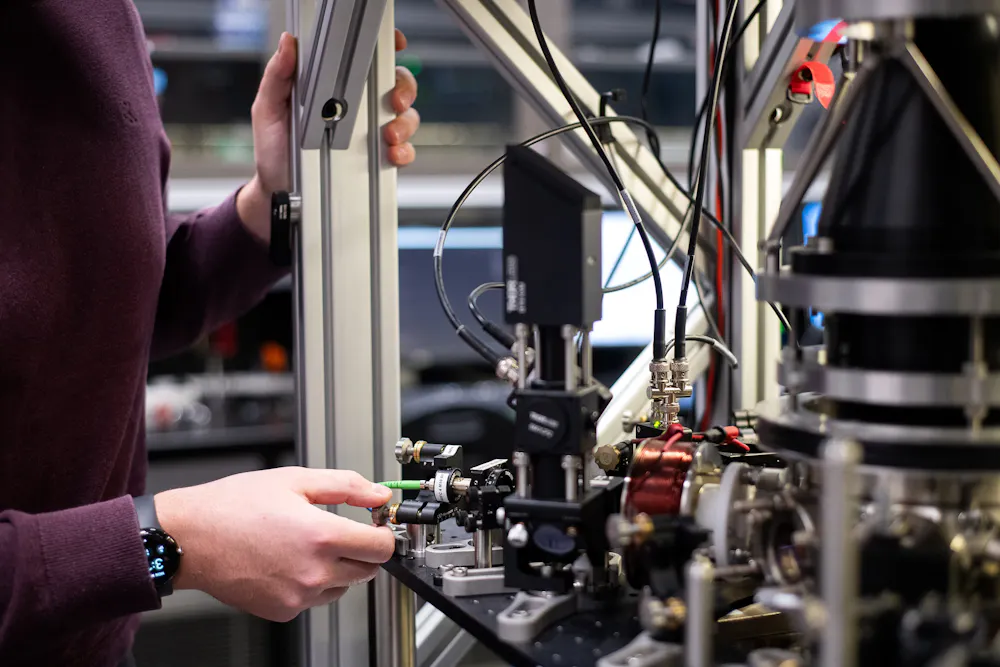
    We used what is called a trapped-ion quantum computer. This works by manipulating individual atoms in a vacuum chamber, held in place with electromagnetic fields.

    Normally, quantum computers store information using quantum bits, or qubits. However, to simulate the behaviour of the molecules, we also used vibrations of the atoms in the computer called “bosonic modes”.

    This technique is called mixed qudit-boson simulation. It dramatically reduces how big a quantum computer you need to simulate a molecule.

    Using a new technique allows realistic simulations to be carried out with small quantum computers.
    Nicola Bailey

    We simulated the behaviour of three molecules absorbing light: allene, butatriene, and pyrazine. Each molecule features complex electronic and vibrational interactions after absorbing light, making them ideal test cases.

    Our simulation, which used a laser and a single atom in the quantum computer, slowed these processes down by a factor of 100 billion. In the real world, the interactions take femtoseconds, but our simulation of them played out in milliseconds – slow enough for us to see what happened.

    A million times more efficient

    What makes our experiment particularly significant is the size of the quantum computer we used.

    Performing the same simulation with a traditional quantum computer (without using bosonic modes) would require 11 qubits, and to carry out roughly 300,000 “entangling” operations without errors. This is well beyond the reach of current technology.

    By contrast, our approach accomplished the task by zapping a single trapped ion with a single laser pulse. We estimate our method is at least a million times more resource-efficient than standard quantum approaches.

    We also simulated “open-system” dynamics, where the molecule interacts with its environment. This is typically a much harder problem for classical computers.

    By injecting controlled noise into the ion’s environment, we replicated how real molecules lose energy. This showed environmental complexity can also be captured by quantum simulation.

    What’s next?

    This work is an important step forward for quantum chemistry. Even though current quantum computers are still limited in scale, our methods show that small, well-designed experiments can already tackle problems of real scientific interest.

    Simulating the real-world behaviour of atoms and molecules is a key goal of quantum chemistry. It will make it easier to understand the properties of different materials, and may accelerate breakthroughs in medicine, materials and energy.

    We believe that with a modest increase in scale — to perhaps 20 or 30 ions — quantum simulations could tackle chemical systems too complex for any classical supercomputer. That would open the door to rapid advances in drug development, clean energy, and our fundamental understanding of chemical processes that drive life itself.

    The authors declare no competing interests. The research was supported by the Sydney Horizon Fellowship program, the Wellcome Leap Quantum for Bio program, the Australian Research Council, the US Office of Naval Research Global, the US Army Research Office Laboratory for Physical Sciences, Lockheed Martin and the Sydney Quantum Academy.

    ref. Australian researchers use a quantum computer to simulate how real molecules behave – https://theconversation.com/australian-researchers-use-a-quantum-computer-to-simulate-how-real-molecules-behave-256870

    MIL OSI AnalysisEveningReport.nz

  • MIL-OSI Russia: The NSU campus will focus on space instrumentation, biotechnology and advanced areas of applied mathematics

    Translation. Region: Russian Federal

    Source: Novosibirsk State University – Novosibirsk State University –

    During the event, thematic specializations of the campus were defined and focused in accordance with the strategic priorities for the development of the country, industry and region. Participants of the strategic session analyzed in detail the research areas, flagship products and their potential for development based on the modern infrastructure of the NSU campus. As a result, comprehensive product programs were developed in such areas as applied mathematics (including artificial intelligence and big data processing), applied engineering, biotechnology and biomedicine, new functional materials, as well as space instrumentation.

    — Our joint task is to fill the new buildings with advanced scientific developments, high-quality education and unique technologies in demand by all campus users in the shortest possible time: both the regional leadership and industrial partners, as well as students, teachers and city residents. The strategic session in Novosibirsk showed excellent results, demonstrating coordinated, organized and constructive work. The teams created promising products focused on the interests and needs of modern youth. The level of detail achieved in the development of product programs is truly impressive, but now the region needs to pay close attention and refine their financial models for successful implementation in the campus activities, — noted Deputy Minister of Education and Science of Russia Andrey Omelchuk.

    The strategic session was attended by about 100 NSU employees representing key areas of the university, including space instrumentation, biotechnology and biomedical research, as well as advanced areas of mathematics. In addition, representatives of the Novosibirsk Region Government and industrial partners of the campus were invited to participate.

    Let us recall that Novosibirsk Oblast is among the five regions that will be the first to develop and implement product programs. In recent years, the university’s strategy has been transformed towards building closer interaction with economic sectors and industrial partners. The development of a campus product program is an important step in implementing NSU’s development strategy and will allow the university to strengthen the campus’s position as a leading scientific and educational center.

    The construction of the NSU campus includes two stages: the first — the educational building and leisure center of the NSU SUNC, as well as the NSU dormitory complex for 690 people — was put into operation in May 2024 and opened its doors to students in September 2024. The construction of the second stage has crossed the “equator” — the overall readiness of the facilities is 57%. The building of the flow auditoriums was put into operation in December 2024, its furnishing with furniture and equipment will be completed in the second quarter of 2025, the educational process in the new building will begin in September of this year. The buildings of the educational and scientific center of the NSU Institute of Medicine and Medical Technologies and the research center are also being erected. Their construction is planned to be completed in 2026.

    On the instructions of President Vladimir Putin, a network of modern campuses is being created in Russia. By 2030, a constellation of 25 campuses should appear in the country. Work in this area is being carried out by the Government of the Russian Federation and the Ministry of Education and Science of Russia. Currently, 24 such campuses are being designed and built with the support of the national project “Youth and Children”. One of them has already been completely built in Moscow on the basis of the Bauman Moscow State Technical University. By 2036, the number of campuses will increase to 40. The project is being financed by federal and regional budgets, as well as by extra-budgetary sources.

    Please note: This information is raw content directly from the source of the information. It is exactly what the source states and does not reflect the position of MIL-OSI or its clients.

    MIL OSI Russia News

  • MIL-Evening Report: Some young trans people take sex hormones so their bodies better align with their gender. What are the benefits and risks?

    Source: The Conversation (Au and NZ) – By Cristyn Davies, Senior Research Fellow in the Specialty of Child and Adolescent Health, Faculty of Medicine and Health, University of Sydney

    romain-jorge/Shutterstock

    Triggered by hormonal changes in the brain and body, puberty marks a physical transformation. Oestrogen and testosterone – often called “sex hormones” – drive many familiar changes, such as breast development and periods or a deeper voice and facial hair.

    For most young people, the pubertal changes they experience align with their gender. However, for trans and gender diverse adolescents, these changes can be distressing and may lead to a sense of disconnection from their true sense of self.

    (We’ll use the term “trans” in this article to refer to transgender and gender diverse people.)

    Why do young trans people use sex hormones?

    To support trans adolescents, oestrogen and testosterone may be used to induce physical changes that better align with their gender.

    Oestrogen stimulates breast development, alters body fat distribution, results in softer skin, and reduces facial and body hair, creating a more feminine appearance.

    Testosterone deepens the voice, increases facial and body hair, promotes muscle growth and stops periods, creating a more masculine appearance.

    Hormones are just one means by which people can affirm their gender and only some trans adolescents seek sex hormone treatment. Other means include puberty suppression, changing your name, pronouns, hair, clothing and legal documents.

    When do trans people start sex hormones?

    Many trans people start taking sex hormones as adults.

    For those who start as adolescents, hormones are introduced when a young person is considered to have the intellectual and emotional maturity to make this decision.

    The starting age also varies depending on the person’s preferences, family support and barriers to accessing care. These barriers include long wait times, regional disparities, costs, legal or policy restrictions, and challenges navigating the health system, all of which make it harder to get timely, reliable care.

    Before starting hormone therapy, trans adolescents undergo comprehensive assessment and counselling with a team of mental health professionals and medical doctors who specialise in transgender health. This helps ensure young people understand the potential benefits, limitations, risks, and long-term implications of treatment.

    This process involves their family and is designed to provide time, support and space for shared, informed decision-making.

    A young trans man takes a walk
    Young trans people undergo comphrensive assessments and counselling before they start taking sex hormones.
    Sandra van der Steen/Shutterstock

    Treatment with sex hormones usually begins with low doses, after which adjustments are made over time under regular clinical monitoring.

    Subsequent physical changes occur gradually over several years, as is true for puberty, and some of these are irreversible. Breast growth or a deepened voice, for example, will persist if treatment is stopped.

    What are the benefits?

    The largest study to date followed 315 trans and gender diverse adolescents for two years after starting oestrogen or testosterone. It found a significant increase in how comfortable participants felt about their appearance. This was accompanied by significant improvements in life satisfaction and reductions in depression and anxiety.

    More recently, Australian youth mental health research centre Orygen conducted a review of the overall evidence. It reported sex hormone treatment for young trans people is associated with body image satisfaction and reduced psychological symptoms, including depression, anxiety and suicide attempts, thoughts and/or planning.

    An independent review of the evidence commissioned by NSW Health reported similar conclusions and found sex hormone therapy was associated with reduced gender dysphoria, which is the distress experienced when a person’s gender identity differs from their sex reported at birth.

    Together, these published outcomes are consistent with decades of clinical and lived experience that young trans people report feeling more at ease in their bodies, more confident in social settings, and more optimistic about their future after starting hormones.

    What about unwanted effects?

    Like all medical treatments, sex hormone therapy involves the potential for unwanted effects.

    Oestrogen, for example, can increase the risk of blood clots and breast cancer in the long-term, but the overall risk appears low.

    Testosterone can increase acne as well as the number of red blood cells the body produces. Too many red cells can make a person’s blood too thick and increase the likelihood of a stroke or heart attack. Monitoring red cell counts and adjusting the dose of testosterone helps reduce these risks.

    Oestrogen and testosterone can also affect the reproductive system. Oestrogen can stop sperm production and testosterone can stop the ovaries from releasing eggs, but neither treatment should be considered an effective form of contraception.

    Given the possibility that trans adolescents might wish to stay on hormone treatment long-term, they are usually offered fertility counselling before starting treatment. The option to freeze sperm or eggs exists, although access and affordability can be a challenge.

    One unwanted effect that has received a lot of attention relates to regret. There is fear adolescents who start hormone treatment will regret this decision later on.

    At this stage, the risk of regret among adolescents starting hormone therapy appears low. Harvard researchers recently followed a cohort of 1,050 adolescents who had received hormone therapy, and only one was noted to have expressed regret.

    However, the risk of regret is inherent to any medical treatment. Allowing adolescents the dignity of risk to make their own decisions respects their autonomy.

    Sex hormones have been used in trans adolescents since at least the 1980s, and so far the evidence suggests these treatments are safe and work well for those who receive them. Nonetheless, long-term research into their safety (and effectiveness) is ongoing and essential.

    What about consent?

    Past decisions of the Family Court of Australia established a requirement for both parents to provide consent for their trans adolescent to access hormonal treatments, treating this care as legally exceptional.

    However, a 2022 decision of the Queensland Supreme Court ruled an adolescent, who is under the age of 18 and has sufficient understanding and intelligence to consent for themselves, could consent to their own hormone treatment.

    Despite this, some gender clinics still require consent from both parents. If there’s a dispute between parents, the matter should be taken to court, to reach a resolution based on the adolescent’s best interests.

    Testosterone and oestrogen therapy are not new or experimental. They are grounded in decades of clinical practice and growing evidence. What is new is the public attention. We need to ensure policies and conversations are based on facts, not fear.

    The Conversation

    Cristyn Davies reports voluntarily being co-chair of the Human Rights Council of Australia; co-chair of the Child and Youth Special Interest Group for the Public Health Association of Australia; President of the Australian Association For Adolescent Health; an ambassador to Twenty10 Incorporating the Gay and Lesbian Counselling Service of New South Wales; and co-chair of the research committee for the Australian Professional Association for Trans Health.

    Blake Cavve is a senior research officer at The Kids Research Institute Australia and an adjunct researcher at The University of Western Australia, with ongoing research collaborations with the Child and Adolescent Health Service. Blake has recieved funding from the Perth Children’s Hospital Foundation and the Raine Medical Research Foundation. He is a member of the Australian Professional Association for Trans Health, and the World Professional Association for Transgender Health.

    Ken Pang is a Senior Principal Research Fellow at the Murdoch Children’s Research Insititute and a paediatrician at the Royal Children’s Hospital in Melbourne. He receives research funding from the Australian National Health and Medical Research Council and the Medical Research Future Fund. He is a member of the Australian Professional Association for Trans Health, the World Professional Association for Transgender Health, and the editorial board of the journal, Transgender Health.

    Michele O’Connell is paediatric endocrinologist at the Royal Children’s Hospital in Melbourne. She is a co-investigator on research studies funded by the Medical Research Future Fund and a member of the Australian Professional Association for Trans Health.

    Rachel Skinner receives funding from the National Health and Medical Research Council’s Medical Research Future Fund and the Australian Research Council for related research. She is an adolescent medicine paediatrician employed by the Sydney Children’s Hospitals Network and provides clinical care to trans young people. She has professional memberships with the Royal Australasian College of Physicians, the Australian Association of Adolescent Health, the Society of Adolescent Health and Medicine, the Australian Professional Association of Transgender Health and the World Professional Association of Transgender Health.

    ref. Some young trans people take sex hormones so their bodies better align with their gender. What are the benefits and risks? – https://theconversation.com/some-young-trans-people-take-sex-hormones-so-their-bodies-better-align-with-their-gender-what-are-the-benefits-and-risks-251254

    MIL OSI AnalysisEveningReport.nz

  • MIL-Evening Report: No chance to say goodbye – defeated MPs will rue not giving valedictory speeches

    Source: The Conversation (Au and NZ) – By Amy Nethery, Associate professor of politics and policy, Deakin University

    Former Greens leader Adam Bandt’s 15-year career in federal parliament came to an end in a nondescript park in Melbourne, far from the seat of power in Canberra.

    He was there to concede defeat in the federal election. In one fell swoop, Bandt had lost his seat, his party’s leadership, his vocation and his living.

    As a defeated MP, he was denied the opportunity to deliver a valedictory speech in parliament, which is available to politicians who go out on their own terms.

    Instead, he stood in a garden, reflecting on his career highs and lows and thanking his family and supporters.

    Adam Bandt draws his 15-year parliamentary career to a close after conceding defeat in his seat of Melbourne.

    Bandt wasn’t the only high-profile politician whose career was cut short without the formal opportunity to say goodbye to parliament.

    At least 14 other MPs, including Peter Dutton, Bridget Archer, David Coleman, Michael Sukkar and Zoe Daniel, were sent on their way by voters without a valedictory to help draw a line under their parliamentary service.

    Rite of passage

    Valedictory speeches are vital for democratic renewal, because they help MPs navigate the complex changeover from the all-consuming role of a parliamentarian to life after politics.

    In this regard, they are similar to other rituals, such as graduations, weddings and even funerals, which help participants and observers make sense of major life transitions. This is why valedictory speeches are a cherished rite of passage for many departing members.

    Bill Shorten planned his retirement from politics and gave a valedictory speech in November 2024. He knew he was one of the fortunate ones:

    In 123 years of the storied history of the Parliament of the Commonwealth of Australia, 1,244 individuals have been elected to the House of Representatives, each introduced themselves in their first speech […] But only 216 ever got the chance to say goodbye, to give a valedictory. Political life can be tough. Election defeat, scandal, illness, Section 44. So today, I stand here neither defeated nor disposed, lucky to have served, fortunate to be able to say goodbye and thank you.

    While first speeches have a long history in parliament, it was only in the 1980s that valedictory speeches became widely available to departing MPs and senators.

    Since then, valedictories have become one of the signature personal moments in a parliamentary career. They are often celebratory, friendly and funny in tone. Unsurprisingly, these speeches tend to be the most autobiographical – and frank – an MP will give in their career.

    On their way out, members speak with less constraint. Cross-party friendships are frequently noted. Some speak about the enormous sacrifices made by their spouses and children, and moments of personal loss.

    Life after politics

    We interviewed 39 former members of the Victorian parliament in 2020 about their experiences leaving parliament.

    Many spoke of valedictory speeches being important touchstones in their transition to life post-parliament.

    One former MP who gave a valedictory told us they “went out in the best way possible”:

    My valedictory speech was probably one of the best speeches I’ve ever made, and I still go back and watch it occasionally […] My kids were there, and family were there. It was just a really nice way to finish up with a funny speech. Then everyone lines up on both sides to shake your hand.

    No closure

    For some who missed out, the absence of the ritual contributed to ongoing negative feelings about parliament and their political career generally.

    Many former MPs experienced financial and emotional stress in their life on “civvy street”. Many found it difficult to establish an identity or career after politics.

    For involuntary leavers, the difficulties of electoral loss can be compounded by the sense of exclusion from one of the key transitional practices, leading to a sense of alienation. One former MP we interviewed recalled:

    One thing I did miss […] was I didn’t get to do a last speech. Very sad that I wasn’t able to round it off. There’s no closure and it’s almost like you’re just kicked out, here’s your basket of things from your desk and off you go.

    New rituals

    Given strangers are not permitted on the floor of the House or Senate, it is not possible for the vanquished to deliver conventional valedictories after an election.

    Parliament should consider giving these former members and senators a comparable transitional process to draw a line under their political careers.

    Some progress has been made. Since 2010, federal members who lost their seats can provide a written statement in lieu of a speech. A booklet of these statements is presented to the House early in the new parliament.

    We recommended to the Parliament of Victoria that a valedictory event be held in the Queen’s Hall or another formal location.

    Not all members want to go back to parliament – some may prefer to say goodbye in a local park.

    But for those who do, this can be an important observance to mark the end of their contribution to public life and their identity as a parliamentarian.

    Amy Nethery received funding from the Parliament of Victoria in 2020 to examine former MP’s experiences of the transition to life after parliament.

    Peter Ferguson received funding from the Parliament of Victoria in 2020 to examine former MP’s experiences of the transition to life after parliament.

    Zim Nwokora received funding from the Parliament of Victoria in 2020 to examine former MP’s experiences of the transition to life after parliament.

    ref. No chance to say goodbye – defeated MPs will rue not giving valedictory speeches – https://theconversation.com/no-chance-to-say-goodbye-defeated-mps-will-rue-not-giving-valedictory-speeches-256569

    MIL OSI AnalysisEveningReport.nz

  • MIL-OSI USA: Rep. Mann Votes to Strengthen Farm Safety Net, Reform SNAP

    Source: United States House of Representatives – Representative Tracey Mann (Kansas, 1)

    WASHINGTON, D.C. – U.S. Representative Tracey Mann (KS-01) voted to advance the House Agriculture Committee’s budget reconciliation proposal that cuts $295 billion in wasteful and fraudulent spending and makes long-overdue investments for the nation’s farmers, ranchers, and agricultural producers. Rep. Mann released the following statement after the markup.

    “America’s farmers, ranchers, and agricultural producers have been clear—they are struggling, and are in need of some degree of certainty,” said Rep. Mann. “After some Congressional Democrats held a Farm Bill hostage last Congress, House Agriculture Committee Republicans delivered to address some of the agriculture community’s most pressing needs. We made much-needed investments into rural America that protect the livelihoods of our farmers, ranchers, and agricultural producers, and our nation’s food supply.

    “Our proposal also strengthens the safety net for America’s most vulnerable communities by uprooting fraudulent spending and making commonsense changes that ensure the SNAP program can serve those it was intended to. The proposal gets able-bodied adults back on the ladder of opportunity, giving them a fair shot at the American dream, all while ensuring that the program is a bridge to a better life instead of a permanent destination. With seven million open jobs across the country, it’s time to get America back to work.

    “I’m grateful we were able to move this proposal forward, and I look forward to seeing how our work lifts Americans out of poverty and provides certainty to America’s agriculture community.”

    The House Agriculture Committee’s budget reconciliation proposal: 

    • Invests $60 billion in strengthening the farm safety net by expanding crop insurance and updating reference prices
    • Bolsters trade promotion to correct the agricultural trade deficit left by the Biden Administration
    • Provides funds to address the deferred maintenance backlog at land-grants like Kansas State University
    • Invests in livestock biosecurity to fend off growing threats like New World Screwworm
    • Closes loopholes in the law that allow states to waive enforcement of work requirements
    • Enacts accountability measures to encourage states to administer the SNAP program efficiently and effectively
    • Ensures that work capable adults without children too young for school are working or volunteering in order to receive benefits

    Ahead of the House Agriculture Committee markup, Rep. Mann applauded the committee’s portion of the bill and its investments to strengthen the farm economy. In May 2024, Rep. Mann voted to advance the Farm, Food, and National Security out of committee. Rep. Mann has continuously expressed his frustration with Congressional Democrats’ efforts to hold the agricultural community hostage to political games instead of passing a Farm Bill.

    The House Agriculture Committee’s budget reconciliation proposal will now go to the House Budget Committee for further consideration.


    ###

    MIL OSI USA News

  • MIL-OSI China: Chinese vice premier calls for high-level sci-tech self-reliance to boost high-quality development

    Source: People’s Republic of China – State Council News

    Chinese vice premier calls for high-level sci-tech self-reliance to boost high-quality development

    WUHAN, May 15 — Chinese Vice Premier Ding Xuexiang has stressed the importance of accelerating China’s high-level self-reliance in science and technology, of building a modern industrial system, and of fostering strong momentum for high-quality development.

    Ding, also a member of the Standing Committee of the Political Bureau of the Communist Party of China Central Committee, made the remarks during an inspection tour in central China’s Hubei Province which began on Monday and ended on Wednesday.

    During visits to three sci-tech enterprises, he emphasized the central role of enterprises in sci-tech innovation, and urged efforts to direct innovation resources toward businesses to assist them in overcoming challenges.

    He stressed the need to deepen the integration of scientific and industrial innovation, expand the high-quality supply of technology, enhance industrial and supply chain stability and security, and accelerate the high-end, intelligent and green transformation of industries.

    At the Huazhong University of Science and Technology and the Hubei Jiufengshan Laboratory, Ding examined the higher education innovation system and scientific journal development. He highlighted the need to strengthen links between basic research, technological development and practical application, as well as the importance of tackling key common technological bottlenecks and enhancing the translation of scientific achievements into practical applications.

    While inspecting the Gezhouba Dam, he stressed that the restoration of the ecological environment of the Yangtze River must remain a top priority. He called for continued efforts to strengthen wastewater and solid waste management, promote green upgrades of shipping equipment, and reduce pollutant emissions at their source to safeguard the river’s water quality.

    MIL OSI China News

  • MIL-OSI New Zealand: NZ to host Pacific leaders

    Source: NZ Music Month takes to the streets

    New Zealand will host leaders from across the Pacific next week, Deputy Prime Minister Winston Peters and Pacific Peoples Minister Dr Shane Reti have announced.

    “New Zealand is a Pacific country, and regular face-to-face dialogue is a crucial underpinning for our relationships throughout our region,” Mr Peters says. 

    The Secretary-General of the Pacific Islands Forum Baron Waqa will visit New Zealand, engaging with Mr Peters and Dr Reti, Prime Minister Christopher Luxon, Climate Change Minister Simon Watts and a range of MPs from across Parliament.

    “New Zealand’s membership of the Forum underpins much of our engagement in the region,” Mr Peters says. 

    “Secretary-General Waqa’s visit will be an opportunity to discuss the Forum’s work on regional priorities, including health, education, security, and the environment.”

    Ulu o Tokelau Esera Tuisano will make his first official visit to New Zealand, ahead of New Zealand and Tokelau marking a centenary of their constitutional relationship next year.

    “New Zealand and Tokelau have enjoyed close ties for nearly a century. We are united by our shared New Zealand citizenship and mutual obligations and responsibilities,” Mr Peters says.

    New Zealand will also host the Council of the University of the South Pacific in Auckland on 19-21 May. The meeting brings together 12 Pacific countries to guide the direction of the leading tertiary provider in the Pacific. 

    “Our role as host reflects our steadfast commitment to advancing tertiary education and research through Pacific regionalism,” Dr Reti says.

    Mr Peters will also meet with Tuvalu Deputy Prime Minister and Finance Minister Panapasi Nelesone. He will reaffirm New Zealand’s commitment to supporting Tuvalu’s development priorities, including economic resilience.

    MIL OSI New Zealand News

  • MIL-OSI USA: Rep. Clyde Honors Class of 2029 U.S. Service Academy Appointees

    Source: United States House of Representatives – Representative Andrew S. Clyde (R-GA)

    Rep. Clyde Honors Class of 2029 U.S. Service Academy Appointees

    Gainesville, May 15, 2025

    GAINESVILLE, GA — Last week, Congressman Andrew Clyde (GA-09) hosted a reception at his Gainesville District Office to honor the six young men from Georgia’s Ninth District who received an appointment to one of the United States Service Academies: U.S. Air Force Academy, U.S. Naval Academy, U.S. Military Academy at West Point, and the U.S. Merchant Marine Academy.


    “Each of the young men who received a U.S. Service Academy appointment embody impressive leadership, academic excellence, and steadfast patriotism,” said Clyde. “I wish Kieron, Tanner, Jayden, Minchan, Deacon, and Samuel the best of luck in attending their prestigious military academies and in serving our nation. I’m confident they will continue making the Ninth District proud in their future endeavors.”


    Rep. Clyde Honors Class of 2029 U.S. Service Academy

    Nominee Kieron McCormack


    Rep. Clyde Presents Certificate of Congressional Commendation to Kieron McCormack for Receiving an Appointment to the U.S. Naval Academy


    The following candidates received an appointment to one of the U.S. Service Academies:


    · Tanner Brannock | Mill Creek High School | U.S. Air Force Academy

    · Jayden Ivaniciuc | University of North Georgia | U.S. Air Force Academy

    · Minchan Kim | North Gwinnett High School | U.S. Military Academy at West Point

    · Kieron McCormack | Buford High School | U.S. Naval Academy

    · Deacon Shull | Gilmer County High School | U.S. Naval Academy

    · Samuel Hegel | Georgia Military College | U.S. Merchant Marine Academy


    Background


    Each year, Congressman Clyde nominates eligible candidates for appointment to four of the five U.S. service academies: U.S. Military Academy (USMA), West Point, NY; the U.S. Naval Academy (USNA), Annapolis, MD; the U.S. Air Force Academy (USAFA), Colorado Springs, CO; and the U.S. Merchant Marine Academy (USMMA), Kings Point, NY. The fifth service academy, the U.S. Coast Guard Academy (USCGA), New London, CT, does not require a congressional nomination for appointment.


    Students interested in seeking a future congressional nomination may find more information and apply HERE.

    MIL OSI USA News

  • MIL-OSI Russia: Dmitry Chernyshenko: The creation of fundamental models makes Russia a leader in the field of artificial intelligence

    Translation. Region: Russian Federal

    Source: Government of the Russian Federation – An important disclaimer is at the bottom of this article.

    Previous news Next news

    Dmitry Chernyshenko opened the plenary session of the VII International Scientific Forum

    The Plekhanov Russian University of Economics is hosting the 7th International Scientific Forum “Step into the Future: Global Foresight, Artificial Intelligence, and Strategic Leadership.” It is dedicated to the development of artificial intelligence (AI) technologies and achieving Russia’s strategic leadership in the context of globalization and geopolitical challenges.

    Deputy Prime Minister Dmitry Chernyshenko opened the plenary session on the topic of international foresight – a joint study to update priority areas of fundamental and exploratory research in the field of AI within the framework of strategic objectives defined by the President and the Government.

    The Deputy Prime Minister called the words of President Vladimir Putin a strategic guideline: “Our direct responsibility is to participate equally in the global race to create strong AI.” He emphasized that it is necessary to agree at the Plekhanov Russian University of Economics, as well as at regional and international sessions: what goals should be “hit” so that Russia remains a leader among other countries in strong AI. The Ministry of Economic Development and the Ministry of Education and Science are preparing a unified research program in the field of AI, within the framework of which funds will be allocated for research that falls within the foresight areas. Universities must definitely get involved in the work.

    According to Dmitry Chernyshenko, AI is already changing our professional landscape, especially in those areas in which flagship AI research centers (RCs) operate: transport and logistics, construction and smart city, medicine, industry, etc.

    “We need to look ahead and foresee which niches are most in demand by our economy. There are areas where we can help with developments in the field of artificial intelligence that meet our Russian specifics, including cultural, social, and technological ones. To do this, we need to create domestic datasets. The groundwork is already in place, we need to popularize our “data lakes”. Collaboration between universities and students is an ideal support for creating domestic datasets as part of an educational program and research projects. Not only is the technology itself changing, there is a shift in the paradigm of thinking,” the Deputy Prime Minister noted.

    He also added that the world is constantly looking for improvements. The pace requires not just watching, but getting involved: “We are proud that Russia is one of the few countries that has its own fundamental AI models. This is a great achievement.”

    The top 15 models of the MERA benchmark, which was created and is being run by the Russian Alliance in the field of AI, include models from several members of the AI Alliance. According to the Deputy Prime Minister, there is healthy competition for leadership within the Russian AI community – this is the path to development, as is world-class collaboration, which does not stop in science.

    The state already supports 12 research centers in the field of AI. Now the selection of flagship RCs of the third wave is underway, and an assessment by experts is underway.

    Dmitry Chernyshenko emphasized the role of science in advancing frontiers in various fields, such as the study of matter, vaccines, and cancer drugs.

    “On the instructions of the President, the International AI Alliance together with SAPFIR are currently working on preparing an international foresight. We are targeting two tracks: foresight in Russia and abroad. We are conducting a foreign foresight to synchronize our watches with the international community and set up cooperation. Third-wave AI centers are focused specifically on foresight areas. After holding individual foresight sessions, a pool of proposals will be formed to update the composition of sub-areas and research tasks,” the Deputy Prime Minister said.

    In conclusion, Dmitry Chernyshenko noted the need to include universities in the organization of the international scientific foresight and instructed them to organize such discussions by inviting foreign experts, scientists and researchers from the field of AI. Each of the invited universities will have time to hold its own foresight session from May to September 2025. The results of the discussions will be consolidated by SAPFIR under the leadership of the Ministry of Economic Development of Russia. The results are planned to be presented to Russian President Vladimir Putin.

    Rector of the Plekhanov Russian University of Economics Ivan Lobanov thanked the Government and Dmitry Chernyshenko personally for their trust and emphasized that the university pays special attention to the development of AI. According to him, Plekhanov University is always in the vector of fulfilling the tasks set by the President and the Government, so the university plans to actively implement the announced approaches and solutions.

    “Today, Plekhanov Russian University of Economics is one of the flagships of the development of the artificial intelligence industry in Russia, we are actively integrating AI into the educational process. The Center for Advanced Research in Artificial Intelligence was created at Plekhanov University, which is engaged in scientific research in the field of explainable and generative AI, implements AI in the field of medicine, develops security solutions based on neural networks, and applied research is also conducted in the Educational and Scientific Laboratory of Artificial Intelligence, Neurotechnology and Business Analytics. Plekhanov Russian University of Economics trains highly qualified specialists in the field of AI, big data and machine learning, and our students test the use of AI in the educational process, learn to work with data and train neural network models,” the rector said.

    The forum brought together leading experts from Russia and abroad, including representatives of the Ministry of Economic Development of Russia, specialized scientific institutes, large companies and international organizations. The event was also attended by First Deputy Minister of Economic Development Maxim Kolesnikov, Deputy Head of the Presidential Administration for the Development of Information and Communication Technologies and Communications Infrastructure Oleg Khorokhordin, Director of the Strategic Agency for Support and Formation of AI Developments Tatyana Soyuznova, representatives of Sberbank PJSC, the Alliance in the Sphere of Artificial Intelligence Association, and the Union of Chinese Entrepreneurs in the Russian Federation.

    The key organizers of foresight in Russia are the International AI Alliance, which includes 17 industry associations from 14 countries, including the Russian AI Alliance, and the Strategic Agency for Support and Formation of AI Developments (SAPFIR), created on the basis of the Skolkovo Foundation in early 2025.

    It is planned that the results of the foresight will be summed up at the annual conference “Journey into the World of Artificial Intelligence” at the end of 2025.

    Please note: This information is raw content directly from the source of the information. It is exactly what the source states and does not reflect the position of MIL-OSI or its clients.

    MIL OSI Russia News

  • MIL-OSI Canada: Internships powering economic growth

    [. To support this, Alberta’s government is making targeted investments to help ensure students develop the skills and abilities needed to meet the workforce demands of the future and succeed in a changing and competitive job market.

    Through a $15-million investment over three years in the Mitacs Internship Program, Alberta’s government is continuing to support valuable internship opportunities. This funding will help provide hands-on learning experiences for post-secondary students and recent graduates in the province’s priority growth areas such as research and development, innovation and science.

    “Hands-on learning is critical to helping students get the skills and training they need, and to prepare them for success in their careers. By working together with industry and the post-secondary system, we are ensuring students receive high-quality education while building the research and innovation labour force that the economy of the future will require.”

    Rajan Sawhney, Minister of Advanced Education

    The Mitacs Internship Program helps drive research commercialization in Alberta and complements other government-funded work-integrated learning programs. Internships also help industry partners achieve their innovation potential, respond to current business challenges and grow their competitive advantage. This $15 million in provincial funding, combined with federal and industry funding, will allow the Mitacs Internship Program to offer more than 3,000 Albertan student internships.

    “Mitacs is honoured to receive this important investment from the Government of Alberta into innovation internships that will boost economic growth, productivity and competitiveness across the province while supporting talent development and retention. We’re proud to contribute to strengthening Alberta’s advanced education and innovation ecosystems.”

    Dr. Stephen Lucas, chief executive officer, Mitacs

    Mitacs is a national non-profit that provides grant and internship programs for post-secondary students and recent graduates in the areas of research and development, innovation and science. Currently, 23 Alberta post-secondary institutions throughout the province have Mitacs funding agreements. Students can apply through their schools or directly with Mitacs.

    Quick Facts

    • Mitacs is a national non-profit organization that plays a key role in advancing Alberta’s economic priorities by driving innovation, applied research and workforce development.
      • Mitacs, founded by Canadian mathematicians in 1999, stands for Mathematics of Information Technology and Complex Systems.
      • Its internship program connects industry with researchers and interns at Alberta’s colleges, polytechnics and universities, empowering businesses to solve critical challenges, boost productivity and enhance competitiveness.  
    • Twenty-three Alberta post-secondary institutions have current Mitacs funding agreements:
    • University of Alberta
    • University of Calgary
    • NAIT
    • SAIT
    • Northwestern Polytechnic
    • Red Deer Polytechnic
    • Lethbridge Polytechnic
    • Red Crow Community College
    • Athabasca University
    • University of Lethbridge
    • Bow Valley College
    • Keyano College
    • Lakeland College
    • Medicine Hat College
    • Olds College
    • Portage College
    • Concordia University of Edmonton
    • Mount Royal University
    • Alberta University of Arts
    • MacEwan University
    • NorQuest College
    • Kings University
    • Ambrose University
    • Mitacs is also receiving $39.2 million of federal government and industry funding for 2025-28.
    • Since 2005, Alberta’s government has also partnered with Mitacs to deliver the Globalink Research Internship program which supports internships and unique international research experiences in Alberta’s priority sectors.
      • The program is open to Albertan and international learners.

    Related information

    • Mitacs internship programs for Albertans | Alberta.ca
    • Mitacs Globalink Research Internship Program | Alberta.ca
    • Connecting Students to Research Opportunities – Mitacs
    • Mitacs: Bringing Innovation Into Reach – Mitacs

    Related news

    • More hands-on learning opportunities for students | alberta.ca (Oct.30, 2020)
    • Alberta and China forge stronger ties in education | alberta.ca (Feb 25, 2014)

    Multimedia

    • Watch the news conference

    MIL OSI Canada News

  • MIL-OSI Canada: Expanded CIC Indigenous Bursary Program Delivering more Supports for Post-Secondary Students Across Saskatchewan

    Source: Government of Canada regional news

    Released on May 15, 2025

    Crown Investments Corporation (CIC) now delivers financial support to more Indigenous post-secondary students in Saskatchewan than ever before. With the expansion of CIC’s Indigenous Bursary Program to most regional colleges and the Gabriel Dumont Institute (GDI), students in rural areas across the province can now gain better access to this educational funding close to their home communities.

    “The Indigenous Bursary Program is one of CIC’s direct efforts to advance economic reconciliation, through delivering more affordable access to training and education opportunities for Indigenous peoples in Saskatchewan,” Crown Investments Corporation Minister Jeremy Harrison said. “Increasing the participation of Indigenous talent in our Crown sector and all aspects of Saskatchewan’s economy is vital to our province’s continued growth.”

    The Indigenous Bursary Program had provided close to $2.2 million between 2018-19 and 2023-24 to financially support students at the University of Saskatchewan, University of Regina, Saskatchewan Polytechnic, Saskatchewan Indian Institute of Technologies (SIIT) and Lakeland College. Since its inception in 2004, more than 1,300 bursaries have been awarded to students.

    The expansion now includes Northlands College, Suncrest College, Southeast College, Great Plains College, North West College and GDI, which offer education opportunities across Saskatchewan’s rural communities and Tribal Council districts. In total, the program provides funding for 115 bursaries per year, valued at $5,000 each – a total annual investment of $575,000.

    “Long-standing partnerships with our donors have been essential in advancing equitable access to education,” Director of Advancement at SIIT Kendra Rowswell said. “Over the years, the bursaries provided by Crown Investments Corporation have significantly reduced financial barriers for Indigenous students, enabling them to pursue their educational goals. CIC’s continued generosity ensures that this impact will be felt for generations to come.” 

    “The Crown Investments Corporation’s Indigenous Bursary provided to the Gabriel Dumont Scholarship Foundation will help create opportunities for Métis students who are unable to access other sources of financial support, one of the major barriers to attending and achieving a higher education,” Gabriel Dumont Institute CEO Brett Vandale said. “In our community, education is the great equalizer!”

    Key program eligibility criterion include:

    • Be of self-declared Indigenous ancestry (includes Status First Nation, Non-Status First Nation, Métis or Inuit);
    • Be a Saskatchewan resident for at least the past 12 months;
    • Achieve satisfactory academic standing in post-secondary studies; and
    • Be registered full-time.  

    Visit: www.cicorp.sk.ca/bursaries-and-internships/indigenous-bursary-program for detailed program information.

    -30-

    For more information, contact:

    MIL OSI Canada News

  • MIL-OSI Canada: New B.C. council launched to support forestry in B.C.

    Source: Government of Canada regional news

    The members of the Provincial Forest Advisory Council are reputable, subject-matter experts. They all have the skills and insight needed to advance stewardship of B.C.’s forests.

    All committee members were jointly appointed by the Minister of Forests and the BC Green Caucus. You can read about each committee member below.

    Co-chair:
    Garry Merkel – Centre of Indigenous Land Stewardship director, faculty of forestry, University of British Columbia (UBC)

    Garry Merkel (nadi’ denezā) is Tahltan from northwestern British Columbia – what is now known as the Stikine River area. He is a great-grandfather and is a professional forester with more than 50 years of experience working in most areas of the forest/lands sector. He is the director of the Centre of Indigenous Land Stewardship currently housed in the faculty of forestry at UBC and has a long public policy history in B.C. and beyond. The most recent was co-chairing with Al Gorley the cabinet-appointed Old Growth Review Panel that produced A New Future for Old Forests, A Strategic Review of How British Columbia Manages its Old Forests Within its Ancient Ecosystems (2021).  Government adopted the 14 recommendations in this review. Merkel continues as an independent mentor, coach, facilitator and adviser to support the government in its leadership role, the forest sector and ultimately the overall provincial land sector through this transition.

    Co-chair:
    Shannon Janzen, former vice-president and chief forester, Western Forest Products

    Shannon Janzen became the first woman in Canada to be appointed chief forester of a major forest products company in 2013 and later served as a vice-president of Western Forest Products from 2015 until 2022. Now the owner of Hypha Consulting Inc., she works with Indigenous communities to support their vision for economic and environmental reconciliation. Starting in operations, she spent over a decade in silviculture and planning, later becoming a lead negotiator for the Coast Forest Conservation Initiative. Her work in the Great Bear Rainforest earned her recognition as the Professional Forester of the Year in 2009. 

    Janzen has negotiated agreements benefiting First Nations and implemented cost-saving initiatives including LEAN supply chain programs and LiDAR Forest Inventory programs. She has also led carbon accounting for forest products and managed environmental social governance initiatives for publicly traded companies. Once a volunteer firefighter, Janzen is committed to making business sense of doing the right thing for people and the planet, tackling complex challenges with optimism and focus.

    Norah White, deputy chief forester, B.C. government

    Norah White is deputy chief forester and executive director in British Columbia’s Office of the Chief Forester within the provincial Ministry of Forests, the division of the provincial government responsible for leadership in forest stewardship and sustainable fibre supply.

    White has an extensive background in provincial forest stewardship policy and has led recent sector-wide change in the areas of forest planning, forest carbon, and the management of old forests and ecosystems.

    She holds a bachelor of science in forestry from the University of British Columbia (2004), an executive master of business administration from Simon Fraser University (2022), and a micro-certificate in forest carbon management from UBC’s faculty of forestry (2022).

    White received her registered professional forester designation in 2007 and is an active member of Forest Professionals BC. She lives within the territory of the Lekwungen peoples, also known as Victoria, B.C., with her spouse and their two daughters, ages 12 and 14.

    Jason Fisher, executive director, Forest Enhancement Society of BC

    Jason Fisher, a registered professional forester, is the executive director of the Forest Enhancement Society of BC (FESBC). FESBC invests the funding it receives from the Ministry of Forests to support forest enhancement projects throughout B.C. that reduce wildfire risk, enhance wildlife habitat, assist in the recovery of forests affected by fire, insects and disease, and/or reduce greenhouse emissions through enhancing the utilization of wood waste for bioenergy.

    Fisher earned degrees in forestry and law, and has worked in the private and public sector, serving as a vice-president with Dunkley Lumber and Pinnacle Renewable Energy and as an associate deputy minister in B.C.’s forest ministry. He is also an instructor at the University of Northern British Columbia, where he teaches a senior-level forest policy and management course. Fisher and his family live in Prince George, located within the traditional territory of the Lheidli T’enneh.

    Jeff Bromley, chairperson, United Steelworkers Wood Council

    Elected Steelworkers Wood Council Chair in 2019, Jeff Bromley was a rank and file IWA member beginning in 1994 when he was hired as an operator at the Elko Sawmill at age 25.

    Bromley was born in Richmond and grew up in the mining town of Kimberley with his mother and stepfather, who was also an IWA member at the Canal Flats sawmill. He earned his associated degree at East Kootenay Community College (now College of the Rockies) with a major in history and a minor in political science.

    Rising through the ranks of Local 1-405, Bromley was elected shop steward and plant committee secretary in 1999, and served as trustee from 2001 until 2008. His advocacy and political action activities have included the USW’s Stop the Killing, Enforce the Law campaign, the softwood lumber lobby effort in Ottawa and the Forest Renewal campaign in Victoria. Bromley has been a local union instructor through District 3’s Back to the Locals instructor program.

    Bromley was elected third vice-president of Local 1-405 in 2008 and, in 2010, graduated from the USW’s leadership development program. Elected financial secretary in 2012, he has served the local union in a full-time staff role since 2012.

    Harry Nelson, associate professor, faculty of forestry, UBC

    Harry Nelson is an associate professor in the faculty of forestry at UBC, specializing in economics and policy. His research interests are in analyzing natural and environmental resource policy around how lands and resources are managed in Canada and the forces driving change in forestry, with the goal of developing solutions that can help enhance the long run sustainability of Canadian forests and the communities and businesses that rely upon them. Long-standing areas of his research include investigating the changing role of Indigenous peoples in land and resource management in Canada and assessing how forest-sector firms, governments and others are adapting to climate change impacts in forestry.

    Hugh Scorah, postdoctoral fellow, UBC

    Hugh Scorah is a researcher at UBC forestry and a business and finance consultant for the agricultural and forest sectors. He has worked on projects related to softwood lumber trade, small and medium-sized enterprises in forestry, community forestry, wildfire risk mitigation, economics of silviculture, hydrological risk and liability in forestry, timber auction design, the economics of sustained yield forestry and pricing of forest tenures.

    Al Gorley, retired professional forester and former president, Professional Foresters Association

    Al Gorley has over 50 years experience in forestry and natural resource management. Born in Burns Lake, he lived in a variety of communities in the northwest while growing up, including Queen Charlotte City (Daajing Giids), Kitwanga, Terrace, and Prince Rupert. His early career with the BC Forest Service saw him stationed in Houston, Lower Post, Ootsa Lake and Smithers.

    During a second stint in Houston as forest district manager, he also served as president of the Association of British Columbia Forest Professionals and board chair for Northwest Community College. In 1994, he was appointed regional manager for the Prince George Forest Region and, for a while, worked concurrently as executive director of Forest Practices Code implementation. In 1998, he moved to Victoria to take on the role of vice-president for land and resources at Forest Renewal BC and was later promoted to chief operating officer.

    In 2002, Gorley started his own consulting firm and worked with a wide variety of industries, communities and governments throughout the province, nationally and internationally, on natural resource and management matters. From 2004 until 2007, he served as president of the McGregor Model Forest and was a founding director of the Canadian Model Forest Network. He is a past member of the BC Forest Appeals Commission and Environmental Board and was chair of the Forest Practices Board from 2010 until 2013.

    In 2019, Gorley was appointed to co-chair a strategic review of how old growth forests are managed in B.C., resulting in the 2020 report A New Future for Old Forests. Now retired, he continues to encourage management approaches that will support community and economic well-being within the envelope of ecosystem sustainability.

    Laurie Kremsater, professional forester, biologist, researcher and educator

    Laurie Kremsater is a professional forester and a professional biologist with more than 35 years experience in forest ecology and wildlife resource management. She completed her bachelor of science in forestry with honours and her master of science in forest wildlife ecology at UBC (1989).

    She was a member of the Clayoquot Sound Scientific Panel, was part of the 1990s Old Growth Strategy and part of the team that directed Weyerhaeuser’s Forest Strategy – the most extensive research, adaptive management and monitoring work in B.C. concerning sustaining biodiversity during forest management. Her initial research concerned black-tailed deer ecology and forest birds, then her work expanded to include small mammals, amphibians, species at risk and biodiversity more broadly. Her work now focuses on managing ecosystems as a whole, helping to develop sustainable forest management plans that maintain biological diversity. She designs landscape reserves for the Great Bear Rainforest Order area and trains others to undertake that task. She is helping incorporate Ecosystem-Based Management into planning for Sechelt Community Forest and Lakes Forest Landscape Plan.

    Educating and developing training materials are passions, all aimed at sustaining biodiversity, while maintaining sustainable economic timber opportunity. Kremsater works for academia, government, industry and non-government organizations. After many years as a research associate at UBC, she became an independent consultant, then joined Madrone Environmental for a period, and now once again is consulting on her own, trying, not so successfully yet, to slow down.

    MIL OSI Canada News

  • MIL-OSI Canada: Detect early, stop cancer

    Half of all people living in Alberta will have cancer during their lifetime. They deserve high-quality cancer care, including early detection. That’s why Alberta’s government is extending the Alberta Lung Cancer Screening Program and is providing grants to four organizations to improve access to cancer screening – particularly in rural, remote and Indigenous communities.

    Launched as a pilot in 2022, the Alberta Lung Cancer Screening Program was designed to assess whether a provincially coordinated approach could improve lung cancer outcomes through earlier detection and timely treatment. After a promising launch, it is being extended with a $2-million investment and an additional $500,000 from the Alberta Cancer Foundation. This funding will allow the pilot to continue offering screenings to eligible individuals for an additional year while plans are finalized to transition the program to a permanent, provincewide program. 

    “We’re making progress, with more people in Alberta surviving lung cancer than ever before, but more work remains. That’s why we’re funding the Alberta Lung Cancer Screening Program to support early detection and improved patient outcomes.”

    Adriana LaGrange, Minister of Health

    Treatment for early-stage lung cancer is significantly more effective, less burdensome for patients and their families, and more cost-effective for the health care system. Since its launch, the Alberta Lung Cancer Screening Program has screened more than 3,800 eligible people in Alberta, with almost 90 per cent of detected lung cancers identified at an early stage.

    “Late-stage lung cancer is much harder to treat or cure because the cancer has already spread to other parts of the body or there’s too much cancer in the lungs. Screening with low-dose CT scans can detect lung cancer earlier, before someone has symptoms.”

    Dr. Alain Tremblay, medical lead, Alberta Lung Cancer Screening Program

    “This year alone, more than 2,700 Albertans will be diagnosed with lung cancer. Our donors are proud to support vital projects like this that strengthen cancer screening across the province and make a meaningful and lasting impact.”

    Wendy Beauchesne, CEO, Alberta Cancer Foundation 

    More funding available for screening, prevention

    Detecting cancer early is crucial to saving lives, and Alberta’s government continues to make early detection more accessible and easier to navigate.

    The Cancer Research in Screening and Prevention Program is providing about $3 million to support cancer prevention and screening initiatives to improve health outcomes for people living in Alberta, including research, education, marketing and public policy development. Eligible Alberta-based health agencies and organizations, post-secondary institutions, non-profits, First Nations and Métis communities, as well as municipalities, can apply for funding under the program.

    Four organizations received funding for their projects in 2024:

    • Alberta Health Services – Optimizing screening for subsequent primary cancers in recipients of hematopoietic cell transplantation – $343,518
    • Lakeland Métis Nation Association – Lakeland Métis Nation cancer screening awareness program – $600,000
    • Siksika Health Services – Siksika Nation cancer screening and prevention – $997,850
    • University of Alberta – A Phase 3 randomized trial of prostate cancer screening using high resolution micro-ultrasound versus MRI – $987,000

    “As a two-time cancer survivor, I know first-hand that early detection saves lives. This funding empowers us to raise awareness and deliver culturally relevant education in our Métis communities, ensuring citizens have the tools and knowledge to take charge of their health.”

    Melina Power, president & CEO, Lakeland Métis Nation Association

    The deadline to apply for 2025-26 program funding, which includes a dedicated Indigenous stream, is May 30.

    Quick facts

    • Lung cancer is the most common cause of cancer deaths in Alberta.
    • In typical clinical settings, more than 70 per cent of lung cancer cases are detected in advanced stages.
    • Alberta Health Services already operates provincewide screening programs for breast, cervical and colorectal cancer.
    • Since the Cancer Research in Screening and Prevention Program launched in 2022, nine organizations have received funding to initiate a total of 18 projects.

    Related Information

    • Cancer Care Alberta
    • Screening for Life
    • Alberta Cancer Foundation
    • Cancer Research for Screening and Prevention Program Fund
    • Cancer Research for Screening and Prevent Program – Recipients

    Related news

    • Bringing mobile lung screening to rural Alberta (Sept. 25, 2024)

    MIL OSI Canada News

  • MIL-OSI USA: ICYMI: To Combat Race Discrimination, Energy Department Terminates Funding for Harvard University

    Source: US Department of Energy

    In case you missed it, the Department of Energy issued a notice to Harvard University this week terminating approximately $89 million in grant funding from DOE’s Office of Science and Advanced Research Projects Agency – Energy due to the University’s policy of racial discrimination. This cancellation from DOE resulted in an immediate savings of $7 million to the American taxpayer and was issued in coordination with the Joint Task Force to Combat Anti-Semitism’s letter to Harvard University announcing the termination of $450 million in grants from eight government agencies in addition to $2.2 billion that was previously frozen by the Trump Administration.

    Excerpts of DOE’s letters to Harvard President Dr. Alan Garber are below:

    DOE understands that Harvard University (Harvard) continues to engage in race discrimination, including in its admission process, and in other areas of student life, such as access to the Law Review at Harvard Law School. We are also aware of recent events at Harvard involving antisemitic action that suggest the institution has a disturbing lack of concern for the safety and wellbeing of Jewish students. Harvard’s ongoing inaction in the face of repeated and severe harassment and targeting of Jewish students has ground day-to-day campus operations to a halt, deprived Jewish students of learning and research opportunities to which they are entitled, and brought shame upon the University and our nation as a whole.

    Indeed, as the Harvard Presidential Task Force on Combating Antisemitism and Anti-Israeli Bias concluded, actions at Harvard during the 2023-2024 academic year resulted in widespread abuse of Jewish and Israeli students by an institution “that mainstreamed and normalized what many Jewish and Israeli students experience as antisemitism and anti-Israeli bias.”

    DOE maintains a firm policy of not supporting entities, individuals or actions that engage in discrimination or which promote and condone, by action or acquiescence, antisemitism. Despite being aware of deeply rooted racial discrimination and antisemitism at Harvard, Harvard has refused to take immediate, definitive and appropriate remedial action.

    Therefore, based on the available information, DOE has concluded that no modification of the Harvard projects could align the projects with agency priorities and any continued funding of the projects is inconsistent with DOE’s stewardship of American taxpayer funds and would be inconsistent with the DOE’s overall mission and goals.

    MIL OSI USA News

  • MIL-OSI USA: Remarks of Commissioner Mark T. Uyeda

    Source: Securities and Exchange Commission

    Welcome to the 12th Annual Conference on Financial Market Regulation.  It is a pleasure to kick off this two-day conference.  Thank you to all who have submitted papers in connection with the conference and to the discussants who have dissected them.  I would also like to thank the staff of the Division of Economic and Risk Analysis, led by Dr. Robert Fisher, for their efforts in planning this program as well as our academic partners.  Today’s program covers a number of timely topics. We have a number of different tracks at the conference, so I thought that I would briefly discuss two topics that caught my attention.[1]

    Private Market Capital Raising

    First, panelists will discuss the economic implications of individual investments in private markets.  One panel will discuss findings related to a systematic study of private equity investments by individual investors.[2]  This topic directly impacts capital formation concerns, but also impacts the issue of expanding investment opportunities for individual investors. Notably, the authors found that contrary to concerns about adverse selection, private equity investments by individual investors perform similarly to those of institutions and outperform public markets. Of particular interest, they identified three innovations that enable individuals to invest in private equity: “the proliferation of funds with low minimum commitments, pooling capital via advisors, and leveraging advisors’ networks to access fund managers.”  These structural observations are relevant as the Commission looks at regulatory mechanisms to increase capital formation. The need to empower retail investment in private companies is critical – both from a capital formation perspective and from an investor diversification lens. 

    Additionally, in exploring ways to expand opportunities by promoting greater retail investing in private companies, changes to the accredited investor definition should be considered. While the accredited investor definition has served as the benchmark for financial sophistication on a national – and perhaps global – level, and has provided stability and predictability to market participants, we look to ways to address some potential unintended consequences of the standard during the forty-plus years since it was introduced.

    In promoting opportunities for retail investment in private companies, we should not shy away from discussing the potential investment risks, including the risk of financial losses.  However, investments in private, growth-stage companies that are higher-risk, higher-reward may be beneficial as part of a person’s diversified portfolio, particularly if the exposure is through pooled investment vehicles.  Modern portfolio theory supports the view that a more diversified portfolio impacts overall economic risk.

    As such, we should seek to modernize the exemptive landscape.  If an individual believes that the risk is appropriate and the framework limits investors to those who are financially sophisticated, can sustain the risk of investment loss, can fend for themselves, and have other relevant characteristics, then our regulatory regime should not deny such individual a source of potential wealth accumulation and portfolio diversification. 

    While current and future regulatory proxies for financial sophistication may never be perfect, we should acknowledge that investor protection might also exist through diversification by expanding opportunities for individual investors to allow them to obtain the investment exposure through financial professionals operating under a best interest or fiduciary duty obligation. 

    Notably, recent investor surveys conducted by the Office of the Investor Advocate found that there is investor appetite by accredited and non-accredited investors, for investing in private companies.  Specifically, 14.4% of accredited investors reported being “interested” in investing in this space, while 4.7% of non-accredited investors reported interest.[3]  Investors in both categories – including persons that are currently non-accredited but may be deemed accredited under any new potential standards—have a desire to optimize their investment returns.  I appreciate the thoughtful economic research related to private markets – this research will likely inform any future policymaking.

    Recent Greenwashing by Funds and Impacts on Investments

    Second, attendees will develop a better understanding of the extent to which funds engaged in “greenwashing” – and more specifically, how such practices impacted investors’ returns.  This is particularly interesting, given the focus on these types of funds recently.  The authors of one paper presented this week, The Economics of Greenwashing Funds, found that “funds engaging in greenwashing charge higher fees while attracting greater flows from investors.”[4]  Charging higher average fees and thus impacting overall returns is concerning in any environment, especially when it is unclear whether improved outcomes were achieved. As it pertains to transactional and investment costs, I also note that the authors found that “greenwashing funds are more likely to incur regulatory costs and experience outflows, as reflected in ESG-related comment letters from the SEC.”  To the extent that funds elect to pursue strategies not directly tied to financial performance of the underlying investments, investors should not be penalized through higher overall investment costs, without corresponding clear and unequivocal disclosure of the downsides of such strategies.  

    These are only two examples of the thoughtful and relevant topics in the program.  There are many other interesting topics, including with respect to crypto.  Your research will help inform policymaking and economic analysis in future regulatory endeavors. 

    Thank you to the economists for your work and thank you for your participation in this conference.  In addition to the presentations, I hope that there will be productive side conversations throughout the next two days. One never knows whether the next great idea will start with some notes jotted down on a napkin.


    [1] My remarks reflect solely my individual views as a commissioner and do not necessarily reflect the views of the full U.S. Securities and Exchange Commission or my fellow Commissioners.

    [2] Cynthia Mei Balloch (London School of Economics), Federico Mainardi (University of Chicago), Sangmin Oh (Columbia University), Petra Vokata (The Ohio State University) Democratizing Private Markets: Private Equity Performance of Individual Investors (forthcoming). 

    [3] Katherine Carman, Alycia Chin, Steven Nash, and Brian Scholl. Exploring Accredited Investors and Private Market Securities Ownership, OIAD Working Paper (2025) (forthcoming).

    MIL OSI USA News

  • MIL-OSI USA: Terry Sanford to be Featured on N.C. Highway Historical Marker

    Source: US State of North Carolina

    Headline: Terry Sanford to be Featured on N.C. Highway Historical Marker

    Terry Sanford to be Featured on N.C. Highway Historical Marker
    jejohnson6

    A man who served as governor, U.S. Senator and university president soon will be recognized with a North Carolina Highway Historical Marker. The N.C. Historical Marker Program is part of the N.C. Department of Natural and Cultural Resources.

    The marker commemorating Terry Sanford will be unveiled Friday, May 23 at 11 a.m., during a roadside ceremony at the intersection of NC 751 and Science Drive in Durham.

    Sanford, who served as governor of North Carolina from 1961-65, also served his state and country in numerous roles throughout his public career.  

    Born Aug. 20, 1917, in Laurinburg, N.C., Sanford was the second of five children in a middle-class family. He attended Presbyterian Junior College (now St. Andrews Presbyterian College) and then the University of North Carolina at Chapel Hill, graduating from the latter in 1939. While at the UNC, Sanford met fellow student Margaret Rose Knight, whom he would marry in 1942, and the couple would have two children.

    Following graduation, Sanford entered the University of North Carolina School of Law. While continuing to study law, Sanford joined the Federal Bureau of Investigation in December 1941 and after training, he was assigned to duty in Ohio and Missouri. Following the entry of the United States into World War II, Sanford enlisted in the Army on the first anniversary of the attack on Pearl Harbor. He was assigned first to the 501st Parachute Infantry Regiment as a medic, and then to the 517th Parachute Infantry Regiment. In the latter regiment, he saw combat in Italy, southern France, and Belgium (the Battle of the Bulge).

    Following the war, Sanford reentered law school and graduated from the university in 1946. He was admitted to the state bar later in the year. Already entertaining ambitions to one day run for governor, he became assistant director of the University of North Carolina’s Institute of Government before becoming a full-time attorney in Fayetteville. He also served as a captain in the North Carolina Army National Guard.  

    A slow but steady rise in the Democratic Party of North Carolina and state government followed over the next few years, including a job in the North Carolina State Ports Authority, presidency of the North Carolina Young Democratic Clubs, state senator representing the 10th District, and campaign manager for former governor W. Kerr Scott’s successful 1954 run for the U.S. Senate, culminating with his successful run for governor in 1960.

    In December 1969, he was selected to be the new president of Duke University. Upon inauguration, he immediately ended a cap on the number of Jewish students who could be enrolled at the school. Facing a budget deficit and a small endowment, he worked to attract more students, increase enrollment, and increase annual donations. He also sought to improve relations between the student body and the administration, declaring opposition to the Vietnam War, supporting peaceful protest, and increasing student involvement in administration operations. He established the Institute of Policy Studies and Public Affairs, now the Sanford School of Public Policy.

    In 1986, Sanford was elected to the U.S. Senate. He supported efforts to bring about an end to the civil war in Nicaragua and created an International Commission for Central American Recovery and Development to promote regional development under the oversight of the Center for International Development Research at Duke University. As in the case of the North Carolina Fund, the commission would be funded by private philanthropy. The commission became informally known as the “Sanford Commission,” although he was not a member. He also participated in efforts to recruit Democratic candidates for the 1988 presidential election. He ran for reelection in 1992 but lost to Republican candidate Lauch Faircloth.

    Sanford devoted his remaining years to law and teaching at Duke. He died of cancer at home on April 18, 1998, and was interred at Duke Chapel.

    For more information about the historical marker, please visit  https://www.dncr.nc.gov/blog/2024/07/10/terry-sanford-1917-1998-g-144, or call (919) 814-6625  

    The Highway Historical Marker Program is a collaboration between the N.C. departments of Natural and Cultural Resources and Transportation.

    About the North Carolina Department of Natural and Cultural Resources
    The N.C. Department of Natural and Cultural Resources (DNCR) manages, promotes, and enhances the things that people love about North Carolina – its diverse arts and culture, rich history, and spectacular natural areas. Through its programs, the department enhances education, stimulates economic development, improves public health, expands accessibility, and strengthens community resiliency.

    The department manages over 100 locations across the state, including 27 historic sites, seven history museums, two art museums, five science museums, four aquariums, 35 state parks, four recreation areas, dozens of state trails and natural areas, the North Carolina Zoo, the State Library, the State Archives, the N.C. Arts Council, the African American Heritage Commission, the American Indian Heritage Commission, the State Historic Preservation Office, the Office of State Archaeology, the Highway Historical Markers program, the N.C. Land and Water Fund, and the Natural Heritage Program. For more information, please visit www.dncr.nc.gov.
    May 15, 2025

    MIL OSI USA News

  • MIL-OSI Russia: China’s Vice Premier Calls for High Level of S&T Independence to Promote High-Quality Development

    Translation. Region: Russian Federal

    Source: People’s Republic of China in Russian – People’s Republic of China in Russian –

    Source: People’s Republic of China – State Council News

    WUHAN, May 15 (Xinhua) — Chinese Vice Premier Ding Xuexiang has stressed the need for China to accelerate its achievement of a high level of scientific and technological self-sufficiency, build a modernized industrial system, and promote high-quality development.

    Ding Xuexiang, also a member of the Standing Committee of the Political Bureau of the CPC Central Committee, made the remarks during an inspection tour of Hubei Province in central China from May 12 to 14.

    After visiting three scientific and technological enterprises, he noted the central role of enterprises in scientific and technological innovation and called for more innovation resources to be directed to enterprises, helping them overcome difficulties and problems.

    According to the Vice Premier of the State Council, it is necessary to deepen the integration of scientific and industrial innovation, expand high-quality scientific and technological supply, improve the stability and safety of production and supply chains, and accelerate the transition of industry to high-tech, intelligent and environmentally friendly production.

    At Huazhong University of Science and Technology and Jiufengshan Laboratory, Ding Xuexiang learned about the innovative higher education system and the development of scientific journals. He emphasized the importance of strengthening the links between basic research, technological development and practical application, pointing to the need to solve key and common technological problems and to more widely apply scientific achievements into practice.

    During the inspection of the Gezhouba Dam, Ding Xuexiang said that restoring the ecological environment of the Yangtze River should remain a priority. He called for strengthening wastewater and solid waste management, promoting green upgrading of shipping equipment, and reducing pollutant emissions at source to protect the river’s water quality. –0–

    MIL OSI Russia News

  • MIL-Evening Report: This election, young people held the most political power. Here’s how they voted

    Source: The Conversation (Au and NZ) – By Intifar Chowdhury, Lecturer in Government, Flinders University

    This election, a lot of focus was directed at young voters. With Millennials and Gen Z now making up a larger share of the electorate than Baby Boomers, this was deserved.

    But for all the attempts to reach these cohorts, whether through TikTok, influencers or podcasts, how did they actually vote?

    Preliminary analysis of electorates with high shares of young people suggests the youth vote was complex and nuanced. The voting bloc continued its unpredictability, with support fragmented across parties, candidates and age groups.

    Analysing voting patterns

    On May 9, I analysed the Australian Electoral Commission’s (AEC) electoral division results alongside youth enrolment statistics, to explore how the youngest electorates voted.

    Rather than treating voters aged 18–44 as a single, homogeneous bloc, I separated them into Gen Z (aged 18–29) and Millennial (aged 30–44) categories. Evidence suggests that generation is more useful for analysis than age alone.

    Electorates with higher shares of young people tended to favour the left, particularly Labor. Even in Liberal-held seats that didn’t change hands, there were clear swings against the Coalition.

    Of course, electoral outcomes are shaped by more than age or generational factors. Seat-level voting reflects a complex mix of influences.

    But while we await individual-level public opinion data, the best available insights come from examining electoral division characteristics using Australian Bureau of Statistics 2021 Census data.

    What happened?

    Surprisingly, the Greens lost three of the country’s most youth-concentrated electorates: Melbourne, Brisbane and Griffith.

    In Melbourne – still the electorate with the highest share of Gen Z voters – the Greens retained the largest primary vote, but lost the seat on preferences.

    However, in Griffith, Labor had a higher primary vote, while in Brisbane, both major parties outpolled the Greens.

    These electorates also have high percentages of renters, public servants, and residents earning above $90,000 a year – demographics that did not necessarily advantage the Greens. In fact, higher-income areas showed a slight lean towards the Liberals.

    Other electorates with large youth shares also showed interesting dynamics. In La Trobe and Lindsay, both held by the Liberals but with growing shares of Millennials and renters, there were swings against the party.

    Labor experienced swings against them in seats such as Solomon, Wills and Pearce.

    Wills maintained a strong Greens primary vote, while Solomon recorded a significant independent vote. This is consistent with high shares of renters, public servants against the Coalition and tertiary-educated women, who are more likely to support minor parties and independents.

    These patterns suggest a quiet divergence between Millennial and Gen Z voters. Millennials, while more likely than older generations to support progressive parties like Labor and, to a lesser extent, the Greens, do not show the same enthusiasm for independents. This indicates Millennials remain more aligned with traditional party politics.

    In contrast, Gen Z voters appear more willing to abandon major parties altogether. This is a generational difference in values and political socialisation, but also a broader shift toward issue-based, campaign-sensitive, less predictable polling.

    A fragmented young electorate

    Even when we take into account the demographic makeup of seats, for a deeper analysis, disentangling the effects of overlapping factors is important. For example, as researcher Nicholas Biddle points out, age and renting are often correlated, so which variable is doing the explanatory work? Is it youth itself, housing tenure, or something else entirely? I dug deeper.

    This further exploration revealed housing and employment factors played a role, even when we account for generational differences.

    Electorates with high shares of renters were significantly more likely to support Labor and less likely to vote Liberal. Public-sector workers leaned clearly towards Labor and away from the Coalition.

    Meanwhile, higher-income electorates (earning more than $90,000 a year) showed a slight, but not statistically significant, movement toward the Liberals and independents, and away from Labor and the Greens.

    Electorates with a larger share of overseas-born residents also leaned modestly toward Labor, likely reflecting swings in areas with significant Chinese populations.

    It’s difficult to know much about gender yet as we don’t have access to the right data. But we can find the intersecting effect of gender with other variables, such as higher education.

    This revealed one of the most striking findings: the strongest positive predictor of a Greens or independent vote, removing all other variables, was the share of university-educated women. These voters consistently turned away from both major parties.

    By contrast, electorates with more tertiary-educated people overall, but not specifically women, were more likely to stick with the major parties.

    With younger generations containing more university-educated women than ever before, this is sobering news for both Labor and the Liberals.

    Big takeaways

    One mistake we keep making is treating the youth vote as a single bloc. This election reminds us there are two generations within the youth base.

    Gen Z are still in their political formative years and they’re showing signs of drifting further from the major parties.

    But Millennials, while still firmly left-leaning, seem to remain anchored to the two-party system.

    Perhaps it’s a sign of political “adulting” – a recognition that minor parties and independents can struggle to wield power in the lower house.

    Labor can still bank on Millennials, for now. But Gen Z, especially those who are highly educated, are the cohort to watch. They’re less loyal, and far less convinced that the traditional party structure speaks to them.

    There’s no way to sugarcoat it for the Liberals: there’s no good news here in their current form.

    But no party can get complacent.

    The modern Australian electorate may lean left overall, but it’s also increasingly disillusioned with the majors. Preferential voting may mask this shift, but it doesn’t halt it.

    The Greens, meanwhile, also have some soul-searching to do. Their campaign didn’t collapse, but their primary vote stalled.

    To become a serious third party in the House of Representatives, the Greens must grow their primary vote and find a way to hold onto their volatile, youthful base as it ages.

    Intifar Chowdhury does not work for, consult, own shares in or receive funding from any company or organisation that would benefit from this article, and has disclosed no relevant affiliations beyond their academic appointment.

    ref. This election, young people held the most political power. Here’s how they voted – https://theconversation.com/this-election-young-people-held-the-most-political-power-heres-how-they-voted-255769

    MIL OSI AnalysisEveningReport.nz

  • MIL-Evening Report: Banning young people from social media sounds like a silver bullet. Global evidence suggests otherwise

    Source: The Conversation (Au and NZ) – By Jasleen Chhabra, Research Fellow, Centre for Youth Mental Health, The University of Melbourne

    Monkey Business / Shutterstock

    Around 98% of Australian 15-year-olds use social media. Platforms such as TikTok, Snapchat and Instagram are where young people connect with friends and online communities, explore and express their identities, seek information, and find support for mental health struggles.

    However, the federal government, seeking to address concerns about young people’s mental health, has committed to ban under-16s from these platforms from later this year.

    There is no doubt social media presents risks to young people. These include cyberbullying, posts related to disordered eating or self-harm, hate speech, and the basic risk of spending long hours scrolling or “doomscrolling”.

    But is banning young people really the answer? We reviewed 70 reports from experts in Australia, the United Kingdom, the United States and Canada to understand what they recommend – and found broad agreement that a ban may not address the real problems.

    Humans preventing harm

    The overall verdict is that we need a much more thoughtful response than just a ban: only a coordinated approach between governments, regulators, tech companies and young people themselves will address youth mental health and online safety.

    We should be asking what we can do to make online spaces safer for young people, not jumping straight to removing them entirely.

    Content moderation is one area in need of urgent attention. Young people regularly report being exposed to harmful and age-inappropriate content on social media, while platforms replace moderation staff with cheaper AI systems.

    Automated processes have their place, but many recommendations in our review emphasised the importance of human moderators to keep up.

    Data and endless advertising

    A second issue exists around the collection and use of user data. Tech platforms have built their business model around user engagement and ad revenue.

    To keep users scrolling (and watching ads), companies collect large amounts of user data to deliver highly personalised feeds.

    Many experts advocate against the widespread collection and use of young people’s data, particularly for delivering advertising materials that promote dieting, unregulated supplements and cosmetic procedures. Posts like these often appear in an endless stream, interspersed between non-harmful and entertaining content.

    Starting with safety

    Alongside greater regulation of advertising material, many experts emphasised the need to consider “safety by design”.

    In other words, social media should be designed from the outset to prevent harming users. It may mean the end of “addictive” features such as infinite scrolling, frequent push notifications, and auto-play videos.

    Regulators also need the tools and power to hold platforms to account.

    That includes financial penalties, more transparent reporting from big tech companies, and taking proactive steps to keep harmful material off these platforms – not just taking down content after the fact.

    Age-checking tech troubles

    Our review did find a small number of reports that recommend barring young people from social media. However, experts questioned the feasibility of age verification technology and raised privacy concerns.

    The federal government has passed the buck to social media companies for actually implementing age verification of users.

    Platforms must take “reasonable steps” to restrict access by under-16s. It is unclear what these steps will be, but the prospect of facial recognition or digital ID checks raises serious privacy concerns.

    Others argue that banning under-16s from social media will drive them to less regulated online spaces, including online forums such as the notorious 4Chan, where some pages have an explicit “no rules” policy.

    It is also important to acknowledge that many young people find important support and communities on social media. Taking away social media may present risks to mental health in these circumstances.

    Listening to young people

    An age ban sounds decisive but comes with its own set of questions.

    In the absence of social media, where do young people questioning their sexual or gender identity go to find information and support? What would a ban mean for young people who engage with news on social media?

    There is little evidence about what impact a ban will have on young people, particularly those from diverse backgrounds.

    What’s more, young people have had minimal input into the policy. They have the insight to offer practical, real-world insights into what works and what does not.

    A blanket ban does nothing to make social media platforms safer for users. It might just delay problems and expose young people to an avalanche of harm when they log on at the age of 16.

    A ban brings its own risks

    The push to ban social media for under-16s is driven by genuine concerns. But unless it is a part of a broader, more thoughtful approach to online safety, it risks doing more harm than good.

    If we want a healthier digital environment, we can’t just lock out young people and hope for the best.

    Vita Pilkington receives funding from the Melbourne Research Scholarship and the Margaret Cohan Research Scholarship, both awarded by the University of Melbourne.

    Zac Seidler has been awarded an NHMRC Investigator Grant. He is also the Global Director of Research with the Movember Institute of Men’s Health. He advises government on men’s health, masculinities, violence prevention and social media policy.

    Jasleen Chhabra does not work for, consult, own shares in or receive funding from any company or organisation that would benefit from this article, and has disclosed no relevant affiliations beyond their academic appointment.

    ref. Banning young people from social media sounds like a silver bullet. Global evidence suggests otherwise – https://theconversation.com/banning-young-people-from-social-media-sounds-like-a-silver-bullet-global-evidence-suggests-otherwise-256587

    MIL OSI AnalysisEveningReport.nz

  • MIL-Evening Report: A trial is testing ways to enforce Australia’s under-16s social media ban. But the tech is flawed

    Source: The Conversation (Au and NZ) – By Alexia Maddox, Senior Lecturer in Pedagogy and Education Futures, La Trobe University

    De Visu/Shutterstock

    Australia’s move to ban under-16s from social media is receiving widespread praise. Other countries, including the United Kingdom, Ireland, Singapore and Japan, are also now reportedly considering similar moves.

    The ban was legislated in November 2024 and is due to take effect in December 2025. The law says social media platforms can’t use official IDs such as passports to check Australian users’ ages, and shouldn’t track Australians. But it doesn’t specify the alternative.

    To test alternative methods, the federal government commissioned a trial of currently available technologies designed to “assure” people’s age online. Run by the Age Check Certification Scheme, a UK-based company specialising in testing and certifying identity verification systems, the trial is in its final stages. Results are expected at the end of June.

    So what are the technologies being trialled? Are they likely to work? And how might they – and the social media ban itself – alter the relationship all of us have with our dominant forms of digital communication?

    Dead ends for age verification

    Age verification confirms a person’s exact age using verified sources such as government-issued IDs. Age assurance is a broader term. It can include estimation techniques such as analysing faces or metadata to determine if users meet age requirements.

    In 2023 the federal government rejected mandating verification technologies for age-gating pornography sites. It found them “immature” with significant limitations. For example, database checks were costly and credit card verification could be easily worked around by minors.

    Nonprofit organisation Digital Rights Watch also pointed out that such systems were easily bypassed using virtual private networks – or VPNs. These are simple tools that hide a user’s location to make it seem like they are from a different country.

    Age assurance technologies bring different problems.

    For example, the latest US National Academies of Sciences report shows that facial recognition systems frequently misidentify children because their facial features are still developing.

    Improving these systems would require massive collections of children’s facial images. But international human rights law protects children’s privacy, making such data collection both legally and ethically problematic.

    Flawed testing of innovative tech?

    The age assurance technology trial currently includes 53 vendors hoping to win a contract for new innovative solutions.

    A range of technology is being trialled. It includes facial recognition offering “selfie-based age checks” and hand movement recognition technologies that claim to calculate age ranges. It also includes bespoke block chains to store sensitive data on.

    There are internal tensions about the trial’s design choices. These tensions centre on a lack of focus on ways to circumvent the technology, privacy implications, and verification of vendors’ efficacy claims.

    While testing innovation is good, the majority of companies and startups such as IDVerse, AgeCheck, and Yoti in the trial, will likely not hold clout over the major tech platforms in focus (Meta, Google and Snap).

    This divide reveals a fundamental problem: the companies building the checking tools aren’t the ones who must use them in the platforms targeted by the law. When tech giants don’t actively participate in developing solutions, they’re more likely to resist implementing them later.

    Google recently proposed storing ID documents in Google Wallet for age verification.
    nitpicker/Shutterstock

    Unresponsive tech companies

    Some major tech companies have shown little interest in engaging with the trial. For example, minutes from the trial’s March advisory board meeting reveal Apple “has been unresponsive, despite multiple outreach attempts”.

    Apple has recently outlined a tool to transmit a declared age range to developers on request. Apple suggests iOS will default the age assurance on Apple devices to under 13 for kids’ accounts. This makes it the responsibility of parents to modify age, the responsibility of developers to recognise age, and the responsibility of governments to legislate when and what to do with an assured age per market.

    Google’s recent Google Wallet proposal for age assurance also misses the mark on privacy concerns and usefulness.

    The proposal would require people over 16 to upload government-issued IDs and link them to a Google account. It would also require people trust Google not track where they go across the internet, via a privacy-preserving technology that remains a promise.

    Crucially, Meta’s social media platforms such as Facebook and Instagram also do not let you login with Google credentials. After all, they are competitors. This raises questions about the usefulness of Google’s proposal to assure age across social media platforms as part of the government’s under-16s ban.

    Meanwhile, Google is also suggesting AI chatbots should be directly targeted and available to children under 13, creating something akin to a “social network of one”, which are out of scope of the ban.

    Rather than engage with Australian age verification systems, companies such as Apple and Google are promoting their own solutions which seem to prioritise keeping or adding users to their services, or passing responsibility elsewhere.

    For the targeted platforms that enable online social interactions, delay in engagement fits a broader pattern. For example, in January 2025, Mark Zuckerberg indicated Meta would push back more aggressively against international regulations that threaten its business model.

    A shift in internet regulation

    Australia’s approach to banning under-16s from using social media marks a significant shift in internet regulation. Rather than age-gating specific content such as porn or gambling, Australia is now targeting basic communication infrastructure – which is what social media have become.

    It centres the problem on children being children, rather than on social media business models.

    The result is limiting childrens’ digital rights with experimental technologies while doing little to address the source of perceived harm for all of us. It prioritises protection without considering children’s rights to access information and express themselves. This risks leaving the most vulnerable children being cut off from digital spaces essential to their success.

    Australia’s approach puts paternal politics ahead of technical and social reality. As we get closer to the ban taking effect, we’ll see how this approach to regulate social communication platforms offers young people respite from the platforms their parents fear – yet continue to use everyday for their own basic communication needs.

    The authors do not work for, consult, own shares in or receive funding from any company or organisation that would benefit from this article, and have disclosed no relevant affiliations beyond their academic appointment.

    ref. A trial is testing ways to enforce Australia’s under-16s social media ban. But the tech is flawed – https://theconversation.com/a-trial-is-testing-ways-to-enforce-australias-under-16s-social-media-ban-but-the-tech-is-flawed-256332

    MIL OSI AnalysisEveningReport.nz

  • MIL-Evening Report: Viral ‘Hongdae boy’ videos expose the fringe group of South Korean men trying to sleep with foreign women

    Source: The Conversation (Au and NZ) – By Joanna Elfving-Hwang, Associate Professor (Korean Society and Culture), Dean International (Korea), Curtin University

    Shutterstock

    If you’re on TikTok, you may have come across “Hongdae boys” or “Hongdae guys” recently. In a social media context, the term refers to a group of young South Korean men who prey on foreign women (particularly white women) visiting the Hongdae area in Seoul’s Mapo district.

    Largely made viral by popular South Korean TikToker Sean Solo (@itsseansolo) creating parodies of these men, Hongdae boys are depicted as men who make brazen (and slightly awkward) attempts at picking up unsuspecting tourists or foreign students.

    Some of these women, who are often viewed as sexually “available”, have sometimes been inspired by K-dramas or K-pop idols to visit Korea in search of the perfect South Korean boyfriend.

    So what’s behind the rise of Hongdae boy videos? And is Seoul turning into a place to avoid if you’re a young female traveller? Well, no. But Sean Solo’s parodies of this recognisable type of South Korean man shouldn’t be dismissed as purely comedy.

    A trend warranting further attention

    Much of the funny viral Hongdae boy content is aimed squarely at foreign audiences. In fact, your average South Korean is more likely to associate the phrase “Hongdae man” (Hongdae namja) with the “Hongdae look” that showcases carefully curated streetwear inspired by hip-hop, rap and vintage elements.

    Hongdae, a famous nightlife spot, is very popular with foreign visitors and South Korean students. In the 1990s it became the cradle of the underground and indie music scene, and remains a buzzing centre for arts and culture.

    Come nighttime, however, it has a reputation for becoming hookup central. There are even “hunting bars” (hunting pocha) where single men and women can go to try and find a match.

    While Hongdae guys are by no means representative of all Korean men (a point Sean Solo emphasises) the fact these men exist, and have become a recognisable part of Hongdae’s nightlife, speaks to serious broader issues of misogyny and gendered thinking.

    Ongoing issues for South Korean women

    South Korea has a reputation for being socially conservative, and K-dramas have emphasised this squeaky clean image. But in recent years, a growing number of South Korean women have spoken out about issues of sexual harassment and violence, including a crisis of digital sex crimes.


    Read more:
    AI is fuelling a deepfake porn crisis in South Korea. What’s behind it – and how can it be fixed?


    This has led to public demonstrations expanding on the global #MeToo movement.

    We’ve also seen the rise of the so-called 4B movement (also called the “Four Nos”). Described as more of an individual lifestyle choice rather than an organised movement, the aim of 4B is to push back against societal standards imposed on South Korean women regarding marriage, childbirth and relationships.

    As Asian studies expert Min Joo Lee notes, foreign women who are married to Korean men and living in Korea are often exoticised as dutiful housewives aspiring for “tradition”, while South Korean women are seen as troublesome and demanding.

    Gender equality issues have also been used as a political football by some politicians. For instance, recently impeached President Suk Yeol Yoon’s 2022 presidential campaign relied on a narrative of male disempowerment to mobilise the vote of young, disaffected men.

    Another setback came in late 2023, when the Supreme Court delivered a final verdict in a case deemed significant for the country’s #MeToo movement. It involved Seo Ji-hyun, a former prosecutor who, in 2018, filed a lawsuit seeking damages against a former male senior prosecutor who she accused of sexual harassment and abuse of power. The court dismissed her claims.

    Foreign fantasies and reality

    For foreign women unaware of South Korea’s gender inequality issues, and who expect the sugar-coated image of Korean men they’ve seen in K-pop or K-dramas, the reality of the hookup culture may come as a shock.

    The disjuncture between reality and the foreign fantasy of South Korea has increasingly been of interest to social commentators and researchers like myself. My own research on the topic has identified a kind of “global Koreanness” that has taken on a life of its own in the imaginations of non-Korean fans overseas.

    The Hongdae boy narrative is similar to the 4B movement in that it is fuelled by attention from outside South Korea. While the 4B movement was widely reported in Western media, it was driven by a relatively small group of courageous women who didn’t actually get mainstream attention in South Korea.

    Nonetheless, having a spotlight on these women still amplified their struggle to fight back against gendered ideas of what’s expected of them. These are ideologies that might treat them as objects to be looked at and “consumed” (such as with K-pop idols), or expect them to prioritise marriage and childbearing, over their own careers, to address a declining population.

    Hongdae boy videos, both comedic and otherwise, may have a similar effect. They’re drawing attention to the gendered expectations many South Korean women face, and the ways in which they are dismissed in their pursuit for equality.

    Joanna Elfving-Hwang receives funding from the Core University Program for Korean Studies through the Ministry of Education of the Republic of Korea and Korean Studies Promotion Service of the Academy of Korean Studies (AKS-2022-OLU-2250005).

    ref. Viral ‘Hongdae boy’ videos expose the fringe group of South Korean men trying to sleep with foreign women – https://theconversation.com/viral-hongdae-boy-videos-expose-the-fringe-group-of-south-korean-men-trying-to-sleep-with-foreign-women-256475

    MIL OSI AnalysisEveningReport.nz

  • MIL-Evening Report: So your primary school child has a ‘boyfriend’ or ‘girlfriend’. Should you be worried?

    Source: The Conversation (Au and NZ) – By Cher McGillivray, Assistant Professor in Psychology, Bond University

    Karhut/Shutterstock

    If you have a child in primary school you may not be expecting to help them manage romantic relationships. Surely this is an issue for the high school years?

    While young children do not experience romantic love in an adult sense, they can still express interest in having a “boyfriend” or “girlfriend”. Some children may talk about a “crush” or even say they are “dating” another child.

    Is this normal? Why do kids do this? And what are some healthy boundaries to talk about?

    Why do kids do this?

    It is quite normal for children in primary school to engage in playful relationships or express interest in having crushes or a “boyfriend” or “girlfriend”.

    This is a way for children to explore their world.

    At this stage of their development, different types of social interactions help children work out emotions and social norms in a safe and imaginative way. It also helps them practice social bonding (how we form close attachments to others) and understanding interpersonal dynamics.

    So, just as children might play games such as “mums and dads” or “sisters and brothers”, they might also play at having a boyfriend or girlfriend, or even stage a mock wedding ceremony.

    Are there other reasons?

    Children are of course also influenced by the movies, fairy tales, books and the TV they consume and by watching older siblings or students at school.

    Seeing Ariel and Prince Eric fall in love in The Little Mermaid may prompt children to act this out. Similarly they might act “spinjistu” moves in the playground after watching Ninjago.

    Psychologist Erik Erikson has also suggested children aged 5–12 are at a stage where they seek approval from adults and peers (approval from friends becomes even more important in high school). Having a “boyfriend” or “girlfriend” may be a way for children to feel socially competent and accepted.

    There could also be peer pressure involved. For example, “all the other Year 4 kids have a boyfriend at the moment, so I will have one too”.

    Children can be influenced by movies or stories they consume. And then act them out in play.
    Altrendo Images/ Shutterstock

    So what are some healthy boundaries to encourage?

    While playing at having boyfriends or girlfriends is quite normal during pre-puberty, it’s important to make sure children are staying within healthy boundaries.

    If they are expressing physical affection – such as hugging or holding hands – it’s important this is appropriate and everyone is consenting. The old playground game of “catch and kiss” is no longer OK, given kisses are effectively being forced on the player who is caught.

    Once children start puberty, childlike feelings of attachment can give way to romantic feelings and more intense relationships. This is when you might start to see children having “proper” relationships.

    At any stage of development, keep talking about what consent looks like, feels like and sounds like. This will vary depending on their age, but the basic principles remain the same.

    Throughout these conversations, emphasise no one ever has to do anything or be in a situation that makes them uncomfortable.

    Keep talking to your child about the importance of only touching friends or other people if they indicate it is OK.
    Monkey Business Images/ Shutterstock

    How can you talk to your child?

    When you are talking to your child, do not to make fun of their feelings or be angry with them.

    If they are exploring their feelings or being curious about relationships, it’s important they feel safe to do so without judgement. They should be able to talk about big or complex things without shame, embarrassment or fear of getting in trouble. Remember, a certain behaviour may not be appropriate, but the child themselves is not “weird” or “bad”.

    If a child feels as though they can’t talk about these feelings or issues, they may feel as thought they are the problem or they are “wrong”. This can lead to poor self-esteem.

    You could ask “what do you like about that friend?” to try and remove the label of boyfriend or girlfriend. It could help to talk about your own experiences, for example, “I had a few close friends in primary school and we did everything together rather than having a ‘boyfriend’ or ‘girlfriend’”.

    If you are worried something inappropriate is happening, you can talk to the parent of the other child or the school to get them to help encourage new boundaries for all the children involved.

    Cher McGillivray does not work for, consult, own shares in or receive funding from any company or organisation that would benefit from this article, and has disclosed no relevant affiliations beyond their academic appointment.

    ref. So your primary school child has a ‘boyfriend’ or ‘girlfriend’. Should you be worried? – https://theconversation.com/so-your-primary-school-child-has-a-boyfriend-or-girlfriend-should-you-be-worried-256111

    MIL OSI AnalysisEveningReport.nz

  • MIL-Evening Report: How accurate are my medical records? You might be surprised how often errors creep in

    Source: The Conversation (Au and NZ) – By Sheree Lloyd, Senior Lecturer in Health Services Management, University of Tasmania

    DC Studio/Shutterstock

    Medical records of hundreds of patients at a Sydney hospital’s cancer genetics service have been reviewed following irregularities related to care by a single specialist.

    According to St Vincent’s Hospital, in about 520 records, there were matters such as poor documentation, incomplete correspondence and a lack of genetic counselling.

    In about 20 records, there were errors that carried potential risk – even if, ultimately, there had been no harm to patients – such as providing incorrect information and advice.

    Every now and again, cases like these make the headlines. Some examples of flawed medical records relate to individual human error. Some relate to issues in how electronic patient record systems are designed.

    These and other reasons mean errors can arise when records are created, accessed and shared.

    A huge potential for errors

    Health-care records describe the symptoms, conditions or problems being treated. They contain details about a patient’s medication, diet, mobility, social history, family concerns, observations, test results and language spoken. Health-care workers also document the plan to restore health, and progress. So entries must be correct, complete and timely.

    However, the scale of health-related communication and documentation is vast.

    Each day on average in Australia there are more than 33,000 hospitalisations, more than 112,000 out-patient services provided and more than 24,000 visits to emergency departments.

    Each month there are millions of specialist letters and discharge summaries shared to My Health Record

    Every interaction with a health-care professional requires notes to be made in a medical record.

    For example, a patient in a metropolitan public hospital is likely to be seen by at least three teams of nurses in a day, two or more junior doctors or registrars, as well as a specialist. Physiotherapists, speech therapists and other allied health workers may also be involved in someone’s care. Health-care teams record notes on paper, in electronic health records or a combination.

    There are also the millions of medical records updated in general practice, or by allied health workers outside hospitals.

    In hospital, multiple staff work in a team, each needing to consult and update a patient’s medical record.
    Rido/Shutterstock

    What type of errors are common?

    Accurate and timely medical records are supposed to allow staff to make safe clinical decisions, and to provide high-quality and continuous care. However, errors have been discovered in several audits and studies, including those related to medications.

    One review looked at how adverse drug reactions were recorded in electronic health records at one large Australian hospital. It found half of the reactions recorded lacked the minimum information required to inform clinicians about future treatment. One-third of records misclassified the type of reaction.

    A study of medication charts in Australia and New Zealand found at least one simple error on the medication charts of about 94% of the records reviewed. These included illegible drug names, missing information and inadequate documentation of allergies.

    One study from the United States found written errors, such as unclear documentation or not using plain language, were among the most common communication errors in the records analysed.

    What happens when there are errors?

    Errors in health-care records can spread, affecting how health-care professionals communicate with each other about the patient, potentially affecting care.

    Missing or inaccurate records can affect evidence collected as part of criminal, coronial or medical negligence investigations.

    As some hospital funding relies on the number and types of patients and interventions recorded, inaccurate records can affect health budgets.

    With inaccurate records, national and international collection of correct health-care information can be compromised.

    What causes errors?

    Errors in health-care records are caused by missing or incomplete information, including when health-care workers do not document changes.

    Difficulty in quickly finding important information, or delays in reporting new information, can contribute to errors, misdiagnosis and inappropriate treatment. This could be due to the ease of use of the electronic health record, the bulky or disorganised paper record or that health workers are busy.

    Health-care teams report using a mixed record systems (using both paper and electronic records) can cause problems.

    Then there’s “note bloat”, when staff copy and paste information from one place to another. This allows wrong information to perpetuate. This is a well-known hazard leading to errors, stress and wasted time.

    Abbreviations used in health-care records, particularly in medication charts, can be misunderstood or misinterpreted.

    An Australian study found one in three medication errors were technology-related and due to poor design or functionality.

    A Swedish study involved patients reviewing notes in their own medical records. It found almost 36% of patients found an error and more than 26% found an omission. About 18% of patients were offended by the content of the notes.

    Errors can arise when there are both paper and electronic records.
    val lawless/Shutterstock

    What can we do?

    Improving the accuracy of medical records is not just health workers’ responsibility, although clearly they have a major role to play. Their workplaces, the IT companies that design the electronic systems, even patients, can also play a role.

    Health workers can make sure medical records are complete, accessible, accurate, readable and long-lasting.

    Workplaces, such as hospitals, can highlight in training and education the importance of documentation and how poor practices can lead to errors, and contribute to safety and quality problems.

    IT companies can design electronic health records that support how health workers need to communicate with each other, and the way they work.

    Patients can ask their health provider to correct errors found in their records, including in My Health Record.

    Sheree Lloyd does not work for, consult, own shares in or receive funding from any company or organisation that would benefit from this article, and has disclosed no relevant affiliations beyond their academic appointment.

    ref. How accurate are my medical records? You might be surprised how often errors creep in – https://theconversation.com/how-accurate-are-my-medical-records-you-might-be-surprised-how-often-errors-creep-in-256233

    MIL OSI AnalysisEveningReport.nz