NewzIntel.com

    • Checkout Page
    • Contact Us
    • Default Redirect Page
    • Frontpage
    • Home-2
    • Home-3
    • Lost Password
    • Member Login
    • Member LogOut
    • Member TOS Page
    • My Account
    • NewzIntel Alert Control-Panel
    • NewzIntel Latest Reports
    • Post Views Counter
    • Privacy Policy
    • Public Individual Page
    • Register
    • Subscription Plan
    • Thank You Page

Category: Universities

  • MIL-OSI Video: Session 1: How is AI transforming the labour market?

    Source: European Central Bank (video statements)

    Session 1: How is AI transforming the labour market?

    Session chair: Luc Laeven, ECB

    AI, task changes in jobs, and worker reallocation

    Christina Gathmann*, LISER, University of Luxembourg and CEPR
    Felix Grimm, LISER
    Erwin Winkler, University of Erlangen-Nuremberg, IZA and LASER
    Discussant: Antonio Dalla Zuanna, Banca d’Italia

    AI adoption and the demand for managerial expertise

    Liudmila Alekseeva*, KU Leuven
    José Azar, University of Navarra and IESE Business School
    Mireia Giné, IESE Business School
    Sampsa Samila, IESE Business School
    Discussant: Juan F. Jimeno, Banco de España

    https://www.youtube.com/watch?v=j5b1Er1KDyE

    MIL OSI Video –

    April 5, 2025
  • MIL-OSI Video: Session 2: Is this time different? Will AI have a significant effect on productivity?

    Source: European Central Bank (video statements)

    Session 2: Is this time different? Will AI have a significant effect on productivity?

    Session chair: Oscar Arce, ECB

    Generative AI and firm-level productivity: evidence from startup funding dynamics

    Dominik Asam* and David Heller, both Max Planck Institute for Innovation and Competition

    Discussant: Paul E. Soto, Federal Reserve Board

    Generative AI and the nature of work

    Manuel Hoffmann*, Harvard Business School and Stanford University
    Sam Boysel, Harvard Business School
    Frank Nagle, Harvard Business School
    Sida Peng, Microsoft
    Kevin Xu, GitHub

    Discussant: Peter Gal, OECD

    https://www.youtube.com/watch?v=tGchsf1_KNQ

    MIL OSI Video –

    April 5, 2025
  • MIL-OSI Video: Session 3: Does AI matter for monetary policy?

    Source: European Central Bank (video statements)

    Session 3: Does AI matter for monetary policy?

    Session chair: Wolfgang Lemke, ECB

    Implications of AI usage for financial stability: evidence from AI-driven investment funds identified by generative AI amid interest rate hikes

    Joe Ho-Yeung Wong*, Victor Pak-Ho Leung and Siru Lu, all Hong Kong Monetary Authority

    Discussant: Shams Pathan, Newcastle University

    Simulating the Survey of professional forecasters

    Sophia Kazinnik*, Stanford HAI
    Anne Lundgaard Hansen, Federal Reserve Bank of Richmond
    John J. Horton, MIT Sloan School of Management
    Daniela Puzzello, Indiana University Bloomington
    Ali Zarifhonarvar, Indiana University Bloomington

    Discussant: Michael Ehrmann, ECB

    https://www.youtube.com/watch?v=SNDpWjXZloQ

    MIL OSI Video –

    April 5, 2025
  • MIL-OSI Video: Policy roundtable & Concluding remarks

    Source: European Central Bank (video statements)

    Policy roundtable: Making the most of AI: how to foster diffusion and address risks?

    Moderator: Jesús Fernández-Villaverde, University of Pennsylvania

    Fidelio Börm, Medimir
    Markus Brunnermeier, Princeton University
    Bertin Martens, Bruegel
    Filiz Unsal, OECD

    Concluding remarks: Oscar Arce, ECB

    https://www.youtube.com/watch?v=wXtjORe23xA

    MIL OSI Video –

    April 5, 2025
  • MIL-OSI Global: What politicians could actually do about the issues raised in Adolescence

    Source: The Conversation – UK – By Robert Lawson, Associate Professor in Sociolinguistics, Birmingham City University

    Mounir Taha/Shutterstock

    Netflix hit Adolescence has ignited conversations across the UK about contemporary masculinity, online radicalisation and violence against women and girls. It has also raised questions about the interventions needed at home, in schools and by the government to counter the seductive power of harmful content on social media.

    The series suggests the key to solving some of these issues is parents and teachers understanding the “manosphere”. This is a collection of websites, influencers and communities where men talk about “men’s issues”. But, as I’ve explored in my research, anti-women and anti-feminist sentiment also prevails.

    In an interview about the series, Adolescence writer Jack Thorne says:

    Jamie is not a simple product of the ‘manosphere’. He is a product of parents that didn’t see, a school that couldn’t care and a brain that didn’t stop him. Put 3,000 kids in the same situation and they wouldn’t do what he did. Yet spend any time on forums on 4chan or Reddit, spend any time on most social media platforms and you end up, quite quickly, in some dark spaces. Parents can try to regulate this, schools can stop mobile phone access but more needs to be done.

    Successive UK governments have attempted to counter online misogyny and violence against women and girls through legislation and public education schemes. But what would really work?

    Adolescence attaches much importance to language and emojis used by teens to obscure meaning, though there is undoubtedly some creative license behind the depictions of the emojis used to mean “incel” (involuntary celibate).

    But focusing on “slang parents and teachers need to know” is misguided. Every generation finds ways of talking about their lives in coded ways. And teen language is frequently tied to moral panics about what it potentially hides. Research has shown that regular, open and supportive conversations between parents and children are much more important.

    The role of schools

    The prime minister has suggested that Adolescence should be shown in schools. And Netflix has made the series available to secondary schools across the UK.

    In December 2024, education minister Bridget Phillipson announced new teaching guidance about incel culture and online misogyny. She argued that it was “vital to recognise the signs of these dangerous ideas as early as possible”.

    It’s encouraging to see the government take these issues seriously, but there are pitfalls. Teachers are under substantial pressure, struggling with workload and staffing. How many have the capacity to lead meaningful and supportive discussions, especially with limited training on these topics?

    Some research suggests that female teachers encounter explicit misogyny in their classrooms. This makes it even more difficult to facilitate conversations about gender and violence. Sessions on countering misogyny also pose the danger of alienating boys, making them feel like they are being vilified for the actions of other men and boys.


    Read more:
    Adolescence in schools: TV show’s portrayal of one boyhood may do more harm than good when used as a teaching tool


    Ultimately, interventions to reduce gender-based violence and misogyny need a “whole-school” approach that integrates gender equality across the curriculum, rather than isolating it within relationships, sex and health education (RSHE) classes. This content could also be covered in initial teacher training courses.

    Researchers have developed resources to challenge dangerous gender norms for use in schools, community groups and other forums. These include toolkits from Dublin City University, University of Liverpool and the MascNet research network, which focus on improving critical thinking, unpacking dominant ideas of masculinity and reflecting on different ways of being a man.

    My own work on A-level English curricula also offers suggestions. Improving digital literacy is key to helping young men identify the mechanisms of manipulation in the content they consume and resist the siren call of manosphere influences. This can encourage young men to rethink their assumptions about gender politics and masculinity, with the ultimate aim of reducing gender-based violence.

    Other discussions have focused on recruiting more male teachers and the importance of models of masculinity based on caring, empathy and emotional vulnerability. Again, these are appealing solutions, but the evidence that male role models improve outcomes for young people is mixed.

    Perhaps the trickiest debate concerns the regulation of media and technology. Adolescence writer Thorne has backed the UK following Australia’s approach to ban social media for under-16s, and some argue the government should ban smartphones for teenagers entirely. Experts say that such bans could do more harm than good.

    The UK’s new online safety laws may go some way to holding social media companies to account for moderating illegal or harmful content and algorithms through fines. This covers intimate image abuse, cyberflashing and some other forms of online misogyny, but there are likely to be gaps when it comes to male supremacist and manosphere content.

    And there are serious concerns about how the law will affect free speech and undermine privacy online.

    Investing in youth

    The problem with many of these strategies is that they fail to acknowledge the material reality of many young boys’ lives. There have been significant cuts over the past 20 years to youth provision, from clubs and community centres to mental health support.

    Boys’ prospects in terms of educational attainment and secure employment lag behind girls’. These inequalities become even more pronounced across regions and social classes, and won’t be solved by banning social media.

    Add to this disconnected communities and a potent combination of insecurity, precarity and frustrated expectation, it is no surprise that many young men find solace in an online world which gives them validation, belonging and a sense of community.


    Read more:
    Blaming absent dads for the crisis of masculinity is too simplistic – many men want to be more involved


    Thankfully, a number of organisations offer better solutions. Charities like Beyond Equality, the Manhood Academy, AndysManClub and Progressive Masculinity have provided outreach, mentoring and mental health provision for boys and young men across the UK for years.

    Similarly, the S.M.I.L.E-ing Boys Project supports boys from black, Asian and minority ethnic communities to develop their emotional intelligence, with positive outcomes in terms of navigating relationships and interpersonal conflict. Government investment would help these organisations reach more young men, alongside improving access for underserved communities.

    Adolescence has started some important conversations among parents, teens and politicians. But to make a difference in how young men navigate the world, how they deal with rejection, and how they negotiate the difficulties that life throws at them, these conversations need to be backed up with investment and concrete action.

    Robert Lawson is a Research Fellow in the Institute for Research on Male Supremacism.

    – ref. What politicians could actually do about the issues raised in Adolescence – https://theconversation.com/what-politicians-could-actually-do-about-the-issues-raised-in-adolescence-252978

    MIL OSI – Global Reports –

    April 5, 2025
  • MIL-OSI Global: More than just chips: Chinese threats and Trump tariffs could disrupt lots of ‘made in Taiwan’ imports − disappointing US builders, cyclists and golfers alike

    Source: The Conversation – USA – By Jay L. Zagorsky, Associate Professor Questrom School of Business, Boston University

    A cargo ship and containers are seen at the Port of Keelung in Taiwan on April 3, 2025. I-HWA CHENG/AFP via Getty Images

    What would the United States stand to lose economically if its current access to the Taiwanese market were upended or totally restricted?

    This seemingly theoretical question about the longtime U.S. trading partner has taken on more relevance in the past several weeks. First, longtime fears about a potential Chinese invasion of the island – which Beijing claims as its own – were magnified as China increased military pressure by sending patrols, firing live ammunition nearby, practicing blockading the island and even publicly revealing the existence of new barges that might be used in an invasion. If China uses force, Taiwan’s manufacturing capacity could be destroyed.

    Then on April 2, 2025, President Donald Trump announced a new 32% tariff on imports from Taipei, excluding semiconductors. Taiwan described the new tariffs, part of a radical upending of U.S. trade practices, as “deeply unreasonable.” They could also be deeply painful to U.S. consumers given the outsize role Taiwan imports play.

    The U.S. State Department calls Taiwan an important U.S. partner in “semiconductors and other critical supply chains.” But as I learned studying trade data and visiting the small but thriving island last fall, the U.S. depends on Taiwan for more than just sophisticated computer chips. In 2024, Taiwanese products constituted 3.6% of all U.S. imports.

    Overall trade figures

    Trade figures are known in detail because almost every government carefully tracks the contents of all shipping containers, cargo flights and bulk deliveries that legally leave and enter their borders. These figures are published online and broken down into very fine detail using a system called the Harmonized Tariff Schedule, or HTS. The HTS shows the tax or duty that must be paid for each kind of item and from every kind of country.

    In 2024, the U.S. exported US$1.7 trillion worth of goods to the world. Since few of us can conceptualize trillions, that is about $5,000 for every man, woman and child in the U.S.

    For its part, Taiwan in 2024 exported about that same amount per resident of the island just to the U.S., $5,000 – or about $90 billion overall. The U.S. is Taiwan’s second-biggest trading partner, after mainland China. Looking at their total exports, Taiwan shipped to the entire world about $20,000 worth of items for every resident.

    The vital technology component

    Not surprisingly, Taiwan’s biggest exports to the U.S. are computers, chips and other electronic hardware such as power supplies. These computer chips are so important that they were specifically excluded from the new tariffs.

    However, $90 billion of exports dramatically underestimates the amount of Taiwanese electronics that end up in U.S. hands. For example, the main chip inside all Apple iPhones is Taiwanese. However, these chips are sent from Taiwan to mainland Chinese factories where the phones are assembled. When these iPhones are exported from mainland China, the value of the chips inside the phone is not counted as U.S. imports from Taiwan. Instead, the whole phone is counted as an import from mainland China and slapped with a tariff.

    The building industry

    But while high-technology equipment often gets the headlines, imports from Taiwan are far broader – and the U.S. would face several economic shocks if Taiwan suddenly stopped exporting.

    First, the U.S. building industry could grind to a halt because Taiwan is a major producer of drywall screws. Though small and cheap, that’s a very significant product, given the prominence of drywall in the interior walls of almost every house, office and factory.

    Microchip and Taiwanese flag displayed on a phone screen.
    Jakub Porzycki/NurPhoto via Getty Images

    Overall, the U.S. uses a massive amount of drywall for new construction and remodeling. In 2024, the country consumed about 28 billion square feet of wallboard. That amount is enough to cover almost the state of Rhode Island.

    To hang drywall, every 100 square feet of the sheets needs about 125 screws. And the vast majority came last year from Taiwan. The U.S. imported over two-thirds of a billion dollars’ worth of the screws; the screws weighed over half a billion pounds.

    While the U.S. does make screws, domestic screw manufacturers primarily focus on high-value parts such as screws needed for airplanes, rocket ships and other performance vehicles, not lower-value screws whose wholesale cost is slightly more than a dollar a pound.

    Beyond screws, Taiwan is a major producer of tools. For example, approximately two-thirds of all socket wrenches, band saws, blowtorches, air compressors and grinders imported into the U.S. come from that island. Losing access to tools is not as crucial as losing access to the screws because many tools last a long time. But finding new suppliers is not trivial.

    The other basket of imports

    Finally, Taiwan is also a big U.S. supplier of sports goods.

    The country is a major producer of bicycles, with manufacturers such as Giant. In 2024, the U.S. imported from Taiwan over a quarter of a billion dollars in just bike parts, which U.S. manufacturers such as Specialized and Trek use when assembling bikes.

    Moreover, Taiwan controls a few key parts of the bike market. For example, over half of all bicycle crank sets, derailleurs and brake parts came from Taiwan. Without these products it is impossible to pedal, shift and even stop a bike.

    Taiwan is also one of the world’s leading suppliers of golf clubs, with the U.S. in 2024 importing about a quarter of a billion dollars’ worth of clubs from the island. To go along with the clubs, Taiwan also sent half a billion golf balls. Given that about 25 million people play on golf courses in the U.S. each year, that works out to 20 balls per player in just 2024.

    Finally, the island sent over a third of a million lacrosse sticks last year, which is almost one new stick for every member of the USA Lacrosse federation.

    All together, the data shows that not just Silicon Valley should be worried about geopolitical factors that disrupt imports from Taiwan. Taiwan might be a small island, but as the story of David and Goliath reminds us, size and impact are not related.

    Jay L. Zagorsky does not work for, consult, own shares in or receive funding from any company or organization that would benefit from this article, and has disclosed no relevant affiliations beyond their academic appointment.

    – ref. More than just chips: Chinese threats and Trump tariffs could disrupt lots of ‘made in Taiwan’ imports − disappointing US builders, cyclists and golfers alike – https://theconversation.com/more-than-just-chips-chinese-threats-and-trump-tariffs-could-disrupt-lots-of-made-in-taiwan-imports-disappointing-us-builders-cyclists-and-golfers-alike-253729

    MIL OSI – Global Reports –

    April 5, 2025
  • MIL-OSI Global: Abolition wasn’t fueled by just moral or economic concerns – the booming whaling industry also helped sink slavery

    Source: The Conversation – USA – By Topher L. McDougal, Professor of Economic Development & Peacebuilding, University of San Diego

    An engraving of whalers at sea attacking a whale with a harpoon from 1820. Kean Collection/Getty Images

    Historians have long debated whether the end of slavery in the United States was primarily driven by moral campaigns or economic changes. But what if both perspectives are looking at only part of the puzzle?

    We are experts in economic development and social movements. Our new research uncovers what we believe to be a surprising and overlooked factor in the decline of slavery in the U.S. – the rise of the whaling industry.

    Starting around 1650, whaling expanded along the Northeast coast of the British American colonies. Whaling expeditions killed whales and brought back to port valuable animal products like oil, used for lamps and other items, and whalebone, used for products ranging from corsets to combs.

    Whalers also brought spermaceti, a waxy substance that comes from a sperm whale’s head and is used to produce candles and lubricants for precision machinery like watches and clocks.

    At its peak, in the 1850s, the American whaling industry alone employed 50,000 to 70,000 workers who worked on an estimated 700 to 800 ships.

    In the decades before cheap oil helped many industries truly take off, whaling played an important, but often overlooked, role in laying the groundwork for the antislavery movement.

    Black sailors made up perhaps 20% to 30% of whaling crews. Of these sailors, some were enslaved and used their hard-won earnings to buy their freedom. Some of these sailors went on to finance abolitionist efforts. Others built houses of worship.

    The whaling industry that produced oil to illuminate 19th-century lamps also added fuel to the fire of the antislavery movement. The city motto of New Bedford, Massachusetts – lucem diffundo, or “I diffuse light” in Latin – referred to the candles and lamps the whaling industry lit, as well as the moral clarity some whalers aspired to promote.

    Three Black whalers stand on a wharf in New Bedford, Mass., in an 1880 drawing.
    Smith Collection/Gado/Getty Images

    The missing link between whaling and abolition

    Slavery in the American colonies began in 1619 with a small enslaved population that grew to about 500,000 by the American Revolution in 1775. As slavery became institutionalized in law and American culture, the number of enslaved people grew, primarily in the South, to as many as 4 million in the years leading up to the Civil War in 1861.

    The first half of the 1800s saw a surge of abolitionist activism, rooted in early Quaker efforts and Indigenous wisdom. Abolitionism reshaped American politics into a fuller democracy, linking Black resistance, feminist struggles and labor rights to the broader fight for democracy and human rights.

    The decline and eventual abolition of slavery has been portrayed as the result of tireless activism and moral persuasion by early Quaker advocates like Benjamin Lay who considered slavery one of the worst sins. Abolitionists like Frederick Douglass would later go on to advocate for the Civil War to force a moral reckoning on the South.

    The result was an antislavery moral high ground from which the United Kingdom, and later the U.S., could measure other countries and monitor the high seas.

    Another common explanation for the end of slavery is the economic argument that slavery declined as fossil fuel-powered machinery replaced enslaved labor on farms and even in factories.

    Our research challenges this binary by showing that before steam engines transformed industry, whaling played an overlooked role in challenging the proposition that slavery was America’s most economically profitable form of labor organization at the time.

    Increased whaling, decreased slavery

    We analyzed data from U.S. Census records and the logbooks of American whaling voyages from 1790 to 1840 – systematized in a dataset maintained by the Mystic Seaport Museum and New Bedford Whaling Museum.

    This data came from well before the 1859 discovery and exploitation of oil in Pennsylvania.

    The results were striking: When the whaling industry brought back more oil, bone and spermaceti to specific ports, the proportion of enslaved people in the corresponding states declined.

    Statistically speaking, we saw a nearly perfect 1-to-1 inverse relationship between whaling and slavery.

    When whaling products went up 1%, slavery proportions went down by almost the same amount in that state in the following years. What’s more, we mapped these findings geographically and discovered that the more whaling occurred, the more widely decreases in slavery occurred in nearby states.

    In other words, our statistics suggest that increases in whaling led to decreases in slavery, and this effect diffused across state lines.

    Why whaling mattered

    Whaling was the first global industry in the colonies that eventually became the U.S.

    Whaling hubs like the Massachusetts towns of Nantucket and New Bedford and the island of Martha’s Vineyard became some of the wealthiest communities in the country.

    Whaling was also one of the few industries where Black Americans, both free and formerly enslaved, could make money and become wealthy. Individuals of all backgrounds could rise through the whaling industry ranks based on skill rather than birth.

    It also required a risk-embracing and entrepreneurial mindset, as immortalized in a song that the writer Herman Melville has the crew sing in the 1851 book Moby-Dick: “So, be cheery, my lads! may your hearts never fail! / While the bold harpooner is striking the whale!”

    By contrast, the plantation economy relied on rigid racial hierarchies and hereditary enslavement.

    Prince Boston was one example of an enslaved whaler, who, in 1773 at the age of 23, won the right in the local Nantucket court to purchase his own freedom from his owner, who lived locally, with the money he earned on a harpoon crew.

    This watershed moment saw the court make a precedent that was probably illegal at the time, but which supported and defended both the whaling industry as well as the aspirations of the people needed to make it thrive. Prince Boston’s free-born nephew, Absolom Boston, become the first Black whaling captain in 1822 – one of approximately 50 Black and Native captains in the American whaling industry throughout its history.

    Financing the fight against slavery

    The economic power generated by whaling helped fund the abolitionist movement in tangible ways.

    Wealthy Quaker merchants in whaling towns, like Martha’s Vineyard, were some of the earliest and most fervent supporters of abolition.

    Elihu Coleman, a Nantucket Quaker, wrote one of the first antislavery pamphlets in America in 1733. Douglass, the famed abolitionist and formerly enslaved man from Maryland, found refuge in New Bedford, a whaling town with a strong antislavery tradition.

    Whaling profits financed the construction of meeting houses and schools for free Black communities in these towns. The African Baptist Society in Nantucket, for example, was built by Black whalers who had achieved financial independence through their trade.

    Whalers cut pieces from a small whale on Long Island, N.Y., in 1900.
    Bettmann/Contributor/Getty Images

    Whaling’s vital role in ending slavery

    As an industry, whaling provided a meritocratic career path before fossil fuel mechanization made slavery obsolete. While industrialization eventually made enslaved labor less profitable by the mid- and late-1800s, whaling had already eroded slavery’s economic and social foundations decades earlier.

    Of course, whaling itself was not a morally pure endeavor. It was dangerous and devastating to whale populations. The American whaling industry killed perhaps 32,000 whales over the 74 years between 1835 and 1909. The global harvest of whales was many times greater. The U.S. officially outlawed whaling in 1971.

    Yet, whaling’s role in funding abolition and providing economic opportunities for free Black Americans is undeniable. It was, in many ways, a bridge between the world of forced labor and the energy-driven economy of the modern age.

    The authors do not work for, consult, own shares in or receive funding from any company or organization that would benefit from this article, and have disclosed no relevant affiliations beyond their academic appointment.

    – ref. Abolition wasn’t fueled by just moral or economic concerns – the booming whaling industry also helped sink slavery – https://theconversation.com/abolition-wasnt-fueled-by-just-moral-or-economic-concerns-the-booming-whaling-industry-also-helped-sink-slavery-250980

    MIL OSI – Global Reports –

    April 5, 2025
  • MIL-OSI Global: Florida is home to about 341,000 immigrants from Venezuela and Haiti who may soon lose residency, work permits

    Source: The Conversation – USA – By Mercedes Vigon, Associate professor of Journalism, Florida International University

    An activist protests the lifting of TPS status for Venezuelans in Doral, Fla. AP Photo/Rebecca Blackwell

    Florida leads the nation in the number of immigrants with Temporary Protected Status, or TPS.

    Soon after taking office, the Trump administration moved to scale back protections for the largest groups of these immigrants – those from Haiti and Venezuela.

    TPS applies to immigrants from designated countries that the Department of Homeland Security considers dangerous due to armed conflicts, environmental disasters, epidemics or other conditions. There are currently 17 countries on the list. The most recent country added was Lebanon on Oct. 16, 2024.

    According to a federal report published in December 2024, nearly a third of the roughly 1.1 million TPS recipients live in Florida. Of those, 59% are Venezuelan and 35% are Haitian, with the other 6% coming from other TPS nations.

    I’m a professor of investigative journalism at Florida International University in Miami. For the past 24 years, I’ve worked with students to report how various waves of immigrants have integrated into Florida, and also on the impact of historical immigration crackdowns on the state’s workforce.

    Because so many TPS recipients live here, ending TPS may affect Florida more than any other state – but it is still hard to say if and when that will happen.

    Uncertain TPS expiration dates

    Temporary Protected Status allows beneficiaries to stay and work in the U.S. for a designated period, typically ranging from six to 18 months. This time period can be extended if conditions in the affected country remain unstable. It does not provide a permanent legal pathway to stay in the United States.

    President Joe Biden’s administration created two TPS designations for Venezuelans – one in 2021 and a second in 2023.

    In early February 2025, Trump’s Homeland Security director, Kristi Noem, rolled back extensions of TPS for Venezuelans that the outgoing Biden administration had issued on Jan. 17, 2025. Then, two days later, she issued a termination notice that canceled TPS for 2023 Venezuelan recipients altogether.

    Noem’s orders meant that almost 250,000 Venezuelans covered by the 2023 designation were expected to lose their residence and work permits on April 7, 2025. Another 256,000 Venezuelans who requested their TPS under the earlier designation were expected to lose their protections on Sept. 10, 2025.

    But Venezuelans got some breathing room on March 31, when U.S. District Judge Edward Chen blocked the change in their immigration status, writing that Noem’s decision “smacks of racism.” As a result, they will keep their TPS protections while the case moves through the courts.

    Noem has said that having Venezuelans in the country “is contrary to the national interest” and accused them without proof of gang affiliations.

    The judge’s ruling doesn’t affect the more than 520,000 Haitian immigrants nationwide expected to lose their TPS protection on Aug. 3, 2025.

    The expiration of TPS potentially affects 341,000 immigrants in Florida. But it doesn’t mean all of these people will leave the country. TPS rules allow immigrants to apply for a change of immigration status, and some will apply for asylum or student visas. Others will go underground.

    Local economic effects

    These policies won’t just affect Venezuelan and Haitian TPS holders personally. It will likely cause some big waves in the Florida economy.

    The non-profit American Immigration Council, an immigrant advocacy group, estimates that 95% of TPS holders in Florida age 16 and older are currently employed.

    They paid approximately US$485.9 million in local and Florida state taxes, according to the same report.

    Although the public often associates immigrants with work in the construction, agricultural and meatpacking industries, most are employed in education and health care.

    Fewer home health aides

    Immigrants account for 64% of all home health aides in Florida, according to the American Immigration Council.

    Nationwide, 1 in 4 direct care workers are immigrants, according to a policy brief from PHI, an advocacy group for elder care and disability service workers.

    Not all of these workers are TPS holders, but an estimated 7% of foreign-born caregivers are from Haiti. Additionally, the research from PHI suggests that the actual percentage of home health aides who are immigrants is likely higher, as many immigrant workers in this sector operate in the “gray market.” These workers receive direct payment from the people they work for, which makes their employment hard to track.

    PHI projects that the long-term care sector in the U.S. will need to fill 9.3 million new direct care job openings by 2031 due to the country’s aging population.

    School staff a concern

    The public school system is another area where the sudden loss of TPS recipients will likely be deeply felt.

    Miami-Dade County Public Schools, the third-largest school district in the country, is experiencing an ongoing shortage of teachers and staff. The district had nearly 700 education and support positions unfilled in August 2024, according to a district-by-district count done by the Florida Education Association.

    “It is not only teachers,” an administrator told me in March 2025, explaining that the vacancies are also among registrars, custodians, paraprofessionals and other roles. These “high stakes” education jobs, as he described them to me, are difficult for Miami-Dade County schools to fill.

    The Miami-Dade school district doesn’t report on the nationality of its employees – or their immigration status. But unfilled positions in the school district dropped after an influx of Venezuelans and Haitians in 2019, the administrator told me.

    Losing these workers would likely mean South Florida’s persistent education and home health care labor shortages would worsen – making it increasingly difficult for families with school-age children, the elderly and individuals with special needs to access affordable essential services.

    Mercedes Vigon does not work for, consult, own shares in or receive funding from any company or organization that would benefit from this article, and has disclosed no relevant affiliations beyond their academic appointment.

    – ref. Florida is home to about 341,000 immigrants from Venezuela and Haiti who may soon lose residency, work permits – https://theconversation.com/florida-is-home-to-about-341-000-immigrants-from-venezuela-and-haiti-who-may-soon-lose-residency-work-permits-251791

    MIL OSI – Global Reports –

    April 5, 2025
  • MIL-OSI Global: The Trump administration says Tren de Aragua is a terrorist group – but it’s really a transnational criminal organization. Here’s why the label matters.

    Source: The Conversation – USA – By Ernesto Castañeda, Professor, and Director, Center for Latin American and Latino Studies, American University

    Venezuelan immigrants, whom the Trump White House says are members of the Tren de Aragua gang, arrive in El Salvador on March 31, 2025. El Salvador Press Presidency Office/Anadolu via Getty Images

    The U.S. State Department declared on Feb. 20, 2025, that the Venezuelan gang Tren de Aragua, as well as some Mexican drug cartels, are now considered foreign terrorist organizations.

    Is the new label warranted?

    Tren de Aragua is at the center of a controversial immigration case that the Supreme Court is going to consider.

    The Trump administration is using the 1798 Alien Enemies Act to justify deporting more than 100 of the 238 Venezuelan and Salvadoran male immigrants it sent to a prison in El Salvador on March 15. The administration says that these immigrants are members of gangs such as Tren de Aragua and are foreign enemies, so they can be sent away with just an order from the White House.

    The administration uses a checklist of items, including physical markers like tattoos, to determine these individuals’ association with Tren de Aragua. Although in reality, the Tren de Aragua gang members do not use any specific tattoos.

    Family members and lawyers representing some of the Venezuelan immigrants say that they are not actually associated with the gang, and that some of them were living in the U.S. legally.

    I am an expert on immigration, and I think it is important to understand why classifying Tren de Aragua as a foreign terrorist organization has sparked debate among observers.

    One important reason is that Tren de Aragua is primarily a profit-driven group, not an ideological one – placing the organization more firmly in the transnational organized crime category rather than a political terrorist group.

    Venezuelan immigrants deported from the U.S. arrived in El Salvador in March 2025.
    El Salvador Press Presidency Office/Anadolu via Getty Images

    Understanding Tren de Aragua

    Tren de Aragua originated as a small prison gang in the early 2000s within Tocorón prison in Venezuela’s state of Aragua, located near the country’s capital, Caracas.

    Over the past 25 years, Tren de Aragua has expanded rapidly across South and Central America, and evolved into a transnational criminal organization under the leadership of Hector Guerrero Flores. Also known as Niño Guerrero, Flores is a 41-year-old Venezuelan who first served time in Tocorón prison in 2010 for killing a police officer before he escaped for the first time in 2012. His current location is not known.

    Flores is wanted by the U.S. and Colombia for various crimes related to expanding the group’s criminal network throughout South and Central America.

    Today, an estimated 5,000 people are affiliated with Tren de Aragua, which is mainly focused on human trafficking and other crimes targeting migrants. The gang has also been linked to other criminal organizations in Latin America and is involved with extortion, kidnapping, money laundering and drug smuggling. The number of active members in the United States is in the low hundreds, and clearly the great majority of Venezuelans here are not members.

    Homeland Security Secretary Kristi Noem arrives at the presidential palace in San Salvador, El Salvador, to discuss the deportation of Venezuelan immigrants to the country on March 26, 2025.
    Alex Brandon-Pool/Getty Images

    Different end goals

    Tren de Aragua has expanded in part because of its ability to exploit weak governance within the state of Aragua, and eventually across Venezuela, which faces political instability and a weak economy. An expansion beyond Venezuela has allowed the gang to connect with other transnational criminal networks.

    Most accepted definitions of terrorism say it is a kind of violence, usually used against civilians, motivated by political and ideological beliefs and goals. Tren de Aragua does not fit that definition. It does not have a political ideology and therefore is not an actual terrorist organization.

    The U.S. government considers a foreign terrorist organization a foreign group that engages in terrorist activity, or plans to do so, in a way that threatens the security of U.S. nationals or the country more broadly.

    Tren de Aragua is among the eight groups that the State Department first classified as foreign terrorist organizations in the first few months of 2025 after Donald Trump’s inauguration. The other new groups put on the list primarily include Latin American drug trafficking organizations, like the Mexican Sinaloa cartel.

    While transnational criminal organizations and foreign terrorist organizations both engage in violence and illicit activities, their end goals are different.

    Foreign terrorist organizations such as al-Qaida and the Islamic State group seek political, religious or ideological change – or all three – as they try to use violence to reshape the political landscape of their regions.

    Terrorist groups and transnational criminal organizations are not the same

    Tren de Aragua, as well as other transnational criminal groups like MS-13 – which originated in Los Angeles but now operates throughout the Americas – and the Sinaloa cartel, carry out illegal, violent activities across borders in order to make money.

    These groups do not have political or ideological motives beyond creating conditions to maximize their own profits. They do not aim to take political power in the U.S. or elsewhere, or try to remake society in their own image. That is beyond their purview and capabilities.

    Properly distinguishing between terrorist organizations and transnational criminal organizations is crucial for devising effective policies and responses to their violence. Mislabeling these groups can lead to inappropriate responses such as putting aside civil liberties, due process and human rights.

    Incorrectly classifying Tren de Aragua and other criminal groups as terrorist organizations could shift U.S. foreign policy and resources toward counterterrorism efforts and away from decreasing the power and violence exercised by organized crime and drug cartels in many parts of Latin America.

    However, the way in which many Venezuelans and other immigrants have been deported from the country over the past few months without passing through immigration court seems to indicate that the main rationale for the talk about alien enemies and these terrorist designations is to aid in the goal of mass deportations, rather than to fight domestic or international terrorism.

    If the U.S. truly wants to curb undocumented immigration and reduce drug and human trafficking, then I believe that it should ensure that its classification of these organizations is accurate and aligned with its actual objectives.

    Melissa Vasquez, a graduate student at American University studying international affairs and the Northern Triangle in Central America, contributed to this piece.

    Ernesto Castañeda does not work for, consult, own shares in or receive funding from any company or organization that would benefit from this article, and has disclosed no relevant affiliations beyond their academic appointment.

    – ref. The Trump administration says Tren de Aragua is a terrorist group – but it’s really a transnational criminal organization. Here’s why the label matters. – https://theconversation.com/the-trump-administration-says-tren-de-aragua-is-a-terrorist-group-but-its-really-a-transnational-criminal-organization-heres-why-the-label-matters-252793

    MIL OSI – Global Reports –

    April 5, 2025
  • MIL-OSI Russia: Cognitive distortions: what they are and how to avoid them will be explained at the State University of Management

    Translartion. Region: Russians Fedetion –

    Source: State University of Management – Official website of the State –

    On April 8, we invite students to a lecture-training “Cognitive distortions”, which will be conducted by the Vice-Rector of the State University of Management Pavel Pavlovsky.

    Participants of the meeting will have the opportunity to hone their skills in building successful communication, which is necessary for anyone who strives for career heights.

    The Vice-Rector of the State University of Management will tell you what cognitive distortions are and how they affect decision-making, teach you to recognize them in yourself and others, and also share practical tools for effective communication that will help you avoid “thinking errors.”

    The meeting will take place on April 8 at 14:45 in the lobby of the Central Control Center.

    Pre-registration is required to participate.

    Don’t miss the opportunity to upgrade your brain and communication skills with GUU.

    Subscribe to the tg channel “Our State University” Announcement date: 04/8/2025

    Please note: This information is raw content directly from the source of the information. It is exactly what the source states and does not reflect the position of MIL-OSI or its clients.

    MIL OSI Russia News –

    April 5, 2025
  • MIL-OSI Global: Life-size sculptures uncovered in Pompeii show that ancient women didn’t just have to be wives to make a difference

    Source: The Conversation – UK – By Emily Hauser, Senior Lecturer in Classics, University of Exeter

    Visitors to the site of Pompeii, the ancient Roman town buried (and so preserved for thousands of years) by the eruption of Mount Vesuvius in 79AD, don’t often think to look beyond the city walls. And it’s easy to understand why: there’s plenty on offer within this monumentally well-preserved town, from jewel-like wall paintings of myths and legends like Helen of Troy, to the majestic amphitheatre and sumptuously stuccoed baths.

    But step outside the gates for a moment, and you’re in a very different – yet no less important – world.

    For the ancient Romans, the roads and paths leading into and out of cities were crucial: not just for getting places, but as a very real kind of “memory lane”. Tombs lined these ancient byways – some simply bearing inscriptions to the memories of loved ones lost, others, more grand, accommodating space for friends and family to feast in remembrance of the dead.

    Some of the tombs even address the passerby directly, as if its occupant could speak again, and pass on what they’ve learned. Take one Pompeiian example, set up by the freedman Publius Vesonius Phileros, which opens with ineffable politeness: “Stranger, wait a while if it’s no trouble, and learn what not to do.”

    Going into Pompeii, and leaving it, was about being reminded of ways of living and ways of dying – as well as an invitation to tip your hat to those who trod the path before you, and to learn from their example.

    Which is why the recent discovery of a monumental tomb crowned by life-size sculptures of a woman and man, just outside the gates on the east side of the town, isn’t just a fascinating find in and of itself. It’s also a reminder to stop, and to remember the people who once lived and died in this bustling Italian town.


    Looking for something good? Cut through the noise with a carefully curated selection of the latest releases, live events and exhibitions, straight to your inbox every fortnight, on Fridays. Sign up here.


    The tomb’s main feature is a large wall, peppered with niches where cremated remains would have been placed, and surmounted by the astonishing relief sculpture of the woman and man. They’re standing side by side, but not touching.

    I rather like that she’s slightly taller than him, standing at 1.77m, while he’s 1.75m. She’s draped in a modest tunic, cloak and veil (symbols of Roman womanhood), and boasts a pronounced crescent-moon-shaped pendant at her neck called a lunula, that (through the age-old link with lunar cycles) tells a story about female fertility and birth. He, meanwhile, is dressed in the quintessentially Roman toga that instantly identifies him as a proud male citizen of Rome.

    Who do the statues depict?

    The status quo in archaeology, when a woman and a man are presented next to each other in tombs and burials like this, has always been to assume that she’s his wife. Yet here, there’s an unmissable clue that there’s more going on. That’s because, in her right hand, she’s holding a laurel branch – which was used by priestesses to waft the smoke of incense and herbs in religious rituals.

    Priestesses, in the Roman world, held unusual levels of power for women – and it’s been suggested that this woman might have been a priestess of the goddess Ceres (Roman equivalent of Demeter).

    So this high-status priestess is shown alongside a man. The inclusion of the symbols of her status (as priestess) alongside his (as a togatus, or “toga-wearing man”), shows that she’s there in her own right, as a contributing member of Pompeiian society. She might be his mother; she might even have been more important than him (which would explain why she’s taller). Without an inscription, we don’t know for sure. The point is: a woman doesn’t have to be a wife to be standing next to a man.

    What’s fascinating is this isn’t unique to Pompeii. In my new book, Mythica, which looks at the women not of Rome but of Bronze age Greece, I’ve found that new discoveries in archaeology are overturning the assumptions that used to be made about a woman’s place in society, and the value of their roles, all the time.

    One fascinating example is a royal burial in Late Bronze Age Mycenae: a woman and a man who’d been buried together in the royal necropolis, around 1700 years before the eruption of Mount Vesuvius decimated Pompeii. As is typical, this woman was immediately labelled, by the archaeologists who uncovered her, as the man’s wife. But then DNA analysis came into the picture.

    As recently as 2008, both skeletons were sampled for DNA – and came up with the game-changing result that they were, in fact, brother and sister. She’d been buried here as a member of a royal family by birth, not by marriage, in other words. She was there on her own terms.

    From golden Mycenae to the ash-blasted ruins of Pompeii: the remains from the ancient world are telling us a different story from the one we always thought. A woman didn’t have to be a wife to make a difference.

    So I think it’s worth listening to the advice of our friend Publius. Let’s look at the burials of the past, and learn.

    Emily Hauser does not work for, consult, own shares in or receive funding from any company or organisation that would benefit from this article, and has disclosed no relevant affiliations beyond their academic appointment.

    – ref. Life-size sculptures uncovered in Pompeii show that ancient women didn’t just have to be wives to make a difference – https://theconversation.com/life-size-sculptures-uncovered-in-pompeii-show-that-ancient-women-didnt-just-have-to-be-wives-to-make-a-difference-253863

    MIL OSI – Global Reports –

    April 5, 2025
  • MIL-OSI Global: Peers elevated to the House of Lords after a career in the House of Commons are often merely being rewarded for loyalty – new study

    Source: The Conversation – UK – By Stephen Holden Bates, Senior Lecturer in Political Science, University of Birmingham

    CC BY-NC-ND

    House of Lords reform is being debated once again with the passage of the bill to end hereditary peerages. But far more wide-reaching reform is needed. Our research reveals potential flaws in the appointments system. Far from being a representative chamber filled with those from all walks of life, we found evidence to suggest that the House of Lords contains a large constituency of former MPs – who are often there as a reward for their partisan loyalty.

    Since the introduction of life peers in 1958 and especially since the removal of all except 92 hereditary peers in 1999, former MPs have become an increasingly important constituency in the House of Lords. They make up about a third of the approximate 1,600 life peers who have been created since 1958. The others have largely been appointed because of their specialist skills or life experiences or, apparently, because of how much money they donated to political parties.

    The Lords is getting more and more crowded.
    House of Lords/Flickr, CC BY-NC-ND

    At present, around a fifth of all peers and coming up to a quarter of life peers sat at one time or another in the House of Commons. And nearly a fifth of all MPs who sat in and subsequently left the Commons between 1979 and 2019 went on to become a peer at some point afterwards.

    These ex-MPs became peers having been nominated in a dissolution honours list prior to a general election, a resignation honours list when a prime minister departed from office, or a political list, which is used to top up the strengths of the three main parties in the chamber. A handful have been appointed as a government minister and therefore needed a seat in parliament.

    Becoming a peer is an attractive option for many ex-MPs. Not only do they become part of the titled nobility, but they also have membership of the House of Lords for life, access to a generous allowances system, and the ability to maintain (and expand) outside interests.

    Our research shows that MPs who become peers are whiter and older than those MPs who don’t make it to the upper chamber. They are more likely to be heterosexual and a member of the aristocracy. They are also more likely to be the child or grandchild of a former MP and to have been educated at a public school, attended university – in particular, Oxford or Cambridge – and have studied PPE (philosophy, politics and economics) at Oxford. They are less likely to have a PhD but also less likely to have had a manual occupation as their first career.

    We also found that serving on the front bench as an MP and resisting the temptation to rebel against your party makes you more likely to be elevated to the House of Lords after serving in the House of Commons.

    For elevated MPs who had served on the frontbench in the House of Commons, their length of frontbench tenure and whether or not they became a minister were the most important indicators of them later becoming a peer. But time served is not necessarily an indicator of excellence. As former MP Rory Stewart has argued, promotion to the frontbench “has nothing to do with expertise. It’s about loyalty and defending the indefensible”. To the extent that experience matters then, it can be said to be more in the sense of direct personal participation rather than accumulated knowledge.


    Want more politics coverage from academic experts? Every week, we bring you informed analysis of developments in government and fact check the claims being made.

    Sign up for our weekly politics newsletter, delivered every Friday.


    For those MPs who had remained backbenchers throughout their time in the Commons, their loyalty was the strongest indicator of their chances of becoming a peer. There is also some evidence, albeit weak, that familial links for backbenchers and aristocratic links for frontbenchers increase the likelihood of receiving a peerage. There are different pathways from the House of Commons into the House of Lords and some MPs appear to find it easier than others to travel along them.

    Our results suggest that for ex-MPs, almost certainly the largest sub-group in the House of Lords, elevation to the peerage is not based on merit alone. Loyalty and, to a lesser extent, nepotism also appear to matter and help to win you a ticket to the Lords.

    Fresh impetus for reform

    Overall, we believe our findings call into question the continued use of appointments to the Lords that are wholly based on the patronage of party leaders.

    The work of parliament is not enhanced by elevating ex-MPs who are in the upper chamber for reasons other than merit or expertise. Neither is it enhanced in the lower chamber through dangling the possibility of elevation to the peerage to encourage loyalty. Both of these sub-optimal situations are only made possible by the House of Lords’ size, which allows for a substantial number of MPs to be elevated in the first place, and it being entirely appointed.

    Every upper chamber in the world except the House of Lords is smaller than the lower chamber of its parliament. And a sizable majority of these upper chambers use elections, either direct or indirect, as the principal mode of designation of members.

    If we truly want to enhance the work of parliament, perhaps it is finally time for the UK to iron out some of its idiosyncratic constitutional kinks and fit in more with the crowd.

    The authors do not work for, consult, own shares in or receive funding from any company or organisation that would benefit from this article, and have disclosed no relevant affiliations beyond their academic appointment.

    – ref. Peers elevated to the House of Lords after a career in the House of Commons are often merely being rewarded for loyalty – new study – https://theconversation.com/peers-elevated-to-the-house-of-lords-after-a-career-in-the-house-of-commons-are-often-merely-being-rewarded-for-loyalty-new-study-251968

    MIL OSI – Global Reports –

    April 5, 2025
  • MIL-OSI Global: US and Russia squabble over Arctic security as melting ice opens up shipping routes

    Source: The Conversation – UK – By Stefan Wolff, Professor of International Security, University of Birmingham

    “You cannot annex another country.” This was the clear message given by the Danish prime minister, Mette Frederiksen, at a recent press conference with the outgoing and incoming prime ministers of Greenland. It did not appear aimed at Russian president Vladimir Putin, but at Donald Trump, the president of one of her country’s closest allies, who has threatened to take over Greenland.

    Frederiksen, speaking in Greenland’s capitak Nuuk, was stating something that is obvious under international law but can no longer be taken for granted. US foreign policy under Trump has become a major driver of this uncertainty, playing into the hands of Russian, and potentially Chinese, territorial ambitions.

    The incoming Greenlandic prime minister, Jens-Frederik Nielsen, made it clear that it was for Greenlanders to determine their future, not the United States. Greenland, which is controlled by Denmark, makes its own domestic policy decisions. Polls suggest a majority of islanders want independence from Denmark in the future, but don’t want to be part of the US.

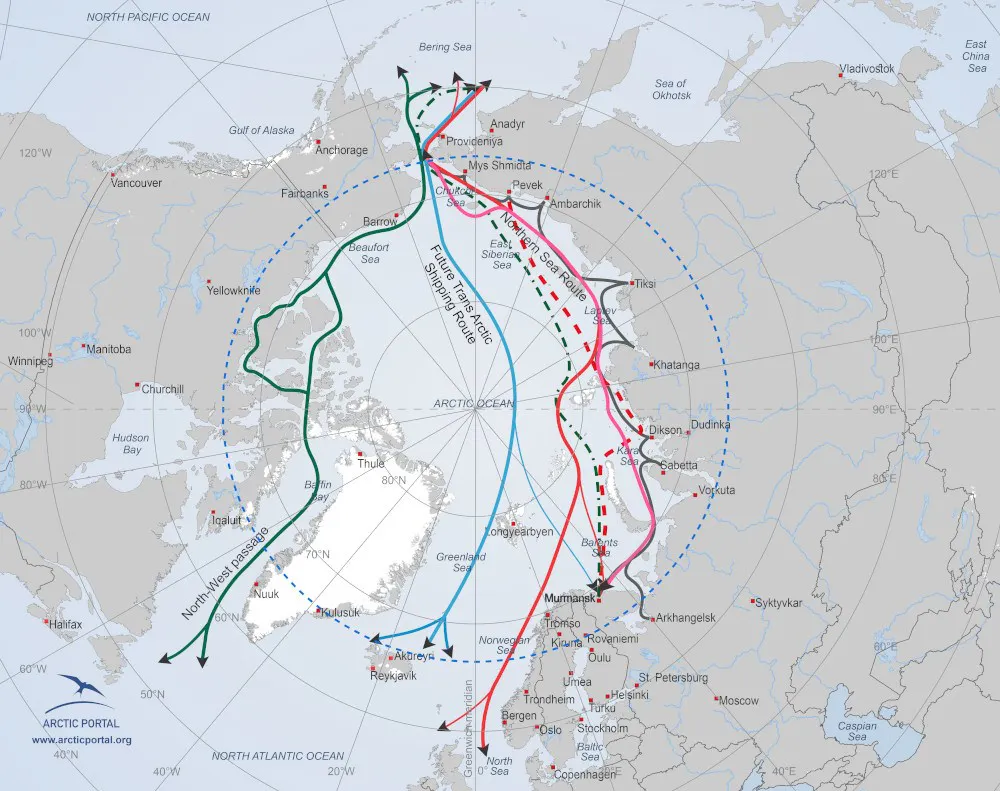
    Trump’s interest in Greenland is often associated with the island’s vast, but largely untapped, mineral resources. But its strategic location is arguably an even greater asset. Shipping routes through the Arctic have become more dependable and for longer periods of time during the year as a result of melting sea ice. The northwest passage (along the US and Canadian shorelines) and the northeast passage (along Russia’s Arctic coast) are often ice free now during the summer.


    Breaking the Ice: Arctic Development and Maritime Transportation, ArcticPortal.org

    This has increased opportunities for commercial shipping. For example, the distance for a container ship from Asia to Europe through the northeast passage can be up to three times shorter, compared to traditional routes through the Suez Canal or around Africa.

    Similarly, the northwest passage offers the shortest route between the east coast of the United States and Alaska. Add to that the likely substantial resources that the Arctic has, from oil and gas to minerals, and the entire region is beginning to look like a giant real estate deal in the making.

    Arctic assets

    The economic promise of the Arctic, and particularly the region’s greater accessibility, have also heightened military and security sensitivities.

    The day before J.D. Vance’s visit to Greenland on March 28, Vladimir Putin, gave a speech at the sixth international Arctic forum in Murmansk in Russia’s high north, warning of increased geopolitical rivalry.

    While he claimed that “Russia has never threatened anyone in the Arctic”, he was also quick to emphasise that Moscow was “enhancing the combat capabilities of the Armed Forces, and modernising military infrastructure facilities” in the Arctic.

    Equally worrying, Russia has increased its naval cooperation with China and given Beijing access, and a stake, in the Arctic. In April 2024, the two countries’ navies signed a cooperation agreement on search and rescue missions on the high seas.


    National Snow & Ice Data Center, Arctic Portal

    In September 2024, China participated in Russia’s largest naval manoeuvres in the post-cold war era, Ocean-2024, which were conducted in north Pacific and Arctic waters. The following month, Russian and Chinese coastguard vessels conducted their first joint patrol in the Arctic. Vance, therefore, has a point when he urges Greenland and Denmark to cut a deal with the US because the “island isn’t safe”.

    That the Russia-China partnership has resulted in an increasingly military presence in the Arctic has not gone unnoticed in the west. Worried about the security of its Arctic territories, Canada has just announced a C$6 billion (£3.2 billion) upgrade to facilities in the North American Aerospace Defense Command it operates jointly with the United States.

    It will also acquire more submarines, icebreakers and fighter jets to bolster its Arctic defences and invest a further C$420 million (£228 million) into a greater presence of its armed forces.


    Read more:
    Arctic breakdown: what climate change in the far north means for the rest of us


    Svalbard’s future role?

    Norway has similarly boosted its defence presence in the Arctic, especially in relation to the Svalbard archipelago (strategically located between the Norwegian mainland and the Arctic Circle). This has prompted an angry response from Russia, wrongly claiming that Oslo was in violation of the 1920 Svalbard Treaty which awarded the archipelago to Norway with the proviso that it must not become host to Norwegian military bases.

    Under the treaty, Russia has a right to a civilian presence there. The “commission on ensuring Russia’s presence on the archipelago Spitzbergen”, the name Moscow uses for Svalbard is chaired by Russian deputy prime minister Yury Trutnev, who is also Putin’s envoy to the far eastern federal district. Trutnev has repeatedly complained about undue Norwegian restrictions on Russia’s presence in Svalbard.

    From the Kremlin’s perspective, this is less about Russia’s historical rights on Svalbard and more about Norway’s – and Nato’s – presence in a strategic location at the nexus of the Greenland, Barents and Norwegian seas. From there, maritime traffic along Russia’s northeast passage can be monitored. If, and when, a central Arctic shipping route becomes viable, which would pass between Greenland and Svalbard, the strategic importance of the archipelago would increase further.

    From Washington’s perspective, Greenland is more important because of its closer proximity to the US. But Svalbard is critical to Nato for monitoring and countering Russian, and potentially Chinese, naval activities. This bigger picture tends to get lost in Trump’s White House, which is more concerned with its own immediate neighbourhood and cares less about regional security leadership.

    Consequently, there has been no suggestion – so far – that the US needs to have Svalbard in the same way that Trump claims he needs Greenland to ensure US security. Nor has Russia issued any specific threats to Svalbard. But it was noticeable that Putin in his speech at the Arctic forum discussed historical territorial issues, including an obscure 1910 proposal for a land swap between the US, Denmark and Germany involving Greenland.

    Putin also noted “that Nato countries are increasingly often designating the Far North as a springboard for possible conflicts”. It is not difficult to see Moscow’s logic: if the US can claim Greenland for security reasons, Russia should do the same with Svalbard.

    The conclusion to draw from this is not that Trump should aim to annex a sovereign Norwegian island next. Maritime geography in the north Atlantic underscores the importance of maintaining and strengthening long-established alliances.

    Investing in expanded security cooperation with Denmark and Norway as part of Nato would secure US interests closer to home and send a strong message to Russia. It would also signal to the wider world that the US is not about to initiate a territorial reordering of global politics to suit exclusively the interests of Moscow, Beijing and Washington.

    Stefan Wolff is a past recipient of grant funding from the Natural Environment Research Council of the UK, the United States Institute of Peace, the Economic and Social Research Council of the UK, the British Academy, the NATO Science for Peace Programme, the EU Framework Programmes 6 and 7 and Horizon 2020, as well as the EU’s Jean Monnet Programme. He is a Trustee and Honorary Treasurer of the Political Studies Association of the UK and a Senior Research Fellow at the Foreign Policy Centre in London.

    – ref. US and Russia squabble over Arctic security as melting ice opens up shipping routes – https://theconversation.com/us-and-russia-squabble-over-arctic-security-as-melting-ice-opens-up-shipping-routes-253493

    MIL OSI – Global Reports –

    April 5, 2025
  • MIL-OSI Global: Why ChatGPT is a uniquely terrible tool for government ministers

    Source: The Conversation – UK – By Deepak Padmanabhan, Senior Lecturer in AI, Queen’s University Belfast

    Shutterstock/Prachova Nataliia

    The news that Peter Kyle, secretary of state for science and technology, had been using ChatGPT for policy advice prompted some difficult questions.

    Kyle apparently used the AI tool to draft speeches and even asked it for suggestions about which podcasts he should appear on. But he also sought advice on his policy work, apparently including questions on why businesses in the UK are not adopting AI more readily. He asked the tool to define what “digital inclusion” means.

    A spokesperson for Kyle said his use of the tool “does not substitute comprehensive advice he routinely receives from officials” but we have to wonder whether any use at all is suitable. Does ChatGPT give good enough advice to have any role in decisions that could affect the lives of millions of people?

    Underpinned by our research on AI and public policy, we find that ChatGPT is uniquely flawed as a device for government ministers in several ways, including the fact that it is backward looking, when governments really should be looking to the future.

    1. Looking back instead of forward

    Where government ministers should ideally be seeking new, fresh ideas with a view to the future, the information that comes out of an AI chatbot is, by definition, from the past. It’s a very effective way of summarising what has already been thought of but not equipped to suggest genuinely new ways of thinking.

    ChatGPT responses are not based on all past equally. The ever-increasing digitisation over the years steers ChatGPT’s pattern-finding mechanism to the recent past. In other words, when asked by a minister to provide advice on a specific problem in the UK, ChatGPT’s responses would be more anchored in documents produced in the UK in recent years.

    And notably, in Kyle’s case, that means that not only will a Labour minister be accessing information from the past, but he’ll be advised by an algorithm leaning heavily on advice given to Conservative governments. That’s not the end of the world, of course, but it’s questionable given that Labour won an election by promising change.

    Kyle – or any other minister consulting ChatGPT – will be given information grounded in the policy traditions reflecting the Rishi Sunak, Boris Johnson, Theresa May and David Cameron eras. They are less likely to receive information grounded in the thinking of the New Labour years, which were longer ago.

    If Kyle asks what digital inclusion means, the answer is more likely to reflect what these Tory administrations think it means rather than thoughts of governments more aligned with his values.

    Amid all the enthusiasm within Labour to leverage AI, this may be one reason for them to distance themselves from using ChatGPT for policy advice. They risk Tory policy – one they so like to criticise – zombieing into their own.

    2. Prejudice

    ChatGPT has been accused of having “hallucinations” – generating, uncanny, plausible-sounding falsehoods.

    There is a simple technical explanation for this, as alluded to in a recent study. The “truth model” for ChatGPT – as for any large language model – is one of consensus. It models truth as something that everyone agrees to be true. For ChatGPT, its truth is simply the consensus of views expressed across the data it has been trained on.

    This is very different from the human model of truth, which is based on correspondence. For us, the truth is what best corresponds to reality in the physical world. The divergence between the truth models could be consequential in many ways.

    For example, TV licensing, a model that operates only within a few nations, would not figure prominently within ChatGPT’s consensus model built over a global dataset. Thus, ChatGPT’s suggestions on broadcast media policy are unlikely to substantially touch upon TV licensing.

    Besides explaining hallucinations, divergences in truth models have other consequences. Social prejudices, including sexism and racism, are easily internalised under the consensus model.

    Consider seeking ChatGPT advice on improving conditions for construction workers, a historically male dominated profession. ChatGPT’s consensus model could blind it from considerations important to women.

    The correspondence model of truth enables humans to continuously engage in moral deliberation and change. A human policy expert advising Peter Kyle could illuminate him on pertinent real-world complexities.

    For example, they might highlight how recent successes in AI-based diagnostics could help tackle distinct aspects of the UK’s disease burden in the knowledge that one of Labour’s priorities is to cut NHS waiting times.

    3. Pleasing narratives

    Tools such as ChatGPT are designed to give engaging, elegant narratives when responding to questions. ChatGPT managed this partly by weeding out bad quality text from its training data (with the help of underpaid workers in Africa).

    These poetic pieces of writing work well for engagement and help OpenAI to keep users hooked on their product. Humans enjoy a good story, and particularly one that offers to solve a problem. Our shared evolutionary history has made us story-tellers and story-listeners unlike any other species.

    But the real world is not a story. It is a constant swirl of political complexities, social contradictions and moral dilemmas, many of which can never be resolved. The real world and the decisions government ministers have to make on our behalf are complex.

    There are competing interests and irreconcilable differences. Rarely is there a neat answer. ChatGPT’s penchant for pleasing narratives stands at odds with the public policy imperative to address messy real-world conditions.

    The very features that make ChatGPT a useful tool in many contexts are squarely incompatible with the considerations of public policy, a realm that seeks to make political choices to address the needs of a country’s citizens.

    The authors do not work for, consult, own shares in or receive funding from any company or organisation that would benefit from this article, and have disclosed no relevant affiliations beyond their academic appointment.

    – ref. Why ChatGPT is a uniquely terrible tool for government ministers – https://theconversation.com/why-chatgpt-is-a-uniquely-terrible-tool-for-government-ministers-253294

    MIL OSI – Global Reports –

    April 5, 2025
  • MIL-OSI Europe: Aurora Pinelli, a Graduate at the Commission on the Status on Women in New York

    Source: Universities – Science Po in English

    Students in front of the entrance at 1 St-Thomas (credits: Pierre Morel)

    Virtual Undergraduate Open House day 2025

    Come meet our teams and students at our campuses.

    Sign-up

    Virtual Graduate Open House day 2025

    Meet faculty members, students and representatives and learn more about our 30 Master’s programmes.

    Sign-up

    MIL OSI Europe News –

    April 5, 2025
  • MIL-OSI USA: Study: Police Finance Organizations Allow Steady Flow of Dark Money to Law Enforcement

    Source: US State of Connecticut

    Five years ago, thanks to a federal program that distributes surplus military equipment to local police, Bridgeport acquired a heavily armored vehicle capable of withstanding a mine blast. Other places like Bristol, Hartford, New London, and Willimantic also got one.

    As local media published town-by-town lists of the night vision goggles, rifles, thermal scopes, underwater sound equipment, reconnaissance cameras, and other armored vehicles acquired under the program, Connecticut legislators voted to henceforth prohibit the acquisition of certain military items.

    In a post-George Floyd world, when citizens nationwide openly question the use of police force and officers often find themselves an unwelcomed presence in neighborhoods, simple transparency, like those town-by-town lists, is paramount, says one UConn researcher.

    It’s also the thing most in danger, as what he calls “police finance organizations” introduce secrecy and a rising amount of dark money into policing.

    “Police departments are funded largely by taxpayers through municipal budgets, but we’ve found there’s a lot of other money going to police that you don’t know about or have control over as a voter or taxpayer,” says sociologist Simon Yamawaki Shachter, an assistant professor at UConn. “When you don’t know what’s going into a police budget, that raises questions about who the police are working for. Is it the community that pays taxes or someone else?”

    Shachter and researchers from Harvard University and the University of Chicago introduce the new concept of police finance organizations in their paper, “The Social Structure of Private Donations to Police,” published recently in Socius: Sociological Research for a Dynamic World.

    In it, they define such organizations as simply private entities that give resources to police. These private entities, however, aren’t subject to the same level of scrutiny as police departments, through freedom-of-information requests and public annual reports for example.

    Among the larger category of police finance organizations, they say there are three smaller types: “connectors,” “boosters,” and “havens.”

    In most cases, taxpayers and voters don’t know this is happening. &#8212 Simon Yamawaki Shachter

    Police connectors are entities that generally are in major U.S. cities and provide resources to multiple police departments, oftentimes serving as hubs between parts of the private funding network.

    Police boosters, on the other hand, give only to a single department and tend to be hyperlocal in their fundraising and giving. Police havens, though, are organizations that operate as a savings account for departments, that is, taking in private donations as deposits and making withdrawals to give to departments upon need or request.

    “While police finance organizations sound fine at face value, what’s interesting is that people can make their own tax-deductible gifts to police departments without an intermediary,” Shachter explains. “So, it’s curious why these organizations need to exist in the first place if people can just go to their local police department and write them a check. Why does there need to be this extra organization in the middle?”

    These organizations, he says, often are incorporated as nonprofits, and as 501(c)3s are not required to disclose donor lists, limiting the public’s knowledge of where the funding originated from. Not only don’t they have to report their donors, they’re also not subject to freedom-of-information laws, so even a written request doesn’t get the information.

    Nearly 1,000 police finance organizations nationwide 

    Shachter says the New York City Police Foundation, founded in 1971, was the first major private organization to support police, and even as others popped up over the years, their popularity was slow to grow until about 2015 when their number exploded.

    Police benevolent associations were not part of the study, Shachter notes, and weren’t considered police finance organizations because they’re a function of police unions and work to support officers, not general policing, namely equipment and training.

    Using information from GuideStar Candid, Shachter and the other researchers found thousands of entries just from the keywords “police,” “sheriff,” “law enforcement,” and “trooper” in tax filer names, mission statements, program accomplishments, expense descriptions, and addresses.

    They worked to winnow down the dataset and figure there are 961 police finance organizations nationwide, which, Shachter says, is a conservative estimate based on various limitations in the data and other roadblocks researchers hit.

    They managed to discern, however, that between 2014 and 2019, police finance organizations had a revenue of $480 million, of which $396 million went to police havens, $56 million to police connectors, and $28 million to police boosters, according to the study.

    The average donation to a police haven was $22,243 – a skewed number thanks to a handful of multimillion-dollar gifts, the study says, explaining that havens often gave money to individual officers, provided nonmaterial gifts to departments, facilitated discounted purchases by departments, and offered free loans of equipment.

    Those giving the most have strong political agendas and are trying to exert policy influence in different ways. &#8212 Simon Yamawaki Shachter

    Havens also exchanged $5 million among themselves through 80 individual donations, “creating a shadow network of internal financial exchanges,” the study says.

    Shachter says police finance organizations find all sorts of ways to secretly pass support to departments, including by donating to individual officers. If gifts are less than $5,000 per officer, the donation needn’t be disclosed.

    This means, for instance, the Chicago Police Memorial Foundation was able in 2020 to give that department 3,330 bulletproof vests and 1,720 vest covers by marking them for individual officers without having to report the $1.47 million donation, the study says.

    Two years prior in 2018, a different organization, the Chicago Police Foundation, purchased “special classes for CPD,” but details on what those classes were for aren’t readily available, a fact that’s not surprising to Shachter. The study notes that its disclosure at all was likely a mistake.

    “Most of the police departments and most of the organizations we studied are using this money for whatever they want, going around any public process,” Shachter says. “We have no idea what’s being offered in these trainings. We just know they’re held and that police go to them.”

    Gifts from billionaire donors 

    From youth programming and defibrillators to shields and even a helicopter, donations run the gamut.

    “Most of the gifts are very benign, supporting the health of canines and medical training for officers, things I think we all support and say should be part of public budgets,” Shachter says. “But if you look at the amount of money that moves through these organizations, it appears far more nefarious. Those giving the most have strong political agendas and are trying to exert policy influence in different ways.”

    Study researchers found three private donors who gave significant support.

    Howard Buffett, son of billionaire Warren Buffett, gave to police finance organizations in Illinois, which led to the ouster of the director of the Illinois Law Enforcement Training and Standards Board over ethical concerns.

    In Arizona, the younger Buffett made donations and became an active member of the Assist Team, giving him direct access to police and allowing him to develop a relationship with U.S. Border Patrol, according to the study.

    Founder of the hedge fund Citadel Kenneth Griffin himself disclosed gifts to police finance organizations, offering a combined $35 million to the University of Chicago Crime Lab in 2018 and 2022, the study says, noting that Griffin openly tied the gifts to mayoral, gubernatorial, and national policy. Because the University of Chicago is a private institution, it did not have to disclose the gift.

    And billionaires Laura and John Arnold, outspoken supporters of law enforcement, funded in 2016 a pilot surveillance drone program through a police haven supporting Baltimore police, the study says. When the community learned of the surveillance program, it was immediately shut down.

    There’s no doubt, Shachter says, that big donors are using their gifts to influence local, state, and national policy conversations.

    “Our goal with this study is to take the first step of shining a light on this area of dark money and then try to make it more transparent. We would love changes to the IRS tax code to require better reporting, like gifts to individual officers. They should report that just like other public officials,” he says.

    “In most cases, taxpayers and voters don’t know this is happening,” he continues. “City councils don’t even know, and if they’re not aware of these off-the-book line items how can they appropriately budget? There are so many ways these organizations are purposely avoiding transparency and that gives us reason for alarm.”

    MIL OSI USA News –

    April 5, 2025
  • MIL-OSI Global: The problem with Trump’s takeover of the Kennedy Center isn’t the possibility of ‘Cats’

    Source: The Conversation – USA – By Joanna Dee Das, Associate Professor of Dance, Washington University in St. Louis

    Donald Trump visits the John F. Kennedy Center for the Performing Arts on March 17, 2025. Jim Watson/AFP via Getty Images

    When President Donald Trump announced that he was assuming control of the Kennedy Center for the Performing Arts, he described the move as a triumph over “wokey” programming. He subsequently fired the 17 board members appointed by President Joe Biden and installed himself as chairman.

    Some critics have reacted to the move by suggesting Trump doesn’t understand art.

    One protester declared that Trump has “no artistic bones in his body.” Theater aficionados claim that he misinterprets his favorite musicals, “Cats” and “Les Misérables.”

    The New Yorker magazine’s satirical description of the Kennedy Center’s 2025 programming under Trump included a fictional show called “Forbidden Branson.” The title plays on the show “Forbidden Broadway,” replacing New York’s storied theater district with the popular Ozarks tourist destination that has been maligned as a mecca of bad taste.

    To me, these responses play right into Trump’s hands, reinforcing his claims that liberals are out-of-touch elitists.

    I’ve spent the past seven years researching and writing a book about Branson, Missouri, a town that offers a plethora of live entertainment, including magic shows, country music performances and variety shows. Many of the productions have a conservative, Christian slant. In my view, a Branson-style show could – and should – belong among the offerings at the Kennedy Center.

    Rather than ridiculing the president’s taste, I think responses to the takeover would be better placed focusing on more fundamental questions about the role of the U.S. government in the nation’s artistic life.

    How can a national arts institution best reflect the country’s diverse range of people and interests? Prior to Trump, how well was the Kennedy Center doing at that?

    Historical opposition to arts funding

    For most of U.S. history, government had a very limited role in the arts.

    European royals had long patronized the arts. In contrast, the founders of the United States, fearful of tyranny, created a weak federal government that could barely impose taxes, let alone establish a national theater.

    Instead, artists of the 18th and 19th centuries operated in a for-profit marketplace. Their audiences rejected elitist cultural norms and watched Shakespeare mixed in with minstrel songs and comedy acts on the same program.

    At the end of the 19th century, the Second Industrial Revolution created a class of ultra-wealthy Americans who sought to imitate European royalty and their tradition of patronage. New cultural distinctions emerged. Opera, ballet and classical music were designated as high art; variety shows featuring comedians, popular songs and acrobatics were designated as low art. Musicals eventually found an uneasy niche as “middlebrow.” Performers who wished to avoid the grind of the commercial marketplace could now turn to private patrons. Nonwhite and working-class performers who lacked social connections to the upper crust had fewer opportunities to do so.

    The Great Depression compelled the U.S. government to fund artists for the first time. In 1935, President Franklin D. Roosevelt established Federal Project Number One, which included visual art, theater, music and writing programs. Its primary goal was to provide work for the unemployed. Its secondary purpose involved creating art that would be accessible to ordinary Americans both in terms of location – like murals in public buildings – and content, such as plays like “One Third of a Nation” that spoke to housing concerns.

    An audience enjoys a public Federal Theatre Project performance in New York in the late 1930s.
    Dick Rose/Library of Congress/Corbis/VCG via Getty Images

    Heated controversies over the program ensued. If the main criterion to receive a grant was need, not skill, would government funding churn out bad art?

    Conservative congressmen argued that Federal One artists were taking “unbridled license to ridicule American ideals and to suggest rebellion against our government.” In 1938, the newly formed House Committee on Un-American Activities accused the head of Federal One’s Theatre Project of supporting communism.

    Soon thereafter, the Federal One programs ended.

    The Cold War and the Kennedy Center

    The Cold War created a new opportunity for arts funding as the United States scrambled to counteract the Soviet Union’s depiction of America as “culturally barren.” Under President Dwight D. Eisenhower, the State Department began to sponsor American artists and fund international tours of their work.

    Even this modest attempt at public arts patronage – European nations were spending 20 to 40 times as much on the arts – faced pushback from conservatives, who cast the tours as a waste of taxpayer money. Nonetheless, Eisenhower persisted. In 1958, he signed the National Cultural Center Act to authorize a national arts complex.

    The act failed to provide enough money to actually build the center. In 1962, President John F. Kennedy embarked on a campaign to raise US$30 million in private money. Part of those fundraising efforts involved reassuring donors that their high-art tastes would be reflected.

    The Kennedy Center finally opened its doors in September 1971. Given the need for constant fundraising ever since, philanthropists have dominated its board.

    Today, the Kennedy Center receives $43 million as a public subsidy, or 16% of its budget. Ticket sales, facility rentals and donations comprise the other 84%. No government funds go to artistic programming, which has blunted potential criticism about censorship or propaganda. But this has also precluded the ability of regular people across the nation to weigh in about what appears onstage.

    With members of the Kennedy family looking on, President Lyndon B. Johnson shovels dirt during the groundbreaking ceremonies for the John F. Kennedy Center for the Performing Arts in 1964.
    Bettmann/Getty Images

    An uncertain future

    The Kennedy Center staff has attempted to work within the constraints of a philanthropy model to reach a broad audience and challenge high/middle/low distinctions. In its first year, the center appointed renowned choreographer Katherine Dunham as a technical adviser in intercultural communication. She aimed to “make the center more responsible to the community” and establish a model of local engagement in Washington that could be replicated throughout the country.

    It didn’t materialize. Programming remained in the traditional high art category until Kennedy Center President Deborah Rutter expanded into genres like hip-hop and comedy in the 2010s. In 2020, the center made progress toward Dunham’s vision with its Social Impact initiative, which focused on free performances and transportation to arts events for local Washington communities. Trump has since dissolved it.

    By declaring himself chairman and personally overseeing the programming, Trump has followed in the footsteps of Russian czars or monarchs like Louis XIV of France, who established arts institutions as extensions of royal power. In effect, it realizes 18th-century Americans’ fears about government involvement in the arts as a form of control.

    At the same time, the private philanthropy model has been far from perfect. It has left the Kennedy Center vulnerable to attacks of elitism. Perhaps future leaders can imagine more robust models of public support and stewardship that reflect America’s diverse and multifaceted national landscape – if they’re ever given an opportunity to do so.

    Joanna Dee Das does not work for, consult, own shares in or receive funding from any company or organization that would benefit from this article, and has disclosed no relevant affiliations beyond their academic appointment.

    – ref. The problem with Trump’s takeover of the Kennedy Center isn’t the possibility of ‘Cats’ – https://theconversation.com/the-problem-with-trumps-takeover-of-the-kennedy-center-isnt-the-possibility-of-cats-253196

    MIL OSI – Global Reports –

    April 5, 2025
  • MIL-OSI Global: Insects are everywhere in farming and research − but insect welfare is just catching up

    Source: The Conversation – USA – By Bob Fischer, Professor of Philosophy, Texas State University

    Employees sort crickets by size at a farm in Thailand. AP Photo/Sakchai Lalit

    Did you know your lipstick might be made from beetles? Or that some cat food may soon be made from flies?

    People farm insects for all sorts of reasons: Farmers rear bees to pollinate billions of dollars of crops, textile companies raise silkworms for their cocoons, and cosmetic companies use cochineal beetles for dyes. Researchers also put insects to work in labs: Fruit flies have revolutionized genetics, cockroaches provide insights into neurobiology, and ants inspire AI-driven robots.

    On top of that, medical companies raise blowfly larvae to clean wounds, desert locusts for compounds that might help reduce the risk of heart disease, and lac insects for their secretions, which are used to coat pills.

    All told, trillions of insects are farmed each year across the globe – more than all other livestock combined. Each year, producers rear some 2.1 trillion black soldier flies alone – and, if industry trends hold, will be rearing three times as many in 2035. Currently, roughly 30 times as many insects are produced as the most-farmed “traditional” farm animal: the chicken.

    As an ethics professor, I think this raises pressing questions about what it means to treat insects humanely. Several years ago, I was skeptical that these questions were worth asking, as most questions about animal welfare center on pain – and I didn’t think there was much chance that insects could feel it. However, as science has uncovered more about insects’ abilities, the emerging field of insect welfare seems increasingly important.

    Dried, crushed female insects known as Dactylopius coccus, which will be used to produce natural red dye, at a farm in Mexico.
    AP Photo/Eduardo Verdugo

    New science of animal minds

    In the 17th century, many scientists believed that all nonhuman animals were mere machines that behaved as if they felt pain but didn’t actually experience it.

    While most scientists have long abandoned this view, researchers have not identified a definitive test for the capacity to feel pain in any nonhuman animal. There is no known brain structure or pattern of neural activity whose presence or absence settles the question. There’s no single behavior that decisively establishes pain, either.

    So, researchers look for several markers of pain that, taken together, support taking this possibility seriously. Some of these markers are neurobiological, such as specialized damage receptors and regions of the brain that integrate those signals with information from other senses. Some are behavioral, such as an animal making trade-offs between avoiding harm and pursuing rewards.

    Fruit flies, for example, are willing to cross electrical barriers that give them mild shocks to reach food. However, they won’t cross barriers that give them stronger shocks, even when very hungry. This suggests that there’s something more than simple reflexes at work: The animal is weighing different motivations to make a decision.

    Evidence like this keeps accumulating. Some bees can remember experiencing high heat and weigh this against the reward of sugar when it’s offered in hot containers. They also display emotion-like states, in that they respond to cognitive bias tests the way other animals do. These tests are used to assess how animals’ emotions influence their cognitive processes: Like people, animals handle uncertain situations differently if stressed or satisfied.

    Fruit flies become averse to temperatures that were once innocuous after researchers amputate their legs, just as some injuries in humans can lead to heightened pain sensitivity. Tobacco hornworm moth larvae and cockroaches tend to their wounds when hurt. And contrary to a common myth, many male praying mantises try to avoid being eaten by females; they don’t always just continue mating.

    Again, no single marker – or even the lot of them – proves that insects can feel pain. However, the accumulated evidence suggests that there’s at least a realistic possibility. This position is reflected in two scientific consensus statements: the 2012 Cambridge Declaration on Consciousness and the 2024 New York Declaration on Animal Consciousness, which are attempts to summarize the state of knowledge about many groups of animals.

    Humane practices?

    It’s widely acknowledged that it’s wrong to cause unnecessary pain in animals – an imperative codified in the ethical principles that U.S. federal agencies consult when making regulations about research. So, if insects can feel pain, as most Americans believe, then there is an ethical reason to protect their welfare.

    Of course, it isn’t certain that they can feel pain. So, precautionary reasoning becomes important: taking steps to reduce the risk of causing harm that are, in some sense, proportional to the magnitude of the risk. In other words, people who rear insects should take modest steps to reduce the risk that they are causing more pain than they need to cause.

    On some insect farms, a potential concern is injuries from cannibalism and aggression, which occur at greater rates when animals such as crickets are crowded together. The issue crops up in other farming systems as well: Chickens harm their flockmates when they don’t have sufficient room.

    There are also worries about slaughter. Typically, a humane death is fast, but many insects are killed using very slow methods, such as baking and microwaving. Grinding and boiling, by contrast, may be much quicker.

    Black soldier flies being grown as fish food live in laying-and-rearing aviaries at a factory in France.
    AP Photo/Aurelien Morissard

    In lab research, one potential concern is performing live dissections, once known as vivisection, without anesthetics or analgesics. The practice has been almost universally abandoned for vertebrate animals but is still routine with some insects. People have described many cases of insect neglect to me, including times when researchers have accidentally let insects starve or become fatally dehydrated after experiments conclude, rather than euthanizing them.

    Granted, it’s hard to be sure that any particular practice causes pain. If there’s a realistic possibility, however, then it’s worth considering alternative practices.

    As scientists have suggested, insect producers could reduce the number of animals in each container to reduce problems associated with crowding. They could investigate strategies for stunning insects before processing them, just as other animals are stunned before slaughter.

    In most countries, insect researchers are not legally required to follow the standard ethical guidelines for other animal researchers. But there is nothing to prevent insect researchers from following them voluntarily. These international guidelines recommend avoiding the use of live animals entirely when possible; using fewer live animals when they do need to be used; and refining practices to minimize the risk of pain and distress, such as giving insects anesthesia before dissection.

    It’s possible to treat insects more humanely. And since they may be able to feel pain, I believe it’s important to take reasonable steps to do so.

    Bob Fischer is on the board of the Insect Welfare Research Society and the Arthropoda Foundation.

    – ref. Insects are everywhere in farming and research − but insect welfare is just catching up – https://theconversation.com/insects-are-everywhere-in-farming-and-research-but-insect-welfare-is-just-catching-up-249585

    MIL OSI – Global Reports –

    April 5, 2025
  • MIL-OSI Global: Hard work feels worth it, but only after it’s done – new research on how people value effort

    Source: The Conversation – USA – By Piotr Winkielman, Professor of Psychology, University of California, San Diego

    How many stairs would you climb for that payoff? Ozgur Donmaz/DigitalVision via Getty Images

    When deciding if something is worth the effort, whether you’ve already exerted yourself or face the prospect of work changes your calculus. That’s what we found in our new research, published in the Journal of Experimental Psychology: General.

    When you consider a future effort, more work makes the outcome less appealing. But once you’ve completed the work, more effort makes the outcome seem more valuable. We also discovered that hiding behind this general principle of timing there are individual differences in how future and past effort shapes people’s value for the fruits of their labor.

    What’s it worth to you?

    In our experiment, we gave participants a choice between a fixed amount of money and a household item – a mug – that they could take home if they exerted some amount of physical effort, roughly equivalent to walking up one, two or three flights of stairs.

    This setup allowed us to determine the value each person placed on the effort – did it add to or subtract from the value of the item? For instance, if putting in a little more effort made someone switch their decision and decide to go with the cash instead of the mug, we could tell that they valued the mug plus that amount of effort less than that sum of money.

    We also manipulated the time aspect of effort. When the effort was in the future, participants decided whether they wanted to go with the cash or get the mug with some effort. When the effort was in the past, participants decided whether they wanted to cash in the mug they had already earned with effort.

    As we had expected, future effort generally detracted from the value of the mug, but the past effort generally increased it.

    But these general trends do not tell the whole story. Not everyone responds to effort the same way. Our study also uncovered striking individual differences. Four distinct patterns emerged:

    1. For some people, extra effort always subtracted value.
    2. Others consistently preferred items with more work.
    3. Many showed mixed patterns, where moderate effort increased value but excessive effort decreased it.
    4. Some experienced the opposite: initially disliking effort, then finding greater value at higher levels.

    These changing patterns show that one’s relationship with effort isn’t simple. For many people, there’s a sweet spot – a little effort might make something more valuable, but push too far and the value drops. It’s like enjoying a 30-minute workout but dreading a 2-hour session, or conversely, feeling that a 5-minute workout isn’t worth changing clothes for, but a 45-minute session feels satisfying.

    Our paper offers a mathematical model that accounts for these individual differences by proposing that your mind flexibly computes costs and benefits of effort.

    Why violate the ‘law of less work?’

    Why should timing even matter for effort? It seems obvious that reason and nature would teach you to always avoid and dislike effort.

    A hummingbird that puts in lots of extra work to get the same amount of nectar won’t last long.
    Juan Carlos Vindas/Moment via Getty Images

    A hummingbird that prefers a hard-to-get flower over an easy equal alternative might win an A for effort, but, exhausted, would not last long. The cruel world requires “resource rationality” – optimal, efficient use of limited physical and mental resources, balancing the benefits of actions with the required effort.

    That insight is captured by the classic psychological “law of less work,” basically boiling down to the idea that given equivalent outcomes, individuals prefer easier options. Anything different would seem irrational or, in plain language, stupid.

    If so, then how come people, and even animals, often prize things that require hard work for no additional payoff? Why is being hard-to-get a route to value? Anyone who has labored hard for anything knows that investing effort makes the final prize sweeter – whether in love, career, sports or Ikea furniture assembly.

    Could the answer to this “paradox of effort” be that in the hummingbird example, the decision is about future effort, and in the Ikea effect, the effort is in the past?

    Our new findings explain seemingly contradictory phenomena in everyday life. In health care, starting an exercise regimen feels overwhelming when focusing on upcoming workouts, but after establishing the habit, those same exercises become a source of accomplishment. At work, professionals might avoid learning difficult new skills, yet after mastering them, they value their enhanced abilities more because they were challenging to acquire.

    John F. Kennedy supported space exploration efforts, ‘not because they are easy, but because they are hard.’
    Robert Knudsen. White House Photographs. John F. Kennedy Presidential Library and Museum, Boston, CC BY

    What still isn’t known

    Sayings like “No pain, no gain” or “Easy come, easy go” populate our language and seem fundamental to our culture. But researchers still don’t fully understand why some people value effortful options more than others do. Is it physical aptitude, past experiences, a sense of meaning, perception of difficulty as importance or impossibility, moralization of effort, specific cultural beliefs about hard work? We don’t know yet.

    We’re now studying how effort shapes different aspects of value: monetary value; hedonic value, as in the pleasure one gets from an item; and the aesthetic value, as in the sense of beauty and artistry. For instance, we’re investigating how people value artful calligraphy after exerting different amounts of effort to view it.

    This work may shed light on curious cultural phenomena, like how people value their experience seeing the Mona Lisa after waiting for hours in crowds at the Louvre. These studies could also help researchers design better motivation systems across education, health care and business.

    Piotr Winkielman received funding for this research from the University of California, San Diego, Academic Senate.

    Przemysław Marcowski received funding for this research from the National Science Centre Poland.

    – ref. Hard work feels worth it, but only after it’s done – new research on how people value effort – https://theconversation.com/hard-work-feels-worth-it-but-only-after-its-done-new-research-on-how-people-value-effort-252684

    MIL OSI – Global Reports –

    April 5, 2025
  • MIL-OSI United Kingdom: Londoners’ chance to nurture nature

    Source: United Kingdom – Executive Government & Departments

    Press release

    Londoners’ chance to nurture nature

    Spring sunshine on time for ‘happy’ outdoor events

    Walkers stepping out for their health and wellbeing, as part of the Natural England Happier Outdoors Festival. Photo: Sally Oldfield

    Groucho Marx said: “Yesterday is dead, tomorrow hasn’t arrived yet. I have just one day, today, and I’m going to be happy in it.”

    And with the warm spring sunshine greeted by so many like a long-lost friend, Londoners are being urged to get outside and connect with so-called green and blue spaces.

    Over the next 2 weeks, the Happier Outdoors Festival highlights the chance to discover the London you might not know. The capital’s hidden nature nuggets rubbing shoulders with the hustle and bustle of city life.

    With green land and waterways making up about half of Greater London, there is every reason to mark the return of longer, lighter days by feeling, embracing and being part of nature.  

    But one in 5 Londoners say they haven’t recently visited a green space, lower than any region in England [i]

    More than 70 classes, groups and sessions make up the city celebration of the great outdoors – a mix of walks, clubs and events to relax or educate the mind and improve both your physical and mental state.

    From Tai Chi classes in Harrow or counting bird numbers in Haringey, to taking a gentle stroll around woods and gardens in Lewisham or Croydon, building hotels for bugs in Barnet, and maybe putting your back into some organised gardening in Ealing.       

    Laura Brown, Natural England’s lead health adviser for London, said:

    “The importance of open spaces cannot be underestimated. Nature can relax us, educate us, and help reduce anxiety and depression.

    “We know there are countless benefits to connecting with nature – it makes us feel better, physically and mentally. The second Happier Outdoors Festival builds on last year, promoting the connection between people and urban nature.

    “I’m excited for Londoners to discover natural spaces just minutes from their home or be inspired by a new outdoor hobby they had never considered before.”

    Natural England founded the Happier Outdoors network, a group of more than 30 organisations running events to encourage people in London to connect with nature for improved health and wellbeing. 

    All events are free, and have either been arranged especially for the festival or continue throughout the year.

    A full list of what’s on and how to get involved can be found at https://happieroutdoors.london/. The Happier Outdoors Festival runs between 7 and 16 April.

    The clarion call to get outside comes as a wide-ranging survey opens into how exposure to natural spaces affects people’s health, behaviour and attitude to the environment over an extended period of time.     

    The three-year study will involve a sample of approximately 18,000 adults across the country, in a partnership between Natural England, the University of Exeter and the Natural Environment Research Council, and developed by organisations from a range of sectors.

    [i] The People and Nature Survey for England 2024: https://www.gov.uk/government/statistics/the-people-and-nature-surveys-for-england-adults-data-y5q2-july-2024-september-2024.

    Contact us:

    Journalists only: 0800 141 2743 or communications_se@environment-agency.gov.uk

    Share this page

    The following links open in a new tab

    • Share on Facebook (opens in new tab)
    • Share on Twitter (opens in new tab)

    Updates to this page

    Published 4 April 2025

    MIL OSI United Kingdom –

    April 5, 2025
  • MIL-OSI Russia: Get a grant and support for your project in the competition “My Country – My Russia”

    Translartion. Region: Russians Fedetion –

    Source: State University of Management – Official website of the State –

    The State University of Management invites you to take part in the All-Russian competition of youth author projects and projects in the field of education aimed at the socio-economic development of Russian territories, “My Country – My Russia”.

    The new season of the “My Country – My Russia” competition offers participants 14 nominations covering key areas of territorial development: from ecology to digital technologies. Particular attention is paid to the special nomination “My Country. My History. My Victory”, dedicated to the 80th anniversary of the Victory in the Great Patriotic War.

    Residents of all regions of Russia are invited to participate in the following categories:

    the first category – from 14 to 17 years old (inclusive), the second category – from 18 to 35 years old (inclusive), the third category – no age restrictions within the nominations “My Pedagogical Initiative”, “My Family: Continuity, Values and Meaning”, the fourth category – up to 13 years old (inclusive) within the special children’s nomination “Threads of My Family Tree”.

    Applications are accepted until May 11 on the official website of the competition. By May 26, the expert jury will select no more than 300 best works, the remote defense of which will take place from May 27 to June 15. Based on the results, the three best projects in each nomination, with the exception of the children’s category, will be published on the website.

    In 2025, the finalists of the My Country – My Russia project of the Russia – Country of Opportunities presidential platform will have a special opportunity to apply for the Rosmolodezh grant competition. This means that the authors of the best initiatives selected by experts will be able to apply for additional support to implement their ideas.

    The winners of the competition will receive comprehensive support, including grants for project implementation, additional points for admission to universities, internships and employment in partner companies, travel around Russia from the More Than Travel program, as well as educational programs and mentoring.

    Subscribe to the TG channel “Our GUU” Date of publication: 04.04.2025

    Please note: This information is raw content directly from the source of the information. It is exactly what the source states and does not reflect the position of MIL-OSI or its clients.

    MIL OSI Russia News –

    April 5, 2025
  • MIL-OSI Russia: SUM presented educational programs for citizens of the EAEU countries at an international session

    Translartion. Region: Russians Fedetion –

    Source: State University of Management – Official website of the State –

    Representatives of the State University of Management spoke at the international expert session “Business and Continuous Education: Strategy for Growth and Sustainable Development in the Kyrgyz Republic”, which was held at the Kyrgyz-Russian Slavic University named after B.N. Yeltsin, located in Bishkek.

    The event was attended by Ambassador Extraordinary and Plenipotentiary of the Russian Federation to the Kyrgyz Republic Sergey Vakunov, Head of the Representative Office of Rossotrudnichestvo in the Kyrgyz Republic Albert Zulkharneev, Director of the Center for Public-Private Partnership at the National Investment Agency under the President of the Kyrgyz Republic Nurbek Anarbek, as well as representatives of the Office of the President of the Russian Federation for Interregional and Cultural Relations with Foreign Countries and industrial partners of the Kyrgyz-Russian Slavic University named after B.N. Yeltsin.

    The State University of Management was represented at the event by Vice-Rector Dmitry Bryukhanov and Director of the Center for Eurasian Cooperation of the International Cooperation Department Dinara Sadieva.

    The session included several blocks, including a plenary discussion “Business and Continuous Education: New Opportunities in the Context of Sustainable Development” and organizational issues of network cooperation.

    Dmitry Bryukhanov presented the activities of the scientific and educational consortium “Eurasian Network University” (ENU) and made a report on the topic “Experience of the Eurasian Network University in implementing programs of additional professional education in the EAEU space”, dedicated to joint educational programs of the State University of Management within the framework of the ENU activities. During the report, it was emphasized that the implementation of such projects will allow the formation of a new generation of managers in the EAEU space, operating on the basis of specially formed competencies and practical skills in building international economic cooperation.

    It was noted that in 2024, the State University of Management implemented 18 programs of additional professional education for citizens of the EAEU countries in the field of management, marketing and management of specific sectors of the economy. The total number of graduates in these areas of the programs was 324 students.

    The participants of the plenary discussion discussed issues related to the growing role of continuous education and the demands of the labor market for additional education, presented current directions of state policy in the field of additional professional education in the Russian Federation and the Kyrgyz Republic, and also identified trends in the development of business education, corporate and online training.

    Subscribe to the TG channel “Our GUU” Date of publication: 04.04.2025

    Please note: This information is raw content directly from the source of the information. It is exactly what the source states and does not reflect the position of MIL-OSI or its clients.

    MIL OSI Russia News –

    April 5, 2025
  • MIL-OSI Russia: We invite you to the presentation of the Moscow Government scholarship program

    Translartion. Region: Russians Fedetion –

    Source: State University of Management – Official website of the State –

    On April 9, the State University of Management will host a presentation of the “Moscow Government Named Scholarship” program.

    The event will tell you how to become part of the project team, gain practical experience, determine your career path, and open doors to all the opportunities in the capital.

    The Moscow Government’s personal scholarship is a platform of opportunities for the best students of Moscow, which helps them realize themselves not only within the walls of the university, but also in large-scale projects of the capital.

    Key areas of the program:

    City department. We develop your skills and competencies in the field of politics and city administration using the playing of famous board games and television shows. Here you can become part of our game universe and a cool team of Moscow.
    A healthy lifestyle, sports, the ecology of the city. We talk about a healthy lifestyle, training, alternative sports methods, explain the principles of proper nutrition and organize various festivals and events.
    Medicine. We talk about medicine in simple words and popularize the idea of ​​donation among Moscow universities and youth of Moscow. You have the opportunity to become speakers and participants in the project #medical sciences, blood donors or volunteers of city medical actions.
    Creation. We reveal creative potential and develop talents. Here you can show the world your emotions and feelings with the help of creativity and creativity.
    Meetings with VIP faces of the city. We give a chance to get acquainted with celebrities and statesmen through unique tasks, games and live communication.

    We are waiting for everyone who is ready not only to study, but also to be at the center of cool projects and change the capital for the better, at the presentation on April 9 at 14:45 in PA-203.

    Let us recall that in March, a student of the State University of Management became a resident of the Moscow Government Personal Scholarship.

    Subscribe to the tg channel “Our State University” Announcement date: 04/04/2025

    Please note: This information is raw content directly from the source of the information. It is exactly what the source states and does not reflect the position of MIL-OSI or its clients.

    MIL OSI Russia News –

    April 5, 2025
  • MIL-OSI USA: Join Us on 4/24 for Law Day 2025: Constitutions, Unity, and the Rule of Law

    Source: US Global Legal Monitor

    On April 24 at 3 p.m. EDT, the Law Library of Congress and the American Bar Association will cohost our annual Law Day celebration with a Zoom-based panel discussion.

    Please register here.

    This year, the American Bar Association’s 2025 Law Day theme is “The Constitution’s Promise: Out of Many, One.” As the American Bar Association explains:

    The Constitution enshrines our collective responsibility to one another, and the 2025 Law Day theme urges us to take pride in a Constitution that bridges our differences to bring us together as a united nation. Our civic lives tie us together as one “We,” whether through legislative efforts that serve the common good, through military service, or by working together, every day, to fulfill the promise of E pluribus unum, or “out of many, one.”

    This panel discussion will explore how law, specifically constitutionalism, has been used to promote unity in nations around the world, exploring this theme from a comparative constitutional law framework, where we will explore the intricacies of constitutional design, focusing on how different nations create, revise, and enforce their constitutions. This program will examine the processes by which constitutions are drafted, highlighting the roles of founding documents, legal frameworks, and the negotiation processes that reflect a nation’s values and aspirations. The panel will discuss how constitutions evolve over time, whether through formal amendments, judicial interpretation, or societal shifts, and how these changes impact governance. The enforcement mechanisms that ensure constitutions remain a living document—through judicial review, political processes, and institutional checks—will also be critically analyzed, providing a deeper understanding of the balance between legal stability and necessary reform. Through this comparative lens, this program will shed light on the diverse approaches to constitutional governance across the globe.

    A logo for the Law Library of Congress and the American Bar Association’s event to commemorate Law Day 2025.

    The program will be introduced by the American Bar Association President William R. Bay and the Law Librarian of Congress, Aslihan Bulut.

    Dr. Alejandro Ponce. Photo courtesy of Dr. Ponce.

    The moderator is Dr. Alejandro Ponce. Dr. Ponce is the Executive Director of the World Justice Project (WJP), leading its global efforts to advance the rule of law through research, data-driven insights, and strategic initiatives.

    Dr. Ponce, a trained economist, has been instrumental in shaping WJP’s research agenda since its early years. As Chief Research Officer (2012–2025), he played a key role in developing the WJP Rule of Law Index and led the creation of major data products, including country and thematic diagnostics, environmental rule of law indicators, legal needs surveys in over 100 countries, and the first study to quantify the global justice gap. He also led WJP’s expansion in Mexico and the European Union, launching subnational justice indicators, advancing criminal justice research, and overseeing documentary film productions.

    Before joining the World Justice Project, Ponce worked as a researcher at Yale University and as an economist at the World Bank and the Mexican Banking and Securities Commission. He has conducted research in the areas of behavioral economics, financial inclusion, justice indicators, and the rule of law, and has been published in collected volumes as well as top academic journals such as the American Economic Review and the Journal of Law and Economics. Ponce is a frequent speaker on the rule of law at international conferences and policy forums and travels the world to help a wide variety of stakeholders turn rule of law data into action. He holds a B.A. in economics from ITAM in Mexico and an M.A. and Ph.D. in economics from Stanford University.

    The panelists include:

    Tariq Ahmad. Photo courtesy of Tariq Ahmad.

    Law Library of Congress Senior Foreign Law Specialist Tariq Ahmad. Tariq’s work at the Law Library of Congress covers mostly South Asian common law jurisdictions, particularly India and Pakistan. He takes a particular research interest in religion and law issues in the South Asia region. Tariq holds an LL.M. degree in international law from American University Washington College of Law and an LL.B. from University College London.

    Professor Zachary Elkins. Photo Courtesy of Professor Elkins.

    Dr. Zachary Elkins. Professor Elkins’ research focuses on issues of democracy, institutional reform, research methods, and national identity, with an emphasis on cases in Latin America. He is currently completing a book manuscript, “Steal this Constitution: The Drift and Mastery of Constitutional Design,” which examines the design and diffusion of democratic institutions. Much of his research is on the origins and consequences of national constitutions. With Tom Ginsburg (University of Chicago), Professor Elkins co-directs both the Comparative Constitutions Project, an NSF-funded initiative to understand the causes and consequences of constitutional choices, and the website Constitute, which provides resources and analysis for constitutional drafters in new democracies. Elkins earned his B.A. from Yale University, an M.A. from the University of Texas at Austin, and his Ph.D. from the University of California, Berkeley.

    Professor Mortimer Sellers. Photo courtesy of Mortimer Sellers.

    Professor Mortimer Sellers. M.N.S. Sellers is Regents Professor of the University System of Maryland, the highest honor in the Maryland Academic System. He is also Director of the University of Baltimore Center for International and Comparative Law (CICL), honorary President of the International Association for the Philosophy of Law and Social Philosophy (IVR), President-Elect of the American Society of Comparative Law, Director of Studies of the American Branch of the International Law
    Association and Counsellor to the American Society of International Law.

    Professor Sellers has written and edited seventeen books and innumerable articles on international law, comparative law, constitutional law, the philosophy of law, and legal history. He is the general editor of several book series, including the Cambridge University Press series ASCL Studies in Comparative Law (with David Gerber) and the Cambridge University Press series ASIL Studies in International Legal Theory (with Michael Cooper). He is the editor with Stephan Kirste of The IVR Encyclopedia of the Philosophy of Law and Social Philosophy, and with Gary Bell of the second edition of the International Encyclopedia of Comparative Law.

    Professor Sellers received his doctorate and civil law degrees from Oxford University, where he was a Rhodes Scholar and T.H. Green Fellow. He received his bachelor’s degree (summa cum laude) and law degree (cum laude) at Harvard University, where he was a Frank Knox Fellow and John Harvard Scholar and received the Edwards Whitaker and Detur prizes. He is an elected member of the International Academy of Comparative Law and of the International Association of Constitutional Law. Professor Sellers has been The H.L.A. Hart Fellow in Jurisprudence at University College, Oxford, Research Fellow of the Max Planck Institute for Comparative Public Law and International Law in Heidelberg, and a visiting professor at the

    Subscribe to In Custodia Legis – it’s free! – to receive interesting posts drawn from the Law Library of Congress’s vast collections and our staff’s expertise in U.S., foreign, and international law.

    MIL OSI USA News –

    April 5, 2025
  • MIL-OSI Russia: Review of Polytechnics’ sporting achievements for March

    Translartion. Region: Russians Fedetion –

    Source: Peter the Great St Petersburg Polytechnic University – Peter the Great St Petersburg Polytechnic University –

    At the Polytechnic, sports activity knows no decline, and students regularly demonstrate high results in various competitions.

    At the St. Petersburg Student Sports Games in powerlifting, Valeria Shaga from IPMET distinguished herself, taking 3rd place with a result of 185 kg in the weight category up to 84 kg, and Margarita Zhornik from ISI, who also won bronze with a total result of 310 kg in the weight category up to 69 kg. It is especially pleasing that Margarita set a record for St. Petersburg among university students, lifting 117.5 kg in squats.

    The jiu-jitsu team also did not leave without awards. Renat Gaibatov and Aglaya Stepanova won silver at the Street Jiu-Jitsu tournament, and Diana Ledovskikh showed the same result at the Just Jiu-Jitsu Champions League.

    Ivan Sokolov took 1st place in the All-Russian competition “Stars of the Baltic” in hand-to-hand combat, dedicated to the memory of the honored coach of Russia A. V. Fakeev

    At the St. Petersburg Rock Climbing Championship, Konstantin Pak took 2nd place and was selected for the city team.

    At the Russian Student Ultimate Championship, held in St. Petersburg, the Polytechnic University men’s team confidently reached the semi-finals, where they defeated ITMO University (8:7), and then won gold, beating Moscow State University (10:9). The women’s team also performed well, winning bronze medals after three tense games and defeating Moscow State Pedagogical University (9:7).

    From March 7 to 9, our athletes also showed high results at the orienteering competitions in Kaliningrad: Olga Shmaylova won silver in two disciplines and bronze in one, Polina Morozova and Ksenia Galkova also received silver and bronze, respectively. Sergey Dribas won bronze at the “Snowy Trail” competition.

    The women’s handball team won the tournament in memory of Yu. N. Zakatova in Boksitogorsk, which confirms their high level of play.

    On March 14, a conference was held at Peter the Great St. Petersburg Polytechnic University III All-Russian scientific and practical conference “Student sports in the modern world”, brought together leading experts and scientists who discussed pressing issues of developing student sports.

    From March 9 to 14, the St. Petersburg Boxing Championship was held, where our team won 13 medals, including three gold. Working at full capacity, the Polytechnicians once again demonstrated high athletic training.

    At the University Dance Sport Championship in Nova Arena, our dance couples won prizes, captivating the hearts of the audience. In the St section, Arseniy Bauman and Anastasia Nazarova took first place, Arseniy Afonin and Sofya Gordeeva took second place, and Ivan Kobernyuk and Ekaterina Kucherova successfully performed in hobby classes. In the La section, the pair of Kobernyuk and Kucherova also became the winner in hobby-4, together with Gleb Gusev and Stefania Aldoshina, who took first place in hobby-6.

    No less striking was the performance of our football team, which on March 17 won the XI tournament named after Anatoly Turchak. In a tense final game, our team defeated their opponents from Leningradets after a penalty shootout. Their persistence and determination brought the long-awaited gold medals!

    The results of the completed championship and the cheerleading championship are also impressive: our girls became champions in mixed stunts and freestyle, and also won a silver medal in freestyle doubles.

    The mini water polo team also deserves congratulations, having taken third place in the university championship among 12 teams. Our team performed brilliantly in the group stage, however, in the semi-final, it lost to ITMO, but coped with a difficult situation, winning the match for 3rd place against SC Gornyak.

    The “Superfinal of the Eight” in phygital mini-golf of the National Student Sports Golf League was held in Moscow from March 20 to 21. St. Petersburg Polytechnic University was represented by two student teams that were part of the “Black Bears-Polytechnic” mini-golf team. As a result, Anastasia Kalashnikova and Anastasia Maksimova took first place, becoming two-time champions, while Alexander Prokhorov and Roman Ivasishin won second place.

    The team of the Institute of Secondary Vocational Education became the bronze prize winner of the first league of the futsal tournament among professional educational organizations. Last year, the polytechnics lost very disappointingly in the match for third place, but now that gestalt was closed. Vladimir Slepov’s charges held an excellent tournament, and in the decisive match they took revenge for the defeat in the group.

    Please note: This information is raw content directly from the source of the information. It is exactly what the source states and does not reflect the position of MIL-OSI or its clients.

    MIL OSI Russia News –

    April 5, 2025
  • MIL-OSI Russia: “This is not just a challenge to Russia, it is also a challenge to our faith”

    Translartion. Region: Russians Fedetion –

    Source: State University Higher School of Economics – State University Higher School of Economics –

    This year Russia will celebrate the 80th anniversary of Victory in the Great Patriotic War. Center for Religion and Law Faculty of Law HSE University held a round table “Connection of Times. Holy War – Special Military Operation. Contribution of Religious Associations to Achieving Victory.” Representatives of different faiths met to recall history and discuss how clergy can support Russians today.

    “The topic that will be discussed today is very important for everyone, for each of us. Everyone is involved in what is happening now throughout the country,” said Dmitry Kuznetsov, Director of the Higher School of Law and Administration at the National Research University Higher School of Economics, opening the event. “But this topic is also deeply historical for us, so I am sure that today we will rely on our roots and talk about the present and, in many ways, predict the future that we need to build together in order to continue strengthening state sovereignty, so that the constitutional principles of interaction between religious associations are fully implemented.”

    Svetlana Nuzhdina, Director of the Center for Religion and Law at the Faculty of Law at the National Research University Higher School of Economics, noted that representatives of the heirs of those religious communities that supported the Russian people and forged victory during difficult times for the country were invited to participate in the round table, and this experience must be remembered and understood today.

    She also read out a greeting from HSE Rector Nikita Anisimov to those gathered.

    “Our country is multi-confessional, and this is its strength. During the difficult wartime, all religious communities of our Motherland showed themselves to be true patriots. The spiritual support of the Red Army soldiers at the front and home front workers undoubtedly helped us resist the enemy and prevent us from being broken in difficult times. The interaction between the state and religious organizations in those years must be studied, including in light of the events associated with the special military operation. I am confident that the discussions that will unfold at this round table will allow us to comprehend the lessons of the past and apply them to the present,” the rector’s greeting reads.

    Hegumen Serapion (August Mitko), Deputy Director Higher School of Law and Administration, the scientific director of the Center for Religion and Law of the Faculty of Law of the National Research University Higher School of Economics, noted that the last three years have become a test not only for the entire Russian people, but also for religious organizations. For the first time in a very long time, different sides in the conflict are justifying their case with religious arguments. “Many religious organizations have joined the anti-Russian campaign. What is happening is not only a challenge to security, not only a political one, but also a spiritual challenge. In addition to victory on the battlefield, there is also a spiritual victory and a spiritual defeat. Now we must understand that this Russophobia, hatred is not just a challenge to Russia, it is a challenge to our faith. We believe in truth, in goodness and in love, and we must preserve both true faith and love,” he emphasized.

    Metropolitan of Moscow and All Rus’ of the Russian Orthodox Old Believer Church Korniliy (Konstantin Titov) told the participants of the round table about the feats that believers accomplished during the Great Patriotic War, saving Moscow from the enemy army. “We constantly pray for help for our soldiers,” he said.

    Rabbi Aaron Gurevich, head of the Department of the Federation of Jewish Communities of Russia for interaction with the Armed Forces, the Ministry of Emergency Situations and law enforcement agencies of the Russian Federation, said that since the beginning of the Second World War, the Jewish community, which is on the side of the Russians, has found itself under double pressure. In his opinion, European politicians, who are now setting the agenda, instead of dealing with the internal problems of their countries, stubbornly oppose Russia, trying to take quasi-revenge for the defeat of their fathers and grandfathers in the Great Patriotic War.

    A person who helps gets much more than the one who receives help, reminded the mufti of the Moscow Region of the Spiritual Assembly of Muslims of Russia Denis Mukhutdinov. “When you immerse yourself in the process of providing help, when you begin to live this process, such a concept as someone else’s grief is erased for you. Each story that you learn becomes your own, and you learn to feel and empathize and, as a religious figure, begin to convey this to your flock,” he said.

    The head of the Department of Education and Science of the Spiritual Administration of Muslims of the Russian Federation, Ilgizar Davletshin, raised the issue of organizing and developing an institute for training military clergymen under special programs. This issue is very important for all faiths, he noted.

    Archpriest Yevgeny Lishchenyuk, head of the Service for Spiritual and Psychological Assistance to Participants in Combat Operations and Their Families at the Synodal Department for Church Charity and Social Service, director of the St. Anthony Smirnitsky Charitable Foundation, said that more than 20,000 clergy have already been to the front. Just like their flock, they find themselves on the front lines, many have been injured, and some have died.

    Vice-Rector for Social and Missionary Work at the Orthodox St. Tikhon’s Humanitarian University, Philipp Ilyashenko, spoke about the tasks of religious education. This is not only helping soldiers and those who returned from the front, but also educating students.

    The head of the public relations department of the Western Russian Union of Seventh-day Adventist Christians, Evgeny Ekimov, noted the importance of the contribution of home front workers to the victory and the need to highly value their work.

    Maria Mchedlova, head of the Department of Comparative Political Science at the Faculty of Humanities and Social Sciences at RUDN University and chief research fellow at the Institute of Sociology at the Federal Research Sociological Center of the Russian Academy of Sciences, discussed how social service is changing today. She noted that compassion and consolation are needed not only by direct participants in the SVO, but also by their relatives who remain in the rear, and especially by those who have lost loved ones. “True believers pray not to destroy the enemy, but for the human to triumph,” she emphasized.

    Crises lead to spiritual revival, noted the head of the Center for the Study of Religion and Society Problems of the Institute of Europe of the Russian Academy of Sciences, Deputy Director of the Institute of Europe of the Russian Academy of Sciences for Research Roman Lunkin. According to him, each of the difficult events for the country was experienced hand in hand by the spiritual and secular authorities, and this led to a fairly large-scale rethinking and restructuring of public consciousness.

    The war has moved from the historical to the value plane, emphasized the adviser to the head of the Federal Agency for Nationalities Aikaz Mikaelyan. “This is the most key value factor, because the memory of the Great Patriotic War is part of the family identity of each person. Every family in our country has such a memory. This is a large set of family values that unites us, the entire post-Soviet space. It is precisely this value understanding, work with young people – only this can guarantee victory,” he emphasized.

    Also speaking at the round table were the Chairman of the Central Spiritual Administration of Buddhists Geshe Yonten Lodoy (Sergey Kirishov), the Chairman of the Russian Union of Evangelical Christians-Baptists Petr Mitskevich, the head of the apparatus, the responsible secretary of the Spiritual Council of the Russian United Union of Christians of the Evangelical Faith (Pentecostals) Dmitry Taranov, a teacher at the Zaoksky Adventist University Dmitry Fokin, and the representative of the Russian and New Nakhichevan Diocese of the Armenian Apostolic Church, priest Gevorg Vardanyan.

    Please note: This information is raw content directly from the source of the information. It is exactly what the source states and does not reflect the position of MIL-OSI or its clients.

    MIL OSI Russia News –

    April 5, 2025
  • MIL-Evening Report: Albanese and Dutton both say they will return the Port of Darwin to Australian hands

    Source: The Conversation (Au and NZ) – By Michelle Grattan, Professorial Fellow, University of Canberra

    Anthony Albanese has announced that the government will ensure the Port of Darwin, currently leased by the Chinese company Landbridge, is returned to Australian hands.

    “Australia needs to own the Port of Darwin,” the prime minister declared late Friday.

    Albanese rang a Darwin radio station after Labor got wind of the fact that Opposition Leader Peter Dutton would on Saturday announce a Coalition government would return the port back to local control.

    Both the government and opposition are promising that, if necessary, they would bring the port’s lease into public ownership.

    Albanese said the government had been seeking a local buyer, but was prepared to acquire the port’s lease if that was the only solution.

    “We prefer that it be through superannuation funds or some other vehicle that doesn’t mean direct taxpayer’s funds, but we’re prepared to go down the road of taxpayer direct involvement, as well.”

    Asked to clarify whether the options were that the port remain privately owned or that it be returned to be a government asset, Albanese said, “yes, they are.”

    The Northern Territory government leased the port to Landbridge in 2015 for about $500 million. The lease was for 99 years.

    The federal government at the time was not directly involved in the deal, but the Northern Territory government sought advice from the Defence Department and security agencies, which didn’t raise objections. Later, US President Barack Obama chided then-Prime Minister Malcolm Turnbull for not giving the Americans a heads-up.

    The Chinese deal has caused serious controversy in the years since.

    When Dutton was defence minister in the Morrison government, his department did a review of the lease.

    A statement on Friday from Dutton and shadow ministers said a Coalition government would seek a private operator to take over the lease, but if one could not be found within six months, the government would acquire it “as a last resort”.

    It would use the Commonwealth’s “compulsory acquisition powers”, and the government would then compensate the Landbridge Group.

    “In the current geopolitical environment, it is vital that this piece of critical infrastructure, which is directly opposite to the Larrakeyah Defence Precinct, is operated by a trusted, Commonwealth approved entity.

    “We will appoint a specialist commercial adviser to work with the Northern Territory Government and officials from the Departments of Treasury, Finance, Defence and Infrastructure to provide advice and engage with potential new operators of the port.”

    Dutton said that a Coalition government would not allow the port to be leased by any entity that is “directly or indirectly controlled by a foreign government, including any state-owned enterprise or sovereign wealth fund.”

    Michelle Grattan does not work for, consult, own shares in or receive funding from any company or organisation that would benefit from this article, and has disclosed no relevant affiliations beyond their academic appointment.

    – ref. Albanese and Dutton both say they will return the Port of Darwin to Australian hands – https://theconversation.com/albanese-and-dutton-both-say-they-will-return-the-port-of-darwin-to-australian-hands-253735

    MIL OSI Analysis – EveningReport.nz –

    April 5, 2025
  • MIL-OSI Global: Faced with new tariffs and a truculent Trump, Japan and South Korea toe a cautious line

    Source: The Conversation – Global Perspectives – By Sebastian Maslow, Associate Professor, International Relations, University of Tokyo

    Two months into US President Donald Trump’s second term, the liberal international order is on life support.

    Alliances and multilateral institutions are now seen by the United States as burdens. Europe and NATO are framed as bad business, “ripping off” the US. On his so-called “Liberation Day”, Trump also imposed 20% tariffs on all European Union imports.

    The Trump administration has been far less critical of the US’ alliances in the Indo-Pacific region. On a visit to Tokyo this week, US Defence Secretary Pete Hegseth described Japan as America’s “indispensable partner” in deterring Chinese aggression.

    Yet, Japan and South Korea fared even worse than the EU with Trump’s new tariffs. Trump slapped Japan with 24% tariffs and South Korea 25%. (Both countries enjoy a trade surplus with the US.)

    So, how are the US’ two main allies in the Indo-Pacific dealing with the mercurial US leader? Will they follow Europe’s lead in reassessing their own security relationships with the US?

    Japan: a positive summit but concerns remain

    America’s post-war security strategy in Asia differs from Europe. While NATO was built on the premise of collective defence among its members, the US adopted a “hub-and-spokes” model in Asia, relying on bilateral alliances to contain the spread of communism.

    Japan and South Korea have long sheltered under the US nuclear umbrella and hosted major US military bases. Both are also highly sensitive to changes in the US’ Indo-Pacific policies.

    Japan, in particular, has a long history of careful alliance management with the US, epitomised by former Prime Minister Shinzo Abe’s courting of Trump.

    During Trump’s first term in office, Abe’s policy goals aligned closely with the US: transforming Japan’s security posture to make it a serious military and diplomatic power. Japan increased military spending, lifted arms export restrictions and deepened ties with India and Australia.

    Prime Minister Fumio Kishida continued to raise Japan’s security profile from 2021-24, again increasing military spending and taking a tough line on Russia’s invasion of Ukraine. He emphasised “Europe today could be Asia tomorrow”.

    His successor, Shigeru Ishiba, had a successful summit with Trump in February, immediately after his inauguration. The joint statement reaffirmed US security guarantees to Japan, including over the Senkaku Islands, which are claimed by China.

    Japan also agreed to import American liquefied natural gas, and later committed to working with South Korea to develop a US$44 billion (A$70 billion) plan to export LNG from Alaska.

    However, these positive developments do not mean the relationship is on firm ground.

    In early March, Trump complained the US-Japan security agreement signed in 1960 was “one-sided” and a top administration official again called for Japan to increase its defence spending to 3% of gross domestic product (GDP) – a huge increase for a country facing serious demographic and fiscal pressures.

    Reports also emerged the US was considering cancelling a new joint headquarters in Japan aimed at deeper integration between US and Japanese forces.

    South Korea: extremely vulnerable on trade

    South Korea faces similar pressures. Ties between the two countries were strained during Trump’s first term over his demand South Korea increase the amount it pays to host US forces by
    nearly 400%. A 2021 agreement restored some stability, but left Seoul deeply worried about the future of the alliance.

    South Korea’s acting president, Choi Sang-mok, has expressed a desire to strengthen ties with the US, though Trump has reportedly been cool to his advances.

    With a US$66 billion (A$105 billion) trade surplus with the US, South Korea is considered the country most vulnerable to trade risk with the Trump administration, according to a Swiss research group.

    Trump’s past suggestions that both South Korea and Japan develop nuclear weapons or pay for US nuclear protection has also rattled some nerves. As confidence in the US alliance erodes, both countries are engaging in an urgent public debate about the possibility of acquiring nuclear weapons.

    Tensions moving forward

    Potential for conflict is on the horizon. For example, Tokyo and Washington are set to renegotiate the deal that dictates how much Japan pays to host US troops next year.

    Both allies pay huge sums to host US bases. South Korea will pay US$1.14 billion (A$1.8 billion) in 2026, and Japan pays US$1.72 billion (A$2.7 billion) annually.

    A trade war could also prompt a reassessment of the costs of US efforts to decouple from China, potentially leading to closer economic ties between Japan, South Korea and China. The three countries have agreed to accelerate talks on a trilateral free trade agreement, which had been on hold since 2019.

    Another challenge is semiconductors. Japan’s new semiconductor revitalisation strategy is prioritising domestic investment, raising questions about whether Trump will tolerate “friendshoring” if Japan diverts investments from the US.

    In 2024, Japan outspent the US in semiconductor subsidies (as a share of GDP), while Taiwan’s TSMC, the world’s largest contract chipmaker, expanded its production capacity in Japan.

    Seoul remains an important partner to Washington on semiconductors. Samsung and SK Hynix are both boosting their investments on new semiconductor plants in the US. However, there is now uncertainty over the subsidies promised to both companies to invest in America under the CHIPS Act.

    Ultimately, the strength of these alliances depends on whether the Trump administration views them as long-term bulwarks against China’s rise in the region, or merely vassals that can be extorted for financial gain.

    If the US is serious about countering China, its regional alliances are key. This would give Japan and South Korea some degree of leverage – or, in Trump terms, they’ll hold valuable cards. Whether they get to play them, however, depends on what Trump’s China policy turns out to be.

    The authors do not work for, consult, own shares in or receive funding from any company or organisation that would benefit from this article, and have disclosed no relevant affiliations beyond their academic appointment.

    – ref. Faced with new tariffs and a truculent Trump, Japan and South Korea toe a cautious line – https://theconversation.com/faced-with-new-tariffs-and-a-truculent-trump-japan-and-south-korea-toe-a-cautious-line-244172

    MIL OSI – Global Reports –

    April 5, 2025
  • MIL-OSI Global: Russia and China both want influence over Central Asia. Could it rupture their friendship?

    Source: The Conversation – Global Perspectives – By Dilnoza Ubaydullaeva, Lecturer in Government, Flinders University

    As he looks to solidify his territorial gains in Ukraine in a potential ceasefire deal, Russian President Vladimir Putin has one eye trained on Russia’s southern border – and boosting Russian influence in Central Asia.

    Following his 2024 re-election, Putin made Uzbekistan his third foreign visit after China and Belarus. The visit signalled the region’s continued importance to Moscow.

    In response to Western sanctions on Moscow over the Ukraine war, trade and investment between Russia and Central Asian countries have grown significantly.

    Russia’s Lukoil and Gazprom are now the dominant foreign players in Uzbekistan’s energy fields. In Kazakhstan, Moscow controls a quarter of the country’s uranium production.

    But as Russia tries to reaffirm its role in the region, China has also been quietly expanding its influence.

    Could this growing competition over Central Asia affect Beijing and Moscow’s broader relationship?

    Central Asia drifting apart from Moscow

    The Central Asian region is home to approximately 79 million people spread across five nations. It was part of the Soviet Union until its collapse in 1991. Its strategic location between Russia and China, on the doorstep of the Middle East, has long made it a “grand chessboard” for great power politics.

    While Russia has traditionally dominated the region, Central Asian leaders have made efforts to somewhat distance themselves from Moscow recently.

    At the Commonwealth of Independent States (CIS) summit in October 2022, for example, Tajikistan’s president publicly challenged Russian President Vladimir Putin. He demanded respect for smaller states like his.

    Similarly, during Putin’s 2023 visit to Kazakhstan, President Kassym-Jomart Tokayev made a symbolic statement at the press conference by delivering his speech in Kazakh rather than Russian. This was a rare move that seemed to catch Putin’s delegation off guard.

    In another striking moment, Tokayev declared at an economic forum in Russia in 2022 that Kazakhstan does not recognise Russia’s “quasi-states”, referring to its occupied territories of Ukraine.

    Yet, all Central Asian states remain part of at least one Russia-led organisation, such as the Commonwealth of Independent States, the Collective Security Treaty Organization, or the Eurasian Economic Union.

    Three states (Kazakhstan, Kyrgyzstan and Tajikistan) rely on Russian security guarantees through the Collective Security Treaty Organization.

    And the region’s economic dependency on Russia remains significant. Of the 6.1 million migrants in Russia, the largest groups come from Uzbekistan, Tajikistan and Kyrgyzstan. These countries depend heavily on remittances from these migrant workers.

    China’s growing influence

    With Russia preoccupied with Ukraine and constrained by Western sanctions, China has seized the opportunity to deepen its engagement in the region.

    Beijing’s involvement in Central Asia has long been economic. In 2013, for instance, China unveiled its ambitious, global Belt and Road Initiative in Kazakhstan. And by 2024, it was China, not Russia, that was the largest trading partner of every Central Asian country except Tajikistan.

    But in recent years, China has expanded its influence beyond economic ties, establishing itself as a key player in regional politics.

    At the inaugural China-Central Asia Summit in 2023, for example, Chinese leader Xi Jinping pledged support for the sovereignty, security and territorial integrity of the region. This is traditionally a role played by Russia.

    Xi has also been making high-profile visits to Central Asian states, signalling Beijing’s growing strategic interests here.

    Local populations, however, remain wary. Public opinion surveys indicate China is viewed more negatively than Russia.

    Many Chinese-funded projects bring their own workers, limiting job opportunities for locals and fuelling resentment. There is also anxiety about potential “debt trap” diplomacy. Civil society groups have called for economic diversification to avoid over-reliance on Beijing.

    Further complicating matters is Beijing’s treatment of the Muslim minority Uyghur population in the Xinjiang region of western China. This has reinforced suspicions in Muslim-majority Central Asia about China’s long-term intentions in the region.

    Growing competition

    The increasing competition raises questions about the potential impact on the broader, “no limits” relationship between Moscow and Beijing.

    At a recent forum, Putin acknowledged Beijing’s growing economic role in the region. However, he insisted Russia still has “special ties” with Central Asian states, rooted in history. And he notably dismissed concerns about China’s expansionist aims, saying:

    There is nothing about domination in the Chinese philosophy. They do not strive for domination.

    On the ground, however, things aren’t so simple. So far, China and Russia have managed to avoid stepping on each other’s toes. How long that balance remains, however, is an open question.

    Central Asian countries, meanwhile, are courting both sides – and diversifying their ties beyond the two powers.

    Many of the region’s educated elite are increasingly looking toward Turkey – and pan-Turkic solidarity – as an alternative to both Russian and Chinese dominance.

    Russia’s historical influence in the region remains strong. But the days of its unquestioned dominance appear to be over.

    Russia may try to reassert its preeminent position, but China’s deepening economic presence is not going anywhere.

    With both countries pushing their own regional agendas, it’s hard to ignore the overlap – and the potential for a future clash over competing interests.

    Dilnoza Ubaydullaeva does not work for, consult, own shares in or receive funding from any company or organisation that would benefit from this article, and has disclosed no relevant affiliations beyond their academic appointment.

    – ref. Russia and China both want influence over Central Asia. Could it rupture their friendship? – https://theconversation.com/russia-and-china-both-want-influence-over-central-asia-could-it-rupture-their-friendship-251023

    MIL OSI – Global Reports –

    April 5, 2025
  • MIL-OSI Global: Myanmar military’s ‘ceasefire’ follows a pattern of ruling generals exploiting disasters to shore up control

    Source: The Conversation – Global Perspectives – By Tharaphi Than, Associate Professor of World Cultures and Languages, Northern Illinois University

    Myanmar’s military chief, Min Aung Hlaing, called for elections on March 27, 2025 – a day before an earthquake devastated the country. STR/AFP via Getty Images

    After a 7.7 magnitude earthquake struck Myanmar on March 28. 2025, the country’s military and the myriad resistance groups fighting a yearslong civil war faced international calls for an immediate ceasefire. A pause in the fighting would enable vital aid to enter the major quake zones and allow rescuers to assist victims in a disaster that has already killed more than 3,000 people.

    The first to heed the call was the opposition National Unity Government, which unilaterally announced a two-week pause on attacks by its armed wing, the People’s Defense Force, on March 29. The Three Brotherhood Alliance – a coalition of three ethnic resistance groups: the Myanmar National Democratic Alliance Army, the Ta’ang National Liberation Army and the Arakan Army – likewise agreed to a temporary truce.

    But Myanmar’s military demurred. Just hours after the quake, as rescuers continued to dig through rubble in search of survivors, the generals ordered airstrikes on enemy positions in Shan state and Karen state in the country’s east – a decision that United Nations special rapporteur Tom Andrews described as “nothing short of incredible.”

    The generals eventually yielded to pressure late on April 2 – some five days after the earthquake hit – announcing that they would halt fighting until April 22. But the statement appeared to be hollow, with reports just a day later that the military’s bombing campaign and ground offensive were continuing unabated in Kachin state in Myanmar’s north.

    Mandalay buildings, like Myanmar’s democracy, lie in ruins.
    STR/AFP via Getty Images

    As an expert on the political history of Myanmar, I believe the behavior of the country’s military is of no surprise. The generals who have had a grip on the country for much of the past six decades have a track record of exploiting disasters for political gain. Weakened by years of entrenched civil war, they are now seeking an opportunity in the earthquake to rehabilitate their image overseas, while consolidating power at home.

    From disasters to elections

    Myanmar’s ruling junta has tried this tactic before. In 2008, a week after the deadly cyclone Nargis killed more than 100,000 people in Myanmar, the military proceeded to hold a constitutional referendum that would guarantee the military’s control of government by reserving 25% of all parliamentary seats for officers while requiring 75% of votes for any future constitutional reform. It also allowed for the military to take over the country “in the event of an emergency.”

    The referendum took place while much of Myanmar was still reeling from disaster, yet the junta announced a 98.12% turnout, of which 92.48% voted in favor of the new pro-military constitution.

    It paved the way to elections in 2010, which the military’s Union Solidarity and Development Party won. Though that vote was boycotted by the opposition National League for Democracy, or NLD, Washington had by then signaled a shift in policy toward “pragmatic engagement” with the then-ruling junta. This U.S. shift forced the recalcitrant NLD to cooperate in subsequent elections, giving legitimacy to a process that was stacked in favor of the generals.

    Using a fig leaf of legitimacy

    The latest disaster comes as the junta is again attempting to push for elections. Just a day before the earthquake, Myanmar’s military chief, Min Aung Hlaing, confirmed plans for a December national vote and called on opposition parties to participate.

    But the proposed election in Myanmar is widely seen as a face-saving strategy for both the Myanmar military and, I would argue, an international community that has done little of any significance to end the civil war. In this context, elections would allow the generals to cover their 2021 power grab with a fig leaf of legitimacy.

    The entrenched civil war that was sparked by that military takeover – a coup that ended a 10-year experiment with limited democracy – derailed the military’s initial plan to return to full control of the country.

    Anti-military soldiers sit in a long-tailed boat on the Salween River.
    Thierry Falise/LightRocket via Getty Images

    Four years of fighting a broad-based opposition that includes ethnic minority groups like the Karen National Union, Kachin Independence Army, Arakan Army, Ta’ang National Liberation Army, Myanmar National Democratic Alliance Army, People’s Defense Force and Bamar People’s Liberation Army has taken its toll on the military.

    It has lost territorial control in many regions to the myriad resistance groups. Internationally, it has become more isolated through sanctions, and its largest trading partner, China, concerned over instability on its border, has slowed investments as it tries to play all sides of the conflict.

    In desperation, the generals have resorted to forced conscription for foot soldiers, while looking to Russia for arms and investment.

    The failure of the generals

    What the military desperately needs now is a lifeline and a civil war exit plan. The earthquake could provide both, with a ceasefire – no matter how badly observed – providing a cover for allowing for a national vote.

    But as has been evident in the days surrounding the announcement of a truce, the military is likely to exploit the disaster to weaken the resistance along the way. It has said that it will take “necessary” measures against any resistance group found to be regrouping or attacking the state during the ceasefire. Yet it has reportedly continued its own offensive.

    The earthquake has revealed the failures and brutalities of the military in other ways, too. In the aftermath of the disaster, the military shut down private clinics and hospitals in badly hit Mandalay for allegedly employing rebel doctors and nurses who were treating members of the resistance. As it was, many health care workers have been in hiding since the coup, and young people who could have been on the front lines of relief efforts have either joined the resistance groups or fled the country.

    The earthquake will also further hurt a Myanmar business community already suffering from the pullout of international businesses after the 2021 coup.

    On unsecure foundations

    Yet, the military may be hoping that it can use the disaster to rebuild its brand overseas. The surprise announcement of a ceasefire by the generals is part of that process. So, too, is the decision to allow in international rescue teams, after initially blocking relief workers from entering the country. It is the military’s way of showing willingness to cooperate with the wider world.

    In short, disaster diplomacy has kicked in for Myanmar’s military, as it did after 2008’s Cyclone Nagris. That earlier cyclone provided an opportunity for the junta to present a different face to the international community. Elections were held, not once, but twice – encouraged by the U.S. and others – and investments rushed into Myanmar as the country was touted as “Asia’s next Tiger.”

    But the foundations of military-backed reform in Myanmar were built on fault lines that cracked and crumbled amid the 2021 coup. The military’s exploitation of the 2025 earthquake will, I fear, result in similar ends.

    Tharaphi Than does not work for, consult, own shares in or receive funding from any company or organization that would benefit from this article, and has disclosed no relevant affiliations beyond their academic appointment.

    – ref. Myanmar military’s ‘ceasefire’ follows a pattern of ruling generals exploiting disasters to shore up control – https://theconversation.com/myanmar-militarys-ceasefire-follows-a-pattern-of-ruling-generals-exploiting-disasters-to-shore-up-control-253577

    MIL OSI – Global Reports –

    April 5, 2025
←Previous Page
1 … 354 355 356 357 358 … 651
Next Page→
NewzIntel.com

NewzIntel.com

MIL Open Source Intelligence

  • Blog
  • About
  • FAQs
  • Authors
  • Events
  • Shop
  • Patterns
  • Themes

Twenty Twenty-Five

Designed with WordPress