Chicago, March 18, 2025 (GLOBE NEWSWIRE) — Nerdio, the automated End-User Computing (EUC) platform transforming how organizations deploy and manage Microsoft cloud technologies, today announced it has signed a definitive agreement for a $500 million minority investment from General Atlantic, a leading global growth investor, with participation from Lead Edge Capital and StepStone. Upon closing, the investment will quadruple Nerdio’s valuation in just two years to $1 billion+.
Companies waste millions trying to manage complex cloud environments, relying on highly-skilled IT talent and outdated tools. This challenge has become increasingly critical as flexible work models become the norm and end-user computing requires increasing sophistication. Industry analysts project the Desktop-as-a-Service market will exceed $60 billion by 2037, growing by 18% annually, as organizations worldwide seek more efficient ways to deliver secure, high-performance digital workspaces to their employees.
Nerdio solves this problem with a platform that simplifies Microsoft cloud management, automating both routine and complex processes while making the most of existing resources and enabling cost savings. The platform allows organizations to deliver better digital workspace experiences for employees while eliminating the complexity typically associated with cloud infrastructure—all without requiring specialized technical expertise.
The Nerdio platform serves more than 5 million users across 15,000 customers in over 50 countries, including Chevron, Impact Networking, Kraft Heinz, ASDA, Carnival Cruise Line, Willis Towers Watson, and Penn State University.
Nerdio’s record over the past year included:
Scaling profitably at over 85% year-over-year ARR growth
Being awarded 2024 Microsoft Americas Partner of the Year
Influencing more than $350 million of Microsoft revenue
Launching 20 product releases, including new Microsoft 365 management capabilities for Nerdio Manager for MSP, broad endpoint management and application delivery enhancements, and AI infused into all products
Expanding its global presence with new offices in the EMEA and APAC regions
“The workplace has fundamentally changed, with remote and hybrid models becoming standard for organizations of all sizes,” said Vadim Vladimirskiy, Co-Founder and CEO of Nerdio. “Most companies struggle with the technical complexities and costs of supporting this transformation. Nerdio’s platform turns what would be months of engineering work into automated processes that any IT team can manage. We are pleased to partner with General Atlantic on the next stage of our growth journey and believe this investment will accelerate our mission to make cloud management simple and cost-effective for every organization, regardless of their technical resources.”
“Switching from traditional virtual desktop infrastructures to Nerdio has truly been transformative for Teleperformance,” said Garion Bown, Global Vice President of Virtualization Technologies at Teleperformance. “The challenge with traditional VDI is that you still have that legacy mindset with infrastructure. With the capabilities of the cloud, you now have the ability to essentially manage your entire infrastructure, and that’s what drove me to Nerdio. The ability to no matter where I was in the world, have a central management plane for my organization.”
The new funding will help drive innovation and growth across several strategic areas:
Accelerating product innovation for the End-User Computing (EUC) market and Managed Service Providers (MSPs), including enhanced Windows 365, Azure Virtual Desktop, and Microsoft 365 management solutions to simplify IT operations and boost efficiency
Expanding Nerdio’s global presence to serve growing international demand
Augmenting its engineering and customer success teams to support rapid customer growth
“Nerdio is enabling the transition of virtualization to the cloud and is delivering immediate and measurable value to organizations struggling with cloud complexity,” said Aaron Goldman, Managing Director and Head of Enterprise Technology at General Atlantic. “The team’s ability to combine technical innovation with ease of use has resulted in remarkable customer loyalty and growth.”
Asher Hecht, Principal at General Atlantic, added, “We’re excited to support Nerdio’s vision of making advanced cloud workspace technology accessible to all organizations.”
As part of the investment, General Atlantic will take two seats on Nerdio’s board, with Aaron Goldman and Asher Hecht representing the firm. J.P. Morgan served as exclusive financial advisor to Nerdio. With no debt, ongoing profitability, and a growing global footprint, Nerdio is well-positioned to scale while continuing to prioritize its mission—making cloud management accessible, cost-effective, and effortless for organizations of all sizes and managed service providers.
Anglia Ruskin University (ARU) is to host an exclusive workshop aimed at anyone involved in indoor crop production, focusing on increasing yields while cutting resource use.
Taking place at ARU’s Chelmsford campus on 6-7 May, it will be the first time that Netherlands-based Plant Empowerment – global leaders in sustainable crop production – have run a workshop in the UK.
Plant Empowerment are renowned for their data-driven approach to optimising plant growth by maintaining natural balances, and their philosophy focuses on enhancing crop resilience, increasing yields, and ensuring efficient use of water, energy, and nutrients.
The two-day event will feature practical demonstrations and expert insights aimed at growers, industry leaders, innovators, and academics.
Anglia Ruskin University’s Writtle campus, located just outside Chelmsford, is a leading centre for agricultural and horticultural courses at both undergraduate and postgraduate levels. Established as a specialist land-based institution in 1893, Writtle merged with Anglia Ruskin University last year to become ARU Writtle.
“Plant Empowerment view a greenhouse as a connected ecosystem, where light, water, climate, and nutrients must work in harmony to maximise plant health and productivity. Their innovative approach is transforming indoor crop production, and we’re excited to host their first UK workshop here at ARU.
“Attendees will benefit from interactive sessions, live demonstrations of technology applications – including greenhouse management and environmental control – and networking opportunities focused on tackling food security and sustainability challenges.”
Dr Kami Baghalian, Senior Lecturer in Crop Production at ARU Writtle
Topics that will be covered during the workshop include Exploring the Rootzone: Understanding its critical role in crop health; Light and Irrigation: Managing resources for maximum growth efficiency; A Fresh Approach to Pest and Disease Management: Reducing crop risks through innovation; and Optimal Pollination Strategies: Tailored techniques for both summer and winter conditions.
Source: Federal Bureau of Investigation (FBI) State Crime News
SCRANTON – The United States Attorney’s Office for the Middle District of Pennsylvania announced that Thomas Trotta, age 49, of Dunmore, Pennsylvania, was sentenced on March 13, 2025, to 96 months’ imprisonment, to be followed by a term of supervised release, and to pay restitution in the amount of $2,759,073, by U.S. District Judge Malachy E. Mannion for one count of theft of major artwork.
According to Acting United States Attorney John C. Gurganus, Trotta had previously pleaded guilty to one count of theft of major artwork, and admitted to stealing the following:
“Le Grande Passion” by Andy Warhol and “Springs Winter” by Jackson Pollock stolen in 2005 from the Everhart Museum in Scranton, Pennsylvania;
Nine (9) World Series rings, seven (7) other championship rings, and two (2) MVP plaques all belonging to Yogi Berra, worth over $500,000 stolen in 2014 from the Yogi Berra Museum & Learning Center in Little Falls, New Jersey;
Six (6) championship belts, including four belonging to Carmen Basilio and two belonging to Tony Zale stolen in 2015 from the International Boxing Hall of Fame in Canastota, New York;
The Hickok Belt and MVP Trophy belonging to Roger Maris, stolen in 2016 from the Roger Maris Museum in Fargo, North Dakota;
The U.S. Amateur Trophy and a Hickok Belt awarded to Ben Hogan, stolen in 2012 from the USGA Golf Museum & Library;
Fourteen (14) trophies and other awards worth approximately $300,000 stolen in 2012 from the Harness Racing Museum & Hall of Fame in Goshen, New York;
Five (5) trophies worth over $30,000, including the 1903 Belmont Stakes Trophy, stolen in 2013 from the National Racing Museum & Hall of Fame in Saratoga Springs, New York;
Three antique firearms stolen in 2006 from Space Farms: Zoo & Museum in Wantage, New Jersey;
A 1903/1904 Tiffany Lamp stolen in 2010 from the Lackawanna Historical Society in Scranton, Pennsylvania,
“Upper Hudson” by Jasper Crospey, worth approximately $120,000, stolen in 2011 from Ringwood Manor in Ringwood, New Jersey;
Antique firearms worth over $150,000, stolen in 2011 from Ringwood Manor in Ringwood, New Jersey;
Hundreds of thousands of dollars’ worth of gold nuggets stolen in 2011 from the Sterling Hill Mining Museum in Ogdensburg, New Jersey;
An antique shotgun worth over $30,000 stolen in 2018 from Space Farms: Zoo & Museum in Wantage, New Jersey;
Trotta committed the above thefts as part of a larger, eight-person conspiracy. After a month-long trial held earlier this year, co-conspirators Nicholas Dombek, age 54, of Thornhurst, Pennsylvania, Damien Boland, age 48, of Moscow, Pennsylvania, and Joseph Atsus, age 48, of Roaring Brook, Pennsylvania, were convicted of conspiracy to commit theft of major artwork, concealment and disposal of major artwork, and interstate transportation of stolen property, as well as multiple related substantive offenses. They are presently pending sentencing.
Three additional co-conspirators pleaded guilty pursuant to felony informations and were sentenced by Judge Mannion earlier this year. They include:
Dawn Trotta, age 53, of Dunmore, Pennsylvania, who was sentenced to 15 months’ imprisonment for conspiracy to commit theft of major artwork, concealment and disposal of major artwork, and interstate transportation of stolen property;
Frank Tassiello, age 52, of Taylor, Pennsylvania, who was sentenced to six months’ imprisonment for conspiracy to commit theft of major artwork, concealment and disposal of major artwork, and interstate transportation of stolen property; and
Ralph Parry, age 47, of Springbrook Township, Pennsylvania, who was sentenced to three years of probation as well as a period of home-confinement for conspiracy to commit theft of major artwork, concealment and disposal of major artwork, and interstate transportation of stolen property.
After stealing the above-described items, the conspirators would transport the stolen goods back to northeastern Pennsylvania, often to the residence of Dombek, and melt the memorabilia down into easily transportable metal discs or bars. The conspirators would then sell the raw metal to fences in the New York City area for hundreds or a few thousands of dollars, significantly less than the sports memorabilia would be worth at fair market value.
Dombek burnt the painting “Upper Hudson” by Jasper Crospey, valued at approximately $100,000, to avoid the painting being recovered by investigators and used as evidence against the members of the conspiracy. The whereabouts of many of the other paintings and stolen objects are currently unknown, however, several antique firearms stolen from the Space Farms: Zoo and Museum and the Ringwood Manor Museum, both in New Jersey, were recovered by investigators.
The matter was investigated by the Federal Bureau of Investigation (FBI), the Pennsylvania State Police, the New Jersey State Police, the New York State Police, the New Jersey State Park Police, the Newport Police Department (Rhode Island), the Fargo Police Department (North Dakota), the Chester Police Department (New York), the Exeter Borough Police Department (Pennsylvania), the Scranton Police Department, the Franklin Police Department (New Jersey), the Village of Goshen Police Department (New York), the Metropolitan Police Department (Washington, D.C.), the West Milord Township Police Department (New Jersey), the Montclair Police Department (New Jersey), the Saratoga Springs Police Department (New York), the Canastota Police Department (New York), the South Abington Police Department (Pennsylvania), the Bernards Township Police Department (New Jersey), the Salisbury Township Police Department (Pennsylvania), the Montclair State University Police Department (New Jersey) the Lackawanna County District Attorney’s Office (Pennsylvania), the Sussex County Prosecutor’s Office (New Jersey), the Essex County Prosecutor’s Office (New Jersey), the Orange County District Attorney’s Office (New York), and multiple other local law enforcement agencies from across the country.
Assistant United States Attorneys James M. Buchanan, Jenny Roberts, and Sean Camoni prosecuted the case.
Source: Government of the Russian Federation – An important disclaimer is at the bottom of this article.
The list of participants in the main track was approved by the Council for the Support of Universities Development Programs – Participants of “Priority 2030”, chaired by the Minister of Education and Science Valery Falkov.
Deputy Prime Minister Dmitry Chernyshenko emphasized that the updated architecture of the Priority 2030 program evaluates the target model of the university and its focus on achieving technological leadership by our country. Russian President Vladimir Putin emphasized this in his Address to the Federal Assembly.
“Since this year, the updated Priority 2030 program has been implemented within the framework of the Youth and Children national project. It encourages universities to set ambitious goals and restructure internal processes. An important result is the strengthening of the connection between universities and the real sector of the economy. Since the launch of the program in 2021, the amount of funds invested in the development programs of participating universities by technology partners has doubled – up to 61 billion rubles last year. At the same time, the number of technology partners has also increased – there are already almost 12.5 thousand of them,” the Deputy Prime Minister noted.
A distinctive feature of the current council was the new view of universities on their development programs – the focus of the universities was on specific projects for interaction with industry, emphasized the head of the Ministry of Education and Science, Valery Falkov.
“This is a serious challenge and an important stage for most universities. Each participant presented a specific technology project, through which we assessed all the work, the entire concept of the university for its development strategy. It is especially pleasant to note that heads of regions and representatives of federal ministries came to support their universities. At the defense in each team of participating universities there were top managers, heads of large companies – partners of the universities. All this speaks to the growing role of the program itself and universities in the country’s economy,” said Valery Falkov.
An expert group of researchers representing various subject areas was formed to evaluate strategic technology projects and monitor their implementation. They assessed how ambitious, realistic and resourced the projects submitted by universities were.
Based on the results of the selection, the first group included 11 universities, each of which will receive about 1 billion rubles. The second group included 21 universities, each of which will receive 460 million rubles. The third group included 68 universities – each of them will receive up to 100 million rubles. Subsidy funds can be used to build a system of incentive payments for faculty, develop university infrastructure, purchase high-tech equipment, attract world-class researchers to universities, and organize scientific events.
The total amount of funds that will be distributed among 100 universities will be 27.8 billion rubles. It is important that about 70% of recipients of subsidies under the Priority program are regional universities.
22 universities have received candidate status in the main track of the Priority and will implement their programs independently using their own funds and attracted financing. During this period, the university has the opportunity to apply for a grant. Financing is provided subject to the successful implementation of the development program and a positive assessment by the collegial bodies of the Priority-2030 program.
The approved list of participants and candidates for the 2025 program can be found atlink.
Priority 2030 is the largest state university support program in the modern history of Russia, successfully implemented since 2021. Its goal is to concentrate resources to ensure the contribution of Russian universities to the achievement of the national development goals of the Russian Federation for the period up to 2030, to increase the scientific and educational potential of universities and research organizations, and to ensure the participation of higher education institutions in the socio-economic development of the constituent entities of the Russian Federation.
This year, the Priority 2030 program is focused on achieving technological leadership as one of Russia’s national development goals. Each participating university included in its development program up to three strategic technological projects planned for implementation by 2030 and for the long term up to 2036.
Thanks to the strengthening of ties with the real sector of the economy in 2021–2024, the number of scientific and technological projects implemented by Priority participants more than doubled – from 3.2 thousand to 7.1 thousand.
An important achievement of the program is the influx of applicants to participating universities, most of which are located in the regions. Today, they have 200 thousand more students than in 2021.
Please note: This information is raw content directly from the source of the information. It is exactly what the source states and does not reflect the position of MIL-OSI or its clients.
Source: The Conversation – USA – By Stephen Norris, Professor of History; Director of the Havighurst Center for Russian and Post-Soviet Studies, Miami University
‘Atlases,’ Victoria Lomasko’s mural at Miami UniversityUsed by permission of Victoria Lomasko
Victoria Lomasko, a graphic artist and muralist, has spent her career documenting how authoritarianism took hold in Vladimir Putin’s Russia. What she has illustrated – as well as the personal journey she has taken – affords a chance to see how dictatorship can develop and strengthen across a decade.
In 2019, I invited Lomasko – who goes by Vika for short – to Miami University, where I teach Imperial Russian and Soviet history. The Havighurst Center for East European, Russian and Eurasian Studies was holding a semester-long series on “Truth and Power” that also included two other Russian dissidents: Leonid Volkov, then chief of staff for opposition leader Alexei Navalny; and Mikhail Zygar, who helped found the independent news station TV Rain in 2010.
I asked Lomasko to paint a mural illustrating the consequences of telling the truth in Putin’s Russia – a theme she has explored in all her works. Her completed mural, “Atlases,” depicted the struggle individuals face between desires to protest or to turn inward under authoritarianism.
Taking action
Lomasko first gained acclaim for “Other Russias,” which was published in English in 2017. The book is a collection of what she terms “graphic reportage”: comic-style art combined with current events.
In it, she covered Russians who are largely invisible: activists, sex workers, truckers, older people, provincial residents, migrants and minorities. She wanted to represent them as “heroes” in their own lives, giving them agency and visibility.
Her heroes came into the public spotlight in 2011 and 2012, when mass protests began in Russia after fraudulent elections and Putin’s return to the presidency. Lomasko attended the protests and sketched the participants. The rallies of 2012 seemed to signify that Russian citizens from a wide range of backgrounds could unite to resist creeping authoritarianism.
A protester in Moscow asks a police officer, ‘Are the police with the people?’ in an illustration from ‘Other Russias.’ Used by permission of Victoria Lomasko
In addition to publishing her drawings, Lomasko also exhibited her work in Moscow and St. Petersburg – a seeming sign that censorship could not prevent an artist or ordinary citizen from voicing their frustration.
This hope did not last long. Over the next few years, the Kremlin passed a series of laws that designated organizations, then media outlets and eventually individuals as “foreign agents” if they received any funding from abroad.
Led by then Minister of Culture Vladimir Medinsky, who was appointed by Putin in 2012, the Russian state also began to demand “patriotic” culture supporting the government, and label anyone who resisted as “unpatriotic.”
In these years, Lomasko documented how protests shrunk to local levels – truckers who decried a new tax, Muscovites who lamented the destruction of local parks, and urban activists who protested plans to tear down Soviet-era apartments. She still depicted participants as everyday heroes, yet she also noticed how protesters’ brief sense of power through collective action faded into disillusionment after the Kremlin went ahead with its plans.
An illustration from ‘Other Russias’ of a truckers protest camp in 2016 in Khimki. Used by permission of Victoria Lomasko
Changing tack
“Other Russias” introduced Lomasko to a worldwide audience. By the time the book came out in 2017, however, she began to question the very basis of her graphic reportage.
Was it enough for an artist to document social change? Lomasko concluded that the answer was no – art should offer solutions. She decided to paint murals that would move beyond graphic reportage.
This new trajectory informed her Miami University project. By the time she arrived in March 2019, Lomasko had completed her first two murals: one for a gallery in England and a second in Germany.
The first, “The Daughter of an Agitprop Artist,” featured her father, who had worked as a propaganda poster artist in her hometown of Serpukhov in the 1980s. In the mural, her father gazes at his work, the rituals of government-sponsored marches, and Lenin posters plastered everywhere. Young Vika stands with her back to her father, holding a red balloon. She stares at her future self, a woman covering the grassroots protests of 2012.
Victoria Lomasko’s mural at the Arts Centre HOME in Manchester, England. Used by permission of Victoria Lomasko
“Our Post-Soviet Land,” her second mural, depicted the ways some former Soviet states, particularly Ukraine, were distancing themselves from their communist past after independence – while others, particularly Russia itself, seemed to be increasingly nostalgic for the Soviet era.
Two paths
Lomasko spent two weeks on campus at Miami University here in Ohio, completing a mural that built on these themes.
The central feature are two figures representing contemporary versions of Atlas, the titan who held up the world in Greek mythology. One faces left, toward a group of people praying in front of an Orthodox icon of Jesus. Here Lomasko depicts one path Russians took in response to the oppressive nature of Putinism: turning inward, retreating to a spiritual life.
The second Atlas gazes upward, holding an artist’s brush. Below this figure a series of people take to the streets, protesting. They hold flags and banners representing a number of causes, including the 2011 “Occupy” movement in the United States. Lomasko’s message seems clear: This is a second path to take to resist authoritarianism – one that might succeed if participants see themselves connected across borders.
Victoria Lomasko stands with her mural ‘Atlases’ at Miami University. Stephen Norris
Art in exile
After unveiling “Atlases,” Lomasko mentioned that she was still trying to retain hope for her country and for humanity. Once again, it did not last long.
During the first two terms of Putin’s presidency, and that of Dmitry Medvedev, the government had largely left citizens’ speech alone, though it controlled information through state media. In 2018 and 2019, however, Russia passed laws that clamped down on internet access and mobile communication.
Lomasko could no longer exhibit her work in Russia and was increasingly unable to find paid work as an artist. As she told me, the state considered her unvarnished depictions of ordinary Russians to be distasteful, while publishers and gallery owners considered her works politically dangerous.
When the country began its full-scale invasion of Ukraine in 2022, these changes allowed the government to criminalize opposition. Lomasko made the difficult decision to flee Moscow. She took her cat and as many artworks as she could carry, but she had to abandon most of her possessions. She documented this new journey the only way she knew: through a series of art panels titled “Five Steps.”
“Isolation” encapsulates how Lomasko and dissidents like her grew ever more cut off from the rampant patriotism espoused by Putin. “Escape” shows her leap into the unknown, fleeing her country because she feared arrest, while others are caught up in war and political repression.
“Exile” depicts Lomasko starting anew in a different country. “Shame,” the most powerful, seeks to capture her emotions at having to flee, as well as the shame she felt for what Russia was doing to Ukraine. “Humanity” retains the artist’s attempt to preserve her optimism – her sense that humans have more in common than they have differences, and that seeing oneself within a larger, global community might give power to the invisible.
‘Humanity,’ by Victoria Lomasko. Used by permission of Victoria Lomasko
Tens of thousands of Russians have left the country since the start of the war, many of them artists and activists. Zygar and Volkov – the two other Russian citizens on campus for our university’s 2018-19 series – have also had to flee.
Lomasko’s art helps trace how authoritarianism took hold in Russia across the past decade. I believe her responses to Putin’s dictatorship, including her decision to flee her homeland, offer us all something to ponder.
Stephen Norris does not work for, consult, own shares in or receive funding from any company or organization that would benefit from this article, and has disclosed no relevant affiliations beyond their academic appointment.
Source: The Conversation – USA – By Ben Zdencanovic, Postdoctoral Associate in History and Policy, University of California, Los Angeles
President Lyndon B. Johnson, left, next to former President Harry S. Truman, signs into law the measure creating Medicare and Medicaid in 1965.AP Photo
The Medicaid system has emerged as an early target of the Trump administration’s campaign to slash federal spending. A joint federal and state program, Medicaid provides health insurance coverage for more than 72 million people, including low-income Americans and their children and people with disabilities. It also helps foot the bill for long-term care for older people.
Instead, the United States developed its current fragmented health care system, with employer-provided health insurance covering most working-age adults, Medicare covering older Americans, and Medicaid as a safety net for at least some of those left out.
Health care reformers vs. the AMA
Medicaid’s history officially began in 1965, when President Lyndon B. Johnson signed the system into law, along with Medicare. But the seeds for this program were planted in the 1930s and 1940s. When President Franklin D. Roosevelt’s administration was implementing its New Deal agenda in the 1930s, many of his advisers hoped to include a national health insurance system as part of the planned Social Security program.
Those efforts failed after a heated debate. The 1935 Social Security Act created the old-age and unemployment insurance systems we have today, with no provisions for health care coverage.
Harry Truman assumed the presidency after Roosevelt’s death in 1945. He enthusiastically embraced that legislation, which evolved into the “Truman Plan.” The American Medical Association, a trade group representing most of the nation’s doctors, feared heightened regulation and government control over the medical profession. It lobbied against any form of public health insurance.
This PBS ‘Origin of Everything!’ video sums up how the U.S. wound up with its complex health care system.
During the late 1940s, the AMA poured millions of dollars into a political advertising campaign to defeat Truman’s plan. Instead of mandatory government health insurance, the AMA supported voluntary, private health insurance plans. Private plans such as those offered by Kaiser Permanente had become increasingly popular in the 1940s in the absence of a universal system. Labor unions began to demand them in collective bargaining agreements.
The AMA insisted that these private, employer-provided plans were the “American way,” as opposed to the “compulsion” of a health insurance system operated by the federal government. They referred to universal health care as “socialized medicine” in widely distributed radio commercials and print ads.
In the anticommunist climate of the late 1940s, these tactics proved highly successful at eroding public support for government-provided health care. Efforts to create a system that would have provided everyone with health insurance were soundly defeated by 1950.
JFK and LBJ
Private health insurance plans grew more common throughout the 1950s.
Federal tax incentives, as well as a desire to maintain the loyalty of their professional and blue-collar workers alike, spurred companies and other employers to offer private health insurance as a standard benefit. Healthy, working-age, employed adults – most of whom were white men – increasingly gained private coverage. So did their families, in many cases.
Everyone else – people with low incomes, those who weren’t working and people over 65 – had few options for health care coverage. Then, as now, Americans without private health insurance tended to have more health problems than those who had it, meaning that they also needed more of the health care they struggled to afford.
But this also made them risky and unprofitable for private insurance companies, which typically charged them high premiums or more often declined to cover them at all.
Health care activists saw an opportunity. Veteran health care reformers such as Wilbur Cohen of the Social Security Administration, having lost the battle for universal coverage, envisioned a narrower program of government-funded health care for people over 65 and those with low incomes. Cohen and other reformers reasoned that if these populations could get coverage in a government-provided health insurance program, it might serve as a step toward an eventual universal health care system.
While President John F. Kennedy endorsed these plans, they would not be enacted until Johnson was sworn in following JFK’s assassination. In 1965, Johnson signed a landmark health care bill into law under the umbrella of his “Great Society” agenda, which also included antipoverty programs and civil rights legislation.
As Medicaid enrollment grew throughout the 1970s and 1980s, conservatives increasingly conflated the program with the stigma of what they dismissed as unearned “welfare.” In the 1970s, California Gov. Ronald Reagan developed his national reputation as a leading figure in the conservative movement in part through his high-profile attempts to cut and privatize Medicaid services in his state.
Upon assuming the presidency in the early 1980s, Reagan slashed federal funding for Medicaid by 18%. The cuts resulted in some 600,000 people who depended on Medicaid suddenly losing their coverage, often with dire consequences.
Medicaid spending has since grown, but the program has been a source of partisan debate ever since.
In the 1990s and 2000s, Republicans attempted to change how Medicaid was funded. Instead of having the federal government match what states were spending at different levels that were based on what the states needed, they proposed a block grant system. That is, the federal government would have contributed a fixed amount to a state’s Medicaid budget, making it easier to constrain the program’s costs and potentially limiting how much health care it could fund.
These efforts failed, but Trump reintroduced that idea during his first term. And block grants are among the ideas House Republicans have floated since Trump’s second term began to achieve the spending cuts they seek.
In the absence of a universal health care system, Medicaid fills many of the gaps left by private insurance policies for millions of Americans. From Medi-Cal in California to Husky Health in Connecticut, Medicaid is a crucial pillar of the health care system. This makes the proposed House cuts easier said than done.
Ben Zdencanovic does not work for, consult, own shares in or receive funding from any company or organization that would benefit from this article, and has disclosed no relevant affiliations beyond their academic appointment.
In 1950, global plastic production was about 2 million tons. It’s now about 400 million tons – an increase of nearly 20,000%.
As a material, it has seemingly limitless potential. Plastic is inexpensive to produce while being lightweight and sturdy. Its applications range from food and beverage packing to clothing and health care.
When a plastic item ends its useful life, it can take a very long time to decompose, up to 500 years in some cases. Even then, the plastic pieces don’t disappear entirely – instead, they break down into smaller and smaller pieces, eventually becoming microplastics that end up in the soil where we grow food, the water we drink and the air we breathe.
Research has linked these microplastics to health issues such as diabetes, heart disease and low male fertility.
For years, local governments and manufacturers have relied on recycling as the answer to keep plastic waste from accumulating. However, despite their efforts to sort and separate recyclables, most plastics still end up in landfills – or worse, in green spaces and waterways.
According to the U.S. Environmental Protection Agency, the overall recycling rate for plastics is 8.7%. About a third of milk jugs and plastic bottles are recycled – a higher rate than other types of plastic.
Because plastic is so commonly used, finding new ways to manage and recycle plastic waste is becoming ever more important. Plastic waste pyrolysis is one technology that could help address this issue.
This is a relatively new technique, so researchers still have only a limited knowledge of the pyrolysis process. As analytical chemists, we strive to understand the composition of complex mixtures, especially new creations from sources such as plastic waste pyrolysis.
What is plastic pyrolysis?
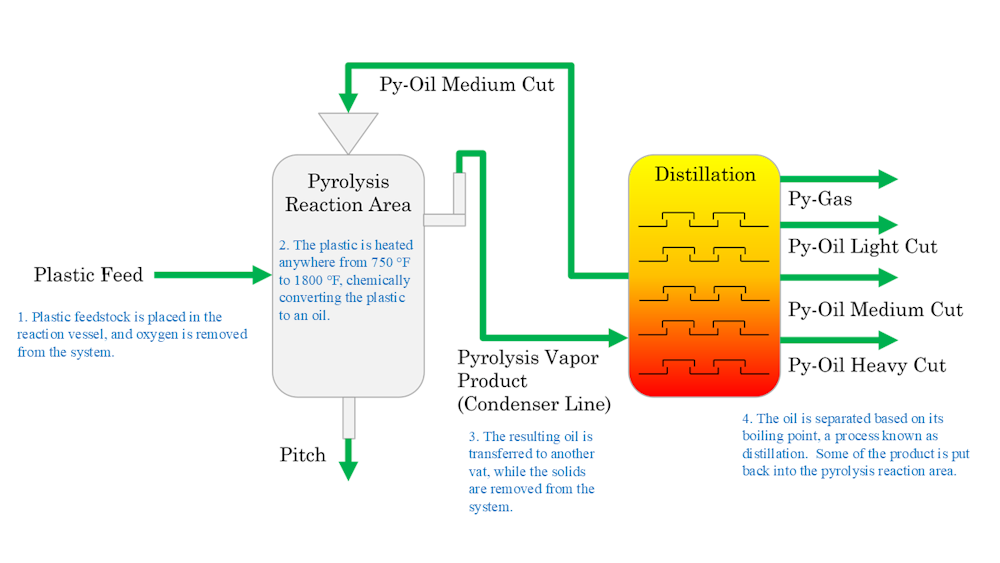
Plastic pyrolysis is a chemical process that involves chemically breaking down plastics into other molecules by heating the plastics to extremely high temperatures in the absence of oxygen.
Plastics are fed into the pyrolysis reactor, where they get hot and turn to oil. The oil moves to another vat where it’s boiled and distilled. Alexander Kaplitz and Kevin A. Schug
Unlike traditional plastic recycling, pyrolysis theoretically isn’t limited to specific types of plastic. It could be made to accommodate many of them, although current technology is limited to a few types – polyethylene and polypropylene, used in food containers and bottles – at an industrial scale.
So, plastic pyrolysis could help handle the waste from consumer products such as plastic bags, bottles, milk jugs, packaging materials, wet wipes and even discarded children’s toys. Pyrolysis can also handle more complex plastic waste such as tires and discarded electronics, although solid waste handlers and recyclers avoid certain plastic types in pyrolysis, such as polyvinyl chloride – or PVC, which is found in pipes and roofing products – and polystyrene, used in packaging, as these can create harmful byproducts.
During pyrolysis, the plastic polymers are broken down into smaller molecules, resulting in the production of liquid oil, fuel source gases such as methane, propane and butane, and char.
Char is the solid residue left at the end of the pyrolysis process. It can be used as a carbon-rich material for various applications, including adding it to soil to make it healthier for farming, as it increases soil moisture and pH, benefiting nutrient absorption. Char also has the ability to absorb harmful carbon gases from the air, which can help prevent climate change.
The main downside of char is if it’s used too much it can increase soil alkalinity, which may hinder plant growth.
Plastic pyrolysis uses heat to break down plastic, with the intent to convert plastic waste into usable materials.
How pyrolosis works
The plastic pyrolysis process typically involves several key steps.
In the first step of pyrolysis, community recyclers collect the plastic waste and clean it to remove any contaminants. The plastic then gets shredded into smaller pieces to facilitate the pyrolysis process. Unlike traditional recycling, it needs only minimal sorting.
Chemical recyclers operating pyrolysis plants feed the shredded plastic into a pyrolysis reactor, where they heat it to temperatures ranging from 600 to 1,600 degrees Fahrenheit (315 to 871 degrees Celsius). Without oxygen, plastics in the reactor don’t catch fire and emit fumes into the air. Instead, this high-temperature environment causes the plastic polymers to break down into smaller hydrocarbon molecules. These smaller molecules can be further refined.
The high temperature turns some molecules into vapors, which condense into liquid oil. Chemical companies can further refine this oil to be used as fuel or as a raw material to make other chemicals or plastics.
In addition to liquid oil, the pyrolysis process generates natural gases, such as methane, ethane, butane and propane. Pyrolysis operators then capture these gases, and they can sometimes use them as a source of energy to power the pyrolysis reactor or other industrial processes.
Plastic pyrolysis generates oil, which engineers can use to create new materials or fuels. BASF, CC BY-NC-ND
Benefits of pyrolysis
When done effectively, plastic pyrolysis offers several benefits.
By expanding recycling beyond just plastic bottles and milk jugs, pyrolysis could reduce the amount of plastic waste pollution that ends up in landfills and oceans.
Additionally, converting plastic waste into usable products could help lower the production demand for new plastics from petroleum hydrocarbons. The byproducts could get used in recycled plastics.
Some researchers are also testing pyrolysis oils to see whether they can use them instead of gasoline to fuel vehicles. The gases produced during pyrolysis can even generate energy that fuels the pyrolysis reactor, making the process more self-sustaining and reducing the need for external energy sources.
Currently, about 15% to 20% of the pyrolysis products are recycled into new propylene and ethylene, while most – about 80% to 85% – becomes diesel fuel, hydrogen, methane and other chemicals.
While plastic pyrolysis holds some promise, it also faces challenges. The cost of setting up and operating pyrolysis plants is high. How profitable the process is depends on the availability of suitable plastic waste, the market demand for the oils and gases produced, and the costs of energy and staff necessary to operate the reactor.
Another issue is quality control. Most plastic types can undergo pyrolysis, but different plastics create oils with different chemical makeups. Scientists will need to understand the composition of these oils before industry can determine which plastic types to focus on and how each oil could create new materials.
Pyrolysis oils have unique chemical compositions depending on the type of plastics used to create them. Alexander Kaplitz and Kevin A. Schug
Researchers like us at The University of Texas at Arlington and our international colleagues are studying new chromatography-based oil-separation techniques that can successfully identify some types of pyrolysis oils. Chromatography is the process of separating components in a mixture by passing them through a stiff material.
Different components in the mixture are attracted to this material to different degrees. So, they exit the chromatography system at different times, which separates them from one another.
With more research into the technique’s efficiency and technological advancements to scale up pyrolysis, this technique could be one part of a sustainable solution to plastic waste management. In the meantime, pyrolysis is being used now, with one report estimating the market for pyrolysis plants at US$40 billion in 2024 and predicting it to grow to $1.2 billion by 2033.
Kevin A. Schug receives funding from the National Science Foundation, the National Institutes for Health, ExxonMobil, and Weaver Consultants Group. He is affiliated with VUV Analytics, Inc. and Infinity Water Solutions as a member of their scientific advisory boards. Lummus Technology, LLC provided the funding for research on plastic waste pyrolysis oils at UT Arlington.
Alexander Kaplitz does not work for, consult, own shares in or receive funding from any company or organization that would benefit from this article, and has disclosed no relevant affiliations beyond their academic appointment.
Source: Saint Petersburg State University of Architecture and Civil Engineering – Saint Petersburg State University of Architecture and Civil Engineering –
From March 3 to 11, the qualifying round of the School Olympiad “All-Russian School TIM-Championship of SPbGASU” in the 2024/2025 academic year was held.
85 schoolchildren from grades 8–11 from 16 Russian regions took part in the selection: St. Petersburg, Leningrad, Nizhny Novgorod, Novgorod, Novosibirsk, Orenburg, Pskov, Sverdlovsk, Tver, Tula regions, Khabarovsk Krai, the Republics of Bashkortostan, Mordovia, Tatarstan, Khanty-Mansiysk and Yamalo-Nenets Autonomous Okrugs.
36 participants have been admitted to the final stage of the Olympiad, 11 of whom are not from St. Petersburg: they are representatives of Arzamas, Yekaterinburg, Kazan, Novosibirsk, Saransk, Surgut, Udomlya and Ulyanovsk. Six of them are eleventh-graders, 14 are tenth-graders, five are in the ninth grade and 11 are in the eighth.
21 of the main stage participants represent TIM classes of SPbGASU, opened in schools of St. Petersburg and Yekaterinburg.
The final stage of the Olympiad will be held in a mixed format (both in-person and remote participation is possible) at our university on March 26–28.
Please note: This information is raw content directly from the source of the information. It is exactly what the source states and does not reflect the position of MIL-OSI or its clients.
ATLANTA – Governor Brian P. Kemp today announced that TriNet is planning to create 750 new jobs at a new corporate center in Dunwoody over the next five years, representing an estimated $15.4 million in investment in DeKalb County.
“As the No. 1 state for business, one of the key drivers of our success is our metro Atlanta area that continues to attract a strong ecosystem of job creators like TriNet,” said Governor Brian Kemp. “TriNet’s services for small businesses will further that network while creating meaningful jobs and investment for the Dunwoody and DeKalb County community.”
TriNet provides comprehensive HR solutions, technology, expertise, and access to world-class benefits that enable small and medium-sized businesses (SMBs) to attract and develop top-tier talent.
“We look forward to opening a new TriNet office in metro Atlanta and becoming a part of this vibrant and growing business community,” saidMike Simonds, TriNet President and CEO. “We are excited to partner with Atlanta’s strong universities and thriving small business ecosystem as we expand our local team and establish a hub where TriNet colleagues from across the country can come together for training, development, and collaboration to better serve our customers.”
“At TriNet, our people are the heart of everything we do, and we are thrilled to expand our team here in metro Atlanta,” said Catherine Wragg, TriNet Chief People Officer. “This new office will help us attract top talent, foster our strong culture of collaboration and making an impact, and further invest in the professional growth of our colleagues. We are committed to creating a workplace where our colleagues can thrive and look forward to making a positive impact in this community.”
TriNet’s new approximately 150,000-square-foot space will be located in Dunwoody. The company will immediately begin hiring for technology, HR consulting, client management, and sales roles, with plans to leverage its increased presence to grow its regional Atlanta and Southeast customer base. To learn more about TriNet, including where interested individuals can apply for jobs, visitwww.trinet.com/about-us/careers.
“Dunwoody provides the ideal setting for TriNet, offering unparalleled access to the region’s talented workforce and a vibrant, mixed-use environment surrounded by top-tier restaurants, shops, and entertainment,” said Dunwoody Mayor Lynn Deutsch. “We are thrilled to welcome TriNet, whose investment will bring hundreds of new jobs to our community. This is another example of a growing company choosing Dunwoody.”
“TriNet’s investment in DeKalb County is a testament to the strength of our workforce, our infrastructure, and our commitment to fostering a thriving business environment,” said DeKalb County CEO Lorraine Cochran-Johnson. “The creation of 750 new jobs will bring invaluable opportunities to our residents while reinforcing DeKalb as a premier destination for corporate growth and innovation. We proudly welcome TriNet to our community and look forward to the positive impact this expansion will have on our local economy and workforce.”
“TriNet’s investment in DeKalb County will create jobs, drive innovation, and strengthen our economy,” said Katie Kirkpatrick, President and CEO of the Metro Atlanta Chamber. “With direct access to a pipeline of emerging talent from metro Atlanta’s renowned universities, TriNet is uniquely positioned to connect businesses with the next generation of HR and business professionals.”
Assistant Director of Statewide Projects John Soper represented the Georgia Department of Economic Development’s (GDEcD) Global Commerce team on this project in partnership with the City of Dunwoody, Decide DeKalb, Metro Atlanta Chamber, University System of Georgia, and Georgia Power.
“TriNet’s decision to locate in Georgia reflects the confidence companies have in the state as a hub for innovation, talent, and long-term success,” said GDEcD Commissioner Pat Wilson. “Strong partnerships between industry, communities, and higher education drive economic growth. We’re excited about the opportunities this investment will bring and congratulate Dunwoody and DeKalb County on this milestone. Welcome to Georgia, TriNet!”
About TriNet
TriNet provides small and medium-sized businesses (SMBs) with HR solutions and offers access to human capital expertise, benefits, risk mitigation, compliance, and payroll services, all enabled by industry-leading technology. TriNet’s suite of products also includes services and software-based solutions to help streamline workflows by connecting HR, benefits, employee engagement, payroll, and time and attendance. Rooted in more than 30 years of supporting entrepreneurs and adapting to the ever-changing modern workplace, TriNet empowers SMBs to focus on what matters most – growing their business and enabling their people. For more information, visit TriNet.com.
SCOTTSDALE, Ariz. and NASHVILLE, Tenn., March 18, 2025 (GLOBE NEWSWIRE) — Laffer Tengler Investments, Inc., a boutique investment management firm for high-net worth individuals, institutional clients and platform advisors is pleased to announce the addition of Mark Werner as Portfolio Manager and Strategy Team member of the Dividend Growth Strategy team. Werner brings with him over two decades of investment experience at asset and wealth management firms.
“Our dividend growth strategy is best in an important and unique strategy; we welcome Mark’s experience and market expertise,” says Nancy Tengler, CEO and CIO of Laffer Tengler Investments. “Adding Mark to our team will help expand our investment strategy offerings as well as add to the firms’ equity research efforts. His background offers the team additional expertise in portfolio management to benefit our valued clients.”
“Laffer Tengler’s proven model was immediately appealing,” says Werner. “I am excited to join the Laffer Tengler team to provide the firm’s clients with diversified and tailored investment strategies.”
Werner’s background includes building and developing asset allocation strategies, conducting in-depth fundamental equity research across global markets, and managing portfolios for both institutional and private clients. Throughout his career, he has held investment and portfolio management roles at firms such as Fred Alger Management, Merrill Lynch, Ashfield Capital Partners, and AXA Rosenberg Investment Management.
Werner holds a Bachelor of Science in Marketing from Arizona State University, a Master of Science in Financial Analysis and Investment Management from St. Mary’s College and is a CFA charter holder.
About Laffer Tengler Investments, Inc.
Laffer Tengler Investments, Inc., headquartered in Nashville, Tennessee, with national distribution and an office in Scottsdale, Arizona, is an asset management firm providing investment solutions to Institutional, Platform and high-net worth clients. The company is an investment advisor registered with the SEC, and it offers advisory services. Laffer Tengler Investments, Inc. is an affiliate of ButcherJoseph. Nancy Tengler, CEO and CIO, has been managing large cap value strategies for over 35 years. The investment team has an average of 20 years of experience in the investment management business.
Source: The Conversation – Africa – By Arthur Khomotso Mahuma, Economist and Researcher at the Centre for Competition, Regulation and Economic Development, University of Johannesburg
Poultry is one of the cheapest protein sources for the growing population of the east and southern Africa region. That makes soybeans critical to food security in the region, as they are an important input in chicken feed.
Soybean pricing and production dynamics have been challenging for Zambia and Malawi, threatening poultry production in the region.
Poultry feed makes up 60%-70% of the total cost of poultry production. Soybean prices directly affect the affordability of poultry and the ability of producers to be competitive. Small-scale independent poultry producers in particular have a hard time because they buy feed from the open market and are too small to determine prices. Large producers source feed from their own operations and determine soybean prices.
Figure 1: From soybeans to poultry
Zambia and Malawi are the key soybean producers in east and southern Africa. Both countries were hit hard in 2024 by climate change related weather and by the behaviour of players in the soybean market, including processors and traders.
Zambia’s soybean production fell by 74% because of poor rains and also because of farmers being squeezed. Large buyers had negotiated very low prices in previous years, so farmers planted less.
Malawi’s production also fell (20%), but much less than Zambia’s. Yet the surge in soybean prices in Malawi by 48% between May 2024 and November 2024 was out of proportion with the drop in production, and even surpassed Zambian prices (Figure 2). Malawian prices were the highest in the region, even though it produced enough to export.
We are economists at the African Market Observatory, which monitors prices of staple foods and conducts research on market dynamics. We analyse market concentration and barriers to entry, within and across countries in east and southern Africa, and we do in-depth field work.
Our work shows that competition issues, such as the ability of large buyers to influence prices and high margins, are at the heart of the surge in prices and low production in Malawi and Zambia. The climate-related weather effects are an additional factor.
Figure 2: Soybean prices in Zambia, Malawi and South Africa (benchmark) (3-month moving averages)
Market outcomes
In Zambia, dominant buyers of soybean offered farmers very low prices during the 2023 season – well below US$400/t and the South African benchmark (Figure 2). This meant that farmers planted less than half the 2023 crop in the 2024 season.
Crops were also affected by poor rainfall. Malawi’s 2024 production fell by 20% because of the worst drought in 100 years. The drop in production was lower than expected, demonstrating that farmers can adapt to weather changes. Prices still rose, however, driven by the highly concentrated soybean trading and processing market.
Cheapest source of proteins
Poultry is one of the cheapest sources of protein and has one of the lowest environmental impacts. It is essential that the value chain works well from feed to chicken rearing and becomes more resilient to extreme weather events.
The experience of 2024 shows what can go wrong.
Poultry demand in sub-Saharan Africa is expected to grow more than fourfold by 2050. Producers will need affordable feed.
Among them are many small-scale independent producers who rely on competitive markets for their inputs. Yet we found that with the escalating soybean and feed prices in Malawi from late 2021, and higher prices for day-old chicks, small independent producers had negative margins, meaning they made a loss in the second half of 2021. High feed prices undermine the competitiveness of Malawi’s poultry industry.
Aside from South Africa (which relies on genetically modified soybean), Zambia and Malawi have been the largest producers in the region. These countries have been exporting around half of their production (including soycake) to neighbouring countries with larger populations such as Tanzania and Kenya.
Zambia’s production plummet
Between 2020 and 2023, Zambia’s soybean production grew from 297,000 tonnes to 650,000 tonnes (Figure 3). In 2024, its production collapsed by 74% to 170,000 tonnes. This sharp decline was primarily due to farmers opting to plant less soybean because of the low prices offered from processors in 2023 (Figure 2). Farmers bought 50% less soybean seed for the 2024 season than the 2023 season.
In Zambia, soybeans are produced by many small farmers, so they compete to sell their crop to a few main processors in a concentrated market. As a result, these processors have greater power to influence the terms of trade, such as price. This was especially evident in 2023 when processors offered farmers lower prices (Figure 2).
Poor rainfall linked to the 2023/24 El Niño phase of the El Niño Southern Oscillation, which is the warming of the central to eastern tropical Pacific Ocean, causing drought in southern Africa while inducing heavy rainfalls and floods in eastern Africa, did have an impact across southern Africa, including Malawi and Zambia. While Kenya, Uganda and Tanzania recorded above average rainfall, their soybean output is low.
Resilience to climate change impacts requires deepening and diversifying agriculture production across countries and regional trade to meet demand.
Soybean prices in Malawi remain high but Zambia’s prices stabilise
Malawi’s prices increased rapidly to over US$700/tonne in June 2024, surpassing Zambia’s, and continued to rise to almost $900/tonne at the end of the year, far above other countries in the region. The reason couldn’t be reduced production from poor rainfall, because production still exceeded local demand. This happened even as the Malawi government put export restrictions on soybeans (but not soymeal). The price surge raises competition concerns in Malawi, where trading and processing is highly concentrated. In theory, highly concentrated markets are characterised by high prices, due to a lack of price competition.
By comparison, Zambia’s prices moderated because of imports. In addition, the low soybean prices offered to farmers in 2023 also meant that processors had crushed surplus soybeans, thereby building up soymeal stock. This reduced the demand for soybeans, as did power cuts in Zambia, which limited crushers’ operations.
Urgent next steps
Soybean developments over 2024 show the need to consider how competition issues within and across borders can undermine the resilience of regional food markets and hinder the ability of small producers to compete. Zambia is currently conducting a commercial poultry market inquiry. But a regional approach in monitoring markets and tackling anti-competitive conduct is necessary to support poultry production.
Arthur Khomotso Mahuma works for the African Market Observatory (AMO), an initiative of the Centre for Competition, Regulation and Economic Development (CCRED) at the University of Johannesburg. He is also a Competition Expert for the Shamba Centre for Food and Climate which has provided funding for CCRED’s for research on African Food Markets.
Namhla Landani works for the African Market Observatory (AMO), an initiative of the Centre for Competition, Regulation and Economic Development at the University of Johannesburg. The AMO receives funding from the Shamba Centre for Food and Climate for research on African Food Markets.
Children with disabilities face significant challenges in South Africa. Firstly there are delayed diagnoses which can lead to complications. The high cost of healthcare and little financial support for their families can limit their access to healthcare services altogether.
There is also little access to rehabilitation services. Inadequate facilities and a shortage of trained personnel are just some of the obstacles.
I started thinking about ways to get over these obstacles when I noticed that people with disabilities weren’t well represented in my sport.
As a competitive surfer and instructor, I had always celebrated the ocean’s ability to inspire confidence and resilience.
Every day, the beach was alive with activity – surfers, families and ocean lovers. Yet among them, I rarely saw people with disabilities in the water.
I began to notice that the beachfront itself, the infrastructure, the culture, and even my own surf school, weren’t actively creating space for inclusivity.
This would eventually become the cornerstone of the Roxy Davis Foundation, established in 2019, and later my doctoral research focusing on ocean-based therapy for children with disabilities.
I found surf therapy enhanced the mental, emotional, and physical well-being of these children.
New therapy
Surf therapy teaches people with disabilities to surf to promote psychological, physical and psychosocial well-being.
The first peer reviewed publication on surf therapy appeared in 2010 and focused on Aboriginal children in Australia. It was about mitigating the inter-generational trauma suffered as a result of the government-sanctioned removal of Aboriginal children from their families, a policy that only ended in the 1970s.
In 2020 a review of a 10-year period included 29 studies into war veterans and young adult cancer survivors, among others.
One such study focused on children with autism spectrum disorder. The study took place in the north-west of Ireland. Children said they felt happier and free, while their parents said they were more relaxed and confident.
A South African study with children with autism spectrum disorder explored the feasibility and unique benefits of an existing surf therapy programme and reported largely positive results.
My own research involved an adapted surf therapy programme for children with a range of disabilities.
Five children aged between 12 and 16 were enrolled. Altogether there were 35 participants including parents, counsellors, volunteers, physiotherapists and surf instructors.
Four of the five children were from under-resourced communities in South Africa’s Western Cape province and all had either a physical, sensory, intellectual or cognitive impairment.
None of the children had taken part in ocean sports before.
Getting into the water
For six weeks the children took part in a three-hour surf therapy session on a Friday afternoon.
The first goal was to get the kids in the water. We used mobility mats, surfboards with handles and amphibious beach wheelchairs to help.
Each child was taught now to surf according to their pace of learning and ability.
There was also a “surfers’ circle” with a discussion topic for each session.
After six weeks we conducted follow-up interviews to see what changes the children had experienced, and if these had any influence on their lives outside surfing.
We also asked parents and counsellors to identify the most significant changes in the children.
‘I felt free and confident’
Final interviews were completed one year later.
Charlie, aged 12, with cerebral palsy: “If my brothers want to go surfing I don’t have to stay behind and just watch them, I can go surf with them. It is so cool to surf with my dad and my brothers.”
Charlie’s teacher: “His self-awareness level and how he sees himself in the world has really improved.”
Tala, aged 15, with cerebal palsy: “Once I started surfing, I felt free and confident. Even in other spaces, when I’m not surfing, like, ‘Yeah I can surf, I can do something like surfing that I didn’t know that I could do before.’ ”
Tala’s school psychologist: “She went into this feeling very insecure, nervous and anxious. She said she will always remember who she was and how she felt before she went to the programme and how she came out of it … to be able to use that feeling and apply it to a different situation, that’s huge for her.”
Princess, aged 15, with spina bifida: was determined to “wean” herself off using nappies after gaining confidence through surf therapy.
Princess’s guardian described her experience as similar to “winning a gold medal … She was more confident in herself than ever. She is off that nappy completely now.”
Thabo, aged 14, a leg amputee: “Before session one, I was feeling nervous and excited, but as soon as I got in the sea, the nerves disappeared. You look and realise you can actually do that. I feel like I belong in the ocean.”
After the final session he said: “I can relax, I can be in control of my urges and my temper. I’m now not always thinking about what people think about me. I can be myself in many ways.”
Rowan, aged 15, a quadruple amputee: “Before I started surfing, I was thinking I can’t do it until I tried it and just being there was like beyond being able to speak in my wildest dreams. I couldn’t believe I could surf in the ocean riding some waves.
“On my first session, I was like ‘If I can do it, I can do it for the rest of my life’.”
In his second interview he said: “My goal is to become a national champion and to become a Paralympic champion.”
One year after the surf therapy programme he entered a provincial parasurfing competition, which he won. He was then selected to participate in the South African Para Surfing Championships in 2022, where he came second. Later that year he was selected to represent South Africa at the World Para Surfing Championships in California. Nineteen months after starting surfing, in December, on his 16th birthday, he competed in the World Championships and was placed 17th.
Surf therapy demonstrates what’s possible when we focus on ability rather than limitation.
Roxy Davis is affiliated with the Roxy Davis Foundation.
Source: The Conversation – Africa – By Assefa Leake Gebru, Assistant Professor of Political Science and Strategic Studies , Mekelle University
For over 20 years, Ethiopia was led by the Ethiopian People’s Revolutionary Democratic Front, a coalition of four ethnic-based political parties representing Tigray, Amhara, Oromo, and Southern nations, nationalities and peoples. The Tigray People’s Liberation Front was the most influential party within the coalition. However, in 2018, when the Prosperity Party came into power, the front lost its important role in government.
On 4 November 2020, the federal government launched an attack on Tigray, terming it a military offensive against political aggression from the Tigrayan front. This sparked a war that lasted two years, and caused severe damage to people and resources. The African Union’s lead mediator in the crisis, Olusegun Obasanjo, estimated about 600,000 civilians were killed. This makes it one of the most destructive conflicts of the 21st century.
On 2 November 2022, the Ethiopian government and the Tigray People’s Liberation Front signed a peace deal in South Africa, the Pretoria agreement. More than two years later, however, Tigray still faces immense political and humanitarian challenges. Assefa Leake Gebru, who has studied post-war Tigray, explains what’s happening.
What’s the current situation in Tigray?
The 2022-2022 war and its lingering effects have thrown the Tigray region into chaos. People are grappling to get basics like food, water and medicine. The regional economy was devastated by the war. There have been no rehabilitation and reconstruction efforts so far. Humanitarian aid is limited. Imagine if your local grocery store ran out of everything and couldn’t restock – that’s the situation I have witnessed and studied in Tigray, which is affecting millions of residents.
Additionally, the leaders of the Tigray People’s Liberation Front are now fighting among themselves for power. The division is mainly between two factions: one led by former regional president Debretsion Gebremichael and the other by Getachew Reda, who heads the interim administration.
In January 2025, leaders of Tigray’s military forces supported calls from the Debretsion faction for new regional leadership. The interim administration opposed this, calling it a soft coup. The federal government considers the political faction led by Debretsion illegitimate. The military leaders’ decision also sparked public protests, with Tigrayans calling for a separation between the military and politics.
This internal division has weakened the interim administration, which was installed as part of the Pretoria agreement in March 2023.
Given this situation, the interim administration remains fragile amid serious humanitarian concerns and security threats facing the region. The interim government and dysfunctional law enforcement institutions aren’t strong enough to fix things.
Economically, jobs remain scarce. A 2024 survey found a youth unemployment rate of 81%. This situation has been created by economic collapse, asset plunder during the war and the absence of a functioning government.
Socially, people are stressed and hurting, like a community still reeling from a major fallout. It’s a pile-up of problems that are making life incredibly tough.
What, exactly, is the Pretoria agreement?
The Pretoria agreement is an important peace deal between Tigray’s political leaders and the federal government. It was signed in Pretoria, South Africa, on 2 November 2022. The African Union facilitated the peace talks hosted by South Africa.
The goal of the agreement? End the violence that began in 2020, keep people safe by calling for an immediate cessation of hostilities, allow aid like food trucks to roll in, disarm Tigray fighters and set up an interim government to restore order.
It also aimed to re-establish the Ethiopian government’s control over federal installations in Tigray.
What has been implemented and what hasn’t?
There has been some positive progress. The Pretoria agreement established the interim government. Some everyday services are back, like banks reopening and planes flying again. A few Tigray fighters have put down their weapons.
But here’s where it gets messy. Soldiers from Eritrea – which supported the Ethiopian army in the Tigray war – and militias from another Ethiopian region, Amhara, are still hanging around Tigray, raising security threats. They’re preventing internally displaced persons from going back home.
The plan to fully disarm Tigrayan fighters hasn’t been completed either. This threatens regional stability, undermines peace efforts and increases the risk of renewed violence.
What are the implications of not fully executing the Pretoria agreement?
First, the region’s humanitarian crisis could worsen. An estimated one million displaced people are grappling with high levels of food insecurity, and thousands of schools remain closed. A weak interim government and the continued occupation of parts of Tigray by armed groups has hindered the restoration of services and stifled economic progress.
Second, the division within the Tigray People’s Liberation Front makes it hard to lead the region under an interim administration. A lack of consensus on power-sharing has hindered effective governance, undermining the intended transitional authority.
Third, a weak interim government can’t keep civilians safe, which was a pillar of the Pretoria agreement. Economically, the lack of jobs and skyrocketing prices are hitting Tigrayans hard. Socially, everyone’s on edge.
Finally, there’s a risk of igniting further conflict in the region along the political fault lines between Debretsion and Getachew. There is a high chance of this situation being manipulated by Eritrean forces, who weren’t involved in the negotiations that led to the Pretoria agreement. The fractures in the interim government provide an opportunity for neighbouring Eritrea to support one faction against the other, which could escalate into war between Ethiopia and Eritrea. The Tigray People’s Liberation Front has been one of Eritrea’s bitterest enemies. The antagonism between the two led to the 1998-2000 war between Ethiopia and Eritrea.
If these tensions keep up, Tigray will remain stuck in an awful cycle. The African Union and international community must address these issues to prevent a spiral into further chaos.
Assefa Leake Gebru does not work for, consult, own shares in or receive funding from any company or organisation that would benefit from this article, and has disclosed no relevant affiliations beyond their academic appointment.
Remember those lessons where you learned to use the formal “usted” with strangers and “tú” with friends? Well, the signs on Philadelphia’s streets show that Spanish speakers actually use pronouns differently.
In Spanish, unlike modern English, speakers must choose between different ways of saying “you” when addressing someone. Some Spanish dialects use up to four different forms – “tú,” “usted,” “vos” and the Colombian “sumercé” – but the Spanish speakers writing signs in Philadelphia have settled on just two: “tú” and “usted.”
But here’s where it gets interesting: In Philadelphia, the choice between these forms doesn’t follow the traditional rules we all thought we knew.
What the signs tell us
After analyzing 250 signs across three neighborhoods with a significant number of Spanish speakers – the Golden Block, in North Philadelphia; Olney, in North Philadelphia; and South Philadelpha’s Italian Market corridor – and online spaces such as social media from different Hispanic organizations in the city, I found some surprising patterns in how these forms are used.
Bilingual signs written in both Spanish and English tend to use the verb form associated with formal “usted” – imagine a store window announcing, “Please wear a mask / Por favor, utilice una mascarilla.” But signs written only in Spanish often use the informal “tú,” even when addressing strangers. This challenges the common assumption that we should always use formal language with people we don’t know.
My study suggests the purpose of the message matters more than formality. When signs make requests, they typically use “usted.” But when they’re trying to persuade or invite people to do something, “tú” is more common. A sign saying, “Please wait to be seated” typically uses “usted,” while one saying “Join us for our grand opening!” uses “tú.”
A city’s changing voice
Philadelphia’s Spanish-speaking history stretches back to the late 1800s, with waves of migration bringing distinct varieties of the Spanish language to the city.
What’s particularly noteworthy is the absence of “vos” in these signs, despite Philadelphia’s significant Salvadoran population who traditionally use this form. This suggests newer communities are adapting their language in signs to match the more established Spanish-speaking groups in the city.
Why this matters
These findings tell us something important about language in immigrant communities.
Rather than creating an entirely new dialect, Philadelphia’s Spanish speakers are finding common ground in how they communicate. It’s a reminder that language rules are often more flexible than we think, shaped by real-world use rather than textbook guidelines.
The next time you’re walking through Philadelphia’s Spanish-speaking neighborhoods, pay attention to the signs around you. They’re not just giving directions or advertising services – they’re showing us how language evolves when different communities come together in a new home.
Daniel Guarin does not work for, consult, own shares in or receive funding from any company or organization that would benefit from this article, and has disclosed no relevant affiliations beyond their academic appointment.
Source: Peter the Great St Petersburg Polytechnic University – Peter the Great St Petersburg Polytechnic University –
The Polytechnic University was included in the first group of universities to receive grants from the Priority 2030 program.
Following the meeting of the expert council of the Ministry of Education and Science of the Russian Federation, 119 universities out of 142 that submitted their updated development programs will receive grants from the Priority-2030 program for a total of 30.5 billion rubles. The largest funding of 1 billion rubles will be received by each first group universities, which included Polytechnic University.
Since 2025, the Priority 2030 university support program has been relaunched with a focus on achieving technological leadership in Russia by combining the efforts of the state, business, and universities to create joint projects. The updated Priority 2030 program includes 10 performance targets, including a new indicator — the integrated technological leadership index (ITL). ITL is calculated based on the volume of extra-budgetary R&D and scientific and technical services, commercialization of intellectual property, and the work of small innovative enterprises.
Each university included a section on “Strategic Technology Leadership” in its comprehensive development program, identifying three strategic technology projects.
The main emphasis in the Polytechnic University Development Program is on the systemic development of a qualified partnership model in all basic processes of the university. The SPbPU team will solve the task of ensuring technological leadership by focusing on three key scientific and technological areas (KST):
KNTN-1 “System Digital Engineering” – development of technologies and products superior to foreign analogues, based on digital twin technology andCML-Bench® Digital Platform; KNTN-2 “New Materials, Technologies, Production” – creation of science-intensive production for repair and manufacture of products for various purposes; KNTN-3 “Artificial Intelligence for Solving Cross-Industry Problems” – development of digital platform solutions for analyzing multimodal data.
“I congratulate the entire Polytechnic staff onsuccessful defense of our Development Program and inclusion in the first group of leading universities. This is the result of our coordinated work on the successful implementation of the projects of the Priority 2030 program, the programs of the World-Class Scientific Center, the NTI Competence Center and the Advanced Engineering School, then on the development of the SPbPU Development Strategy, which has undergone a comprehensive examination, including obtaining an expert opinion from the Russian Academy of Sciences, – commented the rector of SPbPU, academician of the Russian Academy of Sciences Andrey Rudskoy. – The approved Development Strategy forms the basis of the Development Program of our university until 2030 and in the long term until 2036. Formed teams with competencies and experience in solving breakthrough scientific and technological problems, created scientific and scientific-technological groundwork and established effective qualified partnership with industry both in solving frontier engineering problems and in training engineering personnel for high-tech industry will help us achieve all the indicators of the updated Priority-2030 program and make a breakthrough in the scientific and technological sphere aimed at ensuring technological leadership.”
Please note: This information is raw content directly from the source of the information. It is exactly what the source states and does not reflect the position of MIL-OSI or its clients.
PALO ALTO, March 18, 2025 (GLOBE NEWSWIRE) — Pivotal, the market leader in light electric vertical takeoff and landing (eVTOL) aircraft, today announced the appointment of Marjorie Dickman to its board of directors. A global government affairs and geopolitical expert, Ms. Dickman is consistently recognized among the nation’s top public policy executives and top women in technology. For decades, she has led corporate strategies that navigate complex regulatory landscapes in the U.S. and abroad – creating opportunities, managing risk and growing market share.
“We are thrilled to welcome Marjorie to Pivotal’s Board of Directors. Her wisdom of U.S. and global government affairs and her deep business acumen in the emerging tech and transportation sectors are invaluable to our growth,” said Ken Karklin, Chief Executive Officer, Pivotal. “This is an exciting time for Pivotal. Our aircraft offer a new way to experience flight, and our aero architecture is ready for public safety and defense use cases.”
“I am excited to join the board and delighted that my extensive experience in tech and transportation innovation aligns with Pivotal’s mission,” said Marjorie Dickman. “I am especially pleased that my regulatory expertise in navigating global market access and competition can be an asset for Pivotal’s growth in the eVTOL market.”
About Marjorie Dickman Ms. Dickman is a highly seasoned government affairs expert and attorney, based in Washington, D.C.
She built her career leading government engagement and communication strategies for multinational technology companies – with a focus on rapidly evolving sectors like AI, automated and connected vehicles, cybersecurity, data privacy, Internet of Things (transport, energy, manufacturing), and secure communications for defense and first responders. Her track record of success building trusted government relationships, influencing public policy, and navigating regulatory and legal frameworks has earned numerous accolades. Examples include “Tech Titan” Policy Influencer, Global HERoes Role Model, and Most Powerful Women in Tech.
As BlackBerry’s first Chief Government Affairs and Public Policy Officer and direct report to the CEO/Executive Chairman, Ms. Dickman opened the company’s Washington, D.C. office in 2020. She built BlackBerry’s Global Government Affairs and Public Policy organization from the ground up, including the company’s Government Relations and Technical Standards teams operating in the U.S., Canada, EMEA, the UK, LATAM, and APJ.
Prior to BlackBerry, Ms. Dickman led a highly successful 16-year career at Intel Corporation – most recently launching and leading global government affairs for two of Intel’s most ‘disruptive’ businesses: Automated Driving and the Internet of Things – where she managed teams across the U.S., EMEA, China and Japan. Prior to Intel, she practiced law at a prominent Washington firm, specializing in telecom regulation and M&A.
Ms. Dickman has been appointed to the Boards of the Eno Center for Transportation, Consumer Technology Association (CES), U.S. Chamber of Commerce’s Technology Engagement Center and Cybersecurity Leadership Council, No. Virginia Technology Council, and George Mason University’s College of Engineering and Computing. She is an honors graduate of Georgetown University Law Center (J.D.) and Duke University (A.B., Public Policy).
About Pivotal Pivotal designs, develops, and manufactures light eVTOL aircraft. An industry pioneer, Pivotal is renowned for the BlackFly, the first light eVTOL to be commercially available and delivered to customers in the United States. In October 2023, Pivotal introduced its next generation production aircraft, the Helix, and in January 2024 began sales of the Helix. The company’s distinctive tilt-aircraft architecture and scalable technology platform have been under continuous improvement for well over a decade, and today, Pivotal has the most mature technology in the light eVTOL category. Efficient, compact, and simple, Pivotal vehicles are designed for a wide range of consumer, public safety, and defense applications. The company is headquartered in Palo Alto, CA. For videos and more information, visit https://pivotal.aero.
Source: State University of Management – Official website of the State –
In accordance with the initiative of the Ministry of Science and Higher Education of the Russian Federation, a mother and child room has been opened at the State University of Management. This step is part of a federal program, within the framework of which about a thousand such important rooms should be created in Russian universities by 2030.
The mother and child room at the State University of Management is designed to create comfortable conditions for students and university employees raising children. All conditions for comfortable time spending by mothers with children are met here: a cozy interior, necessary furniture, as well as the possibility of holding events aimed at early career guidance for children.
“Caring for children and families of students is an important aspect of the formation of the future economy of our country. Supporting young parents and creating favorable conditions for raising children contribute to the development of human capital,” said Vladimir Stroyev, Rector of the State University of Management.
In 2024, about 40 mother and child rooms were opened in the country, and this process will continue.
At the State University of Management, the mother and child room is located in the right wing of the 1st floor of the Main Academic Building. Absolutely anyone can take the key at the security post at the entrance. Working hours: according to the GUU schedule.
The State University of Management actively supports initiatives aimed at creating a family and ensuring a harmonious combination of study and motherhood, which contributes not only to improving the living conditions of students, but also to improving the quality of the educational environment.
SUM continues to strive to develop an inclusive and supportive atmosphere for all participants in the educational process, which is an important step towards improving higher education in Russia.
Subscribe to the TG channel “Our GUU” Date of publication: 03/18/2025
Please note: This information is raw content directly from the source of the information. It is exactly what the source states and does not reflect the position of MIL-OSI or its clients.
Source: Saint Petersburg State University of Architecture and Civil Engineering – Saint Petersburg State University of Architecture and Civil Engineering – Alexander Kolpakov
Representatives of the North-West Office of the Federal Service for Environmental, Technological and Nuclear Supervision (Rostekhnadzor) met with students to tell them about their activities and employment opportunities for young professionals.
“The demand for specialists capable of ensuring reliable, uninterrupted operation of energy facilities and safety of technological processes is growing. State inspectors who carry out control and supervisory activities play a key role in this. Practice shows that some of those who receive higher education today will not work in their chosen specialty and in the industry as a whole. Today’s meeting is educational in nature for future specialists in the energy sector who can link their professional activities with the field closest to their specialty,” said Alexander Kolpakov, Deputy Head of the Department for State Energy Supervision of Consumer Electrical Installations of the North-West Department of the Federal Service for Environmental, Technological and Nuclear Supervision (in the sphere of state energy supervision).
He explained that the North-West Department of Rostekhnadzor carries out state control and supervision in industrial safety, safety of hydraulic structures, electric power industry, construction in St. Petersburg, Leningrad, Arkhangelsk, Vologda, Kaliningrad, Murmansk, Novgorod, Pskov regions and the Republic of Karelia. In the sphere of state energy supervision, inspectors conduct inspections of legal entities and individual entrepreneurs for their compliance with reliability and safety requirements, regulatory legal acts within their competence. They are among the first to go to the largest and most significant facilities in order to subsequently issue a permit for the commissioning of electrical installations. Among such facilities are the most technologically advanced stadium in the country, Gazprom Arena, the new multifunctional sports complex SKA Arena, the northernmost skyscraper in the world, Lakhta Center, and the metro.
“Everything is developing rapidly today: new technologies are being introduced, modern materials are being used, unique facilities are being built, and it is very interesting to work in our field. Public service differs from civil work due to requirements and restrictions. The main requirements are: Russian citizenship, reaching the age of eighteen, and proficiency in the state language. You can become a specialist expert, senior or chief inspector, department head or deputy only if you have a higher education. Support specialists only need to have a secondary vocational education. There are no requirements for experience: inspectors can be recruited directly from their studies, and students can undergo industrial training,” concluded Alexander Kolpakov. The conversation about work, including at large, well-known facilities, interested the students not only in terms of employment, but also in terms of organizing energy supply to them.
Please note: This information is raw content directly from the source of the information. It is exactly what the source states and does not reflect the position of MIL-OSI or its clients.
Source: Novosibirsk State University – Novosibirsk State University –
March 17 NSU Advanced Engineering School “Cognitive Engineering” held an interregional conference “Engineering education in school: real cases and best practices”. The event was attended by more than 40 teachers of additional education from the Novosibirsk, Omsk and Irkutsk regions.
The opening of the conference was addressed by the Director of the Advanced Engineering School of NSU, Sergei Golovin:
— It is no secret that filling engineering activities with projects involving the real sector of the economy is what our state and region encourage, so that children, having entered universities and studied, become engineers who will create technological independence for Russia. The goal of today’s conference is to discuss how to properly build an engineering methodology in schools, how to involve local industry in projects, and decompose enterprise tasks for school projects. Today, NSU PISH presents the final of the additional professional education program for teachers and mentors who have already prepared their real cases, which they will implement in their territory.
Leading experts in the field of additional secondary vocational education presented reports on best practices and modern approaches to the implementation of school engineering projects and the interaction of educational institutions with industrial partners. The main goal of the conference was to exchange knowledge and skills in the field of involving schoolchildren in engineering activities, as well as discuss strategies that contribute to the successful implementation of school projects and the establishment of strong partnerships with industrial companies.
Among the leading speakers are Svetlana Yakovleva, Head of the Department of Educational Policy in the Sphere of General Education of the Ministry of Education of the Novosibirsk Region. The conference also featured Natalia Gornostaeva, Head of the Altair Regional Center, Maya Gichgeldieva, Director of the Education Foundation, and co-founder of the Garage Tesla project Sergey Salnikov.
The representative of the Ministry presented general information on the development of engineering activities in the Novosibirsk Region. At present, there are 81 general education organizations in the region, where there are engineering classes. There are also 119 institutions of additional education in the Novosibirsk Region, where children can engage in technical creativity. Among them are children’s technology parks.
Within the framework of the national project “Youth and Children”, 382 centers of education in natural sciences and technology were implemented, which covered more than 2,600 children. In 2024, on the basis of ten organizations of additional education, engineering and technical circles were created for joint educational and industrial activities of children and adults.
Concluding her speech, Svetlana Yakovleva emphasized:
— Technical education is certainly a priority in the education system of the Novosibirsk Region. I am confident that the support measures implemented by the Ministry of Education of the Region will improve the quality of training of graduates and engineering personnel for the industry of the Novosibirsk Region.
An important part of the conference was the presentations by graduates of the program “Methodological and technical support for additional education programs for children in engineering, technology and natural sciences” from the Advanced Engineering School of NSU – these are teachers of additional education from the Novosibirsk and Omsk regions.
The program graduates presented roadmaps for the comprehensive implementation of additional education programs in technical areas: microelectronics and unmanned systems. The teachers presented projects for the implementation of programs that will stimulate schoolchildren’s interest in engineering, and also shared plans for interaction with high-tech enterprises to set engineering tasks and adapt them for schoolchildren.
Following the conference, proposals were formulated for further coordination of actions between representatives of additional education on the issue of developing engineering in the school environment.
Please note: This information is raw content directly from the source of the information. It is exactly what the source states and does not reflect the position of MIL-OSI or its clients.
MIAMI, March 18, 2025 (GLOBE NEWSWIRE) — Captivision Inc. (“Captivision” or the “Company”) (NASDAQ: CAPT), a pioneering manufacturer and global LED solution provider, today announced the appointment of Richard “Ric” Clark to its Board of Directors, effective immediately. Mr. Clark will serve as Chair of the Company’s Compensation Committee and also join the Nominating and Corporate Governance Committee, bringing decades of executive leadership and corporate governance expertise to the Company.
Mr. Clark has nearly four decades of real estate, M&A and capital markets experience. He is founder of Burnside Investments, a private investment company, co-founder of WatermanClark, a real estate investment partnership, and a board member of public and private companies in industries including retail, sports and entertainment. Previously, he spent three decades at Brookfield Corp. and its predecessors, serving in various leadership roles, including Chairman and Chief Executive Officer of Brookfield Property Group, Brookfield Property Partners and Brookfield Office Properties. Under his leadership, Brookfield’s real estate group grew its assets under management from $5 billion to more than $200 billion and expanded globally across the property spectrum.
“We are delighted to welcome Ric to Captivision’s Board of Directors,” said Gary Garrabrant, Chairman and CEO of Captivision. “Ric brings an unparalleled experience building and leading one of the world’s largest and most respected real estate companies. His accomplishments as an entrepreneur are equally distinguished as well as his relationships with decision makers globally.”
Mr. Clark holds a Bachelor of Science from Indiana University of Pennsylvania.
About Captivision
Captivision is a pioneering manufacturer of media glass, combining IT building material and architectural glass. The product has a boundless array of applications including entertainment media, information media, cultural and artistic content as well as marketing use cases. Captivision can transform any glass façade into a transparent media screen with real time live stream capability. Captivision is fast becoming a solution provider across the LED product spectrum.
Captivision’s media glass and solutions have been implemented in hundreds of locations globally across sports stadiums, entertainment venues, casinos and hotels, convention centers, office and retail properties and airports. Learn more at http://www.captivision.com/.
Cautionary Note Regarding Forward-Looking Statements This press release contains forward-looking statements within the meaning of the Private Securities Litigation Reform Act of 1995, as amended. These forward-looking statements include, without limitation, statements relating to expectations for future financial performance, business strategies, or expectations for the Company’s respective businesses. These statements are based on the beliefs and assumptions of the management of the Company. Although the Company believes that its plans, intentions and expectations reflected in or suggested by these forward-looking statements are reasonable, it cannot assure you that it will achieve or realize these plans, intentions or expectations. These statements constitute projections, forecasts, and forward-looking statements, and are not guarantees of performance. Such statements can be identified by the fact that they do not relate strictly to historical or current facts. When used in this press release, words such as “believe”, “can”, “continue”, “expect”, “forecast”, “may”, “plan”, “project”, “should”, “will” or the negative of such terms, and similar expressions, may identify forward-looking statements, but the absence of these words does not mean that a statement is not forward-looking.
The risks and uncertainties include, but are not limited to: (1) the ability to raise financing in the future and to comply with restrictive covenants related to indebtedness; (2) the ability to realize the benefits expected from the business combination and the Company’s strategic direction; (3) the significant market adoption, demand and opportunities in the construction and digital out of home media industries for the Company’s products; (4) the ability to maintain the listing of the Company’s ordinary shares and warrants on Nasdaq; (5) the ability of the Company to remain competitive in the fourth generation architectural media glass industry in the face of future technological innovations; (6) the ability of the Company to execute its international expansion strategy; (7) the ability of the Company to protect its intellectual property rights; (8) the profitability of the Company’s larger projects, which are subject to protracted sales cycles; (9) whether the raw materials, components, finished goods, and services used by the Company to manufacture its products will continue to be available and will not be subject to significant price increases; (10) the IT, vertical real estate, and large format wallscape modified regulatory restrictions or building codes; (11) the ability of the Company’s manufacturing facilities to meet their projected manufacturing costs and production capacity; (12) the future financial performance of the Company; (13) the emergence of new technologies and the response of the Company’s customer base to those technologies; (14) the ability of the Company to retain or recruit, or to effect changes required in, its officers, key employees, or directors; (15) the ability of the Company to comply with laws and regulations applicable to its business; and (16) other risks and uncertainties set forth under the section of the Company’s Annual Report on Form 20-F entitled “Risk Factors.”
These forward-looking statements are based on information available as of the date of this press release and the Company’s management team’s current expectations, forecasts, and assumptions, and involve a number of judgments, known and unknown risks and uncertainties and other factors, many of which are outside the control of the Company and its directors, officers, and affiliates. Accordingly, forward-looking statements should not be relied upon as representing the Company management team’s views as of any subsequent date. The Company does not undertake any obligation to update, add or to otherwise correct any forward-looking statements contained herein to reflect events or circumstances after the date they were made, whether as a result of new information, future events, inaccuracies that become apparent after the date hereof or otherwise, except as may be required under applicable securities laws.
DALLAS, March 18, 2025 (GLOBE NEWSWIRE) — Today, Nasdaq will convene top leaders across the Texas economy to celebrate the legacy of Ross Perot Jr. and to discuss strategies for the state’s continued economic prosperity. The event will showcase Perot’s role in driving Texas’ economic success and emphasize the vibrant innovation ecosystem that has been developed under Governor Greg Abbott’s tenure.
“Ross Perot Jr. has been a steadfast advocate for the entrepreneurship and investment that have reshaped the Texas economy. From leading trailblazing developments such as the expansive AllianceTexas project to being a co-founder of Perot Systems, Ross has been a bedrock of the Texas business community and a major contributor to the state’s phenomenal success,” said Adena Friedman, Chair and CEO of Nasdaq. “His dedication to fostering growth through investments in innovative companies and his decades of philanthropic work embody the values Nasdaq is proud to recognize through this award. We thank Ross for his remarkable contributions and Governor Abbott for his tireless leadership in building an economic ecosystem that has become a global epicenter for growth and innovation.”
The convening will also feature a keynote speech by Governor Abbott, who will underscore the historic achievement of the “Texas Miracle,” the state’s tremendous economic growth over the past 20 years. Texas’ success is deeply rooted in its culture of risk-taking, hard work, and entrepreneurial spirit—evolving from a legacy of resource-driven wealth into a diversified, business-friendly economy. With forward-thinking investments in infrastructure and education, and a strong, growing population, Texas continues to lead nationally in job creation, business expansion, and economic dynamism.
“Visionaries like Ross Perot Jr. prove that Texas is the blueprint for American success,” said Governor Greg Abbott. “I’ve known Ross for many years and am proud to call him a great friend. He is a true Texas pioneer whose work in real estate, oil and gas, aviation, and economic development created hundreds of good-paying jobs for hardworking Texans. Entrepreneurs like Ross know that they live in a state where they can cast a vision and achieve it. By continuing to work together, Texas will remain the beacon of economic opportunity and prosperity for generations.”
To celebrate the economic miracle that has positioned Texas as a national and global powerhouse, Nasdaq will present Ross Perot, Jr., Chairman and CEO of Hillwood and the Perot Company, the inaugural Nasdaq Lifetime Achievement Award. The award recognizes Mr. Perot’s unparalleled contributions to the Texas economy and his lasting impact on innovation, technology, economic prosperity, and community development.
In 1989, Mr. Perot spearheaded the development of Fort Worth Alliance Airport, the nation’s first industrial airport, through a groundbreaking public-private partnership. This project became the cornerstone of AllianceTexas, a 27,000-acre master-planned, mixed-use community in North Texas. Today, AllianceTexas serves as a global leader in logistics and innovation, anchored by the AllianceTexas Mobility Innovation Zone, an integrated ecosystem for surface and air mobility technology to scale and commercialize. Since its inception, AllianceTexas has generated more than $120 billion in regional economic impact.
Mr. Perot also co-founded Perot Systems Corporation in 1998 with his late father, where he served in various leadership roles, including CEO, Chairman of the Board, and member of its Board of Directors. The company revolutionized the use of information technology in industries like healthcare and was acquired by Dell Inc. in 2009. Following the acquisition, Mr. Perot served on Dell’s Board of Directors until 2013. Through Perot Jain, his venture capital firm, Mr. Perot continues to invest in innovative companies that redefine industries and drive technological progress.
As an aviation enthusiast and a former fighter pilot in the U.S. Air Force, Mr. Perot chaired the U.S. Air Force Memorial Foundation, leading a 14-year effort to construct the United States Air Force Memorial in Washington, D.C. In addition to his business and philanthropic achievements, Mr. Perot holds several key leadership roles. He serves as Vice Chairman of the Board of Directors for the U.S. Chamber of Commerce and is a board member of the American Enterprise Institute (AEI) and the Hoover Institution. He also holds Board Member Emeritus positions with Vanderbilt University and the Smithsonian National Air and Space Museum.
About Nasdaq Nasdaq (Nasdaq: NDAQ) is a leading global technology company serving corporate clients, investment managers, banks, brokers, and exchange operators as they navigate and interact with the global capital markets and the broader financial system. We aspire to deliver world-leading platforms that improve the liquidity, transparency, and integrity of the global economy. Our diverse offering of data, analytics, software, exchange capabilities, and client-centric services enables clients to optimize and execute their business vision with confidence. To learn more about the company, technology solutions, and career opportunities, visit us on LinkedIn, on X @Nasdaq, or at www.nasdaq.com.
About Ross Perot, Jr. and Hillwood Ross Perot Jr. is Chairman of The Perot Companies, overseeing family interests in real estate, oil and gas, and financial investments, and of Hillwood, a global real estate firm he founded in 1988. He developed Fort Worth Alliance Airport, the nation’s first industrial airport, anchoring a 27,000-acre mixed-use community generating over $120 billion in economic impact. Perot co-founded and served on the boards of Perot Systems and Dell. Currently, he is Vice Chairman of the U.S. Chamber of Commerce and serves on the boards of the Hoover Institution and the American Enterprise Institute.
Source: State University Higher School of Economics – State University Higher School of Economics –
The Olympiad is organized by Rosfinmonitoring jointly with the Ministry of Education and Science and the Ministry of Education of Russia, as well as universities of the International Network Institute in the field of AML/CFT, including the Higher School of Economics. This year, HSE experts took methodological part in developing the tasks of the invitational round. Schoolchildren and students who registered for the selection round before March 30 are allowed to participate.
International Financial Security Olympiad — is an intellectual competition that is held annually on the instructions of the President of the Russian Federation Vladimir Putin. Its main objectives include popularizing financial security as a norm of life, minimizing the risks of involving young people in illegal activities and forming a new type of thinking: from the financial security of an individual to the financial security of the state and the commonwealth of states. Over the four years of its existence, the Olympiad has already united over 6 million people from 36 countries!
The Olympiad is held for students in grades 8–10 in the unified profile “financial security” based on such school subjects as mathematics, computer science and social studies, and for students (1–3 years of bachelor’s degree, 1–4 years of specialist degree and 1st year of master’s degree) — in separate areas of training:
jurisprudence;
Mathematics, Applied Mathematics and Computer Science, Applied Mathematics, Mathematics and Computer Science, Fundamental Computer Science and Information Technology, Computer Science and Computer Engineering, Applied Computer Science, Information Security, Business Computer Science;
economics, finance and credit, economic security;
international relations, foreign regional studies.
The International Financial Security Olympiad is held in several stages. The first of them is an invitational one, which allows you to get acquainted with the format of the tasks, study additional materials and prepare for the new cycle. The second stage is a qualifying one. It is organized in the form of two rounds – from March 31 to April 4 and from April 9 to 15 – in an online format using the Sodruzhestvo platform. You can start completing the tasks only after registration, which must be completed before March 30.
The third important stage is the qualification stage, which is scheduled for the period from August 1 to September 3.
The final will take place from September 28 to October 3 at the Siberian Federal University (Russia, Krasnoyarsk).
Winners and prize winners of the Olympiad will receive advantages when entering a university and offers for practical training and internships with the possibility of further employment from Rosfinmonitoring, the Bank of Russia, PAO Promsvyazbank, MUMCFM, leading financial organizations and partners. Schoolchildren who show high results will be able to enroll in a bachelor’s/specialist’s degree at the Higher School of Economics without entrance examinations or get 100 points for the entrance examination. The benefits apply to the programs of the National Research University Higher School of Economics in Moscow.Information security“, “Computer security” And “Jurisprudence: Digital Lawyer“, as well as to the relevant programs in Nizhny Novgorod And Perm.
“We invite students not only to test themselves by participating in the Olympiad, but also to delve into the issues of financial security in more detail! For this purpose, in 2025 we are launching a minor”Financial Security and Computer Investigations”. You will be able to obtain the necessary knowledge base and form a framework of important legal, financial and digital competencies, and upon completion – an official document confirming the additional qualification received. Thanks to this, new career opportunities in this field will open up for you,” comments Alexander Chepovsky, Director of Strategic Work with Applicants.
The micro-qualification obtained by the minor is “specialist (expert) in the field of financial and information security”. It will allow you to be a sought-after employee in the corporate sector, government agencies, budgetary organizations and non-profit organizations.
Minor Selection Campaign will take place in the near future: March 20 and 21 – the first wave, March 25 – the second.
Please note: This information is raw content directly from the source of the information. It is exactly what the source states and does not reflect the position of MIL-OSI or its clients.
Source: United Kingdom – Executive Government & Departments
News story
Energy Secretary visits China to launch climate dialogue
Ed Miliband resumes formal energy and climate talks with China
Energy Secretary Ed Miliband met his Chinese counterparts in Beijing this week to re-start formal energy and climate discussions and demonstrate global climate leadership.
On Saturday (15 March) the Secretary of State met Chinese Minister Huang at the Ministry of Ecology and Environment. They discussed strengthening cooperation on climate issues such as nationally-determined contributions (NDCs) looking ahead to COP30.
He then travelled to Tsinghua University where he spoke to students about UK action and global cooperation on climate change as part of the university’s climate lecture series.
On Sunday (16 March), the Energy Secretary visited Carbon Capture and Storage (CCUS) and hydrogen power projects in Energy Valley, an area which drives the development of clean energy technologies in the country.
He then met with British business representatives based in Beijing, to hear about the opportunities and challenges for business and how the UK can support in increasing UK clean energy exports to drive growth and create jobs.
On Monday (17 March), the Secretary of State visited China’s National Energy Administration to engage in a formal UK-China Energy Dialogue. Along with Administrator Wang, he led discussions focused on clean energy technologies, pathways to the energy transition including phasing out coal, energy security and international energy governance.
At the end of the meeting, Ed Miliband signed the Clean Energy Partnership Memorandum of Understanding (MoU) with Administrator Wang, which agrees to enhance cooperation on renewables, grid modernisation and clean technologies, while protecting the UK’s national security.
The visit concluded with a visit to the Great Hall of the People, where the Energy Secretary met Chinese Vice Premier Ding Xuexiang to agree to continue cooperation on energy and climate. The Secretary of State also took the opportunity to raise the UK government’s concerns on issues including Russia, forced labour and Jimmy Lai.
Energy Secretary Ed Miliband said:
We can only keep future generations safe from climate change if all major emitters act. It is simply an act of negligence to today’s and future generations not to engage China on how it can play its part in taking action on climate.
That is why I met Chinese ministers for frank conversations about how both countries can fulfil the aims of the Paris Climate Agreement, to which both countries are signed up.
Our Plan for Change and clean energy superpower mission is about energy security, lower bills, good jobs and growth for the British people. It is with this mission that we can also influence climate action on a global stage, fight for our way of life and keep our planet safe for our children and grandchildren.
Source: State University of Management – Official website of the State –
On April 16–18, 2025, the State University of Management will host the International Scientific and Practical Conference “State and Municipal Administration in the Context of the Implementation of National Development Goals of Russia.”
We invite representatives of government bodies, the scientific community, business, the media and all interested parties to participate.
The conference program includes plenary sessions, thematic sections and competition events. Among the key areas: strategy of population saving, digital transformation of public administration, development of urban infrastructure, competitive economy and technological leadership, historical experience and modern challenges of public authority, the future of local self-government in Russia.
The conference includes the following:
Work of seven thematic sections with participation of leading experts; XI All-Russian competition “History of local self-government”; Final of the competition of student projects “Managers: new generation”; Open competition for schoolchildren “If I were the head of the city (district)”; Meetings of sections of young scientists.
Participants will be able to publish the results of their research in the conference proceedings (RSCI) or the thematic issue of the journal “Vestnik RUDN: Public and Municipal Administration” (VAK, K2).
For publication, it is necessary to comply with the requirements for the design and originality of the text.
Participation is free. Mandatory registration is available until April 14, 2025.
A detailed program, publication conditions and contact information of the organizing committee are available on the official website of the conference: https://конфериягуу.рф/
Contacts for inquiries: Mikhail Borisovich Polyakov: 7(929) 613-29-29, mb_polyakov@guu.ru.
Join the dialogue on Russia’s development strategies in the context of global challenges!
Subscribe to the TG channel “Our GUU” Date of publication: 03/18/2025
Please note: This information is raw content directly from the source of the information. It is exactly what the source states and does not reflect the position of MIL-OSI or its clients.
Source: State University of Management – Official website of the State –
The award ceremony will take place at the Open Day at the Information Technology Center of the State University of Management on March 23, 2025. It will start at 12:00.
The All-Russian scientific and practical tournament “Hi-Tech Breakthrough” started in the fall and was held in three stages. Its results were summed up last week. 180 participants from Russia, Tunisia, Kazakhstan, Belarus, Mali, Afghanistan, Iran, the Philippines, Sudan, Israel, Uzbekistan, Tajikistan, Congo, Turkmenistan, India, Vietnam and other countries demonstrated their talents in marketing.
Based on the results of the final, foreign citizens who showed the best results were recommended for admission to the Master’s program “High-Tech Marketing” of the Institute of Marketing within the quota approved by the Government. This year it was 60 places.
The finalists of the Tournament among Russians will also receive a pleasant bonus – additional points await them when they enter the “High-Tech Marketing” program.
Congratulations to the winners, we wish them successful admission to the Master’s program and a great career in marketing! And we are waiting for everyone who wants to try their hand at the Tournament of the next season, which starts on November 1.
Subscribe to the tg channel “Our State University” Announcement date: 03/18/2025
Дне открытых дверей в Центре информационных технологий ГУУ 23 марта 2025 года. Начало в 12.00….” data-yashareImage=”https://guu.ru/wp-content/uploads/Хай-тек-прорыв-2024-1.jpg” data-yashareLink=”https://guu.ru/%d0%b3%d1%83%d1%83-%d0%bf%d1%80%d0%b8%d0%b3%d0%bb%d0%b0%d1%88%d0%b0%d0%b5%d1%82-%d0%bf%d0%be%d0%b1%d0%b5%d0%b4%d0%b8%d1%82%d0%b5%d0%bb%d0%b5%d0%b9-%d0%b8-%d0%bf%d1%80%d0%b8%d0%b7%d1%91%d1%80%d0%be/”>
Please note: This information is raw content directly from the source of the information. It is exactly what the source states and does not reflect the position of MIL-OSI or its clients.
Source: The Conversation – UK – By Craig Jackson, Professor of Occupational Health Psychology, Birmingham City University
US astronauts Sunni Williams and Barry Wilmore have been stranded in low earth orbit onboard the International Space Station for nine months. They are now finally due to return to Earth. Their planned return from their one week mission was abandoned due to concerns with the return vehicle, the Boeing Starliner-1, and this resulted in them being in space for 290 days.
Wilmore and Williams do not hold the record for the longest stay in orbit, which belongs to cosmonaut Valeri Polyakov, who spent 437 continuous days on the Soviet Mir space station. Nine other US astronauts have spent more than 200 days each in orbit during a single spaceflight – but Wilmore and Williams do hold the record for the longest unplanned spaceflight among US astronauts. Could the unplanned nature of their extended trip produce effects not seen in other planned long-term spaceflights?
The risks and hazards of space flight are well understood by Nasa and referred to as “RIDGE” – short for Radiation, Isolation and confinement, Distance from Earth, Gravity effects and hostile Environments. Aerospace medicine takes such issues seriously.
Some physical effects include blood clots and pooling, reductions in bone density, poor digestion, lower nutrient absorption, musculoskeletal atrophy (muscle and bone loss), and poorer cardiovascular function due to reduced blood pumping in zero gravity. Other impacts include changes to the eyeballs due to the pooling of fluids, pooled cerebrospinal fluid around the skull area, and a semi-permanent feeling of congestion.
The reduced sense of smell may be a blessing, as many space capsules develop an unpleasant smell. Physical effects from fluids can be improved, but not entirely negated, by cuff compression (a fabric sleeve that compresses an area of the body) to relieve pain and swelling. Musculoskeletal atrophy can be reduced with the help of an aerobic treadmill and resistive exercises to help maintain the muscles and cardiovascular function.
Exposure to radiation is a serious concern, and longer exposures can increase the likelihood of astronauts developing some cancers later in life. The health of Wilmore and Williams will be monitored for many years to come.
While stranded, Wilmore and Williams will have been providing vital data to help measure the impacts of prolonged stays – every bladder and bowel movement they had will have been weighed and checked for any signs of illness and to monitor changes brought about by their unplanned extension.
On their return to Earth, they will require gentle physiotherapy to regain muscle function and strength, and for cardiovascular rehabilitation, paced carefully due to the physical fatigue and limitations they will suffer for a few weeks. Dizzy spells, reduced muscle function, and visual disturbances will be common and even walking will take some practice. Their skin will be “baby soft” after nine months of not having their clothes rub against their bodies.
Of more interest may be the psychological challenges they face, from their concerns over the “near miss” by not returning to Earth in the vehicle they arrived in because Nasa decided it was too risky, through to having to live in confined quarters with others for so long, with a lack of privacy, and enforced companionship.
Behaviour in others that was initially a minor annoyance can quickly become serious sources of stress and irritation during enforced confinement. Astronauts are selected and screened based on temperament, personality, aptitude and their ability to cope when things go wrong. A problem solving mentality and a will to live, coupled with an ability to follow commands and maintain order in the most difficult of circumstances are what makes astronauts better than most of us.
They are trained to cope under any situation, such as crash-landings in deserts, or technical failures on board the spacecraft. But despite excellent training, human fallibility and failings will emerge given time.
Astronaut training also instils the importance of resilience, despite the most trying circumstances, and they will have been trained to keep their fears and anxieties hidden for the benefit of the mission. It might only be after their return that Wilmore and Williams may express their relief. Depression and anxiety can be common after returning to Earth according to others who have been there, with Buzz Aldrin admitting it happened to him and others in his 1973 autobiography Return to Earth.
Keeping busy will have helped keep worries away. Nasa
They may have experienced feelings of abandonment and questioned why they could not be rescued sooner, or may have developed an understandable lack of trust in technology, and a lack of faith in their fellow mission crew members. They will no doubt have missed important dates with their families, experienced homesickness and possibly even questioned if they could last until rescued.
Video-link contact with family will have kept them going but will have also been painful and difficult at the same time. Knowing that their families are worried about them, yet equally unable to do anything about it must have been particularly difficult. Although keeping themselves busy as a distraction will have helped, there would have been downtime when their worries must have been almost overwhelming.
Sleep disturbances and the inability to get regular sleep to allow their brains to rest will have led to cumulative fatigue – both physical and mental. Some astronauts struggle to ever get used to sleeping in space – resulting in lack of performance in the sufferer.
Being stranded on the ISS and unable to get back home while being able to see home fly by with every rotation of the Earth presents a unique form of frustration. One positive effect reported by many astronauts is the “overview effect” where a sense of peace and oneness with the planet is experienced when viewing the Earth from a whole new perspective. The overview effect seems to have a permanent impact, staying with astronauts for the rest of their lives.
A complication in understanding any psychological effects of spaceflight is that many astronauts hope to continue their careers and have more missions, and therefore may not be honest about any negatives they experienced. With Nasa planning missions to Mars at some point in the future, the unique experiences of Wilmore and Williams will be useful to behavioural scientists planning such future missions and trying to understand the best psychological characteristics for selecting astronauts for long term spaceflights.
Craig Jackson does not work for, consult, own shares in or receive funding from any company or organisation that would benefit from this article, and has disclosed no relevant affiliations beyond their academic appointment.
Historians and neuro-scientists show there are well-established psychological patterns that explain how personal fear fosters anger that leads to a need for action to eliminate the fear.
This dynamic has been evident in much of my 40 years of experience and research on public protests, including my doctorate on public order policing and subsequent ongoing analysis.
Google Trends offers a scientifically valid rating of global search engine topics rated on a weighted scale of 100. In the U.S. on March 10, 2025, for example, the search topic “I am so angry all the time” hit the top of the 100 index, the highest in more than 20 years.
In the powerful 1976 movie Network, actor Peter Finch — playing a volcanic TV newscaster — goes berserk, rises from his desk and yells, “I’m a human being, goddamn it! My life has value … I’m mad as hell and I’m not going to take this anymore!” In response, thousands go to their windows and scream his rallying cry.
A clip of the famous scene in Network when Peter Finch proclaims ‘I’m as mad as hell and I’m not going to take this anymore!’
In perhaps a similar vein, leaders at the Pentagon, Federal Bureau of Investigation, the State Department, the Department of Homeland Security and the Department of Energy recently instructed federal workers not to reply to a weekend email from the Office of Personnel Management with the subject line: “What did you do last week?”
The fear-anger-action dynamic is now unfolding in America.
“If I could say one thing to Elon Musk, it’s ‘Please put a dose of compassion in this. These are real people. These are real lives …. It’s a false narrative to say we have to cut, and you have to be cruel to do it, as well. We can do both.”
The response from Musk and Trump to the outrage follows a proven pattern of action and anti-action my colleagues and I have termed the “4-D defense” of deny, divert, delay and destroy. We discovered this pattern through many years of research on public activism for both industry and government agencies, and it was the focus of my PhD dissertation.
We analyzed the content of thousands of traditional news stories, public opinion surveys and the socio-demographics of fearful groups that were angry they were being impacted by actions that were unfair, unlawful, dangerous and arbitrary.
We found that the defensive 4-D reaction works like this:
First deny there’s a problem.
When proven true, then divert the cause to someone else.
When proven you’re the cause, agree to remedies but delay the process as long as possible through promises and endless consultations.
When this is unacceptable, then destroy those protesting by besmirching their credibility and reputations with erroneous and confusing counter-facts and entangled lawsuits.
Trump prefers the ‘destroy’ part
Trump is quick to jump to the “destroy” part of 4-D defense through threats that have included bullying and crushing tariffs.
Another example of this Trump tendency was a recent heated Truth Social post in which he vowed to “imprison or deport students who participate in certain protests” against his attacks on education.
Musk responded on his social media site, X, that reactions by frightened and angry employees to arbitrary firings was “EXTREMELY troubling that some parts of government think this is TOO MUCH!! What is wrong with them?”
Musk appears to be embracing the 1911 “scientific management” style of Frederick Taylor, an American inventor and engineer who is known as the father of scientific management. He argued that the “greatest evil” in the workplace was lazy employees who were simply “replaceable cogs on a wheel.”
When Musk asks “what is wrong with them?” in reference to the fear, anger and demands for protective action from hundreds of thousands of federal employees, he should perhaps watch Network.
It seems they’re “mad as hell and not going to take it anymore.”
Eli Sopow does not work for, consult, own shares in or receive funding from any company or organisation that would benefit from this article, and has disclosed no relevant affiliations beyond their academic appointment.
Source: Republic of South Africa (video statements-2)
Deputy President Paul Mashatile delivers a keynote address at the United Nations University under the theme “South Africa’s G20 Presidency: Solidarity, Equality, Sustainability – a Conversation with Japan.”
When Marlena Edmonson, a social worker and elementary school counselor from Indiana, considered running for political office, she thought she needed to be an expert in economics or political science if she wanted to throw her hat into the ring.
Joshua Levin ’25 (MSW), a student at the UConn School of Social Work, had toyed with the idea of running for office, but felt like he needed more information on how to actually run an effective campaign.
Also a student at UConn, Quinn Meehan ’26 (MSW) is passionate about making things like political social work, campaigning, and being involved in politics more accessible for those living with disabilities.
And Kashmir Flood, a Master of Social Work student at the Columbia University School of Social Work, sees herself incorporating political work and social work practice together in some way – whether by running for office herself or supporting candidates in the future.
For many of the 130 social workers and students who traveled to Hartford on the first weekend in March and spent two days in a chilly, windowless conference room at the Downtown Marriott hotel in Hartford, the idea of launching, running, or participating in a campaign for political office had seemed like a daunting task.
How do you get started?
Why are the rules so complicated?
And, if I run for office, will I really have to call people on the phone to ask them for money?
But travel they did, from 20 different states and the District of Columbia – some coming from as far as California, New Mexico, Iowa, and Arkansas – to take part in the 29th iteration of the Campaign School for Social Workers, presented by the Nancy A. Humphreys Institute for Political Social Work and to learn, step-by-step, the ins and outs of running a political campaign at any level of government.
Founded in 1995 by the late former UConn School of Social Work dean, Nancy A. Humphreys, her namesake institute works to increase the political participation and power of social workers and the communities they serve.
Since 1996, the Campaign School has trained thousands of social workers, students, and faculty from both the U.S. and abroad on what it’s like to get involved in politics as volunteers, staff, advocates, and candidates; to navigate systemic barriers; and to uphold the social work profession’s values and code of ethics while participating in the political process.
Charles Lewis, founder and director of the Congressional Research Institute for Social Work and Policy in Washington D.C.; Kimberly Hardy, second vice chair of the North Carolina Democratic Party and president of the Society for Spirituality and Social Work; Connecticut State Representative Cristin McCarthy Vahey; and Tanya Rhodes Smith, outgoing director of the Nancy A. Humphreys Institute for Political Social Work at UConn, speak at a panel during Humphreys Institute Campaign School, held on March 7 and 8, 2025. (Thomas Rettig/UConn Photo)
Despite the typical public perception of what social workers do, notes the Humphreys Institute’s outgoing director Tanya Rhodes Smith, social work was founded as a political profession and has always been committed to not only working with individuals, but also to working on solutions to the complex issues impacting the communities that they serve.
And a big part of that is, and always has been, the profession’s active and visible role in the political process.
“Democracy reflects the priorities of those who show up,” Rhodes Smith told the participants on the first day of this year’s Campaign School, “and hint: it’s a small group of people. So, it matters who votes, who holds office, who works on campaigns, and who donates money.”
The skills that make someone a great social worker, Rhodes Smith explained, also make someone a great candidate, and learning how to take part in politics and campaigning is as much about developing leadership skills as it is figuring out financing rules and putting out yard signs.
She also warned that Day One of campaign school would be “like drinking out of a firehose.”
“But we’re going to teach you to live your life as a candidate, so that you will be ready when you decide or are asked to run or serve by others,” Rhodes Smith said.
Have a Plan. Write it Down.
“Close your eyes,” ordered Kate Coyne-McCoy, the person who’s been holding that proverbial firehose at nearly every Campaign School.
“Imagine you’re back in grade school, and you take the bus to your friend Susie’s house, and you go in, and you call your mother, and you say, ‘Mom, I’m at Susie’s and I just invited myself to dinner.’ If you’re like my mother, there’s an audible gasp. You don’t invite yourself to dinner,” Coyne-McCoy continued.
“Now, open your eyes. It’s 2025. You’re not just going to invite yourself to dinner. When you get there, you’re going to ask for money.”
Coyne-McCoy is a social worker who has trained more than 9,000 individuals to run for elected office, is a former Congressional candidate herself, and served as the chief trainer for the Harvard Square to the Oval Office program at Harvard University’s Kennedy School.
And fundraising, she told the participants, is the barrier to most candidacies – the thing you don’t want to do more than anything.
“You cannot get elected to anything if you don’t have the money to communicate with the people you need to,” Coyne-McCoy said. “I know that 90 percent of you are sitting here saying, ‘Nope.’ You can – you all can. But are you willing to do it?”
Though this year marked Coyne-McCoy’s final Campaign School training, she didn’t try to ease the water pressure from her firehose of information. Day One was a nonstop onslaught starting with becoming a candidate, ending with volunteer recruitment, and covering everything in between.
The depth and breadth of the material was surprising to some of the attendees.
“I was afraid it would be more local, and not enough of the others,” said Edmonson, who is interested in running for federal office. “But I feel like I got what I needed.”
You cannot get elected to anything if you don’t have the money to communicate with the people you need to. I know that 90 percent of you are sitting here saying, ‘Nope.’ You can – you all can. But are you willing to do it? — Kate Coyne-McCoy
“I didn’t think it was to be this amount of information at this level of expertise,” Meehan said. “I didn’t think it was going to be complete experts in the field, from so many different organizations, and so, that was really what impressed me.”
Early on in the day, Coyne-McCoy – who spent all of Day One on her feet, roaming around the room while barreling through her training materials and engaging the participants as they peppered her with questions and hypothetical scenarios – explained that it doesn’t matter what office someone is running for: They need to a have a campaign plan and write it down.
That plan needs to include details on their campaign team, their fundraising and budget, messaging, research, and their timeline.
Over the rest of the day, she’d periodically quiz the participants on these essentials.
“What’s the most important part about campaign planning?” she’d call out.
As the day went on, the chorus of voices that responded grew stronger and louder as they’d answer back.
“Have a plan. Write it down.”
The day also included a messaging component where the participants worked to craft their own personal story, a 90-second pitch that explained why they were running and why someone should vote for them – something not just valuable on a campaign, but also in their lives and as social workers.
“Telling your story is about you,” Coyne-McCoy explained. “It’s the thing you should do when you walk into a job interview. It’s what you would do when you walk into a legislator’s office.”
A few participants shared their stories, including a young woman who beat addiction and wants to see those who lack access to health care find the services they need.
And a teacher who saw the lack of resources her students experienced and saw how it made them feel – as though they didn’t matter.
And a social worker and teenage mother who wants her peers to join her in consistently upholding the values and ethics of the social work profession.
That code of ethics – a set of standards set forth by the National Association of Social Workers – was a consistent theme of this year’s Campaign School, Rhodes Smith said, because whether seeking to serve in local, state, or federal office, the code can be applied to help social workers navigate all types of challenges, including conflicts with values that might occur in politics.
“Politics and campaigns exist in a partisan context, but the code rises above party,” she said, “and it’s our superpower and guide through every sticky situation or ethical dilemma.”
‘Any one of you could do it’
The firehose of Day One gave way to a quieter, more thoughtful approach on Day Two, where discussions started a day dedicated to processing everything learned the day before and figuring out how participants might apply it in their own lives.
In-depth discussions with social workers serving in various elected offices were encouraging but realistic about what it means to both run for and hold office.
“We need to demystify how to run for office,” said Justin Roias, a city councilor in Providence. “It feels complicated, and that feels intentional. There’s a lot of things hidden that you need to learn yourself. But once you do, you’ll get there.”
“When I think about local politics, I think about cultivating future leaders,” said Kai Belton, a state representative from Middletown. “And then, I’m looking in this room full of social workers, and I’m like, oh my god, this is amazing. I can’t tell you how many of my colleagues up at the legislature say, ‘Kai, we need more social workers up here.’
UConn Social Work Student Jacob Pierce – with Tanya Rhodes Smith, outgoing director of the Nancy A. Humphreys Institute for Political Social Work – at the Humphreys Institute Campaign School on March 7, 2025. (Thomas Rettig/UConn Photo)
“There are so many people who want to see you win, and you will have the support that you need. I think that this looks intimidating, but it’s really not, and I think that any one of you could do it.”
Discussions with community organizers and panelists looking to navigate power imbalances and improve representation in politics stressed the importance of perseverance.
“Embrace the long game,” encouraged Katrina Huff-Larmond, a city councilor in Randolf, Massachusetts. “We have to understand that what we are fighting for is not going to happen tomorrow. And there’s so much work we need to do in the community, it’s going to take time. We can’t give up.”
The day concluded as participants revisited their personal stories – with some choosing to share and present them while standing at the podium before their peers – and with a challenge from Rhodes Smith: To share what their next step would be when they left campaign school.
Edmonson plans to get in touch with a local official to talk about her potential future campaign.
Meehan wants to work with a co-organizer to help mobilize people with disabilities and help them register to vote, especially people living in institutions.
Others plan to attend local board or city council meetings, volunteer, get involved.
For Flood, the weekend helped her find the connection and encouragement that she needed.
“I knew it would make me want to think about ways that I could find myself in social work and politics,” Flood said, “but it just really solidified for me that, ok, this is really what I want to do. And I didn’t think I could have any more fire in my belly than I do now. So, I’m so happy and really excited.”
And Levin, who said he plans refer back to his notes from the weekend for a while to come, said anyone considering committing the time to go to Campaign School should, “Do it.”
“It’s so easy to convince ourselves to not do something,” Levin said. “There’s always going to be 1,000 reasons to not do something, but that one reason is definitely more important.”
Fourteen minutes ago, the nonprofit advocacy group Children’s Cancer Cause posted on the social media app X that members were on Capitol Hill asking Congress for funding to fight #childhoodcancer.
Three days ago, a special education teacher from Texas posted about a young girl, Caitlyn, who twice survived #childhoodcancer, along with a difficult bone marrow transplant. She included a link to the girl’s GoFundMe account.
Seventeen hours ago, the chairman and CEO of a cancer response team sought prayers for Kellan, who’s in a battle with B-cell acute lymphoblastic leukemia and by virtue of his courage is heralded a “#childhoodcancer warrior.”
These are just three posts from a search of the hashtag on X (formerly Twitter) in late February, a snapshot of the thousands – many, many thousands – shared on the app over the years. A new study from UConn researchers looked at 1,000 posts from October to December 2022 to understand who’s leading the conversation about childhood cancer and what they’re saying.
“We found the largest number of tweets on childhood cancer were not from health care professionals, like oncologists. They were not from nonprofit organizations, like American Cancer Society. They were from individuals – parents, caregivers, and family members. These were the people actually doing the most in terms of raising awareness,” says Sherry Pagoto, allied health sciences professor and director of the UConn Center for mHealth & Social Media.
Pagoto and human development and family sciences professor Keith Bellizzi, along with four students from the high school, undergrad, and graduate levels, recently published, “A Content Analysis of #Childhoodcancer Chatter on X,” in the Journal of Adolescent and Young Adult Oncology.
They found that “educational” tweets and ones that discussed “science” accounted for a combined 28.1% of posts about childhood cancer. Next came “fundraising” with 21.2% of tweets – Twitter did not become X until mid-2023, after the study. “Advocacy” was most prominent in 20.2% of tweets, and “motivational” posts comprised 17.5%.
“Cancer disrupts lives, bringing uncertainty and hardship to individuals and their families,” Bellizzi says. “These findings highlight how different stakeholders may reclaim a sense of control in a situation that often feels uncontrollable. By turning to social media, they are not just sharing stories, they are actively shaping the conversation, raising funds, spreading awareness, and building a supportive community.”
The study says a total of 3,217 tweets were captured from that three-month period in late 2022 by searching on the hashtag, so researchers pared down the total and randomly selected 1,000 to review. They came from 454 unique accounts.
We can study all these different sources of data, but social media gives us a unique form of data by showing us how patients, caregivers, and health care professionals talk about health in their natural environment. — Professor Sherry Pagoto
Among those accounts, researchers found that family members of children with cancer accounted for most of the content on childhood cancer, making up 41.5% of the tweets that were reviewed. Nonprofit organizations were next at 38.6%, followed by health professionals at 8.7%, academic and/or medical centers at 4.2%, and for-profit companies at 3.5%.
“We can study human behavior in a lot of ways,” Pagoto says. “We can do surveys. We can do focus groups. We can take blood samples. We can study all these different sources of data, but social media gives us a unique form of data by showing us how patients, caregivers, and health care professionals talk about health in their natural environment.”
Cameron Cordaway ’23 (CLAS), who majored in physiology and neurobiology and worked on the study her last year at UConn, says she wasn’t surprised to find individuals sharing their stories, sometimes in great detail, on social media.
After all, sharing experiences with others in a digital way is second nature for her generation, she says.
“When I got into dental school, the first thing I did was text my whole family and post it on social media,” Cordaway says of her acceptance to the University of Pennsylvania School of Dental Medicine, where she’ll begin studies this fall. “For my generation, our whole lives are on social media. It’s second nature when something happens in your life to tell people on your phone in some way.”
She continues, “Something as heavy as a cancer diagnosis, while it might not be the first thing you would post in public, people definitely would use social media to communicate, inform, and educate about it. It’s also a good way to let people know, ‘Hey, this is what’s going on with me. This is why I haven’t reached out or why I haven’t been as present.’”
Pagoto says she and Bellizzi conceived the project after noticing that a father chronicling his young son’s cancer journey on Twitter had become a trending topic on the site.
“It really enraptured Twitter users for months, as people watched from afar as this father shared his family’s journey through his child’s cancer treatment,” Pagoto says, explaining that got her thinking about how social media was being used among those thinking about, dealing with, and focused on childhood cancer.
(Amanda Alamsyah / Adobe Stock)
She and Bellizzi turned to digital natives like Cordaway, Cindy Pan ’24 MPH, clinical psychology grad student Jessica Foy, and Andie Napolitano ’28 (CAHNR) who was a high school junior when she worked on the project.
Napolitano, who was a student at Amity Regional High School in Woodbridge, says the school offers a science research program that allows young teens in their sophomore year to start working with university-based researchers.
That year she worked with a professor from the University of New Haven, she says. The last two years of high school, though, were spent with Pagoto and Bellizzi.
She says she liked the idea of a research project dealing with social media and wanted to use the experience to test drive UConn as a potential for her undergraduate work. A bonus was that like the other students, she could be part of the project from start to finish.
Pagoto notes that many research studies take many years to complete, thus students see only a small piece during the year or two they’re on board.
Since tweets are in the public domain and searching Twitter back then was easy, data collection was almost effortless, and the four students could quickly get to work analyzing the tweets.
That’s the fun stuff, they say.
“I have an interest in social media research because people spend so much time on it and so many think it’s a bad thing and that only misinformation spreads online,” Napolitano says.
Doing a project that looks at its benefits especially appealed to her.
Pagato says that in addition to X, Facebook, Instagram, and TikTok also get heavy use from people using the platforms to talk about their other physical issues and even mental health problems.
“There are influencers with Tourette syndrome, depression, cancer, and any condition you can imagine, and, yes, while there is misinformation on social media, there’s also community on social media and these influencers are sharing their experiences and garnering support,” she explains.
“It’s a little like, ‘Here’s my experience. I have this diagnosis, and this is what my life is like,’” she continues. “Health influencers on social media destigmatize many disorders that have been hiding in the shadows, particularly mental health disorders.”
Those with similar diagnoses, she says, can learn from others about what to expect, how to cope with side effects, how to find clinical trials, and what questions to ask.
“Patients have a lot to say about their experience. They’re the ones who must live with the disease. Their voices matter. I wonder if that’s what draws them to social media – to be heard. Oftentimes, we’ll hear in studies that patients don’t feel heard by their doctors. They may not even feel heard by their family members,” Pagoto says.
Napolitano agrees.
“In today’s mainstream media environment, for a lot of reasons, stories don’t get heard. Social media is a way for people to make themselves be heard,” she says.
And that includes the mother of a son treated for neuroblastoma in 1999 who posted four hours ago in a conversation about bringing a newborn into a crowded airport that she had to protect her young son from viral exposures the first eight years of his life: “This is what having a child w/ #childhoodcancer or a #survivor with vulnerable health is like.”