Category: Universities

  • MIL-OSI Africa: Global crises have hit education hard: 24 years of research offers a way forward for southern Africa

    Source: The Conversation – Africa – By Emmanuel Ojo, Associate Professor, University of the Witwatersrand

    Global crises have shaped our world over the past two decades, affecting education systems everywhere. Higher education researcher Emmanuel Ojo has studied the impact of these disruptions on educational opportunities, particularly in southern Africa.

    He looked at 5,511 peer-reviewed articles published between 2000 and 2024 to explore what the research suggests about making education systems more resilient. Here, he answers some questions about his review.


    What are the global crises that have undermined education?

    In my review I drew up a table documenting how multiple crises have disrupted education systems worldwide.

    The cycle began with the 2000-2002 dot-com bubble collapse, which reduced education funding and slowed technological integration. This was followed by the 2001 terrorist attacks, Severe Acute Respiratory Syndrome (SARS) outbreak (2002-2004), Iraq War (2003-2011), Indian Ocean tsunami (2004), and Hurricane Katrina (2005). The Israeli-Palestinian conflict since 2000, global food crisis (2007-2008), financial crisis (2007-2008), and European debt crisis (2010-2012) continued this pattern of disruption.

    More recently, the Ebola epidemic, COVID-19 pandemic, and Russia-Ukraine war have destabilised education systems. Meanwhile, the ongoing climate crisis creates challenges, particularly in southern Africa where environmental vulnerability is high.

    Who suffers most, and in what ways?

    Education has consistently been among the hardest-hit sectors globally. According to Unesco, the COVID pandemic alone affected more than 1.6 billion students worldwide.

    But the impact is not distributed equally.

    My research shows crises have put vulnerable populations at a further disadvantage through school closures, funding diversions, infrastructure destruction and student displacement. Quality and access decline most sharply for marginalised communities. Costs rise and mobility is restricted. Food insecurity during crises reduces attendance among the poorest students.

    In southern Africa, the Covid-19 disruption highlighted existing divides. Privileged students continued learning online. Those in rural and informal settlements were completely cut off from education.

    Climate change compounds these inequalities. Unicef highlights that climate disasters have a disproportionate impact on schooling for millions in low-income countries, where adaptive infrastructure is limited.

    What’s at stake for southern Africa is the region’s development potential and social cohesion. The widening of educational divides threatens to create a generation with unequal opportunities and capabilities.

    What makes southern African education systems fragile?

    My review focused on the 16 countries of the Southern African Development Community, revealing what makes them vulnerable to crisis impacts.

    Southern Africa’s geographic exposure to climate disasters combines with pre-existing economic inequalities. The region’s digital divide became starkly visible during the Covid-19 pandemic. Some students were excluded from learning by limited connectivity and unreliable electricity.

    The region’s systems also rely on external funding. The Trump administration’s sudden foreign aid freeze was a shock to South Africa’s higher education sector. It has affected public health initiatives and university research programmes.

    Research representation itself is unequal. Within the region, South African researchers dominate and other nations make only limited contributions. This creates blind spots in understanding context-specific challenges and solutions.

    Each successive crisis deepens educational divides, making recovery increasingly difficult and costly. Weaker education systems make the region less able to respond to other development challenges, too.

    How can southern Africa build education systems to withstand crises?

    One striking finding from my review was the surge in educational research after the Covid-19 pandemic began – from 229 studies in 2019 to nearly double that in 2020, with continued rapid growth thereafter. This indicates growing recognition that education systems must be redesigned to withstand future disruptions, not merely recover from current ones.

    Research points to a number of ways to do this:

    • Strategic investment in educational infrastructure, particularly digital technologies, to ensure learning continuity.

    • Equipping educators with skills to adapt teaching methods during emergencies.

    • Innovative, context-appropriate teaching approaches that empower communities.

    • Integration of indigenous knowledge systems into curricula, enhancing relevance, adaptability and community ownership.

    • Interdisciplinary and cross-national research collaborations.

    • Protection of education budgets, recognising education’s role in crisis recovery and long-term stability.

    • Community engagement in education, ensuring interventions are culturally appropriate and widely accepted.

    In my view, African philanthropists have a duty to provide the independent financial base that education systems need to withstand external funding fluctuations.

    What’s the cost of doing nothing?

    The economic and social costs of failing to build resilient education systems are profound and long-lasting. Each educational disruption creates negative effects that extend far beyond the crisis period.

    When students miss critical learning periods, it reduces their chances in life. The World Bank estimates that learning losses from the Covid-19 pandemic alone could result in up to US$17 trillion in lost lifetime earnings for affected students globally.

    Social costs are equally severe. Educational disruptions increase dropout rates, child marriage, early pregnancy, and youth unemployment. These outcomes create broader societal challenges that require costly interventions across multiple sectors.

    Spending on educational resilience avoids those costs.

    The question isn’t whether southern African nations can afford to invest in educational resilience, but whether they can afford not to.

    The choices made today will determine whether education systems merely survive crises or make society better. Evidence-based policies and regional cooperation are essential for building education systems that can fulfil Southern Africa’s human potential.

    – Global crises have hit education hard: 24 years of research offers a way forward for southern Africa
    – https://theconversation.com/global-crises-have-hit-education-hard-24-years-of-research-offers-a-way-forward-for-southern-africa-251833
    MIL OSI Africa

  • MIL-OSI Africa: Rescuing Nigeria: how to break the cycle of decline and bring progress

    Source: The Conversation – Africa – By Omano Edigheji, Associate Professor of Practice, University of Johannesburg

    Nigeria has abundant human and natural resources but remains mired in underdevelopment. There are high levels of poverty, corruption, unemployment and inequality. The country is currently witnessing a rise in ethnic militias and terrorism, adding to the threats posed by armed herdsmen’s deadly clashes with rural communities over land.

    The nation suffers from poor economic management and a political leadership that has failed to promote structural transformation of the economy and politics.

    I am a political scientist with research specialisation in the political economy of development. In my view, Nigeria’s social, economic and political crises stem from the absence of a grouping of people who put the country’s interests first. I call this grouping a developmentalist coalition.

    I argue that for Nigeria to realise its potential and forge a prosperous shared future, like-minded individuals motivated by the ideology of development nationalism must come together in a coalition.

    Development nationalism refers to the commitment to advancing one’s country and ensuring its prosperity. This includes enhancing the capabilities of its people so they can reach their potential and contribute to national progress. Individuals like this put loyalty to their country above other identities or considerations.

    This coalition must focus on enhancing the nation’s productive capacity and uplifting the well-being of its citizens. Together, they can break the cycle of underdevelopment and achieve lasting progress.

    And this can be measured through the creation of a predictable governance structure characterised by the rule of law and the provision of essential public goods to citizens.


    Read more: Book review: Nigeria has democracy but not development. How to fix it


    Developmental nationalism

    Developmentalist coalitions shape political and economic affairs in most developed nations. In China, Malaysia, Mauritius, South Korea, Singapore and other countries that have tried to catch up with advanced nations, developmental nationalism has played a significant role.

    In some cases, a developmentalist elite creates its own political party. An example of this is the People’s Action Party founded by Singapore’s first prime minister, Lee Kuan Yew, and his colleagues. The Labour Party in Norway, a coalition mostly of workers and farmers, is another example.

    In other instances, members of this elite join different political parties. When developmentalists are the dominant political elite, any party in power ensures that it upholds standards that reflect the core principles upon which the country is founded.

    Developmental elites articulate values that define and bind their nations. They provide moral and political leadership, as Nelson Mandela did in South Africa.

    Most of these elites want to have inclusive economic and political institutions that help them achieve their development objectives.


    Read more: Calls to restructure Nigeria’s federal system are missing the point: the country needs good governance, not reform


    Why Nigeria needs developmentalist coalitions

    Since Nigeria became independent from Britain in 1960, most of those who have overseen the country’s political and economic landscape have not acted in a nationalistic or patriotic manner.

    Instead, they have followed their self-interest and exploited the Nigerian state for personal gain.

    As a result, the economy remains undiversified, with a small and declining manufacturing sector, thereby missing out on the potential for job creation.

    Successive administrations in the last 26 years have allocated less funding to the education sector than the 26% of the national budget recommended by Unesco.

    The political elite have not built an economy that will create decent jobs for the youth. Also, they have fostered an education system that produces graduates who do not have the skills to start enterprises.

    Most young Nigerians are engaged in the informal sector, with its associated problems: unstable jobs, hazardous working conditions, and a lack of decent wages. Most youths are underemployed and in low value-added economic activities. This means Nigeria is missing out on the potential benefits of its youthful population.

    About 70% of Nigeria’s population of over 200 million are under 30 years old, and 41% are younger than 15.

    Political leaders have failed to create an environment that allows them to achieve their full potential.

    In Nigeria, the issue is not the lack of individuals focused on development. These people exist across all segments of the Nigerian society, including government. The real problem is that they haven’t formed a coalition.

    As a result, they cannot act collectively and cohesively to invest in Nigeria’s greatest asset: its people; and to promote industrialisation.

    Now is the time to form the developmentalist coalition to change the governance and development trajectory of the country.


    Read more: Is Nigeria in danger of a coup? What the country should do to avoid one – political analyst


    What to do

    In Nigeria, a broad-based coalition of developmentalist elites needs to be led by individuals with a clear vision for development and national cohesion.

    Members of this coalition could establish a political party to contest elections, gain political power, and use their positions in government to develop the nation.

    Party members must be disciplined and subordinate their personal ambitions to those of the party and the national interests. The party must not become an empire of powerful individuals: instead, its organs must be allowed to function.

    Establishing this coalition is the way to end Nigeria’s endemic corruption and build a robust manufacturing sector and a thriving digital economy.

    It also needs to promote agro-allied industry, investment in infrastructure, job creation and poverty reduction.

    This coalition should aim to transform Nigeria’s democracy into a system where political parties and elected representatives genuinely serve the people.

    – Rescuing Nigeria: how to break the cycle of decline and bring progress
    – https://theconversation.com/rescuing-nigeria-how-to-break-the-cycle-of-decline-and-bring-progress-251639

    MIL OSI Africa

  • MIL-OSI Global: Global crises have hit education hard: 24 years of research offers a way forward for southern Africa

    Source: The Conversation – Africa – By Emmanuel Ojo, Associate Professor, University of the Witwatersrand

    Global crises have shaped our world over the past two decades, affecting education systems everywhere. Higher education researcher Emmanuel Ojo has studied the impact of these disruptions on educational opportunities, particularly in southern Africa.

    He looked at 5,511 peer-reviewed articles published between 2000 and 2024 to explore what the research suggests about making education systems more resilient. Here, he answers some questions about his review.


    What are the global crises that have undermined education?

    In my review I drew up a table documenting how multiple crises have disrupted education systems worldwide.

    The cycle began with the 2000-2002 dot-com bubble collapse, which reduced education funding and slowed technological integration. This was followed by the 2001 terrorist attacks, Severe Acute Respiratory Syndrome (SARS) outbreak (2002-2004), Iraq War (2003-2011), Indian Ocean tsunami (2004), and Hurricane Katrina (2005). The Israeli-Palestinian conflict since 2000, global food crisis (2007-2008), financial crisis (2007-2008), and European debt crisis (2010-2012) continued this pattern of disruption.

    More recently, the Ebola epidemic, COVID-19 pandemic, and Russia-Ukraine war have destabilised education systems. Meanwhile, the ongoing climate crisis creates challenges, particularly in southern Africa where environmental vulnerability is high.

    Who suffers most, and in what ways?

    Education has consistently been among the hardest-hit sectors globally. According to Unesco, the COVID pandemic alone affected more than 1.6 billion students worldwide.

    But the impact is not distributed equally.

    My research shows crises have put vulnerable populations at a further disadvantage through school closures, funding diversions, infrastructure destruction and student displacement. Quality and access decline most sharply for marginalised communities. Costs rise and mobility is restricted. Food insecurity during crises reduces attendance among the poorest students.

    In southern Africa, the Covid-19 disruption highlighted existing divides. Privileged students continued learning online. Those in rural and informal settlements were completely cut off from education.

    Climate change compounds these inequalities. Unicef highlights that climate disasters have a disproportionate impact on schooling for millions in low-income countries, where adaptive infrastructure is limited.

    What’s at stake for southern Africa is the region’s development potential and social cohesion. The widening of educational divides threatens to create a generation with unequal opportunities and capabilities.

    What makes southern African education systems fragile?

    My review focused on the 16 countries of the Southern African Development Community, revealing what makes them vulnerable to crisis impacts.

    Southern Africa’s geographic exposure to climate disasters combines with pre-existing economic inequalities. The region’s digital divide became starkly visible during the Covid-19 pandemic. Some students were excluded from learning by limited connectivity and unreliable electricity.

    The region’s systems also rely on external funding. The Trump administration’s sudden foreign aid freeze was a shock to South Africa’s higher education sector. It has affected public health initiatives and university research programmes.

    Research representation itself is unequal. Within the region, South African researchers dominate and other nations make only limited contributions. This creates blind spots in understanding context-specific challenges and solutions.

    Each successive crisis deepens educational divides, making recovery increasingly difficult and costly. Weaker education systems make the region less able to respond to other development challenges, too.

    How can southern Africa build education systems to withstand crises?

    One striking finding from my review was the surge in educational research after the Covid-19 pandemic began – from 229 studies in 2019 to nearly double that in 2020, with continued rapid growth thereafter. This indicates growing recognition that education systems must be redesigned to withstand future disruptions, not merely recover from current ones.

    Research points to a number of ways to do this:

    • Strategic investment in educational infrastructure, particularly digital technologies, to ensure learning continuity.

    • Equipping educators with skills to adapt teaching methods during emergencies.

    • Innovative, context-appropriate teaching approaches that empower communities.

    • Integration of indigenous knowledge systems into curricula, enhancing relevance, adaptability and community ownership.

    • Interdisciplinary and cross-national research collaborations.

    • Protection of education budgets, recognising education’s role in crisis recovery and long-term stability.

    • Community engagement in education, ensuring interventions are culturally appropriate and widely accepted.

    In my view, African philanthropists have a duty to provide the independent financial base that education systems need to withstand external funding fluctuations.

    What’s the cost of doing nothing?

    The economic and social costs of failing to build resilient education systems are profound and long-lasting. Each educational disruption creates negative effects that extend far beyond the crisis period.

    When students miss critical learning periods, it reduces their chances in life. The World Bank estimates that learning losses from the Covid-19 pandemic alone could result in up to US$17 trillion in lost lifetime earnings for affected students globally.

    Social costs are equally severe. Educational disruptions increase dropout rates, child marriage, early pregnancy, and youth unemployment. These outcomes create broader societal challenges that require costly interventions across multiple sectors.

    Spending on educational resilience avoids those costs.

    The question isn’t whether southern African nations can afford to invest in educational resilience, but whether they can afford not to.

    The choices made today will determine whether education systems merely survive crises or make society better. Evidence-based policies and regional cooperation are essential for building education systems that can fulfil Southern Africa’s human potential.

    Emmanuel Ojo receives funding from National Research Foundation (NRF).

    ref. Global crises have hit education hard: 24 years of research offers a way forward for southern Africa – https://theconversation.com/global-crises-have-hit-education-hard-24-years-of-research-offers-a-way-forward-for-southern-africa-251833

    MIL OSI – Global Reports

  • MIL-OSI Global: Rescuing Nigeria: how to break the cycle of decline and bring progress

    Source: The Conversation – Africa – By Omano Edigheji, Associate Professor of Practice, University of Johannesburg

    Nigeria has abundant human and natural resources but remains mired in underdevelopment. There are high levels of poverty, corruption, unemployment and inequality. The country is currently witnessing a rise in ethnic militias and terrorism, adding to the threats posed by armed herdsmen’s deadly clashes with rural communities over land.

    The nation suffers from poor economic management and a political leadership that has failed to promote structural transformation of the economy and politics.

    I am a political scientist with research specialisation in the political economy of development. In my view, Nigeria’s social, economic and political crises stem from the absence of a grouping of people who put the country’s interests first. I call this grouping a developmentalist coalition.

    I argue that for Nigeria to realise its potential and forge a prosperous shared future, like-minded individuals motivated by the ideology of development nationalism must come together in a coalition.

    Development nationalism refers to the commitment to advancing one’s country and ensuring its prosperity. This includes enhancing the capabilities of its people so they can reach their potential and contribute to national progress. Individuals like this put loyalty to their country above other identities or considerations.

    This coalition must focus on enhancing the nation’s productive capacity and uplifting the well-being of its citizens. Together, they can break the cycle of underdevelopment and achieve lasting progress.

    And this can be measured through the creation of a predictable governance structure characterised by the rule of law and the provision of essential public goods to citizens.


    Read more:
    Book review: Nigeria has democracy but not development. How to fix it


    Developmental nationalism

    Developmentalist coalitions shape political and economic affairs in most developed nations. In China, Malaysia, Mauritius, South Korea, Singapore and other countries that have tried to catch up with advanced nations, developmental nationalism has played a significant role.

    In some cases, a developmentalist elite creates its own political party. An example of this is the People’s Action Party founded by Singapore’s first prime minister, Lee Kuan Yew, and his colleagues. The Labour Party in Norway, a coalition mostly of workers and farmers, is another example.

    In other instances, members of this elite join different political parties. When developmentalists are the dominant political elite, any party in power ensures that it upholds standards that reflect the core principles upon which the country is founded.

    Developmental elites articulate values that define and bind their nations. They provide moral and political leadership, as Nelson Mandela did in South Africa.

    Most of these elites want to have inclusive economic and political institutions that help them achieve their development objectives.


    Read more:
    Calls to restructure Nigeria’s federal system are missing the point: the country needs good governance, not reform


    Why Nigeria needs developmentalist coalitions

    Since Nigeria became independent from Britain in 1960, most of those who have overseen the country’s political and economic landscape have not acted in a nationalistic or patriotic manner.

    Instead, they have followed their self-interest and exploited the Nigerian state for personal gain.

    As a result, the economy remains undiversified, with a small and declining manufacturing sector, thereby missing out on the potential for job creation.

    Successive administrations in the last 26 years have allocated less funding to the education sector than the 26% of the national budget recommended by Unesco.

    The political elite have not built an economy that will create decent jobs for the youth. Also, they have fostered an education system that produces graduates who do not have the skills to start enterprises.

    Most young Nigerians are engaged in the informal sector, with its associated problems: unstable jobs, hazardous working conditions, and a lack of decent wages. Most youths are underemployed and in low value-added economic activities. This means Nigeria is missing out on the potential benefits of its youthful population.

    About 70% of Nigeria’s population of over 200 million are under 30 years old, and 41% are younger than 15.

    Political leaders have failed to create an environment that allows them to achieve their full potential.

    In Nigeria, the issue is not the lack of individuals focused on development. These people exist across all segments of the Nigerian society, including government. The real problem is that they haven’t formed a coalition.

    As a result, they cannot act collectively and cohesively to invest in Nigeria’s greatest asset: its people; and to promote industrialisation.

    Now is the time to form the developmentalist coalition to change the governance and development trajectory of the country.


    Read more:
    Is Nigeria in danger of a coup? What the country should do to avoid one – political analyst


    What to do

    In Nigeria, a broad-based coalition of developmentalist elites needs to be led by individuals with a clear vision for development and national cohesion.

    Members of this coalition could establish a political party to contest elections, gain political power, and use their positions in government to develop the nation.

    Party members must be disciplined and subordinate their personal ambitions to those of the party and the national interests. The party must not become an empire of powerful individuals: instead, its organs must be allowed to function.

    Establishing this coalition is the way to end Nigeria’s endemic corruption and build a robust manufacturing sector and a thriving digital economy.

    It also needs to promote agro-allied industry, investment in infrastructure, job creation and poverty reduction.

    This coalition should aim to transform Nigeria’s democracy into a system where political parties and elected representatives genuinely serve the people.

    Omano Edigheji receives funding from organisation

    Research Grant from The Ford Foundation

    ref. Rescuing Nigeria: how to break the cycle of decline and bring progress – https://theconversation.com/rescuing-nigeria-how-to-break-the-cycle-of-decline-and-bring-progress-251639

    MIL OSI – Global Reports

  • MIL-OSI Global: From pulpits to protest, the surprising history of the phrase ‘pride and prejudice’

    Source: The Conversation – USA – By Margie Burns, Lecturer of English, University of Maryland, Baltimore County

    Despite the phrase’s rich history, the fame of Jane Austen’s novel ended up drowning out all other associations. Suzy Hazelwood/Pexels

    Most readers hear “pride and prejudice” and immediately think of Jane Austen’s most famous novel, that salty-sweet confection of romance and irony with a fairy-tale ending.

    Few people, however, know the history of the phrase “pride and prejudice,” which I explore in my new book, “Jane Austen, Abolitionist: The Loaded History of the Phrase ‘Pride and Prejudice.’”

    Like most Austen fans and scholars, I had read and loved her novels for years without learning much about the history of the title, which Austen chose after scrapping the original one, “First Impressions.”

    By the 20th century, “pride and prejudice” became solely associated with Austen’s 1813 novel.

    The phrase, which has religious origins, appeared in hundreds of works before Austen was born. From Britain it traveled to America, and from religious tomes it expanded to secular works. It even became a hallmark of abolitionist writing.

    Fighting words for religious factions

    While 2025 marks Austen’s 250th birthday, the phrase “pride and prejudice” first appeared more than 400 years ago, in religious writings by English Protestants. As the daughter, sister, cousin and granddaughter of Church of England ministers, Austen was certainly aware of the tradition.

    If ministers wanted to reproach their parishioners or their opponents, they attributed criticism of their sermons to “pride and prejudice” – as coming from people too arrogant and narrow-minded to entertain their words in good faith.

    While the usage began in the Church of England, other denominations, even radical ones, soon adopted it: “Pride and prejudice” appears in the writings of Nonconformists, Anabaptists, Quakers, Dissenters and other representatives of “Schism, Faction and Sedition,” as one anonymous writer called them.

    One early takeaway is that, amid fervent religious conflicts, various denominations similarly used “pride and prejudice” as a criticism.

    The unnamed minister himself complained that, owing to “the Pride and Prejudice of mens Spirits, the prevailing Interests of some Factions and Parties, the greatest part of the Nation are miserably wanting in their Duty.”

    At the same time, the phrase could be invoked to support religious toleration and in pleas for inclusiveness.

    “When all Pride and Prejudice, all Interests and Designs, being submitted to the Honour of God, and the Discharge of our Duty,” an anonymous clergyman wrote in 1734, “the Holy Scriptures shall again triumph over the vain Traditions of Men; and Religion no longer take its Denomination from little Sects and Factions.”

    From politics to prose

    In the 18th century, advances in publishing led to an explosion of secular writing. For the first time, regular people could buy books about history, politics and philosophy. These popular texts spread the phrase “pride and prejudice” to even more distant shores.

    One fan was American founding father Thomas Paine.

    In his 47-page pamphlet “Common Sense,” Paine argued that kings could not be trusted to protect democracy: “laying aside all national pride and prejudice in favour of modes and forms, the plain truth is, that it is wholly owing to the constitution of the people, and not to the constitution of the government[,] that the crown is not as repressive in England as in Turkey.”

    Others included Daniel Defoe, author of “Robinson Crusoe.” In his 1708 essay “Review of the State of the British Nation,” Defoe satirically exhorted the public to vote Tory rather than electing men of sense, to “dispell the Poisons” that “Sloth, Envy, Pride and Prejudice may have contracted, and bring the Blood of the Party into a true circulation.”

    After the philosophers, the historians and the political commentators came the novelists. And among the novelists, female writers were especially important. My annotated list in “Jane Austen, Abolitionist” includes more than a dozen female writers using the phrase between 1758 and 1812, the year Austen finished revising “Pride and Prejudice.”

    Among them was Frances Burney. Scholars have often attributed Austen’s famous title to Burney, who used the phrase “pride and prejudice” in her novel “Cecilia.”

    But Burney was not alone. Female novelists who used the expression before Austen included Charlotte Lennox, sisters Harriet and Sophia Lee, Charlotte Turner Smith, Mrs. Colpoys, Anne Seymour Damer and mother and daughter Susannah and Elizabeth Gunning, who jointly authored their novel “The Heir Apparent.”

    An abolitionist rallying cry

    As the critique embodied in the phrase progressed beyond religious and partisan conflict, it became increasingly used in the context of ethics and social reform.

    My most striking discovery in this research is the long-standing association of the phrase “pride and prejudice” with abolitionism, the movement to eradicate enslavement and the slave trade.

    The leaders of transnational antislavery organizations used it at their conventions and in the books and periodicals they published. In 1843, 30 years after the publication of Austen’s “Pride and Prejudice,” British Quaker Thomas Clarkson wrote to the General Antislavery Convention, which was meeting in London.

    He exhorted the faithful to repudiate slavery “at once and forever” if there were any among them “whose eyes may be so far blinded, or their consciences so far seared by interest or ignorance, pride or prejudice, as still to sanction or uphold this unjust and sinful system.”

    He even used the phrase twice. Acknowledging that some violent abolitionists had aroused reaction, he warned his audience that “this state of feeling arises as much from pride and prejudice on the one hand, as from indiscretion or impropriety on the other.”

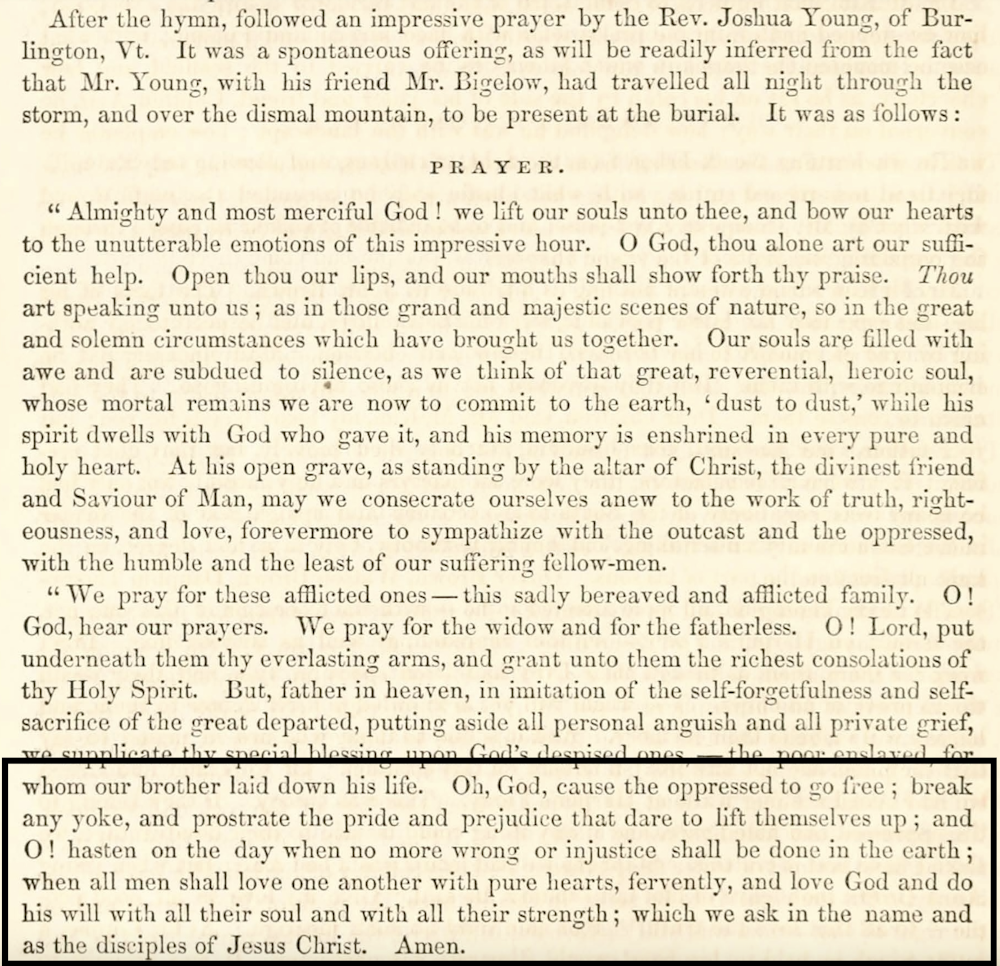
    At the funeral for abolitionist John Brown, the minister prayed over his body, “Oh, God, cause the oppressed to go free; break any yoke, and prostrate the pride and prejudice that dare to lift themselves up.”

    The prayer uttered at John Brown’s burial.
    Library of Congress

    Use of the phrase did not end with Emancipation or the end of the U.S. Civil War.

    In fact, it was one of Frederick Douglass’ favorite phrases. On Oct. 22, 1883, in his “Address at Lincoln Hall,” Douglass excoriated the Supreme Court’s decision rendering the Civil Rights Act of 1875 unconstitutional.

    As was typical of Douglass, the speech ranged beyond racial inequities: “Color prejudice is not the only prejudice against which a Republic like ours should guard. The spirit of caste is malignant and dangerous everywhere. There is the prejudice of the rich against the poor, the pride and prejudice of the idle dandy against the hard-handed workingman.”

    Austen’s independent women

    Early on in “Pride and Prejudice,” the conceited Caroline Bingley snipes that Elizabeth Bennet shows “an abominable sort of conceited independence.” Later, the snobbish Lady Catherine accuses Bennet of being “headstrong.” But near the ending, Mr. Darcy tells Bennet that he loves her for “the liveliness” of her “mind.”

    In this respect, Bennet reflects a quality that all of Austen’s heroines possess. While they try to adhere to standards of courtesy and respect, none are guilty of saying only what the leading man wants to hear.

    Jane Austen.
    Stock Montage/Getty Images

    Given that Austen chose her title to honor the phrase and its history, it is ironic that her own fame ended up drowning out the abolitionist associations of “pride and prejudice” after the Civil War.

    If there is any work of fiction that successfully makes self-sufficiency, independent thinking and open-mindedness look good – and makes sycophants, rigidity and hysterical devotion to rank and status look bad – it is “Pride and Prejudice.”

    Yet the lasting popularity of Austen’s novel demonstrates that the ethics contained in the phrase continue to resonate today, even if its context has been lost.

    Margie Burns does not work for, consult, own shares in or receive funding from any company or organization that would benefit from this article, and has disclosed no relevant affiliations beyond their academic appointment.

    ref. From pulpits to protest, the surprising history of the phrase ‘pride and prejudice’ – https://theconversation.com/from-pulpits-to-protest-the-surprising-history-of-the-phrase-pride-and-prejudice-249836

    MIL OSI – Global Reports

  • MIL-OSI Global: The US military has cared about climate change since the dawn of the Cold War – for good reason

    Source: The Conversation – USA – By Paul Bierman, Fellow of the Gund Institute for Environment, Professor of Natural Resources and Environmental Science, University of Vermont

    Military engineers managing supply routes in Greenland in the 1950s paid attention to the weather and climate.
    US Army/Pictorial Parade/Archive Photos/Getty Images

    In 1957, Hollywood released “The Deadly Mantis,” a B-grade monster movie starring a praying mantis of nightmare proportions. Its premise: Melting Arctic ice has released a very hungry, million-year-old megabug, and scientists and the U.S. military will have to stop it.

    The rampaging insect menaces America’s Arctic military outposts, part of a critical line of national defense, before heading south and meeting its end in New York City.

    Yes, it’s over-the-top fiction, but the movie holds some truth about the U.S. military’s concerns then and now about the Arctic’s stability and its role in national security.

    A poster advertises ‘The Deadly Mantis,’ a movie released in 1957, a time when Americans worried about a Russian invasion. The film used military footage to promote the nation’s radar defenses along the Distant Early Warning line in the Arctic.
    LMPC via Getty Images

    In the late 1940s, Arctic temperatures were warming and the Cold War was heating up. The U.S. military had grown increasingly nervous about a Soviet invasion across the Arctic. It built bases and a line of radar stations. The movie used actual military footage of these polar outposts.

    But officials wondered: What if sodden snow and vanishing ice stalled American men and machines and weakened these northern defenses?

    In response to those concerns, the military created the Snow, Ice and Permafrost Research Establishment, a research center dedicated to the science and engineering of all things frozen: glacier runways, the behavior of ice, the physics of snow and the climates of the past.

    It was the beginning of the military’s understanding that climate change couldn’t be ignored.

    Army engineers test the properties of snow on Greenland’s ice sheet in 1955, a critical determinant of mobility on the ice and one that changes rapidly with temperature and climate.
    U.S. Army

    As I was writing “When the Ice is Gone,” my recent book about Greenland, climate science and the U.S. military, I read government documents from the 1950s and 1960s showing how the Pentagon poured support into climate and cold-region research to boost the national defense.

    Initially, military planners recognized threats to their own ability to protect the nation. Over time, the U.S. military would come to see climate change as both a threat in itself and a threat multiplier for national security.

    Ice roads, ice cores and bases inside the ice sheet

    The military’s snow and ice engineering in the 1950s made it possible for convoys of tracked vehicles to routinely cross Greenland’s ice sheet, while planes landed and took off from ice and snow runways.

    In 1953, the Army even built a pair of secret surveillance sites inside the ice sheet, both equipped with Air Force radar units looking 24/7 for Soviet missiles and aircraft, but also with weather stations to understand the Arctic climate system.

    The public reveal of U.S. military bases somewhere – that remained classified – inside Greenland’s ice sheet, in the February 1955 edition of REAL.
    Paul Bierman collection.

    The Army drilled the world’s first deep ice core from a base it built within the Greenland ice sheet, Camp Century. Its goal: to understand how climate had changed in the past so they would know how it might change in the future.

    The military wasn’t shy about its climate change research successes. The Army’s chief ice scientist, Dr. Henri Bader, spoke on the Voice of America. He promoted ice coring as a way to investigate climates of the past, provide a new understanding of weather, and understand past climatic patterns to gauge and predict the one we are living in today – all strategically important.

    Henri Bader describes drilling high on Greenland’s ice sheet in 1956 or 1957 in a Voice of America recording (National Archives), “The Snows of Yesteryear,” and a movie (U.S. Army). Created by Quincy Massey-Bierman.

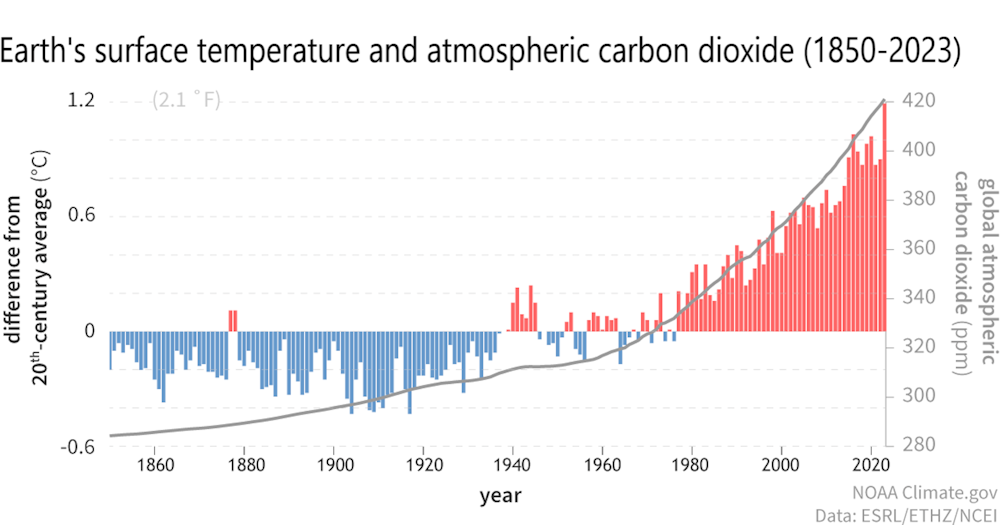
    In the 1970s, painstaking laboratory work on the Camp Century ice core extracted minuscule amounts of ancient air trapped in tiny bubbles in the ice. Analyses of that gas revealed that levels of carbon dioxide in the atmosphere were lower for tens of thousands of years before the industrial revolution. After 1850, carbon dioxide levels crept up slowly at first and then rapidly accelerated. It was direct evidence that people’s actions, including burning coal and oil, were changing the composition of the atmosphere.

    Since 1850, carbon dioxide levels in the atmosphere have spiked and global temperatures have warmed by more than 2.5 degrees Fahrenheit (1.3 Celsius). The past 10 years have been the hottest since recordkeeping began, with 2024 now holding the record. Climate change is now affecting the entire Earth – but most especially the Arctic, which is warming several times faster than the rest of the planet.

    Since 1850, global average temperature and carbon dioxide concentrations in the atmosphere have risen together, reflecting human emissions of greenhouse gases. Red bars indicate warmer years; blue bars indicate colder years.
    NOAA

    Seeing climate change as a threat multiplier

    For decades, military leaders have been discussing climate change as a threat and a threat multiplier that could worsen instability and mass migration in already fragile regions of the world.

    Climate change can fuel storms, wildfires and rising seas that threaten important military bases. It puts personnel at risk in rising heat and melts sea ice, creating new national security concerns in the Arctic. Climate change can also contribute to instability and conflict when water and food shortages trigger increasing competition for resources, internal and cross-border tensions, or mass migrations.

    The military understands that these threats can’t be ignored. As Secretary of the Navy Carlos Del Toro told a conference in September 2024: “Climate resilience is force resilience.”

    A view of aircraft carriers docked at the sprawling Naval Station Norfolk show how much of the region is within a few feet of sea level.
    Stocktrek Images via Getty Images

    Consider Naval Station Norfolk. It’s the largest military port facility in the world and sits just above sea level on Virginia’s Atlantic coast. Sea level there rose more than 1.5 feet in the last century, and it’s on track to rise that much again by 2050 as glaciers around the world melt and warming ocean water expands.

    High tides already cause delays in repair work, and major storms and their storm surges have damaged expensive equipment. The Navy has built sea walls and worked to restore coastal dunes and marshlands to protect its Virginia properties, but the risks continue to increase.

    Planning for the future, the Navy incorporates scientists’ projections of sea level rise and increasing hurricane strength to design more resilient facilities. By adapting to climate change, the U.S. Navy will avoid the fate of another famous marine power: the Norse, forced to abandon their flooded Greenland settlements when sea level there rose about 600 years ago.

    Norse ruins in Igaliku in southern Greenland, illustrated in the late 1800s while flooded at spring tide by sea level, which had risen since the settlement was abandoned around 1400.
    Steenstrup, K.J.V., and A. Kornerup. 1881. Expeditionen til Julianehaabs distrikt i 1876. MeddelelseromGrønland

    Climate change is costly to ignore

    As the impacts of climate change grow in both frequency and magnitude, the costs of inaction are increasing. Most economists agree that it’s cheaper to act now than deal with the consequences. Yet, in the past 20 years, the political discourse around addressing the cause and effects of climate change has become increasingly politicized and partisan, stymieing effective action.

    In my view, the military’s approach to problem-solving and threat reduction provides a model for civil society to address climate change in two ways: reducing carbon emissions and adapting to inevitable climate change impacts.

    The U.S. military emits more planet warming carbon than Sweden and spent more than US$2 billion on energy in 2021. It accounts for more than 70% of energy used by the federal government.

    In that context, its embrace of alternative energy, including solar generation, microgrids and wind power, makes economic and environmental sense. The U.S. military is moving away from fossil fuels, not because of any political agenda, but because of the cost-savings, increased reliability and energy independence the alternatives provide.

    Solar panels generate power on many U.S. military bases. This array at Joint Forces Training Base in Los Alamitos, Calif., generates enough power for more than 15,000 homes and has a backup battery system to provide power when the sun isn’t shining.
    Frederic J . Brown/AFP via Getty Images

    As sea ice melts and Arctic temperatures rise, the polar region has again become a strategic priority. Russia and China are expanding Arctic shipping routes and eyeing critical mineral deposits as they become accessible. The military knows climate change affects national security, which is why it continues to take steps to address the threats a changing climate presents.

    Paul Bierman receives funding from the US National Science Foundation, this work in part supported by grant EAR-2114629.

    ref. The US military has cared about climate change since the dawn of the Cold War – for good reason – https://theconversation.com/the-us-military-has-cared-about-climate-change-since-the-dawn-of-the-cold-war-for-good-reason-246333

    MIL OSI – Global Reports

  • MIL-OSI Global: Remembering China’s Empress Dowager Ling, a Buddhist who paved the way for future female rulers

    Source: The Conversation – USA – By Stephanie Balkwill, Associate Professor of Asian Languages and Cultures, University of California, Los Angeles

    In sixth-century China, a woman known to history as Empress Dowager Ling ruled over an empire called the Northern Wei. Historians do not know her birth name or in what year she was born, but they do know that she served as empress dowager between 515 and 528. As the spouse of a ruling emperor prior to his death, she retained the title of empress dowager in her widowhood.

    She ruled on behalf of her young son, the heir to the throne; however, her regency was interrupted by a coup d’etat from 520 to 525. Although the empress dowager was expected to rule only as a regent, historical records indicate that she administered court in her own name. These same records also reveal that she adopted a personal pronoun – “zhen 朕,” otherwise known as the Chinese “royal we” – that was reserved for the exclusive use of the emperor.

    In my recent book, “The Women Who Ruled China,” I offer an overview of these historical sources and records that document her life, including a translation of her biography retained in the official chronicle of the Northern Wei. Using these sources, I argue that even though the Empress Dowager’s rule was problematic and short – resulting in her assassination – she laid the foundation for other, more successful female rulers across medieval East Asia.

    Capitalizing on different cultural traditions

    In the late fifth century, the capital city of the Northern Wei was moved from its northern location in modern-day Datong, China, to its southern location in Luoyang, a city at the very heart of Han Chinese culture and history; however, the people who ruled the empire were not ethnically Han Chinese.

    Known as the Taghbach, this group migrated south from the Mongolian steppe and ruled a multiethnic and multicultural empire from Luoyang, the world’s largest city and the former capital of the Eastern Han dynasty. The Northern Wei empire adopted laws, institutions and policies from both Taghbach and Han Chinese traditions.

    This cultural hybridity enabled the empress dowager to rule directly: On one hand, the Chinese court system rooted in the Han dynasty had long included the position of empress dowager, even though none of the women who held it had ruled directly. On the other, Taghbach culture had no formal position of empress dowager prior to its adoption of court ranks in the Northern Wei, but it did have a long tradition of women in public life. These women served in the military and advised on political matters.

    Multiple sources of evidence indicate that Taghbach women had a high degree of personal autonomy and political power, with no source suggesting otherwise.

    A well-known story about Taghbach woman appears in the legend of Mulan, who is said to have dressed as a man so that she could serve in the military in place of her father. The Mulan legend is widely recounted in Chinese literature and inspired a fictional character in two Walt Disney movies based on the Chinese fable.

    As a historian of gender in this period, I believe that the Mulan legend does not accurately depict Taghbach women. Instead, it is a Chinese story that emphasizes a form of gender transgression that makes sense only within Chinese and Confucian culture. Unlike Chinese culture, Taghbach culture had long known women warriors who could ride horses and shoot arrows without concealing their gender.

    Empress Dowager Ling was not a warrior, but she embraced martial symbols of her own power that were available to women in Taghbach culture but not in Chinese culture. For example, she was an accomplished archer and famously drove her own horse cart, which was just as splendid and imposing as was the emperor’s cart.

    In the Confucian culture of Han China, such actions were considered highly inappropriate for women, but Empress Dowager Ling carried them out while holding the Chinese title of empress dowager. Her rule, like her empire, was culturally hybrid. That blend of cultural traditions enabled her to take power in a way that neither Chinese nor Taghbach women had done before.

    A Buddhist ruler

    By the time of the reign of the Northern Wei empire, both Taghbah and Chinese cultures had become deeply familiar with Buddhism, a religion that they had inherited from India in a long process of cultural exchange along the Silk Road. The empire had integrated methods of Buddhist statecraft into its own forms of governance.

    Simply put, what this meant was that the ruler of the empire legitimized his reign through Buddhism, portraying himself either as a Buddha or as a patron of Buddhists – their texts and institutions. This was a type of governance that was widely practiced in premodern East Asia.

    The bodhisattva Maitreya, considered to be the Buddha of the future.
    Rogers Fund, 1982/The Metropolitan Museum, New York

    Even though Buddhist statecraft was widespread in the empress dowager’s time, she was the first woman to directly legitimate her independent rule through Buddhism. As a patron of Buddhism, she commissioned majestic Buddhist architecture. Perhaps seen by her populace as a Buddhist figure herself, she symbolized her co-rule with her son by using a Buddhist visual motif of two Buddhas sitting side by side, a representation that came to be known as the rule by “Two Sages,” meaning tandem rulers depicted in the guise of buddhas. The source for the image was the popular Buddhist text, the “Lotus Sūtra.”

    She also attempted to put her own granddaughter on the throne after the death of her son. As I argue in my book, she did so by capitalizing on the idea that first her son, and then her granddaughter, were thought of as the bodhisattva Maitreya, a being of infinite compassion who is believed to be the future Buddha.

    The empress dowager’s legacy

    Empress Dowager Ling was largely unsuccessful in her bid for power. Her rule was short and contested. She was murdered, and her empire was toppled within 13 years of her rule. For five of those years, she was not in power because of a coup d’etat.

    However, about 150 years after the assassination of the empress dowager, another woman would rise to rule China independently, this time taking the title of “emperor.” That woman is known as Empress Wu, or Emperor Wu Zhao, and she is undoubtedly the most famous woman in all of Chinese history. Numerous historical sources attest to her life, work and rule.

    What those sources tell us, however, is that she ruled using the very same strategies as Empress Dowager Ling. Investing her own family heritage in distant links to the Taghbach, she also positioned herself as a “Two Sage” ruler alongside the emperor in precisely the same way that Empress Dowager Ling did. She was also able to successfully establish herself as the bodhisattva Maitreya by using Buddhist texts known to Empress Dowager Ling and her court.

    She patronized the very same Buddhist structures as did Empress Dowager Ling, including the Buddhist caves at Longmen, just outside of Luoyang. However, she accomplished what Empress Dowager Ling could not – holding onto power successfully. I argue her success was possible because Empress Dowager Ling had paved the way.

    Stephanie Balkwill does not work for, consult, own shares in or receive funding from any company or organization that would benefit from this article, and has disclosed no relevant affiliations beyond their academic appointment.

    ref. Remembering China’s Empress Dowager Ling, a Buddhist who paved the way for future female rulers – https://theconversation.com/remembering-chinas-empress-dowager-ling-a-buddhist-who-paved-the-way-for-future-female-rulers-251132

    MIL OSI – Global Reports

  • MIL-OSI Global: Colorado and other states have expanded access to abortion, but not for adolescents

    Source: The Conversation – USA – By Kate Coleman-Minahan, Associate Professor of Nursing, University of Colorado Anschutz Medical Campus

    Since 2022, Colorado and 10 other states have passed voter initiatives to protect or expand abortion access. Yet, seven of these states, including Colorado, require people under the age of 18 to get consent from or notify a parent prior to receiving abortion services.

    In January 2025, my colleagues and I published research using in-depth interviews with 33 people ages 15 to 22 in Colorado who considered or obtained abortion care between 2020 and 2023. Our study suggests that Colorado’s parental notification law delays young people’s access to abortion, complicates already complex family relationships, and forces unwanted disclosure of the pregnancy and abortion.

    As a nurse, I have provided health care to young people and their families for more than two decades, and as a researcher, I have spent the past 10 years studying young people’s experiences with parental involvement laws.

    Tens of thousands of young people are affected by parental involvement laws each year. By design, these laws threaten their ability to make their own pregnancy decisions.

    Expanding abortion access, but not for adolescents

    In the U.S., 38 states allow abortion services at some point in pregnancy. Of those,24 states have parental involvement laws. And of those, 12 states require young people to obtain consent from a parent or guardian; seven require young people to notify a parent or guardian; and five require both notification and consent. Three states – Kansas, Missouri and North Dakota – require involvement of both parents.

    In 2024, Colorado passed a constitutional amendment that protects the right to abortion and allows funding through Medicaid. Yet, Colorado still requires parental notification for people under 18 to obtain abortion services. There have been no recent state-led efforts to remove this law.

    Proponents of parental involvement laws believe that the laws will foster parent-child communication and improve pregnancy decision-making. Research shows this is wishful thinking: These laws do not improve communication or decision-making, and instead harm adolescents.

    We found that even in a state like Colorado that has expanded abortion access, the law creates barriers to services. It takes time for young people to learn the law exists and figure out how to comply with it. That’s true for both young people who can tell their parents and those who cannot. Delays due to parental involvement laws can increase the cost of abortion services, restrict adolescents’ choice of abortion methods and push adolescents past the gestational limit of the clinic or state.

    For some Colorado young people, following the law resulted in unwanted disclosure of their pregnancy and abortion to parents and others, which is associated with negative mental health outcomes and exposes some young people to emotional or physical abuse.

    Judicial bypass

    In states that mandate parental involvement, young people who feel they cannot involve a parent can try to obtain a judicial bypass. The young person must go to court to prove to a judge that they are mature and well informed or that abortion without parental involvement is in their best interest.

    Data from Massachusetts, Illinois, Texas and Florida suggests that between 6% and 23% of young people who had an abortion relied on judicial bypass. In some states, such as Florida, up to 13% of young people who requested a bypass were denied.

    In our prior research, Texas young people described the judicial bypass process as burdensome, humiliating and traumatizing.

    In our new research, young people in Colorado described the judicial bypass process as burdensome. They said it disrupted school, was “embarrassing,” “anxiety” provoking and “nerve wrecking.”

    Judicial bypass also delays access to abortion. For one participant in our Colorado study, the two- to three-week delay contributed to her inability to obtain her wanted abortion because it pushed her past the gestational limit of her chosen clinic.

    Another participant thought the judicial bypass process would take too long, so she instead tried to end the pregnancy herself. She took vitamin C, which is not effective, and considered but did not take large doses of over-the-counter medications such as ibuprofen, which could have caused organ damage.

    The delays and burdens of the judicial bypass process led some study participants’ parents to find out about the pregnancy. This unwanted disclosure breached the privacy that judicial bypass is meant to protect.

    Future of abortion restrictions

    States such as Colorado, Maryland and Montana provide access for people seeking abortion services who live in the 18 states with bans early in pregnancy. For example, Colorado had a 110% increase in the number of abortions among adolescents from out of state between 2020 and 2022.

    However, these states’ parental involvement laws may compound barriers people face when traveling out of state.

    Parental involvement laws were the first state-level abortion restriction allowed by the Supreme Court after the Roe v. Wade decision in 1973, which was overturned in 2022. There is a similar pattern today.

    Policymakers in some states with abortion bans, such as Idaho, Tennessee and Mississippi, are trying to stop people from traveling out of state for services by targeting young people. These proposed laws would make it a crime to help a young person under 18 leave the state for abortion services without parental consent.

    Colorado protects the right to abortion in its state constitution but still requires minors to notify a parent to get an abortion.
    The Washington Post/Contributor/GettyImages

    Some state policymakers are also trying to make it harder to get contraception by targeting young people. For example, federal courts upheld Texas’ refusal to allow minors to confidentially obtain contraception at federally funded clinics.

    Young people know who to trust

    Our research found that Colorado young people want their parents’ or guardians’ support when considering abortion, yet some felt it was not safe for them to ask for it.

    Confirming prior research, we found a number of reasons young people felt unable to disclose their pregnancies to a parent. Those include fearing a parent’s reaction, feeling a parent would not respect their pregnancy decision, and not living with or not having a supportive relationship with a parent.

    In addition to those reasons, young people also accurately predicted their parents’ reactions. Young people recounted emotional abuse and abandonment or feeling coerced into either continuing the pregnancy or having an abortion when a parent they did not feel they could tell found out about the pregnancy. Research, including our new study in Colorado, shows we can trust young people to decide who to involve in their pregnancy decision.

    Read more of our stories about Colorado.

    The views expressed here are her own and not those of the University of Colorado. Kate Coleman-Minahan receives funding from the Eunice Kennedy Shriver National Institute of Child Health and Human Development (NICHD) and the Society of Family Planning.

    ref. Colorado and other states have expanded access to abortion, but not for adolescents – https://theconversation.com/colorado-and-other-states-have-expanded-access-to-abortion-but-not-for-adolescents-249340

    MIL OSI – Global Reports

  • MIL-OSI United Kingdom: Why napping might be beneficial during Ramadan

    Source: Anglia Ruskin University

    By Timothy Hearn, Anglia Ruskin University

    During Ramadan, Muslims abstain from food and drink from sunrise to sunset. This unique rhythm often leads to changes in sleeping patterns. With nights shortened and days filled with fasting, many Muslims find themselves battling fatigue and a dip in alertness – and a well-timed nap may provide a much needed boost.

    Recently published research on athletes fasting during Ramadan has demonstrated that even a 40-minute nap taken after a strenuous evening session can significantly improve physical and cognitive performance. And, in studies with soccer players, those who napped showed better performance in short-distance shuttle runs and attention tests than those who skipped the nap.

    So, why can naps have such a transformative effect on our energy levels?

    Siesta science

    Naps work by giving the brain and body a chance to reset. When you’re awake for long stretches – especially under the stress of altered meal times and reduced nighttime sleep – the brain accumulates sleep pressure.

    A nap, especially in the early afternoon when many experience a natural dip in alertness, can relieve that pressure and enhance mood, reaction time, and even physical endurance. One 2024 study, for instance, showed that a 40-minute nap not only reduced feelings of sleepiness but also improved performance in tasks that require focus and quick thinking. While a 2025 study of female athletes found that both 40-minute and even 90-minute naps could enhance physical performance and mood after a night of sleep restriction.

    But it’s not all good news for habitual nappers. Although longer naps sometimes show even greater benefits, they may also lead to temporary grogginess – a phenomenon known as sleep inertia – which can counteract the positive effects if not managed properly.

    But there’s evidence that exposure to bright light and face washing could help nappers combat sleep inertia. For some, though, this grogginess can linger long enough to affect productivity, mood, and overall performance.

    When it comes to nap duration and timing, the key is to find the “sweet spot”. Short naps – lasting around 20 to 30 minutes – can improve alertness without causing sleep inertia. On the other hand, longer naps, such as those lasting 40 minutes or more, have been shown to boost both mental and physical performance but must be scheduled carefully to avoid interfering with nighttime sleep.

    To nap, or not to nap?

    During Ramadan, when the body is already adapting to a shifted sleep schedule, a carefully timed nap might be especially beneficial. It can serve as a counterbalance to the reduced sleep quality and quantity that sometimes accompany fasting. However, if taken too late in the day, a nap might delay the onset of your regular sleep cycle, leading to disrupted sleep patterns.

    But, when taken at the right time, napping can be a valuable tool for enhancing alertness, mood, and even physical performance – benefits that are particularly relevant during periods of fasting like Ramadan.

    Ultimately, the decision to adopt a daily nap should be guided by your personal lifestyle, sleep quality, and overall health goals. For many, a well-timed, moderate-length nap is not only a healthy habit, but also a strategic advantage in managing daily challenges – whether you’re fasting during Ramadan or simply trying to make the most of a hectic day.

    Timothy Hearn, Senior Lecturer in Bioinformatics, Anglia Ruskin University

    This article is republished from The Conversation under a Creative Commons license. Read the original article.

    The opinions expressed in VIEWPOINT articles are those of the author(s) and do not necessarily reflect the views of ARU.

    If you wish to republish this article, please follow these guidelines: https://theconversation.com/uk/republishing-guidelines

    MIL OSI United Kingdom

  • MIL-OSI Europe: AFRICA/MOZAMBIQUE – “Closely connected to the community”: Catholic University in Beira inaugurates academic year and celebrates its 30th anniversary

    Source: Agenzia Fides – MIL OSI

    Monday, 17 March 2025

    Cuamm

    Beira (Agenzia Fides) – “Since its founding in 1995, the Catholic University of Mozambique (UCM) has responded to educational challenges with seriousness and innovation, with the firm desire to educate citizens of integrity,” said the Rector, Fr. Filipe Sungo. “We seek not only well-prepared and qualified professionals in their field, but also leaders committed to the common good.”Three decades of history have enabled the UCM to realize an educational project that today stands out at the national level for its academic rigor, innovation, internationalization, and, last but not least, its human value. This is affirmed by the medical aid organization “Doctors with Africa Cuamm,” which carries out numerous initiatives in collaboration with the university and was represented at the opening event of the academic year on Friday, March 14, in Beira by its director, Don Dante Carraro, accompanied by Professor Alberto Mantovani, internationally renowned immunologist and scientific director of “Humanitas,” as well as other priests and supporters from the Diocese of Padua.”An institution closely linked to the community,” is how Don Dante defines the UCM, emphasizing that science, research and expertise must not forget to serve the poorest and most vulnerable. “The future begins right here, where knowledge is built and shared,” said Professor Mantovani, who has been a visiting professor in Beira several times over the years.”The university is certainly a place where science is cultivated with seriousness, but it is also a place where hearts and minds are formed not only for academic excellence but also for generous service to humanity,” said Bishop Claudio Dalla Zuanna of Beira, who attended the ceremony, echoing the words of Pope Francis. “The university must not be a self-contained ivory tower, but must be able to listen to society, accept challenges, and provide answers.”The UCM is now the country’s second university campus, located about 1,500 km from the capital, Maputo. A few years after its founding, the Faculty of Medicine of the Catholic University of Mozambique was opened, not least at the urging of “Doctors with Africa Cuamm” and thanks to decades of collaboration between the aid organization and the city’s health authorities. Since the first courses in anatomy, surgery, and internal medicine, launched by CUAMM physicians in 2004, the commitment to the UCM Medical School has never stopped, but has actually grown over time. On August 25, 2007, the first aspiring doctors graduated in Beira. “A historic date for the entire country,” as the university’s rector, Father Alberto Ferreira, called it. They were the first students to be trained outside the capital, Maputo, in the north-central part of the country, where there was barely one doctor per 100,000 inhabitants (see Fides, 8/10/2009). (AP) (Agenzia Fides, 17/3/2025)
    Cuamm

    Cuamm

    Share:

    MIL OSI Europe News

  • MIL-OSI Canada: Bank of Canada announces the Governor’s Award recipient of the 2025 Fellowship Program

    Source: Bank of Canada

    Governor’s Award

    Reka Juhasz
    Assistant Professor of Economics, Vancouver School of Economics
    University of British Columbia

    Professor Reka Juhasz’s primary research focus is on the effects of industrial policy and how governments can improve the efficacy of these policies to foster economic growth. As global trade shifts, understanding how industrial policy can drive costs and inflation has implications for monetary policy, one of the Bank’s core functions. More broadly, her research also considers international trade, economic history, growth and development. Dr. Juhasz is published in top economic journals and has had a meaningful impact as a mentor in her department. She is also the co-founder of The Industrial Policy Group and was awarded the Alexander Gerschenkron Prize in 2016.

    MIL OSI Canada News

  • MIL-OSI USA: Plants Struggled for Millions of Years After the World’s Worst Climate Catastrophe

    Source: US State of Connecticut

    A team of scientists from University College Cork (Ireland), the University of Connecticut (USA), and the Natural History Museum of Vienna (Austria) have uncovered how plants responded to catastrophic climate changes 250 million years ago. Their findings, published in GSA Bulletin, reveal the long, drawn-out process of ecosystem recovery following one of the most extreme periods of warming in Earth’s history: the “End-Permian Event.”

    UConn Department of Earth Sciences Professor and Department Head Tracy Frank, Professor Chris Fielding, and Associate Professor Michael Hren are co-authors on the paper. Frank and Hren performed a series of geochemical analyses through the sedimentary strata recording the event to help tie down ancient climate conditions, and Fielding provided sedimentological data to constrain ancient environmental conditions.

    The End-Permian Extinction, also known as the Great Dying, is the most severe ecological crisis of the past 500 million years.

    “It is believed to have entailed a five-fold increase in atmospheric CO2, global temperature rise of up to 10° C or more, ozone depletion, widespread wildfires, and changes in rainfall patterns across the Earth’s surface,” says Fielding.

    With more than 80% of ocean species wiped out, the end-Permian event was the worst mass extinction of all time. But the impacts of this event for life on land have been elusive. By examining fossil plants and rocks from eastern Australia’s Sydney Basin, researchers have pieced together a multi-million-year story of resilience, recovery, and the long-term effects of climate change following the Great Dying.

    The long, unsteady path to ecosystem recovery

    The fossils from these Australian rocks show that conifers, like modern pines, were some of the earliest to colonize the land immediately after the End-Permian catastrophe. However, the recovery back to flourishing forests was not smooth sailing.

    The researchers discovered that even higher temperatures during the “Late Smithian Thermal Maximum,” approximately 3 million years after the End-Permian Extinction, caused the collapse of these conifer survivors. In turn, they were replaced by tough, shrubby plants resembling modern clubmosses. This scorching period lasted for about 700,000 years and made life challenging for trees and other large plants.

    It wasn’t until a subsequent significant cooling event—the “Smithian-Spathian Event”—that large, but unusual plants called “seed ferns” began to flourish and establish more stable forests. These plants eventually came to dominate Earth’s landscapes for millions of years, paving the way for the lush forests during the Mesozoic “age of dinosaurs.”

    “The first post-apocalyptic floras were ‘opportunistic’ in nature, perhaps the equivalent of what in the modern world are called ‘weeds.’ These plants were mostly small, and were sparsely distributed. Larger trees and other more complex plant types took considerable time to become established as surface conditions gradually improved,” says Fielding.

    After millions of years, the forest ecosystems of the Mesozoic came to look like those from before the end-Permian collapse. But crucially, the plant species that made up the new forests were completely different. “The term ‘recovery’ can be misleading” says Chris Mays, Leader of the Mass Extinction Group at University College Cork, “forests recover eventually, but extinction is forever.”

    What does this mean for us?

    By understanding how ancient plant ecosystems weathered extreme climate swings, researchers hope to learn valuable lessons about how modern plants and ecosystems might cope with today’s climate crisis. Ecosystems depend on a fragile balance, with plants as the backbone of land food webs and climate regulation.

    “This research highlights how crucial plants are, not just as the base of land food chains, but also as natural carbon sinks that stabilize Earth’s climate,” explains Ph.D. student Marcos Amores, the study’s lead author, who spent time in the UConn Earth Science Department as a visiting scholar. “The disruption of these systems can have impacts lasting hundreds of thousands of years, so protecting today’s ecosystems is more important than ever.”

    This deep dive into Earth’s distant past reminds us that plants are unsung heroes of life on Earth—then, now, and in the future.

    “The protracted and complex path back to ‘normality’ after the end-Permian crisis tells us that Earth can recover from devastating environmental tipping points, but that recovery may take periods of time beyond the range of human endurance or even existence,” says Fielding.

    MIL OSI USA News

  • MIL-OSI USA: HackUConn Turns Students into Problem Solvers

    Source: US State of Connecticut

    Teams of undergraduates proved their mettle and creativity as they left their mark on the annual HackUConn event, held this year over the course of a weekend that ended earlier this month. 

    Billed as “Universities of Tomorrow,” the annual hackathon offered students a chance to apply their own solutions to issues in modern academia. The teams had 20 hours to apply their own ingenuity and talents and apply advanced technology, such as laser cutters and 3D printers, to accomplish their tasks. 

    The winning teams of the 2025 HackUConn “Universities of Tomorrow” challenge. Photo contributed by Aaron Rosman.

    Additionally, the teams received mentorship from staff of the Werth Institute for Entrepreneurship and Innovation, several departments on campus, as well as UConn’s Technology Commercialization Services (TCS). The latter is the technology transfer and entrepreneurship wing of the Office of the Vice President for Research. 

    The competition took place in the Werth Residence Tower in UConn’s Hilltop residence hall complex. About 75 students took part in the event, which included guest speakers and invaluable opportunities for the teams to interact with industry professionals. 

    Aaron Rosman ’16 (CAHNR) ’21 MBA , the Werth Institute’s operation manager and fiscal officer, worked with the Institute’s students to plan and implement the competition. Their approach was simple: pose challenges based on the issues and realities impacting UConn undergraduates. From there, teams build on the talents and skills of the individual members, including first-time participants as well as experienced hackers. 

    “Our biggest goal is that this an event for students by students,” says Rosman. “The student planning team can learn everything from how to get funding from sponsors to logistically planning an event. We try to provide students with as many skills as possible. They choose the theme every year, and no two years are alike.” 

    “Universities of Tomorrow” focused on three categories that the teams could explore: 

    • Curriculum and career – how students can apply what they learn to the workforce, such as skills gained from the Academic Achievement Center and the Center for Career Readiness and Life Skills 
    • Quality of life and stress relief – working with the Student Recreation Center and Student Health and Wellness to establish healthy work-life balance 
    • Systems and services – How to maximize and improve student experience in offices such as the Registrar, Financial Aid, and the Bursar. 

    The 20 hours the teams were allotted were filled with more than just work amongst their partners. They received orientation, were offered mentorship, and listened to a keynote address from Abhijit Banerjee, UConn’s Associate Vice President for Research, Innovation and Entrepreneurship. 

    “The students taking part in events like HackUConn are the inventors and entrepreneurs of the future,” Banerjee says. “The skills they demonstrate – including critical thinking and ability to adapt to challenges – are exactly what they will require in their future career endeavors. We are pleased to work with the Werth Institute to provide a forum for UConn students to apply their talents.” 

    TCS experts also helped serve as judges for the different projects. Rosman credited TCS as an excellent bridge between UConn and the market economy, mirroring the purpose of the Werth Institute. 

    HackUConn originated in 2016 as a small hackathon event designed for students focused on technology. The criteria eventually expanded to include undergraduates across a myriad of majors and programs.  

    “The quality of this year was absolutely amazing,” Rosman says. “Based on the feedback I received from mentors, judges, and competitors, the quality of interactions between all three parties were genuinely exciting. I had students telling me how much they learned from judges, and vice versa! It goes to show you, when you bring different parts of a university together, there is so much to be gained. The connections made here will last a lifetime.” 

    The following are the winners of the respective categories: 

    Curriculum and Career  

    Team CT: Sahil Patel ‘27, Ammar Alsadadi ‘25, Connor Lafferty ‘27 

    • Developed a “Univisor” app to enhance student advising experience for students and relieve strain on faculty 

    Systems and Services 

    Quantum Advisors: Shai Verma ‘27, Tyler Brown ‘26, Parth Danve ‘27, Krish Sawant ’27, Harshit Yadav ‘22 

    • Developed “AI Academic Advisor” to resolve class and exam scheduling conflicts during finals week 

    Quality of Life and Stress Relief 

    Concept JVM: Max Senchukov ‘26, Jennifer Gearin ‘28, Varshini Gopinathan ‘27 

    • Developed “Disco App” to help students identify clubs and organizations that match their talents and interests 

    MIL OSI USA News

  • MIL-OSI Russia: Student clubs of the State University of Management: find something to your liking

    Translartion. Region: Russians Fedetion –

    Source: State University of Management – Official website of the State –

    Students of the State University of Management can prove themselves not only in their studies, but also in student life.

    For this purpose, our university has more than ten associations for every taste, from dance to intellectual.

    The KVN League is a club that regularly conquers the top of the Premier and Major Leagues and every year gives us a whole season of battles between cheerful and resourceful teams on the stage of the Assembly Hall;

    ‍The creative collective “StuDos” is a club whose activists create and develop in choreography and vocals;

    ‍The Instrumental Music Club is an association in which you can master any instrument and genre of music, create your own ensemble and perform at a rock concert;

    ‍Case Club “Garnet” is a club whose mission is to help students build the career of their dreams;

    ‍The historical and patriotic club “Zvezda” unites students who advocate for an objective assessment of historical events and the preservation of the memory of their people;

    ‍The board game club “Mind Games” is an association of students who want to have fun and usefully spend their free time;

    ‍International Friendship Club – unites representatives of nationalities and cultures studying at the State University of Management;

    ‍The Student Parliamentary Club is an association of the most active and ambitious students of the State University of Management who are interested in political and social activities;

    ‍Media club “General Press SUM (GPS)” is a club of creative students: writers, photographers, designers and videographers who cover the most exciting events both at the State University of Management and beyond;

    ‍Vernadsky EcoClub – sets itself the task of making the State University of Management eco-friendly; with the club you can help preserve the environment;

    ‍Student theatre is a club where you can play any role, learn to speak freely, perform, express emotions, and, most importantly, study yourself.

    Go to the club page and find something you are ready to dedicate your best years to.

    Subscribe to the TG channel “Our GUU” Date of publication: 03/17/2025

    Please note: This information is raw content directly from the source of the information. It is exactly what the source states and does not reflect the position of MIL-OSI or its clients.

    MIL OSI Russia News

  • MIL-OSI Russia: SPbGASU student Ivan Baranovsky received two awards for his contribution to public activities and support of SVO

    Translartion. Region: Russians Fedetion –

    Source: Saint Petersburg State University of Architecture and Civil Engineering – Saint Petersburg State University of Architecture and Civil Engineering –

    Ivan Baranovsky, a student at the Faculty of Environmental Engineering and Urban Management, received two honorary medals for his active civic position and contribution to public life.

    The first medal was awarded to Ivan for assistance in conducting the Special Military Operation (SMO). The young man actively participated in organizing assistance to military personnel, collected and delivered humanitarian aid, and provided support to the families of SMO participants. His work was highly appreciated by the university and representatives of military structures.

    The second medal, “Active Participant in the Volunteer Movement,” was a recognition of Ivan’s achievements in the field of volunteerism.

    Ivan commented on his achievements as follows: “It is important for me to help people and be useful to my country. These awards are not only my merit, but also the result of the work of our entire team of volunteers. Thank you to everyone who supports us!”

    We congratulate Ivan Baranovsky on his well-deserved awards and wish him further success in his studies and social activities.

    Please note: This information is raw content directly from the source of the information. It is exactly what the source states and does not reflect the position of MIL-OSI or its clients.

    MIL OSI Russia News

  • MIL-OSI Global: With a federal election looming, America’s democratic decline has critical lessons for Canadian voters

    Source: The Conversation – Canada – By Matthew Lebo, Professor, Department of Political Science, Western University

    Prime Minister Mark Carney and his cabinet have been sworn in, ending Justin Trudeau’s time in office and paving the way for a spring election. Canadians are soon heading to the polls as they watch American democracy crumble.

    United States President Donald Trump recently argued “he who saves his country does not violate any Law” as he ignores Congress and the courts, governs by executive order and threatens international laws and treaties.


    Read more:
    Is Donald Trump on a constitutional collision course over NATO?


    Once stable democratic institutions are failing to hold an authoritarian president in check.

    What lessons are there to protect Canadian democracy as the federal election approaches?

    Elites lead the way

    First, it’s important to delve into how so many Americans have become tolerant of undemocratic actions and politics in the first place. It’s not that Republican voters first became more extreme and then chose a representative leader. Rather, public opinion and polarization are led by elites.

    Republican leaders moved dramatically to the right, and the primary system allowed the choice of an extremist. Republican voters then aligned their opinions with his. Trump’s disdain for democratic fundamentals spread quickly. Partisans defending their team slid away from democratic values.

    Canada’s more centrist ideological spectrum is not foolproof against this type of extremism. Public opinion can be moved when our leaders take us there.

    Decline can start slowly and then accelerate. America’s democratic backsliding in the first weeks of Trump’s second presidency follows the erosion of democratic norms over decades. Republican attacks on institutions, the opposition, the media and higher education corrosively undermined public faith in the truth, including election results.

    Trust in government is holding steady in Canada, however. That provides an important guardrail for Canadian democracy.

    The dangers of courting the far right

    There are also lessons for our political parties. To maximize their seats, Republicans accepted extremists like Marjorie Taylor Greene, but soon needed those types of politicians for key votes.

    The so-called Freedom Caucus, made up of MAGA adherents, forced the choice of a new, more extreme, leader of the House of Representatives. This provides a clear lesson that history has shown many times: it is dangerous for the party on the political right to accommodate the far right, which can quickly take control.

    Once established within the ruling party, extremists can hold their party hostage.

    At a recent meeting of the Munich Security Conference, Vice-President JD Vance pushed European parties to include far-right parties, and Elon Musk outright endorsed the far-right Alternative for Germany party.

    Austria recently avoided the inclusion of the far right in its new coalition, and now Germany is working to do the same. As Canada’s Conservatives look for every vote, courting far-right voters and candidates risks destabilizing the system.

    Can it happen in Canada?

    How safe is Canada’s Westminster-style parliamentary democracy?

    The fusion of legislative and executive power in parliamentary systems like Canada’s seems prone to tyranny. America’s Constitutional framers thought so when they designed a system with separate legislative, executive and judicial branches that could check each other’s power.

    They clearly did not imagine party loyalty negating the safeguards that protect democracy from an authoritarian-minded president. The Constitution gives Congress the power to legislate and impeach, limits the executive’s power to spend and make appointments, gives the judiciary power to hold an executive accountable and contains the 25th amendment allowing cabinet to remove a president.

    But when one party controls the legislative and executive branches during a time of hyper-partisanship, these mechanisms may not constrain an authoritarian. Today, Republican loyalty has eroded these checks and balances and American courts are struggling to step up to their heightened role.

    Although counter-intuitive, parliamentary systems like Canada’s are usually less susceptible to authoritarianism than presidential ones because the cabinet or the House of Commons can turn against a lawless leader.

    Still, if popular, authoritarian leaders can still retain their party’s support — and then things can slide quickly. The rightward pull of extremists seen in the U.S. House would be more dangerous here since the Canadian House of Commons includes our executive.

    Guarding against xenophobia

    Lastly, Canada should be wary of xenophobic rhetoric.

    America First” is not simply shopping advice. It began as an isolationist slogan during the First World War but was soon adopted by pro-fascists, American Nazis and the Ku Klux Klan. These entities questioned who is really American and wanted not only isolationism, but racist policies, immigration restrictions and eugenics.

    Trump did not revive the phrase accidentally. It’s a call to America’s fringes. Alienating domestic groups is a sure sign of democratic decline.

    “Canada First” mimics that century-long dark theme in America. In combination with contempt for the opposition, it questions the right of other parties to legitimately hold power if used as a message by one party.

    Also, asserting that “Canada is broken” — as Conservative Leader Pierre Poilievre often does — mimics Trump’s talk of American carnage, language and imagery he uses to justify extraordinary presidential authority.

    Such language erodes citizens’ trust in democratic institutions and primes voters to support undemocratic practices in the name of patriotism. Canadian parties and politicians should exit that road.

    Ultimately, institutions alone do not protect a country from the rise of authoritarianism. Democracy can be fragile. As a federal election approaches in Canada, it’s important to know the warning signs of extremism and anti-democratic practices that are creeping into our politics.

    Matthew Lebo does not work for, consult, own shares in or receive funding from any company or organisation that would benefit from this article, and has disclosed no relevant affiliations beyond their academic appointment.

    ref. With a federal election looming, America’s democratic decline has critical lessons for Canadian voters – https://theconversation.com/with-a-federal-election-looming-americas-democratic-decline-has-critical-lessons-for-canadian-voters-251544

    MIL OSI – Global Reports

  • MIL-OSI Global: Trump’s potential embrace of ‘continentalist geopolitics’ poses grave risks to Canada

    Source: The Conversation – Canada – By Michael Williams, Professor of International Politics, L’Université d’Ottawa/University of Ottawa

    In the few weeks since United States President Donald Trump returned to the White House, world leaders and commentators have struggled to make sense of his approach to foreign policy, including tariffs, alliance renegotiations and threats of territorial appropriation.

    No one is sure how much is bluff or negotiating tactics, nor how much is deadly serious.

    For some, Trump’s foreign policy is simply incoherent, but most try to fit his approach into the familiar choice between isolationism and internationalism.

    But there’s a third possibility: Trump’s second presidency marks a contemporary twist on an older form of continentalist geopolitics with important implications for Canada and the world.

    ‘Great Powers’

    Although it has been largely missing from foreign policy debates in the post-Second World War era, continentalist geopolitics has a long and often controversial history.

    In the 19th century and the first half of the 20th, it envisioned a world divided into “great spaces,” each dominated by a different “Great Power.” According to this perspective, not all regions are equally important, and continentalist geopolitics does not require a choice between internationalism and isolationism.

    Instead, continentalism recommends that Great Powers like the U.S. — with its massive financial, natural and industrial resources — concentrate on controlling territory, the regions surrounding it and the crucial transportation routes on its continental fringes.

    Pressure is placed on countries whose importance is determined by their geopolitical proximity, and those that are least able to resist due to their dense connections and relative dependence on the U.S.

    The objective is not just to gain specific advantages; it’s to force neighbours into even tighter economic and infrastructural connections and dependence. The obvious countries in this scenario are Canada and Mexico, and it’s therefore unsurprising that both have been the targets of Trump’s significant tariff threats and other coercive measures.

    When Ontario Premier Doug Ford talks about the need for tighter continental ties through a continental AmCan arrangement, he provides exactly the desired reaction.

    Pressuring neighbours

    Beyond geographically contiguous states, continentalist geopolitics also focuses on areas that command key strategic passages and trade routes, especially those currently controlled by weaker powers.

    For the U.S., Panama, with its canal, fits the bill. Danish-administered Greenland, with its natural resources and geographic importance in a rapidly thawing Arctic region, is another. It’s unsurprising that these countries, along with Canada, were a Trump focus in the first weeks of his second administration.

    Today, continentalist geopolitics recognizes the multi-polarity and “multi-alignment” in world politics.

    It’s not isolationist, but it recognizes that waning American power in an inter-connected world gives more distant states the ability to resist U.S. pressure by making deals with a wide range of other countries. In this setting, an interventionist global role is neither possible nor desirable, and the U.S. should refrain from global commitments.

    As U.S. Secretary of State Marco Rubio stated in one of his first interviews after taking office:

    “It’s not normal for the world to simply have a unipolar power… that was an anomaly. It was a product of the end of the Cold War, but eventually you were going to reach back to a point where you had a multi-polar world, multi-great powers in different parts of the planet. We face that now with China and to some extent Russia.”

    No commitment to global stability

    The continentalist perspective does not require a complete separation from the world economic or security order. Trade, financial and technology flows can be encouraged, but their basis would be a re-industrialized and more self-sufficient core, well-insulated from economic and security threats.

    Extended interests, such as European stability, could be minimized by increasing the cost burden to allies and minimizing fixed commitments. A powerful global capacity with a “light” geographic footprint is the preferred posture.

    Calls for increased defence spending by NATO allies and for European responsibility in enforcing a post-war settlement in Ukraine logically follow.

    The continentalist playbook is content to leave the management of distant regions to other powers, each pre-eminent in their part of the world. That means participation in international organizations is minimized.

    Foreign aid should reflect American interests, with involvement depending on the costs and benefits, not any automatic commitment to global stability. Feeding the world’s most extensive development agency, USAID, “into the wood-chipper” — to quote Elon Musk — is a page taken straight from this kind of geopolitician’s handbook.

    Unsavoury history

    The possibility that a continentalist geopolitics underpins recent U.S. foreign policy initiatives has received too little attention in Canada.

    It’s not yet clear that the actions of America’s new administration represent the rise, much less the triumph, of Trumpian geopolitics. Nor is there any guarantee that such a vision would or will succeed.

    But there is enough evidence to suggest we should take the possibility seriously. Since 1945, America’s foreign policy options have resided somewhere between internationalism and isolationism. But a geopolitical vision of world politics as a diverse canvas of large territory dominated by different Great Powers have a long, if often unsavoury, history in foreign policy.

    A southern neighbour pursuing a such a geopolitical approach would mark a radical transformation in world order and pose huge challenges for Canada. Canadians should at least be prepared for the possibility.

    Michael Williams receives funding from the Social Science Research Council of Canada

    ref. Trump’s potential embrace of ‘continentalist geopolitics’ poses grave risks to Canada – https://theconversation.com/trumps-potential-embrace-of-continentalist-geopolitics-poses-grave-risks-to-canada-251545

    MIL OSI – Global Reports

  • MIL-OSI Asia-Pac: Medical school proposals received

    Source: Hong Kong Information Services

    The Government announced that the Task Group on New Medical School has received a total of three proposals for the establishment of the third medical school by today’s deadline for submissions.

    The proposals were submitted by Hong Kong Baptist University, the Hong Kong Polytechnic University, and the Hong Kong University of Science & Technology.

    The task group will proceed to the next stage of work to evaluate the proposals according to the devised parameters, having agreed to adopt a holistic and comprehensive approach for evaluating the proposals submitted by universities from various perspectives.

    This is in accordance with 10 key parameters, including innovative strategic positioning, curriculum structure and assessment methodologies, and financial sustainability.

    Expert advisers and other group members will conduct an in-depth evaluation of the proposals in their areas of expertise. The task group plans to conduct interviews within the second quarter of this year with the universities concerned to gain a better understanding of their proposals for making a consolidated consideration.

    The task group is expected to complete the evaluation and recommend to the Government within this year a proposal that could nurture more talented medical practitioners in support of the high quality development of the local healthcare service system, while aligning with the development of Hong Kong into an international medical training, research and innovation hub.

    MIL OSI Asia Pacific News

  • MIL-OSI Asia-Pac: Sir Edward Youde Memorial Fund 38th Awards Presentation Ceremony held today

    Source: Hong Kong Government special administrative region

    The following is issued on behalf of the Working Family and Student Financial Assistance Agency:
     
    The 38th Awards Presentation Ceremony of the Sir Edward Youde Memorial Fund (SEYMF) was held at Hong Kong City Hall today (March 16). Nine hundred and fifty-eight students, four apprentices and five working adults were presented with scholarships and awards.

    Officiating at the ceremony were the Chairman of the SEYMF Council, Mr Ma Ching-cheng, the Chairman of the Board of Trustees, Ms Kwan Sau-ha, and other members of the Council and the Board of Trustees.

    In Lady Youde’s message for the ceremony, she remarked, “The Fund has already disbursed more than $269 million. Over 880 000 students have received our awards or joined our sponsored activities. It has been a privilege to see how the Fund has made it possible for our young people, as well as more mature working adults, to take on new challenges and fulfil their ambitions.”
     
         In the 2024/25 academic year, the Fund disbursed $2.94 million. The awards presented this year included one fellowship award for overseas studies ($300,000); one overseas fellowship for a disabled student ($300,000); three fellowships for local postgraduate students ($50,000 each); six scholarships for local undergraduate students ($40,000 each); one local scholarship for a disabled undergraduate student ($40,000); six medals for students who achieved outstanding results in the Hong Kong Diploma of Secondary Education (HKDSE) Examination ($5,000 each); 928 prizes for senior secondary school students and 12 prizes for students of the Vocational Training Council ($1,000 each); four awards for outstanding apprentices ($5,000 each); and five awards for working adults who underwent retraining and successfully applied what they learned in their new positions ($5,000 each).
     
         Competition for overseas fellowships and scholarships for the 2025/26 academic year was extremely keen. Among 187 applicants, Miss Suen Tsz-ching was selected as the awardee of the overseas fellowship. She is currently a judicial assistant at the Hong Kong Court of Final Appeal and intends to pursue a Master of Laws degree at Harvard University in the United States.
     
         The recipient of the 2025/26 overseas fellowship for disabled students is Miss Poon Sze-ling of the Chinese University of Hong Kong. She intends to pursue a Master’s degree in Linguistics at the University of Edinburgh in the United Kingdom.
     
    The six students who were awarded the Sir Edward Youde Memorial Medals for outstanding results in the 2024 HKDSE Examination are:

    (1) Mr Wong Shue-hei of St Paul’s Co-Educational College;

    (2) Mr Liu Chun-cheung Ander of St Joseph’s College;

    (3) Miss Leung Ying-hin of TWGHs Wong Fut Nam College;

    (4) Mr Choy Ching-hei of Queen’s College; 

    (5) Mr Chan Hei-ching of Baptist Lui Ming Choi Secondary School; and

    (6) Miss Ho Nga-chi of Diocesan Girls’ School.  

    ​The four apprentices, nominated by the Director of Apprenticeship, who received the Outstanding Apprentice Awards are:

    (1) Miss Chung Hiu-ying, who attained a Diploma of Vocational Education – Earn and Learn Scheme (Electrical Engineering) and is currently a technician II;

    (2) Mr Wong Chi-wai, who attained a Higher Diploma in Computer and Electronic Engineering and is currently a technician; 

    (3) Mr Wong Wai-cheung, who attained a Higher Diploma in Building Services Engineering and is currently an assistant electrical and mechanical engineer; and

    (4) Mr Yung Tsz-hung, who attained a Certificate of Vocational Education (Electrical Engineering) and is currently an assistant technician. 

    ​The five working adults, nominated by the Employees Retraining Board and the Construction Industry Council, who received the Awards for Self-Improvement for Working Adults are:

    (1) Mr Chan Kwok-fai, who completed a Certificate in Health Worker Training and is currently a night-shift dormitory assistant;

    (2) Mr Lee Chi-ho, who completed a Certificate in Site Surveying and is currently an assistant surveyor; 

    (3) Mr Poon Yuk-pui, who completed a Foundation Certificate in Exhibition Booth Setting and Decoration and is currently a leveller;

    (4) Mr Tse Chi-wing, who completed a Foundation Certificate in Electrical Generator Technician Trainee Training (Tailor-Made Course) and is currently a generation trainee; and 

    (5) Ms Tsoi Mei-shuen, who completed a Foundation Certificate in Physical Fitness Instructor Training (Physical Fitness Foundation Certification Open Examination) and is currently the founder and chief executive officer of a cross-curriculum physical fitness social enterprise.  

    Since its inception, the SEYMF has supported around 31 500 Hong Kong students under its major schemes. Over 2 890 scholars and fellows have completed their studies and are now working in different sectors in Hong Kong, contributing to the well-being and development of society.
     
    In 2024/25, the Fund continued to provide an annual sponsorship of $600,000 towards the Young Friends of the Hong Kong Arts Festival to increase the exposure of secondary school and tertiary students to performing arts. During the year, around 4 200 students became members of the Young Friends, and around 11 000 students participated in various programmes and activities under this scheme.

    MIL OSI Asia Pacific News

  • MIL-OSI Security: Six South Florida Law Enforcement Officers Graduate FBI National Academy

    Source: Federal Bureau of Investigation (FBI) State Crime Alerts (b)

    Brett Skiles, the acting special agent in charge of FBI Miami, announces the graduation of six South Florida law enforcement officers from the FBI National Academy, Session 293, at a ceremony held in Quantico, Virginia, today.

    The officers are:

    • Boca Police Department Assistant Chief Juan Pijuan;
    • Broward County Sheriff’s Office Lieutenant Colonel Samuel Samaroo;
    • Coast Guard Investigative Service Supervisory Special Agent Brandon Maddox;
    • Florida International University Police Department Major James Mesidor;
    • Palm Beach Police Department Major John Scanlan;
    • Palm Beach Sheriff’s Office Captain Nichole Addazio.

    As FBI National Academy graduates, these officers enter a select group made up of less than one percent of the country’s law enforcement officers. They were hand-picked by their departments and, along with about 200 other officers, completed the 10-week course at the FBI training facility in Quantico, Virginia. Internationally known for its academic excellence, the National Academy offers advanced communication, leadership, and fitness training.

    The FBI National Academy is dedicated to the improvement of law enforcement standards and has long been a benchmark for professional continuing education. Participants are drawn from every state in the union, from U.S. territories, and from over 150 partner nations. Police officers who attend the Academy return to their communities better prepared to meet criminal challenges.

    The overall goal of the Academy is to support, promote, and enhance the personal and professional development of law enforcement leaders by preparing them for complex, dynamic, and contemporary challenges through innovative techniques, facilitating excellence in education and research, and forging partnerships throughout the world.

    The academy was created in 1935 with 23 students in the first class. It has grown over the years to the current enrollment of about 1,000 students a year. The FBI National Academy is one of the premier law enforcement academies in the world.

    For more information about the FBI National Academy: https://www.fbi.gov/services/training-academy/national-academy

    MIL Security OSI

  • MIL-OSI: OnTerra Systems Announces Long-time Microsoft Technical Program Manager Has Joined The Company

    Source: GlobeNewswire (MIL-OSI)

    DENVER, Colo., March 17, 2025 (GLOBE NEWSWIRE) — OnTerra Systems (www.OnTerraSystems.com), a web mapping technologies provider, reseller, and systems integrator, today announced that long-time Microsoft technical program manager Erik Lindeman has joined OnTerra Systems as Director of Product Management & Professional Services.

    As Director of Product Management & Professional Services for OnTerra Systems, Erik Lindeman oversees product management of OnTerra Systems’ various product offerings (RouteSavvy route planning software & RouteSavvy route optimization APIs). He also leads OnTerra Systems’ customer consulting and solution development services, including services for customers that need help migrating their Bing Maps-based applications to alternative mapping platforms before Bing Maps for Enterprise is retired by Microsoft.

    Mr. Lindeman brings more than 20 years of experience from multiple positions within Microsoft that spanned technical product management, enterprise customer engagement, and developer advocacy.

    As a Principal Technical Program Manager for Azure Maps and Bing Maps for Enterprise, he managed location-based services, including search, geocoding, routing, traffic, geolocation, and weather. In this role, he was responsible for improving Microsoft location services driven by internal and external customer needs and ensuring that the product enhancements aligned with Azure compliance standards.

    During his decades at Microsoft, Mr. Lindeman successfully launched several Microsoft Azure Maps services and features. He also has extensive experience in developing industry-specific data compliance for Azure Maps. As an example, he was instrumental in leading the development efforts for HIPAA compliance in Azure Maps. This work enabled US-based healthcare customers to take advantage of Azure Maps functionality while adhering to HIPAA requirements of maintaining the privacy of customer data.

    In addition, he was responsible for helping develop the strategy, planning, and execution of Microsoft’s unification of its enterprise map & geospatial product offerings under Azure Maps to enable customers to do more with location-based services using a modern, cloud approach. This included spearheading the creation of detailed technical documentation, product support resources, and best practices that help customers transition from Bing Maps for Enterprise to Azure Maps. As a result of this experience, Mr. Lindeman brings timely and highly relevant knowledge to the professional services that OnTerra Systems provides to businesses & non-profits that need help migrating off Bing Maps for Enterprise to alternative solutions.

    With extensive experience in customer operations, technical sales and support, project management, and engineering, Mr. Lindeman has developed a strong sense of customer empathy and a growth mindset. He has helped companies ranging from start-ups to Fortune 500 organizations across various industries find solutions to their challenges using advanced services and technologies. Some of the vertical markets in which he has deep expertise include logistics, automotive, retail, e-commerce, financial services, healthcare, hospitality, and real estate.

    Mr. Lindeman earned a bachelor’s degree in economics from Sonoma State University in California.

    “Given his extensive experience with the Microsoft geospatial eco-system, Erik Lindeman is uniquely poised to provide needed consulting & guidance to OnTerra Systems customers,” said OnTerra Systems CEO Steve Milroy. “Businesses & non-profits that need help migrating off Bing Maps for Enterprise, which is being retired by Microsoft, will particularly find his expertise useful – as well as organizations that need general help with web mapping & geospatial solutions.”

    About OnTerra Systems
    Founded in 2005, OnTerra Systems is a mapping software company that offers affordable access to traditionally expensive web mapping technologies. OnTerra Systems’ web mapping technology offerings include powerful, affordable RouteSavvy route planning software, basic and advanced route optimization APIs, aerial imagery with MapSavvy.com, and licensing of web map platforms and related consulting and systems integration. For more information, visit: www.OnTerraSystems.com

    MEDIA CONTACT:
    Courtney DeWinter, DeWinter Marketing & PR Agency – Denver, Colo.
    303.572.8180, www.DeWinterMarketingPR.com

    The MIL Network

  • MIL-OSI Russia: “Logistics 2.0”: GUU students at the project championship

    Translartion. Region: Russians Fedetion –

    Source: State University of Management – Official website of the State –

    Students of the State University of Management took part in the first stage of the logistics ideas championship “Logistics 2.0”.

    The championship is an opportunity for students to develop a project with the support of experts and get a job at the largest logistics company FM logistic.

    The State University of Management was represented by 3rd year students of the educational program “Logistics and Supply Chain Management” Vladislav Naavgust, Elizaveta Moiseenko, Karina Ismailova, Georgy Ermoshin, Alina Rydvanova, Maria Shcherenko and Sergey Koshelev.

    All participants of the championship were able to personally communicate with the jury, ask the experts questions of interest and adjust the work plan for the project.

    Over the course of two months, teams will work on development under the guidance of curators from the career platforms “Professional Leaders” and “School of Basic Knowledge”, and also take online intensive courses.

    Remote pre-defenses of projects will take place at the end of April. The authors of the 10 best works will take part in the in-person final, which will be held in Moscow.

    The project was organized by the logistics company FM logistic together with the Career Agency “Professional Leaders”.

    Subscribe to the TG channel “Our GUU” Date of publication: 03/17/2025

    “Logistics 2.0”.

    The championship is an opportunity for students to develop a project with the support of experts and get a job at the largest logistics company FM logistic….

    ” data-yashareImage=”https://guu.ru/wp-content/uploads/image-1-2.png” data-yashareLink=”https://guu.ru/%d0%bb%d0%be%d0%b3%d0%b8%d1%81%d1%82%d0%b8%d0%ba%d0%b0-2-0-%d1%81%d1%82%d1%83%d0%b4%d0%b5%d0%bd%d1%82%d1%8b-%d0%b3%d1%83%d1%83-%d0%bd%d0%b0-%d1%87%d0%b5%d0%bc%d0%bf%d0%b8%d0%be%d0%bd/”>

    Please note: This information is raw content directly from the source of the information. It is exactly what the source states and does not reflect the position of MIL-OSI or its clients.

    MIL OSI Russia News

  • MIL-OSI Russia: Financial news: Bank of Russia opens applications for participation in the spring ESG school

    Translartion. Region: Russians Fedetion –

    Source: Central Bank of Russia –

    April 16–18 will pass Spring School “ESG, Sustainable Development and Climate Change” is an intensive full-time educational program of the Bank of Russia and the Higher School of Business of the National Research University Higher School of Economics. Students and postgraduates of Russian universities of any year and specialty who have passed the competitive selection can become its participants.

    Applicants will need to pass online program, which will introduce listeners to the basic concepts and principles of sustainable development. It is also required to write an essay on one of the proposed topics and prepare a summary.

    Submit an application can be done through your personal account on the event website until March 27. The results of the competitive selection will be known by April 4.

    The ESG school offers its students a more in-depth study of sustainable development and climate change issues. The curriculum includes lectures by experts from the Bank of Russia, the Higher School of Business, representatives of the banking sector and companies that are leaders in sustainable development. Students will also analyze practical cases on assessing climate risks and processing ESG data, study international experience and take part in brainstorming sessions.

    All ESG school graduates will receive certificates of completion of training.

    Preview photo: Marina Lysceva / TASS

    Please note: This information is raw content directly from the source of the information. It is exactly what the source states and does not reflect the position of MIL-OSI or its clients.

    Please Note; This Information is Raw Content Directly from the Information Source. It is access to What the Source Is Stating and Does Not Reflect

    HTTPS: //vv. KBR.ru/Press/Event/? ID = 23463

    MIL OSI Russia News

  • MIL-OSI Asia-Pac: MoU between Data Informatics and Innovation Division and IIIT- Delhi

    Source: Government of India (2)

    Posted On: 17 MAR 2025 3:12PM by PIB Delhi

    Under the Data Innovation lab Component of Capacity Development Scheme of the ministry, it is envisaged to partner with academic institutions to create an innovation ecosystem, by forging a link between academia and practitioners. This partnership is expected to leverage academic expertise to tackle real-world challenges in official statistics.

    MoUs have been signed with IIM Nagpur, IIT Madras, IIIT Vadodara, IIT Gandhinagar and Maharaja Agrasen University, in addition to Indraprastha Institute of Information Technology, Delhi. This is an ongoing process and MoUs are signed as and when the partnership with academic institutions is finalized.

    This information was given by Minister of State (Independent Charge) of the Ministry of Statistics and Programme Implementation, Minister of State (Independent Charge) of the Ministry of Planning and Minister of State in the Ministry of Culture, Rao Inderjit Singh in a written reply in the Rajya Sabha today.

    *******

    Samrat/ Allen

    (Release ID: 2111771) Visitor Counter : 59

    MIL OSI Asia Pacific News

  • MIL-OSI Asia-Pac: Welfare of Beedi Workers

    Source: Government of India

    Posted On: 17 MAR 2025 2:50PM by PIB Delhi

    As per the data available, there are 49.82 lakh registered Beedi workers in the country. The Labour Welfare Scheme under Ministry of Labour and Employment is implemented across the country through Labour Welfare Organizations, situated in 18 Regions across the country, including for welfare of the Beedi Workers and their family members.

    Labour Welfare Scheme has three components, namely, Health, Scholarship & Housing and the details are as under:-

    1. Health care facilities through 10 Hospitals and 279 dispensaries. Reimbursement of expenditure for specialized treatments i.e. Cancer, Tuberculosis, Heart Diseases, Kidney Transplantation.
    2. Financial Assistance for education of the children of beedi workers from class-I to college/University ranging from Rs. 1000/- to Rs. 25,000/- per student per annum, depending upon class/course.
    3. Subsidy of Rs.1,50,000/- (per beneficiary) for construction of pucca houses, under Revised Integrated Housing Scheme (RIHS) 2016. RIHS has been converged with Pradhan Mantri Awas Yojana.

    The Government also runs other various welfare schemes for the welfare of Unorganized workers including for the Beedi workers, such as (i) Ayushman Bharat-Pradhan Mantri Jan Arogya Yojana (ABPMJAY), (ii) Pradhan Mantri Jeevan Jyoti Bima Yojana (PMJJBY), (iii) Pradhan Mantri Suraksha Bima Yojana (PMSBY), (iv) Pradhan Mantri Shram Yogi Maan- Dhan (PMSYM),  (v) Public Distribution System through One-Nation-OneRation-Card Scheme under National Food Security Act, (vi) Deen Dayal Upadhyay Gramin Kaushal Yojana, (vii) Pradhan Mantri Awas Yojana, (viii) Mahatma Gandhi Bunkar Bima Yojana, (ix) Deen Dayal Antyodaya Yojana, (x) Pradhan Mantri Street Vendors Atmanirbhar Nidhi PMSVANidhi, (xi) Pradhan Mantri Kaushal Vikas Yojana among others.

    This information was given by Union Minister of State for Labour & Employment, Sushri Shobha Karandlaje in a written reply in Lok Sabha today.

    *****

    Himanshu Pathak

    (Release ID: 2111758) Visitor Counter : 9

    MIL OSI Asia Pacific News

  • MIL-OSI Asia-Pac: Dr. Shivkumar Kalyanaraman assumes charge of Chief Executive Officer (CEO) Anusandhan National Research Foundation (ANRF)

    Source: Government of India

    Posted On: 17 MAR 2025 2:24PM by PIB Delhi

    Secretary Department of Science and Technology (DST) Professor Abhay Karandikar who was acting as Chief Executive Officer (CEO) of Anusandhan National Research Foundation (ANRF) handed over the charge to Dr. Shivkumar Kalyanaraman who has been appointed CEO.

    With this, Dr. Shivkumar assumes charge of the CEO of ANRF which aims to seed, grow and promote research and development (R&D) and foster a culture of research and innovation throughout India’s universities, colleges, research institutions, and R&D laboratories.

    Dr. Shivkumar who earlier held the post of Chief Technology Officer (CTO), Energy Industry, Asia at Microsoft is a Distinguished Alumnus Awardee of IIT Madras & Ohio State University (2021). He is also a Fellow of the IEEE (2010), Fellow of Indian National Academy of Engineering (2015), ACM Distinguished Scientist (2010), Microsoft Gold Club (2024) and Technology Review TR100 young innovator (1999).

    ANRF will act as an apex body to provide high-level strategic direction of scientific research in the country as per recommendations of the National Education Policy (NEP).

    ANRF will forge collaborations among the industry, academia, and government departments and research institutions, and create an interface mechanism for participation and contribution of industries and State governments in addition to the scientific and line ministries.

    *****

    NKR/PSM

    (Release ID: 2111743) Visitor Counter : 57

    MIL OSI Asia Pacific News

  • MIL-OSI Russia: Polytechnic University team reaches CASE-IN final in thermal power engineering

    Translartion. Region: Russians Fedetion –

    Source: Peter the Great St Petersburg Polytechnic University – Peter the Great St Petersburg Polytechnic University –

    Teams from Peter the Great St. Petersburg Polytechnic University took part in the CASE-IN qualifying round in the Thermal Power Engineering category for the first time. The event was held at the St. Petersburg State University of Industrial Technologies and Design.

    Three teams, which included students from the Higher School of Nuclear and Thermal Energy and the Higher School of Engineering and Economics, under the guidance of their curator, Associate Professor of HSE Olga Novikova, gained valuable experience in participating in a competition on a third-party platform. Following the results of the qualifying round, the team “4 Gigacalories” reached the final. The captain is Mark Mironchuk, the team members are Egor Vasiliev, Abdulmin Turapov and Nikita Kondrashev (HSE).

    The experts noted the high quality of the technical solutions presented by the team, as well as the deep economic development of the projects. All three SPbPU teams demonstrated an original approach to providing heat to the consumer without using natural gas, taking into account the potential of regional bioenergy resources.

    The 4 Gigacalories team presented a project aimed at substantiating a feasible method of heating a consumer using non-gas heat sources, such as wood waste, biogas and heat pump units.

    Participation in CASE-IN was an interesting challenge for us. The guys and I immediately decided that we wanted to offer not just a working solution, but a truly relevant and environmentally friendly one. Designing a heating system without gas is a complex but interesting task. We coped with it because we assembled a team of specialists from different fields. I am very pleased that the experts appreciated our case solution. Now the final is ahead. We will work even harder to worthily represent SPbPU, – said the team captain Mark Mironchuk.

    Despite the fact that only one team made it to the finals, the jury highly appreciated the creative approach of the QATF team, which included captain Vladislav Shakurov, Angelina Grigorieva, Matvey Savelyev and third-year VIES student Georgy Gunbin.

    The Solnyshki team also deserves special attention. Georgy Kondratov (captain) and Zakhara Vasilyeva (both 4th year students, thermal power engineering), Ksenia Krutoguzenko and Svetlana Abeleva (both 3rd year students, IPMEiT) proposed the most energy-efficient solution, including mini-CHP options.

    Please note: This information is raw content directly from the source of the information. It is exactly what the source states and does not reflect the position of MIL-OSI or its clients.

    MIL OSI Russia News

  • MIL-OSI Russia: Hot off the press: the renovated Pyshechnaya opened at the Polytechnic

    Translartion. Region: Russians Fedetion –

    Source: Peter the Great St Petersburg Polytechnic University – Peter the Great St Petersburg Polytechnic University –

    On March 14, International Pi Day, the Polytechnicians received a gift: after a small renovation, the beloved Pyshki café officially opened.

    The opening day of the donut shop turned out to be quite cold — winter suddenly returned to St. Petersburg. It seems that the pancakes on Maslenitsa failed to drive it away. Perhaps the hot polytechnic donuts will cope with this task better?

    The symbolic green ribbon in front of the entrance was cut by Vice-Rector for Youth Policy and Communication Technologies Maxim Pasholikov and Vice-Rector for Organizational and Economic Work Stanislav Vladimirov.

    We have several symbols of the Polytechnic University: the coat of arms, the logo, the “Black Bear” … And a few years ago, a new beautiful symbol appeared, embodied in many student memes – the Polytechnic donut. We support this tradition, we are reopening our donut shop, let it work for the benefit of students for many, many years! – said Maxim Pasholikov.

    It was warm inside the café, there was a delicious smell of donuts, and they themselves stood in an appetizing, ruddy mound on a large platter for everyone to enjoy.

    “Help yourself!” invited cafe administrator Teresa Balenko.

    Teresa has been working at the donut shop for 13 years, and her friendliness and cheerful manner of communicating with customers have also become legendary. The owner shared that the cafe has new equipment, buns and pies are baked right on the spot, and the range of coffee and cakes has expanded.

    The Polytechnic donuts are indeed extremely popular among students – they launched a Telegram channel about them, filmed a report, and even jokingly awarded two Michelin stars. And during the competition for campus improvement projects “Polytech is a territory of attraction” The Alligators team, which took second place, seriously proposed installing an art object called the Silver Donut on campus.

    Please note: This information is raw content directly from the source of the information. It is exactly what the source states and does not reflect the position of MIL-OSI or its clients.

    MIL OSI Russia News

  • MIL-OSI Russia: Harmony of Style: Fashion Show Held at Polytechnic

    Translartion. Region: Russians Fedetion –

    Source: Peter the Great St Petersburg Polytechnic University – Peter the Great St Petersburg Polytechnic University –

    The spring fashion show was held at the Dobro.Center “Harmony” of SPbPU. The event was held for the first time, it was organized by the Humanitarian and Civil Engineering Institutes with the participation of the St. Petersburg State University of Industrial Technologies and Design.

    The fashion show was attended by honored guests: Deputy Chief of Staff of the regional branch of “Yunarmiya” of St. Petersburg, veteran of combat operations of the SVO Sergei Skoriantov, head of the adolescent and youth center “Ligovo” Anzhelika Kanayan and deputy director of the charity fund “Nevsky Front” Elizaveta Orlova.

    Polytechnic University is a place of attraction for talented youth and unlimited opportunities for creation for the benefit of society, for harmonious development and formation of human capital, – noted in her welcoming speech the director of the SPbPU Dobro.Center Tatyana Nam.

    The students presented collections made from a wide variety of materials, from natural fabrics to oilcloth and plastic.

    In total, the designers showed five signature collections. “Winter Tale” by Ekaterina Krikopole embodies the magic of winter and the festive charm of the New Year. When creating the “Mezen” collection, Elena Moshkina was inspired by the original Mezen painting and the culture of the Russian North. Eliza Badalyan presented the “Yerevan” collection, in which you can see bright ethnic motifs, patterns of old carpets and decorative elements.

    “Legend in Fabrics” by Angelina Vasilyeva is a harmony of the past and the present, where ancient myths and legends come to life in a combination of ethnic patterns and modern design solutions. Elizaveta Goloton created the collection “Morena, the Sea Princess”, in which elegance, comfort and bright shades are intertwined, creating images for real sea princesses and kings. By the way, before the fashion show, Elizaveta held a master class for models on the catwalk.

    At the master class, I tried to help the Polytechnic students immerse themselves in the world of modeling, learn to try on new images, and feel like real queens of the ball. I hope the girls have become more confident, and the experience of working in a team will be useful to them. It is very pleasant when two completely different universities unite and create something new, — shared the organizer of the event, a student of SPbGUPTD Elizaveta Goloton.

    The fashion show was supported by activists of the military-historical club “Our Polytechnic”. Representatives of the role-playing club “Engineering Alliance” together with the leader Daniil Porozov demonstrated combat skills of conducting a medieval duel in knightly armor, and the guys from the “Historical Dance” direction performed numbers in the style of the 1950s – 1960s.

    I really liked all the collections, each designer put a lot of effort and time into their creation. It is nice that not only our students participated, but also representatives of another university. I hope that the event will be held annually, – shared 2nd year student Daria Koval.

    Please note: This information is raw content directly from the source of the information. It is exactly what the source states and does not reflect the position of MIL-OSI or its clients.

    MIL OSI Russia News

  • MIL-OSI Russia: Artificial intelligence will track transactions and select a medicine

    Translartion. Region: Russians Fedetion –

    Source: Peter the Great St Petersburg Polytechnic University – Peter the Great St Petersburg Polytechnic University –

    The spring cycle of seminars on artificial intelligence at the Polytechnic opened with a presentation of a project to improve the quality of plants and transition to green farming.

    Alexander Fedotov, a leading researcher at the laboratory “Modeling of Technological Processes and Design of Power Equipment”, told the seminar participants about how artificial intelligence helps in processing multidimensional spatial data from remote sensing of natural and technical systems. Natural and technical systems are important for sustainable development, since they allow the efficient use of natural resources, minimizing damage to the environment.

    Results were presented on the use of deep learning algorithms for recognizing objects in 3D scenes from laser scanning point clouds. This development is interesting because segmentation of 3D scenes is always a labor-intensive and non-trivial task.

    The system for detecting phytosanitary threats based on artificial intelligence developed by a team of scientists allows determining the condition of plants and identifying their diseases at the earliest stage. To carry out the research, the scientists, together with colleagues from the All-Russian Research Institute for Plant Protection, created their own datasets of spectral portraits of diseased and healthy plants based on hyperspectral images.

    Another relevant area is the analysis of transactions in blockchain networks. It plays an important role in the fight against money laundering. One of the key areas in this area is the classification of addresses, which allows identifying suspicious transactions and distinguishing between legitimate and illegal transactions. Using big data technologies, graph structure analysis, expert rules and machine learning methods (gradient boosting, such as LGBM, XGBoost, CatBoost, as well as interpretable AI methods (xAI SHAP), scientists were able to effectively track anomalous transactions. Through active learning, the model is constantly being improved. According to Alexander Fedotov, foreign solutions in this area are still inferior in efficiency, which emphasizes the need to develop domestic technologies for analyzing blockchain transactions.

    Associates in the field of AI in pharmacology presented associate professors of the Higher School of Biomedical systems and technologies: the head of the nano-and microcapsulation of biologically active substances Alexander Timin and researchers of the laboratory Sergey Shipilovsky and Andrei Makashov. Scientists talked about world trends in solving the problem of manifestation of side effects from different drugs using the example of antitumor drugs. Currently, emphasis is on targeted use of drugs. Scientists of SPBPU, using a retrosynthetic analysis of large data arrays (Big Data), establish a dependence between the structure and biological activity. A trained neural network generates potential structures with the required properties and predicts the affinity of binding with targeted molecules. The proposed approach allows you to calculate the properties based on the structure, create training samples (more than 40,000 molecules), predict the structure of leading formations in the space of experimental samples. These decisions and the developed neural network filter, which monitors the effect of molecules on the body, significantly reduce temporary and material costs on preclinical studies. Answering the questions of the seminar about the reality of ambitions ten times to reduce the cost of new drugs to the market, young scientists replied that in the conditions of the possibilities that appeared with the departure of foreign companies from the Russian market and the interest of domestic manufacturers, their search technologies for the lead structure have already been studied by industrial partners and received approval. At the same time, Sergey Shipilovsky noted that their development is precisely the search for the most effective drugs, and not their creation, since artificial intelligence cannot be engaged in synthesis, it can only treat data, predict the properties of drugs.

    Summing up the results of the seminar, the Head of the Department of Scientific Projects and Programs Natalia Leontyeva emphasized that cases involving industrial partners are of great interest, and invited to continue the topic at the next seminar, which will take place on March 26 at 14.00 in the Kapitsa Hall.

    Please note: This information is raw content directly from the source of the information. It is exactly what the source states and does not reflect the position of MIL-OSI or its clients.

    MIL OSI Russia News