Category: Universities

  • MIL-Evening Report: Chinese dating simulator Love and Deepspace now has a period tracker – it signals a shift in mobile gaming

    Source: The Conversation (Au and NZ) – By Stephanie Harkin, Lecturer, Games, School of Design, RMIT University

    Papergames

    24/7 companionship. Spend time with him whenever you want.

    This is the promise made by Love and Deepspace, a mobile romance game by the Chinese company Papergames.

    Some think video games are all guns and cars, but romance games or “dating simulators” are immensely popular, especially among young women.

    Love and Deepspace reached 50 million users across more than 170 countries and regions in January. Despite their popularity, dating sims, as they are known for short, usually fly under the radar in discussions about games.

    Meanwhile, a recent major update for Love and Deepspace has furrowed some brows by introducing an unusual new feature: a period tracker.

    Need help keeping track of tasks?

    Dating sims offer a fantasy of romantic, intimate companionship. Otome games (from the word “maiden” in Japanese) are a sub-genre of dating sims that are catered to women. They offer a suite of boyfriends to choose from – each attentive, caring and, of course, incredibly handsome.

    Ideal in every way except being fictional.

    Love and Deepspace is a science-fiction otome game that stands out with its unusual blend of combat, magic, dating and gacha (meaning random rewards) microtransactions – which are controversial for their parallels to gambling.

    Its latest update introduced a Remind Me feature, where players can ask their virtual boyfriends to remind them of daily tasks and special events, as well as their upcoming period. Players input information about their menstrual cycle and the game then generates its own predictive calendar and notifications.

    The player’s in-game boyfriend will offer to pick up some sanitary products or even reach towards the screen and provide an imaginary abdomen massage.

    The millions of users drawn to a fantasy about considerate men says a lot about the frustrations women have with modern dating and dating apps.

    Women are conscious of the conservative gender roles within otome games, but at the same time find pleasure in their focus on the female gaze and ability to explore their sexual desire privately.

    In China, where otome games are especially popular, censorship of explicit content for women has intensified. These games are able to convey sexually suggestive themes that are subtle enough to elude censorship.

    Otome games are not new

    Otome games have been around for three decades.

    Angelique, a game made by an all-women team in 1994, is considered to be the first. It helped set the stage for other boyfriend fantasy media for women as seen in the rising popularity of “boyfriend ASMR” on audio and video platforms today. These are designed to directly address the listener in both sensual and everyday scenarios.

    Video games have changed a lot since then, especially as mobile devices have evolved to be more intimate, accompanying us everywhere.

    Love and Deepspace is introducing more features including “Quality Time”, which rewards players for working or studying with the game open. The rewards come in the form of an animated man sighing and whispering into the player’s headphones.

    ‘Feel his deepening breath, rising heartbeat, and the trickle of sweat. He’s working out together with you!’
    Love and Deepspace/X

    Periods and privacy

    Love and Deepspace’s period reminders mirror existing period tracker apps, though they do not incorporate the usual fertility date predictions or ability to log symptoms and sexual activity. That’s probably a good thing.

    Period tracker apps have faced scrutiny for mishandling users’ data. Popular period tracker app Flo has faced a lawsuit in the British Columbia Supreme Court in Canada for sharing personal data to third-party tech firms, including Facebook and Google, which use the data for targeted advertising.

    Meanwhile, the overturning of Roe v. Wade in the United States has threatened many people’s bodily autonomy and made them concerned about the legal risks of sharing personal biological information.

    Love and Deepspace’s privacy policy states any menstruation data is only used for the prediction and reminder features, and that it will not be shared with any third parties without the player’s consent.

    The banning of the Chinese-owned platform TikTok in the US was driven by fears of foreign influence and data privacy. Yet our privacy may not be safer with a US company than a Chinese one.

    US-owned companies have been just as liable to sell sensitive information to third parties, such as location data to abortion clinics and gay clubs.

    Australia’s Privacy Act does not just apply to Australian companies. Papergames could be sanctioned if it breaches its privacy policy.

    That said, it is unlikely many users will be familiar with the policy or read future changes made to it. It is best to always practise caution when entering any kind of personal information in platforms, apps or video games.

    A potential shift

    Period tracking is not a core component in the game. But this new feature signals a potential shift towards more mobile games integrating popular app functions, such as health data.

    Instead of a casual time-filler, mobile games like Love and Deepspace are competing for players’ attention over other apps – which is concerning given its controversial gacha random rewards.

    It’s also possible the game’s designers are picking up on a widespread desire for men to care more about their partner’s periods.

    Stephanie Harkin does not work for, consult, own shares in or receive funding from any company or organisation that would benefit from this article, and has disclosed no relevant affiliations beyond their academic appointment.

    ref. Chinese dating simulator Love and Deepspace now has a period tracker – it signals a shift in mobile gaming – https://theconversation.com/chinese-dating-simulator-love-and-deepspace-now-has-a-period-tracker-it-signals-a-shift-in-mobile-gaming-250497

    MIL OSI AnalysisEveningReport.nz

  • MIL-OSI Global: The UK must make big changes to its diets, farming and land use to hit net zero – official climate advisers

    Source: The Conversation – UK – By Neil Ward, Professor of Rural and Regional Development at the Tyndall Centre for Climate Change Research, University of East Anglia

    William Edge / shutterstock

    If the UK is to achieve net zero emissions by 2050, over one-third of its sheep and cows will have to go, with their fields being replaced by huge new areas of woodland. That’s one conclusion of the latest report by the the Climate Change Committee (CCC), the UK government’s independent advisor on climate change.

    The CCC is tasked with outlining how much greenhouse gas the UK can emit if it is to achieve its climate targets – its “carbon budget”. The committee also recommends how the country might reduce its emissions to get within that budget. It sets future budgets every five years or so. This latest report, the seventh carbon budget, looks at emissions in the period 2038 to 2043. It updates the sixth carbon budget produced in 2020.

    The UK has almost halved its greenhouse gas emissions since 1990, but that was the easy half. Most dirty industries are long gone, for instance, and coal power plants have been replaced with gas and renewable energy.

    Next, the country will be grappling with the most challenging sectors including the focus of my academic research: agriculture and land use. This challenge will be worsened by the impacts of climate change and geopolitical uncertainties that raise doubts about the UK’s food security.

    Currently, agriculture makes up about 11% of UK emissions, but this proportion will rise considerably over the next 15 years as other sectors decarbonise further. Cattle and sheep contribute most of these emissions, and the latest carbon budget suggests their numbers will have to be reduced by 22% by 2035 and by over 38% by 2050.

    This is principally to release land to plant tens of thousands of hectares of new woodland each year (60,000 hectares a year by 2040) and to grow energy crops (38,000 hectares a year by 2040). It will also mean fewer emissions from the animals themselves and from growing animal feed.

    The UK needs a lot more of this.
    Callums Trees / shutterstock

    Less meat and dairy

    The latest carbon budget suggests that dietary change is key to this anticipated change in farming and land use. While British people won’t need to give up meat entirely, they will need to reduce consumption of meat and dairy products by around 35% by 2050 compared to 2019 levels.

    Meat and dairy consumption are already falling, however, and the trend has accelerated since 2020. To meet the budget, the decline would need to continue but more rapidly than the long-term trend.

    The CCC is in the business of advising on what government should do to address climate change, not in the business of telling people what to eat. It hopes that food labels with additional information about emissions will help people make better choices for themselves.

    Emphasising non-meat options and altering the layout of supermarkets may also help change the “choice environment” and so change consumption practices. Nevertheless, before long, the UK and devolved governments will have to grasp the nettle of diet change, land use and livestock. There have already been successful legal challenges for having inadequate plans in this area.

    It helps that diets good for the planet are also good for people’s health. In October 2024, the House of Lords food, diet and obesity committee estimated diet-related ill health and obesity cost £98 billion a year. This is a significant drag on productivity and places acute pressures on the NHS.

    Plant-based foods are better for food security

    Energy security is currently prompting much thought and action, but food security has not. Dietary change can also help improve the UK’s food security, however, since meat and dairy take up more land per calorie than healthier alternatives. A large-scale shift in diet and land use could render the UK more resilient to future wars, pandemics or anything else that causes shocks to food prices and supplies.

    For farmers and landowners there has been increasing interest in greener approaches to production, sometimes called regenerative farming. Some within, or clustered around, farming will protest about the scale of reduction in animal numbers implied by net zero.

    Faced with the basic maths, a marked reduction looks unavoidable. The sooner the conversation can shift from whether change is needed to how it might best be fairly and equitably pursued, the better.

    This carbon budget brings positive opportunities for nature restoration, diversifying rural economies and improving the appearance and ecology of the countryside. But for net emissions to come down enough, the amount of wooded land will need to increase from 13% to 19% by 2050 – that’s over a million extra hectares, or roughly equivalent to Cornwall, Devon and Dorset combined.

    These are very stretching targets, and tree planting over the past few years has fallen far short of the rates required. Because afforestation is such an important factor in the carbon budget, if the UK fails to meet its targets, the dietary changes may need to be even greater.

    Heightened international instability threatening UK food security could mean the same. Indeed, some food, health and environmental organisations will point to the seventh carbon budget and say the CCC has not gone far enough.


    Don’t have time to read about climate change as much as you’d like?

    Get a weekly roundup in your inbox instead. Every Wednesday, The Conversation’s environment editor writes Imagine, a short email that goes a little deeper into just one climate issue. Join the 40,000+ readers who’ve subscribed so far.


    Neil Ward receives funding from UKRI in his role as Co-lead of the AFN (AgriFood4NetZero) Network+.. He is a member of the Labour Party and the National Trust.

    ref. The UK must make big changes to its diets, farming and land use to hit net zero – official climate advisers – https://theconversation.com/the-uk-must-make-big-changes-to-its-diets-farming-and-land-use-to-hit-net-zero-official-climate-advisers-250158

    MIL OSI – Global Reports

  • MIL-Evening Report: Nose-to-tail mining: how making sand from ore could solve a looming crisis

    Source: The Conversation (Au and NZ) – By Daniel Franks, Professor and Director – Global Centre for Mineral Security, The University of Queensland

    Thanagornsoisep/Shutterstock

    Every year, the world consumes around 50 billion tonnes of sand, gravel and crushed stone. The astonishing scale of this demand is hard to comprehend – 12.5 million Olympic sized swimming pools per year – making it the most-used solid material by humans.

    Most of us don’t see the sand and gravel all around us. It’s hidden in concrete footpaths and buildings, the glass in our windows and in the microchips that drive our technology.

    Demand is set to increase further – even as the extraction of sand and gravel from rivers, lakes, beaches and oceans is triggering an environmental crisis.

    Sand does renew naturally, but in many regions, natural sand supplies are being depleted far faster than they can be replenished. Desert sand often has grains too round for use in construction and deserts are usually far from cities, while sand alternatives made by crushing rock are energy- and emissions-intensive.

    But there’s a major opportunity here, as we outline in our new research. Every year, the mining industry crushes and discards billions of tonnes of the same minerals as waste during the process of mining metals. By volume, mining waste is the single largest source of waste we make.

    There’s nothing magical about sand. It’s made up of particles of weathered rock. Gravel is larger particles. Our research has found companies mining metals can get more out of their ores, by processing the ore to produce sand as well.

    This would solve two problems at once: how to avoid mining waste and how to tackle the sand crisis. We dub this “nose-to-tail” mining, following the trend in gastronomy to use every part of an animal.

    Concrete is everywhere – but it requires a great deal of sand and gravel.
    MVolodymyr/Shutterstock

    The failings of tailings

    The metal sulphides, oxides and carbonates which can be turned into iron, copper and other metals are only a small fraction of the huge volumes of ore which have to be processed. Every year, the world produces about 13 billion tonnes of tailings – the ground-up rock left over after valuable metals are extracted – and another 72 billion tonnes of waste rock, which has been blasted but not ground up.

    For decades, scientists have dreamed of using tailings as a substitute for natural sand. Tailings are often rich in silicates, the principal component of sand.

    But to date, the reality has been disappointing. More than 18,000 research papers have been published on the topic in the last 25 years. But only a handful of mines have found ways to repurpose and sell tailings.

    Why? First, tailings rarely meet the strict specifications required for construction materials, such as the size of the particles, the mineral composition and the durability.

    Second, they come with a stigma. Tailings often contain hazardous substances liberated during mining. This makes governments and consumers understandably cautious about using mining waste in homes and our built environment.

    Neither of these problems is insurmountable. In our research, we propose a new solution: manufacture sand directly from ore.

    Converting rock into metal is a complex, multi-step process which differs by type of metal and by type of ore. After crushing, the minerals in the ore are typically separated using flotation, where the metal-containing sulphide minerals attach to tiny bubbles that float up through the slurry of rock and water.

    At this stage, leftover ore is normally separated out to be disposed of as waste. But if we continue to process the ore, such as by spinning it in a cyclone, impurities can be removed and the right particle size and shape can be achieved to meet the specifications for sand.

    We have dubbed this “ore-sand”, to distinguish it from tailings. It’s not made from waste tailings – it’s a deliberate product of the ore.

    Turning ore into metal requires intensive crushing and grinding. These methods could also make sand.
    Aussie Family Living/Shutterstock

    More from ore

    This isn’t just theory. At the iron ore mine Brucutu in Brazil, the mining company Vale is already producing one million tonnes of ore-sand annually. The sand is used in road construction, brickmaking and concrete.

    The move came from tragedy. In 2015 and 2019, the dams constructed to store tailings at two of Vale’s iron ore mines collapsed, triggering deadly mudflows. Hundreds of people died – many of them company employees – and the environmental consequences are ongoing.

    In response, the company funded researchers (such as our group) to find ways to reduce reliance on tailings dams in favour of better alternatives.

    Following our work with Vale we investigated the possibility of making ore-sand from other types of mineral ores, such as copper and gold. We have run successful trials at Newmont’s Cadia copper-gold mine in Australia. Here, using innovative methods we have produced a coarser ore-sand which doesn’t require as much blending with other sand.

    Ore-sand processing makes the most sense for mines located close to cities. This is for two reasons: to avoid the risk of tailings dams to people living nearby, and to reduce the transport costs of moving sand long distances.

    Our earlier research showed almost half the world’s sand consumption happens within 100 kilometres of a mine which could produce ore-sand as well as metals. Since metal mining already requires intensive crushing and grinding, we found ore-sand can be produced with lower energy consumption and carbon emissions than the extraction of conventional sands.

    The challenge of scale

    For any new idea or industry, the hardest part is to go from early trials to widespread adoption. It won’t be easy to make ore-sand a reality.

    Inertia is one reason. Mining companies have well-established processes. It takes time and work to introduce new methods.

    Industry buy-in and collaboration, supportive government policies and market acceptance will be needed. Major sand buyers such as the construction industry need to be able to test and trust the product.

    The upside is real, though. Ore-sand offers us a rare chance to tackle two hard environmental problems at once, by slashing the staggering volume of mining waste and reducing the need for potentially dangerous tailings dams, and offering a better alternative to destructive sand extraction.

    Daniel Franks would like to acknowledge funding and collaboration support from the Queensland Government, Australian Economic Accelerator, Resources Technology and Critical Minerals Trailblazer, Newcrest Mining, Newmont, Vale, The University of Geneva, The University of Exeter, The Universidade Federal de Minas Gerais, and The University of Queensland. Daniel Franks is the recipient of an Australian Research Council Future Fellowship (FT240100383) funded by the Australian Government.

    ref. Nose-to-tail mining: how making sand from ore could solve a looming crisis – https://theconversation.com/nose-to-tail-mining-how-making-sand-from-ore-could-solve-a-looming-crisis-250284

    MIL OSI AnalysisEveningReport.nz

  • MIL-Evening Report: Tibet is one of the most linguistically diverse places in the world. This is in danger of extinction

    Source: The Conversation (Au and NZ) – By Gerald Roche, Lecturer in Linguistics, La Trobe University

    Three days after he was released from prison in December, a Tibetan village leader named Gonpo Namgyal died. As his body was being prepared for traditional Tibetan funeral rites, marks were found indicating he had been brutally tortured in jail.

    His crime? Gonpo Namgyal had been part of a campaign to protect the Tibetan language in China.

    Gonpo Namgyal is the victim of a slow-moving conflict that has dragged on for nearly 75 years, since China invaded Tibet in the mid-20th century. Language has been central to that conflict.

    Tibetans have worked to protect the Tibetan language and resisted efforts to enforce Mandarin Chinese. Yet, Tibetan children are losing their language through enrolment in state boarding schools where they are being educated nearly exclusively in Mandarin Chinese. Tibetan is typically only taught a few times a week – not enough to sustain the language.

    My research, published in a new book in 2024, provides unique insights into the struggle of other minority languages in Tibet that receive far less attention.

    My research shows that language politics in Tibet are surprisingly complex and driven by subtle violence, perpetuated not only by Chinese authorities but also other Tibetans. I’ve also found that outsiders’ efforts to help are failing the minority languages at the highest risk of extinction.

    Tibetan culture under attack

    I lived in Ziling, the largest city on the Tibetan Plateau, from 2005 to 2013, teaching in a university, studying Tibetan and supporting local non-government organisations.

    Most of my research since then has focused on language politics in the Rebgong valley on the northeast Tibetan Plateau. From 2014 to 2018, I interviewed dozens of people, spoke informally with many others, and conducted hundreds of household surveys about language use.

    I also collected and analysed Tibetan language texts, including government policies, online essays, social media posts and even pop song lyrics.

    When I was in Ziling, Tibetans launched a massive protest movement against Chinese rule just before the Beijing Olympics in 2008. These protests led to harsh government crackdowns, including mass arrests, increased surveillance, and restrictions on freedom of movement and expressions of Tibetan identity. This was largely focused on language and religion.

    Years of unrest ensued, marked by more demonstrations and individual acts of sacrifice. Since 2009, more than 150 Tibetans have set themselves on fire to protest Chinese rule.

    Not just Tibetan under threat

    Tibet is a linguistically diverse place. In addition to Tibetan, about 60 other languages are spoken in the region. About 4% of Tibetans (around 250,000 people) speak a minority language.

    Government policy forces all Tibetans to learn and use Mandarin Chinese. Those who speak only Tibetan have a harder time finding work and are faced with discrimination and even violence from the dominant Han ethnic group.

    Meanwhile, support for Tibetan language education has slowly been whittled away: the government even recently banned students from having private Tibetan lessons or tutors on their school holidays.

    Linguistic minorities in Tibet all need to learn and use Mandarin. But many also need to learn Tibetan to communicate with other Tibetans: classmates, teachers, doctors, bureaucrats or bosses.

    In Rebgong, where I did my research, the locals speak a language they call Manegacha. Increasingly, this language is being replaced by Tibetan: about a third of all families that speak Manegacha are now teaching Tibetan to their children (who also must learn Mandarin).

    The government refuses to provide any opportunities to use and learn minority languages like Manegacha. It also tolerates constant discrimination and violence against Manegacha speakers by other Tibetans.

    These assimilationist state policies are causing linguistic diversity across Tibet to collapse. As these minority languages are lost, people’s mental and physical health suffers and their social connections and communal identities are destroyed.

    How do Manegacha communities resist and navigate language oppression?

    Why does this matter?

    Tibetan resistance to Chinese rule dates back to the People’s Liberation Army invasion in the early 1950s.

    When the Dalai Lama fled to India in 1959, that resistance movement went global. Governments around the world have continued to support Tibetan self-determination and combat Chinese misinformation about Tibet, such as the US Congress passage of the Resolve Tibet Act in 2024.

    Outside efforts to support the Tibetan struggle, however, are failing some of the most vulnerable people: those who speak minority languages.

    Manegacha speakers want to maintain their language. They resist the pressure to assimilate whenever they speak Manegacha to each other, post memes online in Manegacha or push back against the discrimination they face from other Tibetans.

    However, if Tibetans stop speaking Manegacha and other minority languages, this will contribute to the Chinese government’s efforts to erase Tibetan identity and culture.

    Even if the Tibetan language somehow survives in China, the loss of even one of Tibet’s minority languages would be a victory for the Communist Party in the conflict it started 75 years ago.

    Gerald Roche has received funding for this research from the Australian Research Council. He is also affiliated with the Linguistic Justice Foundation.

    ref. Tibet is one of the most linguistically diverse places in the world. This is in danger of extinction – https://theconversation.com/tibet-is-one-of-the-most-linguistically-diverse-places-in-the-world-this-is-in-danger-of-extinction-246316

    MIL OSI AnalysisEveningReport.nz

  • MIL-OSI United Kingdom: expert reaction to the Climate Change Committee’s Seventh Carbon Budget

    Source: United Kingdom – Executive Government & Departments

    Scientists comment on the Seventh Carbon Budget, published by the Climate Change Committee. 

    Prof John Barrett, Professor in Energy and Climate Policy and Director of the Climate Evidence Unit at the University of Leeds, said:

    “This is a very welcome report with a robust analysis that lets the Government, industry and citizens know that the pathway to net zero is possible and very much needed. However, it does place enormous responsibility on some key technologies and their rapid roll out to achieve these goals. As the UK Government digests the findings, we would suggest greater consideration of the “social” transformation that examines how we travel and what we buy.”

    “While the report acknowledges some upfront costs, it confirms that acting now will reduce expenses in the long run, with cost savings emerging by the late 2030s and beyond.”

    “The key takeaway from today’s report is clear: the transition to net zero is not only possible but highly beneficial. Independent academic analyses consistently supports this conclusion, showing that it will strengthen the economy, deliver widespread co-benefits, and position the UK as a leader in global climate action.”


    Dr Sean Beevers, Reader in Atmospheric Modelling, School of Public Health, Imperial College London, said:

    “A National Institute for Health and Care Research project examined the effects of net zero policies on air quality, active travel, health, and associated economic benefits in the UK.

    “Our cost benefit analysis showed that net zero transport and building policies deliver substantial co-benefits, including improved indoor and outdoor air quality, better health, increase active travel, lessening inequalities and with long-term economic gains. We estimated an overall monetised air quality and active travel benefit of £46.4 billion by 2060 and £153 billion by 2154.

     “Net zero policy analyses should include benefits from the air pollution reductions and physical activity increases. These benefits apply to current and future generations and failure to act will lead to worse health outcomes and higher costs for attaining net zero.”

    Dr Edward Gryspeerdt, Research Fellow at the Department of Physics, Imperial College London, said:

    “The CCC’s advice highlights that aviation will become the highest emitting sector in the UK by 2040. Clean alternatives, such as low-carbon fuel and technology for low emission flights are currently limited and a range of measures will be needed to meet net-zero – there is no silver bullet.

    “The government has described ‘sustainable aviation fuels’ as a ‘game changer.’ However, to have a significant impact on the climate impact of flying, they will need to be produced at a huge scale. It is not yet clear how this will be achieved. To reach net zero, the CCC also note that a switch from flying to other modes of transport will be required, especially for flights with an easy rail alternative. 

    “These measures alone won’t solve the problem. The CCC’s report highlights that a significant amount of carbon capture will be needed, highlighting the simple fact that the technological solutions to eliminate the climate impact of flying don’t yet exist. Any expansion of the UK’s aviation infrastructure will have to be coupled with improved sustainable transport options.”


    Dr Caterina Brandmayr, Director of Policy and Translation at the Grantham Institute – Climate Change and the Environment, Imperial College London, said:

    “Today’s advice marks an important milestone in charting the UK’s path to net zero. Public opinion surveys continue to show that climate change remains a key issue of concern for a large majority of people in the UK.

     “To put us firmly on track to deliver the deep emission cuts needed from 2038 to 2042, the UK government needs to strengthen its action in the near term, giving confidence to businesses and households to invest in clean alternatives in sectors like housing, transport and energy. 

    “There is strong public support for the benefits that emission reduction interventions can bring, such as warmer homes, energy security and cleaner air. 

    “Effectively communicating these benefits, while ensuring fairness and choice in policy design, will be key to sustaining public support for the transition and driving change in harder to decarbonise sectors, such as aviation and land use.”

    Dr Friederike Otto, Senior Lecturer at the Centre for Environmental Policy and co-lead of World Weather Attribution, Imperial College London, said

    “People shouldn’t forget why we need these targets – we’re already feeling the pain at 1.3°C of warming and things will keep getting worse until emissions are reduced to net zero. 

    “Here in the UK, we’ll experience even wetter winters that could wipe out crops, threaten our food security and turn sports pitches into miserable bogs. In summer, more frequent heatwaves will contribute to thousands of premature deaths, could put additional strain on the NHS, and reduce economic productivity. Overseas, extreme weather could disrupt supply chains we depend on and could contribute to worsening political instability and conflict. 

    “Arguments that climate action is too costly are dangerous, short-sighted and disproportionately harm poorer people. If governments don’t cut emissions, both now and in the future, our children will live in an increasingly hostile climate and even more inequal society. 

    “The UK needs to push ahead and lead the way in emission reductions for a safer, healthier future.”

    Prof Lorraine Whitmarsh, Director at the Centre for Climate Change and Social Transformations (CAST) at the University of Bath, said:

    “The government’s climate advisors make clear that tackling climate change requires significant action from all sections of society in the coming years. A third of emission reductions will come from household behaviour change alone. Low-carbon choices include switching to electric vehicles and heat pumps, eating more plant-based foods, and shifting to cleaner forms of transport. Many of these changes offer wider benefits, like improved health and lower bills. The report also highlights the need for government to reduce the barriers for the public to make these changes and to engage the public more actively in the net zero transition. The citizens panel that fed into these recommendations highlight that measures need to be fair and reduce the cost of low-carbon options.”

    Dr Christina Demski, Deputy Director at the Centre for Climate Change and Social Transformations (CAST) at the University of Bath, said:

    “The latest CCC progress report makes it clear that decisive action is needed now to ensure we meet the net zero target, and that action to reduce emissions also has other benefits like economic security, better health and reducing fuel poverty. While the UK is on track to reduce emissions substantially from energy supply, the report clearly shows that action is also needed in sectors like transport, buildings and agriculture, and that this requires widespread uptake of essential low-carbon technologies like EVs and heat pumps.

    “We have long called for a comprehensive engagement strategy, so it is great to see this included as one of the key recommendations, especially the recommendation to go beyond one-way communication strategies.”

    Dr Sam Hampton, Research Fellow at the Centre for Climate Change and Social Transformations (CAST) at the University of Bath, said:

    “The Climate Change Committee’s 7th Carbon Budget provides a comprehensive account of the changes required across UK society to address the increasingly alarming impacts of climate change. As we have largely exhausted the low-hanging fruit of decarbonising our electricity supply, the focus in the 2030s and 2040s must shift towards demand-side changes. This includes changes in how we eat and travel, as well as the technologies we adopt. The report highlights key solutions including the adoption of electric vehicles and heat pumps, as well as the need for innovation to rid fossil fuels from industry. Another important takeaway is that Sustainable Aviation Fuel (SAF) is not a viable solution to decarbonising air travel. This comes just weeks after government expressed its support for airport expansion, and highlights the need for more radical solutions to limit flying, especially amongst the rich.”


    The Climate Change Committee’s Seventh Carbon Budget was published at 00:01 UK Time Wednesday 26 February 2025. 

    Declared interests

    Prof John Barrett: Deputy Director for Policy, Priestly Centre for Climate Futures, University of Leeds, Theme Leader for the UKRI Energy Research Demand Centre

    For all other experts, no reply to our request for DOIs was received.

    MIL OSI United Kingdom

  • MIL-OSI United Kingdom: expert reaction to study suggesting high dietary fish intake linked to slowed disability progression in Multiple sclerosis (MS)

    Source: United Kingdom – Executive Government & Departments

    A study published in the Journal of Neurology, Neurosurgery and Psychiatry looks at fish intake and slowed disability progress in Multiple Sclerosis (MS). 

    Dr Shelly Coe, Senior Lecturer in Nutrition Science, Oxford Brookes University, said:

    “It is great to see more research into MS and diet approaches for managing symptoms and disability progression, with the current research showing that higher lean and oily fish consumption is associated with a reduced risk of MS disability progression. Benefits of this study include the high sample size and that people with MS have a confirmed diagnosis and are recruited from clinics throughout Sweden.

    “Fish consumption is assessed with a 4-point scale for oily or lean fish intake, and therefore this could result in some limitations; however considering the study design this is overall a suitable method for assessing diet in this population.

    “Those with higher lean and oily fish intake overall showed an association with lower disability progression. More benefits were found in those who consistently had a higher fish consumption over time, however those who increased their fish consumption over time also had an associated reduced disability progression, although less pronounced. This therefore highlights that even if someone with MS changes their diet later in their condition to a diet richer in oily and lean fish, there is still a beneficial association with disability progression to some extent. Overall, analysis seems thorough considering all aspects of the data.”


    Dr Aravinthan Varatharaj, Clinical Lecturer in Neurology, University of Southampton, said:

    “This is a well-conducted study with robust findings. Sweden has an excellent registry where most people with multiple sclerosis include their data. Using this data, the researchers found that people eating more fish were relatively protected against worsening of their disability.

    “There could be lots of reasons for this. All fish contain important nutrients and amino acids which are beneficial for health. Oily fish contain essential omega-3 fatty acids which cannot be otherwise produced by the human body. UK guidelines recommend we eat at least two portions of fish per week, with at least one of oily fish. However, most people in the UK eat less than this, and only a minority regularly eat oily fish. People with multiple sclerosis already know the importance of a healthy balanced diet, and this study is another bit of evidence to say that eating more fish is good for you.

    “The study also showed that for people who didn’t each much fish and were diagnosed with multiple sclerosis, if they started eating more they still benefited. This goes to show that making a lifestyle change after diagnosis can have a positive impact.

    “However, previous studies done in the 1970s looking at fish oil supplementation did not show a strong benefit for people with multiple sclerosis. Dietary studies can be at risk of confounding by hidden factors. One thing this study didn’t look at is whether people who ate less fish were also less well-off. Fish can be expensive, so this could be a factor. We know that people with lower incomes have worse health outcomes (for multiple sclerosis and many other conditions).”

    Dr Ruth Dobson, Clinical Senior Lecturer in Neurology (Multiple Sclerosis), Queen Mary University of London (QMUL), said:

    “The Swedish EIMS study has done a lot to enhance our understanding of MS epidemiology. The question about fish consumption playing a role in MS susceptibility and/or severity is one that has been hypothesised for some time from a biological basis. Diet is of significant interest to people living with MS, and high quality studies to investigate the effect of diet are hard to do; this study provides a really useful avenue for investigation.

    “There appears to be a consistent dose-response relationship between fish consumption and MS severity, the first time this has been reliably described. Notably, the same is true for physical activity and smoking behaviour, which has been shown before.

    “I don’t think this fully answers the question about whether it is fish consumption directly that influences MS (although this is completely plausible), whether it is synergistic with other lifestyle traits (I think this is most likely), or whether it is purely acting as a surrogate for other lifestyle traits (less likely). They do adjust for some of these but residual confounding remains a concern in all studies like this. But the paper as presented is fair and does discuss this.”

    Impact of fish consumption on disability progression in multiple sclerosis’ Eva Johansson et al. was published in Journal of Neurology, Neurosurgery and Psychiatry at 23:30 hours UK time Tuesday 25 February 2025. 

    DOI: 10.1136/jnnp-2024-335200

    Declared interests

    Dr Aravinthan Varatharaj: I am involved in trials of disease-modifying treatments for progressive multiple sclerosis. I am also an investigator on the UK MS Register. I have received funding from Roche who make pharmaceuticals for MS.

    Dr Ruth Dobson: No COIs relating to this research.

    For all other experts, no response to our request for DOIs was received.

    MIL OSI United Kingdom

  • MIL-Evening Report: ‘They’re meant to help and did the complete opposite’: many children feel silenced by family courts

    Source: The Conversation (Au and NZ) – By Georgina Dimopoulos, Associate Professor, Law, Southern Cross University

    Bricolage/AAP

    When parental separation ends up in the family courts, serious risks such as family violence, child abuse, drug, alcohol or substance misuse, and mental health issues are often involved.

    But many children feel shut out of family court processes that decide what is in their “best interests”.

    My new paper, co-authored with Southern Cross University researchers Eliza Hew, Meaghan Vosz and Helen Walsh and published in the journal Child and Family Social Work, looked at how children felt about their experiences in the family courts.

    We interviewed 41 children and young people aged ten to 19 from Queensland, New South Wales, the Australian Capital Territory and Victoria. Four key themes emerged.

    1. Children feel silenced

    Some children we spoke with felt they were heard by family law professionals. Many, however, described feeling silenced. Penny (all names in this article changed to protect identies), aged 14, said:

    [It was like] someone was standing there and putting something over my mouth so I couldn’t speak […] I should have been allowed in the courtroom and been allowed to say what I wanted.

    Chelsea, 15, felt:

    squashed and I just had to do what I was told and be quiet and suck it up, even if it wasn’t what I wanted.

    Family court orders required Paige, 17, and her sister to spend time with their father, contrary to their expressed wishes. Paige blamed herself, saying:

    That was always one of my biggest regrets because I’m like, maybe if I had said something differently, or emphasised it more, they would have understood what I was trying to say and actually listened […] it wouldn’t have made such traumatic memories, which happened afterwards, when we were forced to see him.

    The children in our study wanted to be heard directly. As Troy, 14, put it:

    Talk to us, not about us.

    Children also told us that they wanted their words conveyed accurately by family law professionals to the court. Lisa, 10, said:

    It’s like whispering to another person, and then you keep whispering, whispering, and then eventually, something comes out differently. People get it mixed up.

    Other children felt speaking up was futile. Ari, 11, said:

    I had some ideas that I wanted, that I thought would be fair, but it never really changed […] So I just stopped talking.

    Some children felt speaking up was futile.
    fizkes/Shutterstock

    2. Children feel ‘in the dark’

    Most children we interviewed felt “in the dark” about family court processes. Olive, 11, said she had “no clue what was going on”, while Leo, 13, said:

    I didn’t know anything. I was playing the guessing game.

    Some children got information through their own proactive, even covert efforts. Ava, 13, said:

    I was snooping through Mum’s room and I found some papers.

    Ava then Googled the family court judge who decided her parents’ case, because “she, like, ruined my life. Need to know who.”

    Other children got more information than they wanted.

    Eva, 12, said:

    Mum shared with me lots of the law court stuff and I really wish she didn’t, because I should just be a kid. That was the sort of thing that made me feel […] sort of responsible and it sort of made me look at my mum in a bad way.

    3. Some children will vote with their feet

    Some children said they’d refused to comply with family court parenting orders. As Ava, 13, put it:

    If they can’t listen to me, I’m not going to listen to them.

    Chelsea, 15, explained:

    I wasn’t listened to at all […] in the end, I finally put my foot down, and I was like, “I’m not going to Dad’s”.

    Aaron, 16, and his siblings chose to live with their father, contrary to family court orders. He explained:

    When they said that we had to live with Mum, we just lived with Dad anyway […] They’re meant to help and did the complete opposite.

    4. Children feel less able to trust others

    Children stressed the importance of family law professionals creating space to build trust. But several children felt they were betrayed by law professionals who’d shared what the children had said with their parents.

    Troy, 14, said:

    If I knew what I said was going to get back to Dad, I wouldn’t have said it.

    Jessica, 16, wanted:

    More support on knowing that what I said directly wouldn’t get back to my dad in case I was sent back there, because stuff I said could have really, really, really hurt me if I was sent back.

    Gabrielle, 18, said:

    Adults are meant to be the people that you can trust, particularly when they say that they’re there for your best interest. I lost a lot of trust. I couldn’t trust anyone again.

    Protecting children

    Our study didn’t ask children about details of their family court orders, so it’s possible that, as Aaron, 16, observed, “the people that probably want to do this [research] are probably the people that got messed around”.

    But our findings are important because they expose concerning attitudes about children and their rights in the family courts, and the capacity and skills of professionals to support children to participate meaningfully and safely.

    We’re now working with the children and young people we interviewed to co-create a children’s participation toolkit, which will give children information about their right to participate in family law processes.

    Olive, 11, captures it best:

    You gotta listen to the children, ‘cause it’s their lives. But it’s also like, sometimes they’ve got some pretty great ideas too.

    Georgina Dimopoulos’ research upon which this article is based was partially funded by the Children’s Rights Research Fund (University of Maastricht). She is also a member of the Policy Working Group of the Australian Child Rights Taskforce.

    ref. ‘They’re meant to help and did the complete opposite’: many children feel silenced by family courts – https://theconversation.com/theyre-meant-to-help-and-did-the-complete-opposite-many-children-feel-silenced-by-family-courts-250636

    MIL OSI AnalysisEveningReport.nz

  • MIL-Evening Report: PNG govt’s latest ID plan unlikely to be achieved, says academic

    RNZ Pacific

    The Papua New Guinea government wants to have everyone on their National Identity (NID) card system by the country’s 50th anniversary on 16 September 2025.

    While the government has been struggling to set up the NID programme for more than 10 years, in January the Prime Minister, James Marape, announced they aimed to have 100 percent of Papua New Guineans signed up by September 16.

    However, an academic with the University of PNG, working in conjunction with the Australian National University, Andrew Anton Mako, said there was no chance the government could achieve this goal.

    Anton Mako spoke with RNZ Pacific senior journalist Don Wiseman:

    ANDREW ANTON MAKO: The NID programme was established in November 2014, so it’s 10 years now. I wouldn’t know the mechanics of the delay, why it has taken this long for the project to not deliver on the outcomes, but I can say a lot of money has been invested into the programme.

    By the end of this year, the national government would have spent about 500 million kina (over NZ$211 million). That’s a lot of money to be spent on a particular project, and then it would have only registered about 30 to 40 percent of the total population. So there’s a serious issue there. The project has failed to deliver.

    DON WISEMAN: Come back to that in a moment. But why does the government think that a national ID card is so important?

    AAM: It’s got some usefulness to achieve. If it was well established and well implemented, it would address a number of issues. For example, on doing business and a form of identity that will help people to do business, to apply for jobs in Papua New Guinea or elsewhere, and all that. I believe it has got merit towards it, but I think just that it has not been implemented properly.

    DW: Does the population like the idea?

    AAM: I think generally when it started, people were on board. But when it got delayed, you see a lot of people venting frustration on the NID Facebook page. I think [it’s] popularity has actually fallen over the years.

    DW: It’s money that could go into a whole lot of other, perhaps, more important things?

    AAM: Exactly, there’s pressing issues for the country, in terms of law and order, health and education. Those important sectors have actually fallen over the years. So that 500 million kina would have been better spent.

    DW: So now the government wants the entire country within this system by September 16, and they’re not going to get anywhere near it. They must have realised they wouldn’t get anywhere near it when the Prime Minister made that statement. Surely?

    AAM: It’s not possible. The numbers do not add up. They’ve spent more than 460 million kina over the last 10 years or so, and they’ve only registered 36 percent of the total — 3.3 million people. And then of the 3.3 million people, they’ve only issued an ID card to about 30 to 40 perCent of them . . .

    DW: 30 to 40 percent of those who have already signed up. So it’s what, 10 percent of the country?

    AAM: That’s right, about 1.2 million people have been issued an ID card, including a duplicate card. It is not possible to register the entire country, the rest of the country, in just six, seven or eight months.

    DW: It’s not the first time that the government has come out with what is effectively like a wish list without fully backing it, financially?

    AAM: That’s right. The ambitions that the government and the Prime Minister, their intentions are good, but there is no effective strategy how to get there.

    The resources that are needed to be allocated. It’s just not possible to realise the the end results. For example, the Prime Minister and his government promised that by this year, we would stop importing rice. That was a promise that was made in 2019, so the thing is that the government has not clearly laid out a plan as to how the country will realise that outcome by this year.

    If you are going to promise something, then you have to deliver on it. You have to deliver on the ambitions. Then you have to set up a proper game plan and proper indicators and things like this.

    I think that’s the issue, that you have promised something [and] you must deliver. But you must chart out a proper pathway to deliver that.

    MIL OSI AnalysisEveningReport.nz

  • MIL-Evening Report: Giant glaciers pulverised Earth’s ancient rocks, setting the stage for complex life

    Source: The Conversation (Au and NZ) – By Chris Kirkland, Professor of Geochronology, Curtin University

    Petr Jan Juracka / Shutterstock

    Imagine floating in space, gazing on a frozen white orb. The ball hangs in the void, lonely and gleaming in the light from its star. From pole to equator, the sphere is covered in a thick crust of ice. In orbit around the white planet is a single cratered moon.

    You are gazing on Earth in the Cryogenian period, 700 million years ago. This is about three times as long ago as the earliest dinosaurs roamed – but still not long in the scheme of Earth’s mind-bending 4.5 billion years of history.

    During the Cryogenian, our planet was plunged into a series of deep freezes when enormous glaciers flowed across the globe.

    In new research published in Geology, we show that these crushing rivers of ice, sometimes kilometres deep, pulverised the planet’s rocky surface like enormous bulldozers. When the ice eventually thawed, the ground-up minerals washed into the oceans where they may have provided the nutrients needed for the evolution of complex life.

    Into the fridge

    According to the Snowball Earth hypothesis, Earth underwent at least two extreme global glaciations during the Cryogenian. Traces of these events can be seen across the globe in sedimentary rocks formed under glacial conditions, strongly suggesting that ice spread from the poles to reach the equatorial region.

    Nobody is sure exactly what triggered these deep-freeze events, though scientists have proposed a range of possibilities. One key may have been a significant decline in atmospheric greenhouse gases, particularly carbon dioxide (CO₂).

    During ‘Snowball Earth’ phases, our planet was encrusted with a thick layer of ice.
    Oleg Kuznetsov / Wikimedia, CC BY-SA

    The CO₂ levels in the atmosphere may have fallen because of increased weathering of rocks situated on a large tropical continent that existed at the time. When continents are positioned in tropical regions, warm, moist conditions accelerate chemical weathering, pulling CO₂ out of the atmosphere, locking it away in carbonate minerals.

    Tectonic activity during the breakup of continents that happened during this period may have also played a part. It could have created conditions such as shallow seas, leading to more removal of CO₂ from the air.

    As ice sheets advanced toward the tropics, they reflected more sunlight back into space, leading to further cooling. These processes together caused ice to spread rapidly until the planet was almost entirely frozen.

    How did Snowball Earth end?

    Volcanic activity may have played a crucial role in ending these ice ages. As glaciers covered the planet, interactions between Earth’s crust, oceans and atmosphere slowed dramatically. As a result, when volcanic eruptions injected CO₂ into the atmosphere, it would not have been re-absorbed but rather accumulated over millions of years.

    These high levels of CO₂ created a runaway greenhouse effect, warming the planet and eventually melting the ice. The resulting thaw caused rapid sea level rise and an influx of nutrients into the oceans.

    Distinct rock formations were created during this abrupt climate change, as the chemistry of the oceans responded to the new conditions. The surge of nutrients may have contributed to a cascade of biological changes, possibly setting the stage for the rise of complex life.

    Many scientists have considered the idea that changing atmospheric conditions on the thawing of Snowball Earth led to changes in ocean chemistry. In our new research, we found that material scraped off the continents during the thaw may also have played a role.

    Snowball to slushball, glacial bulldozer to planetary power hose

    We studied sections of rock, from older to younger, through the snowball period to melt down. By doing this, we built up a picture of what the glaciers and the subsequent river systems were doing to the crust of our planet.

    We explored minerals with these sequences of rock and found consistent distinctive changes during periods of time when snowball events started and also when thawing occurred.

    Snowball Earth events were associated with a pronounced increase in older, deeper crust being exposed and ground down under kilometres of ice.

    As the glaciers retreated during thaw periods, massive outflows of melt water transported mineral grains that had been trapped and stabilised under the ice. Once exposed to liquid water, fragile minerals dissolved, releasing chemicals.

    This process – like the changes in the atmosphere – would have changed the chemistry of the oceans. The glacial retreat help shaped the distribution of elements critical to ocean ecosystems.

    Lessons from the past

    The timescales of Earth’s natural processes are important to keep in mind. Over thousands, millions and billions of years, processes such as plate tectonics, erosion, and atmospheric cycles will continue to shape the planet’s future.

    On shorter timescales, however, human activities have become the dominant force driving climate change.

    While Earth itself will endure, the survival of complex human societies depends on our actions today. We are passengers on an extraordinary “spaceship Earth”, a planet that recycles its chemical building blocks through dynamic geochemical cycles, using matter originally forged in ancient stars.

    These processes regulate Earth’s surface and sustain life, even as our planet’s fate is tied to the evolution of the Sun and the cosmos. Humanity, uniquely among Earth’s species, has developed the tools and systems to mitigate existential threats such as climate change, famine, war and even asteroid impacts, yet the effective use of these capabilities remains in our hands.

    The deep past provides a guide on how chemical cycles on our planet operate. Whether we will be wise enough to use this information is yet to be seen.

    Chris Kirkland does not work for, consult, own shares in or receive funding from any company or organisation that would benefit from this article, and has disclosed no relevant affiliations beyond their academic appointment.

    ref. Giant glaciers pulverised Earth’s ancient rocks, setting the stage for complex life – https://theconversation.com/giant-glaciers-pulverised-earths-ancient-rocks-setting-the-stage-for-complex-life-249612

    MIL OSI AnalysisEveningReport.nz

  • MIL-Evening Report: Presumed extinct, this desert rat-kangaroo may still be alive in hiding. New analysis reveals its delicate diet

    Source: The Conversation (Au and NZ) – By Rex Mitchell, Postdoctoral Fellow, Flinders University

    Hedley Herbert Finlayson, The Red Centre, 1935

    When it comes to how hard an animal can bite, size always matters.

    There may be no truer a case of this than the desert rat-kangaroo (Caloprymnus campestris), known as the ngudlukanta to the traditional custodians of its Country of origin, the Wangkangurru Yarluyandi people.

    This small, possibly extinct marsupial from the inhospitable Sturt Stony Desert may have had a solid skull built for hard biting. But not enough to bite through the kinds of foods biologists used to think it ate.

    We discovered the lack of chomping power in the skull of this rat-kangaroo while testing new approaches for analysing skull biomechanics.

    Our results, published today in the Journal of Experimental Biology, may help with ongoing searches for the elusive species.

    Declared extinct 30 years ago, there remains hope the critter might still emerge in some parts of its original home range.

    A difficult desert

    The Sturt Stony Desert in the far north-east of South Australia is one of the world’s most inhospitable places. Few animals can make it their home.

    However, one small marsupial species was known to brave the heat, drought, and scarcity of food: the ngudlukanta.

    The desert rat-kangaroo, known as ngudlukanta to the Wangkangurru Yarluyandi people.
    Hedley Herbert Finlayson, The Red Centre, 1935

    The species was previously thought to be long extinct, until mammal researcher Hedley Herbert Finlayson led the rediscovery of the animal in the 1930s.

    But soon after, it vanished again.

    Sadly, the tiny desert dweller was officially declared extinct in 1994. Weighing just under 1kg, it would have been a perfect snack for introduced predators like foxes and cats. It was further pushed towards extinction by competition with rabbits, overstocking with cattle and sheep, and poor fire management.

    Yet, exciting reports of possible sightings of the ngudlukanta still emerge sporadically. Descriptions of its distinctive compact size, combined with its short face and the hopping gait of a kangaroo, have sparked renewed interest in rediscovering this animal.

    In the quest to find this elusive little battler, information about its diet is key. It can help people to keep a closer eye on areas where its favourite foods would be found.

    From a bite to a diet

    To better understand its diet and feeding behaviour, we turned to the animal’s skull.

    The ngudlukanta had a solidly built skull, with a short and wide face. This led researchers to suggest that it could eat harder desert foods like roots, nuts and seeds.

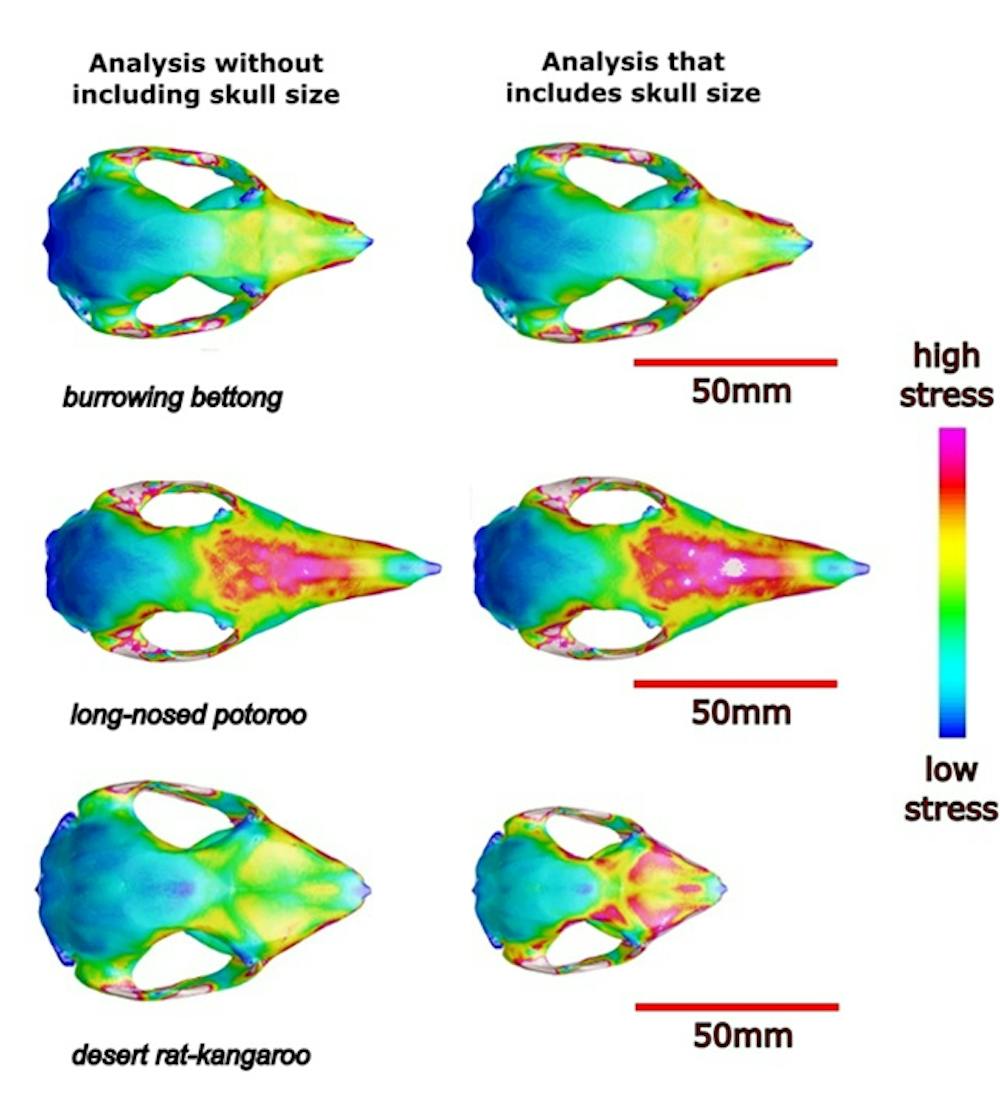
    But in our latest analysis, we showed that these assessments were probably incorrect. Instead, the animal’s diet was more likely restricted to softer materials, rather than the tougher foods eaten by some of its harder-headed relatives like the burrowing bettong.

    The reason for this? It all comes down to its size.

    Previous interpretations of its biting ability had drawn conclusions from comparisons of skull shape between species, but without considering size differences between them.

    Our results form part of a paper that addresses this issue in the methods that researchers use. We used a method called finite element analysis, which helps to predict how a structure – in this case, a skull – would handle the forces it experiences in the real world.

    But what we did differently to other researchers was to keep information about size differences between the skulls in the models.

    What did we find?

    The skull of the ngudlukanta is definitely efficient at biting, but it is also about one quarter smaller than the skull of the next smallest species in our sample, the northern bettong.

    When we included its smaller size in the analysis, the results suggested its relatively short face and robust jaw were unlikely to help it eat harder foods.

    Instead, its solid skull features mostly compensated for its small size, but would only allow it to support bites about as hard as those of the long-nosed potoroo – a larger species with a much less efficient skull at biting.

    Finite element models simulating the stress of each skull during biting with the front teeth. The stress in the desert rat-kangaroo is more similar to the hard food-eating burrowing bettong when not including its small size in the models. But its stress levels are more like the long-nosed potoroo when including its small size.
    Authors

    Early investigations of stomach contents from the 1930s tell us the ngudlukanta fed mostly on leaves and small amounts of insects. But little further detail exists. A more restricted range of softer, fresher plant materials, as suggested by our analysis, would narrow its range of preferred foods in the deserts it lived in.

    Our results therefore paint a picture of a species occupying a delicate position within the desert ecosystem.

    An unsolved mystery in a vast desert

    In recent years, one of us (Karl Vernes) has mounted several expeditions into the ngudlukanta‘s habitat, hoping to find evidence of its continued existence.

    However, finding this tiny marsupial in a vast desert is a challenge – not just because it was probably always rare and elusive, but also because we still know precious little about its ecology.

    Eyewitness accounts, remote camera traps, analysis of predator scat (poo) for mammal remains, genetic testing of scats, and the expert ecological knowledge of Traditional Owners have all been used to investigate the possibility of the survival of the ngudlukanta. No definitive evidence has yet emerged.

    Whether the ngudlukanta is extinct or not, therefore, remains an unsolved mystery.

    But history is replete with examples of rediscovered species believed to be extinct, known as “Lazarus species”. The desert’s vast, inhospitable terrain means it is plausible for a small nocturnal species to be evading detection.

    The distinctive short face of the ngudlukanta, alongside its small size and hopping gait, have led eyewitnesses to argue for its persistence.
    Hedley Herbert Finlayson, The Red Centre, 1935

    In fact, the desert rat-kangaroo was already a Lazarus species after its rediscovery in the 1930s. The story of the ngudlukanta therefore serves as a reminder that extinction declarations are not always the end of the story.

    If the species is still roaming the most inhospitable regions of the continent, the new knowledge gained from our analysis could help pinpoint areas where the ngudlukanta might persist.

    Who knows? The next chapter in the story of this desert-dweller may yet surprise us.

    Rex Mitchell has received funding from the Australian Research Council’s Centre of Excellence for Biodiversity and Heritage (CABAH).

    Karl Vernes has received funding from the Australian Research Council, the Mohamed bin Zayed Species Conservation Fund, Experiment.com, the Hermon Slade Foundation and Parks Australia. He is a member of the Australian Mammal Society.

    Vera Weisbecker receives funding from The Australian Research Council. She is affiliated with The Australian Mammal Society and member of the Australian Greens Party.

    ref. Presumed extinct, this desert rat-kangaroo may still be alive in hiding. New analysis reveals its delicate diet – https://theconversation.com/presumed-extinct-this-desert-rat-kangaroo-may-still-be-alive-in-hiding-new-analysis-reveals-its-delicate-diet-250283

    MIL OSI AnalysisEveningReport.nz

  • MIL-OSI Australia: Trailblazing UniSA programs take out national awards

    Source: University of South Australia

    26 February 2025

    From left: UniSA’s Vice Chancellor Professor David Lloyd, Professor Lan Snell, Associate Professor Stewart Von Itzstein, Dino Rossi and Ryan McClenaghan at the awards event

    The University of South Australia’s two nominations in the 2024 national Shaping Australia Awards have taken out both of the prizes in their category.

    Professor Tom Raimondo, Dr Jo Zucco and Associate Professor Stewart Von Itzstein won the Future Builder Award, as the team behind Australia’s first higher degree apprenticeship program, UniSA’s Bachelor of Software Engineering (Honours).

    Professor Lan Snell, Professor Andrew Beer, Peter Stevens, Stan Astachnowicz, Sam Stengert, Leanne Steele, Ling Ly and Jodie Walsh, the team behind UniSA’s trailblazing Global Executive MBA in Defence and Space (GEMBA), took out the People’s Choice Award in the same category.

    The Future Builder category honours initiatives that go above and beyond to deliver out-of-the-box teaching and industry engagement that bridges critical knowledge gaps. UniSA’s 2024 award wins reflect the University’s strengths in innovation and enterprise, and build on similar success in the inaugural awards last year

    The Shaping Australia Awards are an initiative of Universities Australia, which share the valuable contributions universities make to society.

    Bachelor of Software Engineering (Honours)

    UniSA’s Bachelor of Software Engineering (Honours) enables students to work full time at leading companies like BAE Systems, while studying. This hands-on experience, combined with academic rigor, ensures they graduate as work-ready, experienced software engineers.

    Created in partnership with industry partners including BAE and the AI Group, the success of the Bachelor of Software Engineering (Honours) has prompted the Department of State Development to issue a call for expressions of interest to establish additional degree apprenticeships in SA.

    Global Executive MBA in Defence and Space (GEMBA)

    UniSA’s Global Executive MBA in Defence and Space (GEMBA) is a unique18-month program delivered across three countries, reflecting the trilateral nature of the AUKUS alliance. The program equips leaders with advanced skills in areas like cyber security, space systems and defence procurement, and combines immersive residentials in Australia, the UK and the US with high-quality online learning.

    Through partnerships with Carnegie Mellon University, the University of Exeter and leading industry players, GEMBA empowers future leaders to navigate complex global security challenges and drive Australia’s defence and space industries forward.

    Universities Australia Chief Executive Officer Luke Sheehy congratulated all the winners and finalists.

    “These projects are changing lives, driving economic growth and securing Australia’s future. The overwhelming public response reflects the incredible contributions our universities make to help us all,” Sheehy said.

    The awards were judged by a panel of eminent Australians comprising:

    • Lisa Paul AO PSM, University of Canberra Chancellor and former Secretary of the Department of Education
    • Sir Peter Cosgrove AK AC (Mil) CVO MC (Retd), former Governor-General of Australia
    • Ms Charlene Davison, CEO of the Go Foundation.
    • Ms Michelle Gunn, editor-in-chief of The Australian
    • Mr Nicholas Moore AO, special envoy for Southeast Asia
    • Professor Brian Schmidt AC FAA FRS, former Vice-Chancellor of the Australian National University and Nobel laureate.
    • Ms Annabelle Williams OAM, Paralympic Gold Medallist, business owner and lawyer  

    A full list of the 2024 Shaping Australia Awards winners is available at shapingaustraliaawards.com.au.

    Other articles you may be interested in

    MIL OSI News

  • MIL-OSI Global: AI-detection software isn’t the solution to classroom cheating — assessment has to shift

    Source: The Conversation – Canada – By Michael Holden, Assistant Professor, Faculty of Education, University of Winnipeg

    Two years since the release of ChatGPT, teachers and institutions are still struggling with assessment in the age of artificial intelligence (AI).

    Some have banned AI tools outright. Others have turned to AI tools only to abandon them months later or have called for teachers to embrace AI to transform assessment.

    The result is a hodgepodge of responses, leaving many kindergarten to Grade 12 and post-secondary teachers to make decisions about AI use that may not be aligned with the teacher next door, institutional policies, or current research on what AI can and cannot do.

    One response has been to use AI detection software, which rely on algorithms to try to identify how a specific text was generated.

    AI detection tools are better than humans at spotting AI-generated work. But they’re a sufficiently imperfect solution, and they do nothing to address the core validity problem of designing assessments where we can be confident in what students know and can do.

    Teachers using AI detectors

    A recent American survey, based on nationally representative surveys of K-12 public school teachers published by the Center for Democracy and Technology, reported that 68 per cent of teachers use AI detectors.

    This practice has also founds its way into some Canadian K-12 schools and universities.

    AI detectors vary in their methods. Two common approaches are to check for qualities described as “burstiness,” referring to alternating and short and long sentences (the way humans tend to write) and complexity (or “perplexity”). If an assignment does not have the typical markers of human-generated text, the software may flag it as AI-generated, prompting the teacher to begin an investigation for academic misconduct.

    To its credit, AI detection software is more reliable than human detection. Repeated studies across contexts show humans — including teachers and other experts — are incapable of reliably distinguishing AI-generated text, despite teachers’ confidence that they can spot a fake.

    Teachers should not be confident they can spot AI-generated text. Icons for apps DeepSeek and ChatGPT on a smartphone screen in Beijing, Jan. 28, 2025.
    (AP Photo/Andy Wong)

    Accuracy of detectors varies

    While some AI detection tools are unreliable or biased against English language learners, others seem to be more successful. However, what success rates should really signal for educators is questionable.

    Turnitin boasts that their AI detector has a 99 per cent success rate, vis-à-vis their near one per cent rate of false positives (that is, the number of human-generated submissions their tool incorrectly flags as AI-generated). This accuracy has been challenged by a recent study that found Turnitin only detected AI-generated text about 61 per cent of the time.

    The same study suggested how different factors could shape accuracy results. For example, GPTZero’s accuracy may be as low as 26 per cent, especially if students edit the output an AI tool generates. Yet a different study of the same detector suggested a wide range of results (for example, between 23 and 82 per cent accuracy or 74 and 100 per cent accuracy).

    Considering numbers in context

    The value of a percentage depends on its context. In most courses, being correct 99 per cent of the time is exceptional. It’s above the most common threshold for statistical significance in academic research, which is often set at 95 per cent.

    But a 99 per cent success rate would be atrocious in air travel. There, a 99 per cent success rate would mean around 500 accidents every day in the United States alone. That level of failure would be unacceptable.

    To suggest what this could look like: at an institution like mine, the University of Winnipeg, about 10,000 students submit multiple assignments — we could ballpark five, for argument’s sake — for around five courses every year.

    That would be about 250,000 assignments every year. There, even a 99 per cent success rate means roughly 2,500 failures. That’s 2,500 false positives where students did not use ChatGPT or other tools, but the AI detection software flags them for possible use of AI, potentially initiating hours of investigative work for teachers and administrators alongside stress for students who may be falsely accused of cheating.

    Time wasted investigating false positives

    While AI detection software merely flag possible problems, we’ve already seen that humans are unreliable detectors. We cannot tell which of these 2,500 assignments are false positives, meaning cheaters will still slip through the cracks and precious teacher time will be wasted investigating innocent students who did nothing wrong.

    This is not a new problem. Cheating has been a major concern long before ChatGPT. Ubiquitous AI has merely shed a spotlight on a long-standing validity problem.

    When students can plagiarize, hire contract cheaters, rely on ChatGPT or have their friend or sister write the paper, relying on take-home assessments written outside class time without any teacher oversight is indefensible. I cannot presume that such forms of assessment represent the student’s learning, because I cannot reliably discern if the student actually wrote them.

    Need to change assessment

    The solution to taller cheating ladders is not taller walls. The solution is to change how we are assessing — something classroom assessment researchers have been advocating for long before the onset of AI.

    Just as we don’t spend thousands of dollars on “did-their-sister-write-this” detectors, schools should not rest easy simply because AI detection companies have a product to sell. If educators want to make valid inferences about what students know and can do, assessment practices are needed that emphasize ongoing formative assessment (like drafts, works-in-progress and repeated observations of student learning).

    These need to be rooted in authentic contexts relevant to students’ lives and their learning that centre comprehensive academic integrity as a shared responsibility of students, teachers and system leaders — not just a mantra of “don’t cheat and if we catch you we will punish you.”

    Let’s spend less on flawed detection tools and more on supporting teachers to develop their assessment capacity across the board.

    Michael Holden does not work for, consult, own shares in or receive funding from any company or organisation that would benefit from this article, and has disclosed no relevant affiliations beyond their academic appointment.

    ref. AI-detection software isn’t the solution to classroom cheating — assessment has to shift – https://theconversation.com/ai-detection-software-isnt-the-solution-to-classroom-cheating-assessment-has-to-shift-246102

    MIL OSI – Global Reports

  • MIL-OSI: FHLBank San Francisco Names Michael S. Hennessy Chief Financial Officer

    Source: GlobeNewswire (MIL-OSI)

    SAN FRANCISCO, Feb. 25, 2025 (GLOBE NEWSWIRE) — The Federal Home Loan Bank of San Francisco announced today the promotion of Michael S. Hennessy to the position of executive vice president and chief financial officer, effective April 1, 2025. Hennessy will succeed Joseph E. Amato, the current CFO who is also serving as the interim president and CEO while the bank’s board of directors conducts a search for a permanent chief executive officer.

    Hennessy currently serves as senior vice president, finance and analytics officer, overseeing financial planning and budgeting, capital markets analysis, valuations and analytics, and liquidity management. He has been with the bank for nearly 20 years, holding roles of increasing responsibility. In his new position, he will oversee accounting and financial reporting, treasury and capital markets, strategic planning, and portfolio strategy, ensuring the bank’s continued financial strength and stability.

    “Mike’s deep understanding of the bank and the broader financial industry has been invaluable in advancing our mission of providing liquidity to our members and investing in communities,” said Joseph E. Amato, interim president and CEO. “His leadership and expertise will be important in shaping and executing the bank’s strategy. His deep expertise and knowledge of this Bank and the critical role the FHLBank System plays in our financial system will be a tremendous asset in his new role.”

    Hennessy remarked he is honored to step into the role and continue his work with the team to support the Bank’s goals. “I look forward to driving financial excellence and advancing our mission by supporting our members and continuing to deliver on our liquidity function,” said Hennessy.

    Hennessy joined the bank in 2005 and has played a key role in various financial and strategic initiatives. He represented the FHLBank System on the U.S. Commodity Futures Trading Commission’s Market Risk Advisory Committee from 2015 to 2018. Before joining the bank, he was a vice president in fixed income sales and trading at both Lehman Brothers and Bank of America.

    Hennessy received his bachelor’s degree in economics and molecular and cell biology from the University of California, Berkeley, and is a CFA charter holder.

    About the Federal Home Loan Bank of San Francisco
    The Federal Home Loan Bank of San Francisco is a member-driven cooperative helping local lenders in Arizona, California, and Nevada build strong communities, create opportunity, and change lives for the better. The tools and resources we provide to our member financial institutions — commercial banks, credit unions, industrial loan companies, savings institutions, insurance companies, and community development financial institutions — propel homeownership, finance quality affordable housing, drive economic vitality, and revitalize whole neighborhoods. Together with our members and other partners, we are making the communities we serve more vibrant, equitable, and resilient.

    The MIL Network

  • MIL-OSI Global: USAID’s apparent demise and the US withdrawal from WHO put millions of lives worldwide at risk and imperil US national security

    Source: The Conversation – USA – By Nicole Hassoun, Professor of Philosophy, Binghamton University, State University of New York

    USAID was established by President John F. Kennedy in 1961 as a way to consolidate existing foreign aid programs. JAM STA ROSA/AFP via Getty Images

    On his first day in office, Jan. 20, 2025, President Donald Trump began a drastic reshaping of the United States’ role in global health as part of the first 26 executive orders of his new term.

    He initiated the process of withdrawing the U.S. from the World Health Organization, which works to promote and advance global health, following through on his first attempt in 2020. He also ordered staff members of the Centers for Disease Control and Prevention to cut off all communications with WHO representatives.

    In his first week, Trump also issued a stop-work order pending a 90-day review on nearly all programs of the United States Agency for International Development, or USAID.

    Many experts view this as a first step in dismantling the organization, which facilitates global efforts to improve health and education and to alleviate poverty. The sweeping move left aid workers and the people who depend on them in a panic and interrupted dozens of clinical trials across the world.

    President Trump’s executive order sparked legal action from international health care organizations, resulting in a federal judge ordering a temporary halt to the Trump administration’s freeze on foreign aid. Ultimately, that legal action was unsuccessful.

    On Feb. 23, the Trump administration put nearly all of USAID’s 4,700 workers on paid administrative leave globally and stated that it would be terminating 1,600 of those positions.

    Most recently, on Feb. 25, a federal judge ordered the Trump administration to allow some USAID funding to resume and required that it pay all of its invoices for work completed before the foreign aid freeze went into effect.

    I am the executive director of the Global Health Impact project, an organization that aims to advance access to essential medicines in part by evaluating their health consequences around the world, and a researcher focusing on global health and development ethics and policy.

    In my view and that of many other public health scholars, closing down USAID will imperil our national security and put millions of lives at risk.

    Because of the USAID stop-work order, 500,000 metric tons of food are at risk of spoiling.

    20 million with HIV treated

    USAID works with both nongovernmental organizations and private companies to help distribute medicines and vaccines around the world. The agency also helps improve government policies and invest in research and development to contain and address epidemics and pandemics.

    Starting in the late 1960s, for instance, USAID helped lead the effort to eliminate smallpox and has also helped fight polio and other devastating diseases over the past six decades.

    The smallpox pandemic was one of the worst of all time – it killed one-third of the people infected, causing an estimated 300 million to 500 million deaths worldwide in the 20th century. By contrast, COVID-19 killed less than 1% of those infected.

    These efforts have brought immense financial as well as health benefits to the U.S. and the rest of the world. Some economists estimate that the Global Polio Eradication Initiative, created in 1988, alone saved the world more than US$27 billion as of 2017, and that it will save a total of $40 billion to $50 billion by 2035.

    USAID also plays an important role in promoting global health equity. The agency works to increase access to primary health care, combat hunger and strengthen health systems – ultimately saving lives. In addition, USAID has provided a great deal of funding to fight infectious diseases such as malaria, tuberculosis and HIV.

    For instance, the U.S. President’s Emergency Plan for AIDS Relief, or PEPFAR, provides treatment for 20 million people living with HIV in Africa. Trump’s federal aid freeze has halted funding for PEPFAR projects.

    While the limited waiver under which the agency must now operate means some PEPFAR activities may eventually resume, many are now left without federal funding indefinitely. Unless another organization fills the gap, millions will die without USAID assistance.

    A 2022 photo of men in Afghanistan lining up to receive a monthly food ration, largely supplied by USAID.
    Scott Peterson/Getty Images News via Getty Images

    Mistakes made

    This is not to deny that USAID has made some grave errors in its history.

    For instance, USAID provided significant funding to the Democratic Republic of Congo (formerly Zaire) during the murderous regime of Mobutu Sese Seko, who was in power from 1965 to 1997.

    But USAID also has done an immense amount of good. For instance, it has helped contain the Ebola epidemic in the Democratic Republic of Congo since 2018. USAID’s work in preventing epidemics from spreading helps people everywhere, including in the U.S.

    If anything, there is a strong argument for increasing USAID funding. China has invested heavily in Asia and Africa through its Belt and Road Initiative, which is an attempt to recreate ancient trade routes by investing in roads, trains and ports. Some researchers argue that this has shifted diplomatic relations in favor of China. They believe that if the U.S. does not make similar investments and instead cuts foreign aid, it will affect the United States’ ability to achieve its foreign policy objectives.

    Similarly, there is a strong argument for increasing U.S. support for the WHO rather than withdrawing from the organization.

    Trump’s withdrawal order cites what he sees as the organization’s failures in addressing the COVID-19 pandemic as the rationale. But the WHO helped lead efforts to accelerate vaccine development and distribution, and retrospective reports claim that even more deaths could have been avoided with greater international cooperation.

    While dismantling USAID will cause irreparable harm to global health, these actions taken together are likely to deal a devastating blow to efforts to protect Americans and everyone else in the world from sickness and death.

    Alyssa Figueroa, an undergraduate student at Binghamton University, contributed to this article.

    Nicole Hassoun has received funding for research from the World Health Organization and the United Nations. She is the executive director of Global Health Impact (global-health-impact.org) which participates in the Pandemic Action Network.

    ref. USAID’s apparent demise and the US withdrawal from WHO put millions of lives worldwide at risk and imperil US national security – https://theconversation.com/usaids-apparent-demise-and-the-us-withdrawal-from-who-put-millions-of-lives-worldwide-at-risk-and-imperil-us-national-security-249260

    MIL OSI – Global Reports

  • MIL-OSI Security: Sean Williams Sentenced to 95 Years for Production of Child Pornography and Escape From Custody

    Source: Federal Bureau of Investigation (FBI) State Crime News

    GREENEVILLE, Tenn. – On February 24, 2025, Sean Christopher Williams, 53, of Johnson City, Tennessee, was sentenced to 95 years imprisonment by the Honorable J. Ronnie Greer, United States District Judge, in the United States District Court for the Eastern District of Tennessee at Greeneville.

    In July of 2024, Williams was convicted at trial of escape in violation of 18 U.S.C. § 751(a) and in November of 2024, Williams was convicted at trial of three counts of production of child pornography, in violation of 18 U.S.C. § 2251(a) and (e).

    The evidence presented at the escape trial showed that Williams escaped from a transport van enroute to the Greeneville Federal Courthouse on October 18, 2023.  His escape resulted in a multistate manhunt that led to the capture of Williams in Pinellas County, Florida, on November 21, 2023.

    The evidence presented at the child pornography trial showed that Williams used three minor children to engage in sexually explicit conduct and took photos of the sexually explicit conduct.  The conduct occurred at Williams’s apartment in Johnson City.  The evidence showed that Williams sexually assaulted each of the victims’ mothers while they were unconscious, around the same time that he took pornographic photos of their children.  The criminal conduct extended over a 12-year period.  Williams took photos of the first victim in 2008 and the two other victims on separate occasions in 2020.  Williams was arrested in 2023 near the campus of Western Carolina University and campus police officers seized flash drives from his car that were later found to contain the photos.

    “Sean Williams is a dangerous sexual predator who preyed on our community’s most vulnerable victims,” said United States Attorney Francis M. Hamilton III.  “Today’s sentence reflects the severity of the crimes committed and not only ensures that this dangerous individual has been held accountable for the harm he caused, but also prevents him from hurting others again.  We thank the dedicated law enforcement officers whose efforts made the convictions and sentence possible.”

    “Our children are among the most vulnerable members of our community,” said Special Agent in Charge Joseph E. Carrico of the Federal Bureau of Investigation (FBI) Nashville Field Office.  “The FBI will continue to do everything in its power to stop sexual exploitation of children that causes irreparable harm and trauma to the victims and bring to justice those responsible.”

    “This case shows the impact of collaboration and determination by the Tennessee Bureau of Investigation and our local, state, and federal partners to hold accountable an individual who preyed upon innocent children,” said TBI Director David Rausch.  “We hope the outcome of this investigation sends a clear message that we will continue to commit all the necessary resources to find and apprehend those who victimize our most vulnerable residents.”

    Law enforcement agencies either participating in a joint investigation, or cooperating in a parallel investigation, which led to the apprehension, indictment and subsequent conviction of Williams included the FBI, the United States Marshal Service, Homeland Security Investigations, the First Judicial District Attorney’s Office, the Tennessee Bureau of Investigation, and the Western North Carolina Police Department.

    Assistant U.S. Attorneys Meghan L. Gomez, Emily M. Swecker, and J. Gregory Bowman represented the United States at the trials.

    This case was brought as part of Project Safe Childhood (PSC), a nationwide initiative launched in May 2006, by the Department of Justice to combat the growing epidemic of child sexual exploitation and abuse.  Led by the United States Attorney’s Offices and the Criminal Division’s Child Exploitation and Obscenity Section, PSC marshals federal, state, and local resources to locate, apprehend, and prosecute individuals who sexually exploit children, and to identify and rescue victims.  For more information about PSC, please visit www.justice.gov/psc.

    For more information about internet safety education, please visit www.justice.gov/psc/resources.html and click on the tab “resources.”

                                                                                                          ###

    MIL Security OSI

  • MIL-OSI United Nations: Haiti: Gang violence displaces 6,000 people in one month

    Source: United Nations 4

    Peace and Security

    More than 6,000 people in Haiti have been forced from their homes by gang violence in almost a month, hampering aid efforts by humanitarian agencies, the United Nations warned on Tuesday.

    Since the end of January, a wave of extreme brutality has led to widespread loss of life and the displacement of over 6,000 people in the capital, Port-au-Prince.

    “We are deeply alarmed and appalled by the unacceptable and inhumane intensity of violence in Haiti,” the Haiti Humanitarian Country Team, which is made up of UN agencies, national and international NGOs and donors, said in a statement.

    Entire families were killed in their homes, while others, including children and babies, were shot dead as they tried to escape.

    The killings follow a massacre last December, when an outbreak of violence in the commune of Cité Soleil in Port-au-Prince led to the execution of more than 200 people by the Wharf Jérémie gang.

    UN condemns attacks on civilian population

    According to the UN, the daily life of many Haitians is marked by violence, fear, exhaustion, hunger, disease and an uncertain future. Women, girls and children are increasingly at risk, particularly that of sexual violence.

    By the end of 2024, violence had claimed the lives of at least 5,600 Haitians and displaced more than a million.

    “We condemn in the strongest possible terms any attack against the civilian population and infrastructure, in this case the one that targeted the hospital of the State University of Haiti on February 13. These acts violate human rights and deprive the most vulnerable of essential vital services,” said Humanitarian Coordinator Ulrika Richardson.

    On the ground, the humanitarian community is showing its determination to continue providing life-saving assistance to millions of children, women and men in vulnerable situations.

    Beyond immediate humanitarian assistance, the agencies are also committed to coordinating efforts with development and peacebuilding actors, so that these collective efforts contribute to sustainable solutions that build community resilience.

    “The mobilization actions of the international community in favour of Haiti will continue in order to guarantee the necessary funding to meet urgent needs and restore the dignity of the affected people,” the Humanitarian Country Team stressed.

    © IOM/Antoine Lemonnier

    The UN continues to support people who have been displaced by ongoing violence in Haiti.

    Humanitarian response plan: Over $900 million to save Haitians on the brink

    An appeal for $908 million to help some 3.9 million Haitians facing food insecurity, in a country where basic services are nearing collapse, has been launched by the UN.

    The Office for the Coordination of Humanitarian Affairs (OCHAreleased the 2025 humanitarian response plan on 19 February, which focuses on addressing acute needs caused by recent events, including armed violence, forced displacement, epidemics, and the consequences of natural disasters.

    The funding is earmarked to tackle Haiti’s profound challenges, including mobile teams to help humanitarians deliver aid, protection against sexual exploitation and abuse, and programmes aimed at supporting the country’s long-term development.

    MIL OSI United Nations News

  • MIL-OSI USA: Shapiro Administration Upgrades Education Hall at Nolde Forest Environmental Education Center to Enhance Student and Visitor Experience

    Source: US State of Pennsylvania

    February 25, 2025Reading, PA

    Shapiro Administration Upgrades Education Hall at Nolde Forest Environmental Education Center to Enhance Student and Visitor Experience

    Pennsylvania Department of Conservation and Natural Resources (DCNR) Secretary Cindy Adams Dunn visited Berks County to celebrate the completion of a $436,000 renovation of C.H. McConnell Environmental Education Hall at Nolde Forest Environmental Education Center. This investment is part of the Shapiro Administration’s broader commitment to modernizing state parks and forests, with $120 million in infrastructure improvements completed since January 2023.

    “Governor Shapiro is making strategic investments to improve our state parks and forests so they remain accessible, educational, and enjoyable for all Pennsylvanians,” said Secretary Dunn. “This renovation at Nolde Forest strengthens our commitment to conservation, education, and community engagement.”

    Governor Josh Shapiro’s 2025-26 proposed budget builds on this momentum with $5 million in new funding to expand and improve state parks across Pennsylvania. This includes establishing the Commonwealth’s 125th state park at Laurel Caverns in Fayette County – the first subterranean state park – highlighting the stunning natural beauty of the caverns and further boosting tourism.

    Speakers Include:
    Brent Erb, DCNR Environmental Education Center Manager
    DCNR Secretary Cindy Adams Dunn
    Dolores Portner, Direct Service Worker, John Paul II Center
    Dr. Jaime Becker, Alvernia University
    Dr. Jennifer Murray, Reading School District Superintendent
    Berks County Commissioner Christian Y. Leinbach
    State Representative Jacklyn Rusnock
    Senator Judith L. Schwank

    MIL OSI USA News

  • MIL-OSI USA: Hoeven, Shaheen & Moran Introduce Legislation to Bolster Air Traffic Control Workforce

    US Senate News:

    Source: United States Senator for North Dakota John Hoeven

    02.25.25

    Bipartisan Legislation Would Strengthen Enhanced AT-CTI Program, Improve ATC Recruitment, Training & Retention

    WASHINGTON – Senators John Hoeven (R-N.D.), Jeanne Shaheen (D-N.H.) and Jerry Moran (R-Kan.) introduced the Air Traffic Control (ATC) Workforce Development Act of 2025, bipartisan legislation to address ATC staffing shortages, improve working conditions and ensure the safe transportation of people and goods within U.S. airspace. Among other priorities, the legislation would:

    • Expand the ATC workforce training pipeline by codifying and strengthening the Enhanced Air Traffic-Collegiate Training Initiative (AT-CTI) program.
      • The bill authorizes $20 million per year for grants to AT-CTI schools to invest in curriculum, high-fidelity simulators, faculty and classroom supplies.
      • The legislation also removes disincentives that discourage retired air traffic controllers from working as instructors at AT-CTI schools.
      • Currently, four schools, including the University of North Dakota (UND), have been selected for the Enhanced AT-CTI program, under which graduates are immediately eligible for hire by the FAA and to begin localized training at an air traffic facility.
    • Authorize the procurement and placement of Tower Simulator Systems at ATC facilities nationwide, supporting more efficient certification of ATC trainees.
    • Require the FAA to develop Air Traffic Controller recruitment and retention incentive programs.
    • Support the development of mental health services equipped to address the particular stressors faced by the ATC workforce.

    “Without an adequate workforce of qualified air traffic controllers, air travel cannot function in a safe and efficient manner, a reality made clear by recent aviation tragedies and accidents,” said Senator Hoeven. “Despite efforts to boost recruitment, our nation has been unable to overcome attrition in the ATC workforce, and more needs to be done. Accordingly, our legislation expands the capacity of schools like UND to get more controllers into FAA towers and radar facilities, while providing better benefits to support workers and boost recruitment and retention. We worked hard to secure UND as a leader in the Enhanced AT-CTI program, and now we’re working to provide more resources to accelerate training, reduce the strain on our existing workforce and ensure the American public can trust in the safety of our air transportation system.”

    “Increasingly frequent near-misses and close calls over the last several years—coupled with recent aviation tragedies like the one last month in D.C.—are sobering reminders that we must do more to keep our skies safe,” said Senator Shaheen. “I’m proud to introduce bipartisan legislation with Senator Hoeven to expand the air traffic controller workforce pipeline, enhance training facilities and equipment, improve recruitment and retention efforts and more. I hope this bill moves quickly so we can address the shortage of air traffic controllers and strengthen aviation safety.”

    “Our national air space system relies on technology and individuals working in tandem to keep our skies safe and operating efficiently, and air traffic controllers are essential to that system,” said Senator Moran. “The training, hiring and retention of this critical workforce ought to be a continued priority of Congress, and I am pleased to join my colleagues in introducing legislation to support the current and future air traffic control industry. Continued investments in the programs and infrastructure supporting air traffic controllers will help to address workforce needs and keep our flying public safe.”

    “The National Air Traffic Controllers Association thanks Senators Hoeven and Shaheen for their leadership on the important issues of training, recruiting, and retaining air traffic controllers and we look forward to continuing our collaboration with Congress and the Administration on these critical matters.” – The National Air Traffic Controllers Association.

    “The University of North Dakota is proud to support the ATC Workforce Development Act. As the demand for air traffic controllers continues to rise, this bill represents a significant step forward in advancing their education and training through innovative technologies. By fostering a skilled workforce, this legislation will enhance the security of our airspace and uphold the reputation of air travel as the safest mode of transportation.” –Robert J. Kraus, Dean, John D. Odegard School of Aerospace Sciences, University of North Dakota.

    A summary of the legislation and the full bill text can be found here and here, respectively. The legislation builds upon several years of work between Senators Hoeven and Shaheen to support the Air Traffic Control workforce and address ATC understaffing. Most recently, they sent a lettercalling on the FAA to urgently work with Congress to address ATC staffing shortages, in light of the tragic aviation accident at Ronald Reagan National Airport (DCA) in Washington, D.C. Previously, Senators Hoeven and Shaheen:

    • Worked to include provisions in the FAA Reauthorization Act of 2024 that require the FAA to use a more accurate staffing model developed by the National Air Traffic Controllers Association and the FAA’s Air Traffic Organization (ATO).
      • The bill also sets an updated minimum hiring target for new air traffic controllers.
    • Authored the Air Traffic Controller Hiring Reform Act, which was signed into law as part of the Fiscal Year (FY) 2020 National Defense Authorization Act (NDAA) and required the FAA to prioritize the hiring of veterans and graduates of FAA Certified Collegiate Training Initiative (CTI) schools, like the University of North Dakota, as Air Traffic Controllers.

    The legislation is supported by the National Air Traffic Controllers Association (NATCA), Air Traffic Control Association (ATCA), Airlines for America (A4A), American Association of Airport Executives (AAAE), and Airports Council International – North America (ACI-NA).

    MIL OSI USA News

  • MIL-Evening Report: England subsidises drugs like Ozempic for weight loss. Could Australia follow?

    Source: The Conversation (Au and NZ) – By Jonathan Karnon, Professor of Health Economics, Flinders University

    Nomad_Soul/Shutterstock

    People with a high body weight living in England can now access subsidised weight-loss drugs to treat their obesity. This includes Wegovy (the weight-loss dose of Ozempic, or semaglutide) and Mounjaro (one of the brand names for tirzepatide).

    These drugs, known as GLP-1 agonists, can improve the health of people who are overweight or obese and are unable to lose weight and keep it off using other approaches.

    In Australia, the government subsidises the cost of semaglutide (Ozempic) for people with diabetes.

    But it is yet to subsidise semaglutide (Wegovy) on the Pharmaceutical Benefits Scheme (PBS) for weight loss.

    This is despite Australia’s regulator approving GLP-1 agonists for people with obesity, and for overweight people with at least one weight-related condition.

    This leaves Australians who use Wegovy for weight loss paying around A$450–500 out of pocket per month.

    But could Australia follow the England’s lead and list drugs such as Wegovy or Mounjaro on the PBS for weight loss? Doing so could bring the price down to $31.60 ($7.70 concession).

    Australia has already knocked back Wegovy for subsidies

    The Pharmaceutical Benefits Advisory Committee (PBAC) reviews the submissions pharmaceutical companies make for their drug therapies to be subsidised through the PBS.

    For every such recommendation, PBAC publishes a public document that summarises the evidence and the reasons for recommending that the drug should be added to the PBS – or not.

    In November 2023, PBAC reviewed Novo Nordisk’s submission. It proposed including semaglutide on the PBS for adults with an initial BMI of 40 or above and a diagnosis of at least two weight-related conditions. At least one of these related conditions needed to be obstructive sleep apnoea, osteoarthritis of the knee, or pre-diabetes.

    Sleep apnoea was one of the weight-related conditions in the original application.
    JPC-PROD/Shutterstock

    However, PBAC concluded semaglutide should not be subsidised through the PBS because it didn’t consider the drug cost-effective at the price proposed.

    PBAC referred to evidence on the long-term benefits from weight loss for people at increased risk of developing heart disease, diabetes or having a stroke. However, it didn’t factor these effects into its calculations when estimating the cost-effectiveness of semaglutide.

    The committee suggested a future submission could focus on patients with either pre-existing cardiovascular (heart) disease, type 2 diabetes, or at least two markers of “high cardiometabolic risk”. This could include hypertension (high blood pressure), high cholesterol, chronic kidney disease, fatty liver disease or pre-diabetes.

    What did England decide?

    The National Institute for Health and Care Excellence (NICE) has a similar role to the PBAC, informing decisions to subsidise medicines in England.

    As a result of NICE’s recommendation, semaglutide is subsidised in England for adults with at least one weight-related condition and BMI of 30 or above. Patients must be treated by a specialist weight-management service and prescriptions are for a maximum of two years.

    More recently, NICE approved another GLP-1 agonist, tirzepatide, for adults with at least one weight-related condition and a BMI of 35 or above.

    This approval didn’t restrict prescriptions to those treated in a specialist weight-management service. However, only 220,000 of the 3.4 million who meet the eligibility criteria will receive tirzepatide in the next three years. It is not clear how the 220,000 patients will be selected.

    The limits on tirzepatide will reduce the impact of GLP-1 agonists on the health budget. It is also intended to inform the broader roll-out to all eligible patients.

    For both semaglutide and tirzepatide, NICE noted that clinicians should consider stopping the treatment if the patient loses less than 5% of their body weight after six months of use.

    Australians who use Wegovy for weight loss or heart disease pay A$450–$500 out of pocket per month.
    antoniodiazShutterstock

    Why did they reach such different decisions?

    NICE assessed the use of GLP-1 agonists for a broader population than PBAC: people with one weight-related condition and a BMI of 30 or above.

    Another difference was that NICE’s cost-effectiveness analysis included estimates of the longer-term benefits of these drugs in reducing the risk of diabetes, cardiovascular (heart) disease, stroke, knee replacement and bariatric surgery.

    The proposed prices of the GLP-1 agonists in England and Australia are not reported. We can only observe the estimated health benefits. These are represented as the additional number of “quality-adjusted life years” (QALYs) associated with using the drugs. One QALY is the equivalent of one additional year of life in best imaginable health.

    Committees estimate the amount of additional health spending required to gain QALYs, to see if it’s worth the public investment. Looking at the committees’ estimates of weight-loss drugs (without a two-year maximum):

    • NICE reported a gain of 0.7 QALYs per patient receiving semaglutide for a target population with a BMI of 30 or more

    • PBAC reported a gain of 0.3 QALYs, but for a population with a BMI of 40 and above.

    Part of the explanation for the difference in estimated QALY gains is that PBAC did not consider the reduced risk of future weight-related conditions, only the impact on existing conditions.

    In contrast, NICE referred to substantial cost offsets due to reduced weight-related conditions, in particular because some patients would avoid developing diabetes.

    England and Australia’s estimates of the benefits of Wegovy differed.
    Matt Fowler KC/Shutterstock

    Time to rethink PBAC’s focus?

    Both NICE and PBAC are clearly concerned about the impact of GLP-1 agonists on the health budget.

    PBAC is trying to restrict access to a limited pool of people at highest risk. It is also being more conservative than NICE in estimating the expected benefits of GLP-1 agonists. This would require manufacturers to reduce their price in order for PBAC to consider these drugs cost-effective.

    Maybe this approach will work and the Australian government will pay less for these drugs the next time it considers publicly funding them.

    However, GLP-1 agonists are not on the agenda for the forthcoming PBAC meetings, so there is no timeline for when GLP-1 agonists might be funded in Australia for weight loss.


    Read more:
    People on Ozempic may have fewer heart attacks, strokes and addictions – but more nausea, vomiting and stomach pain


    Jonathan Karnon receives funding from the National Health and Medical Research Council and the Medical Research Future Fund.

    ref. England subsidises drugs like Ozempic for weight loss. Could Australia follow? – https://theconversation.com/england-subsidises-drugs-like-ozempic-for-weight-loss-could-australia-follow-245367

    MIL OSI AnalysisEveningReport.nz

  • MIL-OSI Global: Why Trump’s Gaza reconstruction proposal is unlikely to work

    Source: The Conversation – Canada – By Ali Asgary, Professor, Disaster & Emergency Management, Faculty of Liberal Arts & Professional Studies & Director, CIFAL York, York University, Canada

    There have been many conversations around U.S. President Donald Trump’s Gaza proposal to permanently displace Palestinians from Gaza to neighbouring countries and turn the strip into a luxury resort development. Criticisms of Trump’s comments often focus on the proposal’s illegality, immorality and impracticality.

    However, little has been discussed from the perspective of post-disaster and post-war reconstruction. Post-conflict reconstruction, as part of post-disaster reconstruction studies, has a very long history, scholarly literature, lessons learned and is one of the well-studied phases of disaster and emergency management.

    Where to rebuild

    When it comes to where to rebuild or reconstruct after disasters, including human-made disasters such as war and conflict, there are three main options:

    1) reconstruction in the original location;

    2) reconstruction in a new location; and

    3) reconstruction and integration in existing settlements.

    Each of these approaches has its advantages, disadvantages and challenges. One of the key principles of post-disaster recovery and reconstruction is minimizing post-disaster relocation.

    While a significant majority of post-disaster reconstruction happens in the original locations, there has been reconstruction and resettlement to new locations and beside or inside existing settlements.

    For example, after the 1974 conflict in Cyprus, the city of Famagusta was abandoned and residents were relocated to new areas. Relocation after the 1995 volcano eruption that buried Plymouth in Montserrat is another example. After the 1990 Manjil earthquake in Iran, many villages were relocated and rebuilt in new locations.

    Rebuilding in the original location

    Studies show that reconstruction in the original location is generally the most preferred and effective option. People impacted and displaced by war and disasters usually prefer to live in their original community.

    In some cases, reconstruction in the original location may still require some forms of temporary resettlement. This temporary relocation is a preferred option when the affected areas do not have enough space or ability to support the population during the reconstruction period, particularly during debris removal and infrastructure restoration.

    Past reconstruction efforts in developed and developing countries, show that recovery and reconstruction are more effective, democratic and faster when the impacted population is in charge of the reconstruction process, and remain close to their damaged homes.

    The closer a temporary settlement is to the reconstruction site, the better. Proximity allows the impacted population to participate effectively, monitor and benefit from the reconstruction process without distance and accessibility barriers.

    Rebuilding in new locations

    Reconstruction in a new location is usually considered as one of the last options when rebuilding in the original place is not possible due to various hazards like landslides, earthquakes, tsunamis, hurricanes, flooding or volcanos.

    This usually occurs when mitigation measures are neither possible nor feasible. This option requires relocating the impacted population and rebuilding everything from scratch. Its success very much depends on the availability of land, resources and the willingness of the impacted population to relocate.

    Even when relocation is the only viable option, impacted people must be fully involved and given discretion regarding their place of relocation. Involuntary resettlement programs are impracticable. Even when the population is displaced, studies show that people return to their original homes if they can.

    Rebuilding near existing settlements is an extension of this option except that instead of rebuilding in a new location, reconstruction happens beside existing settlements to minimize infrastructure costs.

    This option can still be challenging. Implementation can be very complex even when new settlements are in the same country or area. Reintegrating people into a new place, even when they are willing to be relocated, requires many livelihood support initiatives, land availability, legal frameworks for land distribution and dispute resolution.

    Rebuilding options for Gaza

    Trump’s proposal is close to that last option, with three major differences. The first difference is that there is no consultation with Palestinians in Gaza.

    The second difference is that the impacted population will be forcefully and involuntarily relocated to settlements in other countries (Egypt and Jordan).

    The third difference is that the United States would “own” Gaza, and rebuild it for other purposes and uses, not for the benefit of Palestinians.

    As mentioned above, one key justification for rebuilding in a new location is that the original place is not permanently safe. Trump’s proposal assumes that Gaza is not safe for Palestinians but somehow safe for others.

    Post-disaster and conflict reconstruction is not just a physical reconstruction project. Rather, it is a complex, multidimensional process, with potentially very high negative impact if not properly planned and implemented.

    Top-down approaches in post-disaster recovery and reconstruction often fail because these approaches ignore the complexity of the built environment, the local conditions, and the needs of the affected population.

    Displacing entire populations, their economic activities and their social networks and relations can have significant impacts — direct and indirect — on the population and on governments. Community relocation fails because it disrupts social networks, and increases negative sentiments and dissatisfaction with living conditions in new location.

    Post-war reconstruction programmes must be multi-dimensional and based on a clear understanding of local conditions and careful consultation with the affected people. The alternative to large-scale resettlement is to reduce the risks people face in their current location.

    In the past, international solidarity has played an important role in reconstruction. Such solidarity increasingly exists for the Palestinians of Gaza, and with that, rebuilding in the same location can still be a viable and preferred option.

    Ali Asgary does not work for, consult, own shares in or receive funding from any company or organisation that would benefit from this article, and has disclosed no relevant affiliations beyond their academic appointment.

    ref. Why Trump’s Gaza reconstruction proposal is unlikely to work – https://theconversation.com/why-trumps-gaza-reconstruction-proposal-is-unlikely-to-work-249680

    MIL OSI – Global Reports

  • MIL-OSI Global: More than just a game: How sports are reflecting Canada-U.S. tensions

    Source: The Conversation – Canada – By Noah Eliot Vanderhoeven, PhD Candidate, Political Science, Western University

    Canada emerged victorious in the 4 Nations Face-off hockey tournament on Feb. 20, but the event was overshadowed by growing political tensions between Canada and the United States.

    In the lead-up to the final game, American fans booed the Canadian national anthem, likely in response to Canadian fans booing the American national anthem ahead of a game between the two teams on Feb. 15.

    This was not the first recent airing of grievances from Canadian fans at a sporting event. Following U.S. President Donald Trump’s announcement of tariffs against Canada and repeated calls for Canada to become the 51st state, fans at a Toronto Raptors game and Ottawa Senators game booed the American national anthem.


    Read more:
    How Donald Trump’s attacks on Canada are stoking a new Canadian nationalism


    Despite the proposed tariffs being postponed for 30 days, Trump’s antagonistic vision for Canada-U.S. relations has stoked anti-American sentiments among Canadians, including calls to boycott American goods and a deteriorating belief in close Canada-U.S. relations.

    Those anti-American sentiments boiled over again when Canada faced the U.S. in Montréal, showcasing how sport can be used as an expression of nationalism — especially at a time of increased tensions between the two countries.

    Why sports matter politically

    It’s not surprising that sport has become an arena for nationalist political rhetoric. Sport possesses powerful symbolism that can be exploited to great affect in forming a coherent national identity.

    In this way, sporting events are a way fandoms can reinforce national identity as an objective symbol that connects to primitive forms of national ideology.

    Sport is also a powerful psychological setting for national rhetoric. A person’s social identity, or how they see themselves in relation to others, can be reinforced through sport. This can happen, for instance, when someone views themselves as a member of a team and celebrates their success, or views a rival team or country in a negative light after a loss.

    Additionally, the outcome of a game can boost in-group favouritism, which can influence whether consumers buy goods from a specific vendor.

    Nationalism versus patriotism

    Generally, research suggests sports reinforce a national in-group identity that is more patriotic than nationalistic. However, the vitriol Canadians have expressed during the American national anthem leans towards expressing nationalist views rather than patriotic ones.

    Patriotism typically focuses on why a country is great without necessarily disparaging outsiders or other countries. Nationalism, on the other hand, tends to play up why one’s country is great while vilifying another country or group.

    Trump’s focus on using tariffs to bully Canada into increasing security at the border has undoubtedly soured relations between the two countries. If Trump decides to flex the United States’ capacity to be a bully in U.S.-Canadian relations, Canada is stuck with limited options.

    But are Canadians playing right into Donald Trump’s hand by leaning into an adversarial relationship?

    How Trump uses sports for political gain

    Trump has a history of using major sporting events to his political benefit. During his last presidential campaign, he attended the Army-Navy football game and became the first sitting president to attend the recent Super Bowl in New Orleans.

    Trump also considered attending the 4 Nations final between the U.S. and Canada in Boston, but couldn’t attend due to a scheduled speech with U.S. governors. Still, he made his presence felt by calling the American team the morning before the game to wish them luck.

    Looking ahead, Trump may continue to use international sporting events to assert his vision for U.S. relations with Canada and Mexico.

    In January, Trump invited Gianni Infantino, the head of FIFA, to his inauguration, just as preparations have begun for the 2026 World Cup, which is to be hosted by Canada, Mexico and the U.S.

    With Infantino and Trump becoming increasingly friendly, it seems likely Trump will use the upcoming World Cup to influence North American relations. At the very least, he will likely try to insert himself into its coverage.

    Trump using sport to reinforce his image

    Beyond politics, Trump uses sports to play into his crafted image as a hyper-masculine man. This image has played a large part in Trump’s popularity among young men and helped him win a second term as president.

    Yet Trump does not necessarily fit the masculine norms his supporters lionize. Trump is fairly tall, which has been shown to be preferred among American voters. However, unlike past presidents such as Dwight D. Eisenhower and Richard Nixon, who played college football, Trump’s athletic background is limited to high school football.

    Nor did Trump serve in the military like previous presidents John F. Kennedy and Ronald Reagan, both of whom served in the Second World War. Trump, by contrast, avoided service during the Vietnam war for medical and educational reasons.

    Despite a lack of traditional masculine bonafides, Trump has shown an ability to use sporting events for his political gain. He has used sporting events as potent media environments to insert his talking points and burnish his masculine image.

    In the end, the boos from Canadian fans may be music to Donald Trump’s ears. He wants to be hated by outsiders so he can turn around to his supporters and say that the U.S. is under attack at its borders. He wants the sporting accomplishments of the American men’s teams to reflect on his strength.

    It can still go against him, as we saw Thursday night with Canada beating the U.S. in overtime. Justin Trudeau wasted no time using that moment to respond with strong rhetoric in a tweet.

    What happened on the ice was out of Trump’s control. But he used the event to serve his own goals, sowing greater divisiveness across borders. The shadow of his combative rhetoric loomed large over the entire event.

    Noah Eliot Vanderhoeven does not work for, consult, own shares in or receive funding from any company or organisation that would benefit from this article, and has disclosed no relevant affiliations beyond their academic appointment.

    ref. More than just a game: How sports are reflecting Canada-U.S. tensions – https://theconversation.com/more-than-just-a-game-how-sports-are-reflecting-canada-u-s-tensions-250385

    MIL OSI – Global Reports

  • MIL-OSI Global: Why Donald Trump is a relentless bullshitter

    Source: The Conversation – Canada – By Tim Kenyon, Professor, Faculty of Humanities, Brock University

    There have been many questions raised about the intentions behind Donald Trump’s spate of radical public statements about Canada, in which he claims trade deficits amount to subsidies, massive amounts of fentanyl are flowing across the border and the country should become the 51st American state, among other things.

    The U.S. president’s comments have fuelled speculation about what he means when he makes these kinds of false claims — or whether he means anything at all.

    After all, rounded to the nearest percentage point, zero per cent of illicit fentanyl entering the U.S. comes from Canada, trade deficits are not subsidies and annexing Canada is an absurd proposal.

    So why say things that are so untrue?

    Is Trump serious about any of this?

    Ignore Trump? Or fear him?

    The aggregate opinion seems to be both an unhelpful no and a yes, so the answer remains unclear.

    If we take every provocation seriously, we’re falling for the “flood the zone” strategy as Trump spews out outlandish claims as a form of distraction.

    If we shrug off his claims, we’re ignoring the potential danger.

    But there are patterns and incentives behind Trump’s flouting of basic communicative norms. One illustrative example dates back to 2018 talks with Prime Minister Justin Trudeau, when Trump complained about the U.S. trade deficit with Canada. Later, he told prospective donors in Missouri that he’d made this claim up on the spot.

    Why make up a claim like that? And, having done so, why admit and even brag about it, and then renew this knowingly false claim six years later?

    My colleague Jennifer Saul and I are scholars in the political philosophy of language. We’re among those who cite this example of Trump bullshit in our work on bullshit in authoritarian political speech and how bullshit can succeed even though everyone recognizes that it is, in fact, bullshit.


    Read more:
    Bullshit is everywhere. Here’s how to deal with it at work


    Why Trump bullshits

    Our notion of bullshit is a refinement of the term that was the subject of American philosopher Harry Frankfurt’s seminal 2005 book On Bullshit.

    Most liars care enough about the truth to try to conceal it. But simply not caring either way is a different vice, which Frankfurt called bullshitting.

    An example would be claiming a trade deficit without having any idea whether that’s true or false. Other examples include uttering falsehoods that are so obvious they couldn’t possibly be intended to deceive anyone.

    Really obvious bullshit can succeed politically, we proposed, because there are many audiences in mass communication. Bullshit targeted at Audience A can be a big hit with Audience B, if B thinks A deserves it.

    Then it becomes a display of power over A, with B enjoying the spectacle. This overt bullshitting lends itself to authoritarian politics for someone cultivating a strongman image. It marks an opponent for disrespectful treatment, and advertises that the bullshitter cannot be held to account.

    So Trump’s admission that he bullshitted Trudeau in 2018 was a successful strategy because he revealed it to a sympathetic audience, who got to see themselves as part of the performance and not as its target. Asking: “Does Trump really mean this?” is often less revealing than: “How does this promote Trump’s image as an authority figure, and to which audience?”

    Similarly, Trump falsely remarked in 2019 that Hurricane Dorian’s projected path included Alabama. He responded to fact-checking by showing an official storm track map that he literally altered by hand, with a marker.

    Such a ridiculous invention couldn’t be meant to deceive. But it showed Trump’s base, many of whom distrust mainstream information sources, that he couldn’t be made to back down for reporters, no matter the facts.

    Some claims appear deceptive lies to one audience and bullshit to another, like Trump’s recent claim that Ukrainian President Volodymyr Zelenskyy is a dictator who started the war in Ukraine.

    Some audiences might believe it. Others will see it as false and designed to be deceptive, yet recognize it as a threat to treat Ukraine as an aggressor with American demands for Ukraine’s rare earth minerals at stake.


    Read more:
    Ukraine’s natural resources are at centre stage in the ongoing war, and will likely remain there


    Credibility matters in unexpected ways

    Even conservative pundits initially worried that Trump’s propensity to bullshit would diminish the finite resource that is credibility.

    They didn’t recognize that credibility is a dubious virtue in strongman politics. Its absence can even be an asset. Acting without credibility is a chance to flex — to show that you can compel others to take you seriously whether they believe you or not.

    These incentives link frivolous outbursts of bullshit with very serious doubling-downs. Trump first spoke about Canada becoming the 51st state in a meeting with Trudeau in late November so offhandedly that it was not immediately mentioned in news reports.

    Once Fox News seized upon it, Trudeau was forced to publicly dismiss the comment as a joke.

    Prime Minister Justin Trudeau and Donald Trump at Trump’s Mar-a-Lago estate in Florida in November 2024. Trudeau apparently thought Trump was just bullshitting when he made mention of Canada becoming a 51st state during the dinner.
    (X/@JustinTrudeau)

    A great deal more commentary revealed liberal-leaning Canadians and Americans were angry and even frightened by this sort of talk — conditions that made it attractive for Trump to double down rather than back down.


    Read more:
    Canada as a 51st state? Republicans would never win another general election


    Combing through Trump’s speech and actions towards Canada to discover what he really means may just be an attempt to “sane-wash” them; meaning trying to figure out if they reflect a stable and sincere attitude, or even a stable and insincere negotiating strategy.

    What makes Trump’s bullshit so dangerous is that it rarely reflects fixed, coherent meanings or convictions. It lurches from triviality to deadly seriousness, depending on how his various audiences provide the approval and the outrage Trump seeks for his performances of strength.

    Tim Kenyon does not work for, consult, own shares in or receive funding from any company or organisation that would benefit from this article, and has disclosed no relevant affiliations beyond their academic appointment.

    ref. Why Donald Trump is a relentless bullshitter – https://theconversation.com/why-donald-trump-is-a-relentless-bullshitter-249896

    MIL OSI – Global Reports

  • MIL-OSI Global: How hockey’s politics played out at the 4 Nations Face-Off Tournament

    Source: The Conversation – Canada – By Braeden McKenzie, Postdoctoral Fellow & Equity Data and Research Analyst, University of Victoria

    The National Hockey League’s 4 Nations Face-Off tournament captured attention across North America as hockey’s first best-on-best competition since the 2014 Sochi Winter Olympics.

    The tournament, which featured competitive round-robin games between Canada, the United States, Finland and Sweden, was a massive success for the league. The final game between Canada and the U.S. averaged 9.25 million viewers with Canada defeating the United States 3-2 in overtime.

    The recent rise in political tensions between Canada and the U.S., amid continued threats of a trade war, have made their way onto the ice. Canadian fans in Montréal loudly booed the Star-Spangled Banner before both of Team USA’s round robin games.

    In response, Bill Guerin, Team USA’s general manager, encouraged U.S. President Donald Trump to attend the championship game in Boston. For his part, Trump used the tournament to reiterate his threat to annex Canada in a Truth Social post.

    An apolitical image

    Historically, hockey has been marketed as an apolitical space. The culture celebrates players that demonstrate a willingness to do their talking on the ice, praising their quiet reverence for the game’s traditions above all else.

    Superstar players like Gordie Howe, Bobby Orr, Wayne Gretzky and Sidney Crosby have been admired for being modest, respectful and even bland in their conduct, approach to the game and leadership style.

    Perhaps unsurprisingly, when players and coaches for the American and Canadian teams were asked about the political context the tournament had been thrust into, most reiterated that hockey should not be political and instead should operate as a space for people to escape.

    However, such notions belie a culture of masculinity that is decidedly white, and which ingrains expectations about tradition, professionalism and respect and works to uphold hockey’s political status quo.

    Fans boo American national anthem ahead of a showdown between Canada and the United States at the 4 Nations Face-Off. (The Canadian Press)

    Hockey’s preferred political acts

    In reality, hockey has always been a political space. Acts like playing national anthems, saluting flags or honouring military service are all inherently political. So, too, are displays of gigantic national flags in stadiums or arenas, military jet flyovers and public subsidies for professional sports facilities.

    It is noteworthy that those political acts are seen as acceptable in sports, while others — like booing or kneeling during an anthem — have faced widespread criticism from players, coaches and management.

    Performances of nationalism and militarism are somehow seen as apolitical, while expressions of protest are unpatriotic and too political. Such distinctions are less about preserving hockey as an apolitical space and more about maintaining unity and consensus in support of the brand of politics that is celebrated throughout the culture.

    Because the game’s history is largely based in white masculinities and traditions, political positions which reflect those ideologies (such as Don Cherry’s brand of nostalgic working-class populism and the MAGA movement’s views on nationalism, family structure or race) have been whole-heartedly accepted within hockey culture.

    A false neutrality

    Framing hockey as somehow neutral or apolitical simply reinforces the politics of the status quo, which benefits those in power and is, in itself, a clear expression of politics.

    Wayne Gretzky, perhaps Canada’s best ever player, has become an example of this very political reality. Gretzky recently faced criticism for attending the U.S. election night celebrations at Mar-A-Lago and Trump’s inauguration. Trump himself has suggested that Gretzky could be Canada’s governor if it becomes the 51st state.

    P.K. Subban, a gold medal-winning Canadian defenseman, was also criticized after he tweeted a screenshot of Trump’s Truth Social post, suggesting Trump may make the difference in the final game’s result.

    While many Canadians might disapprove of Gretzky attending the inauguration and Subban’s post, the acts are not likely to receive any major push-back within hockey itself (with the exception of former Canadian NHL player Akim Aliu calling out Subban).

    Having historically developed as a symbol of white masculinity, hockey will continue to represent a haven for ideologies rooted in inequity, division and extreme nationalism. While silence from players and coaches throughout the tournament is not wholly ill-intentioned, it without question represents complicity in the face of growing hatred, extremism and political turmoil.

    In contrast, acts of resistance or dissent are likely to continue to be cast off as too political by management, coaches and players. These individuals seem fine with politics in sport — just not politics that challenge their own.

    The authors do not work for, consult, own shares in or receive funding from any company or organisation that would benefit from this article, and have disclosed no relevant affiliations beyond their academic appointment.

    ref. How hockey’s politics played out at the 4 Nations Face-Off Tournament – https://theconversation.com/how-hockeys-politics-played-out-at-the-4-nations-face-off-tournament-250602

    MIL OSI – Global Reports

  • MIL-OSI USA: Sharing PLANETS Curriculum with Out-of-School Time Educators

    Source: NASA

    Out of school time (OST) educators work with youth in afterschool, community, and camp programs. Science, Technology, Engineering, and Mathematics (STEM) learning in OST can be challenging for multiple reasons, including lack of materials and support for educators. The NASA Science Activation program’s PLANETS project – Planetary Learning that Advances the Nexus of Engineering, Technology, and Science – led by Northern Arizona University in Flagstaff, AZ, provides both written curriculum and virtual educator support on planetary science and engineering.
    PLANETS offers three curriculum units focused on themes from NASA’s strategic priorities and mission directives in planetary science over the next decade:

    Space Hazards for learners in grades 3-5,
    Water in Extreme Environments, and
    Remote Sensing for learners in grades 6-8.

    PLANETS recently exhibited at two national conferences for educators to share these free NASA partner resources: the Space Exploration Educators Conference at Space Center Houston in Houston, TX on Feb 6-8, 2025 and the Beyond School Hours conference in Orlando, FL on Feb 13-16, 2025. Approximately 500 educators interacted with PLANETS team members to learn about the curriculum and to share their needs for OST learners. Some educators shared how they are already using PLANETS and how much their learners enjoy the lessons. In addition to sharing PLANETS resources, the team also had QR codes and flyers providing information about all the other Science Activation project teams, making sure educators grow in awareness of all that NASA’s Science Mission Directorate does to engage the public.
    OST educators appreciate the integrity and quality of NASA-funded resources. One educator shared, “Free resources are always critical to youth-serving organizations. PLANETS also has everyday materials and educator dialogue on how to deliver, making it easy to pick up and use.”
    Another OST educator said, “There are programs out there, like PLANETS, that truly help people of all backgrounds,” and yet another expressed, “I love the activities, and could see our youth engaging with it in a fun way.” Disseminating these types of NASA Science Activation program resources at regional and national venues is vital.
    The PLANETS project is supported by NASA under cooperative agreement award number NNX16AC53A and is part of NASA’s Science Activation Portfolio. Learn more about how Science Activation connects NASA science experts, real content, and experiences with community leaders to do science in ways that activate minds and promote deeper understanding of our world and beyond: https://science.nasa.gov/learn

    MIL OSI USA News

  • MIL-OSI USA: Construction Starts on 433-Unit Affordable Housing Project

    Source: US State of New York

    Governor Kathy Hochul today announced the start of construction on 1760 Third Avenue in East Harlem, a 433-unit affordable and supportive housing project in East Harlem that is the first residential project to get underway using capital financing through her landmark $1 billion mental health initiative. Funded by New York State Homes and Community Renewal and New York City Department of Housing Preservation and Development with support from the Office of Mental Health and the Office of Temporary and Disability Assistance, the $264 million project will transform a vacant former CUNY dormitory into affordable apartments, including 261 units of supportive housing for individuals living with mental illness.

    “By investing state resources into communities like Harlem, we can create the modern, affordable apartments that New Yorkers need,” Governor Hochul said. “This development on Third Avenue will bring new life to a vacant building by transforming it into affordable apartments that over 400 households will be able to enjoy for generations to come.”

    Breaking Ground, the project developer, will transform the vacant structure at 1760 Third Avenue into a 433-unit mixed-use development for households earning up to 60 percent of the Area Median Income. The redeveloped property will include 261 units reserved for formerly homeless individuals living with serious mental illness, with services provided by Breaking Ground.

    The project will include a subset of units for young adults aging out of foster care or who have experienced homelessness. Onsite support services will include case management, medical and mental health care, benefits and entitlement counseling, and connections to employment.

    The renovations to the building will incorporate sustainability measures such as energy-efficient rooftop air conditioners and hydronic heating system pumps that use water—rather than air—to transfer heat. The building will also feature water-conserving plumbing, efficient lighting, vegetative roofs and ENERGY STAR ® refrigerators to support cleaner living.

    The outdoor spaces along Third Avenue will also be transformed, creating new public-facing areas with landscaping, seating, and community-focused spaces. Constructed in 1974, the 1760 Third Avenue building originally housed a Florence Nightingale Nursing Center. The structure was later converted into a dormitory for the City University of New York’s Hunter College and Baruch College.

    The project received $75 million from HCR’s Supportive Housing Opportunity Program and a $24.6 million first mortgage structured as a 501(c)3 bond from its Housing Finance Agency. In addition, the development was awarded $126 million from the New York City Department of Housing Preservation and Development’s Supportive Housing Loan Program.

    In the past five years, HCR has financed nearly 6,600 affordable homes in Manhattan. 1760 Third Avenue continues this effort and complements Governor Hochul’s $25 billion five-year Housing Plan which is on track to create or preserve 100,000 affordable homes statewide.

    The State Office of Mental Health provided $21 million through Governor Hochul’s landmark $1 billion mental health initiative, which included funding to establish 3,500 units of specialized housing. So far, the mental health initiative has established nearly 1,300 new units including supportive housing and apartment treatment units, with 2,150 capital housing units in the pipeline. OMH has conditionally awarded more than $831 million in capital for community residence single room occupancy, supportive single room occupancy, and transitional residential units.

    The project also received $10 million through the New York State Office of Temporary and Disability Assistance’s Homeless Housing and Assistance Program and a $2 million discretionary capital grant from New York City Council Member Diana Ayala from Fiscal Year 2024. The New York City Acquisition Fund provided an acquisition loan originated by the Low-Income Investment Fund. Wells Fargo is providing the construction letter of credit.

    New York State Homes and Community Renewal Commissioner RuthAnne Visnauskas said, “This $264 million development is a testament to the power of innovation in addressing New York’s housing crisis. By transforming this former college dorm into affordable and supportive homes, we can provide security, stability, and a way forward for more than 430 individuals, families, and young people in need. 1760 Third Avenue exemplifies the Governor’s commitment to creating housing opportunities that are accessible, sustainable, and supportive for all New Yorkers, particularly the most vulnerable members of our community. We thank our partners, including Breaking Ground, for their collaboration on this important project.”

    New York State Office of Mental Health Commissioner Dr. Ann Sullivan said, “Supportive housing provides critical services that enable people living with mental illness to live and thrive in their communities. The project to redevelop 1760 Third Avenue will fill an important need in the East Harlem area and will provide much needed housing stability for individuals experiencing homelessness, including 261 units for those living with mental illness. This project demonstrates Governor Hochul’s continued commitment to increasing specialized housing for New Yorkers living with mental illness.”

    New York State Office of Temporary and Disability Assistance Commissioner Barbara C. Guinn said, “We are grateful to Governor Hochul for making landmark investments to expand supportive housing across New York State, recognizing that stable housing is the foundation for stable health, a stable life, and strong communities. The 1760 Third Avenue project will provide residents who have experienced homelessness with safe, affordable, energy-efficient apartments they can call home and onsite access to support services that will help them thrive in their community. Thank you to all our project partners and special thanks to Breaking Ground for their longtime leadership in providing supportive and transitional housing.”

    Assemblymember Edward Gibbs said, “Today, we celebrate a major milestone in our collective effort to address the affordable housing crisis and provide supportive services to those who need it most. The groundbreaking of 1760 3rd Avenue marks a significant step forward in our mission to create a more just and equitable society. As we continue to address the affordable housing crisis, projects like this remind us that together, we can create a more just and equitable society for all. I’m honored to play a part in supporting this project, and I look forward to seeing the positive impact it will have on our community.”

    New York City Council Member Diana Ayala said, “We are excited to celebrate the start of construction at 1760 Third Avenue. Our office was pleased to have invested $2 million in capital discretionary funding in this project and we look forward to welcoming residents home once construction is complete. Thank you to all our partners.”

    Breaking Ground President and CEO Brenda Rosen said, “Transforming underutilizing buildings like 1760 Third Avenue into much-needed affordable and supportive housing is an unparalleled opportunity – not only for the individuals who will soon call it home but also for the future of adaptive reuse development in our city. We are grateful that our public and private sector partners share our vision to create hundreds of safe, stable homes while preserving and revitalizing existing infrastructure. As we begin renovations, we mark an exciting milestone in our commitment to expanding services in Harlem and ensuring more New Yorkers have access to the housing and support they need.”

    Low Income Investment Fund Director Northeast Region Molly Anderson said, “LIIF was honored to work with NYS Homes and Community Renewal, NYC Department of Housing Preservation and Development, and NYS Office of Temporary and Disability Assistance to secure a $29.5 million acquisition and predevelopment loan in partnership with the New York City Acquisition Fund. This collaboration made a complex transaction a reality – and solidifies our relationship with a mission-aligned recipient, Breaking Ground, as we continue to strengthen historically underserved New York City communities such as East Harlem.”

    Wells Fargo Head of Public Affairs Jason Rosenberg said, “We thank Breaking Ground and the many community partners and neighbors who participated in bringing a long-term supportive and affordable housing option to East Harlem, strengthening the community and making lives better. We were pleased to provide Breaking Ground with $24.9 million in construction financing which will help enable them to transform the property into permanent housing, plus a $500,000 grant from the Wells Fargo Foundation to provide amenities that will help residents feel at home for decades to come.”

    New York City Department of Housing Preservation and Development Commissioner Adolfo Carrion, Jr. said, “It is truly fitting to see this building continue its service to this community, first in public health, then as a home for CUNY students and now by providing hundreds of affordable supportive homes and deepening our city’s commitment to affordable housing in Harlem. This success story is another example of the effective collaboration of the City and State, across multiple agencies, to bring dynamic programming, advance green construction design, and inclusive housing solutions to create investments that tackle the drivers of our housing crisis. HPD is proud to be part of the team and excited for the individuals and families that will call this place home”

    Governor Hochul’s Housing Agenda

    Governor Hochul is committed to addressing New York’s housing crisis and making the State more affordable and more livable for all New Yorkers. As part of the FY25 Enacted Budget, the Governor secured a landmark agreement to increase New York’s housing supply through new tax incentives for Upstate communities, new incentives and relief from certain state-imposed restrictions to create more housing in New York City, a $500 million capital fund to build up to 15,000 new homes on state-owned property, an additional $600 million in funding to support a variety of housing developments statewide and new protections for renters and homeowners. In addition, as part of the FY23 Enacted Budget, the Governor announced a five-year, $25 billion Housing Plan to create or preserve 100,000 affordable homes statewide, including 10,000 with support services for vulnerable populations, plus the electrification of an additional 50,000 homes. More than 55,000 homes have been created or preserved to date.

    The FY25 Enacted Budget also strengthened the Pro-Housing Community Program which the Governor launched in 2023. Pro Housing Certification is now a requirement for localities to access up to $650 million in discretionary funding. Currently, 275 communities have been certified, including New York City.

    MIL OSI USA News

  • MIL-OSI Asia-Pac: Union Minister Ashwini Vaishnaw Unveils Major Infrastructure and IT Initiatives at Advantage Assam 2.0

    Source: Government of India

    Union Minister Ashwini Vaishnaw Unveils Major Infrastructure and IT Initiatives at Advantage Assam 2.0
    Semiconductor Manufacturing Gets a Boost: New Plant Announced for Assam

    Guwahati Railway Station to Be Transformed into IT Hub; Six New Gati Shakti Cargo Terminals to Enhance Assam’s Railway Network

    New Amrit Bharat Trains to Connect Guwahati with Delhi and Chennai

    Posted On: 25 FEB 2025 8:14PM by PIB Guwahati

    Shri Ashwini Vaishnaw, Union Minister of Railways, Electronics & Information Technology, and Information & Broadcasting, participated in the Advantage Assam 2.0 Investment and Infrastructure Summit held in Guwahati today. During the event, he announced several key initiatives and projects aimed at accelerating the growth of the railway and IT industries in the region.

    Highlighting the government’s commitment to enhancing infrastructure and industrialization, Shri Vaishnaw described the North East as the “New Engine” for India’s development. He unveiled plans for a new semiconductor plant in Assam, reinforcing the state’s growing role in electronics and semiconductor manufacturing. Additionally, he announced that Guwahati Railway Station would be transformed into a new IT hub, further strengthening the region’s digital infrastructure.

    The Minister underscored the government’s success in constructing 1,824 km of new railway tracks in Assam and the North East since 2014. He also noted the commissioning of two Gati Shakti cargo terminals in Assam at Moinarband and Cinnamara and announced development of 06 additional Gati Shakti Cargo Terminals at Chaygaon, New Bongaigaon, Bihara, Hilara, Baihata and Rangjuli which will significantly enhance the region’s railway network. Further bolstering connectivity, he confirmed that one Vande Bharat Express is already operational in the Northeast, with another soon to connect Guwahati and Agartala. He also announced the sanctioning of two Amrit Bharat trains (between Guwahati-Delhi and Guwahati-Chennai), which will become operational this year, and the establishment of a railway engine midlife remanufacturing facility in Lumding. The Minister also accounced the plan to set up a Wagon Workshop at Bashbari in Bodoland area at a cost of Rs 300 cr.

    Shri Vaishnaw emphasized the government’s plans to improve connectivity between Assam and Bhutan, opening up new opportunities for economic growth. Addressing development in the Bodoland region, he reiterated the government’s commitment under the Bodo Agreement by announcing the establishment of a Wagon Workshop in Bashbari.

    Discussing India’s remarkable strides in electronics and mobile manufacturing, the Minister noted that over 98% of mobile phones are now produced domestically. To further strengthen the sector, he announced the development of a Greenfield Electronic Manufacturing Cluster (EMC) at Bongora, Kamrup, under the Electronics Manufacturing Scheme at a project cost of Rs. 120 crores. Additionally, he shared that the National Institute of Electronics and Information Technology (NIELIT) has been upgraded to a Deemed-to-be University, with plans to establish a campus in Jagiroad.

    Shri Vaishnaw reaffirmed the government’s dedication to infrastructure and industrial development in the North East, expressing confidence that Assam will soon emerge as a significant industrial hub. Assam Chief Minister Dr. Himanta Biswa Sarma echoed this sentiment, acknowledging the central government’s continuous support in fostering new initiatives in the state. He expressed optimism that Assam will become a key player in the global semiconductor ecosystem.

    During the session, the Government of Assam signed MoUs with 10 industry groups from the semiconductor ecosystem across Singapore, Malaysia, and Japan, in the presence of the Union Minister strengthening international partnerships and fostering investment in the state’s growing semiconductor industry.

    KSY/PG/BM

    (Release ID: 2106238) Visitor Counter : 217

    MIL OSI Asia Pacific News

  • MIL-Evening Report: Outstanding craftsmanship and international voices: the 5 films up for best documentary at the 2025 Oscars

    Source: The Conversation (Au and NZ) – By Phoebe Hart, Associate Professor, Film Screen & Animation, Queensland University of Technology

    Oscar-nominated best documentary film Sugarcane. Disney+

    The Academy Awards represent the screen industry’s biggest annual global recognition for the very best of moviemaking. And in these troubled times, many recognise the power of documentaries to transform the world for the better.

    Like last year, the 2025 nominations for Best Documentary are international in their scope, continuing an Academy trend of placing more emphasis on voices outside of the United States.

    This year’s nominations feature a few milestones: it’s the first time a Japanese filmmaker has been put forward, and the first time an Indigenous North American filmmaker has been nominated in Oscars history.

    All exhibit outstanding craftsmanship while exploring intense themes. The following roundup will hopefully encourage you to check them out at the cinema or online, and see why the experts also think they deserve the top gong.

    Soundtrack to a Coup d’Etat

    Johan Grimonprez’s experimental essay examines the Cold War politics of the 1950s and 60s. At this time, many African nations were gaining independence from their colonial masters.

    In Soundtrack to a Coup d’Etat, the uranium and mineral rich Democratic Republic of the Congo becomes a poignant case study.

    As the first prime minister Patrice Lumumba breaks the country away from Belgian rule, a murderous plot by global superpowers to destroy the country’s newfound sovereignty unfolds.

    And underneath it all: the frenetic beat of jazz as a revolutionary reaction against racism on both sides of the Atlantic.

    A wealth of archival material featuring former world leaders, the Congolese situation, and the musical stylings of Nina Simone, Duke Ellington, Louis Armstrong and others make this documentary effortlessly cool. The edit and sound design has a wonderful syncopated rhythm, revealing fascinating facets of modern history and the scramble for power.

    Sugarcane

    St. Joseph’s Mission was a residential school for Indigenous children in Canada, which closed in 1981.

    When ground penetrating radar begins looking for unmarked graves at the school, Julian Brave NoiseCat – whose father was born on the site – and co-director Emily Kassie embark on a quest of accountability for a myriad of institutional abuses.

    Editors Nathan Punwar and Maya Daisy Hawke interweave archival reels alongside Emily Kassie and Christopher LaMarca’s stark verité cinematography. The film captures members of the Williams Lake First Nation community reckoning with generations of trauma at the hands of Catholic clergy.

    Together, they present some disturbing facts in the film, which won a directing award at the Sundance Film Festival.

    National Geographic has routinely received a documentary Oscar nomination. This film is a challenging topic for Australian and New Zealand audiences. We also have a troubling history with the placement of Aboriginal children in homes, where many faced hardships and mistreatment.

    Sugarcane gives a platform for truth-telling and healing.

    Porcelain War

    Ceramists Slava Leontyev and Anya Stasenko are inspired by the nature of Ukraine and each other. Their friend, and fellow creator, Andrey Stefanov documents their lives on tape after his wife and children flee at the start of the Russian invasion.

    All become involved in active defiance.

    The film combines nonprofessional video, body cams and drone footage alongside wildlife photography and charming animations of Anya’s delicate paintings on clay.

    There are gripping scenes of armed conflict from the viewpoint of Slava’s squad of reservists. These are everyday folks who have become involved in fighting on the ground.

    Porcelain War benefits from a soundtrack composed and performed by folk music quartet DakhaBrakha. This adds an eerie texture to this portrait of hope.

    The film thoughtfully balances light and shade with grace, demonstrating that art remains a potent way to oppose erasure.

    Black Box Diaries

    When her high-profile #MeToo sexual assault case is dropped on the grounds of insufficient evidence, Japanese journalist, director and producer Shiori Itō commences chronicling her journey to justice.

    Deploying abstract imagery over recorded conversations with investigators and witnesses, Itō builds her argument over several years. The passage of time is interspersed with her unfiltered video diary entries.

    There has been controversy about the director including hotel footage of her drugged and being dragged out of a taxi by her attacker, senior reporter Noriyuki Yamaguchi, without permission. Itō had been given the footage for the legal case, but had agreed it would not be used outside of the courtroom.

    The debate has prevented the film from showing on Japanese screens. However, Itō has argued the public good of using this material outweighs commercial interests – especially considering the pressure of Yamaguchi’s influential connections to quell the case, which include then-Prime Minister Shinzo Abe.

    Itō doesn’t shy away from exposing the raw emotional depths of her remarkably brave undertaking against fierce odds, and she serves as an inspiring change-maker we should all heed.

    No Other Land

    No Other Land takes stock of the West Bank situation from the perspective of Basel Adra, who documents evictions of Palestinians in his home village of Masafer Yatta.

    Basel works with journalist Yuval Abraham to bear witness to the army’s gradual destruction of his village to make way for a military training ground.

    No Other Land features some great observational camerawork with many poetic images of resilience. Things kick up a notch when a villager, Harun, is shot by Israeli soldiers while trying to confiscate his building tools. Basel is targeted for filming the ensuing protests – but Adra and Abraham continue undeterred.

    A friendship develops amid the chaos between the Palestinian activist and Israeli reporter, who co-direct and edit with Hamdan Ballal and Rachel Szor. It’s the touching humanity of their relationship that goes to the core of the film; compassion is key to deescalating tensions in the region.


    In Australia and Aotearoa New Zealand, Soundtrack to a Coup d’Etat, Porcelain War, Black Box Diaries and No Other Land are streaming on DocPlay; Sugarcane is streaming on Disney+.

    Phoebe Hart does not work for, consult, own shares in or receive funding from any company or organisation that would benefit from this article, and has disclosed no relevant affiliations beyond their academic appointment.

    ref. Outstanding craftsmanship and international voices: the 5 films up for best documentary at the 2025 Oscars – https://theconversation.com/outstanding-craftsmanship-and-international-voices-the-5-films-up-for-best-documentary-at-the-2025-oscars-249151

    MIL OSI AnalysisEveningReport.nz

  • MIL-Evening Report: Multiple warnings and huge fines are not stopping super funds, insurers and banks overcharging customers

    Source: The Conversation (Au and NZ) – By Jeannie Marie Paterson, Professor of Law, The University of Melbourne

    Last week the Federal Court fined Australia’s biggest superannuation company, AustralianSuper, A$27 million for overcharging customers.

    The company had breached its legal obligations under the Superannuation Industry (Supervision) Act 1993 by failing to identify and merge the duplicate accounts of customers.

    Given the individual errant fees were about $1.50 per duplicate account, the penalty might sound disproportionate to the wrongdoing.

    But over the nine years the duplicate account and other fees were being charged, they collectively cost customers about $69 million.

    As revealed in court, the double charging continued even though AustralianSuper’s employees and officers were aware that duplicate accounts were widespread.

    Not a precedent

    This court case was not the first. It follows a damning series of cases brought by the Australian Securities and Investments Commission (ASIC) against banks, insurers and super funds for overcharging.

    In 2022, ASIC reported six of Australia’s largest financial services institutions had paid almost $4.4 billion in compensation to customers for overcharging or providing no service.

    Financial penalties were also imposed. Westpac and associated entities were fined $40 million for charging $10.9 million to more than 11,800 dead customers.

    ANZ was also hit with a $25 million penalty for failing to provide promised fee benefits to about 689,000 customer accounts over more than 20 years.

    These cases were highlighted in the Royal Commission into Misconduct in the Banking, Superannuation and Financial Services Industry, which ran from December 2017 to February 2019. But even after that, new instances emerged.

    In 2023, a review by ASIC resulted in general insurers repaying more than $815 million to more than 5.6 million customers for pricing failures since 1 January 2018“.

    After this, ASIC imposed penalties on insurers IAG-subsidiaries and QBE. It was alleged they misled customers by promising them loyalty discounts to renew their home insurance policies. But the customers actually had their premiums raised by an amount similar in size to the discounts.

    In 2024, ASIC announced the findings of an inquiry into excessively high fees for superannuation fund advice. The fees were not proportionate to the advice needs of members or the cost of advice.

    More than 300 members across seven of the funds had advice fees of more than $15,000 deducted from their accounts.

    Despite repeated calls by ASIC and the Australian Prudential Regulation Authority for the industry to improve its operations, a 2024 ASIC review found major banks left at least two million low-income customers in high-fee accounts. Those affected were refunded more than $28 million.

    Why has this litany of pricing misconduct cases occurred?

    Put in the best light, the failures represent a combination of poor legacy payment systems and increasingly complex modern payment structures and products.

    Recognising these constraints, the Federal Court has stated that the obligation under the Corporations Act to ensure financial services are provided “efficiently, honestly and fairly” does not demand “absolute perfection”.

    In other words, some mistakes are inevitable. But this does not relieve banks, insurers and superannuation funds from responsibility for payment errors.

    The buck stops with the institutions

    Charging more money than permitted or failing to pass on discounts will usually be a breach of the financial institution’s contract with its customers, and may also amount to misleading conduct.

    It’s unlawful. Even if the individual amounts in question are small compared with the turnover of the financial institution, they are significant to the customers affected.

    This means, as courts have consistently recognised, that financial institutions have a responsibility to put in place “systems and processes” to identify and correct payment errors. And they need to remediate affected customers promptly.

    The ongoing misconduct suggests banks, insurers and superannuation trustees have ignored this.

    Notably, in 2023, a court found NAB waited more than two years to correct overcharging, despite being aware of it.

    And in 2025, the court was critical of AustralianSuper for taking years to address the problem of duplicate customer accounts even after it was identified.

    The judge in the AustralianSuper case said:

    nobody was responsible for ensuring compliance with legislative requirements and [this] resulted in no resources being dedicated to that task.

    When no one takes responsibility

    After the Royal Commission, ASIC was criticised for not being sufficiently rigorous in enforcing the law. It now appears ASIC is working through the fee practices of banks, insurers and super funds armed with considerable penalties.

    ASIC’s clear aim is to ensure payment misconduct doesn’t pay, and enforcement by the regulator cannot be dismissed as a mere cost of doing business.

    But is this enough? Customers may wait years for payment errors to be identified and redressed through enforcement by ASIC.

    We need to rethink how these institutions understand their obligations to customers. Notably, the United Kingdom has introduced a “consumer duty”, which requires banks to promote customers’ interests and demonstrate how they are doing this.

    Australia doesn’t have this obligation. But it may be worth learning from the UK. Banks, insurers and superannuation funds here should be obligated to show they are using processes that produce good ongoing outcomes for their customers.

    Jeannie Marie Paterson receives funding from the Australian Research Council for a project on treating customers fairly commencing July 2025.

    ref. Multiple warnings and huge fines are not stopping super funds, insurers and banks overcharging customers – https://theconversation.com/multiple-warnings-and-huge-fines-are-not-stopping-super-funds-insurers-and-banks-overcharging-customers-250658

    MIL OSI AnalysisEveningReport.nz

  • MIL-Evening Report: Which type of note-taking is better for learning: laptop or pen and paper?

    Source: The Conversation (Au and NZ) – By Penny Van Bergen, Associate Professor in the Psychology of Education, Macquarie University

    VesnaArt/Shutterstock

    Once upon a time, university lectures were accompanied by the sound of pens scribbling on paper. But if you go into a lecture hall today, you will hear students tapping on laptops.

    Devices are now an accepted and important part of modern learning. But this does not necessarily mean students should forget the old-fashioned ways of taking notes.

    Research shows pen and paper can help students learn and remember more from class.

    The benefits of note-taking

    Studies have long shown students who take notes during a lecture, class, or while reading are able to remember more of that content later.

    One reason is note-taking is more active than listening or reading, which helps us maintain attention.

    And students often go beyond just recording the information being said.

    Note-taking means students are trying to understand their teacher by making assessments about what is important in real time. They might also organise the content into themes and sub-themes or highlight things that stand out.

    These activities are examples of active engagement which strengthens the “encoding process”: the way new knowledge moves into long-term memory and forms memory pathways.

    Strong memory pathways enable knowledge to be more easily accessed later, such as when problem solving in class or doing an exam.

    Taking notes during class can help keep your focus and make it easier to retain information.
    Matej Kastelic/Shutterstock


    Read more:
    Avoid cramming and don’t just highlight bits of text: how to help your memory when preparing for exams


    Note-taking on a laptop

    Research shows the kinds of notes students take when typing on a laptop differ from those taken with traditional pen and paper.

    A 2018 study in the United States found college students took longer lecture notes (both in word count and quantity of ideas) when typing on a laptop than when writing by hand. They also recorded longer sections verbatim from the lecture. This might occur because students typically type faster than they handwrite.

    However, while students are faster on a laptop, they are also likely to become distracted.

    A 2021 study of US college students used tracking software and found the average student was distracted for about half their lecture by social media, assignments, shopping and other off-task internet activities.

    Note-taking with a pen

    So how do pen and paper compare?

    A 2024 meta-analysis of 24 international studies showed taking lecture notes by hand resulted in stronger overall test performance and course grades for undergraduate students.

    This is because handwriting engages the brain in a more active way than typing, which is better for learning.

    Students who take notes by hand use more shorthand, visual signals (for example, bolding, underlining, arrows and stars) and images (diagrams, graphs and tables) than those who type.

    Taking notes by hand is particularly helpful if a lecturer or teacher pauses during a lecture or lesson, so students can revise or add to their notes in real time. In one US study, students using longhand added three times as many new ideas to their notes during lecture pauses as laptop users did.

    Notetaking on pen and paper can help students form strong connections between ideas.
    ABO PHOTOGRAPHY/Shutterstock

    Are there times laptops might be better?

    Despite the benefits of handwriting, there are some situations where laptops may be more appropriate for note-taking.

    Students who struggle with slow handwriting or spelling may find pen and paper note-taking interferes with their learning. This is because they need to focus more on the physical act of writing so it becomes harder to process new knowledge.

    Some neurodivergent students may also find handwriting challenging. For instance, autistic students often experience difficulties with fine motor skills like handwriting. Similarly, students with dyslexia or dysgraphia may struggle with handwriting tasks.

    For these students, typing with features like spell-check and auto-correction can allow them to focus on understanding and fully participating in class.

    But for those who find both handwriting and typing equally comfortable, the research shows using a pen and paper are more effective for learning.

    Penny Van Bergen receives funding from the Australian Research Council, Google and the Marsden Fund.

    Emma Burns receives funding from the Australian Research Council, is an associate editor for the Australian Educational Researcher and is on the board of the Australian Educational Research Organisation.

    Hua-Chen Wang receives funding from Google on a research project regarding vocabulary learning.

    ref. Which type of note-taking is better for learning: laptop or pen and paper? – https://theconversation.com/which-type-of-note-taking-is-better-for-learning-laptop-or-pen-and-paper-250404

    MIL OSI AnalysisEveningReport.nz

  • MIL-Evening Report: I spy with my little eye: 3 unusual Australian plant ecosystems to spot on your next roadtrip

    Source: The Conversation (Au and NZ) – By Gregory Moore, Senior Research Associate, School of Agriculture, Food and Ecosystem Sciences, The University of Melbourne

    A boab tree in the Kimberley. Hideaki Edo Photography/Shutterstock

    When the growing gets tough, the tough trees and shrubs get growing.

    Australia’s environment is brutal. Its ancient, low-nutrient soils and generally low rainfall make it a hard place for plants to grow. Despite this, the continent is filled with wonderfully diverse plant ecosystems.

    If you don’t know what you’re looking for, it can be easy to miss these seemingly unremarkable species. So, here are three little-known Australian plant species and ecosystems to look out for during your next roadtrip.

    1. Cycads and eucalypts

    If you are driving a coastal route along southern New South Wales, keep an eye out for the stunning combination of burrawang cycads (Macrozamia communis) and spotted gum (Corymbia maculata). These species live in harmony along the NSW coastline, from Kempsey to Bega, and inland as far as Mudgee.

    Spotted gum trees with burrawang cycad understorey on the Burrawang walking track, NSW South Coast.
    Destinations Journey/Shutterstock

    If you’re on a road trip, now is the perfect time to talk to children about ancient moving continents, volcanoes and dinosaurs.

    Cycads are ancient gymnosperms (cone-bearing plants) which evolved long before the Gondwanan supercontinent separated. These tough, hardy plants saw the dinosaurs come and go, and their relatives are found all around the world.

    These cycads form a striking understorey to the spotted gum. As their scientific name (Macrozamia communis) suggests, they form a dense community.

    Further north in Queensland, pineapple cycads (Lepidozamia peroffskyana), and Western Australia’s zamia palm (Macrozamia riedlei) are also worth spotting.

    Cycad seeds are poisonous, but First Nations Australians worked out a complex process to prepare them for safe eating. This involved dissolving the plant’s toxins in running water, cooking, working and grinding the seeds into a powder.

    Spotted gums evolved long after dinosaurs went extinct. Early eucalypt fossils date from about 34 million years ago, while current species are often only a few million years old.

    Spotted gums are a great example of how plants that survive tough environments often also do well in difficult urban situations.

    Cycads are similarly found growing in poor soils and arid conditions. They have long, glossy leaves up to about 1.5 metres in length with lots of leaflets.

    There are both male and female plants. The female cone is an impressive, wide-domed structure that can be almost half a metre across. Its bright orange-red seeds are eaten by foraging marsupials, large birds and flying foxes.

    Spotted gums are tall, straight eucalyptus trees with dark green, glossy leaves. Old bark creates dark grey spots against their cream coloured trunk, giving them a mottled look.

    It is interesting to see ancient and modern species in such a close community relationship in cycad-spotted gum forests. Both are also well-adapted to the fires that frequent their habitat.

    2. Ancient acacias

    Travelling inland, the environment gets even tougher. Most large trees disappear and are replaced by woodlands dominated by inland acacia (wattle) species.

    These inland acacias are short but mighty, with deep, extensive root systems.

    Two of these species, mulga (Acacia aneura) and brigalow (A. harpophylla) are part of Australian folklore. A Banjo Paterson character says: “You know how the brigalow grows […] saplings about as thick as a man’s arm”.

    Nutrients and water resources are limited, so mulga and brigalow trees are often evenly spaced across the landscape. This eerie symmetry makes it look like they were planted by humans.

    Acacias grow in arid conditions and are what many Australians think of when they envisage the red inland of our continent.
    Ashley Whitworth/Shutterstock

    Many people are unaware that the twisted, stunted specimens they see are more than 250 years old and occupy vast tracts of the Australian landscape.

    Waddy-wood (Acacia peuce) is a rare species of acacia, found in just three locations on the edge of the Simpson Desert. This tree has very strong wood, and was used by Indigenous Australians for making clubs (waddys) and tools for carrying fire.

    Inland acacias were widely used by Indigenous Australians for their wood, resins and medicinal properties. They have also been used as fodder for livestock, especially during drought.

    These crucial species provide important habitat for other plants and animals. But they are under threat.

    As old trees collapse and die, there are no young trees replacing them. This is because of drought and grazing, compounded by climate change.

    Desertification – where fertile land is degraded until it essentially becomes desert – is becoming a huge problem due to the massive area dominated by acacias.

    3. Boabs

    If you’re driving across the Northern Territory and Western Australia, you might come across the mighty boab (Adansonia gregoryii).

    These close relatives of the African and Madagascan baobabs floated to Australia as seeds or seedlings around 12 million years ago.

    Swollen boab tree trunks (called a caudex) can store thousands of litres of water.
    bmphotographer/Shutterstock

    These deciduous trees live in mostly dry environments that also experience strong monsoonal-type rains. Boabs trap and store water in their trunks, allowing them not only to survive but thrive.

    Their African and Madagascan baobab relatives are sometimes called trees of life, as they support many species.

    Australian boabs are similar. They offer habitat, roosting and nesting sites. Their flowers and fruits are food sources to many species of insects and birds.

    They were – and are – important trees in First Nations cultures. Carvings and symbols on their trunks can last for more than a century, much longer than on other trees. These are called dendroglyphs.

    For example, snake carvings dated to more than 200 years old have been found on boab trees in Northern Australia’s Tanami Desert.

    While these special trees are usually found far from the beaten track, they can be spotted growing around Darwin and other remote towns. If you get the chance to see them, count yourself lucky.

    Tough terrain, tough trees

    Plant communities are remarkably resilient. They also display great creativity when evolving ways to survive tough environments.

    Make sure to keep an eye out as you’re exploring Australia and enjoy the fascinating plants our country has to offer.

    Gregory Moore does not work for, consult, own shares in or receive funding from any company or organisation that would benefit from this article, and has disclosed no relevant affiliations beyond their academic appointment.

    ref. I spy with my little eye: 3 unusual Australian plant ecosystems to spot on your next roadtrip – https://theconversation.com/i-spy-with-my-little-eye-3-unusual-australian-plant-ecosystems-to-spot-on-your-next-roadtrip-246129

    MIL OSI AnalysisEveningReport.nz