NewzIntel.com

    • Checkout Page
    • Contact Us
    • Default Redirect Page
    • Frontpage
    • Home-2
    • Home-3
    • Lost Password
    • Member Login
    • Member LogOut
    • Member TOS Page
    • My Account
    • NewzIntel Alert Control-Panel
    • NewzIntel Latest Reports
    • Post Views Counter
    • Privacy Policy
    • Public Individual Page
    • Register
    • Subscription Plan
    • Thank You Page

Category: Universities

  • MIL-OSI United Kingdom: Her Majesty The Queen to unveil iconic statue in Canterbury city centre

    Source: City of Canterbury

    Home  »  Latest News   »   Her Majesty The Queen to unveil iconic statue in Canterbury city centre

    Her Majesty The Queen will visit Canterbury in Kent today (Tuesday 25 February) to unveil a statue of the first full-time professional woman writer in the English language, Aphra Behn.

    Her Majesty will then visit The Beaney House of Art and Knowledge and Canterbury Library to help celebrate the city’s passion for heritage and literature.

    The statue has been given to Canterbury City Council, and therefore to the city, by the Canterbury Commemoration Society.

    Its Chair, Stewart Ross, said: “We’re very excited to be able to welcome Her Majesty to our wonderful city in the heart of the garden of England.

    “The A is for Aphra campaign started five years ago when members of the community began asking why one of Canterbury’s most famous literary heroes was not celebrated in the city where she grew up.

    “The campaign group joined forces with the Canterbury Commemoration Society to celebrate Aphra and to raise the statue back in the same streets Aphra knew as a child.

    “Over the course of the campaign, many people from the community have worked tirelessly to raise awareness and funds for a sculpture to be placed in the city.

    “This included an academic conference at the University of Kent, a revival of Behn’s play The Amorous Prince by the Canterbury Players and a public exhibition about Behn at The Beaney House of Art and Knowledge last year.

    “Canterbury City Council’s successful Levelling Up Fund bid was able to support this project and The Beaney House of Art and Knowledge was chosen as a location that highlights the city’s passion for heritage and literature.”

    Aphra (1640–1689) was baptised in Harbledown, just outside Canterbury, and spent her formative years in the city during the English Civil War.

    The creation of the bronze statue by sculptor Christine Charlesworth followed an extensive period of research, consultation and fundraising.

    After an international design competition, four shortlisted maquettes were toured across the UK and the public asked which they thought would be the most fitting memorial.

    The design by Christine Charlesworth won the public vote.

    The winning design presents a 17-year-old Aphra, book in hand and theatrical mask behind her back, looking wistfully about her as she sets out for London with her family.

    After the unveiling, Her Majesty will be treated to a tour around The Beaney, one of Canterbury City Council’s museums, and Canterbury Library which is run by Kent County Council (KCC).

    The city council’s Head of Culture, Leisure and External Development Michelle Moubarak said: “The Beaney is home to the museum collection, art galleries, the city’s visitor information centre, the library and registration services.

    “It underwent an extensive renovation in 2012 to enable more people to enjoy it especially among those who have been underrepresented in the past.

    “Since its transformation, it has attracted 3.5million visitors including almost 50,000 schoolchildren, seen more than 7,000 people take part in health and wellbeing activities and has benefited from 360 volunteers giving up 12,245 hours of their time.”

    KCC’s Head of Libraries, Registration and Archives James Pearson said: “Canterbury Library stands as one of our most popular libraries in the county.

    “It is a cherished cornerstone of the community offering a warm and welcoming environment for people to sit, relax, read and learn.

    “It currently houses 50,215 books and continues to expand including a Home Library Service with dedicated volunteers delivering books to those in need that are unable to access our physical or mobile library network.

    “The service has recently introduced a collection of books in Ukrainian to support those who have temporarily relocated to Canterbury at such a difficult time for Ukraine.

    “There is a dedicated community hub for reading groups, Talk Time sessions and literacy groups.

    “The local studies collection boasts a wealth of materials, ranging from maps to books of local interest.

    “Among these treasures is our oldest book, Somner’s Antiquities of Canterbury, published in 1640.

    “The modern Canterbury Library continues to evolve in step with the ever changing and diverse needs of the community – forever fostering a love for reading, community, connection to others, inclusivity and lifelong learning. It is a place where everyone is truly welcome.”

    The Queen’s visit, which will celebrate the work both councils undertake around health and wellbeing, will include:

    • an Aphra Behn workshop with Year 3 children from St Peter’s Primary School
    • a look around the library with a focus on community engagement, volunteering, its collection of literature from Ukraine, its Book Club and Reading Well group
    • a look around The Beaney’s Curious Stories exhibition and the different ways of experiencing it with the Sensing Culture visually impaired group and their assistance dogs and the Power of the Object group which supports people living with dementia and their carers
    • a performance of an excerpt from the Royal Shakespeare Company’s production of Behn’s play The Rover directed by Loveday Ingram
    • a reading by Pilgrims Way Primary School pupil Ahmad Raza of his poem All About Me which won the five to eight-year-old category in the Canterbury Festival’s Poet of The Year competition
    • a reading by St Anselm’s School pupil Emily Corbett of her poem Counting Stars which won the nine to 11-year-old category in the same competition
    • a reading of a Behn poem by Gyles Brandreth, President of the Aphra Behn Society of Canterbury

    Her Majesty will also be invited to view the first edition of Behn’s novel Oroonoko and meet its donor, Anna Astin, before signing the visitors’ book at the end of the visit.

    Music for the statue unveiling will be provided by the 2nd Whitstable Sea Scout Band, led by Bandmaster Mark Wilkins.

    Published: 25 February 2025

    MIL OSI United Kingdom –

    February 25, 2025
  • MIL-OSI Russia: Where in Siberia did dinosaurs live?

    Translartion. Region: Russians Fedetion –

    Source: Novosibirsk State University – Novosibirsk State University –

    At the popular science marathon “Darwin Week” junior researcher of the A. A. Trofimuk Institute of Oil and Gas Geology and Geophysics of the Siberian Branch of the Russian Academy of Sciences, engineer of the scientific and educational center “Evolution of the Earth” Faculty of Geology and Geography of Novosibirsk State University, paleontologist Vsevolod Efremenko told which dinosaurs lived in Chukotka and Sakhalin, where to look for their remains and how representatives of the paleofauna adapted to life beyond the Arctic Circle. At present, it is reliably known that 12 species of dinosaurs lived in Siberia. Scientists have discovered about 30 places in Russia where their remains have been preserved to this day, but this does not mean that dinosaurs lived only in those places. It is possible that they lived everywhere, but, unfortunately, bones and teeth, and even more rarely – imprints of feathers and fur, are preserved only in certain conditions.

    — Scientists very rarely find complete dinosaur skeletons. Even finding bone joints is a great success for paleontologists. In 95% of cases, they find teeth, vertebrae, bones or their fragments, parts of skulls and jaw fragments. A significant part of the finds are shells, remains of insects and other invertebrates, imprints of fish and fossil plants — in terms of biomass, they all significantly exceeded dinosaurs. In addition, for their remains to be preserved for tens of millions of years, special conditions are required, which are possible when many factors come together, which is a rather rare phenomenon. Nevertheless, all this makes our work more interesting, — said Vsevolod Efremenko.

    The remains of dinosaurs should be looked for in sedimentary rocks, which are the compressed remains of ancient lakes, rivers and swamps. They are usually formed in an aquatic environment, contain fossils and are destroyed fairly quickly on the earth’s surface. The remains of prehistoric animals are not preserved in volcanic and metamorphic rocks. Success in the search for dinosaurs can be expected if it is possible to determine the places where the shores of seas, rivers or lakes, as well as swamps, used to be, and to determine the excavation sites by their contours.

    At the beginning of the Cretaceous period, 145 million years ago, the position of the continents on our planet was already close to the modern one, only the oceans occupied a significantly larger area, and there were no polar ice caps in the polar region. In Siberia and Asia there was a mountainous terrain, and dinosaurs could have lived in the intermountain plains along the banks of rivers and lakes. Closer to the extinction – 66 million years ago – the continents occupied an even closer position to the modern one, and sedimentary basins are almost no longer observed in Siberia. Accordingly, there are almost no sedimentary rocks in which paleontologists can count on finds from that period. Therefore, the remains of dinosaurs of that period could not have been preserved. But in the Far East, the situation was different, so paleontologists discover very interesting finds there.

    — The climate in the Cretaceous period was quite comfortable for dinosaurs — moderate in the Arctic, warm northern in Siberia, and close to subtropical in the Transbaikal Territory. This is evidenced by the climatic reconstruction made on the basis of paleoflora. Dinosaurs could easily settle throughout the territory of Eurasia, Siberia, including Chukotka and Sakhalin. Even in Antarctica, fossil birds are found that once felt quite comfortable in those places, — explained Vsevolod Efremenko.

    The most ancient dinosaurs discovered in Russia lived in the Jurassic period (201-145 million years ago). In Siberia, two of their locations are known – in the Krasnoyarsk and Transbaikal regions.

    The most famous dinosaur of Transbaikalia was found in the vicinity of the village of Kulinda. Scientists have named it Kulindadromeus transbaikaliensis. It lived in these places about 168 million years ago. It was a small non-avian dinosaur of modest size (about the size of an average dog) covered in feathers and scales. It combined bird and reptilian features and was most likely warm-blooded.

    In the Krasnoyarsk Territory, in the vicinity of the village of Sharypovo, the remains of two dinosaurs of the Jurassic period were discovered: several bones of the predatory tyrannosaurid kilesk (a distant relative of the tyrannosaurus) and many bones of several stegosaurs, from which a whole skeleton was later assembled. Surprisingly, the bones of this herbivorous dinosaur were found among numerous shells of prehistoric turtles in a coal quarry.

    — Paleontology is a very creative science. We can guess from individual bones what genus and species of dinosaur they belong to, and then reconstruct the entire skeleton. This was the case with the kileskos, which hunted stegosaurs. The remains of these ancient animals are found next to each other. But in order not to damage the priceless finds, the paleontologist must work very carefully in the excavation. Since all the bones are scattered, it is necessary to clearly record the position of each of them, so that when assembling the dinosaur skeleton, you do not end up with a chimera, — the paleontologist explained.

    In the Cretaceous period (145-66 million years ago), the diversity of dinosaurs was enormous. At least a dozen sites of their remains have been discovered in Siberia. One of the largest is in the vicinity of the village of Shestakovo in the Kemerovo region. It was here that paleontologists found a large number of bones and even entire skeletons of Psittacosaurus sibirica, a small dinosaur that lived here 125-100 million years ago. The remains of the sauropod Sibirotitan were also found at this location — large cervical vertebrae. These 20-ton giants shared this territory with Psittacosaurus, as well as the recently discovered Ceratosaurus kiyakursor. It was a very mobile, long-legged, small dinosaur. Scientists have found parts of its skeleton — the humerus, cervical vertebrae, a fragment of the girdle of the forelimb, as well as the bones of the hind limb in anatomical articulation. Unfortunately, neither the skull nor its parts were found, and scientists cannot yet say with complete certainty whether this dinosaur was a predator or a herbivore.

    The northernmost dinosaur site is Teete in the Republic of Sakha (Yakutia). During the Cretaceous period, the climate here was warm and mild. Here, paleontologists have discovered stegosaurid teeth and vertebrae, as well as sauropod teeth.

    — Over three field seasons, expedition members collected a rich collection of teeth and vertebrae of small therapsids and salamanders. Remains of turtles, fish, lizards and extinct reptiles were also found. Surprisingly, this territory is a refugium — a region where species of ancient animals that have already become extinct in other places have survived for a long time, — said Vsevolod Efremenko.

    The scientist also spoke about other paleontological finds indicating that dinosaurs lived in Chukotka, Sakhalin and the Far East. Herbivorous duck-billed hadrosaurs lived in Chukotka, as well as ceratopsians – it was previously believed that they inhabited only North America. Eggshells were also found, which means that dinosaurs did not end up in the polar latitudes as a result of migration. They constantly lived and reproduced in these places.

    Many significant finds were made in Blagoveshchensk in the Far East. One of the most striking is the duck-billed dinosaur Olorotitan. The uniqueness of the find was that at the time of its discovery it was the most complete articulated dinosaur skeleton discovered in Russia. Its body length was approximately 8 meters, height – 3.5 meters, and weight could reach 3 tons.

    The richest finds were made in the Transbaikal Territory. They belong to the Jehol biota – these are fossil remains of feathered dinosaurs, birds, mammals and plants, which are found in large quantities in the Lower Cretaceous deposits of North-Eastern China. So far, these unique locations of ancient fauna have not been fully studied and, according to Vsevolod Efremenko, there is enough work for many generations of paleontologists.

    Please note: This information is raw content directly from the source of the information. It is exactly what the source states and does not reflect the position of MIL-OSI or its clients.

    MIL OSI Russia News –

    February 25, 2025
  • MIL-Evening Report: Some of Australia’s largest companies are failing to ‘know and show’ their respect for human rights

    Source: The Conversation (Au and NZ) – By David Birchall, Senior Lecturer in Law, Macquarie University

    The skyline of Sydney’s central business district. Olga Kashubin/Shutterstock

    In our complex, interconnected world, there are risks of human rights violations throughout global supply chains. Examples include not only modern slavery and child labour, but also gender discrimination and violations of land, food and water rights.

    Many people care deeply about whether the companies they support are monitoring and addressing these issues. So, how do some of the biggest Australian companies measure up?

    To answer this question, we analysed the human rights commitments of 25 of the top companies listed on the Australian Securities Exchange (ASX), including some of our largest banks and mining companies.

    We found Australian companies have a long way to go in “knowing and showing” a commitment to respect human rights, suggesting an urgent need for reform.

    One response could be for Australia to follow the European Union’s lead and create a mandatory human rights due diligence regime.


    Read more:
    Many global corporations will soon have to police up and down their supply chains as EU human rights ‘due diligence’ law nears enactment


    International best practice

    Our analysis used the World Benchmarking Alliance’s Corporate Human Rights Benchmark Core UNGP Indicators.

    This benchmark uses 12 indicators that draw on the United Nations Guiding Principles on Business and Human Rights (UNGP), the authoritative international standard.

    There are human rights risks across many stages of global supply chains.
    JULY_P30/Shutterstock

    The indicators are grouped into three themes:

    1. policy commitments to respect human rights
    2. embedding respect through ongoing human rights due diligence
    3. enabling accessible remedies and grievance mechanisms for workers and external stakeholders.

    Companies score between zero and two points on each indicator, depending on how they satisfy its requirements. The maximum possible score is 24.

    It’s important to understand that the aim of our study was not to assess whether these companies have been violating human rights. Rather, it was to evaluate whether companies have disclosed their policies and processes to respect human rights.

    The UN Guiding Principles expect companies to have suitable due diligence processes in place and make these publicly available in an accessible form.

    Ideally, companies should clearly state that they respect all human rights. This includes rights such as nondiscrimination, the prohibition on forced or child labour, freedom to join trade unions, and the right to a clean environment.

    They should outline in detail the mechanisms in place to identify and address actual or potential abuses. On top of this, detail which officials in the company hold responsibility for managing these issues.

    The better companies would even disclose examples of human rights abuses that they discovered in their operations, such as modern slavery or a gender pay gap.

    Poor performance overall

    Our research covered the 25 largest Australian companies by market capitalisation that had not previously been assessed under this benchmark.

    This included some of the leading Australian companies from a range of sectors – mining, banks, energy, insurance, transportation, telecommunication, media, health care and pharmaceuticals.

    Scores were poor overall. The best-performing company scored eight out of a possible 24 points. The average score was 3.6.

    Many companies were found to be making vague or ambiguous human rights commitments or only focusing on a narrow set of modern slavery risks.

    No company disclosed all of the human rights due diligence processes needed to identify, prevent, mitigate and remediate human rights risks. Nor did any disclose how they consulted with relevant stakeholders such as workers or displaced communities to help them understand and identify relevant human rights risks in company operations.

    Only ten of the 25 companies provided a mechanism for external individuals and communities to raise human rights complaints or concerns.

    Companies scored particularly poorly on the second group of indicators: embedding respect through ongoing human rights due diligence. The average score here was 0.58 out of 12.

    Many companies only focused on identifying and addressing modern slavery in their operations, to the exclusion of other human rights risks such as sexual harassment or environmental pollution.

    It was also concerning that companies we assessed often passed the burden of compliance to suppliers. That is, they established higher expectations for suppliers’ conduct than they set for their own.

    Legal requirements made a difference

    Our research found that companies scored well in making human rights commitments where there was a legal obligation to do so.

    Every company, for example, scored the point available for hosting a grievance mechanism for workers to raise concerns about the company. This is because Australia’s Corporations Act requires companies to create a whistleblower mechanism.

    Similarly, most companies disclosed elements of their modern slavery due diligence process, because this is legally required under the Modern Slavery Act.

    Proactive steps

    It is clear from our research that many large Australian companies are not operating in line with international standards.

    That means they also aren’t ready to comply with the ripple effects of the mandatory human rights due diligence laws recently introduced in Europe.

    These laws will require large Australian companies that do significant business in Europe to conduct comprehensive human rights due diligence.

    The European Union has recently introduced mandatory human rights due diligence laws.
    VanderWolf Images/Shutterstock

    Australian companies must take proactive steps to comply with international standards. This means making a public commitment to respect all human rights, establishing and publicly disclosing their human rights due diligence process.

    It will also mean involving everyone who is affected by or has an interest in the company’s activities throughout the due diligence process. This includes making sure they have a way to raise concerns and seek remedies.

    The Australian government has a vital role in ensuring that companies take their human rights responsibilities seriously. The current reporting regime under the Modern Slavery Act has proven very weak, confirmed under a recent formal review.

    Our findings suggest the government should enact a stronger and broader mandatory human rights due diligence law covering all human rights.

    David Birchall is Deputy Director of the B&HR Access to Justice Lab at Macquarie Law School.

    Ebony Birchall is the Deputy Director of the B&HR Access to Justice Lab at Macquarie University. She has previously received research funding from the Australian Government, Macquarie University and the Freedom Fund.

    Surya Deva is Director of the B&HR Access to Justice Lab at Macquarie University. He is currently UN Special Rapporteur on the Right to Development. He has previously received funding from the GIZ, the UNDP, the Freedom Fund and the International Commission of Jurists. He is part of the World Benchmarking Alliance’s Expert Review Committee. The Lab received funding from Maurice Blackburn Lawyers and the World Benchmarking Alliance to cover the costs of hosting an event to launch this report.

    – ref. Some of Australia’s largest companies are failing to ‘know and show’ their respect for human rights – https://theconversation.com/some-of-australias-largest-companies-are-failing-to-know-and-show-their-respect-for-human-rights-250055

    MIL OSI Analysis – EveningReport.nz –

    February 25, 2025
  • MIL-Evening Report: The major parties want 9 in 10 GP visits bulk billed by 2030. Here’s why we shouldn’t aim for 100%

    Source: The Conversation (Au and NZ) – By Yuting Zhang, Professor of Health Economics, The University of Melbourne

    Drazen Zigic/Shutterstock

    Unaffordable GP visits has become a pressing issue amid the increasing cost-of-living crisis. About 30% of Australians delayed or didn’t see a GP in 2023–24.

    To solve this problem, Labor has proposed extending bulk billing incentives to all Australians. It hopes to increase bulk billing from 78% to 90% by 2030.

    The Coalition has promised to match Labor’s plan.

    Why not aim for 100%? It might seem a worthy goal to make GP care free for everyone, for every visit. But the evidence suggests there’s benefit to getting those on higher incomes to contribute a small amount to the cost of seeing a GP.

    GP care should be free for these Australians

    We should aim for access to GP care to be affordable and equitable. For some people, this should mean they can access the services for free.

    Appointments for children should be free. Making health checks regular and accessible during childhood is an effective long-term investment which can delay the onset of disease.

    GP visits should also be free for people with low incomes. Free primary care can mean people who would otherwise avoid seeing a GP can have their ongoing conditions managed, undergo preventive health checks, and fill prescriptions.

    When people skip GP visits and can’t afford to fill their prescriptions, their conditions can worsen. This can reduce the person’s quality of life, and require higher-cost emergency department visits and hospital care.

    Appointments in rural and remote areas should also be free. Australians living in rural and remote areas currently pay more to see a GP, have less access to care when they need it, and experience poorer health outcomes and shorter lives than their city counterparts.

    Making GP visits free for rural and remote Australians would help reduce this rural–urban gap.

    Rural Australians find it harder to see a GP when they need one.
    Michael Leslie/Shutterstock

    However, providing free GP care for everyone can cause unnecessary strain on health budgets and make the policy unsustainable in the long run.

    What can happen if you make care free for all?

    In general, when the price is low, or something is free, people use these services more. This includes medical care and medications. Free GP care may encourage more people to see their GP more than is necessary.

    Previous research showed that free care increased the use of health care but does not necessarily improve health outcomes, especially for those who are relatively healthy.

    If people are using GP services when they’re not really needed, this takes limited resources from those who really need them and can increase waiting times.

    Australia is already experiencing a GP shortage. Higher patient volumes could leave existing GPs overwhelmed and overstretched. This can reduce the quality of care.

    Countries that have made primary health care free for all, such as Canada and the United Kingdom, still report issues with access and equity. In Canada, 22% of Canadian adults do not have access to regular primary care. In the United Kingdom, people who live in poor areas struggle to get access to care.

    Make co-payments more affordable

    To balance affordability for patients with the financial viability of primary care, Australians who can afford to contribute to the cost of their GP care should pay a small amount.

    However, the A$60 many of us currently pay to visit a GP is arguably too expensive, as it may prompt some to forego care when they need it.

    A relatively smaller co-payment in the range of around $20 to $30 to visit the GP would help discourage unnecessary visits when resources are limited, but be less likely to turn patients off seeking this care.

    Providing free GP visits for all may not be efficient or sustainable, but making it more affordable and equitable can lead to a more efficient and sustainable care system and doing so is within our reach.


    Read more:
    Should we aim to bulk-bill everyone for GP visits? We asked 5 experts


    Yuting Zhang has received funding from the Australian Research Council (future fellowship project ID FT200100630), Department of Veterans’ Affairs, the Victorian Department of Health, and National Health and Medical Research Council. In the past, Professor Zhang has received funding from several US institutes including the US National Institutes of Health, Commonwealth fund, Agency for Healthcare Research and Quality, and Robert Wood Johnson Foundation. She has not received funding from for-profit industry including the private health insurance industry.

    Karinna Saxby has previously received funding from the Department of Health and Aged Care,

    – ref. The major parties want 9 in 10 GP visits bulk billed by 2030. Here’s why we shouldn’t aim for 100% – https://theconversation.com/the-major-parties-want-9-in-10-gp-visits-bulk-billed-by-2030-heres-why-we-shouldnt-aim-for-100-249605

    MIL OSI Analysis – EveningReport.nz –

    February 25, 2025
  • MIL-Evening Report: Calling 000 for help in an emergency doesn’t work in parts of Australia – but a new plan could change that

    Source: The Conversation (Au and NZ) – By Mark A Gregory, Associate Professor, School of Engineering, RMIT University

    robert paul van beets/Shutterstock

    People could soon make mobile calls and send SMS text messages from the remotest parts of Australia, under a new election promise from the federal Albanese government to overhaul the country’s mobile phone network.

    The proposal would create a new universal outdoor mobile obligation for Australian mobile carriers such as Telstra, Optus and Vodafone. This obligation would require carriers to work with companies operating low Earth orbit satellites to provide access to mobile voice, SMS and the Triple Zero (000) service almost everywhere across Australia.

    This world-first reform would be a major step forward for public safety – especially in regional and remote areas, where mobile coverage is currently poor to nonexistent. The Albanese government says that if it wins the upcoming election, it would implement the reform by late 2027.

    However, implementing it will come with some technical challenges.

    Satellites boost mobile access

    Low Earth orbit satellites operate at an altitude of between 160km and 2,000km above the Earth’s surface. Examples include the roughly 7,000 Starlink satellites owned and operated by tech billionaire Elon Musk’s company, SpaceX, that are currently in orbit.

    The new generation of these satellites incorporates a technology known as “direct to device”. This means they can directly connect with mobile phones. And it is this feature the Labor government’s new proposal seeks to utilise.

    Specifically, the proposal aims to:

    • expand Triple Zero (000) access for Australians across the nation
    • expand outdoor voice and SMS coverage into existing mobile black spots
    • improve the availability of mobile signals during disasters and power outages.

    The proposal adds to carriers’ existing obligations to provide fixed phone and internet services across Australia.

    In a few years, low Earth orbit satellites should also be able to provide data using an enhanced direct to device technology. The government has said it will consider including data in the obligation when the opportunity arises.

    Staying safer and better connected in the bush

    The telecommunications industry has long worked towards a goal of providing universal outdoor mobile coverage in Australia. Labor’s new proposal provides the impetus for the industry to take this major step forward.

    It would also provide the guidance necessary to ensure a consumer safety focus remains the fundamental rationale for telecommunications.

    This policy would ensure everyone can connect to emergency services, friends and family during emergencies or natural disasters.

    The benefits for people living and working in regional and remote areas would be considerable.

    For example, truck drivers experiencing a breakdown in the outback would be able to call for assistance. And farmers working in the remote wheat belt regions of Western Australia could stay connected with other workers and their families.

    Technical problems to solve

    However, there are some technical problems the telecommunications industry will need to overcome to achieve universal outdoor mobile coverage.

    Across the world, nations are rolling out mobile networks that use different radio frequencies. For the universal outdoor mobile obligation to be successful, the mobile carriers will need to work with satellite providers to ensure the spectrum bands used in Australia for the 4G, and in the future 5G, mobile networks will also work with satellites.

    Mobile devices connect with the network when the user makes a phone call, sends an SMS text message or browses the internet.

    When the mobile is connected to a low Earth orbit satellite, it’s important that it can tell apps to “shut up” and stop trying to connect to the network to transmit data. Otherwise the connected mobiles could cause congestion and limit service reliability and resilience.

    There are mobile handsets that have this capability today. But the vast majority of older mobile handsets do not. A list of compatible mobile handsets would need to be compiled and made available, so that consumers can consider this information when purchasing a mobile.

    To connect to a low Earth orbit satellite, it is anticipated a mobile will need to be used in a location where the sky can be seen directly. And initially at least, using a satellite-connected mobile inside a vehicle will require an external antenna.

    The universal outdoor mobile obligation would enable drivers experiencing a breakdown in the outback to call for help.
    DedovStock/Shutterstock

    A timely step forward

    The government says the introduction of a universal outdoor mobile obligation would provide an opportunity to modernise and expand existing service obligations for mobile carriers. For both to be successful, there is also a need for minimum performance standards.

    Providing mobile voice call and SMS text access across Australia is of little value if the service quality is poor, and fails during an emergency or natural disaster.

    That being said, Labor’s proposal should gain bipartisan support. It is a timely step forward that will bring positive outcomes for all Australians, especially those living and working in regional and remote areas.

    Mark A Gregory has received funding from the Australian Research Council, the Australian Communications Consumer Action Network grants program and the auDA Foundation. Life member of the Telecommunications Association.

    – ref. Calling 000 for help in an emergency doesn’t work in parts of Australia – but a new plan could change that – https://theconversation.com/calling-000-for-help-in-an-emergency-doesnt-work-in-parts-of-australia-but-a-new-plan-could-change-that-250762

    MIL OSI Analysis – EveningReport.nz –

    February 25, 2025
  • MIL-OSI Global: Remembering Roberta Flack, a spellbinding virtuoso of musical interpretation

    Source: The Conversation – Global Perspectives – By Leigh Carriage, Senior Lecturer in Music, Southern Cross University

    The multi-Grammy award winner Roberta Flack has passed away at 88.

    Her approach and sound were a unique combination of soul, folk, rhythm and blues, jazz, pop and musicianship, and arranging skills so broad she had had a lasting impact on future artists.

    Her sustained career laid a foundation for pop and neo-soul artists Alicia Keys, Erykah Badu, Solange, J Dilla, Flying Lotus, and D’Angelo.

    Over her career, Flack performed some original songs, but she is better known for her myriad of covers and performances of songs written for her. No matter who wrote the songs, she made all of them her own. She was a master of musical interpretation.

    An early life of music

    Flack was born in North Carolina in 1937. Both of her parents played piano; her mother was the church organist.

    Her early interest in gospel tunes was encouraged and supported with her participation in a local Baptist church in Arlington, Virginia, and many relatives who sang.

    Her formal classical musical training continued at Howard University. After a brief period teaching at a junior high school, Flack started landing regular bookings at Mr. Henry’s, a Washington DC bar where Flack performed a range of traditional spirituals, jazz, blues and folk repertoire.

    In 1968, she signed with Atlantic Records.

    Her brilliant debut

    Her debut album, First Take, was recorded over just ten hours in 1969 at Atlantic Recording Studios, New York. First take indeed! Genius!

    Considering Flack’s background, religious inspiration and being surrounded by the social movements of the 1960s, it is not surprising that her first album features songs that address race and religion. The album creates a fusion of music with themes of spiritually and compelling political issues.

    Flack blended genres effortlessly. One of the highlights of the album is Flack’s interpretation of the folk song The First Time Ever I Saw Your Face. Written in 1957 by British political singer-songwriter Ewan MacColl for the vocalist Peggy Seeger, Flack’s interpretation is notably delivered with a deliberately slower tempo, and with legato phrasing – smooth, and connected.

    The lesser-known second track, the Venezuelan/Mexican song Angelitos Negros, offers a soulful statement of black rights.

    Flack’s powerful vocal delivery evokes a haunting sense of loss and refined passion. This, combined with her choice of musical arrangement with repeating lyrics, forms a commanding protest song.

    Always forging her own path

    Labels often described her work as “adult contemporary” or “easy-listening”.

    This barely addresses the diversity within her catalogue, which features Broadway ballads like The Impossible Dream, her definitive interpretation of Leonard Cohen’s Hey, That’s No Way To Say Goodbye, Bee Gees and Beatles songs, and folk classics.

    Blending genres like jazz, latin, rock and folk with nuanced elements of classical into her own arrangements and song interpretations, to the listener Flack’s interpretation becomes authorship.

    In this way, Flack played a role in defining pop music’s processes.

    Flack is best known for her majestic indelible early hits songs like Killing Me Softly with His Song, Where Is the Love and The Closer I Get to You.

    The 1973 live recording of Killing Me Softly With His Song, written by Charles Fox and Norman Gimbel, is breathtaking.

    Flack opens without an introduction: straight in, delicately infusing the lyrics with a vast array of tonal shades. The smooth phrases are delivered with a beautifully aligned dynamic, like the most carefully crafted expression.

    In 1996 Killing Me Softly with His Song, was reinvented by the Fugees with lead vocalist Lauryn Hill.

    Where Is the Love, a duet with Donny Hathaway, brings together their two legendary voices perfectly. Here were two highly skilled pianists with incredible musicality with voices that blended perfectly together.

    I have always enjoyed Flack’s version of Compared to What. Flack’s emotive delivery; the warmth of her tone; the panache; the edgeless smooth phrasing pulls you near in complete comfort.

    For Flack the lyric meaning – telling the story with clarity and honesty – was paramount. Her expression is refined with understated inventiveness. There is such power in her performances. She is spellbinding, reaching a deep soulful place that is both classically and contemporarily informed.

    While Flack wrote some songs, such as You Know What It’s Like, she was not predominantly a songwriter. Instead, she was a virtuosic interpreter of music. Whether penned by Flack or not, each song’s interpretation sounds authored by her. That is the sense you are getting when you listen to her music: it doesn’t matter who it’s written by, her interpretation makes you believe it is by her.

    Leigh Carriage does not work for, consult, own shares in or receive funding from any company or organisation that would benefit from this article, and has disclosed no relevant affiliations beyond their academic appointment.

    – ref. Remembering Roberta Flack, a spellbinding virtuoso of musical interpretation – https://theconversation.com/remembering-roberta-flack-a-spellbinding-virtuoso-of-musical-interpretation-250763

    MIL OSI – Global Reports –

    February 25, 2025
  • MIL-OSI Global: The gold price has surged to record highs. What’s behind the move?

    Source: The Conversation – Global Perspectives – By Dirk Baur, Professor of Finance, The University of Western Australia

    The gold price has surged to a new all-time high above US$2,900 (A$4,544) an ounce this month.

    It has risen by 12% since the start of the year and clearly outperformed US and Australian stock markets. The US stock index S&P500 is up 4% and the ASX 200 has gained just 2% in that time.

    That follows an extraordinary run in 2024, when the precious metal surged 27%, the biggest rise in 14 years.

    The drivers behind this surge include heightened uncertainty and fear of inflation that has been stoked by US President Donald Trump’s threats of tariffs, together with increased demand from central banks.


    What explains gold’s recent rally?

    There are many factors at play.

    The supply of gold through gold mine production and recycling is relatively constant over time. But the demand is more variable, and consists of four major components: jewellery, technology, investment and central banks.

    In 2024, jewellery accounted for about 50% of total demand, technology or industrial demand was 5%, investment demand was 25% and central bank demand was 20%.

    Investment demand refers to investors who buy gold as an asset. Central banks generally buy gold to diversify their reserve holdings.

    As all four demand components vary over time (some more than others), gold price movements are sometimes driven by jewellery demand, sometimes by investor demand, and sometimes – as has happened recently – by central bank demand.

    What adds to the difficulty is that both the gold supply and gold demand are global. The supply comes from gold mines across the globe, from emerging countries in Africa and industrial countries such as Australia and Canada.

    The same is true for demand. While China and India dominate jewellery demand, the demand comes from many countries, as does investment demand. Central bank demand stems from large and small central banks around the world.

    Why is there demand for gold?

    One key reason for the popularity of gold is that it is considered to be a store of value. This means gold rises with inflation and maintains its value in the long run.

    In other words, an ounce of gold buys the same basket of goods (or more) today than 20 years ago. This is not the case for money (or fiat currency) such as the US or Australian dollars.

    Due to inflation, the value of money is not constant but depreciates over time. Because gold holds its value, it is also called an inflation hedge.

    While the store of value property holds in the long run, there is another important property that is more short-lived and particularly relevant during crisis periods.

    Gold is seen as a safe haven in troubled times

    The safe haven property of gold means gold prices increase when investors seek shelter in response to a shock or crisis. For example, investors bought gold in reaction to the September 11 2001 terrorist attacks, the start of the global financial crisis in 2008, and the outbreak of COVID in 2020.

    The safe haven effect of gold is generally short-lived, often resulting in falling gold prices after about 15 days.

    Russia’s invasion of Ukraine in February 2022, and the subsequent sanctions on Russia – especially the freeze of Russia’s foreign government bond holdings abroad – has highlighted the risk to governments of losing access to foreign currency holdings.

    It appears some governments or central banks reacted to this with increased gold purchases. This led to a record high of 1,082 tonnes of central bank gold purchases in 2022.

    2023 saw the second-highest annual purchase in history at 1,051 tonnes, followed by 1,041 tonnes in 2024.

    The potential reaction of central banks to the Russian invasion of Ukraine is akin to investors seeking a safe haven, but is a rather new phenomenon for central banks.


    There is an additional, secondary, effect of such central bank purchases and rebalancing from US dollars to gold.

    Selling US dollars for gold implies a weakening US dollar, which increases the price of gold. (If the US dollar weakens, you need more US dollars to buy gold.) The inverse relationship between gold prices and currencies also makes gold a currency hedge. That means gold can protect investors from potential losses due to fluctuating exchange rates. This effect is particularly strong for rather volatile currencies such as the Australian dollar.

    In contrast to the shock caused by the Russian invasion of Ukraine, the more recent increase in gold prices is harder to associate with a single shock.

    Broader economic worries

    The election of Trump has not only increased the risk of higher inflation due to tariffs and a trade war, it has also increased geopolitical risk as the US government reassesses its alliances with other countries.

    The relative unpredictability of Trump compared with his predecessors and with politicians more generally may have increased uncertainty and gold prices.
    The recent gold price trend highlights that “gold loves bad news”.

    Gold prices may anticipate geopolitical shocks or higher inflation. Gold prices rose well before inflation increased after the pandemic and started to fall when inflation had peaked in 2022.

    It is not clear exactly why gold has risen to all-time highs in 2025, but it’s possibly not good news for the world economy.

    Dirk Baur does not work for, consult, own shares in or receive funding from any company or organisation that would benefit from this article, and has disclosed no relevant affiliations beyond their academic appointment.

    – ref. The gold price has surged to record highs. What’s behind the move? – https://theconversation.com/the-gold-price-has-surged-to-record-highs-whats-behind-the-move-250391

    MIL OSI – Global Reports –

    February 25, 2025
  • MIL-Evening Report: Remembering Roberta Flack, a spellbinding virtuoso of musical interpretation

    Source: The Conversation (Au and NZ) – By Leigh Carriage, Senior Lecturer in Music, Southern Cross University

    The multi-Grammy award winner Roberta Flack has passed away at 88.

    Her approach and sound were a unique combination of soul, folk, rhythm and blues, jazz, pop and musicianship, and arranging skills so broad she had had a lasting impact on future artists.

    Her sustained career laid a foundation for pop and neo-soul artists Alicia Keys, Erykah Badu, Solange, J Dilla, Flying Lotus, and D’Angelo.

    Over her career, Flack performed some original songs, but she is better known for her myriad of covers and performances of songs written for her. No matter who wrote the songs, she made all of them her own. She was a master of musical interpretation.

    An early life of music

    Flack was born in North Carolina in 1937. Both of her parents played piano; her mother was the church organist.

    Her early interest in gospel tunes was encouraged and supported with her participation in a local Baptist church in Arlington, Virginia, and many relatives who sang.

    Her formal classical musical training continued at Howard University. After a brief period teaching at a junior high school, Flack started landing regular bookings at Mr. Henry’s, a Washington DC bar where Flack performed a range of traditional spirituals, jazz, blues and folk repertoire.

    In 1968, she signed with Atlantic Records.

    Her brilliant debut

    Her debut album, First Take, was recorded over just ten hours in 1969 at Atlantic Recording Studios, New York. First take indeed! Genius!

    Considering Flack’s background, religious inspiration and being surrounded by the social movements of the 1960s, it is not surprising that her first album features songs that address race and religion. The album creates a fusion of music with themes of spiritually and compelling political issues.

    Flack blended genres effortlessly. One of the highlights of the album is Flack’s interpretation of the folk song The First Time Ever I Saw Your Face. Written in 1957 by British political singer-songwriter Ewan MacColl for the vocalist Peggy Seeger, Flack’s interpretation is notably delivered with a deliberately slower tempo, and with legato phrasing – smooth, and connected.

    The lesser-known second track, the Venezuelan/Mexican song Angelitos Negros, offers a soulful statement of black rights.

    Flack’s powerful vocal delivery evokes a haunting sense of loss and refined passion. This, combined with her choice of musical arrangement with repeating lyrics, forms a commanding protest song.

    Always forging her own path

    Labels often described her work as “adult contemporary” or “easy-listening”.

    This barely addresses the diversity within her catalogue, which features Broadway ballads like The Impossible Dream, her definitive interpretation of Leonard Cohen’s Hey, That’s No Way To Say Goodbye, Bee Gees and Beatles songs, and folk classics.

    Blending genres like jazz, latin, rock and folk with nuanced elements of classical into her own arrangements and song interpretations, to the listener Flack’s interpretation becomes authorship.

    In this way, Flack played a role in defining pop music’s processes.

    Flack is best known for her majestic indelible early hits songs like Killing Me Softly with His Song, Where Is the Love and The Closer I Get to You.

    The 1973 live recording of Killing Me Softly With His Song, written by Charles Fox and Norman Gimbel, is breathtaking.

    Flack opens without an introduction: straight in, delicately infusing the lyrics with a vast array of tonal shades. The smooth phrases are delivered with a beautifully aligned dynamic, like the most carefully crafted expression.

    In 1996 Killing Me Softly with His Song, was reinvented by the Fugees with lead vocalist Lauryn Hill.

    Where Is the Love, a duet with Donny Hathaway, brings together their two legendary voices perfectly. Here were two highly skilled pianists with incredible musicality with voices that blended perfectly together.

    I have always enjoyed Flack’s version of Compared to What. Flack’s emotive delivery; the warmth of her tone; the panache; the edgeless smooth phrasing pulls you near in complete comfort.

    For Flack the lyric meaning – telling the story with clarity and honesty – was paramount. Her expression is refined with understated inventiveness. There is such power in her performances. She is spellbinding, reaching a deep soulful place that is both classically and contemporarily informed.

    While Flack wrote some songs, such as You Know What It’s Like, she was not predominantly a songwriter. Instead, she was a virtuosic interpreter of music. Whether penned by Flack or not, each song’s interpretation sounds authored by her. That is the sense you are getting when you listen to her music: it doesn’t matter who it’s written by, her interpretation makes you believe it is by her.

    Leigh Carriage does not work for, consult, own shares in or receive funding from any company or organisation that would benefit from this article, and has disclosed no relevant affiliations beyond their academic appointment.

    – ref. Remembering Roberta Flack, a spellbinding virtuoso of musical interpretation – https://theconversation.com/remembering-roberta-flack-a-spellbinding-virtuoso-of-musical-interpretation-250763

    MIL OSI Analysis – EveningReport.nz –

    February 25, 2025
  • MIL-Evening Report: The gold price has surged to record highs. What’s behind the move?

    Source: The Conversation (Au and NZ) – By Dirk Baur, Professor of Finance, The University of Western Australia

    The gold price has surged to a new all-time high above US$2,900 (A$4,544) an ounce this month.

    It has risen by 12% since the start of the year and clearly outperformed US and Australian stock markets. The US stock index S&P500 is up 4% and the ASX 200 has gained just 2% in that time.

    That follows an extraordinary run in 2024, when the precious metal surged 27%, the biggest rise in 14 years.

    The drivers behind this surge include heightened uncertainty and fear of inflation that has been stoked by US President Donald Trump’s threats of tariffs, together with increased demand from central banks.


    What explains gold’s recent rally?

    There are many factors at play.

    The supply of gold through gold mine production and recycling is relatively constant over time. But the demand is more variable, and consists of four major components: jewellery, technology, investment and central banks.

    In 2024, jewellery accounted for about 50% of total demand, technology or industrial demand was 5%, investment demand was 25% and central bank demand was 20%.

    Investment demand refers to investors who buy gold as an asset. Central banks generally buy gold to diversify their reserve holdings.

    As all four demand components vary over time (some more than others), gold price movements are sometimes driven by jewellery demand, sometimes by investor demand, and sometimes – as has happened recently – by central bank demand.

    What adds to the difficulty is that both the gold supply and gold demand are global. The supply comes from gold mines across the globe, from emerging countries in Africa and industrial countries such as Australia and Canada.

    The same is true for demand. While China and India dominate jewellery demand, the demand comes from many countries, as does investment demand. Central bank demand stems from large and small central banks around the world.

    Why is there demand for gold?

    One key reason for the popularity of gold is that it is considered to be a store of value. This means gold rises with inflation and maintains its value in the long run.

    In other words, an ounce of gold buys the same basket of goods (or more) today than 20 years ago. This is not the case for money (or fiat currency) such as the US or Australian dollars.

    Due to inflation, the value of money is not constant but depreciates over time. Because gold holds its value, it is also called an inflation hedge.

    While the store of value property holds in the long run, there is another important property that is more short-lived and particularly relevant during crisis periods.

    Gold is seen as a safe haven in troubled times

    The safe haven property of gold means gold prices increase when investors seek shelter in response to a shock or crisis. For example, investors bought gold in reaction to the September 11 2001 terrorist attacks, the start of the global financial crisis in 2008, and the outbreak of COVID in 2020.

    The safe haven effect of gold is generally short-lived, often resulting in falling gold prices after about 15 days.

    Russia’s invasion of Ukraine in February 2022, and the subsequent sanctions on Russia – especially the freeze of Russia’s foreign government bond holdings abroad – has highlighted the risk to governments of losing access to foreign currency holdings.

    It appears some governments or central banks reacted to this with increased gold purchases. This led to a record high of 1,082 tonnes of central bank gold purchases in 2022.

    2023 saw the second-highest annual purchase in history at 1,051 tonnes, followed by 1,041 tonnes in 2024.

    The potential reaction of central banks to the Russian invasion of Ukraine is akin to investors seeking a safe haven, but is a rather new phenomenon for central banks.


    There is an additional, secondary, effect of such central bank purchases and rebalancing from US dollars to gold.

    Selling US dollars for gold implies a weakening US dollar, which increases the price of gold. (If the US dollar weakens, you need more US dollars to buy gold.) The inverse relationship between gold prices and currencies also makes gold a currency hedge. That means gold can protect investors from potential losses due to fluctuating exchange rates. This effect is particularly strong for rather volatile currencies such as the Australian dollar.

    In contrast to the shock caused by the Russian invasion of Ukraine, the more recent increase in gold prices is harder to associate with a single shock.

    Broader economic worries

    The election of Trump has not only increased the risk of higher inflation due to tariffs and a trade war, it has also increased geopolitical risk as the US government reassesses its alliances with other countries.

    The relative unpredictability of Trump compared with his predecessors and with politicians more generally may have increased uncertainty and gold prices.
    The recent gold price trend highlights that “gold loves bad news”.

    Gold prices may anticipate geopolitical shocks or higher inflation. Gold prices rose well before inflation increased after the pandemic and started to fall when inflation had peaked in 2022.

    It is not clear exactly why gold has risen to all-time highs in 2025, but it’s possibly not good news for the world economy.

    Dirk Baur does not work for, consult, own shares in or receive funding from any company or organisation that would benefit from this article, and has disclosed no relevant affiliations beyond their academic appointment.

    – ref. The gold price has surged to record highs. What’s behind the move? – https://theconversation.com/the-gold-price-has-surged-to-record-highs-whats-behind-the-move-250391

    MIL OSI Analysis – EveningReport.nz –

    February 25, 2025
  • MIL-Evening Report: What do young people want to see in politics? More than 20,000 pieces of their writing hold some answers

    Source: The Conversation (Au and NZ) – By Philippa Collin, Professor, Institute for Culture and Society, Western Sydney University

    Shutterstock

    Ahead of the Australian election, candidates, advisers and political parties might be paying attention to what young people think. And if they’re not, they should be.

    This election will be the first in which Gen Z and Millennial voters (aged 18–40) will outnumber Baby Boomers (aged 60–79). Many of these young people were in high school during the previous two elections.

    While there are concerns about the effectiveness of civics and citizenship education, there is also evidence young people are interested in, and active on, many issues.

    So what do young people care about most? We analysed thousands of pieces of writing by young Australians to find out.

    What matters to young people?

    For the past 20 years, young people have been telling us what matters to them as part of the Whitlam Institute’s What Matters? writing competition. Students in years 5–12 can write about whatever they like. Most are directed by their schools to contribute as a part of their civics curriculum. Some opt to enter the competition out of interest.

    A unique sample, our analysis of 22,500 entries from 2019 to 2024 provides insight into the issues that resonate most with this generation.

    We identified common themes: society and democracy, mental health, environment and climate change, intergenerational justice and (social) media.

    1. Society and democracy

    We found young people were actively grappling with complex and diverse issues in an increasingly fragmented political landscape. They are also concerned about anti-democratic forces.

    They reflect on what makes this moment exceptional – climate change, war and violence, rapid technological change – and consider actions needed from individuals, communities and institutions for them to have a future.

    Our research shows young people prioritise care in local and global futures, valuing peer support, family, intergenerational ties, and connections across communities and borders. The most common topic was family, followed by pollution, racism and poverty.

    An ethics of care shapes their sense of belonging and responsibility –
    and the responsibilities of government. As a senior student wrote in 2022:

    Children are being abused, or watching one of their parents be abused countless times. The Government needs to step up and do their job properly by using more effective ways of helping children and their parents get out of unsafe environments.

    Our sentiment analysis shows that they write with hope – and frequently with anxiety and fear.

    2. Mental health

    Many young people write about “health”, including physical health and the health of communities and natural environments. Most often, though, they write about mental health and the causes of worry, distress and illness.

    Young people want governments and leaders to tackle the causes of the causes of ill-health. In other words, they want action on what creates the drivers of ill-health, including climate change, inequality and loneliness.

    For policymakers and advocates, this means recognising mental health as deeply connected to broader social and political issues – issues young people believe governments must address if they are serious about improving wellbeing.

    3. Environment and climate change

    Environmental issues, particularly climate change, were dominant themes — more so than in previous years. Students write about their relationship to the environment and the benefits of connecting to nature.

    Concerns about climate change were a common theme across the entries.
    Shutterstock

    Some are calling out extractive relationships with the environment, particularly by large corporations. They demand urgent action from individuals and institutions, advocating for policies that prioritise future generations and the planet.

    A senior student wrote in 2019:

    our future is under threat because of climate change […] it is our generation’s future that is on the line, yet we continue to be unheard.

    4. Intergenerational justice

    Young people see intergenerational justice and social justice as interconnected, demanding climate action, economic opportunity and democratic participation. Their concerns reflect a commitment to human rights including refugee rights, gender equality and Indigenous justice.

    Their writing shows awareness of Australia’s role in the world. Many discuss global conflicts and the responsibilities of nations in promoting peace and security. They want to contribute to efforts to address these issues.

    Young people want to trust and have more of a role in Australian democracy. They want those in power, and the institutions and agencies over which they preside, to be more transparent, to communicate regularly and honestly, and to show how they are taking action for a better future for all generations.

    Key areas where young people want greater accountability are in government, the media and business. Twelve-year-old Ivy said in an interview:

    young children should have a direct voice to parliament […] adults would take us more seriously instead of just viewing us as just kids. If issues affect kids right now or this generation, they should have a say about that to parliament.

    Young people want their activism and efforts recognised and supported. They hope for a democracy in which they’re not just heard, but are actively engaged by leaders, with a direct voice in government (at all levels) and institutions.

    5. (Social) media

    Young people highlight social media’s pros and cons, calling for strategies that better engage with them to reduce harm and maximise benefits.

    Young Australians painted a nuanced picture of social media.
    Shutterstock

    They stress the need for digital literacy to navigate online information critically, and they want online environments to be supportive and safe.

    Young people are concerned about how they are represented in the media generally. They argue that inclusive and accurate portrayals are key to having their voices heard and respected – crucial for meaningful civic participation.

    Candidates on notice

    Young people are not just future constituents – they are voting at the next election.

    The young people whose writing we analysed have formed civic and political values during a turbulent time in Australian and world history: catastrophic bushfires and floods, a climate crisis, a pandemic, and digital technologies that are changing our lives.

    They reject the idea they are too young to understand issues, and instead want a participatory democracy in which their voices influence real decisions. Indeed, the public has shown a desire to let young people have more of a say.

    Our analysis tells us many of this year’s 18–24-year-old voters are informed, engaged and ready to hold leaders accountable. They want action on climate, mental health, economic justice and democratic accountability. They’re tired of being ignored and sidelined.


    The authors would like to acknowledge research assistant Ammar Shoukat Randhawa for their work on the research this article reports.

    Philippa Collin receives funding from the Australian Research Council, Telstra Foundation, Google, batyr, Whitlam Institute, Academy Of The Social Sciences In Australia and NSW Health. In recent years she has received funding from the NHMRC, the Federal Department of Education, Centre for Resilient and Inclusive Societies.

    Azadeh Dastyari is the Director, Research and Policy at the Whitlam Institute. She also receives funding from the Australian Communications Consumer Action Network (ACCAN).

    Michael Everitt Hartup has no conflict of interest.

    Sky Hugman receives funding from The Whitlam Institute

    – ref. What do young people want to see in politics? More than 20,000 pieces of their writing hold some answers – https://theconversation.com/what-do-young-people-want-to-see-in-politics-more-than-20-000-pieces-of-their-writing-hold-some-answers-250062

    MIL OSI Analysis – EveningReport.nz –

    February 25, 2025
  • MIL-OSI Security: Former Stanford Research Coordinator Convicted For Unlawfully Accessing And Altering Breast Cancer Study Database Hours After She Was Fired

    Source: Office of United States Attorneys

    SAN JOSE – A federal jury convicted Naheed Mangi, 66, a former employee of Stanford University, of accessing a clinical research database for a multisite breast cancer study after her authorization was revoked and altering patient records in the database.  The jury reached its verdict late afternoon on Friday, Feb. 21, 2025, following a two-week trial before Senior U.S. District Judge Edward J. Davila.

    According to court documents and evidence presented at trial, Mangi was employed as a clinical research coordinator in the Cancer Clinical Trials Office at Stanford’s National Cancer Institute from September 2012 until August 2013.  Mangi worked with doctors and patients in the clinical research program, reporting significant patient events, monitoring research, assisting with scheduling patient appointments, and entering data into clinical dataset.

    Mangi was assigned to a Genentech-sponsored study being conducted at Stanford for breast cancer patients that was referred to as the “Velvet Breast Cancer MO27782 Study.”  The study sought to determine the safety and efficacy of a new, experimental pharmaceutical treatment for patients with metastatic or locally advanced breast cancer. Among other duties, Mangi was responsible for reporting any serious adverse events that a patient may experience during the course of the study and accurately entering patient medical data into the study database.  

    On Aug. 19, 2013, Mangi was terminated from her employment with Stanford and Mangi’s supervisor attempted to revoke her Stanford-related computer access and privileges.  The supervisor emailed Genentech to terminate Mangi’s access to the clinical database, but Mangi’s credentials were not disabled until the following day.  

    The jury found that later in the evening on Aug. 19, after Stanford had revoked her access, Mangi logged into the clinical database and altered data in the Velvet Breast Cancer MO27782 Study, replacing patient medical data with erroneous information and insults about her former supervisor.  As a result of Mangi’s unauthorized actions, Stanford undertook an internal investigation, reentered all of the data about its participants in the study from source documents into the study database, and reported the incident to local and federal regulatory authorities, including the FDA.  In addition, Mangi’s criminal conduct caused thousands of dollars in financial loss to Stanford University and the Stanford School of Medicine.  

    “Naheed Mangi intentionally tampered with a breast cancer research database by entering false information and personal insults.  Her senseless actions undermined a study into the safety and efficacy of a new treatment for breast cancer patients,” said Acting United States Attorney Patrick D. Robbins. “The jury’s verdict holds the defendant accountable for her crimes.”

    “Naheed Mangi’s actions jeopardized important cancer research and caused thousands in financial loss to Stanford University. The U.S. Secret Service continues to work diligently to investigate these types of crimes to ensure those responsible are held accountable,” said U.S. Secret Service Special Agent in Charge Shawn Bradstreet.

    Mangi, who was convicted of two counts of Intentional Damage to a Protected Computer in violation of 18 U.S.C. § 1030(a)(5)(A) and one count of Accessing a Protected Computer Without Authorization in violation of 18 U.S.C. § 1030(a)(2)(C), will be sentenced on July 21, 2025.  She faces a maximum penalty of 10 years in prison as to each conviction for Intentional Damage to a Protected Computer and one year in prison as to the conviction for Accessing a Protected Computer Without Authorization.  Any sentence will be imposed by the Court after consideration of the U.S. Sentencing Guidelines and the federal statute governing the imposition of a sentence, 18 U.S.C. § 3553.

    Assistant U.S. Attorneys Nikhil Bhagat and Matthew Chang are prosecuting the case with the assistance of Nina Burney, Mimi Lam, Susan Kreider, Sahib Kaur, Fernanda Gonzalez, Maureen French, and Bella Schou. The prosecution is the result of an investigation by the Secret Service. 
     

    MIL Security OSI –

    February 25, 2025
  • MIL-Evening Report: Want a side of CO₂ with that? Better food labels help us choose more climate-friendly foods

    Source: The Conversation (Au and NZ) – By Yi Li, Senior Lecturer in Marketing, Macquarie University

    udra11, Shutterstock

    When you’re deciding what to eat for lunch or dinner, do you consider the meal’s greenhouse gas emissions? How do you compare the carbon footprint of a beef sandwich with that of a falafel wrap?

    Most people can’t tell what’s better for the climate. Even those who care deeply about making sustainable food choices can struggle.

    In Australia, meat products are responsible for almost half (49%) the greenhouse gas emissions of products consumed at home. Switching from these high-emission foods to lower-emission foods, such as plant-based meals, can significantly reduce household emissions. But a lack of knowledge may be stopping people doing the right thing.

    The good news is my colleagues and I have a simple solution. Highlighting the source of the food as animal- or plant-based on carbon labels makes a big difference to consumer choices. In our latest research, we show this new carbon label encourages switching from animal-based to plant-based foods.

    Closing the knowledge gap

    Previous research has shown consumers consistently underestimate the vast difference in greenhouse gas emissions between animal- and plant-based foods. For instance, producing one kilogram of beef emits 60kg of greenhouse gases, whereas producing the same quantity of peas emits just 1kg of greenhouse gases. However, most people think the gap between the two is much smaller.

    This matters because collectively, our food choices have a big impact on climate change. Agriculture generates almost a third of global greenhouse gas emissions, with animal products the biggest contributors.

    Making carbon labels more informative

    A “carbon footprint” refers to the greenhouse gas emissions associated with a product.

    Globally, there is increasing interest in carbon food labelling, given its potential to nudge consumers towards more sustainable food choices. In Australia, such labelling is voluntary and not yet widespread.

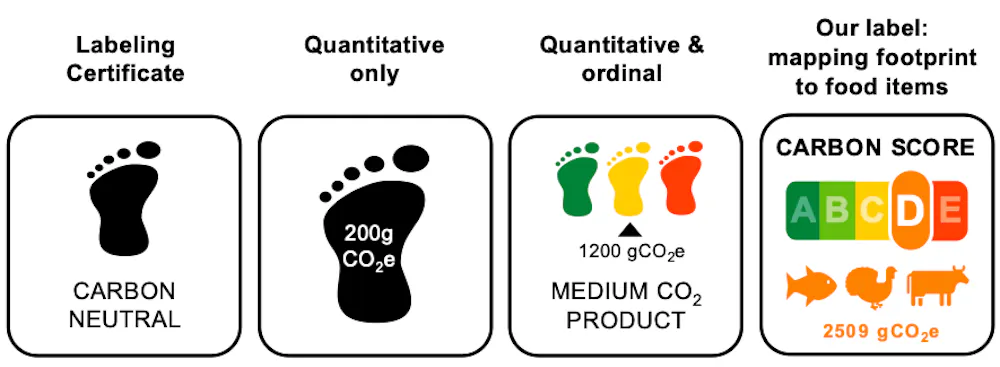
    Most carbon labels follow a similar approach. They typically display a number representing greenhouse gas emissions, and a traffic-light system indicating the level of environmental impact from green (low) to red (high). But such labels do not indicate whether the food is animal- or plant-based. So a high carbon score does not help people identify the source of the emissions.

    Our label maps the carbon footprint to the source of the food, whether plant or animal, along with information about the greenhouse gas emissions.
    Romain Cadario, Yi Li, Anne-Kathrin Klesse, (2025) Appetite., CC BY

    We designed a new type of label. It clearly displays whether the food is sourced mainly from animals or plants, along with the standard emissions score and traffic-light colour code. This approach is especially useful for the growing segment of pre-prepared and packaged foods such as soups and other ready-to-eat meals, which often contain a mix of meat and plant-based food.

    Our label creates a mental link between a food source and its carbon impact. When a consumer sees high carbon scores and red traffic lights appearing more frequently on meat and other animal products, they begin to make the connection between those products and higher emissions. This is key to addressing a lack of knowledge around food carbon emissions.

    We tested our label against the existing labels in a series of experiments with 1,817 everyday consumers from Australia, the United States and the Netherlands.

    One experiment involved soup. Compared with the group exposed to the standard carbon label, the group exposed to our label learned to associate animal-based soups with higher greenhouse gas emissions more effectively. They were more accurate at estimating the greenhouse gas emissions of a second batch of soups without labels.

    This improved knowledge also translates to more climate-friendly food choices. In another experiment with Australian consumers, we encouraged participants to choose five meals from ten options. Five were animal-based and five were plant-based.

    Half the participants saw the meal options with our carbon labels, and the other half did not see the carbon labels. The group exposed to our carbon labels chose fewer animal-based options in their weekly meal plan. In this case, we don’t know whether a third group exposed to the standard label would also make more climate-friendly choices, but our earlier experiments suggested our label was more effective.

    In the final experiment conducted in the Netherlands, displaying our carbon label made university students more likely to choose the plant-based snack option rather than the animal-based option.

    Providing information about the source of the food, whether plant or animal, influenced choices of meal plans.
    Romain Cadario, Yi Li, Anne-Kathrin Klesse, (2025) Appetite., CC BY

    When knowledge isn’t enough

    While people who care most about sustainable eating may think they know better than others, we found that is not the case. These people were not better able than other participants to tell the difference in greenhouse gas emissions between animal- and plant-based foods without seeing our carbon label.

    But they were better learners. When confronted with the facts about the differences between animal and plant-based foods on our labels, they were more likely to change their choices and switch to plant-based foods.

    What this means for consumers and businesses

    A simple change to food labels could help consumers make more informed environmental choices. For businesses and policymakers, it shows displaying only carbon numbers isn’t enough – the food source is crucial.

    Some forward-thinking restaurants and food companies are already experimenting with adding carbon labels to the menu to encourage diners to choose climate-friendly dishes. Our research suggests this approach could be more effective when combined with the new carbon labels we designed.

    Meat products make a significant contribution to climate change.
    Valmedia, Shutterstock

    Implications for climate action

    As Australia grapples with meeting its climate commitments, helping consumers understand the environmental impact of their food choices will become increasingly important.

    The challenge for businesses, policymakers and researchers isn’t convincing people to care about sustainability – they already do. Almost half of Australian shoppers (46%) say sustainability is important to them and influences their purchases, despite cost-of-living pressures.

    But most sustainable actions in retail involve recyclable packaging, products and materials, and local produce. The carbon emission implications of these actions, sadly, are far less than reducing animal-based food consumption.

    Instead, we need to focus on giving people the tools to make their environmental concerns count. Our carbon labels could be the key to helping consumers turn their sustainable intentions into meaningful climate action.

    Yi Li does not work for, consult, own shares in or receive funding from any company or organisation that would benefit from this article, and has disclosed no relevant affiliations beyond their academic appointment.

    – ref. Want a side of CO₂ with that? Better food labels help us choose more climate-friendly foods – https://theconversation.com/want-a-side-of-co-with-that-better-food-labels-help-us-choose-more-climate-friendly-foods-250513

    MIL OSI Analysis – EveningReport.nz –

    February 25, 2025
  • MIL-Evening Report: Calculating the economic cost of climate change is tricky, even futile – it’s also a distraction

    Source: The Conversation (Au and NZ) – By Dennis Wesselbaum, Associate Professor, Department of Economics, University of Otago

    Piyaset/Shutterstock

    Climate change is no longer a distant threat. It’s here, it’s real and it increasingly affects us all.

    But predicting climate change and its associated costs, particularly over long periods of time, is inherently uncertain. And based on the best available evidence from organisations such as the United Nations’ Intergovernmental Panel on Climate Change, the economic costs of climate change appear to be small – making this a relatively weak argument for environmental action.

    At its most basic, climate is the long-term average of the weather we experience. Or, as former president of the American Meteorological Society, Marshall Shepherd, famously put it, “weather is your mood, and climate is your personality”.

    It’s widely accepted that climate change refers to a shift in long-term weather patterns, typically driven by human activities.

    But the impact of climate change, ranging from rising temperatures and extreme weather events to health impacts and disruptions to food and water supply, varies greatly. Some areas experience more extreme impacts than others, exacerbating social and economic disparities.

    There also appears to be a false sense about our state of knowledge. For example, many believe climate change already causes more frequent and intense storms, but the evidence for this is inconclusive.

    Trying to predict the unpredictable

    To understand the economic costs of climate change, we must first grasp how climate affects socioeconomic outcomes.

    The relationship between temperature and socioeconomic outcomes can be modelled using a “dose-response” function, which shows how much a given change in temperature (the “dose”) influences the outcome (for example, temperature-related mortality).

    A key challenge is to understand the shape of the dose-response function. Is the relationship between temperature and mortality linear or is it more complex? Does it have thresholds beyond which the effects substantially change? Is there only one function or are there different ones for different populations?

    As climate change shifts the distribution of weather variables, it alters the outcomes as well. Yet, predicting how these distributions will evolve is difficult.

    The further into the future we look, the harder it is to make reliable predictions about both weather and the associated economic costs.

    If you were asked in 1925 to predict the economy in 2000, for example, how accurate would you have been? In 1925 you drove a Ford Model T, used coal-fired steam trains and passenger ships for travel, and a trip from London to Auckland took up to eight weeks by sea. You used a telegraph for long-distance communication and a radio for entertainment.

    Compare that with the globalised, interconnected economy of the year 2000. Given the technological advancements, would your prediction have been even close?

    Rather than focusing on the uncertain future economic costs of climate change, we should be addressing how it is affecting human life now.
    James Andrews1/Shutterstock

    Cost estimates

    There are a wide range of estimates on the economic costs of climate change. But one of the most reliable has come from the UN’s Intergovernmental Panel on Climate Change.

    The panel’s latest assessment report avoids quantifying the economic costs of climate change. So, to understand the economic costs of climate change, we can use the best estimate based on the previous report and the insights from meta studies. These analyses posit a temperature rise of 3.7°C will reduce global gross domestic product (GDP) by about 2.6% (ranging from 0.5 to 8.2%) by 2100.

    For New Zealand, this is equivalent to about NZ$11 billion, or twice the cost of Auckland’s City Rail Link.

    However, this comparison is extremely misleading. The value of 2.6% today will differ substantially from 2.6% in 75 years.

    The New Zealand economy grew at a compound annual rate of 1.4% between 1960 and 2000. Using this same average growth rate, New Zealanders will have a 184% higher standard of living in 2100. If nothing is done to address climate change, and given the best cost estimate, our standard of living would still be 176% higher than it is now.

    Reporting costs

    There are also issues with how some people report costs. For instance, while the total damage caused by floods and hurricanes in the United States has gone up in dollar amounts, it has not actually increased as a percentage of peoples’ incomes.

    In this context, it is crucial to distinguish between the damage caused by climate change and that resulting from human activities – such as the construction of more houses, higher property prices and river management practices.

    The economic costs of climate change based on the best available evidence appear to be small and highly uncertain.

    Shifting the focus

    Even if we accept our best estimates, economic costs are not the issue, but saving the environment is.

    Instead of focusing the debate of climate change around economic costs, we need to refocus the debate on tangible impacts happening right now: retreating glaciers, species extinction, shifting seasons and coastal erosion, to name a few.

    Addressing these issues is costly, but action will be needed to save the environment and ensure a liveable world into the future.

    Dennis Wesselbaum does not work for, consult, own shares in or receive funding from any company or organisation that would benefit from this article, and has disclosed no relevant affiliations beyond their academic appointment.

    – ref. Calculating the economic cost of climate change is tricky, even futile – it’s also a distraction – https://theconversation.com/calculating-the-economic-cost-of-climate-change-is-tricky-even-futile-its-also-a-distraction-248862

    MIL OSI Analysis – EveningReport.nz –

    February 25, 2025
  • MIL-OSI China: US’ restrictive trade moves to be self-harming

    Source: China State Council Information Office

    China has called on the United States to adhere to international rules and end misguided policies, warning that it will take necessary measures to safeguard its legitimate rights, the Ministry of Commerce said on Sunday.

    On Friday, the Office of the United States Trade Representative invited comments from the public on proposed Section 301 actions aimed at China’s maritime, logistics and shipbuilding sectors.

    The US’ proposed restrictive measures, such as levying port fees, would be self-harming and have detrimental effects, according to an online statement issued by the Commerce Ministry.

    The statement said these moves would not only fail to revive the US shipbuilding industry, but also increase transportation costs on US-related shipping routes and intensify domestic inflationary pressures.

    The moves would diminish the global competitiveness of US goods and negatively affect the interests of US port and terminal operators, as well as their workers, it added.

    Since March 2024, China and the US have held multiple rounds of talks on the proposed actions. China has repeatedly expressed its stance on the Section 301 investigation, urging the US to be rational and objective, and to stop blaming China for its own industrial development issues.

    The ministry noted that a panel of the World Trade Organization has ruled that US imposition of Section 301 tariffs on China is in breach of WTO regulations. The misuse of the Section 301 investigation mechanism, driven by the US’ domestic political needs, continues to erode the multilateral trading system, the ministry said.

    Liao Fan, a professor of international law at the University of Chinese Academy of Social Sciences in Beijing, said that to counter rising protectionism and the weaponization of unilateral sanctions, WTO reform is urgently needed to address systemic issues, such as chronic underfunding and weak enforcement mechanisms.

    John Quelch, executive vice-chancellor of Duke Kunshan University in Kunshan, Jiangsu province, warned that international trade is entering a dangerous “Wild West” era, in which weaker economies and small countries more dependent on international trade are likely to suffer the most.

    “China needs to redouble its efforts to increase trade with Global South countries, gradually reducing dependence on traditional markets,” Quelch said, adding, “China should further stimulate domestic consumption if a global tariff war slows down international trade.”

    Guangxi Yuchai Machinery Co, an automotive engine manufacturer in Yulin, Guangxi Zhuang autonomous region, is already expanding into emerging markets.

    “We have leveraged multiple cooperation mechanisms and trade deals, such as the Belt and Road Initiative and the Regional Comprehensive Economic Partnership, to actively participate in international trade shows and establish new plants in Thailand and Vietnam in recent years. Our export value jumped 73 percent year-on-year in January, hitting a record high for a single month,” said Liu Hongbo, president of marketing at Guangxi Yuchai’s overseas business unit.

    “We have broadened our customer base in key regions, including Southeast Asia and the Middle East, while diversifying our market structure to reduce risks associated with overreliance on any single market,” Liu added.

    MIL OSI China News –

    February 25, 2025
  • MIL-OSI China: Young student develops a taste for Chinese culture

    Source: China State Council Information Office 3

    Nursena Burus, a 19-year-old from the historic city of Manisa on Türkiye’s Aegean coast, poses for a photo at the Forbidden City in Beijing, Nov. 24, 2024. [Photo/Xinhua]

    Nursena Burus, a 19-year-old from the historic city of Manisa on Türkiye’s Aegean coast, has developed a taste for Chinese culture thanks to its food and her travels around the country.

    For Burus, coming to China was not just a language-learning opportunity, but a chance to experience a culture that had captivated her from afar.

    Her sister, who had previously studied artificial intelligence at China’s Xiamen University, encouraged her to take the leap and explore China.

    “My family and friends thought learning Chinese was too difficult, but my sister showed me pictures of her life in China — her friends, festivals and foods,” Burus said. “I started to see it as more than just a place to study. It looks like an adventure.”

    In February 2024, she arrived in China just before the Chinese New Year, and immediately immersed in the vibrant atmosphere of celebration. Red lanterns swayed in the wind, intricate paper cuttings adorned windows, and vibrant couplets decorated doorways.

    “Everywhere I went, the streets were filled with red, a color of celebration and good luck. It was a completely new experience for me.”

    After settling into Tianjin University, Burus could not help but notice that the usually busy campus was almost empty as most Chinese students had headed home for the Spring Festival.

    “It reminded me of the Ramadan Feast in Türkiye, when we all go back to our hometowns to eat, pray and celebrate with family. I love how both cultures value family reunions during important holidays.”

    As classes began in March, Burus quickly adapted to learning and living at Tianjin University. “The teachers were so supportive. They encouraged me to practice speaking without worrying about mistakes, and their passion made me work even harder.”

    Burus quickly built friendships with her Chinese classmates through food and diverse cultural activities.

    Her best Chinese friend Meiqi became her food “mentor.” Meiqi taught her how to use chopsticks and introduced her to Tianjin’s popular street foods, including hot pot and red bean shaved ice.

    She regularly explored the university’s cafeterias and discovered her favorite dishes, including Peking Duck. Moreover, she often followed the recommended foods on the popular short video-sharing platform Douyin to explore new restaurants and shared photos of her culinary adventures on her WeChat Moments.

    “Chinese cuisines are rich and delicious, and the convenient digital payment system has truly amazed me,” Burus said.

    In October 2024, she spent a weekend in the countryside of Tianjin, picking hawthorn and chestnuts and eating farmhouse meals. “It was a very beautiful and peaceful place. People seem to quite enjoy their lives,” she said. The experience reminded her of her hometown village near Manisa, where life is slower, simpler and deeply connected to the land.

    One of her most cherished memories was celebrating the Dragon Boat Festival in 2024. The festival coincided with her birthday and she had the chance to learn how to make Zongzi (sticky rice dumplings) with her classmates.

    “It reminded me of Nevruz, a Turkish holiday that celebrates the arrival of spring. Both festivals honor seasonal changes,” Burus said.

    Now more fluent in Chinese, Burus feels that China has become a second home where she has made lifelong friends and experienced the beauty of Chinese culture.

    “We share so many similar things, like our love for family, traditions and hospitality. I want to build on that connection and show others that the world isn’t as different as it seems.”

    Before leaving China earlier this year after finishing two semesters of a language learning program, she left behind a wish bottle buried on the campus, containing her wish to become a bridge for cultural exchanges between Türkiye and China.

    MIL OSI China News –

    February 25, 2025
  • MIL-OSI China: Parkinson’s possible to be blocked thanks to Chinese scientists’ breakthrough research

    Source: China State Council Information Office 2

    Chinese scientists have discovered a novel therapeutic target for Parkinson’s disease, a neurodegenerative condition with high disability and mortality rates, and have successfully identified a potentially effective small molecule drug.
    The breakthrough, achieved by a team from Huashan Hospital affiliated with Fudan University in Shanghai, holds promise for early intervention in Parkinson’s disease, offering patients renewed hope for delaying its progression. The research was published in the prestigious academic journal Science on Friday (Beijing time).
    The battle against Parkinson’s disease, the second most common neurodegenerative disorder after Alzheimer’s, has been ongoing for years. There are approximately 3 million Parkinson’s patients in China, roughly half of the global total.
    People diagnosed with Parkinson’s disease may initially experience a reduced sense of smell and sleep disorders, eventually developing more severe movement-related symptoms. As the disease progresses, the effectiveness of medications often declines, leading to a significant deterioration in quality of life.
    Unfortunately, previous drugs and surgical therapies have only addressed the symptoms of Parkinson’s disease, failing to prevent its progression. As a result, further in-depth research into the disease’s pathophysiology and targeted treatments is crucial, according to the scientists.
    After five years of persistent efforts, the team identified FAM171A2 as a key risk gene for neurodegeneration. Using artificial intelligence, they screened over 7,000 approved compounds and pinpointed bemcentinib, an anti-cancer agent currently in clinical trials, as a promising lead candidate.
    The small molecule drug has been shown to effectively block the binding between FAM171A2 and the pathogenic protein, according to the research team.
    Yu Jintai, leader of the team, said that, based on an international patent, they will focus on the pre-clinical research and development of small-molecule drugs, antibodies and gene therapies for Parkinson’s disease in the coming years, with the aim of advancing clinical trials and applications to develop an innovative therapeutic system.
    People over the age of 60 are more susceptible to Parkinson’s disease. As China’s population continues to age, this new medical breakthrough has sparked hope within both the academic and medical communities, as well as among patients, with the expectation that the research will have practical applications in the near future.
    “The experimental results have helped us accurately figure out the pathophysiological mechanisms of Parkinson’s disease, creating a real chance of overcoming a battle that has long seemed insurmountable,” said Wang Jian, director of the neurology department at Huashan Hospital, which is also a national medical center for neurological diseases.
    A referee for Science praised the discovery as a “holy grail” in Parkinson’s research, highlighting its potential to lead to therapies that can block the spread of pathology and, consequently, the disease itself.
    Neurological diseases, particularly those affecting the brain, such as Alzheimer’s and Parkinson’s, have become a major global public health and social challenge.
    Chinese experts have called for greater efforts in brain science research, noting that it will be crucial for developing new treatment methods, enhancing early diagnosis, detection and intervention, and ultimately improving the quality of life for patients. 

    MIL OSI China News –

    February 25, 2025
  • MIL-OSI China: Chinese researchers develop system for quantum direct communication

    Source: China State Council Information Office 2

    A team of Chinese researchers proposed a theory of one-way quantum direct communication and successfully developed a practical system, advancing quantum direct communication from a concept to the stage of practical application.
    According to a study recently published in Science Advances, researchers from the Beijing Academy of Quantum Information Sciences, Tsinghua University, and North China University of Technology set a record in a standard optical fiber communication test with a transmission distance of 104.8 km. They achieved stable transmission at a rate of 2.38 kilobit per second for 168 consecutive hours.
    Quantum direct communication was previously proposed by a team led by Long Guilu from Tsinghua University, one of the corresponding authors of the study paper. It enables secure communication by utilizing quantum states and features characteristics such as eavesdropping detection and prevention, compatibility with existing networks, simplified management processes, and covert transmission.
    The core challenge in this field is achieving secure and reliable communication using quantum states with extremely low energy. These states are highly susceptible to interference in quantum channels characterized by high noise, high loss, and the risk of eavesdropping.
    Previous research used bidirectional protocols, in which both communicating parties had to transmit quantum states back and forth. This resulted in significant system loss and severely limited communication performance improvement.
    “In 2022, we set a world record for quantum direct communication over 100 kilometers, but the rate was only 0.5 bit per second, which allowed transmission of messages with very few characters,” Long recalled.
    He explained that one-way transmission could halve the distance of quantum state transmission, significantly reducing loss, which is the key to improving the performance of quantum direct communication.
    The researchers developed high-noise and high-loss channel coding and other key technologies to propose a theoretical method for one-way quantum direct communication. They resolved the technical challenges and completed the development of the communication terminal.
    The new system’s communication rate has increased by 4,760 times compared with the one developed in 2022, significantly enhancing the performance of quantum direct communication.
    According to Long, quantum direct communication systems are expected to be widely applied in fields with extremely high requirements for information security, such as government affairs and finance.
    There are two main types of quantum secure communication. One is quantum key distribution, which uses quantum states to generate keys while transmitting encrypted information through classical communication. Its advantage is the high transmission rate.
    The other is quantum direct communication, which directly transmits information using quantum states. In the event of eavesdropping, the quantum states can self-destruct to ensure information security. 

    MIL OSI China News –

    February 25, 2025
  • MIL-OSI China: Consumers warned over AI courses

    Source: China State Council Information Office 2

    While the rapid rise of China’s homegrown artificial intelligence reasoning model DeepSeek has sparked a host of enterprises seeking to cash in by offering training courses on how to use it, experts have warned consumers to be wary of wasting their money on courses that provide guidance that is already freely available.
    On Chinese lifestyle app Xiaohongshu, or RedNote, some users share guides on using DeepSeek, with prices ranging from a few yuan to several hundred yuan.
    “If you don’t learn how to use AI today, you’ll be left behind tomorrow,” several posts say. “How to use DeepSeek to earn money” is another trending topic on the platform. These posts are typically followed by links to purchase courses or join group chats.
    On WeChat, multiple accounts use DeepSeek user guides as clickbait, though full content often requires additional payment. Paid online communities focused on AI are also emerging, offering “exclusive” resources to subscribers.
    According to the course descriptions, these paid tutorials typically cover basic AI tool usage, including prompt writing, skill-building, applications in various fields and even strategies for making money with AI.
    “The rise of new technologies is always accompanied by a boom in paid training courses,” said Yan Huaizhi, an associate professor of the School of Computer Science &Technology at the Beijing Institute of Technology, in an interview with Workers’ Daily.
    “On one hand, this trend reflects people’s desire to learn new skills. On the other hand, it epitomizes how some agencies exploit the knowledge gap to make quick profits,” Yan said.
    “The popularity of these paid courses also highlights that selling tools to those eager to make money is a lucrative business model,” he added.
    Since the release of DeepSeek R1 on Jan 20, a tag for a DeepSeek training course on Xiaohongshu has been viewed almost 20 million times.
    While some courses and online communities offer value, the quality of many paid offerings is sometimes questionable. Some simply repackage materials from other AI models or provide low-quality content under the DeepSeek name.
    “By touting AI as a necessary survival tool, these people are selling anxiety,” one user wrote online.
    Bao Ran, vice-president of the Interactive Media Technical Standards Promotion Committee of the China Communications Standards Association, said there is no need to pay for these tutorials since the basics are freely available online.
    On video-sharing platform Bilibili, free DeepSeek and AI tutorials have attracted millions of views. One video explaining DeepSeek’s local deployment, published on Jan 27, has more than 2 million views.
    Chinese universities such as Tsinghua University and Zhejiang University have also offered free AI-related lectures and guides to students.
    While certain consumers such as the elderly may gain value from being walked through how to use AI models step by step, others may feel cheated when they realize they paid for something that they could have easily accessed for free.

    MIL OSI China News –

    February 25, 2025
  • MIL-OSI United Kingdom: expert reaction to observational study of antidepressant prescriptions and cognitive decline in people with dementia

    Source: United Kingdom – Executive Government & Departments

    February 25, 2025

    An observational study published in BMC Medicine looks at antidepressant use and cognitive decline in people with dementia. 

    Prof Tara Spires-Jones, Director of the Centre for Discovery Brain Sciences at the University of Edinburgh, Group Leader in the UK Dementia Research Institute, and President of the British Neuroscience Association said:

    “Mo and colleagues’ study examined data from over 18,000 people with dementia enrolled in a Swedish national registry to look for associations between antidepressant use and dementia symptoms.  They observed faster cognitive decline in people with dementia who were taking selective serotonin reuptake inhibitor (SSRI) type antidepressants. This was a large study that looked at data over time, which is a strong design. However, this type of data cannot prove that it was antidepressant use that caused the faster decline.  People who needed antidepressants may have had more aggressive disease or the depression itself could have been affecting disease progression.  It is also worth noting that the effect was not the same for all types of dementia; people with frontotemporal dementia (FTD) did not have accelerated cognitive decline when taking antidepressants. In people with FTD, antidepressants were associated with slightly slower decline. Previous studies have also reported mixed results, highlighting the need for more research before we have a full understanding of the effects of antidepressant use on dementia progression.”


    Dr Richard Oakley, Associate Director for Research and Innovation at Alzheimer’s Society, said:  

    “This study suggested that antidepressants led to faster rates of memory and thinking decline in people with dementia. But it did not rule out the possibility that the changes were due to the presence of depression rather than antidepressant use, so further research is needed to understand the effects of antidepressants. 

    “Alzheimer’s Society wants to see the severity of an individual’s dementia recorded on their primary care records as either mild, moderate or severe. This is especially important as the study shows a decline in memory and thinking skills was stronger in people with more severe dementia who took antidepressants than those who didn’t. 

    “It’s vital that regular reviews are carried out when prescribing antidepressants, but recent research showed that less than half of people with a dementia diagnosis had their medication reviewed in the preceding 12 months.  

    “Alzheimer’s Society is funding research to better understand depression and anxiety in people living with dementia, how to manage it, and how genetics might be involved.” 


    Dr Emma L Anderson, Associate Professor of Epidemiology, University College London, said:

    “As the authors themselves acknowledge, there is substantial risk with this study design for confounding by indication, which could explain the results either in part, or entirely. Confounding by indication is where the outcomes we observe are actually due to the underlying reason people take these medications in the first place (e.g. mental health conditions), rather than the medication itself. More robust study designs, which overcome this very important limitation, are needed before such bold conclusions can be made. When based on limited evidence, these claims can be very damaging for public understanding of antidepressants, which we know help millions of people around the world.”

    Dr Prasad Nishtala, Reader, University of Bath, said:

    “This large population-level study from Sweden uses real-world data and is well-conducted. However, there are some important limitations that should be considered. One major issue is that the severity of depression in dementia patients wasn’t fully accounted for, which has the potential to bias the results. Additionally, there may be a “channelling bias,” meaning that certain antidepressants like citalopram and sertraline might have been more commonly prescribed to patients with severe dementia, which could also bias the results.

    “Another key limitation is that the study found only a small change in MMSE (Mini-Mental State Examination) scores, which may not be meaningful in everyday clinical practice. Previous research has shown that older adults taking tricyclic antidepressants can experience faster cognitive decline because these drugs interfere with the activity of acetylcholine—a chemical in our brain critical for maintaining cognition. Even among SSRIs (a common type of antidepressant), some, like paroxetine, are known to have stronger anticholinergic effects that could impact cognition negatively. There is also a problem of “residual confounding”,- meaning there could be other risk factors that can affect cognition, and it is unclear if they have accounted for other anticholinergic drugs like oxybutynin, which many dementia patients take to treat their urinary incontinence. The analyses were done on dispensed data (medication sold by pharmacists), and it is unclear if patients actually took them.

    “This study suggests that SSRIs like citalopram and sertraline might also speed up cognitive decline. However, it doesn’t explain how or why this happens at a biological level. Because of these limitations, the study’s findings should be interpreted with caution and ideally replicated using other real-world data sources.”

    ‘Antidepressant use and cognitive decline in patients with dementia: a national cohort study’ by Minjia Mo et al. was published in BMC Medicine at 01:00 UK time on Tuesday 25th February. 

    DOI: https://doi.org/10.1186/s12916-025-03851-3

    Declared interests

    Prof Tara Spires-Jones: I have no conflicts with this study but have received payments for consulting, scientific talks, or collaborative research over the past 10 years from AbbVie, Sanofi, Merck, Scottish Brain Sciences, Jay Therapeutics, Cognition Therapeutics, Ono, and Eisai. I am also Charity trustee for the British Neuroscience Association and the Guarantors of Brain and serve as scientific advisor to several charities and non-profit institutions.

    Dr Emma L Anderson: I have no declarations or conflicts of interest. 

    Dr Prasad Nishtala: I sit on the editorial board for BMC Medicine.

    MIL OSI United Kingdom –

    February 25, 2025
  • MIL-OSI China: ‘Ne Zha 2’ debut in HK, Macao wins hearts

    Source: China State Council Information Office 3

    People pose for photos in front of the poster of the Chinese animated feature “Ne Zha 2” at a cinema in Hong Kong, Feb. 18, 2025. [Photo/Xinhua]

    Chinese animated blockbuster “Ne Zha 2” grossed more than $845,900 upon its debut in the Hong Kong and Macao special administrative regions on Saturday, achieving the highest first-day box office revenue for an animated film in the SARs.

    Over 92,000 people in the two cities showed up on Saturday to watch the movie, which has raked in over 13.7 billion yuan ($1.89 billion) around the world and ranked eighth in terms of global box office revenue. This prompted distributors in the SARs to increase the number of screenings on day one from 500 to more than 800 in 2D and IMAX formats, also a record in the history of Hong Kong’s and Macao’s film industries.

    In Hong Kong and Macao, the film has traditional Chinese and English subtitles. Cinemas operated by the film’s four local distributors — Mandarin Motion Pictures, Intercontinental Film Distributors, Sil-Metropole Organisation and Emperor Motion Pictures — have arranged around 400 screenings for Monday, with tickets of some screenings sold out.

    On Sunday, China Retold, a local key opinion leader alliance dedicated to promoting the latest developments on the Chinese mainland and Hong Kong on social media platforms, organized a free screening of “Ne Zha 2”. Those attending the screening formed a long line outside a cinema in Causeway Bay early in the morning, and during the screening, audience members frequently erupted in laughter during humorous scenes and exclamations of awe at the spectacular special effects.

    After the screening, Sebastian Lee, a student from the United Kingdom studying at Chinese University of Hong Kong, said he had heard about the movie’s box office success, which piqued his curiosity, so he decided to attend the special screening.

    Although he wasn’t previously familiar with the background of Chinese mythology, the film explained these cultural elements in a simple and understandable way, making it easy for non-Chinese audiences to follow, Lee said.

    He also praised the film’s special effects, particularly those in the final battle scene, saying that the unprecedented level of detail and complexity of the animation provided an excellent viewing experience.

    Laurent Daury, a French lawyer who works in Hong Kong, said that although it was his first time to watch a Chinese animated film, the movie exceeded his expectations and gave him a strong sense of Chinese culture.

    He said the film reaffirmed his understanding of traditional Chinese culture, particularly the importance of respect, including respect for work, family and skills.

    Cultural values

    Daury said that the film, compared with Western-made animated films, conveys more traditional cultural values, which he admired. He added that he would definitely recommend the film to those around him and planned to watch it again with his wife and friends.

    Karolina Gruschka, a kindergarten teacher in Hong Kong, said the film’s elements of ancient Chinese mythology help viewers, especially children, better understand traditional Chinese culture.

    She said she was touched by the friendship between the two main characters, Ne Zha and Ao Bing. Despite coming from entirely different backgrounds, their connection endured all challenges, showing that true friendship can overcome any obstacle, regardless of one’s origins, she added.

    Gruschka also said that a unique aspect of the film is its core concept of the struggle between good and evil, conveying an uplifting belief that people can change their destiny through their choices.

    “Ne Zha 2” reimagines the tale of Ne Zha, a rebellious deity from Chinese mythology, intertwining ancient folklore with modern themes of defiance and self-determination.

    The film was released on the mainland on Jan. 29, the first day of the Year of the Snake, and soon became the highest-grossing film in China.

    The film has been released overseas in markets such as the United States, Australia and New Zealand, and will debut in Singapore and Malaysia in March.

    MIL OSI China News –

    February 25, 2025
  • MIL-OSI Australia: How pumped hydro can provide the stability Australia’s energy transition needs

    Source: Allens Insights

    A reliable, durable and large-scale storage solution 10 min read

    Australia’s favourable natural geographical landscape and abundance of retiring mine sites provide a unique opportunity for pumped hydro energy storage (PHES) to play a key role in driving the energy transition in this country. By delivering consistent, long-duration, dispatchable capacity during peak demand, PHES can help stabilise the system when other technologies may struggle.

    The past two years have seen a surge in the uptake of battery energy storage systems (BESS). However, firming assets such as BESS and intermittent generators such as wind and solar are constrained by weather conditions, redundancy and, in the case of BESS, capacity and duration limits. These constraints highlight the need for a more reliable, durable, large-scale storage solution to complement the other technologies.

    In the first part of our pumped hydro Insight series, we explore the drivers behind the growing uptake of PHES in Australia, and highlight key considerations for developers, investors, financiers, contractors and other stakeholders assessing such projects.

    Key takeaways

    • There is growing interest in PHES as a long-term, firm, long-duration dispatchable asset that is unconstrained by weather, technology, asset life or capacity limitations.
    • Approximately 20 PHES projects are actively being developed in Australia, with over 22,000 sites identified as suitable for a PHES.
    • PHES projects are capital intensive and inherently complex in their planning, procurement, delivery and commercialisation. These factors necessitate careful planning, robust risk mitigation strategies and proactive engagement with stakeholders to ensure the success of PHES over the long term.

    What’s driving the uptake of PHES in Australia?

    There is no doubt that interest in PHES as an energy generation and storage solution is growing. There are a number of key drivers behind this.

    While BESS are an important part of the storage solution, they have limitations. Most BESS projects range between 200MW and 500MW, with larger projects, such as Melbourne Renewable Energy Hub’s 1,200MW battery, still only half the size of Snowy Hydro 2.0’s 2,200MW project. BESS typically provide around four hours of dispatchable energy before needing to recharge, while PHES can deliver up to 175 hours.

    BESS also have a shorter asset life of around 20 years, with a steady degradation profile down to 60–70% of the nameplate capacity over time, whereas PHES projects are designed to last over 50 years. While BESS technology is still maturing on a utility scale, PHES has a long-established track record and doesn’t face the same fire risk, making it a more sustainable option for long-term energy storage.

    In 2017, the Australian Renewable Energy Agency and the Australian National University identified 22,000 potential ‘bluefield’ PHES sites across Australia, with an estimated energy storage capacity of 67,000GWh. Many of these sites are in areas with natural elevation differences that facilitate the construction of connected upper and lower reservoirs with minimal excavation. The proximity of these sites to natural water sources, such as rivers and dams, would allow these projects to leverage existing water systems to create the necessary reservoirs.

    PHES can also take a ‘closed-loop’ form, where water is transported to a site away from existing river systems and cycled between the two reservoirs. This type of system can be located where topographical features support it, allowing for new PHES facilities to be co-located with solar and wind generation projects in renewable energy zones, boosting grid reliability in those areas.

    The planned and accelerated closure of mine sites presents a unique opportunity for owners to repurpose aging mines into PHES projects. Sites such as Kidston, Mt Rawdon and Muswellbrook show how former mine sites can be transformed into PHES facilities, capitalising on rehabilitation obligations and the potential for long-term, revenue-generating assets.

    Australia has over 60,000 abandoned mine sites, posing challenges for owners who must manage costly rehabilitation efforts on non-revenue-generating assets. With around 75% of mine closures being unplanned or premature, there is an opportunity to repurpose these sites into valuable operational assets. Many of these sites have existing excavated pits that can be used as reservoirs for closed-loop PHES, reducing excavation risk costs and supporting mining companies’ rehabilitation goals through sustainable energy projects.

    The Federal Government and most state governments are supporting private sector-led PHES projects through grants, concessional debt, revenue underwrites and streamlined approvals processes.

    In NSW, EnergyCo’s Pumped Hydro Recoverable Grants Program, which is part of the Electricity Infrastructure Roadmap, helps developers with the cost of early-stage feasibility studies. Additionally, developers can tender for Long-Term Energy Service Agreements (LTESA) in NSW and the Capacity Investment Scheme (CIS) across Australia. The NSW Energy Security Corporation (which received $1 billion in funding and will act as the state equivalent of the Clean Energy Finance Corporation) has been mandated to investigate co-investment opportunities with the private sector on energy storage projects, including PHES.

    Although no LTESA or CIS have been awarded to a PHES project yet, the NSW Government has shown strong long-term support for long-duration storage with an updated position to the Electricity Infrastructure Investment Act 2020 (NSW). By retaining the minimum dispatch duration definition at eight hours and broadening the long-duration storage LTESA assessment criteria, PHES projects are positioned to benefit from future government support. Similarly, under the proposed South Australian Firm Energy Reliability Mechanism, PHES projects offering dispatchable energy for at least eight hours will be able to bid for contracts to underwrite a portion of their revenue, complementing other state and federal policies.

    After the infrastructure boom of the past decade, the pace of the transport infrastructure sector has slowed, while demand for energy infrastructure has risen. Civil contractors with experience in metro, rail and road projects are now focusing on energy projects to capitalise on the available work.

    The civil infrastructure required for PHES, such as deep excavation, tunnelling and the construction of underground caverns and access routes, is similar to that required for transport infrastructure. Contractors with heavy engineering, excavation and tunnelling experience, and an available workforce, are well positioned to apply their skills to PHES projects.

    What challenges are emerging?

    Despite strong drivers and the promising potential of PHES, the uptake and reaching contract close of PHES transactions has lagged behind short to medium duration BESS, wind and solar projects.

    PHES projects are inherently complex and capital intensive, with several key challenges emerging.

    PHES projects typically require large areas of land, which can lead to complex environmental impacts, particularly biodiversity, water resources and, potentially, cultural heritage, and significant challenges with site access and spoil management. As a result, they require more detailed environmental impact assessments and complex approvals processes compared with BESS projects. In addition to state planning approval and environmental licences, PHES projects often require approval under the Environment Protection and Biodiversity Conservation Act 1999 (Cth), as well as being subject to any remediation obligations under any relevant mining tenements and approvals if located on a mine site.

    Securing land tenure is another significant challenge, especially when land is required within national parks, is over land held by Aboriginal land councils or land where native title is still active.

    Water entitlements and licences, crucial for establishing reservoirs, are also a key consideration, particularly for closed-loop projects. While some states, such as NSW, have introduced a special category of water licences for initial fills, these licences may come with restrictions that limit pumping from nearby water sources to periods of high flow, presenting programming challenges. In addition to securing the necessary approvals and resources, early engagement with traditional owners, landowners and local communities is essential for obtaining a social licence to operate.

    We have seen a continuing shift in risk transfer across energy and infrastructure. For PHES, in particular, this has been driven by a limited pool of experienced civil contractors with PHES experience in Australia, a lack of competition among original equipment manufacturer suppliers, and supply chain impacts and increasing demand for energy projects. A consequence of this shift has been the growing use of disaggregated contract packages, including in PHES procurement.

    By splitting contracts, developers can distribute risk among multiple parties and limit exposure to contractor insolvency, with each contractor focusing on their specialist area. Ideally, this improves quality and efficiency, at a more competitive price. However, this approach can create challenges, particularly for developers and financiers, introducing interface gap risks between the contractors, and resulting in smaller sizing for caps and security packages.

    Transport infrastructure procurement has traditionally been driven by state governments, creating a concentrated and aligned purchasing power that drove well-understood risk profiles. The energy infrastructure market is comparatively more diffused, involving a mix of government and private developers, contractors of all tiers and international entrants. This has meant that ‘market standard’ positions are fluid and highly bespoke contracts are being developed.

    An added complexity is that PHES procurement to date has been led by government-developers who are able to use collaborative commercial models with unfixed, variable cost elements. This is more difficult for private developers with limited funding sources who are required to demonstrate bankability to financiers. A balance will need to be struck between developers’ and financiers’ desire for firm pricing and transferred risk, with the contracting market’s calls for flexible, uncapped, commercial models.

    The contractor-led market has brought with it a rise in collaborative contracting in the infrastructure sector and the market is evolving. As an example, NSW and Victoria have adopted incentivised target cost models in infrastructure procurement projects, and Snowy 2.0 shifted from a traditional engineering, procurement and construction model to an incentivised target cost model. While the rise in collaborative contracting has not involved a full-scale move from wrapped lump sum to alliance models, there is an increased focus on fair risk allocation, considering each party’s ability to manage risks.

    In the PHES space, risk associated with input material costs, labour costs and underground work have been the particular focus of collaborative risk-sharing arrangements.

    • Input material and labour costs: PHES projects rely on significant quantities of materials such as concrete and steel, but supply chain issues and material cost escalation could increase project prices and timeframes. Additionally, the scale and construction duration of PHES projects requires substantial labour compared with other assets, with the remoteness of some projects potentially necessitating relocation packages and project-specific camps to attract skilled workers. Enterprise bargaining agreements can mitigate these challenges. However, the long construction period on PHES projects means that enterprise bargaining agreements are more likely to be renegotiated during delivery, reopening labour costs and creating the risk of industrial disputes. Given market changes, sensible and targeted risk-sharing mechanisms should be considered upfront to optimise value for money.
    • Underground work: PHES projects are complex and involve extensive subterranean work. While owners and developers can undertake geotechnical investigations prior to construction commencing, those have limitations, so a geotechnical risk-sharing mechanism is often needed. Geotechnical Baseline Reports are commonly used to set the agreed baseline conditions for tunnels and reservoirs, which serve as the test for any time or cost adjustments.

    Site selection is crucial for PHES projects, as suitable locations are often farther from existing grid infrastructure, leading to higher and more variable grid connection costs compared with BESS projects. Developers must ensure clarity on connection fees payable by a developer to the relevant network service provider and carefully consider the terms of connection agreements.

    Additionally, developers should be aware of the generator performance standards and how they align with other regulatory approvals for the project.

    A key challenge for developers is monetising storage projects and accessing debt capital markets. In the second part of our pumped hydro Insight series, we will explore the challenges, considerations and opportunities that developers, financiers and stakeholders face in monetising and creating stable revenue streams for PHES projects. Stay tuned.

    Actions that you can take now

    If you are considering entering the PHES space, as either a developer, investor, contractor, or financier, it is important to consider the following:

    • Strategic site selection: Rehabilitating existing assets, such as former mines or cleared agricultural sites with low biodiversity and cultural heritage value, and easy access water supply, may reduce planning delays, simplify environmental approval, and, for mine sites, limit the need for extensive excavation.
    • Early engagement: Engage early with all relevant parties, including local government, the community, traditional owners, landholders, consent authorities, regulators, contractors, geotechnical experts, financiers and government programs. The work done early in the project, and through concept and procurement processes, is crucial to the success of your PHES project.
    • Monitor the market: As more PHES projects emerge, market trends in commercial models, risk profiles and offtake strategies will evolve.
    • Adapting to changing regulations and government policies: We expect the regulatory landscape and government policies will evolve to better support PHES projects. Staying updated on these changes will be key to your project’s success.

    Keep an eye out for future Insights in the pumped hydro series, where we will expand further on the offtake and financing strategies that will underpin the bankability and revenue generation of PHES projects.

    MIL OSI News –

    February 25, 2025
  • MIL-OSI Australia: Embedding the right to paid family and domestic violence leave in our workplaces

    Source: Ministers for Social Services

    25 February 2025

    Joint with:

    SENATOR THE HON KATY GALLAGHER
    MINISTER FOR FINANCE
    MINISTER FOR WOMEN
    MINISTER FOR THE PUBLIC SERVICE
    MINISTER FOR GOVERNMENT SERVICES
     

    THE HON AMANDA RISHWORTH MP
    MINISTER FOR SOCIAL SERVICES
    MINISTER FOR THE NATIONAL DISABILITY INSURANCE SCHEME

    SENATOR THE HON MURRAY WATT
    MINISTER FOR EMPLOYMENT AND WORKPLACE RELATIONS

    The Albanese Labor Government is reaffirming its commitment to end violence against women and children in one generation, today releasing the response to the independent review of the paid family and domestic violence leave.

    The independent review, conducted by Flinders University, found the leave was “life changing” for those who accessed it and that there was broad stakeholder support from both employers and unions.

    It found paid family and domestic violence leave is working as intended, supporting the financial security of those escaping or experiencing violence.

    The Government accepts all five recommendations from the review. Work is now underway to address the recommendations, including through:

    • Continued focus on raising awareness to integrate the leave as an ordinary workplace practice across Australian workplaces;
    • Tailored guidance for priority cohorts, such as First Nations, culturally and linguistically diverse and casual employees;
    • Training programs for first responders, health, allied health and community frontline workers who commonly interact with victim-survivors on the entitlement;
    • Additional strategies to improve awareness and access to the entitlement, opportunities to better understand usage of the leave, and further evaluation of the leave through the upcoming statutory review of Closing Loopholes reforms.

    The review also made 12 findings, the most notable, was there should be a focus on increasing awareness and understanding of the leave entitlement through communities and workplaces.

    It also found that ongoing stigma around family and domestic violence was a barrier to workers accessing the leave.

    Resources will be updated and repromoted to incorporate feedback from the review.

    The Government response highlights the important role that workplaces can play in addressing family and domestic violence. There is considerable goodwill from employees and employers alike to make sure anyone who needs the leave can access it, and the workplace is equipped to play its part in supporting people experiencing family and domestic violence.

    The Albanese Government will continue to engage with unions, employer groups, and state and territory governments on strategies to improve awareness and access to the leave.

    Paid family and domestic violence leave is just one of many actions the Albanese Government has taken to improve economic security for women and end gender-based violence.

    You can find the Government response and the review’s findings on the Department of Employment and Workplace Relations website.

    For more information on paid family and domestic violence leave, see the Fair Work Ombudsman’s guidance material and the one-stop shop hub for small business: www.10DayspaidFDVLeave.com

    Quotes attributable to Minister for Women Katy Gallagher:

    “Since coming to government, we have been deeply committed to ending gender-based violence – we were proud to introduce paid domestic and family violence leave as some of our first legislation, and the independent review has demonstrated its life changing impact.

    “The Opposition refused to implement this important change during their years in government, but the Albanese Government listened to the sector, unions and victim-survivors, and we can see the results – more women accessing important and life changing support.”

    Quotes attributable to Minister for Social Services Amanda Rishworth:

    “Paid family and domestic violence leave from work will save lives. This entitlement will allow victim-survivors to take time off to keep themselves and their family safe, without losing their income or their jobs.  

    “Everyone has a role to play to end violence against women and children. It’s vital to that first responders and frontline workers have the right training and education about paid family and domestic leave, so that they can best support victim-survivors of family and domestic violence.”

    Quotes attributable to Minister for Employment and Workplace Relations Murray Watt:    

    “No worker should have to choose between their safety and their pay. We’ve made sure all 12.4 million Australian employees, including casuals, can access 10 days’ paid leave each year when impacted by family and domestic violence.

    “This leave has been life changing for Australians so far, and the Albanese Labor Government is committed to raising awareness, understanding and uptake, so that anyone who would benefit from this leave can access it.

    “But it’s under threat from Peter Dutton and the Coalition – Shadow Minister for Employment and Workplace Relations, Michaelia Cash claimed paid family and domestic violence leave is a “perverse disincentive” to employers hiring women.

    “Peter Dutton and the Coalition need to tell Australians whether this leave will be part of the “targeted set of repeals” of workplace laws they’ve promised to take to the election.”

    MIL OSI News –

    February 25, 2025
  • MIL-OSI Australia: Albanese Labor Government building Australia’s mobile future

    Source: Australian Ministers 1

    The Albanese Labor Government has today announced a major world first reform to provide basic universal outdoor mobile coverage across Australia.

    Labor’s Universal Outdoor Mobile Obligation (UOMO) will require mobile carriers to provide access to mobile voice and SMS almost everywhere across Australia.  

    UOMO will ensure up to 5 million square kilometres of new competitive outdoor mobile coverage across Australia, including over 37,000 kilometres on regional roads.

    Whether it’s in national parks, hiking trails or out on the farm, outdoor coverage will be accessible almost anywhere where Australians can see the sky.

    The Albanese Government’s policy objectives are to: 

    • expand Triple Zero access for Australians across the nation; 
    • expand outdoor voice and SMS coverage into existing mobile black spots; and
    • improve the availability of mobile signals during disasters and power outages.

    This reform is only possible due to the transformative global innovations in Low Earth Orbit Satellites (LEOSats), and the arrival of Direct to Device (D2D) technology, which enables signals from space direct to mobile devices.

    The Government will consult and introduce legislation in 2025 to expand the universal service framework to incorporate mobile coverage for the first time.

    Implementation of outdoor SMS and voice will be expected by late 2027, with many Australians likely to obtain access before then.

    Basic mobile data will be considered in the future as technology roadmaps and capacity considerations develop.

    The Government will work with stakeholders and industry to get the legislation right, including flexibility where warranted by supply, spectrum and other factors.

    The Albanese Government will also engage with industry and examine incentives and removal of barriers to support public interest objectives and competition outcomes.

    Only the Albanese Labor Government has a plan to build Australia’s future, including delivering $3 billion to complete the building of the fibre NBN.

    With global industry expected to launch D2D messaging this year, the Government is moving to ensure this technology becomes an addition to a modernised and expanded voice Universal Service Obligation, including maintaining free access to Triple Zero.

    To ensure consumers are informed about device compatibility and experience, the Government will work with industry and the University of Technology Sydney to expand handset testing.

    The policy has been informed by engagement with the LEOSat working group, advice by the Australian Communications and Media Authority on radiocommunications spectrum, the findings of the Regional Telecommunications Review, and extensive feedback from regional and remote stakeholders and consumers about the need for multiple connectivity paths.

    The Government remains committed and will continue to evolve its existing co-investment programs like the Mobile Black Spot Program and Mobile Network Hardening Program to expand terrestrial mobile coverage, resilience and capacity.

    Further reforms to the longstanding universal services framework will be announced as the Government considers recommendations from the 2024 Regional Telecommunications Review.

    Quotes attributable to the Minister for Communications, the Hon Michelle Rowland MP: 

    “Labor governments have a proven record of expanding universal access to essential services, and the Albanese Government is forging another step forward.

    “The Universal Outdoor Mobile Obligation will improve public safety, increase resilience during natural disasters, and provide an extra layer of coverage in areas previously thought too difficult or costly to reach.

    “The experience will be different to land mobile networks, but the benefits transformative, particularly for a large continent such as ours.

    “Building our mobile future with the latest technology is a vital element of Labor’s plan to make Australia the most connected continent by 2030.”

    MIL OSI News –

    February 25, 2025
  • MIL-OSI Economics: Samsung Develops Groundbreaking Achromatic Metalens With POSTECH

    Source: Samsung

    Samsung Electronics today announced that it has published a joint research paper with Pohang University of Science and Technology (POSTECH) detailing the development of an innovative achromatic metalens in the renowned academic journal Nature Materials.
     
    The paper, titled “Roll-to-plate printable RGB-achromatic metalens for wide-field-of-view holographic near-eye displays,” reflects the findings of research conducted by Samsung and POSTECH’s joint research team, wherein they developed an achromatic metalens free from color distortions and combined it with holographic displays to overcome various optical aberrations. This innovation paves the way for compact yet high-quality holographic XR wearable devices and applications in cameras and sensors.
     
    Dr. Seokil Moon from Samsung Research and Professor Junsuk Rho from POSTECH led the study, with researchers Minseok Choi, Joohoon Kim and Kilsoo Shin from POSTECH also listed as co-authors of the paper.
     
     
    Overcoming Conventional Chromatic Aberration Limitations To Achieve a Compact Achromatic Metalens
    A metalens is a flat lens composed of nanoscale structures capable of controlling light diffraction, which can drastically reduce the size and thickness compared to traditional convex optical lenses.1 For this reason, it has been recognized as a next-generation optical component for applications in displays and cameras, sparking over a decade of research.
     
    Despite these advantages, metalenses have encountered technical challenges in product development due to severe chromatic aberration,2 which leads to significant image distortion.

     
    Previous efforts to eliminate chromatic aberration in metalenses relied on designing individual metastructures independently and subsequently assembling them onto a substrate. As a result, the interrelationships between structures were overlooked during the design phase, preventing the complete reduction of chromatic aberration in the final lens.
     
    The research team overcame the challenge of chromatic aberration reduction by redefining the conventional design approach for metalenses. By accounting for the interrelationships between all metastructures during the design phase and designing them simultaneously, the team has successfully eliminated chromatic aberration after fabrication.
     
    In addition to eliminating chromatic aberration, the achromatic metalens developed by the team also achieves a shorter focal length, significantly reducing the lens’ size and weight.3
     
     
    Higher Resolution and Less Eye Strain With a Single Lens
    Typically, metalenses exhibit various optical aberrations beyond chromatic aberration, with image distortion worsening as screen size increases. These issues have traditionally been addressed by combining multiple lenses. However, the research team has resolved various optical aberrations within the device by integrating a single achromatic metalens with a holographic display, achieving a wide field of view and distortion-free, high-quality images.
     
    Additionally, through technical validation, the research team has demonstrated that substituting conventional optical lenses and displays with achromatic metalenses and holographic displays enables the delivery of compact, lightweight and virtual images that cause less eye strain.4

     
    The findings of this study are anticipated to be applied to immersive media devices such as those equipped with extended reality (XR) capabilities. They will also be used in various optical systems — including displays, cameras and sensors — to enhance performance and reduce size.
     
    Through this collaboration between industry and academia, Samsung has validated the entire process — from conceptualizing innovative ideas to implementation — confirming the potential for advancing various future optical systems and securing next-generation display technologies.
     
    Samsung remains committed to ongoing research efforts, aiming to secure groundbreaking technologies that will shape the future through continued collaborations with academia and other industry-leading initiatives.
     
     
    1 A convex lens typically has a thickness of several millimeters, sometimes exceeding a centimeter, whereas metalenses are much thinner, usually less than 0.5 mm.2 Chromatic aberration, also called color fringing, occurs when a lens fails to focus all colors to the same point, creating colored fringes along the edges of objects in photographs.3 Compared to previously proposed achromatic metalenses, this research has fabricated metalenses that are 3–5 times larger in size while maintaining the same focusing power (numerical aperture).4 The image quality is enhanced by 13% after aberrations are corrected using the holographic display. The image quality is measured using the peak signal-to-noise ratio (PSNR), which is widely used in image and signal processing.

    MIL OSI Economics –

    February 25, 2025
  • MIL-OSI USA: Agency Commissioner Nominees Announced

    Source: US State of New York

    Governor Kathy Hochul today announced the nomination of three New York State agency commissioners. The Governor nominates Denise Miranda as Commissioner of the State Division of Human Rights, Amanda Lefton as Commissioner of the Department of Environmental Conservation; and Willow Baer as Commissioner of the State Office for People With Developmental Disabilities.

    “As we work to make New York the best place to raise a family, it’s critical to have a team in place with the skills and experience to make that goal a reality,” Governor Hochul said. “These three nominees have proven themselves to be strong leaders with a record of achievement — and they will play a pivotal role leading these state agencies.”

    About Commissioner Denise Miranda

    Denise Miranda was appointed by Governor Kathy Hochul in March 2024 as the Acting Commissioner of the Division of Human Rights (DHR).

    During her first year at the Division, Ms. Miranda initiated a complete overhaul of the Division’s intake operations, increased staffing by 40 percent in the first six months, expanded education and outreach initiatives and engaged in wholesale organizational change to ensure and protect the Division’s legacy of being the first state agency in the country dedicated to protecting human and civil rights. In November of 2024, she launched the first statewide “Call Out Hate” campaign to support the work of the Division’s Hate and Bias Prevention Unit, which was created to combat prejudice and discrimination. At the close of the Acting Commissioner’s first year at DHR and with the Governor’s support, DHR saw a 30 percent increase in the agency’s budget and actively worked to increase the agency’s prevention efforts while hastening its processes for investigation and adjudication of claims.

    Prior to this, Acting Commissioner Miranda served as the Executive Director of the New York State Justice Center for the Protection of People with Special Needs for seven years. She oversaw the agency’s operations, which included investigations into abuse and neglect, criminal prosecutions, and administrative disciplinary proceedings. Under her leadership, the Justice Center managed the care of over one million individuals, with a workforce of more than 425 employees and a $41 million operating budget.

    About Commissioner Amanda Lefton

    Amanda Lefton’s diverse career spans the public and private sectors, including previously serving as the Director of the Bureau of Ocean Energy Management (BOEM) within the Department of the Interior. Under her leadership, BOEM developed and implemented an ambitious federal offshore wind program creating a new industry of family supporting jobs and generational opportunity. Her collaborative approach brought together various stakeholders to responsibly manage the nation’s critical offshore energy and mineral resources.

    Prior to her role as BOEM Director, Lefton served as the First Assistant Secretary for Energy and Environment for New York, where she led the State’s environmental and climate initiatives overseeing a portfolio of executive agencies including the DEC. She has also worked for The Nature Conservancy in New York as the Deputy Policy Director and climate mitigation lead, the Rochester Regional Joint Board of Workers United and the New York State Assembly and New York State Senate. Most recently, Lefton was the Vice President of Offshore Development, U.S. East at RWE — one of the world’s leading players in the offshore wind sector.

    Originally from Queens, she grew up on Long Island and holds a Bachelor of Arts from the University at Albany. She now resides in the capital region with her wife and stepchildren.

    About Commissioner Willow Baer

    Willow Baer is honored to be nominated as Commissioner of OPWDD. Prior to stepping up as Acting Commissioner, Willow served as OPWDD’s Executive Deputy Commissioner and oversaw the agency’s operational management, including planning, fiscal planning and oversight, and policy development. She was also responsible for oversight of agency staff in a broad range of capacities, including direct care support, clinical and medical staff in residential and non-residential settings, maintenance and operations.

    Willow has served twice as Assistant Counsel to Governor Kathy Hochul, overseeing legal priorities and legislation across the fields of Human Services and Mental Hygiene. Additionally, Willow previously served as General Counsel to OPWDD, General Counsel and Deputy Commissioner for the Office of Children & Family Services, and as Counsel to the NYS Justice Center. Willow was named a ‘2024 Power Players in Health Care by Politics NY and amNY Metro.

    Willow has spent her entire career working to protect and advocate for underrepresented populations. She will continue the agency’s work to ensure that New York is a state that is inclusive, supportive, and one that those with developmental disabilities live with meaningful choice and are proud to call home.

    Acting Commissioner of the Division of Human Rights Denise Miranda said, “It is the honor of my career to be nominated by Governor Hochul to lead the Division of Human Rights. For nearly 30 years, I’ve dedicated my professional life to advancing civil rights and protecting vulnerable communities throughout New York State, and I am grateful to the Governor for entrusting me with this responsibility. I am elated to accept this nomination and to partner with the Governor to pave the agency’s next chapter as we celebrate 80 years of our NYS Human Rights Law. I look forward to vigorously protecting the civil rights of all New Yorkers.”

    Incoming Commissioner of the Department of Environmental Conservation Amanda Lefton said, “I am honored Governor Hochul has entrusted me to carry out the Department of Environmental Conservation’s critical mission. I am committed to delivering meaningful results to enhance the health and safety of communities all across the State and to protecting our environment and natural resources for future generations.”

    Acting Commissioner of the Office for People With Developmental Disabilities Willow Baer said, “I am grateful that, under Governor Hochul’s leadership, New York State has restored its status as a national leader in providing services to people with developmental disabilities with policies that prioritize greater independence, innovative housing options, and community integration. I am honored and excited to be nominated by the Governor to lead the Office for People With Developmental Disabilities and I am humbled every day to be doing this work alongside the many self-advocates and families throughout New York State who are fighting for equity and inclusion.”

    MIL OSI USA News –

    February 25, 2025
  • MIL-OSI United Kingdom: Professor Sir Ian Chapman appointed next CEO of UK Research and Innovation with renewed focus on economic growth

    Source: United Kingdom – Executive Government & Departments

    Press release

    Professor Sir Ian Chapman appointed next CEO of UK Research and Innovation with renewed focus on economic growth

    Sir Ian will lead the team at UKRI in backing thousands of researchers and innovators in developing solutions which improve people’s lives and help grow the economy

    Professor Sir Ian Chapman appointed as new UKRI CEO

    Professor Sir Ian Chapman will become the next CEO of UK Research and Innovation (UKRI), leading a refreshed mission that puts economic growth at the heart of public investment in R&D, helping to fulfil the potential of science and technology in improving lives, Science Minister Lord Vallance has announced today (Tuesday 25 February).

    UKRI is the country’s largest public research funder, with a budget of £9 billion per year, giving it a central role in ensuring public funding is invested in ambitious, pioneering research that will benefit the whole of the UK and provide a clear return on investment for hardworking taxpayers.

    Its work in recent years includes backing the Oxford-AstraZeneca Covid-19 vaccine, which has saved countless lives and the construction of the world’s most advanced wind turbine test facility, helping the UK to become a clean energy superpower. It has also been a major contributor to the £1 billion of UK public investment in AI R&D so far so the UK captures the technology’s opportunities to enhance growth and productivity as the third largest AI market in the world.

    Sir Ian will lead its team in supporting thousands of bright researchers and innovators in developing solutions from life-saving medicines to protecting our environment – ultimately making a visible, positive difference to people’s lives and supporting the missions at the heart of the Government’s Plan for Change.

    His experience will be a major asset in drawing on the UK’s world-leading research talent, facilities, universities and businesses, as drivers of R&D which will kickstart economic growth, make Britain a clean energy superpower and build an NHS fit for the future.

    During his time as CEO of the UK Atomic Energy Authority, Sir Ian has led the transition from an organisation rooted in deep R&D excellence, to one that is now also delivering a major infrastructure project to design and build a prototype powerplant; driving inward investment and economic growth; and enabling development of a skilled workforce and supply chain.

    Science Minister, Lord Vallance, said:

    “Growing the economy is this government’s number one mission and taking full advantage of the innovative ideas, talent and facilities across our country is key to reaching that goal and improving lives across the UK.

    “Sir Ian’s leadership experience, scientific expertise and academic achievements make him an exceptionally strong candidate to lead UKRI in pursuing ambitious, curiosity-driven research, as well as innovations that will unlock new benefits for the UK’s people and drive our Plan for Change.

    “We also thank Dame Ottoline Leyser ahead of her stepping down this summer, recognising her pivotal work in guiding UKRI through challenging times, notably during the Covid pandemic and through the UK’s return to participation in Horizon Europe.”

    Incoming UKRI CEO, Professor Sir Ian Chapman, said:

    “I am excited to be joining an excellent team at UKRI focussed on improving the lives and livelihoods of UK citizens.

    “Research and innovation must be central to the prosperity of our society and our economy, so UKRI can shape the future of the country.

    “I was tremendously fortunate to represent UKAEA, an organisation at the forefront of global research and innovation of fusion energy, and I look forward to building on those experiences to enable the wider UK research and innovation sector.”

    Through our world-class universities and institutes, UKRI develops and nurtures future talent who can maintain the UK’s position as a global hub of research, development and deployment in the long term while collaborating with partners around the world so that scientific and technological advances driven in the UK can benefit lives at home and around the world.

    UKRI plays a key part in driving up UK participation in the world’s largest research programme, Horizon Europe, helping to build a more efficient and joined-up approach to research funding and unleashing the power of UK research and innovation.

    UKRI will also play an increasing role in steering our long-term industrial strategy, removing barriers to growth and building on the UK’s strategic advantage in its fundamental science capability.

    UKRI Chairman, Sir Andrew Mackenzie, said:

    “The board and I are delighted that Ian will become UKRI’s next CEO in the summer. 

    “Research and Innovation are fundamental to UK growth. Ian has the skills, experience, leadership and commitment to unlock this opportunity to improve the lives and livelihoods of everyone. We look forward to working with him on the next phase of UKRI’s development and our stewardship of the UK’s innovation culture and systems.  

    “We thank Ottoline for an outstanding five years as UKRI’s CEO. She has delivered a step-change in operational effectiveness and cross-discipline work through collective and inclusive leadership and secured more social and commercial impacts from our investments.” 

    Climate Minister Kerry McCarthy said: 

    “I’d like to thank Sir Ian for his many years of dedicated service at UK Atomic Energy Agency, the last nine as CEO. In that time, he has transformed the organisation into a world leading hub for fusion energy commercialisation and driven the UK and global strategy for fusion development forward.

    “I am delighted that the UK will continue to benefit from his drive and expertise in his new role. We will shortly begin recruiting a new UKAEA CEO to lead the UK’s world-class fusion programme into the next decade.”

    Notes to editors

    • Established in 2018, UKRI is a non-departmental public body that combines the strengths of nine distinct research and innovation funders:

    • Arts and Humanities Research Council (AHRC)
    • Biotechnology and Biological Sciences Research Council (BBSRC)
    • Engineering and Physical Sciences Research Council (EPSRC)
    • Economic and Social Research Council (ESRC)
    • Innovate UK (IUK)
    • Medical Research Council (MRC)
    • Natural Environment Research Council (NERC)
    • Research England (RE)
    • Science and Technology Facilities Council (STFC)

    • Sir Ian – who currently sits on UKRI’s Board – will take up the post in the summer, bringing strong leadership experience from his role as CEO of the UK Atomic Energy Authority since 2016 and links to academia. He is a Fellow of the Royal Society, the Royal Academy of Engineering, and the Institute of Physics, and a visiting Professor at Durham University.
    • With a background in fusion and firm grasp of the part that ambitious and targeted R&D can play in improving lives, he has published over 100 journal papers and received several awards for his research.
    • His appointment follows an open recruitment process launched in August 2024, after Professor Dame Ottoline Leyser announced her intention to stand down as UKRI’s CEO from June 2025.
    • Having held the post since 2020, Dame Ottoline leaves a strong foundation to build on, from navigating the continued delivery of research through the pandemic to supporting the UK’s return to participation in Horizon Europe – putting UKRI in a strong position to bolster its role as an engine for delivering pioneering research to improve lives and grow our economy.
    • The UKAEA Board has provisionally agreed that Tim Bestwick (UKAEA deputy CEO) will take over as interim CEO of UKAEA after Sir Ian leaves, whilst a permanent replacement is appointed.

    Share this page

    The following links open in a new tab

    • Share on Facebook (opens in new tab)
    • Share on Twitter (opens in new tab)

    Updates to this page

    Published 25 February 2025

    MIL OSI United Kingdom –

    February 25, 2025
  • MIL-OSI USA: Luján, Sullivan, Padilla, Sheehy Reintroduce Bipartisan Legislation to Boost Wildfire Mitigation and Research

    US Senate News:

    Source: US Senator for New Mexico Ben Ray Luján
    As Wildfires Have Devasted New Mexico and Western States in Recent Years, Luján’s Bipartisan Bill Would Create Career Pathways to Tackle Growing Wildfire Threats
    Washington, D.C. – U.S. Senators Ben Ray Luján (D-N.M.), Dan Sullivan (R-Alaska), Alex Padilla (D-Calif.), and Tim Sheehy (R-Mont.) reintroduced the bipartisan Regional Leadership in Wildland Fire Research Act, legislation that would establish regional research centers at institutions of higher education across the country to boost wildfire mitigation and research. Under this legislation, these regional centers would be tasked with developing next-generation fire and vegetation models and technologies to support wildland fire management and address the specific needs of the region they are situated in. Additionally, this bill would establish a National Center Coordination Board to coordinate the work of regional centers and establish Regional Advisory Boards from wildfire management agencies, state and Tribal governments, and other stakeholders to provide input and assistance.
    According to the U.S. Fire Administration, current wildfire models are failing to adequately predict fire behavior under extreme conditions and in more complex environments. These models also struggle to reproduce recent catastrophic wildfires, making them more likely to fail at predicting future wildfires or determining when and where it is safe to conduct prescribed burns. To support effective wildland fire management and prepare firefighters against evolving risks, next-generation fire and vegetation models are needed.
    “Far too many communities in New Mexico and in states across the country know that wildfire season can cost you everything. We must do everything possible to understand the root causes of these wildfires and how local communities can improve wildfire mitigation efforts and save lives and livelihoods,” said Senator Luján. “I’m proud to partner with Senator Sullivan to reintroduce this bipartisan legislation to establish regional research centers tasked with developing next-generation fire and vegetation models and technologies to boost wildfire mitigation. Each of these regional centers will help boost wildland fire management across the country while creating more opportunities for a good-paying job through career training for wildfire research. I look forward to working with my colleagues to get this bill signed into law.”
    “Wildfires burn millions of acres in Alaska every year—sometimes as much or more than the combined acreage burned in the rest of the country,” said Senator Sullivan. “To better protect lives, homes and critical infrastructure, we need to invest in research that will produce more accurate models and empower our wildland firefighters to better predict and extinguish fires before they become full-scale natural disasters. I’m glad to reintroduce legislation with Senator Luján to establish wildland fire research centers at our universities with specialized expertise in this space—like UAF in Interior Alaska—and develop more effective firefighting strategies that respond to the unique circumstances of each of our states.”
    “Californians are all too familiar with the devastating toll catastrophic wildfires can take on their communities, burning down homes and businesses, and uprooting families’ livelihoods,” said Senator Padilla. “As the climate crisis makes wildfires more dangerous and harder to predict, expanding our wildland fire research would help us better prepare for wildfires and safely conduct prescribed burns ahead of peak fire season. California universities are already the nation’s leading hub for wildfire research and technology, and this bipartisan effort is a critical step forward in expanding next-generation fire mitigation efforts.”
    “If we’ve learned anything from recent wildfire tragedies across the country, it’s that the threat of catastrophic wildfires isn’t seasonal, nor is it isolated to one region; it’s a year-round, nationwide threat. I’m proud to join this bipartisan effort with my colleagues to invest in better anticipating wildland fires, streamlining our response, and ensuring we are fighting these fires faster and more effectively to keep communities safe,” said Senator Sheehy.
    Each regional research center will:
    Conduct research to improve our understanding of wildland fire, including causes and associated risks for fires, rehabilitation of affected ecosystems, mitigation strategies that improve firefighter safety, and more;
    Develop, maintain, and operate next-generation fire and vegetation models and technologies to support wildland fire management; and,
    Develop a career pathway training program to help carry out wildland fire research.
    The bill is supported by the Federation of American Scientists, Megafire Action, National Association of State Foresters, National Federation of Federal Employees, the Nature Conservancy, the University of New Mexico, and the University of Alaska Fairbanks.
    “The University of New Mexico stands in strong support of this legislation sponsored by Senator Ben Ray Luján and Senator Dan Sullivan, seeking to improve existing models of wildland fire risk and build new, improved forecasts of wildfire susceptibility. UNM, along with our state and federal partners, acknowledges the critical function this legislation will serve as we aim to provide more accurate information to land managers and firefighters who share our interest in protecting our local communities and forested watersheds, preserving rural livelihoods and sustaining agricultural economies in New Mexico for future generations,” said Garnett S. Stokes, President, The University of New Mexico.
    “We spend billions on improving our understanding of disasters like hurricanes and tornadoes – that hasn’t happened yet with megafire. The Regional Leadership in Wildland Fire Research Act recognizes and invests in our research community to produce region specific scientific research and solutions to catastrophic wildfires, allowing innovators and wildland firefighters to use this information to directly leverage technology to predict, detect, and prevent megafire,” said Matt Weiner, CEO of Megafire Action.
    “Extreme weather has pushed wildfires to grow in size and severity, making our current wildfire models inadequate. The Regional Leadership in Wildland Fire Research Act is a significant investment in understanding how wildland fire risks continue to evolve, and establishes a strong foundation that first responders and forest managers can rely on,” said Daniel Correa, Chief Executive Officer of the Federation of American Scientists. “We commend Senator Luján and Senator Sullivan for their leadership to champion and invest in innovative next-generation fire and vegetation models to protect human health, ecosystems, and our communities.”
    “Approximately 80% of Alaska’s population is living in areas at risk of wildland fire. It is vital that we improve our understanding of and develop better ways to prevent and combat wildland fire on a regional basis. The best way to accomplish these goals is through regional research efforts. I’m grateful Senator Sullivan recognizes this and thankful for his leadership and introduction of the Regional Leadership in Wildland Fire Research Act. UAF stands ready to advance wildland fire regional research to help protect lives and property in Alaska. I also want to thank Senator Luján for partnering with Senator Sullivan on this important legislation,” said Dr. Dan White, Chancellor of the University of Alaska Fairbanks (UAF).
    “NFFE is pleased to endorse the Regional Leadership in Wildland Fire Research Act, which will provide critical resources for research and technology that will help protect American communities from the wildfire crisis,” said NFFE National President Randy Erwin. “If we are to properly address devastating megafires and improve wildland firefighter safety, we must also develop the next generation of experts to support wildland fire research. Thank you to Senator Luján for his leadership on this issue.”
    Full text of the bill is available here. A one-pager of the bill is available here.

    MIL OSI USA News –

    February 25, 2025
  • MIL-OSI Australia: Samstag explores the chaos of communication to open its 2025 exhibition program

    Source: University of South Australia

    25 February 2025

    Chunxiao Qu, An artist doesn’t need a label (Biannual Façade Commission), 2004, Borchardt Library, La Trobe University, Bundoora. La Trobe Art Institute, La Trobe University. Photograph by AJ Taylor. Image courtesy the artist.

    The absurdity of contemporary communication will be on display at the University of South Australia’s Samstag Museum of Art, delivering an insightful and humorous take on how humans are easily misunderstood between the translation of what is said and what is heard.

    Direct, Directed, Directly will kickstart Samstag’s 2025 program for the Parnati season (Parnati meaning autumn in Kaurna culture) from Friday 28 February, coinciding with the launch of the Adelaide Festival.

    Installed across the two levels of the art museum, the exhibition is one of many in Samstag’s annually curated program of innovative and experimental contemporary art from SA and around the world.

    Direct, Directed, Directly explores communication – speaking directly, speaking indirectly, looking for meaning (and not finding it), double meanings and breakdowns.

    Featuring performances, moving images and sounds created by national and international artists, the installation dives into the difficulties between what is said and what is heard. This group exhibition suggests that amid frustration, futility and misunderstanding, there is catharsis to be found in the humour and absurdity of our attempts to connect.

    Director of Samstag Museum of Art Erica Green says the year ahead for Samstag will be a celebration of innovative and thought-provoking contemporary arts practice.

    “Delving into a diverse range of themes – from the absurdity of contemporary communication to the formal qualities of light and movement – our 2025 program will deliver a year of surprising and insightful visual art experiences for everyone to enjoy,” she says.

    Parnati season
    Friday 28 February to Friday 30 May
    2025 Adelaide Festival
    Direct, Directed, Directly

    Artists: Richard Bell (Kamilaroi, Kooma, Jiman and Gurang Gurang), Madison Bycroft, Kuba Dorabialski, Danielle Freakley, Christine Sun Kim and Thomas Mader, Monte Masi and Chunxiao Qu.

    Kudlila season
    20 June to 26 September
    Frank Bauer

    Samstag’s Kudlila Season, Kudlila meaning winter in Kaurna culture, will begin in June with works by Adelaide-based designer, jeweller, silversmith and artist Frank Bauer. Over a career spanning 45 years, the German-born artist’s cross-disciplinary practice is hallmarked by exceptional quality and a breadth of skill. His process begins with the hand – first drawing then progressing to handling, touching, making in his workshop – and results in works that bear human nature first and foremost in mind. A former lecturer at SACAE, an antecedent of the University of South Australia, who has exhibited in Europe and Australia, his work is held in major museums around the world.

    Caption Frank Bauer, Flag pole, detail, 2024. Photograph by Sia Duff.

    North Terrace: worlds in relief
    Artists:
    Andrew Burrell, Allison Chhorn, Louise Haselton, the ArcHitects (Gary Carsley and Renjie Teoh), with poetry by Natalie Harkin (Narungga).
    As the city’s cultural boulevard, North Terrace is emblematic of Tarntanya/Adelaide’s founding on Kaurna Yarta and the conduct of colonial relations today. In this suite of new works, curated by guest curator Jasmin Stephens, artists from Adelaide, NSW and Singapore respond to the city’s environs and the world views that they convey. The exhibition begins with Narungga poet/activist Natalie Harkin’s text Cultural Precinct, first published in 2016. The artists cast a critical eye over North Terrace’s familiar and lesser-known aspects. Invoking histories of sculpture, moving image and design, the exhibition draws on the collection of UniSA’s Architecture Museum.

    Wirltuti Season
    16 October to 5 December
    Sean Cordeiro and Claire Healy: Psychopomp
    NSW-based artistic duo and Samstag scholars (2006) Sean Cordeiro and Claire Healy will premiere their vibrant moving image work Psychopomp alongside a selection of past works for Samstag’s Wirltuti season in 2025 (Wirltuti meaning ‘spring’ in Kaurna culture). Psychopomp is the outcome of the 2024 UniSA Jeffrey Smart Commission. This vibrant moving image work explores the porous relationship between science and mysticism, and rocket technology and spirituality. From NASA’s Apollo, Mercury and Gemini mission names, which are directly inspired by the gods of antiquity, to pioneer rocket scientist Jack Parson’s conversion to Aleister Crowley’s Church of Thelema, Cordeiro and Healy identify a strong spiritual thread in the history of rocket and space exploration. Melding the significant historical text, the poem Hymn to Pan, with footage of farming fertility festivals in Thailand and Laos, Psychopomp explores the expressive potential of motion, technology and pagan rituals.

    5 STEPS FOR BETTER LIVING, MAXIMUM GAINS AND MANIFESTING YOUR MOST OPTIMISED SELF!!
    Adelaide Film Festival Expand Moving Image Commission
    Artists: Nisa East, Anna Lindner and Yasemin Sabuncu.
    5 STEPS… originates from the 2023 AFF EXPAND Lab, a development initiative bringing together filmmakers, artists and screen-based practitioners to develop collaborative approaches to making moving images. 5 STEPS… offers a satirical, critical reflection on the trends of commodified, masculine ‘wellness’ in times of existential crisis. The multi-channel installation draws on experimental performance, surrealism and dark humour to examine the way wellness subcultures can be used to promote self-centred ideas of freedom and success. A series of compelling character studies of the ‘alpha’ personalities and fitness evangelists that populate the manosphere, this work examines the psychological mechanisms of rejecting failure, vulnerability and introspection, and the pursuit of infinite growth at any cost.

    Nisa East, Anna Lindner and Yasemin Sabuncu, 5 STEPS FOR BETTER LIVING, MAXIMUM GAINS AND MANIFESTING YOUR MOST OPTIMISED SELF!!, production still 2024. Still courtesy the artists.

    Ryan Presley
    In 2024, UniSA commissioned Marri Ngarr artist Ryan Presley to paint a portrait of its Chancellor, The Honourable John Hill. To accompany the unveiling of this commission, Samstag will display a selection of works by Presley. Presley’s figurative paintings weave personal and cultural motifs with art historical references. Raised a Catholic, his art practice explores religious iconography, often featuring intricate patterning and human figures set against seductive and lyrical dreamscapes composed of clouds, sand dunes and industrial motifs.

    Samstag Museum of Art is located at UniSA’s City West campus, an easy 15-minute walk from the city centre. Free city trams operate daily. Samstag is open Tuesday to Saturday 10am to 5pm. Visit the website for more information.

    …………………………………………………………………………………

    Media contact: Erica Green, Director Samstag Museum of Art M: +438 821 239 E: erica.green@unisa.edu.au

    MIL OSI News –

    February 25, 2025
  • MIL-OSI New Zealand: Refreshed eating disorders strategy announced during awareness week

    Source: New Zealand Government

    As part of Eating Disorders Awareness Week, Mental Health Minister Matt Doocey is announcing his intention to refresh New Zealand’s eating disorders strategy, and shining a spotlight on the work and research being done to support people with disordered eating.   

    “Very positive work is being done across the country to address eating disorder issues and the Government wants to take this even further. Eating disorders are not choices, they are a health crisis that have the potential to disrupt people’s lives. New Zealand’s strategy has not been refreshed in 16 years and it is time for an update.  

    “Today I am signalling my intent to refresh the ‘Future Directions for Eating Disorders Services in New Zealand’ strategy document, with the objective of having clear prioritised actions for implementation. Other focuses will include identifying where further efforts across eating disorders services are required, and improving our understanding of eating disorder data. 

    “There is also great opportunity to grow and utilise the peer support workforce more – professionals with lived experience who help people within the health system.  

    “The introduction of new roles like lived-experience peer support workers and family peer support workers provides additional valuable help, along with reassurance that recovery is possible. They also recognise the important role that families play in treatment and provide support to families. 

    “The refresh we are carrying out will give an opportunity to better explore how to help people benefit from these roles more. 

    “Currently there are not many peer support workers in New Zealand focused specifically on eating disorders. Today I had privilege of meeting with one of the only peer support workers who works exclusively at an eating disorder service, based at Hillmorton Hospital, to discuss their unique role in improving treatment.  

    Mr Doocey also met with the South Island Eating Disorders (SIEDs) service today to show his support for the sector. SIEDS is one of four regional specialist eating disorders hubs, which work closely with their district partners or ‘spokes’.  

    “It is always inspiring to meet with our frontline clinicians, and to hear about innovation and improvements that are underway to support people, including those with eating disorders, to make a full recovery,” Mr Doocey says.    

    “Important research is being done in the sector – SIEDs is involved in research partnerships with the University of Otago, with a particular focus on prevention and understanding more about the genetics of eating disorders that will contribute treatment advances internationally.  

    “The team are also working on expanding Media Smart, an eight-lesson programme aimed at improving body image and reducing eating disorder risk factors among young people. 

    “Prevention is key in this space, and this programme has shown significant improvements in intermediate-aged students’ resilience against harmful media messages.  

    “It is work like this that will contribute to helping people with mental health and addiction needs, as well as supporting people to stay well and help us reach the mental health targets this Government has committed to.”  

    Eating Disorders Awareness Week is an annual campaign to educate the public about the realities of eating disorders and to provide hope and visibility to individuals and loved ones impacted by eating disorders. Eating Disorders Awareness Week 2025 is taking place from 24 February to 2 March. New Zealand’s Body Image and Eating Disorder Awareness Week will take place between 2 September and 8 September. 

    MIL OSI New Zealand News –

    February 25, 2025
  • MIL-OSI Australia: New Early Career Academy to support more of our best and brightest to take on teaching in NSW

    Source: New South Wales Government 2

    Headline: New Early Career Academy to support more of our best and brightest to take on teaching in NSW

    Published: 25 February 2025

    Released by: Minister for Education and Early Learning


    The Minns Labor Government is continuing work to rebuild public education across New South Wales with the $20 million Innovative Teacher Training Fund to support NSW’s best and brightest students to embark on a successful teaching career.

    In a NSW first, the NSW Government is establishing the Early Career Academy for Teachers, fulfilling an election commitment which will serve as a centre of excellence for new and future teachers, with expanded support, enhanced development opportunities and stronger partnerships with universities and across schools.

    The Academy will be a one-stop-shop for attracting and supporting new teachers, featuring a digital hub, new scholarships, tailored learning and resources, and embedded department support with a dedicated employee stationed at key universities.

    University Admissions Centre data shows growing interest in applications and offers for students studying Education degrees, following several years of decline.

    Applications by school leavers for Education degrees have risen by 500 or 23 per cent compared to the same time last year, while offers have risen by 642 or 36 per cent compared to 2024.

    The Early Career Academy will focus on making a teaching degree the first preference for more students, improving the classroom readiness of beginning teachers and retaining more early career teachers in NSW public schools.

    This initiative builds on the historic pay rise in teachers’ salaries, which took NSW beginning teachers from the worst paid in the country to among the highest. Targeted strategies to address the unsustainable workloads of teachers are also bearing fruit, leading to a greater attractiveness of the teaching profession.

    The Early Career Academy for Teachers will develop a range of programs and opportunities including:

    • An enhanced scholarship program including early offers to future teachers in high priority regions and specialist areas
    • Revamped professional experience placements to facilitate consistent and high quality experiences for pre-service teachers before they enter the classroom
    • Greater system-led support for pre-service and beginning teachers, including enhanced resources and collaboration opportunities, to enhance the quality of assistance available to early career teachers
    • Stronger strategic partnerships with universities, including Department of Education University Partnership Leads to provide tailored support with those seeking employment opportunities in NSW public schools
    • Department-led professional learning to support classroom readiness, curriculum expertise and teaching practices
    • A Digital Hub with personalised content to support new and future teachers throughout their educational and professional pathway

    The Academy will also continue and expand existing, successful programs such as the school-based Future Teachers Club and rural and remote Beyond the Line study tours.

    The Early Career Academy will formally commence in Term 1, 2026, following co-design and engagement with the profession, union and key stakeholders.

    The NSW public education system is the largest employer of teachers in Australia with more than 96,000 educators working in our schools every year.

    Minister for Education and Early Learning Prue Car said: 

    “The Minns Labor Government promised we would do everything we can to get more of our best and brightest into teaching and keep them in the classroom – and we are delivering.

    “The Early Career Academy will be a game-changer for new and prospective teachers, provide co-ordinated, multi-faceted support and ensuring we have highly skilled, classroom-ready teachers getting jobs in NSW public schools.

    “With the NSW Department of Education being the largest employer of teachers in Australia, it is crucial that universities understand the needs of our public schools, and the Academy will play an important role in ensuring partner universities offer the right courses for our future teachers.

    “Our government has delivered nation-leading pay rises for teachers and reduced teacher vacancies by 40%, and we are building on this work to attract more of our best and brightest to teaching careers in our schools – while ensuring they are supported and valued to stay.

    “The Academy is not just about getting more people to choose a career in teaching or ensuring they are prepared for the classroom from day one, it is about letting our early career teachers know that the Department and the Government is backing you to succeed.”

    MIL OSI News –

    February 25, 2025
←Previous Page
1 … 454 455 456 457 458 … 651
Next Page→
NewzIntel.com

NewzIntel.com

MIL Open Source Intelligence

  • Blog
  • About
  • FAQs
  • Authors
  • Events
  • Shop
  • Patterns
  • Themes

Twenty Twenty-Five

Designed with WordPress