Governor Kathy Hochul today announced the opening of applications for the Empire State Summer Service Corps Program, encouraging State University of New York students to apply for one of 150 paid civic and service internships this summer. The special program will take place from May through August 2025. SUNY students are encouraged to apply on the SUNY website between now and March 20, 2025.
“I have talked about putting money back in the pockets of taxpayers across New York, now it’s time to help put money into the pockets for the youth of New York,” Governor Hochul said. “By providing our youth with meaningful employment opportunities, we are not just giving them a job; we are investing in their future. This program will equip them with valuable skills, empower them to be leaders in their communities, and help them grow into responsible, hardworking individuals who will shape a brighter tomorrow for all of New York.”
The Empire State Service Corps is one of Governor Hochul’s 2024 State of the State priorities to expand service opportunities for college students. Students participating in the program dedicate at least 300 hours to paid community service – and convene regularly to share and learn from each other’s experiences. During its first application cycle, almost 2,000 SUNY students submitted applications for 500 spots across 45 SUNY colleges and universities during the 2024-25 academic year. AmeriCorps funding will make it possible to expand the program to serve 150 students this summer.
SUNY Chancellor John B. King Jr. said, “College has the unique power to bring students together in service and learning. Thanks to Governor Hochul’s leadership and the support of the Legislature, SUNY is proud to make it possible for hundreds of our students to complete paid service internships in their communities through the Empire State Service Corps.”
The Empire State Service Corps provides paid civic and service internships in the following areas:
K-12 Tutoring: Students will partner with local school districts for regular tutoring sessions to support recovery from pandemic-era interrupted learning.
SNAP and basic need outreach: Students will support students with SNAP outreach on campus, as well as provide basic needs support, including shifts at the campus food pantry.
Peer Mental Health: On select campuses, students will be trained to serve as peer mental health counselors.
Sustainability: Students will serve in campus roles and with local nonprofits and State agencies on sustainability work, such as recycling campaigns, tree planting, pollinator gardens, and sustainability outreach.
Anti-Hate and Bias Prevention: Students will serve with local nonprofits focused on ending hate and bias in the community.
FAFSA Completion: Students will serve local communities, through visits to local high schools and work on-campus, to support students in completing the FAFSA so they can access financial aid.
Governor Hochul and the state legislature committed $2.75 million to continue to fund the Empire State Service Corps in the FY25 Enacted Budget.
Community-based organizations and local school districts interested in hosting Empire State Summer Service Corps members can submit their information at this link here.
About The State University of New York
The State University of New York is the largest comprehensive system of higher education in the United States, and more than 95 percent of all New Yorkers live within 30 miles of any one of SUNY’s 64 colleges and universities. Across the system, SUNY has four academic health centers, five hospitals, four medical schools, two dental schools, a law school, the country’s oldest school of maritime, the state’s only college of optometry, and manages one US Department of Energy National Laboratory. In total, SUNY serves about 1.4 million students amongst its entire portfolio of credit- and non-credit-bearing courses and programs, continuing education, and community outreach programs. SUNY oversees nearly a quarter of academic research in New York. Research expenditures system-wide are nearly $1.16 billion in fiscal year 2024, including significant contributions from students and faculty. There are more than three million SUNY alumni worldwide, and one in three New Yorkers with a college degree is a SUNY alum. To learn more about how SUNY creates opportunities, visit www.suny.edu.
Source: United States Senator for Illinois Dick Durbin
February 13, 2025
The Department of Energy Quantum Leadership Act would authorize more than $2.5 billion for quantum research conducted at DOE
WASHINGTON – U.S. Senate Democratic Whip Dick Durbin (D-IL) and U.S. Senator Steve Daines (R-MT) today introduced bipartisan legislation to expand the United States’ capacity to invest in quantum information science and research and development (R&D) through the U.S. Department of Energy (DOE). As quantum science, engineering, and technology advances, the DOE Quantum Leadership Act of 2025 would reinvigorate R&D projects at DOE by authorizing more than $2.5 billion in funding over the next five years—well above the $625 million for DOE-related programs laid out in the now-expiredNational Quantum Initiative Act of 2018. The DOE Quantum Leadership Act would also provide DOE the authority to expand its current quantum R&D initiatives.
“Between Fermilab and Argonne National Lab, our top-tier universities, and the new Illinois Quantum and Microelectronics Park, our state is poised to be a global hub as quantum computing takes center stage. I want to keep the momentum going by supporting the Department of Energy, and in turn, Illinois’ quantum researchers, in pioneering quantum technologies that advance computing, security, and connectivity,” said Durbin. “Senator Daines and I are introducing the bipartisan DOE Quantum Leadership Act to supercharge research, development, and commercialization of quantum technologies—technologies that will grow the medical, financial, and materials industries and create jobs along the way. With this legislation, we can ensure our DOE facilities are well-equipped to lead the quantum revolution.”
“America is a leader in cutting-edge science and technology, and in order to maintain our strong position, we must invest in research and development projects. Spurring innovation through the National Quantum Initiative Program will help strengthen our national security, create Montana jobs and accelerate quantum research projects,” said Daines.
“We strongly support the leadership of Senators Durbin and Daines for their re-introduction of the Department of Energy Quantum Leadership Act at this critical moment for scaling and commercializing quantum computing. PsiQuantum is already building the infrastructure for utility-scale quantum systems, moving this technology towards deployment,” said Professor Jeremy O’Brien, co-founder and CEO of PsiQuantum. “The Department of Energy is a critical partner to PsiQuantum through our work with the SLAC National Accelerator Laboratory and other national labs in collaboration across government agencies. Quantum technologies will be essential for economic competitiveness and national security—advancing defense, securing critical infrastructure, and maintaining technological leadership. By strengthening the supply chain, expanding the workforce, and accelerating deployment, this legislation ensures the U.S. remains at the forefront of this critical technology.”
Specifically, the DOE Quantum Leadership Act would:
Reauthorize and expand R&D activities across DOE through 2030;
Build upon the foundational work of DOE’s five National Research Centers;
Direct DOE to study and address quantum supply chain challenges and reduce barriers to commercialization;
Increase interagency and industry coordination; and
Establish new programs to support the workforce demands of the growing quantum R&D and commercial ecosystems.
Joining Durbin and Daines in introducing this legislation as cosponsors are U.S. Senators Chuck Schumer (D-NY), Lisa Murkowski (R-AK), Alex Padilla (D-CA), and Todd Young (R-IN).
The DOE Quantum Leadership Act is endorsed by the Illinois Quantum and Microelectronics Park, Montana Photonics & Quantum Alliance, the Chicago Quantum Exchange, PsiQuantum, IBM, Quantum Economic Development Consortium, Quantum Industry Coalition, Hewlett Packard Enterprise, D-Wave, EeroQ, MxD, mHub, P33, Montana Chamber of Commerce, Energy Sciences Coalition, University of Chicago, University of Illinois System, Northwestern University, Montana State University, Federation of American Scientists, Computing Research Association, American Physical Society, Optica, and the Chicago Office of the Mayor.
Durbin has been a strong supporter of pushing quantum research forward. Last July, he visited MxD in Chicago to discuss integrating quantum technology into manufacturing processes. He also joined Illinois leaders to announce the new partnership between the Defense Advanced Research Projects Agency (DARPA) and Illinois – Quantum Proving Ground – to promote quantum computing research, development, and manufacturing in the state. In June 2024, Durbin met with Dr. Stefanie Tompkins, Director of DARPA, to discuss Illinois’ role in R&D in the defense industry.
Last summer, Durbin joined Illinois leaders in celebrating the newly-announced location of the Illinois Quantum and Microelectronics Park’s (IQMP) location at USX on the South Side of Chicago and the announcement of the quantum campus’ first anchor tenant, PsiQuantum. Illinois plans to invest $500 million into the new quantum campus to attract Fortune 500 companies and startups in quantum computing.
A section by section of the bill is available here.
A copy of the bill text is available here.
-30-
a llegado la época de impuestos y hay muchas buenas razones para presentar una declaración de impuestos, incluso para las personas que no están obligadas a hacerlo, que es el caso para muchos jóvenes.
A menudo, los jóvenes que trabajan no presentan una declaración de impuestos. Puede que no cumplan con el límite de ingresos que se requiere para que presenten una declaración. O pueden tener la idea equivocada de que sus padres la presentan por ellos porque son sus dependientes. Además es posible que los documentos de impuestos sean confusos para ellos y se preocupen por cometer un error.
En la mayoría de los casos, los jóvenes deben presentar su declaración para reportar sus ingresos y recibir el dinero que les retuvieron de más.
A través de un programa piloto del Departamento de Servicios Humanos de Oregon (ODHS por sus siglas en inglés) que se llevó a cabo el año pasado en siete escuelas secundarias urbanas, rurales y suburbanas en Oregon, los estudiantes se reunieron después de la escuela y prepararon sus propias declaraciones de impuestos usando software aprobado por el Servicio de Impuestos Internos (IRS por sus siglas en inglés). Un maestro – facilitador les ayudó a acceder al software en el sitio web del IRS y respondió sus preguntas sobre formularios y términos. Los estudiantes en el programa piloto recibieron reembolsos de las retenciones de impuestos estatales y federales entre $95 y $1,246.
“El programa piloto realmente nos hizo comprender lo necesaria que es esta ayuda. Muchos estudiantes ni siquiera sabían que podían presentar su declaración. Creían que sus padres lo hacían por ellos. Y en cuanto iniciaron sesión en el software, se les hizo muy fácil usarlo. Algunas cantidades de los reembolsos, más de $1,000 en varios casos, realmente me sorprendieron,” dijo Meg Reinhold, J.D., Analista Senior de Datos y Rendimiento y Coordinadora del Programa de Infraestructura Fiscal de ODHS. A continuación, obtenga más información sobre el Programa de Infraestructura.
Sin importar su edad, encontrar las maneras de presentar su declaración de impuestos gratis es fácil. El sitio web del Departamento de Ingresos de Oregon tiene una lista de las formas de presentar su declaración gratis o para obtener ayuda gratis: https://www.oregon.gov/dor/programs/individuals/Pages/get-free-tax-help.aspx.
Y aún no es demasiado tarde para presentar las declaraciones de años anteriores para que les devuelvan las retenciones de esos años también. Hoy en día muchos programas de software ayudan a las personas a preparar y presentar sus declaraciones de impuestos de años pasados.
Dónde obtener ayuda gratis para presentar su declaración de impuestos
211Info: Llame al 2-1-1 o envíe un correo electrónico a help@211info.org para obtener una lista de ayuda gratis para presentar su declaración de impuestos.
Immigrant and Refugee Community Organization (IRCO); TAX@irco.org; 971-427-3993; Portland, Ontario
Centro de Servicios Para Campesinos; debbiec@Centrodspc.org; 503-982-0243; Woodburn
Universidad Estatal de Oregon (Oregon State University); vita@oregonstate.edu; 541-737-3371; Corvallis, Bend
Universidad del Oeste de Oregon (Western Oregon University); wouvita@wou.edu; 503-751-4132; Monmouth, Independence
Latino Community Association; info@latinocommunityassociation.org; 541-382-4366; Bend, Redmond
Moneywise Oregon; dan@moneywiseoregon.org; 541-670-5054; Coos Bay, Roseburg
El Programa de Ayuda Económica de Infraestructura Fiscal se creó a través del Proyecto de Ley de la Cámara (House Bill, HB por sus siglas en inglés) 4117 (2022). El programa se financia con un Fondo General de 8 millones de dólares. Las ayudas económicas financian a las organizaciones relevantes y culturalmente específicas, los gobiernos tribales, y las organizaciones comunitarias rurales para apoyar a la educación sobre créditos fiscales y la preparación gratuita de declaraciones de impuestos para las personas con ingresos bajos. El financiamiento también se usa para apoyar y aumentar la cantidad de preparadores certificados de impuestos en el estado.
The distinction given to the virtuoso — an artist recognized for exceptional skill and talent — is generated by their prominence and unique creative fortitude.
Oscar Peterson’s artistic identity as a conveyor of compelling passion, expressive freedom and technical command of the piano through jazz improvisation became a beacon of inspiration among his contemporaries, across the spectrum of music.
Here, as a professor of vocal jazz studies at University of Illinois, Urbana-Champaign, and as a performing vocal artist, pianist, choral conductor, jazz and gospel artist, I reflect on elements that contributed to Peterson’s identity, distinctive sound and mission as a Black artist.
Peterson’s legacy stands as a bright beacon among the trailblazers in technical virtuosity and soulful expression.
Peterson, who was born in 1925 and passed away in 2007, was a foundational catalyst for new generational keepers of artistic excellence due to his tremendous range, from rhapsodic spontaneity to vulnerable tenderness.
This contributed to his iconic stature, globally evidenced in sold-out concert halls, filled jazz clubs and many commissioned works. His media personality and his television appearances, including performing his acclaimed composition “Canadiana Suite” in 1964, contributed to the pop culture of his generation.
At Union’s observation of Martin Luther King Jr. Day, individuals spoke to the congregation and with me privately of their lifetime multi-generational sacrifices, accomplishments and efforts to combat racial injustice and employment inequities. These endeavours they undertook from their origin as a community of immigrants and parishioners of colour.
One meeting of great significance took place with Annie “Mildred” Rockhead, the sister-in-law of Rufus Nathaniel Rockhead (1896-1981), Jamaican-born entrepreneur and founder of the famed Rockhead’s Paradise Jazz Club in Little Burgundy.
Another was with Oliver Theophilus Jones, critically acclaimed African Canadian jazz pianist, composer and educator.
An amalgamation of concepts and cultural exposures established the platform for Peterson’s musical explorations. His training in western music theory and his immersion in Black vernacular traditions — comprising linguistic, oral and improvisational elements from Black cultural, popular and religious spaces, and music genres such as spirituals, gospel, blues and jazz — provided him with an expansive repertoire on which to build.
Peterson absorbed a wide range of stylistic influences in tempos and dynamics into his prevailing spiritual core of swing and blues.
‘Soulful swing’
Peterson’s tutelage and cultural absorption contributed to an identifiable expressive voice of stylistic grace, impeccable command of his instrument and execution of spiritual freedom.
I refer to this freedom as the identity of Peterson’s interminable musical statement of “soulful swing.” It draws on blues from its historical roots of cries, moans, and smiles through tears, of the hope and joyful praise of gospel and the pride and grace of jazz. These may all be woven into a charismatic tapestry of rhapsodic virtuosity or solemn stillness.
In exploring Oscar Peterson’s encompassing discography, I reference two mesmerizing excerpts from the Solo recording, featuring solo piano renditions performed for live audience in 1972, released 2002.
Peterson’s performance of the classic Edward Heyman jazz ballad, “Body and Soul,” contains innovative depth, improvisatory brilliance and transportive eloquence. Through these elements, and its structural pace-setting, the performance may be aligned to some of great virtuosi of music history, including such masters of the piano as Franz Liszt, Vladimir Horowitz and another Canadian, Glenn Gould.
Oscar Peterson’s ‘Body and Soul.’
Each statement of the song is presented in incremental segments. We hear the mastery of harmonic inflection, dramatic flare — and elements of surprise. Peterson escorts the listener through multiple doors of rapture, humour, joy and personal tenderness.
“Hogtown Blues” presents Oscar’s rhythmically precise, memorable melody punctuated by harmonic “call and response” phrases raised out of the African American diaspora from secular work songs to sacred songs of faith, hope and praise.
Throughout each consecutive chorus, Peterson extends this lyrical simplicity into euphoric release by the application of virtuosic complexity in keyboard techniques. Yet, during this journey, the constant dance groove remains at the forefront of Oscar’s signature expressive voice — swing!
Dignity, elegance, empowerment
As Canada celebrates Black History Month and the centennial commemoration of Peterson, I am most inspired by Peterson’s own words about his “Hymn to Freedom,” originally featured on the Night Train album with the Oscar Peterson Trio.
Of the song, inspired by the words and life of Martin Luther King Jr., Peterson said:
“I wrote the song with hope because the lyrics personified exactly what I was thinking): ‘When every man joins hands and forever sings in harmony, that’s when we’ll be free.‘”
As one of our most prolific representatives of dignity, elegance and empowerment over adversity, Peterson’s artistic profile and lifetime achievement remain a legacy to cherish.
The authors do not work for, consult, own shares in or receive funding from any company or organisation that would benefit from this article, and have disclosed no relevant affiliations beyond their academic appointment.
Source: United States Senator for Maine Angus King
WASHINGTON, D.C. — U.S. Senator Angus King (I-ME), a member of the Senate Armed Services Committee (SASC) and the Select Senate Committee on Intelligence (SSCI), is cosponsoring bipartisan legislation to help law enforcement combat fentanyl trafficking and equip scientists with the tools to research and better understand fentanyl and other opioid-related substances. The bipartisan Halt All Lethal Trafficking of Fentanyl Act would finally make permanent the scheduling of illicitly produced fentanyl-related substances (FRS) as Schedule I drugs and streamline the regulatory process for scientists seeking approval from the U.S. Department of Health and Human Services (HHS) to research these substances.
A permanent scheduling of FRS is necessary to make penalties for criminals clear and enforceable under the Drug Enforcement Administration (DEA), reducing the supply and availability of illicitly manufactured FRS. The HALT Fentanyl Act places the strongest controls and penalties on FRS, which have no accepted medical use and a high abuse potential. The bill would also establish a new, streamlined registration process for research funded by the Department of Health and Human Services (HHS), the Department of Veterans Affairs (VA), or under an Investigative New Drug (IND) exemption from the Food and Drug Administration (FDA).
“Our state knows all too well the devastation opioids like fentanyl can cause; far too many Maine people have lost their lives or a loved-one to fentanyl related overdoses,” said Senator King. “We have a duty to equip our law enforcement professionals, researchers and those on the frontlines with the consistent guidance to help us combat this deadly epidemic. The bipartisan Halt All Lethal Trafficking of Fentanyl Act meets the urgency of this crisis and is a critical step toward ensuring our families and communities are safe from this dangerous, deadly drug.”
Since 2013, Maine has experienced tragically significant growth in total deaths from fentanyl related overdoses. In 2021, 77% of all drug overdoses in Maine were due to fentanyl. Fentanyl and FRS are especially dangerous because their presence is often unknown to the user and lethal in extremely small amounts. The University of Maine estimates fentanyl to be 25 times more potent than oxycodone and 50-100 times more potent than heroin.
Specifically, the HALT Fentanyl Act would:
Permanently impose the following quantity-based federal trafficking penalties on FRS:
Mandatory minimum penalties: 5 years for 10 grams or more (10 years for second offense); and 10 years for 100 grams or more (20 years for second offense).
Discretionary maximum penalties: 40 years for 10 grams or more (life for second offense); and life for 100 grams or more.
Enhance our understanding of manufactured substances by:
Allowing researchers in the same institution to participate in multiple scientific studies.
Permitting researchers with ongoing studies to examine newly added schedule I substances.
Allowing researchers to manufacture small quantities of FRS without a separate registration.
In addition to Senator King, the HALT Fentanyl Act is cosponsored by Senators Martin Heinrich (D-NM), Bill Cassidy (R-LA), Chuck Grassley (R-IA), Maggie Hassan (D-NH), Ruben Gallego (D-AZ), Roger Marshall (R-KN), Todd Young (R-IN), Steve Daines (R-MT), Eric Schmitt (R-MO), Shelley Moore Capito (R-WV), Catherine Cortez Masto (D-NV), Mike Rounds (R-SD), John Kennedy (R-LA), Jeanne Shaheen (D-NH) and Mark Kelly (D-AZ).
As a member of the Senate Armed Services Committee and Select Senate Committee on Intelligence, Senator King has previously supported legislation to combat illicit drug use and decrease overdoses. He is a cosponsor of the Synthetics Trafficking and Overdose Prevention Act, bipartisan legislation that is designed to stop dangerous synthetic drugs like fentanyl and carfentanil from being shipped through our borders. Senator King also cosponsored the INTERDICT Act, bipartisan legislation to help halt the flow of illicit fentanyl from Mexico, China and other nations around the world into the United States. During an open hearing of the Select Senate Intelligence Committee last year, Senator King pressed Avril Haines, the former Director of National Intelligence and Christopher Wray, the former Director of the Federal Bureau of Investigation (FBI), about what the intelligence community is doing to halt the flow of illicit drugs — including fentanyl — from Mexico, China and other nations into the United States.
The Albanese Labor Government has announced the locations of the next five new Suburban University Study Hubs (SUSHs), bringing university closer to where people live in the outer suburbs.
A recommendation of the Universities Accord, the SUSHs will help more people from the outer suburbs of our big cities get a crack at going to university.
The five new or expanded SUSHs will be located in:
Fairfield, NSW
Mt Druitt and Emerton, NSW
Liverpool, NSW
Inala, QLD
Beenleigh, QLD
This adds to the 10 SUSHs the Government announced in November, and will bring the total number of SUSHs to 15.
The first 10 SUSHs will be located in:
Broadmeadows and Epping, Victoria
Melton, Victoria
Macquarie Fields, NSW
Kurri Kurri, NSW
Elizabeth, South Australia
Strathpine, Queensland
Sorell, Tasmania
Armadale, Western Australia
Ellenbrook, Western Australia
Mandurah, Western Australia
All 15 SUSHs are expected to be open by late 2025.
The evidence shows that where Study Hubs are, university participation goes up.
In addition to the SUSHs, there are now 56 Regional University Study Hubs located across the country.
In total, the Albanese Government is investing $66.9 million to establish more Study Hubs in the regions and in the outer suburbs of our major cities.
These Study Hubs provide student support and campus-style facilities for students who are doing a university degree closer to home.
The Albanese Government is also delivering a range of further reforms for students in higher education and vocational education, including:
Fixing HECS indexation and wiping $3 billion in student debt from around 3 million Australians
Introducing a Commonwealth prac payment for teaching, nursing, midwifery and social work students
Expanding Fee-Free University Ready courses
Committing to cut a further 20 per cent off all student loan debts, wiping around $16 billion in student debt for around 3 million Australians from 1 June next year
Committing to raise the minimum repayment threshold for student loans and cutting repayment rates to make the repayment system fairer for all Australians with a student debt by 1 July next year
Making free TAFE permanent.
For more details visit the Australian Government Department of Education website.
Quotes attributable to Minister for Education Jason Clare:
“Almost one in two young people in their 20s and their 30s have a university degree today. But not everywhere. Not in our outer suburbs and not in regional Australia.
“That’s why we are doubling the number of University Study Hubs, to bring university closer to them.
“We know they work. The evidence is they increase the number of people going to uni and finishing a uni degree.
“Now for the first time, we are putting these University Study Hubs in the outer suburbs.
“I know growing up in Western Sydney I saw a lot of golden arches and KFC and Westfield but not a lot of university crests.
“A lot of my friends felt like university was somewhere else for someone else.
“I want this to change, and that means bringing university closer to where people live.”
Quotes attributable to Assistant Minister for Education, Anthony Chisholm:
“Where you live shouldn’t decide whether or not you can get a degree.
“In outer suburbs like Beenleigh, only 8.7 per cent of the population have a Bachelor degree, our Suburban Uni Study Hubs aim to change stats like these.
“These hubs will also create another pathway for the next nurse or the next teacher to get a degree and fill the gaps we have in our workforce.
“Our regional hubs have helped thousands of students, now the suburban hubs will give those living in the outer suburbs a place to study, saving them from needing to commute or move into our city centres.”
NEW YORK, NY, Feb. 13, 2025 (GLOBE NEWSWIRE) — Maurice Dacosta, an experienced financial executive with extensive expertise in financial control, regulatory compliance, and broker-dealer operations, has joined Spartan Capital Securities as Chief Financial Officer. With nearly two decades of experience in financial leadership roles spanning broker-dealer, private banking, and asset management sectors, Mr. Dacosta brings a deep understanding of financial operations, internal controls, and compliance, making him a valuable addition to the Spartan team.
Mr. Dacosta most recently served as Controller and FINOP at Itau BBA USA Securities, Inc. from 2014 to 2025, overseeing financial operations and regulatory compliance. His career also includes notable roles as Controller at Louis Capital Markets, LP from 2007 to 2012 and at Tullett Prebon from 1996 to 2007, where he managed financial reporting, regulatory reporting, and external audit functions. A licensed Series 27 Financial and Operations Principal (FINOP), Mr. Dacosta specializes in the broker-dealer space and has been instrumental in streamlining financial processes and enhancing operational efficiencies throughout his career. Mr. Dacosta earned his Bachelor of Science in Accounting from St. John’s University, solidifying his foundation in financial management and regulatory reporting.
Spartan Capital Securities’ Founder and CEO, John Lowry, commented: “We are very pleased to welcome Maurice Dacosta to the Spartan team. His extensive expertise in financial control, broker-dealer operations, and regulatory compliance aligns perfectly with our firm’s strategic objectives. As we continue to grow, Maurice’s leadership and industry acumen will be instrumental in optimizing our financial and operational efficiencies.”
About Spartan Capital Securities, LLC (SCS):
Spartan Capital Securities, LLC is a full-service, integrated financial services firm that provides sound investment guidance for high-net-worth individuals and institutions. Their in-depth market knowledge, calculated risk management strategy, and investment acumen have earned them a strong reputation as trusted financial advisors. Spartan Capital’s experienced investment professionals provide highly customized personal service, tailoring an asset allocation program to enable each client to meet their financial goals. Spartan Capital also offers advisory and insurance services through its affiliates, Spartan Capital Private Wealth Management, LLC, and Spartan Capital Insurance Services, LLC.
Whitebaiting can be competitive. Some fishers will go to great lengths to protect their fishing spot, particularly if the whitebait are running well.
Fisher conversations tend to disguise the true nature of their haul, “How much you got today?” “Not much, just a cupful – enough for a feed, maybe a fritter or two.” All the while trying to carry a 10 kilogram bucketful as if it weighs less than 500 grams!
Checking the whitebait catch on the banks of the Rangitaiki River | DOC
So, imagine the challenge DOC, as the whitebait fishery manager, faces. How do you count all the whitebait caught in a whitebaiting season? How big is the fishery?
These silvery delicacies are fished from streams, creeks, rivers and the surfline all over the country from Te Tai Tokerau, the Far North to Rakiura Stewart Island and Rēkohu/Wharekauri, the Chatham Islands.
The Whitebait Regulations don’t require fishers to report their catch. And, even if DOC had enough data collectors to cover every fishing spot, there’s only two months (between 1 September and 30 October) to count the white gold.
New Zealand Whitebaiting rivers based on rivers identified in Kelly 1988, sampled for whitebait by Yungnickel 2017 and identified for survey by DOC operations staff in 2021-22.1
Fortunately, some fishers keep catch diaries for their own interest. Some diaries stretch back over 60 years, others just cover the previous season. These small, battered, often overlooked books are amazing repositories of weather, tide, gear, and catch data – some even record whitebaiter dances and get-togethers on the riverbank!
“Some whitebaiters have already shared this valuable resource with DOC,” says Emily Funnell, Freshwater Species Manager. “Their data is helping us better understand how much whitebait was caught, the weather conditions, river state, and fishing gear used.”
DOC is currently doing a call-out for more whitebait catch diaries.
“It doesn’t matter what state the data or diary is in. We’ve seen pocket-sized farming diaries covered in mildew. Others are computer-based spreadsheet printouts,” says Emily.
“All data is useful, whether you’ve been whitebaiting for a short time or for decades. The more data about the whitebait catch we have, the better we can understand and protect the fishery and its species into the future.”
“And even if you aren’t a whitebaiter, check the family archives as this valuable information can be passed down the generations.”
Emily says privacy is important, so information in the diaries will be kept completely anonymous and combined with data from other whitebaiters’ diaries.
Once the diaries have been collected, they will be analysed by NIWA freshwater scientists. The research results are expected later in 2025.
Whitebait compliance monitoring | DOCBucket full of whitebait – enough for a few fritters! | DOCScoop netting for whitebait on the Rangitaiki River | DOC
How can you help with research into the whitebait fishery?
• Share your whitebait catch diaries • Request a catch diary template to record the 2025 whitebaiting season • Find out more about this research and the results.
[1] Kelly GR. 1988. An inventory of whitebaiting rivers of the South Island. Christchurch: New Zealand Ministry of Agriculture and Fisheries. New Zealand Freshwater Fisheries Report No.: 101. Yungnickel M. 2017. New Zealand’s whitebait fishery: Spatial and Temporal Variation in Species Composition and Morphology [MSc]. Christchurch, New Zealand: University of Canterbury.
Headline: Joseph Hiatt Named First Superintendent of Yellow Mountain State Natural Area
Joseph Hiatt Named First Superintendent of Yellow Mountain State Natural Area jejohnson6
Joseph Hiatt has been promoted to park superintendent of Yellow Mountain State Natural Area in Avery and Mitchell counties, the N.C. Division of Parks and Recreation announced. Hiatt is serving as the first park superintendent of the state natural area, which was previously managed by staff at Grandfather Mountain State Park.
A park superintendent oversees operations and administration at a park and has a wide range of responsibilities that include staffing, law enforcement, planning, resource management, education, and visitor services. At a state natural area transitioning from being managed by another state park, priorities will be hiring staff, monitoring accesses, marking boundaries, and overseeing natural resource projects and conservation efforts.
Hiatt is being promoted from a ranger position at Chimney Rock State Park. A native of Greensboro, he attended the University of North Carolina at Greensboro and received a bachelor’s degree in parks and recreation management. He worked for the Greensboro Parks and Recreation Department while in college and later also worked in maintenance for Forsyth County Parks and Recreation Department’s Triad Park.
Hiatt began his career with the division as an environmental education instructor at Haw River State Park, taking a break in between seasons to hike the entire Appalachian Trail. In 2016, he joined Dismal Swamp State Park as a park ranger, before heading out west to Chimney Rock. After a few years there, he was promoted to lead natural resource ranger at the park. Hiatt holds a pesticide applicator license and an intermediate law enforcement certificate. He is also currently serving as the chair of the division’s interpretation and education council.
“We are thrilled to have a park superintendent at Yellow Mountain State Natural Area, which at nearly 4,000 acres is one of the larger units in the state parks system,” said Deputy Director of Operations Kathy Capps. “Joe’s dedication to natural resource management, education, and law enforcement has been evident in his many years of service for State Parks. We look forward to him taking on the challenge of shaping the future of Yellow Mountain.”
Yellow Mountain State Natural Area comprises three land parcels spanning two counties and 3,805 acres of mountain landscape near the Tennessee border. Part of the Roan Mountain highlands, it is one of the most biologically diverse areas in the southern Appalachians, home to many rare and endangered species, including the golden-winged warbler. Though the state natural area is named after Big Yellow and Little Yellow mountains, it includes a number of high-elevation heath balds and mountain peaks.
The state natural area has been open under the management of Grandfather Mountain State Park but has sustained significant damage due to Hurricane Helene. It does not have public facilities, but the division is working on repairing the existing storm-damaged roads and assessing the landscape for potential passive recreation opportunities.
About North Carolina State Parks North Carolina State Parks manages more than 264,000 acres of iconic landscape within North Carolina’s state parks, state recreation areas and state natural areas. It administers the N.C. Parks and Recreation Trust Fund, including its local grants program, as well as a state trails program, North Carolina Natural and Scenic Rivers and more, all with a mission dedicated to conservation, recreation and education. The state parks system welcomes more than 19 million visitors annually.
About the North Carolina Department of Natural and Cultural Resources The N.C. Department of Natural and Cultural Resources (DNCR) manages, promotes, and enhances the things that people love about North Carolina – its diverse arts and culture, rich history, and spectacular natural areas. Through its programs, the department enhances education, stimulates economic development, improves public health, expands accessibility, and strengthens community resiliency.
The department manages over 100 locations across the state, including 27 historic sites, seven history museums, two art museums, five science museums, four aquariums, 35 state parks, four recreation areas, dozens of state trails and natural areas, the North Carolina Zoo, the State Library, the State Archives, the N.C. Arts Council, the African American Heritage Commission, the American Indian Heritage Commission, the State Historic Preservation Office, the Office of State Archaeology, the Highway Historical Markers program, the N.C. Land and Water Fund, and the Natural Heritage Program. For more information, please visit www.dncr.nc.gov.
Annalena Baerbock, the German foreign minister, spoke for much of the European diplomatic community when she reacted to news of Donald Trump’s phone chat with Vladimir Putin: “This is the way the Trump administration operates,” she declared. “This is not how others do foreign policy, but this is now the reality.”
The resigned tone of Baerbock’s words was not matched by her colleague, defence minister Boris Pistorius, whose criticism that “the Trump administration has already made public concessions to Putin before negotiations have even begun” was rather more direct.
Their sentiments were echoed, not only by European leaders, but in the US itself: “Putin Scores a Big Victory, and Not on the Battlefield” read a headline in the New York Times. The newspaper opined that Trump’s call had succeeded in bringing Putin back in from the cold after three years in which Russia had become increasingly isolated both politically and economically.
This was not lost on the Russian media, where commentators boasted that the phone call “broke the west’s blockade”. The stock market gained 5% and the rouble strengthened against the dollar as a result.
Reflecting on the call, Putin’s spokesman, Dmitry Peskov, continued with operation flatter Donald Trump by comparing his attitude favourably with that of his predecessor in the White House, Joe Biden. “The previous US administration held the view that everything needed to be done to keep the war going. The current administration, as far as we understand, adheres to the point of view that everything must be done to stop the war and for peace to prevail.
“We are more impressed with the position of the current administration, and we are open to dialogue.”
Trump’s conversation with Putin roughly coincided with a meeting of senior European defence officials in Brussels which heard the new US secretary of defense, Pete Hegseth, outline America’s radical new outlook when it comes to European security. Namely that it’s not really America’s problem any more.
Hegseth also told the meeting in Brussels yesterday that the Trump administration’s position is that Nato membership for Ukraine has been taken off the table, that the idea it would get its 2014 borders back was unrealistic and that if Europe wanted to guarantee Ukraine’s security as part of any peace deal, that would be its business. Any peacekeeping force would not involve American troops and would not be a Nato operation, so it would not involve collective defence.
Sign up to receive our weekly World Affairs Briefing newsletter from The Conversation UK. Every Thursday we’ll bring you expert analysis of the big stories in international relations.
International security expert David Dunn believes that the fact that Trump considers himself a consummate deal maker makes the fact that his administration is willing to concede so much ground before negotiations proper have even got underway is remarkable. And not in a good way.
Dunn, who specialises in US foreign and security policy at the University of Birmingham, finds it significant that Trump spoke with Putin first and then called Ukraine’s president Volodymyr Zelensky to fill him in on the call. This order of priority, says Dunn, is a sign of the subordination of Ukraine’s role in the talks.
He concludes that “for the present at least, it appears that negotiations will be less about pressuring Putin to bring a just end to the war he started than forcing Ukraine to give in to the Russian leader’s demands”.
Hegseth’s briefing to European defence officials, meanwhile, came as little surprise to David Galbreath. Writing here, Galbreath – who specialises in defence and security at the University of Bath – says the US pivot away from a focus on Europe has been years in the making – “since the very end of the cold war”.
There has long been a feeling in Washington that the US has borne too much of the financial burden for European security. This is not just a Donald Trump thing, he believes, but an attitude percolating in US security circles for some decades. Once the Berlin Wall fell and the Soviet Union disintegrated, the focus for Nato become not so much collective defence as collective security, where “conflict would be managed on Nato’s borders”.
But it was then the US which invoked article 5 of the Nato treaty, which establishes that “an armed attack against one or more [member states] in Europe or North America shall be considered an attack against them all”. The Bush government invoked Article 5 the day after the 9/11 attacks and Nato responded by patrolling US skies to provide security.
Pete Hegseth dashes Ukraine’s hopes of a future guaranteed by Nato.
Galbreath notes that many European countries, particularly the newer ones such as Estonia and Latvia, sent troops to Iraq and Afghanistan. “The persistent justification I heard in the Baltic states was “we need to be there when the US needs us so that they will be there when we need them”.
The prospect of a profound shift in the world order are daunting after 80 years in which security – in Europe certainly – was guaranteed by successive US administrations and underpinned, not just by Nato but by a whole set of international agreements.
Now, instead of the US acting as the “world’s policeman”, we have a president talking seriously about taking control of Greenland, one way or another, who won’t rule out using force to seize the Panama Canal and who dreams of turning Gaza into a coastal “riviera” development.
Meanwhile Russia is engaged in a brutal war of conquest in Ukraine and is actively meddling in the affairs of several other countries. And in China, Xi Jinping regularly talks up the idea of reunifying with Taiwan, by force if necessary, and is fortifying islands in the South China Sea with a view to aggressively pursuing territorial claims there as well.
And we thought the age of empires was in the rear view mirror, writes historian Eric Storm of Leiden University. Storm, whose speciality is the rise of nation states, has discerned a resurgence of imperial tendencies around the world and fears that the rules-based order that has dominated the decades since the second world war now appears increasingly tenuous.
In any given week, you’d expect the imminent prospect of the collapse of the Gaza ceasefire to be the big international story. And certainly, while Trump and Putin were “flooding the zone” (see last week’s round-up for the origins of this phrase) the prospects of the deal lasting beyond its first phase have become more and more uncertain.
Hamas has recently pulled back from its threat not to release any more hostages. Earlier in the week it threatened to call a halt to the hostage-prisoner exchange, claiming that the Israel Defense Forces (IDF) had breached the terms of the ceasefire deal. Israeli prime minister, Benjamin Netanyahu, responded – with Trump’s backing – saying that unless all hostages were released on Saturday, all bets were off and the IDF would resume its military operations in the Gaza Strip. Trump added that “all hell is going to break out”.
The US president has also doubled down on his idea for a redeveloped Gaza and has continued to pressure Jordan and Egypt to accept millions of Palestinian refugees. This, as you would expect, has not made the population of Gaza feel any more secure.
Nils Mallock and Jeremy Ginges, behavioural psychologists at the London School of Economics, were in the region last month and conducted a survey of Israelis and Palestinians in Gaza to get a feel for how the two populations regard each other. It makes for depressing reading.
The number of Israelis who reject the idea of a two-state solution has risen sharply since the October 7 2023 attacks by Hamas, from 46% to 62%. And roughly the same proportion of people in Gaza can now no longer envisage living side by side with Israelis. Both sides think that the other side is motivated by hatred, something which is known to make any diplomatic solution less feasible.
We also asked Scott Lucas, a Middle East specialist at University College Dublin, to assess the likelihood of the ceasefire lasting into phase two, which is when the IDF is supposed to pull out of Gaza, allowing the people there room to being to rebuild, both physically and in terms of governance.
He responded with a hollow laugh and a shake of the head, before sending us this digest of the key developments in the Middle East crisis this week.
We’ve become very used to seeing apocalyptic photos of the devastation of Gaza: the pulverised streets, choked with rubble, that make the idea of rebuilding seem so remote. But the people of Gaza also cultivated a huge amount of crops – about half the food they ate was grown there. Gazan farmers grew tomatoes, peppers, cucumbers and strawberries in open fields as well as cultivating olive and citrus trees.
Geographers Lina Eklund, He Yin and Jamon Van Den Hoek have analysed satellite images across the Gaza Strip over the past 17 months to work out the scale of agricultural destruction. It makes for terrifying reading.
“1,000 Letters and 15,000 Kisses” screamed the headline in an 1898 edition of the English newspaper, the Halifax Evening Courier.
Harriet Ann McLean, a 32-year-old laundry maid, was suing Francis Charles Matthews, a green grocer, for reneging on the promise of marriage.
Over a decade-long courtship, Harriet had received 1,030 letters containing 15,000 crosses – kisses – from her “loving, precious, future husband Frank”.
By 1898, using a cross for a kiss was commonplace for British letter writers – particularly those of the more “ordinary” variety: the increasingly literate servants, tradesmen and shop workers whose love notes drew laughter when their imploding relationships brought them to court.
The symbol grew in popularity in the following decades, yet its origins have remained obscure.
X marks the spot (of the kiss)
Some three decades after Harriet won her suit, someone wrote a letter to Melbourne’s The Sun News asking if its readers knew the origins of using an X for a kiss.
One correspondent proposed the X resembled the lips of two people kissing. Another thought “the cross marks the spot” where the author had imprinted a kiss for the recipient.
One reader suggested the cross marks the spot where the writer imprinted a kiss. Trove
The following year, a more confidently penned and rapidly reprinted piece claimed the origins lay in the centuries-old practice of those with low literacy using an X in place of a signature. The article argued that, after marking a document with X, the signee kissed the page as a pledge of good faith, and so the X came to be associated with a kiss.
This account was to become popular, being rolled out by journalists many times over the following decades. And it may contain some truth. The laundry maids and green grocers who popularised the X as a kiss in their love notes were part of a newly literate community in the 19th century, for whom using an X as a signature was likely familiar.
However, their 17th and 18th century ancestors had not behaved similarly in their iconography of love. Marks of love on convict tokens, tattoos and the scrappy documents that survive tended to take the form of hearts, crossed Cupid’s arrows and interlinking initials. The cross as a kiss was nowhere to be found.
The kiss had an important role in European culture. The holy kiss, once a mouth kiss shared by congregants in church, allowed for the mingling of spirits and the creation of a uniform Christian body.
Similarly, kisses of fealty (also on the mouth) formed part of a ritual that established a contract between superiors who held land, and their vassals who rented it. This tradition was carried well into the 16th century.
The lovers’ kiss also had many of the above meanings – a kiss of love, loyalty and unity of spirit.
As such, sending kisses in letters had been common among Europeans for centuries, but was usually done in written form. “I send you a thousand kiss’s”, wrote poet Judith Madan to her husband in 1728.
Kisses marked intimacy but could also be delivered to children and friends. As English letter writer Rebecca Cooper dispatched to her sister Catherine Elliott in 1764, “love to all friends not forgetting my sweet boy with fifty kisses”.
Wax dots and ink splots
Using a cross to symbolise a kiss was not unprecedented. Lovers had used ink splots, wax drippings, or drawings to send secret messages to a beloved from at least the 16th century. But at the time these signs were usually personalised and only interpretable by the intended recipient (or especially persistent historians).
Using specific marks to represent kisses became more fashionable and recognisable during the Victorian period, starting from around the mid-19th century.
The detective in an 1850 Charles Dicken’s short story tracked his suspect by a wax dot he left on his envelopes – a kiss for the recipient.
Similarly, in 1862 the jury for the “Hopley v. Hurst” breach of promise of marriage suit heard that the defendant’s letters to his future bride contained “spots of ink” at the bottom, each representing a kiss.
In 1871, William Steward of Montrose, Scotland, used “a number of crosses and small circles” at the bottom of a letter to his lover, according to the trial report in the Western Times.
The cross as a kiss – initially just one of many symbols used for this purpose – grew in use until it became the predominant choice by the 20th century.
During the second world war, the cross was even briefly banned by the military censors in Australia, the United Kingdom and United States, due to worries it could be used to send illicit information.
The cross was found across the United Kingdom, and particularly in Scotland in the early years of its use. It eventually spread to the rest of the Anglophone world, but made less headway on the European continent, where lovers continued to write their kisses out in full.
As the symbol’s popularity grew, so did the mythology and theories around it – its more mundane origin among working-class lovers forgotten.
Katie Barclay receives funding from the Australian Research Council.
The highly anticipated season two of Severance, released in weekly instalments, has continued to draw interest among viewers around the world.
A gripping psychological thriller, this TV series provides an extreme illustration of the compartmentalising of work and personal life.
In the show, “severed” workers agree to a surgical procedure where a device is implanted into the brain to split their memory and experiences in two.
Once severed, “innies” go to work with no knowledge of the lives and families of their “outies”. And “outies” have no recollection of the activities they performed or the relationships they developed while their “innies” were at work.
Back in the real world, the hybrid work revolution has led to a seismic shift in work habits. For some, that’s made it harder to mark where work ends and home starts. But there are still healthy ways to keep our personal and professional lives separate.
A seismic shift in work habits
Severance’s first season in 2022 premiered in the wake of the global pandemic, when lockdowns forced most workers to work from home for an extended period of time.
Now, three years later, many employees are still working in a hybrid mode.
Data from 2024 shows more than one third of Australian still regularly work from home. This arrangement is especially prevalent among knowledge workers. Knowledge-based workers are generally office workers, whose roles can be performed remotely.
At the same time, fully remote work is also increasing, and some workers are exploring a digital nomad lifestyle which allows them to travel and live anywhere in the world while working remotely.
The hybrid work model is clearly the business model of choice for the future from the perspective of workers, although some employers are pushing back.
But hybrid work creates an ongoing challenge for workers who want to create psychological boundaries between work and home domains.
Creating boundaries between work and home
People go to great lengths to construct and manage the psychological boundaries between work and the other activities in their personal lives, such as spending time with family, engaging in the community, or practising self-care.
Examples of these boundaries can include an out-of-office reply to notify others of your set working hours, leaving your laptop at work over the weekend or removing work email apps from your personal phone.
As human beings we crave boundaries that allow us to better focus our attention and be more present in respective life domains.
Severance provides a critical look at how far workers might go to achieve work-life segregation. Take the character Mark S., who underwent the severance procedure to escape the grief of losing his wife and block that part of his personal life from his working life. Or at least, that’s what we’ve been led to believe.
Similar to the confrontational and somewhat thorny style of TV series Black Mirror, Severance challenges the audience by presenting a futuristic and innovative method to reduce the tensions people experience when psychological boundaries are not managed.
Can we sever our identities across domains?
Creating sensible boundaries across life domains is desirable. But Severance helps us examine how we can’t shut off our home selves completely. Towards the end of season one, the show’s “innies” keep attempting to make contact with their “outies” to find out who they truly are outside work.
Indeed, personality research shows that while we can take on somewhat different personas in different life domains, our human need for consistency produces enduring self-concepts and patterns of behaviour.
Digital nomads turn remote work into a lifestyle choice. Shutterstock
Consistency is necessary to maintain the integrity of the self, providing the foundation for us to effectively adapt to different social environments and develop positive wellbeing.
Research also shows when workers feel they can be bring their authentic selves to work, they experience a sense of self-actualisation, as well as higher job satisfaction and lower burnout. Without these protective elements, it’s no wonder Helly R. repeatedly tried to escape the severed floor.
Achieving meaning at work
What is also striking about the work lives of those on the severed floor is how meaningless their jobs appear to be. Throughout season one and into season two, we never truly understand the nature and purpose of their jobs at the mysterious corporation Lumon Industries.
In this sense, if we cannot sever our “innies” and “outies” as shown in Severance, negative work experiences would spill over to our family lives, causing a downward spiral.
Restoring the meaning and purpose in our jobs not only improves our work experiences, but also boosts our self-esteem and enriches our personal lives. This can be done by improving work design, leadership and organisational culture.
As season two continues, Severance will continue posing sticky ethical questions for us to ponder about the role of work in our lives. While the answers may not be forthcoming, the mysterious twists are almost guaranteed.
Severance is now streaming on Apple TV+
Lena Wang previously received funding from various organisations on issues concerning mental health (e.g., National Mental Health Commission). She does not work for, consult, own shares in or receive funding from any company or organisation that would benefit from this article, and have disclosed no relevant affiliations beyond their academic appointment.
Haiying Kang previously received funding from several organisations on issues concerning employment rights, talent attraction and retention (e.g., Telematics Trust, Department of Defence). She does not work for, consult, own shares in or receive funding from any company or organisation that would benefit from this article, and have disclosed no relevant affiliations beyond their academic appointment.
Melissa Wheeler has engaged in paid and pro-bono consulting and research relating to issues of applied ethics and gender equality (e.g., Our Watch, Queen Victoria Women’s Centre, VicHealth). She has previously worked for research centres that receive funding from several partner organisations in the private and public sector, including from the Victorian Government.
Enzymes are molecular machines that carry out the chemical reactions that sustain all life, an ability that has captured the attention of scientists like me.
Consider muscle movement. Your body releases a molecule called acetylcholine to trigger your muscle cells to contract. If acetylcholine sticks around for too long, it can paralyze your muscles – including your heart muscle cells – and, well, that’s that. This is where the enzyme acetylcholinesterase comes in. This enzyme can break down thousands of acetylcholine molecules per second to ensure muscle contraction is stopped, paralysis avoided and life continued. Without this enzyme, it would take a month for a molecule of acetylcholine to break down on its own – about 10 billion times slower.
You can imagine why enzymes are of particular interest to scientists looking to solve modern problems. What if there were a way to break down plastic, capture carbon dioxide or destroy cancer cells as fast as acetylcholinesterase breaks down acetylcholine? If the world needs to take action quickly, enzymes are a compelling candidate for the job – if only researchers could design them to handle those challenges on demand.
Designing enzymes, unfortunately, is very hard. It’s like working with an atom-sized Lego set, but the instructions were lost and the thing won’t hold together unless it’s assembled perfectly. Newly published research from our team suggests that machine learning can act as the architect on this Lego set, helping scientists build these complex molecular structures accurately.
What’s an enzyme?
Let’s take a closer look at what makes up an enzyme.
Enzymes are proteins – large molecules that do the behind-the-scenes work that keep all living things alive. These proteins are made up of amino acids, a set of building blocks that can be stitched together to form long strings that get knotted up into specific shapes.
The specific structure of a protein is key to its function in the same way that the shapes of everyday objects are. For example, much like a spoon is designed to hold liquid in a way that a knife simply can’t, the enzymes involved in moving your muscles aren’t well suited for photosynthesis in plants.
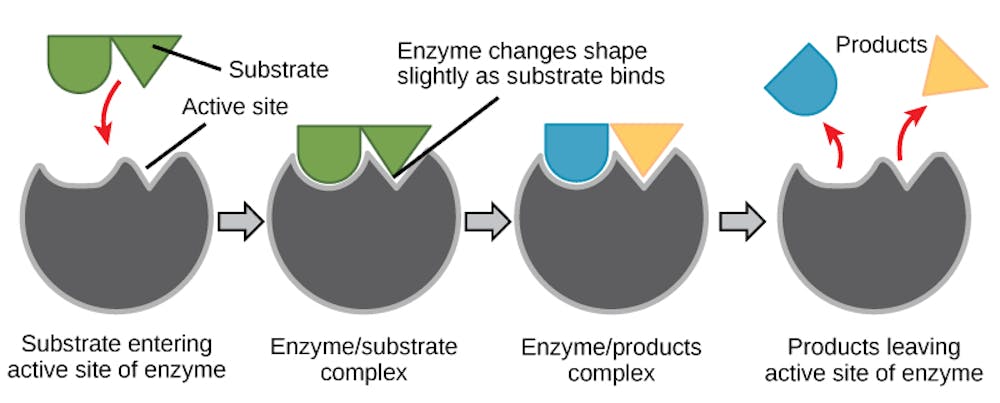
For an enzyme to function, it adopts a shape that perfectly matches the molecule it processes, much like a lock matches a key. The unique grooves in the enzyme – the lock – that interact with the target molecule – the key – are found in a region of the enzyme known as the active site.
The induced fit model of enzymes states that both the enzyme and its substrate change shape when they interact. OpenStax, CC BY-SA
The active site of the enzyme precisely orients amino acids to interact with the target molecule when it enters. This makes it easier for the molecule to undergo a chemical reaction to turn into a different one, making the process go faster. After the chemical reaction is done, the new molecule is released and the enzyme is ready to process another.
How do you design an enzyme?
Scientists have spent decades trying to design their own enzymes to make new molecules, materials or therapeutics. But making enzymes that look like and go as fast as those found in nature is incredibly difficult.
Enzymes have complex, irregular shapes that are made up of hundreds of amino acids. Each of these building blocks needs to be placed perfectly or else the enzyme will slow down or completely shut off. The difference between a speed racer and slowpoke enzyme can be a distance of less than the width of a single atom.
Initially, scientists focused on modifying the amino acid sequences of existing enzymes to improve their speed or stability. Early successes with this approach primarily improved the stability of enzymes, enabling them to catalyze chemical reactions at a higher range of temperatures. But this approach was less useful for improving the speed of enzymes. To this day, designing new enzymes by modifying individual amino acids is generally not an effective way to improve natural enzymes.
This model of acetylcholinesterase shows acetylcholine (green) bound to its active site. Sam Pellock, CC BY-SA
Researchers found that using a process called directed evolution, in which the amino acid sequence of an enzyme is randomly changed until it can perform a desired function, proved much more fruitful. For example, studies have shown that directed evolution can improve chemical reaction speed, thermostability, and even generate enzymes with properties that aren’t seen in nature. However, this approach is typically labor-intensive: You have to screen many mutants to find one that does what you want. In some cases, if there’s no good enzyme to start from, this method can fail to work at all.
Both of these approaches are limited by their reliance on natural enzymes. That is, restricting your design to the shapes of natural proteins likely limits the kinds of chemistry that enzymes can facilitate. Remember, you can’t eat soup with a knife.
Is it possible to make enzymes from scratch, rather than modify nature’s recipe? Yes, with computers.
Designing enzymes with computers
The first attempts to computationally design enzymes still largely relied on natural enzymes as a starting point, focusing on placing enzyme active sites into natural proteins.
This approach is akin to trying to find a suit at a thrift store: It is unlikely you will find a perfect fit because the geometry of an enzyme’s active site (your body in this analogy) is highly specific, so a random protein with a rigidly fixed structure (a suit with random measurements) is unlikely to perfectly accommodate it. The resulting enzymes from these efforts performed much more slowly than those found in nature, requiring further optimization with directed evolution to reach speeds common among natural enzymes.
Recent advances in deep learning have dramatically changed the landscape of designing enzymes with computers. Enzymes can now be generated in much the same way that AI models such as ChatGPT and DALL-E generate text or images, and you don’t need to use native protein structures to support your active site.
AI tools are helping researchers design new proteins.
Our team showed that when we prompt an AI model, called RFdiffusion, with the structure and amino acid sequence of an active site, it can generate the rest of the enzyme structure that would perfectly support it. This is equivalent to prompting ChatGPT to write an entire short story based on a prompt that only says to include the line “And sadly, the eggs never showed up.”
We used this AI model specifically to generate enzymes called serine hydrolases, a group of proteins that have potential applications in medicine and plastic recycling. After designing the enzymes, we mixed them with their intended molecular target to see whether they could catalyze its breakdown. Encouragingly, many of the designs we tested were able to break down the molecule, and better than previously designed enzymes for the same reaction.
To see how accurate our computational designs were, we used a method called X-ray crystallography to determine the shapes of these enzymes. We found that many of them were a nearly perfect match to what we digitally designed.
Our findings mark a key advance in enzyme design, highlighting how AI can help scientists start to tackle complex problems. Machine learning tools could help more researchers access enzyme design and tap into the full potential of enzymes to solve modern-day problems.
Sam Pellock receives funding from the Washington Research Foundation and Schmidt Futures program.
Ross D. MacKinnon, former dean of the College of Liberal Arts and Sciences (CLAS) and Professor Emeritus of geography, passed away from pancreatic cancer at his home in Sonoma, California, surrounded by family, on Jan. 27, 2025, at the age of 82.
A dedicated leader and scholar, MacKinnon left a lasting impact on UConn and the many students, faculty, and colleagues who had the privilege of working with him.
As dean of CLAS from 1996 to 2008, he oversaw a period of transformative growth and investment in the College. He played a pivotal role in guiding CLAS through the UConn 2000 capital program, a state-funded initiative that revitalized the University and strengthened its academic foundation.
Throughout his tenure, he championed major investments in faculty hiring, research, and academic programs. He also spearheaded several multidisciplinary initiatives that continue to shape UConn’s academic community today.
Among his many accomplishments, he led the creation of the UConn Humanities Institute, which supports humanities scholarship through funding, fellowships, and programming. He was also instrumental in establishing the Human Rights Institute and the Center for Health, Intervention, and Prevention, now known as the Institute for Collaboration on Health, Intervention, and Policy.
Before joining UConn, MacKinnon served as dean of the Faculty of Social Sciences and professor of geography at the State University of New York at Buffalo. He previously served as head of SUNY Buffalo’s Department of Geography, during which time he strengthened the department’s graduate program and scholarly reputation. Prior to that, he was a faculty member in the University of Toronto’s geography department.
MacKinnon earned a bachelor’s degree in geography from the University of British Columbia in 1964, a Master of Science in geography from Northwestern University in 1966, and a Ph.D. in geography from Northwestern University in 1968.
He was a proud Canadian and naturalized U.S. citizen who believed in the promise of America. He loved traveling, sharing a good meal with friends, live jazz, contemporary painting, new plays, UConn men’s and women’s basketball, and the Buffalo Bills. He had a great sense of humor and was quick with encouragement.
He is survived by his wife, Marilyn Hoskin, and his two daughters, Pam and Caroline MacKinnon.
His family asks those who wish to honor his memory to take a moment to remember Ross and consider supporting the Dean Ross MacKinnon Endowment for CLAS Graduate Fellows.
If your young child asks “what’s the meaning of life?” you might laugh it off (how cute!) or freeze in panic (where do I even begin?).
It’s tempting to dismiss these big questions as too advanced for kids. Plato and Aristotle both believed children weren’t ready for philosophy. In fact, they didn’t think people were ready to study philosophy until they turned 30.
But children know otherwise. They ask big questions like “Why are we here?” and “What does it mean to be fair?” and “Why do we keep feeding the cat, even though she never says thank you?”
American researcher and author Jana Mohr Lone has taught philosophy to young children for more than 20 years. As one second-grade child told her:
[…] children don’t know as many things about the world and so our minds are more free to imagine.
This openness makes children natural philosophers. By encouraging these conversations, you can help them grow into curious, thoughtful and reflective individuals.
One of the difficulties of engaging in philosophy is people may be unfamiliar with how it works.
But you can have a philosophical discussion by following three steps:
reflection
generalisation
abstraction.
When your child asks a deep question like “What’s the meaning of life?” you don’t need to have the answer, you just need to start a conversation.
First, prompt your child to reflect on the question. You could ask: “What do you think?”
This allows your child to explore their own experiences. They might say, “I live for football and Bluey!”
Second, move to generalisation. You can ask, “Do you think that’s the meaning of life for everyone?” This opens up a philosophical discussion beyond the self. Your child might say, “Well, Stella lives for gymnastics and cheese.”
Finally, prompt towards abstraction, by asking “What makes life meaningful for all people?”
Football, Bluey and handstands won’t appeal to everyone, but something else might. Now we’re looking for examples (or counter-examples) as a method of inquiry.
This prompts your child to look for what is common to all people in living a meaningful life. They may respond with something like:
A lot of people love chocolate but not Aunty Grace. Most people love dogs but maybe not people who really love cats. Everyone loves time with their friends and family.
Suddenly, you’re having a rich philosophical dialogue. You can continue further inquiry into what really is love, or what makes certain relationships more important than others.
What we’re doing here is having a dialogue through concepts, academically known as conceptual analysis.
Educational research has found philosophical dialogue improves children’s logical reasoning, reading and maths comprehension, self-esteem and turn-taking.
Happiness, identity, fairness, death, reality, time, nature, good, knowledge and purpose are all things children encounter every day. Philosophy with your child can simply be the exploration of what these concepts mean and how they impact our lives.
Understanding concepts and being able to apply that understanding to life is the foundation of philosophy.
Kids can ask tricky quesitons. But philosophical approaches prompt them to think through an answer. Kampus Productions/ Pexels, CC BY
Questions to ask your child
To engage your child in philosophy, start a conversation with them about the concepts they’re encountering.
If they’re drawing, you could ask what is art? What is imagination?.
If they don’t want to share their favourite toy: what is fairness? What is kindness?
If they’re talking to the dog: what is language? What is understanding?
If they’re emotional: what is happiness? What is sadness?
If they want to know why they should go to school: what is knowledge?
If they’re telling you about their dream: what is real?
Next time your child asks a big question, embrace the moment. By exploring concepts like fairness, love and happiness, you’re helping them interpret the world and become more thoughtful people.
By asking them to reflect, explore different perspectives and consider the bigger picture, you’ll embark on a philosophical journey that can grow into something meaningful for you both.
Ben Kilby is the Chair of the Victorian Association for Philosophy in Schools
Source: The Conversation (Au and NZ) – By Jude MacArthur, Senior Lecturer, School of Critical Studies in Education, University of Auckland, Waipapa Taumata Rau
Seven new charter schools are opening their gates, and ACT leader and Associate Education Minister David Seymour – the politician responsible for their existence – has been singing their praises.
He says some will deliver “new and innovative ways to help students who are struggling at school to succeed, especially neurodiverse students, where there is huge need”.
Seymour also says charter schools will free teachers from “constant upheavals in education” policy and provide the flexibility to “allow them to better cater to students who are priority learners” – the term charter schools use for “those with neurodiversity and a background of disadvantage and poverty”.
Such innovation will raise overall educational achievement, he says, particularly for students who are underachieving, disengaged or neurodivergent. It may be too early to tell whether this optimism is justified, but it seems the new charter schools will enjoy a range of benefits unavailable to state schools.
For example, Seymour recently praised Arapaki School in Christchurch for its teaching ratio of one teacher and three teacher aides for every 25 students. Australian students with this level of resourcing, he said, learned up to 60% faster than those in state schools.
But teachers, principals and researchers in the state system have been asking for reduced class sizes and one teacher aide per classroom for years. So we need to ask why the resources and privileges being channelled into charter schools can’t be made available to the state school system instead.
An underfunded education system
The coalition government has set aside NZ$153 million to fund charter schools over the next four years. These schools are state funded but operated by a “sponsor”: 75% of their teachers must be qualified and 25% can be permanently employed with a “limited authority to teach”.
The government’s Charter School Agency describes considerable flexibility around teaching, curriculum, governance, hours and days of operation, and how funding is spent.
According to chief executive Jane Lee, this flexibility supports innovation and provides opportunities for students to learn differently. And there is little doubt a sizeable minority of pupils are not well served in the mainstream system.
One in five children and young people in our schools need extra support for their learning. For decades, official reports have documented inequities in this area, including poor achievement for disabled and neurodivergent students.
The problems and solutions are well understood. Disabled and neurodivergent students face barriers to learning because funding, resources and timely support for them and their teachers are inadequate.
This includes a shortage of teacher aides, specialist teachers and therapists, and class sizes being too big.
the current education system as outdated and heading towards major crises, with many seeing home schooling as the only option.
Lack of supporting evidence
Rather than addressing under-resourcing in the state system, however, charter school advocates view the problem as a lack of choice, exacerbated by constant upheavals in education policy.
Associate Education Minister David Seymour. Getty Images
So, what can we learn from the last time charter schools operated between 2012 and 2018? The evidence is mixed, according to an evaluation of eight charter schools undertaken for the Ministry of Education.
While whānau and student experiences appeared positive, low and uneven response rates from these groups make drawing any conclusion difficult.
There was evidence of innovative practices in school governance and management, and to a lesser extent in staffing, student engagement and support, teaching and learning. The schools were least innovative in curriculum design and engagement with their communities.
The schools themselves felt small school rolls and class sizes contributed to their successful operation. As for the key aim of charter school policy supporting priority learners, the report described a good understanding of their needs.
But insufficient data mean we don’t know whether student achievement improved overall, and we know nothing about the achievement of students who received learning support.
Focus on state schools instead
Other questions remain, too. As the New Zealand Educational Institute pointed out last year, the $153 million being spent on charter schools would pay for more than 700 teacher aides in the state system.
Given the existing shortage of learning-support resources overall, will charter schools (which will also have access to those resources) simply add another layer of competition for state schools?
And if charter schools themselves struggle to recruit the necessary expertise, will their staff have the professional knowledge of student diversity and inclusion that’s needed to support students and whānau well, and who will judge that?
Finally, charter schools must select priority group applicants by ballot if there are more applicants than capacity allows. How will they decide on the number of available places?
At the risk of answering these questions with another question, wouldn’t our thinking be better directed at improving the public education system?
All children – including those needing learning support – deserve to belong and learn well in their local school, with all the checks and balances that currently ensure equity, inclusion and a fully qualified teaching staff.
Jude MacArthur currently receives funding from The Teaching and Learning Research Initiative. She has previously received Marsden funding. She is a member of the Teaching Council’s Inclusive Education Advisory Group; The Inclusive Education Action Group; and was a member of the Ministry of Education’s Bicultural and Inclusive Working Group as part of the curriculum refresh.
Finding a home that stays cool in this heat is a real challenge. Homebuyers and renters face two problems: a shortage of heat-resistant homes, and a lack of reliable, independent information about how homes perform in the heat.
So, how can you avoid buying or renting a “hot box”? Here’s a handy list of 12 features to check next time you’re searching for a place to live.
Ask these 4 questions before you inspect
1. Does the house have insulation? Ceiling, wall and underfloor insulation seals the indoor environment, slowing or preventing heat from leaking in or out.
2. Does it have double-glazed windows?Insulated glass, made from two or more window panes with a space in between, keeps heat out in summer and inside during winter.
3. How big is the house? Australian homes are among the largest in the world. Cooling a large home with air conditioning can be costly. Check the floor plan to see if you can shut doors and close off internal spaces, so you only cool the parts you need during hot spells.
4. Has the house had an energy and thermal performance assessment? The Residential Efficiency Scorecard is delivered by the Victorian government on behalf of all Australian governments. The report, undertaken by an accredited assessor, rates a home’s energy use and comfort, and recommends improvements. Other assessments also exist.
Look for these 8 things during an inspection
1. Check the colour and nature of external walls, roof and surrounding surfaces.Dark-coloured roofs or walls, and other hard surfaces such as concrete, absorb more heat. This heat builds up during the day and radiates out at night, causing what’s known as the heat island effect.
2. Look at internal floors and surfaces. Brick walls or concrete surfaces inside can be a good thing, if the hot weather doesn’t last too long. That’s because the home will take longer to heat up. But these heavy materials will also take longer to cool down once the heatwave is over. Good ventilation may compensate for that.
3. Consider the size and position of windows and doors. Openings on each side of rooms and the house as a whole allows cooling through natural ventilation. You can open up the house and let the cool air flow from one side to the other during the night, or once the cool change comes. Security doors and fly screens will keep insects and potential intruders out.
4. Is there external shading, such as blinds or greenery? Ensuring windows and walls are shaded on the outside is the best way to keep the heat out, particularly on the west-facing side. Large unshaded glass windows facing north and west can cause the home to heat up in summer. Vertical blinds work well on west-facing windows. On the north side, horizontal shading such as a pergola blocks out the sun in summer – when it is higher in the sky. It also lets the sun in during winter when the sun is lower in the sky, to gently warm the home.
5. Check for ceiling fans. Ceiling fans cool a home and use little energy. Check how many are installed and where they are located. Ceiling fans are ideal in living spaces, but also work well in bedrooms to help you stay comfortable on hot nights.
Ceiling fans can make you feel cooler without costing a lot of money. Artazum, Shutterstock
6. Investigate the air-con. If the house has air-conditioning, ask about its age, and look up its energy rating on energyrating.gov.au.
7. Consider garden spaces. Plants and trees can creating a “microclimate” around your home, keeping it cool. Also look at the landscape beyond the property – a tree-lined street can reduce temperatures and improve thermal comfort during a heatwave.
8. Note the position of the afternoon sun. Visit potential homes during the mid-late afternoon or check the sun’s path through the home – perhaps using a sun tracking app. If air conditioners are turned on, consider what this might mean for energy bills. What would the home feel like without it? Are there other ways to keep the building cool?
Most Australian homes perform poorly when it comes to maintaining a comfortable temperature range indoors. This is particularly true for those built before the 1990s, when minimum energy performance standards were introduced. But these standards set a low bar compared with those overseas.
This, coupled with the absence of requirements for landlords or sellers (except in the ACT) to have the home assessed or declare a rating, means buyers and renters are left in the dark when it comes to making informed choices.
Renters and lower-income households are at greatest risk of living in a home that is too hot or too cold. The private rental stock in Australia is among the poorest, most uncomfortable housing in the Western world.
While the ACT has introduced minimum energy efficiency standards for rental properties, standards across the country contain few provisions that promise improved thermal comfort.
Until the regulatory landscape changes and energy performance must be disclosed, we hope these tips will help you avoid the worst of Australia’s hot boxes.
Sarah Robertson has received funding from various sources, including the Lord Mayor’s Charitable Foundation and the Fuel Poverty Research Network. She has benefitted from Australian Research Council, Victorian government and various local government and industry partnerships to support research related to this topic.
Nicola Willand receives funding for research from various organisations, including the Australian Research Council, the Victorian state government, the Lord Mayor’s Charitable Foundation, the Future Fuels Collaborative Research Centre and the National Health and Medical Research Council. She is a trustee of the Fuel Poverty Research Network charity and affiliated with the Australian Institute of Architects.
Ralph Horne has received funding from various sources including the Australian Research Council, the Australian Housing and Urban Research Institute and the Victorian government to support research related to this topic.
Trivess Moore has received funding from various organisations including the Australian Research Council, Australian Housing and Urban Research Institute, Victorian government and various industry partners. He is a trustee of the Fuel Poverty Research Network.
Conducting scientific studies is never easy, and there are often major disasters along the way. A researcher accidentally spills coffee on a keyboard, destroying the data. Or one of the chemicals used in the analysis is contaminated, and the list goes on.
However, when we read the results of the study in a scientific paper, it always looks pristine. The study went smoothly with no hiccups, and here are our results.
But studies can contain errors, not all of which independent experts or “peer reviewers” weed out before publication.
Statistical stuff-ups can be difficult to find as it really takes someone trained in statistics to notice something wrong.
When statistical mistakes are made and found, it can have profound impacts on people who may have changed their lifestyle as a result of the flawed study.
These three examples of inadvertent statistical mistakes have had major consequences for our health and shopping habits.
1. Did you throw out your black plastic spoons?
Late last year, I came across a news article about how black plastic kitchen utensils were dangerous as they could potentially leak toxic flame-retardant chemicals into your food.
Being a natural sceptic, I looked up the original paper, which was published in the journal Chemosphere. The article looked genuine, the journal was reputable. So – like perhaps many other people – I threw out my black plastic kitchen utensils and replaced them with silicone ones.
In the study, the authors screened 203 household products (about half were kitchen utensils) made from black plastic.
The authors found toxic flame retardants in 85% of the products tested, with levels approaching the maximum daily limits set by the Environmental Protection Agency in the United States.
Unfortunately, the authors made a mistake in their calculations. They were out by a factor of ten. This meant the level of toxic chemicals was well under the daily safety limits.
A landmark study raised safety concerns about hormone replacement therapy or HRT (now also known as menopausal hormone therapy). This highlights a different type of statistical error.
The Women’s Health Initiative (WHI) study involved 10,739 postmenopausal women aged 50-79 recruited from 40 clinical centres in the US. It compared the health of women randomised to take HRT with those who took the placebo. Neither the researchers nor the women knew which treatment had been given.
In their 2002 paper, the authors reported higher rates of invasive breast cancers in the HRT group. They used a unit called “person-years”. Person-years is a way to measure the total time a group of people spends in a study. For example, if 100 people are in a study for one year each, that makes 100 person-years. If someone leaves the trial after only six months, only that half-year is counted for them.
The authors showed a rate of 38 invasive breast cancers per 10,000 person-years in the HRT group, compared to 30 per 10,000 person-years in the placebo group. This gives a rate ratio of 1.26 (one rate divided by the other).
This fairly large increase in breast cancer rates, also expressed as a 26% increase, caused widespread panic around the world, and led to thousands of women stopping HRT.
But the actual risk of breast cancer in each group is low. The rate of 38 per 10,000 person-years is equivalent to an annual rate of 0.38%. With very small rates like this, the authors should really have used the rate difference rather than the rate ratio. The rate difference is one rate subtracted from the other, rather than divided by it. This equates to an annual increase of 0.08% breast cancer cases in the HRT group – much more modest.
The authors of the 2002 paper also pointed out that the 26% increase in the rate of breast cancer “almost reached nominal statistical significance”. Almost is not statistical significance, and formally, this means there was no difference in breast cancer rates between the two groups. In other words, the difference between the two groups could have happened by chance.
The authors should have been more careful when describing their results.
3. Did Popeye’s spinach change your meals?
Cartoon character Popeye is a one-eyed, pipe-smoking sailor with mangled English, in love with the willowy Olive Oyl. He is constantly getting into trouble, and when he needs extra energy, he opens a can of spinach and swallows the contents. His biceps immediately bulge, and off he goes to sort out the problem.
When Popeye ate spinach, his muscles bulged. No wonder sales of spinach rose.
But why does Popeye eat spinach?
The story begins in about 1870, with a German chemist, Erich von Wolf or Emil von Wolff, depending on which version of events you read.
By then the Popeye character had been created and spinach became incredibly popular with children. Apparently, consumption of spinach in the US went up by a third as a result of the cartoon.
This story had gained legendary status but has one tiny flaw. In a 1932 cartoon, Popeye explains exactly why he eats spinach, and it’s nothing to do with iron. He says in his garbled English:
Spinach is full of Vitamin A. An’tha’s what makes hoomans strong an’ helty!
Adrian Esterman receives funding from the NHMRC, MRFF and ARC.
Source: The Conversation (Au and NZ) – By Deborah Brown, Professor in Philosophy, Director of the University of Queensland Critical Thinking Project, The University of Queensland
There is only so much thinking most of us can do in our heads. Try dividing 16,951 by 67 without reaching for a pen and paper. Or a calculator. Try doing the weekly shopping without a list on the back of last week’s receipt. Or on your phone.
By relying on these devices to help make our lives easier, are we making ourselves smarter or dumber? Have we traded efficiency gains for inching ever closer to idiocy as a species?
This question is especially important to consider with regard to generative artificial intelligence (AI) technology such as ChatGPT, an AI chatbot owned by tech company OpenAI, which at the time of writing is used by 300 million people each week.
According to a recent paper by a team of researchers from Microsoft and Carnegie Mellon University in the United States, the answer might be yes. But there’s more to the story.
Thinking well
The researchers assessed how users perceive the effect of generative AI on their own critical thinking.
Generally speaking, critical thinking has to do with thinking well.
One way we do this is by judging our own thinking processes against established norms and methods of good reasoning. These norms include values such as precision, clarity, accuracy, breadth, depth, relevance, significance and cogency of arguments.
The authors of the recent study adopt a definition of critical thinking developed by American educational psychologist Benjamin Bloom and colleagues in 1956. It’s not really a definition at all. Rather it’s a hierarchical way to categorise cognitive skills, including recall of information, comprehension, application, analysis, synthesis and evaluation.
The authors state they prefer this categorisation, also known as a “taxonomy”, because it’s simple and easy to apply. However, since it was devised it has fallen out of favour and has been discredited by Robert Marzano and indeed by Bloom himself.
In particular, it assumes there is a hierarchy of cognitive skills in which so-called “higher-order” skills are built upon “lower-order” skills. This does not hold on logical or evidence-based grounds. For example, evaluation, usually seen as a culminating or higher-order process, can be the beginning of inquiry or very easy to perform in some contexts. It is more the context than the cognition that determines the sophistication of thinking.
An issue with using this taxonomy in the study is that many generative AI products also seem to use it to guide their own output. So you could interpret this study as testing whether generative AI, by the way it’s designed, is effective at framing how users think about critical thinking.
Also missing from Bloom’s taxonomy is a fundamental aspect of critical thinking: the fact that the critical thinker not only performs these and many other cognitive skills, but performs them well. They do this because they have an overarching concern for the truth, which is something AI systems do not have.
Higher confidence in AI equals less critical thinking
Research published earlier this year revealed “a significant negative correlation between frequent AI tool usage and critical thinking abilities”.
The new study further explores this idea. It surveyed 319 knowledge workers such as healthcare practitioners, educators and engineers who discussed 936 tasks they conducted with the help of generative AI. Interestingly, the study found users consider themselves to use critical thinking less in the execution of the task, than in providing oversight at the verification and editing stages.
In high-stakes work environments, the desire to produce high-quality work combined with fear of reprisals serve as powerful motivators for users to engage their critical thinking in reviewing the outputs of AI.
But overall, participants believe the increases in efficiency more than compensate for the effort expended in providing such oversight.
The study found people who had higher confidence in AI generally displayed less critical thinking, while people with higher confidence in themselves tended to display more critical thinking.
This suggests generative AI does not harm one’s critical thinking – provided one has it to begin with.
Problematically, the study relied too much on self-reporting, which can be subject to a range of biases and interpretation issues. Putting this aside, critical thinking was defined by users as “setting clear goals, refining prompts, and assessing generated content to meet specific criteria and standards”.
“Criteria and standards” here refer more to the purposes of the task than to the purposes of critical thinking. For example, an output meets the criteria if it “complies with their queries”, and the standards if the “generated artefact is functional” for the workplace.
This raises the question of whether the study was really measuring critical thinking at all.
The research found that people with higher confidence in themselves tended to display more critical thinking. ImYanis/Shutterstock
Becoming a critical thinker
Implicit in the new study is the idea that exercising critical thinking at the oversight stage is at least better than an unreflective over-reliance on generative AI.
The authors recommend generative AI developers add features to trigger users’ critical oversight. But is this enough?
Critical thinking is needed at every stage before and while using AI – when formulating questions and hypotheses to be tested, and when interrogating outputs for bias and accuracy.
The only way to ensure generative AI does not harm your critical thinking is to become a critical thinker before you use it.
Becoming a critical thinker requires identifying and challenging unstated assumptions behind claims and evaluating diverse perspectives. It also requires practising systematic and methodical reasoning and reasoning collaboratively to test your ideas and thinking with others.
Chalk and chalkboards made us better at mathematics. Can generative AI make us better at critical thinking? Maybe – if we are careful, we might be able to use generative AI to challenge ourselves and augment our critical thinking.
But in the meantime, there are always steps we can, and should, take to improve our critical thinking instead of letting an AI do the thinking for us.
The authors do not work for, consult, own shares in or receive funding from any company or organisation that would benefit from this article, and have disclosed no relevant affiliations beyond their academic appointment.
Annalena Baerbock, the German foreign minister, spoke for much of the European diplomatic community when she reacted to news of Donald Trump’s phone chat with Vladimir Putin: “This is the way the Trump administration operates,” she declared. “This is not how others do foreign policy, but this is now the reality.”
The resigned tone of Baerbock’s words was not matched by her colleague, defence minister Boris Pistorius, whose criticism that “the Trump administration has already made public concessions to Putin before negotiations have even begun” was rather more direct.
Their sentiments were echoed, not only by European leaders, but in the US itself: “Putin Scores a Big Victory, and Not on the Battlefield” read a headline in the New York Times. The newspaper opined that Trump’s call had succeeded in bringing Putin back in from the cold after three years in which Russia had become increasingly isolated both politically and economically.
This was not lost on the Russian media, where commentators boasted that the phone call “broke the west’s blockade”. The stock market gained 5% and the rouble strengthened against the dollar as a result.
Reflecting on the call, Putin’s spokesman, Dmitry Peskov, continued with operation flatter Donald Trump by comparing his attitude favourably with that of his predecessor in the White House, Joe Biden. “The previous US administration held the view that everything needed to be done to keep the war going. The current administration, as far as we understand, adheres to the point of view that everything must be done to stop the war and for peace to prevail.
“We are more impressed with the position of the current administration, and we are open to dialogue.”
Trump’s conversation with Putin roughly coincided with a meeting of senior European defence officials in Brussels which heard the new US secretary of defense, Pete Hegseth, outline America’s radical new outlook when it comes to European security. Namely that it’s not really America’s problem any more.
Hegseth also told the meeting in Brussels yesterday that the Trump administration’s position is that Nato membership for Ukraine has been taken off the table, that the idea it would get its 2014 borders back was unrealistic and that if Europe wanted to guarantee Ukraine’s security as part of any peace deal, that would be its business. Any peacekeeping force would not involve American troops and would not be a Nato operation, so it would not involve collective defence.
Sign up to receive our weekly World Affairs Briefing newsletter from The Conversation UK. Every Thursday we’ll bring you expert analysis of the big stories in international relations.
International security expert David Dunn believes that the fact that Trump considers himself a consummate deal maker makes the fact that his administration is willing to concede so much ground before negotiations proper have even got underway is remarkable. And not in a good way.
Dunn, who specialises in US foreign and security policy at the University of Birmingham, finds it significant that Trump spoke with Putin first and then called Ukraine’s president Volodymyr Zelensky to fill him in on the call. This order of priority, says Dunn, is a sign of the subordination of Ukraine’s role in the talks.
He concludes that “for the present at least, it appears that negotiations will be less about pressuring Putin to bring a just end to the war he started than forcing Ukraine to give in to the Russian leader’s demands”.
Hegseth’s briefing to European defence officials, meanwhile, came as little surprise to David Galbreath. Writing here, Galbreath – who specialises in defence and security at the University of Bath – says the US pivot away from a focus on Europe has been years in the making – “since the very end of the cold war”.
There has long been a feeling in Washington that the US has borne too much of the financial burden for European security. This is not just a Donald Trump thing, he believes, but an attitude percolating in US security circles for some decades. Once the Berlin Wall fell and the Soviet Union disintegrated, the focus for Nato become not so much collective defence as collective security, where “conflict would be managed on Nato’s borders”.
But it was then the US which invoked article 5 of the Nato treaty, which establishes that “an armed attack against one or more [member states] in Europe or North America shall be considered an attack against them all”. The Bush government invoked Article 5 the day after the 9/11 attacks and Nato responded by patrolling US skies to provide security.
Pete Hegseth dashes Ukraine’s hopes of a future guaranteed by Nato.
Galbreath notes that many European countries, particularly the newer ones such as Estonia and Latvia, sent troops to Iraq and Afghanistan. “The persistent justification I heard in the Baltic states was “we need to be there when the US needs us so that they will be there when we need them”.
The prospect of a profound shift in the world order are daunting after 80 years in which security – in Europe certainly – was guaranteed by successive US administrations and underpinned, not just by Nato but by a whole set of international agreements.
Now, instead of the US acting as the “world’s policeman”, we have a president talking seriously about taking control of Greenland, one way or another, who won’t rule out using force to seize the Panama Canal and who dreams of turning Gaza into a coastal “riviera” development.
Meanwhile Russia is engaged in a brutal war of conquest in Ukraine and is actively meddling in the affairs of several other countries. And in China, Xi Jinping regularly talks up the idea of reunifying with Taiwan, by force if necessary, and is fortifying islands in the South China Sea with a view to aggressively pursuing territorial claims there as well.
And we thought the age of empires was in the rear view mirror, writes historian Eric Storm of Leiden University. Storm, whose speciality is the rise of nation states, has discerned a resurgence of imperial tendencies around the world and fears that the rules-based order that has dominated the decades since the second world war now appears increasingly tenuous.
In any given week, you’d expect the imminent prospect of the collapse of the Gaza ceasefire to be the big international story. And certainly, while Trump and Putin were “flooding the zone” (see last week’s round-up for the origins of this phrase) the prospects of the deal lasting beyond its first phase have become more and more uncertain.
Hamas has recently pulled back from its threat not to release any more hostages. Earlier in the week it threatened to call a halt to the hostage-prisoner exchange, claiming that the Israel Defense Forces (IDF) had breached the terms of the ceasefire deal. Israeli prime minister, Benjamin Netanyahu, responded – with Trump’s backing – saying that unless all hostages were released on Saturday, all bets were off and the IDF would resume its military operations in the Gaza Strip. Trump added that “all hell is going to break out”.
The US president has also doubled down on his idea for a redeveloped Gaza and has continued to pressure Jordan and Egypt to accept millions of Palestinian refugees. This, as you would expect, has not made the population of Gaza feel any more secure.
Nils Mallock and Jeremy Ginges, behavioural psychologists at the London School of Economics, were in the region last month and conducted a survey of Israelis and Palestinians in Gaza to get a feel for how the two populations regard each other. It makes for depressing reading.
The number of Israelis who reject the idea of a two-state solution has risen sharply since the October 7 2023 attacks by Hamas, from 46% to 62%. And roughly the same proportion of people in Gaza can now no longer envisage living side by side with Israelis. Both sides think that the other side is motivated by hatred, something which is known to make any diplomatic solution less feasible.
We also asked Scott Lucas, a Middle East specialist at University College Dublin, to assess the likelihood of the ceasefire lasting into phase two, which is when the IDF is supposed to pull out of Gaza, allowing the people there room to being to rebuild, both physically and in terms of governance.
He responded with a hollow laugh and a shake of the head, before sending us this digest of the key developments in the Middle East crisis this week.
We’ve become very used to seeing apocalyptic photos of the devastation of Gaza: the pulverised streets, choked with rubble, that make the idea of rebuilding seem so remote. But the people of Gaza also cultivated a huge amount of crops – about half the food they ate was grown there. Gazan farmers grew tomatoes, peppers, cucumbers and strawberries in open fields as well as cultivating olive and citrus trees.
Geographers Lina Eklund, He Yin and Jamon Van Den Hoek have analysed satellite images across the Gaza Strip over the past 17 months to work out the scale of agricultural destruction. It makes for terrifying reading.
Flett was assigned a triage score of five, which is intended for non-urgent low-priority cases. The statement of claim alleges that the physician who finally saw Flett insinuated that he was hungover, saying something to the effect of: “I don’t know what to tell you, we don’t treat you here for hangovers.”. Flett was not given diagnostic tests, imaging, a physical examination or pain medication.
In a statement made through his lawyer, Flett said, “I knew that there was something seriously wrong with me and this doctor didn’t seem to want to take me seriously or help me. In that moment, I just felt worthless.”
Flett is a father of six, a building contractor, a resident of Winnipeg and a citizen of Tataskweyak First Nation.
Flett’s statement of claim says he endured an 11-hour bus trip to Winnipeg to seek the care he needed while in severe pain and without other healthcare alternatives.
Once in Winnipeg, Flett called 911 and requested an ambulance. He was instructed by the operator to take a taxi to Seven Oaks Hospital. There he was triaged as a priority but still told to wait.
He finally underwent surgery for acute appendicitis more than 30 hours after he first sought care. The surgery left Flett with complications.
Brian Sinclair is not here to personally tell his version of what happened in the 34 hours he spent in September 2008 in the emergency room of a major Winnipeg hospital.
Structures of Indifference by Mary Jane Logan McCallum and Adele Perry.
Sinclair, a middle-aged Anishinaabe man, died from what is normally an easily treated infection. In our 2018 book, Structures of Indifference: An Indigenous Life and Death in a Canadian City, we show how Sinclair’s tragic and unnecessary death reveals some painful truths about the ongoing history of settler colonialism, and how its legacies continue to devalue Indigenous life.
Sinclair was assumed to be drunk by medical staff and did not receive timely or adequate care, while Flett accuses medical authorities in Manitoba of the same treatment.
These types of experiences are not particular to Manitoba, but are mirrored by incidents of medical racism across Canada.
Tania Dick, Dzawada̱ʼenux̱w registered nurse and current Indigenous Nursing Lead at the University of British Columbia, explained to CBC’s The Current in 2018 that many Indigenous families have their own “Brian Sinclair story.”
This includes the family of Joyce Echaquan. Echaquan was a 34-year-old Atikamew mother of six, who recorded hospital staff hurling racial slurs at her while withholding medical treatment causing her death in a hospital north of Montréal in September 2020.
Inadequate treatment
Both Echequan’s and Sinclair’s families and communities made sure that their deaths did not go unnoticed.
In Sinclair’s case, an inquest and a number of reports resulted in significant changes to the way that patients are triaged and managed.
Echaquan’s experience led to an inquest and the development of Joyce’s Principle, which aims to “guarantee to all Indigenous people the right of equitable access, without any discrimination, to all social and health services.”
These cases have helped fuel a growing awareness about anti-Indigenous medical racism, including among organizations of medical professionals.
Apologies and pledges
Two years ago, the College of Physicians and Surgeons of Manitoba (CPSM) apologized and accepted responsibility for failing to fairly treat Indigenous patients and they pledged to take action against anti-Indigenous racism.
And last year, the Canadian Medical Association (CMA) also acknowledged the racism and discrimination that Indigenous patients and health care providers face. They apologized and pledged to “act against anti-Indigenous racism in health care.”
The inquests, reports and apologies appear to have fallen short. Flett’s lawsuit claims that his treatment violated Sections 7 and 15 of the Canadian Charter of Rights and Freedoms. It seeks damages under Section 24.1, which says that those whose rights or freedoms have been violated can seek remedies from the courts.
It is a good time for us all to think about the ongoing costs of anti-Indigenous racism in Canada’s past and present.
The authors do not work for, consult, own shares in or receive funding from any company or organisation that would benefit from this article, and have disclosed no relevant affiliations beyond their academic appointment.
Source: United States Senator Pete Ricketts (Nebraska)
February 13, 2025
February 13, 2025
WASHINGTON, D.C. – Today, U.S. Senator Pete Ricketts (R-NE)introduced a resolution honoring the life and legacy of Nebraska community leader Howard Hawks. Ricketts announced the resolution while on a conference call with Nebraska media yesterday:
“Nebraskans benefitted greatly from Howard Hawks’ leadership and generosity,” Ricketts said. “He was a visionary leader in the business and philanthropic community. He served on the Board of Creighton University and as a University of Nebraska Regent. His historic support for higher education opened countless new doors for Nebraska students. Howard and his wife Rhonda were also great partners and friends during my time as Governor. My resolution will honor his life and legacy.”
Watch the video HERE.
The text of the resolution can be found here.
Source: United States Senator for Colorado John Hickenlooper
Legislation will cut reliance on China for critical materials essential to our national security, energy, and emerging tech
WASHINGTON – Today, U.S. Senator John Hickenlooper, Lindsey Graham, Chris Coons, and Todd Young reintroduced the bipartisan Critical Materials Future Act to establish a pilot program for the Department of Energy to financially support domestic critical material processing projects.
“American energy independence is a bipartisan goal,” said Hickenlooper. “The U.S. could be a global leader in critical materials, but we need to shore up our domestic supply chains to strengthen our national security. Let’s get to work.”
“China maintains dominant control over critical mineral processing, which poses significant risks to our national security. It’s important for us to build better and more resilient processing capabilities here at home,” said Graham.
“Critical minerals are essential to manufacturing the most advanced energy and defense technologies, but the production, processing, and recycling of these materials is dominated by China,” said Coons. “This bipartisan bill will spur the investment we need to regain American control of our critical mineral supply chains.”
“Our reliance on global supply chains for critical materials poses a significant national security threat, especially as the Chinese Communist Party continues to manipulate this market,” said Young. “Our bill will take innovative steps to identify opportunities for American leadership and investment in critical material projects, strengthen domestic supply chains, and boost our economic and global competitiveness.”
The U.S. critical minerals list contains 50 minerals – including graphite, nickel, and cobalt – that are essential to our economy, infrastructure, and military capability. Critical minerals are used in smartphones, electric vehicle batteries, solar panels, wind turbines, and more.
This December, China announced that they would immediately block the export of three critical minerals: gallium, germanium, and antimony to the U.S. China currently controls 90% of the global processing capacity for rare earth elements and over 80% of the processing for other critical minerals like cobalt, gallium, and graphite. Experts have become increasingly concerned with U.S. dependence on China for critical materials, arguing it poses a significant risk to national security.
The Critical Materials Future Act supports critical material processing projects in the United States by granting the Secretary of Energy the authority and funding to deploy innovative financial mechanisms, such as contracts for differences and advanced market commitments, within this sector.
The bill also requires the Secretary of Energy to conduct a comprehensive study on the impact of these financial tools on market dynamics and processing projects within the critical materials sector, and to provide recommendations for expanding their use to strengthen America’s processing capabilities.
In the 119th Congress, Hickenlooper has reintroduced his bipartisan STRATEGIC Minerals Act to foster critical minerals trade with our international allies, and the bipartisan Unearth Innovation Act to establish a DOE program for critical minerals innovation.
The Critical Materials Future Act is supported by the Colorado School of Mines, the Bipartisan Policy Center, the National Wildlife Federation, the Society for Mining, Metallurgy, and Exploration, the Key Minerals Forum, Citizens for Responsible Energy Solutions, Employ America, MineTech Ventures, Alta Resource Technologies, the Chamber of Progress, U.S. Critical Minerals, Nyrstar, the Alabama Mobility and Power Center (University of Alabama), South32 Hermosa, Alliance for Mineral Security, South Star Battery Metals Corp, the American Critical Minerals Association, and the Federation of American Scientists. For their statements of support, click HERE.
Full text of the Critical Materials Future Act is available HERE. A one-pager explanation on this bill is available HERE.
Source: United States Senator for Colorado John Hickenlooper
Unearth Innovation Act would create a Department of Energy program to drive responsible domestic critical mineral production, develop our energy workforce
WASHINGTON – Today, U.S. Senators John Hickenlooper and Thom Tillis reintroduced their bipartisan Unearth Innovation Act to spur American innovation and drive responsible production of domestic critical minerals with less environmental impact.
“We need critical minerals for our clean energy future and national security, but we can’t rely on China or others for them,” said Hickenlooper. “U.S. research and innovation will set a global example for critical minerals sourcing and help develop our energy workforce of tomorrow.”
“This legislation promotes innovative technologies that will make mining safer, cleaner, and more efficient,” said Tillis. “By collaborating with agencies and experts, we can create high-quality jobs, enhance safety, and equip the next generation with the skills and training needed to strengthen our critical minerals supply chains.”
The legislation would establish a Mining and Mineral Innovation Program within the Department of Energy (DOE) to increase research, development, and commercialization of advanced mining, recycling, and processing technologies that would reduce environmental and human impacts.
The U.S. critical minerals list contains 50 minerals – including graphite, nickel, and cobalt – that are essential to our economy, infrastructure, and military capability. Critical minerals are used in smartphones, electric vehicle batteries, solar panels, wind turbines, and more. Currently, the U.S. is largely dependent on China for importing these minerals, which creates supply chain instability and threats to national security.
Specifically, the Unearth Innovation Act would:
Support research and development of technologies for identifying, mining, recycling, and processing minerals and to reclaim, remediate, and reuse existing mines
Promote responsible mining practices that minimize human and environmental impact
Engage with communities and consult with tribal nations to support strategies to increase the prosperity of mining communities
Allow DOE to coordinate with federal agencies on mining safety innovations
Partner with academic institutions and the mining industry to accelerate new mining technologies and create a pipeline into the critical minerals workforce
In the 119th Congress, Hickenlooper has reintroduced his bipartisan STRATEGIC Minerals Act to foster critical minerals trade with our international allies and the bipartisan Critical Materials Future Act to establish a pilot program to finance domestic critical minerals production.
The Unearth Innovation Act is supported by the Colorado School of Mines, the Bipartisan Policy Center, the National Wildlife Federation, the Society for Mining, Metallurgy, and Exploration, SAFE’s Center for Critical Minerals Strategy, the Key Minerals Forum, the Zero Emission Transportation Association, Citizens for Responsible Energy Solutions, Employ America, MineTech Ventures, Alta Resource Technologies, the Chamber of Progress, U.S. Critical Minerals, Nyrstar, the Alabama Mobility and Power Center (University of Alabama), South32 Hermosa, Alliance for Mineral Security, South Star Battery Metals Corp, the American Critical Minerals Association, and the Federation of American Scientists. For their statements of support, click HERE.
A one-pager explanation of the bill can be found HERE.
Full text of the bill is available HERE.
Now, 85 years later, many people know “Cap” best from his depiction in the Marvel Cinematic Universe (MCU). The first film to bring the character to the big screen was Captain America: The First Avenger, in 2011. The film establishes what is probably the best known iteration of Captain America, a mantle taken up by the second world war “super-soldier” Steve Rogers (Chris Evans).
Each iteration of Captain America correlates to the real US of their time. For Trump’s America, that iteration is played by Anthony Mackie. His MCU character, Sam Wilson, formerly known as Falcon, takes up the mantle in Avengers: Endgame (2019). Mackie now appears in his first standalone film in the role, Captain America: Brave New World.
Looking for something good? Cut through the noise with a carefully curated selection of the latest releases, live events and exhibitions, straight to your inbox every fortnight, on Fridays. Sign up here.
Joe Simon and Jack Kirby, the creators of Captain America, conceived him explicitly as the antithesis to Hitler. By draping Steve Roger in stars and stripes and giving him the name Captain America, their superhero became the symbol of a nation.
With his origins in the second world war, the Steve Rogers iteration of Captain America is a fairly uncomplicated piece of propaganda, representing the righteousness of the US and its fight against Nazism. Captain America is the archetype of the nationalist superhero. He’s embodiment of the nation state and therefore represents and defends the ideal version of it.
However, as cultural geographer Jason Dittmer points out in his book Captain America and the Nationalist Superhero (2013), the state and the nation are not necessarily the same thing. The state is the governmental apparatus while the nation is the identity of its people.
Erskine explains why Rogers was chosen as a super-solder.
This difference is articulated, to an extent, in Captain America: The First Avenger (2011). The creator of the super-soldier serum, Abraham Erskine (Stanley Tucci) explains that the weak, sickly Rogers was chosen to become the first super-soldier because he understands the value of power. Having never had it, Erskine argues, he would not be corrupted by it. Rogers is not a perfect soldier, but he is a good man and that is more important.
If we map this onto the US, the implication is that America as a nation is fundamentally good and just, and therefore separate from any potentially problematic policies set by America the state.
As Rogers’ arc progresses across successive movies, the character becomes increasingly disillusioned with state power and control. His relationship with his own identity as Captain America fluctuates, with his ambivalence often symbolised by his either giving up or reclaiming the shield.
Enter Sam Wilson
In one of the closing scenes of Avengers: Endgame (2019), an aged Steve Rogers passes his shield to Sam Wilson (Anthony Mackie), the African-American superhero known as the Falcon.
In the world of the MCU, Captain America’s shield has never just been a shield – it is a symbol of heroism, of moral values and of “American-ness”. It can be read as a symbol of what America is, and what it could be.
Captain America: Brave New World is Anthony Mackie’s first standalone film in the role.
The legacy of Steve Rogers’ Captain America was explored in the TV show The Falcon and the Winter Soldier (2021). The series interrogated topics such as race, patriotism and American identity through the story arcs of two versions of Captain America: the Rogers-approved Wilson and the state-sponsored John Walker (Wyatt Russell). The series explores the concept of heroism and links it to questions of race.
In American Masculinities: A Historical Encyclopedia (2003), associate professor of American studies Holly Allen argues that: “The basis of American notions of both heroism and manliness has been a tension between virtuous devotion to a higher cause and the quest for personal achievement.”
This tension is palpably played out in the narrative arc of Rogers and in some ways resolved across the course of his films. His personal achievement (thanks to the super-soldier serum) is put in service of a higher cause, first during the second world war, later with the Avengers and finally in passing the shield to Wilson.
The state-sponsored shield
Despite his disillusionment, Rogers is positioned as being the living embodiment of the American dream, rather than a tool of the state. The same cannot be said of Walker, the white, blond, blue-eyed, highly decorated soldier selected to be the next Captain America by the US government.
Rogers’ Captain America was conceived of to fight against and be ideologically opposed to fascism. But Walker’s short-lived tenure sees him – with the backing of the “Global Repatriation Council” – carrying out raids on safe houses and refuges. He angrily demands that the people he is brutalising show him respect purely because he is Captain America.
Walker becomes, effectively, the public face of the Global Repatriation Council. Armed with the shield and dubbed the new “Star Spangled Man”, he embodies a particularly American brand of aggressive insertion into global politics. This can be interpreted as a critique of the positioning of America as “the world’s policeman”.
Wilson’s speech in The Falcon and The Winter Soldier.
During the show, Walker’s murder of an unarmed dissident brings his stint as Captain America to an end. The shield, mantle and title of Captain America therefore return to Wilson, whose climatic speech in the series’ finale articulates the hostility and judgment he faces as a black man wearing the stars and stripes.
During the recent promotional tour for Brave New World, Mackie stated that Captain America was a man with “honour, dignity and integrity”, noting that these are virtues not currently embodied by America the state.
He added that while Cap represents many things, “America” as it currently is should not be one of them. It looks likely then that Wilson’s Captain will return the character to the ideal of the nation as it should be, rather than a tool of state propaganda and repression.
Unsurprisingly, Mackie has faced enormous backlash to his comments – despite them being almost identical to sentiments expressed by Evans in 2011. Whatever the future of the character in the MCU, ideas around heroism, patriotism and race will be central to the continuing evolution of Captain America.
Laura Crossley does not work for, consult, own shares in or receive funding from any company or organisation that would benefit from this article, and has disclosed no relevant affiliations beyond their academic appointment.
As a nine-year-old, I loved singing and took every chance to do so enthusiastically during school assemblies and end-of-year shows. I developed a bit of a reputation, so much so that one day, a classmate asked me to serenade him and a girl. Cut to me belting Donna by 10CC from behind a bush outside his bedroom window.
My classmate was lacking in musical or lyrical abilities to write and perform his own song. However, if he found himself in a similar position this Valentine’s Day, he could get a little help from AI, and so can you.
Suno’s Valentine’s Day Experience is a tool to create personalised love songs in response to a three-question prompt. Keenan Freyberg, one of Suno’s co-founders, noted that their generator is similar to a mixtape, a curated collection of songs that can reflect the compiler’s feelings and intentions.
Music and dance have long served as mediators in matters of love. A British music publisher, writing in 1912, recounted in Pete Doggett’s Electric Shock, noted that music was essential at the start of a courtship, with song lyrics needing to be a blend of directness and obliqueness. This balance should allow the message to be understood while providing a safe way to ignore it if the sentiment is not reciprocated.
Looking for love this Valentine’s Day? Whether you want to improve your relationship with others or with yourself, The Quarter Life Glow-up can help.
This six-week newsletter course from The Conversation will bring you research-backed advice and tools to help improve your relationships, your career, your free time and your mental health – no supplements or skincare required.
So, for instance, if you send someone At Last by Etta James you can plausibly deny that it meant anything. You were just sharing a great song. If, however, they share the sentiment and hear a ring of reciprocal feeling in James’s voice then you can bond in a burgeoning romance where “life is like a song”.
Many of us have probably been guilty of doing this and there are so many love songs out there that there is quite possibly one to help convey every sort of romantic feeling.
A recent survey by the UK’s Performing Rights Society of 2,000 British respondents identified All of Me by John Legend as the UK’s favourite love song. The song was prompted by an old friend of Legend’s who suggested that he write one for his future-wife, Chrissy Teigen, that conveyed a similar message as Billy Joel’s She’s Always A Woman To Me. The idea that you could love someone, flaws and all, is a pretty powerful and universal sentiment.
In the US, a similar chart compiled by Billboard of the top 50 songs with love in their title, spanned hits from 1958 to 2011. The top track was Endless Love by Diana Ross and Lionel Richie, a true classic about undying feelings and commitment.
The most recently released song in the list was Rhianna’s We Found Love featuring Calvin Harris from 2011. The song’s lyrics and central hook, “We found love in a hopeless place,” were written by Calvin Harris and conveys perhaps a more youthful, possibly hedonistic message of love in a club based track.
All of these songs have really strong sentiments, but they aren’t quite the same as expressing your unique thoughts and feelings for your intended yourself. But if, like my 10CC-loving friend, you lack the skill, AI could help you craft something a bit more specific for your intended.
Suno’s love song generator asks for you to plug in your love interest’s name, where you met and something nice about them. The product is a personalised love song. While you might not be able to hide your feelings in the words of others with this AI-generated song, there is something brave and worthy about being so forthright.
Such a direct show of emotion might not be for you but this new development in AI makes clear that music and words have long been essential in the expression of love through the ages. As my experience at the tender age of nine confirms, providing the right words, with a suitable melody, at crucial moments mitigates the awkwardness of males, of all ages, where matters of the heart are concerned. Even in the age of AI.
Hussein Boon does not work for, consult, own shares in or receive funding from any company or organisation that would benefit from this article, and has disclosed no relevant affiliations beyond their academic appointment.
We may never know if St Valentine, a martyr beheaded for officiating the forbidden weddings of persecuted Christians, was keen on chocolate and flowers. But we do know that millions of people around the world will be using those very items to celebrate his name on February 14.
In the UK, it is estimated that 60% of the population will celebrate Valentine’s Day this year, each spending around £52 on gifts and other romantic gestures. The total spend in the US will be about US$27 billion (£22 bilion), including roughly $US500 million on roses.
So the tradition of spending money on your romantic partner on February 14 seems fairly well established. But it is hard to know exactly when the link began.
Up until the late 14th century, Valentine’s Day was solely a commemoration of his martyrdom. The shift toward an association with romantic love emerged in the Middle Ages, and is often attributed to the poet Geoffrey Chaucer, who linked Valentine’s Day to romance in his poem Parliament of Fowls.
But it was the 19th century industrial revolution which brought about the mass production of romantic gifts. Cadbury was the first chocolate maker to commercialise the association between romance and confectionery by producing heart-shaped boxes of chocolates for Valentine’s Day in 1868. These boxes were decorated with images of Cupid, roses and hearts, and would sometimes be kept to store romantic letters and mementos.
And while Hallmark did not invent the occasion, it played a big part in bolstering its popularity by selling Valentine’s Day postcards in 1910, and then printing its own greetings cards from 1916.
Now in the US, around 145 million Valentine’s Day cards are exchanged each year, making it the second largest annual occasion for card giving (after Christmas).
But it’s not just car sellers, florists and chocolate-makers who seek to benefit from the commercial opportunities Valentine’s Day provides. This year for example, IKEA has partnered with a dating app to give nine British couples a “once-in-a-lifetime” first date in an Ikea store, where they will share a meatball dinner for two in bed.
Lego has launched a travelling campaign in major cities around the world to show off its floral designs, and Coca-Cola has teamed up with a fast-food brand to create a Valentine-themed drive-thru experience.
Chocolate and marshmallows
These kinds of one-off marketing campaigns are only possible thanks to a long history of Valentine’s traditions, which vary around the world.
In Japan for example, it is a two-part celebration. On February 14, women often give “Giri-choco” (“obligation chocolate”) to friends and colleagues, while “home-choco” (“true-feeling chocolate”) is reserved for romantic partners. On March 14, known as White Day, men reciprocate by giving jewellery and less-expensive gifts that are white (marshmallows are a popular choice).
Celebrations in South Korea are similar to those in Japan, but with the addition of Black Day on April 14 when single people gather at restaurants to eat black noodles (jajangmyeon). In the Philippines, Valentine’s Day is marked by mass weddings organised by the government.
In Finland and Estonia, Valentine’s Day is known as “Friend’s Day” with the focus on celebrating non-romantic love and friendship. A similar idea, “Galentine’s Day”, which featured in a 2010 episode of the US sitcom Parks and Recreation, has become a popular way of celebrating female friendship.
Love for sale
Of course, not all consumers enjoy Valentine’s Day rituals. For many, there is pressure attached to romantic shopping, while for others it is just an unwelcome reminder of their single status.
But there is a market for that too. Anti-Valentine’s day sentiment has inspired other ways to (not) celebrate, including a box of chocolates aimed at single people.
And it can be a very valuable day for businesses, large and small. With high levels of participation and spending, Valentine’s Day brings a major surge in revenue for sectors including retail, hospitality and entertainment.
So although it might not sound very romantic, it’s worth remembering that while money can’t buy you love, love can provide a significant boost to the economy.
Sameer Hosany does not work for, consult, own shares in or receive funding from any company or organisation that would benefit from this article, and has disclosed no relevant affiliations beyond their academic appointment.
Source: The Conversation – UK – By Louise Gentle, Principal Lecturer in Wildlife Conservation, Nottingham Trent University
In Canada, male bears are becoming more nocturnal and overlapping less with females. Erik Mandre / shutterstock
Frustrated with which dating app to use? Unable to find “the one”? Spare a thought for some of the animal kingdom, where humanity has hampered their efforts to find a mate.
Humans have destroyed or polluted animal habitats. But perhaps the most obvious way that we have affected animals is by placing barriers, such as roads, between populations, making it hard for individual animals to reach each other. In response to this habitat fragmentation, reptile and bird species have increased the distances they move by 35% and 50% respectively.
Here are five more ways that humans have scuppered the love lives of animals.
Noise pollution causes animals to sing louder
Song is hugely important for birds and some other animals, as it indicates their fitness – those who sing louder, or more elaborately, are better able to defend territories against rivals and attract higher quality mates. But city-living great tits have to sing at a higher frequency than those in rural areas, in order to be heard over the sound of low frequency urban noises, such as traffic and machinery. They also sing faster, shorter songs.
Songbirds have learned to survive in a noisy world. Bildagentur Zoonar GmbH / shutterstock
And its not just terrestrial animals that have changed their behaviour in response to humans. As oceans are largely dark, most marine animals rely on non-visual cues, such as sound, to help them find food, navigate and attract mates. Although some whale song can be over 180 decibels in volume – comparable to the sound of a rocket launch – and heard thousands of miles away, ocean noises caused by humans can be even louder.
Not only does noise pollution make it much harder to communicate to potential mates, it has also been linked to more frequent strandings, reduced growth and low fertility in whales and dolphins. Narwhals, for example, have even responded to loud noises by diving deeper into the oceans, using up vital resources that they could be putting into reproducing.
Human disturbance makes mammals more nocturnal
Given that humans are daytime dwellers, it’s not surprising that some animals have developed nocturnal habits to avoid coming into contact with us. Animals often practice this sort of risk avoidance, but typically they move in space – away from us. With a reduction in available space, animals are also moving in time.
Mammals have been found to become more nocturnal in response to human disturbance. This disturbance could be anything from hiking to hunting: animals tend to view all human activity as threatening, whether it is or not.
For example, large male brown bears become more nocturnal when humans are present. But this creates less competition for food during the day. Consequently, the females stick to their daytime activity, essentially separating the males and females in time, and making it increasing difficult to find a mate that won’t fall asleep on them.
Introduced species hybridise with locals
Species that are introduced to areas where they are not usually found, whether on purpose or by accident, often wreak havoc on the native animals, spreading disease and out-competing, or even preying, on them.
The white headed duck is endangered, thanks to hunting, habitat loss, and the new thread of interbreeding with ruddy ducks. smutan / shutterstock
The ruddy duck was unintentionally introduced to Great Britain from North America around 75 years ago, and quickly spread throughout western Europe. After finding their way to Spain, they mated with the endangered white-headed duck, managing to produce fertile offspring and a new hybrid duck. This is pushing the white-headed duck to extinction – not good if you are a white-headed duck looking for love.
Chemical pollution turns males into females
Imagine searching for a reproductive partner only to find none of the opposite sex. This is the unfortunate situation some fish have found themselves in.
Some streams, containing wastewater or effluents, are polluted with synthetic oestrogens from birth-control pills. A study on fathead minnow fish found that increased levels of synthetic oestrogens caused males to have less developed testicles and early-stage eggs. The fish that developed these intersex traits – both male and female characteristics – were found to have fewer and less mobile sperm, which reduced their fertilisation success. This can lead to less sustainable populations, ultimately resulting in extinctions – hardly a good way to find love.
A rubbish Valentine’s Day gift
Animals often ingest plastic and other rubbish, or becoming tangled in it. But rubbish isn’t entirely bad news for all animals.
For instance, birds often use human-made materials when building nests, implying that some species are intentionally using rubbish to show off to members of the opposite sex. One particular species, the satin bower bird, constructs highly ornate bowers – stages where the males show off to the females – decorated with blue items. The more complex the bower, the better the mating success.
Bower building, with blue plastic litter. Ken Griffiths / shutterstock
But, as there are relatively few blue items in nature, the males now decorate their bowers with as many bright blue items of human rubbish as possible, including bottles tops, crisp packets, pegs and even blue condom wrappers. So, although humans are making it increasingly difficult for animals to survive and reproduce, for this particular bird, beauty really is in the eye of the beholder.
Louise Gentle works for Nottingham Trent University
The run up to February 14 is a good time for selling certain products. And alongside the jewellery and flowers, advertisers also try to sell us something broader: a notion of what we should consider romantic.
This might involve an idyllic and perfectly filmed holiday destination, or the casting of a glamorous Hollywood star to represent a particular perfume. For research has shown that advertising can shape our expectations of what love should look like – from the perfect partner to the things we should buy for them.
It’s become a familiar tactic for all kinds of advertising. And it fits with an idea explored by the French literary theorist Roland Barthes in his 1957 collection of essays, Mythologies: that if a message is repeated enough, it becomes true.
Advertisers seem to have embraced this notion, and we see the same kind of messages repeated year after year, telling potential customers what they should aspire to – and invest in – to achieve their best and most romanticised ideals.
Whether those ideals are realistic or not is not the goal here. Advertising generates money for brands by creating a commercially driven view of what love should look like.
There are various techniques available to advertisers to shape those expectations. Emotional appeals, for example, try to evoke feelings of passion and desire.
Google did this effectively in a simple video which tells a love story through the medium of an online search tool.
“Social proof” is a different advertising approach which involves relaying a specific message about what consumers can achieve if they turn to a particular brand. You too can be happy if you drink coffee with your new partner at a local branch of McDonalds for example.
This kind of marketing is designed to appeal to people’s need for social validation. It is advertising which implies that using certain products will lead to a fulfilling romantic life, and that your partner will really love you if you buy them a Toblerone this Valentine’s Day.
“Targeted marketing” is a method which focuses on creating personalised campaigns for specific audiences. This strategy has become more common as we spend more time online, providing big tech with plenty of data about our likes and dislikes.
And with online dating still growing in popularity, targeted marketing is applied through apps like Tinder and Hinge, which are able to provide valuable insights into users’ preferences, enabling advertisers to tailor their messages to specific demographics.
Match up
Marketing can also apply pressure to consumers to purchase gifts or experiences as a way of demonstrating affection. This could be anything from a box of chocolates to an engagement ring.
And who came up with the idea that one of those rings should cost the proposer the equivalent of two months’ salary? It was the jewellery company, De Beers.
In fact, it was only after the company’s 1947 advertising campaign with the slogan “A diamond is forever”, that diamond rings became an engagement tradition at all.
But depictions of diamonds and perfect lifestyles can lead to feelings of inadequacy or low self-esteem when people compare themselves to idealised portrayals in the media. Research suggests that how we process these romantic ideals is affected by our own attachment styles – the patterns of bonding that we learn as children and carry into our adult relationships.
Feelings of inadequacy have also inspired alternative Valentine’s Day celebrations. For instance, an Indian chocolate bar created a campaign to “destroy Valentine’s Day” using the assumption that as soon as uncles join a trend, such as celebrating February 14th, it becomes instantly unfashionable – and Generation Z runs for the hills.
Another harmful effect of advertising romance is how young people’s perception of relationships is shaped by the media promoting unrealistic lifestyles, body shapes and beauty standards. These kinds of branded messages are being delivered to romantic consumers of all ages as the battle for their money and time continues.
Advertisers want you to buy their products. And to make this happen, they also want you to buy into fabricated expectations of romantic love – through repetition, strategy and a familiar date in February.
Carl W. Jones does not work for, consult, own shares in or receive funding from any company or organisation that would benefit from this article, and has disclosed no relevant affiliations beyond their academic appointment.
Source: The Conversation – Canada – By DaLissa Alzner, Registered Psychotherapist, Adjunct faculty in the Department of Applied Psychology, Adler University
A healthy relationship is one where you feel comfortable being your authentic self.(Shutterstock)
Many people spend much of their lives searching for what is arguably one of the most subjective of human experiences — true love. From popular movies, TV shows and dating apps to a cultural focus on finding “the one,” the phenomenon of love is inescapable. Our preoccupation with social connectedness is biologically connected to our desire for human connection.
But how do we establish connections across all our relationships that positively contribute to our well-being? Identifying the characteristics of a healthy relationship and being mindful of red flags is a reasonable place to start.
Love is often one of those things that you just know when you feel it. While it is difficult to define love as an explicit experience or construct, there are certain guides we can use to understand what makes a loving relationship.
What makes a healthy relationship?
If you believe that friends are the family we choose, then you have been fortunate to experience a meaningful friendship that positively contributes to a reality where you feel appreciated, valued and have a sense of belonging.
This experience of connection can be defined as compassionate love — originally coined as a component of the Two-Factor Theory of Love, which suggests love is comprised of two main categories. The first is passionate love, which is the intense longing for someone that may end in sexual connection or rejection. The second is compassionate love, which is associated with friendship, companionship and affection.
Being your authentic self means aligning your actions and behaviours with your core values and beliefs. This allows you to engage in self-discovery and thrive in every environment or relationship you find yourself in.
This alignment fosters a sense of congruence between your internal self and external expressions, allowing you to interact with others genuinely. Engaging with others authentically allows you to navigate social interactions with integrity and fosters deeper, more meaningful relationships.
What does love look like?
While love can be a difficult thing to define, there are some ways that we can sense when it is present, and when it isn’t.
Celebrating differences: Embracing the authenticity and differences of friends, siblings and partners fosters appreciation. This can reduce criticism, unrealistic expectations and dissatisfaction in relationships. Forcing change may work briefly, but it often leads to resentment and unhappiness.
Putting in the work: The grass is greener where you water it. Whether it’s a 25-year or five-month partnership, relationships require effort and co-operation. Working through individual differences to achieve a common goal is crucial in relationships. Siblings may need to overlook disagreements, while friends should meet regularly.
Leaning into language: When extending a gesture or token of appreciation, consider how it will be received by your partner — not by you. For instance, if you enjoy going out for dessert, but the other person prefers staying at home, you might initially think to take them out for dessert. However, to ensure the gesture is meaningful, present it in a way that aligns with their preferences and how they receive affection.
Diffusion:Acceptance and commitment therapy encourages people to create psychological and emotional space when conflict arises. This makes space for them to process conflict objectively, while also de-personalizing the interaction, contributing to emotional regulation and an ability to respond intentionally. The ability to develop and facilitate this skill is a vital tool for emotional regulation across relationships and circumstances.
To curate healthy and meaningful relationships, be intentional about nurturing connection, authenticity and mutual respect. (Shutterstock)
Signs love may not be present
Our need to belong and form meaningful connections drives our desire for companionship. When these efforts fail or relationships break, it is painful. Yet, there are some potential signs that can indicate when love is no longer present in a relationship.
Lack of communication and avoiding conflict: Poor communication and avoiding conflict can harm relationships. Research shows that not communicating leads to misunderstandings, emotional withdrawal and unresolved issues. Avoiding conflict can result in internalizing emotions, passive-aggressive behaviour and tension. In friendships, poor communication can cause feelings of being unheard or undervalued. Studies indicate that healthy friendships rely on open communication and respectful conflict resolution.
In family relationships, dysfunctional communication often contributes to division and resentment. Family therapy research has found that a lack of open communication can contribute to generational misunderstandings, leading to dysfunctional family dynamics.
Within families, particularly between parents and children, the absence of empathy may lead to significant emotional strain. Research has found that if family members fail to offer emotional support or to recognize each other’s needs, it negatively impacts family cohesion and individual well-being.
Controlling or manipulative behavior: Controlling behaviours, like restricting autonomy or manipulating someone into believing they are the problem in every situation, poses a serious threat to the well-being of a relationship. Research has shown that controlling behaviours often reflect insecurity and can contribute to abusive dynamics in relationships.
In friendships, manipulation may present as guilt-tripping, isolating from others or using emotional leverage to get one’s way. Research in this area suggests that healthy friendships involve mutual respect and boundaries, and when manipulation is present, satisfaction and trust is significantly reduced.
In families, controlling behaviours from parents, siblings or other relatives may contribute to a decrease in personal growth. The creation of toxic family dynamics manipulation and control at the hands of family has been found to significantly contribute to damaging effects over time, particularly in the parent-child relationship.
To curate healthy and meaningful relationships, be intentional about nurturing connection, authenticity and mutual respect. By celebrating differences, putting in effort, communicating openly and practising emotional regulation, it is possible to create meaningful relationships that will positively contribute to our well-being.
At the same time, we need to be diligent in recognizing and addressing red flags like poor communication and manipulative behaviours. Doing so allows us to safeguard our emotional health. Start today — reflect on your relationships, embrace authenticity and take the steps necessary to build deeper, more supportive connections that enrich your life.
DaLissa Alzner does not work for, consult, own shares in or receive funding from any company or organisation that would benefit from this article, and has disclosed no relevant affiliations beyond their academic appointment.