Category: Universities

  • MIL-Evening Report: ‘America First’ trade policy is pushing economic self-sufficiency – but history shows this is harder than it seems

    Source: The Conversation (Au and NZ) – By Garritt C. Van Dyk, Senior Lecturer in History, University of Waikato

    The day he took office for his second term, United States President Donald J. Trump unveiled his “America First” trade policy, including tariffs on imported goods from Mexico, Canada (both of which have since been paused) and China.

    President Trump’s reasoning for the tariffs included revitalising the American economy by bringing manufacturing and business back within US borders. Essentially, pushing the country towards greater self-sufficiency.

    Considering the cost of the tariffs, a number of countries have begun to question their dependence on foreign trade. But there are very clear hurdles including access to precious metals and raw materials.

    In a global market that relies on international trade, is it possible to be totally self-sufficient?

    The history of self-seficiency

    The economic term for self-sufficiency is “autarky”, borrowed from the ancient Greek word autarkeia, meaning “to suffice”. Ideally, this meant that a state could supply the needs of its people without foreign trade. Autarky, in its purest form, isolates the state from foreign economic, political and cultural influence.

    There are numerous historical examples of attempts to achieve complete economic autonomy.

    In 17th century Japan the Tokugawa Shogunate closed the borders to foreigners and prohibited Japanese from travelling abroad.

    There was limited private trade with China through Nagasaki and with Europe through Dutch merchants. They were confined to an artificial island, Deshima, off Nagasaki, to ensure their isolation. These restrictions remained for 265 years, until the threat of US gunboats forced Japan to sign a trade treaty in 1854.

    Self-sufficiency was also a goal of Benito Mussolini’s fascist dictatorship, aiming to lift Italy’s post-war economy in the 1920s. One initiative was the “Battle for Wheat”, an attempt to produce enough wheat to meet domestic demand and “free the Italian people from the slavery of foreign bread”.

    Italy imported more than one third of the flour needed to make bread and pasta, the two main foodstuffs. Pasta was targeted as a “backwards” food to promote consumption of local rice and reduce agricultural imports.

    Tariffs were levied on all imported goods in 1931. These were raised again in 1935 after sanctions were imposed on Italy following the invasion of Ethiopia. Mussolini declared in 1935 that Italy “would manage alone”.

    While imports of food, machinery and raw materials dropped, oil imports increased. Mussolini recognised the limits of autarky in 1934:

    Let us not delude ourselves about autarky. All the modern nations, thanks to the prodigious development of the sciences, can move towards a partial autarky. But we, until the contrary is proven, will have to import liquid combustibles.

    In response to Donald Trump’s America First policy, countries increasingly have to consider certain levels of self-sufficiency.
    Sven Hansche/Shutterstock

    A modern push to self-sufficiency

    Even with reduced reliance on fossil fuels, the scarcity of some natural resources, such as rare earth minerals, still poses a challenge to achieving autarky.

    Even the Democratic People’s Republic of Korea (North Korea), a centrally planned economy subject to United Nations Security Council sanctions for its nuclear and ballistic missile testing since 2006, is not completely self-sufficient.

    China is North Korea’s largest trading partner, with plastics, tobacco, soybean oil, rubber tires and packaged medicines as the top imports. The economic isolation of North Korea also makes it more vulnerable to global price fluctuations, as the movements are magnified due to the limited number of trading partners.

    Supply chain disruptions were highlighted during the pandemic, continued in 2021 with shortages in microchips, followed by Russia’s war in Ukraine.

    Some nations, such as the US and the United Kingdom, have responded to this logistical risk by shifting to local production, or reshoring, of certain critical industries, such as semiconductors and pharmaceuticals.

    This inward turn requires significant investment and lead time and may involve higher local energy and labour costs, or additional environmental restrictions. For industries that involve national security or essential goods, reducing dependence on potential adversaries may be necessary. But for other sectors the higher costs will create inflationary pressure.

    There are also implicit costs in cutting economic ties with the outside world. Foreign investment is reduced and innovation lags as there are fewer incentives for the cross-border flow of ideas.

    Embracing friendshoring

    As the push for self-reliance increases, vulnerable countries will need new strategies to remain resilient.

    Identifying alternative supply chain relationships and increasing inventory stockpiles in advance will minimise disruptions.

    Another tactic is “friendshoring” – relocating supply chains to countries where the risk of disruption from political chaos is low.

    It is likely that geopolitical instability will increase and global fragmentation will continue. While straightforward autarky may not be possible, countries will need to consider how to survive the political and economic volatility of the next four years – and beyond.

    Garritt C. Van Dyk does not work for, consult, own shares in or receive funding from any company or organisation that would benefit from this article, and has disclosed no relevant affiliations beyond their academic appointment.

    ref. ‘America First’ trade policy is pushing economic self-sufficiency – but history shows this is harder than it seems – https://theconversation.com/america-first-trade-policy-is-pushing-economic-self-sufficiency-but-history-shows-this-is-harder-than-it-seems-248530

    MIL OSI AnalysisEveningReport.nz

  • MIL-Evening Report: Schools need parent permission to put students’ photos on social media. 3 questions to ask before you say yes

    Source: The Conversation (Au and NZ) – By Karley Beckman, Senior Lecturer in Digital Technologies for Learning, University of Wollongong

    If you are a parent of a school student, you may have received a form seeking permission to use your child’s image on school social media accounts.

    It’s very common for schools to share photos of smiling students on platforms such as Facebook and Instagram. This may be to celebrate the start of term, student achievements, or performances and events at the school.

    Schools need permission from parents to publish or disclose students’ personal information, including photos and videos, on any online platform.

    But research suggests families can lack support and information to provide fully informed consent.


    Read more:
    Is your child’s photo on their school Facebook page? What does this mean for their privacy?


    Why do schools post photos online?

    Our recent study showed one of main reasons schools post on social media is they believe it is what parents want. This is part of marketing their school as a positive place to learn.

    But some parents take a more cautious approach to social media and don’t necessarily want photos of their children made public online.

    There is significant community concern about children’s online privacy and their digital footprint or the information trail about them.

    Last month, the Australian Federal Police warned parents about sharing images of their children online, especially back-to-school photos. It recommended parents blur or obscure the logo of the child’s school. Police also noted how background features can identify a school or child’s location.

    The AFP has seen non-explicit pictures of children and young people become the target of highly sexualised and inappropriate comments or role play.

    The risks also go beyond other people identifying your child online. Photos of children shared online can be used to train AI models or create deepfakes that are increasingly being used in cases of cyber bullying and cyber abuse.

    School social media accounts are a way of marketing to families and the community.
    SpeedKingz/Shutterstock

    What are the rules in Australia?

    The Australian Privacy Act and related Australian Privacy Principles, say consent to share personal information should be current, clearly explained and specific.

    This is why schools need to ask parents at the start of each year, but how they do this will depend on the state education department or individual school.

    Here are three questions to consider before you sign.

    1. What is the school asking you for?

    While approaches vary, it is common for schools to ask for several types of permission in one bundle.

    For example, they may ask if they can use photos and videos of your child in the school newsletter, school website, annual report, online learning platforms, traditional news media as well as social media.

    So the locations where your child’s information and photo may be shared are quite different in terms of privacy and your child’s digital footprint.

    For example, this could involve a photo of your child doing a class activity shared on a secure education app, or a video of your child on a public Facebook page.

    Parents have the right to consent and/or decline the use of their children’s information for specific purposes. If you can’t do this on the form, you can contact the school.

    2. What does the school post?

    Before providing or declining consent, you may want to take a closer look at the kinds of posts the school shares. This includes:

    • the quantity of information shared (number of photos or videos shared, and how often)

    • strategies used to protect children’s privacy (no names or locations, or photos in which children are not clearly identifiable or faces are obscured)

    • the purpose of the posts (can you see the value and benefit of sharing information?).

    Think about whether the school’s approach fits with your family’s approach to social media and what you share.

    3. How does your child feel?

    Research shows children as young as eight are developing an understanding of the risks of sharing personal information online.

    Understanding how your child feels about their school’s social media is important in making an informed decision about consent. It also helps teach them about making decisions about their digital footprint.

    You could ask your child:

    • are they aware of the school social media sites?

    • how does having their photo taken, or not, at school make them feel?

    • are they asked when their photo is taken, and are they told where it will be used or shared?

    These forms can seem routine or presented as if it’s not a big deal. But if you have any questions or concerns you should talk to your school. Schools can help you with more information and can also forward feedback to education departments. This is particularly important as we navigate the changing nature of social media and the potential impacts on children.

    Karley Beckman is an Associate Investigator with the Australian Research Council Centre of Excellence for the Digital Child.

    Tiffani Apps is an Associate Investigator with the Australian Research Council Centre of Excellence for the Digital Child

    ref. Schools need parent permission to put students’ photos on social media. 3 questions to ask before you say yes – https://theconversation.com/schools-need-parent-permission-to-put-students-photos-on-social-media-3-questions-to-ask-before-you-say-yes-249273

    MIL OSI AnalysisEveningReport.nz

  • MIL-Evening Report: Grampians National Park is still burning – here’s what we can expect will survive and recover

    Source: The Conversation (Au and NZ) – By John White, Associate Professor in Wildlife and Conservation Biology, Deakin University

    Fire broke out in the Grampians National Park (Gariwerd) in December and raged for weeks. Then lightning strikes ignited fresh blazes late last month, which merged to form a mega-fire that’s not out yet.

    This 168,000-hectare reserve, about 200km west of Melbourne, is a significant ecological and cultural landscape. Its ancient sandstone mountains and valleys maintain eucalypt woodlands and heathlands that support a rich diversity of plants and animals, making it a key conservation asset in Victoria.

    Since 2008, our team has been monitoring mammal species annually in the Grampians. This long-term effort has allowed us to learn how species respond to wildfires, droughts and floods.

    We commenced our research just two years after big fires swept through the park in 2006. We also witnessed the changes following more fires in 2013 and 2014.

    So while many animals have lost much of their habitat to fire this summer, we know recovery is possible. But some may need help to cope with challenges ahead.

    A terrible summer as multiple fires rage

    The massive December wildfire in the park’s east burned for weeks, forcing evacuations in towns such as Halls Gap, and upending Christmas for many residents. By early January, that fire was contained – but only after burning about 76,000 hectares of the park and surrounding areas.

    Then, on January 27, lightning strikes in the west ignited four fires that eventually merged, burning through the entire Victoria Range and some rural properties.

    The full extent of damage is not yet known. But it’s already clear the fires have been devastating. They burned much of the same areas affected by the 2006 wildfires in the east and 2013 fires in the west, as well as long-unburned areas.

    Combined, fires this big have not been observed in this landscape in the past 50 years.

    The extent of this summer’s wildfires in the Grampians is almost as big as fires in 2006 and 2013 put together.
    John White, using data from Luke Lupone at Dekain University and VicEmergency

    What is the extent of the damage to the environment?

    It’s difficult to determine how much of the park has burned so far this summer, because the shaded area on the state emergency map extends beyond the park’s borders. But a rough, conservative estimate suggests at least 110,000 hectares of the 168,000 hectare park has burned since December. This is a deeply troubling scenario.

    The Grampians is an isolated landscape – an “island” of native vegetation surrounded by a sea of agricultural land. So animals can’t easily migrate from other parts of Victoria to repopulate the area. Recovery largely depends on the landscape’s own ability to regenerate after fire.

    Populations of small carnivorous marsupials often peak in areas that haven’t burned for 10–20 years.

    So for many species, most of their habitat has been lost to fire. This includes endangered mammals such as the smoky mouse, heath mouse, brush-tailed rock wallaby, southern brown bandicoot and long-nosed potoroo. These species in particular will need considerable help for the next few years.

    Some of the native small mammals from the Grampians landscape. Clockwise from top left: yellow-footed antechinus, southern brown bandicoot, agile antechinus (male), swamp rat, long-nosed potoroo, heath mouse.
    John White

    Recovery will happen over time

    Many animals likely perished in the blaze and more will die in coming months.

    Unfortunately, most native small mammals struggle to survive in freshly burned habitats. Fire depletes their food sources and strips away the vegetation that provides cover and protection from predators.

    But there is hope. Our previous research shows some animals do survive. These survivors can eventually breed, sparking the slow recovery of the landscape and helping reestablish populations over the next decade or two.

    The rate of recovery will be driven by rainfall. So if drought hits, recovery will be slow. But if we have wet years, recovery will accelerate.

    Many native plants in the national park are more resilient to fire than the animals, so recover faster. Native heathland plants such as Australian grass trees have evolved in the presence of fire and often reshoot pretty quickly. Seeds also germinate after fires. But it takes a few years after the plants come back before many native animal species fully recover.

    So the first few years after fire are usually tough for native species. From a conservation perspective this is manageable in a patchy landscape — where some areas burned recently and others haven’t burned in decades. However, the current situation is different. This year, most of the landscape burned and almost no long-unburned habitat remains.

    A native grass tree reshoots after wildfire.
    John White

    What are the threats?

    The main challenge to recovery in the coming months and years is introduced species, especially foxes and cats. Foxes are particularly problematic, because they are drawn to recently burned areas where hunting is much easier.

    To give native mammals a fighting chance, it is essential to ramp up fox management efforts for at least the next year. This will allow surviving native mammals time to recover and for vegetation to regrow, providing necessary cover.

    In addition, Parks Victoria and the Victorian Department of Energy, Environment and Climate Action are erecting artificial shelters in ecologically sensitive areas. These provide temporary refuge for animals, giving them a better chance to evade predators.

    What about the role of climate change?

    In recent decades, the Grampians have experienced a general decline in rainfall, coupled with a significant increase in wildfires since the early 2000s.

    We’re now witnessing a cycle where large fires are followed by droughts, and then wet periods such as the recent La Niña years.

    During these wetter periods, vegetation flourishes. But when the inevitable dry spells return, that vegetation dries out, creating ideal conditions for wildfires. So the good years, while offering relief to the landscape, are setting the stage for the next fire. This leaves the landscape constantly vulnerable.

    What can people do to help?

    Fire is a natural process – albeit one increasingly driven by climate change. As climate change worsens, landscapes like the Grampians will face more frequent, large wildfires.

    We should approach our natural landscapes with care, acknowledging climate change is fundamentally altering how these ecosystems function.

    The best action we can take is to pressure governments to seriously address climate change and implement meaningful solutions.

    John White receives funding from Parks Victoria to support his long-term mammal research in the Grampians,

    ref. Grampians National Park is still burning – here’s what we can expect will survive and recover – https://theconversation.com/grampians-national-park-is-still-burning-heres-what-we-can-expect-will-survive-and-recover-249147

    MIL OSI AnalysisEveningReport.nz

  • MIL-Evening Report: Looking for a sperm donor online? 4 things to think about first

    Source: The Conversation (Au and NZ) – By Neera Bhatia, Associate Professor in Law (Health Law), Deakin University

    Tim Samuel/Pexels

    People looking for a sperm donor can go to a fertility clinic, ask a friend to donate or look for a donor online, including on an app or via social media.

    Women in same-sex relationships, single women and others are choosing the online option for a number of reasons.

    But this brings with it various challenges and risks. Here’s what to know first.

    It’s a popular choice

    Up to 4,000 children are estimated to have been born over the past ten years via one Australian sperm donation website alone.

    In just 2022, sperm sourced via one private Facebook group reportedly resulted in 692 births.

    Some donors and recipients choose to use online platforms because they want to form connections and friendships with the other party early on. In some cases, donors choose to remain in the lives of the recipient and any child born from their donation.

    But some sperm donors go online to remain anonymous, an option not usually possible when donating through a fertility clinic.

    Some people might use online sperm donation because the cost of accessing donor sperm at fertility clinics is too high in Australia. Some clinics charge a sperm donation management fee of about A$2,000. This allows people to access information about the donors they can choose from. Then there is the cost of insemination and of the sperm itself, which is about $2,500 out-of-pocket per cycle. Online sperm donation in Australia tends to be altruistic and does not cost anything.

    People in rural or regional areas may live far from fertility clinics, making access challenging.

    Then there’s often a shortage of donor sperm at clinics. In particular, there’s a lack of ethnic and cultural diversity in donors.

    Whatever the reason for seeking sperm online, here are some issues to consider first.

    1. Medical unknowns

    Sperm donors at fertility clinics undergo medical, physical and psychological screening to reduce the risk of transmitting disease to a child.

    However, online sperm donors may provide people with unscreened sperm that might be carrying sexually transmitted infections or inheritable genetic conditions.

    This puts the recipient and the potential child at risk because of the lack of medical information about the donor.

    Sperm donors in fertility clinics undergo genetic testing.
    New Africa/Shutterstock

    2. Psychological, personal, social risks

    People might be placed at risk when they agree to meet a potential online sperm donor in person. There have been reported cases where potential donors have pressured people into natural insemination (sexual intercourse) once they meet. This is despite donors initially agreeing to provide sperm for home insemination (using a syringe to inject the donor sperm into the vagina).

    These safety and exploitation concerns are especially pertinent in cases of same-sex female couples and people who are same-sex attracted who might feel coerced or compelled to have sexual intercourse with a man to try to conceive a child.

    In fertility clinics, state laws limit the number of individuals or families that can use a single donor’s sperm (from five to ten families depending on the state).

    The nature of online sperm donation means there are no records kept about the number of children a donor contributes to conceiving. With no formal record keeping, one donor could potentially provide sperm to hundreds of people. This increases the chances of donor-conceived siblings unknowingly having children together later in life.

    There might be cases where donors do not tell the truth about their identity or background, as happened in a case in Japan when a donor allegedly lied about his identity and education.

    There might also be psychological harm when an agreement has been made about contact between the parties and that agreement is later disputed or disregarded.

    3. Legally, it’s a grey area

    A man who donates sperm to a fertility clinic has no legal rights or obligations to a child born as a result of this donation in Australia.

    However, conceiving a child using informally donated sperm can be legally precarious. We are not aware of any reported cases in Australia of legal disputes about parentage that have involved online sperm donation. However, if the practice continues to grow, the courts may need to intervene if a donor is seeking to exercise some rights relating to the donor-conceived child against the mother’s wishes.

    There was, however, a 2019 case that relates to sperm donation by a friend. Here, the High Court ruled a man who donated sperm informally to his friend was deemed the legal parent of a child. This resulted in the mother and her same-sex partner being prevented from relocating to New Zealand with the child and their sibling.

    As each potential case will depend on its own set of unique circumstances, it’s best to take legal advice first.

    4. What’s best for the child?

    Many donor-conceived people want information about, and contact with, their donor. A lack of information, including medical information, can contribute to psychological, medical and social harms.

    So people should carefully consider how this arrangement might impact any child conceived. This includes their potential desire to meet any siblings conceived using the same donor’s sperm.

    A child may want to meet any siblings conceived using the same donor’s sperm.
    fizkes/Shutterstock

    Where to from here?

    The decision to have a child using donor sperm is complex. When deciding how to access donor sperm, people may benefit from speaking to an accredited fertility counsellor about their options.

    This may include accessing donor sperm through a fertility clinic, which are strictly regulated and licensed, and need to comply with state laws and ethical guidelines.

    While accessing donor sperm through a regulated fertility clinic may be more costly and time-consuming, it is also markedly safer than online sperm donation.

    However, some people may not want to access donor sperm through a fertility clinic, or this might not meet their needs. We need to understand why so we can try to do something about it.

    If a person decides to access donor sperm online, they should have open and honest discussions with the potential donor about:

    • their medical history

    • what role they envisage in the future life of a child born using their sperm

    • how all parties can keep records and contact information.

    Before seeing a potential donor in person, they should also tell a family member, close friend or someone they can confide in about the meeting to ensure they are safe.

    Taking these measures may help make accessing donor sperm online a positive experience for all involved.

    Neera Bhatia receives funding from the UK Arts and Humanities Research Council for an unrelated project.

    Catherine Mills has received industry research funding from Monash IVF, Ferring Pharmaceutical and Illumina. She is a bioethics consultant for VitroLife. She has received Australian government research funding from the ARC, NHMRC and MRFF. She does not receive private remuneration from any industry body.

    Giselle Newton is a donor-conceived woman and is a member of Donor Conceived Australia.

    Molly Johnston has received research funding from Monash IVF Group and Ferring Pharmaceuticals, and honoraria and travel fees from Gedeon Richter.

    Karin Hammarberg does not work for, consult, own shares in or receive funding from any company or organisation that would benefit from this article, and has disclosed no relevant affiliations beyond their academic appointment.

    ref. Looking for a sperm donor online? 4 things to think about first – https://theconversation.com/looking-for-a-sperm-donor-online-4-things-to-think-about-first-246888

    MIL OSI AnalysisEveningReport.nz

  • MIL-Evening Report: The Nullarbor is riddled with wombat and rabbit warrens. Scientists are watching them from space

    Source: The Conversation (Au and NZ) – By Natarsha McPherson, PhD Candidate in Spatial Ecology, University of Adelaide

    Rob D / Shutterstock

    On the vast expanse of the Nullarbor Plain in South Australia, two very different creatures live side by side – but not always peacefully.

    One is the southern hairy-nosed wombat, a slow-moving nocturnal digger that loves its underground burrows. The other is the European rabbit: a small and speedy invader that has spread across the continent, often wreaking environmental havoc and creating its own networks of tunnels.

    How do we know where these semi-subterranean creatures live, and how many there are? The answer is from the sky.

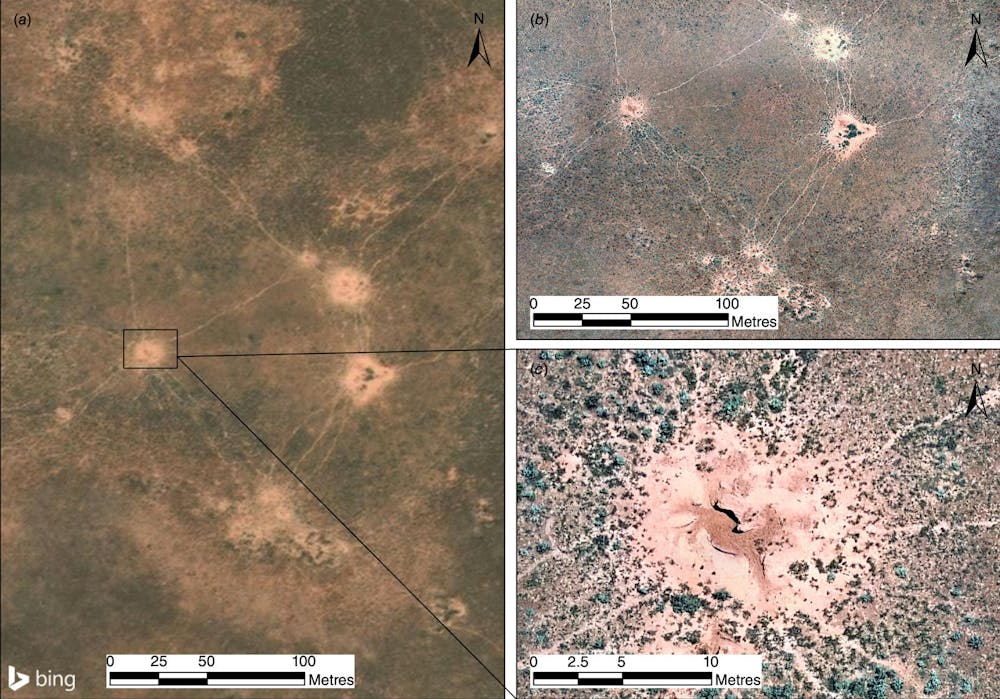
    In new research published in Australian Mammalogy, we show a way to detect wombats and rabbits using satellites that take pictures of our planet from space. By studying high-resolution images from the likes of Google Earth and Bing Maps, we can spot the telltale signs of the burrows and warrens these creatures dig into the ground.

    Why is it any of our business where wombats and rabbits live?

    Knowing where wombats and rabbits live is important for conservation.

    Wombats are unique Australian marsupials that need protection. Rabbits are an invasive species that often damage the land, eating too much vegetation and eroding soil.

    Finding their warrens can help scientists and wildlife managers to understand where they live. This in turn helps to make better decisions about protecting native species and controlling pests.

    How do you spot a warren?

    Imagine looking down at the world from the window of an aeroplane. You might easily see rivers and roads, and even buildings.

    But would you spot a hole in the ground? That’s the challenge we faced in our study of satellite images.

    A wombat warren from above, as seen in images from (a) a Bing maps satellite image, and (b) and (c) higher resolution drone images showing individual burrows and vegetation.
    Bing Maps / McPherson & Ostendorf / Australian Mammalogy, CC BY-NC

    As it turns out, wombat warrens are relatively easy to spot. They are quite large and have clear trails leading in and out. The digging leaves mounds of lighter-coloured soil.

    Rabbit warrens are trickier to find. They are smaller, lack trails, and can blend in with bare patches of dirt.

    How well did we do?

    By comparing satellite images with surveys conducted on the ground, we figured out we could accurately detect about 82% of wombat warrens from the photos. We weren’t quite as good at rabbit warrens: we could only spot 49%. Small rabbit warrens were particularly easy to miss.

    A rabbit warren from above, as seen in images from (a) a Bing maps satellite image, and (b) and (c) higher resolution drone images showing individual burrows and vegetation.
    Bing Maps / McPherson & Ostendorf / Australian Mammalogy, CC BY-NC

    One complicating issue was the fact that wombats and rabbits sometimes share the same burrow. Usually it’s the smaller, sneakier rabbits taking advantage of the large and sturdy tunnels dug by wombats.

    This makes it even harder to figure out exactly who is living where. We could recognise shared warrens when we inspected them on the ground, but so far we can’t distinguish them from satellite photos.

    What’s next?

    Our research shows we can use satellites to map burrowing animal populations without ever setting foot in the outback. This saves time and money, and also reduces the the risk of disturbing wildlife while conducting research.

    In the future, with higher-resolution satellite images and better software – using tools like machine learning – we may be able to detect and count burrows and warrens automatically. This could be a big change for wildlife conservation and pest control.

    So next time you look up at the sky, remember that somewhere out there a satellite might be taking a picture of a sleepy wombat’s home – or a rabbit plotting its next move.

    Natarsha McPherson received funding from the Australian Wildlife Society’s University Research Grant.

    ref. The Nullarbor is riddled with wombat and rabbit warrens. Scientists are watching them from space – https://theconversation.com/the-nullarbor-is-riddled-with-wombat-and-rabbit-warrens-scientists-are-watching-them-from-space-249359

    MIL OSI AnalysisEveningReport.nz

  • MIL-OSI Global: Cloud-based computing: routes toward secure storage and affordable computation

    Source: The Conversation – France – By Robert Deng, Professor of Information Systems – School of Information Systems, Singapore Management University

    Storing data in the cloud is now routine for people and companies alike, but cybersecurity risks still exist, particularly in handling user authentication and access control securely. Researchers are developing novel methods to store data securely and in a computationally affordable way, and to exploit it efficiently–by computing directly on encrypted data.

    Cloud computing, while indispensable for modern business operations, has also become a significant target for cyberattacks due to the large amount of sensitive data stored online. Currently, over 90% of organizations rely on cloud services for critical operations, and there are more than 3.6 billion active cloud users globally. This translates to 47% of the world’s population utilizing cloud services, underscoring the widespread dependency on the cloud.

    Unfortunately, this reliance on cloud computing comes with heightened risks. Data breaches are escalating in both frequency and severity: according to the 2024 Thales Cloud Security Study, 44% of businesses reported experiencing a breach in their cloud environments, with 14% reporting a breach within the past 12 months.

    As organizations migrate more sensitive data to the cloud–nearly half of all cloud-stored data is classified as sensitive–the attack surface for cybercriminals expands. This makes breaches not only more common but also more damaging, as the loss of sensitive information can have far-reaching consequences, including significant financial and reputational harm. The global average cost of a data breach in 2024 was estimated at $4.88 million.

    Nowadays, so-called “client-side encryption” is effective in data security and privacy protection in cloud data storage. However, for encrypted data to be useful, there is still a long way to go toward practical secure computation over it. We still face significant scalability and performance hurdles. Research continues to explore ways to bridge this gap, making scalable, privacy-preserving computation more efficient and accessible for large-scale applications.

    The root causes of data breaches

    User authentication and access control are among the most critical mechanisms to deter data breaches.

    User authentication, the process of verifying the identity of users trying to access cloud resources, is the first line of defence–but it is widely regarded as the weakest link in the chain of security, with an estimated 81% of hacking-related breaches leveraging either stolen or weak passwords. Though user authentication has evolved a lot in recent years, attacks meant to compromise user authentication have, too.

    Access control–the process of regulating who can view, use or interact with cloud resources such as data, applications or services–is the next line of defence. Effective access control ensures that only authorized users or devices have the appropriate permissions to access certain resources, thereby minimizing security risks and preventing unauthorized access or misuse of cloud assets.

    In today’s cloud computing environments, cloud servers are fully responsible to correctly enforce access-control policies. As a result, misconfigurations of servers due to human error or software bugs, or compromise of servers due to malicious attacks, can result in serious breaches. In fact, the US National Security Agency (NSA) considers misconfiguration a leading vulnerability in a cloud environment.

    Client-side encryption for secure storage

    Data can be encrypted and decrypted on end users’ devices before uploading it to and downloading it from the cloud. This approach ensures that data is encrypted during transit and storage, making data inaccessible to anyone without the decryption keys, including service providers and other potential attackers. As long as the decryption keys are kept secure by end users, security and privacy of data can be ensured even if the user’s cloud account and the cloud server are compromised.

    Existing client-side encryption solutions in cloud computing can use either private or public keys. For example, Google Workspace client-side encryption employs an online key distribution server for distribution between authorized users for the purpose of data encryption and sharing. However, an online distribution server can be both a security and performance bottleneck. To circumvent this, MEGA, another client-side encryption service, uses public key encryption and hence does not require an online key distribution server. But it does require sophisticated public key certificate management, as the number of public key encryptions is proportional to the number of potential data users to share a document, making this a strategy that’s hard to scale up.

    Circumventing the computational limitation of client-side encryption

    Suppose that a hospital wants to outsource the storage of its patients’ electronic medical records to the cloud and wants to establish specific policies on who can access the records. Before outsourcing a record, the hospital may specify that it can only be accessed by cardiologists in, say, the University Hospital, or by scientists in the Life Science Institute. Let “CT” denote the encrypted medical record and “AP” = (Cardiologist AND University Hospital) OR (Scientist AND Life Science Institute) be the access policy. CT and AP are cryptographically bound together and are uploaded to the cloud for storage. Then only users whose attributes satisfy AP can decrypt CT to get the decrypted medical record.

    This is a scalable encryption system because its access policy does not need to list each and every authorized user who can access the data, only the attributes of the potential users. Access control (i.e., decryption) of encrypted data is not enforced by the cloud server but through the encryption and decryption algorithms that are theoretically proved secure.

    Beyond secure storage: exploiting secure data efficiently

    One of the main efficiency drawbacks of such systems–which are already deployed–is that decryption is computationally expensive for resource-limited devices. To address this issue, we proposed a protocol that improves decryption efficiency for end users by two orders of magnitude, by outsourcing most of the decryption workload to a public cloud server.

    Another critical problem in deployment is “user revocation”: whenever a user leaves the system, changes her position or loses her existing private key, the key must be revoked to prevent unauthorized access to sensitive data. Current systems mostly use timestamps to bar revoked users from decrypting new content–however, the timestamps require regular updates, which can be computationally heavy in large systems. We proposed hardware-based revocable attribute-based encryption to make revocation cheaper.

    Computing directly on encrypted data

    Ideally, servers should be able to perform meaningful operations on encrypted data without ever decrypting it, preserving privacy at every step.

    This is where so-called “fully homomorphic encryption” comes in. It is a cutting-edge encryption technique that enables mathematical operations–specifically, addition and multiplication–to be executed on encrypted data directly by a server, without the need for decryption.

    However, current state-of-the-art systems are impractical for large-scale computations because of the “noise”–the unwanted, random-looking data introduced by cryptographic operations–that threatens the integrity of the results. Frequent noise-mitigating procedures are required–once again, a computationally expensive method, in particular for large data sets.

    Our novel approach to secure computing over encrypted data allows an unlimited number of arithmetic operations to be performed without the need for “bootstrapping” (the mathematical operation to reduce noise), achieving superior performance across various secure computing tasks, such as privacy-preserving person re-identification.


    Created in 2007 to help accelerate and share scientific knowledge on key societal issues, the Axa Research Fund has supported nearly 700 projects around the world conducted by researchers in 38 countries. To learn more, visit the website of the Axa Research Fund or follow @AXAResearchFund on X.

    Robert Deng has received funding from the Singapore National Research Foundation.

    ref. Cloud-based computing: routes toward secure storage and affordable computation – https://theconversation.com/cloud-based-computing-routes-toward-secure-storage-and-affordable-computation-248592

    MIL OSI – Global Reports

  • MIL-OSI Global: Bolstering Canada’s right to repair could shield it against U.S. tariffs and trade uncertainty

    Source: The Conversation – Canada – By Anthony D Rosborough, Assistant Professor of Law & Computer Science, Dalhousie University

    The right to repair movement aims to give consumers, businesses and independent repair providers access to the resources needed to maintain essential products and technologies. (Shutterstock)

    Canada’s economy has long relied on open trade and cross-border supply chains, but as tariff threats and market protectionism rise from the United States under President Donald Trump, so do Canada’s economic vulnerabilities.

    Although the risk of a trade war between Canada and the U.S. has been given a temporary reprieve, with Trump saying he will hold off on imposing tariffs for at least 30 days, the threat still looms large.

    What happens when crucial imports — farm machinery, medical devices, home appliances — become harder to access or more expensive?

    The current crisis has unveiled deep weaknesses and dependencies in Canada’s economy. In 2023, 77 per cent of Canada’s exports went to the U.S., while nearly half of its imports came from its southern neighbour. For decades, this interdependence was viewed as a diplomatic success, but it’s now clear that this has come with risks and vulnerabilities too.


    Read more:
    Trump’s trade war is forcing Canada to revive a decades-old plan to reduce U.S. dependence


    Political leaders across party lines recognize that Canada needs a plan for bolstering its economic resilience. This will require strengthening domestic manufacturing, expanding trade diversification and building new diplomatic and economic alliances. But this plan must also develop workforce resilience, domestic capacity and innovation right here at home.

    The solution lies in strengthening Canadians’ right to repair the products and devices we rely upon. The right to repair is not just about environmental sustainability, it’s a matter of economic resilience; it can increase the number of well-paying Canadian jobs and reduce Canada’s dependence on unpredictable global markets.

    The right to repair

    The right to repair movement seeks to ensure that consumers, businesses and independent repair providers have access the parts, tools, information and software needed to repair and maintain essential products, devices and technologies.

    That means not only the smartphones in our pockets and the cars we drive to work, but also the machinery that harvests our food and the medical devices that hospitals rely on to save lives.

    Currently, much of this equipment is either imported or relies heavily on imported components. Canada’s agricultural sector, for instance, heavily depends on machinery imports from the U.S. to maintain productivity and food security. This machinery is notoriously difficult to repair as the result of legal and technical restrictions. Canada’s agricultural equipment industry is faced with the same challenges as independent repairers.

    A maintenance engineer checks a CT scanner machine.
    (Shutterstock)

    Similar vulnerabilities exist in the health-care sector. Canada imports 70 per cent of its medical devices, with nearly half coming from the U.S. Much like those servicing (or using) agricultural equipment, biomedical engineers across Canada face a range of technical, legal and market barriers to keep devices online, pushing them into exclusive service contracts to keep devices working.


    Read more:
    A medical ‘right to repair’ can empower consumers — and save lives


    Consumer devices and home appliances are also overwhelmingly imported into Canada, making them susceptible to tariffs and trade barriers — all with the potential to make Canada’s cost-of-living crisis more dire than it already is.

    A path to economic resilience

    The right to repair movement offers a way for Canada to reduce both its economic vulnerabilities and U.S. dependency.

    Extending the lifespan of products is crucial not only for environmental sustainability and reducing waste, but also for strengthening the economy. It can also help communities be more resilient by supporting local businesses, creating jobs and boosting productivity.

    Canada has made significant progress in advancing the right to repair in recent years. Bill C-59 introduced amendments to the Competition Act aimed at cracking down on manufacturers’ refusal to provide independent businesses with the parts, tools and information necessary for repair.

    And, in 2024, Canada amended its Copyright Act to allow repairers to break digital locks used by manufacturers of digital goods to restrict access to repair and diagnostic information.

    But these are only the first steps in a full-fledged right to repair — more needs to be done to support the right to repair in Canada.

    Governments must step up

    Canada’s provinces need to strengthen consumer protection laws to ban planned obsolescence and oblige manufacturers to provide access to essential repair resources.

    Provinces should also prevent manufacturers from voiding warranties on products and devices that are repaired outside of authorized networks. Québec has taken a leading role in this area, but inter-provincial co-ordination will be crucial going forward.

    Extending the lifespan of products is crucial not only for environmental sustainability and reducing waste, but also for strengthening the economy.
    (Shutterstock)

    The federal government’s job also remains unfinished. It needs to regulate repair restrictions in critical technology sectors like agriculture and health care by developing technical standards and minimum repairability requirements for equipment and devices that are purchased through public procurement processes.

    Canada is also in need of federal leadership in enacting a repairability index, which scores products and devices based on their ease of repair. Such an initiative would provide consumers with the information they need to make informed purchasing decisions.

    Advancing the right to repair is a cost-free policy move that will strengthen Canada’s economy in an era of trade uncertainty. Unlike subsidy programs or industry bailouts, right to repair legislation focuses on consumers and independent businesses.

    By enabling workers and businesses to repair rather than replace, Canada can maximize the value of existing goods, reduce dependence on volatile global supply chains and make the country more self-sufficient, all without added government spending.

    Anthony D Rosborough has received Doctoral Award funding from Canada’s Social Sciences & Humanities Research Council (SSHRC) and is a Policy Lead with Dalhousie University’s MacEachen Institute for Public Policy & Governance. Anthony is a Co-Founder of the Canadian Repair Coalition and the Principal Investigator of the Unlocking Healthcare research project (www.unlockinghealthcare.ca).

    ref. Bolstering Canada’s right to repair could shield it against U.S. tariffs and trade uncertainty – https://theconversation.com/bolstering-canadas-right-to-repair-could-shield-it-against-u-s-tariffs-and-trade-uncertainty-248970

    MIL OSI – Global Reports

  • MIL-OSI Global: Why Canada must seize the moment and launch its long-awaited Africa strategy

    Source: The Conversation – Canada – By David J Hornsby, Professor of International Affairs and the Vice-Provost and Associate Vice-President (Academic), Carleton University

    Recent events have been nothing short of shock therapy for many Canadians. The threat of economically devastating tariffs by the United States at the behest of President Donald Trump have only reinforced that the time is ripe for Canada to diversify its foreign engagements and collaborations — like with the African region.

    Africa’s geopolitical and economic trajectory is reshaping the global order. With the African Continental Free Trade Area (AfCFTA) poised to become the world’s largest single market, a youthful population driving innovation and vast renewable energy potential, the continent is no longer a peripheral player — it’s a cornerstone of the 21st-century economy.

    Yet Canada, despite years of consultations and pledges, has delayed the release of a comprehensive Africa trade strategy. The time for hesitation is over.

    AfCFTA window is closing

    The AfCFTA, which spans 54 countries and 1.3 billion people, is projected to boost intra-African trade by 52 per cent by 2035. For Canada, this represents a significant opportunity to diversify exports beyond traditional partners like the U.S. and China.

    Canadian sectors from agri-food to clean tech are well-positioned to meet Africa’s demand for value-added goods and infrastructure.

    Global competitors are already moving: China’s trade with Africa surpassed $200 billion in 2023, while the European Union and India have accelerated trade pact negotiations across the continent.

    Without a formal strategy, Canada risks losing access to a market that could define the next decade of economic growth.

    Geopolitical stakes have never been higher

    Russia and China have deepened their influence across Africa, often at the expense of democratic governance and transparency. Canada’s absence isn’t just an economic miss — it’s a strategic void.

    By aligning with African priorities like Agenda 2063, which emphasizes self-reliance and sustainable development, Canada can counterbalance exploitative partnerships with ones rooted in mutual benefit.

    As Agenda 2063 identifies, African leaders are refocusing their agendas from the struggle against apartheid and political independence to “inclusive social and economic development, continental and regional integration, democratic governance and peace and security.” Africa faces a collective US$100 billion annual infrastructure deficit following centuries of colonial incursion and extraction.

    Recent Canadian investments in peace and security, good governance, people-to-people ties ($54 million) and economic empowerment ($176 million for women and youth empowerment) signal intent, but without a unified strategy, these
    efforts are fragmented.

    Aligning perfectly with Africa’s needs

    Canada’s world-class engineering firms and institutions like the Canada Infrastructure Bank could partner with African states and institutions like the African Development Bank and replicate successes achieved in projects like Ghana’s renewable energy grid.

    Africa’s startup ecosystem thrives in the financial technology and agritech sectors, where Canadian expertise and venture capital could catalyze growth.

    Projects like the Lobito Corridor, offer a chance for Canadian firms to contribute to rail and transport development that could be transformative.

    With significant solar and other renewable energies potential, Africa is critical to the net-zero transition. Canadian mining firms and clean energy innovators are natural partners for lithium and cobalt projects, despite the dubious human and environmental rights track record of some Canadian mining companies in the region.

    A Canada-Africa strategy needs to signal a support for mandatory adherence to environmental and human rights standards for mining firms, such as Canada’s Towards Sustainable Mining framework, while strengthening accountability through mechanisms like independent oversight and legal consequences for violations that already exist. By prioritizing partnerships with African governments and local communities, such a strategy could ensure ethical practices through transparent agreements, community consent protocols, and shared governance models foster a future of more ethical behaviour.

    From aid to equity

    Decades of humanitarian aid have fostered good will, but Africa’s leaders increasingly demand collaboration

    Canada’s Feminist International Assistance Policy emphasizes gender equality and aligns with Africa’s push for women-led development.

    But a true partnership requires reciprocity, like South Africa’s significant investments in Canadian mining and climate research collaborations. The African diaspora community, numbering over 1.2 million in Canada, is a bridge to these opportunities.

    The G7 presidency provides opportunity

    The alignment of the Canadian 2025 G7 presidency with South Africa’s 2025 presidency of the G20 offers a pivotal moment to unveil Canada’s African strategy and to mainstream African priorities, from debt relief to digital inclusion.

    The forthcoming G20 gatherings of finance ministers and central bank governors in Cape Town offers a perfect moment to demonstrate an actual plan to diversify Canadian foreign policy engagements and interests while positioning the country to rally allies behind a renewed set of initiatives that exist across the continent.

    To delay any further will not only frustrate business and diaspora groups alike, but will continue to relegate Canada to a marginal role in the continent’s economic and social development.

    The EU’s public and private investments in the green and digital transitions in Kenya and Ghana’s lithium deal with Australia underscore the urgency for a co-ordinated and concerted approach. Canada’s reputation as a reliable partner hangs in the balance.

    A call for cohesion

    A Canadian Africa strategy is critical now more than ever. To fully engage, any plan will need to articulate pan-African trade and streamlined export opportunities. It should leverage soft power by expanding diplomatic missions across regional economic communities.

    Investing in mutual growth via joint ventures in mining, agri-processing, and digital infrastructure is also crucial. Embedding climate justice by linking critical mineral exports to African renewable energy projects will foster sustainable development — all the while maintaining key imperatives of gender equality, one health and the exchange of knowledge through things like the South Africa-Canada Universities Network.

    Africa’s rise isn’t a distant future — it’s unfolding now. Canada has the tools, the values and the economic imperative to act. Delaying further isn’t just a missed opportunity; it’s a generational misstep.

    The strategy is drafted, the stakeholders are ready. All that’s missing is the political will to hit “publish” and get started.

    David J Hornsby does not work for, consult, own shares in or receive funding from any company or organisation that would benefit from this article, and has disclosed no relevant affiliations beyond their academic appointment.

    ref. Why Canada must seize the moment and launch its long-awaited Africa strategy – https://theconversation.com/why-canada-must-seize-the-moment-and-launch-its-long-awaited-africa-strategy-249255

    MIL OSI – Global Reports

  • MIL-OSI Global: DEI needs to fix systems, not people

    Source: The Conversation – Canada – By Jeffrey To, Psychology PhD Researcher, Intergroup Relations and Implicit Biases, McGill University

    This week, Google announced it’s halting its DEI hiring initiatives. But DEI training is fleeting and hiring practices need to address systems, not individuals. (Tom Barrett/Unsplash), CC BY

    Google recently became the latest multinational to abandon its diversity, equity and inclusion (DEI) hiring mandates. This follows a broader trend among major corporations and a recent executive order by United States President Donald Trump.

    Walmart, the world’s largest retailer, rolled back its DEI policies last November after a five-year racial equity commitment. Other companies like Toyota, Target, Johnson & Johnson, and most recently, McDonald’s, have also halted their DEI initiatives.

    In Canada, however, some companies remain committed to DEI. For example, KPMG Canada conducted 50 DEI training sessions for its 35,000 employees in 2022 and plans to continue its DEI efforts into 2025.

    But is this the best way forward?

    As a PhD student researching implicit bias, I am examining how DEI training and programs can go awry. For example, one study suggests that while DEI programs can reduce prejudice in some cases, programs that exert control over people may backfire. This happens because they place responsibility for bias and discrimination on individuals when research suggests it is the biased systems that deserve more scrutiny.

    Systems — comprising policies, practices and societal norms — are the primary culprits behind biases, which often lead to unfair behaviours toward minority groups.

    Biases are systemic

    We’ve all experienced a moment where we met someone and perhaps without thinking, felt a sense of threat or unfamiliarity. These spontaneous reactions are known as implicit biases. Over the years, researchers have linked these biases to unfair treatment of individuals who differ from us.

    Historically, psychologists have considered bias intrinsic to oneself, similar to personality or IQ. However, newer approaches are challenging this view.

    Personality tests such as the Big Five show reasonable forecasting ability for job outcomes. However, Implicit Association Tests — a common tool used to measure implicit biases — show only weak relevance to actual discriminatory behaviour. In other words, a white person who holds implicit biases against racialized immigrants, for example, might not necessarily act on those biases.

    Recent studies now suggest that biases are better understood as environmental factors, not individual traits. For example, one study demonstrated that implicit biases correlate with behaviour. But this connection only holds when analyzing groups of people within a specific region. In regions where anti-Black biases are more prevalent among white residents, higher rates of police violence against Black individuals are observed.

    This study highlights that biases aren’t about individuals. They are part of broader societal structures and social norms.

    Solutions to systemic bias

    One key takeaway from implicit bias research is that interventions targeting individual biases often provide only temporary results because bias is embedded within systems.

    So, what can organizations do to address systemic bias more effectively?

    Let’s look at hiring as an example.

    Instead of requiring hiring managers to participate in diversity training, organizations could implement hiring criteria that minimize the influence of race and gender bias in the hiring process. Some research suggests tailoring job descriptions to appeal to underrepresented groups. For example, HR postings that increase the transparency of qualifications or focus on benefits can attract more women for roles in traditionally male-dominated fields.

    Policing is another area where systemic change can mitigate bias. Studies show police officers are more likely to stop, question, arrest or use force against Black people than white people.

    Rather than mandating police officers undergo diversity training to educate them about their biases — something that has only a fleeting effect — a restructuring of the policies and procedures around stops and frisks would reduce bias’s impact.

    For instance, policies to ensure the collection of race-based data in police stop and frisks and to encourage stricter accountability among police officers could go a long way to curb racial profiling.

    As DEI programs face increasing scrutiny and skepticism, and many employees feel frustrated by ineffective and repetitive online training, there is a growing need to reframe DEI as systems-focused work. If diversity, equity and inclusion are truly the goals, the solution lies in rebuilding the systems that shape our society.

    Jeffrey To receives funding from The Social Sciences and Humanities Research Council of Canada.

    ref. DEI needs to fix systems, not people – https://theconversation.com/dei-needs-to-fix-systems-not-people-247877

    MIL OSI – Global Reports

  • MIL-OSI Global: Preventing ‘revenge quitting:’ 5 things workplaces can do to help employees feel like they belong

    Source: The Conversation – Canada – By Andrea Carter, Adjunct Faculty in Industrial and Organizational Psychology, Adler University

    Creating a genuine sense of belonging can reshape workplace culture, boost engagement and overall business success. (Shutterstock)

    Longstanding workplace issues such as mistreatment, the normalization of toxic behaviour and a lack of accountability for workplace culture have fuelled a growing trend known as revenge quitting.

    This phenomenon, on the rise since the 2000s, sees employees leaving their jobs not just for better opportunities, but as a form of protest and self-preservation against unfair treatment.

    In the past, fear of economic ruin, social stigma and valuing job stability over personal dignity kept many employees from quitting under such circumstances. However, unprecedented inequality and other geopolitical risks are causing an increase in revenge quitting and similar behaviours.

    Companies that want to address this issue have much to gain, but they must go beyond diversity, equity and inclusion (DEI) or human resources strategies. Creating a genuine sense of belonging can reshape workplace culture, boost engagement and overall business success.


    Read more:
    Understanding the backlash against corporate DEI — and how to move forward


    Consequences of revenge quitting

    When employees resign as a final act of protest against toxic workplace conditions, the impact on organizations can be significant. One of the most obvious consequences is financial loss. Sudden departures lead to expenses related to recruiting, hiring, training, as well as lost productivity and project disruptions.

    Organizations also lose valuable institutional knowledge and skills when experienced employees quit, hampering innovation, continuity and long-term strategy.

    The abrupt departure of employees also sends a powerful message to remaining staff, potentially leading to decreased morale, trust and engagement.

    Employees who ‘revenge quit’ do so not just for better opportunities, but as a form of protest and self-preservation against unfair treatment.
    (Shutterstock)

    High-profile cases of revenge quitting can also damage an organization’s reputation, affecting customer relationships and investor confidence.

    Finally, revenge quitting can have lasting consequences on workplace culture. If the toxic behaviour that caused the resignation remains unaddressed, remaining employees may become disengaged, leading to a decline in work quality.

    Mitigating the risk of revenge quitting

    My research has found that when employees feel a genuine sense of belonging, they are more engaged and loyal, they produce more innovative and creative solutions, and they are more reliable and productive.

    Moreover, belonging buffers against workplace stressors that lead to toxic behaviours by reducing feelings of isolation, mitigating burnout and encouraging active listening before making decisions. This, in turn, decreases the likelihood of employees making abrupt, retaliatory exits.

    Employees want to work for companies that respect their individuality and value their contributions. High-performing teams thrive when there is clear accountability, fair conflict resolution and a culture of feedback and learning. Addressing toxic behaviours early helps maintain trust and reduces the risk of retaliatory quitting.

    It’s also essential to distinguish between belonging and merely fitting in. True belonging is a reciprocated behaviour between employees and the organization, not solely the employee’s responsibility. Organizations that focus only on forcing employees to “fit in” overlook the systemic changes required to foster true benefits.

    Belonging requires an active commitment to the five core indicators of belonging: comfort, connection, psychological safety and well-being. Each indicator is essential in reducing the desire to disengage or quit out of frustration or retaliation.

    Pillar 1: Comfort

    Workplace comfort is essential for focus, cognitive function and productivity. While physical factors like temperature, noise and ergonomics matter, social comfort is more critical. Social comfort comes from clear expectations, defined workflows and recognizing individual talents within a team.

    Unprecedented inequality and other geopolitical risks are causing an increase in revenge quitting and similar behaviours.
    (Shutterstock)

    When the economy becomes volatile, it can force organizations to deviate from their original strategic plans in an effort to stay afloat. When this happens, comfort is the first thing to erode in a workplace, which allows toxicity to go unchecked.

    For example, when economic shifts force leaders to pivot, employees may have to scrap their work. If leadership lacks alignment in the new strategic actions, expectations will rise while clarity drops, creating stress and conflict. Leaders should reset expectations, restore social comfort and ensure collaboration rather than competition.

    Pillar 2: Connections

    Strong social relationships in the workplace can buffer against stress and enhance resilience. Connection is fostered through mentorship programs, collaboration and informal networking.


    Read more:
    Workplace besties: How to build relationships at work while staying professional


    In remote and hybrid work settings, ensuring employees feel connected to their teams through structured check-ins and virtual social space is critical.

    Connections increase engagement and build emotional attachment, which reduces the risk of employees leaving. Employees who experience meaningful interactions with colleagues and leaders are more engaged and less likely to feel alienated.

    Pillar 3: Contributions

    Employees need to feel that their work is meaningful and valued. Recognition activates the brain’s reward system, which reinforces motivation and increases engagement. When employees feel unappreciated, resentment builds. When this happens repetitively, it can lead employees to disengage from their work, and eventually depart.

    Organizations must implement structured recognition programs that celebrate individual and team achievements, ensuring employees know their work is valued.

    Equally important is offering opportunities for employees to contribute beyond their job descriptions, whether through special projects or mentoring. A workplace that values and acknowledges contributions fosters commitment and decreases the likelihood of employees resigning.

    Pillar 4: Psychological safety

    Ensuring employees’ ideas and concerns are met with curiosity and understanding is crucial for retention. In fear-based workplaces, stress inhibits cognitive function and creativity.

    Leaders must create environments where feedback is welcomed, mistakes are viewed as learning opportunities and employees feel empowered to express their perspectives.


    Read more:
    Fostering psychological safety in the workplace: 4 practical, real-life tips based on science


    Employees feel safe when they work in an environment where feedback is taught and encouraged. They are less likely to disengage or engage in retaliatory behaviours like revenge quitting.

    Strategies such as clear communication channels, anonymous feedback mechanisms and inclusive leadership training help create psychological safety.

    Pillar 5: Well-being

    Employee well-being is tied to cognitive function, emotional regulation and job satisfaction. Employees experiencing chronic stress, burnout or work-life imbalances are more likely to disengage and eventually quit.

    Workplace programs that support mental and physical health are crucial. Offering flexible work arrangements, mental health and stress management resources, normalizing breaks and setting boundaries helps sustain employee energy and commitment.

    More than a checkbox

    Revenge quitting isn’t just a series of isolated incidents, but a reflection of a deeper, systemic disregard for worker dignity.

    The workforce has changed, with employees now prioritizing workplaces where they feel respected, valued and safe. Companies that fail to adapt will continue to lose experienced, talented workers — not because the job market is more competitive, but because employees refuse to tolerate environments that undermine their dignity.

    Leaders need to recognize that creating a culture of belonging isn’t about checking a DEI box — it’s about ensuring employees have every reason to stay and grow within their organizations.

    Andrea Carter does not work for, consult, own shares in or receive funding from any company or organisation that would benefit from this article, and has disclosed no relevant affiliations beyond their academic appointment.

    ref. Preventing ‘revenge quitting:’ 5 things workplaces can do to help employees feel like they belong – https://theconversation.com/preventing-revenge-quitting-5-things-workplaces-can-do-to-help-employees-feel-like-they-belong-248411

    MIL OSI – Global Reports

  • MIL-OSI Global: Using smart technologies and artificial intelligence in food packaging can reduce food waste

    Source: The Conversation – Canada – By Tohid Didar, Associate Professor and Canada Research Chair in Nano-biomaterials, Mechanical and Biomedical Engineering, McMaster University

    More than 30 per cent of the world’s food is wasted each year. (Shutterstock)

    Food insecurity is one of humanity’s most pressing challenges, impacting more than two billion people worldwide.

    Paradoxically, as so many suffer from lack of access to food, more than 30 per cent of the world’s food is wasted each year, driven by inefficiencies in production, distribution and consumption.


    Read more:
    About one-third of the food Americans buy is wasted, hurting the climate and consumers’ wallets


    Outdated, imprecise and often incorrect labelling systems — such as printed expiry dates — contribute to these huge problems, leading to the unnecessary disposal of safe, healthy food, increased greenhouse gas emissions and financial losses.

    Addressing these crises requires bold investment in sustainable technologies that are already tested and available. These include smart food-packaging innovations that provide real-time food quality monitoring in every package. This would allow producers, retailers and consumers to receive up-to-date information through the package itself.

    Real-time information

    Unlike traditional expiration-date labels that communicate only time, food packaging innovations use advanced sensors and artificial intelligence to measure spoilage indicators such as pH balance, bacterial growth and biogenic amines. This allows for dynamic and up-to-the-minute tracking of food freshness.

    These systems would increase food safety and prevent food fit for consumption from being thrown out. The early and highly specific warnings they provide would also reduce the need for costly and labour-intensive testing when problems occur.

    Despite the promise of these scientifically proven systems, getting them into the marketplace is a significant challenge.

    Corporations often resist smart packaging due to higher costs and tight profit margins in the highly competitive food sector.

    Applying smart technologies in food packaging design can help consumers make more informed choices.
    (Shutterstock)

    Innovative solutions

    However, the wider economic argument for smart packaging is compelling: food waste contributes to hundreds of billions of dollars in global annual losses, and smart solutions can reduce these losses substantially.

    By quantifying the potential savings — such as reduced spoilage, fewer recalls, less food-related illness and lower legal liabilities — public and private stakeholders can understand why it’s valuable to share the cost of these innovations.

    These technologies also align nicely with growing consumer demand for sustainability and transparency in food systems.

    Reducing food waste through smart food packaging would lower greenhouse gas emissions, conserve agricultural resources and reduce the strain on global supply chains.

    Such innovations can help improve food availability, especially in underserved regions where food insecurity is most acute, fostering healthier and more resilient communities.


    Read more:
    Food prices are not the only obstacle to achieving food security: Root causes include systemic barriers


    Policymakers and industry leaders can create an appetite for change by regarding solutions as investments in people and the planet, not just profits.

    Regulatory bodies must take bold steps, as we have seen in California’s elimination of “sell by” dates, which motivated producers to rethink their labeling strategies.

    Governments can further incentivize smart food-packaging adoption through tax benefits, subsidies, or funding for companies to integrate real-time monitoring technologies. Such measures would make this beneficial change more economically viable for corporations.

    Empowering consumers

    Smart food packaging would also empower consumers to make informed decisions. Innovations such as AI-enabled apps that predict food freshness from smartphone photos can help households reduce waste by determining the safety of food without needing to open the package.

    Smart packaging and apps could take the guesswork out of predicting food freshness.
    (Shutterstock)

    Smart packaging platforms should prioritize universal applications that work across food types, rather than niche, highly customized systems.

    Investing in sustainable innovations to address food insecurity would also deliver broader economic and environmental benefits. Reduced food waste translates to lower greenhouse gas emissions, less strain on agricultural systems and significant savings across supply chains.

    For developing nations disproportionately affected by food insecurity, smart packaging technologies can be transformative, extending shelf life and improving distribution efficiency.

    Collaboration across industry, academia and government is vital to getting these solutions into broad use.

    Profit and societal benefits

    Researchers and innovators must work with corporations to develop proven prototypes into cost-effective, high-performance technologies, while policymakers need to create frameworks to incentivize adoption. Investments must prioritize not just economic returns but also long-term societal benefits.

    As a researcher developing smart food packaging platforms, I have seen firsthand how interdisciplinary partnerships accelerate the translation of bold ideas into practical solutions. I have led research teams that have developed technologies such as Lab-in-a-Package and sprayable bacteriophage microgels. These innovations simultaneously improve food safety and reduce waste.

    Addressing food insecurity demands a holistic, sustainable approach that brings together technological innovation, supportive policies and societal awareness. By investing in smart, scalable solutions, we can transform our food systems to ensure less food is wasted.

    Tohid Didar receives funding from MITACs and NSERC to develop smart food packaging technologies.

    ref. Using smart technologies and artificial intelligence in food packaging can reduce food waste – https://theconversation.com/using-smart-technologies-and-artificial-intelligence-in-food-packaging-can-reduce-food-waste-248616

    MIL OSI – Global Reports

  • MIL-OSI Africa: Migrant traders play a key role in South African tourism: it’s time policy makers protected them

    Source: The Conversation – Africa – By Alicia Fourie, Professor, GIBS, University of Pretoria

    Street traders play an important role in tourism in South Africa. They provide affordable goods to tourists while generating employment for others. Some even source products locally, such as beadwork, traditional masks, woven baskets and various other souvenirs, creating linkages with domestic producers.

    Most of these traders are migrants from outside South Africa.

    South Africa is regarded as the preferred destination for migration in Africa. Migrancy scholars Jonathan Crush and Vincent Williams point to tourism and entry statistics from Statistics South Africa, visa overstay and deportation data, and refugee figures from the United Nations High Commission for Refugees to support the new movements of refugees since the fall of apartheid.

    On arriving in the country, many enter the informal economy to make a living. Often this involves taking up self-employed entrepreneurial activities such as selling goods on street corners.

    South Africa’s tourism hubs present significant trading opportunities. In 2023, the country attracted 8.48 million international tourists. Though still 41.1% below pre-pandemic levels, this was an improvement. Tourism contributed 3.5% to GDP in 2022, when it outperformed industries like agriculture and construction.

    But traders face tough conditions. The sector’s informality means policymakers can easily overlook it. Traders lack formal recognition and have limited access to resources.

    This should change.

    To improve their conditions, several measures could be helpful, including:

    • well-maintained designated trading areas that are equipped with essential amenities like shelter and storage

    • simplifying the process for obtaining the necessary permits and licences to increase their legal protections and operational stability.

    These measures must be the result of discussions with the traders.

    Our view is informed by research we conducted on informal traders over two years (2022 and 2023) in Cape Town, Durban and Johannesburg. Our focus was on the ability of the traders to adapt during times of crisis and economic downturn.

    We found that the traders showed high levels of resilience and ingenuity to survive under tough conditions. But resilience can’t conquer all. The long-term sustainability of informal trading ventures hinges on external factors. They include government support and functioning institutions such as law and order that can help them manage challenges such as xenophobia.

    The traders

    Our study involved 35 qualitative interviews and 363 completed quantitative questionnaires. Three quarters of the respondents were foreign.

    Traders from east and west Africa were dominant in Cape Town while Zimbabwean traders were dominant in Johannesburg.

    Most informal traders (67%) were the sole income earners for their families, supporting multiple dependants. Before starting their businesses, only 47.5% had formal employment in roles like teaching, cleaning, or sales. Most traders had been operating for over 14 years. Monthly gross incomes averaged US$580, with Johannesburg traders earning more than those in Cape Town and Durban.

    On face value these amounts seem higher than earnings of informally employed wage workers such as day labourers. However, these are gross figures, so comparisons with other occupations or cost of living must be treated with caution.

    Resilience and ingenuity

    The stories the traders shared with us are a testament to resilience and ingenuity. Migrant traders’ adaptability and joint commitment underscore their resilience, a key factor in overcoming economic and social crises.

    Informal trading in the tourism sector drives local economies by providing tourists with authentic cultural experiences through locally crafted products. Traders’ activities create employment opportunities, including jobs for individuals working at the stalls and trolley pushers assisting with setup. Their incomes also support entire families.

    Migrant traders also bring an entrepreneurial spirit to South Africa’s economy. Our research revealed that, unlike some of their South African counterparts who may access social grants, migrant traders often diversify their product offerings quicker and more extensively to adapt to changing market demands. This included introducing clothing alongside crafts or selling locally sourced goods (like items used by traditional healers) during economic downturns.

    Their ability to adapt and innovate, even in difficult circumstances, contributes to the resilience of the broader tourism sector. Migrant traders quickly resumed operations after the pandemic. They used strategies like shared payment devices to improve efficiency, and community networks to weather economic shocks, so that tourism-related goods and services remained available.

    Blind spot for policy makers

    The sector’s informality leaves it overlooked by policymakers.

    During the pandemic, formal businesses received government relief, but informal traders were largely excluded. For migrants, the absence of support was even more pronounced, as they lacked access to social safety nets available to South African citizens.

    By supporting informal traders, particularly migrants, South Africa can enhance the sustainability of its tourism sector. This support could take various forms:

    Policy recognition: Acknowledging the vital role of informal traders in tourism and integrating them into local economic development plans.

    Practical policy responses: Examples include improving visible policing and cleaning up beach precincts, especially in Durban. This would reduce crime, increase tourist visits and improve the lives of street traders.

    Access to resources: Providing grants or loans tailored to informal businesses.

    Skills development: Offering training programmes to strengthen business acumen and innovation.

    Community engagement: Promoting social cohesion to reduce xenophobic attitudes and fostering partnerships between local and migrant traders.

    Next steps

    The stories of South Africa’s informal migrant traders are ones of perseverance and potential. They remind us that resilience is not only an individual trait but a communal effort.

    By recognising and supporting these traders, South Africa would be investing in a more inclusive, robust tourism sector.

    As South Africa seeks to revive its tourism industry through the Tourism Sector Recovery Plan, the contributions of informal traders, local and migrant alike, cannot be overlooked. These entrepreneurs are shaping the fabric of the industry, one craft and one customer at a time. Supporting them is not just an act of kindness; it is a strategic move for the nation’s economic future.

    – Migrant traders play a key role in South African tourism: it’s time policy makers protected them
    – https://theconversation.com/migrant-traders-play-a-key-role-in-south-african-tourism-its-time-policy-makers-protected-them-247244

    MIL OSI Africa

  • MIL-OSI Global: Migrant traders play a key role in South African tourism: it’s time policy makers protected them

    Source: The Conversation – Africa – By Alicia Fourie, Professor, GIBS, University of Pretoria

    Street traders play an important role in tourism in South Africa. They provide affordable goods to tourists while generating employment for others. Some even source products locally, such as beadwork, traditional masks, woven baskets and various other souvenirs, creating linkages with domestic producers.

    Most of these traders are migrants from outside South Africa.

    South Africa is regarded as the preferred destination for migration in Africa. Migrancy scholars Jonathan Crush and Vincent Williams point to tourism and entry statistics from Statistics South Africa, visa overstay and deportation data, and refugee figures from the United Nations High Commission for Refugees to support the new movements of refugees since the fall of apartheid.

    On arriving in the country, many enter the informal economy to make a living. Often this involves taking up self-employed entrepreneurial activities such as selling goods on street corners.

    South Africa’s tourism hubs present significant trading opportunities. In 2023, the country attracted 8.48 million international tourists. Though still 41.1% below pre-pandemic levels, this was an improvement. Tourism contributed 3.5% to GDP in 2022, when it outperformed industries like agriculture and construction.

    But traders face tough conditions. The sector’s informality means policymakers can easily overlook it. Traders lack formal recognition and have limited access to resources.

    This should change.

    To improve their conditions, several measures could be helpful, including:

    • well-maintained designated trading areas that are equipped with essential amenities like shelter and storage

    • simplifying the process for obtaining the necessary permits and licences to increase their legal protections and operational stability.

    These measures must be the result of discussions with the traders.

    Our view is informed by research we conducted on informal traders over two years (2022 and 2023) in Cape Town, Durban and Johannesburg. Our focus was on the ability of the traders to adapt during times of crisis and economic downturn.

    We found that the traders showed high levels of resilience and ingenuity to survive under tough conditions. But resilience can’t conquer all. The long-term sustainability of informal trading ventures hinges on external factors. They include government support and functioning institutions such as law and order that can help them manage challenges such as xenophobia.

    The traders

    Our study involved 35 qualitative interviews and 363 completed quantitative questionnaires. Three quarters of the respondents were foreign.

    Traders from east and west Africa were dominant in Cape Town while Zimbabwean traders were dominant in Johannesburg.

    Most informal traders (67%) were the sole income earners for their families, supporting multiple dependants. Before starting their businesses, only 47.5% had formal employment in roles like teaching, cleaning, or sales. Most traders had been operating for over 14 years. Monthly gross incomes averaged US$580, with Johannesburg traders earning more than those in Cape Town and Durban.

    On face value these amounts seem higher than earnings of informally employed wage workers such as day labourers. However, these are gross figures, so comparisons with other occupations or cost of living must be treated with caution.

    Resilience and ingenuity

    The stories the traders shared with us are a testament to resilience and ingenuity. Migrant traders’ adaptability and joint commitment underscore their resilience, a key factor in overcoming economic and social crises.

    Informal trading in the tourism sector drives local economies by providing tourists with authentic cultural experiences through locally crafted products. Traders’ activities create employment opportunities, including jobs for individuals working at the stalls and trolley pushers assisting with setup. Their incomes also support entire families.

    Migrant traders also bring an entrepreneurial spirit to South Africa’s economy. Our research revealed that, unlike some of their South African counterparts who may access social grants, migrant traders often diversify their product offerings quicker and more extensively to adapt to changing market demands. This included introducing clothing alongside crafts or selling locally sourced goods (like items used by traditional healers) during economic downturns.

    Their ability to adapt and innovate, even in difficult circumstances, contributes to the resilience of the broader tourism sector. Migrant traders quickly resumed operations after the pandemic. They used strategies like shared payment devices to improve efficiency, and community networks to weather economic shocks, so that tourism-related goods and services remained available.

    Blind spot for policy makers

    The sector’s informality leaves it overlooked by policymakers.

    During the pandemic, formal businesses received government relief, but informal traders were largely excluded. For migrants, the absence of support was even more pronounced, as they lacked access to social safety nets available to South African citizens.

    By supporting informal traders, particularly migrants, South Africa can enhance the sustainability of its tourism sector. This support could take various forms:

    Policy recognition: Acknowledging the vital role of informal traders in tourism and integrating them into local economic development plans.

    Practical policy responses: Examples include improving visible policing and cleaning up beach precincts, especially in Durban. This would reduce crime, increase tourist visits and improve the lives of street traders.

    Access to resources: Providing grants or loans tailored to informal businesses.

    Skills development: Offering training programmes to strengthen business acumen and innovation.

    Community engagement: Promoting social cohesion to reduce xenophobic attitudes and fostering partnerships between local and migrant traders.

    Next steps

    The stories of South Africa’s informal migrant traders are ones of perseverance and potential. They remind us that resilience is not only an individual trait but a communal effort.

    By recognising and supporting these traders, South Africa would be investing in a more inclusive, robust tourism sector.

    As South Africa seeks to revive its tourism industry through the Tourism Sector Recovery Plan, the contributions of informal traders, local and migrant alike, cannot be overlooked. These entrepreneurs are shaping the fabric of the industry, one craft and one customer at a time. Supporting them is not just an act of kindness; it is a strategic move for the nation’s economic future.

    The authors do not work for, consult, own shares in or receive funding from any company or organisation that would benefit from this article, and have disclosed no relevant affiliations beyond their academic appointment.

    ref. Migrant traders play a key role in South African tourism: it’s time policy makers protected them – https://theconversation.com/migrant-traders-play-a-key-role-in-south-african-tourism-its-time-policy-makers-protected-them-247244

    MIL OSI – Global Reports

  • MIL-Evening Report: View from The Hill: Labor faces risk of Victorians using federal poll as referendum on both Allan and Albanese governments

    Source: The Conversation (Au and NZ) – By Michelle Grattan, Professorial Fellow, University of Canberra

    The weekend byelection in the outer suburban seat of Werribee saw the widely-anticipated slap-in-the-face to Victorian Labor, which is absolutely on the nose. The question is: to what degree were electors venting against federal Labor too?

    With an abundance of caution, the Albanese government would do best to assume it was being given a substantial kick.

    Even if the largest slice of the about 10% two-party swing was prompted by state factors, including the sheer arrogance of the byelection  (a state treasurer departing mid-term), we know federal Labor is doing badly in Victoria.

    There is certainly enough of a message in the result in Werribee (which on present numbers Labor is expected to just retain) to flag a potential serious erosion of federal seats come the national election.

    One challenge for federal Labor is to turn Victorian voters’ attention away from state matters, to focus squarely on the choice between Anthony Albanese and Peter Dutton.

    Labor needs to minimise the extent to which Victorians use the federal election to take out their anger towards the Allan government. So far, only the Werribee voters have had the chance to get some of that frustration out of their systems. The federal opposition will seek to milk feelings about the Allan government.

    Regardless of that, we know Dutton has become more acceptable in Victoria than he was a couple of years ago.

    As things stand, Labor is set to lose federal seats in this state where the Liberals have struggled, and the state Liberal organisation has been a shambles. It is a matter of how many.

    While the Liberals will be delighted with the Werribee result, the hardheads will note that although the Labor primary vote fell nearly 17% the Liberal vote only rose 3.7%. Partly this might reflect the fact that in Labor heartland, the disillusioned voters wanted to protest but not jump the aisle to the Liberals. Nevertheless, there is the message, applicable federally, that the Liberals need to be attracting more primary votes, not just relying on Labor losing them to independents and small parties.

    Once again, we see reflected in this byelection the relative collapse of the two party system. Labor polled 28.7% of the primary vote; the Liberals 29%. fewer than six in ten voters supported one of the major parties.

    Depending on your viewpoint, you can see the decline of the two party system as a portend of future instability in our politics, or the continued indication of a fresh new direction. Federally, the present money is on minority government.

    In Saturday’s other Victorian byelection, the Liberals wrested the inner city seat of Prahran from the Greens. There was no Labor candidate.

    The Greens, on 36.2% of the vote, attempt to take comfort that  the swing against them on primary votes was only 0.6%. But a loss is a loss, whatever the margin, and this setback, on top of those in the recent ACT and Queensland elections, must put fears into the party about the fate of the three Queensland federal seats it won in 2022.

    With some Labor supporters deeply pessimistic and some Liberals wildly optimistic, both sides are trying to manage expectations  about where the election battle stands nationally.

    Labor finds some heart from comparing Newspoll’s now and at comparable points before changes of government.

    The Dutton opposition in the first Newspoll of 2025 was on 51% of the two-party vote.

    By contrast, in the first Newspoll of 1996, the Howard opposition had a two-party vote of 54%.

    Newspoll in August 2007 (about 100 days before  the election)  saw the Rudd opposition on 56%. In  May 2013, with about 100 days to voting, the Abbott opposition was polling 55% in two-party terms. The first Newspoll of 2022 had the Albanese opposition on 56%.

    Governor Michele Bullock will deliver the next big marker on the political calendar when the Reserve Bank announces next week whether it will cut interest rates.

    If it does, there will be a frenzy of speculation about the election being held in April, which would mean scrapping the scheduled March 25 budget.

    Quite how Albanese would explain this, when he and his ministers say every other day how much work is being done on that budget, is unclear. Those in Labor who are in the camp of a May election say the government needs time for an interest rate cut to flow through.

    Only one man determines the timing, and he’s on record recently saying the date remained “fluid”.

    Michelle Grattan does not work for, consult, own shares in or receive funding from any company or organisation that would benefit from this article, and has disclosed no relevant affiliations beyond their academic appointment.

    ref. View from The Hill: Labor faces risk of Victorians using federal poll as referendum on both Allan and Albanese governments – https://theconversation.com/view-from-the-hill-labor-faces-risk-of-victorians-using-federal-poll-as-referendum-on-both-allan-and-albanese-governments-249457

    MIL OSI AnalysisEveningReport.nz

  • MIL-OSI China: Wetland conservation boosts migratory bird protection in northwest China

    Source: People’s Republic of China – State Council News

    LANZHOU, Feb. 9 — For Gao Feng, a shutterbug and bird lover, setting forth on a journey to wetlands and taking snaps of migratory birds in such locations serves as a treat in his golden years.

    The 62-year-old has captured more than 100,000 images of nearly 300 bird species over the past four years in the wetlands, forests, rivers and lakes in northwest China’s Gansu Province.

    “I love photographing birds in wetlands. The diversity and size of waterbirds always delivers surprises,” Gao said. His lens has recorded rare moments of crested ibises dancing and Chinese mergansers gliding across the water.

    Gansu has wetlands covering nearly 1.19 million hectares. In recent years, creative and scientific conservation efforts have transformed these areas into thriving sanctuaries for migratory birds.

    Located at the northeast edge of the Qinghai-Xizang Plateau, the Gahai-Zecha National Nature Reserve attracts flocks of migratory birds in June and November every year to reproduce and spend their winter here.

    Fan Long, an official with the reserve administration, said that 40 artificial nests and infrared cameras have been set up on the center island to facilitate foraging, breeding and nesting.

    “The utilization rate of these artificial nests has reached 99 percent,” said Fan. “The nests not only provide safe feeding grounds but also protect the birds from predators.”

    Notably, this reserve is a crucial breeding site for the black-necked crane — the only crane species that breeds and lives on plateaus.

    In 2024, the reserve for the first time managed to successfully tag two black-necked cranes, thereby allowing researchers to track their habitats and migration routes in real-time, yielding invaluable data in support of conservation efforts.

    Since late 2012, more than 1 million hectares of wetlands have been created or restored in China, with the country’s total wetland area remaining stable and now at over 56.35 million hectares. More than 2,200 wetland nature reserves have been established nationwide, and major wetlands have seen notable ecological improvements.

    Further north, Heihe Wetland National Nature Reserve in the city of Zhangye in Gansu has become a stronghold for the endangered black stork.

    A total of 675 black storks were recorded in the reserve according to a survey of its population in 2024 — marking one of the largest known populations in China.

    Shan Guofeng, head of the wildlife protection department at the reserve, has dedicated years to monitoring black stork breeding and nesting sites. His team has compiled over 330,000 characters in observation logs and more than 10,000 photographs.

    “From relying on binoculars and hiking through mountains to using infrared cameras, smart management platforms and electronic fences, our monitoring and protection methods have become increasingly diversified,” Shan said.

    The reserve now hosts 82 black stork nests, including over 30 breeding nests, with numbers rising annually. To ensure sufficient food during breeding seasons, the reserve has created feeding areas by controlling water levels, planting vegetation and releasing fish to mimic the storks’ natural foraging environment.

    Such conservation efforts have also sparked a growing interest in birdwatching among the public, with wetlands offering rich bird resources and ideal platforms for enthusiasts.

    Increasingly, younger generations are exploring new models of birdwatching by combining it with science education and outdoor sports.

    To meet this rising interest, many wetlands are developing birdwatching bases, which showcase their unique natural and biological resources while also raising public awareness of bird conservation.

    “The involvement of multiple stakeholders and diverse approaches to biodiversity surveys have not only enriched our conservation strategies but also unveiled the mysteries behind bird migration,” said Zhang Lixun, head of the wildlife biodiversity monitoring and protection team at Lanzhou University.

    MIL OSI China News

  • MIL-OSI Global: Sam Nujoma personified Namibia’s struggle for freedom

    Source: The Conversation – Africa – By Henning Melber, Extraordinary Professor, Department of Political Sciences, University of Pretoria

    Sam Nujoma was an outstanding Namibian leader who personified more than anybody else the country’s liberation struggle history and independence. His death at the age of 95 marks the end of an era. But his legacy will live on.

    Together with Andimba Toivo ya Toivo, he was central in the foundation of the national liberation movement, South West Africa People’s Organisation (Swapo).

    Samuel (Sam) Shafishuna (“lightning”) Daniel Nujoma was born on 12 May 1929 at Etunda near Okahao in northern Namibia in today’s Omusati region, the eldest of 11 children. His childhood was devoted to helping care for his siblings, the family cattle and cultivating the land. From 1937 to 1943 he completed primary school at the Finnish Missionary School at Okahao.

    Namibia was then South West Africa, a former German colony, administered by apartheid South Africa since December 1920. Aged 17, he became a contract worker in the harbour town of Walvis Bay. From 1949 he worked as a cleaner at South African Railways in Windhoek. For most of his age group, contract labour in the settler economy was the only way out of subsistence agriculture.

    Like many of his generation, he became politically active in the organised contract labour movement. His upbringing and struggle for independence is presented in his autobiography Where Others Wavered. It has also been turned into a movie.

    Leading the struggle

    In 1959 Nujoma co-founded the Ovamboland People’s Organisation, marking a new chapter of organised resistance against settler-colonial rule. At the time, African residents in the capital Windhoek lived mainly in the so-called Old Location. It was close to the centre of town, while contract workers were accommodated in a separate compound.

    Their residents were supposed to relocate to a distant new township, Katutura. Protests against the forced removal escalated on 10 December 1959. Police opened fire, killing 11 and seriously wounding 44.

    This was a turning point in the organised resistance. Political activists faced increased repression. Nujoma left for exile in February 1960 to campaign internationally, not least at the United Nations in New York.

    In April 1960 the Ovamboland People’s Organisation became Swapo and Nujoma its first president. He remained in office until 2007. In 1967, Swapo resorted to armed resistance against the South African occupation.

    The organisation became the family and Nujoma its patriarch. As Raymond Suttner, a scholar and political analyst, observed:

    Any involvement in a revolution has an impact on conceptions of the personal.

    A warfare of more than 20 years cost thousands of lives. The military component played a big role in Swapo’s struggle history. This is illustrated in the movement’s official narrative To Be Born A Nation.

    While never trained for combat, Nujoma liked to pose as the military leader. Testimony to this is the dominant statue of the “unknown soldier” at the Heroes Acre, modelled as Nujoma.

    Just as enlightening is Nujoma’s autobiography, ending with independence on 21 March 1990. Its title Where Others Wavered is from one of his statements in the late 1970s:

    When the history of a free and independent Namibia is written one day, Swapo will go down as having stood firm where others have wavered: that it sacrificed for the sacred cause of liberation where others have compromised.

    As the Namibian political scientist André du Pisani has pointed out:

    (Nujoma’s account) brings into sharp relief the career of a formidable political activist who displayed enormous courage, determination and will to survive against considerable odds.

    Heading the state

    Nujoma was appointed Namibia’s first head of state by the Constituent Assembly. His initial term (1990-1995) was characterised by efforts to build the nation and foster reconciliation in a deeply divided settler colonial society.

    He accepted a constitutionally enshrined status quo when it came to the privileges of the white minority. Continued socioeconomic disparities under political majority rule signified a process in which political power was traded and transferred while fundamental social inequalities were guarded by the protection of existing property relations.

    When leaving office, he left a mixed record.

    During his second term (1995-2000), “reconciliation took a back seat, and a certain authoritarian tone emerged”, as the urban geographer and writer Bill Lindeke summarised on the 25th year of independence. This included, among other things, unilaterally dispatching troops in August 1998 to rescue his friend Laurent Desiré Kabila in the Democratic Republic of the Congo. Kabila’s government was under attack by rebels backed by Rwanda and Uganda. Nujoma took this decision as Commander in Chief of the army “in the national interest”, with nobody in the Cabinet being consulted or informed.

    In August 1999 Nujoma declared a first state of emergency when a failed secession in what was then called the Caprivi Strip came as a shock attack. The subsequent treatment of the suspected secessionists was anything but reconciliatory. It resulted in the country’s only political refugees so far.

    To allow Nujoma a third term in office (2000-2005), the National Assembly adopted a first constitutional amendment in late 1998. The justification was that his initial appointment was not based on a direct vote by the electorate. The clause was restricted to Nujoma.

    Handing over the torch

    There were doubts if Nujoma would vacate office. In 2004 he declared:

    One cannot ignore the call by the people, because the people are the ones who make the final decision.

    This fuelled speculations that he might be tempted to opt for a referendum, banking on an anticipated majority willing to grant him another term.

    Facing internal Swapo opposition, Nujoma opted for the party’s unity and announced his retirement at the end of his term. This paved the way for three candidates competing for his replacement.

    But, he was adamant that his long-time confidante Hifikepunye Pohamba would become his successor. A heavy-handed approach to bulldoze him through resulted in a break-away new party.

    Nujoma remained Swapo president until late 2007, provoking the question of his ‘presidential indispensability’.

    Pohamba was initially acting in Nujoma’s shadow. After his retirement as the head of state, the National Assembly awarded Nujoma the title “Founding Father of the Namibian Nation”. Ending his party presidency, Swapo named him “Leader of the Namibian Revolution”.

    In such a context retirement is a foreign word. One can leave office but remain a leader. Nujoma’s word and view counted in policy implementation – both at party and national government levels. Although his direct impact gradually subsided, he remained an iconic influencer.

    Achievements despite the limits to liberation

    Many leaders of African countries were shaped by resistance to colonial oppression. This was no romantic picnic, but required perseverance and tough decisions. It came at a cost. Military mindsets and strict hierarchies were fostering authoritarian tendencies.

    These are not the best ingredients for civilian rule. But achieving sovereignty elevated the struggle to new levels. Since the end of white minority rule and South African occupation, Namibian people are governed by those they elected democratically.

    Nujoma was on the commanding heights of Namibia’s liberation struggle for over half a century. He decided to retire as captain in time. Namibians owe it to him and others for paving the way for a democratic state guided by the rule of law.

    This is adequately symbolised in his statue erected at Windhoek’s Independence Museum. Dressed in civilian clothes, Nujoma proudly holds up the Namibian constitution. It might be the best visual recognition of all of his ultimate contribution to Namibian society.

    Since independence, the struggle for more equality continues by civil means. Tatekulu (big man) Sam Nujoma deserves credit for his role in this remarkably peaceful transition towards a multi-party democracy in which politically motivated violence rarely occurs. He will always have centre stage in Namibia’s hall of fame.

    Hamba Kahle (go well), tate Sam.

    Henning Melber is a member of SWAPO since 1974.

    ref. Sam Nujoma personified Namibia’s struggle for freedom – https://theconversation.com/sam-nujoma-personified-namibias-struggle-for-freedom-158904

    MIL OSI – Global Reports

  • MIL-OSI Africa: Sam Nujoma personified Namibia’s struggle for freedom

    Source: The Conversation – Africa – By Henning Melber, Extraordinary Professor, Department of Political Sciences, University of Pretoria

    Sam Nujoma was an outstanding Namibian leader who personified more than anybody else the country’s liberation struggle history and independence. His death at the age of 95 marks the end of an era. But his legacy will live on.

    Together with Andimba Toivo ya Toivo, he was central in the foundation of the national liberation movement, South West Africa People’s Organisation (Swapo).

    Samuel (Sam) Shafishuna (“lightning”) Daniel Nujoma was born on 12 May 1929 at Etunda near Okahao in northern Namibia in today’s Omusati region, the eldest of 11 children. His childhood was devoted to helping care for his siblings, the family cattle and cultivating the land. From 1937 to 1943 he completed primary school at the Finnish Missionary School at Okahao.

    Namibia was then South West Africa, a former German colony, administered by apartheid South Africa since December 1920. Aged 17, he became a contract worker in the harbour town of Walvis Bay. From 1949 he worked as a cleaner at South African Railways in Windhoek. For most of his age group, contract labour in the settler economy was the only way out of subsistence agriculture.

    Like many of his generation, he became politically active in the organised contract labour movement. His upbringing and struggle for independence is presented in his autobiography Where Others Wavered. It has also been turned into a movie.

    Leading the struggle

    In 1959 Nujoma co-founded the Ovamboland People’s Organisation, marking a new chapter of organised resistance against settler-colonial rule. At the time, African residents in the capital Windhoek lived mainly in the so-called Old Location. It was close to the centre of town, while contract workers were accommodated in a separate compound.

    Their residents were supposed to relocate to a distant new township, Katutura. Protests against the forced removal escalated on 10 December 1959. Police opened fire, killing 11 and seriously wounding 44.

    This was a turning point in the organised resistance. Political activists faced increased repression. Nujoma left for exile in February 1960 to campaign internationally, not least at the United Nations in New York.

    In April 1960 the Ovamboland People’s Organisation became Swapo and Nujoma its first president. He remained in office until 2007. In 1967, Swapo resorted to armed resistance against the South African occupation.

    The organisation became the family and Nujoma its patriarch. As Raymond Suttner, a scholar and political analyst, observed:

    Any involvement in a revolution has an impact on conceptions of the personal.

    A warfare of more than 20 years cost thousands of lives. The military component played a big role in Swapo’s struggle history. This is illustrated in the movement’s official narrative To Be Born A Nation.

    Nujoma, centre, as the historic 1989 elections were announced. With him: Hage Geingob, left, Hidipo Hamutenya, Theo Ben Gurirab Moses Garoeb and a bodyguard. HENNING MELBER

    While never trained for combat, Nujoma liked to pose as the military leader. Testimony to this is the dominant statue of the “unknown soldier” at the Heroes Acre, modelled as Nujoma.

    Just as enlightening is Nujoma’s autobiography, ending with independence on 21 March 1990. Its title Where Others Wavered is from one of his statements in the late 1970s:

    When the history of a free and independent Namibia is written one day, Swapo will go down as having stood firm where others have wavered: that it sacrificed for the sacred cause of liberation where others have compromised.

    As the Namibian political scientist André du Pisani has pointed out:

    (Nujoma’s account) brings into sharp relief the career of a formidable political activist who displayed enormous courage, determination and will to survive against considerable odds.

    Heading the state

    Nujoma was appointed Namibia’s first head of state by the Constituent Assembly. His initial term (1990-1995) was characterised by efforts to build the nation and foster reconciliation in a deeply divided settler colonial society.

    He accepted a constitutionally enshrined status quo when it came to the privileges of the white minority. Continued socioeconomic disparities under political majority rule signified a process in which political power was traded and transferred while fundamental social inequalities were guarded by the protection of existing property relations.

    When leaving office, he left a mixed record.

    During his second term (1995-2000), “reconciliation took a back seat, and a certain authoritarian tone emerged”, as the urban geographer and writer Bill Lindeke summarised on the 25th year of independence. This included, among other things, unilaterally dispatching troops in August 1998 to rescue his friend Laurent Desiré Kabila in the Democratic Republic of the Congo. Kabila’s government was under attack by rebels backed by Rwanda and Uganda. Nujoma took this decision as Commander in Chief of the army “in the national interest”, with nobody in the Cabinet being consulted or informed.

    In August 1999 Nujoma declared a first state of emergency when a failed secession in what was then called the Caprivi Strip came as a shock attack. The subsequent treatment of the suspected secessionists was anything but reconciliatory. It resulted in the country’s only political refugees so far.

    To allow Nujoma a third term in office (2000-2005), the National Assembly adopted a first constitutional amendment in late 1998. The justification was that his initial appointment was not based on a direct vote by the electorate. The clause was restricted to Nujoma.

    Handing over the torch

    There were doubts if Nujoma would vacate office. In 2004 he declared:

    One cannot ignore the call by the people, because the people are the ones who make the final decision.

    This fuelled speculations that he might be tempted to opt for a referendum, banking on an anticipated majority willing to grant him another term.

    Statue of the unknown soldier modelled on Sam Nujoma. Henning Melber

    Facing internal Swapo opposition, Nujoma opted for the party’s unity and announced his retirement at the end of his term. This paved the way for three candidates competing for his replacement.

    But, he was adamant that his long-time confidante Hifikepunye Pohamba would become his successor. A heavy-handed approach to bulldoze him through resulted in a break-away new party.

    Nujoma remained Swapo president until late 2007, provoking the question of his ‘presidential indispensability’.

    Pohamba was initially acting in Nujoma’s shadow. After his retirement as the head of state, the National Assembly awarded Nujoma the title “Founding Father of the Namibian Nation”. Ending his party presidency, Swapo named him “Leader of the Namibian Revolution”.

    In such a context retirement is a foreign word. One can leave office but remain a leader. Nujoma’s word and view counted in policy implementation – both at party and national government levels. Although his direct impact gradually subsided, he remained an iconic influencer.

    Achievements despite the limits to liberation

    Many leaders of African countries were shaped by resistance to colonial oppression. This was no romantic picnic, but required perseverance and tough decisions. It came at a cost. Military mindsets and strict hierarchies were fostering authoritarian tendencies.

    These are not the best ingredients for civilian rule. But achieving sovereignty elevated the struggle to new levels. Since the end of white minority rule and South African occupation, Namibian people are governed by those they elected democratically.

    Nujoma was on the commanding heights of Namibia’s liberation struggle for over half a century. He decided to retire as captain in time. Namibians owe it to him and others for paving the way for a democratic state guided by the rule of law.

    This is adequately symbolised in his statue erected at Windhoek’s Independence Museum. Dressed in civilian clothes, Nujoma proudly holds up the Namibian constitution. It might be the best visual recognition of all of his ultimate contribution to Namibian society.

    Since independence, the struggle for more equality continues by civil means. Tatekulu (big man) Sam Nujoma deserves credit for his role in this remarkably peaceful transition towards a multi-party democracy in which politically motivated violence rarely occurs. He will always have centre stage in Namibia’s hall of fame.

    Hamba Kahle (go well), tate Sam.

    – Sam Nujoma personified Namibia’s struggle for freedom
    – https://theconversation.com/sam-nujoma-personified-namibias-struggle-for-freedom-158904

    MIL OSI Africa

  • MIL-Evening Report: NZ must take robust Gaza stance – ‘stop tip-toeing’ around Trump, warns academic

    By Rachel Helyer Donaldson, RNZ News journalist

    New Zealand should be robust in its response to the “unacceptable” situation in Gaza but it must also back its allies against threats by the US President, says an international relations academic.

    Otago University professor of international relations Robert Patman said the rest of the world also “should stop tip-toeing” around President Donald Trump and must stand up to any threats he makes against allies, no matter how outlandish they seem.

    Trump doubled down on his proposal for a US takeover of Gaza on Friday, after the idea was rejected by Palestinians and leaders around the world.

    Foreign Minister Winston Peters told RNZ that New Zealand would not comment on the plan until it was clear exactly what was meant, but said New Zealand continued to support a two-state solution for Israel and Palestine.

    Dr Patman said the president’s plan was “truly shocking and absolutely appalling” in light of the devastation in Gaza in the last 15 months.

    It was not only “tone deaf” but also dangerous, he added, with the proposal amounting to “the most powerful country in the world — the US — dismantling an international rules=based system that [it] has done so much to establish”.

    “This was an extraordinary proposal which I think is reckless and dangerous because it certainly doesn’t help the immediate situation. It probably plays into the hands of extremists in the region.

    “There is a view at the moment that we must all tiptoe round Mr Trump in order not to upset him, while he’s completely free to make outrageous suggestions which endanger people’s lives.”

    Professor Robert Patman . . . Trump’s plan for Gaza “truly shocking and absolutely appalling”. Image: RNZ

    Winston Peters’ careful position on a potential US takeover of Gaza was “a fair response . . . but the Luxon-led government must be clear the current situation is unacceptable” and oppose protectionism, he said.

    “[The government ] wants a solution in the Middle East which recognises both the Israeli desire for security but also recognises the political right to self determination of the Palestinian people — in other words the right to have a state of their own.”

    New Zealand should also speak out against Trump’s threats to annex Canada, “our very close ally”, he said.

    He was “not suggesting New Zealand be provocative but it must be robust”, Dr Patman said.

    Greens also respond to Trump actions
    The Green Party said President Trump had been explicit in his intention to take over Gaza, and New Zealand needed to make its position crystal clear too.

    Greens co-leader Chlöe Swarbrick said the Prime Minister needed to stand up and condemn the plan as “reprehensible”.

    “President Trump’s comments have been pretty clear to anybody who is able to read or to listen to them, about his intention to forcibly displace, or to see displaced, about 1.8 million Gazans from their own land, who have already been made refugees in their own land.”

    France, Spain, Ireland, Brazil and other countries had been “unequivocal” in their condemnation of Trump’s plan, and NZ’s Foreign Affairs Minister should be too, she added.

    “New Zealanders value justice and they value peace, and they want to see our leadership represent that, on the international stage. So [these were] really disappointing and unfortunately unclear comments from our Deputy Prime Minister.”

    Yesterday Foreign Minister Winston Peters told RNZ that New Zealand still supported a two-state solution, but said he would not comment on Trump’s Gaza plan until officials could grasp exactly what this meant.

    Trump sanctions International Criminal Court
    Meanwhile, an international law expert says New Zealand’s cautious position following Trump’s sanctions on International Criminal Court (ICC) staff is the right response — for now.

    Dozens of countries have expressed “unwavering support” for the ICC in a joint statement, after the US President imposed sanctions on its staff.

    The 125-member ICC is a permanent court that can prosecute individuals for war crimes, crimes against humanity, genocide and the crime of aggression against the territory of member states or by their nationals.

    The United States, China, Russia and Israel are not members.

    Trump has accused the court of improperly targeting the US and its ally, Israel.

    Neither New Zealand nor Australia had joined the statement, but in a statement to RNZ the Ministry of Foreign Affairs said it had always supported the ICC’s role in upholding international law and a rules-based system.

    University of Victoria law professor Alberto Costi said currently New Zealand is at little risk of sanctions and there’s no need for a stronger approach.

    “At this stage there is no reason to be stronger. New Zealand is perceived as a state that believes in a rules-based order and is supportive of the work of the ICC.

    “So there’s not much need to go further but it’s a space to watch in the future, should these sanctions become a reality.

    “But as far as New Zealand is concerned, at the moment there is no need to antagonise anyone at this stage.”

    This article is republished under a community partnership agreement with RNZ.

    MIL OSI AnalysisEveningReport.nz

  • MIL-OSI USA: Baldwin Slams Trump and Elon Musk’s Illegal Cut to Lifesaving Disease Research

    US Senate News:

    Source: United States Senator for Wisconsin Tammy Baldwin

    WASHINGTON, D.C. – Today, U.S. Senator Tammy Baldwin (D-WI) released the following statement in response to President Donald Trump and Elon Musk announcing that the National Institutes of Health (NIH) will be making significant, illegal cuts to funding for lifesaving research at Universities. The NIH announced that it is arbitrarily capping indirect cost rates at 15%, which will slash funding that helps research institutions, like the University of Wisconsin, operate their facilities, operate labs, pay staff, and buy equipment needed for groundbreaking work to find cures for diseases and treatments for patients.

    “The President and Elon Musk, the world’s richest man, are illegally cutting funding that families rely on for groundbreaking research that is finding cures for diseases like cancer, Alzheimer’s, and diabetes,” said Senator Baldwin. “Abruptly slashing this funding will mean people might not get the treatments they are relying on, workers from custodians to research trainees to scientists are likely to be laid off, and we will be further away from finding the cures to diseases that plague all of our families. Elon Musk and Donald Trump are finding every which way they can to cut programs and funding that families in Wisconsin rely on – all in service to making room for their tax cut for the biggest corporations and themselves. Wisconsin families will pay the price for this illegal cash grab, and I’m going to fight it.”

    “UW-Madison is one of the world’s leading engines of biomedical research. This proposed change to NIH funding – UW-Madison’s largest source of federal support – will significantly disrupt vital research activity and delay lifesaving discoveries and cures related to cancer, Alzheimer’s Disease, diabetes, and much more,” said the University of Wisconsin-Madison. “In addition, these reductions will have an inevitable impact on student opportunities to engage in research activities, from undergraduates to Ph.D. and medical students. Medical innovation will be slowed, delaying the creation of new treatments, new technologies, and new health workers. The so-called ‘indirect costs’ go to support many aspects of the educational and research work of the university. Indirect costs contribute to everything from utilities charges to building out the laboratories where science is done, to infrastructure for clinical trials of new medicines and treatments. Drastic reduction to this funding will not only disrupt the day-to-day important work of the university but will ultimately harm the livelihoods of real people across Wisconsin and the country, harm the innovation economy and will make our nation less competitive.

    Indirect costs are necessary expenses for universities that support research, including paying key support staff, maintaining equipment, and operating labs, among other things. Slashing this funding will shift billions of dollars in burdens to states and their taxpayers, who often cannot afford to pay the difference. Research institutions in Wisconsin, including the University of Wisconsin–Madison, Medical College of Wisconsin, Marquette University, University of Wisconsin–Milwaukee, and Marshfield Clinic Research Institute, among other University of Wisconsin System schools, will be impacted by these funding cuts.

    As Ranking Member of the Appropriations Subcommittee on Labor, Health and Human Services, and Related Agencies, Senator Baldwin is responsible for writing the bill that funds the NIH, which explicitly prohibits NIH from taking this arbitrary action.  

    MIL OSI USA News

  • MIL-OSI Australia: Asean-Australia Centre Advisory Board Chair appointment

    Source: Australian Government – Minister of Foreign Affairs

    Today I announce the appointment of Professor Mimi Tang as the inaugural Chair of the ASEAN-Australia Centre Advisory Board.

    The ASEAN-Australia Centre was launched in November 2024, as part of the Albanese Government’s ongoing work to deepen engagement with Southeast Asia and support the implementation of Invested: Australia’s Southeast Asia Economic Strategy to 2040.

    The Centre’s programs and activities will strengthen Australia’s partnership with ASEAN and increase business, cultural and community connections. Professor Tang is an internationally recognised immunologist allergist and is a leading expert in food oral immunotherapy. She is Head of the Allergy Immunology Research Group and Director of the Allergy Translation Centre at Murdoch Children’s Research Institute, Professorial Fellow at the University of Melbourne Department of Paediatrics and Consultant Immunologist Allergist at Melbourne’s Royal Children’s Hospital.

    Professor Tang is also CEO and Scientific Founder of Prota Therapeutics, a biotech startup that is developing a novel treatment for peanut allergy. Her pioneering research has transformed the way food allergies are managed in children.

    Professor Tang’s ties to Southeast Asia are strong. She was born in Singapore and spent her early childhood in Malaysia before moving to Australia in primary school. She credits her family’s move to Australia to her father’s involvement as a Malaysian participant of the original Colombo Plan.

    Professor Tang’s personal and professional ties to Southeast Asia, combined with her research and business expertise will enable her to make a strong contribution to the ASEAN-Australia Centre.

    MIL OSI News

  • MIL-OSI USA: UH Mānoa launches new early childhood education degree

    Source: US State of Hawaii

    Reading time: 3 minutes

    Responding to a critical shortage of early childhood educators in Hawaiʻi, the University of Hawaiʻi at Mānoa College of Education, is launching a new Bachelor of Education in Early Childhood Care and Education (ECCE) program in fall 2025.

    UH leaders, lawmakers and educators gather at the UH Mānoa Children’s Center for a press conference announcing the new degree program

    The goal of the program is to provide candidates with the needed competencies and experiences to nurture and guide children from birth through age 8, laying the foundation for their learning and discovery within their individual social-cultural contexts.

    The program offers a full-time schedule with evening classes in a hybrid statewide format. Graduates will be recommended for a Hawaiʻi early childhood teaching license for preschool through third grade. The deadline to apply is March 1. The UH Mānoa College of Education held a joint news conference with Lt. Gov. Sylvia Luke on February 7 at the UH Mānoa Children’s Center to encourage students to enroll.

    “The College of Education is committed to addressing Hawaiʻi’s critical need for early childhood educators by providing a high-quality, accessible pathway for future teachers,” UH Mānoa College of Education Dean Nathan Murata said. “This new program reflects our dedication to supporting children, families and communities by ensuring a well-prepared workforce that understands the importance of early learning and care.”

    Expanding early learning access

    This initiative is a major step in streamlining the pathway to becoming a pre-K teacher by separating early childhood education from the broader K–8th grade track. It aligns with statewide efforts to expand early learning access, and emphasizes the critical role of care and learning from birth—a priority under the state’s Ready Keiki initiative, led by Luke. By 2032, Ready Keiki aims to provide preschool access for all Hawaiʻi 3- and 4-year-olds, creating more than 400 classrooms statewide. However, the expansion of early childhood education is being hindered by a lack of qualified teachers.

    “Expanding access to early childhood education is at the heart of the Ready Keiki initiative, and this new degree program is a critical step in ensuring we have the qualified teachers needed to support Hawaiʻi’s youngest learners,” Luke said. “By streamlining the pathway to becoming a pre-K educator, we are investing in our children, families and the future of our state.”

    The curriculum aligns with the National Professional Standards and Competencies for Early Childhood Educators, as well as the Interstate New Teacher Assessment Consortium Model Core Teaching Standards, ensuring graduates meet national benchmarks for high-quality teaching. Grounded in Hawaiʻi’s unique cultural and educational landscape, the program integrates community input to address local needs.

    “I am incredibly excited for the students of this new program to be able to learn about early childhood from infancy through the early elementary school years through the lens of both education and care, both of which are fundamental aspects of working with Hawaiʻi keiki and families,” ​​said Valley Varma, a teacher at the UH Mānoa Children’s Center and graduate of UH Mānoa’s early childhood education master’s program who has more than 30 years of experience in the early childhood education field. “I’m really proud and excited to see what comes from this new program.”

    The BEd in ECCE program was developed through collaboration among UH Mānoa faculty and early childhood education faculty at multiple UH community colleges, including Honolulu CC, Kauaʻi CC, UH Maui College and Hawaiʻi CC.

    “This new degree program is a testament to the power of collaboration across our UH campuses, ensuring that students statewide have access to high-quality training for critical early childhood education roles,” UH President Wendy Hensel said. “By preparing future educators to meet Hawaiʻi’s workforce needs, UH is helping to strengthen our communities and investing in a brighter future for our families.”

    To apply and/or to sign up for virtual or in-person info sessions, visit the College of Education website.

    MIL OSI USA News

  • MIL-OSI USA: Governor Newsom announces appointments 2.7.25

    Source: US State of California 2

    Feb 7, 2025

    SACRAMENTO – Governor Gavin Newsom today announced the following appointments:

    Khalil “KC” Mohseni, of Sacramento, has been appointed Commissioner of the California Department of Financial Protection and Innovation, where he has been the Chief Deputy Director since 2023. Mohseni was the Chief Operating Officer at the State Controller’s Office from 2022 to 2023. He was the Deputy Director of Administration at the California Department of Housing and Community Development from 2020 to 2022. Mohseni was a Project Director of Business at the Business, Consumer Services, and Housing Agency from 2018 to 2019. He was the Chief Fiscal officer at the Board of State and Community Corrections from 2015 to 2018. Mohseni earned a Juris Doctor degree from the University of California, Davis School of Law, and a Bachelor of Arts degree in Political Science from the University of California, Irvine. This position requires Senate confirmation, and the compensation is $224,868. Mohseni is registered without party preference. 

    Kelly Madsen, of Elk Grove, has been appointed Director of Enterprise Risk Management and Compliance at the California Housing Finance Agency, where she has been the Deputy Director of Innovation and Special Initiatives since 2024. Madsen was a Business Manager at the Waverley Street Foundation in 2023. She was the Director of Scheduling at the Office of Governor Gavin Newsom from 2021 to 2022. Madsen was a Digital Advertising Consultant and Operations Manager at Psyberware from 2017 to 2021. She was a Product Data Analyst at Viator from 2015 to 2018. Madsen held two positions at the California Department of Education, Office of State Superintendent of Public Instruction Tom Torlakson from 2011 to 2014, including Strategic Initiatives Coordinator and Policy Advisor from 2012 to 2014 and Director of Scheduling from 2011 to 2012. She was the Director of Scheduling at the Office of Governor Arnold Schwarzenegger from 2008 to 2010. Madsen earned a Bachelor of Arts degree in Political Science from the University of California, Davis. This position does not require Senate confirmation, and the compensation is $152,988. Madsen is a Democrat.

    Adam P. Romero, of Los Angeles, has been appointed Chief Deputy Director at the Department of Industrial Relations. Romero has been Deputy Director of Executive Programs at the California Civil Rights Department since 2020. He was an Adjunct Professor at University of California, Los Angeles School of Law from 2017 to 2020. Romero held several roles at The Williams Institute at University of California, Los Angeles School of Law from 2014 to 2020, including Director of Legal Scholarship and Federal Policy, Arnold D. Kassoy Scholar of Law, and Senior Counsel. He was Senior Associate at Wilmer Cutler Pickering Hale and Dorr from 2010 to 2014. Romero served as a Law Clerk for the Honorable Judge Shira A. Scheindlin at the U.S. District Court, Southern District of New York from 2009 to 2010 and for the Honorable Judge M. Margaret McKeown at the U.S. Court of Appeals, Ninth Circuit from 2008 to 2009. He is a member of the Chancery Club of Los Angeles. Romero earned a Juris Doctor degree from Yale Law School and a Bachelor of Arts degree in Government from Cornell University. This position does not require Senate confirmation, and the compensation is $190,008. Romero is a Democrat.

    Janus Norman, of Sacramento, has been appointed to the California Workforce Development Board. Norman has been President and Chief Executive Officer of the California Broadband and Video Association since 2022. He was Senior Vice President at the California Medical Association from 2013 to 2022. Norman was a Field Representative at the American Federation of State, County and Municipal Employees – AFL-CIO from 2010 to 2013. He was a Government Analyst at the Judicial Council of California from 2008 to 2010. Norman was a Senior Consultant for the California State Assembly from 2002 to 2008. He earned a Master of Business Administration degree from the University of Southern California and a Bachelor of Arts degree in Communication Studies from California State University, Sacramento. This position does not require Senate confirmation, and the compensation is $100 per diem. Norman is a Democrat.

    Hala Hijazi, of San Francisco, has been appointed to the California Workforce Development Board. Hijazi has been the Founder and Chief Operating Officer at Impact Strategies-SF since 2014. She was a Business Development Manager in the Infrastructure and Labor Division at the San Francisco Public Utilities Commission from 2007 to 2014. Hijazi was a Project Director for the San Francisco Department of Public Works from 2004 to 2007. She was Deputy Director of Marketing for the Mayor’s Office of Economic Development and Special Assistant to the Mayor at the Office of San Francisco Mayor Willie L. Brown, Jr. from 1997 to 2004. Hijazi is the Founder of Professionals VIP Network/Impact Council and San Francisco Bay Area AMEMSA Advisory Board and Muslim Impact Council, Chair of the Board of Directors at Reproductive Freedom for All California PrivacyPAC and Director of the San Francisco Chapter of the Truman National Security Project. She is a Member of the Board of Directors at the American Red Cross, Northern California Coastal Region and Interfaith Center at the Presidio, an Advisor to the Human Rights Studies Program at University of California, Davis and a Member of the Regional Advisory Council for DignityMoves, Democratic National Committee’s Finance Committee, San Francisco Police Department Police Chief’s Community Policing Advisory Forum, and the Leadership Circle at Foreign Policy for America. She earned a Bachelor of Arts degree in Sociology from University of California, Davis. This position does not require Senate confirmation, and the compensation is $100 per diem. Hijazi is a Democrat.

    Charles “Chuck” Poss III, of Huntington Beach, has been appointed to the California Apprenticeship Council. Poss has been the President at Earth Construction and Mining since 2004. He was the Chief Estimator and Senior Project Manager at C.W. Poss Inc. from 1980 to 2004. Poss earned a Bachelor of Science degree in Construction Engineering from Purdue University. This position does not require Senate confirmation, and the compensation is $100 per diem. Poss is a Republican.

    Alejandro “Alex” Beltran, of Antelope, has been appointed to the California Apprenticeship Council. Beltran has been the Director of Training at the Finishing Trades Institute of Northern California and Nevada since 2008. He was a Journey Worker at Sacramento Glazing from 1997 to 2008. Beltran is a member of the Glaziers Local Union 767, District Council 16 International Union of Partners and Allied Trades. This position does not require Senate confirmation, and the compensation is $100 per diem. Beltran is a Democrat.

    Adhitya “Adhi” Nagraj, of Oakland, has been reappointed to the California Housing Partnership Corporation, where he has served since 2016. Nagraj has been the Chief Development Officer at McCormack Baron Salazar since 2022. He was Senior Vice President at McCormack Baron Salazar from 2019 to 2022. Nagraj was the San Francisco Director at SPUR from 2018 to 2019. He was the Director of Real Estate Development at BRIDGE Housing Corporation from 2013 to 2018. Nagraj earned a Juris Doctor degree from Columbia Law School. This position requires Senate confirmation, and there is no compensation. Nagraj is a Democrat.

    Pamela Daniels, of El Granada, has been reappointed to the Board of Chiropractic Examiners, where she has served since 2021. Daniels has been a Chiropractor at Daniels Chiropractic Inc. since 2003, where she is also the Owner and Founder. Daniels earned a Doctor of Chiropractic degree from Palmer College of Chiropractic West and a Master of Science degree in Clinical Neuroscience from the Carrick Institute. She is a member of the California Chiropractic Association. This position does not require Senate confirmation, and the compensation is $100 per diem. Daniels is a Democrat.

    Sergio F. Azzolino, of San Francisco, has been appointed to the Board of Chiropractic Examiners, where he previously served from 2012 to 2021. Azzolino has been the Clinic Director of Azzolino Chiropractic Neurology & Integrative Wellness since 1995 and an Assistant Professor of Clinical Neurology at the Carrick Institute since 2009. He is President of the American Board of Chiropractic Neurology. Azzolino earned a Doctor of Chiropractic degree from Life Chiropractic College West.  This position does not require Senate confirmation, and the compensation is $100 per diem. Azzolino is registered without party preference.

    Press Releases, Recent News

    Recent news

    News SACRAMENTO – Governor Gavin Newsom today announced that he has signed the following bills: SBX1-1 by Senator Scott Wiener (D-San Francisco) – Budget Act of 2024.SBX1-2 by Senator Scott Wiener (D-San Francisco) – Budget Act of 2024. A signing message can be found…

    News LOS ANGELES — Governor Gavin Newsom, LA28 Chairperson and President Casey Wasserman, Dodgers Chairman Mark Walter, and NBA legend Earvin “Magic” Johnson have teamed up through LA Rises to release a new PSA warning fire victims about predatory real estate…

    News What you need to know: Governor Newsom has made the recovery for Los Angeles his top priority – directing a whole-of-government response to support communities and survivors.  LOS ANGELES – In the one month following the Los Angeles firestorms, Governor Gavin…

    MIL OSI USA News

  • MIL-OSI Asia-Pac: Text of the Vice-President’s address at the release of the book ‘I AM?’, compiled by Gopichand P. Hinduja (Excerpts)

    Source: Government of India

    Posted On: 08 FEB 2025 2:29PM by PIB Delhi

    Good morning all of you, 

    Ladies and gentlemen, I have had a public life over four decades. I do not figure out an event that comes even close to it. This is indeed a profoundly unique moment. The release of ‘I Am?’, a thoughtful and thought-provoking assimilation by Shri Gopichand P. Hinduja. He celebrated his 84th birthday last fortnight on January 29. 

    I had the good fortune to call him, to greet him, to enquire about his health and well-being, and wish him happy, healthy, and long life full of creativity. 

    Friends, this launch taking place in Bharat, the land of Sanatan, the cradle of one of the oldest civilisations and global spiritual centre, carries deep significance.

    The title, when we scratch the surface, which we often do, and which more often than not is avoidable, the title is intriguing. Let me buttress my comment, King Charles III of the United Kingdom had accreditations for these treatises.

    Sheikh Nahyan bin Mubarak Al Nahyan, minister of faith and tolerance and will, has glorified it. These treatises, I am confident, will be a feast for the inquisitive mind. It will be North Star for spiritually inspired aspirants. And for the reader, he will get an occasion to delve deep into the timeless truth that all world religions share. 

    I commend G.P., as he is known to his friends, I can claim to be younger, for this visionary masterwork that synthesises civilisation’s eternal truths, illuminating how all first converse in their quest for spiritual transcendence, conveniently forgotten by all on occasions that require remembrance. We work embodying the essence of Sanatana, and there is departure from the usual interfaith conversations marked by upmanship.

    Distinguished audience, I am using the word upmanship only to moderate my reaction. Otherwise, interfaith discourse on occasions matches the kind of disruption and disturbance that I have the occasion to see in Temple of Democracy. 

    Friends, ‘I AM?’ These profound words mark the crossroads, either dissolves into collective harmony, that is wholesomeness, or hardens in ego’s captivity, which is more often the case with people who enjoy power. Ignoring the fundamental facet that power lies in limitations and not in exercise. 

    Coercion is the poorest form of exercise of power but then there is other facet emanating from this book. Through self-reflection, ego blooms, flourishes, and through arrogance, it withers, it slides into painful irrelevance of the possessor. The true power emerges, friends, not in I am for myself.

    If we take I am with you, imagine a person in distress, and someone he looks up to or she looks up to says, I am with you. Can there be a greater motivational, inspirational sucker than this? And if the person goes beyond I am for us, it symbolises spinal leadership quality. Elevating consciousness to Vasudhaiva Kutumbakam, where personal identity transforms into universal connection, a message Bharat imparted to the global fraternity with its G20 motto, ‘One Earth, One Family, One Future’.

    This, as a matter of fact, friends, was reiteration of the civilisational ethos and essence of thousands of years in this country, which was always ground reality. The world is often described as a clash of civilisations. This book soothingly and appropriately presents a convergence of civilisations with focus on unity, where others look for division.

    It espouses timeless civilisational essence of inclusivity, that is Bharat. I seek to quote from Rig Veda, आ नो भद्राः क्रतवो यन्तु विश्वतः Let noble thoughts flow from all directions. 

    Since I find presence of diplomats, I think it was Bismarck said that the winds of change flow but that, with the utmost constraint at my command, was not as large-hearted as what was reflected in Rig Veda. Let noble thoughts flow from all directions. Why only change? This book offers readers an enlightened elixir of wisdom that is always much beyond knowledge.

    The relevance of I am cannot be overstated. It bears huge contemporaneous relevance. We live in an era where societies are fractured by narratives, amplifying differences rather than emphasising commonalities.

    This book, in sharp variance with the alarmingly worrisome confrontational global scenario and the people present here know the gravity and enormity of it more than I do. This book, in sharp variance with the alarmingly worrisome confrontational global scenario stands as a testament to tolerance, working in togetherness as indicated by Pujya Swamiji, harmony, co-existence, mutual respect, recognising shared humanity values and commonality of sublimity and spirituality that threads all faiths. 

    The book instils the reader to nurture a spirit of peaceful, purposeful, sustainable coexistence which no longer is an option. It is the only way if we have to survive on the planet and we all are fully cognisant of the enormity and extremity of the problem and also of the fact there is no planet available other than Mother Earth to cohabit. 

    Friends, at its core this book is about wonders our paths may differ and they would. There will be different points of view. There will be occasions when the other point of view may be right. My own experience is more often than not it is right. We have to subscribe in fullness to expression and dialogue.

    Democracy carries no meaning, no nectar if expression is compromised, throttled or controlled and expression by itself has no dimension if there is no dialogue. If there is expression, my way, I am judgemental, I am right, you can never be right, I will never consider what you have to say, then dialogue has no meaning.

    So expression and dialogue are the twins that define what democracy is. And friends, in a sense the book not only espouses this but is a pointer to the ultimate goal of Vedic wisdom. The wisdom is encapsulated in the realisation of the ultimate reality or the oneness of all creations.

    Just imagine, why limit to human beings, living beings? The source of creation is one. The habitat is one and look at where we have come today. For Bharat, diverse and rising, this book holds greater relevance and promise. The state of the nation is encouraging as never before with hope and possibility all-pervasive. 

    Friends, no nation in recent years has seen exponential economic upsurge, phenomenal infrastructure growth, penetrating technological and digital access and adaptation at all levels, at the level of those who are never on the radar, those in the last line. The nation is no longer a nation with potential as it used to be called. Viksit Bharat is not a dream any longer. It is a definitive object and achievable.

    To all intents and purposes, it shall be achieved when India celebrates the centenary of its independence in 2047, if not earlier. But friends, this wholesome scenario now faces forces seeking to exploit and perniciously amplify artificial divides of caste, class, creed, colour, culture and cuisine. It is excruciating pain at my level in my position that people with a deep understanding of the dangers that are inherent in such an approach tied to partisan interests, narrow interests, take to public platforms to espouse these pernicious tendencies.

    I have no doubt, and this emanates from the book, belief in faith is voluntary. It must be a call of conscience. Faith generated by doctrine or manipulation is pathetic exploitation. The worst form of human exploitation. If it is by way of allurements, temptations, empowerment with this – I have no words, I am holding myself back – this ulterior motive. Imagine if the object is to secure supremacy, primacy over others, subject others to hegemony by demographic prowess, then the concern is extreme. This concern, friends, is a writing on the wall at the moment in most nations of the world.

    The book has come not a day too soon. The book is a beacon of guidance to such misguided souls but for us, for the largest democracy, as I said, home to one-sixth of humanity, with a stunning historical record of inclusivity, sinister forces with a strategised, inimical stance even to the idea of Bharat are unfortunately securing space by way of orchestrated anti-national narratives, non-organic engineered demographic variations, influx of illegal migrants in millions and alluring conversions to refer just to some.

    These are, friends, potentially existential challenges to the philosophy emanating from the book and to the philosophy Bharat has lived for over 5,000 years. In such a scenario, to ensure India’s continual development journey and drawing from essense of all-firsts, it is our bounden spiritual ordainment to neutralise such viciously divisive misadventures. Bharat’s spiritual and cultural heritage is not only our strength and unity’s foundation, it is for world stability, harmony and peace. 

    We all will have to work in unison, in togetherness to make it impregnable. Friends, this book underscores universal relevance of Bharatiyata, virtuosity that is discernible in all faiths. The book reminds preachers and practitioners both we can respect and appreciate others’ truth without alluring conversions. 

    Unity means non-uniformity. Bharati is a perfect example, it exemplifies unity and diversity in all facets of human behaviour. Tolerance means not triumph over others. Disruption must yield to dialogue, disturbance to deliberation. Conflict to consciousness. We find in the world hard, rigid steps being taken. It has been said by our sages, irretrievable confrontational stance is antithetical to the essence of all faiths and smacks of misplaced self-righteousness and judgemental approach. 

    It is crossing all fault lines, getting into the red area. These principles we must adopt. Tolerance, coexistence, dialogue, consensus, because these will free society from the afflictions I have indicated.

    Friends, this philosophy the author is cognisant of the fact is also evidenced in Hinduja Group’s vision fostering inclusivity, sustainability and cultural understanding beyond being a multi-sector powerhouse. Hinduja Group’s contributions transcend conventional CSR. Building a gurdwara and a crematorium in Iran showing extraordinary commitment to preserving identity.

    Recently I was at the Bhoomi Pujan ceremony of Nandlal Newall Centre of Indology at Bharatiya Vidya Bhavan in New Delhi and there I pleasantly gathered that the Hinduja Group established the first overseas branch of Bhartiya Vidya Bhavan in New York. 

    The group bridges the east-west divide through the Dharam Hinduja Indic Research Centre at Columbia University reclaiming our civilisation narrative globally. 

    I commend Shri Gopichand P Hinduja for this remarkable anthology and Shri Ashok Hinduja for enabling its release. I pray one and all may the message that is in the book resonate with the spiritual seekers thought leaders, active citizens and one and all. 

    Jai Hind.

    ****

    JK/RC/SM

    (Release ID: 2100992) Visitor Counter : 32

    MIL OSI Asia Pacific News

  • MIL-Evening Report: Victorian byelections: Liberals gain Prahran from Greens and Labor ahead in Werribee

    Source: The Conversation (Au and NZ) – By Adrian Beaumont, Election Analyst (Psephologist) at The Conversation; and Honorary Associate, School of Mathematics and Statistics, The University of Melbourne

    Byelections occurred on Saturday in the Victorian state seats of Prahran and Werribee. The Liberals gained Prahran from the Greens by a 51.6–48.4 margin, a 13.6% swing to the Liberals since the 2022 state election.

    Primary votes were 36.2% Liberals (up 4.8%), 36.2% Greens (down 0.6%), 12.8% for independent Tony Lupton, the Labor member for Prahran from 2002 to 2010, and 5.3% for another independent. Labor did not contest after winning 26.8% in 2022.

    The primary vote swings between the Greens and Liberals only explain 2.7% of the 13.6% two-candidate swing. In 2022, Labor preferences would have flowed strongly to the Greens, but at the byelection Lupton recommended preferences to the Liberals on his how-to-vote material. The Greens’ share of overall preferences plunged from nearly 80% in 2022 to 44%.

    In Werribee, Labor leads the Liberals by 50.6–49.4, a 10.4% swing to the Liberals since 2022. Primary votes are 29.0% Liberals (up 3.7%), 28.7% Labor (down 16.7%), 14.7% for independent Paul Hopper (up 8.8%), 7.5% Greens (up 0.7%), 7.3% Victorian Socialists (up 3.7%), 5.5% Legalise Cannabis (new) and 4.4% Family First (up 1.9%).

    Labor’s primary vote slumped in Werribee, but the Liberals were not the main beneficiary. There were just enough preferences from left-wing sources (Greens, Socialists and Legalise Cannabis) to put Labor over the line.

    The large majority of outstanding votes at these byelections will be postals. In postals counted so far in Werribee, the Liberals lead by 53–47, and they will need to increase that margin on remaining postals to erase Labor’s current lead. But later postals are usually better for left-wing parties than earlier ones.

    In Prahran, the Liberals lead the Greens on postals counted so far by 65–35. Later postals will probably be better for the Greens, but the Liberals will still win this byelection.

    In Prahran, the Greens should have been able to overcome a shift against them on preferences with an improved primary vote. Losing this seat, which they have held since the 2014 state election, is a dismal result for the Greens.

    Labor is likely to retain Werribee, but the slump in the Labor primary vote validates the recent Victorian Resolve poll that had Labor’s statewide primary vote at just 22% and the Liberals in a clear election-winning position.

    Victorian upper house reform delayed again

    Since winning government at the November 2014 election, Labor has done nothing to reform the upper house electoral system. The upper house still uses group ticket voting (GTV), which is no longer used in any other Australian jurisdiction.

    GTV was scrapped in New South Wales before the 2003 election, federally before 2016, in South Australia before 2018 and in Western Australia before this year’s March election. Other jurisdictions have never used GTV.

    The artificially strong preference flows produced by GTV can allow parties with very low vote share to win seats through preference deals by overtaking parties with a much higher vote. In a system where voters direct their own preferences, this does not occur.

    Analyst Kevin Bonham wrote on Friday that the parliamentary Victorian Electoral Matters Committee had recommended scrapping GTV, but the government has delayed any response until after the Committee publishes its final report in December. By this time, it will be difficult to make changes so that they can be implemented for the November 2026 election.

    Adrian Beaumont does not work for, consult, own shares in or receive funding from any company or organisation that would benefit from this article, and has disclosed no relevant affiliations beyond their academic appointment.

    ref. Victorian byelections: Liberals gain Prahran from Greens and Labor ahead in Werribee – https://theconversation.com/victorian-byelections-liberals-gain-prahran-from-greens-and-labor-ahead-in-werribee-249446

    MIL OSI AnalysisEveningReport.nz

  • MIL-OSI USA: Gov. Pillen Appoints Ramsey as District Court Judge for the Ninth Judicial District

    Source: US State of Nebraska

    . Pillen Appoints Ramsey as District Court Judge for the Ninth Judicial District

     LINCOLN, NE – Today, Governor Jim Pillen announced his appointment of Kane M. Ramsey as district court judge in the Ninth Judicial District.  This district consists of Buffalo and Hall counties.

    Ramsey has been a deputy county attorney with the Buffalo County Attorney’s Office since 2019. Prior to that, he was an associate attorney with the firm of Jacobsen, Orr, Lindstrom & Holbrook in Kearney.

    Ramsey received his bachelor’s degree in history and political science from the University of Nebraska – Lincoln (UNL). He earned his Juris Doctor from the University of Nebraska College of Law.

    The vacancy in the Ninth Judicial District was due to the appointment of Judge Ryan Carson to federal court.

    MIL OSI USA News

  • MIL-OSI USA: Gov. Pillen Makes Appointment to Nebraska Game and Parks Commission

    Source: US State of Nebraska

    . Pillen Makes Appointment to Nebraska Game and Parks Commission


    LINCOLN, NE –Today, Governor Jim Pillen announced his appointment of Kurt Arganbright of Valentine to the Nebraska Game and Parks Commission. Arganbright will serve as the representative for District 6.  His appointment is subject to confirmation by the Nebraska Legislature.


    Arganbright has been in private practice at Arganbright Law Office in Valentine since 2010 with expertise in agricultural law, real estate, estate planning and business planning. He also serves as county attorney for both Rock and Thomas counties. Additionally, his family owns and operates a cow-calf operation.


    Arganbright has served multiple entities in leadership roles including the Sandhills Cattle Association, Valentine Planning Commission, Agriculture Builders of Nebraska and the Nebraska State Bar Association.


    Arganbright has a degree in agricultural economics from the University of Nebraska – Lincoln (UNL). He received his juris doctor from the University of Nebraska College of Law.

    MIL OSI USA News

  • MIL-OSI USA: Governor Pillen Testifies in Support of the Stand With Women Act

    Source: US State of Nebraska

    . The Governor’s testimony comes just two days after his trip to the White House where President Donald J. Trump signed the executive order: No Men in Women’s Sports


    In August 2023, Gov. Pillen signed his executive order establishing biological definitions for men and women and specifying that data collected on individuals by public schools, state agencies and offices reference the sex of the person at birth. He was the second governor in the nation to sign such an order and last month, hosted a news conference attended by athletes and state senators, supporting the introduction of LB89. 


    “We need to ensure that girls and women are not treated unfairly, especially in sports where men certainly have a physical, competitive advantage,” said Gov. Pillen. “Additionally, we need to afford girls and women the privacy and protection that they expect and deserve when they are in spaces where they could be most vulnerable to victimization.” 


    Much like the Governor’s executive order, LB89 also establishes biological definitions for men and women. Other provisions include:

    • Requiring signage designating that restrooms and locker rooms are specifically for use by either males or females
    • Prohibiting use of a restroom by a member of the opposite sex
    • Prohibiting biological boys or men from participating in girls’ or women’s sporting activities


    Requirements apply to schools, including post-secondary institutions, as well as state agencies. Exceptions are included for situations in which a member of the opposite sex would be allowed to enter a bathroom or locker room. 


    “I am thrilled that President Trump is fulfilling his promise to protect women and girls in athletics,” said Sen. Kauth. “This provides a supportive framework for states like Nebraska to implement bills like the Stand With Women Act to protect women and girls in all areas the state has responsibility. I look forward to strong support for the Stand With Women Act.” 


    Students from the University of Nebraska – Lincoln, University of Nebraska — Kearney, high school and college athletes plus other advocates also spoke in favor of the bill.

    MIL OSI USA News

  • MIL-OSI Security: Three Members Of Museum Heist Crew Found Guilty Of Conspiracy, Theft Of Major Artwork, And Concealment/Disposal Of Major Artwork

    Source: Office of United States Attorneys

    SCRANTON – The United States Attorney’s Office for the Middle District of Pennsylvania announced that Nicholas Dombek, age 54, of Thornhurst, Pennsylvania, Damien Boland, age 48, of Moscow, Pennsylvania, and Joseph Atsus, age 48, of Roaring Brook, Pennsylvania, were convicted on February 7, 2025, for conspiracy to commit theft of major artwork, concealment and disposal of major artwork, and interstate transportation of stolen property, as well as multiple related substantive offense, following a four-week jury trial before United States District Court Judge Malachy E. Mannion.

    According to Acting United States Attorney John C. Gurganus, Dombek, Boland, and Joseph Atsus were part of a larger nine-person conspiracy which lasted over 20 years and whose goal was to break into multiple museums and other institutions and steal priceless works of art, sports memorabilia, and other objects. Those objects include the following:

    • A Christy Matthewson jersey and two contracts signed by Matthewson stolen in 1999 from Keystone College in Factoryville, Pennsylvania;
    • “Le Grande Passion” by Andy Warhol and “Springs Winter” by Jackson Pollock stolen in 2005 from the Everhart Museum in Scranton, Pennsylvania;
    • Ten (10) World Series rings, seven (7) other championship rings, and two (2) MVP plaques all belonging to Yogi Berra, worth over $1,000,000 stolen in 2014 from the Yogi Berra Museum & Learning Center in Little Falls, New Jersey;
    • Six (6) championship belts, including four belonging to Carmen Basilio and two belonging to Tony Zale, stolen in 2015 from the International Boxing Hall of Fame in Canastota, New York;
    • The Hickok Belt and MVP Trophy belonging to Roger Maris, stolen in 2016 from the Roger Maris Museum in Fargo, North Dakota;
    • The U.S. Amateur Trophy and a Hickok Belt awarded to Ben Hogan, stolen in 2012 from the USGA Golf Museum & Library;
    • Fourteen (14) trophies and other awards worth over $300,000, stolen in 2012 from the Harness Racing Museum & Hall of Fame in Goshen, New York;
    • Five (5) trophies worth over $400,000, including the 1903 Belmont Stakes Trophy, stolen in 2013 from the National Racing Museum & Hall of Fame in Saratoga Springs, New York;
    • Eleven (11) trophies, including four (4) belonging to Art Wall, Jr., stolen in 2011 from the Scranton Country Club located in Clarks Summit, Pennsylvania;
    • Three antique firearms worth a combined $1,000,000, stolen in 2006 from Space Farms Zoo & Museum in Wantage, New Jersey;
    • An 1903/1904 Tiffany Lamp stolen in 2010 from the Lackawanna Historical Society in Scranton, Pennsylvania,
    • “Upper Hudson” by Jasper Cropsey, worth approximately $500,000, stolen in 2011 from Ringwood Manor in Ringwood, New Jersey;
    • Two antique firearms worth over $300,000, stolen in 2011 from Ringwood Manor in Ringwood, New Jersey;
    • $400,000 worth of gold nuggets, stolen in 2011 from the Sterling Hill Mining Museum in Ogdensburg, New Jersey;
    • Various gems, minerals, and other items stolen in 2017, from the Franklin Mineral Museum in Franklin, New Jersey;
    • An antique shotgun worth over $30,000, stolen in 2018 from Space Farms Zoo & Museum in Wantage, New Jersey;
    • Various jewelry, rings, and other items from various antique and jewelry stores in New York, Rhode Island, and Pennsylvania.

    Five additional co-conspirators pled guilty pursuant to felony informations and are awaiting sentencing. Former co-defendant Alfred Atsus was acquitted of the three counts against him at trial.

    After stealing the above-described items, the conspirators would transport the stolen goods back to northeastern Pennsylvania, often the residence of Dombek, and melt the memorabilia down into easily transportable metal discs or bars.  The conspirators would then sell the raw metal to fences in the New York City area for hundreds or a few thousands of dollars, significantly less than the sports memorabilia would be worth at fair market value.

    Dombek burnt the painting “Upper Hudson” by Jasper Cropsey, valued at approximately $500,000, to avoid the painting being recovered by investigators and used as evidence against the members of the conspiracy. The whereabouts of many of the other paintings and stolen objects are currently unknown, however, several antique firearms stolen from the Space Farms Zoo and Museum and the Ringwood Manor Museum, both in New Jersey, were recovered by investigators.

    The matter was investigated by the Federal Bureau of Investigation (FBI), the Pennsylvania State Police, the New Jersey State Police, the New York State Police, the New Jersey State Park Police, the Newport Police Department (Rhode Island), the Fargo Police Department (North Dakota), the Chester Police Department (New York), the Exeter Borough Police Department (Pennsylvania), the Scranton Police Department, the Franklin Police Department (New Jersey), the Village of Goshen Police Department (New York), the Metropolitan Police Department (Washington, D.C.), the West Milord Township Police Department (New Jersey), the Montclair Police Department (New Jersey), the Saratoga Springs Police Department (New York), the Canastota Police Department (New York), the South Abington Police Department (Pennsylvania), the Bernards Township Police Department (New Jersey), the Salisbury Township Police Department (Pennsylvania), the Montclair State University Police Department (New Jersey), the Lackawanna County District Attorney’s Office (Pennsylvania), the Sussex County Prosecutor’s Office (New Jersey), the Essex County Prosecutor’s Office (New Jersey), the Orange County District Attorney’s Office (New York), and multiple other local law enforcement agencies from across the country.  Assistant United States Attorneys James M. Buchanan, Jenny Roberts, and Sean Camoni prosecuted the case.

    Sentencing is not yet scheduled.  The defendants face a maximum penalty of imprisonment for a term of five years for the conspiracy conviction and maximum penalties of ten years’ imprisonment for each additional count of conviction, as well as a term of supervised release following imprisonment, and a fine.

    # # #

    MIL Security OSI

  • MIL-OSI Russia: Future professionals begin their journey at the State University of Management

    Translartion. Region: Russians Fedetion –

    Source: State University of Management – Official website of the State –

    On February 8, the State University of Management held an “Initiation into Future Professionals” event, timed to coincide with the celebration of Science Day.

    More than 500 tenth-graders from Moscow’s entrepreneurial classes gathered within the walls of the university.

    The curator of the city project “Entrepreneurial Class in a Moscow School” Gulnara Koshimbetova greeted the children and encouraged them to share their opinions about the training.

    “Today, this event is taking place in all the project partner universities. It is important that we have gathered at the State University of Management. The first half of the training year has passed, and you have an idea of the project. Perhaps you have ideas on how to make it more significant and effective. You can tell us about it in the feedback form, and we will take your wishes into account. Wear the badges of the entrepreneurial class with pride and may your path lead to great success,” Gulnara Kashulbekova wished.

    Nikolai Mikhailov, Advisor to the Rectorate of the State University of Management, also gave a speech.

    “It is no coincidence that representatives of the entrepreneurial classes gathered at the State University of Management, because our university has extensive experience in training managers not only for the public sector, but also for various sectors of the economy. From the presentation, you already learned that the State University of Management was founded in 1919. But recently, our historians have established that the university was actually created on the basis of the Alexander School, which opened back in 1879. And it turns out that the State University of Management is older. Our university is not only the first management university in the country, we are now restoring everything related to the engineering direction, including engineering and economics, which is especially in demand today,” noted Nikolai Nikolaevich.

    In addition, the advisor invited the children to the university’s Open Day, which will take place on March 26.

    The official part was continued by the Vice-Rector of our university, Pavel Pavlovsky, who spoke about the various entrepreneurial opportunities for schoolchildren.

    “I would like to name one more reason why GUU is an entrepreneurial university: it is young at heart. Just yesterday I was on the radio and the host said that an entrepreneur is someone who sees the difference between supply and demand and levels it out. I will add that entrepreneurship, in my opinion, is not so much about profit as it is about opportunities for people. We want to teach you how to create good for the country and benefit all citizens. For example, GUU master’s students are already implementing programs in federal camps, conducting a course on business and entrepreneurship, helping 14-17 year olds understand this area and realize themselves,” said Pavel Vladimirovich.

    The program of the event, along with official performances, included bright numbers from the KVN team of the State University of Management and the vocal group “StuDos”.

    After the concert, the tenth-graders took the Solemn Oath of Future Entrepreneurs and went to their classrooms, where they were treated to master classes from graduates of the State University of Management who had become successful entrepreneurs: Vice President of the Novard Group of Companies Sergey Sarkisov, founder of GoTrans Elmira Shagiakhmetova, and General Director of Project 21 Anesti Xinoupoulo.

    The guests talked about their path to success, encouraged the children to be brave and believe in themselves, and also answered questions from those gathered.

    In addition, throughout the event, GUU students conducted various activities for young guests and introduced them to the rich extracurricular activities of the university. The stands presented the V.I. Vernadsky EcoClub, the Mind Games Club, the StuDos Creative Team, the Business and Entrepreneurship Course Project, and the State University of Management Student Fire and Rescue Squad.

    Subscribe to the TG channel “Our GUU” Date of publication: 02/08/2025

    Please note: This information is raw content directly from the source of the information. It is exactly what the source states and does not reflect the position of MIL-OSI or its clients.

    MIL OSI Russia News

  • MIL-OSI Russia: Dmitry Chernyshenko congratulated RUDN on its 65th anniversary

    Translartion. Region: Russians Fedetion –

    Source: Government of the Russian Federation – An important disclaimer is at the bottom of this article.

    Dmitry Chernyshenko congratulated RUDN on its 65th anniversary

    Deputy Prime Minister Dmitry Chernyshenko congratulated the Peoples’ Friendship University of Russia named after Patrice Lumumba (RUDN) on its 65th anniversary.

    “Our President Vladimir Vladimirovich Putin has set the task of providing education in Russia for at least half a million foreign students by 2030. RUDN University is successfully solving this task, making a serious contribution to strengthening friendship and mutual understanding between people of different nationalities and cultures,” the Deputy Prime Minister noted.

    Over the years, the university’s teaching staff has trained tens of thousands of qualified specialists for the economics and social sphere.

    “Today, RUDN is a multidisciplinary scientific and educational center and a leading platform for global student exchange. More than 35 thousand students study at the university, 9 thousand of whom came to us from 160 countries. I am confident that talented, goal-oriented graduates will contribute to the promotion of fruitful international cooperation,” Dmitry Chernyshenko emphasized.

    The Deputy Prime Minister thanked the rector and the university team for their professionalism and dedicated service to Russian education and science, and wished the teachers and students good health, prosperity and new achievements.

    Please note: This information is raw content directly from the source of the information. It is exactly what the source states and does not reflect the position of MIL-OSI or its clients.

    MIL OSI Russia News