Category: Universities

  • MIL-Evening Report: What’s driving north Queensland’s record-breaking, deadly floods?

    Source: The Conversation (Au and NZ) – By Steve Turton, Adjunct Professor of Environmental Geography, CQUniversity Australia

    A flooded street in Townsville John Wilkinson/Facebook

    Record-breaking floods across north Queensland have now turned deadly, with one woman drowning while being rescued on Sunday morning. And the floodwaters are still rising, with rain set to continue.

    Over the 48 hours to Sunday, there were reports of up to 1 metre of rainfall in parts of northeast Queensland. The torrential rain continues, particularly in the Herbert Coast region and north to around Tully.
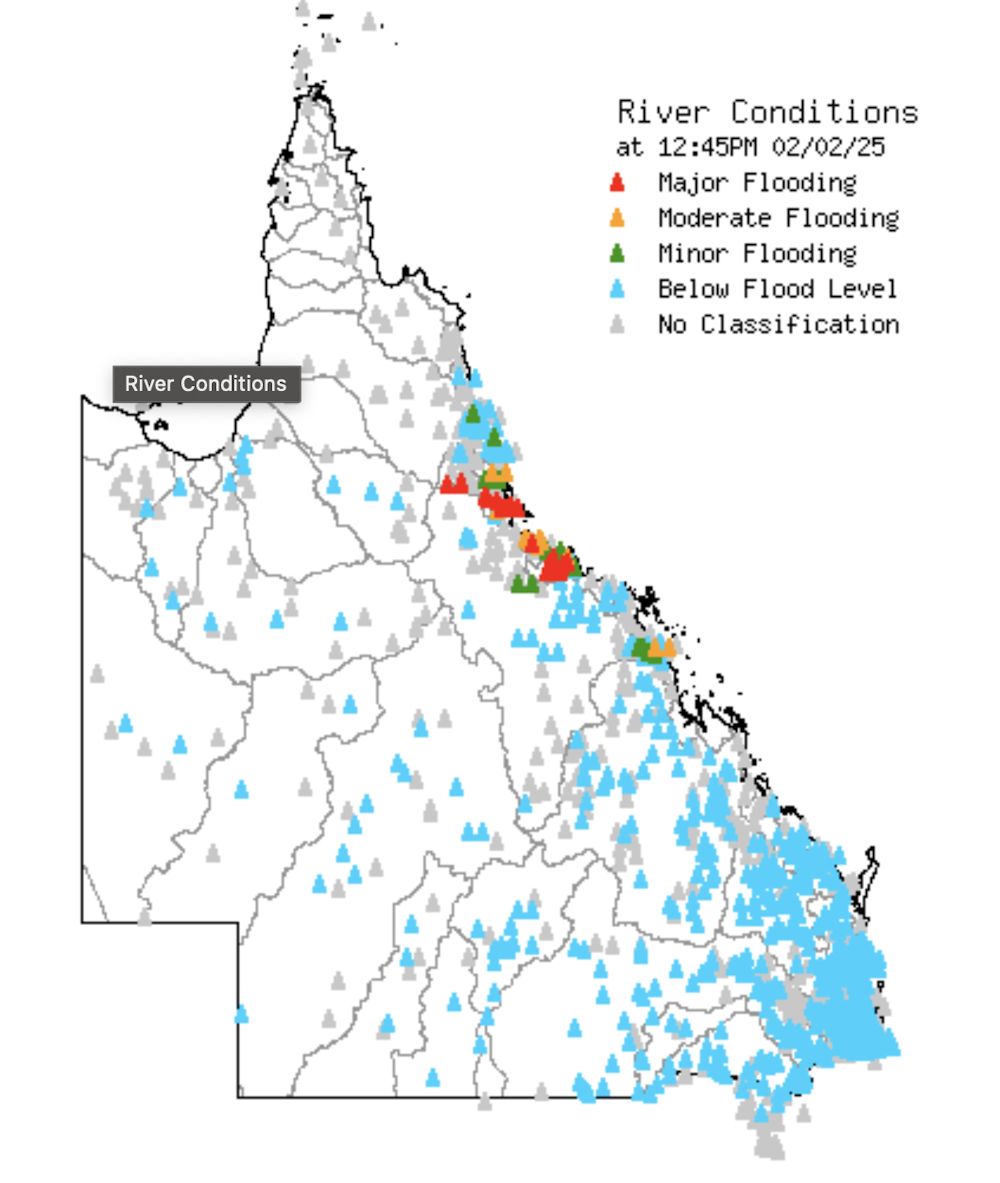
    Major flooding in northern Queensland rivers, as of 12.45pm February 2.
    Bureau of Meteorology

    Residents of Ingham and nearby towns, about 100km from Townsville, are witnessing flooding from the nearby Herbert River. This morning, it was at 15 metres and rising. With more heavy rain forecast for the next 24 hours, the Herbert River is likely to break the 1967 record of 15.2 metres later today.

    Queensland Premier David Crisafulli – who grew up on his family’s sugar cane farm in Ingham – has said the floods will be a “once in a century” event for the town. To make matters worse, authorities say the town has lost power and an extended outage is likely.

    The atmospheric factors behind these floods are very similar to recent floods in the region – and climate change is no doubt playing a role.

    The flood level for the Herbert River at Ingham set in 1967 was 15.2 metres. It’s likely to be breached this afternoon (Sunday February 2).
    Australian Bureau of Meteorology, CC BY

    Where are the floods hitting?

    For many people in Townsville – the largest city in Northern Australia – the unfolding emergency will bring back memories of the devastating February 2019 floods, which caused A$1.24 billion in damage. Residents have been asked to evacuate from several low-lying suburbs which were inundated in 2019.

    Authorities in Townsville asked all residents in the low-lying black zone to evacuate by midday Sunday February 2. Floodwaters could reach second-storey heights in this zone. Residents in pink suburbs have been asked to be on standby.
    Townsville Council, CC BY

    It is too early to say if this flood event will be worse. Fortunately, water levels in the city’s Ross River Dam are much lower than 2019. Townsville Airport has recorded 545mm of rain over the past 48 hours, with many northwest suburbs recording much higher levels. The township of Rollingstone – 60km northwest of Townsville – recorded a whopping 702mm over the 24 hours to 9am Sunday.

    Further north in the Cairns to Daintree region, residents are watching with concern, with many still raw after the record-breaking floods of December 2023.

    What’s behind these floods?

    The ongoing 2025 extreme rainfall event, the 2019 Townsville floods and the 2023 Cairns and Daintree floods are remarkably similar in many ways.

    What triggered each of these floods was prolonged heavy rain falling on the southeast flank of a stationary tropical low weather system. Normally, tropical lows bring wind and rain, but move through quite quickly. But in recent years, we have seen a tendency for these systems to stall, sitting in place over or near land and dumping huge volumes of rain.

    Last week, the Bureau of Meteorology warned that five tropical lows were forming around northern Australia. Most tropical cyclones form from tropical lows embedded in the region’s monsoon trough, a large low pressure band which forms over summer and draws in warm, moist air from the adjacent tropical seas.

    But significant rain events like this one don’t necessarily require a tropical cyclone. Slow-moving deep monsoon lows over land can also deliver huge amounts of rain and widespread flooding.

    These atmospheric conditions allow intense rain bands to form between converging winds: warm, moist winds from the northeast and southeast winds originating from the Coral Sea. As the winds collide, they push the moist air up into the cooler parts of the atmosphere where it condenses and falls as torrential rain.

    More extreme rainfall and higher frequencies of flooded rivers and flash floods around the world have a clear link to climate change and ongoing global heating.

    The main drivers behind these events include warming of the atmosphere. For every 1°C of warming, the atmosphere holds 7% more water vapour. Recent research suggests this figure could be even higher for short duration rainfall.

    Hotter oceans hold more energy, meaning they can also amplify the global water cycle when atmospheric conditions are suitable.

    This year’s latest ever monsoon

    This year, sea surface temperatures in the northwest Coral Sea are 1-2°C above average. Ocean temperatures have risen because of a lack of cloud cover and rain last month. In northwestern Australia, this has given rise to an intensifying marine heatwave.

    This ocean heat is likely to be driven by the Australian monsoon’s latest ever arrival. The monsoon brings heavy rains to northern Australia, triggering the wet season. When it arrives, sea surface temperatures generally drop due to a combination of high cloud cover and the cooling effect of rainwater.

    After a slow start, the North Australian monsoon season is now in full swing.

    The Bureau of Meteorology is monitoring an active monsoon trough for any low pressure systems, which may develop into tropical cyclones over the next week or so. If any cyclone does form, it will gain energy from warmer than usual sea surface temperatures.

    What’s next for north Queensland?

    The flood emergency in north Queensland is far from over. All global circulation models predict heavy rain to continue in the region, extending up towards Cape York and the Gulf Country as an active monsoon surge moves in from Indonesia.

    As river catchments get saturated, more and more water will run off and engorge rivers. Forecasts are for rain to continue well into tonight and the next few days. We are likely to see more flooding in more places this week.

    For the latest updates, check the Bureau of Meteorology’s Queensland flood warnings, ABC Emergency or local ABC radio stations.

    Steve Turton has received funding from the Australian Government.

    ref. What’s driving north Queensland’s record-breaking, deadly floods? – https://theconversation.com/whats-driving-north-queenslands-record-breaking-deadly-floods-248847

    MIL OSI AnalysisEveningReport.nz

  • MIL-OSI USA: Lt. Gov. Kelly Announces Winners of 2nd Annual New Venture Competition

    Source: US State of Nebraska

    . Gov. Kelly Announces Winners of 2nd Annual New Venture Competition


    LINCOLN, NE – Lieutenant Governor Joe Kelly awarded prizes to three teams of aspiring college entrepreneurs through the 2nd Annual Nebraska Governor’s New Venture Competition. Awardees were announced during Thursday’s Nebraska Business Hall of Fame banquet at the Lincoln Marriott Cornhusker Hotel. Ten teams were selected as semi-finalists. The winners, prize amounts and a description of each project follow:


    First Place: Golden Garden Compost, UNO, $20,000 prize

                Golden Garden Compost creates premium organic compost for home gardeners using efficient production and innovative marketing to maximize profits.


    Second Place: brAIn Rot, UNL, $15,000 prize

                brAIn Rot is an educational platform that helps developers enhance their coding skills by solving real world puzzles and competing in coding contests.


    Third Place: IndoFilm, UNL, $10,000 prize

                InfoFilm helps share the impactful stories within the agriculture industry through videography, product photography, branding photography and social media management. 


    “This program is a great opportunity to publicize and support Nebraska-based ideas with world-changing potential,” said Lt. Gov. Kelly. “This year’s pool of finalists brought a variety of ideas to impact education, healthcare, agriculture, AI and other significant areas. They are risk takers willing to put in the long hours for the potential rewards of starting a new venture and watching it blossom.” 


    Governor Jim Pillen created the competition in 2023 to showcase and encourage student-led entrepreneurship. The competition is designed for contemplated and pre-seed businesses. Applicants must designate how their business falls into one of nine industry tracks: Agtech, Fintech/Insurtech, Cleantech, Advanced Manufacturing, Biotech/Healthtech, Emerging Media Arts, Sportstech, General Tech and the Bioeconomy. Submissions must have been received by Dec. 15, 2024. 


    This year, 15 teams – including undergraduate and graduate students – submitted proposals. Participating teams hailed from the University of Nebraska – Lincoln (UNL), University of Nebraska – Omaha (UNO), University of Nebraska – Kearney (UNK) and Metro Community College (MCC). The 15 teams made their initial pitch virtually to a panel of judges representing Flyover Capital, Nebraska Innovation Labs, Nelnet Ventures, Redbud VC and Tech Nebraska. Judges evaluated each project and whittled the group to 10 semi-finalists. 


    “Starting a business is hard enough but starting a business while also attending college is extremely challenging due to time constraints and academic obligations,” said Dan Hoffman, CEO of Invest Nebraska. “Nebraska’s entrepreneurial ecosystem of startup founders, funders, and service providers are excited to mentor and support these young teams as they begin their entrepreneurial journey.”


    Semi-finalist teams were mentored leading up to their final project presentation yesterday during the Nebraska State Chamber of Commerce annual meeting. The judges, from Lincoln Partnership for Economic Development, MOVE Venture Capital, Nelnet, Nave Analytics, Nebraska Public Power District and Workshop, selected the awardees. 


    “I appreciate that Governor Pillen is prioritizing entrepreneurship as a key economic development strategy,” said Nebraska Department of Economic Development (DED) Director K.C. Belitz. “The New Venture Competition is a great way to showcase and encourage the inventiveness of Nebraska’s rising generation. Across the state, we’re building an entrepreneurial ecosystem to support young Nebraskans in turning their ideas into successful businesses.”


    “Congratulations to the 15 teams of students who shared their ideas for pursuing an entrepreneurial opportunity and competed in the New Venture Competition,” added Nebraska Chamber President Bryan Slone.  “We’re always excited to support the next generation of Nebraska business professionals and it was exciting to watch these young entrepreneurs reach new heights.”


    Sponsors for the New Venture Competition include the Nebraska Chamber of Commerce & Industry, Nebraska Public Power District (NPPD), Omaha Public Power District (OPPD), Invest Nebraska, Nebraska Diplomats, Nebraska Economic Developers Association (NEDA) and the Nebraska Department of Economic Development (DED).


    For more information about the Governor’s New Venture Competition, visit the contest’s website: https://negovnewventure.com.


    First Place Team Golden Garden Compost of the University of Nebraska – Omaha

    Second Place Team brAIn Rot of the University of Nebraska – Lincoln

    Third Place Team InfoFilm of the University of Nebraska – Lincoln

    Photos by Sam Rice

    MIL OSI USA News

  • MIL-OSI China: China-Laos Railway draws international travelers

    Source: China State Council Information Office

    Trucks transport railway containers at the Kunming cargo terminal of China United International Rail Containers Co., Ltd. (CRIntermodal) in Kunming, southwest China’s Yunnan Province, on Jan. 2, 2025. [Photo/Xinhua]

    Having long been poring over China’s diversified culture, German vlogger Robert Adolf is particularly fascinated by Yunnan Province, home to over 20 ethnic groups.

    This year’s Spring Festival is unique to Adolf and his mother, who traveled by train to Xishuangbanna, a tropical autonomous prefecture in Yunnan Province and one of the stations along the China-Laos Railway route.

    Adolf has previously explored this 1,035 km-long route linking Kunming of Yunnan to the Laotian capital of Vientiane with eight stops in between, and felt a surge of excitement over how railroads have expanded to smaller cities and villages.

    “It’s now much easier to visit rural areas,” he said.

    Dressed in the traditional attire of the Shui ethnic group, Adolf told Xinhua that he felt “more real … and more to the hearts” in smaller towns. “There’s a family atmosphere.”

    In Yunnan, Adolf has observed the Dai people’s Water-Splashing Festival and the Munao Zongge Festival (meaning “Dancing together”) of the Jingpo people. During the journey, Adolf posted videos on social platforms like Douyin and YouTube, with his bio describing him “on the quest to film all 56 Ethnic Groups in China.”

    He said that people always find ways to keep traditions up to date, and the government helps preserve them by supporting cultural heritage, investing in museums and funding inheritors. “In China, they really keep the culture alive.”

    His mother Anna Adolf referred to the journey in Yunnan as an adventure. “Everywhere I look, people are wearing beautiful clothes, singing and dancing.”

    During the Spring Festival travel season, thousands of passengers travel home or explore new destinations via the China-Laos cross-border train.

    At Kunming South Station, the starting point of the railway, waiting rooms were abuzz with travelers speaking Chinese, Lao, Thai and English, a testament to the cross-border railway’s growing international appeal.

    “We’ve always had a good experience on trains in China. I’m sure this time it will be convenient and comfortable,” Susie, an American living in Beijing, told Xinhua, as she queued up for a train heading to Laos.

    The railway also benefits Thai travelers, who said that it makes the homebound journey faster.

    Since its launch in 2021, the China-Laos Railway, a flagship Belt and Road Initiative project, has handled over 43 million passenger trips and more than 48.3 million tonnes of cargo.

    The Kunming-Vientiane D87 train is painted deep green. It might evoke memories of the old-style passenger trains in China, but its designed speed of 160 km/h integrates efficiency with the need to navigate complex terrain, transporting both passengers and freight.

    Inside some of the train compartments during the Spring Festival holiday, red paper-cut decorations on the windows added a festive touch, marking the first Spring Festival since UNESCO listed the tradition as intangible cultural heritage.

    For Southikiat Thavisouk, a Laotian TV host returning to Vientiane, the railway trip is more than transportation. “It’s a bridge between the Chinese and Laotian people,” he said.

    Having studied at Huaqiao University in China’s Fujian Province, Thavisouk recalled the warm hospitality he received there. Now back in Laos, he sees the Chinese New Year celebrated as well.

    Soulideth Lavanphone, a Laotian tour guide accompanying a group of Chinese travelers, shared a similar sentiment. “I studied in Sichuan, and China is my second home. I’ll do my best to make sure Chinese visitors have a great time in Laos,” he said.

    “Many travelers from Western countries and ASEAN nations have all come to experience the Laos-China Railway firsthand,” said Laotian Consul General in Kunming Pongdong Paxaphacdy with much pride.

    “Tickets are often sold out due to high demand, and we are working on solutions to improve capacity,” Paxaphacdy said.

    “This railway has boosted investment, tourism and connectivity, bringing real benefits to the people. With strong support from both governments, this railway will only continue to grow,” he added. 

    MIL OSI China News

  • MIL-Evening Report: Delayed monsoon and a stalled tropical low: what’s behind north Queensland’s record-breaking floods

    Source: The Conversation (Au and NZ) – By Steve Turton, Adjunct Professor of Environmental Geography, CQUniversity Australia

    A flooded street in Townsville John Wilkinson/Facebook

    Record-breaking floods across north Queensland have now turned deadly, with one woman drowning while being rescued on Sunday morning. And the floodwaters are still rising, with rain set to continue.

    Over the 48 hours to Sunday, there were reports of up to 1 metre of rainfall in parts of northeast Queensland. The torrential rain continues, particularly in the Herbert Coast region and north to around Tully.

    Major flooding in northern Queensland rivers, as of 12.45pm February 2.
    Bureau of Meteorology

    Residents of Ingham and nearby towns, about 100km from Townsville, are witnessing flooding from the nearby Herbert River. This morning, it was at 15 metres and rising. With more heavy rain forecast for the next 24 hours, the Herbert River is likely to break the 1967 record of 15.2 metres later today.

    Queensland Premier David Crisafulli – who grew up on his family’s sugar cane farm in Ingham – has said the floods will be a “once in a century” event for the town. To make matters worse, authorities say the town has lost power and an extended outage is likely.

    The atmospheric factors behind these floods are very similar to recent floods in the region – and climate change is no doubt playing a role.

    The flood level for the Herbert River at Ingham set in 1967 was 15.2 metres. It’s likely to be breached this afternoon (Sunday February 2).
    Australian Bureau of Meteorology, CC BY

    Where are the floods hitting?

    For many people in Townsville – the largest city in Northern Australia – the unfolding emergency will bring back memories of the devastating February 2019 floods, which caused A$1.24 billion in damage. Residents have been asked to evacuate from several low-lying suburbs which were inundated in 2019.

    Authorities in Townsville asked all residents in the low-lying black zone to evacuate by midday Sunday February 2. Floodwaters could reach second-storey heights in this zone. Residents in pink suburbs have been asked to be on standby.
    Townsville Council, CC BY

    It is too early to say if this flood event will be worse. Fortunately, water levels in the city’s Ross River Dam are much lower than 2019. Townsville Airport has recorded 545mm of rain over the past 48 hours, with many northwest suburbs recording much higher levels. The township of Rollingstone – 60km northwest of Townsville – recorded a whopping 702mm over the 24 hours to 9am Sunday.

    Further north in the Cairns to Daintree region, residents are watching with concern, with many still raw after the record-breaking floods of December 2023.

    What’s behind these floods?

    The ongoing 2025 extreme rainfall event, the 2019 Townsville floods and the 2023 Cairns and Daintree floods are remarkably similar in many ways.

    What triggered each of these floods was prolonged heavy rain falling on the southeast flank of a stationary tropical low weather system. Normally, tropical lows bring wind and rain, but move through quite quickly. But in recent years, we have seen a tendency for these systems to stall, sitting in place over or near land and dumping huge volumes of rain.

    Last week, the Bureau of Meteorology warned that five tropical lows were forming around northern Australia. Most tropical cyclones form from tropical lows embedded in the region’s monsoon trough, a large low pressure band which forms over summer and draws in warm, moist air from the adjacent tropical seas.

    But significant rain events like this one don’t necessarily require a tropical cyclone. Slow-moving deep monsoon lows over land can also deliver huge amounts of rain and widespread flooding.

    These atmospheric conditions allow intense rain bands to form between converging winds: warm, moist winds from the northeast and southeast winds originating from the Coral Sea. As the winds collide, they push the moist air up into the cooler parts of the atmosphere where it condenses and falls as torrential rain.

    More extreme rainfall and higher frequencies of flooded rivers and flash floods around the world have a clear link to climate change and ongoing global heating.

    The main drivers behind these events include warming of the atmosphere. For every 1°C of warming, the atmosphere holds 7% more water vapour. Recent research suggests this figure could be even higher for short duration rainfall.

    Hotter oceans hold more energy, meaning they can also amplify the global water cycle when atmospheric conditions are suitable.

    This year’s latest ever monsoon

    This year, sea surface temperatures in the northwest Coral Sea are 1-2°C above average. Ocean temperatures have risen because of a lack of cloud cover and rain last month. In northwestern Australia, this has given rise to an intensifying marine heatwave.

    This ocean heat is likely to be driven by the Australian monsoon’s latest ever arrival. The monsoon brings heavy rains to northern Australia, triggering the wet season. When it arrives, sea surface temperatures generally drop due to a combination of high cloud cover and the cooling effect of rainwater.

    After a slow start, the North Australian monsoon season is now in full swing.

    The Bureau of Meteorology is monitoring an active monsoon trough for any low pressure systems, which may develop into tropical cyclones over the next week or so. If any cyclone does form, it will gain energy from warmer than usual sea surface temperatures.

    What’s next for north Queensland?

    The flood emergency in north Queensland is far from over. All global circulation models predict heavy rain to continue in the region, extending up towards Cape York and the Gulf Country as an active monsoon surge moves in from Indonesia.

    As river catchments get saturated, more and more water will run off and engorge rivers. Forecasts are for rain to continue well into tonight and the next few days. We are likely to see more flooding in more places this week.

    For the latest updates, check the Bureau of Meteorology’s Queensland flood warnings, ABC Emergency or local ABC radio stations.

    Steve Turton has received funding from the Australian Government.

    ref. Delayed monsoon and a stalled tropical low: what’s behind north Queensland’s record-breaking floods – https://theconversation.com/delayed-monsoon-and-a-stalled-tropical-low-whats-behind-north-queenslands-record-breaking-floods-248847

    MIL OSI AnalysisEveningReport.nz

  • MIL-OSI Australia: Supporting young children with disability or developmental concerns

    Source: Ministers for Social Services

    The Albanese Labor Government is extending the National Early Childhood Program (NECP) to support young children with disability or developmental concerns, their families and carers.

    Autism Queensland and the Australian Catholic University (ACU) will each receive an additional $5 million from 2025-26 to 2026-27 to continue activities funded under the NECP.

    Minister for Social Services Amanda Rishworth said the $10 million Federal investment for this extension will mean more children with disability or developmental concerns aged 0-8 years and their families are supported.

    “We recognise the importance of a child’s early years and ensuring they and their families have what they need to ensure a bright future,” Minister Rishworth said.

    “For children with developmental concerns or disability, it is crucial they and their families are given tailored support to ensure they can have their best start in life.

    “The early childhood program activities under the NECP align with Australia’s Disability Strategy 2021-2031 and the Early Years Strategy 2024-2034, helping children and building capacity in their families to support their development. 

    “The NECP was designed in consultation with parents, carers and peak bodies, and the Government is pleased to continue to fund these important activities.”

    The NECP supports young children with newly identified disability or emerging developmental concerns and their parents and carers, increasing readiness for educational environments and providing opportunities to socialise with their peers and siblings in a supported and family-centred environment.

    Initial funding of $13.8 million was awarded following two open grant rounds for 2022-23 to 2024-25. Under these grants:

    • Autism Queensland lead a consortium of organisations including playgroup and autism associations to provide regular, facilitated supports, including playgroups and music programs across the country.
    • ACU provides facilitated group workshops for parents and carers whose children have a newly identified disability or who have concerns regarding their child’s development. 

    More information on the NECP is available on the Department of Social Services website

    MIL OSI News

  • MIL-OSI China: Chinese research team develops groundbreaking prosthetic hand

    Source: China State Council Information Office 2

    A research team from the University of Science and Technology of China (USTC) has unveiled a groundbreaking biomimetic prosthetic hand with high dexterity, which is capable of combing hair, operating smartphones, and even performing intricate sign language gestures.
    The lightweight prosthetic device, which replicates the functionality of a human hand, highlights a significant advancement in prosthetics and humanoid robots, offering hope to millions of amputees worldwide.
    The study was published in Nature Communications, the USTC said on its official website.
    A leap forward in prosthetics
    The human hand, with its 23 degrees of freedom (DOFs) — the number of independent movements it can perform — is a marvel of natural engineering, contributing to 54 percent of the body’s overall functional movements despite weighing only about one-150th of the body’s weight.
    Traditional prosthetic hands, often powered by motors, struggle to balance weight and functionality. Most weigh more than 0.4 kilograms, causing discomfort while offering fewer than 10 DOFs. This limitation confines their ability to perform complex tasks, leading nearly half of users to abandon their prosthetic hands.
    The USTC team addressed these challenges by using shape-memory alloys (SMAs) — materials that “remember” their original shape and return to it when heated — as artificial muscles.
    Combined with a tendon-like transmission system, this innovative approach amplifies the driving force while reducing resistance.
    The team also embedded 23 sensor units in the fingers and wrist for precise motion control and integrated 38 SMA actuators with a cooling module. The result is a prosthetic hand weighing just 0.37 kilograms, lighter than the average human hand, yet capable of 19 active DOFs.
    High dexterity and versatility
    According to the research team, the prosthetic hand demonstrates remarkable dexterity, enabling it to perform tasks such as combing hair, writing, shaking hands, handing out business cards, and even playing chess.
    Its advanced design allows it to replicate 33 standard human grasping modes and six new, more complex ones, such as using scissors, operating smartphones, and performing intricate sign language gestures.
    In clinical tests, a 60-year-old female amputee mastered the device within half a day, successfully completing tasks from the clinically validated hand function test — Southampton Hand Assessment Procedure (SHAP) — and the Wolf Motor Function Test (WMFT), which measures upper extremity motor abilities.
    Its integration with voice recognition technology sets the USTC prosthetic hand apart. It supports 60 languages and 20 dialects with 95 percent accuracy and millisecond-level response times.
    This user-friendly interface makes it accessible to a wide range of users, particularly amputees, according to the research team.
    Compared to similar projects globally, the USTC team’s design stands out for its high DOFs, lightweight construction, and advanced sensory feedback.
    The USTC team’s innovation holds immense promise for both prosthetics and humanoid robotics, according to the research team.
    Its high adaptability opens up a wide range of practical applications across multiple fields, including specialized operations in hazardous environments such as nuclear power plant maintenance or deep-sea equipment repair, medical rehabilitation, flexible manufacturing in high-precision production lines, and home services. 

    MIL OSI China News

  • MIL-OSI USA: Bar Blast – January 14, 2025

    Source: US State of West Virginia

    West Virginia University College of Law’s

    Spring 2025 On-Campus Interviewing (OCI)

    Attention employers: Are you looking to hire a summer intern/clerk or an entry-level associate? Consider participating in the West Virginia University College of Law’s Spring 2025 On-Campus Interviewing (OCI) Session.  Join many of West Virginia’s top private firms and public offices in recruiting talent at the College of Law! To participate, private sector employers must offer paid compensation to summer interns/clerks. While paid employment is always more attractive to students, public sector employers may post volunteer legal intern positions.

    To register your participation, please click here to create an account and post your position. 


    If you have questions or would like additional information, please contact Brad Grimes, Assistant Director of Career Services for the College of Law, at (304) 293-7750 or at

    tgrimes@mail.wvu.edu.

    MIL OSI USA News

  • MIL-Evening Report: Politics with Michelle Grattan: Albanese dumps Nature Positive legislation and considers shrinking the electoral reform bill

    Source: The Conversation (Au and NZ) – By Michelle Grattan, Professorial Fellow, University of Canberra

    Prime Minister Anthony Albanese has dumped – for the second time – the government’s controversial “Nature Positive” legislation, which had run into strong opposition from the Western Australian Labor government.

    Albanese, speaking on The Conversation’s Politics podcast ahead of a fortnight parliamentary sitting starting next week, said there was not enough support for the legislation, which had been on the draft list of bills for next week, circulated by the government.

    This is the second time the Prime Minister has pulled back from the legislation. Late last year he also said it did not have enough support, despite Environment Minister Tanya Plibersek believing she had a deal with the Greens and crossbench for its passage.

    The legislation would set up a federal Environment Protection Agency, which has riled miners who claim it would add to bureaucracy and delay approvals.

    In recent days WA premier Roger Cook, who was instrumental in heading off the legislation last year, has been lobbying the federal government again. WA faces an election on March 8.

    In an interview on Saturday, Albanese told The Conversation: “I can’t see that it has a path to success. So at this stage, I can say that we won’t be proceeding with it this term. There simply isn’t a [Senate] majority, as there wasn’t last year.

    “The Greens Party on one hand have changed their views”, making another demand during the week, he said. While the Liberals – who began the review of the present Environment Protection Act – “have chosen an obstructionist path,” he said.

    Albanese said the government would continue to discuss the issue with stakeholders in the next term of parliament.

    “Does the environment and protection act need revision from where it was last century? Quite clearly it does. Everyone says that that’s the case. It’s a matter of working to, in a practical way, a commonsense reform that delivers something that supports industry.

    “I want to see faster approvals. We in fact have speeded up approvals substantially.

    “But we also want proper sustainability as well.”

    Albanese also flagged the government might cut back its legislation to reform rules covering electoral donations and spending in order to get a deal to pass it.

    Special Minister of State Don Farrell and the Liberals had been on the brink of a deal in the final week of parliament last year, but negotiations imploded at the eleventh hour.

    Albanese told The Conversation he hoped the legislation could still be passed. “I spoke with [Farrell] today, he is consulting with people across the parliament.

    “What I would say is that we are looking to get reform through. Now whether that is a bigger, broader reform or whether it needs to be narrowed down, we’ll wait and see.

    “But we’re very serious about the reform which would lower the donation declarations, that would put a cap on donations, a cap on expenditure, that would lead to more transparency as well. It’s an important part of supporting our democracy.

    “We see overseas and we’ve seen people like Clive Palmer here spend over $100 million on a campaign. That’s a distortion of democracy – if one person can spend that much money to try to influence an election and we don’t find out all of that information till much later on.”

    The reforms would not start operating until the next term of parliament.

    Albanese said he thought the reform would have “overwhelming support” with the public “and I hope that it receives overwhelming support in the Senate as well”.

    Michelle Grattan does not work for, consult, own shares in or receive funding from any company or organisation that would benefit from this article, and has disclosed no relevant affiliations beyond their academic appointment.

    ref. Politics with Michelle Grattan: Albanese dumps Nature Positive legislation and considers shrinking the electoral reform bill – https://theconversation.com/politics-with-michelle-grattan-albanese-dumps-nature-positive-legislation-and-considers-shrinking-the-electoral-reform-bill-248848

    MIL OSI AnalysisEveningReport.nz

  • MIL-OSI China: Cambodia ceases mine clearance in 8 provinces after US funding freeze

    Source: China State Council Information Office

    Cambodia has halted mine clearance projects in eight provinces after the United States has frozen funding, a mine clearance chief said on Friday.

    Heng Ratana, director-general of the Cambodian Mine Action Center (CMAC), said the U.S.-funded mine clearance projects in Ratanakiri, Mondulkiri, Stung Treng, Kratie, Tboung Khmum, Kampong Cham, Prey Veng, and Svay Rieng provinces have been suspended for 85 days from Jan. 25 onwards.

    He said in a statement posted on social media that these projects, carried out by CMAC in cooperation with development partners, are to clear “the U.S. origin unexploded ordinances as the remnants of war.”

    CMAC has received a grant of 6.35 million U.S. dollars from the U.S. for mine clearance operations from March 2022 to November 2025, Ratana said, adding that this funding has supported some 200 technical Unexploded Ordnance (UXO) experts.

    He said under these projects, CMAC had so far made remarkable achievements by clearing 561 polygons or 11,195 hectares of cluster munitions or UXOs affected fields, finding and destroying 27,022 landmines and UXOs that included 17,971 cluster munitions and 69 aerial bombs.

    The halt was made after U.S. President Donald Trump last week ordered a sweeping 90-day pause on foreign aid, which included suspending its funded mine clearance projects around the world.

    Cambodia is one of the countries worst affected by landmines and explosive remnants of war (ERWs). An estimated 4 million to 6 million landmines and other munitions had been left over from three decades of war and internal conflicts that ended in 1998.

    According to the Yale University, from 1965 to 1973, the U.S. had dropped over 2.75 million tons of ordnance in 230,516 sorties on 113,716 sites in Cambodia.

    The CMAA’s report showed that from 1979 to 2024, landmine and ERW explosions had claimed 19,834 lives and maimed 45,252 others. 

    MIL OSI China News

  • MIL-OSI China: Foreigners savor flavors of Spring Festival in China

    Source: China State Council Information Office 2

    “Guonian,” which means “crossing the year,” is more than just a festival marking the arrival of the new year for the Chinese people.
    Though the Chinese New Year, or Spring Festival, is now celebrated in many places worldwide, the true meaning of “Guonian” can only be fully understood by experiencing it in China.
    “The celebration is big, stretching for a month with a lot of food, fireworks and cultural events,” said Kayleen Fangbi from Belgium. “I love it.”
    Lanterns and fairy lights adorn every corner, while shops bustle with people laden with large shopping bags, as observed by a Spanish couple traveling in Beijing just days before the Spring Festival, which fell on Jan. 29 this year.
    Spotting the snake-themed decorations, they decided to look up the meanings of the Chinese zodiac online and discovered that this year is the Year of the Snake. “One of us is a Horse, and the other is a Sheep,” they noted, clearly finding it all quite fascinating.
    Invitations to join in the celebration were shared via the Chinese lifestyle app rednote, with many Chinese netizens offering tips and local authorities promoting festive activities. The surge in activity comes as the app gains many users from the United States and other countries, following the U.S. government’s threat to ban TikTok.
    With the trending hashtag “Chinese New Year,” many foreigners shared about their Spring Festival celebrations virtually from wherever they were, with some expressing the joy of savoring an authentic experience of the holiday in China.
    Beyond the traditional fireworks, decorations, dragon dances, and lion dances, Spring Festival celebrations across China feature distinct local traditions, each adding its unique flavor to the holiday. They all share common themes: family reunions and hope for good fortune in the year ahead.
    The diverse social practices throughout the Chinese New Year celebrations, recently listed as an intangible cultural heritage of humanity by UNESCO, offer international visitors a rich array of experiences during this period.

    Artists perform the traditional Yingge dance in Chaoyang District of Shantou City, south China’s Guangdong Province, Jan. 29, 2025. (Xinhua/Lu Hanxin)
    In the Chaoshan region of south China’s Guangdong Province, the traditional Yingge dance adds a vibrant New Year atmosphere to the celebrations. Videos showcasing the dance have garnered millions of views, drawing many travelers to spend the Spring Festival in the area.
    The dancers, dressed in colorful costumes that represent ancient heroes and heroines, hold short wooden sticks and perform rhythmic movements, such as swinging the sticks, striking them together, and stamping their feet.
    “I was completely captivated by the strength and precision of their movements, the rhythmic sounds of their stomping and sticks clashing, and their powerful shouts of encouragement,” said Thanita Raemee from Thailand, after watching Yingge Dance performances.
    It’s said that when the lanterns in Yuyuan Garden light up, the Spring Festival begins in Shanghai, one of the top destinations for foreign visitors in China.

    Tourists from the Republic of Korea visit the Yuyuan Garden Mall in east China’s Shanghai, Dec. 4, 2024. (Photo by Chen Haoming/Xinhua)
    After strolling through the winding corridors and pavilions, a German tourist bought numerous Chinese New Year-themed souvenirs in Yuyuan Garden. “I want to bring the festive blessings to my friends back home,” she said.
    “A major change is that foreign tourists mostly just walked around in the past, but now they bring real spending power,” said Hu Junjie, vice president of Shanghai Yuyuan Tourist Mart (Group) Co., Ltd., adding that they are particularly interested in the lantern displays, traditional Chinese makeup and costumes, special cuisine, and cultural products.
    Tatiana, 70, a visitor from Russia on a trip to the city of Sanya in the southern island province of Hainan, said that she and her daughter came specifically to experience the Spring Festival.
    At a local event, she eagerly took part in interactive activities. “Writing the Chinese character ‘Fu (meaning blessing)’ with a calligraphy brush was such a unique experience,” she said. They also enjoyed watching traditional Chinese cultural performances, including the unique Li and Miao ethnic folk dances of Hainan.
    Russia remains Hainan’s largest source of international tourists and a key market for Sanya’s inbound tourism. The resumption and opening of international flight routes and visa-free policy have attracted more Russian tourists to the island.
    China expects a boom in international visitors during this Spring Festival holiday. Data from Trip.com Group shows that inbound tourism orders for the 2025 Spring Festival rose over 30 percent year on year.
    Data released by the Chinese travel services platform Qunar showed that as of Jan. 28, the number of domestic flights booked during the Spring Festival by travelers with non-Chinese passports has increased by 70 percent year on year.
    This surge is driven by a series of visa-free entry and transit policies China introduced in 2024, along with continuously upgraded payment, transportation, and tourism facilities. Besides, the growing popularity of China as a travel destination on social media, fueled by early travelers sharing their experiences, has contributed to the increase.
    In 2024, cross-border trips to China by foreigners surged by 82.9 percent from the previous year, reaching 64.88 million. Of these, more than 20 million inbound foreign trips were made visa-free, marking an impressive increase of 112.3 percent year on year, according to the National Immigration Administration.

    Tourists from Vietnam wait for entry inspection at the immigration area at Terminal 3 of Beijing Capital International Airport in Beijing, capital of China, Jan. 28, 2025. (Xinhua/Chen Zhonghao)
    To meet an increase in visitors from neighboring countries, such as Japan and the Republic of Korea, the Beijing tourism bureau and leading tourism companies launched special itineraries offering these travelers an opportunity to experience a Beijing-style New Year celebration in just two to three days.
    These short-haul itineraries took visitors to vibrant temple fairs and traditional performances, while also giving them the chance to savor Beijing’s winter delicacies and iconic dishes, such as dumplings, hotpot, and Peking Duck.
    “The Spring Festival is a window to understand China, especially its traditional culture,” said Jiang Yiyi, an expert on leisure sports and tourism at the Beijing Sport University.
    The inscription of the Spring Festival onto the UNESCO Intangible Cultural Heritage list has significantly boosted its global profile. The numerous traditional cultural activities held across China provide foreign visitors with an immersive experience, allowing them to gain a deeper understanding of Chinese traditional culture, according to Jiang.
    Through these diverse activities, foreign visitors can truly experience what British online influencer Shaun Gibson described in his video as a Spring Festival in China that is “warm, lively, delicious, and happy.”

    MIL OSI China News

  • MIL-Evening Report: The far-right is rising at a crucial time in Germany, boosted by Elon Musk

    Source: The Conversation (Au and NZ) – By Matt Fitzpatrick, Professor in International History, Flinders University

    With only a few weeks until Germany’s election, Elon Musk has unambiguously thrown his support behind the far-right Alternative for Germany (AfD) party. In a video address to a party rally last week, he appeared to urge Germans to “move on” from any “past guilt” related to the Holocaust.

    It’s good to be proud of German culture, German values, and not to lose that in some sort of multiculturalism that dilutes everything.

    Troublingly, the AfD is now firmly entrenched as Germany’s second-most popular political party, behind the centre-right Christian Democratic Union (CDU). Like all parties in German elections, however, it cannot win an outright majority. It is also unlikely to be invited to join any ruling coalition that emerges from the February 23 election.

    But the AfD’s anti-migrant, anti-government sloganeering has already seriously distorted Germany’s public debate and democratic culture, leaving many to ask whether it even needs to win elections to see its policies implemented.

    This was evident following a dramatic week in Germany’s Bundestag.

    First, in a radical break with Germany’s political norms, opposition leader Friedrich Merz deliberately drew on the votes of the AfD on Wednesday to ram a radical anti-asylum seeker motion through the parliament.

    It was the first time in the history of the Bundestag that a parliamentary majority was reached with the help of the far right. Merz’s action was widely condemned as a “taboo-breaking” step towards legitimising the AfD.

    Merz tried to take this a step further with a far-reaching bill to tighten immigration controls on Friday. Although the bill narrowly failed, all of the AfD voted with Merz. Twelve members of his own CDU party refused to back him.

    Merz’s courting of the far right is widely seen as politically unnecessary, given his conservative CDU is already leading the national polls, making him the favourite to succeed the Social Democratic Party (SDP)‘s Olaf Scholz as chancellor.

    This raises a couple crucial questions heading into the election. Is it insiders or outsiders that are playing the biggest role in bringing the far right into the mainstream? And just how big a role will the AfD play after the election?

    The Musk effect

    Musk’s embrace of the AfD should come as no surprise, given the integral part he played in Donald Trump’s election victory in the United States. In the German context, however, his behaviour and statements have taken on darker hues.

    Germans know only too well what is at stake when democracy is eroded by those who abuse its freedoms to attack it. Had Musk’s now notorious Nazi salutes following Trump’s inauguration been performed in Berlin, for example, he might have faced up to three years in prison.

    The catchphrase “never again” has underpinned German politics since the second world war. Yet, the response to Musk’s recent provocations was oddly muted in some sections of the German media.

    The German tabloid Bild made embarrassing excuses for his Hitlerian salute, while others spoke vaguely of a “questionable gesture”.

    With a few notable exceptions, it was left to activists to remind Germans of the severity of this gesture – projecting an image of Musk’s salute on a German Tesla plant, alongside the word “heil”.

    Given the seriousness with which Germany patrols representations of its Nazi past, it was surprising just how few journalists were prepared to state without equivocation that “a Hitler salute is a Hitler salute is a Hitler salute”.

    Merz’s embrace of the far right

    Initially, there were some signs Germany’s main political leaders would decry Musk’s attempts to normalise far-right politics in the country.

    When Musk called the AfD the “last spark of hope” in December, both Scholz and Merz quickly condemned his meddling.

    Scholz has continued to label Musk’s blatant attempts to influence German politics as “unacceptable” and “disgusting”.

    Merz claims to be keeping his distance from Musk. But it appears his strategy for winning the election is not far from what Musk is suggesting – mimicking AfD policies and collaborating with the party on anti-immigration votes.

    In his most radical break with the centrism that characterised the CDU under former Chancellor Angela Merkel, Merz cracked the “firewall” against working with the far-right this week. Knowing just what it meant, he used the AfD’s support to pass the starkly worded nationalist border protection motion in the Bundestag.

    The AfD publicly celebrated their good fortune, calling it a “historic day for Germany”.

    Democratic party leaders, meanwhile, registered their shock and dismay. Merkel herself spoke out against Merz, saying it was “wrong” to “knowingly” work with the AfD.

    Her intervention appears to have been critical to the immigration bill failing on Friday, with many of her former supporters in the CDU withholding their votes.

    What AfD’s rise could mean

    Given the two votes in the past week and Musk’s high-profile intervention, many in Germany now fear a CDU victory in the election could signal more collaboration with the AfD.

    The Left Party has denounced Merz as an AfD puppet and demanded Musk be forbidden from entering Germany.

    The Greens’ Robert Habeck, Germany’s vice chancellor, has said Merz’s nationalist coalition would “destroy Europe”. He has also warned Musk to keep his “hands off our democracy”, prompting Musk to label Habeck “a traitor to the German people”.

    Musk is by no means the cause of the AfD’s popularity, but his embrace of the extremist party has given it a global profile and credibility in circles that might not have otherwise considered supporting it.

    Musk has been a controversial figure in Germany ever since his Tesla “gigafactory” arrived in Brandenburg and was promptly accused of felling 500,000 trees and irreparably damaging precious groundwater reserves. Accusations of Tesla breaching German labour laws and even conducting surprise checks on sick workers have also not endeared him to progressive Germans.

    As some commentators have suggested, it is probably not coincidental the AfD’s plans for the German economy would benefit Musk’s business interests. Economic self-interest alone seems insufficient, however, to explain why Musk has gravitated to the extreme right.

    The same might be said of Merz. Electoral calculations alone cannot explain his risky courting of the far right. He has long been the frontrunner to win the next election. Cosying up to the AfD will only make it harder to form a coalition with either Scholz’s Social Democratic Party or the Greens.

    If these two parties refuse to deal with Merz, the only other bloc large enough to deliver his party control of the government would be the AfD. Would he go so far?

    Whether it is formally part of the next government or not, the AfD and its camp followers (such as Musk) could be set to have a much bigger influence on German politics. How this will change Germany in the long term remains to be seen.

    Matt Fitzpatrick receives funding from the Australian Research Council.

    ref. The far-right is rising at a crucial time in Germany, boosted by Elon Musk – https://theconversation.com/the-far-right-is-rising-at-a-crucial-time-in-germany-boosted-by-elon-musk-247895

    MIL OSI AnalysisEveningReport.nz

  • MIL-OSI Australia: Two years of employees receiving paid family and domestic violence leave

    Source: Ministers for Social Services

    Today marks the second-year anniversary of the Albanese Labor Government’s introduction of paid family and domestic violence leave. 

    Labor believes no one should ever have to choose between their job or their safety.

    As one of the first acts of our Government, Labor ensured all 12.4 million workers in Australia – including casuals – received a minimum legislated entitlement of up to 10 days of paid leave each year.  

    Violence against women and children is a problem of epidemic proportions in Australia. One in three women has experienced physical violence since the age of 15, and one in five has experienced sexual violence.

    An independent statutory review into the operation of paid family and domestic violence leave conducted by Flinders University found it is succeeding in supporting the financial security of those escaping or experiencing violence, without jeopardising their income or employment.

    The review found that of the victim-survivors who had taken paid family and domestic violence leave, 91 per cent surveyed said it helped them maintain their income, and 89 per cent said it helped them to retain their employment, with 41 per cent of victim-survivors using the leave to arrange for their safety, 43 per cent to arrange for their children’s safety, 39 per cent to access police services, 22 per cent to access medical services, and 24 per cent to access legal services.

    Minister for Social Services Amanda Rishworth said legislating paid family and domestic violence leave was a milestone achievement which has saved and changed lives. 

    “We know from our many consultations with victim-survivors just how difficult it can be to leave violent situations – and financial means should not be a barrier to safety,” Minister Rishworth said.

    “This entitlement allows people who are working full-time, part-time and casually in Australia to make arrangements to support their safety, and the safety of their families, without fear of losing their jobs or income.

    “We refuse to be a country where people have to sacrifice their safety for a wage. Our legislated 10 days of paid FDV leave provides all employees who are experiencing family and domestic violence the opportunity to build a better life for themselves, free from violence.”

    Minister for Employment and Workplace Relations Senator Murray Watt said these changes are an important step towards making sure workers no longer have to choose between their pay and safety.  

    “This change meant for the first time, all Australian employees – including casuals – can access 10 days paid leave each year when impacted by family and domestic violence,” Minister Watt said. 

    “This critical leave entitlement ensures workers can maintain their financial independence through what is an incredibly difficult and terrifying time in their lives and it saves lives.

    “But this entitlement is under threat from Peter Dutton and the Coalition, with Shadow Minister for Employment and Workplace Relations, Michaelia Cash claiming it’s a ‘perverse disincentive’ to employers hiring women.

    “Peter Dutton and Michaelia Cash need to tell Australians whether paid family and domestic violence leave will be part of the “targeted set of repeals” of workplace laws they’ve promised to take to the election.”

    The Government gave small businesses additional time to adjust to the payment and invested $3.4 million to support the creation and updating of resources on paid FDV leave, including those specifically for small business.

    Paid FDV leave is one of many actions the Government has taken to address family and domestic violence. All governments have committed to ending gender-based violence in one generation under the National Plan to End Violence Against Women and Children 2022-32, supported by Government investment of $4 billion. 

    More information on paid FDV leave is available on the Fair Work Ombudsman’s website

    Small businesses can find out more about how to support employees impacted by FDV by listening to the Small Business, Big Impact podcast, available on the Acast website, Spotify, Google Podcasts, Apple Podcasts, and a range of other podcast platforms. 

    If you or someone you know is experiencing, or at risk of experiencing, domestic, family, or sexual violence, call 1800 737 732, text 0458 737 732 or visit www.1800RESPECT.org.au for online chat and video call services.

    If you are concerned about your behaviour or use of violence, you can contact the Men’s Referral Service on 1300 766 491 or visit www.ntv.org.au

    Feeling worried or no good? Connect with 13YARN Aboriginal & Torres Strait Islander Crisis Supporters on 13 92 76, available 24/7 from any mobile or pay phone, or visit www.13yarn.org.au No shame, no judgement, safe place to yarn.

    MIL OSI News

  • MIL-OSI Global: Trump’s 25% tariffs on Canada and Mexico amp up the risk of a broader trade war

    Source: The Conversation – Global Perspectives – By Markus Wagner, Professor of Law and Director of the UOW Transnational Law and Policy Centre, University of Wollongong

    It’s official. On February 1, US President Donald Trump will introduce a sweeping set of new 25% tariffs on imports from Canada and Mexico. China will also face new tariffs of 10%.

    During the presidential campaign, Trump threatened tariffs against all three countries, claiming they weren’t doing enough to prevent an influx of “drugs, in particular fentanyl” into the US, while also accusing Canada and Mexico of not doing enough to stop “illegal aliens”.

    There will be some nuance. On Friday, Trump said tariffs on oil and gas would come into effect later, on February 18, and that Canadian oil would likely face a lower tariff of 10%.

    This may only be the first move against China. Trump has previously threatened the country with 60% tariffs, asserting this will bring jobs back to America.

    But the US’ move against its neighbours will have an almost immediate impact on the three countries involved and the landscape of North American trade. It marks the beginning of what could be a radical reshaping of international trade and political governance around the world.

    What Trump wants from Canada and Mexico

    While border security and drug trade concerns are the official rationale for this move, Trump’s tariffs have broader motivations.

    The first one is protectionist. In all his presidential campaigning, Trump portrayed himself as a champion of US workers. Back in October, he said tariff was “the most beautiful word in the dictionary”.

    Trump hasn’t hidden his fondness for protectionist trade measures.

    This reflects the ongoing scepticism toward international trade that Trump – and politicians more generally on both ends of the political spectrum in the US – have held for some time.

    It’s a significant shift in the close trade links between these neighbours. The US, Mexico and Canada are parties to the successor of the North American Free Trade Agreement (NAFTA): the United States-Mexico-Canada Agreement (USMCA).

    Trump has not hidden his willingness to use tariffs as a weapon to pressure other countries to achieve unrelated geopolitical goals. This is the epitome of what a research project team I co-lead calls “Weaponised Trade”.

    This was on full display in late January. When the president of Colombia prohibited US military airplanes carrying Colombian nationals deported from the US to land, Trump successfully used the threat of tariffs to force Colombia to reverse course.


    Read more:
    What are tariffs?


    The economic stakes

    The volume of trade between the US, Canada, and Mexico is enormous, encompassing a wide range of goods and services. Some of the biggest sectors are automotive manufacturing, energy, agriculture, and consumer goods.

    In 2022, the value of all goods and services traded between the US and Canada came to about US$909 billion (A$1.46 trillion). Between the US and Mexico that same year, it came to more than US$855 billion (A$1.37 trillion).

    One of the hardest hit industries will be the automotive industry, which depends on cross-border trade. A car assembled in Canada, Mexico or the US relies heavily on a supply of parts from throughout North America.

    Tariffs will raise costs throughout this supply chain, which could lead to higher prices for consumers and make US-based manufacturers less competitive.

    Auto manufacturing stands to be hit hard by Trump’s tariffs.
    Around the World Photos/Shutterstock

    There could also be ripple effects for agriculture. The US exports billions of dollars in corn, soybeans, and meat to Canada and Mexico, while importing fresh produce such as avocados and tomatoes from Mexico.

    Tariffs may provoke retaliatory measures, putting farmers and food suppliers in all three countries at risk.

    Trump’s decision to delay and reduce tariffs on oil was somewhat predictable. US imports of Canadian oil have increased steadily over recent decades, meaning tariffs would immediately bite US consumers at the fuel pump.

    We’ve been here before

    This isn’t the first time the world has dealt with Trump’s tariff-heavy approach to trade policy. Looking back to his first term may provide some clues about what we might expect.

    In 2018, the US levied duties on steel and aluminium. Both Canada and Mexico are both major exporters of steel to the US.

    In his first term, Trump imposed major tariffs on US steel imports.
    ABCDstock/Shutterstock

    Canada and Mexico imposed retaliatory tariffs. Ultimately, all countries removed tariffs on steel and aluminium in the process of finalising the United States-Mexico-Canada Agreement.

    Notably, though, many of Trump’s trade policies remained in place even after President Joe Biden took office.

    This signalled a bipartisan scepticism of unfettered trade and a shift toward on-shoring or re-shoring in US policy circles.

    The options for Canada and Mexico

    This time, Canada and Mexico’s have again responded with threats of retaliatory tariffs.

    But they’ve also made attempts to mollify Trump – such as Canada launching a “crackdown” on fentanyl trade.

    Generally speaking, responses to these tariffs could range from measured diplomacy to aggressive retaliation. Canada and Mexico may target politically sensitive industries such as agriculture or gasoline, where Trump’s base could feel the pinch.

    There are legal options, too. Canada and Mexico could pursue legal action through the United States-Mexico-Canada Agreement’s dispute resolution mechanisms or the World Trade Organization (WTO).

    Both venues provide pathways for challenging unfair trade practices. But these practices can be slow-moving, uncertain in their outcomes and are susceptible to being ignored.

    A more long-term option for businesses in Canada and Mexico is to diversify their trade relationships to reduce reliance on the US market. However, the facts of geography, and the large base of consumers in the US mean that’s easier said than done.

    The looming threat of a global trade war

    Trump’s latest tariffs underscore a broader trend: the widening of the so-called “Overton window” to achieve unrelated geopolitical goals.

    The Overton Window refers to the range of policy options politicians have because they are accepted among the general public.

    Arguments for bringing critical industries back to the US, protecting domestic jobs, and reducing reliance on foreign supply chains gained traction after the ascent of China as a geopolitical and geoeconomic rival.

    These arguments picked up steam during the COVID-19 pandemic and have increasingly been turned into actual policy.

    The potential for a broader trade war looms large. Trump’s short-term goal may be to leverage tariffs as a tool to secure concessions from other jurisdictions.

    Trump’s threats against Denmark – in his quest to obtain control over Greenland – are a prime example. The European Union (EU), a far more potent economic player, has pledged its support for Denmark.

    A North American trade war – foreshadowed by the Canadian and Mexican governments – might then only be harbinger of things to come: significant economic harm, the erosion of trust among trading partners, and increased volatility in global markets.

    Markus Wagner receives funding from the Department of Defence, Australia as a Chief Investigator on a project titled Weaponised Trade.

    ref. Trump’s 25% tariffs on Canada and Mexico amp up the risk of a broader trade war – https://theconversation.com/trumps-25-tariffs-on-canada-and-mexico-amp-up-the-risk-of-a-broader-trade-war-248667

    MIL OSI – Global Reports

  • MIL-OSI Global: The far-right is rising at a crucial time in Germany, boosted by Elon Musk

    Source: The Conversation – Global Perspectives – By Matt Fitzpatrick, Professor in International History, Flinders University

    With only a few weeks until Germany’s election, Elon Musk has unambiguously thrown his support behind the far-right Alternative for Germany (AfD) party. In a video address to a party rally last week, he appeared to urge Germans to “move on” from any “past guilt” related to the Holocaust.

    It’s good to be proud of German culture, German values, and not to lose that in some sort of multiculturalism that dilutes everything.

    Troublingly, the AfD is now firmly entrenched as Germany’s second-most popular political party, behind the centre-right Christian Democratic Union (CDU). Like all parties in German elections, however, it cannot win an outright majority. It is also unlikely to be invited to join any ruling coalition that emerges from the February 23 election.

    But the AfD’s anti-migrant, anti-government sloganeering has already seriously distorted Germany’s public debate and democratic culture, leaving many to ask whether it even needs to win elections to see its policies implemented.

    This was evident following a dramatic week in Germany’s Bundestag.

    First, in a radical break with Germany’s political norms, opposition leader Friedrich Merz deliberately drew on the votes of the AfD on Wednesday to ram a radical anti-asylum seeker motion through the parliament.

    It was the first time in the history of the Bundestag that a parliamentary majority was reached with the help of the far right. Merz’s action was widely condemned as a “taboo-breaking” step towards legitimising the AfD.

    Merz tried to take this a step further with a far-reaching bill to tighten immigration controls on Friday. Although the bill narrowly failed, all of the AfD voted with Merz. Twelve members of his own CDU party refused to back him.

    Merz’s courting of the far right is widely seen as politically unnecessary, given his conservative CDU is already leading the national polls, making him the favourite to succeed the Social Democratic Party (SDP)‘s Olaf Scholz as chancellor.

    This raises a couple crucial questions heading into the election. Is it insiders or outsiders that are playing the biggest role in bringing the far right into the mainstream? And just how big a role will the AfD play after the election?

    The Musk effect

    Musk’s embrace of the AfD should come as no surprise, given the integral part he played in Donald Trump’s election victory in the United States. In the German context, however, his behaviour and statements have taken on darker hues.

    Germans know only too well what is at stake when democracy is eroded by those who abuse its freedoms to attack it. Had Musk’s now notorious Nazi salutes following Trump’s inauguration been performed in Berlin, for example, he might have faced up to three years in prison.

    The catchphrase “never again” has underpinned German politics since the second world war. Yet, the response to Musk’s recent provocations was oddly muted in some sections of the German media.

    The German tabloid Bild made embarrassing excuses for his Hitlerian salute, while others spoke vaguely of a “questionable gesture”.

    With a few notable exceptions, it was left to activists to remind Germans of the severity of this gesture – projecting an image of Musk’s salute on a German Tesla plant, alongside the word “heil”.

    Given the seriousness with which Germany patrols representations of its Nazi past, it was surprising just how few journalists were prepared to state without equivocation that “a Hitler salute is a Hitler salute is a Hitler salute”.

    Merz’s embrace of the far right

    Initially, there were some signs Germany’s main political leaders would decry Musk’s attempts to normalise far-right politics in the country.

    When Musk called the AfD the “last spark of hope” in December, both Scholz and Merz quickly condemned his meddling.

    Scholz has continued to label Musk’s blatant attempts to influence German politics as “unacceptable” and “disgusting”.

    Merz claims to be keeping his distance from Musk. But it appears his strategy for winning the election is not far from what Musk is suggesting – mimicking AfD policies and collaborating with the party on anti-immigration votes.

    In his most radical break with the centrism that characterised the CDU under former Chancellor Angela Merkel, Merz cracked the “firewall” against working with the far-right this week. Knowing just what it meant, he used the AfD’s support to pass the starkly worded nationalist border protection motion in the Bundestag.

    The AfD publicly celebrated their good fortune, calling it a “historic day for Germany”.

    Democratic party leaders, meanwhile, registered their shock and dismay. Merkel herself spoke out against Merz, saying it was “wrong” to “knowingly” work with the AfD.

    Her intervention appears to have been critical to the immigration bill failing on Friday, with many of her former supporters in the CDU withholding their votes.

    What AfD’s rise could mean

    Given the two votes in the past week and Musk’s high-profile intervention, many in Germany now fear a CDU victory in the election could signal more collaboration with the AfD.

    The Left Party has denounced Merz as an AfD puppet and demanded Musk be forbidden from entering Germany.

    The Greens’ Robert Habeck, Germany’s vice chancellor, has said Merz’s nationalist coalition would “destroy Europe”. He has also warned Musk to keep his “hands off our democracy”, prompting Musk to label Habeck “a traitor to the German people”.

    Musk is by no means the cause of the AfD’s popularity, but his embrace of the extremist party has given it a global profile and credibility in circles that might not have otherwise considered supporting it.

    Musk has been a controversial figure in Germany ever since his Tesla “gigafactory” arrived in Brandenburg and was promptly accused of felling 500,000 trees and irreparably damaging precious groundwater reserves. Accusations of Tesla breaching German labour laws and even conducting surprise checks on sick workers have also not endeared him to progressive Germans.

    As some commentators have suggested, it is probably not coincidental the AfD’s plans for the German economy would benefit Musk’s business interests. Economic self-interest alone seems insufficient, however, to explain why Musk has gravitated to the extreme right.

    The same might be said of Merz. Electoral calculations alone cannot explain his risky courting of the far right. He has long been the frontrunner to win the next election. Cosying up to the AfD will only make it harder to form a coalition with either Scholz’s Social Democratic Party or the Greens.

    If these two parties refuse to deal with Merz, the only other bloc large enough to deliver his party control of the government would be the AfD. Would he go so far?

    Whether it is formally part of the next government or not, the AfD and its camp followers (such as Musk) could be set to have a much bigger influence on German politics. How this will change Germany in the long term remains to be seen.

    Matt Fitzpatrick receives funding from the Australian Research Council.

    ref. The far-right is rising at a crucial time in Germany, boosted by Elon Musk – https://theconversation.com/the-far-right-is-rising-at-a-crucial-time-in-germany-boosted-by-elon-musk-247895

    MIL OSI – Global Reports

  • MIL-Evening Report: NZ Palestinian network advocate Janfrie Wakim praises ‘heroic Gaza’, calls for more action

    Asia Pacific Report

    One of the key early leaders of a national Palestinian solidarity network in Aotearoa New Zealand today praised the “heroic” resilience and sacrifice of the people of Gaza in the face of Israel’s ruthless attempt to destroy the besieged enclave of more than 2 million people.

    Speaking at the first solidarity rally in Auckland Tāmaki Makaurau since the fragile ceasefire came into force last Sunday, Janfrie Wakim of the Palestine Solidarity Network Aotearoa (PSNA) also paid tribute to New Zealand protesters who have supported the Palestine cause for the 68th week.

    “Thank you all for coming to this rally — the first since 7 October 2023 when no bombs are dropping on Gaza,” she declared.

    “The ceasefire in Gaza is fragile but let’s celebrate the success of the resistance, the resilience, and the fortitude — the sumud [steadfastness] — of the heroic Palestinian people.”

    Wakim was formerly a member of Palestine Human Rights Campaign (PHRC) in Auckland which began in the 1970s. This was later absorbed into the nationwide movement PSNA at a conference in 2013.

    “Israel has failed,” she continued. “It has not achieved its aims — in the longest war [15 weeks] in its history — even with $40 billion in aid from the United States.

    “It has failed to depopulate the north of Gaza, it has a crumbling economy, and 1 million Israelis [out if 9 million] have left already.”

    Wakim said that the resistance and success in defeating Israel’s “deadly objectives” had come at a “terrible cost”.

    “We mourn those with families here and in Gaza and now in the West Bank who made  the ultimate sacrifice with their lives — 47,000 people killed, 18,000 of them children, thousands unaccounted for in the rubble and over 100,000 injured.

    Grieving for journalists, humanitarian workers
    “We grieve for but salute the journalists and the humanitarian workers who have been murdered serving humanity.”


    Janfrie Wakim speaking at today’s Palestine rally in Tamaki Makaurau. Video: APR

    She said the genocide had been enabled by the wealthiest countries in the world and the Western media — “including our own with few exceptions”.

    “Without its lies, its deflections, its failure to report the agonising reality of Palestinians suffering, Israel would not have been able to commit its atrocities,” Wakim said.

    “And now while we celebrate the ceasefire there’s been an escalation on the West Bank — air strikes, drones, snipers, ethnic cleansing in Jenin with homes and infrastructure being demolished.

    “Checkpoints have doubled to over 900 — sealing off communities. And still the Palestinians resist.

    “And we must too. Solidarity. Unity of purpose is all important. Bury egos. Let humanity triumph.”

    Palestinian liberation advocate Janfrie Wakim . . . “Without its lies, its deflections, its failure to report the agonising reality of Palestinians suffering, Israel could not have been able to commit its atrocities.” Image: David Robie/APR

    90-year-old supporter
    During her short speech, Wakim introduced to the crowd the first Palestinian she had met in New Zealand, Ghazi Dassouki, who is now aged 90.

    She met him at a Continuing Education seminar at the University of Auckland in 1986 that addressed the topic of “The Palestine Question”. It shocked the establishment of the time with Zionist complaints and intimidation of staff which prevented any similar academic event until 2006.

    Wakim called for justice for the Palestinians.

    “Freedom from occupation. Liberation from apartheid. And peace at last after 76 years of subjugation and oppression by Israel and its allies,” she said

    She called on supporters to listen to what was being suggested for local action — “do what suits your situation and energy. Our task is to persist, as Howard Zinn put it”.

    “When we organise with one another, when we get involved, when we stand up and speak out together, we can create a power no government can suppress,” she said.

    “We don’t have to engage in grand, heroic actions to participate in the process of change. Small acts, when multiplied by millions of people, can transform the world.”

    Introduced to the Auckland protest crowd today . . . Ghazi Dassouki, who is now aged 90.

    As a symbol for peace and justice in Palestine, slices of water melon and dates were handed out to the crowd.

    Calls to block NZ visits by IDF soldiers
    Among many nationwide rallies across Aotearoa New Zealand this weekend, were many calls for the government to suspend entry to the country from soldiers in the Israeli Defence Forces (IDF).

    “New Zealand should not be providing rest and recreation for Israeli soldiers fresh from the genocide in Gaza,” said PSNA national chair John Minto.

    “We wouldn’t allow Russian soldiers to come here for rest and recreation from the invasion of Ukraine so why would we accept soldiers from the genocidal, apartheid state of Israel?”

    As well as the working holiday visa, since 2019 Israelis have been able to enter New Zealand for three months without needing a visa at all.

    This visa-waiver is used by Israeli soldiers for “rest and recreation” from the genocide in Gaza.

    Minto stressed that IDF soldiers had killed at least 47,000 Palestinians — 70 percent of them women and children.

    The International Court of Justice (ICJ) has declared Israeli actions a “plausible genocide”; Amnesty International, and Human Rights Watch have branded the continuous massacres as genocide and extermination; and the latest report from UN Special Rapporteur on Human Rights in the Occupied Palestine Territories Francesca Albanese has called it “genocide as colonial erasure”.

    Watermelon slices for all . . . a symbol of peace, the seed for justice. Image: David Robie/APR

    War crimes red flags
    Also, the International Criminal Court (ICC) has issued arrest warrants for Israeli Prime Minister Benjamin Netanyahu and former Israeli Defence Minister Yoav Gallant for war crimes and crimes against humanity.

    “All these red flags for genocide have been visible for months but the government is still giving the green light to those involved in war crimes to enter New Zealand,” Minto said.

    Last month, PSNA again wrote to the government asking for the suspension of travel to New Zealand for all Israeli soldiers and reservists.

    Meanwhile, 200 Palestinian prisoners held in Israeli jails have been set free under the terms of the Gaza ceasefire deal between Israel and Hamas. Seventy of them will be deported to countries in the region, reports Al Jazeera.

    Masses of people have congregated in Ramallah, celebrating the return of the released Palestinian prisoners.

    A huge crowd waved Palestinian flags, shouted slogans and captured the joyful scene with their phones and live footage shows.

    The release came after Palestinian fighters earlier handed over four female Israeli soldiers who had been held in Gaza to the International Red Cross in Palestine Square.

    The smiling and waving soldiers appeared to be in good health and were in high spirits.

    MIL OSI AnalysisEveningReport.nz

  • MIL-Evening Report: Trump’s 25% tariffs on Canada and Mexico amp up the risk of a broader trade war

    Source: The Conversation (Au and NZ) – By Markus Wagner, Professor of Law and Director of the UOW Transnational Law and Policy Centre, University of Wollongong

    It’s official. On February 1, US President Donald Trump will introduce a sweeping set of new 25% tariffs on imports from Canada and Mexico. China will also face new tariffs of 10%.

    During the presidential campaign, Trump threatened tariffs against all three countries, claiming they weren’t doing enough to prevent an influx of “drugs, in particular fentanyl” into the US, while also accusing Canada and Mexico of not doing enough to stop “illegal aliens”.

    There will be some nuance. On Friday, Trump said tariffs on oil and gas would come into effect later, on February 18, and that Canadian oil would likely face a lower tariff of 10%.

    This may only be the first move against China. Trump has previously threatened the country with 60% tariffs, asserting this will bring jobs back to America.

    But the US’ move against its neighbours will have an almost immediate impact on the three countries involved and the landscape of North American trade. It marks the beginning of what could be a radical reshaping of international trade and political governance around the world.

    What Trump wants from Canada and Mexico

    While border security and drug trade concerns are the official rationale for this move, Trump’s tariffs have broader motivations.

    The first one is protectionist. In all his presidential campaigning, Trump portrayed himself as a champion of US workers. Back in October, he said tariff was “the most beautiful word in the dictionary”.

    Trump hasn’t hidden his fondness for protectionist trade measures.

    This reflects the ongoing scepticism toward international trade that Trump – and politicians more generally on both ends of the political spectrum in the US – have held for some time.

    It’s a significant shift in the close trade links between these neighbours. The US, Mexico and Canada are parties to the successor of the North American Free Trade Agreement (NAFTA): the United States-Mexico-Canada Agreement (USMCA).

    Trump has not hidden his willingness to use tariffs as a weapon to pressure other countries to achieve unrelated geopolitical goals. This is the epitome of what a research project team I co-lead calls “Weaponised Trade”.

    This was on full display in late January. When the president of Colombia prohibited US military airplanes carrying Colombian nationals deported from the US to land, Trump successfully used the threat of tariffs to force Colombia to reverse course.


    Read more:
    What are tariffs?


    The economic stakes

    The volume of trade between the US, Canada, and Mexico is enormous, encompassing a wide range of goods and services. Some of the biggest sectors are automotive manufacturing, energy, agriculture, and consumer goods.

    In 2022, the value of all goods and services traded between the US and Canada came to about US$909 billion (A$1.46 trillion). Between the US and Mexico that same year, it came to more than US$855 billion (A$1.37 trillion).

    One of the hardest hit industries will be the automotive industry, which depends on cross-border trade. A car assembled in Canada, Mexico or the US relies heavily on a supply of parts from throughout North America.

    Tariffs will raise costs throughout this supply chain, which could lead to higher prices for consumers and make US-based manufacturers less competitive.

    Auto manufacturing stands to be hit hard by Trump’s tariffs.
    Around the World Photos/Shutterstock

    There could also be ripple effects for agriculture. The US exports billions of dollars in corn, soybeans, and meat to Canada and Mexico, while importing fresh produce such as avocados and tomatoes from Mexico.

    Tariffs may provoke retaliatory measures, putting farmers and food suppliers in all three countries at risk.

    Trump’s decision to delay and reduce tariffs on oil was somewhat predictable. US imports of Canadian oil have increased steadily over recent decades, meaning tariffs would immediately bite US consumers at the fuel pump.

    We’ve been here before

    This isn’t the first time the world has dealt with Trump’s tariff-heavy approach to trade policy. Looking back to his first term may provide some clues about what we might expect.

    In 2018, the US levied duties on steel and aluminium. Both Canada and Mexico are both major exporters of steel to the US.

    In his first term, Trump imposed major tariffs on US steel imports.
    ABCDstock/Shutterstock

    Canada and Mexico imposed retaliatory tariffs. Ultimately, all countries removed tariffs on steel and aluminium in the process of finalising the United States-Mexico-Canada Agreement.

    Notably, though, many of Trump’s trade policies remained in place even after President Joe Biden took office.

    This signalled a bipartisan scepticism of unfettered trade and a shift toward on-shoring or re-shoring in US policy circles.

    The options for Canada and Mexico

    This time, Canada and Mexico’s have again responded with threats of retaliatory tariffs.

    But they’ve also made attempts to mollify Trump – such as Canada launching a “crackdown” on fentanyl trade.

    Generally speaking, responses to these tariffs could range from measured diplomacy to aggressive retaliation. Canada and Mexico may target politically sensitive industries such as agriculture or gasoline, where Trump’s base could feel the pinch.

    There are legal options, too. Canada and Mexico could pursue legal action through the United States-Mexico-Canada Agreement’s dispute resolution mechanisms or the World Trade Organization (WTO).

    Both venues provide pathways for challenging unfair trade practices. But these practices can be slow-moving, uncertain in their outcomes and are susceptible to being ignored.

    A more long-term option for businesses in Canada and Mexico is to diversify their trade relationships to reduce reliance on the US market. However, the facts of geography, and the large base of consumers in the US mean that’s easier said than done.

    The looming threat of a global trade war

    Trump’s latest tariffs underscore a broader trend: the widening of the so-called “Overton window” to achieve unrelated geopolitical goals.

    The Overton Window refers to the range of policy options politicians have because they are accepted among the general public.

    Arguments for bringing critical industries back to the US, protecting domestic jobs, and reducing reliance on foreign supply chains gained traction after the ascent of China as a geopolitical and geoeconomic rival.

    These arguments picked up steam during the COVID-19 pandemic and have increasingly been turned into actual policy.

    The potential for a broader trade war looms large. Trump’s short-term goal may be to leverage tariffs as a tool to secure concessions from other jurisdictions.

    Trump’s threats against Denmark – in his quest to obtain control over Greenland – are a prime example. The European Union (EU), a far more potent economic player, has pledged its support for Denmark.

    A North American trade war – foreshadowed by the Canadian and Mexican governments – might then only be harbinger of things to come: significant economic harm, the erosion of trust among trading partners, and increased volatility in global markets.

    Markus Wagner receives funding from the Department of Defence, Australia as a Chief Investigator on a project titled Weaponised Trade.

    ref. Trump’s 25% tariffs on Canada and Mexico amp up the risk of a broader trade war – https://theconversation.com/trumps-25-tariffs-on-canada-and-mexico-amp-up-the-risk-of-a-broader-trade-war-248667

    MIL OSI AnalysisEveningReport.nz

  • MIL-OSI USA: Crapo Welcomes Spring 2025 Interns

    US Senate News:

    Source: United States Senator for Idaho Mike Crapo
    Washington, D.C.–Six interns joined U.S. Senator Mike Crapo’s (R-Idaho) Washington, D.C., Boise and Pocatello offices for the winter and spring 2025 terms.
    “The young individuals joining my office for the spring term will get to experience firsthand historic moments with President Trump’s return to office,” said Crapo.  “They will actively engage with Idaho’s constituents, expand their knowledge of the federal policymaking process and grow hard and soft skills important for their next career step.  I am delighted to have them on board for this spring and look forward to their success.”
    Three interns will serve in the Washington, D.C., office:
    Kennedy Cummins is a Murtaugh, Idaho, native and a senior at Boise State University.  She is studying political science.  Kennedy interned in Senator Crapo’s Boise office in the fall.
    Samuel Jardine is an Idaho Falls, Idaho, native a junior at Brigham Young University in Provo, Utah.  He is studying political science with a professional emphasis in political strategy and a minor in business.
    Madison Schmidt is a senior at Boise State University, pursuing a degree in political science and a certificate in business.  Madison attended high school in Meridian, Idaho.
    Two interns will serve in the Boise office:
    Ellison Winger is a sophomore at Boise State University.  She is majoring in political science and minoring in business.
    Jack Marmor moved to Idaho when he was three-years-old.  He is a senior at Boise State University, pursuing a degree in criminal justice.
    One intern served in the Pocatello office during the month of January:
    Giovanni DeLaRosa is a Pocatello, Idaho, native.  Giovanni is studying political science and business management at Columbia University in New York City.
    Crapo hosts interns in his Washington, D.C., office as well as in the various regional offices throughout Idaho.  The applications for the summer and fall 2025 terms close on March 1.  Students interested in positions for the spring, summer or fall semesters can find more information about the application process, internship expectations, and deadlines for applying on the Senator’s official website at: https://www.crapo.senate.gov/services/for-students/internships 

    MIL OSI USA News

  • MIL-OSI USA: Governor Polis Appoints Joshua J. Williford to the 18th Judicial District

    Source: US State of Colorado

    DENVER – Today, Governor Polis appointed Joshua J. Williford to the 18th Judicial District Court. The appointment is effective immediately and fills a new judgeship created by House Bill 20-1026, which changed the boundaries of the existing 18th Judicial District and established the new 23rd Judicial District. 

    Mr. Williford is an Arapahoe County Court Judge in the 18th Judicial District, a position he has held since 2017. His docket consists primarily of criminal matters. Previously, Mr. Williford was Chief Deputy District Attorney (2014-2017), Senior Deputy District Attorney (2011-2014), and Deputy District Attorney (2007-2011) in the 18th Judicial District; and Deputy District Attorney in the 17th Judicial District (2003-2007). Mr. Williford earned his B.A. from Wheaton College in 2000 and his J.D. from the University of Denver Sturm College of Law in 2003. 

    ###

    MIL OSI USA News

  • MIL-OSI Security: Former Hospital Administrator Sentenced to 12 Years in Federal Prison in Identity Theft Scheme that Spanned Three Decades

    Source: Office of United States Attorneys

    Victim Falsely Prosecuted, Jailed, and Forcibly Medicated with Psychotropic Drugs

    An Iowa hospital administrator who lived under a false identity for more than 30 years and caused the false imprisonment, involuntary hospitalization, and forced medication of his victim was sentenced today to 12 years in federal prison.

    Matthew David Keirans, age 59, from Hartland, Wisconsin, received the prison term after an April 1, 2024, guilty plea to one count of false statement to a national credit union administration insured institution and one count of aggravated identity theft.

    Evidence presented at hearings in the case established that Keirans and his identity theft victim worked together at a hotdog cart in Albuquerque, New Mexico, in the late 1980s.  Keirans assumed the victim’s identity and, for the next three decades, used that identity in every aspect of his life.  Keirans obtained several false documents in the victim’s name, including a Kentucky birth certificate.

    In 2013, Keirans obtained employment as a high-level administrator in an Iowa City hospital.  Keirans provided the hospital with false identification documents during the hiring process, including a fictitious I-9 form, social security number, date of birth, and other identification documents in his victim’s name.  After getting hired, Keirans worked for the hospital remotely from his residence in Wisconsin.  Keirans’ access to, and roles in, the system architecture of the hospital’s computer infrastructure were “the highest it could be,” and Keirans “was the key administrator of critical systems.”

    Between March 2014 and May 2022, Keirans repeatedly obtained vehicle and personal loans from two credit unions in the Northern District of Iowa using the victim’s name, social security number, and date of birth.  Keirans obtained nine loans with a total value of over $250,000 from the credit unions.  Keirans also obtained various lines of credit from other lenders in the victim’s name and with his personal identifiers.

    Keirans also maintained deposits at a national bank in the victim’s name.  In August 2019, the victim, who was homeless at the time, entered the branch of the national bank in Los Angeles, California, and told a branch manager that he had recently discovered that someone was using his credit and had accumulated large amounts of debt.  The victim stated that he did not want to pay the debt and wished to close his accounts at the bank.  The victim presented the bank with his true social security card, as well as an authentic State of California identification card.  Due to the large amount of currency in the accounts, the branch manager asked the victim a series of security questions, which the victim was unable to answer.  The national bank then called the Los Angeles Police Department (“LAPD”).

    LAPD officers spoke with Keirans on the telephone, who stated he lived in Wisconsin and did not give anyone in California permission to access his bank accounts.  After faxing the LAPD a series of phony identification documents, the LAPD arrested Keirans’ victim on two felony charges.  After Keirans requested his victim’s prosecution, the victim was charged in Keirans’ name and held without bail at the Los Angeles County Jail.

    In the ensuing months, Keirans contacted the LAPD and Los Angeles District Attorney (LADA) numerous times requesting updates on the victim’s prosecution.  Meanwhile, Keirans’ victim continued to assert throughout the California criminal proceedings that he was not Keirans.  A California state court judge ultimately found Keirans’ victim was not mentally competent to stand trial and ordered Keirans’ victim to a California mental hospital.  The California state court also ordered Keirans’ victim to receive psychotropic medication. 

    In March 2021, Keirans’ victim pled “no contest” to the two felony charges in exchange for a “time-served” sentence, a $400 fine, and immediate release from custody.  In total, Keirans’ victim spent 428 days in county jail and 147 days in the mental hospital as a result of Keirans’ false reports to the LAPD and LADA.  The state court also ordered Keirans’ victim to “use only their true name, Matthew Keirans” in the future.

    After his release from jail and hospital, Keirans’ victim made numerous attempts to regain his identity.  For his part, Keirans continued to make false reports and statements to law enforcement officials in Wisconsin and California.  The State of California billed the victim over $118,000 for the costs of his “care” in the mental hospital between October 20, 2021, and March 15, 2021.

    In January 2023, after learning where Keirans was employed, the victim contacted the Iowa City hospital’s security department about Keirans.  The hospital referred Keirans’ complaint to a local law enforcement agency, which assigned an experienced detective, Ian Mallory, to investigate the victim’s complaint.  The detective conducted an investigation and, over the course of the ensuing months, unraveled Keirans’ identity theft scheme.  Among other things, the detective obtained DNA evidence that conclusively proved that Keirans was not the son of an elderly man in Kentucky, as Keirans had claimed, but that Keirans’ victim was the man’s son. 

    During an interview with the detective in July 2023, Keirans initially insisted that the victim was “crazy” and “needed help and should be locked up.”  After the detective presented Keirans with the results of the DNA testing, however, Keirans confessed to the three-decade identity theft scheme.  Keirans also admitted to providing fraudulent documents to authorities in Los Angeles from his residence in Wisconsin to aid in the arrest, prosecution, and incarceration of the victim.  A California court ultimately exonerated the victim after Keirans pled guilty in federal court.

    Keirans was sentenced in Cedar Rapids by United States District Court Chief Judge C.J. Williams.  Keirans was sentenced to 144 months’ imprisonment and fined $10,000.  He was ordered to make $6,191 in restitution the victim and ordered to repay $10,000 in court-appointed attorney fees.  Keirans must also serve a five-year term of supervised release after the prison term.  There is no parole in the federal system.

    At the sentencing hearing, Chief Judge Williams said Keirans’ crime was “egregious,” “callous,” and “Kafkaesque.”  Chief Judge Williams stated Keirans “weaponized the criminal justice system to achieve his goals.”  Chief Judge Williams praised the “remarkable and exceptional work” of the Iowa detective.

    “Matthew Keirans spent decades pretending to be someone he was not, all the while knowing that his victim was suffering,” said United States Attorney Timothy T. Duax.  “Keirans used his victim’s identity to live his life, obtain loans, and lines of credit.  When the victim tried to clear his name of Keirans’ debts, Keirans deliberately and calculatedly lied to police officers and prosecutors in California in order to keep his victim locked up, unable to live his life, and to keep his own secret safe.  Today, Keirans has been held responsible for his actions and will spend years in prison.” 

    “I would like to thank Detective Mallory for his tenacious work on this case,” said University of Iowa Police Chief Lucy Wiederholt.  “His persistence in finding the facts highlights our commitment to helping victims of crime.”

    “The FBI is committed to working with our local law enforcement partners wherever we can to protect the American people and uphold the Constitution,” said Eugene Kowel, FBI Omaha Special Agent in Charge. “The FBI commends the University of Iowa Police Department’s tenacity in bringing Keirans’ fraudulent crimes to an end, and we remain dedicated to holding individuals like Keirans accountable when they break the laws of our country and impose harm on victims.”

    Keirans is being held in the United States Marshal’s custody until he can be transported to a federal prison.  

    The case was prosecuted by Assistant United States Attorney Timothy L. Vavricek and was investigated by the Federal Bureau of Investigation and the University of Iowa Police Department.  

    Court file information at https://ecf.iand.uscourts.gov/cgi-bin/login.pl.

    The case file number is 23-CR-1020.

    Follow us on X @USAO_NDIA.

    MIL Security OSI

  • MIL-OSI USA: Shaheen Addresses New Hampshire Sea Grant’s Annual Research Symposium, Highlights Importance of Federal Funding for Coastal Communities

    US Senate News:

    Source: United States Senator for New Hampshire Jeanne Shaheen
    (Durham, NH) – Today, U.S. Senator Jeanne Shaheen (D-NH), former Chair and now senior member of the U.S. Senate Commerce, Justice and Science Appropriations Subcommittee, delivered remarks at New Hampshire Sea Grant’s Annual Research Symposium and highlighted the importance of federal funding for coastal communities. The New Hampshire Sea Grant Research Symposium is a showcase of recent projects which are supported by federal funding through the National Oceanic and Atmospheric Administration (NOAA)’s National Sea Grant College Program. The event provides a forum to discuss putting scientific research into action through applied research, education and engagement in local communities. You can view photos from the event here.
    “Sea Grant is a key driver of efforts to protect our coast that not only strengthens the health of our coastal areas, but also informs and improves how we utilize coastal resources to benefit our local communities and the coastal economy,” said Senator Shaheen. “Unfortunately, the current administration’s efforts to cut grants and loans that these communities rely on has caused chaos and panic, while fueling uncertainty about the future of these programs. We need to be focused on creating jobs and strengthening our economy, not gutting programs that help to do just that.”
    Based at the University of New Hampshire since 1980, New Hampshire Sea Grant is one of 34 Sea Grant programs in the U.S. under the umbrella of the National Oceanic and Atmospheric Administration (NOAA)’s National Sea Grant College Program. New Hampshire Sea Grant works to support a coastal environment that sustains healthy ecosystems, economies and people through integrated research, extension, education and communications efforts.
    As a senior member and former Chair of the U.S. Senate Commerce, Justice and Science Appropriations Subcommittee, Shaheen has long advocated for robust funding for the Sea Grant account, which directly supports the New Hampshire Sea Grant program. In the fiscal year (FY) 2024 government funding bill, Shaheen helped secure $80 million for the National Sea Grant College Program which directly funds the New Hampshire Sea Grant program. She also worked across party lines to secure, within that funding,  $2 million for lobster research, $1 million to train young fishermen and $1 million to support research into the impacts of PFAS and other emerging contaminants, efforts that will help ensure that New Hampshire’s coastal economy remains strong for future generations.

    MIL OSI USA News

  • MIL-OSI USA: DOE Announces $7.1 Million in Support of Local Energy Project Planning, Siting and Permitting

    Source: US Office of Energy Efficiency and Renewable Energy

    WASHINGTON, D.C. — The U.S. Department of Energy (DOE) today announced the selection of four projects totaling $7.1 million to expand a program that improves planning, siting, and permitting processes for large-scale renewable energy and energy storage facilities across the United States. The collaborative teams formed through these projects, as well as 12 previously selected under the Renewable Energy Siting through Technical Engagement and Planning (R-STEP™) program, will develop and expand statewide initiatives that provide expertise, trainings, and technical resources to local governments, Tribal governments, and communities as they plan for and evaluate large-scale renewable energy and energy storage projects. 
    A significant portion of large-scale renewable energy and energy storage projects built in the coming years are likely to be built on private lands, where state and local authorities make permitting decisions. The state-based R-STEP collaboratives will evaluate the needs of stakeholders in their regions and develop tailored educational materials and technical assistance programs to improve planning and streamline project reviews and permit decisions. This will result in renewable energy and energy storage projects that contribute to strong local economies, resilient energy systems, and lower energy costs for households and businesses, especially in rural or underserved communities.
    The R-STEP collaboratives bring together stakeholders from all sides of the energy planning process, including state and regional agencies, universities, developers, technical experts, public service commissions, farmers unions, tribes, community organizations, and other trusted entities. 

    The four newly selected collaboratives are:

    Illinois: Led by University of Illinois Extension, the collaborative will build and maintain a cohort of trusted technical assistance providers in each county to help communities make informed decisions about renewable energy projects. The work will focus on developing education and outreach materials to support proactive decision-making by communities and local government officials. (Award amount: $1.9 million)
    Louisiana: Led by the Louisiana Department of Natural Resources, the collaborative will engage a diverse array of community partners in Louisiana to inform state agencies’ planning and decision-making for offshore wind facilities in state waters. (Award amount: $1.9 million)
    Minnesota: Led by University of Minnesota Extension, the collaborative will engage diverse stakeholders to assess needs, expand technical assistance services, and maintain training and educational resources to expand local officials’ capacity to engage constructively in planning, siting, and permitting for large-scale renewable energy projects. (Award amount: $1.2 million)
    Virginia: Led by the Virginia Department of Energy, the collaborative will create a centralized, stakeholder-informed hub to provide resources and access to trusted experts to increase knowledge about energy fundamentals, economic development, environmental regulations and best practices, and planning for large-scale renewable energy development. (Award amount: $1.9 million)

    DOE is currently seeking experts to provide technical assistance to the R-STEP collaboratives. Organizations with expertise on key renewable energy and energy storage planning, siting, and permitting topics are encouraged to learn more and apply by Jan. 9, 2025, at 3 p.m. ET.
    Learn more about the selected state-based collaboratives. 
    Learn more about large-scale renewable energy siting.
    R-STEP is funded by DOE’s Solar Energy Technologies Office and Wind Energy Technologies Office.
    The R-STEP program is administered by ENERGYWERX. This funding mechanism is made possible through the innovative Partnership Intermediary Agreement set up by DOE’s Office of Technology Transitions.
    Selection for award negotiations is not a commitment by DOE to issue an award or provide funding. Before funding is issued, DOE and the applicant will undergo a negotiation process, and DOE may cancel negotiations and rescind the selection for any reason during that time. DOE award amounts are subject to change pending negotiations.

    The R-STEP program has announced state-based collaborations supporting: Colorado, Georgia, Idaho, Illinois, Indiana, Iowa, Louisiana, Michigan, Minnesota, Mississippi, North Carolina and South Carolina, Oklahoma, Pennsylvania, Virginia, Washington, and Wisconsin.

    MIL OSI USA News

  • MIL-OSI USA: DOE Invests $32 Million for Grid-Edge Technology and Smart Charge Management

    Source: US Office of Energy Efficiency and Renewable Energy

    WASHINGTON, D.C.—Today, the U.S. Department of Energy (DOE) announced $32 million for six selected pilot projects that will support new load growth through grid-edge innovations and the ability of energy providers to right-size grid investments for future load growth. These Connected Communities projects in eight states will also provide new strategies and tools for utilities, grid planners and operators, automakers, electric vehicle (EV) smart charge management service providers, and the communities they serve to improve resilience and reduce costs.
    “Providing low-cost, resilient, and reliable energy to all Americans is a top priority for the DOE,” said Jeff Marootian, principal deputy assistant secretary for DOE’s Office of Energy Efficiency and Renewable Energy. “As our nation’s energy system faces unprecedented demand growth, it’s more important than ever to deploy solutions that maximize all our energy resources and deliver the most efficient, reliable, and affordable electricity possible. These pilot projects will leverage the latest grid-edge solutions—like energy efficiency, demand-responsive building systems, energy storage, EV smart charging, and advanced grid-planning strategies—to equip communities and utilities with the tools and data they need to confidently manage our evolving electric grid.”
    DOE continues to evaluate applications for this funding opportunity and intends to award additional projects up to a total of $65 million, as originally announced, with additional selections as reviews are completed. 
    Connected Communities 2.0 builds on the successes and lessons learned from the first cohort of Connected Communities, launched in 2020, and DOE’s original smart neighborhoods in Georgia and Alabama. The first Connected Communities projects focused on integration of distributed energy resources (DERs) to support a more variable grid. The 2.0 version aims to address growing challenges to the grid head-on, ensuring that necessary upgrades are sized correctly to accommodate increasing loads at vehicle charging locations, data centers, buildings, and industrial sites in a way that leverages the flexibility of these new loads. In the process, DOE is selecting a cohort and collecting data needed to build confidence that the grid is highly flexible and resilient.
    Connected Communities 2.0 centers on two major areas:

    Connected Communities (topic 1), focused on integrated grid-edge technical measures in buildings, industry, and transportation to prepare the electric grid for new loads and improve customer benefits and grid resilience.
    Smart Charge Management (subtopic 1A), focused on various unique urban, suburban, and rural-use cases to build confidence in smart charge management as an effective approach for EVs to provide flexibility and value to the electric grid.

    Three projects have been selected in each area.
    The Connected Communities selectees are:

    The Accelerating Community-wide Connected Electric Loads & Energy Reliability Achieved Through Integration with Nationwide Grid (ACCELERATING) Connectivity initiative (Minnesota), led by the Beneficial Electrification League, will advance a nationally scalable approach for building load management. The project will prioritize partnerships with electric cooperatives in Minnesota that advance communications to optimize residential thermal loads as grid assets. (Award amount: $5.3 million)
    Purdue University (Indiana) will demonstrate pathways for rural electric membership cooperatives to improve energy efficiency and resilience in the face of new load growth in collaboration with the National Rural Electric Cooperative Association. Pathways include engaging with rural communities, piloting financial programs, coordinating DERs through systems, and scaling up lessons learned. (Award amount: $5.9 million)
    The Responsive Energy Communities Harnessing Advanced Grid Efficiency (RECHARGE) initiative (California), led by Pacific Gas & Electric, will target residential units, businesses and industry in the city of San Jose and in the Fresno County. RECHARGE will address the growing electric demand and distribution capacity challenges in these communities. (Award amount: $6 million)

    The Smart Charge Management selectees are:

    One Energy Enterprises (Ohio) will pioneer a community charging depot for medium- and heavy-duty truck fleets, which will integrate advanced microgrid technology and DERs to minimize charging investments, while optimizing the grid. The site will be located in Findlay, Ohio, with plans for expansion to support a larger number of class 6–8 electric trucks. (Award amount: $3.2 million)
    Baltimore Gas & Electric Company (Maryland) will use a multi-faceted distributed energy resource management system to unlock grid-aware managed charging functionality. The project will feature technology that reduces residential EV charging peak loads, decreases infrastructure upgrade costs, and adjusts charging schedules to alleviate grid congestion. (Award amount: $5.9 million)
    EV.Energy (California, Florida, Alaska, Rhode Island, and Hawaii) will demonstrate and validate smart charge management solutions in five diverse utility territories across five different states. Smart charge management approaches will include optimization for renewable energy matching, reduced grid congestion, timer peak smoothing, expanded charging access for multifamily housing, and both vehicle-to-home and vehicle-to-grid technologies.  (Award amount: $6 million)

    The six projects selected today will demonstrate the capabilities of grid-edge technologies and integrated power systems that are efficient, resilient, flexible, and affordable, along with distribution and grid-planning strategies that can be replicated across the United States.
    Integration is essential to Connected Communities, and DOE’s Office of Energy Efficiency and Renewable Energy (EERE) and Office of Electricity are collaborating to support integrated energy system planning with a network of technology offices and industry partners. The Connected Communities 2.0 funding announcement is led by EERE’s Building Technologies Office and Vehicle Technologies Office in collaboration with the Solar Energy Technologies Office, Industrial Efficiency and Decarbonization Office, and Geothermal Technologies Office.

    MIL OSI USA News

  • MIL-OSI USA: DOE Announces Collaboration With Tribal Leaders To Reduce Greenhouse Gas Emissions and Strengthen National Security

    Source: US Department of Energy

    WASHINGTON, D.C. —  The U.S. Department of Energy (DOE) today announced the formation of the Tribal Fossil Energy and Carbon Management Working Group, administered by DOE’s Office of Fossil Energy and Carbon Management (FECM). Tribes play a critical role in helping the United States meet its energy security and climate obligations while working to develop their vast energy, critical minerals and materials, and carbon management potential. As part of this collaboration, the Working Group will provide ongoing advice and expertise to DOE on the best ways to assist Tribal decarbonization efforts and utilization of their natural resources. DOE’s technical assistance will help Tribes spur local economic development; provide workforce training for local, high-wage, middle class jobs; and support Tribal technical capacity for fostering energy, economic, and community development opportunities.

    “The U.S. Department of Energy recognizes that energy is foundational to Tribal self-determination, and we are proud to have Tribal leadership in, and partnership with DOE’s efforts to expand clean energy development,” said U.S. Secretary of Energy Jennifer M. Granholm. “Under the Biden-Harris administration, DOE has invested more money in Tribal clean energy projects than any administration and we are excited to build on this work with a new Working Group aimed at supporting Tribal capacity-building and investments in carbon management, methane mitigation and critical minerals that benefit Tribal communities.”  

    This Fossil Energy and Carbon Management Tribal Working Group marks the fourth working group the DOE has established to collaborate with Tribes. This latest working group will initially include representation from eight federally recognized Tribes with significant fossil energy reserves and reliance on revenue from those resources, including: Jicarilla Apache; Crow Nation; Navajo Nation; Caddo Nation; Hopi Nation; Southern Ute; Arctic North Slope Iñupiat; and Mandan, Hidatsa and Arikara (MHA) Nation. DOE anticipates the number of Tribes formally participating in the working group will grow over time.   

    “The Mandan, Hidatsa, and Arikara Nation is deeply honored to have hosted DOE and the forum participants for a site visit to our MHA Native Green Grow and Bakken operations,” said Chairman Mark N. Fox. “We extend our heartfelt thanks to the U.S. Department of Energy’s Office of Fossil Energy and Carbon Management and the U.S. Energy Association for bringing together such an important gathering. It was a privilege to showcase our innovative initiatives and share our vision for sustainable resource development on tribal lands. The MHA Nation looks forward to continued collaboration through the Tribal Working Group and exploring new opportunities with DOE to ensure that our energy resources are managed responsibly for the benefit of future generations.” 

    “The Caddo Nation is honored to join the FECM Tribal Working Group and participate in this vital initiative,” said Chairman Bobby Gonzalez. “As stewards of our land and resources, we recognize the importance of addressing methane emissions and are exploring new opportunities for mitigation. Our Nation is particularly excited to work with FECM and other partners such as the Oklahoma University along with engineers and chemist and industry leaders on innovative solutions like converting methane to hydrogen, which aligns with our long-term energy goals and our commitment to sustainable development and lower emissions. These discussions within [the] FECM Tribal Working Group will not only benefit our Nation but also help Indian Country and the broader Oklahoma community as we look toward a cleaner, more resilient future.” 

    “The Iñupiat Community of the Arctic Slope is eager to participate in the Tribal Working Group in collaboration with the U.S. Department of Energy’s Office of Fossil Energy and Carbon Management,” said Director of Natural Resources Doreen Leavitt. “As stewards of the vast oil and gas resources on the Alaskan North Slope, we are committed to managing these resources in a way that honors our land and our people, while ensuring the well-being of future generations. We look forward to working together with FECM to explore sustainable practices that balance economic development with environmental protection, so that our communities can thrive for years to come.” 

    “We are committed to advancing practices that will bring long-term benefits to the Navajo Nation as well as other participating Tribes,” said Interim Tribal Co-Chair William D. McCabe. “Our participation in the [Tribal Carbon Management Strategies] forum strengthened our resolve to foster sustainable, responsible management of our natural resources. The Navajo Nation looks forward to actively collaborating within the Tribal Working Group and working alongside FECM to explore and leverage the full suite of technologies under the FECM umbrella. Together, we can harness these innovations to ensure that our resources are utilized in a way that brings economic growth, preserves our lands, and supports the prosperity and well-being of the Navajo people, now and for generations to come.”

    “The Southern Ute Indian Tribe is proud to participate in the Fossil Energy and Carbon Management Tribal Working Group,” said Demi Morishige, Designated Representative. “This partnership enables us to advocate for our community’s priorities and promote sustainable energy initiatives that reflect our unwavering commitment to Tribal sovereignty. We are eager to collaborate with our fellow tribal nations and the U.S. Department of Energy to develop solutions for a safe, affordable, and reliable carbon-neutral future. Our efforts will prioritize promoting economic development across all tribal communities.” 

    “The Crow Nation extends its heartfelt gratitude to the U.S. Department of Energy’s Office of Fossil Energy and Carbon Management and the U.S. Energy Association for the opportunity to participate in the Tribal Carbon Management Strategies Forum held in Medora, North Dakota. We are deeply honored to engage in these meaningful discussions about the future of energy, resource management, and economic development for our people. Our Nation is blessed with significant carbon resources, and we look forward to actively participating in the Tribal Working Group, where we can explore new avenues of cooperation with FECM. Together, we can ensure that the Crow Nation continues to utilize these resources in a manner that fosters prosperity for our people and protects the well-being of future generations.” 

    The Bipartisan Infrastructure Law provides more than $13 billion in funding to directly support Tribal communities and makes Tribes eligible to apply for or request billions in additional funding. The Inflation Reduction Act directs $720 million in climate resilience and energy funding to Tribes, as well as provides hundreds of billions in tax credits for which clean energy and industrial projects on Tribal lands and in Tribal communities are eligible. For this reason, the initial priorities proposed for the working group are to explore technical assistance and capacity-building to leverage these funding opportunities related to FECM’s portfolio and other DOE offices:   

    • Development of carbon capture, transport and storage facilities and infrastructure; 
    • Methane mitigation;   
    • Critical minerals production and processing; and  
    • Repurposing existing energy assets slated for retirement—such as coal, oil, and/or natural gas facilities and accompanying equipment and infrastructure. 

    As a next step, FECM plans to convene representatives of the participating Tribes for a series of virtual information briefings across these identified priorities to prepare for the first formal meeting of the working group in 2025.  

    FECM minimizes environmental and climate impacts of fossil fuels and industrial processes while working to achieve net-zero emissions across the U.S economy. Priority areas of technology work include carbon capture, carbon conversion, carbon dioxide removal, carbon dioxide transport and storage, hydrogen production with carbon management, methane emissions reduction, and critical minerals production. To learn more, visit the FECM website, sign up for FECM news announcements, and visit the National Energy Technology Laboratory website. 

    MIL OSI USA News

  • MIL-OSI USA: U.S. Department of Energy Invests $45 Million to Support Regional Consortia Focused on Securing Domestic Critical Minerals and Materials

    Source: US Department of Energy

    WASHINGTON, D.C. — The U.S. Department of Energy’s (DOE) Office of Fossil Energy and Carbon Management (FECM) today announced $45 million in federal funding for six projects to create regional consortia to accelerate the development of critical mineral and materials supply chains including novel nonfuel carbon-based products from secondary and unconventional feedstocks. Realizing the value of secondary and unconventional feedstocks, such as coal and coal by-products, effluent waters from oil and gas development, and acid mine drainage will enable the United States to rebuild domestic supply chains for critical minerals and materials. By focusing on abundant American secondary and unconventional sources, these investments will support dependable and enduring supplies for American manufacturing and production of technologies essential to clean energy and our nation’s defense. 

    “Rebuilding a domestic supply chain for critical minerals and materials here at home will both safeguard our national security and support the continued development of a clean energy and industrial economy,” said Brad Crabtree, Assistant Secretary of Fossil Energy and Carbon Management. “DOE is investing in collaborative regional projects to help us realize our nation’s full potential for recovery of these vital resources, while creating high-wage jobs and delivering environmental benefits for communities across the United States.”

    Selected projects will build upon the work of DOE’s Carbon Ore, Rare Earth and Critical Minerals (CORE-CM) Initiative, expanding the focus from the basin scale to cover eight regions across the Nation. Teams consist of partners such as private industry; universities; local, state, and federal government; local communities; and Tribes and Tribal organizations who will develop and implement strategies that enable each U.S. region to realize its economic critical minerals and materials potential, including valuable non-fuel carbon-based products.

    • University of Alaska Fairbanks (Fairbanks, Alaska) will work with three state geological surveys from Alaska, Oregon, and Washington to better understand the geologic framework and distribution of underexplored mineral resource deposits in the Northwest.
    • University of Illinois Urbana-Champaign (Champaign, Illinois), through the Illinois State Geological Survey, will work with the geological surveys of Michigan, Kentucky, Iowa, Indiana and Ohio to build the economic case for developing critical minerals and materials from coal and coal wastes in the Upper Midwest.
    • University of Texas at Austin (Austin, Texas) will identify resource potential in the Gulf Coast and Permian Basin areas, including from petroleum industry waste; produced water; coal, coal ash, and other coal mine related waste; and other nonfuel mine and processing wastes.
    • University of Utah (Salt Lake City, Utah) will evaluate critical minerals and materials and carbon associated with coal-related materials, sedimentary-hosted minerals, waste-related materials, and other potential value-added materials in the Rocky Mountain region.
    • University of Wyoming (Laramie, Wyoming) will assess the Great Plains and Interior Highlands, which consists of ten states and four basins, to develop domestic supply chains that use secondary and unconventional critical mineral resources.
    • Virginia Polytechnic Institute and State University (Blacksburg, Virginia) will lead a consortium of academic institutions, research laboratories, federal and state natural resource offices, and consultancies to evaluate critical minerals for potential future extraction in the Appalachian Mountain region.

    DOE’s National Energy Technology Laboratory (NETL), under the purview of FECM, will manage the selected projects. A detailed list of the selected projects can be found here. Additional selections may be made at a later date. 

    FECM reduces emissions from fossil energy production and use and key industrial processes, while strengthening U.S. energy and critical minerals security. To learn more, visit the FECM websitesign up for FECM news announcements, and visit the NETL website.

    MIL OSI USA News

  • MIL-OSI USA: DOE Invests $101 Million to Establish Carbon Capture, Removal, and Conversion Test Centers

    Source: US Department of Energy

    WASHINGTON, D.C. – The U.S. Department of Energy’s (DOE) Office of Fossil Energy and Carbon Management (FECM) today announced $101 million in federal funding for five projects to support the development of carbon dioxide (CO2) capture, removal, and conversion test centers for cement manufacturing facilities and power plants. Accelerating the responsible development and deployment of technologies to capture COemissions from industrial operations and power generation and to remove COdirectly from the atmosphere will help reduce COemissions, provide new job opportunities, and strengthen the Nation’s energy security. 

    “Carbon management technologies such as carbon capture can significantly reduce emissions from fossil energy use and key industrial processes, like cement production,” said Brad Crabtree, Assistant Secretary of Fossil Energy and Carbon Management. “By investing in test centers, we are helping reduce barriers to commercial scale deployment of carbon capture, conversion, and removal technologies that will ultimately help reduce pollution and create jobs.”

    The five selected projects will support the establishment of test centers to cost-effectively research and evaluate technologies to capture and convert CO₂ into products from utility and industrial sources or remove CO2 from the atmosphere. Establishing test centers of various sizes that use varying feedstocks from different industries can help establish and improve the efficacy and performance of carbon capture technologies. Each of these projects will enable economical and environmentally sustainable carbon management:

    • The Board of Trustees of the University of Illinois (Urbana, Illinois) plans to develop the conceptual design, business, technical and managerial structures for a test center to evaluate and accelerate carbon capture, removal, and conversion technologies in the cement industry. 
       
    • Holcim US (Chicago, Illinois) plans to establish a domestic Cement Carbon Management Innovation Center at its Hagerstown Cement Facility in Maryland and explore the feasibility of the testing center location, ownership structure, business model and technology partners. 
       
    • Southern Company Services, Inc. (Birmingham, Alabama) intends to maintain and operate the National Carbon Capture Center, a comprehensive test facility capable of evaluating CO2 capture, removal, and conversion technologies under electric generating plant operating conditions. 
       
    • University of North Dakota Energy & Environmental Research Center (Grand Forks, North Dakota) plans to enhance its existing CO2 capture, removal and conversion test center to rapidly and cost-effectively test more technologies under relevant power plant operating conditions. 
       
    • University of Wyoming (Laramie, Wyoming) plans to expand the existing Wyoming Integrated Test Center’s capabilities to accommodate a wider range of carbon management technologies, simulating emissions from natural gas and industrial facilities.

    Project funding is subject to appropriations. DOE’s National Energy Technology Laboratory (NETL), under the purview of FECM, will manage the selected projects. Additional details about the projects can be found here.

    FECM reduces emissions from fossil energy production and use and key industrial processes, while strengthening U.S. energy and critical minerals security. To learn more, visit the FECM websitesign up for FECM news announcements, and visit the NETL website

    MIL OSI USA News

  • MIL-OSI USA: DOE Invests Over $32 Million to Increase Efficiency of U.S. Critical Minerals Production Through the Co-Manufacture of Value-Added Products

    Source: US Department of Energy

    WASHINGTON, D.C. – The U.S. Department of Energy’s (DOE) Office of Fossil Energy and Carbon Management (FECM) today announced $32.75 million for 12 projects that will advance cost effective and environmentally responsible processes to produce and refine critical minerals and materials here in the United States. The funding, provided by the Bipartisan Infrastructure Law, focuses on projects that will develop value-added products, such as graphite or building materials, from feedstocks such as mining waste streams that also contain viable levels of critical minerals and materials. The manufacture of these co-products can improve the economic feasibility of domestically producing critical minerals and materials from these same feedstocks to reduce our dependence on offshore supplies. These projects will help safeguard our national security and build a clean energy and industrial economy, while creating good-paying jobs and supporting communities across the country that historically have depended on mining and energy production.

    “Building reliable and affordable critical mineral and material supply chains is essential to deploying the technologies needed for national defense and to support low-carbon U.S. energy production, manufacturing, and transport,” said Brad Crabtree, Assistant Secretary of Fossil Energy and Carbon Management. “Through DOE’s strategic investments in projects that help improve the economics of domestic materials production through the manufacture of valuable co-products, we are creating good-paying jobs, increasing U.S. competitiveness, reducing our import reliance, and strengthening our national security and energy independence.”

    According to the U.S. Geological Survey, more than 95% of the U.S. demand for rare earth elements is met by foreign sources. More than 50% of most critical minerals come from foreign sources, and at least 12 critical minerals come exclusively from foreign sources.

    Critical Material Innovation, Efficiency, and Alternatives

    The “Critical Material Innovation, Efficiency, and Alternatives” funding opportunity will provide up to $150 million over several rounds of project selections to help to build a secure, sustainable domestic supply of critical minerals from sources across the United States, including recycled materials, mine waste, industrial waste, and ore deposits. Specifically, the funding opportunity will support bench- and pilot-scale research, development, and demonstration projects to increase the robustness of domestic supply chains and reduce our reliance on foreign supply chains. The following 12 projects selected for negotiation fall under the “Value Added Products” area of interest, and are focused on developing products created from other materials that are also part of the waste streams from which critical minerals and materials are extracted:

    • Ohio University (Athens, Ohio) plans to develop and demonstrate the viability of a novel continuous engineered foaming process to produce value-added carbon building materials from coal and coal waste containing critical minerals and materials.
    • Loukus Technologies, Inc. (Calumet, Michigan) aims to establish a semi-continuous process for conversion of cerium oxide with low-value scrap aluminum machining chips to produce advanced aluminum-cerium alloys.
    • Trustees of the Colorado School of Mines (Golden, Colorado) plans to develop bench-scale continuous processes to produce building materials, specifically geopolymer bricks, lightweight aggregates, and ceramic tiles, from critical minerals and materials found in mine tailings. 
    • Still Bright, Inc. (Newark, New Jersey) seeks develop a novel electrochemical technology to extract metal co-products from copper concentrate. 
    • Lawrence Berkeley National Laboratory (Berkeley, California) will develop a domestic supply of lithium while co-producing up to 10 other critical and valuable metals, graphite, and Portland cement.
    • University of Utah (Salt Lake City, Utah) will establish a process to demonstrate co-production of lithium salt, potassium salt, and magnesium salt from Great Salt Lakes brine. 
    • National Energy Technology Laboratory (Albany, Oregon) will define optimum parameters for chromite concentration and the extraction of platinum group elements needed to enable green hydrogen production.
    • Oak Ridge National Laboratory (Oak Ridge, Tennessee) will repurpose end-of-life graphite recycled from spent lithium-ion batteries into value-added graphitic materials using innovative purification and treatment methods.
    • National Energy Technology Laboratory (Albany, Oregon) will design the process of melting electrodes by electric resistance heating of slag—a by-product of the smelting process in metal extraction and refining—which contains rare earth elements in the form of oxides and/or fluorides.
    • Airtronics, LLC (Tucson, Arizona) will develop efficient recycling technologies to recover critical materials, precious metals, and base metals within electronic waste.
    • Mexichem Fluor Inc. (St. Gabriel, Louisiana) will demonstrate the feasibility of an efficient and sustainable process for graphite anode active material production from both graphite waste from battery recycling and mined graphite flake.
    • Melt Technologies LP (Briggs, Texas) will implement a pilot facility to produce tungsten carbide products—essential for many U.S. industries—from feedstock with greater efficiency and lower cost.

    A detailed list of the selected projects and funding amounts can be found here. DOE plans to make additional selections under the FOA’s remaining areas of interest at a later date. 

    DOE’s selections are subject to environmental review in accordance with the National Environmental Policy Act review process. DOE reserves the right to terminate award negotiations at any time for any reason.

    DOE’s Broader Advancements in Critical Minerals and Materials

    With the selections announced today, FECM has committed an estimated $254 million since January 2021 for projects that support critical minerals and materials exploration, resource identification, production, and processing in traditional mining and fossil fuel-producing communities across the country. 

    FECM reduces emissions from fossil energy production and use and key industrial processes, while strengthening U.S. energy and critical minerals securityTo learn more, visit the FECM websitesign up for FECM news announcements, and visit the National Energy Technology Laboratory website.

    MIL OSI USA News

  • MIL-OSI Australia: New data reveals state by state benefit of Labor’s plan to cut student debts by 20 per cent

    Source: Australian Ministers for Education

    A re-elected Albanese Labor Government will cut a further 20 per cent off all student loan debts, wiping around $16 billion in student debt for around three million Australians.

    University students and graduates will see an average of $5,520 wiped from their HECS debt and new data has revealed how each state and territory is expected to benefit. 

    Labor has also promised students cost-of-living relief under changes to repayment arrangements.

    The minimum threshold for repayments would be lifted by more than $10,000 a year, from about $54,000 to $67,000. 

    For someone on an income of $70,000 this will mean they will pay around $1,300 less per year in repayments.

    These changes will provide significant relief to Australian students and workers with a student loan debt.

    20 PER CENT STUDENT DEBT CUT BY STATE AND TERRITORY

    Source: https://data.gov.au/dataset/ds-dga-ce4c58ec-c930-4a05-8a37-f244d960e5f8/details?q=

    This builds on our reforms to fix the student loan indexation formula, which has cut around $3 billion in student debt.

    Labor has already delivered this change with the majority of those with a student debt receiving their credit or refund from the ATO in December last year. 

    This means, all up, the Albanese Labor Government will cut close to $20 billion in student loan debt for more than three million Australians.

    These changes apply to HELP, VET Student Loan, Australian Apprenticeship Support Loan and other student support loans.

    We’re helping with the cost of degrees and the cost of living.

    Australians can calculate how much their student debt could be cut here.

    Quotes attributable to Minister for Education, Jason Clare:

    “This is a game-changer for the more than three million Australians. If Labor wins the next election, we will wipe around a further $16 billion from all Australians with a student debt.

    “Last year we wiped $3 billion in student debt and this is the next step. All up, it means we are wiping close to $20 billion in student debt.

    “The Liberals called these changes ‘terrible’. Peter Dutton wants Australians to struggle with more debt, we want to cut it. 

    “The next election is a choice between building Australia’s future or taking Australia backwards.

    “Only a Labor Government will make these changes to help us build a better and fairer education system.”

    Quotes attributable to Assistant Minister for Education, Anthony Chisholm:

    “While Peter Dutton offers no plan to help students and workers with the cost of living, Labor isn’t just offering relief now, we’ve put forward a plan to go further. 

    “We said we’d create a better and fairer education system, our HECS debt relief and changes to how indexation is calculated are a major part of this plan. 

    “Wiping a further $16 billion in student debt will bring millions of current and former students a bit closer to paying off their student loans.

    “But we’re not just cutting HECS debts, we’ve cut taxes, we’ve cut the cost of childcare and we’ve cut the cost of medicines too. 

    “When it comes to the cost of living, the Albanese Labor Government has proven that we’ll do all we can to take the pressure off those doing it tough.”

    MIL OSI News

  • MIL-OSI Security: Former University Professor Charged with Attempted Coercion and Enticement of a Minor

    Source: Office of United States Attorneys

    COLUMBIA, S.C. — Mohammad Ebrahim Torki Harchegani, 38, has been charged with attempted enticement of a minor for sexual activity.

    During a contested bond hearing, an FBI special agent testified that on Dec. 3-4, 2024, multiple agencies participated in an online chat operation targeting child sex offenders where an officer posed as a 14-year-old female. Torki, a legal permanent resident of the United States and Iranian citizenship, engaged in sexually explicit conversations with the alleged 14-year-old girl. Toriki ultimately traveled to the residence where he believed the girl was home alone to engage in sexual activities with her. He was arrested thereafter.

    Testimony was also presented that Torki was previously a professor at the University of South Carolina. Upon his arrest, his employment was suspended and his contract with the university was not renewed.

    The FBI Columbia Field Office, the South Carolina Internet Crimes Against Children Task Force, and the Richland County Sheriff’s Department participated in the online chat operation and investigated the case. Assistant U.S. Attorneys Elle E. Klein and Winston Holliday are prosecuting the case.

    This case was brought as part of Project Safe Childhood, a nationwide initiative launched in May 2006 by the U.S. Department of Justice to combat the growing epidemic of child sexual exploitation and abuse. Led by the U.S. Attorneys’ Offices and the Criminal Division’s Child Exploitation and Obscenity Section, Project Safe Childhood marshals federal, state and local resources to better locate, apprehend and prosecute individuals, who sexually exploit children, as well as to identify and rescue victims. For more information about Project Safe Childhood, please visit http://www.justice.gov/psc.

    Torki was ordered detained at the hearing. He faces a maximum penalty of life in prison.

    All charges in the indictment are merely accusations and defendants are presumed innocent unless and until proven guilty beyond a reasonable doubt in a court of law.

    ###

    MIL Security OSI

  • MIL-OSI Australia: Independent National Student Ombudsman Opens

    Source: Australian Ministers for Education

    The National Student Ombudsman commences from today to hear from students, investigate complaints and resolve disputes with universities.

    Sarah Bendall will lead the new National Student Ombudsman function of the Commonwealth Ombudsman’s office.

    The National Student Ombudsman forms part of the Action Plan to address gender-based violence in higher education, agreed to by Education Ministers earlier last year.

    Not enough has been done to address sexual violence in our universities, and for too long, students haven’t been heard.

    The 2021 National Student Safety Survey shows one in 20 students have been sexually assaulted since they started university and one in six have been sexually harassed. One in two have felt like they weren’t heard when they made a complaint.

    The Ombudsman will also be able to take complaints from students about a provider’s handling of other matters, for example where a student is subjected to antisemitism, Islamophobia or other forms of racism on campus. 

    It will not handle complaints about issues such as academic judgement or employment matters.

    The Ombudsman will allow higher education students to escalate complaints about the actions of their higher education provider.

    The Ombudsman will:

    • consider whether decisions and actions taken by higher education providers are unreasonable, unjust, oppressive, discriminatory, or otherwise wrong
    • recommend a provider takes specific steps to resolve the complaint
    • share information with relevant regulators for further compliance action if needed
    • offer a restorative engagement process between the student and the provider where appropriate, and
    • bring parties together to resolve complaints through an alternative resolution process.

    The Ombudsman will also have strong investigative powers, similar to those of a Royal Commission, including:

    • to require a university to provide information, documents or other records relevant to an investigation
    • to enter premise of a university as part of an investigation, and
    • to require an officer or employee of a university to attend and answer questions before the Ombudsman.

    The Albanese Government will also next week introduce legislation to establish a National Higher Education Code to Prevent and Respond to Gender-based Violence.

    The National Code will set standards and requirements that all higher education providers must meet to make students and staff safer. 

    Addressing sexual assault and sexual harassment in universities was one of five priority actions from the Australian Universities Accord Interim Report.

    The Action Plan was informed by consultation with victim-survivor advocates, students, staff, the higher education sector, student accommodation providers and subject matter experts, including the CEO of Our Watch, Patty Kinnersly, and across governments.

    The Action Plan will contribute to the work to end gender-based violence in one generation as outlined in the National Plan to End Violence against Women and Children 2022–2032, which is being led by Minister for Social Services, the Hon Amanda Rishworth MP.

    Students can lodge a complaint or find out more by visiting www.nso.gov.au

    Quotes attributable to Minister for Education Jason Clare:

    “The new National Student Ombudsman will be able to support students and resolve disputes with university providers.

    “Not enough has been done to address sexual violence in our universities and for too long students haven’t been heard. We’re changing that.

    “Universities aren’t just places where people work and study, they are also places where people live, and we need to ensure they are safe.

    “That’s why the Albanese Labor Government has listened to students and survivors and taking action and there’s more to come.

    “We will introduce legislation for a new National Code that will give the Student Ombudsman real teeth to hold providers to account.”

    Quotes attributable to Attorney-General Mark Dreyfus:

    “Everyone should feel safe and supported on university campuses so they have the best chance to succeed and thrive.

    “The National Student Ombudsman opening its doors means that now students have a place to go where they can be heard and action can be taken.”

    If you or someone you know is experiencing, or at risk of experiencing, domestic, family or sexual violence, call 1800RESPECT on 1800 737 732, chat online via www.1800respect.org.au or text 0458 737 732. 

    MIL OSI News

  • MIL-OSI Europe: Miha Švent appointed as EIB Representative to Bosnia and Herzegovina

    Source: European Investment Bank

    • The EU Bank announces appointment of its new representative and remains committed to strengthening Bosnia and Herzegovina’s sustainable connectivity, climate action, energy security, and market competitiveness.
    • To date, EIB Global has provided €3.5 billion in affordable financial support and technical assistance to the country for strategic projects.

    The European Investment Bank (EIB Global) has appointed Miha Švent as its new representative for Bosnia and Herzegovina (BiH). Under the new stewardship, the EU bank will remain committed to supporting the country’s green transition, connectivity and progress on its EU accession path to build on the achievements made during the tenure of the outgoing EIB representative, Sandrine Friscia, whose mandate ended in 2024.

    Miha Švent brings nearly 30 years of experience in international development, public infrastructure financing and private business development. Prior to this appointment, he was a senior member of the EIB Advisory Department, where he led the advancement of advisory partnerships with international financial institutions, governments and development banks. Before joining the EIB, he worked for the European Bank for Reconstruction and Development, leading business advisory programmes in the Western Balkans and other regions. A Slovenian national, he holds master’s degrees from the Universities of Sheffield and Ljubljana.

    EIB Vice-President Robert de Groot, who is responsible for the Western Balkans, stated: “With the European Commission and our partners in Bosnia and Herzegovina, we are supporting projects that lead to improved road safety, a more secure and diversified energy supply, better water supply across municipalities, modern healthcare facilities, and new jobs. With €3.5 billion invested so far, we have increased the country’s climate and economic resilience, while creating conditions for more successful regional and EU market integration. Now, with the EU’s Growth Plan and our new representative, we hope to propel these initiatives even further.”

    Expressing his vision for the role, Miha Švent, the new EIB representative for Bosnia and Herzegovina, said: “I am honoured to take on this new role and look forward to further strengthening cooperation with all our partners in the country. Coming from the EIB advisory team, I would like to emphasise the importance of technical support in preparing strategic projects, which is often a prerequisite for accessing available EU funds, including grants under the Western Balkans Investment Framework. Therefore, as well as providing favourable financing, our priority for the country remains to strengthen the capacities of local project management teams, develop and implement new viable investments for the benefit of people and local businesses.”

    Among the milestones achieved in EIB-supported projects in 2024, the Herzegovina Bridge was inaugurated last September – the largest bridge on Corridor Vc in BiH, spanning nearly 1 km across the Neretva river. Additionally, Sarajevo has new state-of-the-art trams, 40 years after they were replaced, as part of the urban transport rehabilitation project.

    Background information:

    About the EIB and EIB Global

    The European Investment Bank is the long-term lending institution of the European Union, owned by its Member States. It finances investments that contribute to EU policy objectives. EIB projects bolster competitiveness, drive innovation, promote sustainable development, enhance social and territorial cohesion, and support a just and swift transition to climate neutrality.

    EIB Global is the EIB Group’s specialised arm devoted to increasing the impact of international partnerships and development finance, and a key partner of Global Gateway. We aim to support €100 billion of investment by the end of 2027 – around one-third of the overall target of this EU initiative. Within Team Europe, EIB Global fosters strong, focused partnerships alongside fellow development finance institutions and civil society. EIB Global brings the EIB Group closer to local people, companies and institutions through our offices around the world.

    About the EIB in BiH

    The EU bank has been active in BiH since 1977. To date, it has invested €3.5 billion, mostly in support of the transportation sector and small and medium businesses. For more information regarding the EIB’s projects in BiH, please refer to: https://www.eib.org/en/projects/regions/enlargement/the-western-balkans/bosnia-herzegovina/index.htm

    The EIB is one of the leading international financiers in the Western Balkans. For detailed information on the EIB’s activities in the Western Balkans, visit www.eib.org/en/publications/the-eib-in-the-western-balkans.

    MIL OSI Europe News