Category: Universities

  • MIL-OSI Russia: Congratulations from the rector of SPbPU Andrey Rudskoy on the Russian Students’ Day

    Translation. Region: Russian Federation –

    Source: Peter the Great St Petersburg Polytechnic University – Peter the Great St Petersburg Polytechnic University –

    Dear friends! I congratulate you on one of my favorite holidays – Russian Students’ Day!

    This holiday of youth, enthusiasm, and determination has been celebrated at all times. I remember my student years with warmth and nostalgia, an important part of which were construction teams. Full of enthusiasm and ideas, we participated in SSO work shifts, made friends and worked, learned mutual assistance and support, laid the foundation for our future life.

    Dear students, I am glad that today you are studying at our wonderful university, which is already 125 years old, that together with you we are moving science forward, adding new discoveries to the treasury of human knowledge. You, the young generation, are talented and brave, open and cheerful, happy and ambitious, looking to the future with hope and without fear, in a word, such as students have always been. You accept the challenges of modernity, overcome difficulties and pave your own unique path.

    Our university is a leader in many areas, and I am proud of you, our young generation. I am proud of your successes not only in studies, but also in science, sports, art, social activities and work.

    And today I am happy to congratulate you on your Day! With all my heart I wish you to spend your student years with full dedication and remember them for the rest of your life. I wish you not to lose the inspiration of true researchers, set high goals for yourself and make your dreams come true!

    Happy holiday, dear ones!

    Rector of SPbPU, Academician of the Russian Academy of Sciences Andrey Rudskoy

    Please note: This information is raw content directly from the source of the information. It is exactly what the source states and does not reflect the position of MIL-OSI or its clients.

    MIL OSI Russia News

  • MIL-OSI Global: Why ancient Mesopotamians would have used a sheep’s liver to predict Donald Trump’s election odds

    Source: The Conversation – UK – By Selena Wisnom, Lecturer in the Heritage of the Middle East, University of Leicester

    With one week to go, the US presidential election race is on a knife-edge. Jonah Elkowitz / Shutterstock

    I’m standing in a basement kitchen prodding at a sheep’s liver, looking for marks on its smooth surface. People crowd around to film the proceedings, since I’m here to ask a question that everyone wants to know the answer to: will Donald Trump win the US election?

    I’m following instructions that were first written down by the ancient Babylonians 4,000 years ago, and still survive today. Every crease on the liver has a meaning, and cuneiform tablets discovered in modern-day Iraq explain how to interpret them.

    Armed with this knowledge, it’s possible to calculate the answer to any question, so long as it is yes or no, by adding up the number of positive or negative signs and seeing which comes out on top.

    Since this liver had an overwhelming number of bad omens in it, I concluded that it declared no for Trump this time. Though in 2016 this method predicted a win well before he had won the Republican nomination, and in 2020 foretold that he would not be reelected that year.

    Will Trump win the US election?

    What started as an entertaining talk for a university open day has since become a serious part of my research – not because I sincerely believe in it, but because it gives us some of the earliest evidence in history for how human beings reason and think.

    Looking at livers also makes a serious underlying point about how humans have coped with uncertainty throughout history, and still struggle to today. People have developed techniques as varied as astrology, tarot cards and even peering into entrails in response to the agony of not knowing, or the strain of trying to make a difficult decision.

    Given the level of feeling invested in this election, it’s a unique moment where perhaps we can appreciate that, in this respect, we are not so different from those who lived thousands of years ago, even if our methods of looking into the future are different.

    Asking the entrails

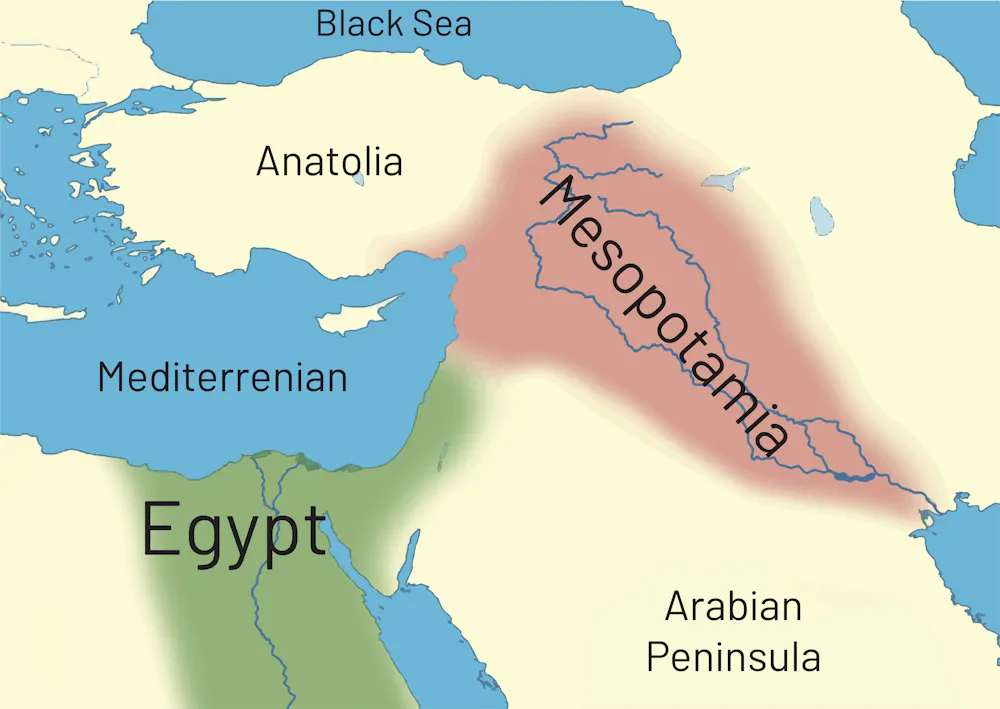
    Developed in its classic form in Babylon, entrail divination was practised throughout ancient Mesopotamia, the written history of which spans from the 3rd millennium BC to the 1st century AD.

    It was enormously important in all sections of society – a standard part of political decision-making at the royal court, but accessible to all. Budget options were even available for those who could not afford a sheep.

    People addressed their questions directly to the gods and believed that at the moment of asking, the answer would be written on the entrails. This could then be “read” by a diviner trained in this esoteric language.

    A map of Mesopotamia, a historical region in modern-day Iraq.
    aipsidtr / Shutterstock

    Sitting in the British Museum is an archive of real questions that were asked by the king of Assyria (a kingdom in northern Mesopotamia) in the 7th century BC. All kinds of affairs of state were put before the gods. Are the Egyptians going to attack? Has the enemy taken the town under siege? And will the governors return home safely?

    Reading the archive, you get a real sense of nerves on a knife-edge as the king waited for news from far away, wanting to know what had happened to his troops and trying to decide what to do next.

    Not only did he ask them about what would happen in the future, but he also consulted them on possible courses of action. Should the Assyrian army go to war? Should the king send a messenger to make peace? Asking the opinion of the gods would have helped him feel more confident in his next steps.

    The Babylonians did not have elections. But that did not mean the king could do whatever he wanted. It was important for his public image to have the gods onside, as well as for his own reassurance.

    Whenever a powerful official was appointed, the entrails would be read to ensure the gods approved. The head of the army, high priests and other important positions were all subject to this requirement. On one occasion, even the choice of crown prince – and hence the future king of Assyria – was put to this test.

    Interpreting the entrails was held to almost scientific standards of exactitude. Diviners worked in pairs or groups of up to 11, checking each other’s work to make sure they got it right. This was not a vague or woolly process, but a real attempt to ensure “accuracy” that could not be manipulated to simply come up with the answer that the king wanted to hear.

    Modern forecasting

    We all want to know what the future has in store, and have come up with ingenious ways of trying to find out, from opinion polls and data modelling to Paul the octopus, who developed a reputation for picking the winners of football matches during the 2010 World Cup. But are our methods really any better than looking inside a sheep?

    As all investors are warned, past performance does not guarantee future results. Yet the only data we have to inform our predictions comes from the past, and most of our models can’t take into account “unknown unknowns”.

    As many experts have found, predicting the future is a difficult business: opinion polls can lie and people change their minds, while economists have often been blindsided by a sudden crash.


    Read more:
    Harris nudges ahead of Trump in the polls – but could the economy prove her downfall?


    A Babylonian clay liver used for divination in Mesopotamia from 2050–1750 BC.
    Science Museum Group Collection, CC BY-NC-ND

    Since liver divination only answers “yes” or “no”, it is going to be right 50% of the time just through the law of averages. Despite its randomness, its success rate may well have seemed convincing at the time.

    And when we trust the authority of the source, it’s easy to find a way to explain away a wrong result – the prediction got halfway there, answered a different question, or would have been right if x hadn’t happened.

    We shouldn’t be blind to the weaknesses of our own methods. We are often wrong, and the Babylonians could sometimes be right.

    Selena Wisnom does not work for, consult, own shares in or receive funding from any company or organisation that would benefit from this article, and has disclosed no relevant affiliations beyond their academic appointment.

    ref. Why ancient Mesopotamians would have used a sheep’s liver to predict Donald Trump’s election odds – https://theconversation.com/why-ancient-mesopotamians-would-have-used-a-sheeps-liver-to-predict-donald-trumps-election-odds-242251

    MIL OSI – Global Reports

  • MIL-OSI Global: The next president will play a key role in shaping US trade policy – here’s what voters need to know

    Source: The Conversation – USA – By Bedassa Tadesse, Professor of Economics, University of Minnesota Duluth

    From the ports of Los Angeles to the cornfields of Iowa, the U.S.’s international trade policy is a force that shapes the lives of every American. With the presidential election looming in November 2024, discussing trade policy isn’t just an academic exercise – it’s a civic responsibility.

    As an economist, I have spent years studying this topic. Trade policy has profound effects on how industries operate, from production locations to competitive dynamics. These changes impact everyday life, from the cost of your morning coffee to the job security in your local community.

    And, because the president has extensive control over trade policy, every presidential election is a referendum on the issue.

    The two most recent administrations – President Donald Trump and Vice President Mike Pence from 2017 to 2021 and President Joe Biden and Vice President Kamala Harris from 2021 to today – have had starkly different approaches to trade policy. The contrast shows how a president’s economic philosophy can reshape the nation’s global business strategy.

    Both Trump and Harris are on the ballot in November. Harris is expected to carry on Biden’s trade policies if she wins. This comparison offers insight into how the next U.S. president will govern on trade.

    2017-2021: Trump and Pence on trade

    Trump pursued a protectionist trade agenda during his time in office.

    Protectionism refers to government policies that limit international trade to benefit domestic industries. These measures include tariffs – taxes on imported goods – quotas and regulations that make imports more expensive.

    One of Trump’s first acts in office was withdrawing from the Trans-Pacific Partnership — a colossal 12-nation pact that would have covered 40% of global output. His decision cost America both access to lucrative Asian markets and a powerful counterweight to China’s economic influence.

    Closer to home, Trump renegotiated the North American Free Trade Agreement (NAFTA) into the United States-Mexico-Canada Agreement,
    tightening rules for automakers. The effect? While wages for workers in the automotive industry and vehicle prices for American consumers increased, it barely spurred any additional domestic car production.

    Trump also launched a tariff-driven trade war with China and the European Union, asserting it would address unfair practices and reduce the U.S. trade deficit. The strategy, however, prompted retaliatory tariffs, resulting in higher consumer prices and job losses in U.S. industries dependent on imported components. While some sectors benefited from the approach, American farmers suffered due to export losses, necessitating government subsidies.

    Trump and his new running mate, JD Vance, have signaled their intent to revive the “America First” trade strategy. Their campaign platform calls for sweeping tariffs, including a blanket 10% tariff on all goods and a more aggressive 60% tariff specifically targeting Chinese products.

    2021-today: Biden and Harris on trade

    In contrast, the Biden-Harris administration adopted a multilateral approach emphasizing cooperation between countries.

    The administration maintained most of Trump’s tariffs on Chinese goods and some on steel and aluminum imports from other countries. However, they reframed the measures as part of a broader push to rein in climate change and protect workers’ rights.

    The administration also launched initiatives like the Indo-Pacific Economic Framework for Prosperity, or IPEF, signaling a return to Obama-era trade strategies prioritizing regional partnerships in the Pacific. The IPEF aims to strengthen economic ties with Asian countries by coordinating policies to enhance supply chain resilience and promote clean energy rather than focusing solely on tariff reductions.

    The Biden-Harris approach emphasizes international cooperation while valuing domestic job creation, particularly in clean energy and manufacturing. However, maintaining many of Trump’s tariffs on Chinese goods, steel and aluminum has kept costs high for some U.S. businesses and consumers.

    Building on the Biden administration’s policies, the Harris campaign has signaled its aim to shield lower- and middle-income households from new tariffs that could raise prices while maintaining a tough stance on China through existing tariffs and trade restrictions.

    Presidential powers and influence on trade

    The president plays a critical role in setting America’s trade policy.

    The president can negotiate international trade deals, although Congress must approve them to become law. The executive branch also controls tariffs; under statutes such as the Trade Act of 1974, the president can impose them without congressional approval.

    In addition, the president can declare national emergencies related to trade, appoint trade representatives, issue executive orders to manage federal trade policies, and impose sanctions that can influence global trade dynamics.

    Free trade agreements can boost exports and promote economic growth, but they may also displace certain workers. In contrast, tariffs on imports protect some domestic industries but raise prices for American consumers. Studies show that tariffs imposed under Trump, and continued by Biden, have led to higher prices, reduced output and lower employment, harming the U.S. economy.

    Trade policies also affect diplomatic relationships and global supply chains. So, as voters sift through the candidates’ trade policy positions, they must look beyond the soundbites. Understanding how each approach affects job markets, consumer prices and global competitiveness will help voters cast an informed ballot that aligns with their vision for the country’s future.

    In the world of trade, every vote counts.

    Bedassa Tadesse does not work for, consult, own shares in or receive funding from any company or organization that would benefit from this article, and has disclosed no relevant affiliations beyond their academic appointment.

    ref. The next president will play a key role in shaping US trade policy – here’s what voters need to know – https://theconversation.com/the-next-president-will-play-a-key-role-in-shaping-us-trade-policy-heres-what-voters-need-to-know-241301

    MIL OSI – Global Reports

  • MIL-OSI Global: Tariffs are back in the spotlight, but skepticism of free trade has deep roots in American history

    Source: The Conversation – USA – By Erik Guzik, Assistant Clinical Professor of Management, University of Montana

    Noted economic nationalist Alexander Hamilton. Douglas Sacha/Getty Images

    One of the more surprising developments in recent American politics has been the backlash against free trade.

    As recently as a decade ago, Democrats and Republicans alike generally favored free trade. But with the 2024 presidential election just days away, both Republican Donald Trump and Democrat Kamala Harris are leaning hard on protectionism. The Trump campaign in particular is promoting tariffs that would be difficult to imagine coming from a Republican presidential candidate just a decade ago.

    This new post-neoliberal moment might seem confounding. But it hearkens back to economic policies – and political parties – from around the time of the nation’s founding, and it offers clues to our divided present.

    Back in the late 18th century, the Founding Father Alexander Hamilton helped put in place a set of policies designed to encourage U.S. industry and to promote economic development and innovation.

    That arrangement, which laid the groundwork for what became known as the “American System,” emerged in part as a counterbalance to British conceptions of free trade. And the American System quickly grew as accepted economic policy as a young America developed its industrial strength.

    Hamilton’s economic nationalism

    In the early years of the republic, the U.S. didn’t have much of a trade policy at all.

    When the U.S. officially achieved independence in 1783 with the signing of the Treaty of Paris, the Articles of Confederation – the nation’s first constitution – greatly limited the federal government’s powers, including its ability to regulate foreign trade.

    These restrictions reflected the reality of 13 very different states that had been more united against the British – and their trade controls – than in support of a common vision of economic development.

    The economic conditions within this loosely connected nation quickly worsened. A deepening economic crisis, rising debt, inflation, cheap British manufactured goods and rising bankruptcy soon emerged. Such changing conditions gave rise to calls for a new national economic policy.

    This economic strain was an important factor leading to the drafting of the U.S. Constitution, ratified in 1789. The Constitution gave the federal government the capacity to regulate trade with foreign countries and, for the first time, to collect taxes. Both were privileges once held exclusively by sovereign American states.

    The ‘second American revolution’

    A strengthened American Congress made passing a national Tariff Act one of its first tasks. When it was ratified in 1789, a national import tax replaced customs previously enacted by the states. Perhaps indicating the magnitude of this change, supporters called it “the Second American Revolution,” passed as it was on July 4, 1789. In effect, it helped create a new conception of the American political and economic system, with a much stronger role for the state in economic matters.

    Duties were levied on 30 commodities, including hemp and textiles. Perhaps foreshadowing trade policy of a future era, the Tariff Act also placed duties of 12.5% on goods imported from China and India.

    The main architect of this new industrial policy was Hamilton, who released his seminal work on economic policy, Report on Manufactures, in 1791. Hamilton’s ideas were based on transforming a predominantly agricultural nation into one defined, at least in part, by growing and diversified industry.

    Though often overlooked, Hamilton’s Report on Manufactures also contained a grander vision – it sought to encourage the development of American invention and ingenuity as a form of economic policy and argued for unlocking “the genius of the people” so that “the wealth of a nation may be promoted.”

    To promote this spirit of national enterprise, Hamilton encouraged promoting technological progress, subsidizing research, attracting migrants, supporting a new financial system and implementing a patent system to promote invention. Such policies were in many ways an extension of previous policy enshrined in Section 8 of the Constitution.

    Tariffs and their discontents

    As the use of tariffs continued in the decades following Hamilton’s plan, policymakers turned increasingly protective in an attempt to more directly promote American industry. They enacted tariffs to insulate growing American industries from foreign competition, primarily from the U.K.

    By the early 19th century, this growing protectionist movement coalesced around the powerful Kentucky legislator Henry Clay and his Whig Party. Clay, who first referred to the American System by name, and his allies were instrumental in raising average national tariff rates to 20% in 1816.

    Those sweetmeats will cost you.
    Library of Congress

    When crisis appeared during the Panic of 1819, a collapse in cotton prices, a tightening of credit, widespread foreclosures and rising unemployment followed. In response, Clay and his allies raised tariff rates again, to 50% in 1828.

    The increasing use of tariffs provoked a fierce response from some in the nation’s agricultural and slave-owning class, who objected to perceived Northern dominance and a strong federal government. One prominent Southern critic at the time referred to the 1828 tariff as the “tariff of abominations.”

    Indeed, opposition to elements of the American System was one of the chief policy goals of early Democratic politicians such as Andrew Jackson, and fights over the system presaged later sectional fights leading up to the Civil War.

    As an industrial revolution took root in American society in the decades that followed, tariffs remained a cornerstone of U.S. economic policy. By the late 1850s, tariffs had become integrated into the policy of the newly formed Republican Party and an important plank of Abraham Lincoln’s economic platform.

    Toward the end of the 19th century, a changing Democratic Party, supported increasingly by a strong agricultural populist movement, continued to largely oppose the tariff system, arguing it benefited powerful industrialists at the expense of the working class while offering little to counter economic crisis.

    The breakup of the American System − and why it matters today

    Between 1861 and 1933, tariffs were a standard tool of U.S. economic policy. During this period, tariffs on dutiable goods often averaged 40% to 50%, especially in the late 19th and early 20th centuries. U.S. policymakers didn’t seriously question tariffs as a form of industrial policy until the deepening of the Great Depression in the 1930s.

    Following World War II, the U.S. decisively shifted away from tariffs. The Smoot-Hawley Tariff Act was widely blamed for deepening the Great Depression and contributing to the international conflicts of the 1930s and 1940s, effectively ending the protectionist era of U.S. industrial history.

    The establishment of the Federal Reserve in 1913 provided policymakers with a novel tool – monetary policy – to deal with economic downturns. The Keynesian revolution provided still another policy response for governments to consider during periods of economic crisis: spending as fiscal stimulus to create jobs and income.

    Finally, as postwar American policy embraced open global trade, American economic policy pursued more direct mechanisms to foster national innovation and entrepreneurship – effectively breaking up policy once dependent on activist trade intervention. With the elimination of tariffs, one of the great periods of American economic growth and innovation followed.

    In 2024, the Republican platform has, in many ways, returned to its origins by offering tariffs as a key economic strategy. Likewise, the Democratic platform, with its skepticism of concentrated corporate power, coupled with a renewed focus on financial support for small businesses and entrepreneurship, echoes its own earlier generation.

    As Americans head to the polls, it’s worth asking how current economic proposals with deep roots in the American System of old might help shape economic policy in the future.

    Erik Guzik does not work for, consult, own shares in or receive funding from any company or organization that would benefit from this article, and has disclosed no relevant affiliations beyond their academic appointment.

    ref. Tariffs are back in the spotlight, but skepticism of free trade has deep roots in American history – https://theconversation.com/tariffs-are-back-in-the-spotlight-but-skepticism-of-free-trade-has-deep-roots-in-american-history-241311

    MIL OSI – Global Reports

  • MIL-OSI Global: New Orleans schools still separate and unequal 70 years after Brown v. Board of Education

    Source: The Conversation – USA – By Connie L. Schaffer, Professor of Teacher Education, University of Nebraska Omaha

    First graders led the desegregation of New Orleans’ public schools in November 1960. Bettmann via Getty

    Sixty-four years ago this November, public schools in New Orleans began to desegregate. School buildings once designated as “white” opened their doors to Black students. The integration process, which deeply divided the city, was led by four first-grade girls.

    Tessie Prevost, Leona Tate and Gail Etienne were the first Black students to attend the McDonogh 19 School. Ruby Bridges was assigned to the previously all-white William Frantz Public School. Newspapers worldwide ran photographs of the girls walking past protesters and entering the schools accompanied by federal marshals.

    When Prevost died in July 2024, she was lauded as a Civil Rights hero. Oprah Winfrey paid tribute to her at the Democratic National Convention.

    Prevost herself did not realize her role in history until high school, when a teacher assigned the class a project on Brown v. Board of Education, the 1954 U.S. Supreme Court ruling that desegregated American schools. As she researched, she discovered her own name and story. She took this discovery to her parents, and they gave her a box of photographs and letters about her place in history, including a note from Eleanor Roosevelt praising her courage.

    To some, Prevost represents the promises of the Civil Rights Movement: integration and equality. As our research on New Orleans Public Schools shows, however, neither of these promises has ever been fully realized.

    New Orleans’schools resegregated in the late 20th century, and the city’s predominantly Black schools still lag behind white schools in many ways.

    ‘All deliberate speed’

    In the landmark 1954 U.S. Supreme Court decision Brown v. Board of Education, the justices ordered U.S. public schools to desegregate “with all deliberate speed” – language that allowed Southern cities and states to drag their heels.

    New Orleans schools did not begin desegregating for six years. Even then, only four first-grade girls out of thousands of Black students were permitted to enroll in white schools.

    The New Orleans district would subsequently desegregate one additional grade per year. As a member of that first desegregated class, Prevost was always in the grade being integrated. As such, all the grades above her remained segregated.

    Indeed, McDonogh 19 remained segregated during the first year of integration because all its white students immediately stopped attending. By December 1960, the school’s only students were the three Black girls. Two white students briefly enrolled in January, but their family succumbed to the pressure of the boycott and soon withdrew their children.

    White New Orleans residents protesting school integration in 1960.
    Bettmann / Contributor via Getty

    When Prevost, Etienne and Tate entered second grade, McDonogh 19 still had very low enrollment. In third grade, in 1962, the girls transferred to T.J. Semmes Elementary School, where enrollment of white students was much higher.

    Within that white student majority, the girls encountered many cruel classmates. White students, encouraged by some teachers and parents, tormented their Black peers. Prevost recalled this as the worst time in her life.

    “The white teachers and students did not want us there,” she said. “Every day there were beatings and cursing. They spat on us and ripped off our clothes.”

    After several years, Prevost’s parents recognized the impact of this heinous racism on their daughter and transferred her into a predominantly Black junior high school. Prevost would again be separated from most of her white peers.

    Equality in name only

    The Brown ruling also promised an equal education regardless of race. In practice, that has yet to happen.

    Most white teachers in New Orleans opposed desegregation, and the district initially allowed teachers to choose where they would teach. In 1972, however, the district reassigned many teachers to work in desegregated schools, and many quit in protest. Other white teachers struggled to connect and engage with their Black students, leading to disaffection among Black students. Their academic achievement declined, and dropout rates began to rise.

    Simultaneously, white flight was working against integration. Between 1960 and 1980, the white population of New Orleans dropped 20%, resegregating many New Orleans schools. By 2004, 50 years after the Brown ruling, McDonogh 19 – which by then had been renamed Louis Armstrong Elementary – was again effectively segregated by race: Nearly 100% of its students were Black.

    Across the district, academic performance declined in predominantly Black schools. By the 1990s, student achievement became increasingly measured by standardized tests known to be biased against students of color and poor students. Black students were also more likely to be taught by teachers with fewer years of experience and less education.

    By 1998, test scores at Louis Armstrong Elementary had fallen well below national, state and district averages. The school was also in a state of deep disrepair. In the summer of 2005, the city closed the school, and a few months later, Hurricane Katrina hit New Orleans.

    The abandoned school building sustained heavy wind damage and flooding. Water reached halfway up the walls of the first floor, leaving toxic mud, peeling chalkboards and mold-encrusted furniture.

    A legacy

    Following Katrina, the State Board of Education stripped New Orleans Public School District of its authority to manage public education.

    The state of Louisiana and charter organizations took over city schools, making New Orleans Public Schools the first all-charter school district in the U.S. Despite the change in governance, New Orleans schools remained segregated by race. Over a decade later, in 2017, roughly 75% of schools had populations of 95% students of color, and test scores showed only incremental improvement.

    Prevost, whose married name was Tessie Williams, lived in New Orleans her whole life, working at Louisiana State University for over two decades.

    She returned to McDonogh 19 in 2022, when the restored building opened as the Tate, Etienne and Prevost Center. The site, once a symbol of resistance to civil rights, is now a community center and museum committed to advancing the unfulfilled promises of the Brown ruling.

    As an adult, when Prevost spoke publicly about desegregation, she recalled the difficulty and disappointment she and others faced. But she tended to emphasize her hope for the future.

    “The ways that we are different are things that we should celebrate,” she said in a Black History Month interview with Louisiana State University. “There is so much power and freedom when we see differences in a positive light.”

    The authors do not work for, consult, own shares in or receive funding from any company or organization that would benefit from this article, and have disclosed no relevant affiliations beyond their academic appointment.

    ref. New Orleans schools still separate and unequal 70 years after Brown v. Board of Education – https://theconversation.com/new-orleans-schools-still-separate-and-unequal-70-years-after-brown-v-board-of-education-235642

    MIL OSI – Global Reports

  • MIL-OSI Global: Rust Belt voters aren’t all white, but election coverage of the region often ignores the concerns of people of color there

    Source: The Conversation – USA – By Christabel Devadoss, Assistant Professor in Global Studies and Human Geography, Middle Tennessee State University

    Wisconsin voters lining up to cast their ballots in the 2022 midterm election, Oct. 25, 2022, in Milwaukee. Scott Olson/Getty Images

    Every four years, national media turn their attention to the Rust Belt, a term that describes Midwestern industrial and manufacturing states whose economies were decimated by the decline of those industries in the 1970s. This region contains the coveted states of Ohio, Michigan, Wisconsin and Pennsylvania.

    Many rural parts of these states have a majority of white residents. The broader Rust Belt, however, also has long and important Black and Indigenous histories and contains some of the nation’s fastest-growing minority populations – in particular Latino, Arab and Asian communities.

    Yet when reporters descend on the rural Rust Belt to understand voters, the people they talk to are almost exclusively white.

    I am a geographer who studies the experiences of communities of color in the rural Rust Belt. Rural is a relative term, but when it comes to policy research, it usually refers to nonmetropolitan areas. From 2021 to 2023, I interviewed 35 people who live or lived in Ohio, Pennsylvania, Michigan and Indiana and identified as Black, Indigenous or people of color.

    I found that these Rust Belt residents have pressing concerns of political importance. Some of these issues are shared by white residents – and, as such, are well documented. But Rust Belt residents of color have additional problems that politicians and the media have long overlooked.

    Local impacts

    My interviewees described typical rural Rust Belt struggles.

    They complained of limited internet access, few or no grocery stores, declining roads and other infrastructure-related challenges. Jobs and opportunities for career advancement were scarce in their communities, while death and suicide rates were high.

    These difficulties are faced by white Rust Belt residents as well. But other struggles they mentioned are less often considered part of the rural experience.

    They described feeling socially isolated and discriminated against at work and school. Many had experienced racial or ethnic profiling by potential employers and police and been verbally harassed.

    One man, Miguel, who worked in carpentry, said his colleagues openly used racial slurs against him.

    “I was putting away some boxes, and they said, ‘Oh that’s because you w–backs are good at packing things in trucks,’” he told me.

    All names used here are pseudonyms; research ethics require me to protect the identity of my subjects.

    “A lot gets brushed under the rug,” said Bao, a Vietnamese American woman whose father also works in a hostile environment. “All the management folks are white,” so “if you speak up, you lose your job or are ignored.”

    These comments conveyed an overall sense of not “belonging.”

    As one woman from rural Pennsylvania explained, people regularly ask her, “No, really, where you from?”

    “They want to hear ‘Asian’ or ‘Korean,’” she said. “It’s very uncomfortable for me.”

    These racial tensions worsen during election periods. Some people I interviewed reported having been turned away or threatened at voting stations – harassment they attributed to their religious, cultural and political backgrounds, or the way they looked.

    Many Rust Belt voters of color already lack political power because they live in racially gerrymandered districts. When news coverage of the region ignores their voices, too, it compounds that feeling of not belonging.

    In 2017, The Washington Post visited the small town of Jefferson, Ohio, in Ashtabula County, to interview voters described as “rural Americans who fear they’re being forgotten” after Donald Trump’s election. Their coverage focused almost exclusively on white residents.

    “How did you go to Ashtabula County and not see Black people?” asked Belle, a resident who identified as African American.

    Not always Republican

    In the past three presidential elections, Ashtabula County has followed state trends: It backed Obama in 2008 and 2012, then voted for Trump in 2016 and 2020.

    Trump won Ashtabula with 60% of the vote in 2020. That’s 26,890 votes, which means that 16,497 people still voted for Democrat Joe Biden. In the years since, Ashtabula County residents have also voted with the state in two Democratic-backed initiatives: to protect abortion rights and legalize marijuana.

    In other words, just because a state or district backs a Republican for president doesn’t mean everyone is Republican, or that Republican voters always vote the party line. They can split their votes, and have.

    Even Ohio’s largely Republican delegation in the House of Representatives is misleading about the state’s political makeup. Ohio is a heavily gerrymandered state where voting districts have been drawn to benefit Republican candidates.

    U.S. Senate elections show more diversity in Ohio’s voting base.

    In 2018, Democrat Sen. Sherrod Brown won 53% of all votes in Ohio, including 51% of those cast in Ashtabula County. Four years later, both the state and Ashtabula County picked Republican JD Vance over Democrat Tim Ryan to replace the outgoing Republican Sen. Rob Portman.

    Why it matters

    In September 2024, Vance – now Trump’s vice presidential running mate – claimed that Haitian migrants in Springfield, Ohio, were kidnapping and eating cats and dogs. After Trump echoed that false claim on the debate stage, the city got 30-plus bomb threats and other threats of violence, and had to close multiple schools.

    During the pandemic, Trump’s derogatory branding of COVID-19 as the “Chinese virus” and “Kung Flu” led to increased hate crimes against immigrants and people of color.

    In my interviews, several participants mentioned how local restaurants and stores owned by Asian Americans had been vandalized. One woman, Lanh, who lived outside Springfield, said her favorite restaurant had to close.

    “They started vandalizing the restaurant, writing graffiti and set the restaurant on fire,” she said.

    The owners were from Thailand, but, Lanh said, the vandals “thought they were Chinese. Folks around the local community like my parents didn’t feel safe,” she added. “I didn’t feel safe.”

    Hateful political rhetoric is known to increase hate crimes against immigrants and people of color.

    When the Rust Belt is stereotyped as red and white, such experiences go unheard.

    So do some good news stories.

    The emergence of Black-owned bee farms in northeast Ohio, for instance, is one small example in a host of businesses started by people of color. Together, they are helping to boost the region’s beleaguered economy, much as Haitian immigrants have been fueling Springfield’s growth.

    Rural America is nuanced

    Nationwide, 24% of rural Americans identified as people of color in the 2020 census.

    That figure is probably low because the census tends to undercount nonwhite respondents – a problem that was particularly evident in 2020. Even so, that’s a quarter of rural residents who don’t fit the national stereotype of rural America.

    Rural America is white and Republican. It’s also trans, queer, Black, Hispanic, Indigenous, South Asian, Democratic and much more. Even if some are Republican, they still aren’t the rural Rust Belt Republicans portrayed in the national media.

    Ignoring these nuances reinforces stereotypes that the rural Rust Belt is the exclusive domain of white conservativism. But this region isn’t now, and never has been, simply red and white.

    Christabel Devadoss received funding from the American Council of Learned Societies (ACLS).

    ref. Rust Belt voters aren’t all white, but election coverage of the region often ignores the concerns of people of color there – https://theconversation.com/rust-belt-voters-arent-all-white-but-election-coverage-of-the-region-often-ignores-the-concerns-of-people-of-color-there-224466

    MIL OSI – Global Reports

  • MIL-OSI Global: Independent voters think for themselves and stay out of politics – 3 essential reads

    Source: The Conversation – USA – By Jeff Inglis, Politics + Society Editor, The Conversation US

    Jessie Harris, left, a registered independent voter in South Carolina, casts a ballot in February 2024. Joe Lamberti for The Washington Post via Getty Images

    In the 2024 election, the two major-party campaigns and many news reporters are spending a lot of time talking about independent voters – those who are neither aligned with the Republican Party nor the Democratic Party. Despite the power that political independents are anticipated to have over the election results, there’s a lot that remains unknown about this group.

    The Conversation U.S. has published several articles about what is known, and why it’s hard to know much more. Here are selections from some of those articles:

    1. How many independent voters are there?

    It’s very hard to answer that question, wrote Thom Reilly, a professor of public affairs at Arizona State University. Part of the problem is figuring out how to define who independent voters are. Surveys often ask people if they are Republicans, Democrats or independents, and if they answer that they are independents, the surveys ask how strongly they might lean toward one party or the other. But this muddies the waters of political identity, Reilly wrote:

    It’s possible that some voters identify as independent but really just have weaker political preferences than party die-hards, while still maintaining some loyalty to one party or the other. And some independent voters change their political identification from one cycle to another. That makes it hard to tell who an independent voter is and how many of them exist.”

    Those changing alignments, Reilly wrote, “may require scholars, media outlets and the public to shift their traditional two-party view of American politics.”


    Read more:
    Why is it so hard to know how many independent voters there are?


    2. Independent voters think for themselves

    Independent voters exhibit a key quality that most Americans expect of their fellow citizens: They base their views on their life experiences.

    Unfortunately, as politics scholars Shanna Pearson-Merkowitz at the University of Maryland and Joshua J. Dyck at UMass Lowell explained, this is an attribute almost unique to political independents:

    In contrast, Democrats’ and Republicans’ ideas of what problems deserve government attention and how to solve them are much less likely to be based on their own life experiences, and instead simply mirror the information they have gained from leading political figures on social media, on cable news networks or through other partisan information outlets.”

    For instance, independents living in neighborhoods with high levels of gun violence are far more likely to report being concerned about gun violence than independents who live in safer areas. But, Pearson-Merkowitz and Dyck wrote,

    “for Democrats and Republicans, there is no relationship between where they live and their level of concern about gun violence: Whether they live in a relatively dangerous community or a relatively safe one, their views on gun violence reflect their party’s messages on the issue.”


    Read more:
    Politics is still both local and personal – but only for independents, not for Democrats or Republicans


    3. Independents less likely to engage in any politics

    Research into independents’ political activity finds them tending to stay away from politics, wrote Julio Borquez, a political science scholar at the University of Michigan-Dearborn:

    “Perhaps most importantly, pure independent voters are simply less likely to vote than those who express any degree of partisan attachment. In the 2020 presidential election, reported turnout among pure independents was about 20 percentage points lower than turnout among other voters, including independents who lean toward a party.”

    Research has found members of this group “tend to be genuinely put off by partisan conflict and party labels,” Borquez wrote. Different studies have found, for instance, that they prefer photos of neighborhoods that did not show political yard signs over the same photos of the same neighborhoods with homes displaying political yard signs. And they pay less attention to campaigns and partisan social media than people with partisan affiliations.

    So they are indeed independent – but the question remains whether they will be uninvolved in 2024 or motivated to cast their ballots and make their views known.


    Read more:
    Independent voters are few in number, influential in close elections – and hard for campaigns to reach


    ref. Independent voters think for themselves and stay out of politics – 3 essential reads – https://theconversation.com/independent-voters-think-for-themselves-and-stay-out-of-politics-3-essential-reads-241193

    MIL OSI – Global Reports

  • MIL-OSI Global: Americans own guns to protect themselves from psychological as well as physical threats

    Source: The Conversation – USA – By Nick Buttrick, Assistant Professor of Psychology, University of Wisconsin-Madison

    Many gun owners cite protection as a reason to carry a firearm. RJ Sangosti/MediaNews Group/The Denver Post via Getty Images

    Kamala Harris, Donald Trump, Tim Walz and JD Vance all have something in common. All four of them, along with an estimated 42% of American adults, have lived in a home with at least one gun.

    Gun ownership in the United States is widespread and cuts across all sorts of cultural divides – including race, class and political ideology. Like all mass experiences in American life, owning a gun can mean very different things to different people.

    One thing that American gun owners tend to agree on, no matter their differences, is that guns are for personal protection. In a 2023 Pew survey, 72% of gun owners reported that they owned a firearm at least in part for protection, and 81% of gun owners reported that owning a gun helped them to feel safer. This perspective contrasts to that of gun owners in other developed economies, who generally report that guns are more dangerous than safe and that they own a gun for some other reason.

    I’m a psychologist who studies contemporary society. In the lab, my colleagues and I have been investigating this feeling of safety that American gun owners report. We’re trying to get a more complete sense of just what people are using their firearms to protect against. Our research suggests it goes much deeper than physical threats.

    Social scientists are exploring the motivations and effects of owning a gun.
    Cécile Clocheret/AFP via Getty Images

    Protection goes beyond the physical

    By combining social-scientific research on firearms ownership with a raft of interviews we’ve conducted, we’ve developed a theory that gun owners aren’t just protecting against the specific threat of physical violence. Owners are also using a gun to protect their psychological selves. Owning a gun helps them feel more in control of the world around them and more able to live meaningful, purposeful lives that connect to the people and communities they care for.

    This sort of protection may be especially appealing to those who think that the normal institutions of society – such as the police or the government – are either unable or unwilling to keep them safe. They feel they need to take protection into their own hands.

    This use of a deadly weapon to provide comfort and solace may come at a cost, however, as firearms often bring a heightened sense of vigilance with them. Firearm instructors frequently teach owners to be especially aware of their environment and all the potential dangers and threats within. When gun owners look for danger, they often are more likely to find it.

    Gun owners may end up perceiving the world as a more dangerous place, institutions as more uncaring or incompetent, and their own private actions as all the more important for securing their lives and their livelihoods.

    How gun owners feel during daily life

    What does this cycle of protection and threat look like in everyday life? My colleagues and I recently ran a study to investigate. We’re still undergoing peer review, so our work is not final yet.

    We recruited a group of over 150 firearms owners who told us that they regularly carry their guns, along with over 100 demographically matched Americans who have never owned a gun. Over two weeks, our research team texted the participants at two random times each day, asking them to fill out a survey telling us what they were doing and how they were feeling.

    To get a sense of how guns change the psychological landscape of their owners, we divided our gun-carrying group into two. When we texted one half of the group, before we asked any other questions, we simply asked whether they had their gun accessible and why they’d made that decision. For the other half of our gun-owning participants, and for our non-gun-owning control group, firearms and firearm carrying never came up.

    When subtly reminded of guns in general – regardless of whether their gun was accessible – our participants reported feeling more safe and in control and that their lives were more meaningful. Thanks to our random-assignment procedure, we can be pretty confident that it was thinking about guns, as opposed to any differences in the underlying groups themselves, that caused this particular increase in psychological well-being.

    About half of the times that we texted, the gun owners told us that they had a gun accessible at that moment. When a gun was handy, our participants told us that they were feeling more vigilant and anxious, and that their immediate situation was more chaotic. This result didn’t seem to be driven by owners choosing to have guns available when they were putting themselves into objectively more dangerous situations: We found the same pattern when we looked just at moments when our participants were sitting at home, watching television.

    Raising fear and promising rescue

    Contemporary American gun ownership may have conflicting messages embedded within it. First, a gun is a thing you can use to bolster your fundamental psychological needs to feel safe, to feel in control and to feel like you matter and belong. Second, having a gun focuses your attention on the dangers of the world.

    By both fueling a sense of danger and holding out the promise of rescuing you from the fear, messaging around guns may end up locking some owners into a sort of doom loop.

    A sense of responsibility goes along with gun ownership for the vast majority of Americans who own a firearm.
    Matt McClain/The Washington Post via Getty Images

    My collaborators and I are currently exploring whether stressing other parts of gun ownership may help owners to move beyond this negative spiral. For instance, while owners often talk about “danger,” they also talk frequently about “responsibility.”

    Being a responsible gun owner is central to many owners’ identities. In one study, 97% of owners reported that they were “more responsible than the average gun owner,” and 23% rated themselves as being in the top 1% of responsibility overall. This, of course, is statistically impossible.

    To more fully understand the many ways responsible firearm ownership can look, we are in the process of interviewing gun owners from all around the state of Wisconsin, a notably diverse state when it comes to gun ownership. We’re tapping into as many of the ways of owning a gun as we can, talking with protective owners, hunters, sport shooters, collectors, folks in urban areas, folks in rural areas, men, women, young people, old people, liberals, conservatives, and, of course, trying to capture the complex ways that race shapes ownership.

    Who do gun owners feel they are responsible for? What kinds of actions do they think responsible owners take?

    We hope to learn more about the many different ways that people conceptualize what a gun can do for them. American gun cultures are complex and distinct things. By exploring the worldviews that support firearm ownership, we can better understand what it means to live in the U.S. today.

    Nick Buttrick receives funding from the National Science Foundation and the Wisconsin Department of Justice.

    ref. Americans own guns to protect themselves from psychological as well as physical threats – https://theconversation.com/americans-own-guns-to-protect-themselves-from-psychological-as-well-as-physical-threats-239363

    MIL OSI – Global Reports

  • MIL-OSI Global: In Hawaii, parasites and viruses team up in the battle against fruit flies – an entomologist explains the implication for global pest control

    Source: The Conversation – USA – By Kelsey Coffman, Assistant Professor of Entomology & Plant Pathology, University of Tennessee

    Diachasmimorpha longicaudata, a parasitoid wasp that helps control pests. Sheina Sim, CC BY

    Take a stroll along one of the beaches on Hawaii Island in late summer, and you’ll likely stumble upon almond-shaped fruits lying in the sand. Known as false kamani nuts, or tropical almonds, they fall from tall, shady Terminalia catappa trees that line the many picturesque ocean views on the island.

    But what may not be clear to the casual beachgoer is that there’s a fight for survival occurring within the flesh of these unassuming fruits. Tropical almonds are one of many active battlegrounds in a war between a global agricultural pest, a parasitic wasp and a beneficial virus.

    As an entomologist who studies insect viruses, I want to untangle the complex interactions that insects have evolved with microbes. The findings might help researchers tackle global food security issues.

    A global pest challenge

    At the center of this conflict are invasive fruit flies in the family Tephritidae, many of which have spread across the globe and wreak havoc on hundreds of commercial fruits and vegetables.

    In Hawaii, several species of tephritid fruit fly invaded, starting in the late 1800s. They have caused major economic losses to fruit production across the islands. Scientists and fruit growers have undertaken enormous efforts to control these flies since their initial introductions, but they remain a serious economic problem.

    One reliable method of control has been to release tiny insects called parasitoid wasps into the wild that can hunt down immature fruit flies and target them for annihilation. The term parasitoid describes an organism that spends its development as a parasite and eventually kills its host.

    Parasitoid wasps use an elongated stinger, known as an ovipositor, to drill into fruits where flies are developing and pierce the fly’s body to lay an egg within. Wasp eggs hatch inside the fly host and gradually devour the entire fly from the inside out.

    Human use of parasitoid wasps or other natural enemies to control pest populations is known as biological control, or biocontrol. It was so successful in Hawaii that several species of parasitoid wasp have established wild populations on the islands. They have helped continuously suppress multiple fruit fly pests to this day.

    The release of nonnative insects for biocontrol could have unforeseen negative consequences for local ecosystems. Therefore, federal agencies like the U.S. Department of Agriculture have strict regulations for new and existing biocontrol programs.

    The enemy of my enemy is my friend

    So, how do wasps achieve the impressive feat of reducing fruit fly pest populations? Once laid inside a fly host, the wasp must face the fly’s immune system, which will try to suffocate the egg before it hatches.

    This inhospitable environment has forced wasps to evolve an arsenal of microscopic substances, also known as molecular factors, to combat fly defenses. These include a cocktail of different molecules introduced by the wasp mother at the time of egg-laying.

    The goal of these factors is to manipulate the fruit fly’s physiological processes, like its development from egg to adult and its immune response to invading parasites. By interacting with molecular components, like proteins, that make up insect physiological pathways, parasitoid wasp factors can delay insect host development and suppress host immunity to allow the wasp offspring to feed on fly tissue unharmed.

    This is the origin story of an unlikely partnership that many species of parasitoid wasp have formed with beneficial viruses. Virus particles multiply to massive quantities within the reproductive organs of female wasps during their development. Wasp mothers then use their ovipositor like a hypodermic needle to inject virus particles into host insects during egg-laying.

    The virus particles turn into biological weapons that infect cells of the wasp’s host. This infection disrupts processes like the fly’s immune response. Developing wasps benefit from the virus’s activity and return the favor by passing on the virus to future wasp generations.

    Not all heroes wear capes

    Diachasmimorpha longicaudata is a small, bright orange wasp with a distinctively long ovipositor. The literal translation of longicaudata is “long-tailed” in Latin. But don’t let its charismatic appearance fool you.

    D. longicaudata is ferocious in its ability to feast on several species of fruit fly pests, such as the Mediterranean fruit fly, Ceratitis capitata, and the oriental fruit fly, Bactrocera dorsalis. Because of D. longicaudata’s ability to attack a wide variety of fruit fly pests, pest management specialists around the world have released the wasps into agricultural ecosystems, where they dependably establish new populations and provide sustained pest control.

    Like many parasitoids, D. longicaudata has formed an alliance with a virus known as Diachasmimorpha longicaudata entomopoxvirus, or DlEPV.

    DlEPV replicates within the venom gland of female wasps, which stores billions of virus particles. Virus particles are so densely packed in there that they often cause the venom gland to appear iridescent blue.

    DlEPV particles are highly lethal when injected into flies in the lab. The virus freezes the fly’s development and replicates with abandon until the fly’s ultimate demise.

    In contrast, the alliance between wasp and virus is so strong that curing D. longicaudata wasps of their resident DlEPV infection causes the wasp offspring to die inside the fly hosts.

    A new potential path forward

    My colleagues and I published a study showing that DlEPV may play a critical role in helping D. longicaudata make a meal out of so many different fruit fly pests. We found a link between D. longicaudata survival and DlEPV lethality within different fruit fly host species.

    When we infected C. capitata and B. dorsalis flies with DlEPV, the virus successfully replicated and killed large swaths of fly hosts. However, DlEPV couldn’t replicate within the melon fly, Zeugodacus cucurbitae, a fly species that D. longicaudata wasps cannot use as hosts.

    These findings shine new light on the effect viruses have on host-parasite rivalries. The presence of these viruses could influence how useful parasitoid wasps are in getting rid of fruit fly pests. In the case of D. longicaudata, its associated virus may be responsible for the decades of reliable aid this wasp has provided to fruit fly biocontrol programs around the world.

    This work has also revealed a new potential tool in the war against fruit fly pests. DlEPV is now known as a lethal enemy for several of the world’s most destructive pest species. If researchers can determine precisely how DlEPV exploits fly hosts at a molecular level, they could one day incorporate the same strategies that this virus uses into new fruit fly pest control methods.

    Kelsey Coffman receives funding from USDA National Institute of Food and Agriculture (NIFA).

    ref. In Hawaii, parasites and viruses team up in the battle against fruit flies – an entomologist explains the implication for global pest control – https://theconversation.com/in-hawaii-parasites-and-viruses-team-up-in-the-battle-against-fruit-flies-an-entomologist-explains-the-implication-for-global-pest-control-234780

    MIL OSI – Global Reports

  • MIL-OSI Russia: Young scientists from the State University of Management presented the results of their research at the All-Russian forum “Science of the Future – Science of the Young”

    Translation. Region: Russian Federation –

    Source: State University of Management – Official website of the State –

    From October 29 to November 1, the IX All-Russian Youth Scientific Forum “Science of the Future – Science of the Young” is being held at the Samara National Research University named after Academician S.P. Korolev.

    The forum is attended by more than 500 Russian and foreign researchers, winners of the mega-grant program, heads of world scientific schools and laboratories, young scientists, students and postgraduates.

    At the opening ceremony, the participants were addressed with welcoming words by the Head of the Department of the Presidential Administration of Russia for Scientific and Educational Policy Tatyana Gracheva, the Director of the Department of State Policy in the Sphere of Scientific and Technological Development of the Ministry of Education and Science of Russia Anton Shashkin, the Chairperson of the Committee on Education and Science of the Samara Regional Duma Svetlana Ilyina, the President of Samara University, Academician of the Russian Academy of Sciences Viktor Soyfer, the Rector of Samara University Vladimir Bogatyrev and the Scientific Director of Samara University, Academician of the Russian Academy of Sciences Evgeny Shakhmatov.

    The main topics of the forum’s business program were the search for effective ways to attract young people to solve the problems outlined in the Strategy for Scientific and Technological Development of the Russian Federation, and the formation of an effective system of interaction between science, technology and production. At the plenary sessions, leading scientists and experts spoke about new trends in aircraft manufacturing and space exploration, quantum technologies and artificial intelligence, problems of neurodegeneration and how young researchers can build a successful career in science.

    The State University of Management was represented at the forum by Associate Professor of the Innovation Management Department Denis Serdechny and Director of the Business Incubator Dmitry Rogov.

    Denis Serdechny spoke at the opening of the Information Technology and Mathematics section with a scientific report on software and hardware systems and intelligent platform digital solutions in the field of agro-industrial technologies. In his report, the associate professor of the Department of Innovation Management spoke about the competencies of the State University of Management in building ecosystems and platform solutions for business, as well as about the results of research within the framework of a large scientific project – developed methods for assessing the digital maturity of agricultural enterprises, the concept of a data parser for a digital platform and the concept of an intelligent decision support system for computer vision for agricultural tasks.

    Dmitry Rogov opened the Engineering Sciences section by presenting a report on the application of mass service theory tools to optimize the operation of transport infrastructure facilities. Particular attention was paid to simulation modeling, which is used both at the design stage of new infrastructure facilities, which are complex mass service systems, and to optimize the operation of existing ones. The SMU postgraduate student demonstrated to the meeting participants a transport hub model created in the AnyLogic environment, formed on the basis of several logical layers: a two-dimensional scheme, a process diagram, and 3D visualization, and presented the results of an assessment of the qualitative indicators of the system’s functioning, necessary for further analysis and management decision-making.

    Subscribe to the TG channel “Our GUU” Date of publication: 10/31/2024

    Please note: This information is raw content directly from the source of the information. It is exactly what the source states and does not reflect the position of MIL-OSI or its clients.

    MIL OSI Russia News

  • MIL-OSI USA: Exceptional Teachers Chosen for Master Teacher Program

    Source: US State of New York

    Governor Kathy Hochul today announced the selection of 144 STEM teachers for the New York State Master Teacher Program, a professional network of more than 1,700 public-school teachers with a passion for inspiring the next generation of educational leaders. Twenty-six counselors were also selected as part of the inaugural Master Counselor Program.

    “Here in New York, we are incredibly grateful for our teachers’ and counselors’ dedication to inspiring and shaping the minds of our students – the next generation of leaders in our state,” Governor Hochul said. “Through the New York State Master Teacher Program, we’re recognizing the hardworking educational leaders who are helping us build a world-class education system here in New York for generations to come.”

    In addition, the application process for the next round is open now through January 26, 2025. Interested applicants can review the eligibility requirements and attend an information session with program staff.

    The new members represent 83 school districts with a Master Teacher or Master Counselor among their faculty, with 40 program members from high-needs districts including Albany, Buffalo, Binghamton, Plattsburgh City, Rochester, Schenectady, Syracuse, Utica, and, for counselors, New York City School Districts.

    Master Teachers support students in grades K-12 in the areas of science, technology, computer science, robotics, coding, engineering, math, and integrated STEM.

    More than half of the new members have been in the classroom for more than ten years, and more than 45 percent have been teaching for 15 or more years. The incoming group of Master Teachers is comprised of 25 percent elementary level teachers, 48 teachers with multiple teaching certifications, 15 teachers certified in Special Education and two teachers who hold a Bilingual Education Extension.

    The Master Counselors are active members of their professional associations serving in leadership roles, and regularly engage with local industries to help students and their families chart a path to student success. More than half of the 2024 Master Counselors have been in a counseling role for longer than ten years. The counselors serve in various district-level and state-level roles, joining the program as experienced leaders dedicated to developing and sharing best practices. One-third of the Master Counselors hold additional certificates or NYS trainings including Occupational Therapy, Disability Services, National Board, and Mental Health Counseling.

    SUNY Chancellor John B. King Jr. said, “As the state’s largest educator preparation provider, SUNY is proud of the success of all teachers and school counselors throughout their careers. We applaud Governor Hochul for recognizing excellence in teaching as well as the importance of school counselors in helping New York State students achieve their aspirations for college and careers.”

    Master Teachers and Master Counselors are leaders in their professions, serving as mentors for students and early-career teachers and counselors. Many new members have been awarded grants for STEM or counseling program resources. The Master Teacher Program is hosted at nine SUNY campuses to leverage the expertise of the University’s faculty and existing educator preparation programs, and SUNY counterparts collaborate regularly with local STEM career and industry experts.

    The total number of teachers and counselors selected from each region, and the respective partner SUNY campus, are:

    • Capital Region: 219 Master Teachers and 4 Master Counselors (University at Albany)
    • Central New York: 213 Master Teachers and 3 Master Counselors (SUNY Cortland)
    • Finger Lakes: 223 Master Teachers and 3 Master Counselors (SUNY Geneseo)
    • Long Island: 206 Master Teachers and 5 Master Counselor (Stony Brook University)
    • Mid-Hudson: 200 Master Teachers and 7 Master Counselors (SUNY New Paltz)
    • Mohawk Valley: 140 Master Teachers and 4 Master Counselors (SUNY Oneonta)
    • North Country: 130 Master Teachers and 6 Master Counselor (SUNY Plattsburgh)
    • Southern Tier: 252 Master Teachers and 7 Master Counselors (Binghamton University)
    • Western New York: 244 Master Teachers and 7Master Counselors (SUNY Buffalo State)
    • New York City: 160 Master Teachers (in partnership with Math for America) and 5 Master Counselors

    Throughout their four-year participation in the Program, Master Teachers, and Master Counselors will receive a $15,000 stipend annually; engage in peer mentoring and intensive content-oriented professional development opportunities throughout the academic year; work closely with pre-service and early career teachers and counselors to foster a supportive environment for the next generation of STEM teachers and counselors; and attend required regional meetings to participate in and lead professional development sessions each year.

    A full list of Master Teachers and Counselors and their school districts is available.

    MIL OSI USA News

  • MIL-OSI Russia: Representatives of the architectural bureau “DA bureau” shared their experience and told how to find the desired job without having any experience

    Translation. Region: Russian Federation –

    Source: Saint Petersburg State University of Architecture and Civil Engineering – Saint Petersburg State University of Architecture and Civil Engineering – Kamila Gilmutdinova and Olga Belyakova

    SPbGASU is holding a competition for the best concept for the main building lobby among students. Our university graduates who have achieved success in the profession have been invited as experts to evaluate the competition entries. In order to improve the students’ professional competencies, they also hold educational lectures. One of them was given by leading architect Olga Belyakova and senior architect Kamila Gilmutdinova from the architectural bureau “DA bureau”, which implements projects in Russia and abroad.

    Olga Belyakova and Kamila Gilmutdinova graduated from SPbGASU in different years and believe that they received a high-quality education, but they emphasize: in order to remain a sought-after specialist in today’s reality, an architect must study all his life, but in a bachelor’s degree it is better to focus on studying. Because the work requires a lot of time and effort, which is why there is a high risk of getting significant gaps in basic knowledge. But in these years, participation in competitions, workshops, summer schools, inter-university events, and training courses are encouraged.

    “These are great stories that help not only expand professional knowledge and skills, but also develop communication skills, provide new useful contacts in areas of interest to you. This is no less important for successful activity,” the experts believe.

    First of all, they paid attention to the range of job responsibilities of a practicing architect. Thus, work on a project includes not only design, but also interaction with the customer, builders, specialists in related industries, approvals and edits, budget allocation, adherence to the schedule and even periodic emotional and professional burnout. But all this is compensated by the successful implementation of projects. And it, in turn, is impossible not only without professionalism, but also without love for the specialty.

    “It is the love for the work and the creative approach that unite the teams of our bureau,” emphasized Olga Belyakova. Kamilla Gilmutdinova added: “We do not simply design objects, we write their unique history through design and architectural forms.”

    During the lecture, they, relying on their own projects, told how to design and implement objects with an area from ten square meters to thirteen hectares. Among them are offices, restaurants, shops, and other spaces. Kamila Gilmutdinova demonstrated a completed project of a cultural heritage site, which became a successful example of the fact that architecture does not dictate a concept. Inspired by natural phenomena, the architect used color effects, digital technologies, and distributed zones without major redevelopment. Speaking about her project of a jewelry store, Olga Belyakova advised carefully studying the customer’s technical specifications and working out all the details. Because in this case, even improper lighting and installation of mirrors can reduce sales several times.

    “A competent and beautiful design attracts a large number of visitors, the right lighting allows you to present jewelry favorably, and mirrors placed in the most advantageous places emphasize their beauty when trying on. Zoning by means of lighting helped to create a kind of navigator for customers who easily find the necessary department. We also added a unique digital element – a robotic arm, which is clearly visible from the street and attracts passers-by, therefore, potential customers. When designing stores, you should always proceed from the product range. This is one of the main rules,” Olga reminded.

    Kamila added that there are limitations in the design of any object, and they are the ones that create the rules for the architect, and therefore the project itself. Therefore, they need to be clarified at the beginning of the work.

    The numerous projects demonstrated interested the students so much that they not only clarified the smallest details in working on them, but also asked the main question: “Is it possible to get a job in a bureau if you have no experience, and what competencies do you need to have in order to attract attention?” It turned out that the lack of experience for a young specialist is not an obstacle to employment. The main thing is to have a desire to work, improve professional knowledge, the ability to work in a team, have communication skills, since the profession involves constant interaction with many people. And be proactive, and not automatically carry out assigned tasks.

    “When selecting candidates, we are also interested in their hobbies. This fact confirms the versatility of a person and the ability to organize their time. It will be much easier to work if you have a sense of humor and are not afraid to ask experienced colleagues about incomprehensible things. During the probationary period, we evaluate not only technical skills, but also pay attention to these personal qualities,” the architects said.

    In addition, they advised to learn now how to use your time rationally for work and rest, learn foreign languages, set priorities in order to understand where you need to spend more effort for the effectiveness of work or study. Because in future professional activities you need to clearly focus on the project, the design, that is, the main things. Do not be upset because of someone else’s (even authoritative) opinion that you will not succeed, because a subjective opinion is not an assessment or a sentence. Often in practice, everything turns out the other way around, and people reach professional heights.

    “I gladly accepted the offer to act as an expert of the competition, because, firstly, I graduated from SPbGASU. Secondly, it is interesting and useful to share my experience. When I was still studying in college, a university student inspired me with her story about studying to move to St. Petersburg and further receive higher education here. As a master’s student, I attended a lecture by “DA bureau”, which inspired me even more. I hope that I will become such an inspiration for the guys,” Olga said.

    “It is always important to show the path to the profession by your own example, to inspire, because it is difficult for a young specialist to immediately understand the mechanism of work, and information from practitioners expands this understanding,” summed up Kamila Gilmutdinova.

    Please note: This information is raw content directly from the source of the information. It is exactly what the source states and does not reflect the position of MIL-OSI or its clients.

    MIL OSI Russia News

  • MIL-OSI USA: ‘Blood-Soaked’ Eyes: NASA’s Webb, Hubble Examine Galaxy Pair

    Source: NASA

    Stare deeply at these galaxies. They appear as if blood is pumping through the top of a flesh-free face. The long, ghastly “stare” of their searing eye-like cores shines out into the supreme cosmic darkness.

    It’s good fortune that looks can be deceiving.

    These galaxies have only grazed one another to date, with the smaller spiral on the left, cataloged as IC 2163, ever so slowly “creeping” behind NGC 2207, the spiral galaxy at right, millions of years ago.

    The pair’s macabre colors represent a combination of mid-infrared light from NASA’s James Webb Space Telescope with visible and ultraviolet light from NASA’s Hubble Space Telescope.

    Image A: Galaxies IC 2163 and NGC 2207 (Webb and Hubble Image)

    Look for potential evidence of their “light scrape” in the shock fronts, where material from the galaxies may have slammed together. These lines represented in brighter red, including the “eyelids,” may cause the appearance of the galaxies’ bulging, vein-like arms.

    The galaxies’ first pass may have also distorted their delicately curved arms, pulling out tidal extensions in several places. The diffuse, tiny spiral arms between IC 2163’s core and its far left arm may be an example of this activity. Even more tendrils look like they’re hanging between the galaxies’ cores. Another extension “drifts” off the top of the larger galaxy, forming a thin, semi-transparent arm that practically runs off screen.

    Image B: Galaxies IC 2163 and NGC 2207 (MIRI Image)

    Both galaxies have high star formation rates, like innumerable individual hearts fluttering all across their arms. Each year, the galaxies produce the equivalent of two dozen new stars that are the size of the Sun. Our Milky Way galaxy only forms the equivalent of two or three new Sun-like stars per year. Both galaxies have also hosted seven known supernovae in recent decades, a high number compared to an average of one every 50 years in the Milky Way. Each supernova may have cleared space in their arms, rearranging gas and dust that later cooled, and allowed many new stars to form.

    To spot the star-forming “action sequences,” look for the bright blue areas captured by Hubble in ultraviolet light, and pink and white regions detailed mainly by Webb’s mid-infrared data. Larger areas of stars are known as super star clusters. Look for examples of these in the top-most spiral arm that wraps above the larger galaxy and points left. Other bright regions in the galaxies are mini starbursts — locations where many stars form in quick succession. Additionally, the top and bottom “eyelid” of IC 2163, the smaller galaxy on the left, is filled with newer star formation and burns brightly.

    Image C: Galaxies IC 2163 and NGC 2207 (Hubble and Webb Images Side by Side)

    What’s next for these spirals? Over many millions of years, the galaxies may swing by one another repeatedly. It’s possible that their cores and arms will meld, leaving behind completely reshaped arms, and an even brighter, cyclops-like “eye” at the core. Star formation will also slow down once their stores of gas and dust deplete, and the scene will calm.

    Video A: Tour of Galaxies IC 2163 and NGC 2207

    [embedded content]

    The James Webb Space Telescope is the world’s premier space science observatory. Webb is solving mysteries in our solar system, looking beyond to distant worlds around other stars, and probing the mysterious structures and origins of our universe and our place in it. Webb is an international program led by NASA with its partners, ESA (European Space Agency) and CSA (Canadian Space Agency).

    The Hubble Space Telescope has been operating for over three decades and continues to make ground-breaking discoveries that shape our fundamental understanding of the universe. Hubble is a project of international cooperation between NASA and ESA (European Space Agency). NASA’s Goddard Space Flight Center in Greenbelt, Maryland, manages the telescope and mission operations. Lockheed Martin Space, based in Denver, Colorado, also supports mission operations at Goddard. The Space Telescope Science Institute in Baltimore, Maryland, which is operated by the Association of Universities for Research in Astronomy, conducts Hubble science operations for NASA.

    Downloads

    Right click any image to save it or open a larger version in a new tab/window via the browser’s popup menu.

    View/Download all image products at all resolutions for this article from the Space Telescope Science Institute.

    Media Contacts

    Laura Betz – laura.e.betz@nasa.gov, Claire Andreoli – claire.andreoli@nasa.govNASA’s Goddard Space Flight Center, Greenbelt, Md.

    Claire Blome – cblome@stsci.edu, Christine Pulliam – cpulliam@stsci.eduSpace Telescope Science Institute, Baltimore, Md.

    Related Information

    Other images: View of NGC 2207 in optical, x-ray, and infrared light

    Video: What happens when galaxies collide?

    Video: Galaxy Collisions: Simulations vs. Observations

    Article: More about Galaxy Evolution

    Video: Learn more about galactic collisions

    More Webb News

    More Webb Images

    Webb Science Themes

    Webb Mission Page

    Hubble Mission Page

    Related For Kids

    What is a galaxy?

    What is the Webb Telescope?

    The Amazing Hubble Telescope

    SpacePlace for Kids

    En Español

    ¿Qué es una galaxia?

    Ciencia de la NASA

    NASA en español 

    Space Place para niños

    MIL OSI USA News

  • MIL-OSI USA: Middlesex Biotech Alum Publishes Fruit-fly Research

    Source: US State of Connecticut

    Jacqueline Guillemin, originally from the town of East Hampton, was homeschooled before deciding to pursue higher education. She wanted to further her studies but was unsure of which path to take. Her mother suggested CT State Middlesex (at that time Middlesex Community College), and it felt like an ideal choice, providing a smooth transition from homeschooling into college life.

    While at Middlesex, Jackie balanced being a full-time student with a part-time job. For a brief period, she also attended UConn as a full-time student while continuing her studies and work at Middlesex. At first, she was an environmental science major, driven by her interest in nature. However, her interests expanded when she enrolled in a biology course with Middlesex professor Frank Stellabotte, Ph.D.

    “When I took Dr. Stellabotte’s introductory biology course, I learned that the natural world had so much more to offer,” said Jackie.

    Jackie also added she was fortunate to study under several inspiring professors at Middlesex.

    “Clearly Dr. Stellabotte made an amazing impact on my education, introducing me to the topics I study today. Additionally, I would not be where I am without the support from [chemistry professor] Dr. Kimberly Thomas, who helped me find my passion for teaching in the sciences. Professor [Emerita] Donna Hylton, who gave me great guidance while working with the Computer Club as president,” Jackie said. “Honestly, I could list so many mentors from Middlesex as favorites!”

    Jackie recalls several standout Middlesex memories—from exploring genetics and zebrafish research with Dr. Stellabotte to hosting and gaming at Computer Club LAN nights.

    “Middlesex offered many opportunities to build a community and to truly feel connected which was very impactful to me,” said Jackie, who graduated from Middlesex in 2017 with an associate degree in biotechnology.

    When it came time to transfer to UConn to complete a four-year degree, Jackie again received strong support from Dr. Stellabotte along with advisor Emily Canto, who helped her build a compelling resume. Most of Jackie’s credits from Middlesex transferred smoothly, preparing her well for upper-level courses at UConn.

    Jackie went on to earn a bachelor’s degree in biology/biological sciences from UConn in 2019.

    Today, Jackie lives just outside of Burlington, VT, having chosen the University of Vermont (UVM) Department of Biology for her doctoral studies.

    “It’s a nice community of students and a broad biology program, which I appreciated for building my knowledge for a more integrative understanding of biology,” Jackie mentioned.

    At UVM’s Stanley Lab, Jackie’s research focuses on how fruit flies choose their food. She said she investigates feeding behaviors on a cellular and molecular level, seeking to understand how internal factors, like previous meals, influence their preferences.

    “We can use our knowledge of the fruit fly taste system to understand how humans integrate taste information and ways to decrease pest damage,” Jackie said.

    Jackie recently published an article in Cell Reports journal (Guillemin, 2023) describing previously unknown cellular functions in fruit flies, using innovative techniques to observe their taste response behaviors. Her findings revealed that certain cells activate upon detecting amino acids, prompting the flies to stop eating and lay eggs.

    “We use tools that allow us to modify the flies to piece together what parts are needed for taste and taste-related behaviors. Using these tools, I was able to ‘turn on’ the cell function and see what the fly does in response to that signal being sent to the brain,” Jackie explained. “Further, I can look at the brain in live flies and offer them different tastes and observe if the cell turns on to those tastes. We found that these cells turn on when in contact with protein building blocks called amino acids, and that they tell the fly to stop eating and instead lay eggs where ever they detect them.”

    Looking ahead, Jackie aims to complete her doctoral degree and hopes to secure a postdoctoral position that allows her to pursue independent research. Ultimately, she envisions a career that combines both research and teaching, passions she discovered during her time at Middlesex.

    During her time at Middlesex a decade ago, Jackie held various roles, including working in the Academic Success Center, serving as an educational assistant, and supporting the after-school STEAM Train computer training programs with Professor Hylton. At UVM, Jackie actively participates in her department’s social committee and holds a leadership position with the Out in STEM (OSTEM) group. Her teaching experience spans multiple semesters, covering subjects from genetics to comparative invertebrate physiology.

    This past summer, Jackie presented her research at the International Conference of Olfaction and Taste in Iceland, and in the fall, she attended the Society of Neuroscience conference in Chicago to showcase her latest findings for her next research paper.

    For prospective Middlesex students, Jackie encourages them to embrace every learning opportunity.

    “It may just feel like a class or two, but you are making connections for life in those classrooms. Relish in the time you have to talk with your professors about all of your favorite topics from that class,” advised Jackie. “And, most importantly, there is no such thing as a stupid question.”

    October 2024

    MIL OSI USA News

  • MIL-OSI Africa: US-Africa relations under Biden: a mismatch between talk and action

    Source: The Conversation – Africa – By Christopher Isike, Director, African Centre for the Study of the United States, University of Pretoria

    In his first year in office, US president Joe Biden committed to resetting US-Africa relations based on a doctrine of equal partnership.

    He sent his secretary of state, Antony Blinken, to Kenya, Côte d’Ivoire and Nigeria. The visit was used to outline the administration’s policy outlook towards Africa. It laid the ground for the official US-Africa policy commitment that Blinken launched the following year in South Africa.

    Since then, there have been high level engagements between the US and African countries to deepen ties. They included visits by top cabinet members of the administration: vice-president Kamala Harris, secretary of defence Lloyd Austin and treasury secretary Janet Yellen. First lady Jill Biden also came.

    Biden hosted a well attended US-Africa Leaders Summit in Washington DC in December 2022. Kenyan president William Ruto paid a state visit to the White House in May.

    Yet our view, which is based on years of studying and writing on US and Africa relations, is that the Biden administration has not fulfilled its commitment to resetting US-Africa relations based on an equal partnership. It hasn’t recognised Africa’s growing agency in international affairs.

    We argue that there has been a mismatch between the rhetoric and practice of an equal partnership. For example, African leaders or the African Union were not consulted about the agenda of the 2022 US-Africa Leaders Summit. This was also the case with the US’s Africa strategy.

    This reflects the traditional paternalistic relationship of the US with Africa.


    Read more: Joe Biden in Africa: US president has ignored the continent for his entire term — why he’s visiting Angola


    Biden is due to visit Angola in December – his only African visit as president. A much more encouraging message of equal partnership would have been delivered if the US-Africa Leaders Summit, for example, had been held at the African Union headquarters in Ethiopia. Biden would have then been able to engage with African leaders in the continent early in his term.

    A full diary of engagements

    There are a number of positive indicators of Biden’s commitment to reset relations with Africa.

    August 2022: The first tangible step was through the US Strategy Toward Sub-Saharan Africa. This presented a shift in emphasis from great power politics (vis-a-vis China and Russia in Africa) and Trump’s America First diplomacy, to one of mutual respect and partnership (at least on paper) under Biden.

    Priorities included fostering open societies, delivering democratic and security dividends, advancing pandemic recovery and economic opportunity, and supporting the climate agenda.

    December 2022: The US-Africa Leaders Summit in Washington DC was attended by 49 African leaders, three months after the release of the Africa strategy. The focus was on

    strengthening ties with African partners based on principles of mutual respect and shared interests and values.

    Biden pledged US$55 billion in investments until 2025 to advance goals that aligned with shared priorities. The US is said to have allocated 80% of said funds.

    The US used the summit to formally announce its support for the African Union’s membership of the G20. This was realised when the AU officially joined the G20 as a permanent member in 2023.

    November 2023: Biden hosted Angolan president João Lourenço at the White House on an official visit. They discussed cooperation on the economy, security, energy, transport, telecommunications, agriculture and outer space.

    May 2024: Kenyan president William Ruto’s state visit was the first by an African leader in more than 15 years.

    September 2024: US ambassador to the United Nations Linda Thomas-Greenfield announced US support for Africa getting two permanent seats on the UN security council.

    Finally, Biden’s visit to Angola, set for the first week in December would be the first by a US president since 2015.

    What’s gone wrong

    It’s possible to see serious flaws in the US approach towards Africa set against the expectation of an equal partnership.

    Firstly, the US has attempted to undermine African agency through its bid to pressure African countries to condemn Russia’s invasion of Ukraine. Many African countries chose non-alignment.

    Secondly, the US championing two seats for Africa on the security council looks commendable on the surface. But the lack of veto power perpetuates power imbalances between Africa and the current permanent security council members – the US, France, the UK, Russia and China.

    US vice-president Kamala Harris visited Zambian president Hakainde Hichilema in 2023. Salim Dawood/AFP via Getty Images.

    The question again is how equal the partnership is if Africa will be a junior member of the security council.

    Thirdly, there has been a lack of joint agenda setting. African countries have made no input into US-Africa strategy or the US-Africa Leaders Summit.

    Failing to consult African leaders, institutions and civil society on the continent’s own priorities reflects the same old practice of imposing priorities on African states. It looks like a continuation of the usual passing off of American national interests as African interests.

    Fourthly, there have been challenges in implementing what’s set out in the US Strategy Toward Sub-Saharan Africa. These have included inadequate resource allocation.


    Read more: US-Africa trade deal turns 25 next year: Agoa’s winners, losers and what should come next


    Fifth, the Biden administration has used the Africa Growth and Opportunity Act (Agoa) as diplomatic leverage over African countries. For example, in October 2023 it announced the removal of Uganda, Niger, Gabon and Central African Republic from the beneficiaries. Earlier, the administration removed Ethiopia, Guinea, Mali and Burkina Faso. These countries were removed from Agoa for not complying with US human rights and political demands.

    Between February and March 2024, the US Congress also considered the US-South Africa Bilateral Relations Bill, which risks South Africa’s exclusion from Agoa because of Pretoria’s position on the Israel/Palestine conflict.

    Lastly, the fact that Biden is only visiting Africa in the last days of his presidency suggests Africa is not a priority. The fact that only one African head of state has been afforded a state visit to Washington reinforces this thinking.

    If the US is serious about equal partnership, it mustn’t treat Africa as an afterthought. It must always consult African states in shaping policies that affect them and the continent.

    Ruth Kasanga, a postgraduate student in the Department of Political Sciences and Research Assistant at the African Centre for the Study of the United States, University of Pretoria, made contributions to this article.

    – US-Africa relations under Biden: a mismatch between talk and action
    – https://theconversation.com/us-africa-relations-under-biden-a-mismatch-between-talk-and-action-242307

    MIL OSI Africa

  • MIL-OSI: Significant Technology Upgrades Fueling Strong Growth Opportunities for U.S. Commercial Drone Market

    Source: GlobeNewswire (MIL-OSI)

    PALM BEACH, Fla., Oct. 31, 2024 (GLOBE NEWSWIRE) — FN Media Group News Commentary – The commercial drone industry is witnessing rapid growth and transforming various sectors such as agriculture, delivery and logistics, and energy among others. Advancements in drone technologies have led to increased demand and utilization in industries such as filming, emergency response, construction, and real estate. Additionally, drone software solution providers and manufacturers are continuously innovating and upgrading their offerings to cater to diverse market needs. As governments establish regulatory frameworks, the integration of drones into industries is expected to accelerate. This, in turn, is likely to create lucrative opportunities for market expansion over the forecast period. A report from Grand View Research projected that the U.S. commercial drone market size is expected to grow at a compound annual growth rate (CAGR) of 9.1% through 2030. The report said: “Furthermore, favorable legislations and rising use of commercial drones by authorities in the U.S. is expected to attract various industries to utilize drones for different processes. Similarly, government authorities across the region are constantly working on framing new regulations for the commercial applications of drones. This is attributed to increased focus on the adoption of commercial drones due to their economic potential, while prioritizing the safety and security of the country. This, in turn, is anticipated to drive the U.S. commercial drone market growth over the forecast period.” Active Tech Companies in the markets today include ZenaTech, Inc. (NASDAQ: ZENA), Kratos Defense & Security Solutions, Inc. (NASDAQ: KTOS), AgEagle Aerial Systems Inc. (NYSE: UAVS), EHang Holdings Limited (NASDAQ: EH), Ondas Holdings Inc. (NASDAQ: ONDS).

    Grand View Research continued: “Moreover, the U.S. is expected to witness a convergence of technologies, societal acceptance as well as a favorable regulatory landscape that is further expected to increase demand for commercial drones in various industries. The continuous development in drone technological capabilities and related software, their commercial applications, as well as the associated benefits, are anticipated to experience steady expansion as it offers added features and easy control to drone operators. Such type of developments by market players are expected to drive the U.S. commercial market growth. Additionally, the introduction of updated drone regulations has optimized the procedure for legally conducting commercial drone operations. The positive regulations are expected to attract entrepreneurs to use commercial drones. For instance, in the U.S., some of the significant changes in the Federal Aviation Administration (FAA) regulation’s Part 107 update includes the removal of “section 333 exception” and relaxed standards for pilots. This change in regulations that are required for commercial operations of drones, is anticipated to drive the market growth over the forecast period.”

    ZenaTech Inc.’s (NASDAQ:ZENA) ZenaDrone Completes the First Phase of an IQ Nano Inventory Management Trial for Multinational Auto Parts Customer – ZenaTech, a technology company specializing in AI (Artificial Intelligence) drone solutions and enterprise SaaS (Software-as-a-Service) solutions, today announced that its subsidiary, ZenaDrone, has successfully completed the first phase of drone testing and 3D mapping, and is beginning the next phase of production of a paid trial for a multinational auto parts manufacturer. This production phase consists of flying automatic and fully autonomous flights of the IQ Nano drone in an inventory management application.

    Testing took place over several months at ZenaDrone’s production facility in Sharjah, United Arab Emirates (UAE) to ensure the smooth operation of the inventory scanning application. The 3D mapping took place just recently at the customer’s site consisting of scanning and mapping the warehouse area to create a 3D map that automates the drone flight path and its operations while in production.

    View video showing the IQ Nano in test flight here.

    The production phase is set to begin imminently and will consist of the IQ Nano flying and reading product and component bar codes, collecting information for verification and integration with the customer’s inventory management and accounting systems.

    “We look forward to the production phase and concluding a successful trial, proving the viability of the IQ Nano and enabling us to deliver our product to our customer. A successful trial also opens the potential to win additional business with this customer and to verifiably demonstrate IQ Nano’s utility for the benefit of attracting additional market interest. The revolutionary use of an indoor drone for productivity and cost savings value can be implemented across hundreds of warehouse facilities, turning a week-long activity like counting inventory into a day,” said CEO Shaun Passley, Ph.D. – Get the full details by visiting: https://www.financialnewsmedia.com/news-zena/

    Additional Groundbreaking ZenaTech Inc. Developments this week include:

    ZenaTech Enters the Drone Sensor and Components Market Establishing a New Taiwan Subsidiary to Win More US Defense Contracts for Its AI Drones – ZenaTech also announced it will establish a new company in Taiwan to manufacture drone sensors and components for use in the drone products produced by its subsidiary ZenaDrone. The new company, named Spider Vision Sensors Ltd., will ensure ZenaDrone’s products are compliant with the US National Defense Authorization Act (NDAA), an important requirement for the company to win more business with the US Military.

    Spider Vision Sensors Ltd. will manufacture drone sensors, electronics, and components such LiDAR (Light Detection and Ranging), thermal, infrared, multi-spectral and hyper sensors, cameras, and PBCs (Printed Circuit Boards). Having in-house manufactured sensors and components will enable ZenaDrone to have a steady supply to fulfill customer orders and drone production needs at its Sharjah, UAE, and future Arizona-based drone manufacturing facilities. Taiwan was selected due to its size and skills as an electronics hub, and the availability of low-cost alternative components versus those from China. The new company is currently at the prototype stage, and the manufacturing facility is expected to be open in November.

    “Establishing a drone sensor and components manufacturer in Taiwan will help bring our products to market faster and removes dependencies on any Chinese made electronics. This will position us to win more US military contracts via achieving Green UAS (Uncrewed Arial Systems) and Blue UAS certifications as an approved supplier,” said CEO Shaun Passley, Ph.D. Read this full release at: https://finance.yahoo.com/news/zenatech-enters-drone-sensor-components-113000155.html

    Other recent developments in the technology industry include:

    Kratos Defense & Security Solutions, Inc. (NASDAQ: KTOS), a Technology Company in the Defense, National Security and Global Markets, recently announced that it will publish financial results for the third quarter 2024 after the close of market on Thursday, November 7th. Management will discuss the Company’s operations and financial results in a conference call beginning at 2:00 p.m. Pacific (5:00 p.m. Eastern).

    The call will be available at www.kratosdefense.com. Participants may register for the call using this Online Form. Upon registration, all telephone participants will receive the dial-in number along with a unique PIN that can be used to access the call. For those who cannot access the live broadcast, a replay will be available on Kratos’ website.

    AgEagle Aerial Systems Inc. (NYSE: UAVS) a leading provider of best-in-class unmanned aerial systems (UAS), sensors and software solutions for customers worldwide in the commercial and government verticals, recently announced the appointment of Kevin Lowdermilk to the Company’s board of directors effective October 25, 2024.

    Company CEO, Bill Irby, commented, “It is a privilege to have Kevin join our board. His distinguished career and leadership in some of the most challenging technology sectors speak to his ability to drive success through vision, strategy and execution. We are grateful to work alongside him and leverage his expertise to support the future expansion of our global footprint in both government and commercial verticals, as we position the Company for long-term shareholder value.”

    EHang Holdings Limited (NASDAQ: EH), the world’s leading Urban Air Mobility (“UAM”) technology platform company, recently announced it has entered into a strategic partnership with the Civil Aviation Flight University of China (the “CAFUC”). Building upon the CAFUC’s extensive expertise in civil aviation education, research, and talent development, the two parties will collaborate on cultivating skilled personnel, including operators and maintenance staffs for EHang’s pilotless electric Vertical Take-Off and Landing (“eVTOL”) aircraft, and their training for personnel licenses and operational supervision. This partnership aims to address the surging demand for talents in the low-altitude economy and foster the sustainable, high-quality development of the civil unmanned aerial vehicle (“UAV”) industry.

    During a briefing of the State Council Information Office of China on October 8, 2024, Chunlin Li, Vice Chairman of the National Development and Reform Commission (“NDRC”), highlighted the booming low-altitude economy and the rising demand for UAV operators. It is estimated that China faces a talent shortage of up to 1 million in this field. The NDRC will continue enhancing job creation efforts and driving the development of strategic emerging industries such as the low-altitude economy and future industries.

    Ondas Holdings Inc. (NASDAQ:ONDS), a leading provider of private industrial wireless networks and commercial drone and automated data solutions, recently announced that its wholly-owned subsidiary Ondas Autonomous Systems Inc. (“OAS”) has entered into an investment agreement with a private investor group, including Charles & Potomac Capital, LLC (“Charles & Potomac”) and Privet Ventures LLC (“Privet Ventures”), for an investment of $3.5 million in convertible notes of OAS. The investment in OAS will support OAS’ business expansion plan and deliver on the substantial growth opportunity in the defense, security, and critical infrastructure and industrial markets targeted by OAS’ Optimus and Iron Drone autonomous drone platforms.

    “We are pleased to secure this initial investment to support the exceptional growth opportunities created by our OAS team across Airobotics and American Robotics,” said Eric Brock, Chairman and CEO of Ondas Holdings and OAS. “Indeed, we have a responsibility to now expand operations and accelerate growth at OAS to meet the urgent needs for security and intelligence for our critical military, government and industrial customers. I am personally investing $1.0 million in this transaction, via Privet Ventures, signaling my firm belief in the substantial value we are creating for all stakeholders including the investors in OAS and Ondas Holdings.”

    About FN Media Group:

    At FN Media Group, via our top-rated online news portal at www.financialnewsmedia.com, we are one of the very few select firms providing top tier one syndicated news distribution, targeted ticker tag press releases and stock market news coverage for today’s emerging companies. #tickertagpressreleases #pressreleases

    Follow us on Facebook to receive the latest news updates: https://www.facebook.com/financialnewsmedia

    Follow us on Twitter for real time Market News: https://twitter.com/FNMgroup

    Follow us on Linkedin: https://www.linkedin.com/in/financialnewsmedia/

    DISCLAIMER: FN Media Group LLC (FNM), which owns and operates FinancialNewsMedia.com and MarketNewsUpdates.com, is a third party publisher and news dissemination service provider, which disseminates electronic information through multiple online media channels. FNM is NOT affiliated in any manner with any company mentioned herein. FNM and its affiliated companies are a news dissemination solutions provider and are NOT a registered broker/dealer/analyst/adviser, holds no investment licenses and may NOT sell, offer to sell or offer to buy any security. FNM’s market updates, news alerts and corporate profiles are NOT a solicitation or recommendation to buy, sell or hold securities. The material in this release is intended to be strictly informational and is NEVER to be construed or interpreted as research material. All readers are strongly urged to perform research and due diligence on their own and consult a licensed financial professional before considering any level of investing in stocks. All material included herein is republished content and details which were previously disseminated by the companies mentioned in this release. FNM is not liable for any investment decisions by its readers or subscribers. Investors are cautioned that they may lose all or a portion of their investment when investing in stocks. For current services performed FNM has been compensated forty nine hundred dollars for news coverage of the current press releases issued by ZenaTech, Inc. by the Company. FNM HOLDS NO SHARES OF ANY COMPANY NAMED IN THIS RELEASE.

    This release contains “forward-looking statements” within the meaning of Section 27A of the Securities Act of 1933, as amended, and Section 21E the Securities Exchange Act of 1934, as amended and such forward-looking statements are made pursuant to the safe harbor provisions of the Private Securities Litigation Reform Act of 1995. “Forward-looking statements” describe future expectations, plans, results, or strategies and are generally preceded by words such as “may”, “future”, “plan” or “planned”, “will” or “should”, “expected,” “anticipates”, “draft”, “eventually” or “projected”. You are cautioned that such statements are subject to a multitude of risks and uncertainties that could cause future circumstances, events, or results to differ materially from those projected in the forward-looking statements, including the risks that actual results may differ materially from those projected in the forward-looking statements as a result of various factors, and other risks identified in a company’s annual report on Form 10-K or 10-KSB and other filings made by such company with the Securities and Exchange Commission. You should consider these factors in evaluating the forward-looking statements included herein, and not place undue reliance on such statements. The forward-looking statements in this release are made as of the date hereof and FNM undertakes no obligation to update such statements.

    Contact Information:

    Media Contact email: editor@financialnewsmedia.com – +1(561)325-8757

    SOURCE: FN Media Group

    The MIL Network

  • MIL-OSI Russia: Dmitry Chernyshenko held meetings with Russian teachers and youth of Uzbekistan in Tashkent

    Translation. Region: Russian Federation –

    Source: Government of the Russian Federation – An important disclaimer is at the bottom of this article.

    Previous news Next news

    Dmitry Chernyshenko, as part of a working visit to Uzbekistan, talked with teachers who are participants in projects of the Russian Ministry of Education. With the Minister of Education Sergey Kravtsov and the head of the Department of Social Development of the Administration of the President of the Republic of Uzbekistan Odil Abdurakhmanov

    During his working visit to Uzbekistan, Deputy Prime Minister of Russia Dmitry Chernyshenko spoke with teachers participating in humanitarian projects implemented by the Russian Ministry of Education: “Russian Teacher Abroad”, “Class!” (“Zur!”) and “Baby” (“Mittivoi”).

    The Deputy Prime Minister emphasized the importance of the work of Russian teachers, who make a significant contribution to the development of bilateral relations between Uzbekistan and Russia.

    “The project “Russian Teacher Abroad” is developing in almost 30 countries. Uzbekistan is one of the leaders in the number of Russian teachers, which emphasizes the importance of bilateral cooperation in the field of education between our countries and the corresponding attitude of our Presidents to this. I know that you closely interact with your Uzbek colleagues and introduce advanced educational technologies here. It is important to build a continuous educational trajectory between specialists from Uzbekistan and Russian business,” the Deputy Prime Minister emphasized.

    Dmitry Chernyshenko thanked the teachers for their dedicated work and promotion of the Russian language and culture in the republic.

    “We are doing a lot of work within the framework of the “Class!” project. Teachers from the Russian Federation undergo appropriate training and advanced training at the A.I. Herzen Russian State Pedagogical University in St. Petersburg. Then they come to the Republic of Uzbekistan and teach Russian, exchanging experiences with local teachers,” noted the Minister of Education of Russia Sergei Kravtsov.

    The head of the Russian Ministry of Education added that the Russian side is also ready to provide methodological assistance so that the training of in-demand specialists here is carried out at a high level.

    During the event, participants also discussed the Russian federal project “Professionalism” and textbooks on Russian as a foreign language.

    At a meeting with participants in youth projects and programs implemented by the Russian Federation, the Deputy Prime Minister noted the significance and legacy of the World Youth Festival and discussed strengthening international youth relations between Uzbekistan and Russia.

    The topic of projects and initiatives that are planned to be implemented within the framework of the 80th anniversary of Victory in the Great Patriotic War was separately touched upon.

    In addition, they discussed ways to increase young people’s interest in science and issues of media literacy.

    “You know that our country pays a lot of attention to the international youth agenda. Some of you personally took part in the World Youth Festival, which took place in the federal territory of Sirius. When organizing such an event, it was very important for us that young people from all over the world, including from our fraternal Republic of Uzbekistan, come, look at the created infrastructure and participate in the events,” said Dmitry Chernyshenko.

    He also noted the importance of Uzbekistan’s support for phygital sports and the Future Games.

    “The delegation of Uzbekistan was one of the largest at the World Youth Festival. More than 300 young people from all corners of our country participated in the festival, had the opportunity to find new friends to learn about the experience of countries around the world, and also to demonstrate the unique experience of Uzbekistan in working with youth,” emphasized the moderator of the event, head of the Volunteer Association of Uzbekistan Shirin Abidova.

    During the meeting, Dmitry Chernyshenko awarded the commemorative medal “World Youth Festival 2024” to representatives of Uzbekistan and Russia who made a great contribution to the preparation and holding of this large-scale event. The medals were awarded in accordance with the order of Russian President Vladimir Putin.

    The meeting was also attended by Ambassador Extraordinary and Plenipotentiary of the Russian Federation to the Republic of Uzbekistan Oleg Malginov, Deputy Head of Rosmolodezh Denis Ashirov, Head of the Representative Office of Rossotrudnichestvo in the Republic of Uzbekistan Irina Staroselskaya, Head of the Department of Social Development of the Administration of the President of the Republic of Uzbekistan Odil Abdurakhmanov, First Deputy Director of the Agency for Youth Affairs of the Republic of Uzbekistan Dilnozahon Kattakhanova.

    “Rosmolodezh is pursuing a course to strengthen international youth relations. It is important for us to help young people from Russia and other countries find common ground in various spheres of activity. Joint projects and programs are a contribution to the development of modern society and the construction of a happy future,” emphasized State Secretary – Deputy Head of the Federal Agency for Youth Affairs (Rosmolodezh) Denis Ashirov.

    The Deputy Prime Minister of Russia also greeted the participants of the international motor rally of the Future Games Trophy Route 2.0 project and gave the start to the Tashkent – Jizzakh stage.

    The Deputy Prime Minister recalled that the run started in October at the Russia – Sports Power forum in Ufa. It will pass through the territory of eight states – participants of the global phygital movement.

    “Phygital and Future Games are a new competition format that was invented in Russia on the instructions of President Vladimir Putin and became known to the entire world. We know the intention of your head of state and the people of Uzbekistan to also be nominated to host the Future Games in your country. I thank the leadership of the republic and everyone who works with young people for their caring attitude to this format, which allows new stars to develop, who show themselves well both in computer games and in real sports,” said Dmitry Chernyshenko.

    Please note: This information is raw content directly from the source of the information. It is exactly what the source states and does not reflect the position of MIL-OSI or its clients.

    MIL OSI Russia News

  • MIL-OSI Global: US-Africa relations under Biden: a mismatch between talk and action

    Source: The Conversation – Africa – By Christopher Isike, Director, African Centre for the Study of the United States, University of Pretoria

    In his first year in office, US president Joe Biden committed to resetting US-Africa relations based on a doctrine of equal partnership.

    He sent his secretary of state, Antony Blinken, to Kenya, Côte d’Ivoire and Nigeria. The visit was used to outline the administration’s policy outlook towards Africa. It laid the ground for the official US-Africa policy commitment that Blinken launched the following year in South Africa.

    Since then, there have been high level engagements between the US and African countries to deepen ties. They included visits by top cabinet members of the administration: vice-president Kamala Harris, secretary of defence Lloyd Austin and treasury secretary Janet Yellen. First lady Jill Biden also came.

    Biden hosted a well attended US-Africa Leaders Summit in Washington DC in December 2022. Kenyan president William Ruto paid a state visit to the White House in May.

    Yet our view, which is based on years of studying and writing on US and Africa relations, is that the Biden administration has not fulfilled its commitment to resetting US-Africa relations based on an equal partnership. It hasn’t recognised Africa’s growing agency in international affairs.

    We argue that there has been a mismatch between the rhetoric and practice of an equal partnership. For example, African leaders or the African Union were not consulted about the agenda of the 2022 US-Africa Leaders Summit. This was also the case with the US’s Africa strategy.

    This reflects the traditional paternalistic relationship of the US with Africa.


    Read more:
    Joe Biden in Africa: US president has ignored the continent for his entire term — why he’s visiting Angola


    Biden is due to visit Angola in December – his only African visit as president. A much more encouraging message of equal partnership would have been delivered if the US-Africa Leaders Summit, for example, had been held at the African Union headquarters in Ethiopia. Biden would have then been able to engage with African leaders in the continent early in his term.

    A full diary of engagements

    There are a number of positive indicators of Biden’s commitment to reset relations with Africa.

    August 2022: The first tangible step was through the US Strategy Toward Sub-Saharan Africa. This presented a shift in emphasis from great power politics (vis-a-vis China and Russia in Africa) and Trump’s America First diplomacy, to one of mutual respect and partnership (at least on paper) under Biden.

    Priorities included fostering open societies, delivering democratic and security dividends, advancing pandemic recovery and economic opportunity, and supporting the climate agenda.

    December 2022: The US-Africa Leaders Summit in Washington DC was attended by 49 African leaders, three months after the release of the Africa strategy. The focus was on

    strengthening ties with African partners based on principles of mutual respect and shared interests and values.

    Biden pledged US$55 billion in investments until 2025 to advance goals that aligned with shared priorities. The US is said to have allocated 80% of said funds.

    The US used the summit to formally announce its support for the African Union’s membership of the G20. This was realised when the AU officially joined the G20 as a permanent member in 2023.

    November 2023: Biden hosted Angolan president João Lourenço at the White House on an official visit. They discussed cooperation on the economy, security, energy, transport, telecommunications, agriculture and outer space.

    May 2024: Kenyan president William Ruto’s state visit was the first by an African leader in more than 15 years.

    September 2024: US ambassador to the United Nations Linda Thomas-Greenfield announced US support for Africa getting two permanent seats on the UN security council.

    Finally, Biden’s visit to Angola, set for the first week in December would be the first by a US president since 2015.

    What’s gone wrong

    It’s possible to see serious flaws in the US approach towards Africa set against the expectation of an equal partnership.

    Firstly, the US has attempted to undermine African agency through its bid to pressure African countries to condemn Russia’s invasion of Ukraine. Many African countries chose non-alignment.

    Secondly, the US championing two seats for Africa on the security council looks commendable on the surface. But the lack of veto power perpetuates power imbalances between Africa and the current permanent security council members – the US, France, the UK, Russia and China.

    The question again is how equal the partnership is if Africa will be a junior member of the security council.

    Thirdly, there has been a lack of joint agenda setting. African countries have made no input into US-Africa strategy or the US-Africa Leaders Summit.

    Failing to consult African leaders, institutions and civil society on the continent’s own priorities reflects the same old practice of imposing priorities on African states. It looks like a continuation of the usual passing off of American national interests as African interests.

    Fourthly, there have been challenges in implementing what’s set out in the US Strategy Toward Sub-Saharan Africa. These have included inadequate resource allocation.


    Read more:
    US-Africa trade deal turns 25 next year: Agoa’s winners, losers and what should come next


    Fifth, the Biden administration has used the Africa Growth and Opportunity Act (Agoa) as diplomatic leverage over African countries. For example, in October 2023 it announced the removal of Uganda, Niger, Gabon and Central African Republic from the beneficiaries. Earlier, the administration removed Ethiopia, Guinea, Mali and Burkina Faso. These countries were removed from Agoa for not complying with US human rights and political demands.

    Between February and March 2024, the US Congress also considered the US-South Africa Bilateral Relations Bill, which risks South Africa’s exclusion from Agoa because of Pretoria’s position on the Israel/Palestine conflict.

    Lastly, the fact that Biden is only visiting Africa in the last days of his presidency suggests Africa is not a priority. The fact that only one African head of state has been afforded a state visit to Washington reinforces this thinking.

    If the US is serious about equal partnership, it mustn’t treat Africa as an afterthought. It must always consult African states in shaping policies that affect them and the continent.

    Ruth Kasanga, a postgraduate student in the Department of Political Sciences and Research Assistant at the African Centre for the Study of the United States, University of Pretoria, made contributions to this article.

    Samuel Oyewole is affiliated with Federal University Oye-Ekiti, Nigeria.

    Christopher Isike does not work for, consult, own shares in or receive funding from any company or organisation that would benefit from this article, and has disclosed no relevant affiliations beyond their academic appointment.

    ref. US-Africa relations under Biden: a mismatch between talk and action – https://theconversation.com/us-africa-relations-under-biden-a-mismatch-between-talk-and-action-242307

    MIL OSI – Global Reports

  • MIL-OSI Global: Alzheimer’s treatment donanemab is not a ‘miracle drug’ – not providing it on the NHS is the right choice

    Source: The Conversation – UK – By Ian Maidment, Professor in Clinical Pharmacy, Aston University

    There was frustration in some corners of the media when it was announced that a new drug to slow the progression of Alzheimer’s was not going to be made available on the NHS.

    Alzheimer’s wonder drug blocked on NHS over cost, a Telegraph headline ran. The Daily Mail went with: Alzheimer’s ‘wonder’ drug will be blocked by NHS from TODAY due to cost.

    In late August, the UK’s National Institute for Health and Care Excellence (Nice), which provides clinical guidance for the NHS, rejected another Alzheimer’s treatment called lecanemab. The media response at that time was similar.

    One million people in the UK have dementia, and this figure is expected to rise to 1.4 million by 2040. We have no drugs that slow the disease progression – so-called “disease-modifying drugs” – for this mind-robbing disease, only drugs to treat symptoms. It is clear that we need new drugs, so has Nice made the wrong decision?

    Let’s dig a bit more into the rationale for Nice’s decision.

    The “wonder” drug (or “miracle drug”) that some newspapers referred to is donanemab, an antibody that latches onto amyloid plaques in the brain and removes them. These plaques are the hallmarks of Alzheimer’s, but it is not known if they are the cause of Alzheimer’s or a consequence of it. (Some people have an abundance of these plaques but no Alzheimer’s.)

    At the end of October, Nice declined to approve this drug for use on the NHS for treating early-stage Alzheimer’s disease. This was despite the UK’s drugs regulator, the Medicines and Healthcare Regulatory Authority (MHRA) approving donanemab.

    How can we explain the different decisions of the two public bodies? And which one was right?

    We can understand the decisions in the context of the different roles of the MHRA and Nice. Essentially, the MHRA reviews the scientific evidence and decides whether the drug is safe and effective. It aims to assess whether the benefits outweigh the risks. If they do, then the drug is approved for use in the UK.

    Nice focuses on developing guidelines to support the adoption of new treatments, while considering value for money for the taxpayer alongside safety and effectiveness.

    We don’t know how much donanemab will cost in the UK. In the US, the list price is £25,000 per patient per year. It is thought that about 70,000 people in the UK would be eligible for treatment with donanemab.

    These drugs, donanemab and lecanemab, are given by infusion every two or four weeks and there are additional costs related to this and the monitoring needed.

    To successfully treat patients in the very early stages of Alzheimer’s, these people first need to be identified. So new specialist diagnostic clinics would need to be created to test and confirm potential underlying disease. This might include genetic tests and lumbar puncture tests (to look for elevated amyloid in spinal fluid).

    The drug infusions need to be started in specialist clinics with trained staff and facilities available for routine administration. This will all potentially increase the medication management burden on the patient and any family carer, which already can be difficult.

    Nice concluded that donanemab slows the rate of decline in symptoms, but is not a cure. We don’t know enough about the long-term effects or the cost-effectiveness of this treatment. Nice consulted various expert groups on how well donanemab works, and the consensus was that it is modest at best.

    The main outcome measurement used in the clinical trial was the integrated Alzheimer’s disease rating scale at 76 weeks. The scale, which measures both cognition and daily functioning, ranges from 0 to 144. A meaningful change is considered to be five points for people with Alzheimer’s who have mild cognitive impairment and nine points for people with Alzheimer’s who have mild dementia.

    The change in the scale from the start of the trial to 76 weeks was −10.19 in patients receiving donanemab compared with −13.11 in patients receiving a placebo. This difference of 2.92 is less than what is considered to be a meaningful change for patients. Given this, donanemab is certainly not a “wonder” drug or a “miracle” drug, and describing it as such may give false hope to vulnerable people with dementia and their family carers.

    Substantial side-effects

    The side-effect burden of donanemab is substantial and like all new drugs, more side-effects may be identified when it is used in day-to-day practice. One particular concern is swelling and bleeding on the brain.

    In human trials, brain swelling and bleeds occurred in 37% of patients on donanemab compared with 15% on the placebo. Overall, 13% of patients on donanemab stopped treatment because of the side-effects compared with 4% on placebo. Although the consequences are generally mild, it can lead to serious problems, such as seizures.

    Hypersensitivity reactions, including swelling of the lips, face, tongue, throat and other parts of the body and breathing difficulties, are also a risk.

    Many families in the UK have been touched by Alzheimer’s and fully understand the need for effective care. For families, one clear need is social care and support. Government after government has identified the need to invest in and reform social care. This, rather than spending money on drugs of questionable benefit, needs to be the priority.

    Ian Maidment does not work for, consult, own shares in or receive funding from any company or organisation that would benefit from this article, and has disclosed no relevant affiliations beyond their academic appointment.

    ref. Alzheimer’s treatment donanemab is not a ‘miracle drug’ – not providing it on the NHS is the right choice – https://theconversation.com/alzheimers-treatment-donanemab-is-not-a-miracle-drug-not-providing-it-on-the-nhs-is-the-right-choice-242147

    MIL OSI – Global Reports

  • MIL-OSI Global: Russia is meddling in politics in Georgia and Moldova – trying to do by stealth what it is doing by war in Ukraine

    Source: The Conversation – UK – By Amy Eaglestone, PhD Candidate, University of Birmingham; Visiting Lecturer, Institute of Political Science, Leiden University

    Recent votes in the former Soviet states of Georgia and Moldova have been dogged by interference from Russian-backed elements. Both countries had previously aspired towards closer ties with western Europe and future membership of the EU. And in both countries there is a strong suggestion of influence from Moscow that could jeopardise those aspirations.

    The Moldovan government held a referendum on the country’s EU accession target for 2030 on October 20. Despite consistent polling suggesting that 60% of Moldovans support further integration, the referendum only passed by a slim majority of 50.4%.

    On the same day, the first round of Moldova’s presidential election saw pro-European incumbent Maia Sandu secure 41% of the vote. This was insufficient for an outright win. Sandu now faces a run off against her closest rival, pro-Russian Alexandr Stoianoglo, who garnered 26% of the first vote.

    In the run-off, Stoianoglo will be backed by the two other candidates, both them pro-Russian populists. This makes a Sandu reelection far from inevitable.

    Meanwhile, in Georgia’s parliamentary elections on October 26, Georgian Dream won its fourth consecutive term with 54% of the vote, its best result to date. It will allow the pro-Russia party to retain control of the government and continue the process of pulling the country further away from Europe and towards closer ties with Moscow.

    This is despite the fact that there has been consistently strong popular support for EU integration and growing dissatisfaction toward Georgian Dream’s increasingly pro-Russian policies.

    The difference between public opinion as expressed by independent polling in both Moldova and Georgia and the outcomes of these votes has raised suspicions of interference. These suspicions have been further corroborated by international and domestic election monitoring organisations raising concerns that the elections were not entirely free and fair.

    The pro-European camps in both Moldova and Georgia say Russia is behind this. There is a suggestion that these efforts are part of Russia’s multifaceted hybrid warfare. It’s a campaign aimed at destabilising these countries and hindering their European integration.

    Russia has long manipulated domestic fears and grievances. The Kremlin and its agents have strong influence over media, civil society organisations and the orthodox church.

    Both Moldova and Georgia also have a Russian military presence. In Moldova this is in the breakaway region of Transnistria, where there is a “peacekeeping force” of about 2,000 troops. Georgia has two pro-Russia breakaways making up 20% of the total land area of the country, Abkhazia and South Ossetia.

    The war in Ukraine has also heightened concerns in both both countries about Moscow’s ambitions towards them. Georgia’s ruling Georgian Dream party campaigned for a closer relationship with Russia.

    Its slogan, “No to war! Choose peace!” contrasted peace and alignment with Russia with being dragged into a war by the west. In Moldova opposition parties used similar rhetoric, calling for Russian protection and framing EU integration as a threat to national sovereignty. This resonated particularly among Russian-speaking populations.

    Russia’s influencers have also escalated cultural tensions in both countries. In Moldova, Moscow-backed opposition groups have rallied conservative segments of society to fight against governments efforts to introduce EU-aligned anti-discrimination legislation.

    Similarly, the Georgian Dream party introduced Russian-style anti-LGBTQ+ legislation in Georgia to appeal to the traditional family values of conservative and religious voters. By leveraging such issues, Russia has aimed to exploit people’s cultural concerns, to increase political polarisation, and to affect political choices.

    Follow the money

    But the most important way the Kremlin, or people associated with Russia, is interfering in the domestic politics of Georgia and Moldova is money. In the case of Moldova, fugitive pro-Moscow tycoon Ilan Shor (who lives in Moscow after being found guilty of fraud in Moldova) has been accused of bribery and helping orchestrate electoral fraud. Shor has denied any wrongdoing connected to the election.

    Georgian banking and tech billionaire Bidzina Ivanishvili one of the country’s wealthiest oligarchs, founded Georgian Dream in 2012. He has been described in one article as “the man who bought a country”. With a fortune worth the equivalent of 25% of Georgia’s GDP, he is thought to wield an outsize influence in the country’s politics, influence he reportedly uses to “tilt the country towards Moscow” (although some say he primarily furthers his own interests).

    Ivanishvili himself, announcing his return to mainstream politics in 2023 as the honorary chair of Georgian Dream, said the party’s role was to “protect our national identity, restore state sovereignty and territorial integrity, and transform Georgian into a high-income state till 2030 and bring it into the European Union”.

    In the conditions in these countries, individuals’ vast resources can be used unchecked for political activities. The influx of funds disadvantages opposing parties, who don’t have access to similar financial backing. They have created a lopsided political environment that favours Russian-aligned candidates.

    There is also a risk that informal or unchecked financing could also have funded election day irregularities. Reports of vote buying, ballot stuffing and violence at polling stations were observed in both countries.

    In one incident in Moldova captured by the BBC, a woman from Transnistria, where people still hold Moldovan citizenship, was filmed openly inquiring where she should go to receive payment for her vote.

    In Georgia, Ivanishvili’s influence allegedly extends to civil servants and the electoral commission as well as the judiciary, which rules on complaints of vote rigging. Claiming victory shortly after polls closed, Ivanishvili said: “It is a rare case in the world that the same party achieves such success in such a difficult situation.”

    The exact impact of Russian interference remains difficult to prove. But the dramatic apparent shifts in electoral sentiment are highly suggestive. This kind of election interference opens the door for autocratic leaders to gradually dismantle democratic institutions.

    This then allows them to enact further illiberal policies, such as the hated recent “foreign agents” law modelled after similar Russian legislation, which targets pro-democracy civil society organisations critical of the government.

    Moldovans are now preparing to vote in the run-off election on November 3, which will determine the immediate future of the country and could affect its future relationship with Europe. Many Georgians, meanwhile – led by the country’s president, Salome Zourabichvili – have taken to the streets to protest what Zourabichvili has called the “total falsification” of the vote.

    If she and Sandu are right, Russia – along with its supporters – appears to be trying to achieve, through this “hybrid warfare” in Georgia and Moldova, what it is striving for on the battlefield in Ukraine: regaining control over currently free nations that used to be Russia’s obedient satellites.

    Amy Eaglestone does not work for, consult, own shares in or receive funding from any company or organisation that would benefit from this article, and has disclosed no relevant affiliations beyond their academic appointment.

    ref. Russia is meddling in politics in Georgia and Moldova – trying to do by stealth what it is doing by war in Ukraine – https://theconversation.com/russia-is-meddling-in-politics-in-georgia-and-moldova-trying-to-do-by-stealth-what-it-is-doing-by-war-in-ukraine-242135

    MIL OSI – Global Reports

  • MIL-OSI Global: Gaza: can the UN suspend Israel over its treatment of Palestinians? It’s complicated, but yes

    Source: The Conversation – UK – By Aidan Hehir, Reader in International Relations, University of Westminster

    Where is the UN?” is a question that has often been asked since the start of Israel’s military offensive in Gaza. As the death toll rises and the conflict spreads, the UN appears woefully unable to fulfil its mandate to save humanity “from the scourge of war” – as it was set up to do.

    While the UN secretary-general, António Guterres, has repeatedly condemned Israel – and been banned from the country for his pains – his pleas have been ignored. Attempts by the UN to sanction Israel have also failed. UN sanctions require the UN security council’s consent. The US has used its power as a permanent member to veto draft resolutions seeking to do so.


    Read more:
    Hard Evidence: who uses veto in the UN Security Council most often – and for what?


    There have also been calls to suspend Israel from the UN. On October 30, the UN special rapporteur on the right to food, Michael Fakhri, called on the UN general assembly to suspend Israel’s membership because, as he said: “Israel is attacking the UN system.”

    Francesca Albanese, UN special rapporteur on human rights in the Palestinian territories is reported to have told a news conference the same day that the UN should “consider the suspension of Israel’s credentials as a member of the UN until it ends violating international law and withdraws the ‘clearly unlawful’ occupation.”

    But suspending a member is more complicated and politically fraught than many appreciate.

    Israel and the UN

    For decades, Israel’s relationship with the UN has been fractious. This is primarily because of the UN’s stance on what it refers to as Israel’s “unlawful presence” in what it defines as
    “occupied territories” in Palestine. In the past 12 months of the latest conflict in Gaza, this relationship has deteriorated further.

    Many have argued that Israel has repeatedly violated UN resolutions and treaties, including the genocide convention during its campaign in Gaza. Some UN officials have accused Israel – and certain Palestinian groups – of committing war crimes. Israel has also come into direct conflict with UN agencies – some 230 UN personnel have been killed during the offensive, and many governments and UN officials have alleged that Israel deliberately targeted UN peacekeepers in Lebanon.

    But the enmity between Israel and the UN came to a head on October 28, when the Israeli parliament, the Knesset, banned the UN Relief and Works Agency for Palestine Refugees (Unrwa) from operating inside Israel, sparking a wave of condemnation.

    The UN’s powers

    Given this open hostility towards the UN, it is not surprising that some are now calling for Israel’s membership to be suspended.

    But can the UN legally suspend a member? The answer is yes. Under articles 5 and 6 of the UN charter a member state may be suspended or expelled if it is found to have “persistently violated the Principles contained in the present Charter”.

    But articles 5 and 6 both state that suspension and expulsion require the consent of the general assembly as well as “the recommendation of the security council”. As such, suspending Israel requires the consent of the five permanent security council members: the US, UK, China, Russia and France.

    And, given the US’s past record and current president Joe Biden’s affirmation of his “ironclad support” for Israel, this is effectively inconceivable. But while it is, therefore, highly unlikely that articles 5 or 6 will be invoked against Israel, there remains a potentially feasible option.

    The South Africa precedent

    At the start of each annual general assembly session, the credentials committee reviews submissions from each member state before they are formally admitted. Usually, this is a formality, but on September 27 1974, the credentials of South Africa – which was then operating an apartheid system – were rejected.

    Tanzanian ambasador to the UN, Salim A. Salim, announces that South Africa has been suspended fdrom the UN, November 1974.
    Teddy Chen/photograph courtesy of the United Nations

    Three days later, the general assembly passed resolution 3207 which called on the security council to, “review the relationship between the United Nations and South Africa in light of the constant violation by South Africa of the principles of the Charter”.

    A draft resolution calling for South Africa’s expulsion was eventually put to the security council at the end of October, but it was vetoed by the US, the UK and France.

    However, on November 12, the president of the general assembly, Algeria’s Abdelaziz Bouteflika, ruled that given the credentials committee’s decision and the passing of resolution 3207, “the general assembly refuses to allow the delegation of South Africa to participate in its work”. South Africa remained suspended from the general assembly until June 1994 following the ending of apartheid.

    It is important to note that South Africa was not formally suspended from the UN, only the general assembly. Nonetheless, it was a hugely significant move.

    A viable solution?

    Could the same measure be applied against Israel and would it be effective? The South Africa case shows it is legally possible. It would also undoubtedly send a powerful message, simultaneously increasing Israel’s international isolation and restoring some much needed faith in the UN.

    The 79th session of the UN general assembly began in September, so it’s too late for the credentials committee to reject Israel. But this could conceivably happen prior to the 80th session next year, if there was sufficient political will. But this is a big “if”.

    Though a majority of states in the general assembly are highly critical of Israel, many do not want the credentials committee to become more politically selective because they fear this could be used against them in the future. Likewise, few want to incur the wrath of the US by suspending its ally.

    As ever, what is legally possible and what is politically likely are two very different things.

    Aidan Hehir does not work for, consult, own shares in or receive funding from any company or organisation that would benefit from this article, and has disclosed no relevant affiliations beyond their academic appointment.

    ref. Gaza: can the UN suspend Israel over its treatment of Palestinians? It’s complicated, but yes – https://theconversation.com/gaza-can-the-un-suspend-israel-over-its-treatment-of-palestinians-its-complicated-but-yes-242559

    MIL OSI – Global Reports

  • MIL-OSI United Kingdom: Birmingham Cultural Compact launch and Culture Strategy refresh

    Source: City of Birmingham

    Early October saw the first official ‘coming together’ of the new Birmingham Cultural Compact Board.

    A cross-sector partnership designed to support the city’s cultural sector and enhance its contribution to development, it has a special emphasis on cross-sector engagement beyond the cultural sector itself.  

    The Cultural Compacts model was born out of the UK Cultural Cities Investment Inquiry 2019 and their implementation in towns and cities across the country has been supported by Arts Council England and the Department for Digital, Culture, Media and Sport.

    Chaired by Professor David Mba (Vice-Chancellor at Birmingham City University) with Councillor Saima Suleman (Cabinet Member for Digital, Culture, Heritage and Tourism at the city council) as Deputy Chair, the Birmingham Cultural Compact brings together stakeholders from the local authority, culture, business, education, healthcare and allied sectors with the aim to help culture thrive and grow in the city and, in turn, increase the city’s health, wellbeing, resilience, economic prosperity and environmental sustainability. 

    Chair of the Birmingham Cultural Compact Professor David Mba said “It is an immense privilege to lead Birmingham’s Cultural Compact Board. We hope to offer the strategic vision for the future that represents the voices of all local communities.  Birmingham has a unique and diverse culture that has global impact. We saw this through the Commonwealth Games in 2022 and, more recently, the city’s successful bid to host the Serendipity Arts Festival.  Our work will put the preservation and celebration of culture at the forefront of regional decision making.” 

    Councillor Saima Suleman, Cabinet Member for Digital, Culture, Heritage and tourism and Deputy Chair of the Birmingham Cultural Compact, stated: “The establishment of the Birmingham Cultural Compact marks a pivotal moment for our city. By uniting diverse sectors—culture, business, education, and healthcare—we can cultivate a thriving cultural landscape that not only enriches lives but also drives economic growth and community wellbeing. Together, we will ensure that Birmingham’s cultural sector flourishes for generations to come.”

    Erica Love, Chief Executive Office of Culture Central said “We know the power Culture has on people and places and we believe in the power of working collectively. Culture Central are excited to be supporting Birmingham’s Cultural Compact and the collaborative approach to the Cultural strategy. It’s great to see the importance of Culture recognised and the vital role it plays in the City.  We look forward to working with the Compact to advocate for, develop and celebrate the vibrant and varied cultural ecology of Birmingham.”

    One of the first actions for the Birmingham Cultural Compact is to lead and oversee development of Birmingham’s new Cultural Strategy 2025 – 2035. Creative Concern, a creative and strategy agency that works on local and regional projects across the UK has been commissioned to deliver the new ten-year arts and culture strategy for Birmingham, supported by its partner consultancy Hatch. Their work will build  on the previous extensive consultation that resulted in the city’s Cultural Statement of Intent but also build on the considerable cultural successes that Birmingham has demonstrated to date. The outcome of the project will be an action-orientated framework strategy that supports culture and the arts across Birmingham for the next ten years.

    Founder and Director of Creative Concern, Steve Connor, said: “Culture is the lifeblood of any city and never was that more the case than for Birmingham. We’re delighted to be working collaboratively with a range of partners from across the city to develop this new strategy, which will re-affirm the importance of culture and the transformative role it can play in delivering civic pride, greater prosperity, wellbeing and of course, joy, happiness and entertainment.” 

    Tim Fanning, Director at Hatch, said: “Culture makes life worthwhile, and we at Hatch spend a lot of time helping institutions and places make the case for it. We are very happy to be supporting partners in Birmingham to ensure that its cultural strategy is built on firm socio-economic evidence.” 

    MIL OSI United Kingdom

  • MIL-OSI Russia: Interest of foreign citizens in studying at HSE is growing: results of 2024/25 admissions and the start of a new campaign

    Translation. Region: Russian Federation –

    Source: State University Higher School of Economics – State University Higher School of Economics –

    The steady growth of interest in studying at HSE, especially among applicants from the CIS and Asia, speaks to the high quality of Russian education. This year, as part of a separate competition for foreign citizens, 2,267 students were enrolled in all HSE campuses for the 2024/25 academic year, which is 14% more than last year.

    November 1st starts Admission campaign for foreign citizens planning to enter in 2025. The results of the 2024/25 admissions campaign for foreign applicants were previously announced.

    HSE Vice-Rector Victoria Panova commented on the growing demand for Russian higher education, emphasizing the campaign’s success: “There are a number of factors that explain the interest in studying at HSE. Applicants and their parents are attracted by the opportunity to receive a high-quality, world-class education in various fields of study. HSE occupies leading positions in national and international rankings. Our graduates are in demand in most sectors of the labor market and can count on a very high level of salary already at the start of their careers, which is proven, among other things, by first place in the ranking of universities with the best reputation among employers by Forbes Education“.

    Having received a diploma from the National Research University Higher School of Economics, a graduate receives a ticket to a world of great opportunities and a wide range of modern, well-paid professions.

    Total number of applicants

    The number of applications for undergraduate and graduate programs has also increased this year: 33.3% more applications for undergraduate programs and almost twice as many for graduate programs. At the same time, the ratio of the number of enrolled students to the number of applications has decreased, which indicates that the requirements for international applicants have increased. Among the first-year undergraduate students of 2024/25, as in the previous year, the majority are from Kazakhstan, Kyrgyzstan, China and Turkmenistan. The number of students from Moldova, Vietnam and Armenia has increased. In the graduate program, there has been a noticeable increase in the number of enrolled citizens of Pakistan, Nigeria, Ghana, Afghanistan and Bangladesh, while the number of applicants from Kazakhstan, Uzbekistan, India and Kyrgyzstan has decreased.

    What areas do foreign applicants choose?

    Among the most popular areas for international undergraduate students are still “Design”, “Business Management” And “Economy”. Master’s programs are in demand “Data Analytics for Business and Economics”, “International Relations: European and Asian Studies” And “Finance”.

    Alexander Deev, Director of Talent Abroad, notes: “The 2024/25 admissions campaign was a success, and this was made possible by the coordinated work of all HSE campuses. We are proud that HSE attracts truly talented applicants not only from Russia, but also from around the world. Thanks to the unified admissions system, international applicants do not need to take exams at each individual campus, or travel or fly in, which makes the process more convenient and creates equal opportunities for everyone.”

    Please note: This information is raw content directly from the source of the information. It is exactly what the source states and does not reflect the position of MIL-OSI or its clients.

    MIL OSI Russia News

  • MIL-OSI Asia-Pac: GBA ambulance transfers set for Nov

    Source: Hong Kong Information Services

    The Hong Kong Special Administrative Region Government today conducted a second drill for the Pilot Scheme for Direct Cross-boundary Ambulance Transfer in the Greater Bay Area, which is expected to launch next month.

    It carried out the drill in collaboration with the Guangdong Provincial Government and the Shenzhen Municipal Government to observe the simulated transfer of a patient by a cross-boundary ambulance.

    Having obtained the quota for cross-boundary ambulances of Guangdong and Hong Kong, the Shenzhen ambulance participating in the drill today is able to travel between Hong Kong and Shenzhen with dual licence plates of the Mainland and Hong Kong, further streamlining the actual operation and procedures for the direct ambulance transfer.

    Secretary for Health Prof Lo Chung-mau, together with relevant representatives of the Guangdong Provincial Government and the Shenzhen Municipal Government inspected the drill at the Hospital Authority’s Major Incident Control Centre.

    Prof Lo noted that the governments of the three places have finalised the mechanism and procedures for the direct cross-boundary ambulance transfer in the Greater Bay Area (GBA).

    He expressed confidence that the pilot scheme could be launched next month to provide a point-to-point transfer arrangement between designated hospitals for patients with specific clinical needs, adding that by then, patients can be transferred in a safer, more timely and convenient manner.

    The direct cross-boundary ambulance transfer arrangement in the GBA concerns not only patients’ safety but also the cross-boundary travel of vehicles, healthcare personnel, medication and devices as well as dangerous goods for medical use, the health chief noted.

    He said the Hong Kong SAR Government will keep deepening collaboration with other GBA cities and harmonise rules and mechanisms among the bay area cities to ensure safety for entry or exit and quarantine.

    The pilot scheme is limited to transfers between designated hospitals with the first phase focusing on the arrangement of direct ambulance transfer of patients from designated hospitals in Shenzhen and Macau to designated public hospitals in Hong Kong.

    The University of Hong Kong – Shenzhen Hospital and the Conde S. Januario Hospital of Macao are the designated hospitals.

    The cross-boundary ambulance mechanism will only be activated when a prior agreement between these two sending hospitals and designated public hospitals in Hong Kong has been reached in advance.

    They have to take the clinical needs, safety and interests of patients as the prime concerns, and have a mechanism in place to avoid abuse, while ensuring the safety of cross-boundary transfer.

    Prof Lo also thanked various national ministries, including the State Council’s Hong Kong & Macao Affairs Office, the National Health Commission and the General Administration of Customs of the People’s Republic of China for the successful implementation of the transfer arrangement, and their support and guidance.

    MIL OSI Asia Pacific News

  • MIL-OSI Global: Israel’s relations with the UN hit a new low with Unrwa ban

    Source: The Conversation – UK – By Lisa Strömbom, Ph D, Associate Professor, Lund University

    Israel’s relationship with the United Nations has historically been strained, but over the past year, tensions have reached new levels. On October 28, the Israeli parliament (the Knesset) passed a law to prohibit operations of the UN’s relief and works agency (Unrwa) – the UN body responsible for Palestinian refugees – within the territory it controls. It’s a legal and political development which many fear will have grave humanitarian consequences for Palestinians in Gaza and beyond.

    The decision also prompts questions about what lies ahead for the increasingly divisive relationship between the government of Benjamin Netanyahu and the UN. There is even speculation that the Unrwa ban could lead to Israel being expelled from the UN general assembly.

    Israel’s relations with the UN have long been fractious. But Unrwa has come in for particular criticism from successive Israeli governments over the years.

    The agency was set up in 1949 to support Palestinian refugees displaced during the 1948 Arab-Israeli war. What was originally intended to be a temporary agency has now operated for more than seven decades, thanks to the unending hostilities between Israel and the Palestinian people. In addition to humanitarian assistance, Unrwa provides education, healthcare and a range of social services to Palestinians in Gaza and the West Bank.

    Unrwa’s schools have been a particular bugbear for Israeli critics. It has been pointed out that textbooks provided by the Palestinian Authority and used in some Unrwa schools were “pivotal in radicalising generations of Gazans”. There have also been allegations that money intended to support Unrwa relief works has been finding its way to Hamas.

    But it was the alleged involvement of Unrwa employees in the October 7 attack on Israel, spearheaded by Hamas, that brought the issue to a head earlier this year. In January, Israel presented Joe Biden’s US administration with a dossier that purported to present evidence that 12 Unrwa staff had taken an active part in the attack. The UN announced it had dismissed the surviving staff named in the dossier – but the accusations led several countries to suspend their Unrwa funding.


    Read more:
    Gaza conflict: what is UNRWA and why is Israel calling for its abolition?


    Unrwa’s commissioner-general, Philippe Lazzarini, described the suspension of funding as a “collective punishment”. He said it would have grave consequences for Gaza’s civilians who were – and remain – at high risk of famine.

    An independent review set up by Lazzarini reported in April and found no evidence that the agency had been infiltrated by Hamas. Instead, it stressed how Unrwa’s work was an “indispensable lifeline” for civilians in Gaza and the West Bank. As a result, international funding of Unrwa was resumed by all countries but the US.

    At loggerheads

    Now Israel has gone a step further and banned Unrwa operations. This appears to be the latest blow in a campaign of hostility against the UN that has been years in the making.

    In recent years, Netanyahu’s anti-UN rhetoric has escalated considerably. In 2022, the UN general assembly (UNGA) voted in favour of a resolution calling for the International Court of Justice to give its opinion on Israel’s “prolonged occupation, settlement and annexation of Palestinian territory”. Netanyahu called the decision “despicable”. He refused to recognise the vote, saying:

    Like hundreds of the twisted decisions against Israel taken by the UNGA over the years, today’s despicable decision will not bind the Israeli government. The Jewish nation is not an occupier in its own land and its own eternal capital, Jerusalem.

    Netanyahu condemns ‘despicable’ UN vote.

    During the past year, as it has continued its assault on Gaza, Israel’s efforts to delegitimise the UN have also intensified. At the beginning of October, after Iran had launched a barrage of rockets at Israeli military installations, Israel barred the UN secretary general, António Guterres, from entering the country. Foreign minister Israel Katz commented: “Anyone who cannot unequivocally condemn Iran’s heinous attack on Israel … does not deserve to set foot on Israeli soil.”

    Meanwhile, units of the Israeli Defense Forces (IDF) have been involved in a number of incidents which have threatened the safety of UN peacekeepers in southern Lebanon (Unifil). The peacekeepers are there under a mandate to safeguard Lebanese civilians in the area, where Israel has been conducting what it calls its “military operation” since the beginning of October. Many scholars of international law believe the IDF’s actions could be interpreted as war crimes.


    Read more:
    Is targeting UN peacekeepers in Lebanon a war crime? Here’s what international law says


    This in turn led to a public spat with the French president, Emmanuel Macron. Calling on Israel to respect the neutrality of Unifil peacekeepers, Macron said Netanyahu should “not forget that his country was created by a decision of the UN” – to which Netanyahu replied:

    It was not the UN resolution that established the state of Israel, but rather the victory achieved in the war of independence with the blood of heroic fighters, many of whom were Holocaust survivors, including from the Vichy regime in France.

    The last clause was a pointed reminder that a section of the French government collaborated with the Nazi regime in the extermination of French Jews.

    International condemnation

    But it’s the decision to bar Unrwa from Israel that has drawn the harshest international criticism, and which threatens to further isolate the country diplomatically. The UN secretary general has been joined by the EU and US in urging Israel to reconsider.

    Washington has already been highly critical of what it describes as “Israeli efforts to starve Palestinians” in parts of Gaza, and the US and UK are both reported to be considering suspending arms sales to Israel.

    Amnesty International, meanwhile, said the law “amounts to the criminalisation of humanitarian aid and will worsen an already catastrophic humanitarian crisis”. But Israel has signalled it intends to hold firm, while insisting it will “continue to do everything in its power” to ensure that aid continues to reach “ordinary Gazans”.

    But the vast majority of Gaza’s population is now displaced. Most of the built infrastructure – including hospitals – has been destroyed. And Israel’s military operations are forcing most civilians out of the north of the Gaza Strip. So, the question now is whether the effective crippling of the largest international aid agency working in Gaza will simply make matters worse for the people living there.

    Lisa Strömbom does not work for, consult, own shares in or receive funding from any company or organisation that would benefit from this article, and has disclosed no relevant affiliations beyond their academic appointment.

    ref. Israel’s relations with the UN hit a new low with Unrwa ban – https://theconversation.com/israels-relations-with-the-un-hit-a-new-low-with-unrwa-ban-242512

    MIL OSI – Global Reports

  • MIL-OSI Security: Defense News: The Department of the Navy is Establishing a Naval Strategic Studies Group (NSSG) Program

    Source: United States Navy

    The Department of the Navy is establishing a Naval Strategic Studies Group (NSSG) program in January administered by the DON Office of Strategic Assessment (OSA).

    The NSSG will be modeled after the Strategic Studies Group created during the Cold War, which had a twofold mission to train future flag officers in strategic thinking and to conduct research on some of the DON’s most vexing strategic challenges.

    The first cohort will include uniformed and civilian members from the Navy and Marine Corps. These plank-owners will conduct a capstone research project that advances Secretary of the Navy Carlos Del Toro’s strategic maritime statecraft initiative.

    “I expect my seasoned, mid-grade officers to be brilliant on naval tactics and operations by the time they report for graduate education,” Del Toro said. “I need future flag and general officers who will think strategically about how to lead naval forces in an increasingly contested maritime domain and amidst intense economic, technological and military competition.”

    The education in strategic studies the NSSG members will receive supports DON’s focus on reinvigorating the strategic workforce, under the Secretary’s enduring priority of building a culture of warfighting excellence.

    Members’ research – focused on broad strategic challenges, rather than narrower problems already addressed by fleet experimentation on specific tactics or technologies – will support DON’s aim of strengthening maritime dominance.

    “The Department of the Navy meets our nation’s maritime needs, both today and into the future. As the Office of Strategic Assessment builds a net assessment capability for the DON to understand the complex challenges we face, the Naval Strategic Studies Group will bring together a cohort of rising leaders who will address these challenges and build the strategic leadership skills to guide our Navy and Marine Corps in a dynamic and shifting global environment,” OSA Director Dr. Cara LaPointe said.

    The chief of naval operations created the previous SSG in 1981 to tackle key strategic challenges related to the Cold War. Over time, the SSG’s focus evolved to reflect the needs of the Navy until 2016, when it was sundowned.

    As the Department of the Navy returns to an era of competition, stakeholders have agreed on the need to amplify strategic leader education as the United States faces an increasingly complex web of threats that includes China, Russia, Iran and North Korea. In 2023 Secretary Del Toro released a Naval Education Strategy to guide investments to modernize naval schools and professional military education. The NSSG will focus students’ strategic leadership studies on DON’s most pressing strategic challenges for greater effect.

    “Today we face a comprehensive maritime power in the Indo-Pacific, Russian aggression in Ukraine, and Houthi attacks in the Red Sea – all of which will shape our security environment for several decades,” Del Toro said. “A revitalized, Naval SSG will help the Department of the Navy engage with and look ahead of these trends with sufficient access, resources, and guidance from leadership.”

    The first cohort will also tackle questions that will help shape the enduring NSSG program, including working with the Naval University System to deliver a world-class curriculum, and will be located in Washington, D.C.

    Lt. Gen. Benjamin Watson, the commanding general of the Marine Corps Training and Education Command, said recent conflicts have reinforced the importance of having Marine Corps leaders at all levels who can outthink the enemy.

    “Domains like information and cyber, along with the rise of non-state actors, don’t fit neatly into old frameworks. Our current operating environment demands nothing less than a renaissance in strategic thinking,” said Watson. “To stay ahead of our adversaries, we need to keep evolving—updating our training, sharpening our minds, and learning – not just observing – the lessons of contemporary conflict. The fight isn’t just on the battlefield anymore, and we need every Marine to possess the training, education, and intellectual agility to adapt and overcome.”

    Vice Adm. Daniel Dwyer, Deputy Chief of Naval Operations for Operations, Plans, Strategy and Warfighting Development, agreed the Navy needs Sailors and civilians “with superb education and training, who are able to think, act and operate differently to ensure we can defeat our adversaries.”
    “The establishment of the NSSG will enhance our culture of warfighting excellence and strengthen our maritime dominance by developing strategically minded warfighters who will be the future senior leaders of the service and will lead our Navy through uncertain times,” said Dwyer.

    Del Toro established the Office of Strategic Assessment in October 2023 and tasked the office to reconstitute the strategic studies program to help rebuild the naval strategist community.
     

    MIL Security OSI

  • MIL-OSI Global: Here and abroad, health-care workers bear witness to the world’s worst atrocities

    Source: The Conversation – Canada – By Suzanne Shoush, Indigenous Health Faculty Lead, Department of Family and Community Medicine, Faculty of Medicine, University of Toronto

    As a physician, I remember the first time I saw a child dying.

    She was in the pediatric intensive care unit, flown in from a remote First Nations community with her family on the way. Intubated and sedated to cope with the blisters covering her little body, she’d had three of her four limbs amputated — the result of a horrific meningococcal infection.

    I remember standing rooted to the ground, unable to walk away from her bedside, wanting more than anything to undo her suffering. This was long before I became involved in academic medicine as Indigenous Health Faculty lead for the Department of Family and Community Medicine at the University of Toronto, yet it profoundly shaped my understanding of suffering and the fragility of life.

    I was a medical student without a magic cure, but I needed to stay close to her simply so she wouldn’t be alone. I remember everything about those moments, from the rhythm of her breath to the stillness of her body.

    Around the world, health-care workers are trained to be observers and meticulously examine those before us, monitoring life and death with intense attention. We witness with a required objectivity, documenting and responding with specificity. We encounter incredibly difficult moments, but the ones involving children are particularly engraved in our minds.

    The horrific situation in Gaza

    I have been considering what health-care workers are experiencing in Gaza, “the world’s most dangerous place to be a child,” according to UNICEF.

    Every single day, they bear witness to a reality that the New York Times has deemed “too horrific for publication” as it declines to print images of dozens of children with gunshot wounds to the head, neck and chest.

    These images came from health-care providers, documenting the time they spent in Gaza to provide desperately needed medical care in a place where nearly half the population is children.

    They’re fighting daily to stem the tsunami of death that has often been referred to as the world’s first live-streamed genocide. With unimaginable determination and exhaustion, they are treating tens of thousands of children, some who have been mortally wounded and maimed due to indiscriminate bombing and sniping. These young people have been starved and terrorized by what the United Nations has called a war on children.

    This crisis also constitutes a war on health care as hospitals in Gaza have been attacked, besieged, burned or decimated. Hundreds of Palestinian health-care workers in Gaza and the Occupied West Bank have been killed and countless more have been injured or abducted. Human Rights Watch says some have been subjected to torture.

    Burning alive

    A UN inquiry recently accused Israel of systematically destroying Gaza’s health-care system, amounting to a “crime of extermination.

    A distressing video captured the agonizing moment as a patient, still tethered to his IV, was seen burning alive in his hospital bed, sparking global outrage.

    Hours after it went viral, Israel banned several Canadian and American medical aid organizations from entering Gaza to provide critical emergency support — crippling the ability of health-care workers to not only support their Palestinian colleagues in providing life-saving care, but also to document what is happening in Gaza.

    Because foreign journalists are barred from entering Gaza and Palestinian journalists have been targeted and killed at an unprecedented rate, much of what the public knows about Gaza is coming from health-care teams.

    Over the past year, health-care professionals have had to learn new terminology to describe what is happening in Palestine: scholasticide, sophicide, domicide and ecocide.

    Parallels in Turtle Island

    The plight in Gaza resonates with the historical experiences of the Indigenous Peoples of Turtle Island. As an intergenerational survivor of the Indian Residential School System, I am acutely aware of the power dynamics inherent in silence and the systemic erasure that often accompanies genocide.

    Canada recently observed the fourth National Day for Truth and Reconciliation, a time when the nation grapples with the ongoing impact of atrocities committed against Indigenous peoples.

    My work focuses on examining and understanding health practices and structures to better understand how to create anti-racist and anti-oppressive spaces for colleagues, learners and patients within our health-care systems, including how to engage Indigenous communities to propose and shape strategies.

    Polish jurist Raphael Lemkin coined the term “genocide,” identifying the techniques employed during genocide in eight areas: political, social, cultural, economic, biological, physical, religious and moral. Such systemic and immense violence is foundational to settler colonialism, and children bear the harshest brunt of the requisite dehumanization.

    Many of the atrocities against Indigenous people in Canada were carried out against Indigenous children, legitimized and legalized under the Indian Act — the blueprint for racial oppression within a democracy — and further enabled and enforced through secrecy, segregation and silence.

    Notable among the historical witnesses to these atrocities was Dr. Peter Bryce, a physician who documented the shocking mortality rates and abuses experienced by Indigenous children within the residential school system.

    A CBC report on Peter Bryce, a whistleblower on residential schools. (CBC News)

    As chief medical officer for the Department of Interior and Indian Affairs, Bryce went public with his findings.

    He was subsequently ostracized from the government and medical community and forced to retire. Defiantly, he went on to publish his findings in a report titled “The Story of A National Crime” in 1922.

    One hundred years later, his report remains a critical document for understanding the acts of genocide inflicted upon Indigenous Peoples.


    Read more:
    Residential school system recognized as genocide in Canada’s House of Commons: A harbinger of change


    Listening to health-care workers

    Bryce’s outspokenness shows that the voices of health-care workers are vital because we possess unique insights into the humanitarian crisis that unfolds in regions of conflict.

    They have a direct impact in areas of conflict due to their ability to provide care — and bear witness. What health-care workers are experiencing in Gaza is becoming incompatible with human life.

    Meaningful change will only emerge through an end to military aid, arms transfers and diplomatic cover for Israel, especially given it faces serious allegations from two international courts of genocide, war crimes and crimes against humanity.

    An immediate ceasefire and the lifting of the illegal blockade of Gaza are essential to enable health-care teams to provide critical life-saving care and to bear witness to the ongoing suffering.

    For me, personally, I carry the legacy of my ancestors as they watch down on me. Their survival of the horrors of the residential school system compel me — as a health-care professional — to break the silence around those suffering in Gaza.

    Suzanne Shoush does not work for, consult, own shares in or receive funding from any company or organisation that would benefit from this article, and has disclosed no relevant affiliations beyond their academic appointment.

    ref. Here and abroad, health-care workers bear witness to the world’s worst atrocities – https://theconversation.com/here-and-abroad-health-care-workers-bear-witness-to-the-worlds-worst-atrocities-242076

    MIL OSI – Global Reports

  • MIL-OSI United Kingdom: Warm welcome for energy efficiency improvements to back-to-back homes

    Source: City of Leeds

    Dozens of back-to-back terraced homes are set to receive energy efficiency upgrades as Leeds City Council continues its efforts to deliver the best possible housing standards for all local communities.

    The improvements will be made to as many as 100 back-to-backs in the Cedars area of Armley during a £4.4m scheme that is due to get under way in January.

    Planned measures include new insulation for external walls and attic rooms as well as the installation of replacement doors and windows where required.

    The work is designed to make the homes easier and more affordable to heat, which should in turn lead to a reduction in fuel poverty and cold-related illness. A detailed technical study will also be carried out to assess the suitability of the area for the possible future use of carbon-cutting ground source heat pumps.

    The scheme is being part-funded by the council, with the West Yorkshire Combined Authority, central government and energy suppliers among those providing additional support. Energy and regeneration specialist Equans will act as delivery partner.

    The Cedars was chosen as the location for the work due to its comparatively high levels of deprivation, with an above-average proportion of residents living in fuel poverty. Many of the back-to-back houses in the area are more than 100 years old.

    Under current plans, just over half of the homes to be improved will be from the council’s housing stock. The remainder will be privately owned, with up to 25 per cent of the cost of changes to these properties being met by landlords or owner-occupiers.

    The inclusion of a range of tenures will, it is hoped, allow the scheme to have a positive visual impact on whole streets and ‘clusters’ of housing rather than dispersed individual homes.

    Scheduled for completion by the end of 2025, the programme follows similar improvements to around 300 properties in Holbeck.

    Hundreds of flats in tower blocks in Little London and Seacroft have also recently benefited from energy efficiency upgrades.

    These projects, and others like them, underline the council’s commitment to addressing social and health inequalities and the part they play in causing illness and lower life expectancy.

    They also show how the council is working with partners to tackle climate change as it seeks to make Leeds the first net zero city in the UK.

    Councillor Jess Lennox, Leeds City Council’s executive member for housing, said:

    “As a council, we are determined to ensure that everyone in Leeds has a home that gives them the right foundation for leading a happy and healthy life.

    “Schemes like the one which will soon be starting in the Cedars can move us another step towards achieving that hugely important goal.

    “The work will make homes easier and cheaper to heat, a vital consideration at a time when many households are experiencing fuel poverty.

    “There will also be environmental benefits, with improved energy efficiency for properties meaning a reduction in carbon emissions.

    “We’re grateful to our partners for supporting a scheme that will have a really positive impact on this community.”

    Tracy Brabin, Mayor of West Yorkshire, said:

    “Our region is home to some of the oldest houses in the country, including our famous back-to-back terraces in Leeds.

    “In this cost of living crisis, it’s vital that we invest now to upgrade these homes for the long term, saving some households hundreds of pounds a year off their energy bills.

    “By working with Leeds City Council and providing free support through our Home Energy West Yorkshire initiative, we’ll build a greener, more secure region with warmer homes and brighter communities for all.”

    The provision of good quality housing is a key objective of Leeds’s ongoing Marmot programme, which aims to reduce health inequalities using an approach developed by leading epidemiologist Professor Sir Michael Marmot.

    Launched in June last year, the programme is being spearheaded by the council alongside University College London’s Institute of Health Equity.

    ENDS

    MIL OSI United Kingdom

  • MIL-Evening Report: Peter Dutton’s reshuffle: David Coleman the surprise choice as shadow foreign minister

    Source: The Conversation (Au and NZ) – By Michelle Grattan, Professorial Fellow, University of Canberra

    Peter Dutton has chosen a dark horse in naming David Coleman for the key shadow foreign affairs portfolio, in a reshuffle that also seeks to boost the opposition’s credentials with women.

    Coleman has been communications spokesman. He led the opposition’s campaign for an age limit on young people’s access to social media – a policy that was later adopted by the government and now has been legislated by the parliament.

    He is one of the opposition’s small band of moderates although not seen as a factional player.

    Coleman, who holds the Sydney marginal seat of Banks, has done extensive work with Middle East communities and the Chinese community. He is a former minister for immigration, citizenship, migrant services and multicultural affairs.

    The foreign affairs job, previously held by Simon Birmingham, who is departing parliament, was keenly sought by a number of frontbenchers. One of the aspirants was deputy Liberal leader Sussan Ley, whose position entitles her to choose her portfolio, at least in theory.

    Dutton has also brought Julian Leeser back onto the frontbench, as shadow assistant minister for foreign affairs. Leeser quit the shadow ministry to fight for the yes case in the 2023 Voice referendum.

    While his return will be welcomed by many on merit grounds, it also reflects the high profile that Leeser, who is Jewish, has taken in demanding more action against the wave of antiseminism in Australia. Announcing his reshuffle on Saturday, Dutton described Leeser as “a powerhouse of support for Australia’s Jewish community”.

    The new shadow cabinet has 11 women, the same number as in the Albanese cabinet.

    Melissa McIntosh, from NSW, has been promoted to the shadow cabinet and takes Coleman’s previous job of communications. She stays shadow minister for Western Sydney.

    Claire Chandler, from Tasmania and the right, is promoted to shadow cabinet as shadow minister for government services and the digital economy and shadow minister science and the arts. Chandler was in the headlines before the last election for her campaigning against trans women’s access to female sports.

    The high profile Jacinta Price receives a promotion. In shades of Elon Musk’s role in the United States, in addition to her current responsibility as shadow minister for Indigenous Australians, she has been given a new role as shadow minister for government efficiency.

    Tony Pasin, from South Australia and the right faction, joins the shadow ministry as spokesman on roads and road safety. The government is emphasising its roads program in its campaigning, this month announcing $7.2 billion to upgrade the Bruce Highway.

    Matt O’Sullivan, a senator from Western Australia, joins the outer shadow ministry as shadow assistant minister for education.

    Ted O’Brien adds energy affordability and reliability to his key role as the opposition’s energy spokesman, in which he is prosecuting the nuclear debate. It has been speculated that the government is likely to do more to give people relief on their power bills.

    Kerrynne Liddle adds Indigenous health services to her responsibilities as shadow minister for child protection and the prevention of family violence.

    Victorian senator James Paterson, who as home affairs spokesman has been regarded as one of the opposition’s best performers, joins the Coalition leadership group.

    Michael Sukkar becomes manager of opposition business in the House of Representatives, the position that has been held by Paul Fletcher, who is retiring at the election.

    Michelle Grattan does not work for, consult, own shares in or receive funding from any company or organisation that would benefit from this article, and has disclosed no relevant affiliations beyond their academic appointment.

    ref. Peter Dutton’s reshuffle: David Coleman the surprise choice as shadow foreign minister – https://theconversation.com/peter-duttons-reshuffle-david-coleman-the-surprise-choice-as-shadow-foreign-minister-248303

    MIL OSI AnalysisEveningReport.nz

  • MIL-OSI Global: With Tucker Carlson, Elon Musk and Donald Trump, Republicans’ ‘strict father’ has become the creepy uncle

    Source: The Conversation – USA – By Karrin Vasby Anderson, Professor of Communication Studies, Colorado State University

    Tucker Carlson at the Trump campaign rally at Madison Square Garden on Oct. 27, 2024. Anna Moneymaker/Getty Images

    When Tucker Carlson, the reactionary pundit fired in 2023 from Fox News, preceded Donald Trump at the Turning Point rally in Duluth, Georgia, on Oct. 23, 2024, he roused attendees by tacitly likening Trump to a stern father and Democrats to a rebellious, “hormone-addled, 15-year-old daughter.” Carlson insisted, “there has to be a point at which Dad comes home.”

    After the crowd erupted with cheers and applause, Carlson continued:

    “Dad comes home and he’s pissed. Dad is pissed. He’s not vengeful. He loves his children. Disobedient as they may be, he loves them. Because they’re his children. They live in his house. But he’s very disappointed in their behavior. And he’s going to have to let them know.”

    Initially, to a political communication scholar like me who studies gender and political leadership, the riff sounded like it was shaped by a political philosophy identified by linguist George Lakoff in the 1990s. That philosophy embraced the “strict father” model of governance, in which the government is akin to a stern patriarch who enforces obedience through punishment and cultivates the self-reliance necessary for people to live without a social safety net.

    Lakoff attributed this philosophy to Republican presidents like Ronald Reagan and, later, George W. Bush, as well as to the GOP’s rank and file.

    But Carlson’s strict father departed from Lakoff’s version in an important way. According to Lakoff, the strict father’s moral authority is rooted in a personal ethic of self-discipline, temperance and restraint – characteristics he seeks to impart to those he is charged with protecting.

    Carlson’s strict father morphed into an unrestrained leader who takes pleasure in the pain of those he subordinates. As the crowd egged him on, Carlson role played:

    “And when Dad gets home, you know what he says? You’ve been a bad girl. You’ve been a bad little girl and you’re getting a vigorous spanking, right now. And, no, it’s not going to hurt me more than it hurts you. No, it’s not. I’m not going to lie. It’s going to hurt you a lot more than it hurts me. And you earned this. You’re getting a vigorous spanking because you’ve been a bad girl.”

    In Carlson’s re-telling, the MAGA Republican patriarch becomes a sadist who achieves pleasure by inflicting pain on an infantilized, feminized and vulnerable Democratic opponent. It was a perversion of an already sexist theory of governance.

    Tucker Carlson at a Turning Point rally on Oct. 23, 2024, in Duluth, Ga., said that when ‘dad gets home,’ he’ll tell his daughter ‘You’ve been a bad little girl, and you’re getting a vigorous spanking right now.’

    ‘Sexism, sadism and sexualization’

    In my research, I’ve examined how sexism, sadism and sexualization often coalesce in mainstream political discourse aimed at women candidates and women voters.

    As the 2024 presidential campaign heads into the home stretch, Trump and the acolytes who surround him have offered racist and sexist grievances propelled by vulgarity as their closing argument.

    On October 25, Elon Musk’s pro-Trump PAC posted an ad to the @America X account that Musk commandeered, with the warning: “America really can’t afford a ‘C-Word’ in the White House right now.”

    The ad opens with a content advisory: “WARNING: THIS AD CONTAINS MULTIPLE INSTANCES OF THE ‘C WORD.’ VIEWER DISCRETION IS ADVISED.”

    The narrator announces, “Kamala Harris is a C word,” as an off-screen audience gasps. The voice continues: “You heard that right. A big ole C word.”

    The ad accuses Harris of being a “tax-hiking, regulation-loving, gun-grabbing” – then the narration pauses to reveal a cat in a Soviet military uniform against a bright red background. The cat swiftly transforms into a picture of Harris in a Soviet-style fur hat while the ad reveals that the “C word” is “Communist” for “Comrade Kamala.” So she’s a tax-hiking, regulation-loving, gun-grabbing … Communist.

    The New York Times reported that, despite the final reveal, “the setup is an obvious play on a far more vulgar term that begins with the same letter – an insult against women that is one of the most obscene words in American English.” The ad’s depiction of Harris as a cat – a pussycat – is a decidedly unsubtle echo of the implied insult.

    A history of insulting women

    It’s not the first time that a Trump ally has invoked “the C word” to insult a woman running for president.

    In 2008, Trump’s friend, associate and future campaign strategist Roger Stone launched a PAC called “Citizens United Not Timid: a 527 Organization To Educate the American Public About What Hillary Clinton Really Is.” The important letters were bolded on the image Stone emblazoned on T-shirts: “C-U-N-T.”

    Fixating on women politicians’ private parts is, sadly, nothing new. I’ve written about it in books, scholarly articles, and for the popular press. But in a recent stump speech in Latrobe, Pennsylvania, Trump told a story about the size of professional golfer Arnold Palmer’s penis, ostensibly as a way to connect with audience members in Palmer’s birthplace of Latrobe.

    The anecdote was more than a casual aside. It was a performance of patriarchal authority.

    Trump said, “Arnold Palmer was all man, and I say that in all due respect to women.” His voice then turned guttural as he insisted, “And I love women, but this guy, this guy, this is a guy that was all man. This man was strong and tough.” Trump then explained, “when he took showers with the other pros they came outta there they said ‘oh my god, that’s unbelievable.’”

    Trump’s choice to inject “locker room talk” into his campaign discourse is a reminder of the Access Hollywood recording that surfaced in 2016 and featured Trump bragging about “try[ing] to f—” a married woman, “mov[ing] on her like a bitch,” and grabbing women “by the pussy,” without consent.

    ‘You will be protected’

    Trump flouts consent whether he is the aggressor or the ostensible protector. In an attempt to appeal to women voters, Trump recently added a promise to his stump speech: “You will no longer be abandoned, lonely or scared. You will no longer be in danger … You will be protected, and I will be your protector.”

    Predictably, that paternalistic refrain earned so much scorn, even his own advisers asked him to stop saying it.

    Trump’s response was telling. On Oct. 30, he told a rally audience that he refused his staff’s suggestion, saying, “I said, well, I’m gonna do it whether the women like it or not.”

    Doing it whether women like it or not is MAGA Republicans’ closing argument in the 2024 campaign. They’ve abandoned the “strict father” and become the creepy uncle.

    Karrin Vasby Anderson does not work for, consult, own shares in or receive funding from any company or organization that would benefit from this article, and has disclosed no relevant affiliations beyond their academic appointment.

    ref. With Tucker Carlson, Elon Musk and Donald Trump, Republicans’ ‘strict father’ has become the creepy uncle – https://theconversation.com/with-tucker-carlson-elon-musk-and-donald-trump-republicans-strict-father-has-become-the-creepy-uncle-242622

    MIL OSI – Global Reports