Category: Universities

  • MIL-OSI United Kingdom: ARU’s world-leading loris expert to receive award

    Source: Anglia Ruskin University

    Published: 25 October 2024 at 10:11

    Professor Anna Nekaris is to be honoured by the Primate Society of Great Britain

    Dr Anna Nekaris, Professor in Ecology, Conservation and Environment at Anglia Ruskin University (ARU), is to receive a prestigious honour later this year from the Primate Society of Great Britain. 

    Professor Nekaris, one of the world’s leading experts in lorises, will be awarded the Osman Hill Memorial Lecture Medal by the Primate Society of Great Britain at their winter meeting in Bristol on 12-13 December.

    The medal is awarded annually to a distinguished primatologist who has shown excellence in research and has made a substantial, original, and lasting contribution to the discipline.

    Professor Nekaris started her work on nocturnal primates in 1992 and in 2011 she established the Little Fireface Project – a conservation project based in Java, Indonesia, that supports loris conservation worldwide.

    She is Vice Chair of the recently formed IUCN Special Section for African and Asian Prosimians, Co-editor-in-chief of Folia Primatologica, and Section Editor of Nature’s Discover Conservation. Earlier this year, Professor Nekaris was made Officer of the Most Excellent Order of the British Empire (OBE) for her services to conservation.

    Professor Nekaris has published more than 300 scientific papers and 10 edited volumes, and her studies cover all species of slow, pygmy and slender lorises, including five she named or elevated from subspecies, and one genus that she named. 

    Her research includes behavioural ecology in zoos, rescue centres and in the wild, including a novel study on slow loris venom, museum studies, genetics, acoustics, taxonomy, conservation education, and community conservation, especially with agroforestry farmers. 

    Much of her conservation work has focused on lorises in the pet trade. Through her advocacy, lorises became protected under the Convention on International Trade in Endangered Species and Professor Nekaris has worked with the Japanese government to change laws regarding microchipping of CITES I protected species. She hopes her research will convince people that lorises do not make good pets. 

    Professor Nekaris said:

    “All species of loris are threatened with extinction and some are amongst the rarest primates on the planet. They are wild animals and my mission is to ensure that as many as possible remain in their natural habitats so we can learn more about these most unique primates.”

    On news of her award from the Primate Society of Great Britain, she added:

    “Being recognised by my fellow primatologists is a tremendous honour, and I’m absolutely thrilled to be following in the footsteps of some of the wonderful scientists who have previously been awarded the Osman Hill Memorial Lecture Medal. 

    “This award is also extra special to me because it is named after a scientist, William Charles Osman Hill, who made some of the first, significant contributions to our knowledge of lorises.”

    MIL OSI United Kingdom

  • MIL-OSI Asia-Pac: Union Health Minister, Shri J P Nadda Presides over 53rd Foundation Day Celebrations and Convocation of University College of Medical Sciences

    Source: Government of India (2)

    Union Health Minister, Shri J P Nadda Presides over 53rd Foundation Day Celebrations and Convocation of University College of Medical Sciences

    Healthcare professionals make crucial contributions to society and approach their work with compassion, integrity, and dedication: Shri JP Nadda

    Reiterates Government’s commitment to strengthening India’s healthcare system and ensuring that medical services are accessible to all

    “Union Government changed the National Health Policy in 2017 which made a shift in looking at healthcare from only a curative angle previously to a holistic approach that caters to preventive, integrative as well as curative healthcare”

    “Hon’ble Prime Minister Shri Narendra Modi had promised to further add 75,000 medical seats in the next five years and we are going to do it”

    Posted On: 25 OCT 2024 1:50PM by PIB Delhi

    Shri Jagat Prakash Nadda, Union Minister of Health & Family Welfare, presided as the Chief Guest at the 53rd Foundation Day and Convocation of the University College of Medical Sciences (UCMS), a constituent medical institution of the University of Delhi, here today. He was joined by Shri Vinai Kumar Saxena, Lt. Governor of Delhi.

    Addressing the gathering, Shri Nadda highlighted the crucial contributions that healthcare professionals make to society and urged the graduates to approach their work with compassion, integrity, and dedication. He reiterated the Government’s commitment to strengthening India’s healthcare system and ensuring that medical services are accessible to all. Reaching out to the students, he stated, “Your efforts should be focused on shaping our national vision of ‘Viksit Bharat.”

    The Union Health Minister said that “basic education is everyone’s birthright but professional education is a privilege that the society bestows on only a few”. Highlighting that the government spends between 30-35 lakh for every MBBS student, he urged the new doctors to shoulder more responsibilities as they embark on their professional careers.

    Shri Nadda also informed about the changes made in the National Health Policy by the Union Government in 2017 which made a shift in looking at healthcare from only a curative angle previously to a holistic approach that caters to preventive, integrative as well as curative healthcare. He also emphasized the recent achievements made in the healthcare sector including the establishment of 22 AIIMS, new medical and nursing colleges, increase in MBBS and MD seats by over 100% etc. He added that “Hon’ble Prime Minister Shri Narendra Modi had promised to further add 75,000 medical seats in the next five years and we are going to do it.”

    During the ceremony, degrees were conferred to 146 MBBS students, 145 MD/MS students, 17 B.Sc (MT) Radiology students, and 4 M.Sc (R&MIT) students and 62 awards were given. Additionally, 4 certificates in Medical Laboratory Technology (MLT) were awarded. Shri Nadda also distributed awards to meritorious students for their exceptional achievements in the field of medical sciences.

    Congratulating the new doctors, Shri Vinai Kumar Saxena, extended his best wishes for their future endeavours. He remarked that UCMS’s unwavering commitment to nurturing capable and compassionate healthcare professionals is commendable and crucial in meeting the country’s ongoing complex health challenges. “This convocation is a recognition of the tireless legacy of UCMS”, he said.

    To commemorate the event, a special souvenir was also released, highlighting the academic achievements of the UCMS in the last year.

    The convocation ceremony marked a proud moment for graduates, faculty, and family members alike, as the new medical professionals prepare to embark on their careers equipped with the knowledge and skills gained from one of India’s leading medical institutions.

    Prof. Balaram Pani, Dean of Colleges, University of Delhi; Prof. (Dr.) Mahesh Verma, Chairperson, Governing Body of UCMS and Vice-Chancellor, Guru Gobind Singh Indraprastha University; Prof. B Srinivas, Secretary of the National Medical Commission (NMC) and Deputy Director General (Medical Education); Dr. Girish Tyagi, Registrar, Delhi Medical Council (DMC) and President-Elect of the Delhi Medical Association; Dr Amita Suneja, Principal, UCMS and senior officials of the Union Health Ministry were present at the event.

    ***

    MV

    HFW/MoS AIIMS Foundation Day/25th September 2024/2

    (Release ID: 2068035) Visitor Counter : 78

    MIL OSI Asia Pacific News

  • MIL-OSI Europe: New technologies helping to search for missing persons in Serbia and Kosovo

    Source: Switzerland – Department of Foreign Affairs in English

    A group of experts from the School of Criminal Sciences at the University of Lausanne has travelled to Serbia and Kosovo under a mandate conferred by the FDFA’s Peace and Human Rights Division. It will assess the possible deployment of laser and radar technology to search for missing persons. The mission is taking place between 14 and 25 October.

    MIL OSI Europe News

  • MIL-OSI Europe: Written question – Participation in the Erasmus+ programme and compliance with the Charter of Fundamental Rights of the European Union – E-001911/2024

    Source: European Parliament

    Question for written answer  E-001911/2024/rev.1
    to the Commission
    Rule 144
    Laurence Farreng (Renew), Nathalie Loiseau (Renew), Sandro Gozi (Renew), Marie-Pierre Vedrenne (Renew), Grégory Allione (Renew), Gilles Boyer (Renew), Christophe Grudler (Renew), Valérie Devaux (Renew)

    It would appear from public statements made by its rector and messages posted on its official site that Türkiye’s Gaziantep Islamic University of Science and Technology, which receives subsidies under the Erasmus+ programme, openly supports terrorist organisations and puts on classes and events that do not uphold the principles of gender equality and non-discrimination.

    In its report on the implementation of the Erasmus+ programme, Parliament (at the encouragement of Renew Europe) voted in favour of the Commission consistently following up ‘on any indications that an accredited beneficiary does not respect European values’ and taking ‘appropriate action’ in such cases.

    • 1.Can the Commission say what students on an exchange at the Gaziantep Islamic University of Science and Technology will be taught?
    • 2.Will the Commission be more rigorous in future? What procedures will it put in place to keep a closer eye on the beneficiaries of Erasmus+ funds to ensure they uphold European values?

    Submitted: 1.10.2024

    Last updated: 25 October 2024

    MIL OSI Europe News

  • MIL-Evening Report: Murdoch to Musk: how global media power has shifted from the moguls to the big tech bros

    ANALYSIS: By Matthew Ricketson, Deakin University and Andrew Dodd, The University of Melbourne

    Until recently, Elon Musk was just a wildly successful electric car tycoon and space pioneer. Sure, he was erratic and outspoken, but his global influence was contained and seemingly under control.

    But add the ownership of just one media platform, in the form of Twitter — now X — and the maverick has become a mogul, and the baton of the world’s biggest media bully has passed to a new player.

    What we can gauge from watching Musk’s stewardship of X is that he’s unlike former media moguls, making him potentially even more dangerous. He operates under his own rules, often beyond the reach of regulators. He has demonstrated he has no regard for those who try to rein him in.

    Under the old regime, press barons, from William Randolph Hearst to Rupert Murdoch, at least pretended they were committed to truth-telling journalism. Never mind that they were simultaneously deploying intimidation and bullying to achieve their commercial and political ends.

    Musk has no need, or desire, for such pretence because he’s not required to cloak anything he says in even a wafer-thin veil of journalism. Instead, his driving rationale is free speech, which is often code for don’t dare get in my way.

    This means we are in new territory, but it doesn’t mean what went before it is irrelevant.

    A big bucket of the proverbial
    If you want a comprehensive, up-to-date primer on the behaviour of media moguls over the past century-plus, Eric Beecher has just provided it in his book The Men Who Killed the News.

    Alongside accounts of people like Hearst in the United States and Lord Northcliffe in the United Kingdom, Beecher quotes the notorious example of what happened to John Major, the UK prime minister between 1990 and 1997, who baulked at following Murdoch’s resistance to strengthening ties with the European Union.

    In a conversation between Major and Kelvin MacKenzie, editor of Murdoch’s best-selling English tabloid newspaper, The Sun, the prime minister was bluntly told: “Well John, let me put it this way. I’ve got a large bucket of shit lying on my desk and tomorrow morning I’m going to pour it all over your head.”

    MacKenzie might have thought he was speaking truth to power, but in reality he was doing Murdoch’s bidding, and actually using his master’s voice, as Beecher confirms by recounting an anecdote from early in Murdoch’s career in Australia.

    In the 1960s, when Murdoch owned The Sunday Times in Perth, he met Lang Hancock (father of Gina Rinehart) to discuss potentially buying some mineral prospects together in Western Australia. The state government was opposed to the planned deal.

    Beecher cites Hancock’s biographer, Robert Duffield, who claimed Murdoch asked the mining magnate, “If I can get a certain politician to negotiate, will you sell me a piece of the cake?” Hancock said yes.

    Later that night, Murdoch called again to say the deal had been done. How, asked an incredulous Hancock. Murdoch replied: “Simple [. . . ] I told him: look you can have a headline a day or a bucket of shit every day. What’s it to be?”

    Between Murdoch in the 1960s and MacKenzie in the 1990s came Mario Puzo’s The Godfather with Don Corleone, aided by Luca Brasi holding a gun to a rival’s head, saying “either his brains or his signature would be on the contract”.

    Changing the rules of the game
    Media moguls use metaphorical bullets. Those relatively few people who do resist them, like Major, get the proverbial poured over their government. Headlines in The Sun following the Conservatives’ win in the 1992 election included: “Pigmy PM”, “Not up to the job” and “1001 reasons why you are such a plonker John”.

    If media moguls since Hearst and Northcliffe have tap-danced between producing journalism and pursuing their commercial and political aims, they have at least done the former, and some of it has been very good.

    The leaders of the social media behemoths, by contrast, don’t claim any Fourth Estate role. If anything, they seem to hold journalism with tongs as far from their face as possible.

    They do possess enormous wealth though. Apple, Microsoft, Google and Meta, formerly known as Facebook, are in the top 10 companies globally by market capitalisation. By comparison, News Corporation’s market capitalisation now ranks at 1173 in the world.

    Regulating the online environment may be difficult, as Australia discovered this year when it tried, and failed, to stop X hosting footage of the Wakeley Church stabbing attacks. But limiting transnational media platforms can be done, according to Robert Reich, a former Secretary of Labor in Bill Clinton’s government.

    Despite some early wins through Australia’s News Media Bargaining Code, big tech companies habitually resist regulation. They have used their substantial influence to stymie it wherever and whenever nation-states have sought to introduce it.

    Meta’s founder and chief executive, Mark Zuckerberg, has been known to go rogue, as he demonstrated in February 2021 when he protested against the bargaining code by unilaterally closing Facebook sites that carried news. Generally, though, his strategy has been to deploy standard public relations and lobbying methods.

    But his rival Musk uses his social media platform, X, like a wrecking ball.

    Musk is just about the first thing the average X user sees in their feed, whether they want to or not. He gives everyone the benefit of his thoughts, not to mention his thought bubbles. He proclaims himself a free-speech absolutist, but most of his pronouncements lean hard to the right, providing little space for alternative views.

    Some of his tweets have been inflammatory, such as him linking to an article promoting a conspiracy theory about the savage attack on Paul Pelosi, husband of the former US Speaker, Nancy Pelosi, or his tweet that “Civil war is inevitable” following riots that erupted recently in the UK.

    As the BBC reported, the riots occurred after the fatal stabbing of three girls in Southport. “The subsequent unrest in towns and cities across England and in parts of Northern Ireland has been fuelled by misinformation online, the far-right and anti-immigration sentiment”.

    Nor does Musk bother with niceties when people disagree with him. Late last year, advertisers considered boycotting X because they believed some of Musk’s posts were anti-Semitic. He told them during a live interview to “Go fuck yourself”.

    He has welcomed Donald Trump, the Republican Party’s presidential nominee, back onto X after Trump’s account was frozen over his comments surrounding the January 6, 2021, attack on the capitol. Since then both men have floated the idea of governing together if Trump wins a second term.

    Is the world better off with tech bros like Musk who demand unlimited freedom and assert their influence brazenly, or old-style media moguls who spin fine-sounding rhetoric about freedom of the press and exert influence under the cover of journalism?

    That’s a question for our times that we should probably begin grappling with.

    Dr Matthew Ricketson is professor of communication, Deakin University and Dr Andrew Dodd is director of the Centre for Advancing Journalism, The University of Melbourne. This article is republished from The Conversation under a Creative Commons licence. Read the original article.
    MIL OSI AnalysisEveningReport.nz

  • MIL-OSI Russia: The Novosibirsk Academpark hosted the NSU School Technical Forum

    Translation. Region: Russian Federation –

    Source: Novosibirsk State University – Novosibirsk State University –

    The NSU School Technical Forum is an annual event for all those who are passionate about robotics and engineering design. The forum is held for the 8th year in a row, traditionally organized by NSU with the support of the Novosibirsk Academpark.

    — This year, the number of teams participating in the tournament has grown to 134. For comparison: last year there were 123. The guys came from Novosibirsk, Altai Krai, the science city of Koltsovo, Iskitim, Kemerovo and other cities. Many people also took part in the LOGO programming Olympiad, which was held in SUNC NSU. This year, 15 teams competed, which is 45 people, said Elena Vishnevskaya, organizer of the NSU school technical forum.

    The goal of the forum is to promote the development of career guidance engineering areas in the system of general and additional education. The forum is aimed at uniting the efforts of teachers, university professors and representatives of high-tech businesses to prepare future engineers.

    The forum’s motto “Here you can see the future” is fully confirmed, because only here you can watch the regional qualifying competitions of the RoboCup championship and the open regional youth competitions “Robointel-2.0”, take part in the competition of creative projects of schoolchildren and the Olympiad in LOGO programming for grades 4-7. For the first time, a hackathon on quadcopters was held as part of the event, organized by NSU Advanced Engineering SchoolAt the intensive course, the kids were taught how to program and launch drones.

    RoboCup is the most authoritative and annual robotics event in the world. The competition has been held since 1997 to develop robotics and research in the field of artificial intelligence through a spectacular and at the same time technically complex competition. In 10 minutes, the team must bring robots to the stage, demonstrate them and take them away. This year, the team “Quantiki” from the children’s technopark “Quantorium” won in the RoboCupJunior Soccer Rules nomination. The guys demonstrated a unique theatrical robotics performance inspired by the ancient Chinese legend of the Black Dragon.

    “Our dragon is the embodiment of our dream. It weighs about 10 kg, we developed it for about a year. The skeleton is assembled from the EV-3 construction set, and the motor is made from the more reliable Tetrix construction set,” explained Anastasia Prytkova, a member of the Quantum team.

    — Our team took third place at the Open Russian Robotics Championship “RoboCap Russia – 2024”, which was held from September 12 to 15 in Tomsk. We prepared hard, everyone was very nervous before the performance, and, of course, we are very happy that we took first place, — shared Maxim Kabelin, mentor of the “Quantica” team.

    The organizers plan to hold “Fun Races” next year as part of the spring session of the NSU Sports Faculty.

    Please note: This information is raw content directly from the source of the information. It is exactly what the source states and does not reflect the position of MIL-OSI or its clients.

    MIL OSI Russia News

  • MIL-OSI USA: Governor Newsom announces appointments 10.24.24

    Source: US State of California 2

    Oct 24, 2024

    SACRAMENTO – Governor Gavin Newsom today announced the following appointments:

    Sarah Soto-Taylor, of Sacramento, has been appointed Undersecretary of the Government Operations Agency, where she has been Deputy Secretary for Business Transformation and Strategic Development since 2019. Soto-Taylor was Senior Consultant at Covered California from 2014 to 2019, where she was Deputy Director of Community Relations from 2012 to 2014. She held several positions at the Managed Risk Medical Insurance Board from 2001 to 2012, including Assistant Deputy Director, Senior Eligibility and Enrollment Manager and Eligibility Policy and Enrollment Manager. Soto-Taylor was a Contract and Outreach Manager at the California Department of Health Care Services from 2000 to 2001. She is a member of Hispanas Organized for Political Equality (HOPE). Soto-Taylor earned a Master of Public Health degree and a Bachelor of Science degree in Community Health Education from San Diego State University. This position does not require Senate confirmation and the compensation is $218,388. Soto-Taylor is registered without party preference.

    Erin Suhr, of Sacramento, has been appointed Senior Advisor for Strategic Initiatives at the Government Operations Agency. Suhr has been Director of Operations in the Office of Governor Gavin Newsom since 2019. She was a Senior Advisor on the Newsom Transition Team from 2018 to 2019. Suhr was Director of Strategic Planning and Scheduling at Fahr LLC from 2014 to 2018 and Program Manager at The Center for the Next Generation from 2012 to 2014. Suhr was Deputy Director of Scheduling in the Office of U.S. Vice President Joe Biden from 2009 to 2011. She was a Staff Member at the Presidential Inauguration Committee for the Obama-Biden inauguration from 2008 to 2009. She earned a Bachelor of Arts degree in Sociology from the University of Montana. This position does not require Senate confirmation and the compensation is $198,000. Suhr is a Democrat.

    Adam Ebrahim, of Carmichael, has been appointed Senior Director of Policy and Continuous Improvement at the California Commission on Teacher Credentialing. Ebrahim has been Principal Consultant at Azimuth Learning Partners since 2016. He was Director of Education Strategy at Parsec Education in 2024. Ebrahim was a Staff Consultant at the California Teachers Association from 2020 to 2024 and Director of LCAP and Continuous Improvement at the San Juan Unified School District from 2019 to 2020. Ebrahim was a Project Director at the Californians Dedicated to Education Foundation from 2016 to 2019. He was a Staff Consultant for Fresno County Superintendent of Schools from 2015 to 2016. Ebrahim was a Teacher at the Fresno Unified School District from 2010 to 2015. He was an Enlisted Soldier and Commissioned Officer in the California Army National Guard from 2007 to 2012. Ebrahim earned a Master of Education degree in U.S. Education in a Global Context from National University, a Master of Arts degree in International Affairs from Washington University in Saint Louis and a Bachelor of Arts degree in Political Science from the University of California, Berkeley. This position does not require Senate confirmation and the compensation is $172,704. Ebrahim is a Democrat.

    Clair Whitmer, of Vallejo, has been appointed Deputy Director at the California Office of the Small Business Advocate. Whitmer has served as Assistant Deputy Director of Regional Economic Engagement at the California Office of the Small Business Advocate since 2023 and as Northern California Regional Advisor at the Governor’s Office of Business and Economic Development since 2021. She was CEO of UpBay Express from 2019 to 2023. Whitmer was an Executive Fellow for the City of Fresno Economic Development Department from 2019 to 2021. She was Head of Consumer Experience for Maker Media from 2014 to 2019 and Senior Director of Media Operations for Slashdot Media for Dice Holdings from 2011 to 2014. She was Director of Voter Outreach for the Overseas Vote Foundation from 2009 to 2010. Whitmer was News Editor/Director of Content Services for CNET Networks from 1996 to 2000. She earned a Bachelor of Arts degree in Political Science from San Francisco State University. This position does not require Senate confirmation and the compensation is $152,772. Whitmer is a Democrat. 

    Trelynd D.J. Bradley, of Los Angeles, has been appointed Deputy Director for Innovation and Emerging Technologies at the Governor’s Office of Business and Economic Development. He has served as Deputy Director of Sustainable Freight and Supply Chain Development at the Governor’s Office of Business and Economic Development since 2022 and was Senior Business Development Specialist there from 2019 to 2022. Bradley held several roles at the Governor’s Office of Planning and Research from 2017 to 2019, including Policy Analyst and Executive Fellow with the Capital Fellows Program. He was a Staff Assistant in the Office of Congressman Raul Ruiz from 2016 to 2017. Bradley was a Business Manager for Black Cat Fireworks from 2010 to 2017 and a Policy Intern for the Ontario International Airport Authority in 2016. Bradley is a member of the University of California, Riverside Alumni Association and the Capital Fellows Alumni Association. He earned a Bachelor of Arts degree in Business Economics and Political Science from the University of California, Riverside. This position does not require Senate confirmation and the compensation is $144,492. Bradley is a Democrat.

    Haley Lanham, of San Luis Obispo, has been appointed Assistant Deputy Director of Communications at the Governor’s Office of Business and Economic Development. Lanham has been Brand and Marketing Manager at REACH since 2021. She was a Project Manager at Vibrant Agency from 2020 to 2021. Lanham was a Marketing Coordinator at Visit SLO CAL from 2019 to 2020. She earned a Bachelor of Science degree in Recreation, Parks and Tourism Administration from California Polytechnic State University, San Luis Obispo. This position does not require Senate confirmation and the compensation is $105,000. Lanham is a Republican.  

    Recent news

    News What you need to know: State and federal partners today signed a Memorandum of Understanding (MOU) to boost cooperation on multi-benefit water projects in the Sacramento River Basin.  SACRAMENTO – Governor Gavin Newsom today highlighted a new agreement between…

    News What you need to know: California Highway Patrol officers conducted blitz operations this weekend, targeting sideshows that led to 22 arrests and the seizure of 36 vehicles. These actions are part of the state’s ongoing enforcement surge in the region, in…

    News What you need to know: Since January 2024, California has seized more than $191 million worth of illegal cannabis, with $70.7 million worth of illegal cannabis seized in the last three months alone.  SACRAMENTO – Governor Gavin Newsom today announced the…

    MIL OSI USA News

  • MIL-OSI Africa: Mozambique’s 2024 elections: 9 major challenges that will face the new president

    Source: The Conversation – Africa – By David Matsinhe, Losophone Research Specialist/Adjunct Professor in African Studies, Carleton University

    Daniel Chapo, Mozambique’s incoming president, faces an array of interconnected problems deeply rooted in historical, socioeconomic, and political dynamics.

    Chapo (47), comes from Frelimo, the former liberation movemen which has been in power since independence in 1975. He must balance meeting immediate needs with long-term structural change.

    Can the resource-rich but impoverished nation of 35 million expect a redirection of policies and strategies under Chapo to address its multifaceted crises?

    Chapo was born after independence and promises to act with integrity. But the old guard placed him in power to protect and promote their interests.

    Mozambique’s crises stem largely from systemic corruption under Frelimo. It has prioritised political elites over national welfare. Its decades of mismanagement, embezzlement and patronage have left institutions weak and unable to address pressing social and economic issues.

    The country is fragmented. The government has neglected the development of inclusive, accountable governance and equitable infrastructure. Regional disparities are the result. This is especially so in Cabo Delgado province, where disenfranchised citizens have become vulnerable to extremist groups.

    This lack of unity and long-term planning has created a fragile state unable to withstand mounting internal and external pressures.

    As a Mozambican social scientist and human rights specialist, I have spent my adult life wrestling with my country’s complex economic, social, cultural and political dynamics.


    Read more: 9 million Mozambicans live below the poverty line – what’s wrong with the national budget and how to fix it


    Mozambique stands at a critical point. The new president must confront the deep-rooted challenges with determination and comprehensive reforms.

    In my view, the new leader faces nine key challenges. These are a deep economic crisis, an Islamic insurgency in the north, climate change, drug trafficking, unemployment, corruption, poor infrastructure, kidnappings and unpaid public sector salaries.

    Economic crisis

    Mozambique’s economy has deteriorated, primarily because of structural imbalances and a dependence on extractive industries. GDP growth has declined sharply, from 7% in 2014 to 1.8% in 2023.

    Slower growth has resulted in over 62% of Mozambicans living in poverty.

    A public debt crisis was worsened by the “hidden debt scandal”: the discovery in 2016 of US$2 billion in previously undisclosed debts the government had guaranteed without the knowledge of parliament.

    This has limited the state’s capacity to invest in education, health and sanitation.

    Economic revival must be accompanied by targeted interventions to promote inclusive growth. All Mozambicans must benefit from economic activities to alleviate poverty.

    Insurgency

    Since 2017, extremist groups have used local grievances and regional disenfranchisement to destabilise northern Mozambique. Over 4,000 people have died. Nearly a million have been displaced.

    The conflict is rooted in socio-economic inequalities, made worse by the extraction of natural gas and rubies. Global and local actors compete for control.

    The new president’s role in mediating this crisis requires nuance. He must address the historical marginalisation of Cabo Delgado while balancing military and developmental responses.


    Read more: Between state and mosque: new book explores the turbulent history of Islamic politics in Mozambique


    He must also write a new chapter in the country’s deplorable human rights record. This is marked by widespread violations of the right to life, physical integrity, freedom from arbitrary detention, and freedoms of expression, assembly and the press.

    Climate change crisis

    Climate change intersects with Mozambique’s vulnerabilities. The country has been repeatedly struck by increasingly devastating severe cyclones, such as Idai and Kenneth in 2019.

    Deforestation has made it more fragile, reducing its capacity to mitigate flood and erosion risks.

    The new president will need to put in place policies that incorporate mitigation and adaptation strategies. He will also need to secure multilateral cooperation.

    Drug trafficking

    Drug trafficking networks have entrenched themselves. Porous borders, weak governance structures and endemic corruption have made Mozambique a corridor for heroin and cocaine trafficking.

    The United Nations Office on Drugs and Crime estimates that US$100 million worth of heroin passes through Mozambique annually. This fuels informal economies that sustain political patronage networks.

    Tackling the problem requires stronger state institutions. It also requires regional and global collaboration to disrupt the transnational flow of narcotics.

    Unemployment

    Joblessness stands at over 70%, affecting youth in particular. Youth disenfranchisement risks perpetuating cycles of poverty, social instability and potential radicalisation.

    Policies promoting vocational training and entrepreneurship are essential. So is investment in labour-intensive sectors, such as agriculture and manufacturing.

    Corruption

    Pervasive corruption erodes public trust and stifles economic innovation. New efforts to combat corruption must go beyond superficial reforms. They must uproot the power structures that sustain these systems.

    Poor infrastructure

    Infrastructure is in disrepair. Urban roads are crumbling, public services are inadequate and electricity blackouts are frequent. Rural regions lack basic services such as clean water and healthcare.

    The next president will need to launch an ambitious infrastructure overhaul to improve living conditions and stimulate economic growth.

    Kidnappings

    Kidnappings, especially targeting the wealthy and business people, have created widespread fear and instability. The crime disrupts business operations and deters foreign investment, further harming economic growth.

    The high-profile nature of kidnappings suggests collusion between criminal networks and law enforcement as well as inefficiencies in the justice system.

    The persistence of kidnappings reflects broader governance issues. These include limited state capacity to respond effectively to organised crime.

    Unpaid public servants

    Delays in salary payments for public servants have worsened economic and social problems. The delays reduce public workers’ purchasing power. This has affected household consumption and local economies.

    Morale among employees is sapped, harming productivity and eroding trust in government institutions.


    Read more: Mozambique’s transgender history is on display in a powerful photo exhibition


    The new president must make public sector reforms. This includes auditing finances, improving revenue collection, enforcing fiscal discipline, promoting merit-based appointments, implementing probity laws, strengthening anti-corruption bodies, and diversifying the economy.

    The future of Mozambique rests on the ability of its next leader to address these profound and intertwined crises. It’s a huge task.

    Whoever it is will have to break from the Frelimo mould, reverse the damage done and set the country on a new path of clean governance, peace and inclusive economic growth.

    – Mozambique’s 2024 elections: 9 major challenges that will face the new president
    – https://theconversation.com/mozambiques-2024-elections-9-major-challenges-that-will-face-the-new-president-240923

    MIL OSI Africa

  • MIL-OSI Russia: Inna Schmidt: “It is important not only to be a specialist, but also to contribute to the development of medicine”

    Translation. Region: Russian Federation –

    Source: Peter the Great St Petersburg Polytechnic University – Peter the Great St Petersburg Polytechnic University –

    Leading doctors of St. Petersburg constantly improve their competencies, choosing the Polytechnic University for this. For example, Inna Schmidt successfully combines the work of the head of the clinical diagnostic laboratory of the Clinical Hospital of St. Luke with scientific and educational activities. Inna Olegovna received an education at the St. Petersburg State Medical Academy named after I. I. Mechnikov and has an impressive list of additional education. Now she is a second-year student at SPbPU in the field of “Biomedicine”. Inna Olegovna told about her path in medicine, what it is like to be a student again, and what significant projects for medicine and science will be implemented jointly with the Polytechnic. Read more in the interview.

    Please note: This information is raw content directly from the source of the information. It is exactly what the source states and does not reflect the position of MIL-OSI or its clients.

    MIL OSI Russia News

  • MIL-OSI Global: Mozambique’s 2024 elections: 9 major challenges that will face the new president

    Source: The Conversation – Africa – By David Matsinhe, Losophone Research Specialist/Adjunct Professor in African Studies, Carleton University

    Daniel Chapo, Mozambique’s incoming president, faces an array of interconnected problems deeply rooted in historical, socioeconomic, and political dynamics.

    Chapo (47), comes from Frelimo, the former liberation movemen which has been in power since independence in 1975. He must balance meeting immediate needs with long-term structural change.

    Can the resource-rich but impoverished nation of 35 million expect a redirection of policies and strategies under Chapo to address its multifaceted crises?

    Chapo was born after independence and promises to act with integrity. But the old guard placed him in power to protect and promote their interests.

    Mozambique’s crises stem largely from systemic corruption under Frelimo. It has prioritised political elites over national welfare. Its decades of mismanagement, embezzlement and patronage have left institutions weak and unable to address pressing social and economic issues.

    The country is fragmented. The government has neglected the development of inclusive, accountable governance and equitable infrastructure. Regional disparities are the result. This is especially so in Cabo Delgado province, where disenfranchised citizens have become vulnerable to extremist groups.

    This lack of unity and long-term planning has created a fragile state unable to withstand mounting internal and external pressures.

    As a Mozambican social scientist and human rights specialist, I have spent my adult life wrestling with my country’s complex economic, social, cultural and political dynamics.


    Read more:
    9 million Mozambicans live below the poverty line – what’s wrong with the national budget and how to fix it


    Mozambique stands at a critical point. The new president must confront the deep-rooted challenges with determination and comprehensive reforms.

    In my view, the new leader faces nine key challenges. These are a deep economic crisis, an Islamic insurgency in the north, climate change, drug trafficking, unemployment, corruption, poor infrastructure, kidnappings and unpaid public sector salaries.

    Economic crisis

    Mozambique’s economy has deteriorated, primarily because of structural imbalances and a dependence on extractive industries. GDP growth has declined sharply, from 7% in 2014 to 1.8% in 2023.

    Slower growth has resulted in over 62% of Mozambicans living in poverty.

    A public debt crisis was worsened by the “hidden debt scandal”: the discovery in 2016 of US$2 billion in previously undisclosed debts the government had guaranteed without the knowledge of parliament.

    This has limited the state’s capacity to invest in education, health and sanitation.

    Economic revival must be accompanied by targeted interventions to promote inclusive growth. All Mozambicans must benefit from economic activities to alleviate poverty.

    Insurgency

    Since 2017, extremist groups have used local grievances and regional disenfranchisement to destabilise northern Mozambique. Over 4,000 people have died. Nearly a million have been displaced.

    The conflict is rooted in socio-economic inequalities, made worse by the extraction of natural gas and rubies. Global and local actors compete for control.

    The new president’s role in mediating this crisis requires nuance. He must address the historical marginalisation of Cabo Delgado while balancing military and developmental responses.


    Read more:
    Between state and mosque: new book explores the turbulent history of Islamic politics in Mozambique


    He must also write a new chapter in the country’s deplorable human rights record. This is marked by widespread violations of the right to life, physical integrity, freedom from arbitrary detention, and freedoms of expression, assembly and the press.

    Climate change crisis

    Climate change intersects with Mozambique’s vulnerabilities. The country has been repeatedly struck by increasingly devastating severe cyclones, such as Idai and Kenneth in 2019.

    Deforestation has made it more fragile, reducing its capacity to mitigate flood and erosion risks.

    The new president will need to put in place policies that incorporate mitigation and adaptation strategies. He will also need to secure multilateral cooperation.

    Drug trafficking

    Drug trafficking networks have entrenched themselves. Porous borders, weak governance structures and endemic corruption have made Mozambique a corridor for heroin and cocaine trafficking.

    The United Nations Office on Drugs and Crime estimates that US$100 million worth of heroin passes through Mozambique annually. This fuels informal economies that sustain political patronage networks.

    Tackling the problem requires stronger state institutions. It also requires regional and global collaboration to disrupt the transnational flow of narcotics.

    Unemployment

    Joblessness stands at over 70%, affecting youth in particular. Youth disenfranchisement risks perpetuating cycles of poverty, social instability and potential radicalisation.

    Policies promoting vocational training and entrepreneurship are essential. So is investment in labour-intensive sectors, such as agriculture and manufacturing.

    Corruption

    Pervasive corruption erodes public trust and stifles economic innovation. New efforts to combat corruption must go beyond superficial reforms. They must uproot the power structures that sustain these systems.

    Poor infrastructure

    Infrastructure is in disrepair. Urban roads are crumbling, public services are inadequate and electricity blackouts are frequent. Rural regions lack basic services such as clean water and healthcare.

    The next president will need to launch an ambitious infrastructure overhaul to improve living conditions and stimulate economic growth.

    Kidnappings

    Kidnappings, especially targeting the wealthy and business people, have created widespread fear and instability. The crime disrupts business operations and deters foreign investment, further harming economic growth.

    The high-profile nature of kidnappings suggests collusion between criminal networks and law enforcement as well as inefficiencies in the justice system.

    The persistence of kidnappings reflects broader governance issues. These include limited state capacity to respond effectively to organised crime.

    Unpaid public servants

    Delays in salary payments for public servants have worsened economic and social problems. The delays reduce public workers’ purchasing power. This has affected household consumption and local economies.

    Morale among employees is sapped, harming productivity and eroding trust in government institutions.


    Read more:
    Mozambique’s transgender history is on display in a powerful photo exhibition


    The new president must make public sector reforms. This includes auditing finances, improving revenue collection, enforcing fiscal discipline, promoting merit-based appointments, implementing probity laws, strengthening anti-corruption bodies, and diversifying the economy.

    The future of Mozambique rests on the ability of its next leader to address these profound and intertwined crises. It’s a huge task.

    Whoever it is will have to break from the Frelimo mould, reverse the damage done and set the country on a new path of clean governance, peace and inclusive economic growth.

    David Matsinhe does not work for, consult, own shares in or receive funding from any company or organisation that would benefit from this article, and has disclosed no relevant affiliations beyond their academic appointment.

    ref. Mozambique’s 2024 elections: 9 major challenges that will face the new president – https://theconversation.com/mozambiques-2024-elections-9-major-challenges-that-will-face-the-new-president-240923

    MIL OSI – Global Reports

  • MIL-OSI Europe: ASIA/CHINA – “I do all things for the sake of the Gospel”: Matthew Zhen Xuebin new Coadjutor Bishop of Beijing

    Source: Agenzia Fides – MIL OSI

    by Marta ZhaoBeijing (Agenzia Fides) – “I do all things for the sake of the Gospel”. With these words, Matthew Zhen Xuebin, the new Coadjutor Bishop of the Diocese of Beijing, who was ordained today, Friday, October 25, in Beitang (“Church of the North”), the cathedral dedicated to the Saviour, introduced himself, quoting the famous phrase of the Apostle Paul. In his final speech of thanksgiving, the new Bishop said: “I am grateful to the Lord for his grace in choosing me, a humble servant, as Coadjutor Bishop of the Diocese of Beijing. I am aware that I do not have the qualities required for the task entrusted to me, but I accept it in faith and entrust myself to the intercession of the Blessed Virgin Mary and St. Matthew the Apostle, trusting with all my heart and promising to dedicate myself entirely to the fulfillment of my pastoral duties, because ‘I do all things for the sake of Gospel’”.“This candidate was approved by the Pope”, reads the Letter of Approval from the “College of Chinese Catholic Bishops”. This Letter, dated Saturday, October 12, was read in full at the beginning of the liturgy by Father Joseph Yang Yu in his capacity as Secretary of the aforementioned body.The liturgy of consecration was presided over by Joseph Li Shan, Bishop of the Diocese of Beijing, who was the principal consecrator. Four other Chinese bishops took part in the Eucharistic concelebration: Peter Ding Lingbin, Bishop of Changzhi (the home diocese of the newly ordained Bishop), Joseph Guo Jincai (diocese of Chengde), John Baptist Li Suguang (diocese of Nanchang), Anthony Yao Shun (diocese of Jining) together with about 140 priests (about eighty from Beijing, and the others mostly from Shanxi, Bishop Matthew Zhan’s home province). Another 500 people (nuns, lay people and many relatives of the new Bishop) took part in the liturgy of consecration and the convivial moment following the mass.The statement of the ordination published today by the Holy See Press Office reports that Pope Francis appointed Father Matthew Zhen Xuebin “as Coadjutor Bishop of Beijing, (Municipality of Beijing, China) on August 28, 2024”, and “approved his candidacy within the framework of the Provisional Agreement between the Holy See and the People’s Republic of China”.Matthew Zhen Xuebin was born in Changzhi, a village in the Chinese province of Shanxi, on May 10, 1970. From 1988 to 1993 he carried out his studies in the Philosophical and Theological Seminary of Beijing; from 1993 to 1997 he continued his studies at Saint John’s University, a university founded by the Vincentian Fathers and based in New York (USA), obtaining a licentiate in Liturgy. On June 25, 1998 he received priestly ordination, and was incardinated in the diocese of Beijing. From 1998 to 2007 he held the office of Vice-Rector of the Seminary of Beijing. He then exercised his ministry in various parishes of the city. He has served as diocesan chancellor since 2007 and in recent years he has also followed with care the pastoral care of non-Chinese Catholics residing in the diocese of Beijing, who take part in liturgies celebrated in Korean, English and Tagalog.The diocese of Beijing has 100 thousand faithful with about 80 priests, a female diocesan congregation dedicated to Saint Joseph and about forty parishes and churches. (Agenzia Fides, 25/10/2024)
    Share:

    MIL OSI Europe News

  • MIL-OSI Europe: ASIA/CHINA – Consecration of Coadjutor Bishop of Beijing

    Source: Agenzia Fides – MIL OSI

    Friday, 25 October 2024

    Vatican City (Agenzia Fides) – Today, Friday 25 October 2024, the episcopal ordination of the Reverend Matthew Zhen Zuebin, appointed by the Holy Father as coadjutor bishop of Beijing (Municipality of Beijing, China) on 28 August 2024, took place, the candidature having been approved in the framework of the Provisional Agreement between the Holy See and the People’s Republic of ChinaThe Reverend Matteo Xuebin was born in Changzhi, Shanxi, on 10 May 1970. From 1988 to 1993 he carried out his studies in the Philosophical and Theological Seminary of Beijing; from 1993 to 1997 he continued his studies at Saint John’s University, United States of America, obtaining a licentiate in liturgy. On 25 June 1998 he received priestly ordination, and was incardinated in the diocese of Beijing. From 1998 to 2007 he held the office of vice-rector of the Seminary of Beijing. He then exercised his ministry in various parishes of the city. He has served as diocesan chancellor since 2007. (Agenzia Fides, 25/10/2024)
    Share:

    MIL OSI Europe News

  • MIL-OSI Russia: HSE experts researched how AI specialists are trained

    Translation. Region: Russian Federation –

    Source: State University Higher School of Economics – State University Higher School of Economics –

    Russian universities are noticeably differentiated in their training in the field of AI. More than half of all students in the AI profile are concentrated in 18 organizations that implement specialized programs and offer the most widespread and at the same time selective programs (about 4% of the surveyed organizations).

    In general, the selectivity of programs in the AI profile is higher than that of programs containing a module on AI, programs in the field of information technology (IT), and bachelor’s and specialist programs in general, and this applies to most large groups of specialties and areas of training. Programs in the field of AI in mathematical and technical sciences are distinguished by increased selectivity in the selection of applicants.

    A number of regions entered the leading groups (with indicator values above the Russian average) both in terms of student coverage by AI-focused programs and programs with an AI module. These include Moscow and St. Petersburg, Rostov, Vologda, Arkhangelsk, Chelyabinsk, Samara, Penza, and Moscow regions. The situation with AI technology training in the regions is directly affected by the degree of AI penetration into their economies. The inequality of opportunities for providing AI technology training is partly explained by the uneven territorial distribution of IT organizations engaged in the development of AI products. However, in a number of cases, the development of AI education significantly lags behind the level of AI implementation in the regional economy. This is due, in particular, to the use of ready-made solutions created by specialists from other constituent entities of the Russian Federation, which indicates that there is a demand for AI developments in such regions and a need to increase the training of their own personnel in the field of AI.

    The provision of teachers in the field of AI in the absolute majority of the universities under consideration exceeds 90%. At the same time, the gap in the values of the indicator between the universities that train specialized specialists is not so large as to conclude that the shortage of personnel plays a key role in their differentiation by the level of development of training in the field of AI. However, attention is drawn to the significantly higher level of shortage of personnel of the appropriate qualifications in universities that do not implement specialized programs, but have included AI modules in other programs. Thus, it can be assumed that organizations with experience in implementing specialized programs have formed teams of teachers of AI disciplines, while other universities have not yet fully succeeded in solving this problem.

    A specialized digital infrastructure — digital equipment and content — plays an important role in training highly qualified specialists in the field of AI. In all clusters of universities considered in the report, formed depending on the volume of training in AI-related programs, there is a shortage of digital resources, primarily in terms of computing power based on graphics accelerators, which are key for tasks related to AI. Universities with experience in training specialists in specialized programs are better provided with content than with equipment. Organizations that provide training only within the AI module are equipped with both approximately equally and, unfortunately, insufficiently.

    Universities that are just beginning to master the AI field have such a pronounced deficit of the digital resources necessary for this that it practically does not allow them to develop programs in the relevant profile and significantly complicates practice-oriented training within the AI modules. The lack of specialized digital infrastructure, therefore, can be the main obstacle to the development of training of specialists in the field of AI in universities.

    Please note: This information is raw content directly from the source of the information. It is exactly what the source states and does not reflect the position of MIL-OSI or its clients.

    MIL OSI Russia News

  • MIL-OSI Global: Why night owls struggle more when the clocks go back

    Source: The Conversation – UK – By Darren Rhodes, Lecturer in Cognitive Psychology and Environmental Temporal Cognition Lab Director, Keele University, Keele University

    When the clocks go back, things are even worse for night people. Roman Samborskyi/Shutterstock

    When the clocks go back and we gain an extra hour, it might seem like a welcome bonus. But not for everyone. Night owls, those who naturally prefer staying up late and waking up late, often find this time of year particularly difficult.

    The explanation lies in the the science of our internal clocks.

    Chronotypes are our natural preference for waking and sleeping at certain times, whether you’re an early bird who springs out of bed with the dawn or a night owl who comes alive in the evening.

    This variation is partly genetic, and it also influences our body’s natural rhythms, like hormone release and body temperature fluctuations. During the day, the hormone cortisol increases to help us feel alert and energised, while another hormone, melatonin, which induces sleepiness, is produced more in the evening. Similarly, our body temperature fluctuates, generally reaching its peak in the late afternoon and dropping during the night to facilitate sleep.

    When the clocks go back, night owls often face a double burden. Their biological rhythm is already shifted later compared to others, and the sudden change in daylight makes it harder to align with the social clock that dictates work and school schedules.

    For night owls, the sudden shift means losing evening daylight when they might
    naturally be more alert and active. This change can exacerbate feelings of social jet lag, a state where their internal body clock is out of sync with societal demands. Research shows that social jet lag is associated with increased stress, lower mood, and even health effects such as poorer cardiovascular health.

    If that wasn’t enough, those with an evening chronotype tend to have a harder time adapting to abrupt changes in sleep patterns. Their melatonin (the hormone that signals it’s time for sleep) is released later in the evening. When daylight saving ends, this delay can lead to even greater misalignment between their internal clock and the environment.

    Research from people living in polar regions, where there is very little daylight for several months of the year, reveals how sensitive our sense of time is to light exposure. A 2020 study on crew at the Belgrano II Argentine Antarctic station measured their estimation of time in the seconds to minutes range at five different points in the year. It found that people’s time perception in winter, due to the lack of daylight and the social isolation and confinement that came with living at the station.

    The difference between morning and night people is in our biology.
    Drazen Zigic/Shutterstock

    Research in polar regions is providing insights into how different chronotypes adapt to extreme daylight conditions. For example, some studies have shown that people with morning chronotypes tend to adapt better to the prolonged daylight of polar summers, maintaining more stable sleep patterns and mental health. Those with evening chronotypes often struggle with the long periods of darkness in polar winters, leading to greater sleep disruptions and mood disturbances.

    These insights not only have the potential to improve the quality of life for people in such settings but could also be instrumental in future space exploration, where adapting to unique time cues will be essential.

    Dark moods and light deprivation

    This struggle isn’t just about feeling tired. It affects productivity, mental health and life satisfaction. Studies suggest that people with later chronotypes are more vulnerable to seasonal affective symptoms when the days get shorter. This may be because night owls are more likely to be deprived of the morning light that helps regulate circadian rhythms.

    Morning light is particularly important for regulating circadian rhythms because it contains a higher amount of blue light, which is the most effective wavelength for stimulating the body’s production of cortisol and suppressing melatonin. Exposure to natural morning light helps reset the internal clock too.

    Night owls often face practical challenges that early birds may not fully appreciate. The misalignment between their natural sleep patterns and the demands of traditional work or school schedules can lead to chronic sleep deprivation. This struggle to adapt to an early schedule can harm cognitive performance, decision making and productivity. Studies have found that night owls are more likely to experience difficulties with metabolic health (processing food like fat and sugar), which may be linked to irregular sleep-wake patterns.

    Owls of the night may also find it harder to reap the benefits of morning activities that can help improve mood and wellbeing. Activities like outdoor exercise in natural light are particularly effective in regulating circadian rhythms. That’s why night owls who miss morning light might not get the same benefits from evening activities. This lack of alignment with societal norms can lead to feelings of isolation or being misunderstood. By recognising and validating these differences, we can begin to create environments that support the needs of different chronotypes.

    The challenges that night owls face when the clocks go back highlight how our
    society’s rigid schedules don’t always accommodate the diversity of human biology.
    Recognising these differences can be a first step toward supporting people
    whose internal clocks don’t align with the norm – whether through flexible work hours, light therapy or simply greater awareness of chronotype differences.

    Darren Rhodes does not work for, consult, own shares in or receive funding from any company or organisation that would benefit from this article, and has disclosed no relevant affiliations beyond their academic appointment.

    ref. Why night owls struggle more when the clocks go back – https://theconversation.com/why-night-owls-struggle-more-when-the-clocks-go-back-241728

    MIL OSI – Global Reports

  • MIL-OSI Global: Why ghosts wear clothes or white sheets instead of appearing in the nude

    Source: The Conversation – UK – By Shane McCorristine, Reader in Cultural History, Newcastle University

    When you think of a ghost, what comes to mind? A ghastly, mouldy winding-sheet? A malevolent pile of supernatural armour? Or a sinister gentleman in a stiff Victorian suit?

    In 1863 George Cruikshank, the caricaturist and illustrator of Dickens’s novels, announced a “discovery” concerning the varied appearance of ghosts. It does not seem, he wrote:

    That any one has ever thought of the gross absurdity and impossibility of there being such things as ghosts of wearing apparel … Ghosts cannot, must not, dare not, for decency’s sake, appear without clothes; and as there can be no such thing as ghosts or spirits of clothes, why then, it appears that ghosts never did appear and never can appear.

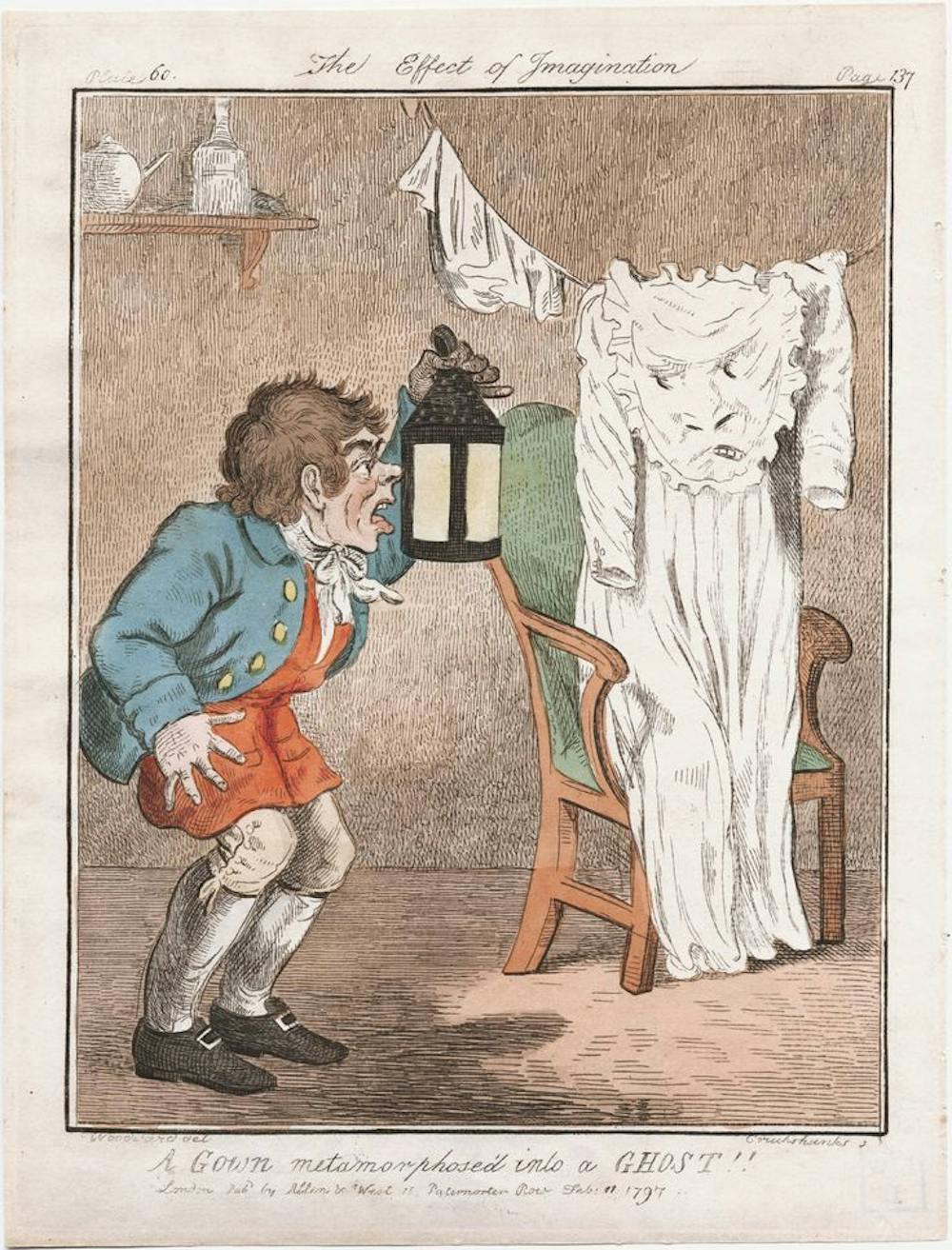
    Why aren’t ghosts naked? This was a key philosophical question for Cruikshank and many others in Victorian Britain. Indeed, stories of naked or clothesless ghosts, especially outside folklore, are exceedingly rare. Sceptics and ghost-seers alike have delighted in thinking about how exactly ghosts could have form and force in the material world. Just what kind of stuff could they be made of that allows them to share our plane of existence, in all its mundanity?

    Gillray’s Gown Metamorphose’d into a Ghost (1797).
    British Museum, CC BY

    The image of the ghost as a figure in a white winding-sheet or burial shroud has retained its iconic status for hundreds of years because it suggests a continuity between the corpse and the spirit.

    The main social role of the ghost before the modern period was to carry a message to the living from beyond the grave, so the link to burial clothing makes sense. This can be seen in the medieval trope of the Three Living and the Three Dead, whereby some hunters encounter their future skeletal corpses, wrapped in linen, admonishing them to remember death.

    Yet by the mid-19th century, with spiritualism and early forms of psychical research spreading across the western world, people began to report seeing ghosts dressed in everyday and contemporaneous clothing.

    This raised problems for those interested in investigating the reality of ghosts. If the ghost was an objective reality, why should it be wearing clothes? If the tenets of spiritualism were true, should the soul which has returned to visit the earth not be formed of light or some other form of ethereal substance? Were the clothes of spirits also spiritual, and if so, did they share in their essence or were they the ghosts of clothes in their own right?

    You could adopt an idealist position and say that the clothes were metaphysical ideas bound up with the immortal identity of the wearer – the identity of the ghost meaning something more than simply the apparition of a soul-force.

    Another explanation was that ghost-seers dress the ghost, automatically, through unconscious processes. And so we see a ghost in its usual dress because that is the mental picture we have of the person, and this choice of garment is most likely to inspire recognition.

    The Lady Ghost by Adelaide Claxton (1876).
    Sotheby’s

    The critic and anthropologist Andrew Lang drew comparisons between dreaming and ghost-seeing in 1897 when he stated that:

    We do not see people naked, as a rule, in our dreams; and hallucinations, being waking dreams, conform to the same rule. If a ghost opens a door or lifts a curtain in our sight, that, too, is only part of the illusion. The door did not open; the curtain was not lifted … It was produced in the same way as when a hypnotised patient is told that “his hand is burned”, his fancy then begets real blisters.

    For Lang, the clothes of ghosts were the stuff that dreams are made of. The implication of this, that ghost-seers are dressers, but not undressers, seems to reflect a pervading morality of ghosts, whereby most 19th-century spirits were sanitised and chaste. Lang’s odd assumption that there was no nakedness in dreams echoes this.

    The matter of spirits

    Fashion and clothing were central to the identification of class, gender and occupation in the Victorian period. The ghosts of the servant class seemed to be especially tied to their clothes, rather than their faces or voices – a theme that comes out in some ghost reports submitted to The Strand magazine in 1908.

    Here, a ghost-seer reported seeing “a figure, which had nothing supernatural about it, being simply that of a servant in a light cotton dress … and with a white cap on … The whole figure had the general appearance of the housemaid, so that she had been the one I had thought of. It was not in the least like the cook, who dressed in much darker cottons”.

    Clothes identify people and make them capable of representation – nakedness disrupts this means of instantly categorising someone.

    The ghost of a woman with a burial shroud confronts her murderer on a stormy night.
    Wellcome Collection, CC BY

    The issue of ghost clothes is interesting for historians of the supernatural because, like a loose thread, pulling at it starts to unravel some of the assumptions about matter in spiritualism. Do ghosts retain the injuries or disabilities that befell them in life? And what about the erotic fleshiness of spirits – the touching and kissing between the living and the dead in the séance room and the “ectoplasm” (a gauze-like spiritual substance) photographed emerging from the orifices of mediums? Could the living even have sexual intercourse with ghosts?

    These kinds of knotty debates have not disappeared in the 21st century. Indeed, “spectrophilia” – or the love of ghosts – is a fetish that is a lively topic of debate on the internet today. Another turn of the screw in the long history of how spirits matter in the world of the living.


    Looking for something good? Cut through the noise with a carefully curated selection of the latest releases, live events and exhibitions, straight to your inbox every fortnight, on Fridays. Sign up here.


    Shane McCorristine does not work for, consult, own shares in or receive funding from any company or organisation that would benefit from this article, and has disclosed no relevant affiliations beyond their academic appointment.

    ref. Why ghosts wear clothes or white sheets instead of appearing in the nude – https://theconversation.com/why-ghosts-wear-clothes-or-white-sheets-instead-of-appearing-in-the-nude-241948

    MIL OSI – Global Reports

  • MIL-OSI Global: Playing in mud and dirt can boost your child’s immune system – here’s how

    Source: The Conversation – UK – By Samuel J. White, Associate Professor & Head of Projects, York St John University

    Being exposed to a diverse array of microbes in childhood helps ‘train’ the immune system. MNStudio/ Shutterstock

    With the popularity of CleanTok on social media, we’re constantly being reminded about how dirty everything around us is. But while you might feel you should disinfect every surface in your home or send your child off to school with antibacterial gels so their hands stay clean, science actually shows us that being exposed to a bit of dirt can be good for kids’ health.

    Evidence suggests that exposure to the microbes in dirt might actually help children develop stronger immune systems – and may even decrease their risk of developing allergies and autoimmune diseases.

    Mud is not just a mix of soil and water. It’s a complex ecosystem filled with microorganisms. One gram of soil can harbour up to 10 billion microorganisms – of potentially thousands of different species.

    The diverse array of bacteria, fungi and other microbes present in mud and soil play a crucial role in our health and is key to what immunologists call “immune training”. This is the process by which the immune system learns to distinguish between harmful pathogens and benign environmental substances.

    During childhood, the immune system is especially adaptable. When exposed to a wide variety of microbes, it learns to strike a balance – responding aggressively to harmful invaders while leaving harmless substances, such as pollen or food particles, alone.

    But a lack of such training could leave immune systems worse off.

    According to the “hygiene hypothesis”, as societies become more urbanised and sanitised, our immune systems are deprived of the microbial challenges they need to develop properly. This may cause the immune system to become hypersensitive, mistaking innocuous substances – such as pollen or dust – for dangerous invaders. This hypersensitivity can manifest as allergic conditions such as asthma, eczema or hay fever.

    Lack of microbial exposure, particularly in early childhood, may also increase the likelihood of developing common colds and other childhood illnesses due to the immune system not being properly trained to handle everyday pathogens.

    The lack of such immune training could potentially explain why children growing up in sanitised environments (such as cities with limited exposure to animals or nature) are up to 50% more likely to develop conditions such as asthma and food allergies. Their immune systems, unchallenged by natural microbial exposure, may overreact to harmless triggers.

    Immune training appears to be important for lowering risk of many conditions and childhood illnesses.
    MorphoBio/ Shutterstock

    And, without regular microbial interactions, the immune system may turn on the body itself – potentially contributing to the development of autoimmune conditions such as type 1 diabetes or multiple sclerosis. Research even shows that children raised in environments with high levels of microbial exposure – such as farms or homes with pets – are less likely to develop allergies or autoimmune diseases.

    There are many reasons why microbial exposure is so good for children’s developing immune systems. For instance, Bacteroides fragilies, which is commonly found in soil, helps produce a key molecule that’s important to immune function.

    Microbial exposure also helps children develop regulatory T cells – white blood cells that control how the immune system responds to foreign invaders. T cells also prevent autoimmune reactions. This may explains why a lack of microbial exposure may increase a person’s likelihood of developing an autoimmune condition (though this is just one of many contributing factors).

    Immune development

    Mud play is more than just a messy outdoor activity. It provides essential sensory experiences – such as touching, smelling and manipulating different textures – which stimulate brain development and enhance emotional resilience.

    Sensory activities (such as playing in mud) can reduce stress in children, which is another crucial element in maintaining a well-functioning immune system.

    Research also shows Mycobacterium vaccae, a type of bacteria commonly found in soil, is shown to reduce inflammation and even improve mood. It does this by influencing the release of serotonin, a key neurotransmitter. In animal studies, exposure to M vaccae has led to reduced symptoms of stress and anxiety. There’s emerging evidence that similar effects could occur in humans.

    In addition, playing outdoors is a form of physical activity, which further supports immune health by promoting better circulation and stimulating the production of immune cells.

    While some parents may worry about the hygiene risks of playing in mud, there are many things you can do to ensure your kids play outdoors safely:

    • Pick clean play areas: Ensure your child plays in areas unlikely to be contaminated by animal waste or harmful chemicals. Home gardens or parks are great options. If you’re unsure how clean an area may be, you can use a soil testing kit to check for harmful substances before play.
    • Dress for the mess: Waterproof clothing such as boots and jackets makes clean-up easier while still allowing children to experience the benefits of outdoor play.
    • Hand hygiene: Washing hands after playing in the mud helps prevent harmful bacteria from entering the body. This reduces the risk of infections while maintaining healthy exposure to microbes.
    • Repeat often: Repeated exposure to beneficial microbes is necessary in order to build a stronger immune system.

    Letting children get dirty by playing in mud could offer more than just fun – it may be an essential part of building a strong immune system. In a world that’s increasingly sanitised, embracing nature – dirt and all – might be exactly what our children’s immune systems need to thrive.

    The authors do not work for, consult, own shares in or receive funding from any company or organisation that would benefit from this article, and have disclosed no relevant affiliations beyond their academic appointment.

    ref. Playing in mud and dirt can boost your child’s immune system – here’s how – https://theconversation.com/playing-in-mud-and-dirt-can-boost-your-childs-immune-system-heres-how-241532

    MIL OSI – Global Reports

  • MIL-OSI Global: How Harris and Trump’s economic pledges stack up

    Source: The Conversation – UK – By Conor O’Kane, Senior Lecturer in Economics, Bournemouth University

    kovop / Shutterstock

    We’re now in the home straight of the US election race, and the economy looks set to play a key role in deciding who will be sat in the White House come January 2025. Despite enjoying strong economic and employment growth since the pandemic, US voters have been telling pollsters that the high cost of living is what bothers them most about life in America right now.

    Both candidates are seeking to address voter’s concerns. The Democratic candidate, Kamala Harris, and her Republican counterpart, Donald Trump, agree on virtually nothing. But what they do agree on is that the federal government should be playing a bigger role in making things more affordable for American consumers.

    That said, there are significant differences in how the candidates propose to bring down prices across the economy. Trump wants to force companies into creating jobs on US soil. And Harris wishes to break down the power that some companies have amassed in the marketplace.

    What has Trump pledged?

    At a campaign rally on September 19, Trump said: “Together, we will deliver low taxes, low regulations, low energy costs, low interest rates and low inflation so that everyone can afford groceries, a car and a home”.

    Trump is promising to reduce regulation, as well as launching another big round of tax cuts for individual people and businesses. He has also pledged to make income from tips, overtime and social security payments exempt from tax altogether.

    But, somewhat ironically, Trump’s overall economic approach is somewhat un-Republican. We traditionally tend to think of Republicans as the “take your hands off my economy” party. However, many of Trump’s economic policy pledges are very hands on.

    He has promised tariffs of up to 20% on goods imported into the US, and 60% on all goods from China. His rationale is that by making imported goods more expensive, US companies will be encouraged to make more goods domestically, so American workers will benefit in terms of millions more well-paid manufacturing jobs at home.

    Trump has also said that, if elected, he will direct his cabinet to reduce energy prices and auto insurance by at least 50%. “Prices will come down. You just watch. They’ll come down and they’ll come down fast”, he claimed during a speech in August.

    He plans to intervene in the housing market, too. Trump’s strategy for lowering housing costs focuses on stopping “the unsustainable invasion of illegal aliens”, and he has pledged to deport up to 11 million immigrants who currently live in the US. This, he says, will result in a dramatic reduction in demand and bring down the cost of housing.

    Perhaps Trump’s most striking policy is in relation to the Federal Reserve. He wants the elected president to have a greater say over the interest rate policy for the US economy. Lower interest rates would mean lower borrowing costs, which should subsequently reduce mortgage prices.

    But a lot of economists, including former US treasury secretary Larry Summers, warn that this approach could backfire. When executives start to intervene in independent central banking, you risk setting off a spiral of rapid inflation.

    What has Harris pledged?

    A lot of Americans believe that grocery chains and food companies are ripping them off. Food prices are up by about 25% compared to before the pandemic, and a recent poll suggests that American consumers’ view of the grocery industry has sunk to a two-decade low.

    Harris has promised to address this. At a campaign event in Raleigh, North Carolina, in August, she said: “As president, I will take on the high costs that matter most to most Americans, like the cost of food”.

    She believes the food industry is too concentrated, where just a few firms have a lot of power. She wants the food industry to become more competitive, which would mean lower prices for US consumers.

    Harris has proposed giving government money to start-up meatpacking companies to help them challenge the dominant players. And she also wants the Federal Trade Commission to look at mergers and other forms of consolidation in the food industry more aggressively.

    This may include giving the commission additional regulatory and enforcement powers to actively look for and stop anti-competitive behaviour. For example, Harris has proposed the first federal ban on price gouging to stop companies exploiting crises to charge people more for essentials.

    Harris has promised to break the stranglehold large corporations have over US food supply.
    Bartolomiej Pietrzyk / Shutterstock

    Harris, like Trump, has also promised to address housing costs. She wants to use federal dollars to encourage developers to build, and has set an ambitious target of building 3 million new housing units over her four-year term.

    Her idea is that one way to bring down housing costs is to build a lot more housing. She also wants to give US$25,000 (£19,200) to every first-time home buyer in the country to help them with a down payment.

    To help reduce child poverty, Harris says she will restore Biden’s generous tax credit for parents. And, on top of that, she wants to introduce a US$6,000 tax credit for parents of newborns, as well as planning to cap childcare costs at 7% of household income.

    Both candidates have clearly listened to voters’ concerns about the cost of living, but there is little detail on how they will fund the giveaways set out in their economic policy pledges.

    Harris says there will be no tax increases for anybody who makes less than US$400,000 a year. However, she has in mind a whole bunch of taxes on millionaires and big companies – the sort that Democrats are fond of targeting. Trump, on the other hand, has not set out how he will pay for any of his policies.

    More than 20 US recipients of the Nobel prize for economics signed a letter on October 23 that called Harris’ economic agenda “vastly superior” to Trump’s.

    But we don’t have long to wait to see which candidate’s economic pledges have resonated most with US voters.

    Conor O’Kane does not work for, consult, own shares in or receive funding from any company or organisation that would benefit from this article, and has disclosed no relevant affiliations beyond their academic appointment.

    ref. How Harris and Trump’s economic pledges stack up – https://theconversation.com/how-harris-and-trumps-economic-pledges-stack-up-241644

    MIL OSI – Global Reports

  • MIL-OSI Global: Will you get an extra hour’s sleep this weekend? Probably not, new research says

    Source: The Conversation – UK – By Melanie de Lange, Epidemiology PhD Student, University of Bristol

    Science says you may not actually get that full hour’s extra sleep you were looking forward to. kattyart/Shutterstock

    A lot of people dread the clocks going back an hour in winter – but reassure themselves that at least they’ll get an extra hour’s sleep. However, in my new study my colleagues and I found most people do not (or can not) take advantage of the full extra hour of sleep in autumn.

    Daylight saving time is the practice of moving the clocks one hour forward in spring and one hour back in autumn. It was introduced during the first world war as a way to cut energy costs. It is in operation in around 70 countries and affects a quarter of the world’s population.

    This “springing forward” and “falling back” is widely thought of a loss of one hour of sleep in spring and a gain of one hour of sleep in autumn. However, research suggests we may lose sleep for about a week after both clock changes as we struggle to adapt to the new time.

    Previous studies have relied on people reporting their own sleep patterns in diaries or surveys. However, this may not be accurate because people sometimes forget or lie about how long they slept for. Recent research has overcome this problem by using activity monitors to record people’s sleep over the clock changes. But until now researchers have only been able to do this in a small number of people.

    Our new study explored the effects of the clock changes on objectively-measured sleep duration in a large number of people who are signed up to the UK Biobank. This is a research database with lifestyle and health information from half a million UK participants. We analysed sleep data from 11,800 people who wore activity monitors for one or more days during the two weeks surrounding the spring and autumn clock changes in 2013-2015.

    Sleep is important for health and wellbeing.
    Lizavetta/Shutterstock

    We found that people slept for just over half an hour more on the Sunday of the autumn clock change than the surrounding Sundays. But people slept for around an hour less of the Sunday of the spring clock change.

    Previous research suggests people sleep for less on the weekdays immediately after the clock changes than the weekdays before. In contrast, this study found that, overall, people were catching up on sleep on the Monday to Friday after both clock changes. This trend was stronger in spring after people had lost an hour of sleep. On average people slept seven minutes more per weeknight after the spring clock change and three minutes more per weeknight after the autumn clock change than the previous week.

    This suggests that effects of the clock changes on sleep duration are more short lived than earlier studies reported. However, when we broke the data down, we found that this pattern of catching up on sleep was not seen in women. In fact, women often slept for less on the weekdays after the clock changes than before. This could be because women experience higher levels of insomnia and sleep difficulties and that these problems are exacerbated by the clock changes. Women are thought to struggle more with insomnia than men due to a number of reasons, including hormonal fluctuations, societal factors and higher rates of depression and anxiety.

    We also found that, in autumn, older people and the retired slept less on the weekdays after the transition than before. It may be that older people are particularly vulnerable to their sleep being disrupted by the clock changes because sleep becomes lighter and more fragmented as we age.

    Why does this matter?

    Although short lived, the sleep loss seen over the spring clock change in our study has consequences for health, as just one night of bad sleep has been associated with a decline in mental and physical health.

    Research has found that the clock changes themselves are associated with an increase in heart attacks, strokes, traffic accidents and depression. Sleep plays a vital role keeping your heart healthy, as well as maintaining emotional regulation. The amount of sleep you get also affects your reaction times and how likely you are to take risks.

    Concern over the harmful effects of the clock changes on health has prompted sleep scientists to call for the clock changes to be abolished. Indeed, a growing number of countries – including the US, Jordan, Mexico, Ukraine and those in the EU – have made plans to do just that.

    But stopping the clock changes is not straightforward. Plans in both the US and EU have stalled, with disagreements over what time to adopt permanently. Sleep experts argue that staying on winter (standard) time is best for health as this prioritises morning light which helps wake you up, resets your biological rhythm each day and makes it easier for you to fall asleep in the evening. Meanwhile, politicians are campaigning for permanent summer time due to the economic benefits they think it has.

    The UK finds itself in an interesting position. No longer part of the EU, it is not duty bound to stop the clock changes at the same time as the EU. But being out of sync with the rest of Europe (including the Republic of Ireland) could have economic and logistical implications.

    The UK government will probably review its daylight saving time policy as and when the EU finally ends the clock changes. It is crucial that they take the effects on sleep and health into account when this happens.

    Melanie de Lange receives funding from Wellcome.

    ref. Will you get an extra hour’s sleep this weekend? Probably not, new research says – https://theconversation.com/will-you-get-an-extra-hours-sleep-this-weekend-probably-not-new-research-says-241285

    MIL OSI – Global Reports

  • MIL-OSI: LIS Technologies Inc. Chief Executive Officer Christo Liebenberg Presented at the University of Tennessee Nuclear Engineering Colloquium on October 23, 2024

    Source: GlobeNewswire (MIL-OSI)

    Oak Ridge, Tennessee, Oct. 25, 2024 (GLOBE NEWSWIRE) — LIS Technologies Inc. (“LIST” or “the Company”), a proprietary developer of advanced laser technology and the only USA-origin and patented laser uranium enrichment company, today announced that Christo Liebenberg, Chief Executive Officer of LIS Technologies Inc. presented at the University of Tennessee’s Nuclear Engineering Colloquium, hosted by the Nuclear Engineering Department.

    “We were delighted to welcome our neighbor Mr. Liebenberg to the Nuclear Engineering Department and the University of Tennessee,” said Ashley Nelkin, Academic Specialist & Events of the University of Tennessee Department of Nuclear Engineering. “This Colloquium provides our students and faculty with a rare opportunity to engage with a leading figure in laser isotope separation and gain first-hand insights into this innovative technology.”

    Figure 1 – LIS Technologies Inc. Chief Executive Officer Christo Liebenberg will present at the University of Tennessee’s Nuclear Energy Colloquium on October 23, 2024.

    The Colloquium included a 45-minute presentation by Mr. Liebenberg, focusing on a comparison of 1st, 2nd, and 3rd generation enrichment technologies, with a particular emphasis on the similarities and differences among various laser enrichment methods. The discussion also covered the fundamentals and requirements of laser enrichment, highlighting 16μm and 5μm MLIS systems. Additionally, key features and benefits of the CRISLA process will be showcased. A 15-minute Q&A session will follow the presentation.

    “The University of Tennessee’s Nuclear Engineering Department fosters some of the brightest talent in the country,” said Christo Liebenberg, CEO of LIS Technologies Inc. “It was an honor to lead this seminar and help inspire the next generation of nuclear engineers to push the boundaries of innovation. This event also provides a valuable opportunity to teach about the capabilities of our laser isotope separation technology and better understand its potential. This was an engaging and rewarding seminar.”

    About LIS Technologies Inc.

    LIS Technologies Inc. (LIST) is a USA based, proprietary developer of a patented advanced laser technology, making use of infrared wavelengths to selectively excite the molecules of desired isotopes to separate them from other isotopes. The Laser Isotope Separation Technology (L.I.S.T) has a huge range of applications, including being the only USA-origin (and patented) laser uranium enrichment company, and several major advantages over traditional methods such as gas diffusion, centrifuges, and prior art laser enrichment. The LIST proprietary laser-based process is more energy-efficient and has the potential to be deployed with highly competitive capital and operational costs. L.I.S.T is optimized for LEU (Low Enriched Uranium) for existing civilian nuclear power plants, High-Assay LEU (HALEU) for the next generation of Small Modular Reactors (SMR) and Microreactors, the production of stable isotopes for medical and scientific research, and applications in quantum computing manufacturing for semiconductor technologies. The Company employs a world class nuclear technical team working alongside leading nuclear entrepreneurs and industry professionals, possessing strong relationships with government and private nuclear industries.

    For more information please visit: LaserIsTech.com

    For further information, please contact:

    Email: info@laseristech.com

    Telephone: 800-388-5492

    Follow us on Twitter

    Follow us on LinkedIn

    Forward Looking Statements

    This news release contains “forward-looking statements” within the meaning of Section 21E of the Securities Exchange Act of 1934, as amended, and the Private Securities Litigation Reform Act of 1995. In this context, forward-looking statements mean statements related to future events, which may impact our expected future business and financial performance, and often contain words such as “expects”, “anticipates”, “intends”, “plans”, “believes”, “will”, “should”, “could”, “would” or “may” and other words of similar meaning. These forward-looking statements are based on information available to us as of the date of this news release and represent management’s current views and assumptions. Forward-looking statements are not guarantees of future performance, events or results and involve known and unknown risks, uncertainties and other factors, which may be beyond our control. For LIS Technologies Inc., particular risks and uncertainties that could cause our actual future results to differ materially from those expressed in our forward-looking statements include but are not limited to the following which are, and will be, exacerbated by any worsening of global business and economic environment: (i) risks related to the development of new or advanced technology, including difficulties with design and testing, cost overruns, development of competitive technology, loss of key individuals and uncertainty of success of patent filing, (ii) our ability to obtain contracts and funding to be able to continue operations and (iii) risks related to uncertainty regarding our ability to commercially deploy a competitive laser enrichment technology, (iv) risks related to the impact of government regulation and policies including by the DOE and the U.S. Nuclear Regulatory Commission; and other risks and uncertainties discussed in this and our other filings with the SEC. Only after successful completion of our Phase 2 Pilot Plant demonstration will LIS Technologies be able to make realistic economic predictions for a Commercial Facility. Readers are cautioned not to place undue reliance on these forward-looking statements, which apply only as of the date of this news release. These factors may not constitute all factors that could cause actual results to differ from those discussed in any forward-looking statement. Accordingly, forward-looking statements should not be relied upon as a predictor of actual results. We do not undertake to update our forward-looking statements to reflect events or circumstances that may arise after the date of this news release, except as required by law.

    Attachment

    The MIL Network

  • MIL-OSI Russia: Happy Russian Students’ Day!

    Translation. Region: Russian Federation –

    Source: State University of Management – Official website of the State –

    Dear students, we sincerely congratulate you on Russian Students’ Day! This is a holiday for everyone who has chosen the path of knowledge and development.

    The history of this day is connected with Moscow State University. On January 25, 1755, Empress Elizabeth Petrovna, at the request of the first Minister of Education of Russia and a prominent philanthropist Ivan Shuvalov, signed a decree on its establishment. This event was marked by the birthday of the university, and then by a common holiday for all students.

    It is worth noting that there is another version of the origin of Russian Students’ Day. The opening of Moscow State University coincided with the day of remembrance of the holy martyr Tatiana of Rome. Perhaps the choice of date was also connected with the fact that Ivan Shuvalov’s mother was also called Tatiana. In 1791, a church named after the saint was opened at the university, who is still considered the patroness of all students.

    The holiday received its official status under Tsarist Russia. Nicholas I made January 25 the official Student’s Day. After the revolution, the name of the celebration was changed, but in 2005, by decree of President Vladimir Putin, Tatyana’s Day again became the Day of Russian Students.

    The traditions of celebrating Tatyana’s Day are very diverse. In the old days, this day was marked by lavish balls, festive services, concerts and student festivities. According to the recollections of contemporaries, the celebration was truly large-scale, with songs, dances and, of course, merry feasts.

    Students celebrate this day by organizing celebrations at universities and beyond. These include concerts, parties, sports competitions, theater performances, and meetings with interesting people. And the atmosphere of joy, friendship, and mutual understanding is always maintained.

    Dear students! We wish you success in your studies and scientific discoveries, lots of energy and optimism, and that your student years will be bright and memorable. Let Tatyana’s Day remind you of hope, self-confidence and that you can achieve any goals! Believe in yourself, and everything will work out!

    Subscribe to the TG channel “Our GUU” Date of publication: 01/25/2025

    Please note: This information is raw content directly from the source of the information. It is exactly what the source states and does not reflect the position of MIL-OSI or its clients.

    MIL OSI Russia News

  • MIL-OSI Russia: Polytechnic at the autumn educational exhibition in Hanoi “Russian Universities – the Best Choice”

    Translation. Region: Russian Federation –

    Source: Peter the Great St Petersburg Polytechnic University – Peter the Great St Petersburg Polytechnic University –

    Polytechnic University took part in an educational exhibition in Vietnam, which was held in Hanoi from October 21 to 25. The event was organized by the representative office of Rossotrudnichestvo in Hanoi as part of the long-term project “Universities of Russia” to popularize Russian education. Polytechnic University was represented by Deputy Head of the International Education Department Tatyana Sytnikova and specialist of the Department for Work with Foreign Students Ekaterina Pirkovska.

    The opening ceremony was attended by the Director of the Russian Center for Science and Culture in Hanoi Vladimir Murashkin, Counselor of the Russian Embassy in Vietnam, representative of the Ministry of Science and Higher Education of the Russian Federation Evgeny Mitrofanov, as well as representatives of 11 leading Russian educational institutions.

    Exhibitions help talented Vietnamese people to better navigate the educational space of Russia, and Russian universities to prepare for a meeting with Vietnamese students. The project “Universities of Russia” is actively expanding the partner network of Russian universities in Vietnam, which contributes to the development of scientific and educational cooperation between our countries, – emphasized Vladimir Murashkin.

    Representative of the Ministry of Science and Higher Education of the Russian Federation Evgeny Mitrofanov emphasized the importance of Russian higher education for Vietnamese students. He noted that studying in Russia opens up new horizons and opportunities, and also highlighted the possibility of receiving free education through scholarships from the Russian government.

    After the official part, more than 200 Vietnamese students and schoolchildren visited the Polytechnic stand, where they were consulted about the educational programs of bachelor’s, master’s and postgraduate studies at SPbPU, and told about dormitories and scholarships.

    The delegation of the Polytechnic University visited the Tran Phu Special School for Talented Children in Hai Phong, the Le Hong Phong Special School for Talented Children in Nam Dinh and the Hanoi University of Entrepreneurship and Technology. During the Polytechnic presentations, the children had a unique opportunity not only to get acquainted with the educational programs and admission conditions, but also to communicate with the university representatives, ask questions and clarify issues of interest to them.

    In addition, a meeting of delegations of Russian universities was held at the Ministry of Education and Personnel Training of the SRV, dedicated to further cooperation between universities of our country and Vietnamese universities. During this event, many agreements were signed aimed at deepening mutual understanding and cooperation in the field of higher education. Special attention was paid to training personnel in such areas as mathematics, economics, philology and Russian studies.

    Tatyana Sytnikova took part in a press conference with Vietnamese media at the Russian Center for Science and Culture in Hanoi. She emphasized the importance of the educational programs offered by the Polytechnic University for foreign applicants.

    The Polytechnic University offers foreign applicants unique educational programs in the fields of IT, artificial intelligence, linguistics, construction and building design, law, design, economics and management, and biotechnology. We are confident that high-quality education in these areas will open up new horizons and opportunities for a successful career for our students, said Tatyana Sytnikova.

    On the last day of the exhibition, an expert session entitled “University Consortia in Russia and the International Educational Space: Practice and Prospects” was held.

    Recently, we have been actively engaged in solving various issues of cooperation between Russia and Vietnam. As a society acting as a people’s diplomacy, we strive to help both our and your partners in establishing strong ties and contacts. We sincerely hope that cooperation between Vietnam and Russia will develop more and more actively every day, – noted the deputy chairman and secretary general of the Vietnamese-Russian Friendship Society, the main reactor of the Berezka magazine Nguyen Dang Phat.

    Educational exhibitions play a key role in establishing effective links between educational institutions and prospective students, providing a valuable platform for information exchange and broadening horizons. The exhibition in Vietnam was a great opportunity for young people to learn about the opportunities that Polytechnic University offers to international students. Such events not only help to popularize education abroad, but also greatly simplify the process of choosing an educational institution for those who are looking to gain quality education and international experience.

    Let us remind you that selection and competitive events have started for foreign applicants wishing to study at the Polytechnic University for free under the direction of the Ministry of Science and Higher Education of the Russian Federation (under a quota) in the next academic year. You can get up-to-date information about the dates of their holding in the English-language Polytech telegram channel.

    You can also apply for the first qualifying round of the international Open Doors Olympiad: Russian Scholarship project until November 20. From this year onwards, the winners will have the opportunity to enroll in the Polytechnic University’s bachelor’s, master’s and postgraduate programs without entrance examinations and study for free in the 2025–2026 academic year.

    Please note: This information is raw content directly from the source of the information. It is exactly what the source states and does not reflect the position of MIL-OSI or its clients.

    MIL OSI Russia News

  • MIL-OSI: Ethical Web AI announces our new Chief Executive Officer – Manfred Ebensberger, with a shareholder update

    Source: GlobeNewswire (MIL-OSI)

    NEW YORK, Oct. 25, 2024 (GLOBE NEWSWIRE) — Bubblr Inc., d/b/a Ethical Web AI (OTC: BBLR) – a frontrunner in ethical technology determined to revolutionize the digital domain, has announced its new CEO, Manfred Ebensberger.

    Before joining Bubblr, Mr. Ebensberger held senior roles in European investment firms, serving as Managing Director and Asset Manager for Ultra-High-Net-Worth Individuals (UHNWIs). He also served as CEO of a luxury Italian fashion brand in New York. Earlier in his career, Mr. Ebensberger was managing director for several US investment companies and an assistant professor at the University of Innsbruck, Austria. Manfred holds a degree from the University of Innsbruck, Austria, from the University of Venice, Italy and completed a certificate in General Business Studies at UCLA. He is a seasoned professional committed to the vision and direction of the company.

    Steve Morris, CTO and founder of Ethical Web AI remarked, “I am delighted to welcome Manfred as our CEO. Manfred is a highly experienced executive who has a proven track record as the CEO of a publicly listed company, which he led to a very successful buy-out. We have been speaking to Manfred for quite some time, and both parties are in agreement that Manfred is the perfect CEO at this critical point in the company’s development.”

    “Our biggest challenge has been our ability to describe succinctly what our platform does and why it is so revolutionary. Now that the platform is demonstrable, this makes our many years of work understandable, applicable and ultimately profitable. Manfred will lead us into the next stage of our revenue-positive corporate development. It has taken years in the making, but we are finally at a point where we have a product that will change the way we all use and utilize the internet.”

    “Our last press release in August 2024 made clear the massive significance of finally delivering our ethical Web Search (EWS) platform to the point where it is demonstrable. It has taken many years of development to build the EWS platform, and it is the technical manifestation of our US Patent 10977387, which has been independently valued at $4.7bn. Manfred’s role is to oversee the next stage of Ethical Web AI’s development to realize its true potential and value as the world’s most innovative technology company. Our current plans are extremely ambitious, and we are confident that Manfred is the CEO we need to deliver them. They include the following key objectives:”

    Raising substantial new investment capital

    Within the next six months, we plan to raise significant new investment capital. This capital is required to transform the company from a technology development company to a fast-growing, revenue-driven business. There are many conversations currently underway with a number of important investors that we expect to be concluded in the next few months.

    Significantly increase revenue from AI Seek.

    Our generative AI product, AI Seek, is capable of generating significant revenues and is very profitable. We intend to sign a distribution and marketing contract in the next few weeks that will deliver very significant new revenues before the end of the year.

    We already consider AI Seek to be demonstrably superior to Chat GPT in many ways. In particular, AI Seek is unique in that it is totally anonymous for consumers to use. This unique aspect of AI Seek allows us to develop a version of AI Seek that can be safely used by children under direct parental control. A “child-safe” generative AI application will obviously be hugely popular.

    Oversee the rollout of the EWS platform to our first pilot projects.

    We are currently negotiating with a number of potential community licensees to pilot our EWS platform. There are three candidates, and all three are very keen to be the first early adopter. Again, we will be signing our first deal in the next few weeks, and we will make announcements as they happen. The pilot project(s) will provide the necessary learnings required to automate the onboarding of new licensees to the platform entirely. Once we have fully automated the onboarding process, we will begin the global adoption of the product using the tried and tested open-source SaaS model.

    Organic uplist to Nasdaq in 2025

    We have a strategic plan to organically uplist Nasdaq in 2025. In order to qualify for Nasdaq, we need revenues and adequate cash reserves in the bank. The cash reserves will be secured primarily through further external investment capital. Both the revenues and the capital raise are eminently achievable.

    The Nasdaq uplist provides a number of significant benefits for the company and its shareholders. We are certain that we have the most significant and valuable technology that the world has ever witnessed. However, hardly anyone has ever heard of the company. The Nasdaq uplist delivers much more visibility of the company and its products. It provides a platform to showcase our company to both the investment community and retail users.

    Pursue our expected exit plan through acquisition.

    The founder and CTO, Steve Morris, has always maintained that the most likely final exit strategy would be that it would be acquired (or its critical assets acquired) by a global technology business to ensure its global adoption. Ethical Web AI is more like a startup pharmaceutical company that has developed a world-beating drug. Such a company knows it will be acquired by one of the global pharma giants. However, acquisition opportunities were not expected to arise before we were uplisted to Nasdaq. In recent developments, a major technology company has expressed interest in communicating with the company regarding potential future alliances.

    It is clear that our new CEO, Manfred Ebensberger, has a lot to do in the next few months, but he has the complete suite of expertise, knowledge and full support of everyone in the company to help him deliver. We expect to issue many more press releases in the coming weeks.

    About Ethical Web AI:
    Ethical Web AI is an ethical technology company that is championing an anonymous, safe, and fair new internet. We are producing unique intellectual property and technology that is made defensible by our valuable utility software patents.

    Visit the new AI Seek website at: https://www.aiseek.ai.

    If you are an AI Seek user, make sure to add desktop integration by going to the page https://desktop.aiseek.ai/

    For more information about our Company and products, please visit our website at https://www.ethicalweb.ai.

    Media Contact:
    Steve Morris
    Bubblr, Inc.
    (646) 814 7184

    Safe Harbor Statement
    This press release contains forward-looking statements within the meaning of Section 27A of the Securities Act of 1933 and Section 21E of the Securities Exchange Act of 1934. These forward-looking statements are based on the current plans and expectations of management and are subject to a number of uncertainties and risks that could significantly affect the Company’s current plans and expectations, as well as future results of operations and financial condition. The Company reserves the right to update or alter its forward-looking statements, whether as a result of new information, future events or otherwise.

    The MIL Network

  • MIL-OSI Global: In her first budget, the chancellor faces a minefield of risks

    Source: The Conversation – UK – By Steve Schifferes, Honorary Research Fellow, City Political Economy Research Centre, City St George’s, University of London

    Ahead of the new government’s first budget on October 30, chancellor Rachel Reeves has revealed her determination to change borrowing rules that will allow her to boost investment spending.

    The overriding goal of the government is to promote economic growth, after more than a decade of stagnation in living standards. In the long run, boosting growth will produce more money for the government to improve public services. But while Reeves has given a strong steer as to how she will fund the public investment needed to grow the economy in the long term, she will also have to find money for urgent improvements to struggling public services like the NHS, a key election pledge.

    There are three ways that the government can raise the funds it needs to boost investment and improve key public services. It can raise taxes, increase borrowing, or make cuts to spending. Given the scale of the challenge faced by the chancellor, all three are likely.

    The government had made a rod for its own back with two of its key election pledges: not to raise the main taxes (income tax, national insurance, and VAT) on “working people”, while sticking to a set of fiscal rules that set strict limits on government borrowing. These pledges were designed to appeal to voters hit by the cost of living, while demonstrating to financial markets that Labour would be cautious with public money. Government borrowing reached nearly £80 billion in last six months, the third highest sum on record.

    With the so-called financial “black hole” now estimated at £40 billion, not the £22 billion announced in July, the Treasury will need major tax rises that go well beyond the modest proposals from the election campaign. Although Labour may make some limited increases in other taxes on wealth, such as capital gains tax, this alone will not close the revenue gap.

    The most likely candidate to bridge the gap is an increase in employer national insurance (NI) contributions, for example by making employers pay NI on their pension contributions. This could raise more than £15 billion per year. Reeves and prime minister Keir Starmer argue that this would not breach their manifesto commitments – but it will be politically controversial. Observers, including the Office for Budget Responsibility (OBR) and the Institute for Fiscal Studies, argue that such taxes are eventually felt by workers through either lower wages or staff cuts.

    Further spending cuts are also on the cards. In July the chancellor announced a series of cuts, cancelling planned spending on the reform of social care, withdrawing the winter fuel payment to most pensioners, and ordering departments to make efficiency savings to help fund pay awards.


    Read more:
    The boomer generation hit the economic jackpot. Young people will inherit their massive debts


    Other than for the NHS, Reeves is expected to squeeze spending in “unprotected” departments (prisons and local government, for example). On welfare spending, the Treasury has the rising bill for disability and incapacity benefits in its sights.

    But even these decisions leave the government with a major funding dilemma. How will it pay for capital spending, everything from new hospitals and schools to roads, bridges and other infrastructure? All are key to boosting long-term growth.

    While one of Reeves’ fiscal rules aims to ensure that day-to-day spending must be balanced by tax receipts (leading to the need for tax increases), borrowing for long-term public investment is not part of that calculation. But any increased borrowing for investment appears to be sharply curtailed by another fiscal rule, which says that total government debt (including that incurred by borrowing to invest) as a percentage of GDP must be falling within five years.

    New government, new rules?

    Despite Labour’s embrace of both these tight fiscal rules during the election campaign, the chancellor has now confirmed that she wants to modify this debt rule to allow herself to borrow more.

    She plans to change how overall government debt is measured, effectively redefining it by including more government assets to set against the amount being borrowed. The likely new measure, known as “public sector net financial assets”, would include assets like funded local government pension schemes and student loans income, as well as government-owned companies like Great British Energy.

    This could give the chancellor up to £50 billion in extra borrowing power for public investment. Her argument is that borrowing to build infrastructure gives the government a tangible asset that will pay for itself in the long term by boosting growth and tax receipts.

    None of the choices facing Rachel Reeves will be easy.

    The government’s spending watchdog, the OBR, agrees that in the long term, well-planned public sector investment could benefit the economy, although it says it would take a long time to materialise. Many observers, including the former head of the civil service, Gus O’Donnell, and Mark Carney, the former governor of the Bank of England, strongly support increased public investment as a way to boost lagging productivity.

    But there are risks in this strategy if it unsettles financial markets. Total government debt on the current measure now stands at £2.6 trillion, nearly the same size as the whole UK economy. It is costing the Treasury around £74 billion a year in interest payments, almost the size of the education budget.

    If the bond markets (which buy government debt) take fright, they could force up the cost of borrowing further, which could raise interest rates on mortgages and other consumer borrowing. And news of the chancellor’s plan to change to the fiscal rule did cause bond yields to rise slightly. This suggests if government debt rises too rapidly, even within the new rules, this could have a destabilising effect. So the chancellor will have to judge carefully how much of the extra headroom she should use.

    Like all Labour chancellors, Reeves faces the task of keeping both voters and the financial markets happy at the same time. Her strategy could end up alienating rather than pleasing both sides.

    Given the scale of Labour’s ambitions, balanced against her limited resources, she may have little choice but to take such a bold approach. But her path between alienating business and disillusioning the public is a narrow one. And the longer it takes for her strategy to bear fruit in terms of a better standard of living and improved public services, the more difficult things will become politically.

    Steve Schifferes does not work for, consult, own shares in or receive funding from any company or organisation that would benefit from this article, and has disclosed no relevant affiliations beyond their academic appointment.

    ref. In her first budget, the chancellor faces a minefield of risks – https://theconversation.com/in-her-first-budget-the-chancellor-faces-a-minefield-of-risks-241939

    MIL OSI – Global Reports

  • MIL-OSI Global: Horror movies are as much a mainstay of Halloween as trick or treat − but why are they so bloody?

    Source: The Conversation – USA – By James Francis, Jr., Instructional Associate Professor, Texas A&M University

    Horror movies are plentiful in 2024, and plenty bloody. The year has seen the release of films awash in blood, such as “Immaculate,” “The First Omen” and “The Strangers.” With Halloween on the way, bloody offerings are streaming, in theaters and running in marathons on cable.

    Watch them, and you’ll likely notice that as the decades pass, the directors, writers and studio executives of these films seem to produce more and more on-screen blood, violence and gore. But why?

    As a professor of horror studies, I explore the depths of the genre with my students – and for us to understand the evolution of blood in horror cinema, we first consider how films reflect their times.

    Alfred Hitchcock and Michael Powell created proto-slashers with “Psycho” and “Peeping Tom,” respectively. Both films were released in 1960 about four months apart, both feature serial killers, and both operate on a “tell, don’t show” visual aesthetic. Rather than show the blood to the audience, the films provide narrative cues to only suggest the blood.

    Janet Leigh’s shower scene in ‘Psycho’ is one of the most memorable moments in movie history.
    Bettmann via Getty Images

    Guts, gore and so much more

    In “Psycho,” Marion Crane, played by Janet Leigh, is stabbed to death in the famous shower scene. But the quick-cut editing gives only the illusion of her nude body being slashed as a small amount of blood washes down the drain in black-and-white tones. By not shooting “Psycho” in color, and avoiding the image of bright red blood in the bathtub – Hitchcock’s choice – the film doesn’t seem as violent.

    By the late 1960s, the restrictive Hays Code, which prohibited overt on-screen violence and the use of fake blood, was replaced by the less stringent Motion Picture Association of America film ratings system. Filmmakers could latch onto new freedoms to express fear, anxiety and dread in more visceral depictions. One way to do that – more blood.

    In “Night of the Living Dead,” George A. Romero’s 1968 seminal zombie flick, the walking dead consume the flesh of the living. Even though the movie is in black and white, the monochromatic presentation does not dull the display of the undead gobbling guts and licking up blood.

    The film’s release came six months after the assassination of Martin Luther King Jr., and a clear connection between Romero’s film and the Civil Rights Movement then taking place is apparent. The movie’s heightened gore correlates to the movement’s all-too-bloody violent struggle, as Ben, played by Duane Jones, the sole person of color among the living, hides from the ghouls in an abandoned farmhouse with a group of six white people.

    Ben works to keep the group safe but faces ongoing pushback from the white male characters. At the end of the film, a group of vigilantes, believing Ben is a zombie, guns him down before tossing his body into a fire.

    The symbolism as a reflection of the times is hard to miss. Romero and John Russo, who co-wrote the screenplay, didn’t initially intend to make a statement on civil rights; but later, during postproduction, Romero realized the assassination of King turned his movie into a “Black film.”

    Bloody metaphors

    Then came the 1970s, when blood was sprayed all over the screen. But Tobe Hooper’sThe Texas Chain Saw Massacre” (1974), William Friedkin’sThe Exorcist” (1974) and Ridley Scott’sAlien” (1979) have something else in common: They feature women protagonists who survive the unthinkable.

    Once again, blood is a common denominator. Sally’s body is covered in it after escaping Leatherface; Regan’s body, along with the blood, spews green vomit; and Ripley sees an alien burst out of a crew member’s chest. But the films weren’t just gory – they were metaphors for the uphill battle for women’s rights in the 1970s.

    The original “Halloween” (1978) also fits here, but with a twist. The character of Laurie Strode, perhaps an early prototype of women protagonists in horror films, connects back to a “tell, don’t show” sensibility while simultaneously embracing changing times. While the first kill shows Michael Myers stabbing his older sister, the audience views the death from the partially veiled perspective of Myers behind his Halloween mask. You see little until her body hits the floor to reveal the blood.

    ‘Halloween’ was a huge hit and has thus far spawned six direct sequels, one offshoot, a two-part remake and one reboot trilogy over 46 years.
    Universal History Archive via Getty Images

    Nightmares and reality

    In the 1980s, the slasher subgenre dominated horror – and the bloodier, the better: These movies focus on the number of kills and the creative ways the victims are dispatched.

    Each sequel in these horror franchises needed to up the kills, if for no other reason than to outdo its predecessors and competitors. Audiences began rooting for villains like Myers, Jason Voorhees and Freddy Krueger, all of whom had their own theme music, and in Freddy’s case, trademark one-liners. Many of the villains had more character development than their victims, who seemed interchangeable and little more than fodder for the slasher machine.

    The 1990s had bigger-budgeted, more innovative films, such as Wes Craven’sNew Nightmare” (1994) and “Scream” (1996). Here the attacks are more personal; the stabbings are close-up. CGI, or computer-generated imagery, used in abundance in the “Nightmare” series, allowed for more creative and bloody kills.

    Scarier times mean bloodier movies

    Since 9/11, horror films have existed in a place where there’s no apparent motive other than violence and bloodshed. In “The Strangers” (2008), the villains tie up, torment and savagely maim their victims. In the 2009 remake of “The Last House on the Left,” it’s the villains who meet a bloody end. Contemporary horror understands how senseless killings on screen are effective, because the removal of emotion from the violence parallels real-world incidents.

    ‘Ghostface’ is the villain in the popular ‘Scream’ series.
    James Gourley/Getty Images Entertainment via Getty Images

    By the late 2010s, horror films link to the #MeToo and Time’s Up movements, most notably in the “Halloween” reboot trilogy, as Laurie Strode once again confronts Michael Myers and the trauma he inflicted 40 years prior.

    The kills in the new “Halloween” trilogy are extremely bloody and violent. They also mirror the sexual and societal exploitation of women and their bodies. Ultimately, the series allows the protagonist, and the traumatized town of Haddonfield, to acknowledge the evil, confront it and try to finally put an end to it, once and for all.

    The evolution in the horror genre’s presentation of blood and gore doesn’t necessarily make for scarier movies, but they often point to the scarier times in which we live. Earlier horror films, comparatively tamer and with less blood, were often box-office successes. But today’s audiences probably appreciate them more for their artistic merits than the fear they induce.

    The preferences of horror audiences change over time, much like the ebb and flow of the blood depicted in these movies. The original “Halloween” has hardly a drop; the recent reboots are over the top – but still nowhere close to the mayhem depicted in the just-released “Terrifier 3.”

    What the future holds is anyone’s guess. But check out the world around you, and you’ll certainly get a bloody good hint of what’s to come.

    James Francis, Jr. does not work for, consult, own shares in or receive funding from any company or organization that would benefit from this article, and has disclosed no relevant affiliations beyond their academic appointment.

    ref. Horror movies are as much a mainstay of Halloween as trick or treat − but why are they so bloody? – https://theconversation.com/horror-movies-are-as-much-a-mainstay-of-halloween-as-trick-or-treat-but-why-are-they-so-bloody-241214

    MIL OSI – Global Reports

  • MIL-OSI Global: Florida’s new condo laws recognize the total price of living on the beach

    Source: The Conversation – USA – By Bill Hughes, Research Director, Kelley A. Bergstrom Real Estate Center, University of Florida

    Repairing high-rise condos like this one in Miami Beach can cost millions. Jeffrey Greenberg/Universal Images Group via Getty Images

    Nearly a million Florida condo owners face an important deadline at the end of the year. That’s when a law passed in 2022 requires most Florida condo associations to submit inspection reports for their buildings and to collect money from owners to pay for any needed repairs.

    Condo owners are reporting that new condominium rules are driving up fees and inducing outrageous assessments.

    The media has picked up on the outrage. News articles about condo owners “facing financial turmoil as a result of new building safety regulations” and how “bills are crippling homeowners” lead readers to believe that Florida lawmakers have imposed an egregious tax on the elderly and those on fixed incomes.

    This is misleading at best.

    As the research director at the University of Florida’s Bergstrom Real Estate Center, I suggest it is important to set emotions aside and see what these laws attempt to accomplish.

    Safety inspections

    The 2022 state condo law, known as SB-4D, and its 2023 follow-up, SB-154, establish three primary requirements: licensed inspections, reporting and disclosures, and reserve funds.

    Importantly, these laws are not tax legislation that directly increases housing costs on condo owners.

    But by requiring more inspections, transparency and funding to cover repairs, many owners will face costs much greater than the amounts paid in the past. These new expenses simply reflect more of the true cost of living in a condo near the ocean.

    Under the laws, all buildings occupied before 1992 must complete a milestone inspection by Dec. 31, 2024. This is an examination of the building’s structural integrity by an architect or engineer.

    The requirement also applies to buildings at least 25 years old that are within 3 miles of the coast.

    If the milestone inspection finds a potential structural problem, testing is required to determine if structural repairs are needed. If they are, owners must fund these repairs without an option to waive by vote.

    If no damage is identified, then the association must report and post the results, and that concludes the requirement.

    Prior to SB-4D, milestone inspections were not required outside of Miami-Dade and Broward counties. Now, they are required statewide and must be reported to local authorities, all unit owners and the public for buyer information.

    Adequate savings for repairs

    The new regulations also require building associations to budget and collect sufficient reserves to cover the cost of maintaining and replacing parts of their buildings subject to regular wear and tear, such as roofs, elevators and balconies.

    History suggests that most homeowners associations struggle to adequately save for repairs and maintenance to keep their properties safe and in top condition.

    “Florida has … more associations that are considered weak [in terms of funded reserves] than any other state,” Will Simons, the head of Florida and Southeast Operations at Association Reserves, which conducts reserve studies for condo and community associations, told a colleague as part of a research article.

    The Champlain Towers South condominium that collapsed in the Miami suburb of Surfside in June 2021, killing 98 people, is just one example. Simons’ company completed a reserve study of the condo just months prior to the collapse and found its association was significantly underfunded.

    The association held approximately US$706,000 in reserves as of January 2021. Association Reserves recommended the association stockpile nearly $10.3 million to account for necessary repairs. That means the Surfside condo’s homeowners association had just 6.9% of the money it needed on hand.

    True costs of living by the ocean

    More than 16,000 condominium associations representing over 900,000 of Florida’s 1.5 million condominium units are currently affected by the new laws because these units are already more than 30 years old.

    Properties that have been sufficiently maintained and hold adequate reserves for future structural repairs will face nothing but an increased disclosure of inspection reports and continued reserve funding.

    Many residents, especially retired seniors, are struggling to adapt to the funding requirement. In response, Gov. Ron DeSantis is indicating some form of relief for owners facing financial hardship over these regulations.

    Frustration is understandable, as current residents are asked to simultaneously fund 30 years of past deterioration and also set aside savings for the next 30 years. However, policymakers are simply setting guidelines that condo owners should have established for themselves. Properties that face significant financial shocks from SB-4D are, by definition, undermaintained or underfunded.

    It is important to separate the intent of these laws from possible overreaction or fraud from condo associations, which is an existing concern. House Bill 1021, signed into law in June 2024, focuses on association governance to manage oversight of this type.

    Oceanside concrete structures, roofs, windows and elevators have limited lifespans. These items need to be repaired or replaced to protect residents’ safety. The new regulations are making the true condo costs transparent to unit owners and buyers.

    Bill Hughes is affiliated with National Council of Real Estate Investment Fiduciaries (NCREIF), Pension Real Estate Association (PREA), Counselors of Real Estate (CRE), and CFA Institute.

    ref. Florida’s new condo laws recognize the total price of living on the beach – https://theconversation.com/floridas-new-condo-laws-recognize-the-total-price-of-living-on-the-beach-239163

    MIL OSI – Global Reports

  • MIL-OSI Global: Student-athletes find more power in the changing legal landscape of college sports

    Source: The Conversation – USA – By Joshua Lens, Associate Professor of Instruction of Sport & Recreation Management, University of Iowa

    Money disputes abound between players and universities. Aksonov/E+ via Getty Images

    Ever since the NCAA permitted college athletes to get paid by companies that use their names, images and likenesses, athletes have tested the limits of their increasing power.

    One of the latest examples is Matthew Sluka, the starting quarterback for UNLV’s first three games of the 2024 season. After helping lead UNLV to three wins and potential contention for a prestigious College Football Playoff bid, Sluka announced on Sept. 24, 2024, he would sit out the rest of the season. His decision is the result of a dispute over compensation for use of his name, image and likeness, commonly referred to as NIL.

    While the decision sent shock waves through college athletics, it also shines light on the changing balance of power that favors athletes over their coaches and universities.

    As a former lawyer and college athletics compliance administrator – and also as a current university faculty member who has authored several law review articles on legal issues related to NIL – I suggest that Sluka’s situation exemplifies how collegiate athletes can use recent NCAA rules changes to improve their financial situation in the NIL era of college athletics.

    Promises and denials

    Sluka’s NIL agent claims a UNLV assistant coach failed to fulfill a promise he made Sluka during the recruiting process. That promise, according to Sluka’s agent, was that Sluka would receive US$100,000 of NIL compensation from an NIL collective should he attend UNLV. NIL collectives are generally formed to pool individuals’ and businesses’ funds to provide NIL opportunities and compensation for athletes.

    Any such promise by a UNLV assistant coach would violate current NCAA policy. That’s because NCAA policy prohibits coaches from making NIL compensation offers contingent on whether a student enrolls. NIL collectives, on the other hand, may negotiate with athletes during the recruiting process as the result of a U.S. District Court ruling. That ruling prohibits the NCAA from penalizing collectives that negotiate NIL compensation with athletes during the recruiting process.

    In a forthcoming BYU Law Review article, however, I suggest that a university whose star athlete transfers because another school’s collective recruited the athlete possesses a viable legal claim against the collective. That claim would be for inducing the athlete to transfer and violate their athletics scholarship agreement.

    UNLV denies Sluka’s version of events. The university asserts that Sluka’s representative demanded more compensation from UNLV and its NIL collective in order for Sluka to continue playing. UNLV says it then refused, as such a “pay-for-play” agreement violates NCAA policy, which states that athletes may not accept NIL compensation based on “play” or on-field results.

    Perceptions and ‘pay-to-play’

    In Sluka’s case, further complicating things is the issue of whether Sluka’s NIL representative is properly registered with the state as an agent, as required by Nevada law. The state may be interested in pursuing enforcement, given the Nevada secretary of state’s relationship with UNLV’s NIL collective. More specifically, Nevada Secretary of State Francisco V. Aguilar co-founded Blueprint Sports, which operates the collective.

    NCAA rules allow a football player to retain a year of eligibility if they play in four or fewer games in a season. Sluka exercised this ability by leaving his team. There is little that UNLV can do about it beyond taking away Sluka’s athletic scholarship for leaving the team.

    Universities, however, must be increasingly sensitive to providing the necessary procedures, such as hearings and appeal opportunities, before disciplining athletes in the NIL era. As I explain in a forthcoming SMU Law Review article, a recent U.S. District Court decision involving then-University of Illinois men’s basketball player Terrence Shannon Jr. precluded the university from enforcing its suspension of Shannon without providing appropriate processes, lest he lose out on NIL compensation, which the court classified as a constitutionally protected interest.

    Issues of fairness linger in the era of NIL deals for college athletes.
    David Madison via Getty Images

    A slew of lawsuits

    Before it granted college athletes the ability to get paid through NIL deals, the NCAA faced long-standing criticism that its policies were unfair to athletes. The argument was that athletes benefited relatively little compared with the NCAA, conferences and universities, even though it was the athletes who provided the product. Along those lines, former college football stars Terrelle Pryor, Reggie Bush and Denard Robinson all recently filed separate lawsuits against the NCAA over denied NIL compensation opportunities.

    Some college football luminaries are now questioning whether the pendulum of power has swung too far in favor of athletes in the NIL era. Examples include former Alabama head coach Nick Saban and former Ohio State quarterback and longtime ESPN commentator Kirk Herbstreit. Saban has openly wondered whether the current college football model is sustainable. Herbstreit has lamented “the players having all the control” without any accountability to their coaches and universities.

    High-profile college football players, such as quarterbacks Kelly Bryant and D’Eriq King and receiver Gary Bryant Jr., previously exploited NCAA rules permitting them to play in four games and then transfer to another university without sacrificing a season of competition eligibility.

    At least publicly, their decisions were due to on-field considerations such as playing time. Sluka’s decision to forgo playing the rest of the season and transfer was different. It is the first time – but likely not the last – a college athlete has publicly based their decision to leave their team mid-season on an NIL dispute.

    Sluka’s departure from UNLV makes clear that collegiate athletes’ power to move freely between universities in pursuit of their best financial situation has greatly increased. Meanwhile, their coaches’ and universities’ power to keep them on the team and participating has significantly decreased.

    While my full-time employment is as a faculty member at the University of Iowa, I provide consulting services on a contractual basis on the side for universities and athletics conferences. However, I have never performed consulting services for UNLV or any of the individuals mentioned in this piece and do not believe my consulting conflicts in any way with publishing this piece.

    ref. Student-athletes find more power in the changing legal landscape of college sports – https://theconversation.com/student-athletes-find-more-power-in-the-changing-legal-landscape-of-college-sports-240433

    MIL OSI – Global Reports

  • MIL-OSI Global: Debates about Columbus’ Spanish Jewish ancestry are not new − the claim was once a bid for social acceptance

    Source: The Conversation – USA – By Devin Naar, Associate Professor of History and Jewish Studies and Chair of the Sephardic Studies Program, University of Washington

    ‘Landing of Columbus,’ by John Vanderlyn. Architect of the Capitol via Wikimedia Commons

    In connection to Columbus Day and Indigenous Peoples Day, media from the BBC and Fox to Reuters and Haaretz reported on new DNA evidence about the holiday’s original namesake. According to research revealed in a recent Spanish documentary, Christopher Columbus was not Italian, as widely assumed, but Sephardic: of Spanish Jewish lineage.

    About 1 in 5 people in Spain and Portugal today may indeed be of “converso” origin: descendants of Jews or Muslims who converted to Catholicism, often under threat of death or expulsion. Regardless of whether Columbus was genealogically Jewish, though, there is scant evidence that he considered himself to be Jewish in any meaningful way. After all, he wrote approvingly of the Spanish king and queen’s decision to expel Jews from Spain in 1492.

    The claim that Columbus may have been of Spanish Jewish descent is by no means certain; the “new” research has not yet been published in any academic journals. What’s more, it’s far from new.

    The debate over the origins of the New World’s “discoverer” stretch back more than a century, to a time when Columbus was more routinely hailed as a hero – whereas today, he is remembered as the man who initiated European settler colonialism in the Americas and the genocide of Indigenous peoples. For decades, some Spanish and American Jewish activists claimed that Columbus was a Sephardic Jew.

    One of their own

    At the turn of the 20th century, new immigrant groups in the U.S. were seeking acceptance as part of dominant white American society. Spaniards, Jews, Italians and Greeks seized claims that Columbus was one of their own, hoping to combat prejudice that they faced. By linking themselves to the progenitor of white “civilization” in the Americas, they sought to secure their own position on the white side of the color line, with the privileges and protections that status bestowed.

    A poster for the Italian-American Exposition of 1892 in Genoa, Italy – often thought to be Columbus’ birthplace.
    Twice25 via Wikimedia Commons, CC BY-SA

    U.S. President Benjamin Harrison instituted Columbus Day in 1892, initially as a one-time holiday. The event was meant to celebrate Italian American contributions to society – partly as an apology, following the lynching of 11 Italian immigrants in New Orleans. Decades later, in 1934, President Franklin Delano Roosevelt rendered Columbus Day a federal holiday, even as the U.S. government continued to impose a quota on Italian immigration.

    Early claims about Columbus or members of his entourage being Sephardic Jews also emerged in 1892 – the 400th anniversary of the conquerer’s arrival. Oscar Straus, a Jewish American diplomat, commissioned Meyer Kayserling, a rabbi and scholar, to research Jews’ role in the age of conquest. While Kayserling’s book did not say Columbus himself was of Jewish origin, it claimed that many people connected to his voyages were, including an interpreter named Luis de Torres and funder Luis de Santagel. Straus hoped that highlighting Jewish contributions to American society would curtail rising antisemitism in the United States.

    Spanish strategy

    In contrast, Spanish claims about Columbus as a Sephardic Jew sought to elevate Spain’s own international image. After its 1898 defeat in the Spanish-American War, Spain lost its possessions in the Western Hemisphere and ceased to be a major European colonial power. A cohort of Spanish writers and artists, known loosely as the Generation of ’98, produced an outpouring of cultural creativity grappling with Spain’s new position.

    Some politicians and intellectuals drew on economic and cultural arguments to court descendants of Jews expelled from Spain in 1492, whom they viewed as having preserved the Spanish language, and thus providing a new source of influence in the Mediterranean region. Ultimately, the Spanish government issued a decree in 1924 that rendered these descendants eligible for citizenship – an offer it renewed from 2015-2021.

    Raquel Venitura and Moise Cohen were wed in Madrid in 1930, the first Hebrew marriage ceremony in Spain since the Inquisition.
    Bettmann via Getty Images

    Spanish intellectuals became the first to claim that Columbus was a Sephardic Jew, hoping to further elevate Spain’s status, in the wake of the losses of 1898, as the trailblazer of European civilization in the Americas. By World War I, scholar Celso Garcia de la Riega published a theory that not only some of Columbus’ crew had Spanish Jewish origins, but Columbus himself. Nobel Prize nominee Salvador de Madariaga endorsed the theory of Columbus’ Jewish origins in his 1940 book on Don Cristobal Colón.

    Crucial moment

    The rise of Nazism heightened discussion among American Jews about Columbus and brought Sephardic Jews themselves into the debate – hoping that a connection to the explorer would temper rising antisemitism.

    Sephardic Jews also hoped that if Columbus were recognized as one of their own, Ashkenazi Jews, the dominant Jewish group in the United States, would be more likely to treat them with respect. Sephardic Jews coming from the Ottoman Empire – one of the primary places their ancestors sought refuge after Spain – were often maligned as “uncivilized” and “uncultured” due to their associations with the Muslim world.

    As Spanish and Portuguese Jews were the first practicing Jews to come to the Americas, Sephardic Jews arriving from the Ottoman Empire at the turn of the 20th century hoped to hitch their story to the grandeur of the country’s first Jewish communities.

    In 1933, American Jewish writer Maurice David purported to offer Spanish archival evidence to demonstrate Columbus’ Spanish Jewish bona fides. While David was not Sephardic himself, the Sephardic Jewish community in New York advertised his book’s “sensational” claims in La Vara, a newspaper written in Ladino, the main Sephardic language, also called Judeo-Spanish.

    Sephardic men in Seattle, around 1918.
    University of Washington via Wikimedia Commons

    The most prominent Sephardic exponent of the theory was the former editor of La Amerika, the first Ladino newspaper published in the U.S. During the Second World War, Moise Gadol published a booklet in English called “Christopher Columbus was a Spanish-Jew.”

    Gadol sought to elevate the status of his own community of Jews from the Ottoman Empire. By demonstrating links to Columbus, he hoped that all Sephardic Jews – not only those early Spanish and Portuguese Jews who came to the Americas during the colonial period – would be associated with Europe rather than the “Orient,” and with being “white” rather than “brown.”

    Gadol also sought to exert pressure on the American public and government to loosen the quotas preventing Jews fleeing Nazi persecution from entering the United States. Two years before, in 1939, the government had rejected all 900 passengers aboard the SS St. Louis, who were forced to return to Europe – an infamous manifestation of the policy.

    Gadol’s dubious claims about Columbus, however, did not produce the desired results. Sephardic Jews continued to be marginalized within the broader American Jewish community. Meanwhile, immigration quotas based on nationality – in effect until 1965 – continued to prevent Jewish refugees from finding safe haven in the U.S.

    Then … and now

    A century ago, embracing Columbus – and the sweeping colonization he represents – was a way for marginalized immigrant groups to claim a sense of belonging as part of the dominant white caste in American society.

    Today, it provokes uncomfortable questions. especially claims about Columbus as a Jew. Fixating on his ancestry reinforces the racial blood logic of the Spanish Inquisition, according to which a person was considered Jewish or Muslim based on descent alone – to say nothing of the racial logic of Nazi Germany or the Jim Crow South.

    What’s more, the emphasis on Columbus’ personal genealogy distracts from the actual geopolitical forces at play, such as empire building and resource extraction, that propelled Europe’s conquest and mass violence.

    As discussions about antisemitism intensify in the U.S. and across the world, perhaps the idea that Columbus was “Jewish” – a conquistador who initiated the destruction of Indigenous peoples – only aggravates the problem.

    Devin Naar does not work for, consult, own shares in or receive funding from any company or organization that would benefit from this article, and has disclosed no relevant affiliations beyond their academic appointment.

    ref. Debates about Columbus’ Spanish Jewish ancestry are not new − the claim was once a bid for social acceptance – https://theconversation.com/debates-about-columbus-spanish-jewish-ancestry-are-not-new-the-claim-was-once-a-bid-for-social-acceptance-242003

    MIL OSI – Global Reports

  • MIL-OSI Global: Doctors are preoccupied with threats of criminal charges in states with abortion bans, putting patients’ lives at risk

    Source: The Conversation – USA – By Sophie Bjork-James, Assistant Professor of Anthropology, Vanderbilt University

    The study took place in Tennessee, a state that has had a near-total ban on abortions since 2022. Anchiy/E+ via Getty Images

    Abortion bans are intended to reduce elective abortions, but they are also affecting the way physicians practice medicine.

    That is the key finding from our recently published article in the journal Social Science & Medicine.

    Medical providers practicing in states that implemented abortion bans in the wake of the 2022 Dobbs v. Jackson Women’s Health Supreme Court decision are forced to balance the needs of their pregnant patients against the risk that the providers could be prosecuted for treating these patients. This dilemma has serious and far-reaching consequences.

    We interviewed 22 medical providers working in reproductive health care across Tennessee in the six months following the implementation of the state’s total abortion ban in 2022.

    Providers spoke with our team about the need to protect themselves from criminal liability and told us that they were increasingly hesitant to provide care that their patients needed.

    Why it matters

    A 2024 ProPublica investigation found that at least two women have died in Georgia as a result of being denied medical care stemming from the implementation of these abortion bans. Nearly all of our interviewees spoke about their fear that these kinds of deaths would happen.

    Providers told us that patients often believe that these bans include exceptions when the health of the pregnant person is at risk, but that is not always true in practice.

    In states with abortion bans, providers grapple with ensuring the health and autonomy of their patients while facing the looming threat of medical malpractice lawsuits and criminal liability.

    The Tennessee abortion ban allows for an “exception for situations where the abortion is necessary to prevent the death of a pregnant woman or prevent serious risk of substantial and irreversible impairment of major bodily function.”

    The problem is that such cases are rarely clear-cut. And the stakes for health care providers are very high. In certain states, including Tennessee, if they are found to have provided an abortion in a case where the mother’s life or health was not imminently at risk, they can face felony charges, which could include multiple years in prison.

    In interviews, providers described many cases where terminating a pregnancy is medically necessary for the pregnant person. Take cases of preterm premature membrane rupture, a condition where a pregnant person’s water breaks before 37 weeks of pregnancy. Serious complications can follow a premature membrane rupture, particularly in cases that do not result in the beginning of labor.

    The standard treatment for this condition is to induce labor in an effort to prevent such potential medical complications. However, if it is early on in a pregnancy and the fetus would likely not survive outside the womb, this treatment is now discouraged, as the law does not sufficiently clarify what interventions are allowed to protect the pregnant person.

    In many cases, the physical harm the pregnant person is experiencing correlates with the level of legal protection a medical provider receives.

    Although doctors are trained to follow best practices around health care treatment, fear of malpractice accusations leads to the widely documented practice of defensive medicine, cases where providers either over-administer testing or avoid risks in an effort to prevent malpractice lawsuits.

    Abortion bans make this dynamic far worse because they often involve the threat of criminal prosecution, which is not covered by malpractice insurance. This exposes providers to a new form of risk, one that is shaping how providers interact with patients and provide care.

    Our team calls this new form of defensive medicine “hesitant medicine.” Providers are forced to prioritize their own criminal legal protection over the well-being of their patients, so they hesitate to provide treatment that patients need. Hesitancy is exacerbated by bans that are ambiguous about when a provider can intervene during a pregnancy complication.

    What’s next

    It will take years before researchers have data showing the full picture of how abortion bans are affecting women’s reproductive health. However, our interviews show that these bans are already shaping how providers are treating pregnant people.

    A majority of our interviewees had considered moving to a state without an abortion ban to practice medicine with far less stress around the threat of criminal prosecution, a trend that is already occurring. Over time, this exodus of providers could exacerbate the problem of health care deserts in the United States.

    To mitigate some of this harm, more effort is needed from medical associations, employers and legislatures to clarify or revise the Tennessee “Human Life Protection Act” in a way that better protects women’s health.

    Sophie Bjork-James receives funding from the National Science Foundation.

    Anna-Grace Lilly and Isabelle Perry Newman do not work for, consult, own shares in or receive funding from any company or organization that would benefit from this article, and have disclosed no relevant affiliations beyond their academic appointment.

    ref. Doctors are preoccupied with threats of criminal charges in states with abortion bans, putting patients’ lives at risk – https://theconversation.com/doctors-are-preoccupied-with-threats-of-criminal-charges-in-states-with-abortion-bans-putting-patients-lives-at-risk-240524

    MIL OSI – Global Reports

  • MIL-OSI Global: Why returning the name Kuwohi to the Great Smoky Mountains matters

    Source: The Conversation – USA – By Seth T. Kannarr, PhD Student in Geography, University of Tennessee

    View from the overlook on Kuwohi of the mountain peaks and ridges of Great Smoky Mountains National Park.

    Getty Images

    It’s not every day that the name of a mountain is restored to the one used by Indigenous peoples for centuries.

    But after nearly two years of trying, the Eastern Band of Cherokee Indians finally convinced the U.S. Board on Geographic Names on Sept. 18, 2024, to formally agree to rename the highest point in the Great Smoky Mountains National Park of Tennessee to Kuwohi (koo-whoa-hee).

    The mountain, known as “Clingmans Dome” since 1859, has been a sacred place for the Cherokee people, serving as a place of prayer, reflection and gathering of mulberries for medicine. In fact, the name Kuwohi translates to “the mulberry place” in Tsalagi, the Cherokee language.

    Though known as Kuwohi by the Cherokee people for hundreds of years, explorer Arnold Guyot effectively ignored that history after he surveyed the mountain range in 1859. Guyot named the peak “Clingmans Dome” after his friend Thomas Lanier Clingman, a North Carolina U.S. senator and a Confederate brigadier general during the Civil War. Clingman never set foot on this mountain, but his name remained there for 165 years until now.

    What is place name repatriation?

    The government’s renaming of the mountain to Kuwohi is a significant example of place name repatriation, or the return of an original, Indigenous name to a particular place or landscape.

    Sometimes the primary motivation for place renaming is to remove an offensive or irrelevant place name from the landscape, such as the renaming of Squaw Peak in Arizona to Piostewa Peak in 2008.

    In other cases, such as the renaming of Mount McKinley in Alaska to Denali in 2016, the motivation was to create a more authentic and historically accurate name for a particular place.

    In the case of Kuwohi, the return to its original name was a mixture of both. The government’s decision recognized the original Indigenous name and removed the name of a white man who defended the enslavement of African people. It is also about restoring a larger sense of respect and recognition of Indigenous identity across the landscape.

    Just as important is the fact that it was individuals from the Eastern Band of Cherokee Indians who put forward this proposal and remained the lead throughout the process.

    Place naming is only truly reparative if these processes truly reflect the agency and intent of these historically oppressed groups. Otherwise, it contributes to the long history of dismissing Indigenous claims to land and culture by not involving them.

    View of observation tower on Kuwohi in Great Smoky Mountains National Park.
    Joshua Moore/Getty Images

    Why does place naming matter?

    A name is one of the most fundamental ways to identify and give meaning to places. In other words, the name of the place makes a big difference in how people perceive it.

    There is growing public recognition that place names can transmit harmful messages that misrepresent the history and identity of minority communities. Place names also can demonstrate how those in power have used them to disrespect and misrepresent ethnic and racial groups that have been historically discriminated against.

    For those groups, the U.S. Department of the Interior’s Advisory Committee on Reconciliation in Place Names found in 2022 that derogatory place names are a source of recurring trauma.

    If place naming did not matter, disputes over name changes would not occur. Some critics find place renaming to be an example of unnecessary political correctness, while others see it as a meaningful solution that will leave a lasting positive impact.

    The elimination of names of Confederate generals from some U.S. military bases provides another example. Former President Donald Trump has pledged to restore the name “Fort Bragg” to the North Carolina Army base that’s known today as Fort Liberty if reelected. Originally named after Braxton Bragg, a slave-owning Confederate general, the fort was one of nine U.S. installations that the Defense Department ordered in 2023 to have their names changed to among 3,700 recommendations.

    Trump’s stance exemplifies the wave of backlash that has occurred against local and state school officials across the country that have removed the names of Confederate generals and others from public buildings.

    Lavita Hill (L) and Mary Crowe in 2022.
    Cherokee One Feather

    Despite such backlash, efforts by Indigenous people and civil rights advocates slowly move forward and are seen across the U.S. in places like streets, neighborhoods, college campuses and beyond.

    For Lavita Hill and Mary Crowe, the two members of the Eastern Band of Cherokee Indians who took the lead on submitting the proposal, the renaming of Kuwohi was a moment of success. Their campaign was heavily inspired by the renaming of Mount Doane to First Peoples Mountain in Yellowstone National Park in 2022.

    Crowe told reporters that she saw friends and relatives shed tears when they learned of the name change. “It was humbling,” she said. “It was beautiful.”

    What comes next?

    The success of the effort to restore the name Kuwohi may help other communities in their ongoing place renaming efforts.

    One such proposal involves a 100-year-old fight to rename Mount Rainier in Washington state to “Tacoma,” the original name given to it by the Salish people of the Pacific Northwest.

    View of the Great Smoky Mountains at sunset from Kuwohi.
    Wolfgang Kaehler/LightRocket/Getty Images

    This movement began in 1924 among the Salish and other groups because its namesake, Peter Rainier, was a British naval officer who was known as being “anti-American.”

    Another example is a push by 20 different Indigenous tribes, including the Lakota Nation and the Oglala Sioux Tribe, to rename Devils Tower in Wyoming to Bear Lodge. The current name of this butte resulted from a poor English translation of the original Indigenous name of “bear lodge” to “bad god’s tower.” Over time, the name was simplified to “Devils Tower.”

    As geographers who have studied the significance of place renaming, we have learned that it is important to engage the folks that these movements will benefit most in all conversations and decisions.

    What is at stake is not just removing insulting names, but also ensuring that the process of changing place names is collaborative of all Americans, especially historically oppressed communities, to truly be restorative and meaningful for society.

    Seth T. Kannarr is affiliated with the Great Smoky Mountains National Park as an Education Branch VIP (Volunteer-In-Parks) part-time.

    Derek H. Alderman once served on the Federal Advisory Committee on Reconciliation in Place Names, U.S. Department of Interior.

    ref. Why returning the name Kuwohi to the Great Smoky Mountains matters – https://theconversation.com/why-returning-the-name-kuwohi-to-the-great-smoky-mountains-matters-240644

    MIL OSI – Global Reports

  • MIL-OSI Global: Foreign countries are helping autocracies repress exiled dissidents in return for economic gain

    Source: The Conversation – USA – By Rebecca Cordell, Assistant Professor of Political Science, University of Pittsburgh

    Governments, even democratic ones, are willing to aid autocracies in silencing exiled dissidents if the host nation thinks it’s in its economic interest.

    That is what we found when looking into cases of transnational repression – the act of governments reaching across their national border to repress diasporas and exiles – from 2014 to 2020.

    Since 2014, international watchdog Freedom House recorded 1,034 cases of governments reaching across borders to illegally deport, abduct, intimidate or assassinate their citizens.

    The most frequent offenders were autocratic countries such as China (213 cases), Turkey (111), Egypt (42), Tajikistan (38), Russia (32) and Uzbekistan (29).

    These governments have extended their reach into over 100 foreign countries to silence critics abroad. While autocracies sometimes act alone or collaborate with nongovernment actors, the most common form of transnational repression involves the governments of countries to which targeted people have fled. This includes democracies working closely with autocratic regimes to arrest, detain and deport people who face the risk of persecution and repression in the home country.

    Our analysis of Freedom House data found that cooperation in transnational repression is most common among trade partners and when foreign countries wish to maintain or improve their economic relationship with autocratic governments.

    Meanwhile, autocratic countries were most successful in securing cooperation among foreign countries with a weak rule of law.

    For example, Turkey has successfully secured cooperation from multiple countries with a weak rule of law, such as Lebanon, in its efforts to silence Turkish journalists and overseas citizens linked to the opposition Gülen movement. Meanwhile, China has used its economic leverage to compel foreign governments to cooperate, with Cambodia deporting 20 Uyghur asylum-seekers to China after signing 14 trade deals with the country. Similarly, Thailand forcibly returned numerous dissident journalists to China, its largest trade partner.

    Our analysis looked specifically at countries hosting refugees and asylum-seekers, since having diaspora populations is necessary for transnational repression to occur. For example, we included Poland, which hosts many Russian refugees, but excluded Belize, which has none.

    Using Freedom House’s database, we tracked 608 cases of direct government cooperation in transnational repression. We focused specifically on detentions, renditions without legal representation, and unlawful deportations, but we excluded cases such as assassinations where host countries weren’t directly involved.

    Then, using statistical models, we analyzed IMF data on annual trade flows and World Bank assessments of a country’s rule of law.

    We found strong quantitative evidence that international cooperation on transnational repression relies on a country’s economic ties to the origin country and the quality of the country’s rule of law.

    Why it matters

    Our findings suggest that many countries are willing to sacrifice the civil liberties of foreign dissidents for economic opportunities with authoritarian governments. Autocracies also appear to be strategically targeting vulnerable states with weak rule of law institutions, such as the police, courts or immigration authorities.

    Foreign countries that are less concerned about the consequences of breaking the rule of law are easier to co-opt and coerce, especially when they’re more financially dependent on the autocratic partner.

    This provides autocracies with both the opportunity to repress and the leverage to elicit cooperation in violation of the “non-refoulement” rule – which, under international law, protects migrants from being returned to a country where they are at risk of torture.

    What still isn’t known

    It is difficult to know the full scale of transnational repression. Data measuring transnational repression is able to capture only the “tip of the iceberg,” as Freedom House has put it.

    Many instances likely go unobserved due to the secret nature of human rights violations and governmental attempts to cover up, censor and deny abuses. We also know less about what causes autocracies to carry out transnational repression through collaborations with nonstate actors – including political parties, educational and religious groups, businesses and criminal gangs – rather than governments.

    More research is needed to establish what prompts autocracies to engage in different types of tactics, from nonphysical instances of transnational repression – harassment, intimidation and threats – to physical forms, such as detention, abduction and physical violence.

    The decision to engage in one tactic over another may be driven by different strategic benefits and costs.

    The Research Brief is a short take on interesting academic work.

    The authors do not work for, consult, own shares in or receive funding from any company or organization that would benefit from this article, and have disclosed no relevant affiliations beyond their academic appointment.

    ref. Foreign countries are helping autocracies repress exiled dissidents in return for economic gain – https://theconversation.com/foreign-countries-are-helping-autocracies-repress-exiled-dissidents-in-return-for-economic-gain-240069

    MIL OSI – Global Reports