Following the addition of these five universities, the programme’s network will comprise a total of 40 Chairs. This expansion is anticipated to strengthen the impact of regional and global initiatives within the network and to promote deeper collaboration and knowledge sharing among academics, policymakers and trade experts.
The five selected institutions will join the programme’s next four-year cycle, which is slated to begin in 2025. They will contribute to the programme’s research, curriculum development and outreach and will benefit from mentoring provided by other Chairs to ease their integration into the network. They will also engage in collaborative events, conferences and seminars to extend the academic and practical impact of their work on trade policies at the national and international levels.
The fourth cycle of the WTO Chairs Programme also marks a transition to a more frequent admission of institutions into the network to further the global reach and impact of the programme. Greater synergies with the WTO’s other technical assistance activities are also anticipated.
This expansion builds on the WTO’s longstanding efforts to ensure that academic institutions play a crucial role in shaping trade policy and deepening the understanding of the multilateral trading system. Funded by France, Austria, the Republic of Korea and Australia, the WTO Chairs Programme has grown from strength to strength as it seeks to address current and emerging global trade challenges.
The selection of universities follows a rigorous review process of applications led by the WTO Chairs Programme Academic Advisory Board.
More information about the Chairs Programme is available here.
The African Development Bank Group has appointed Nnenna Lily Nwabufo as Vice President for Regional Development, Integration and Business Delivery, effective 04 October.
Nwabufo, a Nigerian national and seasoned executive, brings over 33 years of expertise in financial management, budget planning, human resource management, corporate services, and regional operations.
Since joining the Bank in 1991, she has held various managerial roles, including Acting Vice President for Corporate Services in May 2015. In January 2021, she was appointed Director General for East Africa, where she led the Bank Group’s strategic objective of achieving developmental impact in the region’s 13 countries, ensuring the growth of sovereign and non-sovereign operations.
Nwabufo holds a Bachelor of Science degree in Economics from the University of Lagos, Nigeria, and an MBA from Henley Management College in the United Kingdom.
Commenting on her new role, Nwabufo stated, “I look forward to working closely with the president, the Boards of Directors, fellow senior managers, and our talented staff to continue advancing the Bank’s development mission. Together, we will strengthen partnerships, ensure operational efficiency, and drive sustainable, inclusive growth across Africa.”
The President of the African Development Bank Group, Dr. Akinwumi A. Adesina said: “I am delighted to appoint Mrs. Nnenna Lily Nwabufo as Vice President for the Regional Development, Integration and Business Delivery. Nnenna brings deep knowledge of the Bank, vast senior management experience in different parts of the Bank, from finance to human resources, corporate services, budget management, and operations, which will be highly valuable in her new role in charge of country and regional operations and offices. I am confident that Nnenna’s managerial and leadership skills and deep operational experience will support all the Bank’s sector Vice Presidents to deliver and manage their operations and portfolios more effectively on the ground and deepen policy dialogues across countries and regions.”
Round Table Conference on IPR and Commercialization in Ayush Systems organised Integration of traditional wisdom with modern technologies to protect intellectual property and foster innovation
Global Partnerships in the last decade led to tremendous Growth in the Ayush Manufacturing Sector: Vaidya Rajesh Kotecha, Secretary, Ayush
Posted On: 08 OCT 2024 7:00PM by PIB Delhi
A Round Table Conference focusing on “Intellectual Property, Regulatory Framework, and Commercialization Aspects in Traditional Knowledge of Ayush Systems” was organised by the Office of Controller General of Patents, Designs, and Trade Marks (CGPDTM) in collaboration with the School of Biotechnology, Jawaharlal Nehru University (JNU), and the National Institute of Ayurveda (NIA), Jaipur here today. The conference gathered leading experts from academia, government, and industry to address the critical challenges and opportunities in protecting and advancing traditional knowledge in Ayush systems.
The event was graced by Vaidya Rajesh Kotecha, Secretary, Ministry of Ayush, as the Chief Guest. Prof. (Vaidya) Kartar Singh Dhiman, Vice Chancellor of Shri Krishna Ayush University, Haryana, Prof. Anupam Srivastava, Head of Rasa Shastra and Bhaishajya Kalpana at NIA, Jaipur, Prof. Rupesh Chaturvedi from the School of Biotechnology, JNU were among other dignitaries who graced the event.
In his address, Prof. Kotecha emphasized the essential role of research and teaching in Ayurveda and how these pillars drive the Intellectual Property Rights (IPR) agenda in traditional medicine.
Highlighting the Ministry’s initiatives to strengthen Ayush systems, he said, “The evolving digital ecosystem and the generation of scientific evidence are crucial for advancing the Indian system of medicine. We integrate traditional wisdom with modern technologies to protect intellectual property and foster innovation.” Prof. Kotecha praised the Ayurveda Biology Program at JNU for its forward-thinking approach, which contributed to the modernisation and internationalisation of Ayurveda research.
He also elaborated on India’s collaborations with the World Health Organization (WHO), focusing on developing global standards for traditional medicine. He credited these initiatives for contributing to India’s burgeoning Ayush manufacturing sector, which has witnessed tremendous growth over the past decade. Prof. Kotecha stressed that the collaboration between academia and industry is critical to further enhancing the global competitiveness of Ayush products while ensuring the protection of traditional knowledge through appropriate IPR frameworks.
Prof. (Vaidya) Kartar Singh Dhiman, Vice Chancellor of Shri Krishna Ayush University, Haryana, was the Guest of Honor at the conference. He underscored the need for greater cooperation among all Ayush agencies to address common challenges in research and commercialisation. “A molecular understanding of traditional medicine and developing research tools specific to Ayush systems are essential. Moreover, we must include IPR as a core subject in postgraduate courses to prepare future scholars for the challenges ahead,” he remarked.
Addressing a session, Prof. Anupam Srivastava, Head of Rasa Shastra and Bhaishajya Kalpana at NIA, Jaipur, traced the evolution of Ayush systems from the Department of Indian Systems of Medicine and Homeopathy (ISM&H) to the establishment of the Ministry of Ayush. He emphasized the Traditional Knowledge Digital Library’s (TKDL) critical role in protecting India’s traditional medicinal knowledge from biopiracy. He proposed a six-month course on IPR, specifically tailored to the needs of Ayush professionals, to address gaps in intellectual property awareness.
Prof. Rupesh Chaturvedi from the School of Biotechnology, JNU, spoke on the importance of protecting traditional knowledge in India and globally. He stressed the need to bridge research gaps to facilitate the commercialisation of Ayush products. “The proprietary issues surrounding Ayush systems can only be resolved through dedicated research and innovation. We must safeguard our traditional knowledge while ensuring its global integration,” he said.
The conference concluded with a series of panel discussions that brought together leaders from Ayurveda, Unani, and Homeopathy. These sessions explored the creation and protection of intellectual property for Ayush innovations, the necessary regulatory frameworks, and strategies for commercialisation and benefit sharing.
This conference marked a pivotal moment in addressing Ayush systems’ regulatory and intellectual property challenges. The discussions centred on crafting a shared vision to strengthen research, policy frameworks, and educational initiatives promoting India’s traditional knowledge globally. The event also fostered collaborations to advance Ayush systems’ contributions to global healthcare.
As India continues to assert its leadership in traditional medicine, the dialogue initiated at this conference will catalyse further advancements in research, commercialisation, and intellectual property protection in the Ayush sector. The Ministry of Ayush remains committed to ensuring that Ayush systems continue to grow as an integral part of global healthcare solutions.
Source: United States House of Representatives – Congresswoman Nancy Pelosi Representing the 12th District of California
San Francisco – Today, Speaker Emerita Nancy Pelosi announced that the University of California San Francisco (UCSF) will receive up to $30.5 million in new federal funding for its research into preemptively identifying the side-effect targets a drug might have to design the drug to avoid them. This funding comes from the new Advanced Research Projects Agency for Health (ARPA-H) initiative, which was developed by Congresswoman Anna Eshoo and established by March 2022 government funding legislation that then-Speaker Pelosi led in negotiating and enacting.
“UCSF has long been a beacon of excellence in scientific research and medical treatment, especially its leadership on HIV/AIDS with Ward 86,” Speaker Emerita Nancy Pelosi said. “With this new federal funding, UCSF will be able to support the cutting-edge research of San Francisco scientists into proactively preventing side-effects for FDA-approved drug therapies. We are grateful for President Joe Biden’s leadership and Congresswoman Anna Eshoo’s authorship in championing the ARPA-H legislation which has offered so many families across America hope for a better future.”
“The AVOID-OME project leverages high-throughput drug discovery and machine learning to flip the process of predicting adverse reactions on its head and markedly improve the time and cost involved in candidate drug discovery. This work will create a “public good” dataset and algorithm that the drug discovery community can leverage and grow to develop future drug candidates more efficiently and effectively,” said Harold Collard, Vice Chancellor for Research, UCSF.
UCSF will soon be able to draw on a $30.5 million federal budget to support its “structurally enabling the ‘avoid-ome’ to accelerate drug discovery” project. This initiative promises a more proactive and data-driven approach that will ultimately accelerate the delivery of new drug therapies to patients.
Modeled on successful defense and energy research initiatives, ARPA-H supports break-through research efforts with the potential to improve health outcomes for those living with devastating medical conditions.
The Prime Minister, Justin Trudeau, today issued the following statement on British-Canadian physicist Dr. Geoffrey E. Hinton being awarded the 2024 Nobel Prize in Physics:
“I join Canadians and the international science community to congratulate Dr. Geoffrey E. Hinton on being named the 2024 Nobel Prize laureate in Physics.
“World-renowned for his discoveries and inventions in artificial neural networks, Dr. Hinton is being recognized for his work alongside his American colleague Dr. John Hopfield. Their work is revolutionizing the way we understand, interact, and adapt to artificial intelligence (AI). With his Nobel Prize win, Dr. Hinton is now the seventh Canadian to receive this prestigious award.
“Dr. Hinton is a stalwart in his field. Celebrated as one of the ‘Godfathers of AI’, he brings decades of leading expertise in AI research as a professor Emeritus at the University of Toronto’s Department of Computer Science, and the current Chief Scientific Advisor at the Vector Institute in Toronto – one of our three national AI institutes.
“Dr. Hinton is also an outspoken advocate for the responsible development and adoption of AI, educating the world about the benefits and challenges this technology poses.
“Canada is at the forefront of AI technology thanks to trailblazers like Dr. Hinton. His curiosity for discovery and contributions to innovation will inspire generations to come. On behalf of all Canadians, I congratulate him on his remarkable achievement.”
Source: United States of America – Federal Government Departments (video statements)
In this video, Acting Associate Commissioner for Minority Health at the FDA, Dr. Christine Lee, sits down with Dr. Claudia Banquet, an affiliate professor at the University of Maryland School of Pharmacy. Together, they highlight ongoing efforts at HHS to support quality of life for a thriving Sickle Cell Disease community and discuss recent projects related to sickle cell disease. Don’t miss this insightful conversation!
From mining to manufacturing, achieving a successful energy transition and net-zero emissions will require industries to accelerate their pace of decarbonization.
What new innovations and technologies can make decarbonization more efficient, cost-effective and scalable?
This session was recorded live September 23, 2024 during the World Economic Forum’s Sustainable Development Impact Meetings.
Speakers: Sadaf Hosseini Head of Growth, Partnerships and Innovation Ecosystems, UpLink, World Economic Forum
Vivek Salgaocar Managing Director and Founder, Prospect Innovation PTE LTD
Melissa C. Lott Professor, Climate School, Columbia University
Barinder Rasode CEO and Co-Founder, Tersa Earth Innovations
Source: United States Senator for New Jersey Cory Booker
WASHINGTON, D.C. – Today, U.S. Senators Cory Booker (D-NJ) and George Helmy (D-NJ) addressed over 500 New Jersey students and their parents at the annual Service Academy Information Day at Seton Hall University. The event provides information to interested New Jersey high school students on service academies and their admission requirements. Attendees had the opportunity to meet with representatives from the U.S. Air Force Academy, the U.S. Military Academy at West Point, the U.S. Merchant Marine Academy, the U.S. Naval Academy at Annapolis, and the U.S. Coast Guard Academy.
“Today, I had the incredible privilege of meeting young leaders from all over New Jersey who are eager to serve our nation and attend an esteemed service academy,” said Senator Booker. “I am so impressed by their passion and dedication to making a difference and shaping the future of our country for the better. Our nation’s service academies are institutions of academic excellence, but more importantly they are places where young people are able to learn the true meaning of service and sacrifice. I wish the best of luck to all of the young men and women I met today as they embark on this journey; their commitment is an honor to the countless American heroes who came before them.”
“Graduates of the service academies lead not just because of the knowledge they gain in the classroom, but because of the values they learn through hard work, perseverance, and an unwavering commitment to service,” said Senator Helmy. “It is not simply about command; it’s about service, standing up when others sit down, and speaking out when others remain silent. I am proud of the decisions of these young New Jerseyans to pursue this path and represent not just the best of our state, but the best of America.”
The deadline to apply for a service academy nomination from Sen. Booker for the Fall of 2025 is October 11, 2024. More information can be found here.
A UConn graduate and experienced healthcare industry leader, Zembrowski currently serves as the Director of Dermatology Marketing Development at Regeneron Pharmaceuticals, where he has supported the growth of the blockbuster brand DUPIXENT for the past 6 years.
Zembrowski, who graduated from UConn’s School of Pharmacy in 2007, has held leadership roles at major healthcare companies including Regeneron, Allergan, and Nestlé Health Science. In his current role at Regeneron, he leads marketing efforts for Dupixent, a key dermatology treatment, overseeing scientific marketing, and key opinion leader initiatives. Throughout his career, he has successfully launched award-winning campaigns, and played a key role in product launches in multiple disease states.
Some of his notable career achievements include launching Direct-to-Consumer (TV advertising) for Regeneron and leading a global line launch for Nestle. Zembrowski is also dedicated to mentoring future healthcare leaders. He established the Bryan Zembrowski Pharmaceutical Industry Scholarship, which has supported UConn student pharmacists since 2007, and has mentored students through programs at both Rutgers University and UConn.
Bryan Zembrowski
In addition to his Doctor of Pharmacy degree from UConn, Zembrowski holds a Bachelor of Science in Biochemistry from Boston College and has completed executive training in leadership and digital marketing from Rutgers University and the Center for Creative Leadership.
His keynote speech is sure to inspire and encourage UConn’s future pharmacists as they step into the evolving healthcare field.
Source: United States Senator for Alabama Tommy Tuberville
WASHINGTON – U.S. Senator Tommy Tuberville (R-AL) released a video honoring U.S. Navy Lieutenant John Vick of Andalusia as the October “Veteran of the Month.” John is the founder of the Covington Veterans Foundation, which pays tribute to veterans in Covington County.
Excerpts from Senator Tuberville’s remarks can be found below, and his complete remarks can be found here.
“When you ask John Vick of Andalusia where his desire to serve in the military began, he traces it back to when he was just seven years old. Growing up near a depot in the small town of Red Level, John recalls watching the train bring in flag-draped caskets of American soldiers killed in war. He was touched by the patriotism of his local community to honor each of these soldiers who’d made the ultimate sacrifice. This experience not only created a desire to serve in the military, but to ensure that the sacrifices of America’s heroes are never forgotten.”
“After graduating from Andalusia High School, John received a full Navy ROTC scholarship, which he used to attend Auburn University. There, he earned a degree in mechanical engineering in 1962, and was commissioned into the Navy that same year. John rose through the ranks to become a Navy Lieutenant before returning home to Covington County in 1966.”
“In 2019, John founded the Covington Veterans Foundation where he continues this spirit of patriotism that was instilled in him as a child. Thanks to John’s efforts, CVF has been able to display more than 600 veteran banners throughout the City of Andalusia. He has also served for a number of years as chairman of the board of Southern National Corporation and has served on the board of CCB Community Bank for more than 45 years. Additionally, John is an active member of the Andalusia Lions Club and First Methodist Church of Andalusia. He represents the ideals of service and patriotism that Alabamians hold so dear.”
Senator Tuberville recognizes a different Alabama veteran each month for their service and contribution to their community. Constituents can nominate an Alabama veteran and submit their information to Senator Tuberville’s office for consideration by emailing press_office@tuberville.senate.gov.
Senator Tommy Tuberville represents Alabama in the United States Senate and is a member of the Senate Armed Services, Agriculture, Veterans’ Affairs, and HELP Committees.
More than 430 Federation University Australia students will celebrate their education milestones across three graduation ceremonies in Ballarat this week.
Among them will be University Medallist Kara Sewart, who is being recognised for embracing a range of study and research opportunities that have come her way.
When Kara began her undergraduate science degree, she was not sure where she wanted her career to ‘land’, just that she hoped her passion for wildlife and sustainability could one day help contribute towards large scale conservation.
Now, with that degree completed, including two overseas study programs, Kara is taking her passion to the next level, working with the New South Wales government on the release of captive-bred threatened species the Eastern Bristlebird as part of honours studies.
Her overseas study programs included a New Colombo Plan (NCP) fellowship to study in Sri Lanka in 2023 where she was immersed in local culture and learnt about the environmental challenges of the region and restoration projects being championed by the University of Peradeniya.
This was followed by a prestigious NCP scholarship to undertake a semester-long overseas study program where she completed a tropical biodiversity research project at the University of Brunei.
“I had some incredible experiences, including visiting a research centre situated in a remote rainforest only accessible by boat, spotting hornbills, setting up camera traps to search for carnivorous cats, and even delivering a lecture to Bruneian high school students on Australian biodiversity,” Kara said.
“Saying yes to unique and interesting opportunities has been a consistent choice throughout my degree and exposed me to some amazing experiences in both an academic and personal capacity.
“I am proud of the work I have put in over the last few years and feel honoured to have it recognised at such a large scale. I had to make some sacrifices while trying to balance my professional, personal, and academic life but am happy I committed to university and got the most I could out of my degree.”
Federation University’s Vice-Chancellor and President, Professor Duncan Bentley said Kara’s willingness to make the most of the experiences available during her studies, her excellent academic record, and constructive collaboration with her peers, made her a worthy recipient of this year’s University Medal.
“We offer our congratulations to Kara and all students graduating this month and hope they take a moment with family and friends to reflect on all they have achieved,” Professor Bentley said.
“We are delighted to see our graduates celebrate their success and carry their knowledge and passion into their communities.”
Graduation ceremonies will be held at Founders Theatre, Mt Helen Campus, on Tuesday, 8 October and Wednesday, 9 October.
More than 620 graduates across the University’s campuses will mark the academic milestone in front of family, friends and classmates in October.
Source: United Kingdom – Executive Government & Departments
A study published in Brain looks at MRI scans and brain damage associated with long lasting Covid-19 symptoms.
Prof Paul Mullins, Professor in Neuroimaging, University of Bangor, said:
Does the press release accurately reflect the science?
“The press release is a fairly good reflection of the science, although it does over sell the ability of the data to explain long COVID.
Is this good quality research? Are the conclusions backed up by solid data?
“This is a piece of research using sophisticated imaging techniques to provide data not available from clinical imaging scanners. The imaging is good and shows that there are differences in the brain stem of patients who were hospitalised with COVID-19, with greater changes in patients with more severe COVID.
How does this work fit with the existing evidence?
“This fits with some earlier work showing a change in the specific measure, QSM, from this group, and also other work showing long term changes on such sophisticated brain scanning. This finding adds to our knowledge about which regions of the brain COVID impacts, showing change in those regions involved in respiration and other autonomic functions.
Have the authors accounted for confounders? Are there important limitations to be aware of?
“The authors have attempted to account for most confounders, however, there is some limitation with the small number of patients scanned, and the use of a single time point. This is understandable considering that the study took place during the first waves of the pandemic with associated lockdowns and complications.
What are the implications in the real world? Is there any overspeculation?
“This data shows that there may be an increase in iron deposition within the brain stem regions – which likely reflects inflammation – however the technique is not able to determine if this is ongoing inflammation, or the result of past inflammations, so it is likely too early for the authors to conclude that persistent inflammation is present in the brain stem, and that this is the cause of long covid, from this data set alone.
Does this study conclusively prove what causes long COVID?
“While this study does not conclusively prove the causes of long COVID, it does point a finger at one possible suspect for some of the symptoms experienced.
What does this tell us about how long COVID should be treated now and in the future?
“It is not clear that this shows much in the way of possible treatments for long COVID once it has occurred, but it perhaps does point to the need to reduce inflammatory responses during initial COVID infection and response, as lower inflammation was related to smaller changes in the QSM measure used.”
‘7-Tesla quantitative susceptibility mapping in COVID-19: brainstem effects and outcome associations.’ by Catarina Rua et al. was published in Brain at 0:01 UK time on Tuesday 08 October 2024.
DOI: 10.1093/brain/awae215
Declared interests
Prof Paul Mullins “is a professor in neuroimaging at Bangor University and the Director of the Masters in Neuroimaging degree at Bangor University, has received European funding for the use of Neuroimaging in ageing and dementia studies in the past, and has received UKRI funding for research into the use of nutraceuticals for brain health. Professor Mullins researches brain metabolism and physiology, and the brain’s response to environmental stresses, including hypoxia as might be experienced during server acute COVID-19 infections.”
Mental health impacts nearly every aspect of our daily lives, from our physical health to our relationships with friends, family, and communities, as well as productivity at work and beyond. Despite the critical role mental health plays in overall well-being, most technology is centered around physical health. Samsung is committed to fostering innovative health solutions for both today and the future, which is we frequently collaborate with leading medical institutions and universities to leverage advanced technologies and explore new possibilities in health and wellness.
In support of World Mental Health Day, Samsung is highlighting ongoing research programs with Massachusetts General Hospital, MIT Media Lab, Brigham & Women’s Hospital, and Tulane University School of Medicine, Heart and Vascular Institute. Samsung has collaborated with these institutions to create a range of studies that dive deep into the mind-body connection. By examining various health indicators, including depression, mood, recovery, and even cardiovascular diseases, Samsung and leading medical institutions seek to deliver more comprehensive and preventative health solutions for all.
Enabling Depression Prevention & Detection with Massachusetts General Hospital
Massachusetts General Hospital (MGH) continues to analyze the correlation between depression and various biomarkers by evaluating the health metrics of 150 participants — each with different levels of depression — using Galaxy Watch. The study aims to validate the correlations between depression and biometrics, such as participants’ patterns of biometric data, active time, sleep stage, and latency on both weekends and weekdays, to identify more detailed characteristics. The findings will be used to introduce a mental health index, allowing users to better understand their mental state and take proactive measures.
Measuring Well-Being through Sleep with MIT Media Lab
MIT Media Lab has expanded the understanding of sleep’s role in well-being by linking sleep patterns to overall health. Approximately 200 college students participated in the study, tracking their sleep over the course of a month and self-evaluating across five well-being indicators every morning, including alertness, happiness, energy, health, and calmness. The study found strong associations between sleep and well-being, particularly when considering not only sleep duration, but also sleep regularity. Moreover, utilizing an AI-based mixed-effect random forest (MERF) model, MIT Media Lab was able to predict the participants’ self- reported well-being based on their sleep patterns within a mean absolute error of 11- 15 points on a 100 point scaler, which closely matched their self-evaluation results. This outcome highlights the link between sleep and well-being, as well as the possibility of personalized well-being assessment and management through the analysis of sleep patterns.
Helping Rapid Recovery with Brigham & Women’s Hospital
Brigham & Women’s Hospital (BWH) is studying the relationship between biomarkers and an individual’s resilience, or how quickly one recovers from major stressors. As a holistic measure, resilience captures both the capacity of the body and the mind to withstand major events such as disease and surgery. As a first use case, they are monitoring patients before, during and after undergoing transcatheter aortic valve replacement (TAVR) surgery. Galaxy Watch tracks participants’ lifestyle patterns and health conditions in real time while the data is automatically collected and analyzed using the Samsung Health Research Stack, a system designed to increase the efficiency and accuracy of large-scale research. This study aims to uncover insights into recovery and ability to withstand stressors, not only to help inform from medical decisions, but also help individuals understand how they can be prepared in both mind and body for any challenges that may come.
Source: United States Senator for Louisiana Bill Cassidy
MONROE – This afternoon, U.S. Senator Bill Cassidy, M.D. (R-LA) participated in the ribbon-cutting ceremony for the Monroe Street Corridor Project, which will improve roads and create more space for runners and cyclists in Ruston, including at Louisiana Tech University.
“This street is an example of when Louisiana leaders serving in Washington connect with local leaders in Louisiana. I was pleased to combine my efforts with those locally to carry out a vision that makes Ruston and Louisiana better for our citizens,” said Dr. Cassidy.
Thanks in part to a $17.1 million RAISE Transportation Discretionary Grant, the Monroe Street Corridor Project has reached completion, and will yield over $3.47 in net public benefits compared to every single dollar invested. By revitalizing brownfield sites, embracing features like LED lighting and via other measures, Ruston is making the Monroe Street corridor safer for drivers, joggers, and cyclists, including at Louisiana Tech.
The Infrastructure Investment and Jobs Act (IIJA) provides $7.5 billion for similar projects around the state. Just this year, over $10 million was distributed from the IIJA for projects in Lafourche, Plaquemines, and St. Tammany Parishes. Additionally, $900,000 was granted from the IIJA for the Ruston Regional Airport, and $7.5 million was secured in separate appropriations by Cassidy for utility upgrades in Ruston and for domestic semiconductor technology research at Louisiana Tech.
Cassidy was hosted at the ribbon-cutting ceremony by Louisiana Tech President Jim Henderson and Ruston Mayor Ronny Walker, who praised his leadership and advocacy for the City of Ruston.
“This project will make it easier for our neighbors, students and visitors to travel through Ruston, to get to work or class, or to enjoy our downtown,” said Mayor Walker. “And it will make it safer to drive, and add to the more than 30 miles of walking and biking trails in our great city. We appreciate Senator Cassidy’s support of this project, and his continued work to help us meet our infrastructure needs.”
Earlier, Cassidy spoke to the Ruston-Lincoln Chamber of Commerce and with members of the Lincoln Parish Police Jury, to discuss many of the opportunities available for the parish in the IIJA and via separate appropriations. Money is still available in the IIJA for roads, water and sewage projects, and flood mitigation, and Cassidy will be hosting a series of rural community funding summits this month to expose local leaders to those opportunities.
“Lincoln Parish and Louisiana Tech are examples for the rest of the state on how to build safe and livable cities and campuses. That is only possible thanks to our partnership with elected officials, business leaders and university officials dedicated to this community,” said Dr. Cassidy.
At the Chamber, he was introduced to the group by Mr. Thomas Graham, chair of the Ruston-Lincoln Chamber of Commerce Board of Directors, and was welcomed to the Lincoln Parish Police Jury office by Mr. Courtney Hall, the administrator for Lincoln Parish.
“We always enjoy hosting Senator Cassidy and want to thank him for providing such an engaging update to our business community,” said Mr. Graham. “We are grateful to Senator Cassidy for his steadfast leadership in Washington, D.C., and for representing our interests in North Louisiana.”
“We are grateful that Senator Cassidy and his staff have taken time out of their busy schedule to meet with the Lincoln Parish Police Jury to discuss Federal funding opportunities for local projects,” said Mr. Hall. “Lincoln Parish is experiencing unprecedented growth and getting these Federal tax dollars back and working at the local level is critical to ensuring that our transportation infrastructure keeps up with that rapid growth.”
Source: United States Senator for South Carolina Lindsey Graham
WASHINGTON – In order to best serve South Carolinians who were impacted by Hurricane Helene, U.S. Senator Lindsey Graham (R-South Carolina) is joining Governor Henry McMaster and Lieutenant Governor Pamela Evette in announcing a series of Team South Carolina Days. These will be one-stop-shops for South Carolinians who need access to federal, state and nonprofit resources as the state rebuilds after Hurricane Helene.
Click here to watch Graham’s video on Team South Carolina Days
Graham said, “I know it’s been tough on our state. There has been so much devastation. I’ll be working with Governor McMaster and Lieutenant Governor Evette to host Team South Carolina Days where we will get federal, state and local people together so you’ll know where to go to get the services you need.”
Graham concluded, “I know people are hurting out there. I believe this will help.”
Team South Carolina Days will include representatives from South Carolina state agencies to assist with a variety of services including information for seniors, veterans, and children, and information concerning insurance and unemployment benefits. Officials from the Small Business Administration (SBA) will be on hand to provide information on disaster loans for small businesses. The South Carolina Office of Resilience will be able to provide assistance with applying for disaster relief and the Federal Emergency Management Agency (FEMA) will attend to take applications for individual assistance. Several nonprofits are expected to be in attendance as well.
Please see below for information on the Team South Carolina Days that have been announced.
Serving Pickens, Anderson, and Oconee Counties:
Wednesday, October 9
10:00 am – 4:00 pm
Clemson Littlejohn Coliseum
219 Perimeter Road
Clemson, SC 29634
Serving Spartanburg and Cherokee Counties:
Thursday, October 10
10:00 am – 4:00 pm
University of South Carolina Upstate
Health Education Complex
300 N. Campus Blvd
Spartanburg, SC, 29303
Serving Greenville County:
Friday, October 11
10:00 am – 4:00 pm
Greenville Technical College
Student Success Center
506 South Pleasantburg Drive
Greenville, SC 29607
Additional Team South Carolina Days will soon be announced for the weeks of October 14 and 21 for other impacted counties.
New Zealand Police is pleased to announce the 378-recruit wing will be graduating from their initial training course on Thursday morning 10 October in front of whānau and friends.
Attending the ceremony will be Assistant Commissioner Jevon McSkimming and the Police executive, Hon Mark Mitchell the Minister for Police, Hon Casey Costello, Associate Minister for Police along with Wing Patron, Hon Hekia Parata.
Wing 378’s prize-winners are spread across five policing districts, namely Auckland City, Bay of Plenty, Eastern, Tasman and Canterbury.
More details about statistics, prize winners and other recruits will be shared after graduation on Thursday.
Patron details:
The Honourable Hekia Parata (Ngāi Tahu and Ngāti Porou) has provided 41 years of public service to New Zealand.
She began her public service career with the Ministry of Foreign Affairs after graduating from the University of Waikato with a Bachelor of Arts and Master of Arts in Māori Studies. Hekia was a Member of Parliament, representing the National Party, from 2008 until 2017 when she retired. Since then she’s has had several appointments to ministerial inquiries, such as leading the 2023 inquiry into forestry land use after Cyclone Gabrielle.
Graduation day:
Media are welcome to attend the graduation parade which takes place at 10am at The Te Rauparaha Arena, Porirua.
Please RSVP to the Police Media Centre as soon as possible: media@police.govt.nz
Source: The Conversation (Au and NZ) – By Maria O’Sullivan, Associate Professor of Law, Member of Law as Protection Centre, Deakin Law School, Deakin University
Australians’ ability to protest has again been in the news this week. Against the background of an armed conflict in the Middle East and rallies nationwide, the government has suggested Australia should establish a permit system for all protests.
Minister for the NDIS and Government Services Bill Shorten made the suggestion on television this week:
how the permit system works is it doesn’t stop people protesting, but the purpose of is to look at the circumstances […] I don’t necessarily think it should apply to industrial relations, but for some of these protests we’ve seen week in, week out, I do think that having a permit system would at least straighten it up.
So what are protest laws like around the country? Do any states or territories have this permit system, and should they? And importantly, what effect to these laws have on the right to protest?
What are the laws like nationally?
A permit system to allow protest organisers to hold an “authorised public assembly” operates in most states and territories in Australia. These systems allow police to “authorise” a particular protest and require a written application to police and/or the relevant local council.
For instance, in New South Wales, people who wish to hold an authorised protest must lodge a “notice of intention to hold a public assembly” with the NSW Police Commissioner.
Similar provisions also exist in Queensland, where organisers wishing to obtain authorisation for a protest must send a “Notice of Intention to Hold a Public Assembly” form to Queensland Police Service and the local council.
In Western Australia, organisers may apply for a permit to hold a public meeting and/or procession under the Public Order in Streets Act.
However, there a significant differences in the detail of these laws. In most states, the permit system simply allows the protest to be “authorised”. This means that while it is not a criminal offence to hold a protest without a permit, it provides a level of protection to protesters from certain criminal charges such as obstructing traffic.
Victoria does not have a permit system like NSW. Instead, it has laws that enable police to move people on, or to arrest someone for violent or anti-social behaviour.
However, in Tasmania, a section of the Police Offences Act makes it an offence for a person to organise or conduct a demonstration without a permit if it is to be held, wholly or partly, on a public street. It’s punishable by a fine.
The period of notification also varies widely. In most states and territories, the lead time is anywhere from five days to two weeks.
However, in Tasmania, protest organisers are advised to lodge an application with police 12 weeks before the demonstration.
Finally, the grounds for rejection of a permit can be overly broad. For instance, in South Australia, police and other authorities may reject a permit on the ground that “it would, if effectuated, unduly prejudice any public interest”. The legislation does not set out any criteria for that test.
Which laws are the best?
In terms of how these laws compare with one another and which approach is the most preferable, we need to consider two factors: the practicalities of a permit system, and whether allowing government authorities to control protests is advisable.
In terms of practicalities, the paperwork burden, cost and uncertainty of a mandatory permit system may be unworkable. There could also be ensuing litigation to consider.
This was starkly demonstrated in 2020 when planned protests against Indigenous deaths in custody were litigated in the NSW Supreme Court.
In NSW, which has a permit system, the “Stop All Black Deaths in Custody” protest was initially rejected by the NSW Supreme Court but was then declared an authorised public assembly by the NSW Court of Appeal only minutes before the protest was scheduled to start.
In deciding on the best approach to permits, we must also consider whether it is wise to allow government agencies to give the green light to some protests and disallow others. Will this put too much power into the hands of police and individual judges?
The human right of protesting
Here it is relevant to consider Australia’s international human rights treaty obligations, which protect the right to assemble peacefully. United Nations guidance on this right recognises that states can set up notification provisions for protests, but they cannot establish authorisation requirements.
This means Australia can set up a notification system to allow police to facilitate the smooth conduct of a protest in advance (such as by organising road closures).
However, this cannot require people to get permission from the police before undertaking a protest. In fact, this international human rights guidance states that having to apply for permission to protest undermines its status as a basic human right.
More generally, it should be remembered that protests can be spontaneous and should be allowed to be so.
This is best illustrated by one of the most important acts of protest in Australian history: the Aboriginal Tent Embassy. This was set up spontaneously on January 26 1972 when four Indigenous men set up a beach umbrella on the lawns opposite Parliament House in Canberra as a protest against the government’s approach to Indigenous land rights.
It stands to this day and is a visual reminder of the power of spontaneous protest, carried out without police permission, and a sober reminder of the importance of protest in our democratic system.
Maria O’Sullivan is part of a Public Intoxication Reform Evaluation which is funded by the Victorian Department of Justice.
The HMNZS Manawanui ran aground last weekend on a reef about one nautical mile off the south coast of Upolu, Samoa’s most populated island. The specialist dive and hydrographic vessel was on its third deployment, conducting a reef survey, when it caught fire and sank.
Manawanui listing on the reef, October 6. Samoa Fire and Emergency Services Authority via Facebook
The ship has come to rest at a depth of up to 150 metres, which means it may be relatively undisturbed even during storms. Any hull cracks from the impact should not be exacerbated.
But depth makes the salvage operation challenging. Crew may need decompression chambers, and there’s only a narrow window of time to seal any fuel leaks – and, ideally, pipe out more than 900 tonnes of marine diesel the ship carries.
Fuel leaks the first priority
The Manawanui’s sinking is a marine disaster. But it arguably poses a lesser risk than the oil spill caused by the container ship MV Rena, which ran aground near the Astrolabe Reef off Tauranga in 2011.
The Rena was loaded with 1,368 containers, some of which contained hazardous materials, as well as 1,700 tonnes of heavy fuel oil. It also carried thousands of tonnes of dairy products, which effectively fertilised the ocean and caused massive algal blooms, visible from space.
The fuel oil on board the Manawanui is lighter. Its most toxic short-chain hydrocarbons will likely evaporate with wave action. But if the remaining slick washes up on beaches, it will be harder to remove. During low tides, it will be running onto the reef, likely killing off corals and fish in a swath moving inshore or driven by wind and currents.
The salvage crew’s first focus will probably be on mitigating fuel leaks. But they will also need to clean up any crushed coral and contaminated sediment around the reef and wreck as quickly as possible, as it may have been exposed to the ship’s anti-fouling paint. In calm weather this would be possible as it’s shallow on the reef crest.
Ships in the past have been painted with the anti-fouling paint Tributylin. It has now been banned because of its toxicity, but many ships simply painted over it with modern paints. Any damage to the hull could expose old layers. Without a thorough cleanup, this could preclude coral recovery.
My experience, and that of colleague’s both in New Zealand and in tropical Australia, shows a speedy cleanup can make all the difference for the environmental recovery after ships ground on reefs and sometimes sink.
When the Malaysian-flagged container ship Bunga Teratai Satu ran into the Sudbury Reef in the Great Barrier Reef in 2001, the vessel was refloated without losing any cargo or fuel. But it had scraped against the reef, spreading tributyltin-coated fragments. The salvage operation cleaned up the toxic material and the coral was on a recovery trajectory within four years.
In contrast, the sinking of the Shen Neng 1 in 2010 flattened 8,000 square metres of reef east of Great Keppel Island on Queensland’s Capricorn coast. While the ship was also refloated and removed, there was no cleanup and no signs of coral recovery a decade after the disaster.
Should oil dispersants be used?
All 75 crew and passengers have been taken off the Manawanui by life rafts and other boats that came to the rescue. A Court of Inquiry is under way to establish exactly what caused the sinking.
Rescued crew and passengers from Manawanui on Upolu’s southern coast. Samoa Fire and Emergency Services Authority via Facebook
The focus is now on mitigating environmental impacts.
At this point, there are no signs of oil on the beaches where the vessel sank, but locals are reporting an oil-like substance in the water around the wreck.
Should fuel oil spill ashore, locals will have to find ways of harnessing the public for the beach cleanup. When the oil slick from the Rena contaminated local beaches, thousands of volunteers helped with the recovery operation.
Locals will likely also face decisions about using oil dispersants, which break up oil into smaller droplets into the water column.
At the time of the Rena operation, there was a public outcry against the use of dispersants because they spread the pollution further into the marine environment, and the chemical combination of oil and dispersant can be more toxic than either alone.
The use of dispersants makes sense however, if an oil spill threatens turtle nesting areas for example, as it did when the cargo ship Pacific Adventurer was caught in a cyclone off Queensland in 2009 and 270 tonnes of oil created a 5.5 kilometre long slick.
The reef where the Manawanui struck is well known for its large population of sea turtles, which come to feed in the area. They are likely to sense the pollution and eventually stay away, as will pelagic fish.
Given the area is the local villagers’ food basket and a tourist destination, any deleterious effects on the coastal environment and coral reefs will be keenly felt. As in Aotearoa, the intimate bond between people and the sea is profound. Drawing on past experiences will empower speedy action and hasten ecological restoration.
Christopher Battershill received funding from the Ministry for the Environment to examine the environmental effects of the MV Rena ship wreck. He is affiliated with the Oil Pollution Advisory Committee and has previously worked with the Australian Institute of Marine Science.
Often when people come into our sleep clinic seeking treatment, they share ideas about healthy sleep.
Many think when their head hits the pillow, they should fall into a deep and restorative sleep, and emerge after about eight hours feeling refreshed. They’re in good company – many Australians hold the same belief.
In reality, healthy sleep is cyclic across the night, as you move in and out of the different stages of sleep, often waking up several times. Some people remember one or more of these awakenings, others do not. Let’s consider what a healthy night’s sleep looks like.
Sleep cycles are a roller-coaster
As an adult, our sleep moves through different cycles and brief awakenings during the night. Sleep cycles last roughly 90 minutes each.
We typically start the night with lighter sleep, before moving into deeper sleep stages, and rising again into rapid eye movement (REM) sleep – the stage of sleep often linked to vivid dreaming.
If sleeping well, we get most of our deep sleep in the first half of the night, with REM sleep more common in the second half of the night.
Deepest sleep usually happens during the first half of the night. Verin/Shutterstock
Adults usually move through five or six sleep cycles in a night, and it is entirely normal to wake up briefly at the end of each one. That means we might be waking up five times during the night. This can increase with older age and still be healthy. If you’re not remembering these awakenings that’s OK – they can be quite brief.
What does getting a ‘good’ sleep actually mean?
You’ll often hear that adults need between seven and nine hours of sleep per night. But good sleep is about more than the number of hours – it’s also about the quality.
For most people, sleeping well means being able to fall asleep soon after getting into bed (within around 30 minutes), sleeping without waking up for long periods, and waking feeling rested and ready for the day.
You shouldn’t be feeling excessively sleepy during the day, especially if you’re regularly getting at least seven hours of refreshing sleep a night (this is a rough rule of thumb).
But are you noticing you’re feeling physically tired, needing to nap regularly and still not feeling refreshed? It may be worthwhile touching base with your general practitioner, as there a range of possible reasons.
Common issues
Sleep disorders are common. Up to 25% of adults have insomnia, a sleep disorder where it may be hard to fall or stay asleep, or you may wake earlier in the morning than you’d like.
Rates of common sleep disorders such as insomnia and sleep apnoea – where your breathing can partially or completely stop many times during the night – also increase with age, affecting 20% of early adults and 40% of people in middle age. There are effective treatments, so asking for help is important.
Beyond sleep disorders, our sleep can also be disrupted by chronic health conditions – such as pain – and by certain medications.
There can also be other reasons we’re not sleeping well. Some of us are woken by children, pets or traffic noise during the night. These “forced awakenings” mean we may find it harder to get up in the morning, take longer to leave bed and feel less satisfied with our sleep. For some people, night awakenings may have no clear cause.
A good way to tell if these awakenings are a problem for you is by thinking about how they affect you. When they cause feelings of frustration or worry, or are impacting how we feel and function during the day, it might be a sign to seek some help.
If waking up in the night is interfering with your normal day-to-day activities, it may indicate a problem. BearFotos/Shutterstock
We also may struggle to get up in the morning. This could be for a range of reasons, including not sleeping long enough, going to bed or waking up at irregular times – or even your own internal clock, which can influence the time your body prefers to sleep.
If you’re regularly struggling to get up for work or family needs, it can be an indication you may need to seek help. Some of these factors can be explored with a sleep psychologist if they are causing concern.
Can my smart watch help?
It is important to remember sleep-tracking devices can vary in accuracy for looking at the different sleep stages. While they can give a rough estimate, they are not a perfect measure.
In-laboratory polysomnography, or PSG, is the best standard measure to examine your sleep stages. A PSG examines breathing, oxygen saturation, brain waves and heart rate during sleep.
Rather than closely examining nightly data (including sleep stages) from a sleep tracker, it may be more helpful to look at the patterns of your sleep (bed and wake times) over time.
Understanding your sleep patterns may help identify and adjust behaviours that negatively impact your sleep, such as your bedtime routine and sleeping environment.
And if you find viewing your sleep data is making you feel worried about your sleep, this may not be useful for you. Most importantly, if you are concerned it is important to discuss it with your GP who can refer you to the appropriate specialist sleep health provider.
Amy Reynolds receives funding from the National Health and Medical Research Council, the Medical Research Future Fund, the Australian Research Council, the Lifetime Support Authority, and has received consulting and/or speaker fees from industry-funded sources including Compumedics, Teva Pharmaceuticals and Sydney Trains.
Claire Dunbar received funding from The Hospital Research Foundation for their PhD Scholarship and previously from Flinders University development grants.
Hannah Scott receives research funding from Re-Time Pty Ltd, Compumedics Ltd, the American Academy of Sleep Medicine Foundation, and Flinders University.
Nicole Lovato receives funding from the Australian Research Council, the National Health and Medical Research Council, the Medical Research Future Fund, the Hospital Research Foundation, the Lifetime Support Authority, and industry including ResMed, Phillips, and ReTime.
Gorica Micic does not work for, consult, own shares in or receive funding from any company or organisation that would benefit from this article, and has disclosed no relevant affiliations beyond their academic appointment.
Mental health impacts nearly every aspect of our daily lives — from physical health to relationships with friends, family and communities, as well as productivity at work and beyond. Despite the critical role mental health plays in overall well-being, the majority of available technologies are centered around physical health. Samsung is committed to fostering innovative health solutions for both today and tomorrow which is why we frequently collaborate with leading medical institutions and universities to leverage advanced technologies and explore new possibilities in health and wellness.
In support of World Mental Health Day, Samsung is highlighting ongoing research programs with Massachusetts General Hospital, MIT Media Lab, Brigham & Women’s Hospital and Tulane University School of Medicine, Heart and Vascular Institute. These studies dive deep into the mind-body connection by examining various health indicators including depression, mood, resilience and even cardiovascular diseases to deliver more comprehensive and preventative health solutions for all.
Enabling Depression Prevention & Detection With Massachusetts General Hospital
Massachusetts General Hospital (MGH) has been analyzing the correlation between depression and various biomarkers by evaluating the health metrics of 150 participants with different levels of depression using the Galaxy Watch. The study aims to validate the correlations between depression and biometrics — such as participants’ patterns of biometric data, activity level, sleep stage, duration and latency on both weekends and weekdays — to identify more detailed characteristics. The findings will be used to introduce a mental health index, allowing users to better understand their mental state and take proactive measures
Supporting Well-Being Through Better Sleep With MIT Media Lab
MIT Media Lab has expanded the understanding of sleep’s role in well-being by linking sleep patterns to overall health. Approximately 200 college students participated in the study, tracking their sleep over a month and self-evaluating across five well-being indicators every morning — including alertness, happiness, energy, health and calmness. The study found strong associations between sleep and well-being with both sleep duration and sleep regularity directly affecting them. By utilizing a mixed-effect random forest (MERF) model, MIT Media Lab was able to predict the participants’ self-reported well-being based on their sleep patterns with a mean absolute error of 11-15 points on a 100-point scale which closely matched their self-evaluation results. This outcome highlights the link between sleep and well-being as well as the possibility of personalized well-being assessment and management through the analysis of sleep patterns.
Helping Rapid Recovery With Brigham & Women’s Hospital
Brigham & Women’s Hospital (BWH) is studying the relationship between biomarkers and an individual’s resilience, or how quickly one recovers from major stressors. As a holistic measure, resilience captures the capacity of the body and mind to withstand major events such as disease and surgery. For a first use case, they are monitoring patients before, during and after undergoing transcatheter aortic valve replacement (TAVR) surgery. The Galaxy Watch tracks participants’ lifestyle patterns and health conditions in real time while the data is automatically collected and analyzed using the Samsung Health Research Stack, a system designed to increase the efficiency and accuracy of large-scale research. This study aims to uncover insights into recovery and the ability to withstand stressors — not only to help inform medical decisions but also to help individuals understand how they can be prepared in both mind and body for any challenges that may come.
Identifying Cardiovascular Risks With Tulane University School of Medicine
Mental health has a well-established relationship with reduced risk of future cardiovascular disease. Tulane University School of Medicine is utilizing data from the Galaxy Watch and Samsung Health SDK to create biomarkers for early detection of cardiovascular disease risk factors. The study will closely monitor thousands of participants from diverse demographics and areas of high prevalence of cardiovascular diseases and risk factors for up to three years. Each participant’s health records and biometric data will then be analyzed to examine complex and interconnected health factors. Samsung and Tulane’s Heart and Vascular Institute hope to identify factors that impact cardiovascular disease with a goal of developing algorithms for individual cardiovascular disease prediction and prevention.
“At Samsung, we are committed to supporting the health community by unlocking new frontiers that were previously impossible to explore,” said Dr. Hon Pak, Senior Vice President and Head of Digital Health Team, MX Business at Samsung Electronics. “That’s why we collaborate with leading medical institutions and accelerate research focused on the mind-body connection, leveraging our sensor technology and combined expertise to deliver truly holistic and preventative health solutions.”
About Massachusetts General HospitalMassachusetts General Hospital, founded in 1811, is the original and largest teaching hospital of Harvard Medical School. The Mass General Research Institute conducts the largest hospital-based research program in the nation, with annual research operations of more than $1 billion and comprises more than 9,500 researchers working across more than 30 institutes, centers and departments. MGH is a founding member of the Mass General Brigham healthcare system.
About the MIT Media LabAt the intersection of engineering, design, science, and art, the MIT Media Lab is an interdisciplinary creative playground rooted in academic excellence, made up of dozens of research groups, initiatives, and centers working collaboratively on hundreds of projects. Our overarching research themes address global challenges from well-being and cryptocurrencies to robotics and sustainable futures. Committed to diversity, equity, and inclusion, the MIT Media Lab collaborates with corporations, governments, NGOs, donors, and others around the globe to drive impactful change across sectors. Learn more at media.mit.edu.
About Brigham and Women’s HospitalBrigham and Women’s Hospital is a world-class academic medical center based in Boston, Massachusetts. The Brigham serves patients from New England, across the United States and from 120 countries around the world. A major teaching hospital of Harvard Medical School, Brigham and Women’s Hospital has a legacy of clinical excellence that continues to grow year after year.
The Brigham network includes 1,200 doctors throughout New England working across 150 outpatient practices. An international leader in virtually every area of medicine, the Brigham has led numerous medical and scientific breakthroughs that have improved lives around the world.
U.S. News & World Report recognizes Brigham and Women’s Hospital among the best hospitals in many specialty areas, including cancer, heart and vascular, diabetes and endocrine disorders, ear, nose and throat, gastroenterology and GI surgery, geriatric care, gynecology, neurology and neurosurgery, orthopedics, pulmonology, rheumatology, and urology.
About Tulane University School of MedicineFounded in 1834 as the Medical College of Louisiana, Tulane University School of Medicine is one of the oldest medical schools in the United States. Established to combat yellow fever and smallpox in New Orleans, the school is a leading institution known for medical education, research, and patient care. Over the years, it has significantly contributed to medicine, including groundbreaking research and innovative treatments. Today, Tulane continues its legacy of excellence, training the next generation of healthcare leaders and advancing medical knowledge.
Tulane Medicine recruits top faculty, researchers, and students from around the world so they can collaborate and develop groundbreaking medical research and surgical advances. From new drugs to innovative care techniques, or the invention of the binocular microscope to robotic surgeries, we remain a constant presence at the forefront of modern medical innovation. Tulane Medicine equips the next generation of medical professionals — whether scientific or clinical — with a broad set of tools to succeed in a rapidly changing world. When you see the Tulane Shield, you always know that the future of medicine… is here.
The top leader of the Democratic People’s Republic of Korea (DPRK) would never allow the destruction of the balance of force on the Korean peninsula, but develop defence science and industry to bolster up the war deterrent for self-defence “limitlessly,” the official Korean Central News Agency (KCNA) reported on Tuesday.
Kim Jong Un, general secretary of the Workers’ Party of Korea and president of the State Affairs of the DPRK, made the remarks during a speech at the Kim Jong Un University of National Defence on Monday.
During the address to the teaching staff and students of the elite military academy, Kim underscored the validity of the DPRK’s logic of building self-defence capability, saying the country should have physical strength capable of always deterring the enemy and keeping the situation under control, according to the KCNA report.
He also stressed the need to “neutralize the imperialists’ aggressive and adventurous military activities with absolute superiority of the defence sci-tech capabilities,” the KCNA said.
Hay fever (also called allergic rhinitis) affects 24% of Australians. Symptoms include sneezing, a runny nose (which may feel blocked or stuffy) and itchy eyes. People can also experience an itchy nose, throat or ears.
But COVID is still spreading, and other viruses can cause cold-like symptoms. So how do you know which one you’ve got?
Remind me, how does hay fever cause symptoms?
Hay fever happens when a person has become “sensitised” to an allergen trigger. This means a person’s body is always primed to react to this trigger.
Triggers can include allergens in the air (such as pollen from trees, grasses and flowers), mould spores, animals or house dust mites which mostly live in people’s mattresses and bedding, and feed on shed skin.
When the body is exposed to the trigger, it produces IgE (immunoglobulin E) antibodies. These cause the release of many of the body’s own chemicals, including histamine, which result in hay fever symptoms.
People who have asthma may find their asthma symptoms (cough, wheeze, tight chest or trouble breathing) worsen when exposed to airborne allergens. Spring and sometimes into summer can be the worst time for people with grass, tree or flower allergies.
However, animal and house dust mite symptoms usually happen year-round.
Hay fever does not cause a fever, sore throat, muscle aches and pains, weakness, loss of taste or smell, nor does it cause you to cough up mucus.
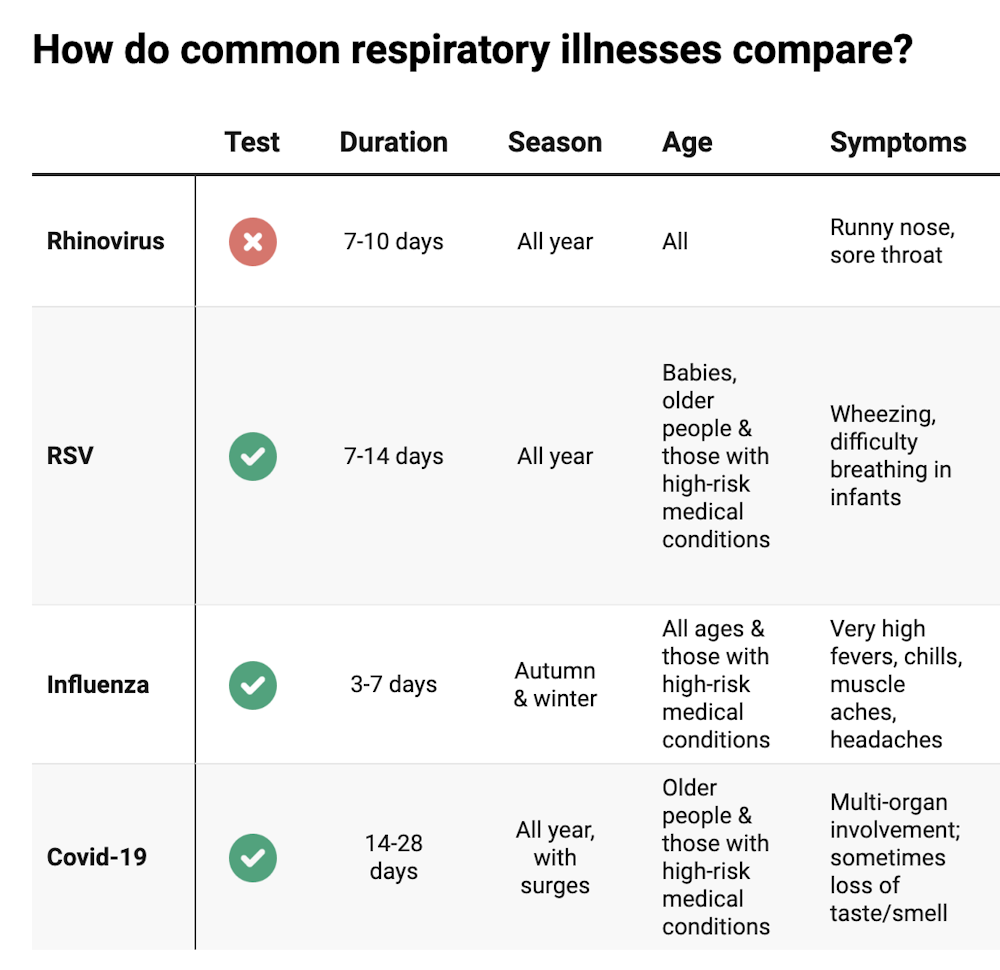
These symptoms are likely to be caused by a virus, such as COVID, influenza, respiratory syncytial virus (RSV) or a “cold” (often caused by rhinoviruses). These conditions can occur all year round, with some overlap of symptoms:
So if you have a fever, sore throat, muscle aches/pains, weakness, fatigue, or are coughing up mucus, stay home and avoid mixing with others to limit transmission.
People with COVID symptoms can take a rapid antigen test (RAT), ideally when symptoms start, then isolate until symptoms disappear. One negative RAT alone can’t rule out COVID if symptoms are still present, so test again 24–48 hours after your initial test if symptoms persist.
You can now test yourself for COVID, RSV and influenza in a combined RAT. But again, a negative test doesn’t rule out the virus. If your symptoms continue, test again 24–48 hours after the previous test.
If it’s hay fever, how do I treat it?
Treatment involves blocking the body’s histamine release, by taking antihistamine medication which helps reduce the symptoms.
Doctors, nurse practitioners and pharmacists can develop a hay fever care plan. This may include using a nasal spray containing a topical corticosteroid to help reduce the swelling inside the nose, which causes stuffiness or blockage.
Nasal sprays need to delivered using correct technique and used over several weeks to work properly. Often these sprays can also help lessen the itchy eyes of hay fever.
Drying bed linen and pyjamas inside during spring can lessen symptoms, as can putting a smear of Vaseline in the nostrils when going outside. Pollen sticks to the Vaseline, and gently blowing your nose later removes it.
People with asthma should also have an asthma plan, created by their doctor or nurse practitioner, explaining how to adjust their asthma reliever and preventer medications in hay fever seasons or on allergen exposure.
People with asthma also need to be alert for thunderstorms, where pollens can burst into tinier particles, be inhaled deeper in the lungs and cause a severe asthma attack, and even death.
What if it’s COVID, RSV or the flu?
Australians aged 70 and over and others with underlying health conditions who test positive for COVID are eligible for antivirals to reduce their chance of severe illness.
Most other people with COVID, RSV and influenza will recover at home with rest, fluids and paracetamol to relieve symptoms. However some groups are at greater risk of serious illness and may require additional treatment or hospitalisation.
For RSV, this includes premature infants, babies 12 months and younger, children under two who have other medical conditions, adults over 75, people with heart and lung conditions, or health conditions that lessens the immune system response.
For influenza, people at higher risk of severe illness are pregnant women, Aboriginal people, people under five or over 65 years, or people with long-term medical conditions, such as kidney, heart, lung or liver disease, diabetes and decreased immunity.
If you’re concerned about severe symptoms of COVID, RSV or influenza, consult your doctor or call 000 in an emergency.
If your symptoms are mild but persist, and you’re not sure what’s causing them, book an appointment with your doctor or nurse practitioner. Although hay fever season is here, we need to avoid spreading other serious infectious.
Deryn Thompson is affiliated with Loreal, Ego Pharmaceuticals and Quality Use of Medicines Alliance having received honorariums for educational talks or advisory work.
Cleaning the graves of strangers is the latest content trend taking over TikTok. But as millions tune in to watch the videos, it’s becoming clear not all of them are created equal. Two grave-cleaning creators in particular seem to reside at opposite ends of the trend.
One of the first accounts to gain popularity for grave cleaning was @ladytaphos. This account is run by Alicia Williams, a Virginia resident who treats the graves with great dignity. Williams will often share the story of the person residing within, and acts with grace and kindness as she restores beauty to the graves.
On the other end of the spectrum is Kaeli Mae McEwen, or @the_clean_girl, who leans into more clickbait-y tactics. McEwen is known for throwing a pink spiky ball through a graveyard and cleaning the grave it lands on. She also uses her videos to promote her own pink foamy cleaner (which at one point could be purchased via a link in her bio).
Cleaning and death
While Williams’ and McEwen’s videos may seem novel to some, death and cleaning have a long and varied relationship that spans time and cultures.
Washing a loved one’s body before burial or cremation isn’t just practical – it’s a significant ritual that provides meaning during a period of grief. In certain cultures and religions it’s also a process of purification, or preparation for the afterlife.
Much has been written about cleaning and clearing out the homes of deceased people. Family members often won’t agree on how to approach such a task. In his essay on death and objects, author Tony Birch writes about his mother clearing out his grandmother’s house.
“My mother decided that our first task after her death was to empty out her Housing Commission flat and scrub it clean,” Birch writes.
He first laments the move, but later recognises the value of cleaning together before sorting – and treasuring – the items his grandmother left behind.
Grave cleaning is a practice steeped in history. Shutterstock
Margaretta Magnuson’s 2017 book, The Gentle Art of Swedish Death Cleaning, is a humorous and thoughtful introduction to the Swedish movement of döstädning. The book (and subsequent reality TV series) has sparked various conversations on death and cleaning, and especially on cleaning before you yourself pass away so you don’t leave a mess for your loved ones.
Grave cleaning can be seen as another continuation of caring for the deceased. People who decide to clean the graves of strangers may do so out of respect, or in an attempt to give them “their name back” (as names on graves become visible following the removal of debris).
Two very different approaches
Williams and McEwen are received quite differently by viewers. Anecdotally, viewers respond more positively to the calmer and more respectful cleaning videos by Williams, who takes time to explain the process while ensuring the correct products are used.
Meanwhile, many find McEwen’s videos problematic and criticise her for not adhering to proper graveyard decorum. McEwen makes a spectacle of sites of mourning, such as by pretending to vacuum graves, replacing flowers placed by others and making jokes. Viewers also speculate the products she uses may cause damage to the graves.
Perceived intent plays a role in how each creator’s content is received. While Williams focuses on respectfully restoring graves to their former glory, McEwen positions herself as the focus and merely uses the graves for content.
A complex emotional object
Similar to other funerary objects such as coffins and urns, graves are associated with both the person who died and the fact of their death. As such, they are emotionally complex objects that bring both strength and sadness to those left behind.
But graves are unique also in that they are private objects of grief exposed in a public context. Anyone visiting the graveyard can view and interact with them. Does that make them “fair game” for content creators?
Graves don’t just represent deceased loves ones. They can also act as stand-ins in their absence, becoming stone bodies of sorts. As sociologist Margaret Gibson describes in her book Objects of the Dead: Mourning and Memory in Everyday Life, “death reconstructs our experience of objects”.
“There is the strangeness of realising that things have outlived persons, and, in this regard, the materiality of things is shown to be more permanent than the materiality of the body,” she says.
Caring for and cleaning graves can therefore be interpreted as caring for the deceased, by extending their existence through the materiality of their resting place.
Psychological researcher Svend Brinkmann asserts artefacts such as graves are “culturally sanctioned”, gaining “significance from a collective system of meaning”.
In other words, we as a community create and uphold reverence for such items. This is partly why the desecration of graves is viewed as abhorrent. It is societally understood to be a desecration of the person themselves. It’s also why content creators must tread lightly.
A reason for haunting?
There are ways to interact with gravestones (and even create content) which acknowledge their complexity and connection to their owners.
TikTok creator Rosie Grant (@ghostlyarchive) bakes recipes found on headstones and records the process. She has even met with the families of the deceased to make the recipes together and learn more about the people behind the engraving-worthy food.
However, randomly cleaning the graves of strangers is fraught territory – and rife with potential privacy issues. It isn’t clear whether McEwen seeks permission from loved ones before cleaning graves, but contextually this seems unlikely.
Recent discussions have also uncovered questionable editing in her videos. Some graves in her before-and-after videos have been edited to appear cleaner and to have their structure altered. McEwen’s pink foaming cleaner also appears to be a blue cleaner edited to appear pink, raising even more questions about intent and responsibility.
While McEwen claims to be “honouring” lives by cleaning “final resting places”, the consensus from viewers is her actions are dishonourable. As one host commented on a in podcast discussing McEwen cleaning a baby’s grave while speaking in a kiddish voice: “Fuck you, you’re going to get haunted.”
The authors do not work for, consult, own shares in or receive funding from any company or organisation that would benefit from this article, and have disclosed no relevant affiliations beyond their academic appointment.
Fireworks celebrating the 75th anniversary of the founding of the People’s Republic of China illuminate the sky over Victoria Harbour in Hong Kong, Oct 1, 2024. [Photo/Xinhua] Experts from the Hong Kong and Macao special administrative regions said the central government’s new directive to transform the two regions into international hubs for top-tier talent will fulfill local demand for talent while propelling the country’s high-quality development. To achieve this objective, both regions should leverage their distinct advantages and policy incentives to attract and retain external talent, while strengthening mechanisms to nurture local talent, they said. The resolution on further deepening reform comprehensively to advance Chinese modernization, which was adopted on July 18 at the third plenary session of the 20th Central Committee of the Communist Party of China, voiced support for Hong Kong and Macao in building themselves into international hubs for high-caliber talent. Luo Yong, chairman of the Hong Kong Quality and Talent Migrants Association, said the resolution marks the first explicit directive from the central authorities regarding the SAR’s talent policies, demonstrating Hong Kong’s significant importance to national development. Daniel Lee Ho-wah, president of the Hong Kong People Management Association, a professional human resources management body, said that Hong Kong will be a direct beneficiary of the resolution. Official data shows that the city’s population is projected to reach 8.19 million by mid-2046, with one-third being age 65 or older. Building Hong Kong into an international talent hub will help address the city’s challenges related to its aging population and labor shortage. The welcome influx of talent will also spur the growth of various industries in Hong Kong, upgrade the city’s economic structure and attract more investment, Lee said. Lau Siu-kai, a consultant with the Chinese Association of Hong Kong and Macao Studies, a Beijing-based think tank, said he believes that professionals attracted to Hong Kong will leverage the city as a gateway to the Chinese mainland and overseas. These professionals will not only contribute to the development of Hong Kong and the mainland but also help foster a positive global narrative of the country, Lau added. The Hong Kong SAR government has ramped up talent-attraction initiatives since late 2022. As of June 30, the city had received more than 320,000 applications through various talent programs, of which 200,000 had been approved, and more than 130,000 of the applicants had arrived in Hong Kong. Leveraging advantage Luo of the Hong Kong Quality and Talent Migrants Association said the “one country, two systems” principle has always been a magnet for global professionals, and the city should further leverage this advantage to enhance its appeal. Considering Hong Kong’s relatively narrow industry scope, the city needs to collaborate with mainland cities in the Guangdong-Hong Kong-Macao Greater Bay Area on talent policies. Luo’s association has been hosting talent summits and fostering exchanges with high-end talent organizations and international talent groups. He noted that professionals, whether from Hong Kong, the mainland or overseas, share a common interest in exploring growth prospects in the city, especially for foreigners who hope to tap mainland opportunities through Hong Kong. Luo emphasized the magnetic effect of career-advancement prospects on high-caliber professionals, suggesting that providing such opportunities is key to attracting the world’s best. Shang Hailong, a lawmaker and chairman of the Hong Kong Top Talent Services Association, proposed targeted scholarship programs to entice people from countries involved in the Belt and Road Initiative to study in Hong Kong. Hong Kong should not just attract professionals, but also needs to retain them, Shang said. As the city prepares for a wave of visa renewals in the coming years, the government could use the opportunity to address the practical challenges faced by newcomers. Lee of the Hong Kong People Management Association underlined the need to address expatriates’ concerns in finding suitable accommodations for their families and the right schools for their children. Lee suggested that the government collaborate with international or English-language schools to reserve spots for the children of senior professionals. Additionally, enterprises can help provide them with affordable transitional housing. He emphasized that going to Hong Kong is not just an individual decision by the professionals, but a family matter as well. Resolving livelihood challenges is essential to encouraging them to relocate to the city, Lee said. Zhou Ping, director of the Macao One Belt, One Road Research Center at City University of Macao, said the plenary session’s resolution provides crucial guidance for advancing Macao’s talent framework. He said Macao’s emphasis on new industries in recent years boasts several advantages that are distinct from those of Hong Kong in attracting talent. Macao’s “1+4” industry diversification strategy, unveiled in 2023, involves promoting the growth of one key sector — tourism and leisure — alongside the advancement of the big health, modern finance and high-tech industries, as well as conventions, exhibitions, culture and sports. This strategic approach opens doors for experts to swiftly assume leadership positions within these industries, Zhou said. Wong Kam-fai, a legislator and an associate dean of the faculty of engineering at Chinese University of Hong Kong, said fostering local talent is critical for the long-term development of Hong Kong’s talent base. Despite Hong Kong’s established prowess in finance, innovation and technology, trade and aviation, there remains a shortage of skilled human resources in some applied technology disciplines such as information technology, electrical and mechanical engineering, maritime engineering and logistics, he said. To address this gap, Wong proposed strengthening cooperation with the city of Shenzhen, Guangdong province, in training talent with applied skills. Hong Kong can establish vocational training colleges on the mainland, offering programs with mutually recognized qualifications, Wong said, adding that graduates from these colleges could be allowed to work in Hong Kong, becoming a force in the city’s talent pool. The government could also construct primary and secondary boarding schools, offering mainland and international curriculums that cater to the needs of families from Shenzhen and Hong Kong. These institutions could serve as incubators for Hong Kong’s future professionals. Addressing challenges Addressing the challenges in fostering innovation and technology talent, Wong suggested that the government establish a committee to focus on the issue. This committee could help the Education Bureau of the Hong Kong SAR create and update the innovation and technology program framework, and systematically develop the professionals required by various industries, he added. Zhou from City University of Macao also emphasized the importance of local talent development. He said the Macao SAR government should offer greater support to the region’s 10 higher education institutions, with a focus on disciplines integral to the city’s future growth. He also encouraged these institutions to consider establishing branches on Hengqin island of Zhuhai, Guangdong province, to capitalize on the synergy of the whole Greater Bay Area.
BAKU, AZERBAIJAN (7 October 2024) — The Asian Development Bank (ADB) has appointed Sunniya Durrani-Jamal as its new Country Director for Azerbaijan. She joined the Azerbaijan Resident Mission today to officially commence her role.
Ms. Durrani-Jamal will lead ADB’s operations in Azerbaijan and manage the bank’s relationships with the government and other stakeholders. She will oversee the preparation and implementation of the bank’s new country partnership strategy (CPS). The new CPS will build on ADB’s existing work in Azerbaijan, and its strategic focus areas will be aligned with the government’s development strategy and ADB’s Strategy 2030.
“It is an honor to lead ADB’s efforts in Azerbaijan, a country of rich culture and significant economic potential,” said Ms. Durrani-Jamal. “My priority is to extend ADB’s enduring collaboration with the government, help diversify the economy and improve the quality of life for people in Azerbaijan. This includes expanding renewable energy, addressing climate change, and helping the Caucasus nation transition to a private-sector-led green economy.”
Azerbaijan’s 10-year development strategy, Azerbaijan 2030: National Priorities for Socio-Economic Development, outlines the country’s ambitions to develop a sustainable and competitive economy, foster an inclusive society, improve human capital, transition to green growth, and improve infrastructure.
As Asia and the Pacific’s climate bank, ADB is also supporting Azerbaijan’s Presidency of COP29, including viacapacity buildingahead of the landmark United Nations climate summit set to take place in Baku next month
Ms. Durrani-Jamal has more than 25 years’ professional experience, including 16 years with ADB where she has held key senior roles. These include country director for Cambodia, senior advisor to ADB’s vice president for east Asia, southeast Asia, and the pacific; and senior economist.
Ms. Durrani-Jamal holds a master’s degree in economics (human development) from the University of Sussex, United Kingdom, and a master of science in economics (monetary policy) from Quaid-i-Azam University, Pakistan. She succeeds outgoing Country Director Candice McDeigan who held this position from 2021.
Since Azerbaijan joined the bank in 1999, ADB has committed more than $5 billion in sovereign and private sector assistance, including in transport, energy, health care, and agriculture.
ADB is committed to achieving a prosperous, inclusive, resilient, and sustainable Asia and the Pacific, while sustaining its efforts to eradicate extreme poverty. Established in 1966, it is owned by 69 members—49 from the region.
Source: Hong Kong Government special administrative region
Appointment of Director of Hong Kong International Legal Talents Training Office announced Appointment of Director of Hong Kong International Legal Talents Training Office announced ******************************************************************************************
The Department of Justice announced today (October 8) that following an open recruitment exercise, Dr Yang Ling will take up the appointment as the Director of the Hong Kong International Legal Talents Training Office. Dr Yang will take up the appointment on November 1. The Secretary for Justice, Mr Paul Lam, SC, welcomed the appointment. Commenting on Dr Yang’s appointment, Mr Lam said, “Dr Yang is a recognised scholar in international legal and dispute resolution with extensive management experience, including from her time at the Hong Kong International Arbitration Centre. I am confident that she will be able to lead the office to take forward the policy initiatives of developing Hong Kong as a capacity-building centre for legal talent in domestic, foreign and international law.” The Hong Kong International Legal Talents Training Office has been set up to serve as the co-ordinating body to take forward the establishment of the Hong Kong International Legal Talents Training Academy set out in the 2023 Policy Address. The Office will also serve as the secretariat for the Hong Kong International Legal Talents Training Expert Committee, which has been established and formed by three advisory boards comprising eminent legal experts and scholars from renowned international, Mainland and local legal organisations, and universities as members. Members of the Expert Committee are appointed in their personal capacity, and the list of membership is set out in the Appendix. Capitalising on Hong Kong’s bilingual common law system and international status, the Academy will regularly organise practical training courses, seminars, international exchange programmes and more to promote exchanges among talent in regions along the Belt and Road. It will also provide training for talent in the practice of foreign-related legal affairs for the country, and nurture legal talent conversant with international law, common law, civil law and the country’s legal system. This initiative will be conducive in consolidating Hong Kong’s position as an international legal and dispute resolution services centre in the Asia-Pacific region. A brief biographical note of Dr Yang is set out below: Dr Yang was admitted to the Chinese Bar in 2004 and currently holds the position of the Deputy Secretary-General and Head of China Relations of the Hong Kong International Arbitration Centre (HKIAC). She obtained an LL.M. in International Law in 2006 and a PhD in 2009 from Wuhan University. Prior to joining the HKIAC in 2018, she was an Associate Professor at the East China University of Political Science and Law where she taught international arbitration for more than eight years. In addition, she was a visiting scholar at the University of Aix-en-Provence Marseille III in 2008 and at Boston University School of Law in 2017. Dr Yang has published widely on issues of international dispute resolution and arbitration in China, and currently serves as Executive Editor-in-Chief for the Shanghai International Arbitration Review. She has also been appointed as an arbitrator.
Source: The Conversation (Au and NZ) – By David Peetz, Laurie Carmichael Distinguished Research Fellow at the Centre for Future Work, and Professor Emeritus, Griffith Business School, Griffith University
Australia’s productivity growth has reverted to the same stagnant pattern as before the pandemic, according to the Productivity Commission’s latest quarterly report.
Productivity is complex and often misunderstood in media and policy debates. So before we read too much into this latest data, here are six key things to understand about productivity.
1. It’s about quantities, not costs
Productivity “measures the rate at which output of goods and services are produced per unit of input”. So it’s about how many workers does it take to make how many widgets?
Most Australian workplace managers don’t know how to measure productivity correctly.
If someone says “higher wages mean lower productivity”, they don’t know what they’re talking about. Wages aren’t part of the productivity equation. People often cite “productivity” as a reason for a policy they like because they can’t say “we like higher profits”.
In fact, high wages can encourage firms to introduce new technology that improves productivity. If labour becomes more expensive, it may be more profitable for firms to invest in labour-saving technology.
But lower productivity isn’t always a bad thing. Sometimes higher selling prices can lower productivity. It seems odd, but works like this: if prices for commodities such as iron ore or coal are high, it becomes profitable for mining companies to dig through more rock to get to it.
This takes more time. But it’s now worth extracting these small quantities, because they’re so valuable. For this reason, with high commodity prices, mining labour productivity fell by 13% between 2019-20 and 2022-23. Mining productivity had the largest negative impact on national productivity growth in 2022-23.
2. Productivity is directed by management, not workers
The biggest single factor that shapes productivity is technology. Who’s responsible for what technology a business introduces? Management. Workers often don’t have much of a say.
OECD research suggests new technology such as artificial intelligence (AI) meets lower resistance from employees when they are consulted over its introduction. That’s because new technology makes their firms more competitive and they want to keep their jobs.
Not surprisingly, there’s lots of research showing management that engages and consults workers gets greater output.
Output will also be better with an educated and skilled workforce. If people can do more things with their brains, they’ll be more productive.
3. Measuring productivity is dodgier the more complex it gets
Measuring labour productivity – output per unit of labour input – is fairly straightforward if you’ve got a single output that is sold in a free market, and you’re looking at a single input (labour). It’s not hard to measure, or describe, the number of cars produced per worker in a week.
It gets very tricky when you’re looking at multi-factor productivity (output per unit of, say, labour-and-capital input). Economists can’t even describe the denominator. (What even is a unit of “labour-and-capital”?) So they express what they measure as an index (giving it a value of 100 in some base year). All sorts of bold assumptions get made.
Estimates are highly creative. In its report, the Productivity Commission looked at revisions to quarterly growth figures and found productivity estimates are “constantly being revised”.
On almost a third of occasions, initial estimates are out by 0.5 percentage points or more. When your estimate is that productivity increased by 0.5% – the number for the year to this June quarter – the potential for error is huge.
Even more creative assumptions are made when you try to measure productivity in the public sector, when the market is not the aim.
Productivity is higher in classrooms when there are fewer teachers per student. At least, the bean-counters will tell you that, but the students will tell you the opposite.
So you should be very wary when someone says the “productivity challenge is […] greater and more pressing in the non-market sector”, when the meaning is so contested.
4. It is best measured over long periods
Productivity growth is so erratic, that you can tell very little from one quarter’s figures. “Revise, revise, revise again”, as the PC report said.
Often the best thing to do, as the Australian Bureau of Statistics recognised long ago is to average it over the whole of a “growth cycle”, that is, between one peak of growth and the next.
Trouble is, growth cycles vary in length, and the end point is not easy to pick when it happens, only later.
Growth averaged over a long period is a lot more meaningful than growth measured over a short period. At least the Productivity Commission showed five-year averages alongside it’s latest quarterly estimates. But chances are your start date will be at a different stage in the growth cycle to your end date, so it’s not that good a measure.
5. Productivity is falling here and overseas
In Australia, productivity growth has been on a long-term decline since the 1960s, with a brief, unsustained upturn in the mid 1990s.
That pattern gives pause for thought: if big reforms to competition policy, industrial relations and wage fixing were aimed at improving productivity growth, why was that unsustainable, and why did it then continue to decline? It pays to remember that a lot of reforms people advocate in the name of productivity growth have quite different aims and effects anyway.
Internationally, the picture is not much different.
Productivity growth across industrialised countries has unevenly but gradually declined since the 1950s and 1960s. The world-wide adoption of what were often called neoliberal reforms from the 1980s failed to improve productivity growth.
6. Productivity growth once drove living standards. Not any more
In theory, higher labour productivity enables higher living standards. In practice, that is driven by the ability of workers to negotiate for higher wages.
It depends on how you measure it and what years you focus on, but from at least the early 2010s, productivity growth was much faster than hourly compensation per employee.
Again, it’s not just Australia. The OECD calls this the “decoupling” of wages and productivity.
Just because something can increase potential earnings growth, it does not follow that it will.
As a university employee and since then, David Peetz has undertaken research over many years with occasional financial support from governments from both sides of politics, employers and unions. He has been and is involved in several Australian Research Council-funded and approved projects, some of which included contributions from an employer body, a superannuation fund, and two unions. The projects do not concern the subject matter of this article.
The Department of Justice announced today that Yang Ling will take up the appointment as Director of the Hong Kong International Legal Talents Training Office with effect from November 1.
Secretary for Justice Paul Lam welcomed Dr Yang’s appointment, which was made following an open recruitment exercise, noting that she is a recognised scholar in international legal and dispute resolution with extensive management experience, including her time at the Hong Kong International Arbitration Centre.
“She will be able to lead the office to take forward the policy initiatives of developing Hong Kong as a capacity-building centre for legal talent in domestic, foreign and international law,” he added.
The International Legal Talents Training Office has been set up to serve as the co-ordinating body to take forward the establishment of the Hong Kong International Legal Talents Training Academy set out in the 2023 Policy Address.
The office will also serve as the secretariat for the Hong Kong International Legal Talents Training Expert Committee, which was formed by three advisory boards comprising eminent legal experts and scholars from renowned international, Mainland and local legal organisations, and universities as members.
Capitalising on Hong Kong’s bilingual common law system and international status, the academy will regularly organise training courses, seminars, international exchange programmes and more to promote exchanges among talent in regions along the Belt & Road.
It will also provide training for talent in the practice of foreign-related legal affairs for the country, and nurture legal talent conversant with international law, common law, civil law and the country’s legal system.
Dr Yang was admitted to the Chinese Bar in 2004 and currently holds the position of Deputy Secretary-General and Head of China Relations of the Hong Kong International Arbitration Centre (HKIAC).
Prior to joining the HKIAC in 2018, Dr Yang was Associate Professor at the East China University of Political Science & Law where she taught international arbitration. She was also a visiting scholar at the University of Aix-en-Provence Marseille III in 2008 and at Boston University School of Law in 2017.
When it rains heavily, plastic waste is washed off our streets into rivers, flowing out to the ocean. Most plastic is trapped in estuaries and coastal ecosystems, with a small fraction ending up offshore in the high seas.
In the coastal ocean, waves and tides break down plastic waste into smaller and smaller bits. These micro and nanoplastics linger in the environment indefinitely, impacting the health of marine creatures from microorganisms all the way up to seabirds and whales, which mistake them for food.
When we look at the scale of the problem of microplastics (smaller than 5mm) and nanoplastics (defined as 1 micrometer or less), we find something alarming. Our new research shows the shallow embayment of Moreton Bay, off Brisbane in Southeast Queensland now has roughly 7,000 tonnes of accumulated microplastics, the same as 700 million half-litre plastic bottles.
This bay accumulates plastics fast, as the Brisbane River funnels the city’s waste into it, along with several other urban rivers. The research hasn’t yet been done, but we would expect similar rates of microplastics in Melbourne’s Port Phillip Bay and Sydney Harbour.
Our research shows how much plastic waste from a big city makes it into its oceans.
Brisbane’s Moreton Bay has mangroves and seagrass meadows as well as a port and many urban rivers. Ecopix/Shutterstock
Plastic buildup in Moreton Bay
What volume of microplastics does a large city accumulate offshore? It’s hard to measure this for cities built on open coastlines. That’s because sediments and microplastics are rapidly washed away from the original source by waves and currents.
But Moreton Bay is different. The large sand islands, Moreton (Mugulpin) and North Stradbroke (Minjerribah) Islands largely protect the bay from the open ocean. This is why the bay is better described as an enclosed embayment. These restricted bays act as a trap for sediments and pollutants, as waves and currents have limited ability to wash them out. These bays make it possible to accurately measure a city’s microplastic build-up.
The bay supports a range of marine habitats from mangroves, seagrass and coral reefs, as well as an internationally recognised wetland for migrating seabirds. Dugong and turtles have long grazed the seagrass in Moreton Bay’s shallow protected waters, while dolphins and whales are also present. But microplastic buildup may threaten their existence.
Most types of plastic are denser than water, which means most microplastics in coastal seas will eventually sink to the seafloor and accumulate in sediment. Mangroves and seagrass ecosystems are particularly good at trapping sediment, which means they trap more microplastics.
We wanted to determine whether Moreton Bay’s varying ecosystems had accumulated different amounts of plastics in the sediment.
We measured the plastic stored in 50 samples of surface sediment (the top 10cm) from a range of different ecosystems across Moreton Bay, including mangroves, seagrass meadows and mud from the main tidal channels.
The result? Microplastics were present in all our samples, but their concentrations varied hugely. We found no clear pattern in how plastics had built up. This suggests plastics were entering the bay from many sources.
We tested for seven common plastics: polycarbonate (PC), polyethylene (PE), polyethylene terephthalate (PET), poly (methyl methacrylate) (PMMA), polypropylene (PP), polystyrene (PS), and polyvinyl chloride (PVC).
Of these, the most abundant microplastic was polyethylene (PE). This plastic is widely used for single-use plastic items such as chip packets, plastic bags and plastic bottles. It’s the most commonly produced and used plastic in Australia and globally.
In total, we estimate the bay now holds about 7,000 tonnes of microplastic in its surface sediments.
In our follow-up paper we explored how rapidly these plastics had built up over time. We took two sediment cores from the central part of the bay, where sediment is accumulating. Cores like this act as an archive of sediment and environmental changes over time.
The trend was clear. Before the 1970s, there were no microplastics in Moreton Bay. They began appearing over the next three decades. But from the early 2000s onwards, the rate rose exponentially. This is in line with the soaring rate of plastic production and use globally. Our analysis shows a direct link between microplastic concentration and population growth in Southeast Queensland.
The challenge of measuring microplastics
To date, we have had limited knowledge of how much plastic is piling up on shallow ocean floors. This is because measuring microplastics is challenging. Traditionally, we’ve used observation by microscope and a technique called absorption spectroscopy, in which we shine infrared light on samples to determine what it’s made up of. But these methods are time-consuming and can only spot plastic particles larger than 20 micrometres, meaning nanoplastics weren’t being measured.
Our research team has been working to get better estimates of microplastic and nanoplastic using a different technique: pyrolysis-gas chromatography mass spectrometry. Here, a sample is dissolved in a solvent and then heated until it vaporises. Once in vapour form, we can determine the concentration of plastic and what types of plastics are present.
This method can be used to estimate how much plastic pollution is present in everything from water to seafood to biosolids and wastewater.
What’s next?
It’s very likely microplastics are building up rapidly in other restricted bays and harbours near large cities, both in Australia and globally.
While we might think microplastics are safe once buried in sediment, they can be consumed by organisms that live in the sediments. Currents, tides and storms can also wash them out again, where marine creatures can eat them.
This is not a problem that will solve itself. We’ll need clear management strategies and policies to cut plastic consumption and improve waste disposal. Doing nothing means microplastics will keep building up, and up, and up.
Elvis Okoffo receives funding from the Goodman Foundation, The Australian Academy of Science and The Australian Research Council (ARC) Training Centre for Hyphenated Analytical Separation Technologies (HyTECH).
Alistair Grinham has received funding from state and federal government, industry and NGOs. He has an honorary role at the University and works for environmental monitoring company Fluvio.
Ben Tscharke receives funding from the Australian Criminal Intelligence Commission and the Australian Research Council.
Helen Bostock receives funding from the Australian Research Council.
Kevin Thomas receives funding from the Australian Criminal Intelligence Commission, Australian Research Council, Goodman Foundation, Minderoo Foundation, National Health and Medical, Research Council, Queensland Corrective Services, Queensland Health and Research Council of Norway.
The Albanese government has today declared stronger protections for the waters around Heard Island and McDonald Islands, one of Australia’s wildest, most remote areas. The marine park surrounding the islands will be extended by 310,000 square kilometres, quadrupling its size.
Announcing the decision, Environment Minister Tanya Plibersek said Heard Island and McDonald Islands – about 4,000 kilometres southwest of Perth – are a “unique and extraordinary part of our planet. We are doing everything we can to protect it.”
But the announcement, while welcome, is a missed opportunity on several fronts.
Important areas around the islands remain unprotected, despite a wealth of scientific evidence pointing to the need for safeguards. On this measure, the government could have done far more to protect this unique wildlife haven.
A special place
Heard Island and McDonald Islands are a crucial sanctuary for marine life in the Southern Ocean. The land and surrounding waters support a food chain ranging from tiny plankton to fish, invertebrates, seabirds and marine mammals such as elephant seals and sperm whales.
Both the marine and land environments of the islands are globally recognised for their ecological significance, and include species not found elsewhere in Australia.
In 2002, a marine reserve was declared over the islands and parts of the surrounding waters. The reserve was extended in 2014.
The expansion announced today means most waters around the islands have protection. The new safeguards primarily extend to foraging areas for seals, penguins and flying birds such as albatrosses.
The expansion covers some deep water areas but excludes important deeper water locations including underwater canyons and seamounts, and a feature known as Williams Ridge.
This is an important oversight that compromises the strength of the expanded protections.
The protections do not extend to an important undersea feature known as William’s Ridge.
The science is clear
In March this year, my colleagues and I released a report showing existing protections for Heard Island and McDonald Islands were no longer adequate and should urgently be expanded.
The report drew on more than two decades’ of research and new scientific understanding. In particular, we found climate change was warming the waters around the islands, posing risks to marine life such as the mackerel icefish.
The icefish lives in shallow water and is an important food source for other animals. To maintain the islands’ biodiversity as the climate warms, we recommended extending the existing marine reserve to cover more shallow waters in the east, and protecting currently unprotected deeper waters.
Today’s announcement does not protect these deeper waters. This is a major shortcoming. Our report showed deeper water areas to the east of Heard Island are significant to the region’s biodiversity, and to its ability to cope with warmer seas under climate change.
The government says its decision came after extensive consultation with a range of parties – including the fishing industry and conservation groups.
Heard Island and McDonald Islands host valuable fisheries for Patagonian toothfish and mackerel icefish. The footprint of fishing operations has expanded over the past 30 years.
The fishery for mackerel icefish uses a range of methods including bottom trawling. This is the only fishery in the Southern Ocean to use bottom trawling methods. This is a damaging fishing technique that uses towed nets to catch fish and other marine species on or near the seabed.
Deeper water areas to the east of Heard Island are significant to the region’s biodiversity. Wikimedia/Tristannew, CC BY
A range of non-target fish species, especially skates, are accidentally caught by the fisheries around Heard Island and McDonald Islands. Skates are a vulnerable species because they are slow to grow and mature. Indicators suggest skate bycatch is too high.
The new measures should have prevented fishing in some deeper waters to reduce pressure on this and other vulnerable species. In particular, bottom trawling should have been prohibited.
As climate change worsens and fishing activity continues, the area must be managed to take account of these dual pressures. The management should also maximise the resilience of species imperilled by climate change, such as mackerel icefish – a cold-adapted species not found anywhere else in Australia’s marine zone.
My colleagues and I proposed deep-sea protections over about 30% of the existing fishing grounds around Heard Island and McDonald Islands. Catch limits would not have been adjusted, and the fisheries were not likely to have been substantially affected.
The decision to allow fishing, including bottom-trawling, in some areas of high conservation value means other measures will be needed to protect marine life in deep areas under pressure from climate change.
An opportunity missed
Today’s announcement follows a decision by the government last year to triple the size of Macquarie Island Marine Park. The move was largely in keeping with the science, and both protected important biodiversity regions and provided for fisheries.
The protection awarded to Heard Island and McDonald Islands falls short of this standard. It fails to protect vulnerable marine species from climate change and fishing, and squanders a chance for Australia to show international leadership.
Andrew J Constable received part funding from Pew Charitable Trusts and Australian Marine Conservation Society to produce the independent report on “Understanding the marine ecosystems surrounding Heard Island and McDonald Islands (HIMI) and their conservation status”.