Category: Universities

  • MIL-Evening Report: Failure to launch: why the Albanese government is in trouble

    Source: The Conversation (Au and NZ) – By Carol Johnson, Emerita Professor, Department of Politics and International Relations, University of Adelaide

    It wasn’t meant to be like this.

    In her 2022 study of Anthony Albanese, Katharine Murphy describes a prime minister who thought he’d be successfully managing an idealistic, collaborative and positive “new politics” that would favour the Teal independents rather than Dutton’s Liberals. Albanese seemed confident that Labor was destined for an extended period in office. Given he later appointed Murphy to his communications team, he apparently approved of her analysis.

    However, even at the time Murphy’s Lone Wolf: Albanese and the New Politics was published, various commentators, including myself, queried the “new politics” scenario. While the Teals may represent a new politics, it is clear that the old Liberal politics — of culture wars and denouncing Labor’s economic and climate change policies — is also still very much with us.

    Labor and the Liberals are now neck-and-neck in some polls, with minority government (or worse) potentially looming for Labor. Meanwhile, Gareth Evans and Bill Kelty, key figures from the Hawke/Keating period, have excoriated the Albanese government’s allegedly lacklustre performance.

    How did it all go so wrong?

    Great expectations; modest reality

    Some of the reasons can be traced back to difficulties addressing unrealistic expectations in Labor’s 2022 election strategy. Albanese went to the 2022 election with a “new politics”, collaborative style agenda that sought to bring all Australians, including business, labour, Indigenous and non-Indigenous Australians together. It was a small target strategy based on assumed common interests, kindness and compassion rather than divisiveness.

    As a result, Labor successfully countered Scott Morrison’s populist, “us versus them” campaign strategy. However, Labor’s approach was to prove easier to implement as an election strategy than in government, as three examples show.

    First, Albanese was channelling Bob Hawke when it came to bringing business and labour together. Yet, the Hawke government’s rapprochement with business was based on business being able to pay lower wages, because workers would be compensated by a government-funded “social wage” in the form of benefits and entitlements.

    By contrast, the Albanese government pledged to end the wage stagnation of the Liberal years and generally increase wages. A major emphasis was placed on improving the wages of low-paid women workers. In the process, Labor tackled issues that arose from Keating’s flawed, neoliberal-influenced, enterprise bargaining model.

    However, key business groups criticised Labor’s resulting industrial relations measures, including multi-employer bargaining, increases in the minimum wage, and measures designed to address precarious and contract work. The Liberals have largely sided with business critiques.

    Second, Labor’s attempts to bring Indigenous and non-Indigenous Australians together, via the Voice referendum, fell victim to a divisive, populist campaign by Dutton and others. Dutton depicted the Voice proposal not as arising from a major national meeting of Indigenous representatives but as being an elite “Canberra voice” that would give special rights to Indigenous Australians that were denied to others. Furthermore, he argued that government was so focused on elite “woke” issues such as the Voice, it was neglecting Australian workers’ cost-of-living crisis. Labor’s strategy for countering right-wing populism was in disarray.

    Albanese’s response to the Voice loss was to go even more “small target” in ways that alienated progressive supporters. He abandoned key commitments ranging from the Indigenous Makarrata commission process of Treaty and Truth-telling, to protecting LGBTQI+ teachers and students from being sacked by religious schools. The debacle over including gender identity questions in the census was another result.

    Third, international events, and other parties’ politicisation of them, have impeded the government’s attempts at social cohesion. Australian political debate has become so polarised over developments in the Middle East that the Albanese government is accused of abandoning support for Israel by the Liberals and the Murdoch press, while simultaneously being accused of being “complicit in Israel’s genocide” by the Greens and pro-Palestinian groups.

    Narrative failure

    As its original story of bringing Australians together has been increasingly undermined, the government has floundered when it comes to telling a clear narrative about itself. By contrast, Dutton’s relentless, focused and simply expressed negativity has been cutting through.

    Part of Labor’s problem in countering Dutton is that he is targeting them for things that are often beyond their control.

    For example, Dutton’s claim the government has been too distracted by so-called “woke” issues to address the cost-of-living crisis has been particularly electorally damaging for Labor. So have his claims that Labor’s renewable energy policies are fuelling inflation and pushing up the cost of living still further.

    The government argues it has been providing extensive cost-of-living relief in the form of tax cuts, energy bill relief, rental assistance, wage increases, cheaper medicines and reduced child care costs. However, the problem is that such government measures are being continually undercut by inflation, price increases, high interest rates, and the housing affordability and supply crisis.

    Yet, the housing affordability and supply crisis has been aggravated by decades of poor housing policy that long predate the Albanese government. Furthermore, Labor’s attempts to address it are currently being stymied by a combination of Coalition and Greens opposition, once again sandwiching Labor.

    Meanwhile, the Coalition argues that government spending is exacerbating inflation and high interest rates. However, even the independent Reserve Bank, which sets cash interest rates and is also critical of government spending, has drawn attention to multiple international factors playing a role in inflation. Price increase gouging by some businesses to augment their profits has exacerbated the problem.

    Furthermore, Treasurer Jim Chalmers argues that existing government spending levels have been essential to preventing Australia sliding into recession, while still enabling a budget surplus.

    Chalmers has struggled to cut through in the way that Keating’s messages did. However, Keating benefited from the Coalition largely agreeing with his neoliberal-influenced “reform” agenda, despite arguing it wasn’t going far enough. By contrast, Chalmers has been facing a fundamentally hostile opposition, unsympathetic to key influences on his thought, such as Mariana Mazzucato.

    Labor has also had trouble selling the government’s achievements because, as I argue in a recent book, some of the Albanese government’s most successful reform measures have been in gender equality (although much more still needs to be done). Despite women making up more than half of the population, reforms that affect women tend to be undervalued in what is still a male defined political culture. Furthermore, the working class is often conceived in terms of blue collar male employment, so benefits for women workers are not being adequately recognised. This is particularly the case in Dutton’s hyper-masculine, strongman discourse.

    Mobilising gendered leadership stereotypes has been central to Dutton’s populist “us” versus “them” politics. Dutton consistently depicts Albanese as an emasculated “weak” leader on issues ranging from addressing the cost of living crisis to detaining asylum seekers freed by a High Court decision, and supporting Israel. By contrast, Dutton is depicted as the strong leader who will stand up for everyday Australians allegedly abandoned by Labor and the so-called elites.

    This does not look like a “new politics” at all and it is a divisive, populist terrain that Labor is finding very difficult to negotiate.

    Carol Johnson has received past funding from the Australian Research Council for work on Labor governments and on gender equality policy. .

    ref. Failure to launch: why the Albanese government is in trouble – https://theconversation.com/failure-to-launch-why-the-albanese-government-is-in-trouble-239730

    MIL OSI AnalysisEveningReport.nz

  • MIL-OSI Global: Many stable atoms have ‘magic numbers’ of protons and neutrons − 75 years ago, 2 physicists discovered their special properties

    Source: The Conversation – USA – By Artemis Spyrou, Professor of Nuclear Physics, Michigan State University

    The linear accelerator at the Facility for Rare Isotope Beams, where researchers study rare isotopes of elements. Facility for Rare Isotope Beams

    The word magic is not often used in the context of science. But in the early 1930s, scientists discovered that some atomic nuclei – the center part of atoms, which make up all matter – were more stable than others. These nuclei had specific numbers of protons or neutrons, or magic numbers, as physicist Eugene Wigner called them.

    Maria Goeppert Mayer won the 1963 Nobel Prize in physics.
    Argonne National Laboratory, CC BY-NC-SA

    The race to figure out what made these nuclei so stable began. Understanding these magic numbers would allow scientists to predict the properties of other nuclei, such as their mass or how long they are expected to live. With that, scientists could also predict which combinations of protons and neutrons can result in a nucleus.

    The solution to the puzzle came in 1949 from two directions simultaneously. In the U.S., physicist Maria Goeppert Mayer published an explanation, at the same time as a group of scientists led by J. Hans D. Jensen in Germany found the same solution.

    Hans Daniel Jensen won the 1963 Nobel Prize in physics.
    The Nobel Foundation

    For their discovery, the two physicists each got a quarter of the 1963 Nobel Prize in physics. We’re two nuclear scientists whose work is built on Goeppert Mayer’s and Jensen’s discoveries 75 years ago. These magic numbers continue to play an important role in our research, only now we can study them in nuclei that live for just a fraction of a second.

    Stability in the atom

    The atom is a complex system of particles. It’s made up of a central nucleus consisting of protons and neutrons, called nucleons, with electrons orbiting around the nucleus.

    Nobel prize-winning physicist Niels Bohr described these electrons in the atom as existing in a shell structure. The electrons circulate around the nucleus in particular energy levels, or orbits. These orbits have specific energies, and each orbit can hold only so many electrons.

    Chemical reactions result from interactions between the electrons in two atoms. In Bohr’s model, if an electron orbit is not already filled, then it’s easier for the atoms to exchange or share those electrons and induce chemical reactions.

    The Bohr model of the atom.
    AG Caesar/Wikimedia Commons, CC BY-SA

    One class of elements, the noble gases, hardly ever react with other elements. In noble gases, the electrons occupy completely filled orbits, and as a result the atoms greedily hold onto their electrons instead of sharing and undergoing a chemical reaction.

    In the 1930s, scientists wondered whether protons and neutrons might also occupy orbits, like electrons. But nobody could show this conclusively. For more than a decade, the scientific community was unable to describe the nucleus in terms of individual protons and neutrons. Scientists used a more simplified picture, one that treated protons and neutrons as one single system, like a drop of water.

    Magic numbers

    In 1949, Goeppert Mayer and Jensen developed the so-called shell model of the nucleus.
    Protons and neutrons occupy particular orbits, analogous to electrons, but they also have a property called spin – similar to a spinning top. Goeppert Mayer and Jensen found that when combining the two properties in their calculations, they were able to reproduce the experimental observations.

    Through some experiments, they found that nuclei with certain magic numbers of neutrons or protons are unusually stable and hold onto their nucleons more than researchers previously expected, just like how noble gases hold onto their electrons.

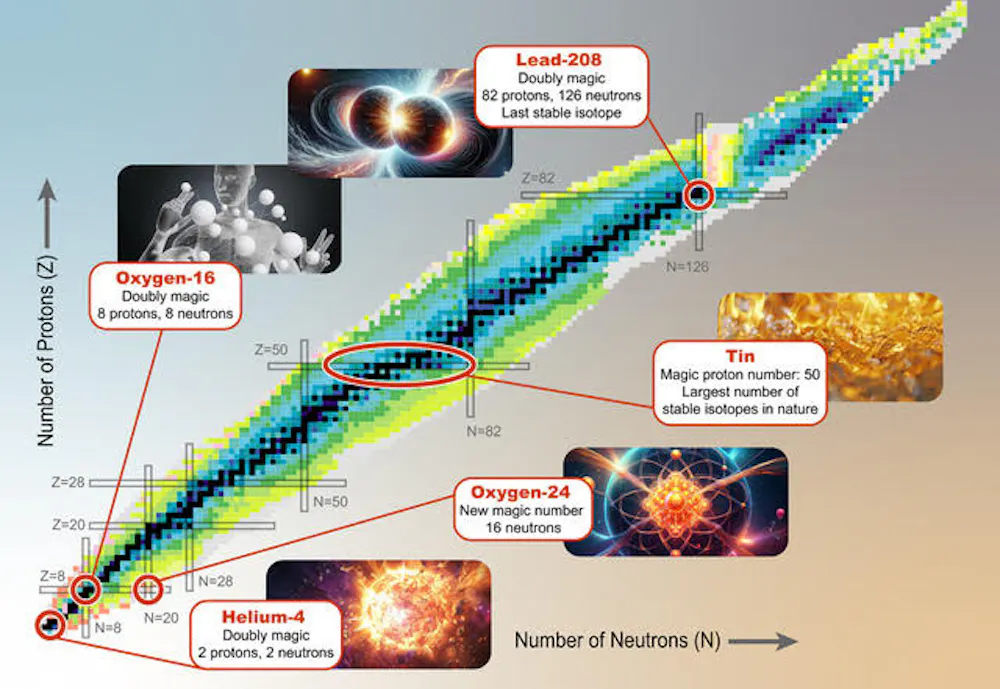
    The magic numbers known to scientists are 2, 8, 20, 28, 50, 82 and 126. They are the same for both protons and neutrons. When a nucleus has a magic number of protons or neutrons, then the particular orbit is filled, and the nucleus is not very reactive, similar to the noble gases.

    For example, the element tin has a magic number of protons. Tin always has 50 protons, and its most common isotope has 70 neutrons. Isotopes are atoms of the same element that have a different number of neutrons.

    There are nine other stable isotopes of tin that can exist – it’s the element with the largest number of stable isotopes. A stable isotope will never spontaneously change into a different element, which is what happens to radioactive isotopes.

    Helium, with two protons and two neutrons, is the lightest “doubly magic” nucleus. Both its neutron count and its proton count are a magic number. The forces that hold the helium-4 nucleus together are so strong that it’s impossible to attach another proton or neutron. If you tried to add another proton or neutron, the resulting atom would fall apart instantaneously.

    On the other hand, the heaviest stable nucleus in existence, lead-208, is also a doubly magic nucleus. It has magic numbers of 82 protons and 126 neutrons.

    Many stable isotopes have magic numbers of protons and neutrons.
    The Facility for Rare Isotope Beams

    Examples of magic numbers and stable nuclei exist everywhere – but scientists couldn’t explain them without the introduction of the shell model.

    Stable nuclei in nature

    The shell structure in nuclei tells researchers about how elements are distributed across the Earth and throughout the universe.

    One of the most abundant elements on our planet and in the human body is oxygen, in particular the isotope oxygen-16.

    With eight protons and eight neutrons, oxygen-16 has an extremely stable nucleus. A nearby star produced the oxygen we find on Earth through nuclear reactions in its core sometime before the solar system was formed.

    Since oxygen nuclei are doubly magic, these nuclei in the star did not interact very much with other nuclei. So more oxygen was left around to eventually act as an essential ingredient for life on Earth.

    In her Nobel lecture, Maria Goeppert Mayer talked about the work she did with physicist Edward Teller. The two had attempted to describe how these elements formed in stars. In the 1930s, it was impossible for them to explain why certain elements and isotopes were more abundant in stars than others. She later found that the increased abundances corresponded to nuclei with something in common: They all had magic numbers of neutrons.

    With the shell model and the explanation of magic numbers, the production of elements in stars was possible and was published in 1957.

    Scientists today continue to use ideas from the nuclear shell model to explain new phenomena in nuclear science. A few accelerator facilities, such as the Facility for Rare Isotope Beams, where we work, aim to create more exotic nuclei to understand how their properties change compared with their stable counterparts.

    At the Facility for Rare Isotope Beams, scientists produce new isotopes by accelerating stable isotopes to about half the speed of light and smashing them at a target. Out of the pieces, we select the rarest ones and study their properties.

    Possibly the most profound modern discovery is the fact that the magic numbers change in exotic nuclei like the type we create here. So, 75 years after the original discovery, the race to discover the next magic number is still on.

    Artemis Spyrou receives funding from the US National Science Foundation.

    Sean Liddick receives funding from the Department of Energy, Office of Science and the Department of Energy, National Nuclear Security Administration.

    ref. Many stable atoms have ‘magic numbers’ of protons and neutrons − 75 years ago, 2 physicists discovered their special properties – https://theconversation.com/many-stable-atoms-have-magic-numbers-of-protons-and-neutrons-75-years-ago-2-physicists-discovered-their-special-properties-239690

    MIL OSI – Global Reports

  • MIL-Evening Report: One of science’s greatest achievements: how the rapid development of COVID vaccines prepares us for future pandemics

    Source: The Conversation (Au and NZ) – By Paul Griffin, Professor, Infectious Diseases and Microbiology, The University of Queensland

    Since COVID was first reported in December 2019, there have been more than 775 million recorded infections and more than 7 million deaths from the disease. This makes COVID the seventh-deadliest pandemic in recorded history.

    Factors including climate change, disruption of animal habitats, poverty and global travel mean we’re only likely to see more pandemics in the future.

    It’s impossible to predict exactly when the next pandemic will happen, or what it will be. But experts around the world are working to prepare for this inevitable “disease X”.

    One of the cornerstones of being prepared for the next pandemic is being in the best possible position to design and deploy a suitable vaccine. To this end, scientists and researchers can learn a lot from COVID vaccine development.

    A look back

    After SARS-CoV-2 (the virus that causes COVID) was discovered, vaccine development moved very quickly. In February 2020 the first batch of vaccines was completed (from Moderna) and the first clinical trials began in March.

    An mRNA vaccine from Pfizer/BioNTech was the first to be approved, on December 2 2020 in the United Kingdom. Approvals for this and other vaccines, including shots developed by Moderna (another mRNA vaccine) and Oxford/AstraZeneca (a viral vector vaccine), followed elsewhere soon afterwards.

    Previously the fastest vaccine developed took around four years (for mumps in the 1960s). Had COVID vaccines taken this long it would mean we would only just be rolling them out this year.

    An estimated 13.72 billion COVID vaccine doses have now been administered, with more than 70% of the world’s population having received at least one dose.

    The rapid development and rollout of COVID vaccines is likely to be one of the greatest achievements of medical science ever. It also means we are in a much better position to respond to future emerging pathogens.

    New vaccine technology

    A lot of work over many years prepared us to develop COVID vaccines as quickly as we did. This included developing new platforms such as viral vector and mRNA vaccines that can be adapted quickly to new pathogens.

    While scientists had been working on mRNA vaccines for decades before the COVID pandemic, the COVID shots from Pfizer/BioNTech and Moderna were the first mRNA vaccines to be approved for human use.

    These vaccines work by giving our body instructions (the “m” in mRNA stands for messenger) to make SARS-CoV-2 spike proteins. These are proteins on the surface of the virus which it uses to attach to our cells. This means when we encounter SARS-CoV-2, our immune system is poised to respond.

    This technology will almost certainly be used to protect against other diseases, and could potentially help with a future pandemic.

    In the meantime, scientists are working to improve mRNA technology even further. For example, “self-amplifying RNA” has the potential to enhance immune responses at lower doses compared with conventional mRNA.

    mRNA vaccines teach our bodies to make SARS-CoV-2’s spike protein.
    Kateryna Kon/Shutterstock

    While our current COVID vaccines are safe and very effective at protecting against severe disease, they’re not perfect. We may never be able to achieve a “perfect” vaccine, but some additional properties we’d like to see in future COVID vaccines include being better at reducing transmission, lasting longer, and needing to be updated less often as new variants emerge.

    Even now there are many COVID vaccines in clinical trials. So hopefully, COVID vaccines that improve on the initial shots will be available relatively soon.

    Other desirable attributes include vaccines we can administer by alternate routes to needles. For COVID and other diseases such as influenza, we’re seeing significant developments locally and internationally on vaccines than can be administered via skin patches, through the nose, and even orally.

    Some challenges

    Developing vaccines for COVID was a huge challenge, but one that can mostly be judged a success. Research has estimated COVID vaccines saved 14.4 million lives across 185 countries in just their first year.

    However, the story of COVID vaccination has also had many other challenges, and arguably a number of failures.

    First, the distribution of vaccines was not equitable. Analysis of the initial rollout suggested nearly 80% of eligible people in high-income countries were vaccinated, compared with just over 10% in low-income nations.

    Supply of vaccines was an issue in many parts of the world, so expanding local capacity to enable more rapid production and distribution of vaccines will be important for the next pandemic.

    Further, adverse events linked to COVID vaccines, such as rare blood clots after the AstraZeneca vaccine, affected perceptions of vaccine safety. While every serious adverse event is significant, these incidents were very rare.

    However, these issues exacerbated other challenges that hampered vaccine uptake, including the spread of misinformation.

    Misinformation remains a problem now and will probably still be prevalent whenever we face the next pandemic. Addressing this challenge involves understanding what’s deterring people from getting vaccinated, then informing and educating, addressing misinformation both about vaccination and the risks of the disease itself.

    Restoring and building trust in public health authorities also needs to continue to be a focus. Trust in governments and health authorities declined during the COVID pandemic, and evidence shows lower trust is associated with lower vaccine uptake.

    The COVID vaccine rollout faced a variety of challenges.
    Yuganov Konstantin/Shutterstock

    Ongoing preparation

    There’s no doubt our recent experience with COVID, particularly the rapid development of multiple safe and effective vaccines, has put us in a better position for the next pandemic.

    This didn’t happen by accident. There was a lot of preparation even before COVID was first discovered that facilitated this. Organisations like the Coalition for Epidemic Preparedness Innovations (CEPI) have been supporting research to develop vaccines rapidly to respond to a new threat for some time.

    CEPI has an ongoing program that aims to be able to develop a vaccine against a new threat, or disease X, in just 100 days. While COVID vaccines have been a huge achievement, work continues in the hope we will be able to develop a vaccine even faster next time.

    This article is part of a series on the next pandemic.

    Paul Griffin is a director and scientific advisory board member of the immunisation coalition. He has served on Medical Advisory Boards including for AstraZeneca, GSK, MSD, Moderna, Biocelect/Novavax, Seqirus and Pfizer and has received speaker honoraria including from Seqirus, Novartis, Gilead, Sanofi, MSD and Janssen.

    ref. One of science’s greatest achievements: how the rapid development of COVID vaccines prepares us for future pandemics – https://theconversation.com/one-of-sciences-greatest-achievements-how-the-rapid-development-of-covid-vaccines-prepares-us-for-future-pandemics-228787

    MIL OSI AnalysisEveningReport.nz

  • MIL-Evening Report: Ocean protection accounts for 10% of fish in the world’s coral reefs – but we could save so much more

    Source: The Conversation (Au and NZ) – By Joshua Cinner, Professor & ARC Laureate Fellow, Thriving Oceans Research Hub, School of Geosciences, University of Sydney

    Ocean fish populations have fallen dramatically in the past half-century, and climate change is expected to make the problem worse. Governments have designated “marine protected areas”, where where human activity is constrained to protect ocean life. But have these efforts worked?

    About 8% of Earth’s oceans are protected, including about 3% where fishing is banned altogether. Our new study of nearly 2,600 tropical coral reefs around the world is the first to examine whether these areas have helped fish populations.

    We found about one in ten kilograms of fish on coral reefs is the result of efforts such as marine protected areas and other restrictions on fishing. This is promising news. But our study also reveals great room for improvement.

    A video discussing how Earth’s fish stocks are declining.

    Getting to grips with marine protection

    Maintaining healthy fish populations is important. Many communities depend on fishing for their food and livelihoods. And fish play a vital role in ocean ecosystems.

    Marine protected areas are a key policy tool used to increase fish populations. They cover a range of ocean areas including lagoons, coastal waters, deep seabed waters and coral reefs.

    The areas go by several names, including marine parks and conservation zones. Some, where fishing is prohibited, are known as no-take zones.

    Governments often quote figures on the area of ocean protected when seeking to tout their conservation policies. For example in Australia, we are told the federal, state and territory governments have established marine parks covering 4.3 million square kilometres or 48% of our oceans.

    But the extent to which marine protected areas actually conserve marine life varies enormously from place to place. So simply counting up the protected ocean area doesn’t tell you much about what has actually been achieved.


    Measuring success

    We and our colleagues wanted to assess the extent to which marine protection efforts have increased the amount of fish on coral reefs.

    We developed a computer model based on about 2,600 reefs across the global tropics, which includes reefs in the Pacific, Indian, and Atlantic oceans. From that, we estimated the amount of fish currently on each reef – measured in the kilograms of fish per hectare, or “biomass”.

    The estimations were based on information such as:

    • environmental conditions such as ocean temperature and the type of habitat where the reef is located

    • the intensity of fishing activity, known as “fishing pressure”

    • how strong the protection is – for example whether it bans fishing, or just restricts it

    • the level of compliance with no-take zones.

    We then simulated what would happen if we changed the type of protection strategy in each location while keeping everything else the same.

    We ran a few scenarios:

    • no coral reef conservation existed anywhere and all reefs could be fished without constraint

    • sites currently fished without constraint (which amounted to over half of our sites) had restrictions in place

    • fishing was prohibited on 30% of all reefs.

    And the results?

    We found both marine protected areas and other fishing restrictions account for about 10% of the fish “biomass” on reefs. In other words, about one in ten kilograms of fish on coral reefs is due to protection efforts.

    No-take zones punch above their weight. Of the fish biomass attributable to protection efforts, about 20% comes from just 3% of sites in no-take zones. This proportion would be even higher if illegal fishing in no-take zones was stamped out.

    But we found any type of fishing restriction was useful. If everywhere currently fished without constraint was subject to some level of protection – such as banning nets or spear guns – the biomass of fish globally would be another 10.5% higher, our study found. This essentially matches all conservation efforts to date.

    Our modelling also showed fish on coral reefs could be increased by up to 28% globally if the area of no-take zones rose to 30%.

    But these reefs must be chosen strategically. That’s because protection strategies can lead to wildly different results, depending on local conditions. For example, sites with lower fishing pressure in the surrounding seascape got a bigger boost from protection than places surrounded by intensive fishing effort.

    This may be because at heavily fished locations, algae often overtakes coral as the dominant feature. Algae is less fish-friendly than coral, so fish populations may not bounce back quickly even when fishing pressure is reduced.

    Grounds for optimism

    Our study tested the mettle of global coral reef conservation. On one hand, we found conservation efforts have made a contribution to the amount of fish on global coral reefs, which provides grounds for cautious optimism.

    But on the other hand, this contribution is quite modest. Our study shows much greater gains could be made not only by expanding protected marine areas, but also by improving compliance in existing ones.

    Most nations have signed a global agreement to protect 30% of Earth’s land and waters by 2030. That means the amount of ocean in marine protected areas globally will increase nearly fourfold in just six years.

    As governments continue this task, we hope our results help identify ocean sites that will benefit most from protection.

    Joshua Cinner receives funding from the Australian Research Council and National Geographic Society. He is a Fellow of the Academy of Social Sciences in Australia and the International Coral Reef Society.

    Iain R. Caldwell is affiliated with the Wildlife Conservation Society

    ref. Ocean protection accounts for 10% of fish in the world’s coral reefs – but we could save so much more – https://theconversation.com/ocean-protection-accounts-for-10-of-fish-in-the-worlds-coral-reefs-but-we-could-save-so-much-more-239188

    MIL OSI AnalysisEveningReport.nz

  • MIL-Evening Report: I think my child might need a tutor. What do I need to consider first?

    Source: The Conversation (Au and NZ) – By Matthew White, Lecturer and Researcher Australian Catholic University, Australian Catholic University

    School tutoring is a huge business. Australian estimates suggest it was worth more than of A$1.5 billion as of 2021.

    In Australia, we see frequent media reports of parents using tutors to help their children through school.

    How can you tell if tutoring is right for your child?

    What is tutoring?

    Private tutoring can be take many forms, but involves parents paying for additional lessons outside of schools hours. These are either one-to-one or in small groups.

    There are services available for students in primary school through to senior high school.

    Some tutoring services target specific skills, such as literacy or numeracy. Others offer support for young people with organisation skills and homework or preparation for certain exams.

    Tutoring can go for a short burst over a few weeks to prepare for an exam or it may be regular and ongoing to maintain learning.

    Tutoring could be to catch up on one element of school, such as handwriting or reading.
    Deyan Georgiev/ Shutterstock

    Why do people get tutoring?

    Families can get tutoring for a student for a wide range of reasons.

    A child may be struggling with certain elements of schooling – such as reading, writing, or maths. Tutoring can provide an opportunity to catch-up with tailored support.

    Tutoring can also help children prepare for tests and exams, such as NAPLAN or Year 12.

    Tutoring is used to prepare students for government selective school programs or private school scholarship exams.

    Researchers have highlighted some cultural backgrounds see investing in tutoring as an essential part of educating their children and helping them reach their full potential.

    The tutoring debate

    Tutoring can be expensive and time consuming for families. Families may pay between $30 and $200 a session, depending on the subject and qualifications of the tutor.

    Some argue this gives some children an unfair advantage and students should instead rely on their natural ability.

    Despite the criticism, there are benefits to tutoring. This includes giving students extra opportunities to consolidate their knowledge – we know this can help students learn.

    It can also help build their confidence if a tutor can step through learning in a less pressured environment. As my research has shown, academic progress relies heavily on a students’ belief in their capacity to succeed.

    Does my child need a tutor?

    All students can benefit from personalised support and coaching in whatever they wish to peruse. However, all students do not need a tutor. The choice to engage a tutor should be attached to a goal that you and your child agree on.

    If the young person does not want to engage in tutoring having a tutor is not going to help. Rather, it is more likely to lead to stress and arguments.

    It may help to talk to your child’s teacher and review school reports before starting with a tutor to work out which particular areas need extra attention.

    Depending on what you need, your child’s tutor may be a university student or someone who has made a career out of tutoring.
    Dmytro Zinkevvych/Shutterstock

    If your shared goal is to catch up or help with certain academic skills, it is important to find a tutor who is experienced and can explain the approach they take and what evidence it is based on.

    If the goal is organisation, homework or even just to improve confidence, you could at first try a university student who has past success themselves or with other students. For more specialised goals, seek out tutors who are open about their qualifications, experience and past success.

    Child safety should also be a consideration. The Australian Tutoring Association provides practical advice for parents choosing a tutor and a code of conduct for tutors.

    There is no requirement for tutors to be a member of the association. So parents should make sure any tutor has a current Working with Children check. You can of course also talk to other parents and teachers for recommendations.

    Matthew White does not work for, consult, own shares in or receive funding from any company or organisation that would benefit from this article, and has disclosed no relevant affiliations beyond their academic appointment.

    ref. I think my child might need a tutor. What do I need to consider first? – https://theconversation.com/i-think-my-child-might-need-a-tutor-what-do-i-need-to-consider-first-240091

    MIL OSI AnalysisEveningReport.nz

  • MIL-Evening Report: Still with the Tony Soprano memes? Young audiences are watching the series with fresh eyes

    Source: The Conversation (Au and NZ) – By Alexander H. Beare, Lecturer in Media, University of Adelaide

    HBO’s latest crime drama The Penguin came with a flood of memes on TikTok, X and Instagram. They compare actor Colin Farrell’s Oswald Cobblepot to James Gandolfini’s Tony Soprano.

    It’s true, there are undeniable similarities between the two portrayals and shows. HBO’s official TikTok account went so far as to upload an edit of The Penguin trailer cut to the rhythm of Alabama 3’s Woke Up This Morning – the title theme for The Sopranos.

    Running for six seasons from 1999 to 2007, The Sopranos is enjoying a sustained cultural relevancy in 2024 – something other prestige dramas of the same era such as Six Feet Under and The Shield have not achieved. A new two-part documentary about the making of the The Sopranos just premiered on HBO, 25 years after the show made its debut.

    For the last couple of years, fans have been discovering the show and making it their own. But how does it fit the present moment?

    The Sopranos as catharsis

    My research and upcoming book is based on in-depth interviews with a group of new Sopranos fans all aged between 19–26. In other words, not old enough to have watched the show when it first aired.

    During the pandemic, The Sopranos saw a surge in viewership and interest that outstripped its contemporaries like Deadwood.

    Superficially, the show is visually comparable to COVID lockdown. Tony and his kids are regularly shown sleeping in, dressed in baggy clothes, and shuffling around the kitchen picking at cold cuts.

    For those I spoke with, viewing The Sopranos wasn’t a way to escape from lockdown: it was a way to purge pent-up emotion.

    For Darcy, the show became:

    Like a cathartic tool, like, I can relate, this is how life feels right now […] A bit of relief, and a sense of relatability, you know? It was always comforting when things are not good.

    Tom shared this feeling:

    One of the cool things about The Sopranos is that a lot of the stuff is really mundane […] It’s about drudgery more than anything […] That’s what lockdown feels like – and it definitely is what a lot of daily life feels like […] it’s those moments of opening up the fridge and just eating like 20 slices of gabagool because you can’t be fucked making something to eat.

    The Sopranos as nostalgia

    The Sopranos is a profoundly negative show and yet it was being viewed by the young people I spoke to through quite an optimistic lens.

    Alannah said:

    It makes me feel nostalgic for a time when things felt a little bit like […] simpler, even though they have complications. It just seemed like a good stage of history to be in.

    In a similar vein, Callum positively characterised this feeling as an “added bonus” that “drew him into watching the show”. Selina fondly remembered the fashion and music of the show.

    Watching with a new lens

    During its original run, The Sopranos was often lauded by scholars for its deconstruction of patriarchal masculinity. This was not so much the case for the people I spoke to.

    Alannah worried The Sopranos could easily be placed in the toxic online “manosphere”:

    [The Sopranos is] like Fight Club and American Psycho. White dudes will watch it and be like, ‘Yeah, this is fucking sick – that’s me man’. And it’s like, you don’t want to be these people! You have to criticise it yourself because it is not overt in my opinion.

    Stuart expressed a similar concern about The Sopranos’ ability to be a dangerous power fantasy.

    In his experience with online Sopranos content, he observed:

    [There are fans] who see Tony Soprano as the ideal man and don’t notice that the show is supposed to be critiquing his behaviour.

    These concerns about “misunderstanding” the show very much reflect current anxieties. The reporting about how the 2019 Joker film might incite violence from white men provides a salient reference point for these worries.

    For the new viewers I spoke to, there was a real concern The Sopranos could combine dangerously with today’s toxic misogynistic online content. They were worried Tony Soprano could be interpreted as a celebration of patriarchal masculinity rather than a critique.

    Born under a bad sign

    In 2024, The Sopranos is still managing to click with new audiences. But these fans interpret the show differently and take new meaning from it. When we look at their responses, we can see how The Sopranos intersects with the attitudes and anxieties of modern audiences.

    Next time you see a meme about Tony Soprano, consider what context today’s viewers place him in – and whether an audience from 20 years ago would have done the same. Today, he might be considered even more dangerous.

    Alexander H. Beare does not work for, consult, own shares in or receive funding from any company or organisation that would benefit from this article, and has disclosed no relevant affiliations beyond their academic appointment.

    ref. Still with the Tony Soprano memes? Young audiences are watching the series with fresh eyes – https://theconversation.com/still-with-the-tony-soprano-memes-young-audiences-are-watching-the-series-with-fresh-eyes-237982

    MIL OSI AnalysisEveningReport.nz

  • MIL-OSI Translation: 03/10/2024 Armed Forces Innovation Forum 2024

    MIL AXIS Translation. Region: Polish/Europe –

    Fuente: Gobierno de Polonia en poleco.

    Armed Forces Innovation Forum 202403.10.202416 in energy in 2024 The 4th edition of the Armed Forces Innovation Forum of the Republic of Poland will be held in the complex of the Military University of Technology, a flagship undertaking of the Ministry of National Defence, constituting a meeting platform for the army, science and industry.

    FORO DE ASSUMPTIONS:Placing emphasis on the role of innovation in the development of the Polish Armed Forces and the need for the Ministry of National Defence to take decisive action in this direction.Promoting innovation in building and strengthening the capabilities of the Polish Armed Forces.Increasing competitiveness among project contractors – an opportunity for innovative enterprises.Specialization, building and strengthening the potential of domestic research and development entities and industries in the area of new and breakthrough technologies.Promoting new international tools as an opportunity for the development of innovation.Promoting the use of the capabilities of the Polish space industry in meeting the needs of the Polish Armed Forces as part of the implementation of the operational domain of space.FORO GOALS:UNDERTAKING ACTIONS FOR THE DEVELOPMENT OF THE INNOVATION SYSTEM IN THE FORUM is a good platform for starting a debate on the needs of the Polish Armed Forces and the possibilities of meeting them through the use of new solutions, including dual-use technologies. The implementation of this goal requires the creation of an appropriate system that promotes innovation in the RON, which is also to be served by the currently developed departmental innovation strategy. Initiating a debate on the role of tactical level commanders in the process of identifying, developing and using dual-use products for the needs of the Polish Armed Forces. PERFORMING THE FUNCTION OF A MEETING PLATFORM FOR THE ARMY, SCIENCE AND INDUSTRY A platform for meetings of representatives of the army, science and industry. During the sessions (discussion panels), a discussion will be held on the needs of the Polish army and the opportunities and innovation in science and industry in Poland and around the world. During the Forum, experiences will be exchanged and cooperation will be established between representatives of various environments. PRESENTATION OF CONCEPTS AND SOLUTIONS BY RESEARCH CENTRES, UNIVERSITIES AND POLISH INDUSTRY The Innovation Forum enables the presentation of new concepts and ideas that may have an impact on increasing the potential of the Polish Armed Forces, while at the same time being a platform for cooperation, exchange of information and experiences with research centers, universities and representatives of the Polish defense industry. Participation in the Forum of Polish Scientists is an opportunity for them to use their ideas and concepts for the benefit of Poland’s security and defence. STRENGTHENING COOPERATION FOR POLAND’S DEFENCE AND SECURITY The Forum has become one of many mechanisms that support the use of the research potential of Polish centers and the discovery of new opportunities among Polish scientific entities (or among Polish scientists). THEMATIC PANELS Three thematic panels will be held during the Forum: Dual-use technologies – a new trend that will pass, or a way to build the capabilities of the Polish Armed Forces? The prospect of developing the innovation system in the Ministry of National Defense. The area of outer space – the needs of the Polish Armed Forces and the capabilities of Polish industry and science. FORO PARTICIPATION IN THE INNOVATION OF THE ARMED FORCES 2024 The Forum will be held in a stationary form on October 16, 2024. The event will be a closed conference, in which invited participants will participate guests. An online broadcast will be held simultaneously for interested representatives of the world of science, industry, the Polish army and communities dealing with security and defense. Please send your online applications by October 11 to the electrifying director: forum@mon.gov.pl. Participation will be confirmed via the link to the online broadcast of the event. In case of questions or concerns, please contact the electrifying director: forum@mon.gov.pl.

    MILES AXIS

    EDITOR’S NOTE: This article is a translation. Apologies should the grammar and/or sentence structure not be perfect.

    MIL Translation OSI

  • MIL-OSI USA: Gov. Justice amends special session call with several new items for consideration

    Source: US State of West Virginia

    CategoriesEnglish, MIL OSI, US State Governments, US State of West Virginia

    CHARLESTON, WV — Gov. Jim Justice has issued a proclamation amending his original call for the West Virginia Legislature to convene in Special Session, adding several new items for consideration.

    Some of the additional items include: 

    • A 2% reduction in the personal income tax.
    • A resolution to honor Hershel “Woody” Williams with a statue in the National Statuary Hall Collection.
    • Funding for certain federally-funded broadband expansion programs to come from the West Virginia Economic Development Authority.
    • Supplemental funding for West Virginia University, Marshall University, Concord University, Shepherd University, and New River Community and Technical College.
    • The allocation of $5 million for statewide EMS program support.

    MIL OSI USA News

  • MIL-OSI Global: South Africa’s unity government is being tested – the toppling of a mayor in a key city exposes faultlines

    Source: The Conversation – Africa – By Susan Booysen, Visiting Professor and Professor Emeritus, University of the Witwatersrand

    South Africa’s long-governing party, the ANC, performed disastrously in the country’s May 2024 elections. Its electoral fortunes are now tied to regaining support in Gauteng, the most populous and economically important province, which it had governed with outright majorities since 1994. In 2024 the ANC’s Gauteng result of 34.8%, along with its 17% in KwaZulu-Natal, sealed the party’s loss of its national outright majority. We asked political scientist Susan Booysen for her perspective on the ANC’s battle for Tshwane, the administrative seat of the national government, where the party used a newly constituted coalition to topple the Democratic Alliance mayor, Cilliers Brink.

    What lies behind the Gauteng ANC’s toppling of the DA mayor of Tshwane?

    For the ANC (African National Congress) to regain majority electoral support, much will depend on the Gauteng province’s populous base. The three Gauteng metropolitan municipalities of Tshwane, Johannesburg, and Ekurhuleni are key in this project. Besides constituting South Africa’s financial hub and having huge budgets, these metropolitan councils (metros) symbolise the country’s cultural heartbeat, and are a gateway to the rest of the continent.

    The ANC’s political control of these bases has been lessening. It fears further lapses may make the losses irreversible. It lost outright control of the Gauteng metros in 2016: it slipped to 49% in Ekurhuleni, 46% in Johannesburg and 41% in Tshwane. The 2021 local elections confirmed both the ANC’s slide and rule by unstable coalition governments.

    Since the 2021 elections, the metros have had multiple coalition governments. The ANC has, through coalition, reclaimed control of the top council positions in Johannesburg and Ekurhuleni.

    What does the toppling of Brink say about internal ANC party dynamics?

    Following their national coalition agreement of June 2024, parties to the coalition government have been discussing cascading the agreement to the provincial and local levels. These talks have been inconclusive.

    The ouster of the mayor of Tshwane was not explicitly or publicly condoned by the ANC’s national leadership. Neither did they stop it. The Tshwane crisis exposes the ANC’s internal party dynamics.

    The ANC in the province and in the Tshwane council constituted an alternative alliance – between the party, Economic Freedom Fighters (EFF) and ActionSA. ActionSA broke its previous alignment with the Democratic Alliance in favour of the ANC.

    Jointly the ANC, EFF and ActionSA hold 117 out of the 214 Tshwane council seats. They used this majority to pass a motion of no confidence against Brink and, in effect, his entire mayoral committee. A small band of one-seat parties reinforced Brink’s ejection.

    The Tshwane development highlighted one of the key faultlines in the government of national unity: the Gauteng ANC’s disdain for the unity government agreement. The national unity government comprises the ANC, DA, Inkatha Freedom Party, Patriotic Alliance, Freedom Front Plus and five other tiny parties. The agreement has the support of the majority in the ANC’s national executive committee (NEC), its highest decision-making body between elective conferences.

    The NEC had originally been strongly divided on forming a coalition with the DA.

    After being elected Gauteng premier with the support of the DA, Panyaza Lesufi constituted the Gauteng executive with the Patriotic Alliance, Rise Mzansi and Inkatha Freedom Party. It excludes the DA.

    Lesufi had offered the DA executive posts that would have placed it in a minor and subjected position in the province. The ANC’s national leadership accepted this. The DA rejected it.

    What are the implications for ANC-DA cooperation in the national government and other municipalities?

    The DA is fighting to have Cilliers Brink reinstated as mayor of Tshwane. It argues that the ANC’s capturing of the position threatens the unity government.

    The DA appears to be angling for a fairer dispensation within the overall coalition formation, given its importance as the second largest party in the coalition government, rather than rejection of the GNU government. The DA needs the coalition as much as the ANC does.

    The coalition government’s statement of intent, and how it is reflected in the lower provincial and municipal levels, are the key issue at stake.

    The Tshwane crisis stands in the context of other local governments where new alliances are forming outside the formula of the national coalition government.

    The crisis is in all probability not threatening the national coalition. But it may result in the fleshing out of the generally vaguely defined and minimalist Statement of Intent (the coalition agreement). In recent weeks more clarity has already emerged regarding conflict resolution in the unity government. The Tshwane crisis is likely to show whether and how the national level agreement resonates provincially and locally.

    In fact, the lesson from the Tshwane coalition fiasco might be that there ought to be no expectations that the coalition government’s formula of approximate proportionality among its constituent parties will be reflected in the executives of the lower-level structures.

    The DA stressed at the time of Brink’s removal that it had been in discussions with ANC national secretary general Fikile Mbalula and ANC negotiator David Makhura – and progress had been made for the two parties to jointly “stabilise” the Gauteng metros (read “exercise power-sharing”). It may have entailed the DA supporting the ANC in Ekurhuleni, and the ANC the DA in Tshwane.

    But the proposal came to naught when the ANC proceeded to capture Tshwane, which it last governed in 2016.

    The effect of the Tshwane fallout is likely to be heightened instability in South Africa’s metro councils. Without ANC-DA cooperation, much of the coalitions detente that had become possible in the wake of the national coalition agreement may dissipate. Instead, alternating coalition governments, through motions of no confidence, may proliferate.

    The instability caused by such party political tit-for-tats and coalition musical chairs, both in the large metropolitan councils and the local municipalities, will contribute to citizens suffering poor delivery of services – although it is not the sole cause.

    What does the ANC’s failure to sing from the same hymn book mean for the party?

    The Tshwane crisis goes to the heart of the struggles unfolding in the ANC.

    The ANC of 2024 is inherently unstable as it fights for electoral survival.

    Its national executive committee and presidency act in ways that hint at them lacking the power to call the shots in relation to coalitions in some provinces and municipalities; and reining in its Gauteng premier and provincial executive committee.

    This, as the party is trying to position itself favourably, through leadership changes, ahead of its national general council meeting next year, and its elective conference of 2027, in the hope of reversing electoral declines in local, provincial and national elections.

    Besides KwaZulu-Natal’s centrality to this process, Gauteng holds the base of ANC succession given that it is political home to its deputy president, Paul Mashatile, and Lesufi.

    The search for a new mayor for Tshwane unleashed a candidacy contest within the ANC. ANC mayoralty candidates are proliferating. They are emerging from the ranks of the politically powerful, anointed by high-level ANC power holders, along with candidates in the local ANC party structures and in the council itself.

    The legacy of the 2016 violent struggles and mayhem in the city amid anger about succession are invoked to justify some proposals. These struggles seem oblivious to new coalition contexts, and the ANC’s loss of majority power.

    Unless the fractious and divided ANC finds a united and consistent voice on coalitions, it may lose out on the possibility of using coalitions to regain electoral support. Unless the ANC in Gauteng is using the metros to confirm its alternative to the national formula.

    Susan Booysen in the past had received funding from HSRC, via various (completed) university projects; and has until recently been employed full-time by MISTRA.

    ref. South Africa’s unity government is being tested – the toppling of a mayor in a key city exposes faultlines – https://theconversation.com/south-africas-unity-government-is-being-tested-the-toppling-of-a-mayor-in-a-key-city-exposes-faultlines-239986

    MIL OSI – Global Reports

  • MIL-OSI Global: The youth-led research giving voice to teen mothers in Uganda

    Source: The Conversation – Canada – By Doris Kakuru, Professor, School of Child and Youth Care, University of Victoria

    Pregnancy can be a stressful enough time for any expecting mother, but it can be even more so for teenage girls navigating the added challenges they face. (Shutterstock)

    The global rate of teen pregnancies has been decreasing in recent decades. According to the World Health Organization, worldwide adolescent birth rates have decreased from 64.5 births per 1,000 women aged 15–19 years in 2000 to 41.3 births per 1,000 women in 2023.

    However, those numbers can differ significantly by region. Every year, around 21 million teenage girls in developing countries become pregnant, and around 12 million give birth.

    In Uganda, the teenage pregnancy rate remains among the highest in Sub-Saharan Africa, at 25 per cent. Cultural and religious norms often make adolescent sexuality a highly sensitive subject. Many girls can be ostracized or face marginalization if they become pregnant. And the long-term impacts on their lives can be significant. Almost 60 per cent of school dropouts in Uganda are due to pregnancy, and many never return to the education system.

    Pregnancy can be a stressful enough time for any expecting mother, but it can be even more so for a pregnant teenager in places where engaging in sexual relations is taboo, especially for girls.

    Along with colleagues in Uganda and Canada, we are conducting a community-engaged research project to understand the experiences of young mothers. Our project, Centering Marginal Voices, aims to build research and advocacy skills for young mothers in Uganda.

    A clip outlining the Centering Marginal Voices project.

    Community-engaged research

    Community-engaged research has emerged in social work as an important approach that empowers communities experiencing particular issues to make decisions concerning those issues. This approach cultivates long-term relationships and promotes the development of sustainable solutions for community problems.

    One form of this approach focuses on engaging youth in researching about their experiences with the issues affecting their lives. This can boost our understanding as researchers and make young people feel heard and empowered.

    Engaging young people in research requires clear communication, the use of appropriate channels of communication, constant feedback and listening. It can also mean providing logistical support like transportation or food, among other things. It is vital for researchers to listen to young people when they describe what they need to be participants in the research process.

    Many adolescent girls already face vulnerabilities and challenges when it comes to their reproductive health. Pregnancy can often add another layer of complexity to those challenges.

    While there is much discussion about teenage pregnancy in Uganda, rarely are young mothers given platforms to speak their truths to help policymakers understand and address the root causes. Their voices are muted and their lived experiences are not represented in policy.

    Teen motherhood presents girls with numerous challenges. They must navigate parenthood while still at a young age. They must figure out ways to support their children while still being dependents themselves. They also have to make important decisions and provide child care with limited experience to draw from, and manage their health needs alongside maternal care, among others.

    Their ability to conduct research may be influenced by a combination of these factors and by the skills they have, how they navigate relational dynamics, and the stigmatization they face being teen mothers.

    A webinar with the researchers and young mothers on the Centering Marginal Voices project.

    Centering young mothers in research

    As we began the research process, we held consultative meetings with community leaders who identified 40 young mothers from urban and rural parts of Uganda. We engaged the young mothers in discussions about their life journeys and in team building exercises. We later divided them into groups based on their villages. Each group then selected two peers to continue on the project as 12 youth peer researchers.

    When conducting this kind of community-engaged project, it is important for researchers to consider the ways they approach and include youth participants:

    Consent — Our first aim with the 12 selected young mothers was to seek consent from their parents or guardians. The young mothers also told us to speak with their live-in partners, whom we had not initially considered. They spoke to their parents or guardians, who were already expecting our team and eased the consent process for us.

    Communication — Young mothers in the capital Kampala preferred phone calls, WhatsApp and physical meetings. However, those in the rural areas did not all have smartphones or understand social media. This posed a challenge as our project entailed them conducting surveys using smartphones. We therefore revised our training to include basics on how to use the smartphone.

    Designing tools — We further engaged the youth peer researchers to refine our research tools. They helped us rephrase questions in local languages, especially those related to sexual relations.

    Mutual support — The youth peer researchers were trained to lead a survey and collect quantitative data from 766 participants in total. They prioritized teamwork and support, with some collecting more data than others. They also requested autonomy in scheduling their data collection to balance their research activities with their maternal duties and caring for their families.

    Navigating environments — The young mothers provided us with a descriptive tour of their environments. They advised us on where to go and how to behave when visiting. They always accompanied us within their community, acting as our guides.

    Young mothers know best about their own experiences, and this accords them a legitimate space in research as researchers. Practitioners and planners should be intent on being open to meaningfully engaging them while learning from them.

    Doris Kakuru has received funding from the Social Sciences and Humanities Research Council of Canada. The Centering Marginal Voices project is supported by a consortium partnership of Makerere University, Nascent Research and Development Organization, and the University of Victoria.

    Jacqueline Nassimbwa does not work for, consult, own shares in or receive funding from any company or organisation that would benefit from this article, and has disclosed no relevant affiliations beyond their academic appointment.

    ref. The youth-led research giving voice to teen mothers in Uganda – https://theconversation.com/the-youth-led-research-giving-voice-to-teen-mothers-in-uganda-239876

    MIL OSI – Global Reports

  • MIL-OSI Europe: Ensuring a More Equitable Future for All With CARE Scholar Isha Agarwal

    Source: Universities – Science Po in English

    Students in front of the entrance at 1 St-Thomas (credits: Pierre Morel)

    Virtual Undergraduate Open House day on 30 November 2024

    Come meet our teams and students at our campuses.

    Sign-up

    Virtual Graduate Open House day on 19 october 2024

    Meet faculty members, students and representatives and learn more about our 30 Master’s programmes.

    Sign-up

    MIL OSI Europe News

  • MIL-OSI Europe: Leading the International Conversation on Climate Action With CARE Scholar Evelyn Mang

    Source: Universities – Science Po in English

    Students in front of the entrance at 1 St-Thomas (credits: Pierre Morel)

    Virtual Undergraduate Open House day on 30 November 2024

    Come meet our teams and students at our campuses.

    Sign-up

    Virtual Graduate Open House day on 19 october 2024

    Meet faculty members, students and representatives and learn more about our 30 Master’s programmes.

    Sign-up

    MIL OSI Europe News

  • MIL-OSI USA: Tech Today: Spraying for Food Safety

    Source: NASA

    Whether protecting crops from diseases and pests or sanitizing contaminated surfaces, the ability to spray protective chemicals over important resources is key to several industries. Electrostatic Spraying Systems Inc. (ESS) of Watkinsville, Georgia, manufactures electrostatic sprayers and equipment that make this possible. By licensing NASA electrostatic technology, originally made to water plants in space, ESS’s improved spray nozzles efficiently use basic laws of electricity to achieve complete coverage on targeted surfaces. 
    ESS traces its origins to research done at the University of Georgia in the 1970s and ’80s. An electrostatic sprayer works by inducing an electric charge onto atomized droplets. Much like an inflated balloon sticking to a wall when it’s gained a charge of static electricity, the droplets then stick to targeted surfaces.
    NASA’s interest in this technology originated with astronauts’ need for an easy way to support plant-growth experiments in space. On the International Space Station, watering plants without the help of gravity isn’t as easy as using a garden hose on Earth. In the future, using a system like an electrostatic sprayer on the space station or other orbiting destination could help the water droplets stick to the plants with uniform coverage. However, most spraying systems require large sources of water and air to properly aerosolize fluids.

    As both air and water are precious resources in space, NASA needed an easier way to make these incredibly small droplets. Charles Buhler and Jerry Wang of NASA’s Kennedy Space Center in Florida led the efforts to develop this capability, with Edward Law of the University of Georgia as a consulting expert. Eventually, the NASA team developed a new design by learning from existing technology called a mister nozzle. The benefit of a mister is that even though the interior volume of the nozzle is small, the pressure inside never builds up, which makes it perfect for enclosed small spaces like the space station.
    As the sprayer industry is a tight-knit group, technology transfer professionals at NASA reached out to the companies that could use a nozzle like this on Earth. Electrostatic Spraying Systems responded and later licensed the sprayer design from the agency and incorporated it into the company’s Maxcharge product lines.

    MIL OSI USA News

  • MIL-OSI United Nations: UNECE/FAO Team of Specialists on Forest Communication – Forest Communicators’ Network annual meeting and workshop

    Source: United Nations Economic Commission for Europe

    Hosted by the Czech Ministry of Agriculture and the Faculty of Forestry and Wood Sciences of the Czech University of Life Sciences, participants will learn about the latest best practices in forest communication and trends in forestry in Europe. This will include the role of innovative technology in impactful communication, such as artificial intelligence, ChatGPT, virtual reality and 360° videos. There will be an opportunity to put these new tools into practice in the urban parks and gardens of one of Europe’s greenest cities.

    There will also be a unique focus on urban forestry with a half-day field trip to visit the City of Prague Forests (LHMP). LHMP manages over 2,900 hectares of forests and meadows in Prague, cares for the city’s parks, gardens, orchards and memorial trees, and manages a rescue station for wildlife.

    In addition, participants are invited to submit proposals for 5-minute lightning talks that show examples of impactful communication on forests, trees and wood. The topic this year will be: “Making a change with powerful communication”. Please send proposals and confirm your participation to [email protected].

    MIL OSI United Nations News

  • MIL-OSI USA: Senate Passes Bipartisan Resolution Led by Peters to Honor James Earl Jones

    US Senate News:

    Source: United States Senator for Michigan Gary Peters

    WASHINGTON, DC – The U.S. Senate passed a bipartisan resolution led by U.S. Senator Gary Peters (MI) that honors the late actor James Earl Jones, who passed away in early September 2024. Jones was born in Arkabutla, Mississippi then moved to Manistee, Michigan, and later attended the University of Michigan. He was widely known for his roles in The Lion King, Star Wars, Field of Dreams, and more.

    Peters led the resolution with U.S. Senators Debbie Stabenow (D-MI), Roger Wicker (R-MS), and Cindy Hyde-Smith (R-MS).

    See the full text of the resolution here.

    MIL OSI USA News

  • MIL-OSI: Waldencast plc Announces Board Appointments and Annual General Meeting

    Source: GlobeNewswire (MIL-OSI)

    NEW YORK, Oct. 07, 2024 (GLOBE NEWSWIRE) — Waldencast plc (NASDAQ: WALD) (“Waldencast” or the “Company”), a global multi-brand beauty and wellness platform, announced today that Hind Sebti, Kelly Brookie and Roberto Thompson have been appointed to its board of Directors (the “Board”), effective September 26, 2024. These executives bring extensive professional experience further enhancing the breadth of talent and expertise possessed by the Board. Ms. Brookie will replace Sarah Brown who has informed the Board of her intention to not renew her mandate ahead of the Company’s Annual General Meeting. The Company also announced that its Annual General Meeting is scheduled for October 28, 2024 during which the Company’s shareholders will be asked to vote on the renewal of Class I and Class II directors. Following this announcement, the Board will include 11 members, each of whom possesses significant expertise, particularly in the beauty, financial and consumer products sectors.

    Hind Sebti is the co-founder and Chief Growth Officer of Waldencast. Ms. Sebti has more than 20 years of experience leading and managing beauty brands across multiple categories and stages during her tenures at L’Oréal and Procter & Gamble. Ms. Sebti co-founded Waldencast Ventures alongside Mr. Brousset in 2019. Ms. Sebti brings in-depth knowledge and understanding of the beauty industry as well as consumer insights to identify and invest in the next-generation beauty brands. Importantly, Ms. Sebti plays a key role in helping portfolio brands scale, leveraging her extensive multi-category and brand management experience. Previously, Ms. Sebti also served as Chief Executive Officer of Waldencast Brands, a subsidiary of Waldencast Ventures, to incubate and commercialize new brands, where she led the brand creation process, with a focus on creative and operational optimization, through all stages from conception and product development to go-to-market strategy.

    Kelly Brookie retired from Deloitte in 2020 with over 25 years of experience in financial accounting and reporting, internal controls and governance matters. As an Audit Partner, Ms. Brookie worked with companies on accounting and auditing matters, transactions, transformation and strategic risks. At Deloitte, Ms. Brookie served consumer products, manufacturing, distribution, and retail companies. Throughout her career, she has performed audit services for public and private companies as well as gained experience with audit committees in performing the required communications and procedures. She is active in supporting multiple non-profit organizations, including serving on Boards and committees. Ms. Brookie is a Certified Public Accountant and a member of the American Institute of Certified Public Accountants. She received her Bachelor’s Degree in Political Science from the University of Washington and a Master of Accounting from University of Southern California. Ms. Brookie will be serving as a member of the Audit and Governance Committee.

    Roberto Thompson Motta received a BS in Mechanical Engineering from Pontifícia Universidade Católica do Rio de Janeiro and an MBA from The Wharton School of the University of Pennsylvania. Mr. Thompson was a co-founder and board member of 3G Capital, a global investment firm headquartered in New York. Mr. Thompson is currently a strategic advisor to the Board of Directors of AB InBev and has served as board member since 2004. Mr. Thompson has also served on the Board of Directors of AmBev S.A., Restaurant Brands International, Lojas Americanas S.A., São Carlos Empreendimentos e Participações S.A. and StoneCo Ltd. He was one of the founding partners of GP Investments Ltd. and a member of its Board of Directors until 2010. Mr. Thompson is a member of The Graduate Executive Board of The Wharton School of the University of Pennsylvania, and of The International Council of The Metropolitan Museum of Art in New York. He is also a Patron of the Museum of Modern Art of São Paulo. Mr. Thompson will be serving as a member of the Finance Committee.

    Felipe Dutra, Chairman of the Board stated: “We are pleased to announce that Hind, Kelly and Roberto are joining our Board of Directors. Each bring distinct and diverse skill sets that we believe will be highly valuable to us as we execute our long-term vision. These appointments reflect the Company’s commitment to maintaining a strong and diverse Board and we look forward to their collective contributions as we execute the strategy that maximizes the power, performance and growth of our brands.”

    The Company extends its sincere thanks to Ms. Brown for her dedicated service and valuable contributions during her tenure, including in her role as chair of the Company’s Nominating and Corporate Governance Committee as well as member of the Audit Committee.

    Annual General Meeting

    The Company will hold its 2024 annual meeting of shareholders (the “Annual General Meeting”) on October 28, 2024, at 5:00 p.m. BST, at Michelin House, 81 Fulham Rd., London SW3 6RD, United Kingdom. Only those persons entered on the register of members of the Company as at September 24, 2024 (the “Record Date”) shall be entitled to attend or vote at the Annual General Meeting in respect of the number of shares registered in their name at that time. As of the Record Date, the Company had 122,584,658 ordinary shares outstanding, consisting of 111,518,130 Class A ordinary shares outstanding and 11,066,528 Class B ordinary shares outstanding.

    Materials made available in connection with the Annual General Meeting are available on the Company’s website at https://ir.waldencast.com/financial-information/annual-meeting.

    About Waldencast plc

    Founded by Michel Brousset and Hind Sebti, Waldencast’s ambition is to build a global best-in-class beauty and wellness operating platform by developing, acquiring, accelerating, and scaling conscious, high-growth purpose-driven brands. Waldencast’s vision is fundamentally underpinned by its brand-led business model that ensures proximity to its customers, business agility, and market responsiveness, while maintaining each brand’s distinct DNA. The first step in realizing its vision was the business combination with Obagi Medical and Milk Makeup. As part of the Waldencast platform, its brands will benefit from the operational scale of a multi-brand platform; the expertise in managing global beauty brands at scale; a balanced portfolio to mitigate category fluctuations; asset light efficiency; and the market responsiveness and speed of entrepreneurial indie brands. For more information please visit: https://ir.waldencast.com/.

    Obagi Medical is an industry-leading, advanced skin care line rooted in research and skin biology, refined with a legacy of 35 years’ experience. First known as leaders in the treatment of hyperpigmentation with the Obagi Medical Nu-Derm® System, Obagi Medical products are designed to diminish the appearance of premature aging, photodamage, skin discoloration, acne, and sun damage. More information about Obagi Medical is available on the brand’s website at http://www.obagi.com.

    Founded in 2016, Milk Makeup quickly became a cult-favorite among the beauty community for its values of self-expression and inclusion, captured by its signature Live Your Look, its innovative formulas and clean ingredients. The brand creates vegan, cruelty-free, clean formulas from its Milk Makeup HQ in Downtown NYC. Currently, Milk Makeup offers over 300 products through its US website http://www.MilkMakeup.com, and its retail partners including Sephora in North America, Europe, the Middle East and Australia and Cult Beauty and Selfridges in the UK.

    Contacts:

    Investors
    ICR
    Allison Malkin
    waldencastir@icrinc.com

    Media
    ICR
    Brittney Fraser/Alecia Pulman
    waldencast@icrinc.com

    The MIL Network

  • MIL-OSI USA: Three Storms Churn in an Active Atlantic

    Source: NASA

    From the stable Lagrange point 1, located one million miles above Earth, NASA’s EPIC (Earth Polychromatic Imaging Camera) imager on the DSCOVR (Deep Space Climate Observatory) satellite observed an unusually active Atlantic Basin.
    In early October, three hurricanes simultaneously spun over the North Atlantic Ocean. This image shows the three storms—Milton, Kirk, and Leslie—at about 12 p.m. Central Time (17:00 Universal Time) on October 6, 2024. It was captured as Milton was developing in the southwestern Gulf of Mexico, about an hour before it became a hurricane.
    According to Phil Klotzbach, a Colorado State University meteorologist, this is the first-known hurricane season to see three hurricanes simultaneously present in the basin after September. Klotzbach cites the National Hurricane Center’s (NHC) database, which dates back to 1851, but he also noted: “…there are likely underestimates and potentially missed hurricanes prior to the satellite era (1966-onwards).”
    Fueled by unusually warm water in the Gulf of Mexico, Hurricane Milton “explosively” intensified from a Category 1 to Category 5 storm in less than 24 hours from October 6-7. The hurricane developed with “light shear and very warm waters in its path,” according to the NHC. As of the afternoon on October 7, Milton had 175 mile (282 kilometer) per hour winds and was forecast by NHC to make landfall on the west coast of the Florida peninsula on the evening of October 9.
    In an October 6 update of tropical Atlantic activity, University of Miami hurricane researcher Brian McNoldy noted that temperatures in the Gulf of Mexico—both at and below the surface—were record warm. “High ocean heat content provides a hurricane with a constant source of fuel and makes it much harder to upwell cooler water from below which could weaken the storm,” McNoldy wrote in the update. “This will help Milton to rapidly intensify and reach a higher peak intensity.”
    To the northeast, Kirk was weakening from a Category 2 to a Category 1 hurricane around the time of this image. Kirk began developing in the eastern tropical Atlantic in late-September and reached peak intensity as a Category 4 hurricane on October 4. The major hurricane veered northeast after development and evolved into an extratropical cyclone. NHC forecasts indicate that the storm could reach the shores of western France on October 9.
    Meanwhile, Leslie churned as a Category 1 storm when this image was acquired. Leslie developed several hundred miles southwest of the Cabo Verde Islands of western Africa and became a hurricane on October 4. The storm is expected to weaken to a tropical storm by October 8, with no interaction with land.
    The hurricane season, which started June 1 and runs through November 30, has been unusually busy so far in 2024, according to Klotzbach. As of October 6, nine hurricanes have developed in the Atlantic compared to the 1991-2020 average of 5.5.
    NASA Earth Observatory image by Michala Garrison, using data from DSCOVR EPIC. Story by Emily Cassidy.

    MIL OSI USA News

  • MIL-OSI USA: Governor McKee Appoints Dr. Michael Browner Jr. to the Rhode Island Ethics Commission

    Source: US State of Rhode Island

    Published on Friday, October 04, 2024

    PROVIDENCE, RI — Governor Dan McKee today announced his appointment of Michael Browner Jr., Ph.D., to serve on the Rhode Island Ethics Commission.

    Dr. Browner currently works as the principal of Frank E. Thompson Middle School in Newport and has decades of experience across all levels of education in Rhode Island. 

    “Michael not only brings extensive knowledge and experience in education and administration but is a proven community leader who is actively working on behalf of Rhode Islanders,” said Governor Dan McKee. “I’m confident Michael will bring that same passion and dedication to the commission and help continue its mission of upholding the highest standards of integrity in our state.”

    Dr. Browner has worked in education in Rhode Island since 1998. During his time as a Rhode Island educator, Dr. Browner has worked as an assistant principal, an elementary English language arts teacher, a middle school social studies teacher, an adjunct professor at Roger Williams University (RWU), and an adjunct professor at the University of Rhode Island (URI).

    “As a Rhode Island native, I am both humbled and honored to accept this appointment to the Rhode Island Ethics Commission,” said Dr. Michael Browner Jr. “I am hopeful that my many years of service in the field of education in Rhode Island will be an asset to the mission of the Ethics Commission. I am excited about the work ahead and the opportunity to serve my home state in a new capacity.”

    Dr. Browner earned his Doctor of Philosophy in Education from Rhode Island College (RIC) and URI. He holds a Master of Education in School Administration and a Bachelor of Arts in History/Secondary Education, both from RIC.

    He is an active member of the Rhode Island Civic Readiness Task Force, the Rhode Island Association of School Principals, and RWU’s Education Advisory Board. Dr. Browner is also a member of the Ebenezer Baptist Church of Providence where he serves as the church organist. 

    MIL OSI USA News

  • MIL-OSI USA: Congressman Kustoff Secures $745,000 for the University of Tennessee at Martin

    Source: United States House of Representatives – Representative David Kustoff (TN-08)

    CategoriesMIL OSI

    WASHINGTON, D.C. — Congressman David Kustoff (R-TN) recently helped secure a U.S. Department of Agriculture (USDA) National Institute of Food and Agriculture (NIFA) Capacity Building Grant for Non-land-grant Colleges of Agriculture worth $745,000 for the University of Tennessee at Martin. 

    “I am pleased to have helped secure this important funding for the University of Tennessee at Martin,” said Congressman Kustoff. “Farmers are the backbone of West Tennessee’s economy and supporting non-land grant colleges of agriculture is one of my main priorities in Washington. It is important to ensure our next generation of farmers have the resources they need to succeed.”

    “The research and outreach provided by this federal funding will positively affect the UT Martin campus, Weakley County Schools, and West Tennessee as well as the service area of our Innov8Africa partner for years. The quality of this project is confirmed by the fact that NIFA requested an increase in scope of the project with an additional $50,000 added to the original budget request,” said Dr. Yancy E. Freeman, Chancellor of the University of Tennessee at Martin. 
     
    Congressman Kustoff secured this funding by leading a letter to the House Committee on Appropriations Subcommittee on Agriculture, Rural Development, Food and Drug Administration, and Related Agencies sent on March 24, 2023. 

    The Capacity Building Grants for Non-land-grant Colleges of Agriculture (NLGCA) Program assists NLGCA-certified institutions in maintaining and expanding their capacity to conduct education, research, outreach/extension, and integrated activities relating to agriculture, renewable resources, and similar disciplines.


    ###

    MIL OSI USA News

  • MIL-OSI Security: U.S. Department of Justice Awards University of Colorado Nearly $2 Million Grant to Combat Hate Crimes

    Source: United States Department of Justice (Hate Crime)

    DENVER – Acting United States Attorney for the District of Colorado Matt Kirsch is pleased to announce that the United States Department of Justice has awarded the University of Colorado the Matthew Shepard and James Byrd, Jr. Hate Crimes Program Grant.

    The grant, totaling $1,999,939, will go to support the work of The University of Colorado Boulder’s Police Department (CUPD), and the Center for the Study and Prevention of Violence (CSPV) to build and deliver a comprehensive approach to hate crimes prevention, intervention, and investigation for all CU locations including CU Boulder, CU Colorado Springs, and CU Denver. Funds will be used to educate audiences across the CU System and train campus officials on coordinated strategies for preventing, investigating, and addressing hate-based incidents and hate crimes in higher education. Grant funding will reach approximately 60,000 students, 23,000 faculty and staff, and 60 law enforcement officers while serving as a model for other colleges and universities around the country.

    “The United States Attorney’s Office for the District of Colorado has a long-standing commitment both to investigating and prosecuting hate crimes and to engaging with the community on this topic,” said Acting United States Attorney for the District of Colorado Matt Kirsch.  “Public education on the tools available to prevent and address hate crimes is fundamental to these efforts, and we are proud to work with University of Colorado.”

    “The University of Colorado and the CU Boulder Police Department is honored to receive the Matthew Shepard and Edward Byrne Hate Crimes Grant, which will help us continue the important work of building a comprehensive approach to preventing hate crimes across the CU System,” said Doreen Jokerst, Assistant Vice Chancellor for Public Safety and Chief of Police of the CU Boulder Police Department at the University of Colorado Boulder. “CUPD will continue to work collaboratively with violence prevention researchers and other experts to create an effective, broad-reaching campaign to combat targeted violence.”

    This grant is part of the Office of Justice Program (OJP) and its wide-ranging efforts to improve community safety, serve victims of crime, support America’s youth, advance science, and promote equal justice. OJP is the largest grantmaking component of the Department of Justice and houses its criminal and juvenile justice related science and statistical units.

    The Department of Justice (DOJ) offers funding opportunities to support law enforcement and public safety activities in state, local, and tribal jurisdictions; to assist victims of crime; to provide training and technical assistance; to conduct research; and to implement programs that improve the criminal, civil, and juvenile justice systems. DOJ grant-making components regularly engage with United States Attorneys’ offices (USAOs) to promote outreach and communication about DOJ-funded grant programs, training, and technical assistance. Such communication helps the Department increase public awareness, access, and utilization of these resources. 

    MIL Security OSI

  • MIL-OSI China: China, Bulgaria celebrate anniversaries together at Confucius Institute

    Source: People’s Republic of China – State Council News

    SOFIA, Oct. 4 — “Bulgaria and China — we celebrate together with a view to the future” event was held at the Confucius Institute here on Friday to mark the 75th anniversary of the establishment of diplomatic relations between China and Bulgaria.

    The event, organized by the Confucius Institute in Sofia, was also held to celebrate the 75th anniversary of the founding of the People’s Republic of China, 20 years of Confucius Institutes, Global Confucius Institute Day, and the Chinese Mid-Autumn Festival.

    Spectators in the institute’s Multifunctional Hall enjoyed Chinese and Bulgarian songs and dances performed by Bulgarian and Chinese students from educational institutions.

    Earlier on Friday, those interested attended lectures dedicated to China, such as “Educational Exchanges Between China and Bulgaria: Development of Bulgarian Studies in China” and “The Cultural Dimension of China’s Foreign Policy.”

    Guan Xin, cultural counselor at the Chinese Embassy in Bulgaria said addressing the festivity that China’s National Day and the establishment of diplomatic relations between Bulgaria and China have become inseparable events that were celebrated together and gave double joy to the two peoples.

    Guan also said that by promoting the Chinese language and culture, Confucius Institutes have helped people around the world get to know China, creating conditions for mutual understanding and rapprochement.

    Chen Ying, Chinese director of the Confucius Institute in Sofia, said the Confucius Institute in Sofia confidently and steadfastly worked for the spread of Chinese culture in Bulgaria, for more and more Bulgarian youth to learn Chinese, to visit China, and to eventually become young ambassadors of friendship between the two peoples.

    Chen said that currently, there are 25 learning centers with Chinese language teaching in the country, among which were universities in Plovdiv, Ruse, Blagoevgrad, Stara Zagora, and Burgas.

    Confucius Institute in Sofia has built eight Confucius Classrooms, which became regional centers for the dissemination of Chinese language and culture, she said.

    A congratulatory address on behalf of Nikolay Marin, rector of the South-West University in Blagoevgrad, said that his university established itself as a bridge of friendship between Bulgaria and China.

    The sustained friendly relations between China and Bulgaria were a prerequisite for the expansion of cooperation between the two countries in various spheres, Marin said.

    “It is our honor and pleasure to share this special moment with you,” said a congratulatory address on behalf of Dobri Yarkov, rector of Trakia University in Stara Zagora, who said he was happy and proud that the relationship and partnership between China and Bulgaria has been deepening in the culture, science, technology, agriculture and education.

    MIL OSI China News

  • MIL-OSI China: Expanding rail transit lines propel Greater Bay Area integration

    Source: People’s Republic of China – State Council News

    SHENZHEN, Oct. 4 — The Guangdong-Hong Kong-Macao Greater Bay Area (GBA) is being closely-knit by a growingly extensive, interconnected transportation network, poised to become one of China’s largest cross-city rail transit systems.

    Spanning 56,000 square km with a total economic output of over 14 trillion yuan (around 2 trillion U.S. dollars) in 2023, the area encompasses the Hong Kong and Macao special administrative regions, along with nine cities in south China’s Guangdong Province.

    Since May, two new intercity rail lines have joined the existing network. Its integrated infrastructure, ticketing, security and information systems allow passengers to travel seamlessly across Guangzhou, Foshan, Dongguan, Zhaoqing and Huizhou in the GBA with a single ticket.

    The nine cities of Guangdong in the GBA see an average of over 6 million daily intercity trips. The intercity rail network has greatly streamlined business travel, tourism and commuting.

    “Compared to a grueling five-hour drive in the past, my daily commute now takes me just over two hours through the intercity transit network,” said a passenger surnamed Xie who works in Guangzhou and lives about 70 km away in Foshan.

    “The transit is quick and comfortable. It feels like I’m commuting within a single city,” Xie added, noting that the convenience of intercity travel makes it easy to meet and hang out with friends across all five cities.

    Experts believe that a bustling, punctual metro system can reduce travel times and transportation costs. Hence, it is logical to develop an extensive cross-city rail transit system to accommodate the high commuter traffic generated by the GBA’s integration.

    China aims to develop the GBA into a world-class city cluster, a global technology and innovation center, a livable, business-friendly location, an exchange hub for the culture of the East and the West and a world-class tourism destination.

    Experts believe that the GBA’s integration is crucial for harnessing regional industrial strengths, driving collaborative development, optimizing the industrial landscape and aligning with the global value chain.

    According to Hu Gang, a professor at Guangzhou-based Jinan University, the intercity line connecting five cities stimulates vitality and fosters interconnectivity, coordinated development and efficient resource circulation in the area.

    With the launch of the Guangzhou-Shenzhen-Hong Kong high-speed railway and the Hong Kong-Zhuhai-Macao Bridge, the GBA’s transportation network has fostered new patterns of cross-city consumption, economic exchange and lifestyles.

    “On weekends, I often stay in Shenzhen, enjoy dim sum and go shopping before heading back to Hong Kong on Sunday,” said Lin Lin, who frequently takes the subway to Shenzhen after finishing work in Hong Kong on Fridays.

    Shenzhen and Hong Kong have implemented a mutual authentication system for digital payment in public transport. People can use payment apps including AlipayHK and Alipay for taking buses and subways in both cities, with fares automatically converted at current exchange rates.

    “The transportation network fosters regional economic cohesion and job growth, differentiating industries and boosting competitiveness,” said Li Peilin, an associate researcher at the National Development and Reform Commission’s Institute of Spatial Planning and Regional Economy.

    MIL OSI China News

  • MIL-OSI Australia: Danala opens as the future of higher education in Darwin

    Source: Australian Ministers 1

    It’s an important day for higher education in the Northern Territory with the official opening of Danala, the new Charles Darwin University Education and Community Precinct campus.

    Next semester, the new campus will throw its doors open to students, delivering courses in information technology, software engineering, law, accounting and more. 

    Students studying at Danala will be welcomed by first-class facilities in a modern, spacious environment, centrally located, close to public transport and retail facilities.

    Danala will feature two levels open to the public, including a new library co-locating the Charles Darwin University and Northern Territory Library collections – and will also support entertainment and events in the Darwin CBD.

    The opening of Danala is the culmination of over half a million work hours through the planning and construction phases, and provided over 1,500 jobs including nearly 1,000 for Territorians. First Nations employees comprised 12 per cent of the workforce, exceeding 70,000 work hours.

    The facility is expected to create 54 new direct jobs, as well as ongoing benefits across the broader Darwin CBD and community.  

    The $239.8 million project was supported with $97.3 million from the Australian Government and a $126.5 million loan from the Northern Australia Infrastructure Facility with Charles Darwin University contributing the remainder of the funding. 

    Quotes attributable to Federal Infrastructure, Transport, Regional Development and Local Government Minister Catherine King:

    “It’s been a privilege to see the development of this extraordinary campus over the past few years. 

    “Its construction has created over 1000 jobs for Territorians, and Danala’s completion is now revitalising the Darwin CBD and honouring Larrakia culture. 

    “Australia is known globally as a leader in world-class education and campuses like Danala mean that our students can access world-class facilities, no matter where they live.”

    Quotes attributable to Minister for Education Jason Clare: 

    “This modern, state of the art facility will make CDU an even better place to study.

    “It is great news for students, staff and the Top End.”

    Quotes attributable to Federal Minister for Northern Australia Madeleine King:

    “This is another example of NAIF investment creating jobs and driving economic growth across northern Australia. 

    “A strong north means a strong Australia.”

    Quotes attributable to Member for Solomon Luke Gosling:

    “We said we’d deliver more community infrastructure in Darwin and Palmerston and that’s exactly what we’re doing.

    “As part of the Darwin City Deal, NAIF generously provided a loan of over $126.5 million towards the ECP.

    “Supporting projects like the new city campus supports Territorians, creating more jobs for locals and opportunities for local businesses. 

    “Danala will be a centre of educational excellence, attracting students from all over the country—and the world—to live, work, and study in the centre of Darwin.”

    Quotes attributable to CDU Vice-Chancellor Scott Bowman: 

    “Danala will stand as a beacon for Darwin, proudly showcasing the city as an education hub. 

    “This precinct will attract students from across Australia, around the world, and most importantly, from across the Northern Territory.

    “Danala will serve as a hub where ideas flourish and connections are made, reinforcing our commitment to being Australia’s most connected university.”

    MIL OSI News

  • MIL-OSI China: World Bank report ranks Hong Kong among top 10 global business hubs

    Source: China State Council Information Office 3

    Hong Kong has been ranked among the top 10 economies to do business in by the World Bank Group on Thursday, a vote of confidence in the city’s regulations for business entry and utility infrastructure.

    In the inaugural Business Ready 2024 Report covering 50 economies, the Hong Kong Special Administrative Region logged high scores in international trade, business entry and utility services.

    The ratings came after the United States in September alleged that businesses faced escalating risks associated with operations in Hong Kong, claiming that routine activities could be violated by the city’s national security law.

    A spokesman for the Hong Kong SAR government said the latest report recognizes the city’s role as an international trading center.

    “The report highlights that Hong Kong has few restrictions on international trade in services and implements good practices in terms of information provision and regulations relating to company registration,” he said.

    However, the government spokesman noted that the report, on the other hand, has not reflected some of Hong Kong’s elements “conducive to a friendly business environment”, such as implementing common law, robust rule of law and safeguarding gender equality.

    The administration said it will maintain close communication with the World Bank Group to explain comprehensively about the city’s situation, and its policies and measures that facilitate the business environment.

    Recent reports from multiple international organizations have validated Hong Kong’s robustness and competitiveness. For example, according to the latest Global Financial Centers Index issued in September, Hong Kong reclaimed its position as Asia’s top financial center and the third globally.

    Ratings showed that the city was among the top places in various competitive areas such as business environment, human capital and infrastructure. The report also ranked the SAR as one of the top 10 financial technology hubs worldwide.

    Billy Mak Sui-choi, an associate professor at Hong Kong Baptist University’s Department of Accountancy, Economics and Finance, said Hong Kong should embark on market diversification and talent cultivation to consolidate its international trade hub status.

    “Hong Kong should reach out to more ASEAN (Association of Southeast Asian Nations) and Belt and Road countries as much as possible to strengthen its superconnector role in regional trade and investment flows,” Mak told China Daily.

    The professor added that Hong Kong should nurture more overseas students from ASEAN, Africa and Central Asia to become international trade talents that can act as the bridge for fostering trade between Hong Kong and those three regions.

    Simon Lee Siu-por, adjunct faculty at Shenzhen Finance Institute of CUHK (Shenzhen), said the report has reaffirmed Hong Kong’s previous efforts to consolidate its international trade center status, adding that the common law system, rule of law and freedom of information flow are very important to cement Hong Kong’s reputation as a business-friendly place.

    “Hong Kong should maintain the attribute of internationalization by welcoming and boosting the confidence of overseas enterprises to operate their businesses here,” Lee told China Daily.

    MIL OSI China News

  • MIL-OSI USA: Rep. Sewell Announces $24.7 Million from the Department of Justice to Fight Crime and Make Alabama Communities Safer

    Source: United States House of Representatives – Congresswoman Terri Sewell (AL-07)

    Washington D.C. — Today, U.S. Rep. Terri Sewell (AL-07) announced more than $24.7 million in federal funding from the United States Department of Justice (DOJ) to address crime and public safety across Alabama’s 7th Congressional District and in the State of Alabama. This comprehensive investment will support law enforcement, crime prevention, victim assistance, and emergency management programs across the Northern District of Alabama.

    “I am thrilled to announce that the City of Birmingham, Jefferson County, the Alabama Department of Commerce, ADECA, and ALEA will receive $24.7 million in grant funding from the DOJ’s Office of Justice Programs, ” said Rep. Sewell. “These critical grants will ensure that local law enforcement agencies and community organizations have the resources they need to break the cycle of violence, prevent crime, and save lives. They will go a long way in making our communities safer for our children and families. I was so proud to advocate for this funding at the federal level and will continue working with our state and local partners to keep Alabamians safe.”

    Rep. Sewell announced the following DOJ grants for communities in Alabama’s 7th Congressional District:

    Birmingham and Jefferson County 

    • $4,200,000 – The City of Birmingham will use this funding for additional cameras and intelligence resources that provide information to its Real Time Crime Center. 
    • $1,000,000 – This funding will allow Jefferson County to provide Veterans’ Treatment Court Services that will be provided via the University of Alabama of Birmingham.
    • $833,000 – Jefferson County will use this funding to support the treatment of substance abuse disorders for people involved within the local justice system. 
    • $500,000 – This funding will be used by the Jefferson County District Attorney’s Office to enhance its investigations and prosecutions of domestic violence cases. 

    Rep. Sewell announced the following DOJ grants for state agencies:

    The Alabama Department of Commerce

    • $741,975 – This funding will be used to collaborate with The Dannon Project for opioid recovery and intervention youth programming. 

    Alabama Department of Economic and Community Affairs (ADECA) 

    • $11,850,932 – This funding will go to the Victim of Crimes Act (VOCA) Victim Assistance Formula Grant, which provides direct assistance to crime victims, with priority going to victims of child abuse, domestic violence and sexual assault and population groups who have been previously underserved. 
    • $2,555,663 – This funding will be distributed for crisis intervention programming. 

    Alabama State Law Enforcement Agency (ALEA) 

    • $3,097,598 – This funding will be used to enhance criminal background check and justice statistics systems.

    ###

    MIL OSI USA News

  • MIL-OSI China: Leading the way to Chinese modernization through sci-tech innovation

    Source: China State Council Information Office 2

    The launch of the BeiDou-3 Navigation Satellite System’s (BDS-3) final two satellites in September marked the completion of China’s independently-developed satnav system, for which President Xi Jinping has given continuous support.
    Xi, also general secretary of the Communist Party of China (CPC) Central Committee and chairman of the Central Military Commission, has been closely following the development of the BDS-3 program.
    He visited the satellite launch site, cared about and encouraged scientists and technicians in the BDS-3 program, officially announced the commissioning of the program, sent a congratulatory letter to an international summit on the application of BeiDou, and mentioned it as a highlight of China’s achievements in his New Year messages.
    He has called for wider application of the BeiDou system to make new and greater contributions to China’s economic and social development, as well as the building of a human community with a shared future.
    Under the new system of concentrating nationwide efforts and resources on key undertakings, sci-tech workers have surmounted a multitude of technological hurdles — successfully integrating BeiDou into both industrial applications and daily life.
    BeiDou has become a standard configuration for mass consumer products such as smartphones and wearable devices. In the first half of 2024, over 98 percent of China’s 139 million units of smartphone shipments supported the BeiDou positioning system.
    The growth of BeiDou mirrors the modernization drive underpinned by the modernization of science and technology, and shows how the Chinese leader values sci-tech innovation and its fruits for bolstering the economy and facilitating high-quality development.
    At this year’s meeting with the country’s sci-tech workers in June, Xi said that Chinese modernization should be supported by sci-tech modernization, and achieving high-quality development relies on new driving forces cultivated by sci-tech innovation.
    What he calls for is happening. China has moved up to 11th place in the rankings of the world’s most innovative economies, representing one of the fastest rises over the past decade, according to the World Intellectual Property Organization (WIPO).
    The country is also home to 26 of the world’s top 100 sci-tech innovation clusters, maintaining its position as the global leader for two consecutive years, the WIPO’s Global Innovation Index 2024 confirmed.
    Xi has emphasized the deep integration of technological and industrial innovation by enhancing the principal position of enterprises in technological innovation.
    The development of new energy vehicles is a good example. In 2014, during an inspection tour of SAIC Motor, a major Chinese carmaker, Xi called for the research and development of products that cater to diverse needs and highlighted the importance of new energy vehicles in enhancing China’s automotive industry.
    In the following decade, the president became a big fan of electric cars, visiting automotive companies, touring laboratories, and showing great interest in trying new home-developed models. He encouraged carmakers to focus on product quality and cultivate market competitiveness.
    Now new energy vehicles have become a highlight of China’s tech-intensive industry. Their penetration rate, a gauge of popularity, climbed to 53.9 percent in the domestic market in August, meaning that their sales volume exceeded that of traditional vehicles with internal combustion engines.
    New energy vehicles are also gaining popularity in Southeast Asian, South American and European markets. In the first eight months of 2024, China exported 818,000 new energy vehicles, a year-on-year increase of 12.6 percent.
    In addition to boosting economic growth through new energy industries, Xi also places great emphasis on the role of such industries in green development and promotes the sharing of green technologies — as harmonious coexistence between human and nature is one of the key features of China’s modernization.
    He has repeatedly expressed China’s commitment to re-adjusting industrial structure and energy mix, vigorously developing renewable energy, and making faster progress in planning and developing large wind power and photovoltaic bases.
    Over the past decade, China’s annual installation of renewable energy power generation capacity has accounted for more than 40 percent of the global total, while exceeding 50 percent in 2023.
    China’s fast progress in developing renewable energy technologies and their massive applications have also significantly contributed to an over 60 percent reduction in wind power costs and a more than 80 percent drop in photovoltaic power costs globally. This has played a pivotal role in global efforts to cut carbon emissions and transit toward a greener economy.
    At the same time, its renewable energy technology is still making breakthroughs, providing impetus for the future development of the industry. According to a study published in Nature at the end of September, Chinese chemists Yuan Mingjian from Nankai University cooperated with a scientist in Canada to prepare perovskite solar cell devices with high energy conversion efficiency and high operational stability, marking a major breakthrough in new-generation photovoltaic technology.
    At a recent symposium on ecological protection and high-quality development in the Yellow River Basin, Xi mentioned that many African countries have been discussing cooperation with China concerning wind and photovoltaic power.
    “Green and low-carbon cooperation has a promising future,” he said. 

    MIL OSI China News

  • MIL-OSI China: Nation ramps up public services to meet rising cultural demand

    Source: China State Council Information Office 2

    Shanghai resident Wang Yanqing, 38, said that her recent experience of trying to secure a spot in the upcoming autumn courses at the Shanghai Resident Night School took her back to university days, when students had to scramble to register for classes online.
    In the blink of an eye, nearly 900,000 eager applicants flooded the system as soon as the night school’s registration portal opened. The most sought-after classes for the autumn session of the school spanned a wide range of disciplines, including archery, baking, leather crafting, popping and Brazilian jiu-jitsu.
    Priced at a modest 500 yuan for a series of 12 classes, the Shanghai Resident Night School has gained a reputation for its accessibility and top-quality instructors, establishing itself as the hottest public cultural service hub in the city.
    Catering to people aged 18 to 55, the night school offers courses during the spring and autumn terms. In the ongoing autumn semester, the service has been expanded to include 37 branch campuses and 367 teaching venues, spanning across the city.
    For Wang, who has been learning dance skills at the primary campus of Shanghai Mass Art Center since 2021, the night school represents a vital outlet for personal growth and exploration.
    “Elderly people have their senior universities and children have various art training institutions to choose from. We young people also need some public cultural services to develop our interests and add color to our lives,” says Wang.
    “At the night school, you’ll find courses with solid reviews, awesome teachers and prices that are budget-friendly. It’s also easy to locate a class close to home,” Wang adds.
    In recent years, the country has been actively improving the public cultural service system and expanding the coverage of basic public cultural services.
    The Resolution of the Central Committee of the Communist Party of China on Further Deepening Reform Comprehensively to Advance Chinese Modernization released in July includes plans for enhancing the public cultural service system.
    This includes establishing a mechanism for high-quality cultural resources to reach grassroots levels and enhancing the participation of social entities in the provision of public cultural services.
    Li Guoxin, director of Peking University’s national center for modern public culture research, explained that the resolution highlights the importance of offering higher quality, more efficient, fairer and sustainable public cultural services to grassroots communities. This is aimed at enhancing people’s sense of cultural attainment and happiness.
    In recent years, the Chinese government has actively promoted innovation and reform in public cultural services. Over 35,000 new public cultural spaces have been set up nationwide, including libraries and cultural centers in urban and rural areas, making cultural services more accessible for a wider population, Li added.
    Hefei, capital of Anhui province, has witnessed active expansion of reading spaces since 2017.
    With more than 100 urban reading spaces, urban residents are guaranteed to reach a reading space within a 15-minute walk from their homes.
    Ji Yuanyuan, a resident from Hefei’s economic development zone, said that the reading space has provided a group of full-time mothers like her with a place where “they can temporarily set aside the family’s troubles and worries, and just be themselves”.
    Formerly an entrepreneur who devoted herself to her career, she used to have her parents take care of her children. After her children started primary school, she decided to devote her time to her children and family.
    However, she found that upon returning from the workplace to the family, women easily fell into anxiety. So she initiated a reading club in 2017, where full-time mothers come together to recommend good books to each other and share parenting experiences.
    The club’s gathering place is called Forest Book House, an urban reading space within her community that not only provides residents with reading facilities but also features workshops on calligraphy and handicrafts.
    The book club receives an average of around 400 visitors per day, and last year, it hosted a total of 140,482 readers.
    “We now have over 100 female members and hold events every Thursday afternoon at the Book House,” Ji said.
    “When we meet like-minded people in the space, our anxious feelings fade away, and we feel more uplifted as a whole.”
    In the first half of the year, the urban reading spaces in Hefei received 4.86 million visitors, with 1.115 million books borrowed and 8,983 events hosted, according to Meng Xianlei, an official from the city’s bureau of culture and tourism.
    Meng points out that these reading spaces are constructed by the government, owned by the government and operated by third parties through bidding processes. The separation of ownership and operation rights of public cultural facilities shows the reform measures proposed by the aforementioned resolution on further deepening and advancing Chinese modernization.
    Starting this year, Hefei is transforming these urban reading spaces into public cultural hubs featuring art exhibitions, training seminars, literary salons, film screenings and a range of other services.
    Originally from Guilin in Southwest China’s Guangxi Zhuang autonomous region, Wang said she has found pleasure and fulfillment in Shanghai’s public cultural amenities, despite the long distance from her hometown.
    The abundance of libraries, art centers and communal spaces has not only enriched Wang’s own life but has also provided a welcoming place for her mother, who recently traveled from Guilin to Shanghai to live with her.
    “She frequents the free movie screenings at the community cultural center near our residence every week. Such public cultural spaces have aided her in swiftly having a social circle in this unfamiliar city,” she added.

    MIL OSI China News

  • MIL-OSI Russia: Dmitry Chernyshenko announced the winner of the All-Russian competition “Teacher of the Year of Russia – 2024”

    MILES AXLE Translation. Region: Russian Federation –

    Source: Government of the Russian Federation – An important disclaimer is at the bottom of this article.

    Previous news Next news

    Dmitry Chernyshenko and the rector of Lomonosov Moscow State University present an award to the winner of the All-Russian competitions of professional excellence in the field of education

    Deputy Prime Minister Dmitry Chernyshenko and Rector of Lomonosov Moscow State University Viktor Sadovnichy announced the winner of the All-Russian competition “Teacher of the Year of Russia” 2024. It was Leonid Dedyukha, a physics teacher at Academic Gymnasium No. 56 named after M.B. Pildes (St. Petersburg).

    The award ceremony for the winners of the All-Russian competitions of professional excellence in the field of education and a festive concert dedicated to Teacher’s Day took place in the State Kremlin Palace.

    Russian President Vladimir Putin sent a congratulatory message on Teacher’s Day.

    “You have chosen a difficult, very responsible and noble mission for yourself, you devote yourself entirely to your students, you strive to do everything so that they grow up to be worthy people, acquire knowledge, values, principles that will become a reliable support for them in adulthood. The work of a teacher evokes special respect. It contains the deepest creative meaning – to help everyone find their own path, their calling, achieve personal success and benefit people, their native country,” the head of state said in a video greeting.

    Prime Minister Dmitry Chernyshenko congratulated Russian teachers on their professional holiday.

    “You are engaged in a noble, responsible and very difficult task, teaching and raising our children. This is a huge, very important job. We know that the profession of a teacher is a truly heroic task that is chosen at the call of the heart. We infinitely value and respect your successes, achievements and will certainly celebrate them. And the main thing is that as many people as possible learn about this. I would like to wish you health, success, professional excellence and good, kind, responsive, grateful students. Happy holiday!” the Deputy Prime Minister addressed the teachers.

    Minister of Education Sergei Kravtsov presented an award to the winner of the First Teacher competition – Svetlana Redchenko, a primary school teacher at School No. 2 in the village of Chernyanka (Belgorod Region).

    “Dear teachers, I congratulate you on the holiday, Happy Teacher’s Day! Almost every day you perform an invisible feat. You are real heroes – teachers, educators, college and university lecturers, and those in the system of additional education. The future of Russia, the future of our children depends on you. As Robert Rozhdestvensky said, the teaching profession is a long-range profession, the most important on Earth,” noted Sergey Kravtsov.

    The head of the Russian Ministry of Education, together with a children’s group, read Andrei Dementyev’s poem “Don’t Dare Forget the Teachers” on stage.

    The Chairperson of the Federation Council Committee on Science, Education and Culture, Liliya Gumerova, presented the award to Tatyana Ranninen, a teacher at kindergarten No. 9 in Gelendzhik (Krasnodar Krai), who won the “Teacher of the Year in Russia” competition.

    The title of “Principal of the Year of Russia” was awarded to Alexey Makhnovetsky, principal of school No. 1 in Yekaterinburg (Sverdlovsk Region). He received the prize from the hands of the President of the Russian Academy of Education Olga Vasilyeva.

    The winners were congratulated by the rector of Lomonosov Moscow State University, Viktor Sadovnichy.

    “I have had the honor of holding the position of the chairman of the grand jury of the “Teacher of the Year of Russia” competition for 30 years. And when you look at the contestants, you are simply amazed. They are smart, strong, beautiful, they love children as much as their teachers loved them. Thank you for raising such wonderful children who come to our universities, and we continue your work. Happy holiday, dear colleagues,” added Viktor Sadovnichy.

    According to the decree of the Russian Government, the winner of the “Teacher of the Year of Russia” competition receives a cash reward of 1 million rubles, and the prize winners receive 500 thousand rubles each.

    The amounts of prize payments for the winners of the competitions “Educator of the Year of Russia”, “Principal of the Year of Russia”, “First Teacher”, “Educator-Psychologist of Russia”, “Teacher-Defectologist of Russia”, “Master of the Year” and “I Give My Heart to Children” have been established. They will receive 200 thousand rubles each.

    Please note: This information is raw content directly from the source of the information. It is exactly what the source states and does not reflect the position of MIL-OSI or its clients.

    Please note; This information is raw content directly from the information source. It is accurate to what the source is stating and does not reflect the position of MIL-OSI or its clients.

    http://government.ru/nevs/52920/

    EDITOR’S NOTE: This article is a translation. Apologies should the grammar and or sentence structure not be perfect.

    MIL OSI Russia News

  • MIL-OSI Translation: 19th Francophonie Summit: first day in Villers-Cotterêts.

    MIL OSI Translation. Government of the Republic of France statements from French to English –

    Majesty, Monsignor, Ladies and Gentlemen Heads of State and Government, Madam Secretary General, dear Louise, Ladies and Gentlemen Ministers, Ladies and Gentlemen Heads of Delegation, Ladies and Gentlemen Parliamentarians, Ladies and Gentlemen Ambassadors, Mr. Prefect, Mr. Mayor, Ladies and Gentlemen in your ranks and capacities.

    Protocol places me here, at this lectern, to welcome you and wish you a warm welcome. It is an honour for me. And as you have understood, no one had anticipated, in the middle of October, that the sun, with the castle of Villers-Cotterêts, would welcome you. But the truth is that you are at home here. Yes, in a place where reigns greater than us, a very old lady of more than five centuries, ancestral and yet eternally young, our language. Welcome to her home. Welcome to this summit which celebrates her and which celebrates all of you, speakers of French from the 5 continents.

    This castle of Villers-Cotterêts, as you have just recalled, is the one where in August 1539, a royal decree marked the first official milestone in the expansion of our language. It was here that François I began to build the unity of the French Nation through its language, an instrument of unity, of power, decisive for our country. If you had come just 5 years ago, you would have seen here only a castle on the verge of ruin, a piece of petrified archive whose plaster was falling off, whose doors were barricaded. Today, it has become this living place, an exhibition and reception center, dedicated to the history and teaching of our language to all. I would like to thank all those who have worked during these years to rebuild, restore, but also to think about and invent this place which is not, as you have seen, simply a museum, but a city. A place of welcome, research, exploration. We are all citizens of this place, because we are all citizens of the French language.

    Yes, we have much in common, more than phonemes, morphemes, lexemes. More than shared tergiversations on the use of the pluperfect subjunctive and the same despair when it comes to agreeing past participles after pronominal verbs. We possess a Rabelaisian heritage in perpetual innovation, combining scholarly culture and its creative verve with that indefinable grain of salt of humor that spans the ages. Our language, from Quebec, Acadia, Louisiana and Haiti, from the heart of the African continent, from Morocco and Tunisia, to the Congo River basin, from Madagascar and Reunion, to Vietnam or Cambodia, from our Oceania, from French Polynesia to Vanuatu, on this language, the sun never sets. There are more than 300 million women and men who speak the French language on 5 continents. More than 300 million women and men who are constantly perfecting it, modernizing it, and enriching it.

    On the vault of the great courtyard, you saw earlier, in huge steel letters, the French words forged by all parts of the world, “zibulateur”, “camberé”, “techniquer”, as they say in Rwanda, dear Paul. This Francophonie that unites us was thought of and desired, I always repeat, by others than France itself. It was first desired by our writers, then our journalists and our radios. It was then promoted and institutionalized in 1970, in Niamey, by Presidents Senghor, Bourguiba, and by Prince Sihanouk.

    Today, 88 States are part of it. I congratulate in advance those who will join us tomorrow, Madam Secretary-General. From the beginning, it has been a decentralized organization that, as a child of decolonization, wanted to claim a language that we share. This is why the French language continues to constitute itself in the Francophonie as well, by equipping itself with its own tools, by structuring itself, by building its own influence. Our language is a space that is being built. So, of course, there is our Académie française and I salute the immortals here present, which is the institution, but there is also the Dictionnaire des francophones et de la francophonie, which we built, not as a competition, but as a tool that made it possible to bring together all the words that are invented. Our language is also a space for learning, understanding the world.

    Since yesterday, we have had the joy of welcoming another face to our family photo, since the presidency of TV Monde, our French-speaking television channel, is now held by Mrs. Kim YOUNES. I would like to thank Canada, Switzerland, Belgium, Monaco, Canada, Quebec and Wallonia, as well as Brussels, for their contribution to this magnificent project of informing the world and sharing our common understanding. We also want to allow new partners, particularly from the entire African continent who pay the same attention to supporting free and independent journalism, to join us. This is a discussion that we have been conducting with President OUATTARA for several years and which is, I believe, a great project.

    Our language is also a space to create. The Francophonie is the treasure of our literature, of our authors that we share, whether at the foot of the cedar or at the top of our mountains. Because beyond language, our authors have built worlds, imaginations, which are those that structure the Francophonie. Sharing them beyond our borders is a duty. In this respect, I am delighted with the development, supported by our partners, of a collection of literary works of reference of the Francophonie that will be made available in several languages, the “Fenêtres” collection. To begin with, it will contain French-language works translated into Arabic, distributed in paper format, at $2, and via press channels, in order to allow everyone to access the ideas, imaginations and values conveyed by French-language works. This is, I believe, an equally important step forward, in the same way that in 2018, at the Académie française, we launched this support program for our interpreters and translators.

    This language, our language, is more than a tool, it is a universe. It is a space of opportunity to create, offered to those who write it, sing it, plough it as a field of artistic expression. I know your attachment, Madam Secretary-General, to cultural and creative industries, and we will have the opportunity to hear it throughout the day. In a moment, Guillaume GALLIENNE will read us some magnificent texts, and the Comédie Française will be there, in Villers-Cotterêts, to share these texts with us, and throughout the day we will have French-speaking artists who will be with us to carry this creativity.

    Our language is also a language for doing business, for trading. First, because it is a great conduit. Take the African continent, take Oceania. French is the language of passage par excellence. It is the one that allows you to switch between all the regional or local languages, the one that sometimes allows you to unify the commercial universe of a country or an entire sub-region. In this respect, it is a great lever of opportunity, and I say this for all our young people, all those who are moving towards trade. Don’t just think English. Think French to trade and reunify it across the Indian Ocean. And from Madagascar to Mauritius, via Reunion or Mayotte and the Comoros, it is a language that unifies this regional space in the same way for Oceania, in the same way for all of West Africa.

    So yes, if the 330 million people we have today in our space will double in the coming decades, it is because this will make French a deeply attractive language in terms of commercial and economic power. Attractiveness is a French word. Entrepreneur is a French word, despite what our English-speaking friends think. And that is why I salute with great respect all the entrepreneurs and innovators who have joined us for this Summit. And I really want to salute the extraordinary energy of our partners at the FrancoTech Show. Thank you, dear Geoffroy ROUX DE BÉZIEUX. Thank you to the summit teams, whom I congratulate, and to its Secretary General, to the Business France teams. You have demonstrated that it has the capacity to innovate in all areas of technology, innovation and sustainable development. That it allowed the entire French-speaking area to move forward and create opportunities. Bravo to you! Yes, innovation is a French word. Invention too. This is why we have worked hard in recent months with our partners, and in particular the World Intellectual Property Organization, dear Daren TANG, to facilitate the launch of a French-speaking intellectual property alliance.

    Our language is also a space for transmission. And I want to pay tribute here to the professors, to the teachers who, in the four corners of the world, teach the language of French speakers.

    Whether French is our mother tongue or whether we have learned it, it has become a piece of our intimate life. It carries our thoughts, our hopes, our ambitions, our revolts, our emotions. The words we speak condition the ideas we deploy, which themselves condition the freedom we have. This is why we must support its teaching more than ever, quality teaching, in order to allow each and every French speaker to build their academic and professional paths. And we will continue to support the educational systems of French-speaking countries on other continents through the OIF, our bilateral actions, as we have also done through the reform of the AEFE. These are shared objectives within our organization. I am of course thinking of the actions of the regional education and training centers with which, at a national level, our cultural network cooperates. I am thinking of the actions of TV5Monde, the Agence universitaire de la Francophonie, and Senghor University, in the beautiful city of Alexandria. And allow me in this regard to address the delegation of Egypt to welcome the support of your authorities for the upcoming installation of Senghor University in this brand new campus of Borg el Arab.

    But also right here, in this Cité internationale de la langue française, in Villers-Cotterêts. You will not only have a wonderful heritage site that we have renovated. You will not only have a wonderful place of culture, of permanent creation. And I congratulate the teams, dear Paul, and all the artists who, all year round, bring this place to life. You will have artist residencies, training places. And we will create, on the occasion of this summit, the Collège international de Villers-Cotterêts. Next year, the Cité internationale de la langue française will itself become a laboratory of excellence for training teachers of and in French, future French-speaking education executives, translators, interpreters, while welcoming researchers and experts in didactics in residence. It will be a place of innovation, of transmission, which will allow to irrigate everything that is done in our capitals, but also in our regions, to allow to boost teaching in French and the teaching of French. Because teaching and translating French are the vectors of our language. And I want to thank Kamel DAOUD in particular for his inspiration, his vision on the importance of translation to give everyone access to our wealth and diversity. Because yes, if there is one thing that also characterizes the Francophonie, it is both its hospitality, we welcome in our language, and it is that it thinks and has always thought in multilingualism, in translation. And as important as teaching French everywhere in the world, it is our ability to teach in our regions, in our countries, English, Mandarin, Arabic, Spanish.

    Because it is this ability to think about language and its passages. A language is not thought of as isolated, closed. Our language is open and opens a space to communicate, share, be a hyphen. Yes, the Francophonie, everywhere, is in some way a trick, it is this language that allows us to build the mesh, the network of friendship, a human understanding, a diplomacy of action, of analysis. It is also, and we always see it, I was in Canada a few days ago, and it is always fascinating to see the love of French that is carried in this wonderful country. And it is carried in Montreal as in Ottawa in different ways. But I was able to measure it. Because it is a language of resistance, of combat, sometimes of contraband, always of invention and reinvention. Yes. This is why the Francophonie and this brotherhood are without exclusivity that only aspires to share its values. It is this utopia that opens its place today among us. It is this great current of air across the world that is constantly in crossbreeding, in creolization, in reinvention. And it is this wonderful place that allows writers like François CHENG, who learned our language at the age of 20, to become the dean of our academy, which allows a young Lebanese to write in our language and to become, like Mr. Amin MAALOUF, the perpetual secretary of our academy, which allows a young Russian, like Andreï MAKINE, to discover the French language in the middle of Siberia and to devote his life to it. And which allows a young Haitian writer to become one of the favorite authors of Canadians and to be adopted by the Académie française to become immortal there like Dany LAFERRIÈRE. Which allows Karim KATTAN, born in Jerusalem, to write his first novel in French, whose plot is both Palestinian and Proustian. Which allows Liliana LAZARE, Romanian, born in Moldova, to unravel the mysteries and poetic torments of a country by using the French language, which is not the language of her characters, but to which nothing human is foreign. A sign, if one were still needed, that French is this bridge between centuries, peoples and individuals.

    Yes, the Francophonie is what allows us, in doing so, to build a shared and reinvented universal. A decentralized, plural, respectful universal, based on the recognition of cultures and peoples. The same one that Souleymane BACHIR DIAGNE admirably describes in his latest book. This is also why, I am convinced, the Francophonie is a space of diplomatic influence that allows us to embrace the challenges of the century. It is together, as Francophones, that we must try to understand technological transformations. It is together, as Francophones, that we must encourage innovation and multiply our capacities for creation and exchange, but also build a digital order that protects citizens. It is together, as Francophones, that we must better fight against disinformation, the spread of hatred online, fight against hate speech, racist speech, anti-Semitic speech. And this is why, and Bruno PATINO, in a moment, will demonstrate it with the debate that animates it and by explaining its content. This is also why today, with the Villers-Cotterêts appeal, we are launching an extremely clear call to the major players in the digital world to build a safer and more diverse space, to have a requirement for moderation in the French language and to fight against all this hate speech. And the International Organization of La Francophonie, Dear Louise, in this regard, will have a very special role as guarantor. It is also in French-speaking terms that we must think about innovations in artificial intelligence, pursue major innovations, make the French-speaking world a space for open-source innovation and promote our major players. And this is also why next year, we will have the Action Summit on Artificial Intelligence in France in February, where the French-speaking world will be a central player to allow us to have a dialogue on innovation and regulation, and where, I know, the G7 that Prime Minister TRUDEAU will have organized will also bring together the convictions that we share together.

    I deeply believe that the Francophonie, yes, is a place where we can together carry out a diplomacy that defends sovereignty, territorial integrity throughout the planet, that carries the same discourse alongside Ukraine, attacked today, threatened in its borders and in its territorial integrity by the Russian war of aggression, but that defends a vision where there is no room for double standards, where all lives are equal for all conflicts throughout the world. And we all believe in the freedom of peoples to determine their own destiny, we are convinced that there can be no peace in the Middle East without a two-state solution. We all stand alongside our Armenian brothers for the respect of their sovereignty, their territorial integrity. We all stand alongside the friendly Lebanese people, today shaken in their sovereignty and their peace. We all stand alongside the sovereignty of all the peoples and all the States of the Pacific, which must be a peaceful region where no power can challenge this peace through territorial provocations or any repetition of tests whatsoever. We carry within us these humanist values that call us alongside all our brothers, in the French-speaking world and elsewhere, in need of assistance and we urge that the humanitarian space and the civilian population be protected everywhere and at all times.

    You have understood that the agenda that the Francophonie is carrying is an agenda of peace, of sustainable development, as we have shown again by voting together, on September 22, for the adoption of the pact of the future. And I congratulate in particular the DRC whose intervention was decisive in allowing us to move forward. The Francophonie is this united city of 330 million souls that we can be proud to inhabit. A city that has the French language as its foundation and the world as its horizon, and which, with Aimé CÉSAIRE, desires a universal that is rich in all individuals. This is why I am very proud and very happy to welcome you alongside all the elected representatives of the territory, in this city of Villers-Cotterêts, city of the royal ordinance of François I, city which also saw the birth of Alexandre DUMAS, city which is yours, by this international city, for this beautiful 19th summit of the Francophonie, thanking you all for your presence and for your commitment. Long live the French language, to the common work that the International Organization of the Francophonie carries high. Long live everyone and us. I thank you.

    EDITOR’S NOTE: This article is a translation. Apologies should the grammar and/or sentence structure not be perfect.

    MIL Translation OSI

  • MIL-OSI Asia-Pac: SPEECH BY PROFESSOR KENNETH MAK, DIRECTOR-GENERAL OF HEALTH, MINISTRY OF HEALTH, AT THE 33RD SINGAPORE PHARMACY CONGRESS, 5 OCTOBER 2024

    Source: Asia Pacific Region 2 – Singapore

    Mr Kevin Ben Laurence, Chairperson, 33rd Singapore Pharmacy Congress Organising Committee, Pharmaceutical Society of Singapore
    Dr Vivianne Shih, President, Pharmaceutical Society of Singapore 
    Associate Professor Camilla Wong, Chief Pharmacist, Ministry of Health (MOH)
    Distinguished guests and speakers, 
    Ladies and Gentlemen,
    Good morning. 
    1. It gives me great pleasure to be with you today at the 33rd Singapore Pharmacy Congress. I would also like to take the opportunity to warmly welcome our distinguished overseas speakers and delegates to Singapore. 
    2. The theme of this year’s congress is “Interlacing Health: Weaving the Future of Pharmacy”. It highlights the complexity of the current healthcare landscape and the need for the various healthcare professionals to work together, each providing their expertise. Through collaboration as a healthcare team, pharmacists can weave the care for patients to achieve holistic care and optimal health outcomes for patients. 
    Reshaping the Healthcare Landscape and the Evolving Roles of Pharmacists 
    3. Pharmacists have always played a key role in providing care in the community. Within community based pharmacies, pharmacists have provided medication counselling when dispensing prescriptions to the public. They have provided health screening and advised those found to have abnormal results to seek care from a doctor. Pharmacists can also provide smoking cessation counselling services. Going forward, and in line with anchoring care within the community, there are now more opportunities for the role of pharmacists to evolve further. 
    4. Since 1 April 2024, our public acute hospitals have implemented the Mobile Inpatient Care at Home service, also known as MIC@Home. This care model allows patients with acute care needs to receive similar care at home as that delivered in the hospital. This ultimately makes more hospital beds available for more sick patients to be admitted for treatment. The programme enhances patient satisfaction as patients can now receive care within familiar surroundings at home. A multi-disciplinary team of doctors, nurses and allied health professionals provides regular home reviews and delivers appropriate care based on the patient’s needs. Pharmacists work as part of the MIC@Home healthcare team to provide patients at home with the appropriate pharmaceutical care. This may include advising fellow team members on the medications to be prescribed and conduct medication reconciliation as needed. They may also work with the community nurses to train home caregivers to help make sure that patients take their medications correctly at home. 
    Pushing Frontiers in Practice and Science 
    5. In Singapore, we are fortunate to be part of a healthcare system that values innovation and excellence. We constantly seek to push the frontiers in practice or science. Pharmacogenomics is one such arena that holds immense potential. Its clinical implementation in our hospitals has allowed us to tailor treatments to the individual genetic profiles of patients, which minimises undesirable adverse drug reactions. Our pharmacists play a key role in the initiation as well as the interpretation of these tests. One such example is the Pre-emptive Pharmacogenomics Programme at the National University Hospital. This Clinical Implementation Project has now expanded to the other public healthcare institutions and specialty centres. We look forward to the implementation of pharmacogenomics in primary care and for pharmacists to play an active role in this transformation of care delivery.
    Interlacing Health Through Digitalisation and Technology 
    6. Digitalisation is an integral part in today’s healthcare landscape. Traditionally, pharmacists have contributed significantly to the development of our healthcare informatics infrastructure particularly in the areas involving prescriptions and medication information. Beyond that, pharmacists in Singapore have also begun exploring how technology can be harnessed to enhance patient outcomes. In this area, SingHealth Pharmacy is partnering with SingHealth Artificial Intelligence (AI) Office to co-develop solutions to improve medication adherence using AI and blockchain technologies. These solutions aim to promote medication adherence and safety though tracking, remote monitoring and personalised reminders to benefit patients and facilitate healthcare providers’ care. 
    7. Another upcoming initiative from the National Healthcare Group, MedVid, is looking to transform the way pharmacists deliver medication counselling to patients and caregivers through pharmacist avatars and engaging video content. The avatars are multilingual and can communicate in any of the four official languages of Singapore. This initiative, which is undergoing proof of viability study, hopes to empower people by enhancing their understanding of medical information.
    Achieving Value-Based Healthcare and Health 
    8. In the current healthcare landscape, I am heartened to know that pharmacists are increasingly seen as an integrated member in the inter-disciplinary teams. In fact, pharmacists are already playing an advanced role in ensuring appropriate pharmaceutical care across care settings through the Collaborative Practitioner Prescribing Programme (CP3). As of September 2024, I am pleased to share that there are 136 CPPs providing care in various settings and disciplines, optimising health outcomes and achieving value-based healthcare. 
    9. I would also like to highlight other public-private partnerships that pharmacists have forged with other healthcare providers to deliver better care. NUHS Pharmacy collaborated with Frontier Family Medicine Clinic since January 2024 to provide clinical pharmacy services, including medication reconciliation, anticoagulation and smoking cessation to their patients. 
    10. Through such personalised services, clinical pharmacists have helped patients in the community optimise chronic disease control, improve medication adherence and resolve drug-related problems. We look forward to the continued evolution of pharmacists’ partnerships in line with MOH’s aim of anchoring care in the community and improve health outcomes of the population. 
    Igniting Passion and Developing Future Leaders 
    11. While we advance as a profession and navigate the complex healthcare environment, it is pertinent that we continue to engage the pharmacy workforce and to nurture and grow future leaders. 
    12. Since its release in May 2020, the Development Framework for Pharmacist (DFP) has served as a guide for systematic advancement across various pharmacy practice settings. Subsequently, the Singapore Pharmacy Council enhanced the Pre-Registration Training and Assessment Framework to align with the DFP, ensuring newly registered pharmacists commence their careers with a robust foundation. Earlier this year, the DFP underwent revision, offering updated evidence examples, reflecting an expanded scope of practice across the domains in line with healthcare system shifts, and emphasising leadership competencies for pharmacists. 
    13. Additionally, I am pleased to announce the launch of the Pharmacy Leadership Development Strategy as part of the PharmForce initiative. The pharmacy profession has expanded to encompass a wider range of responsibilities, including clinical and leadership roles. Specific attributes and skillsets, whether for leading self or supporting others, will be needed to effectively manage these diverse roles within and beyond the pharmacy workforce. The Pharmacy Leadership Development Strategy aims to outline a structured approach where pharmacists can be better equipped to navigate the challenges and opportunities ahead of them. 
    14. Chief Pharmacist will share more on the Pharmacy Leadership Development Strategy during her plenary lecture.
    Upskilling Pharmacy Support Workforce
    15. Pharmacy technicians play a vital role in the healthcare system, working alongside pharmacists to ensure safe and effective medication management. Recognising their crucial role, the training and development of our pharmacy technician workforce are prioritised. In August this year, MOH launched the inaugural Training Roadmap for Pharmacy Technicians in Pharmacy Services. This structured programme aims to equip our pharmacy technicians with essential knowledge and skills in pharmacy services, supporting their career progression systematically. This achievement stems from the continued leadership and commitment of our pharmacy leaders like yourselves. We remain dedicated in partnering with you to progressively develop our pharmacy workforce.
    16. In summary, we see the rich tapestry for the future of pharmacy. Nonetheless, it is crucial for us to be able to weave these initiatives together through evolving roles, partnerships, innovation and workforce development. Together, they would make our healthcare system stronger and more resilient to face the challenges ahead. 
    17. The 33rd Singapore Pharmacy Congress provides an excellent platform for us to strengthen connections, share our knowledge, and work together to interlace health and weave the future of pharmacy. As we move forward, let us keep in mind our common goal: to deliver value-based care that improves the lives of the people we serve, here in Singapore and around the world.
    18. I wish you all a productive and enriching congress. Thank you. 

    MIL OSI Asia Pacific News