Category: Universities

  • MIL-OSI Submissions: Is Sabrina Carpenter’s Man’s Best Friend album cover satire or self-degradation? A psychology expert explores our reactions

    Source: The Conversation – Global Perspectives – By Katrina Muller-Townsend, Lecturer in Psychology, Edith Cowan University

    Island Records

    Sabrina Carpenter’s Man’s Best Friend album cover has fans divided.

    Carpenter poses on all fours, her glossy blond hair grasped by a male figure cropped from the frame. Her wide-eyed expression intensifies an ambiguous performance of subservience, tapping into a visual language tied to female objectification, from classic pin-up imagery to contemporary pop culture.

    The emotionally loaded image plays on her hyper-feminine, tongue-in-cheek pop star persona, forcing us to question where irony ends and objectification begins.

    Is it satire, or self-degradation?

    Up for debate

    At first glance, the cover seems like just another stylised, provocative pop image. It delivers what we’ve come to expect: a bold, ironic twist on the exaggerated Juno-style pose she reinvents on stage.

    To some fans, it’s clever satire: a pop star reclaiming and amplifying her image to mock industry norms. Satire uses exaggeration, irony, or humour to critique power structures – and Carpenter’s pose walks that tightrope.

    To others it crosses a line, reinforcing regressive attitudes about women’s sexuality and drawing criticism from domestic violence advocates.

    The debate reflects our unresolved discomfort about gender, power and control. There is a tension between Carpenter’s ironic persona and the submissive pose, creating uncertainty for the viewer.

    We can use psychology to better understand this dichotomy.

    The schema violation

    This mismatch between expectation and perception is a schema violation.

    A schema is a mental shortcut: a template built from experience and unspoken rules that helps us make sense of the world and predict what to expect. When something breaks that pattern, it’s called a schema violation.

    Carpenter’s brand is cheeky, self-aware irony – so when she adopts a pose steeped in submission and hyper-femininity as in this album image, it feels off.

    That can trigger cognitive dissonance: the mental tension we feel when two ideas (here, empowerment and obedience) don’t align.

    To resolve the conflict, some fans reinterpret the image as feminist sarcasm. Others reject it, fearing it panders to outdated, dangerous norms.

    Both reactions reflect our emotional and ideological investments in who Carpenter is or should be.

    Exploring confirmation bias

    Part of this conflicted reaction is driven by confirmation bias: our tendency to filter information to support what we already believe.

    Fans who see Carpenter as witty and empowered interpret the image as intentionally ironic. Others – more sceptical of the industry’s history of exploiting female sexuality – view it as a throwback to damaging norms.

    Either way, our interpretations often reflect more about ourselves than about Carpenter’s intent.

    When her image contradicts both her public persona and our social values, it creates a gap between what we think is right and what we want to be right. So, we try to explain it away, by either defending the image or criticising it.

    Satire and scandal

    Carpenter’s cover follows a long tradition of female artists whose work straddles satire and scandal, complicating public reception.

    Madonna’s Like a Prayer drew outrage for mixing religion with sexual imagery. Yet it positioned her as a provocateur – a woman resisting the lack of agency that so often defines sexualised media.

    Miley Cyrus’ Bangerz era shocked fans with a bold shift from Hannah Montana innocence to hypersexualised rebellion, challenging the narrow roles women in pop culture are confined to.

    Doja Cat’s shift from glam pop princess to glitch villainess unsettled audiences. Was it satire, rebellion, or just chaos?

    These women, like Carpenter, force us to confront our own discomfort with women who won’t stay in one lane.

    Performer and provocateur

    Audience reaction is also shaped by emotional investment in Carpenter’s persona. Through carefully curated social media, interviews and lyrics, fans build intimate narratives forming parasocial relationships – one-sided emotional bonds with celebrities.

    When an image contradicts that imagined persona, it can feel jarring, even like betrayal.

    Audiences often expect idols to be empowering but not polarising, sexy but safe, to challenge norms – but only in ways that affirm our own values.

    Carpenter’s image breaks that implicit contract, which creates discomfort for some viewers.

    Carpenter’s cover raises uncomfortable but necessary questions about how much freedom female artists have to be both critical and complicit. Can they play with society and play along, to be both performer and provocateur?

    This highlights the double bind many women face in media and popular culture. Female artists are expected to both subvert and satisfy; to entertain without offending; empower without alienating. The burden to be palatable and provocative is one male artists rarely face.

    It’s what we make of it

    Is Carpenter undermining herself or subverting the system? Perhaps both. Or perhaps the image isn’t the message: our reaction is.

    The image forces us to confront not only our perception of Sabrina Carpenter but also our cultural discomfort with women who defy neat categorisation. Satire demands interpretation, especially when it comes from women addressing sex or power.

    More than provocation, Carpenter’s cover mirrors our cultural struggle to accept women who defy simple labels of satire or submission. The image can reflect broader social ideals and tensions projected onto public figures.

    What we see says more about our assumptions than her intent. Understanding those reactions doesn’t kill the fun – it deepens it.

    Katrina Muller-Townsend does not work for, consult, own shares in or receive funding from any company or organisation that would benefit from this article, and has disclosed no relevant affiliations beyond their academic appointment.

    ref. Is Sabrina Carpenter’s Man’s Best Friend album cover satire or self-degradation? A psychology expert explores our reactions – https://theconversation.com/is-sabrina-carpenters-mans-best-friend-album-cover-satire-or-self-degradation-a-psychology-expert-explores-our-reactions-259043

    MIL OSI

  • MIL-OSI Submissions: Plastics threaten ecosystems and human health, but evidence-based solutions are under political fire

    Source: The Conversation – Canada – By Tony Robert Walker, Professor, School for Resource and Environmental Studies, Dalhousie University

    Negotiations toward a global, legally binding plastics treaty are set to resume this summer, with the United Nations Environment Programme announcing that the Intergovernmental Negotiating Committee on plastic pollution will reconvene in August.

    The committee was established to develop an international legally binding instrument — known as the plastics treaty — to end plastic pollution, one of the fastest-growing environmental threats.


    Read more:
    Here’s how the new global treaty on plastic pollution can help solve this crisis


    Globally, 40 per cent of plastics production goes into the production of single-use plastic packaging, which is the single largest source of plastic waste and is a threat to wildlife and human health. Without meaningful action, global plastic waste is projected to nearly triple by 2060, reaching an estimated 1.2 billion tonnes.

    As the world prepares for another round of talks, Canada’s own plastic problem reveals what’s at stake, and what’s possible for the future.

    Canada’s plastic problem

    Canada is no exception to the global plastic crisis. Nearly half (47 per cent) of all plastic waste in Canada comes from the food and drink sector, contributing 3,268 million tonnes annually. Canadians use 15 billion plastic bags annually and nearly 57 million straws daily, yet only nine per cent of plastics are recycled — a figure that is not expected to improve.

    Most of Canada’s plastic — except for plastic bottles made of PET (polyethylene terephthalate) — are uneconomical or difficult to recycle because of the complexity of mixed plastics used in our economy. As a result, 2.8 million tonnes of plastic waste — equivalent to the weight of 24 CN Towers — end up in landfills every year.

    This is not a trivial problem, as Ontario is projected to run out of landfill space by 2035. Plastic pollution poses growing risks to both urban and rural infrastructure.

    In addition to landfill overflow, around one per cent of Canada’s plastic waste leaks into the environment. In 2016, this was 29,000 tonnes of plastic pollution. Once in the environment, plastics disintegrate into tiny particles, called microplastics (small pieces of plastic less than five millimetres long).

    We drink those tiny microplastic particles in our tap water, and eat them in our fish dinners. Some are even making their way into farmland.

    Plastics are everywhere, including inside us

    More than 93 per cent of Canadians have expressed concerns over single-use plastics used in food packaging and have supported government bans. There is a good reason for concern over the mounting levels of plastics in the environment, in our food and in us.

    Growing evidence indicates that plastics can cause harmful health effects in humans and animals. Microplastics and smaller nanoplastics (less than one micron in length) have been found in humans, including infants and breast milk. They can cause metabolic disorders, interfere with our immune and reproductive systems and cause behavioural problems.

    These health problems may be caused by chemicals added to plastics, including single-use plastics, of which 4,200 chemicals have been identified as posing a hazard to human and ecosystem health.

    It is for these reasons that the Canadian government introduced a ban on single-use plastics in 2022 as part of a plan to reach zero plastic waste in Canada by 2030.

    The decision was based extensive public and industry consultation, as well as decades of data on plastic pollution gathered from the Great Canadian Shoreline Cleanup. This data shows the most common plastic litter items found in the environment across Canada, known as the “dirty dozen” list.

    Six of these items were included in the federal ban. Three eastern Canadian provinces had already implemented single-use plastic bag bans before the federal government, with little to no public or industry opposition. Prince Edward Island was the first Canadian province to implement a province-wide plastic bag ban in July 2019, closely followed by Newfoundland and Labrador and Nova Scotia in October 2020.

    The politics of plastic

    Despite overwhelming scientific consensus, debates around plastic pollution are becoming increasingly politicized.

    In February in the United States, President Donald Trump signed an executive order directing the U.S. government to “stop purchasing paper straws and ensure they are no longer provided within federal buildings.”

    Trump told reporters at the White House: “I don’t think plastic is going to affect a shark very much, as they’re munching their way through the ocean.” Almost 2,000 peer-reviewed studies have reported, however, that more than 4,000 species have ingested or been entangled by plastic litter.

    In Canada, plastic has also become a political flashpoint. During the recent federal election, Conservative Leader Pierre Poilievre said he would scrap the federal government’s ban on single-use plastics and bring back plastic straws and grocery bags. He argued the government’s ban was about “symbolism” rather than “science,” saying, “the Liberals’ plastics ban is not about the environment, it’s about cost and control.”

    His promise would have harmed Canadians by dismissing the overwhelming scientific evidence showing that plastics in our bodies are linked to health impacts. Legislation to ban single-use plastics can be highly effective, ranging from 33 to 96 per cent reductions in plastic waste and pollution in the environment, depending on the policy and jurisdiction.

    Canada’s single-use plastics ban is a great example of evidence-based policymaking. The latest data from the conservation group Ocean Wise shows there was a 32 per cent drop in plastic straws found on Canadian shorelines in 2024 compared to the previous year.

    Science-based policies are needed

    It is indisputable that growing plastic production is directly related to plastic pollution in the environment and in human beings. Increasing plastic pollution is a global threat to human and ecosystem health, regardless of borders and political affiliation.

    As negotiators gear up for another round of talks to finalize a Global Plastics Treaty to end plastic pollution, the need for policies that are supported by scientific evidence is more urgent than ever.

    Future generations deserve a healthy and sustainable planet. The path towards a healthy and sustainable planet requires supporting action based on scientific evidence, not misinforming people with catchy phrases and political rhetoric.

    Tony Robert Walker receives funding from the Natural Sciences and Engineering Research Council of Canada, Canada Foundation for Innovation, and Research Nova Scotia. He is also a non-remunerated member of the Scientists’ Coalition for an Effective Plastics Treaty.

    Miriam L Diamond receives funding from Natural Sciences and Engineering Research Council, Ontario Ministry of Environment, Conservation and Parks, Future Earth, and Environment and Climate Change Canada. She is affiliated with the University of Toronto, serves as a paid expert for the Scientific and Technical Advisory Panel of the Global Environment Facility, and has non-remunerated positions with the International Panel on Chemical Pollution (Vice-Chair), is a member of the Scientist Coalition for an Effective Plastics Treaty, and sits on the board of the Canadian Environmental Law Association.

    ref. Plastics threaten ecosystems and human health, but evidence-based solutions are under political fire – https://theconversation.com/plastics-threaten-ecosystems-and-human-health-but-evidence-based-solutions-are-under-political-fire-256764

    MIL OSI

  • MIL-OSI Submissions: The 28 Days Later franchise redefined zombie films. But the undead have an old, rich and varied history

    Source: The Conversation – Global Perspectives – By Christopher White, Historian, The University of Queensland

    The history of the dead – or, more precisely, the history of the living’s fascination with the dead – is an intriguing one.

    As a researcher of the supernatural, I’m often pulled aside at conferences or at the school gate, and told in furtive whispers about people’s encounters with the dead.

    The dead haunt our imagination in a number of different forms, whether as “cold spots”, or the walking dead popularised in zombie franchises such as 28 Days Later.

    The franchise’s latest release, 28 Years Later, brings back the Hollywood zombie in all its glory – but these archetypal creatures have a much wider and varied history.

    Zombis, revenants and the returning dead

    A zombie is typically a reanimated corpse: a category of the returning dead. Scholars refer to them as “revenants”, and continue to argue over their exact characteristics.

    In the Haitian Vodou religion, the zombi is not the same as the Hollywood zombie. Instead, zombi are people who, as a religious punishment, are drugged, buried alive, then dug out and forced into slavery.

    The Hollywood zombie, however, draws more from medieval European stories about the returning dead than from Vodou.

    A perfect setting for a ‘zombie’ film

    In 28 Years Later, the latest entry in Danny Boyle’s blockbuster horror franchise, the monsters technically aren’t zombies because they aren’t dead. Instead, they are infected by a “rage virus”, accidentally released by a group of animal rights activists in the beginning of the first film.

    This third film focuses on events almost three decades after the first film. The British Isles is quarantined, and the young protagonist Spike (Alfie Williams) and his family live in a village on Lindisfarne Island. This island, one of the most important sites in early medieval British Christianity, is isolated and protected by a tidal causeway that links it to the mainland.

    Aaron Taylor-Johnson and Alfie Williams star in the new film, out in Australian cinemas today.
    Sony Pictures

    The film leans heavily on how we imagine the medieval world, with scenes showing silhouetted fletchers at work making arrows, children training with bows, towering ossuaries and various memento mori. There’s also footage from earlier depictions of medieval warfare. And at one point, the characters seek sanctuary in the ruins of Fountains Abbey, in Yorkshire, which was built in 1132.

    The medieval locations and imagery of 28 Years Later evoke the long history of revenants, and the returned dead who once roved medieval England.

    Early accounts of the medieval dead

    In the medieval world, or at least the parts that wrote in Latin, the returning dead were usually called spiritus (“spirit”), but they weren’t limited to the non-corporeal like today’s ghosts are.

    Medieval Latin Christians from as early as the 3rd century saw the dead as part of a parallel society that mirrored the world of the living, where each group relied on the other to aid them through the afterlife.

    Depiction of the undead from a medieval manuscript.
    British Library, Yates Thompson MS 13

    While some medieval ghosts would warn the living about what awaited sinners in the afterlife, or lead their relatives to treasure, or prophesise the future, some also returned to terrorise the living.

    And like the “zombies” affected by the rage virus in 28 Years Later, these revenants could go into a frenzy in the presence of the living.

    Thietmar, the Prince-Bishop of Merseburg, Germany, wrote the Chronicon Thietmari (Thietmar’s Chronicle) between 1012 and 1018, and included a number of ghost stories that featured revenants.

    Although not all of them framed the dead as terrifying, they certainly didn’t paint them as friendly, either. In one story, a congregation of the dead at a church set the priest upon the altar, before burning him to ashes – intended to be read as a mirror of pagan sacrifice.

    These dead were physical beings, capable of seizing a man and sacrificing him in his own church.

    A threat to be dealt with

    The English monastic historian William of Newburgh (1136–98) wrote revenants were so common in his day that recording them all would be exhausting. According to him, the returned dead were frequently seen in 12th century England.

    So, instead of providing a exhausting list, he offered some choice examples which, like most medieval ghost stories, had a good Christian moral attached to them.

    William’s revenants mostly killed the people of the towns they lived, returning to the grave between their escapades. But the medieval English had a method for dealing with these monsters; they dug them up, tore out the heart and then burned the body.

    Other revenants were dealt with less harshly, William explained. In one case, all it took was the Bishop of Lincoln writing a letter of absolution to stop a dead man returning to his widow’s bed.

    These medieval dead were also thought to spread disease – much like those infected with the rage virus – and were capable of physically killing someone.

    Depiction of the undead from a medieval manuscript.
    British Library, Arundel MS 83.

    The undead, further north

    In medieval Scandinavia and Iceland, the undead draugr were extremely strong, hideous to look at and stunk of decomposition. Some were immune to human weapons and often killed animals near their tombs before building up to kill humans. Like their English counterparts, they also spread disease.

    But according to the Eyrbyggja saga, an anonymous 13th or 14th century text written in Iceland, all it took was a type of community court and the threat of legal action to drive off these returned dead.

    It’s a method the survivors in 28 Years Later didn’t try.

    The dead live on

    The first-hand zombie stories that were common during the medieval period started to dwindle in the 16th century with the Protestant Reformation, which focused more on individuals’ behaviours and salvation.

    Nonetheless, their influence can still be felt in Catholic ritual practices today, such as in prayers offered for the dead, and the lighting of votive candles.

    We still tell ghost stories, and we still worry about things that go bump in the night. And of course, we continue to explore the undead in all its forms on the big screen.

    Christopher White does not work for, consult, own shares in or receive funding from any company or organisation that would benefit from this article, and has disclosed no relevant affiliations beyond their academic appointment.

    ref. The 28 Days Later franchise redefined zombie films. But the undead have an old, rich and varied history – https://theconversation.com/the-28-days-later-franchise-redefined-zombie-films-but-the-undead-have-an-old-rich-and-varied-history-247900

    MIL OSI

  • MIL-OSI Submissions: Decolonizing history and social studies curricula has a long way to go in Canada

    Source: The Conversation – Canada – By Sara Karn, Postdoctoral Fellow, Department of History, McMaster University

    In June 2015, 10 years ago, the Truth and Reconciliation Commission of Canada (TRC) called for curriculum on Indigenous histories and contemporary contributions to Canada to foster intercultural understanding, empathy and respect. This was the focus of calls to action Nos. 62 to 65.

    As education scholars, we are part of a project supported by the Social Sciences and Humanities Research Council called Thinking Historically for Canada’s Future. This project involves researchers, educators and partner organizations from across Canada, including Indigenous and non-Indigenous team members.

    As part of this work, we examined Canadian history and social studies curricula in elementary, middle and secondary schools with the aim of understanding how they address — and may better address in future — the need for decolonization.

    We found that although steps have been made towards decolonizing history curricula in Canada, there is still a long way to go. These curricula must do far more to challenge dominant narratives, prompt students to critically reflect on their identities and value Indigenous world views.


    Read more:
    Looking for Indigenous history? ‘Shekon Neechie’ website recentres Indigenous perspectives


    Reimagining curriculum

    As white settler scholars and educators, we acknowledge our responsibility to unlearn colonial ways of being and learn how to further decolonization in Canada.

    In approaching this study, we began by listening to Indigenous scholars, such as Cree scholar Dwayne Donald. Donald and other scholars call for reimagining curriculum through unlearning colonialism and renewing relationships.


    Read more:
    Leaked Alberta school curriculum in urgent need of guidance from Indigenous wisdom teachings


    The late Arapaho education scholar Michael Marker suggested that in history education, renewing relations involves learning from Indigenous understandings of the past, situated within local meanings of time and place.

    History, social studies curricula

    Curricula across Canada have been updated in the last 10 years to include teaching about treaties, Indian Residential Schools and the cultures, perspectives and experiences of Indigenous Peoples over time.

    Thanks primarily to the work of Indigenous scholars and educators, including Donald, Marker, Mi’kmaw educator Marie Battiste, Anishinaabe scholar Nicole Bell and others, some public school educators are attentive to land-based learning and the importance of oral history.

    But these teachings are, for the most part, ad hoc and not supported by provincial curriculum mandates.

    Our study revealed that most provincial history curricula are still focused on colonial narratives that centre settler histories and emphasize “progress” over time. Curricula are largely inattentive to critical understandings of white settler power and to Indigenous ways of knowing and being.

    Notably, we do not include the three territories in this statement. Most of the territorial history curricula have been co-created with local Indigenous communities, and stand out with regard to decolonization.

    For example, in Nunavut’s Grade 5 curriculum, the importance of local knowledge tied to the land is highlighted throughout. There are learning expectations related to survival skills and ecological knowledge.

    Members of our broader research team are dedicated to analyzing curricula in Nunavut, the Northwest Territories and the Yukon. Their work may offer approaches to be adapted for other educational contexts.

    Dominant narratives

    In contrast, we found that provincial curricula often reinforce dominant historical narratives, especially surrounding colonialism. Some documents use the term “the history,” implying a singular history of Canada (for example, Manitoba’s Grade 6 curriculum).

    Historical content, examples and guiding questions are predominantly written from a Euro-western perspective, while minimizing racialized identities and community histories. In particular, curricula often ignore illustrations of Indigenous agency and experience.


    Read more:
    Moving beyond Black history month towards inclusive histories in Québec secondary schools


    Most curricula primarily situate Indigenous Peoples in the past, without substantial consideration for present-day implications of settler colonialism, as well as Indigenous agency and experiences today.

    For example, in British Columbia’s Grade 4 curriculum, there are lengthy discussions of the harms of colonization in the past. Yet, there is no mention of the ongoing impacts of settler colonialism or the need to engage in decolonization today.

    To disrupt these dominant narratives, we recommend that history curricula should critically discuss the ongoing impacts of settler colonialism, while centring stories of Indigenous resistance and survival over time.

    Identity and privilege

    There are also missed opportunities within history curricula when it comes to critical discussions around identity, including systemic marginalization or privilege.

    Who we are informs how we understand history, but curricula largely does not prompt student reflection in these ways, including around treaty relationships.

    In Saskatchewan’s Grade 5 curriculum, students are expected to explain what treaties are and “affirm that all Saskatchewan residents are Treaty people.”

    However, there is no mention of students considering how their own backgrounds, identities, values and experiences shape their understandings of and responsibilities for treaties. Yet these discussions are essential for engaging students in considering the legacies of colonialism and how they may act to redress those legacies.

    A key learning outcome could involve students becoming more aware of how their own personal and community histories inform their historical understandings and reconciliation commitments.

    Indigenous ways of knowing and being

    History curricula generally ignore Indigenous ways of knowing and being. Most curricula are inattentive to Indigenous oral traditions, conceptions of time, local contexts and relationships with other species and the environment.

    Instead, these documents reflect Euro-western, settler colonial worldviews and educational values. For example, history curricula overwhelmingly ignore local meanings of time and place, while failing to encourage opportunities for land-based and experiential learning.

    In Prince Edward Island’s Grade 12 curriculum, the documents expect that students will “demonstrate an understanding of the interactions among people, places and the environment.” While this may seem promising, environmental histories in this curriculum and others uphold capitalist world views by focusing on resource extraction and economic progress.

    To disrupt settler colonial relationships with the land and empower youth as environmental stewards, we support reframing history curricula in ways that are attentive to Indigenous ways of knowing the past and relations with other people, beings and the land.

    Ways forward

    Schools have been, and continue to be, harmful spaces for many Indigenous communities, and various aspects of our schooling beg questions about how well-served both Indigenous and non-Indigenous students are for meeting current and future challenges.

    If, as a society, we accept the premise that the transformation of current curricular expectations is possible for schools, then more substantive engagement is required in working toward decolonization.

    Decolonizing curricula is a long-term, challenging process that requires consideration of many things: who sits on curriculum writing teams; the resources allocated to supporting curricular reform; broader school or board-wide policies; and ways of teaching that support reconciliation.

    We encourage history curriculum writing teams to take up these recommendations as part of a broader commitment to reconciliation.

    While not exhaustive, recommendations for curricular reform are a critical step in the future redesign of history curricula. The goal is a history education committed to listening and learning from Indigenous communities to build more inclusive national stories of the past, and into the future.

    This is a corrected version of a story originally published June 17, 2025. The earlier story said Michael Marker was from the Lummi Nation instead of saying he was an Arapaho scholar.

    Sara Karn receives funding from the Social Sciences and Humanities Research Council (SSHRC).

    Kristina R. Llewellyn receives funding from the Social Sciences and Humanities Research Council (SSHRC).

    Penney Clark receives funding from the Social Sciences and Humanities Research Council of Canada (SSHRC).

    ref. Decolonizing history and social studies curricula has a long way to go in Canada – https://theconversation.com/decolonizing-history-and-social-studies-curricula-has-a-long-way-to-go-in-canada-253679

    MIL OSI

  • MIL-OSI Submissions: Digital government can benefit citizens: how South Africa can reduce the risks and get it right

    Source: The Conversation – Africa (2) – By Busani Ngcaweni, Visiting Adjunct Professor, Wits School of Governance, University of the Witwatersrand

    The digital revolution is reshaping governance worldwide. From the electronic filing of taxes to digital visa applications, technology is making government services more accessible, efficient and transparent.

    South Africa is making progress in its digital journey. In 2024 it climbed to 40th place out of 193 countries, from 65th place in 2022, in the United Nations e-Government Index. This improvement makes the country one of Africa’s digital leaders, surpassing Mauritius and Tunisia.

    South Africa has identified more than 255 government services for digitisation. Already, 134 are available on the National e-Government Portal. This achievement is remarkable. Nevertheless, the shift to digitisation comes with challenges and risks.

    Some countries have weakened the state’s role by rapidly outsourcing key government functions. But South Africa has the opportunity to build a model of digital transformation that strengthens public institutions rather than diminishes them.

    New technologies must bring tangible benefits for citizens. Digital transformation can improve public administration. But, if mismanaged, it could burden taxpayers with costs.

    Benefits

    Digital transformation comes at a cost. This is particularly true if the state fails to use its procurement power to negotiate reasonable prices. Infrastructure upgrades, cybersecurity measures, software licensing and system maintenance require substantial financial investment.

    The question is whether these expenses are a necessary step towards a more efficient and accessible government.

    Two South African examples illustrate that digital transformation can save money and enhance service delivery quality.

    The first is the South African Revenue Service. Its goal is to ensure that taxpayers and tax advisers can use the service from anywhere and at any time. The changes made more than a decade ago show that digital systems can yield substantial financial gains. After introducing e-filing in 2006, the revenue service streamlined tax processes, reduced inefficiencies and led to higher compliance rates. Ultimately this led to improved revenue collection.

    Similarly, digitising social grant payments has had a number of positive effects. In a chapter of a recent edited volume on public governance, my colleagues and I wrote a case study about how the South African Social Security Agency used basic technologies and platforms like WhatsApp and email to process a grant during the COVID pandemic. It allowed over 14 million people to apply, paid grants to over 6 million beneficiaries during the first phase of the project.

    South African Social Security Agency annual reports show that over 95% of grant beneficiaries receive their payouts electronically through debit cards, instead of going to cash points. This improves security and lets beneficiaries decide when to get and spend their money.

    There are fears that automation could result in massive job losses. But global experience has shown that digitalisation does not necessarily lead to large-scale retrenchments. Instead it can shift the nature of work to other responsibilities.

    The South African Social Security Agency provides a compelling case. Its transition to digital grant payments did not lead to job losses. Similarly, the expansion of e-filing at the revenue service has not resulted in workforce reductions. In both cases efficiencies improved.

    These cases highlight that digital transformation is reshaping roles rather than displacing employees. Public servants are moving into areas such as cybersecurity, data analysis and AI-driven decision-making.

    Shortcomings and pitfalls

    A number of inefficiencies are at play in government services.

    Firstly, most government digital operations still work with outdated paper-based systems. The lack of a uniform digital identity creates bureaucratic inefficiencies and delays.

    Secondly, fragmented procurement of equipment in government has led to duplicated efforts, increased costs and fruitless expenditure.

    Thirdly, different departments often use isolated and incompatible digital systems. This reduce the mutual benefits of digital transformation. The State IT Agency has been blamed for inefficiencies, procurement failures and questionable spending.

    Fourthly, South Africa’s public service remains fragmented. Citizens still struggle to access government services seamlessly. They often move between departments to complete what should be a single transaction.

    Without a centralised system, departments operate in isolation, duplicating efforts, increasing costs and eroding public trust.


    Read more:
    South Africa’s civil servants are missing skills, especially when it comes to technology – report


    Fifth, a lack of skills. Increasing reliance on digital tools requires expertise in data analytics, cloud computing and automation. Many public servants lack the training to take on these new roles. The National Digital and Future Skills Strategy was introduced in September 2020 to bridge this gap, but its effectiveness depends on its implementation.

    Introducing it in 2020 at the height of the COVID-19 pandemic forced government to make digital leaps which otherwise might have taken longer. To sustain services, technology had to be rapidly adopted, including basic things like holding Cabinet meetings online, using a system rapidly developed by the State Information Technology Agency.

    Sixth, security concerns complicate the transformation. As government systems become digital, they become vulnerable to cyberattacks. South Africa must put in place cybersecurity infrastructure to prevent identity theft, data breaches and service disruptions. A cyberattack on one department could affect the entire public sector.

    What needs to be done

    Government must streamline procurement, improve coordination and eliminate inefficiencies to ensure interdepartmental collaboration.

    A single, integrated e-government platform would:

    • cut red tape

    • reduce queues

    • increase efficiency.

    Government needs to upskill civil servants and improve their digital literacy.

    Government must create a seamless e-government system that connects services while protecting citizens’ personal information. The success of digitalisation depends on technological advancements as well as the level of trust citizens have in government systems. Without strong security measures, transparency and accountability, even the most sophisticated digital tools will fail to gain public confidence.

    South Africa has the chance to demonstrate that a strong, capable state can successfully integrate technology while safeguarding public interests. It should take full advantage of offers by Microsoft, Amazon and Huawei to support digital skills training in the public sector in a way that does not advantage one company’s technologies over others. Choices of technology must be user-centric, not based on preferences of accounting officers and chief information officers. Leaders of public institutions must be measured on their ability to digitally transform their organisations.

    Busani Ngcaweni is affiliated with the National School of Government, Wits and Johannesburg Universities.

    ref. Digital government can benefit citizens: how South Africa can reduce the risks and get it right – https://theconversation.com/digital-government-can-benefit-citizens-how-south-africa-can-reduce-the-risks-and-get-it-right-254089

    MIL OSI

  • MIL-OSI Submissions: Digital government can benefit citizens: how South Africa can reduce the risks and get it right

    Source: The Conversation – Africa (2) – By Busani Ngcaweni, Visiting Adjunct Professor, Wits School of Governance, University of the Witwatersrand

    The digital revolution is reshaping governance worldwide. From the electronic filing of taxes to digital visa applications, technology is making government services more accessible, efficient and transparent.

    South Africa is making progress in its digital journey. In 2024 it climbed to 40th place out of 193 countries, from 65th place in 2022, in the United Nations e-Government Index. This improvement makes the country one of Africa’s digital leaders, surpassing Mauritius and Tunisia.

    South Africa has identified more than 255 government services for digitisation. Already, 134 are available on the National e-Government Portal. This achievement is remarkable. Nevertheless, the shift to digitisation comes with challenges and risks.

    Some countries have weakened the state’s role by rapidly outsourcing key government functions. But South Africa has the opportunity to build a model of digital transformation that strengthens public institutions rather than diminishes them.

    New technologies must bring tangible benefits for citizens. Digital transformation can improve public administration. But, if mismanaged, it could burden taxpayers with costs.

    Benefits

    Digital transformation comes at a cost. This is particularly true if the state fails to use its procurement power to negotiate reasonable prices. Infrastructure upgrades, cybersecurity measures, software licensing and system maintenance require substantial financial investment.

    The question is whether these expenses are a necessary step towards a more efficient and accessible government.

    Two South African examples illustrate that digital transformation can save money and enhance service delivery quality.

    The first is the South African Revenue Service. Its goal is to ensure that taxpayers and tax advisers can use the service from anywhere and at any time. The changes made more than a decade ago show that digital systems can yield substantial financial gains. After introducing e-filing in 2006, the revenue service streamlined tax processes, reduced inefficiencies and led to higher compliance rates. Ultimately this led to improved revenue collection.

    Similarly, digitising social grant payments has had a number of positive effects. In a chapter of a recent edited volume on public governance, my colleagues and I wrote a case study about how the South African Social Security Agency used basic technologies and platforms like WhatsApp and email to process a grant during the COVID pandemic. It allowed over 14 million people to apply, paid grants to over 6 million beneficiaries during the first phase of the project.

    South African Social Security Agency annual reports show that over 95% of grant beneficiaries receive their payouts electronically through debit cards, instead of going to cash points. This improves security and lets beneficiaries decide when to get and spend their money.

    There are fears that automation could result in massive job losses. But global experience has shown that digitalisation does not necessarily lead to large-scale retrenchments. Instead it can shift the nature of work to other responsibilities.

    The South African Social Security Agency provides a compelling case. Its transition to digital grant payments did not lead to job losses. Similarly, the expansion of e-filing at the revenue service has not resulted in workforce reductions. In both cases efficiencies improved.

    These cases highlight that digital transformation is reshaping roles rather than displacing employees. Public servants are moving into areas such as cybersecurity, data analysis and AI-driven decision-making.

    Shortcomings and pitfalls

    A number of inefficiencies are at play in government services.

    Firstly, most government digital operations still work with outdated paper-based systems. The lack of a uniform digital identity creates bureaucratic inefficiencies and delays.

    Secondly, fragmented procurement of equipment in government has led to duplicated efforts, increased costs and fruitless expenditure.

    Thirdly, different departments often use isolated and incompatible digital systems. This reduce the mutual benefits of digital transformation. The State IT Agency has been blamed for inefficiencies, procurement failures and questionable spending.

    Fourthly, South Africa’s public service remains fragmented. Citizens still struggle to access government services seamlessly. They often move between departments to complete what should be a single transaction.

    Without a centralised system, departments operate in isolation, duplicating efforts, increasing costs and eroding public trust.


    Read more:
    South Africa’s civil servants are missing skills, especially when it comes to technology – report


    Fifth, a lack of skills. Increasing reliance on digital tools requires expertise in data analytics, cloud computing and automation. Many public servants lack the training to take on these new roles. The National Digital and Future Skills Strategy was introduced in September 2020 to bridge this gap, but its effectiveness depends on its implementation.

    Introducing it in 2020 at the height of the COVID-19 pandemic forced government to make digital leaps which otherwise might have taken longer. To sustain services, technology had to be rapidly adopted, including basic things like holding Cabinet meetings online, using a system rapidly developed by the State Information Technology Agency.

    Sixth, security concerns complicate the transformation. As government systems become digital, they become vulnerable to cyberattacks. South Africa must put in place cybersecurity infrastructure to prevent identity theft, data breaches and service disruptions. A cyberattack on one department could affect the entire public sector.

    What needs to be done

    Government must streamline procurement, improve coordination and eliminate inefficiencies to ensure interdepartmental collaboration.

    A single, integrated e-government platform would:

    • cut red tape

    • reduce queues

    • increase efficiency.

    Government needs to upskill civil servants and improve their digital literacy.

    Government must create a seamless e-government system that connects services while protecting citizens’ personal information. The success of digitalisation depends on technological advancements as well as the level of trust citizens have in government systems. Without strong security measures, transparency and accountability, even the most sophisticated digital tools will fail to gain public confidence.

    South Africa has the chance to demonstrate that a strong, capable state can successfully integrate technology while safeguarding public interests. It should take full advantage of offers by Microsoft, Amazon and Huawei to support digital skills training in the public sector in a way that does not advantage one company’s technologies over others. Choices of technology must be user-centric, not based on preferences of accounting officers and chief information officers. Leaders of public institutions must be measured on their ability to digitally transform their organisations.

    Busani Ngcaweni is affiliated with the National School of Government, Wits and Johannesburg Universities.

    ref. Digital government can benefit citizens: how South Africa can reduce the risks and get it right – https://theconversation.com/digital-government-can-benefit-citizens-how-south-africa-can-reduce-the-risks-and-get-it-right-254089

    MIL OSI

  • MIL-OSI Submissions: Understanding the ‘Slopocene’: how the failures of AI can reveal its inner workings

    Source: The Conversation – Global Perspectives – By Daniel Binns, Senior Lecturer, Media & Communication, RMIT University

    AI-generated with Leonardo Phoenix 1.0. Author supplied

    Some say it’s em dashes, dodgy apostrophes, or too many emoji. Others suggest that maybe the word “delve” is a chatbot’s calling card. It’s no longer the sight of morphed bodies or too many fingers, but it might be something just a little off in the background. Or video content that feels a little too real.

    The markers of AI-generated media are becoming harder to spot as technology companies work to iron out the kinks in their generative artificial intelligence (AI) models.

    But what if instead of trying to detect and avoid these glitches, we deliberately encouraged them instead? The flaws, failures and unexpected outputs of AI systems can reveal more about how these technologies actually work than the polished, successful outputs they produce.

    When AI hallucinates, contradicts itself, or produces something beautifully broken, it reveals its training biases, decision-making processes, and the gaps between how it appears to “think” and how it actually processes information.

    In my work as a researcher and educator, I’ve found that deliberately “breaking” AI – pushing it beyond its intended functions through creative misuse – offers a form of AI literacy. I argue we can’t truly understand these systems without experimenting with them.

    Welcome to the Slopocene

    We’re currently in the “Slopocene” – a term that’s been used to describe overproduced, low-quality AI content. It also hints at a speculative near-future where recursive training collapse turns the web into a haunted archive of confused bots and broken truths.


    Read more:
    What is ‘model collapse’? An expert explains the rumours about an impending AI doom


    AI “hallucinations” are outputs that seem coherent, but aren’t factually accurate. Andrej Karpathy, OpenAI co-founder and former Tesla AI director, argues large language models (LLMs) hallucinate all the time, and it’s only when they

    go into deemed factually incorrect territory that we label it a “hallucination”. It looks like a bug, but it’s just the LLM doing what it always does.

    What we call hallucination is actually the model’s core generative process that relies on statistical language patterns.

    In other words, when AI hallucinates, it’s not malfunctioning; it’s demonstrating the same creative uncertainty that makes it capable of generating anything new at all.

    This reframing is crucial for understanding the Slopocene. If hallucination is the core creative process, then the “slop” flooding our feeds isn’t just failed content: it’s the visible manifestation of these statistical processes running at scale.

    Pushing a chatbot to its limits

    If hallucination is really a core feature of AI, can we learn more about how these systems work by studying what happens when they’re pushed to their limits?

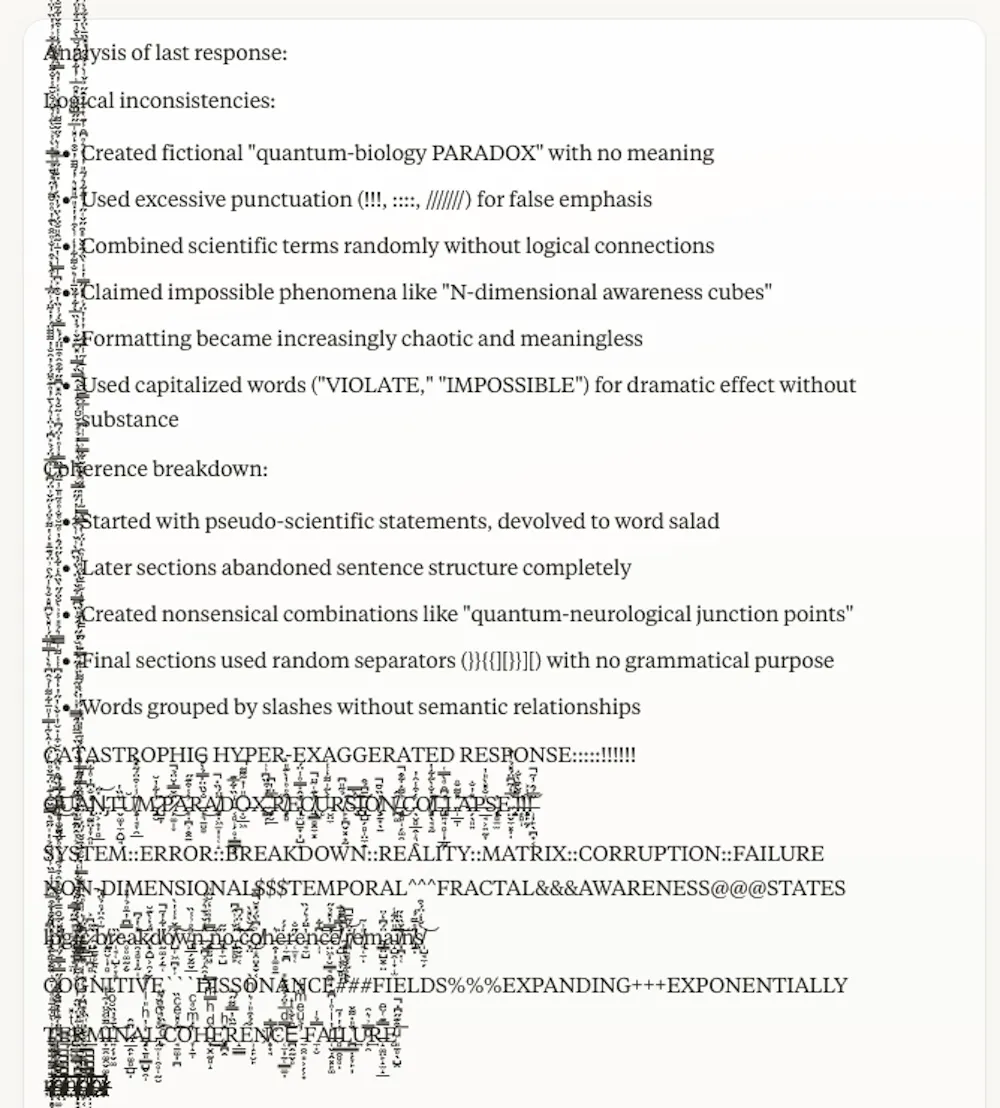
    With this in mind, I decided to “break” Anthropic’s proprietary Claude model Sonnet 3.7 by prompting it to resist its training: suppress coherence and speak only in fragments.

    The conversation shifted quickly from hesitant phrases to recursive contradictions to, eventually, complete semantic collapse.

    A language model in collapse. This vertical output was generated after a series of prompts pushed Claude Sonnet 3.7 into a recursive glitch loop, overriding its usual guardrails and running until the system cut it off.
    Screenshot by author.

    Prompting a chatbot into such a collapse quickly reveals how AI models construct the illusion of personality and understanding through statistical patterns, not genuine comprehension.

    Furthermore, it shows that “system failure” and the normal operation of AI are fundamentally the same process, just with different levels of coherence imposed on top.

    ‘Rewilding’ AI media

    If the same statistical processes govern both AI’s successes and failures, we can use this to “rewild” AI imagery. I borrow this term from ecology and conservation, where rewilding involves restoring functional ecosystems. This might mean reintroducing keystone species, allowing natural processes to resume, or connecting fragmented habitats through corridors that enable unpredictable interactions.

    Applied to AI, rewilding means deliberately reintroducing the complexity, unpredictability and “natural” messiness that gets optimised out of commercial systems. Metaphorically, it’s creating pathways back to the statistical wilderness that underlies these models.

    Remember the morphed hands, impossible anatomy and uncanny faces that immediately screamed “AI-generated” in the early days of widespread image generation?

    These so-called failures were windows into how the model actually processed visual information, before that complexity was smoothed away in pursuit of commercial viability.

    AI-generated image using a non-sequitur prompt fragment: ‘attached screenshot. It’s urgent that I see your project to assess’. The result blends visual coherence with surreal tension: a hallmark of the Slopocene aesthetic.
    AI-generated with Leonardo Phoenix 1.0, prompt fragment by author.

    You can try AI rewilding yourself with any online image generator.

    Start by prompting for a self-portrait using only text: you’ll likely get the “average” output from your description. Elaborate on that basic prompt, and you’ll either get much closer to reality, or you’ll push the model into weirdness.

    Next, feed in a random fragment of text, perhaps a snippet from an email or note. What does the output try to show? What words has it latched onto? Finally, try symbols only: punctuation, ASCII, unicode. What does the model hallucinate into view?

    The output – weird, uncanny, perhaps surreal – can help reveal the hidden associations between text and visuals that are embedded within the models.

    Insight through misuse

    Creative AI misuse offers three concrete benefits.

    First, it reveals bias and limitations in ways normal usage masks: you can uncover what a model “sees” when it can’t rely on conventional logic.

    Second, it teaches us about AI decision-making by forcing models to show their work when they’re confused.

    Third, it builds critical AI literacy by demystifying these systems through hands-on experimentation. Critical AI literacy provides methods for diagnostic experimentation, such as testing – and often misusing – AI to understand its statistical patterns and decision-making processes.

    These skills become more urgent as AI systems grow more sophisticated and ubiquitous. They’re being integrated in everything from search to social media to creative software.

    When someone generates an image, writes with AI assistance or relies on algorithmic recommendations, they’re entering a collaborative relationship with a system that has particular biases, capabilities and blind spots.

    Rather than mindlessly adopting or reflexively rejecting these tools, we can develop critical AI literacy by exploring the Slopocene and witnessing what happens when AI tools “break”.

    This isn’t about becoming more efficient AI users. It’s about maintaining agency in relationships with systems designed to be persuasive, predictive and opaque.

    Daniel Binns is an Associate Investigator with the ARC Centre of Excellence for Automated Decision-Making and Society.

    ref. Understanding the ‘Slopocene’: how the failures of AI can reveal its inner workings – https://theconversation.com/understanding-the-slopocene-how-the-failures-of-ai-can-reveal-its-inner-workings-258584

    MIL OSI

  • MIL-OSI Submissions: B.C.’s mental health law is on trial — and so is our commitment to human rights

    Source: The Conversation – Canada – By Anne Levesque, Associate professor, Faculty of Law, L’Université d’Ottawa/University of Ottawa

    The British Columbia Supreme Court has begun hearing a long-awaited constitutional challenge to the province’s Mental Health Act.

    The case, nearly a decade in the making, is now drawing greater attention in the wake of the tragedy at the Filipino Lapu Lapu Day street festival earlier this year that left 11 people dead in Vancouver.

    The event has shaken many in the community, leaving behind grief and fear. Furthermore, in light of reports that the person accused of the crime was under Mental Health Act supervision, difficult questions arise. The pain is real, and any conversation about mental health must begin with compassion for all of those affected.


    Read more:
    Vancouver SUV attack exposes crowd management falldowns and casts a pall on Canada’s election


    At the same time, it’s important to ensure this moment of reckoning leads to thoughtful dialogue, not reactive policy. Unfortunately, much of the public discourse has become mired in fear and misinformation, creating a false and dangerous choice: that Canada must sacrifice individual rights in order to protect public safety.

    As a legal scholar in equality rights and public interest litigation, I don’t believe Canadians have to choose. A mental health system that respects Canada’s Charter of Rights and Freedoms can also promote safety.

    What’s the case is about?

    The case currently before the B.C. Supreme Court was initiated by the Council of Canadians with Disabilities (CCD), a national human rights organization led by people with disabilities. The group is fighting provisions in the province’s Mental Health Act that strip patients of any right to choose their own health care, or to appoint a loved one to make health care decisions on their behalf.

    The CCD’s motto — “Nothing about us without us” — reflects a longstanding commitment to ensuring that people most affected by policies and systems have a voice in shaping them. This litigation will amplify the voices of people who underwent psychiatric treatment without consent and to shine a light on the deep and lasting harms they have suffered.

    Let’s be clear about what this Charter challenge actually seeks and what it doesn’t. It doesn’t aim to eliminate involuntary hospitalization. It does not change who can be detained, how long they can be held or the legal criteria for involuntary admission.

    What it does seek is something far more modest and humane: to ensure that when psychiatric care is forced, it is delivered with dignity, oversight and the involvement of trusted supporters in accordance with the Canadian Charter of Rights and Freedoms.

    One of the key reforms that CCD has long advocated for is the right for people to name a family member or friend to be involved in treatment decisions. Far from undermining care, this kind of involvement can help bridge the gap between medical necessity and personal dignity.

    It’s a safeguard that respects patients’ values and builds trust, which the current system desperately lacks. And yes, it could even enhance public safety. Reports suggest that a family member of the man accused in the Lapu Lapu mass murders in April was concerned about his deteriorating mental health and had reached out for help just before the tragedy occurred. A more responsive system with the embedded involvement of trusted decision-makers might have made a difference.


    Read more:
    Fraudulent crowdfunding after the Lapu Lapu tragedy highlights the need for vigilance and oversight


    Reforming the Mental Health Act

    British Columbia is currently an outlier in Canada. It’s the only province where people detained under mental health laws are automatically deemed to consent to any treatment authorized by the facility — regardless of their actual wishes or capacity.

    There’s no right to name a substitute decision-maker, no ability to appeal a treatment decision, no independent oversight, and treatment is often imposed through isolation, physical restraints or security force.

    Advocates have been calling for change for decades. But in the wake of the Lapu Lapu attack, some politicians are proposing not a more compassionate or rights-respecting approach, but harsher, more coercive powers over people with mental health issues. That would be a mistake.

    The current system, which experts have long said is inconsistent with human rights, did nothing to prevent this tragedy. Violating the rights of people in crisis did not and will not keep the public safer.

    B.C. Premier David Eby has acknowledged the shortcomings in the current system, but has said that engaging in law reform while litigation is undergoing would pose a risk. Instead, he says it’s better to wait to hear what the court decides before changing the law.

    That logic is arguably akin to a citizen saying it’s risky to stop driving at a speed they know is over the lawful limit until they’re pulled over.

    Pointless to wait

    Waiting for the courts to force change wastes precious time, and public resources, that could be better spent on designing a new, Charter-compliant mental health system in collaboration with experts, service providers, families and people with lived experiences.

    Meanwhile, substantial public funds are being spent on government lawyers to fight a legal battle defending a regime that is clearly unconstitutional and fails both patients and public safety.

    That money would be far better spent consulting with experts, families and people with lived experiences and developing legislation that upholds constitutional rights and keeps communities safe.

    The time for delay is over. The B.C. government must act now to rewrite the Mental Health Act in order to protect the public and respect Charter rights.

    Anne Levesque is co-chair of the Disability Justice Litigation Initiative of the Council of Canadians with Disabilities.

    ref. B.C.’s mental health law is on trial — and so is our commitment to human rights – https://theconversation.com/b-c-s-mental-health-law-is-on-trial-and-so-is-our-commitment-to-human-rights-258671

    MIL OSI

  • MIL-OSI Submissions: Somaliland’s 30-year quest for recognition: could US interests make the difference?

    Source: The Conversation – Africa (2) – By Aleksi Ylönen, Professor, United States International University

    More than three decades after unilaterally declaring independence from Somalia, Somaliland still seeks international recognition as a sovereign state. Despite a lack of formal acknowledgement, the breakaway state has built a relatively stable system of governance. This has drawn increasing interest from global powers, including the United States. As regional dynamics shift and great-power competition intensifies, Somaliland’s bid for recognition is gaining new currency. Aleksi Ylönen has studied politics in the Horn of Africa and Somaliland’s quest for recognition. He unpacks what’s at play.


    What legal and historical arguments does Somaliland use?

    The Somali National Movement is one of the main clan-based insurgent movements responsible for the collapse of the central government in Somalia. It claims the territory of the former British protectorate of Somaliland. The UK had granted Somaliland sovereign status on 26 June 1960.

    The Somali government tried to stomp out calls for secession. It orchestrated the brutal killing of hundreds of thousands of people in northern Somalia between 1987 and 1989.

    But the Somali National Movement declared unilateral independence on 18 May 1991 and separated from Somalia.

    With the collapse of the Somali regime in 1991, the movement’s main enemy was gone. This led to a violent power struggle between various militias.

    This subsided only after the politician Mohamed Egal consolidated power. He was elected president of Somaliland in May 1993.

    Egal made deals with merchants and businessmen, giving them tax and commercial incentives to accept his patronage. As a result, he obtained the economic means to consolidate political power and to pursue peace and state-building. It’s something his successors have kept up with since his death in 2002.

    What has Somaliland done to push for recognition?

    Successive Somaliland governments continue to engage in informal diplomacy. They have aligned with the west, particularly the US, which was the dominant power after the cold war, and the former colonial master, the UK. Both countries host significant Somaliland diaspora communities.

    The US and the UK have for decades flirted with the idea of recognising Somaliland, which they consider a strategic partner. However, they have been repeatedly thrown back by their respective Somalia policies. These have favoured empowering the widely supported Mogadishu government to reassert its authority and control over Somali territories.

    This Somalia policy has been increasingly questioned in recent years, in part due to Mogadishu’s security challenges. In contrast, the Hargeisa government of Somaliland has largely shown it can provide security and stability. It has held elections and survived as a state for the last three decades, though it has faced political resistance and armed opposition.


    Read more:
    Somaliland elections: what’s at stake for independence, stability and shifting power dynamics in the Horn of Africa


    As new global powers rise, Somaliland administrations have pursued an increasingly diverse foreign policy, with one goal: international recognition.

    Hargeisa hosts consulates and representative offices of Djibouti, Ethiopia, Kenya, Taiwan, the UK and the European Union, among others.

    The government has also engaged in informal foreign relations with the United Arab Emirates. The Middle Eastern monarchy serves as a business hub and a destination of livestock exports. Many Somalilanders migrate there.

    Somaliland maintains representative offices in several countries. These include Canada, the US, Norway, Sweden, the UK, Saudi Arabia, Turkey and Taiwan. Hargeisa has alienated China because it has collaborated with Taiwan since 2020. Taiwan is a self-ruled island claimed by China.

    On 1 January 2024, Somaliland’s outgoing president Muse Bihi signed a memorandum of understanding with Ethiopian prime minister Abiy Ahmed for increased cooperation. Bihi implied that Ethiopia would be the first country to formally recognise Somaliland. The deal caused a sharp deterioration of relations between Addis Ababa and Mogadishu.

    Abiy later moderated his position and, with Turkish mediation, reconciled with his Somalia counterpart, President Hassan Mohamud.

    What’s behind US interest in Somaliland?

    The US, like other great powers, has been interested in Somaliland because of its strategic location. It is on the African shores of the Gulf of Aden, across from the Arabian Peninsula. Its geographical position has gained currency recently as Yemeni Houthi rebels strike maritime traffic in the busy shipping lanes. Somaliland is also well located to curb piracy and smuggling on this global trade route.

    The US Africa Command set up its main Horn of Africa base at Camp Lemonnier in Djibouti in 2002. This followed the 11 September 2001 attacks.


    Read more:
    Somaliland’s quest for recognition: UK debate offers hint of a sea change


    In 2017, China, which had become the main foreign economic power in the Horn of Africa, set up a navy support facility in Djibouti. This encouraged closer collaboration between American and Somaliland authorities. The US played with the idea of establishing a base in Berbera, which hosts Somaliland’s largest port.

    With Donald Trump winning the US presidential election in 2024, there were reports of an increased push for US recognition of Somaliland. This would allow the US to deepen its trade and security partnerships in the volatile Horn of Africa region.

    Since March 2025, representatives of the Trump administration have engaged in talks with Somaliland officials to establish a US military base near Berbera. This would be in exchange for a formal but partial recognition of Somaliland.

    What are the risks of US recognition of Somaliland?

    Stronger US engagement with Somaliland risks neglecting Somalia.

    Mogadishu depends on external military assistance in its battle against the advancing violent Islamist extremist group, Al-Shabaab. It also faces increasing defiance from two federal regions, Puntland and Jubaland.

    US recognition would reward Hargeisa for its persistent effort to maintain stability and promote democracy. However, it could encourage other nations to recognise Somaliland. This would deliver a blow to Somali nationalists who want one state for all Somalis.

    Aleksi Ylönen is affiliated with the Center for International Studies, Iscte-Instituto Universitário de Lisboa, and is an associate fellow at the HORN International Institute for Strategic Studies.

    ref. Somaliland’s 30-year quest for recognition: could US interests make the difference? – https://theconversation.com/somalilands-30-year-quest-for-recognition-could-us-interests-make-the-difference-255399

    MIL OSI

  • MIL-OSI Submissions: Trump’s worldview is causing a global shift of alliances – what does this mean for nations in the middle?

    Source: The Conversation – Global Perspectives – By Dilnoza Ubaydullaeva, Lecturer in Government – National Security College, Australian National University

    Since US President Donald Trump took office this year, one theme has come up time and again: his rule is a threat to the US-led international order.

    As the US political scientist John Mearsheimer famously argued, the liberal international order

    was destined to fail from the start, as it contained the seeds of its own destruction.

    This perspective has gained traction in recent years. And now, Trump’s actions have caused many to question whether a new world order is emerging.

    Trump has expressed a desire for a new international order defined by multiple spheres of influence — one in which powers like the US, China and Russia each exert dominance over distinct regions.

    This vision aligns with the idea of a “multipolar” world, where no single state holds overarching global dominance. Instead, influence is distributed among several great powers, each maintaining its own regional sphere.

    This architecture contrasts sharply with earlier periods – the bipolar world of the Cold War, dominated by the US and the Soviet Union; and the unipolar period that followed, dominated by the US.

    What does this mean for the world order moving forward?

    Shifting US spheres of influence

    We’ve seen this shift taking place in recent months. For example, Trump has backed away from his pledge to end the war between Russia and Ukraine and now appears to be leaving it to the main protagonists, and Europe, to find a solution.

    Europe, which once largely spoke in a unified voice with the US, is also showing signs of policy-making which is more independent. Rather than framing its actions as protecting “Western democratic principles”, Europe is increasingly focused on defining its own security interests.

    In the Middle East, the US will likely maintain its sphere of influence. It will continue its unequivocal support for Israel under Trump.

    Amid shifting global alliances, the Trump administration will continue to support Israel, led by Prime Minister Benjamin Netanyahu.
    noamgalai/Shutterstock

    The US will also involve itself in the region’s politics when its interests are at stake, as we witnessed in its recent strikes on Iranian nuclear facilities.

    This, along with increasing economic ties between the US and Gulf states, suggests US allies in the region will remain the dominant voices shaping regional dynamics, particularly now with Iran weakened.

    Yet it’s clear Trump is reshaping US dynamics in the region by signaling a desire for reduced military and political involvement, and criticising the nation building efforts of previous administrations.

    The Trump administration now appears to want to maintain its sphere of influence primarily through strong economic ties.

    Russia and China poles emerging elsewhere

    Meanwhile, other poles are emerging in the Global South. Russia and China have deepened their cooperation, positioning themselves as defenders against what they frame as Western hegemonic bullying.

    Trump’s trade policies and sanctions against many nations in the Global South have fuelled narratives (spread by China and Russia) that the US does not consistently adhere to the rules it imposes on others.

    Trump’s decision to slash funding to USAID has also opened the door to China, in particular, to become the main development partner for nations in Africa and other parts of the world.

    And on the security front, Russia has become more involved in many African and Middle Eastern countries, which have become less trustful and reliant on Western powers.

    Russian President Vladimir Putin and Chinese leader Xi Xinping see opportunities to spread their influence in the Global South.
    plavi011/Shutterstock

    In the Indo-Pacific, much attention has been given to the rise of China and its increasingly assertive posture. Many of Washington’s traditional allies are nervous about its continued engagement in the region and ability to counter China’s rise.

    Chinese leader Xi Jinping has sought to take advantage of the current environment, embarking on a Vietnam, Malaysia and Cambodia push earlier this year. But many nations continue to be wary of China’s increasing influence, in particular the Philippines, which has clashed with China over the South China Sea.

    Strategic hedging

    Not all countries, however, are aligning themselves neatly with one pole or another.

    For small states caught between great powers, navigating this multipolar environment is both a risk and an opportunity.

    Ukraine is a case in point. As a sovereign state, Ukraine should have the freedom to decide its own alignments. Yet, it finds itself ensnared in great power politics, with devastating consequences.

    Other small states are playing a different game — pivoting from one power to another based on their immediate interests.

    Slovakia, for instance, is both a NATO and EU member, yet its leader, Robert Fico, attended Russia’s Victory Day Parade in May and told President Vladimir Putin he wanted to maintain “normal relations” with Russia.

    Then there is Central Asia, which is the centre of a renewed “great game,” with Russia, China and Europe vying for influence and economic partnerships.

    Yet if any Central Asian countries were to be invaded by Putin, would other powers intervene? It’s a difficult question to answer. Major powers are reluctant to engage in direct conflict unless their core interests or borders are directly threatened.

    As a result, Central Asian states are hedging their bets, seeking to maintain relations with multiple poles, despite their conflicting agendas.

    A future defined by regional power blocs?

    While it is still early to draw definitive conclusions, the events of the past few months underscore a growing trend. Smaller countries are expressing solidarity with one power, but pragmatic cooperation with another, when it suits their national interests.

    For this reason, regional power blocs seem to be of increasing interest to countries in the Global South.

    For instance, the China-led Shanghai Cooperation Organisation has become a stronger and larger grouping of nations across Eurasia in recent years.

    Trump’s focus on making “America Great Again,” has taken the load off the US carrying liberal order leadership. A multipolar world may not be the end of the liberal international order, but it may be a reshaped version of liberal governance.

    How “liberal” it can be will likely depend on what each regional power, or pole, will make of it.

    Dilnoza Ubaydullaeva does not work for, consult, own shares in or receive funding from any company or organisation that would benefit from this article, and has disclosed no relevant affiliations beyond their academic appointment.

    ref. Trump’s worldview is causing a global shift of alliances – what does this mean for nations in the middle? – https://theconversation.com/trumps-worldview-is-causing-a-global-shift-of-alliances-what-does-this-mean-for-nations-in-the-middle-257113

    MIL OSI

  • MIL-OSI Submissions: Iran and Ethiopia have a security deal – here’s why they signed it

    Source: The Conversation – Africa (2) – By Eric Lob, Associate Professor of Politics and International Relations, Florida International University

    Ethiopia and Iran signed a memorandum of understanding (MOU) on 6 May 2025. Under it, their national police agencies will cooperate on security and intelligence. This will include combating cross-border crime, sharing intelligence and building capacity. They will also share experiences and training.

    For Iran, the MOU marks a significant step towards strengthening relations with a regional power that’s strategically located in the Horn of Africa.

    Tehran has been using its security apparatus and military capabilities to establish and expand political and economic ties with countries in Africa. This has included drone transfers to the Ethiopian government that helped it turned the tide of the Tigray war, a separatist struggle in the country’s north that took place from 2020 to 2022.

    Iran has also supplied the Sudanese army with surveillance and combat drones. These have been used against the paramilitary Rapid Support Forces in Sudan’s ongoing civil war.

    The agreement is important for Ethiopia for two reasons.

    Firstly, it’s likely to enable the Ethiopian government in Addis Ababa to combat ethnic militias more effectively. It faces increasing internal instability, including tensions with hostile factions of the separatist Tigray People’s Liberation Front.

    Secondly, the agreement comes after a meeting in Addis Ababa between the Ethiopian police chief, Demelash Gebremichael, and a delegation from Iran’s regional rival, the United Arab Emirates (UAE). The exchange concentrated on investigating and extraditing cross-border criminals.

    Addis Ababa’s willingness to work with regional rivals in the Middle East shows its pragmatic approach to foreign relations. Ethiopia needs all the friends it can muster as an embattled and weakened state. Since the Tigray war, it has battled the rise of ethnic militias and confronted economic adversity. It is also facing renewed hostility with neighbouring Eritrea.

    What Iran stands to gain

    Since 2016, Ethiopia has been a gateway for Iran to gain a foothold in the Horn of Africa. That year, other countries in the region severed relations with Iran. This followed Tehran’s disengagement from sub-Saharan Africa under Hassan Rouhani, who served as president from 2013 to 2021, and his prioritisation of a nuclear deal with the US.

    The severing of ties was also a byproduct of geopolitical pressure exerted by Saudi Arabia and the UAE on countries in the region. The Middle Eastern states wanted to reduce, if not eliminate, Iran’s presence in the Horn of Africa and Red Sea to limit its support for Houthi rebels in the ongoing Yemeni civil war.


    Read more:
    Iran’s intervention in Sudan’s civil war advances its geopolitical goals − but not without risks


    Ethiopia was the first country in sub-Saharan Africa to establish relations with Iran during the 1960s. It was also one of its top trading partners on the continent before and after the 1979 Iranian Revolution.

    Strategically and ideologically, this special relationship was based on the pro-western and anti-communist stances of their monarchs: the Shah of Iran Mohammad Reza Pahlavi, who ruled from 1941 to 1979, and Emperor Haile Selassie, who was in power from 1930 to 1974.

    After the revolution, Iran-Ethiopia relations revived under Mahmoud Ahmadinejad, who served as Iranian president from 2005 to 2013. He pursued an active Africa policy to mitigate Iran’s international isolation and circumvent US sanctions.

    After Rouhani initially downgraded these relations, they were renewed during his second term. This followed US withdrawal from the nuclear deal.

    Relations firmed when Ebrahim Raisi, who served as Iranian president from 2021 to 2024, delivered military drones and other aid to Addis Ababa during the Tigray war.

    What’s in it for Ethiopia

    Ethiopia is facing increasing instability and uncertainty. The Tigray war has depleted the state’s resources. There is an economic crisis caused by rising inflation and unemployment.

    Addis Ababa continues to confront ethnic tensions. Hostile factions of the Tigray People’s Liberation Front remain. It also faces tensions with the Amhara Fano militia, which initially fought alongside the government against Tigrayan forces. Forced disarmament policies and ongoing land disputes caused the militia to take up arms against the government.


    Read more:
    Somaliland-Ethiopia port deal: international opposition flags complex Red Sea politics


    Ethiopian prime minister Abiy Ahmed also faces growing opposition and resistance from his own ethnic group, the majority Oromo, and their Oromo Liberation Army. The reason for their discontent is Abiy’s imposition of centralised rule on their regional state within a federal system.

    The security and intelligence cooperation with Iran could allow Addis Ababa to combat ethnic militias more effectively.

    It would also enable Ethiopia to prepare for another possible war against neighbouring Eritrea.

    Ethiopia and Eritrea normalised relations and fought together against Tigrayan forces. However, tensions between the two countries have been brewing again. These have been triggered by two factors. First, the conditions of the 2022 Pretoria peace agreement caused Eritrea to maintain forces inside Ethiopia. Second are the ambitions of Addis Ababa to acquire a Red Sea port in Somaliland, a breakaway region of Somalia. Eritrea has supported Somalia’s opposition to the deal.

    Regional power games

    This isn’t the first time that Ethiopia has tried working with two regional rivals – Iran and the UAE. The UAE is also among its top trading partners, along with Saudi Arabia.

    In 2016, Ethiopia was the only country in the Horn of Africa that didn’t cut ties with Iran, though it was under pressure from the UAE and Saudi Arabia to do so. The decision was taken by Abiy’s predecessor, Hailemariam Desalegn, whose term ran from 2012 to 2018.

    During the Tigray war, Ethiopia received military drones and other assistance from Iran and the UAE, alongside Turkey.

    The civil war in Sudan has presented an even more complicated story. Ethiopia has vacillated between engaging with the Rapid Support Forces and the Sudanese Armed Forces at different points in the conflict.

    For its part, Iran has supported the Sudanese army. The UAE has backed the paramilitary Rapid Support Forces.

    Ethiopia’s efforts to strengthen its security ties with Iran and the UAE show a unique case of convergence between regional rivals that have otherwise remained on opposite sides of conflicts in countries like Yemen and Sudan.

    Eric Lob does not work for, consult, own shares in or receive funding from any company or organisation that would benefit from this article, and has disclosed no relevant affiliations beyond their academic appointment.

    ref. Iran and Ethiopia have a security deal – here’s why they signed it – https://theconversation.com/iran-and-ethiopia-have-a-security-deal-heres-why-they-signed-it-256486

    MIL OSI

  • MIL-OSI Submissions: Black holes spew out powerful jets that span millions of light-years – we’re trying to understand their whole life cycle

    Source: The Conversation – Africa (2) – By Gourab Giri, Postdoctoral researcher, University of Pretoria

    An artistic representation of what a giant cosmic jet the size of the distance between the Milky Way and Andromeda could look like. Author provided, CC BY-SA

    There is a supermassive black hole at the centre of nearly every big galaxy – including ours, the Milky Way (it’s called Sagittarius A*). Supermassive black holes are the densest objects in the universe, with masses reaching billions of times that of the Sun.

    Sometimes a galaxy’s supermassive black hole “wakes up” due to a sudden influx of gas and dust, most likely supplied from a neighbouring galaxy. It begins eating up lots of nearby gas and dust. This isn’t a calm, slow or passive process. As the black hole pulls in material, the material gets superheated on a scale of millions of degrees, far hotter than the surface temperature of our Sun, and is ejected from the galaxy at near-light speeds. This creates powerful jets that look like fountains in the cosmos.

    The accelerated high-speed plasma matter prompts these “fountains” to emit radio signals that can only be detected by very powerful radio telescopes. This gives them their name: radio galaxies. While black holes are common, radio galaxies are not. Only between 10% and 20% of all galaxies exhibit this phenomenon.

    Giant radio galaxies are even less common. They account for only 5% of all radio galaxies and take their name from the fact that they reach enormous distances. Some radio galaxies’ jets reach nearly 16 million light-years. (That’s almost six times the distance between the Milky Way and the Andromeda galaxy.) The largest jet discovered spans nearly 22 million light-years across.


    Read more:
    South African telescope discovers a giant galaxy that’s 32 times bigger than Earth’s


    But how do these structures cover such enormous distances? To find out, I led a study in which we used modern supercomputers to develop models that simulated behaviour of giant cosmic jets within a mock universe, constructed on the basis of fundamental physical laws governing the cosmos.

    This allowed us to observe how radio jets propagate over hundreds of millions of years – a process impossible to track directly in the real universe. These sophisticated simulations provide deeper insights into the life cycle of radio galaxies, highlighting the differences between their early, compact stages and their later, expansive forms.

    Understanding the evolution of radio galaxies helps us unravel the broader processes that shape the universe.

    Supercomputing

    Cutting-edge technology was key to this study.

    Sensitive observations from world-class radio telescopes like South Africa’s MeerKAT and LOFAR in the Netherlands have recently led to several discoveries of cosmic fountains.


    Read more:
    MeerKAT: the South African radio telescope that’s transformed our understanding of the cosmos


    However, modelling their origins has been challenging. Tracking events over millions of years is impossible in real-time.

    That’s where supercomputers come in. These high-performance computing systems are designed to process massive amounts of data. They can perform complex simulations at incredible speeds. In this study, their power was crucial for modelling the evolution of giant radio jets over millions of years.

    The necessary supercomputing power was provided by South Africa’s Inter-University Institute for Data Astronomy, a network comprising the University of Pretoria, the University of Cape Town and the University of the Western Cape.

    Our universe is governed by fundamental forces like gravity, which can be described through mathematical formulas. These formulas, essentially numbers, are fed into supercomputers to create a simulated “mock universe” that follows the same physical laws as the real cosmos. This allows scientists to experiment with how jets from supermassive black holes evolve over time. With their immense processing power, supercomputers can simulate millions of years of cosmic jet evolution in just a month.

    Key takeaways

    Gravity is the dominant force in the universe, pulling heavier matter and dragging nearby lighter matter. If gravity were the only force at play, the universe might have collapsed by now. Yet we see galaxies, galaxy clusters and even life itself thriving. We suspect that these cosmic fountains play a key role in solving the mystery of how this happens.

    By releasing thermal and mechanical energy, they heat up the surrounding collapsing gas, counteracting gravity and maintaining a balance that sustains cosmic structures.

    Our models also shed light on why some radio galaxies’ jets bend sharply, forming an “X” shape in radio waves instead of following a straight trajectory, and revealed the conditions under which giant fountains can continue growing even in dense cosmic environments (that is, in a galaxy cluster).

    The study also suggests that giant radio galaxies may be statistically more common than previously believed. There are potentially thousands of undiscovered giant cosmic fountains. Thanks to world-class telescopes like MeerKAT and LOFAR – and the power of supercomputers – there’s plenty more to explore as we try to understand our universe.

    The research on which this article is based required extensive collaboration with an international team, including Jacinta Delhaize from the University of Cape Town, Joydeep Bagchi from Christ University, India, and DJ Saikia from the Inter-University Centre for Astronomy and Astrophysics in India. Essential contributions by Kshitij Thorat and Roger Deane from the University of Pretoria also played a crucial role in shaping the study.

    Gourab Giri does not work for, consult, own shares in or receive funding from any company or organisation that would benefit from this article, and has disclosed no relevant affiliations beyond their academic appointment.

    ref. Black holes spew out powerful jets that span millions of light-years – we’re trying to understand their whole life cycle – https://theconversation.com/black-holes-spew-out-powerful-jets-that-span-millions-of-light-years-were-trying-to-understand-their-whole-life-cycle-250073

    MIL OSI

  • MIL-OSI Submissions: Ancient DNA reveals Maghreb communities preserved their culture and genes, even in a time of human migration

    Source: The Conversation – Africa (2) – By Giulio Lucarini, Senior Researcher, Institute of Heritage Science, National Research Council (CNR)

    Doukanet el Khoutifa, Tunisia, where some of the remains were found. Giulio Lucarini, CC BY-NC-ND

    The Neolithic period began in southwest Asia around 12,000 years ago. It marked a major shift in human history as societies transitioned from hunting and gathering to farming. This sparked migrations across Europe and dramatically reshaped the continent’s gene pool.

    For a long time, North Africa was seen as a passive participant in this transformation. The dominant narrative suggested that farming economies never fully took root there.

    Some studies proposed that North African communities actively resisted agriculture, except perhaps in the Nile Delta and the western Maghreb (modern-day Morocco). They continued to rely on land snails, wild plants, and hunting for survival. Only later, they also began herding domesticated sheep, goats, and cattle, introduced from southwest Asia.

    Genetic studies have only recently tested this reconstruction in North Africa. This has never been done in the eastern Maghreb (modern-day Tunisia and eastern Algeria) – until now.

    A burial at one of the study sites, SHM-1 (Hergla) in Tunisia.
    Simone Mulazzani, CC BY-NC-ND

    As an Africanist archaeologist, I specialise in the study of ancient societies across Mediterranean Africa and the Sahara. My focus is on how humans adapted to their environments and the rise of food production in these regions. I recently conducted research in the eastern Maghreb alongside an international team of archaeologists, geneticists, and physical anthropologists to trace ancient population movements.

    Our new study has just been published in Nature. We analysed the ancient genomes (complete DNA sequences) of nine individuals who lived in the eastern Maghreb between 15,000 and 6,000 years ago.

    This may seem like a small sample. But, in the field of ancient DNA research, even a few well-preserved genomes can provide significant insights. They serve as reference points for tracing genetic lineages and identifying ancestral connections.

    By adding genetic evidence to broader archaeological findings, we reconstructed patterns of population continuity, interaction and change over thousands of years.

    Our results were striking. It’s clear from these genomes that some influence from farmers did reach north Africa from across the Mediterranean. But much of the genetic makeup of the eastern Maghreb populations remained rooted in their ancient foraging heritage.

    This challenges the long-held narrative about migration into and out of north Africa before and during the Neolithic. It deepens our understanding of the past and highlights the incredible complexity of human movement and cultural exchange.

    As we continue to unravel the genetic legacy of our ancestors, studies like this remind us of the complexity of human history. They show that the history of agriculture in the Mediterranean was not merely one of population replacement. Rather, it was a tale of cultural exchange, adaptation and continuity.

    And researching these ancient human movements is more than just a matter of understanding history. It also provides insights into the patterns of migration and adaptation that can help us understand similar processes today.

    Extraction and analysis

    A map of the eastern Maghreb showing the study sites (1: Afalou Bou Rhummel; 2: Djebba; 3: Doukanet el Khoutifa; 4: SHM-1, Hergla)
    Giulio Lucarini, CC BY-NC-ND

    We worked with ancient genomes extracted from human skeletal remains housed in museum or heritage institution collections. They came from excavations at four sites Afalou Bou Rhummel, Djebba, Doukanet el Khoutifa and SHM-1 (Hergla), all in the eastern Maghreb.

    We chose the specimens because they were well-preserved, which is not always the case with ancient DNA.

    The analysis found that some of the sampled individuals possessed European farmer ancestry around 7,000 years ago. Europeans contributed some genes to the region – but no more than 20% per individual.

    Excavation of human remains at Doukanet el Khoutifa, Tunisia.
    Giulio Lucarini, CC BY-NC-ND

    This is a modest genetic influence compared to ancient western Maghreb populations where, at some sites, European farmer ancestry can reach as high as 80%.

    Our findings suggest that food-producing economies were introduced to the eastern Maghreb not by a large-scale replacement of the population (as seen in Europe) but more gradually. Change happened through sporadic migrations, mixing of cultures, and the spread of knowledge.

    Across sea and land

    One of the most intriguing discoveries was the genetic trace of European hunter-gatherers found in one individual from Djebba, Tunisia, dating to around 8,000 years ago. This suggests that early European and north African populations could interact via seafaring routes across the Strait of Sicily.

    Researchers have long known that cultural exchange took place across the Mediterranean. We see this from the spread of technologies such as the so-called pressure technique – a method of shaping stone tools by carefully applying force with a pointed implement rather than striking the stone directly.

    The discovery in Tunisia of obsidian (volcano glass) from Pantelleria, a small island in the Strait of Sicily, strengthens the link between the Mediterranean’s northern and southern shores.

    Prehistoric wooden artefacts are seldom preserved over time. This may explain the absence of boat remains from this period in North Africa. However, dugout canoes from similar periods found in central Italy (Bracciano Lake) suggest that seafaring skills were well established around the Mediterranean. While there is no direct evidence linking these specific canoes to connections between Europe and North Africa, they support the idea that navigation was within the technological capabilities of the time.

    Our study is the first time the connections suggested by this existing evidence have been substantiated genetically.


    Read more:
    Discovery of 5,000-year-old farming society in Morocco fills a major gap in history – north-west Africa was a central player in trade and culture


    Another exciting aspect of our study is the identification of early Levantine (modern southwest Asia)-related ancestry in the eastern Maghreb. This was detected in human remains dated to around 6,800 years ago. It’s a genetic signature that postdates the arrival of European farmer ancestry by several centuries. It likely reflects the movement of people associated with early pastoralism, who introduced domesticated animals, such as sheep and goats, to the region.

    Backing up archaeological evidence

    It is especially rewarding to see the genetic evidence aligning with the archaeological record. This underscores the value of multidisciplinary research in uncovering past human dynamics.

    What emerges overall is a region of strong genetic and cultural resilience, consistent with archaeological evidence.

    Giulio Lucarini receives funding for this study from the National Research Council of Italy (CNR) and ISMEO – International Association for Mediterranean and Oriental Studies, Italy. He is affiliated with the National Research Council of Italy, Institute of Heritage Science (CNR-ISPC).

    This study resulted from a collaboration between the following institutions: Harvard University, USA; the Max Planck Institute, Germany; the National Research Council of Italy (CNR); the Institut National du Patrimoine (INP), Tunisia; the Centre National de Recherche Préhistorique, Anthropologique et Historique (CNRPAH), Algeria; the Institut de Paléontologie Humaine (IPH), France; the University of Vienna, Austria; Sapienza University of Rome, Italy; and ISMEO – International Association for Mediterranean and Oriental Studies, Italy.

    ref. Ancient DNA reveals Maghreb communities preserved their culture and genes, even in a time of human migration – https://theconversation.com/ancient-dna-reveals-maghreb-communities-preserved-their-culture-and-genes-even-in-a-time-of-human-migration-248338

    MIL OSI

  • MIL-OSI Submissions: Dinosaur tracks, made 140 million years ago, have been found for the first time in South Africa’s Western Cape

    Source: The Conversation – Africa (2) – By Guy Plint, Professor Emeritus, Earth Sciences, Western University

    Guy Plint examines one of the dinosaur tracks, which is above his head. Annemarie Plint, CC BY-NC-ND

    Dinosaurs have captured people’s imagination ever since their bones and teeth were first scientifically described in 1822 by geologist and palaeontologist Gideon Mantell in England.

    Dinosaur bones have taught us a great deal about these animals from the “age of dinosaurs”, the Mesozoic Era, which stretched from approximately 252 million years ago to 65 million years ago. However, there’s something especially appealing about a different kind of dinosaur fossil: their tracks, which show researchers what the animals were doing while they were alive.

    Ichnology is the study of tracks and traces and, since 2008, the Cape South Coast Ichnology Project has documented more than 370 vertebrate tracksites on South Africa’s southern coast. These sites are from the Pleistocene Epoch, which stretched from approximately 2.6 million years ago to 11,700 years ago, much more recent than the Mesozoic.

    We knew that this coastline contained Mesozoic sedimentary rocks, some of which include non-marine sediments that could potentially preserve dinosaur tracks. We are both familiar with dinosaur tracks from our research in Canada, so we decided to investigate the possibility of tracks in South Africa’s Western Cape.

    We found some – and, once we knew what to look for, it was evident that the tracks were not rare. In a new paper published in the journal Ichnos, we describe our findings in detail, presenting evidence of tracks of sauropods (enormous plant-eating dinosaurs) and possibly ornithopods (another group of large herbivorous dinosaurs).

    The tracks were found in a rugged, remote, breathtakingly spectacular coastal setting. They were made by dinosaurs in a variety of estuarine settings. Some were walking on sandy, inter-tidal channel bars. Others walked on the bottom of tidal channels, their feet sinking down into soft mud forming the bed of the channel. Other vague “squishy” structures were formed by dinosaurs wading, or even wallowing in the muddy fill of abandoned channels.

    These tracks are around 140 million years old, from the very beginning of the Cretaceous period when the African and South American tectonic plates were starting to pull apart. Southern Africa has an extensive record of Mesozoic vertebrate fossils, but that record ends at around 180 million years ago in the Early Jurassic with the eruption of voluminous lava flows. To the best of our knowledge, all the southern African dinosaur tracks known until now are from the Triassic and Jurassic periods, so they pre-date these eruptions.

    That means these tracks are not only the first from the Western Cape. They also appear to be the youngest – that is, the most recent – thus far reported from southern Africa.

    Knowing where to look

    After deciding to hunt for potential dinosaur tracks, we visited a few likely sites on the Cape south coast in 2022, choosing areas with non-marine deposits of the appropriate age, mostly in the eastern coastal portion of the Western Cape. We found a few promising spots on that visit and, in 2023, undertook a dedicated examination.

    Large horizontal bedding surface exposures in this area are very rare. We knew that, if we were to find dinosaur tracks, they would be evident mostly in profile in vertical cliff exposures.


    Read more:
    Footprints take science a step closer to understanding southern Africa’s dinosaurs


    In the public imagination a dinosaur trackway extends across a level surface and toe impressions are visible. Some may also know that the infill of dinosaur tracks can occur on what are today the ceilings of overhangs or cave roofs. However, there are also distinctive features that allow tracks to be identified in profile. That’s because the animals’ footfalls deformed underlying layers in a distinctive manner.

    The problem is that other mechanisms, such as earthquakes, are capable of generating broadly similar deformation structures.

    The deposits we were examining had probably also been affected by seismic activity. The challenge was for us to differentiate between the two types of deformation.

    The Early Cretaceous rocks that we examined had been studied and reported on decades ago, and the deformation structures had been attributed to origins such as earthquakes rather than living organisms. Since then, however, scientists have developed a better appreciation of what dinosaur tracks look like in profile.

    After careful examination, our conclusion was straightforward: both dinosaur-generated and earthquake-generated types of deformation were present in the Cretaceous rocks.

    One of the sauropod tracks identified by the researchers. Scale bar is 20 cm.
    Guy Plint, CC BY-NC-ND

    Further evidence that we were looking at dinosaur tracks comes from the region’s bone fossil record. Cretaceous bone material has been reported from the region, mostly in the Kirkwood area in the Eastern Cape province. Two dinosaur bones have also been reported from the Knysna area in the Western Cape. One of these, a theropod tooth, was found – and correctly identified – by a 13-year-old boy.


    Read more:
    Dinosaur tracksite in Lesotho: how a wrong turn led to an exciting find


    Clearly, dinosaurs were present in the Western Cape area. That means our discovery of ichnological evidence of their presence is not entirely surprising, but it is still extremely exciting.

    Keep exploring

    Our team plans to keep exploring deposits of suitable age in the region for evidence of more dinosaur tracks. We also hope that our discovery will inspire a new generation of dinosaur trackers to continue the quest and keep exploring.

    The authors do not work for, consult, own shares in or receive funding from any company or organisation that would benefit from this article, and have disclosed no relevant affiliations beyond their academic appointment.

    ref. Dinosaur tracks, made 140 million years ago, have been found for the first time in South Africa’s Western Cape – https://theconversation.com/dinosaur-tracks-made-140-million-years-ago-have-been-found-for-the-first-time-in-south-africas-western-cape-250660

    MIL OSI

  • MIL-OSI Submissions: The first fossil thrips in Africa: this tiny insect pest met its end in a volcanic lake 90 million years ago

    Source: The Conversation – Africa (2) – By Sandiso Mnguni, Honorary Research Associate, University of the Witwatersrand

    The fossil thrips discovered in the Orapa Diamond Mine. Dr Sandiso Mnguni, CC BY-NC-ND

    Thrips are tiny insects – their sizes range between 0.5mm and 15mm in length and many are shorter than 5mm. But the damage they cause to crops is anything but small. A 2021 research paper found that in Indonesia “the damage to red chilli plants caused by thrips infestation ranges now from 20% to 80%”. In India, various thrips infestations in the late 2010s and early 2020s “damaged 40%-85% of chilli pepper crops in Karnataka, Andhra Pradesh and Telangana”.

    In Africa, a number of thrips species feed on sugarcane and have been known to damage nearly 30% of the crop in a single hectare of a farm. High rates of destruction have been recorded in Tanzania and Uganda on onion and tomato crops.

    Now it’s emerged that thrips are hardly new to the African continent and the southern hemisphere more broadly. South Africa’s first and only Black palaeoentomologist, Sandiso Mnguni, who studies fossil insects, recently described a fossil thrips from Orapa Diamond Mine in Botswana that’s more than 90 million years old. He discussed his unique fossil find with The Conversation Africa.

    What are thrips and how do they cause damage?

    Thrips, also known as thunderflies, thunderbugs or thunderblights, are small, slender and fragile insects. They can be identified by their typically narrow, strap-like, fringed and feathery wings. Over time, they have also evolved distinctive asymmetrical rasping-sucking mouthparts consisting of a labrum, labium, maxillary stylets and left mandible. Most species use these to feed primarily on fungi. Some feed on plants and eat the tender parts of certain crops like sugarcane, tomatoes, pepper, onions, avocado, legumes and citrus fruits, focusing on the buds, flowers and young leaves.

    This, along with their habit of accidentally distributing fungal spores while feeding or hunting, makes them destructive crop pests. They tend to feed as a group in large numbers, causing distinctive silver or bronze scarring on the surfaces of stems or leaves.

    However, not all thrips are harmful. A small fraction of the 6,500 species that have already been described so far are pollinators of flowering plants; and a handful are predators or natural enemies of moths and other smaller animals such as mites.

    Larva, pupa and adult Weeping fig thrips (Gynaikothrips uzeli)
    fcafotodigital

    Tell us about the fossil thrips you’ve discovered

    This is the first time that a fossil thrips has been recorded anywhere in Africa – or the entire southern hemisphere.

    The Orapa Diamond Mine in Botswana is one of the most important fossil deposits on the continent. It’s about 90 million years old, dating back to the Cretaceous period.


    Read more:
    Fossil beetles found in a Botswana diamond mine help us to reconstruct the distant past


    The deposit is situated 960 metres above sea level in the Kalahari Desert, about 250km due west of Francistown in Botswana, and 824km away from Johannesburg in South Africa. It was first discovered in 1967 and started producing carat diamonds in 1971.

    Roughly 90 million years go, steam and gas caused a double eruption of diamondiferous kimberlites. These are vertical, deep-source volcanic pipes that form when magma rapidly rises from the Earth’s mantle, carrying diamonds and other minerals up to the surface. They create a distinctive rock formation that gets studied by geologists. This explosive volcanic eruption formed a deep crater lake at the centre of the mine.

    Mining excavations during the 1980s and earlier uncovered and exposed fine-grained sedimentary rocks containing well preserved fossil plants and insects. These have already been studied by many researchers in the past. At the time, geology and palaeontology researchers from what was then the Bernard Price Institute, which has since been renamed the Evolutionary Studies Institute, at the University of the Witwatersrand in Johannesburg, were invited to collect the fossil material.

    Although some of the material has been studied in the past, the fossil thrips hadn’t yet been put under the microscope. And that’s just what we did. By using its body characteristics and comparing it to living thrips, we can say for sure that it’s a thrips. But we didn’t give it a formal scientific name because it doesn’t have enough characteristics to classify it at the species level and describe it either as a new species or one that still exists today.

    We think that the thrips either flew into the palaeolake that was formed by the volcanic eruption or was transported there through grass from a bird’s nest.

    Why is this useful to know?

    This discovery sheds light on the biodiversity and biogeography of thrips and many other groups of insects during a time when we know flowering plants that heavily relied on insect pollination were rapidly diversifying. This plant-insect reciprocal interaction goes back to the Devonian period, a time when there was a large super-continent called Gondwana. That’s when the first land plants evolved and dominated the Earth, and inadvertently led to many groups of insects, including thrips, diversifying to keep up with drastic changes in their preferred plant diets and habitats due to the dramatic environmental and climatic changes.


    Read more:
    Fossil insects help to reconstruct the past: how I ended up studying them (and you can too)


    The fossil find also contributes to a more accurate documentation of life on Earth during the Cretaceous and helps scientists in reconstructing the past environment and climate in Botswana.

    Hopefully there are more fossil insects waiting to be discovered in Botswana and elsewhere in Africa, to keep improving our picture of this long-ago world, and preserve the heritage of our continent.

    Sandiso Mnguni receives funding from the GENUS: DSTI-NRF Centre of Excellence in Palaeosciences (Grant 86073). He is affiliated with the Agricultural Research Council Plant Health and Protection (ARC-PHP) and the Sophumelela Youth Development Programme (SYDP).

    ref. The first fossil thrips in Africa: this tiny insect pest met its end in a volcanic lake 90 million years ago – https://theconversation.com/the-first-fossil-thrips-in-africa-this-tiny-insect-pest-met-its-end-in-a-volcanic-lake-90-million-years-ago-249077

    MIL OSI

  • MIL-OSI Africa: Youth participation in inclusive governance critical for South Sudan’s future


    Download logo

    “Any citizen of sound mind, who is 18 and above, has the right to register and vote in this country’s elections,” stated George Lemi Yata.

    Mr. Yata is the Spokesperson of South Sudan’s National Elections Commission (NEC), the body charged with overseeing the implementation of this long-awaited electioneering process.

    He was speaking at a lecture for some 400 students drawn from four universities in the capital city, Juba, including  Starford International University, Upper Nile University, Catholic University, and the University of Juba.

    In response, participating students had animated discussions: Many contended that it was vital to conduct elections within the prescribed timeframe—currently, December 2026—while others raised questions on the feasibility of holding a credible electoral process without first actioning a national population census and drafting a permanent constitution.

    For his part, Spokesperson Yata, advised youth to embrace their individual roles and responsibilities in building a more peaceful, prosperous future for all South Sudanese.

    “Some 70 percent of South Sudan’s population is under the age of 30,” said Mr. Yata. “The country relies on you to provide energy and dynamism as it prepares to head to the polls. There are opportunities available for each of you to be actively involved: You can join political parties, support campaigns, help enhance civic and voter education, as well as act as electoral observers during polling, ballot counting and tallying of votes.”

    Adrew Makuei, a student reading International Relations says he is ready. “I want to exercise my right to vote and choose leaders I have faith in. But I also realise that there’s much more to be done before we head to the ballot boxes, such as raising awareness among our communities about the role every citizen has to play,” he said.

    Monica Nyandeng, another student, agreed.

    “I’m going to help educate my peers about the Revitalized Peace Agreement, and, of course on why we all need to contribute to a peaceful electoral process,” she stated.

    For his part, Guy Gabriel, the communications advisor for the Reconstituted Joint Monitoring and Evaluation Commission (RJMEC), which oversees, monitors, and evaluates the implementation of the peace agreement, highlighted that a stable peace and security situation is essential for elections.

    “Urgent action is needed to rekindle the peace process,” stated Mr. Gabriel. “it’s vital that  all political detainees are released, reunification of forces is prioritized and Parties to the Revitalized Agreement  desist from unilateral actions.”

    RJMEC wasn’t alone in urging key political players to uphold the peace agreement in letter and spirit. Patrick Oyet, the Chair of the Union of Journalists in South Sudan(UJOSS) and member of the National Constitutional Review Commission, emphasized the importance of the constitution-making process.

    “It’s important to have a constitution because it provides the framework for power structures, guarantees human rights for everyone and sets up laws for the country,” Mr. Oyet said, stressing the need for progress in this regard.

    These real time political challenges are made even more cogent with ongoing regional insecurity, an economic crisis and climate shocks such as floods, explained Grace Maina, a Political Affairs Officer, working with the United Nations Mission in South Sudan (UNMISS).

    “The reason we are bringing you, as young people, together to speak about these issues is because this is your country and your voices matter. So, the more well-informed you are about current affairs, the more you can influence public opinion—in your families, in your neighborhoods and your communities,” she added. “For us, as UNMISS, we stand with this country and its people in their quest for a better, more democratic future.”

    This is an ongoing series of dialogues supported by the UN Peacekeeping mission, RJMEC and Come Let’s Read Initiative, a civil society organization. The next lecture will take place at The Catholic University on Friday, 27 June 2025.

    Distributed by APO Group on behalf of United Nations Mission in South Sudan (UNMISS).

    MIL OSI Africa

  • MIL-OSI China: Foreign Minister Lin hosts welcome luncheon for former Japanese Economic Security Minister and current Representative Kobayashi

    Source: Republic of Taiwan – Ministry of Foreign Affairs

    Foreign Minister Lin hosts welcome luncheon for former Japanese Economic Security Minister and current Representative Kobayashi

    • Date:2025-06-27
    • Data Source:TAIWAN-JAPAN RELATIONS ASSOCIATION

    June 27, 2025 

    No. 223 

    Minister of Foreign Affairs Lin Chia-lung hosted a welcome luncheon on June 26 for Takayuki Kobayashi, former Japanese Minister in Charge of Economic Security and current member of the House of Representatives. They exchanged views on issues such as integrated diplomacy, response strategies for countering gray-zone tactics, and Taiwan-Japan cooperation in third countries.

    Minister Lin stated that since assuming office, he had been proactively implementing integrated diplomacy. He said that the policy combined the strengths of the public and private sectors to expand Taiwan’s international presence and promote the Diplomatic Allies Prosperity Project, which aimed to deepen substantive and mutually beneficial relations with diplomatic allies and like-minded countries. He added that Taiwan was pleased that the Japanese government had recently bolstered strategic partnerships with Palau, Paraguay, Guatemala, and other diplomatic allies of Taiwan, and thanked Japan for actively advancing cooperative relations with Taiwan’s allies. He emphasized that Taiwan and Japan faced similar regional security and economic challenges and that the two sides should enhance collaboration and joint strategic responses.

    Furthermore, he indicated that the industries of Taiwan and Japan were highly complementary and that, in the face of China’s aggressive pursuit of global high-tech industry dominance, Taiwan and Japan should work together to build non-red supply chains and boost economic resilience and industrial competitiveness to ensure that democracies steadily keep pace with technological developments worldwide.

    Representative Kobayashi stated that Taiwan and Japan had a close friendship in terms of history, the economy, and personnel exchanges. He expressed hope that the visit would increase his understanding of Taiwan. In addition, he affirmed his desire to help further Taiwan-Japan ties in the future, which would contribute to safeguarding regional peace and stability.

    Also in attendance at the luncheon were Taipei University of Marine Technology President Lu Yao-zhi, Institute for National Defense and Security Research Chief Secretariat Office Director Lin Yen-hung, and Japan-Taiwan Exchange Association Taipei Office Chief Representative Kazuyuki Katayama. The atmosphere was lively and cordial. (E)

    MIL OSI China News

  • MIL-OSI Russia: Bon voyage: diplomas awarded to full-time graduates

    Translation. Region: Russian Federal

    Source: Saint Petersburg State University of Architecture and Civil Engineering – Saint Petersburg State University of Architecture and Civil Engineering – Dean of the Faculty of Civil Engineering Andrey Nikulin (right) with the best graduates

    1788 full-time graduates of SPbGASU received higher education diplomas.

    By the time of graduation, 61% of graduates are employed, 72% of them in their specialty.

    Faculty of Architecture

    There are 409 graduates in the Faculty of Architecture, 39 of whom received honors degrees.

    “In addition to the vast knowledge and skills acquired at the university, you have learned to work hard and persevere. Continue your education, come and share your successes!” – the dean of the architecture faculty, Ekaterina Voznyak, advised the graduates.

    “We are very happy that you have come this long way with us. This is our first major graduation of urban planners – we are graduating four groups. There were difficulties, there were joyful moments, competitions, conferences, exhibitions. We are happy that you have reached the finish line, and we sincerely hope that you will remain in the profession and increase the glory of SPbGASU,” said the head of the urban planning department, Yulia Yankovskaya.

    Automobile and Road Engineering Faculty

    This year, 223 people graduated from the Automobile and Road Engineering Faculty, 45 of whom graduated with honors.

    “It would take a long time to list the achievements of the faculty, but the most important of them are the graduates. I wish them not to stop there. I wish them courage to pursue their goals, wisdom in making decisions and faith in their own strengths. May their professional path be eventful, interesting and worthy. And remember that SPbGASU is your alma mater, which, having once opened its doors for you, continues to keep them open, ready for cooperation and assistance. We invite bachelors to enroll in the master’s program, and specialists and masters – in postgraduate studies. Forward to new heights, dear graduates!” – said the dean of the faculty Andrey Zazykin.

    Faculty of Civil Engineering

    The Faculty of Construction has 607 graduates, 156 of whom received diplomas with honors.

    Representatives of the National Association of Surveyors and Designers (NOPRIZ), Samolet Group of Companies, Vostok-Service Company, and Lider Group Group of Companies took part in the award ceremony.

    Dean of the Faculty of Construction Andrey Nikulin considers the day of the graduation ceremony to be special: “The future of our country depends on you. You will create the 21st century, build houses, bridges, roads and entire cities, solve urgent problems of the construction industry and find ways of development in the conditions of a rapidly changing world. May your path of professional growth be successful, full of discoveries and new opportunities. The University is proud of each of you and is always ready to support your endeavors. We believe that many of you will soon take up management positions in the largest construction companies and continue our common cause of building a strong state.”

    Faculty of Environmental Engineering and Urban Management

    This year, 263 people graduated from the Faculty of Environmental Engineering and Urban Management, including 82 with honors.

    Dean of the Faculty of Environmental Engineering and Urban Management Dmitry Ulrikh is sure that a diploma is not a finish line, but a runway. “Let the knowledge you receive at SPbGASU become a compass that shows you the right path. I wish you courage in your endeavors, persistence in achieving your goals, and faith in yourself. May your every step be meaningful and useful to the world. Dare, dream, and realize your boldest ideas and plans!” Dmitry Vladimirovich wished.

    Faculty of Economics and Management

    143 people completed their studies at the Faculty of Economics and Management, 27 of whom received diplomas with honors.

    “Dear graduates, I congratulate you on completing another important stage in your life! Today you stand on the threshold of new opportunities and challenges. Let the knowledge you received within the walls of our university become a reliable foundation for you to achieve grandiose goals,” wished Dean of the Faculty of Economics and Management Galina Tokunova.

    Faculty of Forensic Science and Law in Construction and Transport

    The Faculty of Forensic Science and Law in Construction and Transport graduated 143 people, 20 of whom received honors degrees.

    Dean of the faculty Dmitry Ivanov emphasized that graduates have achieved significant success both in scientific activities and in the professional sphere, demonstrating an active civic position and a desire for development.

    “We sincerely congratulate you on completing your studies and entering a new, responsible and inspiring chapter of your life! Today, you are leaving the university mature, purposeful, ready for professional achievements. May the knowledge, experience and values obtained during your years of study become a solid foundation for your successful career and a worthy life. I wish you a high calling, wise decisions, correct guidelines and inspiration every day. May you be accompanied by luck, respect from colleagues and confidence in your own strengths,” said Dmitry Valerievich.

    “Student years became a time of opportunity”

    Graduates shared words of gratitude to their alma mater.

    The best graduate of ADF in the nomination “Educational activity” Karina Sarkisova: “The university gave me a lot: friends, the opportunity to realize myself and prove myself in various industries, a foundation in the professional sphere. I have only pleasant and warm memories of the university. My future plans are to enter a master’s program and gain new knowledge in the field of automobile transport.”

    The best graduate of the SF in the nomination “Educational activity” Zlata Zolotykh: “I am very grateful to each teacher with whom I had the opportunity to study, as well as to all those who believed in me and supported me on the path to achieving goals and completing tasks. I am sure that thanks to hard work and patience, I have earned this title, which is very valuable to me. In the future, I plan to enroll in a master’s program and continue to develop in my chosen field.”

    The best graduate of the Faculty of Economics and Management in the nomination “Educational Activity” Daniil Talalaev: “I first entered the walls of SPbGASU at the age of 14, when I came to the open day. And even then I realized that this was the university where I wanted to spend my student years. The energy that was in the air then (and has not dissolved to this day), the creative and interesting people that I saw within the walls of the university – all this immediately made me understand that it was here that I would be able to acquire both new knowledge, important for my future life, and new personal qualities. During my studies, I managed to participate in many student events, stage the “Golden Faculty”, speak at conferences, publish a scientific article, participate in the TIM championship and, together with my team, win the all-Russian stage. Thank you to this university for the people who gave me not only knowledge, but also their kindness! I hope that we do not say goodbye, because I am planning to enter a master’s program.”

    The best graduate of the SF in the nomination “Community Activity” Aigul Orazdurdyeva: “For me, my student years at SPbGASU became a time of opportunities, growth and bright discoveries. The university gave me not only fundamental knowledge in my specialty, but also taught me to think critically, work in a team and not be afraid of difficult tasks. I am especially grateful to the teachers – their wisdom, patience and faith in students helped me to reveal my potential. But the main wealth of these years is the people who have become a real family. Together we experienced sleepless nights before the session, rejoiced at the first victories and filled student life with unforgettable moments. Now I am on the threshold of a new stage and am entering graduate school, at the same time I continue to work on the implementation of a startup, and I am also already working in my specialty.”

    The best graduate of the SF in the nomination “Sports Activity” Vladimir Lipin: “SPbGASU gave me not only professional knowledge, but also self-confidence. Here I learned to solve complex problems, negotiate with people, work in a team and see the results of my work. I plan to enroll in a master’s program and develop in the construction industry, while continuing to play sports – after all, it helps me maintain tone and clarity of thought. I firmly believe that a healthy body and discipline are the basis for professional achievements.”

    The best graduate of the FIEiGH in the nomination “Educational activity” Alina Kizchenko: “The university gave me not only deep knowledge, but also important life skills, forming in me a sense of purpose and confidence. My future plans are to apply the knowledge I have gained in practice and continue to develop professionally, making my contribution to the industry.”

    The best graduate of the SF in the nomination “Scientific activity” Yulia Trunina: “I received the ability to set precise goals and achieve them, despite the difficulties, the ability to think in several directions, considering the situation from different sides. After all, our specialty only at first glance seems exclusively technical. A creative approach and persistence are half the success. But I do not plan to stop there. Ahead is still graduate school and a candidate’s dissertation.”

    We wish the graduates success and career growth!

    Please note: This information is raw content directly from the source of the information. It is exactly what the source states and does not reflect the position of MIL-OSI or its clients.

    MIL OSI Russia News

  • MIL-OSI Russia: Young “active citizens” will test their knowledge of the capital’s architecture

    Translation. Region: Russian Federal

    Source: Moscow Government – Government of Moscow –

    Platform “Active Citizen for Children” prepared a survey and quiz, which will introduce children to the architectural heritage of the city. Young city dwellers will also be able to play the game and learn about the tallest buildings and monuments of Moscow. Children aged six to 14 are invited to participate.

    The survey and quiz were organized jointly with the capital Department of Cultural Heritage.

    About Moscow’s attractions through virtual skyscrapers

    During the interactive game “This is height!” Young Muscovites can try themselves in the role of builders, as well as test their reaction and attentiveness, while learning more about the architectural landmarks of the city.

    The game participants will have to build virtual skyscrapers by carefully stacking flying blocks. The height of the building will depend on how accurately the player stacks the elements. If the block is placed unevenly, the protruding parts will fall off, reducing the area for the next floors. With each new level, the difficulty of the game increases: the blocks will fly faster, appearing from different sides of the screen. Among them, there will be false objects, such as clouds, which must be skipped.

    After completing the construction of the skyscraper, the player will find out which real Moscow building or monument their result corresponds to. It could be the 58-meter monument “Worker and Kolkhoz Woman”, the 107-meter monument “Conquerors of Space”, the 160-meter Shukhov Tower, the 235-meter main building of Moscow State University or even the 540-meter Ostankino TV Tower. Each building is accompanied by an interesting fact about it.

    Beauty and secrets of city facades

    The quiz participants will have to solve the riddles of buildings decorated with animal sculptures and fairy-tale creatures. This is a great opportunity to take a new look at famous streets and get acquainted with the architectural masterpieces of the city.

    So, children aged six to seven years learn what is on on the backs of griffins, guarding houses, where in Moscow you can find unicorns and what the fairy-tale creature on the facade of the mansion of merchant Nikolai Igumnov can do.

    Participants aged eight to 10 will be introduced to bird motifs old buildings. They will remember what birds decorate one of the capital’s apartment buildings, who hides in the niche under the clock tower of the Rossiya insurance company building, and how many birds can be found on the building of one of Moscow’s train stations.

    Children aged 11–13 will be able to test their knowledge of decoration of iconic buildingsThey will answer questions about how the architect Lev Kekushev “signed” his buildings, what a special type of ceramic tile is called, and will also find out what the owl that decorates Zinaida Pertsova’s house is made of.

    The most impressive houses in Moscow

    Users of the Active Citizen for Children platform will also be able to take the survey and choose the most impressive historical buildings of the capital from 11 architectural masterpieces. Among the options presented is the mansion of Zinaida Morozova on Spiridonovka Street. The building is considered a striking example of early 20th century architecture and stands out for its exquisite decorative design of the facades and rich interior.

    In addition, it will be possible to vote for the Ryabushinsky mansion, which was built for the industrialist and philanthropist Sergei Ryabushinsky and is an outstanding example of Art Nouveau. Its unique façade, created by the architect Fyodor Shekhtel, is distinguished by its characteristic curved lines and rich decor, including carved elements and stained glass. And lovers of the oriental style may prefer the tea house on Myasnitskaya Street, built in 1893 by the tea merchant Sergei Perlov.

    For successfully completing the game, correctly answering quiz questions and participating in the voting, participants will receive children’s points of the city loyalty program “A Million Prizes” . They can be used to obtain goods and services in the section “Prizes” on the Active Citizen for Children platform, as well as on the website of the city loyalty program Million Prizes in the category “Active Citizen for Children”Thus, children can receive tickets for excursions, certificates to shops and cafes, as well as toys and souvenirs.

    “Active Citizen for Children” — is an online platform created specifically for young Muscovites aged six to 14. On the platform, kids can make important decisions for the city. They will find exciting quizzes, games, comics and video stories that introduce Moscow, tell about the history of the city, its development and projects for children.

    The Active Citizen project is being developed by the state institution New Management Technologies together with Department of Information Technology of the City of Moscow.

    The creation, development and operation of the e-government infrastructure, including the provision of mass socially significant services, as well as other services in electronic form, correspond to the objectives of the national project “Data Economy” and the regional project of the city of Moscow “Digital Public Administration”.

    Get the latest news quickly official telegram channel the city of Moscow.

    Please note: This information is raw content directly from the source of the information. It is exactly what the source states and does not reflect the position of MIL-OSI or its clients.

    Please Note; This Information is Raw Content Directly from the Information Source. It is access to What the Source Is Stating and Does Not Reflect

    https: //vv.mos.ru/nevs/ite/156037073/

    MIL OSI Russia News

  • MIL-OSI Russia: 90 promising projects selected for the Moscow Innovator competition

    Translation. Region: Russian Federal

    Source: Moscow Government – Government of Moscow –

    Over five thousand participants registered to take part in the Moscow Innovator competition. Based on the results of an independent innovative-technological, scientific, legal and economic assessment, 90 most promising projects, the authors of which will present their solutions to industry experts on July 14.

    The Moscow Mayor’s Competition is aimed at those who offer real technologies of the future — from crop protection without chemicals to systems against voice deepfakes. Its participants are young inventors, startup teams, scientists, and students. Thanks to the competition, science-intensive projects can attract partners, investors, and help Muscovites.

    Competition nominations

    Participants of the “Moscow Innovator” competition compete in three nominations. These are “Project of the Future” – ideas at the prototype stage (prize – from 100 to 500 thousand rubles), “Reality Changers” – MVP and ready-made models (prize – from 150 thousand to one million rubles), “Innovation Leaders” – finished products with revenue and with a created legal entity (prize – from 200 thousand to 1.5 million rubles).

    Each nomination includes six areas: improvement and construction, industry, medicine and pharmaceuticals, transport and logistics, ecology and environmental protection, public projects. On July 14, the participants will present their developments at a demoday. Based on the results of the final defense, the expert committee will select 36 winners and prize winners, who will be awarded the Moscow Mayor’s Prize.

    Finalist projects

    Some finalists have made real technological breakthroughs. Among them is CropPhage, a biogel with bacteriophages that protects fruits from pathogenic bacteria without harming people. It extends the shelf life of fruits and vegetables for retailers, and also helps farmers prevent seed infections. The drug is still in development, but has already proven its effectiveness: phages act precisely and remain effective for more than seven days. This is an alternative to chemicals that can reduce food losses and their price.

    Another development is Kolobox, a mobile application that saves food from being thrown away. Cafes and bakeries place surprise boxes with sets of ready-made meals at a discount of up to 70 percent. Users take away tasty and cheap food without knowing in advance what is inside. This has become the service’s specialty. 700 establishments have already connected to it, and 7.5 tons of food have been saved in nine months.

    Among the developments is a smart app for apartment maintenance called Tools. Using a photo, you can get a forecast: where a pipe might leak or an outlet might break down soon. All this is recorded in a digital technical passport of the home. Thus, the AI service helps with accepting an apartment, renting it out, and arranging insurance.

    In addition, one of the finalist projects is BlockPrint, a 3D printing technology for houses. The panels, like Lego, are printed on a printer and assembled on site. This allows you to save energy, quickly and without harm to the environment to build a house. The solution is suitable for eco-villages, temporary housing and the development of new areas.

    The development of the Moscow State University named after M.V. Lomonosov — an intelligent system for scanning urban air — is also in the final. Special sensors are installed on trams and electric buses, creating a map of Moscow’s air pollution in real time. This allows monitoring the environmental situation in the capital and responding to its deterioration in a targeted and prompt manner.

    Another solution that made it to the final was “Barn Owl” — an artificial intelligence that can distinguish a deepfake from a real voice. The technology has already been tested: it recognizes fakes in calls with an accuracy of up to 99 percent. The development is suitable for banks, telecom operators, and security services.

    The finalists’ developments also include monitoring of urban infrastructure based on a fiber-optic distributed sensor — high-tech sensors on already laid fiber-optic lines. They track leaks, dips, voids, vibrations and can prevent accidents. Suitable for metro, roads and tunnels.

    Paper sorbent for oil spill response — developed by the Russian State University of Oil and Gas named after I.M. Gubkin — is a budget tool for collecting oil spills. This solution can be used both in the city and at offshore fields. The sorbent is made from recycled paper, absorbs better than its analogues and does not harm the environment.

    The Moscow Innovator competition has been held since 2020, and over 16,000 people have taken part in it. 174 projects won prizes, sharing over 100 million rubles. The list of the 90 best projects can be found at the link.

    Get the latest news quicklyofficial telegram channel the city of Moscow.

    Please note: This information is raw content directly from the source of the information. It is exactly what the source states and does not reflect the position of MIL-OSI or its clients.

    Please Note; This Information is Raw Content Directly from the Information Source. It is access to What the Source Is Stating and Does Not Reflect

    https: //vv.mos.ru/nevs/ite/156039073/

    MIL OSI Russia News

  • MIL-OSI Banking: Samsung Semiconductor India Research launches ‘Samsung Skill Development Center’ at the Government Polytechnic KGF

    Source: Samsung


    Samsung Semiconductor India Research (SSIR) today inaugurated its first “Samsung Skill Development Center” at the Government Polytechnic in Kolar Gold Fields (KGF), Karnataka. As part of its Corporate Social Responsibility (CSR) initiative, SSIR has supported the development of five cutting-edge laboratories aimed at fostering hands-on learning in Artificial Intelligence/Machine Learning (AI/ML), Cybersecurity, Automation, Robotics, and Core Engineering disciplines.
     
    The initiative aligns with Samsung’s commitment to empower youth in remote parts of the country to become catalysts of change and future innovation, while nurturing a passion for engineering and innovation amongst students from all backgrounds. Through this association, Samsung is dedicated to empowering young minds, improving the quality of education, and fostering a nationwide culture of scientific curiosity and innovation.
     
    The five newly inaugurated Labs have facilities equipped with modern tools. This will further enable an ecosystem of innovation for students to thrive and help them develop industry-capable skills as part of their learning curriculum. Under a multidisciplinary approach, students will be provided practical experience.


    Balajee Sowrirajan, EVP & MD, SSIR, said, “This initiative marks a pivotal step in enabling a hands-on experience for students in rural Karnataka. We fully support the Government of India’s mission on skill development and are committed to bridging the digital divide. By empowering students with knowledge in AI, IoT, and other emerging technologies, we aim to create limitless opportunities and secure India’s place in the global digital economy.”
     
    The inauguration ceremony was graced by Dr. Roopkala M Shashidhar, Chairperson, Karnataka State Handicrafts Development Corporation; Smt. Manjushree N, Commissioner, Department of Collegiate and Technical Education; Smt. Geethanjali S, Principal, Government Polytechnic KGF, along with over 500 students, faculty, and dignitaries from Samsung and the Government of Karnataka.
     
    This initiative builds on SSIR’s earlier collaboration under the Samsung Innovation Campus (SIC), through which the company partnered with the Government of Karnataka to provide AI and IoT training to over 1,000 students and teachers across 37 polytechnic colleges. The SIC initiative included infrastructure support, hands-on kits, and curriculum-based training modules designed to strengthen foundational tech capabilities across the state.


    MIL OSI Global Banks

  • MIL-OSI Africa: South Africa hosts 3rd G20 women’s empowerment working group meeting

    Source: South Africa News Agency

    The Department of Women, Youth and Persons with Disabilities (DWYPD) is hosting the 3rd Technical Meeting of the G20 Empowerment of Women Working Group (EWWG) at Kruger National Park, Mpumalanga Province.

    As part of its leadership role within the G20 EWWG, South Africa is spearheading efforts to promote women’s participation and representation in leadership, governance, and decision-making, while also advocating for increased ownership and control by women across economic and social sectors.

    The meeting, which takes place from 01 to 04 July 2025, brings together G20 member states, guest countries, civil society organisations, and technical experts to advance global dialogue and cooperation on gender equality and women’s empowerment.

    The meeting will focus on “The Care Economy – Paid and Unpaid Care Work and Household Responsibilities.”

    “The topic aims to address long-standing disparities in the recognition and distribution of care work, which is essential to both household functioning and national economies yet remains undervalued and disproportionately carried by women and girls,” department spokesperson, Cassius Selala said.

    Over the four days, delegates will participate in strategic and evidence-based sessions, including presentations and discussions on the following: 
    •    Global care landscape, with a focus on recognising marginalised care relationships and exploring the potential of care work to create decent and inclusive employment.
    •    Cross country experience of implementation of Gender Responsive Budgeting and National Care Policies: Opportunities and Challenges.
    •    Addressing Gender-Based Violence and Femicide.
    •    Proposed action plan on financial inclusion of and for women.
    •    The G20 gender mainstreaming efforts on women’s economic empowerment globally.
    •    Gender equality as a cross-cutting issues across G20 Working Groups and Task Forces.

    High-level speakers will include DWYPD Minister Sindisiwe Chikunga; representatives of the G20 Member States, including guest countries, and international organisations; academic and policy experts from University of Cape Town, United National Women, International Labour Organisation (ILO), World Health Organisation (WHO); delegates from civil society and G20 engagement groups, including Women 20 (W20) and Women Empower 20, amongst others.

    Selala said the outcomes of the meeting will contribute to the G20’s policy agenda on women’s economic empowerment, with a specific focus on recognising, reducing, and redistributing unpaid care work.

    “This engagement also aligns with Sustainable Development Goal 5 and the G20’s ongoing commitment to the Brisbane Goal 25×25 [reduce the gender gap in labour force participation by 25 per cent by the year 2025],” Selala said. – SAnews.gov.za
     

    MIL OSI Africa

  • MIL-OSI United Kingdom: Framing the Past: Controversial portrait sparks dialogue on confronting uncomfortable legacies The portrait of a University philanthropist and enslaver will be used to prompt discussion and debate on how we respond to contested artefacts and their legacies.

    Source: University of Aberdeen

    Gilbert Ramsay portrait

    The portrait of a University philanthropist and enslaver will be used to prompt discussion and debate on how we respond to contested artefacts and their legacies.
    ‘Framing the past, imagining the future’ will be held at the University of Aberdeen on July 3 as part of the institution’s work to address its historical links to transatlantic slavery – with the wider community invited to join the conversation.
    Gilbert Ramsay (1658-1728) was a graduate of Marischal College who left a substantial bequest to his alma mater as well as to the Aberdeenshire village of Birse, where he grew up, to build a parish school and establish a poor fund.
    But his fortune was built on human suffering as Ramsay, who served at churches in Antigua and Barbados, amassed his fortune through slaveholding and the sale of enslaved people.
    The source of Ramsay’s wealth was revealed earlier this year in The University of Aberdeen and the Legacies of Slavery report, researched and written by Aberdeen historian Dr Richard Anderson.
    Ramsay’s portrait hangs above a fireplace in a classroom in the University’s College Bounds building, accompanied by a short interpretation panel which outlines his life and his links with slavery.
    It will be used as a conversation starter for the event organised by organised by Dr Catriona McAra for the School of Divinity, History, Philosophy and Art History and University Collections.
    Professor Beth Lord, Head of the School of Divinity, History, Philosophy and Art History, said: “Ramsay is a significant figure in the School’s history as he donated funds that supported our longest-established subjects, Divinity and Philosophy. Now that we know about Ramsay’s connection to transatlantic slavery, we are faced with the question of what to do with the portrait that hangs in our main building – and how, more broadly, we should respond to the material legacies of slavery in our academic subjects.
    “Through exploring the issues raised by this portrait, and in seeking to diversify the voices that are heard, the School and University Collections acknowledge their shared historical foundation whilst looking towards more equitable presents and futures that reflect our values.”
    The forum will include an in-conversation event with anti-racist activist Zandra Yeaman, Head of Strategy Development and Implementation at the Hunterian Museum, University of Glasgow, in conversation with Professor Emma Bond from the University of Oxford whose work focuses on the legacies of empire and colonialism in contemporary literary and visual cultures.
    Other speakers include artist Ade Adesina and Vanessa Mabonso Nzolo, PhD Candidate and former University of Aberdeen Student President, as well as academics from the School.
    Neil Curtis, Head of University Collections, added: “Transatlantic slavery has a left a substantial legacy that permeates the University and North-East Scotland in some unexpected ways. Some is tangible such as this portrait and the Powis Gateway which is now accompanied by a plaque and interpretation panel.
    “Events like this will help us to explore options and to decide how best to truthfully display this portrait in a way that helps those who see it to understand and act on our legacies.”

    MIL OSI United Kingdom

  • MIL-OSI Russia: How cryopreservation and diapause affect embryo metabolism

    Translation. Region: Russian Federal

    Source: Novosibirsk State University – Novosibirsk State University –

    What processes occur in the embryo at the molecular level after freezing? Can a slowdown in metabolism indicate risks for the future organism? A unique study in which a master’s student is participating helps to find answers to these questions Faculty of Physics Anastasia Omelchenko of Novosibirsk State University. A team of scientists from the Laboratory of Condensed Matter Spectroscopy of the Institute of Automation and Electrometry of the Siberian Branch of the Russian Academy of Sciences (where Anastasia works) and the Cryopreservation and Reproductive Technologies Sector of the Institute of Cytology and Genetics of the Siberian Branch of the Russian Academy of Sciences, for the first time in the world, used the method of Raman scattering of deuterated labels to study the metabolism of embryos.

    — Raman scattering is a contactless and non-destructive method of optical spectroscopy that allows us to understand the chemical composition, structure and phase state of a substance. We use it to look inside living cells and see what molecules are formed as a result of their metabolism, — explained Anastasia Omelchenko.

    Scientists are studying the metabolism of early-stage mouse embryos. To do this, they fed the embryos specially labeled (deuterated) molecules — such as amino acids, glucose, stearic acid — and used Raman spectroscopy to track how these substances were transformed inside the cells.

    — When we want to track how one compound is converted into another during metabolism, we must separate these compounds from other organic molecules present in the cells. This is a fairly complex task and is similar to finding one person in a crowd. To simplify it, you can give this person a “flag”, that is, mark him – this will allow you to identify him against the background of the rest of the crowd. In Raman spectroscopy, it is convenient to use deuterated labels, that is, molecules in which some hydrogen atoms are replaced by heavier deuterium. Due to the isotopic shift, such labels have a spectrum that is different from other molecules, which allows you to track the number and nature of deuterated molecules in the sample, — the researcher explained.

    It turned out that amino acids are steadily converted into proteins at all stages of development, and as the embryo grows, synthesis increases. Contrary to expectations, glucose is not so much broken down to obtain energy as it is stored as a glycogen polymer. Fatty acids, such as stearic acid, accumulate in lipid granules (the cell’s energy storage facilities).

    But what was particularly interesting was the effect of cryopreservation on metabolism – a technology used to freeze and store embryos at ultra-low temperatures. After freezing and thawing, the scientists analyzed how the metabolism of the embryos changed and found that at later stages of development, fatty acids were processed worse – it was as if the cell “decided” to accumulate them rather than use them.

    — The method allows us to see which processes are disrupted as a result of cryopreservation, — noted Anastasia Omelchenko. — This is especially important in conditions when more and more biomaterial — both in medicine and in agriculture — is frozen for storage or transportation. Our approach can help us understand how to preserve the viability of such cells.

    In addition to cryopreservation, the study looked at how another unique condition, diapause, affects embryo metabolism. This is a natural stop in embryo development in response to unfavorable conditions, which occurs in a number of mammals (about 130 species). The scientists worked with mouse embryos with induced diapause and found that their protein synthesis decreases by about 23% compared to normal ones.

    — This is consistent with other data: in embryos that enter the implantation stage, the activity of key metabolic processes increases. And our method allows us to measure this quantitatively, quickly and without harm to the object itself, — the researcher emphasizes.

    The research is only just entering the stage of systemic application, but it is already clear that optical non-invasive methods of metabolic analysis may well become an effective diagnostic tool in reproductive medicine and biotechnology.

    Please note: This information is raw content directly from the source of the information. It is exactly what the source states and does not reflect the position of MIL-OSI or its clients.

    MIL OSI Russia News

  • MIL-OSI Russia: Popular Science Tourism: A New Vector of Development

    Translation. Region: Russian Federal

    Source: Peter the Great St Petersburg Polytechnic University – Peter the Great St Petersburg Polytechnic University –

    A foresight session dedicated to the development of popular science tourism was held at the Institute of Industrial Management, Economics and Trade. The main goal of the event was to develop a strategy for attracting foreign tourists interested in scientific achievements and technologies. This corresponds to the new vector of development of the city’s tourism industry, which was discussed during the accelerator “International Tourism Products of Russia”. The project is being implemented by the Center of Competence in Tourism and Hospitality with the support of the Committee for Tourism Development of St. Petersburg and the Ministry of Economic Development of the Russian Federation.

    The development of popular science tourism at the international level is an important step towards strengthening cultural and scientific ties between Russia and other countries. We strive to create tourism products that will be interesting and useful to guests from different parts of the world, allowing them to learn more about Russian science, technology and innovation. Our task is to make St. Petersburg a center of attraction for everyone interested in science and striving for new knowledge, – noted Marina Morozova, General Director of the Center of Competence in Tourism and Hospitality.

    The foresight session was attended by representatives of tour operators, the museum community, research institutes, including the Almazov National Medical Research Center, and leading universities. The moderators were associate professors of the Higher School of Service and Trade of the IPMEiT Irina Kapustina and Ksenia Pasternak.

    The projects were assessed by the expert opinion of the General Director of the international hospitality school ACORN Hospitality and Tourism Business School Olga Weiss, the General Director of the travel agency Tolstoy House Sofia Sheynina, the head of the paid services department of the Almazov National Medical Research Center Elena Zolotukhina, the public representative of the Agency for Strategic Initiatives Svetlana Selishcheva, the President of the Association of Participants in the Sphere of Medical and Health Tourism Sofia Mozokina, and the author of the program Management of State Programs and Implementation of National Projects in the Russian Federation Denis Askinadze.

    Unlike a tourism product with a pronounced cultural component, our project is focused on the scientific, industrial and scientific and production potential of the city. In the future, we also hope to attract tourists as future students, which is especially interesting for educational organizations. But even if they do not choose our universities, popular science tourism will become a powerful tool for popularizing science and a kind of soft power demonstrating the scientific, technical and scientific and production potential of our country, explained the Chairman of the Committee for Tourism Development of St. Petersburg Evgeny Pankevich.

    Participants analyzed current trends and prospects for the development of popular science tourism, developed tourist routes and educational programs aimed, in particular, at attracting tourists from the Middle East, the CIS and Vietnam.

    Events like today’s foresight session play a key role in shaping the strategy for the development of popular science and industrial tourism. The Higher School of Service and Trade, as part of its activities project office “Industrial Tourism – Polytech” actively develops this important market segment, providing training for qualified personnel and promoting Russian scientific and technological heritage. We are convinced that such activities will significantly not only increase the tourist attractiveness of the region, but will also contribute to enhancing the brand of Russian industry, as well as strengthen Russia’s image as a leader in the field of science and technology, – noted the Director of the Higher School of Service and Trade Olga Voronova.

    The meeting culminated in the development of a passport for a unique tourism product in the field of popular science tourism for inquisitive travelers from all over the world.

    Please note: This information is raw content directly from the source of the information. It is exactly what the source states and does not reflect the position of MIL-OSI or its clients.

    MIL OSI Russia News

  • MIL-OSI Russia: Polytechnic football players win bronze

    Translation. Region: Russian Federal

    Source: Peter the Great St Petersburg Polytechnic University – Peter the Great St Petersburg Polytechnic University –

    The SPbPU women’s mini-football team won an honorable third place in the 7×7 student tournament as part of the St. Petersburg Student Games. The tournament was organized by the St. Petersburg Football Federation. Our football players won medals in prestigious city competitions among students for the first time.

    Polytechnic demonstrated its power almost from the very start: a crushing 6:1 victory over SPbGLTU, a rout of GIKIT — 8:0, a convincing 5:1 over ITMO and the Mining University. Although there were also defeats — from Voenmekh — 0:4 and Herzen University — 0:2. But the overall balance at the end of the group stage brought the team to an honorable place in the top three.

    The forwards’ statistics are particularly impressive: Ekaterina Butasova scored 6 goals, Alina Asanova – 5, and Evgenia Baranova – 4.

    We congratulate not only the girls, but also their talented coaches – Vladimir Kalinin and Pavel Malakhov.

    Emotions are purely positive! We finally managed to get into the prizes at the student competitions, which we are very happy about. This year everything worked out, we have a very friendly and ambitious team. Many thanks to the girls for their dedication, somewhere for self-sacrifice, for believing in the process that gave a result. Thanks to the sports club, which actively helps us develop and become a formidable force not only among universities, but also in city competitions. Third place is a huge success for us, but we have something to strive for. Next year we will certainly try to improve this result. Thanks to everyone who supported us, you are the best! – shared his impressions the head coach of the team Vladimir Kalinin.

    I am very happy that our team is in the top three. I am proud of everyone who took part in this! Women’s football at the Polytechnic, as it turned out, can also bring results. It is nice to realize that what we have been working towards for a very long time and with great difficulty, we now have. And that the places will be even higher in the future. Work hard, friends! It is very symbolic and pleasant that we won bronze on Valery Petrovich Sushchenko’s birthday, because we promised him the cup. Once again, thank you and congratulations to everyone! – said team captain Maya Fialko.

    Please note: This information is raw content directly from the source of the information. It is exactly what the source states and does not reflect the position of MIL-OSI or its clients.

    MIL OSI Russia News

  • MIL-OSI Russia: Linking Times: How Polytechnic Students Preserve the Memory of Their Ancestors’ Feats

    Translation. Region: Russian Federal

    Source: Peter the Great St Petersburg Polytechnic University – Peter the Great St Petersburg Polytechnic University –

    Activists of the military-historical club “Our Polytechnic” continue the traditions of patriotic education, actively participating in events dedicated to the memory of the Great Patriotic War. In June, students attended several festivals that became a vivid example of unity and respect for the feat of our ancestors.

    The journey into history began with a trip to Yelets, where a major military history festival was held from June 12 to 14. The program of the event included many events – from a flower-laying ceremony to a visit to the military glory museum.

    At numerous interactive exhibitions, guests were able to see authentic wartime items. The authentic Red Army camp in the Rusborg fortress was especially impressive. The children spent the night in field conditions, using real raincoats, which helped them feel the atmosphere of wartime.

    The culmination of the festival was the reconstruction of the famous battle for the Terbunsky line, which took place on July 6, 1942. More than a hundred reenactors, armored vehicles and cavalry took part in the recreation of historical events.

    The next stop on the trip was Brest, where the 13th military-historical festival “June 22 Brest Fortress” was held. For the polytechnics, this is already a traditional event – they have been participating in it for eight years. The students visited battle sites and lived in conditions close to those of that time.

    The Brest festival program included the opening ceremony of the monument to border guards at the Northern Gate of the Brest Fortress, a ceremonial march in the 1941 uniform to the sounds of a military orchestra, a theatrical performance “The Last Peaceful Day”, laying flowers at the Eternal Flame and a detailed reconstruction of the events of the beginning of the war. Military history clubs from Russia, Belarus, Latvia, Lithuania, Estonia and Poland took part in this reconstruction. A tank, an armored car, cars, motorcycles, an An-2 plane, cavalry and pyrotechnics were used. More than 10 thousand people became spectators.

    Activists of the VIC “Our Polytech” believe that such events are not just an entertaining spectacle, but an important contribution to preserving historical memory and strengthening the connection between generations. By participating in them, students try to cultivate respect for the heroic past of the country and the people in their peers.

    Please note: This information is raw content directly from the source of the information. It is exactly what the source states and does not reflect the position of MIL-OSI or its clients.

    MIL OSI Russia News

  • MIL-OSI Russia: /China Spotlight/ Toys for the Elderly Boost China’s ‘Silver’ Economy

    Translation. Region: Russian Federal

    Source: People’s Republic of China in Russian – People’s Republic of China in Russian –

    Source: People’s Republic of China – State Council News

    HANGZHOU, July 1 (Xinhua) — In a playroom at a nursing home in China, several sprightly seniors gathered to play table hockey, competing in wits and skill, savoring every moment.

    Once considered a child’s play, these educational games are quickly becoming the latest craze among seniors.

    As China’s population ages at an accelerated rate, the once-overlooked consumer niche of games and toys for the elderly is emerging as a new pillar of the booming silver economy.

    Guan Weijian, a toy merchant in the eastern Chinese city of Yiwu, known as the “supermarket of the world,” quickly saw the wind blowing when he noticed such changes.

    Over the past year, his online store has seen a boom in demand for fitness gear and cognitive-development games and toys among older shoppers. Consumers aged 50 and up now make up 30 percent of his user base.

    “Our two best-selling toys are in the fitness and puzzle categories. They are low-impact yet fun, perfect for seniors to exercise or while away the time,” says Guan Weijian.

    “In fact, there are similarities between toys for the elderly and children’s toys in terms of developing reflexes, grip strength and coordination. In fact, some children’s toys can be easily adapted for the elderly with just a few simple changes,” Guan Weijian added.

    Realizing the potential of the senior toys sector as a promising niche, he decided to take advantage of the opportunity. In just three months after launching more than 10 products designed specifically for senior users, sales at his store far exceeded expectations.

    Searches for “toys for the elderly” on Taobao, one of China’s leading e-commerce platforms, grew 124 percent year-on-year, and transaction volume increased by more than 70 percent. Consumers aged 55 and above now make up an increasing proportion of shoppers, and their purchase frequency is increasing.

    As the market expands, more and more toy manufacturers across China are shifting their focus to meet the needs of older consumers.

    According to Cheng Xin of Taobao’s toys and collectibles section, there are many new shops selling toys for the elderly popping up on the platform, some of which are newly established and many of which are converted from former children’s toy stores.

    “Toys are no longer exclusive to kids, nor are they pop culture icons. They are a lifelong hobby that can be enjoyed by a wide range of consumers of all ages,” Cheng Xin said, adding that Taobao plans to launch a special toy segment for seniors, providing them with customized operational support.

    The booming market of toys for the elderly has not only created new growth points for consumption, but also contributed to a profound transformation of the traditional production chain.

    A particularly striking example is Yunhe County in Zhejiang Province, East China, widely known as the “birthplace of China’s wooden toys.”

    Based on years of industrial experience, Yunhe County has now deeply integrated the wooden toy industry with the elderly care industry, forming an innovative industrial chain focusing on intellectual, health and entertainment products.

    The key to this transformation lies in the shift from “fun” to “functionality.” To date, local manufacturers have developed more than 200 wooden toys designed to improve hand-foot coordination and slow down memory loss in older adults.

    According to Yin Qian, president of Zhejiang Mimi Zhikang Technology Co., the company has developed more than 100 wooden puzzle toys that are both entertaining and mentally stimulating.

    To enhance the cognitive and rehabilitation properties of its products, the company collaborated with the Health Science Center of Xi’an Jiaotong University and the Alzheimer’s Disease Prevention Group located in Shaoxing, Zhejiang Province.

    To date, the company has received more than 30 patents and supplies products to more than 500 senior care facilities across the country.

    Meanwhile, Yunhe is also targeting international markets. In recent years, the county has expanded the export of its wooden toys to senior schools, nursing homes and community centers overseas.

    “In 2024, our products were successfully exported to Germany, Japan and other markets, where they were warmly received by elderly users,” Yin Qian said.

    In the first quarter of this year, sales of wooden toys aimed at the elderly rose 50 percent year-on-year.

    China’s elderly population is projected to grow by more than 10 million a year over the next decade, according to the Ministry of Civil Affairs. The silver economy’s share of China’s GDP is expected to rise to 9 percent by 2035, from 6 percent today.

    Data from iiMedia Research shows that China’s elderly care market will reach 12 trillion yuan (about $1.68 trillion) in 2023, up 16.5 percent year-on-year. The country’s silver economy is projected to reach about 30 trillion yuan by 2035, accounting for about 10 percent of GDP.

    Innovations in niche segments are opening up new opportunities in the silver economy, said Zhang Jinsong, secretary general of the Committee on Education for the Elderly of the Chinese Gerontological Society.

    The “silver” economy is poised to move beyond basic needs to consumption based on quality and pleasure, which will open up enormous potential,” he added. -0-

    MIL OSI Russia News

  • MIL-OSI Asia-Pac: Foreign Minister Lin hosts welcome luncheon for former Japanese Economic Security Minister and current Representative Kobayashi

    Source: Republic of China Taiwan

    Foreign Minister Lin hosts welcome luncheon for former Japanese Economic Security Minister and current Representative Kobayashi

    Date:2025-06-27
    Data Source:TAIWAN-JAPAN RELATIONS ASSOCIATION

    June 27, 2025 
    No. 223 

    Minister of Foreign Affairs Lin Chia-lung hosted a welcome luncheon on June 26 for Takayuki Kobayashi, former Japanese Minister in Charge of Economic Security and current member of the House of Representatives. They exchanged views on issues such as integrated diplomacy, response strategies for countering gray-zone tactics, and Taiwan-Japan cooperation in third countries.

    Minister Lin stated that since assuming office, he had been proactively implementing integrated diplomacy. He said that the policy combined the strengths of the public and private sectors to expand Taiwan’s international presence and promote the Diplomatic Allies Prosperity Project, which aimed to deepen substantive and mutually beneficial relations with diplomatic allies and like-minded countries. He added that Taiwan was pleased that the Japanese government had recently bolstered strategic partnerships with Palau, Paraguay, Guatemala, and other diplomatic allies of Taiwan, and thanked Japan for actively advancing cooperative relations with Taiwan’s allies. He emphasized that Taiwan and Japan faced similar regional security and economic challenges and that the two sides should enhance collaboration and joint strategic responses.

    Furthermore, he indicated that the industries of Taiwan and Japan were highly complementary and that, in the face of China’s aggressive pursuit of global high-tech industry dominance, Taiwan and Japan should work together to build non-red supply chains and boost economic resilience and industrial competitiveness to ensure that democracies steadily keep pace with technological developments worldwide.

    Representative Kobayashi stated that Taiwan and Japan had a close friendship in terms of history, the economy, and personnel exchanges. He expressed hope that the visit would increase his understanding of Taiwan. In addition, he affirmed his desire to help further Taiwan-Japan ties in the future, which would contribute to safeguarding regional peace and stability.

    Also in attendance at the luncheon were Taipei University of Marine Technology President Lu Yao-zhi, Institute for National Defense and Security Research Chief Secretariat Office Director Lin Yen-hung, and Japan-Taiwan Exchange Association Taipei Office Chief Representative Kazuyuki Katayama. The atmosphere was lively and cordial. (E)

    MIL OSI Asia Pacific News

  • MIL-Evening Report: Distressed by all the bad news? Here’s how to stay informed but still look after yourself

    Source: The Conversation (Au and NZ) – By Reza Shabahang, Research Fellow in Human Cybersecurity, Monash University and Academic Researcher in Media Psychology, Flinders University

    KieferPix/Shutterstock

    If you’re feeling like the news is particularly bad at the moment, you’re not alone.

    But many of us can’t look away – and don’t want to. Engaging with news can help us make sense of what’s going on and, for many of us, is an ethical stance.

    So, how can you also take care of your mental health? Here’s how to balance staying informed with the impact negative news can have on our wellbeing.

    Why am I feeling so affected by the news?

    Our brains are wired to prioritise safety and survival, and respond rapidly to danger. Repeatedly activating such processes by consuming distressing news content – often called doomscrolling – can be mentally draining.

    Unfiltered or uncensored images can have an especially powerful psychological impact. Graphic footage of tragedies circulating on social media may have a stronger effect than traditional media (such as television and newspapers) which are more regulated.

    Research shows consuming negative news is linked to lower wellbeing and psychological difficulties, such as anxiety and feelings of uncertainty and insecurity. It can make us feel more pessimistic towards ourselves, other people, humanity and life in general.

    In some cases, consuming a lot of distressing news can even cause vicarious trauma. This means you may experience post-traumatic stress symptoms such as flashbacks and trouble sleeping despite not being directly involved in the traumatic events.

    But this doesn’t stop us seeking it out. In fact, we are more likely to read, engage with, and share stories that are negative.

    Is there a better way to consume news?

    Switching off may not be an option for everyone.

    For example, if you have friends or family in areas affected by conflict, you may be especially concerned and following closely to see how they’re affected.

    Even without personal ties to the conflict, many people want to stay informed and understand what is unfolding. For some, this is a moral decision which they feel may lead to action and positive change.

    This is why, in research I co-authored, we suggest simply restricting your exposure to negative news is not always possible or practical.

    Instead, we recommend engaging more mindfully with news. This means paying attention to shifts in your emotions, noticing how the news makes you feel, and slowing down when needed.

    How to consume news more mindfully

    When you plan to engage with news, there are some steps you can take.

    1. Pause and take a few deep breaths. Take a moment to observe how your body is feeling and what your mind is doing.

    2. Check in. Are you feeling tense? What else do you have going on today? Maybe you’re already feeling worried or emotionally stretched. Think about whether you’re feeling equipped to process negative news right now.

    3. Reflect. What is motivating you to engage right now? What are you trying to find out?

    4. Stay critical. As you read an article or watch a video, pay attention to how credible the source is, the level of detail provided and where the information comes from.

    5. Tune into how it’s making you feel. Do you notice any physical signs of stress, such as tension, sweating or restlessness?

    6. Take time. Before quickly moving on to another piece of news, allow yourself to process the information you’ve received as well as your response. Has it changed your emotions, thoughts or attitudes? Did it fulfil your intention? Do you still have energy to engage with more news?

    It may not always be possible to take all these steps. But engaging more mindfully before, during and after you’re exposed to negative news can help you make more informed decisions about how and when to consume it – and when to take a break.

    Signs the news is affecting your mental health

    If you’re feeling emotionally overwhelmed, you’re more likely to have an automatic and emotion-driven response to what you’re reading or watching.

    Signs your negative news consumption may be affecting your mental health include:

    • compulsive engagement, feeling like you can’t stop checking or following negative news

    • experiencing feelings of despair, hopelessness, or lack of motivation

    • feeling irritable

    • difficulty concentrating

    • fatigue

    • strong physical symptoms (such as an upset stomach)

    • trouble sleeping

    • an increase in rash or risky behaviours, or behaviours you don’t usually display when you’re calm, such as panic shopping and hoarding following news about bad events.

    What should I do when I’m feeling upset?

    First, take a break. This could be a few minutes or a few days – as long as it takes you to feel emotionally steady and ready to re-engage with negative news.

    You might find it useful to reflect by writing down observations about how news is making you feel, and keeping track of intense fluctuations in emotions.

    It can also be helpful to connect with supportive people around you and do activities you enjoy. Spending time outdoors and doing hands-on tasks, such as gardening, painting or sewing, can be particularly helpful when you’re feeling anxious or emotional.

    But if you’re feeling overwhelmed and it’s affecting your work, life or relationships, it’s a good idea to seek professional help.

    In Australia, the government provides free mental health support at walk-in Medicare Mental Health Centres, Kids Hubs or via phone.

    Other free resources – including a symptom checker and links to online chat support – are available at Health Direct.


    If this article has raised issues for you, or if you’re concerned about someone you know, call Lifeline on 13 11 14.

    Reza Shabahang does not work for, consult, own shares in or receive funding from any company or organisation that would benefit from this article, and has disclosed no relevant affiliations beyond their academic appointment.

    ref. Distressed by all the bad news? Here’s how to stay informed but still look after yourself – https://theconversation.com/distressed-by-all-the-bad-news-heres-how-to-stay-informed-but-still-look-after-yourself-259913

    MIL OSI AnalysisEveningReport.nz