Category: Weather

  • MIL-OSI Europe: EIB Group opens office in Latvia to support strategic investments

    Source: European Investment Bank

    EIB

    • EIB Group inaugurates an office in Latvia to accelerate strategic investments and sustainable growth in country.
    • New presence in capital Riga to deepen cooperation with EIB Group partners in public and private sectors.
    • Move reflects reinforced commitment to Baltic region.

    The European Investment Bank (EIB) Group opened an office in Latvia today to propel strategic investments and sustainable growth in the country. This office, located in the capital Riga, will focus on priority projects in areas including climate action, digitalisation, housing, security and defence.

    The EIB Group, which also includes the European Investment Fund (EIF), will use its presence in Riga to deepen cooperation with Latvian partners in the public and private sectors including small and medium-sized enterprises (SMEs).

    “The establishment of our office in Riga marks a milestone in our efforts to enhance financial accessibility and strengthen local financial markets,” said EIB Vice-President Thomas Östros. “It will serve as a focal point, where we can listen, engage, and support domestic needs more actively. Our goal is to drive innovation, sustainable development, and economic growth across various sectors in Latvia and the broader Baltic region.”

    “The opening of the EIB Group’s office in Riga highlights Latvia’s strategic importance and our commitment to sustainable development and economic growth,” said Latvian Finance Minister Arvils Ašeradens. “The EIB’s presence will enhance access to financing for public and private sector initiatives, strengthening the local financial market. We have already established successful cooperation with the EIB for affordable housing and are discussing further projects, including in the defence industry.”

    The EIB Group has invested over €4 billion in Latvia since the start of operations in the country in 1994 – with more than €3.5 billion from the EIB and over €560 million from the EIF. Last year, EIB Group financing in Latvia totalled €82 million.  

    Recent EIB operations in the country include a €200 million loan for energy utility Latvenergo to refurbish the power-distribution network and a €25 million credit for the University of Latvia to  build a state-of-the-art campus in Riga. For its part, the EIF has made recent financial commitments to a Latvian investment fund Merito Partners and to a fund managed by Latvia-based SG Capital.

    Today, the bank is lending €70 million to municipal utility Rīgas ūdens to improve and expand Riga’s water-supply network. This project aims to reduce drinking-water seepages and bolster environmental protection. 

    Future EIB Group priorities in Latvia include supporting renewable energy projects such as solar, wind, and energy storage; improving infrastructure; and fostering business innovation and startups.

    The EIB Group has recently approved additional measures to support security and defence in Europe. This will allow to finance projects dedicated to military uses, such as barracks, storage facilities, drones, helicopters, radars, satellites, advanced avionics, propulsion, and optics, while maintaining strong financing capacity.

    The bank has a pipeline of 14 defence projects expected for approval across Europe, including drones, space, cybersecurity, and quantum technologies, as well as facilities enhancing Europe’s defence capabilities.

    “I warmly welcome the EIB’s decision to open an office and establish a permanent presence in Riga,” said European Commissioner for Economy and Productivity Valdis Dombrovskis. “This move demonstrates the EIB’s strong commitment to supporting economic development in Latvia, and the broader Baltic-region, during these uncertain times. It will allow the EIB to better respond to the evolving needs of the Latvian economy, particularly in key areas such as renewable energy, infrastructure development, capital markets, and security and defence. EIB’s local presence will also enable it to offer more effective, timely support, and tailored solutions to local businesses and the national authorities, making an important contribution to Latvia’s development.”

    The new office, located in Novira Plaza, will be headed by Paulina Brzezicka, an experienced banker who had worked at EIB Group’s Luxembourg headquarters since 2013. “I am honoured to lead the EIB Group’s new office in Riga, reflecting the Bank’s commitment to the country. We have a strong pipeline of operations in Latvia and I look forward to collaborating with our local partners to support Latvia’s sustainable growth.”

    The EIB Group’s Office in Riga reflects a reinforced commitment to the Baltics as a whole, where to date the organisation has had a hub in the Lithuanian capital Vilnius covering all three Baltic States. Tomorrow the EIB Group will open an office in the Estonian capital Tallinn.        

    Background information  

    EIB 

    The European Investment Bank (ElB) is the long-term lending institution of the European Union, owned by its Member States. Built around eight core priorities, we finance investments that contribute to EU policy objectives by bolstering climate action and the environment, digitalisation and technological innovation, security and defence, cohesion, agriculture and bioeconomy, social infrastructure, high-impact investments outside the European Union, and the capital markets union.  

    The EIB Group, which also includes the European Investment Fund (EIF), signed nearly €89 billion in new financing for over 900 high-impact projects in 2024, boosting Europe’s competitiveness and security.  

    All projects financed by the EIB Group are in line with the Paris Climate Agreement, as pledged in our Climate Bank Roadmap. Almost 60% of the EIB Group’s annual financing supports projects directly contributing to climate change mitigation, adaptation, and a healthier environment.  

    Fostering market integration and mobilising investment, the Group supported a record of over €100 billion in new investment for Europe’s energy security in 2024 and mobilised €110 billion in growth capital for startups, scale-ups and European pioneers. Approximately half of the EIB’s financing within the European Union is directed towards cohesion regions, where per capita income is lower than the EU average.

    High-quality, up-to-date photos of our headquarters for media use are available here.

    MIL OSI Europe News

  • MIL-OSI Global: Trump, interrupted: Cory Booker’s 25-hour Senate speech calls for collective action

    Source: The Conversation – Canada – By Barbara Leckie, Professor, English and the Institute for the Comparative Study of Literature, Art, and Culture; Academic Director, Re.Climate: Centre for Climate Communication and Public Engagement, Carleton University

    At 7 p.m. on Day 71 of Donald Trump’s presidency, United States Sen. Cory Booker, a New Jersey Democrat, rose to speak on the Senate floor. He did not cede his right to speech (“the right to recognition”) until 25 hours later, at 8:05 p.m. the following day.

    While the form of his speech resembled a filibuster — a prolonged speech designed to delay or prevent legislation — Booker’s speech was not aimed at any proposed law. Instead he was responding to what he called a “time of crisis” in the United States.

    That crisis, in Booker’s view, is driven by the actions of the Trump administration, including executive orders and other actions that he argued are eroding democracy, exacerbating the climate crisis and dismantling programs that offer life-saving support to both Americans and people around the world.

    Booker set a record for the longest continuous speech in the U.S. Senate, surpassing speeches by Ted Cruz in 2013 and Strom Thurmond in 1957. He had no food, bathroom or sitting breaks.

    Booker’s speech, both a physical feat and a call to action, has been much lauded. But while the content of his speech and its calls for cross-aisle collaboration are admirable, as a literary critic, I believe the form of his speech deserves equal attention.

    How Booker delivered the speech helps to bring into focus his call for a participatory democracy — where everyone is actively involved — using two main strategies: interruption of the current norm (disruption), and an appeal to collaboration (working together).

    The author of this article is a literary expert on political communication, especially with relation to climate change.
    Stanford University Press

    Based on my work in the climate humanities, interruption and working together are among the most effective and necessary ways to generate political action.

    Two forms of interruption

    Two contrasting forms of interruption are important here: interruption that fosters reflection and interruption that discounts it.

    The German philosopher Walter Benjamin developed the concept of interruption in the 1930s as a way to foster thinking in times of crisis.

    Some types of theatre, for example, interrupt their story to break with conventions and remind viewers that they’re watching a play. Building on Benjamin’s idea of interruption, I’m interested in how interruption can work in our current era of political crisis.

    The Trump administration practises the second form of interruption that discounts thinking.

    The administration’s technique of “flooding the zone,” for example, produces new actions in such quick succession that the conditions for thinking are eviscerated.

    Trump’s preferred mode of communication has also been social media, known for its short and punchy delivery. These communication strategies — flooding the zone and short social media posts — scatter attention.

    With the speed and volume of the Trump administration’s actions, it can feel impossible to respond to — let alone reflect on — every executive order, every overreach, every unconstitutional or illegal move.

    A communication shift?

    Until recently, the U.S. Democratic Party has neither changed the form of their political practice nor the form of their communications in any significant way.

    I believe that shifted last week.

    When Booker chose to rise in the Senate, he adopted Benjamin’s version of interruption — by changing the form. In this case, through a congressional address with the time-honoured practice of not ceding the floor.


    Read more:
    With Trump in charge, America is going back to more hostile times


    His single, extended action of uninterrupted speech (except for questions and a prayer) was exactly the opposite of flooding the zone.

    His 25-hour speech commanded and held attention. It was exactly the opposite of a hastily dispatched social media post.

    He asked his audience to listen in a form that reminded them of what listening demands. Stopping. Paying attention. Thinking. Acting.

    Working together: ‘We, the people’

    Booker stood alone at the podium for over 25 hours but he did not act alone.

    His speech is a powerful performance of collaboration and working together. This recognition of a collective debt to others is also mirrored in his repetition of the phrase “we, the people.”

    Here, too, the form of his speech is revealing. Literary critics pay attention to how documents open and close and how words are used and repeated.

    His first words acknowledge his debt to the “pages …the folks that work the door, the clerks, the Parliamentarians.” And his last words return to this point, thanking again “the pages… the Parlimentarian staffs … the clerks …the doorkeepers.”

    Throughout the speech, he reminds his audience that the people are “stronger together”. His words alone cannot stop the dismantling of democracy, he insists, but “we, the people” can.

    The form of his address is an expansive act of inclusion and working together. It incorporates questions to his audience, letters, poetry and literature, questions from the floor, community stories and historical examples.

    Two questions inform his speech overall: “Did you speak up?” and “what can I do?” (the first is repeated with variations 52 times and the second 36 times).

    Questions invite connection, participation, response and more questions. Booker’s answer to the linked questions is to “stand up, speak up” and promote the collective action of the people.

    One form of standing up and speaking up is writing letters to one’s political representatives. Over the course of his speech, Booker gave voice to these constituents and in doing so widened the circle of representation in Congress: “I am trying to elevate the voices,” he said, “that don’t get to come to this place — voices I am hearing from, voices that identify themselves as a Republican veteran, a Democrat.”

    The letters he read generate connection, closed gaps, and, like questions, invite further responses.

    Booker’s recitation of poetry and literature was similarly inclusive and expansive. He used his platform to share Langston Hughes’s lines, “To save the dream for one / It must be saved for all,” Alice Walker’s comment that, “the most common way people give up their power is not realizing they have it in the first place,” and a translation from the Bantu language, “I am because we are,” among many others.

    Bending the form

    In short, Booker bent the form of the congressional address to encourage “thousands of ignition points,” thousands of creative ways to bend the form and work together.

    He joins his voice to those of his constituents, literary and historical figures, Americans past and future, and to others around the world in an effort, as he put it — adapting the words of Martin Luther King Jr. — “to bend the arc of our nation … toward justice.”

    The endurance and content of Booker’s speech is important, but its form most interrupted this moment of political upheaval, invited its listeners to notice and think, and offered examples of “coming together” to support others, listen to their voices, share their stories and be “stronger together.”

    Barbara Leckie does not work for, consult, own shares in or receive funding from any company or organisation that would benefit from this article, and has disclosed no relevant affiliations beyond their academic appointment.

    ref. Trump, interrupted: Cory Booker’s 25-hour Senate speech calls for collective action – https://theconversation.com/trump-interrupted-cory-bookers-25-hour-senate-speech-calls-for-collective-action-253819

    MIL OSI – Global Reports

  • MIL-OSI Africa: President Ramaphosa appoints Professor Mariana Mazzucato to G20 Taskforce

    Source: South Africa News Agency

    President Cyril Ramaphosa has appointed renowned economist Professor Mariana Mazzucato as Technical Expert to South Africa’s G20 Presidency and his Special Presidential Representative to Taskforce 1, focusing on Inclusive Economic Growth, Industrialisation, Employment, and Reducing Inequality.

    In a statement on Monday, The Presidency said Professor Mazzucato will also contribute to Taskforce 3: Artificial Intelligence, Data Governance, and Innovation for Sustainable Development.

    She will also support the Sherpa Track on Trade and Investment Working Group, and the Finance Track Sustainable Finance Working Group, and International Financial Architecture Working Group.

    Professor Mazzucato is a member of President Ramaphosa’s Economic Advisory Council (PEAC) since 2019, advising on areas such as green industrial strategy, State capacity, and reform of State-owned enterprises.

    In 2024, she co-chaired the Group of Experts for Brazil’s G20 Task Force for the Global Mobilisation Against Climate Change (TF-CLIMA).

    “This appointment underscores South Africa’s commitment to leveraging its leadership in the G20 to shape a more inclusive and sustainable global economy.

    “Professor Mazzucato, internationally recognised for her work on rethinking the State, green growth, mission-oriented innovation and public value creation, brings critical expertise to advancing South Africa’s goals on green industrialisation, inclusive growth, and long-term structural transformation,” the Presidency said. 

    Under President Ramaphosa’s leadership and the G20 theme of “Solidarity, Equality, Sustainability”, South Africa aims to lead global discussions on these key issues, advocating for policies that foster resilient economic development, particularly in developing countries.

    South Africa’s G20 Presidency is committed to advancing a global economic framework that supports green growth, economic resilience, and social equity.

    The year 2025, described by President Ramaphosa, President Lula da Silva of Brazil, and Prime Minister Sánchez of Spain as “a pivotal year for multilateralism”, will feature three major global gatherings: the G20 Summit in Johannesburg, the Financing for Development Conference in Seville, and COP30 in Belém. – SAnews.gov.za 

    MIL OSI Africa

  • MIL-OSI USA: March 2025 Regional Temperature and Precipitation Impacts and Outlooks

    Source: US National Oceanographic Data Center

    NOAA and its partners have released the latest Regional Reports and Outlooks, which recap winter 2024 conditions and provide insight into what might be expected this spring 2025. 

    Winter 2025 Temperature Recap

    The average temperature over the contiguous U.S. (CONUS) for meteorological winter (December–February) was 34.1°F, 1.9°F above average, ranking in the warmest third of the winter record. Winter temperatures were near- or above-average across most of the country, and much above average across the Southwest.

    Winter 2025 Precipitation Recap

    The total precipitation averaged over CONUS for winter was 5.87 inches, 0.92 inch below average, ranking in the driest third of the December-February record. Winter precipitation was above average across portions of the Northwest and northern Plains, and from the central Mississippi Valley to the Mid-Atlantic Coast. However, much of the rest of the contiguous U.S. experienced below to much-below-average precipitation, particularly in the Southwest where Arizona and New Mexico had their second-driest winter season on record.

    Spring 2025 Temperature Outlook

    The April-May-June (APJ) 2025 seasonal outlook favors above-normal temperatures for the southern half and eastern one-third of the contiguous U.S. (CONUS) as well as for the Alaska Peninsula and adjacent areas of the southern Mainland and eastern Aleutians. The greatest odds are forecast in the Southwest, southern Plains and bottom two thirds of the Florida Peninsula. Below-normal seasonal mean temperatures are most likely for a small area of west-central Alaska.

    Spring 2025 Precipitation Outlook

    The APJ 2025 precipitation outlook forecasts elevated probabilities for below-normal seasonal total precipitation amounts for much of the western U.S. and the central and southern High and Great Plains. The highest odds are centered just north of the Four Corners region. Above-normal precipitation is favored for the southern Great lakes and Ohio Valley. In Alaska, above-normal precipitation is most likely for the northern and much of the western areas of the state while drier-than-normal conditions are favored for coastal south-central Alaska.

    Impacts and Outlooks for Your Region

    Get more details for your region in the March 2025 temperature and precipitation impacts and outlooks summaries:

    Prairies and High Plains Region
    Gulf Coast Region
    Alaska and Northwestern Canada Region 
    Great Lakes Region
    Gulf of Maine Region
    Mid-Atlantic Region
    Midwest Region
    Missouri River Basin Region
    Northeast Region
    Pacific Region
    Southeast Region
    Southern Region
    Western Region

    You can access all of the Temperature and Precipitation Impacts and Outlooks summaries as well as additional reports and assessments through the U.S. Drought Portal Reports web page at Drought.gov.

    MIL OSI USA News

  • MIL-OSI Canada: Nova Scotia Welcomes Nordic Heads of Mission

    Source: Government of Canada regional news

    Nova Scotia is welcoming the five heads of mission representing Denmark, Finland, Iceland, Norway and Sweden in Canada, who are in Halifax together on a joint diplomatic visit beginning today, April 7.

    During the three-day visit, provincial ministers and other officials will meet with the Nordic region diplomats to explore opportunities to strengthen existing trade partnerships and exchange insights on shared priorities.

    For the Nordic countries, areas of special interest include the blue economy (sustainable use of ocean resources for economic growth); renewable energy and green solutions; healthcare and life sciences; technology and innovation; and trans-Atlantic security and defence. For Nova Scotia, this includes opportunities to increase its self-reliance and invest in critical minerals, wind resources and the seafood sector.

    “We’re thrilled to welcome the ambassadors from the Nordic region to talk about our shared goals and the mutual benefits of working together to protect citizens and strengthen trade opportunities,” said Barbara Adams, Nova Scotia’s Deputy Premier. “Nova Scotia is ready to do business, and we have a lot to offer. We’re excited to share the innovative work happening in Nova Scotia to harness our resources, promote Nova Scotia products and services and so much more.”

    Deputy Premier Adams, who is also Nova Scotia’s Minister responsible for Military Relations, will join the heads of mission for a visit at Canadian Forces Base Halifax. The diplomats’ itinerary also includes stops at the Centre for Ocean Ventures and Entrepreneurship in Dartmouth and the NATO DIANA Regional Office for North America in Halifax, as well as meetings with a half dozen provincial ministers.

    The officials began their visit today with a luncheon hosted by Lt.-Gov. Mike Savage. They will later participate in a panel discussion at Dalhousie University hosted by the Halifax chapter of the Canadian International Council. The event is open to the public.


    Quotes:

    “Nova Scotia and the Nordic region hold much in common. Our economies and the lives of our residents are intertwined with the ocean; we are investing significantly in technology and infrastructure to power our increasingly green and digital economies; and we are hotbeds of innovation, advanced research and culture. On behalf of all five Nordic heads of mission, we very much look forward to our first joint visit to Nova Scotia and to deepening our relations as trans-Atlantic partners.”
    Hlynur Guðjónsson, Ambassador of Iceland to Canada


    Quick Facts:

    • the Nordic region includes five sovereign states – Denmark, Finland, Iceland, Norway, Sweden – and the self-governing territories of the Faroe Islands, Greenland and Åland
    • visiting heads of mission include Hanna-Leena Korteniemi, Ambassador of Finland to Canada; Signe Burgstaller, Ambassador of Sweden to Canada; Hlynur Guðjónsson, Ambassador of Iceland to Canada; Nikolaj Harris, Ambassador of Denmark to Canada; Trygve Bendiksby, Head of Mission, Royal Norwegian Embassy in Ottawa
    • meetings are scheduled with Growth and Development Minister Colton LeBlanc, Addictions and Mental Health Minister Brian Comer, Fisheries and Aquaculture Minister Kent Smith, Cyber Security and Digital Solutions Minister Jill Balser, Natural Resources Minister Tory Rushton and Environment and Climate Change Minister Timothy Halman
    • as declared in the Nordic Council of Ministers’ Agenda 2030, the Nordic region has a vision to become the most sustainable and integrated region in the world by 2030
    • the Nordic Council of Ministers is supporting the visit

    Additional Resources:

    News release – Premier Promotes Nova Scotia in Denmark: https://news.novascotia.ca/en/2025/04/04/premier-promotes-nova-scotia-denmark

    More information on the public panel with the heads of mission is available at: https://events.dal.ca/event/4409-jmeucecic-public-panel-conversation-with-the-nordic-amb

    Nordic Co-operation – the Nordic Council of Ministers and the Nordic Council: https://www.norden.org/en


    Other than cropping, Province of Nova Scotia photos are not to be altered in any way

    MIL OSI Canada News

  • MIL-OSI Australia: New Integrated Energy Plan to help electrify Canberra

    Source: Northern Territory Police and Fire Services

    The plan sets out the next stage of work for the Territory’s transition to an all-electric city over the next 20 years.

    The ACT Government is releasing new Integrated Energy Plan (IEP) as part of its investment in an all-electric, zero-emissions future for Canberra.

    The plan includes a range of Government commitments to support Canberrans through the transition to cheaper, cleaner energy.

    The Integrated Energy Plan 2024–2030 sets out the next stage of work for the Territory’s transition to an all-electric city over the next 20 years.

    It builds on the ACT’s success in reaching 100 percent renewable electricity in 2020.

    It aims to ensure all Canberrans benefit from the transition, not just those most able to afford the necessary changes involved.

    Energy bill savings

    As well as being the cheapest, most effective pathway to net-zero emissions for the ACT, electrification can also bring significant energy bill savings.

    A household that swaps gas cooking, heating and hot water for efficient electric appliances can save around $735 per year – or even more with the addition of solar.

    The Sustainable Housing Scheme

    Households needing support to make such changes can take advantage of the Sustainable Household Scheme.

    Almost 20,000 households – 10 per cent of Canberra’s households – have accessed the scheme, which supports people with loans to electrify their homes and forms of transport. Those who have accessed loans to date have already saved an estimated $43 million on their energy bills.

    Equipping community and public housing

    The ACT Government will electrify all feasible community and public housing properties in the ACT by the end of 2030.

    This work has already started, and will continue to be a priority, along with continued energy efficiency improvements to properties.

    Further support for low-income homeowners

    A new Community Partnership Electrification Program will be delivered over two years, to support vulnerable and low-income homeowners.

    This will cover upfront costs of energy efficiency upgrades and electrification, for approximately 350 low-income households.

    Assistance for apartment owners

    The Integrated Energy Plan will also support apartment residents, who may face extra challenges in electrification.

    A new Retrofit Readiness program will offer free advice and electrification planning for those living in multi-unit buildings, such as apartments.

    To help reduce obstacles for apartment residents, the IEP will also deliver strata reform work to identify and resolve regulatory barriers to electrification upgrades in multi-unit buildings.

    Upskilling a workforce

    An appropriately skilled workforce is crucial to supporting the energy transition.

    The IEP will also target training subsidies to priority trades that support the energy transition. It will also increase subsidies for the Certificate III in Electrotechnology Technician.

    Canberra Institute of Technology (CIT) will host Australia’s first TAFE Centre of Excellence, focusing on electric vehicles.

    ACT Infrastructure Plan updates

    The ACT Government is also updating the ACT Infrastructure Plan, outlining future investments in climate action, energy and environment infrastructure for Canberra’s future.

    This plan outlines how the Government will provide energy infrastructure to support greater electricity usage, the electrification of Government assets as well as water and natural environment protection.

    Both the IEP and updated Infrastructure Plan continue the ACT Government’s commitment to transition to net-zero emissions by 2045.

    Find out more

    Learn more about the ACT’s Pathway to Electrification and read the first Integrated Energy Plan on the Everyday Climate Choices website.

    To read the ACT Infrastructure Plan refresh for climate action, energy and environment infrastructure, visit the Built for CBR website.


    Get ACT news and events delivered straight to your inbox, sign up to our email newsletter:


    MIL OSI News

  • MIL-OSI Global: At a pivotal meeting, the world is set to decide how to cut shipping emissions

    Source: The Conversation – UK – By Simon Bullock, Research Associate, Shipping and Climate Change, University of Manchester

    GreenOak / shutterstock

    You’re probably reading this article on a device assembled in Asia, using materials shipped there from all around the world. After it was made, your phone or laptop most likely travelled to your country on a huge ship powered by one of the world’s largest diesel engines, one of thousands plying the world’s oceans. All this maritime activity adds up: international shipping burns over 200 million tonnes of fossil fuels a year.

    The sector is trying to clean up its act. Its 2023 global climate strategy set a “strive” ambition of 30% cuts in greenhouse gas emissions by 2030, relative to 2008 emissions and 80% by 2040. That’s close to a level of ambition that can deliver on the Paris climate agreement, but this target urgently needs policies to make it happen. This is also urgent: 2030 is only five years away.

    The technology to deliver a rapid transition exists. Wind propulsion technology – yes, sails – can be fitted to existing ships, and much of the sector could soon switch to zero-emission fuels if they were seen as a good investment.

    That said, the transition needs to be fast and will be costly. This raises questions about who is to foot the bill.

    That’s the backdrop for a pivotal meeting this week in London at the International Maritime Organization (IMO). The IMO is the United Nations’ agency, made up of 175 nation states, charged with coordinating a response on shipping’s climate pollution. At this meeting, nations will take a series of decisions which will have a profound impact on whether the sector makes a rapid transition away from fossil fuels, or if it continues to limp along on its current high-carbon course.

    There are two crucial and interlinked decisions to be taken, and at the moment the proposals range from strong to exceptionally weak. Outcomes could go either way.

    Improving efficiency

    The efficiency of shipping hasn’t got much attention, even though it’s an important part of reducing emissions. One key policy is the Carbon Intensity Indicator, which measures how much carbon is emitted per tonne of cargo for every mile travelled. The IMO’s current strategy requires improving this efficiency by 40% by 2030, compared to 2008 levels.

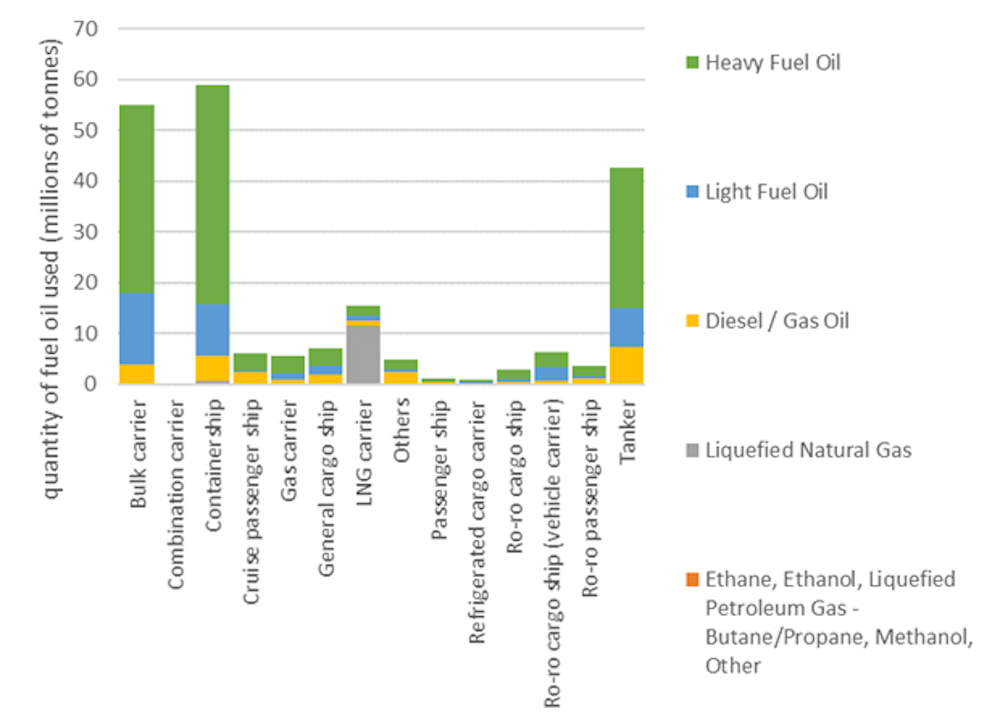
    Annual fuel oil consumption (by ship type):

    How different fuels were used by different ship types (2023 data).
    IMO Future Fuels, CC BY-NC-SA

    But here’s the problem: global demand for shipping is expected to grow by around 60% in that same time. So even with a 40% efficiency boost, total emissions from shipping could stay the same – or even go up – because so much more cargo will be moved.

    Despite this, many countries haven’t updated their policies to reflect this growing demand or to align with the IMO’s updated “30% cuts by 2030” target.

    Some countries, including Palau – a Pacific island nation vulnerable to climate change – and the UK, have pushed for stronger action. But there remains a long way to go before the world agrees on an ambitious path forward.

    Green energy

    The more hotly debated issue is around a fiendishly complicated set of “mid-term measures”. A key part of this is creating a “global fuel standard” – essentially, targets for how much “zero emission” (or “green”) fuel ships must use and by when.

    These rules would come with penalties or costs for using polluting fuels, which would effectively put a price on greenhouse gas emissions. Experts have long agreed that putting a price on shipping pollution is the most effective way to encourage cleaner and more efficient practices. But despite nearly 20 years of discussions, countries still haven’t agreed how to do this.

    Decisions are further complicated by wrangles over how to fairly distribute the revenues from these penalties.

    Who should get the revenues from shipping pollution?
    Uncle_Dave / shutterstock

    The good news is that the world is less than a week away from a decision which will put a price on shipping pollution in some form. The bad news is that proposals on the table could easily deliver a weak, uncertain price signal which doesn’t push the industry to invest in more green solutions. And the fuel standard itself might fall short of the ambitious climate targets set in 2023.

    Until now, talks on improving shipping efficiency and on pricing polluting fuels have happened separately. A big task at the IMO summit in London is to integrate the two into one coordinated plan.

    From a climate perspective, these policies should be judged by whether they will work together to cut shipping emissions by 30% by 2030 (the IMO’s current target).

    As things stand, that outcome is still possible – but is now an uphill battle. Agreement this week is crucial and countries will show their true colours. If they can’t agree to agree more ambitious policies it will undermine the IMO’s ability to regulate shipping emissions.

    Historically, the IMO tends to take its biggest decisions in the last hours of Thursday in week-long negotiations. Both ambitious and more cautious countries have a lot on the line, as the measure adopted will be legally binding for all of them.

    A positive result depends on whether powerful groups such as the European Union line up to support ambitious measures, as as proposed by African, Caribbean, Central American and Pacific countries as well as the UK.

    Although countries have agreed on climate targets for shipping, some still refuse to support the policies needed to actually phase out fossil fuels fast enough. That stance much change. If done right, IMO negotiations this week could be a turning point – not just for shipping, but for renewable energy and climate action worldwide.


    Don’t have time to read about climate change as much as you’d like?

    Get a weekly roundup in your inbox instead. Every Wednesday, The Conversation’s environment editor writes Imagine, a short email that goes a little deeper into just one climate issue. Join the 40,000+ readers who’ve subscribed so far.


    Simon Bullock is a member of the Institute of Marine Engineering, Science and Technology

    Christiaan De Beukelaer receives funding from the ClimateWorks Foundation.

    Tristan Smith owns shares in UMAS International, that working alongside UCL Energy Institute, provides advisory services on the subject of maritime decarbonisation. My research group is recipient of research funding from UKRI, Climateworks Foundation and Quadratue Climate Foundation. I am on the advisory board of the Global Maritime Forum, and the Strategy Board of the Getting to Zero Coalition – not for profit structures that work across governments and industry stakeholders on maritime decarbonisation.

    ref. At a pivotal meeting, the world is set to decide how to cut shipping emissions – https://theconversation.com/at-a-pivotal-meeting-the-world-is-set-to-decide-how-to-cut-shipping-emissions-253462

    MIL OSI – Global Reports

  • MIL-OSI Australia: Braddon restaurant awarded for sustainable choices

    Source: Northern Territory Police and Fire Services

    Clement Chauvin, Head Chef and sole owner of Les Bistronomes. Photo credit Canberra Times and Gary Ramage.

    Clement Chauvin, Head Chef and sole owner of Les Bistronomes, has taken out the Waste Minimisation Award at the 2024 Climate Choices Business Awards.

    He has been acknowledged for his creative and community-minded sustainability initiatives.

    The Awards recognise climate leaders in the business arena across eight categories.

    Les Bistronomes was celebrated for making sustainable choices for everything from sourcing ingredients to disposing waste.

    “It was wonderful to receive the award,” said Clement.

    “As a chef, I’m aware that my produce comes from mother earth and the land we live on. It makes sense to be considerate of the earth that gives us the food that nurtures and feeds us all,” he said.

    Some of the ideas Les Bistronomes was recognised for as part of the award came about during COVID.

    “It was a difficult time, but it really created community around our restaurant, and led to some great ideas for sustainability and waste minimisation,” Clement said.

    The idea to create a ‘green card’ came about from a woman who donated 80 kilograms of Jerusalem artichokes to Clement. She had an excess and didn’t know what to do with them.

    “I wanted to repay her in some way, and that’s when the idea came,” he said.

    “Local home growers in Canberra can bring in their raspberries, flowers, lemons, rhubarb or homegrown veggies in exchange for a 10 per cent discount at the restaurant.”

    This initiative reduces food waste and grows community connection, as well as limiting food miles.

    Les Bistronomes also gives growers food scraps for their compost.

    This is a way of sequestering carbon and returning nutrients to the soil. Their approach is not only great for the business, but also gives back to the local community.

    Clement has now established strong relationships with a number of locals who love growing fruits and vegetables and who regularly supply food for the restaurant.

    “I now work with two local ladies, and we plan out crops so that the restaurant has a steady and seasonal supply of produce,” he said.

    The Sustainable Business Program

    Clement said the future for Les Bistronomes is to go all-electric and move to solar if he can.

    He has reached out to the ACT Government’s Sustainable Business Program to help him.

    The program has technical experts who can provide all ACT businesses with free advice on ways to improve their energy efficiency; including transitioning off gas with rebates of up to $10,000, installing solar panels and battery storage.

    “The Sustainable Business Program helped me look at what options were available to improve sustainability, but from an infrastructure point of view,” Clement said.

    “We’re looking to switch from gas to electric induction cooking and we’re investigating how we can use solar to offset electricity costs.”

    Find out more about the Sustainable Business Program and the other Climate Choices Business Awards winners.


    Get ACT news and events delivered straight to your inbox, sign up to our email newsletter:


    MIL OSI News

  • MIL-OSI USA: Study: How Coral Reefs Shielded Hawaiian Coastlines Against 2018 Hurricanes

    Source: US Geological Survey

    Hurricanes bring powerful waves and storm surges that can erode shorelines and threaten coastal communities. But a new study by USGS and partners details how Hawaii’s coral reefs acted as natural barriers during two successive tropical cyclones that impacted Hawai’i in 2018, reducing wave energy and protecting coastlines.

    MIL OSI USA News

  • MIL-OSI: Welltec Q1 2025 Interim Report and Investor Conference Call Announcement

    Source: GlobeNewswire (MIL-OSI)

    Q1 2025 Interim Report and Investor Conference Call Announcement

    Welltec® will disclose its Q1 2025 Interim Report and will discuss the results during an investor conference call to be held Tuesday, May 20th, 2025, at 5 pm CEST.

    The conference call will be available only to current and prospective bond holders, broker dealers, and securities analysts, and can be accessed by dialling in a few minutes before the start and informing the operator that you would like to participate in Welltec’s investor conference call.

    Relevant dial-in details and conference ID can be obtained by contacting Kris Petrov krpetrov@welltec.com and registering for the call. Registration will not be possible once the investor conference has started.

    The Q1 2025 Interim Report will be made available in the “Investor Room” on Welltec’s website at https://www.welltec.com/discover/investors.

    For further information, please contact:
    Kris Petrov, Finance Director
    Cell:  +45 48 14 35 14
    E-mail: krpetrov@welltec.com

    Company Profile:
    Welltec® is a global technology company that develops and provides efficient, hi-tech solutions for the energy industry.
    The company was founded in 1994 and grew rapidly by supplying innovative robotic technology to oil and gas operators. In 2010, Welltec introduced a new business segment focused on the development of Completion products. Commercialization of these products began in 2014, and the company is now a global leader in the field of metal expandable packer technology. Welltec’s cutting-edge products and services are designed to optimize the performance and integrity of a well, in any environment.
    Through advanced engineering and lightweight design, Welltec’s solutions have helped clients increase operational efficiency and reduce carbon footprints in a safe and sustainable way for more than 30 years. Today, Welltec continues to evolve and invest in its technology portfolio with products and services adapted to take on the challenges of New Energy and Climate Technology, including Geothermal and Carbon Capture & Storage projects.

    The MIL Network

  • MIL-OSI United Kingdom: Welsh food and drink delicacies earn protected status

    Source: United Kingdom – Executive Government & Departments

    Press release

    Welsh food and drink delicacies earn protected status

    Welsh gin, oysters and honey granted protected status under UK Geographical Indication schemes

    Welsh gin, oysters and honey are to join the list of food and drink products granted protected geographical indication (PGI) status under the UK’s Geographical Indication schemes. 

    Dovey Native Botanical Gin, Pembrokeshire Native Oysters, Pembrokeshire Rock Oysters and Welsh Heather Honey have been formally recognised for their distinctive qualities and regional heritage, ensuring only authentic items meeting strict production standards and geographical requirements can be marketed under these protected names. 

    Welsh culinary tradition dates back centuries, with its food and drink deeply rooted in the nation’s landscape, culture, and history. From nutrient-rich waters producing exceptional seafood to vibrant heather moorlands ideal for honey production, Welsh producers have long crafted distinctive products shaped by local environments and passed-down expertise.  

    This recognition gives producers a valuable market advantage while preserving traditional production methods, protecting and championing local products while creating economic opportunity across all parts of the UK under the Government’s Plan for Change. 

    UK Government Minister for Food Security, Farming and Rural Affairs, Daniel Zeichner said:  

    The UK is home to a feast of flavours from every corner of the British Isles, and these new protections help celebrate the outstanding craftsmanship and heritage behind Welsh food and drink.  

    By giving these products unique status, we’re helping local businesses grow while ensuring consumers can enjoy authentic regional specialities for generations to come. 

    These additions join other popular Welsh products already recognised under the GI scheme, including Anglesey Sea Salt, Welsh Leeks, Traditional Welsh Cider and Single-malt Welsh Whisky, showcasing the rich culinary heritage of Wales. 

    Secretary of State for Wales Jo Stevens said:

    Dovey gin, Pembrokeshire oysters and Welsh honey are fantastic products and it’s right that they are being recognised as the high-quality, specialist items they are.

    The GI scheme guarantees quality and excellence while celebrating our outstanding local Welsh produce and driving growth in this vital sector.

    Wales’ Deputy First Minister,  Huw Irranca-Davies, who has responsibility for Climate Change and Rural Affairs, said:

    This recognition strengthens Wales’ growing family of protected foods, showcases the extraordinary quality of our produce, and reflects our commitment to high-quality, sustainable food production.

     From the mountains to the coast, Wales produces some of the UK’s most iconic foods, cultivated with care and tradition. Each GI product tells the story of our landscape, our producers’ expertise and our proud culinary heritage.

    With these new registrations, the total number of UK GIs now reaches 97, representing premium produce from across all four nations of the United Kingdom. 

    The GI schemes support UK food and drink businesses by protecting the reputation of regional products, promoting traditional and agricultural activity while boosting growth in local economies. 

    Danny Cameron of Dovey Native Botanical Gin said:

    Having GI Status is a good thing and helps to raise awareness of Botanical gin being provenance-based and produced to such a strict and high quality.

    Gruffydd Rees of Gwenyn Gruffydd Ltd in Carmarthenshire said:

    I am delighted that Welsh Heather Honey’s precise origin and characteristics have been recognised. The UK GI application process is long, and it is wonderful that Wales is the first UK nation to have a honey receive PGI status.

    Jake Davies, Atlantic Edge Oysters, said:

    Having a PGI Status will attract a broader audience and market who are more aware of GI products and will allow us to join the GI family which has a number of fantastic products.

    Updates to this page

    Published 7 April 2025

    MIL OSI United Kingdom

  • MIL-OSI Australia: Nature in the City grant recipients announced

    Source: Northern Territory Police and Fire Services

    Recipients of the Nature in the City: Cooling Your Suburb grants.

    Two popular cafés are among the four recipients of the Nature in the City: Cooling Your Suburb grants.

    Each receives a share of $150,000 for projects that protect against climate change.

    The four projects aim to show how living infrastructure can improve Canberra’s resilience to the heat impacts of climate change.

    Healthy living infrastructure includes trees, plants, soils, and water systems. These are essential to a city’s success in adapting to the risks of a changing climate.

    The four funded projects will tackle the ‘heat island effect’. Heat islands are a result of too much concrete and not enough plant life, bushland and tree canopy coverage in an urban area.

    This year’s successful recipients are:

    • Three Mills Bakery – Will transform an urban heat island in Woden from an expanse of concrete into an urban oasis near their new café.
    • The Climate Factory – Will grow a native micro-forest in an urban heat island in Dunlop using the Miyawaki method of dense planting to ensure rapid growth.
    • The Woodlands and Wetlands Trust – Will install native species trellis walls, a rainwater irrigation system for an existing green wall, and permeable paving to increase water retention on site.
    • Café Stepping Stone, Dickson – Will conduct a feasibility study to gather valuable insights and data to inform the long-term sustainability and maintenance of a green wall and assess how well such a project might mitigate urban heat.

    From trees to planter boxes to garden beds, simple projects can cool the local climate and make the most of rainwater, also reducing the risk of flooding.

    As well as being great for the natural environment, projects like this can help reinvigorate public spaces.

    “Stepping Stone Social Enterprise aims to create a welcoming and inclusive community space for our employees and customers,” Café Stepping Stone CEO and Founder Vanessa Brettell said.

    “This grant will enable us to improve the comfort of our space, especially in the heat of the afternoon sun and make the most of our Dickson cafe space, both indoors and outdoors through sustainable and green building methods.”

    All grant recipients engaged with the local community and stakeholders to inform their projects.

    Find out more about the Nature in the City: Cooling Your Suburb grants on the Everyday Climate Choices website.


    Get ACT news and events delivered straight to your inbox, sign up to our email newsletter:


    MIL OSI News

  • MIL-OSI: Rob McCain Appointed as Senior Vice President, Market President of Charlotte Metropolitan Area

    Source: GlobeNewswire (MIL-OSI)

    ASHEVILLE, N.C., April 07, 2025 (GLOBE NEWSWIRE) — HomeTrust Bancshares, Inc. (NYSE: HTB) (“Company”), the holding company of HomeTrust Bank (“HomeTrust” or the “Bank”), announced today that Robert “Rob” McCain III has assumed the position of Market President of the Bank’s Charlotte metropolitan area, effective March 31, 2025. McCain will focus on expanding the Bank’s presence in the market, with the primary responsibility of growing commercial and treasury management market share and revenue. He will report to John Sprink, Executive Vice President of Commercial Banking.

    “I am very excited to have Rob join the Charlotte team and the HTB family,” Sprink said. “He has a tremendous reputation and an impressive record of building teams and business in the Charlotte market, while exemplifying the cultural fundamentals that define HomeTrust Bank.”

    McCain said he is honored to take on the role and values HomeTrust’s ability to foster strong relationships with clients while building a collaborative culture. “Over recent years HomeTrust has proven it is more than qualified to serve the needs of businesses in Charlotte, which has transformed itself into a hub of innovation and commerce,” he said. “I’m excited to bring my decades of experience in the Charlotte market to this opportunity.”

    As a native of the area, McCain said he will take special pride in working to establish the Bank as a strong community partner.

    McCain has worked in commercial banking in Charlotte since 1989 in roles that include Market Executive and Manager of Commercial Banking at First Citizens Bank, as well as Line of Business Manager for Commercial Real Estate Lending in the Carolinas at SunTrust.

    He earned his Bachelor of Science in Business Administration from The University of North Carolina at Chapel Hill and his Master in Business Administration from The University of North Carolina at Charlotte. He is also a graduate of the School of Banking at Louisiana State University.

    About HomeTrust Bancshares, Inc.

    HomeTrust Bancshares, Inc. is the holding company for HomeTrust Bank. As of December 31, 2024, the Company had assets of $4.6 billion. The Bank, founded in 1926, is a North Carolina state chartered, community-focused financial institution committed to providing value added relationship banking with over 30 locations as well as online/mobile channels. Locations include: North Carolina (the Asheville metropolitan area, the “Piedmont” region, Charlotte, and Raleigh/Cary), South Carolina (Greenville and Charleston), East Tennessee (Kingsport/Johnson City, Knoxville, and Morristown), Southwest Virginia (the Roanoke Valley) and Georgia (Greater Atlanta).

    Forward-Looking Statements

    This press release may include “forward-looking statements” within the meaning of the Private Securities Litigation Reform Act of 1995. Forward-looking statements are not statements of historical fact, but instead are based on certain assumptions including statements with respect to the Company’s beliefs, plans, objectives, goals, expectations, assumptions and statements about future economic performance and projections of financial items. These forward-looking statements are subject to known and unknown risks, uncertainties and other factors that could cause actual results to differ materially from the results anticipated or implied by forward-looking statements. The factors that could result in material differentiation include, but are not limited to, the impact of bank failures or adverse developments involving other banks and related negative press about the banking industry in general on investor and depositor sentiment; the remaining effects of the COVID-19 pandemic on general economic and financial market conditions and on public health, both nationally and in the Company’s market areas; natural disasters, including the effects of Hurricane Helene; expected revenues, cost savings, synergies and other benefits from merger and acquisition activities might not be realized to the extent anticipated, within the anticipated time frames, or at all, costs or difficulties relating to integration matters, including but not limited to customer and employee retention, might be greater than expected, and goodwill impairment charges might be incurred; increased competitive pressures among financial services companies; changes in the interest rate environment; changes in general economic conditions, both nationally and in our market areas; legislative and regulatory changes; and the effects of inflation, a potential recession, and other factors described in the Company’s latest Annual Report on Form 10-K and Quarterly Reports on Form 10-Q and other documents filed with or furnished to the Securities and Exchange Commission – which are available on the Company’s website at www.htb.com and on the SEC’s website at www.sec.gov. Any of the forward-looking statements that the Company makes in this press release or in the documents the Company files with or furnishes to the SEC are based upon management’s beliefs and assumptions at the time they are made and may turn out to be wrong because of inaccurate assumptions, the factors described above or other factors that management cannot foresee. The Company does not undertake, and specifically disclaims any obligation, to revise any forward-looking statements to reflect the occurrence of anticipated or unanticipated events or circumstances after the date of such statements.

    www.htb.com

    The MIL Network

  • MIL-OSI: Altus Group Releases its 2024 Sustainability Report

    Source: GlobeNewswire (MIL-OSI)

    TORONTO, April 07, 2025 (GLOBE NEWSWIRE) — Altus Group Limited (“Altus” or “the Company”) (TSX: AIF), a leading provider of asset and fund intelligence for commercial real estate (“CRE”), today released its annual Sustainability Report, which highlights the Company’s sustainability initiatives and progress in 2024.

    “As we celebrate our 20th anniversary this year, sustainability continues to guide who we are and how we operate,” said Camilla Bartosiewicz, Chief Communications Officer at Altus Group. “This report brings our values to life – highlighting the tangible progress we made in 2024 in reducing emissions, investing in our people, and upholding strong corporate governance. These efforts are not only core to our identity as a responsible corporate citizen and employer of choice, but are critical to managing enterprise risk and creating long-term value for all stakeholders.”

    Key 2024 highlights:

    • Climate action: reduced Scope 1 and 2 greenhouse gas emissions by approximately 5% in 2024, benefitting from strategic right-sizing of office space, which resulted in a 12% reduction in office footprint.
    • Talent management: expanded people programs to foster career advancement and employee success, earning external recognition for an inclusive, high-trust and high-performance culture.
    • Cybersecurity and data responsibility: continued enhancement of cybersecurity and data standards to uphold data responsibility and maintain stakeholder trust.
    • Governance: welcomed new board members, adding diverse perspectives and skills that enhance board effectiveness.

    To download Altus Group’s 2024 Sustainability Report please visit https://www.altusgroup.com/about-us/sustainability/. More information on Altus Group’s corporate governance program is also detailed in the Company’s 2024 Management Information Circular dated March 26, 2025 which has been filed to SEDAR+ and is posted on Altus Group’s website under the Investors section.

    About Altus Group

    Altus Group is a leading provider of asset and fund intelligence for commercial real estate. We deliver intelligence as a service to our global client base through a connected platform of industry-leading technology, advanced analytics, and advisory services. Trusted by the largest CRE leaders, our capabilities help commercial real estate investors, developers, lenders, and advisors manage risks and improve performance returns throughout the asset and fund lifecycle. Altus Group is a global company headquartered in Toronto with approximately 1,900 employees across North America, EMEA and Asia Pacific. For more information about Altus (TSX: AIF) please visit altusgroup.com.

    FOR FURTHER INFORMATION PLEASE CONTACT:

    Elizabeth Lambe
    Director, Global Communications, Altus Group
    1 (416) 641-9787
    elizabeth.lambe@altusgroup.com

    The MIL Network

  • MIL-OSI Global: How to gauge flood risk before you buy or rent a seafront property

    Source: The Conversation – UK – By Avidesh Seenath, Course Director, MSc Environmental Change and Management, University of Oxford

    Torcross on the south Devon coast. Julian Gazzard/Shutterstock

    Rising sea levels, stronger storms and increased erosion are making life on the coast riskier and more unpredictable. For potential buyers or renters, particularly in the wake of another winter of storms and flooding, questions around whether to invest in coastal properties are more urgent now than ever.

    The desire to understand flood risk before committing to a seaside home is understandable, but assessing that risk isn’t always straightforward. Knowing how people perceive these risks, however, will help scientists better communicate such risks.

    We surveyed over 700 UK residents in a nationwide study to understand how access to flood prediction maps, which indicate the relative risk of flooding for areas based on factors like sea-level rise, storm surges, and local topography, affected their housing preferences. These maps are typically available through government websites and are often consulted during the home-buying process via online property listings or planning reports.

    The results were striking. Once people were shown flood risk maps, their preferences changed decisively – away from scenic seafront properties and towards locations that were inland and considered to be “safe”.

    However, while this change in preference seems rational, it reveals a deeper underlying problem: flood risk is not being communicated clearly or effectively in the UK. Many people in our study treated flood maps as if their predictions were absolute and misinterpreted areas at risk of flooding as being exposed to actual flooding. In reality, these maps are based on mathematical models with varying degrees of complexity and uncertainty.

    Some widely used models are simple and treat flooding as a result of land elevation alone. Others are more complex and attempt to simulate how floodwater spreads over land. Unsurprisingly, these models can produce conflicting results.

    In our survey, participants were shown multiple flood maps for the same town produced by different models. Confusion quickly followed, as different models reported different flood risks for the same areas. The uncertainty led to significant risk-averse behaviour.

    This change in how people choose where to live matters, not just for individual property decisions but for entire coastal economies. If potential buyers avoid seafront homes en masse due to unclear or alarming flood maps, local property markets will probably suffer. So might businesses that rely on local footfall. Meanwhile, some renters, especially younger ones or those on lower incomes, might still take on flood-prone properties without fully understanding the long-term risks or securing adequate insurance. So, what can be done?

    Making sense of flood maps

    Flood prediction maps need to be presented and communicated more clearly. Instead of technical jargon, plain language and relatable visuals on flood maps will help people understand the level of risk and what it actually means. Colour-coded maps are a good start, but they should also explain what the colours represent, and how likely the worst-case scenarios really are.

    The general public, including prospective property buyers, need to be educated on how to read and interpret these maps. Currently, flood information is often tucked away in legal documents during conveyancing or buried in dense government websites. Instead, it should be part of the house-hunting process: visible, accessible and accompanied by guidance.

    Policymakers and real estate professionals must recognise the psychological impact of flood predictions. Overstating risk can cause panic; understating it can leave people unprepared. The goal should be to empower people instead of scaring them, by balancing transparency with nuance.

    Flood models are a vital tool for understanding and managing flood risks in a changing climate. But they are only as effective as our ability to understand and use them wisely. Our research highlights that it’s not just about having the data – it’s about making that data work for real people making life-changing decisions.

    So, before buying or renting that dream seafront home, check the flood maps – and carefully ask and consider what’s behind them. Be curious about what kind of model was used, how recent the data is and what the uncertainties are. With clearer information and better public understanding, coastal communities can more easily adapt – not abandon – our treasured seaside towns.


    Don’t have time to read about climate change as much as you’d like?

    Get a weekly roundup in your inbox instead. Every Wednesday, The Conversation’s environment editor writes Imagine, a short email that goes a little deeper into just one climate issue. Join the 40,000+ readers who’ve subscribed so far.


    The authors do not work for, consult, own shares in or receive funding from any company or organisation that would benefit from this article, and have disclosed no relevant affiliations beyond their academic appointment.

    ref. How to gauge flood risk before you buy or rent a seafront property – https://theconversation.com/how-to-gauge-flood-risk-before-you-buy-or-rent-a-seafront-property-253313

    MIL OSI – Global Reports

  • MIL-OSI United Kingdom: New guide to research and innovation challenges for climate adaptation released

    Source: United Kingdom – Executive Government & Departments

    News story

    New guide to research and innovation challenges for climate adaptation released

    A new report identifying the research and innovation needed to support the UK to adapt effectively to climate change has been released.

    Image of a bumblebee collecting pollen from a bluebell.

    A new report identifying the research and innovation needed to support the UK to adapt effectively to climate change has been released today.  

    Developed by the Government Office for Science and the Department for Environment, Food and Rural Affairs, the Climate Adaptation Research and Innovation Framework (CARIF) outlines the research and innovation needed around climate adaptation. 

    CARIF is designed to make it easier for government, industry, and research communities to work together to tackle the challenges we face around adapting to climate change. The new framework is the first time the UK research needs across government and across sectors have been brought together in one place.   

    Environment Minister Emma Hardy said:

    We are already seeing the impact of climate change and extreme weather on people’s lives, from transport disruption to flooding in people’s homes.  

    This is why, alongside our research into climate adaptation, we are exploring how we can set out stronger objectives to drive action to increase our preparedness for the impacts of climate change up to and beyond the next National Adaptation Programme in 2028.

    Government Chief Scientific Adviser Professor Dame Angela McLean said:

    We need new research to make the UK more resilient to climate change, and innovation to improve how effectively and affordably we ready systems for change. The UK has world-leading science capabilities which we can harness to ensure we are ready for future climate impacts.  

    We have spoken with academia, industry, UK government and the financial sector to produce this first Climate Adaptation Research and Innovation Framework. It aims to drive use of our science capabilities to address the climate adaptation challenge.

    CARIF covers 11 sectors including nature, working land and seas, food security, water supply, energy, telecommunications and ICT, transport, town and cities and community preparedness/response, buildings, health, and business and finance.  

    Read the Climate Adaptation Research and Innovation Framework here.

    Updates to this page

    Published 7 April 2025

    MIL OSI United Kingdom

  • MIL-OSI United Kingdom: Government and industry to train up ‘clean power army’

    Source: United Kingdom – Executive Government & Departments

    Press release

    Government and industry to train up ‘clean power army’

    Government and industry to train up ‘clean power army’ of apprentice engineers, welders, and technicians.

    • Clean energy sector to create thousands of new apprenticeships as part of Plan for Change
    • Energy Secretary tells industry forum that a clean power army of engineers, welders and technicians will be required to deliver clean power by 2030, and that government will work with industry to build it, with Regional Skills Pilots in Aberdeen, Cheshire, Lincolnshire, and Pembrokeshire
    • Work and Pensions Secretary says the government will “give this generation the tools they need to seize the opportunity that is the clean energy transition”

    Young people will be trained to fill thousands of clean energy jobs and apprenticeships needed to deliver clean power by 2030 as part of the government’s Plan for Change to get Britain working and unlock growth.  

    The Energy Secretary has told industry, unions and trade bodies that the government will work with them to build a clean power army to hit ambitious targets for clean power by 2030 at a forum convened with the Work and Pensions Secretary today (Monday 7 April 2025).  

    The transition to clean power will create thousands of opportunities across the sector, from renewables to upgrading the UK’s grid infrastructure.  

    National Grid alone plans to support around 55,000 more jobs by the end of the decade and SSE Transmission plans are supporting a further 37,000 jobs, 17,500 of which would be in Scotland. Scottish Power’s SP Energy Networks plans to double its transmission workforce to create around 1,400 jobs and support a further 11,000 jobs across the UK – with all 3 plans subject to approvals by the regulator.    

    The government is driving forward with Regional Skills Pilot in the clean energy sector. Aberdeen, Cheshire, Lincolnshire and Pembrokeshire have all been identified as key growth regions for clean energy. Local partners will receive funding to identify the skills support that is needed in their area to deliver clean power by 2030, which will protect households and businesses from unstable fossil fuel markets for good. 

    Funding could go towards new training centres, courses or career advisers – supporting local people into opportunities in industries such as welding, electrical engineering, and construction.    

    The government is wasting no time in investing in good jobs for British industries, including thousands of new, skilled jobs being supported in the North East of England as contracts for the first carbon capture, usage and storage were signed in December, following a £21.7 billion commitment from the government to ensure the UK’s vision for CCUS becomes a reality. The government has also invested £55 million for port of Cromarty, to transform it into a major hub for the UK’s world-leading floating offshore wind industry, creating hundreds of skilled jobs and generating growth.  

    The latest CBI Economics figures show jobs supported by net zero sectors increased by 10% last year, with the average annual wage across the sector at £43,000 – £5,600 higher than the national average.  

    The push to support more clean energy jobs comes as the government delivers the most ambitious reforms of the UK’s energy system in a generation and record investment into homegrown clean energy projects. 

    Energy Secretary Ed Miliband said:  

    The energy sector has always been a source of good, skilled, and unionised jobs for young people across the UK, providing secure, well-paid employment for life.   

    To meet our target to reach clean power by 2030, we need a clean power army of engineers, welders and technicians – giving thousands of young people the opportunity to play a vital role in tackling the climate crisis, increasing our energy security and boosting the economy to deliver our Plan for Change.

    Work and Pensions Secretary Liz Kendall said:    

    With almost a million young people neither earning nor learning it is vital that we give this generation the tools they need to seize the opportunity that is the clean energy transition.  

    Our plan to Get Britian Working will overhaul employment support, giving everyone the tools and skills they need to and build a stronger, more prosperous future for them and their families.

    The government launched its Get Britain Working white paper late last year, outlining the biggest employment reforms in a generation and boost employment including reforming Jobcentres to create a genuinely public employment service so everyone can get personalised skills and employment support, as well as a Youth Guarantee ensuring every young person has the chance to earn or learn. Alongside government work to drive up employment and opportunities, the renewable sector will also continue to turbocharge the economy.  

    The government is working closely with employers to train up Britain’s young people to seize clean energy opportunities. Trade unions will also have an essential role in building the UK’s skilled energy workforce, with the government determined to drive world-class pay, terms, and conditions in the clean energy sector. The government is already driving better access and conditions for unions in the energy sector- since July EDF Renewables UK and Ireland have signed one of the first renewables industry recognition agreements with Prospect, Unite, GMB and UNISON.   

    The government has also launched Skills England and the Office for Clean Energy Jobs to bring together key partners to meet the skills needs of the next decade across all regions.    

    Opportunities are already being created through a number of schemes and initiatives to deliver training and skills for apprentices and workers transitioning from the fossil fuel sector, including innovative schemes such as the:  

    • Skills Passport: This supports oil and gas workers to identify routes into several roles in offshore wind including construction and maintenance
    • Your Apprenticeship app: A new app designed by the government with extensive input from apprentices to provide easier access to essential tools, resources, and support to help apprentices to thrive in their qualification

    Whilst driving up employment and opportunities, the renewable sector will also continue to turbocharge the economy.  

    CBI Economics analysis commissioned by the Energy and Climate Intelligence Unit shows that the net zero sector already contributes £83 billion annually to the UK economy, with further investment into projects predicted to grow this even further.  

    Government research has also revealed the extent in which apprenticeships can help drive this growth, with apprentices in England across the economy estimated to create £25 billion of economic growth over their lifetime.  

    Through investment and initiatives, the government will help build the pipeline of skilled workers needed to deliver clean power by 2030, which will unlock £40 billion of investment a year and reindustrialise Britain with thousands of good jobs across the country. This underscores the government’s commitment to deliver a jobs-rich clean energy transition, putting communities and trade unions at the heart of the UK’s clean energy future.    

    Notes to editors

    Skills is a devolved policy area, and therefore the remit of Skills England and the Your Apprenticeship App will only cover England. However, Skills England will assess skills needs across the whole of the UK and DESNZ is working closely with the devolved governments on ensuring we have the skilled workforce for the clean energy transition, including through the Regional Skills Pilots.   

    The RIIO T3 business plans for the UK’s 3 electricity transmission companies are all subject to approval by the energy regulator Ofgem.

    Updates to this page

    Published 7 April 2025

    MIL OSI United Kingdom

  • MIL-OSI United Kingdom: Value for money in pre-arranged financing for disasters

    Source: United Kingdom – Executive Government & Departments

    News story

    Value for money in pre-arranged financing for disasters

    A GAD actuary has co-authored a guidance note to help countries and organisations assess value for money when using pre-arranged financing for disasters.

    Credit: Shutterstock

    Countries and organisations seek to set up financing ahead of disasters. This involves understanding which solution or product presents the best value for money (VfM).

    The report Assessing value for money in pre-arranged financing for disasters: a practical framework has been published by the Centre for Disaster Protection and co-written by a GAD actuary.

    Preparing for disasters

    This guidance note has been developed to help countries and organisations considering or using pre-arranged financing instruments through the process of assessing if a particular instrument or combination of instruments offers the best value for money.

    Pre-arranged financing (PAF) is set up before a disaster and involves committing funding and preparing response plans before disasters occur. As financing is in place before a disaster, it ensures funding is available to reach affected people once an event occurs.  

    Assessing value for money

    The report is drawn from the work of the Centre for Disaster Protection over the past 5 years, and is aimed at organisations or countries which are looking to:

    • set up new PAF instruments
    • improve the design of existing PAF instruments
    • understand the optimal combination of financial instruments needed to manage the risks they face

    The report provides an overview of VfM analysis. It shows how it is a useful tool to inform decision making and demonstrate the potential effectiveness of new financial approaches compared to existing methods of financing disaster response. The report also presents a flexible 7-step framework for approaching VfM analysis in this context, supplemented by case studies and examples.

    Credit: iStock Photo

    Who’s it for?

    The research sets out which organisations may benefit from undertaking VfM assessments in relation to PAF. They include:

    • national governments
    • donor agencies
    • humanitarian agencies and NGOs
    • risk finance providers
    • multilateral development banks / multi-donor funds

    Process and content

    GAD’s Head of Climate and Disaster Risk Georgi Bedenham co-authored the report. She said: “We developed a 7-step framework to encourage governments and organisations to consider a range of aspects of VfM. It is intended as a guide to support anyone designing, commissioning and conducting VfM assessments.

    “We have also provided a useful set of guiding questions at each stage to help the reader work their way through the process.”

    Updates to this page

    Published 7 April 2025

    MIL OSI United Kingdom

  • MIL-OSI Australia: More EV chargers on the way

    Source: Northern Territory Police and Fire Services

    Recently installed chargers are making electric vehicle charging more accessible.

    A new round of ACT Government grants will fund the delivery of 39 more electric vehicle chargers (EV) across the city by 2025.

    Installing more public chargers will support the ACT’s efforts to electrify Canberra’s transport system. It will help reach the ACT Government’s goal of 180 public EV chargers by 2025.

    Providing more DC fast chargers will plug gaps in Canberra’s existing charger network. Having a good mix of DC fast chargers and slower AC chargers means that people can charge in a way that suits their needs. This includes charging quickly when needed or using an AC charger for longer visits like work, school, or sport.

    The 39 chargers will be installed in places where Canberrans and visitors need them most, including:

    • near tourist hot spots
    • shopping centres
    • high-density residential areas.

    New chargers for ANU and Marketplace Gungahlin

    Three new DC fast chargers have been installed at ANU and Marketplace Gungahlin respectively to help make charging more accessible.

    Each set of three chargers are 150kW and can charge six vehicles at once. They are close to nearby apartments and employment hubs.

    People who live in apartments and townhouses have extra barriers to installing home chargers. This is why the ACT Government is prioritising putting public chargers in areas of high-density housing.

    The government will also work with grant recipients to deliver charging bays in priority locations that will be accessible to EV drivers with mobility issues.

    “It’s important to place EV charging infrastructure in convenient locations where people want to go, be it a university, shopping centre, tourism destination or somewhere they visit as part of their daily routine,” Greg Schumann, ENGIE ANZ Director of Green Mobility said.

    A growing network of chargers

    The successful providers for the first projects to be supported by this new funding are ActewAGL, BP, ENGIE and EVIE.

    “We’re committed to keeping Australian EV drivers charged up, by rolling out a national network of bp pulse charge points,” Frédéric Baudry, President bp Australia and Senior Vice President Mobility, Convenience, & Midstream, Asia Pacific said.

    “We know that the ACT is home to more EV drivers than anywhere else in Australia, and with the support of the ACT Government, we’ll be bringing the best of our charging and convenience offers to these drivers on the go when they visit bp.”

    There are currently 156 public EV charging stations operating across the ACT. 39 public EV chargers with 65 charging bays* have been delivered through previous government funding. A further 21 chargers are still to be delivered under the previous grant round by the end of 2024.

    Find more information on the Public EV Charging Infrastructure Fund visit the Everyday Climate Choices website.

    A map of public charging stations in the ACT, and across Australia, is available at www.plugshare.com.

    * This figure is an indication of the number of future chargers as of May 2024. The number and location of future chargers supported by government funding is subject to change.


    Get ACT news and events delivered straight to your inbox, sign up to our email newsletter:


    MIL OSI News

  • MIL-OSI United Nations: UNDRR partnership with Standard Chartered prompts resilient infrastructure deal to tackle $2 trillion climate impacts

    Source: UNISDR Disaster Risk Reduction

    • Standard Chartered announces completion of first adaptation finance deal for a corporate client following launch of the breakthrough Guide for Adaptation and Resilience Finance.
    • Deal facilitates the trade of solar modules resistant to tornadoes and tropical storms, extreme wind, storms and sandstorms.
    • In 2024, the International Chamber of Commerce (ICC) reported that over the last decade, climate-related extreme weather events resulted in cumulative losses to the global economy of around $2 trillion.
    • Deal demonstrates potential of adaptation as an investable asset class in response to growing demand for resilient infrastructure to mitigate economic losses caused by extreme weather events, such as those caused by the Los Angeles wildfires earlier this year.

    London, 13 March 2025 – Standard Chartered today announces the successful completion of an adaptation transaction for Jinko Solar Co., Ltd. (JinkoSolar), facilitating the delivery of storm and extreme weather-resilient solar modules to solar photovoltaic (PV) farms located in the US (Florida), UAE and Saudi Arabia. Standard Chartered provided Bank Guarantees (BGs) to facilitate the trade of these solar modules, known as Tiger Neo N-type products.

    The deal is Standard Chartered’s first labelled adaptation finance deal for a corporate client following the launch of the breakthrough Guide for Adaptation and Resilience Finance, which set out for the first-time, guidance on what constitutes adaptation and resilience investment, mapping over 100 investable activities in this field. This also represents the Bank’s first labelled adaptation finance transaction in China.

    The deal demonstrates the potential of adaptation and resilience as an investable asset class in response to growing demand for resilient infrastructure, particularly in the US (Florida), UAE and Saudi Arabia, where extreme wind, storms and sandstorms degrade and disrupt solar technology, leading to economic losses on investments made. The project specification (see Appendix) protects against:

    • Tornadoes and tropical storms in the US (Florida), like the more than 46 tornadoes that occurred throughout Florida in 2024 as a result of Hurricane Milton. Across the US, hurricanes including Hurricane Milton and Hurricane Helene (North Carolina) caused over $500 billion in economic losses.
    • Extreme wind, storms and sandstorms in the UAE and Saudi Arabia, including the severe storm that swamped Dubai in 2024 leading to damages thought to be worth hundreds of millions of dollars to homes and businesses.

    Ben Hung, President, International at Standard Chartered, said: “As a bank that sits at the centre of trade flows, and helps to facilitate them, we’re delighted to support JinkoSolar on this transaction. This deal demonstrates Standard Chartered’s ability to leverage the full breadth of our cross-border capabilities alongside our unique adaptation finance expertise, to connect demand for advanced solar technology with supply, building long-term resilience into critical energy infrastructure across our markets.”

    Haiyun Cao, Chief Financial Officer at JinkoSolar, said: “Adaptation and resilience financing are crucial in the journey to address climate change and as a leading enterprise in the photovoltaic industry, JinkoSolar feels a great sense of responsibility to support this. We are committed to promoting the development of clean energy and improving the efficiency and adaptability of photovoltaic products through technological innovation. This not only contributes to our own sustainable development, but also provides stable clean energy supply for societies and enhances our ability to cope with climate challenges. JinkoSolar looks forward to strengthening our work with Standard Chartered to contribute to building a more resilient energy system together.”

    Research from the International Chamber of Commerce (ICC) found that over the last decade, nearly 4,000 climate-related extreme weather events resulted in cumulative losses to the global economy of around $2 trillion, including the direct cost of physical asset destruction. In the last two full years alone, global economic damages reached $451 billion – representing a 19% increase compared to the previous eight years of the decade, underscoring the urgent need for resilient infrastructure.

    Tracy Wong Harris, Head, Sustainable Finance GCNA at Standard Chartered said: “Standard Chartered offers practical solutions to mitigate the worst impacts of extreme weather, helping our clients build resilience against the major productivity losses being felt here and now in the real economy as a result of increasingly frequent weather-related events. We’re proud to support JinkoSolar on this transaction, empowering them in delivering clean energy security alongside long-term business growth.”

    In 2024, Standard Chartered, KPMG and the United Nations Office for Disaster Risk Reduction launched the Guide for Adaptation and Resilience Finance, with support from more than twenty leading financial institutions and NGOs a guide for investment in adaptation and resilience. The guide set out a common reference for adaptation and resilience alongside a list of financeable adaptation and resilience themes and activities, forming a classification framework for the market.

    Marisa Drew, Chief Sustainability Officer, Standard Chartered, said: “When we launched the Guide for Adaptation and Resilience Finance, we set out to provide the clarity needed across the market to accelerate investment into adaptation and resilience. Today, we’re putting the Guide into action ourselves through our first labelled deal with a corporate client, demonstrating the commercial opportunity alongside the economic benefits of financing resilient infrastructure in markets that are acutely vulnerable to the negative effects of extreme weather.”

    This is Standard Chartered’s second labelled adaptation finance deal, having completed a deal with an insurance client in 2023, which provided financial protection against extreme weather such as changes in river levels and wind levels for businesses in the renewable energy sector.

    View the report

    MIL OSI United Nations News

  • MIL-OSI USA: President Trump Approves Emergency Declarations for Arkansas, Kentucky and Tennessee to Supplement State-led Response Activities

    Source: US Federal Emergency Management Agency

    Headline: President Trump Approves Emergency Declarations for Arkansas, Kentucky and Tennessee to Supplement State-led Response Activities

    President Trump Approves Emergency Declarations for Arkansas, Kentucky and Tennessee to Supplement State-led Response Activities

    Residents are urged to listen to local officials as severe weather and flooding risk continuesWASHINGTON — FEMA is actively coordinating with states across the mid-west and central U

    S

    affected by recent severe storms and flooding to support their locally-led response efforts

    Residents and visitors should continue to listen to instructions from local officials, monitor local weather alerts and evacuate immediately if told to so

     The President approved emergency declarations for Arkansas, Kentucky and Tennessee, which allows FEMA to identify, mobilize and provide equipment and resources to support state and local efforts

    FEMA is also coordinating with the Department of Defense and other federal agencies to leverage their resources and equipment if requested by the state

    FEMA activated Regional Response Coordination Centers in Georgia and Texas and its National Response Coordination Center in Washington, D

    C

    to support state partners

    Incident Management Teams, as well as emergency communication support and Urban Search and Rescue teams, have been deployed to the area to bolster the state and local responders’ operations

    Federal resources – including meals, water, generators and other commodities – plus additional search and rescue teams are in position and ready to deploy in anticipation of state requests for assistance

    Keep Informed

    Stay Safe

    Even as rainfall amounts in the area begin to decrease, river and flash flooding may become more widespread and create hazardous conditions

    Never walk, swim or drive through floodwaters

    Just six inches of moving water can knock a person down, and one foot of water can carry away a vehicle

      People in the affected area should continue to listen to instructions from local officials to stay safe

    Shelters are open in each state for people who are unable to return home due to the risks from the storm and possible flooding

    Visit redcross

    org or call 1-800-RED CROSS to find the nearest shelter

      While the effects of the storm are widespread and impact many states simultaneously, each disaster is unique

    FEMA continues to work alongside state and local partners to address the specific needs of each affected area

     ArkansasResidents and visitors can get updated weather information on the National Weather Service Little Rock Decision Support Page and can visit the Arkansas Division of Emergency Management online for more information

    Urban Search and Rescue teams and personnel from the U

    S

    Army Corps of Engineers have been deployed for safety and rescue operations

    The state is monitoring power and communication outages and their impacts across the area

     KentuckyResidents and visitors can visit the Kentucky Emergency Management website for the latest information

     Urban Search and Rescue teams are currently deployed to Greenville, Louisville and Moorehead

    FEMA Mobile Emergency Response Support assets are deployed to Frankfort and Louisville, which provide mobile telecommunications, operational support and power generators in support of response officials on the ground

     Emergency Management Assistance Compact task forces, which enable resource sharing across states during disasters, are supporting state and local operations

    Voluntary evacuations are in place for residents of Nelson County

     TennesseeResidents and visitors can visit the TN Emergency Management Agency (TEMA) website for the latest information

    Federal response teams are on the ground and coordinating with local and state search and rescue personnel

    Montgomery and Obion counties have issued voluntary evacuations

    Roads may be impacted by debris or flooding

    Find the latest on road conditions on TDOT’s Smartway map

    mashana

    davis
    Sun, 04/06/2025 – 17:49

    MIL OSI USA News

  • MIL-OSI Europe: Written question – Europe’s industrial and mobile heritage – E-001309/2025

    Source: European Parliament

    Question for written answer  E-001309/2025
    to the Commission
    Rule 144
    Bogdan Andrzej Zdrojewski (PPE), Łukasz Kohut (PPE), Borys Budka (PPE)

    Industrial and mobile heritage is a part of our European identity, representing the technological and social development that has shaped our continent. Preserving this heritage ensures that future generations can understand and appreciate Europe’s industrial values. A key element of its preservation is the continued, but limited production of CO2 based on the availability and use of fossil fuels necessary for the operation of heritage machinery and vehicles.

    • 1.How does the Commission plan to take into account the specific needs of industrial and mobile heritage in the ongoing revision of the CO2 Regulation and the EU Climate Law, ensuring that a limited and controlled production of CO2 and supply of fossil fuels remains available for this purpose?
    • 2.How does the Commission intend to avoid restrictions of cultural heritage fuels resulting from future regulatory developments and considering the importance of passing knowledge and expertise related to industrial and mobile heritage to future generations, and what measures does the Commission plan to support educational and promotional initiatives?
    • 3.How does the Commission plan to bring industrial and mobile heritage to policy action and protection at a time when Europe needs to showcase its inventiveness, industrial ingenuity, creativity and historical achievements?

    Submitted: 28.3.2025

    Last updated: 7 April 2025

    MIL OSI Europe News

  • MIL-OSI: Allstate Canada: Almost 1 in 3 insurance claims are due to a catastrophic weather or climate event

    Source: GlobeNewswire (MIL-OSI)

    Homeowners taking steps to prepare during clear blue skies can help reduce the impact of the next storm

    MARKHAM, Ontario, April 07, 2025 (GLOBE NEWSWIRE) — Catastrophic weather and climate events are no longer a rare occurrence in Canada. According to a recent Léger poll conducted on behalf of Allstate Insurance Company of Canada (‘Allstate’), only 27 per cent of Canadian homeowners who responded say they are very confident their home is prepared for a major weather or climate event, such as a tornado, flooding, wildfire, or hail that cause wide-spread damage to communities.

    Allstate in-house data shows that 29 per cent of claims it received over the last 10 years – that’s almost 1 in 3 – were from major weather or climate events. Analysis shows the number of claims due to large events was particularly high in 2024, with approximately 2.4 times more claims when compared to 2023.

    In fact, the Insurance Bureau of Canada’s industry-wide numbers show that 2024 shattered the record for costliest year for severe weather-related losses in Canadian history, at over $8.5 billion. Given the real possibility of such events in the future, being prepared requires ongoing education and information to support homeowners with adopting proactive behaviours.

    ‘‘Large weather and climate events are affecting more Canadians more often, year after year,” says Odel Laing, Agency Manager at Allstate Canada. “Insurance coverage can help people recover their homes and vehicles following a severe storm or wildfire, but the family heirlooms, photographs, and other personally important items are more difficult to replace. So, taking steps to prevent or reduce the risk of damage is key.’’

    How Homeowners Can Prepare for Catastrophic Weather or Climate Events

    Laing offers the following tips that may help protect families and mitigate property damage from a major weather or climate event.

    • Create an emergency plan: Identify safe spaces in your home, establish a family communication plan, and know local evacuation routes.
    • Build an emergency kit: Have essentials ready for 72 hours, including water, non-perishable food, flashlights, first-aid supplies, and important documents in waterproof containers.
    • Secure your property: Install sump pumps, backwater valves, and reinforce windows and doors to help reduce damage from floods and severe storms.
    • Prepare for wildfires: Clear dry vegetation around your home, use fire-resistant materials on your home.
    • Review and update your insurance: Make sure you have the right coverage you need for you and your family.

    For more preparedness advice, visit the GOOD HANDS® blog at blog.allstate.ca/prepare-for-natural-disasters-in-canada.

    Léger Poll Methodology
    Allstate commissioned Léger to conduct a study among Canadian homeowners to better understand their use of basements, storage habits, flood prevention measures, and overall preparedness for extreme weather events. In order to meet research objectives, an online survey was conducted with 1,000 Canadian homeowners, aged 18 and over, who could express themselves in French or English from January 23 to 27, 2025. It should be noted that due to the non-probabilistic nature of the sample (associated with any web survey), the calculation of the margin of error does not apply. For comparative purposes, a probabilistic sample of 1,000 respondents (web panel) would have a global margin of error of ± 3.1% 19 times out of 20. The margin of error would, however, increase for subgroups.

    About Allstate Insurance Company of Canada
    Allstate Insurance Company of Canada is a leading home and auto insurer focused on providing its customers prevention and protection products and services for every stage of life. Serving Canadians since 1953, Allstate strives to reassure both customers and employees with its “You’re in Good Hands®” promise. Allstate is committed to making a positive difference in the communities in which it operates through partnerships with charitable organizations, employee giving and volunteerism. To learn more, visit www.allstate.ca. For safety tips and advice, visit www.goodhandsadvice.ca

    For more information, please contact:
    Stephanie More
    Agnostic on behalf of Allstate Insurance Company of Canada
    416-912-5341
    smore@thinkagnostic.com

    Maude Gauthier (Quebec only)
    Capital-Image on behalf of Allstate Insurance Company of Canada
    514-915-9469
    mgauthier@capital-image.com

    Cody Gillen
    Public Relations Specialist
    905-475-4536
    cgillen@allstate.ca  

    The MIL Network

  • MIL-OSI United Kingdom: UN Human Rights Council 58: UK Closing Statement

    Source: United Kingdom – Executive Government & Departments

    World news story

    UN Human Rights Council 58: UK Closing Statement

    UK Closing Statement for the 58th HRC. Delivered in Geneva.

    Thank you, Mr President.

    The UK remains fully committed to implementing the Covenant on Economic Social and Cultural Rights. In respect of the resolution L.7 on the realisation of economic, social and cultural rights, the UK notes that States take different approaches, appropriate to the constitutions of their country, to implement the Covenant. The Covenant binds the UK in international law but is unincorporated. Unincorporated treaties are not justiciable domestically so UK courts would not normally contribute to identifying gaps in legislation in respect of Covenant rights. The UK continues to progressively realise the rights recognised in the Covenant through a combination of legislation and administrative measures, in accordance with Article 2 (1) of the Covenant.

    The UK also notes that Article 2 (1) of the Covenant accommodates different States’ resources through the progressive realisation of Covenant rights. International human rights law does not, however, accommodate the notion of common but differentiated responsibilities and respective capabilities, which is a concept set out in certain international environmental treaties. Any attempt to imply that concept forms part of international human rights law, in resolution L.26 Rev.1 on the right to a clean, healthy and sustainable environment, is a mischaracterisation of the law. The UK recognises that the Paris Agreement will be implemented to reflect equity and the principle of common but differentiated responsibilities and respective capabilities, in the light of different national circumstances. The UK remains committed to the UNFCCC (United Nations Framework Convention on Climate Change), the Paris Agreement, and to accelerating action in this critical decade on the basis of the best available science, in the context of sustainable development and efforts to eradicate poverty.

    The UK thanks for the core groups for their constructive engagement on both resolutions.

    Thank you.

    Updates to this page

    Published 7 April 2025

    MIL OSI United Kingdom

  • MIL-OSI Australia: Climate Choices Business Award winners announced

    Source: Northern Territory Police and Fire Services

    Businesses from across the Canberra region have been recognised for their sustainability achievements.

    Today, businesses from across the Canberra region were recognised for their sustainability achievements at the annual Climate Choices Business Awards.

    The awards recognise some of Canberra’s most innovative businesses as the city works towards net-zero emissions.

    The awards received high-quality nominations from a diverse range of organisations.

    This demonstrates a strong commitment to climate action and emissions reduction from the Canberra business community.

    Sustainable choices can sometimes come with an upfront cost, such as those associated with appliance upgrades or installation of EV chargers. The success of businesses such as the award recipients shows that such investments will pay off – for businesses and the community.

    Many of the award-winning businesses benefitted from financial assistance and expert advice from the ACT Government’s Sustainable Business Program.

    Through the program, businesses can receive support to improve sustainability and demonstrate climate leadership in their operations.

    2024 Climate Choices Business Award winners

    Category Business/event
    Zero Emissions Early Movers Goodwin Aged Care Services
    Energy Star Canberra Services Club
    Waste Minimisation Les Bistronomes
    Sustainable Event National Folk Festival
    Sustainable Small Business of the Year Embassy of Belgium
    Corporate Climate Leader Waves Carwash
    Innovation Excellence GREN
    Minister’s Award for Leadership Steven Blakemore
    The Canberra Tradesmen’s Union Club (Dickson Tradies)

    Find out more about the Sustainable Business Program.

    For more information visit the Everyday Climate Choices website.


    Get ACT news and events delivered straight to your inbox, sign up to our email newsletter:


    MIL OSI News

  • MIL-OSI Australia: More than a thousand new homes for north Curtin

    Source: Northern Territory Police and Fire Services

    The site has the potential to supply up to 1300 townhouses and multi-unit dwellings.

    The ACT Government is progressing work to deliver more than 1300 homes in north Curtin.

    Canberrans are invited to have their say on the design of the site, which is located directly adjacent to Yarra Glen Drive.

    The existing north Curtin horse paddocks will welcome the new homes, close to transport, local services and places of employment.

    The site has the potential to supply up to 1300 townhouses and multi-unit dwellings.

    The future residential neighbourhood is envisioned as high-quality, sustainable and vibrant with quality public streets and spaces.

    Canberrans are being asked to share their thoughts on what they feel is important in terms of urban design, landscape design, built form, access and design quality on the site.

    This community feedback will be used to help develop the draft Planning Conditions for the North Curtin Residential Area.

    This will be used to assess future development applications for the site.

    Canberra’s population is set to grow to 500,000 by 2027.

    The ACT Government is supporting the supply of new homes, particularly focused on areas close to transport and services, as well as investing in the infrastructure to support them. 

    The north Curtin consultation will also feed into further consultation on a broader ‘Draft Southern Gateway Planning and Design Framework’ over the next two years.

    This will guide future development along Canberra’s southern transport corridor from Woden to the City.

    The Southern Gateway Planning and Design Framework

    The government will engage with the community on the principles of growth and development of more housing, public spaces and infrastructure along the light rail 2B corridor, including Adelaide Avenue and Yarra Glen Drive. 

    This follows the City and Gateway Design Framework established in 2018 in Canberra’s north, ahead of the completion of light rail stage 1.

    The Southern Gateway Planning and Design Framework will be developed in consultation with the National Capital Authority (NCA).

    The feedback from the north Curtin engagement will be lodged with the NCA towards the end of the financial year, before determining final planning controls.

    This will build on the principles laid out in the Woden District Strategy released in November 2023.

    A referral is also in progress with the Australian Government Department of Climate Change, Energy, the Environment and Water (DCCEEW) under the Environmental Protection and Biodiversity Conservation Act 1999 (EPBC Act), to assess potential environmental impacts.

    YourSay survey

    Canberrans can have their say on the North Curtin Residential Area via the YourSay survey.

    The survey is open until 11 June 2024.


    Get ACT news and events delivered straight to your inbox, sign up to our email newsletter:


    MIL OSI News

  • MIL-OSI: Quadient Receives SBTi’s Validation of its GHG Emission Reduction Targets

    Source: GlobeNewswire (MIL-OSI)

    Quadient (Euronext Paris: QDT), a global automation platform powering secure and sustainable business connections, announces that the Science-Based Targets initiative (SBTi) has validated its greenhouse gas (GHG) emission reduction targets. SBTi is a corporate climate action initiative that provides companies with science-based guidance to reduce greenhouse gas emissions in line with the goals of the Paris Agreement. This validation confirms that Quadient’s commitments align with scientific requirements to limit global warming to 1.5°C.

    Achieving net-zero emissions by 2050 is a cornerstone of Quadient’s sustainability strategy, as part of its ‘Elevate to 2030’ strategic plan. The company has established ambitious near- and long-term targets, committing to reduce Scope 1 and 2 emissions by 64% and Scope 3 emissions by 30% by 2030, compared to 2018 levels. Looking further ahead, Quadient is dedicated to achieving a 90% reduction in absolute Scope 1, 2, and 3 emissions by 2050.

    “SBTi’s validation marks a significant milestone for Quadient, reaffirming our deep commitment to climate action. Sustainability is not just a goal—it’s woven into how we operate, innovate, and collaborate with our customers, partners, and stakeholders,” said Brandon Batt, Chief People and Transformation Officer at Quadient. “We recognize the scale of the challenge ahead and are proactively driving the transformation needed to build a low-carbon future. Our decarbonization efforts go beyond compliance, they represent a strategic opportunity to create value, strengthen our business resilience to changing environments, and contribute to a more sustainable global economy. This validation reinforces our leadership in corporate sustainability and underscores that bold climate action is both a business imperative and a shared responsibility.”

    To translate its commitments into action, Quadient is executing a comprehensive decarbonization roadmap. This strategy focuses on optimizing energy use across operations by modernizing facilities, transitioning to renewable energy, and enhancing overall efficiency. The company is also accelerating the shift to a low-carbon vehicle fleet and promoting remote collaboration technologies to cut business travel-related emissions.

    Beyond operational improvements, Quadient is leveraging product innovation and circular economy principles to reduce environmental impact. Its remanufacturing program has made significant strides, with over 62.8% of mail-related solutions remanufactured in 2024—demonstrating a strong commitment to extending product lifecycles and minimizing waste. Additionally, the company is actively working with its supplier network to drive emission reductions throughout the value chain, aiming to secure carbon reduction commitments from at least 30% of its strategic partners by 2026.

    Transparency and accountability remain central to Quadient’s climate strategy. The company rigorously tracks and reports its progress annually through its sustainability report and the CDP Climate Change Questionnaire. Independent verification of its carbon footprint ensures credibility and reinforces its commitment to meaningful, science-backed climate action. For more information about Quadient’s CSR program, visit www.invest.quadient.com/CSR.

    About Quadient®
    Quadient is a global automation platform powering secure and sustainable business connections through digital and physical channels. Quadient supports businesses of all sizes in their digital transformation and growth journey, unlocking operational efficiency and creating meaningful customer experiences. Listed in compartment B of Euronext Paris (QDT) and part of the CAC® Mid & Small and EnterNext® Tech 40 indices, Quadient shares are eligible for PEA-PME investing. For more information about Quadient, visit www.quadient.com.

    Contacts

    Sandy Armstrong, Sterling Kilgore Joe Scolaro, Quadient         
    VP of Media & Communications Global Press Relations Manager
    +1-630-699-8979 +1 203-301-3673
    sarmstrong@sterlingkilgore.com j.scolaro@quadient.com

    Attachment

    The MIL Network

  • MIL-OSI Asia-Pac: President Lai delivers remarks on US tariff policy response

    Source: Republic of China Taiwan

    Details
    2025-03-13
    President Lai holds press conference following high-level national security meeting
    On the afternoon of March 13, President Lai Ching-te convened a high-level national security meeting, following which he held a press conference. In remarks, President Lai introduced 17 major strategies to respond to five major national security and united front threats Taiwan now faces: China’s threat to national sovereignty, its threats from infiltration and espionage activities targeting Taiwan’s military, its threats aimed at obscuring the national identity of the people of Taiwan, its threats from united front infiltration into Taiwanese society through cross-strait exchanges, and its threats from using “integrated development” to attract Taiwanese businesspeople and youth. President Lai emphasized that in the face of increasingly severe threats, the government will not stop doing its utmost to ensure that our national sovereignty is not infringed upon, and expressed hope that all citizens unite in solidarity to resist being divided. The president also expressed hope that citizens work together to increase media literacy, organize and participate in civic education activities, promptly expose concerted united front efforts, and refuse to participate in any activities that sacrifice national interests. As long as every citizen plays their part toward our nation’s goals for prosperity and security, he said, and as long as we work together, nothing can defeat us. A translation of President Lai’s remarks follows: At many venues recently, a number of citizens have expressed similar concerns to me. They have noticed cases in which members of the military, both active-duty and retired, have been bought out by China, sold intelligence, or even organized armed forces with plans to harm their own nation and its citizens. They have noticed cases in which entertainers willingly followed instructions from Beijing to claim that their country is not a country, all for the sake of personal career interests. They have noticed how messaging used by Chinese state media to stir up internal opposition in Taiwan is always quickly spread by specific channels. There have even been individuals making careers out of helping Chinese state media record united front content, spreading a message that democracy is useless and promoting skepticism toward the United States and the military to sow division and opposition. Many people worry that our country, as well as our hard-won freedom and democracy and the prosperity and progress we achieved together, are being washed away bit by bit due to these united front tactics. In an analysis of China’s united front, renowned strategic scholar Kerry K. Gershaneck expressed that China plans to divide and conquer us through subversion, infiltration, and acquisition of media, and by launching media warfare, psychological warfare, and legal warfare. What they are trying to do is to sow seeds of discord in our society, keep us occupied with internal conflicts, and cause us to ignore the real threat from outside. China’s ambition over the past several decades to annex Taiwan and stamp out the Republic of China has not changed for even a day. It continues to pursue political and military intimidation, and its united front infiltration of Taiwan’s society grows ever more serious. In 2005, China promulgated its so-called “Anti-Secession Law,” which makes using military force to annex Taiwan a national undertaking. Last June, China issued a 22-point set of “guidelines for punishing Taiwan independence separatists,” which regards all those who do not accept that “Taiwan is part of the People’s Republic of China” as targets for punishment, creating excuses to harm the people of Taiwan. China has also recently been distorting United Nations General Assembly Resolution 2758, showing in all aspects China’s increasingly urgent threat against Taiwan’s sovereignty. Lately, China has been taking advantage of democratic Taiwan’s freedom, diversity, and openness to recruit gangs, the media, commentators, political parties, and even active-duty and retired members of the armed forces and police to carry out actions to divide, destroy, and subvert us from within. A report from the National Security Bureau indicates that 64 persons were charged last year with suspicion of spying for China, which was three times the number of persons charged for the same offense in 2021. Among them, the Unionist Party, Rehabilitation Alliance Party, and Republic of China Taiwan Military Government formed treasonous organizations to deploy armed forces for China. In a democratic and free society, such cases are appalling. But this is something that actually exists within Taiwan’s society today. China also actively plots ways to infiltrate and spy on our military. Last year, 28 active-duty and 15 retired members of the armed forces were charged with suspicion of involvement in spying for China, respectively comprising 43 percent and 23 percent of all of such cases – 66 percent in total. We are also alert to the fact that China has recently used widespread issuance of Chinese passports to entice Taiwanese citizens to apply for the Residence Permit for Taiwan Residents, permanent residency, or the Resident Identity Card, in an attempt to muddle Taiwanese people’s sense of national identity. China also views cross-strait exchanges as a channel for its united front against Taiwan, marking enemies in Taiwan internally, creating internal divisions, and weakening our sense of who the enemy really is. It intends to weaken public authority and create the illusion that China is “governing” Taiwan, thereby expanding its influence within Taiwan. We are also aware that China has continued to expand its strategy of integrated development with Taiwan. It employs various methods to demand and coerce Taiwanese businesses to increase their investments in China, entice Taiwanese youth to develop their careers in China, and unscrupulously seeks to poach Taiwan’s talent and steal key technologies. Such methods impact our economic security and greatly increase the risk of our young people heading to China. By its actions, China already satisfies the definition of a “foreign hostile force” as provided in the Anti-Infiltration Act. We have no choice but to take even more proactive measures, which is my purpose in convening this high-level national security meeting today. It is time we adopt proper preventive measures, enhance our democratic resilience and national security, and protect our cherished free and democratic way of life. Next, I will be giving a detailed account of the five major national security and united front threats Taiwan now faces and the 17 major strategies we have prepared in response. I. Responding to China’s threats to our national sovereignty We have a nation insofar as we have sovereignty, and we have the Republic of China insofar as we have Taiwan. Just as I said during my inaugural address last May, and in my National Day address last October: The moment when Taiwan’s first democratically elected president took the oath of office in 1996 sent a message to the international community, that Taiwan is a sovereign, independent, democratic nation. Among people here and in the international community, some call this land the Republic of China, some call it Taiwan, and some, the Republic of China Taiwan. The Republic of China and the People’s Republic of China are not subordinate to each other, and Taiwan resists any annexation or encroachment upon our sovereignty. The future of the Republic of China Taiwan must be decided by its 23 million people. This is the status quo that we must maintain. The broadest consensus in Taiwanese society is that we must defend our sovereignty, uphold our free and democratic way of life, and resolutely oppose annexation of Taiwan by China. (1) I request that the National Security Council (NSC), the Ministry of National Defense (MND), and the administrative team do their utmost to promote the Four Pillars of Peace action plan to demonstrate the people’s broad consensus and firm resolve, consistent across the entirety of our nation, to oppose annexation of Taiwan by China. (2) I request that the NSC and the Ministry of Foreign Affairs draft an action plan that will, through collaboration with our friends and allies, convey to the world our national will and broad social consensus in opposing annexation of Taiwan by China and in countering China’s efforts to erase Taiwan from the international community and downgrade Taiwan’s sovereignty. II. Responding to China’s threats from infiltration and espionage activities targeting our military (1) Comprehensively review and amend our Law of Military Trial to restore the military trial system, allowing military judges to return to the frontline and collaborate with prosecutorial, investigative, and judicial authorities in the handling of criminal cases in which active-duty military personnel are suspected of involvement in such military crimes as sedition, aiding the enemy, leaking confidential information, dereliction of duty, or disobedience. In the future, criminal cases involving active-duty military personnel who are suspected of violating the Criminal Code of the Armed Forces will be tried by a military court. (2) Implement supporting reforms, including the establishment of a personnel management act for military judges and separate organization acts for military courts and military prosecutors’ offices. Once planning and discussion are completed, the MND will fully explain to and communicate with the public to ensure that the restoration of the military trial system gains the trust and full support of society. (3) To deter the various types of controversial rhetoric and behavior exhibited by active-duty as well as retired military personnel that severely damage the morale of our national military, the MND must discuss and propose an addition to the Criminal Code of the Armed Forces on penalties for expressions of loyalty to the enemy as well as revise the regulations for military personnel and their families receiving retirement benefits, so as to uphold military discipline. III. Responding to China’s threats aimed at obscuring the national identity of the people of Taiwan (1) I request that the Ministry of the Interior (MOI), Mainland Affairs Council (MAC), and other relevant agencies, wherever necessary, carry out inspections and management of the documents involving identification that Taiwanese citizens apply for in China, including: passports, ID cards, permanent residence certificates, and residence certificates, especially when the applicants are military personnel, civil servants, or public school educators, who have an obligation of loyalty to Taiwan. This will be done to strictly prevent and deter united front operations, which are performed by China under the guise of “integrated development,” that attempt to distort our people’s national identity. (2) With respect to naturalization and integration of individuals from China, Hong Kong, and Macau into Taiwanese society, more national security considerations must be taken into account while also attending to Taiwan’s social development and individual rights: Chinese nationals applying for permanent residency in Taiwan must, in accordance with the law of Taiwan, relinquish their existing household registration and passport and may not hold dual identity status. As for the systems in place to process individuals from Hong Kong or Macau applying for residency or permanent residency in Taiwan, there will be additional provisions for long-term residency to meet practical needs. IV. Responding to China’s threats from united front infiltration into Taiwanese society through cross-strait exchanges  (1) There are increasing risks involved with travel to China. (From January 1, 2024 to today, the MAC has received reports of 71 Taiwanese nationals who went missing, were detained, interrogated, or imprisoned in China; the number of unreported people who have been subjected to such treatment may be several times that. Of those, three elderly I-Kuan Tao members were detained in China in December of last year and have not yet been released.) In light of this, relevant agencies must raise public awareness of those risks, continue enhancing public communication, and implement various registration systems to reduce the potential for accidents and the risks associated with traveling to China. (2) Implement a disclosure system for exchanges with China involving public officials at all levels of the central and local government. This includes everyone from administrative officials to elected representatives, from legislators to village and neighborhood chiefs, all of whom should make the information related to such exchanges both public and transparent so that they can be accountable to the people. The MOI should also establish a disclosure system for exchanges with China involving public welfare organizations, such as religious groups, in order to prevent China’s interference and united front activities at their outset. (3) Manage the risks associated with individuals from China engaging in exchanges with Taiwan: Review and approval of Chinese individuals coming to Taiwan should be limited to normal cross-strait exchanges and official interactions under the principles of parity and dignity, and relevant factors such as changes in the cross-strait situation should be taken into consideration. Strict restrictions should be placed on Chinese individuals who have histories with the united front coming to Taiwan, and Chinese individuals should be prohibited from coming to Taiwan to conduct activities related in any way to the united front. (4) Political interference from China and the resulting risks to national security should be avoided in cross-strait exchanges. This includes the review and management of religious, cultural, academic, and education exchanges, which should in principle be depoliticized and de-risked so as to simplify people-to-people exchanges and promote healthy and orderly exchanges. (5) To deter the united front tactics of a cultural nature employed by Chinese nationals to undermine Taiwan’s sovereignty, the Executive Yuan must formulate a solution to make our local cultural industries more competitive, including enhanced support and incentives for our film, television, and cultural and creative industries to boost their strengths in democratic cultural creation, raise international competitiveness, and encourage research in Taiwan’s own history and culture. (6) Strengthen guidance and management for entertainers developing their careers in China. The competent authorities should provide entertainers with guidelines on conduct while working in China, and make clear the scope of investigation and response to conduct that endangers national dignity. This will help prevent China from pressuring Taiwanese entertainers to make statements or act in ways that endanger national dignity. (7) The relevant authorities must adopt proactive, effective measures to prevent China from engaging in cognitive warfare against Taiwan or endangering cybersecurity through the internet, applications, AI, and other such tools. (8) To implement these measures, each competent authority must run a comprehensive review of the relevant administrative ordinances, measures, and interpretations, and complete the relevant regulations for legal enforcement. Should there be any shortcomings, the legal framework for national security should be strengthened and amendments to the National Security Act, Anti-Infiltration Act, Act Governing Relations between the People of the Taiwan Area and the Mainland Area, Laws and Regulations Regarding Hong Kong & Macao Affairs, or Cyber Security Management Act should be proposed. Communication with the public should also be increased so that implementation can happen as soon as possible. V. Responding to threats from China using “integrated development” to attract Taiwanese businesspeople and youth (1) I request that the NSC and administrative agencies work together to carry out strategic structural adjustments to the economic and trade relations between Taiwan and China based on the strategies of putting Taiwan first and expanding our global presence while staying rooted in Taiwan. In addition, they should carry out necessary, orderly adjustments to the flow of talent, goods, money, and skills involved in cross-strait economic and trade relations based on the principle of strengthening Taiwan’s foundations to better manage risk. This will help boost economic security and give us more power to respond to China’s economic and trade united front and economic coercion against Taiwan. (2) I request that the Ministry of Education, MAC, Ministry of Economic Affairs, and other relevant agencies work together to comprehensively strengthen young students’ literacy education on China and deepen their understanding of cross-strait exchanges. I also request these agencies to widely publicize mechanisms for employment and entrepreneurship for Taiwan’s youth and provide ample information and assistance so that young students have more confidence in the nation’s future and more actively invest in building up and developing Taiwan. My fellow citizens, this year marks the 80th anniversary of the end of the Second World War. History tells us that any authoritarian act of aggression or annexation will ultimately end in failure. The only way we can safeguard freedom and prevail against authoritarian aggression is through solidarity. As we face increasingly severe threats, the government will not stop doing its utmost to ensure that our national sovereignty is not infringed upon, and to ensure that the freedom, democracy, and way of life of Taiwan’s 23 million people continues on as normal. But relying solely on the power of the government is not enough. What we need even more is for all citizens to stay vigilant and take action. Every citizen stands on the frontline of the defense of democracy and freedom. Here is what we can do together: First, we can increase our media literacy, and refrain from spreading and passing on united front messaging from the Chinese state. Second, we can organize and participate in civic education activities to increase our knowledge about united front operations and build up whole-of-society defense resilience. Third, we can promptly expose concerted united front efforts so that all malicious attempts are difficult to carry out. Fourth, we must refuse to participate in any activities that sacrifice national interests. The vigilance and action of every citizen forms the strongest line of defense against united front infiltration. Only through solidarity can we resist being divided. As long as every citizen plays their part toward our nation’s goals for prosperity and security, and as long as we work together, nothing can defeat us.

    Details
    2025-02-14
    President Lai holds press conference following high-level national security meeting
    On the morning of February 14, President Lai Ching-te convened the first high-level national security meeting of the year, following which he held a press conference. In remarks, President Lai announced that in this new year, the government will prioritize special budget allocations to ensure that Taiwan’s defense budget exceeds 3 percent of GDP. He stated that the government will also continue to reform national defense, reform our legal framework for national security, and advance our economic and trade strategy of being rooted in Taiwan while expanding globally. The president also proposed clear-cut national strategies for Taiwan-US relations, semiconductor industry development, and cross-strait relations. President Lai indicated that he instructed the national security and administrative teams to take swift action and deliver results, working within a stable strategic framework and according to the various policies and approaches outlined. He also instructed them to keep a close watch on changes in the international situation, seize opportunities whenever they arise, and address the concerns and hope of the citizens with concrete actions. He expressed hope that as long as citizens remain steadfast in their convictions, are willing to work hand in hand, stand firm amidst uncertainty, and look for ways to win within changing circumstances, Taiwan is certain to prevail in the test of time yet again. A translation of President Lai’s remarks follows: First, I would like to convey my condolences for the tragic incident which occurred at the Shin Kong Mitsukoshi department store in Taichung, which resulted in numerous casualties. I have instructed Premier Cho Jung-tai (卓榮泰) to lead the relevant central government agencies in assisting Taichung’s municipal government with actively resolving various issues regarding the incident. It is my hope that these issues can be resolved efficiently. Earlier today, I convened this year’s first high-level national security meeting. I will now report on the discussions from the meeting to all citizens. 2025 is a year full of challenges, but also a year full of hope. In today’s global landscape, the democratic world faces common threats posed by the convergence of authoritarian regimes, while dumping and unfair competition from China undermine the global economic order. A new United States administration was formed at the beginning of the year, adopting all-new strategies and policies to address challenges both domestic and from overseas. Every nation worldwide, including ours, is facing a new phase of changes and challenges. In face of such changes, ensuring national security, ensuring Taiwan’s indispensability in global supply chains, and ensuring that our nation continues to make progress amidst challenges are our top priorities this year. They are also why we convened a high-level national security meeting today. At the meeting, the national security team, the administrative team led by Premier Cho, and I held an in-depth discussion based on the overall state of affairs at home and abroad and the strategies the teams had prepared in response. We summed up the following points as an overall strategy for the next stage of advancing national security and development. First, for overall national security, so that we can ensure the freedom, democracy, and human rights of the Taiwanese people, as well as the progress and development of the nation as we face various threats from authoritarian regimes, Taiwan must resolutely safeguard national sovereignty, strengthen self-sufficiency in national defense, and consolidate national defense. Taiwan must enhance economic resilience, maintain economic autonomy, and stand firm with other democracies as we deepen our strategic partnerships with like-minded countries. As I have said, “As authoritarianism consolidates, democratic nations must come closer in solidarity!” And so, in this new year, we will focus on the following three priorities: First, to demonstrate our resolve for national defense, we will continue to reform national defense, implement whole-of-society defense resilience, and prioritize special budget allocations to ensure that our defense budget exceeds 3 percent of GDP. Second, to counter the threats to our national security from China’s united front tactics, attempts at infiltration, and cognitive warfare, we will continue with the reform of our legal framework for national security and expand the national security framework to boost societal resilience and foster unity within. Third, to seize opportunities in the restructuring of global supply chains and realignment of the economic order, we will continue advancing our economic and trade strategy of being rooted in Taiwan while expanding globally, strengthening protections for high-tech, and collaborating with our friends and allies to build supply chains for global democracies. Everyone shares concern regarding Taiwan-US relations, semiconductor industry development, and cross-strait relations. For these issues, I am proposing clear-cut national strategies. First, I will touch on Taiwan-US relations. Taiwan and the US have shared ideals and values, and are staunch partners within the democratic, free community. We are very grateful to President Donald Trump’s administration for their continued support for Taiwan after taking office. We are especially grateful for the US and Japan’s joint leaders’ statement reiterating “the importance of maintaining peace and stability across the Taiwan Strait as an indispensable element of security and prosperity for the international community,” as well as their high level of concern regarding China’s threat to regional security. In fact, the Democratic Progressive Party government has worked very closely with President Trump ever since his first term in office, and has remained an international partner. The procurement of numerous key advanced arms, freedom of navigation critical for security and stability in the Taiwan Strait, and many assisted breakthroughs in international diplomacy were made possible during this time. Positioned in the first island chain and on the democratic world’s frontline countering authoritarianism, Taiwan is willing and will continue to work with the US at all levels as we pursue regional stability and prosperity, helping realize our vision of a free and open Indo-Pacific. Although changes in policy may occur these next few years, the mutual trust and close cooperation between Taiwan and Washington will steadfastly endure. On that, our citizens can rest assured. In accordance with the Taiwan Relations Act and the Six Assurances, the US announced a total of 48 military sales to Taiwan over the past eight years amounting to US$26.265 billion. During President Trump’s first term, 22 sales were announced totaling US$18.763 billion. This greatly supported Taiwan’s defensive capabilities. On the foundation of our close cooperation with the past eight years’ two US administrations, Taiwan will continue to demonstrate our determination for self-defense, accelerate the bolstering of our national defense, and keep enhancing the depth and breadth of Taiwan-US security cooperation, along with all manner of institutional cooperation. In terms of bilateral economic cooperation, Taiwan has always been one of the US’s most reliable trade partners, as well as one of the most important cooperative partners of US companies in the global semiconductor industry. In the past few years, Taiwan has greatly increased both direct and indirect investment in the US. By 2024, investment surpassed US$100 billion, creating nearly 400,000 job opportunities. In 2023 and 2024, investment in the US accounted for over 40 percent of Taiwan’s overall foreign investment, far surpassing our investment in China. In fact, in 2023 and 2024, Taiwanese investment in China fell to 11 percent and 8 percent, respectively. The US is now Taiwan’s biggest investment target. Our government is now launching relevant plans in accordance with national development needs and the need to establish secure supply systems, and the Executive Yuan is taking comprehensive inventory of opportunities for Taiwan-US economic and trade cooperation. Moving forward, close bilateral cooperation will allow us to expand US investment and procurement, facilitating balanced trade. Our government will also strengthen guidance and support for Taiwanese enterprises on increasing US investment, and promote the global expansion and growth of Taiwan’s industries. We will also boost Taiwan-US cooperation in tech development and manufacturing for AI and advanced semiconductors, and work together to maintain order in the semiconductor market, shaping a new era for our strategic economic partnership. Second, the development of our semiconductor industry. I want to emphasize that Taiwan, as one of the world’s most capable semiconductor manufacturing nations, is both willing and able to address new situations. With respect to President Trump’s concerns about our semiconductor industry, the government will act prudently, strengthen communications between Taiwan and the US, and promote greater mutual understanding. We will pay attention to the challenges arising from the situation and assist businesses in navigating them. In addition, we will introduce an initiative on semiconductor supply chain partnerships for global democracies. We are willing to collaborate with the US and our other democratic partners to develop more resilient and diversified semiconductor supply chains. Leveraging our strengths in cutting-edge semiconductors, we will form a global alliance for the AI chip industry and establish democratic supply chains for industries connected to high-end chips. Through international cooperation, we will open up an entirely new era of growth in the semiconductor industry. As we face the various new policies of the Trump administration, we will continue to uphold a spirit of mutual benefit, and we will continue to communicate and negotiate closely with the US government. This will help the new administration’s team to better understand how Taiwan is an indispensable partner in the process of rebuilding American manufacturing and consolidating its leadership in high-tech, and that Taiwan-US cooperation will benefit us both. Third, cross-strait relations. Regarding the regional and cross-strait situation, Taiwan-US relations, US-China relations, and interactions among Taiwan, the US, and China are a focus of global attention. As a member of the international democratic community and a responsible member of the region, Taiwan hopes to see Taiwan-US relations continue to strengthen and, alongside US-China relations, form a virtuous cycle rather than a zero-sum game where one side’s gain is another side’s loss. In facing China, Taiwan will always be a responsible actor. We will neither yield nor provoke. We will remain resilient and composed, maintaining our consistent position on cross-strait relations: Our determination to safeguard our national sovereignty and protect our free and democratic way of life remains unchanged. Our efforts to maintain peace and stability in the Taiwan Strait, as well as our willingness to work alongside China in the pursuit of peace and mutual prosperity across the strait, remain unchanged. Our commitment to promoting healthy and orderly exchanges across the strait, choosing dialogue over confrontation, and advancing well-being for the peoples on both sides of the strait, under the principles of parity and dignity, remains unchanged. Regarding the matters I reported to the public today, I have instructed our national security and administrative teams to take swift action and deliver results, working within a stable strategic framework and according to the various policies and approaches I just outlined. I have also instructed them to keep a close watch on changes in the international situation, seize opportunities whenever they arise, and address the concerns and hope of the citizens with concrete actions. My fellow citizens, over the past several years, Taiwan has weathered a global pandemic and faced global challenges, both political and economic, arising from the US-China trade war and Russia’s invasion of Ukraine. Through it all, Taiwan has persevered; we have continued to develop our economy, bolster our national strength, and raise our international profile while garnering more support – all unprecedented achievements. This is all because Taiwan’s fate has never been decided by the external environment, but by the unity of the Taiwanese people and the resolve to never give up. A one-of-a-kind global situation is creating new strategic opportunities for our one-of-a-kind Taiwanese people, bringing new hope. Taiwan’s foundation is solid; its strength is great. So as long as everyone remains steadfast in their convictions, is willing to work hand in hand, stands firm amidst uncertainty, and looks for ways to win within changing circumstances, Taiwan is certain to prevail in the test of our time yet again, for I am confident that there are no difficulties that Taiwan cannot overcome. Thank you.

    Details
    2025-01-01
    President Lai delivers 2025 New Year’s Address
    On the morning of January 1, President Lai Ching-te delivered his 2025 New Year’s Address, titled “Bolstering National Strength through Democracy to Enter a New Global Landscape,” in the Reception Hall of the Presidential Office. President Lai stated that today’s Taiwan is receiving international recognition for its performance in many areas, among them democracy, technology, and economy. In this new year, he said, Taiwan must be united, and we must continue on the right course. The president expressed hope that everyone in the central and local governments, regardless of party, can work hard together, allowing Taiwan sure footing as it strides forward toward ever greater achievements.  President Lai emphasized that in 2025, we must keep firm on the path of democracy, continue to bolster our national strength, make Taiwan more economically resilient, enhance the resilience of supply chains for global democracies, and continue working toward a Balanced Taiwan and generational justice, ensuring that the fruits of our economic growth can be enjoyed by all our people. The president said that Taiwan will keep going strong, and we will keep walking tall as we enter the new global landscape. A translation of President Lai’s address follows: Today is the first day of 2025. With a new year comes new beginnings. I wish that Taiwan enjoys peace, prosperity, and success, and that our people lead happy lives. Taiwan truly finished 2024 strong. Though there were many challenges, there were also many triumphs. We withstood earthquakes and typhoons, and stood firm in the face of constant challenges posed by authoritarianism. We also shared glory as Taiwan won the Premier12 baseball championship, and now Taiwanese people around the world are all familiar with the gesture for Team Taiwan. At the Paris Olympics, Wang Chi-lin (王齊麟) and Lee Yang (李洋) clinched another gold in men’s doubles badminton. Lin Yu-ting (林郁婷) took home Taiwan’s first Olympic gold in boxing. At the International Junior Science Olympiad, every student in our delegation of six won a gold medal. And Yang Shuang-zi’s (楊双子) novel Taiwan Travelogue, translated into English by King Lin (金翎), became a United States National Book Award winner and a tour de force of Taiwan literature on the international level. Our heroes of Taiwan are defined by neither age nor discipline. They have taken home top prizes at international competitions and set new records. They tell Taiwan’s story through their outstanding performances, letting the world see the spirit and culture of Taiwan, and filling all our citizens with pride. My fellow citizens, we have stood together through thick and thin; we have shared our ups and downs. We have wept together, and we have laughed together. We are all one family, all members of Team Taiwan. I want to thank each of our citizens for their dedication, fueling Taiwan’s progress and bringing our nation glory. You have given Taiwan even greater strength to stand out on the global stage. In this new year, we must continue bringing Taiwan’s stories to the world, and make Taiwan’s successes a force for global progress. In 2025, the world will be entering a new landscape. Last year, over 70 countries held elections, and the will of the people has changed with the times. As many countries turn new pages politically, and in the midst of rapid international developments, Taiwan must continue marching forward with steady strides. First, we must keep firm on the path of democracy. Taiwan made it through a dark age of authoritarianism and has since become a glorious beacon of democracy in Asia. This was achieved through the sacrifices of our democratic forebears and the joint efforts of all our citizens. Democracy’s value to Taiwan lies not just in our free way of life, or in the force driving the diverse and vigorous growth of our society. Democracy is the brand that has earned us international trust in terms of diplomacy. No matter the threat or challenge Taiwan may face, democracy is Taiwan’s only path forward. We will not turn back. Domestic competition among political parties is a part of democracy. But domestic political disputes must be resolved democratically, within the constitutional system. This is the only way democracy can continue to grow. The Executive Yuan has the right to request a reconsideration of the controversial bills passed in the Legislative Yuan, giving it room for reexamination. Constitutional institutions can also lodge a petition for a constitutional interpretation, and through Constitutional Court adjudication, ensure a separation of powers, safeguard constitutional order, and gradually consolidate the constitutional system. The people also have the right of election, recall, initiative, and referendum, and can bring together even greater democratic power to show the true meaning of sovereignty in the hands of the people. In this new year, the changing international landscape will present democratic nations around the world with many grave challenges. Russia’s invasion of Ukraine and conflict between Israel and Hamas rage on, and we are seeing the continued convergence of authoritarian regimes including China, Russia, North Korea, and Iran, threatening the rules-based international order and severely affecting peace and stability in the Indo-Pacific region and the world at large. Peace and stability in the Taiwan Strait are essential components for global security and prosperity. Taiwan needs to prepare for danger in times of peace. We must continue increasing our national defense budget, bolster our national defense capabilities, and show our determination to protect our country. Everyone has a responsibility to safeguard Taiwan’s democracy and security. We must gather together every bit of strength we have to enhance whole-of-society defense resilience, and build capabilities to respond to major disasters and deter threats or encroachment. We must also strengthen communication with society to combat information and cognitive warfare, so that the populace rejects threats and enticements and jointly guards against malicious infiltration by external forces. Here at home, we must consolidate democracy with democracy. Internationally, we must make friends worldwide through democracy. This is how we will ensure security and peace. The more secure Taiwan, the more secure the world. The more resilient Taiwan, the sounder the defense of global democracy. The global democratic community should work even closer together to support the democratic umbrella as we seek ways to resolve the war in Ukraine and conflict between Israel and Hamas. Together, we must uphold stability in the Taiwan Strait and security in the Indo-Pacific, and achieve our goal of global peace. Second, we must continue to bolster our national strength, make Taiwan more economically resilient, and enhance the resilience of supply chains for global democracies. In the first half of 2024, growth in the Taiwan Stock Index was the highest in the world. Our economic growth rate for the year as a whole is expected to reach 4.2 percent, leading among the Four Asian Tigers. Domestic investment is soaring, having exceeded NT$5 trillion, and inflation is gradually stabilizing. Export orders from January to November totaled US$536.6 billion, up 3.7 percent from the same period in 2023. And compared over the same period, exports saw a 9.9 percent increase, reaching US$431.5 billion. Recent surveys also show that in 2024, the average increase in salaries at companies was higher than that in 2023. Additionally, over 90 percent of companies plan to raise salaries this year, which is an eight-year high. All signs indicate that Taiwan’s economic climate continues to recover, and that our economy is growing steadily. Our overall economic performance is impressive; still, we must continue to pay attention to the impact on Taiwan’s industries from the changing geopolitical landscape, uncertainties in the global economic environment, and dumping by the “red supply chain.”  For a nation, all sectors and professions are equally important; only when all our industries are strong can Taiwan be strong as a nation. Our micro-, small-, and medium-sized enterprises (MSMEs) are the lifeblood of Taiwan, and the development of our various industrial parks has given Taiwan the impetus for our prosperity. We must carry the spirit of “Made in Taiwan” forward, bringing it to ever greater heights. Thus, beyond just developing our high-tech industry, our Executive Yuan has already proposed a solution that will help traditional industries and MSMEs comprehensively adopt technology applications, engage in the digital and net-zero twin transition, and develop channels, all for better operational structures and higher productivity. Taiwan must continue enhancing its economic resilience. In recent years, Taiwan has significantly increased its investments in the US, Japan, Europe, and the New Southbound countries, and such investment has already surpassed investment in China. This indicates that our efforts in diversifying markets and reducing reliance on any single market are working. Moving forward, we must keep providing assistance so that Taiwan industries can expand their global presence and market internationally from a solid base here in Taiwan. At the same time, Taiwan must use democracy to promote economic growth with the rest of the world. We must leverage our strengths in the semiconductor and AI industries. We must link with democratic countries so that we can together enhance the resilience of supply chains for global democracies. And through international cooperation across many sectors, such as UAVs, low-orbit communications satellites, robots, military, security and surveillance, or biopharmaceuticals, renewable energy technology, new agriculture, and the circular economy, we must keep abreast of the latest cutting-edge technology and promote diverse development. This approach will help Taiwan remain a leader in advancing global democratic supply chains, ensuring their security and stability. Third, we must continue working toward a Balanced Taiwan and generational justice, ensuring that the fruits of our economic growth can be enjoyed by all our people. Democracy means the people have the final say. Our nation belongs to all 23 million of us, without regard for ethnic group, generation, political party, or whether we live in urban or rural areas. In this new year, we must continue to pursue policies that promote the well-being of the nation and the people. But to that end, the central government needs adequate financial resources to ensure that it can enact each of these measures. Therefore, I hope that the ruling and opposition parties can each soberly reconsider the amendments to the Act Governing the Allocation of Government Revenues and Expenditures and find a path forward that ensures the lasting peace and stability of our country. For nine consecutive years, the minimum wage has continued to rise. Effective today, the minimum monthly salary is being raised from NT$27,470 to NT$28,590, and the hourly salary from NT$183 to NT$190. We hope by raising the pay for military personnel, civil servants, and educators for two consecutive years, coupled with benefits through wage increases and tax reductions, that private businesses will also raise wages, allowing all our people to enjoy the fruits of our economic growth. I know that everyone wants to pay lower taxes and rent. This year, we will continue to promote tax reductions. For example, unmarried individuals with an annual income of NT$446,000 or less can be exempt from paying income tax. Dual-income families with an annual income of NT$892,000 or less and dual-income families with two children aged six or younger with an annual income of NT$1,461,000 or less are also exempt from paying income tax. Additionally, the number of rent-subsidized housing units will also be increased, from 500,000 to 750,000 units, helping lighten the load for everyone. This year, the age eligibility for claiming Culture Points has been lowered from 16 to 13 years, so that now young people aged between 13 and 22 can receive government support for experiencing more in the arts. Also, our Taiwan Global Pathfinders Initiative is about to take effect, which will help more young people in Taiwan realize their dreams by taking part in education and exchange activities in many places around the world. We are also in the process of establishing a sports ministry to help young athletes achieve their dreams on the field, court, and beyond. The ministry will also be active in developing various sports industries and bringing sports and athletics more into the lives of the people, making our people healthier as a result. This year, as Taiwan becomes a “super-aged society,” we will launch our Long-term Care 3.0 Plan to provide better all-around care for our seniors. And we will expand the scope of cancer screening eligibility and services, all aimed at creating a Healthy Taiwan. In addition, Taiwan will officially begin collecting fees for its carbon fee system today. This brings us closer in line with global practices and helps us along the path to our goal of net-zero emissions by 2050. We will also continue on the path to achieving a Balanced Taiwan. Last month, the Executive Yuan launched the Trillion NT Dollar Investment National Development Plan and its six major regional flagship projects. Both of these initiatives will continue to expand the investment in our public infrastructure and the development of local specialty industries, narrowing urban-rural and wealth gaps so that all our people can live and work in peace and happiness. My fellow citizens, today’s Taiwan is receiving international recognition for its performance in many areas, among them democracy, technology, and economy. This tells us that national development is moving in the right direction. In this new year, Taiwan must be united, and we must continue on the right course. We hope that everyone in the central and local governments, regardless of party, can work hard together to ensure that national policies are successfully implemented, with the people’s well-being as our top priority. This will allow Taiwan sure footing as it strides forward toward ever greater achievements. In this new year, we have many more brilliant stories of Taiwan to share with the world, inspiring all Taiwanese, both here and around the world, to cheer time and again for the glory of Taiwan. Taiwan will keep going strong. And we will keep walking tall as we enter the new global landscape. Thank you.

    Details
    2024-10-10
    President Lai delivers 2024 National Day Address
    President Lai Ching-te on the morning of October 10 attended the ROC’s 113th Double Tenth National Day Celebration in the plaza fronting the Presidential Office Building, and delivered an address titled “Taiwan Together for Our Shared Dream.” A translation of the president’s address follows: National Day Celebration Chairperson Han Kuo-yu (韓國瑜), Vice President Bi-khim Hsiao, Premier Cho Jung-tai (卓榮泰), Prime Minister of Tuvalu Feleti Teo and Madame Tausaga Teo, heads of delegations from diplomatic allies and friendly nations, distinguished guests from home and abroad, and my fellow citizens here in person and watching on TV or online: Good morning. Today, we gather together to celebrate the birthday of the Republic of China, praise the beautiful Taiwan of today, and usher in the better Taiwan for tomorrow. One hundred and thirteen years ago, a group of people full of ideals and aspirations rose in revolt and overthrew the imperial regime. Their dream was to establish a democratic republic of the people, to be governed by the people and for the people. Their ideal was to create a nation of freedom, equality, and benevolence. However, the dream of democracy was engulfed in the raging flames of war. The ideal of freedom had for long eroded under authoritarian rule. But we will never forget the Battle of Guningtou 75 years ago, or the August 23 Artillery Battle 66 years ago. Though we arrived on this land at different times and belonged to different communities, we defended Taiwan, Penghu, Kinmen, and Matsu. We defended the Republic of China. We will never forget the Kaohsiung Incident 45 years ago, or wave after wave of democracy movements. Again and again, people who carried the dream of democracy and the ideal of freedom, through valiant sacrifice and devotion, gave their lives to open the door to democracy. Over more than a century, the people’s desire to master their own destiny has finally been fulfilled. My fellow citizens, though the Republic of China was driven out of the international community, the people of Taiwan have never exiled themselves. On this land, the people of Taiwan toil and labor, but when our friends face natural disasters or an unprecedented pandemic, we do not hesitate to extend a helping hand. “Taiwan Can Help” is not just a slogan. It is a movement by the people of Taiwan to cherish peace and do good for others. In the past, our people, going out into the world equipped with only a briefcase, sparked Taiwan’s economic achievements. Now, Taiwan’s chip technology drives the whole world, and has become a global force for prosperity and development. The people of Taiwan are diverse, and they are fearless. Our own Nymphia Wind is a queen on the world stage. The people of Taiwan are truly courageous. Lin Yu-ting (林郁婷), a daughter of Taiwan, is a queen of the boxing world. At 17 years old, Taiwan’s own Tsai Yun-rong (蔡昀融) put steady hands to work and won first place for woodwork in a global skills competition. Chen Sz-yuan (陳思源), at 20, took first for refrigeration and air conditioning, using the skills passed down by his father. A new generation of “Made in Taiwan” youth is putting a new shine on an old label. I want to thank generation after generation of fellow citizens for coming together and staying together through thick and thin. The Republic of China has already put down roots in Taiwan, Penghu, Kinmen, and Matsu. And the Republic of China and the People’s Republic of China are not subordinate to each other. On this land, democracy and freedom are growing and thriving. The People’s Republic of China has no right to represent Taiwan. The 23 million people of Taiwan, now more than ever, must reach out our branches to embrace the future. My fellow citizens, we have overcome challenge after challenge. All along, the Republic of China has shown steadfast resolve; and all along, the people of Taiwan have shown unwavering tenacity. We fully understand that our views are not all the same, but we have always been willing to accept one another. We fully understand that we have differences in opinion, but we have always been willing to keep moving forward hand in hand. This is how the Republic of China Taiwan became what it is today. As president, my mission is to ensure that our nation endures and progresses, and to unite the 23 million people of Taiwan. I will also uphold the commitment to resist annexation or encroachment upon our sovereignty. It is also my mission to safeguard the lives and property of the public, firmly carry out our Four Pillars of Peace action plan, strengthen national defense, stand side by side with democratic countries, jointly demonstrate the strength of deterrence, and ensure peace through strength, so that all generations can lead good lives. All the more, my mission is to care for the lives and livelihoods of the 23 million people of Taiwan, actively develop our economy, and expand investment in social care. I must also ensure that the fruits of our economic growth can be enjoyed by all our people. However, Taiwan faces relentless challenges, and the world’s challenges are just as much our own. The world must achieve sustainable development as we grapple with global climate change. Sudden outbreaks of infectious diseases impact human lives and health around the globe. And expanding authoritarianism is posing a host of challenges to the rules-based international order, threatening our hard-won free and democratic way of life. For these reasons, I have established three committees at the Presidential Office: the National Climate Change Committee, the Healthy Taiwan Promotion Committee, and the Whole-of-Society Defense Resilience Committee. These committees are interrelated, and they are closely connected by the theme of national resilience. We intend to build up a more resilient Taiwan, proactively deal with challenges, and bring Taiwan into deeper cooperation with the international community. We must strengthen Taiwan’s ability to adapt to the risks associated with extreme weather, continue promoting our second energy transition, and ensure a stable power supply. We must steadily advance toward our goal of net-zero transition by 2050 through the development of more forms of green energy, deep energy saving, and advanced energy storage. In terms of health, we must effectively fight the spread of global infectious diseases, and raise the population’s average life expectancy while reducing time spent living with illness or disability. We must achieve health equality so that people are healthy, the nation is stronger, and so that the world embraces Taiwan. Finally, we must strengthen resilience throughout Taiwan in national defense, economic livelihoods, disaster prevention, and democracy. As the people of Taiwan become more united, our nation grows more stable. As our society becomes better prepared, our nation grows more secure, and there is also greater peace and stability in the Taiwan Strait. Taiwan is resolved in our commitment to upholding peace and stability in the Taiwan Strait and achieving global security and prosperity. We are willing to work with China on addressing climate change, combatting infectious diseases, and maintaining regional security to pursue peace and mutual prosperity for the well-being of the people on the two sides of the Taiwan Strait. For a long time now, countries around the world have supported China, invested in China, and assisted China in joining the World Trade Organization, thereby promoting China’s economic development and enhancing its national strength. This was done out of the hope that China would join the rest of the world in making global contributions, that internally it would place importance on the livelihoods of the people, and that externally it would maintain peace. As we stand here today, international tensions are on the rise, and each day countless innocents are suffering injuries or losing their lives in conflict. We hope that China will live up to the expectations of the international community, that it will apply its influence and work with other countries toward ending Russia’s invasion of Ukraine and conflicts in the Middle East. And we hope that it will take up its international responsibilities and, along with Taiwan, contribute to the peace, security, and prosperity of the region and the globe. In an era when the international landscape is becoming increasingly chaotic, Taiwan will become more calm, more confident, and stronger; it will become a force for regional peace, stability, and prosperity. I believe that a stronger democratic Taiwan is not only the ideal of our 23 million people, but also the expectation of the international community. We will continue to make Taiwan stronger and promote cross-sector economic development. Taiwan’s economic strength is no “miracle”; it is the result of the joint efforts of all the people of Taiwan. We must strive for an innovative economy, a balanced Taiwan, and inclusive growth; we must stay on top of changes in global trends, and continue to remain a key player in supply chains for global democracies. Going forward, in addition to our 5+2 innovative industries plan and Six Core Strategic Industries policy, we will more vigorously develop Taiwan’s Five Trusted Industry Sectors, namely semiconductors, AI, military, security and surveillance, and next-generation communications, and help expand their global presence. We will also promote the transformation and development of medium, small, and micro enterprises and help them develop their international markets. My fellow citizens, we will continue working to achieve a Taiwan that is balanced across all its regions. In the central government’s proposed general budget plan for next year, general grants for local governments and general centrally funded tax revenues increased significantly, by NT$89.5 billion, reaching a total of NT$724.1 billion, a record high. And our budget for flood control will be raised by NT$15.9 billion from this year, bringing the total to NT$55.1 billion. This will help municipalities across the country in addressing the challenges of extreme weather.  We will also expedite improvements to the safety of our national road network and create a human-friendly transportation environment. Furthermore, we will improve our mass rapid transit network and connect the greater Taipei area comprising Taipei, New Taipei, Keelung, and Taoyuan. We will roll out the new Silicon Valley plan for Taoyuan, Hsinchu, and Miaoli to form a central technology cluster connecting the north with the south and launch the Smart Technology Southern Industrial Ecosystem Development Plan. We will accelerate promotion of safety in our eastern transportation network so that locals can go home on safer roads. We will also enhance basic infrastructure in the outlying island areas to raise the quality of life for locals and increase their capacity for tourism. My fellow citizens, we must all the more ensure the well-being of our people across the generations. To our young parents, we will continue to promote version 2.0 of our national childcare policy for ages 0–6. We are going even further by already increasing childcare subsidies, and we will also enhance the quality of preschool services. Children are the future of our country, and the government has the responsibility to help take care of them. To our young students, we will continue to provide free tuition for students of high schools and vocational high schools, and we will also continue to subsidize tuition for students of private junior colleges, colleges, and universities. And we are taking that a step further by establishing the Ten-Billion-Dollar Youth Overseas Dream Fund. Young people have dreams, and the government has the responsibility to help youth realize those dreams. To our young adults and those in the prime of life, next year, the minimum wage will once again be raised, and the number of rent-subsidized housing units will be increased. We will expand investment in society and provide more support across life, work, housing, and health, and support for the young and old. Raising a family is hard work, and the government has a responsibility to help lighten the load. To our senior citizens all around Taiwan, next year, Taiwan will become a “super-aged society.” In advance, we will launch our Long-term Care 3.0 Plan and gradually implement the 888 Program for the prevention and treatment of chronic diseases. We will also establish a NT$10 billion fund for new cancer drugs and advance the Healthy Taiwan Cultivation Plan. We will build a stronger social safety net and provide enhanced care for the disadvantaged. And we will bring mental health support to people of all ages, including the young and middle-aged, to truly achieve care for all people of all ages throughout the whole of our society. I am deeply aware that what everyone cares about the most is the pressure of high housing prices, and that what they most detest is rampant fraud. I give the people my promise that our administration will not shirk these issues; even if it offends certain groups, we will address them no matter the price. We will redouble our efforts to combat fraud and fight housing speculation. We will expand care for renters and strike a balance with the needs of people looking to change homes. We will walk together, continuing down the path toward achieving housing justice. We have with us today former President Chen Shui-bian, former President Tsai Ing-wen, and leaders from different political parties. I want to thank all of you for attending. Your presence represents the strength our nation has built up over generations, as well as the values and significance of Taiwan’s diverse democracy. Our nation must become more united, and our society must grow more stable. I also want to thank Legislative Yuan President Han and Premier Cho for recently initiating cooperation among the ruling and opposition parties to facilitate discussion among the ruling and opposition party caucuses. In democratic countries, political parties internally promote the nation’s progress through competition, and externally they unite to work toward achieving national interests. No matter our political party, no matter our political stances, national interests come before the interests of parties, and the interests of parties can never take precedence over the interests of the people. And this is precisely the spirit upheld by those who sacrificed, who gave everything they had, in order to establish the Republic of China. This is the lesson we take from our predecessors who, generation upon generation, overcame authoritarianism, and sacrificed and devoted themselves to the pursuit of democracy. That is precisely why, regardless of party affiliation or regardless of our differences, we are gathered here today. Regardless of what name we choose to call our nation – the Republic of China; Taiwan; or the Republic of China Taiwan – we must all share common convictions: Our determination to defend our national sovereignty remains unchanged. Our efforts to maintain the status quo of peace and stability in the Taiwan Strait remain unchanged. Our commitment to hoping for parity and dignity, and healthy and orderly dialogue and exchanges between the two sides of the strait remains unchanged. Our determination, from one generation to the next, to protect our free and democratic way of life remains unchanged. I believe this is the dream that Taiwan’s 23 million people all share; it is also the shared ideal that Taiwanese society and the international community hold. The stronger the commitment of the Taiwanese people, the greater the tenacity of democracy around the world. The greater the tenacity of the Taiwanese people, the stronger the commitment of democracy around the world. Let’s keep going, Republic of China! Let’s keep going, Taiwan! Regardless of our differences, let’s keep going forward! Thank you.

    Details
    2024-06-24
    President Lai’s remarks on legislative amendments
    On the morning of June 24, President Lai Ching-te delivered his remarks on recent legislative amendments. In remarks, President Lai emphasized opposition to an expansion of legislative power, not legislative reforms, and said that the legislature should naturally engage in reforms, but refrain from an excessive expansion of power, adding that any proposal for legislative reform should remain legal and constitutional. Particularly, the president said, the investigative powers of the Legislative Yuan should not infringe upon the powers of the judiciary or the Control Yuan, and more importantly, they must not infringe upon people’s basic rights, including the right to privacy, trade secrets, and the freedom to withhold expression. Therefore, on the basis of safeguarding the constitutional order and protecting the rights of the people, the president stated that he will petition the Constitutional Court for a constitutional interpretation, as well as petition for a preliminary injunction. Emphasizing that the president’s role is as a guardian of democratic and constitutional governance, President Lai said that given that there are concerns about the recent amendments being unconstitutional, concerns that they confound constitutional provisions on the separation of powers and those on checks and balances, it is incumbent upon him to perform his duties as president and take action. Today, he said, he has decided to petition the Constitutional Court for a constitutional interpretation to rule on the constitutionality and legitimacy of the recent amendments. Stating that this approach is responsible to our nation and to our history and actually reflects the expectations of the people, the president expressed his hope that all of our fellow citizens can work together to safeguard our constitutional system and more deeply entrench our democracy, allowing for the sustainable development of Taiwan’s democracy. A translation of President Lai’s remarks follows: One month ago, I was sworn in as president, taking an oath before the people to observe the Constitution and faithfully perform my duties. Therefore, following the legislature’s passing of amendments to the Law Governing the Legislative Yuan’s Power and to the Criminal Code, earlier this morning, I signed these amendments into law in accordance with the Constitution, and will promulgate the bills today. However, aside from the deliberative process over the amendments raising pronounced concerns from the public, the contents of the bills also risk compromising the constitutional principle of separation of powers, as well as that of checks and balances. A moment ago, Attorney Hong Wei-sheng (洪偉勝) explained our reasons for seeking to petition for a constitutional interpretation. I would like to share with our fellow citizens that it is the responsibility and mission of the president to safeguard our free and democratic constitutional system and protect the rights of the people. In a free and democratic constitutional system, core principles include separation of powers, checks and balances, and the protection of human rights. Separation of powers should be based on the Constitution, with the branches working independently while respecting one another. Regarding checks and balances, branches should function according to their institutional design to ensure constitutionally responsible government. Therefore, I must emphasize that we are opposing an expansion of legislative power, not legislative reforms. The legislature should naturally engage in reforms, but refrain from an excessive expansion of power. Any proposal for legislative reform should remain legal and constitutional. Particularly, the investigative powers of the Legislative Yuan should not infringe upon the powers of the judiciary or the Control Yuan. More importantly, they must not infringe upon people’s basic rights, including the right to privacy, trade secrets, and the freedom to withhold expression. Therefore, on the basis of safeguarding the constitutional order and protecting the rights of the people, I will petition the Constitutional Court for a constitutional interpretation, as well as petition for a preliminary injunction. On the issue of the president giving an address on the state of the nation at the Legislative Yuan, there are already existing regulations in place in the Constitution and the Law Governing the Legislative Yuan’s Power. During legislative sessions, the legislature may invite the president to give a state of the nation address on national security and major policies. I have previously said that on the condition of legal and constitutional procedures, I am willing to deliver a state of the nation address at the Legislative Yuan. However, recent amendments passed by the legislature redefine the president’s address on the state of the nation as compulsory and require that the address be followed with an on-the-spot question and answer session, in an attempt to change the design of responsible government in the Constitution. This disrupts the institution of the Executive Yuan being responsible to the Legislative Yuan, leading to concerns about an overreaching expansion of the power originally bestowed to legislators by the Constitution. As president, I will not impose my personal opinions on the constitutional order; nor will I place my personal interests before national interests. As a physician, I deeply understand that any diagnosis should be made with care. When performing organ transplants, the physician must carefully evaluate and match various attributes, such as blood type, physical constitution, and other conditions. The same principles for treating illness hold true for governing a country. Institutional or legal transplants performed in the absence of careful evaluation or discussion could lead to negative outcomes for the nation’s constitutional governance and the protection of the people’s rights. We must address these issues seriously. Every law has far-reaching impact on our nation, our society, and the next generation. The president’s role is as a guardian of democratic and constitutional governance. Given that there are concerns about the recent amendments being unconstitutional, concerns that they confound constitutional provisions on the separation of powers and those on checks and balances, it is incumbent upon me to perform my duties as president and take action. Today, I have decided to petition the Constitutional Court for a constitutional interpretation to rule on the constitutionality and legitimacy of the recent amendments. This approach is responsible to our nation and to our history and actually reflects the expectations of the people. The Constitution stands as the supreme legal basis of our nation, and the Constitutional Court is the highest judicial organ that works to maintain the constitutional order and protect the rights of citizens. As to the interpretation, ruling and opposition parties must respect and accept the results, no matter what they turn out to be. And we also hope that the public will be able to support the results. In the coming days, as this process of constitutional interpretation unfolds, there will be much discussion and debate among the public. I am confident that this will be a reaffirmation, by Taiwanese society, of our democratic and constitutional governance, and that it will make our democratic society even more mature. For democracy to be even more deeply entrenched, it needs defending, and it needs dialogue. And the historic moment to defend the constitutional structure of free democracy is now. I hope that all of my fellow citizens can work together to safeguard our constitutional system and more deeply entrench our democracy, allowing for the sustainable development of Taiwan’s democracy. Thank you. Also in attendance were Secretary-General to the President Pan Men-an (潘孟安), Deputy Secretary-General to the President Xavier Chang (張惇涵), and agent ad litem Attorney Hong.

    Details
    2025-04-06
    President Lai delivers remarks on US tariff policy response
    On April 6, President Lai Ching-te delivered recorded remarks regarding the impact of the 32 percent tariff that the United States government recently imposed on imports from Taiwan in the name of reciprocity. In his remarks, President Lai explained that the government will adopt five response strategies, including making every effort to improve reciprocal tariff rates through negotiations, adopting a support plan for affected domestic industries, adopting medium- and long-term economic development plans, forming new “Taiwan plus the US” arrangements, and launching industry listening tours. The president emphasized that as we face this latest challenge, the government and civil society will work hand in hand, and expressed hope that all parties, both ruling and opposition, will support the measures that the Executive Yuan will take to open up a broader path for Taiwan’s economy. A translation of President Lai’s remarks follows: My fellow citizens, good evening. The US government recently announced higher tariffs on countries around the world in the name of reciprocity, including imposing a 32 percent tariff on imports from Taiwan. This is bound to have a major impact on our nation. Various countries have already responded, and some have even adopted retaliatory measures. Tremendous changes in the global economy are expected. Taiwan is an export-led economy, and in facing future challenges there will inevitably be difficulties, so we must proceed carefully to turn danger into safety. During this time, I want to express gratitude to all sectors of society for providing valuable opinions, which the government regards highly, and will use as a reference to make policy decisions.  However, if we calmly and carefully analyze Taiwan’s trade with the US, we find that last year Taiwan’s exports to the US were valued at US$111.4 billion, accounting for 23.4 percent of total export value, with the other 75-plus percent of products sold worldwide to countries other than the US. Of products sold to the US, competitive ICT products and electronic components accounted for 65.4 percent. This shows that Taiwan’s economy does still have considerable resilience. As long as our response strategies are appropriate, and the public and private sectors join forces, we can reduce impacts. Please do not panic. To address the reciprocal tariffs by the US, Taiwan has no plans to adopt retaliatory tariffs. There will be no change in corporate investment commitments to the US, as long as they are consistent with national interests. But we must ensure the US clearly understands Taiwan’s contributions to US economic development. More importantly, we must actively seek to understand changes in the global economic situation, strengthen Taiwan-US industry cooperation, elevate the status of Taiwan industries in global supply chains, and with safeguarding the continued development of Taiwan’s economy as our goal, adopt the following five strategies to respond. Strategy one: Make every effort to improve reciprocal tariff rates through negotiations using the following five methods:  1. Taiwan has already formed a negotiation team led by Vice Premier Cheng Li-chiun (鄭麗君). The team includes members from the National Security Council, the Office of Trade Negotiations, and relevant Executive Yuan ministries and agencies, as well as academia and industry. Like the US-Mexico-Canada free trade agreement, negotiations on tariffs can start from Taiwan-US bilateral zero-tariff treatment. 2. To expand purchases from the US and thereby reduce the trade deficit, the Executive Yuan has already completed an inventory regarding large-scale procurement plans for agricultural, industrial, petroleum, and natural gas products, and the Ministry of National Defense has also proposed a military procurement list. All procurement plans will be actively pursued. 3. Expand investments in the US. Taiwan’s cumulative investment in the US already exceeds US$100 billion, creating approximately 400,000 jobs. In the future, in addition to increased investment in the US by Taiwan Semiconductor Manufacturing Company, other industries such as electronics, ICT, petrochemicals, and natural gas can all increase their US investments, deepening Taiwan-US industry cooperation. Taiwan’s government has helped form a “Taiwan investment in the US” team, and hopes that the US will reciprocate by forming a “US investment in Taiwan” team to bring about closer Taiwan-US trade cooperation, jointly creating a future economic golden age.  4. We must eliminate non-tariff barriers to trade. Non-tariff barriers are an indicator by which the US assesses whether a trading partner is trading fairly with the US. Therefore, we will proactively resolve longstanding non-tariff barriers so that negotiations can proceed more smoothly. 5. We must resolve two issues that have been matters of longstanding concern to the US. One regards high-tech export controls, and the other regards illegal transshipment of dumped goods, otherwise referred to as “origin washing.” Strategy two: We must adopt a plan for supporting our industries. For industries that will be affected by the tariffs, and especially traditional industries as well as micro-, small-, and medium-sized enterprises, we will provide timely and needed support and assistance. Premier Cho Jung-tai (卓榮泰) and his administrative team recently announced a package of 20 specific measures designed to address nine areas. Moving forward, the support we provide to different industries will depend on how they are affected by the tariffs, will take into account the particular features of each industry, and will help each industry innovate, upgrade, and transform. Strategy three: We must adopt medium- and long-term economic development plans. At this point in time, our government must simultaneously adopt new strategies for economic and industrial development. This is also the fundamental path to solutions for future economic challenges. The government will proactively cooperate with friends and allies, develop a diverse range of markets, and achieve closer integration of entities in the upper, middle, and lower reaches of industrial supply chains. This course of action will make Taiwan’s industrial ecosystem more complete, and will help Taiwanese industries upgrade and transform. We must also make good use of the competitive advantages we possess in such areas as semiconductor manufacturing, integrated chip design, ICT, and smart manufacturing to build Taiwan into an AI island, and promote relevant applications for food, clothing, housing, and transportation, as well as military, security and surveillance, next-generation communications, and the medical and health and wellness industries as we advance toward a smarter, more sustainable, and more prosperous new Taiwan. Strategy four: “Taiwan plus one,” i.e., new “Taiwan plus the US” arrangements: While staying firmly rooted in Taiwan, our enterprises are expanding their global presence and marketing worldwide. This has been our national economic development strategy, and the most important aspect is maintaining a solid base here in Taiwan. We absolutely must maintain a solid footing, and cannot allow the present strife to cause us to waver. Therefore, our government will incentivize investments, carry out deregulation, and continue to improve Taiwan’s investment climate by actively resolving problems involving access to water, electricity, land, human resources, and professional talent. This will enable corporations to stay in Taiwan and continue investing here. In addition, we must also help the overseas manufacturing facilities of offshore Taiwanese businesses to make necessary adjustments to support our “Taiwan plus one” policy, in that our national economic development strategy will be adjusted as follows: to stay firmly rooted in Taiwan while expanding our global presence, strengthening US ties, and marketing worldwide. We intend to make use of the new state of supply chains to strengthen cooperation between Taiwanese and US industries, and gain further access to US markets. Strategy five: Launch industry listening tours: All industrial firms, regardless of sector or size, will be affected to some degree once the US reciprocal tariffs go into effect. The administrative teams led by myself and Premier Cho will hear out industry concerns so that we can quickly resolve problems and make sure policies meet actual needs. My fellow citizens, over the past half-century and more, Taiwan has been through two energy crises, the Asian financial crisis, the global financial crisis, and pandemics. We have been able to not only withstand one test after another, but even turn crises into opportunities. The Taiwanese economy has emerged from these crises stronger and more resilient than ever. As we face this latest challenge, the government and civil society will work hand in hand, and I hope that all parties in the legislature, both ruling and opposition, will support the measures that the Executive Yuan will take to open up a broader path for Taiwan’s economy. Let us join together and give it our all. Thank you.

    MIL OSI Asia Pacific News

  • MIL-OSI Australia: Five tips for a more sustainable build or renovation

    Source: Northern Territory Police and Fire Services

    Visit the Suburban Land Agency’s Display Village in Whitlam to see innovative design and building practices to inspire more environmentally conscious living.

    Living in a more sustainable home can help you save money, lower emissions and make your home more comfortable.

    Whether you’re buying, building or renovating, the Suburban Land Agency (SLA) Innovation Precinct at the Display Village in Whitlam can give you ideas for sustainable living specific to Canberra’s climate.

    The Precinct includes three sustainable homes to showcase innovative design and building practices to inspire more environmentally conscience living.

    SLA Acting Director of Sustainability and Innovation, Bec Kaye, shared her top tips for sustainable living in Canberra homes.

    Build a smaller home

    If you’re building a home, the number one thing you can do to build more sustainably is to build a smaller footprint home.

    “That will save you money upfront because obviously you use less materials, but it also saves you a lot of embodied carbon.”

    Bec says when people visit the Precinct, they’re surprised by the look and feel of the smaller homes.

    “People are shocked that a smaller house can be designed so well to feel open, and to feel like there’s more space than there is,” she said.

    Think about orientation

    “The second most important thing to do is to orient your home correctly,” Bec said.

    When it comes to orienting a home in Canberra, you need to consider:

    • warm sun from the north
    • hot summer winds from the west
    • cool summer breezes from the east
    • cold winter winds from the south.

    Orienting your home to the north means that in winter, you’ll maximise the warmth and light from the sun.

    “Think about how you can minimise getting heat into the western-facing part of your home during hot summer days,” Bec said.

    That can include things like:

    • getting thick curtains
    • installing double-glazed windows
    • having smaller windows on western-facing walls
    • planting trees or climbers outside for shade.

    Pay attention to insulation and sealing

    Regardless of whether you’re building or renovating, insulating your walls is very important for Canberra homes.

    It’s also important to seal up the gaps in between where windows connect with the walls during your build or renovation. These gaps allow air to get through, bringing the cool in during winter and the heat in through summer.

    “Your builder can use things like building tape and silicone to seal up those gaps and help improve the thermal comfort,” Bec said.

    Consider your garden

    Another environmentally conscious choice you can make is to couple your sustainable home with a climate resilient garden.

    “Allowing space in your backyard to grow a garden is not only a way to add amenity to your home and create a place for the birds and the bees, but it also creates a cooler microclimate within which your house is situated.”

    If you have shade trees in your garden, the temperature around your home will be cooler. That means your house will stay cooler in summer, and you won’t need to use your cooling system as often.

    Download the SLA Climate Wise Garden Designs booklet.

    Optimise energy efficiency

    Choosing energy efficient appliances can reduce the amount of electricity you use, helping to reduce your electricity bill.

    “If you want to make your electricity cost even lower, installing a solar panel system is the best way to go,” Bec said.

    “If you couple a solar panel system with a battery for your house, that battery will store energy that’s generated by the sun during the day so that you can use it at night.”

    Some other tips for sustainable homes include:

    • using recycled materials like Canberra red bricks or recycled timber
    • choosing materials that have a recycled component
    • using more durable materials that need to be replaced less frequently, or can be recycled in the future
    • using permeable pavers to reduce the risk of flood damage
    • decorating your home with second-hand furniture.

    Find more tips in the Your Resilient Home Guide.

    You can see all of these sustainable living choices in action at the SLA Innovation Precinct in the Display Village in Whitlam.

    Learn more about the Precinct.


    Get ACT news and events delivered straight to your inbox, sign up to our email newsletter:


    MIL OSI News

  • MIL-OSI Australia: New fire station for Acton on the way

    Source: Northern Territory Police and Fire Services

    The station will provide a comfortable, well-equipped base for both ACT Fire & Rescue and ACT Ambulance Service personnel.

    Construction is progressing on a new state-of-the-art emergency services station in Acton. The station will further improve response times in the city centre and surrounds.

    The new station is between Clunies Ross Street and Parkes Way. Construction is planned to finish in December 2024. The ACT Government expects that the station will be operational by June 2025.

    The Government has committed more than $40 million to the design and construction of the station. It emphasises energy efficiency and aligns with the ACT’s Climate Change Strategy goals.

    The new Acton Emergency Services Station will improve emergency response times for city and inner north residents.

    The sustainable design of the station is in line with the ACT’s emissions reduction strategy. It will have electric vehicle chargers to meet the needs of the agency’s electric vehicle fleet. The station’s roof will also have solar panels expected to create 142MWh per year.

    The station will be a comfortable, well-equipped base for both ACT Fire & Rescue and ACT Ambulance Service personnel.

    “The Acton Emergency Services Station represents another step toward equipping our first responders with the facilities and infrastructure to carry out their vital work and service one of Canberra’s fastest-growing regions,” Emergency Services Commissioner Wayne Phillips said.

    “We listened to our people when designing the facility and I’m heartened to see their input taking shape in the construction.”


    Get ACT news and events delivered straight to your inbox, sign up to our email newsletter:


    MIL OSI News