Category: Weather

  • MIL-Evening Report: A warning from the future: the risk if NZ gets climate adaptation policy wrong today

    Source: The Conversation (Au and NZ) – By Tom Logan, Senior Lecturer Above the Bar, Civil and Natural Resources Engineering, University of Canterbury

    Getty Images

    New Zealand 2050: On the morning of February 27, the sea surged through the dunes south of the small town of Te Taone, riding on the back of Cyclone Harita’s swollen rivers and 200mm of overnight rainfall.

    By mid-morning, floodwaters had engulfed entire streets. Power was out. Roads were underwater. Emergency services responded swiftly, coordinating evacuations and establishing shelters.

    But for many residents, the realisation came days later: the help they expected after the water receded – support to rebuild, relocate or recover – wasn’t coming.

    “We lost everything,” says Mere Rākete, a solo mother of three, standing outside her home, now uninhabitable. “I rang the council, the government helpline, even the insurance company. They all said I’m not covered.”

    Mere lives in a suburb long identified as “high risk” under national climate risk maps. She didn’t stay there because she ignored the risk. She stayed because she had no viable alternative.

    “They say we had a choice. But when houses here were $400,000 and anything safer was $700,000, what choice is that?”

    No more buyouts

    Although this story is fictitious, it describes a plausible future based on how New Zealand’s draft climate adaptation framework could play out. It reflects the likely consequences of policy decisions that focus narrowly on financial exposure.

    Last week’s recommendations from the Ministry for the Environment’s Independent Reference Group rightly called for urgent and improved risk information. But they focused narrowly on direct risk to property and infrastructure.

    In particular, the group proposed that beyond 2045 the government should not buy out property owners after climate-related disasters (or those at high risk of future events).

    Responding to the recommendations last week, climate policy analyst Jonathan Boston wrote that ruling out property buyouts “is philosophically misguided, morally questionable, administratively inept, and politically naïve”.

    But it appears the government shares the reference group’s view. Addressing the current flooding disaster in the Tasman district, Prime Minister Christopher Luxon said, “In principle, the government won’t be able to keep bailing out people in this way.”

    Beyond the specifics of financial compensation, however, lie the cascading and systemic risks that follow a major weather event. In reality, the impacts do not stop at the property boundary.

    When a family is displaced, or even fears displacement, the consequences ripple outward: schooling is disrupted, jobs are lost, mental health declines, community networks fragment and local economies suffer.

    Research shows how the after-effects of a disaster domino through interconnected systems, affecting health, housing, labour markets and social cohesion.

    A policy decades in the making

    Back to the future: our fictional town of Te Taone sits in a floodplain identified decades ago. By the 2040s, insurance had become unaffordable. New development slowed but many families, especially those on lower incomes, remained, with few relocation options.

    The adaptation framework proposed in 2025, based on a “beneficiary pays” model, created a 20-year transition period that ended in 2045. After that, residents in high-risk areas became ineligible for buyouts or standard recovery funding.

    Future government investment was limited to Crown-owned assets or projects with “national benefit”. Restoration of local infrastructure such as roads and power lines would depend on whether councils or ratepayers could pay.

    Today, parts of Te Taone remain cut off. Power is still out in some areas. The school has relocated inland. Local shops have closed. Many homes are damaged, waterlogged, or destroyed, and some families are now living in tents.

    “It’s not that we weren’t warned,” says a local community worker. “It’s just that we couldn’t afford to do anything but live with the risk and hope for the best.”

    Te Taone’s experience is now raising deeper concerns that Aotearoa New Zealand’s climate adaptation framework may be entrenching a form of “climate redlining”. Those with the means can move to escape risk, while others are left behind to bear it.

    Adaptation or abandonment?

    Māori communities are especially affected. Parts of the floodplain include ancestral land, some communally owned, some leased by whānau who cannot easily relocate. In many cases, this land was only recently returned from the Crown, after years of land court proceedings or Treaty settlements.

    The prospect of abandoning it again, without coordinated support, echoes earlier waves of institutional neglect. Mere Rākete is now considering joining a class action, one of several reportedly forming across the country.

    Residents are challenging the government or local councils over a failure in their duty of care by allowing homes to be built, sold or inhabited in known risk zones without clear and enforceable warnings or adequate alternatives.

    Meanwhile, adaptation experts are calling for a reset: a national compensation framework with clear eligibility rules, long-term investment in affordable housing beyond hazard-prone areas.

    Above all, they argue, government policy based on a climate adaptation framework developed 25 years ago has not reduced exposure to risk. Instead, it has redistributed it from those who could leave to those who couldn’t.

    In the meantime, the remaining residents of Te Taone wait for the next cyclone and wonder whether, next time, anyone will help.

    Planning with people in mind

    Our imagined future scenario can be avoided if governments take a broader view of adaptation. Treating climate risk as an individual responsibility may reduce short-term government liability. But it will not reduce long-term social and fiscal liability.

    The risk of failing to act systemically is that the country pays in other ways – in fractured communities, rising inequity and preventable harm.

    Adaptation to climate change has to be about more than limiting the upfront costs of buyouts or infrastructure repairs. Ignoring the wider impacts will only shift the burden and increase it over time.

    Real economic and community resilience means planning with people in mind, investing early and making sure no one is left behind. That work must begin now.

    Tom Logan owns shares in Urban Intelligence. He receives funding from the Ministry for Business, Innovation and Employment and the Royal Society of NZ.

    Paula Blackett works part time for Urban Intelligence. She receives research funding from the Ministry for Business, Innovation and Employment and undertakes consulting work regarding climate risk and adaptation.

    ref. A warning from the future: the risk if NZ gets climate adaptation policy wrong today – https://theconversation.com/a-warning-from-the-future-the-risk-if-nz-gets-climate-adaptation-policy-wrong-today-260912
    MIL OSI AnalysisEveningReport.nz

  • MIL-OSI China: China, EU hold high-level environment, climate dialogue

    Source: People’s Republic of China – State Council News

    Chinese Vice Premier Ding Xuexiang, also a member of the Standing Committee of the Political Bureau of the Communist Party of China Central Committee, and Teresa Ribera, Executive Vice President of the European Commission, hold the sixth China-EU High-Level Environment and Climate Dialogue jointly in Beijing, capital of China, July 14, 2025.  [Photo/Xinhua]

    BEIJING, July 14 — Chinese Vice Premier Ding Xuexiang held the sixth China-EU High-Level Environment and Climate Dialogue jointly with Teresa Ribera, Executive Vice President of the European Commission, on Monday in Beijing.

    Ding, also a member of the Standing Committee of the Political Bureau of the Communist Party of China Central Committee, urged both sides, under the strategic guidance of their leaders, to strengthen practical cooperation on the environment and climate and make greater contributions to sustainable development in China, the EU and the world.

    He said that China attaches great importance to ecological and environmental protection and responding to climate change, has formulated and implemented a series of practical measures, and has achieved remarkable results in the comprehensive green transformation of its economic and social development.

    China will firmly promote green and low-carbon development and take effective measures to participate in global environmental and climate governance, Ding said, adding that China is willing to work with the EU to maintain high-level dialogue and exchanges, build greater consensus and deepen the green partnership.

    He said China stands ready to work with the EU to uphold mutual benefit and win-win outcomes, continuously expand cooperation in key areas such as energy and the circular economy, and jointly support the green and low-carbon development of other developing countries.

    China is also willing to work with the EU to promote the establishment of a fair, reasonable, cooperative and win-win global environmental and climate governance system, he added.

    Ribera said the EU is willing to take the 50th anniversary of the establishment of diplomatic relations between the EU and China as an opportunity to further consolidate existing cooperation with China, strive to find more new opportunities for cooperation, adhere to multilateralism, and promote the effective implementation of the Paris Agreement.

    MIL OSI China News

  • MIL-OSI Economics: African Development Bank and CIF to launch report on increasing business opportunities, access to credit for women in renewable energy in Uganda,…

    Source: African Development Bank Group

    What:        Launch of report: Increasing Business Opportunities and Access to Credit for Women in Renewable Energy in Uganda, Kenya, and Rwanda  

    Who:         African Development Bank and Climate Investment Funds

    When:       July 14, 2025 – 2:00pm – 4:00 pm EAT

    Where:     Zoom: https://afdb.zoom.us/webinar/register/WN_gFMNsnCCSMy_ovBU0N7HxA

    The African Development Bank will launch a new report, Increasing Business Opportunities and Access to Credit for Women in Renewable Energy in Uganda, Kenya, and Rwanda.

    The report, developed under the Climate Investment Funds (CIF)-supported Scaling Up Renewable Energy Program in collaboration with the African Development Bank, sheds light on the challenges and immense untapped potential of women entrepreneurs driving growth in the region’s dynamic renewable energy sector.

    While women comprise over 50% of the population in Uganda, Kenya, and Rwanda, they lead less than 20% of renewable energy businesses in these nations. A significant barrier remains access to finance, with women entrepreneurs in renewable energy accessing only 7% of available commercial capital. This disparity highlights a critical need for targeted interventions to unlock their full economic potential and accelerate the sustainable energy transition in East Africa.

    Report Highlights

    • Barriers to Accessing Business Opportunities and Finance: The study identifies structural, and gender-specific barriers that hinder women entrepreneurs from securing business opportunities and financing.
    • Untapped Opportunities for Women Entrepreneurs: Beyond traditional roles, the report underscores vast opportunities for women to expand their engagement across entire renewable energy value chains.
    • Existing Interventions and Critical Gaps: The report reviews current financing mechanisms, capacity-building programs, technical assistance, and policy interventions designed to support women entrepreneurs in renewable energy.
    • Actionable Recommendations: The report provides concrete recommendations for policymakers, financial institutions, development partners, and large private and public sector companies.

    Join the Conversation

    Engage with key findings, learn from shared stakeholder experiences, and collaborate on practical steps to empower women in renewable energy.

    For more information, click: [email protected]

    MIL OSI Economics

  • MIL-OSI United Kingdom: National two-minute silence to mark VJ Day 80

    Source: United Kingdom – Executive Government & Departments

    Press release

    National two-minute silence to mark VJ Day 80

    National two-minute silence will be held at 12 noon on 15 August 2025 to honour the 80th anniversary of VJ Day

    • Event at National Memorial Arboretum to honour VJ veterans will be broadcast live
    • Red Arrows will join historic Spitfire and Hurricane aircraft for flypast over national VJ Day 80 commemorations

    Members of the public are encouraged to participate in a national two-minute silence on Friday 15 August to mark the 80th anniversary of the end of the Second World War. 

    A Service of Remembrance will honour and remember those who fought and died during the Second World War in the Far East at the National Memorial Arboretum in Staffordshire, which will be broadcast live on BBC1 from midday. 

    It will host a spectacular tribute to veterans involving 400 members of the Armed Forces, the Red Arrows and historic aircraft from The Battle of Britain Memorial Flight.

    This follows four days of events in May to commemorate the 80th anniversary of VE Day, which marked the end of the Second World War in Europe. 

    However, at that time 80 years ago, thousands of British and Commonwealth military personnel continued to fight Japanese forces in Asia and the Pacific for a further three months when Victory over Japan (VJ Day) was declared on 15 August 1945, following Imperial Japan’s surrender to Allied Forces. Alongside British Armed Forces, hundreds of thousands of people served in the Far East from countries including pre-partition India, Australia, New Zealand, Canada, Nepal and from African nations.

    The Service of Remembrance will be run in partnership with the Royal British Legion and will be attended by Second World War veterans, VJ association members, senior politicians, and military personnel. It will pay tribute to the British, Commonwealth and Allied veterans who served in the Far East theatres of war, the Pacific and Indian Ocean territories.

    The event will include a guard of honour of Royal Navy, British Army and Royal Air Force and music provided by military bands. The Battle of Britain Memorial Flight will lead a breathtaking flypast featuring the historic Dakota, Hurricane and Spitfire aircrafts. 

    Veterans attending will include Burma Star recipients, British Indian Army veterans and those involved in the Battles of Kohima and Imphal, as well as Prisoners of War held across the region and veterans stationed in the UK or Commonwealth countries, who contributed to the war effort. 

    The service is a ticketed event, but members of the public visiting the Arboretum on the day are invited to observe the two-minute silence and watch the service on large screens at a nearby public viewing area.

    Culture Secretary Lisa Nandy said: 

    Those who continued to fight bravely in Asia and the Pacific in those last few months of the Second World War must never be forgotten. 

    It is so important for us as a nation to come together on this important anniversary to remember our VJ Day veterans and hear their stories first-hand so we can ensure that their legacy is passed on to future generations and their sacrifice is never forgotten.

    Defence Secretary John Healey said: 

    VJ Day was the final victory in a war that changed the world, and we honour those who served in the Far East with enduring gratitude. 

    Just as we proudly marked VE Day, we reflect on the courage, sacrifice and resilience shown by so many to secure peace. 

    Their legacy must never be forgotten, and it’s our duty to pass their stories on to future generations.

    Mark Atkinson, Director General of the Royal British Legion, said: 

    We encourage everyone across the country to take a moment to reflect during the two-minute silence on VJ Day, to watch the Service of Remembrance live on the BBC or at the Arboretum, and pay tribute to those from Britain and across the Commonwealth who fought in the Far East in the Second World War. 

    It was so moving to see the nation come together for VE80 and to be putting veterans at the heart of these commemorations – now we have one of our last chances to honour all those VJ Day veterans whose service and sacrifice finally brought an end to the War.

    Second World War veteran and RBL ambassador Tom Berry, 101, from Cheshire, who was serving on HMS Tartar in the Pacific when Japan surrendered, said:

    For veterans like me and all those who carried on fighting until VJ Day was announced, this will be a very emotional day – a moment in history. I’ll be watching the service at home, and I’d ask the country to do the same – to stop and remember all those who gave so much for our freedoms, and those who never made it back.

    The national commemorations will commence with a government reception to celebrate VJ Day with veterans.  

    Government buildings and High Commissions across the globe will also be lit up on 15 August to commemorate VJ Day. 

    In addition, Imperial War Museums (IWM) will be screening I Saw The World End, a digital public artwork by celebrated artist and designer Es Devlin, at Piccadilly Circus on Wednesday 6th August to commemorate the dropping of the atomic bombs on Hiroshima and Nagasaki. 

    IWM will also invite visitors to reflect on the events leading up to the end of the Second World War through paper dove and crane making activities at IWM London and IWM North.  

    On VJ Day itself, IWM will premiere a new contemporary film exploring the events and significance of VJ Day and the war in Asia and the Pacific. The film, which can be seen at IWM North and outdoor screens in locations across the UK, is produced in partnership with SODA (School of Digital Arts), part of Manchester Metropolitan University. A new augmented reality experience at IWM North will also engage audiences in a deeper exploration of the Second World War in Asia and the Pacific and its significance, bringing to life some of the personal stories, sound and film from IWM’s collection.

    Following the success of IWM’s VE Day Letters to Loved Ones initiative, the public are asked to delve into their family history to find letters sent by relatives to loved ones that provide fresh insight and first-hand testimonies of VJ Day and the war in the Far East. Digital copies can be uploaded onto the official VE/VJ80 website.

    Minister Steph Peacock shares her family story, remembering her Grandad and all those he served alongside

    James Taylor, IWM’s Principal Curator of Public History said: 

    The story of the Second World does not finish with VE Day on 8 May 1945, with intense fighting in Asia and the Pacific continuing for another three months, and the destruction of the Japanese cities of Hiroshima and Nagasaki. Through this varied programme of activities, we will shine a light on these often-overlooked stories from the final months of the Second World War. Through public film screenings, digital experiences, and artist commissions, IWM will give people the opportunity to delve deeper into the significance of the war in Asia and the Pacific and its lasting global impact.

    The Government is working with partners across the UK, including the Devolved Governments of Scotland, Wales and Northern Ireland, to ensure commemorations are inclusive and UK-wide. 

    The Commonwealth War Graves will continue their Every Story For Evermore campaign through events, new content, and augmented reality tours at international sites. These will include Commonwealth War Graves Cemeteries at Nairobi in Kenya, Sai Wan in Hong Kong, Kranji in Singapore, Kanchanaburi in Thailand, and Yokohama in Japan. This will enable international audiences to learn about the men and women who continued to serve in the Second World War after VE Day.

    Director of Education, Engagement and Volunteering at the Commonwealth War Graves Commission, Simon Bendry, said:

    As part of the anniversary commemorations marking the end of the Second World War, the Commonwealth War Graves Commission is encouraging people around the world to pause and reflect on the human cost of conflict.

    We commemorate more than 580,000 casualties who died during the Second World War, and we invite the public to ensure their stories are never forgotten by exploring and contributing to our online story collection, For Evermore, and by joining commemorative events taking place across the globe. From sites in the UK to Japan, from Kenya to Thailand, Indonesia and Singapore, local communities will have opportunities to honour and remember those who gave their lives and acknowledge the huge sacrifices made in pursuit of peace.

    Notes to editors: 

    • Access to the service at the base of the Arboretum’s Armed Forces Memorial will be strictly by event ticket only.
    • Members of the public can participate in the commemorations by attending a live screening at the nearby Naval Review and observe the two-minute national silence; pre-booking of car parking via the National Memorial Arboretum website is strongly recommended to guarantee entry.
    • For further information about VJ Day 80 and to pre-book parking, visit: https://thenma.org.uk/what’s-on/events/remembering-vj-day-80-years-on-national-commemorative-event
    • Visit the dedicated interactive website ve-vjday80.gov.uk for latest information and ways to get involved.

    Updates to this page

    Published 14 July 2025

    MIL OSI United Kingdom

  • MIL-OSI USA: ICYMI: Energy Secretary: The World Needs More Reliable American Energy

    Source: US Department of Energy

    The Economist

    July 14, 2025

    “Climate change is a by-product of progress, not an existential crisis, says Trump’s energy czar”

    By Chris Wright, Secretary of Energy

    Nearly every aspect of modern life depends upon energy. It fuels opportunity, lifts people out of poverty and saves lives. That is why, as a lifelong energy entrepreneur and as US Secretary of Energy, I am honoured to advance President Donald Trump’s policy of bettering lives through unleashing a golden age of energy dominance—both at home and around the world.

    Over the past two centuries, two forces dramatically transformed the human condition: the rise of bottom-up social organisation—human liberty—and the explosion in the supply of affordable energy. The result has been a doubling in life expectancy. In the same period, extreme poverty has plummeted from affecting 90% of the world’s population to under 10%. Energy and human liberty matter.

    The world needs more energy—in particular, more American energy. The growth of American energy production is a win for our citizens, for our geopolitical standing and for our allies. We need energy that is affordable, reliable and secure.
    This administration is focused on energy addition, not subtraction—a complete reversal from the previous four years. By the time President Trump took office, American energy had become more uncertain, more expensive and less reliable. One in five American households were struggling to pay their energy bills. Half of the electric grid faced the risk of blackouts.

    In the name of a single risk—climate change—the Biden administration launched a regulatory assault aimed at eliminating hydrocarbons in favour of so-called renewables.
    . . .
    Was this damage at least offset by progress with Joe Biden’s promise to green the economy? In short, no. Hydrocarbons made up 82% of American primary energy consumption in 2024, nearly the same as in 2019. Hydrocarbons are proving extremely difficult to replace.

    Urgent, politically charged proclamations to alter national energy systems have consistently proven disastrous. In Europe, as well as in America under President Biden, climate zealotry has overtaken energy reality. The result is crushingly high energy prices, deindustrialisation and diminished life opportunities for citizens.

    . . .

    America is taking a different path—one focused on growth. We are expanding our supply of reliable energy, delivering more secure energy to Americans more cheaply. This approach enables the reshoring and domestic expansion of energy-intensive manufacturing: steel, semiconductors, fertiliser, cement and more. And it is positioning America to lead the next major energy-intensive frontier: artificial intelligence (AI).

    AI transforms electricity into the most valuable output imaginable: intelligence. The country that wins the global race for AI leadership will shape the future of innovation, economic productivity and national defence. Dominating AI will require not only world-class scientific expertise, but enormous, continuous amounts of power.
    . . .
    We are accelerating the production of all baseload resources—coal, nuclear, geothermal and, of course, natural gas. Natural gas alone supplies over 40% of American electricity and 25% of global primary energy. It heats more American homes than any other fuel, anchors the booming petrochemical industry and remains the dominant source of industrial heat for manufacturing.

    We will treat climate change as what it is: not an existential crisis but a real, physical phenomenon that is a byproduct of progress. Yes, atmospheric CO2 has increased over time—but so has life expectancy. Billions of people have been lifted out of poverty. Modern medicine, telecommunications and global transportation became possible. I am willing to take the modest negative trade-off for this legacy of human advancement.

    The world stands at an energy crossroads and it is time to choose. Do we want an energy policy of exclusion and scarcity that shackles humanity and limits economic potential? Or do we want a policy of inclusion and abundance, bursting all limits to growth and opportunity?

    America has made its choice in favour of more energy, more manufacturing and more economic activity. We invite others to do the same.

    Read the full article here.

    MIL OSI USA News

  • MIL-OSI Russia: China, EU hold 6th High-Level Dialogue on Environment and Climate

    Translation. Region: Russian Federal

    Source: People’s Republic of China in Russian – People’s Republic of China in Russian –

    An important disclaimer is at the bottom of this article.

    Source: People’s Republic of China – State Council News

    BEIJING, July 14 (Xinhua) — Chinese Vice Premier Ding Xuexiang and European Commission Vice President Teresa Ribera held the 6th China-EU High-Level Dialogue on Environment and Climate in Beijing on Monday.

    Ding Xuexiang, also a member of the Standing Committee of the Political Bureau of the CPC Central Committee, called on the two sides, under the strategic guidance of their leaders, to strengthen practical cooperation on environment and climate and make greater contributions to the sustainable development of China, the EU and the world.

    The Vice Premier of the State Council noted that China pays special attention to environmental protection and climate change control, has developed and implemented a series of practical measures, and has achieved notable results in the all-round green transformation of socio-economic development.

    China will firmly promote green and low-carbon development and take effective measures to participate in global environmental and climate governance, Ding Xuexiang promised, adding that China hopes to work with the EU to maintain high-level dialogue and exchanges, build greater consensus and deepen the green partnership.

    According to him, China is ready to adhere to the principles of mutual benefit and win-win with the European Union, continuously expand the depth and scope of cooperation in key areas such as energy and the circular economy, and jointly support the green and low-carbon development of other developing countries.

    China also hopes to work with the EU to promote the construction of a fair, reasonable, cooperative and mutually beneficial global environmental and climate governance system, Ding Xuexiang added.

    T. Ribera, for her part, said that the European Union hopes to take advantage of the 50th anniversary of the establishment of diplomatic relations between the EU and China to further strengthen existing cooperation with China, make efforts to find new opportunities for cooperation, adhere to multilateralism and promote the effective implementation of the Paris Agreement on climate change. –0–

    Please note: This information is raw content obtained directly from the source of the information. It is an accurate report of what the source claims and does not necessarily reflect the position of MIL-OSI or its clients.

    .

    MIL OSI Russia News

  • MIL-OSI USA: July 14th, 2025 Heinrich Announces Committee Passage of Over $12.5 Million for New Mexico

    US Senate News:

    Source: United States Senator for New Mexico Martin Heinrich

    Investments Heinrich championed fully fund SNAP & WIC, increase funding for the Southwest Border Commission, support Tribes & farmers, provide rental assistance, & more

    WASHINGTON — U.S. Senator Martin Heinrich (D-N.M.) announced the bipartisan Senate Appropriations Committee passage of the Fiscal Year 2026 (FY26) Agriculture, Rural Development, Food and Drug Administration (FDA), and Related Agencies Bill. With Committee approval of this bill, Heinrich secured support for over $12.5 million for New Mexico, including over $7.73 million in Congressionally Directed Spending for eight local projects between this bill and its House-companion bill.

    “This Appropriations bill isn’t perfect but after tough negotiations and bipartisan compromise, I was able to get the best deal for New Mexico and advocate for federal resources that deliver for working families,” said Heinrich, a member of the Senate Appropriations Committee. “This legislation will provide rental assistance for working families, expand economic opportunities in Tribal and border communities, assist American farmers produce healthy food, and fully fund SNAP, WIC, and the School Lunch program to keep healthy food on the table and push back against Trump’s cuts to these vital nutrition programs. As a member of the Senate Appropriations Committee, I will always fight for investments that put New Mexico families first, strengthen our middle class, and grow our economy.”

    As Ranking Member of the Legislative Branch Subcommittee, Heinrich also announced the bipartisan Senate Appropriations Committee passage of the Legislative Branch FY26 Appropriations Bill.

    Next, the two bills passed out of the Appropriations Committee will be considered by the full United States Senate.

    Agriculture, Rural Development, Food and Drug Administration (FDA), and Related Agencies Key Points and Highlights

    Congressionally Directed Spending

    Heinrich successfully included $3.63 million in investments for the following 6 local projects in the bill:

    • $1,575,000 for HELP New Mexico, Inc. to renovate classroom spaces to expand early childhood services in Luna County.
    • $750,000 for the Truchas Volunteer Fire Department to purchase and equip a new fire pump apparatus.
    • $467,000 for the New Mexico State University to conduct research using low power electricity to manage weeds in perennial crops.
    • $375,000 for the Village of Questa to purchase and fully equip a wildland fire engine.
    • $275,000 for Conservation Legacy to renovate and repair a Zuni Pueblo building for the Ancestral Lands Conservation Corps’ permanent location and as a community resource.
    • $193,000 for the Gila Regional Medical Center to upgrade and replace aging and failing hospital utility systems.

    Heinrich and U.S. Senator Ben Ray Luján (D-N.M.) successfully included $2.1 million for the following 2 projects:

    • $1,100,000 for Rio Arriba County to purchase radios and repeater towers for Rio Arriba County Volunteer Fire Departments to facilitate communications when firefighters are on duty.
    • $1,000,000 for the Pueblo of Isleta Department of Education to construct the Isleta Learning Center.

    Heinrich also successfully worked with his colleagues in the N.M. Delegation to include $2 million for the following 2 projects in the House-companion bill:

    • $1,000,000 for the Town of Mesilla to plan, design, and construct phase 3 of a town hall complex, which will include public safety facilities, a board room, and the historic Mesilla Museum.
    • $1,000,000 for San Juan County to purchase a new ladder truck.

    Nutrition Assistance

    • WIC: The bill fully funds the Special Supplemental Nutrition Program for Women, Infants, and Children (WIC), which serves nearly 7 million women and children nationwide, including nearly 45,000 in New Mexico — by providing $8.2 billion for the program, a $603 million increase over Fiscal Year 2025 (FY25). This increase will ensure that all eligible participants can continue to rely on the essential nutrition assistance and support provided by WIC. The bill also continues full funding for additional fruit and vegetable benefits.  
    • SNAP: The bill fully funds the Supplemental Nutrition Assistance Program (SNAP) to serve an estimated 42 million people per month, including nearly 500,000 New Mexicans — and does not include restrictive new policy riders. While fully funding SNAP is critically important, this does not reverse the cuts to SNAP included in Trump and Republicans’ budget reconciliation bill that will result in thousands of New Mexicans losing critical food assistance and put hundreds of millions of dollars worth of new unfunded mandates on the state of New Mexico.
    • Child Nutrition: The bill fully funds Child Nutrition Programs — like the School Lunch program, school breakfast program, and Summer EBT program — to ensure schools can continue to serve healthy meals to all eligible children. In 2026, this funding will help serve an estimated 5 billion lunches and 2.7 billion breakfasts to kids across the country.
    • Commodity Supplemental Food Program – The bill rejects the Trump Administration’s budget proposal to eliminate this program’s funding and provides $425 million so that the program can continue to provide supplemental food to low-income Senior citizens.

    Rental Assistance: The bill provides $1.715 billion for rental assistance — an increase of $73 million over FY25 — to help ensure Americans living in rural areas have access to safe and affordable housing. The bill also includes $1 billion in Single Family Direct Loans to help more low-income families and first-time home buyers get mortgages. 

    Economic Development: The bill includes a $2.5 million investment in the Southwest Border Commission (SBRC), a $500,000 increase over FY25, which supports economic and community development in southern New Mexico. Heinrich successfully secured the first-ever congressional investments to finally allow the SBRC to jump-start and expand its operations. The SBRC is one of eight authorized federal regional commissions and authorities.

    Tribal Communities: The bill provides $235 million for the Food Distribution on Indian Reservation Program (FDPIR) and $3 million for a FDPIR pilot program that allows Tribes participating in FDPIR to purchase traditional food from small Tribal producers.

    The bill also provides $700,000 for processing and federal inspection of Tribal bison, which will help support Tribal food sovereignty by enabling Tribes to include bison raised on their own lands to be included in federal nutrition programs like school meals.

    Additionally, bill provides $5.1 million for the U.S. Department of Agriculture’s (USDA) Office of Tribal Relations, which is responsible for government-to-government relations between USDA and Tribal governments.

    Conservation and Wildlife: Heinrich successfully fought for the inclusion of a modified version of his USDA Staff and Field Offices Preservation amendment. This amendment would require the USDA to notify and seek approval from the Senate and House Appropriations Committee to close Natural Resources Conservation Service or Rural Development field offices or to permanently relocate any field-based employees of those agencies that would result in an office with 2 or fewer employees.

    The bill rejects the Administration’s senseless proposal to eliminate all discretionary funding for Conservation Technical Assistance, which is the bedrock of Natural Resources Conservation Service’s (NRCS) mission and a vital tool for farmers and ranchers. Instead, the bill provides $949 million, a $37.7 million increase over FY25, for conservation programs, including $52 million for NRCS Watershed and Flood Prevention Operations and$10 million for the Grazing Lands Conservation Initiative.

    The bill further provides $5 million to support non-lethal strategies to reduce wildlife-livestock conflict and includes direction to expand the Migratory Big Game and Working Lands for Wildlife Initiatives, a long-time Heinrich priority. Finally, the bill includes $22.5 million in funding for research and management of Chronic Wasting Disease, which funds the program created by Heinrich’s Chronic Wasting Disease Research and Management Act, passed into law in 2023.

    Agriculture Research: This bill fully funds agriculture research and provides a $81 million increase over FY25 for the Agricultural Research Service (ARS). Additionally, the bill continues to support Climate Hubs and the Long-term Agroecosystems Research (LTAR) Network, including the Climate Hub and LTAR collaboration between the New Mexico State University (NMSU) and the ARS Experimental Station in Las Cruces. This bill also includes funding for important research in Agrivoltaics being conducted by ARS in collaboration with NMSU.

    Small Farms and Local Food Systems: The bill includes $6 million for the Office of Urban Agriculture, which is focused on providing technical assistance and risk management tools to urban and innovative forms of food production in New Mexico. Albuquerque is home to one of the USDA’s Urban Service Centers. The bill also includes $20 million for the Local Agriculture Market Program (LAMP), which supports the development, coordination, and expansion of direct producer-to-consumer marketing; local and regional food markets and enterprises; and value-added agricultural products.

    Food Safety: The bill provides $1.226 billion for the Food Safety and Inspection Service (FSIS), an increase of $12 million over FY25. This funding will help ensure FSIS can continue its vital work protecting America’s food supply without being forced to reduce its staffing levels, which would jeopardize food safety and exacerbate supply chain delays. The bill includes $399 million for the Animal and Plant Health Inspection Service, including $65 million for addressing the Highly Pathogenic Avian Influenza outbreak.

    Promoting Competition: The bill provides nearly $33 million for enforcement of the Packers and Stockyards Act to promote competition and prevent unfair or deceptive practices and monopolies. The bill further provides an additional $2 million in funding for a pilot Bison Production and Marketing Grant Program within the Agriculture Marketing Service to expand markets for private and Tribal bison producers, following Heinrich’s creation of this program in the FY24 Agriculture Appropriations Bill.

    International Food Aid: The bill provides $1.5 billion for the Food for Peace Program and $240 million for the McGovern-Dole International Food for Education and Child Nutrition Program. This funding is necessary to save lives around the world and reduce conflict.

    Food and Drug Administration (FDA): The bill provides $7.015 billion in total funding for the FDA, which includes $3.535 billion in discretionary funding — a $10 million increase over FY25 — rejecting the president’s budget request, which sought to slash the FDA’s discretionary funding by over $400 million in FY26. The bill provides $2.4 billion for the Center for Drug Evaluation and Research, $625 million for the Center for Biologics Evaluation and Research, and $77 million for the National Center for Toxicological Research. The bill also provides $689 million for the Center for Tobacco Products for activities — including inspections, investigations, and federal task force coordination — related to the presence of unauthorized, illicit e-cigarettes.

    Additionally, Heinrich filed the following amendments to amend the Agriculture, Rural Development, FDA, and Related Agencies Appropriations Bill:

    1. USDA Staff and Field Offices Preservation: This amendment would prohibit the closing of the Natural Resource Conservation, Farm Service Agency, and Rural Development field offices and relocation of staff. This amendment was adopted as part of the Manager’s Package.
    1. Local Food and School Food Purchasing Assistance: This amendment would reestablish the Local Food for Schools and Child Care Cooperative Agreement (LFSCC) and the Local Food Purchase Assistance Cooperative Agreement program (LFPA), which were created in 2022 to supply local and regionally produced foods to schools, childcare facilities, and food banks with a priority for working with underserved producers and small farms. Unfortunately, this amendment was not adopted.
    1. Funding All Obligated and Awarded Projects: This amendment would prevent the USDA Secretary from spending any appropriated funding until the Secretary unfreezes funding for all previous awards and contracts for farmers and organizations assisting farmers. Unfortunately, this amendment was not adopted.
    1. Re-affirming science-based medical product approvals: This amendment re-affirms the FDA’s authority to approve drugs based solely on its safety and efficacy through scientific evaluation of the medical product and not on political bases. Unfortunately, this amendment was not adopted.

    Legislative Branch Key Points and Highlights

    As Ranking Member of the Legislative Branch Subcommittee, Heinrich successfully negotiated the bipartisan FY26 Legislative Branch Appropriations bill, which provides $7,125,000,000 to support essential legislative operations and oversight activities, including the U.S. Senate, Capitol Police, Library of Congress, Congressional Research Service, Congressional Budget Office, Architect of the Capitol, and other key legislative agencies. It preserves robust funding for the Government Accountability Office, which is crucial for protecting taxpayer dollars, promoting government efficiency, and providing rigorous, nonpartisan oversight that builds public trust.

    Additionally, the bill strengthens Congress’s capacity to serve constituents, supports the recruitment and retention of Capitol Police officers, and invests in the nonpartisan institutions that deliver critical analysis, transparency, and accountability. Finally, in this polarized environment, the bill provides funding to bolster the safety of Senators, Representatives, staff, and visitors to the Capitol Complex.

    “While the Legislative Branch Appropriations bill is the smallest in terms of overall funding, it is one of the most important, because it upholds Congress’s role as a coequal branch of government. At a time when maintaining checks and balances is more important than ever, this bill ensures that Congress can effectively serve the American people and hold the executive branch accountable,”said Heinrich, Ranking Member of the Legislative Branch Subcommittee.

    MIL OSI USA News

  • MIL-OSI USA: Investments, Not Cuts in NOAA & Weather Readiness, Will Save Lives & Dollars, Cantwell Tells CBS’s Face the Nation

    US Senate News:

    Source: United States Senator for Washington Maria Cantwell

    07.13.25

    Investments, Not Cuts in NOAA & Weather Readiness, Will Save Lives & Dollars, Cantwell Tells CBS’s Face the Nation

    Interview focuses on importance of federally-funded weather forecasting and disaster preparedness as nation faces more extreme weather events; Cantwell previews letter to President Trump outlining 5-point plan

    WASHINGTON, D.C. – Today, U.S. Senator Maria Cantwell (D-WA), ranking member of the Senate Committee on Commerce, Science, and Transportation – the committee that oversees the National Oceanic and Atmospheric Administration (NOAA) and the National Weather Service (NWS) – joined CBS’s Face the Nation with Margaret Brennan to discuss the importance of funding for NOAA and the NWS.

    “The real question is, is, what can we do to improve the weather forecasting of this nation? To use science, to use better assets, to really do a once-in-a-lifetime investment to upgrade the system so that we could have given people in Kerrville more time, more warning? And the same for tornadoes and hurricanes and fires,” Sen. Cantwell said.

    “The more you can move people and resources out of the way of a storm, the more you can predict what might happen, the better prepared we’re going to be. And that’s going to help us save lives, and certainly save dollars.”

    NOAA’s cutting-edge science informs NWS weather forecasts, which help local communities prepare for and respond to events like the recent deadly floods in Central Texas. President Trump’s proposed budget would slash NOAA’s funding by $1.8 billion – a 27% cut – and his DOGE team has caused over 2,000 job losses at the agency since January.

    On Wednesday, Sen. Cantwell questioned Dr. Neil Jacobs, President Donald Trump’s nominee to head NOAA, about his plans to preserve the agency’s mission as the administration continues to hack away at NOAA’s budget, workforce, and programs.

    Last month, Sen. Cantwell joined renowned meteorologists from across the country for a virtual presser to sound the alarm on the NWS cuts, and called on the Trump Administration to restore the agency to full capacity.

    Sen. Cantwell and Brennan also discussed President Trump’s ongoing trade war. Video of the full segment is HERE and HERE; a transcript is HERE.

    MIL OSI USA News

  • MIL-OSI USA: Governor Stein Kicks Off Week in WNC at AVL Airport, Urges Travelers to “Rediscover the Unforgettable” in Western North Carolina

    Source: US State of North Carolina

    Headline: Governor Stein Kicks Off Week in WNC at AVL Airport, Urges Travelers to “Rediscover the Unforgettable” in Western North Carolina

    Governor Stein Kicks Off Week in WNC at AVL Airport, Urges Travelers to “Rediscover the Unforgettable” in Western North Carolina
    lsaito

    Raleigh, NC

    Today Governor Josh Stein visited Asheville Regional Airport (AVL) as a part of the “Rediscover the Unforgettable” tourism initiative. The press conference kicked off Governor and First Lady Stein’s week exploring the mountains of western North Carolina, supporting small businesses, and showcasing all that the region has to offer travelers.

    “Travelers often take their first steps into western North Carolina right here at Asheville Regional Airport,” said Governor Josh Stein. “Our mountains are home to unforgettable landscapes, experiences, and people; there’s something here for everyone. I urge folks from across the country to book their flight and come experience something unforgettable here in western North Carolina.”

    “Asheville Regional Airport is more than just a gateway—it’s a vital economic engine for western North Carolina,” said Commerce Secretary Lee Lilley. “This region’s resilience, beauty, and hospitality continue to draw visitors from across the country. Through the ‘Rediscover the Unforgettable’ campaign, we’re not only inviting people to experience all that western North Carolina has to offer—we’re helping local communities and small businesses thrive.”

    This summer, Governor Stein and VisitNC have teamed up to help people “Rediscover the Unforgettable” in western North Carolina as the region recovers from Hurricane Helene. Governor Stein announced the initiative at the reopening of Chimney Rock State Park, which is now open to the public with limited hours. This campaign is available to local chambers of commerce, tourism boards, and small businesses for their joint promotional efforts as businesses in cities and towns across western North Carolina welcome travelers back.

    Many visitors come to western North Carolina through AVL, which opened a new concourse last month as part of an expansion project starting in 2023. In 2024, Asheville Regional Airport celebrated its second consecutive year surpassing 2 million passengers, with 2,174,125 travelers. According to the North Carolina Division of Aviation economic impact report, Asheville Regional Airport supports 22,745 jobs, over $1 billion in personal income for the region, and $3.9 billion in economic impact for western North Carolina. In the fall, AVL will be home to six airlines, including American, JetBlue, Delta, and United, with direct flights from Boston, New York, Washington, DC, Dallas-Fort Worth, Denver, and more. 

    Jul 14, 2025

    MIL OSI USA News

  • MIL-OSI USA: Launching the Extreme Heat Equipment Credit

    Source: US State of New York

    overnor Kathy Hochul today announced the launch of the New York State Insurance Fund (NYSIF)’s new Extreme Heat Equipment Credit. The credit helps qualifying small businesses protect their workers through the purchase of personal protective equipment (PPE) and supplies designed to minimize the effects of heat exposure.

    “Extreme weather events have unfortunately become our new normal, and here in New York, we are prioritizing resources to help our small businesses and workers statewide,” Governor Hochul said. “Our hardworking employees across the state deserve to have access to necessary benefits in instances of heat-related illnesses, especially those who work long hours outdoors.”

    With 2024 being the hottest year on record, and each year between 2015-24 ranking among the 10 hottest years on record, rising temperatures have become a critical occupational hazard for many industries. Extreme heat can lead to heat-related illnesses such as heat stroke and heat exhaustion and can exacerbate preexisting conditions such as asthma, kidney disease, or heart disease. Exposure to extreme heat can also impair cognitive and motor functions, increasing the risk of on-the-job accidents.

    The NYSIF Extreme Heat Equipment Credit is available to small businesses — up to 10 employees — in manufacturing, warehousing, carpentry, landscaping and farming; industries where workers are often exposed to extreme temperatures. These businesses can receive a one-time credit of $1,000 or 10 percent of their annual workers’ compensation premium, whichever is less, toward the purchase of PPE designed to protect workers from the effects of extreme heat.

    Today’s initiative is the latest in NYSIF’s commitment to promote worker safety and combat the effects of climate change. NYSIF recently expanded its Climate Action Premium Credit to additional providers of health care services as well as entities engaged in the medical supply chain. The program provides financial incentives and technical support for climate action planning and implementation.

    Eligible purchases under the NYSIF Extreme Heat Equipment Credit program include but are not limited to fans, ventilation systems, cooling vests, ventilated hard hats, UV-resistant safety glasses, and cooling towels. NYSIF policyholders that qualify can apply for the credit on the NYSIF website at nysif.com/ppe.

    New York State Insurance Fund Executive Director and CEO Gaurav Vasisht said, “As extreme heat becomes more frequent and severe, it’s critical that employers provide workers with protective equipment and safety gear to minimize risk. This program was designed for small businesses who may not have the resources of their larger competitors in helping workers stay safe and productive in the most demanding and heat-intensive work environments.”

    New York State Agriculture Commissioner Richard A. Ball said, “As we continue to see an increase in extreme heat across New York, preparation, communication and other precautions can save lives. It’s critical that we are working to provide ample resources to farmers to strengthen their resiliency and ensure their workforce — who primarily operate outdoors — remain safe. This initiative from our partners at NYSIF is a terrific step toward keeping New Yorkers safe in the heat, and I encourage all eligible businesses to apply.”

    New York State Department of Environmental Conservation Commissioner Amanda Lefton said, “DEC and our State and local partners are committed to addressing extreme heat driven by the climate crisis while identifying actions to help keep our communities safe and healthy. As directed by Governor Hochul, DEC is working to implement the Extreme Heat Action Plan with our agency partners by advancing both strategies and solutions to help address extreme heat. NYSIF’s Extreme Heat Equipment Credit complements these efforts by helping small businesses protect their workers, particularly those often exposed to extreme temperatures, from extreme heat and severe weather, across New York State.”

    New York State Department of Health Commissioner Dr. James McDonald said, “Extreme heat can be life threatening, even for healthy individuals and especially for those with preexisting health conditions like asthma. This program can help ensure that small businesses are able to support a safe environment for their employees during the hottest months of the year.”

    New York State Department of Labor Commissioner Roberta Reardon said, “Soaring temperatures can be dangerous and even deadly, especially for those working outdoors. I encourage eligible small businesses to take advantage of the new Extreme Heat Equipment Credit to purchase personal protective equipment and supplies to minimize heat exposure effects for their employees. We must keep workers safe while making New York a healthier, safer place to live and work. I also remind all employers to review our Extreme Heat Guidance to better understand how to protect their workforce.”

    New York State Energy Research and Development Authority President and CEO, Doreen M. Harris said, “Ensuring that workers have access to proper protective gear and supplies during periods of extreme heat is essential to their health and a safe work environment. I commend the New York State Insurance Fund for offering this equipment credit, which is one of many resources available to businesses to reduce exposure and minimize risk when temperatures are dangerously high for long periods of time.”

    New York State Workers’ Compensation Board Clarissa M. Rodriguez said, “Protecting workers from the dangers of extreme heat is the right thing to do and always good for business. I applaud NYSIF for developing a program that helps both small businesses and the employees who work for them.”

    The Business Council of New York State President and CEO Heather Mulligan said, “Federal law requires all employers to provide a working environment free from recognized hazards that can cause serious injury or illness. New York employers are leaders in protecting their workers from these hazards, including exposure to extreme temperatures. By providing the New York State Insurance Fund Extreme Heat Equipment Credit, NYSIF is reinforcing its commitment to supporting New York employers in this effort. We encourage all eligible businesses to take advantage of this credit to reinvest in their small businesses.”

    State Senator Sean Ryan said, “In the New York State legislature, we’re always looking for new, creative ways to support the small businesses that drive our state’s economy. With temperatures rising, we need to ensure that those employed by small businesses in vulnerable fields are able to work in safe and healthy conditions. I thank NYSIF and Governor Hochul for supporting this plan to protect workers and invest in small businesses across the state.”

    Assemblymember Al Stirpe said, “While temperatures continue to rise, putting our workers first is a necessity. This extreme heat equipment credit ensures that workers in the most heat-vulnerable industries stay safe and healthy while on the job. Not only will less employees be at risk for on-the-job accidents and long-term health impacts, but small businesses will also be provided the resources they need to continue operations during extreme heat events. Despite the increasing threat of climate change, New York State remains committed to protecting the livelihood and wellbeing of our workers.”

    Assemblymember Marianne Buttenschon said, “Our small businesses continue to struggle. The Extreme Heat Tax Credit program will assist our small businesses. I appreciate the governor taking this initiative to support our small businesses as well as those that work for them.”

    About NYSIF
    NYSIF is the largest workers’ compensation insurer in New York State and among the ten largest nationwide. NYSIF covers 2 million workers and insures 200,000 employers in New York State. NYSIF’s mission is to guarantee the availability of workers’ compensation, disability insurance and paid family leave at the lowest possible cost to New York employers while maintaining a solvent fund. Since its inception 110 years ago, NYSIF has fulfilled this mission by competing with other insurance carriers to ensure a fair marketplace while serving as a guaranteed source of coverage for employers that cannot secure coverage elsewhere. NYSIF strives to achieve the best health outcomes for injured workers and be an industry leader in price, quality, and service for New York employers. For more information, visit nysif.com.

    MIL OSI USA News

  • MIL-OSI USA: Launching the Extreme Heat Equipment Credit

    Source: US State of New York

    overnor Kathy Hochul today announced the launch of the New York State Insurance Fund (NYSIF)’s new Extreme Heat Equipment Credit. The credit helps qualifying small businesses protect their workers through the purchase of personal protective equipment (PPE) and supplies designed to minimize the effects of heat exposure.

    “Extreme weather events have unfortunately become our new normal, and here in New York, we are prioritizing resources to help our small businesses and workers statewide,” Governor Hochul said. “Our hardworking employees across the state deserve to have access to necessary benefits in instances of heat-related illnesses, especially those who work long hours outdoors.”

    With 2024 being the hottest year on record, and each year between 2015-24 ranking among the 10 hottest years on record, rising temperatures have become a critical occupational hazard for many industries. Extreme heat can lead to heat-related illnesses such as heat stroke and heat exhaustion and can exacerbate preexisting conditions such as asthma, kidney disease, or heart disease. Exposure to extreme heat can also impair cognitive and motor functions, increasing the risk of on-the-job accidents.

    The NYSIF Extreme Heat Equipment Credit is available to small businesses — up to 10 employees — in manufacturing, warehousing, carpentry, landscaping and farming; industries where workers are often exposed to extreme temperatures. These businesses can receive a one-time credit of $1,000 or 10 percent of their annual workers’ compensation premium, whichever is less, toward the purchase of PPE designed to protect workers from the effects of extreme heat.

    Today’s initiative is the latest in NYSIF’s commitment to promote worker safety and combat the effects of climate change. NYSIF recently expanded its Climate Action Premium Credit to additional providers of health care services as well as entities engaged in the medical supply chain. The program provides financial incentives and technical support for climate action planning and implementation.

    Eligible purchases under the NYSIF Extreme Heat Equipment Credit program include but are not limited to fans, ventilation systems, cooling vests, ventilated hard hats, UV-resistant safety glasses, and cooling towels. NYSIF policyholders that qualify can apply for the credit on the NYSIF website at nysif.com/ppe.

    New York State Insurance Fund Executive Director and CEO Gaurav Vasisht said, “As extreme heat becomes more frequent and severe, it’s critical that employers provide workers with protective equipment and safety gear to minimize risk. This program was designed for small businesses who may not have the resources of their larger competitors in helping workers stay safe and productive in the most demanding and heat-intensive work environments.”

    New York State Agriculture Commissioner Richard A. Ball said, “As we continue to see an increase in extreme heat across New York, preparation, communication and other precautions can save lives. It’s critical that we are working to provide ample resources to farmers to strengthen their resiliency and ensure their workforce — who primarily operate outdoors — remain safe. This initiative from our partners at NYSIF is a terrific step toward keeping New Yorkers safe in the heat, and I encourage all eligible businesses to apply.”

    New York State Department of Environmental Conservation Commissioner Amanda Lefton said, “DEC and our State and local partners are committed to addressing extreme heat driven by the climate crisis while identifying actions to help keep our communities safe and healthy. As directed by Governor Hochul, DEC is working to implement the Extreme Heat Action Plan with our agency partners by advancing both strategies and solutions to help address extreme heat. NYSIF’s Extreme Heat Equipment Credit complements these efforts by helping small businesses protect their workers, particularly those often exposed to extreme temperatures, from extreme heat and severe weather, across New York State.”

    New York State Department of Health Commissioner Dr. James McDonald said, “Extreme heat can be life threatening, even for healthy individuals and especially for those with preexisting health conditions like asthma. This program can help ensure that small businesses are able to support a safe environment for their employees during the hottest months of the year.”

    New York State Department of Labor Commissioner Roberta Reardon said, “Soaring temperatures can be dangerous and even deadly, especially for those working outdoors. I encourage eligible small businesses to take advantage of the new Extreme Heat Equipment Credit to purchase personal protective equipment and supplies to minimize heat exposure effects for their employees. We must keep workers safe while making New York a healthier, safer place to live and work. I also remind all employers to review our Extreme Heat Guidance to better understand how to protect their workforce.”

    New York State Energy Research and Development Authority President and CEO, Doreen M. Harris said, “Ensuring that workers have access to proper protective gear and supplies during periods of extreme heat is essential to their health and a safe work environment. I commend the New York State Insurance Fund for offering this equipment credit, which is one of many resources available to businesses to reduce exposure and minimize risk when temperatures are dangerously high for long periods of time.”

    New York State Workers’ Compensation Board Clarissa M. Rodriguez said, “Protecting workers from the dangers of extreme heat is the right thing to do and always good for business. I applaud NYSIF for developing a program that helps both small businesses and the employees who work for them.”

    The Business Council of New York State President and CEO Heather Mulligan said, “Federal law requires all employers to provide a working environment free from recognized hazards that can cause serious injury or illness. New York employers are leaders in protecting their workers from these hazards, including exposure to extreme temperatures. By providing the New York State Insurance Fund Extreme Heat Equipment Credit, NYSIF is reinforcing its commitment to supporting New York employers in this effort. We encourage all eligible businesses to take advantage of this credit to reinvest in their small businesses.”

    State Senator Sean Ryan said, “In the New York State legislature, we’re always looking for new, creative ways to support the small businesses that drive our state’s economy. With temperatures rising, we need to ensure that those employed by small businesses in vulnerable fields are able to work in safe and healthy conditions. I thank NYSIF and Governor Hochul for supporting this plan to protect workers and invest in small businesses across the state.”

    Assemblymember Al Stirpe said, “While temperatures continue to rise, putting our workers first is a necessity. This extreme heat equipment credit ensures that workers in the most heat-vulnerable industries stay safe and healthy while on the job. Not only will less employees be at risk for on-the-job accidents and long-term health impacts, but small businesses will also be provided the resources they need to continue operations during extreme heat events. Despite the increasing threat of climate change, New York State remains committed to protecting the livelihood and wellbeing of our workers.”

    Assemblymember Marianne Buttenschon said, “Our small businesses continue to struggle. The Extreme Heat Tax Credit program will assist our small businesses. I appreciate the governor taking this initiative to support our small businesses as well as those that work for them.”

    About NYSIF
    NYSIF is the largest workers’ compensation insurer in New York State and among the ten largest nationwide. NYSIF covers 2 million workers and insures 200,000 employers in New York State. NYSIF’s mission is to guarantee the availability of workers’ compensation, disability insurance and paid family leave at the lowest possible cost to New York employers while maintaining a solvent fund. Since its inception 110 years ago, NYSIF has fulfilled this mission by competing with other insurance carriers to ensure a fair marketplace while serving as a guaranteed source of coverage for employers that cannot secure coverage elsewhere. NYSIF strives to achieve the best health outcomes for injured workers and be an industry leader in price, quality, and service for New York employers. For more information, visit nysif.com.

    MIL OSI USA News

  • MIL-OSI Canada: People, businesses urged to conserve water as drought risks increase

    Source: Government of Canada regional news

    The Province is urging people in British Columbia to conserve water over the coming weeks as forecasts suggest much of the province will experience elevated drought conditions.

    “Saving water and responding to drought is a shared responsibility, and we know that early action can make a big difference, especially when we work together,” said Randene Neill, Minister of Water, Land and Resource Stewardship. “The Province is doing our part to ensure communities and farmers are prepared, and we are working with large water users to reduce their water use. This is especially critical in high-risk watersheds that support fish populations or are at risk of long-term harm.”

    Voluntary reduction and water-conservation measures and changes in weather, including significant rainfall, can play a critical role in maintaining stream flows. In some B.C. communities, residential water use makes up as much as 70% of total use during the summer months, which is why even small changes at home can make a big difference. That might look like:

    • watering your lawn less often or switching to drought-tolerant plants;
    • using a broom instead of a hose to clean driveways or patios;
    • turning off the tap while brushing your teeth or washing dishes; or
    • fixing leaky faucets, which can waste hundreds of litres over time.

    The Province continues to monitor stream and weather conditions and their potential impacts to aquatic ecosystems and fish populations. In the meantime, people in British Columbia are asked to help ensure the sustainability of watersheds by reducing their water use whenever possible.

    While the recent rains provided relief for some regions in B.C., particularly the Fort Nelson area, it has not been enough to overcome limited rain from previous months. Much of the southern Interior is expected to remain dry with little to no rainfall, with drought conditions worsening and stream flows continuing to decline in the Nicola, Kettle, Okanagan and Slocan-Lower Columbia basins.

    The Province has taken a whole-of-government approach to investing in practical solutions and is working closely with First Nations, local governments, industry and the agricultural sector to manage water wisely and protect long-term water security. In spring 2025, government also updated B.C.’s Drought and Water Scarcity Response Plan to clarify the approach to monitoring drought and water-scarcity impacts ahead of the dry season, with an emphasis on early action and support for local decision-making.

    Additional efforts include a $100-million Watershed Security Fund to support local water projects that build drought resilience and more than $100 million through the Agricultural Water Infrastructure Program to help farmers and communities build better water storage and delivery systems, as well as more funding for emergency response and community planning to better manage water shortages when they happen.

    Temporary protection orders may be issued as a last resort if voluntary efforts are not enough to restore water flows and protect vulnerable animals, fish and watersheds from long-lasting harms that could take generations to recover. Decisions about whether to issue water-use restrictions are based on supporting science, and a careful analysis of local economic factors.

    Learn More:

    To learn more about drought preparation and response, visit: https://www2.gov.bc.ca/gov/content/drought

    A backgrounder follws.

    MIL OSI Canada News

  • MIL-OSI Canada: People, businesses urged to conserve water as drought risks increase

    Source: Government of Canada regional news

    The Province is urging people in British Columbia to conserve water over the coming weeks as forecasts suggest much of the province will experience elevated drought conditions.

    “Saving water and responding to drought is a shared responsibility, and we know that early action can make a big difference, especially when we work together,” said Randene Neill, Minister of Water, Land and Resource Stewardship. “The Province is doing our part to ensure communities and farmers are prepared, and we are working with large water users to reduce their water use. This is especially critical in high-risk watersheds that support fish populations or are at risk of long-term harm.”

    Voluntary reduction and water-conservation measures and changes in weather, including significant rainfall, can play a critical role in maintaining stream flows. In some B.C. communities, residential water use makes up as much as 70% of total use during the summer months, which is why even small changes at home can make a big difference. That might look like:

    • watering your lawn less often or switching to drought-tolerant plants;
    • using a broom instead of a hose to clean driveways or patios;
    • turning off the tap while brushing your teeth or washing dishes; or
    • fixing leaky faucets, which can waste hundreds of litres over time.

    The Province continues to monitor stream and weather conditions and their potential impacts to aquatic ecosystems and fish populations. In the meantime, people in British Columbia are asked to help ensure the sustainability of watersheds by reducing their water use whenever possible.

    While the recent rains provided relief for some regions in B.C., particularly the Fort Nelson area, it has not been enough to overcome limited rain from previous months. Much of the southern Interior is expected to remain dry with little to no rainfall, with drought conditions worsening and stream flows continuing to decline in the Nicola, Kettle, Okanagan and Slocan-Lower Columbia basins.

    The Province has taken a whole-of-government approach to investing in practical solutions and is working closely with First Nations, local governments, industry and the agricultural sector to manage water wisely and protect long-term water security. In spring 2025, government also updated B.C.’s Drought and Water Scarcity Response Plan to clarify the approach to monitoring drought and water-scarcity impacts ahead of the dry season, with an emphasis on early action and support for local decision-making.

    Additional efforts include a $100-million Watershed Security Fund to support local water projects that build drought resilience and more than $100 million through the Agricultural Water Infrastructure Program to help farmers and communities build better water storage and delivery systems, as well as more funding for emergency response and community planning to better manage water shortages when they happen.

    Temporary protection orders may be issued as a last resort if voluntary efforts are not enough to restore water flows and protect vulnerable animals, fish and watersheds from long-lasting harms that could take generations to recover. Decisions about whether to issue water-use restrictions are based on supporting science, and a careful analysis of local economic factors.

    Learn More:

    To learn more about drought preparation and response, visit: https://www2.gov.bc.ca/gov/content/drought

    A backgrounder follws.

    MIL OSI Canada News

  • MIL-OSI United Kingdom: Co-leader calls for climate resilience to be put on a statutory footing

    Source: Green Party of England and Wales

    Reacting to the Met Office’s State of the Climate Report, published today, co-leader of the Green Party, Adrian Ramsay MP, has called on the Prime Minister to put climate resilience on a statutory footing. He said:

    “England is facing its driest start to a year in my lifetime. Extreme weather is becoming the norm, and we are nowhere near prepared to protect our citizens. Our climate is fuelling extreme weather, and that is having direct and urgent consequences in the here and now.

    He continued: ”We had the warmest spring on record, and we are in the middle of this summer’s third heatwave. The last three years have been among the top five warmest on record. The Government has not adequately prepared our infrastructure to protect our citizens.”  

    ”The Government must outline the steps they are taking to prepare for the increasing threat of extreme temperatures. This is not just about this summer, it’s about how we adapt as the climate crisis continues to escalate.”

    “We need to safeguard the public from this rising climate threat. That is why the Prime Minister must put climate resilience on a statutory footing, requiring local councils and major infrastructure providers to carry out climate risk assessments for all projects.”

    MIL OSI United Kingdom

  • MIL-OSI Analysis: The anatomy of a flash flood: Why the Texas flood was so deadly

    Source: The Conversation – Canada – By Hossein Bonakdari, Associate Professor, Civil Engineering, L’Université d’Ottawa/University of Ottawa

    Between July 3 and 6, Texas Hill Country experienced catastrophic flash flooding along the Guadalupe River system. The floods claimed at least 130 lives, with over 96 fatalities in Kerr County alone. More than 160 people were missing as of July 12, including children attending camps along the river.

    Preliminary economic losses are estimated at US$18–22 billion, reflecting both residential and infrastructure damages.

    Understanding the anatomy of this flash flood, and unravelling the complex interplay of meteorological, geomorphological and hydrological forces, forms the foundation for a comprehensive assessment of what happened. This information is vital to help prevent future similar tragedies from occurring.


    Read more:
    What is a flash flood? A civil engineer explains


    Atmospheric conditions

    The July 2025 flood event in central Texas was triggered by a rare and potent meteorological configuration.

    Atmospheric anomalies are weather conditions that differ from what’s expected. Analysis of the July 2025 atmospheric anomalies reveals exceptional thermodynamic conditions that directly contributed to the flood’s severity.

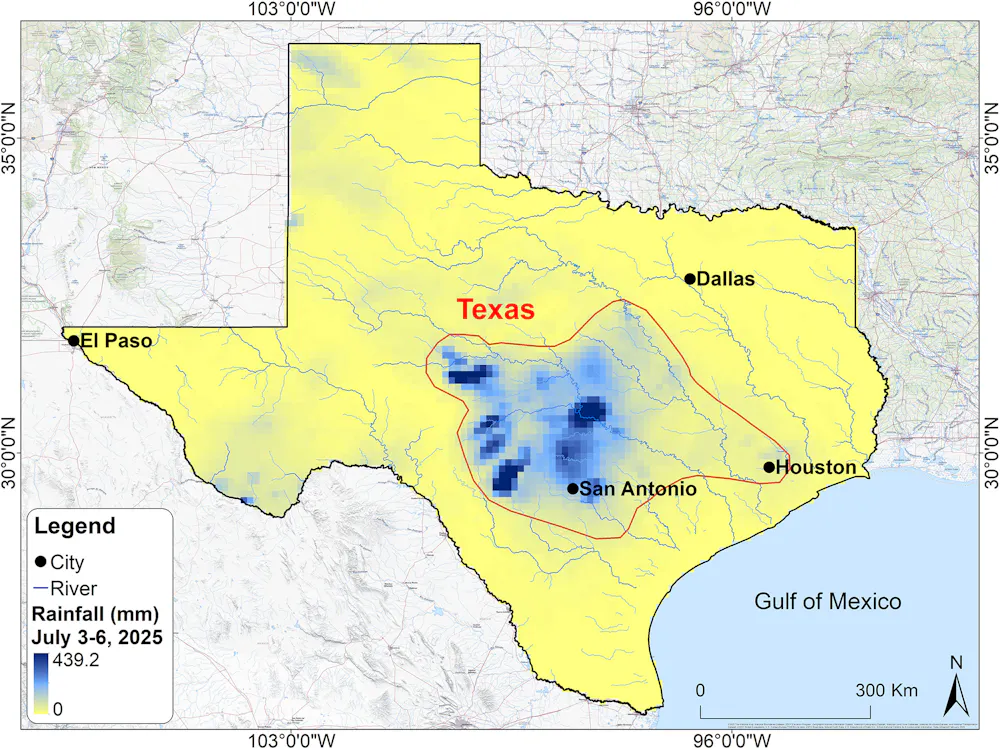
    The total precipitation over the core impact zone in the Hill Country during July 3 to 6 is estimated to have delivered more than 15 billion cubic metres of water — an extraordinary volume.

    This deluge was supported by persistent temperature anomalies ranging from 5.4 to 6.9 degrees Celsius above the mean. Such elevated temperatures increased the atmosphere’s capacity to retain moisture.

    At these anomaly levels, the air mass could store 35 to 50 per cent more water vapour than normal.

    Simultaneously, specific humidity anomalies reflected a 60 to 70 per cent increase over July baselines for central Texas. Specific humidity, which quantifies the actual mass of water vapour per kilogram of air, provides a more direct metric of latent moisture available for precipitation.

    The convergence of these extreme thermodynamic variables created an ideal environment for deep, moisture-laden convection, supporting prolonged intense rainfall.

    This map of Texas highlights the core impact zone in Hill Country, where rainfall totals exceeded 430 millimetres, more than four times the regional July average.
    (H. Bonakdari/GSMaP), CC BY

    Terrain impacts

    While meteorological extremes initiated the July 2025 flood event, the morphology of the Guadalupe River — its shape, behaviour and flows — was pivotal in transforming heavy rainfall into a catastrophic flash flood.

    The upper basin’s physical geography, drainage configuration and valley structure contributed to the rapid concentration and propagation of floodwaters.

    Known as “Flash Flood Alley,” the terrain of the upper Guadalupe River basin amplified the July 2025 flood through a combination of steep slopes, shallow soils and karstic geology.

    These steep slopes limited infiltration and led to rapid soil saturation under intense rainfall. The predominance of karstic limestone — limestone that has been shaped by water creating plains and sinkholes — further reduced storage below the surface, resulting in minimal delay between rainfall and discharge.

    Additionally, narrow valley sections created hydraulic bottlenecks, accelerating flow and increasing flood depth, particularly affecting residential areas and campsites.

    A map showing the relationships between steep headwaters, tributary confluences and vulnerable downstream communities.
    (H. Bonakdari/NASA), CC BY

    In contrast, broader valleys allowed for the water to spread laterally; there was still destructive momentum due to upstream forcing. These geomorphic traits, compounded by the extreme atmospheric moisture, created an environment where floodwaters accumulated rapidly and struck with devastating force, especially along confluence zones and densely occupied riverfronts.

    Excessive runoff

    Prior to the July 2025 event, central Texas had already experienced elevated soil moisture conditions due to above-average rainfall during June and early July. Antecedent moisture indices that measure how wet the ground is before rainfall approached 90 to 100 per cent saturation, meaning that the ground was effectively primed for rapid runoff generation.

    The region’s karst terrain — characterized by shallow, rocky soils — offered less than five per cent effective porosity, severely limiting absorption into the ground. Simultaneously, regional groundwater tables had risen underground, further reducing the ground’s capacity to absorb water.

    This set the stage for an outsized response to the incoming deluge. When intense rainfall arrived, the ground was quickly and completely saturated, resulting in immediate and rapid surface runoff.

    The time of concentration is how long it takes rainwater from the farthest part of a watershed to reach its outlet, like a river or stream. In central Texas Hill Country (known for its steep slopes and rocky, shallow soils), that time is just one to two hours. This means that heavy rain can lead to dangerous river rises very quickly.

    Water flows fast down the slopes and through underground limestone channels, leaving little time for it to soak into the ground. As a result, rivers such as the Guadalupe can swell rapidly, rising several feet in a short time, which causes fast-moving flood impacts in narrow valleys and low-lying communities.

    Multiple forces

    The July floods in Texas were devastatingly deadly. A confluence of various meteorological and topographical factors were to blame.

    An overheated atmosphere, saturated with water vapour, unleashed record-breaking rainfall. The unique terrain of Texas Hill Country funnelled that rain swiftly into the river system, while the region’s hydrology, already primed by previous storms, converted nearly all of it into runoff.

    By understanding how these atmospheric, geographic and hydrological elements combined, we can better anticipate future risks in “Flash Flood Alley” and improve early warning systems to save lives.

    Hossein Bonakdari does not work for, consult, own shares in or receive funding from any company or organisation that would benefit from this article, and has disclosed no relevant affiliations beyond their academic appointment.

    ref. The anatomy of a flash flood: Why the Texas flood was so deadly – https://theconversation.com/the-anatomy-of-a-flash-flood-why-the-texas-flood-was-so-deadly-260695

    MIL OSI Analysis

  • MIL-OSI USA: NIST Shares Preliminary Findings From Hurricane Maria Investigation

    Source: US Government research organizations

    NIST Hurricane Maria Program | Technical Update (July 2025)

    The National Institute of Standards and Technology (NIST) has released a video update and press release on its study of Hurricane Maria’s impacts on Puerto Rico. 

    Hurricane Maria, which struck Puerto Rico on Sept. 20, 2017, was one of the most devastating and costly hurricanes in U.S. history. The storm caused nearly 3,000 deaths and more than $90 billion in damages. While nature cannot be controlled, communities can reduce the impacts of natural hazards by making their buildings and infrastructure more resilient, upgrading emergency preparedness plans for critical facilities, and strengthening evacuation and communication protocols.

    In 2018, the National Institute of Standards and Technology (NIST) launched an investigation into Hurricane Maria’s impacts to learn what went wrong and to take steps to make Americans safer from future hurricanes.

    “Our goal is to learn from that event to recommend improvements to building codes, standards and practices that will make communities more resilient to hurricanes and other hazards, not just in Puerto Rico but across the United States,” said NIST’s lead Hurricane Maria investigator Joseph Main.

    The investigation has been an enormous undertaking. NIST experts have conducted hundreds of surveys and interviews, analyzed dozens of buildings, conducted laboratory experiments, and more. As NIST’s National Construction Safety Team nears the end of its investigation, it has released a video update that highlights significant milestones and preliminary findings.

    What Made Hurricane Maria So Dangerous?

    Hurricane Maria set off a cascade of building and infrastructure failures across Puerto Rico that had lasting impacts on society, including health care, business and education. The storm itself was a Category 4 hurricane, with peak gusts as high as 140 mph over flat terrain, strong enough to topple trees and lift roofs off houses. The wind was even stronger along the ridges of hills and mountains, where power lines and cellphone towers were located. Those lines and towers were damaged or destroyed, knocking out electric, phone and internet service for almost the entire island.

    The steep mountains of Puerto Rico also intensified the rainfall, resulting in extensive flooding and more than 40,000 landslides. This destroyed roads and bridges, blocking routes to hospitals and shelters for those who badly needed them. The hospitals and shelters themselves were heavily damaged by the storm, lifesaving medical equipment was destroyed, and parts of the buildings became uninhabitable. Each of these impacts intensified others. For example, the loss of electricity made it more difficult to move patients and supplies within some hospitals because elevators stopped working.

    Why NIST?

    NIST has a long history of studying disasters and building failures. Under the National Construction Safety Team (NCST) Act, NIST is authorized to establish teams “to assess building performance and emergency response and evacuation procedures in the wake of any building failure that has resulted in substantial loss of life or that posed significant potential of substantial loss of life.”

    Additionally, the National Windstorm Impact Reduction Act gives NIST responsibility for “carrying out research and development to improve model building codes, voluntary standards, and best practices for the design, construction, and retrofit of buildings, structures, and lifelines” with the purpose of achieving “measurable reductions in the losses of life and property from windstorms.”

    Previous NIST investigations have led to building code improvements for tornadoes and fires that can save lives in communities across the country.

    Responding to Hurricane Maria, NIST created a team of experts in structural and civil engineering, public health, epidemiology, medicine, anthropology, communications, sociology and economics. These experts came from NIST, other federal agencies and universities, including outside experts based in Puerto Rico.

    “Having a local presence has been critical in carrying out this work, especially during the pandemic,” said Maria Dillard, investigation associate lead.

    The Investigation So Far

    The investigation is wide-ranging and has included reconnaissance of the island, creation of a detailed map of wind speeds during the hurricane, long-term measurements of wind speeds at cell towers, and wind tunnel tests. The NIST team conducted hundreds of interviews with emergency communicators; family members of the deceased; hospital, school and shelter staff members; shipping and transportation sector representatives; infrastructure officials; and others impacted by the storm. They also surveyed more than 1,500 households, 450 businesses, 300 schools and 16 hospitals for the project.

    Understanding the impact on hospitals and emergency shelters was a high priority for the investigators, who conducted detailed evaluations of five hospitals and five shelter facilities.

    This information went into computer models to understand how the hurricane and the long recovery process unfolded.

    During the course of the investigation, Puerto Rico was buffeted by more disasters, including a series of earthquakes that started in 2019, the COVID-19 pandemic in 2020, Hurricane Fiona in 2022, and Tropical Storm Ernesto in 2024. These events made the recovery from Hurricane Maria more difficult and presented additional challenges for the investigation.

    Importance of NIST’s Hurricane María Investigation

    Preliminary Findings

    The complete report will not be released until 2026, so these findings may change before the report is finalized. However, in the video Main and Dillard share the following major preliminary findings, which they anticipate will be included in the final version.

    While peak wind speeds over flat terrain reached as high as 140 mph (225 kmh), those winds were accelerated to over 200 mph (322 kmh) in some areas by the shape of steep hills and mountains. The mountains also intensified the rainfall. The most extreme rainfall reached 30 inches (76 centimeters) in some areas.

    A major challenge for the investigation was that many weather-measuring devices were damaged during the storm. Only three out of 22 weather stations were fully functional throughout the hurricane. A Doppler weather radar site was destroyed by high winds, and the majority of rain gauges failed during the storm.

    Surveys with family members of those who died in the two weeks following the hurricane showed that only about one-tenth of the deaths occurred on the day of landfall and that only a small fraction of the deaths were caused by storm-related injuries. Reduced access to health care was found to be a significant factor in the deaths that occurred. The most common causes of death were noncommunicable medical conditions such as cardiovascular disease, diabetes and kidney disease, as those who suffered from these conditions had difficulty obtaining the medical care they needed.

    Landslides, collapsed bridges and fallen trees blocking roads kept people from getting help. Such road disruptions were estimated to have cut off hospital access for just over half of the population immediately following the hurricane. Many patients sought medical care at multiple places before receiving treatment. After arriving at hospitals, patients encountered additional disruptions in care from hospital buildings that were damaged, flooded and without electrical power.

    The investigation also found that 95.3% of schools lost power, for an average of over 100 days. Lack of potable water was also an issue for school recovery. One school emphasized that students needed to bring their own water because the school’s water was not safe to drink.

    Success Stories

    One important preliminary finding from the study is that emergency preparations work. Businesses, schools and hospitals that prepared before Hurricane Maria were able to resume operations more quickly afterward. Preparations included preestablished emergency plans, designated risk mitigation funds, and backup power sources.

    Preliminary findings also showed that financial assistance was effective. Statistically, businesses, schools and hospitals that received financial assistance were able to recover more quickly than those that did not.

    Anticipated Recommendations

    Through the National Construction Safety Team (NCST) Act, NIST has a responsibility to use investigation findings to create recommendations and help implement them.

    Recommendations from the Hurricane Maria Program are anticipated to result in:

    • New building standards to account for faster winds caused by mountains and hills.
    • New standards for storm shelters and refuge areas.
    • Measures that will help hospitals and other critical facilities maintain services during and after hurricanes, such as requiring standby generators for elevators and air-conditioning.
    • Guidance on recording damage to communications systems in a way that will prioritize recovery.
    • More robust tools for measuring wind, rainfall and flooding.
    • New standards for creating death certificates during an emergency.

    These changes will be important for hurricane-prone regions throughout the U.S., not just Puerto Rico. Hurricane Helene, which carved a destructive path from Florida through North Carolina in 2024, shared many similarities with Hurricane Maria, such as significant rainfall in mountainous areas that led to flooding and landslides; neighborhoods and communities being cut off from road access; massive infrastructure failure; and at least one hospital requiring evacuation.

    By applying the lessons of Hurricane Maria, this investigation can help the increasing number of communities that are experiencing intense hurricanes prepare for, respond to, and recover from them.

    MIL OSI USA News

  • MIL-OSI: New Reports Map BC’s Hydrogen Potential for Clean Energy Growth

    Source: GlobeNewswire (MIL-OSI)

    VANCOUVER, British Columbia, July 14, 2025 (GLOBE NEWSWIRE) — A series of reports, released by Foresight Canada in partnership with the Clean Energy and Major Projects Office (CEMPO), investigates British Columbia’s potential to establish major hydrogen hubs in various regions and examines the feasibility of hydrogen transportation. In addition to outlining potential challenges, the research identifies key supply and demand opportunities across four areas: BC’s Lower Mainland, Northeast, Southern Interior, and Vancouver Island, highlighting their distinct competitive advantages for hydrogen development.

    As British Columbia works toward net zero, a diverse mix of cleantech solutions and energy alternatives will be required. Hydrogen is a promising option to complement electrification. BC has a strong foundation of innovation and expertise to build on. The reports highlight how this established sector, combined with regional strengths, uniquely positions the province to lead in hydrogen production and adoption. While scaling this sector presents real challenges—including the need for new regulations and infrastructure to ensure its safe transport—the opportunities for BC to drive the clean energy transition through strategic hydrogen hub development are significant.

    Access the hydrogen hub research reports:

    Quotes

    “We’re very excited about the insights these reports unveil, highlighting British Columbia’s immense potential to not only lead in hydrogen innovation but also decisively pave the way for Canada’s clean energy transition. A huge thank you to CEMPO for empowering us to conduct this critical research and bring these exciting opportunities to light.” — Jeanette Jackson, CEO, Foresight Canada

    “British Columbia has tremendous potential to continue to lead in hydrogen innovation and creating these reports and releasing the findings helps fuel this potential. I want to thank Foresight Canada for partnering with us to continue to help drive Canada’s clean energy transition.” – Adrian Dix, Minister of Energy and Climate Solutions, British Columbia

    About Foresight Canada

    Foresight Canada helps the world do more with less, sustainably. As Canada’s largest cleantech innovation and adoption accelerator, they connect public and private sectors to the world’s best clean technologies, de-risking and simplifying the adoption of innovative solutions that improve productivity, profitability, and economic competitiveness, all while addressing today’s most urgent climate challenges.

    About CEMPO

    The Clean Energy and Major Projects Office (CEMPO) is a strategic advisor and accelerator for clean energy and major projects across B.C. CEMPO advances clean energy development in B.C. by supporting project proponents and stakeholders, building strategic partnerships, and acting as the central knowledge hub for clean energy projects such as hydrogen, carbon capture, biofuels, and renewable natural gas.

    It provides strategic guidance throughout the entire project lifecycle, helping accelerate projects to final investment decisions while ensuring alignment with provincial priorities.

    Media Contacts:

    Heather Kingdon
    Manager, Communications
    Foresight Canada
    hkingdon@foresightcac.com

    Vanessa Albert
    Manager, Communications and Engagement
    Clean Energy and Major Projects Office, Ministry of Energy and Climate Solutions
    vanessa.albert@gov.bc.ca

    The MIL Network

  • MIL-OSI USA: Representatives Sorensen, Kaptur, and Doggett Call for Investigation into Deadly Texas Floods

    Source: United States House of Representatives – Congressman Eric Sorensen (IL-17)

    In a Letter to President Trump, NOAA Leadership, and the U.S. Army Corps of Engineers, the Representatives Want Answers to What Contributed to the Deaths of More Than 100 Americans

    Representatives Eric Sorensen (IL-17), Marcy Kaptur (OH-09), and Lloyd Doggett (TX-37) are demanding answers from President Donald Trump, National Oceanic and Atmospheric Administration (NOAA) leadership, and the U.S. Army Corps of Engineers on why hundreds of Americans were unprepared to evacuate from the deadly Texas floods. In a letter they sent to the current Administration, the representatives are calling for an urgent review of the disaster to determine if staffing shortages, stalled forecasting improvements, or insufficient flood preparedness contributed to the deaths of more than 100 people.

    “As someone who has reported on dangerous floods for my neighbors as a meteorologist in my local community, I know how critical it is for NWS meteorologists, local media, and emergency management coordinators to work together seamlessly and quickly to share urgent warnings,” said Congressman Sorensen. “The deadly toll of the flash floods that hit Texas last week beg the question of what went wrong with the warning systems in place and what more could have been done to prevent this tragedy. The Trump Administration’s cuts to NOAA and the NWS are already having a real impact on the accuracy of our nation’s weather forecasting, creating cause for major concern. That is why I am calling on President Trump, NOAA, and the Army Corps of Engineers to undertake a full-scale investigation into what went wrong and what can be done to prevent catastrophes like this in the future.”

    “This flood was not just a natural disaster but a failure of foresight and leadership,” said Congresswoman Kaptur. “A changing climate is rewriting the rules of weather, and our federal agencies must keep pace. The American people deserve a weather warning system that does more than sound the alarm. It must be fully staffed and ready to act to ensure that everyone in harms way receives it. This letter is a demand for accountability, but more importantly, it’s a demand for lives to be protected anywhere severe weather strikes.”

    “As Texans in my state are faced with much pain and uncertainty, we cannot wait to ask the hard questions,” said Congressman Doggett. “Effective oversight saves lives. That is why we need a full account of the ways in which the Trump administration’s recent actions have undermined the federal response, both before and after this catastrophe. Learning from these failures and recognizing that weather intensification driven by climate change increasingly endangers lives will help prevent more tragedies.”

    You can read the full letter HERE.

    Since President Trump took office, there has been a 15% reduction in National Weather Service (NWS) staffing that has begun to degrade forecasting capabilities and operational capacity at NWS offices across the country. 

    As the only meteorologist in Congress, Congressman Sorensen has been a fierce advocate for protecting and strengthening NOAA and the NWS from cuts. Starting last year, he has been warning about the impact of Project 2025’s plans to dismantle and privatize NOAA and the NWS. As the Department of Government Efficiency began making cuts to the agencies, Congressman Sorensen has been speaking out, introducing legislation, and calling on the Administration to bring a stop to the disastrous cuts. He recently introduced the Weather Workforce Improvement Act to help the NWS fully staff critical positions at their offices and the Rural Weather Monitoring Systems Act to help strengthen weather forecasting in rural America. 
     

    MIL OSI USA News

  • MIL-OSI USA: Representatives Sorensen, Kaptur, and Doggett Call for Investigation into Deadly Texas Floods

    Source: United States House of Representatives – Congressman Eric Sorensen (IL-17)

    In a Letter to President Trump, NOAA Leadership, and the U.S. Army Corps of Engineers, the Representatives Want Answers to What Contributed to the Deaths of More Than 100 Americans

    Representatives Eric Sorensen (IL-17), Marcy Kaptur (OH-09), and Lloyd Doggett (TX-37) are demanding answers from President Donald Trump, National Oceanic and Atmospheric Administration (NOAA) leadership, and the U.S. Army Corps of Engineers on why hundreds of Americans were unprepared to evacuate from the deadly Texas floods. In a letter they sent to the current Administration, the representatives are calling for an urgent review of the disaster to determine if staffing shortages, stalled forecasting improvements, or insufficient flood preparedness contributed to the deaths of more than 100 people.

    “As someone who has reported on dangerous floods for my neighbors as a meteorologist in my local community, I know how critical it is for NWS meteorologists, local media, and emergency management coordinators to work together seamlessly and quickly to share urgent warnings,” said Congressman Sorensen. “The deadly toll of the flash floods that hit Texas last week beg the question of what went wrong with the warning systems in place and what more could have been done to prevent this tragedy. The Trump Administration’s cuts to NOAA and the NWS are already having a real impact on the accuracy of our nation’s weather forecasting, creating cause for major concern. That is why I am calling on President Trump, NOAA, and the Army Corps of Engineers to undertake a full-scale investigation into what went wrong and what can be done to prevent catastrophes like this in the future.”

    “This flood was not just a natural disaster but a failure of foresight and leadership,” said Congresswoman Kaptur. “A changing climate is rewriting the rules of weather, and our federal agencies must keep pace. The American people deserve a weather warning system that does more than sound the alarm. It must be fully staffed and ready to act to ensure that everyone in harms way receives it. This letter is a demand for accountability, but more importantly, it’s a demand for lives to be protected anywhere severe weather strikes.”

    “As Texans in my state are faced with much pain and uncertainty, we cannot wait to ask the hard questions,” said Congressman Doggett. “Effective oversight saves lives. That is why we need a full account of the ways in which the Trump administration’s recent actions have undermined the federal response, both before and after this catastrophe. Learning from these failures and recognizing that weather intensification driven by climate change increasingly endangers lives will help prevent more tragedies.”

    You can read the full letter HERE.

    Since President Trump took office, there has been a 15% reduction in National Weather Service (NWS) staffing that has begun to degrade forecasting capabilities and operational capacity at NWS offices across the country. 

    As the only meteorologist in Congress, Congressman Sorensen has been a fierce advocate for protecting and strengthening NOAA and the NWS from cuts. Starting last year, he has been warning about the impact of Project 2025’s plans to dismantle and privatize NOAA and the NWS. As the Department of Government Efficiency began making cuts to the agencies, Congressman Sorensen has been speaking out, introducing legislation, and calling on the Administration to bring a stop to the disastrous cuts. He recently introduced the Weather Workforce Improvement Act to help the NWS fully staff critical positions at their offices and the Rural Weather Monitoring Systems Act to help strengthen weather forecasting in rural America. 
     

    MIL OSI USA News

  • MIL-OSI Canada: Millions Flow into Great Lakes: Canada funds $9.3 million in freshwater solutions

    Source: Government of Canada News (2)

    July 14, 2025 – Burlington, Ontario

    Water sustains life; it is a vital resource for people, nature and our economy. It is more important now than ever that we invest in protecting our freshwater to build a cleaner, safer and sustainable future for all.

    The Great Lakes Watershed is a critical freshwater system that we have here in Canada. It supports industry, recreation, ecosystems, and culture. It also holds spiritual and cultural significance for Indigenous peoples and their way of life.

    Today, the Honourable Julie Dabrusin, Minister of Environment and Climate Change, and Minister responsible for the Canada Water Agency, announced an investment of $9.3 million in 26 freshwater projects in the Great Lakes.  

    These projects are delivered through the Canada Water Agency’s Great Lakes Freshwater Ecosystem Initiative. Each project addresses key environmental challenges affecting water quality and ecosystem health in the region. They are also key in advancing Canada’s commitments under the Canada-United States Great Lakes Water Quality Agreement. Each of these initiatives is community-led, facilitating collaboration on freshwater science and management.

    Among the funded projects, four will support freshwater restoration in Hamilton and Burlington, representing a $1.6 million investment over four years:

    • Royal Botanical Gardens will receive up to $150,000 to enhance habitat resilience in Cootes Paradise Marsh in the Hamilton Harbour Area of Concern through invasive species control, shoreline restoration, and ecological monitoring.
    • Hamilton Region Conservation Authority will receive up to $228,000 to engage landowners in implementing watershed improvement initiatives that reduce nutrient and sediment runoff in the Hamilton Harbour Area of Concern.
    • Halton Region Conservation Authority will receive up to $242,000 to develop a science-based nutrient management plan for the Grindstone Creek watershed. This includes analyzing water quality data, identifying nutrient sources, and engaging stakeholders to recommend targeted best management practices. 
    • The Regional Municipality of Halton will receive up to $995,000 to restore two kilometers of shoreline and dune ecosystems at Beachway Park in Burlington using nature-based restoration approaches.

    This investment will help improve water quality in the Hamilton Harbour Area of Concern and throughout the Great Lakes. Local projects like these drive measurable improvements in water quality and ecosystem health across the region. These projects are also creating lasting economic and social value by supporting sustainable fisheries, protecting drinking water sources, restoring vital habitats, and engaging local communities and landowners in stewardship efforts that strengthen both environmental resilience and regional well-being.

    Through the newly established Canada Water Agency, the Government of Canada is strengthening coordination and collaboration with provinces, territories, and Indigenous peoples to address freshwater challenges and opportunities in the Great Lakes and across the country. These efforts are part of a broader commitment to building a cleaner, more secure, and more prosperous future, because when we protect our water, we protect what makes Canada strong.

    MIL OSI Canada News

  • MIL-OSI USA: PRESS RELEASE: Rep. Barragán and Sen. Markey Introduce Resolution to Confront Rising Public Health Threats from Climate Change

    Source: United States House of Representatives – Representative Nanette Diaz Barragán (CA-44)

    For Immediate Release

    July 12, 2025

    Contact: jin.choi@mail.house.gov

    Rep. Barragán and Sen. Markey Introduce Resolution to Confront Rising Public Health Threats from Climate Change

    WASHINGTON, D.C. — This week, Congresswoman Nanette Barragán (CA-44), a member of the Energy & Commerce Subcommittee on Health, and Senator Edward J. Markey (D-Mass.), member of the Environment and Public Works Committee, introduced a resolution recognizing climate change as a growing threat to public health and calling for a coordinated federal strategy to protect communities from worsening climate-fueled harms. The resolution urges the Department of Health and Human Services (HHS) and other federal agencies to lead a whole-of-government effort to protect public health and improve resiliency against climate-related threats throughout the health sector. Representatives Salud Carbajal (CA-24), Doris Matsui (CA-07), and Brad Schneider (IL-10) co-led the resolution in the House.

    The climate crisis is here. In 2024, the United States experienced 27 climate disasters that caused more than a billion dollars each in damage. Increasingly frequent and extreme events—like wildfires, floods, and heat waves—are driving spikes in illness, displacement, and death. More than 150 million Americans live in areas with unhealthy air, and people with disabilities are 2 to 4 times more likely to die or be injured in climate-related disasters. Frontline workers in agriculture, construction, delivery, and manufacturing face growing health risks from extreme heat and poor air quality on the job. 

    “The climate crisis affects us all, but especially economically disadvantaged communities, communities of color, and other marginalized communities,” said Representative Barragán. “Now more than ever, we see families across the country facing significant health risks as a result of climate disasters such as extreme heat, excessive flooding, and unpredictable storms. Yet the Trump Administration has dangerously chosen to ignore the threat of climate change to our public health – firing staff and canceling programs that were focused on improving our resilience to harmful environmental exposures, such as the HHS Office of Climate Change and Health Equity. That is why I am proud to lead this bicameral resolution with Senator Markey and Representatives Carbajal, Matsui, and Schneider to acknowledge the federal government’s responsibility to mitigate the impacts of climate change and protect the health and well-being of all Americans.”

    “With deadly extreme weather disasters, devastating heat waves, and pollution that triggers asthma and other health crises all on the rise, climate change is a full-blown public health emergency—and we need to treat it that way,” said Senator Markey. “This resolution calls on our government to protect the people most at risk from climate-related threats—those on the frontlines of the climate crisis, including Black and Indigenous communities, low-income families, and workers, especially those in construction, delivery, manufacturing, and warehouses. While Republicans pass bills that kick people off their health care, we are fighting for a resilient health system that helps everyone survive a warming and increasingly chaotic world.”

    “It doesn’t matter if you live in a red or blue state, every American will be affected by climate change,” said Congressman Salud Carbajal. “We’re calling on the Administration to reinstate the OCCHE because it’s essential to protecting the health and well-being of every community in this country.”

    “Over the past six months, President Trump and Congressional Republicans have launched a full-scale attack on the environment and public health,” said Congresswoman Matsui. “By blatantly disregarding climate change, they are driving us towards a dangerous future. Climate change is already harming human health nationwide, driving up heat-related deaths, increasing vector-borne illnesses, and disrupting medical care. This resolution demands urgent action to address the health impacts from climate change to prevent countless deaths across the country.”

    “Climate change threatens every corner of our nation and must be mitigated through swift, coordinated action by our government,” said Congressman Schneider. “The Office of Climate Change and Health Equity is a critical asset in understanding the dire health implications of climate change and mobilizing strategies that ensure no community is left behind. The decision by the Trump Administration to place all OCCHE staff on leave poses a real threat to American lives and wellbeing. I’m proud to join my colleague Rep. Barragan in urging the Trump Administration to reinstate of the Office of Climate Change and Health Equity (OCCHE) and its Office of Environmental Justice.”

    Specifically, the resolution:

    • Demands the release of funding appropriated by Congress that would help to address climate-related health threats that has been held up by Federal agencies;
    • Details the public health dimensions of the climate crisis, including increased risks of respiratory illness, cardiovascular disease, mental health stressors, pregnancy complications, infectious disease outbreaks, and disaster-related displacement;
    • Highlights the disproportionate health burdens on children, people with disabilities, low-income households, communities of color, Tribal nations, and workers in high-risk occupations;
    • Calls on the Department of Health and Human Services to lead cross-agency coordination to strengthen health system climate resilience, support frontline providers, close gaps in climate-health data, and help the health sector lower its own environmental impact;
    • Affirms the importance of engaging environmental justice and community-based organizations in local climate-health preparedness and response efforts;
    • Urges the Occupational Safety and Health Administration to adopt a national worker heat protection standard; and,
    • Calls for annual public reporting on federal climate-health resilience investments and progress.

    The resolution is cosponsored by Senators Lisa Blunt Rochester (D-Del.), Cory Booker (D-N.J.), Jeff Merkley (D-Ore.), and Chris Van Hollen (D-Md.), and Representatives Hank Johnson (GA-04), Sydney Kamlager-Dove (CA-37), Eleanor Holmes Norton (DC-00), Alexandria Ocasio-Cortez (NY-14), Melanie Stansbury (NM-01), Shri Thanedar (MI-13), Rashida Tlaib (MI-12), and Ritchie Torres (NY-15). 

    The resolution is endorsed by Health Care Without Harm, Center for American Progress, Climate Justice Alliance, International Transformational Resilience Coalition, Climate and Community Institute, Earthjustice Action, Public Citizen, Deep South Center for Environmental Justice, Center for Oil and Gas Organizing, Physicians for Social Responsibility, and the American College of Physicians.

    “Health Care Without Harm applauds Senator Markey for introducing this important resolution and is pleased to endorse it,” said Jenny Keroack, Director of Program Strategy & Management in the U.S. Climate Program. “Climate change is causing more severe and frequent storms, wildfires, and extreme heat events, creating safety and public health crises across our country. Our government must have a science-based, coordinated approach to prepare for and respond to these growing threats, and the Department of Health and Human Services has an indispensable role to play as the guardian of our nation’s health and well-being. Vital programs have been attacked, including a grant program that assists families with energy costs so they can afford to cool and heat their homes, funding that helps hospitals stay open and operational when the grid goes down, and research on how best to protect farmworkers from increasing heat waves. Such programs and the expert civil servants who help protect our communities from environmental health threats like climate change must be immediately reinstated and supported. Now is not the time to retreat.”

    “With climate change and extreme weather events driving illness, injury, and death across the United States, the Department of Health and Human Services must harness its resources, leverage its authorities, and coordinate its expertise and action to prepare for and respond to the health and financial impact,” said Jill Rosenthal, Director of Public Health at the Center for American Progress.

    “This resolution is crucial because climate change isn’t just an environmental problem; it’s a public health crisis hurting families right now,” said KD Chavez, Executive Director of the Climate Justice Alliance. “Low-income communities bear the brunt – suffering more asthma attacks, heatstroke, and toxic exposure. But these communities also have the answers! They’ve developed practical, replicable solutions. We need bold action: stronger environmental safeguards, smart investments in resilient infrastructure, and policies that prioritize everyone’s health and safety, no matter where they live. Let’s protect our families and build a healthier future for all.”

    “The International Transformational Resilience Coalition (ITRC) strongly endorses this resolution,” said ITRC Founder and Coordinator Bob Doppelt. “We do so because the climate crisis is a public health crisis that requires significant leadership, support, and investments by the federal government to prevent and heal the accelerating climate-generated mental health, psychosocial, and physical health issues experienced by newborns, young children, adolescents, working age, and older adults nationwide.”

    “Our hospitals and clinics are already seeing the devastating health effects of climate change every day – from children struggling to breathe polluted air to seniors collapsing in extreme heat,” said Ranjani Prabhakar, Legislative Director of Healthy Communities, Earthjustice Action. “Over 200 medical journals have called climate change the greatest threat to human health this century, and Senator Markey’s resolution affirms this data by putting health at the center of environmental solutions. Recognizing this crisis for the public health emergency that it is, is essential to protect our families and communities.”

    “As the planet enters a period of increasing climate chaos, our collective response will either deepen disparities or address the drivers of climate breakdown and health inequity together,” said Batul Hassan, Labor Director at the Climate and Community Institute. “This resolution from Senator Markey establishes the urgent need for coordinated action across health and public health systems to ensure all people and generations to come can thrive in a warming world.”

    The full text of the legislation can be found here.

    # # #

    MIL OSI USA News

  • MIL-OSI Analysis: 2026 FIFA World Cup expansion will have a big climate footprint, with matches from Mexico to Canada – here’s what fans can do

    Source: The Conversation – USA (2) – By Brian P. McCullough, Associate Professor of Sport Management, University of Michigan

    Lionel Messi celebrates with fans after Argentina won the FIFA World Cup championship in 2022 in Qatar. Michael Regan-FIFA/FIFA via Getty Images

    When the FIFA World Cup hits North America in June 2026, 48 teams and millions of sports fans will be traveling among venues spread across Canada, the United States and Mexico.

    It’s a dramatic expansion – 16 more teams will be playing than in recent years, with a jump from 64 to 104 matches. The tournament, whether you call it soccer or football, is projected to bring in over US$10 billion in revenue. But the expansion will also mean a lot more travel and other activities that contribute to climate change.

    The environmental impacts of giant sporting events like the World Cup create a complex paradox for an industry grappling with its future in a warming world.

    A sustainability conundrum

    Sports are undeniably experiencing the effects of climate change. Rising global temperatures are putting athletes’ health at risk during summer heat waves and shortening winter sports seasons. Many of the 2026 World Cup venues often see heat waves in June and early July, when the tournament is scheduled.

    There is a divide over how sports should respond.

    Some athletes are speaking out for more sustainable choices and have called on lawmakers to take steps to limit climate-warming emissions. At the same time, the sport industry is growing and facing a constant push to increase revenue. The NCAA is also considering expanding its March Madness basketball tournaments from 68 teams currently to as many as 76.

    Park Yong-woo of team Al Ain from Abu Dhabi tries to cool off during a Club World Cup match on June 26, 2025, in Washington, D.C., which was in the midst of a heat wave. Some players have raised concerns about likely high temperatures during the 2026 World Cup, with matches scheduled June 11 to July 19.
    AP Photo/Julia Demaree Nikhinson

    Estimates for the 2026 World Cup show what large tournament expansions can mean for the climate. A report from Scientists for Global Responsibility estimates that the expanded World Cup could generate over 9 million metric tons of carbon dioxide equivalent, nearly double the average of the past four World Cups.

    This massive increase – and the increase that would come if the NCAA basketball tournaments also expand – would primarily be driven by air travel as fans and players fly among event cities that are thousands of miles apart.

    A lot of money is at stake, but so is the climate

    Sports are big business, and adding more matches to events like the World Cup and NCAA tournaments will likely lead to larger media rights contracts and greater gate receipts from more fans attending the events, boosting revenues. These are powerful financial incentives.

    In the NCAA’s case, there is another reason to consider a larger tournament: The House v. NCAA settlement opened the door for college athletic departments to share revenue with athletes, which will significantly increase costs for many college programs. More teams would mean more television revenue and, crucially, more revenue to be distributed to member NCAA institutions and their athletic conferences.

    When climate promises become greenwashing

    The inherent conflict between maximizing profit through growth and minimizing environmental footprint presents a dilemma for sports.

    Several sport organizations have promised to reduce their impact on the climate, including signing up for initiatives like the United Nations Sports for Climate Action Framework.

    However, as sports tournaments and exhibition games expand, it can become increasingly hard for sports organizations to meet their climate commitments. In some cases, groups making sustainability commitments have been accused of greenwashing, suggesting the goals are more about public relations than making genuine, measurable changes.

    For example, FIFA’s early claims that it would hold a “fully carbon-neutral” World Cup in Qatar in 2022 were challenged by a group of European countries that accused soccer’s world governing body of underestimating emissions. The Swiss Fairness Commission, which monitors fairness in advertising, considered the complaints and determined that FIFA’s claims could not be substantiated.

    Alessandro Bastoni, of Inter Milan and Italy’s national team, prepares to board a flight from Milan to Rome with his team.
    Mattia Ozbot-Inter/Inter via Getty Images

    Aviation is often the biggest driver of emissions. A study that colleagues and I conducted on the NCAA men’s basketball tournament found about 80% of its emissions were connected to travel. And that was after the NCAA began using the pod system, which is designed to keep teams closer to home for the first and second rounds.

    Finding practical solutions

    Some academics, observing the rising emissions trend, have called for radical solutions like the end of commercialized sports or drastically limiting who can attend sporting events, with a focus on fans from the region.

    These solutions are frankly not practical, in my view, nor do they align with other positive developments. The growing popularity of women’s sports shows the challenge in limiting sports events – more games expands participation but adds to the industry’s overall footprint.

    Further compounding the challenges of reducing environmental impact is the amount of fan travel, which is outside the direct control of the sports organization or event organizers.

    Many fans will follow their teams long distances, especially for mega-events like the World Cup or the NCAA tournament. During the men’s World Cup in Russia in 2018, more than 840,000 fans traveled from other countries. The top countries by number of fans, after Russia, were China, the U.S., Mexico and Argentina.

    There is an argument that distributed sporting events like March Madness or the World Cup can be better in some ways for local environments because they don’t overwhelm a single city. However, merely spreading the impact does not necessarily reduce it, particularly when considering the effects on climate change.

    How fans can cut their environmental footprint

    Sport organizations and event planners can take steps to be more sustainable and also encourage more sustainable choices among fans. Fans can reduce their environmental impact in a variety of ways. For example:

    • Avoid taking airplanes for shorter distances, such as between FIFA venues in Philadelphia, New York and Boston, and carpool or take Amtrak instead. Planes can be more efficient for long distances, but air travel is still a major contributing factor to emissions.

    • While in a host city, use mass transit or rent electric vehicles or bicycles for local travel.

    • Consider sustainable accommodations, such as short-term rentals that might have a smaller environmental footprint than a hotel. Or stay at a certified green hotel that makes an effort to be more efficient in its use of water and energy.

    • Engage in sustainable pregame and postgame activities, such as choosing local, sustainable food options, and minimize waste.

    • You can also pay to offset carbon emissions for attending different sporting events, much like concertgoers do when they attend musical festivals. While critics question offsets’ true environmental benefit, they do represent people’s growing awareness of their environmental footprint.

    Through all these options, it’s clear that sports face a significant challenge in addressing their environmental impacts and encouraging fans to be more sustainable, while simultaneously trying to meet ambitious business and environmental targets.

    In my view, a sustainable path forward will require strategic, yet genuine, commitment by the sports industry and its fans, and a willingness to prioritize long-term planetary health alongside economic gains – balancing the sport and sustainability.

    Brian P. McCullough does not work for, consult, own shares in or receive funding from any company or organization that would benefit from this article, and has disclosed no relevant affiliations beyond their academic appointment.

    ref. 2026 FIFA World Cup expansion will have a big climate footprint, with matches from Mexico to Canada – here’s what fans can do – https://theconversation.com/2026-fifa-world-cup-expansion-will-have-a-big-climate-footprint-with-matches-from-mexico-to-canada-heres-what-fans-can-do-259437

    MIL OSI Analysis

  • MIL-OSI Analysis: 2026 FIFA World Cup expansion will have a big climate footprint, with matches from Mexico to Canada – here’s what fans can do

    Source: The Conversation – USA (2) – By Brian P. McCullough, Associate Professor of Sport Management, University of Michigan

    Lionel Messi celebrates with fans after Argentina won the FIFA World Cup championship in 2022 in Qatar. Michael Regan-FIFA/FIFA via Getty Images

    When the FIFA World Cup hits North America in June 2026, 48 teams and millions of sports fans will be traveling among venues spread across Canada, the United States and Mexico.

    It’s a dramatic expansion – 16 more teams will be playing than in recent years, with a jump from 64 to 104 matches. The tournament, whether you call it soccer or football, is projected to bring in over US$10 billion in revenue. But the expansion will also mean a lot more travel and other activities that contribute to climate change.

    The environmental impacts of giant sporting events like the World Cup create a complex paradox for an industry grappling with its future in a warming world.

    A sustainability conundrum

    Sports are undeniably experiencing the effects of climate change. Rising global temperatures are putting athletes’ health at risk during summer heat waves and shortening winter sports seasons. Many of the 2026 World Cup venues often see heat waves in June and early July, when the tournament is scheduled.

    There is a divide over how sports should respond.

    Some athletes are speaking out for more sustainable choices and have called on lawmakers to take steps to limit climate-warming emissions. At the same time, the sport industry is growing and facing a constant push to increase revenue. The NCAA is also considering expanding its March Madness basketball tournaments from 68 teams currently to as many as 76.

    Park Yong-woo of team Al Ain from Abu Dhabi tries to cool off during a Club World Cup match on June 26, 2025, in Washington, D.C., which was in the midst of a heat wave. Some players have raised concerns about likely high temperatures during the 2026 World Cup, with matches scheduled June 11 to July 19.
    AP Photo/Julia Demaree Nikhinson

    Estimates for the 2026 World Cup show what large tournament expansions can mean for the climate. A report from Scientists for Global Responsibility estimates that the expanded World Cup could generate over 9 million metric tons of carbon dioxide equivalent, nearly double the average of the past four World Cups.

    This massive increase – and the increase that would come if the NCAA basketball tournaments also expand – would primarily be driven by air travel as fans and players fly among event cities that are thousands of miles apart.

    A lot of money is at stake, but so is the climate

    Sports are big business, and adding more matches to events like the World Cup and NCAA tournaments will likely lead to larger media rights contracts and greater gate receipts from more fans attending the events, boosting revenues. These are powerful financial incentives.

    In the NCAA’s case, there is another reason to consider a larger tournament: The House v. NCAA settlement opened the door for college athletic departments to share revenue with athletes, which will significantly increase costs for many college programs. More teams would mean more television revenue and, crucially, more revenue to be distributed to member NCAA institutions and their athletic conferences.

    When climate promises become greenwashing

    The inherent conflict between maximizing profit through growth and minimizing environmental footprint presents a dilemma for sports.

    Several sport organizations have promised to reduce their impact on the climate, including signing up for initiatives like the United Nations Sports for Climate Action Framework.

    However, as sports tournaments and exhibition games expand, it can become increasingly hard for sports organizations to meet their climate commitments. In some cases, groups making sustainability commitments have been accused of greenwashing, suggesting the goals are more about public relations than making genuine, measurable changes.

    For example, FIFA’s early claims that it would hold a “fully carbon-neutral” World Cup in Qatar in 2022 were challenged by a group of European countries that accused soccer’s world governing body of underestimating emissions. The Swiss Fairness Commission, which monitors fairness in advertising, considered the complaints and determined that FIFA’s claims could not be substantiated.

    Alessandro Bastoni, of Inter Milan and Italy’s national team, prepares to board a flight from Milan to Rome with his team.
    Mattia Ozbot-Inter/Inter via Getty Images

    Aviation is often the biggest driver of emissions. A study that colleagues and I conducted on the NCAA men’s basketball tournament found about 80% of its emissions were connected to travel. And that was after the NCAA began using the pod system, which is designed to keep teams closer to home for the first and second rounds.

    Finding practical solutions

    Some academics, observing the rising emissions trend, have called for radical solutions like the end of commercialized sports or drastically limiting who can attend sporting events, with a focus on fans from the region.

    These solutions are frankly not practical, in my view, nor do they align with other positive developments. The growing popularity of women’s sports shows the challenge in limiting sports events – more games expands participation but adds to the industry’s overall footprint.

    Further compounding the challenges of reducing environmental impact is the amount of fan travel, which is outside the direct control of the sports organization or event organizers.

    Many fans will follow their teams long distances, especially for mega-events like the World Cup or the NCAA tournament. During the men’s World Cup in Russia in 2018, more than 840,000 fans traveled from other countries. The top countries by number of fans, after Russia, were China, the U.S., Mexico and Argentina.

    There is an argument that distributed sporting events like March Madness or the World Cup can be better in some ways for local environments because they don’t overwhelm a single city. However, merely spreading the impact does not necessarily reduce it, particularly when considering the effects on climate change.

    How fans can cut their environmental footprint

    Sport organizations and event planners can take steps to be more sustainable and also encourage more sustainable choices among fans. Fans can reduce their environmental impact in a variety of ways. For example:

    • Avoid taking airplanes for shorter distances, such as between FIFA venues in Philadelphia, New York and Boston, and carpool or take Amtrak instead. Planes can be more efficient for long distances, but air travel is still a major contributing factor to emissions.

    • While in a host city, use mass transit or rent electric vehicles or bicycles for local travel.

    • Consider sustainable accommodations, such as short-term rentals that might have a smaller environmental footprint than a hotel. Or stay at a certified green hotel that makes an effort to be more efficient in its use of water and energy.

    • Engage in sustainable pregame and postgame activities, such as choosing local, sustainable food options, and minimize waste.

    • You can also pay to offset carbon emissions for attending different sporting events, much like concertgoers do when they attend musical festivals. While critics question offsets’ true environmental benefit, they do represent people’s growing awareness of their environmental footprint.

    Through all these options, it’s clear that sports face a significant challenge in addressing their environmental impacts and encouraging fans to be more sustainable, while simultaneously trying to meet ambitious business and environmental targets.

    In my view, a sustainable path forward will require strategic, yet genuine, commitment by the sports industry and its fans, and a willingness to prioritize long-term planetary health alongside economic gains – balancing the sport and sustainability.

    Brian P. McCullough does not work for, consult, own shares in or receive funding from any company or organization that would benefit from this article, and has disclosed no relevant affiliations beyond their academic appointment.

    ref. 2026 FIFA World Cup expansion will have a big climate footprint, with matches from Mexico to Canada – here’s what fans can do – https://theconversation.com/2026-fifa-world-cup-expansion-will-have-a-big-climate-footprint-with-matches-from-mexico-to-canada-heres-what-fans-can-do-259437

    MIL OSI Analysis

  • MIL-OSI United Nations: Data for Climate Action: Expert Forum for Climate Change-Related Statistics

    Source: United Nations Economic Commission for Europe

    01 September (9:00) – 03 September (12:30) 2025

    Palais des Nations, Building E, Room XXIII, Geneva Switzerland

    Information note, programme and templates

    Session I: Setting the Scene

    Session II: Climate Change Adaptation-Related Statistics

    Session III: Biennial Transparency Reports

    Session IV: Meeting data user needs

    Session V: Climate and Health Statistics

    MIL OSI United Nations News

  • MIL-OSI United Kingdom: 105-year-old gets active with Cycle Derby

    Source: City of Derby

    A local Second World War veteran has proved you’re never too old to get on a bike.

    Victor, aged 105, contacted Derby City Council with a desire to get more active. The Cycle Derby team carried out an assessment and initially set Victor up with a side-by-side bike for his first sessions.

    Victor’s story highlights the possibilities offered by Cycle Derby’s Inclusive programme, which has a range of adapted bikes to cater for a broad range of abilities. The accessible fleet of over 40 bikes are available for self-hire, instructor-led sessions, and larger community clubs.

    Thanks to the weekly sessions, Victor and many others, have found a wonderful way to enjoy the outdoors, connect with new people, and move more freely. The programme has also helped him gradually rebuild his strength and confidence. In May, Victor proudly cycled over four miles, marking a significant milestone in his fitness journey.  After this ride, Victor said:

    My age aside it’s important to recognise that cycling has been revolutionary in my recovery from a stroke. 

    “I wish I’d done this years ago – it’s enabled me to walk again without my sticks. The opportunity for improved mobility is invaluable.

    Councillor Carmel Swan, Cabinet Member for Climate Change, Transport and Sustainability, said: 

    This is such a heartwarming story. The Inclusive Hub was set up for people like Victor. People of any age or ability. Active Travel isn’t just about getting from A to B, it’s also about maintaining our physical health, moving more and generally broadening our horizons.

    I’m delighted to see that people of all ages are taking advantage of this offering that we have here in Derby. If you’re looking to get active but are nervous about cycling or unable to use a regular bike, get in touch with the team at Cycle Derby.

    Cycle Derby exist to support people of any age or ability become more active, healthier, help them have fun on a bike. You can find more details about their services at www.cyclederby.co.uk.

    MIL OSI United Kingdom

  • MIL-OSI USA: Governor Newsom urges Californians to take precautions as state endures triple digit heat, smoky conditions

    Source: US State of California 2

    Jul 11, 2025

    What you need to know: Californians are strongly encourage to us state and local resources to protect themselves from heat illness as triple digit temperatures move across our state.

    SACRAMENTO — Governor Gavin Newsom is encouraging Californians to prepare for dangerous heat throughout California, and smoky conditions in the far northern part of the state, today through early next week. 

    The National Weather Service has issued heat advisories in many portions of the state on Friday and Saturday, extending through Sunday in parts of the Central Valley.  In Northern California, areas west of Redding are under Extreme Heat Warnings due to triple digit temperatures that are expected to linger into the first part of next week. Air quality will also be impacted due to smoke from several wildfires burning in remote California and Oregon locations.  

    “As temperatures soar across our state, I urge Californians to take precautions and utilize state and local resources to protect from dangerous heat illness and unhealthy air.”

    Governor Gavin Newsom

    CalHeatScore map results from Friday, July 11, 2025

    The recently launched CalHeatScore heat-ranking tool indicates much of northern and central California will be impacted by moderate to severe heat conditions through Monday, with some areas feeling the heat through Wednesday. Residents can check their area by zip code for local conditions. 

    Here are a few tips and considerations for Californians – especially those with access and functional needs, children, and older residents – to stay safe from heat and reduce health risks: 

    Have a heat plan

    Monitor weather forecasts and advisories to know when excessive heat is expected and how long it’s expected to last. Create a heat plan and encourage others to stay safe during a heat event. 

    Keep cool

    Visit a local cooling center or air-conditioned space, such as a library, community center or shopping center. If you’re unable to travel or find an air-conditioned space, consider the following at home: 

    • Close windows, doors, shades and curtains to prevent hot air and sunlight from entering your home during high heat days. 
    • Place a cool, damp towel on the back of your neck and wear light-colored, loose-fitting clothes. 
    • Use cool compresses and take a cool shower or bath to help reduce body temperature and provide relief from the heat.

    Use your support networks

    Identify individuals in your life, such as family, friends and neighbors, who could help support you during heat events. 

    Remember, creating an emergency preparedness plan based on your personal needs is critical to ensure you and your loved ones remain safe during an emergency. 

    Sign up for alerts and notifications

    Sign up for emergency alerts with your county or local officials. You can choose how to get alerts sent to you when you sign up, including cell phone, home phone, email, text messages and, in some cases, TTY devices. 

    Sign up for a medical baseline program, an assistance program for people who depend on power for certain medical needs. Participation is important to ensure you receive additional notification of current or upcoming power shutoff events, which may occur during extreme heat events. 

    Press releases, Recent news

    Recent news

    News What you need to know: Governor Newsom is announcing that the California Employment Development Department is awarding $11 million to help six California organizations connect underserved adults — including veterans, people with disabilities, and at-risk young…

    News What you need to know: As part of California’s strategy to combat homelessness and expand housing, Governor Gavin Newsom is reorganizing state agencies to institutionalize housing, homelessness, and affordability as long-term priorities. The reorganization…

    News What you need to know: To help mark Black Women’s Equal Pay Day, the First Partner visits an apprenticeship program that is helping opportunity youth—including women of color—break into careers in Hollywood’s below-the-line workforce. LOS ANGELES—First Partner…

    MIL OSI USA News

  • MIL-OSI United Nations: Building urban resilience in Capricorn District Municipality, South Africa

    Source: UNISDR Disaster Risk Reduction

    Stakeholders engage in hands-on exercises using the Disaster Resilience Scorecard for Cities to assess resilience levels and identify priority actions.

    From 17 to 19 June 2025, Capricorn District Municipality in South Africa hosted a three-day workshop on Urban Risk-Informed Development Planning and Making Cities Resilient 2030. The training was jointly organized by the municipality, Gesellschaft für Internationale Zusammenarbeit (GIZ) GmbH and United Nations Office for Disaster Risk Reduction (UNDRR) Regional Office for Africa, under the GIZ Resilience Initiative Africa project. 

    Located in Limpopo Province, Capricorn faces multiple hazards such as floods, drought, wildfires, and heatwaves. This makes resilience planning not just relevant but critical. Through participatory exercises, government officials and local stakeholders worked to build their capacities and identify priority actions for disaster risk reduction (DRR). 

    Stakeholders were introduced to DRR frameworks to guide their understanding and action planning. This included a comprehensive orientation on the Sendai Framework for Disaster Risk Reduction 2015-2030, which emphasizes the need for a multi-hazard, multi-sectoral approach to managing disaster risk, and the Making Cities Resilient 2030 (MCR2030) initiative, particularly its Ten Essentials for Making Cities Resilient. These frameworks served as the conceptual backbone for local resilience planning. 

    Participants were guided through the practical application of the Disaster Resilience Scorecard for Cities, a diagnostic tool designed to measure urban resilience across critical sectors. Stakeholders collectively reviewed Capricorn District’s resilience performance, identifying strengths, gaps, and opportunities for improvement. The assessment provided a baseline to inform strategic planning, resource prioritization, and future investments in resilience-building across the district.

    ” Resilience is not optional; it is essential. Through honest reflection and active collaboration, we can build inclusive, adaptive communities aligned with the Sendai Framework and the SDGs,” said Councillor Pemme Jossuf. 

    Stakeholders of the Urban Risk-Informed Development Planning workshop in Capricorn District Municipality

    The assessment revealed that while foundational systems for disaster resilience are in place, several critical gaps still need to be addressed. These include the need for better integration of DRR in spatial planning, stronger financial mechanisms for resilience, safeguarding of natural ecosystem and the need for more inclusive engagement with at risk communities. 

    “Seeing our real scores motivates us to prioritize actions where they matter most. This is exactly the kind of systemic, practical work that sets a foundation for long-term resilience across the SADC region” shared Mr. Mpheehe Machaba, the executive manager for community services, Capricorn District Municipality. 

    The workshop emphasized the importance of inclusive risk-informed planning, integration of Disaster Risk Management (DRM) in performance management, and the use of local knowledge to protect at risk communities. Special focus was placed on aligning local strategies with national policies and international frameworks like the Sendai Framework, SDG 11- Sustainable Cities and Communities and SDG 13- Climate Action, and South Africa’s DRM legislation. 

    “The Scorecard isn’t just a technical tool but a means through which cities understand where they are, where they need to go, and how to get there, ” said Carolyne Mengich, the associate programme management officer at UNDRR. 

    Breakout sessions encouraged collaborative reflection on risks, vulnerabilities, and opportunities for integrating resilience into development planning.

    The final day of the workshop was dedicated to the co-creation of draft DRR Action Plans specifically tailored to the local context, risks, and institutional capacities of the Capricorn District. Building on the insights from the Scorecard assessment, participants identified priority actions across multiple sectors including coordination, infrastructure, social services, and information management and communication. Emphasis was placed on ensuring that the action plans were realistic, inclusive, and locally owned. There was broad consensus that effective implementation will require a phased approach, beginning with quick wins and capacity-building measures, followed by more resource-intensive structural interventions. Participants also recognized that sustained progress hinges on strong multi-stakeholder coordination, inclusive of government departments, local municipalities, civil society, the private sector, and technical partners. The Capricorn experience underscores how locally driven, globally informed resilience building can guide municipalities in South Africa and beyond.

    MIL OSI United Nations News

  • MIL-OSI United Nations: Building inclusive early warning systems in Seychelles: a national step forward

    Source: UNISDR Disaster Risk Reduction

    A major stride was taken towards achieving the goals of the global “Early Warnings for All” initiative, when Seychelles hosted a national workshop to validate its framework for strengthening risk knowledge and Early Warning Systems (EWS). Amid rising climate threats, the three-day event emphasized inclusive disaster preparedness that would ensure that gender, disability, and other vulnerable groups are not overlooked. 

    Supported by UNDRR and the Climate Risk and Early Warning Systems (CREWS) initiative, the workshop brought together government agencies, and civil society to review gaps in the production, access, and use of risk information. Participants validated a draft “Framework and Capacity Building Plan” under Pillar 1: Disaster Risk Knowledge of Seychelles’ National EWS Roadmap, focused on improving understanding of hazards, vulnerabilities, and responsive action. 

    Speakers stressed the importance of accessible, disaggregated data. Marwess Gabriel, Public Relations Officer of the Seychelles Land Transport Agency, highlighted the need for reliable information to support response efforts, while Daniel Cetoupe, Chief Risk Management Officer of the Disaster Risk Management Division (DRMD) underlined the workshop’s goal; identifying gaps to build national resilience. 

    Tsitsi Magadza, Programme Management Officer of UNDRR reinforced that inclusive data drives inclusive decisions:

     “Collecting gender-based and disability-inclusive risk information allows us to make decisions that support at risk groups.”

    A key outcome was the rollout of the Inclusive Early Warning Systems Checklist, a tool to ensure gender and disability inclusion across all EWS pillars. Its application revealed progress in preparedness and response, but gaps in risk knowledge, particularly in involving at-risk groups in data collection remain. 

    Christine Winslow, founder of Ramp Up Rise Up, reflected on the need for training and inclusion of organizations for persons (OPDs) with disabilities in DRR: 

    “There’s a lot of training for me and other disability NGOs to do.” 

    Her reflection pointed to the importance of empowering OPDs with the tools and knowledge needed to contribute meaningfully to early warning and disaster risk reduction systems. 

    The workshop concluded with a commitment to national capacity building, improved data systems, inclusive communication strategies, and stronger cross-sector collaboration. It marked a crucial step forward in making sure that, in terms of DRR, no one is left behind.

    MIL OSI United Nations News

  • MIL-OSI China: UAE minister’s China visit boosts climate, agriculture ties

    Source: People’s Republic of China – State Council News

    Amna bint Abdullah Al Dahak, the UAE’s minister of climate change and environment, concluded a high-level visit to China from July 7-10, the UAE Embassy in Beijing said, as the two countries seek to deepen cooperation on climate action, sustainable agriculture and food security.

    UAE Ambassador to China Hussein Ibrahim Al Hammadi (R) and UAE Minister of Climate Change and Environment Amna bint Abdullah Al Dahak (L) pose for photo in Beijing, July 7, 2025. [Photo Provided to China.org.cn]

    Al Dahak described UAE-China relations as “a comprehensive and interconnected strategic partnership and a unique model for successful cooperation across various fields and projects.”

    She said the UAE views China as an important partner and hopes to combine China’s agricultural innovation capabilities with the UAE’s National Food Security Strategy 2051 to boost food production in both countries while expanding climate cooperation and people-to-people exchanges.

    UAE Ambassador to China Hussain bin Ibrahim Al Hammadi said the visit “opens a new chapter for cooperation between the two countries in climate, agriculture and other fields, reflecting the vision of leaders of both countries to build a prosperous future.”

    Representatives from China and the UAE pose for a group photo at the UAE-China Friendship Forest of Date Palm in Wenchang, Hainan province, July 10, 2025. [Photo Provided to China.org.cn]

    A key part of the delegation’s itinerary was a visit to the UAE-China Friendship Forest of Date Palm in Wenchang, south China’s Hainan province. The project, launched by UAE President Sheikh Mohamed bin Zayed Al Nahyan during his 2019 visit to China, aims to plant 100,000 date palm seedlings.

    Two phases of planting have been completed so far, totaling 25,000 seedlings. The remaining 75,000 will be planted in two phases in 2026 and 2028.

    The delegation also visited institutions including the Beijing Tongzhou International Seed Industry Science and Technology Centre, Tsinghua University and the Chinese Academy of Agricultural Sciences to exchange views on seed science, the circular economy and the transfer of sustainable agricultural technologies.

    Meetings on air pollution control and solid waste management were conducted with the Chinese Research Academy of Environmental Sciences, alongside discussions on data transparency with the Institute of Public and Environmental Affairs. Some members also visited technology firm Inspur Group to explore tech-based environmental solutions.

    The delegation comprised senior officials from the UAE Ministry of Climate Change and Environment, agricultural institution heads and university experts. 

    The embassy said the visit reflects the UAE’s comprehensive determination to deepen cooperation with China at the government, academic and private sector levels.

    MIL OSI China News

  • Widespread rainfall predicted across India; Delhi-NCR to see light showers: IMD

    Source: Government of India

    Source: Government of India (4)

    India continues to witness an active monsoon phase, with the India Meteorological Department (IMD) forecasting extremely heavy rainfall (over 21 cm ) at isolated places in Rajasthan on Monday and Tuesday. Similar intense showers are likely over Gangetic West Bengal, Odisha, and southeast Jharkhand on July 14, and Chhattisgarh on July 15.

    Very heavy rainfall is also expected at isolated places across Himachal Pradesh and Uttarakhand on July 14 and 15.

    West Rajasthan may receive heavy showers on July 16, while west Madhya Pradesh and Gujarat Region are likely to experience similar conditions on July 14.

    Eastern Madhya Pradesh is forecast to receive heavy rainfall on July 16 and 17.

    Gangetic West Bengal and Odisha will continue to receive heavy rain on July 15, while Jharkhand and Chhattisgarh are set for heavy rainfall between July 14 and 16.

    Bihar is expected to receive heavy rainfall during July 14 and 16, while eastern Uttar Pradesh is likely to experience heavy showers on July 17.

    Southern states including Kerala & Tamil Nadu, and coastal Karnataka are likely to receive continuous heavy rainfall through the week from July 14 to 20.

    This weather activity is being driven by a well-marked low-pressure area currently over northeast Rajasthan and adjoining northwest Madhya Pradesh, and another system over southeast Gangetic West Bengal and adjoining Bangladesh.

    In the past 24 hours, Odisha has already recorded extremely heavy rainfall, while very heavy rain (7–20 cm) was observed at isolated places in Jharkhand, East Uttar Pradesh, Rajasthan, and West Madhya Pradesh.

    Several other regions – including Himachal Pradesh, Uttarakhand, Haryana, Chhattisgarh, West Bengal, Maharashtra, Gujarat, Tamil Nadu, Karnataka, Assam, and Tripura – reported heavy rainfall (7–11 cm).

    Weather forecast for Delhi-NCR

    In Delhi-NCR, the IMD has predicted generally cloudy skies and light to moderate rain accompanied by thunderstorms and lightning over the next four days.

    On Monday, the city is likely to experience strong surface winds between 20–30 kmph, gusting up to 40 kmph. Maximum temperatures are expected to remain in the range of 31–33°C, which is 3–5°C below normal.

    On July 15, very light to light rain is forecast, with similar wind patterns and temperatures ranging between 32–34°C (maximum) and 24–26°C (minimum), both slightly below normal.

    The weather will remain partly cloudy on July 16 and 17, with occasional light rain and thunderstorms. Daytime temperatures will hover between 33–35°C, and nighttime temperatures between 24–26°C. Winds will predominantly blow from the southeast, with moderate speeds in the afternoon, easing by evening.

    Overall, Delhi is expected to see relatively cooler and wet weather this week, while the rest of northern, eastern, and central India remains on alert for heavy rainfall and potential flooding in vulnerable regions.