Category: Weather

  • MIL-OSI United Nations: Deputy Secretary-General’s remarks at the Opening Ceremony of the International Conference on the Blue Economy in the Gulf of Guinea [as delivered]

    Source: United Nations secretary general

    H.E. Mr. Joseph Dion Ngute, Prime Minister of the Republic of Cameroon; Personal Representative of the President of Cameroon, H.E. Mr. Paul Biya; H.E. Mr. Philemon Yang, President of the UN General Assembly; H.E. Mr. José Mba Abeso, Executive Secretary of the Gulf of Guinea Commission; Mr. Peter Thomson, UN Special Envoy for the Ocean; Honourable Ministers; Excellencies; Ladies and Gentlemen;

    I wish to express my deep appreciation to the President, Government, and people of Cameroon for hosting this landmark conference on the Blue Economy in the Gulf of Guinea – a region whose waters and people I hold close to heart, as a Nigerian and UN partner over the decades.

    Allow me also to thank the President of the UN General Assembly for his leadership and shining the spotlight on the Blue Economy – in the Gulf of Guinea and globally.

    Excellencies,

    We gather at a moment of both urgency and opportunity. The ocean – our planet’s blue heart – is under threat. But it is also a source of solutions and the attainment of our Global Goals.

    As the Secretary-General reminded us last month in Nice, the destinies of Africa and the ocean are deeply intertwined. For millions across this continent, the ocean is not only a source of life and identity but it is also a source of hope.

    Nowhere is this truer than in the Gulf of Guinea. Our coastal waters, rich in biodiversity and cultural heritage, hold immense potential for economic transformation. Yet, this potential remains largely untapped. Today, the ocean economy accounts for less than 10% of GDP in the region and we must change that with a sense of urgency and scale.

    Therefore, I propose three areas of action that will ensure the Blue Economy delivers for the people in the region which provides a home and livelihood to the over 100 million people in coastal areas, 60 % of which are young people.

    First, we must protect the ocean that sustains us.

    Climate change is warming and acidifying our seas, eroding coastlines, and threatening the livelihoods of coastal communities. Coral reefs are bleaching. Fisheries are collapsing. Sea levels are rising – swallowing homes, ports, deltas, and futures.

    This is not just an environmental crisis. It is a human crisis. Hundreds of millions of people face a future shaped by flooding, food insecurity, transnational crime and displacement. We must act now to safeguard biodiversity, cut emissions, reduce maritime pollution, and build coastal resilience.

    That is why I urge all countries in the Gulf of Guinea to integrate ocean-based climate action into their Nationally Determined Contributions ahead of COP30.

    As we advance on the roadmap from Baku to Belém, these NDCs must reflect the full potential of the Blue Economy – not only as a strategy for mitigation and adaptation, but as a transformative engine for inclusive growth, scaling climate finance, and long-term prosperity.

    This journey offers a critical opportunity to align regional ambition with global momentum and deliver tangible progress for people and planet.

    In this context, the near-finalization of the Treaty on Biodiversity Beyond National Jurisdiction – known as the BBNJ Treaty – is a historic milestone. This agreement is vital to protecting marine biodiversity in areas beyond national jurisdiction, which make up nearly two-thirds of the ocean.

    I urge countries who have not yet ratified the BBNJ Treaty to do so without delay and to accelerate implementation.

    There has also been significant progress towards the Global Biodiversity Framework’s target of protecting 30% of the ocean by 2030 and the launch of the 30×30 Ocean Action Plan. The United Nations stands ready to support all countries national efforts to translate this global commitment into local action.

    As marine ecosystems are choking with plastic pollution, we must accelerate progress toward a legally binding global treaty on plastic pollution. The mounting crisis of microplastics and toxic chemicals infiltrating our oceans demands urgent and coordinated action to sustain fisheries, protect biodiversity, and reduce negative impact on tourism and people’s sources of income.

    This requires not only industry reform but also changes in our daily consumption and waste management systems. Let us apply existing tools based on the polluter pays principle and work with the private sector to keep our oceans clean.

    The launch of the Ocean Rise and Coastal Resilience Coalition in Nice is a call to action. I encourage cities and communities across the Gulf of Guinea to join this global movement for adaptation and innovation to find sustainable solutions to rising sea levels, for the cities of our future. 

    Second, we must unlock the economic power of the ocean.

    Africa’s share of global ocean exports remains modest. But the potential is vast – from sustainable aquaculture and offshore wind to marine biotechnology and eco-tourism.

    Two-thirds of marine species remain undiscovered. They hold the keys to new medicines, low-carbon foods, and bio-based materials. This is a nearly $11 billion market opportunity waiting to be seized for our young people.

    It also holds the key to nourishing our communities, improving nutrition, and building resilient livelihoods across the region. As we head to the 2nd UN Food System Stocktake in Addis Ababa its role in transforming the food systems will be central.

    But to do so, we need investment. At last week’s Financing for Development Conference in Sevilla, we were reminded of the $4 trillion annual gap in sustainable development financing. Reforming the global financial architecture is essential – but so is aligning capital with climate resilience and nature-positive growth.

    This is not just as a sectoral opportunity, but an integrated part of our global financing agenda. We need to work hand in hand with the private sector to unlock new forms of financing and to create an enabling environment for entrepreneurship to drive innovation, create jobs, and unlock new opportunities across the Blue Economy, especially for young people and women.

    Third, and critically, we must ensure security at sea.

    Piracy, trafficking, and transnational crime continue to threaten the Gulf of Guinea. These are not isolated threats – they are linked to broader patterns of instability and terrorism, particularly in the Sahel.

    ECOWAS, ECCAS, and the Gulf of Guinea Commission have demonstrated commendable leadership in advancing regional cooperation to enhance maritime security across the Gulf of Guinea.

    Their efforts have led to the establishment of Regional Maritime Security Centers in West and Central Africa, as well as Multinational Maritime Coordination Centres in countries such as Cabo Verde, Congo, and Ghana. These institutions form a vital architecture for regional stability and ocean governance.

    I therefore call on regional governments, international partners, and the private sector to build on this foundation – recognizing that maritime security is not only a matter of safety, but a cornerstone for sustainable development.

    Excellencies,

    The Secretary-General has called for a political and financial surge to protect our ocean and unleash its potential. That surge must begin here, in the Gulf of Guinea.

    Let us translate the momentum from Nice to Yaoundé into action.

    Let us scale local innovations and forge partnerships that cross borders and sectors.

    And let us remember: the Blue Economy is not only central to SDG 14 – Life Below Water – it is also a powerful enabler of the entire 2030 Agenda and Agenda 2063.

    From ending poverty and hunger, to advancing health, education, gender equality, and climate action, the ocean connects and sustains every dimension of sustainable development.

    The tide is with us. Now we must sail it forward – together in solidarity.

    Thank you.

    ***
     

    MIL OSI United Nations News

  • MIL-OSI Submissions: Should the UK name heatwaves like storms? It won’t make people take them more seriously

    Source: The Conversation – UK – By Andrea Taylor, Associate Professor in Risk Communication, University of Leeds

    The UK Met Office has given storms forenames for the past decade as part of an effort to raise public awareness of extreme weather before it strikes. Heatwaves are becoming increasingly frequent and severe due to greenhouse gas emissions, predominantly from burning fossil fuel, which are raising global temperatures by trapping more heat in Earth’s atmosphere.

    These extreme heat events aren’t named in the UK. Should that change?

    Effective communication strategies are necessary to make people aware of upcoming heatwaves and help them understand how to reduce their risk. Spain started naming them in 2023, with Heatwave Zoe. Italy has a longstanding but unofficial tradition of naming heatwaves according to mythology and classical history.

    The results include Lucifero (Lucifer, another name for the devil) and Cerbero (Cerberus, the three-headed dog that guards the underworld in Greek myth), popularised by the private weather service il Meteo (ilmeteo.it).

    Severe heatwaves in summer 2023 and 2024 prompted a campaign to name heatwaves after fossil fuel companies, to increase awareness of their role in climate change.

    However, there is limited evidence to indicate whether this would be effective in encouraging people to take proper safety precautions during heatwaves, such as staying in the shade between 11am and 3pm, closing the curtains of sun-facing windows during the day and making sure to have enough water if travelling and looking out for those who may struggle to keep themselves cool and hydrated, such as elderly people living alone.

    To explore how effective naming heatwaves might be, my research team conducted online experiments with 2,152 people in England and 1,981 people in Italy.

    Lucifer is scarier than Arnold

    Participants were asked to imagine that next summer, they were to receive a warning that a heatwave was about to affect their country. Participants were randomly assigned information about an event that was was either unnamed, given a threatening name (Lucifer/Lucifero), or a more neutral name (Arnold).

    Then they were asked how much of a risk they though that the event would pose and the actions they would anticipate taking. English participants were also asked about their thoughts on storm-naming practices in the UK and whether they felt that this should be extended to heatwaves.

    We found that naming a heatwave had no effect on the intention of people to take protective measures against it in either country. In Italy, there was no difference between how people perceived the unnamed heatwave and Lucifero, but Arnold was judged to be slightly less concerning and severe.

    This suggests that, while naming a heatwave does not increase concern, departing from Italy’s established convention of using threatening names does reduce it slightly.

    Isolated older people are typically most at risk during heatwaves.
    Ground Picture/Shutterstock

    Our participants in England rated Lucifer as more severe and concerning than an unnamed heatwave, though not by much. When asked about their thoughts on naming weather events more broadly, English participants tended to agree that naming storms made people more likely to engage with weather warnings, but only a minority were in favour of naming heatwaves. Overall we found that, while some people were generally supportive of naming weather events, others worried it could sensationalise them.

    It probably won’t help much

    We did not find enough evidence to support naming heatwaves in the UK.

    Despite a large sample, we found only a very small effect on perceived risk and did not detect any greater intention to take safety precautions for a named heatwave. We also found that responses differed between England and Italy.

    Heatwaves can cross national borders. The fact that there are national differences in how people respond to naming them could lead to unintended differences in how people interpret the risk in different places.

    And unlike storms, which usually take place over a single day with a clearer start and end, heatwaves can last from days to weeks – it’s not always clear whether a prolonged hot spell is one heatwave or a series of them, which could lead to confusion if named.

    Heatwaves are an opportunity to discuss the risks posed by climate change. But naming heatwaves risks coming across as sensationalist to some members of the public. This might have the opposite effect, and make people less likely to heed safety messaging about severe heat.


    Don’t have time to read about climate change as much as you’d like?

    Get a weekly roundup in your inbox instead. Every Wednesday, The Conversation’s environment editor writes Imagine, a short email that goes a little deeper into just one climate issue. Join the 45,000+ readers who’ve subscribed so far.


    Andrea Taylor receives funding from The Lloyds Register Foundation, UKRI and Horizon Europe.

    ref. Should the UK name heatwaves like storms? It won’t make people take them more seriously – https://theconversation.com/should-the-uk-name-heatwaves-like-storms-it-wont-make-people-take-them-more-seriously-260635

    MIL OSI

  • MIL-OSI United Kingdom: Report warns of rising health risks in Leeds from increasing temperatures due to climate change

    Source: City of Leeds

    A new report has warned rising temperatures due to climate change pose serious health risks to the city’s population.

    ‘Heat in the City: Our Health in a Warming Leeds’ – this year’s annual report by Director of Public Health, Victoria Eaton – highlights the growing threat of heat-related illness and calls for collective city-wide action to protect residents now and in the future.

    Leeds has seen record-breaking temperatures in recent years, including the 2022 heatwave when the city hit 40 degrees Celsius (C) for the first time.

    The report warns of the link between hot weather and a rise in hospital admissions and deaths – as seen in the 2022 heatwaves, when an estimated 2,985 died in England during the hottest periods.

    Extreme heat can make breathing harder and put extra strain on the heart, circulatory system and kidneys as they work to cool the body, with vulnerable groups – such as older adults, children, pregnant woman, people with long-term health conditions – most at risk.

    Densely-populated, inner-city areas, where manmade surfaces such as concrete and asphalt absorb and retain heat, greenspace is reduced and tall buildings block airflow, creates a phenomenon known as the ‘urban heat island effect’, where temperatures can be up to 8 degrees Celsius (C) hotter than in rural areas.

    Increasing temperatures due to climate change also introduce new threats such as longer pollen seasons, increased asthma cases during thunderstorms and the potential spread of diseases such as Lyme disease from ticks and mosquito-borne diseases like dengue and Zika.

    The report highlights some of the creative projects and initiatives already happening across the city to combat climate change, including work to enhance biodiversity such as through the creation of the city centre ‘Aire Park’ and the planting of 100 community orchards – with Leeds set to reach the most in the UK outside of London – as well as the distribution of hot weather packs for people most at risk.

    Key recommendations for city-wide action within the report include:

    • Expanding access to cool spaces;
    • Integrating more heat resilience into urban planning;
    • Continuing to prioritise investment in energy-efficient housing;
    • Raising public awareness of the impacts of heat on health as well as ensuring frontline workers have the tools they need to support vulnerable groups.

    Victoria Eaton, Leeds City Council’s director of public health, said “Rising temperatures affect everyone but the health risks aren’t equal.

    “People in our most deprived and densely-populated areas – especially older adults, young children, pregnant women and those with long-term conditions – face the greatest risks.”

    Councillor Fiona Venner, executive member for equality, health and wellbeing, said “Climate change is a health crisis. The choices we make today will shape the wellbeing of future generations.

    “Together we can create a Leeds that not only adapts to rising temperatures but thrives in spite of them.”

    The report was praised by the Association of Directors of Public Health as “particularly innovative,” and supports Leeds’s ambition to become the UK’s first net-zero city by 2030.

    To view the report and accompanying film, visit https://observatory.leeds.gov.uk/dph-report/

    MIL OSI United Kingdom

  • MIL-OSI Analysis: The dangers of romanticising Britain’s 1976 heatwave

    Source: The Conversation – UK – By Stephanie Brown, Lecturer in Criminology, University of Hull

    As I scrolled through social media on a hot afternoon in late June, a meme caught my attention. A black and white photo. A smiling young woman with water up to her knees. She appeared to be in a fountain, with many others dipping their legs in the water.

    The caption read “On this day in 1976, the British heatwave started. It would last until the 27th August, during which time Britain would experience extreme temperatures and widespread droughts. And we all had a wonderful summer and survived.”

    This immediately struck me: it was a boiling hot day. As I sat at my office desk keeping hydrated with a fan pointed directly at my face, I felt the rage burning inside me. How could people be so irresponsible? Heat can be dangerous. But the implication of the meme was clear: if people managed back then, surely today’s warnings about heatwaves, climate change, and public health are exaggerated. These rose-tinted memories obscure a darker truth.

    I am a historical criminologist. This meme had the rare effect of deeply troubling both of my areas of expertise.

    As a historian, this meme concerns me because it perpetuates the myth of the “good old days”. A selective, nostalgic vision of the past that smooths over complexity and hardship in favour of a comforting, idealised narrative. Flattening history into feelgood folklore, erasing the social inequalities and governmental failures.

    It echoes a broader cultural tendency: from “Make America great again” to the “Blitz spirit”, representing Britain’s nostalgia for wartime resilience, a romanticised past is often used by politicians to legitimise political ideas in the present. But history is not a comfort blanket. It is a critical tool.

    My work explores how institutions respond to crisis and how narratives of success or failure are constructed. In 1976, advice for dealing with the water shortage was to share a bath with the wife and drive a dirty car. Areas without domestic tap water had to use communal street pipes.

    The government did not appoint a minister for drought until the end of August, despite mounting evidence from meteorologists and public health officials. Emergency measures were piecemeal and unevenly applied.


    Get your news from actual experts, straight to your inbox. Sign up to our daily newsletter to receive all The Conversation UK’s latest coverage of news and research, from politics and business to the arts and sciences.


    The suggestion that “we all had a wonderful summer and survived” is misleading. It was reported that “200 people a day were apparently dying who would not have died if the weather had been normal”. During the peak of the heatwave, deaths increased by 28% in the southeast England and 33% in Greater London.

    As a criminologist, I know that it is not only natural deaths that can increase during a hot weather. The number of violent deaths also increased in 1976 as well as in other heatwaves. Thermic law is the concept that violent crime is higher in hotter seasons. These patterns might be explained by temperature-aggression theory: that hot weather can cause an increase in aggressive behaviours.

    For other criminologists, it is not the temperature itself that causes increased violence, but how people’s behaviour changes due to the heat. For example, people are taking time off work or school, socialising, and drinking. Unstructured time and spaces, combined with alcohol and a holiday feel all lead to increases in violence.

    Misrepresenting risk

    By sentimentalising the summer of 1976, we strip away its lessons. Worse, we risk repeating its mistakes. One Conservative MP described people concerned about the 2022 heatwave as “snowflakes” and “cowards”. Quite an odd response after the British public was asked to “protect the NHS” during the COVID-19 pandemic.

    This protection apparently did not extend to looking after each other in a heatwave. In fact, heatwaves are largely an invisible risk. We are told not to fuss, but there is often little communication on how to keep safe.

    A lack of policy and examples of political scepticism connect with a key theme in the comments under that meme: climate change denial. If we had a heatwave in 1976 then what we are experiencing now is nothing new, right? Wrong.

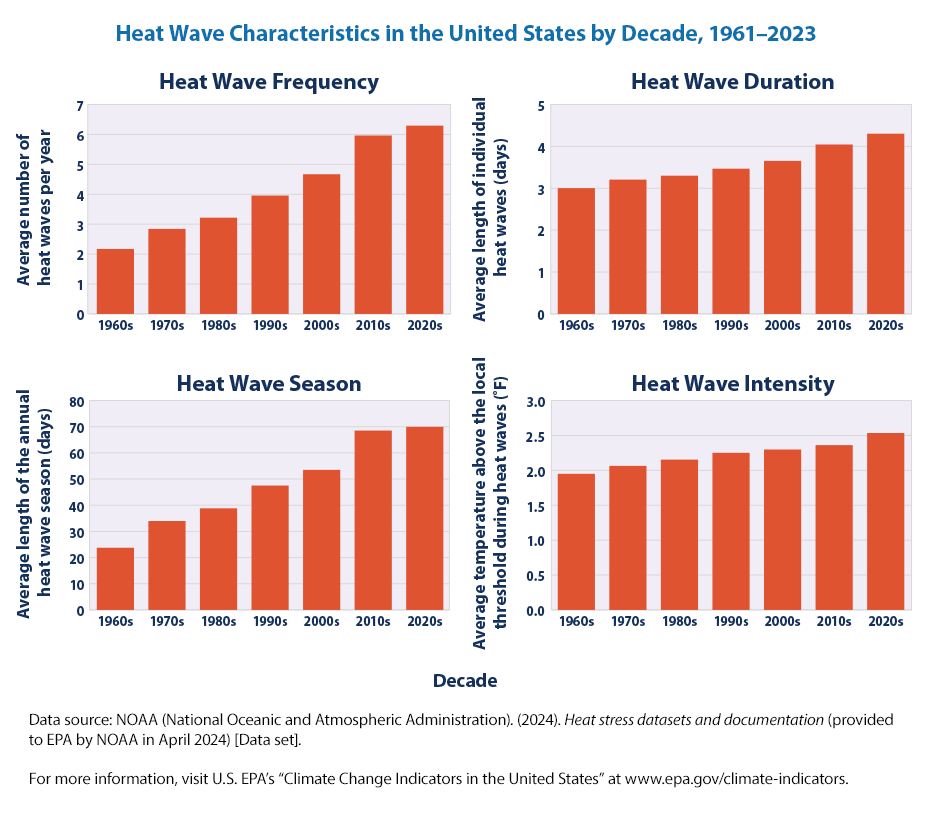
    The heatwave in 1976 was bad: thousands died, fires raged, and water ran dry. But it was also an anomaly; a hot summer in a relatively cool decade. Heatwaves are now more frequent, more intense and longer lasting. Temperatures reached over 40°C in 2022, while the maximum in 1976 was 4°C-5°C cooler.

    Still, each time a weather warning is issued, it is met with a wave of derision. There is the same online discourse as is expressed in this meme. This attitude is not just flippant, it is dangerous. It undermines vital public messaging, discourages precautionary action, and fuels complacency among those least at risk, while leaving the most vulnerable even more exposed.

    History can offer crucial perspective. But only if we treat it honestly. That means moving beyond memeified memories of the past and reckoning with the complexity of what really happened. It means challenging the stories we tell ourselves. Many did live through the 1976 heatwave. But many also died: quietly, invisibly and avoidably. Their stories are not part of the nostalgia. They should be.


    Don’t have time to read about climate change as much as you’d like?

    Get a weekly roundup in your inbox instead. Every Wednesday, The Conversation’s environment editor writes Imagine, a short email that goes a little deeper into just one climate issue. Join the 45,000+ readers who’ve subscribed so far.


    Stephanie Brown does not work for, consult, own shares in or receive funding from any company or organisation that would benefit from this article, and has disclosed no relevant affiliations beyond their academic appointment.

    ref. The dangers of romanticising Britain’s 1976 heatwave – https://theconversation.com/the-dangers-of-romanticising-britains-1976-heatwave-260046

    MIL OSI Analysis

  • MIL-OSI Canada: Ministers Hodgson and Arsenault to hold media availabilities in Charlottetown

    Source: Government of Canada News

    CHARLOTTETOWN — The Honourable Tim Hodgson, Canada’s Minister of Energy and Natural Resources, and the Honourable Gilles Arsenault, Prince Edward Island’s Minister of Environment, Energy and Climate Action, will hold a joint media availability to conclude the Energy and Mines Ministers’ Conference (EMMC) in Charlottetown.

    Date: Friday, July 11, 2025

    Time: 1:30 p.m. AT

    Later that afternoon, Minister Hodgson will make an announcement regarding energy investments for Atlantic Canada. He will be joined by Minister Arsenault and leaders from the Maritime energy sector. A media availability will follow. 

    Date: Friday, July 11, 2025

    Time: 3 p.m. AT

    All accredited media are asked to pre-register by emailing media@nrcan-rncan.gc.ca. Details on how to participate will be provided upon registration.

    MIL OSI Canada News

  • MIL-OSI Submissions: ‘Big Beautiful Bill’ will have Americans paying higher prices for dirtier energy

    Source: The Conversation – USA (2) – By Daniel Cohan, Professor of Civil and Environmental Engineering, Rice University

    Congress passed Donald Trump’s tax and spending bill on July 3, 2025. Kevin Carter/Getty Images

    When congressional Republicans decided to cut some Biden-era energy subsidies to help fund their One Big Beautiful Bill Act, they could have pruned wasteful subsidies while sparing the rest. Instead, they did the reverse. Americans will pay the price with higher costs for dirtier energy.

    The nearly 900-page bill that President Donald Trump signed on July 4, 2025, slashes incentives for wind and solar energy, batteries, electric cars and home efficiency while expanding subsidies for fossil fuels and biofuels. That will leave Americans burning more fossil fuels despite strong public and scientific support for shifting to renewable energy.

    As an environmental engineering professor who studies ways to confront climate change, I think it is important to distinguish which energy technologies could rapidly cut emissions or need a financial boost to become viable from those that are already profitable but harm the environment. Unfortunately, the Republican bill favors the latter while stifling the former.

    The Spring Creek Mine in Decker, Mont., is just one mine in the Powder River Basin, the most productive coal-producing region in the U.S.
    AP Photo/Matthew Brown

    Cuts to renewable electricity

    Wind and solar power, often paired with batteries, provide over 90% of the new electricity added nationally and around the world in recent years. Natural gas turbines are in short supply, and there are long lead times to build nuclear power plants. Wind and solar energy projects – with batteries to store excess power until it’s needed – offer the fastest way to satisfy growing demand for power. Recent technological breakthroughs put geothermal power on the verge of rapid growth.

    However, the One Big Beautiful Bill Act rescinds billions of dollars that the Inflation Reduction Act, enacted in 2022, devoted to boosting domestic manufacturing and deployments of renewable energy and batteries.

    It accelerates the phaseout of tax credits for factories that manufacture equipment needed for renewable energy and electric vehicles. That would disrupt the boom in domestic manufacturing projects that had been stimulated by the Inflation Reduction Act.

    Efforts to build new wind and solar farms will be hit even harder. To receive any tax credits, those projects will need to commence construction by mid-2026 or come online by the end of 2027. The act preserves a slower timeline for phasing out subsidies for nuclear, geothermal and hydrogen projects, which take far longer to build than wind and solar farms.

    However, even projects that could be built soon enough will struggle to comply with the bill’s restrictions on using Chinese-made components. Tax law experts have called those provisions “unworkable,” since some Chinese materials may be necessary even for projects built with as much domestic content as possible. For example, even American-made solar panels may rely on components sourced from China or Chinese-owned companies.

    Princeton University professor Jesse Jenkins estimates that the bill will mean wind and solar power generate 820 fewer terawatt-hours in 2035 than under previous policies. That’s more power than all U.S. coal-fired power plants generated in 2023.

    That’s why BloombergNEF, an energy research firm, called the bill a “nightmare scenario” for clean energy proponents.

    However, one person’s nightmare may be another man’s dream. “We’re constraining the hell out of wind and solar, which is good,” said U.S. Rep. Chip Roy, a Texas Republican who is backed by the oil and gas industry.

    Federal tax credits for homeowners who install solar panels will now expire at the end of 2025.
    AP Photo/Michael Conroy

    Electric cars and efficiency

    Cuts fall even harder on Americans who are trying to reduce their carbon footprints and energy costs. The quickest phaseout comes for tax credits for electric vehicles, which will end on Sept. 30, 2025. And since the bill eliminates fines on car companies that fail to meet fuel economy standards, other new cars are likely to guzzle more gas.

    Tax credits for home efficiency improvements such as heat pumps, efficient windows and energy audits will end at the end of 2025. Homeowners will also lose tax credits for installing solar panels at the end of the year, seven years earlier than under the previous law.

    The bill also rescinds funding that would have helped cut diesel emissions and finance clean energy projects in underserved communities.

    Federal tax credits for buying electric vehicles will end on Sept. 30, 2025.
    AP Photo/Jae C. Hong

    Support for biofuels and fossil fuels

    Biofuels and fossil fuels fared far better under the bill. Tens of billions of dollars will be spent to extend tax credits for biofuels such as ethanol and biodiesel.

    Food-based biofuels do little good for the climate because growing, harvesting and processing crops requires fertilizers, pesticides and fuel. The bill would allow forests to be cut to make room for crops because it directs agencies to ignore the effects of biofuels on land use.

    Meanwhile, the bill opens more federal lands and waters to leasing for oil and gas drilling and coal mining. It also slashes the royalties that companies pay to the federal government for fuels extracted from publicly owned land. And a new tax credit will subsidize metallurgical coal, which is mainly exported to steelmakers overseas.

    The bill also increases subsidies for using captured carbon dioxide to extract more oil and gas from the ground. That makes it less likely that captured emissions will only be sequestered to combat climate change.

    Summing it up

    With fewer efficiency improvements, fewer electric vehicles and less clean power on the grid, Princeton’s Jenkins projects that the law will increase household energy costs by over $280 per year by 2035 above what they would have been without the bill. The extra fossil fuel-burning will negate 470 million tons of anticipated emissions reductions that year, a 7% bump.

    The bill will also leave America’s clean energy transition further behind China, which is deploying more solar and wind power and electric vehicles than the rest of the world combined.

    No one expected President Joe Biden’s Inflation Reduction Act to escape unscathed with Republicans in the White House and dominating both houses of Congress, even though many of its projects were in Republican-voting districts. Still, pairing cuts to clean energy with support for fossil fuels makes Trump’s bill uniquely harmful to the world’s climate and to Americans’ wallets.

    This article includes some material previously published on June 10, 2025.

    Daniel Cohan receives research funding from the Carbon Hub at Rice University. He previously received research funding from Project InnerSpace, the Mitchell Foundation, the National Science Foundation, NASA, and the Environmental Protection Agency.

    ref. ‘Big Beautiful Bill’ will have Americans paying higher prices for dirtier energy – https://theconversation.com/big-beautiful-bill-will-have-americans-paying-higher-prices-for-dirtier-energy-260588

    MIL OSI

  • MIL-OSI Submissions: ‘Big Beautiful Bill’ will have Americans paying higher prices for dirtier energy

    Source: The Conversation – USA (2) – By Daniel Cohan, Professor of Civil and Environmental Engineering, Rice University

    Congress passed Donald Trump’s tax and spending bill on July 3, 2025. Kevin Carter/Getty Images

    When congressional Republicans decided to cut some Biden-era energy subsidies to help fund their One Big Beautiful Bill Act, they could have pruned wasteful subsidies while sparing the rest. Instead, they did the reverse. Americans will pay the price with higher costs for dirtier energy.

    The nearly 900-page bill that President Donald Trump signed on July 4, 2025, slashes incentives for wind and solar energy, batteries, electric cars and home efficiency while expanding subsidies for fossil fuels and biofuels. That will leave Americans burning more fossil fuels despite strong public and scientific support for shifting to renewable energy.

    As an environmental engineering professor who studies ways to confront climate change, I think it is important to distinguish which energy technologies could rapidly cut emissions or need a financial boost to become viable from those that are already profitable but harm the environment. Unfortunately, the Republican bill favors the latter while stifling the former.

    The Spring Creek Mine in Decker, Mont., is just one mine in the Powder River Basin, the most productive coal-producing region in the U.S.
    AP Photo/Matthew Brown

    Cuts to renewable electricity

    Wind and solar power, often paired with batteries, provide over 90% of the new electricity added nationally and around the world in recent years. Natural gas turbines are in short supply, and there are long lead times to build nuclear power plants. Wind and solar energy projects – with batteries to store excess power until it’s needed – offer the fastest way to satisfy growing demand for power. Recent technological breakthroughs put geothermal power on the verge of rapid growth.

    However, the One Big Beautiful Bill Act rescinds billions of dollars that the Inflation Reduction Act, enacted in 2022, devoted to boosting domestic manufacturing and deployments of renewable energy and batteries.

    It accelerates the phaseout of tax credits for factories that manufacture equipment needed for renewable energy and electric vehicles. That would disrupt the boom in domestic manufacturing projects that had been stimulated by the Inflation Reduction Act.

    Efforts to build new wind and solar farms will be hit even harder. To receive any tax credits, those projects will need to commence construction by mid-2026 or come online by the end of 2027. The act preserves a slower timeline for phasing out subsidies for nuclear, geothermal and hydrogen projects, which take far longer to build than wind and solar farms.

    However, even projects that could be built soon enough will struggle to comply with the bill’s restrictions on using Chinese-made components. Tax law experts have called those provisions “unworkable,” since some Chinese materials may be necessary even for projects built with as much domestic content as possible. For example, even American-made solar panels may rely on components sourced from China or Chinese-owned companies.

    Princeton University professor Jesse Jenkins estimates that the bill will mean wind and solar power generate 820 fewer terawatt-hours in 2035 than under previous policies. That’s more power than all U.S. coal-fired power plants generated in 2023.

    That’s why BloombergNEF, an energy research firm, called the bill a “nightmare scenario” for clean energy proponents.

    However, one person’s nightmare may be another man’s dream. “We’re constraining the hell out of wind and solar, which is good,” said U.S. Rep. Chip Roy, a Texas Republican who is backed by the oil and gas industry.

    Federal tax credits for homeowners who install solar panels will now expire at the end of 2025.
    AP Photo/Michael Conroy

    Electric cars and efficiency

    Cuts fall even harder on Americans who are trying to reduce their carbon footprints and energy costs. The quickest phaseout comes for tax credits for electric vehicles, which will end on Sept. 30, 2025. And since the bill eliminates fines on car companies that fail to meet fuel economy standards, other new cars are likely to guzzle more gas.

    Tax credits for home efficiency improvements such as heat pumps, efficient windows and energy audits will end at the end of 2025. Homeowners will also lose tax credits for installing solar panels at the end of the year, seven years earlier than under the previous law.

    The bill also rescinds funding that would have helped cut diesel emissions and finance clean energy projects in underserved communities.

    Federal tax credits for buying electric vehicles will end on Sept. 30, 2025.
    AP Photo/Jae C. Hong

    Support for biofuels and fossil fuels

    Biofuels and fossil fuels fared far better under the bill. Tens of billions of dollars will be spent to extend tax credits for biofuels such as ethanol and biodiesel.

    Food-based biofuels do little good for the climate because growing, harvesting and processing crops requires fertilizers, pesticides and fuel. The bill would allow forests to be cut to make room for crops because it directs agencies to ignore the effects of biofuels on land use.

    Meanwhile, the bill opens more federal lands and waters to leasing for oil and gas drilling and coal mining. It also slashes the royalties that companies pay to the federal government for fuels extracted from publicly owned land. And a new tax credit will subsidize metallurgical coal, which is mainly exported to steelmakers overseas.

    The bill also increases subsidies for using captured carbon dioxide to extract more oil and gas from the ground. That makes it less likely that captured emissions will only be sequestered to combat climate change.

    Summing it up

    With fewer efficiency improvements, fewer electric vehicles and less clean power on the grid, Princeton’s Jenkins projects that the law will increase household energy costs by over $280 per year by 2035 above what they would have been without the bill. The extra fossil fuel-burning will negate 470 million tons of anticipated emissions reductions that year, a 7% bump.

    The bill will also leave America’s clean energy transition further behind China, which is deploying more solar and wind power and electric vehicles than the rest of the world combined.

    No one expected President Joe Biden’s Inflation Reduction Act to escape unscathed with Republicans in the White House and dominating both houses of Congress, even though many of its projects were in Republican-voting districts. Still, pairing cuts to clean energy with support for fossil fuels makes Trump’s bill uniquely harmful to the world’s climate and to Americans’ wallets.

    This article includes some material previously published on June 10, 2025.

    Daniel Cohan receives research funding from the Carbon Hub at Rice University. He previously received research funding from Project InnerSpace, the Mitchell Foundation, the National Science Foundation, NASA, and the Environmental Protection Agency.

    ref. ‘Big Beautiful Bill’ will have Americans paying higher prices for dirtier energy – https://theconversation.com/big-beautiful-bill-will-have-americans-paying-higher-prices-for-dirtier-energy-260588

    MIL OSI

  • MIL-OSI Analysis: My city was one of hundreds expecting federal funds to help manage rising heat wave risk – then EPA terminated the grants

    Source: The Conversation – USA – By Brian G. Henning, Professor of Philosophy and Environmental Studies and Science, Gonzaga University

    The Pacific Northwest heat wave of 2021 left cities across Washington state sweltering in dangerous temperatures. AP Photo/Ted S. Warren

    In June 2021, a deadly heat wave pushed temperatures to 109 degrees Fahrenheit (43 Celsius) in Spokane, Washington, a northern city near the Idaho border where many homes weren’t built with central air conditioning.

    As the heat lingered for over a week, 19 people died in Spokane County and about 300 visited hospitals with signs of heat-related illnesses.

    Scientists say it’s not a matter of if, but when, another deadly heat wave descends on the region. To help save lives, the city teamed up with my university, Gonzaga, to start preparing for a hotter future.

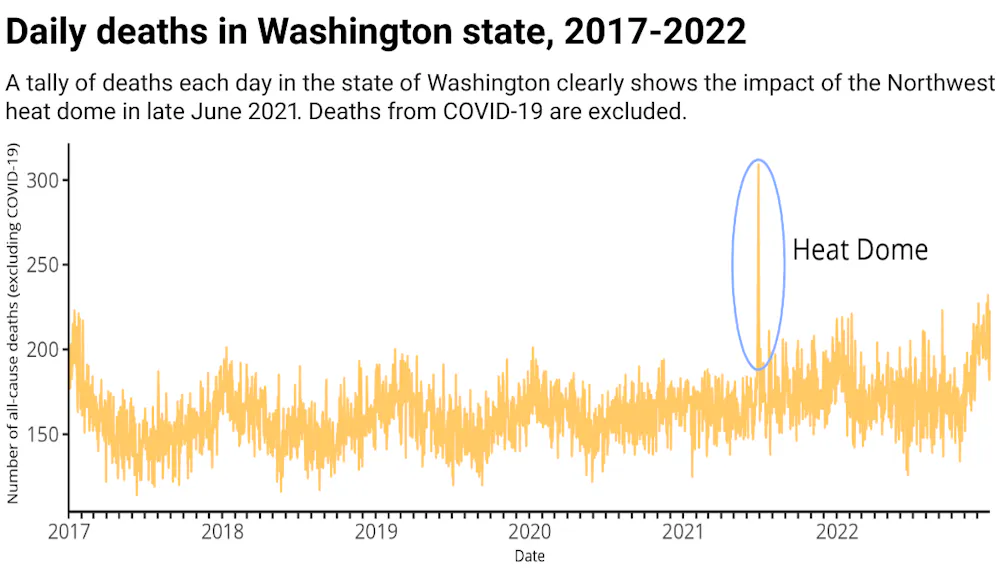
    A chart of all deaths, excluding COVID-19, shows the extraordinary impact the 2021 heat dome had in Washington.
    ‘In the Hot Seat’ report, 2022

    We were excited and relieved when the community was awarded a US$19.9 million grant from the Environmental Protection Agency to help it take concrete steps to adapt to climate change and boost the local economy in the process. The grant would help establish resilience hubs with microgrids and help residents without air conditioning install energy-efficient cooling systems. The city doesn’t have the means to make these improvements on its own, even if they would save lives and money in the long run.

    Less than a year later, the Trump administration abruptly terminated the funding.

    Spokane’s grant wasn’t the only one eliminated – about 350 similar grants that had been awarded to help communities across the country manage climate changes, from extreme heat and wildfire smoke to rising seas and flooding, were also terminated on the grounds that they don’t meet the White House’s priorities. Many other grants to help communities have also been terminated.

    Many of the communities that lost funding are like Spokane: They can’t afford to do this kind of work on their own.

    Why cities like Spokane need the help

    Like many communities in the American West, Spokane was founded in the late 19th century on wealth from railroads and resource extraction, especially gold, silver and timber.

    Today, it is a city of 230,000 in a metro area of a half-million people, the largest on the I-90 corridor between Minneapolis and Seattle. In many ways, Spokane could be on the cusp of a renaissance.

    In January 2025, the U.S. Department of Commerce announced a $48 million grant to develop a tech hub that could put the Inland Northwest on a path to become a global leader in advanced aerospace materials. But then, in May, the Trump administration rescinded that grant as well.

    The lost grants left the economy – and Spokane’s ability to adapt fast enough to keep up with climate changes – uncertain.

    Heat waves are becoming a growing risk in Spokane, known for its river and falls that tumble near downtown.
    Roman Eugeniusz/Wikimedia Commons, CC BY-SA

    This is not a wealthy area. The median household income is nearly $30,000 less than the state average. More than 13 out of every 100 people in Spokane live in poverty, above the national average, and over 67% of the children are eligible for free or reduced lunch.

    The city is a light blue island in a dark red sea, politically speaking, with a moderate mayor. Its congressional district has voted Republican by wide margins since 1995, the year that then-House Speaker Tom Foley lost his reelection bid.

    Lessons from the 2021 heat dome

    The 2021 heat wave was a catalyzing event for the community. The newly formed Gonzaga Institute for Climate, Water and the Environment brought together a coalition of government and community partners to apply for the EPA’s Climate and Environmental Justice Community Change Grant Program. The grants, funded by Congress under the Inflation Reduction Act of 2022, were intended to help communities most affected by pollution and climate change build adaptive capacity and boost the safety of their residents.

    A key lesson from the 2021 heat dome was that temporary, or pop-up, cooling centers don’t work well. People just weren’t showing up. Our research found that the best approach is to strengthen existing community facilities that people already turn to in moments of difficulty.

    Half the $19.9 million award was for outfitting five resilience hubs in existing libraries and community centers with solar arrays and battery backup microgrids, allowing them to continue providing a safe, cool space during a heat wave if the power shuts down.

    The locations and plans for five resilience hubs to serve Spokane, and the infrastructure they would receive.
    Gonzaga Institute for Climate, Water and the Environment

    Another $8 million in grant funding was meant to provide 300 low- to moderate-income homeowners with new high-efficiency electric heat pump heating, ventilation and air conditioning systems, providing more affordable utility bills while improving their ability to cool their homes and reducing fossil fuel emissions.

    Communities are left with few options

    Now, this and other work is at risk in Spokane and cities and towns like it around the country that also lost funding.

    According to the Trump administration, the program – designed to help hundreds of communities around the country become safer – was “no longer consistent with EPA funding priorities.”

    A class action lawsuit was recently filed over the termination of the grants by a coalition that includes Earth Justice and the Southern Environmental Law Center. If the case is successful, Spokane could see its funding restored.

    Meanwhile, the city and my team know we have to move fast, with whatever money and other resources we can find, to help Spokane prepare for worsening heat. We formed the Spokane Climate Resilience Collaborative – a partnership between community organizations, health officials and the city – as one way to advance planning for and responding to climate hazards such as extreme heat and wildfire smoke.

    As concentrations of heat-trapping gasses accumulate in the atmosphere, both the frequency and severity of heat waves increase. It is only a matter of time before another deadly heat dome arrives.

    Brian G. Henning receives funding from the Environmental Protection Agency.

    ref. My city was one of hundreds expecting federal funds to help manage rising heat wave risk – then EPA terminated the grants – https://theconversation.com/my-city-was-one-of-hundreds-expecting-federal-funds-to-help-manage-rising-heat-wave-risk-then-epa-terminated-the-grants-259009

    MIL OSI Analysis

  • MIL-OSI: Mid-Year 2025 Emerging Risks Survey Snapshot

    Source: GlobeNewswire (MIL-OSI)

    ARLINGTON, Va. and CHICAGO, July 09, 2025 (GLOBE NEWSWIRE) — The Casualty Actuarial Society (CAS) and the Society of Actuaries (SOA) jointly published findings from their May 2025 Mid-Year Flash Survey of U.S. risk managers. To keep current with the pace of change, this flash survey supplements the 18th Annual Emerging Risks Survey conducted in November 2024. The annual online questionnaire asks risk managers to rank current and emerging risks, and researchers track those rankings over time.

    Top current risks shifted between the November 2024 and May 2025 surveys. In May, risk managers chose financial volatility as a current risk 24.1% more often than in November, raising it to the top of the list. Globalization shift was chosen 7.4% more often, lifting this risk to the second spot. Wars (including civil wars) decreased by 11.2%, dropping it off the top five list. Technology risks also dropped significantly, while climate change remained in the top five current risks.

    Top Current Risks

    Rank November 2024 Survey Findings May 2025 Survey Findings
    1 Wars (including civil wars) Financial volatility
    2 Financial volatility Globalization shift
    3 Climate change Failed and failing states
    4 Failed and failing states Climate change
    5 Disruptive technologies Liability regimes and regulatory framework
         

    Though respondents’ concerns about current risks have changed significantly since November 2024, their views of emerging risks remain relatively stable. However, the mid-year survey did uncover changes in the perceptions of some emerging risks. For example, Wars (including civil wars) declined by 3.9% from the top of the emerging risk list to seventh and financial volatility rose by 4.2% from sixth to second.

    Top Emerging Risks

    Rank November 2024 Survey Findings May 2025 Survey Findings
    1 War (including civil wars) Disruptive technology
    2 Climate change (tied with War) Financial volatility
    3 Disruptive technology Climate change
    4 Cyber networks Cyber networks
    5 Demographic shift Demographic shift
         

    When asked about the most concerning risk scenarios, respondents listed economic slowdown most often, which is a significant change from previous years. On the other hand, the rate at which inflation was cited as a concern remains very similar to the previous surveys.

    “Since 2022, a mid-year flash survey has been done to offer different data points to capture risk managers’ perceptions of quickly changing environments,” said David Schraub, FSA, MAAA, CERA, CFA, and one of the report authors. “Also, a mid-year flash survey can mitigate the possibility of responses being overly influenced by recent events, a phenomenon also known as recency bias.”

    Survey Details
    Sponsored by the CAS and SOA, the May 2025 flash survey was an online questionnaire and included 150 participants. Respondents’ area of practice included life, property and casualty, and health insurance as well as pensions and risk management. The online questionnaire asked risk managers to rank current and emerging risks. The survey uses four categories to measure risks as perceived by risk managers: top current risk, top five emerging risks, top emerging risk and top emerging risk combinations.

    Read the key findings report for more details and graphs.

    About the Casualty Actuarial Society
    The Casualty Actuarial Society (CAS) is a leading international organization for credentialing, professional education and research. Founded in 1914, the CAS is the world’s only actuarial organization focused exclusively on property-casualty risks and serves over 10,000 members worldwide. CAS members are sought after globally for their insights and ability to apply analytics to solve insurance and risk management problems. Visit www.casact.org.

    About the Society of Actuaries
    With roots dating back to 1889, the Society of Actuaries (SOA) is the world’s largest actuarial professional organization with more than 32,000 actuaries as members. Through research and education, the SOA’s mission is to advance actuarial knowledge and enhance the ability of actuaries to provide expert advice and relevant solutions for financial, business and societal challenges. Visit www.soa.org.

    The MIL Network

  • MIL-OSI USA: Governor Newsom deploys firefighter strike team to support Oregon wildfire response

    Source: US State of California 2

    Jul 8, 2025

    SACRAMENTO — As wildfire conditions intensify across the Pacific Northwest, Governor Newsom has directed the deployment of a CAL FIRE Type 3 engine strike team to assist firefighting efforts in southern Oregon. The deployment includes five fire engines and a strike team leader who will join suppression operations just north of the California–Oregon border.

    “Just as Oregon supported our state during the Los Angeles firestorms, we’re glad to support our Northern neighbors with strike teams and fire engines to aid in their wildfire response efforts. I’m proud California can lend a helping hand to fellow Americans in their time of need.” 

    Governor Gavin Newsom

    CAL FIRE engines being sent to support wildfire suppression in Oregon

    This mobilization comes in response to a significant lightning event that ignited numerous wildfires across the region. Southern Oregon has experienced more than 2,000 lightning strikes in recent days, compounded by high temperatures and gusty winds. The National Weather Service has issued Red Flag Warnings through July 8 for much of southern and central Oregon, signaling elevated fire danger and the need for immediate firefighting reinforcements.

    Upon arrival in Medford, CAL FIRE resources will seamlessly integrate into Oregon’s Department of Forestry command structure to support suppression efforts on active fires. This response is part of a long-standing interstate mutual aid agreement that strengthens wildfire readiness across the western United States.

    California remains prepared to send additional resources should conditions escalate.

    “We stand with Oregon during this critical time, just as they’ve stood with us during some of California’s toughest fire seasons,” said Anale Burlew, Chief Deputy Director of CAL FIRE. “These mutual aid partnerships are built on trust, coordination, and a shared commitment to public safety.”

    Press releases, Recent news

    Recent news

    News What you need to know: The $101 million being made available today will support the development of affordable multifamily rental housing in Los Angeles, prioritizing the needs of displaced residents in the fire-devastated regions. Los Angeles, California – Six…

    News SACRAMENTO – Governor Gavin Newsom today announced the deployment of an additional 18 highly skilled Urban Search and Rescue Team members to Texas to assist with ongoing response efforts related to severe flooding impacts.The deployment includes a total of four…

    News Perris, California — On June 18, 2025, the First Partner visited the Inland Empire to meet with California communities impacted by the Trump Administration’s federal immigration raids. The First Partner visited TODEC, a local nonprofit organization that’s become…

    Jul 8, 2025

    What you need to know: The passage of Proposition 1 by California voters adds rocket fuel to Governor Gavin Newsom’s transformational overhaul of the state’s behavioral health system. These reforms refocus existing funds to prioritize Californians with the most serious mental health and substance use issues, who are too often experiencing homelessness. They also fund more than 11,150 new behavioral health beds and supportive housing units and 26,700 outpatient treatment slots.

    Los Angeles, California – California took a major step forward in correcting the damage from 50 years of neglect to the state’s mental health system with the passage of Proposition 1. This historic measure — a signature priority of Governor Gavin Newsom — adds rocket fuel to California’s overhaul of the state’s behavioral health systems. It provides a full range of mental health and substance abuse care, with new accountability metrics to ensure local governments deliver for their communities.

    This is the biggest reform of the California mental health system in decades and will finally equip partners to deliver the results all Californians need and deserve. Treatment centers will prioritize mental health and substance use support in the community like never before. Now, it’s time to roll up our sleeves and begin implementing this critical reform – working closely with city and county leaders to ensure we see results.

    Governor Gavin Newsom

    newsom-news-template
    IMG_3682-min
    contact-governor-landing
    workers-FxAJ5fkakAAtVI3
    priorities-and-progress-image
    economy-F-isBKpbsAAxdab
    gun-violence-San Diego Guns Package 2.18.22_2

    What they’re saying: 

    • Sacramento Mayor Darrell Steinberg, original author of the Mental Health Services Act: “Twenty years ago, I never could have dreamed that we would have the strong leadership we have today, committing billions and making courageous policy changes that question the conventional wisdom on mental health. Now, with the passage of Proposition 1. California is delivering on decades old promises to help people living with brain-based illnesses, to live better lives, to live independently and to live with dignity in our communities. This is a historic moment and the hard work is ahead of us.“
    • Senator Susan Eggman (D-Stockton), author of Senate Bill 326: “Today marks a day of hope for thousands of Californians who are struggling with mental illness – many of whom are living unhoused. I am tremendously grateful to my fellow Californian’s for passing this important measure.  And I am very appreciative of this Governor’s leadership to transform our behavioral health care system!”
    • Assemblymember Jacqui Irwin (D-Thousand Oaks), author of Assembly Bill 531: “This started as an audacious proposal to address the root cause of homelessness and today, Californians can be proud to know that they did the right thing by passing Proposition 1. Now, it’s time for all of us to get to work, and make sure these reforms are implemented and that we see results.”

    Bigger picture: Transforming the Mental Health Services Act into the Behavioral Health Services Act and building more community mental health treatment sites and supportive housing is the last main pillar of Governor Newsom’s Mental Health Movement – pulling together significant recent reforms like 988 crisis line, CalHOPE, CARE Court, conservatorship reform, CalAIM behavioral health expansion (including mobile crisis care and telehealth), Medi-Cal expansion to all low-income Californians, Children and Youth Behavioral Health Initiative (including expanding services in schools and on-line), Older Adult Behavioral Health Initiative, Veterans Mental Health Initiative, Behavioral Health Community Infrastructure Program, Behavioral Health Bridge Housing, Health Care Workforce for All and more.

    More details on next step here

    Press releases, Recent news

    Recent news

    News What you need to know: The $101 million being made available today will support the development of affordable multifamily rental housing in Los Angeles, prioritizing the needs of displaced residents in the fire-devastated regions. Los Angeles, California – Six…

    News SACRAMENTO – Governor Gavin Newsom today announced the deployment of an additional 18 highly skilled Urban Search and Rescue Team members to Texas to assist with ongoing response efforts related to severe flooding impacts.The deployment includes a total of four…

    News Perris, California — On June 18, 2025, the First Partner visited the Inland Empire to meet with California communities impacted by the Trump Administration’s federal immigration raids. The First Partner visited TODEC, a local nonprofit organization that’s become…

    Jul 8, 2025

    What you need to know: The passage of Proposition 1 by California voters adds rocket fuel to Governor Gavin Newsom’s transformational overhaul of the state’s behavioral health system. These reforms refocus existing funds to prioritize Californians with the most serious mental health and substance use issues, who are too often experiencing homelessness. They also fund more than 11,150 new behavioral health beds and supportive housing units and 26,700 outpatient treatment slots.

    Los Angeles, California – California took a major step forward in correcting the damage from 50 years of neglect to the state’s mental health system with the passage of Proposition 1. This historic measure — a signature priority of Governor Gavin Newsom — adds rocket fuel to California’s overhaul of the state’s behavioral health systems. It provides a full range of mental health and substance abuse care, with new accountability metrics to ensure local governments deliver for their communities.

    This is the biggest reform of the California mental health system in decades and will finally equip partners to deliver the results all Californians need and deserve. Treatment centers will prioritize mental health and substance use support in the community like never before. Now, it’s time to roll up our sleeves and begin implementing this critical reform – working closely with city and county leaders to ensure we see results.

    Governor Gavin Newsom

    newsom-news-template
    IMG_3682-min
    contact-governor-landing
    workers-FxAJ5fkakAAtVI3
    priorities-and-progress-image
    economy-F-isBKpbsAAxdab
    gun-violence-San Diego Guns Package 2.18.22_2

    What they’re saying: 

    • Sacramento Mayor Darrell Steinberg, original author of the Mental Health Services Act: “Twenty years ago, I never could have dreamed that we would have the strong leadership we have today, committing billions and making courageous policy changes that question the conventional wisdom on mental health. Now, with the passage of Proposition 1. California is delivering on decades old promises to help people living with brain-based illnesses, to live better lives, to live independently and to live with dignity in our communities. This is a historic moment and the hard work is ahead of us.“
    • Senator Susan Eggman (D-Stockton), author of Senate Bill 326: “Today marks a day of hope for thousands of Californians who are struggling with mental illness – many of whom are living unhoused. I am tremendously grateful to my fellow Californian’s for passing this important measure.  And I am very appreciative of this Governor’s leadership to transform our behavioral health care system!”
    • Assemblymember Jacqui Irwin (D-Thousand Oaks), author of Assembly Bill 531: “This started as an audacious proposal to address the root cause of homelessness and today, Californians can be proud to know that they did the right thing by passing Proposition 1. Now, it’s time for all of us to get to work, and make sure these reforms are implemented and that we see results.”

    Bigger picture: Transforming the Mental Health Services Act into the Behavioral Health Services Act and building more community mental health treatment sites and supportive housing is the last main pillar of Governor Newsom’s Mental Health Movement – pulling together significant recent reforms like 988 crisis line, CalHOPE, CARE Court, conservatorship reform, CalAIM behavioral health expansion (including mobile crisis care and telehealth), Medi-Cal expansion to all low-income Californians, Children and Youth Behavioral Health Initiative (including expanding services in schools and on-line), Older Adult Behavioral Health Initiative, Veterans Mental Health Initiative, Behavioral Health Community Infrastructure Program, Behavioral Health Bridge Housing, Health Care Workforce for All and more.

    More details on next step here

    Press releases, Recent news

    Recent news

    News What you need to know: The $101 million being made available today will support the development of affordable multifamily rental housing in Los Angeles, prioritizing the needs of displaced residents in the fire-devastated regions. Los Angeles, California – Six…

    News SACRAMENTO – Governor Gavin Newsom today announced the deployment of an additional 18 highly skilled Urban Search and Rescue Team members to Texas to assist with ongoing response efforts related to severe flooding impacts.The deployment includes a total of four…

    News Perris, California — On June 18, 2025, the First Partner visited the Inland Empire to meet with California communities impacted by the Trump Administration’s federal immigration raids. The First Partner visited TODEC, a local nonprofit organization that’s become…

    MIL OSI USA News

  • MIL-OSI USA: Governor Newsom announces additional crews to assist Texas search and rescue operations

    Source: US State of California 2

    Jul 8, 2025

    SACRAMENTO – Governor Gavin Newsom today announced the deployment of an additional 18 highly skilled Urban Search and Rescue Team members to Texas to assist with ongoing response efforts related to severe flooding impacts.

    The deployment includes a total of four units of Human Remains Detection (HRD) Teams, which also include a total of eight canines. The deployed teams are from the Los Angeles County, Riverside City, Menlo Park and Orange County Fire Departments.   

    The 18 Urban Search and Rescue Team members sent today are in addition to the 9 members deployed yesterday from Riverside City and Oakland City

    The scale of loss and devastation Texas is experiencing right now is unfathomable. California is proud to lend a helping hand to our fellow Americans.

    Governor Gavin Newsom

    During this deployment to Texas, California personnel will use their highly-developed and specialized skills to assist emergency operations in and around the hardest hit areas based on priorities and direction of state and local officials to assist with search and rescue operations.  In close coordination with Texas and through the Emergency Management Assistance Compact (EMAC), the California Governor’s Office of Emergency Services (Cal OES) is deploying these crews.

    “Cal OES deploys these experienced teams to help those in need in Texas,” said Cal OES Director Nancy Ward. “These search and rescue professionals have the training needed to navigate extreme conditions.”

    Potential exists for additional flood impacts in the area. California stands ready to send additional resources as requested.

    Since 1992, California-based resources have been deployed to a long list of state, national, and even international disasters including 2017’s Hurricanes Harvey, Irma and Maria, 1992 Hurricane Iniki (Hawaii), the 1994 Northridge Earthquake, the September 11, 2001 attacks, the World Trade Center, Hurricane Katrina and Hurricane Rita, Hurricane Ian, the Camp Fire in Paradise, the Oklahoma City Bombing, and the Montecito Mudslides.

    This deployment does not impact California’s emergency response and firefighting capabilities.

    Press releases, Recent news

    Recent news

    News Perris, California — On June 18, 2025, the First Partner visited the Inland Empire to meet with California communities impacted by the Trump Administration’s federal immigration raids. The First Partner visited TODEC, a local nonprofit organization that’s become…

    News SACRAMENTO – Governor Gavin Newsom today announced the deployment of skilled Urban Search and Rescue Team members to Texas to assist with ongoing response efforts related to severe flooding impacts. “California stands with all those who have lost loved ones,…

    News What you need to know: California added area the equivalent of Glacier National Park to its conserved lands and coastal waters in just the last year – marking significant progress toward its goal of 30% conservation by 2030. SACRAMENTO – Governor Gavin Newsom…

    MIL OSI USA News

  • Are flash floods directly linked to climate change?

    Source: Government of India

    Source: Government of India (4)

    The catastrophic flash floods in Texas a couple of days earlier, triggered by extremely heavy rainfall, which caused over 100 deaths and widespread destruction, have once again raised a pressing question- are flash floods directly linked to climate change? Successive research by environmental agencies corroborates this, saying climate change is a significant factor in the increased risk, frequency and intensity of floods in several parts of the world.

    Research suggests human-caused climate change is driving more and more extreme weather conditions, which include extremely heavy and sometimes untimely rains, which directly contribute to flooding, especially when proper city planning is not in place.

    Studies say warmer temperatures cause a more moisture-laden atmosphere, which turns into more intense rainfall with increased frequency. The recent Texas floods were found to have been made significantly worse by climate change, as atmospheric conditions favoured slow-moving thunderstorms, which caused heavy rains in the same area for hours. Warmer global temperatures have increased the atmosphere’s capacity to hold moisture, resulting in heavier and more concentrated rainfall events that can overwhelm drainage systems and waterways.

    In layman’s terms, climate change leads to higher global temperatures and warmer air holds more moisture. Climate-related researches say with every one-degree Celsius rise in temperature, the atmosphere’s capacity to hold more water vapour rises by about 7%.

    It can be understood from the fact that the recent very heavy rainstorms in Texas delivered about 20% more rainfall than they did in the late 1950s, a time when global temperatures were considerably lower, according to the National Climate Assessment. As climate change continues to warm the planet, extreme rainfall events in Texas are projected to become even more frequent in the coming decade, as highlighted in a 2024 report by the state’s climatologist. The worry is that it’s not just Texas, but across the US, the heaviest storms are predicted to produce more rain as the Earth continues to warm.

    Such storms can trigger deadly flooding far inland, which was on full display in 2024 when Hurricane Helene caused severe flooding across Appalachia. Similarly, in 2021, flash floods caused by Hurricane Ida claimed dozens of lives in the Northeastern US. According to the National Climate Assessment, more than one-third of the estimated 230 billion dollar in inland flood damage in the US between 1988 and 2021 would not have occurred without climate change.

    Storms increase the likelihood of intense and short-duration rainfall in several parts of the globe, which is becoming a major trigger for flash floods. Moreover, climate change also gives rise to sea levels and constantly rising sea levels invariably exacerbate coastal flooding, which seriously threatens human populations and physical assets-infrastructure in the coastal regions.

    In fact, across the US, Europe and other parts of the globe, similar patterns are observed with coastal and inland states facing flood risks due to tropical storms, hurricanes and prolonged rainfall events. In the US, riverine floods are also a concern, especially along major waterways like the Mississippi. In many areas, deforestation, wetland loss and poorly planned development have also disrupted natural drainage systems, reducing the landscape’s ability to buffer heavy rains.

    Like the United States, Europe is also grappling with more frequent and severe flooding. In 2021 and successive years, devastating floods in Germany, Belgium, Italy, the Netherlands, Luxembourg, Poland, the Czech Republic, Slovakia, Austria, Hungary and others highlighted the region’s exposure to extreme weather.

    Climate change is intensifying heavy rainfall events across the continent, particularly in Central and Western Europe. Uncontrolled urban expansion, river channelization and reduced natural water retention due to agricultural and industrial development have made many European regions more prone to flooding. In mountainous areas, rapid snowmelt and glacial lake outbursts, both linked to rising temperatures, also contribute to sudden floods.

    Studies have shown that climate change has increased the likelihood and intensity of heavy rainfall events in both the US and Europe. For example, in Europe, research indicates that human-caused climate change doubled the likelihood of the intense rainfall that caused recent floods in Central Europe. Similarly, in the US, climate change has been linked to more extreme rainstorms and increased flood risk.

    Despite the growing risks, many communities around the country are still not planning for more intense rainstorms as they build roads, floodways, and storm infrastructure. Local governments around the country rely on historical rainfall records from concerned agencies.

    Another factor that may be contributing to the severe floods, however, is human activity and land-use change. Most of the recent floods in Central Europe are river floods, which makes the links between the flooding and climate change less straightforward.

    Central Europe’s devastating floods were made worse by climate change, which scientists say offers glimpses of a bleak future for the world’s fastest-warming continent. In fact, Europe is the fastest-warming continent. The last five years were on average around 2.3°C warmer than the second half of the 19th century, according to the Copernicus Climate Service.

    Addressing these challenges requires a multi-pronged approach. In the short term, improving early warning systems, emergency response mechanisms and public awareness can help save lives. Upgrading drainage infrastructure, reinforcing levees and dams and integrating green infrastructure like rain gardens, permeable pavements and restored wetlands are essential for long-term flood resilience. Urban planning must prioritize flood risk zones, restrict construction in vulnerable areas and promote sustainable land use.

    And at a broader scale, reducing greenhouse gas emissions remains critical to mitigating the root cause of climate-driven floods. International cooperation, climate adaptation funding and policy reforms are necessary to prepare communities for the escalating risks posed by a warming world. Without decisive action, not only the US and Europe, but the majority of countries across the globe are likely to see floods becoming an even more destructive and persistent threat in the decades ahead. Without more ambitious climate action, global warming is expected to reach around 3°C by the end of the century, which would be much more disastrous to the humanity.

  • MIL-OSI Europe: Highlights – Presentation of the Council Presidency’s programme – Committee on Industry, Research and Energy

    Source: European Parliament

    Danish Council Presidency © European Union (2025)

    At the ITRE Committee meeting of 16 July, five Ministers will present the priorities of the Danish Presidency and have an exchange of views with ITRE Members on the policy areas covered by the ITRE Committee.

    On 16 July, Ms Caroline Stage Olsen, Minister for Digital Affairs, will present the Presidency’s priorities related to digital and ICT. On the same day, Mr Lars Aagaard, Minister for Climate, Energy and Utilities, and Mr Morten Bødskov, Minister for Industry, Business and Financial Affairs, will present the priorities on energy and industry / SMEs respectively. Finally, Mr Troels Lund Poulsen, Deputy Prime Minister and Minister of Defence, will present the priorities related to defence, while Mr Schack Pedersen, Minister for Resilience and Preparedness, will present cybersecurity-related priorities.

    MIL OSI Europe News

  • MIL-OSI Africa: Government to publish strategy for planned disaster risk management

    Source: Government of South Africa

    With the Southern African region experiencing a growing number of climate-related disasters, government says it will increase its focus on reducing the fiscal and human cost of disasters by planning for them instead of reacting to them.

    “When disasters strike, government is forced to reallocate funds from other priorities to respond, often at the cost of long-term development. This cycle of crisis and reallocation is unsustainable,” the Deputy Minister of Finance, Ashor Sarupen, said on Tuesday in Parliament. 

    Through the finalisation and publishing of a National Disaster Risk Financing Strategy in the 2025/26 financial year, government’s strategy will shift from reactive funding to proactive, planned disaster risk management.

    The strategy will:

    • Introduce disaster risk financing instruments, including climate insurance products, to improve response time and predictability of funding;
    • Embed disaster risk management in grant frameworks, particularly those for infrastructure and local government, and
    • Support line departments and municipalities in mainstreaming climate risk into their financial planning and investment decisions.

    “Climate change is not a future threat. It is a present reality, and our budget frameworks must reflect that,” Sarupen said while tabling the National Treasury’s Budget Vote.

    Spending for Growth

    As part of National Treasury’s broader macroeconomic framework reforms to drive structural economic transformation and attract investment, public infrastructure spending will exceed R1 trillion over three years. 

    “This represents the fastest-growing area of government expenditure and is aimed at easing supply-side economic constraints and improving social service access. 

    “The Budget Facility for Infrastructure (BFI) is being reconfigured to attract private sector participation through multiple appraisal windows, separated investment and financing decisions, and diversified financing instruments including guarantees, build-operate-transfer structures, and concessional loans,” the Deputy Minister said. 

    New public-private partnership (PPP) regulations, effective 1 June 2025, have reduced procedural complexity, with supporting frameworks for unsolicited proposals and fiscal commitments to be published soon, while municipal PPP regulations will be finalised before the Medium-Term Budget Policy Statement.

    “A single National Treasury-overseen structure will be established this year to systematically crowd-in private sector finance and expertise, consolidating large-scale project preparation, providing PPP technical support, improving data management, and enhancing private sector engagement,” he said.

    Rebuilding local government finances

    In an effort to address service delivery breakdowns, fiscal mismanagement, and governance failures at municipalities, National Treasury is responding with targeted support and structural financial reforms.

    National Treasury’s approach focuses on the following key areas:

    • Adoption of Funded Budgets: Municipalities can no longer adopt unfunded budgets based on wishful projections. Treasury is enforcing the requirement for credible, funded budgets as the basis of municipal financial planning.
    • Revenue Value Chain Reforms: Treasury is supporting municipalities to improve billing systems, strengthen collection rates, and protect revenue integrity. Without this, no budget can be sustainable.
    • Capacity Building: Through direct technical support, Treasury is building the financial management skills of municipal officials, particularly CFOs and budget managers.
    • Financial Recovery Plans: For municipalities in financial distress, Municipal Financial Recovery Services (MFRS) provide tailored recovery plans. These are not generic interventions, they are grounded in the real financial position of each municipality.
    • mSCOA Implementation: The Municipal Standard Chart of Accounts (mSCOA) brings transparency and uniformity to local government finances. It allows us to compare apples with apples — across municipalities, across provinces, and across time.
    • Consequence Management: Treasury is working closely with the Department of Co-operative Governance and Traditional Affairs (CoGTA) and the Auditor-General South Africa (AGSA) to ensure that financial misconduct is addressed swiftly. Public money must be protected. Where there is wrongdoing, there must be consequences.

    Reforming the auditing profession

    After years of audit failures in both the public and private sectors, National Treasury is currently reviewing the Auditing Profession Act.

    The Act provides for the establishment of the Independent Regulatory Board for Auditors; the education, training and professional development of registered auditors; the accreditation of professional bodies; the registration of auditors, and the regulation of the conduct of registered auditors.

    “The proposed amendments are designed to strengthen the Independent Regulatory Board for Auditors (IRBA) and align our regulatory framework with international best practice. These reforms are not just technical changes; they are about fostering trust, integrity, and public confidence in the profession. The auditing profession plays a critical role in financial markets and public accountability,” the Deputy Minister said. – SAnews.gov.za

    MIL OSI Africa

  • Wildfire loses intensity in southern France, firefighters continue battle

    Source: Government of India

    Source: Government of India (4)

    A wildfire that reached the northwestern outskirts of France’s second city of Marseille lost intensity overnight, but firefighters were still battling the flames on Wednesday.

    Residents who had been told on Tuesday to stay in their homes for their own safety were once again allowed out.

    “With the fire in northern Marseille now clearly under control, we can announce this morning that the 16th arrondissement is no longer on lockdown,” Marseille Mayor Benoit Payan said in a post on social media platform X.

    “I call on all Marseille residents to exercise the utmost caution in the area, as emergency services are hard at work,” he said.

    Martine Vassal, head of the area council, said firefighters had worked through the night to control the fire, which she said remained a cause for concern.

    “It is not finished. Weather conditions are worrying for us,” Vassal told broadcaster BFM.

    Local officials said the airport for France’s second-largest city could close for commercial flights to prioritise air resources if the fire flared up again.

    It was too soon for the hundreds of residents who had fled from the wildfire to return, officials said.

    Hundreds of firefighters, aided by helicopters and aircraft, have been fighting the flames, which have been fanned by winds of up to 70 kph (43 mph) that brought plumes of smoke over the southern coastal city. Officials said the blaze was caused by a car that caught on fire.

    The fire had burnt through 700 hectares (2.7 square miles) but no fatalities had been reported, regional prefect Georges-Francois Leclerc said late on Tuesday.

    Interior Minister Bruno Retailleau told reporters late on Tuesday that the fire had been fast-moving, affecting 60 houses and burning down 10.

    The fire in Marseille and a separate one near Narbonne, another southern French city, were the first major fires of the summer, Sophie Primas, the government’s spokesperson, said in an interview with RTL on Wednesday, adding that wildfire season had come early this year.

    Climate change has made wildfires more destructive in Mediterranean countries in recent years.

    This week and last week, fires have also raged in northeastern Spain, on the Greek island of Crete, and in Athens.

    Philippe, a victim of the fires whose surname was not given, told BFM that he had slept poorly after evacuating and hoped to return to his home at noon on Wednesday.

    “There is nothing we can do,” he said. “It is very very, very hard.”

    (Reuters)

  • European heatwave caused 2,300 deaths, scientists estimate

    Source: Government of India

    Source: Government of India (4)

    Around 2,300 people died of heat-related causes across 12 European cities during the severe heatwave that ended last week, according to a rapid scientific analysis published on Wednesday.

    The study targeted the 10 days, ending July 2, during which large parts of Western Europe were hit by extreme heat, with temperatures breaching 40 degrees Celsius (104°F) in Spain and wildfires breaking out in France.

    Of the 2,300 people estimated to have died during this period, 1,500 deaths were linked to climate change, which made the heatwave more severe, according to the study conducted by scientists at Imperial College London and the London School of Hygiene and Tropical Medicine.

    “Climate change has made it significantly hotter than it would have been, which in turn makes it a lot more dangerous,” said Dr Ben Clarke, a researcher at Imperial College London.

    The study covered 12 cities including Barcelona, Madrid, London and Milan, where the researchers said climate change had increased heatwave temperatures by up to 4 degrees Celsius.

    The researchers used established epidemiological models and historical mortality data to estimate the death toll, which reflects deaths where heat was the underlying reason for mortality, including if exposure exacerbated pre-existing health conditions.

    The scientists said they used peer-reviewed methods to quickly produce the estimated death toll, because most heat-related deaths are not officially reported and some governments do not release this data.

    Last month was the planet’s third-hottest June on record, behind the same month in 2024 and 2023, the EU’s Copernicus Climate Change Service said in a monthly bulletin on Wednesday.

    Western Europe experienced its warmest June on record, with much of the region experiencing “very strong heat stress” – defined by conditions that feel like a temperature of 38 degrees Celsius or more, Copernicus said.

    “In a warming world, heatwaves are likely to become more frequent, more intense and impact more people across Europe,” said Samantha Burgess, Copernicus’ strategic lead for climate.

    Researchers from European health institutes reported in 2023 that as many as 61,000 people may have died in Europe’s sweltering heatwaves in 2022, according to new research, suggesting countries’ heat preparedness efforts are falling fatally short.

    The build-up of greenhouse gas emissions in the atmosphere – which mostly come from the burning of fossil fuels – means the planet’s average temperature has increased over time. This increase in baseline temperatures means that when a heatwave comes, temperatures can surge to higher peaks.

    (Reuters)

  • MIL-OSI Africa: Supporting flood-affected populations in Democratic Republic of Congo to recover

    Source: APO


    .

    Salima, a mother of four, was severely affected by the floods that hit Kinshasa, the capital of the Democratic Republic of the Congo, in April 2025. She had previously fled violence and insecurity in the country’s eastern provinces to seek refuge in Kinshasa “A few days after I arrived, the rains caught us by surprise. We lost everything. The entire neighbourhood was heavily flooded. People had to flee to seek refuge elsewhere.”   

    Many of the flood-affected Kinshasa residents were provided with temporary shelter in Kinkole, a neighbourhood in Kinshasa where the government set up a site. More than 100 families were relocated to the shelters. With ambulances mobilized under the World Health Organization’s (WHO) SURGE system – a mechanism project for public health emergency preparedness and response – many patients, including pregnant women, were transferred promptly to referral health facilities, ensuring timely and appropriate care. 

    “Less than 24 hours after the disaster, we were on the ground for a rapid assessment of the situation,” said Dr Guy Kalambayi, Emergency Preparedness and Response Officer with WHO in the Democratic Republic of the Congo. “We helped set up a care unit with the minimum resources needed to relieve the population. Our responsiveness was greatly appreciated by the communities, both in terms of addressing their immediate needs and safeguarding their health.”

    WHO supported the health authorities to develop public health situation analysis, provide health services to those affected, assess the health needs and provide safe drinking water to the displaced and the households hosting them. 

    By June 2025, more than 5000 people were still living at the Kinkole site, out of the over 10 000 people affected by the floods in the sprawling capital city and its surroundings.

    Over than two months after the devastating floods that affected at least five major cities in the country, the authorities, supported by WHO and partners, continue to assist those affected to recover from the disaster. 

    In total, about 1.5 million people were affected across the country by the floods, which also damaged more than 200 schools, over 100 health centres, as well as houses and markets. WHO provided essential medical supplies, including emergency medical equipment, to cover the health needs of 10 000 people for three months. WHO also supplied four tents for emergency shelter.

    “With access to health services disrupted by the disaster, it is critically important to care for vulnerable groups such as pregnant women, children, the elderly and persons with disabilities or chronic conditions who require regular care,” says Dr Kalmbayi. 

    The authorities launched emergency efforts to repair damaged infrastructure and mobilize teams to coordinate humanitarian assistance. In Kinkole and elsewhere, the government and its partners are taking measures to ensure appropriate and dignified living conditions, providing continuity of health services and care, including vaccination and psychosocial support. 

    “We needed safe shelter, water and food. That’s what we received, not to mention the care we received with free medicines,” says Albertine, a medical student in Kinshasa affected by the disaster. 

    For Dr Emilia Sana, Flood Incident Manager at the Ministry of Public Health, Hygiene and Social Welfare, the coordinated response to the floods “marks a turning point towards a more effective multisectoral framework for our efforts, bringing key ministries together at the highest level.”

    WHO and partners continue to support the government strengthen outbreak prevention measures, including securing the supply of safe drinking water, sanitation and reinforcing of community-based disease surveillance systems.

    “We may have lost all our material possessions, but we are still alive and in good health. That’s what matters,” says Salima.

    The Democratic Republic of the Congo remains vulnerable to climate-linked disasters. Off-season rains in June, for instance, claimed at least 29 lives in three districts of Kinshasa, with more than 500 households affected.

    “One of the key takeaways from this emergency, both in Kinshasa and other provinces, is that there is power in collaboration, particularly in managing potentially epidemic diseases and chronic conditions, thereby ensuring continuity of care. WHO’s support through providing medicines to the affected communities has been invaluable,” says Dr Sana of the Ministry of Public Health, Hygiene and Social Welfare. 

    Distributed by APO Group on behalf of World Health Organization (WHO) – Democratic Republic of Congo.

    MIL OSI Africa

  • MIL-OSI Africa: South Sudan’s longest cholera outbreak enters critical stage

    Source: APO


    .

    The outbreak – which started in September 2024 and was confirmed a month later – comes amidst a protracted humanitarian crisis exacerbated by rising intercommunal violence, climate shocks such as flooding and catastrophic hunger.  

    “Now, more than ever, collective action is needed to reduce tensions, resolve political differences and make tangible progress in implementing peace,” said Anita Kiki Gbeho, UN Resident and Humanitarian Coordinator in South Sudan.  

    Alarming escalation

    Since the cholera outbreak was declared in October 2024, UN agencies and partners have documented over 80,000 cholera cases and 1,400 deaths.  

    This is in addition to regional outbreaks of mpox, hepatitis and measles among other communicable diseases.

    South Sudanese authorities, civil society and UN agencies held an inter-ministerial meeting on Monday to discuss what they called an “alarming escalation” in the spread of the outbreak. 

    “This is not merely a public health crisis, but a multi-sectoral emergency exacerbated by flooding, displacement, and limited access to basic services,” the ministers wrote in a communiqué released.  

    The group resolved to facilitate unimpeded humanitarian access to areas which already have outbreaks and to other areas at risk for outbreaks. The Government of South Sudan will coordinate these efforts.

    Partners will also work to preposition materials, improve water and sanitation infrastructure and coordinate proactive and reactive vaccination campaigns.  

    Time is running out

    With the peak of the rainy season on the horizon, the next eight weeks are critical in containing and mitigating the outbreak before severe flooding begins.  

    “Time is of the essence to prevent a further escalation of the outbreak,” the officials wrote.  

    Floods more than double the frequency of cholera outbreaks by imperiling access to clean water and impeding humanitarian access to affected areas. And with rising global temperatures making floods more severe, millions of South Sudanese who were not previously in regions of concern may now be at risk for cholera outbreaks.

    A preventable disease  

    Cholera is an acute diarrhoeal infection caused by consuming contaminated water or food. Although highly communicable, it is preventable through proper hygiene, regular handwashing, safe food preparation and storage, improved sanitation infrastructure, and vaccination.

    Symptoms typically include watery diarrhoea. Most cases are mild to moderate and can be treated effectively with oral rehydration salts (ORS) mixed with clean, boiled water.

    However, in severe cases, cholera can be fatal—sometimes within hours—if not treated promptly.

    Infected individuals can also transmit the disease through their faeces for up to ten days, even if they show no symptoms.

    Need for additional funds

    In South Sudan, the already inadequate water and sanitation infrastructure and overstretched public health system has further deteriorated as a result of displacement and conflict. This has ripened the conditions for the spread of cholera.

    The UN and its partners are working quickly to preposition emergency supplies, especially in these previously low-risk areas, but they are hampered by funding shortfalls. Agencies estimate that they will need $1.69 billion – of which they have only received $368 million – to address the many intersecting humanitarian needs in the country.  

    Nevertheless, the group of ministers insisted that this outbreak is and must remain a priority for all involved.

    “Cholera response and flood preparedness must be treated as urgent national priorities,” they said in the communiqué.

    Distributed by APO Group on behalf of UN News.

    MIL OSI Africa

  • MIL-OSI NGOs: Climate crisis tripled death toll of Europe’s latest heatwave: Greenpeace calls for polluters to pay

    Source: Greenpeace Statement –

    Amsterdam – Responding to a rapid study by scientists at Imperial College London and the London School of Hygiene & Tropical Medicine that found that the number of heat-related deaths across 12 European cities tripled due to the climate crisis in the 10 day period between 23 June and 2 July, as well as to preliminary data published by the Copernicus Climate Change Service that June 2025 was the hottest ever June for Western Europe and the third-warmest June globally.[1][2]

    Ian Duff, Head of Greenpeace International’s Stop Drilling Start Paying campaign said: “It is society’s most vulnerable – in Milan, Barcelona, Paris, London and elsewhere – who suffer most in the midst of record temperatures. Europe’s dependence and soft hand on oil and gas corporations who are fueling this extreme heat is giving a death blow to our parents and grandparents.” 

    “This heatwave comes when public finances are already stretched and it is only fair that those most responsible are made to pay. For European cities to become safe spaces for society’s most vulnerable, polluters like Shell and TotalEnergies must face fines and taxes to pay for soaring climate and health costs.”

    Beyond excess mortality, the latest heatwave in Europe resulted in restrictions on outdoor work hours in Italy, the closure of more than 2,200 schools in France, and wildfires breaking out in Greece, Spain, and Turkey.

    Eight out of 10 people support taxing oil and gas corporations to pay for climate damages, according to a global survey commissioned by Greenpeace International and Oxfam International. The two organisations are part of the Polluters Pay Pact, a global alliance of over 170,000 people, including first responders like firefighters, humanitarian groups and political leaders. It demands that governments around the world make oil, coal and gas corporations pay their fair share for the damages they cause

    ENDS

    Notes:

    [1] “Climate change tripled heatwave death toll in European cities during last week’s heatwave” – Imperial College London and the London School of Hygiene & Tropical Medicine

    [2] “Third-warmest June globally – Heatwaves in Europe amid temperature extremes across both hemispheres” – Copernicus 

    Contact:

    Tal Harris, Global Media Lead – Greenpeace International’s Stop Drilling Start Paying campaign, +41-782530550, [email protected] 

    Greenpeace International Press Desk: [email protected], +31 (0) 20 718 2470 (available 24 hours)

    MIL OSI NGO

  • India and Brazil reaffirm strategic partnership with roadmap for next decade

    Source: Government of India

    Source: Government of India (4)

    Prime Minister Narendra Modi paid a State Visit to Brazil on Tuesday at the invitation of President Luiz Inácio Lula da Silva, with both leaders pledging to deepen ties across a wide range of strategic areas.

    In a joint statement, the two nations reaffirmed their commitment to bolster the India-Brazil Strategic Partnership, describing their shared vision as rooted in common values and aimed at advancing peace, prosperity and sustainable development.

    Defence and Security

    PM Modi and President Lula welcomed growing military collaboration, including joint exercises and senior‐level visits. They noted the recent Agreement on the Exchange and Mutual Protection of Classified Information, and established a Bilateral Cybersecurity Dialogue to share expertise on cyber threats. Both condemned the Pahalgam terror attack and voiced Brazil’s solidarity with India. They condemned all forms of terrorism and agreed to deepen action against UN-designated groups such as Lashkar-e-Tayyiba and Jaish-e-Mohammad, including measures at the UN and FATF. An agreement to combat international terrorism and organized crime was also signed, and both leaders pledged support for the UN Convention on Cybercrime at its signing in Hanoi next year.

    They called for UN Security Council reform, backing expansion in permanent and non-permanent seats with fair representation for Asia, Africa and Latin America. Brazil reaffirmed support for India’s bid for a non-permanent Council seat in 2028–29, while India endorsed Brazil’s aspiration for permanent membership. The two urged a UN Charter review conference in 2025, marking the Organization’s 80th anniversary.

    On Middle East peace, both leaders urged a return to diplomacy, endorsing a two-state solution alongside safe humanitarian access in Gaza and backing UNRWA’s mandate. They also called for renewed dialogue to end hostilities in Ukraine.

    Food and Nutritional Security

    As leading agricultural producers, India and Brazil agreed to advance sustainable farming, fair trade and public stockholding for food security. They reaffirmed the goal of eradicating hunger by 2030 and pledged support for the Global Alliance Against Hunger and Poverty. Joint research on crop productivity, animal genetics and biotechnology will be encouraged through collaboration between national R&D bodies.

    Energy Transition and Climate Action

    The leaders underscored strong collaboration on bioenergy and biofuels, reaffirming their commitment to the Global Biofuels Alliance and exploring sustainable aviation fuel. PM Modi welcomed Brazil’s ‘Tropical Forests Forever Fund’ and India confirmed its support for Brazil’s presidency of COP30 in Belém next year.

    Both sides agreed to step up collaboration on climate finance, sustainable development, and a stronger, fairer international financial system, while urging developed countries to meet their Official Development Assistance commitments.

    Digital Cooperation and Emerging Tech

    Acknowledging the transformative potential of digital public infrastructure, artificial intelligence, and quantum technologies, the two countries signed an MoU to deepen cooperation. India and Brazil pledged to work together on global digital governance and boost direct ties between their innovation ecosystems.

    Industrial Partnerships

    Both leaders noted growing bilateral investment flows and agreed to streamline visa processes to boost business and tourism. They invited closer ties in pharmaceuticals- highlighting Indian API firms in Brazil-aviation, defence equipment, mining, and oil and gas, including carbon capture technologies. A ministerial Commerce and Trade Review Mechanism will oversee the implementation of the 2020 Bilateral Investment Cooperation and Facilitation Treaty and the 2022 Double Taxation Protocol.

  • MIL-OSI Australia: Deductible gift recipient reforms

    Source: New places to play in Gungahlin

    Why DGR reforms were made

    The government has announced several reforms to the administration and oversight of organisations with deductible gift recipient (DGR) status.

    These changes are designed to:

    • strengthen governance arrangements
    • reduce administrative complexity
    • ensure continued trust and confidence in the not-for-profit sector.

    DGRs to be registered as a charity

    On 13 September 2021, the Treasury Laws Amendment (2021 Measures No. 2) Act 2021External Link became law.

    As a precondition for DGR endorsement, this Act amends the Income Tax Assessment Act 1997 to require a fund, authority or institution to be either:

    • a registered charity
    • an Australian Government agency
    • operated by a registered charity or an Australian Government agency.

    Before the amendments, a majority of DGR categories required non-government organisations to be registered as charities. The amendments extended this requirement to 11 general DGR categories. This measure doesn’t apply to ancillary funds or DGRs specifically listed in the tax law.

    For more information, see:

    DGR registers reform

    On 28 June 2023, the Treasury Laws Amendment (Refining and Improving our Tax System) Act 2023 became law.

    This Act amends the Income Tax Assessment Act 1997 to transfer administrative responsibility of 4 unique DGR categories from other government departments to the ATO.

    These changes started on 1 January 2024 and repealed provisions that required each of the 4 departments to maintain a separate register.

    From 1 January 2024, transitional provisions apply to those organisations that were already DGR endorsed in one of the 4 unique DGR categories before 1 January 2024. These organisations remain endorsed if they continue to meet eligibility criteria.

    Transitional provisions also apply to those organisations that had an in-progress application with one of the 4 government departments before 1 January 2024. These applications were transferred to us from 1 January 2024.

    For more information, see DGR registers reform transitional provisions.

    Before the transition

    Before 1 January 2024, the 4 unique DGR categories were administered by other Australian Government departments as follows:

    • Register of Cultural Organisations – Department of Infrastructure, Transport, Regional Development, Communications and the Arts
    • Register of Environmental Organisations – Department of Climate Change, Energy, the Environment and Water
    • Register of Harm Prevention Charities – Department of Social Services
    • Overseas Aid Gift Deductibility Scheme – Department of Foreign Affairs and Trade.

    After the transition

    From 1 January 2024, the ATO started assessing eligibility for DGR endorsement for:

    These changes mean we now administer all 52 DGR categories set out in Division 30 of the Income Tax Assessment Act 1997.

    For more information on the transition, see:

    On 28 June 2024, the Treasury Laws Amendment (Support for Small Business and Charities and Other Measures) Act 2024External Link became law.

    This Act amends the Income Tax Assessment Act 1997 and Taxation Administration Act 1953 to establish:

    • 2 new general DGR categories for
      • community charity trust
      • community charity corporations
    • a requirement for a Treasury Minister to formulate guidelines for the 2 new DGR categories.

    These amendments started on 29 June 2024.

    To be eligible for DGR endorsement as a community charity trust or corporation, a trust or company must, among other requirements, be specified in a ministerial declaration in force. Entities seeking to be specified in a ministerial declaration should contact Treasury at dgr@treasury.gov.au.

    Guidelines

    Treasury opened public consultation on the exposure draft guidelines and accompanying explanatory material on 5 November 2024. The consultation period ended on 3 December 2024. You can refer to the outcomes of Treasury’s consultation at Building Community – ministerial guidelines for community foundationsExternal Link.

    The finalised guidelines were registered on 24 February 2025 and are accessible on the Federal Register of Legislation websiteExternal Link.

    Background

    Originally announced by the previous government in the Budget March 2022–23 – Budget Paper No. 2: Budget MeasuresExternal Link, it was proposed that the tax law be amended to specifically list up to 28 community foundations affiliated with the peak body Community Foundations Australia. The specific listing would be time-limited for 5 years, from 1 July 2022 to 30 June 2027.

    A refined model was proposed in the Budget 2023–24– Budget Paper No. 2: Budget MeasuresExternal Link which includes:

    • the removal of the 5-year time limit requirement
    • DGR endorsement by the Commissioner of Taxation under new ministerial guidelines.

    More information

    For more information, see:

    Subscribe to our newsletter for updates

    Subscribe to our monthly not-for-profit newsletter to keep up-to-date with:

    • our new and refreshed guidance
    • the progress of the proposed amendments
    • how to meet your not-for-profit’s tax and super obligations.

    MIL OSI News

  • Death toll from Texas flood hits triple-digits as tally of missing tops 180

    Source: Government of India

    Source: Government of India (4)

    The death toll from the July Fourth flash flood that ravaged a swath of central Texas Hill Country rose on Tuesday to at least 109, many of them children, as search teams pressed on through mounds of mud-encrusted debris looking for scores of people still missing.

    According to figures released by Governor Gregg Abbott, authorities were seeking more than 180 people whose fate remained unknown four days after one of the deadliest U.S. flood events in decades.

    The bulk of fatalities and the search for additional victims were concentrated in Kerr County and the county seat of Kerrville, a town of 25,000 residents transformed into a disaster zone when torrential rains struck the region early last Friday, flooding the Guadalupe River basin.

    The bodies of 94 flood victims, about a third of them children, have been recovered in Kerr County alone as of Tuesday, Texas Governor Greg Abbott said at a late-afternoon news conference after touring the area by air.

    The Kerr County dead include 27 campers and counselors from Camp Mystic, a nearly century-old all-girls Christian summer retreat on the banks of the Guadalupe near the town of Hunt. The camp director also perished.

    Five girls and a camp counselor were still unaccounted for on Tuesday, Abbott said, along with another child not associated with the camp.

    As of Tuesday, 15 other flood-related fatalities had been confirmed across a swath of Texas Hill Country known as “flash flood alley,” the governor said, bringing the overall tally of lives lost to 109. Reports from local sheriffs’ and media have put the number of flood deaths outside Kerr County at 22.

    But authorities have said they were bracing for the death toll to climb as flood waters recede and the search for more victims gains momentum.

    Law enforcement agencies have compiled a list of 161 people “known to be missing” in Kerr County alone, Abbott said. The roster was checked against those who might be out of touch with loved ones or neighbors because they were away on vacation or out of town, according to the governor.

    ‘FIND EVERY SINGLE PERSON’

    He said another 12 people were missing elsewhere across the flood zone as a whole, a sprawling area northwest of San Antonio.

    “We need to find every single person who is missing. That’s job number one,” Abbott said.

    On Tuesday, San Antonio-born country singer Pat Green disclosed on social media that his younger brother and sister-in-law and two of their children were among those “swept away in the Kerrville flood.”

    Hindered by intermittent thunderstorms and showers, rescue teams from federal agencies, neighboring states and Mexico have joined local efforts to search for missing victims, though hopes of finding more survivors faded as time passed. The last victim found alive in Kerr County was last Friday.

    “The work is extremely treacherous, time-consuming,” Lieutenant Colonel Ben Baker of the Texas Game Wardens said at a press conference. “It’s dirty work. The water is still there.”

    A water-soaked family photo album was among the personal belongings found in flood debris by Sandi Gilmer, 46, a U.S. Army veteran and certified chaplain volunteering in the search operation along the Guadalupe at Hunt.

    “I don’t know how many people in this album are alive or deceased,” she said, flipping through images of two toddlers and a gray-haired man. “I didn’t have the heart to step over it without picking it up and hoping to return it to a family member.”

    MAKINGS OF A DISASTER

    More than a foot of rain fell in the region in less than an hour before dawn last Friday, sending a wall of water cascading down the Guadalupe that killed dozens of people and left mangled piles of debris, uprooted trees and overturned vehicles.

    Public officials have faced days of questions about whether they could have alerted people in flood-prone areas sooner.

    The state emergency management agency warned last Thursday, on the eve of the disaster, that parts of central Texas faced a flash floods threat, based on National Weather Service forecasts.

    But twice as much rain as predicted ended up falling over two branches of the Guadalupe just upstream of the fork where they converge, sending all of that water racing into the single river channel where it slices through Kerrville, City Manager Dalton Rice said.

    Rice has said the outcome was unforeseen and unfolded in a matter of two hours, leaving too little time to conduct a precautionary mass evacuation without the risk of placing more people in harm’s way.

    Scientists have said extreme flood events are growing more common as climate change creates warmer, wetter weather patterns in Texas and other parts of the country.

    At an earlier news briefing on Tuesday, Kerr County Sheriff Larry Leitha rebuffed questions about the county’s emergency operations and preparedness and declined to say who was ultimately in charge of monitoring weather alerts and issuing flood warnings or evacuation orders.

    He said his office began receiving emergency-911 calls between 4 a.m. and 5 a.m. on Friday, several hours after the local National Weather Service station issued a flash-flood alert. “We’re in the process of trying to put (together) a timeline,” Leitha said.

    Abbott said a special session of the Texas legislature would convene later this month to investigate the emergency response and provide funding for disaster relief.

    (Reuters)

  • MIL-OSI United Kingdom: expert reaction to ‘rapid heat death attribution study’ as released by Imperial’s Grantham Institute

    Source: United Kingdom – Executive Government & Departments

    Scientists comment on a heat-related death attribution study released by the Grantham Institute at Imperial College London. 

    Dr Akshay Deoras, Research Scientist at the University of Reading, said:

    “Robust techniques used in this study leave no doubt that climate change is already a deadly force in Europe. Think of the Earth like an oven. In the past, heatwaves were like turning the oven up for a short burst. But with climate change, it is as if we have permanently set the oven to a higher temperature. It takes much less to reach dangerous levels of heat that can be fatal.

    “The June 2025 heatwave across parts of Europe and the UK was not simply a natural disaster—it was supercharged by fossil fuel emissions, costing countless lives in major cities. Heatwaves are now more frequent and intense because our planet’s baseline temperature is higher due to greenhouse gas emissions. Without urgent action to reduce fossil fuel emissions, these extreme heat events will become even more common and severe, putting greater pressure on health systems, disrupting daily life, and threatening the safety of communities across Europe.”

    Prof Richard Allan, Professor of Climate Science at the University of Reading, said:

    “A warming climate sure as hell makes heatwaves worse.  This forensic analysis combining observations, simulations and health data has shown how much more dangerous the recent European heatwave was across several cities with the higher levels of greenhouse gases in the atmosphere.  

    “Even without these rapid attribution studies, it is blindingly obvious from the multiple lines of evidence that when weather conditions generate heatwaves, they are more intense, meaning that moderate heat becomes dangerous and record heat becomes unprecedented. The other side of the coin is that as one part of the globe bakes and burns, another region can suffer intense rainfall and catastrophic flooding as a warmer, thirstier atmosphere saps the moisture from one region and winds blow this excess moisture into storm systems elsewhere.  

    “Communities need to adapt to an increasingly dangerous world through more resilient infrastructure and improved warning systems, yet it is only with rapid and massive cuts in greenhouse gases through collaboration across all sectors of society that worsening of weather extremes can be reined in.”


    Dr Chloe Brimicombe, climate scientist at the Royal Meteorological Society, said:

    “The study quickly shows how 65% of heatwave deaths in the last European heatwave can be linked to human-induced climate change in different cities. This is important because it shows that reducing emissions, which would stop an increase in heatwaves, could save lives. 

    “We are facing more heatwaves this summer across Europe, with many regions also moving towards drought which increases heat and risk of wildfires increase too. We could see more deaths in heatwaves this summer. Research like this is important and being used more in climate litigation cases where groups take countries and companies to court over climate change. 

    “It’s possible this study has even underestimated deaths slightly because it’s not taking into account the built environment and we know that often poorer parts of cities are more impacted because they are less “green” which means they heat up even more. 

    “The results are a model summary of an increase in deaths over populations of cities during a heat period. But in reality the realisation of the risk of cardiac arrest is different to someone drowning. And that is why it’s important to issue heat warnings to everyone because there are a lot of different ways someone dies during a heatwave. 

    “We need to talk about other heatwave impacts like pressure on transport, energy and food supplies. And we quickly need to think about how heat impacts economies as part of loss and damage. We also need to consider the rise in people attending hospital. We don’t really know enough about how heat impacts breastfeeding women and newborns, for example. 

    “Heatwaves silently pressure our society. For some individuals this is now from before birth to the day they die.”

    ‘Climate change tripled heat-related deaths in early summer European Heatwave’ by Ben Clarke et al. is an unpublished ‘rapid heat death attribution study’ led by scientists at Imperial College London and the London School of Hygiene & Tropical Medicine.  The embargo lifted at 5am UK time on Wednesday 9 July 2025.

    Declared interests

    Richard Allan: “No conflicting interests”

    Chloe Brimicombe: “No disclosures”

    For all other experts, no reply for our request for DOIs was received. 

    MIL OSI United Kingdom

  • MIL-Evening Report: NZ Post is the latest company to drop its climate targets – another sign business is struggling to decarbonise

    Source: The Conversation (Au and NZ) – By Pii-Tuulia Nikula, Associate Professor, School of Business, Eastern Institute of Technology

    Getty Images

    NZ Post committed to cutting its emissions by 32% by 2030 (based on 2018 levels), but recently announced it would abandon its climate target.

    The company was part of the Science Based Target initiative (SBTi), the leading international body allowing businesses worldwide to set and validate targets which they can then promote as backed by science.

    More than 10,000 businesses have joined SBTi and the database currently includes 36 New Zealand businesses with active targets or commitments.

    In recent years, however, well known businesses have been abandoning SBTi. NZ Post’s decision follows Air New Zealand’s announcement to withdraw last year and Auckland Airport’s less publicised decision not to renew its SBTi target.

    NZ Post was one of the early adopters of SBTi in New Zealand. Its initial commitment in 2018 included not only the company’s own direct emissions (known as scope 1) but also purchased energy (scope 2) and other indirect emissions (known as scope 3, such as emissions from air freight or waste disposal).

    In the past few years, NZ Post has signalled its intention to update its target to pursue even greater reductions of 42%. In 2023, it made a commitment to align itself with a pathway to achieve net zero by 2050.

    But the company has now decided to fully withdraw from SBTi. NZ Post’s website announcement states:

    After careful consideration and a thorough assessment of both technical feasibility and financial implications, it has become clear that our target is no longer feasible at a technical level and, given the scale of investment required, under present economic conditions.

    NZ Post seems to have found itself in the contradiction between economic objectives and climate action. Ambitious climate action seems to rarely win such a battle.

    The company was already questioning its ability to meet its SBTi targets in its 2022 and 2023 climate disclosures. Its parcel volumes were growing and it struggled with emissions associated with heavy freight and aviation.

    It also stated its emissions had increased due to the acquisition of Fliway Group, improved supply-chain data, and emission factor changes. This indicated it would struggle to meet even less ambitious climate targets.

    Why this is a problem

    One might commend NZ Post for their transparency in disclosing their decision to withdraw from SBTi. However, so far the announcement hasn’t been included in the company’s media releases and remains tucked away in the sustainability section.

    The broader issue is that businesses can use SBTi to gain reputational value without following up with required decarbonisation. The current SBTi setup has some limitations that allow such behaviour.

    For instance, companies can make an SBTi commitment and promote it for two years before having to submit an actual target for validation. Businesses can also promote their SBTi targets for years without making required progress. Finally, some SBTi businesses provide limited reporting, making assessment of their progress difficult.

    In a 2025 consultation, SBTi acknowledged some of these problems and signalled its plan to enhance tracking and accountability.

    Climate action vs profitability

    There are other issues that make transparency limited. For instance, businesses such as Air New Zealand seem to be able to withdraw from the SBTi and fully disappear from the SBTi public target dashboard, making it difficult to track those that have decided to withdraw.

    While most SBTi businesses are probably not joining the scheme with the intention of “carbonwashing”, the ability of many to meet their targets seems uncertain.

    In business contexts, climate action remains subordinate to profitability and revenue growth objectives. Hence, not many businesses are willing to pursue all potential ways to meet their targets as this would require making difficult decisions around economic objectives.

    Many companies struggle to make progress towards science-based goals or don’t have credible transition plans aligned with the goal to keep overall warming at 1.5°C.

    The question remains whether the current SBTi engagement of businesses genuinely reflects ambitious climate action or whether it is merely designed to give stakeholders the impression of global progress through symbolic commitments.

    In its 2024 climate disclosure NZ Post states:

    The more organisations committed to the science-based reductions, the greater our collective ability to achieve decarbonisation.

    The opposite is true as well. The decision of NZ Post and other companies to drop their SBTi targets may diminish the collective ability of businesses in New Zealand to achieve decarbonisation aligning with global climate goals.

    SBTi’s plan to implement new monitoring and reporting mechanisms would enhance accountability. However, it will not make meeting targets any easier. Committing to and promoting ambitious but potentially unrealistic targets can cause reputational damage.

    A safer pathway for many businesses wanting to do as much as they can within the boundaries of the current economic system may be a public disclosure of their support for climate action, transparency about the actions the business is taking, and providing transparent and detailed emissions reporting.

    Pii-Tuulia Nikula does not work for, consult, own shares in or receive funding from any company or organisation that would benefit from this article, and has disclosed no relevant affiliations beyond their academic appointment.

    ref. NZ Post is the latest company to drop its climate targets – another sign business is struggling to decarbonise – https://theconversation.com/nz-post-is-the-latest-company-to-drop-its-climate-targets-another-sign-business-is-struggling-to-decarbonise-260589

    MIL OSI AnalysisEveningReport.nz

  • MIL-OSI Russia: Typhoon Danas makes landfall in East China for the third time

    Translation. Region: Russian Federal

    Source: People’s Republic of China in Russian – People’s Republic of China in Russian –

    An important disclaimer is at the bottom of this article.

    Source: People’s Republic of China – State Council News

    HANGZHOU, July 9 (Xinhua) — Typhoon Danas, the fourth typhoon this year, made landfall for the third time in a coastal area of Rui’an city in east China’s Zhejiang Province on Tuesday night, local authorities confirmed.

    The center of the tropical storm made landfall around 11:45 p.m. on July 8, packing winds of up to 20 meters per second and a minimum central pressure of at least 992 hectopascals, according to the provincial meteorological observatory.

    Earlier, Danas made landfall in Taiwan for the first time early Monday morning and a second time in Dongtou district of Wenzhou city, Zhejiang province, at 9:25 p.m. Tuesday. -0-

    Please note: This information is raw content obtained directly from the source of the information. It is an accurate report of what the source claims and does not necessarily reflect the position of MIL-OSI or its clients.

    .

    MIL OSI Russia News

  • MIL-OSI USA: LEADER JEFFRIES ON MSNBC: “MY REPUBLICAN COLLEAGUES DON’T WORK FOR THE AMERICAN PEOPLE, THEY WORK FOR DONALD TRUMP”

    Source: United States House of Representatives – Congressman Hakeem Jeffries (8th District of New York)

    Today, Democratic Leader Hakeem Jeffries appeared on MSNBC’s The Beat with Ari Melber where he emphasized that the Republicans’ Big Ugly Bill will gut healthcare and nutritional assistance for millions of hardworking Americans in order to pay for tax breaks for billionaires.

    ARI MELBER: The Democratic Minority Leader, Hakeem Jeffries, joins us now. Good evening, and thanks for joining us at this very busy time.

    LEADER JEFFRIES: Good evening. Great to be with you.

    ARI MELBER: Great to have you. I want to just begin, before we get to any of the Washington politics, with this tragedy down in, of course, Kerr County, Texas. Death toll is over 100. As of tonight, we have the latest reporting, which is 161 people are still missing, including a lot of individuals that, of course, have not been accounted for and the worst is feared in terms of what we’re hearing. What is your response to this ongoing, unfolding tragedy that’s affecting so many? You know, what else can the federal government do?

    LEADER JEFFRIES: Our thoughts and prayers are certainly with all of the families who’ve been impacted by this terrible tragedy, and we’ll continue to stand with them and do everything that we can to try to be there for them as a federal government in terms of the recovery and the rebuilding that will necessarily have to take place. Right now, we’re also appreciative, of course, of the fact that we have first responders who are still engaged in a search and rescue effort to try to hopefully find folks who have not been currently located. I think there will also be a moment where, as a Congress, we need to aggressively ask some questions about what happened? Why did it happen? How do we prevent this type of tragedy from ever happening again? There’s real concern, Ari, with the fact that, you know, the National Weather Service has been decimated by the Trump administration. There’s real concern that Donald Trump and his Homeland Security Secretary have threatened to defund FEMA. And there’s real concern that the Texas State Government may not have necessarily done everything that they could have done in advance of the flooding to protect those communities.

    ARI MELBER: Is this, since you mentioned, an area where you think that defunding at the state or federal level could have played a part in an avoidable level of tragedy?

    LEADER JEFFRIES: That remains to be seen, but certainly we have to ask those questions, and we’re going to have to get those answers, and we’re prepared as Democrats to aggressively do just that.

    ARI MELBER: Yeah. Understood. We showed you speaking on the floor there fighting the budget, I guess you and Cory Booker, I don’t know if you guys trade tips in the hallway about how you go that many hours. And I want to ask you about this, you know. We try to call it straight here and follow the facts, the evidence on all these issues here on this program. And it seems like on this one, Democrats have lost a lot of public skirmishes. It seems like Democrats won the messaging battle, but still didn’t have the votes. So I want to get your response to that, but I’ll put up on the screen the numbers here. Just top line—you have a lot more debt, kicking off over 11 million people from their current health coverage, going after popular programs like Medicaid and, overwhelmingly, as you know, as people learned about this bill, the more they learned, the more they didn’t like it. It’s overwhelmingly opposed. Before I get your answer, I just want to show again. Let’s get out of the coastal national news, let’s get out of the television news of coming out of these, you know, folks who might follow politics every day. We checked the polling. This was going underwater 18 points. And local coverage has actually echoed some of the facts Democrats have mentioned against the bill. Take a look.

    VIDEO 1: It’s going to be a big, beautiful challenge for hospitals.

    VIDEO 2: Rural hospitals could face a loss of medical care and services. Millions of Americans who have Medicaid face losing their healthcare coverage.

    VIDEO 3: They’re anticipating about 500,000 people will be cut, will have their Medicaid benefits cut from the Big Ugly Bill.

    VIDEO 4: There is no spinning this as if there’s a positive thing.

    ARI MELBER: Did you get your message out effectively? And if so, what do you say to people who are frustrated that the bill still passed?

    LEADER JEFFRIES: Well, the One Big Ugly Bill represents the largest cut to Medicaid in American history. Hospitals will close, nursing homes will shut down, community-based health clinics will be unable to operate and people are going to die in community after community after community, including in rural America. I think it certainly has been the case that we have successfully communicated across the country the implications of this One Big Ugly Bill. It hurts everyday Americans in order to reward billionaires. And we’re going to continue that effort in state after state after state, in congressional district after congressional district after congressional district. The American people should understandably be frustrated that they clearly have rejected this bill, did not want it to be passed, but Republicans in the House of Representatives have decided to once again be nothing more than a rubber stamp for Donald Trump’s extreme agenda. All we needed were two additional Republicans to join us, and we could have stopped this bill, that’s out of 220.

    ARI MELBER: And what does it mean that Republicans said out loud they oppose the bill, or big parts of it, and still voted for it?

    LEADER JEFFRIES: I spent a lot of time on the House floor, going through a lot of the letters that had been written by my Republican colleagues complaining about the Medicaid cuts, complaining about the cuts to the clean energy tax credits, complaining about the cuts to nutritional assistance and the fact that this bill rips food out of the mouths of children and then they turned around and bent the knee to Donald Trump, because that’s what they do. They don’t work for the American people at this particular point in time. They work for Donald Trump. They act like a wholly owned subsidiary of the Trump administration. It’s an embarrassment. And now that embarrassment will actually result in the American people being hurt in devastating ways.

    ARI MELBER: We also track culture. As you know, sometimes the punchlines give you a sense of where the story is. Here is Jon Stewart.

    JON STEWART (VIDEO): Holly s*** you what? You somehow managed to severely cut the safety net and expand the deficit. That’s impressive. That’s one of those. ‘Hey man, how did you gain all that weight?’ ‘Ozempic.’ That’s something that’s hard to do.

    ARI MELBER: Does this tag the GOP as the fiscally irresponsible party? And where do we go from here? I mean, you’re a pretty young guy by the standards of Washington. Are we going to hear from them when they’re out of power again in however many years that a Democratic White House is growing the deficit? Does that even make sense given their record right now?

    LEADER JEFFRIES: Republicans are complete phonies when it comes to be claiming to be the party of fiscal responsibility. All they have done, administration after administration after administration—they did this during the administration of George W Bush. They did it during Ronald Reagan’s administration. And now, of course, they’re doing it again during Donald Trump’s second administration—is explode the debt and the deficit. Why? In order to provide massive tax cuts for the wealthy, the well-off and the well-connected and subsidize the lifestyles of the rich and shameless. Now you’ve got a bill where they actually have combined hurting everyday Americans, largest cut to Medicaid in American history, largest cut to nutritional assistance in American history, hurting veterans, hurting seniors, hurting children and at the same time, exploding the debt and the deficit. We are going to tattoo this disgusting abomination of a bill to the foreheads of every single Republican who voted for it.

    ARI MELBER: Hardball tattoo politics there. All right. I want to ask you about the ongoing abuses of power alleged by Donald Trump. We’ve seen National Guard there in the streets. Democrats have sued over that. We have Marines used on a small basis, but seems like a test case. We have then, related, in the courts, although it might not get as much dramatic attention, certainly not the visuals like you see here. But this report about Trump claiming sweeping powers to literally nullify laws just passed by Congress, supported by Republicans, by the way. Legal experts telling The Times that Trump is claiming this power to immunize private parties to commit otherwise illegal acts and blatantly defying the recent TikTok rule, whether people agree with it or not, and I think you all know there’s some controversy about that TikTok ban. Since when does the President just say, well, we’ll enforce it later, or maybe not at all. And what specifically does your party do about that?

    LEADER JEFFRIES: Well, Donald Trump has launched an all-out assault on the American way of life, on the rule of law and democracy itself. And this is going to require, of course, a Congress that actually functions as a separate and co-equal branch of government. We will not get that from the modern-day Republican Party, although we are still looking for some folks, just a handful, to show Liz Cheney or John McCain levels of courage to push back against the extremism that is coming from the Trump administration. We haven’t seen it so far, and that’s shameful, but we’ll continue to press them to try to achieve it on behalf of the American people. You know, the courts will need to function as a backstop. And unfortunately, we’ve seen, increasingly, an unwillingness by this Supreme Court to actually push back against Donald Trump and some of his executive overreach. At the end of the day, it was said during the founding of the Republic that when the people fear the government, there is tyranny. But when the government fears the people, there is liberty.

    ARI MELBER: Yeah, of course. Yeah.

    LEADER JEFFRIES: And at the end of the day, it’s going to be the people rising up, pushing back against this extremism, showing it in community after community after community and then, ultimately, when it’s time to go to the polls, to send a clear message that America is better than this.

    ARI MELBER: So, let me take exactly where your answer goes. Someone listening might say, wow, that sounds good. I hope Hakeem Jeffries is right, but what if he’s wrong? What if we’re actually past the point where we can just count on free and fair elections when, as you know, and to be fair—you’ve spoken out about this, of course—the person in the office, he won lawfully, he won the Electoral College in what we know to be a free and fair election. But previously, when he lost, he tried to subvert that. We had a convicted sedition. He then freed the sedition convicts, as everybody knows. And so, there’s great concern about not a repeat of 2020, but a more effective version of it. And you’ve heard this concern. It’s not just random, sort of, activist or the most extreme sort of people worrying about it. James Carville, a longtime, sort of, centrist Democratic figure, said this about rigging the midterms.

    JAMES CARVILLE (VIDEO): Actually, your concerns are legitimate. I would never tell anybody that’s worried that no, don’t you worry about that. He’s been trying to do anything that he can possibly to try to extricate himself from what is almost certain to be a humiliating loss in October, November of 2026. So, people should be worried, they should be vigilant, they should watch this.

    ARI MELBER: Is this a legitimate concern? And if so, what are you doing about it?

    LEADER JEFFRIES: We have to be incredibly vigilant to make sure that there are free and fair elections. I think we have to look at what’s in front of us. And this year, of course, there are off-year elections in New Jersey and in Virginia. We’ve got to make sure that the Democratic nominee, Mikie Sherrill, wins in New Jersey, the Democratic nominee, Abigail Spanberger, wins in Virginia. They’re both tremendous public servants, have served this country in a variety of different ways, including in the Congress. And then, of course, be prepared as it relates to the midterm elections. Now, the good news is—to the extent that there’s a silver lining in our electoral system—is that we don’t have a national election system. It’s state by state by state. And in many of the states where there will be competitive gubernatorial elections, and certainly in the overwhelming majority of the states where the House will be decided, there are Democratic Governors, Democratic Attorney Generals and Democratic Secretaries of State. I’d be far more concerned, honestly, Ari, if we were looking at a situation where the fate of the House would be determined in states where Republicans are in charge.

    ARI MELBER: So, you’re saying—to be clear, because it’s a patchwork—you’re saying you’ve studied this, and if there are Republicans trying to play games, they’re not actually overseeing the races that you think would control the House outcome?

    LEADER JEFFRIES: That’s absolutely correct. There are seats in New York, seats in New Jersey, seats in Michigan, seats in California, seats in Wisconsin, seats in Pennsylvania, seats in Arizona that, you know, by way of example, that are going to determine in large measure who controls the House in the aftermath of the midterm election. Every single one of those states have Democratic Governors, there are Democratic Attorney Generals, Democratic Secretaries of State. And so, that’s kind of the landscape that we find ourselves in. And I’ve got trust in those leaders to make sure that there are actual free and fair elections.

    Full interview can be watched here.

    ###

    MIL OSI USA News

  • MIL-OSI China: Tensions rise in Washington over US Texas flood deaths

    Source: People’s Republic of China – State Council News

    Photo taken on Oct. 9, 2023 shows the White House in Washington, D.C., the United States. [Photo/Xinhua]

    Tensions between Democrats and Republicans are on the rise amid the worst U.S. flooding event in recent memory.

    That’s because a key U.S. Democrat is demanding an investigation into whether staff shortages at a crucial government office contributed to mounting deaths in the deadly flooding event in the U.S. state of Texas.

    Experts believe the floods, and a possible investigation, could pose political problems for U.S. President Donald Trump.

    Brookings Institution Senior Fellow Darrell West told Xinhua: “The floods are a problem for Trump because his administration cut workers and budgets for those who forecast the weather and aid in disaster relief.”

    “It is the beginning of the hurricane season and there are likely to be a number of storms and high winds that harm people. What happened in Texas could end up happening in several different places around the country,” West said.

    “Trump says he wants to eliminate the Federal Emergency Management Agency and have states handle their own disasters. But when there is tremendous damage and loss of life, states immediately turn to the federal government for assistance. His budget cuts in crucial areas will plague him for the rest of his time in office,” West said.

    Senate Democratic Leader Chuck Schumer penned a letter Monday urging the Commerce Department to open an investigation into whether “staffing shortages at key local National Weather Service (NWS) stations contributed to the catastrophic loss of life and property during the deadly flooding.”

    “These are the experts responsible for modeling storm impacts, monitoring rising water levels, issuing flood warnings, and coordinating directly with local emergency managers about when to warn the public and issue evacuation orders,” Schumer said in the letter.

    Texas Democrat Joaquin Castro expressed concern over the issue in an interview Sunday with CNN.

    “When you have flash flooding, there’s a risk that you won’t have the personnel to make that — do that analysis, do the predictions in the best way,” he said.

    “And it could lead to tragedy. So, I don’t want to sit here and say conclusively that that was the case, but I do think that it should be investigated,” he said.

    Clay Ramsay, a researcher at the Center for International and Security Studies at the University of Maryland, told Xinhua: “The National Weather Service has definitely been under attack by DOGE for months. In the Texas case, those local offices were not in as bad shape as some in other parts of the country, but they did have a couple of supervisors missing.”

    He was referring to the Department of Government Efficiency — the group Trump created to cut government jobs he believed were not needed.

    The NWS did get the key warnings out in a timely fashion, nonetheless, they predicted an event half the size of what happened. The NWS was also short of a person whose job it was to coordinate NWS warnings with state agencies so they would get passed on, Ramsay noted.

    “Trump will find an underling to blame, so I don’t think this event by itself will affect him much. It’s also possible that the MAGA people will stop pressuring the NWS for a while. But the big question is: will there be a similar event every one or two months, so that a pattern becomes clear to the public?” Ramsay said.

    Christopher Galdieri, a political science professor at Saint Anselm College, told Xinhua: “The problem Democrats face here is that they don’t control any part of the federal government, so they cannot hold their own oversight hearings, etc.”

    “I think this sort of thing helps keep Trump unpopular and motivates Democratic voters and folks thinking about running next year. Depending on how this winds out in Texas it may also affect midterm elections in that state in particular,” Galdieri said. 

    MIL OSI China News

  • MIL-OSI USA: SPC – No MDs are in effect as of Wed Jul 9 01:02:01 UTC 2025

    Source: US National Oceanic and Atmospheric Administration

    Current Mesoscale DiscussionsUpdated:  Wed Jul 9 01:16:02 UTC 2025 No Mesoscale Discussions are currently in effect.

    Notice:  The responsibility for Heavy Rain Mesoscale Discussions has been transferred to the Weather Prediction Center (WPC) on April 9, 2013. Click here for the Service Change Notice.
    Archived Convective ProductsTo view convective products for a previous day, type in the date you wish to retrieve (e.g. 20040529 for May 29, 2004). Data available since January 1, 2004.

    MIL OSI USA News

  • MIL-OSI China: East China province braces for Typhoon Danas

    Source: People’s Republic of China – State Council News

    East China’s Zhejiang Province has evacuated more than 71,000 residents from high-risk areas as Typhoon Danas nears.

    At 2 p.m. Tuesday, Danas was 118 km east of Wenzhou City, moving at a speed of 10 km per hour westward, according to the Zhejiang Meteorological Observatory.

    The provincial authorities have enacted comprehensive safety protocols, including suspending 118 ferry routes, grounding 577 pleasure boats and canceling 372 rail services. Attractions and high-risk tourism activities have been closed. Emergency teams have been deployed to 12 geological hazard zones in the cities of Wenzhou, Taizhou, and Lishui.

    Approximately 57,000 emergency rescue personnel across the province have been mobilized as standbys, according to the provincial emergency management department.

    MIL OSI China News

  • MIL-OSI New Zealand: Property Market – NZ residential construction costs edge higher, but pressures remain contained – Cotality

    Source: Cotality

    New Zealand’s residential construction costs rose 0.6% in the June 2025 quarter, according to Cotality’s latest Cordell Construction Cost Index (CCCI) – up from a 0.3% increase in Q1. Despite this uptick, cost growth remains below the long-term average of 1.0% per quarter.

    Annual construction cost growth reached 2.7%, the fastest pace since Q3 2023. However, this modest acceleration largely reflects the removal of a sharp 1.1% drop in Q2 2024 from the annual comparison (i.e. a mathematical technicality), rather than a resurgence in price pressures.

    Cotality Chief Property Economist Kelvin Davidson said that while the quarterly lift is worth noting, cost inflation across the residential building sector remains relatively subdued.
    “Although the annual growth rate has nudged higher, it’s important to recognise this is more about base effects than any significant reacceleration,” Mr Davidson said.
    “At 2.7%, annual cost growth is still well below the long-term average of 4.2%, and a far cry from the COVID-era peak of 10.4% in late 2022. Overall, construction cost pressures remain contained.”
    Mr Davidson noted that reduced workloads across the sector over the past two to three years have created a degree of spare capacity, helping to ease cost pressures.
    “New dwelling consents have dropped from more than 51,000 in the year to May 2022 to fewer than 34,000 now,” he said. “That decline has taken the heat off both wages – which account for around 40% of the CCCI – and material costs, which represent roughly 50%.”
    The June quarter revealed a varied picture across individual product lines. Weatherboard cladding saw a 6% increase, while prices for decking timber and ceiling batts fell 1%.
    “Cost movements are now being driven by specific supply and demand dynamics rather than broad-based inflation,” Mr Davidson said. “We’re seeing more nuanced and patchy shifts that reflect a normalising market.”
    While the pace of growth has slowed, Mr Davidson warned that overall build costs remain elevated.
    “Households can be more confident costs won’t run away during a project, but the total cost to build remains a hurdle. With ample existing stock on the market, builders may still face challenges attracting new projects in the short term.”
    Looking ahead, Mr Davidson said several factors could support a gradual lift in construction activity.
    “Population growth is still positive, mortgage rates have eased, and regulatory settings around loan-to-value and debt-to-income ratios continue to favour new-builds. As the broader economy recovers, the construction sector should follow.”
    “Cost growth may well have bottomed out, with some renewed upward pressure possible in 2026. But a return to the double-digit growth rates of 2022 seems unlikely.”

    MIL OSI New Zealand News