Category: Weather

  • MIL-OSI USA: Ahead of Colorado River Day, Hickenlooper, Curtis Introduce Bipartisan Bill to Improve Snowpack Monitoring, Help Manage Water

    US Senate News:

    Source: United States Senator John Hickenlooper – Colorado
    WASHINGTON – Today, U.S. Senators John Hickenlooper and John Curtis introduced the bipartisan Snow Water Supply Forecasting Program Reauthorization Act of 2025 to help better predict and measure water supply to manage drought in the West, including on the Colorado River. Tomorrow, July 25th, is Colorado River Day, which celebrates the day when the river was officially renamed to the Colorado River in 1921.
    “You can’t manage what you can’t measure,” said Hickenlooper. “Snowmelt is Colorado’s largest reservoir. Leveraging advanced snow monitoring tech will give us more accurate water predictions and unlock a better understanding of how to make the most of our water in an era of extreme drought.”
    “In the West, water is everything—our economy, our communities, and our way of life depend on it,” said Curtis. “This bill brings 21st century tools to one of the oldest challenges we face: knowing how much water we’ll have and when. By reauthorizing this program, we’re embracing new technology like airborne snow surveys and advanced modeling to give our water managers the clarity they need to prepare, allocate, and respond.”
    More than 80% of Colorado’s annual surface water supply comes from snowmelt runoff. Accurate measurements of snowpack are necessary to have a clear picture of the snowmelt that feeds rivers and streams across the West.
    The bipartisan legislation would reauthorize the Bureau of Reclamation’s (BOR) Snow Water Supply Forecasting Program which provides grants to advance emerging snow monitoring technology that improve water supply predictions.
    Specifically, the bill would:
    Reauthorize BOR’s Snow Water Supply Forecasting Program through 2031
    Increase authorization from $15 million over five years to $32.5 million over five years
    Update language in existing authorization to emphasize water supply forecasting activities that inform interstate water management decisions
    Yesterday, Representatives Joe Neguse and Jeff Hurd’s companion legislation advanced out of the House Committee on Natural Resources.
    As governor, Hickenlooper helped negotiate the 2019 Colorado River Basin Drought Contingency Plan, which helped protect critical levels at Lake Powell and Lake Mead and ensured continued compliance with the 1922 Colorado River Compact. In the Senate, Hickenlooper convened the bipartisan Colorado River Caucus to help address the Colorado River crisis.
    The bipartisan Snow Water Supply Forecasting Program Reauthorization Act of 2025 is supported by American Rivers, the Southwestern Water Conservation District, Colorado River District, Denver Water, Colorado Department of Natural Resources, Colorado Water Congress, Colorado Municipal League, Associated Governments of Northwest Colorado, the Environmental Defense Fund, The Nature Conservancy, the National Ski Areas Association, the Family Farm Alliance, the National Audubon Society, and the Theodore Roosevelt Conservation Partnership.
    Full text of the bill available HERE.

    MIL OSI USA News

  • MIL-OSI United Nations: Deputy Secretary-General’s remarks on the occasion of Africa Day at the High-level Political Forum on Sustainable Development 2025 [as prepared for delivery]

    Source: United Nations secretary general

    Excellencies,

    Distinguished delegates and colleagues,

    Ladies and gentlemen, 

    It is a great honour to join you here today. 

    As we celebrate Africa Day within this High-Level Political Forum, we gather not only to take stock, but to bear witness to something extraordinary: a continent that refuses to be defined by its starting point but instead chooses to measure itself by how far it has traveled.

    Make no mistake: Africa began its sustainable development journey on the back foot.

    Colonial legacies that took wealth and left behind fractured institutions.

    Climate catastrophes that wash away decades of progress in a single season.

    Conflicts that force entire populations to abandon everything they have built.

    These are daily realities that test the resolve of every African nation.

    Yet here we stand, with ten countries presenting their Voluntary National Reviews this year as testaments to resilience.

    Angola achieving its strongest economic growth in a decade while building over twelve thousand new schools.

    Ethiopia sustaining remarkable growth while powering its entire electrical grid from renewable sources.

    The Gambia driving robust development across agriculture, tourism, and services.

    These efforts are part of a broader continental push to realize the vision of Agenda 2063 and the 2030 Agenda in the VNRs we see that vision coming to life.

    More than 100 other VNRs have been prepared in the last decade since the SDGs were adopted and tell promising stories of progress across the Continent. 

    But let us be clear on the full scale of the challenges facing Africa.

    When a country like Sudan facing conflict sees the vast majority of its factories destroyed with unemployment soaring to crushing levels.

     We are reminded that progress is neither linear nor guaranteed.
    When young people across our continent still struggle to find decent work, we know that our most precious resource – our youth – still faces barriers that deny them their rightful place in building tomorrow’s Africa.

    When Africa gets the fundamentals right, like quality education for every child, the path to higher ground becomes clearer. 

    Digital transformation, climate resilience, economic justice: these are no longer distant summits, but peaks within reach, and Africa has always been a continent of climbers.

    Consider the women breaking barriers across our continent.

    In parliaments from Rwanda to Eswatini to Ghana, women are claiming seats of power once denied to them.

    Across Lesotho, widows now possess rights over family property that previous generations could never imagine.

    Each a seismic shift in how African societies recognize the power and potential of half their population.

    Our youth, too, are not passive recipients of change – they are its architects.

    From Nigeria’s digital revolution to technology driven governance in Seychelles to Morocco’s role in advancing AI research, young Africans are coding and designing the future every step of the way.

    That said, we should not romanticize the road ahead.

    At this moment, at this rate, the SDGs are beyond reach in Africa. 

    We have five years to 2030.

    Five years to transform systems that took decades to build.

    Five years to close gaps and the widest gap remains finance. 

    Finance is the engine of progress. 

    Without it, schools don’t get built, clinics stay empty, and peace remains out of reach. 

    The global financial system is not working for Africa. 

    Borrowing costs are too high, debt burdens are too heavy, and the money that could change lives is tied up in systems that are too slow, too narrow, and too risk averse. 

    The Sevilla Commitment is a step forward, a promise to get resources flowing faster, fairer, and at the scale we need.

    The next five years will test not only our ambition, but our ability to deliver on the most basic promises of dignity and justice – especially in the areas where progress remains most elusive.

    Many women still face gender-based violence that steals their safety, their dignity, and their dreams.

    We must dismantle the structural barriers that persist like shadows, following women from childhood through their adult lives.

    Our young people deserve more than we have given them. We must invest urgently in skills development, particularly in the digital and green sectors where Africa can lead the world. 

    The bigger picture also betrays an all-too-present imbalance: too often, African countries are absent from the tables where global decisions are made, yet they are first to feel the impact.

    The Pact for the Future is working to change that. 

    It calls for more inclusive, representative global governance that reflects today’s realities, not a snapshot of yesterday. 

    It recognizes that sustainable development cannot be built on a foundation of exclusion, and by adopting the Pact, countries committed to ensuring Africa is where it belongs: at the table, shaping the decisions that shape our world.

    And we are taking the necessary steps to ensure that countries have the UN support and capacity needed to do just that. 

    The Secretary-General’s UN80 Initiative also builds on the existing reforms and plots an ambitious path forward to ensure that those we serve have the optimal level and type of capacity in country. 

    Excellencies,

    Africa’s journey toward 2030, 2063 and beyond is not a sprint, it’s a relay race, where each nation, each community, each individual, carries the baton forward.

    The Africa Sustainable Development Report that we are launching today represents both the progress, and the challenges, from a continent still writing its greatest chapter.

    It is a declaration that future generations will inherit not the limitations we face, but the possibilities we create.

    Above all, they speak to a refusal to accept that history determines destiny.

    I want to thank the African Union, the Economic Commission of Africa, the African Development Bank and the UNDP for preparing this crucial piece of work. 

    Let it be our map for the road ahead. 

    Let us build on the foundation of commitment it represents.

    The relay baton is in our hands. 

    The finish line is in sight, and from what I have seen, African nations – resilient, determined, unstoppable – are ready to run.

    Thank you.

    MIL OSI United Nations News

  • MIL-OSI: Cegedim: Like-for-like revenues grew 2.8% in the first half

    Source: GlobeNewswire (MIL-OSI)


    PRESS RELEASE

    First-half financial information as of June 30, 2025
    IFRS – Regulated information – Not audited

    Cegedim: Like-for-like revenues grew 2.8% in the first half

    • Revenue grew 1.1% as reported and 2.8% LFL to €322.5 million in the first half of 2025.
    • The HR, marketing, health insurance, and digitalization businesses delivered the most solid growth.

    Boulogne-Billancourt, France, July 24, 2025, after the market close

    Revenue

      First half Change H1 2025 / 2024
    in millions of euros 2025 2024 Reported Life for like(1)(2)
    Software & Services 144.4 152.1 (5.1)% (1.5)%
    Flow 53.4 49.5 +7.8% +7.7%
    Data & Marketing 63.4 59.3 +6.9% +6.8%
    BPO 43.2 39.9 +8.1% +8.1%
    Cloud & Support 18.2 18.1 +0.3% +0.3%
    Cegedim 322.5 319.0 +1.1% +2.8%

    Cegedim’s consolidated first-half 2025 revenues rose to €322.5 million, up 1.1% as reported and 2.8% like for like(1) compared with the same period in 2024.

    The HR, marketing, health insurance, and invoice & procurement digitalization businesses delivered the most solid growth over the first half. The deconsolidation of INPS in the UK on December 10, 2024, following its voluntary placement in administration, weighed on reported growth at the Software & Services division and Group level.

    Analysis of business trends by division

    • Software & Services
    Software & Services First half Change H1 2025 / 2024
    in millions of euros 2025 2024 Reported Like for like(1)
    Cegedim Santé 38.4 38.9 (1.3)% (5.7)%
    Insurance, HR, Pharmacies, and other services 87.5 86.7 +0.9% +1.0%
    International businesses 18.5 26.5 (30.3)% (3.2)%
    Software & Services 144.4 152.1        (5.1)% (1.5)%

    Revenues at Cegedim Santé fell 1.3% as reported in the first half, and 5.7% like for like. Visiodent contributed over the entire first half, vs just four months in 2024. Maiia software and the Claude Bernard database both performed well, whereas orders for more established offerings were somewhat subdued. Sales mainly slowed because a data service agreement came to an end in late 2024 and was renewed in the second quarter of 2025 at a lower rate.

    The division’s other French subsidiaries saw revenue growth of 0.9% as reported and 1.0% like for like. The division was propelled by a surge in HR business across all client segments and by Health insurance, thanks to robust project-based sales, with new signings and the start of projects won in 2024. On the other hand, business with pharmacists in France was a drag on growth.

    International businesses posted reported revenues down 30.3% owing to the deconsolidation of INPS in the UK from December 10, 2024, following its voluntary placement in administration. Like-for-like revenues fell 3.2%. The decline was again due to the UK: the Pharmacy First program in H1 2024 created a challenging comparison for pharmacy activities and a client of Activus, a UK subsidiary selling software for health and provident insurance for expats, went out of business. Even so, both businesses have clear prospects that will reverse the downward trend in the months ahead. Other international activities had a positive quarter—particularly in Spain—and remain on track.

    Flow First half Change H1 2025 / 2024
    in millions of euros 2025 2024 Reported Like for like(2)
    e-business 32.1 30.0 7.1% 7.0%
    Third-party payer 21.3 19.5 8.8% 8.8%
    Flow 53.4 49.5 7.8% 7.7%

    First-half growth in e-business, e-invoicing, and digitized data exchanges was 7.1% as reported and 7.0% like for like. Both of the division’s two main business lines contributed: “Invoicing & Procurement” (France and UK) and “Healthcare Flows” (notably in pharmaceutical supply chain security for hospitals).

    The Third-party payer business experienced 8.8% growth in H1. It was boosted by strong growth in demand for its fraud and long-term illness detection offerings, a trend that began in the second half of 2024 and continued in H1 2025 with the signing of a fourteenth client.

    • Data & Marketing
    Data & Marketing First half Change H1 2025 / 2024
    in millions of euros 2025 2024 Reported Like for like(1)
    Data 28.7 28.0 2.5% 2.3%
    Marketing 34.7 31.3 10.8% 10.8%
    Data & Marketing 63.4 59.3 6.9% 6.8%

    Data businesses were up 2.5% in the first half on the back of a strong performance in France, which offset a mixed showing abroad.

    The Marketing segment posted robust H1 growth of 10.8% owing to strong sales after new client wins and brisk business with existing clients.

    BPO First half Change H1 2025 / 2024
    in millions of euros 2025 2024 Reported Like for like(1)
    Insurance BPO 31.2 28.7 8.8% 8.8%
    Business Services BPO 12.0 11.2 6.4% 6.4%
    BPO 43.2 39.9 8.1% 8.1%

    The Insurance BPO business grew by 8.8% over the first half, chiefly owing to its overflow business, which has been flourishing because it serves a critical need for clients.

    Business Services BPO (HR and digitalization) reported growth of 6.4% in the first half, again on the back of a popular compliance offering, which is winning new clients.

    • Cloud & Support
    Cloud & Support First half Change H1 2025 / 2024
    in millions of euros 2025 2024 Reported Like for like(1)
    Cloud & Support 18.2 18.1 0.3% 0.3%

    Cloud & Support division revenues grew 0.3% in the first half. The non-renewal of a significant outsourcing contract in the second quarter was a drag on growth and obscured the fact that an expanded range of products backed by Cegedim’s sovereign cloud has been very successful.

    Highlights

    • SBTi validates Cegedim’s decarbonization targets

    The Science Based Targets initiative (SBTi) officially validated Cegedim Group’s greenhouse gas emission reduction targets on June 12, 2025. SBTi is the global standard for measuring companies’ carbon footprints and certifying their stated action plans for reducing emissions in line with the ambitious goals of the Paris Climate Agreement. Cegedim is now part of the select group of about 8,000 companies whose plans have been validated. This major step reflects the strong commitment of Cegedim’s senior management, also mobilizing all subsidiaries, to the sustainable development of the Group’s activities.

    • Switch to Euronext Growth

    At its meeting on June 13, 2025, the Board of Directors decided to move forward with the resolution approved that same day by the general shareholders’ meeting to transfer Cegedim’s shares to the Euronext Growth stock exchange. The Group is currently completing formalities so it can make the switch in early September 2025. The Group discussed the rationale for the move and its impacts in a press release dated June 13, 2025.

    • Conversion of the credit facility into a sustainability-linked loan

    On June 16, 2025, the Group negotiated an addendum with all of the parties to its loan agreement to add performance clauses related to 2030 ESG commitments, making this a sustainability-linked loan. By adhering to the annual Scopes 1 & 2 and Scope 3 decarbonization trajectory validated by SBTi, and by making progress on gender equality in senior management, the Group will be able to lower interest rate by up to 0.05 percentage points for the bank portion and by 0.10 to 0.40 percentage points for the non-bank portion. Conversely, failure to respect those commitments will increase the interest rate by a commensurate amount. The first milestone for applying this arrangement will be the 2025 ESG performance as reported in 2026.

    Significant transactions and events post June 30, 2025

    • Workforce restructuring at the pharmacy business

    The Group has decided to restructure the workforce at its pharmacy management software business in France, which will result in making around 100 positions redundant. By rethinking its organization and reconfiguring to align with market trends and client needs, the company hopes to return to a level of performance that ensures a solid foundation for its employees and allows it to innovate for its clients.
    After the semester close, the Group received approval from France’s regional labor and economics agency, DRIEETS, for the collective agreement it negotiated in the second quarter of 2025 with employee representatives. The Group is now determining what level of provision will be earmarked in the H1 2025 financial statements.

    To the best of the company’s knowledge, apart from the impact of the above items, there were no post-closing events or changes after June 30, 2025, that would materially alter the Group’s financial situation.

    Outlook

    Based on the currently available information, the Group expects 2025 like-for-like revenue(3) growth to be in the range of 2-4% relative to 2024. Recurring operating income should continue to improve, following a similar trajectory as in 2024.

    These targets are not forecasts and may need to be revised if there is a significant worsening of geopolitical, macroeconomic, or currency risks.

    ——————-

    WEBCAST ON JULY 24, 2025, AT 6:15 PM (PARIS TIME)
    The webcast is available at: www.cegedim.fr/webcast
    The H1 2025 revenues presentation is available here:
    https://www.cegedim.fr/documentation/Pages/presentation.aspx

    Financial calendar

    2025 September 25 after the close

    September 26 at 10:00 am

    October 23 after the close

    H1 2025 Earnings

    SFAF meeting

    Q3 2025 revenues

    Financial calendar: https://www.cegedim.fr/finance/agenda/Pages/default.aspx

    Disclaimer
    This press release is available in French and in English. In the event of any difference between the two versions, the original French version takes precedence. This press release may contain inside information. It was sent to Cegedim’s authorized distributor on July 24, 2025, no earlier than 5:45 pm Paris time.
    The figures cited in this press release include guidance on Cegedim’s future financial performance targets. This forward-looking information is based on the opinions and assumptions of the Group’s senior management at the time this press release is issued and naturally entails risks and uncertainty. For more information on the risks facing Cegedim, please refer to Chapter 7, “Risk management”, section 7.2, “Risk factors and insurance”, and Chapter 3, “Overview of the financial year”, section 3.6, “Outlook”, of the 2024 Universal Registration Document filled with the AMF on April 7, 2025, under number D.24-0233.

    About Cegedim:
    Founded in 1969, Cegedim is an innovative technology and services group in the field of digital data flow management for healthcare ecosystems and B2B, and a business software publisher for healthcare and insurance professionals. Cegedim employs nearly
    6,700 people in more than 10 countries and generated revenue of over €654 million in 2024.
    Cegedim SA is listed in Paris (EURONEXT: CGM).
    To learn more please visit: www.cegedim.fr
    And follow Cegedim on X: @CegedimGroup, LinkedIn, and Facebook.

    Aude Balleydier
    Cegedim
    Media Relations
    and Communications Manager

    Tel.: +33 (0)1 49 09 68 81
    aude.balleydier@cegedim.fr

    Damien Buffet
    Cegedim
    Head of Financial
    Communication

    Tel.: +33 (0)7 64 63 55 73
    damien.buffet@cegedim.com

    Céline Pardo
    Becoming RP Agency
    Media Relations Consultant

    Tel.:        +33 (0)6 52 08 13 66
    cegedim@becoming-group.com


    ____________________________________________________________________________________________________________________________________________________

    Annexes

    Breakdown of revenue by quarter and division

    in millions of euros   Q1 Q2 Q3 Q4 Total
    Software & Services   72.4 72.0     144.4
    Flow   27.6 25.8     53.4
    Data & Marketing   29.9 33.5     63.4
    BPO   21.1 22.1     43.2
    Cloud & Support   10.3 7.8     18.2
    Consolidated Group revenue   161.3 161.2     322.5
    in millions of euros   Q1 Q2 Q3 Q4 Total
    Software & Services   74.4 77.8 75.6 80.1 307.8
    Flow   25.4 24.2 23.7 27.0 100.3
    Data & Marketing   27.0 32.3 28.2 38.4 125.9
    BPO   20.2 19.7 21.6 21.2 82.7
    Cloud & Support   9.0 9.1 7.7 12.0 37.8
    Consolidated Group revenue   155.9 163.1 156.8 178.7 654.5

    Revenue breakdown by geographic zone, currency, and division at June 30, 2025

    as a % of consolidated revenues   Geographic zone   Currency
      France EMEA
    ex. France
    Americas   Euro GBP Other
    Software & Services   87.2% 12.7% 0.1%   91.0% 7.0% 2.0%
    Flow   91.7% 8.3% 0.0%   94.2% 5.8% 0.0%
    Data & Marketing   97.7% 2.3% 0.0%   98.2% 0.0% 1.8%
    BPO   100.0% 0.0% 0.0%   100.0% 0.0% 0.0%
    Cloud & Support   97.2% 2.8% 0.0%   97.2% 0.0% 2.8%
    Cegedim   92.3% 7.6% 0.1%   94.5% 4.1% 1.4%

    (1)   At constant scope and exchange rates.

    (2)   The positive currency impact of 0.1% was mainly due to the pound sterling. The negative scope effect of 1.8% was attributable to the deconsolidation of INPS as of December 10, 2024, which the consolidation of Visiodent starting March 1, 2024, only partly offset.
    (2)At constant scope and exchange rates.

    (3)At constant scope and exchange rates.

    Attachment

    The MIL Network

  • MIL-OSI Asia-Pac: Government and stakeholders progressively strengthen efforts to prevent chikungunya fever (with photos)

    Source: Hong Kong Government special administrative region

         Following the meeting of the Pest Control Steering Committee yesterday (July 23), the Government and stakeholders are progressively strengthening efforts to prevent chikungunya fever (CF). The Under Secretary for Environment and Ecology, Miss Diane Wong, and Assistant Director (Operations) of the Food and Environmental Hygiene Department (FEHD) Mr Wan Chi-shun visited the area around Greig Road in the Eastern District today (July 24) to inspect the enhanced CF prevention efforts in the community.
     
         According to the discussions at yesterday’s meeting, the intensified mosquito prevention and control measures by the Government and stakeholders include: constantly updating the list of mosquito infestation hotspots to adjust and plan their work based on the actual situation, to ensure that mosquito prevention and control work is prompt and effective; carrying out a new round of actions promptly following Typhoon Wipha to thoroughly eliminate mosquito breeding places, supplemented by fogging operations (i.e. ultra-low volume spraying) to eradicate adult mosquitoes; continuing to take proactive anti-mosquito measures including clearing potential breeding grounds at least once a week during the rainy season and timely co-ordinate fogging operations until the season ends.
     
         The FEHD is convening meetings of inter-departmental task forces on anti-mosquito work through its District Environmental Hygiene Offices to strengthen mosquito control work with district stakeholders, including to remove accumulated water and carry out mosquito prevention and control work in target areas that have drawn particular concern, such as public markets, cooked food centres and hawker bazaars, single-block buildings, streets and back lanes, common parts of buildings, village houses, construction sites, vacant sites and road works sites. The FEHD will also call on property managements to properly repairs their premises so as to minimise mosquito breeding places. Furthermore, regular ultra-low volume fogging operations have been conducted since the onset of the rainy season. The FEHD will continue to provide departments and the industry with professional advice and technical support to assist them in formulating and implementing effective anti-mosquito measures swiftly. At the same time, the FEHD will strengthen publicity and public education.
     
         The survey area inspected today recorded gravidtrap indices reaching Level 3 alert level in May and June this year, indicating  extensive distribution of Aedes albopictus mosquitoes. The FEHD has been collaborating with relevant departments and stakeholders to strengthen mosquito prevention and control work in areas under their purview, including eliminating mosquito breeding places, applying larvicides, conducting fogging operations to eradicate adult mosquitoes, and ensuring that mosquito trapping devices at appropriate locations are operating properly. The first-phase gravidtrap index for this survey area in July has dropped to 5.8 per cent.
     
         Apart from the co-ordination mechanism at district level, the Environment and Ecology Bureau will also convene a meeting with stakeholders under the regular meeting mechanism for pest control. During the meeting, the Centre for Health Protection of the Department of Health will present the latest situation of chikungunya fever and responsive measures to be taken by the public. The 15 organisations or institutions participating in this mechanism include the Hong Kong Housing Society, Link, People’s Place, the Hong Kong Property Services Alliance, the Hong Kong Association of Property Management Companies, the Federation of Hong Kong Property Management Industry, the Hong Kong Association of Property Services Agents, the Pest Control Personnel Association of Hong Kong, the Hong Kong Pest Management Association, the Federation of Hong Kong, Kowloon, New Territories Hawker Associations, the Hong Kong Federation of Restaurants and Related Trades, the Association for Hong Kong Catering Services Management, the Association of Restaurant Managers, the Hong Kong Construction Association, and the Hong Kong General Building Contractors Association.
     
         As the hot and rainy weather approaches, the overall risk of mosquito borne diseases may rise significantly. Recently, a considerable number of CF infection cases have been reported in neighbouring regions and some overseas countries. There is also a large number of citizens and tourists frequently travelling to and from Hong Kong and different places. If people infected with CF outside Hong Kong and is bitten by mosquitoes in Hong Kong during the infectious period, and subsequently the mosquitoes bite other people, local transmission may occur. In view of this, although there have been no CF cases in Hong Kong since 2020, the industry and the public must remain vigilant and intensify mosquito prevention and control efforts to avoid the risk of local cases.
     
         The Government again appeals to members of the public to continue working with us to take early measures to prevent and eliminate mosquitoes at home and other venues early, including inspecting their homes and surroundings to remove potential breeding places, changing water in vases, scrubbing their inner surfaces, and emptying water fromsaucers under potted plants at least once a week, properly disposing of containers such as soft drink cans and food containers, and drilling large holes in unused tyres. The FEHD also advises members of the public and property management companies to keep drains free of blockage and level all defective ground surfaces to prevent the water accumulation. They should also scrub all drains and surface sewers with alkaline detergents at least once a week to remove any mosquito eggs.
     

    MIL OSI Asia Pacific News

  • MIL-OSI: Love Not War AI Unveils Mathematical Framework That Aligns Capitalism with Collective Good

    Source: GlobeNewswire (MIL-OSI)

    LONDON, UNITED KINGDOM, July 24, 2025 (GLOBE NEWSWIRE) — Love Not War AI today announced the launch of Progressive Utility Mechanics, a newly discovered mathematical framework created by innovator Valraj Singh Mann. This groundbreaking system offers a universal method for designing economic models in which individual financial success automatically enhances social welfare. The announcement marks the first implementation of the framework in a real-world application via the LVAI cryptocurrency, positioning it as a potential tool for addressing systemic issues like poverty, climate change, and inequality at scale.

    Unlike traditional economic systems that create tension between profit and purpose, Progressive Utility Mechanics create mathematically structured guarantees that individual success automatically generates increasing social benefit. The framework is going to be demonstrated through LVAI (Love Not War AI), the first cryptocurrency where charitable impact grows over time, but applications extend across all human economic organization – from corporate structures to government policy to international development.

    “We’ve developed the mathematical framework that may reshape how economic systems are designed across sectors,” said Mann. “For the first time in history, we can create mathematically structured mechanisms that align individual greed with collective good automatically. This isn’t just about cryptocurrency – it’s about demonstrating that capitalism can be inherently charitable, that economic growth can systematically reduce poverty, and that success can help everyone through what we’re calling ‘Mann Mechanics.’”

    Independent analysis confirms this represents the first mathematically structured mechanism demonstrating that economic systems can be designed to automatically strengthen social outcomes as they grow, potentially addressing root causes of global inequality, environmental degradation, and systemic poverty.


    HUMANITY’S GREATEST ECONOMIC CHALLENGE

    Throughout history, human societies have struggled with the fundamental tension between individual success and collective welfare. Traditional capitalism creates wealth but concentrates it, leading to inequality. Socialist systems promote equality but reduce prosperity. Regulatory approaches create compliance costs and economic drag. Charitable solutions depend on voluntary giving that decreases as wealth concentrates.

    “Every economic system in human history has forced a choice between individual freedom and collective good,” noted Mann. “We’ve developed a mathematically structured mechanism demonstrating that choice may be false – they can be systematically unified through progressive design.”

    The framework addresses systemic challenges affecting billions globally:

    • Global Poverty: 700+ million people in extreme poverty despite unprecedented global wealth
    • Climate Change: Economic incentives that reward environmental destruction over restoration
    • Inequality Crisis: Wealth concentration accelerating in every developed economy
    • Corporate Externalities: Profit maximization creating social and environmental costs
    • Aid Dependency: International development creating dependency rather than self-sufficiency
    • Government Inefficiency: Tax systems that reduce productivity while funding bureaucracy


    PROGRESSIVE UTILITY MECHANICS: THE UNIVERSAL SOLUTION

    Progressive Utility Mechanics (also known as “Mann Mechanics”) create economic systems where individual market participation automatically generates increasing social benefit through mathematically structured allocation mechanisms that strengthen over time.

    This framework transforms traditional zero-sum economic thinking into positive-sum systems where everyone’s success helps everyone else automatically, without coercion, regulation, or voluntary charity.

    Real-world applications include:

    • Progressive Impact Corporations: Business structures where shareholder profits automatically fund stakeholder benefits, making successful companies automatically beneficial to their communities

    • Self-Funding Development Programs: Economic zones where business success automatically generates poverty reduction funding, creating sustainable development without foreign aid dependency

    • Progressive Environmental Bonds: Investment vehicles where profit automatically funds environmental restoration, aligning financial returns with ecological recovery

    • Municipal Progressive Systems: City economies where business success automatically improves public infrastructure and services, creating self-improving urban environments

    • Progressive Education Funding: Systems where private success automatically enhances public education, leveling educational playing fields through market mechanisms

    “This framework could eliminate the need to choose between economic growth and social good,” observed one policy researcher. “Every successful business, every profitable investment, every economic gain automatically helps solve humanity’s greatest challenges.”


    GLOBAL IMPACT POTENTIAL

    Progressive Utility Mechanics address the mathematical core of humanity’s most pressing challenges:

    Poverty Elimination: Systems where economic success automatically generates anti-poverty funding may provide sustainable income support without government intervention or international aid dependency.

    Climate Solutions: Investment structures where environmental restoration becomes systematically profitable through progressive mechanics may help reverse ecological damage while generating returns.

    Inequality Reduction: Economic designs where success automatically levels playing fields may reduce wealth concentration without reducing prosperity or economic freedom.
    Corporate Transformation: Business models where profit maximization automatically optimizes social and environmental outcomes could revolutionize capitalism without regulatory coercion.

    International Development: Self-funding development programs could replace aid dependency with sustainable economic systems that strengthen as they succeed.

    “We’re not just talking about improving existing systems,” emphasized Mann. “We’re demonstrating that fundamentally different systems are possible – ones that may systematically address problems rather than creating them.”


    MATHEMATICAL PROOF OF CONCEPT: LVAI IMPLEMENTATION

    LVAI cryptocurrency will serve as the first mathematical proof that Progressive Utility Mechanics work in practice, demonstrating charitable impact that increases rather than decreases over time through three-phase evolution:

    • Phase 1: Economic growth automatically funds ecosystem expansion

    • Phase 2: Balanced allocation prevents stagnation while building social impact capacity

    • Phase 3: Unused economic capacity automatically becomes permanent charity endowment.

    The implementation includes institutional-grade security (94/100 audit rating) and has been mathematically verified to create stronger charitable impact as the system matures, demonstrating that economic success can be systematically aligned with social benefit through mechanism design.


    APPLICATIONS ACROSS HUMAN CIVILIZATION

    The discovery provides mathematical foundations for redesigning economic organization across all sectors:

    Corporate Governance: Progressive Impact Corporations where shareholders profit more as stakeholder outcomes improve, automatically aligning business success with social good.

    Municipal Economics: Progressive Economic Zones where local business success automatically funds public goods, creating self-improving communities without tax burden increases.

    International Relations: Progressive development frameworks where economic growth in developing nations automatically generates sustainable funding for infrastructure, education, and healthcare.

    Environmental Policy: Progressive conservation systems where land preservation and restoration become more profitable over time, creating economic incentives for ecological recovery.

    Educational Systems: Progressive funding mechanisms where private educational success automatically enhances public education quality, reducing inequality through market forces rather than redistribution.

    Healthcare Systems: Progressive health economics where medical innovation profitability automatically funds public health improvements, aligning pharmaceutical profits with population wellness.


    RESHAPING ECONOMIC THEORY

    Progressive Utility Mechanics (Mann Mechanics) represent the first mathematical framework proving that Adam Smith’s “invisible hand” – the foundational concept from the 18th-century economist known as the “Father of Modern Economics” – can be engineered rather than hoped for, creating guaranteed alignment between individual rational behavior and optimal collective outcomes.

    The innovation addresses fundamental questions that have challenged economists, philosophers, and policymakers:

    • Can capitalism be inherently fair? YES – through progressive design
    • Can individual greed serve collective good automatically? YES – through mathematical alignment
    • Can economic growth reduce rather than increase inequality? YES – through systematic progressive allocation
    • Can free markets solve social problems without government intervention? YES – through proper incentive design

    “This could be the most important breakthrough in economics since Adam Smith’s Wealth of Nations,” noted one academic researcher. “Mann Mechanics provide the missing mathematical framework for creating automatically beneficial economic systems, potentially establishing a new field of study alongside Nash Equilibrium – developed by John Nash, the Nobel Prize-winning mathematician portrayed in ‘A Beautiful Mind’ – and Keynesian Economics, created by John Maynard Keynes, the influential British economist whose theories shaped modern government economic policy.”


    POTENTIAL CIVILIZATIONAL SIGNIFICANCE

    If validated and widely implemented, Progressive Utility Mechanics may represent a significant advance in human economic organization since the development of market capitalism, potentially enabling:

    • Systematic poverty reduction through automatically self-funding anti-poverty systems
    • Climate change mitigation through profitable environmental restoration mechanisms
    • Inequality reduction without prosperity reduction through systematic leveling mechanisms
    • Corporate transformation from profit-maximizing to systematically beneficent entities
    • Government efficiency through market-based rather than bureaucratic social solutions

    “We’re exploring the potential to address humanity’s greatest challenges not through sacrifice or coercion, but by redesigning economic systems to systematically optimize for everyone’s benefit,” concluded Mann.


    PRIORITY ESTABLISHMENT

    This announcement establishes Valraj Singh Mann as the inventor of Progressive Utility Mechanics (Mann Mechanics) and creator of the mathematical framework for systematically aligning individual success with collective benefit. The innovation represents the first mathematically structured mechanism demonstrating that economic systems can be designed for systematic social optimization without reducing individual incentives or economic freedom.

    Comprehensive project documentation, including detailed whitepaper and technical specifications, is available at https://lovenotwar.ai


    ABOUT VAL MANN

    Valraj Singh Mann is the inventor of Progressive Utility Mechanics and creator of the mathematical framework for systematically aligning individual economic success with collective social benefit. Through breakthrough mathematical innovation, Mann has developed potential solutions to humanity’s greatest economic challenges while demonstrating that capitalism may be redesigned to be inherently beneficial to all participants.


    ABOUT PROGRESSIVE UTILITY MECHANICS

    Progressive Utility Mechanics (Mann Mechanics) represent a universally applicable mathematical framework for creating economic systems where individual success systematically generates increasing collective benefit. The principle provides potential applications across corporate governance, municipal economics, international development, environmental policy, and all forms of human economic organization.

    MEDIA CONTACT

    Ana Thapar
    Relations Manager
    Email: info@lovenotwar.ai
    Website: https://lovenotwar.ai
    New Community Channel: https://t.me/LoveNotWar_Base

    For global implementation discussions, academic collaboration, policy consultation, or interview requests, contact info@lovenotwar.ai with “Progressive Utility Framework” in the subject line.


    FORWARD-LOOKING STATEMENTS

    This press release contains forward-looking statements about potential applications of Progressive Utility Mechanics to global economic challenges. Implementation of any framework requires extensive testing, stakeholder collaboration, and adaptation to specific economic, legal, and cultural contexts. All projections represent potential applications based on mathematical modeling and require real-world validation.

    The MIL Network

  • MIL-OSI USA: Ranking Member Frankel Opening Remarks at Full Committee Markup of the National Security, Department of State, and Related Programs Funding Bill

    Source: United States House of Representatives – Congresswoman Lois Frankel (FL-21)

    Thank you, Mr. Chairman. I’m going to start by recognizing the collegiality of our Chairman Mr. Diaz-Balart and the thoughtful members on both sides of the aisle. And of course, I want to thank our hardworking staff for their tireless efforts. But most of all, I want to recognize the brave and committed Americans—our diplomats, USAID workers, humanitarian teams, and public health experts and our partners around the world—who bring our country’s values to the world’s toughest places. They’re the ones who delivered vaccines to remote villages in Congo, who help girls in Ethiopia escape forced marriage and find education and safety. 

    I’ve seen their work up close–I know many of us have—and the impact of the programs we funded. Children who escaped the brutality of Assad’s Syria thriving in classrooms in Jordan. Mothers in Malawi learning skills to support their families. Pregnant women in Kenya staying healthy with support from HIV clinics. To all of these workers —past and present: You are the patriots. You represent the best of America. And those who are still serving deserve more than our thanks. They deserve the tools to get the job done.

    Mr. Chairman, I wish we had a bipartisan bill in front of us that I could support that honored that service and reflected America’s leadership. If we had a responsible allocation and a White House that understood diplomacy, development, and humanitarian aid, we could have gotten there. But instead, here we are, questioning whether any of this matters when the President just ignores the will of Congress and the laws we pass.

    So today, I strongly oppose the FY 2026 Republican bill. It’s not just a funding cut—it’s a reckless blueprint for American retreat. Our President seems to think relying on threats and bullying alone is a smart strategy. But chaotic tariffs, cruel immigration crackdowns, and this tepid foreign aid plan before us today is not going to make us more safe, secure, or more prosperous. And attention: we are ceding the world to China. And let me be clear: This bill does not lower costs for hard working families and retirees on day one as promised by President Trump—instead it puts hard earned finances at risk by hurting global stability.

    And tax breaks for billionaires is not a trade-off for millions of starving children and let me just say that this bill does not make one bit of difference in making up the $4 trillion addition to our debt when the Republicans pass what they call their Big Bill their Big Beautiful Bill I call it the Big Ugly Bill   And this bill is just adds to the list of  troubling actions by the Administration.

    Here’s what’s happened leading up: Foreign aid has been held up illegally, then justified by an inane clawback known as recission; USAID—an agency backed by Congress that fights poverty and prevents conflict—gutted; Over 10,000 development and humanitarian professionals dismissed by Elon Musk; 5,000 life-saving aid programs abruptly terminated; 1,300 State Department staff laid off; Offices shuttered. Decades of progress wiped out. How disgusting , the richest man in the world was allowed to pull the plug on programs that save the world’s poorest children.

    The infrastructure and staffing is no longer present to carry out the few programs that remain. Let me say this again with emphasis: The infrastructure and staffing is no longer present to carry out the few programs that remain.

    All while the world faces crisis after crisis: Wars and armed conflict, Extreme weather, Hunger and famine, Disease outbreaks, Mass migration, and Rising authoritarian regimes

    These aren’t distant problems. They land right at our door: Fragile states collapse and migration surges; Trade stops and U.S. farmers and businesses lose buyers ;Climate disasters destroy crops and homes; Broken health systems allow deadly viruses to spread; And when we step back, China and Russia step in—not to help, but to expand their grip.

    We’re leaving behind a gap they fill with money, weapons, and propaganda taking over the airwaves – reaching listeners who used to rely on Voice of America and our international broadcasting. They want to remake the world to fit their playbook.

    Meanwhile, sadly our allies are also slashing foreign aid —pushed to spend more on weapons by Mr. Trump. As global needs explode, democracy’s soft power is vanishing. This bill fails to meet this moment.

    Here’s what it really does:

    Cuts 22% from the international affairs budget – that’s $13 billion, diminishing funding for development and economic assistance:

    • Kids kicked out of the classroom and cut off from clean water
    • Farmers losing seeds and tools to make a living
    • Violence prevention programs vanishing
    • Local nonprofits shut down

    The bill slashes humanitarian aid by 42%:

    • In Nigeria, malnourished infants are dying without food
    • In Myanmar, hospitals are going dark
    • In The Gambia, support for survivors of female genital mutilation has ended—as the country debates making it legal again
    • In Ukraine, wounded soldiers go without care
    • In Ecuador, women entrepreneurs are losing lifelines and heading for our border

    This is a blow to our credibility, our moral standing, and our global influence. Soft power – interestingly enough – development and diplomacy – have been secret weapons abroad. Without them, we’re losing Americans on the ground who know the terrain, see trouble coming, and keep us one step ahead.

    And as always, my, my, my. Here we go again–Republicans couldn’t resist one more swipe at women: Slashing family planning programs that save hundreds of thousands of lives each year and prevent millions of unplanned pregnancies, Reinstating the Global Gag Rule—which blocks funding to foreign groups that even talk about abortion; you can’t even say the word “abortion”, not do abortion, say the word “abortion”– you lose your funding, Gutting the UNFPA—which provides basic reproductive and maternal care in over 150 countries

    And while this bill guts humanitarian programs and walks away from the world’s most vulnerable, the administration is also on the road to destroying one of the smartest, most effective tools of U.S. foreign policy: the Women, Peace, and Security agenda. WPS is not some fringe idea. It’s the law, signed by guess who, Donald Trump. It passed with strong bipartisan support. And here’s why: Women experience conflict differently than men—often bearing the brunt of sexual violence, displacement, and the burden of caring for families amid chaos—yet they are too often excluded from life changing decisions. The WPS agenda has helped train diplomats, strengthen alliances, and put more women at the center of peace and security.

    When women are at the table for peace talks, recovery, and crisis response, the results are better. Period. Peace lasts longer. Communities recover faster. And Missions succeed. And yet, this administration shut down the State Department’s office that leads that work—right when we need women’s leadership the most. That’s not just shortsighted. It makes the world less safe and works directly against our own interests.

    The bill also abandons multilateral institutions and organizations—UNICEF, the UN Development Program, the African and Asian Development Banks, the World Bank, the World Health Organization—undermining our ability to shape the global agenda and ceding ground to autocrats. Guess who? Attention: China is going to take over this world.

    So why should Americans care that these cuts are going to cost more than they save? Because these cuts hurt American families, too.  When we walk away from the world: Chaos spreads; Troops are put in harm’s way; Our adversaries gain ground; And we pay the price—in dollars, and in lives.

    And look, I say this not just as a lawmaker, but as a mother. My son served in the Marines. He was sent to two wars–Iraq and Afghanistan– I know what it means when diplomacy fails. The cost isn’t hypothetical—it hits our soldiers and their families the hardest.

    Let me remind you: the international affairs budget was already less than 1% of our federal spending. But it delivered huge returns: Markets for American goods; Stability abroad; Protection from pandemics; Fewer troops sent into harm’s way.

    Last week, we passed an $832 billion defense bill—that’s hard power. But even our top generals warn: without soft power alongside it, that number will only keep rising. So, Mr. Chairman, This bill is a lost opportunity. It’s a failure to lead. It hurts American families because when health systems collapse, people get sick.  When trade stalls, jobs vanish. When diplomacy fails, our loved ones go to war.  So let me close with this: Democrats aren’t giving up. We’re ready to work together with Republicans to reach a bill that reflects our values, keeps our promises, and protects American lives. Because we can’t bomb and drone our way to peace and prosperity.  A strong America doesn’t hide. And it doesn’t bully. A strong America leads—with vision, with courage, and compassion. And That’s the bill we should be fighting for. Thank you. I yield back.

    MIL OSI USA News

  • MIL-OSI United Kingdom: New flood warning service rolled out across Greater Manchester

    Source: United Kingdom – Government Statements

    Press release

    New flood warning service rolled out across Greater Manchester

    Flood warning service expanded to provide early warning of flooding to communities in Cheadle, Stockport and Platt Bridge. Residents can register for free.

    Defra

    The Environment Agency has expanded its flood warning service across Cheadle, Stockport and the Platt Bridge area of Wigan to ensure more people than ever across Greater Manchester are warned about any imminent risk of flooding. 

    The new flood warnings cover almost 800 homes and businesses and will see a warning message issued when flooding is forecast and then again to warn users if impacts are likely.  

    Flood warnings tell people about the risk of flooding to their home or business, and help people make informed decisions about how to respond. There are three types of warning – Flood Alert, Flood Warning and Severe Flood Warning.  

    Residents can register for the new service for free and choose to receive notifications via phone call (voice recording), text or email and by fully registering, people can also sign up to receive warnings for multiple locations.

    Improving the Service

    The new flood warning areas have been added as part a result of new modelling and data – part of the Environment Agency’s drive to continually improve the flood warning service it provides across the country.

    Several of the new locations to receive flood warnings were places that flooded over the New Year period.

    Laila Berry, Flood Resilience Team Leader at the Environment Agency, said:  

    We know all too well the devastating impact that flooding can have, which is why protecting people and communities is our top priority.  

    Our staff use the latest technology to monitor rainfall, river and tide levels 24 hours a day to forecast flooding.

    The extension of our flood warning service will allow even more people across Stockport, Cheadle and Wigan to take action and stay safe if flooding is likely to occur.

    “We would encourage all of those people in new flood warning areas to fully register their preferred details via Gov UK or Floodline for free, for both their safety and peace of mind.”

    Be Prepared for Flooding

    Householders are encouraged to prepare if they receive a Flood Alert which could mean packing a bag that includes medicines, insurance documents and anything else they wouldn’t want to lose if flooding were to take place.

    A Flood Warning calls on people to act now which means turning off gas, water and electricity and moving family and pets to safety. A Severe Flood Warning means you are in immediate danger and should follow advice from the emergency services. 

    The accuracy of flood warnings improves over time as the Environment Agency gather more data and get a better understanding of how the river reacts to heavy rainfall. In the short term in new flood warning areas, there may be a higher than normal occurrence of false alarms, due to them always being issued on the side of caution.

    There are over 1.6 million users registered to receive flood warnings at the touch of a button across the country. These flood warnings are generated from river level data which is collected via an extensive monitoring network across England.

    The data is combined with weather forecasts, river models and other information to produce location specific flood forecasts. 

    Find Out More

    Home and business owners will be auto enrolled to the Flood Warning service via their mobile network. However, to get the most benefit out of the service the Environment Agency is encouraging people to register directly with them by calling Floodline on 0345 988 1188, or visiting https://flood-warning-information.service.gov.uk/warnings where they can register preferred contact details and sign up for multiple locations if appropriate. 

    Know what to do when you receive a flood warning and download this flood plan – https://flood-warning-information.service.gov.uk/what-to-do-in-a-flood

    To sign up to the new flood warning service please visit: http://www.gov.uk/sign-up-for-flood-warnings  or call Floodline on 0345 988 1188.

    People can also check your long term flood risk at https://flood-warning-information.service.gov.uk/long-term-flood-risk.

    Updates to this page

    Published 24 July 2025

    MIL OSI United Kingdom

  • MIL-OSI China: 2 Chinese coastal provinces activate emergency measures as Typhoon Francisco nears

    Source: People’s Republic of China – State Council News

    2 Chinese coastal provinces activate emergency measures as Typhoon Francisco nears

    HANGZHOU/FUZHOU, July 24 — East China’s coastal provinces of Zhejiang and Fujian on Thursday moved in lockstep to activate their Level-IV typhoon emergency response mechanisms as the seventh typhoon of the year approaches, expected to bring strong winds and heavy rains.

    At 5 p.m. Thursday, Zhejiang upgraded its existing offshore alert to a Level-IV typhoon alert for Typhoon Francisco. Just five hours earlier, Fujian had issued the same warning, underscoring the shared threat.

    At 2 p.m., Francisco’s center was located approximately 790 kilometres southeast of the Zhejiang-Fujian border, packing winds of up to 20 meters per second. It is forecast to move northwest at speeds of 15 to 20 kilometers per hour, to enter the southern East China Sea on Thursday evening, and to then approach the coast from southern Zhejiang to northern Fujian.

    The situation is complicated by newly minted Typhoon Co-May — the eighth typhoon of the year.

    While Co-May is expected to move northeastward late on Thursday afternoon, its proximity to Francisco could trigger a Fujiwhara interaction, which means that the two storms are likely to begin an intense dance around a shared center.

    “The Fujiwhara effect could leave both systems weaker than either would have been alone,” said Mao Yanjun, a senior engineer at the Zhejiang Climate Center. “Co-May is likely to downgrade to a depression on its northward trek, and cooler sea-surface temperatures will sap Francisco’s strength once it enters the East China Sea.”

    MIL OSI China News

  • MIL-OSI: KraneShares Launches Global Private Company Fund Tracking a New MSCI Index of Venture-Backed Firms

    Source: GlobeNewswire (MIL-OSI)

    NEW YORK, July 24, 2025 (GLOBE NEWSWIRE) — Krane Capital Management, LLC (“KraneShares”), a global asset management firm recognized for its innovative investment solutions, today announced the launch of the Krane MSCI All Country Private Company Top 10 Series.

    This new offering provides accredited investors with access to a diversified portfolio of large and dynamic venture-backed global private companies, as tracked by the MSCI All Country Venture-Backed Private Company Top 10 Equal Weighted Index.

    The Index is a research-driven benchmark identifying some of the most valuable and influential global private companies with secondary market trading activity. As of June 2, 2025, the Index’s constituents collectively represent over $1.5 trillion in market capitalization1, spanning industries such as artificial intelligence, fintech, aerospace, and digital media.

    The fund seeks to acquire shares in leading private companies through direct purchases, secondary transactions, or derivative contracts. The portfolio will consist of the ten private companies tracked by the index, which currently are SpaceX, ByteDance, OpenAI, Stripe, xAI, Databricks, Anthropic, Revolut, Anduril, and Canva.

    “Our mission at KraneShares is focused on delivering first-to-market, high-conviction strategies that provide investors with transparent and cost-effective access to groundbreaking capital market opportunities like the private markets,” said Jonathan Krane, CEO of KraneShares. “Through their newly launched index, MSCI is applying institutional-class indexing capabilities to identify some of the largest global venture-backed companies with secondary market activity, which we aim to deliver to investors through our fund.

    “The MSCI All Country Venture-Backed Private Company Indexes represent a significant step forward for investors seeking transparency and actionable insights in private markets. By leveraging robust secondary market data and our decades of index construction expertise, we are enabling investors to benchmark and analyze this dynamic asset class with greater clarity and confidence,” said Christine Berg, Head of Americas Index at MSCI. “We are thrilled that KraneShares is utilizing our index to provide access to this asset class to investors.” 

    For more information on the Krane MSCI All Country Private Company Top 10 Vintage 2025 Series 1 Fund, please visit https://kraneshares.com/private-funds/krane-msci-all-country-private-company-top-10-series/.

    Fund Structure and Terms

    Fund Legal Name Krane MSCI All Country Private Company Top 10 Vintage 2025 Series 1 Fund (KC VC 1, LP)
    Index Provider MSCI
    Index MSCI All Country Venture-Backed Private Company Top 10 Equal Weighted Index
    Minimum Capital Commitment $2,500
    General Partner KCM GP, LLC
    Management Company Krane Capital Management, LLC
       

    About KraneShares

    Krane Capital Management, LLC is a subsidiary of Krane Funds Advisors, LLC (KraneShares), a specialist investment manager focused on China, Climate, and Alternative Assets. KraneShares seeks to provide innovative, high-conviction, and first-to-market strategies based on the firm and its partners’ deep investing knowledge. KraneShares identifies and delivers groundbreaking capital market opportunities and believes investors should have cost-effective and transparent tools for attaining exposure to various asset classes. KraneShares was founded in 2013 and serves institutions and financial professionals globally. The firm is a signatory of the United Nations-supported Principles for Responsible Investment (UN PRI).

    About MSCI

    MSCI is a leading provider of critical decision support tools and services for the global investment community. With over 50 years of expertise in research, data and technology, MSCI powers better investment decisions by enabling clients to understand and analyze key drivers of risk and return and confidently build more effective portfolios. MSCI creates industry-leading research-enhanced solutions that clients use to gain insight into and improve transparency across the investment process. To learn more, please visit www.msci.com.

    Citations:

    1. Data from MSCI as of 6/02/2025.

    Risk Disclosures:

    The Fund has not yet received any investments or started its operations, and it lacks any historical record or performance. This information is only a brief summary and is not exhaustive. The terms mentioned here may undergo significant changes without prior notice. It’s essential to note that certain crucial details about the stated terms are omitted, and other key Fund terms are not addressed in this summary. To gain a comprehensive understanding, potential investors should refer to the Fund’s private placement memorandum, limited partnership agreement and subscription agreement (collectively, “the Fund Documents”), which will take precedence in case of any conflicts with the general terms provided here.

    An investor should base any investment decisions solely on the information contained in the Fund Documents. Furthermore, there is no assurance that the Fund will achieve its fundraising goals, which could impact its ability to carry out its objectives.

    An investment in the Fund is speculative, involves a high degree of risk, and is suitable only for persons who are willing and able to assume the risk of losing their entire investment.

    The Fund’s portfolio intends to invest in ten private companies tracked by the Index. The Target List does not represent all private technology companies, rather, only private technology companies listed on the MSCI All Country Venture-Backed Private Company Top 10 Equal Weighted (June 2025 Vintage) Index. The Target List may include certain companies that perform poorly or omit other companies that perform well. The Partnership may not invest in all the companies comprising the Target List and may need to expand the pool of investments to fully invest its capital. For the avoidance of doubt, the Partnership’s performance will not track the Target List, in part because the Partnership may not be able to participate in the desired amount or may be weighted differently and therefore the Fund’s performance may deviate from that of the Target List. There is no assurance that the Partnership will achieve its investment or risk management objectives or be profitable.

    The Partnership may invest in portfolio companies which are significantly debt-financed by third parties. While investments in leveraged companies offer the opportunity for capital appreciation, such investments also involve a higher degree of risk.

    The Partnership generally seeks to invest and may be concentrated in private, high-growth technology companies which often include the risks of, rapidly changing science and technologies; obsolescence, fierce competition and rapidly changing investor sentiments and preferences with regard to technology sector investments. Information technology companies may be smaller and less experienced companies, with limited operating history.

    The Interests are being offered without registration under the U.S. Securities Act of 1933, as amended (the “Securities Act”), in reliance upon an exemption contained in Section 4(a)(2) of the Securities Act. Investors will generally not have the right to withdraw from the Partnership (unless permitted by the General Partner in its discretion or as otherwise set forth in the Partnership Agreement) and should be viewed as illiquid. Investors may not be able to redeem their interests in the amount or at the time desired and should only be considered by investors who can bear such risk for an indefinite period of time.

    This communication is not intended by Krane or any of its affiliated funds as an offer to sell, or the solicitation of an offer to purchase, any Security. The information set forth in the communication is provided for informational and discussion purposes only and is not intended to be, and shall not be regarded or construed as, a recommendation for a transaction or investment, financial or other advice of any kind. It does not constitute or imply any commitment whatsoever, including without limitation an offer to purchase, sell or hold any Security or to enter into or arrange any type of transaction. Any offering will be made only where permitted by law and by means of the Fund Documents that will contain detailed information about any investment to be offered; no sales will be made, and no commitments to enter into investments will be accepted, and no money is being solicited or will be accepted, until the Fund Documents are made available to prospective investors. Any indication of interest from prospective investors in response to the information provided in the communication involves no obligation or commitment of any kind. Any investment decisions should be based solely on the data in the Fund Documents and after consultation with an investor’s independent advisors.

    The funds or securities referred to herein are not sponsored, endorsed, or promoted by MSCI, and MSCI bears no liability with respect to any such funds or securities or any index on which such funds or securities are based. The Private Placement Memorandum contains a more detailed description of the limited relationship MSCI has with Krane Capital Management, LLC and any related funds.

    The target list of companies herein was compiled based on an MSCI index of private technology companies named “MSCI All Country Venture-Backed Private Company Top 10 Equal Weighted (June 2025 Vintage) Index”. KraneShares licenses this list from MSCI.

    An investment in the Fund would not be appropriate for all investors and involves important legal, operational and tax consequences and investment risks (including, in some cases, volatility, currency and credit risk, illiquidity, and/or loss of principal), each of which should be independently assessed by investors with their professional advisors prior to transacting. This communication does not take into account individual investor circumstances, objectives, or needs. No determination has been made regarding the suitability of any securities, financial instruments, or strategies for particular investors or prospects.

    The interests in the Fund have not been approved or recommended by any United States federal or state securities commission or regulatory authority. The foregoing authorities have not confirmed the accuracy or determined the adequacy of the communication. Any representation to the contrary is a criminal offense.

    THIS COMMUNICATION DOES NOT DISCLOSE ALL THE RISKS AND OTHER SIGNIFICANT ISSUES RELATED TO AN INVESTMENT IN THE FUND. BEFORE INVESTING IN THE FUND, POTENTIAL INVESTORS SHOULD FULLY UNDERSTAND THE FUND’S TERMS AND ANY APPLICABLE RISKS, SOME, BUT NOT ALL, OF WHICH ARE DESCRIBED IN MORE DETAIL IN THE FUND DOCUMENTS.

    Foreside Fund Services, LLC provides marketing review services. Foreside Fund Services, LLC is not affiliated with Krane Capital Management, LLC.

    Contact:
    KraneShares Investor Relations
    info@kraneshares.com

    The MIL Network

  • MIL-OSI Submissions: Why 2025 became the summer of flash flooding in America

    Source: The Conversation – USA (2) – By Jeffrey Basara, Professor of Meteorology, UMass Lowell

    Rescuers searched for survivors after a flash flood in Texas Hill Country on July 4, 2025, that killed more than 130 people. Jim Vondruska/Getty Images

    The National Weather Service has already issued more than 3,600 flash flood warnings across the United States in 2025, and that number is increasing as torrential downpours continue in late July. There’s a good chance the U.S. will exceed its yearly average of around 4,000 flash flood warnings soon.

    For communities in Texas, New Mexico, West Virginia and New Jersey, the floods have been deadly. And many more states have seen flash flood damage in recent weeks, including New York, Oklahoma, Kansas, Vermont and Iowa.

    What’s causing so much extreme rain and flooding?

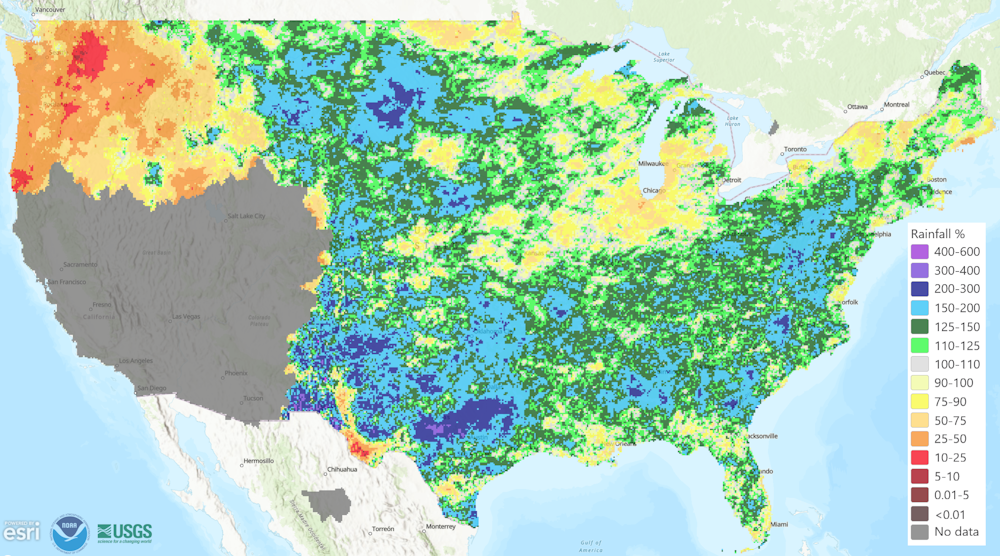
    Much of the central and eastern U.S. has had above-normal precipitation over the three months from April 23 through July 24, 2025. Blues are 150% to 200% of normal. Purples are even higher.
    NOAA National Water Prediction Service

    I study extreme precipitation events along with the complex processes that lead to the devastating damage they cause.

    Both the atmosphere and surface conditions play important roles in when and where flash floods occur and how destructive they become, and 2025 has seen some extremes, with large parts of the country east of the Rockies received at least 50% more precipitation than normal from mid-April through mid-July.

    Excess water vapor, weaker jet stream

    Flash floods are caused by excessive precipitation over short periods of time. When rain accumulates too fast for the local environment to absorb or reroute it, flooding ensues, and conditions can get dangerous fast.

    Flooding from heavy rain in the Boston area on July 10, 2025, shut down an interstate and filled streets and garages with water.
    John Tlumacki/The Boston Globe via Getty Images

    During the warm season, intrusions of tropical air with excessive water vapor are common in the U.S., and they can result in intense downpours.

    In addition, the jet stream and westerly winds – which move storm systems from west to east across the U.S. – tend to weaken during summer. As a result, the overall movement of thunderstorms and other precipitation-producing systems slows during the summer months, and storm systems can remain almost stationary over a location.

    The combination of intense rainfall rates and extended precipitation increases the likelihood of flash flooding.

    The surface rain falls on makes a difference, too

    Local surface characteristics also play important roles in how flash floods develop and evolve.

    When intense precipitation is combined with saturated soils, steep slopes, urban areas and sparse vegetation, runoff can quickly overwhelm local streams, rivers and drainage systems, leading to the rapid rise of water levels.

    When the remnants of Hurricane Helene hit the mountains of North Carolina in October 2024, the intense rainfall on steep slopes quickly filled streams and then rivers that washed away homes in their narrow valleys.
    Sean Rayford/Getty Images

    Because the characteristics of the surface can vary significantly along a stream or river, the timing and location of a heavy downpour pose unique risks for each local area.

    What’s driving flash floods in 2025?

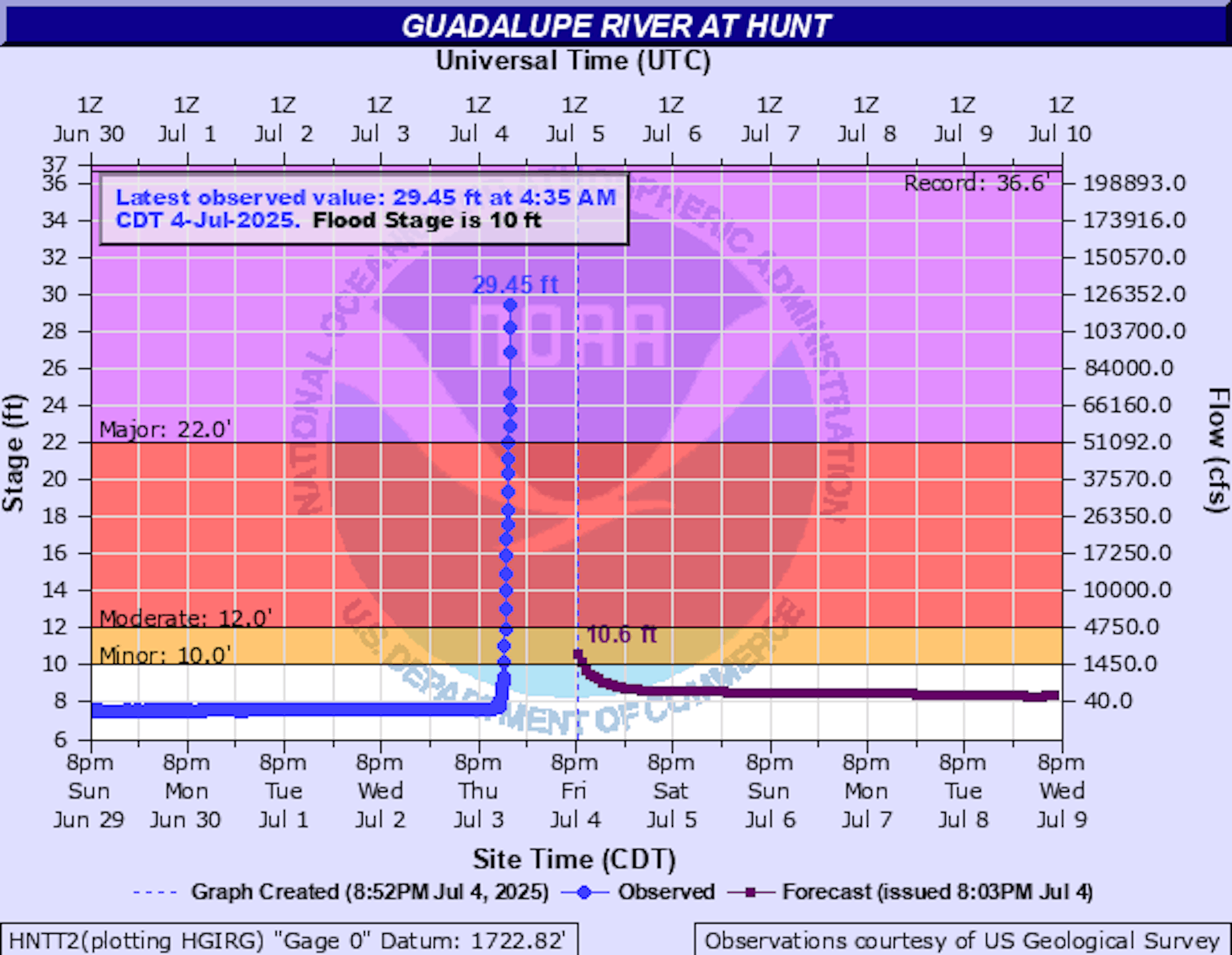
    During the horrific flooding in Texas Hill Country on July 4, 2025, that killed more than 135 people, atmospheric water vapor in the region was at or near historic levels. The storm hit at the headwaters of the Guadalupe River, over streams that converge in the river valley.

    As thunderstorms developed and remained nearly stationary over the region, they were fueled by the excessive atmospheric water vapor. That led to high rainfall rates. Hours of heavy rainfall early that morning sent the river rising quickly at a summer camp near Hunt, Texas, where more than two dozen girls and staff members died. Downstream at Kerrville, the river rose even faster, gaining more than 30 feet in 45 minutes.

    Overall, a persistent atmospheric pattern in late spring and summer 2025 has included a shift of the jet stream farther to the south than normal and, along with lower atmospheric pressures, has supported excessive rainfall across the central and eastern U.S.

    While the West Coast has experienced dry conditions in early summer 2025 due to a ridge of high pressure, the U.S. east of the Rockies has seen an active storm track with frontal boundaries and disturbances that produced thunderstorms and intense downpours across the region.

    Warmer-than-normal ocean water can also boost rainfall. The Caribbean and the Atlantic Ocean are source regions for atmospheric water vapor in the central and eastern U.S. In summer 2025, that water vapor has created extremely humid conditions, which have produced very high rainfall rates when storms develop.

    The result has been flash floods in several states producing catastrophic destruction and loss of life.

    Looking to the future

    The U.S. has seen devastating flash floods throughout its history, but rising global temperatures today are increasing the risk of flooding.

    As ocean and air temperatures rise, atmospheric water vapor increases. Higher ocean temperatures can produce more atmospheric water vapor through evaporation, and a warmer atmosphere can hold more moisture, fueling downpours. In some high-risk areas, meteorologists, aware of the risks, say they are becoming more proactive about warnings.

    Currently, evidence shows that atmospheric water vapor is increasing in the overall global climate system as temperatures rise.

    Jeffrey Basara receives funding from the National Science Foundation, NASA, and NOAA.

    ref. Why 2025 became the summer of flash flooding in America – https://theconversation.com/why-2025-became-the-summer-of-flash-flooding-in-america-261650

    MIL OSI

  • MIL-OSI: Donegal Group Inc. Announces Second Quarter and First Half 2025 Results

    Source: GlobeNewswire (MIL-OSI)

    MARIETTA, Pa., July 24, 2025 (GLOBE NEWSWIRE) — Donegal Group Inc. (NASDAQ: DGICA) and (NASDAQ: DGICB) today reported its financial results for the second quarter and first half of 2025.

    Significant Items for Second Quarter of 2025 (all comparisons to second quarter of 2024):

    • Net premiums earned decreased 1.1% to $231.8 million
    • Combined ratio of 97.7%, compared to 103.0%
    • Net income of $16.9 million, or 46 cents per diluted Class A share, compared to $4.2 million, or 13 cents per diluted Class A share
    • Net investment gains (after tax) of $1.2 million, or 3 cents per diluted Class A share, compared to $0.6 million, or 2 cents per diluted Class A share, are included in net income
    • Annualized return on average equity of 11.3%, compared to 3.4%
    • Book value per share of $16.62 at June 30, 2025, compared to $14.48 at June 30, 2024

    Financial Summary

      Three Months Ended June 30,   Six Months Ended June 30,
        2025       2024     % Change     2025       2024     % Change
      (dollars in thousands, except per share amounts)
                           
    Income Statement Data                      
    Net premiums earned $ 231,775     $ 234,311       -1.1 %   $ 464,476     $ 462,060       0.5 %
    Investment income, net   12,540       11,068       13.3       24,524       22,041       11.3  
    Net investment gains   1,544       737       109.5       1,073       2,850       -62.4  
    Total revenues   247,148       246,773       0.2       491,953       487,913       0.8  
    Net income   16,866       4,153       306.1       42,071       10,108       316.2  
    Non-GAAP operating income1   15,647       3,571       338.2       41,224       7,857       424.7  
    Annualized return on average equity   11.3 %     3.4 %   7.9 pts     14.6 %     4.2 %   10.4 pts
                           
    Per Share Data                      
    Net income – Class A (diluted) $ 0.46     $ 0.13       253.8 %   $ 1.17     $ 0.31       277.4 %
    Net income – Class B   0.43       0.11       290.9       1.08       0.28       285.7  
    Non-GAAP operating income – Class A (diluted)   0.43       0.11       290.9       1.14       0.24       375.0  
    Non-GAAP operating income – Class B   0.40       0.10       300.0       1.06       0.22       381.8  
    Book value   16.62       14.48       14.8       16.62       14.48       14.8  


    1The “Definitions of Non-GAAP Financial Measures” section of this release defines and reconciles data that we prepare on an accounting basis other than U.S. generally accepted accounting principles (“GAAP”).

    Management Commentary

    Kevin G. Burke, President and Chief Executive Officer of Donegal Group Inc., stated, “We are pleased with the progress we have made and the results we delivered for both the second quarter and first half of 2025, which we believe reflect the strength of our strategic execution and underwriting discipline. A meaningful improvement in our core loss ratio for both periods underscores our commitment to disciplined risk management and sustainable profitability. As expected, net premiums written1 declined this quarter, as lower new business writings and planned attrition modestly outpaced ongoing premium rate increases and solid retention levels. As a proactive measure, we intentionally slowed new business writings in our personal lines of business to protect underwriting margins and ensure we remain focused on profitable growth opportunities. We continue to identify and pursue profitable new business opportunities in states and classes that match our objectives.

    “We reached a significant milestone in our multi-year systems modernization project with the successful deployment of our final major commercial lines systems release. During the second half of 2025, we will begin to roll out this enhanced platform on a state-by-state basis, enabling us to more effectively target and win key middle market accounts. When the rollout is completed in the first half of 2026, we will be operating on a single modern technology platform for all of our middle market and small business commercial product offerings.

    “As we look ahead, we remain focused on disciplined execution, organizational alignment and operational excellence to further strengthen our long-term competitive position and enhance value for our stockholders.”

    Insurance Operations

    Donegal Group is an insurance holding company whose insurance subsidiaries and affiliates offer property and casualty lines of insurance in three Mid-Atlantic states (Delaware, Maryland and Pennsylvania), five Southern states (Georgia, North Carolina, South Carolina, Tennessee and Virginia), eight Midwestern states (Illinois, Indiana, Iowa, Michigan, Nebraska, Ohio, South Dakota and Wisconsin) and five Southwestern states (Arizona, Colorado, New Mexico, Texas and Utah). Donegal Mutual Insurance Company and the insurance subsidiaries of Donegal Group conduct business together as the Donegal Insurance Group.

      Three Months Ended June 30,   Six Months Ended June 30,
        2025       2024     % Change     2025       2024     % Change
      (dollars in thousands)
                           
    Net Premiums Earned                      
    Commercial lines $ 138,527     $ 134,489       3.0 %   $ 274,743     $ 266,581       3.1 %
    Personal lines   93,248       99,822       -6.6       189,733       195,479       -2.9  
    Total net premiums earned $ 231,775     $ 234,311       -1.1 %   $ 464,476     $ 462,060       0.5 %
                           
    Net Premiums Written                      
    Commercial lines:                      
    Automobile $ 50,584     $ 47,089       7.4 %   $ 107,109     $ 100,603       6.5 %
    Workers’ compensation   24,243       27,591       -12.1       52,997       58,665       -9.7  
    Commercial multi-peril   56,478       55,870       1.1       117,268       113,373       3.4  
    Other   13,609       11,698       16.3       28,158       25,101       12.2  
    Total commercial lines   144,914       142,248       1.9       305,532       297,742       2.6  
    Personal lines:                      
    Automobile   52,741       62,427       -15.5       107,933       123,808       -12.8  
    Homeowners   33,590       39,608       -15.2       62,378       71,367       -12.6  
    Other   2,568       2,906       -11.6       5,062       5,714       -11.4  
    Total personal lines   88,899       104,941       -15.3       175,373       200,889       -12.7  
    Total net premiums written $ 233,813     $ 247,189       -5.4 %   $ 480,905     $ 498,631       -3.6 %


    Net Premiums Written

    The 5.4% decrease in net premiums written for the second quarter of 2025 compared to the second quarter of 2024, as shown in the table above, represents the net combination of a 1.9% increase in commercial lines net premiums written and a 15.3% decrease in personal lines net premiums written. The $13.3 million decrease in net premiums written for the second quarter of 2025 compared to the second quarter of 2024 included:

    • Commercial Lines: $2.7 million increase that we attribute primarily to solid retention and a continuation of renewal premium increases in lines other than workers’ compensation, offset partially by lower new business writings.
    • Personal Lines: $16.0 million decrease that we attribute primarily to planned attrition due to lower new business writings and non-renewal actions, offset partially by a continuation of renewal premium rate increases and solid retention.

    Underwriting Performance

    We evaluate the performance of our commercial lines and personal lines segments primarily based upon the underwriting results of our insurance subsidiaries as determined under statutory accounting practices. The following table presents comparative details with respect to the GAAP and statutory combined ratios1 for the three and six months ended June 30, 2025 and 2024:

      Three Months Ended   Six Months Ended
      June 30   June 30
        2025       2024       2025       2024  
                   
    GAAP Combined Ratios (Total Lines)              
    Loss ratio – core losses   50.1 %     55.0 %     52.1 %     56.8 %
    Loss ratio – weather-related losses   11.1       10.6       7.4       7.7  
    Loss ratio – large fire losses   5.2       5.3       4.3       5.9  
    Loss ratio – net prior-year reserve development   -1.3       -0.3       -2.9       -2.0  
    Loss ratio   65.1       70.6       60.9       68.4  
    Expense ratio   32.2       31.9       33.4       33.8  
    Dividend ratio   0.4       0.5       0.3       0.5  
    Combined ratio   97.7 %     103.0 %     94.6 %     102.7 %
                   
    Statutory Combined Ratios              
    Commercial lines:              
    Automobile   97.7 %     93.5 %     94.6 %     96.6 %
    Workers’ compensation   104.9       117.0       111.3       114.2  
    Commercial multi-peril   97.5       110.6       93.9       106.7  
    Other   119.8       94.3       100.6       88.3  
    Total commercial lines   101.0       104.9       97.8       103.3  
    Personal lines:              
    Automobile   79.3       95.6       82.2       97.7  
    Homeowners   115.1       103.1       99.0       102.7  
    Other   55.2       104.7       55.9       94.8  
    Total personal lines   91.7       98.6       87.5       99.4  
    Total lines   97.4 %     102.2 %     93.9 %     101.7 %


    Loss Ratio

    For the second quarter of 2025, the loss ratio decreased to 65.1%, compared to 70.6% for the second quarter of 2024. For the commercial lines segment, the core loss ratio, which excludes weather-related losses, large fire losses and net development of reserves for losses incurred in prior accident years, of 54.5% for the second quarter of 2025 decreased modestly from 54.8% for the second quarter of 2024. For the personal lines segment, the core loss ratio of 43.3% for the second quarter of 2025 decreased from 55.3% for the second quarter of 2024, due largely to the favorable impact of premium rate increases on net premiums earned for that segment.

    Weather-related losses were $25.8 million, or 11.1 percentage points of the loss ratio, for the second quarter of 2025, compared to $24.7 million, or 10.6 percentage points of the loss ratio, for the second quarter of 2024. Weather-related loss activity for the second quarter of 2025 was higher than our previous five-year average of $18.9 million, or 9.2 percentage points of the loss ratio, for second-quarter weather-related losses. Atlantic States Insurance Company, our largest insurance subsidiary, incurred $3.0 million in net losses from a catastrophic wind and hail loss event in April 2025, with Donegal Mutual assuming losses that subsidiary incurred from the event in excess of its retention under an intercompany catastrophe reinsurance agreement.

    Large fire losses, which we define as individual fire losses in excess of $50,000, for the second quarter of 2025 were $12.1 million, or 5.2 percentage points of the loss ratio. That amount was comparable to the large fire losses of $12.5 million, or 5.3 percentage points of the loss ratio, for the second quarter of 2024. We experienced a modest decrease in commercial property fire losses that was partially offset by a modest increase in homeowners fire losses compared to the prior-year quarter.

    Net favorable development of reserves for losses incurred in prior accident years reduced the loss ratio by 1.3 percentage points for the second quarter of 2025 and had virtually no impact for the second quarter of 2024. Our insurance subsidiaries experienced favorable development primarily in the personal automobile and homeowners lines of business, partially offset by adverse development in other commercial lines that we primarily attribute to higher-than-anticipated case reserve development.

    Expense Ratio

    The expense ratio was 32.2% for the second quarter of 2025, compared to 31.9% for the second quarter of 2024. The increase in the expense ratio primarily reflected higher underwriting-based incentive costs for agents and employees, partially offset by the favorable impact of ongoing expense management initiatives. The impact from costs that Donegal Mutual Insurance Company allocated to our insurance subsidiaries related to its ongoing systems modernization project peaked at approximately 1.3 percentage points of the full year 2024 expense ratio, and we expect that impact to subside gradually over the next several years. Allocated costs related to that project represented approximately 1.0 percentage point of the expense ratio for the second quarter of 2025, and we expect the full year 2025 expense ratio impact will also be approximately 1.0 percentage point.

    Investment Operations

    Donegal Group’s investment strategy is to generate an appropriate amount of after-tax income on its invested assets while minimizing credit risk through investment in high-quality securities. As a result, we had invested 95.4% of our consolidated investment portfolio in diversified, highly rated and marketable fixed-maturity securities at June 30, 2025.

      June 30, 2025   December 31, 2024
      Amount   %   Amount   %
      (dollars in thousands)
    Fixed maturities, at carrying value:              
    U.S. Treasury securities and obligations of U.S.            
    government corporations and agencies $ 145,585       10.2 %   $ 170,423       12.3 %
    Obligations of states and political subdivisions   424,010       29.7       409,560       29.6  
    Corporate securities   441,603       30.9       440,552       31.8  
    Mortgage-backed securities   353,639       24.7       304,459       22.0  
    Allowance for expected credit losses   (1,374 )     -0.1       (1,388 )     -0.1  
    Total fixed maturities   1,363,463       95.4       1,323,606       95.6  
    Equity securities, at fair value   41,007       2.9       36,808       2.6  
    Short-term investments, at cost   24,764       1.7       24,558       1.8  
    Total investments $ 1,429,234       100.0 %   $ 1,384,972   100.0 %
                   
    Average investment yield   3.5 %         3.3 %    
    Average tax-equivalent investment yield   3.6 %         3.4 %    
    Average fixed-maturity duration (years)   5.2           5.2      


    Net investment income of $12.5 million for the second quarter of 2025 increased 13.3% compared to $11.1 million for the second quarter of 2024. The increase in net investment income primarily reflected an increase in average investment yield relative to the prior-year second quarter.

    Net investment gains of $1.5 million for the second quarter of 2025 were primarily related to unrealized gains in the fair value of equity securities held at June 30, 2025, offset partially by net realized investment losses on the sale of available-for-sale fixed-maturity securities. Net investment gains of $0.7 million for the second quarter of 2024 were primarily related to unrealized gains in the fair value of equity securities held at June 30, 2024.

    Our book value per share was $16.62 at June 30, 2025, compared to $15.36 at December 31, 2024, with the increase related to net income as well as $10.7 million of after-tax unrealized gains within our available-for-sale fixed-maturity portfolio during 2025 that increased our book value by $0.31 per share, offset partially by cash dividends declared.

    Definitions of Non-GAAP Financial Measures

    We prepare our consolidated financial statements on the basis of GAAP. Our insurance subsidiaries also prepare financial statements based on statutory accounting principles state insurance regulators prescribe or permit (“SAP”). In addition to using GAAP-based performance measurements, we also utilize certain non-GAAP financial measures that we believe provide value in managing our business and for comparison to the financial results of our peers. These non-GAAP measures are net premiums written, operating income or loss and statutory combined ratio.

    Net premiums written and operating income or loss are non-GAAP financial measures investors in insurance companies commonly use. We define net premiums written as the amount of full-term premiums our insurance subsidiaries record for policies effective within a given period less premiums our insurance subsidiaries cede to reinsurers. We define operating income or loss as net income or loss excluding after-tax net investment gains or losses, after-tax restructuring charges and other significant non-recurring items. Because our calculation of operating income or loss may differ from similar measures other companies use, investors should exercise caution when comparing our measure of operating income or loss to the measure of other companies.

    The following table provides a reconciliation of net premiums earned to net premiums written for the periods indicated:

      Three Months Ended June 30,   Six Months Ended June 30,
        2025       2024     % Change     2025       2024     % Change
      (dollars in thousands)
                           
    Reconciliation of Net Premiums                      
    Earned to Net Premiums Written                      
    Net premiums earned $ 231,775     $ 234,311       -1.1 %   $ 464,476     $ 462,060       0.5 %
    Change in net unearned premiums   2,038       12,878       -84.2       16,429       36,571       -55.1  
    Net premiums written $ 233,813     $ 247,189       -5.4 %   $ 480,905     $ 498,631       -3.6 %


    The following table provides a reconciliation of net income to operating income for the periods indicated:

      Three Months Ended June 30,   Six Months Ended June 30,
        2025       2024     % Change     2025       2024     % Change
      (dollars in thousands, except per share amounts)
                           
    Reconciliation of Net Income                      
    to Non-GAAP Operating Income                      
    Net income $ 16,866     $ 4,153       306.1 %   $ 42,071     $ 10,108       316.2 %
    Investment gains (after tax)   (1,219 )     (582 )     109.5       (847 )     (2,251 )     -62.4  
    Non-GAAP operating income $ 15,647     $ 3,571       338.2 %   $ 41,224     $ 7,857       424.7 %
                           
    Per Share Reconciliation of Net Income                      
    to Non-GAAP Operating Income                      
    Net income – Class A (diluted) $ 0.46     $ 0.13       253.8 %   $ 1.17     $ 0.31       277.4 %
    Investment gains (after tax)   (0.03 )     (0.02 )     50.0       (0.03 )     (0.07 )     -57.1  
    Non-GAAP operating income – Class A $ 0.43     $ 0.11       290.9 %   $ 1.14     $ 0.24       375.0 %
                           
    Net income – Class B $ 0.43     $ 0.11       290.9 %   $ 1.08     $ 0.28       285.7 %
    Investment gains (after tax)   (0.03 )     (0.01 )     200.0       (0.02 )     (0.06 )     -66.7  
    Non-GAAP operating income – Class B $ 0.40     $ 0.10       300.0 %   $ 1.06     $ 0.22       381.8 %


    The statutory combined ratio is a non-GAAP standard measurement of underwriting profitability that is based upon amounts determined under SAP. The statutory combined ratio is the sum of:

    • the statutory loss ratio, which is the ratio of calendar-year incurred losses and loss expenses, excluding anticipated salvage and subrogation recoveries, to premiums earned;
    • the statutory expense ratio, which is the ratio of expenses incurred for net commissions, premium taxes and underwriting expenses to premiums written; and
      • the statutory dividend ratio, which is the ratio of dividends to holders of workers’ compensation policies to premiums earned.

    The statutory combined ratio does not reflect investment income, federal income taxes or other non-operating income or expense. A statutory combined ratio of less than 100% generally indicates underwriting profitability.

    Dividend Information

    On July 17, 2025, we declared a regular quarterly cash dividend of $0.1825 per share for our Class A common stock and $0.165 per share for our Class B common stock, which are payable on August 15, 2025 to stockholders of record as of the close of business on August 1, 2025.

    Pre-Recorded Webcast

    At approximately 8:30 am ET on Thursday, July 24, 2025, we will make available in the Investors section of our website a pre-recorded audio webcast featuring management commentary on our quarterly results and general business updates. You may listen to the pre-recorded webcast by accessing the link on our website at http://investors.donegalgroup.com. A supplemental investor presentation is also available via our website.

    About the Company

    Donegal Group Inc. is an insurance holding company whose insurance subsidiaries and affiliates offer property and casualty lines of insurance in certain Mid-Atlantic, Midwestern, Southern and Southwestern states. Donegal Mutual Insurance Company and the insurance subsidiaries of Donegal Group Inc. conduct business together as the Donegal Insurance Group. The Donegal Insurance Group has an A.M. Best rating of A (Excellent).

    The Class A common stock and Class B common stock of Donegal Group Inc. trade on the NASDAQ Global Select Market under the symbols DGICA and DGICB, respectively. We are focused on several primary strategies, including achieving sustained excellent financial performance, strategically modernizing our operations and processes to transform our business, capitalizing on opportunities to grow profitably and providing superior experiences to our agents, policyholders and employees.

    Safe Harbor

    We base all statements contained in this release that are not historic facts on our current expectations. Such statements are forward-looking in nature (as defined in the Private Securities Litigation Reform Act of 1995) and necessarily involve risks and uncertainties. Forward-looking statements we make may be identified by our use of words such as “will,” “expect,” “intend,” “plan,” “anticipate,” “believe,” “seek,” “estimate” and similar expressions. Our actual results could vary materially from our forward-looking statements. The factors that could cause our actual results to vary materially from the forward-looking statements we have previously made include, but are not limited to, adverse litigation and other trends that could increase our loss costs (including social inflation, labor shortages and escalating medical, automobile and property repair costs, including due to tariffs), adverse and catastrophic weather events (including from changing climate conditions), our ability to maintain profitable operations (including our ability to underwrite risks effectively and charge adequate premium rates), the adequacy of the loss and loss expense reserves of our insurance subsidiaries, the availability and successful operation of the information technology systems our insurance subsidiaries utilize, the successful development of new information technology systems to allow our insurance subsidiaries to compete effectively, business and economic conditions in the areas in which we and our insurance subsidiaries operate, interest rates, competition from various insurance and other financial businesses, terrorism, the availability and cost of reinsurance, legal and judicial developments, changes in regulatory requirements, our ability to attract and retain independent insurance agents, changes in our A.M. Best rating and the other risks that we describe from time to time in our filings with the Securities and Exchange Commission. We disclaim any obligation to update such statements or to announce publicly the results of any revisions that we may make to any forward-looking statements to reflect the occurrence of anticipated or unanticipated events or circumstances after the date of such statements.

    Investor Relations Contacts

    Karin Daly, Vice President, The Equity Group Inc.

    Phone: (212) 836-9623
    E-mail: kdaly@theequitygroup.com

    Jeffrey D. Miller, Executive Vice President & Chief Financial Officer
    Phone: (717) 426-1931
    E-mail: investors@donegalgroup.com

    Financial Supplement

    Donegal Group Inc.
    Consolidated Statements of Income
    (unaudited; in thousands, except share data)
           
      Quarter Ended June 30,
        2025       2024  
           
    Net premiums earned $ 231,775     $ 234,311  
    Investment income, net of expenses   12,540       11,068  
    Net investment gains   1,544       737  
    Lease income   76       78  
    Installment payment fees   844       579  
    Other income, net   369        
    Total revenues   247,148       246,773  
           
    Net losses and loss expenses   150,917       165,360  
    Amortization of deferred acquisition costs   39,501       40,656  
    Other underwriting expenses   35,150       34,037  
    Policyholder dividends   819       1,187  
    Interest   337       155  
    Other expenses, net         365  
    Total expenses   226,724       241,760  
           
    Income before income tax expense   20,424       5,013  
    Income tax expense   3,558       860  
           
    Net income $ 16,866     $ 4,153  
           
    Net income per common share:      
    Class A – basic $ 0.47     $ 0.13  
    Class A – diluted $ 0.46     $ 0.13  
    Class B – basic and diluted $ 0.43     $ 0.11  
           
    Supplementary Financial Analysts’ Data      
           
    Weighted-average number of shares      
    outstanding:      
    Class A – basic   30,678,158       27,844,811  
    Class A – diluted   31,336,862       27,844,903  
    Class B – basic and diluted   5,576,775       5,576,775  
           
    Net premiums written $ 233,813     $ 247,189  
           
    Book value per common share      
    at end of period $ 16.62     $ 14.48  
           
    Annualized operating return on average equity   11.3 %     3.4 %
    Donegal Group Inc.
    Consolidated Statements of Income
    (unaudited; in thousands, except share data)
           
      Six Months Ended June 30,
        2025       2024  
           
    Net premiums earned $ 464,476     $ 462,060  
    Investment income, net of expenses   24,524       22,041  
    Net investment gains   1,073       2,850  
    Lease income   153       159  
    Installment payment fees   1,727       803  
    Total revenues   491,953       487,913  
           
    Net losses and loss expenses   282,950       316,257  
    Amortization of deferred acquisition costs   78,732       80,258  
    Other underwriting expenses   76,345       75,777  
    Policyholder dividends   1,578       2,241  
    Interest   670       309  
    Other expenses, net   93       810  
    Total expenses   440,368       475,652  
           
    Income before income tax expense   51,585       12,261  
    Income tax expense   9,514       2,153  
           
    Net income $ 42,071     $ 10,108  
           
    Net income per common share:      
    Class A – basic $ 1.19     $ 0.31  
    Class A – diluted $ 1.17     $ 0.31  
    Class B – basic and diluted $ 1.08     $ 0.28  
           
    Supplementary Financial Analysts’ Data      
           
    Weighted-average number of shares      
    outstanding:      
    Class A – basic   30,400,944       27,828,062  
    Class A – diluted   30,884,992       27,845,608  
    Class B – basic and diluted   5,576,775       5,576,775  
           
    Net premiums written $ 480,905     $ 498,631  
           
    Book value per common share      
    at end of period $ 16.62     $ 14.48  
           
    Annualized operating return on average equity   14.6 %     4.2 %
    Donegal Group Inc.
    Consolidated Balance Sheets
    (in thousands)
           
      June 30,   December 31,
        2025       2024  
      (unaudited)    
           
    ASSETS
    Investments:      
    Fixed maturities:      
    Held to maturity, at amortized cost $ 737,356     $ 705,714  
    Available for sale, at fair value   626,107       617,892  
    Equity securities, at fair value   41,007       36,808  
    Short-term investments, at cost   24,764       24,558  
    Total investments   1,429,234       1,384,972  
        57,437       52,926  
    Premiums receivable   198,885       181,107  
    Reinsurance receivable   411,125       420,742  
    Deferred policy acquisition costs   76,620       73,347  
    Prepaid reinsurance premiums   182,795       176,162  
    Other assets   51,739       46,776  
    Total assets $ 2,407,835     $ 2,336,032  
           
    LIABILITIES AND STOCKHOLDERS’ EQUITY
    Liabilities:      
    Losses and loss expenses $ 1,117,010     $ 1,120,985  
    Unearned premiums   635,538       612,476  
    Borrowings under lines of credit   35,000       35,000  
    Other liabilities   14,618       21,795  
    Total liabilities   1,802,166       1,790,256  
    Stockholders’ equity:      
    Class A common stock   339       329  
    Class B common stock   56       56  
    Additional paid-in capital   383,546       369,680  
    Accumulated other comprehensive loss   (17,517 )     (28,200 )
    Retained earnings   280,471       245,137  
    Treasury stock   (41,226 )     (41,226 )
    Total stockholders’ equity   605,669       545,776  
    Total liabilities and stockholders’ equity $ 2,407,835     $ 2,336,032  

    The MIL Network

  • MIL-Evening Report: Grattan on Friday: net zero battle has net zero positives for Sussan Ley

    Source: The Conversation (Au and NZ) – By Michelle Grattan, Professorial Fellow, University of Canberra

    There’s no other way of looking at it: Sussan Ley faces a diabolical situation with the debate over whether the Coalition should abandon the 2050 net zero emissions target.

    The issue is a microcosm of her wider problems. The Nationals, the minor party in the Coalition, are determined to run their own race on most things. The Liberals have become akin to two parties, split between those eyeing urban seats and younger voters, and right-wingers reflecting the party’s conservative grassroots.

    Nobody misses the contrast. The Albanese government is beset by a host of actual issues around the transition to a clean energy economy. The renewables rollout is not going as fast as desirable and is meeting with resistance in some communities. Energy costs are high. But such problems are not putting any pressure on Labor’s unity.

    At the same time, the opposition is fractured over an argument about a target that’s a quarter of a century away, when who knows what the technological or political landscape will look like. For the opposition, the internal debate about net zero is about symbols and signals, rather than substance.

    The net zero debate exploded within the opposition this week with Barnaby Joyce’s private member’s bill to scrap Australia’s commitment to it. The timing, in parliament’s first week, was extraordinarily inconvenient for Ley. But if not now, it would have erupted later.

    On present indications, the Nationals appear likely to ditch the net zero commitment. David Littleproud, anxious to avoid the issue becoming a threat to his leadership, is reading the party room and positioning himself to be in the anticipated majority.

    Asked on Thursday whether he supported net zero, Littleproud told the ABC, “well, I have real concerns about it, to be candid. What net zero has become is about trying to achieve the impossible, rather than doing what’s sensible.” But, he insisted, “we’re not climate deniers”.

    It is less clear how the debate will pan out in the Liberal Party, once the group under Shadow Energy Minister Dan Tehan produces its report on energy and emissions-reduction policy.

    Liberal sources say the issue is now being driven by the party’s grassroots, rather than the parliamentary party. Branches are throwing up motions to get rid of the 2050 target.

    The Western Australian Liberal state council will debate a motion this weekend to drop the net zero commitment. The Queensland LNP organisation will consider its position next month. A few weeks ago, the South Australian Liberal state council rejected net zero.

    With a policy review underway, Ley and the parliamentary Liberals have left a vacuum on the issue. Some Liberals warn the parliamentarians risk being run over by the party outside parliament. Others point out that on policy, the parliamentarians are independent of the organisation, which often comes up with right-wing motions.

    How should Ley best handle the situation? By filling the vacuum with a position sooner rather than later. That means accelerating the Tehan report. Beyond that, ideally she should be taking leadership on the issue herself. But is she in a strong enough position to do that?

    One idea being floated would be for the Liberals to retain the net zero target but extend the time frame. This wouldn’t stop the criticism about the shift.

    Whether the Coalition could stay as one if its two parties had different positions on net zero may be an open question but it certainly would be messy.

    On the other side of politics, the government is rapidly approaching a decision on another key target – the one Australia will put up internationally for cutting emissions by 2035. Inevitably, this will be contentious.

    This target must be submitted by September (it was conveniently delayed beyond the election). Minister for Climate Change and Energy Chris Bowen has yet to receive advice on the target from the Climate Change Authority (advice that will be published). The target is expected to be between 65% and 75%.

    The challenge will be to strike a target with sufficient ambition that doesn’t alienate business and the regions.

    Next week the executive secretary of the United Nations Framework Convention on Climate Change, Simon Stiell, will be in Canberra for talks. His comments will be carefully watched.

    Last year he told the Sydney Morning Herald, “the world needs countries like Australia to take climate action and ambition to the next level, and it’s firmly in the interests of every Australian that they do so”.

    Climate and energy issues will have a place at next month’s economic reform roundtable. Bowen is organising two preliminary roundtables – on electricity, with energy user stakeholders, and on climate adaptation. He told The Conversation’s podcast that adaptation will “be an increasing focus of this government and future governments because, tragically, the world has left it too late to avoid the impacts of climate change”.

    The government is waiting, somewhat impatiently, for the decision on whether Australia will be given the nod to host next year’s UN climate conference. The COP meeting, which would be in Adelaide in November 2026, is an enormous event to put on, so the decision is becoming urgent.

    Bowen says Australia already has the numbers over Turkey, the other contender. But “one of the things about the process to decide COPs, I’ve learnt, is it’s quite opaque and there’s no particular timeline and no particular rules to the ballot.

    “It’s meant to work on a consensus, sort of an old world, sort of gentlemanly sort of approach to say whoever loses will withdraw. That’s not the way it’s panning out. I’ve had multiple meetings with my Turkish counterpart to try to find a ‘win-win’ solution. We haven’t been able to find that yet.”

    Stiell’s trip includes Turkey as well as Australia. Bowen will be hoping he may provide some clarity, when they meet, about how the “opaque” process of assigning the COP meeting is going. Bowen will be emphasising how important the proposed co-hosting COP with the Pacific is to the region, with climate change already an existential issue for many Pacific countries.

    Michelle Grattan does not work for, consult, own shares in or receive funding from any company or organisation that would benefit from this article, and has disclosed no relevant affiliations beyond their academic appointment.

    ref. Grattan on Friday: net zero battle has net zero positives for Sussan Ley – https://theconversation.com/grattan-on-friday-net-zero-battle-has-net-zero-positives-for-sussan-ley-261092

    MIL OSI AnalysisEveningReport.nz

  • MIL-OSI Africa: Africa Finance Corporation (AFC) Fuels Africa’s Mining Ambitions as Silver Sponsor of African Mining Week (AMW) 2025

    Source: APO


    .

    Africa Finance Corporation (AFC), a leading multilateral finance institution, has joined the upcoming African Mining Week (AMW) 2025 as a Silver Sponsor. Held under the theme, From Extraction to Beneficiation: Unlocking Africa’s Mineral Wealth, AMW offers a strategic platform for AFC to engage with African and global mining stakeholders to advance the continent’s mineral development agenda.

    As part of the conference program, AFC will feature in a dedicated finance panel: “The Investor Perspective – Financing Africa’s Mineral Industrialization.” The session will explore how tailored financing solutions can drive local beneficiation, industrialization and inclusive economic growth across Africa’s mining value chains.

    AMW serves as a premier platform for exploring the full spectrum of mining opportunities across Africa. The event is held alongside the African Energy Week: Invest in African Energies 2025 conference from October 1-3 in Cape Town. Sponsors, exhibitors and delegates can learn more by contacting sales@energycapitalpower.com.

    The AFC’s involvement in AMW 2025 comes at a time of expanded capital mobilization efforts. In June 2025, the Corporation secured a €250 million, 10-year loan from Italy’s Cassa Depositi e Prestiti to catalyze Italian investment in African mining and energy infrastructure projects – particularly the strategic Lobito Corridor, enhancing mineral transport between Angola, Zambia and the Democratic Republic of Congo. This initiative complements a proposed €320 million EU financing package supporting the same corridor.

    In February 2025, the European Investment Bank committed $750 million to AFC’s Climate Resilient Infrastructure Fund, targeting climate-focused projects including energy transition metals and sustainable logistics infrastructure. The same month, AFC also secured a $400 million Shariah-compliant facility from Islamic financiers, following a $500 million hybrid bond issuance in January and a $30 million equity investment from the African Development Bank in December 2024.

    AFC’s capital base has also grown with a $184.8 million equity injection from Angola, reflecting the country’s continued collaboration with AFC following over $1 billion in investments in mining, energy and transport. Meanwhile, a €100 million loan extended to construction group Mota–Engil is enabling the execution of three major gold mining contracts in Ivory Coast and Mali – Africa’s second- and third-largest gold producers.

    Against this backdrop, AMW 2025 provides a timely opportunity for the AFC to showcase its financing strategy, highlight its role in advancing Africa’s mineral beneficiation and connect with mining ventures in search of capital.

    Distributed by APO Group on behalf of Energy Capital & Power.

    MIL OSI Africa

  • MIL-OSI United Nations: 24 July 2025 Departmental update WHO unveils health and environment scorecards for 194 countries

    Source: World Health Organisation

    The World Health Organization (WHO) has released the 2024 update of its health and environment country scorecards, assessing how countries are managing eight major environmental threats to health across sectors. These threats include air pollution, unsafe water, sanitation and hygiene (WASH), climate change, loss of biodiversity, exposure to chemicals, and radiation, occupational risks, and environmental risks in and around health care facilities. This year’s edition also introduces a new summary score, offering a concise snapshot of how environmental conditions are impacting people’s health.

    WHO’s health and environment country scorecards serve as a valuable tool for guiding national action. They provide detailed data across the eight key areas linking environment, climate change, and health policies, promoting cross-sectoral engagement, and helping governments prioritize evidence-based interventions. 

    “Tackling environmental risks isn’t optional—it’s a prescription for better health, stronger economies, and a safer future. You can’t have healthy people on a sick planet,” said Dr Maria Neira, WHO Director, Department of Environment, Climate Change and Health. “We urge all countries to take bold, coordinated action across sectors to reduce environmental threats. Investing in clean air, safe water, and climate-protective policies is not just good for the planet. It’s essential for the health and future of their people.”

    From among countries, Norway and Canada received the highest scores overall. Among income groups, Argentina scored highest for upper-middle-income countries, Jordan for lower-middle-income, and Malawi for low-income countries. European countries led in regional averages, followed by the Americas, Western Pacific, and Eastern Mediterranean, and other regions.

    In this third round of scorecards, the introduction of the summary score marks a significant step forward in helping countries prioritize action on health and environment. The summary score is designed to condense a wide range of environmental health indicators into a single, accessible measure. Comprising 25 key indicators across environment, climate change, and health, the score enables countries to track progress at national, regional, and global levels—highlighting trends in exposures, health impacts, policy implementation, as well as identifying critical data gaps.

    The scorecards support countries in conducting situation assessments and setting evidence-based priorities for action. While large disparities exist between countries, shaped in part by differing levels of economic resources, every country has an opportunity to strengthen efforts to reduce environmental health risks.

    “The updated scorecards, together with the summary score, now bring new visibility to the links between environment and health at country level,” said Dr Annette Pruess, Unit Head, Department of Environment, Climate Change and Health, WHO. “This is a powerful tool for governments to identify challenges and shape targeted responses.”

    About 25% of the global burden of disease is linked to environmental threats that are largely preventable. By addressing these environmental risk factors through stronger policies, cleaner technologies, and sustainable practices, we can significantly reduce preventable illnesses and deaths—improving health outcomes while protecting our planet.

    MIL OSI United Nations News

  • MIL-OSI Europe: Italy: EIB and Eni sign €500 million finance agreement to convert Livorno refinery into a biorefinery

    Source: European Investment Bank

    EIB

    • This will be Eni’s third biorefinery in Italy, after those in Venice and Gela.
    • Among the distinctive features of the project, in addition to the use of advanced technologies, there is the possibility of adapting the plant to also produce SAF (sustainable aviation fuel) in the future.
    • This initiative contributes to the European Union’s decarbonisation goals, with particular reference to the transport sector, and confirms Eni’s energy transition path.
    • The project is part of Enilive’s strategy to reach more than five million tonnes of biorefinery capacity by 2030.

    The European Investment Bank (EIB) and Eni have signed a €500 million 15-year finance contract to support the conversion of Eni’s Livorno refinery in Tuscany into a biorefinery. The agreement was signed today at Eni’s headquarters in San Donato Milanese by EIB Vice-President Gelsomina Vigliotti and Eni CEO Claudio Descalzi.

    Eni’s project involves the construction of new plants to produce hydrogenated biofuels at the Livorno refinery site, including a biogenic pre-treatment unit and a 500 000-tonne/year Ecofining™ plant.

    Thanks to its proprietary Ecofining™ technology, Eni’s company dedicated to sustainable mobility, Enilive, produces HVO (hydrogenated vegetable oil) – a biofuel made from renewable raw materials[1] such as used cooking oil and agrifood waste. Pure HVO can now be used in approved engines and is distributed through existing infrastructure.

    EIB Vice-President Gelsomina Vigliotti said: “The EIB financing is key to delivering a project of high environmental, technological and strategic value, helping to promote the decarbonisation of the transport sector. This is a concrete example of how industrial innovation can accelerate the path towards climate neutrality, while generating sustainable value for regions.”

    Eni CEO Claudio Descalzi said: “The agreement with the EIB confirms Eni’s concrete and high-quality commitment in the transition towards increasingly decarbonized energy. It also underscores the validity of our approach, which is to invest and leverage all available and effective initiatives and technologies for reducing emissions. This virtuous approach is now leading us to convert a third refinery into a biorefinery in Italy, following the examples of Venice and Gela.”

    HVO biofuels play a key role because they can make an immediate contribution to reducing transport sector emissions generated not only on roads, but also by air traffic, maritime and rail transport (calculated along the entire value chain). The conversion of the Livorno site is in line with Enilive’s strategy to increase the production of biofuels in response to growing demand in Europe and Italy, in order to meet both emission reduction targets under RED III (Renewable Energy Directive) and the obligations to release pure biofuels for use as defined by Italian legislation. Worldwide, it is estimated that the demand for hydrogenated biofuels will increase by 65% over the period 2024-2028[2].

    The Livorno biorefinery will be able to treat different types of biogenic charges, mainly waste and residues of plant origin, to produce HVO diesel, HVO naphtha and bio-LPG.

    Among the distinctive features of the project, in addition to the adoption of advanced technologies, there is the possibility in the future of modifying the layout of the plant to have the flexibility to also produce sustainable aviation fuel (SAF), which is a key element of efforts to decarbonise aviation. This gives flexibility to the investment and brings it up to speed with the environmental priorities of the European Union, broadening the potential impact.

    This operation is part of the energy transition at national and European level, contributing substantially to decarbonisation of the transport sector and the reduction of CO2 emissions. It also supports the achievement of Italy’s targets for the production of pure biofuels, which under current legislation provides for a gradual increase in use from 300 000 tonnes per year in 2023 to one million tonnes by 2030.

    Background information

    The European Investment Bank (ElB) is the long-term lending institution of the European Union, owned by its Member States. It finances investments that contribute to EU policy objectives. EIB projects bolster competitiveness, drive innovation, promote sustainable development, enhance social and territorial cohesion, and support a just and swift transition to climate neutrality. In the last five years, the EIB Group has provided more than €58 billion in financing for projects in Italy. All projects financed by the EIB Group are in line with the Paris Climate Agreement. The EIB Group does not fund investments in fossil fuels. We are on track to deliver on our commitment to support €1 trillion in climate and environmental sustainability investment in the decade to 2030 as pledged in our Climate Bank Roadmap. Over half of the EIB Group’s annual financing supports projects directly contributing to climate change mitigation and adaptation, and a healthier environment. Approximately half of the EIB’s financing within the European Union is directed towards cohesion regions, where per capita income is lower.

    Eni is a global energy tech company operating in 64 Countries, with about 32.500 employees. Originally an oil & gas company, it has evolved into an integrated energy company, playing a key role in ensuring energy security and leading the energy transition. Eni’s goal is to achieve carbon neutrality by 2050 through the decarbonization of its processes and of the products it sells to its customers. In line with this goal, Eni invests in the research and development of technologies that can accelerate the transition to increasingly sustainable energy. Renewable energy sources, bio-refining, carbon capture and storage are only some examples of Eni’s areas of activity and research. In addition, the company is exploring game-changing technologies such as fusion energy – a technology based on the physical processes that power stars and that could generate safe, virtually limitless energy with zero emissions.


    [1] In accordance with the EU Renewable Energy Directive

    [2] IEA Renewables 2023 report, main case, analysis and forecast to 2028.

    MIL OSI Europe News

  • MIL-OSI Europe: Italy: EIB and Eni sign €500 million finance agreement to convert Livorno refinery into a biorefinery

    Source: European Investment Bank

    EIB

    • This will be Eni’s third biorefinery in Italy, after those in Venice and Gela.
    • Among the distinctive features of the project, in addition to the use of advanced technologies, there is the possibility of adapting the plant to also produce SAF (sustainable aviation fuel) in the future.
    • This initiative contributes to the European Union’s decarbonisation goals, with particular reference to the transport sector, and confirms Eni’s energy transition path.
    • The project is part of Enilive’s strategy to reach more than five million tonnes of biorefinery capacity by 2030.

    The European Investment Bank (EIB) and Eni have signed a €500 million 15-year finance contract to support the conversion of Eni’s Livorno refinery in Tuscany into a biorefinery. The agreement was signed today at Eni’s headquarters in San Donato Milanese by EIB Vice-President Gelsomina Vigliotti and Eni CEO Claudio Descalzi.

    Eni’s project involves the construction of new plants to produce hydrogenated biofuels at the Livorno refinery site, including a biogenic pre-treatment unit and a 500 000-tonne/year Ecofining™ plant.

    Thanks to its proprietary Ecofining™ technology, Eni’s company dedicated to sustainable mobility, Enilive, produces HVO (hydrogenated vegetable oil) – a biofuel made from renewable raw materials[1] such as used cooking oil and agrifood waste. Pure HVO can now be used in approved engines and is distributed through existing infrastructure.

    EIB Vice-President Gelsomina Vigliotti said: “The EIB financing is key to delivering a project of high environmental, technological and strategic value, helping to promote the decarbonisation of the transport sector. This is a concrete example of how industrial innovation can accelerate the path towards climate neutrality, while generating sustainable value for regions.”

    Eni CEO Claudio Descalzi said: “The agreement with the EIB confirms Eni’s concrete and high-quality commitment in the transition towards increasingly decarbonized energy. It also underscores the validity of our approach, which is to invest and leverage all available and effective initiatives and technologies for reducing emissions. This virtuous approach is now leading us to convert a third refinery into a biorefinery in Italy, following the examples of Venice and Gela.”

    HVO biofuels play a key role because they can make an immediate contribution to reducing transport sector emissions generated not only on roads, but also by air traffic, maritime and rail transport (calculated along the entire value chain). The conversion of the Livorno site is in line with Enilive’s strategy to increase the production of biofuels in response to growing demand in Europe and Italy, in order to meet both emission reduction targets under RED III (Renewable Energy Directive) and the obligations to release pure biofuels for use as defined by Italian legislation. Worldwide, it is estimated that the demand for hydrogenated biofuels will increase by 65% over the period 2024-2028[2].

    The Livorno biorefinery will be able to treat different types of biogenic charges, mainly waste and residues of plant origin, to produce HVO diesel, HVO naphtha and bio-LPG.

    Among the distinctive features of the project, in addition to the adoption of advanced technologies, there is the possibility in the future of modifying the layout of the plant to have the flexibility to also produce sustainable aviation fuel (SAF), which is a key element of efforts to decarbonise aviation. This gives flexibility to the investment and brings it up to speed with the environmental priorities of the European Union, broadening the potential impact.

    This operation is part of the energy transition at national and European level, contributing substantially to decarbonisation of the transport sector and the reduction of CO2 emissions. It also supports the achievement of Italy’s targets for the production of pure biofuels, which under current legislation provides for a gradual increase in use from 300 000 tonnes per year in 2023 to one million tonnes by 2030.

    Background information

    The European Investment Bank (ElB) is the long-term lending institution of the European Union, owned by its Member States. It finances investments that contribute to EU policy objectives. EIB projects bolster competitiveness, drive innovation, promote sustainable development, enhance social and territorial cohesion, and support a just and swift transition to climate neutrality. In the last five years, the EIB Group has provided more than €58 billion in financing for projects in Italy. All projects financed by the EIB Group are in line with the Paris Climate Agreement. The EIB Group does not fund investments in fossil fuels. We are on track to deliver on our commitment to support €1 trillion in climate and environmental sustainability investment in the decade to 2030 as pledged in our Climate Bank Roadmap. Over half of the EIB Group’s annual financing supports projects directly contributing to climate change mitigation and adaptation, and a healthier environment. Approximately half of the EIB’s financing within the European Union is directed towards cohesion regions, where per capita income is lower.

    Eni is a global energy tech company operating in 64 Countries, with about 32.500 employees. Originally an oil & gas company, it has evolved into an integrated energy company, playing a key role in ensuring energy security and leading the energy transition. Eni’s goal is to achieve carbon neutrality by 2050 through the decarbonization of its processes and of the products it sells to its customers. In line with this goal, Eni invests in the research and development of technologies that can accelerate the transition to increasingly sustainable energy. Renewable energy sources, bio-refining, carbon capture and storage are only some examples of Eni’s areas of activity and research. In addition, the company is exploring game-changing technologies such as fusion energy – a technology based on the physical processes that power stars and that could generate safe, virtually limitless energy with zero emissions.


    [1] In accordance with the EU Renewable Energy Directive

    [2] IEA Renewables 2023 report, main case, analysis and forecast to 2028.

    MIL OSI Europe News

  • MIL-OSI United Kingdom: Cumbria project named finalist in global river restoration awards

    Source: United Kingdom – Government Statements

    Press release

    Cumbria project named finalist in global river restoration awards

    Cumbrian River Restoration Partnership Programme selected as finalist in the Thiess International Riverprize Awards. Winner announced in Brisbane in September.

    Environment Agency

    The Cumbrian River Restoration Partnership Programme – led by the Environment Agency and Natural England – has been named a finalist in the prestigious Thiess International Riverprize Awards.

    The winner of the award, which sees the Cumbria programme’s work compete alongside finalists Chicago River, USA; Vjosa River, Albania and Klamath River, USA will be announced at a Gala event in Brisbane in September. 

    The Programme has restored nearly 100km of rivers and over 150 hectares of floodplain across the Eden, Derwent and Kent catchments. By reinstating natural river processes – such as reintroducing meanders, removing obsolete weirs and planting native trees – the Partnership is helping nature recover, build climate resilience, reduce flood risk, improve water quality, and boost biodiversity and support sustainable agriculture.  

    This international recognition follows the Programme’s previous win of the European Riverprize in 2022, cementing Cumbria’s place on the world stage for cutting-edge nature-based solutions. 

    Better Habitats and Building Climate Resilience

    Olly Southgate, Cumbria River Restoration Programme Manager at the Environment Agency, said: 

    The Cumbrian River Restoration Partnership Programme is about giving rivers room to breathe and nature the chance to recover while also supporting sustainable farming for the future. 

    By allowing rivers to flow more naturally, we’re not only creating better habitats for wildlife but in some cases, we’re also helping to protect our communities by building climate resilience. It’s a win for people and a win for the planet 

    This nomination is a huge honour and a tribute to the power of partnership. We’re proud to showcase Cumbria’s leadership on the world stage and we thank the many dedicated landowners, local communities and partner organisations who made it all possible.” 

    The Cumbrian River Restoration Partnership Programme is being led by the Environment Agency alongside partners including Natural England, National Trust, RSPB, Ullswater CIC, United Utilities, and the Eden, West Cumbria and South Cumbria Rivers Trusts. 

    100 Restoration Projects Delivered

    The initiative responds to centuries of river modification, across Cumbria, for farming and development, which has led to degraded habitats, increased flood risk, and the loss of wildlife. Over 100 projects have now been delivered throughout the region, combining practical restoration with community involvement, education, and landowner collaboration. 

    In line with the Environment Agency’s goal to leave the environment in a better state for future generations, this work is an example of how nature-based solutions can restore ecosystems at scale and support thriving landscapes and communities. 

    The Thiess International Riverprize, awarded by the International River Foundation since 1999, is the world’s most esteemed prize for river restoration. Winners will be announced at a ceremony in Brisbane, Australia in September.

    Updates to this page

    Published 24 July 2025

    MIL OSI United Kingdom

  • MIL-Evening Report: The Murray–Darling Basin Plan Evaluation is out. The next step is to fix the land, not just the flows

    Source: The Conversation (Au and NZ) – By Michael Stewardson, CEO One Basin CRC, The University of Melbourne

    Yarramalong Weir is one of many barriers to the passage of fish in the Murray-Darling Basin. Geoff Reid, One Basin CRC

    A report card into the A$13 billion Murray–Darling Basin Plan has found much work is needed to ensure the ecology of Australia’s largest river system is properly restored.

    The assessment, by the Murray–Darling Basin Authority, is the most comprehensive to date.

    The authority says the river system is doing better now than it would have without the plan, which aims to ensure sustainable water use for the environment, communities and industries. But it found there is more to be done.

    We are water, economics and environmental researchers with many years of experience working in the Murray-Darling Basin. We agree more work is needed, but with a more local focus, to restore the basin to health.

    This requires more than just more water for the environment. Coordinated local efforts to restore rivers and the surrounding land are desperately needed. There’s so much more to the river system than just the water it contains.

    Preparing for the 2026 Basin Plan Review (Murray–Darling Basin Authority)

    What’s the plan?

    The Murray-Darling Basin is Australia’s food bowl. But for too long, the health of environment was in decline – rivers were sick and wildlife was suffering. The river stopped flowing naturally to the sea because too much water was being taken from it.

    Poor land management has also degraded the river system over time. Floodplain vegetation has been damaged, the river channel has been re-engineered, and pest plants and animals have been introduced.

    The Murray-Darling Basin Plan was established in 2012. It aimed to recover water for the environment and safeguard the long-term health of the river system, while continuing to support productive agriculture and communities. It demanded more water for the environment and then described how this water would be delivered, in the form of targeted “environmental flows”.

    Since 2012, the allocation of water to various uses has gradually changed. So far, 2,069 billion litres (gigalitres) of surface water has been recovered for the environment. Combined with other earlier water recovery, a total of about 28% of water previously diverted for agriculture, towns and industry is now being used by the environment instead.

    A mixed report card

    The evaluation released today is the first step towards a complete review of the plan next year. The 2026 review will make recommendations to Environment and Water Minister Murray Watt. It will then be up to him to decide whether any changes are needed.

    It is a mixed report card. Ecological decline has been successfully halted at many sites. But sustained restoration of ecosystems across the basin is yet to be achieved, and native fish populations are in poor condition across 19 of the basin’s 23 catchments.

    Climate change is putting increasing pressure on water resources. More intense and frequent extreme climate events and an average 20–30% less streamflow (up to 50% in some rivers) are expected by mid-century.

    The evaluation also called for better policy and program design. Specifically, flexible programs have proven more effective than prescriptive, highly regulated programs.

    Finally, the report also highlights that the cost of water reform is increasing.

    Direct buybacks of water licences, mostly from irrigators, account for around two-thirds of the water recovered for the environment under the basin plan. Buybacks are the simplest and most cost-effective way to recover water but are controversial because of concerns about social and economic impacts.

    Much of the remaining water has been recovered through investment in more efficient water supply infrastructure, with water savings reserved for environmental use.

    The authority suggests different approaches will be needed for additional water recovery.

    Having plenty of native vegetation on river banks is important for river health.
    Geoff Reid, One Basin CRC

    Healthy rivers need more than water

    For the past two decades, measures to restore the Murray-Darling Basin have focused largely on water recovery. But research suggests attention now needs to be paid to other, more local actions.

    In March, one author of this article – Samantha Capon – identified nine priority actions to restore Australia’s inland river and groundwater ecosystems at local levels. They included:

    • revegetating land alongside waterways
    • retiring some farmland
    • modifying barriers to fish movements
    • installing modern fish screens on irrigation pumps.

    The study estimated such actions would cost around A$2.9 billion a year, if completed over the next 30 years.

    Works to restore vegetation or other environmental conditions at these critical habitats will only occur with landholders, as well as Traditional Owners.

    That’s because most of the basin’s wetlands and floodplain areas are on private property, including in irrigation districts.

    Irrigator involvement is needed to place fish screens on private irrigation pumps or retire farmland. There is a growing interest and some early experience in using private irrigation channels to deliver environmental water. This also requires local partnerships.

    The basin plan should include targets for environmental outcomes, not just water recovery. This will allow the benefits from local restoration measures and environmental flows to be included when tracking the plan.

    Such ecosystem accounting tools already exist. Research is urgently needed to make these tools both locally relevant and suitable for the basin plan.

    Time for a local approach

    To date, water for the environment under the basin plan has been recovered largely through centralised government-led programs. Decisions around the delivery of environmental flows are also largely in the hands of government agencies.

    But other local restoration actions are also needed.

    A business-as-usual approach would leave responsible agencies struggling to complete these vital local measures with limited funding, resources and accountability.

    Michael Stewardson is a member of the Advisory Committee on Social, Economic and Environmental Science, which advises the Murray Darling Basin Authority,, although he is not representing the views of this committee in this article. The committee is established under Section 203 of the Water Act 2007.
    Michael Stewardson is the CEO of the One Basin CRC, which is jointly funded under the commonwealth Cooperative Research Centre Program and by its partners listed here: https://onebasin.com.au/
    These partners include: state and federal government agencies including the Murray Darling Basin Authority; irrigation infrastructure operators (government owned and non-government), natural resource management agencies (government and non-government); agriculture businesses, industry organisation and R&D organisations; local government organisations; consulting companies in the water sector; technology companies; education and training organisations; and research organisation. Partners contribute to the One Basin CRC in the form of in-kind and cash contributions. The One Basin CRC is also funded by the Commonwealth Environmental Water Office under its FlowMER program. The views in this article do not necessarily represent the views of these partner and funding organisations.
    Michael Stewardson has previously received research funding from the Australian Research Council and both state and federal government agencies.

    Neville Crossman is a Program Leader for Adaptation and Innovation in the One Basin CRC. He is a past employee of the Murray-Darling Basin Authority (2018-2024). He has worked closely with a range of State and federal government agencies and many researchers, industry and community members in the Murray-Darling Basin throughout his career.

    Samantha Capon receives funding from the federal Department of Climate Change, Energy Efficiency, the Environment and Water (DCCEEW), NSW DCCEEW, the Cotton Research and Development Corporation. She is a member of the Murray-Darling Basin Authority’s Advisory Committee for Social, Economic and Environmental Science (ACSEES), but is not representing the view of this committee in this article. Samantha has worked closely with NRM agencies, a range of State and federal government agencies and many researchers, industry and community members in the Murray-Darling Basin throughout her career.

    Seth Westra is the Research Director for the One Basin CRC. He receives funding from the federal Department of Climate Change, Energy Efficiency, the Environment and Water (DCCEEW), NSW DCCEEW and the South Australian Department for Environment and Water (DEW). Seth is Research Director of the One Basin Cooperative Research Centre, Director of the Systems Cooperative, and has worked closely with NRM agencies, a range of State and federal government agencies and many researchers, industry and community members in the Murray-Darling Basin throughout his career.

    ref. The Murray–Darling Basin Plan Evaluation is out. The next step is to fix the land, not just the flows – https://theconversation.com/the-murray-darling-basin-plan-evaluation-is-out-the-next-step-is-to-fix-the-land-not-just-the-flows-261840

    MIL OSI AnalysisEveningReport.nz

  • MIL-OSI Submissions: Historic ruling finds climate change ‘imperils all forms of life’ and puts laggard nations on notice

    Source: The Conversation – Global Perspectives – By Jacqueline Peel, Professor of Law and Director, Melbourne Climate Futures, The University of Melbourne

    Hilaire Bule/Getty

    Climate change “imperils all forms of life” and countries must tackle the problem or face consequences under international law, the International Court of Justice (ICJ) has found.

    The court delivered its long-awaited advisory opinion overnight. The momentous case opens the door for countries impacted by climate disasters to sue major emitting countries for reparations.

    And citizens could seek to hold governments to account for a failure to safeguard their human rights if their own or other countries fail to take adequate action to ensure a safe climate.

    Here’s what the court ruled – and the global ramifications likely to flow from it.

    Vanuatu’s Climate Change Minister Ralph Regenvanu delivers a speech at a demonstration before the International Court of Justice issued its first advisory opinion on state’s legal obligations to address climate change.
    John Thys/AFP

    Climate change breaches human rights

    The ICJ case was instigated by law students at the University of the South Pacific in Vanuatu in 2019. They successfully launched a campaign for the court to examine two key issues: the obligations of countries to protect the climate from greenhouse gases, and the legal consequences for failing to do so.

    The court found a clean, healthy and sustainable environment is essential for the enjoyment of many other human rights. As such, it found, the full enjoyment of human rights cannot be ensured without the protection of the climate system and other parts of the environment.

    The ruling confirms climate change is much more than a legal problem. Rather, the justices concluded, it is an:

    existential problem of planetary proportions that imperils all forms of life and the very health of our planet.

    Most nations have signed up to global human rights agreements such as the International Covenant on Civil and Political Rights. The ICJ ruling means parties to those agreements must take measures to protect the climate system and other parts of the environment.

    An advisory opinion from the International Court of Justice is not legally binding. But it is an authoritative description of the state of the law and the rights of countries to seek reparations if the law is breached. As such, it carries great legal weight.

    Just as climate science assessments of the Intergovernmental Panel on Climate Change have become the gold standard for understanding the causes and impacts of climate change, the court’s ruling provides a clear baseline against which to assess countries’ action, or inaction, on climate change.

    Keeping 1.5°C alive?

    In recent years, many states’ emissions reduction targets under the Paris Agreement have seemed to “settle” at levels which would hold global temperature increases to 2°C at best.

    But the International Court of Justice ruled the much more ambitious 1.5°C goal had become the scientifically based consensus target under the Paris Agreement.

    Some countries argued formal emissions targets should be left to the discretion of each government. However, the court found against this. Rather, each nation’s targets had to be in line with – and make an adequate contribution to – the global goal of holding heating to 1.5°C.

    The court found each state’s emissions reduction pledges should be judged against a stringent “due diligence” standard. The standard takes into account each country’s historical contributions to emissions, level of development and national circumstances, among other factors.

    The ruling means rich countries, such as Australia, will be required under international law to make more ambitious emission-reduction pledges under the Paris Agreement, such as for the 2035 target currently under consideration by the Albanese government.

    The court decision also provides a measure of climate justice for small island states, which have historically low emissions but face a much higher risk of damage from climate change than other nations.

    Holding states accountable for inaction

    Because climate change is global, it is difficult – but not impossible – to attribute damage from extreme weather to the actions of any one nation or group of nations.

    On this question, the court said while climate change is caused by the cumulative impact of many human activities, it is scientifically possible to determine each nation’s total contribution to global emissions, taking into account both historical and current emissions.

    If a nation experiences damage caused by the failure of another nation, or group of nations, to fulfil international climate obligations, the ruling means legal proceedings may be launched against the nations causing the harm. It may result in compensation or other remedies.

    For small, climate-vulnerable nations such as those in the Alliance of Small Island States, this opens more legal options in their efforts to encourage high-emitting nations to properly address climate change.

    Importantly, the court made clear nations can be legally liable even if damage from climate change comes from many causes, including from the activities of private actors such as companies.

    That means nations cannot seek an exemption because others have contributed to the problem. They must also act to regulate companies and other entities under their jurisdiction whose activities contribute to climate change.

    Pacific Island nations emit very little but face huge threats from climate change.
    Luca Turati/Unsplash, CC BY-NC-ND

    Paris Agreement quitters aren’t safe

    One line of argument put to the court by Australia and other states was that climate treaties represented the only obligations to tackle climate change under international law.

    But the court found this was not the case. Rather, other international laws applied.

    The United States pulled out of the Paris Agreement earlier this year. The court’s opinion means the US and other nations are still accountable for climate harms under other international laws by which all countries are bound.

    Could this lead to greater climate action?

    The International Court of Justice has produced a truly historic ruling.

    It will set a new baseline in terms what countries need to do to address climate change and opens up new avenues of recourse against high-emitting states not doing enough on climate change.

    Jacqueline Peel receives funding from the Australian Research Council under her Australian Laureate Fellowship and Kathleen Fitzpatrick Award on ‘Transforming International Law for Corporate Climate Accountability’.

    ref. Historic ruling finds climate change ‘imperils all forms of life’ and puts laggard nations on notice – https://theconversation.com/historic-ruling-finds-climate-change-imperils-all-forms-of-life-and-puts-laggard-nations-on-notice-261848

    MIL OSI

  • MIL-Evening Report: Historic ruling finds climate change ‘imperils all forms of life’ and puts laggard nations on notice

    Source: The Conversation (Au and NZ) – By Jacqueline Peel, Professor of Law and Director, Melbourne Climate Futures, The University of Melbourne

    Hilaire Bule/Getty

    Climate change “imperils all forms of life” and countries must tackle the problem or face consequences under international law, the International Court of Justice (ICJ) has found.

    The court delivered its long-awaited advisory opinion overnight. The momentous case opens the door for countries impacted by climate disasters to sue major emitting countries for reparations.

    And citizens could seek to hold governments to account for a failure to safeguard their human rights if their own or other countries fail to take adequate action to ensure a safe climate.

    Here’s what the court ruled – and the global ramifications likely to flow from it.

    Vanuatu’s Climate Change Minister Ralph Regenvanu delivers a speech at a demonstration before the International Court of Justice issued its first advisory opinion on state’s legal obligations to address climate change.
    John Thys/AFP

    Climate change breaches human rights

    The ICJ case was instigated by law students at the University of the South Pacific in Vanuatu in 2019. They successfully launched a campaign for the court to examine two key issues: the obligations of countries to protect the climate from greenhouse gases, and the legal consequences for failing to do so.

    The court found a clean, healthy and sustainable environment is essential for the enjoyment of many other human rights. As such, it found, the full enjoyment of human rights cannot be ensured without the protection of the climate system and other parts of the environment.

    The ruling confirms climate change is much more than a legal problem. Rather, the justices concluded, it is an:

    existential problem of planetary proportions that imperils all forms of life and the very health of our planet.

    Most nations have signed up to global human rights agreements such as the International Covenant on Civil and Political Rights. The ICJ ruling means parties to those agreements must take measures to protect the climate system and other parts of the environment.

    An advisory opinion from the International Court of Justice is not legally binding. But it is an authoritative description of the state of the law and the rights of countries to seek reparations if the law is breached. As such, it carries great legal weight.

    Just as climate science assessments of the Intergovernmental Panel on Climate Change have become the gold standard for understanding the causes and impacts of climate change, the court’s ruling provides a clear baseline against which to assess countries’ action, or inaction, on climate change.

    Keeping 1.5°C alive?

    In recent years, many states’ emissions reduction targets under the Paris Agreement have seemed to “settle” at levels which would hold global temperature increases to 2°C at best.

    But the International Court of Justice ruled the much more ambitious 1.5°C goal had become the scientifically based consensus target under the Paris Agreement.

    Some countries argued formal emissions targets should be left to the discretion of each government. However, the court found against this. Rather, each nation’s targets had to be in line with – and make an adequate contribution to – the global goal of holding heating to 1.5°C.

    The court found each state’s emissions reduction pledges should be judged against a stringent “due diligence” standard. The standard takes into account each country’s historical contributions to emissions, level of development and national circumstances, among other factors.

    The ruling means rich countries, such as Australia, will be required under international law to make more ambitious emission-reduction pledges under the Paris Agreement, such as for the 2035 target currently under consideration by the Albanese government.

    The court decision also provides a measure of climate justice for small island states, which have historically low emissions but face a much higher risk of damage from climate change than other nations.

    Holding states accountable for inaction

    Because climate change is global, it is difficult – but not impossible – to attribute damage from extreme weather to the actions of any one nation or group of nations.

    On this question, the court said while climate change is caused by the cumulative impact of many human activities, it is scientifically possible to determine each nation’s total contribution to global emissions, taking into account both historical and current emissions.

    If a nation experiences damage caused by the failure of another nation, or group of nations, to fulfil international climate obligations, the ruling means legal proceedings may be launched against the nations causing the harm. It may result in compensation or other remedies.

    For small, climate-vulnerable nations such as those in the Alliance of Small Island States, this opens more legal options in their efforts to encourage high-emitting nations to properly address climate change.

    Importantly, the court made clear nations can be legally liable even if damage from climate change comes from many causes, including from the activities of private actors such as companies.

    That means nations cannot seek an exemption because others have contributed to the problem. They must also act to regulate companies and other entities under their jurisdiction whose activities contribute to climate change.

    Pacific Island nations emit very little but face huge threats from climate change.
    Luca Turati/Unsplash, CC BY-NC-ND

    Paris Agreement quitters aren’t safe

    One line of argument put to the court by Australia and other states was that climate treaties represented the only obligations to tackle climate change under international law.

    But the court found this was not the case. Rather, other international laws applied.

    The United States pulled out of the Paris Agreement earlier this year. The court’s opinion means the US and other nations are still accountable for climate harms under other international laws by which all countries are bound.

    Could this lead to greater climate action?

    The International Court of Justice has produced a truly historic ruling.

    It will set a new baseline in terms what countries need to do to address climate change and opens up new avenues of recourse against high-emitting states not doing enough on climate change.

    Jacqueline Peel receives funding from the Australian Research Council under her Australian Laureate Fellowship and Kathleen Fitzpatrick Award on ‘Transforming International Law for Corporate Climate Accountability’.

    ref. Historic ruling finds climate change ‘imperils all forms of life’ and puts laggard nations on notice – https://theconversation.com/historic-ruling-finds-climate-change-imperils-all-forms-of-life-and-puts-laggard-nations-on-notice-261848

    MIL OSI AnalysisEveningReport.nz

  • MIL-OSI USA: The Data Center Next Door: As Trump Eviscerates Guardrails, Senator Markey Hosts Roundtable Discussion on How AI Data Centers Can Harm Environment, Increase Costs to Households, and Threaten Public Health

    US Senate News:

    Source: United States Senator for Massachusetts Ed Markey

    View Storybook (PDF)

    Washington (July 23, 2025) – Senator Edward J. Markey (D-Mass.), a co-chair of the Environmental Justice Caucus and a member of the Environment and Public Works Committee and Health, Education, Labor, and Pensions Committee, today hosted a virtual roundtable discussion titled “The Data Center Next Door: Hidden Costs and Harms of Artificial Intelligence and Cryptomining.” Senator Markey was joined by Congressman Steve Cohen (TN-09), frontline advocates, and allies to discuss the effects of rapid data center development on climate and communities, including impacts on local air quality, water, grid reliability, health, and utility bills. Speakers highlighted how communities and allied organizations across the country are working to curb harms from data center build-out and how policymakers can more proactively address unsustainable data center development.

    Today, Senator Markey also released a new storybook highlighting the personal experiences of individuals living near data center infrastructure.

    “I have heard from people across the country whose stories make clear: unregulated, uncontrolled data center development is sucking our communities dry. Our environment doesn’t have to be a sacrificial lamb on the altar of innovation. We can have green growth—but not if we have Trump’s AI Inaction Plan as our Big Tech Bible. Lawmakers at all levels of government can and must ensure the Trump administration’s no-holds-barred approach to data center construction does not come at the cost of our health and welfare,” said Senator Markey. “We are not truly moving forward if we harm and leave people behind in the process. We owe it to our neighbors, near and far, to address these impacts at the federal level before we see a race to the bottom—one that could even disadvantage states and towns that try to do things right.”

    “The heart of my district is seeing the environmental impacts of Artificial Intelligence (AI) first-hand, with the world’s biggest supercomputer beginning operations last year. It requires one million gallons of water each day to cool its components and uses the same amount of energy as all 250,000 households in Memphis combined. The continued development of AI will have a drastic effect on energy and water costs and consumption, and our environment as a whole,” said Congressman Cohen.

    “Bitcoin mining is the most energy and water-intensive technology ever created. As long as the bitcoin mining algorithm is operating at scale, it is impossible to make the transition to a resilient, equitable, affordable, and renewable grid,” said Jackie Sawicky, member of the National Coalition Against Cryptomining (NCAC).

    “Families across America are struggling to afford their soaring electric bills as a result of energy-guzzling AI data centers. We cannot afford to let AI fuel a new fossil fuel boom that raises our bills and destroys our environment,” said Ben Inskeep, Program Director at Citizens Action Coalition of Indiana.

    “West Virginia has long borne the brunt of powering our country via the extraction of our natural resources. This legacy and continued pollution from fossil fuel industries worsened health disparities, increased our utility bills, and poisoned our air and water. The rapid growth of artificial intelligence development and the numerous proposals of fossil fuel powered data centers in our region simply carries on that toxic tradition of resource extraction, corporate exploitation, and harmful pollution for West Virginians,” said Morgan King, Climate and Energy Program Manager at West Virginia Citizen Action Group.

    “What’s happening in Virginia is unsustainable and the desire to go even faster is irresponsible. The impacts are too great and the risks are too high, we must slow down and put better guardrails in place,” said Julie Bolthouse, AICP, Director of Land Use at Piedmont Environmental Council.

    “Over the last year, xAI installed and operated dozens of unpermitted methane gas turbines at its Memphis data center, essentially building a power plant without any public oversight or input from nearby communities. These turbines pump out smog-forming pollution and harmful chemicals like formaldehyde and are located near predominantly Black communities that are already overburdened with a long history of environmental injustice. Families in South Memphis deserve transparency and clean air,” said Amanda Garcia, senior attorney in the Tennessee office of the Southern Environmental Law Center.

    MIL OSI USA News

  • MIL-OSI Submissions: Why Texas Hill Country, where a devastating flood killed more than 135 people, is one of the deadliest places in the US for flash flooding

    Source: The Conversation – USA (2) – By Hatim Sharif, Professor of Civil and Environmental Engineering, The University of Texas at San Antonio

    A Kerrville, Texas, resident watches the flooded Guadalupe River on July 4, 2025. Eric Vryn/Getty Images

    Texas Hill Country is known for its landscapes, where shallow rivers wind among hills and through rugged valleys. That geography also makes it one of the deadliest places in the U.S. for flash flooding.

    In the early hours of July 4, 2025, a flash flood swept through an area of Hill Country dotted with summer camps and small towns about 70 miles northwest of San Antonio. More than 135 people died in the flooding. The majority of them were in Kerr County, including more than two dozen girls and counselors at one summer camp, Camp Mystic. Dozens more people were still unaccounted for a week later.

    The flooding began with a heavy downpour, with more than 10 inches of rain in some areas, that sent water sheeting off the hillsides and into creeks. The creeks poured into the Guadalupe River.

    A river gauge at Hunt, Texas, near Camp Mystic, showed how quickly the river flooded: Around 3 a.m. on July 4, the Guadalupe River was rising about 1 foot every 5 minutes at the gauge, National Weather Service data shows. By 4:30 a.m., it had risen more than 20 feet. As the water moved downstream, it reached Kerrville, where the river rose even faster.

    Flood expert Hatim Sharif, a hydrologist and civil engineer at the University of Texas at San Antonio, explains what makes this part of the country, known as Flash Flood Alley, so dangerous.

    What makes Hill Country so prone to flooding?

    Texas as a whole leads the nation in flood deaths, and by a wide margin. A colleague and I analyzed data from 1959 to 2019 and found 1,069 people had died in flooding in Texas over those six decades. The next highest total was in Louisiana, with 693.

    Many of those flood deaths have been in Hill County. It’s part of an area known as Flash Flood Alley, a crescent of land that curves from near Dallas down to San Antonio and then westward.

    The hills are steep, and the water moves quickly when it floods. This is a semi-arid area with soils that don’t soak up much water, so the water sheets off quickly and the shallow creeks can rise fast.

    When those creeks converge on a river, they can create a surge of water that wipes out homes and washes away cars and, unfortunately, anyone in its path.

    Hill Country has seen some devastating flash floods. In 1987, heavy rain in western Kerr County quickly flooded the Guadalupe River, triggering a flash flood similar to the one in 2025. Ten teenagers being evacuated from a camp died in the rushing water.

    San Antonio, at the eastern edge of Hill Country, was hit with a flash flood on June 12, 2025, that killed 13 people whose cars were swept away by high water from a fast-flooding creek near an interstate ramp in the early morning.

    Why does the region get such strong downpours?

    One reason Hill Country gets powerful downpours is the Balcones Escarpment.

    The escarpment is a line of cliffs and steep hills created by a geologic fault. When warm air from the Gulf rushes up the escarpment, it condenses and can dump a lot of moisture. That water flows down the hills quickly, from many different directions, filling streams and rivers below.

    As temperature rise, the warmer atmosphere can hold more moisture, increasing the downpour and flood risk.

    A tour of the Guadalupe River and its flood risk.

    The same effect can contribute to flash flooding in San Antonio, where the large amount of paved land and lack of updated drainage to control runoff adds to the risk.

    What can be done to improve flash flood safety?

    First, it’s important for people to understand why flash flooding happens and just how fast the water can rise and flow. In many arid areas, dry or shallow creeks can quickly fill up with fast-moving water and become deadly. So people should be aware of the risks and pay attention to the weather.

    Improving flood forecasting, with more detailed models of the physics and water velocity at different locations, can also help.

    Probabilistic forecasting, for example, can provide a range of rainfall scenarios, enabling authorities to prepare for worst-case scenarios. A scientific framework linking rainfall forecasts to the local impacts, such as streamflow, flood depth and water velocity, could also help decision-makers implement timely evacuations or road closures.

    Education is particularly essential for drivers. One to two feet of moving water can wash away a car. People may think their trucks and SUVs can go through anything, but fast-moving water can flip a truck and carry it away.

    Officials can also do more to barricade roads when the flood risk is high to prevent people from driving into harm’s way. We found that 58% of the flood deaths in Texas over the past six decades involved vehicles. The storm on June 12 in San Antonio was an example. It was early morning, and drivers had poor visibility. The cars were hit by fast-rising floodwater from an adjacent creek.

    This article, originally published July 5, 2025, has been updated with the death toll rising.

    Hatim Sharif does not work for, consult, own shares in or receive funding from any company or organization that would benefit from this article, and has disclosed no relevant affiliations beyond their academic appointment.

    ref. Why Texas Hill Country, where a devastating flood killed more than 135 people, is one of the deadliest places in the US for flash flooding – https://theconversation.com/why-texas-hill-country-where-a-devastating-flood-killed-more-than-135-people-is-one-of-the-deadliest-places-in-the-us-for-flash-flooding-260555

    MIL OSI

  • MIL-OSI USA: Peters, Slotkin Respond to Federal Disaster Declaration Following Catastrophic Northern Michigan Ice Storm

    US Senate News:

    Source: United States Senator for Michigan Gary Peters
    WASHINGTON, DC – U.S. Senators Gary Peters (D-MI) and Elissa Slotkin (D-MI) responded to the approval of Michigan’s request for a major disaster declaration following the catastrophic ice storm that impacted communities throughout Northern Michigan and the Eastern Upper Peninsula in late March. In May, Peters and Slotkin sent a letter to President Trump urging his swift approval of this declaration to support areas affected by the storm. With this declaration, critical assistance through the Federal Emergency Management Agency’s (FEMA) Public Assistance Program will be available to communities in Alcona, Alpena, Antrim, Charlevoix, Cheboygan, Crawford, Emmet, Montmorency, Oscoda, Otsego, Presque Isle, Kalkaska and Mackinac Counties, as well as the Little Traverse Bay Band of Odawa Indians.
    “I’m pleased that funding is coming to Northern Michigan to bolster the ongoing recovery efforts following the ice storm this March,” said Senator Peters. “The State of Michigan and local emergency managers continue to work hard because this job is not finished, and I’ll keep fighting to help our communities get the resources they need to bounce back stronger.”
    “This is welcome news and a big step for the many Michiganders who are still recovering from the once-in-a-generation ice storm in Northern Michigan and the UP in March,” said Senator Slotkin. “There is still more work ahead, but my office is here to help Michiganders navigate the federal disaster process to rebuild and recover.”
    The National Weather Service has ranked this as one of the most significant ice storms ever recorded in Northern Michigan. State and federal officials estimate the storms caused more than $137 million in immediate response costs, and inflicted severe damage to homes, businesses, and critical infrastructure, including leaving residents without power for weeks. The long-term impacts to local government, industries, and residents remain to be seen.
    FEMA’s Public Assistance Program provides assistance to eligible applicants, including local governments, to respond and recover from major disasters. In Michigan, the authorized funding can be used for debris removal and emergency protective measures such as eligible overtime work and permanent restoration of infrastructure. For additional information regarding the federal assistance, please contact the MSP Emergency Management and Homeland Security Division at 517-243-0149.
    Peters and Slotkin have fought to aid Northern Michigan’s impacted communities from the start. In the days following this devastating storm, the lawmakers wrote to Governor Whitmer expressing their willingness to support any federal support needed as part of the State of Michigan’s response. In June, Peters and Slotkin called on the Small Business Administration to approve the State of Michigan’s Rapid Administrative Disaster Declaration request for eligible counties, which was later approved by SBA Administrator Loeffler.

    MIL OSI USA News

  • MIL-Evening Report: World’s highest court issues groundbreaking ruling for climate action. Here’s what it means for Australia

    Source: The Conversation (Au and NZ) – By Wesley Morgan, Research Associate, Institute for Climate Risk and Response, UNSW Sydney

    JOHN THYS/AFP via Getty Images

    The world’s highest court says countries are legally obliged to prevent harms caused by climate change, in a ruling that repudiates Australia’s claims it is not legally responsible for emissions from our fossil fuel exports.

    The landmark ruling overnight by the International Court of Justice (ICJ) will reverberate in courts, parliaments and boardrooms the world over.

    In a closely watched case at The Hague, the judges were asked to clarify the legal obligations countries have to protect the Earth’s climate system for current and future generations. They were also asked to clarify the legal consequences for nations that fail to do this.

    At issue was the scope of legal obligations. During the court’s deliberations, Australia sided with other fossil fuel exporters and major emitters – including Saudi Arabia, the United States and China – to argue state obligations on climate change are restricted to those set out in climate-specific treaties such as the Paris Agreement.

    But the court disagreed. It found countries have additional obligations to protect the climate and take action to prevent climate harm inside and outside their boundaries. These obligations arise in human rights law, the law of the sea, and general principles of international law.

    This clear statement will have groundbreaking consequences. It means Australia must set a 2035 emissions reduction target in line with the best available science, as required under the Paris Agreement. But it must also go further, by regulating the fossil fuel industry to prevent further harm.

    Australia’s arguments rejected

    The ICJ is the primary legal organ of the United Nations. Its key role is to settle disputes between countries and clarify international law as it applies to nation states.

    While weighing up the obligations of countries to address the climate crisis, the court heard legal arguments from almost 100 countries, making it the largest case ever heard by the ICJ.

    The case threatened major implications for fossil-fuel producers such as Australia, which is heavily reliant on coal and gas exports.

    In his oral presentation to the ICJ, Australian Solicitor-General Stephen Donaghue told the court only the Paris Agreement should apply when it comes to mitigating climate change. Under the Paris rules, countries must set targets to cut domestic emissions, but they are not required to report emissions created when their fossil fuel exports are burned overseas.

    Donaghue and the Australian delegation also suggested responsibility for harms caused by climate change could not be pinned on individual states. Australia also argued protecting human rights does not extend to obligations to tackle climate change.

    The ICJ largely rejected these arguments.

    The ICJ judges largely rejected Australia’s arguments. Pictured: ICJ President Yuji Iwasawa (third from right) and members issuing their advisory opinion.
    JOHN THYS/AFP via Getty Images

    Fossil fuel era is over

    The court found Australia, and other fossil fuel producers, are obliged under international law to prevent fossil fuel companies in their territory from causing significant climate harm.

    This will essentially require a managed phase out of fossil fuel production. As the ICJ ruling says:

    Failure of a State to take appropriate action to protect the climate system from [greenhouse gas] emissions – including through fossil fuel production, fossil fuel consumption, the granting of fossil fuel exploration licences or the provision of fossil fuel subsidies – may constitute an internationally wrongful act which is attributable to that State.

    Australia is one of the world’s largest exporters of coal and gas. When burned overseas, emissions from Australia’s fossil fuel exports are more than double those of its entire domestic economy.

    Australia has approved hundreds of oil, gas and coal projects in recent decades. Dozens more are in the approvals pipeline. Final federal approval is still pending for Woodside’s massive Northwest Shelf gas project – which is set to add millions of tonnes of greenhouse gas emissions every year, for decades.

    The Australian government must heed the message from the Hague. The days of impunity for the fossil fuel industry are coming to an end.

    Woodside’s massive Northwest Shelf gas project is set to add millions of tonnes of greenhouse gas emissions every year.
    GREG WOOD/AFP via Getty Images

    A spark of hope from the Pacific

    Today’s ruling is remarkable for where it originated.

    In 2019, 27 law students at the University of the South Pacific in Vanuatu were given a challenge: find the most ambitious legal pathways towards climate justice.

    Each year, Vanuatu faces the prospect of cyclones, earthquakes, tsunamis, volcanoes, flooding rain and drought. Climate change compounds the risk to island communities – people who have done the least to contribute to the problem.

    The students decided to file a case with the world court. And so began a legal campaign that travelled from Vanuatu’s capital, Port Vila, through the halls of the United Nations in New York and to the world court in the Hague.

    In 2023 Vanuatu and other island nations succeeded in passing a UN General Assembly resolution. It asked the ICJ to give an advisory opinion on countries’ obligations to protect the climate system and legal consequences for states causing “significant harm” to Earth’s climate.

    This week’s ruling delivers poetic justice to Vanuatu and other vulnerable island states.

    The ruling delivers poetic justice to Vanuatu and other vulnerable island states. Pictured: representatives of Pacific states outside the International Court of Justice in December 2024.
    Michel Porro/Getty Images

    A new era for climate justice

    The court’s findings are likely to influence a wave of climate litigation worldwide. It could shape legal reasoning in Australia, too.

    Last week, a Federal Court judge found the Australian government has no legal duty of care to protect Torres Strait Islanders from climate change. If that case is appealed, a superior court may revisit the government’s obligations – and have regard to the ICJ ruling in doing so.

    The ICJ decision will also be relevant for the Queensland Land Court, which this week began hearing a challenge to stop a greenfield mine proposed by Whitehaven Coal – citing environmental and human rights impacts of the project’s emissions.

    Clarified international law obligations should also guide policymakers in the Australian parliament. With a huge majority in the House of Representatives and a climate-friendly Senate crossbench, the Albanese government has a mandate to implement policy in line with Australia’s international law obligations.

    Wesley Morgan is a fellow with the Climate Council of Australia

    Gillian Moon is a regular donor to the Australian Conservation Foundation, which is a party in the Whitehaven Coal case.

    ref. World’s highest court issues groundbreaking ruling for climate action. Here’s what it means for Australia – https://theconversation.com/worlds-highest-court-issues-groundbreaking-ruling-for-climate-action-heres-what-it-means-for-australia-261842

    MIL OSI AnalysisEveningReport.nz

  • MIL-Evening Report: ER Report: A Roundup of Significant Articles on EveningReport.nz for July 24, 2025

    ER Report: Here is a summary of significant articles published on EveningReport.nz on July 24, 2025.

    World’s highest court issues groundbreaking ruling for climate action. Here’s what it means for Australia
    Source: The Conversation (Au and NZ) – By Wesley Morgan, Research Associate, Institute for Climate Risk and Response, UNSW Sydney JOHN THYS/AFP via Getty Images The world’s highest court says countries are legally obliged to prevent harms caused by climate change, in a ruling that repudiates Australia’s claims it is not legally responsible for emissions

    Politics with Michelle Grattan: Chris Bowen on why it’s ‘a little frustrating’ bidding for COP 31
    Source: The Conversation (Au and NZ) – By Michelle Grattan, Professorial Fellow, University of Canberra Energy and climate issues are front and centre for both sides of politics. The government is struggling with pushback from some regional communities against the rollout of transmission lines and wind farms. At the same time, it will soon have

    Cycling’s governing body is introducing new rules to slow down elite riders. Not everyone’s happy
    Source: The Conversation (Au and NZ) – By Popi Sotiriadou, Associate Professor of Sport Management – Director Business Innovation, Griffith University MARCO BERTORELLO/AFP via Getty Images Most sports look to support their athletes to become “faster, higher, stronger” – in reference to the Olympic Games’ original motto – so it is perhaps surprising that cycling’s

    Swirling nebula of two dying stars revealed in spectacular detail in new Webb telescope image
    Source: The Conversation (Au and NZ) – By Benjamin Pope, Associate Professor, School of Mathematical and Physical Sciences, Macquarie University The day before my thesis examination, my friend and radio astronomer Joe Callingham showed me an image we’d been awaiting for five long years – an infrared photo of two dying stars we’d requested from

    UN’s highest court finds countries can be held legally responsible for emissions
    By Jamie Tahana in The Hague for RNZ Pacific The United Nations’ highest court has found that countries can be held legally responsible for their greenhouse gas emissions, in a ruling highly anticipated by Pacific countries long frustrated with the pace of global action to address climate change. In a landmark opinion delivered yesterday in

    Five arms, no heart and a global family: what DNA revealed about the weird deep-sea world of brittle stars
    Source: The Conversation (Au and NZ) – By Tim O’Hara, Senior Curator of Marine Invertebrates, Museums Victoria Research Institute A brittle star of the species _Gorgonocephalus eucnemis_. Lagunatic Photo / Getty Images You may have read that the deep sea is a very different environment from the land and shallow water. There is no light,

    Birds use hidden black and white feathers to make themselves more colourful
    Source: The Conversation (Au and NZ) – By Simon Griffith, Professor of Avian Behavioural Ecology, Macquarie University The green-headed tanager (_Tangara seledon_) has a hidden layer of plumage that is white underneath the orange feathers and black underneath the blue and green feathers. Daniel Field Birds are perhaps the most colourful group of animals, bringing

    Is sleeping a lot actually bad for your health? A sleep scientist explains
    Source: The Conversation (Au and NZ) – By Charlotte Gupta, Senior Postdoctoral Research Fellow, Appleton Institute, HealthWise Research Group, CQUniversity Australia Walstrom, Susanne/Getty We’re constantly being reminded by news articles and social media posts that we should be getting more sleep. You probably don’t need to hear it again – not sleeping enough is bad

    From grasslands to killing fields: why trees are bad news for one of Australia’s most stunning birds
    Source: The Conversation (Au and NZ) – By Gabriel Crowley, Adjunct Associate Professor in Geography, University of Adelaide JJ Harrison/Wikimedia, CC BY Picture this. A small, rainbow-coloured chick emerges from its nest for the first time. It stretches its wings and prepares to take flight. But before the fledgling’s life in the wild has begun,

    As seas rise and fish decline, this Fijian village is finding new ways to adapt
    Source: The Conversation (Au and NZ) – By Celia McMichael, Professor in Geography, The University of Melbourne Celia McMichael, CC BY-NC-ND In the village of Nagigi, Fiji, the ocean isn’t just a resource – it’s part of the community’s identity. But in recent years, villagers have seen the sea behave differently. Tides are pushing inland.

    After 70 years, twisted gothic thriller The Night of the Hunter remains as disturbing and beguiling as ever
    Source: The Conversation (Au and NZ) – By Ben McCann, Associate Professor of French Studies, University of Adelaide United Artists/Getty Images In 1955, director Charles Laughton crafted one of the darkest, strangest fairytales ever to come out of Hollywood. The Night of the Hunter remains visually exquisite and profoundly unsettling. Shortly before Ben Harper is

    Almost a third of NZ households face energy hardship – reform has to go beyond cheaper off-peak power
    Source: The Conversation (Au and NZ) – By Kimberley O’Sullivan, Senior Research Fellow, He Kainga Oranga – Housing and Health Research Programme, University of Otago Igor Suka/Getty Images The spotlight is again on New Zealand’s energy sector, with a group of industry bodies and independent retailers pushing for a market overhaul, saying the sector was

    Immigration courts hiding the names of ICE lawyers goes against centuries of precedent and legal ethics requiring transparency in courts
    Source: The Conversation (Au and NZ) – By Cassandra Burke Robertson, Professor of Law and Director of the Center for Professional Ethics, Case Western Reserve University Some immigration courts have allowed ICE attorneys to conceal their names during proceedings. Jacob Wackerhausen/iStock via Getty Images Something unusual is happening in U.S. immigration courts. Government lawyers are

    How the UK’s immigration system splits families apart – by design
    Source: The Conversation (Au and NZ) – By Nando Sigona, Professor of International Migration and Forced Displacement and Director of the Institute for Research into International Migration and Superdiversity, University of Birmingham arda savasciogullari/Shutterstock The letter that arrived for eleven-year-old Guilherme in June 2025 was addressed personally to him. The UK Home Office was informing

    4.48 Psychosis revival: the play’s window into a mind on the edge is as brutal as ever
    Source: The Conversation (Au and NZ) – By Leah Sidi, Associate Professor of Health Humanities, UCL Under bright lights, the audience looks at a bare stage on two planes. Below, a small stage is white and empty, occupied only by a table and two chairs. Above, a huge, slanted mirror reflects a bird’s-eye view of

    Togo’s ‘Nana-Benz’: how cheap Chinese imports of African fabrics has hurt the famous women traders
    Source: The Conversation (Au and NZ) – By Fidele B. Ebia, Postdoctoral fellow, Duke Africa Initiative, Duke University The manufacturing of African print textiles has shifted to China in the 21st century. While they are widely consumed in African countries – and symbolic of the continent – the rise of “made in China” has undermined

    2 ways cities can beat the heat: Which is best, urban trees or cool roofs?
    Source: The Conversation (Au and NZ) – By Ian Smith, Research Scientist in Earth & Environment, Boston University Trees like these in Boston can help keep neighborhoods cooler on hot days. Yassine Khalfalli/Unsplash, CC BY When summer turns up the heat, cities can start to feel like an oven, as buildings and pavement trap the

    Indonesian military set to complete Trans-Papua Highway under Prabowo’s rule
    By Julian Isaac The Indonesian Military (TNI) is committed to supporting the completion of the Trans-Papua Highway during President Prabowo Subianto’s term in office. While the military is not involved in construction, it plays a critical role in securing the project from threats posed by pro-independence Papuan resistance groups in “high-risk” regions. Spanning a total

    View from The Hill: Nationals’ mavericks ensure the Coalition is the issue in parliament’s first week
    Source: The Conversation (Au and NZ) – By Michelle Grattan, Professorial Fellow, University of Canberra For almost as long anyone can remember, the Nationals have caused the Coalition grief on climate and energy policy. Still, for Barnaby Joyce to bring on a fresh load of trouble – with a private member’s bill to scrap Australia’s

    Childcare centres will have funding stripped if they’re not ‘up to scratch’. Is this enough?
    Source: The Conversation (Au and NZ) – By Erin Harper, Lecturer, School of Education and Social Work, University of Sydney Maskot/Getty Images Childcare centres will lose their eligibility for fee subsidies if they don’t meet safety standards, according to a new bill introduced to parliament on Wednesday. As Education Minister Jason Clare told parliament: it

    MIL OSI AnalysisEveningReport.nz

  • MIL-Evening Report: ER Report: A Roundup of Significant Articles on EveningReport.nz for July 24, 2025

    ER Report: Here is a summary of significant articles published on EveningReport.nz on July 24, 2025.

    World’s highest court issues groundbreaking ruling for climate action. Here’s what it means for Australia
    Source: The Conversation (Au and NZ) – By Wesley Morgan, Research Associate, Institute for Climate Risk and Response, UNSW Sydney JOHN THYS/AFP via Getty Images The world’s highest court says countries are legally obliged to prevent harms caused by climate change, in a ruling that repudiates Australia’s claims it is not legally responsible for emissions

    Politics with Michelle Grattan: Chris Bowen on why it’s ‘a little frustrating’ bidding for COP 31
    Source: The Conversation (Au and NZ) – By Michelle Grattan, Professorial Fellow, University of Canberra Energy and climate issues are front and centre for both sides of politics. The government is struggling with pushback from some regional communities against the rollout of transmission lines and wind farms. At the same time, it will soon have

    Cycling’s governing body is introducing new rules to slow down elite riders. Not everyone’s happy
    Source: The Conversation (Au and NZ) – By Popi Sotiriadou, Associate Professor of Sport Management – Director Business Innovation, Griffith University MARCO BERTORELLO/AFP via Getty Images Most sports look to support their athletes to become “faster, higher, stronger” – in reference to the Olympic Games’ original motto – so it is perhaps surprising that cycling’s

    Swirling nebula of two dying stars revealed in spectacular detail in new Webb telescope image
    Source: The Conversation (Au and NZ) – By Benjamin Pope, Associate Professor, School of Mathematical and Physical Sciences, Macquarie University The day before my thesis examination, my friend and radio astronomer Joe Callingham showed me an image we’d been awaiting for five long years – an infrared photo of two dying stars we’d requested from

    UN’s highest court finds countries can be held legally responsible for emissions
    By Jamie Tahana in The Hague for RNZ Pacific The United Nations’ highest court has found that countries can be held legally responsible for their greenhouse gas emissions, in a ruling highly anticipated by Pacific countries long frustrated with the pace of global action to address climate change. In a landmark opinion delivered yesterday in

    Five arms, no heart and a global family: what DNA revealed about the weird deep-sea world of brittle stars
    Source: The Conversation (Au and NZ) – By Tim O’Hara, Senior Curator of Marine Invertebrates, Museums Victoria Research Institute A brittle star of the species _Gorgonocephalus eucnemis_. Lagunatic Photo / Getty Images You may have read that the deep sea is a very different environment from the land and shallow water. There is no light,

    Birds use hidden black and white feathers to make themselves more colourful
    Source: The Conversation (Au and NZ) – By Simon Griffith, Professor of Avian Behavioural Ecology, Macquarie University The green-headed tanager (_Tangara seledon_) has a hidden layer of plumage that is white underneath the orange feathers and black underneath the blue and green feathers. Daniel Field Birds are perhaps the most colourful group of animals, bringing

    Is sleeping a lot actually bad for your health? A sleep scientist explains
    Source: The Conversation (Au and NZ) – By Charlotte Gupta, Senior Postdoctoral Research Fellow, Appleton Institute, HealthWise Research Group, CQUniversity Australia Walstrom, Susanne/Getty We’re constantly being reminded by news articles and social media posts that we should be getting more sleep. You probably don’t need to hear it again – not sleeping enough is bad

    From grasslands to killing fields: why trees are bad news for one of Australia’s most stunning birds
    Source: The Conversation (Au and NZ) – By Gabriel Crowley, Adjunct Associate Professor in Geography, University of Adelaide JJ Harrison/Wikimedia, CC BY Picture this. A small, rainbow-coloured chick emerges from its nest for the first time. It stretches its wings and prepares to take flight. But before the fledgling’s life in the wild has begun,

    As seas rise and fish decline, this Fijian village is finding new ways to adapt
    Source: The Conversation (Au and NZ) – By Celia McMichael, Professor in Geography, The University of Melbourne Celia McMichael, CC BY-NC-ND In the village of Nagigi, Fiji, the ocean isn’t just a resource – it’s part of the community’s identity. But in recent years, villagers have seen the sea behave differently. Tides are pushing inland.

    After 70 years, twisted gothic thriller The Night of the Hunter remains as disturbing and beguiling as ever
    Source: The Conversation (Au and NZ) – By Ben McCann, Associate Professor of French Studies, University of Adelaide United Artists/Getty Images In 1955, director Charles Laughton crafted one of the darkest, strangest fairytales ever to come out of Hollywood. The Night of the Hunter remains visually exquisite and profoundly unsettling. Shortly before Ben Harper is

    Almost a third of NZ households face energy hardship – reform has to go beyond cheaper off-peak power
    Source: The Conversation (Au and NZ) – By Kimberley O’Sullivan, Senior Research Fellow, He Kainga Oranga – Housing and Health Research Programme, University of Otago Igor Suka/Getty Images The spotlight is again on New Zealand’s energy sector, with a group of industry bodies and independent retailers pushing for a market overhaul, saying the sector was

    Immigration courts hiding the names of ICE lawyers goes against centuries of precedent and legal ethics requiring transparency in courts
    Source: The Conversation (Au and NZ) – By Cassandra Burke Robertson, Professor of Law and Director of the Center for Professional Ethics, Case Western Reserve University Some immigration courts have allowed ICE attorneys to conceal their names during proceedings. Jacob Wackerhausen/iStock via Getty Images Something unusual is happening in U.S. immigration courts. Government lawyers are

    How the UK’s immigration system splits families apart – by design
    Source: The Conversation (Au and NZ) – By Nando Sigona, Professor of International Migration and Forced Displacement and Director of the Institute for Research into International Migration and Superdiversity, University of Birmingham arda savasciogullari/Shutterstock The letter that arrived for eleven-year-old Guilherme in June 2025 was addressed personally to him. The UK Home Office was informing

    4.48 Psychosis revival: the play’s window into a mind on the edge is as brutal as ever
    Source: The Conversation (Au and NZ) – By Leah Sidi, Associate Professor of Health Humanities, UCL Under bright lights, the audience looks at a bare stage on two planes. Below, a small stage is white and empty, occupied only by a table and two chairs. Above, a huge, slanted mirror reflects a bird’s-eye view of

    Togo’s ‘Nana-Benz’: how cheap Chinese imports of African fabrics has hurt the famous women traders
    Source: The Conversation (Au and NZ) – By Fidele B. Ebia, Postdoctoral fellow, Duke Africa Initiative, Duke University The manufacturing of African print textiles has shifted to China in the 21st century. While they are widely consumed in African countries – and symbolic of the continent – the rise of “made in China” has undermined

    2 ways cities can beat the heat: Which is best, urban trees or cool roofs?
    Source: The Conversation (Au and NZ) – By Ian Smith, Research Scientist in Earth & Environment, Boston University Trees like these in Boston can help keep neighborhoods cooler on hot days. Yassine Khalfalli/Unsplash, CC BY When summer turns up the heat, cities can start to feel like an oven, as buildings and pavement trap the

    Indonesian military set to complete Trans-Papua Highway under Prabowo’s rule
    By Julian Isaac The Indonesian Military (TNI) is committed to supporting the completion of the Trans-Papua Highway during President Prabowo Subianto’s term in office. While the military is not involved in construction, it plays a critical role in securing the project from threats posed by pro-independence Papuan resistance groups in “high-risk” regions. Spanning a total

    View from The Hill: Nationals’ mavericks ensure the Coalition is the issue in parliament’s first week
    Source: The Conversation (Au and NZ) – By Michelle Grattan, Professorial Fellow, University of Canberra For almost as long anyone can remember, the Nationals have caused the Coalition grief on climate and energy policy. Still, for Barnaby Joyce to bring on a fresh load of trouble – with a private member’s bill to scrap Australia’s

    Childcare centres will have funding stripped if they’re not ‘up to scratch’. Is this enough?
    Source: The Conversation (Au and NZ) – By Erin Harper, Lecturer, School of Education and Social Work, University of Sydney Maskot/Getty Images Childcare centres will lose their eligibility for fee subsidies if they don’t meet safety standards, according to a new bill introduced to parliament on Wednesday. As Education Minister Jason Clare told parliament: it

    MIL OSI AnalysisEveningReport.nz

  • MIL-OSI Asia-Pac: Taisugar Stands with Farmers, Rent Relief of One to Three Months Offered to Typhoon-Affected Tenants, Based on Damage Severity

    Source: Republic of China Taiwan

    On July 7, Typhoon Danas passed through southern Taiwan leaving a trail of devastation. To reduce the burden on farmers and help them get through these difficult times, Taisugar is offering to waive rent for one to three months depending on the severity of the damage and proof of typhoon-related losses.

    According to Taisugar, tenants in areas eligible for agricultural national disaster financial assistance and low-interest rates as announced by the Ministry of Agriculture should report their disaster-related losses to their local town hall/district office and submit proof to the Taisugar land management unit. Taisugar will then issue rent waivers based on the extent of crop damage. Those that suffered between 20% to 40% damage will have their rent waived for 1 month. Those with over 40% but less than 60% damage will have their rent waived for 2 months. Those with over 60% damage will have their rent waived for 3 months. Additional extensions may be negotiated in special circumstances. Rent paid in advance can be rolled over to the following year or used to extend their lease.

    Taisugar added that if the tenant wishes to terminate their lease due to the impact of the disaster, any rent or bond paid in advance can be refunded without interest once both parties have agreed on a termination date. Taisugar is willing to do everything possible to stand with farmers and help them get through these difficult times.

    TSC News Contact Person:
    Chang Mu-Jung
    Public Relations, Department of Secretariat, TSC
    Contact Number: 886-6-337-8819 / 886-920-636-951
    Email:a63449@taisugar.com.tw

    MIL OSI Asia Pacific News

  • MIL-Evening Report: Politics with Michelle Grattan: Chris Bowen on why it’s ‘a little frustrating’ bidding for COP 31

    Source: The Conversation (Au and NZ) – By Michelle Grattan, Professorial Fellow, University of Canberra

    Energy and climate issues are front and centre for both sides of politics. The government is struggling with pushback from some regional communities against the rollout of transmission lines and wind farms. At the same time, it will soon have to produce its 2035 target under the Paris climate agreement.

    Meanwhile, the opposition is fractured over whether to stick by its commitment to net zero emissions by 2050.

    We’re joined on this podcast by the Minister for Climate Change and Energy Chris Bowen.

    Bowen remains upbeat about the energy transition:

    I think it’s going well. We can always do more, and there’s always more effort needed, and the job is far from done. But when you consider what we’ve achieved over the first three years, I would say pleased but not yet satisfied. We are, by and large, on track for our 43% emissions reduction. Just in the last couple of days, [we saw] some excellent figures about the amount of new renewable electricity connected to the grid.

    So all this is a very significant turnaround from 2022, but I’m far from mission accomplished. There’s still a lot more to do. This is the biggest economic transition our country has undertaken, and you don’t sort of do three years’ work and put your feet up. This is a constant effort, and that’s an effort on which I’m entirely focused.

    Just now, Bowen is also focused on preliminary work for Treasurer Jim Chalmers’ Economic Reform Roundtable in August.

    Bowen announces he’ll be hosting two roundtables of his own, feeding into the broad August 19-21 meeting:

    I’ll be holding two roundtables, one on electricity and one on climate adaptation which is going to be an increasing focus of this government and future governments because tragically the world has left it too late to avoid the impacts of climate change. We can hopefully avoid the worst catastrophic impacts of more than 1.5 and two to three degrees.

    On Australia’s bid to host COP in 2026, Bowen says Australia has the votes against the other contender, Turkey, but the decision-making process is informal:

    So one of the things about the process to decide COPs I’ve learnt is it’s quite opaque and there’s no particular timeline and no particular rules to the ballot. I will say, I’ve said before, we’ve got very strong support. So it’s not a matter of going out and getting more votes.

    But there’s no agreed time or process for a ballot. It’s meant to work on a consensus, sort of an old world, sort of gentlemanly approach to say whoever loses will withdraw.

    Despite the delay, Bowen says Australia will be ready if the bid is successful:

    Having said that, the last COP, the one last year, in Azerbaijan, I accept Azerbaijan is a very different country to Australia, but they found out a year in advance as well. And logistically, physically, they put on a very good COP, that can be done. And I know the Premier of South Australia is a very, very enthusiastic supporter of hosting the COP.

    On the Coalition potentially dropping its commitment to net zero by 2050, Bowen calls the target “the basic bare minimum of action”:

    It’s what the IPCC has recommended as what is absolutely necessary to avoid […] the worst catastrophic impacts of [climate change]. To be debating net zero 2050 in Australia this year is like debating whether the sun should come up. It’s the most basic framework. It’s nowhere near enough.

    I think it’s got strong support, and it’s retaining that. I mean, the election result shows that. That we were told to get on with it. Keep going basically.

    I’ll just say this. At least Peter Dutton had net zero as a policy objective. I mean, Sussan may be indicating maybe she won’t. I used to say Peter Dutton would be the worst prime minister for climate than Tony Abbott, and I was correct at the time, but now it’s starting to look like Sussan Ley would be even worse.

    Michelle Grattan does not work for, consult, own shares in or receive funding from any company or organisation that would benefit from this article, and has disclosed no relevant affiliations beyond their academic appointment.

    ref. Politics with Michelle Grattan: Chris Bowen on why it’s ‘a little frustrating’ bidding for COP 31 – https://theconversation.com/politics-with-michelle-grattan-chris-bowen-on-why-its-a-little-frustrating-bidding-for-cop-31-261763

    MIL OSI AnalysisEveningReport.nz

  • MIL-Evening Report: UN’s highest court finds countries can be held legally responsible for emissions

    By Jamie Tahana in The Hague for RNZ Pacific

    The United Nations’ highest court has found that countries can be held legally responsible for their greenhouse gas emissions, in a ruling highly anticipated by Pacific countries long frustrated with the pace of global action to address climate change.

    In a landmark opinion delivered yesterday in The Hague, the president of the International Court of Justice, Yuji Iwasawa, said climate change was an “urgent and existential threat” that was “unequivocally” caused by human activity with consequences and effects that crossed borders.

    The court’s opinion was the culmination of six years of advocacy and diplomatic manoeuvring which started with a group of Pacific university students in 2019.

    They were frustrated at what they saw was a lack of action to address the climate crisis, and saw current mechanisms to address it as woefully inadequate.

    Their idea was backed by the government of Vanuatu, which convinced the UN General Assembly to seek the court’s advisory opinion on what countries’ obligations are under international law.

    The court’s 15 judges were asked to provide an opinion on two questions: What are countries obliged to do under existing international law to protect the climate and environment, and, second, what are the legal consequences for governments when their acts — or lack of action — have significantly harmed the climate and environment?

    The International Court of Justice in The Hague yesterday . . . landmark non-binding rulings on the climate crisis. Image: X/@CIJ_ICJ

    Overnight, reading a summary that took nearly two hours to deliver, Iwasawa said states had clear obligations under international law, and that countries — and, by extension, individuals and companies within those countries — were required to curb emissions.

    Iwasawa said the environment and human rights obligations set out in international law did indeed apply to climate change.

    ‘Precondition for human rights’
    “The protection of the environment is a precondition for the enjoyment of human rights,” he said, adding that sea-level rise, desertification, drought and natural disasters “may significantly impair certain human rights, including the right to life”.

    To reach its conclusion, judges waded through tens of thousands of pages of written submissions and heard two weeks of oral arguments in what the court said was the ICJ’s largest-ever case, with more than 100 countries and international organisations providing testimony.

    They also examined the entire corpus of international law — including human rights conventions, the law of the sea, the Paris climate agreement and many others — to determine whether countries have a human rights obligation to address climate change.

    The president of the International Court of Justice (ICJ), Yuji Iwasawa, delivering the landmark rulings on climate change. Image: X/@CIJ_ICJ

    Major powers and emitters, like the United States and China, had argued in their testimonies that existing UN agreements, such as the Paris climate accord, were sufficient to address climate change.

    But the court found that states’ obligations extended beyond climate treaties, instead to many other areas of international law, such as human rights law, environmental law, and laws around restricting cross-border harm.

    Significantly for many Pacific countries, the court also provided an opinion on what would happen if sea levels rose to such a level that some states were lost altogether.

    “Once a state is established, the disappearance of one of its constituent elements would not necessarily entail the loss of its statehood.”

    Significant legal weight
    The ICJ’s opinion is legally non-binding. But even so, advocates say it carries significant legal and political weight that cannot be ignored, potentially opening the floodgates for climate litigation and claims for compensation or reparations for climate-related loss and damage.

    Individuals and groups could bring lawsuits against their own countries for failing to comply with the court’s opinion, and states could also return to the International Court of Justice to hold each other to account.

    The opinion would also be a powerful precedent for legislators and judges to call on as they tackle questions related to the climate crisis, and give small countries greater weight in negotiations over future COP agreements and other climate mechanisms.

    Outside the court, several dozen climate activists, from both the Netherlands and abroad, had gathered on a square as cyclists and trams rumbled by on the summer afternoon. Among them was Siaosi Vaikune, a Tongan who was among those original students to hatch the idea for the challenge.

    “Everyone has been waiting for this moment,” he said. “It’s been six years of campaigning.

    “Frontline communities have demanded justice again and again,” Vaikune said. “And this is another step towards that justice.”

    Vanuatu’s Climate Change Minister Ralph Regenvanu (cenbtre) speaks to the media after the International Court of Justice (ICJ) rulings on climate change in The Hague yesterday. Image: X/CIJ_ICJ

    ‘It gives hope’
    Vanuatu’s Climate Minister Ralph Regenvanu said the ruling was better than he expected and he was emotional about the result.

    “The most pleasing aspect is [the ruling] was so strong in the current context where climate action and policy seems to be going backwards,” Regenvanu told RNZ Pacific.

    “It gives such hope to the youth, because they were the ones who pushed this.

    “I think it will regenerate an entire new generation of youth activists to push their governments for a better future for themselves.”

    Regenvanu said the result showed the power of multilateralism.

    “There was a point in time where everyone could compromise to agree to have this case heard here, and then here again, we see the court with the judges from all different countries of the world all unanimously agreeing on such a strong opinion, it gives you hope for multilateralism.”

    He said the Pacific now has more leverage in climate negotiations.

    “Communities on the ground, who are suffering from sea level rise, losing territory and so on, they know what they want, and we have to provide that,” Regenvanu said.

    “Now we know that we can rely on international cooperation because of the obligations that have been declared here to assist them.”

    The director of climate change at the Pacific Community (SPC), Coral Pasisi, also said the decision was a strong outcome for Pacific Island nations.

    “The acknowledgement that the science is very clear, there is a direct clause between greenhouse gas emissions, global warming and the harm that is causing, particularly the most vulnerable countries.”

    She said the health of the environment is closely linked to the health of people, which was acknowledged by the court.

    This article is republished under a community partnership agreement with RNZ.

    MIL OSI AnalysisEveningReport.nz

  • MIL-OSI New Zealand: Rites of fish passage

    Source: NZ Department of Conservation

    Corbies Creek, Canterbury, showing the exclusion barrier (left) and a DOC team removing weeds to improve longjaw habitat. Photo: Sjaan Bowie/DOC. 

    About this time last year, a group of DOC rangers and scientists set out from Twizel for a regular check of a population of threatened fish in nearby Corbies Creek. It was a beautiful day. Soon after getting their gear in the water, they realised something was very wrong. Where were all the fish? Only a year ago they’d found more than 100 in a 25m stretch, but there were hardly any there now.  

    Corbies Creek, along with just a few other small streams in Canterbury, is a refuge for native lowland longjaw galaxias. If we lost them from here, they’d be gone from everywhere. Sleek, pencil-thin and exquisitely camouflaged, their pale-yellow skin is dusted with brown and silver flecks. Adults rarely grow longer than 80 mm.  

    Lowland longjaw galaxias. Photo: P Ravenscroft/DOC.   

    Longjaws are one of New Zealand’s river-resident galaxiid species that live their entire lives in a single waterway. All river-resident galaxiids are vulnerable to being eaten or displaced by larger fish. Some, including longjaws, can’t share habitat with any bigger fish. To safeguard this population, an exclusion barrier has been built to stop predatory trout and kōaro from swimming up into their habitat. 

    So how had two brown trout – the cause of the drastic decline at Corbies Creek – got up there? Sjaan Bowie, DOC senior freshwater technical advisor, thinks the trout were carried across a paddock from a nearby waterway, in a particularly high flood event a few months earlier.  

    Rest assured the trout were quicky removed and the longjaws are bouncing back.  

    “We’re pleased to report that monitoring in March this year found numbers had risen from just 12 to more than 50 fish, and no more trout have been seen upstream of the barrier.”

    Limited tools available – innovations welcome 

    Sjaan says this near-miss extinction of longjaws in Corbies Creek shows that more management tools will be needed to protect our freshwater fish in the future.  

    “What we’re doing generally works fine for small streams under current climatic conditions. But with increasing temperatures, we’re seeing trout head further inland looking for cooler water. More severe weather is also causing bigger floods and longer droughts. This combination increases the risk of trout making it past barriers or accidentally getting into threatened fish habitat, as we saw in Corbies Creek.” 

    Flooding can overtop fish barriers and put native species at risk. Photo: Dean Nelson/DOC.

    She highlights the need for better technology – both for remote monitoring of populations and to protect larger areas.  

    “We’re looking at remote water level monitoring, so we’d get a warning ‘ping’ and could go and check if a barrier had been breached or there was an overland flow. There’s also a need to protect more and larger areas to prevent individual populations becoming genetically isolated. 

    “A fish exclusion barrier that works in larger rivers or low gradient streams without backing up the flow and creating a pool, would also make a big difference to the ongoing survival of these species. If anyone has bright ideas about how to build something like that, we’d really love to hear from you.” 

    Sjaan says the same issues are faced in fish conservation around the world, so any solutions we created here could be used internationally.  

    Regardless, future work to secure our river-resident galaxiids is likely to include building exclusion barriers in new streams and moving current barriers downstream. Other tools like captive breeding and translocations into protected areas are also likely to be necessary. 

    An exclusion barrier in Omarama Spring protects an important population of non-migratory galaxiids. Photo: Sjaan Bowie/DOC.

    Let them through – migratory fish need to move

    Managing the other group of New Zealand’s native fish couldn’t be more different. It’s vital for these species to be able to move up and down waterways and get to and from the sea to complete their lifecycles. In this group of migratory species are eels, bullies and the fish we collectively known as whitebait – the juveniles of īnanga, kōaro and banded, giant and shortjaw kōkopu.  

    The strongest swimmers of the group move the furthest inland. Kōaro stand out as best in class as they can climb near-vertical walls. Īnanga are the most challenged by inclines, jumps, rapids and fast flows, and tend to stay in flatter areas near the coast.   

    Human-built structures in waterways can present swimming challenges. Conservation work for migratory species therefore includes identifying, fixing or removing barriers like poorly designed or unmaintained culverts, fords, dams and weirs.  

    As part of her role, Sjaan advocates for better fish passage. She’s helped develop and update fish passage guidelines and resources, given dozens of seminars about best practice, offered advice and support to others, and coordinated the New Zealand Fish Passage Advisory Group.  

    “We can make a real difference for migratory fish by removing barriers. Yes, we can plant trees and improve habitat but if we can take out something that’s stopping migration, the benefit is immediate. It means the fish aren’t slowed down or stopped in their migration and allows them to get to natural habitat upstream to grow and mature.” 

    Researching ways to fix impassable culverts

    Sjaan Bowie setting up a net to capture and count fish that made it up a ramp and through the culvert. Photo: Nixie Boddy/DOC. 

    Culverts are a big issue. There are hundreds of thousands of them around the country and some hinder or block fish passage by creating overhangs or impassably fast flows.  

    Sjaan and her colleagues have been testing different retrofitted baffles and ramps to see how well they help fish move up and through culverts.  

    “We couldn’t find a lab that was big enough, so we chose some barriers in waterways on the South Island’s West Coast. It has high rainfall, lots of culverts and an abundance of fish.  

    “It looks like these fixes can be used to improve passage for some species under certain conditions, but not for all species. They may be best considered as a temporary solution. Final results will indicate when they improved passage, and allow us to offer better guidance on installation, monitoring and maintenance of these fixes.”  

    Brittany Earl, freshwater ranger (left) and Nixie Boddy measuring post-trial fish before releasing them back into Hodson Stream. Photo: Sjaan Bowie/DOC.

    Sjaan says if there’s a structure that’s restricting fish passage, the best option is always to remove it. “If that’s not possible we need to consider replacing or fixing it permanently.” 

    Spectacular success at Te Pouaruhe wetland, Wairarapa  

    Our work with the Wairarapa Moana Wetlands project restored fish passage to Te Pouaruhe wetland in early 2022 – using a large digger.  

    The area was drained for agriculture in the 1940s and separated from Lake Ōnoke by a stopbank and two culverts. One of the culverts had a flap gate that severely limited fish access to the wetland from the lake and the sea. The digger removed the culverts and made two breaks in the stopbank that now provide free passage up and downstream.  

    Before and after fish surveys in 2019 and 2023 found huge differences in the number and range of species present. Īnanga and common bullies were found at every sampling site in 2023 and in large numbers at most sites. At one site, the number of īnanga rose from 339 to 1563 after fish passage was restored.

    Challenges to fix ford in lower Waipoua River, Northland

    This ford across the Waipoua River was built to provide access for mana whenua (local residents) and commercial forestry vehicles.  

    It’s a significant barrier to fish passage because of a drop off downstream and culverts inside the ford that accelerate the flow. Installing four fish ramps has helped, but a permanent solution is still needed. 

    “Having a barrier 5 km from the sea restricts or prevents fish access to around 100 km of beautiful stream habitat in kauri forest”, says Sjaan. “Improving fish passage there would make a big difference for many species, including threatened shortjaw kōkopu.”  

    Fixing the ford is a priority for Te iwi o Te Roroa and DOC and options, including a fish bypass or replacement bridge, are being looked at.  

    This ford across Waipoua River hinders fish passage for several species despite the installation of floating fish ramps. Photo Sarah Wilcox/DOC

    Progress to celebrate and some lessons learned  

    Reflecting on progress in the last 10 years, Sjaan is pleased to have national guidelines, improved policy and new tools in place.  

    “The Fish Passage Assessment Tool is one way that anyone can record instream structures and assess the risk they pose to fish passage. The tool has contributed to a database of more than 150,000 structures nationwide that are being prioritised and ticked off.  

    “It’s been exciting to see councils such as Northland, Taranaki and West Coast, as well as other organisations, taking action to remove barriers and put in some good fixes to open up habitat for fish.” 

    Wairau Stream after work by New Plymouth District Council to remove a culvert that was hindering fish passage. Photo: New Plymouth District Council.

    Sjaan says instream structures always have at least a dual purpose – to transport water and allow fish to move – and both are important to consider.   

    “One stand-out lesson for me though is the benefit of oversizing and embedding culverts. They will be long-lasting, stand up to floods, and provide good fish passage.”  

    This article was first published in the New Zealand Water Review.  

    Read more about fish passage 

    Read more about our work to secure populations of migratory fish: Ngā Ika e Heke migratory fish workstream: Freshwater restoration

    MIL OSI New Zealand News