Source: International Atomic Energy Agency (IAEA) –
The International Atomic Energy Agency (IAEA) has been informed about a purported drone attack on the city hall in Enerhodar, where most staff of Ukraine’s Zaporizhzhya Nuclear Power Plant (ZNPP) live, Director General Rafael Mariano Grossi said.
During a visit to Enerhodar today, the IAEA team members based at the ZNPP were taken to the city hall and could see some damage at the top of the building, which they were told was caused by a drone strike at around 1am on Friday morning. There were no reports of casualties. Enerhodar is located about 5 km from the ZNPP.
If confirmed, it would be the latest in a series of drone incidents near the ZNPP and other nuclear facilities in Ukraine, further endangering nuclear safety during the conflict.
“As drone attacks have become increasingly common during the war, so have the risks they pose to the safety and security of Ukraine’s nuclear power plants. I’m deeply concerned about the increased frequency of such incidents. In the case of Enerhodar, they also add to the psychological stress for plant staff, which can also impact nuclear safety and security,” Director General Grossi said.
Less than two weeks ago, the IAEA team at the ZNPP was informed of a drone attack that reportedly damaged several vehicles near the site’s cooling pond.
In February, a drone severely damaged the New Safe Confinement (NSC) at the Chornobyl plant in northern Ukraine, built to prevent any radioactive release from the reactor unit 4 destroyed in the 1986 accident and to protect it from external hazards.
Ukraine’s operating nuclear power plants (NPPs) – Khmelnytskyy, Rivne and South Ukraine – also regularly report of drones being detected near the respective sites.
The United States Embassy in Yaoundé welcomes the official announcement of the date for Cameroon’s presidential elections on October 12, 2025. As a longstanding partner and friend of Cameroon, the United States underscores the importance of free, fair, peaceful, and inclusive elections as a cornerstone of democratic governance and stability in Cameroon and Central Africa.
We commend the efforts of Cameroonian institutions, civil society, political parties, and all stakeholders working to prepare for these elections. We urge everyone concerned to engage in the electoral process in a manner that promotes peace, respects the rule of law, and upholds democratic norms and the rights of all citizens to participate freely and to vote their consciences without fear of repercussions.
It is critical that the Cameroonian people have full confidence in their democratic institutions—not only on election day, but throughout the entire electoral period. This includes protecting the fundamental freedoms of expression, assembly, and association as guaranteed in the Cameroonian constitution, electoral code, and other relevant statutes. Journalists, political parties, civil society organizations, and religious institutions must be allowed to operate without harassment or undue restrictions.
We stand with the Cameroonian people as they take this important step along their country’s democratic journey.
Distributed by APO Group on behalf of U.S. Embassy in Cameroon.
The Standing Committee on Political Affairs, Peace and Security of the ECOWAS Permanent Representatives Committee (PRC) conferred with the ECOWAS Commission’s Commissioner of Political Affairs, Peace and Security, Ambassador Abdel-Fatau Musah on the 10th of July 2025, in Abuja, Nigeria.
Discussions centred on ways of consolidating the existing collaboration between the PRC and the Department of Political Affairs, Peace and Security as well as the enhancement of strategic information flow and implementation of decisions by the ECOWAS Authority of Heads of State and Government.
Led by His Excellency Musa Sani Nuhu, the Permanent Representative of Nigeria to ECOWAS, the Ambassadors expressed great appreciation to the Commissioner and the Department for the strong and close partnership in working together over the last three years on matters of peace and stability in West Africa.
On his part, Ambassador Abdel-Fatau Musah congratulated the Sierra Leonean High Commissioner, His Excellency Julius Sandy on his country’s ascension to Chairmanship of the ECOWAS Authority of Heads of State and Government and noted that the need for constant interactions with the ambassadors cannot be overemphasised.
The Commissioner who was flanked by the Director, Peace Keeping and Regional Security (DPKRS) Dr. Cyriaque Agnekethom, Gen. Mactar Diop, Chief of Staff of the ECOWAS Standby Force and staff of the Department stressed that high-pitched attention will continue to be paid to the work of the Department owing to its strategic role in providing responses to core issues of sustainable peace, security, stability and regional integration.
He further harped on the need to have an organic and structured way of feeding into the decision-making processes that are also binding on stakeholders, similar to the arrangements at the United Nations and the African Union.
“There is a need to think regionally. We need that two-way communication between the Department and Member States. How do we contribute as a Department to make sure that the PRC achieves its goals. The forum is therefore something to embrace as it creates an avenue to exchange ideas for the benefit of our region” The Commissioner added.
Members of the Permanent Representatives assured the Department and ECOWAS of their continuous cooperation to move the region forward
Distributed by APO Group on behalf of Economic Community of West African States (ECOWAS).
London, UK, July 12, 2025 (GLOBE NEWSWIRE) — Find Mining, the world’s leading cloud mining service provider, announced today that it has completed a major version upgrade. Its official application has been officially launched on the Google Play Store, marking that Find Mining has officially expanded its convenient, secure and efficient cloud mining services to mobile users. This upgrade will help global cryptocurrency enthusiasts easily participate in mining anytime, anywhere and embrace new opportunities in the digital economy.
Earning Crypto Income Has Never Been Easier with Find Mining
Traditionally, cryptocurrency mining required an investment of thousands of dollars in high-end mining machines, along with enduring constant noise, excessive heat, high electricity costs, and a complex technical setup. For most people, these costs and barriers made mining almost out of reach. But the Find Mining app is changing all of this, making it easy for crypto enthusiasts to mine with just their mobile phones.
Users don’t need to buy any mining machines or learn any technical skills. All they need to do is download the app, spend a few minutes registering and setting up, and they can start cloud mining with a single click.
Flexible Multi-Currency Mining
Find Mining provides a variety of digital asset mining services, covering mainstream cryptocurrencies such as Bitcoin (BTC), Ethereum (ETH), Ripple (XRP), Litecoin (LTC), Dogecoin (DOGE), and more. Users can choose and combine mining strategies based on market conditions to maximize their returns.
Sustainable & Eco-Friendly Cloud Mining
Find Mining operates 135 professional mining farms worldwide and actively uses renewable energy to significantly reduce carbon emissions, providing the cryptocurrency industry with a more eco-friendly and sustainable mining solution. Users not only earn stable returns but also contribute to the development of green mining.
Worldwide Reach & 24/7 Multilingual Support
Find Mining’s service network covers 175 countries and regions worldwide, with more than 9.4 million registered users. No matter where you are, you can access localized support and 24/7 multilingual customer service to resolve any issues easily.
How to Get Started with Find Mining
Step 1— Register an Account and Get $15 Visit the official website at https://findmining.com or download the official app on Google Play. Register your account quickly with your email address to receive a $15 cloud mining bonus upon successful signup — and start your cloud mining journey right away.
Step 2—Choose a Mining Plan You can easily choose the computing power package that best suits your needs. The entry cost is low, earnings are settled in real time with full transparency, and the entire process is flexible and gives you full control.
Step 3—Start mining and reap the rewards
After activating your plan, the system will automatically run efficiently in the background. Your mining earnings are credited to your account daily. Once your balance reaches the minimum withdrawal amount, you can withdraw your coins or reinvest, making it easy to grow your returns.
How the Find Mining App Transforms Traditional Mining
As the world’s leading green cloud mining service provider, Find Mining has launched its official mobile application for global users, now available on the Google Play Store. This makes it easy for anyone — regardless of technical background or hardware investment — to earn mining income anytime, anywhere.
Whether you’re at home, in the office, or on the go, all you need is a smartphone to register an account, choose a computing power package, and activate it to start cloud mining. It runs automatically in the background 24/7, so you can easily earn daily passive income. Complex blockchain algorithms and cumbersome hardware setups? Leave it to Find Mining.
Who Is Find Mining Best For?
Cryptocurrency beginners:No technical knowledge required, easy way to explore the world of digital currency.
Office workers: Time is precious — let your phone mine in the background and earn passive income for you.
Parents & homemakers:While taking care of the kids at home, they can also earn extra income.
Retirees: Enjoy a peaceful retirement while steadily growing idle funds.
Your Crypto Income Journey Starts Here
Find Mining is breaking down the high barriers and technical hurdles of traditional mining, making it easy for anyone to join the cloud mining ecosystem anytime, anywhere. With world-leading green computing infrastructure, smart mining algorithms, and strong compliance and security measures, Find Mining is helping millions of users worldwide truly achieve “everyone can mine and benefit easily.” Instead of letting your phone sit idle, why not let it work for you now?
About Find Mining
Founded in 2018 and headquartered in the UK, Find Mining is a world-renowned cloud mining service provider dedicated to building a secure, compliant, and transparent blockchain infrastructure while using green energy to promote sustainable industry growth. The company currently operates 135 professional mining farms worldwide, with a service network covering 175 countries and regions and serving more than 9.4 million registered users.
Disclaimer: The information provided in this press release is for reference only and does not constitute an investment invitation, financial advice, or trade recommendation. Cryptocurrency mining and staking involve risks and may result in financial losses. We strongly recommend conducting thorough due diligence and consulting professional financial advisors before engaging in cryptocurrency or securities investments and trades.
London, UK, July 12, 2025 (GLOBE NEWSWIRE) — Find Mining, the world’s leading cloud mining service provider, announced today that it has completed a major version upgrade. Its official application has been officially launched on the Google Play Store, marking that Find Mining has officially expanded its convenient, secure and efficient cloud mining services to mobile users. This upgrade will help global cryptocurrency enthusiasts easily participate in mining anytime, anywhere and embrace new opportunities in the digital economy.
Earning Crypto Income Has Never Been Easier with Find Mining
Traditionally, cryptocurrency mining required an investment of thousands of dollars in high-end mining machines, along with enduring constant noise, excessive heat, high electricity costs, and a complex technical setup. For most people, these costs and barriers made mining almost out of reach. But the Find Mining app is changing all of this, making it easy for crypto enthusiasts to mine with just their mobile phones.
Users don’t need to buy any mining machines or learn any technical skills. All they need to do is download the app, spend a few minutes registering and setting up, and they can start cloud mining with a single click.
Flexible Multi-Currency Mining
Find Mining provides a variety of digital asset mining services, covering mainstream cryptocurrencies such as Bitcoin (BTC), Ethereum (ETH), Ripple (XRP), Litecoin (LTC), Dogecoin (DOGE), and more. Users can choose and combine mining strategies based on market conditions to maximize their returns.
Sustainable & Eco-Friendly Cloud Mining
Find Mining operates 135 professional mining farms worldwide and actively uses renewable energy to significantly reduce carbon emissions, providing the cryptocurrency industry with a more eco-friendly and sustainable mining solution. Users not only earn stable returns but also contribute to the development of green mining.
Worldwide Reach & 24/7 Multilingual Support
Find Mining’s service network covers 175 countries and regions worldwide, with more than 9.4 million registered users. No matter where you are, you can access localized support and 24/7 multilingual customer service to resolve any issues easily.
How to Get Started with Find Mining
Step 1— Register an Account and Get $15 Visit the official website at https://findmining.com or download the official app on Google Play. Register your account quickly with your email address to receive a $15 cloud mining bonus upon successful signup — and start your cloud mining journey right away.
Step 2—Choose a Mining Plan You can easily choose the computing power package that best suits your needs. The entry cost is low, earnings are settled in real time with full transparency, and the entire process is flexible and gives you full control.
Step 3—Start mining and reap the rewards
After activating your plan, the system will automatically run efficiently in the background. Your mining earnings are credited to your account daily. Once your balance reaches the minimum withdrawal amount, you can withdraw your coins or reinvest, making it easy to grow your returns.
How the Find Mining App Transforms Traditional Mining
As the world’s leading green cloud mining service provider, Find Mining has launched its official mobile application for global users, now available on the Google Play Store. This makes it easy for anyone — regardless of technical background or hardware investment — to earn mining income anytime, anywhere.
Whether you’re at home, in the office, or on the go, all you need is a smartphone to register an account, choose a computing power package, and activate it to start cloud mining. It runs automatically in the background 24/7, so you can easily earn daily passive income. Complex blockchain algorithms and cumbersome hardware setups? Leave it to Find Mining.
Who Is Find Mining Best For?
Cryptocurrency beginners:No technical knowledge required, easy way to explore the world of digital currency.
Office workers: Time is precious — let your phone mine in the background and earn passive income for you.
Parents & homemakers:While taking care of the kids at home, they can also earn extra income.
Retirees: Enjoy a peaceful retirement while steadily growing idle funds.
Your Crypto Income Journey Starts Here
Find Mining is breaking down the high barriers and technical hurdles of traditional mining, making it easy for anyone to join the cloud mining ecosystem anytime, anywhere. With world-leading green computing infrastructure, smart mining algorithms, and strong compliance and security measures, Find Mining is helping millions of users worldwide truly achieve “everyone can mine and benefit easily.” Instead of letting your phone sit idle, why not let it work for you now?
About Find Mining
Founded in 2018 and headquartered in the UK, Find Mining is a world-renowned cloud mining service provider dedicated to building a secure, compliant, and transparent blockchain infrastructure while using green energy to promote sustainable industry growth. The company currently operates 135 professional mining farms worldwide, with a service network covering 175 countries and regions and serving more than 9.4 million registered users.
Disclaimer: The information provided in this press release is for reference only and does not constitute an investment invitation, financial advice, or trade recommendation. Cryptocurrency mining and staking involve risks and may result in financial losses. We strongly recommend conducting thorough due diligence and consulting professional financial advisors before engaging in cryptocurrency or securities investments and trades.
London, UK, July 12, 2025 (GLOBE NEWSWIRE) — Find Mining, the world’s leading cloud mining service provider, announced today that it has completed a major version upgrade. Its official application has been officially launched on the Google Play Store, marking that Find Mining has officially expanded its convenient, secure and efficient cloud mining services to mobile users. This upgrade will help global cryptocurrency enthusiasts easily participate in mining anytime, anywhere and embrace new opportunities in the digital economy.
Earning Crypto Income Has Never Been Easier with Find Mining
Traditionally, cryptocurrency mining required an investment of thousands of dollars in high-end mining machines, along with enduring constant noise, excessive heat, high electricity costs, and a complex technical setup. For most people, these costs and barriers made mining almost out of reach. But the Find Mining app is changing all of this, making it easy for crypto enthusiasts to mine with just their mobile phones.
Users don’t need to buy any mining machines or learn any technical skills. All they need to do is download the app, spend a few minutes registering and setting up, and they can start cloud mining with a single click.
Flexible Multi-Currency Mining
Find Mining provides a variety of digital asset mining services, covering mainstream cryptocurrencies such as Bitcoin (BTC), Ethereum (ETH), Ripple (XRP), Litecoin (LTC), Dogecoin (DOGE), and more. Users can choose and combine mining strategies based on market conditions to maximize their returns.
Sustainable & Eco-Friendly Cloud Mining
Find Mining operates 135 professional mining farms worldwide and actively uses renewable energy to significantly reduce carbon emissions, providing the cryptocurrency industry with a more eco-friendly and sustainable mining solution. Users not only earn stable returns but also contribute to the development of green mining.
Worldwide Reach & 24/7 Multilingual Support
Find Mining’s service network covers 175 countries and regions worldwide, with more than 9.4 million registered users. No matter where you are, you can access localized support and 24/7 multilingual customer service to resolve any issues easily.
How to Get Started with Find Mining
Step 1— Register an Account and Get $15 Visit the official website at https://findmining.com or download the official app on Google Play. Register your account quickly with your email address to receive a $15 cloud mining bonus upon successful signup — and start your cloud mining journey right away.
Step 2—Choose a Mining Plan You can easily choose the computing power package that best suits your needs. The entry cost is low, earnings are settled in real time with full transparency, and the entire process is flexible and gives you full control.
Step 3—Start mining and reap the rewards
After activating your plan, the system will automatically run efficiently in the background. Your mining earnings are credited to your account daily. Once your balance reaches the minimum withdrawal amount, you can withdraw your coins or reinvest, making it easy to grow your returns.
How the Find Mining App Transforms Traditional Mining
As the world’s leading green cloud mining service provider, Find Mining has launched its official mobile application for global users, now available on the Google Play Store. This makes it easy for anyone — regardless of technical background or hardware investment — to earn mining income anytime, anywhere.
Whether you’re at home, in the office, or on the go, all you need is a smartphone to register an account, choose a computing power package, and activate it to start cloud mining. It runs automatically in the background 24/7, so you can easily earn daily passive income. Complex blockchain algorithms and cumbersome hardware setups? Leave it to Find Mining.
Who Is Find Mining Best For?
Cryptocurrency beginners:No technical knowledge required, easy way to explore the world of digital currency.
Office workers: Time is precious — let your phone mine in the background and earn passive income for you.
Parents & homemakers:While taking care of the kids at home, they can also earn extra income.
Retirees: Enjoy a peaceful retirement while steadily growing idle funds.
Your Crypto Income Journey Starts Here
Find Mining is breaking down the high barriers and technical hurdles of traditional mining, making it easy for anyone to join the cloud mining ecosystem anytime, anywhere. With world-leading green computing infrastructure, smart mining algorithms, and strong compliance and security measures, Find Mining is helping millions of users worldwide truly achieve “everyone can mine and benefit easily.” Instead of letting your phone sit idle, why not let it work for you now?
About Find Mining
Founded in 2018 and headquartered in the UK, Find Mining is a world-renowned cloud mining service provider dedicated to building a secure, compliant, and transparent blockchain infrastructure while using green energy to promote sustainable industry growth. The company currently operates 135 professional mining farms worldwide, with a service network covering 175 countries and regions and serving more than 9.4 million registered users.
Disclaimer: The information provided in this press release is for reference only and does not constitute an investment invitation, financial advice, or trade recommendation. Cryptocurrency mining and staking involve risks and may result in financial losses. We strongly recommend conducting thorough due diligence and consulting professional financial advisors before engaging in cryptocurrency or securities investments and trades.
London, UK, July 12, 2025 (GLOBE NEWSWIRE) — Find Mining, the world’s leading cloud mining service provider, announced today that it has completed a major version upgrade. Its official application has been officially launched on the Google Play Store, marking that Find Mining has officially expanded its convenient, secure and efficient cloud mining services to mobile users. This upgrade will help global cryptocurrency enthusiasts easily participate in mining anytime, anywhere and embrace new opportunities in the digital economy.
Earning Crypto Income Has Never Been Easier with Find Mining
Traditionally, cryptocurrency mining required an investment of thousands of dollars in high-end mining machines, along with enduring constant noise, excessive heat, high electricity costs, and a complex technical setup. For most people, these costs and barriers made mining almost out of reach. But the Find Mining app is changing all of this, making it easy for crypto enthusiasts to mine with just their mobile phones.
Users don’t need to buy any mining machines or learn any technical skills. All they need to do is download the app, spend a few minutes registering and setting up, and they can start cloud mining with a single click.
Flexible Multi-Currency Mining
Find Mining provides a variety of digital asset mining services, covering mainstream cryptocurrencies such as Bitcoin (BTC), Ethereum (ETH), Ripple (XRP), Litecoin (LTC), Dogecoin (DOGE), and more. Users can choose and combine mining strategies based on market conditions to maximize their returns.
Sustainable & Eco-Friendly Cloud Mining
Find Mining operates 135 professional mining farms worldwide and actively uses renewable energy to significantly reduce carbon emissions, providing the cryptocurrency industry with a more eco-friendly and sustainable mining solution. Users not only earn stable returns but also contribute to the development of green mining.
Worldwide Reach & 24/7 Multilingual Support
Find Mining’s service network covers 175 countries and regions worldwide, with more than 9.4 million registered users. No matter where you are, you can access localized support and 24/7 multilingual customer service to resolve any issues easily.
How to Get Started with Find Mining
Step 1— Register an Account and Get $15 Visit the official website at https://findmining.com or download the official app on Google Play. Register your account quickly with your email address to receive a $15 cloud mining bonus upon successful signup — and start your cloud mining journey right away.
Step 2—Choose a Mining Plan You can easily choose the computing power package that best suits your needs. The entry cost is low, earnings are settled in real time with full transparency, and the entire process is flexible and gives you full control.
Step 3—Start mining and reap the rewards
After activating your plan, the system will automatically run efficiently in the background. Your mining earnings are credited to your account daily. Once your balance reaches the minimum withdrawal amount, you can withdraw your coins or reinvest, making it easy to grow your returns.
How the Find Mining App Transforms Traditional Mining
As the world’s leading green cloud mining service provider, Find Mining has launched its official mobile application for global users, now available on the Google Play Store. This makes it easy for anyone — regardless of technical background or hardware investment — to earn mining income anytime, anywhere.
Whether you’re at home, in the office, or on the go, all you need is a smartphone to register an account, choose a computing power package, and activate it to start cloud mining. It runs automatically in the background 24/7, so you can easily earn daily passive income. Complex blockchain algorithms and cumbersome hardware setups? Leave it to Find Mining.
Who Is Find Mining Best For?
Cryptocurrency beginners:No technical knowledge required, easy way to explore the world of digital currency.
Office workers: Time is precious — let your phone mine in the background and earn passive income for you.
Parents & homemakers:While taking care of the kids at home, they can also earn extra income.
Retirees: Enjoy a peaceful retirement while steadily growing idle funds.
Your Crypto Income Journey Starts Here
Find Mining is breaking down the high barriers and technical hurdles of traditional mining, making it easy for anyone to join the cloud mining ecosystem anytime, anywhere. With world-leading green computing infrastructure, smart mining algorithms, and strong compliance and security measures, Find Mining is helping millions of users worldwide truly achieve “everyone can mine and benefit easily.” Instead of letting your phone sit idle, why not let it work for you now?
About Find Mining
Founded in 2018 and headquartered in the UK, Find Mining is a world-renowned cloud mining service provider dedicated to building a secure, compliant, and transparent blockchain infrastructure while using green energy to promote sustainable industry growth. The company currently operates 135 professional mining farms worldwide, with a service network covering 175 countries and regions and serving more than 9.4 million registered users.
Disclaimer: The information provided in this press release is for reference only and does not constitute an investment invitation, financial advice, or trade recommendation. Cryptocurrency mining and staking involve risks and may result in financial losses. We strongly recommend conducting thorough due diligence and consulting professional financial advisors before engaging in cryptocurrency or securities investments and trades.
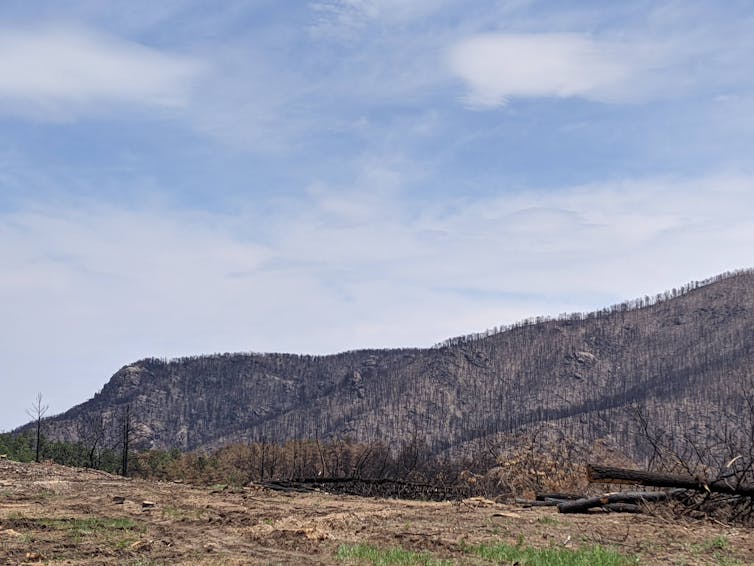
Burned ground can become hydrophobic and almost waxlike, allowing rainfall to quickly wash contaminants downslope.Carli Brucker
A wildfire rages across a forested mountainside. The smoke billows and the flames rise. An aircraft drops vibrant red flame retardant. It’s a dramatic, often dangerous scene. But the threat is only just beginning for downstream communtiies and the water they rely on.
After the smoke clears, the soil, which was once nestled beneath a canopy of trees and a spongy layer of leaves, is now exposed. Often, that soil is charred and sterile, with the heat making the ground almost water-repellent, like a freshly waxed car.
When the first rain arrives, the water rushes downhill. It carries with it a slurry of ash, soil and contaminants from the burned landscape. This torrent flows directly into streams and then rivers that provide drinking water for communities downstream.
As a new research paper my colleagues and I just published shows, this isn’t a short-term problem. The ghost of the fire can haunt these waterways for years.
Scientists explain how wildfires can contaminate water supplies and the ways they measure the effects, summarized in their 2024 publication. University of Colorado-Boulder.
This matters because forested watersheds are the primary water source for nearly two-thirds of municipalities in the United States. As wildfires in the western U.S. become larger and more frequent, the long-term security and safety of water supplies for downstream communities is increasingly at risk.
Charting the long tail of wildfire pollution
Scientists have long known that wildfires can affect water quality, but two key questions remained: Exactly how bad is the impact? And how long does it last?
To find out, my colleagues and I led a study, coordinated by engineer Carli Brucker. We undertook one of the most extensive analyses of post-wildfire water quality to date. The results were published June 23, 2025, in the journal Nature Communications Earth & Environment.
We gathered decades of water quality data from 245 burned watersheds across the western U.S. and compared them to nearly 300 similar, unburned watersheds.
A map of the basins studied shows the outlines of fires in red and burned basins in black. The blue basins did not burn and were used for comparisons. Carli Brucker, et al., 2025, Nature Communications Earth & Environment
By creating a computer model for each basin that accounted for its normal water quality variability, based on factors such as rainfall and temperature, we were able to isolate the impact of the wildfire. This allowed us to see how much the water quality deviated after the fire, year after year.
The results were stark. In the first year after a fire, the concentrations of some contaminants skyrocketed. We found that levels of sediment and turbidity – the cloudiness of the water – were 19 to 286 times higher than prefire levels. That much sediment can clog filters at water treatment plants and require expensive treatment and maintenance. Think of trying to use a coffee filter with muddy water – the water just won’t flow through.
Concentrations of organic carbon, nitrogen and phosphorus were three to 103 times greater in the burned basins. These dissolved remnants of burned plants and soil are particularly problematic. When they mix with the chlorine used to disinfect drinking water, they can form harmful chemicals called disinfection byproducts, some of which are linked to cancer.
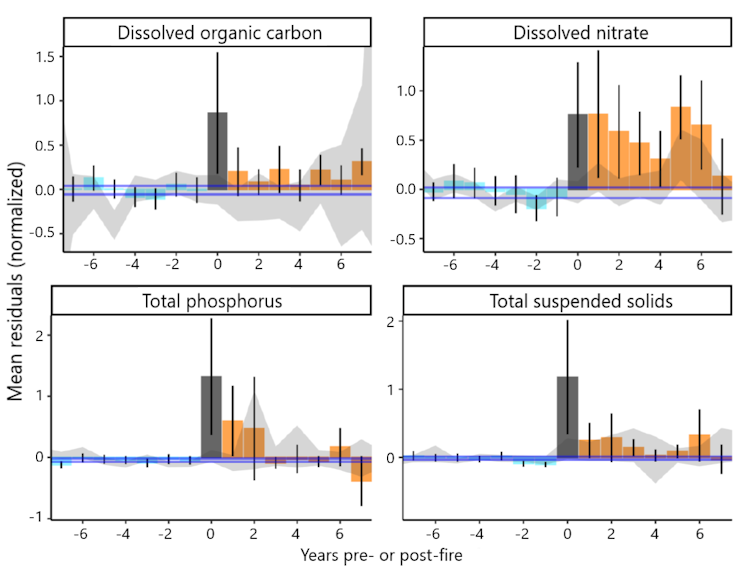
More surprisingly, we found the impacts to be really persistent. While the most dramatic spikes in phosphorous, nitrate, organic carbon and sediment generally occurred in the first one to three years, some contaminants lingered for much longer.
Contaminants including phosphorus, organic carbon and nitrates lingered in water supplies for years after wildfires. The charts show the average among all burned basins eight years before fires (light blue) and all burned basins after fires (orange). The gray bars show levels in the year immediately after the fire. The horizontal purple line shows levels that would be expected without a fire, based on the prefire years. Carli Brucker, et al., 2025, Nature Communications Earth & Environment
We saw significantly elevated levels of nitrogen and sediment for up to eight years following a fire. Nitrogen and phosphorus act like fertilizer for algae. A surge of these nutrients can trigger algal blooms in reservoirs, which can produce toxins and create foul odors.
This extended timeline suggests that wildfires are fundamentally altering the landscape in ways that take a long time to heal. In our previous laboratory-based research, including a 2024 study, we simulated this process by burning soil and vegetation and then running water over them.
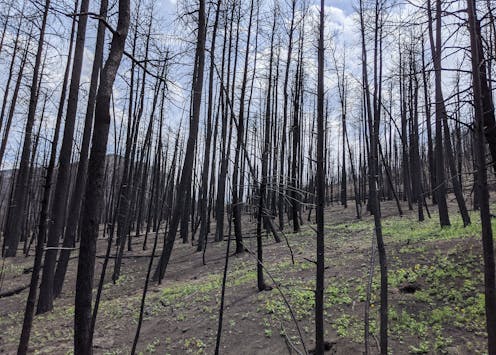
After mountain slopes burn, the rain that falls on them washes ash, charred soil and debris downstream. Carli Brucker
The stuff that leaches out is a cocktail of carbon, nutrients and other compounds that can exacerbate flood risks and degrade water quality in ways that require more expensive treatment at water treatment facilities. In extreme cases, the water quality may be so poor that communities can’t withdraw river water at all, and that can create water shortages.
After the Buffalo Creek Fire in 1996 and then the Hayman Fire in 2002, Denver’s water utility spent more than US$27 million over several years to treat the water, remove more than 1 million cubic yards of sediment and debris from a reservoir, and fix infrastructure. State Forest Service crews planted thousands of trees to help restore the surrounding forest’s water filtering capabilities.
A growing challenge for water treatment
This long-lasting impact poses a major challenge for water treatment plants that make river water safe to drink. Our study highlights that utilities can’t just plan for a few bad months after a fire. They need to be prepared for potentially eight or more years of degraded water quality.
We also found that where a fire burns matters. Watersheds with thicker forests or more urban areas that burned tended to have even worse water quality after a fire.
Since many municipalities draw water from more than one source, understanding which watersheds are likely to have the largest water quality problems after fires can help communities locate the most vulnerable parts of their water supply systems.
As temperatures rise and more people move into wildland areas in the American West, the risk of wildfires increases, and it is becoming clear that preparing for longer-term consequences is crucial. The health of forests and our communities’ drinking water are inseparably linked, with wildfires casting a shadow that lasts long after the smoke clears.
Ben Livneh receives funding from the Western Water Assessment NOAA grant #NA21OAR4310309, ‘Western Water Assessment: Building Resilience to Compound Hazards in the Inter-Mountain West’.
Source: The Conversation – USA (2) – By Jeremy Porter, Professor of Quantitative Methods in the Social Sciences, City University of New York
A deadly flash flood on July 4, 2025, swept through Nancy Callery’s childhood home in Hunt, Texas.Brandon Bell/Getty Images
Destructive flash flooding in Texas and other states is raising questions about the nation’s flood maps and their ability to ensure that communities and homeowners can prepare for rising risks.
The U.S. Federal Emergency Management Agency’s flood maps are intended to be the nation’s primary tool for identifying flood risks.
Originally developed in the 1970s to support the National Flood Insurance Program, these maps, known as Flood Insurance Rate Maps, or FIRMs, are used to determine where flood insurance is required for federally backed mortgages, to inform local building codes and land-use decisions, and to guide flood plain management strategies.
A federal flood map of Kerrville, Texas, with the Guadalupe River winding through the middle in purple, shows areas considered to have a 1% annual chance of flooding in blue and a 0.2% annual chance of flooding in tan. During a flash flood on July 4, 2025, the river rose more than 30 feet at Kerrville. FEMA
But while FEMA has improved the accuracy and accessibility of the maps over time with better data, digital tools and community input, the maps still don’t capture everything – including the changing climate. There are areas of the country that flood, some regularly, that don’t show up on the maps as at risk.
I study flood-risk mapping as a university-based researcher and at First Street, an organization created to quantify and communicate climate risk. In a 2023 assessment using newly modeled flood zones with climate-adjusted precipitation records, we found that more than twice as many properties across the country were at risk of a 100-year flood than the FEMA maps identified.
Even in places where the FEMA maps identified a flood risk, we found that the federal mapping process, its overreliance on historical data, and political influence over the updating of maps can lead to maps that don’t fully represent an area’s risk.
What FEMA flood maps miss
FEMA’s maps are essential tools for identifying flood risks, but they have significant gaps that limit their effectiveness.
One major limitation is that they don’t consider flooding driven by intense bursts of rain. The maps primarily focus on river channels and coastal flooding, largely excluding the risk of flash flooding, particularly along smaller waterways such as streams, creeks and tributaries.
This limitation has become more important in recent years due to climate change. Rising global temperatures can result in more frequent extreme downpours, leaving more areas vulnerable to flooding, yet unmapped by FEMA.
A map of a section of Kerr County, Texas, where a deadly flood struck on July 4, 2025, compares the FEMA flood map’s 100-year flood zone (red) to First Street’s more detailed 100-year flood zone (blue). The more detailed map includes flash flood risks along smaller creeks and streams. Jeremy Porter
For example, when flooding from Hurricane Helene hit unmapped areas around Asheville, North Carolina, in 2024, it caused a huge amount of uninsured damage to properties.
Even in areas that are mapped, like the Camp Mystic site in Kerr County, Texas, that was hit by a deadly flash flood on July 4, 2025, the maps may underestimate their risk because of a reliance on historic data and outdated risk assessments.
Political influence can fuel long delays
Additionally, FEMA’s mapping process is often shaped by political pressures.
Local governments and developers sometimes fight to avoid high-risk designations to avoid insurance mandates or restrictions on development, leading to maps that may understate actual risks and leave residents unaware of their true exposure.
An example is New York City’s appeal of a 2015 FEMA Flood Insurance Rate Maps update. The delay in resolving the city’s concerns has left it with maps that are roughly 20 years old, and the current mapping project is tied up in legal red tape.
On average, it takes five to seven years to develop and implement a new FEMA Flood Insurance Rate Map. As a result, many maps across the U.S. are significantly out of date, often failing to reflect current land use, urban development or evolving flood risks from extreme weather.
This delay directly affects building codes and infrastructure planning, as local governments rely on these maps to guide construction standards, development approvals and flood mitigation projects. Ultimately, outdated maps can lead to underestimating flood risks and allowing vulnerable structures to be built in areas that face growing flood threats.
How technology advances can help
New advances in satellite imaging, rainfall modeling and high-resolution lidar, which is similar to radar but uses light, make it possible to create faster, more accurate flood maps that capture risks from extreme rainfall and flash flooding.
However, fully integrating these tools requires significant federal investment. Congress controls FEMA’s mapping budget and sets the legal framework for how maps are created. For years, updating the flood maps has been an unpopular topic among many publicly elected officials, because new flood designations can trigger stricter building codes, higher insurance costs and development restrictions.
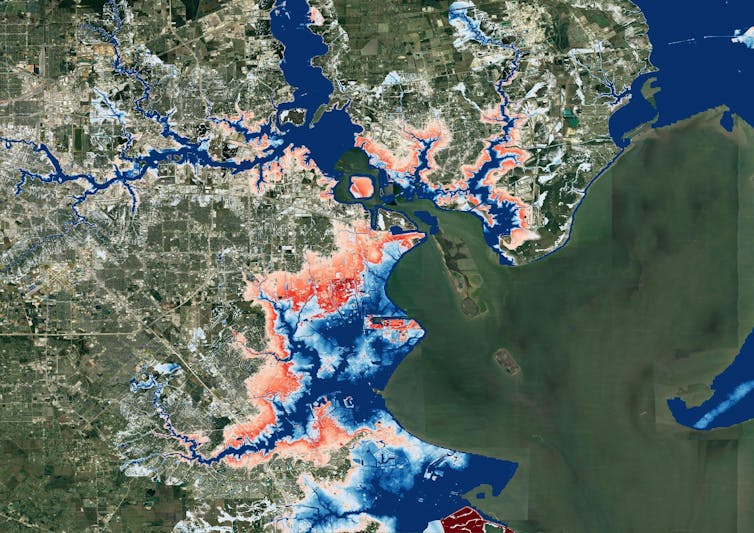
A map of Houston, produced for a 2022 study by researchers at universities and First Street, shows flood risk changing over the next 30 years as climate change worsens. Blue areas are today’s 100-year flood-risk zones. The red areas reflect the same zones in 2050. Oliver Wing et al., 2022
In recent years, the rise of climate risk analytics models and private flood risk data have allowed the real estate, finance and insurance industries to rely less on FEMA’s maps. These new models incorporate forward-looking climate data, including projections of extreme rainfall, sea-level rise and changing storm patterns – factors FEMA’s maps generally exclude.
Real estate portals like Zillow, Redfin, Realtor.com and Homes.com now provide property-level flood risk scores that consider both historical flooding and future climate projections. The models they use identify risks for many properties that FEMA maps don’t, highlighting hidden vulnerabilities in communities across the United States.
Research shows that the availability, and accessibility, of climate data on these sites has started driving property-buying decisions that increasingly take climate change into account.
Implications for the future
As homebuyers understand more about a property’s flood risks, that may shift the desirability of some locations over time. Those shifts will have implications for property valuations, community tax-revenue assessments, population migration patterns and a slew of other considerations.
However, while these may feel like changes being brought on by new data, the risk was already there. What is changing is people’s awareness.
The federal government has an important role to play in ensuring that accurate risk assessments are available to communities and Americans everywhere. As better tools and models evolve for assessing risk evolve, FEMA’s risk maps need to evolve, too.
Burned ground can become hydrophobic and almost waxlike, allowing rainfall to quickly wash contaminants downslope.Carli Brucker
A wildfire rages across a forested mountainside. The smoke billows and the flames rise. An aircraft drops vibrant red flame retardant. It’s a dramatic, often dangerous scene. But the threat is only just beginning for downstream communtiies and the water they rely on.
After the smoke clears, the soil, which was once nestled beneath a canopy of trees and a spongy layer of leaves, is now exposed. Often, that soil is charred and sterile, with the heat making the ground almost water-repellent, like a freshly waxed car.
When the first rain arrives, the water rushes downhill. It carries with it a slurry of ash, soil and contaminants from the burned landscape. This torrent flows directly into streams and then rivers that provide drinking water for communities downstream.
As a new research paper my colleagues and I just published shows, this isn’t a short-term problem. The ghost of the fire can haunt these waterways for years.
Scientists explain how wildfires can contaminate water supplies and the ways they measure the effects, summarized in their 2024 publication. University of Colorado-Boulder.
This matters because forested watersheds are the primary water source for nearly two-thirds of municipalities in the United States. As wildfires in the western U.S. become larger and more frequent, the long-term security and safety of water supplies for downstream communities is increasingly at risk.
Charting the long tail of wildfire pollution
Scientists have long known that wildfires can affect water quality, but two key questions remained: Exactly how bad is the impact? And how long does it last?
To find out, my colleagues and I led a study, coordinated by engineer Carli Brucker. We undertook one of the most extensive analyses of post-wildfire water quality to date. The results were published June 23, 2025, in the journal Nature Communications Earth & Environment.
We gathered decades of water quality data from 245 burned watersheds across the western U.S. and compared them to nearly 300 similar, unburned watersheds.
A map of the basins studied shows the outlines of fires in red and burned basins in black. The blue basins did not burn and were used for comparisons. Carli Brucker, et al., 2025, Nature Communications Earth & Environment
By creating a computer model for each basin that accounted for its normal water quality variability, based on factors such as rainfall and temperature, we were able to isolate the impact of the wildfire. This allowed us to see how much the water quality deviated after the fire, year after year.
The results were stark. In the first year after a fire, the concentrations of some contaminants skyrocketed. We found that levels of sediment and turbidity – the cloudiness of the water – were 19 to 286 times higher than prefire levels. That much sediment can clog filters at water treatment plants and require expensive treatment and maintenance. Think of trying to use a coffee filter with muddy water – the water just won’t flow through.
Concentrations of organic carbon, nitrogen and phosphorus were three to 103 times greater in the burned basins. These dissolved remnants of burned plants and soil are particularly problematic. When they mix with the chlorine used to disinfect drinking water, they can form harmful chemicals called disinfection byproducts, some of which are linked to cancer.
More surprisingly, we found the impacts to be really persistent. While the most dramatic spikes in phosphorous, nitrate, organic carbon and sediment generally occurred in the first one to three years, some contaminants lingered for much longer.
Contaminants including phosphorus, organic carbon and nitrates lingered in water supplies for years after wildfires. The charts show the average among all burned basins eight years before fires (light blue) and all burned basins after fires (orange). The gray bars show levels in the year immediately after the fire. The horizontal purple line shows levels that would be expected without a fire, based on the prefire years. Carli Brucker, et al., 2025, Nature Communications Earth & Environment
We saw significantly elevated levels of nitrogen and sediment for up to eight years following a fire. Nitrogen and phosphorus act like fertilizer for algae. A surge of these nutrients can trigger algal blooms in reservoirs, which can produce toxins and create foul odors.
This extended timeline suggests that wildfires are fundamentally altering the landscape in ways that take a long time to heal. In our previous laboratory-based research, including a 2024 study, we simulated this process by burning soil and vegetation and then running water over them.
After mountain slopes burn, the rain that falls on them washes ash, charred soil and debris downstream. Carli Brucker
The stuff that leaches out is a cocktail of carbon, nutrients and other compounds that can exacerbate flood risks and degrade water quality in ways that require more expensive treatment at water treatment facilities. In extreme cases, the water quality may be so poor that communities can’t withdraw river water at all, and that can create water shortages.
After the Buffalo Creek Fire in 1996 and then the Hayman Fire in 2002, Denver’s water utility spent more than US$27 million over several years to treat the water, remove more than 1 million cubic yards of sediment and debris from a reservoir, and fix infrastructure. State Forest Service crews planted thousands of trees to help restore the surrounding forest’s water filtering capabilities.
A growing challenge for water treatment
This long-lasting impact poses a major challenge for water treatment plants that make river water safe to drink. Our study highlights that utilities can’t just plan for a few bad months after a fire. They need to be prepared for potentially eight or more years of degraded water quality.
We also found that where a fire burns matters. Watersheds with thicker forests or more urban areas that burned tended to have even worse water quality after a fire.
Since many municipalities draw water from more than one source, understanding which watersheds are likely to have the largest water quality problems after fires can help communities locate the most vulnerable parts of their water supply systems.
As temperatures rise and more people move into wildland areas in the American West, the risk of wildfires increases, and it is becoming clear that preparing for longer-term consequences is crucial. The health of forests and our communities’ drinking water are inseparably linked, with wildfires casting a shadow that lasts long after the smoke clears.
Ben Livneh receives funding from the Western Water Assessment NOAA grant #NA21OAR4310309, ‘Western Water Assessment: Building Resilience to Compound Hazards in the Inter-Mountain West’.
Recent reductions in income tax burdens, benign inflation, lower interest rates and a favourable outlook for agricultural production are expected to support rural incomes and bolster overall consumption in India, according to a new report.
Given that private final consumption expenditure constitutes nearly 60 per cent of India’s GDP, it has a strong bearing on India’s overall growth outlook.
A sustained recovery in consumption is also vital for a meaningful pick-up in private sector capital expenditure.
“We expect private consumption growth of 6.2 per cent in FY26 compared to an average of 6.7 per cent in the last three years. In the long run, it will be critical to monitor factors impacting household income to ensure healthy growth in private consumption,” said the report by CareEdge Ratings.
While overall consumption growth has remained broadly healthy over the past few years, recent indicators suggest emerging pressures in urban demand, even as rural demand continues to hold firm.
Rural consumption is expected to be supported by favourable agricultural output and easing inflation in FY26, the report mentioned.
Recent policy support in the form of RBI rate cuts, reduced tax burdens, and easing inflationary pressures is expected to offer some relief and support to urban consumption in the near term.
Moreover, rural consumption could get a further fillip from the likelihood of a good monsoon this year, the report mentioned.
At a time when the income growth has been weak, the household leverage has seen an uptick. As of FY24, household debt stands at 41 per cent of GDP and 55 per cent of net household disposable income. Even though, Indian households are less leveraged than certain emerging economies such as Thailand (87 per cent of GDP), Malaysia (67 per cent) and China (62 per cent).
The report said that it is essential to closely monitor the unsecured segment of household liabilities, which has increased in the post-pandemic years. This is particularly important in the context of moderating income growth and rising delinquencies in the segment.
The 15th East Asia Summit (EAS) Foreign Ministers’ Meeting was convened on 11 July 2025 in Kuala Lumpur, Malaysia. The Meeting was chaired by The Honourable Dato’ Seri Utama Haji Mohamad bin Haji Hasan, Minister of Foreign Affairs of Malaysia.
Review and Future Direction of the EAS
The Meeting reaffirmed its commitment to further strengthening the EAS as the premier Leaders-led forum for dialogue and cooperation on broad strategic, political, and economic issues of common interest and concern with the aim of promoting peace, stability and economic prosperity in East Asia in line with the EAS foundational documents and based on the established principles, objectives and modalities of the EAS.
Download the full statement here.
The post Chairman’s Statement of the 15th East Asia Summit (EAS) Foreign Ministers’ Meeting appeared first on ASEAN Main Portal.
Source: People’s Republic of China in Russian – People’s Republic of China in Russian –
An important disclaimer is at the bottom of this article.
Source: People’s Republic of China – State Council News
KUALA LUMPUR, July 12 (Xinhua) — Openness brings progress, while closedness leads to backwardness, Chinese Foreign Minister Wang Yi, a member of the Politburo of the Communist Party of China Central Committee, said on Saturday, commenting on the high tariffs imposed by the United States on various countries.
Amid the ongoing intertwining of changes and chaos in the current international situation, every country must make a choice between unilateralism and multilateralism, closedness and openness, unity and division, said Wang Yi, who attended the ASEAN Plus Foreign Ministers’ Meetings in Kuala Lumpur.
China is choosing to be more open, he stressed, explaining that this is not only based on the country’s basic experience of development and growth, but also on the inevitable logic of historical progress.
Beijing has taken the lead in lifting tariffs on products from least developed countries and Africa as a whole, fully completed negotiations on the China-ASEAN Free Trade Area 3.0, and created a new model of inter-regional cooperation at the ASEAN-China-GCC (Gulf Cooperation Council) summit, the minister added.
On the contrary, high tariffs on various countries are a clear violation of World Trade Organization rules, disrupt the stable operation of production and supply chains, and hinder the recovery and development of the world economy, Wang said. He called the move irresponsible, unpopular and unsustainable.
China will continue to firmly stand shoulder to shoulder with countries in the region, promote unity, cooperation and collective strength, and will always be an advocate of multilateralism, a defender of free trade and a champion of open development, the minister stressed. –0–
Please note: This information is raw content obtained directly from the source of the information. It is an accurate report of what the source claims and does not necessarily reflect the position of MIL-OSI or its clients.
Source: People’s Republic of China in Russian – People’s Republic of China in Russian –
An important disclaimer is at the bottom of this article.
Source: People’s Republic of China – State Council News
KUALA LUMPUR, July 12 (Xinhua) — Chinese Foreign Minister Wang Yi, a member of the Political Bureau of the Communist Party of China Central Committee, briefed reporters on Saturday on his talks with U.S. Secretary of State Marco Rubio on the sidelines of the ASEAN Plus Foreign Ministers’ Meeting here on Friday.
Both Beijing and Washington recognize that the China-US relationship is the most important bilateral relationship in the world, affects both countries and impacts the entire world, he said.
The common goal of both sides is to translate the important consensus reached by the two heads of state into concrete policies and actions to ensure that the two giant ships – China and the United States – do not deviate from course, lose speed or collide, Wang added.
According to him, the meeting was constructive and an equal dialogue took place in the spirit of mutual respect.
The Chinese delegation comprehensively laid out its principled position on relations with the United States, which, according to Wang Yi, strengthened the United States’ understanding of China and paved the way for future exchanges between the diplomatic teams of the two countries.
The Minister summed up the meeting with the following words: strengthening contacts, preventing misjudgments, managing differences and expanding cooperation.
Wang Yi noted that from the perspective of historical evolution and humanity as a whole, China and the United States have great common interests and broad space for cooperation.
Both sides have the responsibility and opportunity to find the right path to improve relations in the new era, the Foreign Minister said. Finding a common language will be a blessing for the peoples of both countries and will give hope to all countries in the world, he added. –0–
Please note: This information is raw content obtained directly from the source of the information. It is an accurate report of what the source claims and does not necessarily reflect the position of MIL-OSI or its clients.
Source: People’s Republic of China in Russian – People’s Republic of China in Russian –
An important disclaimer is at the bottom of this article.
Source: People’s Republic of China – State Council News
Pyongyang, July 12 (Xinhua) — Russian Foreign Minister Sergei Lavrov arrived at Wonsan Airport on Friday night to begin his visit to the DPRK, the Korean Central News Agency (KCNA) reported Saturday.
It is noted that during the visit, which is taking place at the invitation of the DPRK Foreign Ministry, S. Lavrov will hold talks with his North Korean counterpart Choi Son Hee.
The visit will last from July 11 to 13, KCNA reported earlier.
Ahead of this trip, Russian Foreign Ministry spokesperson Maria Zakharova said that S. Lavrov and Choi Son Hee will take part in the second round of bilateral strategic dialogue at the level of foreign ministers in Pyongyang, Russian media reported on Friday. –0–
Please note: This information is raw content obtained directly from the source of the information. It is an accurate report of what the source claims and does not necessarily reflect the position of MIL-OSI or its clients.
VANCOUVER, British Columbia, July 12, 2025 (GLOBE NEWSWIRE) — Canada-based and Solana-focused FinFra leader Astra Fintech today reinforced its commitment to the Solana ecosystem by announcing a $10M strategic acquisition of Dexlab, a pioneering Solana-native token launching and tooling platform. Backed by Astra’s recently launched $100 million Solana ecosystem fund, this deal marks a bold step in the company’s mission to accelerate PayFi adoption across Asia and beyond.
Why Dexlab? The Investment Thesis From an investment standpoint, Astra Fintech understands that Solana’s technical advantages – its industry-leading scalability and cost efficiency – ultimately derive their value from the quality of Dapps and infrastructures developed on its blockchain. Dexlab stands out as a cornerstone asset for three key reasons:
Proven Track Record
Launched in 2020 as Solana’s first meme coin creation platform, Dexlab enables anyone to create and list a token without writing code. This no-code, permissionless model kickstarted a wave of on-chain experimentation, making Dexlab a cultural and technical foundation of the Solana ecosystem.
95% of Solana’s iconic meme coins — including Bonk, Slerf, Ponke, and numerous Trump and Biden-themed tokens — were originally created on Dexlab. With 189K tokens minted, DexLab generates $532M in trading volume.
Full Token Lifecycle Solutions
Over time, Dexlab evolved into a full-stack token management platform — providing everything from token minting to liquidity pool generation, staking, and decentralized trading. “Dexlab isn’t just a DEX; it’s the Shopify for token economies,” noted Astra Head of Partnership Jamie, “It lowers the barrier to launch and scale tokens — from memes to serious fintech.”
Asia-First Synergy
With Astra’s Asia HQ now operational and DexLab’s recent launch of its APAC subsidiary Calab, the strategic alignment between both entities has created unprecedented momentum for regional blockchain adoption. DexLab will combine its established global infrastructure with Calab’s localized expertise to deliver tailored fintech solutions across Asian markets. This synergistic approach enables Hyper-localized product deployment and PayFi Acceleration across Asia.
Strategic Synergy behind the Acquisitions This acquisition exemplifies Astra’s comprehensive investment thesis – combining financial resources with deep technical expertise to drive ecosystem development. The integration delivers immediate value to Dexlab through:
Access to Astra’s $100M Solana fund, multicoin-backed resources, and cross-border PayFi integrations.
Strategic talent infusion with Astra deploying seasoned North American executives across product, marketing, and operations roles.
Token rebranding to $XLAB to signify a new chapter under Astra’s leadership
Enterprise-level upgrades to support next-gen token management tools for institutions and creators alike.
“This isn’t just an acquisition, it’s more like a catalyst for Solana’s next ecosystem growth wave,” Jamie added, “Dexlab will be our foundation for onboarding the next 100 million users to Web3, starting in Asia.”
The Bigger Picture: Solana as the Foundation The Dexlab deal underscores Astra’s conviction in Solana’s role as the backbone of next-gen fintech. With Korea as its hub, Astra plans to:
Deploy capital from its $100M fund to Solana-based Finfra, PayFi, and AI projects.
Integrate Dexlab’s token rails with Banana Pay, Astra’s blockchain payment solution, to merge decentralized and traditional finance.
Host hackathons and developer grants, building on its Seoulana success to nurture grassroots innovation.
“Crypto’s future hinges on usable infrastructure,” said Jamie. “By investing in Dexlab, we’re betting on Solana and on builders who share our vision for a borderless financial stack.”
About Astra Fintech Astra Fintech is a Canada-based blockchain finance leader revolutionizing FinFra by bridging traditional and decentralized payments. As a strategic Solana ecosystem partner backed by Multicoin LPs, we deliver secure, borderless PayFi solutions while driving innovation through investments in next-gen financial infrastructure.
About DexLab As Solana’s pioneering meme launchpad behind iconic tokens including Bonk, Slerf, and Ponke – along with Trump&Biden-themed assets – DexLab originally facilitated 95% of the network’s early token launches, generating $532M in trading volume. Today, DexLab has matured into a complete institutional-grade token management solution, offering end-to-end lifecycle tools built natively on Solana.
Disclaimer:This content is provided byAstra Fintech. The statements, views, and opinions expressed in this content are solely those of the content provider and do not necessarily reflect the views of this media platform or its publisher. We do not endorse, verify, or guarantee the accuracy, completeness, or reliability of any information presented. We do not guarantee any claims, statements, or promises made in this article. This content is for informational purposes only and should not be considered financial, investment, or trading advice.Investing in crypto and mining-related opportunities involves significant risks, including the potential loss of capital. It is possible to lose all your capital. These products may not be suitable for everyone, and you should ensure that you understand the risks involved. Seek independent advice if necessary. Speculate only with funds that you can afford to lose. Readers are strongly encouraged to conduct their own research and consult with a qualified financial advisor before making any investment decisions. However, due to the inherently speculative nature of the blockchain sector—including cryptocurrency, NFTs, and mining—complete accuracy cannot always be guaranteed.Neither the media platform nor the publisher shall be held responsible for any fraudulent activities, misrepresentations, or financial losses arising from the content of this press release. In the event of any legal claims or charges against this article, we accept no liability or responsibility. Globenewswire does not endorse any content on this page.
Legal Disclaimer: This media platform provides the content of this article on an “as-is” basis, without any warranties or representations of any kind, express or implied. We assume no responsibility for any inaccuracies, errors, or omissions. We do not assume any responsibility or liability for the accuracy, content, images, videos, licenses, completeness, legality, or reliability of the information presented herein. Any concerns, complaints, or copyright issues related to this article should be directed to the content provider mentioned above.
The 15th East Asia Summit (EAS) Foreign Ministers’ Meeting was convened on 11 July 2025 in Kuala Lumpur, Malaysia. The Meeting was chaired by The Honourable Dato’ Seri Utama Haji Mohamad bin Haji Hasan, Minister of Foreign Affairs of Malaysia.
Review and Future Direction of the EAS
The Meeting reaffirmed its commitment to further strengthening the EAS as the premier Leaders-led forum for dialogue and cooperation on broad strategic, political, and economic issues of common interest and concern with the aim of promoting peace, stability and economic prosperity in East Asia in line with the EAS foundational documents and based on the established principles, objectives and modalities of the EAS.
Download the full statement here.
The post Chairman’s Statement of the 15th East Asia Summit (EAS) Foreign Ministers’ Meeting appeared first on ASEAN Main Portal.
The Ministry of Agriculture branch in the Southern Red Sea Region has provided training on the preparation of solid and liquid organic fertilizers to exemplary farmers in the port city of Assab.
The training was attended by exemplary farmers from the sub-zones of Assab and South Dankalia, as well as members of the agriculture office branch.
The training covered the preparation of composted fertilizer from household waste and leaves, fertilizer from fish remains, and the proper use of organic pesticides.
Mr. Mohammed Abdurahman, Head of the Agriculture Office in the region, said that the objective of the training was to enhance farmers’ understanding and encourage the application of organic fertilizers and pesticides in their daily agricultural activities.
The participants noted that the training would significantly contribute to improving their agricultural productivity and called for similar future programs.
Training on financial and material management has been provided to newly elected area administrators, village coordinators, tax collectors in Afabet sub-zone, and members of the sub-zonal administration. The training was organized by the Human Resources Development Unit of the Northern Red Sea Regional Administration.
The training covered planning and its significance, financial and material management, strengthening worker discipline and productivity, documentation, project management, and conflict resolution in the workplace.
Explaining the importance of the training in facilitating their daily responsibilities, the trainees called for the program’s continuity.
Calling on the participants to apply the knowledge gained from the training in their day-to-day activities, Mr. Mohammed-Nur Rejib, Administrator of the sub-zone, expressed the administration’s readiness to strengthen participation and contribute to developing human resource capacity in the sub-zone.
Thirty-four youth from across the south of Libya joined Deputy Special Representative for the Secretary General Stephanie Koury in an online youth consultation Wednesday to discuss their opinions on the Advisory Committee’s recommendations.
The event is part of broader consultations to gather feedback from the public on the next steps of the political process. UNSMIL has also launched an online poll inviting Libyans to share options on the Advisory Committee’s recommendations and contribute to shaping the way forward in the political process.
Participants stressed the need for representation for the south in any mechanism or institution, highlighting that they suffer through economic instability and insecurity across borders and do not benefit from oil money.
The youth all agreed that the deteriorating economic situation was closely linked to the security situation and one could not be solved without addressing the other. They highlighted that they wanted stability and security and their voices to be heard in representative forums.
“We suffer from weak infrastructure with power cuts during 50-degree heat,” said one participant from Ghat. “We are deprived of basic services. We need to focus on these things, not a constitution.”
The economic situation is so bad, another participant from Ghat said, that it’s impacting the security situation. “This is why people are making their livelihoods from selling weapons,” they said. “We need to have a clear economic plan,” said a participant from Sebha. “We need to end the sources of corruption.”
A participant from Ubari called for transitional periods to end. “Through the years and different governments, our divisions have only increased,” said a participant from Sebha, adding that the best way forward was to have a referendum.
When discussing elections, the youth expressed distrust in the national authorities’ ability to oversee elections and in the democratic process overall. One spoke of how votes had been bought; people he knew sold their voter cards in the previous elections.
DSRSG Koury briefed participants on the four options put forward by the Advisory Committee in May. As outlined in the Executive Summary of the Advisory Committee’s report, the options include:
Conducting presidential and legislative elections simultaneously;
Conducting parliamentary elections first, followed by the adoption of a permanent constitution;
Adopting a permanent constitution before elections; or
Establishing a political dialogue forum, based on the Libyan Political Agreement to finalize electoral laws, executive authority and permanent constitution.
Many of the participants who joined favoured option four saying that this was the only option that ended the current cycle of entities that they felt did not represent them or the people of Libya.
UNSMIL stressed that youth voices were crucial to the political process and that it intended to continue with its YouEngage outreach efforts.
All participants were encouraged to complete UNSMIL’s online poll [link] and share it with their friends and families to ensure community voices are heard.
– on behalf of United Nations Support Mission in Libya (UNSMIL).
On the occasion of the 2025 African Anti-Corruption Day, H.E. Mahmoud Ali Youssouf, Chairperson of the African Union Commission, urges all African Union Member States to underscore human dignity in their anti-corruption strategies.
The 2025 African Anti-Corruption Day is commemorated under the theme, Promoting Human Dignity in the Fight Against Corruption. The commemoration held annually on 11 July, aligns this year with the overarching AU theme for 2025: “Justice for Africans and People of African Descent Through Reparations.”
The Chairperson emphasizes that corruption is not merely an economic crime but a direct assault on human dignity and security as it robs countries of their potential and individuals of their dignity. Corruption undermines trust in our institutions, diverts resources meant for development, and perpetuates inequality and poverty.
The Chairperson highlights that corruption strips citizens, particularly women, youth , children and the most vulnerable, of their fundamental rights, freedoms, and opportunities to thrive, leading to tragic consequences like increased maternal mortality due to diverted health funds or lack of basic education for children.
The Chairperson highlights the intrinsic link between the fight against corruption and the broader pursuit of justice and reparations. He notes that just as the continent seeks to address historical injustices through reparations, it must equally dismantle contemporary corrupt systems that perpetuate indignity and injustice.
The 2025 African Anti-Corruption Day theme seeks to sensitize Africans of the importance to examine our history, and to shape our shared future, based on the dignity of people.
The Chairperson reiterates that the African Union has prioritized the fight against corruption as a cornerstone of its Agenda 2063, envisioning an Africa where integrity, accountability, and transparency prevail. He stresses that the African Union Convention on Preventing and Combating Corruption (AUCPCC), adopted 22 years ago, remains the guiding framework. He urges Member States to continue aligning national legislation and strategies with its principles, particularly Article 2(4), which enjoins State Parties to promote socio-economic development by removing obstacles to the enjoyment of economic, social, and cultural rights, as well as civil and political rights.
The AU Chairperson calls for immediate action by Member States to fulfil their commitment to effectively tackle corruption and implement measures that apply a human rights lens in prevention and enforcement. He also calls for unity to dismantle corruption’s structures and build a continent where human dignity is protected and celebrated.
President His Highness Sheikh Mohamed bin Zayed Al Nahyan has sent a message of congratulations to President Carlos Vila Nova of the Democratic Republic of São Tomé and Príncipe on the occasion of his country’s Independence Day.
His Highness Sheikh Mohammed bin Rashid Al Maktoum, Vice President, Prime Minister and Ruler of Dubai, and His Highness Sheikh Mansour bin Zayed Al Nahyan, Vice President, Deputy Prime Minister, and Chairman of the Presidential Court, also sent similar message to President of São Tomé and Príncipe and to Prime Minister Americo d’Oliveira dos Ramos on the occasion.
– on behalf of United Arab Emirates, Ministry of Foreign Affairs.
Source: People’s Republic of China in Russian – People’s Republic of China in Russian –
An important disclaimer is at the bottom of this article.
Source: People’s Republic of China – State Council News
BEIJING, July 12 (Xinhua) — A delegation from Northeast Agricultural University (NEAU) led by Vice-Rector Chen Qingshan recently visited Russian universities. The visit is aimed at actively promoting a higher level of openness in education in Heilongjiang Province (Northeast China) in the northern direction and creating a vanguard of cooperation with Russia among agricultural universities in the country.
As reported on the official website of SVSU, during his visit to Krasnoyarsk State Agrarian University (KSAU), Chen Qingshan held talks with the university’s vice-rector Maria Ozerova. Chen Qingshan noted that in September this year, SVSU will send the first group of Chinese students majoring in “Food Technology” to KSAU as part of the training program for studying in Russia. He expressed hope for close cooperation between the parties in the joint training of highly qualified personnel in the agricultural sector for China and Russia. At the same time, he proposed exchanging genetic resources of such agricultural crops as potatoes and wheat, as well as accelerating the construction of a Chinese-Russian agricultural demonstration zone so that the results of cooperation could better serve the needs of the agricultural development of the two countries.
M. Ozerova said that in recent years the two universities have achieved significant results in student exchanges and scientific cooperation. She expressed hope for expanding cooperation in areas such as breeding cold-resistant crops and promoting agricultural technologies so that practical interactions would benefit more industries.
The delegation also visited the Ural Federal Agricultural Research Center. Chen Qingshan noted the outstanding potential of the center in the field of genetic resource reserves and commercialization of research results. He proposed that the parties continue joint research in the field of potatoes, wheat, flax and other crops, providing technological support for Chinese-Russian agricultural cooperation.
By deepening joint training with leading Russian agricultural universities and research institutes, promoting joint scientific research and establishing agricultural demonstration zones, HSAU aims to establish a cooperation model with Russia characterized by the unity of the three components of “education-scientific research-social services” and the deep integration of production, education, scientific research and application. This will comprehensively enhance the internationalization level of the university and contribute to the modernization of agriculture and the expansion of agricultural technology in Heilongjiang Province abroad. -0-
Please note: This information is raw content obtained directly from the source of the information. It is an accurate report of what the source claims and does not necessarily reflect the position of MIL-OSI or its clients.
Mamadou Diop, Director General and CEO of refinery company Société Africaine de Raffinage (SAR) will participate as a speaker at African Energy Week (AEW): Invest in African Energies 2025, taking place on September 29 to October 3 in Cape Town. His participation comes after a historic breakthrough for Senegal’s energy sector as SAR recently successfully refined locally produced crude oil – marking a major leap forward in energy sovereignty and industrial growth.
In February 2025, SAR successfully refined domestically produced crude oil from the offshore Sangomar field for the first time, processing 650,000 barrels and generating 90,000 tons of petroleum products including diesel, kerosene, gasoline and butane gas. This major milestone is expected to significantly advance Senegal’s strategy to strengthen energy security, reduce dependence on imports and optimize the local value chain.
AEW: Invest in African Energies is the platform of choice for project operators, financiers, technology providers and government, and has emerged as the official place to sign deals in African energy. Visit http://www.AECWeek.com for more information about this exciting event.
With plans to scale up operations, the company recently launched the SAR 2.0 initiative and signed an agreement with China’s Sedin Engineering in September 2024 to explore the construction of a second refinery and petrochemical plant. The new facility is expected to increase the country’s refining capacity from 1.5 million to 5 million tons per year, helping meet local demand while creating new export opportunities to neighboring West African countries.
SAR has also strengthened ties with upstream partner Woodside Energy, with both companies exploring a long-term refining partnership to support increased crude processing. Through the partnership, the SAR refinery adapted its facilities to handle Sangomar crude and continues to implement upgrades to meet AFRI 6 fuel specifications and diversify into petrochemicals. The expansion enables SAR to process a 75/25 blend of Senegalese and Nigerian crude oil, positioning the company to meet up to 75% of domestic fuel demand.
Driven by the development of the 100,000 barrel-per-day Sangomar oilfield and the 2.3 million ton per annum Greater Tortue Ahmeyim LNG project, Senegal has emerged as a burgeoning regional petroleum hub in West Africa. In response to growing energy demand and infrastructure gaps, SAR is implementing a bold transformation strategy to expand refining capacity and meet 100% of domestic fuel needs by 2030. Backed by ongoing discussions with multilateral financial institution the African Export-Import Bank to secure $500 million in syndicated financing, the upgrade will include the construction of a petrochemical complex aimed at reducing reliance on imported products and fostering industrial growth.
“Diop’s leadership has been instrumental in unlocking Senegal’s refining capabilities and in driving the country’s transition from a crude exporter to a fully integrated energy producer. His participation at AEW 2025 will spotlight how local refining capacity can catalyze broader industrial development across the continent,” states Tomás Gerbasio, VP of Commercial and Strategic Engagement, African Energy Chamber.
Nationals in Sweden have contributed over 105,000 Kroner towards augmenting the National Martyrs Trust Fund.
Mr. Negasi Goitom, Head of Finance of the Holidays Coordinating Committee, indicated that the Stockholm branch of the National Union of Eritrean Women contributed 2,000 Kroner; an anonymous donor contributed 2,500 Kroner; women members of the Southern Stockholm Association contributed 5,000 Kroner; the Husby-Kista-Akalla Women’s Association contributed 5,600 Kroner; the Medhanie Alem Women’s Association in Stockholm contributed 3,000 Kroner; and author Rim Tesfom contributed 3,000 Kroner—all towards augmenting the National Martyrs Trust Fund.
Furthermore, Ms. Genet Tewolde contributed 5,000 Kroner in the name of her martyred brother; Ms. Emnet Tekle contributed 2,000 Kroner in the name of her two martyred brothers; Hewan Decoration Center contributed 14,000 Kroner; and the Eritrean community in Hasselby-Vallingby contributed 35,000 Kroner.
Source: Hong Kong Government special administrative region
Over 80 youth trainees complete foundation course of third phase of ROLE Stars Train-the-Leaders Programme Following the first day of the course taught by the Secretary for Justice, Mr Paul Lam, SC, and member of the Standing Committee of the 14th National People’s Congress and Member of the Legislative Council, Dr Starry Lee, last week, the Deputy Secretary for Justice, Dr Cheung Kwok-kwan, elaborated on the second day of the course about the importance of promoting the rule of law, and the responsibilities and roles of ROLE leaders.
Member of the Working Group on Coordination and Liaison (Working Group) under the Steering Committee on Rule of Law Education (Steering Committee), Mr Chan Chak-ming, and member of the Steering Committee, Ms Sabrina Ho, briefed the trainees on topics such as the legal profession, court proceedings, and alternative dispute resolution services in Hong Kong. Founder and Chairperson of BExcellent Group, Dr June Leung, who has many years of experience in education, was also invited to share her insights on communication skills for effective dissemination of messages about the rule of law.
Dr Cheung remarked that the rule of law is Hong Kong’s “golden reputation” and the foundation for Hong Kong to maintain long-term prosperity and stability under the principle of “one country, two systems”. At the current critical period of breaking new ground and achieving another leap forward, the Hong Kong community must uphold the rule of law, and leverage Hong Kong’s international advantages to promote high-quality development through the rule of law, and hence, the promotion of the rule of law is of great importance.
He said that members of the district youth committees have been promoting youth development and civic education in the community, and they can certainly play an important role in the promotion of the rule of law. University students who are pursuing their career in the education sector will be the backbone of schools’ work in promoting rule of law education, and their active participation will undoubtedly provide new momentum to the passing on and further development of the rule of law in Hong Kong.
Dr Cheung said that communication is a kind of special knowledge. The DoJ designed the course with an emphasis on diversified, interactive and easy-to-understand methods, along with real-life examples and case studies, which enable trainees to easily grasp knowledge of the rule of law. The course also invited experts to teach trainees the skills of dissemination and communication, better equipping them to become ROLE leaders in the future.
After the course, the DoJ held the closing ceremony (including a certificate presentation) for the foundation course of the third-phase programme. Members of the Steering Committee, Ms Ho and Professor Dicky Tsang, and member of the Working Group, Mr Chan, presented certificates to the trainees who completed the two-day foundation course of the third-phase programme.
Looking ahead, the DoJ will continue to organise advanced and extended courses under the third phase of the TTL Programme. Through visits to law enforcement agencies, mock court activities, thematic talks on specific legal topics and practice activities for promoting the rule of law, the courses will further deepen the understanding of the legal system and the implementation of legal procedures of the trainees who have completed the foundation course, as well as bolster their confidence in disseminating messages of the rule of law in the community.
Secretary for Home & Youth Affairs Alice Mak will depart tomorrow for a visit to Beijing and Sichuan.
Miss Mak will call on the State Council’s Hong Kong & Macao Affairs Office, Sichuan’s Hong Kong & Macao Affairs Office and relevant ministries and institutions to deepen exchanges and co-operation with the Mainland in areas of youth development, district governance, women’s development and religious affairs.
She plans to attend the inauguration ceremonies of the Hong Kong-Macao Youth Internship Programme at Palace Museum and the Youth Internship Programme at Chinese Academy of Sciences, as well as the closing ceremony of the Youth Internship Programme at Wolong Region of Giant Panda National Park.
These three programmes are under the Home & Youth Affairs Bureau’s Thematic Youth Internship Programmes to the Mainland 2025 that are jointly organised by the Hong Kong Special Administrative Region Government and the cultural, scientific research and nature conservation institutions on the Mainland.
Through diverse thematic internship opportunities, the programmes aim to help Hong Kong youths gain a deeper understanding of the country’s development and acquire knowledge of relevant disciplines and professional fields.
The youth affairs chief will meet with the interns and learn about their lives and experiences on the Mainland.
Miss Mak will return to Hong Kong on the afternoon of July 18. During her absence, Under Secretary for Home & Youth Affairs Clarence Leung will be Acting Secretary.
The global KIF18A targeting therapies market is rapidly gathering momentum as KIF18A has emerged as a key vulnerability in cancers characterized by chromosomal instability. As a mitotic kinesin motor protein essential for chromosome alignment during cell division, KIF18A is overexpressed in malignancies such as ovarian and triple-negative breast cancers, making it a promising target for precision oncology with potentially lower toxicity than traditional chemotherapies.
Although no KIF18A-targeted therapy is commercially available yet, the field is progressing quickly. Clinical pipelines include more than 10 therapies, with several in early clinical development. Among the frontrunners is ATX‑295 from Accent Therapeutics, an oral, best-in-class small-molecule inhibitor that recently entered a Phase I/II dose-escalation study in patients with advanced solid tumors, including ovarian and triple-negative breast cancer. It’s employed with biomarker-enriched enrollment based on genomic instability markers like whole-genome doubling, and has received FDA Fast Track status—accelerating its path forward.
The clinical landscape includes global contributions from leading biotechs such as Volastra Therapeutics, advancing multiple small-molecule inhibitors including Sovilnesib (AMG‑650) in Phase I for platinum-resistant ovarian cancer, and VLS‑1488 in Phase I/II across chromosomal instability-high tumors. Accent’s ATX‑295 stands currently at the most advanced Phase I/II stage, with trials in the US and potentially Asia-Pacific, suggesting geographic development convergence.
Technological innovation underpins expansion in this field. Development is dominated by small-molecule inhibitors designed to halt KIF18A’s motor activity at kinetochores, causing mitotic catastrophe in cancer cells. Alternative approaches include disrupting upstream regulatory pathways like phosphorylation, and leveraging AI-driven drug discovery platforms. For example, Insilico Medicine’s Chemistry42 and PandaOmics platforms generated a macrocyclic KIF18A inhibitor (ISM9682), showcasing the power of AI to enhance specificity and efficiency in drug design.
Market trends demonstrate strong growth potential. The first commercial KIF18A-targeting therapy is expected by 2030, propelled by fast track designations and positive preclinical data. The rich pipeline, combined with precision biomarker strategies, supports a robust developmental roadmap, aligning with unmet clinical needs in CIN-high solid tumors and potentially extending to hematologic malignancies where KIF18A overexpression correlates with poor prognosis.
Regional development trends show clinical leadership based in the US and Europe, where companies like Accent and Volastra are active, while China and other Asia-Pacific markets are engaging through global trial participation and local biotech collaborations. Multi-region trial footprints and biomarker-defined patient enrollment strategies are shaping global development dynamics.
Our Global KIF18A Targeting Therapies Market Report offers detailed insights into this evolving therapeutic area. It profiles more than ten clinical-stage candidates by company, indication, country, and development phase, with a deep focus on ATX‑295 as the leading Phase I/II program. The report evaluates technology platforms, including small-molecule motor inhibitors and AI-enabled discovery, and analyzes biomarker-led patient selection models. Regional development trends and regulatory environments are mapped, and strategic partnerships and investments are examined.
For pharmaceutical executives, biotech investors, and drug development leaders, this report provides a strategic foundation. It outlines market drivers, technological innovations, and clinical milestones that are poised to transform KIF18A from a promising target into an approved therapeutic by 2030, potentially offering new treatment options for patients with chromosomally unstable tumors.
Audience with members of the General Chapters of eight Religious Institutes, 12.07.2025
This morning, in the Courtyard of the Apostolic Palace of the Pontifical Villas of Castel Gandolfi, the Holy Father Leo XIV received in audience the participants in the General Chapters of: the Pontifical Institute for Foreign Missions (PIME), the Pontifical Institute of the Religious Teachers Filippini, the Religious Teachers Venerini, the Daughters of the Church, the Salesian Oblates of the Sacred Heart, the Angeline Franciscan Sisters, the Institute of Oblates of Jesus and Mary, and the Daughters of Mary, Sisters of the Pious Schools (Scolopians).
The following is the address delivered by the Holy Father during the audience:
Address of the Holy Father
In the name of the Father, of the Son, and of the Holy Spirit.
Peace be with you.
Welcome to you all! Let us sit down and reflect together a little.
Dear brothers and sisters,
I welcome you with joy on the occasion of your Chapters and Assemblies. I greet the Superiors General, the members of the Councils, and all of you.
You have gathered to pray, to discuss and to reflect together on what the Lord asks of you for the future. Your Founders and Foundresses, docile to the action of the Holy Spirit, have left you the legacy of various charisms for the edification of the Body of Christ (cf. Eph 4:11-12), and it is precisely so that this may grow according to God’s plans that the Church asks of you the service that you are carrying out (cf. Second Vatican Ecumenical Council, Decree Perfectae caritatis, 4).
Your respective Institutes embody complementary aspects of the life and action of all the People of God: the offering of self in union with the Sacrifice of Christ, the mission ad gentes, love for the Church preserved and transmitted, the education and formation of the young. These are different ways in which the one and eternal reality that animates them all is expressed in charismatic form: God’s love for humanity.
As is customary, then, each of your Congregations identified particular angles, in the light of which to reinterpret the legacy received, in order to update and modernize its contents. These pathways of work, which you chose during the time of preparation, in prayer and mutual listening, are also a precious gift insofar as they are the fruit of the Spirit. It is He who, through the contribution of many, under the guidance of the Pastors, “helps the Christian community to advance in charity towards the fullness of truth (cf. Jn 16:13)” (Benedict XVI, Homily at the Holy Mass for the Inauguration of the Fifth General Conference of the Bishops of Latin America and the Caribbean, 13 May 2007). You have thus formulated guidelines that contain fundamental calls: to renew an authentic missionary spirit, to make one’s own the attitude “that is also yours in Christ Jesus” (cf. Phil 2:5), to promote peace, to cultivate pastoral co-responsibility in local churches, and so on. To stay by their side and to remember them together, at this time, helps us to grasp the richness of our being in a community, especially as men and women religious, engaged in the same wonderful adventure of “[following] Christ more nearly” (Catechism of the Catholic Church, 916).
May this renew and confirm in all of us the awareness and the joy of being Church, and in particular spur you, in your discernment in the Chapters, to think on a large scale, as unique pieces of a plan that exceeds you and involves you beyond your own expectations: the plan of salvation with which God wants to bring all of humanity back to himself, as one big family (cf. Francis, General Audience, 29 May 2013). This is the spirit in which your Institutes were born, and this is the perspective in which to place every effort, so that it may contribute, through small lights, to spreading over the whole earth the light of Christ, which never dims (cf. Roman Missal, Easter Precony).
Dear friends, let us ask the Lord together to be docile to the voice of his Spirit, who “teaches everything” (cf. Jn 14:26), and without whose help, in our weakness, we do not even know how to ask as we ought (cf. Rom 8:26).
Thank you for your work and for your faithful presence in so many parts of the world. I bless you from my heart, and I pray for you. Thank you!
Let us pray together:
[Our Father]
[Blessing]
Thank you all!
The India Meteorological Department (IMD) has forecast intermittent rainfall across large parts of the country till July 17, with heavy to very heavy showers expected in several regions, including the National Capital Region (NCR).
In Delhi and surrounding areas, continuous rainfall has led to waterlogging and traffic disruptions, affecting daily life in parts of Delhi, Noida, Ghaziabad, and Gurugram. Several roads, underpasses, and residential colonies remain inundated, leading to long traffic jams and vehicle breakdowns.
While no formal weather alert has been issued for Delhi-NCR so far, the IMD has warned of persistent rain and thunderstorms throughout the week. The region is likely to experience fluctuating weather conditions, with spells of sunshine contributing to high humidity and discomfort. Temperatures are expected to range between 23°C and 36°C, with humidity levels staying between 60 and 95 percent.
Nationwide, the IMD has predicted heavy to very heavy rainfall in Central and Northwest India, especially over East Rajasthan, Uttarakhand, Himachal Pradesh, Jammu & Kashmir, and both eastern and western parts of Uttar Pradesh through July 17.
Eastern and central Indian states such as Madhya Pradesh, Chhattisgarh, Jharkhand, Bihar, Odisha, and West Bengal are also likely to receive isolated heavy showers during this period. In western India, isolated heavy rainfall is expected on July 13 in parts of Konkan and Goa, Gujarat, Central Maharashtra, and the Saurashtra region.
The weather department also expects light to moderate rainfall, accompanied by thunderstorms and lightning, to continue in Northeast India over the next seven days.
In the South, states like Coastal Karnataka, Kerala, South Interior Karnataka, and Tamil Nadu are likely to experience isolated heavy showers over the coming days.
Due to rough sea conditions, fishermen have been advised to avoid venturing into the Arabian Sea and the Bay of Bengal until July 16.