Blog

  • MIL-OSI Europe: EU sends firefighting planes to Cyprus

    Source: European Union 2

    The EU has mobilised 2 Canadair airplanes from the EU’s joint firefighting fleet in response to a request for assistance from Cyprus, following a major fire in its Limassol district. The EU has already responded to several wildfire emergencies in Albania and North Macedonia this summer.

    MIL OSI Europe News

  • MIL-OSI Europe: Christine Lagarde, Luis de Guindos: Monetary policy statement

    Source: European Central Bank

    Christine Lagarde, President of the ECB,
    Luis de Guindos, Vice-President of the ECB

    Frankfurt am Main, 24 July 2025

    Good afternoon, the Vice-President and I welcome you to our press conference.

    The Governing Council today decided to keep the three key ECB interest rates unchanged. Inflation is currently at our two per cent medium-term target. The incoming information is broadly in line with our previous assessment of the inflation outlook. Domestic price pressures have continued to ease, with wages growing more slowly. Partly reflecting our past interest rate cuts, the economy has so far proven resilient overall in a challenging global environment. At the same time, the environment remains exceptionally uncertain, especially because of trade disputes.

    We are determined to ensure that inflation stabilises at our two per cent target in the medium term. We will follow a data-dependent and meeting-by-meeting approach to determining the appropriate monetary policy stance. In particular, our interest rate decisions will be based on our assessment of the inflation outlook and the risks surrounding it, in light of the incoming economic and financial data, as well as the dynamics of underlying inflation and the strength of monetary policy transmission. We are not pre-committing to a particular rate path.

    The decisions taken today are set out in a press release available on our website.

    I will now outline in more detail how we see the economy and inflation developing and will then explain our assessment of financial and monetary conditions.

    Economic activity

    In the first quarter the economy grew more strongly than expected. This was partly because firms frontloaded exports ahead of expected tariff hikes. But growth was also bolstered by stronger private consumption and investment.

    Recent surveys point to an overall modest expansion in both the manufacturing and services sectors. At the same time, higher actual and expected tariffs, the stronger euro and persistent geopolitical uncertainty are making firms more hesitant to invest.

    The robust labour market, rising real incomes and solid private sector balance sheets continue to support consumption. Unemployment stood at 6.3 per cent in May, close to its lowest level since the introduction of the euro. Easier financing conditions are underpinning domestic demand, including in the housing market. Over time, higher public investment in defence and infrastructure should also support growth.

    More than ever, the Governing Council considers it crucial to urgently strengthen the euro area and its economy in the present geopolitical environment. Fiscal and structural policies should make the economy more productive, competitive and resilient. Governments should prioritise growth-enhancing structural reforms and strategic investment, while ensuring sustainable public finances. It is important to complete the savings and investments union and the banking union, following a clear and ambitious timetable, and to rapidly establish the legislative framework for the potential introduction of a digital euro. The Governing Council welcomes the Eurogroup’s commitment to improve the effectiveness, quality and composition of public spending and supports the efforts by European authorities to preserve the mutual benefits of global trade.

    Inflation

    Annual inflation stood at 2.0 per cent in June, after 1.9 per cent in May. Energy prices went up in June but are still lower than a year ago. Food price inflation eased slightly to 3.1 per cent. Goods inflation edged down to 0.5 per cent in June, whereas services inflation ticked up to 3.3 per cent, from 3.2 per cent in May.

    Indicators of underlying inflation are overall consistent with our two per cent medium-term target. Labour costs have continued to moderate. Year-on-year growth in compensation per employee slowed to 3.8 per cent in the first quarter, down from 4.1 per cent in the previous quarter. Combined with stronger productivity growth, this led to slower growth in unit labour costs. Forward-looking indicators, including the ECB’s wage tracker and surveys on wage expectations of firms, consumers and professional forecasters, point to a further decline in wage growth.

    Short-term consumer inflation expectations declined in both May and June, reversing the uptick observed in previous months. Most measures of longer-term inflation expectations continue to stand at around 2 per cent, supporting the stabilisation of inflation around our target.

    Risk assessment

    Risks to economic growth remain tilted to the downside. Among the main risks are a further escalation in global trade tensions and associated uncertainties, which could dampen exports and drag down investment and consumption. A deterioration in financial market sentiment could lead to tighter financing conditions and greater risk aversion, and make firms and households less willing to invest and consume. Geopolitical tensions, such as Russia’s unjustified war against Ukraine and the tragic conflict in the Middle East, remain a major source of uncertainty. By contrast, if trade and geopolitical tensions were resolved swiftly, this could lift sentiment and spur activity. Higher defence and infrastructure spending, together with productivity-enhancing reforms, would add to growth. An improvement in business confidence would also stimulate private investment.

    The outlook for inflation is more uncertain than usual, as a result of the volatile global trade policy environment. A stronger euro could bring inflation down further than expected. Moreover, inflation could turn out to be lower if higher tariffs lead to lower demand for euro area exports and induce countries with overcapacity to reroute their exports to the euro area. Trade tensions could lead to greater volatility and risk aversion in financial markets, which would weigh on domestic demand and would thereby also lower inflation. By contrast, inflation could turn out to be higher if a fragmentation of global supply chains pushed up import prices and added to capacity constraints in the domestic economy. A boost in defence and infrastructure spending could also raise inflation over the medium term. Extreme weather events, and the unfolding climate crisis more broadly, could drive up food prices by more than expected.

    Financial and monetary conditions

    Market interest rates have increased since our last meeting, especially at longer maturities. At the same time, our past interest rate cuts continue to make corporate borrowing less expensive. The average interest rate on new loans to firms declined to 3.7 per cent in May, from 3.8 per cent in April. The cost of issuing market-based debt also came down, falling to 3.6 per cent in May. While the growth rate of loans to firms moderated to 2.5 per cent in May, corporate bond issuance was stronger, growing at a rate of 3.4 per cent in annual terms.

    Credit standards for business loans were broadly unchanged in the second quarter, as reported in our latest bank lending survey for the euro area. While banks’ concerns about the economic risks faced by their customers had a tightening impact on credit standards, this was broadly offset by stronger competition among lenders. Meanwhile, firms’ demand for credit increased slightly, benefiting from lower interest rates, but they remained cautious because of global uncertainty and trade tensions.

    The average interest rate on new mortgages has barely changed since the start of the year and stood at 3.3 per cent in May. Growth in mortgage lending edged up to 2.0 per cent in May, in the context of a strong increase in demand, while credit standards tightened slightly in the second quarter.

    Conclusion

    The Governing Council today decided to keep the three key ECB interest rates unchanged. We are determined to ensure that inflation stabilises at our two per cent target in the medium term. We will follow a data-dependent and meeting-by-meeting approach to determining the appropriate monetary policy stance. Our interest rate decisions will be based on our assessment of the inflation outlook and the risks surrounding it, in light of the incoming economic and financial data, as well as the dynamics of underlying inflation and the strength of monetary policy transmission. We are not pre-committing to a particular rate path.

    In any case, we stand ready to adjust all of our instruments within our mandate to ensure that inflation stabilises sustainably at our medium-term target and to preserve the smooth functioning of monetary policy transmission.

    We are now ready to take your questions.

    MIL OSI Europe News

  • MIL-OSI United Kingdom: Understanding the Border Security, Asylum and Immigration Bill

    Source: United Kingdom – Executive Government & Departments

    News story

    Understanding the Border Security, Asylum and Immigration Bill

    This factsheet aims to help immigration advisers and organisations understand the proposed powers and prepare for upcoming changes.

    The Immigration Advice Authority (IAA) has published a factsheet to help immigration advisers and organisations understand the proposed changes under the UK Government’s Border Security, Asylum and Immigration Bill 2025.

    The factsheet provides a clear summary of the new powers for the IAA being introduced by the Bill and explains what they could mean for advisers and organisations, their clients, and the wider immigration advice sector.

    The Bill, currently progressing through Parliament, aims to strengthen the UK’s border controls and improve the efficiency of immigration enforcement. It introduces new provisions related to entry and detention, digital documentation, enforcement powers, and penalties for non-compliance with immigration rules.

    Key topics covered in the factsheet include:

    • overview of the proposed new enforcement powers for the IAA
    • public engagement
    • impact on vulnerable groups and small businesses
    • support for advisers and organisations

    Heather Laing, Chief Executive, said:

    We know advisers and organisations are working hard to support people navigating the immigration system. With new legislation on the horizon, it’s vital that the sector is equipped with accurate, timely information.

    This fact sheet is part of our commitment to supporting advisers, so that they can give high-quality, informed immigration advice.

    The IAA will continue to monitor the progress of the Bill and provide updates as more details become available. We encourage all registered advisers and stakeholders to read the fact sheet and share it within their networks.

    Read the factsheet

    Updates to this page

    Published 24 July 2025

    MIL OSI United Kingdom

  • MIL-OSI United Kingdom: Business leaders welcome the UK-India Free Trade Agreement

    Source: United Kingdom – Executive Government & Departments

    Press release

    Business leaders welcome the UK-India Free Trade Agreement

    Business leaders have strongly welcomed the signing of the UK-India Free Trade Agreement.

    Business leaders have strongly welcomed the signing of the UK-India Free Trade Agreement, as Business and Trade Secretary, Jonathan Reynolds and India’s Commerce and Industry Minister, Piyush Goyal, signed the landmark trade deal.

    The £4.8bn trade deal will unlock economic growth for each region and nation of the UK, and is widely backed by large and small businesses across aerospace, financial and professional services, food and drink, and the automotive sector.

    Business Groups  

    Rain Newton-Smith, CEO, CBI said: 

    In an era of rising protectionism, today’s announcement sends a powerful signal that the UK is open for business and remains resolute in its commitment to free and fair trade.  

    A trade agreement with India – one of the world’s fastest-growing economies – is a springboard for long-term partnership and prosperity. UK firms can take advantage of this new platform to scale, diversify and compete on the global stage.  

    The CBI looks forward to working closely alongside the Confederation of Indian Industry to turn ambition into action and negotiation into real-world impact. Ensuring this agreement delivers tangible benefits for businesses on both sides will be critical to meeting the UK’s growth ambitions.

    William Bain, Head of Trade Policy at the BCC, said: 

    The signing of this agreement is a clear signal of the UK’s continuing commitment to free and fair trade. It will open a new era for our businesses and boost investment between two of the world’s largest economies.    

    Currently around 16,000 UK companies are trading goods with Indian companies, and there is high interest in our Chamber Network to grow that.  This deal will create new opportunities in the transport, travel, creative and business support sectors alongside traditional strengths in finance and professional services.

    Policy Chair of the Federation of Small Businesses (FSB), Tina McKenzie, said: 

    India is the fourth largest economy in the world, and today’s trade deal provides exciting growth potential for UK small businesses. 

    Already one-in-seven (14%) of our members who export have India among their overseas markets, and this deal opens the way for that number to grow. It’s welcome that the agreement includes a specific small business chapter. 

    Encouraging more small firms to trade internationally, and making it easier for those who already do to increase their international trade, is an important flank in the quest for economic growth. Reducing barriers is key to achieving that.

    Richard Heald OBE, Chair, UK-India Business Council, said:  

    The UK-India FTA marks a historic milestone in the bilateral relationship.

    Businesses across both countries have long called for an agreement that reduces barriers, enhances market access, and creates a clear framework for long-term, sustainable growth. We congratulate both governments for their commitment and ambition in bringing this complex negotiation to fruition. Success in the FTA will support further economic growth for the world’s 5th and 6th largest economies. It will catalyse collaboration into other areas too.

    Aerospace  

    Tufan Erginbiligic, Rolls-Royce CEO, said: 

    India is an important market for our business, with over 90 years of partnership with Indian industry and the Indian Government.

    We welcome the provisions in this Free Trade Agreement, including those that bring closer alignment with international standards for trade in civil aerospace.

    These agreements will benefit Rolls-Royce and our customers, paving the way for future aerospace growth in India.

    Financial and professional services 

    Ian Stuart, CEO of HSBC UK, said: 

    Today’s signing of the UK-India Free Trade Agreement marks an important milestone for both countries.

    This is a vibrant and fast-growing corridor and will bring huge opportunities for both British and Indian businesses as they seek to grow internationally.  

    As the world’s largest trade bank with deep roots in both countries, we look forward to supporting our clients to take advantage of the full benefits of this historic agreement. 

    Bill Winters CBE, Group Chief Executive of Standard Chartered and Co-Chair of the UK-India Financial Partnership, said: 

    This landmark agreement between the UK and India – two of the world’s largest and most dynamic economies – is a tremendous achievement.

    It will drive greater innovation, unlock growth, and build prosperity across this long-established corridor of trade, capital and investment.

    As one of the largest and oldest international banks in India, we welcome the certainty the FTA provides for UK services and the meaningful opportunities that lower tariffs will create for businesses large and small in both markets.

    Rohan Malik, EY EMEIA and UK & Ireland Government & Public Sector Managing Partner, said:   

    Over the past decade, total trade value between the UK and India has more than doubled from £16.6bn to £40bn and this agreement will further strengthen the flourishing economic relationship between the two countries. 

    Enhanced access to one of the world’s largest markets should offer considerable advantages for financial and professional services businesses, unlocking commercial opportunities and supporting growth across two strategically significant sectors of the UK economy.

    Adam Gagen, Global Head of Government Affairs at Revolut, said:  

    As a UK fintech with significant business in India, we welcome the announcement of this UK-India FTA.

    It is an important partnership to bring these two vital economies closer together and to foster improved trade links, better investment flows and more jobs.

    Revolut looks forward to working with the UK Government to maximise the value of this FTA and we strongly congratulate the hard work of DBT for getting this over the line.

    Nicola Watkinson, Managing Director for International, TheCityUK, said:  

    India is a market with huge growth potential and a strong FTA between our two markets will open up valuable new trade and investment opportunities for UK businesses.

    The UK financial and related professional services industry is well placed to support India’s growth ambitions through the provision of services in areas such as green finance, risk management and capital market development, as well as benefit from India’s digital innovations.

    We welcome the formal signing of the FTA and look forward to continuing to build on its foundations to forge a strong and lasting partnership with India.

    Automotives  

    Mike Hawes, SMMT Chief Executive, said:  

    The UK-India trade agreement represents a significant achievement, partially liberalising the Indian automotive market for the first time.

    While the highly complex deal confirms some compromises, its entry into force will provide commercial opportunities for UK manufacturers who will be able to access vastly reduced tariffs on internal combustion vehicles from day one, and on electrified vehicles and parts in the longer term.

    To ensure maximum and timely benefit, we now need rapid ratification and renewed efforts to agree fair and workable solutions on tariff-rate-quotas administration.

    A JLR spokesperson said:  

    We welcome this free trade agreement between the UK and India, which over time will deliver reduced tariff access to the Indian car market for JLR’s luxury vehicles.

    India is an important market for our British built products and represents significant future growth opportunities.

    Food and drink 

    Nik Jhangiani, Interim Chief Executive, Diageo, said: 

    This agreement marks a great moment for both Scotch and Scotland, and we’ll be raising a glass of Johnnie Walker to all those who have worked so hard to get it secured. 

    Jean-Etienne Gourgues, Chivas Brothers Chairman and CEO, said: 

    Signature of the UK-India FTA is a sign of hope in challenging times for the spirits industry. 

    India is the world’s biggest whisky market by volume and greater access will be an eventual game changer for the export of our Scotch whisky brands, such as Chivas Regal and Ballantine’s.

    The deal will support long term investment and jobs in our distilleries in Speyside and our bottling plant at Kilmalid and help deliver growth in both Scotland and India over the next decade.

    Let’s hope that both governments will move quickly to ratification so business can get to work implementing the deal!

    Mark Kent, Chief Executive of the SWA said:  

    The Scotch Whisky industry has long championed a free trade agreement between the UK and India.

    The signing of the FTA is an historic moment and is an important milestone to reducing tariffs on Scotch Whisky in a growing market.

    This will contribute to the government’s growth objective, by laying the foundations for further investment and jobs.

    George Hyde, Head of Trade, The Food and Drink Federation: 

    We’re pleased to see the details of the new Free Trade Agreement with India, with tariffs for iconic British products, including chocolate, breakfast cereals and biscuits set to be phased out over the next decade.

    We also welcome that this agreement protects the UK’s sugar and rice milling sectors, reflecting the vital role these industries play in boosting local economies. 

    With exports of UK food and drink to India already worth nearly £300 million annually, improved access to this growing market will help strengthen the competitiveness of our sector and help future-proof the nation’s food security.

    We look forward to working with government to help businesses make the most of this opportunity.

    Nick Spencer, Export and Travel Retail Manager at Southwestern Distillery Ltd, said: 

    There are tremendous hurdles for UK spirits producers in terms of entering and succeeding in the Indian market.

    The extremely high import tariffs are probably the most significant barrier to entry we have experienced anywhere internationally.

    The FTA is a fabulous step forward. Since its announcement, we have already received significant new interest from Indian importers and the prospect of success in the Indian market now looks much brighter.

    Stephen Davies, Chief Executive of Penderyn Distillery, said:  

    We are developing our business and brand awareness in both domestic and travel retail sectors in India. It’s an exciting and developing market for us.

    The agreement to reduce tariffs will provide a better platform for us and our industry to develop links and build business over the next five years.

    These are exciting times. 

    Medtech  

    Gordon Sanghera, CEO of Oxford Nanopore Technologies, said:  

    The UK-India Free Trade Agreement is more than a policy document it’s a foundation for action. 

    India’s deep scientific talent, clear ambition and growing global influence make it one of the most exciting places in the world to build long-term partnerships in science and healthcare.

    And this moment, with the FTA in place, gives companies like ours the confidence to invest, to scale and to co-create in ways that weren’t possible before.

    Deepak Nath, Chief Executive Officer, Smith+Nephew, said: 

    Given the size of the Indian economy and its healthcare system, India is an important location for Smith+Nephew. The Free Trade Agreement offers the potential to build trading links in the healthcare sector. 

    We hope that the Free Trade Agreement will enable Smith+Nephew’s innovative medical technologies to support more healthcare professionals to return their patients to health and mobility.

    Philip McKee, Sales Manager at Biopanda, a Belfast-based medtech manufacturer which exports in vitro test kits for clinical laboratories, veterinary practice, and food safety laboratories, said:   

    Biopanda have been supplying a range of diagnostic products to the Indian market throughout the past ten years. We value the business we have done already throughout India and with the introduction of the UK-India FTA this should benefit in increased trade with the removal of export barriers.  

    This will hopefully increase the market access, allowing our distributors throughout India to provide a larger range of our highly accurate clinical diagnostic products at a lower price to the consumer. 

    Manufacturing 

    Graeme Macdonald, JCB Chief Executive, said:  

    India is a great country in which to do business. JCB has been manufacturing machines there since 1979. So, we know India very well and the opportunity for British businesses in that huge market is significant.  

    It’s the fifth largest economy in the world and is tipped to become the third largest by 2028. This Free Trade Agreement should give British businesses the confidence they need to enter the market, trade more easily and benefit from the massive opportunity.

    Professor Carl Stephen Patrick Hunter OBE, Chairman Coltraco Ultrasonics Limited & Director-General The Durham Institute of Research, Development & Invention, said: 

    Coltraco Ultrasonics is strongly supportive of the India FTA Trade Agreement and proud to have modestly contributed to and advising the British negotiating team on various chapters. 

    The UK private sector can now, because of the India FTA, the Windsor Framework CPTPP, and a variety of other UK FTAs, look out to the world, balancing our exporting and investment opportunities between the USA, the EU and Asia Pacific. 

    It is a tremendous success and we thank British and Indian Civil Servants for their public service in the UK-India FTA.

    Mark Ridgway OBE DL, CEO of Rhodes Group, said: 

    As a manufacturer of advanced metalforming machinery used in the forming and lightweighting of aircraft, India is a strong market for Group Rhodes and offers significant growth potential. The recent UK-India trade deal not only sets the scene for reduced tariffs on machinery but also serves to both enhance our competitiveness as a UK exporter and reduce the complexity of trade with this fast-growing market. 

    Importantly, the UK-India FTA recognises UK origin content of at least 20% as qualification as a ‘local supplier’ in India. This provides equal treatment in the Indian government procurement process and the opportunity for Group Rhodes to build on its existence reference sites within the Indian aerospace sector.

    Idir Boudaoud, Founder and CEO at Sensoteq, said: 

    India is a key growth market for Sensoteq — its vast and rapidly evolving manufacturing sector aligns perfectly with our mission to improve machine reliability through smarter monitoring. This trade deal is a real breakthrough for us. 

    Simplified and transparent customs procedures, modernised rules of origin, and stronger IP protections mean we can enter the market with greater speed, confidence, and security. 

    This agreement gives businesses like ours the access and assurance needed to thrive in one of the world’s most important industrial markets.

    William Crawford, Director of Concrete Canvas Ltd, said:  

    India is a dynamic and vibrant economy and an increasingly important market for Concrete Canvas products. A UK-India FTA will help to accelerate our plans for growth by reducing trade barriers and making us more competitive. 

    This is welcome news for both UK and Indian businesses!

    Creative Industries 

    Richard Masters, Premier League Chief Executive, said: 

    India continues to be incredibly important to the Premier League and our clubs. It is a vibrant country that presents exciting opportunities and significant potential. The opening of our office in Mumbai earlier this year was a significant milestone for the Premier League, demonstrating our commitment to build on longstanding work to engage local fans, develop grassroots and elite football and further promote the game in India.   

    The continued growth of the Premier League and UK businesses in India will have a positive impact on our domestic economy. We welcome the signing of this new trade deal which will support UK businesses operating in India.

    Richard Pring, Co-Founder at Wales Interactive, said: 

    The UK-India Free Trade Agreement has the potential to strengthen creative partnerships and streamline production across borders. With India’s vast film and television industry, it creates new opportunities for studios like ours to collaborate with international talent and share our interactive stories and games with even wider audiences. 

    Digital and Tech 

    Simon Hansford, Chief Commercial Officer at Civo, a cloud provider founded in Hertfordshire, said:  

    The UK-India trade deal is a game-changer for UK businesses. Significant tariff reductions on our exports will mean our products can be more competitive and accessible in India’s rapidly growing market. Guaranteed access to India’s public procurement market and simplified customs processes could be transformational for many.  

    This deal offers substantial benefits, boosting confidence and creating new avenues for growth in areas that were previously challenging to navigate, making it easier for UK SMEs to trade and thrive internationally.

    Clean Energy  

    Neil Spann, CEO of Power Roll, said: 

    As a UK clean energy company committed to fostering global impact, the UK-India trade agreement marks a significant milestone for us.  It lowers barriers to entry and enhances our ability to collaborate with Indian partners in one of the world’s most dynamic renewable energy markets. India’s ambitious solar targets and drive for domestic innovation align perfectly with our flexible solar technology and long-term growth strategy.  

    As one of the world’s fastest-growing economies and a key player in the global renewable energy transition, India presents a major opportunity for UK clean energy technology. This trade deal enables us to position UK flexible solar as a key solution to India’s energy goals. We are excited to continue to build upon our existing relationships with valued collaborators by expanding our presence in India following a successful visit earlier this year.

    Transport 

    Chris Woodroofe, Manchester Airport Managing Director, said:  

    We are proud this new route with IndiGo will deliver growth here in the North, and for the UK as a whole. 

    Boosted by the new UK-India FTA, the direct connectivity it provides will unlock opportunities for the region’s businesses to trade with India and will facilitate investment into the UK. 

    That will help turbo charge the Government’s Industrial Strategy by boosting innovation and productivity in the sectors that will sit at the heart of the country’s future prosperity.

    Textiles  

    Bill Leach, Global Sales Director, John Smedley Ltd, said: 

    India is one of the fastest growing luxury markets in the world, and we are very excited about the UK- India Free Trade Agreement coming to fruition. 

    John Smedley knitwear is already sold in over 50 countries around the world, and now that the FTA has been signed, we shall very much look forward to ensuring that an ever-increasing number of discerning luxury consumers in India will enjoy greater access to The World’s Finest Knitwear. 

    We are thankful to DBT for their significant efforts in bringing this FTA to successful conclusion.

    Cosmetics 

    Dr Emma Meredith OBE, Director-General, CTPA (Cosmetic, Toiletry and Perfumery Association), said:  

    The UK-India Free Trade Agreement (FTA) represents a significant opportunity for the cosmetics and personal care industry.  Tariff reduction and the commitments to ongoing cooperation will enhance market access and create new opportunities for growth for UK brands and manufacturers.  CTPA welcomes the strengthening of the bilateral ties through the negotiation process, a great first step in the delivery of substantial benefits for our sector.

    Updates to this page

    Published 24 July 2025

    MIL OSI United Kingdom

  • MIL-OSI Canada: Minister Hajdu represents Canada at the UN High-Level Political Forum on Sustainable Development

    Source: Government of Canada News

    July 24, 2025                    New York City, New York                  Employment and Social Development Canada

    The Honourable Patty Hajdu, Minister of Jobs and Families and Minister responsible for the Federal Economic Development Agency for Northern Ontario, concluded a series of engagements at the United Nations High-Level Political Forum on Sustainable Development in New York City from July 21 to 23, 2025. The Forum is an opportunity for UN countries to gather and discuss progress made toward the 17 Sustainable Development Goals (SDGs). These goals are a collective call to action to end poverty, protect the planet, and build a just, peaceful and inclusive world for all. 

    Minister Hajdu presented Canada’s National Statement on the SDGs, reaffirming our country’s work towards international collaboration and in advancing the 2030 Agenda. Minister Hajdu emphasized our collective duty to work with national and international partners to drive meaningful change and build a more peaceful, inclusive and prosperous world, for the next generations. 

    On July 22, Minister Hajdu participated in the High-Level Dialogue on Adequate Housing for All, alongside Bob Rae, Canada’s Permanent Representative to the United Nations in New York, in his capacity as President of the UN Economic and Social Council. This session highlighted Canada’s focus on housing as a key strategy for reducing poverty, promoting equity, and fostering an inclusive society.

    On the Forum’s final day, Minister Hajdu hosted Canada’s official side event on inclusive and sustainable jobs. This event brought together diverse stakeholders to explore how digital education, disability inclusion, and private sector engagement can help build more inclusive economies. 

    While at the UN, Minister Hajdu and Alexei Buzu, Minister of Labour and Social Protection for the Republic of Moldova, also signed a Declaration of Intent to establish a Canada-Moldova Social Security Agreement. This marks a key step in strengthening bilateral ties and advancing shared goals of inclusion, equity and resilience.

    Canada is focused on advancing the 2030 Agenda both domestically and internationally. While the Government of Canada leads this initiative, partnerships with other orders of government, stakeholders, Indigenous Peoples, and the public are crucial for our collective success.   

    MIL OSI Canada News

  • MIL-OSI Asia-Pac: Child protection guide launched

    Source: Hong Kong Information Services

    Secretary for Labour & Welfare Chris Sun today announced the official launch of a guide for mandated reporters’ reference on child protection.

    The Mandatory Reporting of Child Abuse Ordinance, which mandates 25 categories of specified professionals from the social welfare, education and healthcare sectors to report serious child abuse cases, will commence on January 20, 2026, to create a wide and effective protection web for children.

    As such, the Government formed three professional consultative panels in each of these sectors in early 2024 for formulating the guide.

    Addressing the guide’s launch ceremony, Mr Sun said that the three professional consultative panels comprise cross-disciplinary professionals.

    He noted that their professional exchanges on different cases not only have assisted in establishing a list of key factors that mandated reporters should take into consideration before deciding whether a report is necessary under different scenarios, but also laid an important foundation for the decision trees in the guide, which further helps mandated reporters make reporting decisions and serves as a practical reference for mandated reporters.

    The welfare chief said that an electronic system of the decision trees has also been specially developed by the Social Welfare Department to assist mandated reporters in making an analysis of the case scenarios in a swift and convenient manner only by answering simple questions.

    He added that the electronic system will also direct those cases that need mandatory reporting to the reporting page to ensure mandated reporters can make a report as soon as practicable.

    The features of the guide were introduced at the ceremony. A demonstration of the workflow of the electronic version of the decision trees to be rolled out was also featured.

    While formulating the guide, the professional consultative panels discussed 650 case scenarios and questions collected from their sectors in 33 focus group meetings.

    The valuable advice gathered from the 540 frontline professionals participating in these focus group meetings became a helpful and important reference for the professional consultative panels to finalise the details of the guide.

    The Government will roll out Module 2 of the online learning course for specified professionals in phases starting from next week, covering basic knowledge on the legal and reporting matters related to the ordinance, including the key content of the ordinance, a brief introduction to the guide, analysis of common scenarios, reporting procedures and post-reporting follow-up.

    MIL OSI Asia Pacific News

  • From sweetener to cancer fighter? Fermented stevia shows promise in pancreatic cancer study

    Source: ForeignAffairs4

    Source: The Conversation – UK – By Justin Stebbing, Professor of Biomedical Sciences, Anglia Ruskin University

    Dionisvera/Shutterstock

    In an unexpected twist in the fight against cancer, humble kitchen bacteria and a plant best known for sweetening tea could one day help in treating one of humanity’s deadliest diseases, new research suggests.

    A group of scientists in Japan has discovered that fermented stevia, a plant commonly used as a calorie-free sweetener, may hold intriguing anti-cancer properties. While these findings are early and need much more research, they hint at a potential future role for stevia in tackling pancreatic cancer.

    Pancreatic cancer remains one of the most difficult cancers to treat. Symptoms typically appear only after the disease has spread, and conventional therapies like chemotherapy rarely result in a cure. The outlook is bleak: fewer than 10% of patients survive five years beyond diagnosis.

    This urgent need for more effective and less toxic treatments has driven researchers to explore plant-based compounds. Many chemotherapy drugs already used today have botanical origins – including paclitaxel, derived from the bark of the Pacific yew tree, and vincristine, sourced from the Madagascar periwinkle – offering a proven pathway for discovering new cancer-fighting agents.


    Read more:
    Chemotherapy can be a challenging treatment – here’s how to deal with some of the side-effects


    Stevia, a leafy plant native to South America, is widely known for its natural sweetness. It’s a familiar presence on supermarket shelves, but few think of it as a medicinal plant.

    Stevia leaves are rich in bioactive compounds, some of which have shown hints of anticancer and antioxidant activity in previous research. The challenge has been harnessing this potential, as unfermented stevia extracts are only mildly effective in laboratory settings, often requiring high doses to affect cancer cells.

    Hand plucks stevia in the rays of the bright sun
    Stevia could play an important role in cancer prevention.
    yul38885/Shutterstock

    That’s where fermentation comes in. Known for creating yogurt, kimchi and sourdough bread, fermentation is more than a culinary technique. I’s a form of microbial alchemy that can transform plant compounds into new, bioactive molecules.

    Researchers at Hiroshima University asked a simple but innovative question: what if stevia was fermented with the right bacteria? They experimented with a strain called Lactobacillus plantarum SN13T, a relative of a bacteria commonly found in fermented foods. Fermentation produced a compound called chlorogenic acid methyl ester (CAME), which showed much stronger anti-cancer effects than raw stevia extract.

    In lab tests, the fermented stevia extract caused pancreatic cancer cells to die in large numbers but left healthy kidney cells largely unharmed. Further analysis revealed that CAME was responsible for this effect. It worked by blocking cancer cells at a specific phase of their life cycle, preventing them from multiplying and by triggering apoptosis, a natural process where cells self-destruct when damaged or no longer needed.

    CAME seems to alter the genetic programming of cancer cells. It activates genes that promote cell death while simultaneously suppressing those that help cancer cells grow and survive. This double hit both slows cancer progression and encourages malignant cells to kill themselves.

    The power of fermentation

    Fermented stevia extract was also found to be a stronger antioxidant than its unfermented counterpart. Oxidative stress – an imbalance of potentially harmful moelcules known as free radicals in the body — is linked to cancer and other diseases. By neutralizing these free radicals more effectively, the fermented extract may offer extra protection for healthy cells.

    This is not the first time fermentation has been shown to unlock hidden benefits. Fermented soy and ginseng have been found to offer enhanced health properties compared to their raw forms.

    Red ginseng plant
    Fermented ginseng, particularly red ginseng, could offer enhanced health benefits.
    zhengchengbao/Shutterstock

    But the stevia findings stand out because of the compound’s selectivity. Killing cancer cells while sparing healthy ones is the holy grail for cancer researchers.

    It’s important to note that these results come from lab-grown cells, not from animal or human studies. Many substances that look promising in petri dishes fail in clinical trials due to the complexity of the human body. Still, the discovery is exciting and warrants further exploration.

    This research highlights the potential of everyday foods and their natural microbes as untapped sources of new medicines. It also reflects growing interest in “microbialbiotransformation” – using beneficial bacteria to create powerful compounds from plants.

    In the case of stevia, a simple quest for a natural sweetener has evolved into something potentially far more profound: a stepping stone toward a cancer therapy that’s natural, targeted and cost-effective.


    Get your news from actual experts, straight to your inbox. Sign up to our daily newsletter to receive all The Conversation UK’s latest coverage of news and research, from politics and business to the arts and sciences.

    The Conversation

    Justin Stebbing does not work for, consult, own shares in or receive funding from any company or organisation that would benefit from this article, and has disclosed no relevant affiliations beyond their academic appointment.

    ref. From sweetener to cancer fighter? Fermented stevia shows promise in pancreatic cancer study – https://theconversation.com/from-sweetener-to-cancer-fighter-fermented-stevia-shows-promise-in-pancreatic-cancer-study-261599

  • Yellowstone has been a ‘sacred wonderland’ of spiritual power and religious activity for centuries – and for different faith groups

    Source: ForeignAffairs4

    Source: The Conversation – USA (3) – By Thomas S. Bremer, Professor Emeritus of Religious Studies, Rhodes College

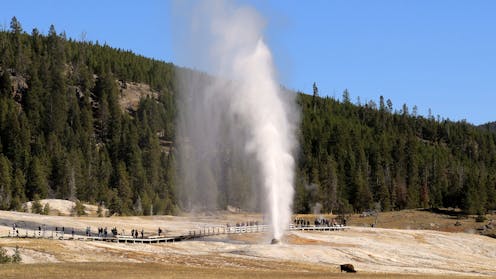
    Beehive Geyser, in the Upper Geyser Basin of Yellowstone National Park. Thomas S. Bremer

    Nearly 5 million travelers come to Wyoming to visit Yellowstone National Park each year, most in the summer months. They come for the geysers, wildlife, scenery and recreational activities such as hiking, fishing and photography.

    However, few realize that religion has been part of Yellowstone’s appeal throughout the park’s history. My 2025 book “Sacred Wonderland” documents how people have long found holiness in Yellowstone: how a landscape once sacred to Native Americans later inspired Christians and New Age communities alike.

    Native reverence – and removal

    Long before European Americans “discovered” the Yellowstone region in the 19th century, numerous Indigenous peoples were aware of its unique landscape – particularly geysers, hot springs and other hydrothermal wonders. Several tribal groups engaged in devotional practices long before it became a park. These included the Tukudika, or Sheep Eaters, a band of mountain Shoshone. They lived year-round within the boundaries of what would become the national park.

    Anthropologists know relatively little about the specific beliefs that Native Americans held about Yellowstone during this era. However, it’s clear most of the Indigenous groups who frequented Yellowstone considered it, as historian Paul Schullery concludes, “a place of spiritual power, of communion with natural forces, a place that inspired reverence.”

    A large waterfall pours over a steep cliff into a river below, surrounded by rocky canyon walls and forested slopes.
    Lower Falls of the Yellowstone River, Yellowstone National Park.
    Thomas S. Bremer

    After the Civil War, more Euro-Americans entered the region. In 1872, the U.S. government created Yellowstone as the first national park, setting a precedent for others in the United States and around the world.

    Yellowstone and other U.S. national parks established in the 19th century were products of manifest destiny: the Christian idea that Americans had a divinely ordained right to expand their country across the continent. The nation’s westward expansion included turning supposedly wild, “uncivilized” areas into parks.

    The park system’s creation, though, came at the cost of Indigenous communities. In Yellowstone, the Tukudika were forcibly removed in the 1870s to two reservations in Idaho and Wyoming, as anthropologists Peter Nabokov and Lawrence Loendorf discuss in their book “Restoring a Presence.”

    Christian ministry

    In addition to the concept of manifest destiny, Christians brought their own religious practices to Yellowstone National Park.

    The U.S. Army was responsible for protecting and managing the park from 1886 to 1918. It operated from Fort Yellowstone at Mammoth Hot Springs in the northern part of the park. The last building it erected at the fort was a chapel, which has been in continuous use as a worship space – mostly for Christian groups – since its completion in 1913.

    A small stone church features a pitched roof, arched windows and a prominent entrance.
    The Yellowstone National Park Chapel at Mammoth Hot Springs, finished in 1913, was the last building constructed by the U.S. Army at Fort Yellowstone.
    Thomas S. Bremer

    One group that has used the chapel consistently since the 1950s is ACMNP, A Christian Ministry in the National Parks, an evangelical Protestant parachurch ministry founded in Yellowstone. Its volunteers conduct worship services and proselytize among employees and visitors.

    ACMNP began as the brainchild of Presbyterian minister Warren Ost, who had worked as a bellhop at the Old Faithful Inn during summer breaks in seminary. Upon graduation, he formed the ministry, hoping to capitalize on the awe people experience in the parks to affirm believers’ faith and bring new souls to Christ.

    ACMNP’s mission involves placing seminarians and other students in national parks as “worker-witnesses.” They work as paid employees in secular jobs and conduct religious activities after their regular working hours. Additionally, they are encouraged to talk about religion with their fellow workers on the job.

    ACMNP experienced rapid growth in the 1950s and 1960s, boosted by support from National Park Service leadership. Cooperation included reduced-cost housing for their volunteers, and in some parks the superintendents or other high-level officials served on local ACMNP committees.

    At its peak in the 1970s, ACMNP had nearly 300 volunteers working in over 50 locations. However, a federal lawsuit in the 1990s challenged its relationship with the government on the grounds of church-state separation and ended some of the privileges ACMNP had enjoyed. Not long after the legal action, Ost announced his retirement.

    Although the organization has scaled back operations, the ministry in Yellowstone has experienced few changes. ACMNP volunteers continue to offer religious services to park employees and visitors throughout the summer.

    Spiritual fortress

    Another religious group has a very different interpretation of Yellowstone. The Church Universal and Triumphant, which had several thousand members at its height, was founded by Elizabeth Clare Prophet in the 1970s, based on the teachings of her late husband, Mark Prophet.

    The Church Universal and Triumphant is an heir to the “I AM” movement, which flourished in the U.S. during the 1930s. Most prominent among I AM’s influences were theosophy, which promotes esoteric knowledge gleaned from Asian religious traditions as a universal wisdom underlying all religions; new thought, which advocates a mind-over-matter spirituality; and spiritualism, which involves communicating with spirits.

    In the 1980s, Prophet’s followers relocated from California to Montana, where they purchased a large ranch adjacent to Yellowstone National Park’s northwest boundary. With them, they brought an eclectic New Age theology that combines elements of Christianity, Buddhism and Hinduism with belief in “ascended masters,” spiritual beings who guide the church. The group’s tradition teaches that beneath Yellowstone are two underground caverns, hidden from human view, that contain a cache of sacred stones with spiritual powers.

    The Church Universal and Triumphant gained attention in the ‘90s when its believers in Montana built underground bunkers. Members believed that their ascended masters had predicted a nuclear war and had instructed the community to prepare to survive underground. When the prophecy of a nuclear attack did not materialize, many members became disillusioned.

    The group struggled to rebuild its reputation and establish goodwill with Montana neighbors, including the National Park Service. Elizabeth Clare Prophet retired in 1999, and since then the church has concentrated more on its publishing and educational enterprises. However, a core community of the faithful still live and worship on their Royal Teton Ranch adjacent to Yellowstone.

    A stage area displaying an image of the Hindu god Shiva and two large portraits of men, with a white chair flanked by two flower-laden tables.
    The main church sanctuary at Church Universal and Triumphant headquarters, just outside Yellowstone National Park.
    Thomas S. Bremer

    Although the community teaches that its Montana ranch is a sacred location of the ascended masters, followers’ holiest place in the Western Hemisphere is roughly 35 miles south of Yellowstone, in Grand Teton National Park. They believe humanity began at Grand Teton Mountain and that the faithful will find their destiny there.

    Accordingly, members believe that Yellowstone and Grand Teton national parks are brimming with spiritual powers, sacred sources of light and energy for the entire world.

    In my conversations with people in the park, I found that very few knew anything about Yellowstone’s religious history at all – especially Native American practices. The ongoing practices of religious communities in the park remain invisible to nearly all visitors. Still, many vacationers interpret Yellowstone’s wonders as evidence of God’s handiwork.

    The Conversation

    Thomas S. Bremer received funding in the past to conduct historical research for the National Park Service at Lincoln Home National Historic Site in Springfield, Illinois.

    ref. Yellowstone has been a ‘sacred wonderland’ of spiritual power and religious activity for centuries – and for different faith groups – https://theconversation.com/yellowstone-has-been-a-sacred-wonderland-of-spiritual-power-and-religious-activity-for-centuries-and-for-different-faith-groups-261045

  • As Mexico’s LGBTQ+ community battles for inclusion, two drag performers have become internet stars – with more than 2 million TikTok followers

    Source: ForeignAffairs4

    Source: The Conversation – USA (2) – By Francisco Tijerina, PhD Candidate in Hispanic Studies, Washington University in St. Louis

    Turbulence Queen, left, and Burrita Burrona perform at the Mexico City Pride Parade in June 2024. Jaime Nogales/Medios y Media via Getty Images News

    In January 2022, Erick Martínez, also known as Turbulence Queen, introduced a guest on his YouTube channel: Ivan “Momo” Guzmán, with the stage name Burrita Burrona, a drag performer wearing a cartoonish donkey costume topped by a wig.

    During their interview, Turbulence and Burrita shared stories, gossiped and threw shade at Mexican actors, newscasters and performers. Soon after, their careers took off.

    Before Burrita’s first appearance, Turbulence’s YouTube channel had fewer than 5,000 subscribers. Now, after the rebranding of the show to include Burrita’s name, their channel has about 375,000. More than 2 million subscribe to them on TikTok – Turbulence, with 600,000 followers and 16 million likes; Burrita with 1.5 million followers and 28 million likes. Their “El Podcast del Momento” has more than 225,000 subscribers.

    The two proved so popular that corporate sponsors started getting in on the action. Soriana, a large supermarket chain in Mexico, splashed their images on a line of cakes. Netflix Latin America had them hosting a series of videos promoting its new South Korean dramas. The media giant Televisa included Turbulence and Burrita as part of their comedic coverage of the 2024 Paris Olympics.

    Over the past 3 ½ years, the YouTube show has added some new characters, including Burrita’s mom and an on-and-off love interest, a butch lesbian wolf. Along with the interviews, the characters do comedic cooking segments and sketches. Even in today’s fragmented and cluttered media environment, the program regularly gets around 250,000 views, with some episodes reaching more than 1 million.

    While drag performers are not new in Mexico, Burrita is something of a novelty: a drag mascot. Although long a part of Mexico’s commercial culture – mascots promote everything from soccer teams to pharmacies and are a staple at children’s birthday parties – Burrita is the first to do it in drag.

    A clip from an episode of ‘El Podcast del Momento.’

    Discrimination and violence

    As a Mexican scholar who specializes in the study of gender and sexuality, I’m struck by how these LGBTQ+ characters have become enormously popular in what I consider a relatively conservative and deeply religious country. However, that too is changing: Today’s Mexico is sometimes called a conservative country with liberal laws. Still, in a country where about 5% of the population self-identify as LGBTQ+, the battle for inclusion – and more diverse representation of gender and sexuality – is far from over.

    In 2023, conservative groups pressured the International Book Fair of Monterrey to cancel a public short-story reading by drag queens. In 2024, a social media influencer’s misogynistic, homophobic and transphobic remarks ran live on national television. Also in 2024, San Nicolás de los Garza, a city of more than 400,000 people, banned public performances by drag queens. Ironically, San Nicolás is in the state of Nuevo Leon, which has one of the largest LGBTQ+ populations in Mexico.

    Indeed, national policies protecting the LGBTQ+ community don’t always apply equally; some states are more restrictive than others. For example, although Mexico’s Supreme Court legalized same-sex marriage in 2015, three states have yet to ratify it in their state constitutions.

    A drag performer, with bright red hair, speaks to an off-camera TV reporter.
    Turbulence Queen is interviewed on local TV at a 2023 red carpet event in Mexico.
    Jaime Nogales/Medios y Media via Getty Images Entertainment

    In May 2025, Mexico’s National Institute of Statistics and Geography reported these findings: 60% of the LGBTQ+ community say they’ve been subjected to some form of violence. Nearly 30% have had suicidal thoughts or have attempted suicide. Just over 37% say they experienced some form of discrimination during the past year. From 2020 to 2025, 25% said they were denied access to health care, education or social support. Hate crimes are on the rise, with 672 reported over a five-year period, including 141 in 2024, a significant jump from the 92 reported in 2023. The 2024 statistic includes 55 murders of transgender women.

    Taking off the mask

    Turbulence and Burrita’s swift success is impressive, but not all LGBTQ+ citizens in Mexico enjoy the same level of recognition and privilege. And as the fight for equal treatment continues, the country’s politics over the past decade has shifted. In 2018, leftist Andrés Manuel López Obrador was elected president. His successor, Claudia Sheinbaum, a climate scientist and a close ally of López Obrador’s, was elected in 2024.

    But although both López Obrador and Sheinbaum are more progressive than previous administrations, neither has been particularly vocal about their support for the LGBTQ+ community. For instance: Although Sheinbaum, Mexico’s first female and Jewish president, mentioned her support for the LGBTQ+ community during her campaign, she has largely ignored LGBTQ+ issues since taking office.

    Until recently, there were few openly LGBTQ+ people pitching products or appearing on television. But Guzmán, who’s the first mascot to perform in drag, is not hiding his sexuality, despite the costume. Rather, he can be read as a symbol of Mexico’s ongoing pursuit of equality. And perhaps his character’s visibility will allow more in the community to be able to shed their masks and come out.

    The Conversation

    Francisco Tijerina does not work for, consult, own shares in or receive funding from any company or organization that would benefit from this article, and has disclosed no relevant affiliations beyond their academic appointment.

    ref. As Mexico’s LGBTQ+ community battles for inclusion, two drag performers have become internet stars – with more than 2 million TikTok followers – https://theconversation.com/as-mexicos-lgbtq-community-battles-for-inclusion-two-drag-performers-have-become-internet-stars-with-more-than-2-million-tiktok-followers-241552

  • Why 2025 became the summer of flash flooding in America

    Source: ForeignAffairs4

    Source: The Conversation – USA (2) – By Jeffrey Basara, Professor of Meteorology, UMass Lowell

    Rescuers searched for survivors after a flash flood in Texas Hill Country on July 4, 2025, that killed more than 130 people. Jim Vondruska/Getty Images

    The National Weather Service has already issued more than 3,600 flash flood warnings across the United States in 2025, and that number is increasing as torrential downpours continue in late July. There’s a good chance the U.S. will exceed its yearly average of around 4,000 flash flood warnings soon.

    For communities in Texas, New Mexico, West Virginia and New Jersey, the floods have been deadly. And many more states have seen flash flood damage in recent weeks, including New York, Oklahoma, Kansas, Vermont and Iowa.

    What’s causing so much extreme rain and flooding?

    Map shows a very wet central and eastern U.S., particularly over Texas, but just about everywhere east of the Rockies was quite a bit above normal
    Much of the central and eastern U.S. has had above-normal precipitation over the three months from April 23 through July 24, 2025. Blues are 150% to 200% of normal. Purples are even higher.
    NOAA National Water Prediction Service

    I study extreme precipitation events along with the complex processes that lead to the devastating damage they cause.

    Both the atmosphere and surface conditions play important roles in when and where flash floods occur and how destructive they become, and 2025 has seen some extremes, with large parts of the country east of the Rockies received at least 50% more precipitation than normal from mid-April through mid-July.

    Excess water vapor, weaker jet stream

    Flash floods are caused by excessive precipitation over short periods of time. When rain accumulates too fast for the local environment to absorb or reroute it, flooding ensues, and conditions can get dangerous fast.

    A man standing in ankle-deep water moves equipment to safety in a construction business.
    Flooding from heavy rain in the Boston area on July 10, 2025, shut down an interstate and filled streets and garages with water.
    John Tlumacki/The Boston Globe via Getty Images

    During the warm season, intrusions of tropical air with excessive water vapor are common in the U.S., and they can result in intense downpours.

    In addition, the jet stream and westerly winds – which move storm systems from west to east across the U.S. – tend to weaken during summer. As a result, the overall movement of thunderstorms and other precipitation-producing systems slows during the summer months, and storm systems can remain almost stationary over a location.

    The combination of intense rainfall rates and extended precipitation increases the likelihood of flash flooding.

    The surface rain falls on makes a difference, too

    Local surface characteristics also play important roles in how flash floods develop and evolve.

    When intense precipitation is combined with saturated soils, steep slopes, urban areas and sparse vegetation, runoff can quickly overwhelm local streams, rivers and drainage systems, leading to the rapid rise of water levels.

    Damaged homes along the Broad River in North Carolina.
    When the remnants of Hurricane Helene hit the mountains of North Carolina in October 2024, the intense rainfall on steep slopes quickly filled streams and then rivers that washed away homes in their narrow valleys.
    Sean Rayford/Getty Images

    Because the characteristics of the surface can vary significantly along a stream or river, the timing and location of a heavy downpour pose unique risks for each local area.

    What’s driving flash floods in 2025?

    During the horrific flooding in Texas Hill Country on July 4, 2025, that killed more than 135 people, atmospheric water vapor in the region was at or near historic levels. The storm hit at the headwaters of the Guadalupe River, over streams that converge in the river valley.

    As thunderstorms developed and remained nearly stationary over the region, they were fueled by the excessive atmospheric water vapor. That led to high rainfall rates. Hours of heavy rainfall early that morning sent the river rising quickly at a summer camp near Hunt, Texas, where more than two dozen girls and staff members died. Downstream at Kerrville, the river rose even faster, gaining more than 30 feet in 45 minutes.

    Overall, a persistent atmospheric pattern in late spring and summer 2025 has included a shift of the jet stream farther to the south than normal and, along with lower atmospheric pressures, has supported excessive rainfall across the central and eastern U.S.

    While the West Coast has experienced dry conditions in early summer 2025 due to a ridge of high pressure, the U.S. east of the Rockies has seen an active storm track with frontal boundaries and disturbances that produced thunderstorms and intense downpours across the region.

    Warmer-than-normal ocean water can also boost rainfall. The Caribbean and the Atlantic Ocean are source regions for atmospheric water vapor in the central and eastern U.S. In summer 2025, that water vapor has created extremely humid conditions, which have produced very high rainfall rates when storms develop.

    The result has been flash floods in several states producing catastrophic destruction and loss of life.

    Looking to the future

    The U.S. has seen devastating flash floods throughout its history, but rising global temperatures today are increasing the risk of flooding.

    As ocean and air temperatures rise, atmospheric water vapor increases. Higher ocean temperatures can produce more atmospheric water vapor through evaporation, and a warmer atmosphere can hold more moisture, fueling downpours. In some high-risk areas, meteorologists, aware of the risks, say they are becoming more proactive about warnings.

    Currently, evidence shows that atmospheric water vapor is increasing in the overall global climate system as temperatures rise.

    The Conversation

    Jeffrey Basara receives funding from the National Science Foundation, NASA, and NOAA.

    ref. Why 2025 became the summer of flash flooding in America – https://theconversation.com/why-2025-became-the-summer-of-flash-flooding-in-america-261650

  • Why do MAGA faithful support Trump if his ‘big beautiful bill’ will likely hurt many of them?

    Source: ForeignAffairs4

    Source: The Conversation – USA – By Alex Hinton, Distinguished Professor of Anthropology; Director, Center for the Study of Genocide and Human Rights, Rutgers University – Newark

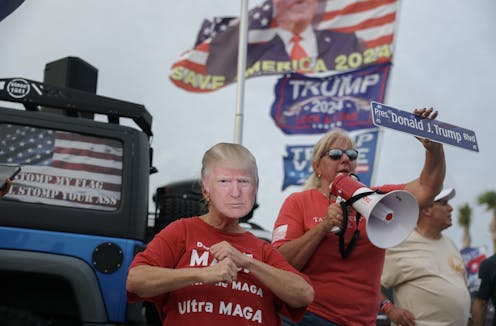
    Supporters of President Donald Trump demonstrate near his Mar-a-Lago home in Palm Beach, Fla., on July 17, 2025. Joe Raedle/Getty Images

    President Donald Trump signed the wide-ranging One Big Beautiful Bill Act into law on July 4, 2025. It focuses on cutting taxes, mainly for households that earn US$217,000 or more each year, as well as increasing funding for military and border security and revamping social programs.

    Republicans tout it as providing “an economic lifeline for working families” and “laying a key cornerstone of America’s new golden age.”

    Democrat lawmakers argue that, in reality, Trump’s act “steals from the poor to give to the ultra-rich.”

    The act is estimated to increase the country’s debt by more than US$3 trillion over 10 years, while knocking more than 10 million people off Medicaid.

    About 41.4 million adults in the U.S. receive Medicaid. And 49% of Medicaid recipients who voted in the 2024 election backed Trump.

    While 94% of Democrats and Democratic-leaning independents said in a May 2025 survey that they are worried Medicaid cuts will lead to more adults and children losing their health insurance, 44% of Republicans and Republican-leaning independents expressed concern about this, according to the KFF Health Tracking Poll.

    Why, then, do Trump’s Make America Great Again supporters – especially those who will be hit hard by cuts to food assistance programs and health care, including hospitals – continue to support him even as he enacts policies that some think go against their interests? Indeed, over 78% of Republicans or Republican-leaning voters say they support the measure Trump signed.

    As an anthropologist who studies MAGA and American political culture, I understand that many of the MAGA faithful believe that Trump is a once-in-a-lifetime leader who is catapulting the U.S. into a new golden age.

    Sure, their reasoning goes, bumps in the road are expected. But they think that most of the criticism of Trump and this latest bill is ultimately fake news spread by radical leftists who have what some call Trump Derangement Syndrome, meaning anti-Trump hysteria.

    An older man with white hair sits and holds up a larger piece of paper. He is surrounded by people dressed formally who applaud and smile.
    President Donald Trump holds up the One Big Beautiful Bill Act that he signed into law on July 4, 2025, at the White House.
    Alex Brandon − Pool/Getty Images

    Trump alone can fix it

    In the eyes of the MAGA faithful, Trump is no ordinary politician. To them, he is a savior who can help ward off the threat of radical left socialism. They believe Trump’s proclamation: “I alone can fix it.”

    Some see Trump’s survival of an assassination attempt on July 13, 2024, as evidence he is divinely chosen to lead the country. Trump himself claimed during his second inaugural address, “I was saved by God to make America great again.”

    As I have repeatedly observed firsthand at Trump rallies and MAGA gatherings and heard in my conversations with Trump supporters, many Trump supporters – even those whom Democrats contend will be hurt by the bill – see the bill as a key step to making America great again. Doing so will not be easy and may cause some pain.

    But as Trump himself has noted about policies such as tariffs, “sometimes you have to take medicine to fix something.”

    ‘Fake news!’

    Even if the bill may cause some short-term pain, MAGA stalwarts contend, the apocalyptic claims of critics of massive health cuts are hoaxes spread by the radical left media. White House National Economic Council director Kevin Hassett, for example, dubbed the Medicare cut claims “a big fake news story.”

    This view, based on my research and observations, is unsurprising. Trump has been pushing the “fake news conspiracy” theory, which holds that the media is part of the deep state, since his first term. He even dubbed the press “the enemy of the people.”

    Trump’s fake news rhetorical strategy has been successful in helping him maintain support. Trump supporters take it for granted that negative news coverage of the president is most likely fake news.

    The Trump administration frequently invokes this conspiracy theory, including statements with headlines like “100 Days of HOAXES: Cutting Through the Fake News.”

    The White House is taking the same approach with the new legislation. In June 2025, the Trump administration issued a statement stating “Myth vs. Fact: The One Big Beautiful Bill” and “MYTHBUSTER: The One Big Beautiful Bill Cuts Spending, Deficit – and That’s a Fact.”

    There is already evidence that this depiction is resonating in places such as rural Nebraska, where many residents do not blame Trump for a health clinic that claims it is shutting down due to Medicaid cuts. “Anyone who’s saying that Medicaid cuts is why they’re closing is a liar,” said one woman of the clinic’s closure.

    A large crowd of people sit and face board a man who is illuminated from the front.
    President Donald Trump holds a rally in July 2024 in Harrisburg, Pa.
    Spencer Platt/Getty Images

    ‘Crushing it’ in the Golden Age

    More broadly, the MAGA faithful contend, the bill’s critics miss the bigger picture. For the most part, Trump has been “crushing it” while putting “‘W’ after ‘W’ on the board.”

    From their perspective, Trump has assembled an all-star Cabinet team that is implementing key pillars of the MAGA agenda, such as restricting immigration, blocking unfair trade and avoiding drawn-out wars.

    Trump supporters underscore the president’s accomplishments on immigration. Attempted unauthorized border crossings of migrants have plummeted in 2025, amid a rise in arrests of immigrants.

    “Our message is clear,” stated Department of Homeland Security Assistant Secretary Tricia McLaughlin, “criminal illegal aliens are not welcome in the United States.”

    Gas prices are also down. Trump has followed through on his pledge to supporters to purge what he calls the deep state, by downsizing or gutting entire government departments and agencies.

    Trump has clamped down on woke universities that brainwash students, as MAGA supporters see it.

    He withheld funding from the University of Pennsylvania until it agreed to ban transgender women from playing on women’s sports teams. Trump also cut $400 million in funding for Columbia University because the administration said it did not sufficiently protect Jewish students from harassment during Palestinian rights protests.

    And Israeli Prime Minister Benjamin Netanyahu even nominated Trump for the Nobel Peace Prize in July for his diplomatic work in the Middle East.

    Recounting Trump’s foreign policy achievements, one conservative commentator gushed that Trump “promised we would win so much we’d get tired of winning. Instead, the wins keep coming – and America isn’t tired at all.”

    Trumpism = Trump

    Yet, Trump faces challenges.

    A June 2025 KFF Health Tracking Poll found that support for the new legislation decreased when people were informed about its negative health care impact, for example.

    Republicans could also face backlash in 2028 after the full impact of the act takes effect and people lose health insurance and other public benefits.

    Regardless, I believe MAGA faithful will likely continue to support Trump.

    They may argue over parts of his bill, the airstrikes on Iran or the release of the Jeffrey Epstein files.

    But, in the end, they will circle the wagons around Trump for a simple reason. Trump created the MAGA movement. He dominates the Republican Party. And there is no Trumpism without Trump.

    The Conversation

    Alex Hinton receives receives funding from the Rutgers-Newark Sheila Y. Oliver Center for Politics and Race in America, Rutgers Research Council, and Henry Frank Guggenheim Foundation.

    ref. Why do MAGA faithful support Trump if his ‘big beautiful bill’ will likely hurt many of them? – https://theconversation.com/why-do-maga-faithful-support-trump-if-his-big-beautiful-bill-will-likely-hurt-many-of-them-260766

  • Plug-in solar panels are the latest green energy trend – here’s what you need to know

    Source: ForeignAffairs4

    Source: The Conversation – UK – By Dylan Ryan, Lecturer in Mechanical & Energy Engineering, Edinburgh Napier University

    Astrid Gast/Shutterstock

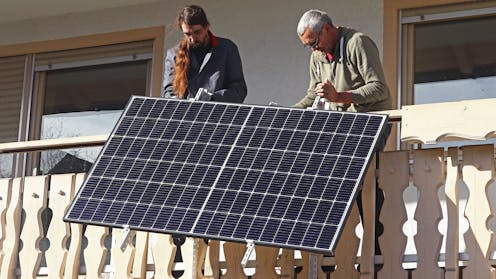
    Solar power is the fastest growing source of electricity globally. Normally, anyone wanting to tap into it would have to rely on roof-mounted panels. But in many parts of Europe, people have found a simple alternative in the form of “plug-in panels” that can be arranged on balconies.

    Instead of having to be wired into the house, you can feed the power generated by these panels into an inverter and a standard plug. Is this something that might catch on in the UK? Let’s investigate.

    First, solar installations usually come under “permitted development” with regard to planning permission. But you still might need to apply, particularly if you live in a shared development or a listed building.

    For example, some apartment blocks are insured collectively; if solar panels are going to affect the building’s insurance, it’s going to affect the whole block. There may also be rules regarding what you can put on your balcony, so consult your building manager.

    The UK government is promising to ease restrictions on solar balconies, but we shall have to see how it addresses these issues.

    There are also safety concerns. The power generated by the panel has to be balanced with consumption. Which, in practice, may restrict their use to a circuit that only connects to low-power devices (lights, TVs or computers are fine, but not ovens or kettles).

    So you need to be aware of what the panels are connected to, particularly if you have an older home which may have been built before modern electrical safety standards. Also, to connect the panels, you would need a weatherised external plug, which not all flats have.

    How much power could you get?

    As luck would have it, I have a south-facing balcony, so let us run the numbers.

    I came across a 800W system online that sells for £499 (with supports that would allow me to mount it). It has an area of 3.95m² and is made of a thin photovoltaic film (about 10-12% efficient).

    The optimum angle for a solar panel in Edinburgh where I live is 37.6 degrees. Mounting them vertically (draped over the railing of a balcony, as is often the case) will reduce performance, with typical losses of 30-45%. My balcony is also completely shaded for half of the day due to a neighbouring building, so a panel will generate little power at those times.

    A house with a large balcony covered with a vertical line of panels.
    A vertically mounted solar system in France. This is not the best angle for generation.
    Asurnipal/Wikimedia, CC BY

    The position of the sun varies as it moves across the sky during the day, as well as seasonally, as does the solar energy received. We can input this data plus our location into an online calculator, which will account for hourly and seasonal variations.

    This estimates output for a vertically mounted panel at 132 kilowatt-hours per year (kWh/yr). Assuming electricity costs of £0.24/kWh, that means a payback period of 15.7 years (thin film solar systems typically last between ten and 20 years).

    If we could orientate the panel at the optimum angle of 37.6° (tilt them out from the edge of the balcony), the power generated would rise to 182 kWh/yr (a payback period of 11.4 years, although this could fall foul of planning rules).

    A first-floor flat with two solar arrays tilted slightly over the balcony.
    Balcony solar panels angled to achieve optimum performance.
    Triplec85/Wikimedia, CC BY

    Free from the shading of my neighbour on the top floor and angled optimally, output from a plug-in panel could rise to 370 kWh/yr (payback 5.6 years). But this is for south-facing balconies. An east- or west-facing balcony would produce 30% less power and a north-facing panel, half as much or less.

    Is it worth it?

    Another issue is that you can only use the generated electricity when you are in the house. If, for example, I’m out half the time the panels are generating power (which is likely), the payback period doubles – so they will probably never pay for themselves. A battery could help store power for use later, but that adds costs plus the hassle of wiring everything up.

    Let’s look at a monocrystalline panel (these last longer than film and are more efficient) that is roof-mounted at the optimum angle (so it’s clear of any obstructions) and wired up to feed into the grid so any power you don’t use, you can sell it to the network.

    An apartment building with panels mounted on the roof.
    Rooftop solar panels on an apartment block in Berlin, Germany.
    Georg Slickers/Wikimedia, CC BY

    Assuming a 4kW monocrystalline array at an installation cost of £5,500, the online calculator estimates generation of 2,970 kWh/yr for a payback period of 7.7 years (on a system that will last 25-30 years). And that’s not even considering any possible grants that you might be eligible for.

    Whether or not balcony solar is feasible is going to be very site-specific. If you have a balcony with an uninterrupted view south and you are not going to fall foul of any planning or electrical issues, it might be worth it.

    If you face north, or there’s another building in the way, or your fuse box looks like a prop from Downton Abbey, less so. In many cases, a solar generator mounted at an optimum angle and exporting electricity to the grid might be a better idea, even if the initial installation costs are higher.


    Don’t have time to read about climate change as much as you’d like?

    Get a weekly roundup in your inbox instead. Every Wednesday, The Conversation’s environment editor writes Imagine, a short email that goes a little deeper into just one climate issue. Join the 45,000+ readers who’ve subscribed so far.


    The Conversation

    Dylan Ryan does not work for, consult, own shares in or receive funding from any company or organisation that would benefit from this article, and has disclosed no relevant affiliations beyond their academic appointment.

    ref. Plug-in solar panels are the latest green energy trend – here’s what you need to know – https://theconversation.com/plug-in-solar-panels-are-the-latest-green-energy-trend-heres-what-you-need-to-know-260467

  • Origins of Israel’s nuclear ambiguity lie in a secret deal forged between Richard Nixon and Golda Meir – podcast

    Source: ForeignAffairs4

    Source: The Conversation – UK – By Gemma Ware, Host, The Conversation Weekly Podcast, The Conversation

    Israel has never officially confirmed or denied having nuclear weapons and has never signed the nuclear non-proliferation treaty. Instead, even as evidence has emerged about its nuclear capabilities, Israel has maintained a policy of nuclear ambiguity.

    The origins of this opacity lie in a secret deal forged in a one-on-one meeting between Israeli prime minister, Golda Meir, and the US president, Richard Nixon, at the White House in September 1969.

    In this episode of The Conversation Weekly podcast, we speak to Avner Cohen, professor of non-proliferation studies at the Middlebury Institute of International Studies at Monterrey in the US, about that 1969 deal and why it has endured for more than 50 years. Cohen is the author of Israel and the Bomb, considered the definitive work on Israel’s nuclear programme, and has been interrogated by the Israeli state for his research.

    Cohen tells us that the understanding between Meir and Nixon meant the US accepted Israel as a special kind of nuclear weapon state. In turn, Israel committed to restraint, not to test nuclear weapons, and not to be the first to introduce them to the region. Neither side has confirmed the existence of a deal, and there are only hints at it in the historical record. Cohen explains:

     Once you realise that there is actually a deal, it explains a great deal of the situation. Why the US [is] looking the other way, why the issue is determined to be removed from the diplomatic agenda, and why many other countries, especially in the west, prefer not to see the Israeli nuclear issue.

    Listen to the conversation with Avner Cohen on The Conversation Weekly podcast.


    This episode of The Conversation Weekly was written and produced by Mend Mariwany and Gemma Ware with assistance from Katie Flood and Ashlynne McGhee. Mixing and sound design by Eloise Stevens and theme music by Neeta Sarl.

    Newclips in this episode from CNN, AP Archive, BBC News and ABC.

    Listen to The Conversation Weekly via any of the apps listed above, download it directly via our RSS feed or find out how else to listen here. A transcript of this episode is available on Apple Podcasts or Spotify.

    The Conversation

    Avner Cohen does not work for, consult, own shares in or receive funding from any company or organisation that would benefit from this article, and has disclosed no relevant affiliations beyond their academic appointment.

    ref. Origins of Israel’s nuclear ambiguity lie in a secret deal forged between Richard Nixon and Golda Meir – podcast – https://theconversation.com/origins-of-israels-nuclear-ambiguity-lie-in-a-secret-deal-forged-between-richard-nixon-and-golda-meir-podcast-261789

  • Russia-Ukraine talks: both sides play for time and wait for Donald Trump’s 50 days to run out

    Source: ForeignAffairs4

    Source: The Conversation – UK – By Stefan Wolff, Professor of International Security, University of Birmingham

    Russia and Ukraine met in Istanbul on July 23 for a third round of talks since face-to-face negotiations resumed in May. Expectations were low. Two previous rounds have yielded very few concrete results, apart from agreements on prisoner exchanges the return of the bodies of soldiers killed in action.

    The latest meeting was the shortest yet, lasting just 40 minutes. The negotiating teams were led by former Ukrainian defence minister Rustem Umerov and Vladimir Medinsky, a senior aide to Russian president Vladimir Putin. They agreed on another exchange of prisoners and on setting up three working groups on political, military and humanitarian issues to engage online rather than in face-to-face meetings.

    But if the talks have achieved very little, they have demonstrated two things. First, that the two sides remain very far apart on what they would consider acceptable terms for a ceasefire, let alone a peace agreement. And, second, that neither side is prepared to walk away from the negotiations, worried about incurring the wrath of the US president, Donald Trump.

    A fourth round of negotiations has not been ruled out, but it is unlikely to involve either Vladimir Putin or Volodymyr Zelensky, given that their negotiating positions still offer little hope of a deal ready to be signed at a leaders’ summit.


    Sign up to receive our weekly World Affairs Briefing newsletter from The Conversation UK. Every Thursday we’ll bring you expert analysis of the big stories in international relations.


    The latest round of talks, however, took place in a different context to the earlier two meetings. Earlier in July, Trump set a deadline of 50 days, ending on September 2, for the fighting to stop.

    After this if there’s no progress towards a ceasefire, the US president will consider imposing hefty secondary sanctions on Russia’s remaining trade partners. The aim would be to starve Moscow’s war economy of crucial foreign income, principally from heavily discounted sales of oil and gas to willing buyers including India and China.

    The first ten days of this 50-day ultimatum have now passed. While the talks in Istanbul might be seen as a sign that Kyiv and Moscow are taking Trump seriously, the lack of tangible results suggests otherwise. There is no indication that either Russia or Ukraine have moved from their maximalist demands.

    Russia keeps insisting on the recognition of its illegal occupation in Ukraine, on future limits to Ukraine’s military strength, and on a denial of the country’s accession to Nato. Ukraine meanwhile asks for its territory to be restored and its sovereignty – including its ability to determine its alliance arrangements – to be respected.

    Playing for time

    Developments on and around the battlefields in Ukraine don’t offer any signs that Moscow or Kyiv are ready even for a ceasefire either. Russia continues to make incremental gains along the 1,000km of frontlines in Ukraine.

    It also keeps pounding Ukrainian cities, including the capital Kyiv, with nightly drone and missile attacks. These have taken place at unprecedented scales of hundreds of drones that have repeatedly overwhelmed Ukraine’s already stretched air defence systems.

    Yet, Ukraine has been buoyed by the promise of more US arms deliveries – paid for by other Nato allies – and the continuing commitments by its international partners to support the country. These include those made at the recent Nato summit in The Hague and the Ukraine Recovery Conference in Rome.

    Add to that Trump’s apparent pivot away from Putin and his recently more constructive relationship with Zelensky, and it becomes clear why Kyiv – like Moscow – thinks that time is on its side.

    Both may be proved wrong. Zelensky’s latest efforts to consolidate his power – a large-scale cabinet reshuffle and a decree to curb the independence of two of Ukraine’s anti-corruption agencies – have caused alarm among EU officials in Brussels. More importantly, they have also triggered rare public protests against the government in Kyiv and other major Ukrainian cities, including Dnipro, Lviv and Odesa.

    The protests may not get enough traction to pose a real danger to the government. But they indicate that support for Zelensky is not unconditional.

    This is something that the Ukrainian president appeared to acknowledge when he outlined his plans to submit an additional bill to parliament to protect the independence of the embattled anti-corruption agencies. What is widely seen as a power grab by the president’s inner circle also has the potential of undermining public morale at a critical time in the war.

    All of this also feeds into a Russian narrative of Zelensky as an illegitimate leader of his country who Russia cannot negotiate with. But it would be a mistake to assume that Russia can simply wait until Ukrainians are simply too exhausted to continue resisting Russia’s invasion or when western support will stop keeping Ukraine in the fight.

    Even if Europeans become disillusioned with Zelensky, Russia’s war against Ukraine is too much of an existential question for European security that they will abandon Kyiv just because they do not agree with its anti-corruption policies.

    It’s also not clear how long Russia can sustain the intensity of its ground and air campaigns against Ukraine or how long these will provide even the kinds of incremental gains that they currently achieve. Trump’s new plan for arming Ukraine by selling arms and ammunition to European Nato allies who would then deliver them to Kyiv is likely to blunt the effectiveness of the Russian air campaign and stymie its ground offensive.

    So playing for time is unlikely to get either Moscow or Kyiv any closer to achieving their war aims. But preventing the other side’s victory – whether that’s on the battlefield or at the negotiation table – may well be enough for now for both Putin and Zelensky.

    At the moment, continuing their war of attrition is the second-best solution that both presidents can agree on. The outcome of the third round of talks between their negotiators indicates that they may have reached such an implicit understanding already.


    Get your news from actual experts, straight to your inbox. Sign up to our daily newsletter to receive all The Conversation UK’s latest coverage of news and research, from politics and business to the arts and sciences.

    The Conversation

    Stefan Wolff is a past recipient of grant funding from the Natural Environment Research Council of the UK, the United States Institute of Peace, the Economic and Social Research Council of the UK, the British Academy, the NATO Science for Peace Programme, the EU Framework Programmes 6 and 7 and Horizon 2020, as well as the EU’s Jean Monnet Programme. He is a Trustee and Honorary Treasurer of the Political Studies Association of the UK and a Senior Research Fellow at the Foreign Policy Centre in London.

    ref. Russia-Ukraine talks: both sides play for time and wait for Donald Trump’s 50 days to run out – https://theconversation.com/russia-ukraine-talks-both-sides-play-for-time-and-wait-for-donald-trumps-50-days-to-run-out-261793

  • An ultra-black coating for satellites could stop them spoiling astronomy pictures

    Source: ForeignAffairs4

    Source: The Conversation – UK – By Noelia Noël, Senior Lecturer, School of Mathematics and Physics, University of Surrey

    Every night, as telescopes around the world open their domes to study the cosmos, astronomers are forced to contend with an unexpected form of pollution: bright white streaks slicing across their images.

    These luminous trails are caused by satellites. Specifically, the growing number of “megaconstellations” launched into low Earth orbit (LEO). These mega-constellations consist of many, sometimes hundreds, of satellites. They are intended to work as a system, providing services such as global internet access. Commercial companies that operate mega-constellations include SpaceX, Amazon and OneWeb.

    The streaks in astronomy images aren’t just cosmetic. They can corrupt sensitive astronomy data, generate false signals, and even trigger alerts for events that never happened.

    There may now be a partial solution to the luminous trails vexing astronomers. An ultra-black coating could be applied to the satellites themselves, dimming the trails that they leave in images. This material, called Vantablack 310, absorbs more than 99.99% of visible light.

    Modern astronomical observations rely on long exposure imaging, collecting faint light from distant galaxies, exoplanets, or supernovae over several minutes or hours. When a satellite crosses the field of view during that time, it reflects sunlight into the telescope, creating a saturated streak across the image.

    The impact is already substantial. Researchers at the Vera C Rubin Observatory in Chile – a flagship survey telescope set to revolutionise our understanding of the Universe – estimate that over 30% of the telescope’s twilight images already contain at least one satellite trail. And it’s not only visible light astronomy that’s at risk.

    Radio telescopes, infrared detectors, and even gravitational wave observatories are reporting increasing interference from satellites – including reflected light, unwanted radio emissions, and other forms of contamination. The ultra-black coating won’t alleviate these issues, of course. Other solutions will need to be found for these other forms of interference.


    Read more:
    Could the first images from the Vera Rubin telescope change how we view space for good?


    A crowded sky

    With more than 16,000 active satellites already in orbit and tens of thousands more planned, the skies are becoming increasingly congested. While these constellations offer enormous benefits, including global internet access, disaster response, agricultural monitoring, and climate surveillance, they also threaten the clarity of astronomical observations.

    Satellites in low Earth orbit (typically 500km-600km altitude) are often visible to the naked eye shortly after sunset or before sunrise. For sensitive telescopes, they can be ten to 100 times brighter than the recommended limits set by the International Astronomical Union.

    I am one of a team of researchers at the University of Surrey that is exploring Vantablack 310 as a next generation coating to reduce satellite brightness. The trials are being carried out by UK scientists in partnership with the Surrey Space Centre, and materials innovators Surrey NanoSystems.

    Originally developed for high-contrast optical systems – such as instruments that need to spot faint signals next to very bright ones – the coating absorbs more than 99.99% of visible light.

    Very black car surrounded by spotlights
    Vantablack has been demonstrated on on a BMW concept car.
    Vanderwolf Images/Shutterstock

    In 2026, Vantablack 310 will be tested in orbit for the first time aboard Jovian 1, a CubeSat – a small satellite about the size of a cereal box. It was developed at the University of Surrey and launched as part of the UK’s Jupiter programme, a university-led initiative that trains students in real-world satellite design, testing and operations, while supporting cutting-edge space research.

    The mission will assess how the coating performs under the harsh conditions in space, such as temperature swings, ultraviolet radiation, and micro-meteoroid impacts. If successful, it could significantly reduce how bright satellites appear to telescopes – making the streaks they leave behind much fainter and easier to remove from astronomical images.

    Ultra-black coatings will not make satellites invisible. Even the darkest object in orbit will reflect some light. But the goal is not invisibility – it is compatibility. Reducing satellite brightness below key thresholds ensures that scientific observations remain viable.

    What’s at stake is more than just clean astronomical data. The night sky is one of humanity’s oldest shared resources – a source of scientific insight, cultural heritage, and spiritual meaning across time and geography. From the star lore of indigenous people to ancient navigation systems, the night sky has always helped us understand our place in the universe.

    Publicly funded observatories in lower income countries – where many of the world’s darkest skies still exist – are also disproportionately affected, despite those countries having little say in the decisions that affect their skies.

    Framing the issue solely as a technical inconvenience for elite institutions misses the point. This is also about equity, access, and environmental justice. Who gets to access the sky, and who decides how it is altered, are global questions that demand inclusive solutions.


    Get your news from actual experts, straight to your inbox. Sign up to our daily newsletter to receive all The Conversation UK’s latest coverage of news and research, from politics and business to the arts and sciences.

    The Conversation

    This project was funded with six months of support from the Research England Development Fund (UKRI), focusing on mitigating satellite light pollution, including the in-orbit testing of ultra-black coatings.

    ref. An ultra-black coating for satellites could stop them spoiling astronomy pictures – https://theconversation.com/an-ultra-black-coating-for-satellites-could-stop-them-spoiling-astronomy-pictures-259171

  • MIL-OSI Asia-Pac: HKMoA to stage first exhibition of Chinese art master Wu Guanzhong in Korea (with photos)

    Source: Hong Kong Government special administrative region

    HKMoA to stage first exhibition of Chinese art master Wu Guanzhong in Korea       
         The exhibition is presented by the Leisure and Cultural Services Department (LCSD) and jointly organised by the SAC and the HKMoA. The exhibition is made possible by the Wu Guanzhong Art Sponsorship. This exhibition in Seoul is a continuation of the popular thematic exhibition of Wu, held at the HKMoA from March 2024 to March 2025, which achieved great success and attracted more than 570 000 visitors during the exhibition period. Accompanied by insightful excerpts from the artist’s writings, the exhibition allows visitors to explore the art master’s distinctive chromatic aesthetics as well as the countless passions and flights of imagination evoked from the interplay between black and white. There will be opportunities to appreciate iconic paintings such as “Two Swallows”, “Reminiscences of Jiangnan”, “Waterway” and more. 
          
         Wu’s works perfectly fuse Eastern and Western aesthetics. He dedicated his entire life to exploring the integration of Chinese and Western art, studied traditional Chinese ink painting and also ventured into the colourful world of oil painting in his early years. After studying in France, he returned to China. His works are noted for his masterful integration of the emotional depth of traditional Chinese ink painting with Western modernist and abstract composition. In 1992, Wu was among the first living Chinese artists to be honoured with a solo exhibition at the British Museum, and his works are also widely exhibited in Asia, Europe and the United States.
          
         Wu had deep connections with Hong Kong, and held multiple exhibitions and participated in various art events in the city. Over the years, Wu and his family have continuously made donations of Wu’s works and archives to the HKMoA, making up a substantial collection of over 450 items. The HKMoA has become the institution with the largest and most diverse collection of Wu’s works. With the support of the Wu Guanzhong Art Sponsorship, the HKMoA is bringing the museum collection and the research and curatorial insights of the art of Wu overseas, and will continue to promote Wu and modern Chinese art to audiences in different regions and at various levels through comprehensive and diversified perspectives.
          
         In addition, an immersive installation from the “Wu Guanzhong Art Sponsorship Cross-disciplinary Series: Wu Guanzhong x Chris Cheung” will also be on display overseas for the first time, complementing the exhibition. Processed by AI, “Sentient Pond – Seoul Edition” created by Hong Kong artist Chris Cheung generates exclusive paintings by visitors that embody Wu’s brushstrokes and artistic style through machine learning over hundreds of Wu’s paintings from the museum collection, to carry on the unconventional creations and spirit of Wu with a contemporary twist.
          
         Hong Kong Week is an annual arts festival organised by the LCSD, celebrating Hong Kong’s creative excellence worldwide and fostering cultural exchanges and artistic collaboration. This year, the festival will arrive in Seoul for the first time. Beginning on September 26, a total of 14 programmes will feature stage performances, film screenings, outdoor shows, visual art exhibitions, comic creations, fashion designs as well as other fringe activities. 
     
    For details of the exhibition and HK Week@Seoul, please visit the HKMoA’s website at hk.art.museum/en/web/ma/exhibitions-and-events/overseas-wgz-bnw.htmlIssued at HKT 19:25

    NNNN

    MIL OSI Asia Pacific News

  • MIL-OSI Video: EU-Japan Summit

    Source: European Commission (video statements)

    On July 23, 2025, Ursula von der Leyen, President of the European Commission, along with European Council President António Costa, visited Tokyo for the 30th EU-Japan Summit with Japanese Prime Minister Shigeru Ishiba. Security and trade were the key points of discussion, with both sides emphasizing their commitment to strengthening cooperation in areas like defense, economic security, and trade rules.

    https://www.youtube.com/shorts/NsZgsf2S7Mc

    MIL OSI Video

  • MIL-OSI Africa: Nelson Mandela Bay, UNISA forge groundbreaking library partnership

    Source: Government of South Africa

    The Nelson Mandela Bay Municipality has launched a pioneering partnership with the University of South Africa (UNISA) to dramatically expand access to library services for students and the broader public within the metro.

    Launched on Tuesday at New Brighton Library, the collaboration aims to enhance educational opportunities by transforming municipal libraries into resource hubs that support both UNISA students and lifelong learners.

    Under the agreement, municipal libraries will provide free internet and computer access, designated study spaces, and serve as convenient delivery and collection points for UNISA library materials.

    Through this collaboration, the municipality’s libraries will offer internet and computer facilities, provide study spaces, and serve as convenient delivery and collection points for UNISA library materials.

    As part of the agreement, the following areas of collaboration were outlined:
    •    Reciprocal participation in annual events and programmes.
    •    ICT training and support, primarily facilitated by UNISA.
    •    Distribution of UNISA brochures, posters, and event announcements in municipal libraries, and vice versa.
    •    Free internet access and usage of electronic resources for students, including Wi-Fi, databases, electronic reserves, journals, and books.
    •    Collaboration on courier services and information dissemination.
    •    Provision of study spaces for UNISA students.
    •    Joint efforts in marketing and communication to assess student satisfaction.
    •    Collaboration on sponsorships, such as provision of computers.
    •    Sharing of reports, statistics, and information.

    Nelson Mandela Bay Municipality Executive Mayor, Babalwa Lobishe, hailed the initiative as a transformative moment for the metro’s education agenda.

    “We are not only opening library doors, but we are opening pathways to opportunity, to education, and to a better future for all. By extending the access to knowledge and technology, especially in our undeserved communities, we are affirming that education is the foundation of dignity, progress, and equality. This fits well in our efforts to build a people-centred and inclusive metro,” Lobishe said.

    UNISA Executive Director for Library Services, Professor Mpho Ngoepe echoed the mayor’s sentiments, saying the initiative marks the beginning of a journey and contributing to closing the inequality gap that leads to poverty, through knowledge and empowerment.

    “In this digital era, libraries must take intentional steps to reach users where they are. We are moving towards a time when UNISA library services will be accessible to everyone, including those who are not enrolled with UNISA.

    “This is the end of the era where universities were seen as inaccessible ivory towers. Through this partnership, we will also explore the dissemination of research outputs,” Ngoepe said.

    Member of the Mayoral Committee for Sport, Recreation, Arts and Culture, Sinesipho Kwatsha, emphasised the broader social impact of the initiative.

    “This partnership is about more than logistics, it is a social contract and a clear commitment that every learner matters, “no matter where they come from. Through this collaboration, learners from disadvantaged communities, who might not otherwise have access to conducive learning spaces and resources, will now be supported through our network of municipal libraries across the metro,” Kwatsha said. – SAnews.gov.za
     

    MIL OSI Africa

  • India–UK CETA to strengthen global footprint of Indian SMEs

    Source: Government of India

    Source: Government of India (4)

    India and the United Kingdom on Thursday signed a landmark Comprehensive Economic and Trade Agreement (CETA), aimed at enhancing access to goods and services between the two countries.

    The agreement, signed in the presence of Prime Minister Narendra Modi and UK Prime Minister Keir Starmer, is set to give a major boost to India’s small and medium enterprises (SMEs), which form the backbone of the country’s economy. SMEs contributed around 30.1% to India’s GDP in 2022–23 and accounted for 45.8% of India’s total exports in 2024–25.

    SMEs benefit from various provisions of the CETA, including through provisions on faster processing at customs, agreements to recognise and facilitate digital systems and paperless trade, and a dedicated chapter to help SMEs. A contact point for SMEs will be established under the ambit of the CETA, facilitating communication and coordination benefiting SMEs.

    In addition to lower tariffs and better market access, SMEs will also benefit from the cooperation between India and the UK on best practices regarding trade education and finance, digital skills, business infrastructure and other important areas, facilitating business opportunities for SMEs.

    The Working Group on Government Procurement and on Innovation enable cooperation to address the issues of SMEs and facilitate participation in government procurement and innovation.

  • India–UK CETA to boost employment, gender equality and youth opportunities

    Source: Government of India

    Source: Government of India (4)

    India and the United Kingdom on Thursday signed a landmark Comprehensive Economic and Trade Agreement (CETA), aimed at enhancing access to goods and services between the two countries.

    The agreement, signed in the presence of Prime Minister Narendra Modi and UK Prime Minister Keir Starmer, will generate tangible employment gains and create brighter futures for Indian workers across multiple sectors. It also focuses on fostering inclusive economic growth by creating meaningful opportunities for women and youth across both nations.

    The immediate removal of duties on Indian products from labour-intensive sectors such as gems and jewellery, textiles, leather and footwear, and food processing will not only boost employment but also directly benefit Indian workers in these industries.

    The CETA offers a range of protections to workers by endorsing internationally recognized labour rights. Workers will benefit from increased public awareness of labour laws and access to impartial and independent tribunals and proceedings for the enforcement of their rights in an accessible and transparent manner.

    Expanding opportunities for women and youth

    India’s youth, aged 15 to 29, make up approximately 27.3% of the population and are key drivers of social and economic change. The CETA is poised to expand high-quality employment pathways for this demographic by easing access to services markets, securing mutual recognition of professional qualifications, and facilitating short-term mobility for talent in sectors such as IT, healthcare, finance, and the creative industries.

    By fostering cooperation on gender-responsive standards, sharing best practices in financial services, and improving digital inclusion, the CETA ensures that women business owners, entrepreneurs, and young professionals can access new markets, acquire valuable information, and participate equitably in global, regional, and domestic economies.

    Dedicated working groups under the CETA will promote activities that address discriminatory practices, encourage diversity, and further gender equality. Lower tariffs on inputs and advanced manufacturing equipment can spur MSME supply-chain integration, creating skilled vocational jobs beyond metros.

    Additionally, the CETA will promote cooperative activities between the Parties that will enable capacity and skill development of workers.

    The CETA also provides enhanced market access for workers which include better mobility access to the UK for Indian workers engaged in maintenance and repair and tourist guides, among others. The CETA and its enhanced market access will create job opportunities for a wide range of workers across various sectors.

  • Parliament Monsoon Session: Both Houses adjourned till Friday amid Opposition protest

    Source: Government of India

    Source: Government of India (4)

    Proceedings in both Houses of Parliament were adjourned for the day on Thursday following continued protests by Opposition members demanding a discussion on the Special Intensive Revision (SIR) of the voter list in Bihar.

    The Lok Sabha and Rajya Sabha will reconvene at 11 a.m. on Friday.

    In the Lok Sabha, uproar broke out during a discussion on the Readjustment of Representation of Scheduled Tribes in Assembly Constituencies of the State of Goa Bill, 2024. Amid the commotion, Krishna Prasad Tenneti, who was chairing the session, adjourned the House for the day.

    Earlier in the day, the Lower House had faced repeated disruptions. The House was initially adjourned till 2 p.m. shortly after convening at 11 a.m., following loud sloganeering by Opposition members. Speaker Om Birla appealed for decorum, expressing concern over the members’ conduct.

    “Such behaviour lowers the dignity of the House,” Birla said, urging members not to raise slogans or carry banners inside the chamber. In a veiled remark directed at the Congress party, the Speaker said, “This is not in a party’s ‘sanskar’, but the new generation is setting a different example for the nation to see.”

    Meanwhile, in the Rajya Sabha, the Carriage of Goods by Sea Bill was under discussion when disruptions resumed. Chairing the House, MP Bhubaneshwar Kalita adjourned the session after Opposition members raised slogans over the SIR issue.

    Speaking to reporters, Congress MP Gaurav Gogoi said, “The Lok Sabha can function if the government agrees to discuss the Special Intensive Revision of the voter list in Bihar. That is our only demand.

    As Parliament heads into another day of the Monsoon Session, tensions between the Treasury and Opposition benches continue to dominate proceedings.

    (With ANI inputs) 

  • India–UK CETA paves global pathways for Indian businesses

    Source: Government of India

    Source: Government of India (4)

    India and the United Kingdom on Thursday signed a landmark Comprehensive Economic and Trade Agreement (CETA), aimed at enhancing access to goods and services between the two countries.

    The agreement, signed in the presence of Prime Minister Narendra Modi and UK Prime Minister Keir Starmer, is poised to offer wide-ranging benefits for Indian businesses, enabling them to expand their global footprint and deepen their presence in the UK market.

    Beyond lower tariffs and broader market access for Indian goods and services, the agreement promotes ease of doing business with the UK through simplified and streamlined customs and trade facilitation processes. This includes established systems like a Single Window and the Authorised Economic Operator framework.

    Moreover, the provision of non-discriminatory treatment for Indian businesses and exporters across goods, services, and government procurement will strengthen their competitive position within the UK market.

    The CETA serves as a strategic catalyst for Indian enterprises operating within the UK, facilitating the optimal deployment of skilled personnel to deliver competitively benchmarked services aligned with UK market expectations.

    Prominent service sector entities, particularly in information technology with an established presence in the UK, stand to benefit from enhanced regulatory certainty regarding visa provisions for the assignment of Indian professionals. This framework is expected to strengthen bilateral economic ties and support the sustained growth of India’s services exports to the UK.

    Businesses will also benefit from the cooperative efforts enshrined in various chapters of the CETA, like the Innovation Working Group and cooperation on digital identities and trade, that will help promote connectivity, digital trade growth, collaboration on best practice principles and innovative opportunities; and responsible business conduction and corporate responsibility practices.

  • MIL-OSI United Kingdom: CW3 cost extension forms updated

    Source: United Kingdom – Executive Government & Departments

    News story

    CW3 cost extension forms updated

    Updates to Controlled work forms (CW3) for extension requests on hourly rates and standard fee cases in immigration & asylum matters

    Which forms are affected?

    Changes have been made to the CW3 forms that immigration providers use when seeking an extension to a cost limit in a Controlled Work matter.

    How have the forms been changed?

    Changes have been made to the PDF versions:

    • to update the contract references to include the 2024 Standard Civil Contract
    • to ensure that terminology matches that used in the Standard Civil Contract
    • to help clarify the use of the forms in different case types

    We have also removed the electronic (Excel) versions as these are rarely used.

    Will old forms still be accepted?

    Previous versions of the application forms will continue to be accepted until 27 October 2025 so providers have time to adjust and to allow software vendors time to update their case management systems.

    If providers have any queries as to which form to use, they should contact cw3@justice.gov.uk

    Why is it happening now?

    Forms have been reviewed to ensure they support the current 2024 Standard Civil Contract.

    Further information

    Updated forms CW3: extension of upper cost limit in controlled work cases – GOV.UK

    Updates to this page

    Published 24 July 2025

    MIL OSI United Kingdom

  • MIL-OSI United Kingdom: Policy paper: India-UK Vision 2035

    Source: United Kingdom – Prime Minister’s Office 10 Downing Street

    Policy paper

    India-UK Vision 2035

    The Prime Ministers of India and the UK endorsed the new ‘India-UK Vision 2035’ during their meeting in London on 24 July 2025.

    Documents

    India-UK Vision 2035

    Details

    The Prime Ministers of India and the United Kingdom, during their meeting on 24 July 2025 in London, endorsed the new ‘India-UK Vision 2035’ that reaffirms their shared commitment to unlocking the full potential of a revitalised partnership.

    This ambitious and future-focused agreement underscores the 2 nations’ resolve to work together for mutual growth, prosperity and to shape a prosperous, secure, and sustainable world in a time of rapid global change.

    Increased ambition: since elevating the relationship to a Comprehensive Strategic Partnership, India and the UK have catalysed significant partnerships and growth across all sectors. The new vision builds on this momentum, setting ambitious goals to deepen and diversify bilateral cooperation.

    Strategic vision: by 2035, flagship partnerships will redefine the India-UK relationship delivering transformative opportunities and tangible benefits for both countries. The India-UK Vision 2035 sets clear strategic goals and milestones, tracking a path for sustained future collaboration and innovation.

    Comprehensive outcomes: the pillars of the India-UK Vision 2035 are designed to reinforce one another, creating a partnership that is greater than the sum of its parts across a wide and deep range of outcomes including:

    • growth and jobs in the UK and India, building on an ambitious trade deal that unlocks markets and opportunities for both countries
    • an education and skills partnership to nurture the next generation of global talent, deepening transnational education collaborations between UK and Indian universities, including the establishment of campuses of leading universities in each other’s countries
    • develop cutting-edge technology and research, building on the Technology Security Initiative, focused on future telecoms, AI and critical minerals, laying the ground for future collaboration on semi-conductors, quantum, bio-technology and advanced materials
    • a transformative climate partnership focussed on accelerating clean energy, mobilising climate finance at scale, and strengthening resilience
    • defence and security cooperation, including a common commitment to peace, security and prosperity in the Indo-Pacific and beyond

    Updates to this page

    Published 24 July 2025

    Sign up for emails or print this page

    MIL OSI United Kingdom

  • MIL-OSI United Kingdom: Wall of Shame – July 2025

    Source: City of Coventry

    The latest episode of the Wall of Shame is out now.

    Fly-tippers continue to plague the city. We continue to expose them. We need you to help us catch them. 

    Watch this month’s episode below or on YouTube now. 

    If you recognise anyone on this video, please email flytipping-cctv@coventry.gov.uk so we can take action.

    You can also look at previous episodes to see if you recognise anyone. 

    Published: Thursday, 24th July 2025

    MIL OSI United Kingdom

  • MIL-OSI Russia: The expert group of the State University of Management has developed recommendations for interdepartmental cooperation in the implementation of youth policy

    Translation. Region: Russian Federal

    Source: Official website of the State –

    An important disclaimer is at the bottom of this article.

    On July 23, 2025, a public discussion of by-laws prepared as part of the implementation of the updated provisions of the Federal Law “On Youth Policy in the Russian Federation” took place in the House of Unions. Specialists from the State University of Management took part in the development of these by-laws.

    The public discussion was attended by: Chairman of the State Duma Committee on Youth Policy, GUU graduate Artem Metelev, Deputy Minister of Science and Higher Education Olga Petrova, First Deputy Chairman of the State Duma Committee on Youth Policy Mikhail Kiselev, Deputy Chairman of the State Duma Committee on Science and Higher Education Ekaterina Kharchenko, Deputy Head of Rosmolodezh Yuri Leskin and other experts.

    The agenda was outlined by the Chairman of the State Duma Committee on Youth Policy, Artem Metelev: “We have accumulated an agenda of three blocks, which we propose to discuss together today. The first: a set of measures for the patriotic education of youth and the spiritual and moral education of youth in the Russian Federation. The second: recommendations for the implementation of the main directions of youth policy in Russia, including the logistical support for its implementation. And the third: recommendations for the organization of interdepartmental interaction between the executive bodies of the country’s constituent entities in the implementation of youth policy.”

    Deputy Minister of Science and Higher Education Olga Petrova noted the activity of universities participating in the development and discussion of documents: “For our part, we have also sent all the necessary materials for consideration to the expert community of the Government of Russia and plan to present the documentary results within the next month.”

    At the initiative of the Federal Agency for Youth Affairs, the Department of State and Municipal Administration, together with the Department of Youth Policy and Educational Work of the State University of Management, developed a draft of recommendations for organizing interdepartmental interaction between executive bodies of the constituent entities of the Russian Federation in implementing youth policy to ensure consistency, eliminate duplication of powers, and ensure the effectiveness and systematicity of the work of government bodies at all levels.

    The project team included: – Advisor to the rector of the State University of Management, head of the department of state and municipal management Sergey Chuev; – Professor of the department of state and municipal management, doctor of economic sciences Vladimir Zotov; – Professor of the department of state and municipal management, doctor of pedagogical sciences Tatyana Korosteleva; – Professor of the department of state and municipal management, doctor of economic sciences Mikhail Shatokhin; – Associate Professor of the department of state and municipal management, candidate of economic sciences Mikhail Polyakov; – Deputy Director of the Institute of Social and Cultural Policy and Culture for educational work, candidate of psychological sciences Svetlana Grishaeva.

    Vice-Rector of the State University of Management Pavel Pavlovsky reported to the public council: “As for the mechanism of interdepartmental cooperation, here we have a number of specific points: establishing a clear procedure for exchanging information and recommendations, obliging regional departments to prepare and implement comprehensive measures to support young specialists aimed at their professional growth and career. Here we also include the development of measures for the professional self-determination of young people, support for gifted children, the creation and implementation of educational programs for patriotism and civic responsibility among young people, the organization of internships and practice for graduates of educational institutions, ensuring their participation in real work projects.”

    The expert group of the State University of Management also proposed to develop a system of joint participation of different branches of government, institutions and organizations in the implementation of youth projects, to ensure openness and accessibility of information about all existing support measures and possible events, for which it is necessary to create one-stop services and digital platforms where young people could resolve any issues that arise.

    At the end of the meeting, Artem Metelev noted that if the recommendations are accepted and regulations are developed on their basis, this will seriously simplify the work of government bodies, which will have a clear line in working with young people.

    Please note: This information is raw content obtained directly from the source of the information. It is an accurate report of what the source claims and does not necessarily reflect the position of MIL-OSI or its clients.

    .

    MIL OSI Russia News

  • MIL-OSI: Bread Financial Announces Modified Dutch Auction Cash Tender Offers for 9.750% Senior Notes Due 2029 and/or 8.375% Fixed-Rate Subordinated Notes due 2035

    Source: GlobeNewswire (MIL-OSI)

    COLUMBUS, Ohio, July 24, 2025 (GLOBE NEWSWIRE) — Bread Financial Holdings, Inc. (NYSE: BFH) (“Bread Financial” or the “Company”) today announced it has commenced cash tender offers (the “Tender Offers” and each, a “Tender Offer”) to purchase up to $150.0 million (subject to increase, the “Aggregate Tender Cap”) aggregate principal amount of its 9.750% Senior Notes maturing March 2029 (the “2029 Notes”) and/or its 8.375% Fixed-Rate Reset Subordinated Notes due 2035, maturing June 2035 (the “2035 Notes” and, together with the 2029 Notes, the “Notes”) subject to (i) the aggregate principal amount of all 2029 Notes accepted for purchase not exceeding $100.0 million (the “2029 Notes Sublimit”) and (ii) the aggregate principal amount of all 2035 Notes accepted for purchase not exceeding $50.0 million (the “2035 Notes Sublimit” and, together with the 2029 Notes Sublimit, the “Sublimits” and each, respectively, a “Sublimit”). The Tender Offers are being made on the terms and subject to the conditions set forth in the Offer to Purchase, dated July 24, 2025 (as it may be amended or supplemented, the “Offer to Purchase”).

    The Tender Offers will expire at 5:00 p.m., New York City time, on August 21, 2025, unless extended or earlier terminated as described in the Offer to Purchase (such date and time, as they may be extended, the “Expiration Time”), with an early participation deadline of 5:00 p.m., New York City time, on August 6, 2025 (the “Early Participation Date”), unless extended or earlier terminated.

    The total consideration payable for each $1,000 principal amount of each series of Notes will be determined based on a modified “Dutch Auction” procedure for each series. Holders of the Notes (“Holders”) who validly tender (and do not validly withdraw) their Notes before 5:00 p.m., New York City time, on the Early Participation Date, and whose Notes are accepted for purchase by the Company, will be eligible to receive the “Total Consideration,” which includes an “Early Participation Amount” of $50.00 for each $1,000 principal amount of the Notes validly tendered. The Company may, but is not obligated to, following the Early Participation Date and prior to the Expiration Time, elect to accept the Notes validly tendered by Holders on or prior to the Early Participation Date, for settlement on such date or promptly thereafter (the “Early Payment Date”) in one or both Tender Offers. If the Company elects to have an Early Payment Date for one or both Tender Offers, it is currently expected to be August 11, 2025, though it will issue a press release announcing the date selected as such Early Payment Date. Holders who validly tender their Notes after the Early Participation Date and on or prior to the Expiration Time, and who have their Notes accepted for purchase by the Company, will not be eligible to receive the Early Participation Amount and will only receive the Total Consideration minus the Early Participation Amount (the “Tender Offer Consideration”) on the final payment date (the “Final Payment Date”). The Final Payment Date is currently expected to occur on August 26, 2025. Holders that hold both 2029 Notes and 2035 Notes may participate in one, both or neither of the Tender Offers.

    Holders electing to participate may specify the minimum applicable Total Consideration (the “Bid Price”) they would be willing to receive in exchange for each $1,000 principal amount of each series of Notes they choose to tender in the Tender Offers. The Bid Price that Holders specify for each $1,000 principal amount of each series of Notes must be within the applicable range set forth in the table below and must be in increments of $1.25. The following table sets forth certain terms of the Tender Offers:

        
    Series of Notes
      CUSIP / ISIN   Aggregate
    Principal Amount
    Outstanding
      Sublimit (3)   Total Consideration
    (Acceptable Bid
    Range)(1)(2)
      Early Participation
    Amount(1)
    9.750% Senior Notes maturing March 2029   144A: 018581AP3 / US018581AP34
    Reg S: U0179AK2 / USU01797AK20
    Reg S: U01797AL0 / USU01797AL03
      $750,012,000   $100,000,000   $1,040 — $1,070   $50.00
    8.375% Fixed-Rate Reset Subordinated Notes maturing June 2035   144A: 018581AQ1 / US018581AQ17
    Reg S: U01797AM8 / USU01797AM85
      $400,000,000   $50,000,000   $995 — $1,025   $50.00
         
    (1)    Per $1,000 principal amount of Notes that are accepted for purchase by the Company.
    (2)    Includes the $50.00 Early Participation Amount.
    (3)    Subject to Aggregate Tender Cap.
     

    As more fully described in the Offer to Purchase, the Total Consideration for each $1,000 principal amount of each series of Notes validly tendered by Holders (and not validly withdrawn) pursuant to the respective Tender Offer on or prior to the Early Participation Date and accepted for purchase by the Company (subject to proration, if applicable) will be equal to the sum of: (1) the “Base Price” for that series of Notes, which also is equal to the minimum Bid Price, and (2) the “Clearing Premium” for that series of Notes, which will be determined by consideration of the bid premiums of all validly tendered (and not validly withdrawn) Notes of such series on or prior to the Early Participation Date, in order of lowest to highest bid premiums. If the aggregate amount of the Notes of a series validly tendered (and not validly withdrawn) in a Tender Offer at or below the Clearing Premium for such series would cause the Company to accept an aggregate principal amount of Notes of such series in excess of the applicable Sublimit for such series under the applicable Tender Offer, then Holders of Notes of such series tendered at the applicable Clearing Premium will be subject to proration as described in the Offer to Purchase.

    Tendered Notes may be withdrawn any time on or prior to 5:00 p.m., New York City time, on August 6, 2025, unless extended by the Company (such date and time, as the same may be extended or earlier terminated, the “Withdrawal Date”). Notes validly tendered after the Withdrawal Date may not be withdrawn or revoked, unless otherwise required by law. The Tender Offers are subject to the satisfaction or waiver of a number of conditions as set forth in the Offer to Purchase. The Company may amend, extend or terminate the Tender Offers in its sole discretion and subject to applicable law.

    The Company reserves the right, subject to applicable law, to (a) extend the Early Participation Date, the Withdrawal Date or the Expiration Time, in each case, to a later date and time; (b) increase the Aggregate Tender Cap, the 2029 Notes Sublimit and/or the 2035 Notes Sublimit; (c) waive in whole or in part any or all conditions to either Tender Offer; (d) delay the acceptance for purchase of any Notes or delay the purchase of any Notes; (e) increase the maximum bid price (as described in the Offer to Purchase) for one or both series of Notes; (f) decrease the minimum bid price or the maximum bid price (each as described in the Offer to Purchase), in each case, for one or both series of Notes; or (g) otherwise modify or terminate the Tender Offers. The Company does not intend to extend the Early Participation Date, the Withdrawal Date or the Expiration Time unless required by law or otherwise in its sole discretion.

    J.P. Morgan Securities LLC is acting as the sole lead dealer manager and BMO Capital Markets Corp., CIBC World Markets Corp., KeyBanc Capital Markets Inc., RBC Capital Markets, LLC, Scotia Capital (USA) Inc., Truist Securities, Inc., Fifth Third Securities, Inc., U.S. Bancorp Investments, Inc. and Wells Fargo Securities, LLC are acting as co-dealer managers for the Tender Offers. D.F. King, Inc. is serving as the information agent and tender agent. Copies of the Offer to Purchase and related tender offering materials are available by contacting the information agent at (212) 448-4476 (banks and brokers) and at (866) 340-7108 or by email at bread@dfking.com. Questions regarding the Tender Offer should be directed to J.P. Morgan at (866) 834-4666 (toll free) or (212) 834-7489 (collect).

    None of the Company, the sole lead dealer manager, the co-dealer managers, the information agent and tender agent or the trustee for the Notes makes any recommendation as to whether Holders should tender any Notes in response to the Tender Offers. Holders must make their own decision as to whether to tender any of their Notes and, if so, the principal amount of Notes and the Bid Price or Bid Prices at which to tender. This press release is for informational purposes only and does not constitute an offer to sell or the solicitation of an offer to buy any security and shall not constitute an offer, solicitation or sale in any jurisdiction in which such offering, solicitation or sale would be unlawful. The Tender Offers are being made solely by means of the Offer to Purchase. In those jurisdictions where the securities, blue sky or other laws require any tender offer to be made by a licensed broker or dealer, the Tender Offers will be deemed to be made on behalf of the Company by the dealer managers or one or more registered brokers or dealers licensed under the laws of such jurisdiction.

    Cautionary Statement on Forward-Looking Language
    This news release may contain forward-looking statements, including, but not limited to, our financing plans and the details thereof, including the proposed tender offer of the Notes and the other expected effects of such transaction. Forward-looking statements may generally be identified by the use of the words such as “believe,” “expect,” “anticipate,” “estimate,” “intend,” “project,” “plan,” “likely,” “may,” “should” or other words or phrases of similar import. Similarly, statements that describe our business strategy, outlook, objectives, plans, intentions or goals also are forward-looking statements. Examples of forward-looking statements include, but are not limited to, statements we make regarding, and the guidance we give with respect to, our anticipated operating or financial results, future financial performance and outlook, future dividend declarations, and future economic conditions.

    We believe that our expectations are based on reasonable assumptions. Forward-looking statements, however, are subject to a number of risks and uncertainties that are difficult to predict and, in many cases, beyond our control. Accordingly, our actual results could differ materially from the projections, anticipated results or other expectations expressed in this release, and no assurances can be given that our expectations will prove to have been correct. Factors that could cause the outcomes to differ materially include, but are not limited to, the following: macroeconomic conditions, including market conditions, inflation, interest rates, labor market conditions, recessionary pressures or concerns over a prolonged economic slowdown, and the related impact on consumer spending behavior, payments, debt levels, savings rates and other behaviors; global political and public health events and conditions, including significant shifts in trade policy, such as changes to, or the imposition of, tariffs and/or trade barriers and any economic impacts, volatility, uncertainty and geopolitical instability resulting therefrom, as well as ongoing wars and military conflicts and natural disasters; future credit performance of the Company’s customers, including the level of future delinquency and write-off rates; loss of, or reduction in demand for services from, significant brand partners or customers in the highly competitive markets in which the Company competes; the concentration of the Company’s business in U.S. consumer credit; increases or volatility in the Allowance for credit losses that may result from the application of the current expected credit loss (CECL) model; inaccuracies in the models and estimates on which the Company relies, including the amount of its Allowance for credit losses and our credit risk management models; increases in fraudulent activity; failure to identify, complete or successfully integrate or disaggregate business acquisitions, divestitures and other strategic initiatives, including, with respect to divested businesses, any associated guarantees, indemnities or other liabilities; the extent to which the Company’s results are dependent upon its brand partners, including its brand partners’ financial performance and reputation, as well as the effective promotion and support of the Company’s products by brand partners; increases in the cost of doing business, including market interest rates; the Company’s level of indebtedness and inability to access financial or capital markets, including asset-backed securitization funding or deposits markets; restrictions that limit the ability of Comenity Bank and Comenity Capital Bank (the “Banks”) to pay dividends to the Company; pending and future litigation; pending and future federal, state, local and foreign legislation, regulation, supervisory guidance and regulatory and legal actions including, but not limited to, those related to financial regulatory reform and consumer financial services practices, as well as any such actions with respect to late fees, interchange fees or other charges; increases in regulatory capital requirements or other support for the Banks; impacts arising from or relating to the transition of the Company’s credit card processing services to third party service providers that it completed in 2022; failures or breaches in the Company’s operational or security systems, including as a result of cyberattacks, unanticipated impacts from technology modernization projects, failure of its information security controls or otherwise; loss of consumer information or other data due to compromised physical or cyber security, including disruptive attacks from financially motivated bad actors and third party supply chain issues; and any tax or other liability or adverse impacts arising out of or related to the spinoff of the Company’s former LoyaltyOne segment or the bankruptcy filings of Loyalty Ventures Inc. and certain of its subsidiaries and subsequent litigation or other disputes. The foregoing factors, along with other risks and uncertainties that could cause actual results to differ materially from those expressed or implied in forward-looking statements, are described in greater detail under the headings “Risk Factors” and “Management’s Discussion and Analysis of Financial Condition and Results of Operations” in our Annual Report on Form 10-K for the most recently ended fiscal year, which may be updated in Item 1A of, or elsewhere in, our Quarterly Reports on Form 10-Q filed for periods subsequent to such Form 10-K. Our forward-looking statements speak only as of the date made, and the Company undertakes no obligation, other than as required by applicable law, to update or revise any forward-looking statements, whether as a result of new information, subsequent events, anticipated or unanticipated circumstances or otherwise.

    About Bread Financial
    Bread Financial® (NYSE: BFH) is a tech-forward financial services company that provides simple, personalized payment, lending, and saving solutions to millions of U.S. consumers. Our payment solutions, including Bread Financial general purpose credit cards and savings products, empower our customers and their passions for a better life. Additionally, we deliver growth for some of the most recognized brands in travel & entertainment, health & beauty, jewelry and specialty apparel through our private label and co-brand credit cards and pay-over-time products providing choice and value to our shared customers.

    Contacts
    Brian Vereb – Investor Relations
    Brian.Vereb@BreadFinancial.com

    Susan Haugen – Investor Relations
    Susan.Haugen@BreadFinancial.com

    Rachel Stultz – Media
    Rachel.Stultz@BreadFinancial.com

    The MIL Network

  • MIL-OSI: Bread Financial Reports Second Quarter 2025 Results

    Source: GlobeNewswire (MIL-OSI)

    COLUMBUS, Ohio, July 24, 2025 (GLOBE NEWSWIRE) — Bread Financial® Holdings, Inc. (NYSE: BFH), a tech-forward financial services company that provides simple, flexible payment, lending and saving solutions, today announced its second quarter 2025 financial results. All earnings-related materials are now available at the company’s investor relations website, here.

    Bread Financial President and Chief Executive Officer Ralph Andretta and Chief Financial Officer Perry Beberman will host a conference call at 8:30 a.m. ET today to discuss results. A link to the conference call will be available at the company’s investor relations website, and a replay will also be available there following the call.

    About Bread Financial® 
    Bread Financial® (NYSE: BFH) is a tech-forward financial services company that provides simple, personalized payment, lending and saving solutions to millions of U.S consumers. Our payment solutions, including Bread Financial general purpose credit cards and savings products, empower our customers and their passions for a better life. Additionally, we deliver growth for some of the most recognized brands in travel & entertainment, health & beauty, jewelry and specialty apparel through our private label and co-brand credit cards and pay-over-time products providing choice and value to our shared customers.

    To learn more about Bread Financial, our global associates and our sustainability commitments, visit breadfinancial.com or follow us on Instagram and LinkedIn.

    Contacts
    Brian Vereb — Investor Relations
    Brian.Vereb@breadfinancial.com

    Susan Haugen — Investor Relations
    Susan.Haugen@breadfinancial.com

    Rachel Stultz — Media
    Rachel.Stultz@breadfinancial.com

    The MIL Network

  • MIL-OSI: Bread Financial Provides Performance Update for June 2025

    Source: GlobeNewswire (MIL-OSI)

    COLUMBUS, Ohio, July 24, 2025 (GLOBE NEWSWIRE) — Bread Financial Holdings, Inc. (NYSE: BFH), a tech-forward financial services company that provides simple, personalized payment, lending, and saving solutions to millions of U.S. consumers, provided a performance update. The following tables present the Company’s net loss rate and delinquency rate for the periods indicated:

      For the
    month ended
    June 30, 2025
      For the
    three months ended
    June 30, 2025
      (dollars in millions)
    End-of-period credit card and other loans $ 17,656     $ 17,656  
    Average credit card and other loans $ 17,631     $ 17,686  
    Year-over-year change in average credit card and other loans   (1 %)     (1 %)
    Net principal losses(1) $ 113     $ 348  
    Net loss rate(1)   7.8 %     7.9 %
      As of
    June 30, 2025
      As of
    June 30, 2024
      (dollars in millions)
    30 days + delinquencies – principal $ 922     $ 979  
    Period ended credit card and other loans – principal $ 16,102     $ 16,344  
    Delinquency rate   5.7 %     6.0 %
    (1) As a result of hurricanes Helene and Milton we froze delinquency progression for cardholders in Federal Emergency Management Agency identified impact zones for one billing cycle, which resulted in modestly lower Net principal losses and Net loss rate in the fourth quarter of 2024, and consequently these actions negatively impacted Net principal losses and Net loss rate in the second quarter of 2025.


    About Bread Financial
    ®  

    Bread Financial® (NYSE: BFH) is a tech-forward financial services company that provides simple, personalized payment, lending, and saving solutions to millions of U.S consumers. Our payment solutions, including Bread Financial general purpose credit cards and savings products, empower our customers and their passions for a better life. Additionally, we deliver growth for some of the most recognized brands in travel & entertainment, health & beauty, jewelry and specialty apparel through our private label and co-brand credit cards and pay-over-time products providing choice and value to our shared customers.  

    To learn more about Bread Financial, our global associates and our sustainability commitments, visit breadfinancial.com or follow us on Instagram and LinkedIn.  

    Forward-Looking Statements

    This release contains forward-looking statements within the meaning of Section 27A of the Securities Act of 1933 and Section 21E of the Securities Exchange Act of 1934. Forward-looking statements give our expectations or forecasts of future events and can generally be identified by the use of words such as “believe,” “expect,” “anticipate,” “estimate,” “intend,” “project,” “plan,” “likely,” “may,” “should” or other words or phrases of similar import. Similarly, statements that describe our business strategy, outlook, objectives, plans, intentions or goals also are forward-looking statements. Examples of forward-looking statements include, but are not limited to, statements we make regarding, and the guidance we give with respect to, our anticipated operating or financial results, future financial performance and outlook, future dividend declarations, and future economic conditions.

    We believe that our expectations are based on reasonable assumptions. Forward-looking statements, however, are subject to a number of risks and uncertainties that are difficult to predict and, in many cases, beyond our control. Accordingly, our actual results could differ materially from the projections, anticipated results or other expectations expressed in this release, and no assurances can be given that our expectations will prove to have been correct. Factors that could cause the outcomes to differ materially include, but are not limited to, the following: macroeconomic conditions, including market conditions, inflation, interest rates, labor market conditions, recessionary pressures or concerns over a prolonged economic slowdown, and the related impact on consumer spending behavior, payments, debt levels, savings rates and other behaviors; global political and public health events and conditions, including significant shifts in trade policy, such as changes to, or the imposition of, tariffs and/or trade barriers and any economic impacts, volatility, uncertainty and geopolitical instability resulting therefrom, as well as ongoing wars and military conflicts and natural disasters; future credit performance, including the level of future delinquency and write-off rates; the loss of, or reduction in demand from, significant brand partners or customers in the highly competitive markets in which we compete; the concentration of our business in U.S. consumer credit; inaccuracies in the models and estimates on which we rely, including the amount of our Allowance for credit losses and our credit risk management models; the inability to realize the intended benefits of acquisitions, dispositions and other strategic initiatives; our level of indebtedness and ability to access financial or capital markets; pending and future federal and state legislation, regulation, supervisory guidance, and regulatory and legal actions, including, but not limited to, those related to financial regulatory reform and consumer financial services practices, as well as any such actions with respect to late fees, interchange fees or other charges; impacts arising from or relating to the transition of our credit card processing services to third party service providers that we completed in 2022; failures or breaches in our operational or security systems, including as a result of cyberattacks, unanticipated impacts from technology modernization projects or otherwise; and any tax or other liability or adverse impacts arising out of or related to the spinoff of our former LoyaltyOne segment or the bankruptcy filings of Loyalty Ventures Inc. (LVI) and certain of its subsidiaries and subsequent litigation or other disputes. The foregoing factors, along with other risks and uncertainties that could cause actual results to differ materially from those expressed or implied in forward-looking statements, are described in greater detail under the headings “Risk Factors” and “Management’s Discussion and Analysis of Financial Condition and Results of Operations” in our Annual Report on Form 10-K for the most recently ended fiscal year, which may be updated in Item 1A of, or elsewhere in, our Quarterly Reports on Form 10-Q filed for periods subsequent to such Form 10-K. Our forward-looking statements speak only as of the date made, and we undertake no obligation, other than as required by applicable law, to update or revise any forward-looking statements, whether as a result of new information, subsequent events, anticipated or unanticipated circumstances or otherwise.

    Contacts 
    Brian Vereb – Investor Relations 
    Brian.Vereb@BreadFinancial.com  

    Susan Haugen – Investor Relations 
    Susan.Haugen@BreadFinancial.com  

    Rachel Stultz – Media 
    Rachel.Stultz@BreadFinancial.com  

    The MIL Network

  • MIL-OSI: Fixing of coupon rates – Nykredit A/S

    Source: GlobeNewswire (MIL-OSI)

    To Nasdaq Copenhagen

    24 July 2025

    FIXING OF COUPON RATES 

    Fixing of coupon rates effective from 28 July 2025

    Effective from 28 July 2025, the coupon rates of floating-rate bonds issued by Nykredit Realkredit A/S will be adjusted.

    Bonds with quarterly interest rate fixing
    The new coupon rates will apply from 28 July 2025 to 27 October 2025:

    Uncapped bonds
    DK0030482849, (SNP), maturity in 2026, new rate as at 28 July 2025: 3.1250% pa
    DK0030513585, (Tier2), maturity in 2032, new rate as at 28 July 2025: 5.8367% pa

    Questions may be directed to Investor Relations at investor_relations@nykredit.dk or Press Officer Peter Klaaborg, tel +45 44 55 14 94.

    Attachment

    The MIL Network