Blog

  • MIL-OSI Russia: How RUDN University ecologists conducted an expedition to Baskunchak

    Translation. Region: Russian Federal

    Source: Peoples’Friendship University of Russia –

    An important disclaimer is at the bottom of this article.

    The Institute of Ecology has had a student popular science travel club for 5 years, opened by NSO GreenLab. With the support of teachers, students organize independent expeditions – scientific research trips with the implementation of a set scientific task, as well as popular science and educational trips.

    “GreenLab does not go on hikes just like that. Each of our outdoor events has a scientific or educational purpose. We see a request from students to participate in such scientific expeditions. Most are not interested in just walking or driving a route to see something beautiful and take a photo for the sake of it – they need something to take with them, in addition to vivid impressions. New knowledge, skills necessary for a future career, understanding of the structure of various ecosystems and natural processes. We select those who are in solidarity with our values and are ready not only to travel, but also to study. So not only students from other RUDN departments go with us, but also from other universities,” – Daniil Mironov, GreenLab outdoor manager, student of the Institute of Ecology (Applied Mathematics and Computer Science, 1st year).

    During the existence of the NSO, students have been on expeditions not only within Russia, but also abroad. The young researchers have worked in Kamchatka Krai, Murmansk Oblast, the Republic of Dagestan, Kalmykia, Karelia, Primorsky Krai, as well as in the regions of Kazakhstan, Uzbekistan, Italy and the Czech Republic.

    One of the latest expeditions took place in the Astrakhan region. A group of students went to the vicinity of Lake Baskunchak. This is not only a famous salt lake, but also karst caves and chalk quarries with various minerals and ancient fossils.

    “The goal of the expedition is to study steppe ecosystems, as well as the geological features of Lake Baskunchak and Mount Bogdo. Bogdo is only 150 meters high, but it is the highest point of the Caspian lowland. Few people know, but this mountain is a real salt dome covered with sedimentary rocks. The salt layers below gradually squeeze it out, causing it to grow by several millimeters per year, promising to erupt in millions of years as real salt lava,” Daniil Mironov, GreenLab outdoor manager, student at the Institute of Ecology (“Applied Mathematics and Computer Science”, 1st year).

    “We got acquainted with the local flora and fauna – we saw menacing solpugs, anxious snakes and numerous dung beetles. We experienced the changeability of the weather in the steppes – we conducted radial walks under the scorching sun, and in the evenings we cooked dinner and listened to lectures in the rain. We managed to walk along the surface of Baskunchak and in its brine (salt solution of lake water), the bottom of which is covered with the mineral halite – the same table salt that we use and which is mined here on an industrial scale,” – Lada Yaseneva, a student of the Institute of Ecology (Ecology and Nature Management, 2nd year).

    Lake Baskunchak itself is fed by 19 springs, of which only 2 are fresh. Underground water passes through layers of salt, becoming saturated and then flowing into Baskunchak itself. The concentration of salt in the lake is about 250 ml/l, which makes it one of the saltiest in Russia and in the world. Salt is not the only mineral that can be found in the vicinity of Baskunchak. There are chalk quarries around – active and exhausted, in which you can find minerals and ancient fossils, such as vertebrae of fish that lived more than 200 million years ago. Participants were able to take away samples of gypsum and feldspars.

    “In a few days, we managed to visit the most interesting places: we climbed Mount Bogdo with its incredible views, visited a gypsum quarry where the land resembled alien landscapes, and, of course, we reached Lake Baskunchak. We had to walk 10 km to the lake, but it was worth it! Walking on salt was painful – my legs cut like broken glass – but the feeling of standing in the middle of an endless white desert was unforgettable. And as souvenirs, we brought home salt crystals and gypsum,” – Daria Dobrova, a student at the Institute of Ecology (“Energy and Resource-Saving Processes in Chemical Engineering, Petrochemistry and Biotechnology”, 1st year).

    Please note: This information is raw content obtained directly from the source of the information. It is an accurate report of what the source claims and does not necessarily reflect the position of MIL-OSI or its clients.

    .

    MIL OSI Russia News

  • MIL-OSI Canada: Minister’s statement on StatsCan release of 2024 police-reported crime statistics

    Nina Krieger, Minister of Public Safety and Solicitor General, has released the following statement in response to Statistics Canada’s release of 2024 police-reported crime statistics:

    “The newly released 2024 police-reported crime stats are encouraging. B.C.’s Crime Severity Index fell 11% last year to its lowest level in six years, marking the largest drop in the country.

    “This progress reflects the continued efforts by the B.C. government, First Nations and local governments, police services, community organizations and businesses to work together to build safer communities.

    “This reduction is also the result of focused investments in policing, mental-health and addictions supports, housing and crime-prevention initiatives. We are seeing the positive impacts of new provincial programs to strengthen public safety, such as expanded integrated response teams and targeted enforcement against repeat violent offenders and organized crime. For example, in British Columbia, violent firearm offences dropped by 20%, homicides dropped 24%, robbery dropped by 8% and mischief dropped by 4%.

    “While these results are promising, we know we have more work to do and there are specific areas where we need to renew our focus. If you are the victim of a theft or an attack, these statistics do not make you feel any safer.

    “I am committed to supporting front-line officers and community partners, addressing the root causes of crime and ensuring that there are specific areas where we need to strengthen our efforts. There is much more to do and we’re going to keep working hard to make sure people in British Columbia can build a good life in safe, healthy communities.”

    MIL OSI Canada News

  • MIL-OSI USA: Department of Energy Terminates Taxpayer-Funded Financial Assistance for Grain Belt Express

    Source: US Department of Energy

    The Department of Energy today announced the Loan Programs Office has terminated its conditional commitment for the Grain Belt Express Phase 1 project.

    Energy.gov

    July 23, 2025

    minute read time

    WASHINGTON— The Department of Energy (DOE) today announced the Loan Programs Office (LPO) has terminated its conditional commitment for the Grain Belt Express Phase 1 project, a high-voltage direct current (HVDC) transmission line intended to connect wind and solar capacity across Kansas and Missouri. The conditional commitment, which would have provided a taxpayer-funded loan guarantee of up to $4.9 billion dollars, was issued by the Biden administration in November 2024 – one of many conditional commitments that were rushed out the door in the final days of the Biden administration.

    After a thorough review of the project’s financials, DOE found that the conditions necessary to issue the guarantee are unlikely to be met and it is not critical for the federal government to have a role in supporting this project. To ensure more responsible stewardship of taxpayer resources, DOE has terminated its conditional commitment.

    DOE is conducting a review of every applicant and borrower – including the nearly $100 billion in closed loans and conditional commitments LPO made between Election Day 2024 to Inauguration Day 2025 – to ensure every single taxpayer dollar is being used to advance the best interest of the American people. This ongoing review positions LPO to move forward with a lower risk tolerance in lending practices and an uncompromising focus on expanding access to affordable, reliable and secure energy for the American people.

    DOE remains focused on advancing projects that expand American energy dominance and deliver on President Trump’s commitment to lower energy prices for the American people.

    Asa Reynolds Named Winner of the U.S. Department of Energy’s 2025 CyberForce® Conquer the Hill® Reign Competition

    MIL OSI USA News

  • MIL-OSI Security: Charleston Man Sentenced to More than 12 Years in Prison for Federal Drug Crime

    Source: United States Bureau of Alcohol Tobacco Firearms and Explosives (ATF)

    CHARLESTON, W.Va. – Antwaun Winbush, 45, of Charleston was sentenced on Monday, July 21, 2025, to 12 years and seven months in prison, to be followed by five years of supervised release, for possession with intent to distribute 50 grams or more of a mixture containing methamphetamine.

    According to court documents and statements made in court, on March 25, 2024, a law enforcement officer attempted a traffic stop of a vehicle driven by Winbush on U.S. Route 35 in Putnam County. Winbush attempted to flee from the officer, reaching speeds exceeding 100 miles per hour. While fleeing, Winbush dumped large quantities of methamphetamine and marijuana out of his vehicle’s window. Some of the thrown methamphetamine struck the officer’s patrol vehicle and the officer inhaled methamphetamine through the air vents. Winbush almost struck multiple vehicles while fleeing before he lost control of his vehicle and came to a stop.

    Officers arrested Winbush following the pursuit and recovered some but not all the methamphetamine from the roadway. As part of his guilty plea, Winbush admitted that he possessed approximately 141.8 grams of a mixture containing methamphetamine.

    Winbush also committed other criminal conduct on October 4, 2021, and December 24, 2023. On October 4, 2021, an officer conducted a traffic stop of a vehicle driven by Winbush in Jackson County. A search of the vehicle by law enforcement resulted in the seizure of approximately 227 grams of a mixture containing methamphetamine, 8 grams of cocaine, 14.7 grams of fentanyl, and a Glock model 33 .357-caliber pistol found hidden behind the stereo area of the dashboard. Winbush admitted to possessing the seized controlled substances and to intending to distribute them.

    On December 24, 2023, law enforcement officers executed a search warrant at Winbush’s residence and seized more than 500 grams of methamphetamine, a firearm, and ammunition found hidden behind a loose wall. Officers also found drug trafficking paraphernalia, including scales, cutting agents and plastic baggies, during the search.

    “Winbush’s criminal history dates back 30 years and includes 20 adult convictions. Winbush has shown time and again that he is only deterred from continuing his criminal conduct and putting citizens at risk when he is incarcerated,” said Acting United States Attorney Lisa G. Johnston. “I commend the brave law enforcement officers who safely apprehended the defendant after he endangered their lives and the public with his reckless attempt to flee the Putnam County traffic stop. I also commend investigative work of the Putnam County Sheriff’s Office, the Jackson County Sheriff’s Office, the Charleston Police Department and the Bureau of Alcohol, Tobacco, Firearms and Explosives (ATF).”

    Senior United States District Judge John T. Copenhaver, Jr. imposed the sentence. Assistant United States Attorney Gabriel Price prosecuted the case.

    A copy of this press release is located on the website of the U.S. Attorney’s Office for the Southern District of West Virginia. Related court documents and information can be found on PACER by searching for Case No. 2:24-cr-154.

    ###


    MIL Security OSI

  • MIL-OSI Security: Group of men convicted of murdering two people in Archway

    Source: United Kingdom London Metropolitan Police

    A group of five men, who killed two people they mistook for rival gang members in Archway have been convicted of murder.

    Lorik Lupqi, 21 (22.09.2003) of St John’s Way, N19, Abel Chunda, 29 (03.01.1996) of Caldy Walk, N1, Jason Furtado, 28 (18.12.1996) of Halton Road, N1, Eden Clark, 29 (28.01.94), of Huddleston Road N7 and Xavier Poponne, 21 (06.11.2002) of Halton Road, Islington, N1 appeared at the Old Bailey on Wednesday, 23 July.

    Following a 15-week trial, all men were all convicted of murdering 15-year-old Leonardo Reid and 23-year-old Klevi Shekaj and attempting to murder another man.

    Detective Inspector Jim Barry of Specialist Crime North said “These violent men went into this estate with the intention of killing anyone they could, under the false impression that those there were rival gang members. This was a senseless, violent act which has shattered the lives of so many, especially Leonardo and Klevi’s loved ones.”

    On Thursday, 29 June 2023, there had been a large gathering on the Elthorne estate to film a music video.

    Lorik Lupqi, a gang member from Islington saw this gathering at around 8:30pm and took it as an opportunity to hurt who he thought were gang opponents. He messaged his girlfriend stating that “opps were outside.” She advised him to remain inside, but Lupqi decided to contact his close friend and gang associate Jason Furtado.

    They formed a plan and recruited three gang members to travel to the Elthorne estate. By the time they arrived two hours later, the filming had concluded, and most people had left, but some local children and teenagers remained in the area.

    The group then fatally stabbed 15-year-old Leonardo Reid, who sadly died at the scene and 23-year-old Klevi Shekaj who died in hospital. They also stabbed another man, who was taken to hospital.

    A double murder and attempted murder investigation was launched with extensive enquiries taking place.

    The enquiries carried out by Met Police’s Specialist Crime Command included reviewing CCTV, forensic examinations and analysis of phone data. This data showed that there were 50 short phone calls between this group in the two hours before the murders. After the attack, the four went to Abel Chunda’s house and called organiser Furtado.

    They were identified as key suspects and work began to bring them into custody.

    Chuna and Furtado were arrested on 3 July with Clarke travelling to the Suffolk coast and changing his appearance in an attempt to evade arrest. Met Officers quickly located him and arrested him on 12 July.

    One suspect, Lupqi illegally travelled to Kosovo days after the murders. He had sent messages to his girlfriend, telling her not to wait for him. Met officers worked closely with the Kosovan authorities, the National Crime Agency and the Crown Prosecution Service to extradite him back to the UK and arrest him at Luton Airport on 12 November 2024.

    Following Poponne’s arrest in November 2023, damning lyrics were found in a drill song written the day after the murders. These lyrics glorified the murders and made references to elements of the attack which could only be known to those involved. In these lyrics, he also referenced how Leonardo and Klevi were not involved in gang criminality. Shortly after the murders, he also changed his social media name to ‘X3’ referencing the number of people he had stabbed.

    During the trial, the group refused to admit responsibility with some stating that they were in the area to deal drugs but not involved in the murders.

    They all appeared at the Old Bailey on Wednesday, 23 July where they were all convicted of two counts of murder and one count of attempted murder. They will appear at the same court on Thursday, 25 September and Friday, 26 September for sentencing.

    Detective Inspector Jim Barry added: “Our team have remained focused on getting justice for those affected by this violent and unnecessary attack.

    “This dangerous group of men will now spend a long time behind bars but the effect of what they did will be felt by the victim’s shattered families for longer.

    “I thank the members of the public who tried to help and save the lives of those injured and have assisted our team with enquiries.

    “We will continue to tackle violent offenders and ensure that justice is bought for the safety of our communities.”

    MIL Security OSI

  • MIL-OSI: EXL Recognized as Market Leader by Everest Group in its Group Life Insurance and Benefits Core Technology Products PEAK Matrix® Assessment 2025 – North America

    Source: GlobeNewswire (MIL-OSI)

    NEW YORK, July 23, 2025 (GLOBE NEWSWIRE) — EXL [NASDAQ: EXLS], a global data and AI company, has been recognized by Everest Group as a Leader and Star Performer in the Group Life Insurance and Benefits Core Technology Products PEAK Matrix® Assessment 2025 – North America.

    The Everest Group report evaluated 15 leading providers of life insurance and benefits technology on their delivery of cloud-native infrastructure, advanced analytics, and configurable core systems that address the unique complexities of group life and benefits administration to their respective clients. EXL was recognized as a Leader for its deep domain expertise, growing library of automation and AI tools tailored for group life operations, and its ability to modernize large-scale platforms through analytic-driven insights.

    “EXL brings deep domain expertise and digital capability to the group insurance administration space, underpinned by its integrated technology and operations model on the LifePRO™ platform,” said Vigitesh Tewary, practice director at Everest Group. “Its ability to streamline administration and enhance service levels is further strengthened by proprietary assets such as MedConnection™, which support intelligent workflow processing, case management, and underwriting optimization. With modular capabilities across policy administration, billing, claims, and servicing, EXL aligns well with carriers operating in hybrid or multi-vendor ecosystems. The firm’s expanding suite of automation and AI-driven tools enables dynamic decisioning, real-time validations, and workflow automation tailored specifically for group life operations. These factors have contributed to its recognition as a Leader in Everest Group’s Group Life Insurance and Benefits Core Technology Products PEAK Matrix® Assessment 2025 – North America.”

    “The North American group life insurance industry is experiencing a rapid wave of digital transformation. As a result, clients are on the hunt for tools that will allow them to supercharge their quoting, underwriting, billing, and payout management capabilities,” said Vivek Jetley, president and head of insurance, healthcare, and life sciences, EXL. “We’re proud to receive this prestigious recognition from Everest Group and look forward to continuing to help our clients provide precise, tailored group life services to their clients.”

    To read more about the Everest Group 2025 report, click here for the custom version of the report. For more information about EXL’s insurance solutions, click here.

    About EXL

    EXL (NASDAQ: EXLS) is a global data and AI company that offers services and solutions to reinvent client business models, drive better outcomes and unlock growth with speed. EXL harnesses the power of data, AI, and deep industry knowledge to transform businesses, including the world’s leading corporations in industries including insurance, healthcare, banking and capital markets, retail, communications and media, and energy and infrastructure, among others. EXL was founded in 1999 with the core values of innovation, collaboration, excellence, integrity and respect. We are headquartered in New York and have approximately 60,000 employees spanning six continents. For more information, visit www.exlservice.com.

    Cautionary Statement Regarding Forward-Looking Statements

    This press release contains forward-looking statements within the meaning of the United States Private Securities Litigation Reform Act of 1995. You should not place undue reliance on those statements because they are subject to numerous uncertainties and factors relating to EXL’s operations and business environment, all of which are difficult to predict and many of which are beyond EXL’s control. Forward-looking statements include information concerning EXL’s possible or assumed future results of operations, including descriptions of its business strategy. These statements may include words such as “may,” “will,” “should,” “believe,” “expect,” “anticipate,” “intend,” “plan,” “estimate” or similar expressions. These statements are based on assumptions that we have made in light of management’s experience in the industry as well as its perceptions of historical trends, current conditions, expected future developments and other factors it believes are appropriate under the circumstances. You should understand that these statements are not guarantees of performance or results. They involve known and unknown risks, uncertainties and assumptions. Although EXL believes that these forward-looking statements are based on reasonable assumptions, you should be aware that many factors could affect EXL’s actual financial results or results of operations and could cause actual results to differ materially from those in the forward-looking statements. These factors, which include our ability to maintain and grow client demand, our ability to hire and retain sufficiently trained employees, and our ability to accurately estimate and/or manage costs, rising interest rates, rising inflation and recessionary economic trends, are discussed in more detail in EXL’s filings with the Securities and Exchange Commission, including EXL’s Annual Report on Form 10-K. You should keep in mind that any forward-looking statement made herein, or elsewhere, speaks only as of the date on which it is made. New risks and uncertainties come up from time to time, and it is impossible to predict these events or how they may affect EXL. EXL has no obligation to update any forward-looking statements after the date hereof, except as required by federal securities laws.

    Contacts
    Media
    Keith Little
    media.relations@exlservice.com

    Investor Relations
    John Kristoff
    +1 212 209 4613
    IR@exlservice.com

    The MIL Network

  • MIL-OSI: RecycLiCo Partners with Lucid to Strengthen North American Domestic Supply Chain for Critical Minerals and Metals

    Source: GlobeNewswire (MIL-OSI)

    SURREY, British Columbia, July 23, 2025 (GLOBE NEWSWIRE) — RecycLiCo Battery Materials Inc. (“RecycLiCo” or the “Company”) (TSX.V: AMY | OTCQB: AMYZF | FSE: ID4), a critical minerals refining and lithium ion battery upcycling company, today announced that it, together with Lucid (NASDAQ: LCID) and other industry leaders has become a founding member of the Minerals for National Automotive Competitiveness Collaboration (MINAC), a partnership focused on accelerating the development and procurement of American-sourced critical mineral resources for use in automotive manufacturing by domestic automakers and Tier 1 suppliers. The other MINAC members are Alaska Energy Metals, Graphite One and Electric Metals.

    The MINAC members will work together to:

    • Advance domestic mineral production through the completion of offtake agreements for American critical minerals for use in American automobiles;  
    • Identify and resolve barriers, and accelerate commercialization and customer adoption;
    • Improve coordination between the mining and automotive sectors; and
    • Support the qualification and procurement of domestically produced materials by American automakers and Tier 1 suppliers.

    The partnership recognizes the value of RecycLiCo’s advanced hydrometallurgical process to recover high-purity, battery-ready materials from newly-mined domestic ore, manufacturing scrap and end-of-life batteries and its potential contribution to onshore sourcing of essential materials and the establishment of a circular supply chain.

    “The historic realignment of the global trading environment, together with governmental initiatives fostering reliance on domestic sources, has highlighted the need for the efficient recovery and refinement of critical minerals. This collaboration with Lucid and our other MINAC partners is a direct response to that need and will help us to validate and scale our technology and work closely with industry leaders,” said Richard Sadowsky, Chief Executive Officer of RecycLiCo.

    As part of the collaboration’s launch, Mr. Sadowsky will join fellow MINAC members for a roundtable and event on July 23, 2025, in Washington, D.C. alongside Arizona Governor Katie Hobbs, Alaska Senator Dan Sullivan, and Representatives Begich (AK) and Biggs (AZ).

    About RecycLiCo
    RecycLiCo Battery Materials Inc. is a critical minerals refining company specializing in the use of advanced hydrometallurgical technologies for processing mined ore and the upcycling of lithium-ion battery materials. RecycLiCo’s processes efficiently recover battery-ready lithium, cobalt, nickel, and manganese from end-of-life batteries and manufacturing scrap, supporting energy storage as well as broader industrial applications. RecycLiCo’s business focus aligns with the global demand for future-ready, responsible supply chains and the growing movement to strengthen domestic sourcing of critical materials.

    For more information, please contact:
    Paola Ashton
    PRA Communications
    Telephone: 604-681-1407
    Email: pashton@pracommunications.com

    Neither the TSX Venture Exchange nor its Regulation Services Provider (as that term is defined in the policies of the TSX Venture Exchange) accepts responsibility for the adequacy or accuracy of this release. This news release may contain “forward-looking statements”, which are statements about the future based on current expectations or beliefs. For this purpose, statements of historical fact may be deemed to be forward-looking statements. Forward–looking statements by their nature involve risks and uncertainties, and there can be no assurance that such statements will prove to be accurate or true. Investors should not place undue reliance on forward-looking statements. The Company does not undertake any obligation to update forward-looking statements except as required by law.

    The MIL Network

  • MIL-OSI: Crypto Analysts Say Bitcoin Swift Is Like Catching Bitcoin Before the First Halving

    Source: GlobeNewswire (MIL-OSI)

    LUXEMBOURG, July 23, 2025 (GLOBE NEWSWIRE) — In 2012, Bitcoin traded under $15, and mining was accessible to anyone with a decent CPU. Fast forward to today, and that window has long closed. But according to crypto analysts, Bitcoin Swift (BTC3) may be the closest modern-day equivalent. With its programmable Proof-of-Yield mining, live AI governance, and a fully functioning smart contract ecosystem, BTC3 is giving investors and developers a second shot at what early Bitcoin once offered: active participation, long-term upside, and immediate earnings.

    The Bitcoin Swift presale launched on July 14 and is gaining momentum fast. Stage 1 offers a $1.00 entry price, with the next stage rising to $2.00 and a $15.00 launch price. Stage 1 APY is 143%, with rewards issued at the end of each presale stage through smart contracts. With only 62 days total, Bitcoin Swift is delivering early access and real utility from day one. You can learn more through Bitcoin Swift.

    A Presale That Pays and Evolves at the Same Time

    Bitcoin Swift doesn’t just sell tokens. It activates programmable mining from day one. Each presale stage ends with a distribution of mining rewards based on the network’s adaptive Proof-of-Yield model. That model tracks real-time usage, carbon efficiency, and validator contributions, then adjusts emissions accordingly.

    AI oracles collect these metrics and feed them directly into the protocol. This enables the network to automatically reward clean energy miners and penalize inefficient activity. Rewards are executed through automated smart contracts, making payouts transparent, trackable, and resistant to manipulation. The reward logic is backed by verified audits including Spywolf and Solidproof, both of which confirm the accuracy and security of BTC3’s programmable systems.

    Bitcoin Swift emphasized investor confidence by completing KYC identity verification, reinforcing its commitment to transparent and ethical practices.

    Dual-Engine Architecture That Locks Down Security

    BTC3 is built on a hybrid consensus model. It combines Proof-of-Work mining with Proof-of-Stake validation. While miners generate SHA-256 blocks, validators finalize checkpoints every 100 blocks, locking in the state of the chain and executing governance decisions.

    This structure provides the brute force security of PoW and the adaptive scalability of PoS. Validators handle DID verification, oracle approvals, and policy enforcement, while miners maintain the network’s operational integrity.

    These operations run on a WASM-compatible smart contract engine embedded with AI agents. Unlike static code, these agents evolve based on user interaction, governance inputs, and environmental data. That makes BTC3 one of the only chains with autonomous contract behavior that adjusts itself based on system health.

    BTC3’s AI oracles support everything from miner reputation scoring to validator uptime and risk modeling. Combined with zk-SNARK layers for private transactions and verifiable credentials, Bitcoin Swift delivers a blend of utility, compliance, and privacy that most first-generation chains never achieved.

    Reputation-Based Governance That Resists Exploitation

    Bitcoin Swift’s governance system avoids the classic failure of one-token-one-vote. Instead, every proposal passes through an AI pre-screening engine and is then subjected to a quadratic voting model. Votes are weighted not just by holdings but by DID reputation scores.

    These scores measure user behavior over time, giving influence to those who contribute meaningfully. Proposal logic, reward parameters, emission schedules, and validator actions are all under this decentralized voting model. Even emergency powers are handled through an on-chain council that prevents gridlock or malicious capture.

    The system evolves through self-regulation. As the Telegram group grows and more users begin to participate in proposals, reputation scores shift. Governance becomes a tool of the many, not the few. And the protocol’s long-term viability grows with each new update voted on and finalized.

    Bitcoin Swift continues to attract attention from the crypto space, with more influencers recognizing its potential. A detailed breakdown from Crypto Nitro highlights why this project is earning serious praise.

    A Roadmap That’s Already Rolling

    Bitcoin Swift is delivering on its roadmap with speed and precision, not distant promises. Every phase adds real functionality while keeping the network’s reward system active. BTC3 continues to evolve while users earn, creating a cycle of growth and participation.

    Key milestones on Bitcoin Swift’s timeline:

    • Q3 2025: Launch of AI smart contract engine and reinforcement learning
    • Q2 2026: Deployment of zk-ledger privacy, shielded DeFi, and zkLogin for Web3 authentication
    • Q4 2026: Migration to native mainnet with a 1:1 trustless bridge from Solana
    • Integration of institutional audit systems and BTC3 stablecoin
    • AI governance simulators to model and test proposals before voting
    • Continuous Proof-of-Yield mining rewards throughout every phase

    Final Verdict

    Crypto veterans often ask, “What would you do if you could go back to 2012?” Bitcoin Swift offers a modern answer. It’s not just a cheap token. It’s a live ecosystem with AI at its core, programmable mining that pays instantly, and governance that evolves intelligently. With just 64 days in the presale and a working protocol already underway, BTC3 is the kind of opportunity people talk about for years. This time, you don’t have to watch from the sidelines.

    For more information on Bitcoin Swift:
    Website: https://bitcoinswift.com

    Contact:
    Luc Schaus
    support@bitcoinswift.com

    Disclaimer: This content is provided by Bitcoin Swift. The statements, views, and opinions expressed in this content are solely those of the content provider and do not necessarily reflect the views of this media platform or its publisher. We do not endorse, verify, or guarantee the accuracy, completeness, or reliability of any information presented. We do not guarantee any claims, statements, or promises made in this article.This content is for informational purposes only and should not be considered financial, investment, or trading advice.Investing in crypto and mining-related opportunities involves significant risks, including the potential loss of capital. It is possible to lose all your capital. These products may not be suitable for everyone, and you should ensure that you understand the risks involved. Seek independent advice if necessary. Speculate only with funds that you can afford to lose. Readers are strongly encouraged to conduct their own research and consult with a qualified financial advisor before making any investment decisions. However, due to the inherently speculative nature of the blockchain sector—including cryptocurrency, NFTs, and mining—complete accuracy cannot always be guaranteed.Neither the media platform nor the publisher shall be held responsible for any fraudulent activities, misrepresentations, or financial losses arising from the content of this press release. In the event of any legal claims or charges against this article, we accept no liability or responsibility.Globenewswire does not endorse any content on this page.

    Legal Disclaimer: This media platform provides the content of this article on an “as-is” basis, without any warranties or representations of any kind, express or implied. We assume no responsibility for any inaccuracies, errors, or omissions. We do not assume any responsibility or liability for the accuracy, content, images, videos, licenses, completeness, legality, or reliability of the information presented herein. Any concerns, complaints, or copyright issues related to this article should be directed to the content provider mentioned above.

    Photos accompanying this announcement are available at: 

    https://www.globenewswire.com/NewsRoom/AttachmentNg/91083ef5-eabc-4c20-aede-8c0ac08aab38

    https://www.globenewswire.com/NewsRoom/AttachmentNg/16a8f08a-213b-4a5b-9d59-4ceedf7f3b47

    https://www.globenewswire.com/NewsRoom/AttachmentNg/20b6a748-3261-460b-b11b-90f7370c6844

    The MIL Network

  • MIL-OSI: Juniata Valley Financial Corp. Announces Results for the Quarter Ended June 30, 2025

    Source: GlobeNewswire (MIL-OSI)

    Mifflintown, PA, July 23, 2025 (GLOBE NEWSWIRE) — Juniata Valley Financial Corp. (OTCQX:JUVF) (“Juniata”), announced net income for the three months ended June 30, 2025 of $1.9 million, an increase of 9.5% compared to net income of $1.7 million for the three months ended June 30, 2024. Earnings per share, basic and diluted, increased 8.6%, to $0.38, during the three months ended June 30, 2025, compared to $0.35 during the three months ended June 30, 2024. Net income was $3.9 million for the six months ended June 30, 2025, an increase of 26.4% compared to net income of $3.1 million for the six months ended June 30, 2024. Earnings per share, basic and diluted, increased 25.8%, to $0.78, during the six months ended June 30, 2025, compared to $0.62 during the six months ended June 30, 2024.

    President’s Message

    President and Chief Executive Officer, Marcie A. Barber stated, “We are pleased to announce second quarter net income of $1.9 million which represents a 9.5% increase over the same quarter last year and a year-to-date net income increase of 26.4% compared to the first six months last year. These improvements are due primarily to disciplined loan and deposit pricing and healthy loan growth. Our credit quality remains strong with nonperforming loans totaling 0.1% of the total loan portfolio and delinquent and nonperforming loans comprising 0.3% of the portfolio. We anticipate continued strong loan activity throughout the remainder of 2025, which would be expected to contribute to the positive trend in our net interest margin.”     

    Financial Results Year-to-Date

    Annualized return on average assets for the six months ended June 30, 2025 was 0.92%, an increase of 27.8% compared to the annualized return on average assets of 0.72% for the six months ended June 30, 2024. Annualized return on average equity for the six months ended June 30, 2025 was 15.76%, an increase of 4.1% compared to the annualized return on average equity of 15.14% for the six months ended June 30, 2024.

    Net interest income was $12.0 million during the six months ended June 30, 2025 compared to $11.3 million during the comparable 2024 period. Average earning assets decreased $11.6 million, or 1.3%, to $846.3 million, during the six months ended June 30, 2025 compared to the same period in 2024, due primarily to a decrease of $18.2 million, or 5.8%, in average investment securities as principal paydowns on the mortgage-backed securities portfolio were used for funding needs rather than being reinvested into the securities portfolio. This decline was partially offset by a $7.9 million, or 1.5%, increase in average loans over the same six month periods. Average interest bearing liabilities decreased by $13.6 million, or 2.2%, for the six months ended June 30, 2025 compared to the six months ended June 30, 2024. This decrease was primarily due to a decline of $26.0 million, or 33.9%, in average borrowings and other interest bearing liabilities, which was partially offset by an increase in average time deposits of $16.2 million, or 8.0%, for the six months ended June 30, 2025 compared to the six months ended June 30, 2024.

    The yield on earning assets increased 17 basis points, to 4.46%, for the six months ended June 30, 2025 compared to same period last year driven by an increase in loan yields of 18 basis points, while the cost to fund interest earning assets with interest bearing liabilities decreased three basis points, to 2.24%. The net interest margin, on a fully tax equivalent basis, increased from 2.68% for the six months ended June 30, 2024 to 2.89% for the six months ended June 30, 2025.

    Juniata recorded a provision for credit losses of $453,000 in the six months ended June 30, 2025 compared to a provision for credit losses of $239,000 in the six months ended June 30, 2024. The increase in the provision for credit losses between six month periods was primarily due to 4.2% growth in total loans in 2025.

    Non-interest income was $2.8 million during both the six months ended June 30, 2025 and June 30, 2024. Most significantly impacting the comparative six month periods was an increase of $99,000 in customer service fees in the 2025 period, which was offset by decreases of $75,000 in fees derived from loan activity primarily due to a decline in title insurance commissions, as well as $41,000 in commissions from sales of non-deposit products in the six months ended June 30, 2025 compared to the six months ended June 30, 2024.

    Non-interest expense was $9.8 million during the six months ended June 30, 2025 compared to $10.3 million during the six months ended June 30, 2024, a decrease of 4.9%. Most significantly impacting non-interest expense in the comparative six month periods were decreases in employee compensation and benefits expenses of $367,000 and $130,000, respectively. The primary drivers for these declines were decreases in employee salary expenses compared to the 2024 period, with the 2024 expenses having been elevated due to overtime pay from the 2024 core conversion and actions taken to optimize staffing levels, and employee benefits expense due to a decrease in medical claims expenses for the six months ended June 30, 2025 compared to the six months ended June 30, 2024. Also contributing to the decrease in non-interest expense between the comparative six month periods was a decrease of $80,000 in professional fees. These decreases were partially offset by an increase of $91,000 in equipment expense primarily due to an increase in office depreciation expenses.

    An income tax provision of $700,000 was recorded during the six months ended June 30, 2025 compared to an income tax provision of $497,000 recorded during the six months ended June 30, 2024, due primarily to the increase in taxable income in the 2025 period.

    Financial Results for the Quarter

    Annualized return on average assets for the three months ended June 30, 2025 was 0.89%, an increase of 9.9%, compared to 0.81% for the three months ended June 30, 2024. Annualized return on average equity for the three months ended June 30, 2025 was 15.01%, a decrease of 8.4%, compared to 16.38% for the three months ended June 30, 2024.

    Net interest income was $6.2 million for the three months ended June 30, 2025 compared to $5.8 million for the three months ended June 30, 2024. Average interest earning assets decreased 1.0%, to $849.8 million, for the three months ended June 30, 2025 compared to the same period in 2024, due to a decrease of $18.3 million, or 5.8%, in average investment securities, which was partially offset by an $11.2 million, or 2.1%, increase in average loans. Average interest bearing liabilities decreased by $11.3 million, or 1.8%, for the three months ended June 30, 2025 compared to the three months ended June 30, 2024. This decrease was primarily due to a decline of $28.1 million, or 38.1%, in average borrowings and other interest bearing liabilities, which was partially offset by increases in average interest bearing demand and time deposits of $4.9 million, or 2.4%, and $14.9 million, or 7.3%, respectively, for the three months ended June 30, 2025 compared to the three months ended June 30, 2024.

    The yield on earning assets increased 14 basis points, to 4.50%, for the three months ended June 30, 2025 compared to same period last year, driven by an increase in loan yields of 11 basis points, while the cost to fund interest earning assets with interest bearing liabilities decreased eight basis points, to 2.21%. The net interest margin, on a fully tax equivalent basis, increased from 2.73% for the three months ended June 30, 2024 to 2.95% for the three months ended June 30, 2025.

    Juniata recorded a provision for credit losses of $349,000 for the three months ended June 30, 2025 compared to a provision for credit losses of $119,000 for the three months ended June 30, 2024. The increase in the provision for credit losses between three month periods was primarily due to growth in outstanding loans in the 2025 period.

    Non-interest income was $1.5 million for both the three months ended June 30, 2025 and June 30, 2024. Most significantly impacting non-interest income in the comparative three month periods were decreases of $40,000 in commissions from sales of non-deposit products and $32,000 in trust fees. Partially offsetting these declines were increases of $31,000 in the change in value of equity securities and $44,000 in other non-interest income primarily due to recording an IRS refund on an amended tax return and an increase in online banking fees in the three months ended June 30, 2025 compared the three months ended June 30, 2024.

    Non-interest expense was $5.1 million for both the three months ended June 30, 2025 and June 30, 2024. Most significantly impacting non-interest expense in the comparative three month periods was a decrease of $134,000 in employee compensation expense, due primarily to the 2024 expenses having been elevated due to overtime pay from the 2024 core conversion and actions taken to optimize staffing levels. Partially offsetting this decline were increases of $57,000 in taxes, other than income, due to an increase in Pennsylvania Shares Tax expense and $176,000 in other non-interest expense due primarily to an increase in the provision for unfunded commitments in the three months ended June 30, 2025.

    An income tax provision of $329,000 was recorded during the three months ended June 30, 2025 compared to an income tax provision of $296,000 recorded during the three months ended June 30, 2024, primarily due to greater taxable income in the 2025 period.

    Financial Condition

    Total assets as of June 30, 2025 were $866.4 million, an increase of $17.6 million, or 2.1%, compared to total assets of $848.9 million at December 31, 2024. Cash and cash equivalents increased by $1.1 million, or 10.1%, as of June 30, 2025 compared to December 31, 2024, while total debt and equity securities decreased by $4.9 million, or 1.9%, over the same period as cash flows were used for funding needs rather than reinvested into the investment portfolio. Total loans increased by $22.5 million, or 4.2%, as of June 30, 2025 compared to year-end 2024 mainly due to an increase in commercial loans. Total deposits increased by $11.4 million, or 1.5%, as of June 30, 2025 compared to December 31, 2024 due to an increase in interest bearing deposits. Short-term borrowings and repurchase agreements increased by $7.5 million, or 17.7%, as of June 30, 2025 compared to year-end 2024 primarily due to an increase in overnight borrowings, which were used to replace a FHLB long-term advance that matured in June 2025, resulting in the $5.0 million, or 100.0%, decline in long-term debt between comparative periods.

    Juniata maintained a strong liquidity position as of June 30, 2025, with additional borrowing capacity with the Federal Home Loan Bank of Pittsburgh of $203.9 million and $50.7 million in additional borrowing capacity from the Federal Reserve’s Discount Window. In addition, Juniata has internal authorization for brokered deposits of up to $175.0 million. Juniata had no brokered deposits outstanding as of June 30, 2025.

    Subsequent Event

    On July 15, 2025, the Board of Directors declared a cash dividend of $0.22 per share to shareholders of record on August 18, 2025, payable on September 1, 2025.

    Management considers subsequent events occurring after the statement of condition date for matters which may require adjustment to, or disclosure in, the consolidated financial statements. The review period for subsequent events extends up to and including the filing date of a public company’s consolidated financial statements with the Securities and Exchange Commission. Accordingly, the financial information in this release is subject to change.

    The Juniata Valley Bank, the principal subsidiary of Juniata Valley Financial Corp., is headquartered in Mifflintown, Pennsylvania, with fourteen community offices located in Juniata, Mifflin, Perry, Franklin, McKean and Potter Counties. More information regarding Juniata Valley Financial Corp. and The Juniata Valley Bank can be found online at www.JVBonline.com. Juniata Valley Financial Corp. trades through the OTCQX Best Market under the symbol JUVF.

    Forward-Looking Information

    *This press release may contain “forward looking” information as defined by the Private Securities Litigation Reform Act of 1995. Forward-looking statements reflect the current views of Juniata’s management with respect to, among other things, future events and Juniata’s financial performance. When words such as “may,” “should,” “could,” “predict,” “potential,” “believe,” “will likely result,” “expect,” “continue,” “will,” “anticipate,” “seek,” “estimate,” “intend,” “plan,” “project,” “forecast,” “goal,” “target,” “would” and “outlook,” or the negative variations of those words or similar expressions are used in this release, Juniata is making forward-looking statements. Such information is based on Juniata’s current expectations, estimates and projections about future events and financial trends affecting the financial condition of its business, many of which, by their nature, are inherently uncertain and beyond the control of Juniata. These statements are not historical facts or guarantees of future performance, events or results and are subject to risks, assumptions and uncertainties that are difficult to predict. If one or more events related to these or other risks or uncertainties materializes, or if underlying assumptions prove to be incorrect, actual results may differ materially from this forward-looking information. Accordingly, you should not place undue reliance on any such forward-looking statements. Any forward-looking statement speaks only as of the date on which it is made, and many factors could affect future financial results. Juniata undertakes no obligation to publicly update or revise forward looking information, whether because of new or updated information, future events, or otherwise. For a more complete discussion of certain risks and uncertainties affecting Juniata, please see the sections entitled “Risk Factors” and “Management’s Discussion and Analysis of Financial Condition and Results of Operations – Forward-Looking Statements” set forth in the Juniata’s filings with the Securities and Exchange Commission.

    Financial Statements

    Juniata Valley Financial Corp. and Subsidiary
    Consolidated Statements of Financial Condition

                 
    (Dollars in thousands, except share data)      (Unaudited)       
        June 30, 2025   December 31, 2024
    ASSETS            
    Cash and due from banks   $ 4,874     $ 5,064  
    Interest bearing deposits with banks     7,237       5,934  
    Cash and cash equivalents     12,111       10,998  
                 
    Equity securities     1,154       1,189  
    Debt securities available for sale     64,231       64,623  
    Debt securities held to maturity (fair value $182,845 and $182,773, respectively)     187,174       191,627  
    Restricted investment in bank stock     2,283       2,530  
    Total loans     556,319       533,869  
    Less: Allowance for credit losses     (6,622 )     (6,183 )
    Total loans, net of allowance for credit losses     549,697       527,686  
    Premises and equipment, net     9,177       9,382  
    Bank owned life insurance and annuities     16,009       15,214  
    Investment in low income housing partnerships     671       832  
    Core deposit and other intangible assets     223       258  
    Goodwill     9,812       9,812  
    Mortgage servicing rights     65       69  
    Deferred tax asset, net     9,004       9,842  
    Accrued interest receivable and other assets     4,823       4,812  
    Total assets   $ 866,434     $ 848,874  
    LIABILITIES AND STOCKHOLDERS’ EQUITY              
    Liabilities:              
    Deposits:              
    Non-interest bearing   $ 192,629     $ 196,801  
    Interest bearing     566,678       551,156  
    Total deposits     759,307       747,957  
                 
    Short-term borrowings and repurchase agreements     49,720       42,242  
    Long-term debt           5,000  
    Other interest bearing liabilities     776       830  
    Accrued interest payable and other liabilities     4,250       5,388  
    Total liabilities     814,053       801,417  
    Commitments and contingent liabilities            
    Stockholders’ Equity:              
    Preferred stock, no par value: Authorized – 500,000 shares, none issued            
    Common stock, par value $1.00 per share: Authorized 20,000,000 shares; Issued – 5,151,279 shares at June 30, 2025 and December 31, 2024; Outstanding – 5,018,799 shares at June 30, 2025 and 5,003,384 shares at December 31, 2024     5,151       5,151  
    Surplus     24,741       24,896  
    Retained earnings     54,840       53,126  
    Accumulated other comprehensive loss     (30,211 )     (33,320 )
    Cost of common stock in Treasury: 132,480 shares at June 30, 2025; 147,895 shares at December 31, 2024     (2,140 )     (2,396 )
    Total stockholders’ equity     52,381       47,457  
    Total liabilities and stockholders’ equity   $ 866,434     $ 848,874  

    Juniata Valley Financial Corp. and Subsidiary
    Consolidated Statements of Income (Unaudited)

                             
        Three Months Ended   Six Months Ended
    (Dollars in thousands, except share and per share data)   June 30,    June 30, 
           2025      2024   2025      2024  
    Interest income:                
    Loans, including fees   $ 8,112   $ 7,778   $ 15,893   $ 15,245  
    Taxable securities     1,372     1,455     2,737     2,920  
    Tax-exempt securities     30     29     60     59  
    Other interest income     20     49     37     92  
    Total interest income     9,534     9,311     18,727     18,316  
    Interest expense:                            
    Deposits     2,889     2,722     5,692     5,364  
    Short-term borrowings and repurchase agreements     440     712     971     1,410  
    Long-term debt     21     89     51     206  
    Other interest bearing liabilities     7     8     14     17  
    Total interest expense     3,357     3,531     6,728     6,997  
    Net interest income     6,177     5,780     11,999     11,319  
    Provision for credit losses     349     119     453     239  
    Net interest income after provision for credit losses     5,828     5,661     11,546     11,080  
    Non-interest income:                            
    Customer service fees     466     456     926     827  
    Debit card fee income     450     470     872     874  
    Earnings on bank-owned life insurance and annuities     62     58     119     114  
    Trust fees     112     144     243     251  
    Commissions from sales of non-deposit products     69     109     170     211  
    Fees derived from loan activity     158     177     273     348  
    Change in value of equity securities     40     9     12     (4 )
    Gain from life insurance proceeds     20         20      
    Other non-interest income     100     56     188     154  
    Total non-interest income     1,477     1,479     2,823     2,775  
    Non-interest expense:                            
    Employee compensation expense     2,098     2,232     4,073     4,440  
    Employee benefits     502     533     1,048     1,178  
    Occupancy     301     327     667     659  
    Equipment     243     226     460     369  
    Data processing expense     778     815     1,407     1,478  
    Professional fees     247     279     453     533  
    Taxes, other than income     95     38     126     94  
    FDIC Insurance premiums     119     139     254     294  
    Amortization of intangible assets     17     20     35     42  
    Amortization of investment in low-income housing partnerships     80     80     161     161  
    Other non-interest expense     585     409     1,066     1,009  
    Total non-interest expense     5,065     5,098     9,750     10,257  
    Income before income taxes     2,240     2,042     4,619     3,598  
    Income tax provision     329     296     700     497  
    Net income   $ 1,911   $ 1,746   $ 3,919   $ 3,101  
    Earnings per share                            
    Basic   $ 0.38   $ 0.35   $ 0.78   $ 0.62  
    Diluted   $ 0.38   $ 0.35   $ 0.78   $ 0.62  

    The MIL Network

  • MIL-Evening Report: 2 ways cities can beat the heat: Which is best, urban trees or cool roofs?

    Source: The Conversation (Au and NZ) – By Ian Smith, Research Scientist in Earth & Environment, Boston University

    Trees like these in Boston can help keep neighborhoods cooler on hot days. Yassine Khalfalli/Unsplash, CC BY

    When summer turns up the heat, cities can start to feel like an oven, as buildings and pavement trap the sun’s warmth and vehicles and air conditioners release more heat into the air.

    The temperature in an urban neighborhood with few trees can be more than 10 degrees Fahrenheit (5.5 Celsius) higher than in nearby suburbs. That means air conditioning works harder, straining the electrical grid and leaving communities vulnerable to power outages.

    There are some proven steps that cities can take to help cool the air – planting trees that provide shade and moisture, for example, or creating cool roofs that reflect solar energy away from the neighborhood rather than absorbing it.

    But do these steps pay off everywhere?

    We study heat risk in cities as urban ecologists and have been exploring the impact of tree-planting and reflective roofs in different cities and different neighborhoods across cities. What we’re learning can help cities and homeowners be more targeted in their efforts to beat the heat.

    The wonder of trees

    Urban trees offer a natural defense against rising temperatures. They cast shade and release water vapor through their leaves, a process akin to human sweating. That cools the surrounding air and reduces afternoon heat.

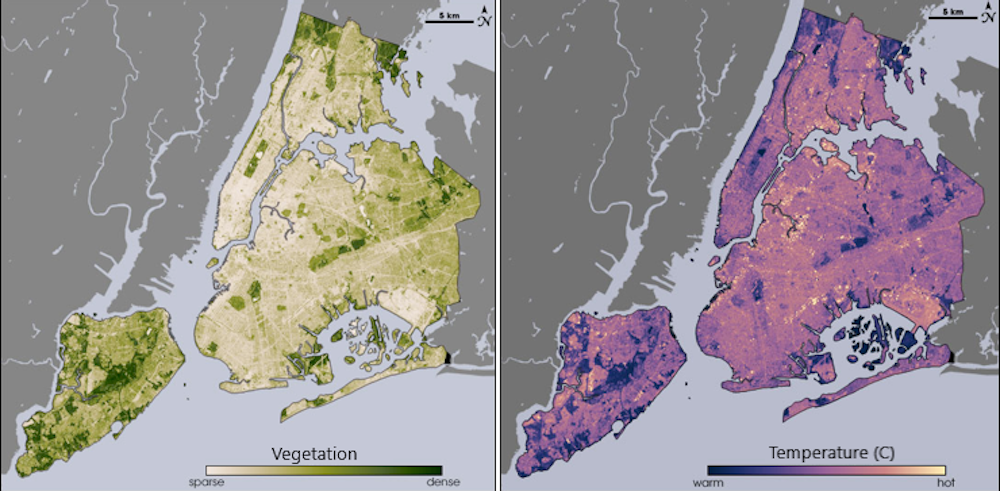
    Adding trees to city streets, parks and residential yards can make a meaningful difference in how hot a neighborhood feels, with blocks that have tree canopies nearly 3 F (1.7 C) cooler than blocks without trees.

    Comparing maps of New York’s vegetation and temperature shows the cooling effect of parks and neighborhoods with more trees. In the map on the left, lighter colors are areas with fewer trees. Light areas in the map on the right are hotter.
    NASA/USGS Landsat

    But planting trees isn’t always simple.

    In hot, dry cities, trees often require irrigation to survive, which can strain already limited water resources. Trees must survive for decades to grow large enough to provide shade and release enough water vapor to reduce air temperatures.

    Annual maintenance costs – about US$900 per tree per year in Boston – can surpass the initial planting investment.

    Most challenging of all, dense urban neighborhoods where heat is most intense are often too packed with buildings and roads to grow more trees.

    How cool roofs can help on hot days

    Another option is “cool roofs.” Coating rooftops with reflective paint or using light-colored materials allows buildings to reflect more sunlight back into the atmosphere rather than absorbing it as heat.

    These roofs can lower the temperature inside an apartment building without air conditioning by about 2 to 6 F (1 to 3.3 C), and can cut peak cooling demand by as much as 27% in air-conditioned buildings, one study found. They can also provide immediate relief by reducing outdoor temperatures in densely populated areas. The maintenance costs are also lower than expanding urban forests.

    Two workers apply a white coating to the roof of a row home in Philadelphia.
    AP Photo/Matt Rourke

    However, like trees, cool roofs come with limits. Cool roofs work better on flat roofs than sloped roofs with shingles, as flat roofs are often covered by heat-trapping rubber and are exposed to more direct sunlight over the course of an afternoon.

    Cities also have a finite number of rooftops that can be retrofitted. And in cities that already have many light-colored roofs, a few more might help lower cooling costs in those buildings, but they won’t do much more for the neighborhood.

    By weighing the trade-offs of both strategies, cities can design location-specific plans to beat the heat.

    Choosing the right mix of cooling solutions

    Many cities around the world have taken steps to adapt to extreme heat, with tree planting and cool roof programs that implement reflectivity requirements or incentivize cool roof adoption.

    In Detroit, nonprofit organizations have planted more than 166,000 trees since 1989. In Los Angeles, building codes now require new residential roofs to meet specific reflectivity standards.

    In a recent study, we analyzed Boston’s potential to lower heat in vulnerable neighborhoods across the city. The results demonstrate how a balanced, budget-conscious strategy could deliver significant cooling benefits.

    For example, we found that planting trees can cool the air 35% more than installing cool roofs in places where trees can actually be planted.

    However, many of the best places for new trees in Boston aren’t in the neighborhoods that need help. In these neighborhoods, we found that reflective roofs were the better choice.

    By investing less than 1% of the city’s annual operating budget, about US$34 million, in 2,500 new trees and 3,000 cool roofs targeting the most at-risk areas, we found that Boston could reduce heat exposure for nearly 80,000 residents. The results would reduce summertime afternoon air temperatures by over 1 F (0.6 C) in those neighborhoods.

    While that reduction might seem modest, reductions of this magnitude have been found to dramatically reduce heat-related illness and death, increase labor productivity and reduce energy costs associated with building cooling.

    Not every city will benefit from the same mix. Boston’s urban landscape includes many flat, black rooftops that reflect only about 12% of sunlight, making cool roofs that reflect over 65% of sunlight an especially effective intervention. Boston also has a relatively moist growing season that supports a thriving urban tree canopy, making both solutions viable.

    Phoenix, left, already has a lot of light-colored roots, compared with Boston, right, where roofs are mostly dark.
    Imagery © Google 2025.

    In places with fewer flat, dark rooftops suitable for cool roof conversion, tree planting may offer more value. Conversely, in cities with little room left for new trees or where extreme heat and drought limit tree survival, cool roofs may be the better bet.

    Phoenix, for example, already has many light-colored roofs. Trees might be an option there, but they will require irrigation.

    Getting the solutions where people need them

    Adding shade along sidewalks can do double-duty by giving pedestrians a place to get out of the sun and cooling buildings. In New York City, for example, street trees account for an estimated 25% of the entire urban forest.

    Cool roofs can be more difficult for a government to implement because they require working with building owners. That often means cities need to provide incentives. Louisville, Kentucky, for example, offers rebates of up to $2,000 for homeowners who install reflective roofing materials, and up to $5,000 for commercial businesses with flat roofs that use reflective coatings.

    In Boston, planting trees, left, and increasing roof reflectivity, right, were both found to be effective ways to cool urban areas.
    Ian Smith et al. 2025

    Efforts like these can help spread cool roof benefits across densely populated neighborhoods that need cooling help most.

    As climate change drives more frequent and intense urban heat, cities have powerful tools for lowering the temperature. With some attention to what already exists and what’s feasible, they can find the right budget-conscious strategy that will deliver cooling benefits for everyone.

    Lucy Hutyra has received funding from the U.S. federal government and foundations including the World Resources Institute and Burroughs Wellcome Fund for her scholarship on urban climate and mitigation strategies. She was a recipient of a 2023 MacArthur Fellowship for her work in this area.

    Ian Smith does not work for, consult, own shares in or receive funding from any company or organization that would benefit from this article, and has disclosed no relevant affiliations beyond their academic appointment.

    ref. 2 ways cities can beat the heat: Which is best, urban trees or cool roofs? – https://theconversation.com/2-ways-cities-can-beat-the-heat-which-is-best-urban-trees-or-cool-roofs-260188

    MIL OSI AnalysisEveningReport.nz

  • MIL-OSI China: Urumqi ranks among China’s top summer destinations

    Source: People’s Republic of China – State Council News

    URUMQI, July 23 — Urumqi, capital of northwest China’s Xinjiang Uygur Autonomous Region, recorded 50.57 million tourist visits in the first half of 2025, making it China’s third most popular summer travel destination, said a press conference on Wednesday.

    A series of cultural and tourism events, such as traditional folk performances and performing arts festivals, have drawn tourists from around the world, according to the regional people’s government.

    The city’s tourism boom has been supported by an increasingly convenient transport network. Urumqi Tianshan International Airport, a national gateway hub, boasts annual passenger trips of 48 million and a cargo throughput of 550,000 tonnes. It operates 258 flight routes connecting over 100 cities at home and abroad.

    Last year, Xinjiang received over 300 million tourist visits, generating more than 359 billion yuan (about 50.27 billion U.S. dollars) in tourism revenue, a year-on-year increase of 21 percent.

    MIL OSI China News

  • MIL-OSI China: Chinese Vice Premier He Lifeng will be in Sweden on July 27-30 for trade talks with US

    Source: People’s Republic of China – State Council News

    Chinese Vice Premier He Lifeng will be in Sweden from July 27 to 30 for economic and trade talks with the United States upon mutual agreement, the commerce ministry announced Wednesday.

    Following the important consensus reached during the phone talks between the two heads of state on June 5, the two sides will leverage the role of the China-U.S. economic and trade consultation mechanism, and continue to engage in consultations on economic and trade issues of mutual concern based on the principle of mutual respect, peaceful coexistence and win-win cooperation, said a spokesperson with the ministry.

    MIL OSI China News

  • Skill development drive under PMKVY sees over 20 lakh youth trained in FY 2024-25

    Source: Government of India

    Source: Government of India (4)

    The Ministry of Skill Development and Entrepreneurship (MSDE) has reported notable progress under the Pradhan Mantri Kaushal Vikas Yojana (PMKVY), with over 20 lakh candidates trained in the financial year 2024-25 alone. The flagship scheme, launched in 2015, aims to equip India’s youth with skill development through Short-Term Training (STT) and Recognition of Prior Learning (RPL) initiatives.

    Over the last five financial years, a cumulative effort across States and Union Territories has contributed to a significant rise in skilled manpower. Uttar Pradesh led the training numbers in FY 2024-25, with more than 4.63 lakh individuals trained, followed by Rajasthan with 2.79 lakh and Madhya Pradesh with over 2.58 lakh trainees.

    Placement tracking under PMKVY was actively carried out during its first three phases-PMKVY 1.0, 2.0, and 3.0-covering the period from 2015-16 to 2021-22. As per official data, the placement rate of candidates certified under the STT component during these phases stood at 43%. Under the current phase, PMKVY 4.0, the emphasis has shifted towards empowering candidates to make informed choices in their career paths with necessary orientation support.

    Third-party evaluations have reaffirmed the scheme’s impact. A study by Sambodhi Research and Communications found that individuals trained and certified under PMKVY 2.0 earned 15 percent more, on average, than their counterparts who had not participated in the scheme. RPL-certified individuals reported a 19 percent higher monthly income when compared to those without certification.

    Further, a study conducted by NITI Aayog in October 2020 revealed that 94 percent of employers surveyed expressed willingness to hire more PMKVY-trained candidates. Additionally, the Indian Institute of Public Administration (IIPA), in its impact evaluation, found that about 70.5 percent of surveyed trainees secured jobs in their desired skill sectors. Over half of the candidates trained under RPL also reported receiving or expecting better salaries than their untrained peers.

    To enhance employment opportunities under PMKVY 4.0, the Skill India Digital Hub (SIDH) has been launched. This integrated platform provides a unified digital space connecting the skilling, education, employment, and entrepreneurship ecosystems. Job seekers can access career opportunities and apprenticeships, while employers can tap into a database of trained candidates. Rozgar Melas are also being organized across the country to facilitate direct engagement between employers and job aspirants.

    This information was shared in a written reply by the Minister of State (Independent Charge) for the Ministry of Skill Development and Entrepreneurship, Jayant Chaudhary, in the Rajya Sabha.

  • MIL-OSI United Kingdom: PM call with President Erdoğan of Türkiye: 22 July 2025

    Source: United Kingdom – Government Statements

    Press release

    PM call with President Erdoğan of Türkiye: 22 July 2025

    The Prime Minister spoke to the President of Türkiye Recep Tayyip Erdoğan yesterday evening.

    The Prime Minister spoke to the President of Türkiye Recep Tayyip Erdoğan yesterday evening.

    The two leaders looked ahead to today’s International Defence Industry Fair in Istanbul, where their Defence Ministers have taken the next step towards signing a multi-billion-pound export deal of UK-built Typhoon jets to Türkiye. 

    The Prime Minister added that once fully finalised, this enhanced military co-operation will strengthen NATO’s collective defences and keep us safer during uncertain times, as well as sustaining 20,000 UK jobs and driving growth. 

    Turning to the Middle East, they discussed the intolerable situation in Gaza and underlined the urgent need for more aid and an urgent ceasefire, in order to pave the way for a two-state solution and a secure future for Palestinians and Israelis.

    They reiterated their concern about the recent violence in Syria, and agreed that the ceasefire must hold.

    The Prime Minister thanked the President for Türkiye’s convening role in the upcoming talks between Russia and Ukraine in Istanbul today, as well as the discussions due to take place on Iran’s nuclear programme later this week.

    Updates to this page

    Published 23 July 2025

    MIL OSI United Kingdom

  • MIL-OSI United Kingdom: Byers Gill Solar development consent decision announced

    Source: United Kingdom – Government Statements

    Press release

    Byers Gill Solar development consent decision announced

    The Byers Gill Solar application has today been granted development consent by the Department for Energy Security and Net Zero.

    Byers Gill Solar

    The application will consist of a proposed solar farm with over 50MW capacity, Solar PV modules and associated mounting structures, inverters, transformers, switch gear and control equipment, a substation, energy storage equipment and underground on and off-site cabling. 

    The application was submitted to the Planning Inspectorate for consideration by RWE Renewables UK Solar and Storage Limited on 9 February 2024 and accepted for examination on 8 March 2024.  

    Following an examination during which the public, statutory consultees and interested parties were given the opportunity to give evidence to the Examining Authority, recommendations were made to the Secretary of State on 23 April 2025.   

    This is the 96th energy application out of 160 applications examined to date and was again completed by the Planning Inspectorate within the statutory timescale laid down in the Planning Act 2008.   

    Local communities continue to be given the opportunity of being involved in the examination of projects that may affect them. Local people, the local authority and other interested parties were able to participate in this six-month examination.   

    The Examining Authority listened and gave full consideration to all local views and the evidence gathered during the examination before making its recommendation to the Secretary of State.  

    The decision, the recommendation made by the Examining Authority to the Secretary of State for Energy Security and Net Zero and the evidence considered by the Examining Authority in reaching its recommendation are publicly available on the project pages of the National Infrastructure Planning website.  

    This decision was made by Minister Miatta Fahnbulleh on behalf of the Energy Secretary’s legal authority. 

    Journalists wanting further information should contact the Planning Inspectorate Press Office, on 0303 444 5004 or 0303 444 5005 or email:   

    Press.office@planninginspectorate.gov.uk

    Updates to this page

    Published 23 July 2025

    MIL OSI United Kingdom

  • MIL-OSI Russia: Rosneft Continues Whale Research

    Translation. Region: Russian Federal

    Source: Rosneft – An important disclaimer is at the bottom of this article.

    World Whale and Dolphin Day is celebrated annually on July 23. The date was established to draw humanity’s attention to the need to preserve and protect cetaceans and other marine mammals.

    Rosneft pays special attention to environmental issues and the preservation of biodiversity. The Company’s activities are based on the principle of preserving a favorable environment and biological diversity in all regions of presence. Studying and protecting the population of whales and dolphins is one of the areas of Rosneft’s environmental program.

    One of the main species that receives close attention is the gray whale of the Okhotsk Sea population. The monitoring program for these whales has been carried out on the north-eastern shelf of Sakhalin Island for almost 30 years. As part of the research, specialists annually conduct a population census, observe the behavior of animals and study their food supply, carry out photo-identification studies, and acoustic monitoring.

    Until the 1990s, the Okhotsk Sea gray whale population was considered to be completely exterminated and was classified as a species on the verge of extinction. In 2018, the western gray whale population was classified as endangered, indicating a slow but steady recovery of the Okhotsk subpopulation of gray whales.

    In 2019, the Okhotsk Sea populations of gray and Greenland whales were included by the Russian Ministry of Natural Resources in the list of rare and endangered species of wildlife requiring priority measures for restoration and reintroduction. In 2020, the Okhotsk Sea population of gray whales was listed in the Red Book of the Russian Federation.

    In addition, the Company conducts environmental monitoring of the Okhotsk-Korean population of gray whales on the north-eastern shelf of Sakhalin Island. Specialists annually perform photo identification, population census, and studies of the food supply and behavior of mammals. The main life period of gray whales in the Sea of Okhotsk is fattening and reproduction, so studying the state of their food supply is one of the most important stages of observations.

    As part of the study of the Okhotsk-Korean gray whale population, unique acoustic monitoring is also being conducted, which includes recording and analyzing the level of natural and anthropogenic underwater noise. The research allows us to study the nature of sounds and model their propagation. Acoustic measurements are carried out using autonomous underwater recorders developed specifically for the project.

    Rosneft is an active participant in the Interdepartmental Working Group under the Ministry of Natural Resources of the Russian Federation to ensure the conservation of the Okhotsk-Korean population of gray whales. The working group develops proposals for the development of legislation for population management, coordinates the interaction of interested federal and regional executive authorities, the business community, scientific and public organizations.

    In 2020, Rosneft, together with the P.P. Shirshov Institute of Oceanology of the Russian Academy of Sciences, implemented a large-scale project to study and monitor Black Sea dolphins. Based on the results of 3 years of observations, modern up-to-date data were obtained on the number and preferred habitats of these Black Sea cetaceans, and the characteristics of their seasonal distribution. Recommendations for the study and conservation of dolphins were prepared.

    Reference:

    The gray whale is the only whale species that has mastered bottom feeding. Whales usually scoop up benthos from the bottom along with water, silt and pebbles at a depth of 15-60 m and filter the suspension through their baleen. The gray whale’s diet includes up to 70 species of invertebrates, including annelids, bivalves, small crustaceans and young fish.

    Gray whales swim slowly – on average 5-8 km/h, which allows marine parasites to cling to the whale’s skin and establish their colonies. The total weight of these fellow travelers can reach 180 kg per whale.

    Department of Information and AdvertisingPJSC NK RosneftJuly 23, 2025

    Please note: This information is raw content obtained directly from the source of the information. It is an accurate report of what the source claims and does not necessarily reflect the position of MIL-OSI or its clients.

    .

    MIL OSI Russia News

  • MIL-OSI Russia: “Online University Admission”: Super Service for Applicants

    Translation. Region: Russian Federal

    Source: Official website of the State –

    An important disclaimer is at the bottom of this article.

    In 2025, admission to universities for bachelor’s, specialist’s, master’s and postgraduate programs will be carried out through the “Online University Admission” service, developed by the Ministry of Education and Science of Russia, the Ministry of Digital Development, Communications and Mass Media of Russia, Rosobrnadzor and available on the “Gosuslugi” portal.

    It allows applicants to submit documents to educational and scientific organizations without a personal visit.

    What programs can I apply for?

    An applicant can apply for budgetary (including targeted) and fee-based education, full-time, part-time and correspondence, for bachelor’s and specialist’s degree programs, including programs of six universities participating in the pilot project to update the higher education system.

    Step by step instructions

    We will tell you in more detail about the procedure for submitting an application on the State Services portal.

    Step 1. Registration on the State Services portal and creation of a digital profile

    A verified account is required to submit an application.

    In your personal account, you can request your data on educational documents, individual achievements (IA), as well as information on disability, and then you will not have to enter them manually and confirm them with originals when submitting an application to a university.

    Step 2. Filling out the application for admission

    Provide information about education, benefits and special rights. Specify the desired areas of study. When applying for a bachelor’s degree, specialist degree or basic higher education, you can choose up to 5 universities and up to 5 areas in each of them, including paid education. The new service “University Selection” will help you quickly find the right university, select a specialty based on subjects and USE scores, and find out the passing scores of previous years. Specify admission priorities Attach documents confirming your individual achievements and entitlement to benefits.

    Details in the video instructions:

    Additionally, at this stage you can choose targeted training by answering “Yes” to the corresponding question on the questionnaire.

    You can find a customer for admission to targeted training on the portal “Work in Russia”.

    How to apply for targeted training, see the video instructions:

    https://guu.ru/wp-content/uploads/05_06_2025-Кака-подача-заяку на-целебное-обучение-в-вуз_17_06_2025.mp4

    Step 3. Submitting an application and tracking the status

    Please check your completed application again carefully and only then submit it.

    Please note that additional or internal entrance examinations must be registered separately.

    In addition, universities have the right to request additional documents or ask to replace copies that are difficult to read.

    Step 4: Submit consent

    This can be done immediately after submitting an application on Gosuslugi, in person at the admissions office, or by sending a letter by mail.

    You can submit consent on State Services starting with the application status “Submitted to the university”.

    If consent has been submitted, but according to the competition lists you see that you are not eligible for the required program, or your priorities have changed, you can revoke consent and submit it to another university.

    Step 5: Receive Notification of Enrollment

    Once the admission orders are published, you will receive a notification of the results.

    The video explains how to conclude an agreement if you are enrolling in a paid course.

    Any questions left?

    Find out more on the service website or ask the members of the admissions committee of the State University of Management by phone 8 (495) 371-00-55, online or in person.

    Please note: This information is raw content obtained directly from the source of the information. It is an accurate report of what the source claims and does not necessarily reflect the position of MIL-OSI or its clients.

    .

    MIL OSI Russia News

  • Understanding how Taylor Swift constructs her songs helps explain her phenomenal popularity

    Source: ForeignAffairs4

    Source: The Conversation – Canada – By Alexander Carpenter, Professor, Musicology, University of Alberta

    In 2023, Forbes published an article about Taylor Swift that included the following mind-boggling statistic: 55 per cent of adults in the United States identify themselves as Swift fans.

    In the wake of her recent epic world tour — which drew 10 million attendees and earned billions of dollars — Swift has clearly emerged as a modern singer-songwriter whose success and renown has no equal.

    The same article reports that 73 per cent of those surveyed insisted that “Swift’s music is a driving force of their support of her.” But the abundant discourse surrounding Taylor Swift in the popular press, academia and online seems to be about everything but her songs.

    In place of critical engagement with her musical work, Swift is credited for creating her own economic ecosystem wherever she goes, lauded for being a shrewd and powerful businessperson, described as an empowered and empowering feminist icon or branded a quintessential entertainer.

    At this moment, Swift resides at the very apex of modern celebrity culture. Ironically, this makes it especially tricky to engage with Swift as a musician, which is the very basis of her fame.

    As a musicologist, music critic and musician who studies and teaches popular music, there are ways to examine the musical meaning of pop songs. These approaches provide useful insights; after all, wasn’t it the music that drew audiences to Swift in the first place?

    Studying Swift

    Swift is increasingly taken seriously in the halls of academia. A number of universities offer courses dedicated to Swift, but typically not to her music as such: rather, many of these courses take a literary approach to her songs or a broadly sociological approach to her as a pop culture phenomenon, or they foreground her business model.

    In his book There’s Nothing Like This, Kevin Evers, senior editor of the Harvard Business Review, regards Swift as a “strategic genius.” He examines how she identifies and exploits untapped markets, making creative and marketing pivots at key moments while protecting her image as a self-made, authentic singer-songwriter.

    Evers focuses on non-musical elements when discussing Swift’s songs. He claims that Swift’s fans interpret her lyrics in a manner akin to the literary analysis of complex poems. Swift’s songs intrigue fans, Evers insists, primarily because they offer insight into her personal life, romantic travails and struggles with fame.

    Of course, words are an important element of pop songs, and for many fans, the words of a song constitute its “about-ness.” But a pop song is a sonic object, not simply a delivery system for words.

    Lyrical discourse analysis

    Song lyrics are not poems, although they may be “like poetry,” as musicologist Dai Griffiths has argued. He points out that when we insist on thinking of lyrics as poetry, we lose a systematic understanding of how words function in songs. The placement and sound of words, and how they relate to the music, are key elements of a song’s musical structure and sense.

    It is this discussion of the musical sense and meaning of Swift’s songs that is largely neglected.

    The academic study of classical music offers a wealth of analytic methodologies; there are ways to examine the musical meaning of pop songs that do not over-analyze the song. These include looking at elements like form, orchestration, melody, harmony and rhythm.

    A song creates space: its formal layout and the rhythm of musical phrases provide the space for words — what Griffiths calls the “verbal space” — which have their own rhythms and structures and work within but also push against the boundaries of this space.

    Form and space

    Consider Swift’s chart-topping 2014 single, “Shake it Off,” re-released as “Shake it Off (Taylor’s Version)” in 2023. This song, while popular, was criticized for its repetitiveness and lack of emotional depth.

    “Shake it Off” doesn’t seem to have much lyrical content: the verses are short, rounded off with simple slant rhymes, and much of the created space seems to be filled with repetition: “I’m just gonna shake, shake, shake, shake, shake/Shake it off, shake it off.”

    Likewise, the song is built musically on some very basic and limited material, namely three chords, a short, unvaried drum loop and a spare bass line provided by a baritone saxophone.

    The lyric video to “Shake it Off (Taylor’s version).”

    The lyrics touch lightly on Swift’s response to fame and her critics, but it is their syllabic density that contributes to the song’s development and momentum. This gradually and sytematically increases over the first two verses and pre-chorus, until arriving at the chorus, where the space is filled almost completely.

    The density of the music also increases in the choruses, with a thicker bass part, added vocals and a brass fanfare.

    While “Shake it Off” is repetitive with little harmonic and melodic variety, it is also quite subtly counterbalanced with a variety of sounds, textures and densities. These move the song forward and importantly, help mark off the song’s formal sections.

    These compositional and production details contribute to the song’s overall meaning. But how the words participate in the unfolding of the song-as-music, or the creation and shaping of the musical space, is also meaningful. The thrust of the lyrics emphasize Swift’s detachment from gossip and criticism: “I never miss a beat/I’m lightnin’ on my feet” and “But I keep cruisin’/Can’t stop, won’t stop groovin’”.

    These lyrics are reinforced by the propulsive musical momentum of the song created by the gradual thickening of the text and music. Even with this thickening, the song still remains quite light, emphasizing the lyrical claims of detachment and distance from negativity.

    The chorus, by contrast, with its deeply resonant bass, layers of background vocals and added brass, is musically the heaviest part of the song, underwriting Swift’s assertive claim that she will “shake off” the lies and gossip that plague her as a celebrity pop star.

    Understanding Swift’s success

    Collecting some musical information about Swift’s songs is not an abstract or intellectual activity; rather, it is essential information if we want to better understand Swift and her success in terms of her song writing.

    I’m not making an argument here for or against Swift’s music; I’m neither a “Swiftie” nor a detractor. Nor have I offered anything like a comprehensive or definitive analysis of a song in this short article.

    But I do think we should be curious and better understand Swift’s success, especially the popularity of her music across generations and demographics. How her songs are actually put together — how they work as music, in tandem with words, to tell stories — is an essential part of that understanding.

    The Conversation

    Alexander Carpenter does not work for, consult, own shares in or receive funding from any company or organisation that would benefit from this article, and has disclosed no relevant affiliations beyond their academic appointment.

    ref. Understanding how Taylor Swift constructs her songs helps explain her phenomenal popularity – https://theconversation.com/understanding-how-taylor-swift-constructs-her-songs-helps-explain-her-phenomenal-popularity-247855

  • What Canada can learn from Australia on adequately protecting citizens at live events

    Source: ForeignAffairs4

    Source: The Conversation – Canada – By Sean Spence, Security Risk Management Pracitioner & Researcher, Royal Military College of Canada

    In April 2025, a man drove an SUV through a crowd of people attending a Filipino cultural festival in Vancouver, killing 11 people and injuring dozens more. In response, the British Columbia government immediately commissioned an inquiry to examine the systemic causes of the incident and whether any lessons could be learned from the tragedy.


    Read more:
    Vancouver SUV attack exposes crowd management falldowns and casts a pall on Canada’s election


    The commission came up with six recommendations based on gaps in the current municipal application and approval system for public events across the province.

    One key recommendation was that all public events should be required to complete a risk assessment. This isn’t currently happening across the province. The absence of such analysis poses a risk for public safety.

    Another recommendation was the creation of local knowledge capacity to support event organizers, particularly for small and rural events, where the expertise to conduct a basic security risk assessment is lacking.

    Forseeable tragedy?

    As I argued in August 2022, the live events industry lacks the same level of professionalism as other occupations. Many of these small event organizers are amateurs who lack the resources to properly deal with the security risks involved in holding their events.


    Read more:
    Canada could have its own Fyre Festival fiasco if it doesn’t amp up event regulations


    These factors, combined with emerging security risks, meant that the tragedy at the Lapu Lapu festival could be considered a foreseeable event given the risk realities associated with modern mass gatherings.

    The inquiry report highlighted how B.C. is lagging behind other international jurisdictions in terms of legislative pro-activeness in securing public events. This policy deficiency is actually a Canada-wide problem; the country is woefully behind other western nations when it comes to securing public events.

    My doctoral thesis examined this very issue when I compared the regulation and application process to host public events in Canada and Australia’s largest cities.

    Australia vs. Canada

    Firstly, it’s important to note that Canada is a less safe country in terms of security than Australia, all things considered equal. Canada’s porous border with the United States means more illegal firearms are entering the country, resulting in more gun violence than in Australia, where there are more restrictive gun ownership laws.

    The Lapu Lapu attack was not investigated as an act of terrorism, but in a related concern, Canada’s intelligence-gathering and national security laws place it at a counter-terrorism disadvantage compared to Australia.

    Relatively speaking, research suggests Canada’s Charter of Rights and Freedoms hinders its security services from being able to detect and investigate terrorism-related offences given the greater importance placed on individual rights compared to Australia, where there is no such Charter equivalent.

    Australia also has pro-active foreign intelligence collection capabilities to aid in its counter-terrorism efforts, while Canada’s CSIS agency only has domestic capabilities. That essentially requires it to import intelligence from its allies.

    Given these facts, it would seem plausible that Canada would be at greater risk for security threats at public events — including terrorist attacks, active shooters, etc. — than Australia.

    When I compared the data between both countries in my research, it suggested Australia has more public event regulation than Canada.

    It was quantitatively shown that Australian officials require risk assessments and other proactive measures from event organizers, including for risk mitigation, while Canadian officials are mostly concerned with reactive security response plans — in other words, determining how organizers would respond to attacks after they occurred.

    An analysis of event application documents in both countries reveal that Australian municipalities disproportionately emphasize “risk management” in approving events compared to Canadian municipalities.

    Three ways the B.C. report falls short

    The B.C. report missed out on examining several important elements.

    Firstly, it did not take a holistic, deep dive into just how vulnerable public events are to myriad security threats — like active shooters, crowd crushing and terrorist attacks — but instead focused solely on the hostile vehicle threat.

    It also failed to consider the urgency of governments to adopt policy changes in the face of emerging threats on public spaces, like drone attacks.

    Secondly, the report made no mention of the need for law enforcement to develop stronger ties to share intelligence with event organizers as a proactive measure to protect mass gathering events from violence. The Hamas attacks at a music festival in Israel in October 2023 highlight the worst outcome of such failures.


    Read more:
    How Israel underestimated Hamas’s intelligence capabilities – an expert reviews the evidence


    Lastly, there was no call for action or recommendation for the federal government to play a greater role in providing guidance to the industry and lower levels of government.

    National security is a federal issue as well as the regulation of airspace for drones. In countries such as the United Kingdom, Australia and the United States, the national government provides guidance on protecting public spaces. There is no such policy leadership in Canada.

    The B.C. findings show Canadian authorities have a lot of work to do to make public events safer for Canadians. With the FIFA World Cup coming to Canada next year, Canadian governments still have time to implement corrective actions to ensure soccer fans stay safe.

    The Conversation

    Sean Spence provides security consulting services within the hospitality industry.

    ref. What Canada can learn from Australia on adequately protecting citizens at live events – https://theconversation.com/what-canada-can-learn-from-australia-on-adequately-protecting-citizens-at-live-events-261161

  • Understanding the violence against Alawites and Druze in Syria after Assad

    Source: ForeignAffairs4

    Source: The Conversation – USA (3) – By Güneş Murat Tezcür, Professor and Director of the School of Politics and Global Studies, Arizona State University

    Bedouin fighters at Mazraa village on the outskirts of Sweida city, during clashes in southern Syria on July 18, 2025. AP Photo/Ghaith Alsayed

    In July 2025, clashes between the Druze religious minority and Sunni Arabs backed by government-affiliated forces led to hundreds of deaths in Sweida province in southern Syria. Israel later launched dozens of airstrikes in support of the Druze.

    This eruption of violence was an eerie reminder of what had unfolded in March 2025 when supporters of the fallen regime led by Bashar Assad, an Alawite, targeted security units. In retaliation, militias affiliated with the newly formed government in Damascus carried out indiscriminate killings of Alawites.

    While exact figures remain difficult to verify, more than 1,300 individuals, most of them Alawites, lost their lives. In some cases, entire families were summarily executed.

    Although the Syrian government promised an investigation into the atrocities, home invasions, kidnappings of Alawite women and extrajudicial executions of Alawite men continue.

    The violence in Sweida also bore a sectarian dimension, pitting members of a religious minority against armed groups aligned with the country’s Sunni majority.

    A key difference, however, involved the active Israeli support for the Druze and the U.S. efforts to broker a ceasefire.

    Post-Assad Syria has seen promising developments, including the lifting of international sanctions, a resurgence of civil society and the end of diplomatic isolation. There was even a limited rapprochement with the main Kurdish political party controlling northeastern Syria.

    The persistent violence targeting the Alawites and, to a more limited extent, the Druze, starkly contrasts with these trends. As a scholar of religious minorities and the Middle East, I argue that the current political situation reflects their historical persecution and marginalization.

    History of the Alawites

    The Alawites emerged as a distinct religious community in the 10th century in the region of the Latakia coastal mountains, which today make up northwestern Syria.

    Although their beliefs have some commonalities with Shiite Islam, the Alawites maintain their own unique religious leadership and rituals. Under the Ottoman regime in the late 19th century, they benefited from reforms such as the expansion of educational opportunities and economic modernization, while gaining geographical and social mobility.

    After Hafez Assad, the father of Bashar, came to power in a coup in 1970, he drew upon his Alawite base to reinforce his regime. Consequently, Alawites became disproportionately represented in the officer corps and intelligence services.

    Prior to the civil war, which began in 2011, their population was estimated at around 2 million, constituting roughly 10% of Syria’s population. During the civil war, Alawite young men fighting for the regime suffered heavy casualties. However, most Alawites remained in Syria, while Sunni Arabs and Kurds were disproportionately displaced or became refugees.

    Several people, including women and children, stand next to parked vehicles.
    Members of the Alawite minority gather outside the Russian air base in Hmeimim, near Latakia in Syria’s coastal region, on March 11, 2025, as they seek refuge there after violence and retaliatory killings in the area.
    AP Photo/Omar Albam

    Among Syria’s minorities, two key factors make the Alawites most vulnerable to mass violence in post-Assad Syria. The first factor is that, like the Druze, Alawites have their own distinct beliefs that deviate from Sunni Islam. Their religious practices and teachings are often described as “esoteric” and remain mostly inaccessible to outsiders.

    In my 2024 book “Liminal Minorities: Religious Difference and Mass Violence in Muslim Societies,” I categorize the Alawites and Druze in Syria alongside Yezidis in Iraq, Alevis in Turkey and Baha’is in Iran as “liminal minorities” – religious groups subject to deep-seated stigmas transmitted across generations.

    These groups are often treated as heretics who split from Islam and whose beliefs and rituals are deemed beyond the pale of acceptance. For instance, according to Alawite beliefs, Ali, the son-in-law of Prophet Muhammad, is a divine manifestation of God, which challenges the idea of strict monotheism central to Sunni Islam.

    From the perspective of Sunni orthodoxy, these groups’ beliefs have been a source of suspicion and disdain. A series of fatwas by prominent Sunni clerics from the 14th to the 19th century declared Alawites heretics.

    Resentment against the Alawites

    The second factor contributing to the Alawites’ vulnerability is the widespread perception that they were the main beneficiaries of the Assad regime, which engaged in mass murder against its own citizens. Although power remained narrowly concentrated under Assad, many Alawites occupied key positions in the security apparatus as well as the government.

    In today’s political landscape where the central government remains weak and its control over various armed groups is limited, religious stigmatization and political resentment create fertile ground for mass violence targeting the Alawites.

    The massacres of March 2025 were accompanied by sectarian hate speech, including open calls for the extermination of the Alawites, both in the streets and on social media.

    While many Sunni Muslims in Syria also perceive the Druze as heretics, they maintained a greater degree of distance from the Assad regime and were less integrated into its security apparatus.

    Nonetheless, in recent months the situation deteriorated rapidly in the Druze heartland. The Druze militias and local Bedouin tribes engaged in heavy fighting in July 2025. Unlike the Alawites, the Druze received direct military assistance from Israel, which has its small but influential Druze population. This further complicates peaceful coexistence among religious groups in post-Assad Syria.

    A sober future

    Sunni Arab identity is central to the newly formed government in Damascus, which can come at the expense of religious and ethnic pluralism. However, it has incentives to rein in arbitrary violence against the Alawites and Druze. Projecting itself as a source of order and national unity helps the government internationally, both diplomatically and economically.

    Internally, however, the new government remains fractured and lacks effective control over vast swaths of territory. While it pays lip service to transitional justice, it is also cautious about being perceived as overly lenient toward individuals associated with the Assad regime and its crimes. Meanwhile, Alawite and Druze demands for regional autonomy continue to stoke popular Sunni resentments and risk triggering further cycles of instability and violence.

    I believe that in a post-Assad Syria defined by fractured governance and episodic retribution, the Alawites as well as Druze are likely to face deepening marginalization.

    The Conversation

    Güneş Murat Tezcür does not work for, consult, own shares in or receive funding from any company or organization that would benefit from this article, and has disclosed no relevant affiliations beyond their academic appointment.

    ref. Understanding the violence against Alawites and Druze in Syria after Assad – https://theconversation.com/understanding-the-violence-against-alawites-and-druze-in-syria-after-assad-255292

  • MIL-OSI USA: Amid regional conflict, the Strait of Hormuz remains critical oil chokepoint

    Source: US Energy Information Administration

    In-brief analysis

    June 16, 2025

    The TIE was reposted to correct a data label and provide the figure data.

    Data source: U.S. Energy Information Administration analysis based on Vortexa tanker tracking
    Note: 1Q25=first quarter of 2025. figure data

    The Strait of Hormuz, located between Oman and Iran, connects the Persian Gulf with the Gulf of Oman and the Arabian Sea. The strait is deep enough and wide enough to handle the world’s largest crude oil tankers, and it is one of the world’s most important oil chokepoints. Large volumes of oil flow through the strait, and very few alternative options exist to move oil out of the strait if it is closed. In 2024, oil flow through the strait averaged 20 million barrels per day (b/d), or the equivalent of about 20% of global petroleum liquids consumption. In the first quarter of 2025, total oil flows through the Strait of Hormuz remained relatively flat compared with 2024.

    Although we have not seen maritime traffic through the Strait of Hormuz blocked following recent tensions in the region, the price of Brent crude oil (a global benchmark) increased from $69 per barrel (b) on June 12 to $74/b on June 13. This piece highlights the importance of the strait to global oil supplies.

    Chokepoints are narrow channels along widely used global sea routes that are critical to global energy security. The inability of oil to transit a major chokepoint, even temporarily, can create substantial supply delays and raise shipping costs, potentially increasing world energy prices. Although most chokepoints can be circumvented by using other routes—often adding significantly to transit time—some chokepoints have no practical alternatives. Most volumes that transit the strait have no alternative means of exiting the region, although there are some pipeline alternatives that can avoid the Strait of Hormuz.

    Between 2022 and 2024, volumes of crude oil and condensate transiting the Strait of Hormuz declined by 1.6 million b/d, which were only partially offset by a 0.5-million b/d increase in petroleum product cargoes. The decline in oil transit through the strait partially reflects the OPEC+ decision to voluntarily cut crude oil production several times starting in November 2022, which lowered exports from Saudi Arabia, Kuwait, and the United Arab Emirates (UAE). In addition, disruptions in 2024 to oil flows around the Bab al-Mandeb Strait, which connects the Arabian Sea to the Red Sea, led Saudi Arabia’s national oil company Aramco to shift seaborne crude oil flows from the Strait of Hormuz, instead sending it over land through its East-West pipeline to ports on the Red Sea. Also, more refining capacity in the Persian Gulf states increased regional demand for crude oil and shifted some flows to local markets within the Persian Gulf.

    Flows through the Strait of Hormuz in 2024 and the first quarter of 2025 made up more than one-quarter of total global seaborne oil trade and about one-fifth of global oil and petroleum product consumption. In addition, around one-fifth of global liquefied natural gas trade also transited the Strait of Hormuz in 2024, primarily from Qatar.

    Data source: U.S. Energy Information Administration, Short-Term Energy Outlook, June 2025, and U.S. Energy Information Administration analysis based on Vortexa tanker tracking
    Note: World maritime oil trade excludes intra-country volumes except those volumes that transit the Strait of Hormuz. LNG=liquefied natural gas. 1Q25=first quarter of 2025

    Based on tanker tracking data published by Vortexa, Saudi Arabia moves more crude oil and condensate through the Strait of Hormuz than any other country. In 2024, exports of crude and condensate from Saudi Arabia accounted for 38% of total Hormuz crude flows (5.5 million b/d).

    Alternative routes
    Saudi Arabia and the UAE have some infrastructure in place that can bypass the Strait of Hormuz, which may somewhat mitigate any transit disruptions through the strait. The pipelines do not typically operate at full capacity, and we estimate that about 2.6 million b/d of capacity from the Saudi and UAE pipelines could be available to bypass the Strait of Hormuz in the event of a supply disruption.

    Saudi Aramco operates the 5 million-b/d East-West crude oil pipeline, which runs from the Abqaiq oil processing center near the Persian Gulf to the Yanbu port on the Red Sea. Aramco temporarily expanded the pipeline’s capacity to 7.0 million b/d in 2019 when it converted some natural gas liquids pipelines to accept crude oil. In 2024, Saudi Arabia pumped more crude oil through the East-West pipeline to avoid the shipping disruptions around the Bab al-Mandeb.

    The UAE also operates a pipeline that bypasses the Strait of Hormuz. This 1.8 million-b/d pipeline links onshore oil fields to the Fujairah export terminal in the Gulf of Oman. In 2024, crude oil and condensate volumes originating in the UAE and traversing Hormuz were 0.4 million b/d less than in 2022 because refinery upgrades allowed more heavy crude oil to be refined locally. These upgrades also allowed the UAE to increase exports of its lighter crude oil grades, and use of the pipeline to the Fujairah export terminal increased. Increased use of the pipeline for day-to-day operations has limited the excess capacity available to reroute additional volumes around the Strait of Hormuz.

    Iran inaugurated the Goreh-Jask pipeline and the Jask export terminal on the Gulf of Oman (avoiding the Strait of Hormuz) with a single export cargo in July 2021. The pipeline’s effective capacity remains around 300,000 b/d. However, during the summer of 2024 Iran exported less than 70,000 b/d from ports (Bandar-e-Jask and Kooh Mobarak) using the Goreh-Jask pipeline and stopped loading cargoes after September 2024.

    Destination markets
    We estimate that 84% of the crude oil and condensate and 83% of the liquefied natural gas that moved through the Strait of Hormuz went to Asian markets in 2024. China, India, Japan, and South Korea were the top destinations for crude oil moving through the Strait of Hormuz to Asia, accounting for a combined 69% of all Hormuz crude oil and condensate flows in 2024. These markets would likely be most affected by supply disruptions at Hormuz.

    Data source: U.S. Energy Information Administration analysis based on Vortexa tanker tracking
    Note: 1Q25=first quarter of 2025. figure data

    In 2024, the United States imported about 0.5 million b/d of crude oil and condensate from Persian Gulf countries through the Strait of Hormuz, accounting for about 7% of total U.S. crude oil and condensate imports and 2% of U.S. petroleum liquids consumption. In 2024, U.S. crude oil imports from countries in the Persian Gulf were at the lowest level in nearly 40 years as domestic production and imports from Canada have increased.

    Principal contributors: Candace Dunn, Justine Barden

    MIL OSI USA News

  • MIL-OSI: Silynxcom Secures $500,000 of New Orders from Israel Defense Forces, Reinforcing Leadership in Tactical Communication Solutions

    Source: GlobeNewswire (MIL-OSI)

    Netanya, Israel, July 23, 2025 (GLOBE NEWSWIRE) — Silynxcom Ltd. (NYSE American: SYNX) (“Silynxcom” or the “Company”), a manufacturer and developer of ruggedized tactical communication headset devices, today announced that it has received new purchase orders valued at approximately $500,000 from the Israel Defense Forces (“IDF”). 

    The orders include Silynxcom’s advanced in-ear headset systems and communication accessories, designed to provide secure, reliable, and combat-proven solutions for IDF personnel across various operational units. These systems feature active sound protection, ambient environmental awareness and seamless integration with professional-grade ruggedized radios, ensuring clear communication in high-intensity environments.

    “We are honored to continue our strong relationship with the IDF, delivering cutting-edge communication solutions tailored to the demands of modern defense operations,” said Nir Klein, Chief Executive Officer of Silynxcom. “We believe that these new orders emphasize the confidence in our technology and our commitment to supporting mission-critical operations worldwide.”

    Silynxcom expects to deliver the ordered units in the second half of 2025. The Company believes that this latest milestone reflects the growing global demand for the Company’s innovative tactical communication systems, as defense forces prioritize operational efficiency.

    About Silynxcom Ltd.

    Silynxcom Ltd. develops, manufactures, markets, and sells ruggedized tactical communication headset devices as well as other communication accessories, all of which have been field-tested and combat-proven. The Company’s in-ear headset devices, or In-Ear Headsets, are used in combat, the battlefield, riot control, demonstrations, weapons training courses, and on the factory floor. The In-Ear Headsets seamlessly integrate with third party manufacturers of professional-grade ruggedized radios that are used by soldiers in combat or by police officers in leading military and law enforcements units. The Company’s In-Ear Headsets also fit tightly into the protective gear to enable users to speak and hear clearly and precisely while they are protected from the hazardous sounds of combat, riots or dangerous situations. The sleek, lightweight, In-Ear Headsets include active sound protection to eliminate unsafe sounds, while maintaining ambient environmental awareness, giving their customers 360° situational awareness. The Company works closely with its customers and seek to improve the functionality and quality of the Company’s products based on actual feedback from soldiers and police officers “in the field.” The Company sells its In-Ear Headsets and communication accessories directly to military forces, police and other law enforcement units. The Company also deals with specialized networks of local distributors in each locale in which it operates and has developed key strategic partnerships with radio equipment manufacturers.

    For additional informaiton about the company please visit: https://silynxcom.com

    Forward-Looking Statements

    This press release contains “forward-looking statements” within the meaning of the “safe harbor” provisions of the Private Securities Litigation Reform Act of 1995 and other federal securities laws and are subject to substantial risks and uncertainties. Forward-looking statements contained in this press release may be identified by the use of words such as “anticipate,” “believe,” “contemplate,” “could,” “estimate,” “expect,” “intend,” “seek,” “may,” “might,” “plan,” “potential,” “predict,” “project,” “target,” “aim,” “should,” “will” “would,” or the negative of these words or other similar expressions, although not all forward-looking statements contain these words. For example, the Company uses forward-looking statements when it discusses: the Company’s belief that these orders emphasize the confidence in its technology and commitment to supporting mission-critical operations worldwide; the expected timing of the delivery of the units; and the belief that these orders reflect the growing global demand for the Company’s innovative tactical communication systems. Further, certain forward-looking statements are based on assumptions as to future events that may not prove to be accurate. These and other risks and uncertainties are described more fully in the section titled “Risk Factors” in the Company’s Annual Report on Form 20-F for the year ended December 31, 2024 filed with the U.S. Securities and Exchange Commission (the “SEC”) on May 13, 2025, and other documents filed with or furnished to the SEC which are available on the SEC’s website, www.sec.gov. The Company cautions you not to place undue reliance on any forward-looking statements, which speak only as of the date they are made. The Company undertakes no obligation to update these statements for revisions or changes after the date of this release, except as required by law. References and links to websites have been provided in this press release as a convenience, and the information contained on such websites is not incorporated by reference herein.

    Capital Markets & IR Contact
    Michal Efraty
    ir@silynxcom.com

    The MIL Network

  • MIL-OSI: Diane Davis Appointed to Boards of First Fed and First Northwest Bancorp

    Source: GlobeNewswire (MIL-OSI)

    PORT ANGELES, Wash., July 23, 2025 (GLOBE NEWSWIRE) — First Northwest Bancorp (NASDAQ: FNWB), the holding company for First Fed Bank, announced the appointment of Diane C. Davis to the Boards of Directors of both First Fed Bank and First Northwest Bancorp.

    Ms. Davis brings more than 25 years of leadership experience in the insurance industry, with expertise in executive management, strategy, risk management, and corporate governance. Further, Diane is an experienced community bank board member, having served on the board of First Financial Northwest Bancorp, which was acquired earlier this year.

    “Diane’s extensive experience in risk oversight and executive leadership will be a tremendous asset to our organization as we continue to grow and serve our communities,” said Geri Bullard, Interim CEO of First Fed. “Her proven expertise in strategy and governance aligns with our long-term goals, and we are excited to welcome her to the Board.”

    “Community banks play a vital role in building strong, resilient local economies, and I’m deeply passionate about supporting that mission. I’m honored to join First Fed’s board and work alongside its dedicated executive team and fellow board members,” said Diane Davis.

    Ms. Davis began her career at Farmers New World Life Insurance Company in 1992 and advanced through a variety of leadership roles, including Chief Risk Officer and ultimately President from 2016 until her retirement in 2019. She also served as Regional Chief Risk Officer for Global Life North America at Zurich Insurance Company Ltd., bringing broad actuarial and strategic planning experience to her board role.

    She holds a Bachelor of Science in Actuarial Science from the University of Illinois at Urbana-Champaign and a Master of Business Administration from the University of Washington. A Fellow of the Society of Actuaries, Ms. Davis currently serves as co-chair of 5050 Women on Boards of Greater Seattle and is a former member of the Board of Directors for Habitat for Humanity Seattle-King County.

    Her appointment reflects First Fed’s ongoing commitment to strong governance, sustainable growth, and long-term financial security for its customers and communities.

    About FNWB

    First Northwest Bancorp (Nasdaq: FNWB) is a financial holding company engaged in investment activities including the business of its subsidiary, First Fed Bank. First Fed is a Pacific Northwest-based financial institution which has served its customers and communities since 1923. Currently, First Fed has 18 locations in Washington State including 12 full-service branches. First Fed’s business and operating strategy is focused on building sustainable earnings by delivering a full array of financial products and services for individuals, small businesses, non-profit organizations and commercial customers. In 2022, First Northwest made an investment in The Meriwether Group, LLC, a boutique investment banking and accelerator firm. Additionally, First Northwest focuses on strategic partnerships to provide modern financial services such as digital payments and marketplace lending. First Northwest Bancorp was incorporated in 2012 and completed its initial public offering in 2015 under the ticker symbol FNWB. First Fed is headquartered in Port Angeles, Washington.

    First Fed Bank was recognized by Puget Sound Business Journal as a Best Workplace in 2023 and top Corporate Philanthropist in 2023 and 2024. By popular vote, First Fed received 2024 awards for Best Bank and Best Lender in Best of the Peninsula for Clallam County. First Fed is a Member FDIC and equal housing lender.

    Geri Bullard, Interim CEO / Chief Operating Officer
    First Fed 105 W. Eight Street
    Port Angeles, WA 98362
    360-565-8556

    The MIL Network

  • MIL-OSI: Greene County Bancorp, Inc. Reports Record High Net Income of $31.1 Million for the Fiscal Year Ended June 30, 2025, Announces Plans to Expand into Saratoga County

    Source: GlobeNewswire (MIL-OSI)

    CATSKILL, N.Y., July 23, 2025 (GLOBE NEWSWIRE) — Greene County Bancorp, Inc. (the “Company”) (NASDAQ: GCBC), the holding company for the Bank of Greene County and its subsidiary Greene County Commercial Bank, today reported net income for the quarter and fiscal year ended June 30, 2025. Net income for the quarter and fiscal year ended June 30, 2025 was $9.3 million, or $0.55 per basic and diluted share, and $31.1 million, or $1.83 per basic and diluted share, respectively, as compared to $6.7 million, or $0.40 per basic and diluted share, and $24.8 million, or $1.45 per basic and diluted share, for the quarter and fiscal year ended June 30, 2024, respectively. Net income increased $2.6 million, or 38.6%, when comparing the quarters ended June 30, 2025 and 2024, and increased $6.3 million, or 25.7%, when comparing the fiscal years ended June 30, 2025 and 2024.

    Highlights:

    • Net Income: $31.1 million for the fiscal year ended June 30, 2025, a new record high
    • Total Assets: $3.0 billion at June 30, 2025, a new record high
    • Net Loans: $1.6 billion at June 30, 2025, a new record high
    • Total Deposits: $2.6 billion at June 30, 2025
    • Return on Average Assets: 1.10% for the fiscal year ended June 30, 2025
    • Return on Average Equity: 14.08% for the fiscal year ended June 30, 2025

    Donald Gibson, President & CEO, stated: “I am pleased to report record high net income for the fiscal year ended June 30, 2025, marking 16 years of the past 17 years that our Company has achieved record earnings. This sustained performance is a testament to our disciplined business model, strong community partnerships and exceptional execution of our team. As we look ahead, we are excited to announce plans to expand into Saratoga County with our first branch in that market area, expanding our geographic footprint from five to six counties within New York State, and further strengthening our position as the leading economic engine of the communities we serve. Additionally, we are honored to be recognized by the Albany Business Review, first as one of the Capital Regions 11 fastest growing large companies, defined as those with revenue exceeding $100.0 million, and second, on July 17, 2025, we ranked as the number one commercial mortgage lender in New York’s Capital Region for commercial loan volume in 2024. I believe the distinction reflects our financial strength and our long-term commitment to organic growth that benefits customers, communities and shareholders alike.”

    Total consolidated assets for the Company were $3.0 billion at June 30, 2025, primarily consisting of $1.6 billion of net loans and $1.1 billion of total securities available-for-sale and held-to-maturity. Consolidated deposits totaled $2.6 billion at June 30, 2025, consisting of retail, business, municipal and private banking relationships.

    Pre-provision net income was $32.5 million for the year ended June 30, 2025 as compared to $25.5 million for the year ended June 30, 2024, an increase of $7.0 million, or 27.1%. Pre-provision net income measures the Company’s net income less the provision for credit losses. Management believes that this non-GAAP measure assists investors in comprehending the impact of the provision for credit losses on the Company’s reported results, offering an alternative view of the Company’s performance and the Company’s ability to generate income in excess of its provision for credit losses. The Company strategically managed its balance sheet by focusing on higher-yielding loans and securities, and lowering deposit rates to align with the Federal Reserve’s recent interest rate cuts. This resulted in a higher net interest margin for the year ended June 30, 2025 as compared to the year ended June 30, 2024. The Company will continue to monitor the Federal Reserve and interest rates paid on deposits, while maintaining our long-term customer relationships.

    Selected highlights for the quarter and fiscal year ended June 30, 2025 are as follows:

    Net Interest Income and Margin

    • Net interest income increased $3.8 million to $16.7 million for the three months ended June 30, 2025 from $12.9 million for the three months ended June 30, 2024. Net interest income increased $9.1 million to $60.1 million for the year ended June 30, 2025 from $51.0 million for the year ended June 30, 2024. The increase in net interest income was due to an increase in the average balance of interest-earning assets which increased $219.0 million and $170.7 million when comparing the three months and years ended June 30, 2025 and 2024, respectively, an increase in interest rates on interest-earning assets, which increased 16 basis points and 26 basis points when comparing the three months and years ended June 30, 2025 and 2024, respectively, and a decrease of 26 basis points in rates paid on interest-bearing liabilities when comparing the three months ended June 30, 2025 and 2024. The increase in net interest income was offset by increases in the average balance of interest-bearing liabilities, which increased $203.4 million and $168.3 million when comparing the three months and years ended June 30, 2025 and 2024, respectively, and an increase of 4 basis points in rates paid on interest-bearing liabilities when comparing the years ended June 30, 2025 and 2024.

      Average loan balances increased $145.9 million and $96.6 million and the yield on loans increased 18 basis points and 23 basis points when comparing the three months and years ended June 30, 2025 and 2024, respectively. The average balance of securities increased $87.0 million and $79.1 million and the yield on such securities increased 24 basis points and 36 basis points when comparing the three months and years ended June 30, 2025 and 2024, respectively. Average interest-bearing bank balances and federal funds decreased $13.8 million and $5.0 million and the yield on interest-bearing bank balances and federal funds decreased 172 basis points and 36 basis points when comparing the three months and years ended June 30, 2025 and 2024, respectively.

      The cost of NOW deposits decreased 34 basis points and 2 basis points, the cost of certificates of deposit decreased 81 basis points and 21 basis points, and the cost of savings and money market deposits decreased 1 basis point and increased 7 basis points when comparing the three months and years ended June 30, 2025 and 2024, respectively. The growth in interest-bearing liabilities was primarily due to an increase in average NOW deposits of $178.0 million and $135.1 million and an increase in average certificates of deposits of $75.0 million and $62.7 million when comparing the three months and years ended June 30, 2025 and 2024, respectively. This was partially offset by a decrease in average savings and money market deposits of $15.0 million and $22.8 million when comparing the three months and years ended June 30, 2025 and 2024, respectively. Yields on interest-earning assets increased when comparing the three months and years ended June 30, 2025 and 2024 as the Company continued to reprice assets into the higher interest rate environment. During the year ended June 30, 2025, the Company implemented a strategic reduction in deposit rates that aligns with the Federal Reserve’s rate cuts, while providing competitive financial solutions to the Company’s customers that reflect the prevailing economic conditions, while growing new relationships.

    • Net interest rate spread increased 42 basis points to 2.14% for the three months ended June 30, 2025, compared to 1.72% for the three months ended June 30, 2024. Net interest rate spread increased 22 basis points to 1.97% for the year ended June 30, 2025, compared to 1.75% for the year ended June 30, 2024.
      Net interest margin increased 40 basis points to 2.37% for the three months ended June 30, 2025, compared to 1.97% for the three months ended June 30, 2024. Net interest margin increased 21 basis points to 2.19% for the year ended June 30, 2025, compared to 1.98% for the year ended June 30, 2024. The increase in net interest rate spread and margin during the three months and year ended June 30, 2025, was due to increases in interest income on loans and securities, as they continue to reprice at higher yields and the interest rates earned on new balances were higher than the historic low levels from the prior periods.
    • Net interest income on a taxable-equivalent basis includes the additional amount of interest income that would have been earned if the Company’s investment in tax-exempt securities and loans had been subject to federal and New York State income taxes yielding the same after-tax income. Tax equivalent net interest margin was 2.67% and 2.24% for the three months ended June 30, 2025 and 2024, respectively, and was 2.47% and 2.25% for the years ended June 30, 2025 and 2024, respectively.

    Credit Quality and Provision for Credit Losses

    • Provision for credit losses amounted to a benefit of $880,000 and $151,000 for the three months ended June 30, 2025 and 2024, respectively. The benefit for the three months ended June 30, 2025 was primarily attributable to an improvement in the qualitative factors assessments on loans, partially offset by a modest deterioration in the economic forecasts used in the Current Expected Credit Loss models on loans as of June 30, 2025, and growth in securities held-to-maturity that require an allowance. Provision for credit losses amounted to a charge of $1.3 million and $766,000 for the years ended June 30, 2025 and 2024, respectively. The provision for the year ended June 30, 2025, was primarily attributable to growth in gross loans, a modest deterioration in the economic forecasts used in the Current Expected Credit Loss models on loans as of June 30, 2025 and growth in securities held-to-maturity that require an allowance, partially offset by an improvement in the qualitative factors assessments on loans. The allowance for credit losses on loans to total loans receivable was 1.24% at June 30, 2025 compared to 1.28% at June 30, 2024.
    • Loans classified as substandard and special mention totaled $45.4 million at June 30, 2025 and $48.6 million at June 30, 2024, a decrease of $3.2 million. Of the loans classified as substandard or special mention, $42.1 million were performing at June 30, 2025. There were no loans classified as doubtful or loss at June 30, 2025 or June 30, 2024.
    • Net charge-offs on loans amounted to $44,000 and $1.0 million for the three months ended June 30, 2025 and 2024, respectively, a decrease of $956,000. Net charge-offs totaled $349,000 and $1.4 million for years ended June 30, 2025 and 2024, respectively. There were no material charge-offs in any loan segment during the three months and year ended June 30, 2025.
    • Nonperforming loans amounted to $3.1 million at June 30, 2025 and $3.7 million at June 30, 2024. The activity in nonperforming loans during the period included $2.6 million in loan repayments, $128,000 in charge-offs or transfers to foreclosure, $67,000 in loans returning to performing status, and $2.1 million of loans placed into nonperforming status. At June 30, 2025, nonperforming assets were 0.10% of total assets compared to 0.13% at June 30, 2024. At June 30, 2025, nonperforming loans were 0.19% of net loans compared to 0.25% at June 30, 2024.

    Noninterest Income and Noninterest Expense

    • Noninterest income increased $46,000, or 1.2%, to $3.8 million for the three months ended June 30, 2025 compared to $3.7 million for the three months ended June 30, 2024. The increase during the three months ended June 30, 2025 was primarily due to a $128,000 increase in fee income earned on customer interest rate swap contracts. This was partially offset by a $152,000 decrease of investment services income. Noninterest income increased $1.3 million, or 9.5%, to $15.2 million for the year ended June 30, 2025 compared to $13.9 million for the year ended June 30, 2024. The increase during the year ended June 30, 2025 was primarily due to a $610,000 Employee Retention Tax Credit, an increase in fee income earned on customer interest rate swap contracts of $528,000, loan fees of $242,000, service charge account fees of $235,000, and income from bank owned life insurance of $363,000. This was partially offset by a $665,000 loss on sales of securities available-for-sale.
    • Noninterest expense increased $497,000, or 5.0%, to $10.4 million for the three months ended June 30, 2025 compared to $9.9 million for the three months ended June 30, 2024. The increase during the three months ended June 30, 2025 was primarily due to a $204,000 increase in service and data processing fees and a $170,000 increase in computer and software supplies. Noninterest expense increased $2.1 million, or 5.6%, to $39.4 million for the year ended June 30, 2025 as compared to $37.3 million for the year ended June 30, 2024. The increase during the year ended June 30, 2025 was primarily due to an increase of $579,000 in salaries and employee benefit costs, as new positions were created during the period to support the Company’s continued growth, an increase of $544,000 in service and data processing fees, an increase of $796,000 in the allowance for credit losses on unfunded commitments, due to the Company’s increased contractual obligations to extend credit, and an increase of $183,000 in occupancy expenses mostly due to repairs and maintenance on the Company’s buildings. This was partially offset by a decrease of $164,000 in legal and professional fees during the year ended June 30, 2025.

    Income Taxes

    • Provision for income taxes reflects the expected tax associated with the pre-tax income generated for the given period and certain regulatory requirements. The effective tax rate was 14.8% and 10.2% for the three months and year ended June 30, 2025, and 1.4% and 7.6% for the three months and year ended June 30, 2024, respectively. The statutory tax rate is impacted by the benefits derived from tax-exempt bond and loan income, the Company’s real estate investment trust subsidiary income, income received on the bank owned life insurance and tax credits, to arrive at the effective tax rate. The increase during the three months and year ended June 30, 2025 is primarily due to higher pre-tax income and reflects a lower mix of tax-exempt income from municipal bonds, tax advantage loans, and bank owned life insurance in proportion to pre-tax income. Additionally, the Company was able to recognize historic preservation tax credits on the Company’s wealth management center, located at 345 Main Street, in Catskill New York for the year ended June 30, 2024.

    Balance Sheet Summary

    • Total assets of the Company were $3.0 billion at June 30, 2025 and $2.8 billion at June 30, 2024, an increase of $214.8 million, or 7.6%.
    • Total cash and cash equivalents for the Company were $183.1 million at June 30, 2025 and $190.4 million at June 30, 2024. The Company has continued to maintain strong capital and liquidity positions as of June 30, 2025.
    • Securities available-for-sale and held-to-maturity increased $91.9 million, or 8.8%, to $1.1 billion at June 30, 2025 as compared to $1.0 billion at June 30, 2024. Securities purchases totaled $444.2 million during the year ended June 30, 2025, and consisted primarily of $308.5 million of state and political subdivision securities, $88.4 million of mortgage-backed securities, $24.7 million of U.S. Treasury securities, $16.7 million of collateralized mortgage obligations, and $5.9 million of corporate debt securities. Principal pay-downs and maturities during the year ended June 30, 2025 amounted to $353.5 million, primarily consisting of $258.7 million of state and political subdivision securities, $58.0 million of U.S. Treasury securities, $32.7 million of mortgage-backed securities, $2.8 million of collateralized mortgage obligations and $1.3 million of corporate debt securities. Sales during the year ended June 30, 2025 amounted to $6.7 million of U.S. Treasury securities.
    • Net loans receivable increased $127.0 million, or 8.6%, to $1.6 billion at June 30, 2025 as compared to $1.5 billion at June 30, 2024. Loan growth experienced during the year ended June 30, 2025 consisted primarily of $117.9 million in commercial real estate loans, $5.5 million in commercial loans, and $4.9 million in home equity loans.
    • Deposits totaled $2.6 billion at June 30, 2025 and $2.4 billion at June 30, 2024, an increase of $250.6 million, or 10.5%. The Company had $51.6 million and zero brokered deposits at June 30, 2025 and June 30, 2024, respectively. NOW deposits increased $192.6 million, or 10.9%, and certificates of deposits increased $89.7 million, or 64.8%, when comparing June 30, 2025 and June 30, 2024. Noninterest bearing deposits decreased $15.3 million, or 12.2%, money market deposits decreased $10.5 million, or 9.3%, and savings deposits decreased $5.9 million, or 2.3%, when comparing June 30, 2025 and June 30, 2024.
    • Borrowings amounted to $128.1 million at June 30, 2025 compared to $199.1 million at June 30, 2024, a decrease of $71.0 million. At June 30, 2025, borrowings included $74.0 million of overnight borrowings with the Federal Home Loan Bank of New York (“FHLB”), $49.9 million of Fixed-to-Floating Rate Subordinated Notes, and $4.2 million of long-term borrowings with the FHLB.
    • Shareholders’ equity increased to $238.8 million at June 30, 2025 compared to $206.0 million at June 30, 2024, resulting primarily from net income of $31.1 million and a decrease in accumulated other comprehensive loss of $6.2 million, partially offset by dividends declared and paid of $4.5 million.

    Corporate Overview

    Greene County Bancorp, Inc. is the holding company for the Bank of Greene County, and its subsidiary Greene County Commercial Bank. The Company is the leading provider of community-based banking services throughout the Hudson Valley and Capital Region of New York State. Its customers include individuals, businesses, municipalities and other institutions. Greene County Bancorp, Inc. (GCBC) is publicly traded on the Nasdaq Capital Market and is dedicated to promoting economic development and a high quality of life in the communities it serves. For more information on Greene County Bancorp, Inc., visit www.tbogc.com.

    Forward-Looking Statements

    This earnings release contains statements about future events that constitute forward-looking statements, as defined in the Private Securities Litigation Reform Act of 1995. Forward-looking statements may be identified by references to a future period or periods or by the use of the words “believe,” “expect,” “anticipate,” “intend,” “estimate,” “assume,” “will,” “should,” “could,” “plan,” and other similar terms of expressions. Forward-looking statements should not be relied on because they involve known and unknown risks, uncertainties and other factors, many of which are beyond the Company’s control. These risks, uncertainties and other factors may cause the actual results, performance or achievements expressed in, or implied by, the forward-looking statements to differ materially from those contemplated by the forward-looking statements. Factors that may cause such a difference include, but are not limited to, local, regional, national and international general economic conditions, including actual or potential stress in the banking industry, financial and regulatory changes, changes in interest rates, regulatory considerations, competition, technological developments, retention and recruitment of qualified personnel, changes in customer deposit behavior, and market acceptance of the Company’s pricing, products and services.

    The Company cautions readers not to place undue reliance on any forward-looking statements, which speak only as of the date made, and advises readers that various factors, including, but not limited to, those described above and other factors discussed in the Company’s annual and quarterly reports previously filed with the Securities and Exchange Commission, could affect the Company’s financial performance and could cause the Company’s actual results or circumstances for future periods to differ materially from those anticipated or projected.

    Unless required by law, the Company does not undertake, and specifically disclaims any obligations to, publicly release any revisions that may be made to any forward-looking statements to reflect the occurrence of anticipated or unanticipated events or circumstances after the date of such statements.

    For more information, please see our reports filed with the United States Securities and Exchange Commission (“SEC”), including our most recent annual report on Form 10-K and quarterly reports on Form 10-Q.

    Non-GAAP Measures

    In addition to presenting information in conformity with accounting principles generally accepted in the United States of America (GAAP), this news release contains financial information determined by methods other than GAAP (non-GAAP). The following measures used in this release, which are commonly utilized by financial institutions, have not been specifically exempted by the Securities and Exchange Commission (“SEC”) and may constitute “non-GAAP financial measures” within the meaning of the SEC’s rules.

    The Company has provided in this news release supplemental disclosures for the calculation of net interest margin utilizing a fully taxable-equivalent adjustment and pre-provision net income. Management believes that the non-GAAP financial measures disclosed by the Company from time to time are useful in evaluating the Company’s performance and that such information should be considered as supplemental in nature and not as a substitute for or superior to the related financial information prepared in accordance with GAAP. Our non-GAAP financial measures may differ from similar measures presented by other companies. Refer to the tables on page 9 for Non-GAAP to GAAP reconciliations.

     
    Greene County Bancorp, Inc.
    Consolidated Statements of Income, and Selected Financial Ratios (Unaudited)
                               
      At or for the Three Months   At or for the Years
      Ended June 30,   Ended June 30,
    Dollars in thousands, except share and per share data   2025     2024       2025     2024  
    Interest income $ 30,739   $ 27,328     $ 117,705   $ 103,664  
    Interest expense   14,033     14,471       57,584     52,685  
    Net interest income   16,706     12,857       60,121     50,979  
    Provision for credit losses   (880 )   (151 )     1,316     766  
    Noninterest income   3,765     3,719       15,233     13,908  
    Noninterest expense   10,394     9,897       39,372     37,302  
    Income before taxes   10,957     6,830       34,666     26,819  
    Tax provision   1,624     98       3,528     2,050  
    Net income $ 9,333   $ 6,732     $ 31,138   $ 24,769  
             
    Basic and diluted EPS $ 0.55   $ 0.40     $ 1.83   $ 1.45  
    Weighted average shares outstanding   17,026,828     17,026,828       17,026,828     17,026,828  
    Dividends declared per share (4) $ 0.09   $ 0.08     $ 0.36   $ 0.32  
             
    Selected Financial Ratios        
    Return on average assets(1)   1.28 %   1.00 %     1.10 %   0.93 %
    Return on average equity(1)   15.98 %   13.36 %     14.08 %   12.87 %
    Net interest rate spread(1)   2.14 %   1.72 %     1.97 %   1.75 %
    Net interest margin(1)   2.37 %   1.97 %     2.19 %   1.98 %
    Fully taxable-equivalent net interest margin(2)   2.67 %   2.24 %     2.47 %   2.25 %
    Efficiency ratio(3)   50.77 %   59.71 %     52.25 %   57.49 %
    Non-performing assets to total assets       0.10 %   0.13 %
    Non-performing loans to net loans       0.19 %   0.25 %
    Allowance for credit losses on loans to non-performing loans       658.37 %   516.20 %
    Allowance for credit losses on loans to total loans       1.24 %   1.28 %
    Shareholders’ equity to total assets       7.85 %   7.29 %
    Dividend payout ratio(4)       19.67 %   22.07 %
    Actual dividends paid to net income(5)       14.37 %   13.08 %
    Book value per share     $ 14.03   $ 12.10  
           
    (1) Ratios are annualized when necessary.
    (2) Interest income calculated on a taxable-equivalent basis (non-GAAP) includes the additional interest income that would have been earned if the Company’s investment in tax-exempt securities and loans had been subject to federal and New York State income taxes yielding the same after-tax income.
    (3) The efficiency ratio has been calculated as noninterest expense divided by the sum of net interest income and noninterest income.
    (4) The dividend payout ratio has been calculated based on the dividends declared per share divided by basic earnings per share. No adjustments have been made to account for dividends waived by Greene County Bancorp, MHC (“MHC”), the Company’s majority shareholder, owning 54.1% of the shares outstanding.
    (5) Dividends declared divided by net income. The MHC waived its right to receive dividends declared during the three months ended June 30, 2023, December 31, 2023, March 31, 2024, June 30, 2024, March 31, 2025 and June 30, 2025. Dividends declared during the three months ended September 30, 2023, September 30, 2024, and December 31, 2024 were paid to the MHC.
     
    Greene County Bancorp, Inc.
    Consolidated Statements of Financial Condition (Unaudited)
     
      At
    June 30, 2025
      At
    June 30, 2024
    Dollars In thousands, except share data      
    Assets      
    Cash and due from banks $ 12,788     $ 13,897  
    Interest-bearing deposits   170,290       176,498  
    Total cash and cash equivalents   183,078       190,395  
           
    Long term certificate of deposit   1,425       2,831  
    Securities available-for-sale, at fair value   356,062       350,001  
    Securities held-to-maturity, at amortized cost, net of allowance for credit losses of $548 and $483 at June 30, 2025 and June 30, 2024   776,147       690,354  
    Equity securities, at fair value   402       328  
    Federal Home Loan Bank stock, at cost   5,504       7,296  
           
    Loans receivable   1,627,406       1,499,473  
    Less: Allowance for credit losses on loans   (20,146 )     (19,244 )
    Net loans receivable   1,607,260       1,480,229  
           
    Premises and equipment, net   15,232       15,606  
    Bank owned life insurance   59,795       57,249  
    Accrued interest receivable   16,381       14,269  
    Prepaid expenses and other assets   19,323       17,230  
    Total assets $ 3,040,609     $ 2,825,788  
           
    Liabilities and shareholders’ equity      
    Noninterest bearing deposits $ 110,163     $ 125,442  
    Interest bearing deposits   2,529,672       2,263,780  
    Total deposits   2,639,835       2,389,222  
           
    Borrowings, short-term   74,000       115,300  
    Borrowings, long-term   4,189       34,156  
    Subordinated notes payable, net   49,867       49,681  
    Accrued expenses and other liabilities   33,881       31,429  
    Total liabilities   2,801,772       2,619,788  
    Total shareholders’ equity   238,837       206,000  
    Total liabilities and shareholders’ equity $ 3,040,609     $ 2,825,788  
    Common shares outstanding   17,026,828       17,026,828  
    Treasury shares   195,852       195,852  
           

    The above information is preliminary and based on the Company’s data available at the time of presentation.

    Non-GAAP to GAAP Reconciliations

    The following table summarizes the adjustments made to arrive at the fully taxable-equivalent net interest margins.

      For the three months ended
    June 30,
    For the years ended
    June 30,
    (Dollars in thousands)   2025     2024     2025     2024  
    Net interest income (GAAP) $ 16,706   $ 12,857   $ 60,121   $ 50,979  
    Tax-equivalent adjustment(1)   2,130     1,740     7,679     6,791  
    Net interest income-fully taxable-equivalent basis (non-GAAP) $ 18,836   $ 14,597   $ 67,800   $ 57,770  
             
    Average interest-earning assets (GAAP) $ 2,824,952   $ 2,605,966   $ 2,739,472   $ 2,568,756  
    Net interest margin-fully taxable-equivalent basis (non-GAAP)   2.67 %   2.24 %   2.47 %   2.25 %
                             

    (1) Interest income calculated on a taxable-equivalent basis (non-GAAP) includes the additional interest income that would have been earned if the Company’s investment in tax-exempt securities and loans had been subject to federal and New York State income taxes yielding the same after-tax income. The rate used for this adjustment was 21% for federal income taxes for the three and twelve months ended June 30, 2025 and 2024, 4.44% for New York State income taxes for the three and twelve months ended June 30, 2025 and 2024.

    The following table summarizes the adjustments made to arrive at pre-provision net income.

      For the three months ended June 30,
    (Dollars in thousands)   2025     2024  
    Net income (GAAP) $ 9,333   $ 6,732  
    Provision for credit losses   (880 )   (151 )
    Pre-provision net income (non-GAAP) $ 8,453   $ 6,581  
      For the years ended June 30,
    (Dollars in thousands)   2025     2024  
    Net income (GAAP) $ 31,138   $ 24,769  
    Provision for credit losses   1,316     766  
    Pre-provision net income (non-GAAP) $ 32,454   $ 25,535  
                 

    The above information is preliminary and based on the Company’s data available at the time of presentation.

    For Further Information Contact:
    Donald E. Gibson
    President & CEO
    (518) 943-2600
    donaldg@tbogc.com

    Nick Barzee
    SVP & CFO
    (518) 943-2600
    nickb@tbogc.com


    The MIL Network

  • MIL-OSI Submissions: Understanding the violence against Alawites and Druze in Syria after Assad

    Source: The Conversation – USA (3) – By Güneş Murat Tezcür, Professor and Director of the School of Politics and Global Studies, Arizona State University

    Bedouin fighters at Mazraa village on the outskirts of Sweida city, during clashes in southern Syria on July 18, 2025. AP Photo/Ghaith Alsayed

    In July 2025, clashes between the Druze religious minority and Sunni Arabs backed by government-affiliated forces led to hundreds of deaths in Sweida province in southern Syria. Israel later launched dozens of airstrikes in support of the Druze.

    This eruption of violence was an eerie reminder of what had unfolded in March 2025 when supporters of the fallen regime led by Bashar Assad, an Alawite, targeted security units. In retaliation, militias affiliated with the newly formed government in Damascus carried out indiscriminate killings of Alawites.

    While exact figures remain difficult to verify, more than 1,300 individuals, most of them Alawites, lost their lives. In some cases, entire families were summarily executed.

    Although the Syrian government promised an investigation into the atrocities, home invasions, kidnappings of Alawite women and extrajudicial executions of Alawite men continue.

    The violence in Sweida also bore a sectarian dimension, pitting members of a religious minority against armed groups aligned with the country’s Sunni majority.

    A key difference, however, involved the active Israeli support for the Druze and the U.S. efforts to broker a ceasefire.

    Post-Assad Syria has seen promising developments, including the lifting of international sanctions, a resurgence of civil society and the end of diplomatic isolation. There was even a limited rapprochement with the main Kurdish political party controlling northeastern Syria.

    The persistent violence targeting the Alawites and, to a more limited extent, the Druze, starkly contrasts with these trends. As a scholar of religious minorities and the Middle East, I argue that the current political situation reflects their historical persecution and marginalization.

    History of the Alawites

    The Alawites emerged as a distinct religious community in the 10th century in the region of the Latakia coastal mountains, which today make up northwestern Syria.

    Although their beliefs have some commonalities with Shiite Islam, the Alawites maintain their own unique religious leadership and rituals. Under the Ottoman regime in the late 19th century, they benefited from reforms such as the expansion of educational opportunities and economic modernization, while gaining geographical and social mobility.

    After Hafez Assad, the father of Bashar, came to power in a coup in 1970, he drew upon his Alawite base to reinforce his regime. Consequently, Alawites became disproportionately represented in the officer corps and intelligence services.

    Prior to the civil war, which began in 2011, their population was estimated at around 2 million, constituting roughly 10% of Syria’s population. During the civil war, Alawite young men fighting for the regime suffered heavy casualties. However, most Alawites remained in Syria, while Sunni Arabs and Kurds were disproportionately displaced or became refugees.

    Members of the Alawite minority gather outside the Russian air base in Hmeimim, near Latakia in Syria’s coastal region, on March 11, 2025, as they seek refuge there after violence and retaliatory killings in the area.
    AP Photo/Omar Albam

    Among Syria’s minorities, two key factors make the Alawites most vulnerable to mass violence in post-Assad Syria. The first factor is that, like the Druze, Alawites have their own distinct beliefs that deviate from Sunni Islam. Their religious practices and teachings are often described as “esoteric” and remain mostly inaccessible to outsiders.

    In my 2024 book “Liminal Minorities: Religious Difference and Mass Violence in Muslim Societies,” I categorize the Alawites and Druze in Syria alongside Yezidis in Iraq, Alevis in Turkey and Baha’is in Iran as “liminal minorities” – religious groups subject to deep-seated stigmas transmitted across generations.

    These groups are often treated as heretics who split from Islam and whose beliefs and rituals are deemed beyond the pale of acceptance. For instance, according to Alawite beliefs, Ali, the son-in-law of Prophet Muhammad, is a divine manifestation of God, which challenges the idea of strict monotheism central to Sunni Islam.

    From the perspective of Sunni orthodoxy, these groups’ beliefs have been a source of suspicion and disdain. A series of fatwas by prominent Sunni clerics from the 14th to the 19th century declared Alawites heretics.

    Resentment against the Alawites

    The second factor contributing to the Alawites’ vulnerability is the widespread perception that they were the main beneficiaries of the Assad regime, which engaged in mass murder against its own citizens. Although power remained narrowly concentrated under Assad, many Alawites occupied key positions in the security apparatus as well as the government.

    In today’s political landscape where the central government remains weak and its control over various armed groups is limited, religious stigmatization and political resentment create fertile ground for mass violence targeting the Alawites.

    The massacres of March 2025 were accompanied by sectarian hate speech, including open calls for the extermination of the Alawites, both in the streets and on social media.

    While many Sunni Muslims in Syria also perceive the Druze as heretics, they maintained a greater degree of distance from the Assad regime and were less integrated into its security apparatus.

    Nonetheless, in recent months the situation deteriorated rapidly in the Druze heartland. The Druze militias and local Bedouin tribes engaged in heavy fighting in July 2025. Unlike the Alawites, the Druze received direct military assistance from Israel, which has its small but influential Druze population. This further complicates peaceful coexistence among religious groups in post-Assad Syria.

    A sober future

    Sunni Arab identity is central to the newly formed government in Damascus, which can come at the expense of religious and ethnic pluralism. However, it has incentives to rein in arbitrary violence against the Alawites and Druze. Projecting itself as a source of order and national unity helps the government internationally, both diplomatically and economically.

    Internally, however, the new government remains fractured and lacks effective control over vast swaths of territory. While it pays lip service to transitional justice, it is also cautious about being perceived as overly lenient toward individuals associated with the Assad regime and its crimes. Meanwhile, Alawite and Druze demands for regional autonomy continue to stoke popular Sunni resentments and risk triggering further cycles of instability and violence.

    I believe that in a post-Assad Syria defined by fractured governance and episodic retribution, the Alawites as well as Druze are likely to face deepening marginalization.

    Güneş Murat Tezcür does not work for, consult, own shares in or receive funding from any company or organization that would benefit from this article, and has disclosed no relevant affiliations beyond their academic appointment.

    ref. Understanding the violence against Alawites and Druze in Syria after Assad – https://theconversation.com/understanding-the-violence-against-alawites-and-druze-in-syria-after-assad-255292

    MIL OSI

  • MIL-OSI Africa: Ambassador Gao Wenqi visits Early Childhood Development (ECD) center with United Nations Children’s Fund (UNICEF) country representative to Rwanda

    Source: APO

    On July 22, Ambassador Gao Wenqi, along with Ms. Lieke van de Wiel, UNICEF country Representative to Rwanda, visited the cross-border Early Childhood Development center in Burera District, Northern Province. They were warmly received by District Mayor MUKAMANA Soline and briefed by the ADEPE team and young parents on how the project has helped and empowered local children and families. The field trip also featured lively interactions with the kids.

    Ambassador GAO noted that as a signature tripartite cooperation project between China, UNICEF and Rwanda, the ECD project in Rwanda has made positive contributions to improving children nutrition and health, empowering education for young generations, and promoting Rwandas national strategic transformation. China will continue to work with UN agencies and the Rwandan government to support the countrys socio-economic development with more and more early harvest.

    The cooperation with the Chinese government has effectively enhanced local childrens well-being and promoted Rwandas sustainable development, the UNICEF Representative to Rwanda said. She expressed willingness to strengthen cooperation with the Embassy in the near future.

    The Early Childhood Development project is funded by the Chinese government through the Global Development and South-South Cooperation Fund and implemented by UNICEF Rwanda. It has been carried out across six districts in three provinces of the country since March 2025.

    Distributed by APO Group on behalf of Embassy of the People’s Republic of China in the Republic of Rwanda.

    Media files

    .

    MIL OSI Africa

  • MIL-OSI Africa: Minister of State at Ministry of Foreign Meets State Minister for Foreign Affairs and International Cooperation of Somalia

    Source: APO


    .

    HE Minister of State at the Ministry of Foreign Affairs Dr. Mohammed bin Abdulaziz bin Saleh Al Khulaifi met on Wednesday with HE State Minister for Foreign Affairs and International Cooperation of the Federal Republic of Somalia Ali Mohamed Omar, who is currently visiting the country.

    During the meeting, they reviewed cooperation relations between the two countries and ways to support and enhance them. They also discussed the latest developments in Somalia, in addition to several issues of mutual interest.

    HE the Minister of State at the Ministry of Foreign reaffirmed the State of Qatar support for efforts aimed at promoting security and stability in Somalia, and achieving development and prosperity for its people.

    Distributed by APO Group on behalf of Ministry of Foreign Affairs of The State of Qatar.

    MIL OSI Africa

  • MIL-OSI Africa: Kenya: Amb. Guo Haiyan Visits Local Industrial Park

    Source: APO

    On July 22, H.E. Amb. Guo Haiyan visited Tatu City Special Economic Zone (SEZ) in Kiambu County and held discussions with Tatu City Executives and the representatives of Chinese companies invested in the SEZ. Minister Counselor Zhou Zhencheng was present.

    Amb. Guo said that the partnership initiative for industrial chain cooperation is an important part of the ten partnership initiatives of the 2024 FOCAC Beijing Summit. She hoped that Chinese companies deepen the cooperation with Kenyan companies in industrial and supply chain, enhance China-Africa as well as China-Kenya interconnected industrial development, strengthen technology transfer and local employee training, and support Kenya’s industrialization.

    Distributed by APO Group on behalf of Embassy of the People’s Republic of China in the Republic of Kenya.

    Media files

    .

    MIL OSI Africa

  • MIL-OSI Africa: Affluenz Magazine Unveils Commemorative Issue Spotlighting United Arab Emirates (UAE) Founding Father Sheikh Zayed, Noura Al Kaabi, and African Visionary Elvis Sepenya

    Source: APO

    Affluenz Magazine (www.Affluenz.com), International’s leading global luxury, leadership, and impact publication, has officially released its much-anticipated July/August 2025 issue — a special edition commemorating the 20th anniversary of the passing of His Highness Sheikh Zayed bin Sultan Al Nahyan, the Founding Father of the United Arab Emirates.

    This commemorative edition features a powerful trio of cover stories — spotlighting the enduring legacy of Sheikh Zayed, the cultural diplomacy of UAE’s Minister of State, Noura bint Mohammed Al Kaabi, and the entrepreneurial excellence of Elvis Sepenya, CEO of Skywise Group, one of Africa’s most innovative investment firms.

    This historic issue celebrates Sheikh Zayed’s vision of unity, progress, and inclusion — a legacy that continues to define the modern UAE. Affluenz Magazine delves into his leadership, values, and role in positioning the Emirates as a hub of diplomacy, innovation, and tolerance.

    Also on the cover is Noura Al Kaabi, a global advocate for cultural dialogue and creative economies. In her exclusive interview, she discusses the UAE’s mission to foster global cultural exchange and its investment in youth empowerment across the Arab world and Africa.

    Rounding out the trio is Elvis Sepenya, the young African magnate who has risen to prominence through Skywise Group’s diversified holdings in aviation, real estate, and tech. His story of resilience, reinvention, and corporate leadership offers inspiration for a new generation of African entrepreneurs.

    Beyond the covers, the issue features in-depth profiles on several influential leaders and institutions across Africa and the Middle East — from oil and gas executives and royalty to social innovators and philanthropists — all of whom are making measurable impact in their sectors and communities.

    Beyond its striking covers, the July/August 2025 edition of Affluenz Magazine delivers an enriching array of exclusive features and compelling interviews that spotlight transformative figures shaping Africa and the global stage.

    Among the celebrated personalities is Ameera Abraham, the trailblazing founder of The Nail Bar, who shares her journey in redefining luxury wellness and empowering a new wave of African beautypreneurs. Equally inspiring is Tonya Lawani, the formidable force behind SEAL Group, whose strategic leadership continues to drive innovation and empowerment across industries.

    Linda Turner, founder of Linda Hope Initiatives and CEO of Jat Holdings, exemplifies the powerful blend of business acumen and humanitarian spirit. With ventures spanning real estate, fashion, interior design, and hospitality, she personifies resilience and compassion, balancing her roles as a mother, wife, entrepreneur, and advocate—all grounded in her unwavering commitment to uplifting lives.

    Adunni Rinwa emerges as a beacon of integrity and innovation in Nigeria’s real estate sector. As founder and CEO of Rinwa Realty, she has revolutionized property investment and homeownership, raising the bar for transparency and delivery in the industry.

    The issue also features Hassan Imam, Managing Director of Keystone Bank, recognized for his strategic role in redefining digital banking and financial inclusion in Nigeria. From the UAE, Hussain Abdulrahman Khansaheb is profiled for his contributions to sustainable urban development and visionary leadership in construction and infrastructure.

    Adding to the intellectual gravitas of the edition is Peace Hyde, celebrated media entrepreneur, educator, and founder of Aim Higher Africa. Her voice continues to inspire a generation to dream big and build boldly.

    Together, these stories reflect the essence of Affluenz Magazine: a publication committed to elevating Africa’s voices, capturing legacies in the making, and connecting excellence across continents.

    Founded in 2011 as Pleasures Magazine and rebranded as Affluenz Magazine in 2024, the publication has evolved into a world-class platform that highlights African and Middle Eastern excellence, entrepreneurship, and culture. With editorial offices in Abuja, Dubai,Riyadh Accra, Washington DC and London, the magazine reaches readers in over 103 countries and maintains syndication through platforms like Yahoo Finance, Business Insider, and Washington Times.

    Speaking about the new edition, Executive Publisher Adedotun Olaoluwa remarked:

    “This special issue is not just a tribute to Sheikh Zayed, but a celebration of global visionaries — individuals building bridges across continents. Affluenz continues to be a vessel for celebrating our shared humanity and transformative leadership from Africa to the Middle East.”

    The July/August 2025 issue is now available in digital and print formats across select global outlets, including Barnes & Noble (US), WHSmith (UK), and Virgin Megastore (UAE), as well as through Affluenz’s official website: www.Affluenz.com and Selar (https://apo-opa.co/4f7wBiA).

    Distributed by APO Group on behalf of The Affluenz (formerly Pleasures Magazine).

    Contact:
    Dotmount Communications
    Email: info@affluenz.com
    Instagram: @ affluenzmag
    Phone: +234 816 090 6918
    https://apo-opa.co/4f7wBiA

    Media files

    .

    MIL OSI Africa

  • MIL-OSI Security: Mexican national sentenced to over 11 years for importing nearly $8 million in methamphetamine

    Source: Office of United States Attorneys

    McALLEN, Texas – A 26-year-old resident of Camargo, Mexico, has been sentenced to federal prison for importing more than 100 kilograms of methamphetamine, announced U.S. Attorney Nicholas J. Ganjei.

    Cesar Alejandro Saavedra-Garcia pleaded guilty Feb. 28.

    Chief U.S. District Judge Randy Crane has now ordered Saavedra to serve 135 months in federal prison to be immediately followed by three years of supervised release. At the hearing, the court heard additional evidence that Saavedra-Garcia played an integral role in smuggling illegal narcotics into the United States. In handing down the sentence, the court noted the large amount of meth found in Saavedra-Garcia’s vehicle and the fact that he had admitted to transporting narcotics previously. 

    On Dec. 17, 2024, Saavedra-Garcia arrived at the Sarita Border Patrol Checkpoint and claimed he had no illegal drugs in his vehicle. 

    However, at secondary inspection, a K-9 alerted to the odor of narcotics. A subsequent search revealed 112 bricks of methamphetamine hidden in compartments near the vehicle’s cargo bed. 

    The drugs weighed approximately 109 kilograms and had an estimated street value of nearly $7.7 million. 

    At the time of his plea, Saavedra-Garcia admitted he knew he was smuggling narcotics into the United States. 

    Saavedra-Garcia will remain in custody pending transfer to a Federal Bureau of Prisons facility to be determined in the near future.

    Customs and Border Protection and Immigration and Customs Enforcement-Homeland Security Investigations conducted the investigation. Assistant U.S. Attorneys Theodore Parran and Avery Benitez prosecuted the case.

    MIL Security OSI