NewzIntel.com

    • Checkout Page
    • Contact Us
    • Default Redirect Page
    • Frontpage
    • Home-2
    • Home-3
    • Lost Password
    • Member Login
    • Member LogOut
    • Member TOS Page
    • My Account
    • NewzIntel Alert Control-Panel
    • NewzIntel Latest Reports
    • Post Views Counter
    • Privacy Policy
    • Public Individual Page
    • Register
    • Subscription Plan
    • Thank You Page

Blog

  • MIL-OSI Russia: China Promotes High-Tech Solutions to Support People with Disabilities

    Translation. Region: Russian Federal

    Source: People’s Republic of China in Russian – People’s Republic of China in Russian –

    An important disclaimer is at the bottom of this article.

    Source: People’s Republic of China – State Council News

    BEIJING, July 23 (Xinhua) — China is exploring the use of advanced technologies such as smart bionic hands and guide robots to improve the well-being of people with disabilities so that scientific and technological progress can benefit the group, a Chinese official said Tuesday.

    Zhou Changkui, chairman of the executive council of the All-China Federation of Disabled Persons, said at a press conference that the developments were presented at a recent forum.

    He added that China will pay more attention to the development of new technologies and industries, including brain-machine interfaces, to better support people with disabilities.

    According to Zhou Changkui, the federation has jointly issued a guideline document with other government bodies to promote the use of technology to help people with disabilities. It has also collaborated with universities, research institutes and high-tech companies to promote the development of relevant technologies and industries.

    The official noted that during the upcoming 15th Five-Year Plan period (2026-2030), China will continue to promote the application of artificial intelligence and other advanced technologies to serve people with disabilities, ensuring that advanced technologies better meet their needs. -0-

    Please note: This information is raw content obtained directly from the source of the information. It is an accurate report of what the source claims and does not necessarily reflect the position of MIL-OSI or its clients.

    .

    MIL OSI Russia News –

    July 24, 2025
  • MIL-OSI Russia: The first project within the framework of the Global Development Initiative has been launched in Belarus

    Translation. Region: Russian Federal

    Source: People’s Republic of China in Russian – People’s Republic of China in Russian –

    An important disclaimer is at the bottom of this article.

    Source: People’s Republic of China – State Council News

    MINSK, July 23 (Xinhua) — The project “Protection of Belarus Forests: A Comprehensive Initiative for Local-Level Fire Preparedness, Prevention and Response” was launched in Minsk on Wednesday. This is the first project under the Global Development Initiative, supported by the Chinese government’s Global Development and South-South Cooperation Fund, in Belarus. The financial assistance will amount to 2 million U.S. dollars.

    The project is financed by the Global Development Fund and South-South Cooperation and is being implemented jointly with the United Nations Development Programme /UNDP/ and the Ministry of Forestry of Belarus. It envisages equipping Belarusian forestry enterprises and fire departments with the latest fire-fighting equipment and machinery, increasing the effectiveness of early warning and rapid response to forest fires, and reducing the threat of natural disasters to natural resources, life and property of citizens.

    During the ceremony, the Minister of Forestry of Belarus Alexander Kulik expressed sincere gratitude to the Government of China and UNDP for their support and cooperation. He noted that global climate change creates serious challenges in the field of forest fire protection, and for Belarus, where forests cover more than 40 percent of the country’s territory, this issue is of particular importance. He noted that the project of the Global Development Fund and South-South Cooperation will strengthen the material and technical base of the forestry of Belarus in the field of fire prevention.

    During the event, Ambassador Extraordinary and Plenipotentiary of the People’s Republic of China to Belarus Zhang Wenchuan noted that since its establishment in 2015, the Global Development and South-South Cooperation Fund has managed to significantly improve the well-being of people, strengthen the potential of recipient countries and make a significant contribution to the implementation of the UN Agenda for Sustainable Development until 2030. “I am confident that this project will become a new model of cooperation between China and Belarus in the joint implementation of the Global Development Initiative, giving new impetus to the friendship between the two countries and practical cooperation in various fields,” Zhang Wenchuan said.

    In turn, UNDP Resident Representative in Belarus Liu Renfei noted that the program welcomes the Global Development Initiative put forward by China as a contribution to accelerating the achievement of sustainable development goals by developing countries. The initiative reflects a commitment to multilateral cooperation under the auspices of the UN and South-South cooperation, and the Global Development and South-South Cooperation Fund turns these commitments into concrete results, helping developing countries implement projects in practice. This provides unique opportunities to strengthen global partnership and improve people’s lives. “UNDP cooperates with all member countries, including China, following the principles of international development, strengthening the multilateral framework and accelerating the achievement of the SDGs,” Liu Renfei summarized. -0-

    Please note: This information is raw content obtained directly from the source of the information. It is an accurate report of what the source claims and does not necessarily reflect the position of MIL-OSI or its clients.

    .

    MIL OSI Russia News –

    July 24, 2025
  • MIL-OSI Russia: China’s Yarlung Tsangpo River hydropower project has no negative impact on downstream areas, says MFA

    Translation. Region: Russian Federal

    Source: People’s Republic of China in Russian – People’s Republic of China in Russian –

    An important disclaimer is at the bottom of this article.

    Source: People’s Republic of China – State Council News

    BEIJING, July 23 (Xinhua) — The construction of a hydropower project on the lower reaches of the Yarlung Tsangpo River in southwest China will contribute to disaster prevention and mitigation in the entire river basin and will not have a negative impact on downstream areas, Chinese Foreign Ministry spokesperson Guo Jiakun said in Beijing on Wednesday.

    As the Chinese diplomat reported at a regular departmental press conference, the project is within the sovereign jurisdiction of China and is aimed at accelerating the development of environmentally friendly energy, significantly improving the well-being of the local population and actively responding to climate change.

    China has always taken a very responsible approach to developing transboundary rivers and has rich experience in developing hydropower projects, Guo Jiakun said, adding that the planning, design and construction of this project on the Yarlung Tsangpo River strictly adhere to China’s highest industry standards.

    The project is being implemented taking into account all aspects of construction, environmental safety and environmental protection, bypassing many important ecologically sensitive areas and maximally preserving the pristine ecosystem, he added.

    The diplomat noted that China has established cooperation with downstream countries in areas such as hydrological information exchange, flood control and disaster mitigation, and has made necessary contacts on the project in question.

    China will continue to enhance cooperation with downstream countries to benefit the people living in the Yarlung Tsangpo River basin, Guo Jiakun said. -0-

    Please note: This information is raw content obtained directly from the source of the information. It is an accurate report of what the source claims and does not necessarily reflect the position of MIL-OSI or its clients.

    .

    MIL OSI Russia News –

    July 24, 2025
  • MIL-OSI Russia: Crew members of China’s Shenzhou-19 spacecraft awarded for achievements in astronautics

    Translation. Region: Russian Federal

    Source: People’s Republic of China in Russian – People’s Republic of China in Russian –

    An important disclaimer is at the bottom of this article.

    Source: People’s Republic of China – State Council News

    BEIJING, July 23 (Xinhua) — Three crew members of China’s Shenzhou-19 manned spacecraft were awarded medals and honorary titles on Wednesday for their outstanding achievements in the field of domestic cosmonautics.

    In particular, Cai Xuzhe was awarded the Medal for Merit in Cosmonautics, Second Class, while Song Lingdong and Wang Haoze received the Medal for Merit in Cosmonautics, Third Class, and the honorary title of “Hero Cosmonaut”.

    The awards were presented by decision of the CPC Central Committee, the State Council of the People’s Republic of China and the Central Military Commission. -0-

    Please note: This information is raw content obtained directly from the source of the information. It is an accurate report of what the source claims and does not necessarily reflect the position of MIL-OSI or its clients.

    .

    MIL OSI Russia News –

    July 24, 2025
  • MIL-OSI Asia-Pac: CE awards govt teams

    Source: Hong Kong Information Services

    Chief Executive John Lee today presented award certificates to the Hong Kong Special Administrative Region Search & Rescue Team to quake-stricken areas in Myanmar in March and the Inter-departmental Preparation Team for Kai Tak Sports Park (KTSP) Commissioning.

    Addressing the Chief Executive’s Award for Exemplary Performance Presentation Ceremony, Mr Lee praised the excellent performances of the two award-winning teams.

    He noted that the two awarded outstanding teams have demonstrated their respective strengths, which not only set an example for the entire civil service, but also demonstrated the Hong Kong SAR Government’s spirit of pursuing excellence and fearlessly taking on challenges.

    Mr Lee said: “They created good stories of civil servants that we are proud of through their actions.”

    The Chief Executive highlighted that Hong Kong’s ranking of second globally and first in Asia in the Government efficiency section of the World Competitiveness Yearbook 2025 underlines the outstanding competence and effective performance of Hong Kong’s civil servants.

    Mr Lee said he will continue to strengthen the system to enable officials to better utilise their proactive leadership capability so that the civil service can bring out their efficiency and potential to the fullest and realise the Government’s result-oriented policy initiatives through action.

    In March this year, a major earthquake struck Myanmar, resulting in serious casualties. The Hong Kong SAR Search & Rescue Team rushed to Mantalay, one of the most devastated areas in Myanmar, to conduct search and rescue operations.

    The team completed 61 search and rescue operations covering 57 locations amid constant aftershocks and scorching heat in the disaster-stricken areas, and conducted joint operations with the China Search & Rescue Team, successfully rescuing one survivor who had been trapped for more than 125 hours.

    The Hong Kong SAR Search & Rescue Team consists of civil servants from the Security Bureau, the Fire Services Department and the Immigration Department, as well as medical representatives from the Hospital Authority.

    The team’s commander Cheu Yu-kok thanked the Government for recognising the team’s efforts.

    He said that the team will continue to uphold its professionalism, strengthen exchanges with relevant Mainland authorities and continue to explore further uses of AI and advanced technology to persistently enhance its emergency rescue capabilities and standards, and to make greater contributions to international humanitarian rescue work.

    Another awardee is an interdepartmental preparation team formed by the Culture, Sports & Tourism Bureau, the Security Bureau, the Civil Service Bureau, the Transport & Logistics Bureau, the Police Force and the Transport Department.

    The team completed around 20 test events, including five large-scale drills, in just five months, mobilising about 140,000 civil servants to participate in the stress tests to evaluate the capability of the KTSP and its surrounding facilities comprehensively, to become fully prepared for the grand opening ceremony on March 1 and the subsequent large-scale events.

    Representative of the Inter-departmental Preparation Team for KTSP Commissioning, Commissioner for Sports George Tsoi thanked the Chief Executive for his recognition of the team.

    He said that the team had done its utmost to overcome various challenges during the KTSP’s preparatory process with efficiency and professionalism. The team will continue to work closely with the established foundation of good communication and collaboration to fully capitalise on the opportunities brought about by the KTSP.

    The nomination exercise for the new round of the Chief Executive’s Award for Exemplary Performance commenced in May this year. The Civil Service Bureau invited bureaus to nominate outstanding teams or colleagues for the honour.

    MIL OSI Asia Pacific News –

    July 24, 2025
  • MIL-OSI USA: Coal-fired power plants are well-stocked this year

    Source: US Energy Information Administration

    In-brief analysis

    July 23, 2025


    We expect U.S. coal-fired power plants will remain relatively well-stocked through the end of next year in our latest Short-Term Energy Outlook. We estimate power plants in the United States had 124 million short tons of coal on-site at the end of June for them to consume that coal at a rate of about 1.3 million short tons per day, meaning they had about 93 days’ worth of fuel on-site. This metric, also called days of burn, is calculated by dividing coal inventories held at power plants by a seasonal consumption rate. We forecast days of burn will range between about 90 and 120 days between now through the end of 2026, or about a month’s worth of coal more than power plants had on-site between 2019 and 2022.

    Although coal inventories held at U.S. power plants have fallen since early 2024, coal consumption in the U.S. electric power sector has also fallen since then, so the supply measure of days of burn remains relatively high. Reflecting this supply condition, coal shipments to power plants—many of which occur by rail—have declined in line with coal consumption in the U.S. electric power sector.


    We forecast the long-term decrease in U.S. coal consumption will temporarily reverse in 2025 primarily because of rising electricity demand and coal’s increased competitiveness in the electric power sector, which accounted for more than 90% of U.S. coal consumption in 2024. U.S. natural gas prices last year were at historic lows, and as natural gas prices increased in the first quarter of 2025, coal became more competitive: U.S. coal consumption in the first quarter of 2025 was 18% more than in the first quarter of 2024.

    In our short-term forecast, we expect coal’s share of U.S. electricity generation to increase from 16% in 2024 to 17% in 2025 and then decrease to 15% in 2026. Overall electricity generation is increasing to meet growing electricity demand, especially from the commercial and industrial sectors.

    Similarly, we forecast a 6% increase in U.S. coal consumption for 2025, followed by a 6% decrease in 2026 with planned coal power plant retirements and increasing renewable capacity coming online.


    Principal contributor: Jonathan Church

    MIL OSI USA News –

    July 24, 2025
  • MIL-OSI Security: Chile Strengthens National Cancer Control, Views Expansion of Radiopharmaceutical Production

    Source: International Atomic Energy Agency – IAEA

    The imPACT team of 13 international experts reviewed cancer prevention, early detection, diagnosis, treatment and palliative care, as well as nuclear and radiation medicine safety. For the first time, the imPACT review also included radiopharmaceutical production.

    The assessment underlined Chile’s achievements in cancer control, including universal health coverage, the adoption of latest technologies and a highly trained health workforce sustained by strong academic institutions.

    At the same time, the team identified opportunities for improvement, such as strengthening governance and coordination mechanisms for cancer control, reducing waiting times, increasing access in underserved regions, and enhancing national cancer surveillance and information systems.

    Chile has a well-established national governance structure for cancer control, which includes the Child and Adolescent Cancer Plan 2023-2028 and the Adult Action Plan for the National Cancer Plan 2022-2027.  

    “Chile’s cancer control strategy is rooted in inclusive and participatory processes. The involvement of stakeholders from across ministries, academia and civil society is essential to address the most pressing challenges,” said Bernardo Martorell Guerra, Vice Minister of Healthcare Networks at MINSAL.

    The country is seeking to expand cancer control activities, including enhanced infectious disease control, addressing risk behaviours such as tobacco use and expanding access to radiation medicine.

    MIL Security OSI –

    July 24, 2025
  • MIL-OSI: Global Blockchain Artificial Intelligence Market Size Estimated to Reach $4.33 Billion By 2034

    Source: GlobeNewswire (MIL-OSI)

    PALM BEACH, Fla., July 23, 2025 (GLOBE NEWSWIRE) — FN Media Group News Commentary – The global blockchain Artificial Intelligence (AI) market is rapidly evolving due to the influence of its secure and decentralized technology and advanced data processing capabilities provided by AI with blockchain. A recent report from Precedence Research said: “The market has a considerable expansion rate due to rising demand for efficient data handling, data transparency, and security. Key applications for the market are supply-chain management, healthcare domain, BFSI, fraud detection methods, etc. Major tech companies are investing heavily in the development and research to enhance the functionalities of blockchain AI technology and integrate AI algorithms into the blockchain.” It projected: “The global blockchain AI market size was calculated at USD 550.70 million in 2024 and is expected to reach around USD 4,338.66 million by 2034. The market is expanding at a solid CAGR of 22.93% over the forecast period 2024 to 2033. An increasing amount of data generation pervades almost every sector, which needs to be analyzed precisely with advanced technology like AI and blockchain to provide a secure ledger system. Based on a regional perspective, North America currently dominates the blockchain AI technology market, while Asia Pacific shows the highest growth rate owing to technological advancements and supportive regulatory backup. Despite the number of benefits, the blockchain AI market is challenged by some hurdles, like the need for a highly skilled workforce and limitations in scalability. However, as the technology grows and matures with time, these hurdles will be mitigated. Thus, the market presents a promising future and the potential to transform several industries.”   Active companies in the markets this week include: Intellistake Technologies Corp. (CSE: ISTK) (OTC: ISTKF), Strategy Incorporated (NASDAQ: MSTR), Galaxy Digital Inc. (NASDAQ: GLXY) (TSX: GLXY), MARA Holdings, Inc. (NASDAQ: MARA), Riot Platforms, Inc. (NASDAQ: RIOT).

    Precedence Research continued: “The primary driver for the blockchain AI market is the highly secure and immutable ledger system offered by blockchain, which further provides decentralization data that aids in reliable transactions and reduces data privacy concerns. Blockchain AI systems can be deployable in major industries like automation, healthcare, electronics and services, banking, fiancé, etc., due to their data integrity to avoid financial loss and, thereby, the reputation of firms or institutes. When AI is combined with blockchain, which excels at analyzing and processing vast amount of data, it holds potential to create more efficient and secure system is substantial. Moreover, the integration of blockchain and AI can enhance the functionalities of smart contracts and decentralized applications to foster innovations and new business models, which again propels the blockchain AI market. Furthermore, AI can enhance security measures by detecting and mitigating fraudulent activities on blockchain networks, thus building greater trust among users. By combining AI’s data processing capabilities with blockchain’s transparency and security, this integration can drive the next wave of innovation in financial services, making them more accessible, efficient, and secure.”

    Intellistake Technologies Corp. (CSE: ISTK) (OTC: ISTKF) Appoints Mario Casiraghi, Leading AI Digital Asset Ecosystem CFO at SingularityNET Foundation and CEO of Established $90M USD AUM Digital Asset Firm Singularity Venture Hub, to Advisory Board to Bridge Traditional Finance and Digital Asset Markets – Intellistake Technologies Corp. (FSE: 3KZ) (“GFCO” or the “Company”) is pleased to announce the appointment of Mario Casiraghi to its Advisory Board. A globally recognized financial strategist with over a decade of experience bridging traditional capital markets and decentralized technology. Casiraghi will provide strategic guidance to support the Company’s operations as a technology company focused on decentralized artificial intelligence (“AI”) and digital currencies.

    Casiraghi brings exceptional expertise from both traditional finance and the digital asset ecosystem. As a former investment banker at Bank of America Merrill Lynch and ING Bank, he executed over $80 billion in structured transactions across Europe and the United States, including the landmark $46 billion AB InBev acquisition financing—the second-largest corporate debt offering in U.S. history. His traditional finance background includes 15+ major debt capital markets transactions and liability management exercises for Fortune 500 companies.

    Recognizing the transformative potential of blockchain technology, Casiraghi transitioned from traditional investment banking to become a pioneer in digital asset infrastructure. In 2020, he became Group CFO of SingularityNET Foundation and co-founded SingularityDAO Labs, where he led a $6 million USD Series A funding round and scaled the decentralized finance protocol to manage up to $200 million USD in total value locked.

    In his role as Group CFO, Casiraghi has scaled a multi-token digital ecosystem from $40 million USD to over $5 billion USD market cap, positioning him as one of the leading financial architects in decentralized AI infrastructure. He led the structuring of the Artificial Superintelligence Alliance (ASI)—a $6 billion USD token-based merger between three of the world’s largest decentralized AI networks, representing one of the most significant consolidations in blockchain and artificial intelligence history. As part of this ecosystem expansion, he participated in the $100 million USD acquisition of Cudos, the largest decentralized compute network in Web 3.0 by available computing power.

    “Mario’s unique combination of traditional finance background and deep understanding of digital asset ecosystems makes him a great addition to our Advisory Board,” said Jason Dussault, CEO of Intellistake Technologies Corp. “His experience executing billion-dollar transactions in both traditional and digital markets provides invaluable perspective as we build infrastructure bridging AI and blockchain technology.”

    Casiraghi is also Founder and CEO of Singularity Venture Hub, a venture and treasury advisory firm managing over $90 million USD in assets. The firm provides capital allocation strategy, risk governance, and regulatory structuring to fast-scaling AI and blockchain companies.

    “Mario’s expertise will strengthen Intellistake’s role of providing traditional investors with regulated access to the intersection of artificial intelligence and blockchain technology through familiar stock exchange mechanisms,” added Mr. Dussault.

    “Joining the advisory board at Intellistake is a natural progression in what has already been a strong and growing relationship” said Mario Casiraghi, CEO of Singularity Venture Hub. “I’ve had the privilege of working closely with their team and have been consistently impressed by their vision and execution. This next step allows us to converge even more deeply on the innovative work Intellistake is doing in decentralized finance and AI—two sectors I believe are shaping the future.” CONTINUED… Read this full press release and more news for Intellistake Technologies at:   https://www.financialnewsmedia.com/news-istk/

    Other recent developments in the blockchain/digital currency industry of note include:

    Strategy Incorporated (NASDAQ: MSTR), the largest corporate holder of Bitcoin and the world’s first Bitcoin Treasury Company, recently announced the general availability of Strategy Mosaic™, a groundbreaking AI-powered Universal Intelligence Layer designed to enable AI applications. As organizations modernize their data infrastructures, they often encounter challenges with siloed systems that lead to inconsistent metrics and governance gaps. This lack of clean, connected, and organized data is one of the greatest barriers to AI adoption. Strategy Mosaic addresses this issue by connecting disparate data sources across the enterprise, providing consistent and secure access to information that empowers both business users and AI applications.

    Sitting atop any database or data warehouse, Strategy Mosaic allows organizations to access diverse data sources. This unified layer supports AI, applications, and analytics use cases, enabling rapid development of data products without the need for custom data warehouses. Unlike traditional data catalogs and virtual data warehouses, Mosaic uses business definitions and user-friendly objects to represent data.

    Galaxy Digital Inc. (NASDAQ: GLXY) (TSX: GLXY) recently announced that it will report second quarter 2025 financial results before the opening of Nasdaq and the Toronto Stock Exchange on Tuesday August 5th, 2025. Michael Novogratz, CEO and Founder of Galaxy, and members of management will host a conference call to provide an update to investors and analysts on the Company’s activities and results on the same day at 8:30 AM Eastern Time.

    A live webcast will be available at https://investor.galaxy.com/. The conference call can also be accessed by investors and analysts in the United States or Canada by dialing 1-844-746-0741, or +1-412-317-5107(outside the U.S. and Canada) using the Conference ID: 2449863. A replay of the webcast will be available and can be accessed in the same manner as the live webcast on the Company’s Investor Relations website.

    MARA Holdings, Inc. (NASDAQ: MARA), a vertically integrated digital energy and infrastructure company that leverages high-intensity compute, such as bitcoin (“bitcoin” or “BTC”) mining, to monetize excess energy and optimize power management, recently published unaudited bitcoin production updates for April 2025.

    “In April, our production saw a 15% month-over-month decrease in blocks won, as global hashrate had its second largest monthly gain on record and mining difficulty grew 8% from March,” said Fred Thiel, MARA’s chairman and CEO. “Despite these headwinds, our energized hashrate grew 5.5% over the prior month. We completed a 50-megawatt (“MW”) expansion at our fully owned data center in Ohio, bringing total operational capacity to 100 MW, with the site designed to scale up to 200 MW. Additionally, we installed over 12,000 S21 Pro miners at the location.

    “Last month, we fully energized our 25 MW gas-to-power operations across wellheads in North Dakota and Texas. These sites currently provide us with our lowest cost per BTC mined while monetizing excess gas and mitigating methane emissions for the producers.

    Riot Platforms, Inc. (NASDAQ: RIOT) recently announced the hiring of Jonathan Gibbs as Chief Data Center Officer (“CDCO”) to lead the development of Riot’s data center platform. In this role, Jonathan will lead the strategic development and operations of this new platform, which will focus on building and operating state-of-the-art data centers specifically tailored to serve hyperscale and enterprise tenants.

    The creation of this new data center platform furthers Riot’s strategy to maximize the value of its assets by expanding into the development of non-bitcoin-related data centers, which diversifies the Company’s revenues, enhances Riot’s ability to generate long-term cash returns for investors and strengthens its capabilities to contract with the world’s leading technology companies. This additional platform will build on the success of Riot’s vertically-integrated strategy of utilizing bitcoin mining at scale to create significant value across its land and power portfolio and positions the Company to capitalize on the upsurge in demand for digital infrastructure driven by the growing need for cloud computing, AI and other compute-intensive applications.

    About FN Media Group:

    At FN Media Group, via our top-rated online news portal at www.financialnewsmedia.com, we are one of the very few select firms providing top tier one syndicated news distribution, targeted ticker tag press releases and stock market news coverage for today’s emerging companies. #tickertagpressreleases #pressreleases

    Follow us on Facebook to receive the latest news updates: https://www.facebook.com/financialnewsmedia

    Follow us on Twitter for real time Market News: https://twitter.com/FNMgroup

    Follow us on Linkedin: https://www.linkedin.com/in/financialnewsmedia/

    DISCLAIMER: FN Media Group LLC (FNM), which owns and operates FinancialNewsMedia.com and MarketNewsUpdates.com, is a third party publisher and news dissemination service provider, which disseminates electronic information through multiple online media channels.  FNM is NOT affiliated in any manner with any company mentioned herein. FNM and its affiliated companies are a news dissemination solutions provider and are NOT a registered broker/dealer/analyst/adviser, holds no investment licenses and may NOT sell, offer to sell or offer to buy any security. FNM’s market updates, news alerts and corporate profiles are NOT a solicitation or recommendation to buy, sell or hold securities. The material in this release is intended to be strictly informational and is NEVER to be construed or interpreted as research material. All readers are strongly urged to perform research and due diligence on their own and consult a licensed financial professional before considering any level of investing in stocks.  All material included herein is republished content and details which were previously disseminated by the companies mentioned in this release. FNM is not liable for any investment decisions by its readers or subscribers. Investors are cautioned that they may lose all or a portion of their investment when investing in stocks. For current services performed FNM was compensated forty two hundred dollars for news coverage of the current press releases issued by Intellistake Technologies Corp. by the company. FNM HOLDS NO SHARES OF ANY COMPANY NAMED IN THIS RELEASE.

    This release contains “forward-looking statements” within the meaning of Section 27A of the Securities Act of 1933, as amended, and Section 21E the Securities Exchange Act of 1934, as amended and such forward-looking statements are made pursuant to the safe harbor provisions of the Private Securities Litigation Reform Act of 1995. “Forward-looking statements” describe future expectations, plans, results, or strategies and are generally preceded by words such as “may”, “future”, “plan” or “planned”, “will” or “should”, “expected,” “anticipates”, “draft”, “eventually” or “projected”. You are cautioned that such statements are subject to a multitude of risks and uncertainties that could cause future circumstances, events, or results to differ materially from those projected in the forward-looking statements, including the risks that actual results may differ materially from those projected in the forward-looking statements as a result of various factors, and other risks identified in a company’s annual report on Form 10-K or 10-KSB and other filings made by such company with the Securities and Exchange Commission. You should consider these factors in evaluating the forward-looking statements included herein, and not place undue reliance on such statements. The forward-looking statements in this release are made as of the date hereof and FNM undertakes no obligation to update such statements.

    Contact Information:

    Media Contact email: editor@financialnewsmedia.com – +1(561)325-8757 

    SOURCE: FN Media Group, LLC.

    The MIL Network –

    July 24, 2025
  • MIL-OSI: Matador Technologies Inc. Secures USD $100 Million Financing Facility to Accelerate Bitcoin Treasury Growth

    Source: GlobeNewswire (MIL-OSI)

    Key Highlights

    • Strategic Capitalization: Matador has executed a Purchase Agreement for a USD $100 million secured convertible note facility (the “Facility”) with ATW Partners, featuring an initial USD $10.5 million tranche.
    • Exclusive Use of Proceeds: Proceeds are earmarked for purchasing Bitcoin as part of Matador’s treasury allocation strategy, with the intention of increasing long-term Bitcoin-per-share (BPS).
    • Institutional Partnership: ATW Partners—an institutional investor known for structuring growth-stage financings—brings both capital and strategic depth to Matador’s Bitcoin ecosystem vision.

      Flexible, Equity-Aligned Structure: The secured convertible notes provide minimally dilutive, price-adaptive funding that converts at market-aligned prices.

    • Accelerates Treasury Plan: Supports Matador’s roadmap to acquire up to 1,000 BTC on or before 2026 and 6,000 BTC on or before 2027, targeting a top 20 global corporate holder position.

    TORONTO, July 23, 2025 (GLOBE NEWSWIRE) — Matador Technologies Inc. (TSXV:MATA, OTCQB:MATAF, FSE:IU3) (“Matador” or the “Company”), the Bitcoin Ecosystem Company, announces that it has entered into an arm’s-length agreement for a secured convertible note facility (the “Facility”) with ATW Partners (the “Investor”), signed on July 22, 2025 (the “Purchase Agreement“), pursuant to which the Company may issue convertible notes (“Notes“) in the aggregate principal amount of up to USD $100 million.

    The Facility provides a structured funding mechanism designed to support the Company’s stated objective of increasing its Bitcoin holdings. USD $10.5 million will be funded at the Initial Closing, while USD $89.5 million of additional capacity remains available subject to customary conditions, including execution of a registration-rights agreement and receipt of all required regulatory approvals. The Facility marks a significant financing step in the execution of the Company’s treasury strategy. The Facility will be used exclusively to purchase Bitcoin for Matador’s balance sheet, reinforcing its strategy to become a top 20 corporate holder globally.

    Deven Soni, CEO of Matador Technologies, commented:

    “This financing represents meaningful progress toward our long-term Bitcoin accumulation goals. It provides the Company with capital to increase our Bitcoin holdings in a way that minimizes immediate dilution and aligns with our broader capital strategy.”

    Mark Moss, Chief Visionary Officer of Matador Technologies, added:

    “Bitcoin remains central to our business model and balance sheet approach. This structure supports our objective of growing Bitcoin per share and reflects continued institutional interest in our strategy.”

    This funding supports Matador’s long-term BTC strategy, including:

    • Acquiring up to 1,000 BTC on or before 2026
    • Reaching 6,000 BTC on or before 2027
    • Long-term objective to hold 1% of Bitcoin’s supply and be a top 20 corporate holder globally

    The Notes will carry an interest rate of 8% per annum and the maturity date of the Notes will be approximately two years from the applicable closing date. The Notes will be senior secured, with the Initial Closing backed by 1.5x Bitcoin collateral, and future tranches secured by 1.0x Bitcoin collateral. The Notes will be convertible at the closing price immediately prior to the related news release. As it relates to the Initial Closing, the conversion price will be CAD$0.72.

    The Notes, and the common shares issuable upon conversion, will be issued outside of Canada pursuant to Ontario Securities Commission Rule 72-503 – Distributions Outside Canada, and accordingly will not be subject to any statutory hold period under Canadian securities laws. A copy of the Purchase Agreement is available under the Company’s profile on SEDAR+ at www.sedarplus.ca.

    Joseph Gunnar & Co., LLC acted as placement agent for the transaction. For the Initial Closing, the placement agent will receive a placement fee of 5% in cash on the net proceeds received by the Company, a capital markets advisory fee of 2.5% in cash on the net proceeds, and 5% fee in warrants. For any subsequent closings, the placement agent will receive a 5% cash placement fee on the net proceeds received by the Company.

    For additional information, please contact:

    Media Contact:
    Sunny Ray
    President
    Email: sunny@matador.network
    Phone: 647-496-6282

    About Matador Technologies Inc.
    Matador Technologies Inc. (TSXV:MATA, OTCQB:MATAF, FSE:IU3) is a publicly traded Bitcoin ecosystem company focused on holding Bitcoin as its primary treasury asset and building products to enhance the Bitcoin network. Matador’s strategy combines strategic Bitcoin accumulation, Bitcoin-native product development, and participation in digital asset infrastructure, with a focus on driving long-term shareholder value while maintaining capital efficiency.

    Matador has recently proposed to expand its global footprint by entering into an agreement to invest in HODL Systems, one of India’s first digital asset treasury companies, securing up to a 24% ownership stake. This investment strengthens Matador’s position as a leading Bitcoin treasury company and underscores its commitment to the worldwide adoption of Bitcoin as a reserve asset.

    With a Bitcoin-first strategy, and a clear focus on innovation, Matador is shaping the future of financial infrastructure on Bitcoin.

    Visit us online at https://www.matador.network/.

    Cautionary Statement Regarding Forward-Looking Information

    NEITHER THE TSX VENTURE EXCHANGE NOR ITS REGULATION SERVICES PROVIDER (AS THAT TERM IS DEFINED IN THE POLICIES OF THE TSX VENTURE EXCHANGE) ACCEPTS RESPONSIBILITY FOR THE ADEQUACY OR ACCURACY OF THIS RELEASE.

    This news release does not constitute an offer to sell or the solicitation of an offer to buy any securities in any jurisdiction.

    This news release contains “forward-looking information” within the meaning of applicable Canadian securities laws. All statements that are not historical facts are forward-looking statements, including, without limitation: (i) statements regarding the structure, terms, and anticipated benefits of the Facility; (ii) expectations relating to the timing and completion of the initial USD$10.5 million tranche and subsequent drawdowns, upon terms as presently proposed or at all; (iii) the use of proceeds from the Facility for purchasing Bitcoin; (iv) the Company’s ability to meet its Bitcoin accumulation targets, including 1,000 BTC on or before 2026, 6,000 BTC on or before 2027, and a long-term goal of holding 1% of Bitcoin’s total supply; and (v) the Company’s strategy to grow Bitcoin-per-share (BPS) and become a top 20 global corporate BTC holder.

    Forward-looking information is based on management’s reasonable assumptions at the time such statements are made, including assumptions regarding market conditions, the price and availability of Bitcoin, regulatory and stock exchange approvals, and the Company’s ability to execute its strategic plans and secure additional capital on acceptable terms.

    Forward-looking statements are subject to various risks and uncertainties, including: fluctuations in Bitcoin price and trading volume; availability and terms of financing; satisfaction of conditions related to future drawdowns under the Facility; the impact of potential penalties and payments under the Facility on the liquidity and future prospects of the Company; potential risks associated with the Company committing an event of default under the Facility and the potential implications thereof; regulatory risk; changes in the Company’s business model or execution plans; and the potential that the Company will not receive applicable regulatory approval of the Facility or any individual drawdown thereunder.. There can be no assurance that the Company will meet its BTC accumulation targets, receive any applicable regulatory approvals, complete any tranches of the Facility, or achieve its broader strategic objectives within the projected timelines or at all.

    Forward-looking statements are provided to offer information about management’s current expectations and plans and may not be appropriate for other purposes. Readers are cautioned not to place undue reliance on such forward-looking information. The Company undertakes no obligation to update or revise any forward-looking statements, whether as a result of new information, future events, or otherwise, except as required by applicable law.

    The MIL Network –

    July 24, 2025
  • MIL-OSI: Matador Technologies Inc. Secures USD $100 Million Financing Facility to Accelerate Bitcoin Treasury Growth

    Source: GlobeNewswire (MIL-OSI)

    Key Highlights

    • Strategic Capitalization: Matador has executed a Purchase Agreement for a USD $100 million secured convertible note facility (the “Facility”) with ATW Partners, featuring an initial USD $10.5 million tranche.
    • Exclusive Use of Proceeds: Proceeds are earmarked for purchasing Bitcoin as part of Matador’s treasury allocation strategy, with the intention of increasing long-term Bitcoin-per-share (BPS).
    • Institutional Partnership: ATW Partners—an institutional investor known for structuring growth-stage financings—brings both capital and strategic depth to Matador’s Bitcoin ecosystem vision.

      Flexible, Equity-Aligned Structure: The secured convertible notes provide minimally dilutive, price-adaptive funding that converts at market-aligned prices.

    • Accelerates Treasury Plan: Supports Matador’s roadmap to acquire up to 1,000 BTC on or before 2026 and 6,000 BTC on or before 2027, targeting a top 20 global corporate holder position.

    TORONTO, July 23, 2025 (GLOBE NEWSWIRE) — Matador Technologies Inc. (TSXV:MATA, OTCQB:MATAF, FSE:IU3) (“Matador” or the “Company”), the Bitcoin Ecosystem Company, announces that it has entered into an arm’s-length agreement for a secured convertible note facility (the “Facility”) with ATW Partners (the “Investor”), signed on July 22, 2025 (the “Purchase Agreement“), pursuant to which the Company may issue convertible notes (“Notes“) in the aggregate principal amount of up to USD $100 million.

    The Facility provides a structured funding mechanism designed to support the Company’s stated objective of increasing its Bitcoin holdings. USD $10.5 million will be funded at the Initial Closing, while USD $89.5 million of additional capacity remains available subject to customary conditions, including execution of a registration-rights agreement and receipt of all required regulatory approvals. The Facility marks a significant financing step in the execution of the Company’s treasury strategy. The Facility will be used exclusively to purchase Bitcoin for Matador’s balance sheet, reinforcing its strategy to become a top 20 corporate holder globally.

    Deven Soni, CEO of Matador Technologies, commented:

    “This financing represents meaningful progress toward our long-term Bitcoin accumulation goals. It provides the Company with capital to increase our Bitcoin holdings in a way that minimizes immediate dilution and aligns with our broader capital strategy.”

    Mark Moss, Chief Visionary Officer of Matador Technologies, added:

    “Bitcoin remains central to our business model and balance sheet approach. This structure supports our objective of growing Bitcoin per share and reflects continued institutional interest in our strategy.”

    This funding supports Matador’s long-term BTC strategy, including:

    • Acquiring up to 1,000 BTC on or before 2026
    • Reaching 6,000 BTC on or before 2027
    • Long-term objective to hold 1% of Bitcoin’s supply and be a top 20 corporate holder globally

    The Notes will carry an interest rate of 8% per annum and the maturity date of the Notes will be approximately two years from the applicable closing date. The Notes will be senior secured, with the Initial Closing backed by 1.5x Bitcoin collateral, and future tranches secured by 1.0x Bitcoin collateral. The Notes will be convertible at the closing price immediately prior to the related news release. As it relates to the Initial Closing, the conversion price will be CAD$0.72.

    The Notes, and the common shares issuable upon conversion, will be issued outside of Canada pursuant to Ontario Securities Commission Rule 72-503 – Distributions Outside Canada, and accordingly will not be subject to any statutory hold period under Canadian securities laws. A copy of the Purchase Agreement is available under the Company’s profile on SEDAR+ at www.sedarplus.ca.

    Joseph Gunnar & Co., LLC acted as placement agent for the transaction. For the Initial Closing, the placement agent will receive a placement fee of 5% in cash on the net proceeds received by the Company, a capital markets advisory fee of 2.5% in cash on the net proceeds, and 5% fee in warrants. For any subsequent closings, the placement agent will receive a 5% cash placement fee on the net proceeds received by the Company.

    For additional information, please contact:

    Media Contact:
    Sunny Ray
    President
    Email: sunny@matador.network
    Phone: 647-496-6282

    About Matador Technologies Inc.
    Matador Technologies Inc. (TSXV:MATA, OTCQB:MATAF, FSE:IU3) is a publicly traded Bitcoin ecosystem company focused on holding Bitcoin as its primary treasury asset and building products to enhance the Bitcoin network. Matador’s strategy combines strategic Bitcoin accumulation, Bitcoin-native product development, and participation in digital asset infrastructure, with a focus on driving long-term shareholder value while maintaining capital efficiency.

    Matador has recently proposed to expand its global footprint by entering into an agreement to invest in HODL Systems, one of India’s first digital asset treasury companies, securing up to a 24% ownership stake. This investment strengthens Matador’s position as a leading Bitcoin treasury company and underscores its commitment to the worldwide adoption of Bitcoin as a reserve asset.

    With a Bitcoin-first strategy, and a clear focus on innovation, Matador is shaping the future of financial infrastructure on Bitcoin.

    Visit us online at https://www.matador.network/.

    Cautionary Statement Regarding Forward-Looking Information

    NEITHER THE TSX VENTURE EXCHANGE NOR ITS REGULATION SERVICES PROVIDER (AS THAT TERM IS DEFINED IN THE POLICIES OF THE TSX VENTURE EXCHANGE) ACCEPTS RESPONSIBILITY FOR THE ADEQUACY OR ACCURACY OF THIS RELEASE.

    This news release does not constitute an offer to sell or the solicitation of an offer to buy any securities in any jurisdiction.

    This news release contains “forward-looking information” within the meaning of applicable Canadian securities laws. All statements that are not historical facts are forward-looking statements, including, without limitation: (i) statements regarding the structure, terms, and anticipated benefits of the Facility; (ii) expectations relating to the timing and completion of the initial USD$10.5 million tranche and subsequent drawdowns, upon terms as presently proposed or at all; (iii) the use of proceeds from the Facility for purchasing Bitcoin; (iv) the Company’s ability to meet its Bitcoin accumulation targets, including 1,000 BTC on or before 2026, 6,000 BTC on or before 2027, and a long-term goal of holding 1% of Bitcoin’s total supply; and (v) the Company’s strategy to grow Bitcoin-per-share (BPS) and become a top 20 global corporate BTC holder.

    Forward-looking information is based on management’s reasonable assumptions at the time such statements are made, including assumptions regarding market conditions, the price and availability of Bitcoin, regulatory and stock exchange approvals, and the Company’s ability to execute its strategic plans and secure additional capital on acceptable terms.

    Forward-looking statements are subject to various risks and uncertainties, including: fluctuations in Bitcoin price and trading volume; availability and terms of financing; satisfaction of conditions related to future drawdowns under the Facility; the impact of potential penalties and payments under the Facility on the liquidity and future prospects of the Company; potential risks associated with the Company committing an event of default under the Facility and the potential implications thereof; regulatory risk; changes in the Company’s business model or execution plans; and the potential that the Company will not receive applicable regulatory approval of the Facility or any individual drawdown thereunder.. There can be no assurance that the Company will meet its BTC accumulation targets, receive any applicable regulatory approvals, complete any tranches of the Facility, or achieve its broader strategic objectives within the projected timelines or at all.

    Forward-looking statements are provided to offer information about management’s current expectations and plans and may not be appropriate for other purposes. Readers are cautioned not to place undue reliance on such forward-looking information. The Company undertakes no obligation to update or revise any forward-looking statements, whether as a result of new information, future events, or otherwise, except as required by applicable law.

    The MIL Network –

    July 24, 2025
  • MIL-OSI NGOs: Chile Strengthens National Cancer Control, Views Expansion of Radiopharmaceutical Production

    Source: International Atomic Energy Agency (IAEA) –

    The imPACT team of 13 international experts reviewed cancer prevention, early detection, diagnosis, treatment and palliative care, as well as nuclear and radiation medicine safety. For the first time, the imPACT review also included radiopharmaceutical production.

    The assessment underlined Chile’s achievements in cancer control, including universal health coverage, the adoption of latest technologies and a highly trained health workforce sustained by strong academic institutions.

    At the same time, the team identified opportunities for improvement, such as strengthening governance and coordination mechanisms for cancer control, reducing waiting times, increasing access in underserved regions, and enhancing national cancer surveillance and information systems.

    Chile has a well-established national governance structure for cancer control, which includes the Child and Adolescent Cancer Plan 2023-2028 and the Adult Action Plan for the National Cancer Plan 2022-2027.  

    “Chile’s cancer control strategy is rooted in inclusive and participatory processes. The involvement of stakeholders from across ministries, academia and civil society is essential to address the most pressing challenges,” said Bernardo Martorell Guerra, Vice Minister of Healthcare Networks at MINSAL.

    The country is seeking to expand cancer control activities, including enhanced infectious disease control, addressing risk behaviours such as tobacco use and expanding access to radiation medicine.

    MIL OSI NGO –

    July 24, 2025
  • MIL-OSI Submissions: How germy is the public pool? An infectious disease expert weighs in on poop, pee and perspiration – and the deceptive smell of chlorine

    Source: The Conversation – USA (3) – By Lisa Cuchara, Professor of Biomedical Sciences, Quinnipiac University

    A 2023 CDC report tracked more than 200 pool-associated outbreaks over a four-year period. But a few basic precautions can ward off these dangers. Maria Korneeva/Moment via Getty Images

    On hot summer days, few things are more refreshing than a dip in the pool. But have you ever wondered if the pool is as clean as that crystal blue water appears?

    As an immunologist and infectious disease specialist, I study how germs spread in public spaces and how to prevent the spread. I even teach a course called “The Infections of Leisure” where we explore the risks tied to recreational activities and discuss precautions, while also taking care not to turn students into germophobes.

    Swimming, especially in public pools and water parks, comes with its own unique set of risks — from minor skin irritations to gastrointestinal infections. But swimming also has a plethora of physical, social and mental health benefits. With some knowledge and a little vigilance, you can enjoy the water without worrying about what might be lurking beneath the surface.

    The reality of pool germs

    Summer news headlines and social media posts often spotlight the “ick-factor” of communal swimming spaces. These concerns do have some merit.

    The good news is that chlorine, which is widely used in pools, is effective at killing many pathogens. The not-so-good news is that chlorine does not work instantly – and it doesn’t kill everything.

    Every summer, the Centers for Disease Control and Prevention issues alerts about swimming-related outbreaks of illness caused by exposure to germs in public pools and water parks. A 2023 CDC report tracked over 200 pool-associated outbreaks from 2015 to 2019 across the U.S., affecting more than 3,600 people. These outbreaks included skin infections, respiratory issues, ear infections and gastrointestinal distress. Many of the outcomes from such infections are mild, but some can be serious.

    Germs and disinfectants

    Even in a pool that’s properly treated with chlorine, some pathogens can linger for minutes to days. One of the most common culprits is Cryptosporidium, a microscopic germ that causes watery diarrhea. This single-celled parasite has a tough outer shell that allows it to survive in chlorine-treated water for up to 10 days. It spreads when fecal matter — often from someone with diarrhea — enters the water and is swallowed by another swimmer. Even a tiny amount, invisible to the eye, can infect dozens of people.

    Showering before and after swimming in a public pool helps avoid both bringing in and taking out pathogens and body substances.
    Hafid Firman Syarif/iStock via Getty Images Plus

    Another common germ is Pseudomonas aeruginosa, a bacterium that causes hot tub rash and swimmer’s ear. Viruses like norovirus and adenovirus can also linger in pool water and cause illness.

    Swimmers introduce a range of bodily residues to the water, including sweat, urine, oils and skin cells. These substances, especially sweat and urine, interact with chlorine to form chemical byproducts called chloramines that may pose health risks.

    These byproducts are responsible for that strong chlorine smell. A clean pool should actually lack a strong chlorine odor, as well as any other smells, of course. It is a common myth that a strong chlorine smell is a good sign of a clean pool. In fact, it may actually be a red flag that means the opposite – that the water is contaminated and should perhaps be avoided.

    How to play it safe at a public pool

    Most pool-related risks can be reduced with simple precautions by both the pool staff and swimmers. And while most pool-related illnesses won’t kill you, no one wants to spend their vacation or a week of beautiful summer days in the bathroom.

    These 10 tips can help you avoid germs at the pool:

    • Shower before swimming. Rinsing off for at least one minute removes most dirt and oils on the body that reduce chlorine’s effectiveness.

    • Avoid the pool if you’re sick, especially if you have diarrhea or an open wound. Germs can spread quickly in water.

    • Try to keep water out of your mouth to minimize the risk of ingesting germs.

    • Don’t swim if you have diarrhea to help prevent the spread of germs.

    • If diagnosed with cryptosporidiosis, often called “crypto,” wait two weeks after diarrhea stops before returning to the pool.

    • Take frequent bathroom breaks. For children and adults alike, regular bathroom breaks help prevent accidents in the pool.

    • Check diapers hourly and change them away from the pool to prevent fecal contamination.

    • Dry your ears thoroughly after swimming to help prevent swimmer’s ear.

    • Don’t swim with an open wound – or at least make sure it’s completely covered with a waterproof bandage to protect both you and others.

    • Shower after swimming to remove germs from your skin.

    Lisa Cuchara is affiliated with American Society for Microbiology

    – ref. How germy is the public pool? An infectious disease expert weighs in on poop, pee and perspiration – and the deceptive smell of chlorine – https://theconversation.com/how-germy-is-the-public-pool-an-infectious-disease-expert-weighs-in-on-poop-pee-and-perspiration-and-the-deceptive-smell-of-chlorine-260996

    MIL OSI –

    July 24, 2025
  • MIL-OSI Submissions: I teach college and report on Colorado media — there should be more professors doing the same in other states

    Source: The Conversation – USA (2) – By Corey Hutchins, Manager, Colorado College Journalism Institute, Colorado College

    Newsletters that cover a state’s media landscape are few and far between, according to a new report. iStock / Getty Images Plus

    Over the years, the crisis facing local news has meant the disappearance of reporting on the arts, politics, sports and local government.

    Newspapers have disappeared from many local communities, and the ranks of individual local journalists have plummeted over the past two decades.

    The retrenchment has also led to a loss of something else: reporters and columnists at local news organizations who decades ago regularly focused on their local media as a beat.

    There are very few of them left.

    I’m an instructor at Colorado College, where I manage the Journalism Institute. I also compulsively keep track of our state’s shifting media landscape.

    Recently, I produced a nationwide study called “Local News as a Public Good: Increasing Visibility Through University-Led Statewide Newsletters.”

    The Center for Community News at the University of Vermont solicited and published the report. The goal was to find out who is doing similar work and where.

    The Center for Community News is interested in fostering partnerships between academic programs and local newsrooms. The center is also seeking to find other ways higher-ed institutions are supporting their state’s media ecosystem — so they were especially interested in media newsletters being produced at a college or university.

    Few state-based newsletters

    The problem is, there weren’t many to track. I found just six, including my own, while researching for the report.

    Very few states, it turns out, “have a dedicated publication, site, or newsletter that regularly and independently reports on and analyzes ongoing developments in the local media scene,” the report found.

    ‘Inside the News in Colorado’ is the author’s newsletter, in which he obsessively tracks the media landscape in Colorado.
    Corey Hutchins via Substack

    My own weekly Substack newsletter is called “Inside the News in Colorado.” Each week, I report on, comment on and analyze the goings on in Colorado’s media scene. I connect local developments to what’s happening nationally, and I explore what makes the state’s local news ecosystem unique.

    My newsletter also pokes and prods, critiques and uplifts, and seeks to spark debate and a better understanding about the practice of local journalism. And it maintains a weekly running tab on the health of the state’s media landscape.

    Other newsletters across the country include NC Local, authored by Catherine Komp. The Newsroom Digest, out of the Center for Cooperative Media at Montclair State University in New Jersey, is another. Gateway Journalism Review from Southern Illinois University Carbondale’s School of Journalism, in the College of Arts and Media made the list. And Media Nation by Northeastern University professor Dan Kennedy in Massachusetts is another.

    Kennedy has been producing Media Nation for more than 20 years and writes more about national media issues. But he mixes it with plenty of local and regional happenings.

    If someone were to, say, leak an internal email from The Boston Globe, it is likely they would do so with Media Nation.

    The NC Local newsletter’s format is a mix of digestible roundups and some original reporting.

    A recurring item titled “Well Done” offers “noteworthy work from the NC news & information ecosystem.” The most-clicked links each week tend to come from a bulletin board section where Komp rounds up job postings and opportunities.

    The chunky Newsroom Digest newsletter highlights notable local journalism in New Jersey. It comes with a “Media Moves” section that introduces its audience to new local journalists and tracks newsroom personnel changes.

    While they differ in style and delivery, each is filling a gap in coverage in their state or region by reporting on an important industry: their own.

    “When I was at the (Boston) Phoenix, I think all of us at the alternative press thought big local media were a powerful local institution that ought to be held to account just like big business and everything else,” Media Nation’s Kennedy said for the report.

    Where to house the news about the news?

    I believe colleges and universities make good places to produce these kinds of state-based media newsletters.

    Journalism departments in particular are likely equipped to run them, especially if they have practitioners on the faculty. They are outside of a state’s established media organizations but also adjacent to them.

    Richard Watts, the director of the Center for Community News, commissioned the “Local News as a Public Good” study. He says there are important reasons for more newsletters consistently reporting on local media in individual states.

    “They draw attention to the key role local news plays by writing about the stories and the impact of those stories,” he said. “They help amplify and they showcase the importance of the media ecosystem for a vibrant democracy.”

    Furthermore, such newsletters can serve as the “canary in the coal mine to draw attention to media platforms in trouble, or actions by unscrupulous owners,” Watts added. “And they can share ideas and best practices across the system to help strengthen individual media platforms. And, lastly, they help create a community of stakeholders committed to the importance of a free press.”

    To that end, the Center for Community News at the University of Vermont is looking to help anyone in a higher-ed program who might be interested in launching a state-based media newsletter.

    “I think a really good person to do something like this is, first, someone who is doing more than just reporting on the industry or ecosystem,” said Komp of NC Local in the Center for Community News study.

    “It does need to be somebody who is engaging with journalists, with publishers, with journalism educators, with students, with funders, in ways that are not just reporting on what’s happening but in ways that are looking to always find solutions and address challenges.”

    Read more of our stories about Colorado.

    Corey Hutchins consults for the Center for Community News at the University of Vermont where he is working on a project to help colleges and universities create state-based media newsletters.

    – ref. I teach college and report on Colorado media — there should be more professors doing the same in other states – https://theconversation.com/i-teach-college-and-report-on-colorado-media-there-should-be-more-professors-doing-the-same-in-other-states-260891

    MIL OSI –

    July 24, 2025
  • MIL-OSI Submissions: Caution in the C-suite: How business leaders are navigating Trump 2.0

    Source: The Conversation – USA (2) – By Erran Carmel, Professor of Business, American University Kogod School of Business

    In the first months of Donald Trump’s second term as president, his policies – from sweeping tariffs and aggressive immigration enforcement to attacks on diversity, equity and inclusion – have thrown U.S. businesses into turmoil, leading to a 26-point decline in CEO confidence.

    Yet despite this volatility, many American corporations have remained notably restrained in their public responses.

    This might come as a surprise. After all, in recent decades, CEOs have become increasingly willing to speak out about social and political issues. But while some universities and law firms have publicly pushed back against the Trump administration, business leaders are seemingly opting for caution.

    What would it take for these titans of corporate America to speak out against Trump’s policies? We are a professor and a graduate student who study business, and back in 2018, one of us – Dr. Carmel – conducted an analysis asking this very question. More recently, we gathered new data looking at how business leaders are responding to Trump’s second term.

    The 2018 analysis, involving data from about 200 leading U.S. CEOs, found that most business leaders remained publicly neutral on Trump, and only a handful expressed strong opposition. Silence was often a strategic choice, with many leaders staying mum due to fear of retaliation. The evidence also suggested that Trump could one day cross a line that would prompt a broader CEO backlash.

    Seven years later, that line hasn’t yet appeared, even as Trump’s footprint on corporate America is now far more direct and substantial.

    Most notable are Trump’s tariffs, first announced in April 2025, which have roiled global markets and unnerved CEOs. And there are many other ripples: Some companies, such as CBS’ parent company, Paramount – which is seeking the Trump administration’s approval for a merger – have decided to self-censor. Others, including Disney and Meta, gave in to Trump’s lawsuits and paid multimillion-dollar settlements, against the counsel of many outside experts. CEOs also have to deal with the threat of backlash from both the right and left.

    Against this backdrop, we collected new public data to see how corporate leaders are responding to the second Trump administration. Just as in 2018, we examined the 232 companies that make up the Business Roundtable – a club of the most powerful American businesses.

    We assessed the actions that these companies took regarding DEI and whether they experienced any backlash. We focused on these criteria as a way to assess whether CEOs are seeking either to support or placate Trump, or to stand on other principles. We also collected other data, including public statements from CEOs and campaign donations.

    DEI as a bellwether

    Corporate DEI actions were an early, useful way to gauge a business’s stances, since, from the outset, the Trump administration identified DEI as a “scourge” to be eliminated. Although the White House’s anti-DEI directives have applied to the executive branch and federal contractors, some private businesses rushed to make changes as well.

    By May, just a bit over 100 days into Trump’s second term, a significant number of companies had decided to go along with Trump’s preferences. Sixty-nine of the 232 companies in the Business Roundtable rolled back their DEI initiatives in some way, while just 20 companies announced that they kept their DEI programs in place. There’s no information either way on the remaining 61% – likely because they decided it’s better to stay out of the news.

    DEI-related actions have tapered off since May, but there’s still an impact. For example, the Federal Communications Commission pressured T-Mobile to eliminate DEI. Only then was its merger approved.

    Companies that scaled back their DEI initiatives sometimes pointed to the political environment as a factor. Meta, for example, said in an internal memo that it was ending its DEI efforts due to a “shifting legal and policy landscape.” Other companies, including Verizon and Comcast, reportedly rolled back DEI programs because they feared legal action by the federal government.

    Some corporations announced changes through internal announcements, legal filings or quiet updates to their websites, suggesting they want to stay out of the media spotlight.

    A small number of Business Roundtable companies stood firm on their DEI policies – to mixed results. When Marriott’s CEO voiced support for DEI at a corporate leadership event, he reportedly received 40,000 appreciative emails from employees. On the other hand, after Coca-Cola reiterated its “commitment to sponsoring an inclusive workplace,” the right-wing activist Robby Starbuck — who The New York Times has described as “the anti-DEI agitator that companies fear most” – said Coca-Cola “should be very nervous about continuing with its woke policies.”

    Bracing for backlash

    Overall, 22% of Business Roundtable companies saw some sort of backlash to their actions. Most came from the political right: 36 companies were called out by conservatives, another eight by progressives, and eight more faced bipartisan backlash.

    With more than three years left in Trump’s second term, it’s worth asking what lies ahead. We think the most likely scenario is that companies will continue to try to stay off the president’s radar and placate him when they must. After all, following the split with Elon Musk, Trump quite explicitly threatened to use presidential powers to hurt Musk’s businesses. Any CEO gets the implications.

    While our analysis primarily focused on social issues, policies at the business core may push U.S. companies to confront Trump. Tariff policy is a prime example. Back in April, major retailers like Walmart quietly warned Trump that tariffs could lead to empty shelves and higher prices. More recently, the CEO of Goldman Sachs publicly warned that tariffs “have raised the level of uncertainty to a degree I do not think is healthy for investment and growth.”

    These are voices of criticism – but worded quite softly.

    The authors do not work for, consult, own shares in or receive funding from any company or organization that would benefit from this article, and have disclosed no relevant affiliations beyond their academic appointment.

    – ref. Caution in the C-suite: How business leaders are navigating Trump 2.0 – https://theconversation.com/caution-in-the-c-suite-how-business-leaders-are-navigating-trump-2-0-260557

    MIL OSI –

    July 24, 2025
  • MIL-OSI Submissions: 2 ways cities can beat the heat: Which is best, urban trees or cool roofs?

    Source: The Conversation – USA (2) – By Ian Smith, Research Scientist in Earth & Environment, Boston University

    Trees like these in Boston can help keep neighborhoods cooler on hot days. Yassine Khalfalli/Unsplash, CC BY

    When summer turns up the heat, cities can start to feel like an oven, as buildings and pavement trap the sun’s warmth and vehicles and air conditioners release more heat into the air.

    The temperature in an urban neighborhood with few trees can be more than 10 degrees Fahrenheit (5.5 Celsius) higher than in nearby suburbs. That means air conditioning works harder, straining the electrical grid and leaving communities vulnerable to power outages.

    There are some proven steps that cities can take to help cool the air – planting trees that provide shade and moisture, for example, or creating cool roofs that reflect solar energy away from the neighborhood rather than absorbing it.

    But do these steps pay off everywhere?

    We study heat risk in cities as urban ecologists and have been exploring the impact of tree-planting and reflective roofs in different cities and different neighborhoods across cities. What we’re learning can help cities and homeowners be more targeted in their efforts to beat the heat.

    The wonder of trees

    Urban trees offer a natural defense against rising temperatures. They cast shade and release water vapor through their leaves, a process akin to human sweating. That cools the surrounding air and reduces afternoon heat.

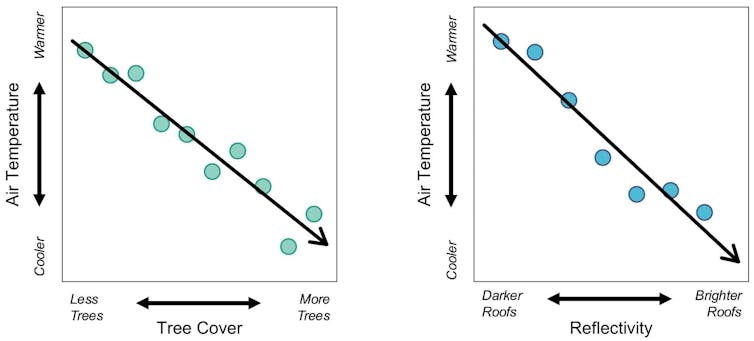
    Adding trees to city streets, parks and residential yards can make a meaningful difference in how hot a neighborhood feels, with blocks that have tree canopies nearly 3 F (1.7 C) cooler than blocks without trees.

    Comparing maps of New York’s vegetation and temperature shows the cooling effect of parks and neighborhoods with more trees. In the map on the left, lighter colors are areas with fewer trees. Light areas in the map on the right are hotter.
    NASA/USGS Landsat

    But planting trees isn’t always simple.

    In hot, dry cities, trees often require irrigation to survive, which can strain already limited water resources. Trees must survive for decades to grow large enough to provide shade and release enough water vapor to reduce air temperatures.

    Annual maintenance costs – about US$900 per tree per year in Boston – can surpass the initial planting investment.

    Most challenging of all, dense urban neighborhoods where heat is most intense are often too packed with buildings and roads to grow more trees.

    How cool roofs can help on hot days

    Another option is “cool roofs.” Coating rooftops with reflective paint or using light-colored materials allows buildings to reflect more sunlight back into the atmosphere rather than absorbing it as heat.

    These roofs can lower the temperature inside an apartment building without air conditioning by about 2 to 6 F (1 to 3.3 C), and can cut peak cooling demand by as much as 27% in air-conditioned buildings, one study found. They can also provide immediate relief by reducing outdoor temperatures in densely populated areas. The maintenance costs are also lower than expanding urban forests.

    Two workers apply a white coating to the roof of a row home in Philadelphia.
    AP Photo/Matt Rourke

    However, like trees, cool roofs come with limits. Cool roofs work better on flat roofs than sloped roofs with shingles, as flat roofs are often covered by heat-trapping rubber and are exposed to more direct sunlight over the course of an afternoon.

    Cities also have a finite number of rooftops that can be retrofitted. And in cities that already have many light-colored roofs, a few more might help lower cooling costs in those buildings, but they won’t do much more for the neighborhood.

    By weighing the trade-offs of both strategies, cities can design location-specific plans to beat the heat.

    Choosing the right mix of cooling solutions

    Many cities around the world have taken steps to adapt to extreme heat, with tree planting and cool roof programs that implement reflectivity requirements or incentivize cool roof adoption.

    In Detroit, nonprofit organizations have planted more than 166,000 trees since 1989. In Los Angeles, building codes now require new residential roofs to meet specific reflectivity standards.

    In a recent study, we analyzed Boston’s potential to lower heat in vulnerable neighborhoods across the city. The results demonstrate how a balanced, budget-conscious strategy could deliver significant cooling benefits.

    For example, we found that planting trees can cool the air 35% more than installing cool roofs in places where trees can actually be planted.

    However, many of the best places for new trees in Boston aren’t in the neighborhoods that need help. In these neighborhoods, we found that reflective roofs were the better choice.

    By investing less than 1% of the city’s annual operating budget, about US$34 million, in 2,500 new trees and 3,000 cool roofs targeting the most at-risk areas, we found that Boston could reduce heat exposure for nearly 80,000 residents. The results would reduce summertime afternoon air temperatures by over 1 F (0.6 C) in those neighborhoods.

    While that reduction might seem modest, reductions of this magnitude have been found to dramatically reduce heat-related illness and death, increase labor productivity and reduce energy costs associated with building cooling.

    Not every city will benefit from the same mix. Boston’s urban landscape includes many flat, black rooftops that reflect only about 12% of sunlight, making cool roofs that reflect over 65% of sunlight an especially effective intervention. Boston also has a relatively moist growing season that supports a thriving urban tree canopy, making both solutions viable.

    Phoenix, left, already has a lot of light-colored roots, compared with Boston, right, where roofs are mostly dark.
    Imagery © Google 2025.

    In places with fewer flat, dark rooftops suitable for cool roof conversion, tree planting may offer more value. Conversely, in cities with little room left for new trees or where extreme heat and drought limit tree survival, cool roofs may be the better bet.

    Phoenix, for example, already has many light-colored roofs. Trees might be an option there, but they will require irrigation.

    Getting the solutions where people need them

    Adding shade along sidewalks can do double-duty by giving pedestrians a place to get out of the sun and cooling buildings. In New York City, for example, street trees account for an estimated 25% of the entire urban forest.

    Cool roofs can be more difficult for a government to implement because they require working with building owners. That often means cities need to provide incentives. Louisville, Kentucky, for example, offers rebates of up to $2,000 for homeowners who install reflective roofing materials, and up to $5,000 for commercial businesses with flat roofs that use reflective coatings.

    In Boston, planting trees, left, and increasing roof reflectivity, right, were both found to be effective ways to cool urban areas.
    Ian Smith et al. 2025

    Efforts like these can help spread cool roof benefits across densely populated neighborhoods that need cooling help most.

    As climate change drives more frequent and intense urban heat, cities have powerful tools for lowering the temperature. With some attention to what already exists and what’s feasible, they can find the right budget-conscious strategy that will deliver cooling benefits for everyone.

    Lucy Hutyra has received funding from the U.S. federal government and foundations including the World Resources Institute and Burroughs Wellcome Fund for her scholarship on urban climate and mitigation strategies. She was a recipient of a 2023 MacArthur Fellowship for her work in this area.

    Ian Smith does not work for, consult, own shares in or receive funding from any company or organization that would benefit from this article, and has disclosed no relevant affiliations beyond their academic appointment.

    – ref. 2 ways cities can beat the heat: Which is best, urban trees or cool roofs? – https://theconversation.com/2-ways-cities-can-beat-the-heat-which-is-best-urban-trees-or-cool-roofs-260188

    MIL OSI –

    July 24, 2025
  • MIL-OSI Submissions: How the nature of environmental law is changing in defense of the planet and the climate

    Source: The Conversation – USA (2) – By Dana Zartner, Professor of International Studies, University of San Francisco

    A 2017 New Zealand law recognizes inherent rights of the Whanganui River. Jason Pratt, CC BY-SA

    While the dangerous effects of climate change continue to worsen, legal efforts to address a range of environmental issues are also on the rise.

    Headlines across the globe tout many of these legal actions: South Korea’s Climate Law Violates Rights of Future Generations; Ukraine is Ground Zero in Battle for Ecocide Law; Paris Wants to Grant the River Seine Legal Personhood; and Montana Court Rules Children Have the Right to a Healthy Environment, to name a few recent examples.

    As an environmental lawyer, I see that most of these suits use one of five legal strategies that have been developed over the past couple of decades. These approaches vary in terms of who is filing the lawsuit, against whom, and whether the underlying legal perspective is based on protecting human rights or the rights of the environment itself. But they all share an innovative approach to protect all life on this planet.

    1. Right to a healthy environment

    In 2022, the United Nations declared that humans have “the right to a clean, healthy and sustainable environment … essential to protecting human life, well-being and dignity.” More than 150 countries have similar declarations in their constitutions or laws, often alongside protections for other human rights, such as those to education and medical care.

    These rights are held by humans, so people can sue for alleged violations. Typically they sue one or more government agencies, whose responsibility it is to protect human rights.

    One recent case using this approach was Held v. Montana, in which a group of young people in 2024 won a lawsuit against the state of Montana for violating the state constitution’s right to a “clean and healthful environment.” The state Supreme Court agreed with the plaintiffs and struck down a law barring the consideration of climate effects when evaluating proposals for fossil fuel extraction. Similar cases have been heard in the U.S. and other countries around the world.

    Rikki Held, the lead plaintiff in the Montana case, center seated, confers with the Our Children’s Trust legal team before the start of the trial on June 12, 2023.
    William Campbell/Getty Images

    2. The rights of future generations

    A legal concept called “intergenerational equity” is the idea that present generations must “responsibly use and conserve natural resources for the benefit of future generations.” First codified in international law in the 1972 Stockholm Declaration, the principle has been gaining popularity in recent decades. International organizations and national governments have enshrined this principle in law.

    Focused on humans’ rights, these laws allow people and groups to bring claims, usually against governments, for allowing activities that are altering the environment in ways that will harm future generations. One well-known case that relied on this legal principle is Future Generations v. Ministry of the Environment and Others, in which a Colombian court in 2018 agreed with young people who had sued, finding that the Colombian government’s allowance of “rampant deforestation in the Amazon” violated the pact of intergenerational equity.

    3. Government responsibility

    Another human-centered approach is the public trust doctrine, which establishes “that certain natural and cultural resources are preserved for public use” and that governments have a responsibility to protect them for everyone’s benefit.

    While the concept of “public trust” has long existed in the law, recently it has been used to bring suit against governments for their failure to address climate change and other environmental degradation. In Urgenda Foundation v. the State of the Netherlands, a Dutch court held in 2019 that the government has a responsibility to mitigate the effects of climate change due to the “severity of the consequences of climate change and the great risk of climate change occurring.” Since the decision, the Dutch government has sought to reduce emissions by phasing out the use of coal, increasing reliance on renewable energy and aiming to achieve carbon neutrality by 2050.

    Government responsibility for the public trust was also a basis of the Juliana v. U.S. case, where a group of young people sued the U.S. government for breaching the public trust by not doing enough to curb greenhouse gas emissions. The U.S. Supreme Court ultimately declined to hear an appeal of a lower court’s ruling, but the lack of a specific ruling by the nation’s highest court has given continued hope to new cases, which continue to be filed based on the same principle.

    A documentary examining the movement to protect the rights of nature.

    4. Rights of nature

    The rights of nature is one of the fastest-growing environmental legal strategies of the past decade. Since Ecuador recognized the rights of Pachamama, the Quechua name for Mother Earth, in its Constitution in 2008, more than 500 laws on the rights of nature have been enacted around the world.

    The principle recognizes the legal rights of natural entities, such as rivers, mountains, ecosystems or even something as specific as wild rice. The laws that grant these rights don’t focus on humans but rather nature itself, often including language that the natural entity has the right to “exist and persist.”

    The laws then provide a mechanism for the natural entity – whether through a specific group assigned legal guardianship or other community efforts – to protect itself by filing lawsuits in court. In the 2018 Colombian case, the court found that the Amazon ecosystem has rights, which must be respected and protected.

    Similarly, in Bangladesh in 2019 the courts recognized the rights of all the country’s rivers, requiring, among other things, a halt on damaging development along the rivers that block their natural flow. The court also created a commission to serve as legal guardians of the country’s rivers.

    The destruction of a dam in Ukraine, which emptied this former reservoir, is being investigated as a possible crime of ecocide.
    Tarasov/Ukrinform/Future Publishing via Getty Images

    5. Defining a new crime: Ecocide

    In 2024, the governments of Vanuatu, Fiji and Samoa formally proposed that the international community recognize a new crime under international law. Called “ecocide,” the principle takes a nature-focused approach and includes any unlawful act committed with “the knowledge that there is a substantial likelihood of severe and either widespread or long-term damage to the environment.”

    Put another way, what genocide is to humans, ecocide is to nature. It is being proposed as an addition to the 2002 Rome Statute, which created the International Criminal Court to prosecute war crimes, genocide and crimes against humanity.

    While the idea is relatively new, in addition to the international efforts, several countries have incorporated ecocide into their laws – including Vietnam, France, Chile and Ukraine. A Ukrainian prosecutor is currently investigating the June 2023 destruction of a dam in a Russian-occupied area of the country as a potential crime of ecocide, because of the widespread flooding and habitat destruction that resulted.

    The European Union has also incorporated ecocide into its Environmental Crime Directive, which applies to all EU member countries, providing them with a mechanism to hear ecocide claims in their national courts.

    Using these ideas

    Each of these legal concepts has the potential to increase protection for the environment – and the people who live in it. But determining which strategy has the greatest chance of success depends on the details of the existing law and legal system in each community.

    All of these legal strategies have a role in the fight to protect and preserve the environment as an integral, interdependent living thing that is vitally important to us as humans but also in its own right.

    Dana Zartner is a volunteer with the Earth Law Center assisting with the editing of toolkits and guides, but has not worked on any of its lawsuits.

    – ref. How the nature of environmental law is changing in defense of the planet and the climate – https://theconversation.com/how-the-nature-of-environmental-law-is-changing-in-defense-of-the-planet-and-the-climate-258982

    MIL OSI –

    July 24, 2025
  • MIL-OSI Submissions: Trump has fired the head of the Library of Congress, but the 225-year-old institution remains a ‘library for all’ – so far

    Source: The Conversation – USA – By Alex H. Poole, Associate Professor of Information Science, Drexel University

    The main reading room is seen at the Library of Congress on June 13, 2025, in Washington. Kevin Carter/Getty Images

    Carla Hayden, the 14th librarian of Congress, who has held the position since 2016, received an unexpected email on May 8, 2025.

    “Carla, on behalf of President Donald J. Trump, I am writing to inform you that your position as the Librarian of Congress is terminated effective immediately. Thank you for your service,” wrote Trent Morse, deputy director of presidential personnel at the White House.

    White House Press Secretary Karoline Leavitt later explained that Hayden, who was the first woman, Black person and professionally trained librarian to oversee the Library of Congress, had done “quite concerning things,” on the job, including “putting inappropriate books in the library for children.”

    Democratic politicians sharply criticized Hayden’s termination, saying the firing was unjust. It was actually about Trump punishing civil servants “who don’t bend to his every will,” New York Sen. Chuck Schumer said.

    An information science scholar, I have written extensively about the history of libraries and archives, including the Library of Congress. To fully understand the role Hayden played for the past nine years, I think it is important to understand what the Library of Congress does, and the overlooked and underappreciated role it has played in American life.

    Carla Hayden, the recently fired librarian of Congress, attends an event in March 2025 in Washington.
    Shannon Finney/Getty Images

    The Library of Congress’ work

    The Library of Congress is an agency that was first established, by an act of Congress, in 1800. The act provided for “the purchase of such books as may be necessary for the use of Congress at the said city of Washington, and for fitting up a suitable apartment for containing them.” Its chief librarian is appointed by the president and confirmed by the Senate.

    The library has six buildings in Washington that hold a print and online collection of nearly 26 million books, as well as more than 136 million other items, including manuscripts, maps, sheet music and prints and photographs.

    It also houses historic documents, like Thomas Jefferson’s rough draft of the Declaration of Independence and James Madison’s notes on the 1787 Constitutional Convention.

    The library is the property of the American people. Anyone over the age of 16 with a government-issued photo identification can enter its buildings and read or view its materials on-site. The Library of Congress was partially designed as a research institution to suit the needs of members of Congress, and only Congress members can borrow items from the library and take them home.

    The Library of Congress has an annual budget of about US$900 million, with a staff of 3,263. In 2024, the library’s staff helped acquire 1,437,832 million new items, issue nearly 69,000 library cards and answer more than 764,000 reference requests, among other tasks.

    The library’s deep roots

    The library has evolved alongside the U.S. itself. Five years before the Constitutional Convention of 1787, future president James Madison called for a library to provide materials to help inform Congress and its members. In 1800, President John Adams signed a bill that established the institution, which began with a $5,000 government appropriation, equivalent to more than $127,000 today.

    The library’s first collection included 152 works in 740 volumes imported from England. It occupied a space in a Washington Senate office that measured just 22 feet by 34 feet.

    The British army torched the infant library and its collection that had grown to 3,000 books in 1814, during the War of 1812. In response, former president Thomas Jefferson sold his personal collection of 6,479 books to the library, which he called “unquestionably the choicest collection of books in the U.S.”

    Tragedy struck again in 1851, with a fire that incinerated two-thirds of the library’s 55,000 volumes, including most of Jefferson’s personal collection.

    The organization rebounded in the next few years, as it purchased the 40,000-volume Smithsonian library in 1866, among other new acquisitions.

    Ainsworth Spofford, the sixth librarian of Congress, boosted the library’s national image in the late 1800s when he tried to centralize the country’s patchwork copyright system.

    Spofford also successfully lobbied Congress to pass the Copyright Act of 1870, which stipulated that any party registering a work for copyright needed to deposit two copies of that work with the library.

    A growing place in American life

    As its collections burgeoned in both scale and scope in the latter part of the 19th century, the library assumed an increasingly visible role and became known by some as “the nation’s library.” By 1900, it had nearly 1 million printed books and other materials.

    The opening of a new library building in 1897, offering services to blind people with a designated reading room containing 500 raised character – or braille – books and music items, epitomized the library’s new status.

    President Theodore Roosevelt said in 1901 that the library was “the one national library of the United States” and that was “a unique opportunity to render to the libraries of this country – to American scholarship – service of the highest importance.”

    The library’s work, and global approach, continued to grow during the 20th century.

    By the late 1900s, the library held materials in more than 450 languages.

    It continued to add remarkable items to its collection, including a Gutenberg Bible, the first book printed in Europe from movable metal type, a kind of printing technology, in 1455.

    Documenting the evolution of democracy, the library also assumed stewardship of 23 presidents’ official papers, from George Washington to Calvin Coolidge, during this time frame.

    A public service

    While primarily designated a research institution for Congress, the library has also catered to a diverse range of patrons, including by mail and telephone.

    As one Science Digest writer noted in 1960, reference staff members fielded questions ranging from “What was the color of a mastodon’s eye?” to “How many words are there in the English language?” and “Could you suggest a name for twins?”

    The library’s register of copyrights received similarly diverse and even humorous inquiries. One older woman seeking to publish her poetry wrote in 1954 to request “a poetic license” to ensure her work conformed to the law.

    In the late 20th century, the library focused on a new democratic national and international mission, as it embraced a new role. Daniel Boorstin, the librarian from 1975 to 1987, termed that role a “multimedia encyclopedia.”

    A congressional resolution marking the Library of Congress’s bicentennial in 2000 noted that it was “the largest and most inclusive library in human history,” as it digitized its collections to extend its reach still further with the growth of the internet.

    As the library marks its 225th year, it continues to represent, as David Mearns, chief of the library’s manuscript division, said in 1947, “the American story.”

    The Thomas Jefferson Building of the Library of Congress is seen on June 11, 2025, in Washington.
    Kevin Carter/Getty Images

    A library for all

    Following Hayden’s dismissal, Trump appointed Deputy Attorney General Todd Blanche, his former personal lawyer, as acting librarian of Congress.

    Hayden has contended that her dismissal, which occurred alongside other firings of top civil servants, including the national archivist, represents a broad threat to people’s right to easily access free information.

    “Democracies are not to be taken for granted,” Hayden said in June. She explained in an interview with CBS that she never had a problem with a presidential administration and is not sure why she was dismissed.

    “And the institutions that support democracy should not be taken for granted,” Hayden added.

    In her final annual report as librarian, Hayden characterized the institution as “truly, a library for all.” So far, even without her leadership, it remains just that.

    Alex H. Poole does not work for, consult, own shares in or receive funding from any company or organization that would benefit from this article, and has disclosed no relevant affiliations beyond their academic appointment.

    – ref. Trump has fired the head of the Library of Congress, but the 225-year-old institution remains a ‘library for all’ – so far – https://theconversation.com/trump-has-fired-the-head-of-the-library-of-congress-but-the-225-year-old-institution-remains-a-library-for-all-so-far-257508

    MIL OSI –

    July 24, 2025
  • MIL-OSI Submissions: Ozzy Osbourne’s spirit of defiance changed music forever

    Source: The Conversation – UK – By Douglas Schulz, Lecturer in Sociology and Criminology, University of Bradford

    Ozzy Osbourne’s death is not just the passing of another rock star. It marks the end of an era – the fading of a figure who helped shape an entire music genre and subculture.

    Both as a member of Black Sabbath and as a solo artist, Osbourne’s legacy lies not only in music history but how we understand performance, rebellion, and the expressive power of sound itself.

    Despite a long battle with Parkinson’s disease and several health setbacks over the years, the news of his death was a shock to the whole metal community. Just weeks before his death on July 22, Osbourne delivered his final performance with Black Sabbath in the place it all began – Villa Park in Birmingham.

    In the hours following the announcement of his death, countless bands and musicians flooded their social media channels to pay their respects.

    Osbourne’s life was a testament to reinvention, grit, and the power of artistic authenticity – going from a working-class kid in Aston to the biggest name in heavy metal, writing the soundtrack to so many people’s lives. His distinctive voice, theatrical presence, and sheer will and determination shaped heavy metal music – inspiring generations of musicians and fans.


    Looking for something good? Cut through the noise with a carefully curated selection of the latest releases, live events and exhibitions, straight to your inbox every fortnight, on Fridays. Sign up here.


    When Black Sabbath emerged in the early 1970s, they played a role in making rock music more menacing, grittier and heavier. The Birmingham band didn’t just turn up the amplifiers and played louder guitars – they introduced a new aesthetic. They were known for their doomy riffs and lyrics about war, madness and the occult. Osbourne, with his uncanny voice and stage presence, was at the front and centre.

    This sound was destined to become the blueprint for heavy metal. But Osbourne’s contribution went beyond his voice. He gave the genre its face, theatricality – and above all, its spirit of defiance.

    Whether he was biting off the head of a bat on stage, stumbling through reality television with absurd but relatable quotes, or delivering genre-defining performances, Osbourne embodied contradictions. He was a mix of menace and mischief, tragedy and comedy, myth and man.

    Heavy metal music has existed in tension with mainstream culture ever since its emergence in the UK in the late 1960s. It has been regarded as too aggressive, too loud, too weird. But Osbourne’s presence forced metal into the public discourse – whether through moral panics in the 1970s and ’80s, or through his television appearances in the 2000s. The Osbournes, a reality show following the family which aired on MTV, was a huge hit in the US and around the world, making Ozzy famous to a whole new audience.

    Throughout his long career, Osbourne helped shift heavy metal from the margins into the mainstream, without ever diluting its transgressive edge.

    A symbol of inspiration

    Osbourne’s stage persona carved out space for other artists to follow. His willingness to be ridiculous, to speak openly about his addictions, health struggles and family dysfunction made him oddly relatable. It is that relatability that allowed Osbourne to be metal’s court jester and elder statesman in one.

    Over time, bands like Slipknot, Ghost, Sleep Token, as well as more introspective bands like Deftones or Gojira, owe much to the groundwork Osbourne and Black Sabbath laid: a template for authenticity, theatricality, and emotional openness wrapped in spectacle and distortion. They helped define the core rhythms, riffs, themes and aesthetics that generations of metal bands followed.

    But Osbourne’s cultural influence cannot be measured only in record sales (although those were plenty), Grammy wins, or his induction into the US Rock and Roll Hall of Fame. His influence lies in how his image, sound and attitude reshaped music scenes across continents.

    In countries where metal is censored or underground, Osbourne was a symbol of resistance. In places where metal was accepted, he was the genre’s most unpredictable ambassador.

    The Prince of Darkness, as he was known, may have left the stage but his legacy will live on. His music is still looped on Tiktok videos, and memes still make rounds on social media.

    Young metal-heads will continue to emulate his style and irreverence. As long as people pick up guitars and look for a way to scream back at the world, Ozzy will be there – in spirit, in sound, and in spectacle.

    Douglas Schulz does not work for, consult, own shares in or receive funding from any company or organisation that would benefit from this article, and has disclosed no relevant affiliations beyond their academic appointment.

    – ref. Ozzy Osbourne’s spirit of defiance changed music forever – https://theconversation.com/ozzy-osbournes-spirit-of-defiance-changed-music-forever-261775

    MIL OSI –

    July 24, 2025
  • MIL-OSI Video: Cooperation built on security and trade: EU-Japan Summit in Tokyo

    Source: European Commission (video statements)

    During the EU-Japan Summit in Tokyo on 23 July 2025, European Commission President Ursula von der Leyen met with important Japanese stakeholders to further foster the relationship between Japan and the EU.

    The Japan-EU Strategic Partnership Agreement which includes topics such as digital partnerships, green alliances or security cooperation, and a strengthening of the relationship between the EU and the Indo-Pacific region were in focus during this 30th EU-Japan Summit.

    Find the joint declaration from all three political leaders here: https://ec.europa.eu/commission/presscorner/detail/en/statement_25_1892

    Follow live events and access media content here:
    https://audiovisual.ec.europa.eu/en/

    Stay updated — follow us on X: https://x.com/EC_AVService

    Follow us on:
    -X: https://twitter.com/EU_Commission
    -Instagram: https://www.instagram.com/europeancommission/
    -Facebook: https://www.facebook.com/EuropeanCommission
    -LinkedIn: https://www.linkedin.com/company/european-commission/
    -Medium: https://medium.com/@EuropeanCommission

    Check our website: http://ec.europa.eu/

    https://www.youtube.com/watch?v=zSx4gDVZlok

    MIL OSI Video –

    July 24, 2025
  • MIL-OSI United Kingdom: Analysis Function resources

    Source: United Kingdom – Government Statements

    News story

    Analysis Function resources

    Resources to learn more about and promote the Strategy for analysis in government 2025 to 2028

    On this page you will find:

    • A campaign in a box to containing resources to help you promote the Strategy for analysis in government 2025 to 2028
    • Slide templates for use in presentations about the Strategy for analysis in government 2025 to 2028

    Campaign in a Box – Strategy for analysis in government 2025 to 2028

    MS PowerPoint Presentation, 33.5 MB

    This file may not be suitable for users of assistive technology.

    Request an accessible format.
    If you use assistive technology (such as a screen reader) and need a version of this document in a more accessible format, please email analysis.function@ons.gov.uk. Please tell us what format you need. It will help us if you say what assistive technology you use.

    Presentation – Strategy for analysis in government 2025 to 2028

    MS PowerPoint Presentation, 12 MB

    This file may not be suitable for users of assistive technology.

    Request an accessible format.
    If you use assistive technology (such as a screen reader) and need a version of this document in a more accessible format, please email analysis.function@ons.gov.uk. Please tell us what format you need. It will help us if you say what assistive technology you use.

    Share this page

    The following links open in a new tab

    • Share on Facebook (opens in new tab)
    • Share on Twitter (opens in new tab)

    Updates to this page

    Published 23 July 2025

    MIL OSI United Kingdom –

    July 24, 2025
  • MIL-OSI Russia: Masterpieces of Music and Poetry of the Romantic Era

    Translation. Region: Russian Federal

    Source: Moscow Government – Government of Moscow –

    An important disclaimer is at the bottom of this article.

    The A.P. Bogolyubov Arts Library invites you to the concert “Masterpieces of Music and Poetry of the Romantic Era”. This evening, pianist Mikhail Latsis will perform works by Ludwig van Beethoven, Robert Schumann, Frederic Chopin, Franz Liszt and Sergei Rachmaninov. Alexander Kazantsev will read poems by Heinrich Heine and Johann Wolfgang von Goethe.

    Please note: This information is raw content obtained directly from the source of the information. It is an accurate report of what the source claims and does not necessarily reflect the position of MIL-OSI or its clients.

    .

    MIL OSI Russia News –

    July 24, 2025
  • I teach college and report on Colorado media — there should be more professors doing the same in other states

    Source: ForeignAffairs4

    Source: The Conversation – USA (2) – By Corey Hutchins, Manager, Colorado College Journalism Institute, Colorado College

    Newsletters that cover a state’s media landscape are few and far between, according to a new report. iStock / Getty Images Plus

    Over the years, the crisis facing local news has meant the disappearance of reporting on the arts, politics, sports and local government.

    Newspapers have disappeared from many local communities, and the ranks of individual local journalists have plummeted over the past two decades.

    The retrenchment has also led to a loss of something else: reporters and columnists at local news organizations who decades ago regularly focused on their local media as a beat.

    There are very few of them left.

    I’m an instructor at Colorado College, where I manage the Journalism Institute. I also compulsively keep track of our state’s shifting media landscape.

    Recently, I produced a nationwide study called “Local News as a Public Good: Increasing Visibility Through University-Led Statewide Newsletters.”

    The Center for Community News at the University of Vermont solicited and published the report. The goal was to find out who is doing similar work and where.

    The Center for Community News is interested in fostering partnerships between academic programs and local newsrooms. The center is also seeking to find other ways higher-ed institutions are supporting their state’s media ecosystem — so they were especially interested in media newsletters being produced at a college or university.

    Few state-based newsletters

    The problem is, there weren’t many to track. I found just six, including my own, while researching for the report.

    Very few states, it turns out, “have a dedicated publication, site, or newsletter that regularly and independently reports on and analyzes ongoing developments in the local media scene,” the report found.

    A screenshot of the Substack newsletter Corey Hutchins publishes every week.
    ‘Inside the News in Colorado’ is the author’s newsletter, in which he obsessively tracks the media landscape in Colorado.
    Corey Hutchins via Substack

    My own weekly Substack newsletter is called “Inside the News in Colorado.” Each week, I report on, comment on and analyze the goings on in Colorado’s media scene. I connect local developments to what’s happening nationally, and I explore what makes the state’s local news ecosystem unique.

    My newsletter also pokes and prods, critiques and uplifts, and seeks to spark debate and a better understanding about the practice of local journalism. And it maintains a weekly running tab on the health of the state’s media landscape.

    Other newsletters across the country include NC Local, authored by Catherine Komp. The Newsroom Digest, out of the Center for Cooperative Media at Montclair State University in New Jersey, is another. Gateway Journalism Review from Southern Illinois University Carbondale’s School of Journalism, in the College of Arts and Media made the list. And Media Nation by Northeastern University professor Dan Kennedy in Massachusetts is another.

    Kennedy has been producing Media Nation for more than 20 years and writes more about national media issues. But he mixes it with plenty of local and regional happenings.

    If someone were to, say, leak an internal email from The Boston Globe, it is likely they would do so with Media Nation.

    The NC Local newsletter’s format is a mix of digestible roundups and some original reporting.

    A recurring item titled “Well Done” offers “noteworthy work from the NC news & information ecosystem.” The most-clicked links each week tend to come from a bulletin board section where Komp rounds up job postings and opportunities.

    The chunky Newsroom Digest newsletter highlights notable local journalism in New Jersey. It comes with a “Media Moves” section that introduces its audience to new local journalists and tracks newsroom personnel changes.

    While they differ in style and delivery, each is filling a gap in coverage in their state or region by reporting on an important industry: their own.

    “When I was at the (Boston) Phoenix, I think all of us at the alternative press thought big local media were a powerful local institution that ought to be held to account just like big business and everything else,” Media Nation’s Kennedy said for the report.

    Where to house the news about the news?

    I believe colleges and universities make good places to produce these kinds of state-based media newsletters.

    Journalism departments in particular are likely equipped to run them, especially if they have practitioners on the faculty. They are outside of a state’s established media organizations but also adjacent to them.

    Richard Watts, the director of the Center for Community News, commissioned the “Local News as a Public Good” study. He says there are important reasons for more newsletters consistently reporting on local media in individual states.

    “They draw attention to the key role local news plays by writing about the stories and the impact of those stories,” he said. “They help amplify and they showcase the importance of the media ecosystem for a vibrant democracy.”

    Furthermore, such newsletters can serve as the “canary in the coal mine to draw attention to media platforms in trouble, or actions by unscrupulous owners,” Watts added. “And they can share ideas and best practices across the system to help strengthen individual media platforms. And, lastly, they help create a community of stakeholders committed to the importance of a free press.”

    To that end, the Center for Community News at the University of Vermont is looking to help anyone in a higher-ed program who might be interested in launching a state-based media newsletter.

    “I think a really good person to do something like this is, first, someone who is doing more than just reporting on the industry or ecosystem,” said Komp of NC Local in the Center for Community News study.

    “It does need to be somebody who is engaging with journalists, with publishers, with journalism educators, with students, with funders, in ways that are not just reporting on what’s happening but in ways that are looking to always find solutions and address challenges.”

    Read more of our stories about Colorado.

    The Conversation

    Corey Hutchins consults for the Center for Community News at the University of Vermont where he is working on a project to help colleges and universities create state-based media newsletters.

    – ref. I teach college and report on Colorado media — there should be more professors doing the same in other states – https://theconversation.com/i-teach-college-and-report-on-colorado-media-there-should-be-more-professors-doing-the-same-in-other-states-260891

    July 24, 2025
  • Caution in the C-suite: How business leaders are navigating Trump 2.0

    Source: ForeignAffairs4

    Source: The Conversation – USA (2) – By Erran Carmel, Professor of Business, American University Kogod School of Business

    In the first months of Donald Trump’s second term as president, his policies – from sweeping tariffs and aggressive immigration enforcement to attacks on diversity, equity and inclusion – have thrown U.S. businesses into turmoil, leading to a 26-point decline in CEO confidence.

    Yet despite this volatility, many American corporations have remained notably restrained in their public responses.

    This might come as a surprise. After all, in recent decades, CEOs have become increasingly willing to speak out about social and political issues. But while some universities and law firms have publicly pushed back against the Trump administration, business leaders are seemingly opting for caution.

    What would it take for these titans of corporate America to speak out against Trump’s policies? We are a professor and a graduate student who study business, and back in 2018, one of us – Dr. Carmel – conducted an analysis asking this very question. More recently, we gathered new data looking at how business leaders are responding to Trump’s second term.

    The 2018 analysis, involving data from about 200 leading U.S. CEOs, found that most business leaders remained publicly neutral on Trump, and only a handful expressed strong opposition. Silence was often a strategic choice, with many leaders staying mum due to fear of retaliation. The evidence also suggested that Trump could one day cross a line that would prompt a broader CEO backlash.

    Seven years later, that line hasn’t yet appeared, even as Trump’s footprint on corporate America is now far more direct and substantial.

    Most notable are Trump’s tariffs, first announced in April 2025, which have roiled global markets and unnerved CEOs. And there are many other ripples: Some companies, such as CBS’ parent company, Paramount – which is seeking the Trump administration’s approval for a merger – have decided to self-censor. Others, including Disney and Meta, gave in to Trump’s lawsuits and paid multimillion-dollar settlements, against the counsel of many outside experts. CEOs also have to deal with the threat of backlash from both the right and left.

    Against this backdrop, we collected new public data to see how corporate leaders are responding to the second Trump administration. Just as in 2018, we examined the 232 companies that make up the Business Roundtable – a club of the most powerful American businesses.

    We assessed the actions that these companies took regarding DEI and whether they experienced any backlash. We focused on these criteria as a way to assess whether CEOs are seeking either to support or placate Trump, or to stand on other principles. We also collected other data, including public statements from CEOs and campaign donations.

    DEI as a bellwether

    Corporate DEI actions were an early, useful way to gauge a business’s stances, since, from the outset, the Trump administration identified DEI as a “scourge” to be eliminated. Although the White House’s anti-DEI directives have applied to the executive branch and federal contractors, some private businesses rushed to make changes as well.

    By May, just a bit over 100 days into Trump’s second term, a significant number of companies had decided to go along with Trump’s preferences. Sixty-nine of the 232 companies in the Business Roundtable rolled back their DEI initiatives in some way, while just 20 companies announced that they kept their DEI programs in place. There’s no information either way on the remaining 61% – likely because they decided it’s better to stay out of the news.

    DEI-related actions have tapered off since May, but there’s still an impact. For example, the Federal Communications Commission pressured T-Mobile to eliminate DEI. Only then was its merger approved.

    Companies that scaled back their DEI initiatives sometimes pointed to the political environment as a factor. Meta, for example, said in an internal memo that it was ending its DEI efforts due to a “shifting legal and policy landscape.” Other companies, including Verizon and Comcast, reportedly rolled back DEI programs because they feared legal action by the federal government.

    Some corporations announced changes through internal announcements, legal filings or quiet updates to their websites, suggesting they want to stay out of the media spotlight.

    A small number of Business Roundtable companies stood firm on their DEI policies – to mixed results. When Marriott’s CEO voiced support for DEI at a corporate leadership event, he reportedly received 40,000 appreciative emails from employees. On the other hand, after Coca-Cola reiterated its “commitment to sponsoring an inclusive workplace,” the right-wing activist Robby Starbuck — who The New York Times has described as “the anti-DEI agitator that companies fear most” – said Coca-Cola “should be very nervous about continuing with its woke policies.”

    Bracing for backlash

    Overall, 22% of Business Roundtable companies saw some sort of backlash to their actions. Most came from the political right: 36 companies were called out by conservatives, another eight by progressives, and eight more faced bipartisan backlash.

    With more than three years left in Trump’s second term, it’s worth asking what lies ahead. We think the most likely scenario is that companies will continue to try to stay off the president’s radar and placate him when they must. After all, following the split with Elon Musk, Trump quite explicitly threatened to use presidential powers to hurt Musk’s businesses. Any CEO gets the implications.

    While our analysis primarily focused on social issues, policies at the business core may push U.S. companies to confront Trump. Tariff policy is a prime example. Back in April, major retailers like Walmart quietly warned Trump that tariffs could lead to empty shelves and higher prices. More recently, the CEO of Goldman Sachs publicly warned that tariffs “have raised the level of uncertainty to a degree I do not think is healthy for investment and growth.”

    These are voices of criticism – but worded quite softly.

    The Conversation

    The authors do not work for, consult, own shares in or receive funding from any company or organization that would benefit from this article, and have disclosed no relevant affiliations beyond their academic appointment.

    – ref. Caution in the C-suite: How business leaders are navigating Trump 2.0 – https://theconversation.com/caution-in-the-c-suite-how-business-leaders-are-navigating-trump-2-0-260557

    July 24, 2025
  • 2 ways cities can beat the heat: Which is best, urban trees or cool roofs?

    Source: ForeignAffairs4

    Source: The Conversation – USA (2) – By Ian Smith, Research Scientist in Earth & Environment, Boston University

    Trees like these in Boston can help keep neighborhoods cooler on hot days. Yassine Khalfalli/Unsplash, CC BY

    When summer turns up the heat, cities can start to feel like an oven, as buildings and pavement trap the sun’s warmth and vehicles and air conditioners release more heat into the air.

    The temperature in an urban neighborhood with few trees can be more than 10 degrees Fahrenheit (5.5 Celsius) higher than in nearby suburbs. That means air conditioning works harder, straining the electrical grid and leaving communities vulnerable to power outages.

    There are some proven steps that cities can take to help cool the air – planting trees that provide shade and moisture, for example, or creating cool roofs that reflect solar energy away from the neighborhood rather than absorbing it.

    But do these steps pay off everywhere?

    We study heat risk in cities as urban ecologists and have been exploring the impact of tree-planting and reflective roofs in different cities and different neighborhoods across cities. What we’re learning can help cities and homeowners be more targeted in their efforts to beat the heat.

    The wonder of trees

    Urban trees offer a natural defense against rising temperatures. They cast shade and release water vapor through their leaves, a process akin to human sweating. That cools the surrounding air and reduces afternoon heat.

    Adding trees to city streets, parks and residential yards can make a meaningful difference in how hot a neighborhood feels, with blocks that have tree canopies nearly 3 F (1.7 C) cooler than blocks without trees.

    Two maps of New York City show how vegetation matches cooler areas by temperature.
    Comparing maps of New York’s vegetation and temperature shows the cooling effect of parks and neighborhoods with more trees. In the map on the left, lighter colors are areas with fewer trees. Light areas in the map on the right are hotter.
    NASA/USGS Landsat

    But planting trees isn’t always simple.

    In hot, dry cities, trees often require irrigation to survive, which can strain already limited water resources. Trees must survive for decades to grow large enough to provide shade and release enough water vapor to reduce air temperatures.

    Annual maintenance costs – about US$900 per tree per year in Boston – can surpass the initial planting investment.

    Most challenging of all, dense urban neighborhoods where heat is most intense are often too packed with buildings and roads to grow more trees.

    How cool roofs can help on hot days

    Another option is “cool roofs.” Coating rooftops with reflective paint or using light-colored materials allows buildings to reflect more sunlight back into the atmosphere rather than absorbing it as heat.

    These roofs can lower the temperature inside an apartment building without air conditioning by about 2 to 6 F (1 to 3.3 C), and can cut peak cooling demand by as much as 27% in air-conditioned buildings, one study found. They can also provide immediate relief by reducing outdoor temperatures in densely populated areas. The maintenance costs are also lower than expanding urban forests.

    Two workers apply paint to a flat roof.
    Two workers apply a white coating to the roof of a row home in Philadelphia.
    AP Photo/Matt Rourke

    However, like trees, cool roofs come with limits. Cool roofs work better on flat roofs than sloped roofs with shingles, as flat roofs are often covered by heat-trapping rubber and are exposed to more direct sunlight over the course of an afternoon.

    Cities also have a finite number of rooftops that can be retrofitted. And in cities that already have many light-colored roofs, a few more might help lower cooling costs in those buildings, but they won’t do much more for the neighborhood.

    By weighing the trade-offs of both strategies, cities can design location-specific plans to beat the heat.

    Choosing the right mix of cooling solutions

    Many cities around the world have taken steps to adapt to extreme heat, with tree planting and cool roof programs that implement reflectivity requirements or incentivize cool roof adoption.

    In Detroit, nonprofit organizations have planted more than 166,000 trees since 1989. In Los Angeles, building codes now require new residential roofs to meet specific reflectivity standards.

    In a recent study, we analyzed Boston’s potential to lower heat in vulnerable neighborhoods across the city. The results demonstrate how a balanced, budget-conscious strategy could deliver significant cooling benefits.

    For example, we found that planting trees can cool the air 35% more than installing cool roofs in places where trees can actually be planted.

    However, many of the best places for new trees in Boston aren’t in the neighborhoods that need help. In these neighborhoods, we found that reflective roofs were the better choice.

    By investing less than 1% of the city’s annual operating budget, about US$34 million, in 2,500 new trees and 3,000 cool roofs targeting the most at-risk areas, we found that Boston could reduce heat exposure for nearly 80,000 residents. The results would reduce summertime afternoon air temperatures by over 1 F (0.6 C) in those neighborhoods.

    While that reduction might seem modest, reductions of this magnitude have been found to dramatically reduce heat-related illness and death, increase labor productivity and reduce energy costs associated with building cooling.

    Not every city will benefit from the same mix. Boston’s urban landscape includes many flat, black rooftops that reflect only about 12% of sunlight, making cool roofs that reflect over 65% of sunlight an especially effective intervention. Boston also has a relatively moist growing season that supports a thriving urban tree canopy, making both solutions viable.

    Two aerial images show very different building coloring in two cities.
    Phoenix, left, already has a lot of light-colored roots, compared with Boston, right, where roofs are mostly dark.
    Imagery © Google 2025.

    In places with fewer flat, dark rooftops suitable for cool roof conversion, tree planting may offer more value. Conversely, in cities with little room left for new trees or where extreme heat and drought limit tree survival, cool roofs may be the better bet.

    Phoenix, for example, already has many light-colored roofs. Trees might be an option there, but they will require irrigation.

    Getting the solutions where people need them

    Adding shade along sidewalks can do double-duty by giving pedestrians a place to get out of the sun and cooling buildings. In New York City, for example, street trees account for an estimated 25% of the entire urban forest.

    Cool roofs can be more difficult for a government to implement because they require working with building owners. That often means cities need to provide incentives. Louisville, Kentucky, for example, offers rebates of up to $2,000 for homeowners who install reflective roofing materials, and up to $5,000 for commercial businesses with flat roofs that use reflective coatings.

    Two charts show improvements
    In Boston, planting trees, left, and increasing roof reflectivity, right, were both found to be effective ways to cool urban areas.
    Ian Smith et al. 2025

    Efforts like these can help spread cool roof benefits across densely populated neighborhoods that need cooling help most.

    As climate change drives more frequent and intense urban heat, cities have powerful tools for lowering the temperature. With some attention to what already exists and what’s feasible, they can find the right budget-conscious strategy that will deliver cooling benefits for everyone.

    The Conversation

    Lucy Hutyra has received funding from the U.S. federal government and foundations including the World Resources Institute and Burroughs Wellcome Fund for her scholarship on urban climate and mitigation strategies. She was a recipient of a 2023 MacArthur Fellowship for her work in this area.

    Ian Smith does not work for, consult, own shares in or receive funding from any company or organization that would benefit from this article, and has disclosed no relevant affiliations beyond their academic appointment.

    – ref. 2 ways cities can beat the heat: Which is best, urban trees or cool roofs? – https://theconversation.com/2-ways-cities-can-beat-the-heat-which-is-best-urban-trees-or-cool-roofs-260188

    July 24, 2025
  • How the nature of environmental law is changing in defense of the planet and the climate

    Source: ForeignAffairs4

    Source: The Conversation – USA (2) – By Dana Zartner, Professor of International Studies, University of San Francisco

    A 2017 New Zealand law recognizes inherent rights of the Whanganui River. Jason Pratt, CC BY-SA

    While the dangerous effects of climate change continue to worsen, legal efforts to address a range of environmental issues are also on the rise.

    Headlines across the globe tout many of these legal actions: South Korea’s Climate Law Violates Rights of Future Generations; Ukraine is Ground Zero in Battle for Ecocide Law; Paris Wants to Grant the River Seine Legal Personhood; and Montana Court Rules Children Have the Right to a Healthy Environment, to name a few recent examples.

    As an environmental lawyer, I see that most of these suits use one of five legal strategies that have been developed over the past couple of decades. These approaches vary in terms of who is filing the lawsuit, against whom, and whether the underlying legal perspective is based on protecting human rights or the rights of the environment itself. But they all share an innovative approach to protect all life on this planet.

    1. Right to a healthy environment

    In 2022, the United Nations declared that humans have “the right to a clean, healthy and sustainable environment … essential to protecting human life, well-being and dignity.” More than 150 countries have similar declarations in their constitutions or laws, often alongside protections for other human rights, such as those to education and medical care.

    These rights are held by humans, so people can sue for alleged violations. Typically they sue one or more government agencies, whose responsibility it is to protect human rights.

    One recent case using this approach was Held v. Montana, in which a group of young people in 2024 won a lawsuit against the state of Montana for violating the state constitution’s right to a “clean and healthful environment.” The state Supreme Court agreed with the plaintiffs and struck down a law barring the consideration of climate effects when evaluating proposals for fossil fuel extraction. Similar cases have been heard in the U.S. and other countries around the world.

    A young woman and two young boys listen as lawyers talk. Young people fill two rows of benches behind them in the small court room.
    Rikki Held, the lead plaintiff in the Montana case, center seated, confers with the Our Children’s Trust legal team before the start of the trial on June 12, 2023.
    William Campbell/Getty Images

    2. The rights of future generations

    A legal concept called “intergenerational equity” is the idea that present generations must “responsibly use and conserve natural resources for the benefit of future generations.” First codified in international law in the 1972 Stockholm Declaration, the principle has been gaining popularity in recent decades. International organizations and national governments have enshrined this principle in law.

    Focused on humans’ rights, these laws allow people and groups to bring claims, usually against governments, for allowing activities that are altering the environment in ways that will harm future generations. One well-known case that relied on this legal principle is Future Generations v. Ministry of the Environment and Others, in which a Colombian court in 2018 agreed with young people who had sued, finding that the Colombian government’s allowance of “rampant deforestation in the Amazon” violated the pact of intergenerational equity.

    3. Government responsibility

    Another human-centered approach is the public trust doctrine, which establishes “that certain natural and cultural resources are preserved for public use” and that governments have a responsibility to protect them for everyone’s benefit.

    While the concept of “public trust” has long existed in the law, recently it has been used to bring suit against governments for their failure to address climate change and other environmental degradation. In Urgenda Foundation v. the State of the Netherlands, a Dutch court held in 2019 that the government has a responsibility to mitigate the effects of climate change due to the “severity of the consequences of climate change and the great risk of climate change occurring.” Since the decision, the Dutch government has sought to reduce emissions by phasing out the use of coal, increasing reliance on renewable energy and aiming to achieve carbon neutrality by 2050.

    Government responsibility for the public trust was also a basis of the Juliana v. U.S. case, where a group of young people sued the U.S. government for breaching the public trust by not doing enough to curb greenhouse gas emissions. The U.S. Supreme Court ultimately declined to hear an appeal of a lower court’s ruling, but the lack of a specific ruling by the nation’s highest court has given continued hope to new cases, which continue to be filed based on the same principle.

    A documentary examining the movement to protect the rights of nature.

    4. Rights of nature

    The rights of nature is one of the fastest-growing environmental legal strategies of the past decade. Since Ecuador recognized the rights of Pachamama, the Quechua name for Mother Earth, in its Constitution in 2008, more than 500 laws on the rights of nature have been enacted around the world.

    The principle recognizes the legal rights of natural entities, such as rivers, mountains, ecosystems or even something as specific as wild rice. The laws that grant these rights don’t focus on humans but rather nature itself, often including language that the natural entity has the right to “exist and persist.”

    The laws then provide a mechanism for the natural entity – whether through a specific group assigned legal guardianship or other community efforts – to protect itself by filing lawsuits in court. In the 2018 Colombian case, the court found that the Amazon ecosystem has rights, which must be respected and protected.

    Similarly, in Bangladesh in 2019 the courts recognized the rights of all the country’s rivers, requiring, among other things, a halt on damaging development along the rivers that block their natural flow. The court also created a commission to serve as legal guardians of the country’s rivers.

    People walk through an area of rocks to a grassy plain.
    The destruction of a dam in Ukraine, which emptied this former reservoir, is being investigated as a possible crime of ecocide.
    Tarasov/Ukrinform/Future Publishing via Getty Images

    5. Defining a new crime: Ecocide

    In 2024, the governments of Vanuatu, Fiji and Samoa formally proposed that the international community recognize a new crime under international law. Called “ecocide,” the principle takes a nature-focused approach and includes any unlawful act committed with “the knowledge that there is a substantial likelihood of severe and either widespread or long-term damage to the environment.”

    Put another way, what genocide is to humans, ecocide is to nature. It is being proposed as an addition to the 2002 Rome Statute, which created the International Criminal Court to prosecute war crimes, genocide and crimes against humanity.

    While the idea is relatively new, in addition to the international efforts, several countries have incorporated ecocide into their laws – including Vietnam, France, Chile and Ukraine. A Ukrainian prosecutor is currently investigating the June 2023 destruction of a dam in a Russian-occupied area of the country as a potential crime of ecocide, because of the widespread flooding and habitat destruction that resulted.

    The European Union has also incorporated ecocide into its Environmental Crime Directive, which applies to all EU member countries, providing them with a mechanism to hear ecocide claims in their national courts.

    Using these ideas

    Each of these legal concepts has the potential to increase protection for the environment – and the people who live in it. But determining which strategy has the greatest chance of success depends on the details of the existing law and legal system in each community.

    All of these legal strategies have a role in the fight to protect and preserve the environment as an integral, interdependent living thing that is vitally important to us as humans but also in its own right.

    The Conversation

    Dana Zartner is a volunteer with the Earth Law Center assisting with the editing of toolkits and guides, but has not worked on any of its lawsuits.

    – ref. How the nature of environmental law is changing in defense of the planet and the climate – https://theconversation.com/how-the-nature-of-environmental-law-is-changing-in-defense-of-the-planet-and-the-climate-258982

    July 24, 2025
  • Trump has fired the head of the Library of Congress, but the 225-year-old institution remains a ‘library for all’ – so far

    Source: ForeignAffairs4

    Source: The Conversation – USA – By Alex H. Poole, Associate Professor of Information Science, Drexel University

    The main reading room is seen at the Library of Congress on June 13, 2025, in Washington. Kevin Carter/Getty Images

    Carla Hayden, the 14th librarian of Congress, who has held the position since 2016, received an unexpected email on May 8, 2025.

    “Carla, on behalf of President Donald J. Trump, I am writing to inform you that your position as the Librarian of Congress is terminated effective immediately. Thank you for your service,” wrote Trent Morse, deputy director of presidential personnel at the White House.

    White House Press Secretary Karoline Leavitt later explained that Hayden, who was the first woman, Black person and professionally trained librarian to oversee the Library of Congress, had done “quite concerning things,” on the job, including “putting inappropriate books in the library for children.”

    Democratic politicians sharply criticized Hayden’s termination, saying the firing was unjust. It was actually about Trump punishing civil servants “who don’t bend to his every will,” New York Sen. Chuck Schumer said.

    An information science scholar, I have written extensively about the history of libraries and archives, including the Library of Congress. To fully understand the role Hayden played for the past nine years, I think it is important to understand what the Library of Congress does, and the overlooked and underappreciated role it has played in American life.

    A middle-aged woman with light brown skin and dark hair stands and smiles with her hands clasped together.
    Carla Hayden, the recently fired librarian of Congress, attends an event in March 2025 in Washington.
    Shannon Finney/Getty Images

    The Library of Congress’ work

    The Library of Congress is an agency that was first established, by an act of Congress, in 1800. The act provided for “the purchase of such books as may be necessary for the use of Congress at the said city of Washington, and for fitting up a suitable apartment for containing them.” Its chief librarian is appointed by the president and confirmed by the Senate.

    The library has six buildings in Washington that hold a print and online collection of nearly 26 million books, as well as more than 136 million other items, including manuscripts, maps, sheet music and prints and photographs.

    It also houses historic documents, like Thomas Jefferson’s rough draft of the Declaration of Independence and James Madison’s notes on the 1787 Constitutional Convention.

    The library is the property of the American people. Anyone over the age of 16 with a government-issued photo identification can enter its buildings and read or view its materials on-site. The Library of Congress was partially designed as a research institution to suit the needs of members of Congress, and only Congress members can borrow items from the library and take them home.

    The Library of Congress has an annual budget of about US$900 million, with a staff of 3,263. In 2024, the library’s staff helped acquire 1,437,832 million new items, issue nearly 69,000 library cards and answer more than 764,000 reference requests, among other tasks.

    The library’s deep roots

    The library has evolved alongside the U.S. itself. Five years before the Constitutional Convention of 1787, future president James Madison called for a library to provide materials to help inform Congress and its members. In 1800, President John Adams signed a bill that established the institution, which began with a $5,000 government appropriation, equivalent to more than $127,000 today.

    The library’s first collection included 152 works in 740 volumes imported from England. It occupied a space in a Washington Senate office that measured just 22 feet by 34 feet.

    The British army torched the infant library and its collection that had grown to 3,000 books in 1814, during the War of 1812. In response, former president Thomas Jefferson sold his personal collection of 6,479 books to the library, which he called “unquestionably the choicest collection of books in the U.S.”

    Tragedy struck again in 1851, with a fire that incinerated two-thirds of the library’s 55,000 volumes, including most of Jefferson’s personal collection.

    The organization rebounded in the next few years, as it purchased the 40,000-volume Smithsonian library in 1866, among other new acquisitions.

    Ainsworth Spofford, the sixth librarian of Congress, boosted the library’s national image in the late 1800s when he tried to centralize the country’s patchwork copyright system.

    Spofford also successfully lobbied Congress to pass the Copyright Act of 1870, which stipulated that any party registering a work for copyright needed to deposit two copies of that work with the library.

    A growing place in American life

    As its collections burgeoned in both scale and scope in the latter part of the 19th century, the library assumed an increasingly visible role and became known by some as “the nation’s library.” By 1900, it had nearly 1 million printed books and other materials.

    The opening of a new library building in 1897, offering services to blind people with a designated reading room containing 500 raised character – or braille – books and music items, epitomized the library’s new status.

    President Theodore Roosevelt said in 1901 that the library was “the one national library of the United States” and that was “a unique opportunity to render to the libraries of this country – to American scholarship – service of the highest importance.”

    The library’s work, and global approach, continued to grow during the 20th century.

    By the late 1900s, the library held materials in more than 450 languages.

    It continued to add remarkable items to its collection, including a Gutenberg Bible, the first book printed in Europe from movable metal type, a kind of printing technology, in 1455.

    Documenting the evolution of democracy, the library also assumed stewardship of 23 presidents’ official papers, from George Washington to Calvin Coolidge, during this time frame.

    A public service

    While primarily designated a research institution for Congress, the library has also catered to a diverse range of patrons, including by mail and telephone.

    As one Science Digest writer noted in 1960, reference staff members fielded questions ranging from “What was the color of a mastodon’s eye?” to “How many words are there in the English language?” and “Could you suggest a name for twins?”

    The library’s register of copyrights received similarly diverse and even humorous inquiries. One older woman seeking to publish her poetry wrote in 1954 to request “a poetic license” to ensure her work conformed to the law.

    In the late 20th century, the library focused on a new democratic national and international mission, as it embraced a new role. Daniel Boorstin, the librarian from 1975 to 1987, termed that role a “multimedia encyclopedia.”

    A congressional resolution marking the Library of Congress’s bicentennial in 2000 noted that it was “the largest and most inclusive library in human history,” as it digitized its collections to extend its reach still further with the growth of the internet.

    As the library marks its 225th year, it continues to represent, as David Mearns, chief of the library’s manuscript division, said in 1947, “the American story.”

    A large building is seen with the sun shining on it on a clear day.
    The Thomas Jefferson Building of the Library of Congress is seen on June 11, 2025, in Washington.
    Kevin Carter/Getty Images

    A library for all

    Following Hayden’s dismissal, Trump appointed Deputy Attorney General Todd Blanche, his former personal lawyer, as acting librarian of Congress.

    Hayden has contended that her dismissal, which occurred alongside other firings of top civil servants, including the national archivist, represents a broad threat to people’s right to easily access free information.

    “Democracies are not to be taken for granted,” Hayden said in June. She explained in an interview with CBS that she never had a problem with a presidential administration and is not sure why she was dismissed.

    “And the institutions that support democracy should not be taken for granted,” Hayden added.

    In her final annual report as librarian, Hayden characterized the institution as “truly, a library for all.” So far, even without her leadership, it remains just that.

    The Conversation

    Alex H. Poole does not work for, consult, own shares in or receive funding from any company or organization that would benefit from this article, and has disclosed no relevant affiliations beyond their academic appointment.

    – ref. Trump has fired the head of the Library of Congress, but the 225-year-old institution remains a ‘library for all’ – so far – https://theconversation.com/trump-has-fired-the-head-of-the-library-of-congress-but-the-225-year-old-institution-remains-a-library-for-all-so-far-257508

    July 24, 2025
  • How germy is the public pool? An infectious disease expert weighs in on poop, pee and perspiration – and the deceptive smell of chlorine

    Source: ForeignAffairs4

    Source: The Conversation – USA (3) – By Lisa Cuchara, Professor of Biomedical Sciences, Quinnipiac University

    A 2023 CDC report tracked more than 200 pool-associated outbreaks over a four-year period. But a few basic precautions can ward off these dangers. Maria Korneeva/Moment via Getty Images

    On hot summer days, few things are more refreshing than a dip in the pool. But have you ever wondered if the pool is as clean as that crystal blue water appears?

    As an immunologist and infectious disease specialist, I study how germs spread in public spaces and how to prevent the spread. I even teach a course called “The Infections of Leisure” where we explore the risks tied to recreational activities and discuss precautions, while also taking care not to turn students into germophobes.

    Swimming, especially in public pools and water parks, comes with its own unique set of risks — from minor skin irritations to gastrointestinal infections. But swimming also has a plethora of physical, social and mental health benefits. With some knowledge and a little vigilance, you can enjoy the water without worrying about what might be lurking beneath the surface.

    The reality of pool germs

    Summer news headlines and social media posts often spotlight the “ick-factor” of communal swimming spaces. These concerns do have some merit.

    The good news is that chlorine, which is widely used in pools, is effective at killing many pathogens. The not-so-good news is that chlorine does not work instantly – and it doesn’t kill everything.

    Every summer, the Centers for Disease Control and Prevention issues alerts about swimming-related outbreaks of illness caused by exposure to germs in public pools and water parks. A 2023 CDC report tracked over 200 pool-associated outbreaks from 2015 to 2019 across the U.S., affecting more than 3,600 people. These outbreaks included skin infections, respiratory issues, ear infections and gastrointestinal distress. Many of the outcomes from such infections are mild, but some can be serious.

    Germs and disinfectants

    Even in a pool that’s properly treated with chlorine, some pathogens can linger for minutes to days. One of the most common culprits is Cryptosporidium, a microscopic germ that causes watery diarrhea. This single-celled parasite has a tough outer shell that allows it to survive in chlorine-treated water for up to 10 days. It spreads when fecal matter — often from someone with diarrhea — enters the water and is swallowed by another swimmer. Even a tiny amount, invisible to the eye, can infect dozens of people.

    Collection of visual symbols for pool rules
    Showering before and after swimming in a public pool helps avoid both bringing in and taking out pathogens and body substances.
    Hafid Firman Syarif/iStock via Getty Images Plus

    Another common germ is Pseudomonas aeruginosa, a bacterium that causes hot tub rash and swimmer’s ear. Viruses like norovirus and adenovirus can also linger in pool water and cause illness.

    Swimmers introduce a range of bodily residues to the water, including sweat, urine, oils and skin cells. These substances, especially sweat and urine, interact with chlorine to form chemical byproducts called chloramines that may pose health risks.

    These byproducts are responsible for that strong chlorine smell. A clean pool should actually lack a strong chlorine odor, as well as any other smells, of course. It is a common myth that a strong chlorine smell is a good sign of a clean pool. In fact, it may actually be a red flag that means the opposite – that the water is contaminated and should perhaps be avoided.

    How to play it safe at a public pool

    Most pool-related risks can be reduced with simple precautions by both the pool staff and swimmers. And while most pool-related illnesses won’t kill you, no one wants to spend their vacation or a week of beautiful summer days in the bathroom.

    These 10 tips can help you avoid germs at the pool:

    • Shower before swimming. Rinsing off for at least one minute removes most dirt and oils on the body that reduce chlorine’s effectiveness.

    • Avoid the pool if you’re sick, especially if you have diarrhea or an open wound. Germs can spread quickly in water.

    • Try to keep water out of your mouth to minimize the risk of ingesting germs.

    • Don’t swim if you have diarrhea to help prevent the spread of germs.

    • If diagnosed with cryptosporidiosis, often called “crypto,” wait two weeks after diarrhea stops before returning to the pool.

    • Take frequent bathroom breaks. For children and adults alike, regular bathroom breaks help prevent accidents in the pool.

    • Check diapers hourly and change them away from the pool to prevent fecal contamination.

    • Dry your ears thoroughly after swimming to help prevent swimmer’s ear.

    • Don’t swim with an open wound – or at least make sure it’s completely covered with a waterproof bandage to protect both you and others.

    • Shower after swimming to remove germs from your skin.

    The Conversation

    Lisa Cuchara is affiliated with American Society for Microbiology

    – ref. How germy is the public pool? An infectious disease expert weighs in on poop, pee and perspiration – and the deceptive smell of chlorine – https://theconversation.com/how-germy-is-the-public-pool-an-infectious-disease-expert-weighs-in-on-poop-pee-and-perspiration-and-the-deceptive-smell-of-chlorine-260996

    July 24, 2025
  • Ozzy Osbourne’s spirit of defiance changed music forever

    Source: ForeignAffairs4

    Source: The Conversation – UK – By Douglas Schulz, Lecturer in Sociology and Criminology, University of Bradford

    Ozzy Osbourne’s death is not just the passing of another rock star. It marks the end of an era – the fading of a figure who helped shape an entire music genre and subculture.

    Both as a member of Black Sabbath and as a solo artist, Osbourne’s legacy lies not only in music history but how we understand performance, rebellion, and the expressive power of sound itself.

    Despite a long battle with Parkinson’s disease and several health setbacks over the years, the news of his death was a shock to the whole metal community. Just weeks before his death on July 22, Osbourne delivered his final performance with Black Sabbath in the place it all began – Villa Park in Birmingham.

    In the hours following the announcement of his death, countless bands and musicians flooded their social media channels to pay their respects.

    Osbourne’s life was a testament to reinvention, grit, and the power of artistic authenticity – going from a working-class kid in Aston to the biggest name in heavy metal, writing the soundtrack to so many people’s lives. His distinctive voice, theatrical presence, and sheer will and determination shaped heavy metal music – inspiring generations of musicians and fans.


    Looking for something good? Cut through the noise with a carefully curated selection of the latest releases, live events and exhibitions, straight to your inbox every fortnight, on Fridays. Sign up here.


    When Black Sabbath emerged in the early 1970s, they played a role in making rock music more menacing, grittier and heavier. The Birmingham band didn’t just turn up the amplifiers and played louder guitars – they introduced a new aesthetic. They were known for their doomy riffs and lyrics about war, madness and the occult. Osbourne, with his uncanny voice and stage presence, was at the front and centre.

    This sound was destined to become the blueprint for heavy metal. But Osbourne’s contribution went beyond his voice. He gave the genre its face, theatricality – and above all, its spirit of defiance.

    Whether he was biting off the head of a bat on stage, stumbling through reality television with absurd but relatable quotes, or delivering genre-defining performances, Osbourne embodied contradictions. He was a mix of menace and mischief, tragedy and comedy, myth and man.

    Heavy metal music has existed in tension with mainstream culture ever since its emergence in the UK in the late 1960s. It has been regarded as too aggressive, too loud, too weird. But Osbourne’s presence forced metal into the public discourse – whether through moral panics in the 1970s and ’80s, or through his television appearances in the 2000s. The Osbournes, a reality show following the family which aired on MTV, was a huge hit in the US and around the world, making Ozzy famous to a whole new audience.

    Throughout his long career, Osbourne helped shift heavy metal from the margins into the mainstream, without ever diluting its transgressive edge.

    A symbol of inspiration

    Osbourne’s stage persona carved out space for other artists to follow. His willingness to be ridiculous, to speak openly about his addictions, health struggles and family dysfunction made him oddly relatable. It is that relatability that allowed Osbourne to be metal’s court jester and elder statesman in one.

    Over time, bands like Slipknot, Ghost, Sleep Token, as well as more introspective bands like Deftones or Gojira, owe much to the groundwork Osbourne and Black Sabbath laid: a template for authenticity, theatricality, and emotional openness wrapped in spectacle and distortion. They helped define the core rhythms, riffs, themes and aesthetics that generations of metal bands followed.

    But Osbourne’s cultural influence cannot be measured only in record sales (although those were plenty), Grammy wins, or his induction into the US Rock and Roll Hall of Fame. His influence lies in how his image, sound and attitude reshaped music scenes across continents.

    In countries where metal is censored or underground, Osbourne was a symbol of resistance. In places where metal was accepted, he was the genre’s most unpredictable ambassador.

    The Prince of Darkness, as he was known, may have left the stage but his legacy will live on. His music is still looped on Tiktok videos, and memes still make rounds on social media.

    Young metal-heads will continue to emulate his style and irreverence. As long as people pick up guitars and look for a way to scream back at the world, Ozzy will be there – in spirit, in sound, and in spectacle.

    The Conversation

    Douglas Schulz does not work for, consult, own shares in or receive funding from any company or organisation that would benefit from this article, and has disclosed no relevant affiliations beyond their academic appointment.

    – ref. Ozzy Osbourne’s spirit of defiance changed music forever – https://theconversation.com/ozzy-osbournes-spirit-of-defiance-changed-music-forever-261775

    July 24, 2025
  • Binary star systems are complex astronomical objects − a new AI approach could pin down their properties quickly

    Source: ForeignAffairs4

    Source: The Conversation – USA – By Andrej Prša, Professor of Astrophysics and Planetary Science, Villanova University

    In a binary star system, two stars orbit around each other. ESO/L. Calçada, CC BY

    Stars are the fundamental building blocks of our universe. Most stars host planets, like our Sun hosts our solar system, and if you look more broadly, groups of stars make up huge structures such as clusters and galaxies. So before astrophysicists can attempt to understand these large-scale structures, we first need to understand basic properties of stars, such as their mass, radius and temperature.

    But measuring these basic properties has proved exceedingly difficult. This is because stars are quite literally at astronomical distances. If our Sun were a basketball on the East Coast of the U.S., then the closest star, Proxima, would be an orange in Hawaii. Even the world’s largest telescopes cannot resolve an orange in Hawaii. Measuring radii and masses of stars appears to be out of scientists’ reach.

    Enter binary stars. Binaries are systems of two stars revolving around a mutual center of mass. Their motion is governed by Kepler’s harmonic law, which connects three important quantities: the sizes of each orbit, the time it takes for them to orbit, called the orbital period, and the total mass of the system.

    I’m an astronomer, and my research team has been working on advancing our theoretical understanding and modeling approaches to binary stars and multiple stellar systems. For the past two decades we’ve also been pioneering the use of artificial intelligence in interpreting observations of these cornerstone celestial objects.

    Measuring stellar masses

    Astronomers can measure orbital size and period of a binary system easily enough from observations, so with those two pieces they can calculate the total mass of the system. Kepler’s harmonic law acts as a scale to weigh celestial bodies.

    An animation of a large star, which appears stationary, with a smaller, brighter star orbiting around it and eclipsing it when it passes in front.
    Binary stars orbit around each other, and in eclipsing binary stars, one passes in front of the other, relative to the telescope lens.
    Merikanto/Wikimedia Commons, CC BY-SA

    Think of a playground seesaw. If the two kids weigh about the same, they’ll have to sit at about the same distance from the midpoint. If, however, one child is bigger, he or she will have to sit closer, and the smaller kid farther from the midpoint.

    It’s the same with stars: The more massive the star in a binary pair, the closer to the center it is and the slower it revolves about the center. When astronomers measure the speeds at which the stars move, they can also tell how large the stars’ orbits are, and as a result, what they must weigh.

    Measuring stellar radii

    Kepler’s harmonic law, unfortunately, tells astronomers nothing about the radii of stars. For those, astronomers rely on another serendipitous feature of Mother Nature.

    Binary star orbits are oriented randomly. Sometimes, it happens that a telescope’s line of sight aligns with the plane a binary star system orbits on. This fortuitous alignment means the stars eclipse one another as they revolve about the center. The shapes of these eclipses allow astronomers to find out the stars’ radii using straightforward geometry. These systems are called eclipsing binary stars.

    By taking measurements from an eclipsing binary star system, astronomers can measure the radii of the stars.

    More than half of all Sun-like stars are found in binaries, and eclipsing binaries account for about 1% to 2% of all stars. That may sound low, but the universe is vast, so there are lots and lots of eclipsing systems out there – hundreds of millions in our galaxy alone.

    By observing eclipsing binaries, astronomers can measure not only the masses and radii of stars but also how hot and how bright they are.

    Complex problems require complex computing

    Even with eclipsing binaries, measuring the properties of stars is no easy task. Stars are deformed as they rotate and pull on each other in a binary system. They interact, they irradiate one another, they can have spots and magnetic fields, and they can be tilted this way or that.

    To study them, astronomers use complex models that have many knobs and switches. As an input, the models take parameters – for example, a star’s shape and size, its orbital properties, or how much light it emits – to predict how an observer would see such an eclipsing binary system.

    Computer models take time. Computing model predictions typically takes a few minutes. To be sure that we can trust them, we need to try lots of parameter combinations – typically tens of millions.

    This many combinations requires hundreds of millions of minutes of compute time, just to determine basic properties of stars. That amounts to over 200 years of computer time.

    Computers linked in a cluster can compute faster, but even using a computer cluster, it takes three or more weeks to “solve,” or determine all the parameters for, a single binary. This challenge explains why there are only about 300 stars for which astronomers have accurate measurements of their fundamental parameters.

    The models used to solve these systems have already been heavily optimized and can’t go much faster than they already do. So, researchers need an entirely new approach to reducing computing time.

    Using deep learning

    One solution my research team has explored involves deep-learning neural networks. The basic idea is simple: We wanted to replace a computationally expensive physical model with a much faster AI-based model.

    First, we computed a huge database of predictions about a hypothetical binary star – using the features that astronomers can readily observe – where we varied the hypothetical binary star’s properties. We are talking hundreds of millions of parameter combinations. Then, we compared these results to the actual observations to see which ones best match up. AI and neural networks are ideally suited for this task.

    In a nutshell, neural networks are mappings. They map a certain known input to a given output. In our case, they map the properties of eclipsing binaries to the expected predictions. Neural networks emulate the model of a binary but without having to account for all the complexity of the physical model.

    Neural networks detect patterns and use their training to predict an output, based on an input.

    We train the neural network by showing it each prediction from our database, along with the set of properties used to generate it. Once fully trained, the neural network will be able to accurately predict what astronomers should observe from the given properties of a binary system.

    Compared to a few minutes of runtime for the physical model, a neural network uses artificial intelligence to get the same result within a tiny fraction of a second.

    Reaping the benefits

    A tiny fraction of a second works out to about a millionfold runtime reduction. This brings the time down from weeks on a supercomputer to mere minutes on a single laptop. It also means that we can analyze hundreds of thousands of binary systems in a couple of weeks on a computer cluster.

    This reduction means we can obtain fundamental properties – stellar masses, radii, temperatures and luminosities – for every eclipsing binary star ever observed within a month or two. The big challenge remaining is to show that AI results really give the same results as the physical model.

    This task is the crux of my team’s new paper. In it we’ve shown that, indeed, the AI-driven model yields the same results as the physical model across over 99% of parameter combinations. This result means the AI’s performance is robust. Our next step? Deploy the AI on all observed eclipsing binaries.

    Best of all? While we applied this methodology to binaries, the basic principle applies to any complex physical model out there. Similar AI models are already speeding up many real-world applications, from weather forecasting to stock market analysis.

    The Conversation

    Andrej Prša receives funding from the National Aeronautics and Space Administration.

    – ref. Binary star systems are complex astronomical objects − a new AI approach could pin down their properties quickly – https://theconversation.com/binary-star-systems-are-complex-astronomical-objects-a-new-ai-approach-could-pin-down-their-properties-quickly-253387

    July 24, 2025
  • MIL-OSI United Kingdom: Welsh Crown Estate Devolution Bill a step closer to becoming law

    Source: Party of Wales

    Plaid Cymru urge UK Government to reconsider its stance ahead of the Bill’s third reading in the Lords

    A Bill that would transfer responsibility for the Crown Estate in Wales to the Welsh Government has passed the report stage in the House of Lords without opposition and is now set for its third reading.

    The Crown Estate (Devolution to Wales) Bill, introduced by Plaid Cymru peer Dafydd Wigley, seeks to ensure that Welsh natural resources – including seabed rights and offshore wind developments – are managed from Wales and for the benefit of the people of Wales.

    The Bill draws on precedent set by the UK Government in devolving the Crown Estate to Scotland via the Scotland Act 2016. In 2023–24, Scotland benefited by £113 million in revenue from its devolved Crown Estate. In contrast, the Crown Estate in Wales remains reserved to Westminster, and Senedd Cymru receives no such direct benefit.

    During the debate on the Bill’s Committee stage, Lord Wigley highlighted the overwhelming political and civic support for the move, noting that all of Wales’s 22 local authorities – across a range of political parties – have passed resolutions calling for the devolution of the Crown Estate.

    Plaid Cymru urged the UK Government now to support Dafydd Wigley’s Bill when it returns to the House of Lords for its third reading after the summer recess, which would then allow it to be transferred to the House of Commons.

    The party’s energy spokesperson, Llinos Medi MP, said it gave “new momentum” to Plaid Cymru’s campaign to devolve the Crown Estate.

    The UK Labour government rejected Plaid Cymru’s calls for control over the Crown Estate to be given to ministers in Wales in February, with Labour MPs – including those from Wales, voting against an amendment by Llinos Medi MP to the government’s Crown Estate Bill. 

    Plaid Cymru Peer, Dafydd Wigley said:

    “Wales has a history of exploitation of our natural resources, whether it is coal or other minerals, or our water resources, on which Birmingham and London now increasingly depend. We likewise see the exploitation of our energy potential – wave, sea currents, estuarial waters and wind on shore and in the seas around our coast.

    “My Plaid Cymru colleagues and I want to see the maximum possible benefit from such projects coming into the Welsh economy; we want to see that happen in a planned manner that recognises the financial benefit that should rightly come to those who invest in such projects, but also to the communities in which they are based.

    “Given this Bill has passed its Report Stage unopposed in the Lords, given the unanimous support of all Welsh councils towards the principle of the Bill, as well as the support of the Welsh Government, the UK Government should reflect on this issue and support my Bill when it returns for its Third Reading after the summer recess, and subsequently when it comes to the Commons, to make time available for MPs to discuss it further.”

    Plaid Cymru Energy spokesperson, Llinos Medi MP, added:

    “The passing of this Bill’s Report Stage in the House of Lords gives new momentum to the campaign to devolve the Crown Estate. Combined with the unanimous support across all Welsh councils, it’s clear that the UK Government must now reconsider its stance.

    “The UK Government can no longer justify keeping these powers in Westminster. If Scotland can control its own natural resources, then Wales deserves nothing less. This is about fairness, accountability, and empowering Welsh communities to shape their own future.”

    MIL OSI United Kingdom –

    July 23, 2025
←Previous Page
1 … 186 187 188 189 190 … 5,934
Next Page→
NewzIntel.com

NewzIntel.com

MIL Open Source Intelligence

  • Blog
  • About
  • FAQs
  • Authors
  • Events
  • Shop
  • Patterns
  • Themes

Twenty Twenty-Five

Designed with WordPress