BOSTON, July 22, 2025 (GLOBE NEWSWIRE) — Today, Rapid7, Inc. (NASDAQ: RPD), a leader in threat detection and exposure management, announced the release of Active Patching, a fully automated patching and remediation solution integrated into Rapid7’s Exposure Command solution. Powered by Automox, Active Patching empowers security and IT teams to proactively mitigate risk across vulnerable assets.
The pace at which attackers exploit zero-day vulnerabilities and misconfigurations continues to accelerate. At the same time, traditional patching methods often leave critical gaps due to delays, complexity, and limited coverage. Active Patching within Exposure Command addresses this challenge by automating risk remediation and providing continuous, real-time visibility into which systems require patches and which have no available fixes.
Powered by Automox’s Autonomous Endpoint Management platform, this new solution provides security and IT teams with another powerful way to prioritize effectively and accelerate response times with Exposure Command. The result is a proactive and compliant security posture that addresses vulnerabilities head-on.
“The visibility and context Exposure Command delivers is unmatched. It’s not just about seeing where you’re vulnerable, it’s about knowing exactly what to do next,” said Craig Adams, chief product officer at Rapid7. “We’ve built a platform that doesn’t just highlight risk, it contextualizes it. Active Patching is another way that Rapid7’s Command Platform turns insights into action, enabling teams to automatically remediate vulnerabilities or apply compensating controls in real time, even when a patch doesn’t exist. That’s the difference between reactively managing vulnerabilities and proactively eliminating exposures.”
Active Patching augments Exposure Command’s complete attack surface visibility, native and third-party vulnerability management, and enriched threat intelligence with automated patching and remediation capabilities from Automox, providing organizations the following:
Impact-driven, scalable mitigation: Efficiently reduce risk and eliminate manual process by automating remediation actions across multiple assets at once.
Threat intelligence embedded into every finding: Remediate risks automatically and with confidence by knowing which vulnerabilities impact mission-critical assets by combining contextual insights, dynamic risk scores, and actionable threat intelligence from Rapid7 Labs.
Actionable risk acceptance: Protect assets without known fixes via an expansive array of pre-built virtual patching templates that can help automatically configure endpoints and prevent attacks targeting unpatched systems.
Automated remediation workflows: Leverage hundreds of out-of-box actions to automate risk remediation, drive compliance, and respond to vulnerabilities faster.
Closed-loop vulnerability management: Continuously view the status of all deployed patches to establish trust that vulnerabilities have been properly mitigated.
Unmatched patching and configuration coverage: Automate fixes across almost any device, including Linux, MacOS, and Windows operating systems and their third-party software.
“Modern security demands more than just knowing where you’re exposed—it requires the ability to take action, fast. Our partnership with Rapid7 brings that capability to life,” said Jason Kikta, CISO and senior vice president of product at Automox. “By embedding our patch and configuration automation technology into Exposure Command, we’re enabling customers to go from identification to remediation in a matter of minutes, dramatically reducing risk while eliminating manual overhead.”
About Rapid7 Rapid7, Inc. (NASDAQ: RPD) is on a mission to create a safer digital world by making cybersecurity simpler and more accessible. We empower security professionals to manage a modern attack surface through our best-in-class technology, leading-edge research, and broad, strategic expertise. Rapid7’s comprehensive security solutions help more than 11,000 global customers unite cloud risk management with threat detection and response to reduce attack surfaces and eliminate threats with speed and precision. For more information, visit our website, check out our blog, or follow us on LinkedIn or X.
Rapid7 Media Relations Alice Randall Director, Global Communications press@rapid7.com (857) 216-7804
About Automox Automox is the autonomous endpoint management platform for small to medium enterprises. Policy-driven, human-controlled automation empowers IT and security professionals to prove vulnerabilities are fixed, slash cost and complexity, win back hours in their days, and delight end users. Automox’s cloud-native, automation-first platform helps IT and security leaders reduce risk and improve efficiency by delivering 65% faster patching and 44% more efficient security teams with automated configuration management across Windows, macOS, and Linux devices and servers worldwide.
MIAMI, July 22, 2025 (GLOBE NEWSWIRE) — Varonis Systems, Inc. (Nasdaq: VRNS) is heading to Las Vegas this August for the cybersecurity world’s summer camp — Black Hat USA 2025, DEF CON, and BSides. Varonis will be on the ground sharing insights from our elite Varonis Threat Labs team, showcasing how to secure data from threats across multi-cloud environments, and connecting with the community that’s shaping the future of cyber defense.
Varonis Highlights at Black Hat USA 2025:
Meet Varonis atbooth #2751. Varonis proudly returns to Black Hat USA 2025 as a Platinum Plus Sponsor and Sustaining Partner. Learn how Varonis’ cloud-native Data Security Platform enables organizations to reduce risk to data in the age of AI. Hear how Varonis identifies and mitigates threats across IaaS and SaaS, safeguards sensitive data, and supports customers with Managed Data Detection and Response, the industry’s only service dedicated to preventing attacks on data.
Play the first Snowflake GOAT. Can you trace the attacker’s steps and stop a breach from becoming a data avalanche? Check out our capture-the-flag challenge online and at our booth for your chance to top the leaderboard and pick up the coolest swag at Black Hat!
Expert Session — Navigating the Identity Crisis: Why Authentication Keeps Failing. Join Varonis’ Mark Vaitsman to explore how attackers continue to compromise authentication and steal identities. Learn how to recognize the signs of post-authentication compromise, identify detection and response gaps, and harden security beyond MFA.
Date: Wednesday, August 6 at 10:50 a.m. Location: Business Hall Theater D
Varonis Highlights at BSides Las Vegas:
Expert Session — Rusty Pearls: Postgres RCE on Cloud Databases. Join Varonis Threat Labs experts as they unpack a critical Remote Code Execution vulnerability affecting cloud-hosted databases. Learn how they discovered this flaw and transformed it into a powerful exploit. They’ll share detection strategies, defense techniques, and more.
Date: Tuesday, August 5 at 10:30 a.m. Location: Florentine A
Varonis Highlights at DEF CON Las Vegas:
Workshop — SnowGoat: Exposing Hidden Security Risks and Leaking Data Like a Threat Actor. Join senior security researchers Lior Adar and Chen Levy Ben Aroy for an interactive workshop on identifying hidden configuration risks in Snowflake. This intermediate session offers hands-on experience with vulnerable and misconfigured environments.
Date: Friday, August 8 at 9:00 a.m. Location: Las Vegas Convention Center – L2 – Workshops
Expert Session — Rusty Pearls: Postgres RCE on Cloud Databases. Join Varonis Threat Labs experts as they unpack a critical Remote Code Execution vulnerability affecting cloud-hosted databases. Learn how they discovered this flaw and transformed it into a powerful exploit. They’ll share detection strategies, defense techniques, and more.
Date: Friday, August 8 at 5:30 p.m. Location: Las Vegas Convention Center – L1 – EHW3 – Track 1
Additional Resources
About Varonis Varonis (Nasdaq: VRNS) is a leader in data security, fighting a different battle than conventional cybersecurity companies. Our cloud-native Data Security Platform continuously discovers and classifies critical data, removes exposures, and detects advanced threats with AI-powered automation.
Thousands of organizations worldwide trust Varonis to defend their data wherever it lives — across SaaS, IaaS, and hybrid cloud environments. Customers use Varonis to automate a wide range of security outcomes, including data security posture management (DSPM), data classification, data access governance (DAG), data detection and response (DDR), data loss prevention (DLP), AI security, identity protection, and insider risk management.
Varonis protects data first, not last. Learn more at www.varonis.com.
Investor Relations Contact: Tim Perz Varonis Systems, Inc. 646-640-2112 investors@varonis.com
News Media Contact: Rachel Hunt Varonis Systems, Inc. 877-292-8767 (ext. 1598) pr@varonis.com
New York City, NY, July 22, 2025 (GLOBE NEWSWIRE) — With the passage of the GENIUS Act, crypto assets are accelerating their integration into the global financial system. Mainstream currencies such as BTC, ETH, DOGE, and XRP have become the core assets of decentralized finance. However, traditional mining still daunts many ordinary users due to high equipment investment, technical barriers, and energy consumption costs. Siton Mining is rewriting this landscape. As the world’s leading compliant cloud mining platform, Siton Mining has officially launched a new mobile app to bring a truly “zero threshold mining” experience to global users. Users can access Siton Mining’s global green mining network with just one click on their smartphones, and easily start the road to passive income from crypto assets.
Start your mining journey easily: 1Visit sitonmining.com, register an account, and immediately receive a $10-$100 random reward for new users 2Choose a suitable cloud computing power contract and customize your investment strategy 3After the contract is activated, the system automatically starts mining, and the income is credited daily 4Supports more than 9 cryptocurrency settlements: including USDT (TRC20/ERC20), BTC, ETH, XRP, DOGE, LTC, BCH, BNB, SOL, USDC, etc. 5Withdraw at any time when you reach $100, or choose to reinvest to continuously amplify your income Denominated in US dollars to avoid market volatility risks All contracts are priced in US dollars. The system automatically converts the BTC, ETH, DOGE and other currencies invested by users according to the real-time exchange rate to help users lock in value and significantly reduce potential losses caused by currency price fluctuations.
Why chooseSiton Mining? Siton Mining is the world’s leading green cloud computing platform, creating stable income for more than 9 million users. Its core advantages include:
Global green mines, creating a sustainable mining model Siton Mining has deployed green energy mines in Northern Europe, Canada, Russia and other places, all of which are driven by renewable energy such as hydropower and wind power to ensure high energy consumption ratio and promote the standardized development of environmentally friendly mining.
Military-grade security protection to ensure worry-free assets The platform’s EV SSL encryption technology protects user accounts and data assets around the clock. At the same time, it uses an AI intelligent risk control system to monitor potential risk behaviors in real time and comprehensively prevent hacker attacks and abnormal operations.
The future of digital assets starts with Siton Mining In the current uncertain global economic environment, Siton Mining provides users with a stable, secure and sustainable channel for the appreciation of encrypted assets. Whether you are a digital currency novice or a senior investor, you can start the road to stable passive income with just a mobile phone.
Join Siton Mining now and let your mobile phone become your digital wealth portal! Official website: https://sitonmining.com Email: info@sitonmining.com
Current accounts in major economies diverged significantly in 2024, widening global current account balances by 0.6 percentage points of world GDP. This widening, driven by domestic macro imbalances, represents a sizable reversal from the post-pandemic narrowing. Staff assessment suggests that excess current account balances account for about two-thirds of the widening in global current account balances. The assessed increase in excess current account balances is the largest in a decade, with major economies—China, the United States and the euro area—driving the increase. Such rapid and globally sizable increase in excess current account balances in major economies can generate significant negative cross-border spillovers. In 2025 and over the medium term, a delay in macroeconomic adjustments to correct the post-pandemic domestic macro imbalances could result in continued current account divergence in major economies, while addressing domestic imbalances could bring about a convergence of major current account balances.
The coach, the specialized equipment, the carefully tailored exercise regimen – they’re all key to athletic performance. But imagination might be an unexpected asset when it comes to playing sports.
The idea that athletic achievement depends on the mind isn’t new. Sport psychologists have known for years that working with an athlete on their mental game – visualizing the skill, kinesthetically feeling the swing – has a positive impact on actual performance. But these mental simulations draw only upon mental imagery – seeing and feeling the physical goals in the mind’s eye. Imagination offers a much wider range of possibilities.
What if your game could be helped by an imaginary friend?
In a recent retrospective study of college students, we discovered that imagination comes in handy in athletics in ways that are surprisingly social. The creation of what we termed imaginary athletes – a person or being that a child imagined in the context of athletics – enabled and motivated athletic play, especially for children between the ages of about 6 and 12. Imaginary athletes also provided companionship during athletic play.
The most basic form of an imaginary athlete might be a wall, fence or even tree that makes a good opponent in a pinch. For a child or adolescent practicing a sport alone, a surface that provides a ball return or a steady target for a throw gives opportunities for practice usually requiring other players.
Is it any wonder, then, if the branches of the tree start to resemble a wide receiver’s arms, or an invisible goalie emerges in front of the fence? Solitary play might be a lot more fun if a make-believe teammate could provide an assist, or an invisible coach could appear and shout instructions during practice.
The college students in our study reported that such support, even if imaginary, made them play a little longer or try a little harder as kids.
About 41% of our sample of 225 college students reported creating at least one imaginary athlete at some point in middle childhood or early adolescence. Most, but not all, of these beings fell into three categories based on their characteristics.
The first we called placeholders, such as ghost runners. They are typically generic, amorphous, imaginary teammates created by groups of children when not enough real players are available.
The second type functioned as what we named athletic tools. They helped kids focus on their performance and improve their skills, usually by providing a worthy competitor, sometimes based on an admired professional athlete. The skills of athletic tools were often just above those of the child, drawing out the desire to be better, stronger, faster.
Social relationships, our name for the third kind of imaginary athlete, primarily served emotional functions, relieving loneliness and providing the child or adolescent with a sense of belonging, safety or companionship as they engaged in their sport.
Students who remembered imaginary athletes differed from their peers in two ways. First, more men than women reported creating these imaginary beings, possibly owing to the greater investment in and importance of athletics among boys versus girls. Second, people with imaginary athletes scored higher than those without on a current-day measure of predilection for imagination, but they were not more likely to report having created a make-believe friend or animal as a child.
Imagination is a valuable power
Creating an imaginary other might seem like a quirky, perhaps even childish, addition to sports practice. But actually, this behavior is entirely logical. After all, imagination is the core of human thought. Without it, we couldn’t conceptualize anything outside of the present moment that wasn’t already stored in memory. No thinking about the future, no consideration of multiple outcomes to a decision, no counterfactuals, daydreams, fantasies or plans.
Why wouldn’t people apply such a fundamental tool of day-to-day thought in athletic contexts? Participation in sports is common, especially among school-age kids, and many college students in our study described drawing upon their imaginations frequently when playing sports, especially when doing so in their free time.
The creation of imaginary athletes is also unsurprising because it’s one of myriad ways that imagination enhances people’s social worlds throughout their lives. Above all else, social relationships are what matter most to people, and using imagination in thinking about them is common. For instance, people imagine conversations with others, particularly those close to them, sometimes practicing the delivery of bad news or envisioning the response to a proposal of marriage.
In early childhood, kids create imaginary companions who help them learn about friendship and other’s perspectives. And in adolescence, when people focus on developing their autonomy and their own identities, they create parasocial relationships that let them identify with favorite celebrities, characters and media figures. Even in older age, some widows and widowers imagine continued relationships with their deceased spouses. These “continuing bonds” are efforts to cope with loss through imaginary narratives that are fed by and extrapolate upon years of interactions.
At each point in their developmental trajectory, people might recruit imagination to help them understand, manage, regulate and enjoy the social aspects of life. Imaginary athletes are merely one manifestation of this habit.
Because so many children and adolescents spend a lot of time engaged in sports, athletics can be a major environment for working on the developmental tasks of growing up. As children learn about functioning as part of a group, forming, maintaining and losing friendships, and mastering a range of skills and abilities, imaginary athletes provide teammates, coaches and competitors tailored to the needs of the moment.
Of course, an imaginary athlete is but one tool that children and adolescents might use to address developmental tasks such as mastering skills or negotiating peer relationships. Children who aren’t fantasy-prone might create complex training regimens to practice their skills, and they might manage their friendships by talking through problems with others.
But some report that turning inward generated real athletic and social benefits. “I got confidence out of my [imaginary athletes],” reported one participant. “If I could imagine beating someone, and [winning], then I felt like I could do anything.”
The authors do not work for, consult, own shares in or receive funding from any company or organization that would benefit from this article, and have disclosed no relevant affiliations beyond their academic appointment.
The City of Wanneroo has adopted its 2025/26 budget, prioritising a range of services and facilities to keep our community connected, safe and sustainable.
Council adopted a 3.5 per cent rate increase across all rating categories, and a 3 per cent increase for residential ratepayers which amounts to less than $1 per week for most homeowners.
Mayor Linda Aitken said the $353.4 million budget included a $132.6 million capital works program and investment in a range of community services and facilities to benefit all residents.
“We are committed to providing the programs, services, facilities and infrastructure our community needs and expects, while remaining mindful of the cost-of-living challenges people are facing,” she said.
“As one of Australia’s fastest-growing local government areas, we have a duty to ensure value for money for our ratepayers. Half of this year’s budget is funded from sources beyond rates, thanks to strong partnerships and a strategic focus on alternative revenue streams.”
“The City looks forward to delivering on this budget and continuing to build a thriving, inclusive and sustainable City for the generations to come.”
2025/26 capital works program highlights
Community recreation and facilities
Over the next 12 months, the City will spend $60.9 million on upgrades to existing sporting facilities and the construction of new facilities to ensure local families and sporting clubs can stay healthy, active and connected.
This includes $48.9 million to progress the construction of the Alkimos Aquatic and Recreation Centre.
A $1.3 million investment will progress the design of a new sports hub for the Wanneroo Recreation Centre, a further $470,000 will progress a new amenities building at Abbeville Park in Mindarie, and $230,000 for an extension to the existing Wanneroo Showgrounds Clubrooms.
Construction of the highly anticipated Dordaak Kepup library and youth innovation hub is scheduled for completion, with the $18 million Landsdale facility set to open its doors in December 2025.
$1.6 million will support upgrades to Gumblossom Community Centre in Quinns Rocks, Yanchep Community Centre, Carramar Community and Butler Community Centre.
An additional $1 million will support the Girrawheen Hub Redevelopment project.
Waste management
We’ve allocated $4.4 million to support more sustainable and efficient waste management processes. Funding will progress the development of a recycling centre in Neerabup and waste transfer stations in Neerabup and Wangara.
Community safety
We’re investing $3.7 million to community safety measures this year, including $1.6 million to upgrade the Two Rocks Bush Fire Brigade.
We’ll also spend $1.6 million to commence detailed design for the Wanneroo Emergency Services Precinct, to ensure the City is better prepared for bushfires and other emergencies.
Parks, playgrounds and pathways
We’re committing $6.7 million towards park and playground upgrades, to ensure the community can enjoy our City’s natural environment. This work will include replacing playground equipment, shade structures, picnic shelters, barbecues and drink fountains.
A $515,000 investment will provide new play spaces at Rotary Park, and $320,000 will complete the construction of new toilet facilities at Amery Park in Hocking.
We’ve allocated $6.7 million to new and upgraded pathways and trails across the City, including new shared paths in Alexander Heights and from Butler to Alkimos Station.
A further $815,000 will provide pathway lighting at Kingsbridge, Chesterfield, Brampton, Lighthouse and Delamere parks.
Local roads
With a focus on creating a safe and connected City, we’ve allocated $18.2 million this year to road upgrades and traffic treatments.
This includes $4.8 million for Flynn Drive upgrades between Mather Drive and Old Yanchep Road.
We’re also spending $1.3 million on upgrades to the intersection of Marangaroo Drive and Girrawheen Avenue, and $750,000 on the construction of a dual carriageway between Marmion Avenue to Spinnaker Boulevard on Yanchep Beach Road.
In additional to the budget, the City is launching a new online payment portal this August, providing residents with a more flexible and user-friendly way to manage their rates.
The portal offers a variety of automated payment options, such as weekly, fortnightly or monthly direct debit payments, depending on what suits your budget.
For more information on the City’s 2025/26 budget and or the online payment portal, visit wanneroo.wa.gov.au/budget.
Please note, some figures have been rounded to nearest decimal whole number.
ECOWAS, with the support of UN Trade and Development (UNCTAD), organized an e-trade reform tracker (eTRT) training in Lagos, Nigeria, on Monday 14th July, 2025.
The eTRT is an innovative digital tool that will support implementing agencies in tracking progress, coordinating actions, and enhancing accountability in the implementation of e-commerce reforms.
In his remarks at the opening ceremony of the training, Mr. Kolawole Sofola, Director of Trade at ECOWAS Commission, on behalf of Madame Massandjé TOURE-LITSE, ECOWAS Commissioner for Economic Affairs and Agriculture, stated that this session offers a hands-on opportunity to explore how the Tracker works, how it can be used to streamline internal and inter-departmental coordination, and how it can help generate reliable data for monitoring and evaluation. This will be especially valuable as ECOWAS moves toward the operationalization of the Regional E-Commerce Committee, which will serve as the broader governance platform for the regional e-commerce agenda.
“I encourage all participants, particularly our focal points from key implementing directorates and agencies, to engage actively, ask questions, and explore how the tool can be applied within your respective mandates. I am confident that today’s training will equip us with a shared understanding of how to work smarter, together, to deliver the ambitions of the ECOWAS E-Commerce strategy”.
The objective of the E-Trade Reform Tracker training and workshop was to familiarize key directorates in the ECOWAS Commission with the structure and functionalities of the eTRT, promote utilization of the eTRT in the regular follow-up of the ECOWAS ECS implementation, and strengthen coordination of the implementation of the ECS.
The training was conducted for the ECOWAS internal working group on e-commerce with the following key agencies and directorates from the ECOWAS Commission in attendance: Directorates of Trade, Free Movement of Persons and Migration, Customs Union and Taxation, Private Sector, Macroeconomic Stability and Multilateral Surveillance, Communications, as well as the ECOWAS Regional Competition Authority, the ECOWAS Gender Development Center and the ECOWAS Youth and Sports Center who were in attendance.
Distributed by APO Group on behalf of Economic Community of West African States (ECOWAS).
Source: The Conversation – USA (2) – By Jennifer Duyne Barenstein, Senior Lecturer of Social Anthropology, Swiss Federal Institute of Technology Zurich
Located in the Peñarol neighborhood of Montevideo, COVIMT 1 was the city’s first mutual aid housing cooperative. It was founded by textile workers, who completed construction of the complex in 1972.Bé Estudio, CC BY-SA
More than 1.8 billion people lack access to adequate and affordable housing. Yet too few countries have taken meaningful steps to ensure dignified housing for their most vulnerable citizens.
We research how cooperative housing can serve as one solution to the affordable housing crisis. There are a variety of cooperative housing models. But they generally involve residents collectively owning and managing their apartment complexes, sharing responsibilities, costs and decision-making through a democratic process.
Other countries, such as El Salvador and Colombia, have struggled to integrate housing cooperatives into their countries’ preexisting housing policies. In fact, although Latin America has a long-standing tradition of community-driven and mutual aid housing, housing cooperatives haven’t taken root in many places, largely due to weak political and institutional backing.
Uruguay is an exception.
With a population of just 3.4 million, the small Latin American nation has a robust network of housing cooperatives, which give access to permanent, affordable housing to citizens at a range of income levels.
An experiment becomes law
Housing cooperatives in Uruguay emerged in the 1960s during a time of deep economic turmoil.
The first few pilot projects delivered outstanding results. Financed through a mix of government funds, loans from the Inter-American Development Bank and member contributions, they were more cost-effective, faster to build and higher in quality than conventional housing.
These early successes played a key role in the passage of Uruguay’s National Housing Law in 1968. This law formally recognized housing cooperatives and introduced a legal framework that supported different models. The most common models to emerge roughly translate to “savings cooperatives” and “mutual aid cooperatives.”
In the savings model, members pool their savings to contribute around 15% of the capital investment. This gives them access to a government-subsidized mortgage to finance the construction. The cooperative then determines how repayment responsibilities are distributed among its members. Typically, members purchase “social shares” in the cooperative, equivalent to the cost of the assigned housing unit. If a member decides to leave the cooperative, their social shares are reimbursed. These shares are also inheritable, allowing them to be passed on to heirs.
In contrast, the mutual aid model enables households without savings to participate by contributing 21 hours per week toward construction efforts. Tasks are assigned to individuals according to their abilities. They can range from manual labor to administrative tasks, such as the ordering of construction materials.
Despite their differences, both models share a fundamental principle: The land and housing units are held collectively and are permanently removed from the private market.
Typically, once cooperatives are established, each household must contribute a monthly fee that covers the repayment of the state’s loan and maintenance costs. In exchange, members have an unlimited and inheritable contract of “use and enjoyment” of a quality apartment. If a member decides to leave, they are partially reimbursed for the contributions they’ve made over time, typically with a 10% deduction that the cooperative keeps.
This ensures that cooperative housing provides long-term security and remains affordable, especially for those at the lowest rungs of the income ladder.
This growth has been possible thanks to state support, federations of cooperatives and nonprofit groups.
The state recognized that the success of housing cooperatives depended on sustained public support. The National Housing Law defined the rights and responsibilities of cooperatives. It also outlined the state’s obligations: overseeing operations, setting criteria for financial assistance and providing access to land.
Beyond organizing and advocating for the right to housing – and human rights more broadly – FUCVAM offers its member cooperatives a wide range of support services, including training to strengthen cooperative management, legal counseling and conflict mediation.
Finally, a vital pillar of this model are the Technical Assistance Institutes, which were also recognized by the National Housing Law. These are independent, nonprofit organizations that advise cooperatives.
Their role is crucial: The construction of large-scale housing projects is complicated. The vast majority of citizens have no prior experience in construction or project management. The success of Uruguay’s cooperative model would be unthinkable without their support.
From the outskirts to the city center
Uruguay’s housing cooperatives have not only expanded, but have also evolved in response to changing needs and challenges.
In their early years, most cooperatives built low-density housing on the outskirts of cities. This approach was largely influenced by the ideals of the Garden City movement, a planning philosophy of the late 19th century that prioritized low-density housing and a balance between development and green spaces. In Uruguay, there was also a cultural preference for single-family homes. And land was more expensive in city centers.
These early cooperatives, however, contributed to urban sprawl, which has a number of drawbacks. Infrastructure has to be built out. It’s harder to reach jobs and schools. There’s more traffic. And single-family homes aren’t an efficient use of land.
Meanwhile, in the 1970s Montevideo’s historic city center started experiencing abandonment and decay. During this period, the country’s shifting socioeconomic landscape created a set of new challenges. More people relied on irregular incomes from informal work, while more single women became heads of households.
In response, housing cooperatives have shown a remarkable ability to adapt.
For women, by women
As urban sprawl pushed development outward, Montevideo’s historic center, Ciudad Vieja, was hemorrhaging residents. Its historic buildings were falling apart.
Seeking to revitalize the area without displacing its remaining low-income residents, the city saw housing cooperatives as a solution.
This spurred the creation of 13 mutual aid cooperatives in Ciudad Vieja, which now account for approximately 6% of all housing units in the area.
One of the pioneers of this effort was Mujeres Jefas de Familia, which translates to Women Heads of Household. Known by the acronym MUJEFA, it was founded in 1995 by low-income, single mothers. MUJEFA introduced a new approach to cooperative housing: homes designed, built and governed with the unique needs of women in mind.
Architect Charna Furman spearheaded the initiative. She wanted to overcome the structural inequalities that prevent women from finding secure housing: financial dependence on men, being primary caregivers, and the absence of housing policies that account for single women’s limited access to economic resources.
Remaining in Ciudad Vieja was important to members of MUJEFA. Its central location allowed them to be close to their jobs, their kids’ schools, health clinics and a close-knit community of friends and family.
However, the project faced major hurdles. The crumbling structure the group acquired in 1991 – an abandoned, heritage-listed building – needed to be transformed into 12 safe, functional apartments.
The cooperative model had to adapt. Municipal authorities temporarily relaxed certain regulations to allow older buildings to be rehabbed as cooperatives. There was also the challenge of organizing vulnerable people – often long-time residents at risk of eviction, who were employed as domestic workers or street vendors – into groups that could actively participate in the renovation process. And they had to be taught how to retrofit an older building.
Today, 12 women with their children live in the MUJEFA cooperative. It’s a compelling example of how cooperative housing can go beyond simply putting a roof over families’ heads. Instead, it can be a vehicle for social transformation. Women traditionally excluded from urban planning were able to design and construct their own homes, creating a secure future for themselves and their children.
Building up, not out
COVIVEMA 5, completed in 2015, was the first high-rise, mutual aid cooperative in a central Montevideo neighborhood. Home to around 300 residents, it’s made up of 55 units distributed across two buildings.
Members participated in the building process with guidance from the Centro Cooperativista Uruguayo, one of the oldest and most respected Technical Assistance Institutes. Architects had to adapt their designs to make it easier for regular people with little experience in construction to complete a high-rise building. Cooperative members received specialized training in vertical construction and safety protocols. While members contributed to the construction, skilled labor would be brought in when necessary.
Members of the cooperative also designed and built Plaza Luisa Cuesta, a public square that created open space in an otherwise dense neighborhood for residents to gather and socialize.
Housing cooperatives are neither public nor private. They might be thought of as an efficient and effective “third way” to provide housing, one that gives residents a stake in their homes and provides long-term security. But their success depends upon institutional, technical and financial support.
Jennifer Duyne Barenstein receives funding from The Swiss National Science Foundation. She is affiliated with the Centre for Research on Architecture, Society and the Built Environment, Department of Architecture, ETH Zurich
Daniela Sanjinés receives funding from the Swiss National Science Foundation. She is affiliated with the Centre for Research on Architecture, Society and the Built Environment, Department of Architecture, ETH Zurich.
Source: The Conversation – USA (2) – By Camille Banger, Assistant Professor in Business Information Technology, University of Wisconsin-Stout
Students pick up on AI-infused apps quickly, but generative AI appears to require more reflection on how to use technology.Hill Street Studios via Getty Images
The tech world says generative artificial intelligence is essential for the future of work and learning. But as an educator, I still wonder: Is it really worth bringing it into the classroom? Will these tools truly help students learn, or create new challenges we haven’t yet faced?
Like many other people in higher education, I was skeptical but knew I couldn’t ignore it. So, instead of waiting for all the answers, I decided to dive in and discover what preparing students for an AI-powered world really means beyond the hype. Last semester, I developed a business technology class where the latest generative AI tools were woven into the curriculum.
What I found is that AI productivity products have a learning curve, much like other applications that students, and ultimately white-collar workers, use in knowledge work. But I needed to adjust how I taught the class to emphasize critical thinking, reflection on how these tools are being used and checks against the errors they produce.
The project
It’s no secret that generative AI is changing how people work, learn and teach. According to the 2025 McKinsey Global Survey on AI, 78% of respondents said their organizations use AI in at least one business function, and many are actively reskilling their workforce or training them with new skills to meet the demands of this shift.
As program director of the Business Information Technology bachelor’s degree program at the University of Wisconsin-Stout, Wisconsin’s polytechnic university, I spend a lot of time thinking about how to prepare students for the workplace. I’m also an AI enthusiast, but a skeptical one. I believe in the power of these tools, but I also know they raise questions about ethics, responsibility and readiness.
So, I asked myself: How can I make sure our students are ready to use AI and understand it?
In spring 2025, University of Wisconsin-Stout launched a pilot for a small group of faculty and staff to explore Microsoft 365 Copilot for business. Since it works alongside tools such as Word, Excel, Outlook, PowerPoint, OneDrive and Teams, which are products our students already use, I saw an opportunity to bring these latest AI features to them as well.
To do that, I built an exploratory project into our senior capstone course. Students were asked to use Copilot for Business throughout the semester, keep a journal reflecting on their experience and develop practical use cases for how AI could support them both as students and future professionals. I didn’t assign specific tasks. Instead, I encouraged them to explore freely.
My goal wasn’t to turn them into AI experts overnight. I wanted them to build comfort, fluency and critical awareness about how and when to use AI tools in real-world contexts.
What my students and I learned
What stood out to me the most was how quickly students moved from curiosity to confidence.
Many of them had already experimented with tools such as ChatGPT and Google Gemini, but Copilot for Business was a little different. It worked with their own documents, emails, meeting notes and class materials, which made the experience more personal and immediately relevant.
In their journals, students described how they used Copilot to summarize Teams video meetings, draft PowerPoint slides and write more polished emails. One student said it saved them time by generating summaries they could review after a meeting instead of taking notes during the call or rewatching a recording. Another used it to check their assignment against the rubric – a scoring tool that outlines the criteria and performance levels for assessing student work – to help them feel more confident before submitting their work.
College students will likely be asked to use AI features in business productivity applications once they enter the workforce. What’s the best way to teach them how to effectively use them? Denise Jans on Unsplash
Several students admitted they struggled at first to write effective prompts – the typed requests that guide the AI to generate content – and had to experiment to get the results they wanted. A few reflected on instances where Copilot, like other generative AI tools, produced inaccurate or made-up information, or hallucinations, and said they learned to double-check its responses. This helped them understand the importance of verifying AI-generated content, especially in academic and professional settings.
Some students also said they had to remind themselves to use Copilot instead of falling back on other tools they were more familiar with. In some cases, they simply forgot Copilot was available. That feedback showed me how important it is to give students time and space to build new habits around emerging technologies.
What’s next
While Copilot for Business worked well for this project, its higher cost compared with previous desktop productivity apps may limit its use in future classes and raises ethical questions about access.
That said, I plan to continue expanding the use of generative AI tools across my courses. Instead of treating AI as a one-off topic, I want it to become part of the flow of everyday academic work. My goal is to help students build AI literacy and use these tools responsibly and thoughtfully, as a support for their learning, not a replacement for it.
Historically, software programs enabled people to produce content, such as text documents, slides or the like, whereas generative AI tools produce the “work” based on user prompts. This shift requires a higher level of awareness about what students are learning and how they’re engaging with the materials and the AI tool.
This pilot project reminded me that integrating AI into the classroom isn’t just about giving students access to new tools. It’s about creating space to explore, experiment, reflect and think critically about how these tools fit into their personal and professional lives and, most importantly, how they work.
As an educator, I’m also thinking about the deeper questions this technology raises. How do we ensure that students continue developing original thoughts and critical thinking when AI can easily generate ideas or content? How can we preserve meaningful learning while still taking advantage of the efficiency these tools offer? And what kinds of assignments can help students use AI effectively while still demonstrating their own thinking?
These questions aren’t easy, but they are important. Higher education has an important role to play in helping students use AI and understand its impact and their responsibility in shaping how it’s used.
Striking the right balance between fostering original thought and critical thinking with AI can be tricky. One way I’ve approached this is encouraging students to first create their content on their own, then use AI for review. This way, they maintain ownership of their work and see AI as a helpful tool rather than a shortcut. It’s all about knowing when to leverage AI to refine or enhance their ideas.
One piece of advice I received that really stuck with me was this: Start small, be transparent and talk openly with your students. That’s what I did, and it’s what I’ll continue doing as I enter this next chapter of teaching and learning in the age of AI.
Camille Banger does not work for, consult, own shares in or receive funding from any company or organization that would benefit from this article, and has disclosed no relevant affiliations beyond their academic appointment.
Every few years, the tires on your car wear thin and need to be replaced. But where does that lost tire material go?
The answer, unfortunately, is often waterways, where the tiny microplastic particles from the tires’ synthetic rubber carry several chemicals that can transfer into fish, crabs and perhaps even the people who eat them.
We are analytical and environmental chemists who are studying ways to remove those microplastics – and the toxic chemicals they carry – before they reach waterways and the aquatic organisms that live there.
Tires shed tiny microplastics as they move over roadways. Rain washes those tire wear particles into ditches, where they flow into streams, lakes, rivers and oceans.
Researchers in 2020 found that more than half of the coho salmon returning to streams in Washington state died before spawning, largely because of 6PPD-Q, a chemical stemming from 6PPD, which is added to tires to help keep them from degrading.
In a study in China, the same chemical, 6PPD-Q, was also found in the urine of children and adults. While the effects of this chemical on the human body are still being studied, recent research shows that exposure to this chemical could harm multiple human organs, including the liver, lungs and kidneys.
In Oxford, Mississippi, we identified more than 30,000 tire wear particles in 24 liters of stormwater runoff from roads and parking lots after two rainstorms. In heavy traffic areas, we believe the concentrations could be much higher.
At the University of Mississippi, we are experimenting with sustainable ways of removing tire wear particles from waterways with accessible and low-cost natural materials from agricultural wastes.
The idea is simple: Capture the tire wear particles before they reach the streams, rivers and oceans.
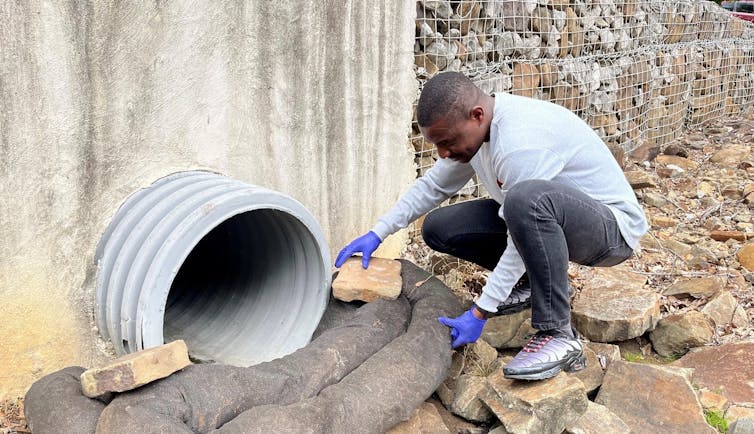
In a recent study, we tested pine wood chips and biochar – a form or charcoal made from heating rice husks in a limited oxygen chamber, a process known as pyrolysis – and found they could remove approximately 90% of tire wear particles from water runoff at our test sites in Oxford.
Boluwatife S. Olubusoye, one of the authors of this article, positions a filter sock filled with biochar under a storm drain. James Cizdziel/University of Mississippi
We designed a biofiltration system using biochar and wood chips in a filter sock and placed it at the mouth of a drainage outlet. Then we collected stormwater runoff samples and measured the tire wear particles before and after the biofilters were in place during two storms over the span of two months. The concentration of tire wear particles was found to be significantly lower after the biofilter was in place.
We believe this approach holds strong potential for scalability to mitigate tire wear particle pollution and other contaminants during rainstorms.
Since biochar and wood chips can be generated from agricultural waste, they are relatively inexpensive and readily available to local communities.
Long-term monitoring studies will be needed, especially in heavy traffic environments, to fully determine the effectiveness and scalability of the approach. The source of the filtering material is also important. There have been some concerns about whether raw farm waste that has not undergone pyrolysis could release organic pollutants.
Like most filters, the biofilters would need to be replaced over time – with used filters disposed of properly – since the contaminants build up and the filters degrade.
Plastic waste is harming the environment, the food people eat and potentially human health. We believe biofilters made from plant waste could be an effective and relatively inexpensive, environmentally friendly solution.
Boluwatife S. Olubusoye received partial funding from the Center for Biodiversity and Conservation Research (CBCR) at the University of Mississippi
James V Cizdziel received funding from the National Science Foundation (MRI Grant #2116597) for the instrument used to analyze samples for microplastics.
The Trump administration is decreasing the attention federal regulators pay to pipeline leaks. But leaks from natural gas pipelines don’t just waste energy and warm the planet – they can also make the air more dangerous to breathe. That air pollution threat grows not just in the communities where the leaks happen but also as far as neighboring states, as our analysis of gas leaks and air pollution levels across the U.S. has found.
For instance, in September 2018 the Merrimack Valley pipeline explosion in Massachusetts, which released roughly 2,800 metric tons of methane, damaged or destroyed about 40 homes and killed one person. We found that event caused fine-particle air pollution concentrations in downwind areas of New Hampshire and Vermont to spike within four weeks, pushing those areas’ 2018 annual average up by 0.3 micrograms per cubic meter. That’s an increase of about 3% of the U.S. EPA’s annual health standard for PM2.5. Elevated air pollution then showed up in New York and Connecticut through the rest of 2018 and into 2019.
In our study, we examined pipeline leak data from the U.S. Pipeline and Hazardous Materials Safety Administration from 2009 to 2019 and data about the state’s level of small particulate matter in the air from Columbia University’s Center for International Earth Science Information Network. We also incorporated, for each state, data on environmental regulations, per-capita energy consumption, urbanization rate and economic productivity per capita.
In simple terms, we found that in years when a state – or its neighboring states – experienced more methane leak incidents, that state’s annual average fine-particle air pollution was measurably higher than in years with fewer leaks.
A 2018 natural gas leak and explosion in Massachusetts destroyed and damaged homes, killed one person and increased air pollution over a wide area. John Tlumacki/The Boston Globe via Getty Images
Methane’s role in fine‑particle formation
Natural gas is primarily made of methane, a powerful greenhouse gas. But methane also helps set off chemical reactions in the air that lead to the formation of tiny particles known as PM2.5 because they are smaller than 2.5 micrometers (one ten-thousandth of an inch). They can travel deep into the lungs and cause health problems, such as increasing a person’s risk of heart disease and asthma.
So, when natural gas leaks, energy is wasted, the planet warms and air quality drops. These leaks can be massive, like the 2015 Aliso Canyon disaster in California, which sent around 100,000 metric tons of methane into the atmosphere.
But smaller leaks are also common, and they add up, too: Because the federal database systematically undercounts minor releases, we estimate that undocumented small leaks in the U.S. may total on the order of 15,000 metric tons of methane per year – enough to raise background PM2.5 by roughly 0.1 micrograms per cubic meter in downwind areas. Even this modest increase can contribute to health risks: There is no safe threshold for PM2.5 exposure, with each rise of 1 microgram per cubic meter linked to heightened mortality from cardiovascular and respiratory diseases.
The most direct way to reduce this problem is to reduce the number and quantity of methane leaks from pipelines. This could include constructing them in ways or with materials or processes that are less likely to leak. Regulations could create incentives to do so or require companies to invest in technology to detect methane leaks quickly, as well as encourage rapid responses when a leak is identified, even if it appears relatively small at first.
Reducing pipeline leaks would not just conserve the energy that is contained in the methane and reduce the global warming that results from increasing amounts of methane in the atmosphere. Doing so would also improve air quality in communities that are home to pipelines and in surrounding areas and states.
The authors do not work for, consult, own shares in or receive funding from any company or organization that would benefit from this article, and have disclosed no relevant affiliations beyond their academic appointment.
The coach, the specialized equipment, the carefully tailored exercise regimen – they’re all key to athletic performance. But imagination might be an unexpected asset when it comes to playing sports.
The idea that athletic achievement depends on the mind isn’t new. Sport psychologists have known for years that working with an athlete on their mental game – visualizing the skill, kinesthetically feeling the swing – has a positive impact on actual performance. But these mental simulations draw only upon mental imagery – seeing and feeling the physical goals in the mind’s eye. Imagination offers a much wider range of possibilities.
What if your game could be helped by an imaginary friend?
In a recent retrospective study of college students, we discovered that imagination comes in handy in athletics in ways that are surprisingly social. The creation of what we termed imaginary athletes – a person or being that a child imagined in the context of athletics – enabled and motivated athletic play, especially for children between the ages of about 6 and 12. Imaginary athletes also provided companionship during athletic play.
The most basic form of an imaginary athlete might be a wall, fence or even tree that makes a good opponent in a pinch. For a child or adolescent practicing a sport alone, a surface that provides a ball return or a steady target for a throw gives opportunities for practice usually requiring other players.
Is it any wonder, then, if the branches of the tree start to resemble a wide receiver’s arms, or an invisible goalie emerges in front of the fence? Solitary play might be a lot more fun if a make-believe teammate could provide an assist, or an invisible coach could appear and shout instructions during practice.
The college students in our study reported that such support, even if imaginary, made them play a little longer or try a little harder as kids.
About 41% of our sample of 225 college students reported creating at least one imaginary athlete at some point in middle childhood or early adolescence. Most, but not all, of these beings fell into three categories based on their characteristics.
The first we called placeholders, such as ghost runners. They are typically generic, amorphous, imaginary teammates created by groups of children when not enough real players are available.
The second type functioned as what we named athletic tools. They helped kids focus on their performance and improve their skills, usually by providing a worthy competitor, sometimes based on an admired professional athlete. The skills of athletic tools were often just above those of the child, drawing out the desire to be better, stronger, faster.
Social relationships, our name for the third kind of imaginary athlete, primarily served emotional functions, relieving loneliness and providing the child or adolescent with a sense of belonging, safety or companionship as they engaged in their sport.
Students who remembered imaginary athletes differed from their peers in two ways. First, more men than women reported creating these imaginary beings, possibly owing to the greater investment in and importance of athletics among boys versus girls. Second, people with imaginary athletes scored higher than those without on a current-day measure of predilection for imagination, but they were not more likely to report having created a make-believe friend or animal as a child.
Imagination is a valuable power
Creating an imaginary other might seem like a quirky, perhaps even childish, addition to sports practice. But actually, this behavior is entirely logical. After all, imagination is the core of human thought. Without it, we couldn’t conceptualize anything outside of the present moment that wasn’t already stored in memory. No thinking about the future, no consideration of multiple outcomes to a decision, no counterfactuals, daydreams, fantasies or plans.
Why wouldn’t people apply such a fundamental tool of day-to-day thought in athletic contexts? Participation in sports is common, especially among school-age kids, and many college students in our study described drawing upon their imaginations frequently when playing sports, especially when doing so in their free time.
The creation of imaginary athletes is also unsurprising because it’s one of myriad ways that imagination enhances people’s social worlds throughout their lives. Above all else, social relationships are what matter most to people, and using imagination in thinking about them is common. For instance, people imagine conversations with others, particularly those close to them, sometimes practicing the delivery of bad news or envisioning the response to a proposal of marriage.
In early childhood, kids create imaginary companions who help them learn about friendship and other’s perspectives. And in adolescence, when people focus on developing their autonomy and their own identities, they create parasocial relationships that let them identify with favorite celebrities, characters and media figures. Even in older age, some widows and widowers imagine continued relationships with their deceased spouses. These “continuing bonds” are efforts to cope with loss through imaginary narratives that are fed by and extrapolate upon years of interactions.
At each point in their developmental trajectory, people might recruit imagination to help them understand, manage, regulate and enjoy the social aspects of life. Imaginary athletes are merely one manifestation of this habit.
Because so many children and adolescents spend a lot of time engaged in sports, athletics can be a major environment for working on the developmental tasks of growing up. As children learn about functioning as part of a group, forming, maintaining and losing friendships, and mastering a range of skills and abilities, imaginary athletes provide teammates, coaches and competitors tailored to the needs of the moment.
Of course, an imaginary athlete is but one tool that children and adolescents might use to address developmental tasks such as mastering skills or negotiating peer relationships. Children who aren’t fantasy-prone might create complex training regimens to practice their skills, and they might manage their friendships by talking through problems with others.
But some report that turning inward generated real athletic and social benefits. “I got confidence out of my [imaginary athletes],” reported one participant. “If I could imagine beating someone, and [winning], then I felt like I could do anything.”
The authors do not work for, consult, own shares in or receive funding from any company or organization that would benefit from this article, and have disclosed no relevant affiliations beyond their academic appointment.
HE Minister of State at the Ministry of Foreign Affairs Dr. Mohammed bin Abdulaziz bin Saleh Al Khulaifi received a phone call on Tuesday from HE Acting Minister of Foreign Affairs in the Caretaker Government of Afghanistan Mawlawi Amir Khan Muttaqi.
During the call, they discussed the latest developments in Afghanistan and ways to support the Afghan people.
HE Acting Minister of Foreign Affairs in the Caretaker Government of Afghanistan expressed, during the call, his country’s appreciation for the State of Qatar’s efforts in facilitating the return of a second group of Afghan citizens from Germany to their country.
In a move set to bolster the city’s creative economy, the eThekwini Municipality’s Economic Development Directorate has signed three Memorandums of Understanding (MOUs) with key stakeholders to strengthen Durban’s film and television sector.
The three-year agreements were recently signed with the Film and Publications Board (FPB), the Companies and Intellectual Property Commission (CIPC), and the KwaMashu Community Advancement Projects (KCAP).
These strategic partnerships aim to enhance skills development, promote regulatory compliance, and create economic opportunities for emerging creatives in the region.
Chairperson of the Economic Development and Planning Committee, Thembo Ntuli, said the MOUs signify a shared commitment to sustainable industry growth, leveraging collective expertise to uplift communities and foster transformation.
“This initiative aligns with the municipality’s vision of building an inclusive, vibrant, and economically active creative industry,” Ntuli said.
Ntuli also highlighted the practical importance of the agreement, noting “these MOUs are more than symbolic, they are living frameworks.”
“Through coordinated action, we will strengthen compliance, intellectual property education, enhance training, and ensure that our storytellers are equipped to compete on national and global stages,” Ntuli said.
Guided by the District Development Model (DDM), the initiative aligns with the city’s integrated approach to planning and service delivery. It seeks to unlock opportunities for sustainable development through intergovernmental cooperation.
The MOU with CIPC focuses on public education and outreach around intellectual property rights, while the FPB partnership promotes content classification and regulatory compliance.
The KCAP agreement will enhance community engagement through initiatives such as film screenings, audience development, scriptwriting labs, and the KwaZulu-Natal African Film Festival.
“These partnerships reflect our collective resolve to grow Durban’s creative economy while creating a safe, inclusive, and enabling environment. Together, we are shaping a future where the film sector contributes meaningfully to social development and economic transformation,” Director of the Economic Development Directorate, Shunnon Tulsiram said. – SAnews.gov.za
Nigel Topping CMG appointed Chair of the Climate Change Committee
Nigel Topping CMG has been appointed as Chair of the Climate Change Committee.
Nigel Topping CMG has been appointed as Chair of the Climate Change Committee (CCC) by the UK and devolved governments today (22 July).
This follows the Secretary of State, Ed Miliband, and the Northern Irish, Welsh and Scottish devolved government Ministers selecting Nigel Topping as the preferred candidate for the role, as well as a successful pre-appointment hearing in front of the Energy Security and Net Zero and Environmental Audit Committees on Wednesday 16 July.
The Energy Secretary has written to Nigel Topping to confirm his appointment, welcoming him to the role and confirming his confidence in him to lead the Climate Change Committee. He has also written to Professor Piers Forster, to thank him for his leadership as interim Chair of the CCC following Lord Deben’s departure in 2023.
The Chair will play a key role in the committee’s work of advising government on the delivery of its carbon budgets, with a critical few years ahead as the government accelerates to net zero as part of its clean energy superpower mission.
Energy Secretary, Ed Miliband, said:
I want to congratulate Nigel Topping on his appointment as Chair of the Climate Change Committee.
We highly value the Climate Change Committee’s independent advice on how we can achieve net zero, so I am thrilled to have Nigel in this important role – as he brings extensive experience, including from his time serving as the UN High Level Climate Action Champion for COP26.
Net zero is the economic opportunity of the 21st century and Nigel’s business expertise will help us to maximise on this opportunity as we deliver our clean energy superpower mission – boosting energy security, creating good jobs, bringing down bills and tackling the climate crisis.
Nigel Topping, Chair of the Climate Change Committee, said:
It is an honour to be appointed Chair of the Climate Change Committee at this pivotal moment. The UK has an opportunity to deliver on its climate commitments in a way that reduces costs for households, powers our industries forward, and makes our economy more successful. It’s also important to ensure resilience against growing climate impacts and I look forward to working with Baroness Brown who leads our adaptation work.
I’d like to offer my sincere thanks to Professor Piers Forster, who has been our interim Chair since Lord Deben stepped down. He has led the Committee through an incredibly busy period overseeing advice on the UK’s Seventh Carbon Budget, three devolved carbon budgets, and a number of key progress reports to government.
I am committed to upholding the rigour and independent nature of the Committee’s advice, while harnessing our country’s wealth of scientific, financial and business talent.
Nigel Topping’s selection follows a competitive recruitment process in line with the Governance Code for Public Appointments.
Notes to Editors
The UK government, Scottish Government, Welsh Government, and Northern Ireland Executive agreed to appoint Nigel Topping. The decision-making Ministers were:
Ed Miliband MP, Secretary of State for Energy Security and Net Zero
Andrew Muir MLA, Minister of Agriculture, Environment, and Rural Affairs, Northern Ireland Executive
Gillian Martin MSP, Cabinet Secretary for Climate Action and Energy, Scottish Government
Huw Irranca-Davies MS, Deputy First Minister of Wales and Cabinet Secretary for Climate Change and Rural Affairs, Welsh Government
Nigel Topping’s term as Chair will begin on Wednesday 23 July.
An important disclaimer is at the bottom of this article.
The State University of Management was among the winners of the All-Russian competition of youth projects among universities, implemented with the support of Rosmolodezh and Rosmolodezh.Grants.
A total of 2,803 projects from 293 educational institutions were submitted to the competition, and 89 universities won.
The State University of Management received the maximum grant of 22.5 million rubles for the implementation of youth initiatives.
The head of the Federal Agency for Youth Affairs, associate professor of the Department of State and Municipal Management of the State University of Management Grigory Gurov noted that “the grant is no longer a one-time subsidy, but a two-year program for the development of youth policy. Comprehensive programs that receive funding go beyond individual events and become systemic work.”
In 2025-2026, 14 project solutions aimed at forming value systems and guidelines among young people will be implemented at the State University of Management:
School of Coordinators “KUL” All-Russian Forum of Student Commissions on Education Quality and Centers for Researching Students’ Opinions “Exploring Students” Creation of a System for Popularizing Volunteering “The Path of Good” School of Student Self-Government Activists “Successful Leader’s Course” Military-Patriotic Game “Defenders of the State University of Management” Student Interregional Historical Ball “Inspiration” Festival of Youth Brass Bands “St. George’s Trumpets” Youth Festival of Creativity “Raising the Flag” School of Administrators of the Service-Learning Program Interregional Accelerator “Entrepreneur for Russia” Student Coworking Zone on the -1 Floor of the Main Academic Building Entrepreneurial Coworking Zone Festival of Interethnic Friendship and Harmony Dedicated to the Year of the Defender of the Fatherland “Hero of His People” Patriotic Festival “Family History. Immortal Memory”
We will report on the progress of the projects on our website and in the official social networks of the State University of Management, subscribe so as not to miss important information: VKontakte, Telegram, Zen, Rutube.
Please note: This information is raw content obtained directly from the source of the information. It is an accurate report of what the source claims and does not necessarily reflect the position of MIL-OSI or its clients.
Source: People’s Republic of China – Ministry of National Defense
BEIJING, July 21 — Focusing on the security situation in the mission area, the Chinese Peacekeeping Military Utility Helicopter Unit and the Chinese Peacekeeping Rapid Response Unit to the United Nations Interim Security Force for Abyei (UNISFA) recently conducted joint drills in the context of responding to the armed attacks in land operations together with peacekeeping troops from multiple countries.
The drills involved rapid response, armed support, medical rescue, and other subjects, aiming to strengthen the coordinated operational capabilities of multinational peacekeeping troops.
Source: People’s Republic of China – Ministry of National Defense
BEIJING, July 22 — On Monday, the theme day event on unmanned and counter-unmanned land combat systems in the military trade market held by the China North Industries Group (Norinco Group) kicked off in north China’s Inner Mongolia Autonomous Region. The latest equipment such as unmanned aerial vehicles (UAVs), loitering munitions, and counter-UAVs were all showcased.
The theme day event was divided into dynamic performance and static display. The dynamic part displayed aerial “offensive and defensive” operations such as reconnaissance, informed planning, penetration and attack, etc.
The exhibition area displayed unmanned and counter-unmanned equipment including UAVs, airborne munitions, loitering munitions. In addition, the wheeled gunnery with an unmanned turret that can automatically load and fire, the tank with an onboard UAV system and a radio jamming system, were also showcased.
INIR mission team leader John Haddad presents the draft report to Thushara Rathnayake, Chairperson of the Sri Lanka Atomic Energy Board, at the closing meeting on 18 July. (Photo: Ministry of Energy of Sri Lanka)
As Sri Lanka embarks on the development of its nuclear power programme, the country is making progress in establishing the necessary nuclear infrastructure, according to an International Atomic Energy Agency (IAEA) review mission that recently concluded.
The mission team, comprising two international experts from Bulgaria and Türkiye and two IAEA staff, assessed the progress made to address the recommendations and suggestions of the Phase 1 2022 INIR mission. A Phase 1 INIR mission assesses the readiness of a country to make a knowledgeable commitment to a nuclear power programme using the Phase 1 criteria of the IAEA Milestones Approach and Evaluation Methodology. The 2022 mission made 26 recommendations and 6 suggestions to assist Sri Lanka in advancing its infrastructure development.
In 2010, Sri Lanka’s Cabinet approved the initiation of studies for implementing a nuclear power programme in the country. In 2019, a Nuclear Energy Programme Implementing Organization (NEPIO) was established to coordinate related efforts, which included the Ministry of Energy, the Sri Lanka Atomic Energy Board (SLAEB), the Ceylon Electricity Board (CEB) and the Sri Lanka Atomic Energy Regulatory Council (SLAERC). In 2024, the government decided on further actions to consider a nuclear power programme.
The INIR team concluded that Sri Lanka has made good progress to address recommendations and suggestions from the Phase 2 INIR mission in 2022. Sri Lanka has already identified five candidate sites for the nuclear power plant, established a management structure to oversee the procurement process for nuclear reactors, drafted a comprehensive nuclear law and included nuclear power in its current long-term energy planning for the period 2025-2044.
Sri Lanka hosted a national workshop on nuclear law in November 2023, as well as an IAEA Site and External Events Design Review Service (SEED) mission in 2024, which reviewed the country’s selection process to identify candidate sites to build its first nuclear power plant. A SEED follow up mission was also conducted, which took place in July this year.
“Sri Lanka is actively working on addressing the recommendations and suggestions from the main INIR mission in 2022,” said mission team leader John Haddad from IAEA’s Nuclear Infrastructure Development Section. “This indicates the level of commitment of Sri Lanka to conduct the required studies and make a knowledgeable decision regarding the nuclear power programme.”
In the opening ceremony for the INIR Mission, Hon. Eng. Kumara Jayakody, Cabinet Minister of Energy, welcomed the INIR mission as “a significant milestone in Sri Lanka’s journey towards a secure, sustainable and forward-looking energy future as we take decisive steps forward in exploring the role of nuclear power in our national energy mix.”
Nuclear Power is included as an energy source within the CEB Least Cost Long Term Generation and Expansion Plan 2025-2044. According to the plan, accommodating a nuclear power unit above 600 MWe to the Sri Lankan network will be technically challenging due to the network’s condition, projected demand growth, and the generation mix which is expected to be dominated by variable renewable energy sources. The team said that further work is needed related to the finalization of strategies and studies in various areas of infrastructure development such as, among others, management, human resource development, stakeholder involvement, radioactive waste management and industrial involvement.
About Integrated Nuclear Infrastructure Review (INIR) Missions
INIR missions are based on the IAEA Milestones Approach, with its 19 infrastructure issues, three phases (consider, prepare and construct) and three milestones (decide, contract and operate). INIR missions enable IAEA Member State representatives to have in-depth discussions with international experts about experiences and best practices in different countries.
In developing its recommendations, the INIR team considers the comments made by the relevant national organizations. Implementation of any of the team’s recommendations and suggestions is at the discretion of the Member State requesting the mission. The results of the INIR mission are expected to help the Member State develop an action plan to fill any gaps, which in turn will help the development of the national nuclear infrastructure.
INIR follow-up missions assess the implementation of the recommendations and suggestions provided during the main mission.
Tampa Bay, Florida, July 22, 2025 (GLOBE NEWSWIRE) — Draganfly Inc. (NASDAQ: DPRO; CSE: DPRO; FSE: 3U8A) (“Draganfly” or the “Company”), an award-winning developer of drone solutions and systems developer, today announced the sale of Commander 3XL Unmanned Aerial Vehicle (UAV) systems to a globally recognized defense contractor specializing in persistent surveillance technologies for military operations.
A trusted partner to U.S. and allied defense forces for decades, the client is one of the world’s leading providers of persistent surveillance platforms. Its systems are deployed across key Department of Defense (DoD) and allied installations, delivering reliable, persistent intelligence, surveillance, and reconnaissance (ISR) capabilities.
The Commander 3XL’s modular payload architecture, extended endurance, and AI-enabled mission control make it an ideal asset for military-grade surveillance programs. The systems will support perimeter security, early warning, and real-time situational awareness, operating seamlessly alongside and integrated with persistent platforms and ground-based command centers.
“This sale marks a significant milestone for Draganfly as we expand our presence in the defense sector,” said Cameron Chell, CEO of Draganfly. “We are honored that the Commander 3XL has been chosen for integration into one of the world’s most advanced and enduring persistent surveillance platforms. This integration enhances capabilities for military and border surveillance systems, providing greater reach and effectiveness.”
This purchase further underscores the Commander 3XL’s versatility in both static and dynamic ISR environments, enabling defense clients to adapt swiftly to evolving threat landscapes.
About Draganfly
Draganfly Inc. (NASDAQ: DPRO; CSE: DPRO; FSE: 3U8A) is a leader in cutting-edge drone solutions and software that are transforming industries and serving stakeholders globally. Recognized for innovation and excellence for over 25 years, Draganfly delivers award-winning technology to the public safety, agriculture, industrial inspection, security, mapping, and surveying markets. The Company is driven by passion, ingenuity, and a mission to provide efficient solutions and first-class services to customers worldwide, saving time, money, and lives.
Company Contact Cameron Chell Chief Executive Officer (306) 955-9907 info@draganfly.com
This release contains certain “forward looking statements” and certain “forward-looking information” as defined under applicable securities laws. Forward-looking statements and information can generally be identified by the use of forward-looking terminology such as “may”, “will”, “expect”, “intend”, “estimate”, “anticipate”, “believe”, “continue”, “plans” or similar terminology. Forward-looking statements and information are based on forecasts of future results, estimates of amounts not yet determinable and assumptions that, while believed by management to be reasonable, are inherently subject to significant business, economic and competitive uncertainties and contingencies. Forward-looking statements include, but are not limited to, statements with respect to the Commander 3XL’s modular payload architecture, extended endurance, and AI-enabled mission control make it an ideal asset for military-grade surveillance programs as well as that the systems will support perimeter security, early warning, and real-time situational awareness, operating seamlessly alongside persistent platforms and ground-based command centers. Forward-looking statements and information are subject to various known and unknown risks and uncertainties, many of which are beyond the ability of the Company to control or predict, that may cause the Company’s actual results, performance or achievements to be materially different from those expressed or implied thereby, and are developed based on assumptions about such risks, uncertainties and other factors set out here in, including but not limited to: the potential impact of epidemics, pandemics or other public health crises, including the COVID-19 pandemic, on the Company’s business, operations and financial condition; the successful integration of technology; the inherent risks involved in the general securities markets; uncertainties relating to the availability and costs of financing needed in the future; the inherent uncertainty of cost estimates; the potential for unexpected costs and expenses, currency fluctuations; regulatory restrictions; and liability, competition, loss of key employees and other related risks and uncertainties disclosed under the heading “Risk Factors“ in the Company’s most recent filings filed with securities regulators in Canada on the SEDAR website at www.sedar.com and with the United States Securities and Exchange Commission (the “SEC”) on EDGAR through the SEC’s website at www.sec.gov. The Company undertakes no obligation to update forward-looking information except as required by applicable law. Such forward-looking information represents managements’ best judgment based on information currently available. No forward-looking statement can be guaranteed and actual future results may vary materially. Accordingly, readers are advised not to place undue reliance on forward-looking statements or information.
Source: International Atomic Energy Agency (IAEA) –
INIR mission team leader John Haddad presents the draft report to Thushara Rathnayake, Chairperson of the Sri Lanka Atomic Energy Board, at the closing meeting on 18 July. (Photo: Ministry of Energy of Sri Lanka)
As Sri Lanka embarks on the development of its nuclear power programme, the country is making progress in establishing the necessary nuclear infrastructure, according to an International Atomic Energy Agency (IAEA) review mission that recently concluded.
The mission team, comprising two international experts from Bulgaria and Türkiye and two IAEA staff, assessed the progress made to address the recommendations and suggestions of the Phase 1 2022 INIR mission. A Phase 1 INIR mission assesses the readiness of a country to make a knowledgeable commitment to a nuclear power programme using the Phase 1 criteria of the IAEA Milestones Approach and Evaluation Methodology. The 2022 mission made 26 recommendations and 6 suggestions to assist Sri Lanka in advancing its infrastructure development.
In 2010, Sri Lanka’s Cabinet approved the initiation of studies for implementing a nuclear power programme in the country. In 2019, a Nuclear Energy Programme Implementing Organization (NEPIO) was established to coordinate related efforts, which included the Ministry of Energy, the Sri Lanka Atomic Energy Board (SLAEB), the Ceylon Electricity Board (CEB) and the Sri Lanka Atomic Energy Regulatory Council (SLAERC). In 2024, the government decided on further actions to consider a nuclear power programme.
The INIR team concluded that Sri Lanka has made good progress to address recommendations and suggestions from the Phase 2 INIR mission in 2022. Sri Lanka has already identified five candidate sites for the nuclear power plant, established a management structure to oversee the procurement process for nuclear reactors, drafted a comprehensive nuclear law and included nuclear power in its current long-term energy planning for the period 2025-2044.
Sri Lanka hosted a national workshop on nuclear law in November 2023, as well as an IAEA Site and External Events Design Review Service (SEED) mission in 2024, which reviewed the country’s selection process to identify candidate sites to build its first nuclear power plant. A SEED follow up mission was also conducted, which took place in July this year.
“Sri Lanka is actively working on addressing the recommendations and suggestions from the main INIR mission in 2022,” said mission team leader John Haddad from IAEA’s Nuclear Infrastructure Development Section. “This indicates the level of commitment of Sri Lanka to conduct the required studies and make a knowledgeable decision regarding the nuclear power programme.”
In the opening ceremony for the INIR Mission, Hon. Eng. Kumara Jayakody, Cabinet Minister of Energy, welcomed the INIR mission as “a significant milestone in Sri Lanka’s journey towards a secure, sustainable and forward-looking energy future as we take decisive steps forward in exploring the role of nuclear power in our national energy mix.”
Nuclear Power is included as an energy source within the CEB Least Cost Long Term Generation and Expansion Plan 2025-2044. According to the plan, accommodating a nuclear power unit above 600 MWe to the Sri Lankan network will be technically challenging due to the network’s condition, projected demand growth, and the generation mix which is expected to be dominated by variable renewable energy sources. The team said that further work is needed related to the finalization of strategies and studies in various areas of infrastructure development such as, among others, management, human resource development, stakeholder involvement, radioactive waste management and industrial involvement.
About Integrated Nuclear Infrastructure Review (INIR) Missions
INIR missions are based on the IAEA Milestones Approach, with its 19 infrastructure issues, three phases (consider, prepare and construct) and three milestones (decide, contract and operate). INIR missions enable IAEA Member State representatives to have in-depth discussions with international experts about experiences and best practices in different countries.
In developing its recommendations, the INIR team considers the comments made by the relevant national organizations. Implementation of any of the team’s recommendations and suggestions is at the discretion of the Member State requesting the mission. The results of the INIR mission are expected to help the Member State develop an action plan to fill any gaps, which in turn will help the development of the national nuclear infrastructure.
INIR follow-up missions assess the implementation of the recommendations and suggestions provided during the main mission.
Ethiopia’s agricultural sector is going digital, with new tools offering ways to boost productivity and improve market access. In Addis Ababa, sector leaders and stakeholders explore practical steps for building a more resilient, tech-enabled farming system.
With traditional farming still widespread and digital tools often out of reach for rural communities, a symposium held in Addis Ababa, Ethiopia, set out to address challenges in productivity, market access, infrastructure and digital literacy. Smallholder farmers, women, youth and others who are frequently excluded from innovation efforts, received particular attention.
Organized by Orbit Innovation Hub in partnership with the International Trade Centre and Trade Ethiopia, the symposium brought together stakeholders from across the agriculture and technology ecosystems.
Focused on real-world solutions
The one-day programme included panel discussions, startup pitches, a documentary screening and presentations on new technologies such as AI in agriculture. The event offered a platform for exchanging ideas and exploring how digital innovation can support inclusive and sustainable agricultural growth.
Orbit Innovation Hub, launched as the social enterprise arm of health tech company Orbit Health, is committed to developing the startup ecosystem in Ethiopia. “We started this because we didn’t want new entrepreneurs to face the same hurdles we did,” said COO Girum Habetewold. “Agriculture remains central to our economy. Modernizing it is essential for long-term growth.”
Support from the International Trade Centre’s Netherlands Trust Fund V (NTF V) Ethiopia Tech project has been key to turning that vision into reality. Over the past three years, the programme has provided both funding and technical guidance to help Orbit standardize the symposium format, bring in international expertise and expand its reach. What began as a local idea has become a national platform with international relevance.
Building networks and partnerships
One of the symposium’s key strengths was the range of voices in the room. Policymakers, business leaders, researchers, funders and grassroots entrepreneurs all took part. “Everyone brought their networks,” said Kiya Girma of Trade Ethiopia. “It helped connect people who don’t usually have the chance to collaborate directly.”
Trade Ethiopia, a B2B platform connecting local producers with global buyers, joined the organizing team for the first time this year. Their involvement highlighted the importance of linking agriculture, digital tools and export opportunities. “We support cooperatives and smallholder farmers in accessing markets,” Girma said. “Digital tools help them do that more efficiently and on better terms.”
NTF V played a coordinating role in bringing these different actors together, drawing on its extensive experience in supporting agricultural trade and digital innovation across Ethiopia.
Stories from the field
The symposium also presented examples of what happens when digital tools and support systems are in place. For example, a young farmer from Woliso, who attended a SEED programme workshop, secured a bank loan and bought a tractor. His story illustrates how targeted training and financial access can bring new opportunities for youth engagement and economic mobility within the sector.
Another example came from Kifiya Technologies, a company offering digital insurance services that help farmers manage risk and improve resilience.
Speakers raised important points about the need to design tools that fit local realities, invest in digital literacy, prioritize relationships with farmers, and ensure that technology is accessible, affordable and relevant to those working in remote or underserved areas. Several panelists stressed that without strong local engagement, even the most advanced tools risk being underused or misunderstood.
“You don’t get useful data unless you’ve built trust,” Girma said. “Technology has to work for the people using it.”
Supporting national goals
The symposium directly supports Ethiopia’s Digital Ethiopia 2025 strategy, which aims to unlock greater value in agriculture through digital innovation. Orbit Innovation Hub has been an active contributor to this agenda, and NTF V has served as a key partner in making that contribution possible.
NTF V’s broader impact extends well beyond the symposium. The project helped Ethiopian agri-businesses engage in international markets, supported women-led enterprises, and increased digital access for nearly 400,000 individuals. It also brought in direct investment and improved the capacity of local support organizations, including those involved in agricultural trade.
Looking ahead
As the NTF V project concludes, Orbit and its partners are exploring how to sustain and scale the work that has been started. Plans are under way for future editions of the symposium and new initiatives that will support innovation in agriculture and beyond.
“Agriculture in Ethiopia is beginning to change,” said Habetewold of Orbit Innovation Hub. “It’s a slow process, but the groundwork is being laid. Shifting from traditional practices to data-driven, tech-enabled farming will take time, especially given the scale of the sector and the realities facing smallholder farmers. But with continued investment, strong partnerships and a focus on practical outcomes, Ethiopia is taking meaningful steps toward a more resilient and inclusive farming future.”
The COO added that the AgriTech Stakeholders Symposium has become a clear example of how local collaboration, combined with sustained international support, can turn good ideas into action and help reshape the agricultural landscape from the ground up.
Distributed by APO Group on behalf of International Trade Centre.
The Food and Agriculture Organization of the United Nations (FAO), in collaboration with Rwanda’s Ministry of Agriculture and Animal Resources (MINAGRI), hosted a Digital Village twinning event as part of the Fostering Digital Villages through Innovative Advisory and Profitable Market Services in Africa (FDiVi) project.
The event brought together more than 130 participants, including representatives from farmer organizations, private sector partners, digital ambassadors, and officials from the Ministry of ICT and Innovation (MINICT), MINAGRI, and the Rwanda Information Society Authority (RISA). The gathering served as a platform for sharing experiences and best practices in leveraging digital technologies to enhance agricultural productivity, market access, advisory services, and access to real-time data and knowledge.
A key highlight of the event was a Peer Learning Session, during which members from 48 farmer cooperatives shared testimonies and best practices on how digital tools have transformed their daily lives. These stories illustrated the real-world impact of digital transformation in agriculture, particularly in improving efficiency, profitability, and market connectivity.
During a panel discussion, district authorities from Musanze, Nyanza, Ngororero, and Nyagatare reflected on the opportunities and challenges of scaling digital agriculture in rural communities. The four districts expressed their commitment to integrating the FDiVi project into local development plans and emphasized the importance of cross-district collaboration and peer learning both within Rwanda and as a model for other countries.
FAO Representative a.i in Rwanda Nomathemba Mhlanga commended the role of digital ambassadors in guiding farmers through the digital literacy journey and underscored the need for continued support from local governments.
“District and sector authorities must remain the bridge between policy and practice, between strategy and implementation,” she said.
As part of the event, outstanding farmer cooperatives were recognized during an awards ceremony. FAO provided 99 smartphones to selected farmer organizations to support access to digital tools.
“This smartphone will transform how our cooperative accesses information, connects with markets, receives digital advisory services, and promotes our agricultural products using technology,” said Nyirabakiga Immaculée, one of the recipients.
Through the FDiVi project, FAO continues to empower rural communities by fostering inclusive digital ecosystems that drive innovation, market integration, and improved livelihoods across Rwanda.
FAO’s FDiVi project, launched in April 2024, empowers around 150 farmer groups in Malawi, Rwanda, and Zimbabwe by using digital tools such as tablets, AI‑chatbots, and social media to enhance agricultural advisory services, improve market access, and boost rural livelihoods.
Distributed by APO Group on behalf of Food and Agriculture Organization of the United Nations (FAO): Regional Office for Africa.
Secretary-General of ASEAN, Dr. Kao Kim Hourn, today delivered remarks at the Opening Ceremony of the ASEAN Regional Disaster Emergency Response Simulation Exercise 2025 (ARDEX-25), in Phnom Penh, Cambodia. In his remarks, SG Dr. Kao underscored the critical role of ARDEX as a cornerstone of ASEAN’s efforts to strengthen regional disaster resilience. He emphasised that through coordinated simulation exercises, ARDEX enables ASEAN Member States and relevant stakeholders to assess the effectiveness of existing mechanisms in responding to complex emergencies. SG Dr. Kao also highlighted that the exercise fosters a spirit of solidarity and collective responsibility among ASEAN Member States, which is essential for building a more responsive and adaptive disaster management system in the face of increasingly severe and frequent natural hazards.
During the pre-ceremony engagement and equipment display visit, SG Dr. Kao was invited by the H.E. Kun Kim to inspect search and rescue equipment from Cambodia and other ASEAN Member States, showcasing technologies and capacities.
Download the full remarks here.
The post Secretary General of ASEAN Delivered Remarks at the Opening Ceremony of ASEAN Regional Disaster Emergency Response Simulation Exercise 2025, in Phnom Penh, Cambodia appeared first on ASEAN Main Portal.
Nearly £1m of extra investment will help reinforce Portsmouth as a nature positive city.
Portsmouth City Council has been awarded Nature Towns and Cities funding after a successful bid to the National Lottery Heritage Fund.
The £895,818 will be spent on transforming the city’s green infrastructure over three years for the benefit of residents and nature, paving the way for Portsmouth to become an officially recognised Nature City. It will also be used to leverage in external funding for the city.
Cllr Kimberly Barrett, Portsmouth City Council Cabinet Member for Climate Change and Greening the City, said:
“As we approach 2026, Portsmouth’s Centenary Year, this funding will help us understand how we can work with residents and communities to achieve our bold ambition to make Portsmouth a nature positive city, where the benefits of nature can be enjoyed and support the health and wellbeing of residents.
“We can only achieve this by working in partnership, and the council is delighted to be working with Southern Water, Hampshire and Isle of Wight Wildlife Trust, Historic England and Shaping Portsmouth. We know facing the environmental challenges of the future requires strong collaboration.”
Because Portsmouth is a densely populated city, it means its vital green spaces are fragmented by roads and buildings. The funding will help connect these spaces by identifying opportunities for new green infrastructure such as rain gardens and trees, creating corridors for wildlife to travel between.
The funding will build on recommendations from a developing Urban Forest Master Plan and enable the council to work with residents, landowners and others across the city to develop a resilient treescape with diverse species resistant to a changing climate and pests and disease. This will help in the fight against climate change, by creating shade and cooling because trees release water vapour, and absorb rain water.
By working with local environmental groups, charities, communities and businesses the council will develop a shared understanding of how to become a well-adapted Portsmouth, resilient to the increasing climate hazards already being faced, whether heatwaves or intense rainfall bringing surface water flooding. Working in key areas of the city will drive investment for green infrastructure into places where it is needed most, therefore addressing inequalities.
Community groups will be supported through small grants, training and mentoring. Businesses will also be encouraged to participate in the project accessing support and advice.
The ambitious and transformative project will start in October 2025 when further details will be available.
Residents are also encouraged to help young trees thrive in the current heatwaves by watering those close to where they live or work.
Over 4 nights, 400 members of Wolverhampton Music Service represented 60 city schools and performed 50 individual pieces of music as part of Wolverhampton Summer Sounds, a celebration of musical talent held at the Wulfrun Hall, University of Wolverhampton at The Halls.
Organised by Wolverhampton Music Service, it included performances by the Youth Choir, Concert String Orchestra, Keyboard Ensemble, Fusion Fives, Big Top SEND Ensemble, Bhangra Fusion Percussion, the Primary and Secondary Rock ‘n’ Pop groups, Guitar Group, Concert Wind Band, New Wind, Early Strings, New Strings, Jazz Big Band, Youth Wind Orchestra and Youth Orchestra.
Head of Service Ciaran O’Donnell said: “It has been an aspiration to bring all 16 musical groups to the city’s most iconic venue, and I am so proud of everyone who took part and made it happen.
“Many parents went for coffee or something to eat beforehand; in this way, alongside our educational ambition for our children and young people, the Music Service can also really support the city’s nighttime economy. I hope we can do it again next year.”
Councillor Jacqui Coogan, the City of Wolverhampton Council’s Cabinet Member for Children, Young People and Education, said: “This concert series was a powerful showcase of the dedication, creativity and spirit of Wolverhampton’s young musicians.
“Their talent deserved to be heard and celebrated on the big stage and it was great that so many family and friends were able to watch on proudly as their young people took part in these very special performances.”
The Summer Sounds concert series was made possible thanks to a generous donation of £10,000 donation from the Friends of Wolverhampton Music Service.
Wolverhampton Music Service’s team of 34 hard working staff provide high quality tuition and musical opportunities for youngsters from schools across the city, including the chance to perform with its flagship groups, Wolverhampton Youth Orchestra and Wolverhampton Youth Wind Orchestra.
Recent feedback from the Arts Council cited school engagement at 94%, with curriculum support the highest in the West Midlands.
The Music Service will be recruiting new members in September – to find out more, please visit Wolverhampton Music Service.
Leeds City Council’s aquatic training scheme has brought home six medals from the European Junior Championships that took place earlier this month.
Five swimmers got selected from Leeds for the championship this year, more than from any other programme and the highest number Leeds has had selected since 2008.
The team brought home three gold, one silver and two bronze medals.
As a result of their great performances Daniel Ransom and Gabriel Shepherd have also been selected for the World Aquatics Junior Championships in August, where they will represent Great Britain amongst some of the strongest junior swimmers from across the world.
The aquatics scheme at John Charles Centre for Sport has cemented itself as the leading aquatics programme in Great Britain, providing more athletes to Great Britain’s world class programmes and the England national performance and talent programmes than any other aquatics programme.
Councillor Salma Arif, executive member for adult social care, active lifestyles, and culture, said: “I want to say congratulations to the whole team who competed in the European Junior Championships, what an achievement.
“We are very proud of our aquatics training scheme and it’s wonderful to see that the hard work of the coaches and the athletes continues to pay off year after year.”
Jamie Fowler, group coach at Leeds City Council’s swim training scheme, said: “I would like to thank Active Leeds, Leeds City Council and the City of Leeds Swimming Club for the support that is provided for competitive swimming in the city.
“To have five swimmers at European Junior level is a fantastic achievement and is more than any other programme in Britian. It’s a true testament to how strong our age group and youth development programme is.”
Children are enjoying safer journeys to and from school thanks to a pioneering Council scheme, which has now won a nationally recognised award for helping to keep children safe by the school gates.
School Safe Haven Zones operate outside of schools, using temporary road closures or restrictions to limit the use of cars for school drop-offs and pick-ups. Enforced by ANPR cameras, the zones restrict vehicles during peak hours to improve air quality and safety for students.
The zones, which have been trialled in multiple locations across the city, have brought tangible benefits to both school children and local residents. Not only are there fewer hazards caused by moving and dangerously parked vehicles, but air quality has improved, and active travel – such as walking and cycling – has increased. Residents living close to the zones have also seen reductions in traffic ‘rat-runs’ and felt that their communities were safer, more pleasant places to be.
Data collected through the scheme is used to identify high-risk locations, monitor compliance and enhance the technology, making sure that any enforcement is fair and accurate. Data collected in Derby has shown significant reductions of Nitrogen Dioxide (NO2) concentrations, with reductions of up to 48.8% in some locations.
The pioneering zones been formally recognised with Derby’s parking and transport teams winning Best Service Team of the Year at this year’s MJ Awards, which recognise and celebrate the vital, but often unseen, work that happens across local government. The first local authority to implement this type of scheme outside of London and Wales, the award highlighted the Derby City Council’s innovative and strategic approach, such as the positive impact on child safety, use of active travel methods and the improvements in air quality around schools across the city.
Councillor Carmel Swan, Cabinet Member for Climate Change, Transport and Sustainability said:
“We’re incredibly proud of the positive impact that our School Safe Havens have brought to Derby, and I’m so pleased that this work has been recognised on a national level.
“This isn’t just about reducing traffic; it’s about making sure that our children are safe outside the school gates and enabling healthy habits from a young age by promoting active travel and contributing to a healthier generation.
“By partnering with other local authorities to share our expertise, we’re not just making Derby safer, we’re also helping other councils do the same.”
Following overwhelming success in trials, the Council has teamed up with councils in Walsall, Coventry and Hull to roll out the project and improve safety elsewhere in the UK. Income of around £500,000 has been generated through this roll-out that is being reinvested into the project and other local services, such as providing cycle training and bicycles for school children as well as supporting other highways projects and the work of the school crossing patrol team.
More information about School Safe Haven Zones can be found on the Council’s website.
Source: Moscow Government – Government of Moscow –
An important disclaimer is at the bottom of this article.
According to weather forecasters, rain and thunderstorms are expected in Moscow on July 22. Wind gusts may reach 15 meters per second.
In bad weather, city residents are asked to be especially careful on the street, not to take shelter under trees and not to park cars near them.
The project has been opened on the portal “Our City” “Safe Summer”, with the help of which Muscovites can report about unreliably fixed advertising structures and road signs, broken or leaning trees, as well as other potentially dangerous situations. This will allow to quickly and effectively help services to minimize the consequences of bad weather, to protect the lives, health and property of city residents.
Please note: This information is raw content obtained directly from the source of the information. It is an accurate report of what the source claims and does not necessarily reflect the position of MIL-OSI or its clients.