Source: US Department of Health and Human Services – 3
For Immediate Release: July 16, 2025
The U.S. Food and Drug Administration today announced it is revoking, or proposing to revoke, 52 food standards after concluding they are obsolete and unnecessary. The 52 standards are for canned fruits and vegetables, dairy products, baked goods, macaroni products and other foods. Today’s actions are the first results from the agency’s ongoing analysis of its portfolio of over 250 food Standards of Identity (SOI) to make sure they are useful, relevant and serve consumers in the best possible way. The removal of these standards is in alignment with broader efforts to ensure that HHS is directing resources to where they’re most needed – delivering better outcomes for the American people. “I’m eliminating outdated food regulations that no longer serve the interests of American families,” said HHS Secretary Robert F. Kennedy Jr. “Today marks a crucial step in my drive to cut through bureaucratic red tape, increase transparency and remove regulations that have outlived their purpose.” The FDA began establishing food standards in 1939 to promote “honesty and fair dealing” and to ensure that the characteristics, ingredients and production processes of specific foods were consistent with what consumers expect. However, advances in food science, agriculture and production practices, and additional consumer protections have made many of these older, rigid “recipe standards” unnecessary. “The FDA’s Standards of Identity efforts have helped ensure uniformity, boost consumer confidence and prevent food fraud. But many of these standards have outlived their usefulness and may even stifle innovation in making food easier to produce or providing consumers healthier choices,” said FDA Commissioner Marty Makary, M.D., M.P.H. “Antiquated food standards are no longer serving to protect consumers. It is common sense to revoke them and move to a more judicious use of food standards and agency resources.” Today’s actions include publication of the following:
A direct final rule revoking standards for 11 types of canned fruits and vegetables that are no longer sold in U.S. grocery stores, including seven standards for fruits artificially sweetened with saccharin or sodium saccharin. The agency is issuing a companion proposed rule in the same issue of the Federal Register in case the direct final rule is withdrawn because significant adverse comments are received, and the agency needs to move forward with a proposed rule to put these changes in place. A proposed rule that would revoke standards for 18 types of dairy products – including certain milk and cream products, cheeses and related cheese products and frozen desserts. A proposed rule that would revoke standards for 23 types of food products –including bakery products, macaroni and noodle products, canned fruit juices, fish and shellfish, and food dressings and flavorings.
Many of the standards listed in the two proposed rules predate more recent consumer protections such as requirements about ingredient safety, ingredient labeling, food packaging, safe food production and manufacturing practices and nutrition labeling information and claims. On May 13, HHS and FDA issued a Request for Information to identify and eliminate outdated or unnecessary regulations. This initiative supports a broader federal effort to reduce regulatory burdens and increase transparency, in alignment with President Trump’s Executive Order 14192 “Unleashing Prosperity Through Deregulation.” Related Information
Related Information
###
Boilerplate
The FDA, an agency within the U.S. Department of Health and Human Services, protects the public health by assuring the safety, effectiveness, and security of human and veterinary drugs, vaccines and other biological products for human use, and medical devices. The agency also is responsible for the safety and security of our nation’s food supply, cosmetics, dietary supplements, radiation-emitting electronic products, and for regulating tobacco products.
Source: US State of California Department of Justice
California will receive more than $4 million from multistate settlement in principle
OAKLAND – California Attorney General Rob Bonta today joined a coalition of 48 other attorneys general in securing $202 million from Gilead Sciences, Inc. (Gilead), for running an illegal kickback scheme to promote its HIV medications. Gilead allegedly violated federal law by illegally providing incentives – including awards, meals, and travel expenses – to healthcare providers to prescribe Gilead’s medications, resulting in millions of dollars of false claims submitted to government health care programs, including Medi-Cal. The settlement in principle, reached in coordination with the U.S. Department of Justice and approved by the U.S. District Court for the Southern District of New York, provides $49 million for Medicaid programs nationwide, including $4,118,184 for California, with the remainder going to Medicare, Tricare, and the AIDS Drug Assistance Program (ADAP).
“The best interests of patients must always come first,” said Attorney General Bonta. “At this time of unprecedented funding cuts to Medicaid, it is particularly important to protect the program from illegal kick-back schemes that harm the program and patients alike. Today’s settlement returns critical funding to our communities and programs like Medicaid that keep them healthy.”
From January 2011 to November 2017, Gilead allegedly violated federal anti-kickback laws by providing gifts to healthcare providers who attended and spoke at promotional speaker programs for Gilead’s HIV drugs: Stribild, Genvoya, Complera, Odefsey, Descovy, and Biktarvy. Gilead paid high-volume prescribers tens to hundreds of thousands of dollars to present as “HIV Speakers.” The company also covered travel expenses for speakers, including those traveling long distances and to attractive destinations, such as Hawaii, Miami, and New Orleans, and hosted dinners at high-end restaurants.
Gilead’s internal compliance mechanisms failed to halt these violations. The company’s internal policies and procedures failed to prevent its sales representatives from improperly offering incentives to induce prescriptions.
Joining Attorney General Bonta in securing settlements with Gilead are the attorneys general of Alabama, Alaska, Arizona, Arkansas, Colorado, Connecticut, Delaware, Florida, Georgia, Hawaii, Idaho, Illinois, Iowa, Kansas, Kentucky, Louisiana, Maine, Massachusetts, Michigan, Minnesota, Missouri, Montana, Nebraska, Nevada, New Hampshire, New Jersey, New Mexico, New York, North Carolina, North Dakota, Ohio, Oklahoma, Oregon, Pennsylvania, Rhode Island, South Carolina, South Dakota, Tennessee, Utah, Vermont, Virginia, Washington, West Virginia, Wisconsin, Wyoming, the District of Columbia, Puerto Rico, and the U.S. Virgin Islands.
The Division of Medi-Cal Fraud and Elder Abuse receives 75 percent of its funding from the U.S. Department of Health and Human Services under a grant award totaling $69,244,976 for Federal fiscal year (FY) 2025. The remaining 25 percent is funded by the State of California. FY 2025 is from October 1, 2024 through September 30, 2025.
SOUTH BEND – Yesterday, Quadir Quiroz, 20 years old, of South Bend, Indiana, was sentenced by United States District Court Judge Cristal C. Brisco after pleading guilty to Hobbs Act robbery and brandishing a firearm during a crime of violence, announced Acting United States Attorney M. Scott Proctor.
Quiroz was sentenced to 216 months in prison followed by 3 years of supervised release.
According to documents in the case, Quiroz robbed a person at gunpoint and stole the person’s car. Ten days later, Quiroz robbed a gas station in South Bend. During the robbery, Quiroz struck a gas-station employee in the head with his gun.
This case was investigated by the Federal Bureau of Investigation with assistance from the South Bend Police Department. The case was prosecuted by Assistant United States Attorney Joel Gabrielse.
This case is part of Project Safe Neighborhoods (PSN), a program bringing together all levels of law enforcement and the communities they serve to reduce violent crime and gun violence, and to make our neighborhoods safer for everyone. On May 26, 2021, the Department launched a violent crime reduction strategy strengthening PSN based on these core principles: fostering trust and legitimacy in our communities, supporting community-based organizations that help prevent violence from occurring in the first place, setting focused and strategic enforcement priorities, and measuring the results.
Eagle Ship Management LLC (ESM), based in Stamford, Connecticut, pleaded guilty yesterday to violating the Act to Prevent Pollution from Ships (APPS) by deliberately polluting U.S. waters off the coast of New Orleans from the M/V Gannet Bulker, a foreign-flagged bulk carrier. If approved by the court, ESM would pay a criminal fine of $1,750,000 and serve a four-year term of probation that includes external audits by an independent technical expert.
The chief engineer of the Gannet Bulker was prosecuted in a separate case and sentenced to serve a year and a day in prison for his role in the discharge of oil and obstructing justice.
The Coast Guard launched its investigation after a crew member sent a message via social media on March 14, 2021, indicating that the engine room had flooded and that the resulting oil-contaminated bilge waste had been deliberately pumped overboard at night. Flooded bilges can pose a serious threat to the safety of the ship and crew, including creating a risk of electrocution, loss of power, and inability to steer.
At the time, the Gannet Bulker was at an anchorage near the Southwest Passage of the Port of New Orleans, near the mouth of the Mississippi River. According to court records, the intentional overboard oily discharge into U.S. waters involved approximately 39 cubic meters (approximately 10,303 gallons), and was done without the use of required pollution prevention equipment or required recordkeeping
“The Department of Justice vigorously prosecutes violations of the laws that protect U.S. ports and waters,” said Acting Assistant Attorney General Adam Gustafson of the Justice Department’s Environment and Natural Resources Division (ENRD). “The criminal conduct involved here was serious, including intentional pollution and a deliberate coverup.”
“Today’s announcement sends a clear message intended to deter deliberate pollution,” said Acting U.S. Attorney Michael M. Simpson for the Eastern District of Louisiana. “This office will continue to work with our agency partners to enforce the laws that were designed to protect U.S. ports and waters.”
“The United States Coast Guard and the Coast Guard Investigative Service remain steadfast in our commitment to enforcing maritime environmental laws to protect U.S. waters and ensure compliance with international regulations,” said Special Agent in Charge Damon J. Youmans of the Coast Guard Investigative Service’s Gulf Field Office. “We will continue to hold accountable those who violate these laws and endanger our marine environment.”
In pleading guilty, ESM admitted that its crew engaged in a variety of obstructive acts to conceal the internal flooding that was caused by a botched repair. The obstructive acts included retaliation against the whistleblower whose identity was known. Senior ship officers and crew also lied to the Coast Guard and destroyed evidence including a printout from the engine control room computer that contained key information. Additionally, senior ship officers created false and backdated personnel evaluations intended to discredit the whistleblower.
Sentencing has been scheduled for Oct. 16.
The Coast Guard Criminal Investigations Division and the Coast Guard Heartland District investigated the case.
Assistant U.S. Attorney G. Dall Kammer for the Eastern District of Louisiana and Senior Litigation Counsel Richard A. Udell of the ENRD’s Environmental Crimes Section are prosecuting the case.
WALTHAM, Mass., July 16, 2025 (GLOBE NEWSWIRE) — eSHARE, a leading provider of secure collaboration and data governance solutions, proudly announces a series of major compliance achievements in 2025, further solidifying its position as a trusted partner for enterprises and regulated industries. Through rigorous third-party assessments and internal initiatives, eSHARE has successfully achieved and maintained the following security and compliance certifications.
2025 Compliance Achievements:
SOC 2 Type II Attestation (Year 4): Third-party verified controls for security, availability, and confidentiality—achieved for the fourth consecutive year across commercial and government environments.
NIST 800-171 Assessment: Confirms eSHARE meets U.S. federal standards for safeguarding Controlled Unclassified Information (CUI), critical for defense and public sector collaboration.
Risk Assessment: Highlights eSHARE’s proactive approach to identifying, evaluating, and mitigating risks across its operations.
Independent Penetration Testing: Completed extensive independent penetration testing to ensure robust protection against evolving cyber threats.
CSA STAR Level 1 & 2 Attestation: Achieved both Level 1 (self-assessment) and Level 2 (third-party certification) in the Cloud Security Alliance’s Security, Trust & Assurance Registry, reflecting industry-leading cloud security practices.
ISO/IEC 27001 Certification: Validates eSHARE’s implementation of a comprehensive Information Security Management System (ISMS) in accordance with international standards.
DORA (EU) Attestation: Demonstrates eSHARE’s alignment with the European Union’s DORA requirements, ensuring operational resilience and risk management in digital finance.
FedRAMP (In Progress): Following a completed gap assessment, eSHARE is progressing toward FedRAMP Authorization, targeted for completion by December 2025.
“These achievements reflect our relentless commitment to security, operational resilience, and regulatory compliance”, said Nick Stamos, Founder & CEO of eSHARE. “As customers increasingly rely on eSHARE to enable secure external collaboration, our focus remains on embedding trust at every level of our platform and operations.”
Why It Matters
These accomplishments position eSHARE as a preferred partner for Fortune 500 companies and regulated industries—including aerospace, health insurance, and financial services—that require secure external collaboration without compromising the Microsoft-native user experience.
About eSHARE
eSHARE is the secure collaboration platform built for Microsoft 365, empowering organizations to exchange sensitive data and collaborate with confidence—inside and outside their enterprise. Trusted by Fortune 100 companies, eSHARE helps highly regulated industries ensure compliance, security, and control without disrupting the Microsoft-native experience. Learn more at www.eshare.com.
This press release contains forward-looking statements regarding eSHARE’s compliance posture and future initiatives. Actual results may differ based on regulatory developments and business needs.
When the FIFA World Cup hits North America in June 2026, 48 teams and millions of soccer fans will be traveling to and from venues spread across the United States, Canada and Mexico.
It’s a dramatic expansion – 16 more teams will be playing than in recent years, with a jump from 64 to 104 matches. The tournament is projected to bring in over US$10 billion in revenue. But the expansion will also mean a lot more travel and other activities that contribute to climate change.
The environmental impacts of giant sporting events like the World Cup create a complex paradox for an industry grappling with its future in a warming world.
A sustainability conundrum
Sports are undeniably experiencing the effects of climate change. Rising global temperatures are putting athletes’ health at risk during summer heat waves and shortening winter sports seasons. Many of the 2026 World Cup venues often see heat waves in June and early July, when the tournament is scheduled.
Some athletes are speaking out for more sustainable choices and have called on lawmakers to take steps to limit climate-warming emissions. At the same time, the sport industry is growing and facing a constant push to increase revenue. The NCAA is also considering expanding its March Madness basketball tournaments from 68 teams currently to as many as 76.
Park Yong-woo of team Al Ain from Abu Dhabi tries to cool off during a Club World Cup match on June 26, 2025, in Washington, D.C., which was in the midst of a heat wave. Some players have raised concerns about likely high temperatures during the 2026 World Cup, with matches scheduled June 11 to July 19. AP Photo/Julia Demaree Nikhinson
Estimates for the 2026 World Cup show what large tournament expansions can mean for the climate. A report from Scientists for Global Responsibility estimates that the expanded World Cup could generate over 9 million metric tons of carbon dioxide equivalent, nearly double the average of the past four World Cups.
This massive increase – and the increase that would come if the NCAA basketball tournaments also expand – would primarily be driven by air travel as fans and players fly among event cities that are thousands of miles apart.
A lot of money is at stake, but so is the climate
Sports are big business, and adding more matches to events like the World Cup and NCAA tournaments will likely lead to larger media rights contracts and greater gate receipts from more fans attending the events, boosting revenues. These are powerful financial incentives.
In the NCAA’s case, there is another reason to consider a larger tournament: The House v. NCAA settlement opened the door for college athletic departments to share revenue with athletes, which will significantly increase costs for many college programs. More teams would mean more television revenue and, crucially, more revenue to be distributed to member NCAA institutions and their athletic conferences.
When climate promises become greenwashing
The inherent conflict between maximizing profit through growth and minimizing environmental footprint presents a dilemma for sports.
Several sport organizations have promised to reduce their impact on the climate, including signing up for initiatives like the United Nations Sports for Climate Action Framework.
However, as sports tournaments and exhibition games expand, it can become increasingly hard for sports organizations to meet their climate commitments. In some cases, groups making sustainability commitments have been accused of greenwashing, suggesting the goals are more about public relations than making genuine, measurable changes.
For example, FIFA’s early claims that it would hold a “fully carbon-neutral” World Cup in Qatar in 2022 were challenged by a group of European countries that accused soccer’s world governing body of underestimating emissions. The Swiss Fairness Commission, which monitors fairness in advertising, considered the complaints and determined that FIFA’s claims could not be substantiated.
Alessandro Bastoni, of Inter Milan and Italy’s national team, prepares to board a flight from Milan to Rome with his team. Mattia Ozbot-Inter/Inter via Getty Images
Aviation is often the biggest driver of emissions. A study that colleagues and I conducted on the NCAA men’s basketball tournament found about 80% of its emissions were connected to travel. And that was after the NCAA began using the pod system, which is designed to keep teams closer to home for the first and second rounds.
These solutions are frankly not practical, in my view, nor do they align with other positive developments. The growing popularity of women’s sports shows the challenge in limiting sports events – more games expands participation but adds to the industry’s overall footprint.
Further compounding the challenges of reducing environmental impact is the amount of fan travel, which is outside the direct control of the sports organization or event organizers.
Many fans will follow their teams long distances, especially for mega-events like the World Cup or the NCAA tournament. During the men’s World Cup in Russia in 2018, more than 840,000 fans traveled from other countries. The top countries by number of fans, after Russia, were China, the U.S., Mexico and Argentina.
There is an argument that distributed sporting events like March Madness or the World Cup can be better in some ways for local environments because they don’t overwhelm a single city. However, merely spreading the impact does not necessarily reduce it, particularly when considering the effects on climate change.
How fans can cut their environmental footprint
Sport organizations and event planners can take steps to be more sustainable and also encourage more sustainable choices among fans. Fans can reduce their environmental impact in a variety of ways. For example:
Avoid taking airplanes for shorter distances, such as between FIFA venues in Philadelphia, New York and Boston, and carpool or take Amtrak instead. Planes can be more efficient for long distances, but air travel is still a major contributing factor to emissions.
While in a host city, use mass transit or rent electric vehicles or bicycles for local travel.
Consider sustainable accommodations, such as short-term rentals that might have a smaller environmental footprint than a hotel. Or stay at a certified green hotel that makes an effort to be more efficient in its use of water and energy.
Engage in sustainable pregame and postgame activities, such as choosing local, sustainable food options, and minimize waste.
You can also pay to offset carbon emissions for attending different sporting events, much like concertgoers do when they attend musical festivals. While critics question offsets’ true environmental benefit, they do represent people’s growing awareness of their environmental footprint.
Through all these options, it’s clear that sports face a significant challenge in addressing their environmental impacts and encouraging fans to be more sustainable, while simultaneously trying to meet ambitious business and environmental targets.
In my view, a sustainable path forward will require strategic, yet genuine, commitment by the sports industry and its fans, and a willingness to prioritize long-term planetary health alongside economic gains – balancing the sport and sustainability.
Brian P. McCullough does not work for, consult, own shares in or receive funding from any company or organization that would benefit from this article, and has disclosed no relevant affiliations beyond their academic appointment.
Golden oyster mushrooms, with their sunny yellow caps and nutty flavor, have become wildly popular for being healthy, delicious and easy to grow at home from mushroom kits.
In a study we believe is the first of its kind, fellow mycologists and I demonstrate that an invasive fungus can cause environmental harm, just as invasive plants and animals can when they take over ecosystems.
A scientist documents golden oyster mushrooms growing wild in a Wisconsin forest, where these invasive fungi don’t belong. DNA tests showed the species had pushed out other native fungi. Aishwarya Veerabahu
Native mushrooms and other fungi are important for the health of many ecosystems. They break down dead wood and other plant material, helping it decay. They cycle nutrients such as carbon and nitrogen from the dead tissues of plants and animals, turning it into usable forms that enter the soil, atmosphere or their own bodies. Fungi also play a role in managing climate change by sequestering carbon in soil and mediating carbon emissions from soil and wood.
Their symbiotic relationships with other organisms also help other organisms thrive. Mycorrhizal fungi on roots, for example, help plants absorb water and nutrients. And wood decay fungi help create wooded habitats for birds, mammals and plant seedlings.
However, we found that invasive golden oyster mushrooms, a wood decay fungus, can threaten forests’ fungal biodiversity and harm the health of ecosystems that are already vulnerable to climate change and habitat destruction.
The dark side of the mushroom trade
Golden oyster mushrooms, native to Asia, were brought to North America around the early 2000s. They’re part of an international mushroom culinary craze that has been feeding into one of the world’s leading drivers of biodiversity loss: invasive species.
As fungi are moved around the world in global trade, either intentionally as products, such as kits people buy for growing mushrooms at home, or unintentionally as microbial stowaways along with soil, plants, timber and even shipping pallets, they can establish themselves in new environments.
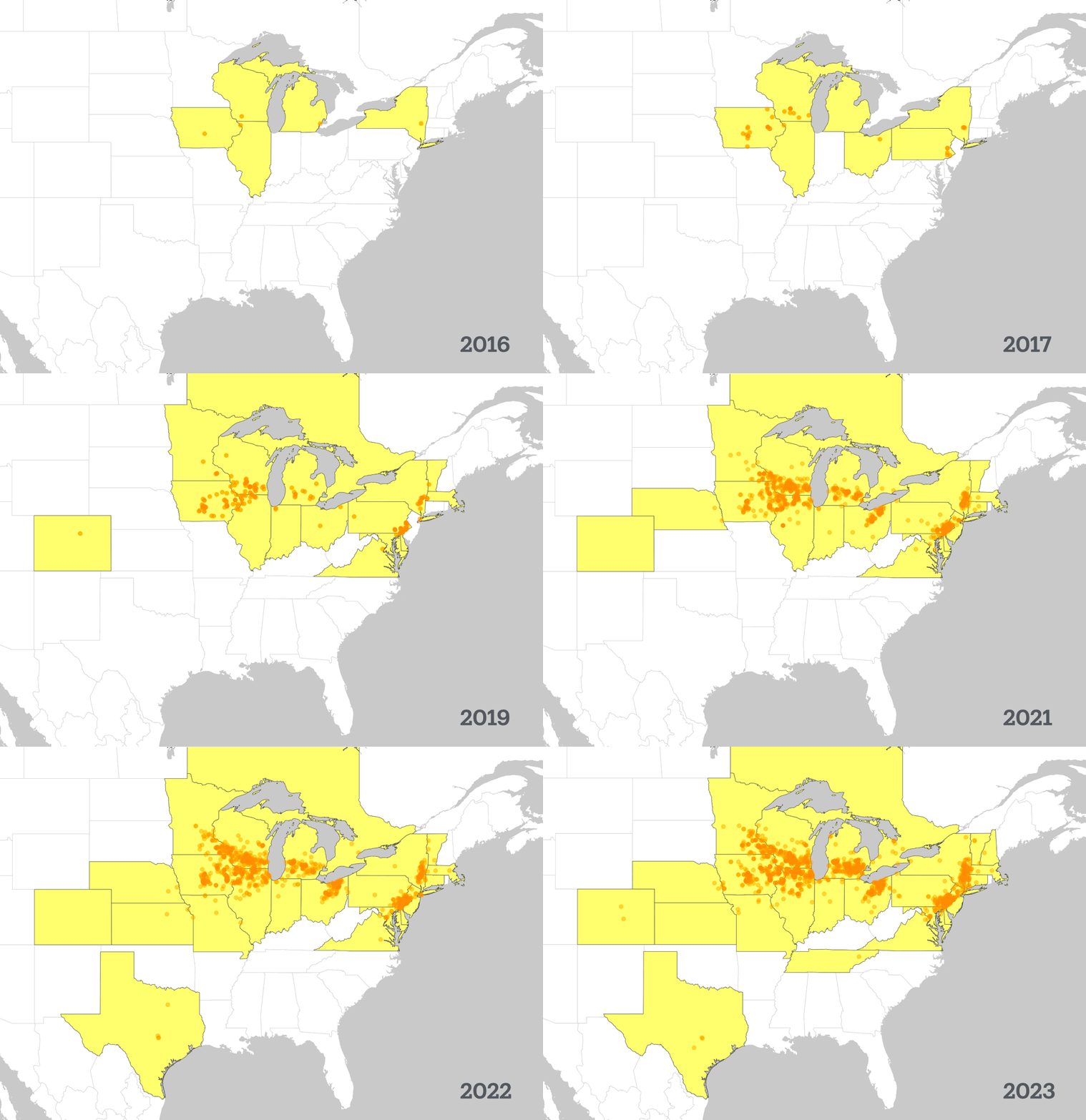
Where golden oyster mushrooms, an invasive species in North America, have been reported in the wild, including in forests, parks and neighborhoods. Red dots indicate new reports each year. States in yellow have had a report at some point. Aishwarya Veerabahu
Many mushroom species have been cultivated in North America for decades without becoming invasive species threats. However, golden oyster mushrooms have been different.
No one knows exactly how golden oyster mushrooms escaped into the wild, whether from a grow kit, a commercial mushroom farm or outdoor logs inoculated with golden oysters – a home-cultivation technique where mushroom mycelium is placed into logs to colonize the wood and produce mushrooms.
As grow kits increased in popularity, many people began buying golden oyster kits and watching them blossom into beautiful yellow mushrooms in their backyards. Their spores or composted kits could have spread into nearby forests.
In our study, designed by Michelle Jusino and Mark Banik, research scientists with the U.S. Forest Service, our team went into forests around Madison, Wisconsin, and drilled into dead trees to collect wood shavings containing the natural fungal community within each tree. Some of the trees had golden oyster mushrooms on them, and some did not.
We then extracted DNA to identify and compare which fungi, and how many fungi, were in trees that had been invaded by golden oyster mushrooms compared with those that had not been.
We were startled to find that trees with golden oyster mushrooms housed only half as many fungal species as trees without golden oyster mushrooms, sometimes even less. We also found that the composition of fungi in trees with golden oyster mushrooms was different from trees without golden oyster mushrooms.
For example, the gentle green “mossy maze polypore” and the “elm oyster” mushroom were pushed out of trees invaded by golden oyster mushrooms.
Mossy maze polypore growing on a stump. This is one of the native species that disappeared from trees when the golden oyster mushroom moved in. mauriziobiso/iStock/Getty Images Plus
Given what my colleagues and I discovered, we believe it is time to include invasive fungi in the global conversation about invasive species and examine their role as a cause of biodiversity loss.
That conversation includes the idea of fungal “endemism” – that each place has a native fungal community that can be thrown out of balance. Native fungal communities tend to be diverse, having evolved together over thousands of years to coexist. Our research shows how invasive species can change the makeup of fungal communities by outcompeting native species, thus changing the fungal processes that have shaped native ecosystems.
The golden oyster mushrooms’ invasion of North America should serve as a bright yellow warning that nonnative fungi are capable of rapid invasion and should be cultivated with caution, if at all.
Golden oyster mushrooms are now recognized as invasive in Switzerland and can be found in forests in Italy, Hungary, Serbia and Germany. I have been hearing about people attempting to cultivate them around the world, including in Turkey, India, Ecuador, Kenya, Italy and Portugal. It’s possible that golden oyster mushrooms may not be able to establish invasive populations in some regions. Continued research will help us understand the full scope of impacts invasive fungi can have.
What you can do to help
Mushroom growers, businesses and foragers around the world may be asking themselves, “What can we do about it?”
For the time being, I recommend that people consider refraining from using golden oyster mushroom grow kits to prevent any new introductions. For people who make a living selling these mushrooms, consider adding a note that this species is invasive and should be cultivated indoors and not composted.
If you enjoy growing mushrooms at home, try cultivating safe, native species that you have collected in your region.
Most mushrooms you see in the grocery store are grown indoors.
There is no single right answer. In some places, golden oyster mushrooms are being cultivated as a food source for impoverished communities, for income, or to process agricultural waste and produce food at the same time. Positives like these will have to be considered alongside the mushrooms’ negative impacts when developing management plans or legislation.
In the future, some ideas for solutions could involve sporeless strains of golden oysters for home kits that can’t spread, or a targeted mycovirus that could control the population. Increased awareness about responsible cultivation practices is important, because when invasive species move in and disrupt the native biodiversity, we all stand to lose the beautiful, colorful, weird fungi we see on walks in the forest.
Aishwarya Veerabahu receives funding from UW-Madison Dept. of Botany, the UW Arboretum, the Society of Ecological Restoration, and the Garden Club of America. Aishwarya Veerabahu was an employee of the USDA Forest Service.
Source: The Conversation – UK – By Felia Allum, Professor of Comparative Organised Crime and Corruption, University of Bath
It has been 33 years since anti-mafia prosecutor Paolo Borsellino was blown up by Cosa Nostra in front of his mother’s home in Palermo, Sicily. His death on July 19 1992 came 57 days after the murder of his colleague, Giovanni Falcone. This was the peak of Cosa Nostra’s attack on state representatives.
A vital document was lost that day – a red notebook believed to have been in Borsellino’s work bag. This loss has hampered attempts to understand how deep into the Italian state Cosa Nostra’s activities run.
The early 1990s were a turbulent time in Italy. The fall of the Berlin wall in 1989 broke the Italian party system and wiped out the traditional political parties, which had been based around the opposing forces of the Christian Democrats (supported by the US and the Vatican) and the Communist party.
The Christian Democrats, in power during the post-war period, had often protected Cosa Nostra. But losing power meant an inability to honour its “pact” with mafiosi. This led to the mafia attacking anyone who got in its way.
Falcone and Borsellino, as anti-mafia prosecutors, had got under the skin of Cosa Nostra. Their work zoned in on its mentality and activities. They were the driving force behind the 1986 “maxi trial” that saw hundreds of mafiosi prosecuted. This was the first time important mafia bosses were imprisoned. Falcone and Borsellino had brought a new understanding to the internal workings of the mafia, including its links with politics and money laundering operations.
The mafia was deploying terrorist tactics against state representatives and institutions in the early 1990s in what appears to have been an attempt to get the state to negotiate with it. Borsellino, it is believed, was investigating this when he was murdered.
The red notebook
Crucially, on the day Borsellino was murdered, his work bag, which contained his red notebook (“l’agenda rossa”) disappeared from the wreckage of his car.
He carried his red notebook around with him everywhere, making copious notes of his investigations and ideas. Had it been recovered, l’agenda rossa could have revealed the possible links between state representatives (including with the police and judiciary), businessmen and Cosa Nostra.
It could, in effect, have mapped out how and to what extent Cosa Nostra had infiltrated the Italian state and the nature of its relationships with the new political class, the business elite, freemasons and other covert actors.
A photograph of a police officer walking off with what looks very much like the bag that presumably contained the notebook has circulated ever since. But this is where the trail ends. The bag – minus the notebook – was later found in the office of the head of the flying squad, with no explanation as to how and why it got there.
The disappearance of the red notebook remains a persistent enigma – and one which continues to haunt contemporary Italy because of what it might suggest about the nation’s underworld and political class.
This photo could even suggest that the goal of killing Borsellino was not just to eliminate a zealous public prosecutor but to remove a pantheon of knowledge about organised crime and its infiltration into the public realm as part of a more orchestrated plan.
Then, in 1993, Cosa Nostra suddenly and inexplicably ceased its terrorist tactics against the state. It was as though a truce had been reached. Could this be the case?
The history of these dynamics between state and the mafia has since been written and re-written, dividing Italians and mafia scholars.
At the heart of all these disagreements lie two questions: was the notebook taken intentionally and why did Cosa Nostra stop its attacks on the state at the specific moment that it did?. The answer to these would essentially establish whether or not there was a negotiated peace between the mafia and the state.
Some legal experts and historians have argued that the theory of coordinated action by state representatives and mafiosi was always an absurd hypothesis. While there might have been some random informal contacts, they contest that there was never a formal pact. The end of Cosa Nostra‘s violence, they argue, was due to a combination of other factors, including greater enforcement of the law.
Others argue that there is evidence of a pact. These include first-hand accounts from former criminals. But of course it is hard to make these stories stick because all evidence of a relationship of this kind would, by definition, be covert and off the books. As with many trials and in particular, mafia trials, there are no facts, just interpretations of facts.
In 2018, some state representatives and mafiosi were found guilty. But in 2023, the Italian supreme court overturned the 2018 ruling and concluded that there was no pact and no state-mafia negotiation.
All involved were cleared for different reasons as the court attempted to draw a line under the intrigue by articulating a clear position. But with the mafia, answers are rarely that simple. And history is not only written in the courtroom.
Borsellino’s legacy is celebrated in Italy to this day – but the unresolved matter of his missing notebook haunts the country more profoundly. His bag – minus the notebook – has recently been put on show at the Italian senate to celebrate his life. The display is also a reminder of how much remains unresolved from that period.
Felia Allum does not work for, consult, own shares in or receive funding from any company or organisation that would benefit from this article, and has disclosed no relevant affiliations beyond their academic appointment.
WASHINGTON, D.C. – Last night, Congressman Chris Deluzio (PA-17) with colleagues on the powerful House Armed Services Committee, marked up the 2026 National Defense Authorization Act (NDAA)—the large, annual defense bill that creates the policies related to our armed services and other national security-related efforts. Congressman Deluzio voted for the measure, which passed out of committee by a vote of 55-2.
“The United States faces tremendous strategic challenges across the globe, including the war in Ukraine, intensifying competition with Communist China, and instability in the Middle East. All this activity is stressing the highly consolidated defense industrial base,” said Congressman Deluzio. “For too long, our government has neglected America’s manufacturing competitiveness and power. We need stronger accountability, transparency, and competition in government contracting to beef up our defense industrial base and to protect public money. While not a perfect bill, the 2026 NDAA takes on many of these important issues and more, and that’s why I voted yes last night.”
Specifically, the NDAA included Congressman Deluzio’s amendment to fight defense industry price gouging by requiring defense contractors to report when their products under sole source contracts increase by more than 25% of the price specified in the contract bid, over 25% more than the price of the product the preceding year, or by 50% more than the government paid for the product at any time over the last five years.
During the NDAA markup, Congressman Deluzio successfully secured several important wins, including some that will specifically benefit the people and economy of Western Pennsylvania.
This legislation:
Implements an assessment and evaluation of the use of inland waterways for national defense purposes, and an assessment of vulnerabilities in our Marine Transportation Systems and associated infrastructure.
Authorizes an additional two and a half million dollars in funding to improve long range precision fires technology. This kind of research is ongoing at Western Pennsylvania institutions like the University of Pittsburgh.
Requires a new report about the technology and disposal methods of Per-and Polyfluoroalkyl Substances (PFAS). This is important because the Defense Department has previously considered incinerating PFAS “forever chemicals” in East Liverpool, Ohio—just across the border from Pennsylvania’s 17th District.
This year’s NDAA also includes the text of Congressman Deluzio’s bill, theDepot Investment Reform Act. This bill strengthens federal investment in military depots, including those in Pennsylvania, like the Letterkenny and Tobyhanna Army Depots.
Congressman Deluzio secured additional national priorities in this defense bill. This legislation:
Strengthens the “right to repair,” requiring contractors to give access to tools, parts, and information for major weapon systems so that our military and servicemembers can repair their own equipment.
Adjusts annual reporting on the U.S. Navy’s shipyard modernization efforts at the four public shipyards to include efforts related to the incorporation of digital hardware, software, and cloud storage.
Extends the number of days that national guardsmen can be activated by a governor of a state to respond to an emergency like a natural disaster from 3 to 14 days, with possible extensions of 7 and up to 46 days.
Requires a report on the Department of Defense’s efforts to incorporate artificial intelligence data centers on Department of Defense land. This report will analyze the risks, benefits, impacts, and footprint of those facilities.
Requires the Department of Defense to identify shortfalls and propose solutions for shortfalls of critical minerals and other materials in the National Defense Stockpile. This will better inform the United States’ current readiness and preparedness for any future conflict.
Fights consolidation in the defense industry by requiring the Government Accountability Office (GAO) to investigate impacts of mergers and acquisitions on the defense industrial base and competition in the defense industry.
Requires that contractors who are negotiating sole-source contracts with the government provide timely andcritical pricing data to the government. This will assist the military in getting the best deal for our servicemembers and will steward good use of American public dollars.
Requires the Department of Defense to assess the current competitive environment for contracts under $10 million. This will help the military and Congress assess whether recent policy changes have been effective in uplifting small businesses and growing the defense industrial base.
A full summary of the Fiscal Year 2026 NDAA as prepared by Democratic committee staff can befound here.
The NDAA now goes to the House Floor for a vote, and the final bill will be negotiated with the Senate.
Washington, D.C. — U.S. Senators Martin Heinrich (D-N.M.) and Ben Ray Luján (D-N.M.) joined Senator Reverend Raphael Warnock (D-Ga.), Banking Committee Ranking Member Elizabeth Warren (D- Mass.), Senate Minority Leader Chuck Schumer (D-N.Y.), Jeff Merkley (D-Ore.) and 24 other Senators in pushing the Trump administration for answers regarding the Consumer Financial Protection Bureau’s (CFPB) decision to vacate the medical debt rule finalized in January 2025. The letter demands CFPB share any data the agency relied on in deciding to petition a court to vacate the rule and any communications it had with entities during the process that would profit from its decision.
“On April 30, 2025, the Consumer Financial Protection Bureau (CFPB) asked a court to vacate the agency’s recently released rule to remove medical debt from consumer credit reports. We write to request the information you relied on in making that determination, including any communications with collection agencies that stand to profit from it,” the Senators said.
“Medical debt collections information is often inaccurate, and studiesshow that it is not useful in determining a consumer’s ability to repay other debts…Almost half of all medical bills contain at least one error, and almosthalfof nonprofit hospitals have routinely and mistakenly billed patients who were eligible for free or discounted care,” they continued.
At the conclusion of the letter, the Senators emphasize the need for transparency into the agency’s decision-making process.
“On April 30, the CFPB filed a joint motion with the industry groups that oppose the rule, petitioning the court to vacate it – lining the pockets of corporations off the backs of American consumers. Given the substantial evidence that the CFPB’s rule was well-considered and would help consumers without reducing the accuracy of their credit scores, we write to request that the CFPB make public all information relied on by the agency in its decision to drop the rule, including any communications with the debt collection industry,” the Senators closed.
Senator Luján has long worked to support Americans facing medical debt. In March 2024, Senator Luján called on CFPB Director Rohit Chopra to eliminate reporting of all medical debt in consumers’ credit reports. In November 2024, Senator Lujánintroduced the Medical Bankruptcy Fairness Act to ease the burden on Americans forced into bankruptcy because of unforeseen medical expenses. Senator Luján continues to stand up in defense of New Mexicans by holding the CFPB under President Trump accountable.
In addition to Senators Heinrich, Lujan, Warnock, Warren, Schumer, and Merkley, the letter was signed by U.S. Senators Amy Klobuchar (D-MN), Adam Schiff (D-CA), John Hickenlooper (D-CO), Angela Alsobrooks (D-MD), Tammy Duckworth (D-IL), Ed Markey (D-MA), Jeanne Shaheen (D-NH), Ron Wyden (D-OR), Cory Booker (D-NJ), Bernie Sanders (I-VT), Lisa Blunt Rochester (D-DE), John Fetterman (D-PA), Kirsten Gillibrand (D-NY), Tina Smith (D-MN), Jack Reed (D-RI), Richard Blumenthal (D-CT), Sheldon Whitehouse (D-RI), Angus King (I-ME), Chris Van Hollen (D-MD), Peter Welch (D-VT), Ruben Gallego (D-AZ), Andy Kim (D-NJ), Mazie Hirono (D-HI), and Jacky Rosen (D-NV).
Read the full letter HERE, and the text is below
Dear Acting Director Vought,
On April 30, 2025, the Consumer Financial Protection Bureau (CFPB) asked a court to vacate the agency’s recently released rule to remove medical debt from consumer credit reports. We write to request the information you relied on in making that determination, including any communications with debt collection agencies that stand to profit from it.
Medical debt collections information is often inaccurate, and studiesshow that it is not useful in determining a consumer’s ability to repay other debts. One major credit scoring company, VantageScore, hasstoppedusing medical debt in its newer models entirely. Almost halfof all medical bills contain at least one error, and almosthalfof nonprofit hospitals have routinely and mistakenly billed patients who were eligible for free or discounted care. People often receive collection notices for debts they did not owe, in the wrong amount, or that should have been covered by insurance—but still end up experiencing long-lasting damage to their credit scores.
Listing medical debt on a person’s credit report drives down their credit score, which hurts their ability to purchase a car, buy a home or rent an apartment, get utility service, start a business, or access other banking services. This has profound effects on families that can last generations. To make matters worse, medical debt is the most commonreason debt collectors contact consumers; the debt collection industry makes one-fourthof its annual revenue from health care debt. Including medical debt on credit reports makes consumers more vulnerable to predatory debt collection practices. Medical debt on credit reports also blocks working families from access to credit that they would be able to repay.The CFPB found that people who had all their medical debts completely removed from their credit reports experienced an average credit score increase of 20 points, in some cases elevating families into a higher credit score tier.
In response to growing data that medical debt is not a good indicator of creditworthiness, states across the country have acted to ban the inclusion of medical debt on credit reports. And on January 7, the Consumer Financial Protection Bureau (CFPB) issued a final rule to remove medical debt from consumer credit reports. The rule would remove an estimated $49 billion in medical bills from the credit reports of 15 million Americans, prohibit credit reporting companies from sharing medical debt information with lenders, and bar lenders from considering medical debt in underwriting decisions. It was designed to help the millions of Americans who are struggling to make ends meet, by lowering costs and increasing access to affordable credit for working families without affecting the predictive value of their credit reports. The rule would also help reduce the effects of structural racism and other prejudices. People of color are disproportionately harmed by the inclusion of medical debt on credit reports. Meanwhile, adults with a disability and new moms are more than twice as likely to carry medical debt.
Despite the critical importance of the medical debt rule, on April 30, the CFPB filed a joint motion with the industry groups that oppose the rule, petitioning the court to vacate it—lining the pockets of corporations off the backs of American consumers. Given the substantial evidence that the CFPB’s rule was well-considered and would help consumers without reducing the accuracy of their credit scores, we write to request that the CFPB make public all information relied on by the agency in its decision to drop the rule, including any communications with the debt collection industry, by July 28, 2025. We specifically request that CFPB publicly publish all data about how medical debt relates to key economic indicators, including:
Barriers to home and car ownership, including challenges getting loans or not being approved to rent or lease,
Paying higher premiums for auto, homeowner’s and other types of insurance,
Losing job opportunities as a result of credit reporting on background checks,
Obstacles to starting small businesses because of challenges with securing loans,
Paying more for everyday services such as household utilities or cell phone contracts
We are particularly concerned about the outsize impact that medical debt has on the credit scores of seniors, veterans, new parents, people with disabilities, cancer patients and survivors, and small business owners.
It is with deep sadness that we announce the passing of Jean-Pierre Azéma, historian and professor at Sciences Po, who died on Monday, 14 July 2025, in his eighty-seventh year.
Alongside Serge Berstein, Jean-Noël Jeanneney, Pierre Milza, and Michel Winock, Jean-Pierre Azéma was one of the founding members of the group of historians at Sciences Po who, under the benevolent guidance of René Rémond, brought together scholars of contemporary history with a particular focus on modern political developments.
A specialist in the Second World War, the Occupation, the Resistance and the Vichy regime, he established himself from the 1970s onwards as one of France’s foremost experts on the period. He authored numerous landmark publications — including De Munich à la Libération, 1938–1944 (Seuil, 1979) and Jean Moulin: Le politique, le rebelle, le résistant (Perrin, 2003) — and contributed to major collective volumes such as Vichy et les Français (Fayard, 1992).
After teaching in secondary education, notably at the Lycées Lakanal and Henri IV, Jean-Pierre Azéma joined Sciences Po in 1973 as an assistant professor. There, he rejoined Serge Berstein and Pierre Milza, who had arrived a few years earlier, and was later followed by his lifelong friend and former schoolmate Michel Winock. A few years later, he was promoted to full professor – among the very first in the field of history at Sciences Po.
Over the course of thirty-five years, Jean-Pierre Azéma taught with unwavering dedication and intellectual rigour across all levels of instruction at Sciences Po. As lecturer of the first-year general history course, he trained and inspired generations of students in the “année préparatoire” (undergraduate programme), his deep erudition and colourful temperament leaving a lasting impression.
He was also a key figure in Sciences Po’s graduate programme in history, mentoring numerous master’s and doctoral students with both generosity and high standards (among them Alya Aglan, Anne Simonin, Guillaume Piketty, and Florent Brayard).
“In history, you need the real stuff,” (by which he meant sources), he would often remind his students, regardless of their level — as recalled by historian Nicolas Offenstadt, one of his former undergraduate and postgraduate students.
A committed member of the academic community, Jean-Pierre Azéma also served the institution in other capacities. For over a decade, he co-chaired Sciences Po’s Joint Committee, a university body established in the wake of May 1968, bringing together faculty and students in equal numbers — the forerunner of today’s Student Life and Education Committee (CVEF). In this role, he played a vital part in mediating between interests, always with integrity and without demagoguery.
Beyond Sciences Po, his scholarly reputation led to frequent public engagement. He was notably cited by the civil parties during the Maurice Papon trial. He also brought historical insight to wider audiences through his contributions to L’Histoire magazine, his collaboration with Claude Chabrol on the documentary L’œil de Vichy, and his role as historical advisor for the acclaimed television series Un village français.
For years, students, faculty, and staff at Sciences Po encountered the instantly recognisable figure of Jean-Pierre Azéma — often distinguished by his trademark scarf, long a vivid red, which never left his neck. Many will retain the memory of a professor whose mischievous gaze and intellectual passion brought history vividly to life.
Our thoughts are with his family, his loved ones, and all those at Sciences Po who knew, respected, and loved him.
Conflict in Syria has escalated with Israel launching bombing raids against its northern neighbour.
It follows months of fluctuating tensions in southern Syria between the Druze minority and forces aligned with the new government in Damascus. Clashes erupted in the last few days, prompting Israeli airstrikes in defence of the Druze by targeting government bases, tanks, and heavy weaponry.
a terrorist, a barbaric murderer who should be eliminated without delay.
Despite the incendiary language, a ceasefire has been reached, halting the fighting – for now.
Syrian forces have begun withdrawing heavy military equipment from the region, while Druze fighters have agreed to suspend armed resistance, allowing government troops to regain control of the main Druze city of Suwayda.
What do the Druze want?
The Druze are a small religious minority estimated at over one million people, primarily concentrated in the mountainous regions of Lebanon, Syria, Israel, and Jordan.
In Syria, their population is estimated at around 700,000 (of around 23 million total Syrian population), with the majority residing in the southern As-Suwayda Governorate – or province – which serves as their traditional stronghold.
Since the 2011 uprising against the Assad regime, the Druze have maintained a degree of autonomy, successfully defending their territory from various threats, including ISIS and other jihadist groups.
They advocate for a decentralised model that would grant greater autonomy to regional communities.
However, the transitional government in Damascus is pushing for a centralised state and seeking to reassert full control over the entire Syrian territory. This fundamental disagreement has led to periodic clashes between Druze forces and government-aligned troops.
Despite the temporary ceasefire, tensions remain high. Given the core political dispute remains unresolved, many expect renewed conflict to erupt in the near future.
Why is Israel involved?
The ousting of the Assad regime created a strategic opening for Israel to expand its influence in southern Syria. Israel’s involvement is driven by two primary concerns:
1. Securing its northern border
Israel views the power vacuum in Syria’s south as a potential threat, particularly the risk of anti-Israeli militias establishing a foothold near its northern border.
The Israeli Defence Forces will not allow a military threat to exist in southern Syria and will act against it.
Likewise, Prime Minister Benjamin Netanyahu, who has stated he will not allow Syrian forces south of Damascus:
We are acting to prevent the Syrian regime from harming them [the Druze] and to ensure the demilitarisation of the area adjacent to our border with Syria.
In line with these warnings, the Israeli Air Force has conducted extensive strikes against Syrian military infrastructure, targeting bases, aircraft, tanks, and heavy weaponry.
These operations are intended to prevent any future buildup of military capacity that could be used against Israel from the Syrian side of the border.
2. Supporting a federated Syria
Israel is backing the two prominent allied minorities in Syria — the Kurds in the northeast and the Druze in the south — in their push for a federal governance model.
A fragmented Syria, divided along ethnic and religious lines, is seen by some Israeli policymakers as a way to maintain Israeli domination in the region.
This vision is part of what some Israeli officials have referred to as a “New Middle East” — one where regional stability and normalisation emerge through reshaped borders and alliances.
Israeli Foreign Minister Gideon Sa’ar recently echoed this strategy, stating:
A single Syrian state with effective control and sovereignty over all its territory is unrealistic.
For Israel, the logical path forward is autonomy for the various minorities in Syria within a federal structure.
The United States’ role?
According to unconfirmed reports, Washington has privately urged Israel to scale back its military strikes on Syria in order to prevent further escalation and preserve regional stability.
The US is promoting increased support for Syria’s new regime in an effort to help it reassert control and stabilise the country.
There are also indications the US and its allies are encouraging the Syrian government to move toward normalisation with Israel. Reports suggest Tel Aviv has held talks with the new Sharaa-led regime about the possibility of Syria joining the Abraham Accords (diplomatic agreements between Israel and several Arab states), which the regime in Damascus appears open to.
US Special Envoy Tom Barrack has described the recent clashes as “worrisome”, calling for de-escalation and emphasising the need for
a peaceful, inclusive outcome for all stakeholders – including the Druze, Bedouin tribes, the Syrian government, and Israeli forces.
Given the deep-rooted political divisions, competing regional agendas, and unresolved demands from minority groups, the unrest in southern Syria is unlikely to end soon.
Despite another temporary ceasefire, underlying tensions remain. Further clashes are not only possible but highly probable.
Ali Mamouri does not work for, consult, own shares in or receive funding from any company or organisation that would benefit from this article, and has disclosed no relevant affiliations beyond their academic appointment.
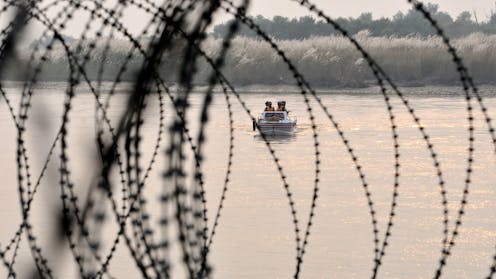
With the future of a crucial water-sharing treaty between India and Pakistan up in the air, one outside party is looking on with keen interest: China.
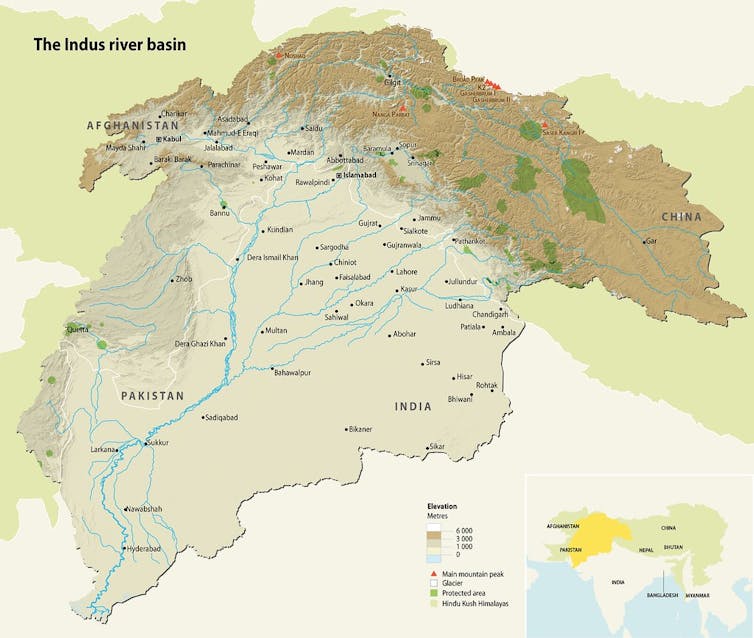
For 65 years, the Indus Waters Treaty has seen the two South Asian rivals share access and use of the Indus Basin, a vast area covered by the Indus River and its tributaries that also stretches into Afghanistan and China.
For much of that history, there has been widespread praise for the agreement as a successful demonstration of cooperation between adversarial states over a key shared resource. But experts have noted the treaty has long held the potential for conflict. Drafters failed to factor in the effects of climate change, and the Himalayan glaciers that feed the rivers are now melting at record rates, ultimately putting at risk the long-term sustainability of water supply. Meanwhile, the ongoing conflict over Kashmir, where much of the basin is situated, puts cooperation at risk.
With treaty on ice, China steps in
That latest provocation threatening the treaty was a terrorist attack in the Indian union territory of Jammu and Kashmir on April 22, 2025. In response to that attack, which India blamed on Pakistan and precipitated a four-day confrontation, New Delhi temporarily suspended the treaty.
But even before that attack, India and Pakistan had been locked in negotiation over the future of the treaty – the status of which has been in the hands of international arbitrators since 2016. In the latest development, on June 27, 2025, the Permanent Court of Arbitration issued a supplementary award in favor of Pakistan, arguing that India’s holding of the treaty in abeyance did not affect its jurisdiction over the case. Moreover, the treaty does not allow for either party to unilaterally suspend the treaty, the ruling suggested.
Amid the wrangling over the treaty’s future, Pakistan has turned to China for diplomatic and strategic support. Such support was evident during the conflict that took place following April’s terrorist attack, during which Pakistan employed Chinese-made fighter jets and other military equipment against its neighbor.
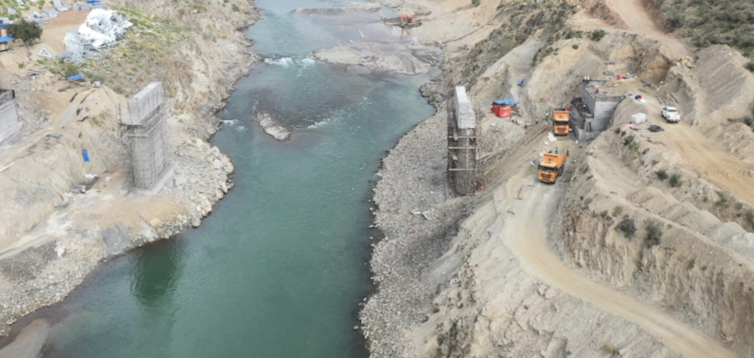
Meanwhile, in an apparent move to counter India’s suspension of the treaty, China and Pakistan have ramped up construction of a major dam project that would provide water supply and electricity to parts of Pakistan.
But as an expert in hydro politics, I believe Beijing’s involvement raises concerns: China is not a neutral observer in the dispute. Rather, Beijing has long harbored a desire to increase its influence in the region and to counter an India long seen as a rival. Given the at-times fraught relationship between China and India – the two countries went to war in 1962 and continue to engage in sporadic border skirmishes – there are concerns in New Delhi that Beijing may respond by disrupting the flow of rivers in its territory that feed into India.
In short, any intervention by Beijing over the Indus Waters Treaty risks stirring up regional tensions.
Wrangling over waters
The Indus Waters Treaty has already endured three armed conflicts between Pakistan and India, and until recently it served as an exemplar of how to forge a successful bilateral agreement between two rival neighbors.
Under the initial terms of the treaty, which each country signed in 1960, India was granted control over three eastern rivers the countries share – Ravi, Beas and Satluj – with an average annual flow of 40.4 billion cubic meters. Meanwhile, Pakistan was given access to almost 167.2 billion cubic meters of water from the western rivers – Indus, Jhelum and Chenab.
In India, the relatively smaller distribution has long been the source of contention, with many believing the treaty’s terms are overly generous to Pakistan. India’s initial demand was for 25% of the Indus waters.
For Pakistan, the terms of the division of the Indus Waters Treaty are painful because they concretized unresolved land disputes tied to the partition of India in 1947. In particular, the division of the rivers is framed within the broader political context of Kashmir. The three major rivers – Indus, Jhelum and Chenab – flow through Indian-administered Jammu and Kashmir before entering the Pakistan-controlled western part of the Kashmir region.
But the instability of the Kashmir region – disputes around the Line of Control separating the Indian- and Pakistan-controlled areas are common – underscores Pakistan’s water vulnerability.
Since Pakistan’s economy relies heavily on agriculture and the water needed to maintain agricultural land, the fate of the Indus Waters Treaty is of the utmost importance to Pakistan’s leaders.
Such conditions have driven Islamabad to be a willing partner with China in a bid to shore up its water supply.
China provides technical expertise and financial support to Pakistan for numerous hydropower projects in Pakistan, including the Diamer Bhasha Dam and Kohala Hydropower Project. These projects play a significant role in addressing Pakistan’s energy requirements and have been a key aspect of the transboundary water relationship between the two nations.
Doing so fits Beijing’ s greater strategic presence in South Asian politics. After the terrorist attack, China Foreign Minister Wang Yi reaffirmed China’s support for Pakistan, showcasing the relationship as an “all-weather strategic” partnership and referring to Pakistan as an “ironclad friend.”
And in response to India’s suspension of the treaty, China announced it was to accelerate work on the significant Mohmand hydropower project on the tributary of the Indus River in Pakistan.
Chinese investment in Pakistan’s hydropower sector presents substantial opportunities for both countries in regards to energy security and promoting economic growth.
The Indus cascade project under the China-Pakistan Economic Corridor initiative, for example, promises to provide cumulative hydropower generation capacity of around 22,000 megawatts. Yet the fact that project broke ground in Gilgit-Baltistan, a disputed area in Pakistan-controlled Kashmir, underscores the delicacy of the situation.
Beijing’s backing of Pakistan is largely motivated by a mix of economic and geopolitical interests, particularly in legitimizing the China-Pakistan Economic Corridor. But it comes at the cost of stirring up regional tensions.
As such, the alignment of Chinese and Pakistani interests in developing hydro projects can pose a further challenge to the stability of South Asia’s water-sharing agreements, especially in the Indus Basin. Recently, the chief minister of the Indian state of Arunachal Pradesh, which borders China, warned that Beijing’s hydro projects in the Western Tibet region amount to a ticking “water bomb.”
To diffuse such tensions – and to get the Indus Waters Treaty back on track – it behooves India, China and Pakistan to engage in diplomacy and dialogue. Such engagement is, I believe, essential in addressing the ongoing water-related challenges in South Asia.
Pintu Kumar Mahla is affiliated with the Water Resources Research Center, the University of Arizona. He is also a member of the International Association of Water Law (AIDA).
Pintu Kumar Mahla has not received funding related to this article.
Source: The Conversation – Global Perspectives – By Garret Martin, Hurst Senior Professorial Lecturer, Co-Director Transatlantic Policy Center, American University School of International Service
Iran Foreign Minister Hossein Amirabdollahian, right, attends a news conference with EU foreign affairs representative Josep Borrell in Tehran on June 25, 2022.Atta KenareAFP via Getty Images
The U.S. bombing of three Iranian nuclear facilities on June 22, 2025, sent shock waves around the world. It marked a dramatic reversal for the Trump administration, which had just initiated negotiations with Tehran over its nuclear program. Dispensing with diplomacy, the U.S. opted for the first time for direct military involvement in the then-ongoing Israeli-Iranian conflict.
European governments have long pushed for a diplomatic solution to Tehran’s nuclear ambitions. Yet, the reaction in the capitals of Europe to the U.S. bombing of the nuclear facilities was surprisingly subdued.
But the timid reaction also underscored Europe’s bystander role, contrasting with its past approach on that topic. Iran’s nuclear program had been a key focal point of European diplomacy for years. The E3 nations initiated negotiations with Tehran back in 2003. They also helped to facilitate the signing of the 2015 Iran nuclear deal, which also included Russia, the European Union, China, the U.S. and Iran. And the Europeans sought to preserve the agreement, even after the unilateral U.S. withdrawal in 2018 during President Donald Trump’s first term.
As a scholar of transatlantic relations and security, I believe Europe faces long odds to once again play an impactful role in strengthening the cause of nuclear nonproliferation with Iran. Indeed, contributing to a new nuclear agreement with Iran would require Europe to fix a major rift with Tehran, overcome its internal divisions over the Middle East and manage a Trump administration that seems less intent on being a reliable ally for Europe.
Growing rift between Iran and Europe
For European diplomats, the 2015 deal was built on very pragmatic assumptions. It only covered the nuclear dossier, as opposed to including other areas of contention such as human rights or Iran’s ballistic missile program. And it offered a clear bargain: In exchange for greater restrictions on its nuclear program, Iran could expect the lifting of some existing sanctions and a reintegration into the world economy.
As a result, the U.S. withdrawal from the deal in 2018 posed a fundamental challenge to the status quo. Besides exiting, the Trump White House reimposed heavy secondary sanctions on Iran, which effectively forced foreign companies to choose between investing in the U.S. and Iranian markets. European efforts to mitigate the impact of these U.S. sanctions failed, thus undermining the key benefit of the deal for Iran: helping its battered economy. It also weakened Tehran’s faith in the value of Europe as a partner, as it revealed an inability to carve real independence from the U.S.
U.S. President Donald Trump walks past French President Emmanuel Macron, center, and German Chancellor Friedrich Merz, right, in The Hague, Netherlands, on June 25, 2025. Christian Hartmann/AFP via Getty Images
These deep tensions remain a significant impediment to constructive negotiations on the nuclear front. Neither side currently has much to offer to the other, nor can Europe count on any meaningful leverage to influence Iran. And Europe’s wider challenges in its Middle East policy only compound this problem.
Internal divisions
In 2015, Europe could present a united front on the Iranian nuclear deal in part because of its limited nature. But with the nonproliferation regime now in tatters amid Trump’s unilateral actions and the spread of war across the region, it is now far harder for European diplomats to put the genie back in the bottle. That is particularly true given the present fissures over increasingly divisive Middle East policy questions and the nature of EU diplomacy.
Unless Europe can develop a common approach toward the Middle East, it is hard to see it having enough regional influence to matter in future negotiations over Iran’s nuclear program. This, in turn, would also affect how it manages its crucial, but thorny, relations with the U.S.
Europe in the shadow of Trump
The EU was particularly proud of the 2015 nuclear deal because it represented a strong symbol of multilateral diplomacy. It brought together great powers in the spirit of bolstering the cause of nuclear nonproliferation.
Ten years on, the prospects of replicating such international cooperation seem rather remote. Europe’s relations with China and Russia – two key signers of the original nuclear deal – have soured dramatically in recent years. And ties with the United States under Trump have also been particularly challenging.
Dealing with Washington, in the context of the Iran nuclear program, presents a very sharp dilemma for Europe.
And pursuing an independent path could easily provoke the ire of Trump, which Europeans are keen to avoid. There has already been a long list of transatlantic disputes, whether over trade, Ukraine or defense spending. European policymakers would be understandably reticent to invest time and resources in any deal that Trump could again scuttle at a moment’s notice.
Trump, too, is scornful of what European diplomacy could achieve, declaring recently that Iran doesn’t want to talk to Europe. He has instead prioritized bilateral negotiations with Tehran. Alignment with the U.S., therefore, may not translate into any great influence. Trump’s decision to bomb Iran, after all, happened without forewarning for his allies.
Thus, Europe will continue to pay close attention to Iran’s nuclear program. But, constrained by poor relations with Tehran and its internal divisions on the Middle East, it is unlikely that it will carve out a major role on the nuclear dossier as long as Trump is in office.
Garret Martin receives funding from the European Union for the organization, the Transatlantic Policy Center, that he co-directs.
When the FIFA World Cup hits North America in June 2026, 48 teams and millions of soccer fans will be traveling to and from venues spread across the United States, Canada and Mexico.
It’s a dramatic expansion – 16 more teams will be playing than in recent years, with a jump from 64 to 104 matches. The tournament is projected to bring in over US$10 billion in revenue. But the expansion will also mean a lot more travel and other activities that contribute to climate change.
The environmental impacts of giant sporting events like the World Cup create a complex paradox for an industry grappling with its future in a warming world.
A sustainability conundrum
Sports are undeniably experiencing the effects of climate change. Rising global temperatures are putting athletes’ health at risk during summer heat waves and shortening winter sports seasons. Many of the 2026 World Cup venues often see heat waves in June and early July, when the tournament is scheduled.
Some athletes are speaking out for more sustainable choices and have called on lawmakers to take steps to limit climate-warming emissions. At the same time, the sport industry is growing and facing a constant push to increase revenue. The NCAA is also considering expanding its March Madness basketball tournaments from 68 teams currently to as many as 76.
Park Yong-woo of team Al Ain from Abu Dhabi tries to cool off during a Club World Cup match on June 26, 2025, in Washington, D.C., which was in the midst of a heat wave. Some players have raised concerns about likely high temperatures during the 2026 World Cup, with matches scheduled June 11 to July 19. AP Photo/Julia Demaree Nikhinson
Estimates for the 2026 World Cup show what large tournament expansions can mean for the climate. A report from Scientists for Global Responsibility estimates that the expanded World Cup could generate over 9 million metric tons of carbon dioxide equivalent, nearly double the average of the past four World Cups.
This massive increase – and the increase that would come if the NCAA basketball tournaments also expand – would primarily be driven by air travel as fans and players fly among event cities that are thousands of miles apart.
A lot of money is at stake, but so is the climate
Sports are big business, and adding more matches to events like the World Cup and NCAA tournaments will likely lead to larger media rights contracts and greater gate receipts from more fans attending the events, boosting revenues. These are powerful financial incentives.
In the NCAA’s case, there is another reason to consider a larger tournament: The House v. NCAA settlement opened the door for college athletic departments to share revenue with athletes, which will significantly increase costs for many college programs. More teams would mean more television revenue and, crucially, more revenue to be distributed to member NCAA institutions and their athletic conferences.
When climate promises become greenwashing
The inherent conflict between maximizing profit through growth and minimizing environmental footprint presents a dilemma for sports.
Several sport organizations have promised to reduce their impact on the climate, including signing up for initiatives like the United Nations Sports for Climate Action Framework.
However, as sports tournaments and exhibition games expand, it can become increasingly hard for sports organizations to meet their climate commitments. In some cases, groups making sustainability commitments have been accused of greenwashing, suggesting the goals are more about public relations than making genuine, measurable changes.
For example, FIFA’s early claims that it would hold a “fully carbon-neutral” World Cup in Qatar in 2022 were challenged by a group of European countries that accused soccer’s world governing body of underestimating emissions. The Swiss Fairness Commission, which monitors fairness in advertising, considered the complaints and determined that FIFA’s claims could not be substantiated.
Alessandro Bastoni, of Inter Milan and Italy’s national team, prepares to board a flight from Milan to Rome with his team. Mattia Ozbot-Inter/Inter via Getty Images
Aviation is often the biggest driver of emissions. A study that colleagues and I conducted on the NCAA men’s basketball tournament found about 80% of its emissions were connected to travel. And that was after the NCAA began using the pod system, which is designed to keep teams closer to home for the first and second rounds.
These solutions are frankly not practical, in my view, nor do they align with other positive developments. The growing popularity of women’s sports shows the challenge in limiting sports events – more games expands participation but adds to the industry’s overall footprint.
Further compounding the challenges of reducing environmental impact is the amount of fan travel, which is outside the direct control of the sports organization or event organizers.
Many fans will follow their teams long distances, especially for mega-events like the World Cup or the NCAA tournament. During the men’s World Cup in Russia in 2018, more than 840,000 fans traveled from other countries. The top countries by number of fans, after Russia, were China, the U.S., Mexico and Argentina.
There is an argument that distributed sporting events like March Madness or the World Cup can be better in some ways for local environments because they don’t overwhelm a single city. However, merely spreading the impact does not necessarily reduce it, particularly when considering the effects on climate change.
How fans can cut their environmental footprint
Sport organizations and event planners can take steps to be more sustainable and also encourage more sustainable choices among fans. Fans can reduce their environmental impact in a variety of ways. For example:
Avoid taking airplanes for shorter distances, such as between FIFA venues in Philadelphia, New York and Boston, and carpool or take Amtrak instead. Planes can be more efficient for long distances, but air travel is still a major contributing factor to emissions.
While in a host city, use mass transit or rent electric vehicles or bicycles for local travel.
Consider sustainable accommodations, such as short-term rentals that might have a smaller environmental footprint than a hotel. Or stay at a certified green hotel that makes an effort to be more efficient in its use of water and energy.
Engage in sustainable pregame and postgame activities, such as choosing local, sustainable food options, and minimize waste.
You can also pay to offset carbon emissions for attending different sporting events, much like concertgoers do when they attend musical festivals. While critics question offsets’ true environmental benefit, they do represent people’s growing awareness of their environmental footprint.
Through all these options, it’s clear that sports face a significant challenge in addressing their environmental impacts and encouraging fans to be more sustainable, while simultaneously trying to meet ambitious business and environmental targets.
In my view, a sustainable path forward will require strategic, yet genuine, commitment by the sports industry and its fans, and a willingness to prioritize long-term planetary health alongside economic gains – balancing the sport and sustainability.
Brian P. McCullough does not work for, consult, own shares in or receive funding from any company or organization that would benefit from this article, and has disclosed no relevant affiliations beyond their academic appointment.
Golden oyster mushrooms, with their sunny yellow caps and nutty flavor, have become wildly popular for being healthy, delicious and easy to grow at home from mushroom kits.
In a study we believe is the first of its kind, fellow mycologists and I demonstrate that an invasive fungus can cause environmental harm, just as invasive plants and animals can when they take over ecosystems.
A scientist documents golden oyster mushrooms growing wild in a Wisconsin forest, where these invasive fungi don’t belong. DNA tests showed the species had pushed out other native fungi. Aishwarya Veerabahu
Native mushrooms and other fungi are important for the health of many ecosystems. They break down dead wood and other plant material, helping it decay. They cycle nutrients such as carbon and nitrogen from the dead tissues of plants and animals, turning it into usable forms that enter the soil, atmosphere or their own bodies. Fungi also play a role in managing climate change by sequestering carbon in soil and mediating carbon emissions from soil and wood.
Their symbiotic relationships with other organisms also help other organisms thrive. Mycorrhizal fungi on roots, for example, help plants absorb water and nutrients. And wood decay fungi help create wooded habitats for birds, mammals and plant seedlings.
However, we found that invasive golden oyster mushrooms, a wood decay fungus, can threaten forests’ fungal biodiversity and harm the health of ecosystems that are already vulnerable to climate change and habitat destruction.
The dark side of the mushroom trade
Golden oyster mushrooms, native to Asia, were brought to North America around the early 2000s. They’re part of an international mushroom culinary craze that has been feeding into one of the world’s leading drivers of biodiversity loss: invasive species.
As fungi are moved around the world in global trade, either intentionally as products, such as kits people buy for growing mushrooms at home, or unintentionally as microbial stowaways along with soil, plants, timber and even shipping pallets, they can establish themselves in new environments.
Where golden oyster mushrooms, an invasive species in North America, have been reported in the wild, including in forests, parks and neighborhoods. Red dots indicate new reports each year. States in yellow have had a report at some point. Aishwarya Veerabahu
Many mushroom species have been cultivated in North America for decades without becoming invasive species threats. However, golden oyster mushrooms have been different.
No one knows exactly how golden oyster mushrooms escaped into the wild, whether from a grow kit, a commercial mushroom farm or outdoor logs inoculated with golden oysters – a home-cultivation technique where mushroom mycelium is placed into logs to colonize the wood and produce mushrooms.
As grow kits increased in popularity, many people began buying golden oyster kits and watching them blossom into beautiful yellow mushrooms in their backyards. Their spores or composted kits could have spread into nearby forests.
In our study, designed by Michelle Jusino and Mark Banik, research scientists with the U.S. Forest Service, our team went into forests around Madison, Wisconsin, and drilled into dead trees to collect wood shavings containing the natural fungal community within each tree. Some of the trees had golden oyster mushrooms on them, and some did not.
We then extracted DNA to identify and compare which fungi, and how many fungi, were in trees that had been invaded by golden oyster mushrooms compared with those that had not been.
We were startled to find that trees with golden oyster mushrooms housed only half as many fungal species as trees without golden oyster mushrooms, sometimes even less. We also found that the composition of fungi in trees with golden oyster mushrooms was different from trees without golden oyster mushrooms.
For example, the gentle green “mossy maze polypore” and the “elm oyster” mushroom were pushed out of trees invaded by golden oyster mushrooms.
Mossy maze polypore growing on a stump. This is one of the native species that disappeared from trees when the golden oyster mushroom moved in. mauriziobiso/iStock/Getty Images Plus
Given what my colleagues and I discovered, we believe it is time to include invasive fungi in the global conversation about invasive species and examine their role as a cause of biodiversity loss.
That conversation includes the idea of fungal “endemism” – that each place has a native fungal community that can be thrown out of balance. Native fungal communities tend to be diverse, having evolved together over thousands of years to coexist. Our research shows how invasive species can change the makeup of fungal communities by outcompeting native species, thus changing the fungal processes that have shaped native ecosystems.
The golden oyster mushrooms’ invasion of North America should serve as a bright yellow warning that nonnative fungi are capable of rapid invasion and should be cultivated with caution, if at all.
Golden oyster mushrooms are now recognized as invasive in Switzerland and can be found in forests in Italy, Hungary, Serbia and Germany. I have been hearing about people attempting to cultivate them around the world, including in Turkey, India, Ecuador, Kenya, Italy and Portugal. It’s possible that golden oyster mushrooms may not be able to establish invasive populations in some regions. Continued research will help us understand the full scope of impacts invasive fungi can have.
What you can do to help
Mushroom growers, businesses and foragers around the world may be asking themselves, “What can we do about it?”
For the time being, I recommend that people consider refraining from using golden oyster mushroom grow kits to prevent any new introductions. For people who make a living selling these mushrooms, consider adding a note that this species is invasive and should be cultivated indoors and not composted.
If you enjoy growing mushrooms at home, try cultivating safe, native species that you have collected in your region.
Most mushrooms you see in the grocery store are grown indoors.
There is no single right answer. In some places, golden oyster mushrooms are being cultivated as a food source for impoverished communities, for income, or to process agricultural waste and produce food at the same time. Positives like these will have to be considered alongside the mushrooms’ negative impacts when developing management plans or legislation.
In the future, some ideas for solutions could involve sporeless strains of golden oysters for home kits that can’t spread, or a targeted mycovirus that could control the population. Increased awareness about responsible cultivation practices is important, because when invasive species move in and disrupt the native biodiversity, we all stand to lose the beautiful, colorful, weird fungi we see on walks in the forest.
Aishwarya Veerabahu receives funding from UW-Madison Dept. of Botany, the UW Arboretum, the Society of Ecological Restoration, and the Garden Club of America. Aishwarya Veerabahu was an employee of the USDA Forest Service.
Source: United Kingdom – Executive Government & Departments
World news story
Call for bids: Building peaceful interethnic relations in Mostar
British Embassy Sarajevo is inviting bids by 6 August 2025 for a project to strengthen peaceful interethnic relations in Mostar and surrounding areas.
Old Bridge, Mostar, Bosnia and Herzegovina
Introduction
A stable and less divided Bosnia and Herzegovina (BiH) is a top priority of the UK government. Recent scoping and engagement across the country has identified that ethnic tensions remain high, often localised and in some instances, communities are severely divided.
Mostar, the largest city in the Herzegovina region, is a stark example of this division with communities living in de facto segregation. For this reason, the UK has invested in peace and reconciliation efforts in Mostar – including a flagship project to support the rejuvenation of public spaces between 2022 and 2024.
The project achieved significant engagement from the public, and ‘increased interpersonal connections through establishing a participatory process to identify which and how public spaces should be rejuvenated. (This was the most cited reason for why citizens believed that relations between citizens was better than they were a year ago in the end of line survey).
Building on this success, we are now commissioning for a short-term follow-on project (until 31 March 2026) that uses public spaces to bring individuals together, across ethnic divisions through activities that directly support peaceful interethnic relation, community cohesion and societal resilience.
Activities should deliver for Mostar but can additionally work with neighbouring areas (for example Stolac) if it supports the project objective. Proposals must focus on one or several of the following goals and clearly identify which ones they are seeking to address:
using sport as a method to bring people, including women and girls, together from all backgrounds, particularly those more resistant to inter-ethnic engagement, and promote common values and undermine divisive narratives
using music as a method to bring people together from all backgrounds, particularly those more resistant to inter-ethnic engagement, and promote common values and undermine divisive narratives
addressing and countering inter-ethnic tensions in Mostar related to football hooliganism
enabling inter-religious cooperation in promoting interfaith and interethnic cooperation and collaboration to reduce tensions and divided living
Detailed information
Only not-for-profit organisations are invited to bid. This includes international organisations (IOs), international non-governmental organisations (INGOs) and local civil society organisations (CSOs), who can also apply in a consortium of CSOs.
Successful projects should have sustainable outcomes and should clearly identify their intended impact. They may also build on projects by other organisations, complementing their efforts. All bids should make clear how they complement existing activities in Mostar supported by other donors and international partners.
The minimum indicative funding for projects is £120,000 and maximum £250,000. This may be in addition to co-funding and self-funding contributions. Co-funded projects will be regarded favourably.
Projects must be completed by the 31 March 2026. Where appropriate, bidders are encouraged to describe how their project could be further scaled up if additional funding became available.
All project management, project administration, and overhead costs should be detailed and not to exceed 12% of total budget. Budgeting overheads as a flat percentage is not supported, and any such costs should be fully detailed in the budget.
We are unable to fund academic courses or English language courses. The purchase of IT and other equipment over £500 per item will require prior approval of the embassy, but such procurement should not constitute a significant part of the overall project budget.
The British Embassy Sarajevo will carry out due diligence of potential grantees, including seeking references, as part of the selection process.
Bidding is competitive and only selected project/s will receive funding. The embassy reserves the right to accept or reject any or all bids without incurring any obligation to inform the affected applicant(s) of the grounds of such acceptance or rejection. Due to the volume of bids expected we will not be able to provide feedback on unsuccessful bids.
Bidding process
Bidders should fill in a standard project proposal form (Annex A) and include a breakdown of project costs in the activity-based budget (ABB) (Annex B).
Budgets must be Activity Based Budgets (ABB), all costs should be indicative, in GBP. Successful implementers should be able to receive project funding in either BAM or GBP.
Successful bids must have a clear Gender Equality and Social Inclusion (GESI) objective explicit in the project documentation and an explanation of a positive impact of the project on advancing gender equality and social inclusion.
All projects or activities must align with the Paris Agreement on Climate Change and assess climate and environmental impact and risks, taking steps to ensure that no environmental harm is done and, where relevant, support adaptation.
An information session will be held at at 10am (BiH time) on 23 July 2025. Email meliha.muherina@fcdo.gov.uk to receive the meeting invitation.
Proposals should be emailed to emma.fowler@fcdo.gov.uk by 5pm (BiH time) on 6 August 2025. Include the name of the bidder in the email subject line.
Successful bids are expected to start on 1 September 2025 and conclude on 31 March 2026. Successful shortlisted bidders will be informed by mid-August.
Evaluation criteria
the proposal should clearly state which of the listed goals it is seeking to address and how it will measure whether the activity is contributing to the goal
quality of project: how well defined and relevant the outcome is and how outputs will deliver this change; ability to leverage bigger funding would be an advantage
value for money: the value of the expected project outcomes, the level of funding requested and institutional contribution
local knowledge and previous experience: evidence of the project team’s understanding the context, socio-political challenges, previous experience of implementing similar activities/related fields with evidenced results, ability to manage and deliver a successful project. Evidence of how the project will learn from tested experiences, respond to opportunities and changing political circumstances
fluent understanding of the local language
gender-sensitive approach
alignment with the Paris Agreement on Climate Change
demonstrated experience of working with conflict affected communities
ability for the project to engage and leverage relationships with all societal tracks (including but not limited to local authorities, civil society actors, academia, law enforcement agencies, the private sector and media)
Background information
The UK’s commitment
The successful project will be funded via British Embassy Sarajevo, from the Western Balkans Freedom and Resilience Programme (FRP). The FRP has 2 outcomes.
improved reconciliation and peacebuilding outcomes for conflict-affected communities, with a focus on building connections across conflict divides and strengthening access to transitional justice processes
empowerment of women and girls through tackling CRSV, GBV and promoting women’s meaningful participation in decision-making processes
The embassy in BiH commits to delivering for these outcomes by supporting initiatives which put BiH on a positive pathway to achieve long term and inclusive peace for all citizens. It acknowledges this can only be achieved by locally owned activities that ultimately contribute to conflict prevention, reconciliation and peacebuilding.
Thematic background
The demographic of BiH was fundamentally changed by the war in the 1990s, with many communities now ethnically homogenous. Mostar remains one of the few genuinely multi-ethnic cities.
Yet true peace and reconciliation has not been achieved, memories and traumas of the conflict endure, with deeply held engrained views of accepting a divided reality. Assessment shows the divided school system is fostering further societal division, together with external influences stoking tensions within the city.
To reverse the trend of division, group activities like football or music have an opportunity to facilitate interethnic engagement. Moreover, whilst there are activities for young people, groups engaged with are not including the hardest to reach factions. Participants in cross community activities are predominantly those who have public will for a multi-ethnic way of life, failing to reach the truly divided and problematic elements within the community.
Activities of hooligan groups can be major trigger points for destabilisation in general, but in BiH this is exacerbated by an unresolved conflict. In Mostar, the two football clubs have long had distinct ethnic links, playing into tribalism and identity politics. There is a live risk of individuals being manipulated to extend behaviour to violence and political extremism. This is then multiplied with social media through the spreading of hate speech and extremist behaviours and ideologies.
Religion is woven within ethnic divides in BiH. Despite this, religious leaders in Mostar have pioneered their own initiatives and demonstrate positive engagement both as a group and as a unifying voice with key decision makers. This has supported progress in supporting minority voices and facilitating increased dialogue across ethnicities.
Building on success
The project should build on the success of ‘Project Mostar’ which worked with local communities to rebuild public spaces and which addressed shared civic, social, and economic needs. Project sites include various open public spaces, such as Bunica and Trimuša park, as well as numerous indoor spaces, such as museums, cultural centres, puppet theatres etc.
The project contributed to integration of marginalised groups, including persons with disabilities and women and girls, into mainstream cultural and social life, breaking down barriers and normalising their participation. While evidence of cross-community engagement in cultural spaces is still emerging, the project did demonstrate other impacts such as job creation through women’s empowerment, improved work conditions in cultural institutions and care centres, and potential boosts to tourism.
The initial ‘project Mostar’ focused on providing spaces and using a participatory process to ensure increased community ownership of public spaces. This call for bids seeks to reinforce the success of the previous project by supporting activity in public spaces which facilitates interethnic interaction and understanding of shared principles.
Successful projects will have time bound and realistic outputs that focus on engaging communities across the divide through activity whilst being underpinned by a clear understanding of how activity is contributing to the relevant outcome. Implementers are required to apply conflict sensitivity to all elements of project design, implementation and monitoring and evaluation.
Source: State University “Higher School of Economics” –
An important disclaimer is at the bottom of this article.
The site may not display correctly in older browser versions. For optimal site experience, we recommend using a modern browser.
We use cookies to improve the HSE website and make it more convenient to use. More detailed information about the use of cookies can be foundHere, our rules for processing personal data are –Here. By continuing to use the site, you confirm that you have been informed of the use of cookies by the HSE website and agree with our rules for processing personal data. You can disable cookies in your browser settings.
ABC ABC ABC A A A A A
Regular version of the site
Date
July 16
Headings
The article mentions
Persons
Please note: This information is raw content obtained directly from the source of the information. It is an accurate report of what the source claims and does not necessarily reflect the position of MIL-OSI or its clients.
Source: State University “Higher School of Economics” –
An important disclaimer is at the bottom of this article.
The site may not display correctly in older browser versions. For optimal site experience, we recommend using a modern browser.
We use cookies to improve the HSE website and make it more convenient to use. More detailed information about the use of cookies can be foundHere, our rules for processing personal data are –Here. By continuing to use the site, you confirm that you have been informed of the use of cookies by the HSE website and agree with our rules for processing personal data. You can disable cookies in your browser settings.
ABC ABC ABC A A A A A
Regular version of the site
Date
July 16
Headings
The article mentions
Persons
Please note: This information is raw content obtained directly from the source of the information. It is an accurate report of what the source claims and does not necessarily reflect the position of MIL-OSI or its clients.
At least 24 boys, 11 girls and two pregnant women reportedly were among the victims of the violence, which occurred over the weekend in communities around the city of Bara, including the villages of Shag Alnom and Hilat Hamid.
UNICEF fears that with dozens more injured and many still missing, the number of child casualties could rise further.
‘A complete disregard for human life’
“These attacks are an outrage,” Executive Director Catherine Russell said in a statement issued on Tuesday.
“They represent a terrifying escalation of violence, and a complete disregard for human life, international humanitarian law, and the most basic principles of humanity.”
Former allies turned rivals – the Sudanese Armed Forces (SAF) and the paramilitary Rapid Support Forces (RSF) – have been battling for control of the country since April 2023 and fighting has intensified recently in the Kordofan region which encompasses three states.
End the violence now
“UNICEF condemns the attacks in the strongest possible terms,” said Ms. Russell.
She called on all parties to end the violence immediately and to uphold their obligations under international law, including international humanitarian law, as well as the principles of distinction, proportionality and precaution.
The UNICEF chief stressed that civilians – particularly children – must never be targeted. Furthermore, all alleged violations must be independently investigated, and those responsible held to account.
“Impunity cannot be tolerated for violations of international law, especially when children’s lives are at stake,” she said.
Ms. Russell extended the agency’s deepest condolences to the families of the victims, and to anyone impacted by this heinous violence.
“No child should ever experience such horrors,” she said. “Violence against children is unconscionable and must end now.”
The Government of Saskatchewan’s first subsurface mineral public offering of the fiscal year, held on Monday, July 7, 2025, generated $1,023,670.98 in revenue, primarily due to interest in lithium.
Out of the 11 subsurface permits listed for this offering, four received bids covering a total area of 22,910.998 hectares. All the permits are prospective for lithium in formation water.
The highest bid was $984,452.07 from Millennium Land Ltd. for a 2,852.327 hectare block north of Estevan. Millennium Land Ltd. bid $27,044.83 on a second block, covering 12,697.104 hectares, in the Weyburn area.
Inland Country Earth Consulting acquired the remaining two permit blocks. One block, covering 3,854.236 hectares and located in the Estevan area, received a bid of $6,286.56. The second block, covering 3,507.332 hectares and situated southeast of Radville, received a bid of $5,887.52.
Lithium is one of the 27 critical minerals found in Saskatchewan and several companies are actively pursuing lithium exploration and production in the province. Lithium will play a key role in the province achieving the goals outlined in Saskatchewan’s Critical Minerals Strategy, including doubling the number of critical minerals being produced in Saskatchewan and increasing Saskatchewan’s share of Canadian mineral exploration spending to 15 per cent, all by 2030.
The July public offering is the first of three planned for the 2025-26 fiscal year. The next public offering is scheduled for November.
For more information about the Government of Saskatchewan’s subsurface mineral offering process, visit this link.
A renewed partnership between the Province of Nova Scotia and Government of Canada will ensure that more families of missing and murdered Indigenous people have help when they need it most.
The agreement provides more funding for Nova Scotia’s Family Information Liaison Unit, a program co-ordinated through provincial Victim Services. A portion of funding also goes to the Nova Scotia Native Women’s Association for its work on community outreach and prevention.
With the additional funding, the unit will add a full-time case co-ordinator with Victim Services and a full-time community outreach position at the association.
“Through Nova Scotia’s Victim Services, we strive to provide supports that are culturally responsive and easy to navigate so that people can access justice and move toward healing,” said Attorney General and Justice Minister Becky Druhan. “The Family Information Liaison Unit is an important resource for Indigenous families, and I’m so pleased to see it continue and expand.”
The unit provides specialized support services to families of missing and murdered Indigenous people in a family-centred, culturally grounded and trauma-informed manner. It helps gather information from government sources about the family’s loved one, including assistance in addressing unanswered questions, and also makes connections between family members and cultural advisors, Elders and other culturally grounded community supports.
The funding is provided by Justice Canada through the Federal Victims Strategy’s Victims Fund. The new agreement provides a total of almost $2.2 million over five years, an increase of almost $800,000 from the previous five-year agreement.
Quotes:
“For many families, getting information about a missing or murdered loved one is an essential part of the healing process. This support will help more families in Nova Scotia get the answers they deserve. It means more staff on the ground to guide families, stronger outreach in Mi’kmaw communities across Nova Scotia, and services that are grounded in culture, compassion and trust.” — Sean Fraser, Minister of Justice and Attorney General of Canada
“Too many Mi’kmaw families in Nova Scotia have faced barriers when searching for answers about their loved ones. This funding will ensure they’re met with compassion, understanding and culturally grounded care when it matters most.” — Leah Martin, Minister of L’nu Affairs
“We are committed to empowering women, girls and two-spirit people and providing them with vital resources and safe spaces for growth. This new funding is essential in our work towards improving safety, implementing preventative measures and raising awareness of the FILU program. The addition of an outreach and prevention worker will also enable us to provide direct support and resources to MMIWG2S families and survivors.” — Dawn McDonald, Executive Director, Nova Scotia Native Women’s Association
Quick Facts:
family information liaison units were established in 2016 and support the government of Canada’s commitments made in the Federal Pathway to Address Missing and Murdered Indigenous Women, Girls and 2SLGBTQQIA+ People
they are also a key mechanism to implement victims’ right to information under the Canadian Victims Bill of Rights
in 2023, the Government of Canada increased support to allow the units to serve families of all missing and murdered Indigenous people, including men and boys
there are units in all provinces and territories, funded through the federal Victims Fund
Additional Resources:
National Inquiry into Missing and Murdered Indigenous Women and Girls: https://www.rcaanc-cirnac.gc.ca/eng/1448633299414/1534526479029
Nova Scotia’s Family Information Liaison Unit: https://novascotia.ca/just/victim_services/_docs/17-46137_Family_Info_Liaison_Unit_Fact_Sheet.pdf
Nova Scotia Victim Services: https://novascotia.ca/just/victim_services/
The Drinking Water Safety Advisory Committee (DWSAC) today accepted an investigation report by the Water Supplies Department (WSD) concerning a recent water quality incident at Queen’s Hill Estate and Shan Lai Court.
It asked the WSD to expedite implementation of improvement measures and said it expected the department to provide further progress updates before the end of this year.
At a meeting today, the DWSAC received a briefing from the WSD on the report, outlining the department’s tracing of the entire fresh water supply network from the Ping Che Fresh Water Service Reservoir to Queen’s Hill Estate and Shan Lai Court, along with related analysis and findings, and recommendations to prevent similar incidents in the future.
DWSAC Chairman Chan Hon-fai said the tracing work was objective and scientific.
The DWSAC agreed with the WSD’s findings that black sediments in the water supply, identified as bituminous materials, originated from a 400m-long steel pipe with internal bituminous protective lining at Ping Che Road, which is located upstream of the estates.
The sediments also contained a trace amount of blue fragments, which were identified as resin from the internal protective coating on valves in the pipelines. A source of the fragments was found to be a valve located at Lung Ma Road, outside the estates.
The DWSAC agreed to continue the identification and replacement of any defective valves in the estates.
It also noted that the WSD and the Housing Department had carried out a series of joint operations over the past month.
These included increasing the frequency of flushing underground fresh water pipes along Lung Ma Road and within the estates, cleansing the water tanks in each building on the estates, and installing additional strainers on existing filtering devices within the estates.
The DWSAC said that the prevailing water quality had been restored to normal.
Meanwhile, the WSD will explore whether new technologies can be adopted to ensure effective cleansing and eliminate the possibility of sediment in water pipes.
In addition, the DWSAC agreed with several recommendations put forward by the WSD, including the gradual replacement of steel water pipes with bituminous protective lining, which can effectively prevent recurrence of similar incidents in the future.
The department also reported to the DWSAC that it had promptly replaced a section of the underground water pipe with bituminous protective lining at Ping Che Road with an exposed temporary water pipe, and would strive to complete the laying of a new permanent underground water pipe by the end of this year.
The Hong Kong Special Administrative Region Government today said it strongly condemned organisations in the US and other Western countries for slandering and smearing the Hong Kong SAR Government for its handling, in accordance with the law, of the case of Lai Chee-ying and related custodial arrangements.
In a press statement, the Government said such slanders had fully exposed the malicious and despicable intentions of anti-China organisations and media to undermine the rule of law in Hong Kong.
The Government highlighted that it has emphasised time and again that as legal proceedings involving Lai Chee-ying are ongoing, it is inappropriate for anyone to comment on the case in an attempt to interfere with the court’s exercise of independent judicial power and to pervert the course of justice.
It said foreign organisations have nevertheless continued to distort the truth, discredit Hong Kong’s judicial system and trials, and make false and misleading statements about the treatment provided to Lai Chee-ying during his custody, in an attempt to glorify criminal behaviour and exert pressure on Hong Kong’s courts.
In addition, it stressed that while Lai Chee-ying’s legal representative has clarified that he has received suitable treatment and care in prison, foreign organisations have turned a blind eye to this in order to carry out malicious political manoeuvres and pursue ulterior motives.
The Hong Kong SAR Government stressed that it opposes all such actions.
Separately, the Correctional Services Department said that it handles matters relating to Lai Chee-ying no differently from those regarding any other persons-in-custody.
It also reiterated that Lai Chee-ying’s removal from association from other persons-in-custody has been in accordance his own request and was approved by the department after considering all relevant factors in accordance with the law.
The department remarked that remarks by organisations from the US and other Western countries regarding Lai Chee-ying’s solitary confinement therefore deliberately twist the facts, reflecting a malicious intention to smear and attack the Hong Kong SAR Government.
The Government also stressed that all cases in Hong Kong, including Lai Chee-ying’s case, are handled strictly on the basis of evidence and in accordance with the law. It said the Department of Justice controls criminal prosecutions, free from any interference and that all defendants in Hong Kong receive a fair trial under the safeguards of the Basic Law and the Hong Kong Bill of Rights.
Crews will repair steel beams on iconic, 100-year-old bridge while travelers detour using nearby Heron Street Bridge
ABERDEEN – Daytime travelers who both walk and roll across the 100-year-old US 12 Wishkah River Bridge in Aberdeen will want to plan for additional travel time.
From 9:30 a.m. to 9:30 p.m. Monday, July 21, and Tuesday, July 22, Washington State Department of Transportation crews will close the westbound bridge to all traffic.
During the closure, the eastbound US 12 Heron Street Bridge will be reconfigured to accommodate two-way travel for most vehicles and pedestrians. Travelers can expect congestion and some delays while the detour is in place.
Due to restrictions on the Heron Street Bridge, overweight vehicles will need to detour from US 12 to US 101 and State Route 107 during work on the Wishkah River Bridge.
About the work
In June, WSDOT bridge engineers reduced the maximum gross vehicle weight for the bridge after inspections revealed cracks and advanced decay in aging steel beams underneath the bridge deck. A temporary detour was put in place for vehicles exceeding the posted weight restrictions until repairs could be made.
During the 12-hour closures, crews will reinforce the beams with new steel plates. Additional closures may be needed to complete the repair. Once the repair is complete and inspected, the weight restriction and detour will be removed. WSDOT will provide an update once the information is available.
The work requires daylight hours so crews can see into tight spaces underneath the bridge deck. The bridge cannot carry any vehicle loads during the work.
About the bridge
Built in 1925, the US 12 Wishkah River Bridge is one of five moveable highway bridges in Grays Harbor County. The 100-year-old, single-leaf bascule-span bridge carries an average of 16,392 vehicles a day across the Wishkah River. A bascule bridge is a type of drawbridge that moves in an upward swing to allow for marine traffic to pass. Like other bridges in the area, it is exposed to weather and needs constant upkeep. Additional work is scheduled for the bridge starting in 2026.
WSDOT regularly inspects bridges and categorizes bridges by condition. The condition scale is good, fair and poor. These condition ratings help plan inspections and schedule long-term repairs. WSDOT crews can and do close or restrict any bridge that is deemed not safe for travel. Both the US 12 Wishkah River Bridge and the US 12 Heron Street Bridge are listed in poor condition.
As of June 2024:
133 WSDOT-owned bridges were load-posted or load-restricted.
315 WSDOT-owned bridges are at least 80 years old.
A bridge is expected to have a service life of 75 years based on current standards. The average age of state-owned vehicular bridges is 51 years.
Before heading out the door, check the WSDOT app and statewide travel map for real-time information. Sign up for email updates to get the latest on road work in Grays Harbor County.
SANTA BARBARA, Calif., July 16, 2025 (GLOBE NEWSWIRE) — AppFolio (NASDAQ:APPF), the technology leader powering the future of the real estate industry, announced that it has been selected by Northpoint Asset Management to power its operations.
Headquartered in Salt Lake City, UT, Northpoint is a full-service property management company for long-term single and multifamily rental homes, managing over 8,000 units. With more than $5 billion in real estate assets managed, Northpoint identified the need for a performance-first platform that could unify data, streamline operations, and deliver real-time insights to owners. Northpoint chose AppFolio Property Manager Max, an enterprise-grade solution specifically tailored for large residential operators, for its intuitive user experience and leadership in AI.
“It’s essential that our tools evolve with us as we expand our geographic footprint and portfolio,” said Adam Haleck, CEO at Northpoint Asset Management. “AppFolio will free our team from task-based silos, allowing us to focus on holistic outcomes and unlocking tangible performance.”
“Moving to AppFolio was a seamless experience, which speaks volumes about the partnership. AppFolio’s significant and ongoing investment in product development, along with their client-first support team, reinforces our confidence that Northpoint’s residents and owners will continue to have the best experiences and outcomes,” Haleck continued.
“Northpoint Asset Management is a forward-thinking operator that recognizes the power of a unified experience across its entire business,” said Marcy Campbell, Chief Revenue Officer at AppFolio. “We’re excited to help Northpoint harness the full performance potential of their operations, empowering their teams to act proactively, delight stakeholders, and thrive.”
This partnership underscores how leading operators are choosing AppFolio Realm, the company’s AI-native product suite, to help them free up staff while delivering improved outcomes. AppFolio Realm-X – its embedded generative AI – continues to expand its capabilities, including the recently announced AppFolio Realm-X Performers, which empower operators to delegate entire workflows through agentic AI.
About Northpoint Asset Management, Inc. Northpoint, a founder-led business, is a full-service property management company for long-term single and multifamily rental homes with 40+ office locations across the US. Northpoint manages real estate for thousands of clients across the US, including some of the nation’s largest-institutional investors.
About AppFolio AppFolio is the technology leader powering the future of the real estate industry. Our innovative platform and trusted partnership enable our customers to connect communities, increase operational efficiency, and grow their business. For more information about AppFolio, visit appfolio.com.
SANTA BARBARA, Calif., July 16, 2025 (GLOBE NEWSWIRE) — AppFolio (NASDAQ:APPF), the technology leader powering the future of the real estate industry, announced that it has been selected by Northpoint Asset Management to power its operations.
Headquartered in Salt Lake City, UT, Northpoint is a full-service property management company for long-term single and multifamily rental homes, managing over 8,000 units. With more than $5 billion in real estate assets managed, Northpoint identified the need for a performance-first platform that could unify data, streamline operations, and deliver real-time insights to owners. Northpoint chose AppFolio Property Manager Max, an enterprise-grade solution specifically tailored for large residential operators, for its intuitive user experience and leadership in AI.
“It’s essential that our tools evolve with us as we expand our geographic footprint and portfolio,” said Adam Haleck, CEO at Northpoint Asset Management. “AppFolio will free our team from task-based silos, allowing us to focus on holistic outcomes and unlocking tangible performance.”
“Moving to AppFolio was a seamless experience, which speaks volumes about the partnership. AppFolio’s significant and ongoing investment in product development, along with their client-first support team, reinforces our confidence that Northpoint’s residents and owners will continue to have the best experiences and outcomes,” Haleck continued.
“Northpoint Asset Management is a forward-thinking operator that recognizes the power of a unified experience across its entire business,” said Marcy Campbell, Chief Revenue Officer at AppFolio. “We’re excited to help Northpoint harness the full performance potential of their operations, empowering their teams to act proactively, delight stakeholders, and thrive.”
This partnership underscores how leading operators are choosing AppFolio Realm, the company’s AI-native product suite, to help them free up staff while delivering improved outcomes. AppFolio Realm-X – its embedded generative AI – continues to expand its capabilities, including the recently announced AppFolio Realm-X Performers, which empower operators to delegate entire workflows through agentic AI.
About Northpoint Asset Management, Inc. Northpoint, a founder-led business, is a full-service property management company for long-term single and multifamily rental homes with 40+ office locations across the US. Northpoint manages real estate for thousands of clients across the US, including some of the nation’s largest-institutional investors.
About AppFolio AppFolio is the technology leader powering the future of the real estate industry. Our innovative platform and trusted partnership enable our customers to connect communities, increase operational efficiency, and grow their business. For more information about AppFolio, visit appfolio.com.
HOUSTON, July 16, 2025 (GLOBE NEWSWIRE) — Molecule Software, the provider of the market’s most advanced energy trading risk management (ETRM) platform, has successfully completed its Series B funding round. Since securing its Series A in 2021, the Houston-based company has expanded its cross-commodity capabilities in the U.S. and launched innovative solutions that support power and renewables trading on a global scale. Its rapidly expanding customer base now features industry leaders across the UK, Europe, Canada, and South America.
Sundance Growth, a software-focused growth equity firm, led Molecule’s Series B capital raise. Managing Partner Christian Stewart noted that Molecule has achieved success where many solutions fail.
“Molecule is doing something very few companies in energy tech have done: combining mission-critical depth with cloud-native, scalable technology,” Stewart said. “Sameer and his team have built a platform that’s not only powerful, but user-friendly—a rare combination in enterprise software. We’re thrilled to partner with Molecule as they continue to grow and transform the energy trading and risk management market.”
Molecule’s growth has included the launch of two new modules with specialized functionality for power and renewables: Elektra for complex power market trading and Hive for renewable certificate lifecycle management – both of which received 2025 Power Technology Excellence Awards from GlobalData in April.
In addition, Molecule has expanded its operations in the UK and EU, serving major European customers including Nuveen and operating a dedicated production environment for UK and EU compliance requirements.
“Four years ago, we committed to becoming the leading platform for energy trading,” said Sameer Soleja, founder and CEO of Molecule. “Today, our customers are managing complex power and renewable portfolios across multiple jurisdictions, all within Molecule.”
Molecule’s platform evolution includes enhanced power purchase agreement (PPA) modeling capabilities, the Bigbang data lake-as-a-service for advanced trade data reporting, AI-powered data querying, and strategic integrations for powering everything from trade capture to back office operations.
Molecule’s growth reflects a broader energy market transformation where renewable energy trading complexity requires more modern platforms that legacy systems struggle to provide.
“Molecule was built to meet the needs of today’s energy traders; it’s fast, flexible, and deeply integrated into their workflow,” said Soleja. “This funding gives us the opportunity to double down on product innovation, grow our team, and reach even more markets. Working with Christian and Sundance Growth has been energizing, and their strategic insight, speed, and founder-first mindset made them the ideal partner for our next chapter.”
About Molecule Molecule is the ETRM built for the future of energy. Cloud-native with an intuitive, easy-to-use experience at its core, Molecule is the alternative to the convoluted systems of the past. With near real-time reporting, 30+ integrations, and headache-free implementations, Molecule gets your ETRM out of your way—because you have more valuable things to do with your time. Find out more at molecule.io.
About Sundance Growth Founded by Christian Stewart, a former Accel-KKR investor, Sundance Growth is a growth equity firm focused on investing in mission-critical, B2B SaaS companies. The firm raised a $125 million debut fund in 2025, backed by leading institutional investors. Sundance provides founders with flexible capital and hands-on support to help companies grow and scale organically and through strategic M&A. The firm partners closely with management teams to accelerate go-to-market execution, product expansion, and operational scale. Sundance invests in companies with $3–10 million in ARR, writing checks ranging from $5M to $15M. Visit sundancegrowth.com to learn more.
Media Contact Kari Foster Molecule Phone: +1 832.464.4037 Email: kari@molecule.io
San Francisco, CA, July 16, 2025 (GLOBE NEWSWIRE) — LambdaTest, a unified agentic AI and cloud engineering platform, is excited to announce native support for Detox, the popular end-to-end testing framework for React Native applications.
Now supporting Detox testing on both Android real devices and iOS simulators through HyperExecute, this integration empowers developers to execute Detox tests at lightning speed directly from their local environments, leveraging HyperExecute’s intelligent infrastructure.
With a single CLI command, you can execute Detox suites across multiple device configurations and watch logs in real time within the HyperExecute Dashboard. Every run captures detox console logs, full device logs, and video recordings, giving complete visibility for lightning-fast debugging, stable execution, and actionable insights throughout your test lifecycle.
“With Detox now available on HyperExecute, we’re continuing our mission to simplify and accelerate mobile app testing for modern dev teams,” said Mayank Bhola, Co-founder and Head of Product at LambdaTest. “React Native developers can now run end-to-end tests at scale with the performance, reliability, and deep observability that HyperExecute was built for.”
This latest integration further solidifies LambdaTest’s commitment to supporting the evolving needs of mobile developers by offering a unified platform for comprehensive, scalable, and intelligent test execution.
About LambdaTest LambdaTest is a GenAI-powered Quality Engineering Platform that empowers teams to test intelligently, smarter, and ship faster. Built for scale, it offers a full-stack testing cloud with 10K+ real devices and 3,000+ browsers.
With AI-native test management, MCP servers, and agent-based automation, LambdaTest supports Selenium, Appium, Playwright, and all major frameworks. AI Agents like HyperExecute and KaneAI bring the power of AI and cloud into your software testing workflow, enabling seamless automation testing with 120+ integrations.
LambdaTest Agents accelerate your testing throughout the entire SDLC, from test planning and authoring to automation, infrastructure, execution, RCA, and reporting.
Los Angeles, California, July 16, 2025 (GLOBE NEWSWIRE) —
ALL4 Mining is changing how people explore Google Play app downloads for cryptocurrency mining. With their powerful mobile platform, mining Bitcoin, Dogecoin, and Litecoin becomes effortless, secure, and entirely hardware-free. Forget about complicated rigs, costly equipment, or electricity bills. ALL4 Mining makes it possible for anyone to generate passive crypto income daily, right from their pocket.
Why ALL4 Mining’s App is a Must-Have
A True Cloud Mining Experience in Your Hand
The ALL4 Mining app offers complete control over your mining operation. You can easily monitor performance, manage contracts, and adjust settings anytime. Whether you’re lounging on the couch, working in the office, or commuting on a train, your mining continues quietly in the background. This seamless design means your smartphone becomes a money-making tool without interrupting your lifestyle.
Multiple Cryptocurrency Options for Smart Earnings
The ALL4 Mining app offers a variety of cryptocurrencies, which is a major plus. Unlike other apps that lock you into a singular asset, the ALL4 Mining app supports more than ten major coins, including BTC, DOGE, ETH, XRP, and USDT. You have the freedom to choose coins based on current market conditions. This offers you an opportunity to make more from your earnings over time, just by picking the right coins. And as prices adjust, you can shift from one approach to the other instantaneously!
Top-Tier Security for Total Peace of Mind
Your digital assets deserve the most significant level of protection. That is why ALL4 Mining employs McAfee® encryption technology and Cloudflare® firewalls. Such strong protections make all the transactions, including personal information and balances, secure and tamper-proof. Whether you are investing a little or you are going deep, your crypto is protected at every level.
Earn Without Spending: Start Mining in Minutes
Enjoy Instant Signup Bonuses and Daily Rewards
ALL4 Mining’s approach is simple and incredibly rewarding. When you download the app and sign up, you’ll immediately receive $15 worth of mining credit. This bonus gets your mining started without needing to spend any money. Plus, by simply logging in daily, you earn an additional $0.60. This means your mining grows consistently, laying a steady path to passive income.
Guaranteed 24/7 Uptime and Global Customer Support
No matter if you’re investing $15 or $150,000, you’ll experience uninterrupted mining thanks to ALL4 Mining’s advanced infrastructure. The platform guarantees 100% uptime, ensuring your mining never stops. And if you ever have questions, there’s round-the-clock customer support ready to assist you. Their team works tirelessly to keep your mining smooth and your earnings stable.
Get Started With ALL4 Mining in Three Simple Steps
Step 1: Download the app on your Android or iOS device
Download the ALL4 Mining app on Google Play. The installation process is quick and easy and takes only a few minutes.
Step 2: Sign up and claim your free mining credits
Create your account and instantly get $15 in mining credits. This bonus is automatically activated, so you can start earning money right away without any extra steps.
Step 3: Choose a plan and start mining
Choose a mining contract that fits your goals. Whether you’re looking for quick short-term gains or long-term growth, the app has a plan tailored to each investor. Once you’ve chosen a plan, watch your cryptocurrency balance grow every day.
ALL4 Mining is Pioneering the Future of Crypto Wealth
Founded in 2019, ALL4 Mining has grown rapidly into a global leader. They serve over 9 million users across 200+ countries. Their mining operations cover the UK, the US, Canada, France, Germany, the UAE, and Kazakhstan. As the blockchain market expands, ALL4 Mining remains at the forefront by making mining safe, portable, and profitable for everyone.
Download ALL4 Mining Today and Secure Your Financial Future
If you want to earn cryptocurrencies without having to buy expensive equipment or manage complicated software, ALL4 Mining is the app for you. Download the app from Google Play today and start earning Bitcoin, Dogecoin, Litecoin, and more in minutes, no experience required.