PROVIDENCE – A 49-year-old former Rhode Island man whom court records reflect is a career offender who has spent nearly half of his life incarcerated, has been sentenced to a further ten years in federal prison for trafficking multiple kilos of methamphetamine into Rhode Island, announced United States Attorney Zachary A. Cunha.
Carl Sharp, 49, of Peoria, Arizona, who formerly resided in Rhode Island, was sentenced today by U.S. District Court Chief Judge John J. McConnell, Jr., to 120 months of incarceration to be followed by five years of federal supervised release. Sharp pleaded guilty on October 15, 2024, to a charge of distribution of 50 grams or more of methamphetamine.
Court records reflect that Sharp was previously convicted and incarcerated on unrelated charges involving, among other things: drug trafficking, domestic violence, and assault. Sharp also previously faced a murder charge, but was acquitted of that charge after a key witness in the case died.
According to court documents and information provided to the court in the current federal case, during an investigation into drugs being shipped through the U.S. Mail to Rhode Island from Western states, the United States Postal Inspection Service identified thirteen packages, six of which were mailed by Sharp. Court-authorized searches of three packages, two of which were mailed by Sharp, resulted in the seizure of a total of 4.44 kilograms of methamphetamine and 249 grams of cocaine.
One of the packages shipped by Sharp was sent to a Rhode Island residence that he had used previously for his drug trafficking activities, and another parcel was mailed to the residence of an unsuspecting 85-year-old woman who lived alone. After opening the package and finding nearly two kilos of meth wrapped in clothing inside the package, a man knocked on her back door looking for the package. The woman told the man that she did not have the package, and he left. She then brought the package to the post office.
A financial investigation into Sharp’s assets determined that between January 2022 and May 2024, he deposited over $320,000 in unexplained cash into his personal bank account.
The case was prosecuted by Assistant United States Attorney Sandra R. Hebert.
The matter was investigated by the United States Postal Inspection Service, with the assistance of the FBI.
NEWPORT NEWS, Va. – The former Assistant Director of James River Residential Reentry Facility (James River RRC) pled guilty today to taking bribes as a public official.
According to court documents, Marlon R. Jones, Jr., 44, of Portsmouth, had supervisory authority over an inmate, identified as L.C., who was released to home confinement in January 2021. From at least April 2021 through September 2022, Jones had a direct relationship with L.C. that quickly exceeded appropriate boundaries.
In addition to having sexual contact and exchanging sexual messages via telephone and text, L.C. paid Jones on several occasions for assistance with making violations disappear. This was discovered when another supervisor took over James River RRC and found that L.C. had had at least fourteen incidents, only three of which had been properly recorded.
Jones engaged in hundreds of exchanges with L.C., including messages that revealed that Jones both had sexual contact with L.C. and that L.C. paid Jones in exchange for helping L.C. avoid disciplinary consequences for violations.
Jones both received physical currency and electronic transfers from L.C. through his CashApp account. Between Sept. 24, 2021, and March 29, 2022, L.C. paid Jones a total of $650 over five CashApp transactions.
L.C. also referred other individuals to Jones, including his cousin.
Jones is scheduled to be sentenced on Aug. 7 and faces up to 15 years in prison. Actual sentences for federal crimes are typically less than the maximum penalties. A federal district court judge will determine any sentence after considering the U.S. Sentencing Guidelines and other statutory factors.
Erik S. Siebert, U.S. Attorney for the Eastern District of Virginia, and Timothy C. Edmiston, Special Agent in Charge of the Department of Justice Office of the Inspector General Mid-Atlantic Region, made the announcement after U.S. Magistrate Judge Lawrence R. Leonard accepted the plea.
Assistant U.S. Attorneys Brian J. Samuels and Julie Podlesni prosecuting the case.
A copy of this press release is located on the website of the U.S. Attorney’s Office for the Eastern District of Virginia. Related court documents and information are located on the website of the District Court for the Eastern District of Virginia or on PACER by searching for Case No. 4:25-cr-3.
Orlando, Florida – United States Attorney Roger B. Handberg announces the filing of a criminal information charging Xiao Guang Pan (71, Canada) with three counts of using an unmanned aircraft to photograph vital defense installations and equipment without authorization. If convicted, Pan faces a maximum penalty of one year in federal prison on each count.
According to the criminal information, Pan used an unmanned aircraft to photograph vital defense installations and equipment at Cape Canaveral Space Force Base. On three separate days in January 2025, Pan took aerial photographs of Space Launch complexes, a payload processing facility, a submarine wharf, and munitions bunkers. Taking unauthorized photographs of vital defense installations or equipment is prohibited under federal law.
An information is merely a formal charge that a defendant has committed one or more violations of federal criminal law, and every defendant is presumed innocent unless, and until, proven guilty.
This case is being investigated by Homeland Security Investigations, the Air Force Office of Special Investigations, and the Federal Bureau of Investigation, with valuable assistance from the Federal Aviation Administration, U.S. Customs and Border Protection, the Federal Air Marshals Service, the NASA Office of Inspector General, and the Brevard County Sheriff’s Office. It is being prosecuted by Assistant United States Attorney Richard Varadan.
The Defendant Used the Church’s Computer to Access, View, and Download Material Depicting the Sexual Exploitation of Children
CHARLOTTE, N.C. – Ashley James Crouse, 53, of Granite Falls, N.C., was sentenced today to 120 months in prison and a lifetime of supervised release for possession and receipt of child sexual abuse material (CSAM), announced Lawrence J. Cameron, Acting U.S. Attorney for the Western District of North Carolina. Crouse was also ordered to register as a sex offender after he is released from prison.
Robert M. DeWitt, Special Agent in Charge of the Federal Bureau of Investigation (FBI), Charlotte Division, Roger “Chip” Hawley, Director of the North Carolina State Bureau of Investigation (SBI), Sheriff Alan C. Jones of the Caldwell County Sheriff’s Office, and Chief Reed Baer of the Hickory Police Department, join Acting U.S. Attorney Cameron in making today’s announcement.
According to court documents and today’s sentencing hearing, in April 2023, the National Center for Missing and Exploited Children (NCMEC) referred a tip to law enforcement that a Dropbox account user had uploaded videos containing CSAM. Law enforcement determined that the Dropbox user was Crouse, who was a pastor at a church in Caldwell County. On November 3, 2023, law enforcement executed a search warrant at Crouse’s residence and the church. From Crouse’s office at the church, detectives seized a computer tower, an iPad, and two thumb drives.
Crouse admitted to law enforcement officers that he had been downloading and collecting child pornography for five to six years and that he viewed CSAM at the church while multi-tasking and completing church business. The investigation determined that Crouse routinely used his computer at the church to access, view, and download CSAM. A forensic examination of Crouse’s church computer and other digital devices revealed that Crouse shared child pornography and links to child pornography through the Telegram application and that he had used AI and a software program to make child and other pornography. In total, Crouse possessed over 1,200 videos and 450 images depicting the sexual abuse of children.
Also on the church computer, investigators found that Crouse maintained a book that outlines in detail how to sexually abuse children. The forensic examiner further found evidence that Crouse had installed an anti-forensic software program on his church computer which he used to permanently delete files and folders.
On August 21, 2024, Crouse pleaded guilty to possession of child pornography that involved a minor who had not attained the age of 12 years, and receipt of child pornography. Crouse remains in federal custody. He will be transferred to the custody of the Federal Bureau of Prisons upon designation of a federal facility.
In making today’s announcement, Acting U.S. Attorney Cameron commended the FBI, the SBI, the Caldwell County Sheriff’s Office, and the Hickory Police Department for their investigation of the case.
Assistant U.S. Attorney Kimlani Ford of the U.S. Attorney’s Office in Charlotte prosecuted the case.
This case was brought as part of Project Safe Childhood, a nationwide initiative to combat the growing epidemic of child sexual exploitation and abuse, launched in May 2006 by the Department of Justice. Led by U.S. Attorneys’ Offices and the Criminal Division’s Child Exploitation and Obscenity Section (CEOS), Project Safe Childhood marshals federal, state and local resources to better locate, apprehend and prosecute individuals who exploit children via the Internet, as well as to identify and rescue victims. For more information about Project Safe Childhood, please visit https://www.justice.gov/psc.
Burlington, Vermont – The United States Attorney’s Office for the District of Vermont announced that John Austin, 30, a Michigan native who recently has resided in South Burlington, Vermont, pleaded not guilty yesterday in United States District Court in Burlington to a charge that he unlawfully possessed a pistol as a convicted felon. U.S. Magistrate Judge Kevin Doyle ordered that Austin be held without bail pending trial, which has not been scheduled. Austin is currently in the primary custody of the Vermont Department of Corrections awaiting trial on a 2023 aggravated assault charge stemming from a shootout in Burlington’s Old North End.
This past November, a federal grand jury returned a one-count indictment alleging that in April 2024, Austin possessed a semi-automatic pistol. Austin is prohibited from possessing firearms because he has multiple felony convictions in Michigan. According to court records, police officers in Burlington located a rental car that had been reported stolen. Inside, officers recovered a loaded .40 caliber semi-automatic pistol that had Austin’s fingerprints on it.
The United States Attorney emphasizes that the charge in the indictment is merely an accusation, and that the defendant is presumed innocent unless and until he is proven guilty. If convicted, Austin faces up to 15 years of imprisonment and a fine of up to $250,000. The actual sentence, however, would be determined by the District Court with guidance from the advisory United States Sentencing Guidelines and the statutory sentencing factors.
This case was investigated by the Burlington and South Burlington Police Departments and the Bureau of Alcohol, Tobacco, Firearms and Explosives.
Austin is represented by the Office of the Federal Public Defender. The prosecutor is Assistant U.S. Attorney Gregory Waples.
This case is part of Project Safe Neighborhoods (PSN), a program bringing together all levels of law enforcement and the communities they serve to reduce violent crime and gun violence, and to make our neighborhoods safer for everyone. On May 26, 2021, the Department launched a violent crime reduction strategy strengthening PSN based on these core principles: fostering trust and legitimacy in our communities, supporting community-based organizations that help prevent violence from occurring in the first place, setting focused and strategic enforcement priorities, and measuring the results. For more information about Project Safe Neighborhoods, please visit Justice.gov/PSN.
CHARLOTTE, N.C. – Osco Lothario Jackson, 37, of Charlotte, was sentenced today to 64 months in prison followed by three years of supervised release for illegal possession of a firearm, announced Lawrence J. Cameron, Acting U.S. Attorney for the Western District of North Carolina.
Bennie Mims, Special Agent in Charge of the U.S. Bureau of Alcohol, Tobacco, Firearms and Explosives (ATF), Charlotte Field Division, and Chief Johnny Jennings of the Charlotte Mecklenburg Police Department (CMPD), join Acting U.S. Attorney Cameron in making today’s announcement.
According to court documents and court proceedings, on September 6, 2023, Jackson, shot into a group of people that included a man and several teenagers. Jackson’s shot hit his intended target, the man, in the leg. Jackson has multiple prior convictions for violent and drug-related offenses including Assault on a Government Official/Employee, Possession With Intent to Deliver Cocaine, Assault with a Deadly Weapon Inflicting Serious Injury, and Conspiracy to Commit Robbery with a Dangerous Weapon, thus he is prohibited from possessing firearms or ammunition.
On June 26, 2024, Jackson pleaded guilty to possession of a firearm by a felon. He will remain in federal custody pending placement by the Federal Bureau of Prisons at a designated facility.
The ATF and CMPD investigated the case.
Assistant U.S. Attorney Kimlani Ford of the U.S. Attorney’s Office in Charlotte prosecuted the case.
SAN ANTONIO – A New York man was sentenced in a federal court in San Antonio to 120 months in prison for conspiracy to transport illegal aliens causing serious bodily injury and placing lives in jeopardy.
According to court documents, a Kendall County Sheriff’s Department deputy attempted a traffic stop on July 18, 2022, when the deputy observed Peter Diaz-Vasquez, 28, of Bronx, driving a pickup truck at 106 mph on I-10. Diaz-Vasquez led the deputy on a nine-mile pursuit, which included driving 110 mph through a 65 mph construction zone with numerous highway workers present. The pursuit ended when Diaz-Vasquez attempted to abruptly exit the highway, wove through traffic on the access road, and crashed over a curb into a fence. Six passengers fell out of the truck’s open bed as the truck rolled onto its side.
Diaz-Vasquez remained buckled in the driver’s seat until he was removed by law enforcement. He had been transporting 11 undocumented noncitizens at the time of the crash, two of whom were airlifted to a hospital after sustaining serious head injuries. Each of the migrants sustained serious bodily injury to their upper and lower bodies, including broken arms and legs, as well as head trauma. One suffered a severe spinal injury requiring endotracheal intubation and did not regain consciousness for 7-9 days. One of the smuggled migrants was a 17-year-old juvenile.
Diaz-Vasquez admitted that he traveled from New York by plane and rented a vehicle after being hired to pick up an unknown number of undocumented noncitizens in or near Uvalde. He said he would be paid $800 per person to transport them to a location at or near San Antonio or Austin.
“This case clearly highlights the extreme dangers posed by human smuggling,” said U.S. Attorney Jaime Esparza for the Western District of Texas. “This defendant packed 11 passengers in his vehicle, endangering them, along with everyone on the road that day, with complete disregard for human safety. This sentence, sending Diaz-Vasquez to federal prison for 10 years, reflects the seriousness of this offense.”
Homeland Security Investigations and the Kendall County Sheriff’s Department investigated the case.
Assistant U.S. Attorney Amanda Brown prosecuted the case.
CHARLOTTE, N.C. – Taiji Group USA, Inc. (Taiji Group), a paper converter in Conover, N.C., has agreed to pay $460,395.09, to resolve allegations that it violated the False Claims Act by knowingly providing false information to apply for a Paycheck Protection Program (PPP) loan to which the company was not entitled, announced Lawrence J. Cameron, Acting U.S. Attorney for the Western District of North Carolina.
Congress created the PPP in March 2020 as part of the Coronavirus Aid, Relief, and Economic Security (CARES) Act, to provide forgivable loans to small businesses struggling to pay employees and other expenses. In 2021, Congress offered a second round of forgivable PPP loans through the Economic Aid to Hard-Hit Small Businesses, Nonprofits, and Venues Act. When applying for PPP loans, borrowers were required to certify the truthfulness and accuracy of all information provided in their loan applications.
In March 2021, Taiji Group applied for a second round PPP loan and certified that it was eligible to receive the loan. Among other certifications, Taiji Group certified that no “entity created in or organized under the laws of the People’s Republic of China” owned or held 20 percent or more of the economic interest in Taiji Group. The company also certified that it did not retain, as a member of its board of directors, a person who was a resident of the People’s Republic of China. At the time of its application, however, both of these certifications were allegedly false. For this reason, Taiji Group was not eligible for the $271,165 second round PPP loan that it received. After receiving the PPP loan, Taiji Group sought and received forgiveness of the total amount of the loan.
“PPP loans were a lifeline for many businesses during the COVID-19 pandemic,” said Acting U.S. Attorney Cameron. “Ineligible businesses that improperly obtained federal aid loans harmed the taxpayers who funded these programs and reduced the resources available for businesses that were eligible to receive assistance. Our office is committed to rooting out fraud and holding accountable businesses that wrongfully benefited from these federal programs.”
This matter arose from a lawsuit filed under the qui tam or whistleblower provision of the False Claims Act, which permits private parties, called relators, to file suit on behalf of the United States for false claims and share in a portion of the government’s recovery. The qui tam case is captioned United States of America ex rel. Sidesolve, LLC, v. Taiji Group USA, Inc., W.D.N.C. Case No. 5:24-cv-98.
The government was represented by Assistant U.S. Attorney Seth Johnson.
Anyone with information about allegations of attempted fraud involving COVID-19 can report it by calling the Department of Justice’s National Center for Disaster Fraud (NCDF) Hotline at 866-720-5721 or via the NCDF Web Complaint Form at: https://www.justice.gov/disaster-fraud/ncdf-disaster-complaint-form.
The claims resolved by the settlement are allegations only. There has been no determination of liability.
Headline: Enhancing supply chain efficiency with agentic systems
The supply chain challenge continues
Retailers and consumer goods companies have faced constant change, particularly in supply chains. New sales and distribution models, such as online sales, omnichannel approaches, direct-to-consumer sales, and complex ecosystems, have evolved. External disruptions are frequent, with 90% of leaders reporting supply chain challenges in 20241.
Supply chain agility and resiliency rely on fast and accurate decision making. Poor decisions or slow responses lead to missed promises, negatively impacting revenue and customer satisfaction, and increasing costs due to inefficient shipments and higher inventory levels.
To address these challenges, there is an urgent need to improve both the quality and speed of decision making in supply chain management.
Microsoft Cloud for Retail
Connect your customers, your people, and your data.
Enter agents and agentic systems
Agentic systems offer a revolutionary opportunity to enhance decision making quality and speed. Triggered by business events, agents collect and analyze relevant data to either act directly or recommend actions.
Microsoft announced the ability to build autonomous agents using Microsoft Copilot Studio during Microsoft Ignite in October 2024. In a supply chain context, this capability could, for example, allow for the identification and action upon alternative supply sources in the event of a delayed shipment, with minimal human intervention.
Overview of agentic systems
In the context of agentic systems, an agent refers to a system capable of autonomous decision making and action. These systems can pursue goals independently without direct human intervention. Agentic systems have the following characteristics:
Autonomy. They operate independently, making decisions and executing tasks without human oversight, escalating to a human when necessary.
Context aware. They interpret data and adjust actions accordingly.
Goal orientation. They can aim to achieve specific objectives.
Learning. They enhance their performance by using new data and past outcomes.
Reasoning and decision making. Agents use reasoning to process information, infer relationships, and make decisions.
Perception and sensing. Agents perceive their environment through sensors or other means, which allows them to be triggered by changes in the process.
Skills and capabilities. Agents possess specific skills or capabilities to perform tasks. These skills can be learned or programmed.
Memory. An agent’s memory stores relevant information for decision making and future actions.
Agents can be programmed to pursue specific objectives once activated. For instance, when searching for an alternative supply source, they can prioritize cost minimization rather than selecting the first available option.
Agents are already delivering value for customers—for example, one customer has autonomous agents reviewing shipping invoices with more use cases planned. Over time, agents can be developed for various tasks across the organization, with Microsoft Copilot serving as the ‘UI for AI’.
Have we heard this before?
This may sound like RPA (Robotic Process Automation). You might also question how an agent differs from a copilot.
RPA employs rules-based automation, while agents enhance this capability by reasoning over data and using large language models (LLMs) to extract relevant information from extensive datasets. Whereas an RPA-based solution is rigid in terms of the scenarios that it can address and requires programming to make changes, an agent-based process automation solution can learn and improve over time, resulting in more effective outcomes.
Agents operate autonomously, unlike copilots who assist users in real-time. An agent can work within Copilot, aligning with the Microsoft vision of Copilot as the UI for AI. In the future, users will have one copilot but multiple agents including many working autonomously behind the scenes.
How agents can operate in the retail and consumer goods (RCG) supply chain
Agents can be widely applied across the RCG supply chain to automate repetitive tasks, analyze vast amounts of data for insights, and improve supply chain management. An ideal use case involves tasks that are human-intensive, repetitive, and require real-time decision making, where AI can significantly boost efficiency and accuracy. The criteria for an ideal use case includes high data availability, clearly defined achievable outcomes, and the potential for measurable improvements in revenue and cost savings.
AI agents can play a crucial role in retail store performance and inventory management practices. An agent can autonomously monitor performance data to alert the store manager when store performance metrics fall below a defined threshold. By comparing performance across similar stores, the agent can identify areas for improvement and recommend actions to improve store performance.
Agents can help to avoid stockout and overstock situations at retail locations. By analyzing data from various sources (such as sales, inventory, promotions, and external events), an agent can identify when a sales spike is misaligned with the forecast, leading to a potential shortage, and alert the supply chain team. The agent recommends a replenishment order which it can automatically generate to help ensure optimal stock levels, lower carrying costs, and reduce the likelihood of stockouts or surplus inventory.
Mitigating challenges with agentic AI
Disruptions across the supply chain often lead to product shortages and low case fill rate (CFR), leading to the complex daily task of allocating inventory across your customers. An agent can analyze customer orders, current inventory levels, and product substitution options to identify potential CFR situations. The agent allocates inventory by prioritizing orders based on predefined criteria such as customer loyalty, customer segmentation, order value, SLA fines, and urgency.
One of the biggest challenges facing RCG companies in 2025 is assessing the impact of tariffs. AI agents can evaluate and recommend alternative suppliers from different regions to mitigate the risk of high tariffs. This diversification strategy helps in maintaining a steady supply of materials while minimizing costs. By continuously monitoring tariff regulations and market conditions, an AI agent can suggest cost-saving measures such as bulk purchasing before tariff hikes or shifting production to countries with lower tariffs. An agent can assist in negotiating better terms with suppliers by analyzing market conditions and historical pricing data. This helps to ensure that companies get the best possible deals despite tariff fluctuations.
What’s next?
Consider the significant amount of time and effort that it takes today to answer the question: “How can I optimize my supply chain to boost sales by 10%?”.
Although this might feel like a supply chain question, it involves finance, sales, marketing, and possibly manufacturing. It’s such a complex question that answering it is likely to need days or weeks of analysis.
Today, agents integrated into Copilot enable users to ask specific questions in defined areas. This capability will expand in scope and complexity over time, eventually leading to a comprehensive redesign of business applications.
Project Sophia envisions agents, copilot, and business applications converging into an infinite research canvas.
Designed with an AI first approach, Project Sophia lets you ask business questions by analyzing data from various disparate systems and inputs. The AI guides you to view different perspectives, helping you understand and act on insights holistically.
Project Sophia reimagines the user experience, supporting each job function to address questions from their perspective while integrating strategic and tactical approaches.
Getting started with agentic systems
Increasing AI’s potential to scale value chain optimization in retail, consumer goods
Agentic AI lends itself well to navigating the complexity of routes to market—integrating manufacturing and sales strategies, selling through multiple channels or direct to consumer, managing multiple product lines and businesses, and integrating marketing and sales efforts globally.
Agentic AI is an integral tool that gives LLMs agency, with the ability to act autonomously. Whereas LLMs have previously been used to perform tasks including generating text and summarizing documents, they have not been able to act on their recommendations. Agentic AI on the other hand, is designed to drive goal-based optimizations and can dynamically adapt and execute goals with high predictability and minimal human oversight. Together, advancements in generative AI and agentic AI will redefine strategic value and productivity derived from technology, incorporating more advanced decision making processes with greater accuracy and speed.
Identify business problems and scenarios for more strategic engagement
As you consider how to use AI agents in a strategic manner, it is vital to frame applications of agentic AI in the larger context of identifying line of business processes that lend themselves to automation: optimizing time-consuming and mundane tasks/scenarios; establishing user trust in the agent’s capabilities and establishing clear operational guardrails for agentic AI including data governance, privacy, security; and instilling confidence in the agent’s value delivery, extending collaborative work management beyond task tracking to planning and execution functions.
The integration of agentic AI and generative AI into business applications signifies a monumental shift in how organizations can approach problem solving, strategic planning, and operational efficiency. By using advanced AI capabilities, businesses can anticipate a future where decision making is not only faster and more accurate, but also more insightful and holistic. This convergence of technology paves the way for innovative solutions and unprecedented levels of productivity, firmly with AI at the core of tomorrow’s business landscape.
Business Strategy Leader, Supply Chain & Operations, Worldwide Retail and Consumer Goods and Gaming, Microsoft
Felice leads Supply Chain and Sustainability Strategy for Microsoft’s Worldwide Retail and Consumer Goods Industry Group collaborating with customers and partners to reimagine data and AI solutions, and leveraging technology to drive innovation and better business outcomes. She has extensive experience in consumer products, retail, and global manufacturing. Felice has been an angel investor in early-stage startups, the founder of Delvv, a machine learning studio that created AI-driven interface technology to enhance the smartphone user experience and is an advocate for consumer-centric technology in the mobile space.
See more articles from this author
Oliver Guy
Global Industry Architect, Microsoft Retail & Consumer Goods, Microsoft
Oliver Guy, Global Industry Architect, specializes in helping business leaders innovate and compete more flexibility and efficiently. For more than 25 years he has delivered value for retail and consumer goods companies across the globe with technology led change. Oliver is a recognized Retail Technology Influencer by Retail Technology Innovation Hub (RTIH) and is also a RetailWire BrainTrust panelist.
See more articles from this author
Paul Manikas
Principal Industry Architect, Industry Solutions Delivery, Microsoft
As a Manufacturing industry architect, Paul works with senior business and IT leaders to help them understand how to apply Microsoft’s technologies and partner solutions to digitally transform their company. Leveraging over 35 years of manufacturing industry experience, Paul works with clients to build their transformations strategy, considering four key pillars of digital transformation: customer experience, operational excellence, workforce transformation and product-as-a-service.
Headline: AI at Work: Let’s talk about AI pricing strategies
When your company is investing in AI, it can be hard to gauge ROI. What use cases will generate the most value? How will you measure ROI? With these big questions looming, it’s understandable that leaders might feel uncertain about answering one of the most basic questions: how much should I spend?
Adding to the complexity is the fact that we’re operating in a fast-changing AI market, as innovations constantly disrupt the status quo and models become commoditized. Last month it was DeepSeek—what will tomorrow bring? In the midst of so much volatility, it’s natural to wonder how this will affect the AI market in general, and prices specifically.
But here’s the thing: No matter how uncertain and fast-moving the environment is, you still need to drive value from your AI investment. So don’t get distracted by factors you can’t control.
At Microsoft, the core of my job is helping customers get the most value out of their AI investments. As part of that effort, we’ve been evolving our approach to pricing AI. We believe the best way to optimize your organization’s AI investment is to focus on three key elements:
Here’s the thinking behind our approach and how it plays out in our pricing model.
The Price That’s Right Microsoft recently released a new offering called Microsoft 365 Copilot Chat. It’s the simplest way to illustrate what I’m talking about because it’s the simplest price: free. Copilot Chat is AI chat for our Microsoft 365 commercial customers, available at no charge. It’s powered by GPT-4o, one of the most sophisticated mainstream models available.
I bring this up not to pitch you our product, but to show how it addresses those key elements that every organization needs to consider when investing in AI.
Flexibility: A free offering offers a low-stakes way for everyone in an organization to learn how one of the most foundational AI use cases—chat—can help them become more productive in their day-to-day work. Organizations can then see how those collective productivity gains start to generate ROI.
Cost efficiency: This one may seem a little obvious, but it’s worth noting that what you’re getting for free is an on-ramp to discovering the value of AI at scale. You’re not getting access to maximum-strength AI—that would be our flagship Microsoft 365 Copilot offering—but it’s enough to start identifying where potential value lies.
At the next level of AI capability are agents, and here we took a page from the cloud-services pricing playbook. Along with the free Copilot Chat, we’re also offering metered access to AI agents—you pay as you go based on the volume and complexity of tasks the agent carries out. We’re aiming to lower the barrier to entry for one of AI’s most exciting uses by once again addressing those three core needs.
Flexibility: With pay as you go, you’re not making a big financial commitment before you know how valuable agents will be for transforming your organization’s business processes. Employees have a low-risk way to experiment with agents and learn what they’re capable of.
The third leg of the AI-pricing stool is probably the most familiar: subscriptions. You pay a fixed fee for unlimited access to AI. It’s simple and straightforward. This is how we price Microsoft 365 Copilot. Once again, it’s an approach that addresses the three core needs of organizations investing in AI—in this case, most likely the ones furthest along the AI adoption curve.
Cost efficiency: Pay-as-you-go agents make sense up to a point, and that point is where you’re spending more on metered use than you would for a subscription. It’s easy to see when you’re hitting that tipping point, and it’s easy to switch to a flat-fee subscription.
Finding Your Mix How your organization invests in AI probably depends on how far along you are on the AI adoption curve, but for many companies it will involve a mix of these three approaches.
Whenever a technology is new, some companies want pay-as-you-go pricing. They’re excited to get moving quickly but don’t want a big commitment or a lot of risk. Typically, once they start using it and seeing the value, they come back and say, “Actually, I don’t want consumption-based pricing any longer. Will you give me a flat rate instead?” I expect the same thing will happen with AI.
There’s another approach that’s starting to get some attention. Outcome-based pricing ties the cost of AI services directly to specific results—the fee could be based on, say, the number of resolved conversations in customer support. This approach builds ROI right into the payment structure. But for it to work, both the provider and customer need to be perfectly aligned on what constitutes results. As these issues get smoothed out, we expect this model to work for some applications.
Summing It Up There’s a lot going on right now with AI (and the world in general). Don’t let that paralyze you.
The big picture is that AI is essential to your company’s future, whatever industry you’re in. Every employee will have an AI assistant, and every business process will be transformed by agents. Right now, it’s essential for your employees to explore and innovate with AI. By staying focused on flexibility, scalability, and cost efficiency, you’ll put your organization in the best position to most effectively invest in AI. It will help you tune out the noise and concentrate on your path to maximizing the value of AI, regardless of the news cycle.
For more insights on AI and the future of work, subscribe to this newsletter.
“1,000 Letters and 15,000 Kisses” screamed the headline in an 1898 edition of the English newspaper, the Halifax Evening Courier.
Harriet Ann McLean, a 32-year-old laundry maid, was suing Francis Charles Matthews, a green grocer, for reneging on the promise of marriage.
Over a decade-long courtship, Harriet had received 1,030 letters containing 15,000 crosses – kisses – from her “loving, precious, future husband Frank”.
By 1898, using a cross for a kiss was commonplace for British letter writers – particularly those of the more “ordinary” variety: the increasingly literate servants, tradesmen and shop workers whose love notes drew laughter when their imploding relationships brought them to court.
The symbol grew in popularity in the following decades, yet its origins have remained obscure.
X marks the spot (of the kiss)
Some three decades after Harriet won her suit, someone wrote a letter to Melbourne’s The Sun News asking if its readers knew the origins of using an X for a kiss.
One correspondent proposed the X resembled the lips of two people kissing. Another thought “the cross marks the spot” where the author had imprinted a kiss for the recipient.
One reader suggested the cross marks the spot where the writer imprinted a kiss. Trove
The following year, a more confidently penned and rapidly reprinted piece claimed the origins lay in the centuries-old practice of those with low literacy using an X in place of a signature. The article argued that, after marking a document with X, the signee kissed the page as a pledge of good faith, and so the X came to be associated with a kiss.
This account was to become popular, being rolled out by journalists many times over the following decades. And it may contain some truth. The laundry maids and green grocers who popularised the X as a kiss in their love notes were part of a newly literate community in the 19th century, for whom using an X as a signature was likely familiar.
However, their 17th and 18th century ancestors had not behaved similarly in their iconography of love. Marks of love on convict tokens, tattoos and the scrappy documents that survive tended to take the form of hearts, crossed Cupid’s arrows and interlinking initials. The cross as a kiss was nowhere to be found.
The kiss had an important role in European culture. The holy kiss, once a mouth kiss shared by congregants in church, allowed for the mingling of spirits and the creation of a uniform Christian body.
Similarly, kisses of fealty (also on the mouth) formed part of a ritual that established a contract between superiors who held land, and their vassals who rented it. This tradition was carried well into the 16th century.
The lovers’ kiss also had many of the above meanings – a kiss of love, loyalty and unity of spirit.
As such, sending kisses in letters had been common among Europeans for centuries, but was usually done in written form. “I send you a thousand kiss’s”, wrote poet Judith Madan to her husband in 1728.
Kisses marked intimacy but could also be delivered to children and friends. As English letter writer Rebecca Cooper dispatched to her sister Catherine Elliott in 1764, “love to all friends not forgetting my sweet boy with fifty kisses”.
Wax dots and ink splots
Using a cross to symbolise a kiss was not unprecedented. Lovers had used ink splots, wax drippings, or drawings to send secret messages to a beloved from at least the 16th century. But at the time these signs were usually personalised and only interpretable by the intended recipient (or especially persistent historians).
Using specific marks to represent kisses became more fashionable and recognisable during the Victorian period, starting from around the mid-19th century.
The detective in an 1850 Charles Dicken’s short story tracked his suspect by a wax dot he left on his envelopes – a kiss for the recipient.
Similarly, in 1862 the jury for the “Hopley v. Hurst” breach of promise of marriage suit heard that the defendant’s letters to his future bride contained “spots of ink” at the bottom, each representing a kiss.
In 1871, William Steward of Montrose, Scotland, used “a number of crosses and small circles” at the bottom of a letter to his lover, according to the trial report in the Western Times.
The cross as a kiss – initially just one of many symbols used for this purpose – grew in use until it became the predominant choice by the 20th century.
During the second world war, the cross was even briefly banned by the military censors in Australia, the United Kingdom and United States, due to worries it could be used to send illicit information.
The cross was found across the United Kingdom, and particularly in Scotland in the early years of its use. It eventually spread to the rest of the Anglophone world, but made less headway on the European continent, where lovers continued to write their kisses out in full.
As the symbol’s popularity grew, so did the mythology and theories around it – its more mundane origin among working-class lovers forgotten.
Katie Barclay receives funding from the Australian Research Council.
Source: United States Senator for Massachusetts – Elizabeth Warren
February 13, 2025
Washington, D.C. – Following Senate Republicans voting to confirm Robert F. Kennedy Jr. for Secretary of Health and Human Services (HHS), U.S. Senator Elizabeth Warren (D-Mass.) released the following statement:
“Putting Kennedy in charge of the nation’s public health is a huge mistake. When dangerous diseases resurface and people can’t access lifesaving vaccines, all Americans will suffer. And thanks to his serious, unresolved conflicts of interest, RFK Jr.’s family could continue getting richer from his anti-vaccine crusade while he’s in office.”
Armagh City, Banbridge and Craigavon Borough Council has unanimously agreed a district rate increase of 3.91% for the incoming financial year (2025-26).
For the average household in the borough with a Capital Value of £110,000 this represents an additional 42 pence per week (or £1.81 per month) and reflects the new budget set for 2025-26, to operate and maintain vital public services and deliver a significant capital investment programme across the borough. For a business in the borough with a NAV of £50,000 the increase is approximately £49 per month.
The increase takes into account external financial challenges and cost pressures associated with the rate of inflation, the continued volatility with energy costs and rising staffing costs following the national pay increase. To mitigate against rising costs, council has set a savings plan of £2.7m through a critical budget review and agreed efficiencies programme.
Lord Mayor of Armagh City, Banbridge and Craigavon Borough Council, Councillor Sarah Duffy said,
“The council has meticulously set a rate that strikes a balance between addressing external financial pressures and maintaining essential public services while continuing vital investment in our communities, towns, and villages.
“This budget will support economic growth, deliver a robust capital investment programme, and keep the financial impact on our ratepayers as low as possible.”
The rate set is used to finance local public services including refuse collections and waste disposal, recycling centres, leisure, tourism, and community facilities, as well as other key planning and building control services, and an annual events programme to support the local economy and boost civic pride.
Deputy Lord Mayor of Armagh City, Banbridge and Craigavon Borough Council, Councillor Kyle Savage said,
“Significant efforts have been made through the efficiencies programme to reduce the impact on residents and businesses.
“I would like to commend both members and council officers for their diligence in setting the lowest achievable rate.”
Key investment projects include the completion of a £6 million public realm scheme in Banbridge Town Centre with a further £3.2 million to expand the FE McWilliam Gallery due to commence this year. An extended borough-wide Empty to Occupied scheme to bring vacant commercial properties back into sustainable use, along with £4 million to enhance rural villages and small settlements including an environmental improvement scheme due to commence this year in Markethill, Rathfriland and Gilford.
Continued investment for community and wellbeing facilities remains a priority with £1.8 million earmarked for remedial works at the Orchard Leisure Centre, to support service delivery as plans are progressed for a future new build leisure facility in Armagh.
The investment of £2.1 million will deliver the council’s play strategy to develop and upgrade play parks across the borough, as well as £6 million for pitches, parks and open spaces and a further £2.5 million to enhance community centre provision in Lurgan.
Rates bills are made up of two parts – the local district rate which pays for council services and the regional rate which pays for services provided by central government. The regional rate has yet to be agreed.
As part of our ongoing refurbishment of North Bridge, there will be a northbound closure for six weeks from Monday 17 February.
During this period traffic will only be permitted to proceed southbound (from Princes Street towards South Bridge).
The six-week closure is to undertake resurfacing on both the southbound approach to the bridge (both lanes outside Waverley Gate toward Princes Street) and the southbound departure of the bridge (both lanes from the entrance to the Hilton Edinburgh Carlton on North Bridge to the junction at High Street).
The wider work on North Bridge has included refurbishing the cast iron bridge facades, grit blasting and repainting structural steelwork, repairing and improving the footway paving and underdrainage amongst a host of other improvements. A full list of the improvements and the wider project benefits is on our website.
We’re targeting the end of this year for the end of major repair works.
Transport and Environment Convener, Councillor Stephen Jenkinson said:
I appreciate this temporary closure will be frustrating for our residents and businesses. I want to thank them for their continued patience as we carry out these essential works.
These works are part of the wider project to restore this crucial link between the north and south of the city – and of course preserve it for future generations.
I’m conscious that this work is taking longer to complete than we had initially anticipated, but this is this a hugely complex project, with the historic nature of the bridge requiring painstaking and specialist work to restore it to its former glory.
Decolonization is not the end of a journey, but the first step on a new path, United Nations Secretary-General António Guterres said today as the Special Committee on the Situation with regard to the implementation of the Declaration on the Granting of Independence to Colonial Countries and Peoples began its 2025 Session.
Opening the session, Mr. Guterres — speaking via a message delivered by Courtney Rattray, his Chef de Cabinet — pointed out that even after achieving decolonization, countries still need to grapple with the legacies of being oppressed, which range from chronic institutional underinvestment to profound imbalances and discrimination. He also recalled how liberation movements in Portuguese colonies transformed societies, adding that decolonization has been one of the defining causes of his own political journey.
The path to decolonization requires collaboration between Non-Self-Governing Territories, administering Powers and Member States, he said, calling for more dialogue and constructive discussions. “Resilience and adaption need to be at the heart” of these discussions, he said, because most Non-Self-Governing Territories are small islands at the front line of the climate crisis.
Menissa Rambally (Saint Lucia), who was re-elected as Chair for this session, noted that 2025 marks the midpoint of the fourth International Decade for the Eradication of Colonialism. “Let us move forward with determination and unity, inspired by the resilience and aspirations of the peoples of the Non-Self-Governing Territories,” she said. Recalling the Special Committee’s visiting mission to the British Virgin Islands in August 2024, she thanked the United Kingdom and the Government and people of the British Virgin Islands for their cooperation.
Timor-Leste to Host Regional Seminar
She also thanked the Government and people of Timor-Leste for their willingness to host this year’s regional seminar. The Committee then approved the Government of that country as host of the 2025 Pacific regional seminar from 21 to 23 May in Dili, while noting that the seminar is traditionally held to coincide with the annual observance of the Week of Solidarity with the Peoples of Non-Self-Governing Territories — 25 to 31 May.
The Special Committee also heard from the representative of Timor-Leste, who said he was “deeply honoured by the trust” vested in his country. It not merely an honour, but a responsibility, as well, he said, welcoming it as a recognition of his nation’s resilience. “We stand ready to provide a nurturing and inspiring environment for dialogue, reflection and strategic planning,” he said, noting that preparations are underway. Noting that wisdom and patience are needed for transformative change, he looked forward to the day when decolonization is not just a goal but a lived reality.
Report of Visiting Mission to British Virgin Islands
The Chair then introduced the report of the visiting mission to the British Virgin Islands (document A/AC.109/2025/20), noting that it was held from 26 to 27 August 2024, and included meetings with a broad range of civil society representatives. Highlighting the “exceptional dialogue” with territorial Government, the people of the Territory and the administering Power, she said that the mission identified a need for improved education on decolonization so that the people can make informed decisions about their future. The mission also noted a growing consensus to advance the decolonization process, she said, adding that the United Kingdom and United Nations remain essential to facilitating this.
The representative of Antigua and Barbuda also recalled the visiting mission and described it as “a major step in giving a voice to the islanders”. Highlighting the relationship between the British Virgin Islands and his country, as well as the wider Caribbean community, he noted that the mission met with a wide cross-section of the Islands’ population. Many people expressed the need for developing self-Government arrangements and shared openly about the process that would be required. “They are aware of the challenge ahead” and they know what they need, he said, stressing the need for continued engagement between the British Virgin Islands and the United Kingdom.
The representatives of Papua New Guinea and Iraq welcomed the recommendations in the report of the visiting mission, while Saint Lucia’s delegate noted the role of education in promoting self-determination.
Committee Members Reaffirm Commitment to Decolonization
Committee members, including the representatives of Syria, Bolivia, India and Sierra Leone, also took the opportunity to reaffirm commitment to decolonization. The representative of Indonesia, recalling the Bandung Conference of 1955, held in his country, underscored the need to avoid a “one-size-fits-all approach”.
Cuba’s delegate expressed support for self-determination for “the brotherly people of Puerto Rico”. Though colonialism was abolished practically everywhere in the second half of the twentieth century, it prevails in new modes, he pointed out. Nicaragua’s delegate called for more extensive participation from Non-Self-Governing Territories in the regional seminars.
Fiji’s delegate said the prime consideration in self-determination is the will of the people. “If we look at recent history, in the last 65 years,” he said, it is clear that it is more important to enable Non-Self-Governing Territories to be self-governing “and then we help them”. The process of helping them meet the conditions for self-determination is not going to work, he cautioned, stressing that the process should be driven by “the determination of the human beings involved.”
Committee Elects Bureau and Approve Work Programme
Also today, the Special Committee elected its Bureau by acclamation, electing Ernesto Soberón Guzmán (Cuba), Hari Prabowo (Indonesia) and Michael Imran Kanu (Sierra Leone) as Vice-Chairs. Koussay Aldahhak (Syria) was re-elected as Rapporteur.
Members also approved their “Organization of work: relevant resolutions and decisions of the General Assembly” (document A/AC.109/2025/L.1) and tentative work programme and timetable (document A/AC.109/2025/L.2), as orally revised.
Commenting on the outcome of the evaluation of the cooperation, Representative of Denmark at Eurojust, Ms Kirstine Troldborg, and Liaison Prosecutor for Norway, Mr Rudolf Christoffersen jointly, said: This really shows the importance of long-term judicial cooperation across borders between national authorities. Only by closely working together via Eurojust, we can really tackle major criminal networks and get justice done. The support of the Agency to our joint investigation team has been instrumental in getting these impressive results.
Investigations at national level in both countries showed that a well-structured organised crime group (OCG) trafficked large quantities of different kinds of illicit drugs to Denmark and Norway from Morocco via Spain. In order to tackle the OCG at large, judicial authorities in Denmark and Norway decided to set up a dedicated JIT in 2019, with financial, logistical and operational support from Eurojust.
Over the five-year period, this not only resulted in the total of 1 037 years of prison sentences being imposed, but also in the seizure of over 9 600 kilos of cannabis, around 675 kilos of cocaine, 355 kilos of amphetamine, 77 kilos of synthetic drugs and 41 kilos of heroin across the two countries.
Also, both in Denmark and Norway, various firearms, several apartments and other real estate, a vehicle, a boat, a motorbike and luxury watches, as well as cash and cryptocurrencies, were seized, with a total estimated value of EUR 15.6 million.
The following authorities were involved in the coordination of the operations against the OCG in both countries:
Denmark: National Special Crime Unit; Attached Prosecution Service to National Special Crime Unit
Norway: Norwegian National Criminal Investigation Service
In view of Protocol 22 of the Lisbon Treaty of 2009, the EU legislation in the area of freedom, security and justice does not apply to Denmark. Since the entry into force of the Eurojust Regulation in December 2019, Denmark no longer has a National Member at Eurojust, but a Representative. Norway is one of twelve countries* with a Liaison Prosecutor at Eurojust that can open requests for judicial cooperation to authorities in EU Member States and vice versa, via Eurojust.
*The other countries with Liaison Prosecutors at Eurojust are: Albania, Georgia, Iceland, Moldova, Montenegro, North Macedonia, Serbia, Switzerland, Ukraine, the United Kingdom and the United States.
BOSTON – A Dominican man, living in Methuen, was sentenced yesterday in federal court in Boston for illegally reentering the United States after deportation.
Santos Guzman, 56, was sentenced by U.S. District Court Judge Denise J. Casper to two years in prison to be followed by three years of supervised release. Guzman is subject to deportation upon completion of his sentence. In November 2024, Guzman pleaded guilty to illegal reentry after being indicted by a federal grand jury in December 2021.
Guzman is a citizen of the Dominican Republic who entered the United States at an unknown date and unknown location. Guzman was convicted in 2019 of two state drug trafficking crimes and, in November 2019, was ordered removed from the United States. On Jan. 7, 2020, he was deported to the Dominican Republic. Thereafter, at an unknown time and place, Guzman reentered the United States and in November 2021, was arrested on a state drug trafficking offense. A copy of his fingerprint from his removal document was compared to his fingerprint taken in connection with his November 2021 arrest and they were identical to each other.
United States Attorney Leah B. Foley Patricia H. Hyde, Acting Field Office Director, Boston, U.S. Immigration and Customs Enforcement’s Enforcement and Removal Operations; and Methuen Police Chief Scott J. McNamara made the announcement. Assistant U.S. Attorney Suzanne Sullivan Jacobus of the Major Crimes Unit prosecuted the case.
SAN FRANCISCO, Feb. 13, 2025 (GLOBE NEWSWIRE) — TRM Labs today announced their comprehensive blockchain intelligence coverage for The Open Network (TON), a decentralized blockchain integrated with the end-to-end encrypted messaging application Telegram, that allows developers to create decentralized applications (dApps) and digital assets, and one of the fastest-growing blockchain ecosystems in the world.
TON’s multi-blockchain architecture with dynamic sharding enables it to process millions of transactions per second — underpinning the importance of blockchain intelligence for identifying and preventing bad actors from capitalizing on the network’s speed and scalability. TRM’s coverage of TON provides essential risk management and compliance solutions that benefit both financial institutions and law enforcement agencies — providing unparalleled intelligence capabilities while ensuring users can transact on TON safely and securely.
For financial institutions and crypto natives, TRM’s coverage creates a seamless experience for assessing risk exposure, detecting threats, and meeting regulatory requirements. For example: screening wallets for sanctions and high-risk activity, monitoring transactions for suspicious activity or fraud, ensuring regulatory compliance for TON trading and custody, and supporting incident response and law enforcement requests — all while providing customers with access to innovative blockchains.
For law enforcement agencies, TRM’s extensive coverage provides unparalleled intelligence for tracing illicit activity on TON, enabling law enforcement to uncover, investigate, and disrupt financial crime across one of the fastest-growing blockchain ecosystems. TRM’s coverage for TON includes the integration of Chainabuse — the leading reporting platform for malicious crypto activity worldwide — enabling real-time identification and reporting of illicit TON activity.
This layering of data and insights from Chainabuse is particularly crucial as TON experiences explosive growth through its Telegram integration. TON will receive real-time alerts of fraud and scams on Telegram involving TON, enabling them to rapidly respond by flagging dangerous addresses and entities in real-time — helping to keep their 3 million+ monthly active users safe.
“Innovation and security must go hand in hand. By expanding our coverage to TON, we’re giving compliance teams and law enforcement the intelligence they need to navigate regulatory requirements, detect illicit activity, and support the safe growth of one of the world’s most dynamic blockchain networks,” said Rahul Raina, Chief Technology Officer at TRM Labs.
“One of the things we’re most committed to ensuring at TON is that we deliver security alongside speed and scalability,” said Manuel Stotz, President of TON Foundation. “Our partnership with TRM Labs underscores and strengthens this commitment by providing best-in-class intelligence capabilities that help safeguard our ecosystem. With TRM’s advanced blockchain intelligence, we are now able to proactively detect and prevent illegal activities, ensuring a secure environment for developers, institutions, and our millions of global users.”
TRM’s blockchain intelligence now spans 77 blockchains — 32 of them with enhanced support — offering the broadest and most advanced coverage in the market. This makes TRM the most comprehensive solution for tracking cross-chain financial flows involving TON, empowering compliance teams and law enforcement with unparalleled visibility into illicit activity.
About TRM Labs TRM Labs provides blockchain analytics solutions to help law enforcement and national security agencies, financial institutions, and cryptocurrency businesses detect, investigate, and disrupt crypto-related fraud and financial crime. TRM’s blockchain intelligence platform includes solutions to trace the source and destination of funds, identify illicit activity, build cases, and construct an operating picture of threats. TRM is trusted by leading agencies and businesses worldwide who rely on TRM to enable a safer, more secure crypto ecosystem. TRM is based in San Francisco, CA, and is hiring across engineering, product, sales, and data science. To learn more, visit www.trmlabs.com.
About The Open Network (TON) The Open Network (TON) is a global, decentralized blockchain community focused on putting crypto in every pocket. By building the Web3 ecosystem in Telegram Messenger, TON’s vision is to empower 500 million users to own their digital identity, data, and assets by 2028. Learn more at https://ton.org/.
The highly anticipated season two of Severance, released in weekly instalments, has continued to draw interest among viewers around the world.
A gripping psychological thriller, this TV series provides an extreme illustration of the compartmentalising of work and personal life.
In the show, “severed” workers agree to a surgical procedure where a device is implanted into the brain to split their memory and experiences in two.
Once severed, “innies” go to work with no knowledge of the lives and families of their “outies”. And “outies” have no recollection of the activities they performed or the relationships they developed while their “innies” were at work.
Back in the real world, the hybrid work revolution has led to a seismic shift in work habits. For some, that’s made it harder to mark where work ends and home starts. But there are still healthy ways to keep our personal and professional lives separate.
A seismic shift in work habits
Severance’s first season in 2022 premiered in the wake of the global pandemic, when lockdowns forced most workers to work from home for an extended period of time.
Now, three years later, many employees are still working in a hybrid mode.
Data from 2024 shows more than one third of Australian still regularly work from home. This arrangement is especially prevalent among knowledge workers. Knowledge-based workers are generally office workers, whose roles can be performed remotely.
At the same time, fully remote work is also increasing, and some workers are exploring a digital nomad lifestyle which allows them to travel and live anywhere in the world while working remotely.
The hybrid work model is clearly the business model of choice for the future from the perspective of workers, although some employers are pushing back.
But hybrid work creates an ongoing challenge for workers who want to create psychological boundaries between work and home domains.
Creating boundaries between work and home
People go to great lengths to construct and manage the psychological boundaries between work and the other activities in their personal lives, such as spending time with family, engaging in the community, or practising self-care.
Examples of these boundaries can include an out-of-office reply to notify others of your set working hours, leaving your laptop at work over the weekend or removing work email apps from your personal phone.
As human beings we crave boundaries that allow us to better focus our attention and be more present in respective life domains.
Severance provides a critical look at how far workers might go to achieve work-life segregation. Take the character Mark S., who underwent the severance procedure to escape the grief of losing his wife and block that part of his personal life from his working life. Or at least, that’s what we’ve been led to believe.
Similar to the confrontational and somewhat thorny style of TV series Black Mirror, Severance challenges the audience by presenting a futuristic and innovative method to reduce the tensions people experience when psychological boundaries are not managed.
Can we sever our identities across domains?
Creating sensible boundaries across life domains is desirable. But Severance helps us examine how we can’t shut off our home selves completely. Towards the end of season one, the show’s “innies” keep attempting to make contact with their “outies” to find out who they truly are outside work.
Indeed, personality research shows that while we can take on somewhat different personas in different life domains, our human need for consistency produces enduring self-concepts and patterns of behaviour.
Digital nomads turn remote work into a lifestyle choice. Shutterstock
Consistency is necessary to maintain the integrity of the self, providing the foundation for us to effectively adapt to different social environments and develop positive wellbeing.
Research also shows when workers feel they can be bring their authentic selves to work, they experience a sense of self-actualisation, as well as higher job satisfaction and lower burnout. Without these protective elements, it’s no wonder Helly R. repeatedly tried to escape the severed floor.
Achieving meaning at work
What is also striking about the work lives of those on the severed floor is how meaningless their jobs appear to be. Throughout season one and into season two, we never truly understand the nature and purpose of their jobs at the mysterious corporation Lumon Industries.
In this sense, if we cannot sever our “innies” and “outies” as shown in Severance, negative work experiences would spill over to our family lives, causing a downward spiral.
Restoring the meaning and purpose in our jobs not only improves our work experiences, but also boosts our self-esteem and enriches our personal lives. This can be done by improving work design, leadership and organisational culture.
As season two continues, Severance will continue posing sticky ethical questions for us to ponder about the role of work in our lives. While the answers may not be forthcoming, the mysterious twists are almost guaranteed.
Severance is now streaming on Apple TV+
Lena Wang previously received funding from various organisations on issues concerning mental health (e.g., National Mental Health Commission). She does not work for, consult, own shares in or receive funding from any company or organisation that would benefit from this article, and have disclosed no relevant affiliations beyond their academic appointment.
Haiying Kang previously received funding from several organisations on issues concerning employment rights, talent attraction and retention (e.g., Telematics Trust, Department of Defence). She does not work for, consult, own shares in or receive funding from any company or organisation that would benefit from this article, and have disclosed no relevant affiliations beyond their academic appointment.
Melissa Wheeler has engaged in paid and pro-bono consulting and research relating to issues of applied ethics and gender equality (e.g., Our Watch, Queen Victoria Women’s Centre, VicHealth). She has previously worked for research centres that receive funding from several partner organisations in the private and public sector, including from the Victorian Government.
Enzymes are molecular machines that carry out the chemical reactions that sustain all life, an ability that has captured the attention of scientists like me.
Consider muscle movement. Your body releases a molecule called acetylcholine to trigger your muscle cells to contract. If acetylcholine sticks around for too long, it can paralyze your muscles – including your heart muscle cells – and, well, that’s that. This is where the enzyme acetylcholinesterase comes in. This enzyme can break down thousands of acetylcholine molecules per second to ensure muscle contraction is stopped, paralysis avoided and life continued. Without this enzyme, it would take a month for a molecule of acetylcholine to break down on its own – about 10 billion times slower.
You can imagine why enzymes are of particular interest to scientists looking to solve modern problems. What if there were a way to break down plastic, capture carbon dioxide or destroy cancer cells as fast as acetylcholinesterase breaks down acetylcholine? If the world needs to take action quickly, enzymes are a compelling candidate for the job – if only researchers could design them to handle those challenges on demand.
Designing enzymes, unfortunately, is very hard. It’s like working with an atom-sized Lego set, but the instructions were lost and the thing won’t hold together unless it’s assembled perfectly. Newly published research from our team suggests that machine learning can act as the architect on this Lego set, helping scientists build these complex molecular structures accurately.
What’s an enzyme?
Let’s take a closer look at what makes up an enzyme.
Enzymes are proteins – large molecules that do the behind-the-scenes work that keep all living things alive. These proteins are made up of amino acids, a set of building blocks that can be stitched together to form long strings that get knotted up into specific shapes.
The specific structure of a protein is key to its function in the same way that the shapes of everyday objects are. For example, much like a spoon is designed to hold liquid in a way that a knife simply can’t, the enzymes involved in moving your muscles aren’t well suited for photosynthesis in plants.
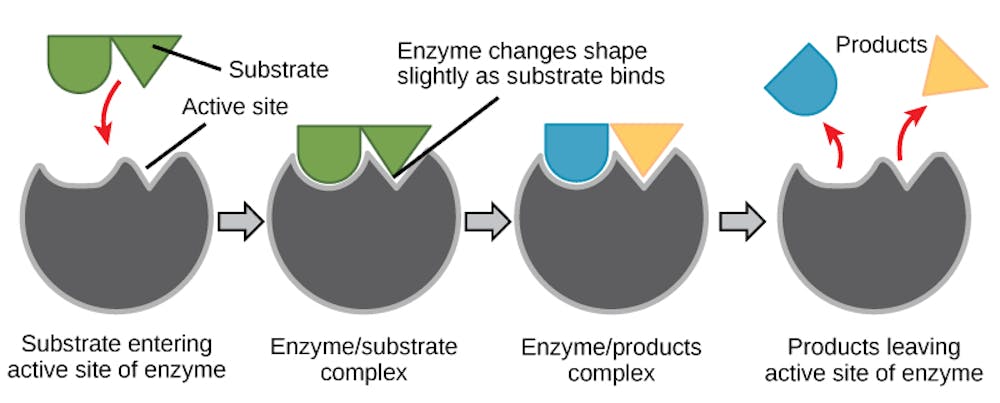
For an enzyme to function, it adopts a shape that perfectly matches the molecule it processes, much like a lock matches a key. The unique grooves in the enzyme – the lock – that interact with the target molecule – the key – are found in a region of the enzyme known as the active site.
The induced fit model of enzymes states that both the enzyme and its substrate change shape when they interact. OpenStax, CC BY-SA
The active site of the enzyme precisely orients amino acids to interact with the target molecule when it enters. This makes it easier for the molecule to undergo a chemical reaction to turn into a different one, making the process go faster. After the chemical reaction is done, the new molecule is released and the enzyme is ready to process another.
How do you design an enzyme?
Scientists have spent decades trying to design their own enzymes to make new molecules, materials or therapeutics. But making enzymes that look like and go as fast as those found in nature is incredibly difficult.
Enzymes have complex, irregular shapes that are made up of hundreds of amino acids. Each of these building blocks needs to be placed perfectly or else the enzyme will slow down or completely shut off. The difference between a speed racer and slowpoke enzyme can be a distance of less than the width of a single atom.
Initially, scientists focused on modifying the amino acid sequences of existing enzymes to improve their speed or stability. Early successes with this approach primarily improved the stability of enzymes, enabling them to catalyze chemical reactions at a higher range of temperatures. But this approach was less useful for improving the speed of enzymes. To this day, designing new enzymes by modifying individual amino acids is generally not an effective way to improve natural enzymes.
This model of acetylcholinesterase shows acetylcholine (green) bound to its active site. Sam Pellock, CC BY-SA
Researchers found that using a process called directed evolution, in which the amino acid sequence of an enzyme is randomly changed until it can perform a desired function, proved much more fruitful. For example, studies have shown that directed evolution can improve chemical reaction speed, thermostability, and even generate enzymes with properties that aren’t seen in nature. However, this approach is typically labor-intensive: You have to screen many mutants to find one that does what you want. In some cases, if there’s no good enzyme to start from, this method can fail to work at all.
Both of these approaches are limited by their reliance on natural enzymes. That is, restricting your design to the shapes of natural proteins likely limits the kinds of chemistry that enzymes can facilitate. Remember, you can’t eat soup with a knife.
Is it possible to make enzymes from scratch, rather than modify nature’s recipe? Yes, with computers.
Designing enzymes with computers
The first attempts to computationally design enzymes still largely relied on natural enzymes as a starting point, focusing on placing enzyme active sites into natural proteins.
This approach is akin to trying to find a suit at a thrift store: It is unlikely you will find a perfect fit because the geometry of an enzyme’s active site (your body in this analogy) is highly specific, so a random protein with a rigidly fixed structure (a suit with random measurements) is unlikely to perfectly accommodate it. The resulting enzymes from these efforts performed much more slowly than those found in nature, requiring further optimization with directed evolution to reach speeds common among natural enzymes.
Recent advances in deep learning have dramatically changed the landscape of designing enzymes with computers. Enzymes can now be generated in much the same way that AI models such as ChatGPT and DALL-E generate text or images, and you don’t need to use native protein structures to support your active site.
AI tools are helping researchers design new proteins.
Our team showed that when we prompt an AI model, called RFdiffusion, with the structure and amino acid sequence of an active site, it can generate the rest of the enzyme structure that would perfectly support it. This is equivalent to prompting ChatGPT to write an entire short story based on a prompt that only says to include the line “And sadly, the eggs never showed up.”
We used this AI model specifically to generate enzymes called serine hydrolases, a group of proteins that have potential applications in medicine and plastic recycling. After designing the enzymes, we mixed them with their intended molecular target to see whether they could catalyze its breakdown. Encouragingly, many of the designs we tested were able to break down the molecule, and better than previously designed enzymes for the same reaction.
To see how accurate our computational designs were, we used a method called X-ray crystallography to determine the shapes of these enzymes. We found that many of them were a nearly perfect match to what we digitally designed.
Our findings mark a key advance in enzyme design, highlighting how AI can help scientists start to tackle complex problems. Machine learning tools could help more researchers access enzyme design and tap into the full potential of enzymes to solve modern-day problems.
Sam Pellock receives funding from the Washington Research Foundation and Schmidt Futures program.
The global secretariat of the Global Validation Advisory Committee (GVAC) on the validation of elimination of mother-to-child transmission and elimination of viral hepatitis B and C as a public health problem has considered the appointment of four new members to the Committee. The new members bring expertise crucial to viral hepatitis C elimination to the GVAC. With these appointments, the Global Validation Secretariat bolsters the capacity of the GVAC to conduct its mission for assessing whether countries have met the criteria for validation of hepatitis elimination as a public health problem.
The new members are:
Dr Kimberly Green, Global Director for Primary Health Care (PHC), PATH, United States of America. Dr Green will bring expertise in prevention and service delivery of viral hepatitis.
Ms Rachel Halford, Chief Executive Officer, The Hepatitis C Trust, United Kingdom of Great Britain and Northern Ireland. Ms Halford will bring expertise in civil society, human rights, community engagement and lived experience of hepatitis C.
Dr Ajeet Singh Bhadoria, Additional Professor, Department of Community and Family Medicine, All India Institute of Medical Sciences, India. Dr Singh Bhadoria will bring expertise in epidemiology of liver diseases, patient care and services for viral hepatitis.
Dr Ibou Thior, Senior Technical Adviser, PATH, United States of America. Dr Thior will bring expertise in viral hepatitis research, blood safety and injection safety for prevention of hepatitis C.
To enhance WHO’s management of conflicts of interest, as well as strengthen public trust and transparency in connection with WHO advisory groups involving the provision of technical advice, the names and brief biographies of individuals being considered for assignment to WHO advisory groups are disclosed for public notice and comment.
The comments received by WHO through the public notice and comment process are treated confidentially and their receipt will be acknowledged through a generic email notification to the sender. Comments and perceptions brought to the attention of WHO through this process are an integral component of WHO’s conflict of interest assessment policy and are carefully reviewed. WHO reserves the right to discuss information received through this process with the relevant expert with no attribution to the provider of such information. Upon review and assessment of the information received through this process, WHO, in its sole discretion, may take appropriate management action in accordance with its policies.
The list of participating experts, a summary of relevant interests disclosed by such experts, and any appropriate mitigation measures taken by WHO relating to the management of conflicts of interests, will be reported publicly in accordance with WHO practice.
The deadline for public comments is 24 February 2025. Please send your comment to gvacsecretariat@who.int with subject: Public comments on new GVAC members.
WorkSafe New Zealand is calling on farmers to consider how vehicles move inside their barns and sheds, following a sentencing for an horrific death at one of South Canterbury’s biggest agribusinesses.
Louis van Heerden was crushed to death by an hydraulic tailgate on a trailer at Turley Farms Limited near Temuka in March 2022. The 45-year-old had been standing at the back of a dark, narrow shed as a spotter while grass seed was being tipped off the trailer.
WorkSafe investigators found Turley Farms had no specific plan in place for managing farm traffic indoors. In addition, workers should not have been permitted in such a restricted space.
Turley Farms has now been sentenced for its health and safety failings.
“Farmers are tempting fate if they think traffic only needs to be managed outdoors. Without a clear plan for how vehicles and people move around indoor barns and sheds, it’s only a matter of time before something goes terribly wrong,” says WorkSafe’s area investigation manager, Steve Kelly.
“This is a good reminder to take a critical look at how tractors and other vehicles move around inside farm buildings. Clear separation of vehicles and pedestrians is the key component. Signage and designated safe areas are also simple and inexpensive ways to boost safety – especially when compared to a conviction and a fine.”
Following the fatality, Turley Farms has introduced reversing cameras, closing alarms, and isolation valves to the back of its trailers.
Vehicles are a leading cause of death and injury on New Zealand farms, which is why agriculture is a priority sector under WorkSafe’s new strategy. Agriculture accounts for around 25 percent of serious acute harm in Aotearoa while having only six percent of employment.
Businesses must manage their risks, and WorkSafe’s role is to influence businesses to meet their responsibilities and keep people healthy and safe. When they do not, we will take action.
Turley Farms Limited was sentenced at Timaru District Court on 13 February 2025
A fine of $247,500 was imposed, and reparations of $201,477 were ordered
Turley Farms was charged under sections 36(1)(a), 48(1) and 48(2)(c) of the Health and Safety at Work Act 2015
Being a PCBU, having a duty to ensure, so far as is reasonably practicable, the health and safety of workers who work for the PCBU, including Louis Frederick van Heerden, while at work in the business or undertaking, namely acting as a spotter while plant was being unloaded into a drying shed, did fail to comply with that duty and that failure exposed workers, namely Louis Frederick van Heerden, to a risk of death or serious injury arising from exposure to the risk of being struck or crushed by plant.
The maximum penalty is a fine not exceeding $1.5 million.
The Congressional Budget Act of 1974 requires the Congressional Budget Office to prepare a cost estimate for nearly every bill that is approved by a full committee of either the House or Senate. For those estimates, CBO produces a point estimate—that is, a specific amount—rather than a range. The estimates specify the legislation’s likely effects on federal outlays and revenues compared with the agency’s projections of what would occur under current law over a 10-year period (projections often referred to as CBO’s baseline). Lawmakers can use CBO’s cost estimates to inform their deliberations and enforce budgetary rules. Those estimates generally reflect the middle of the distribution of the most likely budgetary outcomes that would result if a piece of legislation was enacted. Though representing the agency’s best assessment of the legislation’s budgetary effects, estimates can be subject to uncertainty arising from various sources. This document describes how CBO addresses the most common sources of uncertainty in its cost estimates.
Although uncertainty has many sources, this document addresses six.
Ross D. MacKinnon, former dean of the College of Liberal Arts and Sciences (CLAS) and Professor Emeritus of geography, passed away from pancreatic cancer at his home in Sonoma, California, surrounded by family, on Jan. 27, 2025, at the age of 82.
A dedicated leader and scholar, MacKinnon left a lasting impact on UConn and the many students, faculty, and colleagues who had the privilege of working with him.
As dean of CLAS from 1996 to 2008, he oversaw a period of transformative growth and investment in the College. He played a pivotal role in guiding CLAS through the UConn 2000 capital program, a state-funded initiative that revitalized the University and strengthened its academic foundation.
Throughout his tenure, he championed major investments in faculty hiring, research, and academic programs. He also spearheaded several multidisciplinary initiatives that continue to shape UConn’s academic community today.
Among his many accomplishments, he led the creation of the UConn Humanities Institute, which supports humanities scholarship through funding, fellowships, and programming. He was also instrumental in establishing the Human Rights Institute and the Center for Health, Intervention, and Prevention, now known as the Institute for Collaboration on Health, Intervention, and Policy.
Before joining UConn, MacKinnon served as dean of the Faculty of Social Sciences and professor of geography at the State University of New York at Buffalo. He previously served as head of SUNY Buffalo’s Department of Geography, during which time he strengthened the department’s graduate program and scholarly reputation. Prior to that, he was a faculty member in the University of Toronto’s geography department.
MacKinnon earned a bachelor’s degree in geography from the University of British Columbia in 1964, a Master of Science in geography from Northwestern University in 1966, and a Ph.D. in geography from Northwestern University in 1968.
He was a proud Canadian and naturalized U.S. citizen who believed in the promise of America. He loved traveling, sharing a good meal with friends, live jazz, contemporary painting, new plays, UConn men’s and women’s basketball, and the Buffalo Bills. He had a great sense of humor and was quick with encouragement.
He is survived by his wife, Marilyn Hoskin, and his two daughters, Pam and Caroline MacKinnon.
His family asks those who wish to honor his memory to take a moment to remember Ross and consider supporting the Dean Ross MacKinnon Endowment for CLAS Graduate Fellows.
Flighttime Enterprises Inc., an American subsidiary of a Russian aircraft parts supplier, along with three of its current and former employees, have been charged federally with crimes related to a scheme to illegally export aircraft parts and components from the United States to Russia and Russian airline companies without the required licenses from the Department of Commerce.
The three individuals charged include Daniela Friery, 43, a naturalized U.S. citizen residing in Loveland, Ohio; Pavil Iglin, 46, a citizen of Russia who currently resides in Florida pursuant to a non-immigrant visa; and Marat Aysin, 39, a legal permanent resident of the United States who currently resides in Florida.
According to the 11-count indictment unsealed today, the three defendants worked for Flighttime Enterprises Inc., an aircraft equipment supplier with office locations near West Chester, Ohio, and Miami.
As alleged in the indictment, following Russia’s further invasion of Ukraine in February 2022, Flighttime and the individual defendants knowingly and willfully violated and evaded the export restrictions imposed on Russia to ship aviation parts to Russia and Russian end users, including airlines subject to Department of Commerce Temporary Denial Orders, by mislabeling shipments, providing false certifications, and using intermediary companies and countries to obscure the true end destination and end users. The indictment details four specific export transactions totaling more than $2 million.
For example, in June 2022, Flighttime employees allegedly negotiated the purchase of an auxiliary power unit from an American supplier for $395,000. The U.S. supplier initially expressed hesitation about the transaction due to the company’s connections to Russia. In connection with the purchase, Aysin falsely told the American supplier that the part would be used to replenish stock in West Chester. Through Aysin, Iglin allegedly signed and dated a Russia end-user certificate with the supplier falsely certifying that the part would not be exported to Russia. The part was thereafter illegally exported to Russia for a Russian aviation company without the required license.
The company and three defendants are each charged with one count of conspiring to violate the Export Control Reform Act (ECRA), and multiple counts of violating the ECRA, which are federal crimes punishable by up to 20 years in prison.
They are also charged with conspiracy to commit smuggling, which carries a maximum penalty of five years in prison, and multiple counts of smuggling, which carry maximum penalties of 10 years in prison. Finally, they are each charged with one count of conspiring to launder monetary instruments, a federal crime punishable by up to 10 years in prison.
Sue J. Bai, head of the Justice Department’s National Security Division; U.S. Attorney Kenneth L. Parker for the Southern District of Ohio; Special Agent in Charge Elena Iatarola of the FBI Cincinnati Field Office; and Special Agent in Charge Jeffrey Levine of the Office of Export Enforcement, Bureau of Industry and Security (BIS) announced the case.
The FBI and BIS are investigating the case.
Assistant U.S. Attorney Timothy S. Mangan for the Southern District of Ohio is prosecuting the case with assistance from Trial Attorneys Maria Fedor and Menno Goedman of the National Security Division’s Counterintelligence and Export Control Section.
An indictment is merely an allegation. All defendants are presumed innocent until proven guilty beyond a reasonable doubt in a court of law.
Flighttime Enterprises Inc., an American subsidiary of a Russian aircraft parts supplier, along with three of its current and former employees, have been charged federally with crimes related to a scheme to illegally export aircraft parts and components from the United States to Russia and Russian airline companies without the required licenses from the Department of Commerce.
The three individuals charged include Daniela Friery, 43, a naturalized U.S. citizen residing in Loveland, Ohio; Pavil Iglin, 46, a citizen of Russia who currently resides in Florida pursuant to a non-immigrant visa; and Marat Aysin, 39, a legal permanent resident of the United States who currently resides in Florida.
According to the 11-count indictment unsealed today, the three defendants worked for Flighttime Enterprises Inc., an aircraft equipment supplier with office locations near West Chester, Ohio, and Miami.
As alleged in the indictment, following Russia’s further invasion of Ukraine in February 2022, Flighttime and the individual defendants knowingly and willfully violated and evaded the export restrictions imposed on Russia to ship aviation parts to Russia and Russian end users, including airlines subject to Department of Commerce Temporary Denial Orders, by mislabeling shipments, providing false certifications, and using intermediary companies and countries to obscure the true end destination and end users. The indictment details four specific export transactions totaling more than $2 million.
For example, in June 2022, Flighttime employees allegedly negotiated the purchase of an auxiliary power unit from an American supplier for $395,000. The U.S. supplier initially expressed hesitation about the transaction due to the company’s connections to Russia. In connection with the purchase, Aysin falsely told the American supplier that the part would be used to replenish stock in West Chester. Through Aysin, Iglin allegedly signed and dated a Russia end-user certificate with the supplier falsely certifying that the part would not be exported to Russia. The part was thereafter illegally exported to Russia for a Russian aviation company without the required license.
The company and three defendants are each charged with one count of conspiring to violate the Export Control Reform Act (ECRA), and multiple counts of violating the ECRA, which are federal crimes punishable by up to 20 years in prison.
They are also charged with conspiracy to commit smuggling, which carries a maximum penalty of five years in prison, and multiple counts of smuggling, which carry maximum penalties of 10 years in prison. Finally, they are each charged with one count of conspiring to launder monetary instruments, a federal crime punishable by up to 10 years in prison.
Sue J. Bai, head of the Justice Department’s National Security Division; U.S. Attorney Kenneth L. Parker for the Southern District of Ohio; Special Agent in Charge Elena Iatarola of the FBI Cincinnati Field Office; and Special Agent in Charge Jeffrey Levine of the Office of Export Enforcement, Bureau of Industry and Security (BIS) announced the case.
The FBI and BIS are investigating the case.
Assistant U.S. Attorney Timothy S. Mangan for the Southern District of Ohio is prosecuting the case with assistance from Trial Attorneys Maria Fedor and Menno Goedman of the National Security Division’s Counterintelligence and Export Control Section.
An indictment is merely an allegation. All defendants are presumed innocent until proven guilty beyond a reasonable doubt in a court of law.
Two men were arrested on February 12, 2025, by RCMP NL’s West District General Investigation Section (GIS) at a traffic stop that was conducted on Route 430.
As part of an ongoing investigation, at approximately 7:30 p.m. on Wednesday, GIS, with assistance from Deer Lake RCMP, stopped a vehicle on Route 430 near Reidville. The two vehicle occupants were arrested for possession for the purpose of drug trafficking.
At the traffic stop, officers located and seized a quantity of cocaine, more than $2000.00 cash and other items consistent with possession for the purpose of drug trafficking. Both men were transported to Deer Lake detachment and were released on a number of conditions. The pair are set to appear in court at a later date, each to face a charge of possession for the purpose of trafficking cocaine.
The investigation is continuing.
If you have information about drug activity in your community, please contact your local policeor, to remain anonymous, contact Crime Stoppers: #SayItHere 1-800-222-TIPS (8477), visitwww.nlcrimestoppers.comor use the P3Tips app.
Through Kickbacks and Bribes, Defendants Illegally Diverted Tens of Millions of Dollars from COVID-19 Emergency Housing Program to Enrich Themselves
Earlier today, at the federal court in Brooklyn, an indictment was unsealed charging Julio Medina, Christopher Dantzler and Weihong Hu with conspiracy to commit wire fraud, honest-services wire fraud, money laundering conspiracy, conspiracy to violate the Travel Act and the use of a facility of interstate commerce in aid of commercial bribery. This morning, Dantzler was arrested on Long Island, Hu in Manhattan and Medina in the Bronx. They will be arraigned this afternoon before United States Magistrate Judge James R. Cho.
John J. Durham, United States Attorney for the Eastern District of New York, Jocelyn E. Strauber, Commissioner, New York City Department of Investigation (DOI) and James E. Dennehy, Assistant Director in Charge, Federal Bureau of Investigation, New York Field Office (FBI), announced the arrests and charges.
“The defendants’ brazen and illegal kickback scheme stole money from the City of New York that was intended to provide emergency housing and support services during the pandemic,” stated United States Attorney Durham. “Shamefully, the defendants saw the pandemic as an opportunity to line their pockets with stacks of cash, finance a luxury vehicle, purchase homes and pay off personal debts. While New York City was trying to curb the spread of COVID-19, the defendants exploited a nonprofit organization to enrich themselves. My Office will relentlessly pursue those who steal public funds and deprive members of our community of crucial resources.”
DOI Commissioner Strauber stated: “As charged, these defendants, an Executive Director of a City-funded nonprofit and the principals of the nonprofit’s subcontractors, engaged in and concealed a bribery and kickback scheme, pocketing millions of dollars of funds intended to provide emergency housing and support services in New York City during the COVID-19 pandemic. I thank the Mayor’s Office of Risk Management and Compliance for the referral to DOI that prompted this investigation and the U.S. Attorney’s Office for the Eastern District of New York and the FBI for their partnership and commitment to protect critical public resources.”
“These three defendants allegedly pocketed millions of dollars from public funds allocated for emergency housing during the pandemic,” stated FBI Assistant Director in Charge Dennehy. “This alleged kickback scheme abused a program designed to provide a vulnerable population with healthier, unexposed lodging alternatives, to finance enhancements to the defendants’ lifestyles. The FBI will never tolerate any individual who twists public programs into a mechanism to sell services for personal profit.”
As alleged in the indictment, Medina founded and served as the Executive Director and Chief Executive Officer of a non-profit organization that, among other things, provided various reentry services to formerly incarcerated individuals (the “Organization”). In June 2020, the New York City Mayor’s Office of Criminal Justice (MOCJ) contracted with the Organization to administer an emergency transitional housing program (the “Emergency Housing Program”), in partnership with local hotels and other businesses, to combat the spread of COVID-19 in New York City jails. The Organization subsequently entered into agreements with various hotels to operate as reentry hotels under the Emergency Housing Program. In total, between June 2020 and December 2023, the Organization received approximately $122 million in public funds from MOCJ to operate the Emergency Housing Program at these hotels.
Dantzler and Hu each operated or controlled businesses that received tens of millions of dollars in public funds from the Organization under the Emergency Housing Program. Dantzler’s company purported to provide security services at the reentry hotels but was not a licensed security company and did not, in fact, provide security services. Hu operated or controlled two hotels in Queens that operated as reentry hotels under the Emergency Housing Program and was a member of a repurposed catering company that provided food services to formerly incarcerated individuals residing at reentry hotels under the Emergency Housing Program.
Medina solicited and accepted bribes and kickbacks from Dantzler and Hu in exchange for Medina providing business through the Organization to Dantzler’s and Hu’s respective businesses under the Emergency Housing Program. Among other bribes and kickbacks, Dantzler and Hu purchased Medina an approximately $1.3 million townhouse; Hu, through one of her businesses, financed a luxury vehicle for Medina valued at approximately $107,000; and Dantzler paid to purchase and renovate a house for Medina for approximately $750,000.
As depicted in the following photograph, during an in-person meeting in September 2020, Hu also provided Medina with a stack of wrapped U.S. currency in exchange for two checks from the Organization made out to Hu’s catering company, totaling more than $187,000.
In total, Dantzler and Hu provided Medina with at least $2.5 million in U.S. currency and in-kind benefits in exchange for Medina steering approximately $51 million in public funds from the Emergency Housing Program to Dantzler’s and Hu’s businesses. In turn, Dantzler’s security company received approximately $21 million in public funds from the Organization under the Emergency Housing Program, of which Dantzler personally retained approximately $9 million in public funds. Hu’s hotels received approximately $12 million in public funds from the Organization under the Emergency Housing Program, while her repurposed catering company received approximately $17 million in public funds.
The charges in the indictment are allegations and the defendants are presumed innocent unless and until proven guilty.
The government’s case is being handled by the Office’s Public Integrity Section. Assistant United States Attorneys Meredith A. Arfa, Eric Silverberg and Sean M. Sherman are in charge of the prosecution, with assistance from Paralegal Specialists Kavya Kannan and Rebecca Roth.
Monteverde & Associates PC (the “M&A Class Action Firm”), has recovered millions of dollars for shareholders and is recognized as a Top 50 Firm by ISS Securities Class Action Services Report. We are headquartered at the Empire State Building in New York City and are the only firm to have filed a federal securities class action lawsuit on behalf of former public common shareholders of Avangrid, Inc. (former ticker symbol: AGR), in connection with the acquisition by Iberdrola, S.A. (the “Merger”). The case is styled Goldschein v. Avangrid, Inc., Case No. 25-cv-00772 (the “Federal Class Action”), and a copy of the Complaint can be obtained at www.monteverdelaw.com/news.
If you owned Avangrid shares as of August 19, 2024, and received $35.75 at the close of the Merger, please contact our firm to discuss your legal rights.
TIME IS OF THE ESSENCE: If you wish to serve as lead plaintiff, you must seek lead appointment in the Federal Class Action by March 31, 2025. For more information, please go to https://monteverdelaw.com/case/avangrid-inc/. It is free and there is no cost or obligation to you. Any member of the putative Class may move the Court to serve as lead plaintiff through counsel of their choice or may choose to do nothing and remain an absent class member.
NOT ALL LAW FIRMS ARE THE SAME. Before you hire a law firm, you should talk to a lawyer and ask:
Do you file class actions and go to Court?
When was the last time you recovered money for shareholders?
What cases did you recover money in and how much?
About Monteverde & Associates PC
Our firm litigates and has recovered money for shareholders…and we do it from our offices in the Empire State Building. We are a national class action securities firm with a successful track record in trial and appellate courts, including the U.S. Supreme Court.
No company, director or officer is above the law. If you owned common stock in Avangrid and have concerns or wish to obtain additional information free of charge, please visit our website or contact Juan Monteverde, Esq. either via e-mail at jmonteverde@monteverdelaw.com or by telephone at (212) 971-1341.
Contact: Juan Monteverde, Esq. MONTEVERDE & ASSOCIATES PC The Empire State Building 350 Fifth Ave. Suite 4740 New York, NY 10118 United States of America jmonteverde@monteverdelaw.com Tel: (212) 971-1341
Attorney Advertising. (C) 2025 Monteverde & Associates PC. The law firm responsible for this advertisement is Monteverde & Associates PC (www.monteverdelaw.com). Prior results do not guarantee a similar outcome with respect to any future matter.