Blog

  • Peptides: performance-boosting, anti-ageing drugs or dangerous snake oil?

    Source: ForeignAffairs4

    Source: The Conversation – UK – By Adam Taylor, Professor of Anatomy, Lancaster University

    PeopleImages.com – Yuri A/Shutterstock.com

    For a growing number of middle-aged men, ageing no longer means surrendering to sagging skin, sore joints or slowing metabolism. Instead, it’s becoming a science experiment. The new frontier? Injectable peptides – experimental compounds that promise rapid recovery, fat loss and muscle gains with the ease of a twice-daily to weekly jab.

    Once confined to elite labs and obscure bodybuilding forums, these amino acid chains are now flooding wellness spaces, social media feeds and online marketplaces. Although they are marketed as “next-generation biohacks” and “research chemicals”, many peptides are not approved for human use and lack basic clinical testing.

    Still, their popularity is growing – fuelled by testimonials, influencer hype and the seductive promise of turning back time.

    But beneath the surface of glossy marketing and fitness fantasies lies a far more sobering truth: many of these substances operate in a medical grey zone, with unknown long-term risks, questionable manufacturing standards, and in some cases, life-threatening side-effects.

    Peptides aren’t entirely new to medicine. The first peptide drug – insulin – was isolated in 1921 and became commercially available in 1923. Today over 100 peptide medications are approved, including semaglutide – better known as Ozempic and Wegovy.

    But the compounds now circulating in fitness communities represent a very different category. They’re experimental substances that have shown promise in animal studies but have never undergone proper human trials.

    The ‘Wolverine stack’

    One such compound, first discovered in human gastric juice, that is attracting lots of attention is BPC-157. Early animal studies suggest it may help repair damaged tissue throughout the body.

    Researchers tested it on mice, rats, rabbits and dogs without finding serious side-effects. The compound appears to support healing of the tendons, teeth and digestive organs, including the stomach, intestines, liver and pancreas.

    Scientists don’t yet fully understand how BPC-157 works, but animal studies suggest it triggers several biological processes essential for healing. The compound appears to help cells move to damaged areas and encourages the growth of new blood vessels, bringing nutrients and oxygen to tissues in need of repair.

    Another compound gaining attention is TB500. It is a synthetic version of thymosin beta-4, a naturally occurring protein fragment that plays an important role in repairing and regenerating damaged cells and tissues.

    It also helps protect cells from further harm by reducing inflammation and defending against microbes. The combination of BPC-157 and TB500 has earned the nickname “the Wolverine stack”, named after the Marvel superhero famous for his rapid healing.

    Then there’s IGF-1 LR3, a modified version of a natural protein (IGF-1) linked to muscle growth. This synthetic compound was shown to increase muscle mass by 2.5 times in animal studies, though it has never been studied in humans.

    The limited human research that does exist for these compounds offers inconclusive results. For example, a study showed that over 90% of patients experienced reduced knee pain after BPC-157 injections. However, the study had no control group and several methodological issues, so the results should be viewed with caution.

    Hidden dangers

    Even though the early results seem exciting, these experimental compounds can be dangerous. Making them involves special chemicals called coupling agents, which can trigger serious allergic reactions, including anaphylaxis – a life-threatening condition.

    The health consequences extend well beyond allergic reactions. Long-term injection of performance-enhancing substances can lead to heart failure that can occur rapidly with little warning, as documented in recent medical case studies of young bodybuilders.

    Injection-related injuries pose another significant threat. “Compartment syndrome” can develop at injection sites in leg muscles, causing numbness, blood clots and muscle spasms that result in permanent loss of function.

    In severe cases, skin and underlying tissue can suffer necrosis (tissue death), requiring antibiotics or surgery to treat. More alarming still are reports of users contracting HIV, hepatitis B and C, and serious eye infections from contaminated injections.

    These compounds don’t just target muscles – they affect the entire body in ways scientists are only beginning to understand. Some interfere with natural insulin production, while others activate biological pathways that healthy cells use for growth and repair.

    The concern is that these same pathways are exploited by cancer cells. The VEGF pathway, which promotes blood vessel growth, is active in about half of all human cancers, including melanoma and ovarian cancer. Laboratory studies suggest that thymosin beta-4 may play a role in helping colorectal and pancreatic cancers spread.

    While there’s no direct evidence linking compounds like BPC-157 or TB500 to cancer, researchers emphasise that the long-term effects remain unknown because these substances have never undergone proper human trials. The World Anti-Doping Agency has banned these compounds, noting they lack approval from any health regulatory authority and are intended only as research tools.

    A growing problem

    Yet their use appears to be spreading rapidly. A 2014 study found that 8.2% of gym members used performance-enhancing drugs. By 2024, a comprehensive review suggested the figure could be as high as 29%. Perhaps most concerning: only 38% of users recognised the health risks involved.

    These experimental compounds represent a dangerous gamble with long-term health. Unlike approved drugs, they haven’t undergone the rigorous testing required to understand their safety profile in humans. While they may promise enhanced performance and healing, they deliver it at a cost that users may not fully understand until it’s too late.

    The appeal is understandable – who wouldn’t want faster healing and better muscle tone? But the reality is these substances remain experimental for good reason. Until proper human trials are conducted, users are essentially volunteering as test subjects in an uncontrolled experiment with their own bodies.


    Get your news from actual experts, straight to your inbox. Sign up to our daily newsletter to receive all The Conversation UK’s latest coverage of news and research, from politics and business to the arts and sciences.

    The Conversation

    Adam Taylor does not work for, consult, own shares in or receive funding from any company or organisation that would benefit from this article, and has disclosed no relevant affiliations beyond their academic appointment.

    ref. Peptides: performance-boosting, anti-ageing drugs or dangerous snake oil? – https://theconversation.com/peptides-performance-boosting-anti-ageing-drugs-or-dangerous-snake-oil-259531
  • The treaty meant to control nuclear risks is under strain 80 years after the US bombings of Hiroshima and Nagasaki

    Source: ForeignAffairs4

    Source: The Conversation – USA (2) – By Stephen Herzog, Professor of the Practice, Middlebury Institute of International Studies at Monterey, Middlebury

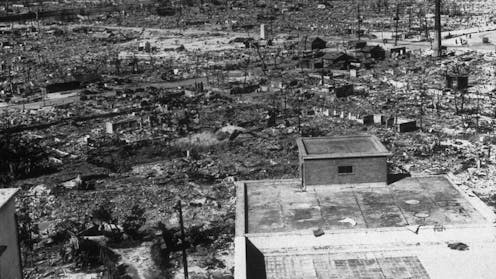
    The city of Hiroshima was destroyed when the United States dropped atomic bomb “Little Boy” on Aug. 6, 1945. Hulton Archive/Getty Images

    Eighty years ago – on Aug. 6 and 9, 1945 – the U.S. military dropped atomic bombs on Hiroshima and Nagasaki, Japan, thrusting humanity into a terrifying new age. In mere moments, tens of thousands of people perished in deaths whose descriptions often defy comprehension.

    The blasts, fires and lingering radiation effects caused such tragedies that even today no one knows exactly how many people died. Estimates place the death toll at up to 140,000 in Hiroshima and over 70,000 in Nagasaki, but the true human costs may never be fully known.

    The moral shock of the U.S. attacks reverberated far beyond Japan, searing itself into the conscience of global leaders and the public. It sparked a movement I and others continue to study: the efforts of the international community to ensure that such horrors are never repeated.

    Two people in protective clothing, helmets and masks stand near blue barrels outside a building.
    Inspectors from the International Atomic Energy Agency visit an Iraqi nuclear facility in 2003, seeking to ensure that the country did not use peaceful nuclear materials to develop weapons.
    Ramzi Haidar/AFP via Getty Images

    Racing toward the brink

    The memories of Hiroshima and Nagasaki cast a long shadow over global efforts to contain nuclear arms. The 1968 Treaty on the Non-Proliferation of Nuclear Weapons, more commonly known as the Nuclear Nonproliferation Treaty, was a powerful, if imperfect, effort to prevent future nuclear catastrophe. Its creation reflected not just morality, but also the practical fears and self-interests of nations.

    As the years passed, views of the bombings as justified acts began to shift. Harrowing firsthand accounts from Hibakusha – the survivors – reached wide audiences. One survivor, Setsuko Thurlow, described the sight of other victims:

    “It was like a procession of ghosts. I say ‘ghosts’ because they simply did not look like human beings. Their hair was rising upwards, and they were covered with blood and dirt, and they were burned and blackened and swollen. Their skin and flesh were hanging, and parts of the bodies were missing. Some were carrying their own eyeballs.”

    Nuclear dangers increased further with the advent of hydrogen bombs, or thermonuclear weapons, capable of destruction far greater than the atomic bombs dropped on Hiroshima and Nagasaki. What had once seemed a decisive end to a global war now looked like the onset of an era wherein no city or civilization would truly be safe.

    These shifting perceptions shaped how nations viewed the nuclear age. In the decades following World War II, nuclear technology rapidly spread. By the early 1960s, the United States and the Soviet Union aimed thousands of nuclear warheads at one another.

    Meanwhile, there were concerns that countries in East Asia, Europe and the Middle East would acquire the bomb. U.S. President John F. Kennedy even warned that “15 or 20 or 25 nations” might be able to develop nuclear weapons during the 1970s, resulting in the “greatest possible danger” to humanity – the prospect of its extinction. This warning, like much of the early nonproliferation rhetoric, drew its urgency from the legacies of Hiroshima and Nagasaki.

    Perhaps the starkest indication of the gravity of the stakes emerged during the Cuban missile crisis of October 1962. For 13 days, the world teetered on the edge of nuclear annihilation until the Soviet Union withdrew its missiles from Cuba in exchange for the secret withdrawal of U.S. missiles from Turkey. During those long days, U.S. and Soviet leaders – and external observers – witnessed how quickly the risks of global destruction could escalate.

    Two ships steam side by side with an aircraft flying overhead.
    A Soviet freighter, center, is escorted out of Cuban waters by a U.S. Navy plane and the destroyer USS Barry during the 1962 Cuban missile crisis.
    Underwood Archives/Getty Images

    Crafting the grand bargain

    In the wake of such “close calls” – moments where nuclear war was narrowly averted due to individual judgment or sheer luck – diplomacy accelerated.

    Negotiations on a treaty to control nuclear proliferation continued at meetings of the Eighteen Nation Disarmament Committee in Geneva from 1965 to 1968. While the enduring horrors of Hiroshima and Nagasaki helped to drive the momentum, national interests largely shaped the talks.

    There were three groups of negotiating parties. The United States was joined by its NATO allies Britain, Canada, Italy and France – which only observed. The Soviet Union led a communist bloc containing Bulgaria, Czechoslovakia, Poland and Romania. And there were nonaligned countries: Brazil; Burma, now known as Myanmar; Ethiopia; India; Mexico; Nigeria; Sweden, which only joined NATO in 2024; and the United Arab Republic, now known as Egypt.

    For the superpowers, a treaty to limit the spread of the bomb was as much a strategic opportunity as a moral imperative.
    Keeping the so-called “nuclear club” small would not only stabilize international tensions, but it would also cement Washington’s and Moscow’s global leadership and prestige.

    U.S. leaders and their Soviet counterparts therefore sought to promote nonproliferation abroad. Perhaps just as important as ensuring nuclear forbearance among their adversaries was preventing a cascade of nuclear proliferation among allies that could embolden their friends and spiral out of control.

    Standing apart from these Cold War blocs were the nonaligned countries. Many of them approached the atomic age through a humanitarian and moral lens. They demanded meaningful action toward nuclear disarmament to ensure that no other city would suffer the tragic fate of Hiroshima and Nagasaki.

    The nonaligned countries refused to accept a two-tiered treaty merely codifying inequality between nuclear “haves” and “have-nots.” In exchange for agreeing to forgo the bomb, they demanded two crucial commitments that shaped the resulting treaty into what historians often describe as a “grand bargain.”

    The nonaligned countries agreed in the treaty to permit the era’s existing nuclear powers – Britain, China, France, the Soviet Union (later Russia) and the United States – to temporarily maintain their arsenals while committing to future disarmament. But in exchange, they were promised peaceful nuclear technology for energy, medicine and development. And to reduce the risks of anyone turning peaceful nuclear materials into weapons, the treaty empowered the International Atomic Energy Agency to conduct inspections around the world.

    People sit at a large table and sign documents.
    U.S. President Lyndon B. Johnson, right, looks on as Secretary of State Dean Rusk signs the Nuclear Non-Proliferation Treaty on July 1, 1968.
    Corbis via Getty Images

    Legacies and limits

    The treaty entered into force in 1970 and with, 191 member nations, is today among the world’s most universal accords. Yet, from the outset, its provisions faced limits. Nuclear-armed India, Israel and Pakistan have always rejected the treaty, and North Korea later withdrew to develop its own nuclear weapons.

    In response to evolving challenges, such as the discovery of Iraq’s clandestine nuclear weapons program in the early 1990s, International Atomic Energy Agency safeguard efforts grew more stringent. Many countries agreed to accept nuclear facility inspections on shorter notice and involving more intrusive tools as part of the initiative to detect and deter the development of the world’s most powerful weapons. And the countries of the world extended the treaty indefinitely in 1995, reaffirming their commitment to nonproliferation.

    The treaty represents a complex compromise between morality and pragmatism, between the painful memories of Hiroshima and Nagasaki and hard-edged geopolitics. Despite its many imperfections and its de facto promotion of nuclear inequality, the treaty is credited with limiting nuclear proliferation to just nine countries today. It has done so through civilian nuclear energy incentives and inspections that give countries confidence that their rivals are not building the bomb. Countries also put pressure on each other to obey the rules, such as when the international community condemned, sanctioned and isolated North Korea after it withdrew from the treaty and tested a nuclear weapon.

    But the treaty continues to face serious challenges. Critics argue that its disarmament provisions remain vague and unfulfilled, with some scholars contending that nonnuclear countries should exit the treaty to encourage the great powers to disarm. Nuclear-armed countries continue to modernize – and in some cases, expand – their arsenals, eroding trust in the grand bargain.

    Armed soldiers walk next to a barbed-wire fence.
    Tensions between India and Pakistan can often carry veiled, or even explicit, threats of nuclear action.
    Mukesh Gupta/AFP via Getty Images

    The behavior of individual countries also points to strains on the treaty. Russia’s persistent nuclear threats during its war on Ukraine show how deeply possessors may still rely on these weapons as tools of coercive foreign policy. North Korea continues to wield its nuclear arsenal in ways that undermine international security. Iran might consider proliferation to deter future Israeli and U.S. strikes on its nuclear facilities.

    Still, I would argue that declaring the treaty to be dead is simply premature. Critics have predicted its demise since the treaty’s inception in 1968. While many countries have growing frustrations with the existing system of nonproliferation, most of them still see more benefit in staying than walking away from the treaty.

    The treaty may be embattled, but it remains intact. Worryingly, the world today appears far removed from the vision of avoiding nuclear catastrophe that Hiroshima and Nagasaki helped awaken. As nuclear dangers intensify and disarmament stalls, moral clarity risks fading into ritual remembrance.

    I believe that for the sake of humanity’s future, the tragedies of the atomic bombings must remain a stark and unmistakable warning, not a precedent. Ultimately, the Nuclear Nonproliferation Treaty’s continued relevance depends on whether nations still believe that shared security begins with shared restraint.

    The Conversation

    Stephen Herzog does not work for, consult, own shares in or receive funding from any company or organization that would benefit from this article, and has disclosed no relevant affiliations beyond their academic appointment.

    ref. The treaty meant to control nuclear risks is under strain 80 years after the US bombings of Hiroshima and Nagasaki – https://theconversation.com/the-treaty-meant-to-control-nuclear-risks-is-under-strain-80-years-after-the-us-bombings-of-hiroshima-and-nagasaki-262164

  • From printing presses to Facebook feeds: What yesterday’s witch hunts have in common with today’s misinformation crisis

    Source: ForeignAffairs4

    Source: The Conversation – USA (3) – By Julie Walsh, Whitehead Associate Professor of Critical Thought and Associate Professor of Philosophy, Wellesley College

    An illustration from ‘The History of Witches and Wizards,’ published in 1720, depicting witches offering wax dolls to the devil. Wellcome Collection/Wikimedia Commons

    Between 1400 and 1780, an estimated 100,000 people, mostly women, were prosecuted for witchcraft in Europe. About half that number were executed – killings motivated by a constellation of beliefs about women, truth, evil and magic.

    But the witch hunts could not have had the reach they did without the media machinery that made them possible: an industry of printed manuals that taught readers how to find and exterminate witches.

    I regularly teach a class on philosophy and witchcraft, where we discuss the religious, social, economic and philosophical contexts of early modern witch hunts in Europe and colonial America. I also teach and research the ethics of digital technologies.

    These fields aren’t as different as they seem. The parallels between the spread of false information in the witch-hunting era and in today’s online information ecosystem are striking – and instructive.

    Birth of a publishing empire

    The printing press, invented around 1440, revolutionized how information spread – helping to create the era’s equivalent of a viral conspiracy theory.

    By 1486, two Dominican friars had published the “Malleus Maleficarum,” or “Hammer of Witches.” The book has three central claims that came to dominate the witch hunts.

    A yellowed title page from a manuscript, with print in black and red ink.
    A 1669 edition of ‘Malleus Maleficarum.’
    Wellcome Collection/Wikimedia Commons, CC BY-SA

    First, it describes women as morally weak and therefore more likely to be witches. Second, it tightly links witchcraft with sexuality. The authors claim that women are sexually insatiable – part of what leads them to witchcraft. Third, witchcraft involves a pact with the devil, who tempts would-be witches through pleasures such as orgies and sexual favors. After establishing these “facts,” the authors conclude with instructions for interrogating, torturing and punishing witches.

    The book was a hit. It had more than two dozen editions and was translated into multiple languages. While “Malleus Maleficarum” was not the only text of its kind, its influence was enormous.

    Prior to 1500, witch hunts in Europe were rare. But after the “Malleus Maleficarum,” they picked up steam. Indeed, new printings of the book correlate with surges in witch-hunting in Central Europe. The book’s success wasn’t just about content; it was about credibility. Pope Innocent VIII had recently affirmed the existence of witches and conferred authority on inquisitors to persecute them, giving the book further authority.

    Ideas about witches [from earlier texts and folklore] – such as the fact that witches could use spells to make penises vanish – were recycled and repackaged in the “Malleus Maleficarum,” which in turn served as a “source” for future works. It was often quoted in later manuals and woven into civic law.

    The popularity and influence of the book helped crystallize a new domain of expertise: demonologist, an expert on the nefarious activities of witches. As demonologists repeated one another’s spurious claims, an echo chamber of “evidence” was born. The identity of the witch was thus formalized: dangerous and decisively female.

    Skeptics fight back

    Not everyone bought into the witch hysteria. As early as 1563, dissenting voices emerged – though, notably, most didn’t argue that witches weren’t real. Instead, they questioned the methods used to identify and prosecute them.

    A faded painting of a bald man with a mustache, wearing a white ruff, heavy necklace, and red robe.
    Essayist Michel de Montaigne, painted around 1578 by an unknown artist.
    Conde Museum/Wikimedia Commons

    Dutch physician Johann Weyer argued that women accused of witchcraft were suffering from melancholia – what we might now call mental illness – and needed medical treatment, not execution. In 1580, French philosopher Michel de Montaigne visited imprisoned witches and concluded they needed “hellebore rather than hemlock”: medicine rather than poison.

    These skeptics also identified something more insidious: the moral responsibility of people spreading the stories. In 1677, English chaplain, physician and philosopher John Webster wrote a scathing critique, claiming that most demonologists’ texts were straightforward copy and paste jobs where the authors repeated one another’s lies. The demonologists offered no original analysis, no evidence and no witnesses – failing to meet the standards of good scholarship.

    The cost of this failure was enormous. As Montaigne wrote, “The witches of my neighborhood are in mortal danger every time some new author comes along and attests to the reality of their visions.”

    Demonologists benefited from the social and political status associated with the popularity of their books. The financial benefit was, for the most part, enjoyed by the printers and booksellers – what today we refer to as publishers.

    Witch hunts petered out throughout the 1700s across Europe. Doubt about the standards of evidence, and increased awareness that accused “witches” may have been suffering from delusion, were factors in the end of the persecution. The skeptics’ voices were heard.

    Psychology of viral lies

    Early modern skeptics understood something we’re still grappling with today: Certain people are more vulnerable to believing extraordinary claims. They identified “melancholics,” people predisposed to anxiety and fantastical thinking, as particularly susceptible.

    Nicolas Malebranche, a 17th-century French philosopher, believed that our imaginations have enormous power to convince us of things that are not true – especially fear of invisible, malevolent forces. He noted that “extravagant tales of witchcraft are taken as authentic histories,” increasing people’s credulity. The more stories, and the more they were told, the greater the influence on the imagination. The repetition served as false confirmation.

    “If they were to cease punishing (women accused of witchcraft) and treat them as mad people,” Malebranche wrote, “in a little while they would no longer be sorcerers.”

    A printed book page labelled 'Witches Apprehended, Examined and Executed,' with a drawing of people submerging a woman in a river.
    The title page of a treatise on witchcraft from 1613.
    Wellcome Collection/Wikimedia Commons, CC BY-SA

    Today’s researchers have identified similar patterns in how misinformation and disinformation – false information intended to confuse or manipulate people – spreads online. We’re more likely to believe stories that feel familiar, stories that connect to content we’ve previously seen. Likes, shares and retweets becomes proxies for truth. Emotional content designed to shock or outrage spreads far and fast.

    Social media channels are particularly fertile ground. Companies’ algorithms are designed to maximize engagement, so a post that receives likes, shares and comments will be shown to more people. The more viewers, the higher the likelihood of more engagement, and so on – creating a cycle of confirmation bias.

    Speed of a keystroke

    Early modern skeptics reserved their harshest criticism not for those who believed in witches but for those who spread the stories. Yet they were curiously silent on the ultimate arbiters and financial beneficiaries of what got printed and circulated: the publishers.

    Today, 54% of American adults get at least some news from social media platforms. These platforms, like the printing presses of old, don’t just distribute information. They shape what we believe through algorithms that prioritize engagement over accuracy: The more a story is repeated, the more priority it gets.

    The witch hunts offer a sobering reminder that delusion and misinformation are recurring features of human society, especially during times of technological change and social upheaval. As we navigate our own information revolution, those early skeptics’ questions remain urgent: Who bears responsibility when false information leads to real harm? How do we protect the most vulnerable from exploitation by those who profit from confusion and fear?

    In an age when anyone can be a publisher, and extravagant tales spread at the speed of a keystroke, understanding how previous societies dealt with similar challenges isn’t just academic – it’s essential.

    The Conversation

    Julie Walsh receives funding from the National Science Foundation

    ref. From printing presses to Facebook feeds: What yesterday’s witch hunts have in common with today’s misinformation crisis – https://theconversation.com/from-printing-presses-to-facebook-feeds-what-yesterdays-witch-hunts-have-in-common-with-todays-misinformation-crisis-260995

  • The World Court just ruled countries can be held liable for climate change damage – what does that mean for the US?

    Source: ForeignAffairs4

    Source: The Conversation – USA (2) – By Lauren Gifford, Faculty, Ecosystem Science & Sustainability; Director, Soil Carbon Solutions Center, Colorado State University

    Ralph Regenvanu, climate change minister of Vanuatu, speaks outside the International Court of Justice in The Hague on July 23, 2025. John Thys/AFP via Getty Images

    The International Court of Justice issued a landmark advisory opinion in July 2025 declaring that all countries have a legal obligation to protect and prevent harm to the climate.

    The court, created as part of the United Nations in 1945, affirmed that countries must uphold existing international laws related to climate change and, if they fail to act, could be held responsible for damage to communities and the environment.

    The opinion opens a door for future claims by countries seeking reparations for climate-related harm.

    But while the ruling is a big global story, its legal effect on the U.S. is less clear. We study climate policies, law and solutions. Here’s what you need to know about the ruling and its implications.

    Why island nations called for a formal opinion

    The ruling resulted from years of grassroots and youth-led organizing by Pacific Islanders. Supporters have called it “a turning point for frontline communities everywhere.”

    Small island states like Vanuatu, Tuvalu, Barbados and others across the Pacific and Caribbean are among the most vulnerable to climate change, yet they have contributed little to global emissions.

    Waves spend spray higher than houses and lap at the edges of homes, with palm trees in the background.
    Waves hit the shore in Majuro, the capital of the Marshall Islands, during a storm on Nov. 27, 2019. Waves inundated parts of the island, washing rocks and debris into roads.
    Hilary Hosia/AFP via Getty Images

    For many of them, sea-level rise poses an existential threat. Some Pacific atolls sit just 1 to 2 meters above sea level and are slowly disappearing as waters rise. Saltwater intrusion threatens drinking water supplies and crops.

    Their economies depend on tourism, agriculture and fishing, all sectors easily disrupted by climate change. For example, coral reefs are bleaching more often and dying due to ocean warming and acidification, undermining fisheries, marine biodiversity and economic sectors such as tourism.

    When disasters hit, the cost of recovery often forces these countries to take on debt. Climate change also undermines their credit ratings and investor confidence, making it harder to get the money to finance adaptive measures.

    A satellite image of the Maldives islands.
    The Maldives, shown in a satellite image from 2020, has an average elevation of less than 5 feet (1.5 meters) above sea level. With limited land where people can live, the country has tried to build up new areas of its islands for housing.
    NASA Earth Observatory

    Tuvalu and Kiribati have discussed digital nationhood and leasing land from other countries so their people can relocate while still retaining citizenship. Some projections suggest nations like the Maldives or Marshall Islands could become largely uninhabitable within decades.

    For these countries, sea-level rise is taking more than their land – they’re losing their history and identity in the process. The idea of becoming climate refugees and separating people from their homelands can be culturally destructive, emotionally painful and politically fraught as they move to new countries.

    More than a nonbinding opinion

    The International Court of Justice, commonly referred to as the ICJ or World Court, can help settle disputes between states when requested, or it can issue advisory opinions on legal questions referred to it by authorized U.N. bodies such as the General Assembly or Security Council. The advisory opinion process allows its 15 judges to weigh in on abstract legal issues – such as nuclear weapons or the Israeli occupation of the Palestinian territories – without a formal dispute between states.

    While the court’s advisory opinions are nonbinding, they can still have a powerful impact, both legally and politically.

    The rulings are considered authoritative statements regarding questions of international law. They often clarify or otherwise confirm existing legal obligations that are binding.

    What the court decided

    The ICJ was asked to weigh in on two questions in this case:

    1. “What are the obligations of States under international law to ensure the protection of the climate system … from anthropogenic emissions of greenhouse gases?”

    2. “What are the legal consequences under these obligations for States where they, by their acts and omissions, have caused significant harm to the climate system?”

    In its 140-page opinion, the court cited international treaties and relevant scientific background to affirm that obligations to protect the environment are indeed a matter of international environmental law, international human rights law and general principles of state responsibility.

    The decision means that in the authoritative opinion of the international legal community, all countries are under an obligation to contribute to the efforts to reduce global greenhouse emissions.

    To the second question, the court found that in the event of a breach of any such obligation, three additional obligations arise:

    1. The country in breach of its obligations must stop its polluting activity, which would mean excess greenhouse gas emissions in this case.

    2. It must ensure that such activities do not occur in the future.

    3. It must make reparations to affected states in terms of cleanup, monetary payment and apologies.

    The court affirmed that all countries have a legal duty under customary international law, which refers to universal rules that arise from common practices among states, to prevent harm to the climate. It also clarified that individual countries can be held accountable, even in a crisis caused by many countries and other entities. And it emphasized that countries that have contributed the most to climate change may bear greater responsibility for repairing the damage under an international law doctrine called “common but differentiated responsibility,” which is commonly found in international treaties concerning the environment.

    While the ICJ’s opinion doesn’t assign blame to specific countries or trigger direct reparations, it may provide support for future legal action in both international and national courts.

    What does the ICJ opinion mean for the US?

    In the U.S., this advisory opinion is unlikely to have much legal impact, despite a long-standing constitutional principle that “international law is part of U.S. law.”

    U.S. courts rarely treat international law that has not been incorporated into domestic law as binding. And the U.S. has not consented to ICJ jurisdiction in previous climate cases.

    Contentious cases before international tribunals can be brought by one country against another, but they require the consent of all the countries involved. So there is little chance that the United States’ responsibility for climate harms will be adjudicated by the World Court anytime soon.

    Still, the court’s opinion sends a clear message: All countries are legally obligated to prevent climate harm and cannot escape responsibility simply because they aren’t the only nation to blame.

    The unanimous ruling is particularly remarkable given the current hostile political climate in the United States and other industrial nations around climate change and responses to it. It represents a particularly forceful statement by the international community that the responsibility to ensure the health of the global environment is a legal duty held by the entire world.

    The takeaway

    The ICJ’s advisory opinion marks a turning point in the global effort to hold countries responsible for climate change.

    Vulnerable countries now have a more concrete, legally grounded base to claim rights and press for accountability against historical and ongoing climate harm – including financial claims.

    How it will be used in the coming years remains unclear, but the opinion gives small island states in particular a powerful narrative and a legal tool set.

    The Conversation

    Lauren Gifford receives funding from the National Science Foundation and the US Department of Agriculture.

    Daimeon Shanks-Dumont does not work for, consult, own shares in or receive funding from any company or organization that would benefit from this article, and has disclosed no relevant affiliations beyond their academic appointment.

    ref. The World Court just ruled countries can be held liable for climate change damage – what does that mean for the US? – https://theconversation.com/the-world-court-just-ruled-countries-can-be-held-liable-for-climate-change-damage-what-does-that-mean-for-the-us-262272

  • Historian uncovers evidence of second mass grave of Irish immigrant railroaders in Pennsylvania who suffered from cholera, violence and xenophobia

    Source: ForeignAffairs4

    Source: The Conversation – USA – By William E. Watson, Professor of History, Immaculata University

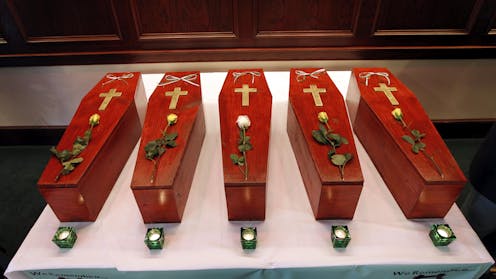
    Caskets of Irish railroaders whose remains were excavated from a mass grave outside Philadelphia. AP Photo/Matt Rourke

    When commuters on the R5 SEPTA train that connects suburban Chester County to Philadelphia approach Malvern station, they might spot a square stone monument on the right side in a clearing surrounded by a thick stand of forest.

    Above it, a sign paid for by the Amtrak electrical workers union and suspended from the trees reads:

    BURIAL PLOT OF IRISH RAILROAD WORKERS: At this site, known as Duffy’s Cut, fifty-seven Irish immigrant railroad workers from the counties of Donegal, Tyrone, Derry and Leitrim died of cholera and murder in the summer of 1832.

    I’m a historian at Immaculata University, about one mile west of Duffy’s Cut. In 2004, my colleagues and I were the ones to discover the mass grave when we excavated the site with the permission of the Pennsylvania Historical and Museum Commission.

    My students, who were about the same age as Duffy’s workers in 1832, provided a great deal of the labor at the excavation.

    More recently, in May 2025, we discovered human remains that suggest a second Irish immigrant railroader mass grave 11 miles west of Duffy’s Cut, in Downingtown.

    Commuter train passes wooded area with large rocks
    A SEPTA commuter train passes Duffy’s Cut in Malvern, Pa.
    William E. Watson, CC BY-NC-SA

    57 dead railroaders

    Duffy’s Cut was named after an Irish Catholic immigrant railroad contractor named Philip Duffy, who lived from 1783-1871 and was probably from County Donegal in northwest Ireland.

    I learned about the site and its possible mass grave from Pennsylvania Railroad documents that survived in my family.

    A 1909 file, labeled “History of Duffy’s Cut Stone enclosure east of Malvern, Pennsylvania, which marks the burial place of 57 track laborers who were victims of the cholera epidemic of 1832,” was compiled by future Pennsylvania Railroad president Martin W. Clement when he was an assistant supervisor. My grandfather, who was Clement’s executive assistant and later director of personnel, obtained the file before the records were auctioned off in 1972, and my brother showed me the file in 2002.

    The Philadelphia & Columbia Railroad, the predecessor of the Pennsylvania Railroad, wanted to shorten the travel time from Philadelphia to Pittsburgh from three to four weeks by Conestoga wagon to three to four days by rail, canal and river.

    The file my brother had in his possession stated that the dead railroaders at Duffy’s Cut were young men, recently arrived from Ireland. It also said the cost of mile 59 was vastly more expensive than the typical Philadelphia & Columbia Railroad mile. Laying a typical mile of P&C railroad cost US$5,000 in the 1830s. But at mile 59, gouging the landscape with a “cut” to lay the tracks on level ground and bridging the valley with a fill – an earthen bridge – cost $32,000. Although the work was especially difficult, the common laborers received about 25 cents a day.

    Artifact that looks like smooth stick with engraved with the word 'Derry'
    Fragment of an Irish-made clay pipe unearthed near the Duffy’s Cut mass grave.
    AP Photo/Matt Rourke

    Most of the men had sailed from the city of Derry in the north of Ireland to Philadelphia from April to June of 1832 aboard the John Stamp. The ship pulled into the Lazaretto quarantine station on the Delaware River in Essington, Pennsylvania, before sailing on to Philadelphia.

    No one on the John Stamp was reported to be ill. This was the height of the 1832 cholera epidemic that ultimately killed at least 10,000 people in the U.S.

    Forty-seven laborers from the John Stamp ship joined 10 other Irish immigrant workers who were already living with Duffy in a rental house in Willistown, a mile south of the work site.

    Yet almost as soon as they arrived to the work camp at mile 59, so did cholera, which had spread to Philadelphia from New York City.

    Cholera in the camps

    Americans could read about the spread of cholera across Europe in 1831 in the newspapers, but very little was known about the disease until decades later.

    Cholera is a bacterial infection that spreads due to poor sanitary practices in which human feces get into drinking water, via excrement passed into streams or by seepage from outhouses to wells.

    But in 1832, people believed cholera was linked to intemperance and vice, which were thought to weaken the body. According to the prevailing miasma theory, it caused outbreaks once airborne. Immigrants and the poor were thought to be especially susceptible to the disease and primary vectors for its spread.

    Cholera causes extreme diarrhea and vomiting that lead to rapid electrolyte loss. In 1832 it was fatal in about 50% of cases. In the Delaware Valley, cholera cases mounted from July into August 1832. Philadelphia registered its peak number of cases, 173, on Aug. 6 and peak number of deaths, 76, on Aug. 7. The hardest-hit areas in the region were working-class neighborhoods and canal and railroad work camps.

    A typical crew on a P&C mile numbered 100 to 120 men. However, the work by Irish immigrants was segregated along sectarian lines on the railroads in the U.S., as it was in the Belfast dockyards at the same time. The other half of the workers at mile 59, according to Canal Commission reports, were Irish Protestant immigrants who worked for an Irish Protestant contractor and did the less dangerous work of laying tracks. They did not die of cholera.

    Four men working in wooded area
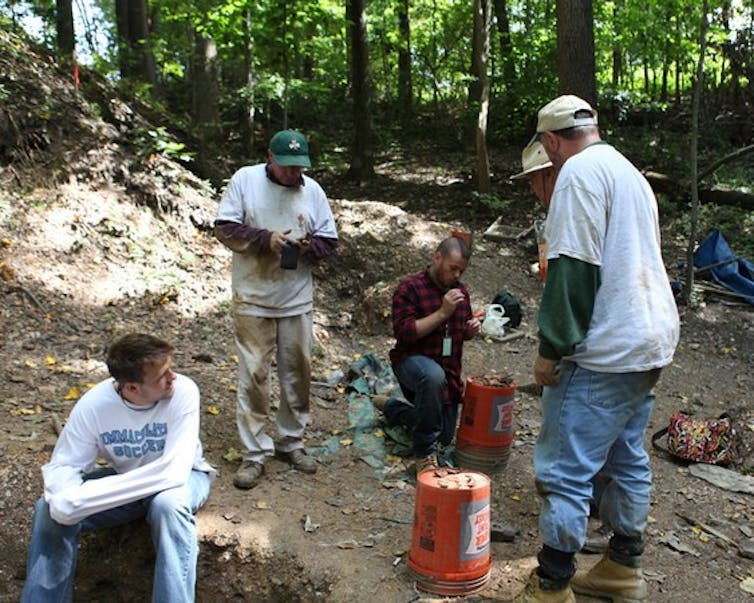
    The author, second from left, and his team at the dig site at Duffy’s Cut in 2011.
    William E. Watson, CC BY-NC-SA

    Signs of a massacre

    To excavate the site, we partnered with the Chester County Emerald Society, a law enforcement group that cleared our work with the county district attorney, and the coroner, in case we found human remains. The University of Pennsylvania Museum provided ground-penetrating radar, as well as archaeological and anthropological assistance for the dig. Staff trained my students in how to properly excavate and handle artifacts and bones.

    Our research team uncovered seven sets of remains between 2009 and 2012 in the remaining eastern portions of the fill. The skeletons had been buried in coffins sealed with an exceptional number of nails, perhaps to contain the cholera.

    Analysis at the UPenn Museum showed evidence of violence to each of the skulls – with one skull showing both an ax blow and a bullet encased in the skull. Researchers found no evidence of defensive wounds on any skeleton, suggesting that the men might have been tied up before being killed.

    After our team analyzed the remains, we came to the startling conclusion that the men didn’t die from cholera – they were massacred.

    I believe that fear of cholera, an epidemic that some clergymen in America and England called “a chastisement for the sins of the people,” and anti-immigrant sentiment fueled violence against them by native-born populations.

    After forensic examinations of the remains, five of the skeletons were reburied during a ceremony at West Laurel Hill Cemetery in Bala Cynwyd in 2012. My team determined the identities of two of the deceased – 18-year-old John Ruddy from County Donegal and 29-year-old Catherine Burns, the daughter of one of the workers, from County Tyrone – and their remains were returned to their home counties in Ireland in 2013 and 2015.

    Man wearing red, purple and white vestments shown incensing caskets as crowd of people look on
    Bishop Michael J. Fitzgerald takes part in a funeral at West Laurel Hill Cemetery in 2012 for the five 19th-century Irish immigrants whose remains were excavated from the Duffy’s Cut site.
    AP Photo/Matt Rourke

    A second mass grave in Chester County

    Historical records led us to what we believe is a second mass grave in Chester County.

    An article in the Nov. 7, 1832, issue of the Village Record newspaper in West Chester reported that one man from Duffy’s Cut fled westward down the unfinished track line to another Irish immigrant railroader crew “near the line of East Bradford and East Caln.”

    This was P&C mile 48 in Downingtown, Pennsylvania. It was under the direction of Irish immigrant contractor Peter Connor, whose crew of 100 to 120 men was reported to have all died around the same time as Duffy’s crew.

    Forty years later, Charles Pennypacker’s 1909 “History of Downingtown” recorded that the dead Irishmen in Downingtown were carted north to a field where they were buried in a mass grave on the property of present-day Northwood Cemetery, “in the eastern part of the cemetery, near the gully.”

    Fragments of bones shown in container lined with purple satin
    File photo from March 24, 2009, shows bones recovered from the mass grave at Duffy’s Cut.
    AP Photo/Matt Rourke, File

    On May 15, 2025, the Duffy’s Cut team unearthed the first human remains from the Downingtown crew in the exact place reported by Pennypacker. This work has just started.

    Up and down the East Coast, there are numerous mass graves of anonymous workers who died of epidemics and overwork in the 1820s and 1830s. Most of those people will never have their stories told.

    At Duffy’s Cut, and now at the Downingtown site, we hope to humanize some of the hardworking immigrants who died building a crucial part of America’s industrial landscape.

    Visitors can view artifacts found at Duffy’s Cut at the Duffy’s Cut Museum in the Gabriele Library at Immaculata University in Malvern, Pa.

    Read more of our stories about Philadelphia and Pennsylvania.

    The Conversation

    William E. Watson serves as the unpaid director of the 501 c 3 educational non-profit and in 2016 served as director of an NEH summer teachers’ institute at Immaculata University. .

    ref. Historian uncovers evidence of second mass grave of Irish immigrant railroaders in Pennsylvania who suffered from cholera, violence and xenophobia – https://theconversation.com/historian-uncovers-evidence-of-second-mass-grave-of-irish-immigrant-railroaders-in-pennsylvania-who-suffered-from-cholera-violence-and-xenophobia-261442

  • Quantum scheme protects videos from prying eyes and tampering

    Source: ForeignAffairs4

    Source: The Conversation – USA – By Yashas Hariprasad, Assistant Professor of Computer Science, California State University, East Bay


    Quantum physics enables hack-proof video transmission.
    sakkmesterke/iStock via Getty Images

    We have developed a new way to secure video transmissions so even quantum computers in the future won’t be able to break into private video livestreams or recordings. We are computer scientists who study computer security. Our research introduces quantum-safe video encryption, which combines two complementary techniques: quantum encryption and secure internet transmission.

    With our encryption system, a hacker wouldn’t be able to access or understand the video data because it’s scrambled using a quantum key that changes unpredictably. Cryptographic keys scramble data so that only someone with the correct key can unscramble it. If the hacker even tries to peek, the system detects it and raises an alarm. The video also travels in the digital equivalent of a locked box over the internet, so nobody can swap or tamper with it in transit.

    Quantum encryption scrambles video data using truly random cryptographic keys based on quantum physics. Unlike traditional encryption that relies on mathematical complexity, quantum encryption uses the fundamental unpredictability of quantum states to generate unbreakable keys.

    Quantum refers to the scale of atoms and molecules, which behave in counterintuitive ways. Quantum computers take advantage of these strange behaviors to solve problems that are difficult or impossible for ordinary computers.

    We combine this quantum encryption scheme with secure transmission over the internet using transport layer security. This is the encryption scheme used to keep connections between web browsers and web pages private.

    Our approach works by converting each video frame into a quantum image representation, essentially a mathematical framework that captures visual information in quantum states. We then scramble the data by combining it with quantum-generated random keys, making the encrypted video statistically indistinguishable from pure noise.

    Quantum encryption explained.

    And because quantum encryption is resistant to future technology such as quantum computers, that video is safe for years to come.

    Why it matters

    Today’s encryption works well, until tomorrow’s quantum computers arrive. These super-powerful machines will be able to crack most current encryption methods in seconds. That means today’s private videos, stored on cloud platforms or transmitted over the internet, could be decrypted years from now.

    More dangerously, these stolen videos can be manipulated into deepfakes: AI-generated videos that can make anyone appear to say or do anything. A forged video can ruin reputations, sway decisions and even incite violence. A secure encryption system not only protects privacy, it helps protect truth.

    What other research is being done

    Researchers around the world are exploring quantum key distribution to securely share encryption keys. Others use chaos theory, deep learning or hybrid algorithms to secure video and image content.

    But most existing work focuses on images, or only on key exchange, without fully securing live or stored video data.

    What’s next

    We’re working toward scaling this system to encrypt full video files and real-time video streams, such as those used in video conferencing and surveillance systems.

    Next steps include reducing the performance overhead for smoother playback and testing the system in real-world environments. We’re also exploring how it can work alongside deepfake detection tools, so we not only stop hackers from accessing videos but also prove the videos haven’t been altered.

    While our framework shows strong early results, practical use will depend on phased adoption as quantum systems become more accessible over the years.

    The Research Brief is a short take on interesting academic work.

    The Conversation

    The authors do not work for, consult, own shares in or receive funding from any company or organization that would benefit from this article, and have disclosed no relevant affiliations beyond their academic appointment.

    ref. Quantum scheme protects videos from prying eyes and tampering – https://theconversation.com/quantum-scheme-protects-videos-from-prying-eyes-and-tampering-261049

  • As wrestling fans reel from the sudden death of Hulk Hogan, a cardiologist explains how to live long and healthy − and avoid chronic disease

    Source: ForeignAffairs4

    Source: The Conversation – USA (3) – By William Cornwell, Associate Professor of Cardiology, University of Colorado Anschutz Medical Campus

    Hulk Hogan’s international fame as a wrestling superstar began in the 1980s. This photo is from 2009. Paul Kane via Getty Images Entertainment

    On July 24, 2025, the American pro wrestling celebrity Hulk Hogan, whose real name was Terry Bollea, died at the age of 71. Hogan had chronic lymphocytic leukemia and a history of atrial fibrillation, or A-fib, a condition in which the upper chambers of the heart, or atria, beat irregularly and often rapidly. His cause of death has been confirmed as acute myocardial infarction, commonly known as a heart attack.

    Hogan became a household name in the 1980s and has long been known for maintaining fitness and a highly active lifestyle, despite having had 25 surgeries in 10 years, including a neck surgery in May.

    Hogan’s death has brought renewed attention to the importance of maintaining heart health through exercise. Many people think that bodybuilders are the “picture” of health. However, the truth is that too much muscle can increase strain on the heart and may actually be harmful. It may seem ironic, then, that people who exercise to extreme levels and appear healthy on the outside can, in fact, be quite unhealthy on the inside.

    As the director of sports cardiology at the University of Colorado Anschutz Medical Campus, I see patients of all age groups and at varying levels of fitness who are interested in promoting health by incorporating exercise into their lifestyle, or by optimizing their current exercise program.

    Two older women exercising together in a park.
    More exercise and less sedentary behavior reduces the risk of heart disease, stroke, cancer and dementia.
    andreswd/E+ via Getty Images

    Exercise is the foundation for good health

    When people think of vital signs, they usually think about things such as heart rate, blood pressure, temperature, breathing rate and blood oxygen levels. However, the American Heart Association also includes “fitness” as an additional vital sign that should be considered when determining a patient’s overall health and risk of heart disease, cancer and death.

    While fitness may be determined in various ways, the best way is by checking what is known as peak oxygen uptake, or VO2 max, through a specialized evaluation called a cardiopulmonary exercise test. These can be performed at many doctors’ offices and clinics, and they provide a wealth of information related to overall health, as well as heart, lung and skeletal muscle function.

    Exercise is one of the most effective interventions to prolong life and reduce the risk of developing chronic diseases throughout life – in effect, prolonging lifespan and improving health span, meaning the number of years that people spend in good health.

    In fact, a large study done by the Cleveland Clinic found that a low level of fitness poses a greater risk of death over time than other traditional risk factors that people commonly think of, such as smoking, diabetes, coronary artery disease and severe kidney disease.

    When it comes to brain health, the American Stroke Association emphasizes the importance of routine exercise and avoiding sedentary behavior in their 2024 guidelines on primary prevention of stroke. The risk of stroke increases with the amount of sedentary time spent throughout the day and also with the amount of time spent watching television, particularly four hours or more per day.

    Regarding cognitive decline, the Alzheimer’s Society states that regular exercise reduces the risk of dementia by almost 20%. Furthermore, the risk of Alzheimer’s disease is twice as high among individuals who exercise the least, when compared to individuals who exercise the most.

    There is also strong evidence that regular exercise reduces the risk of certain types of cancer, especially, colon, breast and endometrial cancer. This reduction in cancer risk is achieved through several mechanisms.

    For one, obesity is a risk factor for up to 13 forms of cancer, and excess body weight is responsible for about 7% of all cancer deaths. Regular exercise helps to maintain a healthy weight.

    Second, exercise helps to keep certain hormones – such as insulin and sex hormones – within a normal range. When these hormone levels get too high, they may increase cancer cell growth. Exercise also helps to boost the immune system by improving the body’s ability to fight off pathogens and cancer cells. This in turn helps prevent cancer cell growth and also reduces chronic inflammation, which left unchecked damages tissue and increases cancer risk.

    Finally, exercise improves the quality of life for all people, regardless of their health or their age. In 2023, Hulk Hogan famously quipped, “I’m 69 years old, but I feel like I’m 39.”

    7,000 steps is just over 3 miles – depending on your pace, that’s about 40 to 60 minutes of walking.

    The optimal dose of exercise

    Major health organizations, such as the American Heart Association, American Cancer Society and Department of Health and Human Services, all share similar recommendations when it comes to the amount of exercise people should aim for.

    These organizations all recommend doing at least 150 minutes per week of moderate-intensity exercise, or at least 75 minutes per week of vigorous-intensity exercise. Moderate exercises include activities such as walking briskly (2.5 to 4 miles per hour), playing doubles tennis or raking the yard. Vigorous exercise includes activities such as jogging, running or shoveling snow.

    A good rule of thumb for figuring out how hard a specific exercise is is to apply the “talk test”: During moderate-intensity exercise, you can talk, but not sing, during the activity. During vigorous intensity exercise, you can say only a few words before having to stop and take a breath.

    There is a lot of solid data to support these recommendations. For example, in a very large analysis of about 48,000 people followed for 30 years, the risk of death from any cause was about 20% lower among those who followed the physical activity guidelines for Americans.

    Life can be busy, and some people may find it challenging to squeeze in at least 150 minutes of exercise throughout the course of the week. However, “weekend warriors” – people who cram all their exercise into one to two days over the weekend – still receive the benefits of exercise. So, a busy lifestyle during the week should not prevent people from doing their best to meet the guidelines.

    What about the number of steps per day? In a new analysis in The Lancet, when compared with walking only 2,000 steps per day, people who walked 7,000 steps per day had a 47% lower risk of death from any cause, a 25% lower risk of developing heart disease, about a 50% lower risk of death from heart disease, a 38% lower risk of developing dementia, a 37% lower risk of dying from cancer, a 22% lower risk of depression and a 28% lower risk of falls.

    Historically, people have aimed for 10,000 steps per day, but this new data indicates that there are tremendous benefits gained simply from walking 7,000 steps daily.

    It’s never too late to start

    One question that many patients ask me – and other doctors – is: “Is it ever too late to start exercising?” There is great data to suggest that people can reap the benefits even if they don’t begin an exercise program into their 50s.

    Being sedentary while aging will cause the heart and blood vessels to stiffen. When that happens, blood pressure can go up and people may be at risk of other things such as heart attacks, strokes or heart failure.

    However, in a study of previously sedentary adults with an average age of 53, two years of regular exercise reversed the age-related stiffening of the heart that otherwise occurs in the absence of routine exercise.

    And it is important to remember that you do not have to look like a body builder or fitness guru in order to reap the benefits of exercise.

    Almost three-quarters of the total benefit to heart, brain and metabolic health that can be gained from exercise will be achieved just by following the guidelines.

    The Conversation

    William Cornwell does not work for, consult, own shares in or receive funding from any company or organization that would benefit from this article, and has disclosed no relevant affiliations beyond their academic appointment.

    ref. As wrestling fans reel from the sudden death of Hulk Hogan, a cardiologist explains how to live long and healthy − and avoid chronic disease – https://theconversation.com/as-wrestling-fans-reel-from-the-sudden-death-of-hulk-hogan-a-cardiologist-explains-how-to-live-long-and-healthy-and-avoid-chronic-disease-262103

  • Shingles vaccination rates rose during the COVID-19 pandemic, but major gaps remain for underserved groups

    Source: ForeignAffairs4

    Source: The Conversation – USA (3) – By Jialing Lin, Research fellow in Health Systems, International Centre for Future Health Systems, UNSW Sydney

    The CDC recommends shingles vaccination for all adults age 50 and older. xavierarnau/E+ via Getty Images

    Vaccination against shingles increased among adults age 50 and older in the U.S. during the COVID-19 pandemic, but not equally across all population groups. That’s the key finding from a new study my colleagues and I published in the journal Vaccine.

    Shingles is caused by the reactivation of the varicella-zoster virus, the same virus that causes chickenpox. It leads to a painful rash and potentially serious complications – especially in older adults – such as persistent nerve pain, vision loss and neurological problems. While antiviral treatments can ease symptoms, vaccination is the most effective way to prevent shingles.

    We analyzed nationally representative survey data from almost 80,000 adults age 50 and over between 2018 and 2022, collected by the Centers for Disease Control and Prevention to monitor the health of the U.S. population. The survey tracked vaccination rates in people of different ethnic backgrounds as well as other factors such as sex, household income and the presence of chronic conditions like diabetes and cardiovascular disease.

    The uptake of shingles vaccines rose notably during the pandemic – from 25.1% of people for whom it is recommended in 2018-2019, to 30.1% during 2020-2022. We observed this overall increase across nearly all groups in our study.

    We saw the greatest relative increases among groups that historically have had lower rates of shingles vaccination. These included adults ages 50-64, men, people from racial and ethnic minority groups such as non-Hispanic Black adults, those with lower household incomes, current smokers and people without chronic conditions like cancer or arthritis.

    Red bumpy skin rash caused by shingles
    Shingles is caused by the same virus that causes chickenpox. It leads to a painful rash and other potentially serious complications.
    Irena Sowinska/Moment via Getty Images

    Why it matters

    In the U.S., the CDC recommends shingles vaccination for all adults age 50 and older. However, uptake has been low, partly due to limited awareness, cost concerns and missed opportunities during routine health care visits.

    The COVID-19 pandemic, while disruptive, may have inadvertently created new opportunities to improve adult vaccination uptake, particularly among groups with historically low uptake of the shingles vaccine. Factors contributing to this shift likely included heightened public awareness of the importance of vaccination, more frequent health care encounters, especially during COVID-19 vaccine rollouts, and the expanded availability of adult vaccines in pharmacies and primary care settings.

    Replacing the older, less effective live attenuated zoster vaccine, called Zostavax, with the newer, non-live zoster vaccine, Shingrix, in 2020 also played a role. Public health campaigns that promoted co-administration of vaccines and launched targeted outreach to underserved populations further contributed to these gains.

    However, major inequities persist. While shingles vaccination rates improved across the board, groups that had lower uptake before the pandemic continued to lag behind wealthier, non-Hispanic white populations with greater health care access. Overall, the vaccination rate for shingles is still low – below other vaccines such as the flu vaccine.

    This gap reflects long-standing disparities in getting needed health care, which became even more prominent during the pandemic. It also highlights the need for fairer policies and customized outreach efforts to underserved communities that build trust and raise awareness about the health benefits of the shingles vaccine.

    What still isn’t known

    Although the upward trend we observed is encouraging, several questions remain. For example, we could not tell from the survey data we worked with whether participants received both doses of the Shingrix vaccine. Both are needed for full protection against shingles.

    Nor could we tell whether participants received the shingles vaccine alongside their COVID-19 vaccination. Receiving multiple vaccines at a single health care visit makes vaccination more convenient and may boost vaccine uptake by reducing the number of needed visits. Also unknown is how immunocompromised people fared during this period. Current guidelines recommend that immunocompromised adults regardless of age also receive the shingles vaccine, but the data only included adults age 50 and over.

    Addressing these questions in future studies would help public health experts develop strategies to encourage more eligible people to receive the shingles vaccine.

    The Research Brief is a short take on interesting academic work.

    The Conversation

    Jialing Lin does not work for, consult, own shares in or receive funding from any company or organization that would benefit from this article, and has disclosed no relevant affiliations beyond their academic appointment.

    ref. Shingles vaccination rates rose during the COVID-19 pandemic, but major gaps remain for underserved groups – https://theconversation.com/shingles-vaccination-rates-rose-during-the-covid-19-pandemic-but-major-gaps-remain-for-underserved-groups-262020

  • A university bookshop in Ibadan tells the story of Nigeria’s rich publishing culture

    Source: ForeignAffairs4

    Source: The Conversation – Africa – By Tinashe Mushakavanhu, Assistant Professor, Harvard University

    Driven by a desire to explore Nigeria’s literary and cultural history beyond the metropolis of Lagos, I took a road trip to Ibadan, once the most important university town in the country. Ibadan, in Oyo State, was the first city in Nigeria to have a university set up in 1948.

    Ibadan is where the Mbari Club once gathered, an experimental space where Nigerian writers, artists and thinkers – among them Chinua Achebe, Wole Soyinka, JP Clark, Christopher Okigbo, Uche Okeke, Bruce Onobrakpeya, Mabel Segun and South Africa’s Es’kia Mphahlele – met, debated and dreamed in the 1960s and 70s.

    It’s the city where celebrated Nigerian artist and architect Demas Nwoko imagined and built his utopias. Where the Oxford University Press and Heinemann Educational Books established their west African headquarters.


    Read more:
    Chimamanda’s Lagos homecoming wasn’t just a book launch, it was a cultural moment


    Books have always been a form of cultural currency in Ibadan. The presence of major publishers meant that bookshops were not just retail outlets, but intellectual salons, sites of encounter and exchange.

    So while in Ibadan I visited cultural spaces and independent bookshops but it was the charms of the University campus that mostly captured my imagination. And my favourite place was the University of Ibadan Bookshop. At this campus bookshop I lingered the most, in awe and wonder. Its eclectic range of books, journals, public lecture pamphlets, novels, poetry collections and monographs excited me.

    Today, when the global publishing economy has increasingly digitised and centralised, the bookshop feels almost radical just by existing. It’s a reminder that intellectual life in Africa is not peripheral or derived from the west. It is present, prolific and profoundly local. To walk through the shelves of this bookshop was to encounter a history of African thought written and produced on its own terms.

    As a scholar of African literature and archives, my research traces the hidden lives of spaces that have shaped publishing and archives. University bookshops have been overlooked but are essential nodes in the continent’s intellectual history.

    A snapshot of Nigeria

    This campus bookshop gives a snapshot of Nigeria as a print country. Here we witness the nation through its printed matter. A nation of prolific publishing. I found the literary output in the Ibadan campus bookshop not only vast but exuberant and unrelenting. It reflects the texture of the Nigerian personality: loud, boisterous, layered and insistent. Stacks upon stacks of books.

    In these stacks, it dawned on me that beneath the surface lies a vibrant, ongoing literary discourse that is unmistakably Nigerian, and sadly not resonant far beyond its borders. These are books you don’t see on reference lists of “popular” and “influential” scholarship that privileges work produced and imported to Africa from the Euro-American academy.

    I was especially intrigued with how the Nigerian academic and writer does not tire in producing academic and cultural journals. There are journals for every subject under the sun.

    While the critical framework of African literature is too often shaped by the global north (see critiques by Ato Quayson, Biodun Jeyifo, Simon Gikandi and Grace Musila) in Ibadan, I saw a distinctly local and deeply African critical discourse rooted in place, language and lived experience. To walk into the University of Ibadan Bookshop is to step into legacy. Its shelves bear the weight of decades of African thought, theory and storytelling.

    Despite being housed in an ageing building, it has stayed defiant. Even though floods destroyed books and computers worth a small fortune in 2019, the bookshop is still standing proudly. And there was pride too among the staff who were eager to help or answer any questions about the books.

    More than bookshops

    The University of Ibadan bookshop reminded me of the bookshop from my undergraduate days in Zimbabwe. Even though our campus bookshop was much smaller, I used to find pleasure going there in between lectures. It often felt like walking into a vault of African knowledge and memory.

    Our bookshop at Midlands State University stocked old, canonical books alongside current literature. On occasion, rare, out-of-print secondhand books would appear on the shelves. The bargain sales also meant I spent most of my money there.

    But to call these spaces on African university campuses “bookshops” hardly does them justice. They are hybrid cultural ecosystems that function as part bookshop, part print shop, stationer, library and sometimes even archive. They have long served as vital nodes in the circulation of African knowledge and thought.

    Yet this ecosystem is rapidly eroding, undermined by the rise of internet culture, artificial intelligence, piracy and harsh economic conditions. The result is a slow but devastating disappearance of African intellectual memory. As scholars remind us, digital platforms are not neutral. They are structured by algorithms that often marginalise black and African knowledge. So, the loss of these analogue spaces is more than nostalgic, it is epistemic erasure.

    In this digital age, there is something vital about the physical presence of bookshops on African campuses. Thanks to them, as a student, for me literature was the serendipity of discovery, the tactile feel of books, the beautiful persistence of a local knowledge system that was relatable and produced by people like me.


    Read more:
    Nigerian architect Demas Nwoko on his award-winning work: ‘Whatever you build, it should suit your culture’


    On the way out of the city, we stopped at Bower’s Tower. From there you can see Ibadan’s sprawling layout, the ancient hills from which the settlement was built, and its red roofs.

    The view reflected the complexity and density of ideas the city has nurtured. And despite shifts in Nigeria’s publishing geography from here to Lagos and Abuja, Ibadan still matters. It’s a city that remembers, that archives, that holds on to knowledge.

    The Conversation

    Tinashe Mushakavanhu does not work for, consult, own shares in or receive funding from any company or organisation that would benefit from this article, and has disclosed no relevant affiliations beyond their academic appointment.

    ref. A university bookshop in Ibadan tells the story of Nigeria’s rich publishing culture – https://theconversation.com/a-university-bookshop-in-ibadan-tells-the-story-of-nigerias-rich-publishing-culture-262050

  • European gloom over the Trump deal is misplaced. It’s probably the best the EU could have achieved

    Source: ForeignAffairs4

    Source: The Conversation – UK – By Maha Rafi Atal, Adam Smith Senior Lecturer in Political Economy, School of Social and Political Sciences, University of Glasgow

    The trade deal between the US and the European Union, squeezed in days before the re-introduction of Donald Trump’s “liberation day” tariffs, is reflective of the new politics of global trade. Faced with the threat of 30% baseline tariffs from Washington, as well as additional levies on specific sectors, the EU has secured a partial reprieve of a flat 15% tariff on all goods.

    Was this the best the bloc could have achieved? In the time available, it may well have been. The 15% rate is higher than the UK secured earlier this year, but it’s significantly below the level applied to China and Mexico, and on par with Japan.

    The EU has also managed a “zero-for-zero” tariffs deal on some hi-tech goods, notably semiconductors vital for products like phones and laptops. This is something the UK did not push for or secure in its own framework agreed with the US president.


    Read more:
    Donald Trump has reduced tariffs on British metals and cars, but how important is this trade deal? Experts react


    What’s more, EU leaders have argued that agreeing to the deal has security benefits in protecting dwindling US support for European defence. The urgency of Europe’s security concerns in Ukraine made these talks different from trade negotiations in the first Trump administration, when Europe could afford to be more aggressive.

    The biggest winners in this deal are Europe’s carmakers. The US has collapsed various sector-specific duties on goods like aircraft, cars and automotive parts into the 15% ceiling. This effectively reduces tariffs on EU-made cars (from 27.5%).

    American automakers, meanwhile, rely heavily on parts from Mexico and China – still subject to higher tariffs at the time of writing. This makes EU vehicles more competitive for US consumers than “American” cars that rely on overseas parts.

    Most importantly however, like the UK deal before it, the new EU agreement is a statement of understanding between the White House and the European Commission, rather than a formal treaty. A treaty would be subject to parliamentary ratification on both sides.

    But the semi-formal nature of this agreement allows both Trump and European leaders to portray the deal as a “win” by playing fast and loose with what’s actually in it.

    For example, the Trump administration will celebrate an EU commitment to buy US$250 billion (£189 billion) in US energy imports annually. Yet the concession holds no legal weight in the EU. The European Commission, which negotiated with Trump, does not buy any energy nor does it manage the power grid inside its 27 member states.

    The commission can encourage, but cannot compel, those states to buy American. (Indeed, it might want to do so anyway, since it helps it to pivot away from Russian gas). But ultimately, member states and businesses decide where their energy supply comes from, and they are not direct parties to the deal. Only a formal treaty ratified by the European parliament would compel them.

    No guarantees from Trump

    The informal nature of this agreement also allows EU member states to protest against what they see as capitulation to Trump’s demands without real consequence. After all, there is not yet a treaty text they would be required to vote on or implement.

    The Trump administration similarly imposed its sweeping tariff threats in early spring without a vote from Congress, and has been making ad hoc changes to the rates in the same way.

    On the one hand, this means European countries may not ultimately be required to implement some of the deal’s less savoury elements such as the energy purchases or lowering the bloc’s own tariffs on US goods.

    On the other hand, this means the Trump administration – notorious for abrupt changes of turn – can also renege at any time. In reality, there is little the EU can do about this. The question of leverage looms large. Trump’s longstanding antipathy towards the EU – seeing it less as an ally and more as a rival – meant that Brussels was never negotiating from a position of strength.

    The fact that the EU avoided the worst-case scenario, protected key sectors and secured other sector-specific advantages suggests a deal shaped not by triumph, but by containment of Trump. Since the deal was announced, the picture emerging from many European leaders has been one of gloom. True, the EU didn’t win – but it survived. And that, for now, is probably enough.


    Get your news from actual experts, straight to your inbox. Sign up to our daily newsletter to receive all The Conversation UK’s latest coverage of news and research, from politics and business to the arts and sciences.

    The Conversation

    Maha Rafi Atal does not work for, consult, own shares in or receive funding from any company or organisation that would benefit from this article, and has disclosed no relevant affiliations beyond their academic appointment.

    ref. European gloom over the Trump deal is misplaced. It’s probably the best the EU could have achieved – https://theconversation.com/european-gloom-over-the-trump-deal-is-misplaced-its-probably-the-best-the-eu-could-have-achieved-262369

  • Will the latest diplomatic moves to end the war in Gaza work?

    Source: ForeignAffairs4

    Source: The Conversation – UK – By Jonathan Este, Senior International Affairs Editor, Associate Editor, The Conversation

    This article was first published in The Conversation UK’s World Affairs Briefing email newsletter. Sign up to receive weekly analysis of the latest developments in international relations, direct to your inbox.


    It feels as if things are moving at completely different speeds in Gaza and in the outside world. From the embattled Gaza Strip the narrative is depressingly familiar. Dozens more Palestinian civilians have been killed in the past 24 hours as they try to get hold of scarce supplies of food.

    Aid agencies report that despite air drops of supplies and “humanitarian pauses” in the fighting, the amount of food getting through to the starving people of Gaza remains pitifully insufficient.

    Two more children are reported to have died of starvation, bringing the total number of hunger-related deaths to 159, according to Palestinian sources quoted by al-Jazeera.

    US envoy Steve Witkoff arrived in Jerusalem for more talks as the US president Donald Trump posted his latest bout of social media diplomacy on his TruthSocial site, a message which appears pretty faithful to the Netanyahu government’s position: “The fastest way to end the Humanitarian Crises in Gaza is for Hamas to SURRENDER AND RELEASE THE HOSTAGES!!”

    Both sides continue to reject the other side’s demands, bringing ceasefire negotiations to an effective standstill.

    In the outside world, meanwhile, events seem to be gathering pace. A “high-level conference” at the United Nations in New York brought together representatives of 17 states, the European Union and the Arab League, resulting in “a comprehensive and actionable framework for the implementation of the two-state solution and the achievement of peace and security for all”.


    Sign up to receive our weekly World Affairs Briefing newsletter from The Conversation UK. Every Thursday we’ll bring you expert analysis of the big stories in international relations.


    What first catches the eye about this proposal, which was signed by Saudi Arabia,
    Qatar, Egypt and Jordan, is that it links a peace deal with the disarming and disbanding of Hamas. It also condemns the militant group’s savage attack on southern Israel on October 23 2023, which was the catalyst for the latest and arguably most grievous chapter of this eight-decade conflict. It’s the first time the Arab League has taken either of these positions.

    The New York declaration, as it has been dubbed, envisages the complete withdrawal of Israeli security forces from Gaza and an end to the displacement of Palestinians. Government will be the responsibility of the Palestinian Authority (PA), and a conference to be scheduled in Egypt will design a plan for the reconstruction of Gaza, much of which has been destroyed in the 20-month assault by the Israel Defense Forces.

    It is, writes Scott Lucas, a “bold initiative” which, “in theory could end the Israeli mass killing in Gaza, remove Hamas from power and begin the implementation of a process for a state of Palestine. The question is whether it has any chance of success.”

    Lucas, an expert in US and Middle East politics at the Clinton Institute of University College Dublin, is not particularly sanguine about the short-term prospects for a ceasefire and the alleviation of the desperate conditions for the people of Gaza. But what it represents more than anything else, is “yet another marker of Israel’s increasing isolation”.

    He points to recent announcements that France, the UK (subject to conditions) and Canada will recognise the state of Palestine at the UN general assembly in September. The prospect of normalisation between Israel and Arab states, at the top of the agenda a few short years ago, is now very unlikely. And in the US, which remains Israel’s staunchest ally, a Gallup poll recently found that public opinion is turning against Israel and its prime minister, Benjamin Netanyahu.


    Read more:
    New peace plan increases pressure on Israel and US as momentum grows for Palestinian statehood


    But how important are the declarations by France, the UK and Canada of intent to potentially recognise Palestinian statehood, asks Malak Benslama-Dabdoub. As expert in international law at Royal Holloway University of London, who has focused on the question of Palestinian statelessness, Benslama-Dabdoub thinks that the French and British pledges bear closer examination.

    The French declaration was made on July 24 on Twitter by the president, Emmanuel Macron. Macron envisages a “demilitarised” state, something Benslama-Dabdoub sees as a serious problem, as it effectively denies the fundamental right of states to self-determination and would rob a future Palestinian state of the necessary right to self-defence.

    The declaration by the UK prime minister that Britain may also recognise Palestinian statehood in September is framed as a threat rather than a pledge. Unless Israel agrees to a ceasefire, allows the UN to recommence humanitarian efforts and engages in a long-term sustainable peace process, the UK will go ahead with recognising Palestine at the UN.

    You have to consider that the UK government’s statement said that the position has always been that “Palestinian statehood is the inalienable right of the Palestinian people”. So to frame this as a threat rather than a demand is arguably to deny that “inalienable right”.


    Read more:
    UK to recognise Palestinian statehood unless Israel agrees to ceasefire – here’s what that would mean


    Paul Rogers also sees serious problems with the pledges to recognise Palestinian statehood. Demands for Hamas to disarm and play no further role in Palestinian government he sees as a non-starter as is the thought of a demilitarised Palestine. “Neither plan has the slightest chance of getting off the ground.”

    Rogers, who has researched and written on the Middle East for more than 30 years, also thinks that without the full backing of the US there is very little chance that a peace plan could succeed.

    Rogers finds it hard to believe that Washington will change tack on the Palestinian question, “unless the US president somehow gets the idea that his own reputation is being damaged”. There’s always a chance of this. News from the Gaza Strip is relentlessly horrifying and the aforementioned polls suggest many voters are reassessing their views of the conflict. But Trump is heavily indebted for his re-election to the far-right Christian Zionist movement, who wield a great deal of power with the White House.

    The other thing that might influence the conflict is if enough of the IDF’s top brass recognise the futility of waging what has always been an unwinnable conflict. This, writes Rogers, is whispered about in Israel’s military circles and one eminent retired general, Itzhak Brik, has come out and said: “Hamas has defeated us.”

    These, writes Rogers, are currently the only routes to an end to the conflict.


    Read more:
    UK and France pledges won’t stop Netanyahu bombing Gaza – but Donald Trump or Israel’s military could


    Inside Trumpian diplomacy

    We mentioned earlier that the Canadian prime minister, Mark Carney, has also pledged to recognise the state of Palestine in September. This was immediately greeted by Trump with the threat that he does so it will derail a trade deal with the US. Whether this will cut any ice with Carney, who had to make concessions to get the trade deal done in the first place, remains to be seen.

    But there’s a broader point here, writes Stefan Wolff. As Wolff reports, this week the foreign ministers of the Democratic Republic of Congo and Rwanda got together in Washington to sign a ceasefire deal, brokered by the US. Trump also claims to have successfully ended a conflict between India and Pakistan at the end of May and hostilities between Thailand and Cambodia earlier this month.

    Meanwhile his efforts to secure peace deals, or even a lasting ceasefire, in Gaza or Ukraine have been unsuccessful.

    Wolff considers why some countries respond to Trump’s diplomatic efforts while others don’t. There are a number of reasons, principally the US president’s ability to apply leverage through trade deals or sanctions and the differing complexity of the conflicts.

    He also points to the depleted resources of the US state department, Trump’s use of personal envoys with little foreign affairs experience and the US president’s insistence on making all the important decisions himself. He concludes: “The White House simply may not have the bandwidth for the level of engagement that would be necessary to get to a deal in Ukraine and the Middle East.”


    Read more:
    Why Donald Trump has stopped some conflicts but is failing with Ukraine and Gaza


    One US government department whose resources haven’t been depleted under Donald Trump is the US Immigration and Customs Enforcement agency, known as Ice. Part of the Department of Homeland Security, Ice has been responsible for identifying and detaining non-citizens and undocumented migrants.

    Their agents carry guns, wear masks and typically operate in plain clothes, although they often wear military kit. The agency received massive funding via Trump’s One Bzig Beautiful Bill Act earlier this month, which will allow the agency to recruit hundreds, if not thousands, of new agents. The number of arrests is increasing steadily, as is the disquiet their operations are prompting in many American cities, where opposition protests are also growing.

    Dafydd Townley, an expert in US politics at the University of Portsmouth, explains how Ice operates and where it sits in Donald Trump’s plan to deport millions of illegal migrants from the US.


    Read more:
    Masked and armed agents are arresting people on US streets as aggressive immigration enforcement ramps up


    World Affairs Briefing from The Conversation UK is available as a weekly email newsletter. Click here to get updates directly in your inbox.


    The Conversation

    ref. Will the latest diplomatic moves to end the war in Gaza work? – https://theconversation.com/will-the-latest-diplomatic-moves-to-end-the-war-in-gaza-work-262380

  • The African activists who challenged colonial-era slavery in Lagos and the Gold Coast

    Source: ForeignAffairs4

    Source: The Conversation – Africa – By Michael E Odijie, Associate Professor, University of Oxford

    When historians and the public think about the end of domestic slavery in west Africa, they often imagine colonial governors issuing decrees and missionaries working to end local traffic in enslaved people.

    Two of my recent publications tell another part of the story. I am a historian of west Africa, and over the past five years, I have been researching anti-slavery ideas and networks in the region as part of a wider research project.

    My research reveals that colonial administrations continued to allow domestic slavery in practice and that African activists fought this.

    In one study I focused on Francis P. Fearon, a trader based in Accra, the Ghanaian capital. He exposed pro-slavery within the colonial government through numerous letters written in the 1890s (when the colony was known as the Gold Coast).

    In another study I examined the Lagos Auxiliary, a coalition of lawyers, journalists and clergy in Nigeria. Their campaigning secured the repeal of Nigeria’s notorious Native House Rule Ordinance in 1914. That ordinance had been enacted by the colonial government to maintain local slavery in the Niger Delta region.

    Considered together, the two studies demonstrate how local campaigners used letters, print culture, imperial pressure points and personal networks to oppose practices that had kept thousands of Africans in bondage.

    The methods Fearon and the Lagos Auxiliary pioneered still matter because they show how marginalised communities can compel power‑holders to close the gap between laws and lived reality. They remind us that well‑documented local testimony, amplified trans-nationally, can still overturn official narratives, compel policy change, and keep institutions honest.

    Colonial ‘abolition’ that wasn’t

    West Africa was a major source of enslaved people during the transatlantic slave trade. The transatlantic trade was suppressed in the early 19th century, but this did not bring an end to domestic slavery.

    One of the principal rationales for colonisation in west Africa was the eradication of domestic slavery.

    Accordingly, when the Gold Coast was formally annexed as a British colony in 1874, the imperial government declared slave dealing illegal. And slave-dealing was criminalised across southern Nigeria in 1901. On paper these measures promised freedom, but in practice loopholes empowered slave-holders, chiefs and colonial officials who continued to demand coerced labour.

    On the Gold Coast, the 1874 abolition law was never enforced. The British governor informed slave-owners that they might retain enslaved persons provided those individuals did not complain. By 1890, child slavery had become widespread in towns such as Accra. According to the local campaigners, it was even sanctioned by the colonial governor. This led to some Africans uniting to establish a network to oppose it.

    The Niger Delta region of Nigeria had a similar experience. The colonial administration enacted the Native House Rule Ordinance to counteract the effects of the Slave-Dealing Proclamation of 1901 which criminalised slave dealing with a penalty of seven years’ imprisonment for offenders. The Native House Rule Ordinance required every African to belong to a “House” under a designated head. It went on to criminalise any person who attempted to leave their “House”. In the Niger Delta kingdoms such as Bonny, Kalabari and Okrika, the word “House” never referred to a single dwelling. Rather, it denoted a self-perpetuating, named corporation of relatives, dependants and slaves under a chief, which owned property and spoke with one voice. By the 1900s, “Houses” had become the primary units through which slave ownership was organised.

    Therefore, the Native House Rule Ordinance compelled enslaved people in Houses to remain with their masters. The masters were empowered to use colonial authority to discipline them. District commissioners executed arrest warrants against runaways. In exchange, the House heads and local chiefs supplied the colonial administration with unpaid labour for public works.

    African campaigners in Accra and Lagos organised to challenge what they perceived as the British colonial state’s support for slavery.

    Fearon: an undercover abolitionist in Accra

    Francis Fearon was an educated African, active in the Accra scene during the second half of the 19th century. He was highly literate and part of elite circles. He was closely associated with the journalist Edmund Bannerman. He regularly wrote to local newspapers, often expressing concerns about racism against Black people and moral decay.

    On 24 June 1890, Fearon sent a 63-page letter, with ten appendices, to the Aborigines’ Protection Society in London. That dossier would form the basis of several further communications. He alleged that child trafficking continued.

    As evidence, he transcribed the confidential court register of Accra and claimed that Governor W. B. Griffith had instructed convicted slave-owners to recover their “property”.

    Fearon’s tactics were audacious. He remained anonymous, relied on court clerks for documents, and supplied the Aborigines’ Protection Society with evidence. He pleaded with the society to investigate the colonial administration in the Gold Coast.

    Although the society publicised the scandal, subsequent narratives quietly effaced the African source.

    Lagos elites organise – and name the problem

    Like Fearon, Nigerian campaigners also wrote to the Anti-Slavery and Aborigines’ Protection Society. They denounced the colonial government in Nigeria for promoting slavery, but they did not remain anonymous.

    By this time, the Native House Rule Ordinance had prompted some enslaved people to flee the districts in which it was enforced. They sought refuge in Lagos. Through these arrivals, Lagosian elites learned of the ordinance. They unleashed a vigorous campaign against the colonial state.

    The principal figures in this movement included Christopher Sapara Williams, a barrister, and James Bright Davies, editor of The Nigerian Times. Others included politician Herbert Macaulay, Herbert Pearse, a prominent merchant, Bishop James Johnson and the Reverend Mojola Agbebi. Unlike Fearon’s lone-wolf strategy, they mounted a coordinated assault on the colonial administration. They drafted petitions, briefed sympathetic European organisations, and inundated local newspapers with commentary.

    Their arguments blended humanitarian indignation with constitutional acumen. They insisted that the ordinance contravened both British liberal ideals and African custom.

    After years of pressure the law was amended and then quietly repealed in 1914.

    Why these stories matter now

    Contemporary scholarship on abolition is gradually shifting from asking “what Britain did for Africa” to examining the role Africans played in ending slavery.

    Many African abolitionists who fought and lost their lives in the struggle against slavery have long gone unacknowledged. This is beginning to change.

    The two articles discussed here highlight the creativity of Africans who, decades before radio or civil-rights NGOs, used transatlantic information circuits. They exposed colonial governments that continued to rely on forced-labour economies long after slavery was supposed to have ended.

    They remind us that grassroots documentation can overturn official narratives. Evidence-based advocacy, coalition-building, and the strategic use of global media remain potent instruments.

    The Conversation

    Research for these articles was funded by the European Research Council under the European Union’s Horizon 2020 research and innovation programme (Grant Agreement No. 885418).

    ref. The African activists who challenged colonial-era slavery in Lagos and the Gold Coast – https://theconversation.com/the-african-activists-who-challenged-colonial-era-slavery-in-lagos-and-the-gold-coast-261089

  • Cricket’s great global divide: elite schools still shape the sport

    Source: ForeignAffairs4

    Source: The Conversation – Africa – By Habib Noorbhai, Professor (Health & Sports Science), University of Johannesburg

    If you were to walk through the corridors of some of the world’s leading cricket schools, you might hear the crack of leather on willow long before the bell for the end of the day rings.

    Across the cricketing world, elite schools have served as key feeder systems to national teams for decades. They provide young players with superior training facilities, high-level coaching and competitive playing opportunities.

    This tradition has served as cricket’s most dependable talent pipeline. But is it a strength or a symptom of exclusion?

    My recent study examined the school backgrounds of 1,080 elite men’s cricketers across eight countries over a 30-year period. It uncovered telling patterns.


    Read more:
    Cricket: children are the key to the future of the game, not broadcast rights


    Top elite cricket countries such as South Africa, England and Australia continue to draw heavily from private education systems. In these nations, cricket success seems almost tied to one’s school uniform.

    I argue that if cricket boards want to promote equity and competitiveness, they will need to broaden the talent search by investing in grassroots cricket infrastructure in under-resourced areas.

    For cricket to be a sport that anyone with talent can succeed in, there will need to be more school leagues and entry-level tournaments as well as targeted investment in community-based hubs and non-elite school zones.

    Findings

    South Africa is a case in point. My previous study in 2020 outlined that more than half of its national players at One-Day International (ODI) World Cups came from boys-only schools (mostly private).

    These schools are often well-resourced, with turf wickets, expert coaches and an embedded culture of competition. Unsurprisingly, the same schools tend to produce a high number of national team batters, as they offer longer game formats and better playing surfaces. Cricket’s colonial origins have influenced the structure and culture of school cricket being tied to a form of privilege.


    Read more:
    Elite boys’ schools still shape South Africa’s national cricket team


    In Australia and England, the story is not very different. Despite their efforts to diversify player sourcing, private schools still dominate. Even in cricketing nations that celebrate working-class grit, such as Australia, private school players continue to shape elite squads.

    The statistics say as much; for example: about 44% of Australian Ashes test series players since 2010 attended private schools, and for England, the figure is 45%. That’s not grassroots, it could be regarded as gated turf…

    Yet not all countries follow this route. The West Indies, Pakistan and Sri Lanka reflect very different models. Club cricket, informal play and community academies provide their players with opportunities to rise. These countries have lower reliance on private schools. Some of their finest players emerged from modest public schooling or neighbourhood cricketing networks.

    India provides an interesting hybrid. Although elite schools such as St. Xavier’s and Modern School contribute players, most national stars emerge from public institutions or small-town academies. The explosion of the Indian Premier League since 2008 has also democratised access, pulling in talent from previously overlooked and underdeveloped cities.

    In these regions, scouting is based on potential, not privilege.

    So why does this matter?

    At first glance, elite schools producing elite cricketers might appear logical. These institutions have the resources to nurture talent. But scratch beneath the surface and troubling questions appear.

    Are national teams truly reflecting their countries? Or are they simply echo chambers of social advantage?


    Read more:
    Cricket inequalities in England and Wales are untenable – our report shows how to rejuvenate the game


    In South Africa, almost every Black African cricketer to represent the country has come through a private school (often on scholarship). That suggests that talent without access remains potentially invisible. It also places unfair pressure on the few who make it through, as if they carry the hopes of entire communities.

    I found that in England, some county systems have started integrating players from state schools, but progress is slow. In New Zealand, where cricket is less centralised around private institutions, regional hubs and public schools have had more success in spreading opportunities. However, even there, Māori and Pasifika players remain underrepresented in elite squads.

    Four steps that can be taken

    1. One solution lies in recognising that schools don’t have a monopoly on talent. Cricket boards must increase investment in grassroots infrastructure, particularly in under-resourced areas. Setting up community hubs, supporting school-club partnerships and more regional competitions could discover hidden talent.

    2. Another step is to improve the visibility and reach of scouting networks. Too often, selection favours players from known institutions. By diversifying trial formats and leveraging technology (such as video submissions or performance-tracking apps), selectors can widen their net. It’s already happening in India, where IPL scouts visit the most unlikely of places.

    3. Coaching is another stumbling block. In many countries, high-level coaches are clustered in elite schools. National boards should consider optimising salaries as well as rotating certified coaches into public schools and regional academies. They should also ensure coaches are developed to be equipped to work with diverse learners and conditions.

    4. Technology offers other exciting possibilities too. Virtual simulations, motion tracking and AI-assisted video reviews are now common in high-performance centres. Making simplified versions available to lower-income schools could level the playing field. Imagine a township bowler in South Africa learning to analyse their technique using only a smartphone and a free app?

    Fairness in sport

    The conversation about schools and cricket is not just about numbers or stats. It is about fairness. Sport should be the great leveller, not another mechanism of exclusion. If cricket is to thrive, it needs to look beyond scoreboards and trophies. It must ask who gets to play and who never gets seen?


    Read more:
    Why is cricket so popular on the Indian sub-continent?


    A batter from a village school in India, a wicket-keeper from a government school in Sri Lanka or a fast bowler in a South African township; each deserves the chance to be part of the national story. Cricket boards, policymakers and educators must work together to make that possible.

    The game will only grow when it welcomes players from all walks of life. That requires more than scholarships. It requires a reset of how we think about talent. Because the next cricket superstar may not wear a crest on their blazer. They may wear resilience on their sleeve.

    The Conversation

    Habib Noorbhai does not work for, consult, own shares in or receive funding from any company or organisation that would benefit from this article, and has disclosed no relevant affiliations beyond their academic appointment.

    ref. Cricket’s great global divide: elite schools still shape the sport – https://theconversation.com/crickets-great-global-divide-elite-schools-still-shape-the-sport-261709

  • Medieval skeletons reveal the lasting damage of childhood malnutrition – new study

    Source: ForeignAffairs4

    Source: The Conversation – UK – By Julia Beaumont, Researcher in Biological Anthropology, University of Bradford

    Beneath churchyards in London and Lincolnshire lie the chemical echoes of famine, infection and survival preserved in the teeth of those who lived through some of the most catastrophic periods in English history.

    In a new study, my colleagues and I examined over 270 medieval skeletons to investigate how early-life malnutrition affected long-term health and life expectancy.

    We focused on people who lived through the devastating period surrounding the Black Death (1348-1350), which included years of famine during the little ice age and the great bovine pestilence (an epidemic that killed two-thirds of cattle in England and Wales). We found that the biological scars of childhood deprivation during this time left lasting marks on the body.

    These findings suggest that early nutritional stress, whether in the 14th century or today, can have consequences that endure well beyond childhood.

    Children’s teeth act like tiny time capsules. The hard layer inside each tooth, called dentine, sits beneath the enamel and forms while we’re growing up. Once formed, it stays unchanged for life, creating a permanent record of what we ate and experienced.

    As our teeth develop, they absorb different chemical versions (isotopes) of carbon and nitrogen from our food, and these get locked into the tooth structure. This means scientists can read the story of someone’s childhood diet by analysing their teeth.

    A method of measuring the chemical changes in sequential slices of the teeth is a recent advance used to identify dietary changes in past populations with greater accuracy.

    When children are starving, their bodies break down their fat stores and muscle to continue growing. This gives a different signature in the newly formed dentine than the isotopes from food. These signatures make centuries-old famines visible today, showing exactly how childhood trauma affected health in medieval times.

    We identified a distinctive pattern that had been seen before in victims of the great Irish famine. Normally, when people eat a typical diet, the levels of carbon and nitrogen in their teeth move in the same direction. For example, both might rise or fall together if someone eats more plants or animals. This is called “covariance” because the two markers vary together.

    But during starvation, nitrogen levels in the teeth rise while carbon levels stay the same or drop. This opposite movement – called “opposing covariance” – is like a red flag in the teeth that shows when a child was starving. These patterns helped us pinpoint the ages at which people experienced malnutrition.

    Lifelong legacy

    Children who survived this period reached adulthood during the plague years, and the effect on their growth was recorded in the chemical signals in their teeth. People with famine markers in their dentine had different mortality rates than those who lacked these markers.

    Children who are nutritionally deprived have poorer outcomes in later life: studies of modern children have suggested that children of low birth weight or who suffer stresses during the first 1,000 days of life have long-term effects on their health.

    For example, babies born small, a possible sign of nutritional stress, seem to be more prone to illnesses such as heart disease and diabetes in adulthood than the population at large. These characteristics can also be passed to future offspring through changes in how genes are switched on or off, known as “epigenetic effects” – which can endure for three generations.

    Epigenetics explained.

    In medieval England, early nutritional deprivation may have been beneficial during catastrophic times by producing adults of short stature and the capacity to store fat, but these people were much more likely to die after the age of 30 than their peers with healthy childhood dentine patterns.

    The patterns for childhood starvation increased in the decades leading up to the Black Death and declined after 1350. This suggests the pandemic may have indirectly improved living conditions by reducing population pressure and increasing access to food.

    The medieval teeth tell us something urgent about today. Right now, millions of children worldwide are experiencing the same nutritional crises that scarred those long-dead English villagers – whether from wars in Gaza and Ukraine or poverty in countless countries.

    Their bodies are writing the same chemical stories of survival into their growing bones and teeth, creating biological problems that will emerge decades later as heart disease, diabetes and early death.

    Our latest findings aren’t just historical curiosities; they’re an urgent warning that the children we fail to nourish today will carry those failures in their bodies for life and pass them on to their own children. The message from the medieval graves couldn’t be clearer: feed the children now or pay the price for generations.


    Get your news from actual experts, straight to your inbox. Sign up to our daily newsletter to receive all The Conversation UK’s latest coverage of news and research, from politics and business to the arts and sciences.

    The Conversation

    Julia Beaumont receives funding from Arts and Humanities research council, British Academy/Leverhulme.

    ref. Medieval skeletons reveal the lasting damage of childhood malnutrition – new study – https://theconversation.com/medieval-skeletons-reveal-the-lasting-damage-of-childhood-malnutrition-new-study-262081

  • Weight loss drug demand continues to grow in the UK – here’s what’s being done to keep supplies readily available

    Source: ForeignAffairs4

    Source: The Conversation – UK – By Liz Breen, Professor of Health Service Operations, School of Pharmacy & Medical Sciences, University of Bradford

    Demand for weight loss jabs has surged in the UK. Mohammed_Al_Ali/ Shutterstock

    Over a fifth of people in the UK have tried to access a weight loss drug in the last year, according to a recent poll.

    Weight loss jabs such as Mounjaro (tirzepatide) and Wegovy (semaglutide) are very effective in managing obesity. Clinical trials have shown that some people lose up to 26% of their body weight while using these drugs.

    With this impact, it’s no wonder a growing number of people are seeking out these products – often buying them in private clinics or online. But with plans to expand access to these drugs through NHS prescriptions, there are concerns that supply may not meet demand – especially for those people in most need.

    In the UK, NHS prescriptions for weight loss jabs are only approved for people who meet strict eligibility requirements. For example, to qualify early for Mounjaro from your GP, you must have health problems due to your weight and a body mass index greater than 40 (adjusted for ethnicity). People assessed by the NHS and given prescriptions will also have access to additional support – such as advice about diet and physical activity.

    Weight loss drugs can be prescribed by specialist clinics and, increasingly, local GPs. But a lack of time and resources means even those who are eligible are left waiting. Consequently, people who can afford to do so are approaching private providers for access to these medicines – despite the potential risks to their health.

    There’s also evidence that people who aren’t clinically eligible for weight loss jabs prescribed by the NHS are purchasing them from online pharmacies.

    Supply issues

    Demand for weight loss jabs is about to grow, as the provision of Mounjaro via GPs is imminent, pending the creation of an infrastructure to support safe local prescribing.

    The number of monthly GP prescriptions in England for Mounjaro has already risen from under 3,000 in March 2024 (on introduction) to over 200,000 in May 2025. Mounjaro (also marketed in the US as Zepbound) is widely considered to be the best weight loss jab currently available and a great commercial success.

    GP prescriptions of all forms of semaglutide (the active ingredient in Wegovy) are more stable, at around 130,000 items per month (including generics and products to treat diabetes).

    While a number of GLP-1 drugs faced shortages last year (including Wegovy and Mounjaro), these shortages have now been resolved. Shortages were spurred by a spike in global demand for these drugs alongside stockpiling by private clinics to feed requests.

    Still, there were reports early this year that certain strengths of Mounjaro were difficult to access. The reasons for this are not clear, but may be due to the novelty of access to this new medication or a lack of access to alternatives.

    Around 220,000 people in England are due to be offered Mounjaro via the NHS over the next three years. However, it’s estimated that 3.4 million people in England could actually be eligible for Mounjaro.

    Two prescription boxes of Mounjaro 15mg.
    Mounjaro will initially be offered to 220,000 people on the NHS over the next three years.
    Cynthia A Jackson/ Shutterstock

    Wider NHS access to this drug is being phased to manage staff workload and ensure good support for patients. Phased rollout may also help to ensure there is enough supply for those who need to be prescribed one of these medications.

    Future access

    It’s likely that demand for these weight loss drugs will only continue to grow in the UK, so it’s important that supply is readily available.

    Regulatory agencies have taken some steps to tighten controls of online prescribing of weight loss drugs and prevent misuse. Registered online pharmacies must seek independent verification of key clinical information (such as from a GP or through a person’s medical records) instead of relying on questionnaires or phone calls.

    However, weight loss products remain easy to access for people with money and savvy search skills, but who may be clinically ineligible. The scale of demand from this group is difficult to quantify, but it’s clear more needs to be done to keep patients safe and manage demand.

    Several new weight loss drugs are undergoing trials in the UK. These drugs will work similarly to those already available but may be administered differently (such as an oral tablet). The trials for these and subsequent approvals will not only increase market competition, but also improve patient access and choice.

    Key patents for the manufacture of semaglutide are also due to expire in 2026 and 2031. Once a pharmaceutical product is outside of its patented time frame, other companies can be approved to manufacture it as a generic product.

    A generic product is approved on the basis that it works in the same manner and has equal benefits to the original product. The generics market allows new entrants and new versions of these very popular products onto the market.

    Generic products are usually less expensive and so are bought (where still clinically safe and effective) by the NHS. This change could provide greater access to weight loss medications and save the NHS and patients money in the long term.

    Generic semaglutide products will probably be available in the UK from 2032 but will be initially authorised to treat diabetes rather than weight loss. Still, this should have a positive impact on the availability of prescription drugs used for both diabetes and weight management.

    Generic liraglutide is already available on the NHS for the treatment of diabetes. The liraglutide brand Saxenda is also marketed for weight management. However, liraglutide is less effective than Wegovy or Mounjaro and requires daily injections.

    The number of monthly NHS prescriptions for liraglutide has fallen from over 40,000 in July 2020 to 1,000 in May 2025. This fall was most likely influenced by the discontinuation of the Victoza brand for type 2 diabetes in late 2024. Shortages of all types of GLP-1 drugs, which lasted until the end of 2024, may also have impacted demand for liraglutide.

    For now, NHS staff can report on known demand for these products to inform manufacturing quantities and procurement. What isn’t known is the future demand for online or private purchases of weight management drugs. It’s this “unknown” demand that may mean supply security is challenged and unsustainable.


    Get your news from actual experts, straight to your inbox. Sign up to our daily newsletter to receive all The Conversation UK’s latest coverage of news and research, from politics and business to the arts and sciences.

    The Conversation

    The authors do not work for, consult, own shares in or receive funding from any company or organisation that would benefit from this article, and have disclosed no relevant affiliations beyond their academic appointment.

    ref. Weight loss drug demand continues to grow in the UK – here’s what’s being done to keep supplies readily available – https://theconversation.com/weight-loss-drug-demand-continues-to-grow-in-the-uk-heres-whats-being-done-to-keep-supplies-readily-available-262065

  • Flames to floods: how Europe’s devastating wildfires are fuelling its next climate crisis

    Source: ForeignAffairs4

    Source: The Conversation – UK – By Ioanna Stamataki, Senior Lecturer in Hydraulics and Water Engineering, University of Greenwich

    In recent years, I have all too often found myself passing over an active wildfire when flying from London to my family home in Greece during the summer months. The sky glows an eerie, apocalyptic red, and the scent of smoke fills the cabin. Silence falls as we become unwilling witnesses to a tragic spectacle.

    Now wildfires are again raging across the Mediterranean. But the flames themselves are only part of the story. As wildfires become more intense and frequent, they’re setting off a dangerous chain reaction – one that also includes a rising risk of devastating floods.

    Wildfire viewed from a plane
    Author’s photo from a plane landing in Athens last summer.
    Ioanna Stamataki

    In January 2024, Nasa reported that climate change is intensifying wildfire conditions, noting that the frequency of the most extreme wildfires had more than doubled over the past two decades. While some of this is driven by natural weather variability, human-induced warming is clearly playing a major role. Decades of rising temperatures combined with longer and more severe droughts have created ideal conditions for wildfires to ignite and spread.

    This year, another brutal Mediterranean wildfire season is unfolding right before our eyes, with numerous active wildfire fronts across the region. As of July 22 2025, 237,153 hectares have burned in the EU – an increase of nearly 78% from the same period last year. The number of fires rose by about 45%, and CO₂ emissions increased by 23% compared to 2024. These are terrifying statistics.

    Climate phenomena are closely interconnected

    The fires themselves are bad enough. But they’re also closely connected to other climate-related extremes, including floods.

    Natural hazards often trigger chain reactions, turning one disaster into many. In the case of floods, wildfires play a big role both through weather patterns and how the land responds to rain.

    On the weather side, higher temperatures lead to more extreme rainfall, as warmer air can hold more moisture and fuels stronger storms. Intense wildfires can sometimes get so hot they generate their own weather systems, like pyrocumulus clouds – towering storm clouds formed by heat, smoke and water vapour. These clouds can spark sudden, localised storms during or shortly after the fire.

    The damage doesn’t end when the flames die down. Satellite data shows that burned land can remain up to 10°C hotter for nearly a year, due to lost vegetation and damaged soil.

    As the world warms, the atmosphere is able to hold about 7% more moisture for every extra degree. Recent temperatures of 40°C or more in Greece suggest a capacity for more downpours and more flooding.

    Climate stripes chart for Greece
    Greece is getting hotter and hotter (Each stripe represents one year, with blue indicating cooler and red indicating warmer than the 1961-2010 average).
    Ed Hawkins / Show Your Stripes (Data: Berkeley Earth & ERA5-Land), CC BY-SA

    Wildfires also make the land itself more vulnerable to flooding. Burnt areas respond much faster to rain, as there is less vegetation to slow down the water. Wildfires also change the soil structure, often making it water-repellent. This means more water runs off the surface, erosion increases, and it takes less rain to trigger a flood.

    Under these conditions, a storm expected once every ten years can cause the sort of catastrophic flooding expected only every 100 to 200 years. Water moves much faster across scorched landscapes without plants to slow it down. Wildfires also leave behind a lot of debris, which can be swept up by fast-moving floodwaters.

    While EU-wide data on post-wildfire flood risk is still limited, various case studies from southern Europe offer strong evidence of the connection. In Spain’s Ebro River Basin, for example, research found that if emissions remain high and climate policy is limited, wildfires will increase the probability of high flood risk by 10%.

    Nature’s ability to regenerate is nothing short of magical, but recovering from a wildfire takes time. Burnt soil takes years to return to normal and, during that time, the risks of extreme rainfall are higher. Beyond the impact of wildfires on soil and water, it is important not to overlook the devastating loss of plant and animal species or even entire ecosystems, making the natural world less biodiverse and resilient.

    To reduce the frequency and severity of extreme events, we must focus on repairing climate damage. This means moving beyond isolated perspectives and adopting a multi-hazard approach that recognises how disasters are connected.

    Flooding after wildfires is just one example of how one crisis can trigger another. We need to recognise these cascading risks and focus on long-term resilience over short-term fixes.


    Get your news from actual experts, straight to your inbox. Sign up to our daily newsletter to receive all The Conversation UK’s latest coverage of news and research, from politics and business to the arts and sciences.

    The Conversation

    Ioanna Stamataki currently receives funding from the Leverhulme Trust and the Royal Society for ongoing flood research. Previous research has been supported by the EPSRC and the Newton Fund (via the British Council) for career development and international collaboration.

    ref. Flames to floods: how Europe’s devastating wildfires are fuelling its next climate crisis – https://theconversation.com/flames-to-floods-how-europes-devastating-wildfires-are-fuelling-its-next-climate-crisis-262204

  • MIL-OSI USA: Carbajal Statement on Trump Administration Revoking Approval of Ocean Areas Designated for Wind Power

    Source: United States House of Representatives – Representative Salud Carbajal (CA-24)

    Carbajal Statement on Trump Administration Revoking Approval of Ocean Areas Designated for Wind Power

    Washington, July 30, 2025

    U.S. Representative Salud Carbajal (D-CA-24) released the statement below following the Trump administration’s decision to revoke approval for millions of acres of ocean to be set aside for offshore wind development. 

    “This is another backwards policy decision by the Trump administration that will hurt our wind energy sector and the thousands of jobs it supports,” said Rep. Carbajal. “Wind power is no longer theoretical—it’s vital to our economy and energy security. Undermining renewables not only hurts American workers and businesses, it hands the future of clean energy to global competitors like China. This is an America Last policy approach.”

    MIL OSI USA News

  • MIL-OSI New Zealand: Heritage NZ – Exhibition with a difference at Alberton

    Source: Heritage New Zealand Pouhere Taonga

    An exhibition with a difference will be unveiled at Alberton, the historic Mt Albert mansion cared for by Heritage New Zealand Pouhere Taonga, on August 10.
    Alberton – Impressions of an Art Group in Residence draws on the work of members of the Auckland Plein Art Group. The historic property – which earlier hosted the group of artists – is the focal point of the group’s creative expression, with interior and exterior scenes of the landmark heritage building serving as subject for the artists.
    The Auckland Plein Air Group is the brainchild of Nicki Heenan and Amanda Gleason who started the group in the summer of 2023.
    “En plein air is an ethos of painting that follows on in the traditions of the French Impressionists and such English artists from the 1800s as Constable and Turner, who took their inspiration from nature and looked for new ways to communicate their ideas,” says Nicki.
    “This was happening in the 1860s – much the same time as the construction of Alberton. There has been a huge revival in plein air painting in the past 10 years with festivals being held around the world.”
    The Auckland Plein Air Group provides a welcoming social environment where people share ideas and provide support and encouragement to each other with the possibility of presenting their artwork to a wider audience through exhibitions and tutorials.
    The exhibition in Alberton’s ballroom is an opportunity for people to come and appreciate the group’s work. The artworks are also available for sale.
    “What these artists have produced is remarkable,” says Alberton Property Lead Rendell McIntosh.
    “They have managed to create a range of images that capture Alberton’s many different moods and angles. The paintings help us see Alberton through fresh eyes – even those of us who are very familiar with the building.”
    – Alberton Impressions of an Art Group in Residence opens on August 10 and runs through to August 31. Entry to the exhibition in the Alberton Ballroom is free (donation appreciated). Standard entry fee applies to visit the rest of house.
    – Join us for a Quick Draw event on (Sunday August 31, 11am-1pm) where you can bring your own art materials and paint alongside the Auckland Plein Air Group members. The Quick Draw is a fundraising event with a suggested $5 koha. All ages, especially school age, welcome and there are special awards for young painters. 

    MIL OSI New Zealand News

  • MIL-OSI New Zealand: Weather News – Return to winter’s chill – MetService

    Source: MetService

    Covering period of Thursday 31st July – Monday 4th August – After a soggy start to the week for many across the motu, the end of the week brings sunnier skies and a return to chilly winter nights. 

    While folks in southern and eastern parts will still see a few showers, for the rest of the country the weekend is a great time for outdoor plans, whether you’re heading out for a stroll, off to a Saturday sports game, working in the garden, or taking the opportunity to hang the washing out.
     
    Today’s action is in the upper North Island: eastern parts of Auckland and Northland, as well as Taranaki, may hear a rumble of thunder or see a scattering of hail this afternoon as some beefier showers roll through. 
    MetService meteorologist Silvia Martino advises, “With heavier showers expected right around school run time and into rush hour, make sure to keep an eye on the rain radar to see if any pop up near you.”
    Luckily for those cleaning up after heavy rain and flooding in Bay of Plenty yesterday, just a few showers are forecast for the region today, although the odd shower might still be heavy.
     
    There’s one more month of meteorological winter, and the next few days will certainly feel like it. Overnight temperatures dip into the negatives for much of the country, and many in the South Island will be back to single-digit daytime highs.
    “Clear skies, cold air, and light winds are perfect conditions for frosty nights and mornings – watch out for icy roads, and bring any precious pot plants in out of the cold,” Martino suggests.
    There is light on the horizon, though, with longer days bringing more daylight hours. Today the country sees an average of 45 minutes more daylight than we did a month ago on the shortest day of the year, and during August we’ll add another hour and a quarter to that.
     
    All eyes (and ears) have been on the tsunami advisories issued by NEMA for coastal regions of Aotearoa New Zealand. MetService supports the distribution of this safety-critical messaging with a banner on our Marine forecast pages directing users to https://www.civildefence.govt.nz/ for the most up-to-date information, as well as advising people through individual coastal and recreational marine forecasts to expect strong and unusual currents and unpredictable surges at shore.
    Martino explains, “The wave models used by weather forecasting agencies capture waves produced by wind and weather, so the swell heights in our marine forecasts don’t include any contribution from tsunami waves. Tsunami modelling is carried out by specialists at Earth Sciences New Zealand (formerly GNS Science), and messages issued by NEMA represent the official warning status for New Zealand.”

    MIL OSI New Zealand News

  • MIL-OSI Asia-Pac: Director General David Cheng-Wei Wu Attends the Opening Ceremony of O-Bank’s Sydney Representative Office

    Source: Republic of China Taiwan

    irector General David Cheng-Wei Wu was honoured to attend the opening ceremony of O-Bank’s Sydney Representative Office, alongside distinguished guests including the Hon. Anthony Roberts MP, the Hon. Rod Roberts MLC, Dr. Hugh McDermott MP, President of the Australia-Taiwan Business Council John Toigo, President of the Taiwanese Chamber of Commerce in Australia Peter Huang, as well as leaders from the Taiwanese banking, business, and community sectors.
    O-Bank President Elton Lee envisions the Sydney Representative Office as a pivotal hub in the bank’s roadmap for global expansion. The bank aims not only to upgrade the office to a full branch but also to establish additional locations across Australia. By collaborating with fellow Taiwanese financial institutions in Australia, O-Bank seeks to deepen financial, trade, and cultural ties between Taiwan and Australia.
    Director General Wu began his remarks by thanking the three members of the New South Wales Parliament for their presence, which demonstrated bipartisan support for the Taiwanese community, the Representative Office, and O-Bank. He noted that, as Taiwan’s first native digital bank, O-Bank’s presence marks the ninth Taiwanese bank in Sydney and the twelfth in Australia — a clear indication of growing financial ties between Taiwan and New South Wales. He further emphasized Taiwan’s active pursuit of membership in the Comprehensive and Progressive Agreement for Trans-Pacific Partnership (CPTPP), with the support of Australia. Taiwan’s inclusion would strengthen supply chain integration among like-minded democracies and generate concrete economic benefits at both bilateral and multilateral levels. In short, the CPTPP will be stronger with Taiwan on board.

    MIL OSI Asia Pacific News

  • MIL-OSI: GL Supports Next-Gen SIP Testing and Emulation

    Source: GlobeNewswire (MIL-OSI)

    GAITHERSBURG, Md., July 31, 2025 (GLOBE NEWSWIRE) — GL Communications Inc., a global leader in telecom testing solutions, addressed the press regarding their SIP protocol emulation and testing solutions. In today’s dynamic telecom environment, ensuring the reliable operation of SIP-based VoIP devices and networks is essential. This powerful platform emulates all key SIP elements and generates real-time SIP and RTP traffic for thorough testing.

    [For illustration, refer to sip-architecture.jpg]

    Vijay Kulkarni, CEO of GL Communications, states “GL’s Message Automation & Protocol Simulation (MAPS™) is a flexible software program that can emulate a wide variety of telecommunications protocols. MAPS™ SIP is a specialized application within this platform that focuses on testing SIP-based communication systems. It emulates key SIP elements such as User Agent Client (UAC), User Agent Server (UAS), Registrar, and Redirect servers.”

    MAPS™ SIP emulates complex SIP call flows and supports high-volume call generation with real-time transmission of voice, video, fax, and messaging traffic. With full support for SIP over UDP, TCP, and TLS, it ensures performance validation, resolves interoperability issues, and confirms compliance with industry standards across VoIP and IP multimedia networks.

    Key Features:

    • Scalable Bulk Call Generation and Load Testing
      MAPS™ SIP supports up to 2,000 concurrent media calls at 250 calls per second (CPS) and 70,000 signaling-only calls at 750 CPS. With the MAPS™ RTP High Density appliance, it scales to 160,000 calls at 800 CPS, making it ideal for testing network performance under heavy load in both lab and field setups.
    • Flexible SIP Emulation for VoIP and Air Traffic Control Networks
      A single instance of MAPS™ SIP can emulate multiple SIP entities and generate diverse SIP messages without extra hardware. It also supports EUROCAE ED-137C standards, allowing accurate emulation of Air Traffic Control communication systems.
    • SIP Testing for Gateway and Analog Telephone Adapter (ATA)
      MAPS™ SIP validates Gateway and ATA devices by testing connectivity, signaling behavior, and voice quality. It handles RTP traffic types including voice, tones, digits, and both pass-through and T.38 fax.
    • Remote Control and Integration
      The platform supports remote operation via a client-server Command Line Interface and APIs in Python or Java. This enables easy automation, integration with external systems, and distributed testing across different environments.
    • Fax over IP Emulation and Analysis
      Automates fax call generation and analysis for both T.30 and T.38 sessions. Users can assess transmission quality, protocol handling, and system performance across SIP networks.
    • Instant Messaging Support for NG9-1-1 over SIP
      MAPS™ SIP integrates Message Session Relay Protocol (MSRP) to support instant messaging in NG9-1-1 networks. It enables testing of IM-only sessions as well as mixed audio and messaging scenarios to ensure emergency communication reliability.
    • Multimedia Call Emulation with Audio, Video, and Text Messaging
      The tool can emulate SIP calls with audio, video, and text messaging in a single session. Each call includes separate RTP streams for comprehensive end-to-end multimedia testing.
    • Ensuring Protocol Compliance Across SIP Interfaces
      MAPS™ SIP supports standard SIP as well as SIP-I, SIP IMS, and SIP MSRP. It helps verify protocol conformance across diverse implementations.
    • End-to-End IP Multimedia Subsystem (IMS) Testing for VoLTE, VoWiFi, and 5G Services
      The MAPS™ SIP IMS Test Suite emulates core IMS nodes and supports SIP, RTP, and Diameter protocols. It’s ideal for testing VoLTE, VoNR, and 5G services, ensuring seamless session management and interoperability.
    • SIP Protocol Conformance Testing with ETSI Support
      With over 400 ETSI-based test cases (IETF RFC 3261, ETSI TS 102-027-2 v4.1.1 (2006-07)), MAPS™ SIP Conformance Suite ensures thorough validation of SIP implementations. It can be configured as a UAC to test UAS devices for registration, call control, proxy, and redirect functions.
    • Automated Interactive Voice Response (IVR) Testing
      MAPS™ SIP automates IVR testing by sending DTMF tones or voice inputs. This allows for seamless navigation through IVR prompts and validation of response accuracy.

    About GL Communications Inc.,

    GL Communications is a global provider of telecom test and measurement solutions. GL’s solutions verify the quality and reliability of Wireless, Fiber Optic, TDM and Analog networks.

    Warm Regards,

    Vikram Kulkarni, PhD

    Phone: 301-670-4784 x114

    Email: info@gl.com

    The MIL Network

  • MIL-OSI Australia: Albanese Government cuts 20 per cent off all student debts

    Source: Murray Darling Basin Authority

    The Albanese Labor Government has today cut all student debts by 20 per cent.

    We are wiping more than $16 billion in debt for more than three million Australians.

    Our number one focus is continuing to deliver cost of living relief for the Australian people.

    Cutting student debt by 20 per cent will ease pressure on workers and students across the country.

    For someone with the average debt of $27,600, this will see $5,520 wiped from their outstanding Higher Education Loan Program (HELP) loans.

    Backdated to 1 June, this is lifting the burden for Australians with a student debt – including all HELP, Vocational Education and Training (VET) Student Loans, Australian Apprenticeship Support Loans, Student Startup Loans, and other student loans.

    In addition to cutting student debt by 20 per cent, we are raising the minimum amount before people have to start making repayments from $54,435 to $67,000 and reduces minimum repayments.

    For someone earning $70,000 it will reduce the minimum repayments they have to make by $1,300 a year.

    This builds on our reforms to fix the indexation formula, which has already cut more than $3 billion in student debt.

    This means, all up, the Albanese Labor Government will cut close to $20 billion in student debt for more than three million Australians.

    The ATO will now begin the work of processing the cut.

    This will take a little while but the 20 per cent cut to student debt is guaranteed.

    Most people will see their balance reduced before the end of the year, backdated to June.

    Quotes attributable to Prime Minister Anthony Albanese:

    “This is another way my Government is continuing to deliver cost of living relief to Australians.

    “We promised cutting student debt would be the first thing we did back in Parliament – and that’s exactly what we’ve done.

    “Getting an education shouldn’t mean a lifetime of debt.

    “No matter where you live or how much your parents earn, my Government will work to ensure the doors of opportunity are open for you.”

    Quotes attributable to Minister for Education Jason Clare:

    “We promised we would cut your student debt by 20 per cent and we have delivered.

    “This is a big deal for 3 million Australians.

    “This will save millions of Australians thousands of dollars.

    “The average student debt today is $27,600, this will cut that debt by $5,520.

    “Just out of uni, just getting started, this will take a weight off their back.

    “We are also cutting annual repayments. For someone earning $70,000 a year, it will cut the amount they have to repay every year by $1,300.

    “That’s real help with the cost of living. It means more money in your pocket, not the government’s.”

    Quotes attributable to Minister for Skills and Training Andrew Giles:  

    “At the election, students and apprentices sent a resounding message of support for our Government’s plan to cut student debt by 20 per cent.

    “Now, we’ve delivered on this commitment, making a real difference to the lives of students and apprentices – including nearly 300,000 TAFE students and apprentices.

    “The Albanese Government is backing Australians with cost of living relief, and backing them to pursue an apprenticeship or qualification that sets them up for their future.”

    MIL OSI News

  • MIL-OSI Australia: Police investigating serious motorbike crash at Herdsmans Cove

    Source: New South Wales Community and Justice

    Police investigating serious motorbike crash at Herdsmans Cove

    Thursday, 31 July 2025 – 11:32 am.

    Police are investigating a motorbike crash in Herdsmans Cove last night where two people sustained serious injuries. 
    About 11pm, two trail bikes were travelling in opposite directions on a walkway near Zena Drive. The area is poorly lit, the bikes did not have headlights, and one of the riders was not wearing a helmet.  
    The bikes collided, and both riders, a 19-year-old woman and an 18-year-old man, were transported to hospital in serious but stable conditions.  
    “Police remind all road users, particular motorcyclists, to prioritise their safety,” said Inspector Luke Horne. 
    “Please – if you’re a rider – protect your safety and the safety of others every time you ride.”  
    Anyone with information in relation to the crash is asked to contact Bridgewater Police on 131 444.  
    Information can also be provided anonymously through Crime Stoppers Tasmania on 1800 333 000 or at crimestopperstas.com.au.

    MIL OSI News

  • MIL-OSI USA: PREPARED REMARKS: Sanders Forces Vote to Stop Arms Sales to Israel Amid Starvation in Gaza

    US Senate News:

    Source: United States Senator for Vermont – Bernie Sanders

    WASHINGTON, July 30 – Sen. Bernie Sanders (I-Vt.) today rose to force a vote on two Joint Resolutions of Disapproval (JRDs) to block offensive arms sales to Israel in light of the daily civilian massacres and unfolding famine created by the Netanyahu government’s policies. The JRD is the only formal mechanism available to Congress to prevent an arms sale noticed by the administration from advancing.

    Sanders’ remarks introducing the vote today, as prepared for delivery, are below and can be watched live HERE:

    M. President, let me begin by stating what this debate is about, and what it is not about. It is not about whether anyone in the Senate disagrees that Hamas is a terrorist organization, which began this war with a brutal terrorist attack on October 7, 2023, that killed 1,200 innocent people and took 250 hostages. Everyone agrees with that.

    The International Criminal Court was right to indict the leaders of Hamas as war criminals for those atrocities. There is also, I believe, no disagreement as to whether or not Israel had a right to defend itself, like any other country suffering an attack like that. Clearly, it did.

    And, in a certain sense, this debate is not really about Israel. It is about the United States of America, and whether we will abide by U.S. and international law, or whether we will continue to contribute billions of dollars to an extremist government in Israel, which has caused an unprecedented humanitarian disaster in Gaza. This debate is over whether or not the United States of America will have any moral credibility on the international scene. Whether or not we will be able, with a straight face, to condemn other countries who commit barbaric acts if we don’t stand up tonight. That is what we are debating.

    M. President, the vast majority of the American people and the world community understand that the Netanyahu government in Israel has gone well beyond defending itself from Hamas. Over the last 21 months, it has waged an all-out, illegal, immoral and horrific war of annihilation against the Palestinian people. 

    This war has already killed some 60,000 Palestinians and wounded more than 143,000 — most of whom are women, children and the elderly. In a population of just over two million, more than 200,000 people have been killed or wounded since this war began. That, M. President, is 10% of the population of Gaza. 

    M. President, to put that into scale so we as Americans can understand the enormity of what is happening there, if that kind of destruction happened in the United States — if 10% of our population were killed or wounded in war, it would mean that 34 million of us would have been killed or wounded.

    The toll on Gaza’s children is unspeakable, and it is literally hard to imagine. The United Nations reports that more than 18,000 children have been killed since this war began. Just this morning, the Washington Post published a list of all these children’s names, and I ask that these names be entered into the Congressional Record.

    I should mention that more than 12,000 of these children were under the age of 12, and more than 3,000 children in Gaza have had one or more limbs amputated. That is how this war has impacted the children in Gaza. But it’s not just the horrific loss of life that we are seeing.

    New satellite imagery shows that Israel’s indiscriminate bombardment has destroyed 70% of all structures in Gaza. The UN estimates that 92% of the housing units have been damaged or destroyed. Most of the population is now living in tents or other makeshift structures.

    And let us not forget, over the last 21 months, these people, most of whom are poor, have been displaced time and time again — told to go here, told to go there, moved around with often no possessions other than the clothing on their backs.

    M. President, the health care system in Gaza has been destroyed. Most of the territory’s hospitals and primary health care facilities have been bombed. More than 1,500 health care workers have been killed, as well as 336 UN staff.

    Gaza’s civilian infrastructure has been totally devastated, including almost 90% of water and sanitation facilities. Raw sewage now runs all over Gaza. Most of the roads have been destroyed. Gaza’s educational system has been obliterated. Hundreds of schools have been bombed, as has every single one of Gaza’s 12 universities. And there has been no electricity in Gaza for 21 months. 

    M. President, all of this is a horror unto itself. But in recent months, the Netanyahu government’s extermination of Gaza has made an unspeakable and horrible situation even worse. 

    From March 2 to May 19, Israel did not allow a single shipment of humanitarian aid into Gaza — no food, no water, no fuel and no medical supplies for a distressed population of two million people over a period of 11 weeks. Since then, Israel has allowed a trickle of aid to get into Gaza, but nowhere near enough to meet the enormous needs of a population besieged for so long. 

    M. President, when you cut off all food to a population, what happens is not surprising. People starve to death. And that is exactly what Israeli policy has deliberately done — it is causing mass starvation and famine.

    Children and other vulnerable people are dying in increasing numbers. In the last two weeks, dozens of young children have died from starvation. Starving mothers cannot breastfeed their infants, and no formula is available, and certainly no clean water to make it, in any case. Hospitals have run out of nutritional treatments, and doctors and nurses who are already treating the desperate, they themselves are going hungry and are fainting from hunger. 

    The World Food Programme says that the food crisis has reached “new and astonishing levels of desperation, with a third of the population not eating for multiple days in a row.” 

    Just yesterday, the gold-standard UN-backed food monitoring group, the IPC, issued a new report saying: “The worst-case scenario of famine is currently playing out in the Gaza Strip.”  

    When mass death from starvation begins, it is difficult to reverse. Aid groups say it will soon be too late to stop a wave of preventable deaths in Gaza, all of which is the direct result of the Israeli government’s policies. 

    M. President, what I’m going to describe now is gruesome, but I think it is important for us to understand what is happening to the children in Gaza.

    Mark Brauner, an American doctor who spent in two weeks in Gaza in June described the situation: “a lot of the children have already passed the point of no return where their physiology has eroded to the point where even refeeding could potentially cause death itself. The gut lining has started to auto-digest and it will no longer have adequate absorptive capacity for water or for nutrition. Death is unfortunately imminent for probably thousands of children.”

    That’s an American physician who was in Gaza in June.

    M. President, what the extremist Netanyahu government is doing now is not an effort to win a war. There is no military purpose in starving thousands and thousands of children. Let us be clear: This is not an effort to win a war, this is an effort to destroy a people.

    Having already killed or wounded more than 200,000 Palestinians, mostly women and children, the extremist Israeli government is using mass starvation to engineer the ethnic cleansing of Gaza. They are trying to drive a desperate people out of their homeland, to God knows where. 

    This is not my speculation; this what Israeli ministers and officials are saying themselves.

    A few months ago, the Finance Minister vowed that “Gaza will be entirely destroyed.” Just last week, another current Israeli minister said: “All Gaza will be Jewish… the government is pushing for Gaza being wiped out. Thank God, we are wiping out this evil.” Another Likud member of the Knesset and former minister called for “Erasing all of Gaza from the face of the earth.”

    And in the West Bank, we see this agenda being carried out clearly and methodically, with more than 500,000 Israeli settlers now illegally occupying land integral to any future Palestinian state. Earlier this month, the Knesset even approved a non-binding motion in favor of formally annexing the West Bank.

    This slow-motion annexation is backed by violence: Israeli security forces and settler extremists have killed thousands of Palestinians in recent years. Israeli settlers brutally beat a young American to death earlier this month, the seventh American killed in the West Bank since 2022. Despite a demand from President Trump’s ambassador to Israel, Mike Huckabee, no one has been held accountable for these deaths.

    M. President, people around the world are outraged by what is going on in Gaza right now, and countries are increasingly demanding that Netanyahu’s government stop what they are doing.

    France and Canada have said they will recognize a Palestinian state. The United Kingdom has said it will do so, as well, if Israel does not immediately end this war and surge humanitarian aid. And at the UN last month, 149 countries voted for a ceasefire resolution condemning the use of starvation as a weapon of war and demanding an end to Israel’s blockade on humanitarian aid. But it is not just the international community. 

    Just yesterday, Gallup, one of the best polling organizations in our country, released a new poll that shows that just 32% of Americans support Israel’s military action in Gaza, while 60% oppose it. To my Democratic colleagues here in the Senate, I would point out that only 8% of Democrats support this war, and just 25% of independents. And to my Republican colleagues, I would point out that more and more Republicans are beginning to speak out against the atrocities of this war and the fact that billions of billions of taxpayer dollars are going to a government in Israel waging an illegal war. 

    Further, M. President, a recent Economist/YouGov poll shows that just 15% of the American people support increasing military aid to Israel, while 35% support decreasing military aid to Israel or stopping it entirely. Just 8% of Democrats support increasing military aid to Israel. 

    M. President, the American people are haunted by the images coming out of Gaza.

    These are desperate children with pots in their hands, crying, begging for food in order to stay alive. That’s what the American people are seeing every night on TV, on the internet and in the newspapers. These are emaciated children, their bodies, in some cases, barely more than skeletons. The American people are seeing miles and miles of rubble where cities and towns once stood. They are seeing innocent people shot down while they wait on line to get food while they are starving.

    M. President, despite these war crimes, carried out daily in plain view, the United States has provided more than $22 billion for Israel’s military operations since this war began. One estimate, based on Brown University research, calculates that the United States has paid for 70% of the Gaza war. In other words, American taxpayer dollars are being used to starve children, bomb schools, kill civilians and support the cruelty of Netanyahu and his criminal ministers. And that, M. President, is why I have brought these two resolutions of disapproval to block offensive arms sales to Israel. 

    S.J.Res.34 would prohibit the U.S.-taxpayer financed $675.7 million sale of thousands of 1,000-pound bombs and many thousands of JDAM guidance kits.

    And S.J.Res.41 would prohibit the sale of tens of thousands of fully automatic assault rifles.

    These arms sales clearly violate the Foreign Assistance Act and the Arms Export Control Act, which prohibit sending arms to countries that violate international law by killing civilians and blocking humanitarian aid — and very few people doubt that that is exactly what Israel is doing. If you want to obey the law, vote for these resolutions. 

    The rifles in question will go to arm a police force overseen by far-right, extremist minister Itamar Ben-Gvir, who has long advocated for the forcible expulsion of Palestinians from the region, who was convicted of support for terrorism by an Israeli court, and who has distributed weapons to violent settlers in the West Bank. Ben-Gvir has formed new police units comprised of extremist settlers and has boasted about how many weapons he has distributed to vigilante settlers in the West Bank. And you want to give him more rifles? That’s what one of these resolutions is about.

    These are rifles the Biden administration held back over fears they would be used by extremist Israeli settlers in the West Bank to terrorize Palestinians and push them from their homes and villages.

    M. President, U.S. taxpayers have spent many, many billions of dollars in support of the racist, extremist Netanyahu government. Enough is enough. 

    Americans want this to end. They do not want to be complicit in an unfolding famine and daily civilian massacres. And we here in Congress tonight have the power to act. No more talks, no more great speeches. But tonight, we have the power to act — the power to force Netanyahu and his extremist government to end this slaughter.

    The time is long overdue for Congress to use the leverage we have — tens of billions in arms and military aid — to demand that Israel end these atrocities.

    At a time when Israeli soldiers are shooting civilians trying to get food aid on a near-daily basis, when extremist settlers are pushing Palestinians from their homes in the West Bank, and when Gaza is witnessing mass starvation as a result of Israeli government policy, the United States should not and must not be providing more weapons to enable these atrocities. 

    M. President, whatever happens tonight, history will condemn those who fail to act in the face of these horrors.

    MIL OSI USA News

  • MIL-OSI USA: Rosen Helps Lead Effort Calling for Large‑Scale Expansion of Humanitarian Aid to Gaza, Return of Hostages, and Resumption of Negotiations to End the War

    US Senate News:

    Source: United States Senator Jacky Rosen (D-NV)

    WASHINGTON, DC – U.S. Senator Jacky Rosen (D‑NV) joined Senators Schiff, Schatz, and Schumer in leading a letter to Secretary of State Marco Rubio and Special Envoy to the Middle East Steve Witkoff raising alarm over the worsening humanitarian crisis and starvation in Gaza. The letter urges a large‑scale expansion of humanitarian aid, calls for immediately bringing all the hostages home, endorses  a return to the negotiating table to end the war, and supports a permanent end to Hamas rule in Gaza.
    “The acute humanitarian crisis in Gaza is also unsustainable and worsens by the day. Hunger and malnutrition are widespread, and, alarmingly, deaths due to starvation, especially among children, are increasing,” wrote the Senators. “The ‘Gaza Humanitarian Foundation’ has failed to address the deepening humanitarian crisis and contributed to an unacceptable and mounting civilian death toll around the organization’s sites. To prevent the situation from getting even worse, we urge you to advocate for a large-scale expansion of humanitarian assistance and services throughout the Gaza Strip, including through the use of experienced multilateral bodies and NGOs that can get life-saving aid directly to those in need and prevent diversion.” 
    “The Israeli hostages, held in Gaza by Hamas since their brutal attack on Israel on October 7th, have suffered far too long, as have their families. It is imperative that those still living be brought home as soon as possible, before more perish as the war drags on. And it is essential that the remains of those presumed killed – including Americans Omer Neutra and Itay Chen – be reunited with their loved ones. After many months of despair, it is long past time to bring all of the hostages home,” wrote the Senators. 
    The full text of the letter is available HERE.
    Senator Rosen has been leading the push for Hamas to release the remaining hostages and has been calling for increased humanitarian aid for innocent civilians in Gaza. As Ranking Member of the Senate Foreign Relations Committee’s Subcommittee on the Near East, Senator Rosen led a hearing focused on the Middle East, where she raised the importance of humanitarian access and a negotiated ceasefire that brings the hostages home. Earlier this year, she traveled to Israel, the West Bank, Jordan, and Iraq, discussing the war in Gaza and humanitarian aid in several of her diplomatic engagements. Senator Rosen also led a bipartisan, bicameral resolution demanding the safe release of hostages still held by Hamas. In January, she applauded the agreement between Israel and Hamas to pause fighting and secure hostage releases.

    MIL OSI USA News

  • MIL-OSI USA: WATCH: Padilla Questions Former AG Eric Holder on Republican Push for Racial Gerrymandering in Texas During Spotlight Forum on Voter Suppression

    US Senate News:

    Source: United States Senator Alex Padilla (D-Calif.)

    WATCH: Padilla Questions Former AG Eric Holder on Republican Push for Racial Gerrymandering in Texas During Spotlight Forum on Voter Suppression

    Office of Special Counsel Confirms Hatch Act Investigation Following Padilla Letter

    Holder: “It’s both a sign of weakness and a sign of fear … The President and his party are afraid of the voters, and they are trying to manipulate the maps in Texas so that they can rig the election in 2026.”

    WATCH: Padilla questions Attorney General Holder and Professor Levitt on Republican power grab for five additional Texas congressional seats
     
    Watch the full spotlight forum, including witness opening statements and questioning, here.

    WASHINGTON, D.C. — Today, U.S. Senator Alex Padilla (D-Calif.), Ranking Member of the Senate Committee on Rules and Administration and California’s former Secretary of State, convened a spotlight forum titled “Protecting the Future of American Democracy: Fighting a Surge in Voter Suppression.” During the forum, he questioned former Attorney General Eric Holder and Loyola Law School Professor Justin Levitt on the Trump Administration’s efforts in Texas and other states to implement mid-decade racial redistricting for partisan political purposes.

    The spotlight forum — co-led by Senator Dick Durbin (D-Ill.), Ranking Member of the Senate Judiciary Committee — came as Republicans in the Texas House of Representatives released their new gerrymandered maps, caving to pressure from political appointees at Trump’s White House and U.S. Department of Justice (DOJ) in an effort to create five additional Republican congressional seats.

    Padilla highlighted his recent letter to the independent Office of Special Counsel demanding an investigation into senior Trump Administration officials for carrying out the President’s partisan scheme to racially gerrymander Texas and other states, calling it “a clear violation of the Hatch Act.” In response to Padilla’s letter, the Hatch Act Unit at the Office of Special Counsel confirmed they will open a file to address this potential violation.

    While questioning Attorney General Holder, Padilla called the Trump-directed Texas redistricting “nothing short of a power grab” and emphasized that Republicans are “trying to tip the scales because they’re afraid of the response of the people in the 2026 election” to their extreme agenda. Holder further underscored the stakes of the Trump Administration’s partisan attempt at a racial gerrymander and highlighted an ongoing lawsuit on Texas’ previous gerrymander. He emphasized that nearly 90 percent of Texas’ population growth that recently granted them additional congressional seats came from people of color moving to Texas, yet the state previously added two majority white congressional districts.

    • PADILLA: Attorney General Holder, what is your reaction to seeing a President of the United States — it’s not a dog whistle, it’s not saying the quiet part out loud, they’re using bull horns now — publicly call for partisan advantage through mid-decade racial gerrymandering and redistricting from the White House grounds, and is the Department of Justice appropriate to be party to this?
    • HOLDER: Yeah. I mean, it’s both a sign of weakness and a sign of fear, as I indicated before. The President and his party are afraid of the voters, and they are trying to manipulate the maps in Texas so that they can rig the election in 2026, and people need to understand: this is not just a Texas problem. I mean, you know, the margin in the House of Representatives is now, I guess, three seats or so. What they’re trying to get is five seats out of Texas with the thought that that will be an insurance policy to somehow keep an unpopular party with unpopular policies, unpopular candidates in power in the United States House of Representatives. And to have a President of the United States make that kind of statement, I mean, it’s not, it’s as you say. He’s saying the quiet part out loud. He’s not saying that there’s a basis for this other than just “give me five seats so that I will have those protections that we need.” […]
    • HOLDER: I think this is all about power. It’s all about the acquisition and the maintenance of power. It’s about the fear that they have of the people. And I think that this body, this committee and all Americans have to do all that we can to oppose that which they are trying to do, which is, at base, fundamentally un-American.

    Padilla also asked Professor Levitt about the Trump Administration’s potential Hatch Act violations as a result of their partisan redistricting push. Levitt called the redistricting attempt “flatly unlawful,” emphasizing the Supreme Court’s 9-0 ruling that excessive partisan gerrymanders are unconstitutional and criticizing the DOJ Civil Rights Division’s recent letter to Governor Greg Abbott and Texas Attorney General Ken Paxton. The DOJ letter purports that they have “serious concerns regarding the legality” of four majority-minority districts represented by Democrats, giving Texas a pretext for their gerrymander, despite the state previously defending their district lines and arguing for several years that they had utilized a race-blind process for developing them.

    • PADILLA: In addition to the disregard, disrespect to voters of this whole exercise, as I mentioned in my opening statement, there’s a genuine significant concern about Hatch Act violations when the President of the United States and those around him are clearly utilizing their position and resources for partisan political purposes. Professor Levitt, are we on track here? Can you share your thoughts?
    • LEVITT: Yeah, lamentably, I think we are, Ranking Member Padilla. To have the Texas legislators violate their oaths of office by acting unconstitutionally and unlawfully to erect an excessive partisan gerrymander — the Supreme Court said nine to nothing in 2019 that excessive partisan gerrymandering is unconstitutional. It is inconsistent with democratic principles. So, to have a number of Texas legislators about to violate their own oaths that they have sworn is alarming. I share Attorney General Holder’s concern that to have that cheer-led from the lawn of the White House and from the Department of Justice is even more alarming. It is both unconstitutional and unlawful. You have passed, Congress has passed, laws that prohibit the use of public office, including the offices in the Civil Rights Division of the Department of Justice for any partisan purpose. And the letter that was sent to Texas that Texas relied on a month after disclaiming exactly the same arguments was such shoddy pretext that it is impossible to understand that letter as anything other than a partisan act, and issued from the Department of Justice that’s flatly unlawful.

    Video of Padilla’s first round of questioning is available here, and his second round of questioning is available here.

    Padilla’s opening remarks from today’s spotlight forum are available here.

    In addition to Attorney General Holder and Professor Levitt, Democratic Senators also heard today from North Carolina Supreme Court Associate Justice Allison Riggs and Vet Voice Foundation Chief Executive Officer Janessa Goldbeck on systematic attacks on the right to vote.

    Read Attorney General Eric Holder’s opening testimony here.

    Read Professor Justin Levitt’s opening testimony here and his full written testimony here.

    Read Associate Justice Allison Riggs’ opening testimony here.

    Read Vet Voice CEO Janessa Goldbeck’s opening testimony here. The Rules Committee Democrats’ spotlight forum series continues to underscore the dangers of the Trump Administration’s unprecedented attacks on election security, integrity, and funding required to smoothly administer elections and protect American democracy. The first spotlightforum in May focused on Congressional Republicans’ Safeguard American Voter Eligibility (SAVE) Act and Trump’s illegal anti-voter executive order, both of which threaten to disenfranchise millions of eligible American citizens.

    MIL OSI USA News

  • MIL-OSI USA: Tuberville Veterans Legislation Passes Out of Committee, Heads to Senate Floor for Final Vote

    US Senate News:

    Source: United States Senator Tommy Tuberville (Alabama)

    WASHINGTON – Today, U.S. Senator Tommy Tuberville’s (R-AL) legislation, the Veterans Homecare Choice Act—which aims to expand care options for veterans by allowing caregiver registries to qualify for the Community Care Network (CCN)—passed out of the Senate Committee on Veterans’ Affairs. The legislation would give veterans greater flexibility in choosing home health services—such as nursing care, health aides, or companion support—from independent professionals. The legislation effectively reverses limitations introduced by the 2018 VA MISSION Act, restoring access to homecare providers operating through caregiver registries and enabling reimbursement through the VA.

    “When our country’s heroes need medical care in their own homes, they should be able to decide what kind of service is best for them,” said Sen. Tuberville. “This bill fixes an obvious error that’s forcing veterans into one-size-fits-all homecare programs instead of giving them the options they deserve. Having care in the home is an important and personal decision. I’m glad to see this legislation pass out of committee and head to the floor for a vote.Veterans deserve the freedom to choose a homecare provider they trustand they are one step closer to being able to make that decision.”

    In addition to the Veterans Homecare Choice Act, the Senate Committee on Veterans’ Affairs passed the Veterans ACCESS Act, which included elements of the Ensuring Continuity in Veterans Health Act, legislation Sen. Tuberville introduced earlier this year. The Ensuring Continuity in Veterans Health Actallows veterans to continue accessing community care for services they already receive, prevents disruptions for veterans receiving specialized treatments from community care providers, and provides veterans with the most convenient providers.

    MORE:

    Tuberville, Moran Introduce Legislation to Give Cost-of-Living Increase to Veterans

    Tuberville Introduces Legislation to Help Disabled Veterans

    Tuberville, VA Secretary Doug Collins Discuss Streamlining Processes to Improve Outcomes for Veterans

    Tuberville, Lee Introduce Legislation to Repurpose Woke USAID Funding to Improve Veterans’ Homes

    Tuberville, Boozman Introduce Legislation to Support Defrauded Veterans

    Tuberville Reintroduces Legislation to Expand Treatment Options for Veterans

    Tuberville Introduces Legislation to Ensure Community Care Access for Veterans

    Tuberville, Moran Introduce Legislation to Improve Access to Care for Veterans

    Senator Tommy Tuberville represents Alabama in the United States Senate and is a member of the Senate Armed Services, Agriculture, Veterans’ Affairs, HELP and Aging Committees.

    MIL OSI USA News

  • MIL-OSI USA: DelBene Underscores Risks to Medicare & Medicaid at Redmond Senior Care Facility

    Source: United States House of Representatives – Congresswoman Suzan DelBene (1st District of Washington)

    Today, Congresswoman Suzan DelBene (WA-01) visited Redmond Care and Rehabilitation Center and Redmond Heights Senior Living as part of a National Day of Action to raise awareness about harmful cuts to Medicare and Medicaid. DelBene met with facility staff to discuss how the recently passed Big Ugly Bill is already affecting care and creating uncertainty for providers and patients alike.

    The Big Ugly Bill slashed over $1 trillion from the U.S. health care system, putting more than 15 million Americans at risk of losing health coverage and triggering deep cuts to both Medicare and Medicaid. In Washington state, hospitals could lose an estimated $662 million annually. The bill also weakened Medicare through a half-trillion-dollar sequester and stricter eligibility rules for immigrants, while reducing Medicaid payments to providers and putting more than 500 nursing homes nationwide at risk of closure.

    “Medicare and Medicaid are lifelines for Washington seniors, working families, and people with disabilities. Congress should be strengthening, not dismantling, these vital programs,” said DelBene. “I heard directly from caregivers and residents today who are worried about what these cuts mean for their future. I’ll keep fighting to protect access to affordable, high-quality care for every Washingtonian.”

    “By slashing Medicaid, we aren’t just cutting a budget line- we are cutting off lifelines for seniors who depend on skilled nursing care to survive with dignity. These are not just numbers on a page- they are people, families, and futures,” said Sravanthi Dasari, DPT, Administrator for Redmond Care and Rehabilitation Center and Redmond Heights Senior Living.

    “If we can’t provide adequate therapy, that stroke patient may never walk again. If we can’t maintain proper staffing ratios, that confused resident might fall and break a hip,” said Victor, MDS Coordinator for Redmond Care and Rehabilitation Center and Redmond Heights Senior Living. “These aren’t just statistics in a budget – they’re real people whose highest level of functioning and quality of life depend on the assessments I complete and the funding those assessments generate. Medicare and Medicaid funding doesn’t just pay bills; it preserves hope and human dignity.”

    “The Big Beautiful Bill will be devastating for everyone, especially for nursing home residents which will end up having ramifications for every US citizen, because the quality of health care will be diminished and people will end up leaving the profession,” said Joe Pergamo DPT/DOR for Redmond Care and Rehabilitation Center and Redmond Heights Senior Living. “Thank you for being a voice for the unheard population. The time to act is now so we could prevent what will be devastating to people who rely on health care services. It would end up having ripple effects and long-lasting decline. People will end up going without much needed healthcare and as a result get weaker and sicker.”

    MIL OSI USA News

  • MIL-OSI China: PLA garrison in HK holds reception to celebrate 98th anniv of founding of PLA

    Source: People’s Republic of China – State Council News

    The Hong Kong Garrison of the Chinese People’s Liberation Army (PLA) on Wednesday held a reception to celebrate the 98th anniversary of the founding of the PLA at Stonecutters Island Barracks, attended by around 400 people.

    John Lee, chief executive of the Hong Kong Special Administrative Region (HKSAR), Zhou Ji, director of the Liaison Office of the Central People’s Government in the HKSAR, Dong Jingwei, director of the Office for Safeguarding National Security of the Central People’s Government in the HKSAR, Cui Jianchun, commissioner of the Chinese Foreign Ministry in the HKSAR, Peng Jingtang, commander of the Chinese PLA Hong Kong Garrison, Lai Ruxin, political commissar of the PLA Hong Kong Garrison, veterans of the Hong Kong Independent Battalion of the Dongjiang Column, and people from all walks of life in Hong Kong attended the event.

    In his speech, Peng said that over the past 98 years, under the strong leadership of the Communist Party of China (CPC), the PLA have endured the flames of war and made remarkable historical contributions to the party and the people.

    Peng said that this year marks the 80th anniversary of victory in the Chinese People’s War of Resistance against Japanese Aggression and in the World Anti-Fascist War. Led by the CPC, the Hong Kong Independent Battalion of the Dongjiang Column played a vital role in defending Hong Kong and fighting against Japanese invaders, making an important contribution to the global victory over fascism.

    Peng also reviewed the hard work of the PLA garrison in Hong Kong, which has faithfully fulfilled its sacred duty of safeguarding Hong Kong’s long-term prosperity and stability, serving as a vital anchor of security and reassurance.

    MIL OSI China News

  • MIL-OSI China: Cambodia, Thailand reaffirm commitment to ceasefire agreement at trilateral meeting with China

    Source: People’s Republic of China – State Council News

    Cambodia and Thailand reaffirmed to China their commitment to abiding by their ceasefire agreement at an informal trilateral meeting, according to a statement released on the Chinese foreign ministry’s website.

    China, Cambodia and Thailand held the meeting in Shanghai on Wednesday. Chinese Vice Foreign Minister Sun Weidong and representatives of Cambodia and Thailand were in attendance.

    Cambodia and Thailand reaffirmed to China that they will abide by the ceasefire agreement, and expressed their appreciation for the positive role China has played to date in calming down the situation, the statement said.

    It noted that the meeting had a frank, friendly and harmonious atmosphere.

    China has continuously played a constructive role in supporting Cambodia and Thailand in the peaceful resolution of their border disputes, and the Wednesday meeting was China’s latest diplomatic effort in this regard, the statement said.

    Cambodia and Thailand reached a common understanding on an immediate and unconditional ceasefire effective from 24:00 hours (local time) on July 28, 2025, Prime Minister Anwar Ibrahim of Malaysia, rotating chair of ASEAN, said after hosting the leaders of the two countries in Putrajaya, Malaysia.

    The on-site ceasefire situation is relatively fragile, Chinese foreign ministry spokesperson Guo Jiakun said at a regular news briefing on Wednesday, explaining the reason for the trilateral meeting in Shanghai.

    Since conflict broke out on the Cambodia-Thailand border, Chinese Foreign Minister Wang Yi has communicated with his Cambodian and Thai counterparts, as well as the secretary-general of ASEAN, Guo said.

    The Chinese foreign ministry has also maintained close communication with Cambodia and Thailand, dispatched its special envoy for Asian affairs to conduct shuttle diplomacy twice, and sent representatives to attend the meeting between the leaders of Cambodia and Thailand, he said.

    China has no selfish interests in this border conflict, and supports ASEAN in promoting the political settlement of the issue in “the ASEAN way,” he said.

    China is willing to continue to maintain close communication on this issue with Cambodia, Thailand, Malaysia and other regional countries, and to play a constructive role in consolidating the ceasefire agreement and restoring peace and stability as soon as possible, the spokesperson said.

    MIL OSI China News