At the planning committee meeting held on 15th October Oxford City Council approved the plans for Marick Real Estate to redevelop 38-40 George Street
At the planning committee meeting held on 15th October Oxford City Council approved the plans for Marick Real Estate to redevelop 38-40 George Street for a new 145 room aparthotel operated by Staycity for their premium brand Wilde. The development with also include a new 400m2 community space developed in partnership with Makespace Oxford, which will be used for a wide range of community activities.
“We are delighted to see these proposals, which will improve the Gloucester Green area and contribute towards the city’s need for more overnight accommodation and community space, and reduce the pressure to turn family homes into short term lets. It will also provide 24 new cycle spaces and public realm enhancements, alongside generating employment and apprenticeship opportunities, which will pay the Oxford Living Wage as a minimum.” Councillor Ed Turner, Deputy Leader and Cabinet Member for Finance and Asset Management
“This is fantastic news for Oxford and supports the Council’s policy to encourage more hotels to open in Oxford city centre to boost the city centre’s economy.” Andrew Heselton of Marick
States of Alderney clarifies progress on new ferry operation
Concerns that the States of Alderney is dragging its feet on the issuing of a passenger licence for Alderney Ferry Services’s new vessel Dart Fisher have been strenuously denied.
The States of Alderney meeting on October 16th was told that the Harbour Authority has provided full guidance and assistance to Alderney Ferry Services (AFS) on the practical and safe operation of the vessel.
The Authority has assessed options for mooring the vessel in various wind and weather conditions and the most suitable areas and methods for the safe embarking or disembarking of passengers.
AFS been made aware of the legislative and operational frameworks which the States of Alderney expects all locally licenced commercial vessels to comply with.
To date, the process has included berthing trials for the Dart Fisher and the training and examination of four candidates put forward by AFS to serve as Master of the vessel. One of those candidates was successful in obtaining a pilotage licence and the reassessment of the remaining three can take place in due course.
Following the pilotage examinations, the Harbour Master confirmed the results with AFS and reiterated the requirement to apply for a passenger licence. These licences are issued by the General Services Committee (GSC) under section 3 of The Licencing of Passenger Boats (Alderney) 1954 Ordinance.
The Chief Clerk has now received an application and a report will be brought to GSC for determination at its meeting on November 1st. The outcome will be communicated to AFS immediately.
The following statement was given at the States meeting:
“The perception has been created that the States of Alderney is one of the reasons for the delay to the Dart Fisher being a licenced vessel and also being responsible for the need to put [AFS vessel] Causeway Explorer up for sale.
“The States have been supportive of AFS through provision of subsidies, extending the cost cap of those subsidies to provide additional rotations for our community, extending the tourism season into the shoulder months, and assisting in resolving the challenges that have been posed by the Dart Fisher’s arrival in Alderney.
“Since the announcement of the purchase of the vessel, the Harbour Authority has liaised closely with AFS to discuss practical operational matters and ensure safe operations. Therefore, to suggest the States have been the cause of delay to licencing and suggested as a reason for the sale of Causeway Explorer is unfounded.”
Venues across Plymouth are opening their doors again this winter to offer people a safe, warm space, as part of the city’s cost of living support for residents.
Household Support Funds have been distributed to the Council by the Government to help those who are struggling to afford energy, water, food and other essentials because of the rise in cost of living, as part of this funding, businesses have the opportunity to apply to become a Welcoming Space this winter.
The warm, welcome spaces were a success last year, many locations stayed open all year round, running regular community cafes or events to help bring people together and support them.
Councillor Chris Penberthy, Cabinet Member for Housing, Cooperative Development and Communities, said: “The Welcoming Spaces are not just a place to keep warm but somewhere for people to come together as a community during the winter months.
“The aim of the Welcoming Spaces is to help build individual and community resilience which could include signposting or providing some information and advice, encouraging the development of mutual aid and connecting people, and sharing and increasing skills and knowledge.
“We understand the rise in the cost of living, and I am really pleased to see that more places will be opening their doors to support residents this winter.”
Organisations that are interested in registering as a Welcoming Space can also do so via this link, this must be submitted by 5pm on Friday 1 November 2024.
The website will be updated once grants have been awarded in mid-November.
Applications should be for additional provision, not funding existing activity.
Applications are welcome that include activities to connect people and encourage volunteering and the sharing of food or skills.
Emergency donation of £250,000 to support relief efforts.
Humanitarian aid efforts in the Middle East will receive funding of £250,000 in response to a Disasters Emergency Committee (DEC) Appeal.
DEC, Scottish Catholic International Aid Fund (SCIAF) and Mercy Corps will use the funding to support humanitarian activities as the situation in the region continues to deteriorate.
£200,000 will contribute to a fund shared between DEC’s 15 member organisations helping to provide food, water, medical assistance and shelter to displaced people in the region. SCIAF and Mercy Corps will each receive £25,000 to support aid activities.
First Minister John Swinney said:
“Thousands of innocent people have been killed in the crisis in the Middle East, with millions more displaced and left without certainty about how to access to shelter, food, clean water and medical care.
“The humanitarian crisis in the Middle East continues to deepen and spread, and an immediate ceasefire and de-escalation of conflict is needed to prevent more innocent lives being lost and bring an end to the unimaginable suffering this conflict has caused.
“Urgent humanitarian aid must be provided to all those who need it, and this contribution from the Scottish Government will assist the Disasters Emergency Committee, SCIAF and Mercy Corps in ensuring it reaches as many people as possible. Members of the public can also pledge support and make donations to the DEC Appeal in a variety of ways and I would urge everyone to consider donating if they are in a position to do so.”
Background
The DEC appeal for the Middle East will launch on 17 October 2024. Details are available on the DEC website for how to donate to the Appeal.
Source: United Kingdom – Executive Government & Departments
The Regulator of Social Housing (RSH) has today set out the main risks facing the social housing sector.
Its annual sector risk profile report shows that viability risks have intensified over the last year, and social landlords are facing significant and competing pressures to deliver both more and better social homes against a backdrop of higher borrowing costs.
Though the sector remains resilient overall, many landlords have less capacity to deal with new challenges. This requires more active management from boards, with less margin for error in decision making.
It is a fundamental responsibility of all landlords to ensure that tenants are safe in their homes. They must prioritise essential safety work, including issues with cladding on high-rise buildings, and tackle other issues like damp and mould. It is absolutely critical that landlords continue to be well run and financially viable, so they can carry out this important safety work, identify issues before they happen, and build new homes for people on waiting lists.
London and other urban areas are experiencing the most acute financial pressures particularly where large numbers of flats need building safety works.
These challenges are expected to persist for the foreseeable future, as social housing undergoes a long-term shift, with higher borrowing costs and an ongoing need to maintain and invest in tenants’ existing homes and build much needed new homes for the future.
Fiona MacGregor, Chief Executive at RSH, said:
Most housing associations are investing record amounts in new and existing homes without threatening their financial viability.
However, some individual landlords face particular pressures, and we expect those to sustain for some time before the position eases.
There is very little margin for error, and it is absolutely critical that landlords are well run, with robust systems for identifying and mitigating risks.
Boards must maintain a real clarity of purpose to successfully navigate these competing demands while remaining financially viable.
For the first time since 2009, the cost of servicing debt for private registered providers (PRPs) exceeded net earnings last year. In aggregate terms, forecast sector interest cover over the next five years is just 111%.
RSH has a range of tools – including inspections, yearly stability checks and quarterly surveys – to identify emerging risks and work with landlords to mitigate these as far as possible.
RSH has already identified a number of individual landlords who were not financially viable and who have since merged with others to protect tenants’ homes and lenders’ capital. RSH expects that more individual landlords will fail to meet the outcomes in its economic standards over the coming months, as this challenging environment continues.
Notes to editors
The Sector Risk Profile sets out the regulator’s view of the most significant risks to providers’ ongoing compliance with its regulatory standards. The report is aimed primarily at boards of housing associations and other private registered providers and, where relevant, the councillors forming the governing bodies of local authority registered providers.
The Sector Risk Profile has a particular focus on risks to delivering the outcomes required by RSH’s economic standards. RSH’s annual consumer regulation review provides examples from recent casework that providers can learn from to help strengthen their approach.
The Regulator of Social Housing promotes a viable, efficient and well-governed social housing sector able to deliver and maintain homes of appropriate quality that meet a range of needs. It does this by undertaking robust economic regulation focusing on governance, financial viability and value for money that maintains lender confidence and protects the taxpayer. It also sets consumer standards and may take action if the outcomes in these standards are not delivered.
Local authorities must meet RSH’s new consumer standards but RSH does not regulate their governance or financial viability.
Source: Traditional Unionist Voice – Northern Ireland
Statement by TUV MLA Timothy Gaston:
“While there has been justified focus on the pay arrangements for Michael McMonagle, something which has received relatively little attention is the fact that because Sinn Fein, and specifically North Antrim MLA Philip McGuigan, failed to cancel his pass he could come and go as he pleased from Parliament Buildings.
“In order to probe this issue I asked the Assembly Commission to detail the number of times, including dates, that Michael McMonagle entered Parliament Buildings since being charged with sexual offences against children; and any groups, including schools and youth groups, that visited Parliament Buildings on the dates Michael McMonagle was in Parliament Buildings during this period.
“The Commission has now confirmed, as I suspected they would, that they have no idea.
“We therefore have a situation where someone suspected of sexual offences against children – who has since admitted his guilt – was left with the means to come and go from Parliament Buildings while charged with serious offences and no one has any idea if he availed of the opportunity, facilitated by Philip McGuigan, to do so.
“There are profoundly serious child protection issues involved here – issues which should not be ignored merely because the political and media establishment believe that the rotten institutions of the Belfast Agreement are more important than child safety.”
Note to editors
Mr Gaston’s question and the Commission’s answer are as follows:
To ask the Assembly Commission to detail (i) the number of times, including dates, that Michael McMonagle entered Parliament Buildings since being charged with sexual offences against children; and (ii) any groups, including schools and youth groups, that visited Parliament Buildings on the dates Michael McMonagle was in Parliament Buildings during this period. (AQW 16576/22-27)
Data relative to the use of Assembly ID passes is retained on the Assembly’s Visitor Management System for a period of 90 days after use. The pass issued to Michael McMonagle was cancelled on 1 October 2024, and there is no record of it being used in the preceding 90 days which extend back until 4 July 2024. It has been widely reported that Mr McMonagle attended a publicity event in the Great Hall on 14 February 2023.
When Mr McMonagle attended the Great Hall on 14 February 2023, he used a visitor pass. These passes are valid for one day and are issued to any visitor to Parliament Buildings.
Source: Switzerland – Department of Justice and Police
Federal Office of Justice
Bern, 17.10.2024 – –
GRECO (the Council of Europe’s Group of States against Corruption) acknowledges Switzerland’s efforts to prevent corruption among judges and members of parliament in the Second Addendum to its Second Compliance Report. The Report will be published today, 17 October. This concludes GRECO’s fourth round of evaluations.
Address for enquiries
Olivier Gonin, Federal Office of Justice, T +41 58 463 08 50, olivier.gonin@bj.admin.ch
Publisher
Federal Office of Justicehttp://www.bj.admin.ch
MILES AXLE Translation. Region: Russian Federation –
Source: Moscow Government – Government of Moscow –
Five playgrounds were repaired in the Strogino district as part of the improvement and rehabilitation of part of the Moskvoretsky natural and historical park. The work was carried out in the Strogino floodplain and in the courtyards of residential buildings near it. Modern play equipment, made mainly of wood, was installed on the playgrounds. Young archaeologists will be able to discover a “dinosaur skeleton” on one of them.
“The surfaces on the playgrounds had become unusable over time, and in some places they were completely absent. The equipment did not meet modern standards and needed to be replaced: it was outdated, there was no stylistic uniformity, and there was significant wear and tear on the moving elements of the structures. The functionality of the playgrounds no longer met the needs of children aged three to seven, and elements that would be interesting to older children were missing,” said the deputy head of the capital’s Department of Capital Repairs.
In Stroginskaya Poima, a children’s playground near property 33 on Marshal Katukov Street has been renovated. It was equipped with landscape geoplastics — artificial bumps were made, and play elements were mounted on and in them. A hill with tunnels for climbing, slides, and an obstacle course appeared here. Various climbing elements were placed on the slopes, clinging to which you can climb to the tops of these bumps, and slides will help you go down. A sandbox with tables, chairs, a children’s excavator, and a hidden panel in the form of a dinosaur skeleton was equipped for the little ones. While digging it, children can imagine themselves as archaeologists.
At the playground near building 32, building 3 on Tallinskaya Street, swings, spring swings, a sandbox and a play complex with a climbing board, a slide and a suspended rope crossing were installed.
On Tvardovskogo Street, in addition to the usual swings, carousels and trampolines, a children’s town called “Monkeys” was installed with various climbing frames and a slide. A sandbox with play equipment was also provided for the little ones, and comfortable benches were installed for the parents. At the request of residents, the playground surface was made of natural material – rounded gravel.
Two playgrounds have been renovated near the houses between Tvardovskogo Street and Turkmensky Proezd. On one of them, a slide and climbing elements have been placed on a natural slope, by clinging to which you can climb to the upper level of the playground. Benches for parents and a hammock have been installed on the lower one. Across the path, there is a larger playground where you can find talking tubes, balance beams, a sports complex, interactive play panels, trampolines, a sandbox and swings, including ones with seats for the little ones.
The playgrounds were designed in a single style. Given the peculiarity of the territory, the play equipment was made mainly of wood. This material is environmentally friendly, harmonizes well with the environment and allows children to get acquainted with different textures.
Please note: This information is raw content directly from the source of the information. It is exactly what the source states and does not reflect the position of MIL-OSI or its clients.
Please note; This information is raw content directly from the information source. It is accurate to what the source is stating and does not reflect the position of MIL-OSI or its clients.
A message from Cllr Abdul Salam Khan, Deputy Leader of Coventry City Council.
The City of Coventry sends its congratulations to the 2024 Nobel Peace Prize winners Nihon Hidankyo.
The grassroots movement of atomic bomb survivors from Hiroshima and Nagasaki, also known as Hibakusha, is a worthy recipient of the Prize for its dedicated work towards creating a world free of nuclear weapons.
Coventry has formed strong links with the city of Hiroshima over the years, and we are very proud of that friendship. Hiroshima Day is marked every year in our city on 6 August as we remember those who lost their lives when atomic bombs were dropped on the two cities in 1945.
Since those dark days of war, our cities have worked tirelessly for peace and have formed friendships with others around the world to try and prevent such horrors ever happening again.
We are delighted that the efforts of Nihon Hidankyo have been recognised with this great honour.
Their dedication and resolve to banish nuclear weapons to the pages of history have helped to spread a message of peace.
These historical witnesses have helped to generate and consolidate widespread opposition to nuclear weapons by drawing on personal stories and creating educational campaigns based on their own experience.
The core of Alfred Nobel’s vision was the belief that committed individuals can make a difference, and that is clearly shown by Nihon Hidankyo and the survivors who have bravely chosen to use their terrible experiences to bring peace to others.
Next year will mark 80 years since those terrible weapons caused such pain and devastation, and yet they are still a threat to our world today.
The city of Coventry thanks Nihon Hidankyo for its work to combat that threat, and we renew our promise to the cities and people of Hiroshima and Nagasaki that we will always continue our work for peace by their sides.
Cllr Abdul Salam Khan, Deputy Leader, Coventry City Council
Source: Switzerland – Department of Defence, Civil Protection and Sport
Federal Department of Defence, Civil Protection and Sports
Bern, 17.10.2024 – In order to reduce the danger posed by mines and other explosive ordnance in Ukraine, the Swiss government is supporting Ukraine’s civil protection service through a partnership with the Swiss company Global Clearance Solutions (GCS). The partnership involves supplying three mine clearance systems to Ukraine alongside a comprehensive training, mentoring and logistics package. The package, which amounts to CHF 4.6 million, is being funded by the federal government and underlines the importance of humanitarian mine clearance for the country’s recovery.
Mines and other explosive ordnance in the ground pose a danger to the civilian population, restrict agricultural work and hinder the reconstruction of a country. In Ukraine, around 139,000 square kilometres of land are estimated to be contaminated by mines and other explosive ordnance. That is equivalent to about three and a half times the surface area of Switzerland. Humanitarian mine clearance in Ukraine is therefore a priority for Switzerland. For that reason, the federal government has signed a contract with the Swiss company Global Clearance Solutions (GCS) for the delivery of three mine clearance systems to the State Emergency Service of Ukraine (SESU). The package, which includes a training and mentoring programme, is worth CHF 4.6 million.
The project aims to strengthen the capacities of the Ukrainian civil authorities so that humanitarian demining operations can be carried out more safely, efficiently and effectively. In addition to the delivery of the three demining systems, the contract includes an extensive training, mentoring and logistics package. GCS has its own maintenance centre and operations team in Ukraine, enabling the company to provide extensive training and deploy the demining systems sustainably and efficiently.
The partnership and the demining systems are being financed out of the CHF 100 million that the Federal Council made available on 29 September 2023 to support humanitarian mine clearance in Ukraine. The total amount will be funded equally by the DDPS and the FDFA. Through this support package, Switzerland is providing its expertise to help overcome an immense humanitarian challenge. In addition, Switzerland, under the lead of President Viola Amherd and Federal Councillor Ignazio Cassis, is jointly hosting the Ukraine Mine Action Conference with Ukraine in Lausanne on 17 and 18 October. The importance of mine clearance for Ukraine’s recovery will be discussed at the conference.
The federal government is working closely with the Geneva International Centre for Humanitarian Demining (GICHD) on humanitarian mine clearance in Ukraine. The GICHD is supporting the Ukrainian authorities in developing a national demining programme. In addition, the federal government is supporting the demining work of the Swiss Foundation for Mine Action (FSD) on the ground in Ukraine. A year ago, the DDPS presented Ukraine with a remote-controlled demining machine from the Swiss DIGGER Foundation.
Defendants Helped Clients File Tax Returns Claiming Millions in False Charitable Deductions
Two accountants were each sentenced today to 20 months in prison for their roles in the promotion and sale of abusive syndicated conservation easement tax shelters.
According to court documents and statements made in court, Victor Smith was a CPA and founding partner of an Atlanta-based accounting firm. Beginning at least in 2014 and through at least 2019, Smith promoted and sold tax deductions to his wealthy clients in the form of units in illegal syndicated conservation easement tax shelters organized and created by co-defendants Jack Fisher, James Sinnott and others. Smith, along with his firm, sold approximately $14 million in false tax deductions to their clients, causing a tax loss to the IRS of about $4.8 million. He earned $491,400 in commissions from Fisher and Sinnott for his role in the scheme.
William Tomasello was a CPA at another accounting firm who, at least in 2015 and through at least 2019, also promoted and sold units to his wealthy clients in these same syndicated conservation easement tax shelters. Tomasello sold approximately $8.5 million in false deductions, causing a tax loss of about $2.3 million. He earned approximately $525,072 in commissions.
The scheme entailed the creation of partnerships that would purchase land and land-owning companies and then donate conservation easements over that land or the land itself. Appraisers would value the land and the partnerships would then claim a charitable contribution tax deduction based on the appraised value of the conservation easement, resulting in tax deductions flowing to the wealthy clients who purchased units in the partnership. Many of these clients joined the tax shelters after the donation of the interest in land and after the close of the relevant tax year.
Smith and Tomasello both knew that, contrary to law, these syndicated conservation easement tax shelters lacked economic substance and that their wealthy clients participated in these sham investments only to obtain a tax deduction and received only a tax benefit for their participation in the tax shelters. For example, a client who purchased units in a partnership had to “vote” ostensibly on what to do with the partnership’s land. However, Smith and Tomasello knew that the “vote” held by the partnerships each year was just optics and that the land invariably would be donated largely as a conservation easement. Smith and Tomasello also knowingly instructed and caused their clients to falsely backdate documents — such as subscription agreements and checks — related to the illegal tax shelters.
In addition to their prison sentences, U.S. District Court Judge Timothy C. Batten Sr. for the Northern District of Georgia ordered Smith to serve two years of supervised release and to pay $4,878,990.90 in restitution. Judge Batten ordered Tomasello to serve three years of supervised release, to perform 120 hours of community service and to pay $2,386,816.04 in restitution.
Seven additional defendants have previously pleaded guilty to criminal conduct related to the syndicated conservation easement tax shelter scheme of Fisher and Sinnott (who were convicted after trial). These other defendants include appraiser Walter Douglas “Terry” Roberts, accountant Stein Agee, CPA Corey Agee, CPA Ralph Anderson, CPA James Benkoil, CPA Herbert Lewis and CPA and Attorney Randall Lenz.
Acting Deputy Assistant Attorney General Stuart M. Goldberg of the Justice Department’s Tax Division, U.S. Attorney Ryan K. Buchanan for the Northern District of Georgia and IRS Criminal Investigation Chief Guy Ficco made the announcement. They also thanked U.S. Attorney Dena J. King for the Western District of North Carolina for her office’s assistance.
IRS Criminal Investigation and the U.S. Postal Inspection Service investigated the case.
Trial Attorneys Richard M. Rolwing, Parker Tobin, Jessica Kraft and Nicholas J. Schilling Jr. of the Tax Division and Assistant U.S. Attorney Christopher Huber, Deputy Chief of the Complex Frauds Section, for the Northern District of Georgia prosecuted the case.
A Connecticut man was sentenced today to one year and one day in prison for evading taxes on income he earned from commercial fishing in Massachusetts.
According to court documents and statements made in court, Brian Kobus, of Durham, worked as a commercial fisherman and deckhand for various fishing companies in Massachusetts. After each fishing trip, the companies paid Kobus by check. Despite receiving over $1.2 million in fishing income between 2011 through 2013, and 2017 through 2021, Kobus never filed a federal income tax return or paid the taxes that he owed. To conceal the source and disposition of his income from the IRS, Kobus regularly cashed his paychecks from the fishing companies and used the cash to fund his personal lifestyle.
In total, Kobus caused a tax loss to the IRS of approximately $377,839.90.
In addition to his prison sentence, U.S. District Court Judge Nathaniel M. Gorton for the District of Massachusetts ordered Kobus to serve one year of supervised release and to pay $377,839.90 in restitution to the United States.
Acting Deputy Assistant Attorney General Stuart M. Goldberg of the Justice Department’s Tax Division and Acting U.S. Attorney Joshua S. Levy for the District of Massachusetts made the announcement.
IRS Criminal Investigation is investigating the case.
Trial Attorney Matthew L. Cofer of the Tax Division and Assistant U.S. Attorney Victor Wild for the District of Massachusetts prosecuted the case.
An Ohio man was sentenced yesterday to three years in prison for possessing a green card he illegally obtained by concealing that he had been charged with a war crime in Croatia prior to immigrating to the United States.
According to court documents, Jugoslav Vidic, 56, of Parma Heights, in applying to become a lawful permanent resident of the United States, falsely stated that he had never been charged with breaking any law even though he knew he had been charged in Croatia with a war crime against the civilian population. Vidic also falsely stated that his only past military service was in the Yugoslav Army from 1988 to 1989, when, in fact, he fought with the Serb Army of Krajina and its predecessors during the civil war in the former Yugoslavia from 1991 to 1995. As a result of these materially false statements, Vidic was approved for lawful permanent resident status and received a green card.
“Jugoslav Vidic lied about war crimes charged against him in an attempt to escape his past and live in the United States unlawfully,” said Principal Deputy Assistant Attorney General Nicole M. Argentieri, head of the Justice Department’s Criminal Division. “Thanks to the dedication of prosecutors, law enforcement, and our international partners, Vidic will serve prison time in the United States followed by his removal. His sentence demonstrates that human rights violators will not be allowed to hide from their crimes in the United States.”
“Vidic committed serious human rights violations and was convicted of war crimes in Croatia as a result. Yet, he lied to U.S. immigration officials about his conviction and participation in a violent military force to claim refugee status and obtain a green card — becoming a permanent legal resident of our country — when he was not eligible to do so,” said U.S. Attorney Rebecca Lutzko for the Northern District of Ohio. “Those who run away from violent crimes they commit elsewhere in the world and then enter our country by brazenly lying about their past will be held to account, as yesterday’s sentence demonstrates. Vidic’s deceitful actions are detestable, and unfairly hurt people in need who legitimately seek refuge to flee real harms in their home countries.”
“Our communities here in Ohio and across the United States are not safe havens for war criminals to escape accountability in their home countries,” said Executive Associate Director Katrina W. Berger of Homeland Security Investigations (HSI). “It is my hope that this sentencing provides some measure of solace to the victims’ families with the knowledge that despite the passage of time, the United States will seek justice.”
“Jugoslav Vidic intentionally circumvented the laws of the United States by lying on his green card application about his war crimes conviction in Croatia,” said Assistant Director Chad Yarbrough of the FBI Criminal Investigative Division. “This case should serve as a warning to others that the FBI will work with our law enforcement partners to identify and hold accountable those like Vidic who seek to violate U.S. law by fraud of any kind.”
“Jugoslav Vidic knowingly avoided the truth of his past to enjoy the freedoms and liberties of the United States for over two and a half decades,” said Special Agent in Charge Greg Nelsen of the FBI Cleveland Field Office. “Yesterday’s sentence underscores the work of the FBI and its local, state, federal, and international partners and sends a clear message that people in the United States who take part in war crimes, regardless of when or where they occurred, or by masking their involvement, will be identified, investigated, and prosecuted.”
Vidic admitted in his plea agreement that he was charged with a war crime in Croatia in 1994 and convicted in absentiain 1998. The Croatian court found that during an attack by ethnic Serb forces in Petrinja, Croatia, on Sept. 16, 1991, Vidic cut off the arm of civilian Stjepan Komes, who died afterward. Vidic further admitted that he knew about the Croatian charges when he immigrated to the United States as a refugee in 1999, applied to become a lawful permanent resident in 2000, and was interviewed by U.S. immigration officials and received his green card in 2005.
Vidic pleaded guilty to one count of possessing an alien registration receipt card knowing it had been procured through materially false statements. As part of the plea agreement, Vidic agreed to the entry of a judicial order of removal from the United States.
HSI and the FBI investigated the case with coordination provided by the Human Rights Violators and War Crimes Center, including the FBI’s International Human Rights Unit. The Justice Department thanks the Ministry of the Interior and Ministry of Justice and Public Administration of the Republic of Croatia, which were both instrumental in furthering the investigation.
Trial Attorney Patrick Jasperse of the Criminal Division’s Human Rights and Special Prosecutions Section and Assistant U.S. Attorneys Matthew W. Shepherd and Jerome J. Teresinski for the Northern District of Ohio prosecuted the case. The Justice Department’s Office of International Affairs also provided assistance.
Members of the public who have information about human rights violators or immigration fraud in the United States are urged to contact the FBI at 1-800-CALL-FBI (800-225-5324) or through the FBI online tip form, or HSI at 1-866-DHS-2-ICE or through the ICE online tip form. All are staffed around the clock, and tips may be provided anonymously.
A former Louisiana sheriff’s office deputy was sentenced yesterday to 37 months in prison for assaulting a pretrial detainee.
Javarrea Pouncy, 31, a former sergeant with the DeSoto Parish Sheriff’s Office (DPSO), previously pleaded guilty to one count of using excessive force against the detainee. During his plea, Pouncy admitted that, in September 2019, he and another DPSO deputy conducted a strip search of a detainee in the DeSoto Parish jail, as part of the detainee’s booking. Pouncy admitted further that, during the search, the deputies repeatedly punched the detainee in his head, face and body, even though the detainee did not pose a threat to either officer. As a result of the assault, the detainee was hospitalized and sustained a broken eye socket and broken nose, among other injuries.
“The defendant pledged to protect and serve his community, but instead, he repeatedly punched a detainee without justification, leaving him bloodied and broken,” said Assistant Attorney General Kristen Clarke of the Justice Department’s Civil Rights Division. “People in detention have the right to be treated humanely and not to be brutalized by excessive force. This sentence sends a clear message that we will not tolerate such abuses behind bars. The Justice Department will hold accountable officials who violate detainees’ civil rights.”
“Pouncy took advantage of his position, the power that it yields and the prestige of the badge in committing this criminal act,” said U.S. Attorney Brandon B. Brown for the Western District of Louisiana. “Decency and order can co-exist with the preservation of an offender’s civil rights. Prosecutions such as these are critical to ensure that the good work of law enforcement officers is not hampered by the heinous acts of bad law enforcement officers.”
“Yesterday, Pouncy faced the consequences of his unnecessary and violent actions toward someone he was supposed to protect,” said Assistant Director Chad Yarbrough of the FBI Criminal Investigative Division. “It’s a sad day when we have to investigate someone who took an oath to uphold the law. His actions undermine the integrity of the criminal justice system, and I want the public to know we will not tolerate it. The FBI is committed to investigating criminal misconduct, no matter who the subject is or what position they hold in their community.”
The other deputy involved in the assault, DeMarkes Grant, previously pleaded guilty to one count of obstructing justice in connection with the assault. He was sentenced to 10 months in prison.
The FBI New Orleans Field Office investigated the case.
Assistant U.S. Attorney Seth Reeg for the Western District of Louisiana and Trial Attorney Erin Monju of the Civil Rights Division’s Criminal Section prosecuted the case.
Source: Hong Kong Government special administrative region
Composite Interest Rate: End of September 2024 Composite Interest Rate: End of September 2024 **********************************************
The following is issued on behalf of the Hong Kong Monetary Authority: The Hong Kong Monetary Authority (HKMA) announced today (17 October) the composite interest rate at the end of September 2024 (Note 1). The composite interest rate, which is a measure of the average cost of funds of banks, decreased by 17 basis points to 2.35 per cent at the end of September 2024, from 2.52 per cent at the end of August 2024 (see Chart 1 in the Annex). The decrease in composite interest rate mainly reflected the decrease in the weighted funding cost for deposits during the month (see Chart 2 in the Annex) (Note 2). The historical data of the composite interest rate from the end of the fourth quarter of 2003 to the end of September 2024 are available in the Monthly Statistical Bulletin on the HKMA website (www.hkma.gov.hk).Note 1: The composite interest rate is a weighted average interest rate of all Hong Kong dollar interest-rate-sensitive liabilities, which include deposits from customers, amounts due to banks, negotiable certificates of deposit and other debt instruments, and all other liabilities that do not involve any formal payment of interest but the values of which are sensitive to interest rate movements (such as Hong Kong dollar non-interest bearing demand deposits) on the books of banks. Data from retail banks, which account for about 90 per cent of the total customers’ deposits in the banking sector, are used in the calculation. It should be noted that the composite interest rate represents only average interest expenses. There are various other costs involved in the making of a loan, such as operating costs (e.g. staff and rental expenses), credit cost and hedging cost, which are not covered by the composite interest rate.Note 2: Since June 2019, the composite interest rate and weighted deposit rate have been calculated based on the new local “Interest rate risk in the banking book” (IRRBB) framework. As such, these figures are not strictly comparable with those of previous months.
Ends/Thursday, October 17, 2024Issued at HKT 16:30
Source: Hong Kong Government special administrative region
Volume and price statistics of external merchandise trade in August 2024 Volume and price statistics of external merchandise trade in August 2024 ************************************************************************
Further to the external merchandise trade statistics in value terms for August 2024 released earlier on, the Census and Statistics Department (C&SD) released today (October 17) the volume and price statistics of external merchandise trade for that month. In August 2024, the volume of Hong Kong’s total exports of goods and imports of goods increased by 3.1% and 4.9% respectively over August 2023. Comparing the first eight months of 2024 with the same period in 2023, the volume of Hong Kong’s total exports of goods and imports of goods increased by 7.2% and 4.2% respectively. Comparing the three-month period ending August 2024 with the preceding three months on a seasonally adjusted basis, the volume of total exports of goods decreased by 0.1%, while the volume of imports of goods increased by 4.7%. Changes in volume of external merchandise trade are derived from changes in external merchandise trade value with the effect of price changes discounted. Comparing August 2024 with August 2023, the prices of total exports of goods and imports of goods increased by 3.1% and 2.6% respectively. As regards price changes in the first eight months of 2024 over the same period in 2023, the prices of total exports of goods and imports of goods increased by 4.0% and 3.5% respectively. Price changes in external merchandise trade are reflected by changes in unit value indices of external merchandise trade, which are compiled based on average unit values or, for certain commodities, specific price data. The terms of trade index is derived from the ratio of price index of total exports of goods to that of imports of goods. Compared with the same periods in 2023, the index increased by 0.5% in August 2024 and 0.4% in the first eight months of 2024. Changes in the unit value and volume of total exports of goods by main destination are shown in Table 1. Comparing August 2024 with August 2023, increases were recorded for the total export volume to Vietnam (23.9%), the mainland of China (the Mainland) (8.6%) and Taiwan (7.0%). On the other hand, the total export volume to the USA (-2.0%) and India (-20.3%) decreased. Over the same period of comparison, the total export prices to the USA (5.3%), the Mainland (3.9%), Taiwan (3.5%) and Vietnam (2.1%) increased. On the other hand, the total export prices to India decreased by 1.8%. Changes in the unit value and volume of imports of goods by main supplier are shown in Table 2. Comparing August 2024 with August 2023, increases were recorded for the import volume from Singapore (21.3%), Korea (14.5%), the Mainland (6.8%) and Taiwan (6.8%). On the other hand, the import volume from Japan decreased by 0.4%. Over the same period of comparison, the import prices from all main suppliers increased: Singapore (5.2%), Korea (4.6%), the Mainland (2.9%), Japan (0.9%) and Taiwan (0.4%). Further information Details of the above statistics are published in the August 2024 issue of “Hong Kong Merchandise Trade Index Numbers”. Users can browse and download the report at the website of the C&SD (www.censtatd.gov.hk/en/EIndexbySubject.html?pcode=B1020006&scode=230). Enquiries on merchandise trade indices may be directed to the Trade Analysis Section of the C&SD (Tel: 2582 4918).
Ends/Thursday, October 17, 2024Issued at HKT 16:30
MILES AXLE Translation. Region: Russian Federation –
Source: State University Higher School of Economics – State University Higher School of Economics –
Despite the widespread use of smartphones, they have not been used enough by teachers in the teaching process of schoolchildren, including for developing their digital skills. Irina Dvoretskaya, a researcher from Institute of Education, National Research University Higher School of Economics,studiedpatterns of use of mobile devices by students in grades 9–11 for learning.
On September 1, 2024, a law came into force that prohibits schoolchildren from using mobile phones during school hours, even for educational purposes. According to media reports, in 2023, more than 80% of parents supported the proposal to ban smartphones during school lessons. Irina Dvoretskaya, a research fellow at the HSE Institute of Education, analyzed how Russian high school students had used smartphones up to this point and whether teachers were involved in students’ work with digital tools.
The study involved an online survey in urban and rural Russian schools among students in grades 9–11 (more than 20,000 boys and girls) who had smartphones. The study showed that most high school students did not use smartphones for their studies. Almost 60% of respondents either did not use gadgets at all or used them to work with applications such as an electronic diary. At the same time, teachers did not use teaching practices that promote the development of digital competencies in the classroom. Most often, a smartphone was used as a calculator or as a tool for searching for information. According to the study, only 7.34% of high school students are advanced users of gadgets.
Irina Dvoretskaya notes that in the existing frontal model of educational work, a smartphone really distracts a student from his studies. However, it would be wrong to completely exclude gadgets from the educational process, given their widespread use and the increasing digitalization of all spheres of life. Otherwise, there is a risk that personal mobile devices will remain a means of entertainment and communication for a child, but not education.
“Every year, more and more new user technologies appear (for example, chatbots with AI), and banning smartphones in the educational process will not help a child learn to use them responsibly and productively,” notes Irina Dvoretskaya.
The fruitful use of a mobile device for active learning in project-based or research-based learning allows schoolchildren not only to successfully master subject content, but also to develop meta-subject skills, that is, what students should be able to do in addition to knowledge of school subjects: to realize their educational interests and needs, to solve various life problems.
The conducted research can help the management of Russian schools to assess the possibilities of integrating personal digital infrastructure into educational organizations. The obtained data can also be used to monitor the progress and academic performance of various groups of students, develop flexible learning paths and individual educational materials in the context of the development of artificial intelligence.
Please note: This information is raw content directly from the source of the information. It is exactly what the source states and does not reflect the position of MIL-OSI or its clients.
Please note; This information is raw content directly from the information source. It is accurate to what the source is stating and does not reflect the position of MIL-OSI or its clients.
This year, all children from Reception to Year 11, including those who are home educated, are eligible for the vaccination. For the majority of children, the vaccine will be given via a nasal spray. For children who require a pork gelatine free alternative, or who are unable to have the nasal spray for medical reasons, an injectable vaccination is available on request.
Parents are urged to return their child’s consent forms as soon as possible to ensure they don’t miss out. Consent can be given online at Flu Immunisation 2024/25. Verbal consent can be given by calling Vaccination UK on 01902 200077. Requests for the injectable vaccination can be made when giving consent.
Vaccinations are scheduled to take place throughout the autumn term and each school will be visited twice by Vaccination UK, giving children who may have been off the first time the chance to have their vaccination.
Any child who misses their free vaccine in school will be able to get it at catch up clinics which will be arranged in the coming weeks, or by contacting their GP.
John Denley, Wolverhampton’s Director of Public Health, said: “The flu vaccination campaign is well underway in local schools and it’s vital that you ensure your child doesn’t miss out.
“Flu can be deadly and easily spread by children and adults. The vaccine is the best way to protect your children and other family members from becoming ill with the flu, particularly more vulnerable relatives like grandparents or those with underlying health conditions.
“I would urge parents to return their consent forms as soon as they receive them so that their children can have their free vaccine and become a Flu Fighter!”
Children aged 2 and 3, and children with some long term health conditions, are also eligible for the nasal spray, with their vaccinations given at their local GP surgery. Parents or guardians who have not yet received a letter or text from their GP inviting them for a vaccination are encouraged to contact their surgery to arrange an appointment.
To find out more about the flu vaccine for children, read the answers to frequently asked questions and enjoy the 4 exciting Flu Fighters stories for children, Flu Fighters Versus Chilly, Achy and Snotty, Flu Fighters in The Battle of Planet Bogey, Flu Fighters in Close Encounters of the Germed Kind and Flu Fighters on a Vacc-tastic Voyage, please visit Bugbusters.
Source: The Conversation – UK – By Phil Tomlinson, Professor of Industrial Strategy, Co-Director Centre for Governance, Regulation and Industrial Strategy (CGR&IS), University of Bath
The UK government’s plan to create a new industrial strategy is a welcome attempt to steer Britain’s economy through the challenges of the 21st century. Amid a backdrop of global economic uncertainty, a clear focus on achieving growth is essential.
The plan is at an early stage. The new green paper marks the beginning of a consultation process designed to shape future government policy.
But creating an industrial strategy in the first place – to coordinate a wide range of economic policies – is commendable. For too long, the UK has been lagging behind other countries which have embraced greater government intervention in their economies.
And the idea of having that strategy overseen by an “industrial strategy council”, to offer a degree of independent oversight, is a good one. If set up properly, this council should encapsulate the idea of industrial strategy as a partnership between the state and business – a collaborative effort to discover new opportunities and develop new policies.
It is also pleasing to see the green paper hasn’t shied away from some of the big issues. There is appropriate emphasis on geography, and creating opportunities in “left behind places”. For too long, economic growth in Britain has been disproportionately concentrated in London and the south-east.
Empowering local leaders in other regions to shape industrial policies, tailored to their specific needs, is a step in the right direction.
The emphasis on addressing the UK’s clapped-out infrastructure is also wise. Pledges to invest in broadband, electricity supply, rail and roads should lay the groundwork for a more interconnected economy. There is evidence that improved connectivity could attract new investment and boost regional productivity in areas that have been economically stagnant for decades.
There are also promises to increase public investment in research and development
in emerging industries such as AI and clean energy. The vision for a modern, hi-tech economy driven by innovation is much needed in a county which currently ranks 25th in the global robotics league table, the only G7 nation outside the top 20.
But there are also risks to such a technology-centred approach, which could easily be at odds with the goal of tackling regional inequality. Indeed, given new investment tends to flow to existing hi-tech regions, the divide between successful and left-behind places could widen.
The plan’s green focus is also timely. By prioritising clean energy and investment in sectors such as electric vehicles, the strategy aligns with goals for achieving net zero emissions by 2050.
Mission impossible?
However, other issues also need to be included in the government’s plans. There is no consideration of geopolitics in the green paper. Yet any effective UK industrial strategy has to account for the impact of China and the US, and their ongoing tensions.
Similarly – and strangely – Brexit is hardly mentioned. Despite post-Brexit disruption to trade with the EU continuing to act as a drag on investment and growth, the green paper merely skirts around the issue. Nor is there anything about how industries deeply reliant on EU supply chains and markets (such as car manufacturing) can thrive outside the European single market.
Workers in traditional manufacturing, and in sectors such as retail, hospitality and care, will also need to hear more about support and retraining. The government needs to be mindful of not increasing a sense of polarisation between those who benefit from a green hi-tech revolution, and those who don’t.
And there will need to be much more detail about funding. The Labour government is keen to attract investors – the green paper was published on the same day as a high-profile investment summit in London, which featured impressive international attendees enjoying fine food and high-calibre entertainment.
But heavy reliance on private sector investment raises questions about accountability. For, while public-private partnerships can be effective, there is always a risk that private sector interests may not align with the needs of everyone else.
Overall, the green paper is the starting point for a critical national conversation about the UK’s economic future. The road to tangible success will depend on translating ideas into concrete actions, dealing with inevitable trade-offs, and being brave enough to address some deep structural issues. If it does, the green paper could turn into a blueprint for a genuinely resilient and competitive country.
Phil Tomlinson receives funding from the Engineering and Physical Sciences Research Council (EPSRC) for Made Smarter Innovation: Centre for People-Led Digitalisation.
David Bailey receives funding from the Economic and Social Research Council’s UK in a Changing Europe Programme.
Michael A. Lewis currently receives funding from the Economic and Social Research Council (ESRC) and the Arts and Humanities Research Council (AHRC).
Portsmouth’s annual fireworks will be held for the second year at Southsea Common on Tuesday 5 November.
The site opens at 4pm, with stalls and entertainment for the whole family. Then, the big event itself is scheduled to take place from 7pm.
There will be a variety of hot food and refreshments available on site, including food such as burgers, loaded fries, hog roast, gyros, sweets, hot drinks, and toasted marshmallow pits.
Careful planning for your journey is advised. Given the expected high levels of attendance, attendees are encouraged to plan their journey and allow extra time. Consider taking the bus, renting an e-scooter, cycling or walking to the event site for a hassle-free experience.
Cllr Steve Pitt, Leader of Portsmouth City Council said: “The annual firework display is a much-loved tradition in Portsmouth.
“As always, we’ll have the fireworks, great entertainment, live music, and a good choice of food and refreshments for everyone to enjoy.”
Facilities will be onsite including toilets, first aid, visitor information point and a separate welfare tent including a lost child point, lost and found, ear defenders, and seating space for anyone feeling overwhelmed.
Source: United Kingdom – Executive Government & Departments
By Jackie Currie, SLC Executive Director, Business Operations
At the Student Loans Company, we remain at the forefront of supporting the education sector by providing trusted, transparent, and accessible student finance services. SLC enables more than 1.5 million students each year to invest in their futures by providing financial support to access further and higher education. And we have marked another significant milestone in the 24/25 delivery of student finance to the education sector, paying more than £2 billion pounds in tuition fees to higher education colleges and universities this week.
On Wednesday, 16 October, we paid £2.3 billion in tuition fees to education providers on behalf of almost students. This follows the almost £3 billion that was paid in maintenance loans to students since the start of academic term in September.
In total, SLC has paid over £5 billion* in student finance in the 24/25 year so far.
Currently, our primary focus is on providing additional financial support to students who applied after the deadlines and have received the minimum level of student finance. We’re also processing application from students who are still applying and for those on courses starting in January.
Where a student applied late for funding, we awarded the minimum maintenance loan and their tuition fee loan to ensure they had funding to start their term, their remaining funding is paid to them as a top-up payment once all necessary application details are confirmed.
*Please note these are provisional figures. Full year figures are published in our Student Support for Higher Education statistical release which will be published on 28 November 2024.
Source: United Kingdom – Executive Government & Departments
New green corridors could boost use of sustainable fuels, secure green jobs of the future and advance environmentally friendly travel within Europe.
world’s first ‘green shipping corridors’ to be created between the UK and Europe, accessing prime destinations like Amsterdam, Oslo, Copenhagen and Dublin
up to £9 million investment to decarbonise shipping and turbocharge green jobs of the future
30 projects across the country will also receive a share of funding to make smarter, cleaner shipping a reality
Passengers could reap the rewards of greener travel by sea thanks to the development of new shipping routes only accessible to zero emission vessels.
The Department for Transport (DfT) is also funding the development of green shipping routes from the UK to Norway and Demark – the organisations that will lead these are soon to be announced.
Green corridors are zero emission maritime routes between 2 or more ports. The UK led the development of green corridors through the launch of the Clydebank Declaration at COP26.
Once developed, should the world’s biggest shipping companies operate along these greener routes, it could transform the ‘fast shopping’ industry, making the global shipment of goods more environmentally friendly.
Maritime Minister, Mike Kane, said:
Shipping is a big contributor to global greenhouse gas emissions, so these new green corridors could be a real game changer for industry.
This is exactly the direction we need to be going in to achieve our mission of becoming a clean energy superpower.
These new corridors could turbocharge the use of sustainable fuels, secure the green jobs of the future and advance environmentally friendly travel to major European capitals like Amsterdam and Dublin.
The funding comes from the fifth round of the government’s Clean Maritime Demonstration Competition (CMDC5), which focuses on driving innovative solutions and new technologies to decarbonise the industry and grow the economy.
Matt Beeton, CEO of the Port of Tyne, said:
Today’s funding announcement will support the development of port infrastructure for electrification and the refuelling of state-of-the-art clean powered vessels. This important green infrastructure will ensure that the Port of Tyne and the Port of Ijmuiden are supporting decarbonised routes between the North East of England and Europe with the aim of saving up to 850,000 tonnes of CO2 annually.
Bolstered by the Maritime Innovation Hub, the Port of Tyne continues to drive sustainable innovation and act as a focal point for a growing European decarbonised distribution network for green trade and passenger journeys.
The River Tyne fuelled the industrial revolution and now it’s at the forefront of greening international logistics.
Visiting the Port of Tyne, the Maritime Minister also announced separate funding to help make sea travel cleaner and smarter.
Up to £8 million of match funding will be given to 30 projects across the UK to accelerate plans to develop smart technologies, such as autonomous systems, AI, robotics and sensors.
These technologies will help position the UK as a world leader in maritime decarbonisation and will support economic growth and coastal communities by delivering local jobs and boosting local businesses.
Mike Biddle, Executive Director for Net Zero at Innovate UK, said:
Like so many industries, the maritime sector is under immense pressure to decarbonise its transport and process methods. Innovate UK is proud to be a key delivery partner for DfT’s UK SHORE programme, which provides a unique platform for innovators and collaborators to demonstrate real-world solutions to some of the sector’s most pressing challenges.
With this year’s round of competitions delivering a host of exciting prospective technologies, from smart shipping drones to methanol-fuelled vessels, UK SHORE looks to accelerate the adoption of these sustainable solutions and help the UK drive towards its net zero targets.
This latest round of funding comes from the £206 million UK SHORE programme which is focused on decarbonising the UK maritime sector through tech innovation.
Geneva, 17 October, 2024: The war in Sudan, now 550 days in, has triggered one of the most devastating humanitarian crises in decades.
According to the UN, one in five people has been displaced, and half of the country’s people face acute food insecurity. Médecins Sans Frontières/Doctors Without Borders (MSF), with over 1,000 staff running 15 hospitals, 9 health centres, and mobile clinics in Sudan, is scaling up the response thanks to €35 million from the IKEA Foundation.
Despite these efforts, the needs of people remain overwhelming and a collective increase in aid is urgently required.
“This life-changing gift will allow us to respond to the medical needs, providing access to free health care services, and giving displaced people the opportunity to be treated and live a healthy life,” says Alaa Ahmed, an MSF nurse working in Sudan.
“The Sudan war is a massive, underreported emergency”, says Stephen Cornish, Director General of MSF’s Operational Centre in Geneva. “We are grateful to the IKEA Foundation and other donors who have stepped up for the people of Sudan. We are determined to deliver more lifesaving treatment for those in need.”
In response to this escalating crisis, the IKEA Foundation—a long-standing partner of MSF, as part of the Foundation’s focus on underreported emergencies—has committed €35 million to help MSF scale up efforts.
“This is now one of the largest humanitarian crises in the world,” says Jessica Anderen, CEO of the IKEA Foundation. “We are humbled by the work MSF is doing to support the Sudanese people and encourage other funders to join us in supporting their efforts.”
“This devastating situation is not getting the attention or funding it deserves. More needs to be done to provide critical support for those impacted,” says Hayley Kornblum, Programme Manager at the IKEA Foundation. “We are so encouraged to see other private sector organisations, like Mastercard Foundation, taking strong action through donations to UNHCR, but much more is required from both government and the private sector.”
The war in Sudan has displaced over 10 million people within the country and driven nearly three million more to seek refuge in neighbouring countries, such as Chad and South Sudan. Over half of Sudan’s population—around 25.6 million people—are now facing critical levels of food insecurity, according to the UN.
MSF is scaling up relief and lifesaving activities, focusing on treating severely malnourished children, and addressing the needs of displaced people and refugees. In addition, MSF is providing water and sanitation services, and ensuring the delivery of essential aid in refugee camps, like Adré transit camp in Chad, where MSF teams provide over one million litres of water per day.
MSF Australia was established in 1995 and is one of 24 international MSF sections committed to delivering medical humanitarian assistance to people in crisis. In 2022, more than 120 project staff from Australia and New Zealand worked with MSF on assignment overseas. MSF delivers medical care based on need alone and operates independently of government, religion or economic influence and irrespective of race, religion or gender. For more information visit msf.org.au
India’s economy is thriving, bolstered by strong domestic demand, rural consumption, and a growing working-age population. Infrastructure investments are enhancing productivity in the manufacturing and services sectors, fostering high investor confidence.
Against this backdrop, GlobalData, a leading data and analytics company, has revised India’s economic growth forecast for 2024 and 2025 by 0.3 percentage points (pp) and 0.2pp in its Q4 2024 update compared to the previous projections made in Q3 2024.
GlobalData’s latest report, “Macroeconomic Outlook Report: India,” reveals that India’s GDP increased by 7.6% in 2023 and is projected to grow by 7.0% in 2024 and 6.6% in 2025. Inflation is expected to decrease to 4.4% in 2024, down from 5.6% in the previous year.
To combat inflation, the Reserve Bank of India (RBI) has kept the repo rate steady at 6.5% for the 10th consecutive meeting in October 2024, emphasizing its commitment to stabilizing prices and supporting economic growth amidst the changing economic conditions.
Moreover, the rebound in India’s private consumption, indicated by a 7.4% rise in Private Final Consumption Expenditure (PFCE) for Q2 2024, suggests increased economic resilience and a potential boost in rural spending. This recovery, fueled by lower inflation and improved agricultural performance, may enhance the overall GDP growth, supporting investor confidence.
Gayatri Ganpule, Economic Research Analyst at GlobalData, comments, “Despite the geopolitical uncertainties, India’s economy shows resilience. Although inflation increased in September 2024, the projected annual rate of 4.4% is lower than the last year’s 5.6%. This expected lower price level, along with the festive season, is expected to boost consumption in Q4 2024. However, rising oil prices are a major concern, as India relies on imports for about 88% of its oil needs, risking imported inflation.”
In terms of sectors, financial intermediation, real estate, and business activities contributed 22.7% to the gross value added (GVA) in 2023, followed by mining, manufacturing, and utilities (18.7%) and agriculture (17.7%). In nominal terms, the three sectors are forecast to grow by 11.9%, 9.5%, and 9.7%, respectively, in 2024 as compared to the 9.9%, 8.1%, and 5.4% growth recorded in 2023.
India’s 2024-25 budget prioritizes job creation and enhancing the business environment through strategic tax reforms to attract foreign investment. The proposed measures include a review of the Income-tax Act, an amnesty scheme for tax disputes, and incentives for job creation. Simplifying foreign direct investment frameworks and adjusting capital gains taxes are expected to stimulate economic growth. These initiatives aim to resolve tax disputes and foster a more favorable investment climate.
India’s net foreign direct investment (FDI) increased to $6.9 billion in Q2 2024, up from $4.7 billion during the same period last year, as per the RBI data. This growth was driven by a 26.4% rise in gross inward FDI, totaling $22.5 billion. Sectors such as manufacturing, financial services, and energy contributed to 80% of these inflows, primarily from countries like Singapore and the US. During a recent roundtable meeting on 14 October 2024, Indian Prime Minister Narendra Modi engaged with business leaders from Singapore, leading to a commitment of approximately $60 billion in investments across various sectors in India.
On the external front, India aims to achieve $2 trillion in exports by 2030 under its new Foreign Trade Policy. The country recorded a current account surplus of $5.7 billion in Q1 2024, driven by service exports and remittances. As of 10 March 2024, India signed 14 free trade agreements (FTAs), including one with the European Free Trade Association (EFTA), to improve exports and market access, seeking preferential ties with 94 countries. The ongoing negotiations could extend these agreements to over 120 countries, strengthening India’s global trade relationships.
India is categorized as a medium-risk nation and ranked 75th out of 153 nations in the GlobalData Country Risk Index (GCRI Q2 2024). The country’s risk score was lower in terms of political, legal, and technology and infrastructure risk parameters when compared with the average score of the world.
Ganpule concludes, “India’s economy demonstrates resilience, supported by robust domestic demand and government reforms aimed at enhancing investment. However, challenges such as increasing oil prices and high youth unemployment remain pressing issues. Continued efforts to expand trade and attract foreign investment are key to sustaining growth.”
4,000 of the world’s largest companies, including over 70% of FTSE 100 and 60% of Fortune 100 companies, make more timely and better business decisions thanks to GlobalData’s unique data, expert analysis, and innovative solutions, all in one platform. GlobalData’s mission is to help our clients decode the future to be more successful and innovative across a range of industries, including the healthcare, consumer, retail, financial, technology, and professional services sectors.
October 17 2024 – deVere Group, one of the world’s largest independent financial organizations, proudly announces that it has been awarded the highly sought-after Family Office Licence by the Financial Services Commission (FSC) of Mauritius.
A family office handles investment and wealth management and legal matters for a wealthy family, generally one with more than $75 million in investable assets, with the objective being to effectively grow and transfer wealth across generations.
This milestone achievement solidifies deVere’s position as the global leader in comprehensive wealth management services, adding to its already impressive suite of offerings including financial advisory, asset management, private banking, foreign exchange, and tax consultancy services, among many others.
The newly secured Family Office Licence allows deVere to cater to the most complex financial needs of ultra-high-net-worth individuals (UHNWIs) and families, setting it apart from competitors.
With this licence, deVere is now able to provide bespoke Family Office services, supporting families in preserving and growing their wealth across generations, through a dedicated and structured approach.
“We are incredibly proud to have been granted the Family Office Licence – one of the very few global financial firms to have achieved this,” comments Nigel Green, CEO of deVere Group.
“This new licence allows us to offer an unparalleled proposition for our elite clients, giving them access to an exclusive suite of wealth preservation, investment management, and intergenerational planning services.”
He continues: “Family is at the heart of deVere’s story.
“We understand that family governance, succession planning, and the broader social and environmental responsibilities of families are not just business concerns, they are personal.
“Our Family Office service is designed to be an extension of that legacy, allowing families to preserve their wealth while creating a meaningful impact for generations to come.”
With deVere’s Family Office, clients will benefit from tailored governance strategies, consolidated oversight of family investments, and the ability to establish clear communication and education platforms to ensure family values are transferred across generations.
deVere’s extensive network of experts and advisors will support families in creating a comprehensive roadmap for their financial future, enabling them to cut through complexity and focus on their long-term objectives.
This new licence builds on deVere’s renowned expertise and extensive resource base, cementing its commitment to staying ahead of the curve in financial innovation.
“The Family Office offering includes access to world-class partners through deVere’s network of dedicated providers and the opportunity for clients to exchange thought leadership with peer families and industry leaders,” affirms the deVere Group CEO.
“This licence is more than just another feather in our cap; it’s a testament to the quality and dedication of our team. It demonstrates our commitment to providing the most comprehensive and forward-thinking solutions in wealth management in the world today.”
As deVere expands its reach and deepens its service offerings, this new capability will provide clients with an extra level of expertise and attention to their financial and personal needs.
Whether families are looking to set their values in motion, contribute to sustainable communities, or navigate the complexities of family governance, deVere’s Family Office service is designed to provide the necessary guidance.
With this new addition, deVere’s clients now have access to a complete suite of financial solutions, all under one roof. This comprehensive approach, paired with the firm’s unwavering commitment to excellence, positions deVere as a global reference point for family wealth management.
Nigel Green concludes: “We are incredibly excited about what this means for our clients and the future of deVere Group.
“This licence enables us to offer a more personalized and holistic approach to wealth management and legal affairs, ensuring our clients’ legacies are secured and thrive for generations to come.”
deVere Group is one of the world’s largest independent advisors of specialist global financial solutions to international, local mass affluent, and high-net-worth clients. It has a network of offices around the world, more than 80,000 clients, and $12bn under advisement.
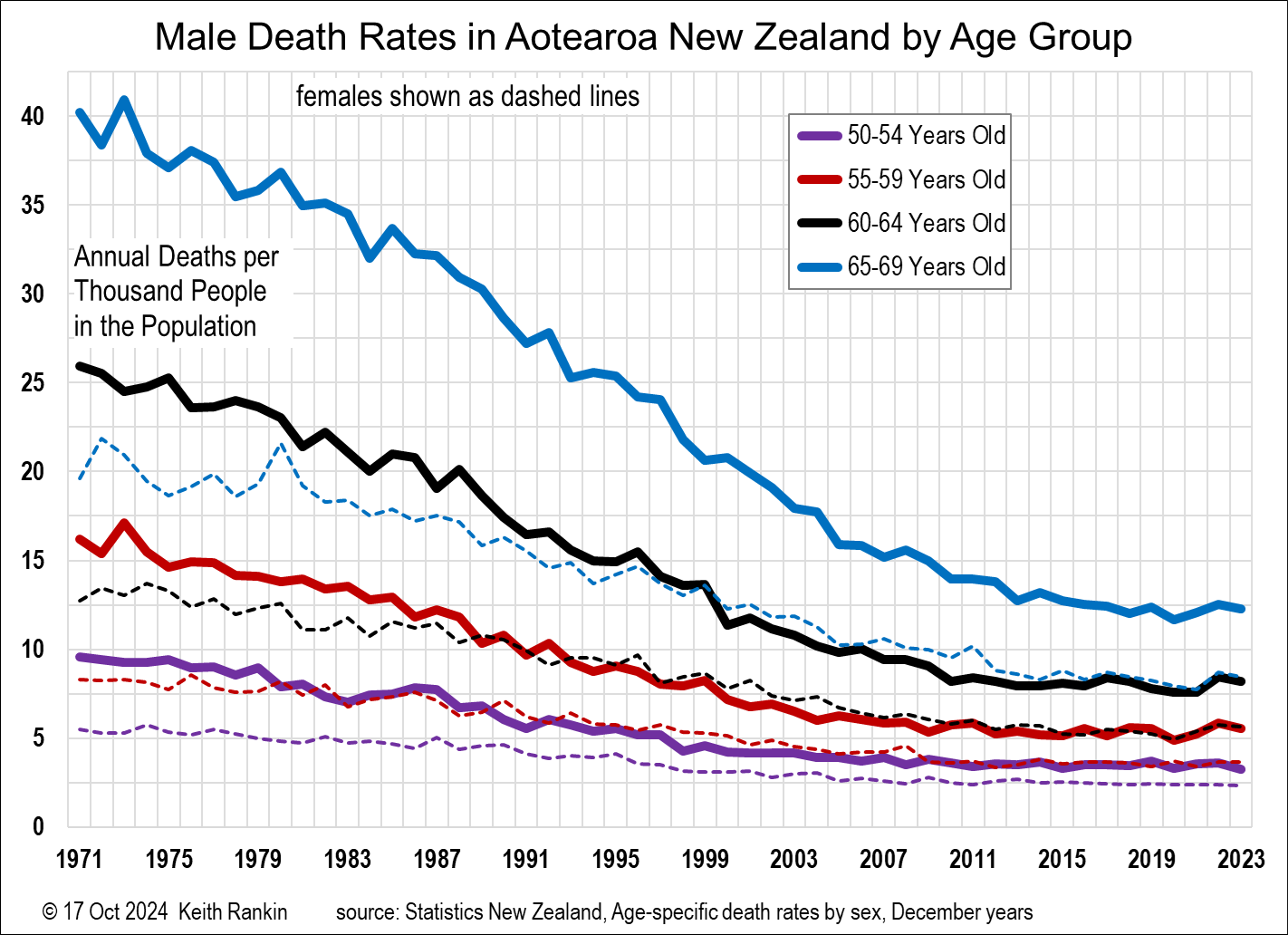
This chart shows how death rates have fallen since the 1970s, emphasising the higher male death experience. The principal finding is that dramatically falling death rates have plateaued since around 2010, especially for men aged 50 to 64. Yet the starkest fact portrayed is the much higher death rates of males than females, in each of the age groups shown.
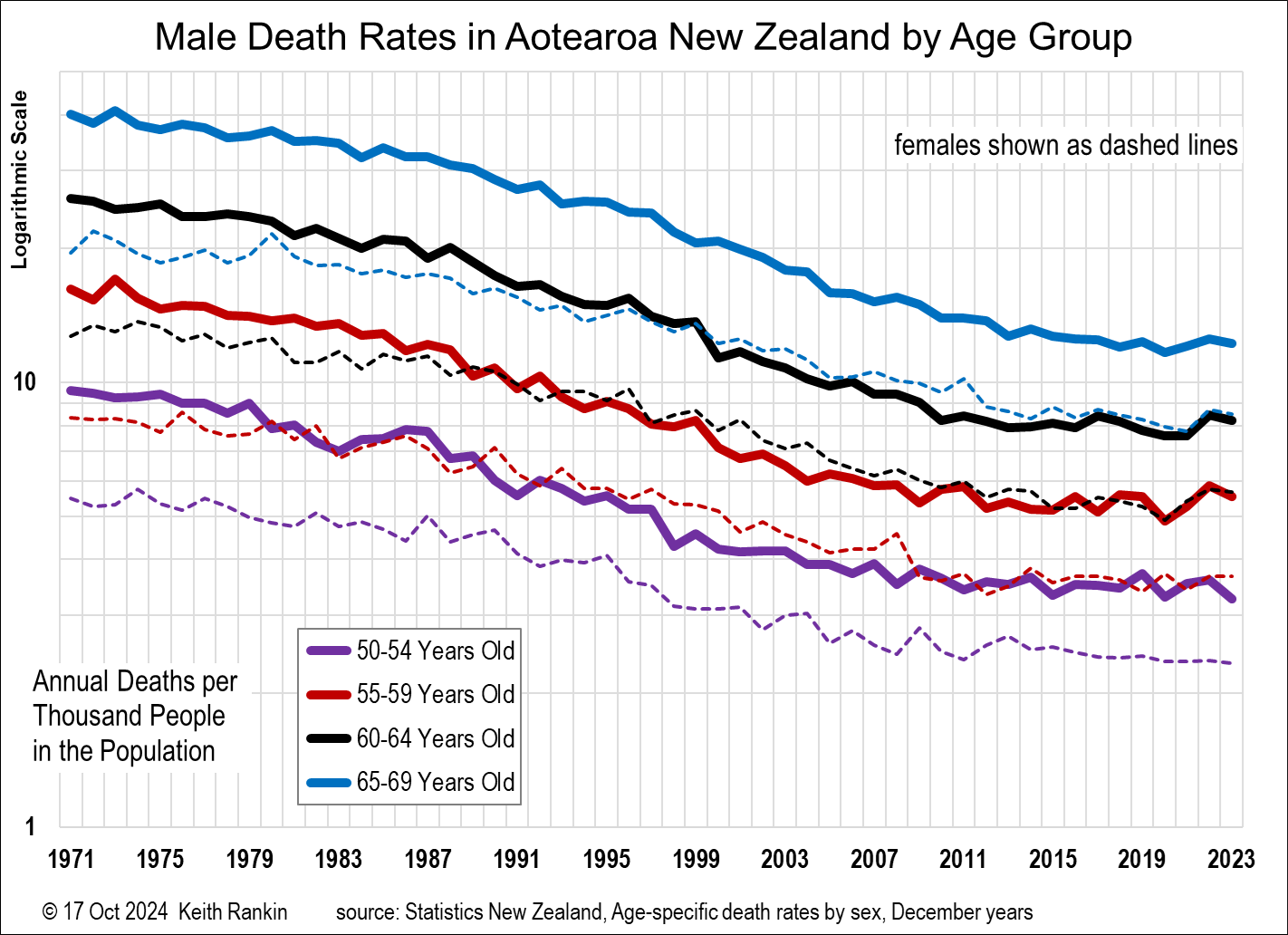
While this chart shows the differences in death rates clearly, the arithmetic plots used have an inbuilt visual bias with respect to changes over time; they exaggerate the slowing down of the improvements in death rates and the narrowing of the gaps. The second chart uses a ‘logarithmic scale’, which corrects this bias. For this second chart it is the slopes that matter, not the gaps between the groups.
Chart by Keith Rankin.
The ‘plateau-effect’ still clearly shows. What it means is that it is no longer credible to say that “we are all living longer” (as many people urging us to save more for retirement say). Essentially, since about 2010, older working-age adults were dying at the same rates in the late 2010s as in the early 2010s. For the 2020s there is a small Covid19 effect. It seems unlikely that the declining age-group death rates of the millennial period will resume.
The data used shows some other things that are not easy to chart. First, the large gap between male and female death rates is closing (but remains large). Second, males aged between 15 and 35 had disturbingly higher death rates in the late 1980s ‘Rogernomic period’ compared to the early-1980s ‘Muldoon period’. Though females aged 20-24 did have markedly rising death rates in the early 1980s. In recent years, the death rates of younger people has risen significantly, especially females; though female death rates remain significantly lower than male death rates for all age groups. The biggest improvements in death rates in the millennial period were made by younger people, and by males aged 50 to 74. Those improvements slowed or reversed after 2015.
*******
Keith Rankin (keith at rankin dot nz), trained as an economic historian, is a retired lecturer in Economics and Statistics. He lives in Auckland, New Zealand.
Source: Hong Kong Government special administrative region
A spokesman for the Agriculture, Fisheries and Conservation Department (AFCD) today (October 17) announced that marine fish culture licences for operation in Wong Chuk Kok Hoi and Mirs Bay fish culture zones are open for application from today.
The spokesman said, “The AFCD has commenced the two new fish culture zones in Wong Chuk Kok Hoi and Mirs Bay for operation. The two are located in open waters with better currents, which facilitate the adoption of modern aquaculture facilities and technology such as steel truss cages or HDPE (high-density polyethylene) gravity-type cages with strong wind and wave resistance, together with automated feeding and real-time monitoring systems. They also allow fishermen to operate aquaculture in an intensification mode. Their establishment promotes and assists fishermen in switching to a modernised and sustainable mode of operation, thus facilitating the sustainable development of the local fisheries industry.”
The AFCD accepts applications for marine fish culture licences for operation in the two new fish culture zones from today to December 16. Applicants shall provide a detailed business plan, including an introduction to the proposed sustainable mariculture business, as well as explaining the kind of deep-sea cages to be used and the business itself, which should comply with relevant cage requirements as well as environmental protection and mitigation measures.
The spokesman noted that persons interested in operating in the above new fish culture zones may consider applying for marine fish culture licences through funding from the Sustainable Fisheries Development Fund or through self-financing to develop mariculture businesses.
The AFCD designated Wong Chuk Kok Hoi, Mirs Bay, Outer Tap Mun and Po Toi (Southeast) as four new fish culture zones in December last year, covering a total area equivalent to three times that of the original fish culture zones. Among these, Wong Chuk Kok Hoi and Mirs Bay fish culture zones commenced first. The AFCD will review the operation in these two new fish culture zones to further improve the planning of the two new fish culture zones at Outer Tap Mun and Po Toi (Southeast), and to prepare for commencing these new fish culture zones in due course.
The AFCD will hold a briefing session on October 22 for interested parties to provide information on the application process and licensing requirements of marine fish culture licences for operation in the new fish culture zones. Details of application and the briefing are available on the AFCD website: www.afcd.gov.hk/english/fisheries/fish_aqu/fish_aqu_mfco/newfczmfcl2024.html.
Source: Hong Kong Government special administrative region
The following is issued on behalf of the Hospital Authority.
The spokesperson for the Kowloon Central Cluster made the following announcement today (October 17):
A 70-year-old male patient in a respiratory medicine ward of Kowloon Hospital (KH) was confirmed to be carrying Candida auris on September 23 without signs of infection. In accordance with the prevailing infection control guidelines, KH commenced a contact tracing investigation. Three more male patients (aged 53 to 88) from the same ward were subsequently confirmed to be carrying Candida auris without signs of infection. One patient is currently hospitalised at Queen Elizabeth Hospital for other medical needs. The remaining three patients are now being treated in isolation at KH and are in stable condition.
Moreover, regarding an earlier announcement on Candida auris carrier cases in the medical ward of Hong Kong Buddhist Hospital (HKBH), one more patient of the ward concerned, an 89-year-old female, was confirmed to carry Candida auris without signs of infection. The patient is now in isolation care and is in stable condition.
The hospitals will continue the contact tracing investigations of close contacts of the patients in accordance with the prevailing guidelines. A series of enhanced infection control measures have already been adopted at wards concerned to prevent the spread of Candida auris, namely:
thorough cleaning and disinfection of the ward concerned; enhanced admission screening for patients and environmental screening procedures; and application of stringent contact precautions and enhanced hand hygiene of staff and patients.
The hospitals will continue to closely monitor the situation of the patients. The cases have been reported to the Hospital Authority Head Office and the Centre for Health Protection for necessary follow-up.
17 October 2024 – Tax Justice Aotearoa welcomes the latest 1News-Verian poll finding which shows almost half of voters would support a capital gains tax that excludes the family home.
The poll asked “Do you support or oppose the introduction of a capital gains tax (CGT) on properties other than the family home?”
More voters than not said they would support the introduction of a CGT, with 46 per cent in favour and 41 per cent opposed. 13 per cent did not know or preferred not to say.
“This poll shows that New Zealanders are tired of the current unfair system, in which you are taxed less if you make a living from buying and selling houses than you do if you work an ordinary job,” says Tax Justice Aotearoa chair Glenn Barclay.
“New Zealand is an outlier internationally in that we do not tax capital gains in a comprehensive way. The additional revenue raised could fund vital services such as education, healthcare and infrastructure and help address climate change – leading to a better quality of life for all New Zealanders.”
“Our tax system is way out of balance and a capital gains tax (CGT) is a good first step to help level the playing field between wage earners and those who mainly earn their money through investments,” Barclay says.
“There has been growing support for a capital gains tax from a range of individuals and organisations in the media in recent weeks and this poll shows the public of New Zealand are supportive too.”
Polling commissioned by TJA also indicates a strong public appetite for a tax on capital – and showed that when the concept is properly explained, support was even stronger.
“Once people understand that gains from the sale of assets such as houses and shares is income, just like income from employment, they realise how unfair our current system is,” Barclay says.
“Given the public level of support for treating all sources of income consistently for tax purposes, we call on all political parties to act now.”
PETER KHALIL MP, MEMBER FOR WILLS: Thanks everyone, I’m Peter Khalil MP, Member for Wills. Today I’m joined by Amanda Rishworth, Claudia Johnson, Assistant Principal here at Brunswick Secondary College and Hunter Johnson, the CEO of The Man Cave and these wonderful young leaders here, these young men – I’m going to get this right – Jethro, Campbell, Harry, and Marco, who have demonstrated some amazing leadership in the way that they role model to younger kids and teach respectful relationships. They’re doing a terrific job, as is the school. So it’s great to have the Minister here to hear about the work that the Man Cave is doing, and the Brunswick Secondary College are doing, and I want to hand over now to Minister Amanda Rishworth. Welcome to Wills, thanks for coming.
AMANDA RISHWORTH, MINISTER FOR SOCIAL SERVICES: Thank you. Well, look, it’s really wonderful to be here, and I’d like to firstly acknowledge the advocacy that Peter Khalil does do, particularly about getting the right supports for adolescent men and boys. I’d also like to thank Hunter from The Man Cave and Claudia from Brunswick Secondary College for having us here today. We are announcing today the three providers that will be delivering our Healthy Mate program. The three providers are the Jesuit Social Services, the Foundation for Positive Masculinity and also The Man Cave. These three organisations will be delivering, in-person conversation and connection with young men, talking about what it means to be a young man: what some of the challenges they’re facing, how can they develop positive relationships with their peers, how can they develop positive relationships with their wider community. We know that there are many influences out there. Some role models are great, and it was wonderful to speak with these young men about some of those really good role models. But we know that many young men are being influenced by not-so-good role models. Influencers like Andrew Tate, and other online influencers that are really promoting really rigid, negative, aggressive, and violent portrayals of what it is to be a man. And so it’s really important that we get in and have these conversations with young men, and I’d like to thank The Man Cave for the proposal they put in. Their work really goes to actually having deep conversations, making sure that there are really healthy role models for young men to help them be able to realise that talking about your emotions is really important. We were talking before just about the fact that everyone feels sad from time to time, and that it’s not a sign of weakness for young men to talk about being sad. So this is what this program is doing, is making sure that we can work with young men and boys to make sure that we are developing healthy men into the future. This is, of course, really important for those young men as individuals, but really important as we tackle gender-based violence and this has been a critical area that not only was highlighted in the rapid review, but in our National Plan, that we must engage and work with young men and boys into the future. So I’m really pleased to hand over to Hunter now from The Man Cave, that is going to be one of the three organisations that will be delivering this important program.
HUNTER JOHNSON: Thank you, Minister. And thank you Peter, great to see you again. Thank you, Claudia as well. Amazing to be at Brunswick Secondary College, which is local for us. We really focus on boys’ strengths rather than their deficits. It is absolutely an inflection point for masculinity right now, it’s a really confusing time for many young men, but we’re surrounded by four, incredible, positive role models here today. The funding for us will allow us to scale to the many – to the hundreds of schools that reach out to us that have economic barriers to entry. It allows us to subsidise the program so that we can get it out far and wide, and really, it’s focussing on the character development, the social and emotional intelligence, and their relationship skills, the sex education in a way that really meets boys where they’re at. It can be, as I said, very confusing, a lot of these messages, but also we work with tens of thousands of boys on the front line every day and I can tell you from a position of hope, there are thousands of young men who want to be allies, both for supporting themselves but their relationships, their communities, too. So just recognise it’s such an important time in Australian culture, whether it’s men’s mental illness, men’s suicide prevention or men’s violence against women, a lot of the funding traditionally has gone to crisis management, and I fully understand why and I back it, but we’re also at a really exciting point with this generational moment where we can invest in the future generation to create a positive future state for masculinity. So this is a real landmark investment, I really back the courage of the Australian Government to do this and we’re excited to work alongside the other members of the collective to scale this work into the communities that need it most. So thank you very much and I’ll pass over to Claudia.
CLAUDIA JOHNSON: Thanks, Hunter. I’m really grateful to you, Minister Rishworth, and to The Man Cave for including Brunswick Secondary College in this wonderful opportunity. We know that young men need particular support, and they specifically need different ways to receive support. So it just can’t be one single program. It needs to be a whole range of things and certainly The Man Cave’s program will fit perfectly with what we’re doing at the school. The Man Cave, the program’s going to benefit our wonderful young men, but it also benefits the young women in our school as well and the community more broadly. So, again, we’re really grateful for this partnership and we’re excited for where it’s going to bring to our school. Thank you.
JOURNALIST: Minister, whereabouts is this program? What parts of the country is it actually rolled out in?
AMANDA RISHWORTH: Well, this is a trial and at the moment we’re looking at predominantly rolling it out in New South Wales and Victoria, but very much looking at continuing to see the results and looking at other opportunities which allows us to roll this program out.
JOURNALIST: How long’s the trial going to go for?
AMANDA RISHWORTH: The trial is over the next year, and we will hopefully get a good evaluation of the trial. We know already anecdotally this is having a positive influence, even just speaking recently, from speaking to participants in the program, hearing directly the benefits before this trial even began about the Man Cave program. But this will allow greater accessibility and evaluation and then we’ll look at where else we can extend it to.
JOURNALIST: What about in areas like the Northern Territory? Just yesterday another woman was killed, this is the seventh woman since July in the Territory. What else needs to be done in areas like that where we don’t have access to services like this and enough help for women up there?
AMANDA RISHWORTH: In terms of particularly for Aboriginal and Torres Strait Islander people, we have a separate action plan that was developed with States and Territories about how we address the disproportionately high rate of violence against Aboriginal women and children. And in particular, we’ve announced a number of actions, including men’s wellness camps. We are currently rolling those out, which provide culturally appropriate healing for men across the country, but there has been a particular focus on the Northern Territory under that program. These aren’t run by government. This is run by those with a cultural appropriateness to connect with men. When it comes to adolescent boys who have experienced violence, that’s another challenge because we know that trauma, in particular, can have an impact. We’ve recently announced the roll out of a number of programs to support those adolescent boys who have experienced family domestic violence themselves and that is about stopping the cycle, the generational cycle of violence. So this program is, in itself, is not the only program. In fact, under our Aboriginal and Torres Strait Islander Action Plan, there’s $263 million. When it comes to support in the Northern Territory, we have put close to $180 million extra into support within the Northern Territory.
JOURNALIST: Something’s obviously not working up there, though?
AMANDA RISHWORTH: Well, I would make the point about the National Plan. The National Plan is about a plan to change generations. We know that, for example, this program is about changing the attitudes and stereotypes that come along with a rigid masculinity that can lead to violence. So this is about making sure that we have adolescent boys that grow up healthy. That obviously, to see the benefits when it comes to violence, will take some time. I just visited, just then, new safe places accommodation here in Victoria, but equally we’re rolling them out across the country. This is building crisis accommodation as well. So we need to make sure that we’re investing in prevention, early intervention, crisis response and healing and recovery. We’ve invested as a Government, in the last two and a half years, an extra $3.4 billion. Obviously we’re rolling this out to get it on the ground. But some of this is about generational change, it is about culture change in Australia, and I would invite everyone to work with all levels of government, and I will remind that all levels of government have signed up to this National Plan, along with how we create change in our broader community if we’re going to achieve our goal.
JOURNALIST: How important is cracking down on social media? Obviously a lot of young people use TikTok and things like that, a lot of misinformation, a lot of values posted on TikTok. How important is cracking down on that for young kids?
AMANDA RISHWORTH: Look, obviously what we know is that social media in particular feeds up information that causes a stir and what that can mean is that there is a lot of quite aggressive footage on there. There can often be views that condone violence against women, encourage violence against women, and if you’re at a particularly young age, then this could be quite influential. We were just talking before about the importance of role models at the home, and it was really lovely to hear some of the young men here talking about what an important role model their father was in particular. But we also need to acknowledge that young people are being really bombarded by some really very toxic attitudes and viewpoints on social media. So it is important that we do crack down on social media and that is why our government’s committed to having an age limit on social media in legislation introduced by the end of the year.
JOURNALIST: Can I ask Hunter a quick question about the program? In terms of how you’re going to see how effective it is in schools, how are you actually going to look at that data?
HUNTER JOHNSON: Sure, so we work with schools based on their socioeconomic status, which is basically called an ICSEA status. So we will charge a school based on how high or affluent or disadvantaged they may be. We’ve also got an in-house impact evaluation team that monitors the short, long-term behavioural change and the attitudinal change, and we partner with educational institutions like universities to measure the effectiveness.
JOURNALIST: Just a couple of questions. Obviously the Prime Minister’s just purchased that $4.3 million home. Do you think he’s shown a lack of judgment by purchasing this multi-million dollar property during a cost-of-living crisis?
AMANDA RISHWORTH: I don’t accept that. The purchase of this house is really a matter for the Prime Minister and his fiancé. And he won’t be the first person or the last person, politician or other person, to buy a property. But I think what’s important is you need to look at the actions that this Government has taken when it comes to cost of living. Actions like our immediate support for a 45 per cent increase in Commonwealth Rent Assistance, whether it’s our $32 billion in investment, whether that’s in social and affordable housing, whether that’s in our rent-to-buy plan, whether that is in our home equity scheme that supports people become homeowners. I mean, really, the Greens and the Liberal Party need to front up and explain why they are standing in the way. So we’ve got to judge us by the actions, our cheaper medicines, these are the things that our government is taking action on and are critical to support people with cost-of-living pressures.
JOURNALIST: A recent survey that was released just last week said around 80 per cent of people believed that young people aren’t going to be able to buy a new home without the help of a family member and that they’re unlikely to ever be able to purchase a new home. Does this indicate that the public doesn’t believe your government is doing enough to help first homebuyers?
AMANDA RISHWORTH: Firstly, I would say that it is a challenge, of course, to get more supply online. We’ve had inaction by the previous Federal Government, the Liberal Government that did nothing when it came to housing supply in this country. So from the very beginning, we’ve been delivering things like the Housing Australia Future Fund, but also this is where our help-to-buy scheme is so important. It is providing the opportunity for 40,000 Australians to have a share – to be part of a shared equity scheme to help them own their first home. And so it is quite appalling that the Liberal Party and the Greens are standing in the way of this legislation. So I’m not surprised that Australians are feeling pretty disappointed because this legislation has been stalled in the Senate.
JOURNALIST: Is Labor divided on its housing tax policy?
AMANDA RISHWORTH: No.
JOURNALIST: Would you like to see any change to negative gearing arrangements?
AMANDA RISHWORTH: That is not part of our housing policy. As I said, we’ve committed to $32 billion extra funding when it comes to our housing policies and that includes things like the 45 per cent in Commonwealth Rent Assistance, which is flowing to people now. But it also includes increasing supply across the domains of social and affordable housing. We know that social housing has been ignored for so many years and our housing Australia Future Fund is delivering that. Our housing funding to States and Territories is delivering on that. But, of course, in addition to that, private rental and, of course, looking at home ownership. We are looking right across the board to support people. I tell you one thing that won’t help the cost of housing and that is the Liberal Party, A, standing in the way with the Greens blocking of our bill, but also, their plans that means that people have to dig into their retirement savings and to own a house. That will only ensure that more people rely on the pension and push up house prices. So it’s only Labor with a credible plan to address housing shortages in this country.
JOURNALIST: Will you rule out making any changes to the housing tax mix before the next election?
AMANDA RISHWORTH: Well, look, as the Prime Minister, Housing Minister, Treasurer said, that is not part of our plan. We have put our plans forward and we will keep talking about how important our homes for Australia plan is, that’s delivering houses now. I just recently, just before, went out to see the capital build that will happen for crisis accommodation for women and children fleeing domestic and family violence. Our funding is allowing for over 100 safe places for women and children leaving violent circumstances. That wouldn’t have been able to be done without the investment from the Commonwealth, a capital investment, to actually build those places. Thank you.