NewzIntel.com

    • Checkout Page
    • Contact Us
    • Default Redirect Page
    • Frontpage
    • Home-2
    • Home-3
    • Lost Password
    • Member Login
    • Member LogOut
    • Member TOS Page
    • My Account
    • NewzIntel Alert Control-Panel
    • NewzIntel Latest Reports
    • Post Views Counter
    • Privacy Policy
    • Public Individual Page
    • Register
    • Subscription Plan
    • Thank You Page

Blog

  • MIL-OSI Russia: GUU expands cooperation with Delovaya Rossiya

    Translation. Region: Russian Federal

    Source: Official website of the State –

    An important disclaimer is at the bottom of this article.

    Rector of the State University of Management Vladimir Stroyev and Vice-Rector Dmitry Bryukhanov held a working meeting with the Deputy Chairman, Head of the Executive Committee of the All-Russian Public Organization “Business Russia” Nonna Kagramanyan.

    The meeting discussed a wide range of issues of cooperation between the State University of Management and Delovaya Rossiya, including holding events aimed at developing entrepreneurial competencies among students and students of additional education programs, developing joint educational and expert activities, and developing a business education system.

    One of the key areas is cooperation within the framework of the implementation of MBA programs – creation of joint programs, their examination for compliance with market trends, involvement of experts from Delovaya Rossiya, and consulting of program students.

    The Basic Department of “Business Russia” operates on the basis of the Higher School of Business and Technology of the State University of Management, which coordinates joint projects and provides scientific and methodological support in the field of entrepreneurship and business development management.

    “Delovaya Rossiya”, founded in 2001, unites more than 10 thousand businessmen of our country. The total number of employees at the enterprises of “Delovaya Rossiya” is more than 4.5 million people, and the total annual revenue of the enterprises exceeds 10 trillion rubles. More than 700 members of the organization are included in public councils of government bodies, working groups of state councils and national projects.

    Please note: This information is raw content obtained directly from the source of the information. It is an accurate report of what the source claims and does not necessarily reflect the position of MIL-OSI or its clients.

    .

    MIL OSI Russia News –

    July 11, 2025
  • NESTS launches multi-pronged initiatives with UNICEF, Tata Motors to boost education and employment for tribal youth

    Source: Government of India

    Source: Government of India (4)

    In a major push towards empowering tribal students, the National Education Society for Tribal Students (NESTS), an autonomous body under the Ministry of Tribal Affairs, has unveiled a series of initiatives to enhance education, life skills, and employability for students studying in Eklavya Model Residential Schools (EMRSs) across the country.

    On July 9, NESTS signed landmark agreements with UNICEF India, Tata Motors Limited, and the Ex-Navodayan Foundation to roll out programmes that will support over 1.3 lakh tribal students in their academic and professional journeys.

    At the centre of these efforts is TALASH (Tribal Aptitude, Life Skills and Self-Esteem Hub), an innovative national platform launched in partnership with UNICEF. TALASH aims to strengthen both academic learning and personal development by helping students discover their strengths, build essential life skills, and plan clear career pathways.

    Through psychometric assessments inspired by NCERT’s ‘Tamanna’ initiative, students will receive individual Career Cards suggesting suitable career options based on their aptitudes. The platform will also provide career counselling, dedicated life skills modules, and resources for teachers to guide students effectively. The phased national rollout has already begun, with 189 teachers from 75 EMRSs trained to lead sessions in their schools. By the end of 2025, TALASH is expected to reach all EMRSs in 28 states and 8 union territories.

    Complementing this, NESTS has entered into a five-year Memorandum of Understanding with Tata Motors Limited to bridge the gap between classroom learning and industry-ready skills. Under this partnership, students passing out of Class 12 from EMRSs will be enrolled in Tata Motors’ Kaushalya Program — an ‘Earn & Learn’ initiative that combines a Diploma in Engineering with on-the-job training. Eligible students will be aged 18 to 23 and must have secured at least 60% marks in their Class 10 examinations.

    The program provides a monthly stipend, subsidised canteen and transport facilities, uniforms, safety equipment, insurance cover, and opportunities for high-performing students to pursue further technical studies such as B.Tech through tie-ups like BITS Pilani’s Work Integrated Learning Program. Placement support under a ‘One Trainee, One Job’ policy will ensure that trained graduates find employment within Tata Motors’ manufacturing and service locations nationwide.

    In a parallel move, NESTS has also signed a tripartite agreement with Tata Motors and the Ex-Navodayan Foundation to offer focused coaching for competitive exams like IIT-JEE and NEET. This initiative will include dedicated residential Centres of Excellence at Chankapur (Maharashtra) and Chintapalle (Andhra Pradesh), providing intensive in-person coaching for meritorious science stream students of Grades XI and XII. Additionally, online preparatory classes for Olympiad, NTSE, and KVPY exams will be made available to students from digitally equipped EMRSs, extending support to learners from Grade IX onwards.

    Together, these new measures are intended to close educational gaps, build confidence among tribal youth, and create a sustainable pipeline of skilled students ready to contribute to India’s development.

    According to Ajeet Kumar Srivastava, Commissioner, NESTS, these collaborations are “a testament to our commitment to providing tribal students with opportunities to realise their full potential. Through these initiatives, we aim to bridge gaps in education and empower the next generation of tribal leaders.”

    NESTS, under the Ministry of Tribal Affairs, runs Eklavya Model Residential Schools nationwide to ensure quality education for tribal students. UNICEF India continues to partner with the government in advancing inclusive education, while Tata Motors and the Ex-Navodayan Foundation bring industry experience and academic expertise to strengthen outcomes for tribal youth.

    July 11, 2025
  • MIL-OSI: Jamf to Report Second Quarter 2025 Financial Results on August 7, 2025

    Source: GlobeNewswire (MIL-OSI)

    MINNEAPOLIS, July 10, 2025 (GLOBE NEWSWIRE) — Jamf (NASDAQ: JAMF), the standard in managing and securing Apple at work, announced today it will report second quarter financial results for the period ended June 30, 2025, following the close of the market on Thursday, August 7, 2025. On that day, management will host a conference call and webcast at 3:30 p.m. CT (4:30 p.m. ET) to discuss the company’s business and financial results.

    Jamf Second Quarter 2025 Earnings Conference Call

    When: Thursday, August 7, 2025

    Time: 3:30 p.m. CT (4:30 p.m. ET)

    Live Webcast: The conference call will be webcast live on Jamf’s Investor Relations website at https://ir.jamf.com.

    Replay: A replay of the call will be available on the Investor Relations website beginning on August 7, 2025, at approximately 6:00 p.m. CT (7:00 p.m. ET).

    About Jamf

    Jamf’s purpose is to simplify work by helping organizations manage and secure an Apple experience that end users love and organizations trust. Jamf is the only company in the world that provides a complete management and security solution for an Apple-first environment that is enterprise secure, consumer simple and protects personal privacy. To learn more, visit: www.jamf.com.

    Investor Contact:
    Jennifer Gaumond
    ir@jamf.com

    Media Contact:
    media@jamf.com

    The MIL Network –

    July 11, 2025
  • MIL-OSI: Brag House Announces Zacks Small-Cap Research Initiation of Coverage

    Source: GlobeNewswire (MIL-OSI)

    NEW YORK, July 10, 2025 (GLOBE NEWSWIRE) — Brag House Holdings, Inc. (NASDAQ: TBH) (“Brag House” or the “Company”), the media-tech platform at the intersection of gaming, college sports, and Gen Z engagement, is pleased to announce that Zacks Small-Cap Research has initiated coverage of Brag House.

    Highlights from Zacks Coverage

    • Recognition of Innovative Model: Zacks highlights Brag House’s unique platform, which enables authentic engagement between Gen Z casual gamers, brands, and collegiate sports communities.
    • Gen Z Focus: The report underscores Brag House’s strategic focus on Gen Z, a demographic expected to comprise a significant portion of the workforce by 2030 and projected to hold $360 billion in disposable income.
    • Strategic Partnerships: Zacks notes the importance of our recent partnership with Learfield, granting access to media rights across 200+ NCAA Division schools and expanding our national reach.
    • Growth Prospects: The coverage outlines Brag House’s anticipated revenue growth through B2B sponsorships, collegiate tournaments, and the future launch of a SaaS-based analytics platform to deliver actionable Gen Z insights to brands.
    • Market Opportunity: Zacks estimates Brag House’s target market at $6.7 billion, with our platform positioned to capture a sizable niche within this rapidly expanding segment.

    “We are honored to be recognized by Zacks Small-Cap Research, a respected authority in equity research,” said Lavell Juan Malloy, II, CEO and Chairman of Brag House. “Their initiation of coverage validates our vision to bridge the gap between brands and Gen Z through innovative, data-driven engagement. Our recent milestones, including the Learfield partnership and successful collegiate activations, demonstrate Brag House’s momentum and commitment to delivering value for our partners, users, and shareholders.”

    About Brag House
    Brag House is a leading media technology gaming platform dedicated to transforming casual college gaming into a vibrant, community-driven experience. By seamlessly merging gaming, social interaction, and cutting-edge technology, the Company provides an inclusive and engaging environment for casual gamers while enabling brands to authentically connect with the influential Gen Z demographic. For more information, visit www.braghouse.com.

    About Zacks Small Cap Research
    Zacks Small Cap Research (“Zacks SCR”) is a division of Zacks Investment Research. Zacks SCR coverage specifically looks to focus on small and micro-cap companies that are underfollowed or undervalued by Wall Street.  Our analysts seek to identify and report on these companies, bringing to investors a unique opportunity to gain insight on small cap investments that are believed to be undervalued and well-positioned for future growth.  Our goal is to produce high quality (institutional) research for the small cap portfolio.

    Media Contact:
    Fatema Bhabrawala
    Director of Media Relations
    fbhabrawala@allianceadvisors.com

    Investor Relations Contact:
    Adele Carey
    VP, Investor Relations
    ir@thebraghouse.com

    The MIL Network –

    July 11, 2025
  • MIL-OSI: Announcement of the decision made at the bondholders’ meeting of UAB “Orkela” on 10 July 2025

    Source: GlobeNewswire (MIL-OSI)

    At the initiative of UAB “Orkela” (the Company) and the decision of UAB “AUDIFINA” (the Trustee), a meeting of the bondholders of the Company’s bond issue, ISIN code LT0000405961 (the Bonds), was held on 10 July 2025 (the Meeting).

    Meeting draft decision and voting results:

    Regarding the extension of the Bonds’ redemption date to 19 October 2025. A vote was held in the Meeting to approve the change of the redemption date specified in the Bond documents to 19 October 2025, with the Company paying higher annual interest of 9% for the final interest period from 19 July 2025 (inclusive) to 19 October 2025 (exclusive).


    The decision of the Meeting was adopted.

     In accordance with the Meeting’s decision, the Bonds’ redemption date is extended and changed to 19 October 2025, with the Company paying higher annual interest of 9% for the final interest period from 19 July 2025 (inclusive) to 19 October 2025 (exclusive).

    The Meeting minutes are attached to this announcement and are published on the Company’s website at https://lordslb.lt/orkela_bonds/, as well as on the Trustee’s website at https://www.audifina.lt/paslaugos/konsultacines-paslaugos/obligaciju-savininku-interesu-gynimas-atstovavimas/#viesi-pranesimai.

    The presentation delivered by the Company during the meeting is attached hereto

    Attachments

    • UAB-Orkela-susirinkimo-protokolas-Audifina_LT-EN_10.07.2025 (1)
    • 2025 07 10 Orkela bondholders meet presentation

    The MIL Network –

    July 11, 2025
  • MIL-OSI: Bitget Protection Fund in June 2025 Hits $716 Million

    Source: GlobeNewswire (MIL-OSI)

    VICTORIA, Seychelles, July 10, 2025 (GLOBE NEWSWIRE) — Bitget, the leading cryptocurrency exchange and Web3 company, has released its monthly report on Protection Fund which has reached a high of $716 million in June 2025, more than doubling its original benchmark of $300 million. The fund, designed to serve as a safeguard for users in extreme market conditions, maintained a consistent 6,500 BTC balance throughout the month. Its value fluctuated with market prices, with the average monthly valuation settling at around $687 million.

    The highest daily valuation was recorded on June 9, driven by BTC prices topping $110,000. At its lowest on June 22, the fund stood at approximately $655 million, still well above the pledged minimum. This level of reserve reflects a stable security buffer that operates independently of insurance or third-party guarantees.

    Since its launch, the fund has been monitored in real-time through publicly visible wallet addresses, offering full transparency into its assets. It is held entirely in BTC and USDT, allowing it to remain liquid and responsive to market shifts. Bitget has kept the fund for emergencies, positioning it strictly as a protective reserve in case of major incidents such as hacks, exploit attempts, or abnormal losses on the platform.

    Originally launched with a $300 million reserve, the fund has grown by over 140%, aligned with the appreciation of BTC holdings and Bitget’s strategic focus on market insurance. The fund’s value fluctuates in accordance with the price of Bitcoin, with May’s performance boosted by BTC trading above $110,000 on multiple occasions.

    June’s figures arrive at a time when crypto markets continue to move unpredictably, and user trust is tied more closely than ever to platform security. The Protection Fund has quietly grown into one of the largest exchange reserves of its kind, offering users reassurance without the need for claims or long settlement processes.

    In an industry where security promises are often tested after the fact, the Bitget Protection Fund remains one of the few safety nets that is not only pre-funded and on-chain but also well above its original target. The June 2025 update shows that user protection is not just an afterthought it’s a standing reserve, ready as needed.

    With monthly Merkle Tree audits verifying full asset backing and ISO 27001:2022 certification asserting best-in-class protocols, the platform integrates SSL encryption and an advanced risk control system that actively monitors suspicious activity. This combination of rigorous standards and real-time protection has kept Bitget breach-free since 2018 and contributed to its AAA security rating and helped reinforce user confidence to set a benchmark for transparency across the industry.

    For more information and monthly updates on the Protection Fund, visit here.

    About Bitget

    Established in 2018, Bitget is the world’s leading cryptocurrency exchange and Web3 company. Serving over 120 million users in 150+ countries and regions, the Bitget exchange is committed to helping users trade smarter with its pioneering copy trading feature and other trading solutions, while offering real-time access to Bitcoin price, Ethereum price, and other cryptocurrency prices. Formerly known as BitKeep, Bitget Wallet is a leading non-custodial crypto wallet supporting 130+ blockchains and millions of tokens. It offers multi-chain trading, staking, payments, and direct access to 20,000+ DApps, with advanced swaps and market insights built into a single platform.

    Bitget is at the forefront of driving crypto adoption through strategic partnerships, such as its role as the Official Crypto Partner of the World’s Top Football League, LALIGA, in EASTERN, SEA and LATAM markets, as well as a global partner of Turkish National athletes Buse Tosun Çavuşoğlu (Wrestling world champion), Samet Gümüş (Boxing gold medalist) and İlkin Aydın (Volleyball national team), to inspire the global community to embrace the future of cryptocurrency.

    For more information, visit: Website | Twitter | Telegram | LinkedIn | Discord | Bitget Wallet

    For media inquiries, please contact: media@bitget.com

    Risk Warning: Digital asset prices are subject to fluctuation and may experience significant volatility. Investors are advised to only allocate funds they can afford to lose. The value of any investment may be impacted, and there is a possibility that financial objectives may not be met, nor the principal investment recovered. Independent financial advice should always be sought, and personal financial experience and standing carefully considered. Past performance is not a reliable indicator of future results. Bitget accepts no liability for any potential losses incurred. Nothing contained herein should be construed as financial advice. For further information, please refer to our Terms of Use.

    Photos accompanying this announcement are available at:

    https://www.globenewswire.com/NewsRoom/AttachmentNg/e4912037-6e64-41b5-b8f6-27d998f661e4

    https://www.globenewswire.com/NewsRoom/AttachmentNg/2bb7ca57-9e45-4f79-8879-352cc552965f

    The MIL Network –

    July 11, 2025
  • MIL-OSI: NextNRG Reports Preliminary June 2025 Revenue Growth of 231% Year-Over-Year

    Source: GlobeNewswire (MIL-OSI)

    AI-Driven Energy Pioneer Delivers Sixth Consecutive Record Month

    Company on Clear Path to $100 Million Revenue Run-Rate with Canadian Acquisition

    MIAMI, July 10, 2025 (GLOBE NEWSWIRE) — NextNRG, Inc. (Nasdaq: NXXT), a pioneer in AI-driven energy innovation transforming how energy is produced, managed, and delivered through its Next Utility Operating System®, smart microgrids, wireless EV charging, and mobile fuel delivery, today announced preliminary unaudited financial results for June 2025.

    June 2025 Highlights:

    • Revenue: $6.98 million, up 231% year-over-year and 6% month-over-month
    • Gallons delivered: Over 2.04 million gallons, up 270% year-over-year and 4% month-over-month
    • Year-to-date revenue through June reached approximately $35.87 million, representing a 33% increase over full-year 2024 revenue of approximately $27 million

    “We’re thrilled to report our sixth consecutive record month, with June’s 231% year-over-year revenue growth demonstrating the scalability of our AI-driven energy platform and strong market demand for our integrated solutions,” said Michael D. Farkas, Executive Chairman and CEO of NextNRG. “With our pending acquisition of ReFuel Mobile in Canada and expanding domestic operations across six U.S. states with 144 active fuel delivery trucks, we are positioned to achieve $100 million in forward 12-month revenues. More importantly, our improving operational efficiency and recurring revenue contracts provide a direct pathway to profitability in 2026 – a critical milestone that will transform NextNRG from a high-growth company into a sustainable, cash-generating enterprise. The combination of our proven mobile fueling platform, microgrid pipeline, and strategic international expansion creates multiple revenue streams that support both our near-term growth targets and long-term profitability objectives.”

    NextNRG’s robust growth continues to be driven by strong adoption from commercial fleets and strategic partnerships in its mobile fueling operations. The company is also preparing to deploy its Next Utility Operating System®, AI-powered microgrid systems, and wireless EV charging products in key markets to diversify its revenue streams.

    The pending acquisition of ReFuel Mobile, Canada’s #36 fastest-growing company with 1,166% three-year revenue growth, is expected to close by August 1, 2025, and will immediately contribute to NextNRG’s recurring revenue base while providing a strategic platform for international expansion.

    Note on Preliminary Results
    The financial results for June 2025 are preliminary and unaudited. Final results may differ and will be confirmed upon the completion of standard month-end closing procedures.

    About NextNRG, Inc.
    NextNRG Inc. (NextNRG) is Powering What’s Next by implementing artificial intelligence (AI) and machine learning (ML) into renewable energy, next-generation energy infrastructure, battery storage, wireless electric vehicle (EV) charging and on-demand mobile fuel delivery to create an integrated ecosystem.

    At the core of NextNRG’s strategy is its Next Utility Operating System®, which leverages AI and ML to help make existing utilities’ energy management as efficient as possible, and the deployment of NextNRG smart microgrids, which utilize AI-driven energy management alongside solar power and battery storage to enhance energy efficiency, reduce costs and improve grid resiliency. These microgrids are designed to serve commercial properties, healthcare campuses, universities, parking garages, rural and tribal lands, recreational facilities and government properties, expanding energy accessibility while supporting decarbonization initiatives.

    NextNRG continues to expand its growing fleet of fuel delivery trucks and national footprint, including the acquisition of Yoshi Mobility’s fuel division and Shell Oil’s trucks, further solidifying its position as a leader in the on-demand fueling industry. NextNRG is also integrating sustainable energy solutions into its mobile fueling operations. The company hopes to be an integral part of assisting its fleet customers in their transition to EV, providing fuel delivery while advancing efficient energy adoption. The transition process is expected to include the deployment of NextNRG’s innovative wireless EV charging solutions.

    To find out more visit: www.nextnrg.com

    Forward-Looking Statements
    This press release includes forward-looking statements within the meaning of the Private Securities Litigation Reform Act of 1995. Any statement describing NextNRG’s goals, expectations, financial or other projections, intentions, or beliefs is a forward-looking statement and should be considered an at-risk statement. Words such as “expect,” “intends,” “will,” and similar expressions are intended to identify forward-looking statements. Such statements are subject to certain risks and uncertainties, including, but not limited to, those related to NextNRG’s business and macroeconomic and geopolitical events. These and other risks are described in NextNRG’s filings with the Securities and Exchange Commission from time to time. NextNRG’s forward-looking statements involve assumptions that, if they never materialize or prove correct, could cause its results to differ materially from those expressed or implied by such forward-looking statements. Although NextNRG’s forward-looking statements reflect the good faith judgment of its management, these statements are based only on facts and factors currently known by NextNRG. Except as required by law, NextNRG undertakes no obligation to update any forward-looking statements for any reason. As a result, you are cautioned not to rely on these forward-looking statements.

    Investor Relations Contact
    NextNRG, Inc.
    Sharon Cohen
    SCohen@nextnrg.com

    The MIL Network –

    July 11, 2025
  • MIL-OSI Analysis: Trump’s ‘big’ bill gives millions of taxpayers a new charitable tax break, but whether it will help nonprofits is unclear

    Source: The Conversation – USA (2) – By Daniel Hungerman, Professor of Economics, University of Notre Dame

    Tax policy changes can influence how much Americans donate. Douglas Rissing/iStock via Getty Images Plus

    The multitrillion-dollar bill that President Donald Trump signed into law on July 4, 2025, will change how the U.S. tax code treats charitable donations. It also has several tax provisions that affect some colleges, universities and other nonprofits. The Conversation U.S. asked Daniel Hungerman, an economist who studies charitable activities and public policy, to explain how these tax policies could influence charitable giving and affect nonprofits.

    What will change for donors?

    The consequences generally vary depending on how much money a donor gives to charity. They also depend on whether a donor claims the standard deduction – as about 90% of U.S. taxpayers have done since the 2017 tax reforms took effect during the first Trump administration – or itemizes their tax returns.

    Anyone taking the standard deduction, which will rise in 2025 to US$15,750 for an individual and $31,500 for married couples filing jointly, will get a new broadly available tax break of up to $1,000 for giving to a charitable nonprofit if they file on their own. Married couples filing jointly may deduct $2,000 from their taxable income if they give at least that amount to charity. To put this into sharper perspective, the average middle-income household gives about $3,300 annually.

    Americans who give a bit more than the typical donor – say, between $5,000 and $20,000 – will see major changes too. In some places, it will become easier for people to deduct more of the amount they pay in state and local taxes from their federal taxes – at least for a few years. Those taxpayers may also deduct their charitable giving from their income when they file their taxes.

    But there’s a new catch. People who itemize their taxes can’t claim the charitable deduction unless they give at least the equivalent of 0.5% of their adjusted gross income to charity. For example, someone who earns $100,000 a year would have to donate at least $500 to qualify for this tax break.

    A similar new catch will apply to corporate donations: Unless corporations give at least 1% of their taxable income to charity, they will no longer get a charitable tax deduction.

    The tax law also revises a rule that limits how much the biggest donors can give to charity and still get a tax break.

    What could that mean for charitable giving?

    Based on my research on tax policies and donations, I don’t expect the $1,000 charitable deduction for taxpayers who take the standard deduction to boost giving. The government has tried this before.

    The first time was in the 1980s. Starting in 1982, people taking the standard deduction could take a charitable deduction. The amount changed annually. In 1984, for example, it was $75 – $236 in 2025 dollars. Congress ended this experiment with the 1986 tax reforms.

    There was also a temporary $300 charitable deduction for people who took the standard deduction in 2020.

    The results were underwhelming both times, for two reasons.

    First, the maximum size of those tax breaks was too small in those earlier efforts. Many people were already giving enough to max out this new benefit. When that happens, the government is giving up tax revenue without encouraging people to donate more.

    To be fair, there are a couple of reasons that things might be better this time. First, $1,000 in 2025 – or $2,000 for married couples filing jointly – is more money than the $300 deduction in 2020. Also, this time it is permanent. A permanent provision gives charities time to publicize the bill and people time to learn about it.

    Another concern with this bill is that Americans who have not given to charity in the past might not begin to open their wallets but will still try to get the new $1,000 charitable deduction anyway by lying about it on their tax returns. There is evidence that a growing number of taxpayers try to game the tax system this way. The only way to stave off that sort of tax evasion would require additional work by the IRS, costing more tax dollars.

    This part of the tax law also sends a message that giving is not just for the wealthy, but that everyone can do it and get a tax break for it. That could help halt or reverse a decline in gifts from people who aren’t rich. And it makes me wonder whether a charitable deduction for people who don’t itemize their tax returns will work better this time around.

    What’s happening to higher education?

    The government will raise its tax on the income earned by the endowments held by some colleges and universities from 1.4% to as much as 8%. The system is complicated and hinges on how large an endowment is per student enrolled. Colleges attended by fewer than 3,000 students don’t have to pay this tax.

    Endowments are pooled financial investments that belong to a nonprofit. Those assets usually come from donations, and the income they earn typically flows into the nonprofit’s budget.

    Several prominent schools are bracing for higher taxes. Yale University, for example, says it will have to pay $280 million once this goes into effect.

    The higher endowment tax is unlikely to raise a whole lot of tax revenue, but it could force some schools to scale back financial aid, hike tuition or freeze hiring.

    What about K-12 schools?

    Perhaps the most significant change will be a new federal K-12 educational tax credit. Starting in 2027, it will be available to help offset the cost of private K-12 school tuition or other educational expenses, such as homeschooling. If someone makes a $1 gift to a nonprofit scholarship-granting organization – which would then deliver those funds to the school the donor designates – the government will cut their tax bill by $1. This tax credit can be worth up to $1,700 per year.

    Many details about how this system would work are yet to be determined.

    I believe that this provision could mark another step in the transformation of how private schools are funded in the United States. Beyond that, many private schools are run by churches, and many churches running schools already get large amounts of their funding from vouchers issued by state and local governments. Ultimately, private K-12 education could become an increasing source of revenue for churches.

    What about nonprofits that provide social services?

    Even if the megabill boosts charitable giving, nonprofits providing social services are likely to find themselves financially squeezed.

    That’s because the bill also cuts spending and tightens eligibility restrictions on the Supplemental Nutrition Assistance Program, also known as food stamps, and Medicaid, the public health insurance program that mainly covers people who are low-income or have disabilities.

    I have researched the effects of the welfare reforms President Bill Clinton signed into law in 1996. One of my findings was that when the government cut spending on safety net programs by a dollar, charities, including churches, stepped in to provide 25 cents of services or more. But for every extra dollar needed to compensate for lost government spending, donors only gave 5 cents more.

    Another concern is that this bill makes permanent increases in the standard deduction – which I’ve found to have historically lowered charitable giving considerably. Perhaps the deduction for people who don’t itemize their tax returns, together with the state-and-local-taxes change, will counteract this trend. But it is certainly possible that Americans will give less to charity starting in 2025 compared with a world where there were no Trump tax reforms at all.

    Daniel Hungerman is a professor at the University of Notre Dame, and a Research Associate at the National Bureau of Economic Research.

    – ref. Trump’s ‘big’ bill gives millions of taxpayers a new charitable tax break, but whether it will help nonprofits is unclear – https://theconversation.com/trumps-big-bill-gives-millions-of-taxpayers-a-new-charitable-tax-break-but-whether-it-will-help-nonprofits-is-unclear-260379

    MIL OSI Analysis –

    July 11, 2025
  • MIL-OSI Analysis: Dune patterns in California desert hold clues that help researchers map Mars’ shifting sands

    Source: The Conversation – USA – By Lauren Berger, Ph.D. Student in Geology, Texas A&M University

    The author did some of her fieldwork at the Algodones Dunes in California. Ryan Ewing

    Our two-person team loaded the car with a GPS, a drone, notebooks, sample bags, a trowel and a flat spatula lovingly called a scoopula. Then we drove 30 minutes in our rented truck from Yuma, Arizona, to the Algodones Dunes, a sandy field bordering California, Arizona and Mexico. The day was sunny, with a strong breeze. Turning off the highway, we carefully headed onto a gravelly path that acted as our road.

    After making decent – if bumpy – progress, we pulled off onto the sand flats and drove slowly toward the dunes, worried we might get stuck in the sand. Having arrived on the outskirts of the Algodones, we stopped and loaded our backpacks, then set off into the desert on foot.

    The coarse- and fine-grained sand at the Algodones Dunes.
    Lauren Berger

    It was November 2022. As a graduate student at Texas A&M University, I was beginning part of my Ph.D. research with my adviser, geology professor Ryan Ewing. We were looking for coarse-grained sand ripples, which are patterned piles of sand shaped by wind. Sand ripples and sand dunes are types of aeolian bedforms, which are wind-created geologic features.

    Aeolian bedforms are common on Earth and across the solar system, including on Mars, Venus, Pluto, the Saturn moon Titan, the Neptune moon Triton, and Comet 67P. These geological features, among the first landforms observed by remote images of planetary surfaces, are robust indicators of a world’s wind patterns.

    Flying a drone at Algodones. Note the GPS on the tripod, and a GPS target on the ground, which was also a landing pad for the drone.
    Ryan Ewing

    Measuring sand patterns in person

    The shapes and patterns of aeolian bedforms can reveal the environmental conditions that created them.

    Two sizes of the same bedform, such as small dunes on top of big dunes, are called compound bedforms. I study compound bedforms at two scales – the meter- and centimeter-sized coarse-grained ripples at the dunes here on Earth, and the kilometer- and meter-sized dunes on Mars.

    At the Algodones, I measured the height of each large coarse-grained sand ripple and the distance between neighboring ripples. Then we flew our drone low and steady, above the ripples, to create high-resolution images. The drone data allows us to do further measurements on the ripples later, back at my desk.

    On that day, I learned an essential rule of fieldwork in the desert: Don’t forget a shovel. Otherwise, if your vehicle gets stuck, as ours did, you’ll have to dig it out by hand. Luckily for us, a dune buggy driver passing by helped us out and we were able to get back to Yuma in time for dinner.

    High-resolution drone images of the sand ripples at Algodones.
    Lauren Berger

    My introduction to Mars

    I first became interested in aeolian bedforms during my sophomore year of college, when I interned at the NASA Jet Propulsion Laboratory. My job was to view surface images of Mars and then map the sand ripples in the regions where Perseverance, the Mars rover, might land. I assessed the areas where ripples could be hazards – places where the rover could get stuck in the sand, the way our rental truck did in the Algodones.

    I mapped those sand ripples on Mars for two years. But while I mapped, I became fascinated with the patterns the ripples made.

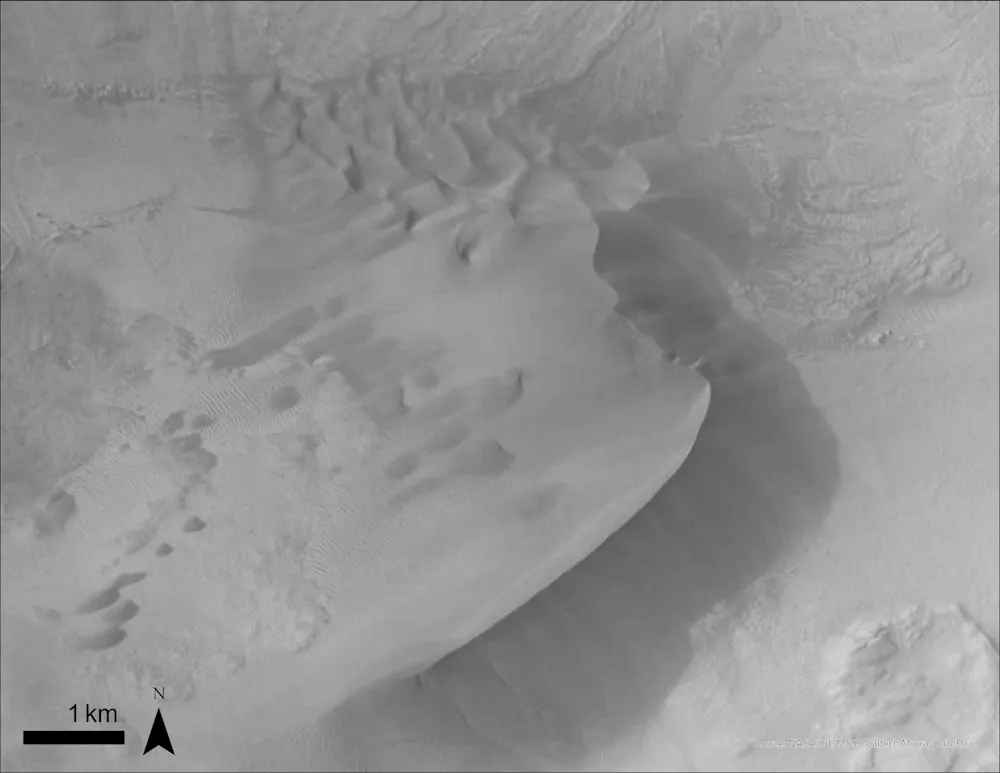
    A potential compound dune on Mars.
    NASA/JPL-Caltech

    Now, as a graduate student and aspiring planetary geologist, my time is split between work in the field and at my computer, where I have stitched together the drone’s photographs of the Algodones to create a large image of the entire study area. I then look for compound dunes on the Martian surface in images taken by the Mars reconnaissance orbiter’s context camera.

    Scientists already know about Earth’s weather patterns, sand grain size and wind data. By measuring different parts of bedforms on both planets – such as their height, shape and spacing – I can compare the similarities and differences of the bedforms to find clues to the wind patterns, grains and atmosphere on Mars. Slowly but surely, as I listen to Studio Ghibli soundtracks, I’m creating the first database of compound dunes on Mars.

    Two dune fields on Mars, both inside an impact crater.
    NASA/JPL-Caltech

    Developing this database is essential to the proposed human mission to Mars. Dust storms are frequent, and some can encircle the entire planet. Understanding aeolian bedforms will help scientists know where to put bases so they don’t get buried by moving sand.

    It is wonderful to spend an afternoon ping-ponging all over a planet that’s 140 million miles from us, seeing gorgeous terrain while I try to answer questions about the compound dunes on Mars. How common are they? Where do they form? How do they compare to those on Earth? I hope to answer these questions as I work toward earning my Ph.D in geology.

    Lauren Berger receives funding from NASA FINESST. Lauren Berger would like to acknowledge the help of her mentors Dr. Ryan Ewing (NASA Johnson Space Center), Dr. Marion Nachon (Texas A&M University), and Dr. Julia Reece (Texas A&M University).

    – ref. Dune patterns in California desert hold clues that help researchers map Mars’ shifting sands – https://theconversation.com/dune-patterns-in-california-desert-hold-clues-that-help-researchers-map-mars-shifting-sands-251761

    MIL OSI Analysis –

    July 11, 2025
  • MIL-OSI Video: WhatsApp Video 2025-07-10 at 14.00.54.mp4

    Source: Republic of South Africa (video statements)

    #G20SouthAfrica’s Presidency, enhancing cross-border payments is a top priority.

    Africa faces some of the highest costs for cross-border transactions globally.

    The G20 Presidency is committed to making payments:
    faster;
    cheaper; and
    more inclusive and transparent

    #GovZAUpdates

    https://www.youtube.com/watch?v=mxg9NKRhdk0

    MIL OSI Video –

    July 11, 2025
  • MIL-OSI Africa: The Minister of Foreign Affairs, Regional Integration and International Trade of Republic of Mauritius to Visit Japan

    Source: APO


    .

    Hon. Dhananjay Ramful, Minister of Foreign Affairs, Regional Integration and International Trade, Republic of Mauritius will pay a visit to Japan from July 13 to 16.

    During his stay in Japan, the Minister will meet with Mr. IWAYA Takeshi, Minister for Foreign Affairs of Japan, and will participate in the National Day Event of Expo 2025 Osaka, Kansai, Japan, as official guest of the Government of Japan.

    The visit of the Minister is expected to further develop the bilateral relations between Japan and Mauritius.

    Distributed by APO Group on behalf of Ministry of Foreign Affairs of Japan.

    MIL OSI Africa –

    July 11, 2025
  • MIL-OSI Africa: Sudan: Children reveal harrowing violence in latest North Darfur mass displacement

    Source: APO


    .

    Save the Children and its partners spoke to over 450 of these displaced children in Tawila for the assessment “Children Caught in Conflict”, with children describing traumatic journeys and expressing fear, grief, and a profound sense of uncertainty about their futures. 

    Hundreds of children have recounted harrowing stories of terror and loss after their homes in Sudan’s North Darfur region were attacked, with many telling Save the Children how they lost contact with friends and loved ones [1].  

    Violence is happening daily in North Darfur, the epicentre of Sudan’s two-year conflict,  with fighting intensifying over the past 12 months and spiking in April this year when the Zamzam camp housing people forced from their homes was viciously attacked.  

    Nearly 500,000 people – including 260,000 children – were displaced from Zamzam camp between April and May, which amounts to 99% of the camp’s population. About  75% of the displaced people ended up in the Tawila camp [2], which is located around 60km southeast of Zamzam.  

    Save the Children and its partners spoke to over 450 of these displaced children in Tawila for the assessment “Children Caught in Conflict”, with children describing traumatic journeys and expressing fear, grief, and a profound sense of uncertainty about their futures. 

    Many children witnessed killings and dead bodies in the streets, with some reporting witnessing young people being arrested or killed, and more than half of the girls interviewed (53%) reported incidents of sexual violence during their journey out of Zamzam to Tawila.  

    Three children reported that their mothers died during the journey to Tawila, while four others said they lost a brother, and five reported the death of their fathers. 

    Some children recounted supporting elderly relatives travelling long distances on donkeys, with others saying they were forced to leave behind exhausted family members under threat of violence.  

    Salma*, 12, originally from El Fasher, was displaced twice — first to Zamzam, then to Tawila. She described witnessing rape, killings, and looting along the road. Her grandfather died during the journey due to exhaustion and lack of care. Upon arrival in Tawila, her family had no food or shelter and slept in the open.  

    Talha*, 12, was fetching water for his family when the Zamzam camp came under attack. He witnessed shootings, and widespread panic. He ran home to find his family but discovered the house empty. He searched the schools where people were hiding but couldn’t find them. Believing his family had fled to Tawila, Talha followed the crowds on foot. After arriving, he stayed with a host family for seven days before they too left, leaving him alone. Talha told the survey team his only wish is to return to El Fasher and reunite with his family — though he doesn’t know if they are still alive. 

    While some children said they feel relatively safe in Tawila, many — especially girls — expressed deep grief over the loss of family members and fear of ongoing violence. 

    Children cited poor living conditions, including sleeping on the ground, extreme heat, food shortages, and the presence of armed individuals, as sources of distress.  

    Girls reported high levels of fear and vulnerability, particularly when using toilets or traveling long distances for water. Many shared that friends were raped during displacement or in the camps. Both boys and girls acknowledged a rise in sexual violence, with girls aged 12–18 being the most affected. Boys were also aware of the abuse experienced by their sisters and peers.  

    Francesco Lanino, Deputy Country Director of Programmes and Operations for Save the Children in Sudan, said: 

    “Children in North Darfur have been to hell and back. They are grieving deeply, while contemplating uncertain futures. Many lost family members before and during their displacement, and don’t have adequate tools to process their experiences. Some children have described to our staff harrowing experiences of parting with older family members on the route, many of whom they haven’t seen since.  

    “Since the conflict began, children’s lives have been upended. They now wake to the sound of gunfire and shelling. Families dig trenches for protection, schools are closed, and access to healthcare is limited. Many children reported that their peers have joined armed groups or been forced into early marriage due to economic hardship.  

    “Children’s rights have been completely ignored in Sudan. They are being separated from their families, seeing loved ones killed or maimed, and have already missed years of critical education, with terrible consequences for their long-term well-being. We are incredibly concerned for these children’s futures – and the future of Sudan – if this conflict doesn’t end now.” 

    Save the Children is urging the international community to redouble efforts to demand a ceasefire in Sudan, to allow safe and unhindered humanitarian access and a drastic scale-up of humanitarian assistance.  

    Save the Children has worked in Sudan since 1983 and is currently supporting children and their families across Sudan providing health, nutrition, education, child protection and food security and livelihoods support. Save the Children is also supporting refugees from Sudan in Egypt and South Sudan. 

    Since April 2025, Save the Children has been leading a major humanitarian response in North Darfur, addressing the urgent needs of displaced populations following mass displacement from Zamzam camp and El Fasher. With hundreds of thousands of internally displaced persons across the region, Save the Children has scaled up operations in El Fasher, Tawila and Central Darfur, delivering life-saving services in health, nutrition, water and sanitation, protection, and shelter. 

    Distributed by APO Group on behalf of Save the Children.

    MIL OSI Africa –

    July 11, 2025
  • MIL-OSI Africa: Economic Community of West African States (ECOWAS) celebrates its fiftieth anniversary in Cotonou: a march for regional unity and solidarity

    Source: APO


    .

    As part of the celebrations marking the fiftieth anniversary of the Economic Community of West African States (ECOWAS), the ECOWAS Representation in Benin, with the support of the Beninese Government, the West African Power Pool (WAPP) and the Multinational Maritime Coordination Centre (MMCC) Zone E, organised a commemorative march in Cotonou on Saturday 28th of June 2025.

    Titled the “Jubilee Walk”, the event brought together over 300 participants from state and diplomatic institutions, ECOWAS specialised agencies, project partners, West African communities, youth organisations, NGOs, students and teachers.

    The march set off from the Place de l’Amazone at 7.00am and took a looping route through the Place Bio Guéra, returning to its starting point at around 10.00am. It was led by a high-level delegation including Ambassador Amadou DIONGUE, ECOWAS Resident Representative in Benin, the representative of the Minister for Sport, the Director of CMMC Zone E and the representative of the WAPP Secretary General. The presence of the Resident Coordinator of the United Nations System, the Resident Representatives of UEMOA and UNFPA, as well as Ambassador Francis OKE, former Permanent Representative of the ECOWAS to the African Union, enhanced the solemnity of the event.

    In keeping with the theme of the golden jubilee, “Stronger together for a brighter future”. the march was punctuated by messages in favour of unity and solidarity, the essential foundations of successful regional integration.

    In his speech, the ECOWAS Resident Representative said: “This march symbolises our shared commitment to an ECOWAS of peoples, united and in solidarity. In the face of current challenges, it is imperative that we unite our voices on the international stage to defend the interests of our region and accelerate the implementation of our integration policies, in order to create opportunities for our peoples”.

    The ceremony ended with words of thanks and encouragement from Ambassador Francis OKE, the Resident Coordinator of the United Nations System, the representative of the Minister for Sport and the Resident Representative of the ECOWAS. They all stressed that the support, solidarity and unity of the peoples are the foundation of West African political and economic integration. The morning ended in a convivial atmosphere, with refreshments and a family photo.

    Distributed by APO Group on behalf of Economic Community of West African States (ECOWAS).

    MIL OSI Africa –

    July 11, 2025
  • MIL-OSI Africa: Economic Community of West African States (ECOWAS) holds sensitization session on procurement standard documents to strengthen compliance and operational coherence across institutions

    Source: APO


    .

    The Directorate of Administration and General Services is currently holding a three-day sensitization meeting on ECOWAS Procurement Standard Documents (the Procurement Code / Manual; Grant Code / Manual, and various Annexes thereof), which are strategic documents intended to ensure consistent interpretation of the documents and their proper application in alignment with international and donor-compliant procurement practices.

    The Sensitization exercise is to engender clear, uniform understanding and application of the procurement standard documents during procurement processes whilst promoting clarity of Roles, Responsibilities, and Standard Timelines throughout the procurement standard document cycle.

    For enhanced synergy in the ECOWAS procurement chain across all ECOWAS Institutions, and Offices, participants in this important session include officers/stakeholders from the ECOWAS Commission (Directorates of Finance – B&T / FR&G – ITS, Legal Affairs, Human Resources, Infrastructure); Office of the Auditor-General, Parliament, Court of Justice, WAHO, GIABA); Agencies (ARAA, RCDC, PPDU, ECREEE, Gender Center, Water Resources).

    The meeting was declared open by the Commissioner for Internal Services (CIS) and moderated by the Director of Administration and General Services (DAGS).

    Distributed by APO Group on behalf of Economic Community of West African States (ECOWAS).

    MIL OSI Africa –

    July 11, 2025
  • MIL-OSI Africa: The task force on the Economic Community of West African States (ECOWAS) Trade Liberalisation Scheme (TLS) has held a meeting to take stock of eight years of action in the field

    Source: APO


    .

    The Task Force on the ECOWAS Trade Liberalisation Scheme (TLS) met from the 1st to 3rd of July 2025, in Abidjan, Côte d’Ivoire, to take stock of the eight years of field missions across the ECOWAS Member States.

    The meeting was attended by the Chairman of the TLS Task Force, Dr Mohamed Ibn CHAMBAS, the ECOWAS Commission’s Commissioner for Economic Affairs and Agriculture, Ms Massandjé TOURE-LITSE, members of the first and second teams of the TLS Task Force, executives from the Customs Union and Taxation Directorate, and representatives of associations lobbying for the free movement of people and goods in West Africa, including AOCTAH/WACTAF, the Borderless Alliance, ENDA-CACID, NANTS, and ROPPA.

    In his welcoming remarks, the Chairman of the TLS Task Force, Dr Mohamed Ibn CHAMBAS, recalled the main objective of the meeting, which is not only to take stock of the actions of the TLS Task Force since the installation of the first team in 2016 up to the present day, to analyse without complacency the strengths and weaknesses of the said actions, but also to make relevant proposals likely to reinforce the gains made and correct the weaknesses, with a view to eliminating obstacles to intra-regional trade.

    Opening the meeting on behalf of the President of the ECOWAS Commission, H.E Dr Omar Alieu TOURAY, the Commissioner for Economic Affairs and Agriculture, Mrs Massandjé LITSE-TOURE, welcomed the key role played by the TLS Task Force in deepening intra-community trade through the free movement of people and goods. She praised the leadership of Dr CHAMBAS, who has brought a number of trade facilitation reforms to the attention of the region’s highest authorities, with tangible results.

    The plenary session, which lasted three days, enabling participants to make proposals to allow the TLS Task Force to be more effective in its future actions. The participants also recommended that the TLS Task Force should advocate for the strengthening of Member States’ commitment to regional integration through the appointment of a Special Adviser to the Cabinet of each President of the Republic or Prime Minister. This Special Adviser to the President or Prime Minister should, as a matter of priority, monitor the application by national administrations of Community texts on the free movement of persons and goods. It was also recommended that the TLS Task Force should step up its lobbying of governments on the issue of speeding up the digitisation of customs and trade procedures in order to facilitate the flow of goods along the various ECOWAS trade corridors.

    Beyond the question of the mandate of the Task Force on TLS, the participants seized the opportunity of this review meeting, in connection with the celebration of the fiftieth anniversary of ECOWAS, to make proposals to be fed back into the reflection on the ECOWAS of the future. These include the creation of an ECOWAS solidarity fund to promote balanced development within the community. ECOWAS should launch federative infrastructure projects (roads, railways, energy, interconnectivity, etc.) based on endogenous resources. Finally, a panel of eminent personalities will be set up to review the ECOWAS Treaty, with a view to strengthening the roles of the Parliament and the Community Court of Justice.

    The Chairman of the TLS Task Force, Dr Mohamed Ibn CHAMBAS, will shortly be travelling to Abuja to report to the Chairman of the Commission on the results of the Abidjan meeting.

    Distributed by APO Group on behalf of Economic Community of West African States (ECOWAS).

    MIL OSI Africa –

    July 11, 2025
  • MIL-OSI Africa: Golar LNG Reaches Commercial Operations Date (COD) at Greater Tortue Ahmeyim (GTA) Project, Joins African Energy Week (AEW) 2025 as Gold Partner

    Source: APO


    .

    Golar LNG has officially announced that its FLNG Gimi vessel has reached its Commercial Operations Date (COD) under the 20‑year lease-and-operate agreement for the Greater Tortue Ahmeyim (GTA) gas project offshore Mauritania and Senegal. Achieving COD triggers the commencement of this long-term contract – unlocking approximately $3 billion in adjusted EBITDA backlog for Golar – and marks a major milestone in positioning both countries as emerging LNG exporters.

    The Gimi FLNG unit will initially produce 2.4 million tons of LNG per annum, with plans to ramp up to its full capacity of 2.7 million tons. Backed by an estimated 15 trillion cubic feet of natural gas, the GTA project is expected to bolster regional and global energy security while stimulating economic growth in both host nations.

    In line with its growing presence in Africa’s energy landscape, Golar LNG has joined the 2025 edition of African Energy Week (AEW): Invest in African Energies as a Gold Partner. Taking place from September 29 to October 3 in Cape Town, AEW 2025 brings together African governments, energy companies and global investors to explore and advance opportunities across the energy value chain. The event serves as a strategic platform for companies like Golar LNG to showcase innovative FLNG solutions and their long-term commitment to Africa’s energy development.

    Golar LNG’s participation at AEW aligns with the event’s broader vision to develop Africa’s estimated 620 trillion cubic feet of natural gas as a catalyst for energy security and poverty alleviation. In June 2024, the company signed a Project Development Agreement with the Nigerian National Petroleum Company Limited for a new FLNG facility in the Niger Delta. The project is designed to liquefy 400–500 million standard cubic feet of gas per day, contributing to Nigeria’s Decade of Gas Initiative and its goal to harness 209 trillion cubic feet of reserves to expand access to cleaner, more reliable energy.

    Golar LNG has also played a pioneering role in Cameroon’s gas sector since 2018, operating the 2.4-million-ton-per-annum Hilli Episeyo FLNG facility. As the company continues to grow its balance sheet and expand its footprint across the continent, AEW: Invest in African Energies offers an unparalleled opportunity to engage African stakeholders and pursue new prospects across the natural gas value chain.

    “The commercial launch of the Gimi FLNG facility is a major step forward for the MSGBC Basin and Africa’s LNG market,” says Ore Onagbesan, Program Director, AEW. “As countries like Nigeria, Ivory Coast, Gabon, Equatorial Guinea, Ghana, Mozambique and Tanzania work to monetize their offshore gas resources, innovative and reliable partners such as Golar LNG will play a vital role in driving sustainable growth and long-term value.”

    Distributed by APO Group on behalf of African Energy Chamber.

    About AEW:
    Invest in African Energies is the platform of choice for project operators, financiers, technology providers and government, and has emerged as the official place to sign deals in African energy. Visit www.AECWeek.com for more information about this exciting event.

    MIL OSI Africa –

    July 11, 2025
  • MIL-OSI United Kingdom: Kent farmers in innovative Chalk to Coast project

    Source: United Kingdom – Executive Government & Departments

    Press release

    Kent farmers in innovative Chalk to Coast project

    Farmer-led initiative to create vital nature network across Kent’s diverse landscapes. Project contributes to government’s Nature Recovery Network commitment

    Nightingale in nest – credit Ben Andrew (RSPB-images.com)

    An ambitious farmer-led initiative connecting Kent’s diverse landscapes from chalk downlands to coastal habitats has officially launched, bringing new hope for wildlife conservation across the region. 

    The Chalk to Coast project unites three established farm clusters, Hoo Peninsula, Swale and North Kent Downs and Medway Gap, forming a ‘super cluster’ that will create natural wildlife corridors across different habitats.

    A farm cluster is a plan to help farmers and partners work more cohesively together in their locality, enabling them to collectively deliver greater benefits for soil, water and wildlife at a landscape scale.

    Part of the project includes the creation of ‘natural corridors’ that will be placed strategically on strips of land and help connect fragmented wildlife habitats, allowing plants and animals to move freely and enhancing biodiversity. 

    These corridors are crucial for supporting wildlife movement, enabling them to find food, mates and suitable breeding grounds, ultimately contributing to a more resilient and thriving natural environment. 

    The creation of the nature corridors between the three farm clusters, including linking the new North Kent Woods and Downs National Nature Reserve in the countryside with Elmley National Nature Reserve by the sea, will link habitats together, creating a continuous ecological corridor for wildlife to travel between from ‘Chalk to Coast’ in Kent.  

    Barn owl in flight – credit Robert Canis

    Things that can be done to enable nature corridors includes:

    • Planting more trees and hedges and getting more woodland coppiced and back into healthy management use.
    • Planting more hedgerows to encourage the dispersal of the rare and endangered dormice simultaneously connecting woodlands.
    • And creating stepping stones of thick scrub to encourage wider populations of nightingale. Kent has the stronghold of nightingale, an incredibly rare species in the UK.

    James Seymour, Natural England deputy director for Kent, said:

    Nature’s recovery is core to delivering the Plan for Change with economic growth and a healthy environment. This project shows how Natural England provides expert advice that enhances ecosystems while supporting agricultural businesses.

    This collaborative approach demonstrates how agriculture and nature recovery can work together, delivering biodiversity gains while maintaining profitable farming businesses.

    Natural England has played a pivotal role in supporting this initiative, which forms part of the government’s commitment to a growing network of wildlife-rich places that supports nature recovery and sustainable farming practices nationwide. 
    With a new website now live at www.chalktocoast.co.uk, organisers are calling on more farmers and landowners across Kent to pledge their land to expand this vital nature network. 

     The three landowners and co-founders of the Chalk to Coast project explain more.

    Guy Nevill, of North Kent Downs and Medway Gap Farm cluster, said:

    This initiative shows how agriculture and nature recovery can work hand in hand. By connecting farm clusters, we’re creating wildlife corridors across Kent’s landscapes. We’re now encouraging more farmers to join this collaborative approach to land management.

    Tom Gore, from Hoo Peninsula Farm cluster, said:

    This is an exciting opportunity for both commercial farmers and environmental organisations to come together. Linking wildlife corridors and carrying out a large-scale biodiversity project, where both food production and nature work in harmony

    Gareth Fuller, of Swale Farm cluster, said:

    We are very excited to be part of Chalk to Coast. Over the last forty years, we have worked to restore abundant nature to the coastal wetlands of Elmley and Swale, and more recently to develop a sustainable nature-based economy though nature tourism and education.

    To do more we want to collaborate with others across a much larger area. Chalk to Coast offers the inspiration, ambition, opportunities, and scale to achieve a more connected, abundant landscape for nature and people. We are hugely grateful to Guy Nevill and the other founders for driving this initiative forwards.

    Boxing hares – credit Robert Canis

    The project contributes to the government’s Plan for Change through the development of a national Nature Recovery Network, helping wildlife thrive and respond to climate change while connecting people with nature, farming and food. 
     
    The initiative builds on existing farm clusters in Kent, enabling coordinated action on soil conservation, water management, habitat creation, and species recovery across property boundaries. 
     
    Land managers interested in joining can find information at www.chalktocoast.co.uk. 
     
    Background: 

    For more information about Chalk to Coast, visit www.chalktocoast.co.uk.
     
    For more information about Natural England’s work supporting nature recovery, visit www.gov.uk/natural-england.

    Contact us:

    Journalists only: 0800 141 2743 or communications_se@environment-agency.gov.uk.

    Share this page

    The following links open in a new tab

    • Share on Facebook (opens in new tab)
    • Share on Twitter (opens in new tab)

    Updates to this page

    Published 10 July 2025

    MIL OSI United Kingdom –

    July 11, 2025
  • MIL-OSI United Kingdom: Locations for new speed cameras announced

    Source: City of Birmingham

    Published: Thursday, 10th July 2025

    Six new sites for the location of speed cameras across Birmingham have been announced by the city council, which will be installed by the end of the year.

    The average speed enforcement cameras will be funded through the Clean Air Zone net surplus revenues and the locations agreed following joint working with West Midlands Police.

    Routes have been selected and prioritised based on the number and severity of road traffic collisions along the route and/or where compliance with speed limits is poor which leads to an increased risk of road harm.  All the routes chosen have the full endorsement of WMP.

    Cllr Majid Mahmood, cabinet member for environment and transport, said: “Safety on our busy highway network is paramount and these cameras have an important role to play – far too many collisions on our roads involve excessive speed.

    “However, they can never be a solution on their own. We all have a role to play in keeping our roads safe and everyone has a duty to think about others, whether pedestrians, cyclists or other motorists. This is not about making money – the majority of revenue goes direct to government – it is about road safety. I would be happy if no fines were issued as that means people are not speeding.

    “We also need to rethink how we move people and goods around the city and regions, which is why our Birmingham Transport Plan and Road Harm Reduction Strategy are looking at redesigning street in a way that put people first, and not only reducing speed but reducing the number of vehicles on our streets.”

    BCC and WMP entered into a new Joint Working Agreement covering camera enforcement of traffic offences in April 2025.  This not only secures ongoing enforcement of existing ASE locations, but also paves the way for new ASE, spot speed and red-light camera locations to be brought forward.

    Chief Constable Craig Guildford said: “I fully support this initiative, which will hopefully reduce the number of people who are killed or seriously injured on our roads.”

    The new camera locations are:

    1. A45 Coventry Road (extension of existing operation from Berkeley Road to Bordesley Middleway)
    2. A47 Nechells/Fort Parkway (A4040 Ring-road to A452 Chester Road)
    3. B4121 West Boulevard (Selcroft Avenue to California Way)
    4. A34 Walsall Road (Wellinton Road to Newton Road/City Boundary)
    5. B4114 Washwood Heath Road (Ward End Park Road to Bromford Lane)
    6. A34 Stratford Road (Coniston Close to Robin Hood Lane)

    Useful links

    MIL OSI United Kingdom –

    July 11, 2025
  • MIL-OSI Russia: HSE took part in the BRICS summit

    Translation. Region: Russian Federal

    Source: State University “Higher School of Economics” –

    An important disclaimer is at the bottom of this article.

    The site may not display correctly in older browser versions. For optimal site experience, we recommend using a modern browser.

    We use cookies to improve the HSE website and make it more convenient to use. More detailed information about the use of cookies can be foundHere, our rules for processing personal data are –Here. By continuing to use the site, you confirm that you have been informed of the use of cookies by the HSE website and agree with our rules for processing personal data. You can disable cookies in your browser settings.

    ABC ABC ABC A A A A A

    Regular version of the site

    Date

    July 10

    Headings

    The article mentions

    Persons

    You may also be interested in:

    Please note: This information is raw content obtained directly from the source of the information. It is an accurate report of what the source claims and does not necessarily reflect the position of MIL-OSI or its clients.

    .

    MIL OSI Russia News –

    July 11, 2025
  • MIL-OSI Russia: China to increase basic pension payments

    Translation. Region: Russian Federal

    Source: People’s Republic of China in Russian – People’s Republic of China in Russian –

    An important disclaimer is at the bottom of this article.

    Source: People’s Republic of China – State Council News

    BEIJING, July 10 (Xinhua) — Chinese authorities on Thursday announced that basic pension payments for retirees will be increased in 2025.

    The average monthly old-age pension benefit will be increased by 2 percent from the 2024 level starting from Jan. 1, 2025, for those who retired before the end of 2024, according to a notice jointly released by the Ministry of Human Resources and Social Security and the Ministry of Finance. -0-

    Please note: This information is raw content obtained directly from the source of the information. It is an accurate report of what the source claims and does not necessarily reflect the position of MIL-OSI or its clients.

    .

    MIL OSI Russia News –

    July 11, 2025
  • MIL-OSI Russia: China takes steps to combat smuggling of strategic minerals

    Translation. Region: Russian Federal

    Source: People’s Republic of China in Russian – People’s Republic of China in Russian –

    An important disclaimer is at the bottom of this article.

    Source: People’s Republic of China – State Council News

    BEIJING, July 10 (Xinhua) — China has taken measures to crack down on smuggling of strategic minerals while continuing to process legitimate applications for their export for civilian use, Ministry of Commerce spokeswoman He Yongqian said Thursday.

    Responding to a question about strategic minerals reportedly transiting to the United States, He Yongqian said at a press conference that strategic minerals such as antimony and gallium have obvious dual-use properties, and export controls on them are in line with internationally accepted practices.

    In order to resolutely prevent the illegal export of such minerals, China launched a special operation to combat their smuggling in May this year, He Yongqian said, adding that relevant information is available on the ministry’s website.

    She stressed that China, as a responsible major country, fully takes into account the reasonable civilian needs of various countries for these strategic minerals.

    China reviews applications for export licenses in accordance with laws and regulations and approves those that meet the requirements, she said. -0-

    Please note: This information is raw content obtained directly from the source of the information. It is an accurate report of what the source claims and does not necessarily reflect the position of MIL-OSI or its clients.

    .

    MIL OSI Russia News –

    July 11, 2025
  • MIL-OSI Russia: Lu Ban’s Workshop Becomes a Bridge for Humanitarian Exchanges between SCO Countries

    Translation. Region: Russian Federal

    Source: People’s Republic of China in Russian – People’s Republic of China in Russian –

    An important disclaimer is at the bottom of this article.

    Source: People’s Republic of China – State Council News

    TIANJIN, July 10 (Xinhua) — Igor Khodachek, director of the Eurasian Studies Center of the European University at St. Petersburg, entered his name on a computer while visiting the Tianjin Vocational Institute of Light Industry and a laser marking machine engraved his name on the surface of a metal plate.

    “This is a wonderful souvenir of this trip,” said I. Khodachek, who participated in the “Dialogue of World Mayors – SCO Summit Cities,” which was held from July 6 to 9 in Tianjin, northern China. During the event, guests at the aforementioned institute visited an exhibition hall dedicated to Lu Ban’s Workshop and a base integrating production and training in the field of high-precision instrument manufacturing and intelligent manufacturing.

    Lu Ban Workshop, named after the famous ancient Chinese craftsman Lu Ban, is a brand of international vocational education initiated and promoted by Tianjin City Government.

    To date, China has built 34 Lu Ban Workshops in 30 countries and regions around the world. 10 of them were established in Kazakhstan, Tajikistan, Uzbekistan, Russia, Pakistan, Cambodia, Egypt and other SCO countries.

    With the construction of a practical training center and the provision of modern teaching equipment in Lu Ban Workshop, Chinese teachers and technical personnel are also sent to learn technical skills from local teachers who may be invited to China for experience exchange.

    Since 2022, Wu Zhengpeng, a teacher from Tianjin Vocational and Technical Institute of Urban Administration and Construction, has been teaching at Lu Ban Workshop in Tajikistan using China’s advanced equipment and 3D teaching resources.

    “We had a comprehensive discussion with the teachers of the Tajik side and jointly formulated the curriculum, discussed the methodology and agreed to invite them to Tianjin for exchanges,” Wu Zhengpeng shared. In July last year, representatives of the teachers and students of the Tajik Technical University named after Academician M.S. Osimi visited Tianjin as planned.

    Lu Ban’s workshop provides an opportunity for more and more young people from SCO countries to study abroad.

    Ibrahim Maher, a 21-year-old student from Egypt, is currently studying at Tianjin Light Industry Vocational and Technical Institute under the Lu Ban Workshop project, majoring in Computer Numerical Control (CNC) technology.

    “Lu Ban Workshop has many advanced teaching equipment and data centers from China, which enables students to transform theoretical knowledge into practical skills and adapt to the working environment more quickly. We are also provided with many opportunities to visit companies, participate in internships, and experience a large number of projects in practice,” he said.

    At the end of the tour, Director of the Institute of World Politics of Kyrgyzstan Sheradil Baktygulov said that Lu Ban’s Workshop provides assistance to Kyrgyzstan in developing such areas as robotics, autonomous driving and computer technology.

    At present, Lu Ban’s Workshop is an important platform for international exchanges and cooperation in the field of professional education, and also serves as a bridge to promote humanities exchanges and the rapprochement of peoples. -0-

    Please note: This information is raw content obtained directly from the source of the information. It is an accurate report of what the source claims and does not necessarily reflect the position of MIL-OSI or its clients.

    .

    MIL OSI Russia News –

    July 11, 2025
  • MIL-OSI Russia: Wang Yi talks about the achievements of mutually beneficial cooperation between China and ASEAN

    Translation. Region: Russian Federal

    Source: People’s Republic of China in Russian – People’s Republic of China in Russian –

    An important disclaimer is at the bottom of this article.

    Source: People’s Republic of China – State Council News

    KUALA LUMPUR, July 10 (Xinhua) — Chinese Foreign Minister Wang Yi, a member of the Politburo of the Communist Party of China Central Committee and a member of the Political Bureau of the Communist Party of China (CPC) Central Committee, spoke about the fruitful achievements of bilateral cooperation while delivering a speech at the China-ASEAN foreign ministers’ meeting here on Thursday.

    First, the community of shared future between neighboring countries has become stronger. In April 2025, Chinese President Xi Jinping made successful visits to Vietnam, Malaysia and Cambodia, which brought the construction of bilateral communities of shared future to a higher level and promoted mutually beneficial cooperation in the direction of improving quality.

    Secondly, steps towards regional openness and cooperation have become more decisive. The negotiations on the China-ASEAN Free Trade Area 3.0 have been fully completed, and the protocol is expected to be signed within a year. The ASEAN-China-GCC (Gulf Cooperation Council) summit has launched a new model of interregional cooperation.

    Third, security cooperation has deepened. The two sides completed the third reading of the draft text of the Code of Conduct in the South China Sea, effectively resolving differences and maintaining overall maritime stability. China has also joined hands with Myanmar, Laos, Thailand and other countries to combat transnational crimes such as online gambling and cyber fraud.

    Fourth, mutual travel has become easier. Over the past two years, the two sides have held more than 100 cultural and humanitarian events. The issuance of “Lancang-Mekong visa” and “ASEAN visa” has officially begun, making mutual travel as convenient and frequent as family reunions.

    Wang Yi noted that China always regards ASEAN as a priority area of its diplomatic relations with its neighbors. Beijing views this region as a pioneering platform for the creation of a community with a common future for mankind, the minister added.

    According to him, China will continue to adhere to the principles of good-neighborliness, stable and prosperous neighborhood, benevolence, sincerity, mutual benefit, inclusiveness and common destiny. China is willing to work with ASEAN to promote Asia’s values of peace, cooperation, openness and inclusiveness, and build a common home of peace, security, prosperity, beauty and friendship, Wang said. He also said that China and ASEAN will actively promote the building of an even closer community with a shared future, accelerating the rise of Asia amid the rapid strengthening of the Global South. –0–

    Please note: This information is raw content obtained directly from the source of the information. It is an accurate report of what the source claims and does not necessarily reflect the position of MIL-OSI or its clients.

    .

    MIL OSI Russia News –

    July 11, 2025
  • MIL-OSI Russia: China is a reliable partner for ASEAN in addressing complex challenges: Wang Yi

    Translation. Region: Russian Federal

    Source: People’s Republic of China in Russian – People’s Republic of China in Russian –

    An important disclaimer is at the bottom of this article.

    Source: People’s Republic of China – State Council News

    KUALA LUMPUR, July 10 (Xinhua) — China has always been the most reliable stabilizing force in a turbulent world and the most reliable partner for members of the Association of Southeast Asian Nations (ASEAN) in tackling difficult challenges, Chinese Foreign Minister Wang Yi, a member of the Politburo of the Communist Party of China (CPC) Central Committee, said at a China-ASEAN foreign ministers’ meeting here on Thursday.

    Noting that China and ASEAN have similar development concepts, common requirements and integrated interests, he added that Beijing regards ASEAN as a priority area for diplomatic relations with its neighbors and a pioneering platform for promoting the building of a community with a shared future for mankind.

    “We should support each other and achieve success for each other in advancing the modernization process of Asia,” Wang said.

    The minister spoke about the achievements of China-ASEAN cooperation and put forward four proposals.

    First, it must become a benchmark for upholding international justice. Wang said China and ASEAN must resolutely uphold the global system with the UN at its core and the international order based on international law.

    China supports ASEAN’s central position in the regional architecture and its greater role in regional and international affairs. China is willing to work with ASEAN to practice open regionalism and genuine multilateralism and make greater contributions to regional and global governance.

    Secondly, it should be a model for maintaining peace and stability in the region. Peace and stability in the region are extremely valuable and must be reliably protected, and geopolitical conflicts or bloc confrontations should not spread to Asia, Wang Yi said. China is ready to take a leading role in signing the Protocol to the Treaty on a Nuclear-Weapon-Free Zone in Southeast Asia, he added.

    The South China Sea is a common home for regional countries, not a “gladiator arena” for major powers, and China is willing to expand cooperation with ASEAN countries in areas such as marine environmental protection, shipping safety, maritime law enforcement and key maritime infrastructure, fully implement the Declaration on the Conduct of Parties in the South China Sea, facilitate consultations on the Code of Conduct in the South China Sea and always hold the initiative in the South China Sea issue, the Foreign Minister stressed.

    Third, it is necessary to set an example of mutually beneficial cooperation. According to Wang Yi, Beijing is ready to cooperate with ASEAN in building the China-ASEAN Free Trade Area 3.0, effectively implement the Regional Comprehensive Economic Partnership (RCEP), and build a high-level free trade network.

    China is willing to continue to use high-quality cooperation under the Belt and Road Initiative as a core platform, strengthen communication and cooperation with ASEAN in industrial and supply chains, and advance cooperation in areas such as artificial intelligence, digital transformation and clean energy, the minister said.

    China highly appreciates ASEAN’s firm commitment to free trade and the multilateral trading system, and holds that economic and trade differences should be resolved through equal dialogue and mutual benefit, while upholding its own dignity and fundamental principles and not encroaching on the interests of third parties, Wang said.

    Fourth, we should set an example in promoting inclusiveness and mutual learning. China is willing to continue to advocate dialogue, exchanges and mutual learning among different civilizations with ASEAN countries, the foreign minister said. The two sides should jointly hold a successful Year of People-to-People Exchanges, intensify exchanges in the fields of education, youth, think tanks, media and other areas, take concrete measures to implement the Global Civilization Initiative and promote mutual understanding, friendship and integration among peoples.

    The participating countries noted that China-ASEAN cooperation is the most dynamic and fruitful. China has always been one of ASEAN’s most important dialogue partners, they said, expressing gratitude to China for supporting the association’s central position. –0–

    Please note: This information is raw content obtained directly from the source of the information. It is an accurate report of what the source claims and does not necessarily reflect the position of MIL-OSI or its clients.

    .

    MIL OSI Russia News –

    July 11, 2025
  • MIL-OSI Russia: Xizang’s first scheduled cargo flight opens

    Translation. Region: Russian Federal

    Source: People’s Republic of China in Russian – People’s Republic of China in Russian –

    An important disclaimer is at the bottom of this article.

    Source: People’s Republic of China – State Council News

    LHASA, July 10 (Xinhua) — China’s SF Airlines on Thursday launched a cargo flight linking Lhasa in China’s Xizang Autonomous Region and Ezhou in Hubei Province.

    The Boeing 757-200 of the company left Lhasa Konggar International Airport at 12:10 p.m., carrying agricultural products including tomatoes, chicken eggs, rapeseed oil and barley to Ezhou, becoming the first scheduled flight in Xijiang dedicated exclusively to cargo.

    According to the plan, round trip flights on this air route will be carried out once a week. The aircraft is capable of delivering more than 30 tons of cargo on the Lhasa-Ezhou route.

    The opening of the flight on the new route will make it more convenient to deliver products from Xizang not only to other regions of the country, but also beyond its borders, said Liu Shuxin, an employee of the Xizang branch of SF Airlines.

    Given Xijiang’s strategic location as the “gateway to South Asia,” the launch of the Lhasa-Ezhou route will help other regions in the country expand their supply of products to the South Asian market, he added.

    According to official data, airports in the Xizang Autonomous Region served 3.7 million passengers in the first half of this year. At the same time, the cargo turnover and the volume of parcels through them amounted to 26 thousand tons. These figures increased by 3.0 percent and 7.9 percent, respectively, year-on-year. -0-

    Please note: This information is raw content obtained directly from the source of the information. It is an accurate report of what the source claims and does not necessarily reflect the position of MIL-OSI or its clients.

    .

    MIL OSI Russia News –

    July 11, 2025
  • Trump’s ‘big’ bill gives millions of taxpayers a new charitable tax break, but whether it will help nonprofits is unclear

    Source: ForeignAffairs4

    Source: The Conversation – USA (2) – By Daniel Hungerman, Professor of Economics, University of Notre Dame

    Tax policy changes can influence how much Americans donate. Douglas Rissing/iStock via Getty Images Plus

    The multitrillion-dollar bill that President Donald Trump signed into law on July 4, 2025, will change how the U.S. tax code treats charitable donations. It also has several tax provisions that affect some colleges, universities and other nonprofits. The Conversation U.S. asked Daniel Hungerman, an economist who studies charitable activities and public policy, to explain how these tax policies could influence charitable giving and affect nonprofits.

    What will change for donors?

    The consequences generally vary depending on how much money a donor gives to charity. They also depend on whether a donor claims the standard deduction – as about 90% of U.S. taxpayers have done since the 2017 tax reforms took effect during the first Trump administration – or itemizes their tax returns.

    Anyone taking the standard deduction, which will rise in 2025 to US$15,750 for an individual and $31,500 for married couples filing jointly, will get a new broadly available tax break of up to $1,000 for giving to a charitable nonprofit if they file on their own. Married couples filing jointly may deduct $2,000 from their taxable income if they give at least that amount to charity. To put this into sharper perspective, the average middle-income household gives about $3,300 annually.

    Americans who give a bit more than the typical donor – say, between $5,000 and $20,000 – will see major changes too. In some places, it will become easier for people to deduct more of the amount they pay in state and local taxes from their federal taxes – at least for a few years. Those taxpayers may also deduct their charitable giving from their income when they file their taxes.

    But there’s a new catch. People who itemize their taxes can’t claim the charitable deduction unless they give at least the equivalent of 0.5% of their adjusted gross income to charity. For example, someone who earns $100,000 a year would have to donate at least $500 to qualify for this tax break.

    A similar new catch will apply to corporate donations: Unless corporations give at least 1% of their taxable income to charity, they will no longer get a charitable tax deduction.

    The tax law also revises a rule that limits how much the biggest donors can give to charity and still get a tax break.

    What could that mean for charitable giving?

    Based on my research on tax policies and donations, I don’t expect the $1,000 charitable deduction for taxpayers who take the standard deduction to boost giving. The government has tried this before.

    The first time was in the 1980s. Starting in 1982, people taking the standard deduction could take a charitable deduction. The amount changed annually. In 1984, for example, it was $75 – $236 in 2025 dollars. Congress ended this experiment with the 1986 tax reforms.

    There was also a temporary $300 charitable deduction for people who took the standard deduction in 2020.

    The results were underwhelming both times, for two reasons.

    First, the maximum size of those tax breaks was too small in those earlier efforts. Many people were already giving enough to max out this new benefit. When that happens, the government is giving up tax revenue without encouraging people to donate more.

    To be fair, there are a couple of reasons that things might be better this time. First, $1,000 in 2025 – or $2,000 for married couples filing jointly – is more money than the $300 deduction in 2020. Also, this time it is permanent. A permanent provision gives charities time to publicize the bill and people time to learn about it.

    Another concern with this bill is that Americans who have not given to charity in the past might not begin to open their wallets but will still try to get the new $1,000 charitable deduction anyway by lying about it on their tax returns. There is evidence that a growing number of taxpayers try to game the tax system this way. The only way to stave off that sort of tax evasion would require additional work by the IRS, costing more tax dollars.

    This part of the tax law also sends a message that giving is not just for the wealthy, but that everyone can do it and get a tax break for it. That could help halt or reverse a decline in gifts from people who aren’t rich. And it makes me wonder whether a charitable deduction for people who don’t itemize their tax returns will work better this time around.

    What’s happening to higher education?

    The government will raise its tax on the income earned by the endowments held by some colleges and universities from 1.4% to as much as 8%. The system is complicated and hinges on how large an endowment is per student enrolled. Colleges attended by fewer than 3,000 students don’t have to pay this tax.

    Endowments are pooled financial investments that belong to a nonprofit. Those assets usually come from donations, and the income they earn typically flows into the nonprofit’s budget.

    Several prominent schools are bracing for higher taxes. Yale University, for example, says it will have to pay $280 million once this goes into effect.

    The higher endowment tax is unlikely to raise a whole lot of tax revenue, but it could force some schools to scale back financial aid, hike tuition or freeze hiring.

    What about K-12 schools?

    Perhaps the most significant change will be a new federal K-12 educational tax credit. Starting in 2027, it will be available to help offset the cost of private K-12 school tuition or other educational expenses, such as homeschooling. If someone makes a $1 gift to a nonprofit scholarship-granting organization – which would then deliver those funds to the school the donor designates – the government will cut their tax bill by $1. This tax credit can be worth up to $1,700 per year.

    Many details about how this system would work are yet to be determined.

    I believe that this provision could mark another step in the transformation of how private schools are funded in the United States. Beyond that, many private schools are run by churches, and many churches running schools already get large amounts of their funding from vouchers issued by state and local governments. Ultimately, private K-12 education could become an increasing source of revenue for churches.

    What about nonprofits that provide social services?

    Even if the megabill boosts charitable giving, nonprofits providing social services are likely to find themselves financially squeezed.

    That’s because the bill also cuts spending and tightens eligibility restrictions on the Supplemental Nutrition Assistance Program, also known as food stamps, and Medicaid, the public health insurance program that mainly covers people who are low-income or have disabilities.

    I have researched the effects of the welfare reforms President Bill Clinton signed into law in 1996. One of my findings was that when the government cut spending on safety net programs by a dollar, charities, including churches, stepped in to provide 25 cents of services or more. But for every extra dollar needed to compensate for lost government spending, donors only gave 5 cents more.

    Another concern is that this bill makes permanent increases in the standard deduction – which I’ve found to have historically lowered charitable giving considerably. Perhaps the deduction for people who don’t itemize their tax returns, together with the state-and-local-taxes change, will counteract this trend. But it is certainly possible that Americans will give less to charity starting in 2025 compared with a world where there were no Trump tax reforms at all.

    The Conversation

    Daniel Hungerman is a professor at the University of Notre Dame, and a Research Associate at the National Bureau of Economic Research.

    – ref. Trump’s ‘big’ bill gives millions of taxpayers a new charitable tax break, but whether it will help nonprofits is unclear – https://theconversation.com/trumps-big-bill-gives-millions-of-taxpayers-a-new-charitable-tax-break-but-whether-it-will-help-nonprofits-is-unclear-260379

    July 11, 2025
  • Dune patterns in California desert hold clues that help researchers map Mars’ shifting sands

    Source: ForeignAffairs4

    Source: The Conversation – USA – By Lauren Berger, Ph.D. Student in Geology, Texas A&M University

    The author did some of her fieldwork at the Algodones Dunes in California. Ryan Ewing

    Our two-person team loaded the car with a GPS, a drone, notebooks, sample bags, a trowel and a flat spatula lovingly called a scoopula. Then we drove 30 minutes in our rented truck from Yuma, Arizona, to the Algodones Dunes, a sandy field bordering California, Arizona and Mexico. The day was sunny, with a strong breeze. Turning off the highway, we carefully headed onto a gravelly path that acted as our road.

    After making decent – if bumpy – progress, we pulled off onto the sand flats and drove slowly toward the dunes, worried we might get stuck in the sand. Having arrived on the outskirts of the Algodones, we stopped and loaded our backpacks, then set off into the desert on foot.

    An image of desert sand.
    The coarse- and fine-grained sand at the Algodones Dunes.
    Lauren Berger

    It was November 2022. As a graduate student at Texas A&M University, I was beginning part of my Ph.D. research with my adviser, geology professor Ryan Ewing. We were looking for coarse-grained sand ripples, which are patterned piles of sand shaped by wind. Sand ripples and sand dunes are types of aeolian bedforms, which are wind-created geologic features.

    Aeolian bedforms are common on Earth and across the solar system, including on Mars, Venus, Pluto, the Saturn moon Titan, the Neptune moon Triton, and Comet 67P. These geological features, among the first landforms observed by remote images of planetary surfaces, are robust indicators of a world’s wind patterns.

    A woman in the desert, near a tripod and a GPS target.
    Flying a drone at Algodones. Note the GPS on the tripod, and a GPS target on the ground, which was also a landing pad for the drone.
    Ryan Ewing

    Measuring sand patterns in person

    The shapes and patterns of aeolian bedforms can reveal the environmental conditions that created them.

    Two sizes of the same bedform, such as small dunes on top of big dunes, are called compound bedforms. I study compound bedforms at two scales – the meter- and centimeter-sized coarse-grained ripples at the dunes here on Earth, and the kilometer- and meter-sized dunes on Mars.

    At the Algodones, I measured the height of each large coarse-grained sand ripple and the distance between neighboring ripples. Then we flew our drone low and steady, above the ripples, to create high-resolution images. The drone data allows us to do further measurements on the ripples later, back at my desk.

    On that day, I learned an essential rule of fieldwork in the desert: Don’t forget a shovel. Otherwise, if your vehicle gets stuck, as ours did, you’ll have to dig it out by hand. Luckily for us, a dune buggy driver passing by helped us out and we were able to get back to Yuma in time for dinner.

    Four aerial photographs of sand ripples.
    High-resolution drone images of the sand ripples at Algodones.
    Lauren Berger

    My introduction to Mars

    I first became interested in aeolian bedforms during my sophomore year of college, when I interned at the NASA Jet Propulsion Laboratory. My job was to view surface images of Mars and then map the sand ripples in the regions where Perseverance, the Mars rover, might land. I assessed the areas where ripples could be hazards – places where the rover could get stuck in the sand, the way our rental truck did in the Algodones.

    I mapped those sand ripples on Mars for two years. But while I mapped, I became fascinated with the patterns the ripples made.

    A black and white aerial image of a dune on Mars.
    A potential compound dune on Mars.
    NASA/JPL-Caltech

    Now, as a graduate student and aspiring planetary geologist, my time is split between work in the field and at my computer, where I have stitched together the drone’s photographs of the Algodones to create a large image of the entire study area. I then look for compound dunes on the Martian surface in images taken by the Mars reconnaissance orbiter’s context camera.

    Scientists already know about Earth’s weather patterns, sand grain size and wind data. By measuring different parts of bedforms on both planets – such as their height, shape and spacing – I can compare the similarities and differences of the bedforms to find clues to the wind patterns, grains and atmosphere on Mars. Slowly but surely, as I listen to Studio Ghibli soundtracks, I’m creating the first database of compound dunes on Mars.

    A black and white aerial images of dune fields on Mars.
    Two dune fields on Mars, both inside an impact crater.
    NASA/JPL-Caltech

    Developing this database is essential to the proposed human mission to Mars. Dust storms are frequent, and some can encircle the entire planet. Understanding aeolian bedforms will help scientists know where to put bases so they don’t get buried by moving sand.

    It is wonderful to spend an afternoon ping-ponging all over a planet that’s 140 million miles from us, seeing gorgeous terrain while I try to answer questions about the compound dunes on Mars. How common are they? Where do they form? How do they compare to those on Earth? I hope to answer these questions as I work toward earning my Ph.D in geology.

    The Conversation

    Lauren Berger receives funding from NASA FINESST. Lauren Berger would like to acknowledge the help of her mentors Dr. Ryan Ewing (NASA Johnson Space Center), Dr. Marion Nachon (Texas A&M University), and Dr. Julia Reece (Texas A&M University).

    – ref. Dune patterns in California desert hold clues that help researchers map Mars’ shifting sands – https://theconversation.com/dune-patterns-in-california-desert-hold-clues-that-help-researchers-map-mars-shifting-sands-251761

    July 11, 2025
  • MIL-OSI United Nations: Libya: UN urges restraint as military buildup threatens renewed violence in Tripoli

    Source: United Nations 2

    In a statement late on Wednesday (local time), the UN Support Mission in Libya (UNSMIL) expressed deep concern over continued reports of armed group mobilisation in densely populated areas, urging all parties to refrain from the use of force and inflammatory rhetoric.

    “The Mission strongly urges all parties to avoid any actions or political rhetoric that could trigger escalation or lead to renewed clashes,” it said.

    UNSMIL stressed that protection of civilian lives and property under international law remains a binding obligation for all political and security actors.

    “Those responsible for attacks against civilians will be held accountable,” the Mission said.

    Pursue dialogue, not violence

    The Mission reiterated its support for the implementation of security arrangements developed by the Truce and Security and Military Arrangements Committees, emphasising that “forces recently deployed in Tripoli must withdraw without delay.”

    It also underscored that dialogue – not violence – remains the only viable path to achieving sustainable peace and stability in Tripoli and across Libya.

    The appeal comes amid reports of military movements in the capital and renewed clashes between armed groups, reflecting the persistent volatility that has plagued Libya since the fall of former leader Muammar Gaddafi in 2011.

    Political stalemate

    The country remains divided between rival administrations in the east and west, with unity efforts repeatedly stalled.

    A UN-brokered ceasefire signed in 2020 raised hopes for national elections, but progress has been hampered by political deadlock and sporadic outbreaks of violence – particularly in Tripoli.

    In May, clashes erupted in several districts of the capital, reportedly triggered by the killing of a prominent militia leader. The fighting, which involved heavy weaponry in densely populated areas, forced hundreds of families to flee and further strained the city’s already fragile infrastructure.

    MIL OSI United Nations News –

    July 11, 2025
  • MIL-OSI USA: An Interview with Foreign Law Intern at the Law Library of Congress, Raksmei Dara

    Source: US Global Legal Monitor

    Today’s blog post is an interview with a foreign law intern at the Law Library of Congress, Raksmei Dara. She works with Foreign Law Specialist Sayuri Umeda in the Global Legal Research Directorate. 

    Describe your background.

    My name is Raksmei Dara, but people call me Mei. I was born in the heart of Phnom Penh city, Cambodia. I have an older brother, and I am the youngest one in my family.

    What is your academic/ professional history?

    I have a bachelor’s degree in law from the American University of Phnom Penh and a Bachelor of Arts in law from the University of Arizona. I interned at the Fraud Prevention Unit in the U.S. Consular Affairs Office at the United States Embassy in Cambodia during my undergraduate program. Shortly after, I was offered a scholarship from Pennsylvania State University for an LL.M. program, where I earned my concentration in international, foreign, and comparative law. While at Penn State, I was chosen and coached as a competitor for Penn State Law in the Willem C. Vis International Commercial Moot Court Competition 2025. That is when my passion for international law grew.

    How do you describe your job to other people?

    I am a foreign law intern in the Global Legal Research Directorate of the Law Library of Congress. I research and analyze Cambodian legal frameworks, draft articles on new laws and other regulations, and compile those findings into clear, up-to-date reports and articles for our global audience.

    Why did you want to work at the Law Library of Congress?

    The Law Library of Congress is an open door for me to deepen my legal skills, gain new research knowledge, and collaborate with incredible scholars from around the world. Most importantly, the Library of Congress is a place of rich history and unparalleled resources, making it the perfect stepping stone for my legal career. I am grateful to have such an honorable institution like the Law Library of Congress as part of my legal professional journey.

    What is the most interesting fact you have learned about the Law Library of Congress?

    I am blown away by how professional and talented everyone is in the workplace. The Library of Congress feels like a jungle of unmatched resources and archival treasures you simply cannot find anywhere else in the world. Its global network of scholars and the depth of its collections make it a truly one-of-a-kind institution that words cannot do justice.

    What’s something most of your co-workers do not know about you?

    I always find myself interested in the psychology behind laws and how law shapes both legislation and enforcement.


    Subscribe to In Custodia Legis – it’s free! – to receive interesting posts drawn from the Law Library of Congress’s vast collections and our staff’s expertise in U.S., foreign, and international law.

    MIL OSI USA News –

    July 11, 2025
  • MIL-OSI Europe: OCEANIA/PAPAU NEW GUINEA – Blessed To Rot: An example of faith for catechists and laity

    Source: Agenzia Fides – MIL OSI

    Thursday, 10 July 2025

    Port Moresby (Agenzia Fides) – “We celebrated Blessed Peter To Rot on his feast day on July 7 in Port Moresby, with a Mass that brought before the faithful the figure of our first saint, who will be canonized next October 19. And we will continue the celebrations in the various dioceses throughout July. To Rot is for us an example of a catechist and husband: a Christian who was convinced that the personal journey of holiness is a response to the call of every baptized person. Each of us, we recall, receives this call,” Paul Sundu, Bishop of Kundiawa, who participated in the celebration in Port Moresby, which was also attended by the Apostolic Nuncio to Papua New Guinea, Msgr. Maurizio Bravi, told Fides.Bishop Sundu said that the Blessed “is an example of the faith in our country today: There are many catechists like him who continue the work of witnessing and transmitting the faith in remote places, without whom the Church’s mission would not continue.” To Rot, the bishop stated, “in a way anticipated the Second Vatican Council by living the mission of evangelization as a lay person. He became a catechist because, given the shortage of missionaries, he recognized that ‘the harvest is plentiful, but the workers are few.’ Today, he is an example of the laity’s participation in the Church.” Regarding the situation of the Catholic community in Papua New Guinea, the bishop said: “We are 16 million Catholics, divided into four macro-regions, in a nation that can still be called ‘Christian’: Faith is of great importance to the people.” Papua New Guinea is largely covered by tropical jungle and is inhabited by very diverse indigenous peoples. Over the past two centuries, the country has been the subject of colonial conflicts between the British, Dutch, and Germans. Foreign powers welcomed Christian missionaries, both Protestant and Catholic, who proclaimed the Gospel to the native population.”Our country is home to very diverse societies and cultures, with hundreds of ethnic groups, traditions, and religions.The challenge for the Church lies in its relationship with the many local cultures whose heritage includes practices that are contrary to Christian values, such as divorce, shamanism, and ancestor worship,” Bishop Sundu continued. “The Church’s witness and mission, on the one hand, thrive on its relationship with traditional and ancestral religions; on the other, it is confronted with secularization and modernization, which are making themselves felt in the general mentality and are particularly noticeable in the cities and among young people.” The Catholic Church in Papua New Guinea, he adds, “remains a credible and valued institution today, supporting the population in its development and sometimes doing more than the government, especially in areas such as education and health, thus continuing to make a significant and valuable contribution to the country’s public life.” Referring specifically to the situation in his diocese of Kundiawa, a mountain town in the heart of Simbu Province in the Central Highlands, the bishop reports how “the communities of believers are experiencing the Holy Year: especially the young people in various communities and parishes have organized the pilgrimage of the World Youth Day Cross, bringing a message of hope: the hope of living according to God’s heart, living the Gospel each in their own context and territory, in their own life situation, in their own community.” (PA) (Agenzia Fides, 10/7/2025)
    Share:

    MIL OSI Europe News –

    July 11, 2025
←Previous Page
1 … 582 583 584 585 586 … 5,934
Next Page→
NewzIntel.com

NewzIntel.com

MIL Open Source Intelligence

  • Blog
  • About
  • FAQs
  • Authors
  • Events
  • Shop
  • Patterns
  • Themes

Twenty Twenty-Five

Designed with WordPress