Category: Academic Analysis

  • MIL-Evening Report: Australia’s economy has turned the corner, and consumer spending was a big help

    Source: The Conversation (Au and NZ) – By Stephen Bartos, Professor of Economics, University of Canberra

    Australia’s economy expanded at the fastest pace in two years in the December quarter, boosted by an improvement in household spending and stronger exports.

    The Australian Bureau of Statistics’ national accounts report today said the economy grew by 0.6% in the quarter. It attributed this to “modest growth […] broadly across the economy […] supported by an increase in exports”.

    Annual gross domestic product (GDP) growth for the year to December 2024 was 1.3%. That’s not especially high in historical terms, but as good as we have seen since late 2022. The long-term average growth for the Australian economy is closer to 2.7%.

    It is one of the last pieces of major economic data before the next federal election, and will provide some comfort to the Labor government.

    The per capita recession is over

    A further encouraging sign is that GDP per head of population is no longer shrinking. It is tiny, rising a mere 0.1%, but at least is positive.

    This follows seven consecutive quarters where the per capita measure declined. Today’s report ends what some call a “per capita recession”: when the economy grows slower than population, so in terms of production per person we actually go backwards.

    Households spent more – on furniture, appliances, clothing, hotels, cafes and restaurants, health care and electricity. Consumption grew by 0.4% – which added to economic growth.

    Households also saved more – the saving to income ratio grew from 3.6% to 3.8%, the highest in nine quarters. How were households able to save, even while they spent more? The answer is wages are growing even more strongly.

    Employee compensation increased by 2% across the board, in both the public and private sectors. The compensation figure also reflects a 0.7% increase in hours worked.

    Other contributors to positive economic growth in the quarter were government spending and exports of goods and services. Agriculture was a strong performer (up 7.3%) due to meat exports to the United States and increased grains production following favourable weather conditions.

    What GDP doesn’t measure

    Nevertheless, GDP does not capture important dimensions of wellbeing.

    It omits things we value such as unpaid work, and the natural environment. Spending on recovery from a disaster improves GDP; if disaster never happens the numbers are unaffected.

    Australian statistician David Gruen outlined the limitations of GDP in a speech he gave in 2010, while still at Treasury. Economists and statisticians alike recognise those limitations.

    Still, the alternative to GDP growth is a recession: people lose jobs and income, businesses go broke. So overall, this latest release is a positive set of numbers for Australia.

    Improving outlook

    The trajectory for economic growth is looking good.

    The December quarter was an improvement on the September quarter’s result of 0.3%, and 0.2% in the June quarter. That September quarter result turned out, as predicted,
    to be a turning point.

    We now seem to be on a pathway for continuing growth. The December quarter, remember, came before the Reserve Bank cut interest rates in February. Falling interest rates will benefit not only mortgage holders but also business borrowers.

    Inflation has fallen to a level that gives optimism on possible future interest rate cuts.

    Nevertheless, although the rate of inflation is falling, this does not mean prices are coming down. They are merely rising more slowly than before. The inflation number is also an average. Some goods or services have higher than average price rises, others lower. People tend to pay attention to the prices that rise, not those that stay the same or decline.

    In short, these numbers may not make too much of a difference to the government’s election prospects. People will still be worried about the cost of living.

    International events beyond our control

    If voters pay attention to international politics, they also know our current economic sunshine might not last.

    US President Donald Trump has imposed 25% tariffs on Canadian and Mexican imports, and doubled the tariff on Chinese imports from 10% to 20%. The affected countries are talking about retaliation.

    Even if the US does not impose tariffs on Australian products (which remains a possibility, but Australian diplomats are lobbying hard to head it off), there is an impact from the US tariffs on China.

    We rely on China as our major trading partner. If its economy slows, so will ours. China has responded to the threat of tariffs today with a fresh stimulus package.

    Even more worrying is if the trade wars spread to other countries. Protectionism and insularity harms economies. Spread widely it can lead to a global recession.

    Even though the December quarter national accounts show good signs of economic recovery and bode well for the future, international events beyond Australia’s control might yet derail our positive prospects.

    Stephen Bartos does not work for, consult, own shares in or receive funding from any company or organisation that would benefit from this article, and has disclosed no relevant affiliations beyond their academic appointment.

    ref. Australia’s economy has turned the corner, and consumer spending was a big help – https://theconversation.com/australias-economy-has-turned-the-corner-and-consumer-spending-was-a-big-help-251262

    MIL OSI AnalysisEveningReport.nz

  • MIL-Evening Report: Brisbane on alert: these maps show the suburbs most likely to flood during Cyclone Alfred

    Source: The Conversation (Au and NZ) – By Matt Garrow, Editorial Web Developer

    Tropical Cyclone Alfred is forecast to strike densely populated areas of southeast Queensland and northeast New South Wales. Brisbane, home to more than 2.5 million people, is among the places in the storm’s path.

    Brisbane City Council says almost 20,000 properties in the Queensland capital could be affected by storm surge or flooding. Residents have been urged to consider relocating ahead of the cyclone’s arrival.

    Peak flooding and storm surges are expected from Thursday. The cyclone is expected to cross the coast early on Friday morning.

    The warning is based on new modelling produced by the council, based on the latest Bureau of Meteorology forecasts. Affected properties could experience damage ranging from mild inundation in yards to significant flooding inside homes.

    The council says impacts may extend beyond those areas highlighted in the modelling. Suburbs identified as most at risk include Nudgee Beach, Brighton, Windsor, Ashgrove, Morningside and Rocklea.

    The maps below show the predicted flood extent based on advice issued by the bureau.

    For cyclone preparedness and safety advice, go to Get Ready Queensland. For emergency assistance call the State Emergency Service (SES) in NSW or Queensland on 132 500.

    This new article in The Conversation also outlines how to prepare for the cyclone, including what to pack, how to soothe children and how to protect your home.


    Read more:
    Cyclone Alfred is bearing down. Here’s how it grew so fierce – and where it’s expected to hit


    Read more:
    ‘Don’t panic, do prepare’: why it’s not too late to plan for Cyclone Alfred


    ref. Brisbane on alert: these maps show the suburbs most likely to flood during Cyclone Alfred – https://theconversation.com/brisbane-on-alert-these-maps-show-the-suburbs-most-likely-to-flood-during-cyclone-alfred-251478

    MIL OSI AnalysisEveningReport.nz

  • MIL-Evening Report: Safe for autocracy: the world according to Putin and Trump

    Source: The Conversation (Au and NZ) – By Matthew Sussex, Associate Professor (Adj), Griffith Asia Institute; and Fellow, Strategic and Defence Studies Centre, Australian National University

    What does an ideal world look like for Russian President Vladimir Putin and his US counterpart Donald Trump? In a word: ugly.

    Trump’s embrace of Russia’s dictator, his bullying of a weakened Ukraine, his musings about new US territorial conquests, and his dismantling of US democratic institutions would, in any other age, have resulted in his immediate removal from office.

    And yet he has succeeded in beating his political opponents into submission, while his cultish following applauds every fresh outrage he visits on America’s friends, and every undeserved boon he grants its enemies.

    American interests?

    When discussing foreign policy, we typically use the term “national interests” to frame our understanding of what countries want, and the enablers and constraints that affect their chances of achieving it. Essentially, we to try to identify some parameters about what countries can, can’t, and might do.

    It assumes that factors such as economic heft, military capability, natural resources, alliance networks and geopolitical position all create a kind of baseline unique to each nation. It also assumes a fair amount of continuity in foreign policy, as new governments invariably face the same kinds of challenges and opportunities as past ones.

    And crucially, it assumes leaders will recognise it: that in democracies, for instance, elected public servants will continue acting in the broader public good.

    Not so for Trump. His behaviour is far more reminiscent of Putin’s. Like the Russian autocrat he idolises, Trump’s main domestic and foreign agendas revolve around his personal fortune, cementing his political power, and creating a narrative that existential forces – as well as internal enemies – are to blame for America’s problems.

    By presenting himself as the nation’s only possible saviour, Trump is directly plagiarising the Putin playbook.

    Like Russia’s tsar in all but name, Trump is creating an image of the state in which regime security and national security are innately linked. In that way, America First and Trump First are not just compatible, but actually synonymous.

    Trajectories of power

    Where the two differ, though, is that Putin’s recipe for dominating Russian politics has tended to increase his country’s raw national power, rather than diminishing it.

    Certainly, Putin’s renationalisation of Russia’s energy sector helped turn Russia into a petro-giant. That Putin has remained at the top of Russian politics for so long has been at least partly because he has distributed Russian wealth beyond a clique of oligarchs.

    The result was a larger middle class, apathetic to politics and tolerant of dictatorship, as long as living standards were improving.

    At the same time, Putin’s erosion of freedoms created powerful disincentives to express any opposition to his regime. After all, when criticising Russia’s “special military operation” in Ukraine can lead to beatings, ostracism from society, being sent to the front, or a prison sentence of up to 15 years, where’s the value in speaking out?

    There are plenty of signs that Trump would like to emulate Putin’s progress. From installing loyalists in the military and the ostensibly independent Department of Justice and FBI, coupled with threats against freedom of the press, his subversion of US democracy looks eerily familiar.

    But Trump’s recipe for success looks almost certain to weaken the US, not strengthen it.

    He has surrounded himself with completely unqualified supplicants in key roles, chosen on the basis of loyalty rather than competence.

    Purges at the CIA are weakening America’s vaunted intelligence-gathering capabilities. Orders to stop cyber operations against Russia are an extraordinary own-goal.

    Trump’s punishment of partners via tariffs – along with continued suggestions about annexing Canada, and his belittling of Prime Minister Justin Trudeau by calling him “governor” – are costing America friendships built on decades of trust.

    These schisms are becoming evident across the Atlantic too. In France, for instance, even the far-right nationalist Marine Le Pen has criticised Trump’s standover tactics in suspending military aid to Ukraine. A recent French poll found that fully 73% of respondents believed Trump’s US was no longer an ally.

    A new age of empires

    The recent – and historically breathtaking – statement by Putin’s press secretary, Dmitry Peskov, that Russian and US worldviews now largely align speaks volumes about the kind of world both regimes now agree on.

    It is, put simply, a new Age of Empires. This has long been a central theme of Russian geopolitical propaganda: that all major decisions affecting the world should be taken in only three of its capitals: Moscow, Beijing and Washington.

    In this brutal order, the strong do as they will, and the weak do as they must. It envisages a world cleaved into spheres of influence, with Russia permitted to run rampant over Eastern Europe, the US dominating the Americas and the East Pacific, and China as a hybrid maritime and continental power exerting hegemony in Asia.

    So how worried should we be? When we think of past global dangers, events such as the Cuban Missile Crisis come to mind. This is, of course, not the same: there isn’t the potential imminence of nuclear war.

    But there should nonetheless be not just deep concern but also immediate action to inoculate ourselves, as best we can, from the slow-burn effect of a world made safe for autocracy rather than democracy.

    There is also a legitimate counterargument that Trump’s bark is worse than his bite; that he will be a lame duck after the mid-term elections in 2026; and that all US allies need do is to keep a low profile until then.

    That may have been an appropriately soothing sentiment during Trump’s first term, but in his second one it rings increasingly hollow.

    For one thing, the goalposts have shifted. Trump has shown he will act with near-total impunity. He will doubtless try to manipulate elections, and he has shown before that he is perfectly prepared to reject their outcomes. For another, this time he will have not just a pliant legislature and cabinet, but also a loyal bureaucracy, and key supporters in law enforcement and military posts.

    Given that, it is one thing to hope for the best. But it makes sense also to plan for the worst. If the past few weeks have taught us anything, it is to be prepared for virtually daily episodes of disappointment. Or, to put it bluntly: things will get worse before they get better.

    Matthew Sussex has received funding from the Australian Research Council, the Atlantic Council, the Fulbright Foundation, the Carnegie Foundation, the Lowy Institute and various Australian government departments and agencies.

    ref. Safe for autocracy: the world according to Putin and Trump – https://theconversation.com/safe-for-autocracy-the-world-according-to-putin-and-trump-251246

    MIL OSI AnalysisEveningReport.nz

  • MIL-OSI Global: Trump is the kinglike president many feared when arguing over the US Constitution in 1789 – and his address to Congress showed it

    Source: The Conversation – USA – By Maurizio Valsania, Professor of American History, Università di Torino

    President Donald Trump addresses a joint session of Congress at the U.S. Capitol on March 4, 2025. Chip Somodevilla/Getty Images

    If there are any limits to a president’s power, it wasn’t evident from Donald Trump’s speech before a joint session of Congress on March 4, 2025.

    In that speech, the first before lawmakers of Trump’s second term, the president declared vast accomplishments during the brief six weeks of his presidency. He claimed to have “brought back free speech” to the country. He declared that there were only two sexes, “male and female.” He reminded the audience that he had unilaterally renamed an international body of water as well as the country’s tallest mountain.

    “Our country is on the verge of a comeback the likes of which the world has never witnessed, and perhaps will never witness again,” Trump asserted.

    The extravagant claims appear to match Trump’s view of the presidency – one virtually kinglike in its unilateral power.

    It’s true that the U.S. Constitution’s crucial section about the executive branch, Article 2, does not grant the president unlimited power. But it does make this figure the sole “Commander in Chief of the Army and Navy of the United States, and of the Militia of the several States.”

    This monopoly on the use of force is one way Trump could support his 2019 claim that he can do “whatever I want as President.”

    Before Trump’s speech, protesters outside had taken issue with Trump’s wielding of such unchecked power. One protester’s sign said, “We the People don’t want false kings in our house.”

    With those words, she echoed a concern about presidential power that originated more than 200 years ago.

    Many Americans, including these protesting in Washington, D.C. on March 4, 2024, have long resisted the idea of the president as a king.
    AP Photo/Jose Luis Magana

    Remnants of the monarchy

    When the Constitution was written, many people – from those who drafted the document to those who read it – believed that endowing the president with such powers was dangerous.

    Ratified after a lot of huffing and puffing, on May 29, 1790, by rather nervous citizens, the text of the Constitution had stirred many controversies.

    It wasn’t just the oftentimes vague language, which includes head-scratchers such as the very preamble, “We the People of the United States.” Nor was the discomfort due solely to the document’s jarring brevity – at 4,543 words, the U.S. Constitution is the shortest written Constitution of any major nation in the world.

    No, what made that document especially problematic, to borrow from John Adams, was that it provided for “a monarchical Republick, or if you will a limited Monarchy.”

    Adams would eventually become the nation’s second president in 1797. Even though he was a staunch supporter of the Constitution, he was honest enough to take a hard look over the political layout of the new nation. And what he found were remnants of the British monarchy and traces of a king whose unchecked abuses had led the Colonists to demand their independence in the first place.

    “The Name of President,” Adams couldn’t help concluding in a letter to prominent Massachusetts lawyer William Tudor, “does not alter the Nature of his office nor diminish the Regal Authorities and Powers which appear clearly in the Writing.”

    John Adams, left, one of four founders pictured here, was concerned that the Constitution gave the president ‘Regal Authorities and Powers.’
    Stock Montage/Archive photos, Getty Images

    While Adams was only somewhat uncomfortable, as a historian of the early republic I can stress that other observers at the time were downright appalled.

    In a 1787 article published in the Philadelphia Independent Gazetteer, “An Old Whig” – identity unknown – wrote, “The office of President of the United States appears to me to be clothed with such powers as are dangerous.”

    As the commander in chief of the Army, the American president “is in reality to be a king as much a King as the King of Great Britain, and a King too of the worst kind – an elective King.”

    Consequently, as the author of this article resolved, “I shall despair of any happiness in the United States” until this office is “reduced to a lower pitch of power.”

    ‘Subjects of a military king’

    Concern over a commander in chief declaring martial law, no matter the legality of the measure, was similarly on the minds of the Americans who had read the Constitution.

    In 1788, a patriot who went under the pseudonym of “Philadelphiensis” – real name, Benjamin Workman – issued a sweeping warning. Should the president decide to impose martial law, “your character of free citizens” would be “changed to that of the subjects of a military king.”

    A president turned military king could “wantonly inflict the most disgraceful punishment on a peaceable citizen,” the piece continued, “under pretence of disobedience, or the smallest neglect of militia duty.”

    George Mason worried that giving the president pardon power would mean pardons granted to ‘prevent a discovery of his own guilt.’
    New York Public Library, Smith Collection/Gado/Getty Images

    Another power given to the president was also universally considered extremely dangerous: that of granting pardons to individuals guilty of treason.

    Maryland Attorney General Luther Martin reasoned that the treason most likely to take place was “that in which the president himself might be engaged.” What the president would do, Martin wrote, would be “to secure from punishment the creatures of his ambition, the associates and abettors of his treasonable practices, by granting them pardons.”

    George Mason, who participated in the Constitutional Convention and also drafted Virginia’s state Constitution, foresaw a gloomy scenario. He shivered at the idea of a president who would “screen from punishment those whom he had secretly instigated to commit the crime, and thereby prevent a discovery of his own guilt.”

    Choosing ‘villains or fools’

    The framers did limit executive power in one significant way: The president of the United States is subject to impeachment and, upon conviction of treason or other high crimes, removal from office.

    But in the meantime, the president may enact irreparable damage.

    The Constitution was finally ratified – but only begrudgingly by the American citizens, who feared a president’s abuse of power. More persuasive than the legal restraints placed on the office, the belief that the people would choose their leader wisely tipped the scale toward approval.

    Delegate John Dickinson asked a rhetorical question: “Will a virtuous and sensible people chuse villains or fools for their officers?”

    Also, 18th-century common sense deemed it improbable that a person without virtue and magnanimity would run for the nation’s highest office. Americans’ faith in their first president, the upstanding George Washington, helped convince them that all would end well and their Constitution would be sufficient to protect the republic.

    The Federalist Papers, the 85 essays written to persuade voters to support ratification, were suffused with this optimism.

    People “of the character marked out for that of the President of the United States” were widely available, said the Federalist #67.

    “It will not be too strong to say,” reads Federalist #68, “that there will be a constant probability of seeing the station filled by characters pre-eminent for ability and virtue.”

    In the Nov. 1, 1787, edition of The Independent Gazetteer, one reader wrote, ‘The office of President of the United States appears to me to be clothed with such powers as are dangerous.’
    ConSource

    Government of laws?

    Adams wasn’t so optimistic. He wavered. And then he flipped the issue on its head.

    “There must be a positive Passion for the public good … established in the Minds of the People,” he had written in a 1776 letter, “or there can be no Republican Government, nor any real liberty.”

    After almost 250 years of uninterrupted republican life, Americans are used to thinking that their nation is secured by checks and balances. As Adams kept repeating, America aims at becoming “a government of laws, and not of men.”

    Americans, in other words, have long believed it is their institutions that make the nation. But the opposite is true: The people are the soul and the conscience of the republic.

    Everything, in the end, boils down to the character of these people and the control they assert over who becomes their most important leader.

    Maurizio Valsania does not work for, consult, own shares in or receive funding from any company or organization that would benefit from this article, and has disclosed no relevant affiliations beyond their academic appointment.

    ref. Trump is the kinglike president many feared when arguing over the US Constitution in 1789 – and his address to Congress showed it – https://theconversation.com/trump-is-the-kinglike-president-many-feared-when-arguing-over-the-us-constitution-in-1789-and-his-address-to-congress-showed-it-251294

    MIL OSI – Global Reports

  • MIL-Evening Report: ‘Don’t panic, do prepare’: why it’s not too late to plan for Cyclone Alfred

    Source: The Conversation (Au and NZ) – By Yetta Gurtner, Adjunct senior lecturer, Centre for Disaster Studies, James Cook University

    For millions of people in southeast Queensland and northern New South Wales, Cyclone Alfred will be their first experience living through a cyclone. Alfred is forecast to make landfall about 2am on Friday morning.

    I am a disaster expert based in northern Queensland, which regularly experiences cyclones. In my other role as an acting SES public information officer, I’m heading south to the Gold Coast to help residents prepare and respond.

    Here’s what I want you to know. First, don’t panic. Second, do prepare.

    Preparation has several steps. It’s important to clearly assess your specific threat. If you live near the sea, storm surges – where the sea spills inland – could be a significant threat, while flooding might pose a large risk if you live near a river – especially in the few days after Alfred passes. The highest rainfall is likely on Alfred’s southern flank from the Gold Coast down to northern New South Wales.

    Having enough food, water and medication is vital. Be ready to evacuate too, in case authorities deem it necessary. Check your local council’s disaster website, disaster apps and stay tuned to the ABC, which will run disaster alerts.

    The Bureau of Meteorology’s latest update on Cyclone Alfred’s path and likely impact, as of the morning of Wed 5th March.

    What should I do right now?

    If you’re in the danger zone, make preparations now, before the full intensity of the cyclone arrives.

    Tie down loose objects. Clean gutters to avoid overflow from torrential rain. And prepare your “go bag” – a bag of essentials you can throw in the car if authorities tell you to leave immediately. Don’t take too much – just the bare necessities.

    Buy an AM/FM radio and tune it to ABC National, as you cannot be sure mobile networks will function. Radio is a reliable way to get good information from the ABC, Australia’s designated emergency channel.

    Make sure the car is fuelled or charged. If you’ve got a generator, make sure you have fuel and the generator is positioned outside in a well-ventilated area. Water is often unreliable after disasters. Fill your bathtub or front-loader washing machine with water. Put containers of water in your freezer, to keep food cold if the power goes out and as another water source. Plan for days of power outages. Protect windows with plywood, heavy blankets or mattresses. Put a mattress between your car and garage roller door to stop it blowing in.

    Turn off gas, electricity and solar power.

    Authorities recommend using sandbags to reduce the chance of water getting in. You can get sacks from hardware stores or council-run emergency centres, if available, who also provide sand. You also need plastic sheeting.

    If there’s a shortage of sand, you can use garden soil or commercial bagged soil. If you can’t get sacks, large plastic shopping bags will do.

    Tape strong plastic sheeting around the door or low window where water might get in. This is the barrier that actually keeps water out – sandbags keep it in place.

    Fill sandbags and lay them like bricks. Lay one row, and lay the next row offset for strength.

    Sandbags are good, but they have limits. There’s little point in piling sandbags higher than about 30 centimetres. If floodwaters edge higher, water will get through.

    Many people have had the unpleasant experience of having effluent come back up through toilets during cyclones and subsequent flooding. To stop this, cover your toilet with plastic sheeting (directly on the porcelain) and put a sandbag on top for weight. Do the same for any drains where water might flow back up.

    To reduce water damage, put valuable or important items up high, atop tables or bunk beds or upstairs if you have a second storey.


    Read more:
    How to prepare for a cyclone, according to an expert


    What will it be like when Alfred hits?

    When the cyclone first hits, it can be overwhelming. The sound is like a roaring jet engine.

    If you haven’t been advised to evacuate by authorities, you will be sheltering in place.

    This means finding the safest room in the house, to avoid damage from flying objects. Choose the smallest room with the fewest windows – a bathroom or a room under the stairs. Basements are very safe, but will be the first affected by water.

    As the cyclone picks up intensity, set up inside this safe room with your pets and children. Do not leave this room until you have been told it’s safe by authorities.

    At the centre of strong cyclones is the eye of the storm, which we experience as a period of sudden calm. People often make the mistake of thinking it’s over. But in fact, it’s just a brief reprieve before the intense winds pick up again. Don’t make the mistake of leaving the house – check with authoritative sources.

    Cyclone Alfred is a slow-moving cyclone, which means you might be stuck inside for a while. Be prepared to be inside your house for up to 24 hours, even after the worst has passed. This is because there may well be downed powerlines with live electricity, broken glass, falling trees and so on.

    For your children (and yourself), being in the cyclone is frightening. Young kids find the sound chilling. You can play music through headphones to help soothe them. Board games, books and puzzles can help pass the time. You will need distraction. Have a bucket in the corner for emergency toilet needs.

    Keep track of the storm and any emerging dangers through your radio and internet-enabled phone (if still functioning).

    What if I have to evacuate?

    Authorities are working to set up evacuation centres for people whose homes may not be safe. Authorities will go door-to-door to tell affected residents to leave, as well as broadcasting the information on radio and online.

    You’re more likely to have to evacuate if your house is on low-lying land near the sea, as a storm surge is likely. How much water is pushed ashore will depend on the tide, but it could be as high as 70cm above the high tide line if we’re unlucky.

    Evacuations can happen after the cyclone too. Alfred is packing a lot of rain – up to a metre in some areas. That’s very likely to cause flooding, both flash floods and rivers breaking their banks.

    If you are asked to evacuate, you can go to the house of a friend or family member if it’s on higher ground and outside the flood risk zones. Or you can go to a local evacuation centre – check your council website to see where your closest one is. Take as little as possible with you.

    Many people who choose not to evacuate do so because they’re worried about their pets. This is risky. Some evacuation centres do take pets, so check now. If they don’t, look for other options with friends and family. Staying put after an evacuation order is dangerous.

    What will happen after the cyclone?

    Cyclone Alfred brings three threats: intense winds, high seas and heavy rain.

    After the intense winds die down, the seas will be dangerous for days after Alfred. There are coastal hazard warnings for about 1,000km of coastline.

    Cyclones also often decay into tropical low weather systems, which dump heavy rain for days. This is likely.

    As you move into recovery phase, don’t relax your guard. In far north Queensland, 16 people have now died after being infected with melioidosis, a bacterium found in mud. The bug is more prevalent after heavy rainfall.

    Wear protective gear such as gloves and face masks when dealing with water-damaged goods and mud, and pay close attention to the latest advice authorities are giving.

    But remember – don’t panic. We will get through this.

    Yetta Gurtner has received funding in the past from the Bureau of Meteorology. She is a community engagement officer with the Queensland State Emergency Services.

    ref. ‘Don’t panic, do prepare’: why it’s not too late to plan for Cyclone Alfred – https://theconversation.com/dont-panic-do-prepare-why-its-not-too-late-to-plan-for-cyclone-alfred-251463

    MIL OSI AnalysisEveningReport.nz

  • MIL-Evening Report: Cyclone Alfred is bearing down. Here’s how it grew so fierce – and where it’s expected to hit

    Source: The Conversation (Au and NZ) – By Steve Turton, Adjunct Professor of Environmental Geography, CQUniversity Australia

    Bureau of Meteorology, Himawari-9 satellite, CC BY-SA

    Tropical Cyclone Alfred is strengthening as it bears down on the coast of southern Queensland and northern New South Wales, prompting fears it may become a destructive category 3 cyclone before it makes landfall.

    As of Wednesday, the cyclone was a category 2 and had begun moving west towards land. It is forecast to maintain intensity on Thursday and cross the coast early on Friday morning, probably between Maroochydore and Coolangatta.

    According to the Bureau of Meteorology, the possibility of the system reaching a low-end category 3 was a low risk but “cannot be ruled out”.

    The bureau has issued warnings from Double Island Point in Queensland to Grafton in NSW. The area includes Brisbane, the Gold Coast, the Sunshine Coast, Byron Bay and Ballina.

    Brisbane Lord Mayor Adrian Schrinner says modelling shows 20,000 properties in Brisbane could be affected by storm surge or flooding.

    The intensifying cyclone is a major concern, and makes Cyclone Alfred an unusual phenomenon. Cyclones typically lose strength as they approach the coast – especially this far south. It means Alfred may cause extensive damage, including to inland areas. We can expect it to last well into Friday before petering out and heading south on Saturday.

    What to expect in the next few days

    From Wednesday afternoon and into Thursday, the bureau forecasts gales, with damaging wind gusts to 120km an hour, along the coast from southeast Queensland to northeast NSW.

    From Thursday afternoon, destructive wind gusts of up to 155km an hour may develop around the coast and islands as Alfred’s “destructive core” approaches and crosses the coast, the bureau says.

    If Alfred crosses the coast on Friday morning during high tide, it may cause a dangerous storm surge along the coast, especially in waterfront suburbs near and south of the cyclone’s centre. This may inundate low-lying areas, such as canal communities of the Gold Coast.

    In Brisbane, peak storm surges are expected from Thursday onwards. Some 20,000 properties have been warned of impacts ranging from minor inundation in yards to significant flooding inside homes. Areas most at risk include Nudgee Beach, Brighton, Windsor, Ashgrove, Morningside and Rocklea.


    Damaging surf may also cause serious erosion at open beaches between Sandy Cape and Grafton, and further south into NSW.

    From Thursday, residents in southeastern Queensland and northeastern NSW have been told to expect heavy to intense rain. It may lead to life-threatening flash flooding – again, near and south of the cyclone centre.

    Northern NSW has already been hit by devastating flooding in recent years, most recently in February 2022. Many of its settlements, including Lismore, are along or close to major river courses. Residents are understandably anxious about what the next few days may bring.

    The bureau released the below map on Wednesday morning. It shows the bureau’s best estimate of the cyclone’s future movement and intensity.

    The grey zone indicates the range of tracks the cyclone centre may follow. The bureau says winds will almost certainly extend to regions outside the rings on this map.

    Cyclone Alfred tracking map released by the Bureau of Meteorology on Wednesday morning shows it circling of the coast of southeast Queensland.
    BoM

    Why is Alfred so fired up?

    Cyclone Alfred has been meandering off Queensland’s coast for almost two weeks. Unusually, it has maintained its cyclonic structure and intensity much further south than is typical.

    Over the past two days, unique atmospheric and oceanic conditions have allowed Cyclone Alfred to intensify.

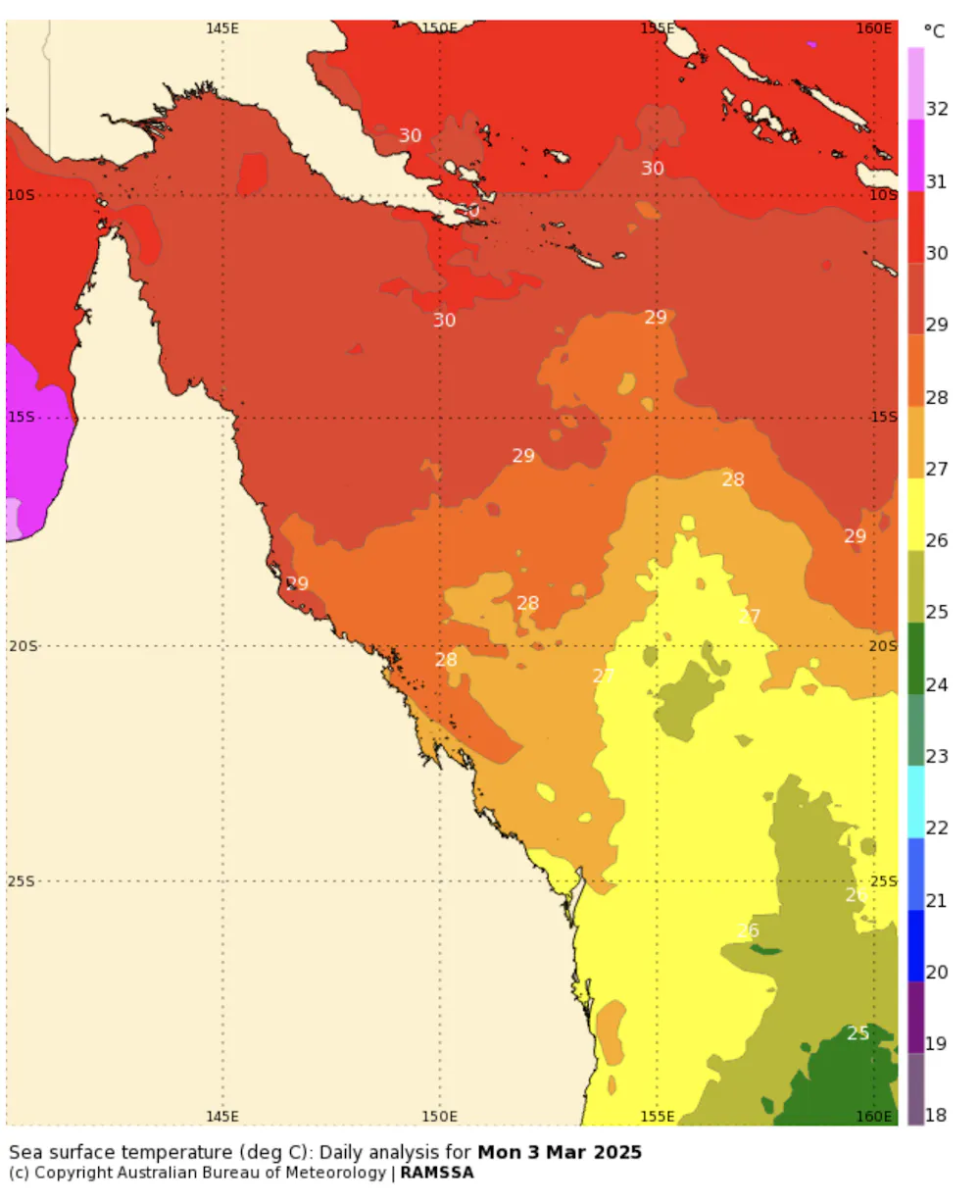
    It moved towards an area of warmer coastal water (around 27°C), which caused it to strengthen. It also moved into an area of reduced “vertical wind shear” – a variation in wind speed running at right angles to prevailing winds, which often acts to weaken a cyclone.

    Image showing high sea surface temperatures which are fuelling the cyclone.
    BoM

    Usually, cyclones in this part of Australian waters may brush the coast, but are soon pulled south or east by an upper trough of cold air and then flicked away into the cooler waters of the Tasman Sea – to an area known as the “cyclone graveyard”.

    The current situation is unusual because that upper trough is absent. At the same time, a high pressure system in the Tasman Sea is steering the cyclone towards the coast.

    The big question now is whether Alfred reaches category 3 – that is, very destructive winds of 165–224km per hour.

    Should the cyclone’s forward motion towards the coast slow, it raises the chances of becoming a category 3 storm. That’s because it would spend more time passing over the warm area of coastal water.

    Category 3 winds are likely to cause significant structural damage to some buildings. Brisbane is, to some extent, sheltered from the winds by offshore islands. Other areas, such as the Gold Coast, do not have such protections.

    How long will the cyclone last?

    As I write, gales are starting to rake the coast – including where I live, on the Sunshine Coast. Conditions will continue to deteriorate this afternoon and into tonight.

    The cyclone will bring gale-force winds to a large area of coastline – from Double Island Point in the north to potentially as far south as Coffs Harbour.

    By Thursday afternoon, conditions on land and just offshore will be pretty rough. If the cyclone keeps travelling at a constant speed, it will cross the coast in the early hours of Friday morning.

    This is less than ideal. It will be dark and people can’t see what’s going on. But there is much affected communities can do to prepare, as outlined here.

    For cyclone preparedness and safety advice, go to Get Ready Queensland. For emergency assistance call the State Emergency Service (SES) in NSW or Queensland on 132 500.

    A Bureau of Meteorology update on Cyclone Alfred dated March 5.

    Steve Turton has previously received funding from the federal government.

    ref. Cyclone Alfred is bearing down. Here’s how it grew so fierce – and where it’s expected to hit – https://theconversation.com/cyclone-alfred-is-bearing-down-heres-how-it-grew-so-fierce-and-where-its-expected-to-hit-251358

    MIL OSI AnalysisEveningReport.nz

  • MIL-OSI Global: What’s the difference between wholemeal and wholegrain bread? Not a whole lot

    Source: The Conversation – Global Perspectives – By Margaret Murray, Senior Lecturer, Nutrition, Swinburne University of Technology

    Phish Photography/Shutterstock

    If you head to the shops to buy bread, you’ll face a variety of different options.

    But it can be hard to work out the difference between all the types on sale.

    For instance, you might have a vague idea that wholemeal or wholegrain bread is healthy. But what’s the difference?

    Here’s what we know and what this means for shoppers in Australia and New Zealand.

    Let’s start with wholemeal bread

    According to Australian and New Zealand food standards, wholemeal bread is made from flour containing all parts of the original grain (endosperm, germ and bran) in their original proportions.

    Because it contains all parts of the grain, wholemeal bread is typically darker in colour and slightly more brown than white bread, which is made using only the endosperm.

    Wholemeal flour is made from all parts of the grain.
    Rerikh/Shutterstock

    How about wholegrain bread?

    Australian and New Zealand food standards define wholegrain bread as something that contains either the intact grain (for instance, visible grains) or is made from processed grains (flour) where all the parts of the grain are present in their original proportions.

    That last part may sound familiar. That’s because wholegrain is an umbrella term that encompasses both bread made with intact grains and bread made with wholemeal flour. In other words, wholemeal bread is a type of wholegrain bread, just like an apple is a type of fruit.

    Don’t be confused by labels such as “with added grains”, “grainy” or “multigrain”. Australian and New Zealand food standards don’t define these so manufacturers can legally add a small amount of intact grains to white bread to make the product appear healthier. This doesn’t necessarily make these products wholegrain breads.

    So unless a product is specifically called wholegrain bread, wholemeal bread or indicates it “contains whole grain”, it is likely to be made from more refined ingredients.

    Which one’s healthier?

    So when thinking about which bread to choose, both wholemeal and wholegrain breads are rich in beneficial compounds including nutrients and fibre, more so than breads made from further-refined flour, such as white bread.

    The presence of these compounds is what makes eating wholegrains (including wholemeal bread) beneficial for our overall health. Research has also shown eating wholegrains helps reduce the risk of common chronic diseases, such as heart disease.

    The table below gives us a closer look at the nutritional composition of these breads, and shows some slight differences.

    Wholegrain bread is slightly higher in fibre, protein, niacin (vitamin B3), iron, zinc, phosphorus and magnesium than wholemeal bread. But wholegrain bread is lower in carbohydrates, thiamin (vitamin B1) and folate (vitamin B9).

    However the differences are relatively small when considering how these contribute to your overall dietary intake.


    Which one should I buy?

    Next time you’re shopping, look for a wholegrain bread (one made from wholemeal flour that has intact grains and seeds throughout) as your number one choice for fibre and protein, and to support overall health.

    If you can’t find wholegrain bread, wholemeal bread comes in a very close second.

    Wholegrain and wholemeal bread tend to cost the same, but both tend to be more expensive than white bread.

    Margaret Murray does not work for, consult, own shares in or receive funding from any company or organisation that would benefit from this article, and has disclosed no relevant affiliations beyond their academic appointment.

    ref. What’s the difference between wholemeal and wholegrain bread? Not a whole lot – https://theconversation.com/whats-the-difference-between-wholemeal-and-wholegrain-bread-not-a-whole-lot-249156

    MIL OSI – Global Reports

  • MIL-Evening Report: What’s the difference between wholemeal and wholegrain bread? Not a whole lot

    Source: The Conversation (Au and NZ) – By Margaret Murray, Senior Lecturer, Nutrition, Swinburne University of Technology

    Phish Photography/Shutterstock

    If you head to the shops to buy bread, you’ll face a variety of different options.

    But it can be hard to work out the difference between all the types on sale.

    For instance, you might have a vague idea that wholemeal or wholegrain bread is healthy. But what’s the difference?

    Here’s what we know and what this means for shoppers in Australia and New Zealand.

    Let’s start with wholemeal bread

    According to Australian and New Zealand food standards, wholemeal bread is made from flour containing all parts of the original grain (endosperm, germ and bran) in their original proportions.

    Because it contains all parts of the grain, wholemeal bread is typically darker in colour and slightly more brown than white bread, which is made using only the endosperm.

    Wholemeal flour is made from all parts of the grain.
    Rerikh/Shutterstock

    How about wholegrain bread?

    Australian and New Zealand food standards define wholegrain bread as something that contains either the intact grain (for instance, visible grains) or is made from processed grains (flour) where all the parts of the grain are present in their original proportions.

    That last part may sound familiar. That’s because wholegrain is an umbrella term that encompasses both bread made with intact grains and bread made with wholemeal flour. In other words, wholemeal bread is a type of wholegrain bread, just like an apple is a type of fruit.

    Don’t be confused by labels such as “with added grains”, “grainy” or “multigrain”. Australian and New Zealand food standards don’t define these so manufacturers can legally add a small amount of intact grains to white bread to make the product appear healthier. This doesn’t necessarily make these products wholegrain breads.

    So unless a product is specifically called wholegrain bread, wholemeal bread or indicates it “contains whole grain”, it is likely to be made from more refined ingredients.

    Which one’s healthier?

    So when thinking about which bread to choose, both wholemeal and wholegrain breads are rich in beneficial compounds including nutrients and fibre, more so than breads made from further-refined flour, such as white bread.

    The presence of these compounds is what makes eating wholegrains (including wholemeal bread) beneficial for our overall health. Research has also shown eating wholegrains helps reduce the risk of common chronic diseases, such as heart disease.

    The table below gives us a closer look at the nutritional composition of these breads, and shows some slight differences.

    Wholegrain bread is slightly higher in fibre, protein, niacin (vitamin B3), iron, zinc, phosphorus and magnesium than wholemeal bread. But wholegrain bread is lower in carbohydrates, thiamin (vitamin B1) and folate (vitamin B9).

    However the differences are relatively small when considering how these contribute to your overall dietary intake.


    Which one should I buy?

    Next time you’re shopping, look for a wholegrain bread (one made from wholemeal flour that has intact grains and seeds throughout) as your number one choice for fibre and protein, and to support overall health.

    If you can’t find wholegrain bread, wholemeal bread comes in a very close second.

    Wholegrain and wholemeal bread tend to cost the same, but both tend to be more expensive than white bread.

    Margaret Murray does not work for, consult, own shares in or receive funding from any company or organisation that would benefit from this article, and has disclosed no relevant affiliations beyond their academic appointment.

    ref. What’s the difference between wholemeal and wholegrain bread? Not a whole lot – https://theconversation.com/whats-the-difference-between-wholemeal-and-wholegrain-bread-not-a-whole-lot-249156

    MIL OSI AnalysisEveningReport.nz

  • MIL-Evening Report: AI deepfakes threaten democracy and people’s identities. ‘Personality rights’ could help

    Source: The Conversation (Au and NZ) – By Wellett Potter, Lecturer in Law, University of New England

    Ray Bond/Shutterstock

    How much is your voice worth?

    It could be as little as roughly A$100. That was how much ABC News Verify recently spent to clone federal senator Jacqui Lambie’s voice – with her permission – using an easily accessible online platform.

    This example highlights how artificial intelligence (AI) apps which create a synthetic replica of a person’s image and/or voice in the form of deepfakes or voice cloning are becoming cheaper and easier to use.

    This poses a serious threat not only to the functioning of democracy (especially around elections), but also to a person’s identity.

    Current copyright laws in Australia are inadequate when it comes to protecting people if their image or voice is digitally cloned without their permission. Establishing “personality rights” could help.

    Detecting what’s fake is difficult

    Deepfake technology is able to produce content which seems increasingly real. This makes it harder to detect what is fake and what is not. Indeed, several people for whom the ABC played the voice clone of Senator Lambie did not initially realise it was fake.

    This shows how unauthorised deepfakes and voice cloning can be easily used to generate misinformation. They can also be extremely damaging to individuals.

    This was highlighted back in 2020, when one of Australia’s first political deepfake videos was released. It featured the then Queensland premier Annastacia Palaszczuk claiming the state was “cooked” and in “massive debt”.

    The video received around 1 million views on social media.

    What laws cover this?

    In Australia, defamation, privacy, image-based abuse laws, passing off and consumer protection laws might be applicable to situations involving deepfake video or audio clips. You may also be able to lodge a complaint with the eSafety commissioner.

    In theory copyright law can also protect a person’s image and voice. However, its application is more nuanced.

    First, a person whose likeness has been cloned by an AI platform often does not own the source material. This material could be an image, video or voice recording which has been copied and uploaded. Even if your image and voice is depicted, if you are not the owner of the source material, you cannot sue for infringement.

    Using Senator Lambie as an example, the ABC only needed 90 seconds of original voice recording to create the AI clone. Senator Lambie’s voice itself is not able to be copyright-protected. That’s because copyright can only attach to a tangible expression, say in written or recorded form. It cannot attach to speech or unexpressed ideas.

    As the ABC arranged, recorded and produced the original 90-second recording, the broadcaster could hold copyright in it as a sound recording. It is a fixed, tangible expression of Senator Lambie’s voice. However, unless the senator and the ABC made an agreement, Senator Lambie would have no economic rights, such as the right to reproduction, to the original voice recording. Nor would she have any rights to the clone of her voice.

    In fact, the AI-generated clone itself is unlikely to be protected by copyright, as it is considered authorless under Australian copyright law. Many AI-generated creations are currently unable to be protected under Australian copyright, due to a lack of original, identifiable human authorship.

    Moral rights – including the right of attribution (to be credited as the performer), the right against false attribution and the right of integrity – are also limited in scope. They could apply to the original audio clip, but not to a deepfake.

    What are ‘personality rights’?

    In most jurisdictions in the United States, there exist what are commonly known as “personality rights”. These rights include the right of publicity, which acknowledges that an individual’s name, likeness, voice and other attributes are commercially valuable.

    Celebrities such as Bette Midler and Johnny Carson have successfully exercised this right to prevent companies using elements of their identity for commercial purposes without permission.

    However, personality rights might not always apply to AI voice clones, with some lawyers arguing that only actual recorded voices are protectable, not clones of voices. This has led to states such as Tennessee introducing legislation to specifically address AI-generated content. The Ensuring Likeness, Voice, and Image Security Act, introduced in 2024, addresses the misappropriation of an individual’s voice through generative AI use.

    Urgent steps are needed

    There has been longstanding scholarly debate about whether Australia should introduce statutory publicity rights.

    One of the challenges is overlap with pre-existing laws, such as Australian consumer law and tort law. Policymakers might be hesitant to introduce a new right, as these other areas of the law may provide partial protection. Another challenge is how to enforce these rights if an AI-generated deepfake is created overseas.

    Australia could also consider introducing a similar law to the “No Fakes Bill” currently being debated in the US. If passed, this bill would allow people to protect their image and voice through intellectual property rights. This should be given serious consideration in Australia too.

    Deepfakes are becoming more and more common, and are now widespread during elections. Because of this, it’s important that Australians remain vigilant to them in the lead up to this year’s federal election.

    And let’s hope that whoever wins that election takes urgent steps to better protect everyone’s image and voice.

    Wellett Potter does not work for, consult, own shares in or receive funding from any company or organisation that would benefit from this article, and has disclosed no relevant affiliations beyond their academic appointment.

    ref. AI deepfakes threaten democracy and people’s identities. ‘Personality rights’ could help – https://theconversation.com/ai-deepfakes-threaten-democracy-and-peoples-identities-personality-rights-could-help-251267

    MIL OSI AnalysisEveningReport.nz

  • MIL-Evening Report: Fires used to terrify city residents. New research suggests climate change could see this fear return

    Source: The Conversation (Au and NZ) – By David Bowman, Professor of Pyrogeography and Fire Science, University of Tasmania

    Fire rages in the Pacific Palisades area of Los Angeles in January 2025 eley archives/Shutterstock

    For centuries, fire was one of the major fears for city-dwellers. Dense cities built largely of wood could – and did – burn. In 1666, a fire in a bakery went on to destroy two-thirds of the city of London, leaving 85% of residents homeless. In 1871, fire burned out huge areas of Chicago. In World War II, bombing raids by Allied forces largely destroyed cities such as Dresden in Germany and Tokyo in Japan.

    The threat of large-scale urban fires drove authorities to spend more on urban firefighting and require buildings to use less flammable material. Fire alarms, fire engines and automatic sprinklers have done much to reduce the chance of uncontrolled spread.

    But will our sense of safety endure in the age of climate change? In January, we saw swathes of Los Angeles burn – even in the northern winter. Driven by low humidity and high winds, numerous large fires encroached on the city, destroying outlying suburbs. Climate change made the fires worse, according to climate scientists.

    Now we have new research on the question of whether climate change will make large city fires more likely. A research team from China, Singapore and Australia have gathered a decade’s worth of data on fires from almost 3,000 cities in 20 nations, home to one-fifth of the world’s population.

    The researchers found for every 1°C increase in air temperature, outdoor fires (rubbish and landfill) increase 4.7% and vehicle fires 2.5%. If the world accelerates its burning of fossil fuels under a high emissions scenario compatible with a 4.3°C temperature rise by century’s end, outdoor fires in cities would soar 22% and vehicle fires 11%. But building fires are projected to actually fall 5%. Thankfully, this emissions scenario is now less likely.

    The Great Fire of London destroyed most of the city in 1666.
    HodagMedia/Shutterstock

    What did this research find?

    To make these findings, the researchers aggregated the fire incident data from 2,847 cities located in 20 countries over the 2011–20 decade and analysed them to see how air temperature influences the frequency of three types of fires: outdoor, structural and vehicle. They found a strong correlation.

    Of the 20 nations, New Zealand looks likely to have the highest increase in fires, soaring 140% over 2020 figures by 2100.

    When we think of fires in a city, we usually think of structural fires – a building going up in flames.

    The research suggests building fires would actually decrease 5% by 2100. This is unexpected, and might suggest uncertainty about this finding.

    Interestingly, this research found the fewest structural fires occurred at air temperatures of 24°C, a temperature which humans find optimal. When it’s hotter or cooler than that, more buildings catch fire.

    Why? It’s likely due to our behaviour. We spend more time indoors when it’s very cold or very hot outside, which the authors suggest could make us more likely to accidentally cause fires by using electrical appliances and fireplaces which have a fire risk.

    By contrast, outdoor and vehicle fires do increase linearly as temperatures rise. Most vehicle fires come from an equipment or heat source failure, which are both likely to increase as temperatures rise. We are also more likely to have a car crash when it’s hotter, and vehicle fires often come after a crash.

    Vehicle fires will become more common as the climate changes, according to this research.
    Rodrigo Teixeira/Pexels, CC BY-NC-ND

    Outdoor fires become more likely because heat dries out fuels and favours fire spread. Rubbish dumps can spontaneously catch fire when temperatures are too high – even underground. This happens because chemical reactions are accelerated in warmer temperatures, causing waste materials to heat up faster. If the extra heat isn’t dissipated, waste can become so hot that it catches fire on its own.

    We should take these estimates with a grain of salt. This is because they project recent statistical patterns into an uncertain future, and draw on a data set not perfectly suited to the task. The data set stops in 2020, before the electric vehicle transition gathered speed. EVs have a different risk profile for accidental fires.

    As the authors note, there are large barriers to getting a coherent understanding of fire risk. “Despite multiple efforts, we have been unsuccessful in obtaining fire data from Africa and South America,” they write.

    Their estimates also relate to a high-emissions future which is hopefully becoming less likely, though the general pattern of the results are similar under less severe climate projections.

    Most importantly, it’s not yet clear why temperature influences urban fires. This uncertainty raises questions over whether simple projections of current patterns into the future are realistic or appropriate.

    Cities aflame?

    Arguably the most important contribution of this new research is to show us that our cities are not inherently protected from fire.

    For city authorities, this research points to the need to manage combustible materials, from piles of mulch to dry urban parks and even home gardens. Storage yards, rubbish dumps and recycling centres will also need to be managed.

    Fire used to be a major concern for cities, and it could be again. Cities and fire are uneasy bedfellows, and climate change will worsen the situation.

    David Bowman is an Australian Research Council Laureate Fellow and also receives funding from the New South Wales Bushfire and Natural Hazards Research Centre, and Natural Hazards Research Australia.

    Calum Cunningham receives funding from the Australian Research Council.

    ref. Fires used to terrify city residents. New research suggests climate change could see this fear return – https://theconversation.com/fires-used-to-terrify-city-residents-new-research-suggests-climate-change-could-see-this-fear-return-251056

    MIL OSI AnalysisEveningReport.nz

  • MIL-Evening Report: America or Europe? Why Trump’s Ukraine U-turn is a fork in the road for New Zealand

    Source: The Conversation (Au and NZ) – By Alexander Gillespie, Professor of Law, University of Waikato

    The aftermath of one of the most undiplomatic – and notorious – White House meetings in recent history reveals a changed world.

    Having berated Ukraine’s President Volodymyr Zelensky for supposedly not wanting peace with Russia and failing to show sufficient gratitude to the United States, President Donald Trump has now paused all military aid to Ukraine.

    This equates to about 40% of the beleaguered nation’s military support. If the gap is not quickly covered by other countries, Ukraine will be severely compromised in its defence against the Russian invasion.

    This has happened while the Russian army is making slow but costly gains along the front in eastern Ukraine. Trump’s goal appears to be to force Zelensky to accept a deal he does not want, and which may be illegal under international law.

    New Zealand is a long way from that front line, but the implications of Trump’s unilateral abandonment of Ukraine still create a serious foreign policy problem.

    Aside from its unequivocal condemnation of Russia’s actions, New Zealand has provided Defence Force personnel for training, intelligence, logistics and liaison to the tune of nearly NZ$35 million. The government has also given an additional $32 million in humanitarian assistance.

    At the same time, New Zealand has supported global legal efforts to hold Russia to account at both the International Court of Justice and the International Criminal Court. With Trump undermining these collective actions, New Zealand faces some stark choices.

    Allies at war

    While a genuine ceasefire and eventual peace in Ukraine are the right aims, Trump’s one-sided proposal has involved direct talks between Russia and the US, excluding all other parties, including the actual victims of Russian aggression.

    With eery parallels to the Munich Agreement of 1938 between Nazi Germany, Britain, France and Italy, peace terms could be dictated to the innocent party. Ukraine may have to sacrifice part of its territory in the hope a wider peace prevails.

    In exchange, Ukraine may be given some type of “security assurance”. But what that arrangement would look like, and what kind of peacekeeping force might be acceptable to Russia, remains unclear.

    If the current UK and European ceasefire proposals fail, Europe could be pulled more directly into the conflict. Since the Trump rebuff, European leaders are embracing Zelenskyy more tightly, wary of an emboldened Russia threatening other states with substantial Russian populations such as in Estonia and Latvia.

    European boots on the ground in Ukraine could escalate the existing war into a much larger and more dangerous conflict. The complexities of this new reality are now spilling over in the United Nations.

    A fork in the road

    While the Security Council finally agreed on a broad statement in favour of a lasting peace, just what that might look like has seen opposing resolutions in the General Assembly.

    On February 18, 53 countries, including New Zealand, voted in favour of a resolution condemning Russian aggression and calling for the return of Ukrainian territory. The resolution passed, but the US, Russia, Belarus and North Korea voted against it.

    The US then put up its own resolution calling for peace, without recognising Russian aggression or the illegal annexation of Ukrainian territory. New Zealand supported this, too.

    Those two votes clearly signal a fork-in-the-road moment for New Zealand.

    As well as the wider consequences and potential precedents of any Ukraine peace settlement for security in Europe and the Pacific region, there is the immediate problem of supporting Ukraine.

    With the US and Europe – both traditional allies of New Zealand – now deeply divided, whatever path the government chooses will directly affect present and future security arrangements – including any possible “pillar two” membership of AUKUS.

    Potentially complicating matters further, Trump’s civilian lieutenant Elon Musk has publicly advocated for the US leaving the UN and NATO. Whether or not that happens, the threat alone underscores the gravity of the current situation.

    No option without risk

    Ultimately, if Trump decides to force Zelensky to the negotiating table against his will, and Europe continues urging and supporting him to fight on, New Zealand will have to take sides. It cannot take both.

    The National-led coalition government will either have to abandon the stance New Zealand has taken on the Russian invasion over the past three years, or wait for Europe’s response and align with efforts to support a rules-based international order.

    The first option would mean stepping back from that traditional foreign policy position, cutting military support for Ukraine (and trusting the Trump process), and probably ending sanctions against Russia and diplomatic efforts for legal accountability.

    The other path would mean spending more on military aid, and possibly deploying more defence personnel to help fill the gap Trump has created.

    No option is without risk. But, on balance, the European approach to international affairs seems closer to New Zealand’s worldview than the one currently articulated by the Trump administration.

    The authors do not work for, consult, own shares in or receive funding from any company or organisation that would benefit from this article, and have disclosed no relevant affiliations beyond their academic appointment.

    ref. America or Europe? Why Trump’s Ukraine U-turn is a fork in the road for New Zealand – https://theconversation.com/america-or-europe-why-trumps-ukraine-u-turn-is-a-fork-in-the-road-for-new-zealand-251459

    MIL OSI AnalysisEveningReport.nz

  • MIL-Evening Report: Police are seizing 3D-printed guns across Australia, but our laws aren’t keeping up

    Source: The Conversation (Au and NZ) – By Andrew Hemming, Associate Professor of Law, School of Law and Justice, University of the Sunshine Coast

    Shutterstock

    After Martin Bryant killed 35 people and wounded 23 others at Port Arthur in 1996, Australia made fundamental changes to its gun laws. The use of automatic and semi-automatic weapons became restricted and a national gun registry was established.

    As a result, unlike the situation in the United States where automatic weapons can be readily obtained, mass shootings are a rarity in Australia.

    However, a new and pressing danger in the form of 3D guns, or “ghost guns”, threatens to undermine Australia’s strict gun control laws.

    The reason is simple: 3D guns can be manufactured in a suburban garage. In a process like making a dress from a pattern, a digital blueprint for the manufacture of a firearm can be downloaded from the internet. Then, instead of a sewing machine, you need a 3D printer or an electronic milling machine.

    The emergence of these types of firearms reveal big loopholes in many of our gun laws. These need urgent attention.

    How are these guns made?

    A 3D gun is manufactured in stages, with each part of the gun printed separately and assembled manually.

    Think of yourself as making a toy LEGO gun, but instead of taking the parts from the LEGO box, you make the parts on your 3D printer based on your digital blueprint and you then assemble your gun. Your raw materials are thermoplastic polymers and metal for the barrel and firing pin.

    High-end, industrial-grade 3D printers are priced between $2,000 and $10,000, and are readily available.

    This technology has been around for more than a decade.

    The first 3D printed handgun was designed by Cody Wilson in 2013, which he christened The Liberator. It was made of 15 parts of plastic and a nail for the ring pin.

    Also in 2013, reporters from the Daily Mail newspaper in London 3D-printed a Liberator pistol and smuggled the disassembled gun onto a Eurostar train. They reassembled the gun in the toilet.

    As the gun was made of plastic, metal detectors were not activated, demonstrating the danger these weapons pose even in high-security locations such as airports and public transport.

    In the recent high-profile murder in New York of Brian Thompson, chief executive of the US health insurance company United Healthcare, the suspect, Luigi Mangione, when arrested was found to be in possession of a similar 3D-printed gun and 3D-printed suppressor to those allegedly used in the shooting.

    Leaps forward in technology

    In the 12 years since the designs for The Liberator were posted on the internet, the quality and range of 3D guns have greatly improved and expanded.

    According to Detective Inspector Brad Phelps from Queensland’s Crime and Intelligence Command Drug Squad, the technology has advanced sufficiently that:

    now you wouldn’t be able to tell the difference between a privately manufactured firearm and a traditional firearm in many instances […] every jurisdiction in Australia has reported an increase, particularly in the last 18 months to two years.

    As 3D guns are untraceable, the actual prevalence of 3D guns is unknown, other than the growing number of 3D guns seized in police raids. According to gun safety groups, 3D guns can now fire up to 40 rounds and use standard gauge ammunition.

    Police predict homemade guns will soon overtake illicit weapon imports.

    In October 2024, Western Australian police seized 21 privately made 3D-printed firearms from a home in Perth.

    Fixing the legal loopholes

    So, with all these alarm bells ringing in the ears of law enforcement agencies, what steps have authorities taken to meet the threat 3D guns pose to community safety?

    Indeed, what effective steps are being taken to prevent further advances in the technology and thwart any efforts to produce these guns en masse?

    The answer would appear to be that little attention has been directed towards the dangers 3D guns represent. Legislation across Australian jurisdictions is inconsistent.

    At present, only New South Wales and Tasmania have legislated to make it an offence to possess a digital blueprint for the manufacture of a firearm on a 3D printer or electronic milling machine. The maximum penalties are imprisonment for 14 years and 21 years, respectively.

    In 2022, WA took a step in the right direction by making unauthorised possession of firearms technology an offence. This included possession of a 3D printer or milling device.

    The slow progress on this issue is well illustrated by South Australia. There have been 23 incidents in which police have seized 3D-printed firearms and firearm parts between 2020 and 2023.

    But the drafting of proposed legal amendments to address these incidents started in 2024 and are still to be introduced into the SA parliament.

    There needs to be a national sense of urgency similar to the federal government’s response to the Port Arthur massacre in 1996. Existing laws are inadequate as there is no uniformity in the legislation covering 3D-printed firearms and their digital blueprints.

    There was a senate inquiry into gun violence in 2014, which found 3D printers “were by no means integral to the illegal manufacture of firearms”. This is no longer accurate.

    Ironically, the senate committee recommended “Australian governments investigate the requirement for uniform regulations in all jurisdictions covering the manufacture of 3D-printed firearms and firearm parts”. A decade on, little progress has been made.

    New laws could distinguish between possessing of a digital blueprint for a 3D gun and actually manufacturing a firearm. This could look like a scale of penalties, such as those imposed for the possession and manufacture of illegal drugs, which are based on the category of drug and the quantity seized.

    Andrew Hemming does not work for, consult, own shares in or receive funding from any company or organisation that would benefit from this article, and has disclosed no relevant affiliations beyond their academic appointment.

    ref. Police are seizing 3D-printed guns across Australia, but our laws aren’t keeping up – https://theconversation.com/police-are-seizing-3d-printed-guns-across-australia-but-our-laws-arent-keeping-up-250255

    MIL OSI AnalysisEveningReport.nz

  • MIL-OSI Global: A potential $110B economic hit: How Trump’s tariffs could mean rising costs for families, strain for states

    Source: The Conversation – USA – By Bedassa Tadesse, Professor of Economics, University of Minnesota Duluth

    A worker at a steel company in Monterrey, Nuevo Leon, Mexico, on Feb. 11, 2025. Julio Cesar Aguilar/AFP via Getty Images

    Get ready to pay more for avocados, maple syrup and – well – almost everything.

    The U.S. officially imposed new 25% tariffs on Canada and Mexico on March 4, 2025, following through on a long-delayed pledge from President Donald Trump. American consumers and businesses are now bracing for higher costs and potential supply disruptions.

    Although tariffs, or taxes on imports, are a pillar of Trump’s economic policy, the move still surprised many observers, since Mexico and Canada are among the U.S.’s traditional allies and top trading partners. The administration further rattled global supply chains by doubling existing tariffs on Chinese goods to 20%.

    As an economist who studies global trade, I wanted to know how the 25% import duties on Canada and Mexico would affect different parts of the country. So I conducted a state-by-state impact analysis.

    What I found is alarming: The U.S. economy could face an annual loss of US$109.23 billion. This shortfall would mean rising costs of everyday goods for American families and would disproportionately affect certain states. My analysis focused exclusively on the effects of U.S. tariffs, so it didn’t take retaliation from Canada or Mexico into account. If it did, the losses would be even greater.

    Unequal burdens for states, higher prices for families

    Imagine your grocery bill surging by 17.5% to 25%, car parts costing hundreds of dollars more, and your favorite local restaurant raising prices as imported ingredients become unaffordable. Because tariffs drive up consumer prices, these scenarios, or others like them, will soon become reality across the U.S.

    But not all Americans will be affected equally, I found. States that are deeply connected to North American supply chains will suffer the biggest economic blows. Texas, with its strong trade ties to Mexico and key role in energy, would lose $15.3 billion. California’s diverse economy would take a $10.2 billion hit. Michigan, heavily reliant on auto manufacturing, would face a $6.2 billion blow – over 1% of its gross domestic product.

    The biggest losers from the policy on a per-capita basis would be smaller, trade-dependent states that lack the flexibility to absorb such a shock. New Mexico, Kentucky and Indiana would be among the hardest hit, with projected GDP losses ranging from 1.12% to 1.48%. These states rely heavily on manufacturing and specialized industries, making them particularly vulnerable to rising costs and supply chain disruptions.

    Take New Mexico. While it may not experience the largest total economic loss, it would bear the highest per-person burden. That $1.73 billion hit to its economy would translate to $822 for every resident – a devastating blow in a state where incomes are already below the national average.

    Indeed, the likely effects of tariffs will be felt especially hard by American families. For example, a family of four in New Mexico would see an estimated $3,288 additional annual costs, equivalent to three months of grocery bills or an entire year’s utility expenses. Families in Kentucky and Indiana would also bear heavy financial burdens, paying an extra $3,120 and $2,836, respectively. Even in wealthier states such as Texas, the added annual costs would reach over $2,000 per household.

    For middle- and lower-income families, these aren’t trivial costs. They represent difficult trade-offs, forcing households to cut back on essentials, delay major purchases or dip into savings to make ends meet.

    A truck crosses the Ambassador Bridge, a border crossing between Windsor, Ontario, Canada, and Detroit, Mich., on March 1, 2025.
    Geoff Robins/AFP via Getty Images

    Where industry will face a tough hit

    Perhaps no industry would suffer more than the auto sector, particularly in states such as Michigan, Indiana and Kentucky. These regions rely on a highly integrated North American supply chain, where components cross borders multiple times before a final product reaches consumers. Tariffs would disrupt this delicate balance, leading to price increases, reduced production and job losses.

    My conservative estimate shows that such disruptions could cost the industry approximately $28.2 billion, putting around 680,000 jobs at risk across manufacturing, parts production and sales operations. And the ripple effects would extend beyond automakers to suppliers, dealerships and local economies.

    But the pain wouldn’t stop there. Manufacturing, which plays a critical role in 17 of the top 20 states most affected by tariffs, would also face rising costs and shrinking profit margins. The agricultural sector – vital in at least 10 states – would endure higher input costs and potential retaliatory tariffs from Mexico and Canada. Past trade disputes have shown that American farmers often bear the brunt of such policies, with lost export markets and declining revenues.

    During the U.S.-China trade war of 2018-2019, for example, American farmers suffered over $27 billion in losses, with soybean exports dropping by 71% and states such as Iowa, Illinois and Kansas losing billions in GDP. The federal government paid affected farmers more than $23 billion to offset these losses. Similar – and possibly worse – challenges loom now.

    Retaliation from Mexico and Canada could deal a heavy blow to agricultural exports – including corn, beef and dairy – that anchor local economies, especially in Iowa, Nebraska and Wisconsin. Both countries have threatened countermeasures targeting key U.S. exports, raising concerns among farmers and agribusinesses. Retaliatory tariffs could shrink profit margins, further disrupt supply chains, and create uncertainty for producers relying on these markets.

    Looking at the bigger picture

    The new Trump tariff regime represents a fundamental shift in how the U.S. engages with its closest economic partners. While ostensibly meant to strengthen American industry, the tariffs on offer have serious side effects that will likely cause widespread disruptions for businesses, consumers and entire state economies.

    Trade isn’t just about numbers on a spreadsheet. It’s about real people, real businesses and the intricate economic fabric that connects the nation. Changes to this system can come at a high price. Safeguarding American jobs and ensuring economic stability entails recognizing the realities of global trade and considering the trade-offs of instituting new policies.

    While tariffs are one method of disrupting the status quo, they are far from the only way. Indeed, reform is also possible through targeted policies – including negotiated trade agreements, investment incentives and workforce development programs – that address trade concerns without altering deeply integrated supply chains.

    Bedassa Tadesse does not work for, consult, own shares in or receive funding from any company or organization that would benefit from this article, and has disclosed no relevant affiliations beyond their academic appointment.

    ref. A potential $110B economic hit: How Trump’s tariffs could mean rising costs for families, strain for states – https://theconversation.com/a-potential-110b-economic-hit-how-trumps-tariffs-could-mean-rising-costs-for-families-strain-for-states-251028

    MIL OSI – Global Reports

  • MIL-Evening Report: Beyond the garage: How important are spaces to business creation?

    Source: The Conversation (Au and NZ) – By Etienne Capron, Postdoctoral fellow, HEC Montréal

    Cities, and on a smaller scale, neighbourhoods and meeting places, play a significant role in promoting innovation. (Shutterstock)

    There is an enduring myth that many technological innovations have come out of garages, bedrooms and basements.

    One of the most famous garages is the one at Steve Jobs’ parents’ house where he was rumoured to have designed the Apple I computer, along with Steve Wozniak and some colleagues. The myth was so persistent, that the garage was designated as a site of historical importance in 2013. It was a similar story for the founders of Google, who set up their first offices in an actual garage in Menlo Park in San Jose, Calif.

    Then there was William Hewlett and David Packard, who developed a low-distortion frequency oscillator in their garage in Palo Alto, before going on to found the information technology company HP Inc. One of their first customers was Walt Disney, who used it for the sound in his 1940 film Fantasia.

    The garage is an important site in the founding myths of many entrepreneurial adventures. Before a company becomes successful, where it starts out is as important as the visionaries who invest in it. And in addition to the specific space of the garage, the surrounding urban environment is also important. What a city offers, and the way it is organized, both contribute to innovation.


    This article is part of our series Our cities from yesterday to tomorrow. Urban life is going through many transformations, each with cultural, economic, social – and, in this election year, political – implications. To shed light on these diverse issues, The Conversation Canada is inviting researchers to discuss the current state of our cities.

    Multiplicity of creative spaces

    There are many spaces specifically designed to support entrepreneurship today, including incubators, accelerators and collaborative workspaces. In addition to providing a place to work, these spaces facilitate both networking with potential partners and access to business opportunities.

    It is also interesting to note how these creative spaces have multiplied in most cities, sometimes with a specialization. They can be found in the fields of health, social innovation and digital technologies.

    The Apple garage, located in Steve Jobs’s childhood home, was a meeting place for Apple’s founders.
    (Shutterstock)

    Yet, as important as they may be for some players, these spaces are not the only factors that contribute to entrepreneurial success. Other places, sometimes unexpected, such as the fast food restaurant where Nvidia was born or the Californian saunas that have replaced luxury hotels for business meetings between investors and entrepreneurs, also contribute to the creation and development of new companies. Nor can the success of an entrepreneurial venture be explained by a single place.

    That raises the question: what do we know about how cities, and the variety of places within them, affect the development of entrepreneurial capacity?

    As a postdoctoral researcher at HEC Montréal (MOSAIC) and a professor of innovation management at the IAE Nantes University, respectively, we have explored this question as part of our research in innovation management, particularly in a recent piece of research.

    The city, an ecosystem

    Research has long focused on specific types of places. The aim is both to understand what happens there and to extract lessons that can be replicated elsewhere. Accessing a shared workspace offers entrepreneurs the opportunity to socialize. This was also the great promise of the American company WeWork: to be a member of a community.


    À lire aussi :
    WeWork : chute d’une entreprise ou fin du coworking ?


    Specific technologies or tools for prototyping can be found in a fab lab or a collaborative manufacturing workshop. Presenting your project to investors is easier from an incubator or accelerator. For example, by presenting a project at Y-Combinator in California, an accelerator renowned for supporting promising projects, entrepreneurs know they’ll get noticed by investors.

    Similarly, it is easier to meet potential partners or pick up on the latest trends in a market or technologies by spending the evening in a trendy café or bar. Informal exchanges are easier there and these play a big role in the entrepreneurial dynamics of a territory.

    WeWork shared office space in Two Summerlin, Nevada, USA.
    (Shutterstock)

    And then, quite simply, where does the initial idea come from? As the American columnist and writer Steven Johnson shows through the examples of Gutenberg and Darwin, it is clear this often happens at odd times and in unusual places.

    As a result, whether innovators are entrepreneurs, artists or scientists, it is unlikely that all the resources they require will be available to everyone, all the time, in one place.

    As the American urban planner and sociologist Jane Jacobs so aptly put it, individuals experience the city. They do not got to a single place: they visit or pass by a variety of places, each of which, in its own way, can nurture the creativity and career of an entrepreneur. Our research reveals that it is above all the combination of a city’s places – their diversity of size, function, purpose and location – that produces entrepreneurial capacity.

    Observing artists to better understand entrepreneurship

    Let’s take the example of creators who produce projection mapping works in Montréal. Thanks to a six-month survey of 21 Montréal artists, we were able to show the heterogeneity of places they visited regularly throughout the process of creation and development.


    Thousands of subscribers already receive The Conversation’s Canada Daily newsletter. And you? Subscribe today to our newsletter to better understand today’s major issues.

    _

    Our study led to two main conclusions.

    Firstly, depending on the profile of individuals and their creative approach, the places they visit regularly are different, and sometimes distinctive. This is the case, for example, of an artist who benefits from a residency in a printing workshop to create a projection on fabrics. It is also the case of a designer who goes to a fab lab to experiment with sensors.

    This suggests that there are specific trajectories for each individual, and therefore, no single path that leads to innovation.

    The need for structuring places

    Secondly, this observation suggests that the convergence around certain places does not owe to chance: multiple resources, sometimes crucial for recognition in a field, are mobilized there.

    For example, many of the artists in our study regularly visited Montréal’s Society for Arts and Technology (SAT), a renowned meeting place that has helped the careers of many artists. The artists we met go there to take courses, attend shows, and meet musicians with whom they may eventually collaborate.

    That’s how a venue’s reputation is built. As we have shown, this can become essential at a particular stage of the entrepreneur’s journey.

    But before or after this stage, other places may be more beneficial.

    In fact, depending on the phase of the innovation project, the types of places visited and their number vary greatly. So, since needs are different, the capacity to innovate depends on the places and possibilities that exist in a city. For example, Montréal’s diverse cultural offerings, with its artist-run centres and performance halls, strongly inspire projection mapping artists.

    Workshops are obviously important places for experimentation and creation, but they are only used when a prototype or final work is being produced.

    The territory of innovation

    In a more global context, where there are many technological, societal and environmental challenges, innovations are necessary.

    Ideas and entrepreneurs are essential to make innovation happen. Entrepreneurs need skills and financial resources. They need to be part of collectives and communities. But also, and perhaps even above all, they need to be in territories that offer a wide range of places where they can take advantage of complementary resources to carry out their projects.

    The city as a whole, and on a smaller scale, its neighbourhoods, are the melting pot from which ideas circulate and mix, where projects mature and take shape. The urban morphology, which can be seen as a particular arrangement of places and transport or travel infrastructures, then becomes a new deciding factor in entrepreneurial capacity.

    Les auteurs ne travaillent pas, ne conseillent pas, ne possèdent pas de parts, ne reçoivent pas de fonds d’une organisation qui pourrait tirer profit de cet article, et n’ont déclaré aucune autre affiliation que leur organisme de recherche.

    ref. Beyond the garage: How important are spaces to business creation? – https://theconversation.com/beyond-the-garage-how-important-are-spaces-to-business-creation-250130

    MIL OSI AnalysisEveningReport.nz

  • MIL-Evening Report: Bill Gates’ origin story describes a life of privilege, exposing the DNA of some of the tech industry’s problems

    Source: The Conversation (Au and NZ) – By Dana McKay, Associate Dean, Interaction, Technology and Information, RMIT University

    Bill Gates, cofounder of Microsoft, is one of the world’s richest men. He is also a highly controversial figure.

    On one hand, he contributes to social, medical and environmental causes through his foundation, making grants worth more than US$77 billion ($A123 billion) from its inception to the end of 2023. On the other, he has confirmed associations with Jeffrey Epstein and was the subject of spurious COVID conspiracy theories.

    Even Gates’ Microsoft days were controversial. Under his leadership, Microsoft became the first tech giant, but Gates has been repeatedly described as ruthless, both personally and professionally.


    Review: Source Code, My Beginnings – Bill Gates (Penguin)


    He was accused by his late long-term friend and business partner Paul Allen, of canvassing ways to dilute Allen’s shares in Microsoft when the latter was undergoing treatment for lymphoma. Gates reportedly apologised to Allen, and they repaired their relationship, and were on good terms by the time Allen died.

    Still, as a leader, his style has been characterised by some who worked with him in the 1980s and 1990s as bullying. (Gates’ spokesperson has denied he mistreated employees.)

    Childhood

    In Source Code, Gates sets out to tell his own story, and the story of the birth of the tech industry.

    His parents were the children of hardworking strugglers. His father, Bill Senior, was educated as a lawyer on the GI bill; his mother, Mary, was, according to Gates, an innovative and engaged homemaker, who later shattered glass ceilings.

    Born in 1955 Gates describes himself as the kind of kid his mother had to warn his preschool teachers about. He responded to not knowing how to fit in with other kids by becoming a class clown, and was pushed by his mother to relate to other adults.


    He was introduced to mathematics by his maternal grandmother, a Christian Scientist and a card sharp. She played assiduously with her grandchildren. She did not believe in losing to them deliberately. Through cards, Gates learned two key lessons: that you can learn the mathematics of a problem, and that practising a skill will hone it.

    His relationship with his father was loving and respectful, but his relationship with his mother was more fraught. She encouraged him, but he resented her expectation that he live up to social mores so much that peace had to be brokered by a family therapist.

    The privilege of private school

    Gates was sent to a private school for boys, and his stories about Lakeside School in Seattle are probably the most engaging segment of the book. It was at Lakeside that he learned to apply himself academically, after his class-clown act failed to impress. There, he also met Allen, who would become co-founder of Microsoft, and got his hands on his first computer.

    In the late 1960s and early 1970s, computer time was charged by the minute. Gates used lucky connections and his entreprenurial spirit to get a job coding, so he could do more of what he loved. This was how he clocked up 500 hours coding before he left high school, a mean feat even by today’s standards.

    Gates describes a degree of freedom almost unimaginable in today’s regimented education system. He had access to the computer lab at all hours and was able to take an entire semester off to code.

    He continued his elite education at Harvard. Eventually, he chose to major in applied mathematics, partly because it gave him some of the same freedom he had been accustomed to. He soon realised he was not the best at pure mathematics, as he had anticipated.

    Gates again got early access to computers at Harvard. He used this access to build his first microprocessor software (“Micro-Soft”), with Allen, which he and Allen sold to a company called MITS in 1975.

    He was sanctioned by Harvard for this project. Their computers were not supposed to be for commercial use. He was also bringing non-students into the lab.

    At this point, aged 19, he decided to take a semester off to focus on his business.

    But they stole my software!

    In 1975 Gates went to work with MITS, the company that built the first desktop computer, where he expanded his software.

    The first version of this software was literally stolen at a trade fair, reducing Microsoft’s profits and creating a rift between Gates and many of the hobbyists who were using this software

    Gates believed that software should be paid for; many of the hobbyists believed software should be free and open source.

    Gates describes the head of MITS, Ed Roberts, as loud and somewhat mercurial, an irony that is not lost as we read Gates’ letters to his friends and business partners, in whom he is frequently disappointed.

    Eventually, the relationship with MITS broke down. MITS failed to meet the terms of its contract to promote and license Gates’s software.

    The end of this contract left Gates free to sell his software to a range of companies, including Apple and Texas Instruments. A legal judgement confirmed MITS had not fulfilled its contract to Microsoft, and that Microsoft had full ownership of its software and the right to sell it. This judgement is probably the foundation of the for-profit software industry.

    In early adulthood, Gates already showed little respect for other people and social norms. He describes subscribing to the ideology of the lone genius, being arrested for speeding (where the famous mugshot of him comes from), and even joyriding on parked bulldozers.

    This section of the book is probably the least readable. It presents a limited account of an exciting time in computing. Steven Levy’s Hackers is a great alternative account.

    The DNA of computer programs

    The “source code” is the DNA of the computer programs we use. Gates’ book sets out the source code of Microsoft, as a company, and in many ways, of the tech industry as a business.

    Gates created not just Microsoft, but arguably an entire industry: selling software. His book describes the unique set of personal characteristics that made him the right person for this (single minded focus, which Gates attributes to likely autism, and a willingness to ignore all other considerations to get the job done).

    It also describes a lucky set of circumstances. Gates benefited from a legal education at his father’s knee, a family history of entrepreneurship, and early access to computers.

    The book ends in the late 1970s just as this combination of circumstances is about to bear fruit and a full four years before the launch of Microsoft’s first operating system. It does not cover Microsoft’s heyday, nor Gates’ substantial philanthropic activities later in life.

    It isn’t clear why Gates has written this book now. If it is to rehabilitate his image, he makes a poor job of it. He describes a life of consistent privilege and only acknowledges this privilege at the end of the book, which rings hollow.

    He displays a profound belief that he has been right in his interactions with others, going so far as to describe his relationship with Steve Jobs at Apple as “sometimes rivalrous, sometimes friendly”, even though Apple famously sued Microsoft over the rights to the windows style of user interface we are all used to today.

    There is little acknowledgement in the book even of the regrets he has expressed elsewhere, for example over his treatment of Paul Allen. There is little to dilute the impression that Gates was ruthless, though perhaps a later memoir may document changes later in life.

    A male-dominated industry

    While Gates’ focus and drive were clearly fundamental to the growth of the tech industry, this book also exposes the DNA of some of the tech industry’s problems.

    He describes his father as a feminist, but his mother’s social expectations were a source of irritation to him, and he barely mentions his two sisters. He got his first access to computers at an elite boys’ school – a school where, notably, his best friend protested the integration of the sister school for fear it would reduce academic standards.

    This school, and later Harvard (then another male bastion), were the source of all early Microsoft employees, sowing the seeds of today’s male-dominated industry, with all its attendant problems.

    Gates’ attitude to property underpins Microsoft’s aggressive business practices. He was clearly prepared to borrow what isn’t his (bulldozers, computer lab time), but he is incensed by the theft of his intellectual property. This attitude is evident in the long history of Microsoft litigation.

    The company has been repeatedly prosecuted for antitrust behaviour and sued for copyright infringement. Conversely, it aggressively pursued those it believes to be infringing, including, famously, a 17-year-old entrepreneur, who was probably not unlike Gates himself.

    Gates doesn’t draw these connections. He is largely uncritical of his own path, only occasionally admitting he treated someone poorly.

    Ultimately, his book is a useful insight into the source code of the tech industry, but not always in the ways Gates likely anticipates.

    Dana McKay has previously received funding from Google.

    ref. Bill Gates’ origin story describes a life of privilege, exposing the DNA of some of the tech industry’s problems – https://theconversation.com/bill-gates-origin-story-describes-a-life-of-privilege-exposing-the-dna-of-some-of-the-tech-industrys-problems-247577

    MIL OSI AnalysisEveningReport.nz

  • MIL-OSI Global: Canada is now in a trade war with the U.S. — here’s what you need to know to prepare for it

    Source: The Conversation – Canada – By Xiaodan Pan, Associate Professor, John Molson School of Business, Concordia University

    United States President Donald Trump has officially imposed 25 per cent tariffs on Canadian and Mexican imports, sending shockwaves through Canadian consumers and businesses.

    The decision escalates tensions in an increasingly fragile relationship between the countries, marking a significant shift in North American economic ties.

    The unfolding trade war between is expected to have far-reaching consequences for people and businesses on both sides of the border. How can Canadians navigate the trade war and minimize the financial strain of the tariffs?

    As experts in supply chain management, we aim to break down the impact of these tariffs and offer practical strategies for Canadians to help navigate the economic turbulence ahead.

    How consumers react to trade wars

    When the news of a potential trade war is first publicized, consumers tend to react by monitoring the situation until further information is available.

    Once the government announces which products will be affected, consumers begin to take action. Some Canadians have already started stockpiling products whose prices are likely to rise or be in short supply following the imposition of tariffs.

    Stockpiling can lead to product shortages at retailers, which may be worsened by the fear of missing out. Media headlines highlighting empty shelves can act as reinforcement loops, further fuelling frenzied shopping behaviour.

    This kind of “panic buying” is common in times of crisis, much like the rush to buy supplies before the onset of a major hurricane and the hoarding of essential supplies during the COVID-19 pandemic.

    Consumers and retailers face challenges

    With a trade war breaking out, both consumers and retailers will need to adapt.

    Shortages are likely to occur as new importation procedures slow the time products take to cross the border. The ensuing delays, along with higher tariff rates, will push some retailers to raise prices to cover cost increases. Others may limit purchases to discourage hoarding behaviour.

    Some firms may even take advantage of the situation by raising prices on products not covered by the tariffs to pad their profits — a practice known as “greedflation,” which happened during the pandemic. Another potential consequence is “shrinkflation,” where package sizes become smaller while prices remain unchanged.

    As consumers adapt by changing their shopping habits or using their stockpiled reserves, some of the shortages may be eased. However, retailers may struggle to manage their inventories as demands fluctuate — a phenomena known as the “bullwhip effect.” Navigating these shifts will require careful planning.

    Challenges of buying domestic

    Trump’s trade war has intensified calls to “buy Canadian” as a way to support domestic products.

    Recently, the Canadian government has threatened counter-tariffs on imported products that have Canadian substitutes — for example, targeting Kentucky bourbon in favour of Canadian whiskey or Florida orange juice for Canadian apple juice.


    Read more:
    ‘Buying Canadian’ is an opportunity to reflect on the ethics of consumerism


    However, fully replacing imports with domestic goods presents significant challenges. Many Canadian farmers and manufacturers lack the capacity to quickly scale up production to meet demand, at least in the short run.

    Production costs may also be significantly higher in Canada than abroad, which is a major reason for relying on imports in the first place. Apparel manufacturing is a good example. It has a high labour component — the reason that most of it has been moved to low-cost countries in Asia.

    In general, U.S. productivity is higher than Canadian productivity, contributing to lower costs in the U.S. In addition, some products simply cannot be produced in Canada at all, such as tropical fruits and vegetables.

    Furthermore, trade wars create uncertainty, making farmers and manufacturers hesitant to make large-scale investments that may not pay off once the trade conflict ends. While this approach foregoes potential short-term gains for long term stability, it also exacerbates shortages and price hikes during and after the trade war.

    The new normal

    Unlike one-off events like hurricanes, or fluctuating disruptions such as COVID-19, the outcome of a trade war is difficult to predict. This makes it difficult to forecast what the “new normal” will be.

    Certainly, some consumers who substitute domestic products for imported products may continue to do so in the long run. However, others may switch back to imported products if the tariffs are lifted and prices are lowered.

    Knowing that this might happen, domestic producers may not ramp up production during a tariff war. Those who do increase production may later find themselves with excess capacity and inventory surpluses after the conflict ends.

    Meanwhile, manufacturers and retailers that raise prices to cover tariff-related costs may choose to keep them elevated even after tariffs are removed. For instance, canned food prices saw a significant price rise following the implementation of the 2018 U.S. steel tariffs.

    Consumer acceptance of the price increases, adjustments to new higher cost supply chain structures, or efforts to maintain profit margins, may potentially establish a higher baseline prices in the post-trade-war economy.

    Navigating the trade war

    How can Canada best shield itself from the effects of the trade war? The easy answer is to become more self-reliant, but this is a costly option that requires technology, skilled labour and capital investments.

    As a result, this option should only be chosen for the most necessary and essential items, like certain pharmaceuticals and food staples. Other strategies must also be considered:

    1. Building supply chain resilience: Sourcing from multiple suppliers and retaining inventories of the most essential products may increase inventory and purchasing costs, but will reduce risks. It allows enterprises to withstand short-term supply chain disruptions and puts them in a better position to survive a trade war.

    2. Engaging in honest communication: Governments and retailers should regularly update the public on negotiations, new tariff schedules and potential price changes, reducing the guesswork that fuels panic buying and stockpiling. Transparency allows individuals to make the best purchasing decisions.

    3. Protecting low-income consumers: Retailers should limit sales quantities of staple products during disruptions to avoid hoarding behaviour. Governments should consider tax relief and subsidies aimed at budget-constrained individuals to relieve the burden of higher tariff-related costs.

    Supply chain disruptions inevitably result in higher costs and product shortages, often impacting low-income households the hardest. Even after the trade war ends, higher prices may persist as the new norm. To minimize the impact of tariffs, governments and enterprises need to adopt policies that reduce economic strain and result in fairer outcomes for all.

    The authors do not work for, consult, own shares in or receive funding from any company or organisation that would benefit from this article, and have disclosed no relevant affiliations beyond their academic appointment.

    ref. Canada is now in a trade war with the U.S. — here’s what you need to know to prepare for it – https://theconversation.com/canada-is-now-in-a-trade-war-with-the-u-s-heres-what-you-need-to-know-to-prepare-for-it-250989

    MIL OSI – Global Reports

  • MIL-OSI Global: A basic income can be a strong investment in mental health

    Source: The Conversation – Canada – By Tracy Smith-Carrier, Associate Professor and Canada Research Chair (Tier 2) in Advancing the UN Sustainable Development Goals, Royal Roads University

    To eradicate poverty, we need policy actions that address the root of financial hardship. A basic income does just that. (Shutterstock)

    Over half of Canadians feel “financially paralyzed” by the cost-of-living crisis, according to a recent poll. As life becomes more unaffordable for more people, we need governments to create policies that will improve public health and well-being.

    One such policy is a basic income guarantee: an unconditional cash transfer from government to ensure people can meet their basic needs and live with dignity.

    A basic income guarantee differs from the universal basic income (UBI) model often discussed. While a UBI is set at the same amount and made available to everyone, a basic income guarantee is targeted to those need it, through a benefit that rises as income declines.

    Our recently published research looks into one basic income program, the Ontario Basic Income Pilot that was launched in 2017 but abruptly ended the following year. We conducted a study to understand how Ontario’s pilot impacted the lives of those who participated in it.

    We interviewed 46 participants across four cities included in the pilot. We asked about their experiences before the pilot, during their participation in it and after its abrupt end.


    Read more:
    Dear politicians: To solve our food bank crisis, curb corporate greed and implement a basic income


    Ontario’s basic income pilot

    In 2017, the Ontario government, under then-premier Kathleen Wynne, launched the Ontario Basic Income Pilot to test the efficacy of an unconditional cash transfer. A total of 4,000 people were enrolled, and the pilot was slated to run in Hamilton, Lindsay, Brantford and Thunder Bay over a three-year period.

    Set at 75 per cent of the low-income measure (one of Statistics Canada’s three poverty lines), the pilot provided $1,415 monthly for single people and an additional $500 for people with disabilities (up to $1,915 monthly), with every dollar earned subject to a 50 per cent claw-back.

    Despite a campaign promise to complete the pilot, incoming premier Doug Ford abandoned it in 2018. Participants weren’t forewarned but learned of its cancellation like everyone else — on the news or through social media.

    The government claimed the pilot did not help people become “independent contributors to the economy.” The lack of evidence to justify this claim, along with other government statements, suggests the pilot’s premature cancellation was an ideological decision.


    Read more:
    Implementing a basic income means overcoming myths about the ‘undeserving poor’


    Impact on participants’ mental health

    The pilot’s guiding principles, written by the late-Senator Hugh Segal, affirmed that “no individual will be made worse off during or after the pilot, as a result of participation in the pilot.” Our study, however, indicates that the mental health of many participants was demonstrably worsened in the pilot’s demise.

    With a three-year promise of stable income, participants told us of being able to plan better for their futures. Some pursued higher education, others found better paying and more stable jobs or started their own businesses. Some moved into better housing, leaving behind mold-infested or poorly maintained dwellings, only to plead with their landlords to break their new leases after the pilot was cancelled.

    We found that increased income security improved participants’ mental health, reduced their stress and allowed them to improve diets with healthier food options. Some spoke of no longer having to rely on food charity as they could go the grocery store like everyone else.

    Interviewees described what life is like in poverty: not being able to go out for a cup of coffee with friends or buy gifts for your children on their birthdays, not being able to entertain family over the holidays or go out and socialize.

    Some had not disclosed their financial situation to family or friends because their sense of shame was so profound. Yet, feeling unable to discuss their situation essentially cut them off from valuable sources of social support.

    Structural violence

    Ontario’s premature cancellation of the pilot was an act of structural violence — a policy decision that caused needless and avoidable harm and suffering. Anthropologist Nancy Scheper-Hughes explains that structural violence refers to “the invisible social machinery of inequality that reproduces social relations of exclusion and marginalization.”

    Structural violence upholds the poverty, racism, sexism and other social inequities that lead to higher rates of illness, suffering and premature death. It is often invisible and can result from policy omissions, but the termination of the pilot was a public, deliberate decision.

    By throwing participants’ lives and carefully laid plans into chaos, and thrusting them back into poverty, our research shows the Ontario government’s policy decision caused significant harm.

    Our research is consistent with a larger body of evidence demonstrating that unconditional cash transfer programs, like basic income, can improve mental well-being. As young people are more vulnerable to the mental stress resulting from financial insecurity, these programs provide the necessary protection to mitigate the lifelong damaging impacts of childhood poverty.

    We also know that welfare systems are associated with poor health outcomes and increase recipients’ psychological distress. These haven’t been subject to the rigorous experimentation that a basic income has, yet they persist, despite the voluminous research documenting their harms.


    Read more:
    We gave $7,500 to people experiencing homelessness — here’s what happened next


    The cost of mental illness in Canada already amounts to over $50 billion annually (in direct health-care costs and lost productivity) but without intervention could increase to $291 billion by 2041.

    Research shows how poor mental health is a direct consequence of poverty. Money not only helps meet people’s material needs but also alleviates their worries. Reducing poverty translates into significant savings for the economy and the public purse. Canada could save $4 to $10 for every dollar spent on mental health supports.

    Eradicating poverty

    Poverty is not caused by personal failings. It is the social environment people live in that has the greatest impact on life trajectories.

    To eradicate poverty, we need policies that address the root of financial hardship. A basic income does just that. The Parliamentary Budget Officer of Canada recently released estimates that show a basic income, using parameters similar to the Ontario pilot’s, could cut poverty by up to 40 per cent. This is an affordable option with the potential for broad positive effects.

    We already have the Canada Child Benefit for families and the Guaranteed Income Supplement for older adults that provide forms of a basic income guarantee, although these benefits must be enlarged to be truly adequate. What we need now is a program that provides a robust income floor beneath which no one can fall.

    As citizens, we have few ways to hold leaders accountable for acts of structural violence, like cancelling the pilot. A class-action lawsuit lodged against the Ontario government for breach of contract is ongoing; it remains to be seen whether this will prove successful.

    Whatever their ideological leanings, politicians have a duty to advance policies that bolster public health and well-being. Improving mental health through a basic income is a wise investment, one that will prevent the needless suffering of generations to come.

    Tracy Smith-Carrier has received funding from the Social Sciences and Humanities Research Council of Canada and from the Canada Research Chairs program.

    Elaine Power has received funding from the Social Sciences and Humanities Research Council of Canada and the Canadian Institutes for Health Research.

    ref. A basic income can be a strong investment in mental health – https://theconversation.com/a-basic-income-can-be-a-strong-investment-in-mental-health-250018

    MIL OSI – Global Reports

  • MIL-OSI Global: It’s important to protect trans athletes on campuses, and this benefits all students

    Source: The Conversation – Canada – By Daniel Del Gobbo, Assistant Professor and Chair in Law, Gender & Sexual Justice, Faculty of Law, University of Windsor

    United States President Donald Trump’s executive order banning transgender and gender diverse (trans) women athletes from competing in women’s sports, at the beginning of his presidential term on Feb. 5, showed the president accelerating a long-standing moral panic about queer and trans people.

    Bearing the offensive title “Keeping Men Out of Women’s Sports,” the executive order misinterprets a U.S. law called Title IX to suggest falsely that trans-inclusive policies in collegiate and elite-level sports are somehow harmful to cisgender women. The force of this claim is backed by a threat: ban trans women, or face having your funding rescinded. The order came following a flurry of political moves entrenching transphobia in U.S. law and society.

    The moral panic around trans women athletes can be seen in Canada as well. In both countries, the issue has emerged as fundamental to a right-wing strategy that positions trans women athletes as scapegoats, fuelling social anxieties about trans inclusion and gender equality more broadly. As leading trans scholar and professor of political science, women’s and gender studies Paisley Currah puts it, “the situation is dire — an unrelenting assault on our ability to go about our daily lives.”

    Canadian universities must take action to protect trans students as part of a comprehensive strategy to promote gender equality on campuses.

    Myths about trans women athletes, debunked

    Right-wing commentators rely on two main arguments in support of banning trans women athletes.

    The first argument is the so-called “lost opportunity” argument, which holds that trans women athletes prevent cisgender women from participating by taking up limited spots reserved for women. This claim is based on a misapprehension.

    The number of trans athletes competing in women’s sports at the collegiate and elite levels is extremely small. In 2024, NCAA President Charlie Baker told a U.S. Senate panel that, to his knowledge, fewer than 10 of the 510,000 student athletes competing in NCAA schools were trans. It is unclear how many identify as trans women, a group that is systemically underrepresented in every level of sports, both in terms of participation and results in competitions.


    Read more:
    Transgender athletes face an uncertain future at the Olympics as reactionary policies gain ground


    The second argument is the so-called “unfair advantage” argument, which roots itself in the idea that “natural” biological sex-based differences exist that give trans women a competitive edge. This claim is equally problematic.

    In 2024, the Canadian Centre for Ethics in Sport released a review of research that summarized the data on trans women athletes. It found that research in this area is limited, often methodologically flawed and inconclusive in its results. Evidence indicates that trans athletes who have undergone testosterone suppression, for example, have no clear advantages over cisgender women.

    Even if certain advantages exist, however — and that’s a big “if” — the fact remains that cisgender male athletes like Michael Phelps, an American swimmer and 23-time Olympic gold medalist, are celebrated for their physiological differences from other athletes. The choice to ban trans athletes is based on a pretext, not principle.

    Harms of excluding trans people

    Trans women athletes have faced backlash. A notable target of these attacks is Lia Thomas, a trans swimmer at the University of Pennsylvania and the NCAA Division I champion who was banned from competing at the 2024 U.S. Olympic trials.

    As of February 2025, Fox News had published over 3,200 stories about Thomas, many of which contain dehumanizing language about trans people.

    Racialized and Indigenous athletes face additional obstacles, particularly when they fail to meet racial and gender stereotypes about women. The barriers are often greatest in colonial sporting cultures where whiteness is upheld as a standard of femininity.

    At the 2024 Olympics, right-wing commentators singled out Imane Khelif, a cisgender woman from Algeria who won the gold medal in women’s 66 kg boxing, based on false claims that she was trans. President Trump repeatedly misgendered Khelif, feeding the fire of racist, misogynistic and transphobic attacks that scrutinized Khelif’s appearance and behaviour to assess her gender conformity.

    Effects on campus

    Myths about trans athletes have turned Canadian universities into battlegrounds. In 2024, Harriette Mackenzie, a trans basketball player at Vancouver Island University in Nanaimo, B.C. spoke out about her mistreatment, saying she was physically targeted by an opposing team after their coach said she should not have been allowed to compete against cisgender women.

    Cases like Mackenzie’s affect not only trans students who experience discrimination on campus at disproportionate rates. They affect everyone because transphobia reinforces the gender binary and its assumptions about how people should look, act and compete in sports. The problem extends to broader academic climate and culture at universities, given that escalating rhetoric and hatefulness can amplify risks of gender-based violence on campuses.


    Read more:
    The stabbing attack at the University of Waterloo underscores the dangers of polarizing rhetoric about gender


    How universities can lead the change

    Every province has passed human rights legislation providing that students have the right to be free from discrimination on the grounds of sex, sexual orientation, gender identity and gender expression. Canadian universities have a legal and moral responsibility to provide trans women athletes with equal opportunities to participate in campus life.

    As a first step, universities should protect trans athletes in their non-discrimination and gender-based violence policies, many of which have been criticized on equality grounds. Through needs assessments studies (like the one conducted at University of British Columbia focussed on trans, two-spirit and gender diversity, completed in 2023), universities can identify gaps in their policies and programming and make recommendations.

    Consider the issue of access. Many universities continue to show men’s and women’s bathrooms and locker rooms on campus maps without highlighting the location of trans-inclusive facilities. Research confirms that trans students are more likely to feel isolated and marginalized when campus services exclude them.

    Additionally, universities should expand their athletics programs, improve training for coaches and staff, and create gender and sexuality support and affinity centres to celebrate the achievements of trans athletes and foster acceptance of trans students generally. These efforts should form part of a comprehensive strategy to promote equality, diversity, inclusion and decolonization on campuses, particularly in the face of right-wing pressure to curb these initiatives without good reason.

    Finally, it bears mentioning that for many trans athletes, particularly those who face barriers to inclusion in other family and community spaces, the opportunity to participate in sports is more than a human right — it can be life-saving for them. Athletics provide an important outlet for trans people’s self-expression, discovery and community building at a formative time in their lives. Gender equality is not a game for these students. Universities must recognize that.

    The authors do not work for, consult, own shares in or receive funding from any company or organisation that would benefit from this article, and have disclosed no relevant affiliations beyond their academic appointment.

    ref. It’s important to protect trans athletes on campuses, and this benefits all students – https://theconversation.com/its-important-to-protect-trans-athletes-on-campuses-and-this-benefits-all-students-249664

    MIL OSI – Global Reports

  • MIL-OSI Global: Beyond blame: The role of malfunctioning fat tissue in the disease of obesity

    Source: The Conversation – Canada – By Muhammad Ilyas Nadeem, PhD Candidate in Obesity & Diabetes | Public Scholar (2024-2025), Concordia University

    For too long, societal attitudes have focused on blaming individuals for poor lifestyle choices, ignoring the deeper, multifaceted causes of obesity. (Shutterstock)

    Many people who have struggled with their weight have been told to “eat less and move more.” Others have spent years juggling trendy diets, from keto to fasting, with minimal results. Despite their best efforts, what they often hear from physicians, friends, family and even strangers, is that they lack discipline. However, for many people with obesity, their bodies are fighting against them — a battle dictated by biological mechanisms beyond sheer willpower.

    Millions struggle under the weight of societal blame for a condition rooted in complex metabolic science.

    Obesity is a critical public health concern affecting millions worldwide. Yet, it is often oversimplified as an issue of personal choice. Canadian data highlights the staggering prevalence of obesity (26.6 per cent) and diabetes (8.1 per cent). For too long, societal attitudes have focused on blaming individuals for poor lifestyle choices, ignoring the deeper, multifaceted causes of the condition.


    Read more:
    Stop asking me if I’ve tried keto: Why weight stigma is more than just being mean to fat people


    The need to understand obesity beyond lifestyle changes is urgent — particularly through scientific inquiry into its genetic, environmental and physiological roots. It is beyond the simple equation of calories in versus calories out; this perspective only serves to create stigma by oversimplifying the science.

    Malfunctioning fat tissue

    The reality lies within the fat in our bodies. Body fat, particularly fat under the skin, known as subcutaneous adipose tissue (SAT), plays a crucial role in energy regulation and metabolic health. When fat accumulates, SAT malfunctions. This seemingly adds to excessive fat storage in organs like the liver and muscles, increasing the risk of diabetes and cardiovascular disease.

    Through identifying these specific dysfunctions, researchers can work towards therapies that restore SAT function rather than simply reducing body weight.

    Researchers are exploring the cellular and genetic aspects of these different fat depots, and their link with obesity and diabetes.
    (Shutterstock)

    Research from our metabolism, nutrition and obesity (MON) lab at Concordia University focuses on understanding the adipose tissue (fat tissue) environment to uncover how these complex mechanisms and their interactions can lead to the development of diabetes and cardiovascular diseases. The goal is to eventually use our discoveries to provide more effective treatment approaches based on individual differences.

    One aspect that can contribute to individual differences is where fat is stored in the body. SAT from the lower body, around the hips and thighs, seems to function differently from SAT around the belly in the upper body. We are exploring the cellular and genetic aspects of these different fat depots, and their link with obesity and diabetes.

    Obesity is not just about extra weight — it’s about how the body stores and processes fat. Our research also shows that external factors may come into play in how SAT behaves. For example, different SAT depots behave differently depending on sex. Whether a person is male, or female makes a difference to how their fat tissue handles fat.

    A closer look at fat tissue under a microscope shows that the tissue is made up of different types of cells including fat cells or adipocytes, and immune cells. Fat cells, or adipocytes, are not passive storage units; they regulate energy, produce hormones, and interact with other systems in the body. However, when these cells become dysfunctional, they can trigger inflammation, insulin resistance and other metabolic disturbances.

    We have found that not only is sex a factor in fat cell characteristics of different depots but fat cell characteristics are also affected by whether obesity develops during childhood compared to adulthood. Immune cells are also important components of fat tissue that also play a role in inflammation and metabolic disturbances.

    Shifting the conversation

    Instead of blaming individuals, we need to shift the conversation towards understanding these pathophysiological mechanisms. By doing so, we can develop targeted treatments that address the root causes of obesity rather than relying on generic, often ineffective solutions.

    The need to shift our perspective on obesity is not solely a medical necessity but a societal one.
    (Shutterstock)

    Obesity Canada reports that failing to treat obesity costs Canada $5.9 billion in health care and $21.7 billion in lost workplace productivity annually, with a $5.1 billion hit to government revenue from premature deaths and reduced workforce participation. Women with obesity face disproportionate impacts, earning four per cent less and being 5.3 per cent less likely to be employed than those with a healthy weight.

    In 2023, obesity-related diseases placed over 10,000 seniors in long-term care, costing $639 million. Yet, fewer than 20 per cent of privately insured Canadians have access to approved treatments, and bariatric surgery wait times stretch up to eight years — reinforcing harmful stigma and delaying essential care.

    The challenge is that our health-care system still leans toward tried and tested weight-loss approaches, such as medication, exercise and nutrition, often to the exclusion of how individual bodies respond biologically. Personalized medicine is a potential replacement. By matching treatment to each patient’s metabolic profile, we can move away from one-size-fits-all approaches and toward more effective interventions.

    The need to shift our perspective on obesity is not solely a medical necessity but a societal one. The stigma attached to excess weight and obesity prevents people from receiving medical treatment, drives mental illness and perpetuates damaging myths. A more empathetic, science-based approach could help reshape public attitudes and clinical practices.

    Millions of people have been misled by the myth that self-control can cure obesity. Seeing obesity as a chronic metabolic disease rather than a moral one is a way forward for effective remedies. The future of obesity treatment depends on research-driven, personalized interventions — ones that substitute blame with knowledge and stigma with support. Only then can we fully address this global public health crisis.

    Sylvia Santosa receives/has received funding from NSERC, CIHR, CRC, MITACS, CFDR, QBIN, HSF. She is affiliated with Obesity Canada, and Canadian Nutrition Society.

    Cristina Sanza and Muhammad Ilyas Nadeem do not work for, consult, own shares in or receive funding from any company or organisation that would benefit from this article, and have disclosed no relevant affiliations beyond their academic appointment.

    ref. Beyond blame: The role of malfunctioning fat tissue in the disease of obesity – https://theconversation.com/beyond-blame-the-role-of-malfunctioning-fat-tissue-in-the-disease-of-obesity-249264

    MIL OSI – Global Reports

  • MIL-OSI Global: Extreme heat silently accelerates aging on a molecular level − new research

    Source: The Conversation – USA – By Eunyoung Choi, Postdoctoral Associate in Gerontology, University of Southern California

    Extreme heat increases the risk of a number of diseases, including kidney and heart conditions. Spencer Platt/Getty Images

    What if extreme heat not only leaves you feeling exhausted but actually makes you age faster?

    Scientists already know that extreme heat increases the risk of heat stroke, cardiovascular disease, kidney dysfunction and even death. I see these effects often in my work as a researcher studying how environmental stressors influence the aging process. But until now, little research has explored how heat affects biological aging: the gradual deterioration of cells and tissues that increases the risk of age-related diseases.

    New research my team and I published in the journal Science Advances suggests that long-term exposure to extreme heat may speed up biological aging at the molecular level, raising concerns about the long-term health risks posed by a warming climate.

    Extreme heat is a public health issue.
    AP Photo/Lynne Sladky

    Extreme heat’s hidden toll on the body

    My colleagues and I examined blood samples from over 3,600 older adults across the United States. We measured their biological age using epigenetic clocks, which capture DNA modification patterns – methylation – that change with age.

    DNA methylation refers to chemical modifications to DNA that act like switches to turn genes on and off. Environmental factors can influence these switches and change how genes function, affecting aging and disease risk over time. Measuring these changes through epigenetic clocks can strongly predict age-related disease risk and lifespan.

    Research in animal models has shown that extreme heat can trigger what’s known as a maladaptive epigenetic memory, or lasting changes in DNA methylation patterns. Studies indicate that a single episode of extreme heat stress can cause long-term shifts in DNA methylation across different tissue types in mice. To test the effects of heat stress on people, we linked epigenetic clock data to climate records to assess whether people living in hotter environments exhibited faster biological aging.

    Certain populations are more vulnerable to extreme heat.
    Angela Weiss/AFP via Getty Images

    We found that older adults residing in areas with frequent very hot days showed significantly faster epigenetic aging compared with those living in cooler regions. For example, participants living in locations with at least 140 extreme heat days per year – classified as days when the heat index exceeded 90 degrees Fahrenheit (32.33 degrees Celcius) – experienced up to 14 months of additional biological aging compared with those in areas with fewer than 10 such days annually.

    This link between biological age and extreme heat remained even after accounting for a wide range of individual and community factors such as physical activity levels and socioeconomic status. This means that even among people with similar lifestyles, those living in hotter environments may still be aging faster at the biological level.

    Even more surprising was the magnitude of the effect – extreme heat has a comparable impact on speeding up aging as smoking and heavy alcohol consumption. This suggests that heat exposure may be silently accelerating aging, at a level on par with other major known environmental and lifestyle stressors.

    Long-term public health consequences

    While our study sheds light on the connection between heat and biological aging, many unanswered questions remain. It’s important to clarify that our findings don’t mean every additional year in extreme heat translates directly to 14 extra months of biological aging. Instead, our research reflects population-level differences between groups based on their local heat exposure. In other words, we took a snapshot of whole populations at a moment in time; it wasn’t designed to look at effects on individual people.

    Our study also doesn’t fully capture all the ways people might protect themselves from extreme heat. Factors such as access to air conditioning, time spent outdoors and occupational exposure all play a role in shaping personal heat exposure and its effects. Some individuals may be more resilient, while others may face greater risks due to preexisting health conditions or socioeconomic barriers. This is an area where more research is needed.

    What is clear, however, is that extreme heat is more than just an immediate health hazard – it may be silently accelerating the aging process, with long-term consequences for public health.

    Large swaths of the U.S. population are experiencing long stretches of extreme heat, as this map of cumulative heat days from 2010 to 2016 shows.
    Eunyoung Choi, CC BY-ND

    Older adults are especially vulnerable because aging reduces the body’s ability to regulate temperature effectively. Many older individuals also take medications such as beta-blockers and diuretics that can impair their heat tolerance, making it even harder for their bodies to cope with high temperatures. So even moderately hot days, such as those reaching 80 degrees Fahrenheit (26.67 degrees Celcius), can pose health risks for older adults.

    As the U.S. population rapidly ages and climate change intensifies heat waves worldwide, I believe simply telling people to move to cooler regions isn’t realistic. Developing age-appropriate solutions that allow older adults to safely remain in their communities and protect the most vulnerable populations could help address the hidden yet significant effects of extreme heat.

    Eunyoung Choi receives funding from the National Institutes of Health and National Institute on Aging.

    ref. Extreme heat silently accelerates aging on a molecular level − new research – https://theconversation.com/extreme-heat-silently-accelerates-aging-on-a-molecular-level-new-research-250757

    MIL OSI – Global Reports

  • MIL-Evening Report: ‘I can’t be friends with the machine’: what audio artists working in games think of AI

    Source: The Conversation (Au and NZ) – By Sam Whiting, Vice-Chancellor’s Senior Research Fellow, RMIT University

    Visual Generation/Shutterstock

    The Media, Entertainment and Arts Alliance, the union for voice actors and creatives, recently circulated a video of voice actor Thomas G. Burt describing the impact of generative artificial intelligence (GenAI) on his livelihood.

    Voice actors have been hit hard by GenAI, particularly those working in the video game sector. Many are contract workers without ongoing employment, and for some game companies already feeling the squeeze, supplementing voice-acting work with GenAI is just too tempting.

    Audio work – whether music, sound design or voice acting – already lacks strong protections. Recent research from my colleagues and I on the use of GenAI and automation in producing music for Australian video games reveals a messy picture.

    Facing the crunch

    A need for greater productivity, increased turnarounds, and budget restraints in the Australian games sector is incentivising the accelerated uptake of automation.

    The games sector is already susceptible to “crunch”, or unpaid overtime, to reach a deadline. This crunch demands faster workflows, increasing automation and the adoption of GenAI throughout the sector.

    The Australian games industry is also experiencing a period of significant contraction, with many workers facing layoffs. This has constrained resources and increased the prevalence of crunch, which may increase reliance on automation at the expense of re-skilling the workforce.

    One participant told us:

    the fear that I have going forward for a lot of creative forms is I feel like this is going to be the fast fashion of art and of text.

    Mixed emotions and fair compensation

    Workers in the Australian games industry have mixed feelings about the impact of GenAI, ranging from hopeful to scared.

    Audio workers are generally more pessimistic than non-audio games professionals. Many see GenAI as extractive and potentially exploitative. When asked how they see the future of the sector, one participant responded:

    I would say negative, and the general feeling being probably fear and anxiety, specifically around job security.

    Others noted it will increase productivity and efficiency:

    [when] synthesisers started being made, people were like, ‘oh, it’s going to replace musicians. It’s going to take jobs away’. And maybe it did, but like, it also opened up this whole other world of possibilities for people to be creative.

    There were once fears about what synthesisers would mean for musicians’ livelihoods.
    Peter Albrektsen/Shutterstock

    Regardless, most participants expressed concerns about whether a GenAI model was ethically trained and whether licensing can be properly remunerated, concerns echoed by the union.

    Those we spoke with believed the authors of any material used to train AI data-sets should be fairly compensated and/or credited.

    An “opt-in” licensing model has been proposed by unions as a compromise. This states a creators’ data should only be used for training GenAI under an opt-in basis, and the use of content to train generative AI models should be subject to consent and compensation.

    Taboos, confusion and loss of community

    Some audio professionals interested in working with GenAI do not feel like they can speak openly about the subject, as it is seen as taboo:

    There’s like this feeling of dread and despair, just completely swirling around our entire creative field of people. And it doesn’t need to be like that. We just need to have the right discussions, and we can’t have the right discussions if everyone’s hair is on fire.

    The technology is clearly divisive, despite perceived benefits.

    Several participants expressed concerns the prevalence of GenAI may reduce collaboration across the sector. They feared this could result in an erosion of professional community, as well as potential loss of institutional knowledge and specific creative skills:

    I really like working with people […] And handing that over to a machine, like, I can’t be friends with the machine […] I want to work with someone who’s going to come in and completely shake up the way, you know, our project works.

    The Australian games sector is reliant on a highly networked but often precarious set of workers, who move between projects based on need and demand for certain skills.

    The ability to replace such skills with automation may lead to siloing and a deterioration of greater professional collaboration.

    But there are benefits to be had

    Many workers in the games audio sector see automation as helpful in terms
    of administration, ideation, workshopping, programming and as an educational tool:

    In terms of automation, I see it as, like, utilities. For example, being a developer, I write scripts. So, if I’m doing something and it’s gonna take me a long time, I’ll automate it by writing a script.

    These systems also have helpful applications for neurodivergent professionals and workers who may struggle with time management or other attention-related issues.

    Over half of participants said AI and automation allows more time for creativity, as workers can automate the more tedious elements of their workflow:

    I suffer like anyone else from writer’s block […] If you can give me a piece of software that is trained off me, that I could say, ‘I need something that’s in my house style, make me something’, and a piece of software could spit back at me a piece of music that sounds like me that I could go, ‘oh, that’s exactly it’, I would do it. That would save me an incalculable amount of time.

    Many professionals who would prefer not to use AI said they would consider using it in the face of time or budget constraints. Others stated GenAI allows teams and individuals to deliver more work than they would without it:

    Especially with deadlines always being as short as they are, I think a lot of automation can help to focus on the more creative and decision-based aspects.

    Many workers within the digital audio space are already working hard to create ethical alternatives to AI theft.

    Although GenAI may be here to stay, a balance between the efficiencies provided should not come at the cost of creative professions.

    Sam Whiting receives funding from RMIT University and the Winston Churchill Trust. Dr Whiting received funding from APRA/AMCOS and Creative Australia for the project discussed in this piece.

    ref. ‘I can’t be friends with the machine’: what audio artists working in games think of AI – https://theconversation.com/i-cant-be-friends-with-the-machine-what-audio-artists-working-in-games-think-of-ai-248869

    MIL OSI AnalysisEveningReport.nz

  • MIL-Evening Report: Why can’t I sleep? 4 ways climate change could be keeping you up at night and what you can do about it

    Source: The Conversation (Au and NZ) – By Ty Ferguson, Research Fellow, University of South Australia

    Marcos Mesa Sam Wordley/Shutterstock

    Tossing and turning on sweltering summer nights? You’re not alone.

    As temperatures rise due to climate change, our sleep is becoming shorter and more disrupted.

    But it’s not just the heat keeping us awake – climate change creates multiple challenges to our nightly slumber, which may be affecting our health.

    What happens when we don’t get enough sleep?

    Sleep isn’t just rest – it’s vital for our health.

    Adults need at least seven hours per night to maintain cognitive function, memory and emotional balance. Poor sleep immediately impacts mood and attention, while chronic sleep issues increase risk of diabetes, obesity, depression, heart disease and even premature death.

    So, how is climate change impacting our sleep?

    1. Overnight temperatures are rising

    Our circadian rhythm – that internal biological clock – requires our internal body temperature to drop at night for quality sleep. The ideal room temperature for sleep is 15°C to 19°C.

    Rising outdoor temperatures make this body temperature increasingly difficult to maintain, especially for those without air conditioning. Paradoxically, widespread air conditioning use further contributes to climate change by using fossil-energy, which creates emissions.**

    Research shows the impact on our sleep is already measurable. Our 2023 study of 375 Australian adults found people lost 12 minutes per night on the hottest nights compared with the coldest (31°C vs 0.4°C overnight temperatures across the year).

    Globally, scientists predict we could lose 50–58 hours of sleep annually per person by the end of the century if warming continues unchecked. This is one way climate change will make geographic inequalities worse.

    Rising temperatures make it increasingly difficult to maintain your body’s circadian rhythm, especially for those without air conditioning.
    Antoniodiaz

    2. Climate change is worsening air pollution

    Hot and dry conditions typically tend to make air pollution worse. As climate change increases the number of hot days and frequency of heatwaves, the rate of wildfires will increase. This adds another source of air pollution, increasing emissions of harmful greenhouse gases and airborne particles.

    Air pollution is linked with poorer health, increased risk of chronic illness and early death.

    Air pollution also impacts our sleep through breathing issues, inflammation and potentially disrupting our nervous system’s ability to regulate sleep.

    And in winter, households burn wood for residential heating, adding another source of climate-impacting emissions. Air pollution from wood fires worsens respiratory conditions such as asthma, bronchitis and chronic obstructive pulmonary disease, further compromising sleep.

    3. Extreme weather events are becoming more frequent and severe

    Whether it’s wildfires, heatwaves, flooding or cyclones, extreme weather is becoming more common and more intense.

    With these extreme events comes widespread upheaval in affected communities. From mass population displacement to loss of shelter, security and essential resources, sleep is likely way down the list of priorities when dealing with natural disasters.

    However, sleep disturbances are common after these extreme events. A review of global research on wildfire survivors found two-thirds experienced insomnia and more than a third reported nightmares. These effects persisted up to 10 months after the disaster.

    Two-thirds of wildfire survivors experienced insomnia and over a third reported nightmares.
    Toa55/Shutterstock

    4. Climate anxiety is on the rise

    Even if you haven’t directly experienced an extreme weather event, the constant stream of climate catastrophes in our media can trigger what psychologists call “climate anxiety” – an existential dread that is keeping people awake.

    Research confirms these climate concerns are linked with sleep disturbances including difficulty falling asleep, insomnia and wakefulness. They occur across the age spectrum, affecting both younger and older adults.

    If climate-related concerns or ongoing poor sleep are significantly impacting your life consider consulting a doctor or psychologist.

    Climate concerns are linked with sleep disturbances.
    Thebigland/Shutterstock

    Tips for getting a good night sleep during hot nights

    Fortunately, there are a few simple things you can do to improve your chances of getting a good night’s sleep. They cost nothing or very little and require just a small bit of pre-bedtime planning.

    Here are some tips for getting a good night sleep despite the temperature:

    For your environment:

    · sleep in the coolest room in the house (this may not be the bedroom)

    · keep curtains closed during the day to limit heating from sunlight

    · put on a fan – air flow can lower your perception of the temperature (by helping sweat evaporate faster) without actually cooling your room

    · select light, breathable bedding (natural fibres work best)

    · if outside temperatures drop at night, open the windows to encourage air circulation.

    For your body:

    · take a cool shower before bed to help lower body temperature

    · timing your exercise is important: aim to exercise early in the day

    · wear light natural-fibre clothing

    · keep a damp towel or spray bottle by your bed to dampen your skin

    · stay hydrated but avoid heavy meals before sleeping.

    As we adapt to a changing climate, getting a good night’s sleep should be a top priority for our health.

    With some practical adjustments to our environments and habits, we can adapt to these changes while advocating for the broader climate solutions that will ultimately help us all rest easier.

    Ty Ferguson receives funding from the Medical Research Future Fund and the National Health and Medical Research Council

    Carol Maher receives funding from the Medical Research Future Fund, the National Health and Medical Research Council, the National Heart Foundation, the SA Department for Education, Preventive Health SA, the Channel 7 Children’s Research Foundation, the South Australian Office for Sport, Recreation and Racing, Healthway, Hunter New England Local Health District, and the Central Adelaide Local Health Network.

    ref. Why can’t I sleep? 4 ways climate change could be keeping you up at night and what you can do about it – https://theconversation.com/why-cant-i-sleep-4-ways-climate-change-could-be-keeping-you-up-at-night-and-what-you-can-do-about-it-250253

    MIL OSI AnalysisEveningReport.nz

  • MIL-Evening Report: The strategies and risks European powers must consider when it comes to tackling Trump

    Source: The Conversation (Au and NZ) – By Jessica Genauer, Senior Lecturer in International Relations, Flinders University

    Since commencing his second term as United States president, Donald Trump has distanced the US from Ukraine and warmed relations with Russia.

    This presents a predicament for European nations.

    A changing landscape

    Europe relies on the US for military and technology capability.

    The US is responsible for more than a third of the total funds spent on defence worldwide.

    It is also a critical member of the NATO security alliance and has more than 80,000 troops on the European continent.

    Since January 20, the Trump administration has coupled economic isolationism with a surprisingly interventionist foreign policy agenda.

    This is driven by a realist, interests-based approach to political leadership.

    Trump’s actions align with a worldview that emphasises material advantage over values and ideas – the interests of great and regional powers are considered to be the only ones that matter.

    The heated exchange between Trump, Vice President JD Vance and Ukrainian President Volodymyr Zelensky on February 28 underscored the crumbling architecture and protocols of the international rules-based order in place since the second world war.

    It appears the Trump administration may expect unilateral concessions from Ukraine to Russia for peace. This would likely include ceding significant territory to Russia.


    Read more:
    In siding with Russia over Ukraine, Trump is not putting America first. He is hastening its decline


    A rock and a hard place

    Ukraine borders four EU and NATO-member countries: Hungary, Poland, Romania and Slovakia. This poses a serious security risk.

    Europe’s foremost security challenge is to deter Russia from further offensive action on the continent.

    European countries have a direct interest in stopping the war, because a continuing conflict presents a costly threat, draining resources in military and humanitarian aid.

    According to the Kiel institute for the World Economy, since the full-scale invasion of Ukraine, European countries have collectively committed more than $US138 billion ($A222 billion) in military and non-military aid.

    European countries want to see an end to the war that leaves Ukraine a safe and sovereign nation state. For European countries, it is crucial that any political settlement effectively deters Russia from further incursions into Ukrainian or Eastern European territory.

    Without deterrence measures in place, there is no guaranteed prevention of wider state-to-state conflict on the European continent in future.

    On the one hand, Europe needs the US military and economic might. On the other hand, Europe has pressing security concerns that drive a divergence from the US in its position on Ukraine.

    How far will Trump go with Russia?

    A key question on European leaders’ minds is: will the NATO alliance hold if there is an incursion into NATO-member territory?

    If the borders of Poland or a Baltic state are violated, NATO’s article 5 will be triggered. This article requires the collective defense by all NATO allies of any ally under attack.

    This could mean the US is obliged to join a direct confrontation with Russia.

    Would Trump actually commit US military support to a fight with Russia? Or would the US abandon their NATO treaty obligations?

    Trump’s rhetoric and actions so far suggest European countries should prepare for the latter possibility.


    Read more:
    How Trump’s spat with Zelensky threatens the security of the world – including the US


    Strategic autonomy and deterrence

    Given this dilemma, Europe needs to focus on strategic autonomy and deterrence.

    Strategic autonomy includes not only defence, but also economics, environment, energy and values.

    In terms of defence, strategic autonomy means Europe taking more responsibility for its own security. Former European Defence Agency chief Jorge Domecq notes this includes having the ability to “develop, operate, modify and maintain the full spectrum of defence capabilities”.

    Effective deterrence of further Russian aggression on the continent requires providing substantive security guarantees to Ukraine. This may include a multilateral security structure for European countries (without the US) that could guarantee Ukraine’s security.

    The idea of a European Army has also reemerged. This would go beyond defence cooperation to full military and strategic integration. Such an entity could underpin a European peacekeeping force in Ukraine.

    At a summit in London on March 2, EU countries and the UK proposed a one-month truce that could be followed by European troops on the ground in Ukraine to maintain the peace.

    What does Ukraine want from Europe?

    A Gallup survey in late 2024 suggests the percentage of Ukrainians who want a negotiated end to the war has increased from about 20% in early 2022 to more than 50% in late 2024.

    Over the same period, those who favour fighting for a military solution has declined from more than 70% to just under 40%.

    The same survey revealed most Ukrainians prefer a key role for the EU in negotiations (70%) and the UK (63%), with less than half preferring a significant role from Trump.

    Interestingly, more than 40% supported a central role for Turkey in negotiations.

    China: a country to watch

    China’s approach to Russia and the war could have an impact on Europe’s security and political stability.

    China is mostly concerned with domestic economic growth and regime stability, and it has not directly involved itself in the war in Ukraine.

    However, China is a close friend of Russia and a security ally of North Korea, which is currently fighting in the Kursk province of Russia against Ukrainian forces.

    In 2023, China put forward its own “peace plan” proposal for Ukraine.

    A rapprochement between the US and Russia may be viewed unfavourably by China which could see this as a threat to its own regional geopolitical influence.

    China maintains significant influence over Russian President Vladimir Putin due to economic and security ties.

    If China senses a fundamental shift in the international order, it may become more assertive in attempting to influence Russia and the trajectory of the war in Ukraine.

    For Europe, distancing from the US may mean getting closer to China.

    However, this comes with its own risks.

    Jessica Genauer does not work for, consult, own shares in or receive funding from any company or organisation that would benefit from this article, and has disclosed no relevant affiliations beyond their academic appointment.

    ref. The strategies and risks European powers must consider when it comes to tackling Trump – https://theconversation.com/the-strategies-and-risks-european-powers-must-consider-when-it-comes-to-tackling-trump-251253

    MIL OSI AnalysisEveningReport.nz

  • MIL-Evening Report: ‘High agency’: what the science says about the latest tech buzzword

    Source: The Conversation (Au and NZ) – By Katharine H. Greenaway, Associate Professor, The University of Melbourne

    Caspar David Friedrich / The Conversation, CC BY-SA

    In 218 BC, the Carthaginian general Hannibal crossed the Alps against the advice of his men, who claimed it was impossible. “Aut inveniam viam, aut faciam,” Hannibal is said to have replied: “I shall either find a way, or make one.”

    Though apocryphal, Hannibal’s bold statement captures a trait much sought in the tech industry today: “high agency”. This means being able to positively influence yourself or the world around you.

    Psychologists use a range of other terms to refer to this kind of trait — including perceived control, mastery, and efficacy. All of them boil down to being able to achieve the things you want, when you want.

    Recognising agency

    In the business world, the term high agency is used in much the same way as “disruptor”, “game-changer” and “self-starter” were before it. As you might expect from those comparisons, high agency is a catch-all phrase for people who see and take opportunities where others see roadblocks.

    More than this, high agency describes a person who creates their own opportunities where there appear to be none.

    High agency is beneficial in more than the professional sphere, however.

    Research shows that feeling able to achieve important goals is a building block for motivation in most domains of life, including education, health and political action. This is because people who feel “in control” set higher goals, are more committed those goals, and exert greater effort to achieve those goals than people who feel “out of control”.

    Agency differs by demographic, including factors such as age. Some research suggests people feel more in control of their life circumstances and outcomes in middle age than in old age.

    Socioeconomic factors such as education, income and work history also play a role. Put simply, people who are “better off” feel more agentic.

    Mental health seems to be both an outcome and a predictor of high agency. People who are less depressed feel more in control of their lives, and those who feel more in control are less depressed.

    Rethinking agency

    The concept of “high agency” is an amalgamation of, or an umbrella term for, a range of traits that psychologists have studied for decades. Related concepts include the prized “growth mindset” (the belief that one’s talents are developable rather than innate), “proactivity” (acting in advance of, rather than reacting to, situations), and the somewhat controversial “grit” (perseverance in the pursuit of long-term goals). Note, however, that some argue grit is just a rebranded version of the personality trait “conscientiousness”.

    High agency, as the tech world sees it, appears to borrow from all these concepts, wrapped up in one convenient package. Agentic people are those who see possibility where others see barriers, take action rather than wait to be told what to do, and aren’t afraid to go after what they want.

    These traits are also stereotypically associated with particular people in society: members of advantaged majority groups, such as men, those with high socioeconomic status, and white people.

    In many ways, high-agency behaviour is an act of privilege. It involves trusting that others will react well to your efforts to try a new approach or disrupt the status quo.

    The reality is that the way other people respond will depend at least in part on factors outside our control. This may be particularly true for less privileged people, who tend to see less opportunity to exert choice and influence the world due to the very real structural barriers they face. This means acting “high agency” may be a risk for some people: actions that see one person praised as a “game changer” could easily see another labelled a “troublemaker”.

    Taken to an extreme, high agency could read as “alpha” – the kind of person who takes charge and is a natural leader. Alpha is a gendered term, most commonly applied with a suffix such as male, bro or dude.

    The already male-dominated tech industry should be wary of baking gendered traits into personnel selection procedures. If high agency is understood to mean a certain type of person rather than just a type of personality, it could be a problem for equity, diversity and inclusion initiatives.

    Realising agency

    Given the rising value of high agency in professional settings – not to mention its personal emotional and motivational benefits – you might wonder how people can become more agentic.

    Many proponents of high agency emphasise its value for looking at the world in a different way. So too it might be valuable to look at high agency in a different way: not what makes an individual agentic, but what are the conditions that allow agency to thrive.

    Research shows that certain types of environments set people up for success. Environments that allow people to thrive are those that meet three basic psychological needs.

    The first is the need for autonomy: the ability to freely choose what we do and when we do it. The second is the need for competence: the feeling of being capable of performing desired actions. Finally, there is the need for relatedness: the feeling of being connected to others.

    These needs can be fostered by the work environment. (Google famously adopts similar motivational workplace practices.) People can also adapt themselves by “job crafting” to help create the conditions conducive to success.

    While high agency may seem like an innate personality trait, emerging research suggests the people around us may be a powerful source of personal agency. People who are better able to influence their own outcomes are often those who can turn to, or recruit, others to help them achieve those outcomes.

    Paradoxically, this means that “high agency” might not (just) be a quality of you personally, but a quality of the people around you.

    Katharine H. Greenaway does not work for, consult, own shares in or receive funding from any company or organisation that would benefit from this article, and has disclosed no relevant affiliations beyond their academic appointment.

    ref. ‘High agency’: what the science says about the latest tech buzzword – https://theconversation.com/high-agency-what-the-science-says-about-the-latest-tech-buzzword-250767

    MIL OSI AnalysisEveningReport.nz

  • MIL-Evening Report: NZ governments enjoy an ‘executive paradise’ – a longer parliamentary term won’t change that

    Source: The Conversation (Au and NZ) – By Richard Shaw, Professor of Politics, Te Kunenga ki Pūrehuroa – Massey University

    Getty Images

    Extending the length of the parliamentary term is one of those recurring issues in New Zealand politics, emerging from the constitutional shadows every 30 years or so and quickly retreating from the bright light of scrutiny.

    The pending introduction of the Term of Parliament (Enabling 4-year Term) Legislation Amendment Bill – a coalition initiative of the ACT Party but which enjoys qualified cross-party support – sees the question once again enjoying a moment in the sun.

    Because of the constitutional protection of the parliamentary term, and if the bill becomes law, an extension would require a public referendum with the 2026 general election (or the support of 75% of all MPs, a route the government will not take).

    The standard maximum term of parliament would remain three years. But a prime minister would have the option at the start of a new parliamentary term of advising the governor-general it would be extended to four years.

    This could only happen if the allocation of places on select committees reflected the distribution of non-executive MPs across all parliamentary parties. Theoretically, this would be a check on executive power.

    But while the coming debate will be framed as one about parliament, the real issue is whether voters wish to extend the length of time governments spend in office. This is a crucial distinction.

    Lack of checks and balances

    New Zealand voters do not directly elect the executive branch. Rather, the government is formed by the party or parties able to command a majority of MPs following each election.

    In short, we elect parliaments, which then provide governments. The length of one is connected to that of the other – meaning elections are one of the few ways New Zealanders can hold their governments to account.

    Perhaps for this reason, voters have consistently supported a three-year term, despite historical attempts by earlier governments to extend it. Two previous referendums, in 1967 and 1990, maintained the status quo.

    This does make New Zealand something of an outlier internationally. Of 190 lower houses and unicameral national legislatures around the world, only nine have terms of three years or less. The vast majority have terms of four or five years.

    But New Zealand also lacks the checks and balances found in many of those other countries: a codified constitution, a Supreme Court responsible for policing it, and an upper legislative chamber.

    Consequently, the frequency with which governments are held accountable to the people really does matter.

    An ‘executive paradise’

    This absence of the sorts of constitutional guardrails common elsewhere is what led former prime minister and constitutional lawyer Geoffrey Palmer to call New Zealand an “executive paradise”.

    Former prime minister Geoffrey Palmer.
    Getty Images

    The introduction of a four-year parliamentary term would do little to alter that, despite the argument it would improve the quality of parliamentary law and the standard of public policy-making.

    A three-year cycle, it is often claimed, forces governments to spend their first year in office removing as many traces of the previous administration as possible, the second consolidating its own policy agenda, and the third campaigning for the next election.

    A four-year term, the logic goes, would give ministers more time to learn the intricacies of their portfolios and develop policy expertise. It would allow for longer parliamentary deliberation on complex legislation, and ensure parliament properly scrutinises government policies, budgets and performance.

    All things being equal, a longer parliamentary term could improve governance and create a more stable, durable policy mix. But, of course, all things are rarely equal.

    Missing provisions

    In and of itself, a longer parliamentary term is unlikely to produce the benefits its proponents promise. Improved policy-making requires resources as well as more time, including policy and procedural expertise, judgement and institutional wisdom.

    These things reside in the professional bureaucracy. Without also addressing the systemic crisis in the public service, an extra year won’t improve matters.

    It would be especially important to ensure a longer term went hand in hand with more effective parliamentary scrutiny of government activity, both its forecasts and actual results.

    As a 2019 report from the Institute for Governance and Policy Studies suggested, investment in MPs’ policy expertise, systematic work plans for select committees and changes to parliament’s Standing Orders are also needed to improve the legislative process.

    But these do not feature in the draft legislation. And without them, an extended parliamentary term would simply tip the balance even further towards the executive branch and away from the legislature.

    Democratic accountability

    There are other important issues the draft legislation doesn’t address, including the implications of making a four-year term discretionary, and what might prevent a government from ignoring irksome select committee recommendations (as can and does presently occur).

    Worryingly, too, advice from the Ministry of Justice to the justice minister points out that parts of the proposed legislation are “constitutionally and practically problematic”.

    The inevitable uncertainty at the start of every new parliament would “undermine democratic accountability” and “risks undermining the legitimacy of parliament and its exercise of public decision-making powers”.

    The advice also says the legislation is “out of step with other long-standing legal and constitutional principles, including that it appears to encroach on the House of Representatives’ right to control its own operations”. In our constitutional tradition it is not for the executive to determine how parliament functions. A king’s head once rolled over this issue.

    The proposed legislation starkly illustrates the tensions that can emerge when constitutional arrangements blur the boundaries between the executive and legislative branches, enabling the former to dictate terms to the latter.

    Without other changes – an increase in the size of the House relative to the executive, say, or restrictions on the power of the prime minister to call early elections – the variable parliamentary term promised by the bill will inject more uncertainty into public life, not less.

    And it will not improve the quality of our laws. It will simply extend the length of time government ministers get to spend in paradise.

    Richard Shaw does not work for, consult, own shares in or receive funding from any company or organisation that would benefit from this article, and has disclosed no relevant affiliations beyond their academic appointment.

    ref. NZ governments enjoy an ‘executive paradise’ – a longer parliamentary term won’t change that – https://theconversation.com/nz-governments-enjoy-an-executive-paradise-a-longer-parliamentary-term-wont-change-that-251139

    MIL OSI AnalysisEveningReport.nz

  • MIL-OSI Global: Solar farms can host up to three times as many birds as crop fields – new research

    Source: The Conversation – UK – By Catherine Waite, Research Associate, Department of Zoology, University of Cambridge

    A stonechat on the edge of a solar farm. Joshua Copping

    The UK’s installed capacity of solar power expanded rapidly over the past decade to reach 17.2 gigawatts (GW) in 2024 – enough electricity to power roughly 4 million homes. The government aims to raise solar generation capacity to 70 GW by 2035. And by 2050, the government’s advisers estimate that as much as 90 GW of solar power may be needed to achieve net zero emissions.

    Building solar farms – large-scale installations of solar panels on agricultural land – will have to be done carefully, to avoid exacerbating another environmental crisis: the dwindling variety of wildlife, or biodiversity.

    However, surprisingly few studies have examined the impact of solar farms on biodiversity. Our new research is one of the first to study the impact of solar farms on birds in the UK. And, hectare-for-hectare, we found that solar farms in the farm-rich East Anglian countryside that were managed with biodiversity in mind contained a greater number of bird species, and more birds overall, than surrounding cropland.

    Farmland is frequently disturbed and can be a fraught habitat for wildlife.
    David Calvert/Shutterstock

    During spring 2023, we used the breeding bird survey method to survey solar farms in the East Anglian fens that were under different management styles.

    These sites ranged from intensively managed solar farms, in which the grass surrounding panels is cut or grazed short throughout the year, with no hedgerows or small trees, to mixed-habitat solar farms where infrequent cutting or grazing has allowed wildflowers, trees and hedgerows to grow along boundary fences. For comparison, we also surveyed the surrounding farmland.

    Good habitats for birds

    We found that the number of birds on the mixed-habitat solar farms was typically twice that of the intensively managed sites, and three times higher than adjacent high-yielding cropland. The number of species on mixed-habitat solar farms was 2.5 times higher than both of the alternatives.

    Our study also showed that solar farms offer important habitat for a number of threatened bird species. In fact, birds such as yellowhammer, linnet, greenfinch and corn bunting, which are of particular concern to conservationists due to their declining national populations, were considerably more abundant on mixed-habitat solar farms.

    Perhaps our results aren’t that surprising. After all, the mixed-habitat solar farms we surveyed contained many of the features birds prefer (similar to nature-friendly farms in less intensively farmed areas). These features include hedgerows, which can offer berries to eat and crevices to shelter in, particularly for birds adapted to woodland habitats. The tall and diverse vegetation around the solar panels contains a variety of habitats, with insect prey or seeds for food. The intensively managed cropland and solar farms had none of these features.

    By providing the right habitat, birds have been naturally drawn to these solar farms in an area that sorely lacks it.

    A golden opportunity

    So, solar farms can benefit biodiversity in rural landscapes dominated by intensive agriculture in the UK. Especially when they are designed to allow plants to grow around the panels, and have hedgerows or trees in the margins. Prioritising the needs of wildlife when planning solar farms could help the UK meet its climate commitments while helping nature.

    When grass was allowed to grow long on solar farms, it appeared to encourage birds.
    Joshua Copping

    What’s more, our previous research has shown that the UK has enough land to deploy 90 GW of solar power – enough to meet suggested capacity by 2050 – without damaging bird populations at a national scale or affecting food production. Our new findings should allay public concerns about some of the risks of renewable energy to wildlife.

    We have a golden opportunity for finding multiple functions for land: generating clean energy while restoring biodiversity at the same time.


    Don’t have time to read about climate change as much as you’d like?

    Get a weekly roundup in your inbox instead. Every Wednesday, The Conversation’s environment editor writes Imagine, a short email that goes a little deeper into just one climate issue. Join the 40,000+ readers who’ve subscribed so far.


    Catherine Waite receives funding from The Natural Environment Research Council (NERC).

    Joshua Copping receives funding from The Natural Environment Resource Council (NERC) and is employed by the Royal Society for the Protection of Birds (RSPB).

    ref. Solar farms can host up to three times as many birds as crop fields – new research – https://theconversation.com/solar-farms-can-host-up-to-three-times-as-many-birds-as-crop-fields-new-research-249551

    MIL OSI – Global Reports

  • MIL-OSI Global: Netflix’s Toxic Town offers a stark warning on environmental rollbacks

    Source: The Conversation – UK – By Kirsty Pringle, Atmospheric Scientist and Project Manager, Software Sustainability Institute, University of Edinburgh

    Netflix’s new drama Toxic Town tells the true story of a group of women from Corby in Northamptonshire, UK, who gave birth to children with limb differences in the 1980s and 90s. The children were born with shortened arms or legs or missing fingers. The drama follows their battle to uncover the cause and their subsequent fight for justice.

    This skilful portrayal of a real-life tragedy isn’t just compelling drama, it’s a stark warning about the dangers of weak environmental protections. With the UK no longer following EU environmental standards and the US rolling back key pollution regulations and scaling down environmental enforcement, the issues at the heart of Toxic Town feel more urgent than ever.

    As two atmospheric scientists, we were pleased to see Netflix taking on this recent event in UK history.

    Corby’s industrial heritage mirrors that of many English towns: for decades, the town’s steelworks provided jobs. Then in the 1980s they were decommissioned, leaving behind high unemployment and thousands of tonnes of hazardous waste. While many areas have decommissioned steelworks, the difference here is that environmental procedures for decommissioning hazardous waste appear not to have been followed.


    Looking for something good? Cut through the noise with a carefully curated selection of the latest releases, live events and exhibitions, straight to your inbox every fortnight, on Fridays. Sign up here.


    Waste from the steelworks was transported through town in lorries to sites for long-term storage. Despite government advice to ensure their lorries were cleaned and their loads covered to prevent contamination, dirty, uncovered lorries carrying hazardous waste were repeatedly driven through the area, allowing toxic sludge to spill out on to the roads.

    Drivers were also paid bonuses for extra loads, which encouraged them to ignore regulations and cut corners. And, as the sludge spilled from their lorries dried, it turned into dust that was carried through the air and inhaled by residents, including pregnant mothers.

    Crucially, this dust was not typical air pollution which, while harmful, doesn’t usually come from contaminated land so doesn’t contain high concentrations of heavy metals and industrial chemicals. Yet, to the naked eye, Corby’s toxic dust would have been pretty indistinguishable from everyday grime.

    What is clear, however, is that there was a lot of it. During the 2009 court case against what was then Corby Borough Council, which was responsible for the steelworks’ decommissioning, residents recalled the orange dust coating surfaces and filling the air. Many stressed the need to wash their cars frequently as they quickly became coated in dust.

    As the show depicts, in 1999 concerns were raised about the impact of the pollution by mothers in the area who had given birth to children with upper limb differences. Northamptonshire Health Authority conducted an initial investigation and concluded the problem was no worse than elsewhere in England and Wales.

    Acting on behalf of the mothers, the solicitor Des Collins launched his own investigation. Ultimately birth differences in Corby were, in fact, found to be three times higher than in surrounding areas

    Inexplicably, even among environmental researchers, the Corby toxic waste case remains relatively unknown despite being a landmark legal case. It was the first time a link between airborne pollution and limb differences in children was officially established.

    The council lost the case and was found liable for public nuisance, negligence and breach of statutory duty. It disputed the verdict but reached a confidential private settlement with the families.

    Corby’s story has been dubbed the “British Erin Brockovich”. This is due to its parallels with the famous US environmental lawsuit in which Erin Brockovich, a legal clerk, helped build a case against Pacific Gas and Electric who were fined US$330 million (£415 million) for contaminating the water supply in Hinkley, California.

    Why environmental regulation matters

    It’s tempting to watch Toxic Town with the reassurance that such a disaster couldn’t happen again. Surely, with modern environmental monitoring and stronger regulations, we are now better protected?

    Environmental protections are only as strong as the political will to enforce them. History has repeatedly shown that weak or poorly enforced regulations can lead to catastrophic consequences. For example, the Bhopal gas disaster in India in 1984 saw a toxic gas leak that killed thousands.

    The Love Canal incident in the US in the 1970s exposed residents to hazardous waste, causing birth defects and illness. And the Deepwater Horizon oil spill in the US in 2010, which became one of the largest marine oil spills in history.

    Despite such repeated events, environmental regulation is increasingly dismissed by some politicians and industry leaders as red tape –a bureaucratic burden that hampers industrial and economic growth.

    The UK’s exit from the EU means that it no longer needs to adhere to EU environmental regulations, including the Reach law which mandates the registration, evaluation, authorisation and restriction of chemicals, It’s the main EU law that governs chemicals to protect both the environment and human health. While not flawless, Reach is considered to be the most robust chemicals regulation in the world and because of global supply chains, it often encourages manufacturers beyond Europe to comply.

    Campaigners worry that the UK’s departure from the EU environmental regulations will weaken its environmental benchmarks. Water quality in the UK has worsened in the past decade and is now worse than that of most EU countries. Yet, evidence shows that the chemicals industry lobby is powerful.

    The attitude of the new administration in the US to environmental protection laws has caused considerable concern across the global scientific community. There has been a rollback of more than 100 environmental regulations, including 39 relevant to air and water pollution. Most of these rule reversals have already been enacted, just over a month into the new administration.

    The US Environmental Protection Agency (EPA) has had 168 staff placed on leave and environmental groups have warned “that these cuts put minority and lower income families living close to polluting sites at risk”. In parallel, the National Oceanic and Atmospheric Administration (Noaa), another federal agency which monitors oceanic and atmospheric conditions, is facing drastic cuts to it’s staff and budget. These cuts harm the capacity of the US to monitor and enforce environmental regulations.

    What happens in the US often sets a precedent for other countries. It is worrying that reducing environmental protection in the US may encourage other countries, including the UK, to follow suit.

    So, far from being a thing of the past, we could be witnessing a return to the toxic times seen in Corby if we fail to prioritise stringent environmental safeguards. As solictor Des Collins starkly reminds us at the end of the drama: “A town that is made by burning up red tape and using it as fuel does so much damage.”

    Kirsty Pringle receives funding from UKRI.

    Jim McQuaid receives funding from UKRI, Horizon Europe, The Royal Society and Defra

    ref. Netflix’s Toxic Town offers a stark warning on environmental rollbacks – https://theconversation.com/netflixs-toxic-town-offers-a-stark-warning-on-environmental-rollbacks-251168

    MIL OSI – Global Reports

  • MIL-OSI Global: Banning first cousin marriage would be eugenic and ineffective – expert view

    Source: The Conversation – UK – By Dominic Wilkinson, Consultant Neonatologist and Professor of Ethics, University of Oxford

    AliAshraf/Shutterstock

    A bill that proposes to ban first-cousin marriage in the UK will receive its second reading in the House of Commons on March 7.

    The bill, proposed by Conservative former minister Richard Holden, follows the introduction of a ban on cousin marriages that came into effect in Norway in 2023 and a planned ban in Sweden from mid-2026.

    Different reasons might be given for proposing to ban first-cousin marriage. However, one significant reason given by supporters of these bans is concern for public health. Holden claimed in his speech to parliament that: “First-cousin marriage should be banned on the basis of health risk alone.”

    In the UK, a long-standing research study of childhood outcomes in Bradford, where there has traditionally been a high rate of cousin marriages within the Pakistani community, recently found that children of first cousin parents had higher rates of learning and speech problems and more visits to hospitals and doctors.

    The increased incidence of certain genetic illnesses in children of related parents has long been recognised. When parents are closely related, they are more likely to carry the same faulty genes.

    If both parents pass on the same faulty gene to their child, the child has a higher chance of developing a genetic illness (about double the risk of parents who aren’t related). The Bradford study had earlier found that first-cousin marriages were linked to 30% of cases of birth defects in the studied population.

    The recent study suggests that even once you exclude those children diagnosed with recessive genetic conditions – and even after adjusting for other risk factors such as poverty – the children had higher rates of illness and developmental problems.

    Although it is laudable to wish to seek measures to prevent health and learning problems in future children, there is a fundamental ethical challenge.

    Banning first-cousin marriage will not prevent children from having genetic illness or health problems, rather, it will prevent some children from being born and mean that different children (with a lower chance of genetic or other problems) are born instead.

    Harm principle

    A basic legal and ethical principle, defended by the 19th-century philosopher John Stuart Mill, is that states are only justified in restricting the basic freedoms of individuals to prevent harm to others. But if we take the “harm principle” seriously, then the health case for a marriage ban dissolves. There will be no child who is saved from illness or harm because of a law banning first-cousin marriage.

    It might be thought that a ban would still be justified, based on community health rather than for the sake of specific children. The idea would be that it would be important to prevent first-cousin marriage because of the high rate of genetic illness in offspring. Perhaps the hope would be to reduce pressure on the health system. But there are several problems with this argument.

    First, most children of parents who are first cousins are healthy. The rate of genetic or congenital problems is 6% (compared with 3% in parents who are not related). This means that 94% of children will not have genetic or congenital problems. Or to put it another way, given the small additional risk, over 30 couples would have to be prevented from marrying to prevent one child from being born with an inherited genetic problem. The same argument applies to the extra learning problems seen in the Bradford study that were not diagnosed as genetic problems: most children of first-cousin parents did not have learning difficulties or serious illness.

    Next, a ban on cousin marriage to reduce the rates of illness or learning problems in their offspring would represent an attempt to prevent certain people from having children for the sake of benefiting the population. But once we frame it in that way, it is clear that such an effort would be eugenic, based on a particular group’s perceived genetic fitness to reproduce.

    Such a policy would be an example of some of the most troubling forms of eugenics: restricting basic freedoms (the freedom to marry and have children) for the sake of the common good.

    Third, the health-based reason to ban first-cousin marriages is because of the elevated rate of birth defects and health problems in children. However, the rate of these problems is also increased in parents who are related more distantly. And in close-knit ethnic groups there can be shared genes and increased rate of congenital problems (so-called endogamy), even without cousin marriage.

    If we ban first-cousin marriages, families could shift to others within their extended family. Or, if we wanted to prevent higher rates of birth defects, we might need to ban not just first- and second-cousin marriages, but also marriage within ethnic communities. But that would look even more problematic.

    How should we respond then to the high rates of health and learning problems in communities like those in Bradford?

    One important response is to be aware of the additional needs of those communities (Bradford has areas that are among the most deprived in the UK) and to ensure that the needs of children are addressed.

    A second response is to provide education to families and to young people who are potentially marrying so that they are aware of the increased risks associated with cousin marriage and can make informed decisions.

    Finally, there are more sophisticated and targeted ways of identifying risks for couples while respecting their reproductive rights. So-called expanded reproductive carrier screening could identify before they become pregnant, whether both partners in a couple are carriers for the same genetic illness. That could help them to decide whether to have children together, whether to use other techniques – such as IVF – to prevent genetic illness or to adopt. That expanded screening isn’t currently available on the NHS, but it could be made available to couples who are related.

    We should be concerned about higher rates of illness in the children of parents who are related. But the ethical answer isn’t to ban them from getting married.

    Dominic Wilkinson receives funding from the Wellcome Trust.

    ref. Banning first cousin marriage would be eugenic and ineffective – expert view – https://theconversation.com/banning-first-cousin-marriage-would-be-eugenic-and-ineffective-expert-view-251187

    MIL OSI – Global Reports

  • MIL-OSI Global: Black women are more likely to die from breast cancer – so why is breast screening attendance still a problem?

    Source: The Conversation – UK – By Anietie Aliu, Postgraduate Researcher, Health and Medical Sciences, University of Surrey

    Gorodenkoff/Shutterstock

    Breast cancer is the most common cancer diagnosed in women globally. But, in part thanks to screening programmes, over 75% of those diagnosed with breast cancer in England now survive for ten years or more.

    However, due to a complex combination of racial disparities in the quality of healthcare patients receive, social factors such as poverty, and differences in tumour biology, Black women in the UK are more likely to die from the disease than women from other ethnicities.

    Breast screening improves breast cancer survival by identifying cancer at an earlier stage when it is easier to treat. In the UK, breast screening by mammography is offered free to women who are between the ages of 50 and 71 through the National Health Service Breast Screening Programme.

    Research shows that Black women in the UK are less likely to take part in breast screening programmes but are more likely to die from the disease from late diagnosis. So, why are Black women less likely to attend breast screenings when it could help save their lives?

    I was part of a team that reviewed all the studies which examined the barriers to breast cancer screening which Black women in the UK experience.

    The review found significant gaps in existing research on breast cancer in the Black community and barriers preventing Black African and Black Caribbean women in the UK in partaking in potentially life-saving breast cancer screenings. We reviewed nearly 1,000 papers, but only eight articles included Black women.

    The review found that previous research often grouped Black women from diverse backgrounds together, including Black African and Black Caribbean, masking important cultural nuances and different experiences. Additionally, the limited research available primarily focused on women who either attend screenings or who are ineligible, overlooking the crucial perspectives of those who are eligible but do not participate.

    As part of our research, we also wanted to identify any effective interventions to improve screening uptake for Black women – but we found no interventions that exclusively targeted Black women.

    Our study found that barriers were physical, emotional, cultural and related to healthcare. Black women who believed breast cancer could be treated if caught early were more likely to attend screening. Some of the key barriers, though, seem applicable to women from all ethnic groups. For example, fear of positive diagnosis.

    Cancer diagnosis is often seen as a death sentence but we found that Black women, in particular, are less likely to discuss breast cancer. Our review found that fear, stigma and negative perceptions of cancer contributed to a strong culture of silence which hindered responses to screening.

    Our review also found that many Black women who participated in the studies placed a high value on family relationships. Some Black African women, for example, were worried that if they were diagnosed and treated for breast cancer their partner might leave them or that their marriage prospects could be negatively affected because potential partners might think that cancer runs in their family.

    Barriers from healthcare structure were also flagged. Black women reported difficulties in attending screening appointments during work hours and lack of evening or weekend appointments prevented some women in full-time employment from attending screening.

    The review found that knowledge and awareness of breast cancer could be low, especially among some women born outside the UK, some of whom believed they weren’t vulnerable to breast cancer because they weren’t familiar with it in their country of birth. This shows a need for more culturally sensitive research on breast cancer screening in the Black communities.

    To reduce health disparities, then, and to enhance awareness of breast cancer screening, we recommend tailored community health programs and outreach initiatives that resonate with the people they are targeting.

    Anietie Aliu is affiliated with University of Surrey

    Aliu, A.E., Kerrison, R.S. and Marcu, A. (2025), A Systematic Review of Barriers to Breast Cancer Screening, and of Interventions Designed to Increase Participation, Among Women of Black African and Black Caribbean Descent in the UK. Psycho-Oncology, 34: e70093. https://doi-org.surrey.idm.oclc.org/10.1002/pon.70093

    ref. Black women are more likely to die from breast cancer – so why is breast screening attendance still a problem? – https://theconversation.com/black-women-are-more-likely-to-die-from-breast-cancer-so-why-is-breast-screening-attendance-still-a-problem-250324

    MIL OSI – Global Reports

  • MIL-OSI Global: Decolonising Ireland’s education system remains vital despite the country’s wealth and privilege

    Source: The Conversation – UK – By Aoife Lynam, Assistant Professor in Psychology of Education, Trinity College Dublin

    BearFotos / Shutterstock

    Ireland urgently needs to decolonise its higher education system. British rule spanned several centuries in Ireland and policies during this time sought to replace Irish culture with British norms, leaving a legacy that continues to influence Irish higher education.

    Today, Ireland is a wealthy and confident nation state. But this hides a colonial past which saw its language, culture and intellectual heritage systematically suppressed. Our education system has long been shaped by English-speaking and, recently, specifically American intellectual ideas. This has left limited space for Irish perspectives and thinkers.

    Ireland has grown close in many respects to nations which were once colonising powers. It has taken on many of their entrenched practices. For education, this includes the export of western “expertise” to non-western countries, known as “helicopter research”. This is where researchers from wealthy countries study communities in lower-income countries without involving local researchers.

    Another well-known phenomenon, known as “white saviourism”, positions western experts as heroic figures, bringing solutions to “underdeveloped” regions without understanding the local context. Irish professionals are not exempt from this dynamic.

    Grassroots, student-led initiatives such as “Why Is My Curriculum White?” and “Liberate My Degree” have emerged from students’ demands to challenge the Eurocentric dominance of university teaching. These initiatives also push for greater inclusivity and representation within higher education.

    Our university, Trinity College Dublin (TCD), continues to address its colonial legacy through various initiatives, such as denaming the college library, repatriating human remains and honouring female scholars with new busts in the library.

    Recently, a movement emerged, led by Trinity College Dublin’s Students’ Union (TCDSU), advocating for greater recognition of Irish language rights within the university. The union prominently displayed a banner reading “Cá bhfuil an Ghaeilge?” (“Where is the Irish?”) on the university’s iconic Campanile (its bell tower). These efforts aimed to draw attention to the need for stronger representation of the national language in signage, official communications and advertisements: a call that TCD promptly addressed.

    Questioning hierarchies

    As mentioned, English and American frameworks continue to shape much of Irish university education, sidelining Ireland’s intellectual traditions. This affords little space to Irish thinkers in fields such as Initial Teacher Education (ITE) or psychology.

    This issue also finds expression in cultural practices, such as the frequent mispronunciation of Irish names. Names like Siobhán, Aoife, and Tadhg are often treated as comedic challenges in US media, which is widely consumed in Ireland, reducing their rich linguistic and cultural significance to punchlines. While seemingly trivial, this reinforces a broader disregard for linguistic diversity and reflects the ways Irish identity has been marginalised, even in the modern era.

    Addressing these challenges requires more than tokenistic gestures. In higher education, decolonisation involves reclaiming neglected voices and critically examining our assumptions and biases. Decolonisation is not about simply adding Irish or non-western thinkers to reading lists but about fundamentally reshaping how knowledge is framed, taught and contextualised.

    Efforts to decolonise must address the specifics of Irish identity, such as the revival of the Irish language and culture. Post-independence, these efforts have faced accusations of elitism and uneven implementation. Future efforts must take an inclusive approach that integrates perspectives from migrants and minority communities, reflecting the multicultural reality of today’s Ireland.

    Decolonising the higher education system in Ireland requires an approach that acknowledges the legacies of colonialism and privilege, and recognises that Ireland takes part in many practices today that come from that colonial mindset.

    But by taking the right approaches, Ireland can create an education system that authentically represents its past, present and future.

    The authors do not work for, consult, own shares in or receive funding from any company or organisation that would benefit from this article, and have disclosed no relevant affiliations beyond their academic appointment.

    ref. Decolonising Ireland’s education system remains vital despite the country’s wealth and privilege – https://theconversation.com/decolonising-irelands-education-system-remains-vital-despite-the-countrys-wealth-and-privilege-251186

    MIL OSI – Global Reports