Category: Academic Analysis

  • Starmer’s suspension of ‘rebel’ MPs risks alienating his party in a way he can’t afford

    Source: ForeignAffairs4

    Source: The Conversation – UK – By Tony McNulty, Lecturer/Teaching Fellow, British Politics and Public Policy, Queen Mary University of London

    Starmer has removed the whip from four ‘persistent rebel’ MPs. Flickr/UK Parliament , CC BY-NC-ND

    Political parties with commanding parliamentary majorities are often tempted by the promise of assertive leadership and decisive action. Yet, as the events of the last few weeks reveal, a large majority is no substitute for the subtler arts of political management, party cohesion and narrative discipline.

    Missteps like suspending four MPs and sacking three trade envoys are not isolated misjudgements but symptomatic of deeper issues within Labour’s approach to internal governance. These are issues that need to be addressed if this government is to make the difference needed.

    At the centre of the week’s controversies sits the leader’s decision to discipline members of his own parliamentary party. On the surface, such acts might be interpreted as “factional authoritarianism” – a heavy-handed display to quell rebellion. But it is more probably rooted in clumsy party management and weakness.


    Want more politics coverage from academic experts? Every week, we bring you informed analysis of developments in government and fact check the claims being made.

    Sign up for our weekly politics newsletter, delivered every Friday.


    This is especially true given Labour’s comfortable majority, which is currently around 160. It is reasonable to expect a majority party to exude a certain confidence and to practise tolerance for internal debate. It knows, after all, that a handful of dissenters pose no existential threat to the government’s legislative agenda. Instead, the government appears brittle, hyper-sensitive to criticism, and more interested in enforcing unity than fostering meaningful dialogue.

    The consequences are not trivial. Rather than projecting an image of strength and competence, the government gives the impression of insecurity and control for its own sake. The sacking of trade envoys – posts which previously were barely known or understood by the public – appears to many as petty and vindictive. The broader public takeaway is not about Labour’s policy on trade or any other issue, but about its willingness to punish internal dissent.

    Lost narrative and missed opportunities

    A parallel failure lies in the government’s continuing inability to control or shape the public narrative. Just days before the prime minister decided to suspend his rebels, the government announced £500m for a “better futures fund” to support vulnerable children and families. This could have been a bold declaration of intent for the new government. It could have been a huge win. Yet, it was disconnected from any overarching narrative and proved yet another missed opportunity to champion a new direction for the party and the country.

    Instead, media and public attention shifted immediately to the suspensions and sackings, drowning out any potential positive coverage of the government’s messaging. The chancellor’s Mansion House speech – an annual opportunity to set the agenda – fell similarly flat. Rachel Reeves received only insipid headlines before being entirely overshadowed.

    Neil Duncan-Jordan speaking in parliament.
    Neil Duncan-Jordan, one of the suspended MPs.
    Flickr/UK Parliament, CC BY-NC-ND

    The government’s inability to sequence and frame its positive announcements, and to anticipate how punitive actions would dominate the news cycle, requires urgent attention. It is not enough to make policy announcements; there must be a coherent story that MPs and the public alike can follow.

    Rebellion, dissent and party discipline

    The rebellion that sparked this drama was not led by perennial troublemakers, but a group of select committee chairs who are experienced, respected parliamentarians and not easily dismissed as the “usual subjects.” When the government gutted its own benefits bill to quell the backlash, a majority of rebels indeed relented. Only Rachel Maskell (one of the four MPs now suspended) and 46 others persisted in voting against the bill at third reading.

    Rachael Maskell in parliament.
    Rachael Maskell, now suspended, speaking in parliament in March.
    Flickr/UK Parliament, CC BY-NC-ND

    Was this really worthy of suspension, especially so early in a new parliamentary session? The government’s justification rests on the need for discipline – that rebels should “play ball” after exacting concessions. But this only works when both government and rebels understand and respect the same rules.

    The claim is that the four rebels and three MPs who lost envoy status are persistent rebels, but this is an overreaction. In either case, it is clear the backbenchers felt ignored and undervalued, and that the government failed to take their concerns seriously in the first place.

    There is a sense that Labour’s leadership is more interested in enforcing conformity than in building consensus. A true show of strength would be to sit down and discuss with colleagues how differing views can be accommodated, and to have some confidence in your argument and build a narrative around it.

    Several warnings about internal unrest were ignored. The Whips Office flagged issues around poverty, pensions, and benefit reform, but these concerns were sidelined by Number 10. Ministers called for a broader anti-poverty strategy but again found themselves ignored. Select committee chairs, who tried for months to initiate constructive dialogue, were only heard in the final days before the bill’s debate.

    External threats

    Labour’s majority, while impressive, is based on fragile foundations. It won with only a 34% share of the vote. Many of the newly elected MPs are inexperienced and hold wafer thin majorities. A 5% swing against Labour would see more than 100 MPs lose their seats. External threats – an ascendant Reform UK, a possible Corbynista party, and the consolidation of the Liberal Democrats and Greens – compound the sense of fragility.

    In this context, disciplining a handful of MPs as some sort of a show of strength to keep putative rebels in line, is not going to work. The government cannot afford to alienate its own MPs.

    Labour’s early weeks in government provide a cautionary tale in the risks of prioritising discipline over dialogue, and of losing sight of the narrative that should bind the party and its supporters together. Most Labour MPs want the government to succeed, but early heavy-handedness breeds resentment and undermines unity just when it is most needed.

    True political strength lies not in the ability to punish dissent, but in the confidence to accommodate it – building a compelling story that inspires loyalty rather than demands it.

    If the government wants its MPs to sing from the same song sheet, it must first establish the melody. The significant achievements of this government – £40 billion more on public services, international trade deals, infrastructure investment, renters’ and workers’ rights, energy initiatives, advances in the living wage, and free school meals – can only resonate if they are woven into a story that MPs and the public can share.

    The lesson is clear: discipline without narrative and command without consensus are recipes for internal discord and political decline.

    The Conversation

    Tony McNulty is a member of the Labour Party.

    ref. Starmer’s suspension of ‘rebel’ MPs risks alienating his party in a way he can’t afford – https://theconversation.com/starmers-suspension-of-rebel-mps-risks-alienating-his-party-in-a-way-he-cant-afford-261339

  • MIL-OSI Submissions: Starmer’s suspension of ‘rebel’ MPs risks alienating his party in a way he can’t afford

    Source: The Conversation – UK – By Tony McNulty, Lecturer/Teaching Fellow, British Politics and Public Policy, Queen Mary University of London

    Starmer has removed the whip from four ‘persistent rebel’ MPs. Flickr/UK Parliament , CC BY-NC-ND

    Political parties with commanding parliamentary majorities are often tempted by the promise of assertive leadership and decisive action. Yet, as the events of the last few weeks reveal, a large majority is no substitute for the subtler arts of political management, party cohesion and narrative discipline.

    Missteps like suspending four MPs and sacking three trade envoys are not isolated misjudgements but symptomatic of deeper issues within Labour’s approach to internal governance. These are issues that need to be addressed if this government is to make the difference needed.

    At the centre of the week’s controversies sits the leader’s decision to discipline members of his own parliamentary party. On the surface, such acts might be interpreted as “factional authoritarianism” – a heavy-handed display to quell rebellion. But it is more probably rooted in clumsy party management and weakness.


    Want more politics coverage from academic experts? Every week, we bring you informed analysis of developments in government and fact check the claims being made.

    Sign up for our weekly politics newsletter, delivered every Friday.


    This is especially true given Labour’s comfortable majority, which is currently around 160. It is reasonable to expect a majority party to exude a certain confidence and to practise tolerance for internal debate. It knows, after all, that a handful of dissenters pose no existential threat to the government’s legislative agenda. Instead, the government appears brittle, hyper-sensitive to criticism, and more interested in enforcing unity than fostering meaningful dialogue.

    The consequences are not trivial. Rather than projecting an image of strength and competence, the government gives the impression of insecurity and control for its own sake. The sacking of trade envoys – posts which previously were barely known or understood by the public – appears to many as petty and vindictive. The broader public takeaway is not about Labour’s policy on trade or any other issue, but about its willingness to punish internal dissent.

    Lost narrative and missed opportunities

    A parallel failure lies in the government’s continuing inability to control or shape the public narrative. Just days before the prime minister decided to suspend his rebels, the government announced £500m for a “better futures fund” to support vulnerable children and families. This could have been a bold declaration of intent for the new government. It could have been a huge win. Yet, it was disconnected from any overarching narrative and proved yet another missed opportunity to champion a new direction for the party and the country.

    Instead, media and public attention shifted immediately to the suspensions and sackings, drowning out any potential positive coverage of the government’s messaging. The chancellor’s Mansion House speech – an annual opportunity to set the agenda – fell similarly flat. Rachel Reeves received only insipid headlines before being entirely overshadowed.

    Neil Duncan-Jordan, one of the suspended MPs.
    Flickr/UK Parliament, CC BY-NC-ND

    The government’s inability to sequence and frame its positive announcements, and to anticipate how punitive actions would dominate the news cycle, requires urgent attention. It is not enough to make policy announcements; there must be a coherent story that MPs and the public alike can follow.

    Rebellion, dissent and party discipline

    The rebellion that sparked this drama was not led by perennial troublemakers, but a group of select committee chairs who are experienced, respected parliamentarians and not easily dismissed as the “usual subjects.” When the government gutted its own benefits bill to quell the backlash, a majority of rebels indeed relented. Only Rachel Maskell (one of the four MPs now suspended) and 46 others persisted in voting against the bill at third reading.

    Rachael Maskell, now suspended, speaking in parliament in March.
    Flickr/UK Parliament, CC BY-NC-ND

    Was this really worthy of suspension, especially so early in a new parliamentary session? The government’s justification rests on the need for discipline – that rebels should “play ball” after exacting concessions. But this only works when both government and rebels understand and respect the same rules.

    The claim is that the four rebels and three MPs who lost envoy status are persistent rebels, but this is an overreaction. In either case, it is clear the backbenchers felt ignored and undervalued, and that the government failed to take their concerns seriously in the first place.

    There is a sense that Labour’s leadership is more interested in enforcing conformity than in building consensus. A true show of strength would be to sit down and discuss with colleagues how differing views can be accommodated, and to have some confidence in your argument and build a narrative around it.

    Several warnings about internal unrest were ignored. The Whips Office flagged issues around poverty, pensions, and benefit reform, but these concerns were sidelined by Number 10. Ministers called for a broader anti-poverty strategy but again found themselves ignored. Select committee chairs, who tried for months to initiate constructive dialogue, were only heard in the final days before the bill’s debate.

    External threats

    Labour’s majority, while impressive, is based on fragile foundations. It won with only a 34% share of the vote. Many of the newly elected MPs are inexperienced and hold wafer thin majorities. A 5% swing against Labour would see more than 100 MPs lose their seats. External threats – an ascendant Reform UK, a possible Corbynista party, and the consolidation of the Liberal Democrats and Greens – compound the sense of fragility.

    In this context, disciplining a handful of MPs as some sort of a show of strength to keep putative rebels in line, is not going to work. The government cannot afford to alienate its own MPs.

    Labour’s early weeks in government provide a cautionary tale in the risks of prioritising discipline over dialogue, and of losing sight of the narrative that should bind the party and its supporters together. Most Labour MPs want the government to succeed, but early heavy-handedness breeds resentment and undermines unity just when it is most needed.

    True political strength lies not in the ability to punish dissent, but in the confidence to accommodate it – building a compelling story that inspires loyalty rather than demands it.

    If the government wants its MPs to sing from the same song sheet, it must first establish the melody. The significant achievements of this government – £40 billion more on public services, international trade deals, infrastructure investment, renters’ and workers’ rights, energy initiatives, advances in the living wage, and free school meals – can only resonate if they are woven into a story that MPs and the public can share.

    The lesson is clear: discipline without narrative and command without consensus are recipes for internal discord and political decline.

    Tony McNulty is a member of the Labour Party.

    ref. Starmer’s suspension of ‘rebel’ MPs risks alienating his party in a way he can’t afford – https://theconversation.com/starmers-suspension-of-rebel-mps-risks-alienating-his-party-in-a-way-he-cant-afford-261339

    MIL OSI

  • College ‘general education’ requirements help prepare students for citizenship − but critics say it’s learning time taken away from useful studies

    Source: ForeignAffairs4

    Source: The Conversation – USA (2) – By Kelly Ritter, Professor of Writing and Communication, Georgia Institute of Technology

    Students learn about the arts and humanities, social sciences, and science and mathematics in general education. Olga Pankova/Moment via Getty Images

    What do Americans think of when they hear the words “general education”?

    By definition, general education covers introductory college courses in arts and humanities, social sciences, and science and mathematics. It has different names, including core curriculum or distribution requirements, depending on the college or university.

    It is also sometimes called liberal education, including by the American Association of Colleges and Universities, which describes it as providing “a sense of social responsibility, as well as strong and transferable intellectual and practical skills.”

    The liberal label can be fodder for conservative groups who argue that today’s general education is part of an indoctrination into higher education’s purported left-leaning belief systems. Some other conservatives support general education as a concept but want more emphasis on so-called traditional values and less on cross-cultural understanding. These initiatives position general education and college as a space for ideological battles.

    As a scholar of historical connections between literacy and social class, I know that general education was designed to provide opportunity for all students without regard for their political preferences.

    A young Black man is sitting in front of students in a lecture hall, gesturing as they smile
    The value of a college education can be shaped by political affiliation.
    bernarddobo/iStock via Getty Images

    An education for all

    Eighty years ago, a group of Harvard University faculty created what many colleges and universities still follow as a template for general education. This plan was outlined in the book “General Education in a Free Society.”

    Harvard’s plan was meant for all students, including veterans studying under the GI Bill, and others we today refer to as first generation, where neither parent had a college degree.

    General education made college more accessible to students who were not becoming doctors or lawyers but who also wanted careers outside the vocational trades. It helped make college a place for educating all citizens, not just students of socioeconomic privilege.

    Expanding access to higher education was central to the 1947 special report Higher Education for American Democracy, commissioned by President Harry Truman. The goal was to provide a foundational education for all, especially in math and science. But the report, commonly known as the Truman Commission Report, also included disciplines that help students understand the world – such as writing and communication, literature, psychology and history.

    The purposes of general education are central to two competing views of college today, views that I also hear expressed by students and parents I’ve met in my 28 years as a professor.

    One view of college is of an on-campus experience steeped in the liberal arts that holistically prepares students to live in a functioning democracy. These benefits are seen as worth the time and costs.

    The other view is of college as a sum of career-focused credentials that can begin and end anywhere, not specific to one college campus. These benefits are completely financial, to be gained via the cheapest, quickest means.

    Both of these views are informed by national perspectives that further divide citizens on higher education as a whole, such as Vice President JD Vance’s 2021 statement that “there was a wisdom in what Richard Nixon said approximately 40, 50 years ago. He said, and I quote, ‘The professors are the enemy.’”

    Both these groups of Americans, however, hope that obtaining a college degree will pay off for graduates who find employment and reach a standard of living better than their parents’ generation.

    For the first group, general education is critical to developing the whole student for jobs and life. For the latter, it is an expensive obstacle to it.

    Not surprisingly, these views on education and college often correspond to political party identification and whether a person attended college themselves.

    A July 2023 Lumina Foundation and Gallup Poll showed that only 36% of Americans have a “great deal” of confidence in higher education, with significant partisan differences between the 20% of Republicans who have this confidence, the 56% of Democrats and the 35% of independents who have it. There are also measurable differences between those who have earned a postgraduate degree and those who have not.

    A student wearing a hooded sweatshirt slumps over a textbook.
    To cut costs, more students are searching for ways to complete general education requirements before they begin college.
    PeopleImages/E+ via Getty Images

    Questioning value

    As college costs continue to rise in 2025, families are struggling – even taking on payment plans for everyday purchases, also known as phantom debt – to make ends meet.

    General education represents about a third of the requirements of a bachelor’s degree and most of an associate degree.

    For those who see college as a waste of money, general education courses are a calculable loss on future income. In the past two decades, this – and the increasingly competitive admissions process for college – has contributed to a tenfold increase in low-income students who take Advanced Placement courses and a 50% increase since 2021 in the number of students in dual-credit coursework. Both programs allow students to complete general education-equivalent courses for free while still in high school.

    Complete College America, a nonprofit advocacy group that works with states to increase college completion rates, supports these moves by students and parents, classifying general education under “gateway courses” to be completed “as soon as possible.”

    Other groups promote stackable units of credit toward college degrees. This push to complete general education requirements before entering college is gaining momentum, despite studies that show Advanced Placement classes, and exams, favor and benefit mostly white, middle- to upper-class students because these students tend to have more time and resources to devote to AP coursework and also take multiple exams in order to earn college credit.

    Students sit on steps talking to each other on a sunny day.
    For college students, general education can offer benefits beyond career attainment.
    ferrantraite/E+ via Getty Images

    Understanding the world

    While arguments for streamlining college and its costs are evergreen, foundational lessons taught across fields of study are as relevant in 2025 as they were in 1945. The U.S. faces threats to its democracy, is navigating rapid advances in technology, and is adapting to population shifts that will change how its residents live and work.

    General education gives students broad foundational knowledge that can be used in a variety of careers. By design, it teaches an understanding of the world outside one’s own and how to live in it – a core requirement for a functioning democracy.

    The Conversation

    Kelly Ritter does not work for, consult, own shares in or receive funding from any company or organization that would benefit from this article, and has disclosed no relevant affiliations beyond their academic appointment.

    ref. College ‘general education’ requirements help prepare students for citizenship − but critics say it’s learning time taken away from useful studies – https://theconversation.com/college-general-education-requirements-help-prepare-students-for-citizenship-but-critics-say-its-learning-time-taken-away-from-useful-studies-257083

  • Poll finds bipartisan agreement on a key issue: Regulating AI

    Source: ForeignAffairs4

    Source: The Conversation – USA – By Adam Eichen, Ph.D. Candidate in Political Science, UMass Amherst

    Are concerns about AI a bridge across the polarization divide? ZargonDesign/iStock via Getty Images

    In the run-up to the vote in the U.S. Senate on President Donald Trump’s spending and tax bill, Republicans scrambled to revise the bill to win support of wavering GOP senators. A provision included in the original bill was a 10-year moratorium on any state law that sought to regulate artificial intelligence. The provision denied access to US$500 million in federal funding for broadband internet and AI infrastructure projects for any state that passed any such law.

    The inclusion of the AI regulation moratorium was widely viewed as a win for AI firms that had expressed fears that states passing regulations on AI would hamper the development of the technology. However, many federal and state officials from both parties, including state attorneys general, state legislators and 17 Republican governors, publicly opposed the measure.

    In the last hours before the passage of the bill, the Senate struck down the provision by a resounding 99-1 vote. In an era defined by partisan divides on issues such as immigration, health care, social welfare, gender equality, race relations and gun control, why are so many Republican and Democratic political leaders on the same page on the issue of AI regulation?

    Whatever motivated lawmakers to permit AI regulation, our recent poll shows that they are aligned with the majority of Americans who view AI with trepidation, skepticism and fear, and who want the emerging technology regulated.

    Bipartisan sentiments

    We are political scientists who use polls to study partisan polarization in the United States, as well as the areas of agreement that bridge the divide that has come to define U.S. politics. In April 2025, we fielded a nationally representative poll that sought to capture what Americans think about AI, including what they think AI will mean for the economy and society going forward.

    The public is generally pessimistic. We found that 65% of Americans said they believe AI will increase the spread of false information. Fifty-six percent of Americans worry AI will threaten the future of humanity. Fewer than 3 in 10 Americans told us AI will make them more productive (29%), make people less lonely (21%) or improve the economy (22%).

    While Americans tend to be deeply divided along partisan lines on most issues, the apprehension regarding AI’s impact on the future appears to be relatively consistent across Republicans and Democrats. For example, only 19% of Republicans and 22% of Democrats said they believe that artificial intelligence will make people less lonely. Respondents across the parties are in lockstep when it comes to their views on whether AI will make them personally more productive, with only 29% − both Republicans and Democrats − agreeing. And 60% of Democrats and 53% Republicans said they believe AI will threaten the future of humanity.

    On the question of whether artificial intelligence should be strictly regulated by the government, we found that close to 6 in 10 Americans (58%) agree with this sentiment. Given the partisan differences in support for governmental regulation of business, we expected to find evidence of a partisan divide on this question. However, our data finds that Democrats and Republicans are of one mind on AI regulation, with majorities of both Democrats (66%) and Republicans (54%) supporting strict AI regulation.

    When we take into account demographic and political characteristics such as race, educational attainment, gender identity, income, ideology and age, we again find that partisan identity has no significant impact on opinion regarding the regulation of AI.

    State of anxiety

    In the years ahead, the debate over AI and the government’s role in regulating it is likely to intensify, on both the state and federal levels. As each day seems to bring new advances in AI’s capability and reach, the future is shaping up to be one in which human beings coexist – and hopefully flourish – alongside AI. This new reality has made the American public, both Democrats and Republicans, justifiably nervous, and our polling captures this widespread trepidation.

    Lawmakers and technology leaders alike could address this anxiety by better communicating the pitfalls and potential of AI, and take seriously the concerns of the public. After all, the public is not alone in its trepidation. Many experts in the field also have substantial worries about the future of AI.

    One of the fundamental political questions moving forward, then, will be to what degree regulators put guardrails on this emerging and transformative technology in order to protect Americans from AI’s negative consequences.

    The Conversation

    The authors do not work for, consult, own shares in or receive funding from any company or organization that would benefit from this article, and have disclosed no relevant affiliations beyond their academic appointment.

    ref. Poll finds bipartisan agreement on a key issue: Regulating AI – https://theconversation.com/poll-finds-bipartisan-agreement-on-a-key-issue-regulating-ai-259780

  • Supreme Court justices’ political leanings got a lot more newspaper coverage after the 2016 death of Scalia – and reporters have been mentioning them ever since

    Source: ForeignAffairs4

    Source: The Conversation – USA – By Joshua Boston, Associate Professor of Political Science, Bowling Green State University

    Reporters used to treat the Supreme Court as a nonpolitical institution, but not anymore. Tetra Images/Getty

    The U.S. Supreme Court has always ruled on politically controversial issues. From elections to civil rights, from abortion to free speech, the justices frequently weigh in on the country’s most debated problems.

    And because of the court’s influence over national policy, political parties and interest groups battle fiercely over who gets appointed to the high court.

    The public typically finds out about the court – including its significant decisions and the politics surrounding appointments – from the news media. While elected officeholders and candidates make direct appeals to their voters, the justices and Supreme Court nominees are different – they largely rely on the news to disseminate information about the court, giving the public at least a cursory understanding.

    Recently, something has changed in newspaper coverage of the Supreme Court. As scholars of judicial politics, political institutions and political behavior, we set out to understand precisely how media coverage of the court has changed over the past 40 years. Specifically, we analyzed the content of every article referencing the Supreme Court in five major newspapers from 1980 to 2023.

    Of course, people get their news from a variety of sources, but we have no reason to believe the trends we uncovered in our research of traditional newspapers do not apply broadly. Research indicates that alternative media sources largely follow the lead of traditional beat reporters.

    What we found: Politics has a much stronger presence in articles today than in years past, with a notable increase beginning in 2016.

    When public goodwill prevailed

    Not many cases have been more important in the past quarter-century or, from a partisan perspective, more contentious than Bush v. Gore – the December 2000 ruling that stopped a ballot recount, resulting in then-Texas Governor George W. Bush defeating Democratic candidate Al Gore and winning the presidential election.

    Bush v. Gore is particularly interesting to us because nine unelected, life-tenured justices functionally decided an election.

    A New York Times front page story from Dec. 13, 2000, with banner headline 'BUSH PREVAILS.'
    The New York Times story about the Supreme Court’s decision in Bush v. Gore indicated the justices’ names and votes but neither the party of the president who appointed them nor their ideological leanings.
    Screenshot, The New York Times

    Surprisingly, the court’s public support didn’t suffer, ostensibly because the court had built up a sufficient store of public goodwill.

    One reason public support remained steady following Bush v. Gore might be newspaper coverage. Although the court’s decision reflected the justices’ ideologies, with the more conservative members effectively voting to end the recount and its more liberal members voting in favor of the recount, newspapers largely ignored the role of politics in the decision.

    For example, the New York Times case coverage indicated the justices’ names and their votes but mentioned neither the party of the president who appointed them nor their ideological leanings. The words “Democrat,” “Republican,” “liberal” and “conservative” – what we call political frames – do not appear in the Dec. 13, 2000, story about the decision.

    This epitomizes court-related newspaper articles from the 1980s to the early 2000s, when reporters treated the court as a nonpolitical institution. According to our research, court-related news articles in The New York Times, The Washington Post, Chicago Tribune, Los Angeles Times and The Wall Street Journal hardly used political frames during that time.

    Instead, newspapers perpetuated a dominant belief among the public that Supreme Court decisions were based almost completely on legal principles rather than political preferences. This belief, in turn, bolstered support for the court.

    Recent newspaper coverage reveals a starkly different pattern.

    A contemporary political court

    It would be nearly impossible to read contemporary articles about the Supreme Court without getting the impression that it is just as political as Congress and the presidency.

    Analyzing our data from 1980 to 2023, the average number of political frames per article tripled. To be sure, politics has always played a role in the court’s decisions. Now, newspapers are making that clear. The question is when this change occurred.

    Across the five major newspapers, reporting about the court has gradually become more political over time. That isn’t surprising: America has been gradually polarizing since the 1980s as well, and the changes in news media coverage reflect that polarization.

    Take February of 2016, when Justice Antonin Scalia unexpectedly died. Of course, justices have died while serving on the court before. But Scalia was a conservative icon, and his death could have swung the court to the center or the left.

    How the politics of naming his successor played out after Scalia’s death was unprecedented.

    President Barack Obama’s nomination effort to put Merrick Garland on the court were stonewalled. The Senate majority leader, Republican Mitch McConnell of Kentucky, said the Senate would not consider any nomination until after the presidential election, nine months from Scalia’s death.

    Republican candidate Donald Trump, seeing an opening, promised to fill the vacancy with a conservative justice who would overturn Roe v. Wade. The court and the 2016 election became inseparable.

    People bowing their heads next to a U.S. flag-covered casket.
    President Barack Obama and first lady Michelle Obama pay respects to Justice Antonin Scalia, whose 2016 death brought lasting change in newspaper coverage of the court.
    Tom Williams/CQ Roll Call via Getty Images

    Scalia vacancy changed everything

    February 2016 brought about an abrupt and lasting change in newspaper coverage. The day before Scalia’s death, a typical article referencing the court used 3.22 political frames.

    The day after, 10.48.

    We see an uptick in political frames if we consider annual changes as well. In 2015, newspapers averaged 3.50 political frames per article about the Supreme Court. Then, in 2016, 5.30.

    Using a variety of statistical methods to identify enduring framing shifts, we consistently find February 2016 as the moment newspapers shifted to higher levels of political framing of the court. We find the number of political frames in newspapers remained elevated through 2023.

    How stories frame something shapes how people think about it.

    If an article frames a court decision as “originalist” – an analytical approach that says constitutional texts should be interpreted as they were understood at the time they became law – then readers might think of the court as legalistic.

    But if the newspaper were to frame the decision as “conservative,” then readers might think of the court as ideological.

    We found in our study that when people read an article about a court decision using political frames, court approval declines. That’s because most people desire a legal court rather than a political one. No wonder polls today find the court with precariously low public support.

    We do not necessarily hold journalists responsible for the court’s dramatic decline in public support. The bigger issue may be the court rather than reporters. If the court acts politically, and the justices behave ideologically, then reporters are doing their job: writing accurate stories.

    That poses yet another problem. Before Trump’s three court appointments, the bench was known for its relative balance. Sometimes decisions were liberal; other times, conservative.

    In June 2013, the court provided protections to same-sex marriages. Two days earlier, the court struck down part of the Voting Rights Act. A liberal win, a conservative win – that’s what we might expect from a legal institution.

    Today the court is different. For most salient issues, the court supports conservative policies.

    Given, first, the media’s willingness to emphasize the court’s politics, and second, the justices’ ideologically consistent decisions across critical issues, it is unlikely that the news media retreats from political framing anytime soon.

    If that’s the case, the court may need to adjust to its low public approval.

    The Conversation

    The authors do not work for, consult, own shares in or receive funding from any company or organization that would benefit from this article, and have disclosed no relevant affiliations beyond their academic appointment.

    ref. Supreme Court justices’ political leanings got a lot more newspaper coverage after the 2016 death of Scalia – and reporters have been mentioning them ever since – https://theconversation.com/supreme-court-justices-political-leanings-got-a-lot-more-newspaper-coverage-after-the-2016-death-of-scalia-and-reporters-have-been-mentioning-them-ever-since-259120

  • Philly’s City Council turned down a new rental inspection program − studies show that might harm tenants’ health

    Source: ForeignAffairs4

    Source: The Conversation – USA – By Gabriel L. Schwartz, Assistant Professor of Health Management and Policy, Drexel University

    Tenants who complain to landlords about housing conditions can risk eviction. Photo Jeff Fusco/The Conversation U.S., CC BY-NC-ND

    As Philadelphia Mayor Cherelle Parker’s US$2 billion housing plan moves forward, heated debates continue about another set of municipal housing proposals that could transform Philadelphia tenants’ rights.

    In June 2025, Philadelphia’s City Council considered three housing bills, collectively known as the Safe Healthy Homes Act. The package was introduced by Nicolas O’Rourke, an at-large council member who belongs to the Working Families Party.

    One of the bills authorized the city to create a fund for tenants to relocate if their buildings are condemned by city inspectors. It was signed into law, though it remains unclear how the fund will be financed.

    The other two bills stalled. One was an ordinance that would broadly strengthen tenants’ rights, and the other – known as the Right to Repairs – would shift how Philadelphia ensures housing is safe for tenants, empowering the city to proactively inspect rentals for housing code violations.

    These bills deal with housing policy, but they’re also matters of public health.

    I know this because I am a researcher in Philadelphia who studies how housing affects our health outcomes. And in particular, recent research by myself and others suggests the fate of the Rights to Repairs legislation could have major implications for Philadelphians’ well-being.

    Housing protections today

    To understand this new evidence, it’s important to first understand the system of housing regulations Philadelphia has now, in the absence of the proposed Right to Repairs legislation.

    When a landlord rents an apartment, Pennsylvania law mandates that apartment must be habitable and free of hazards such as mold, cockroaches and dangerous dilapidation.

    This legal principle is known as the “implied warranty of habitability.”

    All 50 states except Arkansas have some kind of policy like this, though they vary in how much they hold landlords responsible for tenants’ safety.

    Under Pennsylvania’s warranty and related municipal law, if conditions deteriorate in a rental property, Philadelphia tenants are first supposed to alert their landlord, who has 30 days to fix the given violation – such as rodents or lead exposure.

    If landlords refuse, however, tenants are in a bind. They could file a complaint with the Department of Licenses and Inspections, which might come and issue a citation. Tenants could also file a lawsuit against their landlord, and they are entitled to withhold rent. But all of these options risk provoking your landlord – at potentially high cost.

    Invoking your warranty rights as a tenant can therefore be tricky. You have to know your rights, document repair requests in writing, and be willing to take your landlord to task legally.

    That’s challenging in a city like Philadelphia, where most renters – outside of a pilot program in some ZIP codes – aren’t guaranteed lawyers in housing court.

    Indeed, nationally, 9 in 10 landlords have lawyers in housing cases, while 9 in 10 tenants do not.

    The stakes are high for tenants. If they complain, they risk eviction – and that’s amid a shortage of affordable housing in Philadelphia and across the country.

    In 2018 alone, according to a local news investigation, Philadelphia landlords filed over 2,000 eviction cases soon after tenants raised habitability issues, despite such retaliatory evictions being illegal. More up-to-date estimates are hard to come by, as these illegal evictions are not systematically tracked.

    Tenants have little choice. Philadelphia does not require that an apartment pass an inspection before the city issues rental licenses or certificates of rental suitability. If housing violations arise, it’s on tenants to assert and defend their rights.

    A man dressed in dark suit and light blue tie gestures while speaking outdoors at a podium
    Philadelphia City Council member Nicolas O’Rourke introduced a housing legislation package guided by three rights – the right to safety, the right to repairs and the right to relocation. Only the right to relocation bill was passed.
    Lisa Lake for MoveOn via Getty Images

    Do habitability laws work?

    Housing quality protections for tenants, in other words, largely boil down to implied warranties of habitability, plus associated fines the city can issue. But this works only if tenants are able to properly document violations, submit complaints and defend themselves from the blowback.

    Despite warranties forming the backbone of Philadelphia’s housing quality governance system – and concerns that these laws saddle tenants with unreasonable enforcement responsibilities – little is known about whether warranties are even effective. Do they keep tenants from getting sick due to poor housing conditions?

    To find out, fellow researchers and I examined what happened when nine states enacted implied warranty of habitability laws like the one in place in Pennsylvania today. We wanted to know whether renters’ health improved after warranty policies were enacted, compared with other states where such laws didn’t go into effect over the same period.

    We also used homeowners as a control group, comparing whether renters’ health uniquely improved when these laws were enacted. Homeowners are useful here because we wouldn’t expect homeowners’ health to be affected by these laws.

    Our findings were stark: We found no improvements for renters at all, across a slew of housing-related health outcomes, even 10 years after enactment.

    There were no effects on renters’ asthma, respiratory allergies, bronchitis, mental health, hospitalizations, or even less clinical outcomes such as self-rated health.

    To be clear, implied warranties of habitability are important laws and are surely helpful for individual tenants. Broadly speaking, however, our findings suggest that these policies simply don’t work.

    That is likely especially true in Pennsylvania, a state whose implied warranty of habitability was given an F- by researchers who evaluated the comprehensiveness of states’ policies for protecting tenants’ well-being.

    A 2014 study in neighboring New Jersey helps shed light on why these policies fall short.

    Researchers there examined 40,000 eviction cases, looking for whether tenants successfully raised implied warranty of habitability violations as a defense. Given how often landlords retaliate after violation complaints are made, one might expect thousands of tenants party to these lawsuits to have invoked their warranty rights.

    The result? Only 80 tenants did so – 80 out of 40,000.

    In practice, then, existing data paints a bleak picture: The vast majority of tenants lack the financial resources, legal knowledge, alternative housing options or freedom from fear necessary to protect themselves from unsafe conditions at home.

    Proactive rental inspections show more success

    What policies might work instead? Cities such as Rochester, New York, may provide an answer.

    In 2005, Rochester implemented a more proactive rental inspection program to combat their child lead-poisoning crisis – a problem Philadelphia shares.

    This meant that Rochester’s municipal inspectors began proactively inspecting rental units on a regular basis and issuing fines for any violations they found. Tenants did not have to file a complaint and therefore weren’t forced into adversarial disputes with their landlords.

    The results were dramatic. By 2012, childhood lead poisoning in Rochester had dropped by 85%. This decline was nearly 2.5 times faster than the rest of New York state.

    Further, scientists found that units that were inspected every three years had one-third of the rate of housing code violations as units inspected every six years.

    Whether the Right to Repair is good policy for Philadelphia is a question for city legislators. But research is increasingly clear: The city’s current housing policies do not protect tenants from unsafe housing, while proactive rental inspections show real promise for fighting persistent housing-related health problems.

    Read more of our stories about Philadelphia.

    The Conversation

    Gabriel L. Schwartz’s research described in this article was funded through a pilot grant from the UCSF Benioff Homelessness and Housing Initiative. UCSF had no role in the design, completion, or reporting of that study. The views expressed in this article solely represent the scientific opinion of the author, and do not necessarily represent the opinion of either UCSF or his employer.

    ref. Philly’s City Council turned down a new rental inspection program − studies show that might harm tenants’ health – https://theconversation.com/phillys-city-council-turned-down-a-new-rental-inspection-program-studies-show-that-might-harm-tenants-health-260266

  • Research replication can determine how well science is working – but how do scientists replicate studies?

    Source: ForeignAffairs4

    Source: The Conversation – USA – By Amanda Kay Montoya, Associate Professor of Psychology, University of California, Los Angeles

    Some research teams work on replicating prior studies to assess the value of a body of work. AzmanL/E+ via Getty Images

    Back in high school chemistry, I remember waiting with my bench partner for crystals to form on our stick in the cup of blue solution. Other groups around us jumped with joy when their crystals formed, but my group just waited. When the bell rang, everyone left but me. My teacher came over, picked up an unopened bag on the counter and told me, “Crystals can’t grow if the salt is not in the solution.”

    To me, this was how science worked: What you expect to happen is clear and concrete. And if it doesn’t happen, you’ve done something wrong.

    If only it were that simple.

    It took me many years to realize that science is not just some series of activities where you know what will happen at the end. Instead, science is about discovering and generating new knowledge.

    Now, I’m a psychologist studying how scientists do science. How do new methods and tools get adopted? How do changes happen in scientific fields, and what hinders changes in the way we do science?

    One practice that has fascinated me for many years is replication research, where a research group tries to redo a previous study. Like with the crystals, getting the same result from different teams doesn’t always happen, and when you’re on the team whose crystals don’t grow, you don’t know if the study didn’t work because the theory is wrong, or whether you forgot to put the salt in the solution.

    The replication crisis

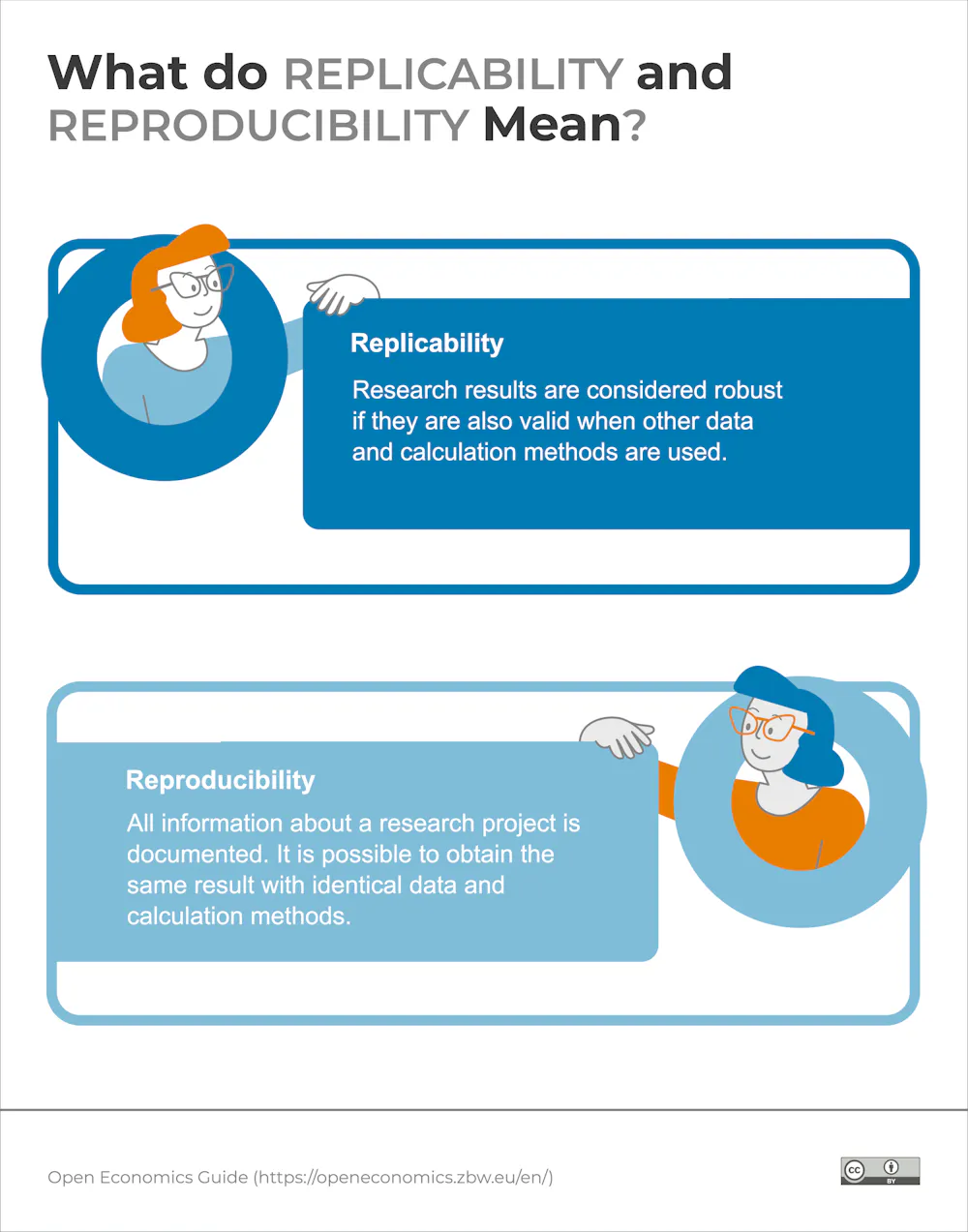
    A May 2025 executive order by President Donald Trump emphasized the “reproducibility crisis” in science. While replicability and reproducibility may sound similar, they’re distinct.

    Reproducibility is the ability to use the same data and methods from a study and reproduce the result. In my editorial role at the journal Psychological Science, I conduct computational reproducibility checks where we take the reported data and check that all the results in the paper can be reproduced independently.

    But we’re not running the study over again, or collecting new data. While reproducibility is important, research that is incorrect, fallible and sometimes harmful can still be reproducible.

    By contrast, replication is when an independent team repeats the same process, including collecting new data, to see if they get the same results. When research replicates, the team can be more confident that the results are not a fluke or an error.

    A diagram with the two definitions of replicability and reproducibility
    Reproducibility and replicability are both important, but have key differences.
    Open Economics Guide, CC BY

    The “replication crisis,” a term coined in psychology in the early 2010s, has spread to many fields, including biology, economics, medicine and computer science. Failures to replicate high-profile studies concern many scientists in these fields.

    Why replicate?

    Replicability is a core scientific value: Researchers want to be able to find the same result again and again. Many important findings are not published until they are independently replicated.

    In research, chance findings can occur. Imagine if one person flipped a coin 10 times and got two heads, then told the world that “coins have a 20% chance of coming up heads.” Even though this is an unlikely outcome – about 4% – it’s possible.

    Replications can correct these chance outcomes, as well as scientific errors, to ensure science is self-correcting.

    For example, in the search for the Higgs boson, two research centers at CERN, the European Council for Nuclear Research, ATLAS and CMS, independently replicated the detection of a particle with a large unique mass, leading to the 2013 Nobel Prize in physics.

    A large array of machinery arranged in a tunnel, as part of a particle detector experiment.
    The ATLAS experiment at the Large Hadron Collider at CERN is one of two that led to the discovery of the Higgs boson.
    CERN, CC BY

    The initial measurements from the two centers actually estimated the mass of the particle as slightly different. So while the two centers didn’t find identical results, the teams evaluated them and determined they were close enough. This variability is a natural part of the scientific process. Just because results are not identical does not mean they are not reliable.

    Research centers like CERN have replication built into their process, but this is not feasible for all research. For projects that are relatively low cost, the original team will often replicate their work prior to publication – but doing so does not guarantee that an independent team could get the same results.

    A graph showing time on the x axis and COVID-19 cases on the y axis. A line labeled 'placebo group' goes up from zero at a 45-degree angle, while the line labeled 'vaccine group' goes up slightly and then plateaus.
    Because the results on vaccine efficacy were so clear, replication wasn’t necessary and would have slowed the process of getting the vaccine to people.
    XKCD, CC BY-NC

    When projects are costly, urgent or time-specific, independently replicating them prior to disseminating results is often not feasible. Remember when people across the country were waiting for a COVID-19 vaccine?

    The initial Pfizer-BioNTech COVID-19 vaccine took 13 months from the start of the trial to authorization from the Food and Drug Administration. The results of the initial study were so clear and convincing that a replication would have unnecessarily delayed getting the vaccine out to the public and slowing the spread of disease.

    Since not every study can be replicated prior to publication, it’s important to conduct replications after studies are published. Replications help scientists understand how well research processes are working, identify errors and self-correct. So what’s the process of conducting a replication?

    The replication process

    Researchers could independently replicate the work of other teams, like at CERN. And that does happen. But when there are only two studies – the original and the replication – it’s hard to know what to do when they disagree. For that reason, large multigroup teams often conduct replications where they are all replicating the same study.

    Alternatively, if the purpose is to estimate the replicability of a body of research – for example, cancer biology – each team might replicate a different study, and the focus is on the percentage of studies that replicate across many studies.

    These large-scale replication projects have arisen around the world and include ManyLabs, ManyBabies, Psychological Accelerator and others.

    Replicators start by learning as much as possible about how the original study was conducted. They can collect details about the study from reading the published paper, discussing the work with its original authors and consulting online materials.

    The replicators want to know how the participants were recruited, how the data was collected and using what tools, and how the data was analyzed.

    But sometimes, studies may leave out important details, like the questions participants were asked or the brand of equipment used. Replicators have to make these difficult decisions themselves, which can affect the outcome.

    Replicators also often explicitly change details of the study. For example, many replication studies are conducted with larger samples – more participants – than the original study, to ensure the results are reliable.

    Registration and publication

    Sadly, replication research is hard to publish: Only 3% of papers in psychology, less than 1% in education and 1.2% in marketing are replications.

    If the original study replicates, journals may reject the paper because there is no “new insight.” If it doesn’t replicate, journals may reject the paper because they assume the replicators made a mistake – remember the salt crystals.

    Because of these issues, replicators often use registration to strengthen their claims. A preregistration is a public document describing the plan for the study. It is time-stamped to before the study is conducted.

    This type of document improves transparency by making changes in the plan detectable to reviewers. Registered reports take this a step further, where the research plan is subject to peer review before conducting the study.

    If the journal approves the registration, they commit to publishing the results of the study regardless of the results. Registered reports are ideal for replication research because the reviewers don’t know the results when the journal commits to publishing the paper, and whether the study replicates or not won’t affect whether it gets published.

    About 58% of registered reports in psychology are replication studies.

    Replication research often uses the highest standards of research practice: large samples and registration. While not all replication research is required to use these practices, those that do contribute greatly to our confidence in scientific results.

    Replication research is a useful thermometer to understand if scientific processes are working as intended. Active discussion of the replicability crisis, in both scientific and political spaces, suggests to many researchers that there is room for growth. While no field would expect a replication rate of 100%, new processes among scientists aim to improve the rates from those in the past.

    The Conversation

    Amanda Kay Montoya is an Associate Professor at the University of California, Los Angeles. She serves on the Board of Directors for the Center for Open Science. She receives funding from the US-National Science Foundation.

    ref. Research replication can determine how well science is working – but how do scientists replicate studies? – https://theconversation.com/research-replication-can-determine-how-well-science-is-working-but-how-do-scientists-replicate-studies-260771

  • When grief involves trauma − a social worker explains how to support survivors of the recent floods and other devastating losses

    Source: ForeignAffairs4

    Source: The Conversation – USA (3) – By Liza Barros-Lane, Assistant Professor of Social Work, University of Houston-Downtown

    Rain falls over a makeshift memorial for flood victims along the Guadalupe River on July 13, 2025, in Kerrville, Texas. AP Photo/Eric Gay

    The July 4, 2025, floods in Kerr County, Texas, swept away children and entire families, leaving horror in their wake. Days later, flash floods struck Ruidoso, New Mexico, killing three people, including two young children.

    These are not just devastating losses. When death is sudden, violent, or when a body is never recovered, grief gets tangled up with trauma.

    In these situations, people don’t only grieve the death. They struggle with the terror of how it happened, the unanswered questions and the shock etched into their bodies.

    I’m a social work professor, grief researcher and the founder of The Young Widowhood Project, a research initiative aimed at expanding scholarship and public understanding of premature spousal loss.

    I was widowed when I was 36. In July 2020, my husband, Brent, went missing after testing a small, flat-bottomed fishing boat called a Jon boat. His body was recovered two days later, but I never saw his remains.

    Both my personal loss and professional work have shown me how trauma changes the grieving process and what kind of support actually helps.

    To understand how trauma can complicate grief, it’s important to first understand how people typically respond to loss.

    Grief isn’t a set of stages

    Many people still think of grief through the lens of psychiatrist Dr. Elisabeth Kübler-Ross’ five stages of grief, popularized in the early 1970s: denial, anger, bargaining, depression and acceptance.

    But in fact, this model was originally designed for people facing their own deaths, not for mourners. In the absence of accessible grief research in the 1960s, it became a leading framework for understanding the grieving process – even though it wasn’t meant for that.

    Despite this misapplication, the stages model has shaped cultural expectations: namely, that grief ends once people reach the “acceptance” stage. But research doesn’t support this idea. Trying to force grief into this model can cause real harm, leaving mourners feeling they’re grieving “wrong.”

    In reality, mourning is often lifelong. Most people go through an acute period of overwhelming pain right after the loss. This is usually followed by integrated grief, where the pain softens but the loss is still part of everyday life, returning in waves.

    Although grief is unique to each person and relationship, researchers have found that mourners often strive to a) make sense of the death; b) adjust to a world without their loved one; c) form an ongoing connection with their deceased loved one in new ways; and d) figure out who they are without their loved one.

    It’s difficult and at times disorienting work, but most people find ways to carry their grief and keep living.

    A grandmother embraces a young woman in front of a wall of flowers.
    Julia Mora embraces her granddaughter, Isla Meyer, during a vigil for Texas flood victims on July 11, 2025.
    AP Photo/Gerald Herbert

    When grief and trauma collide

    However, some losses carry an extra layer of pain, confusion and trauma.

    Sudden, unexpected, accidental, violent or deeply tragic deaths – like those experienced during the recent floods – can lead to what researchers call traumatic bereavement: grief that is disrupted by the traumatic nature of the death.

    People experiencing traumatic bereavement often endure a longer and more intense acute grief period. They may be haunted by disturbing images, nightmares or relentless thoughts about how their loved one died or suffered. Many wrestle with dread, spiritual disorientation and a shattered sense of safety in the world.

    Some of these deaths are also considered “ambiguous” – unclear or unconfirmed loss – such as when a body is never recovered or is too damaged to view. Without physical confirmation, mourners often feel stuck in disbelief and helplessness.

    This was true in my case. Not seeing my husband’s body left a part of me suspended between knowing and not knowing. I knew he had died but couldn’t fully believe it, no matter how much I lived with the reality of his absence. For a long time, I caught myself repeating these words every morning: “Brent is dead. Brent is dead.”

    In many cases, these reactions aren’t short term. Many people affected by traumatic loss remain overwhelmed and sometimes physically and emotionally impaired for years. Symptoms may taper over time, but they rarely disappear entirely.

    Supporting mourners

    Traumatic bereavement can feel unbearable. Many mourners struggle with intense, long-lasting reactions that can leave them feeling helpless, altered or even unrecognizable to themselves. They may appear withdrawn, forgetful or emotionally drained because their systems are overwhelmed. Coping can look messy or self-destructive, but these are often survival strategies, not conscious choices. I’ve also seen how those same struggles become more survivable when mourners don’t have to carry them alone. If you’re supporting someone through traumatic loss, here are three ways to help.

    • Make space for the horror. Listen without flinching. Acknowledge the full weight of what happened and how terrifying and unjust the loss was. This means saying things like, “This should never have happened,” or “What you went through is beyond words.” It means staying present when the mourner speaks about what haunts them. Let them know they don’t have to carry this alone. You may feel the urge to say something hopeful such as, “At least the body was recovered,” but there is no silver lining in these cases. Instead, say: “There’s nothing I can say to fix this, but I’m not going anywhere.”

    • Help them find others who can understand. Trauma can be isolating. Mourners often feel uniquely overwhelmed or confused. Support groups, peer companions and therapists trained in treating grief and trauma can offer the kind of recognition and validation that even the most devoted friend may not be able to provide.

    • Take care of yourself, too. Being present for someone in deep grief takes energy, especially if you were personally affected by the loss. Stay connected to replenishing people, practices and routines. If you don’t, you may begin to experience trauma, too. Taking care of yourself will help you remain grounded so that you can show up.

    I believe supporting someone through traumatic bereavement is one of the most meaningful things you can do. You don’t need perfect words or a plan. What sustains them won’t be advice or solutions, but your simple, powerful act of staying.

    The Conversation

    Liza Barros-Lane does not work for, consult, own shares in or receive funding from any company or organization that would benefit from this article, and has disclosed no relevant affiliations beyond their academic appointment.

    ref. When grief involves trauma − a social worker explains how to support survivors of the recent floods and other devastating losses – https://theconversation.com/when-grief-involves-trauma-a-social-worker-explains-how-to-support-survivors-of-the-recent-floods-and-other-devastating-losses-260908

  • Children living near oil and gas wells face higher risk of rare leukemia, studies show

    Source: ForeignAffairs4

    Source: The Conversation – USA (3) – By Lisa McKenzie, Associate Professor of Health, Department of Environmental & Occupational Health, University of Colorado Anschutz Medical Campus

    The U.S. has nearly 1 million oil and natural gas wells. Some, like the one here in Commerce City, Colo., are within a few thousand feet of schools and neighborhoods. RJ Sangosti/Getty Images

    Acute lymphocytic leukemia is one of the most commonly diagnosed cancers in children, although it is rare. It begins in the bone marrow and rapidly progresses.

    Long-term survival rates exceed 90%, but many survivors face lifelong health challenges. Those include heart conditions, mental health struggles and a greater chance of developing a second cancer.

    Overall cancer rates in the U.S. have declined since 2002, but childhood acute lymphocytic leukemia rates continue to rise. This trend underscores the need for prevention rather than focusing only on treatment for this disease.

    A growing body of literature suggests exposure to the types of chemicals emitted from oil and natural gas wells increases the risk of developing childhood acute lymphocytic leukemia.

    Oil and gas drill extracting oil from the earth.
    Heavy machinery injects water under the surface of the earth to push oil and natural gas out.
    NurPhoto/GettyImages

    We are environmental epidemiologists focused on understanding the health implications of living near oil and natural gas development operations in Colorado and Pennsylvania. Both states experienced a rapid increase in oil and natural gas development in residential areas beginning in the early 21st century. We’ve studied this issue in these states, using different datasets and some different approaches.

    2 studies, similar findings

    Both of our studies used a case-control design. This design compares children with cancer, known as cases, with children without cancer, known as controls. We used data from statewide birth and cancer registries.

    We also used specialized mapping techniques to estimate exposure to oil and natural gas development during sensitive time windows, such as pregnancy or early childhood.

    The Colorado study looked at children born between 1992 and 2019. The study included 451 children diagnosed with leukemia and 2,706 children with no cancer diagnosis. It considered how many oil and natural gas wells were near a child’s home and how intense the activity was at each well. Intensity of activity included the volume of oil and gas production and phase of well production.

    The Colorado study found that children ages 2-9 living in areas with the highest density and intensity wells within eight miles (13 kilometers) of their home were at least two times more likely to be diagnosed with acute lymphocytic leukemia. Children with wells within three miles (five kilometers), of their home bore the greatest risk.

    The Pennsylvania study looked at 405 children diagnosed with leukemia between 2009 and 2017 and 2,080 children without any cancer diagnosis. This study found that children living within 1.2 miles (two kilometers) of oil and natural gas wells at birth were two to three times more likely to be diagnosed with acute lymphocytic leukemia between ages 2 to 7 than those who lived farther than 1.2 miles away.

    The risk of developing leukemia was more pronounced in children who were exposed during their mother’s pregnancy.

    The results of our two studies are also supported by a previous study in Colorado published in 2017. That study found children diagnosed with acute lymphocytic leukemia were four times more likely to live in areas with a high density of oil and natural gas wells than children diagnosed with other cancers.

    Policy implications

    To extract oil and natural gas from underground reserves, heavy drilling equipment injects water and chemicals into the earth under high pressure. Petroleum and contaminated wastewater are returned to the surface. It is well established that these activities can emit cancer-causing chemicals. Those include benzene, as well as other pollutants, to the air and water.

    The U.S. is the world’s largest producer of oil and natural gas. There are almost 1 million producing wells across the country, and many of these are located in or near residential areas. This puts millions of children at increased risk of exposure to cancer-causing chemicals.

    In the U.S., oil and natural gas development is generally regulated at the state level. Policies aimed at protecting public health include establishing minimum distances between a new well and existing homes, known as a setback distance. These policies also include requirements for emission control technologies on new and existing wells and restrictions on the construction of new wells.

    Setbacks offer a powerful solution to reduce noise, odors and other hazards experienced by communities near oil and gas wells. However, it is challenging to establish a universal setback that optimally addresses all hazards. That’s because noise, air pollutants and water contaminants dissipate at different rates depending on location and other factors.

    In addition, setbacks focus exclusively on where to place oil and natural gas wells but do not impose any restrictions on releases of air pollutants or greenhouse gases. Therefore, they do not address regional air quality issues or mitigate climate change.

    An oil rig sits across the street from a residential neighborhood in Frederick, Colorado.
    In many U.S. cities there are set distances that oil and gas wells are allowed to be from places such as schools and neighborhoods. In this Frederick, Colo., neighborhood the oil rig is very near houses.
    UGC/GettyImages

    Furthermore, current U.S. setback distances range from just 200 feet to 3,200 feet. Our results indicate that even the largest setback of 3,200 feet (one kilometer) is not sufficient to protect children from an increased leukemia risk.

    Our results support a more comprehensive policy approach that considers both larger setback distances and mandatory monitoring and control of hazardous emissions on both new and existing wells.

    Future research

    More research is needed in other states, such as Texas and California, that have oil and natural gas development in residential areas, as well as on other pediatric cancers.

    One such cancer is acute myeloid leukemia. This is another type of leukemia that starts in bone marrow and rapidly progresses. This cancer has exhibited a strong link to benzene exposure in adult workers in several industries, including the petroleum industry. Researchers have also documented a moderate cancer link for children exposed to vehicular benzene.

    It remains unclear whether benzene is the culprit or if another agent or combination of hazards is an underlying cause of acute myeloid leukemia.

    Even though questions remain, we believe the existing evidence coupled with the seriousness of childhood acute lymphocytic leukemia supports enacting further protective measures. We also believe policymakers should consider the cumulative effects from wells, other pollution sources and socioeconomic stressors on children and communities.

    Read more of our stories about Colorado and Pennsylvania.

    The Conversation

    Lisa McKenzie receives funding from the American Cancer Society and the University of Colorado Cancer Center.

    Nicole Deziel receives funding from the American Cancer Society, the National Institutes of Health, and the Yale School of Public Health.

    ref. Children living near oil and gas wells face higher risk of rare leukemia, studies show – https://theconversation.com/children-living-near-oil-and-gas-wells-face-higher-risk-of-rare-leukemia-studies-show-252994

  • Data can show if government programs work or not, but the Trump administration is suppressing the necessary information

    Source: ForeignAffairs4

    Source: The Conversation – USA (2) – By Sarah James, Assistant Professor of Political Science, Gonzaga University

    Do government programs work? It’s impossible to find out with no data. Andranik Hakobyan/iStock via Getty Images Plus

    The U.S. has the highest rate of maternal mortality among developed nations. Since 1987, the Centers for Disease Control and Prevention has administered the Pregnancy Risk Assessment Monitoring System to better understand when, where and why maternal deaths occur.

    In April 2025, the Trump administration put the department in charge of collecting and tracking this data on leave.

    It’s just one example of how the administration is deleting and disrupting American data of all kinds.

    The White House is also collecting less information about everything from how many Americans have health insurance to the number of students enrolled in public schools, and making government-curated data of all kinds off-limits to the public. President Donald Trump is also trying to get rid of entire agencies, like the Department of Education, that are responsible for collecting important data tied to poverty and inequality.

    His administration has also begun deleting websites and respositories that share government data with the public.

    Why data is essential for the safety net

    I study the role that data plays in political decision-making, including when and how government officials decide to collect it. Through years of research, I’ve found that good data is essential – not just for politicians, but for journalists, advocates and voters. Without it, it’s much harder to figure out when a policy is failing, and even more difficult to help people who aren’t politically well connected.

    Since Trump was sworn in for a second time, I have been keeping an eye on the disruption, removal and defunding of data on safety net programs such as food assistance and services for people with disabilities.

    I believe that disrupting data collection will make it harder to figure out who qualifies for these programs, or what happens when people lose their benefits. I also think that all this missing data will make it harder for supporters of safety net programs to rebuild them in the future.

    Why the government collects this data

    There’s no way to find out whether policies and programs are working without credible data collected over a long period of time.

    For example, without a system to accurately measure how many people need help putting food on their tables, it’s hard to figure out how much the country should spend on the Supplemental Nutrition Assistant Program, formerly known as food stamps, the federal supplemental nutrition program for women, infants and children, known as WIC, and related programs. Data on Medicaid eligibility and enrollment before and after the passage of the Affordable Care Act in 2010 offers another example. National data showed that millions of Americans gained health insurance coverage after the ACA was rolled out.

    Many institutions and organizations, such as universities, news organizations, think tanks, and nonprofits focused on particular issues like poverty and inequality or housing, collect data on the impact of safety net policies on low-income Americans.

    No doubt these nongovernmental data collection efforts will continue, and maybe even increase. However, it’s highly unlikely that these independent efforts can replace any of the government’s data collection programs – let alone all of them.

    The government, because it takes the lead in implementing official policies, is in a unique position to collect and store sensitive data collected over long periods of time. That’s why the disappearance of thousands of official websites can have very long-term consequences.

    What makes Trump’s approach stand out

    The Trump administration’s pausing, defunding and suppressing of government data marks a big departure from his predecessors.

    As early as the 1930s, U.S. social scientists and local policymakers realized the potential for data to show which policies were working and which were a waste of money. Since then, policymakers across the political spectrum have grown increasingly interested in using data to make government work better.

    This focus on data grew starting in 2001, when President George W. Bush made holding government accountable to measurable outcomes a top priority.

    He saw data as a powerful tool for reducing waste and assessing policy outcomes. His signature education reform, the No Child Left Behind Act, radically expanded the collection and reporting of student achievement data at K-12 public schools.

    George W. Bush speaks against a school locker backdrop, next to an American flag and another flag. Above him are the words 'Strengthening our schools.'
    President George W. Bush speaks about education in 2005 at a high school in Falls Church, Va., outlining his plans for the No Child Left Behind Act.
    Alex Wong/Getty Images)

    How this contrasts with the Obama and Biden administrations

    Presidents Barack Obama and Joe Biden emphasized the importance of data for evaluating the impact of their policies on low-income people, who have historically had little political clout.

    Obama initiated a working group to identify ways to collect, analyze and incorporate more useful data into safety net policies. Biden implemented several of the group’s suggestions.

    For example, he insisted on the collection of demographic data and its analysis when assessing the impacts of new safety net policies. This approach shaped how his administration handled changes in home loan practices, the expansion of broadband access and the establishment of outreach programs for enrolling people in Medicaid and Medicare.

    Why rebuilding will be hard

    It’s harder to make a case for safety net programs when you don’t have relevant data. For example, programs that help low-income people see a doctor, get fresh food and find housing can be more cost-effective than simply having them continue to live in poverty.

    Blocking data collection may also make restoring government funding after a program gets cut or shut down even more challenging. That’s because it will be more challenging for people who in the past benefited from these programs to persuade their fellow taxpayers that there is a need for investing in a expanding program or creating a new one.

    Without enough data, even well-intended policies in the future may worsen the very problems they’re meant to fix, long after the Trump administration has concluded.

    The Conversation

    Sarah James does not work for, consult, own shares in or receive funding from any company or organization that would benefit from this article, and has disclosed no relevant affiliations beyond their academic appointment.

    ref. Data can show if government programs work or not, but the Trump administration is suppressing the necessary information – https://theconversation.com/data-can-show-if-government-programs-work-or-not-but-the-trump-administration-is-suppressing-the-necessary-information-259760

  • Babies born with DNA from three people hailed as breakthrough – but questions remain

    Source: ForeignAffairs4

    Source: The Conversation – UK – By Cathy Herbrand, Professor of Medical and Family Sociology, De Montfort University

    Ten years after the UK became the first country to legalise mitochondrial donation, the first results from the use of these high-profile reproductive technologies – designed to prevent passing on genetic disorders – have finally been published.

    So far, eight children have been born, all reportedly healthy, thanks to the long-term efforts of scientists and doctors in Newcastle, England. Should this be a cause for excitement, disappointment or concern? Perhaps, I would suggest, it could be a bit of all three.

    The New England Journal of Medicine has published two papers on a groundbreaking fertility treatment that could prevent devastating inherited diseases. The technique, called mitochondrial donation, was used to help 22 women who carry faulty genes that would otherwise pass serious genetic disorders – such as Leigh syndrome – to their children. These disorders affect the body’s ability to produce energy at the cellular level and can cause severe disability or death in babies.

    The technique, developed by the Newcastle team, involves creating an embryo using DNA from three people: nuclear DNA from the intended mother and father, and healthy mitochondrial DNA from a donor egg. During the parliamentary debates leading up to The Human Fertilisation and Embryology (Mitochondrial Donation) Regulations in 2015, there were concerns about the effectiveness of the procedure and its potential side effects.

    The announcement that this technology has led to the birth of eight apparently healthy children therefore marks a major scientific achievement for the UK, which has been widely praised by numerous scientists and patient support groups. However, these results should not detract from some important questions they also raise.

    First, why has it taken so long for any updates on the application of this technology, including its outcomes and its limitations, to be made public? Especially given the significant public financial investment made into its development.

    In a country positioning itself as a leader in the governance and practice of reproductive and genomic medicine, transparency should be a central principle. Transparency not only supports the progress of other research teams but also keeps the public and patients well informed.

    Second, what is the significance of these results? While eight babies were born using this technology, this figure contrasts starkly with the predicted number of 150 babies per year likely to be born using the technique.

    The Human Fertilisation and Embryology Authority, the UK regulator in this area, has approved 32 applications since 2017 when the Newcastle team obtained its licence, but the technique was used with only 22 of them, resulting in eight babies. Does this constitute sufficiently robust data to prove the effectiveness of the technology and was it worth the considerable efforts and investments over almost two decades of campaigning, debate and research?

    As I wrote when this law was passed, officials should have been more realistic about how many people this treatment could actually help. By overestimating the number of patients who might benefit, they risked giving false hope to families who wouldn’t be eligible for the procedure.

    The safety question

    Third, is it safe enough? In two of the eight cases, the babies showed higher levels of maternal mitochondrial DNA, meaning the risk of developing a mitochondrial disorder cannot be ruled out. This potential for a “reversal” – where the faulty mitochondria reassert themselves – was also highlighted in a recent study conducted in Greece involving patients who used the technique to treat infertility problems.

    As a result, the technology is no longer framed by the Newcastle team as a way to prevent the transmission of mitochondrial disorders, but rather to reduce the risk. But is the risk reduction enough to justify offering the technique to more patients? And what will the risk of reassertion mean for the children born through it and their parents, who may live with the continuing uncertainty that the condition could emerge later in life?

    As some experts have suggested, it may be worth testing this technology on women who have fertility problems but don’t carry mitochondrial diseases. This would help doctors better understand the risks of the faulty mitochondria coming back, before using the technique only on women who could pass these serious genetic conditions to their children.

    This leads to a fourth question. What has been the patient experience with this technology? It would be valuable to know how many people applied for mitochondrial donation, why some were not approved, and, among those 32 approved cases, why only 22 proceeded with treatment.

    It also raises important questions about how patients who were either unable to access the technology, or for whom it was ultimately unsuccessful feel, particularly after investing significant time, effort and hope in the process. How do they come to terms with not having the healthy biological child they had been offered?

    This is not to say we shouldn’t celebrate these births and what they represent for the UK in terms of scientific achievement. The birth of eight healthy children represents a genuine scientific breakthrough that families affected by mitochondrial diseases have waited decades to see. However, some important questions remain unanswered, and more evidence is needed and it should be communicated in a timely manner to make conclusions about the long-term use of the technology.

    Breakthroughs come with responsibilities. If the UK wants to maintain its position as a leader in reproductive medicine, it must be more transparent about both the successes and limitations of this technology. The families still waiting to have the procedure – and those who may never receive it – deserve nothing less than complete honesty about what this treatment can and cannot deliver.

    The Conversation

    Cathy Herbrand receives funding from the Economic and Social Research Council.

    ref. Babies born with DNA from three people hailed as breakthrough – but questions remain – https://theconversation.com/babies-born-with-dna-from-three-people-hailed-as-breakthrough-but-questions-remain-261385

  • East African countries and open borders: great strides, but still a long way to go

    Source: ForeignAffairs4

    Source: The Conversation – Africa – By Alan Hirsch, Senior Research Fellow New South Institute, Emeritus Professor at The Nelson Mandela School of Public Governance, University of Cape Town

    It’s not uncommon to find a Ugandan taxi driver in Rwanda’s capital, Kigali, just as one regularly meets Zimbabwean Uber drivers in South Africa. But there is a big difference. A Ugandan working in Rwanda most likely has a secure legal right to be there, whereas Zimbabweans working in South Africa are often uncertain of their current or future legality.

    East Africa has made greater strides towards the free flow of people crossing borders and seeking work than most of Africa. Only the Economic Community of West African States (Ecowas) is in the same league.

    While the African Union’s Free Movement of Persons protocol has faltered at a continental level, some of the regional economic communities have made progress. The Southern African Development Community (SADC) allows visa-free travel across almost all its borders.

    Ecowas and the East African Community (EAC) have driven ambitiously towards regional common markets including the freeing up of job-seeking, residential settlement and business development across the borders of member states.

    The New South Institute, a think-tank focused on governance reforms in the global south, is nearing the end of a research programme on migration governance reform in Africa. Our new report is on East Africa.

    We have found that unlike much of the global north, the African continent is moving towards more open borders for people. In some of the global south the promise of economic growth outweighs political fears. Yet progress is slow, and not coordinated. Mostly migration reform happens in regions and between neighbours.

    The progress in the East African Community is particularly notable compared with other African regional communities. We identify a number of reasons for this, including strong leadership and co-operation between state and non-state actors.

    The commitment to free movement

    The East African Community adopted its Common Market Protocol in 2010. The bloc is made up of Tanzania, Uganda, Kenya, Rwanda, Burundi, South Sudan, the DRC and Somalia.

    The regional body’s common market pact includes the movement of goods, services, capital and people. It gives people the right – on paper at least – to find employment across borders, the right to reside and the right to establish a business. There is also a commitment to the harmonisation and mutual recognition of academic and professional qualifications and labour policies to ease mobility.

    Even before the common market protocol, the regional bloc began to establish one-stop border posts on many of its internal borders to facilitate the flow of goods and people. Though they don’t all operate the same way or equally well, they have been successful at easing movement.

    Uneven outcomes

    The common market’s impact on the movement of people has been uneven within the region. Most integrated are Uganda, Kenya and Rwanda, which allow the cross-border movement of citizens with standardised identity documents – they do not need passports.

    It is also relatively easy to get jobs across these borders.

    Tanzania and Burundi are close to the inner circle but still require passports, though no visas. The three states which joined more recently, South Sudan, the DRC and Somalia, are all fragile states with governance systems that do not always meet the standards needed for acceptance into all the privileges of the regional bloc.

    In practice there is differential treatment. Generally, it is more difficult for citizens of the three latecomers to get regular access and jobs in their regional partners.

    Another limitation when it comes to the mobility of people is that little progress has been made in the formal harmonisation of education, health and social welfare systems between member states. This inhibits job seeking across borders.

    In addition, national labour laws, which tend to require permits for foreigners, still apply to varying degrees in the region. Some countries are more permissive. For example, Kenya, Uganda and Rwanda have a reciprocal no-fee work permit agreement.

    Another shortcoming has been that the outcomes of court processes in enforcing the freedom of movement have been disappointing. This is so even though the regional bloc has an active East African Court of Justice. Its legal mandate includes the enforcement of the bloc’s treaty and its protocols.

    In some cases the court has found that national actions inhibiting the movement of persons were trumped by the regional protocol. It has instructed the errant governments to comply. But its ability to enforce the decisions is minimal.

    Reasons for success

    Leadership has been important. The fact that the strongest economy in the region, Kenya, has been part of the leading echelon is significant.

    Rwanda and Uganda have led by example too. Rwanda was one of the first countries on the continent to offer visa-free entry to all other African countries. For its part, Uganda is widely admired for its refugee inclusion programmes.

    Another factor outlined in our report has been the opportunity for collaboration fostered by relationships between formal institutions, such as governments, and non-state actors such as the International Organisation for Migration. Interactions between these various players have created opportunities for officials and policymakers from states of the region to meet, discuss issues of concern, and develop relationships of trust and understanding.

    Another non-state donor-funded actor, TradeMark Africa, which was established in 2010 to support in the implementation of the common market in east Africa, provided considerable support. For example it supported the implementation of the regional One-Stop Border Post programme..

    Way forward

    Based on our report we identified changes that could make a positive difference.

    Firstly, the development of reliable, harmonised systems in the region to collect and manage data on population mobility and employment. This would build confidence that policy was being made on the basis of reliable information.

    Secondly, reducing friction in cross-border monetary transactions, including migrants’ remittances. This would make it easier for migrants to send some of their income to their countries of origin.

    Thirdly, improvements to population registers, identity documents, passports and cross-border migration management systems. Improvements would build mutual trust in the integrity of systems and pave the way for further commitments to lowering migration barriers.

    Fourth, cooperation on cross-border access to social services such as health and education. This is one of the most important intermediate steps towards freeing up mobility for the citizens of the region.

    Fifth, reconsidering some of the amendments made to weaken the East African Court of Justice in 2007. This would strengthen the de jure powers of the court, adding considerably to the entrenchment of cross-border rights in the region.

    Ultimately, the key constraint in the region is political and security instability, which holds back social and economic development. Nevertheless, incremental progress on mobility is possible despite issues in the fragile states, even though it may result in asymmetric progress within the East African Community.

    The Conversation

    Alan Hirsch’s work on migration governance is part of his responsibilities while employed as a Senior Research Fellow at the New South Institute.

    ref. East African countries and open borders: great strides, but still a long way to go – https://theconversation.com/east-african-countries-and-open-borders-great-strides-but-still-a-long-way-to-go-261021

  • MIL-OSI Submissions: East African countries and open borders: great strides, but still a long way to go

    Source: The Conversation – Africa – By Alan Hirsch, Senior Research Fellow New South Institute, Emeritus Professor at The Nelson Mandela School of Public Governance, University of Cape Town

    It’s not uncommon to find a Ugandan taxi driver in Rwanda’s capital, Kigali, just as one regularly meets Zimbabwean Uber drivers in South Africa. But there is a big difference. A Ugandan working in Rwanda most likely has a secure legal right to be there, whereas Zimbabweans working in South Africa are often uncertain of their current or future legality.

    East Africa has made greater strides towards the free flow of people crossing borders and seeking work than most of Africa. Only the Economic Community of West African States (Ecowas) is in the same league.

    While the African Union’s Free Movement of Persons protocol has faltered at a continental level, some of the regional economic communities have made progress. The Southern African Development Community (SADC) allows visa-free travel across almost all its borders.

    Ecowas and the East African Community (EAC) have driven ambitiously towards regional common markets including the freeing up of job-seeking, residential settlement and business development across the borders of member states.

    The New South Institute, a think-tank focused on governance reforms in the global south, is nearing the end of a research programme on migration governance reform in Africa. Our new report is on East Africa.

    We have found that unlike much of the global north, the African continent is moving towards more open borders for people. In some of the global south the promise of economic growth outweighs political fears. Yet progress is slow, and not coordinated. Mostly migration reform happens in regions and between neighbours.

    The progress in the East African Community is particularly notable compared with other African regional communities. We identify a number of reasons for this, including strong leadership and co-operation between state and non-state actors.

    The commitment to free movement

    The East African Community adopted its Common Market Protocol in 2010. The bloc is made up of Tanzania, Uganda, Kenya, Rwanda, Burundi, South Sudan, the DRC and Somalia.

    The regional body’s common market pact includes the movement of goods, services, capital and people. It gives people the right – on paper at least – to find employment across borders, the right to reside and the right to establish a business. There is also a commitment to the harmonisation and mutual recognition of academic and professional qualifications and labour policies to ease mobility.

    Even before the common market protocol, the regional bloc began to establish one-stop border posts on many of its internal borders to facilitate the flow of goods and people. Though they don’t all operate the same way or equally well, they have been successful at easing movement.

    Uneven outcomes

    The common market’s impact on the movement of people has been uneven within the region. Most integrated are Uganda, Kenya and Rwanda, which allow the cross-border movement of citizens with standardised identity documents – they do not need passports.

    It is also relatively easy to get jobs across these borders.

    Tanzania and Burundi are close to the inner circle but still require passports, though no visas. The three states which joined more recently, South Sudan, the DRC and Somalia, are all fragile states with governance systems that do not always meet the standards needed for acceptance into all the privileges of the regional bloc.

    In practice there is differential treatment. Generally, it is more difficult for citizens of the three latecomers to get regular access and jobs in their regional partners.

    Another limitation when it comes to the mobility of people is that little progress has been made in the formal harmonisation of education, health and social welfare systems between member states. This inhibits job seeking across borders.

    In addition, national labour laws, which tend to require permits for foreigners, still apply to varying degrees in the region. Some countries are more permissive. For example, Kenya, Uganda and Rwanda have a reciprocal no-fee work permit agreement.

    Another shortcoming has been that the outcomes of court processes in enforcing the freedom of movement have been disappointing. This is so even though the regional bloc has an active East African Court of Justice. Its legal mandate includes the enforcement of the bloc’s treaty and its protocols.

    In some cases the court has found that national actions inhibiting the movement of persons were trumped by the regional protocol. It has instructed the errant governments to comply. But its ability to enforce the decisions is minimal.

    Reasons for success

    Leadership has been important. The fact that the strongest economy in the region, Kenya, has been part of the leading echelon is significant.

    Rwanda and Uganda have led by example too. Rwanda was one of the first countries on the continent to offer visa-free entry to all other African countries. For its part, Uganda is widely admired for its refugee inclusion programmes.

    Another factor outlined in our report has been the opportunity for collaboration fostered by relationships between formal institutions, such as governments, and non-state actors such as the International Organisation for Migration. Interactions between these various players have created opportunities for officials and policymakers from states of the region to meet, discuss issues of concern, and develop relationships of trust and understanding.

    Another non-state donor-funded actor, TradeMark Africa, which was established in 2010 to support in the implementation of the common market in east Africa, provided considerable support. For example it supported the implementation of the regional One-Stop Border Post programme..

    Way forward

    Based on our report we identified changes that could make a positive difference.

    Firstly, the development of reliable, harmonised systems in the region to collect and manage data on population mobility and employment. This would build confidence that policy was being made on the basis of reliable information.

    Secondly, reducing friction in cross-border monetary transactions, including migrants’ remittances. This would make it easier for migrants to send some of their income to their countries of origin.

    Thirdly, improvements to population registers, identity documents, passports and cross-border migration management systems. Improvements would build mutual trust in the integrity of systems and pave the way for further commitments to lowering migration barriers.

    Fourth, cooperation on cross-border access to social services such as health and education. This is one of the most important intermediate steps towards freeing up mobility for the citizens of the region.

    Fifth, reconsidering some of the amendments made to weaken the East African Court of Justice in 2007. This would strengthen the de jure powers of the court, adding considerably to the entrenchment of cross-border rights in the region.

    Ultimately, the key constraint in the region is political and security instability, which holds back social and economic development. Nevertheless, incremental progress on mobility is possible despite issues in the fragile states, even though it may result in asymmetric progress within the East African Community.

    Alan Hirsch’s work on migration governance is part of his responsibilities while employed as a Senior Research Fellow at the New South Institute.

    ref. East African countries and open borders: great strides, but still a long way to go – https://theconversation.com/east-african-countries-and-open-borders-great-strides-but-still-a-long-way-to-go-261021

    MIL OSI

  • MIL-Evening Report: Grattan on Friday: New parliament presents traps for Albanese and Ley

    Source: The Conversation (Au and NZ) – By Michelle Grattan, Professorial Fellow, University of Canberra

    Anthony Albanese hasn’t been in any rush to convene the new parliament, which Governor-General Sam Mostyn will open on Tuesday.

    It’s only mildly cynical to observe that governments of both persuasions often seem to regard having pesky members and senators around too much as a hindrance to business. Accountability is all very good in theory – facing it in practice is another matter.

    In this first fortnight of the new parliament, however, much of the attention will be less on the government than on the opposition. Liberal leader Sussan Ley has handled her early weeks without tripping. But her critics hover like crows on the fence in lambing season. Angus Taylor, who narrowly lost the leadership ballot, retains his ambition. The right-wing media wait for Ley’s mistakes.

    Ley will need to maintain a strong grip on her team’s messaging, especially on foreign and defence policy, or the Coalition will open itself to criticism.

    Taylor, now the defence spokesman, attracted attention this week when he went out on a limb on Taiwan, telling the ABC, “we should have a joint commitment with them [the US] to the security of Taiwan”.

    Ley, who says she wants to avoid unrelenting negativity, must choose the Coalition’s targets carefully. It has been presented with some useful fodder with the (inadvertently) leaked Treasury brief to the re-elected government that urged the need for tax rises and spending cuts. This is manna from political heaven because it is on the Coalition’s favoured economic ground, and raises issues for which the government doesn’t have immediate or clear-cut answers.

    As important as Ley’s own performance will be, so will that of shadow treasurer Ted O’Brien. Taylor’s handling of the job last term was a serious weakness for the Coalition.

    Facing a well-prepared and confident counterpart in Jim Chalmers, O’Brien must find his feet quickly. Sensibly, he has hired on his staff an experienced, credible economist, Steven Hamilton, who has been an assistant professor of economics at George Washington University in Washington DC. Hamilton has also been a regular contributor to The Australian Financial Review, so he has a feel for, and contacts in, the financial media.

    The government has a mix of legislation to introduce in this initial fortnight. Albanese promised during the campaign that Labor’s first cab off the rank would be its commitment to cut student debt by 20%. It also foreshadowed early action to cement in penalty rates.

    It didn’t anticipate having to rush in a bill to strip funding from childcare centres that do not meet safety standards. This follows the recent revelations
    of abuse.

    The first parliamentary fortnight comes in the run-up to the government’s August 19–21 productivity roundtable (named by Chalmers the “economic reform roundtable”). With expectations inevitably exploding, observers will be watching closely the dynamics between the treasurer and the prime minister in parliament.

    The two agree that delivering election promises should be the floor, rather than the ceiling, of ambition for the second term. But their degrees of ambition differ. Chalmers fears Albanese’s is limited; the prime minister fears his treasurer’s will overreach. Will Albanese show a restraining hand on the roundtable in the weeks before it?

    As the government wants to emphasise delivery to voters in the early days of the parliament, Chalmers hasn’t rushed to seek the deal he needs with the Greens on his controversial changes to superannuation tax arrangements. The plan is to increase the tax on balances of more than $3 million, and tax the unrealised capital gains.

    The Greens want the $3 million reduced to $2 million and that amount indexed. It’s a fair assumption a compromise will be reached when negotiations occur.

    That will be a relatively easy test for the Greens under their new leader Larissa Waters, who has also said she wants to be constructive while holding the government to account.

    Later on, though, will come harder issues, including whether the Greens will sign up to a new environmental protection authority, stymied by political obstacles last term.

    In general, the Senate will be less complicated for the government in coming months than last term, given the Greens hold the sole balance of power on legislation contested by the opposition.

    That means things are more frustrating for other Senate crossbenchers.

    In his stand on staffing, Albanese is not improving their mood. Pauline Hanson’s One Nation doubled its representation to four senators but has no extra staff. Staff allocation is up to the prime minister, who has once again been arbitrary about how many staff individual Senate crossbenchers receive. This is an unfair and indefensible system – there should be independent, consistent rules.

    ACT senator David Pocock hasn’t lost any staff but he has lost clout, compared with last term when his vote could be crucial and he was able to trade it for concessions from the government. The new numbers deal him and other non-Green crossbenchers out of the game.

    In the House of Representatives, the Teals retain strong representation but, as in the last parliament, they can only exert (limited) influence, not power. For a while early this year, when it looked as if there would be a hung parliament, they were preparing wish lists.

    One new Teal will be sworn in next week, Nicolette Boele, who won the seat of Bradfield from the Liberals. She can’t know, however, whether she will see out her term. The Liberals have challenged the result after she won by just 26 votes. The matter will be decided by the Court of Disputed Returns.

    There are three possible outcomes: the court confirms the result; the result is overturned and the seat awarded to Liberal candidate Gisele Kapterian (who was allowed to vote in the Liberal leadership and supported Ley); or a fresh election is ordered.

    The Liberals are taking some risk with the challenge. If there were a new election, and they lost it, that would be another setback for them and could destabilise Ley’s leadership.

    Michelle Grattan does not work for, consult, own shares in or receive funding from any company or organisation that would benefit from this article, and has disclosed no relevant affiliations beyond their academic appointment.

    ref. Grattan on Friday: New parliament presents traps for Albanese and Ley – https://theconversation.com/grattan-on-friday-new-parliament-presents-traps-for-albanese-and-ley-261096

    MIL OSI AnalysisEveningReport.nz

  • What will batteries of the future be made of? Four scientists discuss the options – podcast

    Source: ForeignAffairs4

    Source: The Conversation – UK – By Gemma Ware, Host, The Conversation Weekly Podcast, The Conversation

    The majority of the world’s rechargeable batteries are now made using lithium-ion. Most rely on a combination of different rare earth metals such as cobalt or nickel for their electrodes. But around the world, teams of researchers are looking for alternative – and more sustainable – materials to build the batteries of the future.

    In this episode of The Conversation Weekly podcast, we speak to four scientists  who are testing a variety of potential battery materials about the promises they may offer.

    When lithium-ion batteries emerged in the 1990s, they were a huge breakthrough, says Laurence Hardwick, a professor of electrochemistry at the University of Liverpool in the UK. He explains that lithium-ion batteries “ became commercialised at the same time as the mobile electronics industry really took off”. But their subsequent use in electric cars now presents “a challenge of scale”, given the use of rare earth minerals within their components.

    Hardwick is director of the Stephenson Institute for Renewable Energy, named after the 19th-century engineer George Stephenson – builder of the world’s first inter-city rail link between Liverpool and Manchester, which passed close by to the University of Liverpool’s campus.

    Hardwick’s work focuses on what other materials could be used either in conjunction with lithium, or on their own, to diversify battery manufacturing away from rare earth metals. Part of this includes research on solid-state batteries, which use ceramic plates rather than a solvents to conduct the ions that provide the charge. “ Solid-state batteries offer a lot of potential energy-gaining benefits and safety benefits,” he says.

    Sodium-ion is also being touted as a potential alternative to lithium-ion batteries. Robert Armstrong, principal research fellow in chemistry at the University of St Andrews in Scotland, is part of a consortium of UK-based researchers working on questions around sodium-ion batteries, including what type of electrodes and electrolytes work best.

    Like potassium-ion, which is also a potential battery candidate, sodium-ion is heavier than lithium-ion, but Armstrong says sodium is  fairly evenly abundant: “So you don’t have the supply issues that might affect lithium-ion, and you’re not like to see the same price volatility.”

    Some Chinese manufacturers in China, such as BYD and CATL, are pushing ahead with sodium-ion batteries for cars, despite the fact they’re heavier than lithium-ion batteries. There’s also interest in sodium-based technology in countries in the Arabian Gulf that use desalination plants. “They’ve got all this sodium kicking around. Why not make use of it?” says Armstrong.

    Batteries which biodegrade

    A version of the soil-fuelled Terracell battery
    Terracell on display at the Prototypes for Humanity 2024 showcase in Dubai.
    Gemma Ware, CC BY-SA

    Other researchers are looking at how to make batteries out of plant-based materials that are biodegradable. Bill Yen, a PhD candidate in electrical engineering at Stanford University, is part of a team who are developing Terracell, a type of battery that generates power using microbes in the soil.

    Their inspiration was how to power environmental sensors in damp environments without leaving lots of electronic waste behind at the end of the battery’s life. Terracell won the energy category of the Prototypes for Humanity 2024 event in 2024 in Dubai, a  showcase for sustainable solutions to the world’s problems.

    Also in Dubai was Ulugbek Asimov, a professor of mechanical and construction engineering at Northumbria University in the UK, who is developing BioPower Cells, a type of rechargeable battery made from waste products such as coffee which doesn’t contain any rare earth metals. “  And at the end of its lifespan, we drop it into boiling water and it will be turned into liquid ionic fertilizer,” Asimov said.

    Listen to The Conversation Weekly to hear the conversations with these four scientists about their work and the batteries of the future.


    Applications are now open for early career researchers to submit their projects for the Prototypes for Humanity 2025 awards and showcase in Dubai.

    This episode of The Conversation Weekly was written and produced by Gemma Ware with assistance from Mend Mariwany and Katie Flood. Mixing and sound design by Eloise Stevens and theme music by Neeta Sarl.

    Listen to The Conversation Weekly via any of the apps listed above, download it directly via our RSS feed or find out how else to listen here. A transcript of this episode is available on Apple Podcasts or Spotify.

    The Conversation

    Bill Yen has received funding for his work on Terracell from National Science Foundation, the Agricultural and Food Research Initiative and support from the Alfred P. Sloan Foundation,VMware Research, and 3M. Laurence Hardwick has received funding from the Faraday Institution and is a member of the Royal Society of Chemistry. Ulugbek Asimoz has received funding from the Northern Accelerator Proof of Concept to develop certain stages of the BioPower Cells project, which will be a spinout company from Northumbria University in the future. Robert Armstrong has received funding from the Faraday Institution and funding from EPSRC and Leverhulme Trust.

    ref. What will batteries of the future be made of? Four scientists discuss the options – podcast – https://theconversation.com/what-will-batteries-of-the-future-be-made-of-four-scientists-discuss-the-options-podcast-261294

  • New discovery at Cern could hint at why our universe is made up of matter and not antimatter

    Source: ForeignAffairs4

    Source: The Conversation – UK – By William Barter, UKRI Future Leaders Fellow, University of Edinburgh

    Why didn’t the universe annihilate itself moments after the big bang? A new finding at Cern on the French-Swiss border brings us closer to answering this fundamental question about why matter dominates over its opposite – antimatter.

    Much of what we see in everyday life is made up of matter. But antimatter exists in much smaller quantities. Matter and antimatter are almost direct opposites. Matter particles have an antimatter counterpart that has the same mass, but the opposite electric charge. For example, the matter proton particle is partnered by the antimatter antiproton, while the matter electron is partnered by the antimatter positron.

    However, the symmetry in behaviour between matter and antimatter is not perfect. In a paper published this week in Nature, the team working on an experiment at Cern, called LHCb, has reported that it has discovered differences in the rate at which matter particles called baryons decay relative to the rate of their antimatter counterparts. In particle physics, decay refers to the process where unstable subatomic particles transform into two or more lighter, more stable particles.

    According to cosmological models, equal amounts of matter and antimatter were made in the big bang. If matter and antimatter particles come in contact, they annihilate one another, leaving behind pure energy. With this in mind, it’s a wonder that the universe doesn’t consist only of leftover energy from this annihilation process.

    However, astronomical observations show that there is now a negligible amount of antimatter in the universe compared to the amount of matter. We therefore know that matter and antimatter must behave differently, such that the antimatter has disappeared while the matter has not.

    Understanding what causes this difference in behaviour between matter and antimatter is a key unanswered question. While there are differences between matter and antimatter in our best theory of fundamental quantum physics, the standard model, these differences are far too small to explain where all the antimatter has gone.

    So we know there must be additional fundamental particles that we haven’t found yet, or effects beyond those described in the standard model. These would give rise to large enough differences in the behaviour of matter and antimatter for our universe to exist in its current form.

    Revealing new particles

    Highly precise measurements of the differences between matter and antimatter are a key topic of research because they have the potential to be influenced by and reveal these new fundamental particles, helping us discover the physics that led to the universe we live in today.

    Differences between matter and antimatter have previously been observed in the behaviour of another type of particle, mesons, which are made of a quark and an antiquark. There are also hints of differences in how the matter and antimatter versions of a further type of particle, the neutrino, behave as they travel.

    Big Bang
    Equivalent amounts of matter and antimatter were generated by the Big Bang.
    Triff / Shutterstock

    The new measurement from LHCb has found differences between baryons and antibaryons, which are made of three quarks and three antiquarks respectively. Significantly, baryons make up most of the known matter in our universe, and this is the first time that we have observed differences between matter and antimatter in this group of particles.

    The LHCb experiment at the Large Hadron Collider is designed to make highly precise measurements of differences in the behaviour of matter and antimatter. The experiment is operated by an international collaboration of scientists, made up of over 1,800 people based in 24 countries. In order to achieve the new result, the LHCb team studied over 80,000 baryons (“lambda-b” baryons, which are made up of a beauty quark, an up quark and a down quark) and their antimatter counterparts.

    Crucially, we found that these baryons decay to specific subatomic particles (a proton, a kaon and two pions) slightly more frequently – 5% more often – than the rate at which the same process happens with antiparticles. While small, this difference is statistically significant enough to be the first observation of differences in behaviour between baryon and antibaryon decays.

    To date, all measurements of matter-antimatter differences have been consistent with the small level present in the standard model. While the new measurement from LHCb is also in line with this theory, it is a major step forward. We have now seen differences in the behaviour of matter and antimatter in the group of particles that dominate the known matter of the universe. It’s a potential step in the direction of understanding why that situation came to be after the big bang.

    With the current and forthcoming data runs of LHCb we will be able to study these differences forensically, and, we hope, tease out any sign of new fundamental particles that might be present.

    The Conversation

    William Barter works for the University of Edinburgh. He receives funding from UKRI. He is a member of the LHCb collaboration at Cern.

    ref. New discovery at Cern could hint at why our universe is made up of matter and not antimatter – https://theconversation.com/new-discovery-at-cern-could-hint-at-why-our-universe-is-made-up-of-matter-and-not-antimatter-261274

  • MIL-OSI Submissions: New discovery at Cern could hint at why our universe is made up of matter and not antimatter

    Source: The Conversation – UK – By William Barter, UKRI Future Leaders Fellow, University of Edinburgh

    Why didn’t the universe annihilate itself moments after the big bang? A new finding at Cern on the French-Swiss border brings us closer to answering this fundamental question about why matter dominates over its opposite – antimatter.

    Much of what we see in everyday life is made up of matter. But antimatter exists in much smaller quantities. Matter and antimatter are almost direct opposites. Matter particles have an antimatter counterpart that has the same mass, but the opposite electric charge. For example, the matter proton particle is partnered by the antimatter antiproton, while the matter electron is partnered by the antimatter positron.

    However, the symmetry in behaviour between matter and antimatter is not perfect. In a paper published this week in Nature, the team working on an experiment at Cern, called LHCb, has reported that it has discovered differences in the rate at which matter particles called baryons decay relative to the rate of their antimatter counterparts. In particle physics, decay refers to the process where unstable subatomic particles transform into two or more lighter, more stable particles.

    According to cosmological models, equal amounts of matter and antimatter were made in the big bang. If matter and antimatter particles come in contact, they annihilate one another, leaving behind pure energy. With this in mind, it’s a wonder that the universe doesn’t consist only of leftover energy from this annihilation process.

    However, astronomical observations show that there is now a negligible amount of antimatter in the universe compared to the amount of matter. We therefore know that matter and antimatter must behave differently, such that the antimatter has disappeared while the matter has not.

    Understanding what causes this difference in behaviour between matter and antimatter is a key unanswered question. While there are differences between matter and antimatter in our best theory of fundamental quantum physics, the standard model, these differences are far too small to explain where all the antimatter has gone.

    So we know there must be additional fundamental particles that we haven’t found yet, or effects beyond those described in the standard model. These would give rise to large enough differences in the behaviour of matter and antimatter for our universe to exist in its current form.

    Revealing new particles

    Highly precise measurements of the differences between matter and antimatter are a key topic of research because they have the potential to be influenced by and reveal these new fundamental particles, helping us discover the physics that led to the universe we live in today.

    Differences between matter and antimatter have previously been observed in the behaviour of another type of particle, mesons, which are made of a quark and an antiquark. There are also hints of differences in how the matter and antimatter versions of a further type of particle, the neutrino, behave as they travel.

    Equivalent amounts of matter and antimatter were generated by the Big Bang.
    Triff / Shutterstock

    The new measurement from LHCb has found differences between baryons and antibaryons, which are made of three quarks and three antiquarks respectively. Significantly, baryons make up most of the known matter in our universe, and this is the first time that we have observed differences between matter and antimatter in this group of particles.

    The LHCb experiment at the Large Hadron Collider is designed to make highly precise measurements of differences in the behaviour of matter and antimatter. The experiment is operated by an international collaboration of scientists, made up of over 1,800 people based in 24 countries. In order to achieve the new result, the LHCb team studied over 80,000 baryons (“lambda-b” baryons, which are made up of a beauty quark, an up quark and a down quark) and their antimatter counterparts.

    Crucially, we found that these baryons decay to specific subatomic particles (a proton, a kaon and two pions) slightly more frequently – 5% more often – than the rate at which the same process happens with antiparticles. While small, this difference is statistically significant enough to be the first observation of differences in behaviour between baryon and antibaryon decays.

    To date, all measurements of matter-antimatter differences have been consistent with the small level present in the standard model. While the new measurement from LHCb is also in line with this theory, it is a major step forward. We have now seen differences in the behaviour of matter and antimatter in the group of particles that dominate the known matter of the universe. It’s a potential step in the direction of understanding why that situation came to be after the big bang.

    With the current and forthcoming data runs of LHCb we will be able to study these differences forensically, and, we hope, tease out any sign of new fundamental particles that might be present.

    William Barter works for the University of Edinburgh. He receives funding from UKRI. He is a member of the LHCb collaboration at Cern.

    ref. New discovery at Cern could hint at why our universe is made up of matter and not antimatter – https://theconversation.com/new-discovery-at-cern-could-hint-at-why-our-universe-is-made-up-of-matter-and-not-antimatter-261274

    MIL OSI

  • MIL-Evening Report: Why a surprise jump in unemployment isn’t as bad as it sounds

    Source: The Conversation (Au and NZ) – By Jeff Borland, Professor of Economics, The University of Melbourne

    New figures show Australia’s seasonally adjusted unemployment rate unexpectedly rose to 4.3% – its highest level since late 2021 – in June this year, up from 4.1% in May.

    While this is bad news, it’s not as bad as it might seem. Higher unemployment came from more people looking for work. In the long run, that’s good for the economy.

    And these figures also make it more likely we’ll see an interest rate cut next month – which is now looking overdue.

    What’s the bad news?

    This is the second month in a row we’ve seen no growth in total employment, while total hours worked (the number of hours worked by employed individuals, regardless of whether they are full-time, part-time or overtime) in the past month has gone backwards.

    All this adds to the picture of a slowing labour market since the start of the year, after surprisingly strong growth in the second half of 2024.

    The latest Australian Bureau of Statistics release also includes data on where extra hours worked during 2025 have come from.

    Employment growth has come entirely from the “non-market sector” – which is healthcare and social assistance, education and training, and public administration and safety. And the big driver of those extra jobs has been in social assistance and health care, which is largely government-funded.

    That means employment has gone backwards in the rest of the economy, adding to a picture of a jobs market being propped up by government investment in the caring economy.

    Why it as bad as you might think

    The reason unemployment rose is that more people were looking for work – so it’s not because employment fell.

    Of course, we’d prefer those people to have found jobs. But it does mean people weren’t losing jobs for the unemployment rate to rise.

    The growth in labour force participation in June continues the trend of strong growth since late 2021. In the long run, that’s a good thing – it means the country can produce more output, and more people gain an income from work.

    An interest rate cut now looks more certain

    A fortnight ago, the Reserve Bank surprised most people by keeping the cash rate on hold at 3.85%.

    Today’s unemployment data is extra evidence that the labour market isn’t contributing to inflation pressure – in fact, it’s the opposite.

    It shows an interest rate cut is now overdue. The Reserve Bank board meets again in mid-August, with a decision on rates announced on August 12.

    When will we know if this is a blip or a trend?

    One possibility is that some of the extra people who became unemployed in June have a job to go to in the next month. Ups and downs in that group have at times been influential in driving unemployment numbers in recent times. In that case, this month’s figures may partly turn out to be a blip. We’ll be able to tell that when we see next month’s figures.

    But the blip is unlikely to explain all of the rise in June. This is also about a labour market that is slowing.

    Jeff Borland receives funding from the Australian Research Council.

    ref. Why a surprise jump in unemployment isn’t as bad as it sounds – https://theconversation.com/why-a-surprise-jump-in-unemployment-isnt-as-bad-as-it-sounds-261375

    MIL OSI AnalysisEveningReport.nz

  • From coal to crops: Dayak women lead a just transition through backyard farming

    Source: ForeignAffairs4

    Source: The Conversation – Indonesia – By Aidy Halimanjaya, Associate lecturer, Universitas Katolik Parahyangan

    The global shift toward renewable energy is no longer a choice but a necessity: the climate crisis intensifies, with 2024 confirmed as the warmest year on record.

    Yet in Indonesia, coal remains an economic lifeline for several regions. In East Kutai, East Kalimantan, coal mining accounts for nearly 75% of the district’s gross regional domestic product (GRDP).

    The end of the coal mining era will come at a cost to local residents, many of whom risk losing their current jobs — especially after their traditional forest-based livelihoods have already been eroded by environmental degradation tied to fossil fuel extraction.

    Aulia, 31, a Dayak women from East Kutai, admitted:

    We’re heavily dependent on mining—it’s the only thing that gives us a substantial income.

    Yet, amid this dilemma, indigenous Dayak women are unfolding a quiet revolution.

    By growing food crops in their backyards, these women not only generate income but also demonstrate that sustainable agriculture can align with local traditions. Their initiative is an inspiration, especially for communities near mining sites seeking alternative sources of income.

    Mining’s hidden toll on women and indigenous communities

    While coal fuels East Kalimantan’s economy, its benefits are unevenly distributed. In 2024, Kutai Kartanegara and East Kutai regencies were ranked first and third among the province’s poorest regions.

    Instead of prosperity, many residents face environmental degradation and the loss of traditional livelihoods (land-based livelihood). This is especially true for women, who are often marginalised in decision-making and excluded from the mining sector.

    Since the forest was converted into a mining pit, the indigenous Dayak Basap community, which once relied on the forest for its livelihood, has lost its traditional living space and been forced to adapt to survive.

    Many men have turned to mining, while women have sought other ways to support their families: some teach, others run small businesses, and many now grow chillies, spinach, and watercress in their backyards.

    From backyards to resistance: A community’s fight for survival

    With the changing economic landscape, Basap Dayak women are turning to their yards as a source of alternative income. There, they grow food crops that yield quick harvests, are in high demand, and may influence local inflation — such as chillies. Spinach and watercress are also among the popular choices.

    This shift is driven by a 2024 pilot project from Just Transition Indonesia and Parahyangan University, supported by Energi Muda, a local NGO focused on energy transition issues.

    On a 700-square-metre plot, local residents have learned to blend traditional farming with modern permaculture techniques, including composting and crop rotation. Permaculture is a holistic approach to agriculture and land management that mimics patterns found in surrounding natural ecosystems. Local youth are also engaged as community mobilisers to support the post-coal transition.

    The results are promising. With agricultural science and technological support from the startup HARA, Dayak Basap women have overcome challenges such as acidic soil and water pollution caused by mining. Through seed cultivation, their crop yields have even outperformed those of conventional farming methods previously tested.

    They’ve also learned to sell their harvests directly to consumers — such as restaurants and cracker producers — cutting out middlemen and increasing their bargaining power. This combination of traditional knowledge and modern innovation is not only enhancing community capacity but also delivering tangible economic benefits.

    When innovation meets tradition: Overcoming barriers

    However, the journey is far from easy. Formerly mined land takes a long time to recover. Acidic soil and water contaminated with heavy metals pose serious challenges, while limited access to tools and fertilisers remains a significant barrier. In some cases, communities must purchase pre-grown seedlings to speed up the planting process.

    This chilli planting program has been very good. It’s just that the condition of the land was inadequate and hard to improve. If there’s a chance, maybe we can try farming that lasts more than just one season—Indigenous Dayak women.

    Furthermore, the transition from shifting cropping to a long-term management system requires ongoing training. This kind of adaptation certainly cannot be achieved overnight and requires intensive mentoring.

    A just transition must be grassroots-led

    Initiatives like these offer valuable lessons.

    First, the energy transition must involve local communities—especially women—from the outset.

    Second, collective, community-based approaches have proven more sustainable than top-down programmes, which often fail to address real needs on the ground.

    Third, policy support must be directed toward grassroots initiatives like this. The focus should not only be on meeting transition targets, but also on ensuring social and ecological justice.

    In the global context, Indonesia has expressed its commitment through the Paris Agreement and the Just Energy Transition Partnership (JETP). However, this commitment must be grounded in the lived experiences of communities, particularly indigenous women and those directly impacted by extractive industries.

    A just energy transition requires gradual steps, targeted programme support, inclusive partnerships, and genuine commitment from all stakeholders.

    The story of the Dayak Basap women is more than one of resilience—it is a roadmap for a just energy transition. Their success proves that economic diversification is possible, even in coal-dependent regions. But that success hinges on the quality of support: whether it truly meets community needs and is led by strong local leadership.

    The Conversation

    Aidy Halimanjaya terafiliasi sebagai pendiri dan direktur Yayasan Transisi berkeadilan Indonesia. Ia menerima dana dari Bank Indonesia melalui Universitas Parahyangan.

    ref. From coal to crops: Dayak women lead a just transition through backyard farming – https://theconversation.com/from-coal-to-crops-dayak-women-lead-a-just-transition-through-backyard-farming-260827

  • MIL-Evening Report: Australia got off on a technicality for its climate inaction. But there are plenty more judgement days to come

    Source: The Conversation (Au and NZ) – By Wesley Morgan, Research Associate, Institute for Climate Risk and Response, UNSW Sydney

    This week, the Federal Court found the Australian government has no legal duty to protect Torres Strait Islanders from climate change. The ruling was disappointing, but it’s not the end of the matter.

    The plaintiffs, Uncle Paul Kabai and Uncle Pabai Pabai, hail from the low-lying islands of Saibai and Boigu, near Papua New Guinea. They argued the Commonwealth was negligent for failing to take strong action on climate change.

    While the judge accepted the devastating effects climate change has wrought on the Torres Strait Islands, he found the Uncles did not prove their case of negligence.

    However, the judge found previous Australian governments had not taken the best available science into account when setting emissions reduction targets. The finding tightens the screws on the Albanese government, which is due to announce Australia’s long-awaited targets to cut emissions out to 2035.

    To protect communities in the Torres Strait, and across Australia, the government must set a 2035 target that is in line with the science.

    And the court finding is unlikely to stem the tide of litigation seeking greater government accountability for climate change – especially for those most vulnerable to its harms.

    Limitations of Australian law

    The Uncles’ case did not fail because there was no merit in their allegations. It failed because Justice Michael Wigney ruled negligence law was not the appropriate vehicle to deal with climate change policy.

    Justice Wigney found the Torres Strait Islanders proved much of their case, including that Australia’s emissions targets set in 2015, 2020 and 2021 were not consistent with the best available science. That science dictates national governments should set emissions reduction targets in line with international efforts to hold global temperature rise to 1.5°C.

    The Coalition was in power during the period in question. Justice Wigney found the government of the day “did not engage with or give real or genuine consideration to the best available science” when setting its targets.

    Looking ahead to our 2035 targets

    The Labor government is currently weighing its 2035 emissions reduction target. The Climate Change Authority, which provides independent advice to government on climate policy, is expected to recommend a target between 65% and 75%.

    But evidence suggests this may not be in line with the best available science.

    For example, according to some scientists, emissions reduction of 90% by 2035, based on 2005 levels, would be required to stay in line with the 1.5°C goal.

    Australia’s 2035 targets are not just crucial to the global effort to tackle climate change. They will also affect our standing in the Pacific at a time of deepening geostrategic competition.

    Australia is bidding to host the UN climate talks next year in partnership with Pacific island countries. Our climate policy for the decade ahead will be a powerful signal to our Pacific neighbours about our commitment to the region, and to climate justice.

    A shifting legal landscape

    Tuesday’s court finding left open the possibility an appeal court may revisit the state of the law, and recognise the duty of care claimed by the Uncles.

    This would require an appeal to the full court of the Federal Court. Wigney was a single judge and considered himself bound by past precedent set by the full court.

    Around the world, courts and human rights bodies are holding governments accountable for climate inaction. It is possible for Australian law to do the same.

    International courts and human rights bodies are holding governments accountable for climate inaction.
    Sjoerd van der Wal/Getty Images

    Courts in the Netherlands and Belgium, for example, have recognised government duties to heed the science to address foreseeable harms of climate change.

    Next week, the International Court of Justice – the world’s highest court – will issue an historic legal opinion on the obligations of nations to tackle climate change.

    This opinion will clarify the obligations of countries to prevent human rights harms caused by climate change, and to limit pollution of the Earth’s oceans and climate system. The opinion will be non-binding, but could influence future climate litigation.

    What’s more, attribution science is improving all the time. This field of science examines how greenhouse gas emissions affect a particular weather event or climate pattern.

    Clearer attribution science will provide courts an ever-stronger basis to consider how government policy decisions on emissions cause climate impacts – and resulting harms to people.

    As the legal responsibilities of governments are clarified, further strategic litigation in Australia is likely.

    Change is coming

    In his judgement, Justice Michael Wigney said the law currently “provides no real or effective legal avenue” for people or communities to seek legal recourse for government inaction on climate change. That will remain the case until the law changes, he said.

    To remain legitimate, legal norms must reflect changing social expectations. History shows laws can adapt when they are challenged repeatedly by those who are harmed by the status quo. Eventually, the dam wall breaks, and law is reinterpreted.

    A clear example is the Mabo case of 1992. The High Court of Australia acknowledged the obvious fact that Indigenous peoples have lived on this continent for tens of thousands of years, and that the “terra nullius” (land belonging to no-one) concept was a legal myth.

    The Mabo decision allowed common law to recognise native title. It was a departure from previous rulings which relied on the terra nullius concept to reject native title claims.

    Australia’s legal norms largely pre-date the scientific consensus on climate change. They must evolve to better recognise climate impacts that are harming Australians. While this week might not have been the time, change is inevitable.

    As Justice Wigney said, until the law adapts, the key avenue for change is public advocacy, protest and voter action at the ballot box.

    Wesley Morgan is a fellow with the Climate Council.

    Riona Moodley does not work for, consult, own shares in or receive funding from any company or organisation that would benefit from this article, and has disclosed no relevant affiliations beyond their academic appointment.

    ref. Australia got off on a technicality for its climate inaction. But there are plenty more judgement days to come – https://theconversation.com/australia-got-off-on-a-technicality-for-its-climate-inaction-but-there-are-plenty-more-judgement-days-to-come-261305

    MIL OSI AnalysisEveningReport.nz

  • Do women really need more sleep than men? A sleep psychologist explains

    Source: ForeignAffairs4

    Source: The Conversation – Global Perspectives – By Amelia Scott, Honorary Affiliate and Clinical Psychologist at the Woolcock Institute of Medical Research, and Macquarie University Research Fellow, Macquarie University

    klebercordeiro/Getty

    If you spend any time in the wellness corners of TikTok or Instagram, you’ll see claims women need one to two hours more sleep than men.

    But what does the research actually say? And how does this relate to what’s going on in real life?

    As we’ll see, who gets to sleep, and for how long, is a complex mix of biology, psychology and societal expectations. It also depends on how you measure sleep.

    What does the evidence say?

    Researchers usually measure sleep in two ways:

    • by asking people how much they sleep (known as self-reporting). But people are surprisingly inaccurate at estimating how much sleep they get

    • using objective tools, such as research-grade, wearable sleep trackers or the gold-standard polysomnography, which records brain waves, breathing and movement while you sleep during a sleep study in a lab or clinic.

    Looking at the objective data, well-conducted studies usually show women sleep about 20 minutes more than men.

    One global study of nearly 70,000 people who wore wearable sleep trackers found a consistent, small difference between men and women across age groups. For example, the sleep difference between men and women aged 40–44 was about 23–29 minutes.

    Another large study using polysomnography found women slept about 19 minutes longer than men. In this study, women also spent more time in deep sleep: about 23% of the night compared to about 14% for men. The study also found only men’s quality of sleep declined with age.

    The key caveat to these findings is that our individual sleep needs vary considerably. Women may sleep slightly more on average, just as they are slightly shorter on average. But there is no one-size-fits-all sleep duration, just as there is no universal height.

    Suggesting every woman needs 20 extra minutes (let alone two hours) misses the point. It’s the same as insisting all women should be shorter than all men.

    Even though women tend to sleep a little longer and deeper, they consistently report poorer sleep quality. They’re also about 40% more likely to be diagnosed with insomnia.

    This mismatch between lab findings and the real world is a well-known puzzle in sleep research, and there are many reasons for it.

    For instance, many research studies don’t consider mental health problems, medications, alcohol use and hormonal fluctuations. This filters out the very factors that shape sleep in the real world.

    This mismatch between the lab and the bedroom also reminds us sleep doesn’t happen in a vacuum. Women’s sleep is shaped by a complex mix of biological, psychological and social factors, and this complexity is hard to capture in individual studies.

    Let’s start with biology

    Sleep problems begin to diverge between the sexes around puberty. They spike again during pregnancy, after birth and during perimenopause.

    Fluctuating levels of ovarian hormones, particularly oestrogen and progesterone, seem to explain some of these sex differences in sleep.

    For example, many girls and women report poorer sleep during the premenstrual phase just before their periods, when oestrogen and progesterone begin to fall.

    Perhaps the most well-documented hormonal influence on our sleep is the decline in oestrogen during perimenopause. This is linked to increased sleep disturbances, particularly waking at 3am and struggling to get back to sleep.

    Some health conditions also play a part in women’s sleep health. Thyroid disorders and iron deficiency, for instance, are more common in women and are closely linked to fatigue and disrupted sleep.

    How about psychology?

    Women are at much higher risk of depression, anxiety and trauma-related disorders. These very often accompany sleep problems and fatigue. Cognitive patterns, such as worry and rumination, are also more common in women and known to affect sleep.

    Women are also prescribed antidepressants more often than men, and these medications tend to affect sleep.

    Society also plays a role

    Caregiving and emotional labour still fall disproportionately on women. Government data released this year suggests Australian women perform an average nine more hours of unpaid care and work each week than men.

    While many women manage to put enough time aside for sleep, their opportunities for daytime rest are often scarce. This puts a lot of pressure on sleep to deliver all the restoration women need.

    In my work with patients, we often untangle the threads woven into their experience of fatigue. While poor sleep is the obvious culprit, fatigue can also signal something deeper, such as underlying health issues, emotional strain, or too-high expectations of themselves. Sleep is certainly part of the picture, but it’s rarely the whole story.

    For instance, rates of iron deficiency (which we know is more common in women and linked to sleep problems) are also higher in the reproductive years. This is just as many women are raising children and grappling with the “juggle” and the “mental load”.

    Women in perimenopause are often navigating full-time work, teenagers, ageing parents and 3am hot flashes. These women may have adequate or even high-quality sleep (according to objective measures), but that doesn’t mean they wake feeling restored.

    Most existing research also ignores gender-diverse populations. This limits our understanding of how sleep is shaped not just by biology, but by things such as identity and social context.

    So where does this leave us?

    While women sleep longer and better in the lab, they face more barriers to feeling rested in everyday life.

    So, do women need more sleep than men? On average, yes, a little. But more importantly, women need more support and opportunity to recharge and recover across the day, and at night.

    The Conversation

    Amelia Scott is a member of the psychology education subcommittee of the Australasian Sleep Association. She receives funding from Macquarie University.

    ref. Do women really need more sleep than men? A sleep psychologist explains – https://theconversation.com/do-women-really-need-more-sleep-than-men-a-sleep-psychologist-explains-259985

  • Catholic clergy are speaking out on immigration − more than any other political issue except abortion

    Source: ForeignAffairs4

    Source: The Conversation – USA (3) – By Evan Stewart, Assistant Professor of Sociology, UMass Boston

    Catholic bishops invited by Mark Seitz, center, the bishop of El Paso, Texas, lead a march in solidarity with migrants on March 24, 2025, in downtown El Paso. AP Photo/Andres Leighton

    Catholic priests across the U.S. discuss immigration with their congregations more than leaders in many other faith traditions, according to our new research published in the journal Sociological Focus.

    Catholic priests also said they discussed immigration more than nearly all other political issues, including hunger in their communities, capital punishment, health care and the environment. Abortion was the only one priests discussed slightly more often.

    Our study, which uses data from the 2022 National Survey of Religious Leaders, found that 71% of Catholic priests surveyed said they spoke about any political issue with their congregations. Among them, just over half talked about immigration.

    In white conservative Protestant congregations, Black Protestant congregations and non-Christian congregations, only about a quarter of leaders who discussed political issues said they talked about immigration. Leaders of white liberal Protestant congregations, however, talked about the topic almost as much as Catholic leaders did.

    Why it matters

    The United States has a long history of religious leaders addressing political matters, on both the left and the right – and today is no different.

    With immigration raids on the rise across the country and an unprecedented level of funding approved for deportations, Catholic bishops in the U.S. are speaking out. Many of them have called for compassion and care for migrants and the need to uphold human dignity and due process, regardless of someone’s immigration status – in line with Catholic social teaching.

    As sociologists who study politics and religion, we wanted to know what is happening on the ground in congregations. Given the church’s teachings about caring for the vulnerable, we expected that Catholic clergy might be particularly likely to speak out.

    However, the percentage of people affiliated with a religious congregation is decreasing, and those who do attend are increasingly politically conservative. Rank and file Catholics are very divided on their support for immigrants, according to a 2024 national survey by the Center for Applied Research in the Apostolate.

    In this context, we were curious about whether clergy would discuss a political issue such as immigration with their congregations or say they avoid it altogether.

    What still isn’t known

    The survey we used is from 2022, before some of today’s immigration enforcement policies took effect. That said, these findings demonstrate that immigration was on the radar for Catholic leaders before the recent changes under the current administration.

    Because we focused on survey data, we got a good picture of trends among Catholic leaders nationwide. However, we could look only at whether religious leaders reported discussing immigration; we could not know exactly what they said, or how. There is much more to learn about what kinds of political messages come from the pulpit today and what messages tend to stick with congregants.

    We did find that Catholic leaders of congregations where the majority of worshipers are Hispanic were much more likely to talk about immigration, compared with leaders of non-Catholic Hispanic congregations and Catholic leaders of mostly white congregations. Because Hispanic communities in the U.S. are facing the brunt of the immigration crackdown, this finding shows that Catholic leaders have been addressing the needs of their communities.

    What’s next

    Catholic parishioners may be exposed to different opinions about immigration from religious and political leaders. Diane, one of the authors, is furthering this research by conducting interviews with Catholics in Greater Boston. By asking church members to talk through their attitudes toward immigrants, we can learn more about how people make sense of complicated ethical questions.

    The Research Brief is a short take on interesting academic work.

    The Conversation

    Diane Beckman received funding from Duke University to conduct research using data from the National Survey of Religious Leaders.

    Evan Stewart does not work for, consult, own shares in or receive funding from any company or organization that would benefit from this article, and has disclosed no relevant affiliations beyond their academic appointment.

    ref. Catholic clergy are speaking out on immigration − more than any other political issue except abortion – https://theconversation.com/catholic-clergy-are-speaking-out-on-immigration-more-than-any-other-political-issue-except-abortion-260485

  • MIL-Evening Report: I created a Vivaldi-inspired sound artwork for the Venice Biennale. The star of the show is an endangered bush-cricket

    Source: The Conversation (Au and NZ) – By Miriama Young, Associate Professor Music Composition, Melbourne Conservatorium of Music, The University of Melbourne

    Marco Zorzanello

    It was late January when I got the call. I’m asked to bring my sound art to a collaborative ecology and design project, Song of the Cricket, for the Venice Biennale of Architecture. When such as invitation arrives, you have no choice but to jump in.

    I see an image of the site for the project: the Gaggiandre at the Arsenale – a medieval shipyard that serviced the Venetian military at its imperial peak.

    Once a resplendent hive of industry, it is even detailed by Dante Alighieri in The Divine Comedy:

    As in the arsenal of the Venetians,
    all winter long a stew of sticky pitch
    boils up to patch their sick and tattered ships
    that cannot sail (instead of voyaging,
    some build new keels, some tow and tar the ribs
    of hulls worn out by too much journeying;
    some hammer at the prow, some at the stern,
    and some make oars, and some braid ropes and cords;
    one mends the jib, another, the mainsail)

    The Gaggiandre is a cavernous, church-like space flanked by stone colonnades, wooden roof beams, and situated, in true Venetian style, on a bed of water. With long reverberation times, music in this space would need to be slowly unfolding, drawing the listener in and inviting them to meditate.

    It is a place of reflection, both metaphorically and physically. To a sound artist, creating for the Gaggiandre is a dream.

    Art and the Anthropocene

    The Song of the Cricket exhibit has been on display at the Biennale since May. Its purpose is to bridge ecological research with sound art to raise awareness for our fragile biodiversity, with a focus on the critically endangered Adriatic bush-cricket, Zeuneriana marmorata.

    Zeuneriana marmorata is a rare species found in wetlands in north-eastern Italy and Slovenia.
    Wikimedia, CC BY-SA

    What better place than Venice – a city slowly sinking – to reflect on where we stand in this moment of environmental collapse?

    The exhibit was created by a large team of collaborators. It features several mobile habitats populated with Zeuneriana. Some of these habitats sit on the Arsenale lawn, while other symbolic habitats float on the water as life rafts. Alongside the enclosures, my pre-composed “sound garden” plays through speakers onto the lawn.

    At the end of the Biennale, the team, led by landscape architect and ecologist Alex Felson, intends to use the life rafts to ceremonially transport incubated eggs to a new home on the mainland.

    The installation features mobile cricket habitats on the lawn, as well as symbolic life rafts on the water.
    Miriama Young

    Sounds of nature and Vivaldi

    On the lawn, the chirrup of live courting bush-crickets blends with pre-recorded sounds of their ancestors. These ancestral sounds might double as a lullaby for newly orphaned eggs, as adults only live a few months.

    The accompanying sound garden is richly diverse, created from an array of fauna sounds drawn from Northern Italian wetland environments, including the Eurasian reed warbler, the cuckoo and, my personal favourite, the green toad.

    My intention is for the soundscape to transport audiences to a different time and place: to a future where these species thrive in a healthy ecology.

    Excerpt from the Song of Crickets sound installation.
    Miriama Young and Monica Lim1.73 MB (download)

    There is a second element to the sound installation, created with support from sound technologist Monica Lim. Informed by the music of Antonio Vivaldi, this element serves to further activate the untapped airspace and enhance visitors’ experience of the site.

    Born in Venice in 1678, Vivaldi is a ubiquitous and avoidable cliché for locals. Yet his music was the perfect inspiration for this project, as it encodes a hidden ecological story.

    Vivaldi incorporated the literal sounds of nature into The Four Seasons (1723), with particular species’ songs annotated onto the score.

    The Song of the Cricket borrows elements from Vivaldi’s Summer: Allegro non Molto. In the short section I drew from, the cuckoo, turtledove and goldfinch are all musically described and credited by Vivaldi.

    And although they are not expressly mentioned, I imagine bush-crickets also pervade Vivaldi’s Summer movement, as we know they were once prolific in the Venice lagoon, and would have filled the summer air during his lifetime. You might hear them in the rapidly repeating (tremolo) string gestures.

    The cricket’s song serves as a indicator of an ecosystem’s health. But the sound of crickets in Venice today is largely missing.

    Our take on Vivaldi is slowed down 30 times, magnified and fragmented, voiced through synthesizers, and piped into the Gaggiandre through five speakers – creating an immersive experience that feels at once futuristic and Baroque.

    Mobile habitats awaiting the Zeuneriana marmorata eggs float on the water.
    Marco Zorzanello

    Bridging the past and an imagined future

    The decision to borrow from music of the Western historical canon (in this case Vivaldi) fits into a burgeoning movement that composer Valentin Silvestrov coined “eschatophony”.

    This is presumably a portmanteau of “eschatology”, the study of the end of the world, and “phony”, which in this case relates to sound (such as symphony). Here, we are left only to wrestle with and re-contextualise our musical past, to create “echoes of history”.

    The inclusion of sound is still a novelty at the architecture Biennale. Of the 300 exhibits this year, I can count on one hand the projects that incorporated sound. All of them were special.

    Sound creates a remarkable theatre, both through its immediacy, as well as its capacity to elevate a project beyond the prosaic, into the poetic.

    Venice is a city where history pervades at every turn. The Song of the Cricket invites listeners in, offering them space to reflect, and to imagine a future where ecosystems might once again thrive.

    This article is part of Making Art Work, our series on what inspires artists and the process of their work.

    Miriama Young does not work for, consult, own shares in or receive funding from any company or organisation that would benefit from this article, and has disclosed no relevant affiliations beyond their academic appointment.

    ref. I created a Vivaldi-inspired sound artwork for the Venice Biennale. The star of the show is an endangered bush-cricket – https://theconversation.com/i-created-a-vivaldi-inspired-sound-artwork-for-the-venice-biennale-the-star-of-the-show-is-an-endangered-bush-cricket-259681

    MIL OSI AnalysisEveningReport.nz

  • MIL-Evening Report: I created a Vivaldi-inspired sound artwork for the Venice Biennale. The star of the show is an endangered bush-cricket

    Source: The Conversation (Au and NZ) – By Miriama Young, Associate Professor Music Composition, Melbourne Conservatorium of Music, The University of Melbourne

    Marco Zorzanello

    It was late January when I got the call. I’m asked to bring my sound art to a collaborative ecology and design project, Song of the Cricket, for the Venice Biennale of Architecture. When such as invitation arrives, you have no choice but to jump in.

    I see an image of the site for the project: the Gaggiandre at the Arsenale – a medieval shipyard that serviced the Venetian military at its imperial peak.

    Once a resplendent hive of industry, it is even detailed by Dante Alighieri in The Divine Comedy:

    As in the arsenal of the Venetians,
    all winter long a stew of sticky pitch
    boils up to patch their sick and tattered ships
    that cannot sail (instead of voyaging,
    some build new keels, some tow and tar the ribs
    of hulls worn out by too much journeying;
    some hammer at the prow, some at the stern,
    and some make oars, and some braid ropes and cords;
    one mends the jib, another, the mainsail)

    The Gaggiandre is a cavernous, church-like space flanked by stone colonnades, wooden roof beams, and situated, in true Venetian style, on a bed of water. With long reverberation times, music in this space would need to be slowly unfolding, drawing the listener in and inviting them to meditate.

    It is a place of reflection, both metaphorically and physically. To a sound artist, creating for the Gaggiandre is a dream.

    Art and the Anthropocene

    The Song of the Cricket exhibit has been on display at the Biennale since May. Its purpose is to bridge ecological research with sound art to raise awareness for our fragile biodiversity, with a focus on the critically endangered Adriatic bush-cricket, Zeuneriana marmorata.

    Zeuneriana marmorata is a rare species found in wetlands in north-eastern Italy and Slovenia.
    Wikimedia, CC BY-SA

    What better place than Venice – a city slowly sinking – to reflect on where we stand in this moment of environmental collapse?

    The exhibit was created by a large team of collaborators. It features several mobile habitats populated with Zeuneriana. Some of these habitats sit on the Arsenale lawn, while other symbolic habitats float on the water as life rafts. Alongside the enclosures, my pre-composed “sound garden” plays through speakers onto the lawn.

    At the end of the Biennale, the team, led by landscape architect and ecologist Alex Felson, intends to use the life rafts to ceremonially transport incubated eggs to a new home on the mainland.

    The installation features mobile cricket habitats on the lawn, as well as symbolic life rafts on the water.
    Miriama Young

    Sounds of nature and Vivaldi

    On the lawn, the chirrup of live courting bush-crickets blends with pre-recorded sounds of their ancestors. These ancestral sounds might double as a lullaby for newly orphaned eggs, as adults only live a few months.

    The accompanying sound garden is richly diverse, created from an array of fauna sounds drawn from Northern Italian wetland environments, including the Eurasian reed warbler, the cuckoo and, my personal favourite, the green toad.

    My intention is for the soundscape to transport audiences to a different time and place: to a future where these species thrive in a healthy ecology.

    Excerpt from the Song of Crickets sound installation.
    Miriama Young and Monica Lim1.73 MB (download)

    There is a second element to the sound installation, created with support from sound technologist Monica Lim. Informed by the music of Antonio Vivaldi, this element serves to further activate the untapped airspace and enhance visitors’ experience of the site.

    Born in Venice in 1678, Vivaldi is a ubiquitous and avoidable cliché for locals. Yet his music was the perfect inspiration for this project, as it encodes a hidden ecological story.

    Vivaldi incorporated the literal sounds of nature into The Four Seasons (1723), with particular species’ songs annotated onto the score.

    The Song of the Cricket borrows elements from Vivaldi’s Summer: Allegro non Molto. In the short section I drew from, the cuckoo, turtledove and goldfinch are all musically described and credited by Vivaldi.

    And although they are not expressly mentioned, I imagine bush-crickets also pervade Vivaldi’s Summer movement, as we know they were once prolific in the Venice lagoon, and would have filled the summer air during his lifetime. You might hear them in the rapidly repeating (tremolo) string gestures.

    The cricket’s song serves as a indicator of an ecosystem’s health. But the sound of crickets in Venice today is largely missing.

    Our take on Vivaldi is slowed down 30 times, magnified and fragmented, voiced through synthesizers, and piped into the Gaggiandre through five speakers – creating an immersive experience that feels at once futuristic and Baroque.

    Mobile habitats awaiting the Zeuneriana marmorata eggs float on the water.
    Marco Zorzanello

    Bridging the past and an imagined future

    The decision to borrow from music of the Western historical canon (in this case Vivaldi) fits into a burgeoning movement that composer Valentin Silvestrov coined “eschatophony”.

    This is presumably a portmanteau of “eschatology”, the study of the end of the world, and “phony”, which in this case relates to sound (such as symphony). Here, we are left only to wrestle with and re-contextualise our musical past, to create “echoes of history”.

    The inclusion of sound is still a novelty at the architecture Biennale. Of the 300 exhibits this year, I can count on one hand the projects that incorporated sound. All of them were special.

    Sound creates a remarkable theatre, both through its immediacy, as well as its capacity to elevate a project beyond the prosaic, into the poetic.

    Venice is a city where history pervades at every turn. The Song of the Cricket invites listeners in, offering them space to reflect, and to imagine a future where ecosystems might once again thrive.

    This article is part of Making Art Work, our series on what inspires artists and the process of their work.

    Miriama Young does not work for, consult, own shares in or receive funding from any company or organisation that would benefit from this article, and has disclosed no relevant affiliations beyond their academic appointment.

    ref. I created a Vivaldi-inspired sound artwork for the Venice Biennale. The star of the show is an endangered bush-cricket – https://theconversation.com/i-created-a-vivaldi-inspired-sound-artwork-for-the-venice-biennale-the-star-of-the-show-is-an-endangered-bush-cricket-259681

    MIL OSI AnalysisEveningReport.nz

  • MIL-Evening Report: Do women really need more sleep than men? A sleep psychologist explains

    Source: The Conversation (Au and NZ) – By Amelia Scott, Honorary Affiliate and Clinical Psychologist at the Woolcock Institute of Medical Research, and Macquarie University Research Fellow, Macquarie University

    klebercordeiro/Getty

    If you spend any time in the wellness corners of TikTok or Instagram, you’ll see claims women need one to two hours more sleep than men.

    But what does the research actually say? And how does this relate to what’s going on in real life?

    As we’ll see, who gets to sleep, and for how long, is a complex mix of biology, psychology and societal expectations. It also depends on how you measure sleep.

    What does the evidence say?

    Researchers usually measure sleep in two ways:

    • by asking people how much they sleep (known as self-reporting). But people are surprisingly inaccurate at estimating how much sleep they get

    • using objective tools, such as research-grade, wearable sleep trackers or the gold-standard polysomnography, which records brain waves, breathing and movement while you sleep during a sleep study in a lab or clinic.

    Looking at the objective data, well-conducted studies usually show women sleep about 20 minutes more than men.

    One global study of nearly 70,000 people who wore wearable sleep trackers found a consistent, small difference between men and women across age groups. For example, the sleep difference between men and women aged 40–44 was about 23–29 minutes.

    Another large study using polysomnography found women slept about 19 minutes longer than men. In this study, women also spent more time in deep sleep: about 23% of the night compared to about 14% for men. The study also found only men’s quality of sleep declined with age.

    The key caveat to these findings is that our individual sleep needs vary considerably. Women may sleep slightly more on average, just as they are slightly shorter on average. But there is no one-size-fits-all sleep duration, just as there is no universal height.

    Suggesting every woman needs 20 extra minutes (let alone two hours) misses the point. It’s the same as insisting all women should be shorter than all men.

    Even though women tend to sleep a little longer and deeper, they consistently report poorer sleep quality. They’re also about 40% more likely to be diagnosed with insomnia.

    This mismatch between lab findings and the real world is a well-known puzzle in sleep research, and there are many reasons for it.

    For instance, many research studies don’t consider mental health problems, medications, alcohol use and hormonal fluctuations. This filters out the very factors that shape sleep in the real world.

    This mismatch between the lab and the bedroom also reminds us sleep doesn’t happen in a vacuum. Women’s sleep is shaped by a complex mix of biological, psychological and social factors, and this complexity is hard to capture in individual studies.

    Let’s start with biology

    Sleep problems begin to diverge between the sexes around puberty. They spike again during pregnancy, after birth and during perimenopause.

    Fluctuating levels of ovarian hormones, particularly oestrogen and progesterone, seem to explain some of these sex differences in sleep.

    For example, many girls and women report poorer sleep during the premenstrual phase just before their periods, when oestrogen and progesterone begin to fall.

    Perhaps the most well-documented hormonal influence on our sleep is the decline in oestrogen during perimenopause. This is linked to increased sleep disturbances, particularly waking at 3am and struggling to get back to sleep.

    Some health conditions also play a part in women’s sleep health. Thyroid disorders and iron deficiency, for instance, are more common in women and are closely linked to fatigue and disrupted sleep.

    How about psychology?

    Women are at much higher risk of depression, anxiety and trauma-related disorders. These very often accompany sleep problems and fatigue. Cognitive patterns, such as worry and rumination, are also more common in women and known to affect sleep.

    Women are also prescribed antidepressants more often than men, and these medications tend to affect sleep.

    Society also plays a role

    Caregiving and emotional labour still fall disproportionately on women. Government data released this year suggests Australian women perform an average nine more hours of unpaid care and work each week than men.

    While many women manage to put enough time aside for sleep, their opportunities for daytime rest are often scarce. This puts a lot of pressure on sleep to deliver all the restoration women need.

    In my work with patients, we often untangle the threads woven into their experience of fatigue. While poor sleep is the obvious culprit, fatigue can also signal something deeper, such as underlying health issues, emotional strain, or too-high expectations of themselves. Sleep is certainly part of the picture, but it’s rarely the whole story.

    For instance, rates of iron deficiency (which we know is more common in women and linked to sleep problems) are also higher in the reproductive years. This is just as many women are raising children and grappling with the “juggle” and the “mental load”.

    Women in perimenopause are often navigating full-time work, teenagers, ageing parents and 3am hot flashes. These women may have adequate or even high-quality sleep (according to objective measures), but that doesn’t mean they wake feeling restored.

    Most existing research also ignores gender-diverse populations. This limits our understanding of how sleep is shaped not just by biology, but by things such as identity and social context.

    So where does this leave us?

    While women sleep longer and better in the lab, they face more barriers to feeling rested in everyday life.

    So, do women need more sleep than men? On average, yes, a little. But more importantly, women need more support and opportunity to recharge and recover across the day, and at night.

    Amelia Scott is a member of the psychology education subcommittee of the Australasian Sleep Association. She receives funding from Macquarie University.

    ref. Do women really need more sleep than men? A sleep psychologist explains – https://theconversation.com/do-women-really-need-more-sleep-than-men-a-sleep-psychologist-explains-259985

    MIL OSI AnalysisEveningReport.nz

  • MIL-Evening Report: Do women really need more sleep than men? A sleep psychologist explains

    Source: The Conversation (Au and NZ) – By Amelia Scott, Honorary Affiliate and Clinical Psychologist at the Woolcock Institute of Medical Research, and Macquarie University Research Fellow, Macquarie University

    klebercordeiro/Getty

    If you spend any time in the wellness corners of TikTok or Instagram, you’ll see claims women need one to two hours more sleep than men.

    But what does the research actually say? And how does this relate to what’s going on in real life?

    As we’ll see, who gets to sleep, and for how long, is a complex mix of biology, psychology and societal expectations. It also depends on how you measure sleep.

    What does the evidence say?

    Researchers usually measure sleep in two ways:

    • by asking people how much they sleep (known as self-reporting). But people are surprisingly inaccurate at estimating how much sleep they get

    • using objective tools, such as research-grade, wearable sleep trackers or the gold-standard polysomnography, which records brain waves, breathing and movement while you sleep during a sleep study in a lab or clinic.

    Looking at the objective data, well-conducted studies usually show women sleep about 20 minutes more than men.

    One global study of nearly 70,000 people who wore wearable sleep trackers found a consistent, small difference between men and women across age groups. For example, the sleep difference between men and women aged 40–44 was about 23–29 minutes.

    Another large study using polysomnography found women slept about 19 minutes longer than men. In this study, women also spent more time in deep sleep: about 23% of the night compared to about 14% for men. The study also found only men’s quality of sleep declined with age.

    The key caveat to these findings is that our individual sleep needs vary considerably. Women may sleep slightly more on average, just as they are slightly shorter on average. But there is no one-size-fits-all sleep duration, just as there is no universal height.

    Suggesting every woman needs 20 extra minutes (let alone two hours) misses the point. It’s the same as insisting all women should be shorter than all men.

    Even though women tend to sleep a little longer and deeper, they consistently report poorer sleep quality. They’re also about 40% more likely to be diagnosed with insomnia.

    This mismatch between lab findings and the real world is a well-known puzzle in sleep research, and there are many reasons for it.

    For instance, many research studies don’t consider mental health problems, medications, alcohol use and hormonal fluctuations. This filters out the very factors that shape sleep in the real world.

    This mismatch between the lab and the bedroom also reminds us sleep doesn’t happen in a vacuum. Women’s sleep is shaped by a complex mix of biological, psychological and social factors, and this complexity is hard to capture in individual studies.

    Let’s start with biology

    Sleep problems begin to diverge between the sexes around puberty. They spike again during pregnancy, after birth and during perimenopause.

    Fluctuating levels of ovarian hormones, particularly oestrogen and progesterone, seem to explain some of these sex differences in sleep.

    For example, many girls and women report poorer sleep during the premenstrual phase just before their periods, when oestrogen and progesterone begin to fall.

    Perhaps the most well-documented hormonal influence on our sleep is the decline in oestrogen during perimenopause. This is linked to increased sleep disturbances, particularly waking at 3am and struggling to get back to sleep.

    Some health conditions also play a part in women’s sleep health. Thyroid disorders and iron deficiency, for instance, are more common in women and are closely linked to fatigue and disrupted sleep.

    How about psychology?

    Women are at much higher risk of depression, anxiety and trauma-related disorders. These very often accompany sleep problems and fatigue. Cognitive patterns, such as worry and rumination, are also more common in women and known to affect sleep.

    Women are also prescribed antidepressants more often than men, and these medications tend to affect sleep.

    Society also plays a role

    Caregiving and emotional labour still fall disproportionately on women. Government data released this year suggests Australian women perform an average nine more hours of unpaid care and work each week than men.

    While many women manage to put enough time aside for sleep, their opportunities for daytime rest are often scarce. This puts a lot of pressure on sleep to deliver all the restoration women need.

    In my work with patients, we often untangle the threads woven into their experience of fatigue. While poor sleep is the obvious culprit, fatigue can also signal something deeper, such as underlying health issues, emotional strain, or too-high expectations of themselves. Sleep is certainly part of the picture, but it’s rarely the whole story.

    For instance, rates of iron deficiency (which we know is more common in women and linked to sleep problems) are also higher in the reproductive years. This is just as many women are raising children and grappling with the “juggle” and the “mental load”.

    Women in perimenopause are often navigating full-time work, teenagers, ageing parents and 3am hot flashes. These women may have adequate or even high-quality sleep (according to objective measures), but that doesn’t mean they wake feeling restored.

    Most existing research also ignores gender-diverse populations. This limits our understanding of how sleep is shaped not just by biology, but by things such as identity and social context.

    So where does this leave us?

    While women sleep longer and better in the lab, they face more barriers to feeling rested in everyday life.

    So, do women need more sleep than men? On average, yes, a little. But more importantly, women need more support and opportunity to recharge and recover across the day, and at night.

    Amelia Scott is a member of the psychology education subcommittee of the Australasian Sleep Association. She receives funding from Macquarie University.

    ref. Do women really need more sleep than men? A sleep psychologist explains – https://theconversation.com/do-women-really-need-more-sleep-than-men-a-sleep-psychologist-explains-259985

    MIL OSI AnalysisEveningReport.nz

  • MIL-OSI Submissions: Catholic clergy are speaking out on immigration − more than any other political issue except abortion

    Source: The Conversation – USA (3) – By Evan Stewart, Assistant Professor of Sociology, UMass Boston

    Catholic bishops invited by Mark Seitz, center, the bishop of El Paso, Texas, lead a march in solidarity with migrants on March 24, 2025, in downtown El Paso. AP Photo/Andres Leighton

    Catholic priests across the U.S. discuss immigration with their congregations more than leaders in many other faith traditions, according to our new research published in the journal Sociological Focus.

    Catholic priests also said they discussed immigration more than nearly all other political issues, including hunger in their communities, capital punishment, health care and the environment. Abortion was the only one priests discussed slightly more often.

    Our study, which uses data from the 2022 National Survey of Religious Leaders, found that 71% of Catholic priests surveyed said they spoke about any political issue with their congregations. Among them, just over half talked about immigration.

    In white conservative Protestant congregations, Black Protestant congregations and non-Christian congregations, only about a quarter of leaders who discussed political issues said they talked about immigration. Leaders of white liberal Protestant congregations, however, talked about the topic almost as much as Catholic leaders did.

    Why it matters

    The United States has a long history of religious leaders addressing political matters, on both the left and the right – and today is no different.

    With immigration raids on the rise across the country and an unprecedented level of funding approved for deportations, Catholic bishops in the U.S. are speaking out. Many of them have called for compassion and care for migrants and the need to uphold human dignity and due process, regardless of someone’s immigration status – in line with Catholic social teaching.

    As sociologists who study politics and religion, we wanted to know what is happening on the ground in congregations. Given the church’s teachings about caring for the vulnerable, we expected that Catholic clergy might be particularly likely to speak out.

    However, the percentage of people affiliated with a religious congregation is decreasing, and those who do attend are increasingly politically conservative. Rank and file Catholics are very divided on their support for immigrants, according to a 2024 national survey by the Center for Applied Research in the Apostolate.

    In this context, we were curious about whether clergy would discuss a political issue such as immigration with their congregations or say they avoid it altogether.

    What still isn’t known

    The survey we used is from 2022, before some of today’s immigration enforcement policies took effect. That said, these findings demonstrate that immigration was on the radar for Catholic leaders before the recent changes under the current administration.

    Because we focused on survey data, we got a good picture of trends among Catholic leaders nationwide. However, we could look only at whether religious leaders reported discussing immigration; we could not know exactly what they said, or how. There is much more to learn about what kinds of political messages come from the pulpit today and what messages tend to stick with congregants.

    We did find that Catholic leaders of congregations where the majority of worshipers are Hispanic were much more likely to talk about immigration, compared with leaders of non-Catholic Hispanic congregations and Catholic leaders of mostly white congregations. Because Hispanic communities in the U.S. are facing the brunt of the immigration crackdown, this finding shows that Catholic leaders have been addressing the needs of their communities.

    What’s next

    Catholic parishioners may be exposed to different opinions about immigration from religious and political leaders. Diane, one of the authors, is furthering this research by conducting interviews with Catholics in Greater Boston. By asking church members to talk through their attitudes toward immigrants, we can learn more about how people make sense of complicated ethical questions.

    The Research Brief is a short take on interesting academic work.

    Diane Beckman received funding from Duke University to conduct research using data from the National Survey of Religious Leaders.

    Evan Stewart does not work for, consult, own shares in or receive funding from any company or organization that would benefit from this article, and has disclosed no relevant affiliations beyond their academic appointment.

    ref. Catholic clergy are speaking out on immigration − more than any other political issue except abortion – https://theconversation.com/catholic-clergy-are-speaking-out-on-immigration-more-than-any-other-political-issue-except-abortion-260485

    MIL OSI

  • MIL-Evening Report: Is childbirth really safer for women and babies in private hospitals?

    Source: The Conversation (Au and NZ) – By Hannah Dahlen, Professor of Midwifery, Associate Dean Research and HDR, Midwifery Discipline Leader, Western Sydney University

    A study published this week in the international obstetrics and gynaecology journal BJOG has raised concerns among women due to give birth in Australia’s public hospitals.

    The study compared the outcomes of mothers and babies, as well as the costs, of standard public maternity care versus private obstetric-led care from 2016 to 2019 in Victoria, New South Wales and Queensland.

    It found women who gave birth in the public system were more likely to haemorrhage, sustain a third or fourth degree tear, and were less likely to have a caesarean than those who birthed in the private system. It found their babies were more likely to be deprived of oxygen, to be admitted to intensive care and to die.

    But the study and subsequent media reports don’t tell the whole story. There are also several reasons to be cautious about this data.

    And it’s important to keep in mind that while things sometimes go wrong during childbirth, the majority of women who give birth in Australia do so safely.

    Birth options in Australia

    Australia has a two-tiered system of health care:

    • a publicly funded system that provides care for free, or limited out-of-pocket costs, to patients in public hospitals

    • a private system where patients with private health insurance access care from doctors mainly in private hospitals. They face varying out-of-pocket costs.

    There are multiple models of maternity care in Australia, but these can be grouped into:

    • fragmented care models, where women see many different care providers. Fragmented models include medical and midwifery care, and GP shared care (shared between GPs, obstetricians and midwives)

    • continuity of care models where one (or a small number of providers) provide the majority of the care throughout the antenatal, birth and postnatal period. This includes continuity of midwifery care in the public system, private obstetric care, or care from a privately practising midwife in the private system.

    Women favour continuity of care and they and their babies experience better outcomes in these models, especially under midwifery continuity of care.

    However, continuity of midwifery care can be difficult to access, despite calls to expand this model worldwide.

    Digging into the data

    The BJOG paper examined the outcomes for 368,292 births selected out of a bigger data set of 867,334 women who gave birth in NSW, Queensland and Victoria between January 2016 and December 2019.

    It used publicly available data collected on each birth in three states in Australia, as well as Pharmaceutical Benefits Scheme (PBS) and Medicare Benefits Schedule (MBS) data linked to these cases to help examine cost.

    The study grouped all the models of care together in the public system and compared them to one model of private obstetric care (excluding the privately practising midwifery model altogether).

    A major problem with doing research with big data sets is they do not contain the many medical and social complexities that inform health outcomes. These complexities are much more prevalent in the public system and impact on health outcomes.

    Only diabetes and blood pressure problems were included in medical complications controlled for in this paper.

    But there are others that impact on outcomes. There was no controlling for drug and alcohol use, mental health, refugee status and many more significant factors impacting health outcomes for mothers and babies.

    On the other hand, women who give birth in private hospitals are more likely to be socially advantaged (with higher incomes, more education, and greater access to health care, transport and safe housing), which also impacts on birth outcomes.

    While the researchers attempted to “match” the population groups to be as similar as possible and reduce these differences, some of the variables were not included in the data sets. Data on artificial reproductive technology, body mass index and smoking, for example, were not available in all three states. These variables impact outcomes.

    The study did not consider some key outcomes often used to measure maternity care, such as rates of episiotomies (surgical cuts to the perineum). Rates of episiotomies are higher in the private sector.

    The findings of the study also differ from other research on some measurements, such as third and fourth degree perineal tears. The BJOG paper reports severe perineal tearing is lower in private hospitals, while other earlier research shows the opposite.

    Severe perineal tearing does, however, occur more often among some ethnic groups who are more likely to have public health care.

    More c-sections

    The study found women in private hospitals were more likely to have a caesarean section (47.9%) than in the public system (31.6%). There were also higher rates of caesarean sections undertaken before 39 weeks in private obstetric-led care.

    It was beyond the scope of the paper to examine the impacts of this on children, however previous research shows early births are linked to an increased risk of developmental problems, such as poorer school performance.

    While caesarean sections are generally safe, past research as found c-sections can increase risks for women’s future pregnancies and births and can have long-term impacts on children’s health.

    Our previous research showed low-risk women who gave birth in private hospitals had higher rates of intervention but earlier research showed no difference in the rate of deaths. Thankfully, baby deaths are very rare in Australia’s high-quality health system.

    It’s important that women have a choice in how they give birth, and for that choice to be informed and supported. Australian women can also be reassured that Australia is one of the safest countries in which to give birth.

    Hannah Dahlen receives funding from National Health and Medical Research Council, the Australian Research Council, and the Medical Research Future Fund. She is a member of the Australian College of Midwives.

    Jenny Gamble receives funding from National Health and Medical Research Council. She is a member of the Australian College of Midwives. She is a co-author of the BJOG study.

    ref. Is childbirth really safer for women and babies in private hospitals? – https://theconversation.com/is-childbirth-really-safer-for-women-and-babies-in-private-hospitals-261179

    MIL OSI AnalysisEveningReport.nz

  • MIL-Evening Report: What does Australian law have to say about sovereign citizens and ‘pseudolaw’?

    Source: The Conversation (Au and NZ) – By Madeleine Perrett, PhD Candidate in Law, University of Adelaide

    Armed with obscure legal jargon and fringe interpretations of the law, “sovereign citizens” are continuing to test the limits of the Australian justice system’s patience and power.

    A few weeks ago, two Western Australians were jailed for 30 days after defying a Supreme Court order and refusing to acknowledge the court’s authority.

    Weeks earlier, former AFL footballer Warren Tredrea told the Federal Court he could not pay his legal costs to his former employer, Channel 9, because he did not believe in Australian legal tender.

    And former One Nation senator Rod Culleton is currently fighting the Australian Federal Police, arguing his court-declared bankruptcy is not legally binding and therefore should not affect his federal election nomination.

    These are not isolated incidents. They are part of a growing trend known as “pseudolaw”.

    What is ‘pseudolaw’?

    Pseudolaw describes the practice of constructing legal arguments that sound convincing but are fundamentally wrong.

    It often relies on real law or cases, twisting them through bizarre or inaccurate interpretations. It looks like law, but isn’t.

    Common pseudolegal arguments include:

    • governments have no authority over “natural persons”
    • writing a legal name in all capital letters creates a separate legal entity (a “strawman”), which is not subject to state authority
    • money is not real and anything can be legal tender
    • tax laws only apply to federal entities, not individuals
    • “natural rights” override statutes and court-made rules.

    Not one of these arguments has ever succeeded in an Australian court.

    What are ‘sovereign citizens’?

    Those who believe and engage in pseudolaw are sometimes termed “sovereign citizens” or “SovCits”, a label imported from the United States during the 1970s.

    The sovereign citizen “movement” reached Australia in the late 1990s.

    As the Australian Federal Police explain, sovereign citizens believe they are morally and legally correct, and are quite open about their beliefs and plans.

    They reject government authority, refuse to comply with laws and rely on complex but false legal theories to justify their actions.

    Because many social media platforms ban their content, sovereign citizens frequently communicate through encrypted messaging apps or gather in person at protests and “common law courts” – unofficial tribunals based on a distorted reading of historical legal principles. These “courts” claim to operate outside state authority and often “try” public officials, file false claims against property and carry out other pseudolegal actions with no real legal force.

    They claim to be peaceful and say they are acting in “self-defence” against perceived government overreach. But a small number turn violent.

    The rise of pseudolaw in Australia

    In the 1970s, WA farmer Leonard Casley labelled his farm the “Hutt River Province”, then attempted to secede from the Commonwealth of Australia and the State of Western Australia.

    A curiosity back then, but a warning sign.

    For years, fringe tax protesters and anti-government groups quietly pushed these ideas.

    Then the COVID pandemic hit: lockdowns, mandates and rising distrust meant pseudolaw went more viral. Social media lit up with people claiming they weren’t subject to Australian law.

    They spouted strawman theories, cited fake laws and filmed themselves refusing police orders.

    Now it’s in the courts, on the streets and in online echo chambers.

    It is not just noise. It is congesting the judicial system and putting people, including adherents, at risk.

    A recent South Australian study highlights how pseudolaw is increasingly disrupting legal processes in that state.

    The law, however, still stands, no matter what those on YouTube say.

    What the ‘real’ law says

    To be clear, pseudolaw looks real but isn’t; the real law is clear on many of the points raised by sovereign citizens.

    For example, the federal government derives its authority to govern from the Commonwealth Constitution. This document clearly states the government has executive authority and can make laws that bind all Australians.

    This includes tax laws and laws declaring Australian money as legal tender: in 2007, the Federal Court flatly rejected arguments that income tax and currency laws were invalid.

    The “strawman theory” – which states someone has two personas, one of real flesh and blood and the other a separate legal personality, who is the “strawman” – has also been debunked by the courts countless times. The West Australian Supreme Court recently called it “fundamentally misguided”.

    And does capitalising your name on official documents like your birth certificate or driver’s licence affect your rights? The courts have categorically said “no”.

    Pseudolaw is, as one Victorian judge described it last year, nothing more than “nonsense”, “gibberish”, and “gobbledygook”.

    Why sovereign citizens are a threat

    While this might seem eccentric, or even harmless, pseudolaw poses real risks.

    The Judicial Commission of New South Wales warns it’s not just a nuisance – it’s clogging up courts, wasting police resources and putting public officials at risk.

    But the danger isn’t only to others – it is to the followers too.

    Adherents lose more than arguments. Some have racked up massive legal bills fighting fines. Others have lost custody in family court or been imprisoned for ignoring court orders.

    Pseudolaw is a dangerous ideology.

    It is crucial all Australians recognise that pseudolaw not only threatens your credibility but can land you in hot water under the real law.

    The authors do not work for, consult, own shares in or receive funding from any company or organisation that would benefit from this article, and have disclosed no relevant affiliations beyond their academic appointment.

    ref. What does Australian law have to say about sovereign citizens and ‘pseudolaw’? – https://theconversation.com/what-does-australian-law-have-to-say-about-sovereign-citizens-and-pseudolaw-260289

    MIL OSI AnalysisEveningReport.nz

  • MIL-Evening Report: Is it okay to boil water more than once, or should you empty the kettle every time?

    Source: The Conversation (Au and NZ) – By Faisal Hai, Professor and Head of School of Civil, Mining, Environmental and Architectural Engineering, University of Wollongong

    Avocado_studio/Shutterstock

    The kettle is a household staple practically everywhere – how else would we make our hot drinks?

    But is it okay to re-boil water that’s already in the kettle from last time? While bringing water to a boil disinfects it, you may have heard that boiling water more than once will somehow make the water harmful and therefore you should empty the kettle each time.

    Such claims are often accompanied by the argument that re-boiled water leads to the accumulation of allegedly hazardous substances including metals such as arsenic, or salts such as nitrates and fluoride.

    This isn’t true. To understand why, let’s look at what is in our tap water and what really happens when we boil it.

    What’s in our tap water?

    Let’s take the example of tap water supplied by Sydney Water, Australia’s largest water utility which supplies water to Sydney, the Blue Mountains and the Illawarra region.

    From the publicly available data for the January to March 2025 quarter for the Illawarra region, these were the average water quality results:

    • pH was slightly alkaline
    • total dissolved solids were low enough to avoid causing scaling in pipes or appliances
    • fluoride content was appropriate to improve dental health, and
    • it was “soft” water with a total hardness value below 40mg of calcium carbonate per litre.

    The water contained trace amounts of metals such as iron and lead, low enough magnesium levels that it can’t be tasted, and sodium levels substantially lower than those in popular soft drinks.

    These and all other monitored quality parameters were well within the Australian Drinking Water Guidelines during that period. If you were to make tea with this water, re-boiling would not cause a health problem. Here’s why.

    It’s difficult to concentrate such low levels of chemicals

    To concentrate substances in the water, you’d need to evaporate some of the liquid while the chemicals stay behind. Water evaporates at any temperature, but the vast majority of evaporation happens at the boiling point – when water turns into steam.

    During boiling, some volatile organic compounds might escape into the air, but the amount of the inorganic compounds (such as metals and salts) remains unchanged.

    While the concentration of inorganic compounds might increase as drinking water evaporates when boiled, evidence shows it doesn’t happen to such an extent that it would be hazardous.

    Let’s say you boil one litre of tap water in a kettle in the morning, and your tap water has a fluoride content of 1mg per litre, which is within the limits of Australian guidelines.

    You make a cup of tea taking 200ml of the boiled water. You then make another cup of tea in the afternoon by re-boiling the remaining water.

    On both occasions, if heating was stopped soon after boiling started, the loss of water by evaporation would be small, and the fluoride content in each cup of tea would be similar.

    But let’s assume that when making the second cup, you let the water keep boiling until 100ml of what’s in the kettle evaporates. Even then, the amount of fluoride you would consume with the second cup (0.23mg) would not be significantly higher than the fluoride you consumed with the first cup of tea (0.20mg).

    The same applies to any other minerals or organics the supplied water may have contained. Let’s take lead: the water supplied in the Illawarra region as mentioned above, had a lead concentration of less than 0.0001mg per litre. To reach an unsafe lead concentration (0.01mg per litre, according to Australian guidelines) in a cup of water, you’d need to boil down roughly 20 litres of tap water to just that cup of 200ml.

    Practically that is unlikely to happen – most electric kettles are designed to boil briefly before automatically shutting off. As long as the water you’re using is within the guidelines for drinking water, you can’t really concentrate it to harmful levels within your kettle.

    But what about taste?

    Whether re-boiled water actually affects the taste of your drinks will depend entirely on the specifics of your local water supply and your personal preferences.

    The slight change in mineral concentration, or the loss of dissolved oxygen from water during boiling may affect the taste for some people – although there are a lot of other factors that contribute to the taste of your tap water.

    The bottom line is that as long as the water in your kettle was originally compliant with guidelines for safe drinking water, it will remain safe and potable even after repeated boiling.

    Faisal Hai does not work for, consult, own shares in or receive funding from any company or organisation that would benefit from this article, and has disclosed no relevant affiliations beyond their academic appointment.

    ref. Is it okay to boil water more than once, or should you empty the kettle every time? – https://theconversation.com/is-it-okay-to-boil-water-more-than-once-or-should-you-empty-the-kettle-every-time-260293

    MIL OSI AnalysisEveningReport.nz