Category: Academic Analysis

  • MIL-OSI Submissions: Paolo Borsellino: the murder of an anti-mafia prosecutor and the enduring mystery of his missing red notebook

    Source: The Conversation – UK – By Felia Allum, Professor of Comparative Organised Crime and Corruption, University of Bath

    It has been 33 years since anti-mafia prosecutor Paolo Borsellino was blown up by Cosa Nostra in front of his mother’s home in Palermo, Sicily. His death on July 19 1992 came 57 days after the murder of his colleague, Giovanni Falcone. This was the peak of Cosa Nostra’s attack on state representatives.

    A vital document was lost that day – a red notebook believed to have been in Borsellino’s work bag. This loss has hampered attempts to understand how deep into the Italian state Cosa Nostra’s activities run.

    The early 1990s were a turbulent time in Italy. The fall of the Berlin wall in 1989 broke the Italian party system and wiped out the traditional political parties, which had been based around the opposing forces of the Christian Democrats (supported by the US and the Vatican) and the Communist party.

    The Christian Democrats, in power during the post-war period, had often protected Cosa Nostra. But losing power meant an inability to honour its “pact” with mafiosi. This led to the mafia attacking anyone who got in its way.

    Falcone and Borsellino, as anti-mafia prosecutors, had got under the skin of Cosa Nostra. Their work zoned in on its mentality and activities. They were the driving force behind the 1986 “maxi trial” that saw hundreds of mafiosi prosecuted. This was the first time important mafia bosses were imprisoned. Falcone and Borsellino had brought a new understanding to the internal workings of the mafia, including its links with politics and money laundering operations.

    The mafia was deploying terrorist tactics against state representatives and institutions in the early 1990s in what appears to have been an attempt to get the state to negotiate with it. Borsellino, it is believed, was investigating this when he was murdered.

    The red notebook

    Crucially, on the day Borsellino was murdered, his work bag, which contained his red notebook (“l’agenda rossa”) disappeared from the wreckage of his car.

    He carried his red notebook around with him everywhere, making copious notes of his investigations and ideas. Had it been recovered, l’agenda rossa could have revealed the possible links between state representatives (including with the police and judiciary), businessmen and Cosa Nostra.

    It could, in effect, have mapped out how and to what extent Cosa Nostra had infiltrated the Italian state and the nature of its relationships with the new political class, the business elite, freemasons and other covert actors.

    A photograph of a police officer walking off with what looks very much like the bag that presumably contained the notebook has circulated ever since. But this is where the trail ends. The bag – minus the notebook – was later found in the office of the head of the flying squad, with no explanation as to how and why it got there.

    The disappearance of the red notebook remains a persistent enigma – and one which continues to haunt contemporary Italy because of what it might suggest about the nation’s underworld and political class.

    This photo could even suggest that the goal of killing Borsellino was not just to eliminate a zealous public prosecutor but to remove a pantheon of knowledge about organised crime and its infiltration into the public realm as part of a more orchestrated plan.

    Then, in 1993, Cosa Nostra suddenly and inexplicably ceased its terrorist tactics against the state. It was as though a truce had been reached. Could this be the case?

    Many have speculated that there was a secret dialogue and a trattativa – a state-mafia negotiation entered and a deal struck between state representatives and Cosa Nostra leaders to stop the violence. In exchange for an end to the violence, it was suggested that state representatives promised softer anti-mafia laws. It’s possible that the disappearance of Borsellino’s red notebook could have been part of the deal.

    Interpreting history

    The history of these dynamics between state and the mafia has since been written and re-written, dividing Italians and mafia scholars.

    At the heart of all these disagreements lie two questions: was the notebook taken intentionally and why did Cosa Nostra stop its attacks on the state at the specific moment that it did?. The answer to these would essentially establish whether or not there was a negotiated peace between the mafia and the state.

    In 2014, high-profile politicians, police officers and mafiosi were put on trial, accused of playing a role and enabling these negotiations. This was, in effect, the Italian state putting itself on trial.

    Some legal experts and historians have argued that the theory of coordinated action by state representatives and mafiosi was always an absurd hypothesis. While there might have been some random informal contacts, they contest that there was never a formal pact. The end of Cosa Nostra‘s violence, they argue, was due to a combination of other factors, including greater enforcement of the law.

    Others argue that there is evidence of a pact. These include first-hand accounts from former criminals. But of course it is hard to make these stories stick because all evidence of a relationship of this kind would, by definition, be covert and off the books. As with many trials and in particular, mafia trials, there are no facts, just interpretations of facts.

    In 2018, some state representatives and mafiosi were found guilty. But in 2023, the Italian supreme court overturned the 2018 ruling and concluded that there was no pact and no state-mafia negotiation.

    All involved were cleared for different reasons as the court attempted to draw a line under the intrigue by articulating a clear position. But with the mafia, answers are rarely that simple. And history is not only written in the courtroom.

    Borsellino’s legacy is celebrated in Italy to this day – but the unresolved matter of his missing notebook haunts the country more profoundly. His bag – minus the notebook – has recently been put on show at the Italian senate to celebrate his life. The display is also a reminder of how much remains unresolved from that period.

    Felia Allum does not work for, consult, own shares in or receive funding from any company or organisation that would benefit from this article, and has disclosed no relevant affiliations beyond their academic appointment.

    ref. Paolo Borsellino: the murder of an anti-mafia prosecutor and the enduring mystery of his missing red notebook – https://theconversation.com/paolo-borsellino-the-murder-of-an-anti-mafia-prosecutor-and-the-enduring-mystery-of-his-missing-red-notebook-259101

    MIL OSI

  • Why is Israel bombing Syria?

    Source: ForeignAffairs4

    Source: The Conversation – Global Perspectives – By Ali Mamouri, Research Fellow, Middle East Studies, Deakin University

    Conflict in Syria has escalated with Israel launching bombing raids against its northern neighbour.

    It follows months of fluctuating tensions in southern Syria between the Druze minority and forces aligned with the new government in Damascus. Clashes erupted in the last few days, prompting Israeli airstrikes in defence of the Druze by targeting government bases, tanks, and heavy weaponry.

    Israel Minister Amichai Chikli has called the Syrian president Ahmed al-Sharaa

    a terrorist, a barbaric murderer who should be eliminated without delay.

    Despite the incendiary language, a ceasefire has been reached, halting the fighting – for now.

    Syrian forces have begun withdrawing heavy military equipment from the region, while Druze fighters have agreed to suspend armed resistance, allowing government troops to regain control of the main Druze city of Suwayda.

    What do the Druze want?

    The Druze are a small religious minority estimated at over one million people, primarily concentrated in the mountainous regions of Lebanon, Syria, Israel, and Jordan.

    In Syria, their population is estimated at around 700,000 (of around 23 million total Syrian population), with the majority residing in the southern As-Suwayda Governorate – or province – which serves as their traditional stronghold.

    Since the 2011 uprising against the Assad regime, the Druze have maintained a degree of autonomy, successfully defending their territory from various threats, including ISIS and other jihadist groups.

    Following Assad’s fall late last year, the Druze — along with other minority groups such as the Kurds in the east and Alawites in the west — have called for the country to be federalized.

    They advocate for a decentralised model that would grant greater autonomy to regional communities.

    However, the transitional government in Damascus is pushing for a centralised state and seeking to reassert full control over the entire Syrian territory. This fundamental disagreement has led to periodic clashes between Druze forces and government-aligned troops.

    Despite the temporary ceasefire, tensions remain high. Given the core political dispute remains unresolved, many expect renewed conflict to erupt in the near future.

    Why is Israel involved?

    The ousting of the Assad regime created a strategic opening for Israel to expand its influence in southern Syria. Israel’s involvement is driven by two primary concerns:

    1. Securing its northern border

    Israel views the power vacuum in Syria’s south as a potential threat, particularly the risk of anti-Israeli militias establishing a foothold near its northern border.

    During the recent clashes, the Israeli military declared

    The Israeli Defence Forces will not allow a military threat to exist in southern Syria and will act against it.

    Likewise, Prime Minister Benjamin Netanyahu, who has stated he will not allow Syrian forces south of Damascus:

    We are acting to prevent the Syrian regime from harming them [the Druze] and to ensure the demilitarisation of the area adjacent to our border with Syria.

    In line with these warnings, the Israeli Air Force has conducted extensive strikes against Syrian military infrastructure, targeting bases, aircraft, tanks, and heavy weaponry.

    These operations are intended to prevent any future buildup of military capacity that could be used against Israel from the Syrian side of the border.

    2. Supporting a federated Syria

    Israel is backing the two prominent allied minorities in Syria — the Kurds in the northeast and the Druze in the south — in their push for a federal governance model.

    A fragmented Syria, divided along ethnic and religious lines, is seen by some Israeli policymakers as a way to maintain Israeli domination in the region.

    This vision is part of what some Israeli officials have referred to as a “New Middle East” — one where regional stability and normalisation emerge through reshaped borders and alliances.

    Israeli Foreign Minister Gideon Sa’ar recently echoed this strategy, stating:

    A single Syrian state with effective control and sovereignty over all its territory is unrealistic.

    For Israel, the logical path forward is autonomy for the various minorities in Syria within a federal structure.

    The United States’ role?

    According to unconfirmed reports, Washington has privately urged Israel to scale back its military strikes on Syria in order to prevent further escalation and preserve regional stability.

    The US is promoting increased support for Syria’s new regime in an effort to help it reassert control and stabilise the country.

    There are also indications the US and its allies are encouraging the Syrian government to move toward normalisation with Israel. Reports suggest Tel Aviv has held talks with the new Sharaa-led regime about the possibility of Syria joining the Abraham Accords (diplomatic agreements between Israel and several Arab states), which the regime in Damascus appears open to.

    US Special Envoy Tom Barrack has described the recent clashes as “worrisome”, calling for de-escalation and emphasising the need for

    a peaceful, inclusive outcome for all stakeholders – including the Druze, Bedouin tribes, the Syrian government, and Israeli forces.

    Given the deep-rooted political divisions, competing regional agendas, and unresolved demands from minority groups, the unrest in southern Syria is unlikely to end soon.

    Despite another temporary ceasefire, underlying tensions remain. Further clashes are not only possible but highly probable.

    The Conversation

    Ali Mamouri does not work for, consult, own shares in or receive funding from any company or organisation that would benefit from this article, and has disclosed no relevant affiliations beyond their academic appointment.

    ref. Why is Israel bombing Syria? – https://theconversation.com/why-is-israel-bombing-syria-261259

  • China’s insertion into India-Pakistan waters dispute adds a further ripple in South Asia

    Source: ForeignAffairs4

    Source: The Conversation – Global Perspectives – By Pintu Kumar Mahla, Research Associate at the Water Resources Research Institute, University of Arizona

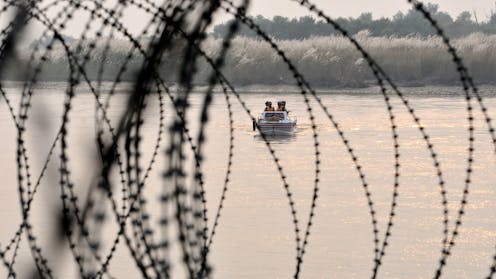
    Indian Border Security Force soldiers patrol near the line of control in Kashmir. Nitin Kanotra/Hindustan Times via Getty Images

    With the future of a crucial water-sharing treaty between India and Pakistan up in the air, one outside party is looking on with keen interest: China.

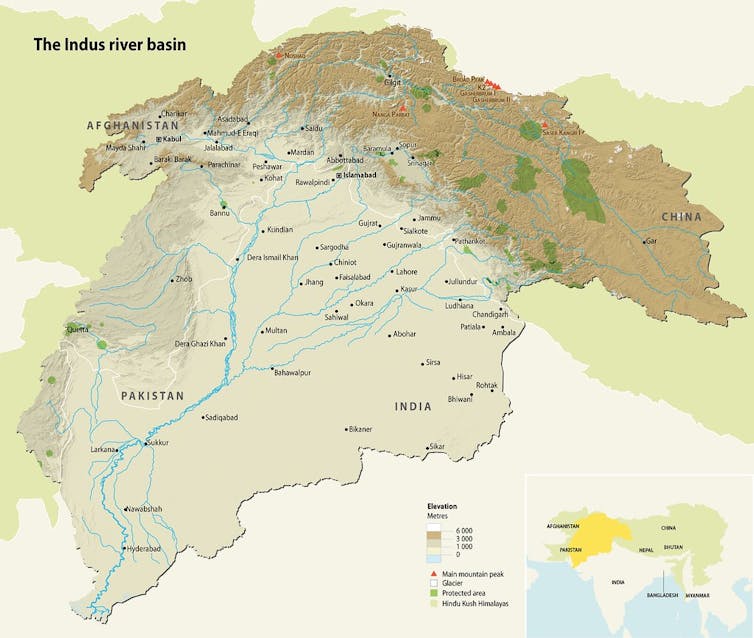
    For 65 years, the Indus Waters Treaty has seen the two South Asian rivals share access and use of the Indus Basin, a vast area covered by the Indus River and its tributaries that also stretches into Afghanistan and China.

    For much of that history, there has been widespread praise for the agreement as a successful demonstration of cooperation between adversarial states over a key shared resource. But experts have noted the treaty has long held the potential for conflict. Drafters failed to factor in the effects of climate change, and the Himalayan glaciers that feed the rivers are now melting at record rates, ultimately putting at risk the long-term sustainability of water supply. Meanwhile, the ongoing conflict over Kashmir, where much of the basin is situated, puts cooperation at risk.

    With treaty on ice, China steps in

    That latest provocation threatening the treaty was a terrorist attack in the Indian union territory of Jammu and Kashmir on April 22, 2025. In response to that attack, which India blamed on Pakistan and precipitated a four-day confrontation, New Delhi temporarily suspended the treaty.

    But even before that attack, India and Pakistan had been locked in negotiation over the future of the treaty – the status of which has been in the hands of international arbitrators since 2016. In the latest development, on June 27, 2025, the Permanent Court of Arbitration issued a supplementary award in favor of Pakistan, arguing that India’s holding of the treaty in abeyance did not affect its jurisdiction over the case. Moreover, the treaty does not allow for either party to unilaterally suspend the treaty, the ruling suggested.

    Amid the wrangling over the treaty’s future, Pakistan has turned to China for diplomatic and strategic support. Such support was evident during the conflict that took place following April’s terrorist attack, during which Pakistan employed Chinese-made fighter jets and other military equipment against its neighbor.

    Meanwhile, in an apparent move to counter India’s suspension of the treaty, China and Pakistan have ramped up construction of a major dam project that would provide water supply and electricity to parts of Pakistan.

    So, why is China getting involved? In part, it reflects the strong relationship between Pakistan and China, developed over six decades.

    But as an expert in hydro politics, I believe Beijing’s involvement raises concerns: China is not a neutral observer in the dispute. Rather, Beijing has long harbored a desire to increase its influence in the region and to counter an India long seen as a rival. Given the at-times fraught relationship between China and India – the two countries went to war in 1962 and continue to engage in sporadic border skirmishes – there are concerns in New Delhi that Beijing may respond by disrupting the flow of rivers in its territory that feed into India.

    In short, any intervention by Beijing over the Indus Waters Treaty risks stirring up regional tensions.

    Wrangling over waters

    The Indus Waters Treaty has already endured three armed conflicts between Pakistan and India, and until recently it served as an exemplar of how to forge a successful bilateral agreement between two rival neighbors.


    Riccardo Pravettoni, CC BY-SA

    Under the initial terms of the treaty, which each country signed in 1960, India was granted control over three eastern rivers the countries share – Ravi, Beas and Satluj – with an average annual flow of 40.4 billion cubic meters. Meanwhile, Pakistan was given access to almost 167.2 billion cubic meters of water from the western rivers – Indus, Jhelum and Chenab.

    In India, the relatively smaller distribution has long been the source of contention, with many believing the treaty’s terms are overly generous to Pakistan. India’s initial demand was for 25% of the Indus waters.

    For Pakistan, the terms of the division of the Indus Waters Treaty are painful because they concretized unresolved land disputes tied to the partition of India in 1947. In particular, the division of the rivers is framed within the broader political context of Kashmir. The three major rivers – Indus, Jhelum and Chenab – flow through Indian-administered Jammu and Kashmir before entering the Pakistan-controlled western part of the Kashmir region.

    But the instability of the Kashmir region – disputes around the Line of Control separating the Indian- and Pakistan-controlled areas are common – underscores Pakistan’s water vulnerability.

    Nearly 65% of Pakistanis live in the Indus Basin region, compared with 14% for India. It is therefore not surprising that Pakistan has warned that any attempt to cut off the water supply, as India has threatened, would be considered an act of war.

    It also helps to explain Pakistan’s desire to develop hydropower on the rivers it controls. One-fifth of Pakistan’s electricity comes from hydropower, and nearly 21 hydroelectric power plants are located in the Indus Basin region.

    Since Pakistan’s economy relies heavily on agriculture and the water needed to maintain agricultural land, the fate of the Indus Waters Treaty is of the utmost importance to Pakistan’s leaders.

    Such conditions have driven Islamabad to be a willing partner with China in a bid to shore up its water supply.

    China provides technical expertise and financial support to Pakistan for numerous hydropower projects in Pakistan, including the Diamer Bhasha Dam and Kohala Hydropower Project. These projects play a significant role in addressing Pakistan’s energy requirements and have been a key aspect of the transboundary water relationship between the two nations.

    Using water as a weapon?

    With it’s rivalry with India and its desire to simultaneously work with Pakistan on numerous issues, China increasingly sees itself as a stakeholder in the Indus Waters Treaty, too. Chinese media narratives have framed India as the aggressor in the dispute, warning of the danger of using “water as a weapon” and noting that the source of the Indus River lies in China’s Western Tibet region.

    Doing so fits Beijing’ s greater strategic presence in South Asian politics. After the terrorist attack, China Foreign Minister Wang Yi reaffirmed China’s support for Pakistan, showcasing the relationship as an “all-weather strategic” partnership and referring to Pakistan as an “ironclad friend.”

    And in response to India’s suspension of the treaty, China announced it was to accelerate work on the significant Mohmand hydropower project on the tributary of the Indus River in Pakistan.

    Two foundation stones are seen either side of a river.
    Construction at the Mohmand Dam.
    Pakistan Water and Power Development Authority

    Chinese investment in Pakistan’s hydropower sector presents substantial opportunities for both countries in regards to energy security and promoting economic growth.

    The Indus cascade project under the China-Pakistan Economic Corridor initiative, for example, promises to provide cumulative hydropower generation capacity of around 22,000 megawatts. Yet the fact that project broke ground in Gilgit-Baltistan, a disputed area in Pakistan-controlled Kashmir, underscores the delicacy of the situation.

    Beijing’s backing of Pakistan is largely motivated by a mix of economic and geopolitical interests, particularly in legitimizing the China-Pakistan Economic Corridor. But it comes at the cost of stirring up regional tensions.

    As such, the alignment of Chinese and Pakistani interests in developing hydro projects can pose a further challenge to the stability of South Asia’s water-sharing agreements, especially in the Indus Basin. Recently, the chief minister of the Indian state of Arunachal Pradesh, which borders China, warned that Beijing’s hydro projects in the Western Tibet region amount to a ticking “water bomb.”

    To diffuse such tensions – and to get the Indus Waters Treaty back on track – it behooves India, China and Pakistan to engage in diplomacy and dialogue. Such engagement is, I believe, essential in addressing the ongoing water-related challenges in South Asia.

    The Conversation

    Pintu Kumar Mahla is affiliated with the Water Resources Research Center, the University of Arizona. He is also a member of the International Association of Water Law (AIDA).

    Pintu Kumar Mahla has not received funding related to this article.

    ref. China’s insertion into India-Pakistan waters dispute adds a further ripple in South Asia – https://theconversation.com/chinas-insertion-into-india-pakistan-waters-dispute-adds-a-further-ripple-in-south-asia-258891

  • Europe is stuck in a bystander role over Iran’s nuclear program after US, Israeli bombs establish facts on the ground

    Source: ForeignAffairs4

    Source: The Conversation – Global Perspectives – By Garret Martin, Hurst Senior Professorial Lecturer, Co-Director Transatlantic Policy Center, American University School of International Service

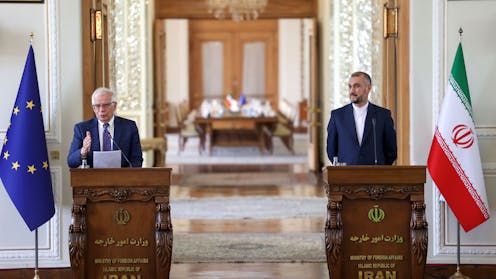
    Iran Foreign Minister Hossein Amirabdollahian, right, attends a news conference with EU foreign affairs representative Josep Borrell in Tehran on June 25, 2022. Atta KenareAFP via Getty Images

    The U.S. bombing of three Iranian nuclear facilities on June 22, 2025, sent shock waves around the world. It marked a dramatic reversal for the Trump administration, which had just initiated negotiations with Tehran over its nuclear program. Dispensing with diplomacy, the U.S. opted for the first time for direct military involvement in the then-ongoing Israeli-Iranian conflict.

    European governments have long pushed for a diplomatic solution to Tehran’s nuclear ambitions. Yet, the reaction in the capitals of Europe to the U.S. bombing of the nuclear facilities was surprisingly subdued.

    European Commission President Ursula von der Leyen noted Israel’s “right to defend itself and protect its people.” German Chancellor Friedrich Merz was equally supportive, arguing that “this is dirty work that Israel is doing for all of us.” And a joint statement by the E3 – France, the U.K. and Germany – tacitly justified the U.S. bombing as necessary to prevent the possibility of Iran developing nuclear weapons.

    Europe’s responses to the Israeli and American strikes were noteworthy because of how little they discussed the legality of the attacks. There was no such hesitation when Russia targeted civilian nuclear energy infrastructure in Ukraine in 2022.

    But the timid reaction also underscored Europe’s bystander role, contrasting with its past approach on that topic. Iran’s nuclear program had been a key focal point of European diplomacy for years. The E3 nations initiated negotiations with Tehran back in 2003. They also helped to facilitate the signing of the 2015 Iran nuclear deal, which also included Russia, the European Union, China, the U.S. and Iran. And the Europeans sought to preserve the agreement, even after the unilateral U.S. withdrawal in 2018 during President Donald Trump’s first term.

    As a scholar of transatlantic relations and security, I believe Europe faces long odds to once again play an impactful role in strengthening the cause of nuclear nonproliferation with Iran. Indeed, contributing to a new nuclear agreement with Iran would require Europe to fix a major rift with Tehran, overcome its internal divisions over the Middle East and manage a Trump administration that seems less intent on being a reliable ally for Europe.

    Growing rift between Iran and Europe

    For European diplomats, the 2015 deal was built on very pragmatic assumptions. It only covered the nuclear dossier, as opposed to including other areas of contention such as human rights or Iran’s ballistic missile program. And it offered a clear bargain: In exchange for greater restrictions on its nuclear program, Iran could expect the lifting of some existing sanctions and a reintegration into the world economy.

    As a result, the U.S. withdrawal from the deal in 2018 posed a fundamental challenge to the status quo. Besides exiting, the Trump White House reimposed heavy secondary sanctions on Iran, which effectively forced foreign companies to choose between investing in the U.S. and Iranian markets. European efforts to mitigate the impact of these U.S. sanctions failed, thus undermining the key benefit of the deal for Iran: helping its battered economy. It also weakened Tehran’s faith in the value of Europe as a partner, as it revealed an inability to carve real independence from the U.S.

    A man with blond hair walks past a group of people in suits.
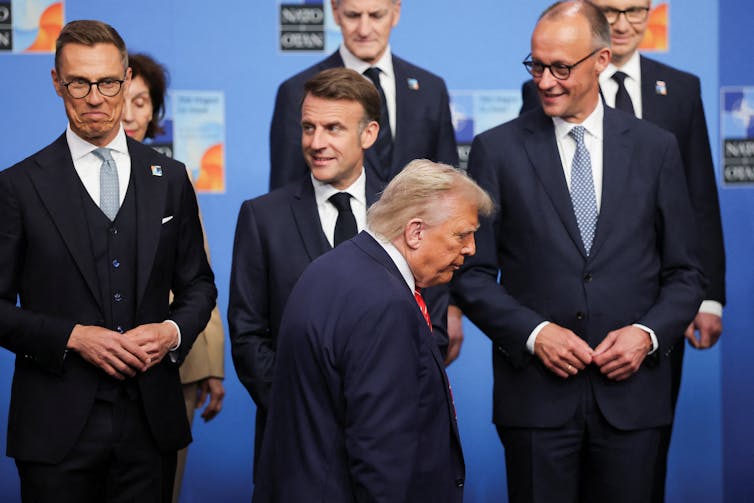
    U.S. President Donald Trump walks past French President Emmanuel Macron, center, and German Chancellor Friedrich Merz, right, in The Hague, Netherlands, on June 25, 2025.
    Christian Hartmann/AFP via Getty Images

    After 2018, relations between Europe and Iran deteriorated significantly. Evidence of Iranian state-sponsored terrorism and Iran-linked plots on European soil hardly helped. Moreover, Europeans strongly objected to Iran supplying Russia with drones in support of Moscow’s invasion of Ukraine – and later on, ballistic missiles as well. On the flip side, Iran deeply objected to European support for Israel’s war in the Gaza Strip in the aftermath of the Oct. 7, 2023, attacks.

    These deep tensions remain a significant impediment to constructive negotiations on the nuclear front. Neither side currently has much to offer to the other, nor can Europe count on any meaningful leverage to influence Iran. And Europe’s wider challenges in its Middle East policy only compound this problem.

    Internal divisions

    In 2015, Europe could present a united front on the Iranian nuclear deal in part because of its limited nature. But with the nonproliferation regime now in tatters amid Trump’s unilateral actions and the spread of war across the region, it is now far harder for European diplomats to put the genie back in the bottle. That is particularly true given the present fissures over increasingly divisive Middle East policy questions and the nature of EU diplomacy.

    Europe remains very concerned about stability in the Middle East, including how conflicts might launch new migratory waves like in 2015-16, when hundreds of thousands of Syrians fled to mainland Europe. The EU also remains very active economically in the region and is the largest funder of the Palestinian Authority. But it has been more of a “payer than player” in the region, struggling to translate economic investment into political influence.

    In part, this follows from the longer-term tendency to rely on U.S. leadership in the region, letting Washington take the lead in trying to solve the Israeli-Palestinian conflict. But it also reflects the deeper divisions between EU member nations.

    With foreign policy decisions requiring unanimity, EU members have often struggled to speak with one voice on the Middle East. Most recently, the debates over whether to suspend the economic association agreement with Israel over its actions in Gaza or whether to recognize a Palestinian state clearly underscored the existing EU internal disagreements.

    Unless Europe can develop a common approach toward the Middle East, it is hard to see it having enough regional influence to matter in future negotiations over Iran’s nuclear program. This, in turn, would also affect how it manages its crucial, but thorny, relations with the U.S.

    Europe in the shadow of Trump

    The EU was particularly proud of the 2015 nuclear deal because it represented a strong symbol of multilateral diplomacy. It brought together great powers in the spirit of bolstering the cause of nuclear nonproliferation.

    Smoke is seen rising from a group of buildings
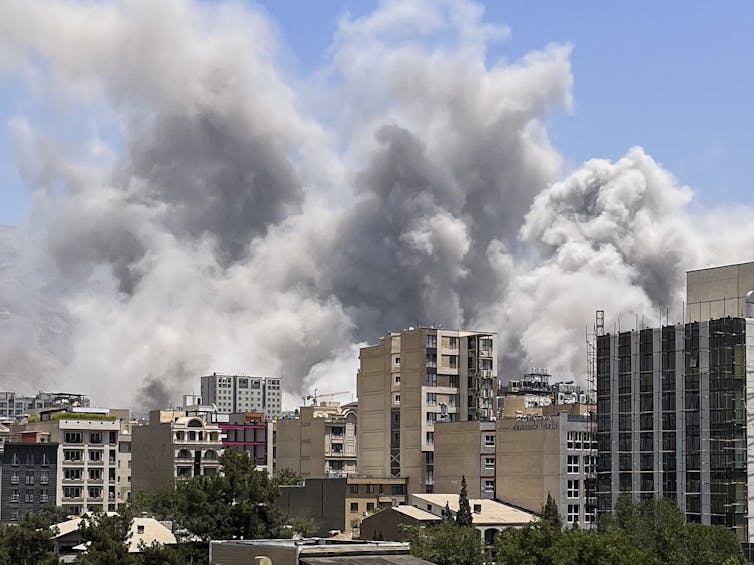
    Smoke rises from a building in Tehran after the Iranian capital was targeted by Israeli airstrikes on June 23, 2025.
    Elyas/Middle East Images/AFP via Getty Images

    Ten years on, the prospects of replicating such international cooperation seem rather remote. Europe’s relations with China and Russia – two key signers of the original nuclear deal – have soured dramatically in recent years. And ties with the United States under Trump have also been particularly challenging.

    Dealing with Washington, in the context of the Iran nuclear program, presents a very sharp dilemma for Europe.

    Trying to carve a distinct path may be appealing, but it lacks credibility at this stage. Recent direct talks with Iranian negotiators produced little, and Europe is not in a position to give Iran guarantees that it would not face new strikes from Israel.

    And pursuing an independent path could easily provoke the ire of Trump, which Europeans are keen to avoid. There has already been a long list of transatlantic disputes, whether over trade, Ukraine or defense spending. European policymakers would be understandably reticent to invest time and resources in any deal that Trump could again scuttle at a moment’s notice.

    Trump, too, is scornful of what European diplomacy could achieve, declaring recently that Iran doesn’t want to talk to Europe. He has instead prioritized bilateral negotiations with Tehran. Alignment with the U.S., therefore, may not translate into any great influence. Trump’s decision to bomb Iran, after all, happened without forewarning for his allies.

    Thus, Europe will continue to pay close attention to Iran’s nuclear program. But, constrained by poor relations with Tehran and its internal divisions on the Middle East, it is unlikely that it will carve out a major role on the nuclear dossier as long as Trump is in office.

    The Conversation

    Garret Martin receives funding from the European Union for the organization, the Transatlantic Policy Center, that he co-directs.

    ref. Europe is stuck in a bystander role over Iran’s nuclear program after US, Israeli bombs establish facts on the ground – https://theconversation.com/europe-is-stuck-in-a-bystander-role-over-irans-nuclear-program-after-us-israeli-bombs-establish-facts-on-the-ground-260740

  • When big sports events expand, like FIFA’s 2026 World Cup matches across North America, their climate footprint expands too

    Source: ForeignAffairs4

    Source: The Conversation – USA (2) – By Brian P. McCullough, Associate Professor of Sport Management, University of Michigan

    Lionel Messi celebrates with fans after Argentina won the FIFA World Cup championship in 2022 in Qatar. Michael Regan-FIFA/FIFA via Getty Images

    When the FIFA World Cup hits North America in June 2026, 48 teams and millions of soccer fans will be traveling to and from venues spread across the United States, Canada and Mexico.

    It’s a dramatic expansion – 16 more teams will be playing than in recent years, with a jump from 64 to 104 matches. The tournament is projected to bring in over US$10 billion in revenue. But the expansion will also mean a lot more travel and other activities that contribute to climate change.

    The environmental impacts of giant sporting events like the World Cup create a complex paradox for an industry grappling with its future in a warming world.

    A sustainability conundrum

    Sports are undeniably experiencing the effects of climate change. Rising global temperatures are putting athletes’ health at risk during summer heat waves and shortening winter sports seasons. Many of the 2026 World Cup venues often see heat waves in June and early July, when the tournament is scheduled.

    There is a divide over how sports should respond.

    Some athletes are speaking out for more sustainable choices and have called on lawmakers to take steps to limit climate-warming emissions. At the same time, the sport industry is growing and facing a constant push to increase revenue. The NCAA is also considering expanding its March Madness basketball tournaments from 68 teams currently to as many as 76.

    A sweating soccer player squirts water from a bottle onto his forehead during a match.
    Park Yong-woo of team Al Ain from Abu Dhabi tries to cool off during a Club World Cup match on June 26, 2025, in Washington, D.C., which was in the midst of a heat wave. Some players have raised concerns about likely high temperatures during the 2026 World Cup, with matches scheduled June 11 to July 19.
    AP Photo/Julia Demaree Nikhinson

    Estimates for the 2026 World Cup show what large tournament expansions can mean for the climate. A report from Scientists for Global Responsibility estimates that the expanded World Cup could generate over 9 million metric tons of carbon dioxide equivalent, nearly double the average of the past four World Cups.

    This massive increase – and the increase that would come if the NCAA basketball tournaments also expand – would primarily be driven by air travel as fans and players fly among event cities that are thousands of miles apart.

    A lot of money is at stake, but so is the climate

    Sports are big business, and adding more matches to events like the World Cup and NCAA tournaments will likely lead to larger media rights contracts and greater gate receipts from more fans attending the events, boosting revenues. These are powerful financial incentives.

    In the NCAA’s case, there is another reason to consider a larger tournament: The House v. NCAA settlement opened the door for college athletic departments to share revenue with athletes, which will significantly increase costs for many college programs. More teams would mean more television revenue and, crucially, more revenue to be distributed to member NCAA institutions and their athletic conferences.

    When climate promises become greenwashing

    The inherent conflict between maximizing profit through growth and minimizing environmental footprint presents a dilemma for sports.

    Several sport organizations have promised to reduce their impact on the climate, including signing up for initiatives like the United Nations Sports for Climate Action Framework.

    However, as sports tournaments and exhibition games expand, it can become increasingly hard for sports organizations to meet their climate commitments. In some cases, groups making sustainability commitments have been accused of greenwashing, suggesting the goals are more about public relations than making genuine, measurable changes.

    For example, FIFA’s early claims that it would hold a “fully carbon-neutral” World Cup in Qatar in 2022 were challenged by a group of European countries that accused soccer’s world governing body of underestimating emissions. The Swiss Fairness Commission, which monitors fairness in advertising, considered the complaints and determined that FIFA’s claims could not be substantiated.

    A young man looks up as he prepares to board a plane on the tarmac in Milan, Italy, for a flight to Rome on Dec. 15, 2024.
    Alessandro Bastoni, of Inter Milan and Italy’s national team, prepares to board a flight from Milan to Rome with his team.
    Mattia Ozbot-Inter/Inter via Getty Images

    Aviation is often the biggest driver of emissions. A study that colleagues and I conducted on the NCAA men’s basketball tournament found about 80% of its emissions were connected to travel. And that was after the NCAA began using the pod system, which is designed to keep teams closer to home for the first and second rounds.

    Finding practical solutions

    Some academics, observing the rising emissions trend, have called for radical solutions like the end of commercialized sports or drastically limiting who can attend sporting events, with a focus on fans from the region.

    These solutions are frankly not practical, in my view, nor do they align with other positive developments. The growing popularity of women’s sports shows the challenge in limiting sports events – more games expands participation but adds to the industry’s overall footprint.

    Further compounding the challenges of reducing environmental impact is the amount of fan travel, which is outside the direct control of the sports organization or event organizers.

    Many fans will follow their teams long distances, especially for mega-events like the World Cup or the NCAA tournament. During the men’s World Cup in Russia in 2018, more than 840,000 fans traveled from other countries. The top countries by number of fans, after Russia, were China, the U.S., Mexico and Argentina.

    There is an argument that distributed sporting events like March Madness or the World Cup can be better in some ways for local environments because they don’t overwhelm a single city. However, merely spreading the impact does not necessarily reduce it, particularly when considering the effects on climate change.

    How fans can cut their environmental footprint

    Sport organizations and event planners can take steps to be more sustainable and also encourage more sustainable choices among fans. Fans can reduce their environmental impact in a variety of ways. For example:

    • Avoid taking airplanes for shorter distances, such as between FIFA venues in Philadelphia, New York and Boston, and carpool or take Amtrak instead. Planes can be more efficient for long distances, but air travel is still a major contributing factor to emissions.

    • While in a host city, use mass transit or rent electric vehicles or bicycles for local travel.

    • Consider sustainable accommodations, such as short-term rentals that might have a smaller environmental footprint than a hotel. Or stay at a certified green hotel that makes an effort to be more efficient in its use of water and energy.

    • Engage in sustainable pregame and postgame activities, such as choosing local, sustainable food options, and minimize waste.

    • You can also pay to offset carbon emissions for attending different sporting events, much like concertgoers do when they attend musical festivals. While critics question offsets’ true environmental benefit, they do represent people’s growing awareness of their environmental footprint.

    Through all these options, it’s clear that sports face a significant challenge in addressing their environmental impacts and encouraging fans to be more sustainable, while simultaneously trying to meet ambitious business and environmental targets.

    In my view, a sustainable path forward will require strategic, yet genuine, commitment by the sports industry and its fans, and a willingness to prioritize long-term planetary health alongside economic gains – balancing the sport and sustainability.

    The Conversation

    Brian P. McCullough does not work for, consult, own shares in or receive funding from any company or organization that would benefit from this article, and has disclosed no relevant affiliations beyond their academic appointment.

    ref. When big sports events expand, like FIFA’s 2026 World Cup matches across North America, their climate footprint expands too – https://theconversation.com/when-big-sports-events-expand-like-fifas-2026-world-cup-matches-across-north-america-their-climate-footprint-expands-too-259437

  • The golden oyster mushroom craze unleashed an invasive species – and a worrying new study shows it’s harming native fungi

    Source: ForeignAffairs4

    Source: The Conversation – USA (2) – By Aishwarya Veerabahu, Ph.D. Candidate in Botany, University of Wisconsin-Madison

    Golden oyster mushrooms can be cultivated, but they can also escape into the wild. DDukang/iStock/Getty Images Plus

    Golden oyster mushrooms, with their sunny yellow caps and nutty flavor, have become wildly popular for being healthy, delicious and easy to grow at home from mushroom kits.

    But this food craze has also unleashed an invasive species into the wild, and new research shows it’s pushing out native fungi.

    In a study we believe is the first of its kind, fellow mycologists and I demonstrate that an invasive fungus can cause environmental harm, just as invasive plants and animals can when they take over ecosystems.

    A woman with a phone camera takes pictures of large clumps of yellow mushrooms growing all over the base of a tree.
    A scientist documents golden oyster mushrooms growing wild in a Wisconsin forest, where these invasive fungi don’t belong. DNA tests showed the species had pushed out other native fungi.
    Aishwarya Veerabahu

    Native mushrooms and other fungi are important for the health of many ecosystems. They break down dead wood and other plant material, helping it decay. They cycle nutrients such as carbon and nitrogen from the dead tissues of plants and animals, turning it into usable forms that enter the soil, atmosphere or their own bodies. Fungi also play a role in managing climate change by sequestering carbon in soil and mediating carbon emissions from soil and wood.

    Their symbiotic relationships with other organisms also help other organisms thrive. Mycorrhizal fungi on roots, for example, help plants absorb water and nutrients. And wood decay fungi help create wooded habitats for birds, mammals and plant seedlings.

    However, we found that invasive golden oyster mushrooms, a wood decay fungus, can threaten forests’ fungal biodiversity and harm the health of ecosystems that are already vulnerable to climate change and habitat destruction.

    The dark side of the mushroom trade

    Golden oyster mushrooms, native to Asia, were brought to North America around the early 2000s. They’re part of an international mushroom culinary craze that has been feeding into one of the world’s leading drivers of biodiversity loss: invasive species.

    As fungi are moved around the world in global trade, either intentionally as products, such as kits people buy for growing mushrooms at home, or unintentionally as microbial stowaways along with soil, plants, timber and even shipping pallets, they can establish themselves in new environments.

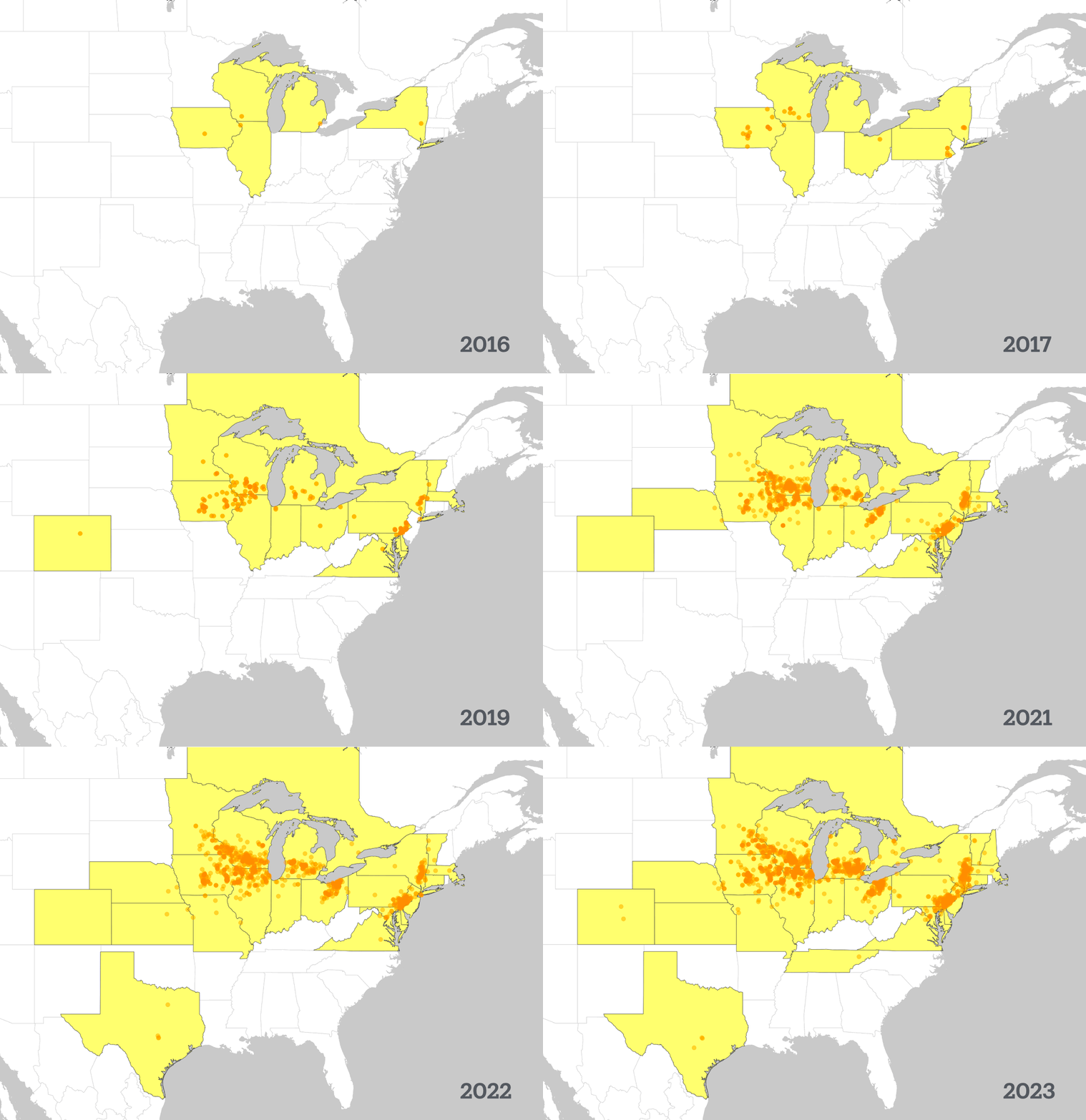
    Where golden oyster mushrooms, an invasive species in North America, have been reported in the wild, including in forests, parks and neighborhoods. Red dots indicate new reports each year. States in yellow have had a report at some point. Aishwarya Veerabahu

    Many mushroom species have been cultivated in North America for decades without becoming invasive species threats. However, golden oyster mushrooms have been different.

    No one knows exactly how golden oyster mushrooms escaped into the wild, whether from a grow kit, a commercial mushroom farm or outdoor logs inoculated with golden oysters – a home-cultivation technique where mushroom mycelium is placed into logs to colonize the wood and produce mushrooms.

    As grow kits increased in popularity, many people began buying golden oyster kits and watching them blossom into beautiful yellow mushrooms in their backyards. Their spores or composted kits could have spread into nearby forests.

    Evidence from a pioneering study by Andrea Reisdorf (née Bruce) suggests golden oyster mushrooms were introduced into the wild in multiple U.S. states around the early 2010s.

    Species the golden oysters pushed out

    In our study, designed by Michelle Jusino and Mark Banik, research scientists with the U.S. Forest Service, our team went into forests around Madison, Wisconsin, and drilled into dead trees to collect wood shavings containing the natural fungal community within each tree. Some of the trees had golden oyster mushrooms on them, and some did not.

    We then extracted DNA to identify and compare which fungi, and how many fungi, were in trees that had been invaded by golden oyster mushrooms compared with those that had not been.

    We were startled to find that trees with golden oyster mushrooms housed only half as many fungal species as trees without golden oyster mushrooms, sometimes even less. We also found that the composition of fungi in trees with golden oyster mushrooms was different from trees without golden oyster mushrooms.

    For example, the gentle green “mossy maze polypore” and the “elm oyster” mushroom were pushed out of trees invaded by golden oyster mushrooms.

    Mossy green mushrooms grow like shelfs on the side of a tree trunk.
    Mossy maze polypore growing on a stump. This is one of the native species that disappeared from trees when the golden oyster mushroom moved in.
    mauriziobiso/iStock/Getty Images Plus

    Another ousted fungus, Nemania serpens, is known for producing diverse arrays of chemicals that differ even between individuals of the same species. Fungi are sources of revolutionary medicines, including antibiotics like penicillin, cholesterol medication and organ transplant stabilizers. The value of undiscovered, potentially useful chemicals can be lost when invasive species push others out.

    The invasive species problem includes fungi

    Given what my colleagues and I discovered, we believe it is time to include invasive fungi in the global conversation about invasive species and examine their role as a cause of biodiversity loss.

    That conversation includes the idea of fungal “endemism” – that each place has a native fungal community that can be thrown out of balance. Native fungal communities tend to be diverse, having evolved together over thousands of years to coexist. Our research shows how invasive species can change the makeup of fungal communities by outcompeting native species, thus changing the fungal processes that have shaped native ecosystems.

    There are many other invasive fungi. For example, the deadly poisonous “death cap” Amanita phalloides and the “orange ping-pong bat” Favolaschia calocera are invasive in North America. The classic red and white “fly agaric” Amanita muscaria is native to North America but invasive elsewhere.

    Bright orange mushrooms the texture of ping-pong paddles.
    The orange ping-pong bat mushroom is invasive in North America. These were photographed in New Zealand.
    Bernard Spragg. NZ/Flickr Creative Commons

    The golden oyster mushrooms’ invasion of North America should serve as a bright yellow warning that nonnative fungi are capable of rapid invasion and should be cultivated with caution, if at all.

    Golden oyster mushrooms are now recognized as invasive in Switzerland and can be found in forests in Italy, Hungary, Serbia and Germany. I have been hearing about people attempting to cultivate them around the world, including in Turkey, India, Ecuador, Kenya, Italy and Portugal. It’s possible that golden oyster mushrooms may not be able to establish invasive populations in some regions. Continued research will help us understand the full scope of impacts invasive fungi can have.

    What you can do to help

    Mushroom growers, businesses and foragers around the world may be asking themselves, “What can we do about it?”

    For the time being, I recommend that people consider refraining from using golden oyster mushroom grow kits to prevent any new introductions. For people who make a living selling these mushrooms, consider adding a note that this species is invasive and should be cultivated indoors and not composted.

    If you enjoy growing mushrooms at home, try cultivating safe, native species that you have collected in your region.

    Most mushrooms you see in the grocery store are grown indoors.

    There is no single right answer. In some places, golden oyster mushrooms are being cultivated as a food source for impoverished communities, for income, or to process agricultural waste and produce food at the same time. Positives like these will have to be considered alongside the mushrooms’ negative impacts when developing management plans or legislation.

    In the future, some ideas for solutions could involve sporeless strains of golden oysters for home kits that can’t spread, or a targeted mycovirus that could control the population. Increased awareness about responsible cultivation practices is important, because when invasive species move in and disrupt the native biodiversity, we all stand to lose the beautiful, colorful, weird fungi we see on walks in the forest.

    The Conversation

    Aishwarya Veerabahu receives funding from UW-Madison Dept. of Botany, the UW Arboretum, the Society of Ecological Restoration, and the Garden Club of America. Aishwarya Veerabahu was an employee of the USDA Forest Service.

    ref. The golden oyster mushroom craze unleashed an invasive species – and a worrying new study shows it’s harming native fungi – https://theconversation.com/the-golden-oyster-mushroom-craze-unleashed-an-invasive-species-and-a-worrying-new-study-shows-its-harming-native-fungi-259006

  • MIL-OSI Submissions: Muhammadu Buhari: Nigeria’s military leader turned democratic president leaves a mixed legacy

    Source: The Conversation – Global Perspectives – By Kester Onor, Senior Research Fellow, Nigerian Institute of International Affairs

    Nigeria’s former president, Muhammadu Buhari, who died in London on 13 July aged 82, was one of two former military heads of state who were later elected as civilian presidents. Buhari was the military head of state of Nigeria from 31 December 1983 to 27 August 1985 and president from 2015 to 2023.

    The other Nigerian politician to have been in both roles is former president Olusegun Obasanjo . He was a military ruler between 1976 and 1979 and elected president between 1999 and 2007.

    Buhari led Nigeria cumulatively for nearly a decade. His time as military head of state was marked with a war against corruption but he couldn’t do as much during his time as president under democratic rule.

    As a political scientist who once served in the Nigerian Army, I believe that former president Buhari’s government’s war on terrorism was largely underwhelming, despite promises and early gains.

    In his elected role, Buhari maintained a modest personal lifestyle and upheld electoral transitions. Nevertheless his presidency was marred by economic mismanagement, a failure to implement bold structural reforms, ethnic favouritism, and an unfulfilled promise of change.

    He did leave tangible infrastructural footprints, a focus on agriculture, and foundational efforts in transparency and anti-corruption.

    So his mark on Nigeria’s development trajectory was mixed.

    Early years

    Buhari was born on 17 December 1942, to Adamu and Zulaiha Buhari in Daura, Katsina State, north-west Nigeria. He was four years old when his father died. He attended Quranic school in Katsina. He was a Fulani, one of the major ethnic nationalities in Nigeria.

    After completing his schooling, Buhari joined the army in 1961. He had military training in the UK, India and the United States as well as Nigeria.

    In 1975 he was appointed military governor of North Eastern State (now Borno State), after being involved in ousting Yakubu Gowon in a coup that same year. He served as governor for a year.

    Buhari later became federal commissioner for petroleum resources, overseeing Nigeria’s petroleum industry under Obasanjo. Obasanjo had become head of state in 1976 when Gowon’s successor, Murtala Muhammed, was assassinated in a failed coup that year.

    In September 1979, he returned to regular army duties and commanded the 3rd Armoured division based in Jos, Plateau State, north central. Nigeria’s Second Republic commenced that year after the election of Shehu Shagari as president.

    The coup that truncated the Shagari government on 31 December 1983 saw the emergence of Buhari as Nigeria’s head of state.

    Buhari’s junta years

    Buhari headed the military government for just under two years. He was ousted in another coup on 27 August 1985.

    While at the helm he vowed that the government would not tolerate kick-backs, inflation of contracts and over-invoicing of imports. Nor would it condone forgery, fraud, embezzlement, misuse and abuse of office and illegal dealings in foreign exchange and smuggling.

    Eighteen state governors were tried by military tribunals. Some of the accused received lengthy prison sentences, while others were acquitted or had their sentences commuted.

    His government also enacted the notorious Decree 4 under which two journalists, Nduka Irabor and Dele Thompson, were jailed. The charges stemmed from three articles published on the reorganisation of Nigeria’s diplomatic service.

    Buhari also instituted austerity measures and started a “War Against Indiscipline” which sought to promote positive values in the country. Authoritarian methods were sometimes used in its implementation. Soldiers forced Nigerians to queue, to be punctual and to obey traffic laws.

    He also instituted restrictions on press and political freedoms. Labour unions were not spared either. Mass retrenchment of Nigerians in the public service was carried out with impunity.

    While citizens initially welcomed some of these measures, growing discontent on the economic front made things tougher for the regime.


    Read more:
    Why Buhari won even though he had little to show for first term


    Buhari, the democrat

    Buhari’s dream to lead Nigeria again through the ballot box failed in 2003, 2007 and 2011. To his credit, he didn’t give up. An alliance of opposition parties succeeded in getting him elected in 2015.

    The legacy he left is mixed.

    Buhari’s government deepened national disunity.

    His appointments, often skewed in favour of the northern region and his Fulani kinsmen, fuelled accusations of tribalism and marginalisation. His perceived affinity with Fulani herdsmen, despite widespread violence linked to some of them, further eroded public trust in his leadership.

    His anti-corruption mantra largely did not succeed. While some high-profile recoveries were made, critics argue that his anti-corruption war was selective and heavily politicised.

    Currently, his Central Bank governor is on trial for corruption charges.

    The performance of the economy was also dismal under his tenure. Not all these problems could be laid at his feet. Nevertheless his inability to tackle the country’s underlying problems, such as insecurity, inflation and rising unemployment, all contributed. He presided over two recessions, rising unemployment, inflation, and a weakened naira.

    He did, however, succeed on some fronts.

    He tried with infrastructure. The Lagos-Ibadan expressway, a major road, was almost completed and he got the railways working again, completing the Abuja-Kaduna and Lagos-Ibadan lines. He also completed the Second Niger Bridge.

    There was an airport revitalisation programme which led to improvements in Lagos, Abuja and Port Harcourt airports.

    Buhari signed the Petroleum Industry Act after nearly 20 years’ delay. This is now attracting more investments into the oil industry.

    He also initiated some social investment schemes like N-Power, N-Teach and a school feeding programme. They provided temporary jobs for some and gave some poor people more money in their pockets. N-Power is a youth empowerment programme designed to combat unemployment, improve social development and provide people with relevant skills.

    These programmes later became mired in corruption which only became known after he left office.

    There was also an Anchor Borrowers Scheme to make the country more sufficient in rice production. Again, it got enmeshed in corruption and some of its officials are currently standing trial.

    In the fight against corruption, the Buhari administration made some progress through the Treasury Single Account, which improved financial transparency in public institutions. The Whistle Blower Policy also led to the recovery of looted funds.


    Read more:
    Why Buhari’s government is losing the anti-corruption war


    Security failures

    Buhari oversaw a deterioration of Nigeria’s security landscape. Banditry, farmer-herder clashes, kidnapping and separatist agitations escalated.

    In 2015 Buhari campaigned on a promise to defeat Boko Haram and restore territorial integrity in the north-east. Initially, his administration made some progress. Boko Haram was driven out of several local government areas it once controlled, and major military operations such as Operation Lafiya Dole were launched to reclaim territory.

    However, these initial successes were not sustained. Boko Haram splintered, giving rise to more brutal factions like the Islamic State West Africa Province. This group continued to launch deadly attacks.

    Buhari’s counter-terrorism strategy was often reactive, lacking a clear long-term doctrine. The military was overstretched and under-equipped. Morale issues and allegations of corruption in the defence sector undermined operations.

    Intelligence coordination remained poor, while civil-military relations suffered due to frequent human rights abuses by security forces. Community trust in the government’s ability to provide security dwindled.

    Buhari’s second coming as Nigeria’s leader carried high expectations, but he under-delivered.

    Kester Onor does not work for, consult, own shares in or receive funding from any company or organisation that would benefit from this article, and has disclosed no relevant affiliations beyond their academic appointment.

    ref. Muhammadu Buhari: Nigeria’s military leader turned democratic president leaves a mixed legacy – https://theconversation.com/muhammadu-buhari-nigerias-military-leader-turned-democratic-president-leaves-a-mixed-legacy-261079

    MIL OSI

  • MIL-OSI Submissions: What makes ‘great powers’ great? And how will they adapt to a multipolar world?

    Source: The Conversation – Global Perspectives – By Andrew Latham, Professor of Political Science, Macalester College

    When greats clash! In this case, in the 1974 film ‘Godzilla vs. Mechagodzilla.’ FilmPublicityArchive/United Archives via Getty Images

    Many column inches have been dedicated to dissecting the “great power rivalry” currently playing out between China and the U.S.

    But what makes a power “great” in the realm of international relations?

    Unlike other states, great powers possess a capacity to shape not only their immediate surroundings but the global order itself – defining the rules, norms and structures that govern international politics. Historically, they have been seen as the architects of world systems, exercising influence far beyond their neighborhoods.

    The notion of great powers came about to distinguish between the most and least powerful states. The concept gained currency after the 1648 Peace of Westphalia and the Congress of Vienna in 1815 – events in Europe that helped establish the notion of sovereign states and the international laws governing them.

    Whereas the great powers of the previous eras – for example, the Roman Empire – sought to expand their territory at almost every turn and relied on military power to do so, the modern great power utilizes a complex tapestry of diplomatic pressure, economic leverage and the assertions of international law. The order emerging out of Westphalia enshrined the principles of national sovereignty and territorial integrity, which allowed these powers to pursue a balance of power as codified by the Congress of Vienna based on negotiation as opposed to domination.

    This transformation represented a momentous development in world politics: At least some portion of the legitimacy of a state’s control was now realized through its relationships and capacity to keep the peace, rather than resting solely on its ability to use force.

    From great to ‘super’

    Using their material capabilities – economic strength, military might and political influence – great powers have been able to project power across multiple regions and dictate the terms of international order.

    In the 19th-century Concert of Europe, the great powers – Britain, France, Austria, Prussia and Russia – collectively managed European politics, balancing power to maintain stability. Their influence extended globally through imperial expansion, trade and the establishment of norms that reflected their priorities.

    During the 20th century, the Cold War brought a stark distinction between great powers and other states. The U.S. and the Soviet Union, as the era’s two “superpowers,” dominated the international system, shaping it through a rivalry that encompassed military alliances, ideological competition and economic systems. Great powers in this context were not merely powerful states but the central actors defining the structure of global politics.

    Toward a multipolar world

    The post-Cold War period briefly ushered in a unipolar moment, with the U.S. as the sole great power capable of shaping the international system on a global scale.

    This era was marked by the expansion of liberal internationalism, economic globalization and U.S.-led-and-constructed multilateralism.

    However, the emergence of new centers of power, particularly China and to a lesser extent Russia, has brought the unipolar era to a close, ushering in a multipolar world where the distinctive nature of great powers is once again reshaped.

    In this system, great powers are states with the material capabilities and strategic ambition to influence the global order as a whole.

    And here they differ from regional powers, whose influence is largely confined to specific areas. Nations such as Turkey, India, Australia, Brazil and Japan are influential within their neighborhoods. But they lack the global reach of the U.S. or China to fundamentally alter the international system.

    Instead, the roles of these regional powers is often defined by stabilizing their regions, addressing local challenges or acting as intermediaries in great power competition.

    Challenging greatness

    Yet the multipolar world presents unique challenges for today’s great powers. The diffusion of power means that no single great power can dominate the system as the U.S. did in the post-Cold War unipolar era.

    Instead, today’s great powers must navigate complex dynamics, balancing competition with cooperation. For instance, the rivalry between Washington and Beijing is now a defining feature of global politics, spanning trade, technology, military strategy and ideological influence. Meanwhile, Russia’s efforts to maintain its great power status have resulted in more assertive, though regionally focused, actions that nonetheless have global implications.

    Great powers must also contend with the constraints of interdependence. The interconnected nature of the global economy, the proliferation of advanced technologies and the rise of transnational challenges such as climate change and pandemics limit the ability of any one great power to unilaterally dictate outcomes. This reality forces great powers to prioritize their core interests while finding ways to manage global issues through cooperation, even amid intense competition.

    As the world continues to adjust to multiple centers of power, the defining feature of great powers remains an unmatched capacity to project influence globally and define the parameters of the international order.

    Whether through competition, cooperation or conflict, the actions of great powers will, I believe, continue to shape the trajectory of the global system, making their distinctiveness as central players in international relations more relevant than ever.

    This article is part of a series explaining foreign policy terms commonly used but rarely explained.

    Andrew Latham does not work for, consult, own shares in or receive funding from any company or organization that would benefit from this article, and has disclosed no relevant affiliations beyond their academic appointment.

    ref. What makes ‘great powers’ great? And how will they adapt to a multipolar world? – https://theconversation.com/what-makes-great-powers-great-and-how-will-they-adapt-to-a-multipolar-world-260969

    MIL OSI

  • MIL-OSI Submissions: Why is Israel bombing Syria?

    Source: The Conversation – Global Perspectives – By Ali Mamouri, Research Fellow, Middle East Studies, Deakin University

    Conflict in Syria has escalated with Israel launching bombing raids against its northern neighbour.

    It follows months of fluctuating tensions in southern Syria between the Druze minority and forces aligned with the new government in Damascus. Clashes erupted in the last few days, prompting Israeli airstrikes in defence of the Druze by targeting government bases, tanks, and heavy weaponry.

    Israel Minister Amichai Chikli has called the Syrian president Ahmed al-Sharaa

    a terrorist, a barbaric murderer who should be eliminated without delay.

    Despite the incendiary language, a ceasefire has been reached, halting the fighting – for now.

    Syrian forces have begun withdrawing heavy military equipment from the region, while Druze fighters have agreed to suspend armed resistance, allowing government troops to regain control of the main Druze city of Suwayda.

    What do the Druze want?

    The Druze are a small religious minority estimated at over one million people, primarily concentrated in the mountainous regions of Lebanon, Syria, Israel, and Jordan.

    In Syria, their population is estimated at around 700,000 (of around 23 million total Syrian population), with the majority residing in the southern As-Suwayda Governorate – or province – which serves as their traditional stronghold.

    Since the 2011 uprising against the Assad regime, the Druze have maintained a degree of autonomy, successfully defending their territory from various threats, including ISIS and other jihadist groups.

    Following Assad’s fall late last year, the Druze — along with other minority groups such as the Kurds in the east and Alawites in the west — have called for the country to be federalized.

    They advocate for a decentralised model that would grant greater autonomy to regional communities.

    However, the transitional government in Damascus is pushing for a centralised state and seeking to reassert full control over the entire Syrian territory. This fundamental disagreement has led to periodic clashes between Druze forces and government-aligned troops.

    Despite the temporary ceasefire, tensions remain high. Given the core political dispute remains unresolved, many expect renewed conflict to erupt in the near future.

    Why is Israel involved?

    The ousting of the Assad regime created a strategic opening for Israel to expand its influence in southern Syria. Israel’s involvement is driven by two primary concerns:

    1. Securing its northern border

    Israel views the power vacuum in Syria’s south as a potential threat, particularly the risk of anti-Israeli militias establishing a foothold near its northern border.

    During the recent clashes, the Israeli military declared

    The Israeli Defence Forces will not allow a military threat to exist in southern Syria and will act against it.

    Likewise, Prime Minister Benjamin Netanyahu, who has stated he will not allow Syrian forces south of Damascus:

    We are acting to prevent the Syrian regime from harming them [the Druze] and to ensure the demilitarisation of the area adjacent to our border with Syria.

    In line with these warnings, the Israeli Air Force has conducted extensive strikes against Syrian military infrastructure, targeting bases, aircraft, tanks, and heavy weaponry.

    These operations are intended to prevent any future buildup of military capacity that could be used against Israel from the Syrian side of the border.

    2. Supporting a federated Syria

    Israel is backing the two prominent allied minorities in Syria — the Kurds in the northeast and the Druze in the south — in their push for a federal governance model.

    A fragmented Syria, divided along ethnic and religious lines, is seen by some Israeli policymakers as a way to maintain Israeli domination in the region.

    This vision is part of what some Israeli officials have referred to as a “New Middle East” — one where regional stability and normalisation emerge through reshaped borders and alliances.

    Israeli Foreign Minister Gideon Sa’ar recently echoed this strategy, stating:

    A single Syrian state with effective control and sovereignty over all its territory is unrealistic.

    For Israel, the logical path forward is autonomy for the various minorities in Syria within a federal structure.

    The United States’ role?

    According to unconfirmed reports, Washington has privately urged Israel to scale back its military strikes on Syria in order to prevent further escalation and preserve regional stability.

    The US is promoting increased support for Syria’s new regime in an effort to help it reassert control and stabilise the country.

    There are also indications the US and its allies are encouraging the Syrian government to move toward normalisation with Israel. Reports suggest Tel Aviv has held talks with the new Sharaa-led regime about the possibility of Syria joining the Abraham Accords (diplomatic agreements between Israel and several Arab states), which the regime in Damascus appears open to.

    US Special Envoy Tom Barrack has described the recent clashes as “worrisome”, calling for de-escalation and emphasising the need for

    a peaceful, inclusive outcome for all stakeholders – including the Druze, Bedouin tribes, the Syrian government, and Israeli forces.

    Given the deep-rooted political divisions, competing regional agendas, and unresolved demands from minority groups, the unrest in southern Syria is unlikely to end soon.

    Despite another temporary ceasefire, underlying tensions remain. Further clashes are not only possible but highly probable.

    Ali Mamouri does not work for, consult, own shares in or receive funding from any company or organisation that would benefit from this article, and has disclosed no relevant affiliations beyond their academic appointment.

    ref. Why is Israel bombing Syria? – https://theconversation.com/why-is-israel-bombing-syria-261259

    MIL OSI

  • MIL-OSI Submissions: China’s insertion into India-Pakistan waters dispute adds a further ripple in South Asia

    Source: The Conversation – Global Perspectives – By Pintu Kumar Mahla, Research Associate at the Water Resources Research Institute, University of Arizona

    Indian Border Security Force soldiers patrol near the line of control in Kashmir. Nitin Kanotra/Hindustan Times via Getty Images

    With the future of a crucial water-sharing treaty between India and Pakistan up in the air, one outside party is looking on with keen interest: China.

    For 65 years, the Indus Waters Treaty has seen the two South Asian rivals share access and use of the Indus Basin, a vast area covered by the Indus River and its tributaries that also stretches into Afghanistan and China.

    For much of that history, there has been widespread praise for the agreement as a successful demonstration of cooperation between adversarial states over a key shared resource. But experts have noted the treaty has long held the potential for conflict. Drafters failed to factor in the effects of climate change, and the Himalayan glaciers that feed the rivers are now melting at record rates, ultimately putting at risk the long-term sustainability of water supply. Meanwhile, the ongoing conflict over Kashmir, where much of the basin is situated, puts cooperation at risk.

    With treaty on ice, China steps in

    That latest provocation threatening the treaty was a terrorist attack in the Indian union territory of Jammu and Kashmir on April 22, 2025. In response to that attack, which India blamed on Pakistan and precipitated a four-day confrontation, New Delhi temporarily suspended the treaty.

    But even before that attack, India and Pakistan had been locked in negotiation over the future of the treaty – the status of which has been in the hands of international arbitrators since 2016. In the latest development, on June 27, 2025, the Permanent Court of Arbitration issued a supplementary award in favor of Pakistan, arguing that India’s holding of the treaty in abeyance did not affect its jurisdiction over the case. Moreover, the treaty does not allow for either party to unilaterally suspend the treaty, the ruling suggested.

    Amid the wrangling over the treaty’s future, Pakistan has turned to China for diplomatic and strategic support. Such support was evident during the conflict that took place following April’s terrorist attack, during which Pakistan employed Chinese-made fighter jets and other military equipment against its neighbor.

    Meanwhile, in an apparent move to counter India’s suspension of the treaty, China and Pakistan have ramped up construction of a major dam project that would provide water supply and electricity to parts of Pakistan.

    So, why is China getting involved? In part, it reflects the strong relationship between Pakistan and China, developed over six decades.

    But as an expert in hydro politics, I believe Beijing’s involvement raises concerns: China is not a neutral observer in the dispute. Rather, Beijing has long harbored a desire to increase its influence in the region and to counter an India long seen as a rival. Given the at-times fraught relationship between China and India – the two countries went to war in 1962 and continue to engage in sporadic border skirmishes – there are concerns in New Delhi that Beijing may respond by disrupting the flow of rivers in its territory that feed into India.

    In short, any intervention by Beijing over the Indus Waters Treaty risks stirring up regional tensions.

    Wrangling over waters

    The Indus Waters Treaty has already endured three armed conflicts between Pakistan and India, and until recently it served as an exemplar of how to forge a successful bilateral agreement between two rival neighbors.


    Riccardo Pravettoni, CC BY-SA

    Under the initial terms of the treaty, which each country signed in 1960, India was granted control over three eastern rivers the countries share – Ravi, Beas and Satluj – with an average annual flow of 40.4 billion cubic meters. Meanwhile, Pakistan was given access to almost 167.2 billion cubic meters of water from the western rivers – Indus, Jhelum and Chenab.

    In India, the relatively smaller distribution has long been the source of contention, with many believing the treaty’s terms are overly generous to Pakistan. India’s initial demand was for 25% of the Indus waters.

    For Pakistan, the terms of the division of the Indus Waters Treaty are painful because they concretized unresolved land disputes tied to the partition of India in 1947. In particular, the division of the rivers is framed within the broader political context of Kashmir. The three major rivers – Indus, Jhelum and Chenab – flow through Indian-administered Jammu and Kashmir before entering the Pakistan-controlled western part of the Kashmir region.

    But the instability of the Kashmir region – disputes around the Line of Control separating the Indian- and Pakistan-controlled areas are common – underscores Pakistan’s water vulnerability.

    Nearly 65% of Pakistanis live in the Indus Basin region, compared with 14% for India. It is therefore not surprising that Pakistan has warned that any attempt to cut off the water supply, as India has threatened, would be considered an act of war.

    It also helps to explain Pakistan’s desire to develop hydropower on the rivers it controls. One-fifth of Pakistan’s electricity comes from hydropower, and nearly 21 hydroelectric power plants are located in the Indus Basin region.

    Since Pakistan’s economy relies heavily on agriculture and the water needed to maintain agricultural land, the fate of the Indus Waters Treaty is of the utmost importance to Pakistan’s leaders.

    Such conditions have driven Islamabad to be a willing partner with China in a bid to shore up its water supply.

    China provides technical expertise and financial support to Pakistan for numerous hydropower projects in Pakistan, including the Diamer Bhasha Dam and Kohala Hydropower Project. These projects play a significant role in addressing Pakistan’s energy requirements and have been a key aspect of the transboundary water relationship between the two nations.

    Using water as a weapon?

    With it’s rivalry with India and its desire to simultaneously work with Pakistan on numerous issues, China increasingly sees itself as a stakeholder in the Indus Waters Treaty, too. Chinese media narratives have framed India as the aggressor in the dispute, warning of the danger of using “water as a weapon” and noting that the source of the Indus River lies in China’s Western Tibet region.

    Doing so fits Beijing’ s greater strategic presence in South Asian politics. After the terrorist attack, China Foreign Minister Wang Yi reaffirmed China’s support for Pakistan, showcasing the relationship as an “all-weather strategic” partnership and referring to Pakistan as an “ironclad friend.”

    And in response to India’s suspension of the treaty, China announced it was to accelerate work on the significant Mohmand hydropower project on the tributary of the Indus River in Pakistan.

    Construction at the Mohmand Dam.
    Pakistan Water and Power Development Authority

    Chinese investment in Pakistan’s hydropower sector presents substantial opportunities for both countries in regards to energy security and promoting economic growth.

    The Indus cascade project under the China-Pakistan Economic Corridor initiative, for example, promises to provide cumulative hydropower generation capacity of around 22,000 megawatts. Yet the fact that project broke ground in Gilgit-Baltistan, a disputed area in Pakistan-controlled Kashmir, underscores the delicacy of the situation.

    Beijing’s backing of Pakistan is largely motivated by a mix of economic and geopolitical interests, particularly in legitimizing the China-Pakistan Economic Corridor. But it comes at the cost of stirring up regional tensions.

    As such, the alignment of Chinese and Pakistani interests in developing hydro projects can pose a further challenge to the stability of South Asia’s water-sharing agreements, especially in the Indus Basin. Recently, the chief minister of the Indian state of Arunachal Pradesh, which borders China, warned that Beijing’s hydro projects in the Western Tibet region amount to a ticking “water bomb.”

    To diffuse such tensions – and to get the Indus Waters Treaty back on track – it behooves India, China and Pakistan to engage in diplomacy and dialogue. Such engagement is, I believe, essential in addressing the ongoing water-related challenges in South Asia.

    Pintu Kumar Mahla is affiliated with the Water Resources Research Center, the University of Arizona. He is also a member of the International Association of Water Law (AIDA).

    Pintu Kumar Mahla has not received funding related to this article.

    ref. China’s insertion into India-Pakistan waters dispute adds a further ripple in South Asia – https://theconversation.com/chinas-insertion-into-india-pakistan-waters-dispute-adds-a-further-ripple-in-south-asia-258891

    MIL OSI

  • MIL-OSI Submissions: Europe is stuck in a bystander role over Iran’s nuclear program after US, Israeli bombs establish facts on the ground

    Source: The Conversation – Global Perspectives – By Garret Martin, Hurst Senior Professorial Lecturer, Co-Director Transatlantic Policy Center, American University School of International Service

    Iran Foreign Minister Hossein Amirabdollahian, right, attends a news conference with EU foreign affairs representative Josep Borrell in Tehran on June 25, 2022. Atta KenareAFP via Getty Images

    The U.S. bombing of three Iranian nuclear facilities on June 22, 2025, sent shock waves around the world. It marked a dramatic reversal for the Trump administration, which had just initiated negotiations with Tehran over its nuclear program. Dispensing with diplomacy, the U.S. opted for the first time for direct military involvement in the then-ongoing Israeli-Iranian conflict.

    European governments have long pushed for a diplomatic solution to Tehran’s nuclear ambitions. Yet, the reaction in the capitals of Europe to the U.S. bombing of the nuclear facilities was surprisingly subdued.

    European Commission President Ursula von der Leyen noted Israel’s “right to defend itself and protect its people.” German Chancellor Friedrich Merz was equally supportive, arguing that “this is dirty work that Israel is doing for all of us.” And a joint statement by the E3 – France, the U.K. and Germany – tacitly justified the U.S. bombing as necessary to prevent the possibility of Iran developing nuclear weapons.

    Europe’s responses to the Israeli and American strikes were noteworthy because of how little they discussed the legality of the attacks. There was no such hesitation when Russia targeted civilian nuclear energy infrastructure in Ukraine in 2022.

    But the timid reaction also underscored Europe’s bystander role, contrasting with its past approach on that topic. Iran’s nuclear program had been a key focal point of European diplomacy for years. The E3 nations initiated negotiations with Tehran back in 2003. They also helped to facilitate the signing of the 2015 Iran nuclear deal, which also included Russia, the European Union, China, the U.S. and Iran. And the Europeans sought to preserve the agreement, even after the unilateral U.S. withdrawal in 2018 during President Donald Trump’s first term.

    As a scholar of transatlantic relations and security, I believe Europe faces long odds to once again play an impactful role in strengthening the cause of nuclear nonproliferation with Iran. Indeed, contributing to a new nuclear agreement with Iran would require Europe to fix a major rift with Tehran, overcome its internal divisions over the Middle East and manage a Trump administration that seems less intent on being a reliable ally for Europe.

    Growing rift between Iran and Europe

    For European diplomats, the 2015 deal was built on very pragmatic assumptions. It only covered the nuclear dossier, as opposed to including other areas of contention such as human rights or Iran’s ballistic missile program. And it offered a clear bargain: In exchange for greater restrictions on its nuclear program, Iran could expect the lifting of some existing sanctions and a reintegration into the world economy.

    As a result, the U.S. withdrawal from the deal in 2018 posed a fundamental challenge to the status quo. Besides exiting, the Trump White House reimposed heavy secondary sanctions on Iran, which effectively forced foreign companies to choose between investing in the U.S. and Iranian markets. European efforts to mitigate the impact of these U.S. sanctions failed, thus undermining the key benefit of the deal for Iran: helping its battered economy. It also weakened Tehran’s faith in the value of Europe as a partner, as it revealed an inability to carve real independence from the U.S.

    U.S. President Donald Trump walks past French President Emmanuel Macron, center, and German Chancellor Friedrich Merz, right, in The Hague, Netherlands, on June 25, 2025.
    Christian Hartmann/AFP via Getty Images

    After 2018, relations between Europe and Iran deteriorated significantly. Evidence of Iranian state-sponsored terrorism and Iran-linked plots on European soil hardly helped. Moreover, Europeans strongly objected to Iran supplying Russia with drones in support of Moscow’s invasion of Ukraine – and later on, ballistic missiles as well. On the flip side, Iran deeply objected to European support for Israel’s war in the Gaza Strip in the aftermath of the Oct. 7, 2023, attacks.

    These deep tensions remain a significant impediment to constructive negotiations on the nuclear front. Neither side currently has much to offer to the other, nor can Europe count on any meaningful leverage to influence Iran. And Europe’s wider challenges in its Middle East policy only compound this problem.

    Internal divisions

    In 2015, Europe could present a united front on the Iranian nuclear deal in part because of its limited nature. But with the nonproliferation regime now in tatters amid Trump’s unilateral actions and the spread of war across the region, it is now far harder for European diplomats to put the genie back in the bottle. That is particularly true given the present fissures over increasingly divisive Middle East policy questions and the nature of EU diplomacy.

    Europe remains very concerned about stability in the Middle East, including how conflicts might launch new migratory waves like in 2015-16, when hundreds of thousands of Syrians fled to mainland Europe. The EU also remains very active economically in the region and is the largest funder of the Palestinian Authority. But it has been more of a “payer than player” in the region, struggling to translate economic investment into political influence.

    In part, this follows from the longer-term tendency to rely on U.S. leadership in the region, letting Washington take the lead in trying to solve the Israeli-Palestinian conflict. But it also reflects the deeper divisions between EU member nations.

    With foreign policy decisions requiring unanimity, EU members have often struggled to speak with one voice on the Middle East. Most recently, the debates over whether to suspend the economic association agreement with Israel over its actions in Gaza or whether to recognize a Palestinian state clearly underscored the existing EU internal disagreements.

    Unless Europe can develop a common approach toward the Middle East, it is hard to see it having enough regional influence to matter in future negotiations over Iran’s nuclear program. This, in turn, would also affect how it manages its crucial, but thorny, relations with the U.S.

    Europe in the shadow of Trump

    The EU was particularly proud of the 2015 nuclear deal because it represented a strong symbol of multilateral diplomacy. It brought together great powers in the spirit of bolstering the cause of nuclear nonproliferation.

    Smoke rises from a building in Tehran after the Iranian capital was targeted by Israeli airstrikes on June 23, 2025.
    Elyas/Middle East Images/AFP via Getty Images

    Ten years on, the prospects of replicating such international cooperation seem rather remote. Europe’s relations with China and Russia – two key signers of the original nuclear deal – have soured dramatically in recent years. And ties with the United States under Trump have also been particularly challenging.

    Dealing with Washington, in the context of the Iran nuclear program, presents a very sharp dilemma for Europe.

    Trying to carve a distinct path may be appealing, but it lacks credibility at this stage. Recent direct talks with Iranian negotiators produced little, and Europe is not in a position to give Iran guarantees that it would not face new strikes from Israel.

    And pursuing an independent path could easily provoke the ire of Trump, which Europeans are keen to avoid. There has already been a long list of transatlantic disputes, whether over trade, Ukraine or defense spending. European policymakers would be understandably reticent to invest time and resources in any deal that Trump could again scuttle at a moment’s notice.

    Trump, too, is scornful of what European diplomacy could achieve, declaring recently that Iran doesn’t want to talk to Europe. He has instead prioritized bilateral negotiations with Tehran. Alignment with the U.S., therefore, may not translate into any great influence. Trump’s decision to bomb Iran, after all, happened without forewarning for his allies.

    Thus, Europe will continue to pay close attention to Iran’s nuclear program. But, constrained by poor relations with Tehran and its internal divisions on the Middle East, it is unlikely that it will carve out a major role on the nuclear dossier as long as Trump is in office.

    Garret Martin receives funding from the European Union for the organization, the Transatlantic Policy Center, that he co-directs.

    ref. Europe is stuck in a bystander role over Iran’s nuclear program after US, Israeli bombs establish facts on the ground – https://theconversation.com/europe-is-stuck-in-a-bystander-role-over-irans-nuclear-program-after-us-israeli-bombs-establish-facts-on-the-ground-260740

    MIL OSI

  • Sudan’s war is an economic disaster: here’s how bad it could get

    Source: ForeignAffairs4

    Source: The Conversation – Africa (2) – By Khalid Siddig, Senior Research Fellow and Program Leader for the Sudan Strategy Support Program, International Food Policy Research Institute (IFPRI)

    Since April 2023, Sudan has been engulfed in a devastating war between the Sudanese Armed Forces and the Rapid Support Forces. What began as a struggle for power has turned into a national catastrophe. More than 14 million people have been displaced. Health and education systems have collapsed and food insecurity threatens over half the population of about 50 million.

    The war has disrupted key sectors, triggering severe economic contractions, and worsening poverty and unemployment levels.

    Sudan’s finance minister reported in November 2023 that the war had resulted in economic losses exceeding US$26 billion – or more than half the value of the country’s economy a year earlier. The industrial sector, which includes manufacturing and oil refining, has lost over 50% of its value. Employment has fallen by 4.6 million jobs over the period of the conflict. More than 7 million more people have been pushed into poverty. The agrifood system alone has shrunk by 33.6%. These estimates exclude informal economy losses.

    My research applies economy-wide models to understand how conflict affects national development. In a recent study, my colleagues and I used this approach to answer the question: what will happen to Sudan’s economy and poverty levels if the war continues through 2025?

    To assess the economic impact of the conflict, we used a Social Accounting Matrix multiplier model. This is a tool that captures how shocks affect different sectors and other agents of the economy, such as firms, government and households.

    Based on our modelling, the answer is devastating: the conflict could shrink the size of Sudan’s economy by over 40% from 2022 levels, plunging millions more into poverty.

    We modelled two scenarios to capture the potential trajectories of Sudan’s economy.

    The extreme scenario assumes a sharp initial collapse, with a 29.5% contraction in the size of the economy in 2023 and 12.2% in 2024, followed by a 7% decline in 2025, reflecting some stabilisation over time.

    The moderate scenario, based on World Bank projections, applies a 20.1% contraction in 2023 and a 15.1% drop in 2024, also followed by a 7% reduction in 2025, indicating a slower but more prolonged deterioration.

    We estimated the annual figures and report only the aggregate impacts through 2025 for clarity.

    We found that if the conflict endures, the value of Sudan’s economy will contract by up to 42% from US$56.3 billion in 2022 (pre-conflict) to US$32.4 billion by the end of 2025. The backbone of livelihoods – agriculture – will be crippled. And the social fabric of the country will continue to fray.

    How we did it

    Our Social Accounting Matrix multiplier model used data from various national and international sources to show the impact of conflict on the value of the economy, its sectors and household welfare.

    We connected this to government and World Bank data to reflect Sudan’s current conditions.

    This allowed us to simulate how conflict-driven disruptions affect the value of the economy, its sectors and household welfare.

    What we found

    Under the extreme scenario, we found:

    • Gross domestic product collapse: Gross domestic product (GDP) measures the total value of all goods and services produced in a country within a year. It’s a key indicator of economic health. We found that the value of Sudan’s economy could contract by up to 42%. This means the country would be producing less than 60% of what it did before the conflict. This would affect incomes, jobs, government revenues and public services. The industrial sector – heavily concentrated in Khartoum – would be hardest hit, with output shrinking by over 50%. The value of services like education, health, transport and trade would fall by 40%, and agriculture by more than 35%.

    • Job losses: nearly 4.6 million jobs – about half of all employment – could disappear. Urban areas and non-farm sectors would be worst affected, with over 700,000 farming jobs at risk.

    • Incomes plummet: household incomes would decline across all groups – rich and poor, rural and urban – by up to 42%. Rural and less-educated households suffer the most.

    • Poverty spikes: up to 7.5 million more people could fall into poverty, adding to the 61.1% poverty level in 2022. In rural areas, the poverty rate could jump by 32.5 percentage points from the already high rural poverty rate pre-conflict (67.6% of the rural population). Women, especially in rural communities, are hit particularly hard. Urban poverty, which was at 48.8% pre-conflict, increases by 11.6 percentage points.

    • The agrifood system – which includes farming, food processing, trade and food services – would lose a third of its value under the extreme scenario.

    Why these findings matter

    Sudan was already in a fragile state before the war. It was reeling from decades of underinvestment, international sanctions and institutional breakdown.

    The war has reversed hard-won gains in poverty reduction. It is also dismantling key productive sectors – from agriculture to manufacturing – which will be essential for recovery once the conflict ends. Every month of continued fighting adds to the damage and raises the cost of rebuilding.

    Our projections already show major economic collapse, yet they don’t include the full extent of the damage. This includes losses in the informal economy or the strain on household coping strategies. The real situation could be even worse than what the data suggests.

    What needs to be done

    First and foremost, peace is essential. Without an end to the fighting, recovery will be impossible.

    Second, even as conflict continues, urgent action is needed to stabilise livelihoods. This means:

    • supporting agriculture in areas that remain relatively safe. Food production must be sustained to prevent famine.

    • restoring critical services where possible – particularly transport, trade and retail – to keep local economies functioning

    • protecting the most vulnerable, such as women in rural areas and the elderly, through expanded social protection and targeted cash assistance.

    Third, prepare for recovery. The international community – donors, development banks and NGOs – must begin laying the groundwork for post-conflict reconstruction now. This includes investment in public infrastructure, rebuilding institutions and re-integrating displaced populations.

    The bottom line

    Sudan’s war is more than a political crisis. It is an economic catastrophe unfolding in real time. One that is deepening poverty, destroying livelihoods and erasing years of progress.

    Our research provides hard numbers to describe what Sudanese families are already experiencing every day.

    The country’s economy is bleeding. Without a shift in the trajectory of the conflict, recovery could take decades – if it happens at all.

    The Conversation

    Khalid Siddig does not work for, consult, own shares in or receive funding from any company or organisation that would benefit from this article, and has disclosed no relevant affiliations beyond their academic appointment.

    ref. Sudan’s war is an economic disaster: here’s how bad it could get – https://theconversation.com/sudans-war-is-an-economic-disaster-heres-how-bad-it-could-get-260609

  • Alpha males are surprisingly rare among primates – new research

    Source: ForeignAffairs4

    Source: The Conversation – UK – By Louise Gentle, Principal Lecturer in Wildlife Conservation, Nottingham Trent University

    Female lemurs are often dominant. Miroslav Halama/Shutterstock

    Is it true that male animals are dominant over females? Previous studies have often found male-biased power in primates and other mammals.

    A new study, investigating physical encounters between members of the same species in 121 primates (around a quarter of all primate species) found that half of all aggressive contests were between males and females. But males won these contests in only 17% of primate populations, with females dominating in 13% – making it almost as likely for females to dominate males.

    The remaining 70% of primate populations showed no clear-cut dominance of one sex over the other. This study may have shown different results to previous research because it assessed individual contests rather than categorising species based on their social structure and physical attributes.


    Get your news from actual experts, straight to your inbox. Sign up to our daily newsletter to receive all The Conversation UK’s latest coverage of news and research, from politics and business to the arts and sciences.


    The new study found male dominance, where males have a greater ability to influence the behaviour of the opposite sex, to be prevalent in primate species where the males are much larger than the females. This enables males to gain dominance through physical force or coercion. It was also widespread in species where males have weapons and mate with lots of females.

    This is typical of African and Asian monkeys and the great apes, such as gorillas. Weighing in at around 200kg, a silverback male can be twice the size of the females within his troop. Male gorillas also have large canine teeth that can seriously injure or even kill other gorillas.

    Male dominance often twins with weapons throughout the animal kingdom, – horns, antlers, claws or tusks. The largest antlers ever known were those of the now extinct Irish elk, spanning lengths up to 3.5m.

    Model of Iirsh elk.
    The Irish elk is extinct but once had huge antlers.
    Fotokon/Shutterstock

    Female dominance

    Female power was seen in primate species that had a scarcity of females, one exclusive sexual partner, similar sized males and females but did not have bodily weapons, according to the new study. These are all factors that give females more choice over who to mate with.

    Female dominance was also seen in species where fighting with a male was less risky for the dependent offspring of females. For example, some primates “park” their young on their own in nests while foraging, rather than carrying them around. If a mother is holding her baby when she’s attacked, she may submit to protect her young.

    Finally, matriarchal societies were common in species that live primarily in trees, which makes it easier to flee an attacker.

    Female-dominated species were more likely in lorises, galagos and lemurs. So, contrary to the film Madagascar where King Julien is the king of the lemurs, females are, in fact, in charge. In the ring-tailed lemurs, females control access to food and mates, and maintain the dominance hierarchy where males are often at the bottom.

    This is also true of bonobos, the closest relatives of humans. Although male bonobos are larger, females form coalitions to overcome the physical power of the males and force them into submission. This show of solidarity has also been shown in humans.

    Think of how the suffragettes campaigned for women’s rights to vote in the UK. Or more recently, how women demanded new safety measures after Sarah Everard was murdered by Metropolitan Police officer Wayne Couzens in 2021.

    Bushbaby perches on tree branch.
    Galagos, also known as bushbabies, tend to live in female dominant societies.
    Jurgens Potgieter/Shutterstock

    Although female dominance has been documented less often in the wider animal kingdom, there are some examples that defy expectations. Spotted hyenas have a matriarchal society where females dominate the clans. They even have a pseudo-penis that they erect to indicate submission to more dominant individuals.


    Read more:
    Sex and power in the animal kingdom: seven animals that will make you reconsider what you think you know


    Naked mole rats have a queen that gives birth to all of the young while her offspring find food and defend the nest. The males are subordinate to the queen, but so too are the other females. In fact, the queen bullies the other members of her colony so much that the females are all rendered sterile through stress.

    But what about the 70% of primate species that were found to show no dominant sex bias in the new study? These were largely the South American monkeys such as marmosets, tamarins and capuchins, that are generally small, live in trees, are social and omnivorous.

    They also tended to have a prehensile tail that helps them grasp things. The ecology of these species fall in the middle of the male and female dominated species, with size difference and weapons being neither extreme nor absent, mating systems being neither polygamous nor monogamous, and the frequency of females being nether abundant nor rare.

    The absence of a definitive sex-bias in dominance found in the majority of primate species may be a result of the rarity of contests between males and females, or because males and females were both equally likely to win. Nevertheless, dominance varied within species. For example the percentage of intersexual contests won by female patas monkeys ranged from 0% to 61%, depending on the population studied.

    What does this mean for humans?

    Human traits are not skewed towards those of male-dominated societies in other primates. We may not live in trees but males do not have natural weapons. Males are not always bigger than females, females do not tend to outnumber males and our sexual habits are varied.

    Humans are actually more aligned to the 70% of species that show no clear distinction in sex biases, where species of either sex can become dominant. Let’s see which way evolution takes us.

    The Conversation

    Louise Gentle works for Nottingham Trent University.

    ref. Alpha males are surprisingly rare among primates – new research – https://theconversation.com/alpha-males-are-surprisingly-rare-among-primates-new-research-260472

  • Measles isn’t just dangerous – it may erase your immune system

    Source: ForeignAffairs4

    Source: The Conversation – UK – By Antony Black, Lecturer, Life Sciences, University of Westminster

    INSAGO/Shutterstock

    Blindness, pneumonia, severe diarrhoea and even death – measles virus infections, especially in children, can have devastating consequences. Fortunately, we have a safe and effective defence. Measles vaccines are estimated to have averted more than 60 million deaths between 2000 and 2023.

    Yet despite this success, measles cases are rising sharply in the UK and around the world. This global surge is the result of several factors, from vaccine hesitancy to missed immunisation campaigns, leaving many children unprotected and vulnerable.

    But there’s more at stake than just measles itself. Emerging research suggests that the measles vaccination may offer surprising additional health benefits. Children who receive the vaccine have been shown to have a significantly lower risk of infections from diseases unrelated to measles.


    Get your news from actual experts, straight to your inbox. Sign up to our daily newsletter to receive all The Conversation UK’s latest coverage of news and research, from politics and business to the arts and sciences.


    One explanation for this broader benefit is the idea of “measles amnesia.” This refers to the ability of the measles virus to erase parts of the body’s immune memory.

    Our immune system contains various cells that protect us from infections. Some produce antibodies that neutralise viruses, while others detect and destroy infected cells. Immune memory allows the body to “remember” past infections and mount faster responses in the future.

    However, measles infection may reduce the number and diversity of these memory cells – leaving children vulnerable to a wide range of diseases they had previously developed immunity to. In other words, the virus doesn’t just make children ill in the short term, it may also undo years of immune protection.

    In one study, researchers found that between 11% and 73% of antibodies targeting other diseases were lost after a measles infection in unvaccinated children. This immune depletion was not observed in children who had received the vaccine, suggesting that vaccination protects against this damaging effect.

    This broad loss of immune protection may explain why measles outbreaks are often followed by spikes in other infectious diseases. Ongoing studies are exploring the impact of measles amnesia in regions such as West Africa, where measles and other infections remain widespread.

    A vaccine that does more?

    Another theory for the vaccine’s broader benefit is known as the “non-specific effect”. Unlike measles amnesia, which explains how the virus weakens immunity, the non-specific effect suggests that the measles vaccine actively strengthens the immune system against a wide range of pathogens.

    Recent research has shown that measles vaccination may enhance the function of certain immune cells, making them more effective at fighting off other diseases. Some scientists believe this effect, rather than protection against amnesia alone, could be the primary reason why vaccinated children have better overall health outcomes.

    The measles vaccine is a live attenuated vaccine, which means it uses a weakened version of the virus to stimulate a strong immune response. Live vaccines, including the BCG vaccine for tuberculosis, are known to provide broad immune training effects, which may explain this non-specific protection.

    Forgotten the dangers

    In the 1960s, before widespread vaccination, measles caused around 2.6 million deaths per year. It’s hard to imagine today, but that’s partly the problem.

    As measles became rare, society began to forget how serious it is. We forgot how contagious it is (one infected person can spread the virus to up to 90% of nearby unvaccinated people) and we forgot how effective vaccination is (two doses provide more than 90% long-term protection).

    And in some circles, this fading memory has been replaced by something more dangerous: mistrust. Misinformation, vaccine myths, and anti-vaccine rhetoric are spreading, just like the virus itself.

    So, whether the additional protection offered by the vaccine is due to prevention of immune amnesia, a non-specific immune boost, or both, the takeaway is the same: Vaccinate children against measles. Because when we protect them from measles, we may also be protecting them from so much more.

    The Conversation

    Antony Black does not work for, consult, own shares in or receive funding from any company or organisation that would benefit from this article, and has disclosed no relevant affiliations beyond their academic appointment.

    ref. Measles isn’t just dangerous – it may erase your immune system – https://theconversation.com/measles-isnt-just-dangerous-it-may-erase-your-immune-system-261136

  • Zonal pricing is dead – here’s how the UK should change its electricity system instead

    Source: ForeignAffairs4

    Source: The Conversation – UK – By Cassandra Etter-Wenzel, DPhil Candidate in Energy Policy, University of Oxford

    Marcin Rogozinski/Shutterstock

    The UK government has decided against setting different prices for electricity based on the locations of consumers.

    Zonal pricing would have categorised Britain into distinct zones, each with wholesale electricity prices that reflect how much power is generated locally, and how much demand there is for it. It would have raised prices in areas with lots of demand but low generation, like London, and lowered them where supply outstrips demand, such as in the turbine-rich Scottish Highlands.

    This might have caused an immediate increase in the energy bills of already vulnerable households in some high-demand, low-generation areas, such as Tower Hamlets in London and Blackpool in north-west England.

    But the idea was to encourage the construction of renewable energy to meet high demand in higher-priced zones, and prompt big electricity consumers to move to where electricity is cheaper. It was also intended to ease the need for new infrastructure to transmit electricity over long distances, like pylons. Australia, Norway and several EU nations already use this method.

    The ultimate goal of zonal pricing was to make the price of electricity more accurately reflect generation and transmission costs. However, one thing has significantly inflated electricity prices in recent years, which this pricing method wouldn’t have addressed on its own: gas.


    Get your news from actual experts, straight to your inbox. Sign up to our daily newsletter to receive all The Conversation UK’s latest coverage of news and research, from politics and business to the arts and sciences.


    Gas is expensive, even more so since Russia’s invasion of Ukraine. Britain’s electricity system operator brings power plants onto the system to meet demand in order of the lowest to highest marginal costs.

    The point at which supply meets demand forms the wholesale price of electricity. Renewable sources, like wind and solar, have zero or very low marginal costs. But most of the time the wholesale price is set by gas plants, because they can readily fill a gap in supply but have high and erratic marginal costs (largely tied to what they pay for fuel).

    We need another, cheaper technology to set the wholesale price of electricity. Batteries, which can store electricity over several hours, and options capable of storing energy for longer, such as compressed air and low-carbon hydrogen, could be just the thing.

    The idea is simple: batteries can be charged at times when there is a lot of surplus electricity generation (on a bright, windy day, for example) and discharge it at times of peak demand (or when the sun doesn’t shine and the wind doesn’t blow). This would entail grid operators (and ultimately, consumers) not having to pay gas plants to fire up when renewable generation cannot meet the shortfall.

    Unfortunately, batteries comprised just 6% of Britain’s total electricity capacity in 2024. Investment in energy storage has lagged behind what the government forecasts is necessary to meet its 2030 clean power goals, but it is at least increasing.

    Research shows that the more money that is invested in batteries, the more associated costs come down. If used instead of gas to stabilise the grid, energy storage could significantly lower the wholesale cost of the UK’s energy over time, and with the right balance of policies, household bills too. This would require subsidies to cover some of the cost of making and installing batteries, and planning mandates to build new renewables alongside new batteries.

    Affordable and fair

    The government could also try alternatives to zonal pricing. Wholesale electricity prices could reflect the “strike” price in renewable energy contracts. This is the price at which developers have agreed to build clean electricity generation projects, like wind farms. This would mean that gas no longer sets the wholesale price, but stable, predictable prices agreed years in advance, which would help to regulate the retail costs consumers pay.

    Rows of solar panels in a rural area.
    Solar arrays installed on farmland in Devon, southern England.
    Pjhpix/Shutterstock

    These types of reforms can help set efficient energy prices, which the government usually talks about as the price needed to encourage investment in new energy technologies. But just because prices are efficient, it doesn’t mean they’re fair. Some households struggle to afford their energy bills even when markets are working efficiently. So, when prices change to encourage cleaner energy, it can hit them harder.

    The government should implement new policies and expand eligibility for existing measures to take the burden off energy-poor households. These include social tariffs, which offer discounted rates to vulnerable consumers, and discounts for blocks of electricity use when renewables are generating a lot of it.

    Transition funds could help poorer households meet bills, while schemes to encourage home insulation and other improvements could see more homes with rooftop solar panels and battery storage.

    This support, combined with increasing investment in energy storage and renewables, will lower the wholesale price of electricity over time – and make energy more affordable (and fair) for everyone.


    Don’t have time to read about climate change as much as you’d like?

    Get a weekly roundup in your inbox instead. Every Wednesday, The Conversation’s environment editor writes Imagine, a short email that goes a little deeper into just one climate issue. Join the 45,000+ readers who’ve subscribed so far.


    The Conversation

    Anupama Sen has previously received funding from the Quadrature Climate Foundation and Children’s Investment Fund Foundation.

    Cassandra Etter-Wenzel and Sam Fankhauser do not work for, consult, own shares in or receive funding from any company or organisation that would benefit from this article, and have disclosed no relevant affiliations beyond their academic appointment.

    ref. Zonal pricing is dead – here’s how the UK should change its electricity system instead – https://theconversation.com/zonal-pricing-is-dead-heres-how-the-uk-should-change-its-electricity-system-instead-260985

  • What is peer review? The role anonymous experts play in scrutinizing research before it gets published

    Source: ForeignAffairs4

    Source: The Conversation – USA – By Joshua Winowiecki, Assistant Professor of Nursing, Michigan State University

    Reviewer 1: “This manuscript is a timely and important contribution to the field, with clear methodology and compelling results. I recommend publication with only minor revisions.”

    Reviewer 2: “This manuscript is deeply flawed. The authors’ conclusions are not supported by data, and key literature is ignored. Major revisions are required before it can be considered.”

    These lines could be pulled from almost any editorial decision letter in the world of academic publishing, sent from a journal to a researcher. One review praises the work, while another sees nothing but problems. For scholars, this kind of contradiction is common. Reviewer 2, in particular, has become something of a meme: an anonymous figure often blamed for delays, rejections or cryptic critiques that seem to miss the point.

    But those disagreements are part of the peer-review process.

    a robot holds a manuscript and says 'No. No. I don't like the font.'
    A world of memes – like this one shared on Reddit – has sprung up about the ridiculous feedback provided by a mythical Reviewer #2.
    Reddit/r/medicalschool

    As a clinical nurse specialist, educator and scholar who reviews studies in nursing and health care and teaches others to do so critically as well, I’ve seen how peer review shapes not just what gets published, but what ultimately influences practice.

    Peer review is the checkpoint where scientific claims are validated before they are shared with the world. Researchers and scholars submit their findings to academic journals, which invite other scholars with similar expertise – those are the peers – to assess the work. Reviewers look at the way the scholar designed the project, the methods they used and whether their conclusions stand up.

    The point of peer review

    This process isn’t new. Versions of peer review have been around for centuries. But the modern form – anonymous, structured and managed by journal editors – took hold after World War II. Today, it is central to how scientific publishing works, and nowhere more so than health, nursing and medicine. Research that survives review is more likely to be trusted and acted upon by health care practitioners and their patients.

    Millions of research papers move through this process annually, and the number grows every year. The sheer volume means that peer review isn’t just quality control, it’s become a bottleneck, a filter of sorts, and a kind of collective judgment about what counts as credible.

    In clinical fields, peer review also has a protective role. Before a study about a new medication, procedure or care model gains traction, it is typically evaluated by others in the field. The point isn’t to punish the authors – it’s to slow things down just enough to critically evaluate the work, catch mistakes, question assumptions and raise red flags. The reviewer’s work doesn’t always get credit, but it often changes what ends up in print.

    So, even if you’ve never submitted a paper or read a scientific journal, peer-reviewed science still shows up in your life. It helps shape what treatments are available, what protocols and guidelines your nurse practitioner or physician uses, and what public health advice gets passed along on the news.

    This doesn’t mean peer review always works. Plenty of papers get published despite serious limitations. And some of these flawed studies do real harm. But even scholars who complain about the system often still believe in it. In one international survey of medical researchers, a clear majority said they trusted peer-reviewed science, despite frustrations with how slow or inconsistent the process can be.

    What actually happens when a paper is reviewed?

    Before a manuscript lands in the hands of reviewers, it begins with the researchers themselves. Scientists investigate a question, gather and analyze their data and write up their findings, often with a particular journal in mind that publishes new work in their discipline. Once they submit their paper to the journal, the editorial process begins.

    At this point, journal editors send it out to two or three reviewers who have relevant expertise. Reviewers read for clarity, accuracy, originality and usefulness. They offer comments about what’s missing, what needs to be explained more carefully, and whether the findings seem valid. Sometimes the feedback is collegial and helpful. Sometimes it’s not.

    high angle of woman marking papers with laptop in background
    Peer reviewers’ comments can help researchers revise and strengthen their work.
    AJ_Watt/E+ via Getty Images

    Here is where Reviewer 2 enters the lore of academic life. This is the critic who seems especially hard to please, who misreads the argument, or demands rewrites that would reshape the entire project. But even these kinds of reviews serve a purpose. They show how work might be received more broadly. And many times they flag weaknesses the author hadn’t seen.

    Review is slow. Most reviewers aren’t paid, with nearly 75% reporting they receive no compensation or formal recognition for their efforts. They do this work on top of their regular clinical, teaching or research responsibilities. And not every editor has the time or capacity to sort through conflicting feedback or to moderate tone. The result is a process that can feel uneven, opaque, and, at times, unfair.

    It doesn’t always catch what it is supposed to. Peer review is better at catching sloppy thinking than it is at detecting fraud. If data is fabricated or manipulated, a reviewer may not have the tools, or the time, to figure that out. In recent years, a growing number of published papers have been retracted after concerns about plagiarism or faked results. That trend has shaken confidence in the system and raised questions about what more journals should be doing before publication.

    Imperfect but indispensable

    Even though the current peer-review system has its shortcomings, most researchers would argue that science is better off than it would be without the level of scrutiny peer review provides. The challenge now is how to make peer review better.

    Some journals are experimenting with publishing reviewer comments alongside articles. Other are trying systems where feedback continues after publication. There are also proposals to use artificial intelligence to help flag inconsistencies or potential errors before human reviewers even begin.

    These efforts are promising but still in the early stages of development and adoption. For most fields, peer review remains a basic requirement for legitimacy, while some, such as law and high-energy physics, have alternate methods of communicating their findings. Peer review assures a reader that a journal article’s claim has been tested, scrutinized and revised.

    Peer review doesn’t guarantee truth. But it does invite challenge, foster transparency, offer reflection and force revision. That’s often where the real work of science begins.

    Even if Reviewer 2 still has notes.

    The Conversation

    Joshua Winowiecki does not work for, consult, own shares in or receive funding from any company or organization that would benefit from this article, and has disclosed no relevant affiliations beyond their academic appointment.

    ref. What is peer review? The role anonymous experts play in scrutinizing research before it gets published – https://theconversation.com/what-is-peer-review-the-role-anonymous-experts-play-in-scrutinizing-research-before-it-gets-published-258255

  • Examining mushrooms under microscopes can help engineers design stronger materials

    Source: ForeignAffairs4

    Source: The Conversation – USA – By Mohamed Khalil Elhachimi, PhD Student in Mechanical Engineering, Binghamton University, State University of New York

    White button mushrooms are one of the types studied to inform stronger materials. DigiPub/Moment via Getty Images

    Pick up a button mushroom from the supermarket and it squishes easily between your fingers. Snap a woody bracket mushroom off a tree trunk and you’ll struggle to break it. Both extremes grow from the same microscopic building blocks: hyphae – hair-thin tubes made mostly of the natural polymer chitin, a tough compound also found in crab shells.

    As those tubes branch and weave, they form a lightweight but surprisingly strong network called mycelium. Engineers are beginning to investigate this network for use in eco-friendly materials.

    A diagram showing a mushroom with hyphae filaments labeled, as well as the mycelium filaments underground.
    Filaments called hyphae are a mushroom’s support structures both above and below ground, and the mycelium network links multiple mushrooms together.
    Milkwood.net/Flickr, CC BY-NC-SA

    Yet even within a single mushroom family, the strength of a mycelium network can vary widely. Scientists have long suspected that how the hyphae are arranged – not just what they’re made of – holds the key to understanding, and ultimately controlling, their strength. But until recently, measurements that directly link microscopic arrangement to macroscopic strength have been scarce.

    I’m a mechanical engineering Ph.D. student at Binghamton University who studies bio-inspired structures. In our latest research, my colleagues and I asked a simple question: Can we tune the strength of a mushroomlike material just by changing the angle of its filaments, without adding any tougher ingredients? The answer, it turns out, is yes.

    2 edible species, many tiny tests

    In our study, my team compared two familiar fungi. The first was the white button mushroom, whose tissue uses only thin filaments called generative filaments. The second was the maitake, also called hen-of-the-woods, whose tissue mixes in a second, thicker type of hyphae called skeletal filaments. These skeletal filaments are arranged roughly in parallel, like bundles of cables.

    A diagram showing two electron microscope images of long, thin filaments. On the right, the filaments are arranged in parallel.
    The two types of mushrooms used in the study: The white button mushroom is monomitic, shown on the left, meaning it has only one type of hyphae. The maitake is shown on the right, and is dimitic, meaning it has two types of hyphae.
    Mohamed Khalil Elhachimi

    After gently drying the caps and stems to remove any water, which can soften the material and skew the results, we zoomed in with scanning electron microscopes and tested the samples at two very different scales.

    First, we tested macro-scale compression. A motor-driven piston slowly squashed each mushroom while sensors recorded how hard the sample pushed back – the same way you might squeeze a marshmallow, only with laboratory precision.

    Then we pressed a diamond tip thinner than a human hair into individual filaments to measure their stiffness.

    The white mushroom filaments behaved like rubber bands, averaging about 18 megapascals in stiffness – similar to natural rubber. The thicker skeletal filaments in maitake measured around 560 megapascals, more than 30 times stiffer and approaching the stiffness of high-density polyethylene – the rigid plastic used in cutting boards and some water pipes.

    Two mushroom photos, the left is a bracket mushroom with many leaflike structures attached together, the right is button mushrooms which are spherical caps with conical stems.
    The two mushrooms tested include the maitake, left, and the button mushroom.
    Lance Cheung/USDA and edenpictures/Flickr, CC BY

    But chemistry is only half the story. When we squeezed entire chunks, the direction we squeezed in mattered even more for the maitake. Pressing in line with its parallel skeletal filaments made the block 30 times stiffer than pressing across the grain. By contrast, the tangled filaments in white mushrooms felt equally soft from every angle.

    A digital mushroom and twisting the threads

    To separate geometry from chemistry, we converted snapshots from the microscope into a computer model using a 3D Voronoi network – a pattern that mimics the walls between bubbles in a foam. Think of ping-pong balls crammed in a box: Each ball is a cell, and the walls between cells become our simulated filaments.

    We assigned those filaments by the stiffness values measured in the lab, then virtually rotated the whole network to angles of 0 degrees, 30 degrees, 60 degrees, 90 degrees and completely random.

    Horizontal (0 degrees) filaments flexed like a spring mattress. Vertical (90 degrees) filaments supported weight almost as firmly as dense wood. Simply tilting the network to 60 degrees nearly doubled its stiffness compared with 0 degrees – all without changing a single chemical ingredient.

    A diagram showing five arrangements of fibers, where the fibers are tilted different degrees.
    The researchers modeled structures with different fiber orientations to see which are the strongest: (a) represents a horizontal fiber orientation, (b) a 30-degree fiber orientation, (c) a 60-degree fiber orientation, (d) a vertical fiber orientation, and (e) a random fiber orientation.
    Mohamed Khalil Elhachimi

    Basically, we found that orientation alone could turn a mushy sponge into something that stands up to serious pressure. That suggests manufacturers could make strong, lightweight, biodegradable parts – such as shoe insoles, protective packaging and even interior panels for cars – simply by guiding how a fungus grows rather than by mixing in harder additives.

    Greener materials – and beyond

    Startups already grow “leather” made from mycelium – the threadlike fungal network – for handbags, and mycelium foam as a Styrofoam replacement.

    Guiding fungi to lay their filaments in strategic directions could push performance much higher, opening doors in sectors where strength-to-weight ratio is king: think sporting goods cores, building-insulation panels or lightweight fillers inside aircraft panels.

    The same digital tool kit also works for metal or polymer lattices printed layer by layer. Swap the filament properties in the model, let the algorithm pick the best angles, and then feed that layout into a 3D printer.

    One day, engineers might dial up an app that says something like, “I need a panel that’s stiff north-south but flexible east-west,” and the program could spit out a filament map inspired by the humble maitake.

    Our next step is to feed thousands of these virtual networks into a machine learning model so it can predict – or even invent – filament layouts that hit a targeted stiffness in any direction.

    Meanwhile, biologists are exploring low-energy ways to coax real fungi to grow in neat rows, from steering nutrients toward one side of a petri dish to applying gentle electric fields that encourage filaments to align.

    This study taught us that you don’t always need exotic chemistry to make a better material. Sometimes it’s all about how you line up the same old threads – just ask a mushroom.

    The Conversation

    Mohamed Khalil Elhachimi does not work for, consult, own shares in or receive funding from any company or organization that would benefit from this article, and has disclosed no relevant affiliations beyond their academic appointment.

    ref. Examining mushrooms under microscopes can help engineers design stronger materials – https://theconversation.com/examining-mushrooms-under-microscopes-can-help-engineers-design-stronger-materials-260477

  • Biology is complex and diverse, so scientific research approaches need to be too

    Source: ForeignAffairs4

    Source: The Conversation – Canada – By Thomas Merritt, Professor, Chemistry and Biochemistry, Laurentian University

    The beautiful, fascinating and often perplexing world around us grows from intricate and convoluted interactions of millions of pieces. As scientists, we work to understand and describe the parts and interactions of these systems.

    Scientific understanding is only as good as the questions we ask. Observing the world from a variety of viewpoints and asking questions from a diversity of perspectives helps us recognize and understand biological complexity. Science, and our own experience, tells us that diverse collaborations lead to better questions and more innovative solutions — but diversity in research is under threat.

    A major advancement in modern biology, specifically in the world of modern genetics that our research team works in, has been the realization that genes are far more complicated than we thought 20 years ago. When the human genome was first sequenced in 2001, scientists realized that each person’s DNA contained around 20,000 genes. Earlier estimates had been between 80,000 and 100,000.

    This drastic downsize may seem like a step back in complexity, but the reduced number means genes must be more complex in order to fulfil multiple roles and functions. There are fewer genes, but each gene has a complicated set of multiple functions modulated through intricate, interconnected and interactive gene-regulation mechanisms.

    Model species, surprising discoveries

    Our research group studies gene regulation using the fruit fly (Drosophila melanogaster) as a model species — a non-human species studied extensively to reveal more about other organisms. Flies, like humans, have two copies of each chromosome, each copy with a full set of genes. Typically, regulation of each copy has been assumed to be independent.

    a close up of a fruit fly
    Flies, like humans, have two copies of each chromosome.
    (Mr.checker/Wikimedia)

    Unexpectedly, our research has found that in fruit flies, the copies on separate chromosomes physically interact to modulate each other’s regulation. This means that the chromosomes aren’t independent: they co-regulate in a way that depends on genome structure, or what we call chromosome architecture.

    This form of inter-chromosomal gene regulation, called transvection, was originally described in the 1950s, but is largely unknown. Its potential role to drive biological complexity is underappreciated because its effects are often (but not always) subtle and generally overshadowed by “typical” mechanisms of gene regulation along a single chromosome, cis-regulation.


    Read more:
    How to kill fruit flies, according to a scientist


    Complex genetic interactions

    Our transvection research focuses on subtle differences between individuals and environments. Too often, biology assumes that phenomena are simple, uniform and discreet.

    A classic example, taught in high school biology classes, demonstrates this thinking. Austrian biologist Gregor Mendel studied genetics in pea plants to propose dominant and recessive hereditary traits. His data was a little too clean, too good to be true: Mendel’s peas were either wrinkled or round, yellow or green.

    Genetics is works in more complex ways: think of eye colour. Our eyes are not a dichotomous brown or blue. Colour varies in a spectrum of shades of blues, greens, grays, hazels and browns.

    Similarly, we have shown that transvection, itself an unexpected twist, varies subtly and substantially, in unexpected ways. Recognizing that inter-chomosomal regulation was even possible, let alone could itself be modulated and variable, meant looking at our results from a non-typical view point, a different perspective.

    Our research into stress biology has drawn similar conclusions; diverse responses are the norm and appreciating this variability is absolutely fundamental to understanding the system.

    Differences between male and female biologies

    In our research into metabolism, we have repeatedly found significant and substantial differences between male and females. For example, in recent unpublished data, we find that differences between male and female fruit fly responses to metal toxicity were as large as we would have expected to occur between different species.

    Past conventional wisdom in the field assumed that the biology in the two sexes was interchangeable, with females essentially being just hypervariable males, although recent research in our lab and others is broadly pushing back against this misconception.


    Read more:
    Sex matters: Male bias in the lab is bad science


    The male and female responses are similar but distinct, and this is an important point. To understand biology, our research indicates, we need to identify, appreciate and study these subtle differences in order to produce more thorough scientific investigations.

    Unexpected complexity

    Our research regularly reveals unexpected biological complexity and, not coincidentally, the studies listed above were all collaborations. The technical complexity of research often requires involving experts in multiple disciplines.

    A typical project can involve half a dozen or more experiments and methods, ranging from biochemistry to genetics to life history, and techniques from enzyme kinetic assays to mass spectrometry and DNA sequencing.

    We are part of a genetics research group at Laurentian University whose diversity has greatly strengthened the quality and originality of contributions we have made to the field. In our experience, diverse collaborations combining different perspectives and viewpoints lead to innovative conclusions.

    The literature bears this out: a series of large-scale studies involving millions of researchers and publications repeatedly show that diverse groups of scientists ask more interesting, perceptive and innovative questions and pose more interesting solutions.

    Diversity and innovation

    But this diversity-innovation connection is under attack in the current social and political climate. This has been most visible under the current political regime in the United States, but is also present here in Canada.

    If successful, these attacks will narrow the perspective of scientific research and cripple scientific advances. Current diversity is the result of decades of programs fighting generations of systematic discrimination. Many researchers have been making research a more diverse and inclusive place.


    Read more:
    Want to reach out to an Indigenous scholar? Awesome! But first, here are 10 things to consider


    Sustainability is essential to the long-term health of scientific research. The research, and our own experiences, clearly shows that diverse groups of researchers conduct more creative, innovative and impactful science. Visibility in scientific research is important to ensure its sustainability. More young students will pursue careers in research if they can see themselves in that role.

    Our hope is that a broader appreciation of the importance of diversity in research, will lead to greater community and political, support for research programs that recognize the fundamental importance of diversity, equity and inclusion.

    The biological world is a beautifully diverse and complex place. To truly understand that world, the research laboratory must to be, too.

    The Conversation

    Thomas Merritt receives funding from the Natural Sciences and Engineering Research Council.

    Allie Hutchings does not work for, consult, own shares in or receive funding from any company or organisation that would benefit from this article, and has disclosed no relevant affiliations beyond their academic appointment.

    ref. Biology is complex and diverse, so scientific research approaches need to be too – https://theconversation.com/biology-is-complex-and-diverse-so-scientific-research-approaches-need-to-be-too-260696

  • How rising living costs are changing the way we date, live and love

    Source: ForeignAffairs4

    Source: The Conversation – Canada – By Melise Panetta, Lecturer of Marketing in the Lazaridis School of Business and Economics, Wilfrid Laurier University

    Young adults in their 20s and 30s face an altered social landscape where financial realities influence their relationships. (Rene Ranisch/Unsplash)

    If it feels like rising prices are affecting your dating life or friendships, you’re not imagining it. Around the world, economic pressures are taking a significant toll on personal relationships.

    From strained romantic partnerships to postponed life milestones, financial uncertainty is changing the way people connect and relate to with one another.

    Young adults in their 20s and 30s, in particular, are facing an altered social landscape where even the most fundamental aspects of relationships are being influenced by financial realities.


    Dating today can feel like a mix of endless swipes, red flags and shifting expectations. From decoding mixed signals to balancing independence with intimacy, relationships in your 20s and 30s come with unique challenges. Love IRL is the latest series from Quarter Life that explores it all.

    These research-backed articles break down the complexities of modern love to help you build meaningful connections, no matter your relationship status.


    Financial stress and relationship strain

    Money has long been one of the biggest sources of conflict in relationships, but today’s economic landscape has made financial stress an even greater burden.

    In Canada, a staggering 77 per cent of couples report financial strain, and 62 per cent say they argue over money. The rising cost of rent, food and everyday expenses has forced many couples to make difficult financial decisions, sometimes at the expense of their relationship.

    These concerns are not unique to Canadian couples. A study in the United Kingdom found that 38 per cent of people in a relationship admit to having a secret account or “money stashed away” that their partner doesn’t know about. And in the United States, couples surveyed reported having 58 money-related arguments per year.

    A woman sits on a couch with her head in her hands while another person, only seen from the neck down, sits beside her with their arms crossed
    Money has long been one of the biggest sources of conflict in relationships.
    (Shutterstock)

    Even more concerning, financial instability is affecting how long relationships last. A recent RBC poll found 55 per cent of Canadians feel they need to be in a relationship to afford their lifestyle.

    The economic barriers to independence are particularly pronounced for those contemplating separation or divorce. Traditionally, a breakup meant one partner moving out, but now more divorced and separated couples are finding themselves cohabitating simply because they can’t afford to live alone.

    Understanding how to maintain a healthy relationship when facing financial troubles is essential for couples to navigate these difficult times.

    Postponing major life decisions

    The cost-of-living crisis is also delaying key life milestones for young adults worldwide. A Statistics Canada survey found that 38 per cent of young adults have postponed moving out due to economic uncertainty, an increase from 32 per cent in 2018.

    This issue is not only delaying the journey to independent adulthood, it is also reversing it. For example, in the United Kingdom, one in five young adults who moved out have had to move back into their family home due to the cost of living crisis.

    Housing affordability plays a major role in these delays. With housing prices soaring in Canada, the U.S., the U.K. and elsewhere, home ownership feels out of reach for many. For instance, 55 per cent of young Canadians report the housing crisis is fuelling their decision to delay starting a family.

    Several real estate for sale signs seen on a lawn
    The cost-of-living crisis is also delaying key life milestones for young adults worldwide. Real estate signs seen in Calgary in May 2023.
    (Shutterstock)

    These delays have cascading effects on individuals and on broader societal trends, including lower fertility rates and shifts toward smaller families.

    Dating in a cost-conscious era

    One side effect of the rising cost of living is that couples are moving in together sooner than they might have otherwise in order to split living expenses. Others are adopting a more pragmatic approach to dating and bringing up topics like financial stability, job security and housing much earlier in their relationships.

    A dating trend known as “future-proofing” is also spreading. According to Bumble’s annual trend report, 95 per cent of singles say their worries about the future are impacting who they date and how they approach relationships. Top concerns include finances, job security, housing and climate change.


    Read more:
    The price of love: Why millennials and Gen Zs are running up major dating debt


    At the same time, financial strain is leading to simpler and cheaper date nights. More than half of Canadians say the rising cost of living is affecting dating. Many people are opting for budget-friendly activities like coffee dates, picnics or home-cooked meals instead of expensive dinners or weekend getaways.

    In the U.K., inflation and other day-to-day expenses have also made 33 per cent of the nation’s young singles less likely to go on dates. Around one-quarter of them say it has made them less likely to seek out a romantic partner altogether.

    Two people knock their glasses of red wine together over a candlelit table
    Financial strain is leading fewer people to go on expensive, extravagent date nights.
    (Shutterstock)

    These costs are forcing single Americans to adjust their dating plans. With 44 per cent of single Americans reporting adjusting a date for financial reasons, and 27 per cent outright cancelling plans due to financial pressures, it is clear that the cost of living is fundamentally changing how Americans date.

    Also, with 38 per cent of dating Canadians saying the costs associated with dating have negatively impacted their ability to reach their financial goals, some are even skipping dating altogether.

    The cost of friendship

    Friendships, too, are feeling the pinch. Gone are the days of casually grabbing dinner or catching a concert on the weekend. Nearly 40 per cent of Canadians, 42 per cent of Britons and 37 per cent of Americans have cut back on social outings due to financial constraints.

    While this may seem like a small sacrifice, the decline in social interactions carries serious consequences. Regular social engagement is critical for mental health, resilience and career development. The more social activities are reduced, the greater the risk of loneliness and isolation — two factors that can significantly impact emotional well-being.

    For many, socializing now means opting for budget-friendly alternatives. However, even with creative adjustments, financial pressures are making it harder to maintain strong social ties.

    The changing landscape of connection

    If you’re in your 20s or 30s, you’ve probably felt the way the economic realities of today are reshaping what relationships look like. Rising costs are influencing everything, from who you live with, how you date and when — or if — you take major life steps.

    Maybe you’ve moved in with a partner sooner than planned to split rent, swapped nights out for budget-friendly hangs or put off milestones like starting a family. You’re not alone. Financial pressures are redefining how we connect with each other.

    Finding ways to maintain strong relationships under economic stress is essential. Research shows providing emotional support to your partner, employing positive problem-solving skills and engaging in open communication are key maintaining high-quality relationships.

    The Conversation

    Melise Panetta does not work for, consult, own shares in or receive funding from any company or organisation that would benefit from this article, and has disclosed no relevant affiliations beyond their academic appointment.

    ref. How rising living costs are changing the way we date, live and love – https://theconversation.com/how-rising-living-costs-are-changing-the-way-we-date-live-and-love-252709

  • ‘Alligator Alcatraz’ showcases Donald Trump’s penchant for visual cruelty

    Source: ForeignAffairs4

    Source: The Conversation – Canada – By Marycarmen Lara Villanueva, PhD Candidate, Department of Social Justice Education, Ontario Institute for Studies in Education, University of Toronto

    The United States government recently announced the opening of a massive immigrant detention facility built deep within the Florida Everglades that’s been dubbed “Alligator Alcatraz.” White House Press Secretary Karoline Leavitt said during a media briefing that “there is only one road leading in … and the only way out is a one-way flight.”

    For some taking in her remarks, the moment felt dystopian. According to Florida Gov. Ron DeSantis, the facility is surrounded by swamps and alligators and is equipped with more than 200 security cameras, 8,500 metres of barbed wire and a security force of 400 personnel.

    Accounts from some of the first detainees at the facility have shed light on the inhumane conditions. They’ve described limited access to water and fresh air, saying they received only one meal a day and that the lights are on 24/7.

    Apparently designed to be an immigration deterrence and a display of cruelty, Alligator Alcatraz is much more than infrastructure. It is visual policy aimed to stage terror as a message while making Trump’s authoritarian and fascist politics a material reality.

    Contributing to this fascist visual apparatus, AI-generated images of alligators wearing Immigration and Customs Enforcement (ICE) hats have circulated widely on social media. Some have questioned whether these images were satire or state propaganda.

    An AI-generated image shows alligators wearing ICE caps outside a heavily fortified facility with barbed wire fences and a watch tower.
    A screenshot of a June 2025 Homeland Security post on X, formerly Twitter.

    Surveillance, migration, debilitation

    In a moment of growing right-wing rhetoric and support for anti-immigrant violence, understanding how visual regimes operate, and what they attempt to normalize, is important.


    Read more:
    Nearly 54% of extreme conservatives say the federal government should use violence to stop illegal immigration


    Surveillance and deterrence technologies used along the U.S.–Mexico border for decades were intentionally designed to restrict the movement of undocumented migrants. According to Human Rights Watch, this has resulted in more than 10,000 deaths.

    Since 1994, U.S. Border Patrol has been accused of directing migrants away from urban crossings along the southern border, intentionally funnelling them into harsh and inhospitable terrain like the Sonora Desert.

    The desert serves as a deterrent to prevent immigrants from reaching their destiny. American theorist Jasbir Puar’s concept of debility is useful in making sense of the strategic process whereby the state works not to kill, but to weaken, as a form of slow violence that wears people down over time. The desired outcome is deterrence.

    On the southern U.S. border, severe dehydration and kidney failure can be outcomes of this debilitating process, potentially resulting in disability or death.

    Infrastructures of violence

    Sarah Lopez, a built environment historian and migration scholar in the U.S., describes the architecture of migrant immobilization as existing on a continuum with prison design. She’s highlighted the increasingly punitive conditions of immigration detention facilities, such as small dark cells or the absence of natural light.

    French architect and writer Léopold Lambert explains that architecture isn’t just about buildings, but about how space is used to organize and control people. He coined and developed the term weaponized architecture to describe how spaces are designed to serve the political goals of those in power.

    Colonialism, capitalism and modernity are closely connected, and architecture has played a key role in making them possible. Alligator Alcatraz sits at the intersection of all three, intentionally created to invoke danger and isolation. In other words, it’s cruel by design.

    As Leavitt put it, the facility is “isolated and surrounded by dangerous wildlife and unforgiving terrain.” The Trump administration has essentially transformed land into infrastructure and migrants into disposable threats.

    Terrorizing the marginalized

    State-sanctioned “unforgiving terrains” are not new, and the use of alligators to terrorize people of colour isn’t new either.

    The grotesque history of Black children being used as “alligator bait” in Jim Crow-era imagery is well-documented.

    So when Trump publicly fantasized about alligators eating immigrants trying to escape the new detention centre, it came as no surprise to those familiar with the long racist visual history linking alligators to representations of Black people.

    This logic is redeployed in the form of a racial terror that is made visible, marketable and even humorous in mainstream political discourse.

    Visuality and migration

    “Visuality” is a key term in the field of visual and cultural studies, originally coined by Scottish historian Thomas Carlyle and reintroduced in the early 2000s by American cultural theorist Nicholas Mirzoeff. It can be understood as the socially, historically and culturally constructed ways of seeing and understanding the visual world.

    Visual systems have historically been used to justify western imperial and colonial rule by controlling how people see and understand the world.

    While Alligator Alcatraz is a brand-new detention facility, it draws from a longer visual and spatial history of domination.

    The AI-generated images of alligators wearing ICE hats can be seen as part of a broader visual system that makes racialized violence seem normal, justified and even funny. In this absurd transformation, the alligator is reimagined as a legitimate symbol of border enforcement.

    Migrant death by water

    The spectacle of Alligator Alcatraz, with its swampy inhospitable landscape, cannot be divorced from the long visual history of migrant death by water that’s relied on the circulation of images to provoke outrage — and sometimes state action.

    Examples include the iconic image of Aylan Kurdi, the Syrian child whose lifeless body washed ashore in Turkey in 2015, and the devastating photo of Oscar Alberto Martínez Ramírez and his two-year-old daughter who both drowned crossing the Rio Grande in 2019.

    These images sparked global concern, but they also reinforced the idea that migrant lives only matter when they end in death — as if borders only become visible when they cause deaths.

    Alligator Alcatraz was built in eight days. The fact that a detention camp — or what some have called a concentration camp — can be assembled almost overnight, while basic human needs like clean drinking water or emergency warning systems go unmet for years, speaks volumes about where political will and government priorities lie.

    The Conversation

    Marycarmen Lara Villanueva does not work for, consult, own shares in or receive funding from any company or organisation that would benefit from this article, and has disclosed no relevant affiliations beyond their academic appointment.

    ref. ‘Alligator Alcatraz’ showcases Donald Trump’s penchant for visual cruelty – https://theconversation.com/alligator-alcatraz-showcases-donald-trumps-penchant-for-visual-cruelty-260566

  • Angels, witches, crystals and black cats: How supernatural beliefs vary across different groups in the US

    Source: ForeignAffairs4

    Source: The Conversation – USA (3) – By Christopher P. Scheitle, Associate Professor of Sociology, West Virginia University

    Education, income and demographics shape our views of the unseen world, a survey found. karetoria/Collection Moment via Getty Images

    Younger Americans are more likely to express belief in witchcraft and luck, as our new research shows.

    As sociologists who research the social dynamics of religion in the United States, we conducted a nationally representative survey in 2021. Our survey posed dozens of questions to 2,000 Americans over the age of 18 on a wide range of beliefs in supernatural phenomena – everything from belief in the devil to belief in the magical power of crystals.

    Our statistical analyses found that supernatural beliefs in the United States tend to group into four types.

    The first represents what many consider “traditional religious beliefs.” These include beliefs in God, the existence of angels and demons, and belief in the soul and its journey beyond this lifetime.

    A second represents belief in “spiritual and mental forces,” some of which are associated with either paranormal or new age beliefs. These include communicating with the dead, predicting the future, or believing that one’s soul can travel through space or time.

    A third group represents belief in “witches and witchcraft.” This was measured on our survey with questions about the existence of “black magic” and whether it was “possible to cast spells on people.”

    The fourth and final group represents beliefs in supernatural forces that shape “luck” – for instance, that “black cats bring bad luck.”

    Our analysis finds that higher education and higher income are associated with lower levels of all four types of supernatural belief. Those with a bachelor’s degree or higher, for instance, score below average on all four types of belief, while those with less education score higher than average on all four.

    Looking at race and ethnicity, we found that Latino or Hispanic individuals were more likely than white individuals to express belief in the “witches and witchcraft” form of supernatural belief. About 50% of Latino or Hispanic individuals in our survey, for example, strongly agreed that “witches exist.” This compares with about 37% of white individuals.

    Comparing gender differences, we find that women are more likely than men to believe in the “spiritual and mental forces” forms of supernatural belief. For instance, about 31% of women in our survey agreed that “it is possible to communicate with the dead” compared with about 22% of men.

    Why it matters

    Our research addresses two key questions: first, whether people who hold one type of supernatural belief are also more likely to hold other types of supernatural beliefs; and second, how do different types of supernatural belief vary across key demographic groups, such as across educational levels, racial and ethnic groups, and gender?

    Answering these questions can be surprisingly difficult. Most scientific surveys of the U.S. public include, at best, only one or two questions about religious beliefs; rarely do they include questions about other types of supernatural beliefs, such as belief in paranormal or superstitious forces. This could lead to an incomplete understanding of how supernatural beliefs and practices are changing in the United States.

    An increasing number of Americans are leaving organized religion. However, it is not clear that supernatural beliefs have or will follow the same trajectory – especially beliefs that are not explicitly connected to those religious identities. For example, someone can identify as nonreligious but believe that the crystal they wear will provide them with supernatural benefits.

    Moreover, recognizing that supernatural beliefs can include more than traditionally religious supernatural beliefs may be vital for better understanding other social issues. Research has found, for example, that belief in paranormal phenomena is associated with lower trust in science and medicine.

    What’s next

    Our survey provides some insight into the nature and patterns of supernatural belief in the U.S. at one point in time, but it does not tell us how such beliefs are changing over time.

    We would like to see future surveys – both ours or from other social scientists – that ask more diverse questions about belief in supernatural beings and forces that will allow for an assessment of such changes.

    The Research Brief is a short take on interesting academic work.

    The Conversation

    Christopher P. Scheitle receives funding from the National Science Foundation and the John Templeton Foundation. The research discussed in this article was supported by a grant from the Science and Religion: Identity and Belief Formation grant initiative spearheaded by the Religion and Public Life Program at Rice University and the University of California-San Diego and provided by the Templeton Religion Trust via The Issachar Fund.

    Bernard DiGregorio receives funding from the National Science Foundation. The research discussed in this article was funded by a grant from the Science and Religion: Identity and Belief Formation grant initiative spearheaded by the Religion and Public Life Program at Rice University and the University of California-San Diego and provided by the Templeton Religion Trust via The Issachar Fund.

    Katie E. Corcoran receives funding from the National Science Foundation, the John Templeton Foundation, and the Patient-Centered Outcomes Research Institute. The research discussed in this article was supported by a grant from the Science and Religion: Identity and Belief Formation grant initiative spearheaded by the Religion and Public Life Program at Rice University and the University of California-San Diego and provided by the Templeton Religion Trust via The Issachar Fund.

    ref. Angels, witches, crystals and black cats: How supernatural beliefs vary across different groups in the US – https://theconversation.com/angels-witches-crystals-and-black-cats-how-supernatural-beliefs-vary-across-different-groups-in-the-us-258377

  • California farmers identify a hot new cash crop: Solar power

    Source: ForeignAffairs4

    Source: The Conversation – USA (2) – By Jacob Stid, Ph.D. student in Hydrogeology, Michigan State University

    This dairy farm in California’s Central Valley has installed solar panels on a portion of its land. George Rose/Getty Images

    Imagine that you own a small, 20-acre farm in California’s Central Valley. You and your family have cultivated this land for decades, but drought, increasing costs and decreasing water availability are making each year more difficult.

    Now imagine that a solar-electricity developer approaches you and presents three options:

    • You can lease the developer 10 acres of otherwise productive cropland, on which the developer will build an array of solar panels and sell electricity to the local power company.
    • You can select 1 or 2 acres of your land on which to build and operate your own solar array, using some electricity for your farm and selling the rest to the utility.
    • Or you can keep going as you have been, hoping your farm can somehow survive.

    Thousands of farmers across the country, including in the Central Valley, are choosing one of the first two options. A 2022 survey by the U.S. Department of Agriculture found that roughly 117,000 U.S. farm operations have some type of solar device. Our own work has identified over 6,500 solar arrays currently located on U.S. farmland.

    Our study of nearly 1,000 solar arrays built on 10,000 acres of the Central Valley over the past two decades found that solar power and farming are complementing each other in farmers’ business operations. As a result, farmers are making and saving more money while using less water – helping them keep their land and livelihood.

    A hotter, drier and more built-up future

    Perhaps nowhere in the U.S. is farmland more valuable or more productive than California’s Central Valley. The region grows a vast array of crops, including nearly all of the nation’s production of almonds, olives and sweet rice. Using less than 1% of all farmland in the country, the Central Valley supplies a quarter of the nation’s food, including 40% of its fruits, nuts and other fresh foods.

    The food, fuel and fiber that these farms produce are a bedrock of the nation’s economy, food system and way of life.

    But decades of intense cultivation, urban development and climate change are squeezing farmers. Water is limited, and getting more so: A state law passed in 2014 requires farmers to further reduce their water usage by the mid-2040s.

    Workers on farmland with mountains in the background.
    California’s Central Valley is some of the most productive cropland in the country.
    Citizen of the Planet/UCG/Universal Images Group via Getty Images

    The trade-offs of installing solar on agricultural land

    When the solar arrays we studied were installed, California state solar energy policy and incentives gave farm landowners new ways to diversify their income by either leasing their land for solar arrays or building their own.

    There was an obvious trade-off: Turning land used for crops to land used for solar usually means losing agricultural production. We estimated that over the 25-year life of the solar arrays, this land would have produced enough food to feed 86,000 people a year, assuming they eat 2,000 calories a day.

    There was an obvious benefit, too, of clean energy: These arrays produced enough renewable electricity to power 470,000 U.S. households every year.

    But the result we were hoping to identify and measure was the economic effect of shifting that land from agricultural farming to solar farming. We found that farmers who installed solar were dramatically better off than those who did not.

    They were better off in two ways, the first being financially. All the farmers, whether they owned their own arrays or leased their land to others, saved money on seeds, fertilizer and other costs associated with growing and harvesting crops. They also earned money from leasing the land, offsetting farm energy bills, and selling their excess electricity.

    Farmers who owned their own arrays had to pay for the panels, equipment and installation, and maintenance. But even after covering those costs, their savings and earnings added up to US$50,000 per acre of profits every year, 25 times the amount they would have earned by planting that acre.

    Farmers who leased their land made much less money but still avoided costs for irrigation water and operations on that part of their farm, gaining $1,100 per acre per year – with no up-front costs.

    The farmers also conserved water, which in turn supported compliance with the state’s Sustainable Groundwater Management Act water use reduction requirements. Most of the solar arrays were installed on land that had previously been irrigated. We calculated that turning off irrigation on this land saved enough water every year to supply about 27 million people with drinking water or irrigate 7,500 acres of orchards. Following solar array installation, some farmers also fallowed surrounding land, perhaps enabled by the new stable income stream, which further reduced water use.

    A view of farmland with irrigation sprinklers spraying widely.
    Irrigation is key to cropland productivity in California’s Central Valley. Covering some land with solar panels eliminates the need for irrigation of that area, saving water for other uses elsewhere.
    Citizen of the Planet/UCG/Universal Images Group via Getty Images

    Changes to food and energy production

    Farmers in the Central Valley and elsewhere are now cultivating both food and energy. This shift can offer long-term security for farmland owners, particularly for those who install and run their own arrays.

    Recent estimates suggest that converting between 1.1% and 2.4% of the country’s farmland to solar arrays would, along with other clean energy sources, generate enough electricity to eliminate the nation’s need for fossil fuel power plants.

    Though many crops are part of a global market that can adjust to changes in supply, losing this farmland could affect the availability of some crops. Fortunately, farmers and landowners are finding new ways to protect farmland and food security while supporting clean energy.

    One such approach is agrivoltaics, where farmers install solar designed for grazing livestock or growing crops beneath the panels. Solar can also be sited on less productive farmland or on farmland that is used for biofuels rather than food production.

    Even in these areas, arrays can be designed and managed to benefit local agriculture and natural ecosystems. With thoughtful design, siting and management, solar can give back to the land and the ecosystems it touches.

    Farms are much more than the land they occupy and the goods they produce. Farms are run by people with families, whose well-being depends on essential and variable resources such as water, fertilizer, fuel, electricity and crop sales. Farmers often borrow money during the planting season in hopes of making enough at harvest time to pay off the debt and keep a little profit.

    Installing solar on their land can give farmers a diversified income, help them save water, and reduce the risk of bad years. That can make solar an asset to farming, not a threat to the food supply.

    The Conversation

    Jacob Stid works for Michigan State University. Funding for this work came from the US Department of Agriculture’s National Institute of Food and Agriculture program and the Department of Earth and Environmental Sciences at Michigan State University. He also receives funding from the Foundation for Food and Agricultural Research.

    Annick Anctil receives funding from NSF and USDA.

    Anthony Kendall receives funding from the USDA, NASA, the NSF, and the Foundation for Food and Agricultural Research. He is an Assistant Professor at Michigan State University, and serves on the nonprofit board of the FLOW Water Advocates.

    ref. California farmers identify a hot new cash crop: Solar power – https://theconversation.com/california-farmers-identify-a-hot-new-cash-crop-solar-power-259653

  • MethaneSat: The climate spy satellite that went quiet

    Source: ForeignAffairs4

    Source: The Conversation – UK – By Vincent Gauci, Professorial Fellow, School of Geography, Earth and Environmental Sciences, University of Birmingham

    Satellites circling the Earth have many different functions, including navigation, communications and Earth observation. About 8%-10% of all active satellites are military or “dual use” serving intelligence or reconnaissance functions as spy satellites.

    But it was a climate satellite serving as both spy and “name and shame” police officer in the sky that recently caught the world’s attention when it went quiet.

    MethaneSat was developed to spot emission hot spots or plumes of invisible methane pollution from space. Built by the US non-profit, the Environmental Defense Fund with Nasa’s support, it tracked methane leaks from oil and gas sites, farms and landfills across the globe.

    These are among the biggest human-caused emission sources. But methane emissions are traditionally hard to spot because they come from so many relatively small point sources or plumes.


    Get your news from actual experts, straight to your inbox. Sign up to our daily newsletter to receive all The Conversation UK’s latest coverage of news and research, from politics and business to the arts and sciences.


    This specialist observation satellite was developed and deployed because methane acts differently to other greenhouse gas emissions. Methane is a powerful greenhouse gas that, over 20 years, is more than 80 times more powerful a greenhouse gas than carbon dioxide.

    Since 1750, additional human-caused methane emissions have contributed directly and indirectly, to around 60% of the global warming of carbon dioxide over that time.

    Methane also has a short lifetime. Where carbon dioxide stays in the atmosphere for in excess of 100 years, relying on plant uptake for its removal from the atmosphere and conversion into other carbon forms, methane is broken down in the atmosphere by molecules known as hydroxyl radicals. These are nicknamed “the atmosphere’s detergent”, because they effectively remove methane from the atmosphere in less than ten years.

    gas refinery plume burning
    A gas flare at an oil refinery – one of many pinpoint sources of methane emissions.
    hkhtt hj/Shutterstock

    This combination of short lifetime and high global warming potential (a measure of the climate strength of the gas relative to carbon dioxide) makes methane both a problem and an ideal target for reduction. In fact, growth in atmospheric methane is occurring at such a rate that it is placing us dangerously off track from meeting our Paris agreement obligations to stay within 1.5°C of climate warming by 2050 and 2°C by 2100.

    Eyes in the sky

    But how can we achieve these reductions and what was the role of MethaneSat in seeking to meet this objective?

    There are two ways atmospheric methane concentrations can be reduced. A recent and more challenging proposition is that methane is actively removed from the atmosphere.

    This is difficult because it relies on technological advances that are at their earliest stages (although growing more trees can go some way to achieving this). Another more realistic approach is to reduce emissions and then to let atmospheric chemistry do the work of removing excess methane in the atmosphere.

    The global methane pledge was announced in 2021 at the UN climate summit, Cop26, in Glasgow. This aimed to reduce human-caused methane emissions by 30% on 2020 levels by 2030. More than 150 countries have now signed up to this pledge. If successful, it could reduce warming by up to 0.2°C by 2050. That’s why MethaneSat was so useful.

    MethaneSat is fitted with a hyperspectral sensor – which can record sunlight reflected off Earth in hundreds of narrow colour bands across the spectrum, far beyond what our eyes can see. It’s capable of picking up concentrations of methane in air at minute quantities.

    This sensor allowed the satellite to spot individual plumes of methane, so it had a crucial role in identifying those problem areas. Given that these are dispersed but also individual point sources, it was invaluable in intervening in the leaks, permitting identification of those responsible so they could be held to account and so address the problem.

    No one instrument can cover what MethaneSat could do with freely available data. It had high precision, high spatial resolution and, critically, global coverage and it was particularly useful at identifying plumes in nations that don’t have the resources for the sort of regional surveys using aircraft mounted systems that can fill the gap in developed regions.

    Now that MethaneSat is no longer operational, there are some other tools to identify small anthropogenic emissions sources, but they tend to be regionally focused like the aircraft measurements mentioned.

    Other satellites gather similar data but that data sits behind commercial paywalls, whereas MethaneSat data was freely available. Collectively, these drawbacks mean that it’s just going to be that much harder to spot the emissions MethaneSat was so good at tracking.


    Don’t have time to read about climate change as much as you’d like?

    Get a weekly roundup in your inbox instead. Every Wednesday, The Conversation’s environment editor writes Imagine, a short email that goes a little deeper into just one climate issue. Join the 45,000+ readers who’ve subscribed so far.


    The Conversation

    Vincent Gauci receives funding from the NERC, Spark Climate Solutions, the JABBS Foundation and has received funding from the Royal Society, Defra and the AXA Research Fund.

    ref. MethaneSat: The climate spy satellite that went quiet – https://theconversation.com/methanesat-the-climate-spy-satellite-that-went-quiet-261022

  • Small penises are still the butt of the joke in film and TV

    Source: ForeignAffairs4

    Source: The Conversation – UK – By Neil Cocks, Associate Professor in the Department of English Literature, University of Reading

    Gen V (2023-present), the recent iteration of the wildly successful superhero satire The Boys (2019), thrives on scenes of bodily outrage. One such episode concerns a young woman who is able to shrink – an ability triggered by self-induced vomiting.

    Her boyfriend persuades her to use her powers during sex and we see her touching his penis, which is now taller than she is. We also understand why the boyfriend is so insistent about her transformation: relatively speaking, he has a small penis.

    In Companion (2025), a film about a young man who has an abusive sexual relationship with a self-conscious robot, a small penis is also mocked. When the robot gains autonomy, and has an intelligence boost, she confronts and shames the abusive man, claiming that he is motivated in his violent and controlling behaviour by “a below average-sized penis”.

    What interests me about these works, as a researcher of sexuality and film, is that they are otherwise committed to questioning reductive ideas about the body. Yes, in the universe of The Boys there is undoubted glee at all the exploding heads and superpowered, murderous buttocks, but the keynote is pathos.


    Looking for something good? Cut through the noise with a carefully curated selection of the latest releases, live events and exhibitions, straight to your inbox every fortnight, on Fridays. Sign up here.


    The girl who changes her shape through vomiting is arguably representing bulimic experience and there are characters whose superpowers can be understood to negotiate, for example, self-harm and dysmorphia. But when it comes to a man with a small penis, it’s a different story. His body is understood to directly influence both his actions and sense of morality.

    Likewise, in Companion, which is in so many senses a meditation on the fraught relationship between mind and body, the small penis of the young man is understood to be the obvious source of his repressive actions.

    In both cases, the audience is expected to laugh at the abuser because of his small penis. The small penis is framed as both a signifier and cause of abusiveness.

    ‘We are still so medieval about penis size’

    It could be argued that in Companion and Gen V, the small penis itself is not what is being mocked. The men involved in both are young, white and heterosexual. The idea is, perhaps, that mocking those with small penises is acceptable, because in this the creators are really questioning white, heterosexual and male power structures, and that the inadequacy of that power, its mythic nature, is exposed.

    One difficulty in this is that as only power held by men with small penises is mocked, the power of the well endowed, regardless of racial or sexual identity, is naturalised.

    Equally, those people of colour or queer people who have small penises might implicitly be included in the mockery, with the implication that they are somehow the beneficiaries of power structures, misuse this power, and have obvious, biologically rooted motivations in so doing.

    The trailer for Gen V.

    Gen V qualifies the laughter – the girl , talking later to a friend, makes clear that there is nothing wrong in having a small penis, just “don’t be a dick about it”. But the only small-penised character we see is, of course, being “a dick”.

    There have been a number of television shows that focus on penis size, but each explores the pathos of having a large penis: Hung (2009), The Hard Times of RJ Berger (2010), Sex Education (2019). Imagine an equivalent concerning a character with a small – or even simply not large – penis.

    As journalist Caitlin Moran wrote in a 2023 Guardian article introducing her book, What About Men:

    We are still so medieval about penis size that we see male genitalia as being inimical to a man’s soul. Remember when Stormy Daniels told the world that Donald Trump’s penis was ‘smaller than average – a dick like the mushroom character in Mario Kart’. And we were all like: ‘Yes, it makes sense the horrible man has a small, weird mushroom penis.’ The whole world joined in on that one.

    Let us instead question the relationship between biology and destiny. And let this action be taken not to frame heterosexual white men as a disadvantaged group, but for the good of us all. Our bodies are ours to negotiate, with ourselves, and with our significant others, as well as those others that find in them indifference, or more troubling affects.

    As Gen V and Companion suggest, in recent science fiction stories that otherwise reimagine the body, the small penis can only be imagined as shameful. It is taken to be an obvious motivation for abusive behaviour. Such an understanding helps no one. As the science fiction genre is especially well placed to question common-sense ideas about the human and its form, it would be a good place to begin.

    The Conversation

    Neil Cocks does not work for, consult, own shares in or receive funding from any company or organisation that would benefit from this article, and has disclosed no relevant affiliations beyond their academic appointment.

    ref. Small penises are still the butt of the joke in film and TV – https://theconversation.com/small-penises-are-still-the-butt-of-the-joke-in-film-and-tv-256748

  • AI can be your wingman when online dating – but should you let it?

    Source: ForeignAffairs4

    Source: The Conversation – UK – By Natasha McKeever, Lecturer in Applied Ethics, University of Leeds

    YWdesign/Shutterstock

    Many dating app companies are enthusiastic about incorporating generative AI into their products. Whitney Wolfe Herd, founder of dating app Bumble, wants gen-AI to “help create more healthy and equitable relationships”. In her vision of the near future, people will have AI dating concierges who could “date” other people’s dating concierges for them, to find out which pairings were most compatible.

    Dating app Grindr is developing an AI wingman, which it hopes to be up and running by 2027. Match Group, owner of popular dating apps including Tinder, Hinge and OK Cupid, have also expressed keen interest in using gen-AI in their products, believing recent advances in AI technology “have the power to be transformational, making it more seamless and engaging for users to participate in dating apps”. One of the ways they think gen-AI can do this is by enhancing “the authenticity of human connections”.

    Use of gen-AI in online dating is not just some futuristic possibility, though. It’s already here.

    Want to enhance your photos or present yourself in a different style? There are plenty of online tools for that. Similarly, if you want AI to help “craft the perfect, attention-grabbing bio” for you, it can do that. AI can even help you with making conversation, by analysing your chat history and suggesting ways to reply.

    Extra help

    It isn’t just dating app companies who are enthusiastic about AI use in dating apps either. A recent survey carried out by Cosmopolitan magazine and Bumble of 5,000 gen-Zers and millennials found that 69% of respondents were excited about “the ways AI could make dating easier and more efficient”.

    An even higher proportion (86%) “believe it could help solve pervasive dating fatigue”. A surprising 86% of men and 77% of the women surveyed would share their message history with AI to help guide their dating app conversations.


    Dating today can feel like a mix of endless swipes, red flags and shifting expectations. From decoding mixed signals to balancing independence with intimacy, relationships in your 20s and 30s come with unique challenges.Love IRL is the latest series from Quarter Life that explores it all.

    These research-backed articles break down the complexities of modern love to help you build meaningful connections, no matter your relationship status.


    It’s not hard to see why AI is so appealing for dating app users and providers. Dating apps seem to be losing their novelty: many users are reportedly abandoning them due to so-called “dating app fatigue” – feeling bored and burnt out with dating apps.

    Apps and users might be hopeful that gen-AI can make dating apps fun again, or if not fun, then at least that it will make them actually lead to dates. Some AI dating companions claim to get you ten times more dates and better dates at that. Given that men tend to get fewer matches on dating apps than women, it’s also not surprising that we’re seeing more enthusiasm from men than women about the possibilities AI could bring.

    Talk of gen-AI in connection to online dating gives rise to many ethical concerns. We at the Ethical Dating Online Network, an international network of over 30 multi-disciplinary academics interested in how online dating could be more ethical, think that dating app companies need to convincingly answer these worries before rushing new products to market. Here are a few standout issues.

    Pitfalls of AI dating

    Technology companies correctly identify some contemporary social issues, such as loneliness, anxiety at social interactions, and concerns about dating culture, as hindering people’s dating lives.

    But turning to more technology to solve these issues puts us at risk of losing the skills we need to make close relationships work. The more we can reach for gen-AI to guide our interactions, the less we might be tempted to practise on our own, or to take accountability for what we communicate. After all, an AI “wingman” is of little use when meeting in person.

    Also, AI tools risk entrenching much of dating culture that people find stressful. Norms around “banter”, attractiveness or flirting can make the search for intimacy seem like a competitive battleground. The way AI works – learning from existing conversations – means that it will reproduce these less desirable aspects.

    Woman looking annoyed and upset at phone
    Gen-AI may reproduce the negative elements of online dating culture.
    fizkes/Shutterstock

    Instead of embracing those norms and ideals, and trying to equip everyone with the tools to seemingly meet impossibly high standards, dating app companies could do more to “de-escalate” dating culture: make it calmer, more ordinary and help people be vulnerable. For example, they could rethink how they charge for their products, encourage a culture of honesty, and look at alternatives to the “swiping” interfaces.

    The possibility of misrepresentation is another concern. People have always massaged the truth when it comes to dating, and the internet has made this easier. But the more we are encouraged to use AI tools, and as they are embedded in dating apps, bad actors can more simply take advantage of the vulnerable.

    An AI-generated photo, or conversation, can lead to exchanges of bank details, grooming and sexual exploitation.

    Stopping short of fraud, however, is the looming intimate authenticity crisis. Online dating awash with AI generated material risks becoming a murky experience. A sincere user might struggle to identify like-minded matches on apps where use of AI is common.

    This interpretive burden is annoying for anyone, but it will exacerbate the existing frustrations women, more so than men, experience on dating apps as they navigate spaces full of with timewasting, abuse, harassment and unwanted sexualisation.

    Indeed, women might worry that AI will turbo-charge the ability of some men to prove a nuisance online. Bots, automation, conversation-generating tools, can help some men to lay claim to the attention of many women simultaneously.

    AI tools may seem like harmless fun, or a useful timesaver. Some people may even wholeheartedly accept that AI generated content is not “authentic” and love it anyway.

    Without clear guardrails in place, however, and more effort by app companies to provide informed choices based on transparency about how their apps work, any potential benefits of AI will be obscured by the negative impact it has to intimacy online.

    The Conversation

    The authors do not work for, consult, own shares in or receive funding from any company or organisation that would benefit from this article, and have disclosed no relevant affiliations beyond their academic appointment.

    ref. AI can be your wingman when online dating – but should you let it? – https://theconversation.com/ai-can-be-your-wingman-when-online-dating-but-should-you-let-it-254666

  • Looking for meaningful romantic relationships? Start by diversifying your friendships and forgetting your wishlist

    Source: ForeignAffairs4

    Source: The Conversation – UK – By Mariko Visserman, Assistant Professor in Psychology, University of Sussex

    loreanto/Shutterstock

    When you’re looking for a relationship, chances are you’ll start off with a wishlist for your ideal partner. Maybe someone who is attractive or wealthy, someone who likes the same movies and the outdoors. Seems like a solid starting point, right? The problem is that in the real world, these wishlists are rarely helpful. And how realistic is the idea that one person can fulfil all our needs in the first place?

    In 2017, researchers conducted a large speed-dating study. They wanted to see how well the preferences people indicated for a potential partner predicted who they wanted to see again after the event.

    The researchers were left with nothing: people’s wishlists did not predict who they actually liked. Instead, they suggested that the best predictor of whether you like someone is seeing how they make you feel when you interact with them. Do you feel comfortable in their presence? Do they make you laugh?

    The scientific evidence suggests that you have to meet people in the flesh if you want to find your match.


    Dating today can feel like a mix of endless swipes, red flags and shifting expectations. From decoding mixed signals to balancing independence with intimacy, relationships in your 20s and 30s come with unique challenges. Love IRL is the latest series from The Conversation’s Quarter Life that explores it all.

    These research-backed articles break down the complexities of modern love to help you build meaningful connections, no matter your relationship status.


    People used to find their romantic partner by tapping into their social networks – through friends, family, or the people they met in their daily lives. Nowadays, we often look for a romantic partner using online dating platforms, which allow us to access a larger network of potential romantic partners than ever before.

    This apparent abundance may encourage a critical comparison with your wishlist and you may spend a lot of time swiping through profiles of potential partners, without initiating meeting them.

    Research suggests that doing so can leave you feeling paralysed by an overload of choice and less optimistic about your chances. Research also shows that people tend to have fewer matches as the number of profiles on offer increases.

    The researchers of this paradox suggest that you may be wise to put yourself on a dating diet: only looking at a limited number of profiles each day and exploring them with a curious mind. Then, when contact is established and you feel positive about the initial interaction, the real experiment begins.

    When you spend a long time interacting online you may construct an idealised version of your potential partner and what you hope they’re like. That leaves you all the more likely to be disappointed when meeting them in person, as it’s easy for them to fall short of your expectations.

    Woman smiling at her phone
    When you spend long time interacting online you may construct an idealised version of your potential partner.
    dodotone/Shutterstock

    A better strategy would be to meet them in the flesh with a curious mind, before becoming overly invested in an online persona that is not a fair representation of what the other person may be like.

    Taking it offline

    Whether you will go on to have a satisfying relationship in the long run depends more than anything on your relationship expectations and behaviour.

    Being kind and attentive to each other’s goals and needs ensures each partner’s happiness and will help weather any challenge, small or large, that couples inevitably face. But here too, technology may disrupt your mindful awareness of others – for example being on your phone in the presence of your partner – posing a risk to enjoying relationships.

    Couples today also seem to have historically high expectations for their partner to help them fulfil all their goals and needs. You may want a partner to be a passionate lover, your best friend, your motivational coach and help you achieve personal growth.

    In other words, people’s wishlists people carry into relationships too, as we long for a partner to fulfil all our needs.

    Girl and boy feeding each other crisps
    Diversifying your friendships can put less pressure on your romantic connection.
    Dupe/Daniel Bughiu

    Demanding all of this from one partner can place too much pressure on the relationships, rather than satisfying your needs. You may be left with a dissatisfying relationship that falls short of your expectations.

    In some ways, we may all benefit from adopting lower expectations when looking for a partner and when being with them long term. This may help us appreciate them instead of taking their support and kind acts for granted.

    It’s also a good idea to diversify your relationships. Having other important close (and even less close) relationships can help fulfil some needs your partner may not be best suited to meet, such as friends who like the same movies you do or who like to explore the outdoors together.

    Research has shown that a greater diversity of relationships benefits happiness, as different relationships can serve different roles in fulfilling your needs, which may take some pressure off “the one” fulfilling all your needs.

    Putting some brakes on your expectations for a romantic partner, when looking for a partner and when sharing your life with them, may help you to see more clearly who they are and appreciate what they contribute to your life.

    The Conversation

    Mariko Visserman does not work for, consult, own shares in or receive funding from any company or organisation that would benefit from this article, and has disclosed no relevant affiliations beyond their academic appointment.

    ref. Looking for meaningful romantic relationships? Start by diversifying your friendships and forgetting your wishlist – https://theconversation.com/looking-for-meaningful-romantic-relationships-start-by-diversifying-your-friendships-and-forgetting-your-wishlist-254022

  • Love IRL: a new Quarter Life series on modern dating from The Conversation

    Source: ForeignAffairs4

    Source: The Conversation – UK – By Anna Walker, Senior Arts + Culture Editor

    Roman Samborskyi/Shutterstock

    None of the cultural love stories of the 2000s started with a swipe. Friends taught us that your social circle could double as a dating pool. The Office proved that love could blossom by the water cooler, and in High School Musical the perfect match could be the new girl at school.

    But in the years since, apps have changed the way we date. The old-fashioned meet-cute was replaced by swipes, and slow-burn feelings were forgotten in favour of instant digital chemistry. It came with some benefits. Gone were the days when your romantic options were limited to bad set-ups, overly flirty colleagues, or trying to catch the eye of the hottie reading on the train. And introverts could pursue connections without the anxiety of approaching someone in a noisy bar or making the first move with a friend. But there were losses too.

    While the convenience of dating apps expanded our horizons, they also stripped away some of the spontaneity and authenticity of in-person connections. The rush of emotions tied to real-life interactions – the spark of chemistry when eyes meet across a room or the thrill of an unexpected conversation – has become less frequent. Swiping left and right creates a kind of detachment, where it’s easier to dismiss someone with a flick of the thumb than to take a moment to truly get to know them. What we gained in options, we lost in meaningful connections.

    Now another love revolution is on the horizon as algorithms and AI start to play an ever-growing role in how we form and navigate our relationships. Whether you’re single, dating, married or somewhere in between, our love lives are increasingly mediated by technology.

    This is especially true for those of us in our 20s and 30s, who grew up with the promise of finding romance in real life but came of age as the dating app revolution began in earnest. Which is where Love IRL, a new Quarter Life series from The Conversation, comes in. These research-backed articles break down the complexities of modern love, from decoding mixed signals to balancing independence with intimacy. Along the way we’ll help you navigate the ghosts, love-bombers, breadcrumbers and catfishers and strive for more meaningful connections – offline and on.

    Some of the topics you’ll read about include how ditching the wishlists can help you find meaningful romantic relationships, how AI wingmen are influencing online dating, and how rising living costs are changing the way we date, live and love.

    Thoughts? Relationship woes? Get in touch at quarterlife@theconversation.com


    Dating today can feel like a mix of endless swipes, red flags and shifting expectations. From decoding mixed signals to balancing independence with intimacy, relationships in your 20s and 30s come with unique challenges. Love IRL is the latest series from Quarter Life that explores it all.

    These research-backed articles break down the complexities of modern love to help you build meaningful connections, no matter your relationship status.


    The Conversation

    ref. Love IRL: a new Quarter Life series on modern dating from The Conversation – https://theconversation.com/love-irl-a-new-quarter-life-series-on-modern-dating-from-the-conversation-259474

  • MIL-OSI Submissions: Angels, witches, crystals and black cats: How supernatural beliefs vary across different groups in the US

    Source: The Conversation – USA (3) – By Christopher P. Scheitle, Associate Professor of Sociology, West Virginia University

    Education, income and demographics shape our views of the unseen world, a survey found. karetoria/Collection Moment via Getty Images

    Younger Americans are more likely to express belief in witchcraft and luck, as our new research shows.

    As sociologists who research the social dynamics of religion in the United States, we conducted a nationally representative survey in 2021. Our survey posed dozens of questions to 2,000 Americans over the age of 18 on a wide range of beliefs in supernatural phenomena – everything from belief in the devil to belief in the magical power of crystals.

    Our statistical analyses found that supernatural beliefs in the United States tend to group into four types.

    The first represents what many consider “traditional religious beliefs.” These include beliefs in God, the existence of angels and demons, and belief in the soul and its journey beyond this lifetime.

    A second represents belief in “spiritual and mental forces,” some of which are associated with either paranormal or new age beliefs. These include communicating with the dead, predicting the future, or believing that one’s soul can travel through space or time.

    A third group represents belief in “witches and witchcraft.” This was measured on our survey with questions about the existence of “black magic” and whether it was “possible to cast spells on people.”

    The fourth and final group represents beliefs in supernatural forces that shape “luck” – for instance, that “black cats bring bad luck.”

    Our analysis finds that higher education and higher income are associated with lower levels of all four types of supernatural belief. Those with a bachelor’s degree or higher, for instance, score below average on all four types of belief, while those with less education score higher than average on all four.

    Looking at race and ethnicity, we found that Latino or Hispanic individuals were more likely than white individuals to express belief in the “witches and witchcraft” form of supernatural belief. About 50% of Latino or Hispanic individuals in our survey, for example, strongly agreed that “witches exist.” This compares with about 37% of white individuals.

    Comparing gender differences, we find that women are more likely than men to believe in the “spiritual and mental forces” forms of supernatural belief. For instance, about 31% of women in our survey agreed that “it is possible to communicate with the dead” compared with about 22% of men.

    Why it matters

    Our research addresses two key questions: first, whether people who hold one type of supernatural belief are also more likely to hold other types of supernatural beliefs; and second, how do different types of supernatural belief vary across key demographic groups, such as across educational levels, racial and ethnic groups, and gender?

    Answering these questions can be surprisingly difficult. Most scientific surveys of the U.S. public include, at best, only one or two questions about religious beliefs; rarely do they include questions about other types of supernatural beliefs, such as belief in paranormal or superstitious forces. This could lead to an incomplete understanding of how supernatural beliefs and practices are changing in the United States.

    An increasing number of Americans are leaving organized religion. However, it is not clear that supernatural beliefs have or will follow the same trajectory – especially beliefs that are not explicitly connected to those religious identities. For example, someone can identify as nonreligious but believe that the crystal they wear will provide them with supernatural benefits.

    Moreover, recognizing that supernatural beliefs can include more than traditionally religious supernatural beliefs may be vital for better understanding other social issues. Research has found, for example, that belief in paranormal phenomena is associated with lower trust in science and medicine.

    What’s next

    Our survey provides some insight into the nature and patterns of supernatural belief in the U.S. at one point in time, but it does not tell us how such beliefs are changing over time.

    We would like to see future surveys – both ours or from other social scientists – that ask more diverse questions about belief in supernatural beings and forces that will allow for an assessment of such changes.

    The Research Brief is a short take on interesting academic work.

    Christopher P. Scheitle receives funding from the National Science Foundation and the John Templeton Foundation. The research discussed in this article was supported by a grant from the Science and Religion: Identity and Belief Formation grant initiative spearheaded by the Religion and Public Life Program at Rice University and the University of California-San Diego and provided by the Templeton Religion Trust via The Issachar Fund.

    Bernard DiGregorio receives funding from the National Science Foundation. The research discussed in this article was funded by a grant from the Science and Religion: Identity and Belief Formation grant initiative spearheaded by the Religion and Public Life Program at Rice University and the University of California-San Diego and provided by the Templeton Religion Trust via The Issachar Fund.

    Katie E. Corcoran receives funding from the National Science Foundation, the John Templeton Foundation, and the Patient-Centered Outcomes Research Institute. The research discussed in this article was supported by a grant from the Science and Religion: Identity and Belief Formation grant initiative spearheaded by the Religion and Public Life Program at Rice University and the University of California-San Diego and provided by the Templeton Religion Trust via The Issachar Fund.

    ref. Angels, witches, crystals and black cats: How supernatural beliefs vary across different groups in the US – https://theconversation.com/angels-witches-crystals-and-black-cats-how-supernatural-beliefs-vary-across-different-groups-in-the-us-258377

    MIL OSI

  • University students feel ‘anxious, confused and distrustful’ about AI in the classroom and among their peers

    Source: ForeignAffairs4

    Source: The Conversation – USA (2) – By Elise Silva, Director of Policy Research at the Institute for Cyber Law, Policy, and Security, University of Pittsburgh

    Artificial intelligence has taken off on campus, changing relationships between students and professors and among students themselves. Photo by Annie Spratt on Unsplash

    The advent of generative AI has elicited waves of frustration and worry across academia for all the reasons one might expect: Early studies are showing that artificial intelligence tools can dilute critical thinking and undermine problem-solving skills. And there are many reports that students are using chatbots to cheat on assignments.

    But how do students feel about AI? And how is it affecting their relationships with peers, instructors and their coursework?

    I am part of a group of University of Pittsburgh researchers with a shared interest in AI and undergraduate education. While there is a growing body of research exploring how generative AI is affecting higher education, there is one group that we worry is underrepresented in this literature, yet perhaps uniquely qualified to talk about the issue: our students.

    Our team ran a series of focus groups with 95 students across our campuses in the spring of 2025 and found that whether students and faculty are actively using AI or not, it is having significant interpersonal, emotional effects on learning and trust in the classroom. While AI products such as ChatGPT, Gemini or Claude are, of course, affecting how students learn, their emergence is also changing their relationships with their professors and with one another.

    ‘It’s not going to judge you’

    Most of our focus group participants had used AI in the academic setting – when faced with a time crunch, when they perceive something to be “busy work,” or when they are “stuck” and worry that they can’t complete a task on their own. We found that most students don’t start a project using AI, but many are willing to turn to it at some point.

    Many students described positive experiences using AI to help them study or answer questions, or give them feedback on papers. Some even described using AI instead of a professor, tutor or teaching assistant. Others found a chatbot less intimidating than attending office hours where professors might be “demeaning.” In the words of one interviewee: “With ChatGPT you can ask as many questions as you want and it’s not going to judge you.”

    But by using it, you may be judged. While some were excited about using AI, many students voiced mild feelings of guilt or shame about their AI use due to environmental or ethical concerns, or just coming across as lazy. Some even expressed a feeling of helplessness, or a sense of inevitability regarding AI in their futures.

    Anxiety, distrust and avoidance

    While many students expressed a sense that faculty members are, as one participant put it, “very anti-ChatGPT,” they also lamented the fact that the rules around acceptable AI use were not sufficiently clear. As one urban planning major put it: “I feel uncertain of what the expectations are,” with her peer chiming in, “We’re not on the same page with students and teachers or even individually. No one really is.”

    Students also described feelings of distrust and frustration toward peers they saw as overly reliant on AI. Some talked about asking classmates for help, only to find that they “just used ChatGPT” and hadn’t learned the material. Others pointed to group projects, where AI use was described as “a giant red flag” that made them “think less” of their peers.

    These experiences feel unfair and uncomfortable for students. They can report their classmates for academic integrity violations – and enter yet another zone in which distrust mounts – or they can try to work with them, sometimes with resentment. “It ends up being more work for me,” a political science major said, “because it’s not only me doing my work by myself, it’s me double checking yours.”

    Photos of small college classroom with teacher and students
    Student-teacher relationships are a key part of a good college experience. What if students avoid professors and rely instead of always-available chatbots?
    U.S. Department of Education

    Distrust was a marker that we observed of both student-to-teacher relationships and student-to-student relationships. Learners shared fears of being left behind if other students in their classes used chatbots to get better grades. This resulted in emotional distance and wariness among students. Indeed, our findings reflect other reports that indicate the mere possibility that a student might have used a generative AI tool is now undercutting trust across the classroom. Students are as anxious about baseless accusations of AI use as they are about being caught using it.

    Students described feeling anxious, confused and distrustful, and sometimes even avoiding peers or learning interactions. As educators, this worries us. We know that academic engagement – a key marker of student success – comes not only from studying the course material, but also from positive engagement with classmates and instructors alike.

    AI is affecting relationships

    Indeed, research has shown that faculty-student relationships are an important indicator of student success. Peer-to-peer relationships are essential too. If students are sidestepping important mentoring relationships with professors or meaningful learning experiences with peers due to discomfort over ambiguous or shifting norms around the use of AI technology, institutions of higher education could imagine alternative pathways for connection. Residential campuses could double down on in-person courses and connections; faculty could be incentivized to encourage students to visit during office hours. Faculty-led research, mentoring and campus events where faculty and students mix in an informal fashion could also make a difference.

    We hope our research can also flip the script and disrupt tropes about students who use AI as “cheaters.” Instead, it tells a more complex story of students being thrust into a reality they didn’t ask for, with few clear guidelines and little control.

    As generative AI continues to pervade everyday life, and institutions of higher education continue to search for solutions, our focus groups reflect the importance of listening to students and considering novel ways to help students feel more comfortable connecting with peers and faculty. Understanding these evolving interpersonal dynamics matters because how we relate to technology is increasingly affecting how we relate to one another. Given our experiences in dialogue with them, it is clear that students are more than ready to talk about this issue and its impact on their futures.

    Acknowledgment: Thank you to the full team from the University of Pittsburgh Oakland, Greensburg, Bradford and Johnstown campuses, including Annette Vee, Patrick Manning, Jessica FitzPatrick, Jessica Ghilani, Catherine Kula, Patty Wharton-Michael, Jialei Jiang, Sean DiLeonardi, Birney Young, Mark DiMauro, Jeff Aziz, and Gayle Rogers.

    The Conversation

    Elise Silva does not work for, consult, own shares in or receive funding from any company or organization that would benefit from this article, and has disclosed no relevant affiliations beyond their academic appointment.

    ref. University students feel ‘anxious, confused and distrustful’ about AI in the classroom and among their peers – https://theconversation.com/university-students-feel-anxious-confused-and-distrustful-about-ai-in-the-classroom-and-among-their-peers-258665

  • Patients who feel heard are more likely to stick with medical treatment

    Source: ForeignAffairs4

    Source: The Conversation – France – By Diana Pérez-Arechaederra, Associate Professor of Organizational Psychology, ESCP Business School

    In the 2000s, when I worked as a psychologist in long-term elderly care and primary healthcare services, many of the patients I saw were living with chronic or complex conditions. These situations required that patients trust care providers, consistently adhere to treatments and, often, receive care over an extended period of time.

    But what stood out to me were the differences in how those protocols were applied. Some practitioners took time to explain something clearly, asked questions that showed genuine care, or invited patients into a conversation about their treatment. I also noticed how differently patients responded when none of that happened.

    The quality of communication – the level of respect, attention and clarity – often made the difference between patients’ cooperation and resistance, between their motivation and withdrawal.

    These observations led me to systematically investigate the psychological processes involved in how patients perceive fairness in healthcare.

    What I found, in collaboration with colleagues, is that this “soft” dimension of care – how people perceive their treatment, how information is shared with them, and how much time and space they are given to take part in the process – has very real effects on behaviour. Patients’ perception of respect – what we call interactional fairness – often hinges on whether they are given the chance to ask questions, make sense of information, weigh different options and even participate in making decisions. For patients to follow a practitioner’s recommendations, they need to feel informed, heard, respected and involved – not just treated.

    What fairness looks like in practice

    In our study, we examined two forms of what psychologists call organizational justice in healthcare settings:

    • Interactional justice – the sense of being treated with dignity, attentiveness and respect

    • Informational justice – the perception that shared information is clear, complete, timely and relevant

    We surveyed over 850 patients in Spain and the United States who had visited a healthcare provider in the previous six months. We asked them how they experienced their interactions with health professionals, how much they trusted those professionals, how satisfied they were with the service, whether they followed medical advice, and whether they intended to return to the same provider.

    What we saw was a clear pattern. Patients who perceived fairness – being treated with respect and given clear and appropriate information – were more likely to trust their healthcare provider. That trust, in turn, shaped whether they felt able to engage with treatment and sustain their relationship with (or, in the language of our study, their “loyalty” to) the healthcare service or physician. What we call informational fairness had a particularly strong direct link to adherence to treatments or clinical advice, showing its importance for understanding patient behaviour.

    In healthcare, patients are navigating uncertainty, vulnerability, and long-term relationships with systems and providers. Their ability to understand, participate in and trust that process is integral to care.


    A weekly e-mail in English featuring expertise from scholars and researchers. It provides an introduction to the diversity of research coming out of the continent and considers some of the key issues facing European countries. Get the newsletter!

    Insights across borders

    Despite the structural and institutional differences between Spain, with its predominantly public healthcare system, and the United States, where healthcare is largely organised through the private sector, our goal was to identify common patterns in how patients interpret and engage with services. Specifically, we sought to understand whether similar cognitive and emotional processes create the patient experience, regardless of the broader healthcare system in place.

    Using path analysis models, we assessed the relationships between patients’ perceptions of fairness and their resulting levels of trust and satisfaction, and then, the relationship between those perceptions and patients’ adherence and loyalty to the service. While patients in the United States exhibited slightly stronger associations between perceived fairness and both trust and satisfaction, the overall nature of the relationships was highly consistent across both countries.

    These findings suggest that despite differences in how care is delivered and financed, patients in both countries respond to their healthcare interactions in fundamentally similar ways. This matters for healthcare providers and policymakers across diverse settings who are aiming to enhance patient-centred care.

    Recognizing patients as agents

    At the heart of this is an ethical question: Are patients treated as agents in their own care, or simply as objects of intervention?

    Medicine is not a closed, flawless system. It is a developing field of research being translated into practice, and its shortcomings are shaped by social and structural biases, and by the fact that patients may not be given all of the options they should receive. In areas such as women’s health, chronic pain, mental health and rare diseases, patients often offer insights that clinical protocols miss. When their lived experience is ignored or dismissed, we lose opportunities for better diagnoses, more responsive and efficient care, and more sustainable treatment plans.


    À lire aussi :
    Doctors need to talk through treatment options better for black men with prostate cancer


    When I was working in elderly care, I remember the testimony of a resident who was very upset because his parenteral treatment (an injection) had been changed to an enteral one (a drink). Nobody informed him about the change. When I asked him why he was so unhappy, he said: “I much preferred the injections because the clinician who came to administer them was very nice to me. We were friends. Now, I’ll never see her again.”

    I’m not sure whether continuing with the parenteral administration was even possible, but what was certain is that nobody asked him what he preferred. And that had an impact on him.

    Listening to patients is not merely being polite: it is recognizing that they have information that professionals lack. And that the ethical foundation of health care depends not only on what medical professionals do to patients, but on how they work with them.

    What can be done

    Creating fairer care involves the following concrete practices, which come from our findings:

    • Designing information systems that support timely, accessible and patient-centred communication

    • Designing procedures and allocating enough time for professionals to conduct themselves in accordance with interactional and informational fairness principles

    • Training for professionals in relational and communication skills that foster patients’ perceptions of respect and dignity

    • Educating patients about what care can reasonably provide to help set appropriate expectations

    • Reframing patient participation so that patients are not just surveyed after the fact, but listened to and given agency throughout the care process


    À lire aussi :
    Power to the patient: Person-centred care and how you can take your health into your own hands


    None of this is separate from clinical quality. On the contrary, it is what allows clinical care to work best and for all. When patients feel that they matter – that they are respected and informed – they are more likely to collaborate, follow through and return for more care if they need it. That would benefit patients, their practitioners, healthcare systems and society.

    The Conversation

    The scientific article referred to in this piece was funded by the Spanish Ministry of Science and Innovation and the Instituto de Salud Carlos III (ISCIII), whose projects, RD24/0005/0018, were co-funded by the European Union and the Facility for Recovery and Resilience (MRR). The Network for Research on Chronicity, Primary Care and Health Promotion (RICAPPS) was involved in the development of RD24/0005/0018. Projects PI22/01677 and PI20/00321 were co-financed by the European Union. The government of Castilla y León also collaborated in the funding of this study through research projects BioSan 2009 and BioSan 2011. These funders played no role in the study design, data analysis, results reporting or the decision to submit the manuscript for publication.

    ref. Patients who feel heard are more likely to stick with medical treatment – https://theconversation.com/patients-who-feel-heard-are-more-likely-to-stick-with-medical-treatment-260750