Category: Academic Analysis

  • MIL-Evening Report: Hitting the beach? Here are some dangers to watch out for – plus 10 essentials for your first aid kit

    Source: The Conversation (Au and NZ) – By Andrew Woods, Lecturer, Nursing, Faculty of Health, Southern Cross University

    FTiare/Shutterstock

    Summer is here and for many that means going to the beach. You grab your swimmers, beach towel and sunscreen then maybe check the weather forecast. Did you think to grab a first aid kit?

    The vast majority of trips to the beach will be uneventful. However, if trouble strikes, being prepared can make a huge difference to you, a loved one or a stranger.

    So, what exactly should you be prepared for?

    Knowing the dangers

    The first step in being prepared for the beach is to learn about where you are going and associated levels of risk.

    In Broome, you are more likely to be bitten by a dog at the beach than stung by an Irukandji jellyfish.

    In Byron Bay, you are more likely to come across a brown snake than a shark.

    In the summer of 2023–24, Surf Life Saving Australia reported more than 14 million Australian adults visited beaches. Surf lifesavers, lifeguards and lifesaving services performed 49,331 first aid treatments across 117 local government areas around Australia. Surveys of beach goers found perceptions of common beach hazards include rips, tropical stingers, sun exposure, crocodiles, sharks, rocky platforms and waves.

    Sun and heat exposure are likely the most common beach hazard. The Cancer Council has reported that almost 1.5 million Australians surveyed during summer had experienced sunburn during the previous week. Without adequate fluid intake, heat stroke can also occur.

    Lacerations and abrasions are a further common hazard. While surfboards, rocks, shells and litter might seem more dangerous, the humble beach umbrella has been implicated in thousands of injuries.

    Sprains and fractures are also associated with beach activities. A 2022 study linked data from hospital, ambulance and Surf Life Saving cases on the Sunshine Coast over six years and found 79 of 574 (13.8%) cervical spine injuries occurred at the beach. Surfing, smaller wave heights and shallow water diving were the main risks.

    Rips and rough waves present a higher risk at areas of unpatrolled beach, including away from surf lifesaving flags. Out of 150 coastal drowning deaths around Australia in 2023–24, nearly half were during summer. Of those deaths:

    • 56% occurred at the beach
    • 31% were rip-related
    • 86% were male, and
    • 100% occurred away from patrolled areas.

    People who had lived in Australia for less than two years were more worried about the dangers, but also more likely to be caught in a rip.

    Safety Beach on Victoria’s Mornington Peninsula. Still bring your first aid essentials though.
    Julia Kuleshova/Shutterstock


    Read more:
    Drugs and the sun – your daily medications could put you at greater risk of sunburn


    Knowing your DR ABCs

    So, beach accidents can vary by type, severity and impact. How you respond will depend on your level of first aid knowledge, ability and what’s in your first aid kit.

    A first aid training company survey of just over 1,000 Australians indicated 80% of people agree cardiopulmonary resuscitation (CPR) is the most important skill to learn, but nearly half reported feeling intimidated by the prospect.

    CPR training covers an established checklist for emergency situations. Using the acronym “DR ABC” means checking for:

    • Danger
    • Response
    • Airway
    • Breathing
    • Circulation

    A complete first aid course will provide a range of skills to build confidence and be accredited by the national regulator, the Australian Skills Quality Authority.


    Read more:
    Snakes are waking up. What should you do if you’re bitten? And what if you’re a long way from help?


    What to bring – 10 first aid essentials

    Whether you buy a first aid kit or put together you own, it should include ten essential items in a watertight, sealable container:

    1. Band-Aids for small cuts and abrasions
    2. sterile gauze pads
    3. bandages (one small one for children, one medium crepe to hold on a dressing or support strains or sprains, and one large compression bandage for a limb)
    4. large fabric for sling
    5. a tourniquet bandage or belt to restrict blood flow
    6. non-latex disposable gloves
    7. scissors and tweezers
    8. medical tape
    9. thermal or foil blanket
    10. CPR shield or breathing mask.

    Before you leave for the beach, check the expiry dates of any sunscreen, solutions or potions you choose to add.

    If you’re further from help

    If you are travelling to a remote or unpatrolled beach, your kit should also contain:

    • sterile saline solution to flush wounds or rinse eyes
    • hydrogel or sunburn gel
    • an instant cool pack
    • paracetamol and antihistamine medication
    • insect repellent.

    Make sure you carry any “as-required” medications, such as a Ventolin puffer for asthma or an EpiPen for severe allergy.

    Vinegar is no longer recommended for most jellyfish stings, including Blue Bottles. Hot water is advised instead.

    In remote areas, also look out for Emergency Response Beacons. Located in high-risk spots, these allow bystanders to instantly activate the surf emergency response system.

    If you have your mobile phone or a smart watch with GPS function, make sure it is charged and switched on and that you know how to use it to make emergency calls.

    First aid kits suitable for the beach range in price from $35 to over $120. Buy these from certified first aid organisations such as Surf Lifesaving Australia, Australian Red Cross, St John Ambulance or Royal Life Saving. Kits that come with a waterproof sealable bag are recommended.

    Be prepared this summer for your trip to the beach and pack your first aid kit. Take care and have fun in the sun.

    The authors do not work for, consult, own shares in or receive funding from any company or organisation that would benefit from this article, and have disclosed no relevant affiliations beyond their academic appointment.

    ref. Hitting the beach? Here are some dangers to watch out for – plus 10 essentials for your first aid kit – https://theconversation.com/hitting-the-beach-here-are-some-dangers-to-watch-out-for-plus-10-essentials-for-your-first-aid-kit-243037

    MIL OSI AnalysisEveningReport.nz

  • MIL-Evening Report: From smaller homes to screen time, backyard cricket is facing challenges in modern Australia

    Source: The Conversation (Au and NZ) – By Kasey Symons, Lecturer of Communication, Sports Media, Deakin University

    We are well and truly in cricket season.

    The Australian men’s cricket team is taking centre stage against India in the Border Gavaskar Trophy series while the Big Bash League is underway, as is the Sheffield Shield.

    It is a packed summer schedule, with the Australian women’s cricket team competing in an Ashes series against England that will culminate in a historic Test at the MCG on January 30: the first women’s Test played at the venue since 1948–49.

    That match will also be the 90th anniversary of the first ever women’s Ashes series, when England toured Australia in the summer of 1934–35.

    It’s an exciting schedule for fans and one Cricket Australia will be looking to capitalise on.

    But is all this cricket driving participation?

    The changing face of cricket participation

    Like most sports, cricket faces a challenge to retain junior players in an oversaturated sports market. It is also competing with other entertainment offerings, increased screen time, financial pressures, and parent and guardian unavailability.


    Read more:
    No cash, no play? Have cost-of-living pressures impacted sports participation in Australia?


    Ahead of the 2024–25 summer, Cricket Australia released its annual report, which included 2023–24 participation numbers.

    On the whole, things are looking somewhat positive, with growth in junior cricket (ages 5-12) increasing 5%.

    For women and girls, the numbers are even more encouraging, with Cricket Australia reporting 18% growth for the 2023–24 season, attributed to a 44% rise in school competitions, 6% growth in social competitions and a record-breaking year of youth girls’ participation (ages 5–12).

    But Cricket Australia highlighted challenges in that next phase – the teenage years, with the governing body reporting an overall 5% drop in teenage participation.

    The death of backyard cricket?

    There has been reflection recently about the decline of junior participation in some demographics and a changing cricketing landscape.

    A query that often arises in these conversations is whether the sport’s traditional breeding ground, backyard cricket, is under threat.

    What is interesting is the nostalgia many cricket fans hold for the days of the iconic pastime and how it is central to a person’s, and maybe even our national, identity.

    Backyard cricket has long been a staple for many Australian families (and those in cricketing countries). It has attracted a certain rose-coloured nostalgia that fills the memories of generations – the sounds of a ball bouncing off a wheelie bin, the shouts of “car!” in quiet suburban streets and maybe sometimes, of smashed glass and the cries of angry parents to not play near the windows.

    Cricket fans can connect to stories of backyard cricket, reflecting on simpler times, mates made in the streets and maybe even how they perfected their action in narrow driveways, to avoid trees or to not lose the ball over the neighbour’s fence.

    Cricket lovers can not only recall their childhood and growing cricket fandom, but also imagine how their cricketing heroes were likely doing the exact same thing.

    In 2009, Steve Cannane wrote the book First Tests – Great Australian Cricketers and The Backyards That Made Them. The book is a testament to the romance of backyard cricket and how we can relate as fans to the icons of the game, who also experienced modest beginnings in similar streets. They were just like us.

    But recreation looks different to today’s teens, with the rise of technology and other entertainment options, as well as changing social patterns where organic interactions are less likely or not encouraged.

    This can make it hard to find fielders for those long cover drives down the driveway.

    I recently discussed this on ABC Radio’s The Conversation Hour. We discussed how children might be less likely to approach other children to play today, which might be a result of COVID restrictions or general concerns about children’s safety.

    Australia’s changing housing market is also affecting backyard cricket.

    Apartment living and smaller homes in urban areas with limited outdoor space make the activity not only very difficult but not visible to invite others in.

    Modern city planning appears focused on making cities more compact and experts note the loss of outdoor space could increase the risks of physical and mental health problems among city residents.

    It appears for many, the days of walking down a street, seeing kids playing a game and joining in until your parents called out “dinner” (or “tea” in the rural neighbourhood I grew up in) are long gone.

    Finding the fandom balance

    Kerry Packer’s 1977 World Series Cricket is what inspired CEO of Softball Australia Sarah Loh to pick up a cricket bat when her family migrated to Australia when she was six years old.

    She told ABC Radio Melbourne:

    There were those great characters, and that is when my love of sport and cricket came.

    While traditional cricket fans often bemoan new formats, flashy tournaments and increased commercialisation of cricket, for many, these innovations also offer entry points, drive interest and allow their fandom to grow.

    Cricket Australia’s chief of cricket James Allsopp has spoken of the need for more social forms of cricket to keep kids interested in the game and prevent the drop-off in teen years.

    A balance must be achieved in our rapidly changing society – the challenge for cricket’s administrators will now be to connect with kids, women, and diverse communities in ways that respond to their needs and bring them to the sport on their terms.

    They must also do this in a way that protects the history that has already brought so many people together every summer in front of televisions, in stadiums and in backyards across the country.

    Kasey Symons consults to and conducts research for a number of organisations across Australia. Her research has received funding from organisations including the Victorian Government, and national and state sport governing bodies including the Australian Football League and its clubs and the National Rugby League. Dr Symons is also one of the co-founders of Siren: A Women in Sport Collective.

    ref. From smaller homes to screen time, backyard cricket is facing challenges in modern Australia – https://theconversation.com/from-smaller-homes-to-screen-time-backyard-cricket-is-facing-challenges-in-modern-australia-241351

    MIL OSI AnalysisEveningReport.nz

  • MIL-Evening Report: Switching off from work can be difficult but taking a proper break is good for your health

    Source: The Conversation (Au and NZ) – By Ty Ferguson, Research associate in exercise, nutrition and activity, University of South Australia

    Peera_Stockfoto/Shutterstock

    It’s never been easier to stay connected to work. Even when we’re on leave, our phones and laptops keep us tethered. Many of us promise ourselves we won’t check emails during our break. But we do.

    Being away from the workplace, and even in a new location, is often not enough to detach psychologically. We might still be thinking about a demanding project we raced to finish or even feel guilty about leaving others to cover for us.

    ‘Digital presenteeism’

    It mightn’t be spelt out by our employers but having phones and laptops can create an underlying expectation we are constantly available, even outside the usual work hours.

    This feeling of connection or “digital presenteeism”, can impact our health by making us stressed, anxious and burnt out.

    Switching off our work tools when we are out of the office or on leave can remove these problems as well as helping improve and enjoy our non-work activities and relationships.

    Right to disconnect

    While recently passed right to disconnect laws in Australia legally support workers to switch off, there’s another option already available to workers. Taking annual leave.

    Unfortunately, many workers don’t take advantage of this valuable resource, with an estimated 160 million annual leave days banked up by Australian workers. One in five have more than the typical yearly allocation of four weeks unused.

    The benefits of taking a break

    Taking a break doesn’t just feel good, it’s been shown to benefit your health.

    A 2017 meta-analysis of 86 studies revealed taking holidays can lead to reduced stress and less exhaustion during the holiday period.

    There is significant research showing taking a break improves wellbeing.
    Gladskikh Tatiana/Shutterstock

    So what do we do with all the extra time we have? Sleep more? Do more exercise? Studies show that’s exactly what happens when we are on holiday. We studied movement patterns of 375 adults during annual leave. We found people were more physically active, less sedentary and had more sleep each day – all of which are good for our health.

    Holidays can also be associated with changes in how our body functions. A study of 112 holiday makers who attended a wellness resort for six days in the United States had increased heart rate variability which indicates greater resilience to stress.

    Also, the odds of meeting metabolic syndrome criteria decreased with each break taken each year in a cohort of workers who took on average five holidays each year.

    If you’re male and still not convinced, there is evidence that taking holidays is linked with living longer. Men who take more frequent holidays and more leave days a year have lower mortality rates than those who don’t?

    The best type of break?

    Simply taking leave is beneficial. Longer breaks do not have increased benefits and where you go is also unimportant.

    A study of locations found those who took a short four day break in a hotel did not benefit more than those who took a break at home. Both groups showed positive changes to stress, recovery, strain and wellbeing.

    In our study, the largest favourable changes were experienced by people who took one to two weeks’ leave or those who spent time outdoors camping or hiking. However positive changes were observed for all types of holidays.

    People who spent time outdoors during their holidays experienced the biggest health benefits.
    Dimitry Molchanov/Shutterstock

    Ultimately, the best vacation is the one that fits your preferences and budget – there’s no such thing as a perfect holiday.

    How to make the most of your next break

    If you haven’t already, book some time off and get away from the workplace. Here are five ways to make the most of the time:

    1. Finish up your to-do list and clear out your inbox: returning to work after a summer holiday with fewer unfinished tasks allows the positive effects of the holiday to linger longer.

    2. Step away from the normal routine: try to limit work-like activities (such as shopping, cleaning, computer-based tasks) and find environments that feel removed from your typical routine and obligations.

    3. Engage in “soft fascination” activities: exploring nature is an example of an activity that gently holds your attention while leaving headspace for reflection. These types of activites have been shown to provide restorative mental benefits.

    4. Reduce the friction and chaos: avoid putting yourself in settings of conflict (such as visiting a difficult family member), confusion (busy, unfamiliar environments) or tension (excessive travel and/or tight timelines).

    5. Take more frequent breaks: aim for multiple short breaks throughout the year, rather than a single longer vacation. This spreads out the benefit with more lead-in time and longer comedown.

    The research is clear: vacations are essential for our health and wellbeing. So, if you haven’t already, book some time off and get away from the workplace.

    Carol Maher receives funding from the Medical Research Future Fund, the National Health and Medical Research Council, the National Heart Foundation, the SA Department for Education, Preventive Health SA, the Channel 7 Children’s Research Foundation, the South Australian Office for Sport, Recreation and Racing, Healthway, Hunter New England Local Health District, and the Central Adelaide Local Health Network.

    Rachel Curtis receives funding from the Medical Research Future Fund, National Health and Medical Research Council, SA Department for Education, SA Office for Recreation, Sport and Racing, Preventive Health SA, Healthway, Hunter New England Local Health District, and SA Department for Innovation and Skills, the Channel 7 Children’s Research Foundation.

    Ty Ferguson does not work for, consult, own shares in or receive funding from any company or organisation that would benefit from this article, and has disclosed no relevant affiliations beyond their academic appointment.

    ref. Switching off from work can be difficult but taking a proper break is good for your health – https://theconversation.com/switching-off-from-work-can-be-difficult-but-taking-a-proper-break-is-good-for-your-health-244744

    MIL OSI AnalysisEveningReport.nz

  • MIL-Evening Report: Looking for a summer or longer-term job? Here’s how to find one and avoid being exploited

    Source: The Conversation (Au and NZ) – By Grozdana Manalo, Career Services Manager (Education), University of Sydney

    hedgehog94/Shutterstock

    Getting casual work over summer, or a part-time job that you might continue once your tertiary course starts, can be a great way to get workplace experience and earn some extra money.

    But it’s important to be cautious and to ensure you don’t get caught up with an unscrupulous employer who might take advantage of a young, inexperienced job-seeker.

    The most common red flags to be aware of are unpaid or underpaid wages, unsafe working conditions or unfair treatment. But, before we get into that, where do you start?

    How to find a casual or summer job

    Recruitment agencies

    Register with recruitment agencies that specialise in temporary or seasonal work – they can match you with employers looking for short-term staff, ideal for summer jobs.

    It’s free to join, and all you need to do is submit your resume and contact details. A quick tip: a recruitment agent makes their income from matching prospective job seekers to roles, so make sure your resume is tailored to the industry you’re interested in.

    Local papers and community boards

    Despite the rise of social media, many summer jobs can be found in local newspapers or newsletters, or your community bulletin boards, especially for smaller companies and in regional areas.

    Check your local libraries, supermarkets and shopping centres. Some businesses will also place a notice in their front window.

    Social media

    Follow your favourite organisations and brands on social media, as many will use their sites to advertise vacancies. Studies have shown more than 90% of employers have used, or are planning to use, social media to find candidates.

    Job vacancies can by found on a company’s website or on the sites of specialist and general recruitment agencies.
    ronstik/Shutterstock

    Online job portals

    Employment websites such as SEEK, Indeed, GradConnection and Prosple allow you to filter roles by location, industry and job type. If you want to work for a particular company, go directly to its website and check the careers page.

    Personal networks

    Use your personal and professional networks. Let your friends, family and acquaintances know you are looking. People will often help or recommend you. Most job vacancies are filled via the hidden job market, without being advertised.

    Now you’ve found a job…

    Getting a job is the first step. Ensuring your wages, hours and other conditions are legal under the Fair Work Act is the next.

    Carefully read job descriptions

    If an advertisement is vague and offers a promise of earning a lot of money for very little effort, as in the case of some work-from-home or remote jobs, it’s probably too good to be true.

    Legitimate job ads provide detailed information about the role, responsibilities, required qualifications and experience, working hours and application process. Most importantly, an advertisement should include an email or phone number you can contact to get further information.

    Do your research

    Before you apply for a job, take the time to research the organisation. Look for reviews on websites such as Glassdoor – where former employees share their experiences.

    Take a look at the company’s website, if it has one, to get an idea of the culture and values. If you find negative information, be wary. Sometimes a simple Google search will produce articles on a businesses questionable behaviour.

    Ask for an employment contract

    A written contract is necessary to protect your rights. A contract must outline your pay, working hours, working conditions, work health and safety issues. Before starting a job, the contract should be signed by both parties.

    Read the Fair Work Ombudsman’s Guide to starting a new job.

    Once you start working, keep written records of your hours and tasks. Keep a notebook or spreadsheet and track your hours and tasks daily. Also, keep records of all your payslips in case there’s an issue with your pay.

    Safety and wellbeing

    Safety is very important, especially if you are doing physical labour. Look for signs that your workplace follows local regulations and provides a safe work environment.

    As well as physical safety, it is also important to protect your mental health. Watch for signs of bullying, intimidation or other inappropriate behaviour by bosses or colleagues.

    Trust your gut

    If something doesn’t feel right throughout the process, it probably isn’t. If a potential employer can’t answer simple questions, or is reluctant to give you written documentation, those are red flags.

    It’s better to walk away than risk being put in an uncomfortable situation. If in doubt, talk to someone you trust, such as family, friends or mentors.

    If you don’t have anyone you can talk to, you can always contact the office of the Fair Work Ombudsman.

    Grozdana Manalo is affiliated with the National Association of Graduate Career Advisory Services (NAGCAS) as a professional member. NAGCAS is a not-for-profit professional association which aims to upskill and educate career service professionals.

    ref. Looking for a summer or longer-term job? Here’s how to find one and avoid being exploited – https://theconversation.com/looking-for-a-summer-or-longer-term-job-heres-how-to-find-one-and-avoid-being-exploited-245754

    MIL OSI AnalysisEveningReport.nz

  • MIL-Evening Report: Yes, reindeer actually can have red noses – and other fascinating facts about this Christmas icon

    Source: The Conversation (Au and NZ) – By Julie Old, Associate Professor, Biology, Zoology, Animal Science, Western Sydney University

    Dmitry Chulov, Shutterstock

    At this time of year, images of reindeer are everywhere. I’ve had a soft spot for reindeer ever since I was a little girl. Doesn’t everyone?

    While I work on Australian mammals, especially marsupials such as wombats, I still find reindeer fascinating.

    I’ve spent a great deal of time reading up about reindeer. Some of the research may interest you too.

    So here’s everything you need to know about this iconic animal, including why they need antlers, why they really can have red noses and how their eyes change colour!

    Male reindeer lose their horns in winter.
    Tam and Trace Photography, Shutterstock

    What do reindeer eat?

    Reindeer (Rangifer tarandua) are herbivores, which means they eat plants. But because they live in the Arctic, where snow and ice covers the ground for most of the year, they can’t be too fussy.

    Their diet mostly consists of lichen, a plant-like organism that grows on rocks and trees. They also eat grass, moss and fungus when they can get it. I’m sure they’d love a carrot or two, but they’re more likely to find only tough “vascular” shrubs and bushes in the Arctic.

    Like rabbits and koalas, reindeer also eat droppings – specifically barnacle goose poo. Who knows, maybe eating goose droppings give reindeer special flying powers at Christmas time?

    How do they keep warm?

    We’ve all heard the Christmas song Rudolph the Red-Nosed Reindeer. Yet you may not realise reindeer really can have red noses!

    Blood flow in the nose can increase or decrease to control heat exchange. So when reindeer need to cool down, their nose looks red because blood is pumped closer to the skin. It’s a bit like when fair-skinned people get hot and flushed.

    Reindeer can also regulate the temperature of the skin on their legs by a similar mechanism, to conserve energy.

    They build up very large fat reserves over the warmer months. Around 25% of these reserves are then used for energy in winter.

    Reindeer can also break down their own protein for energy over winter.

    Specialised hair acts to minimise heat loss. Reindeer fur is thickest in winter with more dense woollen underfur.

    Hollow “guard hairs” stand out from the rest to provide both colour and insulation from the cold.

    As reindeer fur is broader than other deer fur, with a larger hollow cavity, it probably also supports buoyancy. Perhaps it helps keep reindeer afloat when they cross lakes and rivers during migration. Maybe it could even make them lighter, just as birds have hollow bones, and enable flight.

    But these cold climate specialists may suffer as the world warms. Last year researchers described how female reindeer responded to an extreme heatwave in Finland. The reindeer became less active as their body temperature increased and heart rate decreased, reducing the ability to build up their fat reserves.

    Glittering eyes and fancy feet

    Reindeer noses are not the only body part that changes colour. Part of the back of their eye shines a gold-turquoise colour in summer, and deep blue in winter.

    The colour change corresponds to changes in the spacing of collagen fibres and pressure within the eye itself. It all has to do with making the most of the light at different times of the year.

    In summer, reindeer have sponge-like footpads that help grip the soft ground. In winter, however, their footpads are smaller and the hoof rim is exposed, enabling reindeer to cut through snow and ice to find food.

    Reindeer toes on the front feet play a braking role – making for easy landings on roofs perhaps – while toes on the back feet are used for pushing.

    Antlers and herd dynamics

    Reindeer are unique among all deer in that both males and females have antlers. But only females have antlers all year around.

    The size of male reindeer (bull) antlers is second only to that of the moose. But relative to body size, reindeer antlers are the largest among living deer.

    Bulls use their antlers and body size to win over females. Older males have larger antlers with more spiky projections.

    Bull antler buds appear in March or April, become fully developed during summer then shed from August to September. Bulls also grow a mane and their neck thickens by this time.

    The older males shed their antlers earlier than younger (or weaker) bulls, with antlers dropping off sometime between November and May.

    Unlike bulls, cows need to keep their antlers throughout winter to compete for food and prevent unwanted attention from young bulls.

    Young cows develop antlers early to earn a higher rank among the herd, which can be maintained for life.

    The clicking sound from reindeer knees is a curious feature. It’s thought to come from the tendon within the knee when it slips over the bone.

    The sound is likely to be louder in bigger reindeer with longer tendons, as observed in eland (Taurotragus oryx). So knee clicking can provide an acoustic signal to rivals, allowing combatants to determine if they want to engage in battle or not.

    Survival of the species

    Reindeer are essential to the health of the Arctic grasslands and forests, and have great cultural significance to the many Indigenous peoples of the regions in which they live.

    Yet reindeer are vulnerable to extinction. The global population has declined from about 4.8 million to 2.9 million over a couple of decades.

    People are largely to blame. Farming, mining, forestry, hunting and now climate change threaten the survival of the species.

    Fortunately, Santa is not the only person to keep reindeer. Many are kept in captivity, ensuring this amazing species’ survival for a while yet.

    Julie Old does not work for, consult, own shares in or receive funding from any company or organisation that would benefit from this article, and has disclosed no relevant affiliations beyond their academic appointment.

    ref. Yes, reindeer actually can have red noses – and other fascinating facts about this Christmas icon – https://theconversation.com/yes-reindeer-actually-can-have-red-noses-and-other-fascinating-facts-about-this-christmas-icon-242739

    MIL OSI AnalysisEveningReport.nz

  • MIL-OSI Global: How global inequality hinders climate action

    Source: The Conversation – UK – By Susan Ann Samuel, PhD Candidate, School of Politics and International Studies, University of Leeds

    Leaders from around the globe are meeting in Davos. Michael Derrer Fuchs/Shutterstock

    World leaders have gathered for the World Economic Forum annual meeting in Davos, Switzerland. One of their main goals is to align their responses to geopolitical shocks such as floods and wildfires that hamper trade, investment and more.

    The meeting also supposedly aims to find ways to stimulate economic growth to improve living standards, foster a just and inclusive energy transition, achieve security and cooperation amidst conflicts, and accelerate the economic response to an “intelligent age” of AI.

    But, a new report from Oxfam International, published on the first day of the meeting in Davos, highlights how global inequality is more rampant than ever. The report, written by a team of policy campaigners and inequality research advisers outlines how billionaire wealth rose sharply in 2024 worldwide, with the pace of the increase three times faster than in 2023.

    The World Economic Forum lists extreme weather as one of the top global risks. But, as world leaders convene in Davos, the high-profile anti-climate stances of some of them stand in stark opposition to any meaningful progress for climate action.

    The Oxfam report highlights the exploitation involved in creating and sustaining wealth and outlines how, as inequalities deepen, vulnerable communities are disproportionately affected. The most vulnerable – overwhelmingly women, people of colour, Indigenous groups and low-wage workers – are caught in a cycle of insufficient wages, limited services and minimal political influence.

    The report also highlights how wealth inequality is often intertwined with historical processes of extraction — both within countries (for example, through weak labour protections that lowers wages) and between countries (through trade, finance, and resource exploitation).

    The climate connection

    Other research has also shown how inequality is deeply interwoven with climate breakdown. Each crisis exacerbates the other. Historically, the richest nations – and within them, the wealthiest people – have contributed the most to greenhouse gas emissions.

    Meanwhile, lower-income countries that bear little responsibility for global heating suffer the most. These countries, already burdened by debt and systemic inequality, have fewer resources to protect communities from extreme weather, crop failures and infrastructure damage. This makes day-to-day survival a struggle for billions.

    When climate change exacerbates existing inequalities, marginalised communities are denied basic human rights. For instance, droughts reduce crop yields and deplete water sources, so more people — often women and children — have to ration supplies or go without. This directly infringes on their rights to food, safe drinking water and sanitation.

    In these ways, without climate action, the warming planet threatens to widen inequalities by affecting the poorest people most severely. A 2020 World Bank report estimated that an additional 68 to 135 million people could be pushed into poverty by 2030 because of climate change. French researchers identified that climate change also slows down the economic catch-up of poorer countries.


    Read more:
    Extreme weather has already cost vulnerable island nations US$141 billion – or about US$2,000 per person


    The reality on the ground is bleak. Floods in Pakistan displaced thousands and affected more than 33 million people in 2023. That’s ten times more than the total population of Los Angeles where, when the recent wildfires struck, 170,000 people had to be evacuated.

    Around the world, climate movements continue. Law suits that demand climate action are transforming governance. High-level negotiations like the UN’s annual climate summit carry on seeking progress, although the processes could be improved to accelerate change.

    What can Davos do? World leaders need to look at how wealth and power can be redistributed (reparations for climate damages is one way to do this) and low-income, climate-vulnerable nations can be better represented in global decision-making.

    Without this kind of change, there’s a risk climate action will perpetuate the same structural imbalances that first enabled environmental exploitation. Only by tackling both climate injustice and economic inequality together can the world prevent further climate disasters and ensure a more equitable future.


    Don’t have time to read about climate change as much as you’d like?

    Get a weekly roundup in your inbox instead. Every Wednesday, The Conversation’s environment editor writes Imagine, a short email that goes a little deeper into just one climate issue. Join the 40,000+ readers who’ve subscribed so far.


    Susan Ann Samuel receives funding from the University of Leeds, for her PhD research.

    ref. How global inequality hinders climate action – https://theconversation.com/how-global-inequality-hinders-climate-action-247841

    MIL OSI – Global Reports

  • MIL-OSI Global: From pop songs to baby names: How Simeulue Island’s ‘smong’ narrative evolves post-tsunami

    Source: The Conversation – Indonesia – By Alfi Rahman, Lecturer at Faculty of Social and Political Sciences, Universitas Syiah Kuala, Director of Research Center for Social and Cultural Studies (PRISB) Universitas Syiah Kuala, and Researcher at Tsunami and Disaster Mitigation Research Center (TDMRC), Universitas Syiah Kuala

    Simelulue men gather to perform ‘nandong,’ a traditional local song. (Jihad fii Sabilillah/Youtube), CC BY

    20 years have passed since the Aceh tsunami, leaving deep scars on Indonesia, especially for those directly affected. Aceh was also recovering from a three-decade armed conflict between the Free Aceh Movement and the national government

    Throughout December 2024, The Conversation Indonesia, in collaboration with academics, is publishing a special edition honouring the 20 years of efforts to rebuild Aceh. We hope this series of articles preserves our collective memory while inspiring reflection on the journey of recovery and peace in the land of ‘Serambi Makkah.’


    Off the southern coast of Aceh lies Simeulue, a small island with a powerful story of survival. When the devastating Indian Ocean tsunami killed hundreds of thousands across the region in 2004, only five people died on Simeulue — some say just three.

    This remarkable survival was credited to a local wisdom called smong — their term for tsunamis in the Simeulue language — that taught them to read nature’s warning signs and escape to safety.

    Passed down through generations since a previous tsunami struck in 1907, smong describes the signs of an upcoming ghostly wave: a strong earthquake and the receding of seawater. This knowledge becomes a survival guide that directs them to move away from the coast immediately or head to higher ground.

    Two decades after the 2004 disaster, our research shows that this life-saving knowledge is transforming, reflecting broader social shifts and information and communication technology development. It is no longer told only through nafi-nafi (oral storytelling) but adapting to new channels, from traditional songs to pop music and even into children’s names.

    From tradition to transformation

    Our study – spanning from 2016 to 2023 and involving interviews with 18 participants – captures how smong evolves over time. Smong, for instance, finds its way to nandong, Simeulue’s traditional songs that now incorporate lyrics about the life-saving local wisdom. A local artist said:

    After the 2004 tsunami, we adapted the smong story into nandong. This became a new way to convey the ‘smong’ message, ensuring it remains relevant and easy to remember.

    One popular nandong lyric goes:

    Linon uwak-uwakmo (The earthquake rocks you like a cradle)

    Elaik kedang-kedangmo (Thunder beats like a drum)

    Kilek suluh-suluhmo (Lightning flashes like your lamp)

    Smong dumek-dumekmo (The tsunami is your bathing water).

    Video containing song or ‘nandong’ about ‘smong’

    But even as Simeulue’s younger generation embraced modern influences, smong kept up. Local artists began creating pop songs in Devayan, one of the island’s local languages. The catchy tunes brought smong into classrooms, as a 23-year-old local testified:

    I first heard a ‘smong’ song at school. The lyrics were simple but clear. They told me exactly what to do if a tsunami came.

    A children’s tale telling a stort about ‘smong’

    Smong as a symbol of resilience

    Today, smong is more than a safety warning; it symbolises the island’s strength and identity. In some families, smong even lives on in names.

    One grandmother named her grandson “Putra Smong” (smong’s son) as a tribute, saying

    His name reminds us of the wisdom that saved our lives.

    The challenge of preservation

    Despite its transformation, preserving the smong narrative faces challenges that risk eroding this customary knowledge.

    The biggest challenge is the shift in lifestyle and culture among Simeulue’s youth. Today’s younger generation is more familiar with digital technology than oral traditions. A mother said:

    In the past, our elders would tell ‘smong’ stories every evening after Maghrib (dusk) prayers. Now, children are too busy with their gadgets.

    Globalisation also brings external cultural influences, diverting the attention of Simeulue’s youth from the local heritage. Many young people grow up with limited knowledge of traditions like nafi-nafi.

    Another major challenge is the declining use of local languages such as Devayan, Sigulai, and Lekon in daily conversations. Since smong originates from these languages, preserving it relies on their continued use.

    Our observation concludes that the transmission of smong narratives remains sporadic. Its spread often depends on individual or small group initiatives and sometimes awaits external interventions.

    Without concrete efforts, the smong narrative risks fading and being forgotten by future generations. A local activist stated:

    I once proposed building a ‘smong’ monument to remind the younger generation, but the idea has yet to be realised.

    Hope for continuity: Bridging tradition and modernity

    The elders of Simeulue firmly believe that smong is a heritage that must be safeguarded. An 80-year-old community elder expressed his hope for future generations to keep smong alive.

    As long as the ‘smong’ story exists, we will remain safe. But if this story is lost, we will lose our most precious wisdom and treasure.

    To keep smong alive, educators and community leaders are looking to the future. Some propose integrating smong into school curriculum, ensuring every child knows its lessons. A teacher said.

    ‘Smong’ isn’t just a story. It’s a life-saving guide that must be passed on to every generation.

    Technology can also be an important means of preserving the native understa. Digital videos, disaster simulations, and interactive storytelling could bring smong to a tech-savvy audience, making it relevant today.

    As we hope these approaches will bridge the old tradition with modern needs, smong transformation highlights that it is not just a relic from the past. Its narrative must evolve to adapt to the times, ensuring its treasured knowledge remains alive amid social changes.

    In the face of ongoing disaster threats, particularly in Indonesia’s Ring of Fire, smong offers a valuable lesson on how preserving local wisdom can form the foundation for disaster preparedness.

    Alfi Rahman receives funding from the Ministry of Education, Culture, Research and Technology of Indonesia for this research (grant number 0168/E5/PG.02.00.PL/2023 and 094/E5/PG.02.00.PL/2024).

    Muzayin Nazaruddin tidak bekerja, menjadi konsultan, memiliki saham, atau menerima dana dari perusahaan atau organisasi mana pun yang akan mengambil untung dari artikel ini, dan telah mengungkapkan bahwa ia tidak memiliki afiliasi selain yang telah disebut di atas.

    ref. From pop songs to baby names: How Simeulue Island’s ‘smong’ narrative evolves post-tsunami – https://theconversation.com/from-pop-songs-to-baby-names-how-simeulue-islands-smong-narrative-evolves-post-tsunami-246153

    MIL OSI – Global Reports

  • MIL-OSI Global: House of the Dragon and families fighting for power – it can happen in business too

    Source: The Conversation – UK – By Bingbing Ge, Lecturer in the Department of Entrepreneurship and Strategy, Lancaster University

    While most agree that HBO’s hit fantasy show House of the Dragon (HotD) might be an interesting dive into the chaos of the Middle Ages, less has been said about its lessons for the contemporary business world.

    Though modern laws make sibling rivalries much more civilised (siblings don’t usually kill each other, nor do they have dragons), there are still many similarities between throne-claiming and today’s family battles over business leadership – especially when multiple siblings are involved.

    As a lecturer in entrepreneurship and strategy, I use the show – a prequel to Game of Thrones that sees siblings fighting to inherit their father’s throne – to illustrate the complications in family business succession.

    When succession of leadership in a business becomes an issue, it is important for the family to be clear about their direction. Important, and often difficult, conversations around which legacy, as well as the methods to achieve it, need to be agreed by all family members.

    The issue of succession is known to contribute to tension in famous family businesses, as seen with the Murdoch family. As one of the most prevalent forms of business worldwide, family businesses could certainly try to avoid conflict – and, in HotD’s case, a kingdom dispute – if successions were handled more carefully.

    In the show, King Viserys I Targaryen, played by Paddy Considine, is not a bad ruler, but when it came to succession planning there was so much more he could have done. By the time he had announced his daughter Rhaenyra (played by Emma D’Arcy) as heir, it was perceived that this decision was taken out of desperation, due to there being no male heir.

    Succession planning.

    Family business leaders typically have a stronger sense of ownership of the firm than non-family employees, which sometimes leads them to keep hold of leadership. While this is human nature, it is important for family business leaders, like kings are to their kingdoms, to remember their responsibility to the businesses’ prosperity and stability and to have a clear Plan B.

    The accession of an heir in a family business often sparks wide discussions, like in the case of Alexandre Arnault of luxury goods conglomerate LVMH. He was recently appointed at just 32 years old as deputy CEO of the group’s wines and spirits business Moët Hennessy. In the case of the heir Rhaenyra in HotD, her half-brother challenged her legitimacy to the throne, with strong support from stakeholders, (that is to say, the lords in the show) who believed that a son would make a more legitimate heir.

    In a family business, successors often need to legitimise their position and get the senior managers (like the lords in HotD), employees, and other stakeholders like customers (the “smallfolk” in the show), to accept the transition.

    While there are different stages of succession, research has shown that it extends far beyond the business arena to affect the lives of family members, with conflict spilling into other areas.

    In a family where everyone gets on, a succession can bind the next generations together – to the point where they might even quit jobs with other companies to carry on the family dream. But HotD portrays a dysfunctional family and intense sibling rivalry, as is also the case in another TV show, Succession.

    In HotD, the king’s first son Aegon (played by Tom Glynn-Carney) was groomed to be fearful and even hateful of his half-sister Rhaenyra and her children. The dysfunctional family life went on to haunt the children when succession discussions arose.

    The Targaryen family in HotD was divided by goals – with Viserys’ and Rheanyra’s side aiming to continue the Targaryen reign, and the king’s second wife Alicent (played by Olivia Cooke) and Aegon’s side trying to maintain primogeniture (where succession goes to the first-born child) and purity in the bloodline. Competing goals are often paradoxical and can be unsettling for stakeholders in family businesses.

    The role of women

    In the show, there are instances where the roles and desires of female characters are marginalised. The role of women in family businesses has also traditionally been overlooked.

    But female family business members are often more important than their titles in the business suggest, where their role in the family in maintaining traditions, values and harmony are sometimes more central.

    HotD demonstrates how the sometimes quieter female voices can influence the succession through the use of a variety of strong female characters. This is a helpful resource to illustrate how females might influence strategic decisions in family businesses.

    Women’s influence in the family and its business can sometimes go unrecognised. This could be particularly tricky in situations where multiple siblings (and even wives) are in competition, like the Majid Al Futtaim (MAF) retail and leisure empire, where ten family members had claims on the estate.

    Sibling rivalries and the challenge of female legitimacy in family business succession take centre-stage in HotD. The complex dynamics between heirs vying for power and the struggles faced by women in leadership roles echo the real-world tensions that often unfold in family-owned businesses.

    Viewers may be immersed in the sweeping political dramas of Westeros, but at the same time the series offers important contemporary lessons in managing family legacies, power struggles and succession planning.

    Bingbing Ge does not work for, consult, own shares in or receive funding from any company or organisation that would benefit from this article, and has disclosed no relevant affiliations beyond their academic appointment.

    ref. House of the Dragon and families fighting for power – it can happen in business too – https://theconversation.com/house-of-the-dragon-and-families-fighting-for-power-it-can-happen-in-business-too-237377

    MIL OSI – Global Reports

  • MIL-OSI Global: 4B: how South Korean women are leading a radical movement against misogyny

    Source: The Conversation – UK – By Youngmi Kim, Senior Lecturer in Korean Studies, University of Edinburgh

    Tanawat Chantradilokrat / Shutterstock

    Donald Trump’s return to the White House has sparked fears about the future for women’s rights in the US. Trump has a long history of misogyny and has boasted about his role in shaping the court that overturned women’s constitutional right to an abortion in 2022. His victory thus, unsurprisingly, sparked a reaction.

    Following November’s election, some American women encouraged each other to delete dating apps, sign up for self-defence classes, and get on birth control. Others drew attention to 4B, a radical feminist movement founded in South Korea that has seen some women refuse to marry, have children, engage in romance, or participate in sexual relationships with men.

    The movement, which first came about in the 2010s as a response to the misogyny that is pervasive across South Korean society, went viral on social media in the aftermath of Trump’s election, especially in the US. It takes its name from its four defining tenets: bihon (no marriage), bichulsan (no childbirth), biyeonae (no dating), and bisex (no sex).

    Feminist activism in South Korea is not new, but it only gained wide popularity and support over the past decade. In 2016, a woman was killed at a public toilet near the Gangnam subway station in the country’s capital, Seoul, by a stranger who told the police he committed the crime because he had been “belittled by women” many times in the past. The tragic event sparked mass public mourning and prompted backlash against misogyny across the nation.

    The #MeToo movement, which has highlighted sexual harassment and abuse around the world, took hold in South Korea the following year. This started with allegations of rape, assault and sexually predatory behaviour against renowned Korean filmmaker Kim Ki-duk and actor Cho Jae-hyeon.

    Kim responded to South Korea’s state broadcaster MBC, where the accusations were first made, by saying, “I never tried to satisfy my personal desires using my status as a film director,” and claimed that he only engaged in “consensual sexual relationships”. Cho pledged his innocence, saying: “The things I see in news are so different from truth.” And, in January 2021, the Seoul Central District Court ruled in his favour.

    But allegations quickly spread to the political arena. Ahn Hee-jung, the governor of the western province of South Chungcheong resigned in 2018 after his secretary publicly accused him of repeatedly raping her. Ahn was sentenced to three-and-a-half years in prison for sexual assault.

    The former mayor of Seoul, Park Won-soon, was then found dead in 2020 after an apparent suicide one day after his secretary filed a complaint against him with the police over sexual harassment. More than 500,000 people signed a petition calling on the government not to use public money for Park’s five-day state funeral.

    Sexual violence in South Korea is not exclusive to influential figures. Thousands of people in South Korea – the vast majority of whom are female – have fallen victim to illicit filming in public places over the past decade. Between 2011 and 2017, there was a fivefold increase in the number of people identified by the police for illicit filming, from 1,300 to 5,300. South Korea’s former president, Moon Jae-in, said in May 2024 that spy cams had become a “part of daily life”.

    Many of these clips are subsequently shared on adult websites. A report by international non-governmental organisation Human Rights Watch in 2021 found that the anguish caused by this crime was so severe that it led to depression and suicidal thoughts among the affected women and girls. It was out of this deep-seated misogyny that South Korea’s 4B movement was born.

    #MeToo protest march in Seoul, South Korea in August 2018.
    Socialtruant / Shutterstock

    From hopelessness to resentment

    The 4B movement took root at a time when South Korea was undergoing its own reckoning with gender violence and inequality. But, in my position as a researcher of online political participation and activism, I see it as also entwined in a broader societal movement in which a generation of South Koreans in their 20s and 30s have given up on numerous things. This includes not only dating, marriage and childbearing, but also employment, home ownership, and, in general, hope for their future.

    This sense of hopelessness can be traced to the aftermath of the Asian financial crisis in 1997, when economic reforms were implemented to increase the flexibility of the labour market. Since then, a growing number of South Korean citizens have found themselves unable to find secure employment, which has led a growing number of young people to give up entirely on searching for a job.

    These feelings of hopelessness have manifested in gender conflict online. Many young men see themselves as victims of the achievements of South Korea’s feminist movements over the past two decades, particularly the abolition of the country’s military service bonus point system in 1999. This system granted men who had completed their mandatory military service an additional 3% to 5% in public official recruitment exams.

    South Korean politicians have weaponised this growing resentment, and have used sexism and misogyny for electoral gain. South Korea’s now suspended current president, Yoon Suk Yeol, won the presidential election in 2022, in part thanks to his efforts to consolidate the support of aggrieved young male voters. During his campaign, Yoon promised to abolish the ministry of gender equality and family, accusing it of treating men like “potential sex criminals”.

    There are certainly aspects of this trend of giving up that are specific to South Korea. But it also resonates across many advanced industrialised societies that are becoming increasingly unequal. Societal conflicts are being compounded by growing economic divides in an increasingly polarised world.

    Youngmi Kim receives funding from the Royal Society of Edinburgh (‘Arts and culture-led mobilization in Leith and Gamcheon’) and the Academy of Korean Studies (‘Consolidating the Scottish Centre for Korean Studies at the University of Edinburgh’).

    ref. 4B: how South Korean women are leading a radical movement against misogyny – https://theconversation.com/4b-how-south-korean-women-are-leading-a-radical-movement-against-misogyny-243296

    MIL OSI – Global Reports

  • MIL-OSI Global: Repression of climate and environmental protest is intensifying across the world

    Source: The Conversation – UK – By Oscar Berglund, Senior Lecturer in International Public and Social Policy, University of Bristol

    Climate and environmental protest is being criminalised and repressed around the world. The criminalisation of such protest has received a lot of attention in certain countries, including the UK and Australia. But there have not been any attempts to capture the global trend – until now.

    We recently published a report, with three University of Bristol colleagues, which shows this repression is indeed a global trend – and that it is becoming more difficult around the world to stand up for climate justice.

    This criminalisation and repression spans the global north and south, and includes more and less democratic countries. It does, however, take different forms.

    Our report distinguishes between climate and environmental protest. The latter are campaigns against specific environmentally destructive projects – most commonly oil and gas extraction and pipelines, deforestation, dam building and mining. They take place all around the world.

    Climate protests are aimed at mitigating climate change by decreasing carbon emissions, and tend to make bigger policy or political demands (“cut global emissions now” rather than “don’t build this power plant”). They often take place in urban areas and are more common in the global north.

    Four ways to repress activism

    The intensifying criminalisation and repression is taking four main forms.

    1. Anti-protest laws are introduced

    Anti-protest laws may give the police more powers to stop protest, introduce new criminal offences, increase sentence lengths for existing offences, or give policy impunity when harming protesters. In the 14 countries we looked at, we found 22 such pieces of legislation introduced since 2019.

    2. Protest is criminalised through prosecution and courts

    This can mean using laws against climate and environmental activists that were designed to be used against terrorism or organised crime. In Germany, members of Letzte Generation (Last Generation), a direct action group in the mould of Just Stop Oil, were charged in May 2024 with “forming a criminal organisation”. This section of the law is typically used against mafia organisations and had never been applied to a non-violent group.

    In the Philippines, anti-terrorism laws have been used against environmentalists who have found themselves unable to return to their home islands.

    Criminalising protest can also mean lowering the threshold for prosecution, preventing climate activists from mentioning climate change in court, and changing other court processes to make guilty verdicts more likely. Another example is injunctions that can be taken out by corporations against activists who protest against them.

    3. Harsher policing

    This stretches from stopping and searching to surveillance, arrests, violence, infiltration and threatening activists. The policing of activists is carried out not just by state actors like police and armed forces, but also private actors including private security, organised crime and corporations.

    In Germany, regional police have been accused of collaborating with an energy giant (and its private fire brigade) to evict coal mine protesters, while private security was used extensively in policing anti-mining activists in Peru.

    4. Killings and disappearances

    Lastly, in the most extreme cases, environmental activists are murdered. This is an extension of the trend for harsher policing, as it typically follows threats by the same range of actors. We used data from the NGO Global Witness to show this is increasingly common in countries including Brazil, Philippines, Peru and India. In Brazil, most murders are carried out by organised crime groups while in Peru, it is the police force.

    Protests are increasing

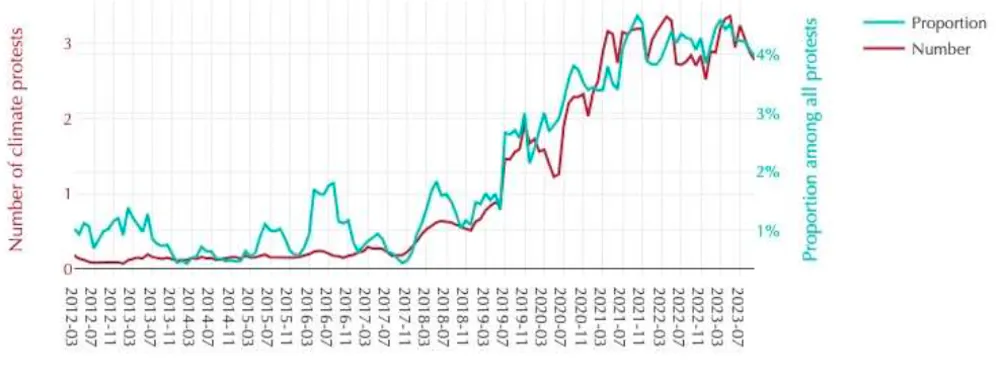
    To look more closely at the global picture of climate and environmental protest – and the repression of it – we used the Armed Conflicts Location Event database. This showed us that climate protests increased dramatically in 2018-2019 and have not declined since. They make up on average about 4% of all protest in the 81 countries that had more than 1,000 protests recorded in the 2012-2023 period:

    Climate protests increased sharply in the late 2010s in the 14 countries studied. (Data is smoothed over five months; number of protests is per country per month.)
    Berglund et al; Data: ACLED, CC BY-SA

    This second graph shows that environmental protest has increased more gradually:

    Environmental protests in the same 14 countries.
    Data: ACLED, CC BY-SA

    We used this data to see what kind of repression activists face. By looking for keywords in the reporting of protest events, we found that on average 3% of climate and environmental protests face police violence, and 6.3% involve arrests. But behind these averages are large differences in the nature of protest and its policing.

    A combination of the presence of protest groups like Extinction Rebellion, who often actively seek arrests, and police forces that are more likely to make arrests, mean countries such as Australia and the UK have very high levels of arrest. Some 20% of Australian climate and environmental protests involve arrests, against 17% in the UK – with the highest in the world being Canada on 27%.

    Meanwhile, police violence is high in countries such as Peru (6.5%) and Uganda (4.4%). France stands out as a European country with relatively high levels of police violence (3.2%) and low levels of arrests (also 3.2%).

    In summary, while criminalisation and repression does not look the same across the world, there are remarkable similarities. It is increasing in a lot of countries, it involves both state and corporate actors, and it takes many forms.

    This repression is taking place in a context where states are not taking adequate action on climate change. By criminalising activists, states depoliticise them. This conceals the fact these activists are ultimately right about the state of the climate and environment – and the lack of positive government action in these areas.

    Oscar Berglund is a member of the Green Party. The report this article is based on was written with Christina Pantazis, Chris Rossdale and Roxana Pessoa Cavalcanti.

    Tie Franco Brotto does not work for, consult, own shares in or receive funding from any company or organisation that would benefit from this article, and has disclosed no relevant affiliations beyond their academic appointment.

    ref. Repression of climate and environmental protest is intensifying across the world – https://theconversation.com/repression-of-climate-and-environmental-protest-is-intensifying-across-the-world-246379

    MIL OSI – Global Reports

  • MIL-OSI Global: Eating red meat may increase your risk of type 2 diabetes – not a lot of people know that

    Source: The Conversation – UK – By Gulshanara (Rumy) Begum, Senior Lecturer in Nutrition & Exercise Science, University of Westminster

    Red meat has been a part of diets worldwide since early man. It is an excellent source of protein, vitamins (such as B vitamins) and minerals (such as iron and zinc).

    However, red meat has long been associated with increasing the risk of heart disease, cancer and early death. What may not be so well known is the link between red meat consumption and type 2 diabetes.

    A paper published in the Lancet in September 2024 highlighted this link to type 2 diabetes using data from the Americas, the Mediterranean, Europe, south-east Asia and the Western Pacific (20 countries included).

    This recent study, with nearly 2 million participants, found that high consumption of unprocessed red meat, such as beef, lamb and pork, and processed meat, such as bacon, salami and chorizo, increased the incidence of type 2 diabetes.

    The researchers also highlighted a link between the consumption of poultry and the incidence of type 2 diabetes, but the link was weaker and varied across the populations.

    Type 2 diabetes is a serious public health issue affecting 462 million people globally. It occurs when our bodies don’t make enough insulin or can’t use insulin well.

    Insulin is a hormone produced by the pancreas, a small leaf-shaped gland that sits behind the stomach and just in front of the spine. Insulin helps blood glucose enter cells, which stops levels from rising in the blood.

    In type 2 diabetes, due to our body not having enough insulin or inability to use the insulin (also referred to as “insulin resistance” or “impaired insulin sensitivity”), blood glucose reaches high levels, causing symptoms such as extreme thirst, increased need to pass urine and feelings of tiredness. Long-term health issues include nerve damage, foot problems and heart disease.

    The underlying mechanisms linking red meat intake with type 2 diabetes are unclear. Mechanisms could relate to the function of the pancreas, insulin sensitivity or a combination of the two.

    Possible mechanisms

    Red meat has high levels of saturated fat and is low in polyunsaturated fats, which could disrupt insulin sensitivity.

    Research has also shown that a high protein intake from animal sources (compared to vegetarian sources) can increase the risk of type 2 diabetes, possibly due to the high levels of branched-chain amino acids (BCAA) in animal protein.

    BCAA include the amino acids leucine, isoleucine and valine. In a small study, short-term BCAA infusions increased insulin resistance in humans. Similar findings were shown in larger human studies.

    High levels of plasma BCAA can have various origins. These connections between red meat, BCAA, insulin resistance and type 2 diabetes are worth exploring further.

    Another potential mechanism involves gut microbiota, the collection of microbes in our gut.

    Our microbiota metabolises choline (a water-soluble essential nutrient) and L-carnitine (an amino acid found naturally in food), both of which are abundant in red meat, producing trimethylamine. Increased trimethylamine has been associated with a higher risk of developing type 2 diabetes.

    How we cook meat may also add to this conundrum. Cooking meat at high temperatures, such as grilling and barbecuing, can produce harmful compounds called “advanced glycation end products”.

    These compounds can damage cells due to oxidative stress (caused by unstable atoms called free radicals), lead to inflammation (which can be damaging if it occurs in healthy tissues or lasts too long) and insulin resistance.

    Red meat is a great source of iron. But some studies have shown long-term iron intake or iron overload, particularly haem iron (iron from animal-based sources), may increase the risk of type 2 diabetes.

    Eat less red meat

    According to a World Health Organization report, in the last 50 years, global consumption of all types of meat has increased. In some wealthy countries, such as the UK, red meat consumption appears to be stable or declining. Although there is a lot of variation in meat consumption between and within countries.

    In the UK, people are advised to consume no more than 70g (cooked weight) of red meat per day and to avoid eating processed meat. A similar recommendation is given across many countries.

    With the winter holidays around the corner and the festive gatherings in full swing, reducing red meat consumption will be difficult, especially for those who really like the taste. So enjoy these moments without worrying, and where possible, try to consume fibre-rich vegetables with red meat.

    Small steps can be taken to reduce your red meat intake by having smaller portions or choosing a day in the week that is meat free (meat-free Mondays, say), or substituting some (or all) of the meat in recipes with chicken, fish, beans, lentils or the like.

    And for those days you do eat red meat, try poaching, steaming or stewing it – it’s healthier than grilling or barbecuing.

    Gulshanara (Rumy) Begum does not work for, consult, own shares in or receive funding from any company or organisation that would benefit from this article, and has disclosed no relevant affiliations beyond their academic appointment.

    ref. Eating red meat may increase your risk of type 2 diabetes – not a lot of people know that – https://theconversation.com/eating-red-meat-may-increase-your-risk-of-type-2-diabetes-not-a-lot-of-people-know-that-245495

    MIL OSI – Global Reports

  • MIL-OSI Global: Europe’s microstates: the medieval monarchies that survive in our midst

    Source: The Conversation – UK – By Elisa Bertolini, Associate Professor of Comparative Public Law, Bocconi University

    San Marino is one of four microstates with very distinct constitutional arrangements. Shutterstock/kavalenkava

    Continental Europe is home to four microstates with populations of between 30,000 and 80,000 people: Andorra, on the border between France and Spain; Liechtenstein, nestled between Switzerland and Austria; Monaco, which sits on the French Riviera; and San Marino, which is surrounded by northern Italy.

    These states have existed since the medieval period and their tiny size has enabled them to develop and maintain singular constitutional arrangements. They have all developed original solutions to the problems of state architecture, many of which survive today.

    All four of these microstates participate in the Council of Europe (Europe’s human rights organisation) and have therefore had to modernise to meet international standards of governance. This includes the independence of the judiciary.

    However, all four have also implemented these reforms without altering their institutional identity. Their commitment to preserving their distinctiveness from other countries prevents wider reform to their institutions. For them, the protection of national tradition and identity is a form of self-preservation rather than a mere expression of ideology.

    The distinctiveness of the four microstates lies in the survival of institutional arrangements that can no longer to be found practically anywhere else in the world. In the principalities of Liechtenstein and Monaco, for example, the monarchy still has a central role in the constitution.

    Unlike in most European states with a monarchy, in Liechtenstein and Monaco, the royal head of state continues to exercise meaningful power. Andorra and San Marino, meanwhile, operate under a dual head of state arrangement. They effectively have two monarchs.

    The populations of Europe’s medieval microstates.
    World Bank/ Data Commons, CC BY-ND

    Institutional arrangements in these principalities has been shaped by their diminutive size, both in terms of territory and population, and their geographical location. And these arrangements have survived since the middle ages because they have become their identity. While national tradition is an ideological debate in other nations, in these, preserving the past is a survival mechanism.

    Liechtenstein and Monaco

    Liechtenstein and Monaco are constitutional monarchies of the kind that offer substantial power to the royal family. Everything is organised around a prince, who exercises the executive power. Contemporary monarchies in the western legal tradition generally have a ceremonial king or queen but the executive power is held by an elected government. Liechtenstein and Monaco have maintained their historical organisation of government, centred on a very powerful monarch.

    Although his powers are not unlimited, in Monaco, the prince is not even accountable to the parliament for the powers he does hold. Liechtenstein’s prince enjoys even more powers, including the right to appoint half of the members of the constitutional court.

    However, the prince of Liechtenstein’s sovereign power is held in partnership with the people of Liechtenstein. The institutional architecture is built as to allow a system of checks and balances between the prince and the people.

    Since a 2003 constitutional amendment, for example, the people can table a motion of no-confidence in the prince if more than 1,500 citizens are in agreement to do so, which triggers a referendum on confidence in him. The same number of citizens can mount an initiative to abolish the monarchy entirely, should they choose to do so.

    Andorra and San Marino

    The principality of Andorra should more properly be called co-principality, because of its co-princes arrangement. One of the princes is the bishop of Urgell – from Catalonia – and the other is the president of the French Republic (and previously the French king or emperor). So another Andorran peculiarity is that neither of the princes are Andorran nationals.

    Following a 1993 reform that established a fully fledged constitution, neither prince holds sovereign power. Their present constitutional role is almost entirely ceremonial. However, concerns remain over the fact that they are not nationals of the state and that the heads of state are selected neither by the Andorran people nor by their representatives. The historical reason for a foreign head of state is the geographical location of Andorra – wedged between Catalonia and France. Allowing itself to be put under this double sovereignty was a guarantee of survival.

    San Marino also has a two-headed state but both leaders, called the Captains Regent, are Sammarinese nationals. They are elected by the Grand and General Council (the Sammarinese legislative body) and their distinctive trait is that they serve only a six-month term of office.

    The reason for such a short tenure is that San Marino has a population of just under 34,000 people. Everyone knows everyone else, which is a situation that can be detrimental to the independence of elective offices.

    Captains Regent can’t shore up enough power in their short time in office to be able to overthrow the republic. The Captains Regent were first established in 1243, shortly before a number of Italian republics were overthrown by wealthy families. One of the reasons why San Marino has been able to survive is because it has prevented one family from being more powerful than the others for centuries.

    Microstates are, therefore, not like Europe’s regular-sized states. They have distinctive institutional architectures – and often for understandable reasons.

    Elisa Bertolini does not work for, consult, own shares in or receive funding from any company or organisation that would benefit from this article, and has disclosed no relevant affiliations beyond their academic appointment.

    ref. Europe’s microstates: the medieval monarchies that survive in our midst – https://theconversation.com/europes-microstates-the-medieval-monarchies-that-survive-in-our-midst-245328

    MIL OSI – Global Reports

  • MIL-OSI Global: Five ways to beat loneliness this winter

    Source: The Conversation – UK – By Dorothy Yen, Professor in Marketing and Lead on the Happy to Chat project, Brunel University of London

    Tricky_Shark/Shutterstock

    For some people, loneliness can feel overwhelming, especially during winter, but small steps toward connection can make a significant difference. Research shows that micro conversations with strangers can help improve wellbeing and reduce feelings of loneliness.

    This explains why in the UK, the new charity Happy to Chat is trying to encourage people to talk to each other when out and about. In Sweden, a similar scheme – the Say Hi campaign – was also launched in winter 2023 to promote small talks among people in their neighbourhoods.

    Most studies on the benefits of talking to strangers have focused on younger people, leaving a big question mark over how older adults experience these everyday interactions. Yet, this is a group that could stand to benefit the most. The World Health Organization estimates that one in four older adults face social isolation, which can seriously affect their health, happiness, and even how long they live.

    Our research shows that most older people in the UK have a positive attitude towards the idea of small talk when out and about. They see it as being neighbourly, an act of kindness, a way to brighten someone else’s day. Popular spots for these chats include bright, public spaces, like shopping centres, garden centres, libraries, community events, university campuses, or even while waiting for public transport.

    Feeling confident is important; it’s not just about starting a conversation or keeping it going. It’s also about feeling safe and in control. That confidence isn’t the same for everyone, though. Older women, in particular, were more concerned about potential challenges such as personal safety or dealing with an awkward or uncomfortable chat.

    A safe and secure environment can make all the difference in their choice of whether to engage in small talk when out and about. So, it is important that we all make an effort in creating a friendly environment, combating loneliness together through small and meaningful conversations. With that in mind, here are five ways to beat loneliness this winter and build those much needed connections.

    1. Join the ‘happy to chat’ movement

    A simple conversation can go a long way in making both you and others feel more connected. The “happy to chat” initiative in the UK encourages people to sit at designated benches or wear ‘happy to chat’ badges that signal their openness to friendly talks with those passing by. Our research shows that these badges work wonders as ice breakers, making it easier to strike up a conversation. Whether you’re at a park, garden centre, café, or on public transport, a little small talk can brighten your day and build a sense of community.

    2. Volunteer for a local charity

    Giving back not only benefits others but can also create a sense of purpose and connection. Many organisations seek extra hands during the winter, especially for holiday drives, food banks or programmes supporting older people. Volunteering is a great way to meet like-minded people while spreading warmth and joy.

    3. Take part in community activities

    From Christmas carol singing to craft workshops and winter walks, your local area is probably buzzing with events this season. Joining in these activities is a natural way to socialise and meet new people. Have a look at your community centre or local general practitioners notice boards. Neighbourhood gatherings or shared hobbies make connecting with others feel effortless and fun.

    4. Stay active and embrace the outdoors

    Exercise has proven mental health benefits, including reducing feelings of loneliness. Bundle up and take a brisk walk in the park, or join a local fitness class or walking group, where you can enjoy the fresh air while having small talks with others. Outdoor winter activities like ice skating may not be everyone’s cup of tea, but having a visit to seasonal markets can also provide opportunities to interact with others.

    5. Reconnect with friends and family

    The holiday season is a perfect time to reach out to loved ones or people you may have lost in touch with. But don’t forget that loneliness can be all year around. Drop a postcard to say hello, schedule a call or meet-ups, even if it’s just for a quick coffee. If you can’t meet in person, virtual gatherings can still help you feel connected and cared for.

    What is not recommended?

    Although pets can provide companionship, they require long-term commitment, time and care. Getting a pet solely to combat loneliness during the winter isn’t a good idea.

    Pets are for life, not just for the holiday season, and taking on this responsibility without careful thought can lead to challenges for both you and the animal. Instead, consider alternative ways to connect, like volunteering at an animal shelter or spending time with friends who have pets.

    Loneliness can feel overwhelming, especially during winter, but small steps toward connection can make a significant difference. By reaching out to others and engaging in your community, you can transform this season into one of warmth, companionship and joy. Sometimes, all it takes is a simple smile or a friendly conversation to turn someone’s day around – including your own.

    Christina Victor receives funding from ESRC, Dunhill Medical Trust, Wellcome Trust, Alzheimer’s Society, NIHR

    Dorothy Yen does not work for, consult, own shares in or receive funding from any company or organisation that would benefit from this article, and has disclosed no relevant affiliations beyond their academic appointment.

    ref. Five ways to beat loneliness this winter – https://theconversation.com/five-ways-to-beat-loneliness-this-winter-245630

    MIL OSI – Global Reports

  • MIL-OSI Global: In the age of AI, Wallace and Gromit’s claymation style remains a festive favourite

    Source: The Conversation – UK – By Christopher Holliday, Senior Lecturer in Liberal Arts and Visual Cultures Education, Department of Interdisciplinary Humanities, King’s College London

    A new Wallace and Gromit adventure, Vengeance Most Fowl (2024), premieres on BBC One and Netflix this Christmas Day. It’s been nearly 20 years since the last feature film about Yorkshire’s favourite eccentric inventor and his above-intelligent pet dog, The Curse of the Were-Rabbit (2005).

    Aardman’s latest Christmas instalment marks the reappearance of Feathers McGraw, the mysterious and silent penguin villain from The Wrong Trousers (1993). It also represents the latest outing for the Bristol-based company’s signature stop-motion “claymation” style – which is both a symbol of the studio’s enduring relationship to craft, and a vital element of Aardman’s international identity as an animation powerhouse.

    A new era of artificial intelligence is threatening to transform the boundaries of what we understand as art. So it is significant that one of this year’s most highly anticipated festive films celebrates the skill and spirit of handmade animation.


    Looking for something good? Cut through the noise with a carefully curated selection of the latest releases, live events and exhibitions, straight to your inbox every fortnight, on Fridays. Sign up here.


    Aardman was founded in 1972. Over the last 50 years, the studio has cultivated a durable and worldwide reputation as a pioneer of animation as a handmade, craft-based art form.

    Both before and after its feature-film debut, Chicken Run (2000), the studio’s stop-motion approach was refined across an extensive range of animated projects and commissions. These included short films like Creature Comforts (1990), the first Aardman production to win an Academy Award, as well as an array of television idents, music videos and advertising campaigns.

    Such has been Aardman’s longstanding connection to claymation that when the Newplast company shut down in March 2023, sparking rumours of a shortage of its famous modelling clay, the studio issued a statement denying it was running out of materials, while assuring fans it would find a new supplier for future projects.

    The trailer for Wallace and Gromit: Vengeance Most Fowl.

    Aardman’s animated productions have been a staple of Christmas film and television since Wallace and Gromit creator Nick Park’s 30-minute short The Wrong Trousers debuted on Boxing Day 1993.

    So much so, in fact, that Aardman proclaims that it is “proud to be synonymous with Christmas”. The many television specials featuring old and new Aardman characters include the 30-minute Netflix Christmas shorts Shaun The Sheep: A Flight Before Christmas (2021) and Robin Robin (2021), as well as multiple “cracking” Christmas advertising campaigns.

    This Christmas season, that’s included the decorating of London’s Battersea power station with Aardman characters, and a collection of specially commissioned Christmas idents exclusively for the BBC.

    Aardman goes digital

    Despite a defining investment in the creative potential of claymation, the studio has occasionally dipped a toe into the the world of digital technology. A brief foray into computer-animated filmmaking in the early 2000s with Flushed Away (2006) and Arthur Christmas (2011) marked an ultimately short-lived creative partnership with DreamWorks Animation and Sony Pictures.

    While Aardman’s involvement with these renowned Hollywood companies pushed the studio away from its house style and ushered in a new kind of big-screen humour, in design at least, these films retained their quintessential Aardman “look”. But though these characters appeared firmly from the Aardman stable (particularly in their recognisably exaggerated smiles), their animated perfection demonstrated the pristine visuals increasingly afforded by sophisticated computer graphics.

    Clearly, much like Wallace, Aardman animators aren’t immune to the thrill of technological innovation. But they have still largely maintained their claymation methods of production, to instil in audiences the many pleasures of doing things by hand.

    The glimpse of fingerprints accidentally pressed into the modelling clay, coupled with the jerky movements of their plasticine characters, emphasises that Aardman methods remain far removed from modern technology. Craft and the handmade are therefore as much business strategies as they are aesthetic choices, deployed to sell the Aardman brand around the world.

    After a hiatus of almost 20 years, the imminent return of Wallace and Gromit to British screens seems a pointed reflection on the virtues of the handmade, against the acceleration of AI within the film industry.

    With Vengeance Most Fowl telling the story of a rogue automatic garden gnome, Aardman is seemingly questioning a future built from computerised (and potentially dangerous) automation. By preserving the artisanal and anchoring its very British charm once again to the hand-crafted, slightly imperfect models that populate these stop-motion animated worlds, it seems that, for Aardman at least, computers are not always what they are cracked up to be.

    Christopher Holliday does not work for, consult, own shares in or receive funding from any company or organisation that would benefit from this article, and has disclosed no relevant affiliations beyond their academic appointment.

    ref. In the age of AI, Wallace and Gromit’s claymation style remains a festive favourite – https://theconversation.com/in-the-age-of-ai-wallace-and-gromits-claymation-style-remains-a-festive-favourite-246070

    MIL OSI – Global Reports

  • MIL-OSI Global: Are we moral blank slates at birth? A new study offers some clues

    Source: The Conversation – UK – By Madeline G. Reinecke, Postdoctoral Researcher, Collective Moral Development, University of Oxford

    Saulich Elena/Shutterstock

    What does a baby know about right and wrong? A foundational finding in moral psychology suggested that even infants have a moral sense, preferring “helpers” over “hinderers” before uttering their first word. Now, nearly 20 years later, a study that tried to replicate these findings calls this result into question.

    In the original study, Kiley Hamlin and her colleagues showed a puppet show to six- and ten-month-old babies. During the show, the babies would see a character — which was really just a shape with googly eyes — struggling to reach the top of a hill.

    Next, a new character would either help the struggling individual reach the top (acting as a “helper”) or push the character back down to the bottom of the hill (acting as a “hinderer”).

    By gauging babies’ behaviour — specifically, watching how their eyes moved during the show and whether they preferred to hold a specific character after the show ended — it seemed that the infants had basic moral preferences. Indeed, in the first study, 88% of the ten-month-olds – and 100% of the six-month-olds – chose to reach for the helper.

    Kiley Hamlin explains the helper-hinderer experiment.

    But psychology, and developmental psychology, in particular, is no stranger to replicability concerns (when it is difficult or impossible to reproduce the results of a scientific study). After all, the original study sampled only a few dozen infants.

    This isn’t the fault of the researchers; it’s just really hard to collect data from babies. But what if it was possible to run the same study again — with say, hundreds or even thousands of babies? Would researchers find the same result?

    This is the chief aim of ManyBabies, a consortium of developmental psychologists spread around the world. By combining resources across individual research labs, ManyBabies can robustly test findings in developmental science, like Hamlin’s original “helper-hinderer” effect. And as of last month, the results are in.

    With a final sample of 567 babies, tested in 37 research labs across five continents, babies did not show evidence of an early-emerging moral sense. Across the ages tested, babies showed no preference for the helpful character.

    Blank slate?

    John Locke, an English philosopher argued that the human mind is a “tabula rasa” or “blank slate”. Everything that we, as humans, know comes from our experiences in the world. So should people take the most recent ManyBabies result as evidence of this? My answer, however underwhelming, is “perhaps”.

    This is not the first attempted replication of the helper-hinderer effect (nor is it the first “failure to replicate”). In fact, there have been a number of successful replications. It can be hard to know what underlies differences in results. For example, a previous “failure” seemed to come from the characters’ “googly eyes” not being oriented the right way.

    The ManyBabies experiment also had an important change in how the “show” was presented to infants. Rather than a puppet show performed live to baby participants, researchers instead presented a video with digital versions of the characters. This approach has its strengths. For example, ensuring that the exact same presentation occurs across every trial, in every lab. But it could also shift how babies engage with the show and its characters.

    I appreciated the recent remarks made by Michael Frank, founder of the ManyBabies consortium, on social network BlueSky: “Some people will jump to the interpretation that [the results of ManyBabies] shows that the original finding was incorrect (and hence that the other replications were incorrect as well, and the earlier non-replications were right). This [is] one possibility – but we shouldn’t be so quick to jump to conclusions.”

    Rather, we can take this finding for exactly what it is: a well-executed large investigation (senior-authored by Kiley Hamlin herself) of the hypothesis that infants prefer helpers over hinderers. In this instance, the hypothesis was not supported.

    This could be because, underneath it all, Locke was right. Perhaps the babies tested hadn’t had enough time in the world to learn “right from wrong”, so they wouldn’t make any distinction between a helpful character and a harmful one. Or perhaps there’s something more complicated going on. Only more science, with many, many more babies, will tell us.

    At the very least, a question mark now hangs over one of the most famous experiments in developmental psychology.

    Madeline G. Reinecke does not work for, consult, own shares in or receive funding from any company or organisation that would benefit from this article, and has disclosed no relevant affiliations beyond their academic appointment.

    ref. Are we moral blank slates at birth? A new study offers some clues – https://theconversation.com/are-we-moral-blank-slates-at-birth-a-new-study-offers-some-clues-245333

    MIL OSI – Global Reports

  • MIL-OSI Global: Why there’s no such thing as normal in child development

    Source: The Conversation – UK – By Samuel Forbes, Associate Professor in Psychology, Durham University

    Hasnuddin/Shutterstock

    For parents, carers and teachers, it’s often tempting to base our thinking on a child’s development around what we understand as “normal”. Much of the time we do this without thinking, describing a child as “doing well” in one subject and “behind” in another.

    Whenever we make this sort of comparison, we have some sort of mental benchmark or yardstick in our head: for example, a toddler should be able to climb on furniture by age two. Increasingly, child development researchers are arguing that the same thing happens in child development research — the study of how behaviours and abilities such as language develop.

    Many of the studies that claim to research child development either implicitly, or explicitly, claim that their findings are universal.

    There could be many reasons for this. Sometimes there’s a temptation to oversell conclusions, sometimes it might be the way findings are interpreted by readers or the media. The upshot is that what’s been found in one group of children is then taken as the standard — the yardstick against which future research is compared.

    Most of the research into how children develop comes from wealthier, western countries, in particular the US, the UK, the Netherlands, Germany and France. Chances are, if you’ve heard of milestones in child development, they were developed in one of these countries.

    This is so much so that it can be challenging to do basic research on child development in developing countries, as peers and reviewers will ask for or demand comparisons to western populations to put findings from these regions in context. Of course without realising it, these peers and reviewers have set up western children as a norm.

    Most of the existing academic research on child development comes from western countries.
    Olesia Bilkei/Shutterstock

    But is it fair to make these comparisons? One of the tricky things about researching child development is that it occurs within a cultural and social context it can’t be removed from. But this context is often messy. Differences in physical environment, parenting styles, location, climate and so on all interact to shape how children grow.

    Besides these differences, there is individual variation as well. These could be, for instance, curiosity, shyness and neurodiversity, which can all frame how a child shapes their own learning environment.

    Take for example the field of motor development in infancy – the study of
    how children learn to move. Many parents in particular might be familiar with charts showing when they can expect their child to sit, crawl, stand and run. The existence of these charts make it seem pretty universal, and often a child’s motor development is judged accordingly.

    This makes sense. Early research was preoccupied with finding out what was normal, and it makes sense to try to support children who might be at risk of falling behind. The timing and order investigated back then led to the norms and scales we still use today.

    Is something like motor development timing universal? It’s easy to imagine that it might be. When there are no physical or cognitive barriers we all learn to sit and stand, so on the surface it seems fair to say this could be.

    But it turns out that the context that children develop in plays a huge role even
    in something as seemingly universal as this. In countries and
    cultures where babies routinely receive firm massages from caregivers, such as in Jamaica, motor development is accelerated. It’s clear that a norm developed in one culture might not translate well to another.

    Beyond norms

    It’s clear to see that the problems highlighted above are not unique to motor development. In areas like language development or social development the cultural component is even more compelling.

    There is simply no way of understanding these elements of child development without also understanding the context in which they take place. Every child is developing within a context and however normal our own culture feels to us, there is no objective context-free norm that we can compare other children to. That is, to say, we should embrace the mess.

    If we think of normal child development as being something that just happens, researchers miss out on understanding the dynamics of development itself. But worse, educators and caregivers might not realise development is something we can act upon, and miss an opportunity to enact change.

    An important part of seeing child development as being intertwined with culture is that it doesn’t just mean collecting data from other cultures, but involving local communities and research perspectives. Understanding communities means listening to them, empowering them and making space for them to have a voice.

    Moving beyond a western-centric understanding of child development won’t just benefit researchers and lead to more accurate science, but hopefully benefit everyone working with children around the world.

    The authors do not work for, consult, own shares in or receive funding from any company or organisation that would benefit from this article, and have disclosed no relevant affiliations beyond their academic appointment.

    ref. Why there’s no such thing as normal in child development – https://theconversation.com/why-theres-no-such-thing-as-normal-in-child-development-244681

    MIL OSI – Global Reports

  • MIL-OSI Global: Octopuses and their relatives are a new animal welfare frontier − here’s what scientists know about consciousness in these unique creatures

    Source: The Conversation – USA – By Rachel Blaser, Professor of Neuroscience, Cognition and Behavior, University of San Diego

    A common octopus (Octopus vulgaris) off Croatia in the Mediterranean Sea. Reinhard Dirscherl/ullstein bild via Getty Images

    We named him Squirt – not because he was the smallest of the 16 cuttlefish in the pool, but because anyone with the audacity to scoop him into a separate tank to study him was likely to get soaked. Squirt had notoriously accurate aim.

    As a comparative psychologist, I’m used to assaults from my experimental subjects. I’ve been stung by bees, pinched by crayfish and battered by indignant pigeons. But, somehow, with Squirt it felt different. As he eyed us with his W-shaped pupils, he seemed clearly to be plotting against us.

    A common cuttlefish (Sepia officinalis) in Portugal’s Arrábida Natural Park.
    Diego Delso/Wikipedia, CC BY-SA

    Of course, I’m being anthropomorphic. Science does not yet have the tools to confirm whether cuttlefish have emotional states, or whether they are capable of conscious experience, much less sinister plots. But there’s undeniably something special about cephalopods – the class of ocean-dwelling invertebrates that includes cuttlefish, squid and octopus.

    As researchers learn more about cehpalopods’ cognitive skills, there are calls to treat them in ways better aligned with their level of intelligence. California and Washington state both approved bans on octopus farming in 2024. Hawaii is considering similar action, and a ban on farming octopus or importing farmed octopus meat has been introduced in Congress. A planned octopus farm in Spain’s Canary Islands is attracting opposition from scientists and animal welfare advocates.

    Critics offer many arguments against raising octopuses for food, including possible releases of waste, antibiotics or pathogens from aquaculture facilities. But as a psychologist, I see intelligence as the most intriguing part of the equation. Just how smart are cephalopods, really? After all, it’s legal to farm chickens and cows. Is an octopus smarter than, say, a turkey?

    A deepwater octopus investigates the port manipulator arm of the ALVIN submersible research vessel.
    NOAA, CC BY

    A big, diverse group

    Cephalopods are a broad class of mollusks that includes the coleoids – cuttlefish, octopus and squid – as well as the chambered nautilus. Coleoids range in size from adult squid only a few millimeters long (Idiosepius) to the largest living invertebrates, the giant squid (Architeuthis) and colossal squid (Mesonychoteuthis) which can grow to over 40 feet in length and weigh over 1,000 pounds.

    Some of these species live alone in the nearly featureless darkness of the deep ocean; others live socially on active, sunny coral reefs. Many are skilled hunters, but some feed passively on floating debris. Because of this enormous diversity, the size and complexity of cephalopod brains and behaviors also varies tremendously.

    Almost everything that’s known about cephalopod cognition comes from intensive study of just a few species. When considering the welfare of a designated species of captive octopus, it’s important to be careful about using data collected from a distant evolutionary relative.

    Marine biologist Roger Hanlon explains the distributed structure of cephalopod brains and how they use that neural power.

    Can we even measure alien intelligence?

    Intelligence is fiendishly hard to define and measure, even in humans. The challenge grows exponentially in studying animals with sensory, motivational and problem-solving skills that differ profoundly from ours.

    Historically, researchers have tended to focus on whether animals think like humans, ignoring the abilities that animals may have that humans lack. To avoid this problem, scientists have tried to find more objective measures of cognitive abilities.

    One option is a relative measure of brain to body size. The best-studied species of octopus, Octopus vulgaris, has about 500 million neurons; that’s relatively large for its small body size and similar to a starling, rabbit or turkey.

    More accurate measures may include the size, neuron count or surface area of specific brain structures thought to be important for learning. While this is useful in mammals, the nervous system of an octopus is built completely differently.

    Over half of the neurons in Octopus vulgaris, about 300 million, are not in the brain at all, but distributed in “mini-brains,” or ganglia, in the arms. Within the central brain, most of the remaining neurons are dedicated to visual processing, leaving less than a quarter of its neurons for other processes such as learning and memory.

    In other species of octopus, the general structure is similar, but complexity varies. Wrinkles and folds in the brain increase its surface area and may enhance neural connections and communication. Some species of octopus, notably those living in reef habitats, have more wrinkled brains than those living in the deep sea, suggesting that these species may possess a higher degree of intelligence.

    Holding out for a better snack

    Because brain structure is not a foolproof measure of intelligence, behavioral tests may provide better evidence. One of the highly complex behaviors that many cephalopods show is visual camouflage. They can open and close tiny sacs just below their skin that contain colored pigments and reflectors, revealing specific colors. Octopus vulgaris has up to 150,000 chromatophores, or pigment sacs, in a single square inch of skin.

    Like many cephalopods, the common cuttlefish (Sepia officinalis) is thought to be colorblind. But it can use its excellent vision to produce a dizzying array of patterns across its body as camouflage. The Australian giant cuttlefish, Sepia apama, uses its chromatophores to communicate, creating patterns that attract mates and warn off aggressors. This ability can also come in handy for hunting; many cephalopods are ambush predators that blend into the background or even lure their prey.

    The hallmark of intelligent behavior, however, is learning and memory – and there is plenty of evidence that some octopuses and cuttlefish learn in a way that is comparable to learning in vertebrates. The common cuttlefish (Sepia officinalis), as well as the common octopus (Octopus vulgaris) and the day octopus (Octopus cyanea), can all form simple associations, such as learning which image on a screen predicts that food will appear.

    Some cephalopods may be capable of more complicated forms of learning, such as reversal learning – learning to flexibly adjust behavior when different stimuli signal reward. They may also be able to inhibit impulsive responses. In a 2021 study that gave common cuttlefish a choice between a less desirable but immediate snack of crab and a preferred treat of live shrimp after a delay, many of the cuttlefish chose to wait for the shrimp.

    Cuttlefish perform in an experiment adapted from the Stanford “marshmallow test,” which was designed to see whether children could practice delayed gratification.

    A new frontier for animal welfare

    Considering what’s known about their brain structures, sensory systems and learning capacity, it appears that cephalopods as a group may be similar in intelligence to vertebrates as a group. Since many societies have animal welfare standards for mice, rats, chickens and other vertebrates, logic would suggest that there’s an equal case for regulations enforcing humane treatment of cephalopods.

    Such rules generally specify that when a species is held in captivity, its housing conditions should support the animal’s welfare and natural behavior. This view has led some U.S. states to outlaw confined cages for egg-laying hens and crates too narrow for pregnant sows to turn around.

    Animal welfare regulations say little about invertebrates, but guidelines for the care and use of captive cephalopods have started to appear over the past decade. In 2010, the European Union required considering ethical issues when using cephalopods for research. And in 2015, AAALAC International, an international accreditation organization for ethical animal research, and the Federation of European Laboratory Animal Science Associations promoted guidelines for the care and use of cephalopods in research. The U.S. National Institutes of Health is currently considering similar guidelines.

    The “alien” minds of octopuses and their relatives are fascinating, not the least because they provide a mirror through which we can reflect on more familiar forms of intelligence. Deciding which species deserve moral consideration requires selecting criteria, such as neuron count or learning capacity, to inform those choices.

    Once these criteria are set, it may be well to also consider how they apply to the rodents, birds and fish that occupy more familiar roles in our lives.

    Rachel Blaser does not work for, consult, own shares in or receive funding from any company or organization that would benefit from this article, and has disclosed no relevant affiliations beyond their academic appointment.

    ref. Octopuses and their relatives are a new animal welfare frontier − here’s what scientists know about consciousness in these unique creatures – https://theconversation.com/octopuses-and-their-relatives-are-a-new-animal-welfare-frontier-heres-what-scientists-know-about-consciousness-in-these-unique-creatures-241978

    MIL OSI – Global Reports

  • MIL-OSI Global: Could trusting each other more unlock economic growth?

    Source: The Conversation – UK – By Paul Whiteley, Professor, Department of Government, University of Essex

    Shutterstock/GoodStudio

    Trust in Britain’s institutions is in bad shape, according to recent data from the European Social Survey.

    Trust is important because a good deal of governing involves trying to persuade people to do things or convince them that things will get better in the future. This is increasingly difficult to do if trust is in decline. Trust in political institutions is particularly important when governments have to make unpopular decisions, such as raising taxes.

    Data covering a 20-year period shows a marked decline in trust in parliaments, political parties and politicians. The following question is asked in the European Social Surveys over time:

    Please tell me on a score of 0-10 how much you personally trust each of the following institutions. 0 means you do not trust an institution at all, and 10 means you have complete trust in it.

    The decline in trust began around the time of the 2016 survey, when the lowest level of trust in politicians and political parties was recorded in 20 years of doing the survey. Parliament has done a bit better, but decline in trust for it is still quite marked. It is no coincidence that this decline started in 2016 – the year of Brexit.

    Average trust scores for British institutions, 2002-2022

    Trust on the slide.
    P Whiteley, CC BY-ND

    But the European Social Survey carries another important measure of trust – our trust in fellow citizens. A question in the surveys asks how trusting respondents felt about other people on an 11-point scale, with a high score indicating that people are trusting.

    Average trust scores in other people in Britain, 2002-2022

    Trust in other people.
    P Whiteley, CC BY-ND

    After a shaky start at the beginning of the millennium, trust in other people increased significantly in Britain in 2006, to over 5.35 on the 11-point scale. It then dropped in 2008, the year of the financial crisis. The recovery from this decline was in place by 2010. It is noticeable that the trust scores fell again in 2018, when the political consequences of Brexit were making themselves felt. Trust revived again in 2020 during the pandemic.

    So, our trust in each other is in healthier shape than our trust in institutions. This is important because trust in others is a key measure of social capital – the willingness of people to work together to solve social and economic problems in society. The importance of social capital in creating prosperity in the US was highlighted by the American political scientist Bob Putnam in his best-selling book, Bowling Alone.

    Trust is lacking in British politicians.
    Flickr/UK Parliament, CC BY-NC-ND

    There is now a large literature on social capital and trust, some of it focusing specifically on Britain. The findings are that trust promotes prosperity for a number of reasons. If people trust each other, they are more likely to volunteer. This free labour helps to provide a social safety net, which increases prosperity for all – even if it is not fully recognised in the national income statistics.

    High-trust countries like Denmark and Sweden also have low levels of corruption – and corruption is a blocker to growth. In a high-trust environment, the costs of doing business are lower because there is less need for elaborate contracts, expensive lawyers and lots of litigation to make other people behave properly. This is, in part, why high-trust countries are richer than low-trust countries.

    It’s well established that economic growth is driven by investment in innovation, skills and transport, extra manufacturing capacity and greater workplace productivity. However, it is also the case that social capital helps to create economic growth. In researching this across a variety of countries, I found that trust was very important in stimulating economic growth alongside these other factors.

    Government has limited direct influence on social capital, but it can encourage it by investing in voluntary organisations and increasing transparency in its dealings with the public.

    Britain has suffered from a lack of investment in capital spending and infrastructure, and has neglected investment in education over the past 15 years. Social capital seems to be in much better shape, and faced with the significant challenge of restoring growth, the UK government needs to pull every lever at its disposal. It can repair trust in politics with its own actions, and this is likely to help with sustaining social capital, which is part of the solution to restoring economic growth.

    Paul Whiteley has received funding from the British Academy and the ESRC.

    ref. Could trusting each other more unlock economic growth? – https://theconversation.com/could-trusting-each-other-more-unlock-economic-growth-246302

    MIL OSI – Global Reports

  • MIL-OSI Global: Prince Andrew and the British establishment’s ‘target-rich environment’ for spies

    Source: The Conversation – UK – By Philip Murphy, Director of History & Policy at the Institute of Historical Research and Professor of British and Commonwealth History, School of Advanced Study, University of London

    A ruling by the UK’s Special Immigration Appeals Commission has revealed that a Chinese businessman with links to King Charles’ younger brother, Prince Andrew, has been banned from Britain. The commission was upholding a decision originally taken in 2023 by the then home secretary, Suella Braverman, to exclude a man subsequently named as Yang Tengbo.

    Britain’s Security Service, MI5, had advised the commission that Yang posed “a risk to UK national security”. Reports have noted Yang’s visits to royal events at the request of the prince and his communications with one of Andrew’s senior advisers, Dominic Hampshire.

    That Andrew might have been cultivated by an agent of the Chinese government will come as no surprise to anyone who has studied the work of intelligence agencies. Their ideal target will not necessarily be someone who sympathises with the regime they serve. Indeed with the collapse of the ideological certainties of the cold war, this has become increasingly unlikely.

    Rather, a target will probably be someone who has particular weaknesses that can be exploited, often revolving around money or sex. They are seldom at the very pinnacle of power. But that, in itself, can leave them resentful and hungry for affirmation.

    An exaggerated sense of self-importance can render them even more pliable. This can make for a complex relationship between intelligence predator and their prey.

    In Andrew’s case, there are indications that members of his circle actually talked up the prince’s importance as a political contact. The commission’s ruling quoted a message from Hampshire to Yang in March 2020 after the latter had been invited to attend the Prince’s 60th birthday party.

    Hampshire told Yang: “I also hope that it is clear to you where you sit with my principal and indeed his family. You should never underestimate the strength of that relationship. …outside of his closest internal confidants, you sit at the very top of a tree that many, many people would like to be on.”

    Those more familiar with the workings of the British government might be sceptical about the height of the branches Yang had reached. King Charles is, after all, a constitutional monarch with few formal powers. And Andrew has become an increasingly marginalised figure within the royal family.

    A steady stream of revelations about his relationship with sex-trafficker and paedophile Jeffrey Epstein has left him increasingly out in the cold. He was stripped of his role as UK trade envoy in 2011 and was then forced to step down from public duties in 2019. So why bother trying to court him?

    Clues are provided in an important survey of the links between the royal family and the intelligence community published by international history specialists Richard Aldrich and Rory Cormac in 2021. As they note, before 2011, Andrew had enjoyed a long career in the royal navy and then as a British trade envoy, becoming closely involved in the sensitive and secretive world of UK arms sales.

    In 2010, the Wikileaks revelations suggested Andrew had been fiercely critical of the Serious Fraud Office for almost derailing a deal with Saudi Arabia and that his inside knowledge might have extended to some dark corners of the arms trade and its methods. There were also reports that the UK’s foreign intelligence service, MI6, was concerned that a former US deputy police chief close to the investigation into the Epstein affair might have leaked details to Russia, leaving Andrew open to blackmail.

    So Andrew probably was a tempting target, combining personal vulnerability with knowledge that could, at the very least, be embarrassing to the UK. But then, to borrow former US defense secretary Donald Rumsfeld’s vivid phrase about Iraq, the British establishment has long provided foreign intelligence agencies with “a target-rich environment”. And the waters tend to be muddied by the ease with which legitimate contacts based on cultural and trade diplomacy can morph into something more sinister.

    Broader concerns

    The ruling of the Special Immigration Appeals Commission quoted from a statement by the director-general of MI5 from July 2022 which distinguished between legitimate diplomacy and “what we call interference activity – influencing that is clandestine, coercive or corruptive”. Yet, in practice, the distinction is often opaque.

    When darker forces are at work, it often only becomes apparent as a result of prolonged surveillance of those involved. And that, in turn, assumes Britain’s spies are actually doing their job. Various bodies have questioned whether they are.

    In a July 2020 report, the parliamentary intelligence and security committee criticised the intelligence community for not being more curious about certain aspects of Russian activity. The possibility of Kremlin interference in the 2016 Brexit referendum was a significant concern.

    The implication – that intelligence officials had been nervous about getting involved in such a sensitive political issue – was rather borne out by the fate of the committee’s report itself. It was delivered to then prime minister Boris Johnson in October 2019 but was not released to the public until well after his pro-Brexit government had won the general election of December that year.

    Nor is the Labour party without questions to answer. At the same time as the Prince Andrew scandal was unfolding, Christine Lee, who donated £584,177 to the office of the Labour MP Barry Gardiner, lost a claim against MI5 which had accused her of engaging in political interference on behalf of China. Gardiner has said in response that none of the donations “according to MI5, came from an illegal source” and that he has “ceased all contact” with Lee following the MI5 warning.

    Prince Andrew’s behaviour is part of a wider picture and speaks to the general need for higher standards in British public life. Stricter rules on political donations to prevent foreign interference in British politics are long overdue. And people of political influence, including members of both houses of parliament, should be far more closely scrutinised over their relationships with foreign officials and business people. National security, as the term implies, very much begins at home.

    Philip Murphy has received funding from the AHRC. He is a member of the European Movement UK.

    ref. Prince Andrew and the British establishment’s ‘target-rich environment’ for spies – https://theconversation.com/prince-andrew-and-the-british-establishments-target-rich-environment-for-spies-246383

    MIL OSI – Global Reports

  • MIL-OSI Global: Christmas can be stressful for many people – here’s what can help you get through the festive season

    Source: The Conversation – UK – By Jolel Miah, Senior Lecturer, Health Psychology, University of Westminster

    Stress during the holidays doesn’t have to be inevitable. Kaspars Grinvalds/ Shutterstock

    Christmas is a season of joy and togetherness. But for many, it’s also one of the most stressful times of the year.

    Stress arises from an imbalance between the demands placed on us and our ability to cope with those demands. Psychologically, stress is linked to how we cope in situations – and whether we view them as challenging, threatening or manageable. The more challenging or threatening we see a situation to be, the more likely we are to feel stressed out.

    It makes sense, then, that Christmas is such as stressful time of year for many.

    The pressure to make the holidays “perfect”, spending more money than we perhaps should to fulfil expectations, the struggle to balance work and study commitments with holiday shopping, decorating and socialising can leave us feeling overwhelmed and exhausted.

    For others, Christmas highlights feelings of loneliness, grief or estrangement from loved ones. The season can be a painful reminder of lost relationships, financial hardships, or unmet life goals – and this can amplify feelings of inadequacy or sadness.

    Family visits can also bring tension as we’re forced to interact with relatives whose views or habits may clash – leading to conflicts or rehashing unresolved disputes.

    But while some stress during the holidays is inevitable, there are many things you can do to cope – and even prevent this stress in the first place.

    Plan ahead

    When our brains know what to expect, they require less energy to find solutions. This makes it easier to navigate any challenges we may face. And by planning or thinking ahead, it allows us to take control of our thoughts and minimise potential stressors.

    Before the holidays roll around, try spending time thinking about things which tend to be sources of stress to you – and make a plan for how you prevent this stress.

    For instance, if cooking Christmas dinner is a source of stress for you, perhaps making a list of specific tasks you can delegate to certain family members will help take some of the pressure off of you.

    Set boundaries

    It’s important to learn to say “no”, rather than agreeing to everything that might be asked of you. Understanding and respecting your own boundaries will help you allocate your time and resources more effectively – reducing stress.

    This skill takes time to develop but can significantly benefit your long-term wellbeing. The more confident we become in our abilities to manage the challenges we face, the better we become at setting boundaries – ultimately becoming better at managing stress.

    Some boundaries you might set at Christmas could include setting a budget limit for presents so you aren’t stressed about over-spending or limiting the number of social engagements you attend so you don’t get burnt out.

    Manage expectations

    It’s important to recognise that not everything is within your control. While there are many things you can plan and prepare for at Christmas, there are just as many things that are out of your hands. For example, you can’t control the way other people may behave at your Christmas dinner, or the way someone may react to a present you’ve bought them.

    Setting realistic expectations for the holidays and accepting there are things you just can’t control is key in managing stress levels.

    Take time to reflect

    Another helpful way to manage holiday stress is to pause and connect with your feelings.

    Writing down your thoughts may help alleviate stress.
    Ground Picture/ Shutterstock

    Write down your thoughts on a piece of paper. Then pause and really think about how your feel. Giving your brain a moment to process what’s happening can help you moderate your feelings. Keeping a journal can help improve your thoughts and mood, offering a constructive outlet for emotions.

    If you’re finding it difficult to get on with friends and family during the holidays, pause before reacting or saying something you might not mean. This will help you get your emotions under control and may help to reduce your stress.

    Coping after the holidays

    Some people may experience low mood after the holidays – often termed the “post-festive blues” or “post-holiday blues”.


    Read more:
    Why do we feel so ‘blah’ after Christmas?


    The holiday season often brings a mix of joy and stress, creating emotional highs that leave our bodies feeling drained and exhausted once it’s over. It’s important to recognise that these feelings are a natural response to the demands of the festive period – not a reflection of personal inadequacy. Taking the time to acknowledge and accept that our bodies and minds are simply recovering is a crucial step toward moving forward positively.

    There are many strategies you can use to manage these post-holiday blues. Activities such as regular exercise, setting realistic and achievable goals, and reconnecting with others can significantly improve our mood and boost “happy hormones” such as endorphins.

    By consciously planning ways to re-energise and stay connected, we can shift our focus from any lows we may have experienced over the holidays to a more balanced perspective as we step into the new year.

    Jolel Miah does not work for, consult, own shares in or receive funding from any company or organisation that would benefit from this article, and has disclosed no relevant affiliations beyond their academic appointment.

    ref. Christmas can be stressful for many people – here’s what can help you get through the festive season – https://theconversation.com/christmas-can-be-stressful-for-many-people-heres-what-can-help-you-get-through-the-festive-season-246097

    MIL OSI – Global Reports

  • MIL-OSI Global: Nurses need care too – how curbing self-sacrifice can prevent burnouts

    Source: The Conversation – UK – By Ester Ellen Trees Bolt, Post-doctoral Researcher, University of Leeds

    PeopleImages.com – Yuri A/Shutterstock

    Reflecting on my mother’s decade-long nursing career, I often wonder why so many nurses leave the profession after just a few years.

    In the UK, the shortage of nurses has reached alarming levels. Fewer students are enrolling in nursing programmes, and nearly half of newly registered nurses leave within five to ten years.

    Meanwhile, the demand for healthcare continues to grow, as outlined in England’s NHS Long-Term Workforce Plan, which sets out how the NHS will ensure there are enough nurses and doctors to support patients.

    The problem is not confined to the UK: nursing faces a global crisis. The high turnover of skilled professionals has serious implications for healthcare systems worldwide.

    The Netherlands is also experiencing troubling trends, with predictions of a significant healthcare staffing shortfall in the coming decades.

    Burnout is one of the most pressing reasons behind this exodus of nurses from the profession.

    Culture of self-sacrifice

    I interviewed nurses in the Netherlands about their workplace experiences including burnout for my research.

    And I found that one of the main reasons nurses leave is because of the profession’s culture of self-sacrifice. While empathy, compassion, and dedication are hallmarks of nursing, these qualities can lead to them working too hard. Nurses often push themselves so hard to meet their patients’ needs that they neglect their own health. Nursing often reinforces the culture of self-sacrifice, with an unspoken expectation that nurses should prioritise patients’ needs.

    My research shows that nurses are actively seeking employment to avoid burnout, but this often involves changing employers – a decision that is personally and organisationally intense and costly. I argue that, to ensure they remain in the workforce long term, nurses should be trained in setting boundaries and prioritising self-care.

    Nurses, particularly in long-term care, frequently form strong emotional bonds with their patients, which makes it challenging to draw boundaries between professional responsibilities and personal attachment. Interviews with nurses highlight the emotional toll of this. Several nurses mentioned feeling guilt when calling in sick, knowing their patients and colleagues depend on them. Some described how increased workloads, due to colleagues’ absences, eventually left them too overworked to continue. Others reported being constantly contacted to work extra shifts, even on their days off, due to staffing shortages caused by absenteeism and turnover.

    These stories reflect the relentless pressure nurses face. For many, the instinct to help others is both a source of pride and a path to burnout. When nurses don’t to set boundaries, their bodies often force them to stop – through illness and exhaustion.

    How to change

    Although nurses are the backbone of healthcare systems, the profession is undervalued and often viewed as less professional compared to other medical roles. This perception disrespects the complexity of nursing and discourages young people from entering the field.

    To address these issues, nurses need more support from employers and colleagues, including doctors and HR teams. Public campaigns must celebrate nursing as a highly skilled and indispensable profession, challenging outdated stereotypes.

    Burnout prevention also requires systemic changes. Nursing education must teach self-care and boundary setting as essential skills. Research indicates that nurses often report improved mental health and job satisfaction after switching employers, suggesting that organisational culture is pivotal in retaining staff – and that some workplaces are already leading the way.

    Self-sacrifice culture is a double-edged sword. While it reflects the compassion and dedication that define nursing, it poses a serious threat to the sustainability of the profession. To retain nurses, they need to be viewed as true professionals and be acknowledged for the value they deliver to the overall care processes. By fostering a culture that values personal boundaries, supports wellbeing, and elevates the professional identity of nursing, we can ensure that nurses are cared for just as much as they care for others.

    Failure to act will have far reaching consequences not just for nurses but for patients and healthcare systems around the world.

    Ester Ellen Trees Bolt does not work for, consult, own shares in or receive funding from any company or organisation that would benefit from this article, and has disclosed no relevant affiliations beyond their academic appointment.

    ref. Nurses need care too – how curbing self-sacrifice can prevent burnouts – https://theconversation.com/nurses-need-care-too-how-curbing-self-sacrifice-can-prevent-burnouts-244312

    MIL OSI – Global Reports

  • MIL-OSI Global: Saudi Arabia is a controversial choice to host the World Cup, but the spotlight and scrutiny might spark change

    Source: The Conversation – UK – By Wasim Ahmed, Senior Lecturer in Marketing, University of Hull

    The official announcement that Saudi Arabia would host the 2024 Fifa men’s World Cup came as a surprise to nobody. Hosting rights have been on the country’s geopolitical agenda for many years, and football’s international governing body was more than happy to oblige.

    Both parties have come in for heavy criticism as a result.

    A joint statement from 21 campaign groups, including Amnesty International, accused Fifa of making “empty human rights commitments”. The apparent lack of a competitive bidding process was ridiculed, and concerns were raised about the the potential environmental impact.

    So what was Fifa thinking?

    After all the controversy over the 2022 tournament in Qatar (and Russia in 2018) has it simply doubled down on being impervious to global criticism? Or is it genuinely trying to perform a balancing act which fairly distributes the geopolitical and economic power of football?

    Whatever the underlying reason, Fifa has become well practised at defending itself. It said that for the 2034 tournament, a “comprehensive consultation process” had taken place. Fifa president Gianni Infantino added that he expects Saudi Arabia to deliver “social improvements [and] positive human rights impacts” as “one of the responsibilities of hosting a World Cup”.

    And there is some evidence which actually backs up this stance. It has been suggested for example, that after the intense scrutiny around its hosting of the 2022 World Cup, Qatar’s approach to human rights and the treatment of migrant workers improved.

    It could also be argued that Fifa is opening up the sport to new regions, away from the traditional power bases of football. After all, since the 1930s, Europe has hosted 11 Word Cup tournaments, with five in Latin America. It took until 2002 for Asia to have a turn (in Japan and South Korea), while Africa did not have a host nation until 2010 (South Africa).

    Fifa also likes to position itself as a promoter of global peace and international unity. The appointment of former Arsenal manager Arsene Wenger as chief of global football development was a positive move in this direction. Under his leadership, Fifa has established more consultation processes with fans and national confederations to shape the future of football. It still has a way to go though.

    The world is watching

    Fifa would probably argue that it is accountable and open. After all, it went to the trouble of publishing a bid evaluation report. This endorsed Saudi Arabia’s bid for being “innovative” and “forward looking”, showing strong financial and organisational capacity.

    You can understand the “innovative” element. One of the planned stadiums situated on top of a cliff, promises to be a modern marvel. Another will be built 350m above the ground, at the heart of a newly built city.

    The “forward looking” part may be a stretch for a country where the royal family remains omnipotent, the security services are powerful, and questioning the ruling elite is simply not tolerated.

    Yet sport could also provide an opportunity for Saudi Arabia to change. In recent years, the country has lifted a ban on women drivers, opened up job opportunities, and appointed women to some of the top jobs in government. Women attend football matches, there has been a surge in popularity of female-only gyms, and the country’s gay scene is becoming more visible.

    All of this does not match Saudi Arabia to the standards many in the west are used to, but at least it’s a start.

    Fifa certainly appears to see it this way. Justifying the country’s successful bid, it said: “This is about making decisions based on evidence of how effectively bidders intend to address human rights risks connected with a tournament. It is not about peremptorily excluding countries based on their general human rights context.”

    A league apart?

    And it’s perhaps worth noting that few potential host countries would get a completely clean bill of political or societal health. In 2018, when the US, Canada and Mexico were given joint hosting duties for the 2026 tournament, the first Trump presidency had banned travellers from some Muslim countries from entering the country and was sparking huge concerns over the treatment of migrant families at the Mexican border.

    Similarly, Canada continues to grapple with its long-term mistreatment of the country’s indigenous population.

    In 2024 (so far) across the US and Mexico, there have been more than 45,000 deaths linked to gun violence. That includes dozens of politicians in Mexico, where 163 journalists have been killed since 2000.

    The US, Mexico and Canada are also among the biggest oil and gas producing nations in the world. The US has the second biggest carbon footprint of any country, which will be exacerbated by the 78 matches due to be played there during the 2026 tournament.

    Few questioned the decision to award the three countries hosting rights. So perhaps the inconvenient truth for purists is that no nation is perfectly suited for this role.

    Competing to host major events has become something of a geopolitical tournament in itself, where the prizes on offer include power, prestige and the chance to try and change global perceptions. At the same time, football continues to seek ways to satisfy its hunger for commercial development and revenue growth.

    Amid all of this, the hope must be that the world’s favourite sport manages to be a force for social good – wherever it is played.

    The authors do not work for, consult, own shares in or receive funding from any company or organisation that would benefit from this article, and have disclosed no relevant affiliations beyond their academic appointment.

    ref. Saudi Arabia is a controversial choice to host the World Cup, but the spotlight and scrutiny might spark change – https://theconversation.com/saudi-arabia-is-a-controversial-choice-to-host-the-world-cup-but-the-spotlight-and-scrutiny-might-spark-change-246366

    MIL OSI – Global Reports

  • MIL-OSI Global: ‘Yes, I am a human’: bot detection is no longer working – and just wait until AI agents come along

    Source: The Conversation – UK – By Irfan Mehmood, Associate Professor in Business Analytics and AI, University of Bradford

    ‘Let’s try for a third time.’ Gago Design

    You’re running late at the airport and need to urgently access your account, only to be greeted by one of those frustrating tests — “Select all images with traffic lights” or “Type the letters you see in this box”. You squint, you guess, but somehow you’re wrong. You complete another test but still the site isn’t satisfied.

    “Your flight is boarding now,” the tannoy announces as the website gives you yet another puzzle. You swear at the screen, close your laptop and rush towards the gate.

    Now, here’s a thought to cheer you up: bots are now solving these puzzles in milliseconds using artificial intelligence (AI). How ironic. The tools designed to prove we’re human are now obstructing us more than the machines they’re supposed to be keeping at bay.

    Welcome to the strange battle between bot detection and AI, which is set to get even more complicated in the coming years as technology continues to improve. So what does the future look like?

    Captcha, which stands for Completely Automated Public Turing test to tell Computers and Humans Apart, was invented in the early 2000s by a team of computer scientists at Carnegie Mellon University in Pittsburgh. It was a simple idea: get internet users to prove their humanity via tasks they can easily complete, but which machines find difficult.

    Machines were already causing havoc online. Websites were flooded with bots doing things like setting up fake accounts to buy up concert tickets, or posting automated comments to market fake Viagra or to entice users to take part in scams. Companies needed a way to stop this pernicious activity without losing legitimate users.

    The early versions of Captcha were basic but effective. You’d see wavy, distorted letters and type them into a box. Bots couldn’t “read” the text the way humans could, so websites stayed protected.


    Chris Messina, CC BY

    This went through several iterations in the years ahead: ReCaptcha was created in 2007 to add a second element in which you had to also key in a distorted word from an old book.

    Then in 2014 – by now acquired by Google – came reCaptcha v2. This is the one that asks users to tick the “I am not a robot” box and often choose from a selection of pictures containing cats or bicycle parts, or whatever. Still the most popular today, Google gets paid by companies who use the service on their website.

    Damn those bicycles.
    Lilgrapher

    How AI has outgrown the system

    Today’s AI systems can solve the challenges these Captchas rely on. They can “read” distorted text, so that the wavy or squished letters from the original Captcha tests are easy for them. Thanks to natural language processing and machine learning, AI can decode even the messiest of words.

    Similarly, AI tools such as Google Vision and OpenAI’s Clip can recognise hundreds of objects faster and more accurately than most humans. If a Captcha asks an AI to click all the buses in a picture selection, they can solve it in fractions of a second, whereas it might take a human ten to 15 seconds.

    This isn’t just a theoretical problem. Consider driving tests: waiting lists for tests in England are many months long, though you can get a much faster test by paying a higher fee to a black-market tout. The Guardian reported in July that touts commonly used automated software to book out all the test slots, while swapping candidates in and out to fit their ever-changing schedules.

    In an echo of the situation 20 years ago, there are similar issues with tickets for things such as football matches. The moment tickets become available, bots overwhelm the system – bypassing Captchas, purchasing tickets in bulk and reselling them at inflated prices. Genuine users often miss out because they can’t operate as quickly.

    Similarly, bots attack social media platforms, e-commerce websites and online forums. Fake accounts spread misinformation, post spam or grab limited items during sales. In many cases, Captcha is no longer able to stop these abuses.

    What’s happening now?

    Developers are continually coming up with new ways to verify humans. Some systems, like Google’s ReCaptcha v3 (introduced in 2018), don’t ask you to solve puzzles anymore. Instead, they watch how you interact with a website. Do you move your cursor naturally? Do you type like a person? Humans have subtle, imperfect behaviours that bots still struggle to mimic.

    Not everyone likes ReCaptcha v3 because it raises privacy issues – plus the web company needs to assess user scores to determine who is a bot, and the bots can beat the system anyway. There are alternatives that use similar logic, such as “slider” puzzles that ask users to move jigsaw pieces around, but these too can be overcome.

    Slider Captcha:


    GitHub

    Some websites are now turning to biometrics to verify humans, such as fingerprint scans or voice recognition, while face ID is also a possibility. Biometrics are harder for bots to fake, but they come with their own problems – privacy concerns, expensive tech and limited access for some users, say because they can’t afford the relevant smartphone or can’t speak because of a disability.

    The imminent arrival of AI agents will add another layer of complexity. It will mean we increasingly want bots to visit sites and do things on our behalf, so web companies will need to start distinguishing between “good” bots and “bad” bots. This area still needs a lot more consideration, but digital authentication certificates are proposed as one possible solution.

    In sum, Captcha is no longer the simple, reliable tool it once was. AI has forced us to rethink how we verify people online, and it’s only going to get more challenging as these systems get smarter. Whatever becomes the next technological standard, it’s going to have to be easy to use for humans, but one step ahead of the bad actors.

    So the next time you find yourself clicking on blurry traffic lights and getting infuriated, remember you’re part of a bigger fight. The future of proving humanity is still being written, and the bots won’t be giving up any time soon.

    The authors do not work for, consult, own shares in or receive funding from any company or organisation that would benefit from this article, and have disclosed no relevant affiliations beyond their academic appointment.

    ref. ‘Yes, I am a human’: bot detection is no longer working – and just wait until AI agents come along – https://theconversation.com/yes-i-am-a-human-bot-detection-is-no-longer-working-and-just-wait-until-ai-agents-come-along-246427

    MIL OSI – Global Reports

  • MIL-OSI Global: How to detect more antimicrobial resistant bacteria in our waterways

    Source: The Conversation – UK – By Zina Alfahl, Lecturer in Bacteriology, University of Galway

    Antimicrobial resistant superbugs have been found in rivers, lakes and streams worldwide. Freebird7977/Shutterstock

    Antimicrobial resistance (AMR) in waterways presents a critical threat. If commonly used antibiotics are deemed useless, decades of progress in human medicine and agriculture could be undermined.

    By 2050, AMR could cause 10 million deaths annually, according to the UN Environment Programme. But AMR is not just a human health issue. It also contributes to a decline in water quality and is exacerbated by water pollution, particularly from sources such as sewage and agricultural runoff. So, it’s a significant environmental concern with far-reaching implications.

    Addressing AMR in water is challenging because water systems are complex and can carry many different types of resistant bacteria. The lack of efficient, scalable and globally accessible methods to monitor AMR in water makes it difficult to mitigate this growing threat.

    I recently published a review in the Sustainable Microbiology journal that identifies key trends in AMR detection methods and highlights significant gaps.

    Rivers, lakes and wastewater systems around the world act as reservoirs and pathways for resistant superbugs and their genes, allowing AMR to spread across ecosystems, affecting wildlife, agriculture and human populations. River water is the most studied source of water samples, making up 42% of AMR-related research studies. Other water sources, including lakes and wastewater, may also play a key role in spreading resistant genes but, without detailed analysis, will remain misunderstood.

    Most AMR research comes from three countries: the US (17%), China (10%) and Brazil (9%). This shows where the focus is, but many other regions, especially low-income countries, are not well studied. This is concerning because AMR may be even more serious in these areas, yet data is lacking.

    New detection methods are more accurate but more expensive.
    Khomson Satchasataporn/Shutterstock

    To detect AMR, scientists primarily use two advanced molecular methods: polymerase chain reaction (PCR) (used in 57% of studies) and metagenomics (27%), alongside traditional culture-based methods that involve growing bacteria in a lab.

    Culture-based methods are simpler and cheaper than molecular methods but cannot be used onsite. They also can’t detect dead bacteria or hidden resistance genes.

    PCR amplifies specific DNA sequences for detection and can be used to identify specific bacteria. Metagenomics is a technique that analyses all of the genetic material from entire microbial communities within a sample, offering a broader perspective.

    These advanced methods are better at detecting AMR in rivers, lakes and oceans. They can find both known and new types of resistance, making them more useful for thorough monitoring.

    In Brazil, scientists used metagenomics to search for all of the different resistance genes present in waterways in different cities. This technique can detect patterns of resistance that regular tests can’t.

    While these methods are time-consuming and complicated (because they need specialised equipment and trained staff) and can be expensive, costing thousands of euros, they could be used more widely if funding is available. This would help track antibiotic resistance around the world, making it easier to find and fight.

    One Europe-wide study shows that culture methods failed to find all the resistance genes in contaminated river systems in ten countries, while advanced metagenomic techniques were able to identify them. So, molecular tools are crucial for understanding the true extent of AMR.

    My review shows a shift towards molecular techniques as the gold standard for AMR detection. It highlights the inadequacies of traditional culture-based methods and the need for integrated approaches that combine molecular techniques such as PCR (for detecting specific resistance genes) with metagenomics (for broader microbial community analysis).

    For example, wastewater monitoring programs could use PCR to quickly identify key resistance genes in hotspots while employing metagenomics to map the diversity of resistant organisms. This would offer a more balanced approach that optimises cost, efficiency, and accessibility.

    A hybrid approach

    By mapping global research efforts, I identified underrepresented regions such as sub-Saharan Africa and southeast Asia. I also found that certain water sources were underrepresented, particularly rivers in low-income countries. Without more equitable and comprehensive AMR surveillance, those will not be accounted for.

    To make accurate AMR detection more accessible to all, hybrid approaches that combine the comprehensive detection capabilities of molecular methods with the affordability of culture-based methods will be essential.

    Governments around the world must prioritise investments in technologies that are not only scientifically robust but also economically viable, particularly for low- and middle-income countries.

    New methods such as PCR and metagenomics can help us fight the spread of drug resistance. If we can make these methods cheaper and easier to use it could help us manage wastewater better, improve global tracking of drug resistance and make decisions that protect both people and the environment from superbugs.


    Don’t have time to read about climate change as much as you’d like?

    Get a weekly roundup in your inbox instead. Every Wednesday, The Conversation’s environment editor writes Imagine, a short email that goes a little deeper into just one climate issue. Join the 40,000+ readers who’ve subscribed so far.


    Zina Alfahl does not work for, consult, own shares in or receive funding from any company or organisation that would benefit from this article, and has disclosed no relevant affiliations beyond their academic appointment.

    ref. How to detect more antimicrobial resistant bacteria in our waterways – https://theconversation.com/how-to-detect-more-antimicrobial-resistant-bacteria-in-our-waterways-246062

    MIL OSI – Global Reports

  • MIL-OSI Global: Climate, migration and conflict mix to create ‘deadly’ intense tropical storms like Chido

    Source: The Conversation – UK – By Liz Stephens, Professor of Climate Risks and Resilience, University of Reading

    Cyclone Chido was an “intense tropical cyclone”, equivalent to a category 4 hurricane in the Atlantic. It made landfall in Mayotte, a small island lying to the north-west of Madagascar on December 14, generating wind gusts approaching 155mph (250km/hr). Later on, it hit Mozambique, East Africa with the same ferocity.

    This storm skirted north of Madagascar and affected the Comoros archipelago before making landfall in Mozambique. It is well within the range of what is expected for this part of the Indian Ocean. But this region has experienced an increase in the most intense tropical cyclones in recent years. This, alongside its occurrence so early in the season, can be linked to increases in ocean temperatures as a result of climate change.

    News of the effects of tropical cyclone Chido in Mayotte, Mozambique and Malawi continues to emerge. Current estimates suggest 70% of Mayotte’s population have been affected, with over 50,000 homes in Mozambique partially or completely destroyed.

    Ongoing conflict in Mozambique and undocumented migration to Mayotte will have played a key role in the number of deaths and the infrastructure damage.

    Assessing how these cyclones characteristics are changing across southern Africa is part of the research we are involved in. Our team also studies how to build resilience to cyclones where conflict, displacement and migration magnify their effects.

    A human-made disaster?

    The risk that tropical cyclones pose to human life is exacerbated by socioeconomic issues. Migrants on Mayotte, many of whom made perilous journeys to escape conflict in countries such as the Democratic Republic of Congo, now make up more than half of the island’s population.

    Precarious housing and the undocumented status of many residents reportedly made the disaster more deadly, as people feared evacuation would lead them to the police. On islands with poor infrastructure such as Mayotte, there is often simply nowhere safe to go. It takes many days for the power network and drinking water supply to be restored.

    The situation is particularly complex in Mozambique. The ongoing conflict and terrorist violence, coupled with cyclones, including Kenneth in 2019, has caused repeated evacuations and worsening living conditions. Cabo Delgado and Nampula in the far north of Mozambique, the provinces most affected by both Chido and the conflict, rank among the poorest and most densely populated in the country due to limited education, scarce livelihood options and an influx of people displaced by violence.

    As of June 2024, more than half a million people remained without permanent homes in the region, many living in displacement camps. That number is likely to rise significantly after Chido.

    Compounding the crisis, Chido’s landfall so early in the cyclone season meant that the usual technical and financial preparations were not yet fully ramped up, with low stock levels delaying the timely delivery of aid. Unrest following elections in November hampered preparations further, cutting the flow of resources and personnel needed for anticipatory action and early response.

    Tropical cyclones in a warmer world

    Warmer sea surface temperatures not only provide more fuel for stronger storms, but may also expand the regions at risk of tropical cyclones.

    The Indian Ocean is warming faster than the global average, and is experiencing a staggering increase in the proportion of storms reaching the intensity of Chido.

    Climate simulations predict that storms will continue getting stronger as we further warm our world, and could even lead to an unprecedented landfall as far south as the Mozambican capital, Maputo.

    Scientists carry out attribution studies to determine how climate change contributed to specific events. Scientists undertaking rapid attribution studies of Chido have found that the ocean surface temperatures along the path of the storm were 1.1°C warmer than they would have been without climate change. So, temperatures this warm were made more than 50 times more likely by climate change. Another study focusing on Chido itself concluded that the cyclone’s winds were 5% faster due to global heating caused by burning fossil fuels, enough to bump it from a category 3 to a category 4 storm.

    Intense winds are not the only hazard. Scientists are confident that tropical cyclones will dump more rain as a result of climate change. A trend towards slower-moving storms has been observed, causing more of that rain to accumulate in a single location, resulting in floods.

    Cyclone Freddy delivered a year’s worth of rain to southern Malawi in just four days in March 2023. Storm surges, exacerbated by sea level rise, also raise the scale of flooding, as in the devastating Cyclone Idai in March 2019. An increase in the number of storms that rapidly intensify, as Chido did before landfall in Mayotte has also been linked to climate change, which makes it harder to provide early warnings.

    To improve resilience to future cyclones, conflict, migration and social dynamics must be considered alongside climate change, without this, displaced and migrant communities will continue to be the most affected by the risks that climate change poses.


    Don’t have time to read about climate change as much as you’d like?

    Get a weekly roundup in your inbox instead. Every Wednesday, The Conversation’s environment editor writes Imagine, a short email that goes a little deeper into just one climate issue. Join the 40,000+ readers who’ve subscribed so far.


    Liz Stephens also works for the Red Cross Red Crescent Climate Centre, where she works as the Science Lead. She receives funding from the Foreign, Commonwealth & Development Office (FCDO) and the International Development Research Centre in Canada, as part of the CLARE (CLimate Adaptation and REsilience) research programme. Liz holds advisory positions within the Red Cross Red Crescent Movement, for the European Commission’s Global Flood Awareness System, the Anticipation Hub and the African Risk Capacity

    I work for a university which has interest on publications around disasters and climate change. I am part of a research consortium (REPRESA) funded by IDRC to research cyclones in Southern Africa region

    Dan Green does not work for, consult, own shares in or receive funding from any company or organisation that would benefit from this article, and has disclosed no relevant affiliations beyond their academic appointment.

    ref. Climate, migration and conflict mix to create ‘deadly’ intense tropical storms like Chido – https://theconversation.com/climate-migration-and-conflict-mix-to-create-deadly-intense-tropical-storms-like-chido-246219

    MIL OSI – Global Reports

  • MIL-OSI Global: What the colour of your snot says about your immune health

    Source: The Conversation – UK – By Samuel J. White, Associate Professor & Head of Projects, York St John University

    Clear snot is usually the baseline. Dmitrii Pridannikov/ Shutterstock

    Ever wondered why the colour of your snot is different when you’re sick? You’re probably not the first person to ask this question.

    There are actually many reasons why your snot’s changes colour when you’re unwell. And the colour and consistency of nasal mucus can reveal intriguing details about your immune system, and how your body responds to illnesses.

    Mucus is produced by the tissues lining our nasal passages. Often perceived as a mere nuisance, mucus serves a very important role. It acts as a protective barrier, trapping dust, bacteria, viruses and other irritants – preventing them from reaching the respiratory system’s deeper parts.

    Enzymes such as lysozyme and lactoferrin that inhabit our nasal mucus also have antimicrobial properties. They break down bacterial cell walls and help to limit bacterial growth. This protective role makes mucus a critical line of defence – even when we’re not unwell.

    The continuous process of mucus production by the tissues lining our nasal passages exemplifies the body’s natural defence mechanisms in action. When we get sick, mucus changes – becoming thicker, more abundant and sometimes colourful. These changes highlight your immune system’s response.

    Here’s what the many colours of your snot says about your health:

    Clear

    This is the baseline for a healthy nose. It’s mostly water, combined with proteins, salts and cells that keep the nasal passages moist and trap particles.

    Allergies and the very early stages of a viral infection can cause an overproduction of clear mucus. This can also happen when your body reacts to irritants or pathogens.

    White

    White mucus is often a sign of congestion.

    Inflammation in the nasal tissues slows mucus flow, causing it to thicken. This typically signals the beginning of an infection, such as a cold, as your immune system starts mobilising against invaders.

    Yellow

    Yellow mucus indicates your immune system is actively fighting off an infection.

    Don’t be surprised by yellow snot when you’re battling an illness.
    Soloviova Liudmyla/ Shutterstock

    White blood cells sent to attack the infection die and release enzymes that give mucus its yellowish colour. This is a hallmark of the body’s response to many viral infections – including the common cold, influenza and respiratory syncytial virus (RSV).

    Green

    Green mucus results from an intensified immune response. The green tint comes from an enzyme called myeloperoxidase, which is produced by neutrophils (a type of white blood cell). This enzyme generates a specific molecule that destroys pathogens.

    While green mucus often indicates a bacterial infection, it can also occur when your body mounts a robust immune response to aggressive viral pathogens.

    Red or pink

    A pink or reddish tint in mucus means there’s blood present. This often happens when the nasal tissues are irritated, dry or damaged – such as after excessive nose blowing or exposure to dry air. Small amounts of blood are usually not a cause for concern.

    Brown or orange

    Brown or orange mucus may result from dried blood mixing with mucus, or from inhaling environmental debris – such as smoke or dust. While typically harmless, it may suggest irritation or prolonged inflammation.

    Black

    Black mucus is rare and may indicate serious issues – such as a fungal infection (particularly in immunocompromised people) or heavy exposure to pollutants such as soot or cigarette smoke. This warrants medical attention.

    The immune system in action

    Mucus is an indispensable part of your immune system, actively protecting your body by trapping and neutralising harmful pathogens. Changes in its colour and consistency provide a glimpse into your health – helping differentiate between viral bacterial infections. It also provides insight into the complex processes occurring as your body works to keep you healthy.

    Next time you reach for a tissue, remember that mucus isn’t merely a symptom of illness — it’s your immune system in action. Its colours and textures tell a story of resilience, reflecting the intricate defences that keep your body healthy and safe.

    The authors do not work for, consult, own shares in or receive funding from any company or organisation that would benefit from this article, and have disclosed no relevant affiliations beyond their academic appointment.

    ref. What the colour of your snot says about your immune health – https://theconversation.com/what-the-colour-of-your-snot-says-about-your-immune-health-245876

    MIL OSI – Global Reports

  • MIL-OSI Global: What next for Syria? The danger of violence in post-war transitions

    Source: The Conversation – UK – By Chelsea Johnson, Lecturer in International Relations, University of Liverpool

    Images emerging from Syria over the past week have shown jubilation on the streets, as millions celebrate the end of 24 years of repression under Bashar al-Assad.

    It is rare for rebels to manage to tip the scales in their favour and win a war outright after such a long and protracted stalemate. But the obvious next question is: what comes next? Looking to the handful of similar examples, history suggests that new forms of violence could continue to threaten Syria’s political future.

    In Libya, an umbrella coalition of rebel forces known as the National Transition Council defeated Muammar Gaddafi’s government in 2011. Meanwhile, in South Sudan, victory against Omar al-Bashir came in the form of a successful referendum on independence that same year.

    Looking further back, in Idi Amin’s Uganda, an alliance was brokered by neighbouring Tanzania between two rival rebellions in 1979. Their joint military campaign ended in Amin’s defeat soon after.

    The immediate aftermath of rebel victory in each of these cases points to one common lesson. Where a fragmented coalition of armed groups finds itself in a political vacuum, more violence – not less – is probably on the horizon.

    Fragile and shifting coalitions

    The injustices of repressive regimes often motivate rebellion. They can also provide a common enemy that, especially when sensing a window of opportunity, makes it possible for rival armed groups to put aside their differences and work together towards a common cause.

    Subsequently, however, transition periods generate uncertainty over political futures. This can make it difficult for former allies to remain united.

    Many Libyan militias allied behind the National Transition Council during its uprising against Muammar Gaddafi. But they soon became violent rivals in competition over political influence in the transitional government being formed in Tripoli.

    In a vacuum of authority, these new forms of violence may look like local turf wars. But they are often attempts by faction leaders to position themselves advantageously as political spoils are up for grabs at the national level.

    Meanwhile, where dominant factions vie for national power in the presence of many smaller and more localised militias, these weaker factions may be prone to changing allegiances so as to end up on the winning side.

    Fighting in Libya throughout 2017 exhibited this kind of opportunistic flip-flopping. Local militias such as the Kiniyat Brigade changed their allegiances between the faction of former prime minister, Khalifa al-Ghawil, and a rival faction based in Tripoli claiming to represent the legitimate government of Libya.

    The conflict in South Sudan has long been described as ethnic in nature. The main rival leaders, Salva Kiir and Riek Machar, belonged to the country’s two largest ethnic groups, Dinka and Nuer. But this obscures a more complex and strategic constellation of alliances. Many of the groups that have fought against Kiir have also been ethnic Dinkas and vice versa, with loyalties shifting over time as either leader gains an advantage. Some of the most recent violence has been between forces loyal to Machar and a co-ethnic splinter faction known as Kitgwang, which opposes his leadership.

    Numerous reports from international observers and mediators have attested to the difficulty of brokering and maintaining a stable agreement on the terms of transition in these countries due to fluid and shifting coalitions.

    Armed groups in Syria have already shown such tendencies. The Military Operations Command, the coalition of Syrian opposition groups that brought down Assad’s regime, exists in name only. The dominant group, Hayat Tahrir al-Sham (HTS), is itself an amalgam of at least four separate militias, while previous coalitions backed by Turkey and the US have coalesced and fragmented over time.

    HTS leader Ahmed al-Sharaa has pledged that all rebel factions will “be disbanded and the fighters trained to join the ranks of the defence ministry”. But history suggests that a rival is likely to emerge from one of these blocs to challenge the legitimacy of HTS’s claim to lead the transition. This will introduce a new element of uncertainty for the smaller factions forced to choose a side.

    Looking ahead to elections

    Even where a stable transitional coalition can be upheld, peace may eventually be threatened by the outcome of a winner-takes-all election.

    Violence was avoided in post-Amin Uganda for as long as the two faction leaders who overthrew him held top positions in a transitional power-sharing government. But when elections produced a clear win for Milton Obote in 1980, his rival, Yoweri Museveni, relaunched his rebellion. Uganda’s so-called bush war would continue until 1986, when Museveni’s forces took the capital, Kampala, by force.

    Ethiopia’s post-war transition fared slightly better after victory for an allied rebel assault on the authoritarian Derg regime in 1991. Most of Ethiopia’s rebel factions had clear and distinct ethno-territorial bases and, as a result, the new constitution emerging from an inclusive national conference devolved power to ethnic regions in a federal system.

    This attempt to create a political stake for former rebels not wholly dependent on national election results may have succeeded had local or regional elections been held first. Ultimately, however, at least two rebellions returned to low-level violence throughout the 1990s, accusing the new government of marginalisation and attempts to undermine their electoral competitiveness.

    In any case, devolution appears unlikely in Syria. Aside from Kurdish separatists in the north-east, the country’s many militias have less clear linkages to specific demographic groups and often overlap in their areas of influence. And with HTS now calling for a unified state with no federal regions, the national-level political game will remain high stakes and prone to violent forms of contention.

    Chelsea Johnson receives funding from the British Academy.

    ref. What next for Syria? The danger of violence in post-war transitions – https://theconversation.com/what-next-for-syria-the-danger-of-violence-in-post-war-transitions-246073

    MIL OSI – Global Reports

  • MIL-OSI Global: Who chooses to work, and who is forced to, after retirement?

    Source: The Conversation – UK – By Takao Maruyama, Assistant Professor in Business Analytics, University of Bradford

    fizkes/Shutterstock

    The state pension age in the UK is currently 66. Yet 9.5% of people aged 66 and older (1.12 million people) were still working, according to the most recent data from the UK’s Annual Population Survey (July 2023 to June 2024). This figure has been rising over the past decade, increasing from 8.70% (880,000 people) in July 2013 to June 2014.

    We think of retirement as a time to pursue hobbies, relax and enjoy the fruits of our labour. So why then, are so many people still working beyond retirement age, and who are they? This is what we sought to find out in a recent study.

    We investigated who is more likely to “choose to work” and who is “forced to work”, using data from the UK’s annual population survey.

    Older workers are not a homogeneous population. They differ in terms of age, ethnicity, socioeconomic class, financial situation, health conditions and more. Likewise, the reasons for working beyond retirement age vary widely. Some may work because they want to, while others may have no option and feel they have to work in order to make ends meet.

    The below chart shows the breakdown of these retirement-age workers by key demographic and socioeconomic characteristics from the most recent data.

    Three in five retirement-age workers were men, and almost all (94.4%) older workers were white. Just over half (51.5%) of older workers continued to work despite having long-term illnesses.

    Characteristics of workers aged 66 and older:

    Workers aged 66 years and older by demographic and socioeconomic characteristics.
    Author provided, data from Annual Population Survey July 2023 to June 2024, CC BY

    The majority (71.2%) of older workers were married, in a civil partnership or cohabiting. Nearly 40% of older workers were employed in higher managerial, administrative and professional occupations, followed by intermediate occupations such as sales or some service roles (32.1%), and routine manual occupations (25.6%).

    More than 85% of retirement-age workers lived in the south (52.8%) and the north (33.1%) of England, and 70% are homeowners.

    Who is ‘forced’ to work?

    In our study, we calculated the likelihood of pension-age workers (66 years and older) with varying demographic and socioeconomic characteristics being forced to work.

    The Annual Population Survey identifies six main reasons why older workers continue working beyond retirement age. These are:

    A. To pay for desirable items (such as holidays),
    B. Not ready to stop work,
    C. Employer needs your experience or you are needed in the family business,
    D. Due to opportunities to work more flexible hours,
    E. To pay for essential items (such as bills), and
    F. To boost pension pot.

    In our study, we classed reasons (A) to (D) as “choose to work”, and (E) and (F) as “forced to work”. Our analysis, based on the most recent dataset (April 2022 to March 2023) at the time of the study, revealed that women are 25% more likely to be forced to work compared to men, and Asian workers are 120% more likely to be forced to work than white workers (with 34% and 17% more likely for older workers from black and other ethnic backgrounds, respectively).

    Workers without long-term illness are 33% less likely to be forced to work than those with long-term illness, and non-married or single workers are 56% more likely to be forced to work compared to seniors who are married, in a civil partnership or cohabiting.

    Workers in intermediate and routine manual occupations are 37% and 67% more likely to be forced to work, respectively, compared to those in higher managerial occupations. Older workers from the south of England are more likely to be be forced to work compared to seniors from any other parts of the UK, and retirement-age workers with mortgages or renting were 117% more likely to be forced to work compared to those who owned their properties.

    Who is more likely to be ‘forced to work’?:

    % comparison of likelihood of being ‘forced to work’.
    Author provided, data from Annual Population Survey April 2022 to March 2023., CC BY

    Ageing populations

    This matters because of the changing nature of work, the rising cost of living and the UK’s ageing population. Retirement-age workers will be increasingly pressured to work longer due to the rising state pension age (due to increase to 67 in 2026-27).

    Understanding who works by choice and who by necessity into retirement age is important, because these groups will need different kinds of support and resources.

    For example, the higher likelihood of being forced to work among older female workers can be partly attributed to career breaks they took to serve as primary caregivers for their children, which often prevented them from accumulating sufficient pensions.

    As the state pension age is expected to continue rising, it is crucial for policymakers and employers to design support systems for diverse demographic and socioeconomic groups of older workers, addressing their unique needs. This starts with understanding why people are working into old age.

    The authors do not work for, consult, own shares in or receive funding from any company or organisation that would benefit from this article, and have disclosed no relevant affiliations beyond their academic appointment.

    ref. Who chooses to work, and who is forced to, after retirement? – https://theconversation.com/who-chooses-to-work-and-who-is-forced-to-after-retirement-246214

    MIL OSI – Global Reports

  • MIL-OSI Global: A short history of palm reading in the UK – and a guide to how it’s supposed to work

    Source: The Conversation – UK – By Martha McGill, Historian of Supernatural Beliefs, University of Warwick

    Wikimedia , CC BY

    In August 1676, a court in Hertford heard a case of fraud against Joseph Haynes, James Domingo and Domingo’s “pretended wife” Sarah. The three had been travelling between local towns telling fortunes.

    Apparently, Domingo had promised one woman that she would marry a “pretty tall merry-speaking” farmer’s son with a mole on his chin and a respectable £80 to his name. Haynes, meanwhile, boasted that his divinatory efforts had won him £5, three maidenheads and a broken shin.

    The court’s decision is not recorded, but the case encapsulates the divided opinion of divination in the 17th century. Although commonly condemned by the authorities, fortune-telling was a popular and potentially profitable art.

    We do not know how exactly the three miscreants practised, but most travelling fortune-tellers studied facial features (physiognomy) or read palms (palmistry or chiromancy). The idea that there was occult meaning etched in the body’s marks, lines, features and moles stretches back to antiquity.

    The body’s outer form supposedly reflected the state of the soul. Also, it was believed that the body was intimately entwined with the wider cosmos.


    Looking for something good? Cut through the noise with a carefully curated selection of the latest releases, live events and exhibitions, straight to your inbox every fortnight, on Fridays. Sign up here.


    In a popular work from the early 16th century, the German physician Heinrich Cornelius Agrippa explained that the body’s appearance and behaviour invited particular “celestial gifts”. Palmistry was the art of interpreting this “harmonical correspondency”.

    However, Christian authorities were largely unimpressed. Theologians dismissed palmistry as superstitious, or argued that it was presumptuous to pry into God’s plan. The Catholic church officially condemned divinatory arts in a papal bull of 1586. The English Protestant minister William Perkins (1558–1602) wrote that palmistry was an “abomination” that was “detested of God, and ought also to be detestable in the eyes of Gods [sic] people”.

    Official mistrust of palmistry was spurred by its association with “Egyptian” fortune-tellers (often shortened to “gypsies”). This label was used for travellers of diverse origins, but especially the Romani diaspora from India.

    Romani travellers first reached central and western Europe in the 15th century and many claimed to have come from Egypt. Ancient Egyptians were famed for their occult wisdom and the association probably helped Romani groups to win credit as fortune-tellers. Nevertheless, they met with widespread persecution.

    A fortune teller reading the palm of a soldier.
    Wellcome Collection, CC BY-NC

    In England, a 1530 parliamentary act officially banished the “outlandish” people “calling themselves Egyptians” who allegedly travelled about the country, swindling people by pretending divinatory prowess.

    All the same, magical practitioners at various social levels continued to offer palm-reading services. And from the 17th century, pamphlets offered guides to interpreting your own hands.

    An anonymous work published in London in 1700 claimed to fully resolve all questions about human life through “the Rules of Art used by the Ancient and Famous Egyptian Magi, or Wise Men and Philosophers”.

    Here I offer some guidance on how you’re supposed to read your palm based on that work. It may contradict itself hopelessly. It may promise you a grisly death. But if the stars are kind, you too could rise by your good deeds and find a spouse lauded for their virtue – or, at least, a merry man with £80 and a nice mole.

    How to read a palm

    Always consult the left hand.

    1: Life line

    Look for the semi-curved line that starts between the thumb and index finger and runs down toward the wrist.

    If this line is long and clear, not broken with little cross-lines, you will be healthy and live to an old age. However, if the uppermost part of the line is forked or jagged, you will often be sick.

    If there are three stars intersecting with the line, you may suffer “great losses and calamities”. If the line intertwines with the table line, you will gain “honour and riches”.

    2: Table line

    Look for a horizontal line on your upper palm that starts near the index or middle finger and runs to beneath the little finger.

    If this line is broad and vivid in colour, you will be healthy and contented. However, if the line is forked at the end, you will gain riches by trickery and soon lose them again. If it branches towards the index or middle finger, you will rise to a prestigious position.

    3: Middle line

    Look for a horizontal line across the middle part of the palm.

    If there are lots of small lines in between this and the table line, you will be sick when you are young but make a recovery. If there is a halfmoon in this line, you will suffer from “cold and watery diseases”, but a sun or a star promises prosperity.

    4: Line of Venus

    Look for an arching line that runs near the base of your middle, ring and little fingers.

    If this line forks near the index finger, you may be ruined by keeping bad company. If there are crosses on this line near the index and little fingers, you are “inclined to a virtuous and modest course of life”. The author claims that wise men employ this method to choose suitable wives.

    5: Liver line

    Look for a vertical line that starts beneath the ring or little finger and runs to the base of the palm.

    If this line is straight, you are of sound judgement. If it is crooked you are deceitful. If this line and the middle line begin near one other, it means foolishness in men and foretells injury by overwork for women.

    6: Plain of Mars

    Plains are flat areas of the palm that can be associated with difference parts of life. The plain of Mars is the centre of your palm.

    If the lines in this plain are crooked, you will fall by your enemies. If you have lines beginning at the middle of your wrist and reaching into the plain of Mars, you will get into lots of fights. If there are large crosses in the plain, you will, if a man, rise by good deeds or, if a woman, have many husbands and children.

    Martha McGill does not work for, consult, own shares in or receive funding from any company or organisation that would benefit from this article, and has disclosed no relevant affiliations beyond their academic appointment.

    ref. A short history of palm reading in the UK – and a guide to how it’s supposed to work – https://theconversation.com/a-short-history-of-palm-reading-in-the-uk-and-a-guide-to-how-its-supposed-to-work-246276

    MIL OSI – Global Reports

  • MIL-OSI Global: Times journalists deemed ‘legitimate military targets’ – how Russia muzzles criticism at home and abroad

    Source: The Conversation – UK – By Precious Chatterje-Doody, Senior Lecturer in Politics and International Studies, The Open University

    Russia’s former president and current deputy head of its security council, Dmitry Medvedev, has declared that the editors of the Times newspaper in the UK are now “legitimate military targets”.

    Medvedev, who is one of Vladimir Putin’s closest allies, was responding to the newspaper’s coverage of the recent assassination of Russia’s chemical weapons chief, Igor Kirillov, in Moscow on December 17. The paper’s leading article referred to his killing by an explosive device hidden in a scooter as a “legitimate act of defence by a threatened nation”.

    Medvedev took to Telegram to denounce the article, writing: “Those who carry out crimes against Russia … always have accomplices. They too are now legitimate military targets. This category could also include the miserable jackals from the Times who cowardly hid behind their editorial. That means the entire leadership of the publication.”

    The assassination of Kirillov, who was in charge of Russia’s chemical, biological and nuclear defence forces, came a day after he had been charged by Ukraine in absentia with war crimes over Russia’s use of chemical weapons in the ongoing war.

    Once seen as a liberal reformer when he temporarily took over Russia’s presidency between 2008 and 2012, Medvedev has since reinvented himself as a pro-war hawk who regularly makes outlandish or extreme statements on social media.

    In May 2023, following a drone attack on the Kremlin, Medvedev posted a message on Telegram saying there were “no options left other than the physical elimination of [the Ukrainian president] Zelenskyy and his clique”. The post prompted Ukraine’s foreign minister, Dmytro Kuleba, to respond in an interview that “Medvedev should drink less vodka before going on Telegram”.

    In his most recent outburst, Medvedev mirrored the rhetoric used in the Times editorial, claiming that by the same logic, all of Kyiv’s “accomplices” – whether decision-makers in Nato or journalists justifying Ukraine’s actions – are active participants in a war against Russia. This makes them “legitimate military targets” who need to “be careful” even in London, where “anything goes”.

    Part of a pattern

    Medvedev’s comments, while extreme, fall within a broader pattern of Russian officials using humour or courting controversy to justify their positions or ensure international press coverage. But they are also part of an escalation in Russian attacks on freedom of expression and the press.

    Prior to the full-scale invasion of Ukraine, Russia’s media environment was restricted. Opposition viewpoints could, however, still be accessed relatively easily from a range of sources, including the regional press, online outlets and the political blogosphere. But the Kremlin has gradually chipped away at these possibilities by increasing restrictions on independent media and social media users alike.

    These restrictions were ramped up even further following Russia’s invasion of Ukraine in February 2022. Criticism of the armed forces and spreading what the Kremlin deems “false information” about the so-called “special military operation” were criminalised.

    Anti-war activists now routinely face conviction for justifying terrorism, and well-respected news outlets such as Ekho Moskvy have been forced to close. Journalists from Russia and abroad have been tried, convicted and incarcerated for allegedly violating these laws. They are often held in harsh conditions, in isolation and without access to adequate medical care.

    But it is not just journalists and activists within Russia who have come under threat from this increasingly authoritarian regime. As well as its military incursions into Georgia in 2008 and eastern Ukraine since 2014, Russian intelligence organisations have been blamed for a number of targeted provocations abroad in recent years. In the case of the 2018 Salisbury poisonings, these resulted in fatalities on British soil.

    Russian involvement is, of course, always denied. Kremlin propaganda uses a range of disinformation tactics to hide Russia’s culpability. With the Salisbury poisonings, this included an outlandish television interview on Russia’s RT network, where the main suspects claimed to be visiting health supplements salesmen. My research at the time showed that online audiences universally rejected their story, but incredulity over the interview overtook public anger.

    Contrasting values

    As my research has shown, extreme statements and conspiracy theories circulate rapidly and widely in today’s international media environment. With this in mind, it is common for the Kremlin and its proxies to mirror accusations back towards other parties and accuse them of hypocrisy.

    Taking questions from a US journalist in his end-of-year press conference and phone-in on December 19, Putin was asked about the “failure” of the special military operation in Ukraine. The reporter went on to describe Putin’s position as “weaker” than that of the incoming US president, Donald Trump.

    Putin insinuated that the very fact this US journalist was included in the event showed a better treatment by Russia of “esteemed” international journalists than Russian journalists receive from the US.

    This is patently untrue. Wall Street Journal reporter Evan Gershkovich was imprisoned in Russia for 16 months on trumped-up espionage charges, after being detained in March 2023 while covering the effect of western sanctions on the Russian economy.

    Russia’s crackdown on freedom of speech and freedom of the press is precisely because authoritarian regimes recognise they are incredibly vulnerable to the free and open-ended enquiry that my co-authors and I have argued is so crucial to defend.

    As a spokesperson for the UK prime minister, Keir Starmer, noted in response to Medvedev’s latest comments: “A free press is a cornerstone of our democracy.”

    Precious Chatterje-Doody does not work for, consult, own shares in or receive funding from any company or organisation that would benefit from this article, and has disclosed no relevant affiliations beyond their academic appointment.

    ref. Times journalists deemed ‘legitimate military targets’ – how Russia muzzles criticism at home and abroad – https://theconversation.com/times-journalists-deemed-legitimate-military-targets-how-russia-muzzles-criticism-at-home-and-abroad-246361

    MIL OSI – Global Reports