Category: Academic Analysis

  • MIL-OSI Global: Whales can live way longer than scientists had thought, with potential lifespans as much as double previous estimates

    Source: The Conversation – USA – By Greg Breed, Associate Professor of Quantitative Ecology, University of Alaska Fairbanks

    Animals with long lifespans tend to reproduce extremely slowly. Els Vermeulen

    Southern right whales have lifespans that reach well past 100 years, and 10% may live past 130 years, according to our new research published in the journal Science Advances. Some of these whales may live to 150. This lifespan is almost double the 70-80 years they are conventionally believed to live.

    North Atlantic right whales were also thought to have a maximum lifespan of about 70 years. We found, however, that this critically endangered species’ current average lifespan is only 22 years, and they rarely live past 50.

    These two species are very closely related – only 25 years ago they were considered to be one species – so we’d expect them to have similarly long lifespans. We attribute the stark difference in longevity in North Atlantic right whales to human-caused mortality, mostly from entanglements in fishing gear and ship strikes.
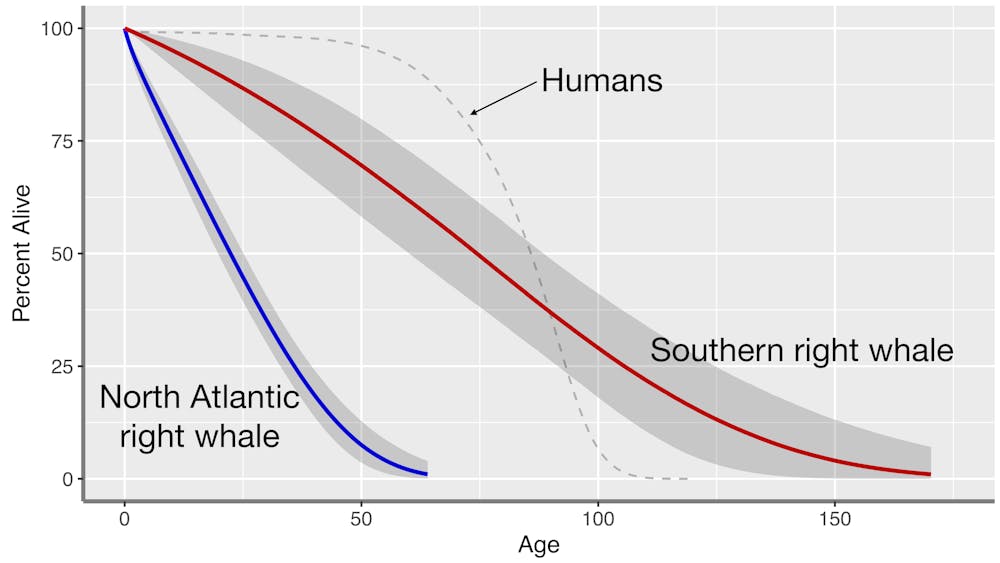
    Survivorship curves show female right whales can live to very old ages, but humans are causing North Atlantic right whales to die well short of their potential. Plotted for comparison is the U.S. survivorship curve for women as estimated by the Social Security Adminstration.
    Greg Breed

    We made these new age estimates using photo identification of individual female whales over several decades. Individual whales can be recognized year after year from photographs. When they die, they stop being photographically “resighted” and disappear. Using these photos, we developed what scientists call “survivorship curves” by estimating the probability whales would disappear from the photographic record as they aged. From these survivorship curves, we could estimate maximum potential lifespans.

    Twenty-five years ago, scientists working with Indigenous whale hunters in the Arctic showed that bowhead whales could live up to and even over 200 years. Their evidence included finding stone harpoon points that hadn’t been used since the mid-1800s embedded in the blubber of whales recently killed by traditional whalers. Analysis of proteins from the eyes of hunted whales provided further evidence of their long lifespan. Like right whales, before that analysis, researchers thought bowhead whales lived to about 80 years, and that humans were the mammals that lived the longest.

    In the years following that report, scientists tried to figure out what was unique about bowhead whales that allowed them to live so long. But our new analysis of the longevity of two close relatives of bowheads shows that other whale species also have potentially extremely long lives.

    Why it matters

    Understanding how long wild animals live has major implications for how to best protect them. Animals that have very long lifespans usually reproduce extremely slowly and can go many years between births. Baleen whales’ life history – particularly the age when females start breeding and the interval between calves – is strongly influenced by their potential lifespan. Conservation and management strategies that do not plan accordingly will have a higher chance of failure. This is especially important given the expected impacts of climate disruption.

    What still isn’t known

    There are many other large whales, including blue, fin, sei, humpback, gray and sperm whales. Like bowhead and right whales, these were also almost wiped out by whaling. Scientists currently assume they live about 80 or 90 years, but that’s what we believed about bowhead and right whales until data proved they can live much longer.

    How long can these other whale species live? Industrial whaling, which ended only in the 1960s, removed old whales from the world’s whale populations. Though many whale populations are recovering in number, there hasn’t been enough time for whales born after the end of industrial whaling to become old.

    It’s possible, even likely, that many other whale species will also prove to have long lifespans.

    Sixty years after the end of industrial whaling, today’s whale populations may still be missing their elders.
    Maxi Jonas/picture alliance via Getty Images

    What other research is being done

    Other research finds the loss of older individuals from populations is a phenomenon occurring across most large animal species. It diminishes the reproductive potential of many species. Researchers also argue this represents a real loss of culture and wisdom in animals that degrades their potential for survival in the face of changing conditions.

    What’s next

    We want to better understand how whaling affected the number of old individuals in current whale populations and predict when the number of old individuals will recover to prewhaling levels. Preliminary results suggest it may be another 100 years before whale populations truly recover, even for species whose populations now number as many as there were before whaling.

    For North Atlantic right whales, our research shows that even when the population was increasing, the management actions taken were insufficient to prevent these whales from dying far too young.

    The Research Brief is a short take on interesting academic work.

    Greg Breed received funding from The Royal Society

    Peter Corkeron headed the National Oceanic and Atmospheric Administration’s large whale research program for the northeastern US from 2011 to 2019, then led the New England Aquarium’s right whale research program through 2022.

    ref. Whales can live way longer than scientists had thought, with potential lifespans as much as double previous estimates – https://theconversation.com/whales-can-live-way-longer-than-scientists-had-thought-with-potential-lifespans-as-much-as-double-previous-estimates-245826

    MIL OSI – Global Reports

  • MIL-Evening Report: Trump has fired a major cyber security investigations body. It’s a risky move

    Source: The Conversation (Au and NZ) – By Toby Murray, Professor of Cybersecurity, School of Computing and Information Systems, The University of Melbourne

    Before the end of its first full day of operations, the new Trump administration gutted all advisory panels for the Department of Homeland Security. Among these was the well-respected Cyber Safety Review Board, or CSRB.

    While this change hasn’t received as much notice as Trump’s massive announcement about AI, it has potentially significant implications for cyber security. The CSRB is an important source of information for governments and businesses trying to protect themselves from cyber threats.

    This change also throws into doubt the board’s current activities. These include an ongoing investigation into the Salt Typhoon cyber attacks which began as early as 2022 and are still keeping cyber defenders busy, attributed to hackers in China.

    Salt Typhoon has been described as the “worst telecommunications hack” in US history. Among other activities, the hackers obtained call records data made by high-profile individuals and even the contents of phone calls and text messages. The phones of then presidential nominee Donald Trump were reportedly among those targeted.

    What does the Cyber Safety Review Board do?

    The board was established three years ago by the Biden administration. Roughly speaking, its job is the cyberspace equivalent of government air traffic investigation bodies such as the US National Transportation Safety Board, or the Australian Transport Safety Bureau.

    The CSRB investigates major cyber security incidents. Its job is to determine their causes and recommend ways government and businesses can better protect themselves, including on how to prevent similar incidents in future.

    Its members include global cyber security luminaries from industry, such as cyber executives from Google and Microsoft, and US government leaders from several departments and agencies concerned with security.

    The US CSRB has previously published three major reports. Its first covered the infamous 2021 Log4j vulnerability, described at the time as the “single biggest, most critical vulnerability ever”. (A vulnerability is a weakness in a computer system that cyber criminals can exploit.)

    The board’s most recent published investigation involved a very sophisticated hacking campaign that targeted Microsoft’s cloud email services in 2023. As a result, hackers even gained access to the emails of various US government agencies.

    Cyber security experts widely consider the CSRB as a positive thing. Late last year, Australia even committed to establish its own version, the Cyber Incident Review Board.

    At the time of writing, it’s unclear whether the CSRB will continue – perhaps with different membership – or whether its activities will cease entirely.

    Either way, the decision to fire the board’s members has significant security implications. It comes at a moment in history when cyber threats have never been more severe.

    What is Salt Typhoon?

    The CSRB has been investigating the Salt Typhoon hacking campaign. Salt Typhoon is the name Microsoft assigned to a sophisticated group of hackers believed to be operated by China’s Ministry of State Security. The ministry is somewhat like a combination of an intelligence agency and a secret police service.

    Salt Typhoon is best known for hacking into several US telecommunication companies, first reported in August 2024. In December, it came to light Salt Typhoon’s telco hacks may also have impacted countries beyond the US. American, Australian, Canadian and New Zealand authorities also jointly issued public guidance to organisations to help defend against Salt Typhoon.

    Salt Typhoon reportedly targeted prominent figures, including political leaders. The hackers’ goal appears to have been to collect intelligence, rather than cause damage.

    For example, it has been reported Salt Typhoon collected a list of all phone calls made near Washington DC, which could help them determine who was talking to whom in the US capital.

    Salt Typhoon also reportedly obtained a list of phone numbers wiretapped by the US Justice Department. This confirmed the fears of many people opposed to the government’s powers to lawfully wiretap citizens’ phones.

    It is unclear why the hackers obtained that information. Some have speculated it would identify which of their own operatives were being monitored by US law enforcement.

    To say the Salt Typhoon revelations created waves in government and cyber security circles is putting it mildly. Telecommunications are critical infrastructure, as well as highly valuable targets for intelligence collection.

    The idea that foreign spies could burrow so deeply into the communication fabric of the US was unprecedented and disturbing.

    In October 2024 the CSRB was tasked with investigating Salt Typhoon’s activities.

    An uncertain future

    With the board now fired, the future of the Salt Typhoon investigation remains unclear.

    A thorough and impartial investigation of the Salt Typhoon hacks, had it been allowed to run, was likely to have delivered highly valuable cyber security lessons. Those lessons are important for both US companies and those in Australia, which have also been the targets of Chinese intelligence collection.

    The future of the CSRB itself is now also in question. The board and its overseas equivalents serve a vital role in promoting cyber information-sharing that helps to improve best practices.

    It is imperative these bodies are staffed with a diverse collection of impartial experts, able to carry out their work free from government and corporate interference.

    It remains to be seen whether dissolving the current CSRB will be a gift to Chinese hackers (as some have claimed), or simply a speed bump in the evolution of the board.

    Toby Murray is the Director of the Defence Science Institute, which receives Commonwealth and State government funding. Toby receives research funding from the Australian government and has previously received funding from the US Department of Defense, Facebook and Google.

    ref. Trump has fired a major cyber security investigations body. It’s a risky move – https://theconversation.com/trump-has-fired-a-major-cyber-security-investigations-body-its-a-risky-move-248106

    MIL OSI AnalysisEveningReport.nz

  • MIL-Evening Report: China has invested billions in ports around the world. This is why the West is so concerned

    Source: The Conversation (Au and NZ) – By Claudio Bozzi, Lecturer in Law, Deakin University

    Shutterstock

    On his way to the G20 summit in Rio de Janeiro in November, Chinese President Xi Jinping met with Peruvian President Dina Boluarte to officially open a new US$3.6 billion (A$5.8 billion) deepwater mega-port in Peru called Chancay.

    China’s state-owned Cosco shipping giant had purchased a 60% stake in the port for US$1.6 billion (A$2.6 billion), which gave the company exclusive use of the port for 60 years.

    Days later, the first ship departed for Shanghai loaded with blueberries, avocados and minerals.

    Chancay is part of China’s vision of a 21st century maritime Silk Road that will better connect China’s manufacturing hubs with its trading partners around the world. This has involved a heavy investment in ports in many countries, which has the West concerned about China’s expanding influence over global shipping routes.

    Newly re-elected US President Donald Trump made clear these concerns when he claimed China was “operating” the Panama Canal and the US intended to take it back.

    China does not operate the canal, though. Rather, a Hong Kong company operates two ports on either side of it.

    A booming port expansion

    The scale and scope of the maritime Silk Road is impressive. China has invested in 129 ports in dozens of countries through its state-owned enterprises, mostly in the Global South. Seventeen of these ports have majority-Chinese ownership.

    According to one estimate, Chinese companies invested US$11 billion (A$17.7 billion) in overseas port development from 2010–19. More than 27% of global container trade now passes through terminals where leading Chinese firms hold direct stakes.

    China has entered Latin America aggressively, becoming the region’s top trading partner. Its port strategy has clearly signalled a long-term goal to access the exports essential to its food and energy security: soybeans, corn, beef, iron ore, copper and battery-grade lithium.

    Last year, for example, Portos do Paraná, the Brazilian state-owned enterprise that acts as the port authority in the state of Paraná, signed a letter of intent with China Merchants Port Holdings to expand Paranaguá Container Terminal, the second-largest terminal in South America. China may invest in even more Brazilian ports, as 22 terminals are scheduled to be auctioned before the end of 2025.

    In Africa, Chinese investment grew from two ports in 2000 to 61 facilities in 30 countries by 2022.

    And in Europe, Chinese enterprises have complete or majority ownership of two key ports in Belgium and Greece – the so-called “dragon’s head” of the Belt and Road Initiative in Europe.

    What’s driving this port strategy?

    China’s emergence as a maritime and shipping power is central to Xi’s ambition for global economic dominance.

    For one, China requires stable access to key trading routes to continue meeting the demand for Chinese exports globally, as well as the imports Beijing needs to keep its economy humming.

    Controlling ports also enables China to create economic zones in other countries that give port owners and operators privileged access to commodities and products. Some fear this could allow China to disrupt supplies of certain goods or even exert influence over other countries’ politics or economies.

    Another key driver of this strategy is the metals and minerals needed to fuel China’s rise as a tech superpower. Beijing has concentrated its port investment in regions where these critical resources are located.

    For example, China is the world’s largest importer of copper ore, mainly from Chile, Peru and Mexico. It is also one of the world’s major lithium carbonate importers.), mainly from Chile and Argentina. And its port deals in Africa give it access to rare earths and other minerals.

    In addition, tapping into Latin America counteracts the trade tensions China has experienced recently with Europe. It also preempts concerns about possible US tariffs imposed on Chinese goods by Trump.

    Military concerns

    These moves have prompted concern in Washington that China is challenging US influence in its own backyard.

    China maintains that its seaport diplomacy is market oriented. However, it has established one naval base in the strategically located African nation of Djibouti. And it is believed to be building another naval base in Equatorial Guinea.

    According to a recent report by the Asia Society Policy Institute, strategy analysts believe China is seeking to “weaponise” the Belt and Road Initiative.

    One way it is doing this is by requiring the commercial ports it invests in to be equally capable of acting as naval bases. So far, 14 of the 17 ports in which it has a majority stake have the potential to be used for naval purposes. These ports can then serve a dual function and support the Chinese military’s logistics network and allow Chinese naval vessels to operate further away from home.

    US officials are also concerned China could leverage its influence over private companies to disrupt trade during a time of war.

    How is the West responding?

    While China’s investments are raising suspicions, the West’s willingness to invest in ports at this scale is limited. The US International Development Finance Corporation, for instance, has a much slower, rigorous process for its investments, which generally leads to fairer outcomes for both investors and host nations.

    However, some Western companies are acquiring stakes in established and newly built ports in other countries, albeit not to the extent of Chinese enterprises.

    The French shipping and logistics company CMA CGM’s global port development strategy, for example, includes investments in 60 terminals worldwide. In 2024, it acquired control over South America’s largest container terminal in the Port of Santos, Brazil.

    Trump has threatened tariffs as one way of countering China’s global sea power. An advisor on his transition team has proposed a 60% tariff on any product transiting through the Chancay port in Peru or any other Chinese-owned or controlled port in South America.

    Rather than making nations reluctant to sign port deals with Beijing, however, this kind of action just erodes Washington’s regional influence. And China is likely to take retaliatory measures, like banning the export of critical minerals to the US.

    Host nations like Peru and Brazil, meanwhile, are using the competition for port investment to their advantage. Attracting interest from both the West and China, they are increasingly asserting their autonomy and adopting a strategy of using ports to “play everywhere” on the global stage.

    Claudio Bozzi does not work for, consult, own shares in or receive funding from any company or organisation that would benefit from this article, and has disclosed no relevant affiliations beyond their academic appointment.

    ref. China has invested billions in ports around the world. This is why the West is so concerned – https://theconversation.com/china-has-invested-billions-in-ports-around-the-world-this-is-why-the-west-is-so-concerned-244733

    MIL OSI AnalysisEveningReport.nz

  • MIL-Evening Report: Luxon goes all out for growth in mining and tourism – we should be careful what he wishes for

    Source: The Conversation (Au and NZ) – By Glenn Banks, Professor of Geography, School of People, Environment and Planning, Te Kunenga ki Pūrehuroa – Massey University

    Getty Images

    Prime Minister Christopher Luxon’s state-of-the-nation address yesterday focused on growth above all else. We shouldn’t rush to judgement, but at least one prominent financial commentator has concluded the maths behind the goals “just doesn’t add up”.

    Luxon specified mining and tourism among a number of sectors where the government was anticipating and facilitating growth. Having researched these sectors across the Pacific and Aotearoa New Zealand for more than 30 years, we would echo a cautionary approach.

    There is certainly scope for more activity in both sectors. But there also needs to be a dose of realism about what they can deliver, and recognition of the significant risks associated with focusing solely on growth.

    NZ is not Australia

    Luxon wants to see mining “play a much bigger role in the New Zealand economy”, comparing the local sector with the “much higher incomes” generated in places such as Australia. If we wanted these, he suggested, we need to be aware it is “mining that pays” them.

    But it is simplistic to compare domestic mining’s potential to the industry in Australia, which exports more than 400 times as much mineral wealth as New Zealand.

    In addition, mineral wealth does not necessarily translate into significant increases in local or even national wealth. This is especially relevant when the local sector is dependent on foreign investment, high levels of imports and offshore expertise for construction and operations, highly volatile commodity prices and generous taxation regimes.

    Luxon cited Taranaki and the West Coast as potential areas where mining could deliver “higher incomes, support for local business and families, and more investment in local infrastructure”.

    This echoes Regional Development Minister Shane Jones’ linking of mining and regional development. But it flies in the face of historical trends and empirical evidence.

    The West Coast has seen the longest continuous presence of large- and small-scale gold and coal mining (for well over a century). And yet the region consistently scores among the worst for socioeconomic deprivation. Mining itself does not create regional development.

    The ‘critical minerals’ cloak

    The prime minister also gave a nod to the minerals “critical for our climate transition”.

    While it’s true that “EVs, solar panels and data centres aren’t made out of thin air”, they are also not made in any significant way with the minerals we currently or might potentially mine (aside from some antimony, possibly).

    The “critical minerals” argument risks being a cloak for justifying more mining of coal and gold.

    So, even leaving aside the very real (though unacknowledged by Luxon) environmental risks, mining will not be the panacea the government suggests, and certainly not in the short term.

    New Zealand does need mining, of course. Aggregates for roads and construction are the most obvious “critical mineral”. But the country also deserves a 21st-century sector that is environmentally responsible and transparent, and which generates real returns for communities and the national economy.

    The tourist trap

    Echoing Finance Minister Nicola Willis’ speech earlier in the week, Luxon also said “tourism has a massive role to play in our growth story”.

    Willis said, “We want all tourists.” But this broad focus on high-volume tourism goes against international best practice in tourism development.

    The negative impacts of a high-growth tourism model have been well documented in New Zealand. The Parliamentary Commissioner for the Environment’s 2019 report – titled “Pristine, popular … imperilled?” – warned of the environmental damage that would be caused by pursuing this approach.

    Mayors and tourism industry officials have responded to the Willis and Luxon speeches this week by expressing concern that boosting tourism numbers will only work if there is more government funding.

    This is needed to manage growth and provide infrastructure, particularly in areas with low numbers of ratepayers. The need stretches from providing public toilets for busloads of tourists flowing through MacKenzie District, to maintaining popular tracks such as the West Coast Wilderness Trail.

    A 2024 report from Tourism New Zealand showed 68% of residents experienced negative impacts from tourism, including increased traffic congestion and rubbish.

    Further expansion could see tourism losing its social licence – a dire outcome when international tourists particularly value the “warm and welcoming” nature of locals.

    High value vs high volume

    Luxon and Willis point to major employment wins from tourism growth. But tourism is notorious for creating low-income, insecure jobs. This is not the basis for strong and sustainable economic development.

    While we agree with Luxon that our tourism industry is “world class”, we risk seriously damaging that reputation if we compromise the quality of experience for visitors.

    Post-COVID, there have been significant efforts by the tourism industry to support and implement a regenerative approach. This aligns with a high-value – or “high values” – approach, rather than being fixated on high volume.

    We are not arguing against mining or tourism per se. Rather, we are sounding a caution: they are sectors that need careful assessment and regulation, and reputable operators, to deliver sustainable and equitable growth, regionally and nationally.

    Simply generating profits for foreign investors and leaving local communities to deal with the costs cannot be a sustainable model.

    The authors do not work for, consult, own shares in or receive funding from any company or organisation that would benefit from this article, and have disclosed no relevant affiliations beyond their academic appointment.

    ref. Luxon goes all out for growth in mining and tourism – we should be careful what he wishes for – https://theconversation.com/luxon-goes-all-out-for-growth-in-mining-and-tourism-we-should-be-careful-what-he-wishes-for-248131

    MIL OSI AnalysisEveningReport.nz

  • MIL-Evening Report: Trump has called time on working from home. Here’s why the world shouldn’t mindlessly follow

    Source: The Conversation (Au and NZ) – By Julia Richardson, Professor of Human Resource Management, Head of School of Management, Curtin University

    Gorodenkoff/Shutterstock

    US President Donald Trump has called time on working from home. An executive order signed on the first day of his presidency this week requires all federal government departments and agencies to:

    take all necessary steps to terminate remote work arrangements and require employees to return to work in-person.

    There are a few different models of working from home. Strictly speaking, remote work is where employees work from an alternative location (typically their home) on a permanent basis and are not required to report to their office.

    This is distinct from “telework”, a hybrid model whereby employees work from home an agreed number of days each week. But it’s clear Trump wants to end telework too.

    Under guidelines released on Wednesday, federal agencies were given until 5pm local time on 24 January to update their telework policies to require all employees back in the office full-time within 30 days.

    Obviously, Trump can’t end working from home for everyone. Private organisations are allowed to set their own policies. But the US government is a seriously big employer, with more than 3 million employees.

    According to the American Federation of Government Employees (AFGE), about 10% of federal workers are fully remote. The impact of this order will be far-reaching.

    Trump abruptly pulls the rug

    The work-from-home movement was a profound global shift, brought on by the COVID pandemic. We’ve been living with it for five years.

    Federal workers who have been working remotely for an extended period are likely to have made significant life decisions based on their flexible working arrangements.

    Flexible working arrangements have been mainstream for years, influencing key life decisions for many people.
    Monkey Business Images/Shutterstock

    It may have influenced where they bought a house, what school their children attend, and what their spouse or partner does for work.

    Trump’s order is likely to have a dramatic ripple effect on workers’ families and other life arrangements and responsibilities.

    True, federal heads of department and managers and supervisors will be allowed to make some exceptions – including for a disability, medical condition or other “compelling reason”.

    But the message is clear. What has been a growing but informal trend among some employers worldwide to “bring employees back into the office” is now being incorporated into US government policy.

    Why the backlash?

    Trump’s executive order reflects longstanding concerns among some employers and managers who think it is simply better to have employees in the office.

    They argue, among other things, that in-office work makes it easier to keep a close eye on performance, and supports more face-to-face collaboration. It also makes better use of often very expensive real estate.

    Amazon recently ordered all of its staff back into the office five days a week. Other surveys suggest many employers are planning a crackdown this year.

    City planners and businesses have also lamented the impact of remote and flexible working on restaurants, dry cleaners and coffee shops that rely on trade from commuters.

    What might be lost?

    Some employees may actually welcome the return to the office, particularly those who prefer more social interaction and want to make themselves more visible.

    Visibility is often linked with more promotion and career development opportunities.

    Others will find the change jarring, and may lose a range of benefits they’ve grown used to.

    A 2023 report by policy think tank EconPol Europe found working from home had become most prevalent in English-speaking countries.

    It suggested strong support, saying:

    the majority of workers highly value the opportunity to work from home for a portion of their work week, with some placing significant importance on it.

    Many also wanted to work more days from home than their employers were willing to allow.

    A recent analysis by the Committee for Economic Development of Australia (CEDA) found that working from home had significantly increased workforce participation for two key groups: working mums and people with a disability or health condition.

    Many employees now prioritise flexible work arrangements, and some are willing to sacrifice part of their salary for the privilege.

    Work-from-home arrangements also offer individuals living in remote communities access to employment. That benefit goes two ways, allowing employers to tap into a bigger talent pool.

    Will Australia follow?

    Trump’s executive order could have big, immediate impacts on federal workers in the US, but it’s unclear whether there’ll be domino effects here. It would be unwise for the Australian government or major employers to adopt a blanket approach.

    Indeed, some multinational US firms with offices in Australia may get caught up in Trump’s return-to-office movement.

    In the short term, this forced change is unlikely to make its way to Australia. While social trends do travel between regions, each country has its own employment laws, customs and trends.

    Researchers have shown it can be difficult, and in some cases impossible, to transfer human resource practices between countries
    and across cultures.

    Australia’s geography may be a factor on remote work’s side. A complete ban would immediately have a negative impact on employment opportunities for talented workers in the regions.

    The key message for Australian employers and policy-makers is that the benefits of remote work aren’t just for employees.

    It can enhance an organisation’s performance, widening the talent pool to include not only those who live far away from the office, but also talented workers who may otherwise be excluded.

    Julia Richardson does not work for, consult, own shares in or receive funding from any company or organisation that would benefit from this article, and has disclosed no relevant affiliations beyond their academic appointment.

    ref. Trump has called time on working from home. Here’s why the world shouldn’t mindlessly follow – https://theconversation.com/trump-has-called-time-on-working-from-home-heres-why-the-world-shouldnt-mindlessly-follow-248036

    MIL OSI AnalysisEveningReport.nz

  • MIL-OSI Global: DRC has created a reserve force to fight the M23 – why this may backfire

    Source: The Conversation – Africa – By Judith Verweijen, Assistant professor, Utrecht University

    After nearly three decades of warfare, armed conflict in the eastern Democratic Republic of Congo (DRC) seems only to intensify. The Rwanda-backed M23 rebellion has been at the centre of attention in recent years. However, eastern DRC is home to more than 100 other armed groups, which are a major source of instability too. The question of their demobilisation has haunted the country ever since the end of the Second Congo War in 2003.

    A new chapter in this long-standing conundrum seems to have started. In 2022, the government decided to form an alliance with armed groups to fight their common enemy, the M23 and its Rwandan backers. At around the same time, it launched an initiative to create an army reserve, known as the Reserve armée de la défense (RAD). This formalised the Congolese army’s established practice of using armed groups as auxiliaries.

    The creation of the reserve army allows the government to reward armed group allies with integration while bringing them under institutionalised control. But will this actually work?

    Our past and ongoing research on army integration and demobilisation in eastern DRC casts doubt on the plan, for three reasons.

    The first risk is that armed groups will boost their numbers to gain a stronger bargaining position once integration does occur.

    Secondly, reservist forces may compete with the army over territorial control and limited resources and turn against those who created them.

    Finally, merely absorbing armed groups into a reserve force does little to address the long-standing grievances that underlie conflict in the east.

    The Wazalendo: eastern DRC’s predatory patriots

    On 9 May 2022, in a secretive meeting in the town of Pinga in North Kivu, the Congolese armed forces and several Congolese armed groups agreed to cease hostilities against each other and instead form an alliance to fight their common enemy, the M23.

    As a result, these groups became quasi-official and increasingly presented themselves as defenders of Congo’s territorial integrity. They started to call themselves Wazalendo or patriots in Kiswahili. Fuelled by President Félix Tshisekedi’s supportive rhetoric, the Wazalendo became symbols of Congolese resistance against foreign aggression. This benefited the president’s 2023 electoral campaign.

    Across North and South Kivu provinces, armed groups have rebranded themselves Wazalendo, even when not part of the coalition fighting the M23.

    As the Congolese army’s attention is on the M23, these armed groups have benefited from the lull in operations against them. Most Wazalendo groups are allowed to roam around freely and have dramatically expanded their zones of influence and violent systems of revenue generation.

    This includes taxation at markets and rapidly proliferating roadblocks, but also ransom kidnappings and contract killings. There is also evidence that Wazalendo groups are engaged in torture, sexual violence and arbitrary arrests, and frequently recruit child soldiers.

    Chequered history of integration

    A few months after the Pinga meeting, Congo’s government launched a new national defence policy that mentioned the establishment of the reserve army. Though it was passed unanimously in parliament in April 2023, MPs voiced concerns that the new army reserve risked repeating mistakes of the past.

    The army is itself the product of the painstaking integration of former belligerents after the Second Congo War (1998-2003). But rebel-military integration became an open-ended process. Armed group officers alternately integrated into and deserted from the army in the hope of gaining higher ranks and positions in a next round of integration.

    Unending rebel integration also weakened the national army. It reinforced parallel command chains, facilitated intelligence leaks and created a lopsided hierarchy.

    The first iteration of the M23 rebellion in 2012 was the result of rebel integration gone wrong. In its aftermath, the Congolese government banned the wholesale negotiated integration of armed groups into the army.

    Hurdles to integration

    The reserve army risks unleashing the same dynamics of rewarding rebellion by doling out positions to armed group leaders and granting them impunity for past violence. In April 2024, the leaders of many Wazalendo groups were flown to Kinshasa where the army reserve leadership told them to start preparing lists of their combatants ahead of their integration.

    This has prompted numerous armed groups to step up recruitment.

    The prospect of integration has also triggered fierce competition for positions between Wazalendo commanders. This risks worsening animosities between groups.

    Other hurdles, some of which have been faced before, include:

    Unity of command. Forcing smaller armed groups into a hierarchical mould doesn’t always work. Most have deep local roots, with their recruitment and influence limited to a relatively small area. Used to calling the shots in their home areas, these commanders tend to be reluctant to take orders from higher-placed outsiders.

    Ethnic competition. Armed groups may resist full integration if they feel their rank and positions in the reserve army will be lower and that this will hamper their ability to protect members of their ethnic community. Such “local security dilemmas” have obstructed army integration and demobilisation efforts in the past.

    Resources. Armed groups currently enjoy substantial income, and considerable freedom in obtaining it. Will the reserve army command allow its members to engage in illegal taxation, kidnapping for ransom, robbery and ambushes? If not, how will it compensate for their lost opportunities? In addition, the reserve army is likely to compete with the army over revenue-generating opportunities. And some of its members may leak intelligence to fellow armed groups.

    Painkiller or cure?

    The army reserve may be read as the latest attempt at solving the decades-old problem of getting rid of the many armed groups in eastern DRC, this time by bringing them into the fold of the state yet not into the army.

    However, this solution does risk unleashing many of the same detrimental dynamics as army integration. It may fuel armed mobilisation and militarisation rather than contain it.

    Wazalendo groups are currently in a comfortable position and there are no repercussions for not integrating the reserve force. To contain them, both the DRC’s army and the military justice system would need to be professionalised.

    Even if the reserve army did not have negative ripple effects, it would be an unlikely cure for armed mobilisation. That requires comprehensive, bottom-up peace efforts that tackle deep-seated grievances related to past violence and conflict over belonging, territory and local authority. Barring such efforts, the reserve force will remain a painkiller at best.

    Michel Thill is a Senior Program Officer for swisspeace, a Basel University affiliated practice and research institute dedicated to advancing effective peacebuilding. swisspeace receives funding from research funding bodies, and bilateral and multilateral organizations. Michel is also a Fellow of the Rift Valley Institute.

    Judith Verweijen does not work for, consult, own shares in or receive funding from any company or organisation that would benefit from this article, and has disclosed no relevant affiliations beyond their academic appointment.

    ref. DRC has created a reserve force to fight the M23 – why this may backfire – https://theconversation.com/drc-has-created-a-reserve-force-to-fight-the-m23-why-this-may-backfire-247476

    MIL OSI – Global Reports

  • MIL-OSI Global: DRC creates a reserve force to fight the M23 – why this may backfire

    Source: The Conversation – Africa – By Judith Verweijen, Assistant professor, Utrecht University

    After nearly three decades of warfare, armed conflict in the eastern Democratic Republic of Congo (DRC) seems only to intensify. The Rwanda-backed M23 rebellion has been at the centre of attention in recent years. However, eastern DRC is home to more than 100 other armed groups, which are a major source of instability too. The question of their demobilisation has haunted the country ever since the end of the Second Congo War in 2003.

    A new chapter in this long-standing conundrum seems to have started. In 2022, the government decided to form an alliance with armed groups to fight their common enemy, the M23 and its Rwandan backers. At around the same time, it launched an initiative to create an army reserve, known as the Reserve armée de la défense (RAD). This formalised the Congolese army’s established practice of using armed groups as auxiliaries.

    The creation of the reserve army allows the government to reward armed group allies with integration while bringing them under institutionalised control. But will this actually work?

    Our past and ongoing research on army integration and demobilisation in eastern DRC casts doubt on the plan, for three reasons.

    The first risk is that armed groups will boost their numbers to gain a stronger bargaining position once integration does occur.

    Secondly, reservist forces may compete with the army over territorial control and limited resources and turn against those who created them.

    Finally, merely absorbing armed groups into a reserve force does little to address the long-standing grievances that underlie conflict in the east.

    The Wazalendo: eastern DRC’s predatory patriots

    On 9 May 2022, in a secretive meeting in the town of Pinga in North Kivu, the Congolese armed forces and several Congolese armed groups agreed to cease hostilities against each other and instead form an alliance to fight their common enemy, the M23.

    As a result, these groups became quasi-official and increasingly presented themselves as defenders of Congo’s territorial integrity. They started to call themselves Wazalendo or patriots in Kiswahili. Fuelled by President Félix Tshisekedi’s supportive rhetoric, the Wazalendo became symbols of Congolese resistance against foreign aggression. This benefited the president’s 2023 electoral campaign.

    Across North and South Kivu provinces, armed groups have rebranded themselves Wazalendo, even when not part of the coalition fighting the M23.

    As the Congolese army’s attention is on the M23, these armed groups have benefited from the lull in operations against them. Most Wazalendo groups are allowed to roam around freely and have dramatically expanded their zones of influence and violent systems of revenue generation.

    This includes taxation at markets and rapidly proliferating roadblocks, but also ransom kidnappings and contract killings. There is also evidence that Wazalendo groups are engaged in torture, sexual violence and arbitrary arrests, and frequently recruit child soldiers.

    Chequered history of integration

    A few months after the Pinga meeting, Congo’s government launched a new national defence policy that mentioned the establishment of the reserve army. Though it was passed unanimously in parliament in April 2023, MPs voiced concerns that the new army reserve risked repeating mistakes of the past.

    The army is itself the product of the painstaking integration of former belligerents after the Second Congo War (1998-2003). But rebel-military integration became an open-ended process. Armed group officers alternately integrated into and deserted from the army in the hope of gaining higher ranks and positions in a next round of integration.

    Unending rebel integration also weakened the national army. It reinforced parallel command chains, facilitated intelligence leaks and created a lopsided hierarchy.

    The first iteration of the M23 rebellion in 2012 was the result of rebel integration gone wrong. In its aftermath, the Congolese government banned the wholesale negotiated integration of armed groups into the army.

    Hurdles to integration

    The reserve army risks unleashing the same dynamics of rewarding rebellion by doling out positions to armed group leaders and granting them impunity for past violence. In April 2024, the leaders of many Wazalendo groups were flown to Kinshasa where the army reserve leadership told them to start preparing lists of their combatants ahead of their integration.

    This has prompted numerous armed groups to step up recruitment.

    The prospect of integration has also triggered fierce competition for positions between Wazalendo commanders. This risks worsening animosities between groups.

    Other hurdles, some of which have been faced before, include:

    Unity of command. Forcing smaller armed groups into a hierarchical mould doesn’t always work. Most have deep local roots, with their recruitment and influence limited to a relatively small area. Used to calling the shots in their home areas, these commanders tend to be reluctant to take orders from higher-placed outsiders.

    Ethnic competition. Armed groups may resist full integration if they feel their rank and positions in the reserve army will be lower and that this will hamper their ability to protect members of their ethnic community. Such “local security dilemmas” have obstructed army integration and demobilisation efforts in the past.

    Resources. Armed groups currently enjoy substantial income, and considerable freedom in obtaining it. Will the reserve army command allow its members to engage in illegal taxation, kidnapping for ransom, robbery and ambushes? If not, how will it compensate for their lost opportunities? In addition, the reserve army is likely to compete with the army over revenue-generating opportunities. And some of its members may leak intelligence to fellow armed groups.

    Painkiller or cure?

    The army reserve may be read as the latest attempt at solving the decades-old problem of getting rid of the many armed groups in eastern DRC, this time by bringing them into the fold of the state yet not into the army.

    However, this solution does risk unleashing many of the same detrimental dynamics as army integration. It may fuel armed mobilisation and militarisation rather than contain it.

    Wazalendo groups are currently in a comfortable position and there are no repercussions for not integrating the reserve force. To contain them, both the DRC’s army and the military justice system would need to be professionalised.

    Even if the reserve army did not have negative ripple effects, it would be an unlikely cure for armed mobilisation. That requires comprehensive, bottom-up peace efforts that tackle deep-seated grievances related to past violence and conflict over belonging, territory and local authority. Barring such efforts, the reserve force will remain a painkiller at best.

    Michel Thill is a Senior Program Officer for swisspeace, a Basel University affiliated practice and research institute dedicated to advancing effective peacebuilding. swisspeace receives funding from research funding bodies, and bilateral and multilateral organizations. Michel is also a Fellow of the Rift Valley Institute.

    Judith Verweijen does not work for, consult, own shares in or receive funding from any company or organisation that would benefit from this article, and has disclosed no relevant affiliations beyond their academic appointment.

    ref. DRC creates a reserve force to fight the M23 – why this may backfire – https://theconversation.com/drc-creates-a-reserve-force-to-fight-the-m23-why-this-may-backfire-247476

    MIL OSI – Global Reports

  • MIL-Evening Report: Albanese records worst Newspoll ratings this term; Victorian Labor’s primary plunges

    Source: The Conversation (Au and NZ) – By Adrian Beaumont, Election Analyst (Psephologist) at The Conversation; and Honorary Associate, School of Mathematics and Statistics, The University of Melbourne

    A national Newspoll, conducted January 20–24 from a sample of 1,259, gave the Coalition a 51–49 lead, a one-point gain for the Coalition since the previous Newspoll in early December. Primary votes were 39% Coalition (steady), 31% Labor (down two), 12% Greens (up one), 7% One Nation (steady) and 11% for all Others (up one).

    In three of the last four Newspolls, the Coalition has had a 51–49 lead. This is the consensus of the polls at the moment, as can be seen from the graph below. The federal election is not due until May, and this position is recoverable for Labor, but they would probably lose now. I had more comments on this last Thursday.

    The worst news from Newspoll for Labor was Anthony Albanese’s ratings, which slumped six points since December to a term-low net approval of -20, with 57% dissatisfied and 37% satisfied.

    Peter Dutton’s net approval increased one point to -11. Albanese led Dutton by 44–41 as better PM (45–38 in December). This three-point margin for Albanese is a term low.

    The graph below shows Albanese’s Newspoll ratings this term. The individual polls are marked with plus signs and a smoothed line has been fitted.

    There have been five polls in January of leaders’ ratings from Freshwater, YouGov, Resolve, Essential and Newspoll. On average, Albanese is at -15 net approval and Dutton at -3.2. If not for a net zero approval from Essential, Albanese’s ratings would be worse.

    Additional Resolve questions

    I previously covered the mid-January Resolve poll for Nine newspapers that gave Dutton a 39–34 preferred PM lead over Albanese. In additional questions, by 61–24, voters supported keeping Australia’s national day on January 26 over changing to another date (47–39 in January 2023).

    The thumping defeat of the October 2023 Voice referendum has damaged the push to change the date. By 52–24, voters supported legislating so that January 26 is enshrined in law as Australia’s national day.

    By 54–9, respondents thought there had been more antisemitism over more Islamophobia in recent months (32–14 in October). By 51–24, they thought the conflict in the Middle East had made Australia a less safe place (45–26 in October).

    Victorian Resolve poll: Labor’s primary plunges to 22%

    A Victorian state Resolve poll
    for The Age, conducted with the federal December and January Resolve polls from a sample of over 1,000, gave the Coalition 42% of the primary vote (up four since November), Labor 22% (down six), the Greens 13% (steady), independents 17% (up three) and others 6% (down one).

    Resolve doesn’t usually give a two-party estimate, but The Age’s article said that on 2022 election preference flows, the Coalition would have a 55.5–44.5 lead. Independents would be unlikely to get 17% at an election, but they are on the readout everywhere in Resolve polls until after nominations close.

    In late December, Brad Battin was elected Liberal leader in a party room vote, replacing John Pesutto. From just the January sample, Battin led Labor incumbent Jacinta Allan as preferred premier by 36–27 (30–29 to Pesutto in November).

    Victorian Labor’s unpopularity is hurting federal Labor in Victoria. The Poll Bludger’s BludgerTrack has a 5.3% swing against Labor in Victoria, with swings in the other mainland states at 2% or less.

    By the November 2026 election, Labor will have governed in Victoria for 12 successive years and for 23 of the 27 years since 1999. An “it’s time” factor is probably contributing to Labor’s woes.

    State byelections will occur on February 8 in Labor-held Werribee and Greens-held Prahran. At the 2022 election, Labor won Werribee by a 60.9–39.1 margin against the Liberals, while the Greens won Prahran by 62.0–38.0 against the Liberals.

    In Prahran, which Labor is not contesting, Tony Lupton, who was the Labor MP from 2002 to 2010, is running as an independent. The Liberals and Lupton will swap preferences on their how to vote material. Voters can choose their own preferences instead of following their candidate’s recommendations, but many will follow those recommendations.

    Germany and Canada

    I covered German and Canadian electoral developments for The Poll Bludger on Saturday. The German federal election is in about four weeks, on February 23. Polls are bleak for the left, with big gains likely for the far-right AfD.

    Justin Trudeau announced he would resign as Canadian Liberal leader and PM on January 6 once a new Liberal leader had been elected, which will occur on March 9. The Conservatives had a big lead in last Monday’s update to the CBC Poll Tracker, but there’s a new poll that gives the Conservatives just a 3.8-point lead. Trudeau promised to reform Canada’s electoral system before he won the October 2015 election, but did nothing.

    Adrian Beaumont does not work for, consult, own shares in or receive funding from any company or organisation that would benefit from this article, and has disclosed no relevant affiliations beyond their academic appointment.

    ref. Albanese records worst Newspoll ratings this term; Victorian Labor’s primary plunges – https://theconversation.com/albanese-records-worst-newspoll-ratings-this-term-victorian-labors-primary-plunges-248222

    MIL OSI AnalysisEveningReport.nz

  • MIL-Evening Report: Breaking up the band: why solo artists have come to dominate the music charts

    Source: The Conversation (Au and NZ) – By Sam Whiting, Vice-Chancellor’s Senior Research Fellow, RMIT University

    Shutterstock

    Predictions for this year’s Hottest 100 countdown revealed an interesting trend that has come to dominate popular music over the past decade: the prevalence of solo artists over bands.

    In the past 15 years, only five winners of the Hottest 100 were bands, compared to 13 in the 15 years prior to that. This shift is being replicated across charts globally.

    And it’s not just rock bands that are losing out, but bands of all sorts, including pop groups (with the considerable exception of K-pop).

    The rise of solo artists doesn’t signify some sort of embrace of a hyper-individual idol culture, nor should we nostalgically lament a mythical “golden era of bands”. Solo artists have always been pervasive within popular music. Also, most bands are driven by one or two key songwriters, and often fronted by a charismatic individual.

    The trend towards solo artists is less a product of culture, and more a result of the creative and economic realities of pop music’s production, consumption, distribution and marketing.

    Doja Cat took out the top spot in the 2023 Triple J Hottest 100.

    Doing more with less

    With the emergence of digital audio workstations, home studio technologies, and the widespread availability of video tutorials, musicians and songwriters no longer need costly rehearsal rooms and recording studios to produce new music.

    They can record demos and workshop material with less players in the room, or in many cases with no room at all – as a large bulk of the work is done digitally.

    This has made writing and producing music cheaper, easier and more efficient. What previously might have required a whole band can now be done by a single artist with the help of a producer and some session musicians.

    More revenue between less people

    It’s no secret musicians are doing it tough in the streaming era. Many receive limited income from recorded music, and are pushed to depend heavily on touring and merchandise.

    Why then, would creatives want to increase their costs by bringing in more mouths to feed? Whether you’re a band or a solo artist, touring can come with financial risk and even major financial loss.

    Solo artists retain the lion’s share of whatever profits are made. Rather than negotiating tricky revenue-sharing agreements between members, they can hire session and contract musicians as needed for recording and touring, keeping costs down and side-stepping ownership issues that might lead to tension in a band.

    Such arrangements also make it easier to market the artist and music itself.

    The artist as a brand

    Creating a successful brand as a musician is more effective when working with one or two key identities, rather than a collective such as a band.

    Even popular K-pop groups – which stand as an exception to the trend towards solo acts – emphasise individual members, marketing each one to a different part of their fan-base.

    Likewise, many bands are strongly identified with a charismatic front-person, who tends to double as an artistic spokesperson.

    It’s easier to curate an artistic and aesthetic vision around one individual, rather than several. This also helps streamline marketing activities, as well as touring and media engagements.

    Bands break up

    It’s a harsh reality that bands break up.

    Bands can break up for many reasons, but no doubt the strain of touring plays a major role. With an increased prevalence of mental health issues among international touring musicians, as well as power imbalances and exploitative labour practices entrenched in the live music sector – touring can take a toll on many bands.

    In the years since the COVID pandemic, more and more artists have cancelled tours, citing exhaustion and burnout. Solo artists only have to make this decision for themselves (although it effects their touring crew), whereas bands have to negotiate such crucial decisions collectively.

    Despite good intentions and industry success, having to maintain creative and business relationships with the same group of people often becomes unsustainable.

    Solo artists have a clearer separation between their creative, business and personal relationships. They can maintain a business model that doesn’t necessarily rely on the consistent commitment of three, four or five people.

    Then again, this commitment is possibly the very thing that makes bands such an intriguing artistic phenemonen: a group of individuals working together to create something greater than the sum of their parts.

    Such demonstrations of collective creative alchemy might be the reason bands continue to captivate our attention, despite the atomising creative and economic realities of the modern music industry.


    Read more:
    This K-pop band just made US Billboard history. Here’s how Stray Kids conquered the music world


    Sam Whiting receives funding from RMIT University and the Winston Churchill Trust.

    ref. Breaking up the band: why solo artists have come to dominate the music charts – https://theconversation.com/breaking-up-the-band-why-solo-artists-have-come-to-dominate-the-music-charts-248123

    MIL OSI AnalysisEveningReport.nz

  • MIL-Evening Report: The ‘singles tax’ means you often pay more for going it alone. Here’s how it works

    Source: The Conversation (Au and NZ) – By Alicia Bubb, Research & Teaching Sessional Academic, RMIT University

    lightman_pic/Shutterstock

    Heard of the “singles tax”? Going it alone can also come with a hidden financial burden you may not be aware of.

    Obviously, this isn’t an official levy paid to anyone in particular. It simply refers to the higher costs single people face compared to couples or families.

    Single-person households have been on the rise in Australia. It’s projected they’ll account for up to 28% of all households in 2046.

    People are marrying later, divorce rates remain high and an ageing population means more people live alone in older age. Many people also make a conscious decision to remain single, seeing it as a sign of independence and empowerment.

    This is part of a global trend, with singledom increasing in Europe, North America and Asia.

    So, how does the singles tax work – and is it worse for some groups than others? What, if anything, can we do about it?

    Why does being single cost more?

    One of the biggest drivers of the singles tax is the inability to split important everyday costs. For example, a single person renting a one-bedroom apartment has to bear the full cost, while a couple sharing it can split the rent.

    Being single can mean not being being able to split living costs like groceries.
    Gorodenkoff/Shutterstock

    Singles often miss out on the savings from bulk grocery purchases, as larger households consume more and can take better advantage of these deals.

    Fixed costs for a house like electricity, water and internet bills often don’t increase by much when you add an extra user or two. Living alone means you pay more.

    These are all examples of how couples benefit from economies of scale – the cost advantage that comes from sharing fixed or semi-fixed expenses – simply by living together.

    My calculations, based on the most recent data from the Australian Bureau of Statistics (ABS), show that singles spend about 3% more per person on goods and services compared to couples.

    Compared to couples with children, single parents spend about 19% more per person. While government support mechanisms such as the child care subsidy exist, many single parents find them insufficient, especially if they work irregular hours.

    Beyond the essentials

    The singles tax extends beyond our “essential needs” and into the costs of travel, socialising and entertainment.

    Solo travellers, for example, may encounter something called a “single supplement” – an extra fee charged for utilising an accommodation or travel product designed for two people.

    Streaming services such as Netflix and Spotify offer family plans at slightly higher prices than individual ones, making them more cost-effective for larger households.

    Couples and families can easily split fixed costs, such as streaming subscriptions.
    Vantage_DS/Shutterstock

    A global phenomenon

    Reports from around the world paint a similar picture.

    In the United States, research by real estate marketplace Zillow found singles pay on average US$7,000 ($A11,100) more annually for housing, compared to those sharing a two-bedroom apartment.

    In Europe, higher living costs and limited government supports put singles at a disadvantage. And in Canada, singles report feeling the pinch of rising rent and grocery prices.

    The tax systems of many countries can amplify the financial burden of being single, by favouring couples and families.

    In the United States, for example, tax policies intended to alleviate poverty often exclude childless adults, disproportionately taxing them into poverty.

    The Earned Income Tax Credit (EITC) reduces tax liabilities by providing refundable credits to low-income workers. It’s had some significant benefits for families, but offers minimal support to single, childless individuals.

    Many tax structures disadvantage single-person households.
    WPixz/Shutterstock

    As economist Patricia Apps argues, tax and transfer policies often fail to account for the complexities of household income distribution.

    These systems favour traditional family structures by providing benefits like spousal offsets or joint income tax breaks. Single individuals and single-parent households are left bearing a disproportionate financial burden.

    Who is affected the most?

    The singles tax disproportionately impacts women, who are more likely to live alone than men.

    This can compound existing financial pressures such as the gender pay gap, taking career breaks, and societal expectations leaving them with lower retirement savings.

    For older women, the singles tax adds another layer of difficulty to maintaining financial security.

    And it can seriously exacerbate financial pressures on single mothers. Many rely on child support payments, which are often inconsistent or inefficient, leaving them financially vulnerable.

    Working part-time or in casual roles due to caregiving responsibilities further limits their earning potential.

    Single mothers may be disproportionately impacted by the singles tax.
    Drazen Zigic/Shutterstock

    There are unique challenges for single men, too, who may lack the same access to family-oriented subsidies and workplace flexibility. Single men may also face societal expectations to spend more on dating or socialising.

    Alarmingly, men are disproportionately represented among the homeless population, making up 55.9% of people experiencing homelessness, and single men have a higher risk of premature death.

    Growing recognition

    While the singles tax highlights big systemic inequities, there are signs the issue is receiving more attention.

    Some advocacy groups are pushing for better financial protections and child support reforms for single mothers.

    Similarly, efforts to address homelessness have gained momentum, with increased attention to advocacy and services for single men facing housing insecurity.

    There is also the potential to design tax systems to reduce these inequities. Tax systems that treat individuals as economic units, instead of basing benefits on household structures, could mitigate the singles tax and create a fairer system for all.

    Nothing to disclose.

    Sarah Sinclair does not work for, consult, own shares in or receive funding from any company or organisation that would benefit from this article, and has disclosed no relevant affiliations beyond their academic appointment.

    ref. The ‘singles tax’ means you often pay more for going it alone. Here’s how it works – https://theconversation.com/the-singles-tax-means-you-often-pay-more-for-going-it-alone-heres-how-it-works-247578

    MIL OSI AnalysisEveningReport.nz

  • MIL-Evening Report: Take breaks, research your options and ditch your phone: how to take care of yourself during Year 12

    Source: The Conversation (Au and NZ) – By Steven Lewis, Associate Professor of Comparative Education, Australian Catholic University

    Karolina Grabowska/Pexels, CC BY

    Year 12 is arguably the most important year of school. It is full of exams, milestones and decisions.

    It is both the culmination of formal learning and the gateway to what lies beyond. It is an end and beginning all in one.

    Unsurprisingly, many Year 12s find it to be a demanding and stressful time. So, what mindsets and habits can you set up now to give yourself the stamina and support you need for the year ahead?

    Put your exams in context

    The academic focus of Year 12 is an obvious source of stress for many students. While this is natural, there are many things you can do to put all the assignments and assessments in context.

    Remember Year 12 should always be framed as preparing students for life after school. It is about working out where you want to go – be it further study or work – and then keeping open as many possible pathways to get you there.

    While students might have a particular career goal in mind, there are always many options and they don’t all hinge entirely on your ATAR.

    Know what the entrance requirements are for your preferred option (such as getting into a particular course at university), but also research other pathways if you don’t get your desired grades or preferences.

    There are always alternative ways into your dream course or field of study. A TAFE diploma can unlock entrance to a bachelor’s degree and a bachelor of arts can open entry into postgraduate law. Many universities also offer early entry schemes that don’t rely on Year 12 grades or ATAR rankings.

    Most of all, try to avoid thinking there is only one right path. It is about finding the right path for you at this point in time.

    Remember your ‘success’ this year does not hinge on your ATAR.
    Karolina Grabowska/Pexels, CC BY


    Read more:
    ‘Practically perfect’: why the media’s focus on ‘top’ Year 12 students needs to change


    Don’t study all the time

    While study is going to play a large role this year, it is important to make time for your mental, physical and emotional wellbeing. This will help give you stamina to face your study workload and the other demands of the year.

    For example, playing sport or making art can help to enhance cognition, reduce stress and improve self-confidence.

    Work out a schedule that allows time for study, rest and the things you enjoy. This could also include catch-ups with friends, walking your dog or cooking dinner with your family.

    Remember that it is recommended teenagers get 8-10 hours of sleep per day. If you don’t get enough sleep, it makes it harder to think, learn and regulate your emotions.

    And while it might be unpopular, it is also important to avoid excessive screen time. This can also help your sleep and decrease stress.

    Create habits that can make you less reactive to technology. For example, put your phone on “do not disturb” mode when you are studying, and try to avoid screens at least an hour before bed.

    Time with a furry friend can help as you manage the demands of Year 12.
    Samson Katt/ Pexels, CC BY


    Read more:
    Avoid cramming and don’t just highlight bits of text: how to help your memory when preparing for exams


    You’re not alone

    If you’re feeling overwhelmed, don’t be afraid to ask for help.

    This may be from teachers or school guidance officers, or it may be from parents, older siblings or friends. Reach out to trusted people early if you are worried or anxious, and support your fellow Year 12s to do the same.

    Look for signs in yourself and others that could suggest at-risk mental health.

    This might be difficulty concentrating, inability to sleep or significant changes in mood and behaviour. Seeking help early can help avoid these issues escalating.


    If this article has raised issues for you, or if you’re concerned about someone you know, call Lifeline on 13 11 14 or Kids Helpline on 1800 55 1800.

    Steven Lewis receives funding from the Australian Research Council.

    ref. Take breaks, research your options and ditch your phone: how to take care of yourself during Year 12 – https://theconversation.com/take-breaks-research-your-options-and-ditch-your-phone-how-to-take-care-of-yourself-during-year-12-247897

    MIL OSI AnalysisEveningReport.nz

  • MIL-Evening Report: 3 reasons to fear humanity won’t reach net-zero emissions – and 4 reasons we might just do it

    Source: The Conversation (Au and NZ) – By Nick Rowley, Honorary Associate Professor, The Crawford School of Public Policy, Australian National University

    UNIKYLUCKK/Shutterstock

    Within hours of taking office last week, President Donald Trump made good on his pledges to wind back the United States’ climate action – including withdrawing the US from the Paris Agreement.

    This political show comes barely a week after 2024 was revealed as the world’s hottest year and following the catastrophic Los Angeles fires. The fires directly killed 20 people; potentially many more will die from toxic smoke and other after-effects.

    The science is clear: achieving net-zero emissions by 2050 is humanity’s only hope of achieving some measure of climate security. It’s time to think deeply on our chances of getting there.

    Here, I outline a few reasons for pessimism, and for hope.

    Reasons for pessimism

    1. The data doesn’t lie

    The landmark Paris Agreement, signed by 196 nations in 2015, aimed to limit global temperature rise to well below 2°C above pre-industrial levels while pursuing efforts to limit it to 1.5°C. Achieving that requires reaching net-zero emissions by mid-century.

    Yet nearly a decade after the agreement, global emissions continue to rise. The Global Carbon Budget estimates a record-high 37.4 billion tonnes of CO₂ was emitted last year.

    And 2024 was not just the hottest year on record – it was the first year to exceed the 1.5°C temperature threshold.

    It’s not too late to change trajectory. But sadly, the data show the bathtub is fast filling, and the tap is still running hard.

    2. Renewable energy rollout is too slow

    Renewable energy deployment is increasing and the price is falling. But it’s not happening fast enough.

    According to the International Energy Agency, clean energy investment must more than double this decade if the net-zero goal is to be reached by 2050. In particular, clean energy investment in developing countries must increase significantly.

    Richer nations – which are largely responsible for the stock of emissions in the atmosphere driving the climate problem – are failing to help developing countries make the clean energy shift. At the COP29 climate talks in Baku last year, developed nations agreed to give only US$300 billion (A$474 billion) a year in climate finance to developing countries by 2035. It is nowhere near enough.

    Richer nations have not provided the funds the developing world needs to make the clean energy shift.
    PradeepGaurs/Shutterstock

    3. The net-zero smokescreen

    Net-zero emissions is not the same as zero emissions. It allows some industries to keep polluting, if equivalent emissions are removed from the atmosphere elsewhere to keep the balance at zero.

    This means nations that are purportedly committed to the net-zero goal can continue with business as usual, or worse.

    In 2023, for example, then-British Prime Minister Rishi Sunak announced 100 new oil and gas licences in the North Sea, saying it was “entirely consistent” with his government’s net-zero goal. The same logic has allowed Australia’s environment minister, Tanya Plibersek, to approve new coal mines.

    Both decisions came from governments that have pledged commitment to reaching net-zero – yet both are clearly making the goal harder to achieve.

    These are just a few of the reasons to feel pessimistic about getting to net-zero – there are many more.

    Barriers exist to extracting the critical minerals needed in low-emissions technology. Differences in human relationships to nature means we will never reach full agreement on how to respond to environmental risk. And globally, there is rising mistrust in international agreements and institutions.

    But it’s not all doom and gloom. Here’s why.

    Reasons for hope

    1. Renewable energy is cheap

    Renewable energy has become the cheapest form of new electricity in history. The technologies are now less expensive than coal and gas in most major countries.

    The International Energy Agency projects global renewable capacity will increase by more than 5,520 gigawatts between 2024 and 2030. This is 2.6 times more than the deployment over the six years to 2023.

    The growth in rooftop solar is expected to more than triple, as equipment costs decline and social acceptance increases.

    Renewable energy has become the [cheapest form of new electricity in history.
    Quality Stock Arts/Shutterstock

    2. Commitments to net-zero are many

    Global support for the net-zero goal is significant. According to Net Zero Tracker, 147 of 198 countries have set a net-zero target. Some 1,176 of the 2,000 largest publicly traded companies by revenue have also adopted it.

    Without seeing the plans, numbers, laws, regulations and investments required to achieve these ambitions, one should be sceptical – but not cynical.

    3. Tech innovation and climate response are in lock-step

    Twenty-five years ago, smartphones did not exist, email was new and we “surfed” a new thing called the worldwide web with a slow dial-up modem.

    Similarly, our technologies will look very different 25 years from now – and many developments will ultimately help deliver the net-zero goal.

    Smart electricity grids, for example, use digital technologies, sensors and software to precisely meet the demand of electricity users – making the system more efficient and reducing carbon emissions.

    The European Union, United States and China are all investing vast sums to support their development.

    Already, we can use smart meters to monitor electricity generation from our roofs to our cars and home batteries. This allows zero-emissions electricity to both be used and sold back to the grid.

    Tech innovation is not confined to the electricity sector. As Australia’s Climate Change Authority has stated, technology offers pathways to reduce emissions across the economy – in transport, agriculture, industry and more.

    We already have the means to monitor electricity generation and use at home.
    aslysun/Shutterstock

    4. Human talent and capacity

    Many of humanity’s best minds are now focused on reducing climate risk.

    Climate change mitigation is attracting remarkable professionals in roles unimaginable 25 years ago – from engineers developing breakthrough renewable technologies to financial experts designing green investment products, policy specialists crafting new regulations, and climate scientists refining our understanding of climate risk.

    And among much of the public, global support for climate action is strong.

    No time for despair

    The fact that humans caused climate change is an enabling truth: we also have the capacity to make decisions to address the problem.

    Our choices today will make a difference. It will be a bumpy road – but to achieve some measure of climate security, net-zero is a goal we must achieve.

    Nick Rowley does not work for, consult, own shares in or receive funding from any company or organisation that would benefit from this article, and has disclosed no relevant affiliations beyond their academic appointment.

    ref. 3 reasons to fear humanity won’t reach net-zero emissions – and 4 reasons we might just do it – https://theconversation.com/3-reasons-to-fear-humanity-wont-reach-net-zero-emissions-and-4-reasons-we-might-just-do-it-247992

    MIL OSI AnalysisEveningReport.nz

  • MIL-Evening Report: Too many Australians miss out on essential medical care every year. Here’s how to fix ‘GP deserts’

    Source: The Conversation (Au and NZ) – By Peter Breadon, Program Director, Health and Aged Care, Grattan Institute

    Zhuravlev Andrey/Shutterstock

    Some communities are “GP deserts”, where there are too few GPs to ensure everyone can get the care they need when they need it. These communities are typically sicker and poorer than the rest of Australia, but receive less care and face higher fees.

    At the 2025 federal election, all parties should commit to changing that. The next government – whether Labor or Coalition, majority or minority – should set a minimum level of access to GP care, and fund local schemes to fill the worst gaps.

    People in GP deserts miss out on care

    About half a million Australians live in GP deserts. These are communities in the bottom 5% for GP services per person. Most GP deserts are in remote Queensland, Western Australia and the Northern Territory, and some are in Canberra.

    People in GP deserts receive 40% fewer GP services than the national average. This means less of the essential check-ups, screening and medication management GPs provide.

    Nurses and Aboriginal health workers help plug some of the gap, but even then GP deserts aren’t close to catching up to other areas.

    And some people miss out altogether. Last year, 8% of people older than 65 in these areas didn’t see the GP at all, compared to less than 1% in the rest of the country.

    Poorer and sicker places miss out, year after year

    GP deserts are in the worst possible places. These communities are typically sicker and poorer, so they should be getting more care than the rest of Australia, not less.

    People in GP deserts are almost twice more likely to go to hospital for a condition that might have been avoided with good primary care, or to die from an avoidable cause.

    Most GP deserts are in the bottom 40% for wealth, yet pay more for care. Patients in GP deserts are bulk billed six percentage points less than the national average.


    These communities miss out year after year. While rises and falls in national bulk billing rates get headlines, the persistent gaps in GP care are ignored. The same communities have languished well below the national average for more than a decade.

    Policies to boost rural primary care don’t go far enough

    Most GP deserts are rural, so recent policies to boost rural primary care could help a bit.

    In response to rising out-of-pocket costs, the government has committed A$3.5 billion to triple bulk-billing payments for the most disadvantaged. Those payments are much higher for clinics in rural areas. An uptick in rural bulk billing last year is an early indication it may be working.

    Older people in GP deserts are much less likely to see a GP than their peers in other parts of the country.
    Theera Disayarat/Shutterstock

    New rural medical schools and programs should help boost rural GP supply, since students who come from, and train in, rural areas are more likely to work in them. A “rural generalist” pathway recognises GPs who have trained in an additional skill, such as obstetrics or mental health services.

    But broad-based rural policies are not enough. Not all rural areas are GP deserts, and not all GP deserts are rural. Australia also needs more tailored approaches.

    Local schemes can work

    Some communities have taken matters into their own hands.

    In Triabunna on Tasmania’s east coast, a retirement in 2020 saw residents left with only one GP, forcing people to travel to other areas for care, sometimes for well over an hour. This was a problem for other towns in the region too, such as Swansea and Bicheno, as well as much of rural Tasmania.

    In desperation, the local council has introduced a A$90 medical levy to help fund new clinics. It’s also trialling a new multidisciplinary care approach, bringing together many different health practitioners to provide care at a single contact point and reduce pressure on GPs. Residents get more care and spend less time and effort coordinating individual appointments.

    Murrumbidgee in New South Wales has taken a different approach. There, trainee doctors retain a single employer throughout their placements. That means they can work across the region, in clinics funded by the federal government and hospitals managed by the state government, without losing employment benefits. That helps trainees to stay closely connected to their communities and their patients. Murrumbidgee’s success has inspired similar trials in other parts of NSW, South Australia, Queensland and Tasmania.

    These are promising approaches, but they put the burden on communities to piece together funding to plug holes. Without secure funding, these fixes will remain piecemeal and precarious, and risk a bidding war to attract GPs, which would leave poorer communities behind.

    Australia should guarantee a minimum level of GP care

    The federal government should guarantee a minimum level of general practice for all communities. If services funded by Medicare and other sources stay below that level for years, funding should automatically become available to bridge the gap.

    The federal and state governments should be accountable for fixing GP deserts. These regions typically have small populations, few clinicians, and limited infrastructure. So governments must work together to make the best use of scarce resources.

    Some states have introduced schemes where doctors can work in a range of locations.
    Stephen Barnes/Shutterstock

    Funding must be flexible, because every GP desert is different. Sometimes the solution may be as simple as helping an existing clinic hire extra staff. Other communities may want to set up a new clinic, or introduce telehealth for routine check-ups. There is no lack of ideas about how to close gaps in care, the problem lies in funding them.

    Lifting all GP deserts to the top of the desert threshold – or guaranteeing at least 4.5 GP services per person per year, adjusted for age, would cost the federal government at least A$30 million a year in Medicare payments.

    Providing extra services in GP deserts will be more expensive than average. But even if the cost was doubled or tripled, it would still be only a fraction of the billions of dollars of extra incentives GPs are getting to bulk bill – and it would transform the communities that need help the most.

    GP deserts didn’t appear overnight. Successive governments have left some communities with too little primary care. The looming federal election gives every party the opportunity to make amends.

    If they do, the next term of government could see GP deserts eliminated for good.

    Peter Breadon and Wendy Hu do not work for, consult, own shares in or receive funding from any company or organisation that would benefit from this article, and has disclosed no relevant affiliations beyond their academic appointment. Grattan Institute has been supported in its work by government, corporates, and philanthropic gifts. A full list of supporting organisations is published at www.grattan.edu.au.

    .

    ref. Too many Australians miss out on essential medical care every year. Here’s how to fix ‘GP deserts’ – https://theconversation.com/too-many-australians-miss-out-on-essential-medical-care-every-year-heres-how-to-fix-gp-deserts-245253

    MIL OSI AnalysisEveningReport.nz

  • MIL-Evening Report: Elon Musk now has an office in the White House. What’s his political game plan?

    Source: The Conversation (Au and NZ) – By Henry Maher, Lecturer in Politics, Department of Government and International Relations, University of Sydney

    Shutterstock/The Conversation

    Elon Musk has emerged as one of the most influential and controversial powerbrokers in the new Trump administration. He spent at least US$277 million (about A$360 million) of his own money to help Donald Trump win re-election, campaigning alongside him around the country.

    This significant investment of time and money raises the question of what the world’s wealthiest person hopes to receive in return. Critics have wondered whether Musk’s support for Trump is just a straightforward commercial transaction, with Musk expecting to receive political favours.

    Or does it reflect Musk’s own genuinely held political views, and perhaps personal political ambition?

    From left to alt-right

    Decoding Musk’s political views and tracking how they have changed over time is a complex exercise. He’s hard to pin down, largely by design.

    Musk’s current X feed, for example, is a bewildering mix of far-right conspiracy theories about immigration, clips of neoliberal economist Milton Friedman warning about the dangers of inflation, and advertisements for Tesla.

    Historically, Musk professes to have been a left libertarian. He says he voted for Barack Obama in 2008 and 2012, Hillary Clinton in 2016 and Joe Biden in 2020.

    Musk claims that over time, the Democratic party has moved further to the left, leaving him feeling closer politically to the Republican party.

    Key to Musk’s political shift, at least by his own account, is his estrangement from his transgender daughter, Vivian Jenna Wilson.

    After Vivian’s transition, Musk claimed she was “dead, killed by the woke mind virus”. She is very much alive.

    He’s since repeatedly signalled his opposition to transgender rights and gender-affirming care, and diversity, equity and inclusion policies more broadly.

    However, if the mere existence of a trans person in his family was enough to cause a political meltdown, Musk was clearly already on a trajectory towards far-right politics.

    Rather than responding to a shift in the Democratic Party, it makes more sense to understand Musk’s changing politics as part of a much broader recent phenomenon known as as “the libertarian to alt-right pipeline”.

    The political science, explained

    Libertarianism has historically tended to be divided between left-wing and right-wing forms.

    Left libertarians support economic policies of limited government, such as cutting taxes and social spending, and deregulation more broadly. This is combined with progressive social policies, such as marriage equality and drug decriminalisation.

    By contrast, right libertarians support the same set of economic policies, but hold conservative social views, such as opposing abortion rights and celebrating patriotism.

    Historically, the Libertarian Party in the United States adopted an awkward middle ground between the two poles.

    The past decade, though, has seen the Libertarian Party, and libertarianism more generally, move strongly to the right. In particular, many libertarians have played leading roles in the alt-right movement.

    The alt-right or “alternative right” refers to the recent resurgence of far-right political movements opposing multiculturalism, gender equality and diversity, and supporting white nationalism.

    The alt-right is a very online movement, with its leading activists renowned for internet trolling and “edgelording” – that is, the posting of controversial and confronting content to deliberately stoke controversy and attract attention.

    Though some libertarians have resisted the pull of the alt-right, many have been swept along the pipeline, including prominent leaders in the movement.

    Making sense of Musk

    While this discussion of theory may seem abstract, it helps to understand what Musk’s values are (beneath the chaotic tweets and Nazi salutes).

    In economic terms, Musk remains a limited-government libertarian. He advocates cutting government spending, reducing taxes and repealing regulation – especially regulations that put limits on his businesses.

    His formal role in the Trump administration as head of the “Department of Government Efficiency”, also known as DOGE, is targeted at these goals.

    Musk has suggested that in cutting government spending, he will particularly target diversity, equity and inclusion (DEI) initiatives. This is the alt-right influence on display.

    Alt-right sensibilities are most evident, however, in Musk’s online persona.

    On X, Musk has deliberately stoked controversy by boosting and engaging with white nationalists and racist conspiracy theories.

    For example, he has favourably engaged with far-right politicians advocating for the antisemitic “Great Replacement theory”. This theory claims Jews are encouraging mass migration to the global north as part of a deliberate plot to eliminate the white race.

    More recently, Musk has endorsed the far-right in Germany. He’s also shared videos from known white supremacists outlining the racist “Muslim grooming gangs” conspiracy theory in the United Kingdom.

    Whether Musk actually believes these outlandish racist conspiracy theories is, in many ways, irrelevant.

    Rather, Musk’s public statements are better understood as reflecting philosopher Harry Frankfurt’s famous definition of “bullshit”. For Frankfurt, “bullshit” refers to statements made to impress or provoke in which the speaker is simply not concerned with whether the statement is actually true.

    Much of Musk’s online persona is part of a deliberate alt-right populist strategy to stoke controversy, upset “the left”, and then claim to be a persecuted victim when criticised.

    Theory vs practice

    Though Musk’s public statements might fit nicely into contemporary libertarianism, there are always contradictions when putting ideology into practice.

    For example, despite Musk’s oft-stated preference for limited government, it’s well documented that his companies have received extensive subsidies and support from various governments.

    Musk will expect this special treatment to continue under a quintessentially transactional president such as Trump.

    The vexed issue of immigration also presents some contradictions.

    Across the campaign, both Musk and Trump repeatedly criticised immigration to the US. Reprising the themes of the far-right Great Replacement theory, Musk claimed illegal immigration was a deliberate plot by Democrats to “replace” the existing electorate with “compliant illegals”.

    However, after the election Musk has argued Trump should preserve categories of skilled migration such as the H1-B visas. This angered more explicit white supremacists, such as Trump advisor Laura Loomer.

    Musk’s motives in arguing for the visas are not humanitarian. H1-B visas allow temporary workers to enter the country for up to six years, making them entirely dependent on the sponsoring company. It’s a situation some have called “indentured servitude”.

    These visas have been used heavily in the technology sector, including in companies owned by both Musk and Trump.

    An unsteady alliance

    So what might we expect from Musk now that he has both political office and influence?

    Musk’s stated aim of using DOGE to cut $2 trillion from the US budget would represent an unprecedented transformation of government. It also seems highly unlikely.

    Instead, expect Musk to focus on creating controversy by cutting DEI initiatives and other politically sensitive programs, such as support for women’s reproductive rights.

    Musk will clearly use his political influence to look after the interests of his companies. Shares in Tesla surged to record highs following Trump’s re-election, suggesting investors believe Musk will be a major financial beneficiary of the second Trump administration.

    Finally, Musk will undoubtedly use his new position to remain in the public eye. This last part might lead Musk into conflict with another expert in shaping the media cycle – Trump himself.

    Musk has already reportedly fallen out with Vivek Ramaswamy, who will now no longer co-lead DOGE with Musk.

    Exactly how stable the alliance between Trump and Musk is, and whether the egos and interests of the two billionaires can continue to coexist, remains to be seen.

    If the alliance persists, it will be a key factor in shaping what many are terming the emergence of a “new gilded age” of political corruption and soaring inequality.

    Henry Maher does not work for, consult, own shares in or receive funding from any company or organisation that would benefit from this article, and has disclosed no relevant affiliations beyond their academic appointment.

    ref. Elon Musk now has an office in the White House. What’s his political game plan? – https://theconversation.com/elon-musk-now-has-an-office-in-the-white-house-whats-his-political-game-plan-248011

    MIL OSI AnalysisEveningReport.nz

  • MIL-Evening Report: Online privacy policies can be 90,000 words long. Here are 3 ways to simplify them

    Source: The Conversation (Au and NZ) – By Adam Andreotta, Lecturer, School of Management and Marketing, Curtin University

    Rokas Tenys/Shutterstock

    Think about the last app you downloaded. Did you read every word of the associated privacy policy? If so, did you fully understand it?

    If you said “no” to either of these questions, you are not alone. Only 6% of Australians claim to read all the privacy policies that apply to them.

    Don’t blame yourself too much, though. Privacy policies are often long – sometimes up to 90,000 words – and hard to understand. And there may be hundreds that apply to the average internet user (one for each website, app, device, or even car you use).

    Regular reviews are also required. In 2023, for example, Elon Musk’s X updated its privacy policy to include the possibility of collecting biometric data.

    For these reasons, some privacy scholars have argued that it’s nearly impossible for us to properly manage how our personal data are collected and used online.

    But even though it might be hard to imagine, we can regain control over our data. Here are three possible reforms to online privacy policies that could help.

    1. Visuals-based privacy policies

    One way to shorten privacy policies is by replacing some text with visuals.

    Recently, the Australian bank Bankwest developed a visual-style terms and conditions policy to explain one of its products. A consulting engineering company also used visuals in its employment contract.

    There is evidence that suggests this promotes transparency and helps users understand the contents of a policy.

    Could visuals work with online privacy policies? I think companies should try. Visuals could not only shorten online privacy policies, but also make them more intelligible.

    2. Automated consent

    Adding visuals won’t solve all the problems with privacy policies, as there would still be too many to go through. Another idea is to automate consent. This essentially means getting software to consent for us.

    One example of this software, currently being developed at Carnegie Melon
    University in the United States, is personalised privacy assistants. The software promises to:

    learn our preferences and help us more effectively manage our privacy settings across a wide range of devices and environments without the need for frequent interruption.

    In the future, instead of reading through hundreds of polices, you might simply configure your privacy settings once and then leave the accepting or rejecting of polices up to software.

    The software could raise any red flags and make sure that your personal data are being collected and used only in ways that align with your preferences.

    The technology does, however, raise a series of ethical and legal issues that will need to be wrestled with before widespread adoption.

    For example, who would be liable if the software made a mistake and shared your data in a way that harmed you? Furthermore, privacy assistants would need their own privacy policies. Could users easily review them, and also track or review decisions the assistants made, in a way that was not overwhelming?

    3. Ethics review

    These techniques may have limited success, however, if the privacy policies themselves fail to offer user choices or are deceptive.

    A recent study found that some of the top fertility apps had deceptive privacy policies. And in 2022, the Federal Court of Australia fined Google for misleading people about how it used personal data.

    To help address this, privacy policies could be subject to ethical review, in much the same way that researchers must have their work reviewed by ethics committees before they are permitted to conduct research.

    If a policy was found to be misleading, lacked transparency, or simply failed to offer users meaningful options, then it would fail to get approval.

    Would this really work? And who would be included in the ethics committee? Further, why would companies subject their policies to external review, if they were not required to do so by law?

    These are difficult questions to answer. But companies who did subject their polices to review could build trust with users.

    In 2022, the Federal Court of Australia fine Google for misleading people about how it used personal data.
    JHVEPhoto/Shutterstock

    Testing the alternatives

    In 2024, Choice revealed that several prominent car brands, such as Tesla, Kia, and Hyundai, collect people’s driving data and sell it to third-party companies. Many people who drove these cars were not aware of this.

    How might the above ideas help?

    First, if privacy polices had visuals, data collection and use practices could be explained to users in easier-to-understand ways.

    Second, if automated consent software was being used, and users had a choice, the sharing of such driving data could be blocked in advance, without users even having to read the policy, if that was what they preferred. Ideally, users could pre-configure their privacy preferences, and the software could do the rest. For example, automated consent software could indicate to companies that users do not give consent for their driving data to be sold for advertising purposes.

    Third, an ethics review committee may suggest that users should be given a choice about whether to share driving data, and that the policy should be transparent and easy to understand.

    Some car companies, such as Tesla, collect people’s driving data and sell it to third-party companies.
    Jure Divich/Shutterstock

    Benefits of being transparent

    Recent reforms to privacy laws in Australia are a good start. These reforms promise to give Australians a legal right to take action over serious privacy violations, and have a greater focus on protecting children online.

    But many of the ways of empowering users will require companies to go beyond what is legally required.

    One of the biggest challenges will be motivating companies to want to change.

    It is important to keep in mind there are benefits of being transparent with users. It can help build trust and reputation. And in an era where consumers have become more privacy conscious, here lies an opportunity for companies to get ahead of the game.

    Adam Andreotta does not work for, consult, own shares in or receive funding from any company or organisation that would benefit from this article, and has disclosed no relevant affiliations beyond their academic appointment.

    ref. Online privacy policies can be 90,000 words long. Here are 3 ways to simplify them – https://theconversation.com/online-privacy-policies-can-be-90-000-words-long-here-are-3-ways-to-simplify-them-247095

    MIL OSI AnalysisEveningReport.nz

  • MIL-Evening Report: Wanting to ‘return to normal’ after a disaster is understandable, but often problematic

    Source: The Conversation (Au and NZ) – By Anthony Richardson, Senior Lecturer and Deputy Director, Te Puna Ako Centre for Tertiary Teaching and Learning, University of Waikato

    Media coverage of the recent fires in Los Angeles showed the heartbreaking damage in Pacific Palisades and elsewhere across Los Angeles County. People lost not only their houses but also the thriving communities of which they had been part.

    What was quickly apparent was the desire to rebuild. People often want their lives to bounce back from every crisis or disaster and to recreate what they have lost.

    And this points to a broader issue that emerges after many natural disasters. People want to rebuild and return to normal when, in the face of an increasingly volatile climate, the best option may be to adapt and change.

    There is a tension between a common understanding of personal resilience and the resilience of complex adaptive systems such as cities. People have a psychological and social need for stability and permanence, but all complex systems are resilient only because they adapt when forced to.

    In New Zealand, the same tension emerged in the aftermath of Cyclone Gabrielle. Ahead of the second anniversary of the devastating cyclone – and as Northland is battered, yet again, by severe weather and flooding – New Zealanders need to ask how we can balance our personal resilience and need for stability while also acknowledging the need for a managed retreat.

    The long history of fires in Los Angeles

    In his essay The Case for Letting Malibu Burn, writer Mike Davis outlines how fire is an inescapable part of Los Angeles history and how after each fire the city has always been rebuilt.

    Davis’ work focuses on Los Angeles but raises important questions about the future of all communities facing increasing risks from climate change.

    The repeated rebuilds in Los Angeles have created an expectation that the city will be rebuilt after every fire.

    But the city also has unique physical features that make such fires inescapable: the combination of the Santa Ana winds blowing from the desert with chaparral vegetation growing in the steep and dry canyons.

    Fire has always been a natural part of the cycle of regeneration in this landscape. What has changed is the encroachment of human dwellings at the foot of these hills and canyons, and into them. Between 1990 and 2020, nearly 45% of the homes built in California were placed in these high fire risk areas.

    Climate change is also making both localised rain events and droughts in the Los Angeles environs more extreme, creating larger and then drier fuel loads.

    From a systems perspective, a managed retreat from the areas of worst fire risk makes sense. The resilience of cities requires them to be adaptive.

    Yet adaptation in Los Angeles is largely not happening. After previous fires, rebuilding has generally occurred within six years and with minimal to no change in building design or placement. People have found comfort in the idea of “bouncing back” like a rubber ball.

    Pricing in the risk

    There is one group within this complex system which is actually adapting in the face of increasing climate change – in Los Angeles and elsewhere, including in New Zealand.

    Home insurers have drastically raised premiums in Los Angeles, or removed cover entirely from many homeowners, to cover ever-growing losses. The insurance bill for these recent fires is predicted to be US$30 billion and the frequency and cost of such climate disasters is increasing.

    Together, the 2023 Auckland Anniversary floods and Cyclone Gabrielle cost insurers more than NZ$3.5 billion. The cost of insurance in New Zealand rose by 14% in 2024, significantly outpacing general consumer price inflation.

    In system terms, increased insurance premiums represent some of the adaptive capacity of a community that insists on rebuilding in the face of increasing risks.

    In economic terms, you can also think of insurance premiums as a market signal which is pricing the ever-increasing risk of disaster into the cost of living in such fire or flood zones.

    Accepting risk or accepting change in NZ

    The approaching second anniversary of Cyclone Gabrielle and the ongoing debate over managed retreat demonstrates the same tension in Aotearoa New Zealand between increasing climate risks and our very human need to rebuild and restore what we have lost.

    City and regional councils are facing questions about whether to build (or rebuild) in high-risk areas.

    But with two thirds of our population living in flood risk areas and both flood risks and insurance costs increasing, how many times can New Zealand rebuild in these risky areas?

    In the end, we need to remember that a crucial, and sometimes overlooked, element of psychological resilience is acceptance of change.

    In a world of accelerating climate change and related disasters this is increasingly the more realistic response.

    Anthony Richardson does not work for, consult, own shares in or receive funding from any company or organisation that would benefit from this article, and has disclosed no relevant affiliations beyond their academic appointment.

    ref. Wanting to ‘return to normal’ after a disaster is understandable, but often problematic – https://theconversation.com/wanting-to-return-to-normal-after-a-disaster-is-understandable-but-often-problematic-247884

    MIL OSI AnalysisEveningReport.nz

  • MIL-OSI Global: LA gets rain, but also risk of flooding and debris flows from wildfire burn scars – a geologist explains the threat

    Source: The Conversation – USA – By Jen Pierce, Professor of Geosciences, Boise State University

    A debris flow channel in a severely burned watershed in Idaho. Amirhossein Montazeri/Boise State University, CC BY-ND

    While firefighters work to extinguish the Los Angeles-area wildfires, city officials and emergency managers are also worried about what could come next.

    Light rain began falling on Jan. 25, 2025, helping firefighters who have been battling fires for nearly three weeks, but rain can also trigger dangerous floods and debris flows on burned hillslopes. The National Weather Service issued a flood watch for the burned areas through Jan. 27.

    Debris flows can move with the speed of a freight train, picking up or destroying anything in their path. They can move tons of sediment during a single storm, as Montecito, just up the coast from Los Angeles, saw in 2018.

    What causes these debris flows, sometimes called mudflows, and why are they so common and dangerous after a fire? I am a geologist whose research focuses on pyrogeomorphology, which is how fire affects the land. Here’s what we know.

    How debris flows begin

    When severe fires burn hillslopes, the high heat from the fires, sometimes exceeding 1,000 degrees Fahrenheit (538 degrees Celsius), completely destroys trees, shrubs, grass and structures, leaving behind a moonscape of gray ash. Not only that, the heat of the fire actually burns and damages the soil, creating a water-repellent, or hydrophobic, layer.

    What once was a vegetated hillslope, with leaves and trees to intercept rain and spongy soils to absorb water, is transformed into a barren landscape covered with ash, and burned soil where water cannot soak in.

    Illustrations show how fire can change the soil and landscape.
    National Weather Service

    When rain does fall on a burned area like this, water mixes with the ash, rocks and sediment to form a slurry. This slurry of debris then pours downhill in small gullies called rills, which then converge to form bigger and bigger rills, creating a torrent of sediment, water and debris rushing downhill. All this debris and water can transform small streams and usually dry gullies into a danger zone.

    Because the concentration of sediment is so high, especially when there is a large amount of ash and clay, debris flows behave more like a slurry of wet cement than a normal stream. This fluid can pick up and move large boulders, cars, trees and other debris rapidly downhill.

    A firefighter walks through knee-deep mud while checking for victims after a debris flow hit Montecito, Calif., in January 2018.
    Wally Skalij/Los Angeles Times via Getty Images

    In January 2018, a few weeks after the Thomas fire burned through the hills above Montecito, a storm triggered debris flows that killed 23 people and damaged at least 400 homes.

    What controls size and timing of debris flows

    The geography of the land, burn severity, storm intensity and soil characteristics all play important roles in if, when and where debris flows occur.

    Fire and debris flow scientists with the U.S. Geological Survey use these variables to create models to predict the likelihood and possible hazards from postfire debris flows. They are already developing maps to help residents, emergency managers and city officials prepare and predict postfire debris flows in 2025 burn areas in Los Angeles.

    The U.S. Geological Survey modeled debris flow risks after the Palisades Fire near Los Angeles. The map shows some of the highest-risk areas if hit by 15 minutes of rain falling at just under 1 inch (24 millimeters) per hour.
    USGS

    Some of the triggers of debris flows are literally part of the landscape.

    For example, the slope angle in a watershed and the amount of clay in the soil are important. Watersheds with gentle slopes – generally less than about 23 degrees – and a lack of clay and silt-sized particles are unlikely to produce debris flows.

    Other key factors that contribute to postfire debris flows relate to the proportion of the watershed that is severely burned and the intensity and duration of the rainstorm event.

    Early important research in the field of pyrogeomorphology demonstrated that while large, intense storms are more likely to cause large, intense debris flows, even small rainstorms can produce debris flows in burned areas.

    Debris flows are becoming more common

    A whopping 21.8 million Americans live within 3 miles of where a fire burned during the past two decades, and that population more than doubled from 2000 to 2019. A recent study from central and northern California indicates that nearly all the observed increases in area burned by wildfires in recent decades are due to human-caused climate change.

    The warming climate is also increasing the likelihood of more extreme downpours. The amount of moisture the atmosphere can hold increases by about 7% per degree Celsius of warming, leading to more intense downpours, particularly from ocean storms. In California, scientists project increases in rainfall intensity of 18% will result in an overall 110% increase in the probability of major debris flows.

    Jon Frye, of Santa Barbara Public Works, shows what happened in the January 2018 Montecito debris flow and why the risks to downslope communities would continue for several years. Source: County of Santa Barbara, 2018.

    Studies using models of fire, climate and erosion rates estimate that the amount of sediment flowing downhill after fires will increase by more than 10% in nine out of every 10 watersheds in the western U.S.

    Even without rain, debris on fire-damaged slopes can be unstable. A small slide in Pacific Palisades shortly after a fire burned through the area split a home in two. A phenomenon called “dry ravel” is a dominant form of hillslope erosion following wildfires in chaparral environments in Southern California

    Preparing for debris flow risks

    Research on charcoal pieces from ancient debris flows has shown fires and erosion have shaped Earth’s landscape for at least thousands of years. However, the rising risk of wildfires near populated areas and the potential for increasingly intense downpours mean a greater risk of damaging and potentially deadly debris flows.

    As their populations expand, community planners need to be aware of those risks and prepare.

    This article, originally published Jan. 23, 2025, has been updated with rainfall in Los Angeles.

    Jen Pierce receives funding from the National Science Foundation and is the chair of the Quaternary Geology and Geomorphology division of the Geological Society of America.

    ref. LA gets rain, but also risk of flooding and debris flows from wildfire burn scars – a geologist explains the threat – https://theconversation.com/la-gets-rain-but-also-risk-of-flooding-and-debris-flows-from-wildfire-burn-scars-a-geologist-explains-the-threat-247770

    MIL OSI – Global Reports

  • MIL-OSI Global: Rain falling on wildfire burn scars can trigger deadly debris flows – a geologist explains how

    Source: The Conversation – USA – By Jen Pierce, Professor of Geosciences, Boise State University

    A debris flow channel in a severely burned watershed in Idaho. Amirhossein Montazeri/Boise State University, CC BY-ND

    While firefighters work to extinguish the Los Angeles-area wildfires, city officials and emergency managers are also worried about what could come next.

    Light rain began falling on Jan. 25, 2025, helping firefighters who have been battling fires for nearly three weeks, but rain can also trigger dangerous floods and debris flows on burned hillslopes. The National Weather Service issued a flood watch for the burned areas through Jan. 27.

    Debris flows can move with the speed of a freight train, picking up or destroying anything in their path. They can move tons of sediment during a single storm, as Montecito, just up the coast from Los Angeles, saw in 2018.

    What causes these debris flows, sometimes called mudflows, and why are they so common and dangerous after a fire? I am a geologist whose research focuses on pyrogeomorphology, which is how fire affects the land. Here’s what we know.

    How debris flows begin

    When severe fires burn hillslopes, the high heat from the fires, sometimes exceeding 1,000 degrees Fahrenheit (538 degrees Celsius), completely destroys trees, shrubs, grass and structures, leaving behind a moonscape of gray ash. Not only that, the heat of the fire actually burns and damages the soil, creating a water-repellent, or hydrophobic, layer.

    What once was a vegetated hillslope, with leaves and trees to intercept rain and spongy soils to absorb water, is transformed into a barren landscape covered with ash, and burned soil where water cannot soak in.

    Illustrations show how fire can change the soil and landscape.
    National Weather Service

    When rain does fall on a burned area like this, water mixes with the ash, rocks and sediment to form a slurry. This slurry of debris then pours downhill in small gullies called rills, which then converge to form bigger and bigger rills, creating a torrent of sediment, water and debris rushing downhill. All this debris and water can transform small streams and usually dry gullies into a danger zone.

    Because the concentration of sediment is so high, especially when there is a large amount of ash and clay, debris flows behave more like a slurry of wet cement than a normal stream. This fluid can pick up and move large boulders, cars, trees and other debris rapidly downhill.

    A firefighter walks through knee-deep mud while checking for victims after a debris flow hit Montecito, Calif., in January 2018.
    Wally Skalij/Los Angeles Times via Getty Images

    In January 2018, a few weeks after the Thomas fire burned through the hills above Montecito, a storm triggered debris flows that killed 23 people and damaged at least 400 homes.

    What controls size and timing of debris flows

    The geography of the land, burn severity, storm intensity and soil characteristics all play important roles in if, when and where debris flows occur.

    Fire and debris flow scientists with the U.S. Geological Survey use these variables to create models to predict the likelihood and possible hazards from postfire debris flows. They are already developing maps to help residents, emergency managers and city officials prepare and predict postfire debris flows in 2025 burn areas in Los Angeles.

    The U.S. Geological Survey modeled debris flow risks after the Palisades Fire near Los Angeles. The map shows some of the highest-risk areas if hit by 15 minutes of rain falling at just under 1 inch (24 millimeters) per hour.
    USGS

    Some of the triggers of debris flows are literally part of the landscape.

    For example, the slope angle in a watershed and the amount of clay in the soil are important. Watersheds with gentle slopes – generally less than about 23 degrees – and a lack of clay and silt-sized particles are unlikely to produce debris flows.

    Other key factors that contribute to postfire debris flows relate to the proportion of the watershed that is severely burned and the intensity and duration of the rainstorm event.

    Early important research in the field of pyrogeomorphology demonstrated that while large, intense storms are more likely to cause large, intense debris flows, even small rainstorms can produce debris flows in burned areas.

    Debris flows are becoming more common

    A whopping 21.8 million Americans live within 3 miles of where a fire burned during the past two decades, and that population more than doubled from 2000 to 2019. A recent study from central and northern California indicates that nearly all the observed increases in area burned by wildfires in recent decades are due to human-caused climate change.

    The warming climate is also increasing the likelihood of more extreme downpours. The amount of moisture the atmosphere can hold increases by about 7% per degree Celsius of warming, leading to more intense downpours, particularly from ocean storms. In California, scientists project increases in rainfall intensity of 18% will result in an overall 110% increase in the probability of major debris flows.

    Jon Frye, of Santa Barbara Public Works, shows what happened in the January 2018 Montecito debris flow and why the risks to downslope communities would continue for several years. Source: County of Santa Barbara, 2018.

    Studies using models of fire, climate and erosion rates estimate that the amount of sediment flowing downhill after fires will increase by more than 10% in nine out of every 10 watersheds in the western U.S.

    Even without rain, debris on fire-damaged slopes can be unstable. A small slide in Pacific Palisades shortly after a fire burned through the area split a home in two. A phenomenon called “dry ravel” is a dominant form of hillslope erosion following wildfires in chaparral environments in Southern California

    Preparing for debris flow risks

    Research on charcoal pieces from ancient debris flows has shown fires and erosion have shaped Earth’s landscape for at least thousands of years. However, the rising risk of wildfires near populated areas and the potential for increasingly intense downpours mean a greater risk of damaging and potentially deadly debris flows.

    As their populations expand, community planners need to be aware of those risks and prepare.

    This article, originally published Jan. 23, 2025, has been updated with rainfall in Los Angeles.

    Jen Pierce receives funding from the National Science Foundation and is the chair of the Quaternary Geology and Geomorphology division of the Geological Society of America.

    ref. Rain falling on wildfire burn scars can trigger deadly debris flows – a geologist explains how – https://theconversation.com/rain-falling-on-wildfire-burn-scars-can-trigger-deadly-debris-flows-a-geologist-explains-how-247770

    MIL OSI – Global Reports

  • MIL-OSI Global: California depends on prison labour to deal with climate disasters — Canada must avoid a similar model

    Source: The Conversation – Canada – By Jordan House, Assistant Professor, Labour Studies, Brock University

    As wildfires continue to burn in and around Los Angeles, the fact that many of the firefighters battling the blazes are inmates from California’s prison system has drawn significant attention in news coverage.

    While the California Department of Corrections and Rehabilitation (CDCR) claims their fire camp program is voluntary and provides prisoners with meaningful opportunities, research demonstrates otherwise.

    Critics, including the American Civil Liberties Union (ACLU), argue that the program exploits incarcerated individuals, labelling it as “modern-day slavery.” One ex-prisoner described it as “involuntary servitude.”

    An inmate shares his experience fighting California wildfires (ABC News).

    The use of prison labour is particularly concerning, given Black Americans are incarcerated at nearly five times the rate of white Americans in state prisons. In 12 states, more than half of the prison population is Black.

    California prisoners are denied access to minimum wage provisions, prevented from forming labour unions and denied access to other workplace safety regulations. They’re also more likely to be injured or to die on the job than non-incarcerated firefighters. Their wages are capped at US$29.80 per day, compared to non-incarcerated firefighters, who earn up to US$358 daily, not including overtime.

    While serving in a fire crew gives prisoners the chance to shave time off of their sentences and have records expunged, neither of these benefits is guaranteed. Both are contingent on the CDCR or county jails deeming the service in a fire camp to be “successful.” This leaves prisoners vulnerable to being denied these benefits, despite risking injury or death.

    Prison labour in the Canadian context

    Some Canadian coverage of the L.A. fires has noted that provincial prisoners in British Columbia also work in a wildfire suppression program. However, little has been said about how that work relates to the larger system of prison labour in the country.

    Like their counterparts south of the border, Canadian prisoners are engaged in various forms of labour, including wildfire management, but are denied basic rights as workers.

    In 1975, Donald Griggs, then-superintendent of Ontario’s Monteith Correctional Complex, told the Globe and Mail that prison labour had been used in response to fires from time immemorial: “When a fire got bad, the jails were emptied and the men were shoved out on the fire line.”

    By the late 1960s, programs for prisoners to support wildfire suppression had become more formalized. During that time, for example, prisoners at Beaver Creek, a federal prison in Ontario, participated in regional bushfire response efforts. Working in the program offered prisoners, who were paid $1.25 an hour, a chance at some “action.”

    By the mid-1970s, some Ontario prisoners earned up to $50 a day battling wildfires. Today, however, most prisoners don’t earn anything close to those wages. Federal prisoner pay maxes out at $6.90 per day.

    In the rare situations where prisoners are relatively well-compensated, prison labour still offers employers unique benefits. Prisoners’ lack of freedom and limited ability to refuse work is touted as an advantage. Correctional Service of Canada (CSC) officials have argued that, compared to volunteer firefighters, prisoners “are always in one place and available for duty.”

    Prison labour in British Columbia

    Canada’s most prominent use of prison labour to manage wildfires is in B.C. While prisoners served in direct firefighting roles in the past, today provincial prisoners, who make between $2 and $8 per day, play a critical support role for wildfire-fighting crews by maintaining equipment and fire camps.

    Notably, all the participating prisoners have “open custody” status, having “behaved exceptionally well during previous experience on other community work crews.”

    In Canada, prisoners are supposed to work as part of their rehabilitation, not as punishment. However, the reality often prioritizes the needs of employers over the rehabilitation of prisoners. A review of the CSC’s Federal Work Release Program, which was established in 1992 and included a firefighting component, notes:

    “It is not necessary that the work be directly related to the offender’s correctional plan…work release is a very flexible program that allows correctional managers to respond to community projects and local needs for labour.”

    This is particularly concerning given that ex-prisoners often struggle to secure gainful employment upon release, despite their participation in employment programming.

    Prison labour as a response to climate disasters

    While the idea of keeping people incarcerated to maintain a labour force to fight disasters might sound like something out of science fiction, it’s not mere speculation. Responses to climate catastrophes like the L.A. fires demand huge amounts of resources and labour.

    Former U.S. vice-president Kamala Harris, as California attorney general, led a campaign to defy a U.S. Supreme Court order to reduce the state’s prison population partly because decarceration would “severely impact fire camp participation.”

    In Canada, prison labour has similarly been used in disaster responses. Most recently, CORCAN, the federal prison industry program, has been contracted to build temporary housing for people displaced by the 2024 wildfires in Jasper, Alta.

    Just as Black, Indigenous and racialized people in the U.S. are more likely to become incarcerated, these are also the populations that suffer disproportionately from the impacts of wildfires. Studies have shown that Indigenous communities in Canada are the hardest hit by wildfires, while Indigenous Peoples make up the fastest growing prison populations.

    Much like the U.S., Canada also disproportionately incarcerates Black, Indigenous and racialized people, while also depriving incarcerated labourers of access to minimum wage rights, workplace safety provisions and the right to unionize.

    The root cause of many of these disasters — climate change — is disproportionately driven by the world’s wealthiest elites. The use of prison labour to fight wildfires only further perpetuates the systemic inequalities exacerbated by climate injustice and reflects a continuation of indentured servitude.

    The authors do not work for, consult, own shares in or receive funding from any company or organisation that would benefit from this article, and have disclosed no relevant affiliations beyond their academic appointment.

    ref. California depends on prison labour to deal with climate disasters — Canada must avoid a similar model – https://theconversation.com/california-depends-on-prison-labour-to-deal-with-climate-disasters-canada-must-avoid-a-similar-model-248099

    MIL OSI – Global Reports

  • MIL-OSI Global: The legacy of anti-Black racism: The public health crisis of racial trauma

    Source: The Conversation – Canada – By Ingrid Waldron, Professor, Faculty of Humanities, HOPE Chair in Peace & Health, McMaster University

    The police killing of George Floyd in 2020 in the United States was an appalling act involving a group of officers who did not place much, if any, value on the life of a Black man. In the agonizing nine minutes before he died under the knee of Derek Chauvin, Floyd cried out for air and for his mother.

    Those moments, recorded by a passerby and shared widely and repeatedly over the days that followed, shocked the consciences of many Americans and others, triggering protests across the United States and in other countries, many of them led by the Black Lives Matter movement.

    Chauvin was convicted of murder, and three other officers were convicted of other serious crimes.


    Read more:
    How to deal with the pain of racism — and become a better advocate: Don’t Call Me Resilient EP 2


    While there is now greater awareness and scrutiny of racism and violence in policing, there is also a long record of reverting to old ways. Indeed, deeply entrenched racial bias is rooted in the soul and psyche of North American society and globally.

    When we think about Black Lives Matter, we typically think of criminal justice, but the movement also started a conversation about the lingering mental health impacts of police brutality on those who experience it directly, as well as those who experience it vicariously.

    Black trauma

    The traumatizing after-effects of anti-Black racism also result from Black people’s experiences within other social structures, such as employment, education and health care.

    The trauma resulting from multiple forms of anti-Black racism has a legacy that took root during the colonial era and has endured, impacting the spiritual, emotional, psychological and mental well-being of Black people in societies harmed by colonialism, such as Canada, the U.S. and the United Kingdom.

    I am a professor and the HOPE Chair in Peace and Health in the Global Peace and Social Justice Program at McMaster University. I have been studying Black trauma for almost 20 years, and recently published a book on the subject, From the Enlightenment to Black Lives Matter: Tracing the Impacts of Racial Trauma in Black Communities from the Colonial Era to the Present.

    The book documents that since the colonial era, Black bodies have been receptacles for trauma that carry the weight of the past and the present. Black trauma is deep, complex and continuing, and has harmful impacts on the mental health of Black people. It includes the dehumanizing and lingering consequences of the slave trade, the social and economic subjugation of Black people in Jim Crow America and the racist social structures that persist there and in Canada, the U.K. and elsewhere.

    For Black people, trauma results from racist assaults to their spiritual, emotional, mental, psychological and physical well-being. When racism resides in the body in these visceral ways, it manifests as emotional pain and rage, and its lingering after-effects endure over generations.

    Public health crisis

    Addressing the public health crisis of racial trauma for Black people requires that racism be recognized as a legitimate issue in health education and training, research, clinical practice, mental health services and policy, and in the mental health system more broadly.

    It also requires that mental health professionals not only become more culturally competent, but also develop skills in structural competency.

    That means being prepared to play a role in dismantling the inequities embedded within our social structures, including addressing the impact of upstream factors (poverty, poor public infrastructure, etc.) on the mental health of Black and other marginalized populations.

    Addressing racial trauma experienced by Black people also demands an analysis that appreciates racism’s inter-generational and multifaceted features. This analysis would examine how racism not only manifests itself over generations, but also at different levels, such as through everyday interactions between people (individual racism), within institutions (institutional racism), or through cultural dominance (cultural racism).

    Challenging legacies

    Addressing racial trauma experienced by Black people also demands an analysis that appreciates racism’s inter-generational and multifaceted features.
    (Shutterstock)

    For too long, efforts to address disparities between Black and white people in education, labour, employment, health and other social structures have focused on attributing these disparities to pathologies presumed to be inherent to Black culture and Black people. Instead, these efforts must be focused on identifying, dismantling and resolving the pathologies embedded within these social structures and peeling back the systems of power that impact mental health and well-being in Black communities.

    Resolving structural pathologies that harm Black people must be accompanied by a willingness to understand and appreciate the complexities of Black life, Black trauma and Black responses to trauma that may appear maladaptive to many, but that are normal and natural responses to racism’s intergenerational, multi-faceted and multilevel manifestations.

    Finally, resolving Black trauma must involve challenging the colonial and imperial legacies that reside within psychiatry and other mental health professions.

    Ingrid Waldron receives funding from CIHR, SSHRC.

    ref. The legacy of anti-Black racism: The public health crisis of racial trauma – https://theconversation.com/the-legacy-of-anti-black-racism-the-public-health-crisis-of-racial-trauma-246104

    MIL OSI – Global Reports

  • MIL-OSI Global: Online platforms risk becoming ideological echo chambers that undermine meaningful dialogue

    Source: The Conversation – Canada – By Alexander Martin, PhD Student, Science and Technology Studies, York University, Canada

    The migration to Bluesky, especially after the 2024 U.S. presidential election, reflects a growing dissatisfaction with centralized platforms and their handling of political content. (Shutterstock)

    There has recently been a shift online from centralized platforms like X (formerly Twitter) to decentralized alternatives like Bluesky. In particular, many users unhappy with the politics and antics of X owner Elon Musk are moving to Bluesky.

    Users migrating from X have cited a rise in bots and hate speech as the reason for leaving the site. Journalist Cory Doctorow termed this the idea of “enshittification,” a process where platforms get worse by focusing on profit and spreading harmful content.

    Under Musk, X has seemingly shifted to promote more extreme accounts, making the platform less welcoming to others. These users are looking for more control, transparency, and less manipulation.

    However, this migration raises an important question. Is this shift towards platforms like Bluesky limiting cross-ideological conversation and increasing political polarization? If so, what does this mean for the health of democracy in the digital age?

    The migration to Bluesky, especially after the 2024 U.S. presidential election, reflects a growing dissatisfaction with centralized platforms and their handling of political content. Understanding this trend is essential, as it could shape how future political debates and movements unfold online.

    Social media and political discourse

    Social media platforms are now central to political discourse. Amid recent political movements, including Donald Trump’s rise, social media has emerged as a key player in shaping political narratives. Figures like Musk and Meta CEO Mark Zuckerberg are increasingly close to Trump.

    Meta donated $1 million to Trump’s inauguration fund, as did other tech companies. Both Zuckerberg and Musk made appearances at Trump’s inauguration, signalling support for Trump’s ascent to power. This demonstrates the tech industry’s close proximity to political power and centralized social media’s potential to amplify certain political agendas.

    The shift from X to Bluesky is part of a larger trend. Left-leaning users are moving to Bluesky because of concerns over political bias and misinformation on X.

    Musk’s acquisition of X in 2022 changed its content moderation policies. This change amplified conservative voices and pushed away users who already felt marginalized. This resulted in an initial exodus to another decentralized social media site called Mastodon, where the user count surged from 3,400 to 113,400 in a single day.

    Commentators have pointed out that many users want a platform with less bias, few manipulations and more freedom of expression.

    Bluesky’s open-source, federated structure provides a space where users have more control over their online experience. This has helped Bluesky grow rapidly, with the platform gaining 2.5 million new users in just two months and seeing a 500 per cent increase in traffic following the U.S. election.

    The platform’s appeal lies in its promise of transparency and user autonomy, qualities that users increasingly value as centralized platforms like X and Meta face scrutiny over political bias and misinformation.

    Tara McGowan discusses the migration of liberals from X to Bluesky.

    May fuel more polarization

    While Bluesky offers an alternative to X’s perceived political bias, it may also deepen political polarization. Its decentralized nature gives users control over what they see, which could reinforce ideological silos.

    Research being done on Mastodon shows that this model can contribute to the democratization of social media by offering more control. As left-leaning users flock to Bluesky while right-leaning users stay on X and Meta, the divide between these groups deepens, further entrenching political silos.

    One of the main reasons for the migration to Bluesky is dissatisfaction with content moderation practices on centralized platforms like X and Meta. Under Musk’s leadership, X has scaled back content moderation and reinstated controversial accounts, raising concerns about the spread of misinformation.

    Similarly, Meta has relaxed its content guidelines by introducing community notes, similar to X. This makes it easier for harmful content to spread. With the community notes, the platform decides what content is considered factual. While this gives users more freedom, it could also enable the spread of false and misleading information.


    Read more:
    Meta is abandoning fact checking – this doesn’t bode well for the fight against misinformation


    Bluesky offers a decentralized model that gives users more control over the content they see. Users can curate their own feeds, creating a more personalized experience.

    Though this model faces challenges, like bot activity and misinformation, it moves away from algorithm-driven approach of platforms like X and Meta. In an era where users worry about bias and censorship, Bluesky’s model offers a potential solution for those seeking more transparency and control over the content they see.

    However, all misinformation threatens the integrity of public discourse. As users gravitate toward platforms that reinforce their existing beliefs, they become more vulnerable to misinformation campaigns.

    This has the potential to undermine public trust in political institutions and the democratic process. Unchecked false information could have serious consequences for democratic participation and the legitimacy of the political process.

    A threat to democracy?

    Bluesky’s decentralized model offers an alternative to traditional centralized platforms that are increasingly seen as biased or manipulative.

    However, this migration also highlights the dangers of political polarization and echo chambers. As users move to platforms that align with their beliefs, space for cross-ideological dialogue shrinks, weakening public discourse.

    This growing division could make it harder for people to have informed, open debates about important issues that matter most. Moving to decentralized platforms like Bluesky may provide more control over the content, but it still requires careful attention to how platforms shape political narratives and the future of democratic engagement.

    Alexander Martin does not work for, consult, own shares in or receive funding from any company or organisation that would benefit from this article, and has disclosed no relevant affiliations beyond their academic appointment.

    ref. Online platforms risk becoming ideological echo chambers that undermine meaningful dialogue – https://theconversation.com/online-platforms-risk-becoming-ideological-echo-chambers-that-undermine-meaningful-dialogue-247982

    MIL OSI – Global Reports

  • MIL-OSI Global: How Jan. 27 came to be International Day of Commemoration in Memory of the Victims of the Holocaust

    Source: The Conversation – Canada – By Robert Jan van Pelt, Professor, School of Architecture, University of Waterloo

    When, in the late 1980s, I began my research on the architectural history of the Auschwitz death camp, Jan. 27 wasn’t marked on any official calendar as a special day of commemoration.

    Since then, as a historian who has focused on the history of the Holocaust in general and the history of Auschwitz in particular, and who has with collaborators curated the Auschwitz exhibition now showing in Toronto, I have seen changes in terms of how the Holocaust generally, and Auschwitz in particular, is publicly remembered and commemorated.

    Jan. 27 is now identified as an annual International Day of Commemoration in Memory of the Victims of the Holocaust. On Jan. 27 1945, the Red Army liberated some 7,000 remaining prisoners in Auschwitz, located in south-central Poland. How was this date chosen, and what issues or reflection might it raise?

    Poland

    With 1.1 million murdered victims — of whom one million were Jews — Auschwitz was the most murderous of the German death camps. It had already become by the mid-1970s a powerful symbol of the Holocaust.

    Yet during the Cold War, European nations commemorated the dead of the Second World War on dates that were anniversaries of the end of the war. In Poland, a profoundly Roman Catholic country, the observances of the victims of the war were held on All Saints Day or, since 1955, the Sunday closest to the Ides of April, not Jan. 27.

    In the early 1990s, the Polish government led by President Lech Walesa decided to make the 50th anniversary of the arrival of the liberating Red Army at the gates of Auschwitz into a major international commemoration in 1995.

    Seventeen heads of state, including German Federal President Roman Herzog, attended the occasion on Jan. 27, 1995. It was, in a sense, a “coming-out” of the now firmly democratic Polish Republic. At that time, Warsaw was eyeing membership of NATO and the EU, which had been formally established by means of the Maastricht Treaty two years earlier.

    In the 1995 commemoration, Jews were largely invisible — in fact, Walesa forgot to mention the Jews in his speech.

    Dates in the Hebrew calendar

    Among Jews, primarily in North America and Israel, Holocaust commemorations are typically associated with three dates in the Hebrew (lunar) calendar:

    1. The ninth day of the Jewish month of Av: Since time immemorial, Jews commemorated on this day the destruction of the First Temple (in 586 BCE) and the destruction of the Second Temple (in 70 CE).

    2. The 10th day of the Jewish month of Tevet: This day, King Nebuchadnezzar II began the siege of Jerusalem that was to lead to the destruction of the First Temple. Traditionally on this day, Jews say the prayer of the dead for family members whose date of death is unknown. As the date of death of most of the Jews murdered in the Holocaust is indeed unknown, the 10th of Tevet became quite prominent in Israel as a date of Holocaust commemoration.

    3. The 27th day of the Jewish month of Nisan: This day, established in 1953 as Yom Hashoah (Shoah Day) by the Israeli government, coincides with the Warsaw Ghetto Uprising, which is a point of great pride to Jews. Thus, Yom Hashoah was meant to commemorate not only the depth of the catastrophe, but at the same time one of the few points of light within the Holocaust.

    In American society, a custom arose in the 1980s to hold a commemorative day of the Holocaust in the period that stretches from the Sunday preceding Yom Hashoah to the Sunday following Yom Hashoah, creating a clear link with the Jewish practice. In Canada, Jews mobilized to introduce provincial days of remembrance, insisting that they would follow Jewish practice and be held on Yom Hashoah.

    Germany

    Months after the 1995 Polish commemoration, the leaders of the allied nations and Germany gathered in Berlin on May 8, 1995 to observe the 50th anniversary of the end of the Second World War. German President Herzog noted that while many Germans still remembered May 8 as a day of defeat, in fact that day had opened a door to a future of peace and co-operation in Europe.

    However, some Germans believed that it was now time to move on and stop talking about the the Nazis, the war and the Holocaust.

    Herzog decided something had to be done to force continued engagement with the Nazi past, and to shut up revisionists who stressed German victimhood. He proclaimed Jan. 27 as Day of Commemoration of the Victims of National Socialism. It was a politically astute move. He knew that in any discussion about the meaning of the Third Reich, the name “Auschwitz” was the ultimate trump card that could not be beaten.

    Sweden, U.K., EU, UN

    In 1998, Swedish Prime Minister Göran Persson declared Jan. 27 to be an official day of Holocaust Remembrance. This move was to lay the groundwork for a larger Swedish-led inter-governmental educational initiative founded to combat rising antisemitism.

    In support of this project, which lead to the Stockholm Declaration and the establishment of the International Holocaust Remembrance Alliance (IHRA), the British and Italian governments adopted Jan. 27 as a day of commemoration in 1999 and 2000.

    A few years later, the Czech Republic, Estonia, Hungary, Latvia, Lithuania, Poland, Slovakia and Slovenia — plus Malta and Cyprus — joined the EU. Until then, it had consisted of countries that had been either stable liberal democracies since 1945, or had become such in the 1970s.

    Most of the new members had been communist-ruled. There was nervousness about the baggage they would bring — especially persistent antisemitism. On Jan. 27, 2005, the European Parliament called on the European Council, Commission and member states to make Jan. 27 European Holocaust Memorial Day, to be observed across the EU.

    The effects were profound: Aleida Assmann, a prominent historian of collective memory, observed that pan-European importance of the Jan. 27 day of commemoration since 2005 confirmed the Holocaust as a common “europäischer Gründungsmythos” or European foundation narrative

    Later in 2005, the General Assembly of the United Nations made Jan. 27 an annual International Day of Commemoration in Memory of the Victims of the Holocaust. The resolution establishing the date invoked the Universal Declaration of Human Rights and reaffirmed “that the Holocaust, which resulted in the murder of one third of the Jewish people, along with countless members of other minorities, will forever be a warning to all people of the dangers of hatred, bigotry, racism and prejudice.”

    What to think of Jan. 27?

    While deeply committed to the study of the history of Auschwitz and profoundly engaged with the commemoration of both the Holocaust in general and Auschwitz in particular, if forced to choose, I have a clear preference for Yom Hashoah over Jan. 27.

    Jan. 27 as a day of commemoration emerged from initiatives taken by non-Jews at the highest political level, without much consultation with Jews.

    A few of my now-deceased Auschwitz survivor friends told me that the entire Jan. 27 date should be cancelled as it has no or little meaning for Jews, and it certainly had no meaning for them as Auschwitz survivors, because they had been taken away from Auschwitz in a death march before the arrival of the Red Army.

    Yet now it exists, and better to work with it. All the good reasons why Auschwitz became a symbol of the Holocaust are still valid — especially the fact that it ties a very complex series of events to a real place that everyone can visit.

    But I would like to invite all who gather on Jan. 27 to remember the Holocaust to consider also its profoundly political origins. And I hope that they will decide to also attend a similar event a few months later, on Yom Hashoah.

    Robert Jan van Pelt is curator for the Auschwitz exhibit at the ROM.

    ref. How Jan. 27 came to be International Day of Commemoration in Memory of the Victims of the Holocaust – https://theconversation.com/how-jan-27-came-to-be-international-day-of-commemoration-in-memory-of-the-victims-of-the-holocaust-248104

    MIL OSI – Global Reports

  • MIL-OSI Global: Canada’s claim that it champions human rights is at odds with its mining practices

    Source: The Conversation – Canada – By Véronique Plouffe, PhD candidate in Feminist and Gender Studies, L’Université d’Ottawa/University of Ottawa

    Canada presents itself as a gender equality and human rights champion both at home and abroad. But it’s also a global leader in mining, an industry with an abysmal human rights record.

    Under the previous Conservative federal government, Canadian foreign aid was more directly aligned with mining and commercial interests. But when Liberal Justin Trudeau was elected in 2015, it appeared to signal a return to more “progressive” values.


    Read more:
    Justin Trudeau’s resignation creates a progressive void in Canada, part of a long-established cycle


    The launch of the Feminist International Assistance Policy in 2017 was a powerful symbol in this direction. But despite Canadian mining companies being accused of environmental and human rights violations in various countries, the Liberal government continues to actively support mining abroad.

    Canada is a global mining powerhouse, home to almost half of the world’s publicly listed mining and mineral exploration companies.

    According to 2023 data, Canadian mining companies operate in 95 foreign countries and the value of Canadian mining assets totalled $336.7 billion. Half of Canadian foreign mining assets are located in Latin America and the Caribbean.

    Canadian mining in Peru

    Peru is a key mining partner; 71 firms operate in the country and Canada has nearly $10 billion of mining assets in the South American country. Canada has the largest number of mining exploration projects in Peru at 24, and ranks third (after the United Kingdom and Peru itself) in terms of mining exploration investments.

    At last year’s Asia-Pacific Economic Cooperation meeting in Lima, Trudeau announced investments to create “a better future by focusing on a healthier planet and equal opportunities for all.” These included initiatives to support women’s and girls’ rights as well as improving access to the justice system for Indigenous and Afro-Peruvian communities.

    Trudeau also announced the creation of a Canada-Peru Dialogue of Critical Minerals and Mining Sustainability.

    But can Canada be both a human rights champion and a global mining leader? While Canada describes its mining industry as sustainable and socially responsible, human rights organizations paint a different picture.

    Backing Boluarte government

    Canadian mining companies have been accused in Peru of environmental contamination, criminalizing community leaders, land dispossession and the violation of Indigenous self-determination. Canada has also supported Peruvian mining law reforms in favour of foreign mining investment.

    Canada’s support of the current and highly unpopular Dina Boluarte government, which ousted left-wing president Pedro Castillo in 2022, points to the ongoing prioritization of mining interests over human rights, even those of Canadian citizens.

    Castillo meanwhile had proposed a plan to renegotiate mining contracts with multinational companies so that more profits stayed in Peru.

    The impact on women

    Reports have shown that women bear the brunt of mining’s negative impacts, which include gender violence, economic and food insecurity and health problems.

    Women human rights defenders confronting extractive industries also face gender-specific risks and challenges. Indigenous women are often at the forefront of resisting extractive projects.

    Despite the bold ambitions of Canada’s Feminist International Assistance Policy to promote a “more peaceful, more inclusive and more prosperous world,” critics have highlighted several weaknesses and challenges.

    Among them: insufficient funding, its instrumentalist approach (when women are used for broader economic and political goals), as well as its emphasis on neoliberal capitalist growth and the private sector.

    Some have also highlighted its lack of coherence with other policy areas, including trade and security, its support for Israel and its treatment of Indigenous women in Canada.


    Read more:
    Canada’s inaction in Gaza marks a failure of its feminist foreign policy


    Structural causes not addressed

    My ongoing research with civil society organizations in Peru suggests that Canada is providing much-needed and highly appreciated support for women’s rights, LGTBQ+ and Indigenous women’s organizations, namely through its Women’s Voice and Leadership Program. The positive impacts of such initiatives should not be overlooked.

    But even though these projects — often short-term — may benefit some people and some organizations, they often fail to tackle the structural causes of poverty and gender inequality. They also neglect to take into account Canada’s role in creating and maintaining global inequalities through its disruptive mining activities.


    Read more:
    The role of Canadian mining in the plight of Central American migrants


    For years, Canadian civil society organizations have been demanding greater accountability and regulation for Canadian overseas corporations. Despite promises to hold companies accountable for abuses abroad with the creation of the Ombudsperson for Responsible Enterprise, the Trudeau government has been criticized for failing to deliver on these pledges.

    With the possible election of a Conservative federal government in the coming months, it’s unlikely that tightening regulations for private Canadian companies operating in other countries will be a priority.

    Despite its feminist ambitions, taking a closer look at Canada’s role in countries where it has significant mining interests reveals a more complex and nuanced image of Canada in the world.

    Véronique Plouffe receives funding from the Social Sciences and Humanities Research Council (SSHRC).

    ref. Canada’s claim that it champions human rights is at odds with its mining practices – https://theconversation.com/canadas-claim-that-it-champions-human-rights-is-at-odds-with-its-mining-practices-246757

    MIL OSI – Global Reports

  • MIL-OSI Global: Urban food gardens produce more than vegetables, they create bonds for young Capetonians – study

    Source: The Conversation – Africa – By Tinashe P. Kanosvamhira, Post-doctoral researcher, African Centre for Cities, University of Cape Town

    Urban farms like this one in Nouakchott, Mauritania, have many benefits. John Wessels/AFP via Getty Images)

    Urban agriculture takes many forms, among them community, school or rooftop gardens, commercial urban farms, and hydroponic or aquaponic systems. These activities have been shown to promote sustainable cities in a number of ways. They enhance local food security and foster economic opportunities through small-scale farming initiatives. They also strengthen social cohesion by creating shared spaces for collaboration and learning.

    However, evidence from some African countries (and other parts of the world) shows that very few young people are getting involved in agriculture, whether in urban, peri-urban or rural areas. Studies from Kenya, Tanzania, Ethiopia and Nigeria show that people aged between 15 and 34 have very little interest in agriculture, whether as an educational pathway or career. They perceive farming as physically demanding, low-paying and lacking in prestige. Systemic barriers like limited access to land, capital and skills also hold young people back.

    South Africa has a higher rate of young people engaging in farming (24%) than elsewhere in sub-Saharan Africa. However, this number could be higher if young people better understood the benefits of a career in farming and if they had more support.

    In a recent study I explored youth-driven urban agriculture in Khayelitsha, a large urban area outside Cape Town whose residents are mostly Black, low-income earners.

    The young urban farmers I interviewed are using community gardens to grow more than vegetables. They’re also nurturing social connections, creating economic and business opportunities, and promoting environmental conservation. My findings highlight the transformative potential of youth-driven urban agriculture and how it can be a multifaceted response to urban challenges. It’s crucial that policy makers recognise the value of youth-led urban agriculture and support those doing the work.

    The research

    Khayelitsha is vibrant and bustling. But its approximately 400,000 residents have limited resources and often struggle to make a living.

    I interviewed members of two youth-led gardens. One has just two members; the other has six. All my interviewees were aged between 22 and 27. The relatively low number of interviewees is typical of qualitative research, where the emphasis is placed on depth rather than breadth. This approach allows researchers to obtain detailed, context-rich data from a small, focused group of participants.

    The first garden was founded in January 2020, just a few months before the pandemic struck. The founders wanted to tackle unemployment and food insecurity in their community. They hoped to create jobs for themselves and others, and to provide nutritional support, particularly for vulnerable groups like children with special needs.

    The second garden was established in 2014 by three childhood friends. They were inspired by one founder’s grandmother, who loved gardening. They also wanted to promote organic farming, teach people healthy eating habits, and create a self-reliant community.

    All of my interviewees were activists for food justice. This refers to efforts aimed at addressing systemic inequities in food production, distribution, and access, particularly for marginalised communities. It advocates for equitable access to nutritious, culturally appropriate food.

    One of the gardens, for instance, operates about 30 beds. It cultivates a variety of produce: beetroot, carrots, spinach, pumpkins, potatoes, radishes, peas, lettuce and herbs. 30% of its produce is donated to local community centres each month (they were unable to say how many people benefited from this arrangement). The rest is sold to support the garden financially. Its paying clients include local restaurants and chefs, and members of the community. The garden also partners with schools, hospitals and other organisations to promote healthy eating and sustainable practices.

    The second garden, which is on land belonging to a local early childhood development centre, also focuses on feeding the community, as well as engaging in food justice activism.

    Skills, resilience and connections

    The gardens also help members to develop skills. Members gain practical knowledge about sustainable agriculture, marketing and entrepreneurship, all while managing operations and planning for growth.


    Read more:
    Healthy food is hard to come by in Cape Town’s poorer areas: how community gardens can fix that


    This hands-on experience instils a sense of responsibility and gives participants valuable skills they can apply in future careers or ventures. The founder of the first garden told me his skills empowered him to seek help from his own community rather than waiting for government intervention. He approached the management of an early childhood development centre in the community to request space on their land, and this was granted.

    Social connections have been essential to the gardens’ success. Bonding capital (close ties within their networks) and bridging capital (connections beyond their immediate community) has allowed them to strengthen relationships between themselves and civil society organisations. They’ve also been able to mobilise resources, as in the case of the first garden accessing community land.

    Additionally, the gardens foster community resilience. Members host workshops and events to educate residents about healthy eating, sustainable farming and environmental stewardship.

    By donating produce to local early childhood centres, they provide direct benefits to those most in need. These efforts have transformed the gardens into safe spaces for the community.

    Broader collaboration has also been key to the gardens’ success. For instance, the second garden has worked with global organisations and networks, like the Slow Food Youth Network, to share and gain knowledge about sustainable farming practices.

    Room for growth

    My findings highlight the need for targeted support for youth-driven urban agriculture initiatives. Policy and financial backing can enable these young gardeners to expand their efforts. This in turn will allow them to provide more food to their communities, create additional jobs, and empower more young people.

    At a policy level, the government could prioritise land access for urban agriculture projects, especially in under-served communities. Cities can foster an environment for youth initiatives to thrive by allocating spaces within their planning for urban farming.


    Read more:
    Africa’s megacities threatened by heat, floods and disease – urgent action is needed to start greening and adapt to climate change


    There’s also a need for educational programmes that emphasise the value of sustainable urban agriculture, and workshops and training on entrepreneurship and sustainable farming techniques. Community organising could further empower young farmers. Finally, continued collaboration with national and international food networks would help strengthen such initiatives.

    Tinashe P. Kanosvamhira does not work for, consult, own shares in or receive funding from any company or organisation that would benefit from this article, and has disclosed no relevant affiliations beyond their academic appointment.

    ref. Urban food gardens produce more than vegetables, they create bonds for young Capetonians – study – https://theconversation.com/urban-food-gardens-produce-more-than-vegetables-they-create-bonds-for-young-capetonians-study-243500

    MIL OSI – Global Reports

  • MIL-OSI Global: What France loses by closing its military bases in Africa

    Source: The Conversation – Africa – By Thierry Vircoulon, Coordinateur de l’Observatoire pour l’Afrique centrale et australe de l’Institut Français des Relations Internationales, membre du Groupe de Recherche sur l’Eugénisme et le Racisme, Université Paris Cité

    Senegalese president Bassirou Diomaye Faye announced on 31 December 2024 that all foreign military bases in his country would close by 2025. On the same day, the Ivorian president said France would hand over control of the Abidjan military base to his country’s army.

    These announcements followed the planned withdrawal of French forces from Chad, Burkina Faso, Mali and Niger. Researcher Thierry Vircoulon discusses the potential implications of these decisions for France.

    What advantages could France lose by withdrawing its troops from African countries?

    France’s military presence in French-speaking Africa has evolved in strategic importance over the past 65 years. Over time, the significance of this presence has diminished. By the end of the 20th century, some French military bases had been closed and the number of pre-positioned troops had reduced from 20,000 in 1970 to 6,000 in 2022.

    Military bases have been a strategic asset for France, initially securing newly independent and fragile regimes in the aftermath of independence. They also played a key role in conducting external operations. These bases served as logistical hubs that enabled French military interventions and the evacuation of French nationals during crises.

    For instance, Operation Sagittarius, which evacuated European nationals from Sudan at the start of the war in April 2023, relied on the resources of the French base in Djibouti.

    Without these logistical points, projecting military strength becomes much more challenging and, in some cases, impossible. The closure of these military bases implies the end of major French military interventions, such as Operation Licorne (2002-2015) or Barkhane (2014-2022).

    In recent years, the cost-benefit analysis of these bases has been questioned in Paris. They have become a political and strategic issue. On one hand, these bases symbolise the old post-independence security pact between Paris and the leaders of some countries, making them appear as a legacy of neocolonialism.

    On the other hand, from a strategic point of view, having a pre-positioned military presence in Africa serves little purpose when the main threats to France come from elsewhere (for instance, eastern Europe and the Middle East). As a result, the strategic value of France’s military bases in Africa has diminished in recent years.

    What impact could military withdrawal have on France’s political and diplomatic influence in its former African colonies?

    The closure of the bases would signal the end of France’s capacity to intervene – whether justified or not – in certain conflicts across Africa.

    This would weaken its influence in the region, particularly as conflicts intensify across the continent, with more and more African countries seeking security providers. Addressing, stabilising or resolving these conflicts requires a combination of diplomacy and military intervention.

    It’s important to distinguish between countries that have chosen to sever military cooperation agreements with Paris (such as Chad and Senegal) and those that have simply closed military bases but maintained the military cooperation (like Ivory Coast).

    The announcement of base closures by African leaders, rather than by Paris, symbolises a rejection of French policy. This marks a significant loss of influence for France in the countries involved.

    Could this withdrawal reduce France’s influence in managing security crises in Africa?

    As part of the informal division of security responsibilities among western nations, France has long been considered the “gendarme of Africa”.

    Between 1964 and 2014, France conducted no fewer than 52 military operations across the continent. At the start of the 21st century, it played the role of lead nation in European military interventions in Africa. Other western powers recognised France’s expertise in managing African crises. In most cases, they either supported or simply followed its policies.

    This was reflected in France’s diplomatic responsibilities within the European Union and at the United Nations. French diplomacy is well represented in the Africa division of the European External Action Service. The French delegation is tasked with drafting UN security council resolutions on Africa. The peacekeeping department at the UN is led by a French diplomat.

    The end of France’s military interventionism will have diplomatic repercussions beyond Africa. They are already being felt in Brussels, Washington and New York.

    In Niger, the United States did not follow France’s hard line stance after the coup that ousted President Mohamed Bazoum in 2023. Instead it attempted to engage with the junta. This effort ultimately failed.

    In Chad, while Paris was complacent towards the dynastic succession from Idriss Déby to his son, Berlin took a critical stance. This led to a diplomatic crisis and the expulsion of ambassadors from Chad and Germany in 2023. In Italy, prime minister Giorgia Meloni publicly criticised French policy in Africa, causing tensions between Paris and Rome.

    How will the reduction in military presence affect France’s ability to protect its economic interests, particularly in the mining and energy sectors?

    In 2023, Africa accounted for only 1.9% of France’s foreign trade, 15% of its supply of strategic minerals, and 11.6% of its oil and gas supply.

    France’s top two trading partners in sub-Saharan Africa are Nigeria and South Africa – former British colonies which have never hosted a French military base.

    Since the beginning of the century, relations between France and African countries have been marked by a clear separation between economic and military interests. France not only has diminishing economic interests in Africa, but these are concentrated in countries that do not host French military bases.

    Thierry Vircoulon is a research associate at the Institut Français des Relations Internationales and an expert on the Global Initiative against Transnational Organized Crime.

    ref. What France loses by closing its military bases in Africa – https://theconversation.com/what-france-loses-by-closing-its-military-bases-in-africa-247898

    MIL OSI – Global Reports

  • MIL-OSI Global: South African telescope discovers a giant galaxy that’s 32 times bigger than Earth’s

    Source: The Conversation – Africa – By Jacinta Delhaize, Lecturer, University of Cape Town

    Inkathazo’s glowing plasma jets are shown in red and yellow. The starlight from other surrounding galaxies can be seen in the background. K.K.L Charlton (UCT), MeerKAT, HSC, CARTA, IDIA, CC BY

    You may not know it, but right now there’s a huge cosmic rave party happening far, far above our heads. The chief party goers are known as supermassive black holes. These mysterious objects can have masses several million or billion times that of the Sun and are so dense that they warp space time around them.

    As far as astronomers know, all galaxies harbour a supermassive black hole at their very centres. In some galaxies, large amounts of interstellar gas are spiralling around the supermassive black hole and getting pulled in beyond the event horizon and essentially on to the black hole. This process creates a huge amount of friction and energy, which can cause the “rave” I’m talking about – releasing huge amounts of light at many different colours and frequencies across the electromagnetic spectrum.

    In some cases, the black hole will even spew jets of plasma, millions of light-years across intergalactic space. The plasma gas is so hot that it’s essentially a soup of electrons moving close to the speed of light. These plasma jets glow at radio frequencies, so they can be seen with a radio telescope and are, aptly, named radio galaxies. In a recent episode of the astronomy podcast The Cosmic Savannah, I likened their appearance to two glow sticks (the plasma jets) poking out of a ball of sticky tack (the galaxy). Astronomers hypothesise that the plasma jets keep expanding outwards as time passes, eventually growing so large that they become giant radio galaxies.

    Millions of normally sized radio galaxies are known to science. But by 2020 only about 800 giant radio galaxies had been found, nearly 50 years since they had been initially discovered. They were considered rare. However, a new generation of radio telescopes, including South Africa’s MeerKAT, have turned this idea on its head: in the past five years about 11,000 giants have been discovered.

    MeerKAT’s newest giant radio galaxy find is extraordinary. The plasma jets of this cosmic giant span 3.3 million light-years from end to end – over 32 times the size of the Milky Way. I’m one of the lead researchers who made the discovery. We’ve nicknamed it Inkathazo, meaning “trouble” in South Africa’s isiXhosa and isiZulu languages. That’s because it’s been a bit troublesome to understand the physics behind what’s going on with Inkathazo.

    This discovery has given us a unique opportunity to study giant radio galaxies. The findings challenge existing models and suggest that we don’t yet understand much of the complicated plasma physics at play in these extreme galaxies.

    Here comes ‘trouble’

    The MeerKAT telescope is located in the Karoo region of South Africa, is made up of 64 radio dishes and is operated and managed by the South African Radio Astronomy Observatory. It’s a precursor to the Square Kilometre Array, which will, when it commences science operations around 2028, be the world’s largest telescope.

    MeerKAT has already been pivotal in uncovering some of the hidden treasures of the southern sky since it was first commissioned in 2018.

    This is the third giant radio galaxy that my collaborators and I have discovered with MeerKAT in a relatively small patch of sky near the equator, around the size of five full moons, that astronomers refer to as the “COSMOS field”. We pointed MeerKAT at COSMOS during the early stages of the most advanced surveys of distant galaxies ever conducted: the International Gigahertz Tiered Extragalactic Exploration (MIGHTEE).


    Read more:
    Discovery of two new giant radio galaxies offers fresh insights into the universe


    The MIGHTEE team, a collaboration of astronomers from around the world, and I first published the discovery of the two other giant radio galaxies in COSMOS in 2021.

    We spotted Inkathazo more recently in my own MeerKAT follow-up observations of COSMOS, as well as in the full MIGHTEE survey.

    However, Inkathazo differs from its cosmic companions in several ways. It doesn’t have the same characteristics as many other giant radio galaxies. For example, the plasma jets have an unusual shape. Rather than extending straight across from end-to-end, one of the jets is bent.

    Additionally, Inkathazo lives at the very centre of a cluster of galaxies, rather than in relative isolation, which should make it difficult for the plasma jets to grow to such enormous sizes. Its location in a cluster raises questions about the role of environmental interactions in the formation and evolution of these giant galaxies.

    A spectral age map of ‘Inkathazo’. Cyan and green show younger plasma, while purple indicates older plasma.
    K.K.L Charlton (UCT), MeerKAT, HSC, CARTA, IDIA., CC BY

    MeerKAT’s exceptional capabilities are helping us to unravel this cosmic conundrum. We’ve created some of the highest-resolution spectral maps ever made for giant radio galaxies. These maps track the age of the plasma across different parts of the galaxy, providing clues about the physical processes at work.

    The results revealed intriguing complexities in Inkathazo’s jets. Some electrons within the plasma jets receive unexpected boosts of energy. We think this may occur when the jets collide with hot gas in the voids between galaxies in a cluster. This gives us hints about what sort of plasma physics might be happening in these extreme parts of the Universe that we didn’t previously predict.

    A treasure trove

    The fact that we unveiled three giant radio galaxies by pointing MeerKAT at a single patch of sky suggests that there’s likely a huge treasure trove of these cosmic behemoths just waiting to be discovered in the southern sky. The telescope is incredibly powerful and it’s in a perfect location for this kind of research, so it’s ideally poised to uncover and learn more about giant radio galaxies in the years to come.

    Kathleen Charlton, a Master’s student at the University of Cape Town, was the lead author of the research on which this article was based.

    Jacinta Delhaize receives funding from the Africa-Oxford Initiative and the National Research Foundation.

    ref. South African telescope discovers a giant galaxy that’s 32 times bigger than Earth’s – https://theconversation.com/south-african-telescope-discovers-a-giant-galaxy-thats-32-times-bigger-than-earths-248023

    MIL OSI – Global Reports

  • MIL-OSI Global: Finding ‘Kape’: How Language Documentation helps us preserve an endangered language

    Source: The Conversation – Indonesia – By Francesco Perono Cacciafoco, Associate Professor in Linguistics, Xi’an Jiaotong-Liverpool University

    Shiyue Wu, a member of Francesco Perono Cacciafoco’s research team at Xi’an Jiaotong-Liverpool University (XJTLU), who is currently developing intensive fieldwork in Alor Island to document and preserve endangered languages, discovered and first documented Kape during a Language Documentation fieldwork in August 2024 and therefore actively contributed to this study.


    As of 2025, more than 7000 languages are spoken across the world. However, only about half of them are properly documented, leaving the rest at risk of disappearing.

    Globalisation has propelled languages such as English and Chinese into the mainstream, and they now dominate global communication.

    Parents today prefer their children learn widely-spoken languages. Meanwhile, indigenous languages, such as Copainalá Zoque in Mexico and Northern Ndebele in Zimbabwe, are not even consistently taught in schools.

    Indigenous people generally did not use writing for centuries and, therefore, their languages do not have ancient written records. This has contributed to their gradual disappearance.

    To prevent the loss of endangered languages, field linguists – or language documentarists – work to ensure that new generations have access to their cultural heritage. Their efforts reveal the vocabulary and structure of these languages and the stories and traditions embedded within them.

    My research team and I have spent over 13 years documenting endangered Papuan languages in Southeast and East Indonesia, particularly in the Alor-Pantar Archipelago, near Timor, and the Maluku Islands. One of our significant and very recent discoveries is Kape, a previously undocumented and neglected language spoken by small coastal communities in Central-Northern Alor.

    Not only is the discovery important for mapping the linguistic context of the island, but it also highlights the urgency of preserving endangered languages by employing Language Documentation methods.

    The discovery of Kape

    In August 2024, while working with our Abui consultants, Shiyue Wu, my Research Assistant at Xi’an Jiaotong-Liverpool University, discovered a previously-ignored, presumably undocumented Papuan language from Alor, ‘Kape’.

    At the time, she was gathering information about the names and locations of ritual altars known as ‘maasang’ in the Abui area, with assistance from our main consultant and several native speakers. In Central Alor, every village has a ‘maasang’.

    During conversations about the variants in altar names across Alor languages and Abui dialects, some speakers mentioned the name of the ‘maasang’ (‘mata’) in Kape—a language previously unrecorded and overlooked in linguistic documentation.

    ‘Kape’ translates to ‘rope’, symbolising how the language connects its speakers across the island, from the mountains to the sea. Geographically and linguistically, it is associated with Kabola in the east and Abui and Kamang in Central Alor.

    At this stage, it is unclear whether Kape is a distinct language or a dialect of Kamang, as the two are mutually intelligible. Much of Kape’s basic lexicon (the collection of words in one language), indeed, shares cognates (related words among languages) with Kamang.

    However, Kape is spoken as the primary (native) language by the whole Kape ethnic group of Alor, and the speakers consider themselves an independent linguistic and ethnic community. This could serve as an element for regarding Kape as a language.

    Kape also shows connections with Suboo, Tiyei, and Adang, other Papuan languages from Alor Island. The speakers, known as ‘Kafel’ in Abui, are multilingual, fluent, to some extent, in Kape, Kamang, Bahasa Indonesia, Alor Malay, and, sometimes, Abui.

    So far, no historical records have been found for Kape, though archival research may reveal more about its origins. Based on its typology and lexical characteristics, Kape appears as ancient as other languages spoken in Alor. Like many Papuan languages, it is critically endangered and requires urgent documentation to preserve its legacy.

    Documenting languages: An ongoing challenge

    Language Documentation aims to reconstruct the unwritten history of indigenous peoples and to guarantee the future of their cultures and languages. This is accomplished by preserving endangered, scarcely documented or entirely undocumented languages in disadvantaged and remote areas.

    External sources, like diaries by missionaries and documentation produced by colonisers, can help reconstruct some historical events. However, they are insufficient for providing reliable linguistic data since the authors were not linguists.

    My research team and I document endangered languages, starting with their lexicon and grammar. Eventually, we also explore the ancient traditions and ancestral wisdom of the native speakers we work with.

    We have contributed to the documentation of several Papuan languages from Alor Island, especially Abui, Kula, and Sawila. These languages are spoken among small, sometimes dispersed communities of indigenous peoples belonging to different but related ethnic clusters.

    They communicate with each other mostly in Bahasa Indonesia and Alor Malay. This is because their local languages are almost never taught in schools and are rarely used outside their groups.

    Over time, in addition to documenting their lexicons and grammars, we worked to reconstruct their place-names and landscape names, oral traditions, foundation myths, ancestral legends and the names of plants and trees they use.

    We also explored their traditional medical practices and local ethnobotany, along with their musical culture and number systems.

    Safeguarding Kape is not just linguistically relevant. Its preservation and documentation are not just about attesting its existence – they also contribute to revitalising the language, keeping it alive, and allowing the local community to rediscover its history, knowledge, and traditions to pass down to the next generations.

    This journey has just begun, but my team and I – with the indispensable collaboration from our local consultants and native speakers – are prepared to go all the way towards its completion.

    Francesco Perono Cacciafoco received funding from Xi’an Jiaotong-Liverpool University (XJTLU): Research Development Fund (RDF) Grant, “Place Names and Cultural Identity: Toponyms and Their Diachronic Evolution among the Kula People from Alor Island”, Grant Number: RDF-23-01-014, School of Humanities and Social Sciences (HSS), Xi’an Jiaotong-Liverpool University (XJTLU), Suzhou (Jiangsu), China, 2024-2025.

    ref. Finding ‘Kape’: How Language Documentation helps us preserve an endangered language – https://theconversation.com/finding-kape-how-language-documentation-helps-us-preserve-an-endangered-language-247465

    MIL OSI – Global Reports

  • MIL-OSI Global: No, America’s battery plant boom isn’t going bust – construction is on track for the biggest factories, with thousands of jobs planned

    Source: The Conversation – USA – By James Morton Turner, Professor of Environmental Studies, Wellesley College

    Workers install battery packs in a BMW X5 in South Carolina. A new battery plant under construction nearby will supply BMW factories. BMW

    The United States is in the midst of the biggest boom in clean energy manufacturing investments in history, spurred by laws like the bipartisan Infrastructure Investment and Jobs Act and the Inflation Reduction Act.

    These laws have leveraged billions of dollars in government support to drive private sector investments in clean energy supply chains across the country.

    For several years, one of us, Jay Turner, and his students at Wellesley College have been tracking clean energy investments in the U.S. and sharing the data at The Big Green Machine website. That research shows that companies have announced 225 projects, totaling US$127 billion in investment, and more than 131,000 new jobs since the Inflation Reduction Act became law in 2022.

    You may have seen news stories that said these projects are at risk of failure or significant delays. In August 2024, the Financial Times reported that 40% of more than 100 projects it evaluated were delayed. These included battery manufacturing, renewable energy projects and metals and hydrogen projects, as well as semiconductor manufacturing plants. More recently, The Information, which covers the technology industry, warned that 1 in 4 companies were walking away from government-supported grants for battery investments.

    Workers assemble battery packs for electric vehicles in Spartanburg, S.C. New battery plants in the state will help move the supply chain closer to U.S. EV factories.
    BMW

    We checked up on all 23 battery cell factories announced or expanded since the Inflation Reduction Act was signed – almost all of them gigafactories, which are designed to produce over 1 gigawatt-hour of battery cell capacity. These factories have some of the largest employment potential of any project supported by the act.

    We wanted to find out if the boom in U.S.-based clean energy manufacturing is about to go bust. What we have learned is mostly reassuring.

    The biggest battery factories are on track

    While the exact investment totals are challenging to pin down, our research shows that planned capital expenditures add up to $52 billion, which would support 490 gigawatt-hours of battery manufacturing capacity per year – enough to put roughly 5 million new electric vehicles on the road.

    While not all 23 companies have announced their hiring plans, these facilities are expected to support nearly 30,000 new jobs, with projects mostly in the U.S. Southeast, Midwest and Southwest.

    We wanted to know if these projects are on track or experiencing delays or problems.

    To do that, we first reached out to local and state economic development agencies. In many instances, local and state tax incentives are supporting these projects. Where possible, we sought to confirm the project’s status through public data or formal announcements. In other instances, we looked for news stories to see if there is evidence of construction or hiring.

    Of the 23 projects, our research shows that 13 appear to be on track, with total planned capital investments in excess of $40 billion and nearly 352 gigawatt-hours per year of capacity. Importantly, these include most of the biggest projects with the largest investments and projected production.

    By our count, 77% of the total planned capital investment, 79% of the proposed jobs and 72% of the planned battery production are on track, which means that a project is likely to happen, roughly on time, and generally with their expected level of investment and employment.

    Three projects are on the bubble. These have shown progress but experienced delays in construction or financing.

    Five others show deeper signs of distress. We don’t yet have enough information to draw a conclusion on two projects.

    An example of a project that is on track is Envision AESC’s battery factory in Florence, South Carolina. Its scale has been expanded twice since it was first announced in December 2022. It is now a $3 billion investment intended to manufacture 30 gigawatt-hours of batteries annually to supply BMW’s factory in Woodruff, South Carolina.

    In early October 2024, South Carolina Secretary of Commerce Harry Lightsey conducted a tour of the Envision site and posted a video. Construction on the plant started in February 2024, and 850 workers are working six days a week to finish the 1.4 million-square-foot facility by August 2025. Once it goes into full production, the project is expected to employ 2,700 people.

    2024 election could end or accelerate the boom

    But a lot hinges on what happens in the upcoming elections.

    Our data suggests the real risk that these projects and projects like them face isn’t slow demand for electric vehicles, as some people have suggested – in fact, demand continues to climb. Nor is it local opposition, which has slowed only a few projects.

    The biggest risk is policy change. Many of these projects are counting on Advanced Manufacturing Tax Credits authorized by the Inflation Reduction Act through 2032.

    On the campaign trail, Republicans up and down the ticket are promising to repeal key Biden-led legislation, including the Inflation Reduction Act, which includes grant funding and loans to support clean energy as well as tax incentives to support domestic manufacturing.

    While full repeal of the act may be unlikely, an administration hostile to clean energy could divert its unspent funds to other purposes, slow the pace of grants or loans by slow-walking project approvals, or find other ways to make the tax incentives harder to get. While our research has focused on the battery industry, this concern extends to investments in wind and solar power too.

    So, is the big boom in U.S.-based clean energy manufacturing about to go bust? Our data is optimistic, but the politics is uncertain.

    Joshua Busby receives funding from the U.S. Department of Defense. He is affiliated with the Center for Climate and Security and the Chicago Council on Global Affairs.

    James Morton Turner and Nathan Jensen do not work for, consult, own shares in or receive funding from any company or organization that would benefit from this article, and have disclosed no relevant affiliations beyond their academic appointment.

    ref. No, America’s battery plant boom isn’t going bust – construction is on track for the biggest factories, with thousands of jobs planned – https://theconversation.com/no-americas-battery-plant-boom-isnt-going-bust-construction-is-on-track-for-the-biggest-factories-with-thousands-of-jobs-planned-242567

    MIL OSI – Global Reports

  • MIL-Evening Report: How does a jury reach a conclusion? A new SBS show painstakingly recreates details to take us behind the scenes

    Source: The Conversation (Au and NZ) – By Xanthe Mallett, Forensic Criminologist, University of Newcastle

    SBS

    Juries are the bedrock of common law, and have been used for centuries to decide factual issues before the court.

    Jury research has for years attempted to improve our understanding of how jurors reach a conclusion, both individually and as a collective. But we have very little understanding of how each specific case is decided: in Australia, jurors are banned from discussing their deliberations outside of the jury room.

    Predicting the jury’s decision in criminal matters is impossible: the whole system remains totally opaque. This has been evident in a very high-profile case just this year, when a very surprising decision was handed down; I would love to be able to pick that one apart.

    A new show by SBS attempts to demystify the process. The Jury: Death on the Staircase follows the deliberations of 12 jurors as they listen to nine days’ worth of evidence in a real, concluded manslaughter case.

    Observing the trial, and the jury

    The names, dates, locations and images from the original case have been changed to make sure the jurors could not look up the result, and to protect the individuals involved in the real trial. These changes could, of course, alter the jury’s decision-making process.

    Actors are used to re-enact the trial, using transcripts of the original case to simulate the real trial as closely as possible. The jurors are everyday Australians who volunteered to take part in this experiment.

    The case revolves around the death of a man who was found at the bottom of a staircase, in the home he shared with his male partner.

    Other factors the jury attaches relevance to are the 20-year age gap between the deceased and the younger accused man, and the accused is Asian.

    We hear the pre-trial thoughts and motivations of the jurors, and some of the biases and prejudices start to show early on.

    As the trial unfolds, specific aspects of the accused’s personality impress different members of the jury – some finding points of commonality that encourage them to be very sympathetic, others highly sceptical of his innocence. This seems less based on the evidence being heard, and instead reflects directly the personality and life experience of the juror.

    The jurors, like a real jury, come from all walks of life, educational backgrounds, sexualities and ancestral groups. There are some big, dominant voices, as well as others who are much quieter and more circumspect.

    What surprised me while watching was that many of the impressions the jury discuss – and their interpretations of them – aren’t based on the evidence at all. They’re watching the accused, trying to get a read on his guilt or innocence from his body language, where he looks at certain times.

    None of them are body language experts, but they seem to think they can reliably extrapolate how he is feeling from observing him.

    Some of them also speculate wildly as to what could have happened, and why.
    If that’s what real jurors do, that’s worrying.

    I have some questions

    It’s hard to know how closely the producers mirrored the original case: was it a homosexual relationship, was there a large age gap, was the accused Asian?

    These factors are important, because the jury puts weight on them and hypothesises with these in mind.

    Another big question for me was how they chose the members of the jury. Was it random? If it was, they do not reflect the personalities of the original jurors and it is very clear that personality and life experience were heavily influential in each person’s response to the case.

    The question was asked by one of the jurors: what if they reach a different conclusion than the original, genuine jury? What would that mean for the accused?

    My sense was they were wondering if they found him not guilty of manslaughter, would that have any legal implication.

    The answer is no.

    It’s impossible to truly replicate a case. I would even suggest the same jury could reach a different conclusion at a different time, depending on what had happened in their lives recently and other external factors. Regardless of what result this jury reached, it could not hurt or help the real accused person.

    But it is certainly an interesting program, and will give the viewer an insight into what factors most influence jurors.

    It might also scare them slightly. We like to think juries make their decision based on the evidence put before them, but that does not appear to be the case, at least certainly not early on in the trial process.

    The jurors focused on how the accused lived their life, and judged him accordingly – both positively and negatively. The scientist in me feels that it would be great to repeat this experience, to see if the same or a different result was achieved under these, somewhat controlled conditions.

    I’d also love to see more access to real jurors, post decision: that is the only true way to gauge their thoughts and impressions as they work through a case. But as that is unlikely, this series is as close as we’ll get. It is worth a watch if you’re interested in how juries reach their – sometimes apparently inexplicable – decisions.

    The Jury: Death on the Staircase is on SBS and SBS On Demand from today.

    Xanthe Mallett does not work for, consult, own shares in or receive funding from any company or organisation that would benefit from this article, and has disclosed no relevant affiliations beyond their academic appointment.

    ref. How does a jury reach a conclusion? A new SBS show painstakingly recreates details to take us behind the scenes – https://theconversation.com/how-does-a-jury-reach-a-conclusion-a-new-sbs-show-painstakingly-recreates-details-to-take-us-behind-the-scenes-242114

    MIL OSI AnalysisEveningReport.nz

  • MIL-Evening Report: 5 Indian films from the 2024 Adelaide Film Festival that blew me away

    Source: The Conversation (Au and NZ) – By Yanyan Hong, PhD Candidate in Communication and Media Studies, University of Adelaide

    In The Belly of a Tiger/IMDB

    This year’s Adelaide Film Festival (AFF2024) had something truly exciting laying in wait: a spotlight on Indian cinema.

    While many people are familiar with Bollywood, most don’t know about the vast film industry that exists beyond it. And this is no small market; India is currently the most populated country in the world.

    This year’s festival delivered a variety of Indian films from regions and directors that remain underrepresented. From award-winning tales, to a poetic nature documentary, to a sweet coming-of-age story from the North East, the program promises to challenge and expand our understanding of what Indian cinema can offer.

    Of all the films I saw, these five spoke to me the most.

    All We Imagine As Light

    Payal Kapadia’s Cannes Grand Prix winner, All We Imagine as Light, was the film that I’d most looked forward to – and it turned out to be as dreamlike as its title promised.

    It’s an ode to the city of Mumbai, also known as India’s “dream-making factory” (and where Bollywood is based). Mumbai is where Indians from all states and of all languages come to fulfil their dreams.

    The story follows three female nurses, Prabha (Kani Kusruti), Anu (Divya Prabha) and Parvaty (Chhaya Kadam), who come to Mumbai looking for a better life. Yet they find themselves struggling to belong in a city that refuses to embrace them.

    As Kapadia explains: “The film is about not being able to see a way out when one is surrounded by darkness […] that hope doesn’t exist if you have never seen it.”

    Kapadia’s storytelling brings a kind of realism rarely seen in popular Indian cinema – not through larger-than-life spectacle or the resplendent city skyline, but through the quiet intimacy of shared apartments, poetry booklets, dinner dates, and small joys and defeats. It is simply soulful.

    The film blends themes of female solidarity and friendship with heavier topics such as religious differences, migrant struggles, language barriers and class divides – yet it feels as gentle as rain on skin.

    While some have critiqued the film for being too slow (and I admittedly felt this at times), this is exactly how Kapadia managed to turn a city with more than 21 million people into a place that feels completely lonely.

    Second Chance

    Unlike the vibrant image of India we’re so used to – full of colour, song and lively dances – Subhadra Mahajan’s black-and-white film Second Chance is nothing short of breathtaking.

    Set in the snowy peaks of Himachal Pradesh, the film follows 25-year-old Nia (Dheera Johnson) as she retreats to her family’s Himalayan holiday home after a painful breakup and the emotional toll of taking abortion pills. Mahajan captures the stark, quiet beauty of the Himalayan landscape, where time slows down and silence seems to heal.

    The film is shot among the snow-covered Himalayan mountains.
    Adelaide Film Festival

    There, she finds unexpected companions through Bhemi and Sunny. Bhemi, the gentle 70-year-old mother-in-law of the home’s caretaker, is played with a captivating authenticity by Thakra Devi, a local resident and non-professional actress. Sunny (Kanav Thakur) is Bhemi’s playful and curious 8-year-old grandson.

    At the top of the world, Second Chance crafts a beautiful and intimate space where we are invited to see that there’s always another chance to find oneself – a chance as infinite and expansive as the snow-capped peaks themselves.

    Nocturnes

    It’s rare to see films such as Second Chance, which are made in the Himalayas. But it’s even rarer to see an Indian nature documentary such as Nocturnes. The film follows a scientist named Mansi and her indigenous assistants as they chase down thousands of Himalayan moths (particularly Hawk moths).

    Directed by Anirban Dutta and Anupama Srinivasan, Nocturnes captures the hypnotic rhythms of field study (something that particularly resonates with me as a researcher).

    Fluttering wings and insect trills create a serene soundscape. The close-ups of the moths – their textures, patterns and slight vibrating movements – are fascinating to observe – as the the wider shots of the scientists’ glowing setup in the darkened forest, which drew me in like a moth to light.

    Nocturnes is a thoughtful, meditative film that reminds us of how our destruction of the climate can impact these ancient residents of Earth. As the voiceover reminds is, “we most likely cannot survive what the moths have been through.”

    Boong

    Right from the opening scene, Boong pulled me in with unexpected laughs. The titular character Boong (Gugun Kipgen) is a schoolboy who, along with his best friend Raju (Angom Sanamatum), embarks on a risky journey along India’s militarised eastern border to bring Boong’s absent father back home.

    In one scene, the playful prankster, Boong, aims his slingshot at his school’s entryway sign.
    IMDB

    As they make their way, we’re treated to views from Manipur, India’s North East state near Myanmar, which we rarely see in mainstream Indian cinema. Boong itself tips its hat to Bollywood a few times, such as when Raju shows his excitement upon hearing the song Lungi Dance from the Bollywood blockbuster Chennai Express (2013), or when the the chief villager’s secret home cinema is adorned with Hindi film posters.

    Director Lakshmipriya Devi does a fantastic job showcasing the region’s vibrant yet complex culture. All the while, she highlights some surprising lesser-known facts, such as how Hindi films were banned in Manipur for years in the name of protecting local culture, language and the regional film industry.

    While Manipur’s cinematic potential is still largely untapped, Boong is a brilliant step.

    In the Belly of a Tiger

    Of the 23 films I saw at AFF2024, In the Belly of a Tiger was a precious gem that stayed with me.

    This multinational production (which just won the festival’s Feature Fiction Award) tells a heart-wrenching story of an elderly and desperately poor couple faced with an impossible choice: which one of them will go into the forest to be eaten by a tiger so the other can receive government compensation?

    It’s a deeply spiritual and painfully pragmatic exploration of power, sacrifice, love and hope.

    The symbolism of the film’s poster hints at its larger themes. Just as Hindu mythology posits the universe emerged from Lord Vishnu’s navel, unfolding like the petals of a lotus, we see how fate, too, blossoms unevenly.

    The film’s poster signposts some of its larger themes.
    IMDB

    In the film, a poor family in a remote village longs for a better life in the next world, holding tightly to memories of young, innocent love.

    Shooting in Hindi, and featuring mostly non-professional actors, In the Belly of a Tiger is both authentic and ambitious. Indian director and cinematographer Jatla Siddhartha collaborated with some of the biggest names in cinema to bring the story to life, including multiple Oscar-winning sound designer Resul Pookutty (who also worked on Slumdog Millionaire).

    The music is composed by Japan’s Umebayashi Shigeru, known for his work on Wong Kar-wai’s In the Mood for Love (2000) and The Grandmaster (2013). Shigeru’s melodies bring an emotional and magical tone to what is, at its heart, a truly Indian story.

    More dreams to share

    The films I’ve highlighted here represent some of the most exciting and thought-provoking works coming out of India today.

    While the Mumbai-based Bollywood industry is undeniably a huge part of Indian culture, it’s only one piece of the puzzle. These films paint a far richer and more diverse portrait of India, its people, its struggles and its beauty.

    They also showcase a glorious future for Indian cinema – one which promises to carry the dreams of a nation eager to share its stories with the world.

    Yanyan Hong does not work for, consult, own shares in or receive funding from any company or organisation that would benefit from this article, and has disclosed no relevant affiliations beyond their academic appointment.

    ref. 5 Indian films from the 2024 Adelaide Film Festival that blew me away – https://theconversation.com/5-indian-films-from-the-2024-adelaide-film-festival-that-blew-me-away-242118

    MIL OSI AnalysisEveningReport.nz