Category: Academic Analysis

  • MIL-OSI Global: Africa is the world’s largest market for Guinness beer – how its ad campaigns exploit men

    Source: The Conversation – Africa – By Jordanna Matlon, Associate Professor of Sociology, School of International Service, American University

    Africa is the world’s largest market for Guinness beer (and Nigeria is second only to Britain for the most consumers in one country). The Irish brand’s success on the continent is regarded as a trailblazing business model. And that has a lot to do with their advertising campaigns over the years.

    Award-winning sociologist Jordanna Matlon recently published a research paper that analyses three prominent Guinness Africa ad campaigns. She explores what market forces are behind them – and how they target male consumers and shape masculinity in a way that echoes colonial extraction. We asked her to explain.


    How did Guinness capture the African market – what’s the appeal?

    We can think about Guinness in Africa in two phases. The first was less marketing savvy than old-fashioned imperial domination, in which territories under British dominion were captive markets for British imports. Despite its proud Irish origins, Guinness has had solid connections to the UK since the 1800s. Following British imperial shipping routes, the brewery began exporting to Africa in 1827. In 1959 Guinness established an import/export arrangement with Britain’s United Africa Company.


    Read more:
    Coca-Cola in Africa: a long history full of unexpected twists and turns


    By the era of African independence from the mid-1950s to the 1970s – the second phase – Guinness was already a well-known brand. Its advertising strategies found a ready African audience. Like colonialism generally, Guinness linked the consumption of foreign goods to the “civilising mission”. To be a civilised, modern man, the argument went, was to drink what the colonisers drank. But this was part of a larger work-consume nexus in which modern men were salaried men who could afford such trappings. Women, I should add, were always excluded: colonial ideals expressed clear gender divisions, with men in the public sphere and women at home, cooking for their (supposed) husbands and raising their (supposed) children.

    Tailored to African consumers, mid-1900s Guinness ads featured sophisticated African men in suits and ties enjoying their beers – clearly after a long day at the office. But like so many foreign imports, part of the appeal involved adapting to local tastes. It played off ideas of African strength and especially virility as a masculinised strength.

    Could you talk us through your analysis of the Michael Power campaign?

    This follows directly from my last point. Guinness became well known as a drink that made you strong. From the 1960s on, among its African consumers the brewery made “Guinness gives you power” its rallying cry. This morphed into the fictional character of Michael Power who, at the turn of the century, appeared in film shorts and a feature-length award-winning film, Critical Assignment – all part of Guinness’s advertising campaign.

    Power, a globetrotting journalist, was handsome, fearless, impeccably dressed, and generically African. In Michael Power, Guinness was responding directly to the question of how Africa positions itself in a world still strongly shaped by colonial hierarchies. Here was a figure who had turned the page, embodying elegance, wit, cosmopolitanism – and, of course, power.

    And the other two campaigns – Guinness Greatness and Made of More?

    Despite Michael Power’s success in helping make Guinness Africa’s leading imported beer, the campaigns that followed pivoted sharply. Michael Power was a fictional character who reflected the aspirations more than the reality of most African men.

    To come of age in Africa in the 2000s was to have grown up reeling from the effects of structural adjustment. Jobs that offered the best prospects for a middle-class life had overwhelmingly been in the public sector. The conditions attached to debt relief scaled these jobs back significantly. Now the informal economy was on the rise. To increase its target market, Guinness needed to speak to the experiences of real consumers: men who had long abandoned the prospect of a job that would have required a tie and a briefcase.

    In the commercial I look at from the Greatness campaign, a football scout comes to Africa (it’s unclear where on the continent exactly) and discovers talent everywhere – even in his driver. Not coincidentally, this was aired around the time of the 2010 men’s football World Cup in South Africa when the dream of football stardom felt especially palpable.

    In a Made of More commercial, an actual collective of Congolese dandies known as sapeurs return home from thankless day labour and transform into new men with their stylish – we might say ostentatious! – clothing. The narrator says, “In life, you cannot always choose what you do. But you can choose who you are.” Though not salarymen, they prove their worth.

    These campaigns take a major turn from the colonial iteration of the ideal man. Rather, we find the improbable but spectacular success of the international athlete, or the shift away from work altogether and toward conspicuous consumption. Both reflect a new Africa – indeed, a new global order – that has abandoned salaried work for economies of entrepreneurs and consumers.

    What do you conclude (and what is ‘bottom billion masculinity’)?

    I borrow this idea of the “bottom billion” from the business world, where emerging markets are a final frontier for corporate profits. It is supposed to celebrate the wealth potential of the poorest people on Earth: as the argument goes, the minuscule “wealth” of a billion people is really a fortune.

    Of course if we pick this apart just a bit it is clear that the wealth belongs not to the poor but to the corporations that sell them things. There is no real “Africa Rising” in this vision, no plan for enlarging an African middle class. Reflecting a longer colonial legacy, wealth here is something to be extracted.


    Read more:
    The genius at Guinness and his statistical legacy


    Bottom billion masculinity genders this dynamic. It asks us to think about how conspicuous consumption becomes a way for men to showcase their worth, a substitute for the provider role that is out of reach for so many men working precariously in Africa’s informal economies.

    Guinness’s recent campaigns celebrate the African everyman, the men at the bottom billion. And in doing so, it sells them a beer. It is a powerful example of how men’s search for validation can actually enrich corporations.

    Jordanna Matlon does not work for, consult, own shares in or receive funding from any company or organisation that would benefit from this article, and has disclosed no relevant affiliations beyond their academic appointment.

    ref. Africa is the world’s largest market for Guinness beer – how its ad campaigns exploit men – https://theconversation.com/africa-is-the-worlds-largest-market-for-guinness-beer-how-its-ad-campaigns-exploit-men-239120

    MIL OSI – Global Reports

  • MIL-OSI Global: Celebrity brands: Why fame alone isn’t enough to keep them afloat anymore

    Source: The Conversation – Canada – By Omar H. Fares, Lecturer of Marketing in the Lazaridis School of Business and Economics, Wilfrid Laurier University

    Over the past decade, there has been a significant rise of celebrity brands. Recent data from NielsenIQ, a global marketing research firm, shows just how significant this boom has become.

    Celebrity beauty brands collectively achieved $1.1 billion in sales from November 2022 to November 2023. Interestingly, these brands experienced a growth rate of 57.8 per cent, far outpacing the overall beauty category’s growth of 11.1 per cent during the same period.

    Celebrity brands are products or services created, endorsed or owned by famous individuals who leverage their fame to influence consumer decisions. With the rise of social media and the emergence of digital celebrities, these celebrity brands have become increasingly prominent.

    On the surface, the appeal seems straightforward for both celebrities and consumers. Celebrities use their influence to develop brands that bypass the typical awareness stage, entering consumers’ consideration immediately upon launch.

    Consumers, in turn, expect that a celebrity they admire will offer high-quality products that resonate with their preferences and values. However, this trust can quickly erode when products fail to meet expectations.

    Why do some brands fail?

    While some celebrity brands, like Selena Gomez’s Rare Beauty and Rihanna’s Fenty Beauty brands, are successful, not all manage to maintain their initial momentum.

    A notable example is beauty influencer Jaclyn Hill’s cosmetics brand, which faced major backlash when her 2019 lipstick launch was filled by complaints of defective products, leading to a recall and long-lasting damage to her brand’s reputation. Hill has since announced the brand will be shutting down, highlighting how even celebrity brands can falter when quality and consumer trust are compromised.

    There are three key reasons that can often lead to the downfall of these ventures: product quality, authenticity and misalignment of positioning with the target market.

    Consumers expect that products endorsed by their favourite celebrities will live up to a high standard. When this expectation is not met, trust is quickly eroded. This falls in line with the expectation confirmation theory, which suggests consumer satisfaction is shaped by the relationship between initial expectations and the actual performance of the product.

    An example of this is Kylie Jenner’s skincare brand, Kylie Skin, which came under fire shortly after its launch for promoting a walnut scrub. Skincare professionals and consumers criticized the product, for being too harsh for the skin and potentially causing microtears. This raised questions about the product safety and hurt the brand’s reputation early on.

    Consumers expect products to deliver on promises, and if quality is lacking, no amount of celebrity endorsement can save the brand.

    The value of authenticity

    Younger consumers especially value authenticity in celebrity brands. Consumers are increasingly drawn to brands that feel like a true extension of the celebrity’s personal brand and values.

    When a brand feels disingenuous or disconnected from the celebrity, it often results in strong backlash. Given the heightened expectations surrounding celebrity-backed ventures, any perceived inauthenticity tends to amplify negative word-of-mouth, even more so than traditional brands.

    For example, in the case of Millie Bobby Brown’s Florence by Mills, the brand faced early challenges, particularly regarding its authenticity and the quality of its marketing.

    Shortly after its 2019 launch, Brown was criticized for faking a skincare routine video in which she appeared to mimic applying her products without actually using them. This misstep raised doubts about her involvement in the brand and its authenticity, leading to public backlash.

    Brown later apologized, saying she was “still learning” about the beauty space. Although the brand has since recovered, and Brown has recently announced that she is launching a fashion brand, this sort of hurdle can be a breaking point for other brands.

    Misalignment with target market

    Misalignment between what celebrities think their target market wants and what the market actually desires can severely impact a brand’s success. An example of misalignment in brand positioning is Jessica Alba’s Honest Beauty.

    Initially launched as part of the Honest Company, which focuses on safe, non-toxic baby products, Honest Beauty faced challenges when it expanded into skincare. Issues like the 2015 sunscreen backlash where consumers reported sunburns despite using the product, and other allegations of misleading product claims, eroded trust.

    Additionally, while the brand was positioned as eco-conscious and affordable, some premium-priced products alienated a portion of the target audience, creating a disconnect between its mission and consumer expectations.

    In essence, successful brands must align their positioning — how the brand is perceived in the minds of the consumers — with the celebrity’s image and their audience’s expectations to avoid such challenges.

    The future of celebrity brands

    As the market continues to evolve and consumers become more discerning about the products they buy, the success of celebrity brands requires more than just star power these days. The era of slapping a famous name on any product and expecting it to sell is over.

    Many consumers are also experiencing “celebrity fatigue” due to the oversaturation of celebrity brands. This year alone has seen the launch of Beyoncé haircare brand Cécred, Dwayne Johnson’s skincare brand Papatui and Wiz Khalifa’s Mistercap’s mushroom growing kits.

    With the market becoming increasingly competitive, longevity is now a critical measure of success. While some brands may enjoy an initial boost of interest upon launch, the real challenge lies in sustaining that momentum over time.

    To stand out in today’s crowded marketplace, celebrity brands must demonstrate substance, quality and purpose. Today’s consumers are looking for brands that go beyond the surface, offering consumers real value, authenticity and a commitment to social responsibility. Celebrity brands must work to prove their worth and longevity to consumers.

    As we move forward, the focus will shift from the sheer number of celebrity brand launches to which ones are truly deserving of consumers’ trust in a space that continues to be increasingly competitive.

    Omar H. Fares does not work for, consult, own shares in or receive funding from any company or organisation that would benefit from this article, and has disclosed no relevant affiliations beyond their academic appointment.

    ref. Celebrity brands: Why fame alone isn’t enough to keep them afloat anymore – https://theconversation.com/celebrity-brands-why-fame-alone-isnt-enough-to-keep-them-afloat-anymore-238956

    MIL OSI – Global Reports

  • MIL-OSI Global: How to navigate the challenges of long-distance caregiving

    Source: The Conversation – Canada – By Navjot Gill-Chawla, Doctoral Candidate, Aging, Health and Well-being, University of Waterloo

    Co-ordinating care from a different time zone, navigating language barriers and managing finances and legal matters remotely can be overwhelming. (Shutterstock)

    Taking on the role of a caregiver can often come with a lot of physical and mental stress and doing so from a distance can be even more emotionally taxing.

    Long-distance caregiving presents unique challenges for caregivers in different cities, regions or countries. Distance can create a sense of helplessness and guilt, as caregivers feel powerless to provide hands-on assistance or support in times of need. The inability to be physically present can also lead to feelings of isolation and frustration as caregivers grapple with the limitations of their involvement in their family member’s daily lives.

    In our modern world families are increasingly spread across borders, making it challenging to provide care and support to aging parents, relatives or friends. These logistical challenges of long-distance caregiving add another layer of stress. Co-ordinating care from a different time zone, navigating language barriers and managing finances and legal matters remotely can be overwhelming.

    Constantly juggling responsibilities and the pressure to make crucial decisions from a distance can take a toll on the caregiver’s mental and emotional well-being.

    However, with the proper support, resources and coping strategies, caregivers can navigate these challenges and provide meaningful support to their family and relatives from afar.

    Constantly juggling responsibilities and the pressure to make crucial decisions from a distance can take a toll on the caregiver’s mental and emotional well-being.
    (Shutterstock)

    Challenges of long-distance care

    One of the primary challenges of long-distance caregiving is communication. Maintaining open lines of communication with health-care providers, family members and the person receiving care is essential for ensuring the necessary support and assistance are provided.

    However, distance can hinder effective communication, leading to misunderstandings and delays in addressing urgent needs. Another challenge is co-ordinating medical care and accessing essential services.

    Caregivers may need help finding reliable health-care providers in their family member’s location. Additionally, navigating the complexities of health-care systems and insurance coverage in different countries can be daunting, requiring careful research and planning.

    Financial considerations also play a significant role in long-distance caregiving. Supporting someone from afar often entails significant expenses, including travel costs on top of the usual expenses of long-term care. Caregivers may need to make difficult decisions about their finances and employment to accommodate the financial demands of caregiving, adding to their stress and anxiety.

    Moreover, the emotional toll of long-distance caregiving cannot be overstated. Caregivers may experience feelings of guilt, anxiety and depression as they grapple with the challenges of balancing their caregiving responsibilities with other aspects of their lives.

    Supporting long-distance caregivers

    While caregiving from afar is challenging, there are strategies and resources available to support caregivers with their responsibilities. Building a support network of family members, friends and health-care professionals can provide caregivers with emotional support and practical assistance.

    Seeking out local resources and support groups, both in their community and in the community where their family member resides, can also help caregivers feel less isolated and overwhelmed.

    Utilizing technology can also facilitate communication and co-ordination of care. Video calls, messaging apps and telehealth services allow caregivers to stay connected with their family members and health-care providers, regardless of geographical distance. Online platforms and mobile applications can also help caregivers manage appointments, medications and other aspects of their family member’s care more effectively.

    By fostering a supportive environment and promoting collaboration among caregivers, we can help alleviate the burdens of long-distance caregiving.
    (Shutterstock)

    Policymakers can potentially address the challenges of long-distance caregiving by implementing several key measures. Cross-border health-care agreements can ensure consistent access to medical services, simplifying care and reducing financial and legal burdens. Governments can also invest in support networks, such as helplines, counselling, and care co-ordination services that provide caregivers with valuable local resource information.

    Financial support, through tax incentives or travel subsidies, can help ease the economic strain of caregiving from afar. Flexible work policies, like remote work options and caregiving leave, would enable caregivers to balance their responsibilities without sacrificing financial stability. For example, the Canada Caregiver Credit provides tax relief for those supporting a spouse, common-law partner, or dependent living with physical or mental impairment. Additionally, Employment Insurance Family Caregiver Benefits offer up to 35 weeks of financial support to caregivers who need to take time off work to care for a critically ill or injured family member.

    Finally, inclusive caregiving policies should ensure that benefits and services are accessible to all caregivers, including those providing care across international borders.

    Caregivers, both near and far, face numerous obstacles and challenges. It is essential to recognize the unique needs of long-distance caregivers and provide them with the resources and support they need to fulfill their caregiving responsibilities effectively.

    By fostering a supportive environment and promoting collaboration among caregivers, health-care professionals and community organizations, we can potentially help alleviate the burdens of long-distance caregiving and ensure that those receiving and giving care get the support they deserve.

    Navjot Gill-Chawla does not work for, consult, own shares in or receive funding from any company or organisation that would benefit from this article, and has disclosed no relevant affiliations beyond their academic appointment.

    ref. How to navigate the challenges of long-distance caregiving – https://theconversation.com/how-to-navigate-the-challenges-of-long-distance-caregiving-238412

    MIL OSI – Global Reports

  • MIL-OSI Global: Tablet use by young children is linked with more outbursts of anger and frustration

    Source: The Conversation – Canada – By Caroline Fitzpatrick, Canada Research Chair in Digital Media Use by Children and Its Implications for Promoting Togetherness: An Ecosystemic Approach, Université de Sherbrooke

    Tablets and mobile devices can be highly engaging for young children. However, they offer few opportunities for children to develop important emotion regulation skills, including the ability to manage strong emotions like anger and frustration. (Shutterstock)

    The number of children who own their own tablet has increased from seven per cent in 2013 to 44 per cent in 2020. In the United States, tablet use has become nearly universal, with 93 per cent of parents reporting that their two- to four-year-old uses a mobile device.

    Tablets and mobile devices can be connected to the internet and allow users unlimited access to tailored content thanks to personalized algorithms. For this reason, these devices can be highly engaging for young children. However, they offer few opportunities for children to develop important emotion regulation skills, including the ability to manage strong emotions like anger and frustration.

    The early childhood years are foundational for the development of emotion regulation skills. More challenging, less well-regulated children also tend to be exposed to more screen time by parents. For this reason, it remains important to answer the following question: does children’s tablet use contribute to poor emotional regulation, or do poorly regulated children spend more time on tablets?

    We and our co-authors addressed this question in a study published in JAMA Pediatrics.

    Tablet use and emotional regulation

    Our study found that for every 73-minute increase in tablet use at the age of 3.5 years, there was a significant increase in expressions of anger and frustration at age 4.5.
    (Shutterstock)

    Over the course of three years, we longitudinally studied a sample of 315 children at the ages of 3.5, 4.5 and 5.5 years in Nova Scotia. Parents reported how much time their child spent using tablets on average every day, and reported how frequently their child expressed anger and frustration in the context of their daily routines.

    Children in our sample spend on average 55 minutes (0.92 hours) per day using tablets at age 3.5, 57 minutes (0.95 hours) per day using tablets at 4.5, and 60 (one hour) per day using tablets at age 5.5.

    We found that for every 73 minutes (1.22 hours) increase in tablet use at the age of 3.5 years, there was a significant increase in expressions of anger and frustration at age 4.5. Children who expressed anger and frustration more frequently at age 4.5 then increased their tablet time at age 5.5 by 17 minutes (0.28 hours).

    Our study’s rigorous design also allowed us to compare each child to themselves over time. That means they served as their own baseline control, which prevents other factors such as pre-existing individual differences (such as child sex and temperament) or differences in the quality of the family environment or socio-economic status from confounding the analyses.

    Kids’ tablet use

    Because of their small size, tablets can also be transported to restaurants or brought along for car or bus rides.
    (Shutterstock)

    Because of their small size, tablets can be transported to restaurants or brought along for car or bus rides to keep children busy or manage boredom and emotional outbursts. Indeed, parents report using screen media as a calming tool to help manage young children’s emotional outbursts. This strategy may be an effective short-term solution, but is likely to backfire in the long run.

    In addition, very young children can operate tablets on their own, which can lead parents to use mobile devices to keep children busy. As such, child tablet use is likely to offer immediate gratification to children while remaining a solitary activity.

    For these reasons, three-year-olds who spend more hours using tablets may forfeit opportunities to engage in activities — such as interactions with caregivers or free play with other children — that are essential for rehearsing and eventually mastering self-regulation. By the age of four, more frequent expression of anger also contributed to increases in tablet use, suggesting that early childhood tablet use could contribute to a vicious cycle over time.

    Co-use of tablets with a caregiver may offer more opportunities for social interactions which may contribute to child learning outcomes.
    (Shutterstock)

    Our study is not without limitations. First, our study was conducted during the pandemic with a convenience sample of 315 children with low levels of socioeconomic risk. Replications on more diverse and vulnerable samples post-pandemic are needed to confirm these results.

    Future studies could examine the roles of screen media content and context of use on children. For instance, using tablets for e-book reading versus using a tablet to watch videos on YouTube may have different effects on children. Furthermore, the co-use of tablets with caregivers may offer more opportunities for social interactions, which may contribute to child learning outcomes.

    Takeaways for parents and caregivers

    Our results indicate that parents should closely monitor tablet use in the early preschool years. Parents should also avoid using tablets as a digital calming tool, especially with children who may be having trouble regulating their emotions and behaviour.

    Finally, to improve emotional regulation skills, parents can ensure that children have sufficient opportunities to engage in activities that promote the development of emotion.

    Gabrielle Garon-Carrier receives funding from Canada Research Chairs Program.

    Caroline Fitzpatrick and Fabricio De Andrade Rocha do not work for, consult, own shares in or receive funding from any company or organisation that would benefit from this article, and have disclosed no relevant affiliations beyond their academic appointment.

    ref. Tablet use by young children is linked with more outbursts of anger and frustration – https://theconversation.com/tablet-use-by-young-children-is-linked-with-more-outbursts-of-anger-and-frustration-237111

    MIL OSI – Global Reports

  • MIL-Evening Report: ‘Breakthrough discovery’: Indigenous Rangers in outback WA find up to 50 night parrots – one of Australia’s most elusive birds

    Source: The Conversation (Au and NZ) – By Rachel Paltridge, Adjunct Senior Research Fellow, ecology, The University of Western Australia

    In arid inland Australia lives one of Australia’s rarest birds: the night parrot. Missing for more than a century, a live population was rediscovered in 2013. But the species remains elusive.

    Until recently, Australia’s known night parrot population numbered in the tens of birds, scattered across desert in Queensland and Western Australia.

    But our research team – consisting of Indigenous rangers and scientists – has made a breakthrough discovery. We’ve detected the largest known night parrot population in the world: perhaps as many as 50, living in WA’s Great Sandy Desert, on land managed by the Ngururrpa people. Our results are published today.

    Urgent action is needed to protect these vulnerable populations and ensure the night parrot doesn’t go missing a second time, perhaps for good.

    The night parrot lives in arid inland Australia. Pictured: an 1890 illustration by Elizabeth Gould.
    Wikimedia, CC BY

    A highly mysterious species

    The night parrot was once found throughout Australia’s arid inland, but its numbers plummeted in the late 19th century.

    The bird was not definitely recorded for more than 100 years, until a dead bird was found near Boulia in western Queensland in 1990. Another dead bird was found in Diamantina National Park, also in western Queensland, in 2006.

    In 2013 a small population was found by naturalist John Young in south-western Queensland. That area is now a wildlife reserve.

    Night parrots are notoriously difficult to detect. They build tunnels in dense spinifex and hide there by day, emerging at night to forage. They are known only from populations in remote south-west Queensland and central and northern Western Australia. The species is critically endangered.

    In Western Australia, Indigenous cultural knowledge about the species includes stories about how difficult the bird is to find. There are also whispered stories of mothers telling children the night parrot’s call was the sound of an evil spirit, and warning them not to stray from camp.

    A short video explaining the night parrot project.

    What we did

    The Ngururrpa Indigenous Protected Area is in the Great Sandy Desert. It comprises vast areas of sandplains and dunefields, and smaller areas of floodplain and spinifex which are key night parrot habitats.

    The researchers recorded night parrots using ‘songmeters’.
    Ngururrpa Rangers/Facebook

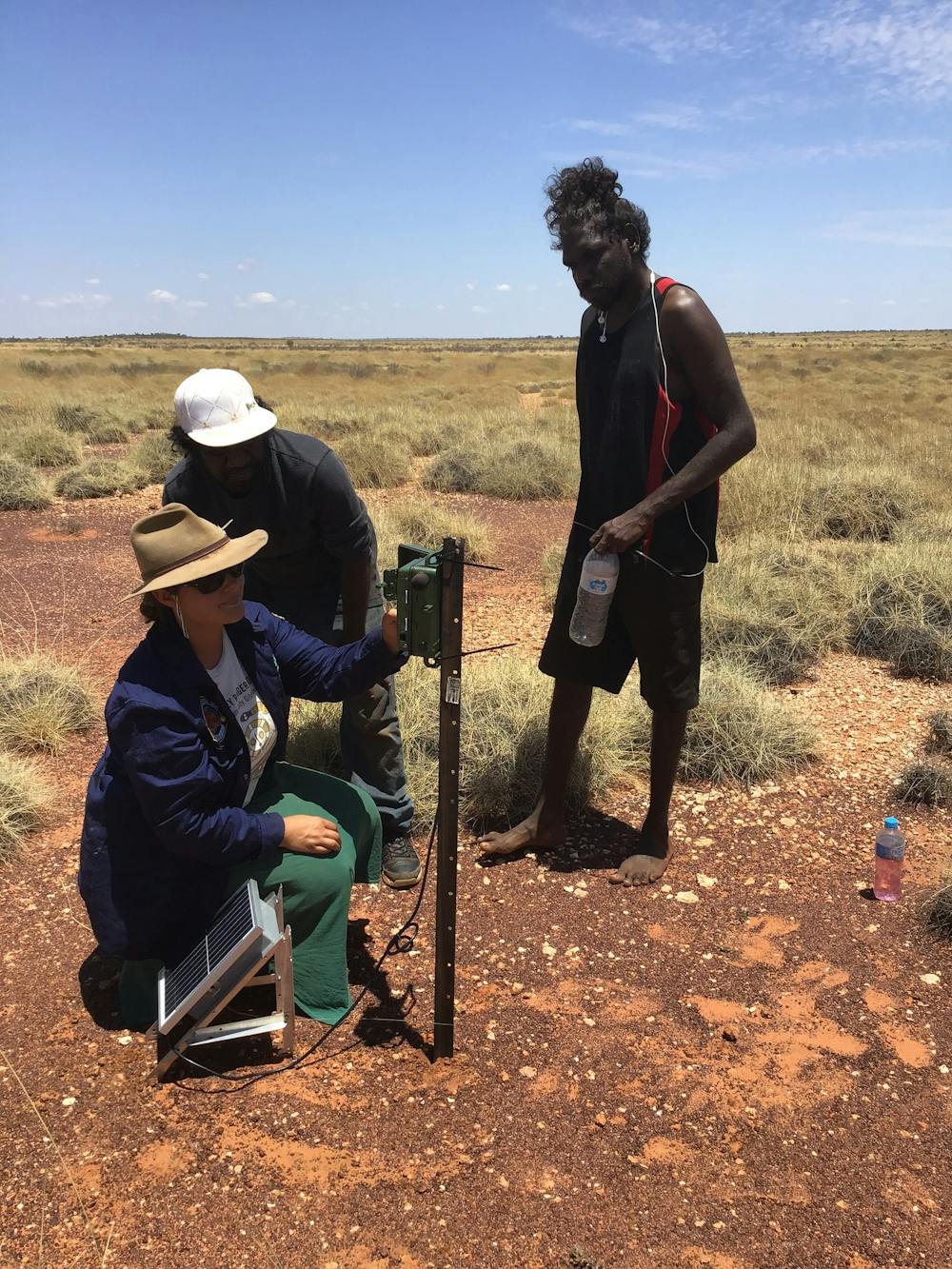
    Ngururrpa Rangers worked with scientists to learn how to use sound recorders to search for night parrots. We then searched for the birds on Country between 2018 and 2023.

    We combined the rangers’ detailed knowledge of habitats, water and seed resources with geology maps, satellite imagery and fire history data. From this we selected 31 potential roosting areas, then deployed sound recorders called “songmeters” at those sites.

    We wanted to detect the night parrots’ distinctive calls which consist of whistles, croaks and bell-like sounds.

    The acoustic data we gathered was then analysed to extract any bird calls in the night parrot’s frequency range. Potential detections were verified using a reference library of known night parrot calls.

    Our results

    We detected night parrot calls at 17 of 31 sites. Of these, ten were roost sites, where night parrot calls were detected in the hour after sunset and the hour before sunrise.

    Individual night parrots are thought to have unique calls. We analysed how many different calls we could hear, and how loud they were (which can tell us when birds are calling from different locations). From this we built a picture of the identity and number of individuals regularly occupying a site.

    We extrapolated this across the 58 patches of potential night parrot habitat on the Ngururrpa Indigenous Protected Area. We concluded up to 20 roosting areas may be occupied by night parrots.

    Based on the numbers at roosting sites where we recorded calls, we estimate 40–50 night parrots could be present in the Ngururrpa Indigenous Protected Area.


    Fire and predators pose grave threats

    Once we found the night parrot populations, we wanted to know what threats they faced.

    We used camera-traps to identify predators and also collected their scats (poos) to analyse their diets.

    Ngururrpa Ranger Kathryn Njamme with a night parrot feather.
    Ngururrpa IPA

    Dingoes were the predator detected most frequently in night parrot roosting habitat. Our cameras captured them ten times more often than feral cats. And we found dingoes regularly eat feral cats at night parrot sites.

    Based on information from other areas, we suspect cats are a key predator of night parrots. Dingoes could be important in suppressing cat numbers and helping the parrots survive. So, attempts to limit predators in night parrot habitat should not harm dingoes.

    We also analysed 40 years of satellite imagery to assess the threat of fire to night parrots’ roosting habitat. Based on the vegetation types and flammability of surrounding landscapes, we found bushfires sparked by lightning are a much bigger threat to night parrots in the Great Sandy Desert than in Queensland.

    Strategic aerial and ground burning, to reduce fuel loads, already occurs in the Ngururrpa Indigenous Protected Area. As our knowledge of night parrots improves, these programs can become more targeted to protect key night parrot areas.

    Ngururrpa Rangers using ‘Felixer’ devices to selectively control cats in night parrot habitat.
    Ngururrpa IPA

    Keeping night parrots alive

    A long-term monitoring program for night parrots on Ngururrpa Country should be established to help better understand and protect this vitally important population.

    And the remote, wild nature of the landscape should be retained. This means minimising disturbance from people and vehicles, and continuing to exclude livestock and weeds.

    Clifford Sunfly has articulated how the rangers want to help protect night parrots into the future:

    We would like to spend more time on Country to find where [night parrots] are and understand what they are doing.

    We want those scientists to come and help us catch some night parrots and tag them. We also need more snake-cams (inspection cameras) too and more songmeters. And a kit for collecting scats for DNA.

    One day we would love to have our own research facility for doing our night parrot surveys. It would be our dream to have our own research base on Ngururrpa.

    Rachel Paltridge receives funding from the National Environmental Science Program’s Resilient Landscapes Hub, and the Indigenous Desert Alliance.

    Clifford Sunfly is a Ngururrpa Ranger. The ranger program receives funding from the WA government’s Aboriginal Ranger Program and the State NRM Program.

    Nicholas Leseberg receives funding from the Australian and Queensland Governments. He works for Bush Heritage Australia, and as a consultant on night parrots for many projects.

    ref. ‘Breakthrough discovery’: Indigenous Rangers in outback WA find up to 50 night parrots – one of Australia’s most elusive birds – https://theconversation.com/breakthrough-discovery-indigenous-rangers-in-outback-wa-find-up-to-50-night-parrots-one-of-australias-most-elusive-birds-239449

    MIL OSI AnalysisEveningReport.nz

  • MIL-Evening Report: Why are the violins the biggest section in the orchestra?

    Source: The Conversation (Au and NZ) – By Laura Case, Lecturer in Musicology, Sydney Conservatorium of Music, University of Sydney

    Manuel Nägeli/Unsplash, FAL

    As the largest section of the orchestra, sitting front and centre of the stage performing memorable melodies, it’s easy for violinists to steal the limelight. Ask any violinist why there are so many in an orchestra, and we’ll often reply, tongue-in-cheek: “obviously it’s because we’re the best”.

    The real answer is a bit more complex, and combines reasons both logistical and historical.

    How we got the modern orchestra

    During the Baroque period between around 1600 and 1750, the composition of the orchestra was not standardised, and often used instruments based on availability. Monteverdi’s opera L’Orfeo, which premiered in 1607, is one of the earliest examples of a composer specifying the desired instrumentation.

    The size of the orchestra also varied. Johann Sebastian Bach wrote for and worked with ensembles of up to 18 players in Germany. At Palazzo Pamphili in Rome, Corelli directed ensembles of 50–80 musicians – and, on one notable occasion to celebrate the coronation of Pope Innocent XII, an ensemble of 150 string players.

    The modern-day violin was also developed around this time, and eventually replaced the instruments of the viol family. The violin has remained a staple member of the orchestra ever since.

    Philippe Mercier, 1689 or 1691–1760, Franco-German, active in Britain (from 1716), The Sense of Hearing, 1744 to 1747, Oil on canvas.
    Yale Center for British Art, Paul Mellon Collection, B1974.3.19.

    Music of this period was created on a smaller scale than much of the repertoire we hear today, and often placed a strong focus on string instruments. As the orchestra became more standardised, members of the woodwind family appeared, including the oboe, bassoon, recorder and transverse flute.

    During the classical period from around 1730 to 1820, orchestral performances moved from the royal courts into the public domain, and their size continued to grow. Instruments were organised into sections, and bowed strings formed the majority.

    Composers began to use a wider range of instruments and techniques. Beethoven wrote parts for the early double bassoon, piccolo flute, trombone (which was largely confined to church music beforehand), and individual double bass parts (where previously they had often doubled the cello part).

    Marco Ricci, 1676–1729, Italian, active in Britain (1708–10; 1711–16), Rehearsal of an opera, ca. 1709, Oil on canvas.
    Yale Center for British Art, Paul Mellon Collection, B1981.25.523.

    During the romantic period of the 19th century, composer Hector Berlioz, author of a Treatise on Instrumentation and Modern Orchestration (1841), further developed the symphony orchestra by adding instruments such as the tuba, cor anglais and bass clarinet.

    By the end of the 19th century, many orchestras reached the size and proportions we recognise today, with works that require more than 100 musicians, such as Wagner’s Ring Cycle.

    What’s size got to do with it?

    As increasing numbers of performers and instruments became standard in orchestral repertoire, ensembles became louder, and more string players were needed to balance the sound. The violin is a comparatively quiet instrument, and a solo player cannot be heard over the power of the brass.

    Having violinists at the front of the stage also helps the sound reach the audience’s ears without competing to be heard over the louder instruments.

    The typical layout of the orchestra has not always been standard. First violinists (who often carry the melody) and second violinists (who typically play a supportive role) used to sit opposite each other on stage.

    US conductor Leopold Stokowski rearranged the position of the first and second violinists during the 1920s so they sat next to each other on the left of the stage. This change meant the voices of each string section were arranged from high to low across the stage.

    This change was widely adopted and has become a standard setup for the modern orchestra.

    Stokowski is known for experimenting with the layout of the orchestra. He once placed the entire woodwind section at the front of the orchestra ahead of the strings, receiving widespread criticism from the audience and musicians. The board of the Philadelphia Orchestra allegedly said the winds “weren’t busy enough to put on a good show”.

    Sound, texture and timbre

    String players do not need to worry about lung capacity or breaking for air. As such, violinists can perform long melodic passages with fast finger work, and our bows allow for seemingly endless sustain. Melodies written for strings are innumerable, and often memorable.

    Having several violinists play together creates a specific sound and texture that is distinct from a solo string player and the other sections of the orchestra. Not only is the sound of every violin slightly different, the rate of each string’s vibration and the movement of each player’s bow varies. The result is a rich and full texture that creates a lush effect.

    Today, symphony orchestras are expected to perform an incredibly diverse range of repertoire from classical to romantic, film scores to newly commissioned works. Determining the number of violinists who will appear in any given piece is a question of balance that will change depending on the repertoire.

    A Mozart symphony might require fewer than ten wind or brass players, who would be drowned out by a full string section. However, a Mahler symphony requires more than 30 non-string players – meaning far more string players are needed to balance out this sound.

    Room for experimentation

    Notable exceptions to the orchestra’s standard setup include Charles Ives’ 1908 The Unanswered Question for string orchestra, solo trumpet and wind quartet spread around the room; Stockhausen’s 1958 Gruppen, pour trois orchestres, in which three separate orchestras perform in a horseshoe shape around the audience; and Pierre Boulz’s 1981 Répons featuring 24 performers on a stage surrounded by the audience, who are in turn surrounded by six soloists.

    Despite experimentation, the placement and number of instruments in an orchestra has remained relatively standard since the 19th century.

    Many aspects of the traditional orchestra’s setup make sense. However, many of the orchestra’s habits come down to tradition and perhaps unconscious alignment with “just the way things are done”.

    Laura Case does not work for, consult, own shares in or receive funding from any company or organisation that would benefit from this article, and has disclosed no relevant affiliations beyond their academic appointment.

    ref. Why are the violins the biggest section in the orchestra? – https://theconversation.com/why-are-the-violins-the-biggest-section-in-the-orchestra-236596

    MIL OSI AnalysisEveningReport.nz

  • MIL-Evening Report: Do footy’s best and fairest awards achieve what they claim?

    Source: The Conversation (Au and NZ) – By Hunter Fujak, Senior Lecturer in Sport Management, Deakin University

    Football’s awards season kicks off this week, with the AFL’s Brownlow Medal awarded on Monday evening and the NRL’s Dally M awarded on October 2.

    Both medals aim to crown their league’s best regular season player.

    Historical voting patterns, however, question whether they achieve this objective, or rather award the most influential key position player from the season’s most successful teams.

    How to assess a fairest and best player?

    A curiosity of the Australian sport landscape is that all four major football codes use a different panel of judges in award voting.

    The AFL’s Brownlow Medal is voted on by umpires, while the NRL’s Dally M is determined by a pool of media pundits and ex-players.

    Rugby Australia’s John Eales Medal is voted on by players, and the A-League’s Johnny Warren Medal is judged by a four-body panel that consists of a technical football expert, football media representative, former player and match officials.

    Each one of these structures produces unique biases and criticisms.

    The Brownlow: the midfielder’s medal

    The Brownlow was devised as an award for the fairest and best player of the AFL competition, reflecting the often understated importance of fair play that umpires are uniquely positioned to judge.

    The Brownlow’s voting system has long been a topic of interest for fans, pundits and academics alike.

    While Lachie Neale’s surprise victory in 2023 generated renewed controversy, the Brownlow has long been criticised as a midfielders award.

    Melbourne’s Herald, in 1938, stated:

    Under the present method, men playing on the full-forward or full-back lines have little chance of winning the award usually being won by men most constantly in the play who are able to stand out in comparatively weak sides.

    This observation around weak sides reflected that from 1931 to 1938, the Brownlow went on an eight-season run of being won by a player not from a finals team.

    Indeed, among the first 49 Brownlow winners from 1924 to 1969, only 31% came from finalists.

    Since 1970, 72% of winners have come from a finals team (noting the finals system has changed over time).

    One consistent long-term trend has been the dominance of midfielders.

    Among the 27 Brownlows awarded this millennium, only Adam Goodes (a two-time winner) would not be considered primarily a midfielder.

    This positional dominance is not unique to AFL.

    Soccer’s most pre-eminent global award, the Ballon d’Or, has been awarded 66 times, of which a defender has been the recipient only four times and a goalkeeper once.

    The Dally M suffers from a similar concentration.

    The Dally M: the media medal

    The Dally M has been awarded since 1979, becoming rugby league’s premier individual honour in 1998 with the formation of the NRL.

    In 45 years of voting, the winner has come from a non-finalist team on only six occasions (13%).

    The award is also won near exclusively by the “spine” positions of fullback, five-eighth, halfback and hooker, which account for 91% of medallists.

    The Dally M uses a pool of media pundits and ex-players for voting on each match, creating the potential for obvious conflicts of interests.

    During seasons 2019 and 2020 for instance, 12 of the Brisbane Broncos’ 44 matches were judged by ex-Broncos players. On four of these instances, former player Darren Lockyer was the judge, despite being an active non-executive director of the Brisbane Broncos organisation.

    Voting in nearly 22% of matches in these two seasons was performed by judges who played or coached for one of the participating teams.

    NRL Chairman Peter V’Landys initiated a review of the Dally M following a surprise winner in 2020 (Jack Wighton), claiming the voting system disadvantaged players from winning teams.

    Whilst this supposition disregarded that 88% of all 2020 Dally M points were awarded to players from the winning team, voting was modified for the 2023 season.

    This revised system introduced an additional judge to produce two independent voters per match, and in a widely criticised move, veiled these judges with anonymity.

    This new system has revealed just how little experts agree when trying to assess subjective performance.

    In the opening five rounds of 2023, the two judges picked the same player of the match in less than half (48%) of fixtures.

    In a third of matches (31%), one judge’s best on ground did not poll any points with the other judge.

    In one instance, the two judges chose six completely different players in their respective 3-2-1 votes (round five, 2023, Bulldogs v Cowboys).


    Player and coach awards: The true best and fairest?

    Although the Brownlow and Dally M dominate the public limelight, team accolades are typically held in high standing within sport clubs, as internal recognition is often more highly valued than external status within high performance cultures.

    Such player and coach awards, typically forming part of season-end club events, can be argued as more accurate assessments of player performance.

    This is because the voters – teammates and/or coaches – best understand the roles and expectations of each player within the team’s overarching game plan.

    For this reason, in the AFL, there is often wide discrepancies between a team’s distribution of Brownlow votes and a club’s internal award votes.

    In 2023, for instance, six of 18 AFL clubs crowned a best and fairest who was different from their highest Brownlow vote-getter.

    The most notable of this was Brisbane, where key defender Harris Andrews won the club’s best and fairest, despite finishing 44th in Brownlow voting.

    Defender Harry Sheezel similarly won North Melbourne’s best and fairest despite finishing fifth from his team in the Brownlow count.

    Is there a perfect solution?

    Recent shock winners in both codes saw media organisations perform “forensic analysis” of voting patterns.

    In the AFL, former Collingwood president and media personality Eddie McGuire proposed a “panel of elders” while the NRL’s V’Landys proposed rating every player for every match, to determine their respective awards.

    Such scrutiny has undoubtedly been fuelled by the datafication of sport and its athletes, which has seen player performance statistics enter the sporting mainstream.

    Is it notable then that the AFL reaffirmed their existing policy in early 2024 to preclude umpires from accessing player statistics in casting their votes.

    Indeed statistics may not offer the perfect solution some believe.

    Any statistical assessment of player performance remains underpinned by human judgement as to the importance of each metric, whilst missing the qualitative nuance that surrounds key match plays and moments.

    Ultimately then, there may not be a perfect method to determine a league’s best and fairest player and, arguably, it is this human judgement dimension which makes these awards so engaging as a public spectacle.

    The authors do not work for, consult, own shares in or receive funding from any company or organisation that would benefit from this article, and have disclosed no relevant affiliations beyond their academic appointment.

    ref. Do footy’s best and fairest awards achieve what they claim? – https://theconversation.com/do-footys-best-and-fairest-awards-achieve-what-they-claim-237978

    MIL OSI AnalysisEveningReport.nz

  • MIL-Evening Report: Basic service provider or mini democracy? Why NZ needs to decide what it wants from local government

    Source: The Conversation (Au and NZ) – By Jeffrey McNeill, Honorary Research Associate, School of People, Environment and Planning, Te Kunenga ki Pūrehuroa – Massey University

    Prime Minister Christopher Luxon’s recent challenge to local government “to rein in the fantasies and to get back to delivering the basics brilliantly” was unsurprising, given his government’s focus on fiscal restraint.

    It was in keeping with his announcement that councils’ legislative purpose of delivering their communities’ economic, social, environmental and cultural wellbeing are to be removed from the Local Government Act.

    Local government responded with the usual indignation and suggested solutions. There were complaints about inadequate funding mechanisms, questions about whether libraries are basic services. The whole spat likely flew under the radar of the wider public.

    Yet the problems facing local government are very real and will not just go away by kicking costly decisions down the road. Rather, they are symptomatic of fundamental choices facing the sector.

    Foundational issues

    The problems go back to the late 1980s when our current local government system was designed.

    Led by then local government minister Michael Bassett, the reforms were the first in over 100 years. More than 850 city, borough and county councils, catchment boards, united councils and local boards were amalgamated to form 86 in 1989 and now 78 regional, city and district councils we have today.

    But Bassett still considered local government reform incomplete because of the failure to address water provision.

    But I would argue the real unfinished business was the failure to resolve the purpose of local government in the first place. Only when that is agreed can we address local government’s functions, form and funding.

    Until then, the shape and function of local government will remain a political football.

    According to section 10(1)(a) of the Local Government Act 2002, the purpose of local government is “to enable democratic local decision-making and action by, and on behalf of, communities”.

    But the second subsection describing its purpose, (s.10(1)(b)) has changed with the various governments. In 2002, under Helen Clark’s Labour-led government, the purpose of local government was:

    to promote the social, economic, environmental, and cultural well-being of communities in the present and for the future.

    John Key’s National-led government in 2012 replaced that purpose with a remit

    to meet the current and future needs of communities for good-quality local infrastructure, local public services, and performance of regulatory functions in a way that is most cost-effective for households and businesses.

    The previous Labour government reintroduced the wellbeing purpose. Luxon is set to remove it.

    Function, form and funding

    Should local government be a true local government with comprehensive and wide powers, or simply a property-services organisation, providing little more than street-lighting, roading, water and sewerage?

    The two very different conceptions of local government determine its functions, form and funding.

    These differing views reflect the disparate Anglophone and European concepts of local government. National aligns with the Anglophone model, with its limited local government functions under a strong central government. Labour leans towards the European model, with devolved wide-ranging functions.

    The distinction between the two models was made very clear to me while working as part of an international team researching local government responses to the COVID-19 pandemic.

    My Italian colleague, for example, reported how his country’s local governments were vitally involved in their cities’ day to day management during the crisis.

    Mayors and councils were making daily decisions and announcements about their hospitals’ resourcing, whether to close the schools and training institutes, increase social welfare provision and housing, and so on.

    On the flipside, New Zealand local government was largely sidelined to address humanitarian services such as ensuring people had access to food and accommodation.

    Instead, councils searched for local “shovel-ready” infrastructure projects to access central government funds in order to reduce unemployment and stimulate local economies. The public focused on national daily press announcements from the prime minister and director-general of health.

    No appetite strong local government

    For all that, the distinction between Labour and National conceptions of local government may not be as great as recent history suggests.

    Both want a strong centre and weak local government. Our councils have largely reinforced this reality. Some have sought to extend their scope of activities, others have clearly defined themselves as property services agencies.

    Most have largely refrained from the excesses the prime minister appears to be concerned about, partly to avoid being caught out by changes in central government, but also because most council expenditure is already committed to infrastructure.

    But does it have to be this way?

    The Labour-led government’s 2021 Future for Local Government review envisaged local government using partnerships with hapū and iwi to promote the four key wellbeings as key to any reform. This is at odds with the present government’s priorities and views on governing with Māori – a big reason why the reports now collect dust.

    The review was also very constrained in considering local government functions. Rather, it seemingly took existing functions as its starting point to focus instead on local governance.

    Writing about our local government nearly 70 years ago, public servant and academic R.J. Polaschek imagined what would have been if New Zealand had been colonised by Denmark instead of Great Britain. In this hypothetical scenario he saw strong independent local government based on communities with wide-ranging functions.

    It still could be, but tinkering at the edges is not going to solve its problems. Our local government project remains unfinished business. It will take political courage and vision to complete the task. One that remains a fantasy, and we are all the losers.

    Jeffrey McNeill does not work for, consult, own shares in or receive funding from any company or organisation that would benefit from this article, and has disclosed no relevant affiliations beyond their academic appointment.

    ref. Basic service provider or mini democracy? Why NZ needs to decide what it wants from local government – https://theconversation.com/basic-service-provider-or-mini-democracy-why-nz-needs-to-decide-what-it-wants-from-local-government-238862

    MIL OSI AnalysisEveningReport.nz

  • MIL-Evening Report: Why isn’t dental included in Medicare? It’s time to change this – here’s how

    Source: The Conversation (Au and NZ) – By Peter Breadon, Program Director, Health and Aged Care, Grattan Institute

    Engin Akyurt/Unsplash

    When the forerunner of Medicare was established in the 1970s, dental care was left out. Australians are still suffering the consequences half a century later.

    Patients pay much more of the cost of dental care than they do for other kinds of care.

    More Australians delay or skip dental care because of cost than their peers in most wealthy countries.

    And as our dental health gets worse, fees keep on rising.

    For decades, a litany of reports and inquiries have called for universal dental coverage to solve these problems.

    Now, with the Greens proposing it and Labor backbenchers supporting it, could it finally be time to put the mouth into Medicare?

    What’s stopping us?

    The Australian Dental Association says the idea is too ambitious and too costly, pointing out it would need many more dental workers. They say the government should start small, focusing on the most vulnerable populations, initially seniors.

    Starting small is sensible, but finishing small would be a mistake.

    Dental costs aren’t just a problem for the most vulnerable, or the elderly. More than two million Australians avoid dental care because of the cost.

    More than four in ten adults usually wait more than a year before seeing a dental professional.

    Bringing dental into Medicare will require many thousands of new dental workers. But it will be possible if the scheme is phased in over ten years.

    The real reason dental hasn’t been added to Medicare is it would cost billions of dollars. The federal government doesn’t have that kind of money lying around.

    Australia has a structural budget problem. Government spending is growing faster than revenue, because we are a relatively low-tax country with high service expectations.

    The growing cost of health care is a major contributor, with hospitals and medical benefits among the top six fastest-growing major payments.

    The structural gap is only likely to grow without major policy changes.

    So, can we afford health care for all? We can. But we should do it with smart choices on dental care, and tough choices to raise revenue and reduce spending elsewhere.

    Smart choices about a new dental scheme

    The first step is to avoid repeating the mistakes of Medicare.

    Medicare payments to private businesses haven’t attracted them to a lot of the communities that need them the most. Many rural and disadvantaged areas are bulk-billing deserts with too few GPs.

    The poorest areas have more than twice the psychological distress of the wealthiest areas, but they get about half the Medicare-funded mental health services.

    As a result, government money isn’t going where it will make the biggest difference.

    There are about 80,000 hospital visits each year for dental problems that could have been avoided with dental care. If there is too little care in disadvantaged and rural communities, where oral health is worst, that number will remain high.

    That’s why a significant share of new investment should be quarantined for public dental services, with those services targeted to areas where people are missing out on care.

    Another problem with Medicare is its payments often have little relationship to the cost of care, or the impact that care has on the patient’s health.

    To tamp down costs, Medicare funding for dental care should exclude cosmetic treatments and orthodontics. It should be based on efficient workforce models where dental assistants and therapists use all their skills – you might not always need to see a dentist.

    Sometimes you might see a dental therapist instead.
    Gustavo Fring/Pexels

    The funding model should take account of a patient’s needs, reward giving them ongoing care, and have a cap on spending per patient.

    Oral health should be measured and recorded, to make sure patients and taxpayers are getting results.

    Tough choices to balance the budget

    Those steps would slash the cost of The Greens’ plan, which is hard to estimate but might reach more than $20 billion a year once it’s phased in. Instead, the cost would fall to roughly $7 billion a year.

    That would be a good investment. But if you’re worried about where the money will come from, there are good ways to pay for it.

    Many reforms could reduce government health budgets without harming patients.

    There is waste in government funding of pathology tests and less cost-effective medicines.

    In some hospitals, there are excessive costs and potentially harmful low-value care.

    Over the longer-term, investments in prevention can reduce demand for health care. A tax on sugary drinks, for example, would improve health while raising hundreds of millions of dollars a year.

    Measures like this would help the government pay for more dental care. But demand for health care will keep growing as the population ages, and as expensive new treatments arrive.

    This means a broader strategy is needed to meet the three goals of balancing the budget, keeping up with growing health-care demand, and bringing dental into Medicare.

    Adding dental to Medicare would mean some tradeoffs.
    Lafayett Zapata Montero/Unsplash

    There are no easy solutions, but there are many options to reduce spending and boost revenue without hurting economic growth.

    Choosing Australia’s infrastructure and defence megaprojects more wisely could save several billion dollars each year.

    Undoing Western Australia’s special GST funding deal – described by economist Saul Eslake as “the worst Australian public policy decision of the 21st Century thus far” – would save another $5 billion a year.

    Reducing income tax breaks and tax minimisation opportunities – including by reining in superannuation tax concessions, reducing the capital gains tax discount, limiting negative gearing, and setting a minimum tax on trust distributions – could raise more than $20 billion a year.

    Major tax reform like this offers economic benefits while creating space for better services such as universal dental coverage.

    No one likes spending cuts and tax hikes, but they will be needed sooner or later regardless. Dental coverage might be just the sweetener taxpayers need to accept it.

    Grattan Institute, has been supported in its work by government, corporates, and philanthropic gifts.

    A full list of supporting organisations is published at www.grattan.edu.au.

    ref. Why isn’t dental included in Medicare? It’s time to change this – here’s how – https://theconversation.com/why-isnt-dental-included-in-medicare-its-time-to-change-this-heres-how-239086

    MIL OSI AnalysisEveningReport.nz

  • MIL-Evening Report: How did they get my data? I uncovered the hidden web of networks behind telemarketers

    Source: The Conversation (Au and NZ) – By Priya Dev, Lecturer & Academic Data Science, Digital Assets & Distributed Ledgers, Australian National University

    Kokhan O/Shutterstock

    Last year, I started getting a lot of unsolicited phone calls, mainly from people trying to sell me things. This came as a surprise because, as a data scientist, I am very careful about what personal information I let out into the world. So I set out to discover what had happened.

    My investigation took several months. It eventually led me to the labyrinthine world of data brokers.

    In today’s digital age, where personal data is a new kind of gold, these companies wield significant power, creating networks where our personal information is shared between brokers and telemarketers as easily as TikTok videos. Their businesses profit from the data they collect, and many of the calls they enable come from scammers.

    This comes at an enormous cost: in 2023, Australians lost $2.7 billion to scams. This highlights the urgent need for stronger privacy protections to limit how our personal data is collected and shared.

    In an attempt to address this need, the Australian government this month introduced long-overdue privacy reforms. But these reforms are still inadequate for the many privacy issues affecting people today, including targeting by data brokers and telemarketers.

    Investigating the hidden web

    One of the mechanisms designed to protect us from unwanted calls is the Do Not Call Register.

    Managed by the Australian Communications and Media Authority, the registry holds more than 12 million phone numbers, including mine. The registry is supposed to block unsolicited calls. But last year, despite being on the list, I began to receive dozens of unwanted calls – on average, about three per day.

    Curious, I started tracing the origins of these calls. What I uncovered was a network of hidden connections between data brokers, telemarketers and large organisations – including a major political party. It became clear that simply being on the Do Not Call Register wasn’t enough to protect my privacy.

    I started by asking the callers what data they held, and how they had obtained mine. I requested details about the companies they represented, including their websites and Australian Business Numbers (ABNs) – the unique identifiers for Australian businesses.

    Most callers hung up the moment I started asking questions, until one day I spoke with a man named Paul, who worked in the real estate sector – an industry worth more than $10 trillion as of 2024. The high-value real-estate market makes our personal data especially valuable to businesses operating within the industry.

    Digging deeper

    The unique thing about Paul was that he knew my real name, whereas other telemarketers only had access to the pseudonyms I’d used to protect my identity online. Paul explained he had licensed my data from the real estate giant CoreLogic Australia.

    This discovery pushed me to dig deeper. After a lot of back and forth, I finally obtained my data from CoreLogic. The amount of information was small, but surprisingly accurate – especially considering the steps I’d taken to hide my identity. It made me wonder where they got it from, as only organisations such as utility companies, banks or the government would hold that type of information.

    CoreLogic told me in an email that:

    CoreLogic gets data from a variety of sources … most of the information we collect comes from public records, which we license from government departments and agencies. We may also collect personal information from third parties such as through real estate agents, tenancy and strata mangers, financial institutions and marketing database providers.

    This was a troubling discovery, because the institutions on which we depend for essentials such as public services, housing and finance – and from which we can’t hide our identities – may be selling our personal information to data brokers, who then pass it along to telemarketers.

    What’s even more alarming is that the data is shared unmasked, meaning personal details such as our names, genders and phone numbers are fully visible. Once this information is out in the open, it becomes almost impossible to control how it’s recorded or shared.

    It’s also nearly impossible to stop it being passed to overseas telemarketers, who aren’t bound by Australian privacy laws.

    Real estate giant CoreLogic says most of the personal data it collects comes from public records.
    IgorGolovniov/Shutterstock

    Solving the mystery

    My investigation didn’t end there.

    Eventually, CoreLogic revealed it had purchased my data from Australian data broker firm Smrtr in August 2023. This coincided with the surge in unsolicited calls.

    Through Smrtr I learned they had purchased my data in 2016 from another data broker, EightDragons Digital. Smrtr also admitted to selling my data to various companies – all without my consent.

    Determined to investigate the origin of my online data trail, I contacted EightDragons Digital, which calls itself “a leading global consumer data agency”. It collects personal data for big brands including Energy Australia, Vodafone, NRMA, Nissan, Johnnie Walker, American Express, The Good Guys, and even the Australian Labor Party.

    The company claimed it collected my data in a 2014 marketing campaign, and likely passed it to at least 50 other companies. However, it had no records to verify the marketing campaign or prove that I had given consent.

    A small step only

    CoreLogic defended its practices as legal, saying it’s too difficult to verify consent or anonymise personal data.

    However, with modern technology, it’s actually possible to track where data comes from, check consent, and share insights without exposing personal details such as names and phone numbers.

    The government’s recent privacy reforms are a small step in the right direction. But until data brokers are required to obtain explicit consent before trading personal information, they fall far short of being a giant leap forward.

    Priya Dev does not work for, consult, own shares in or receive funding from any company or organisation that would benefit from this article, and has disclosed no relevant affiliations beyond their academic appointment.

    ref. How did they get my data? I uncovered the hidden web of networks behind telemarketers – https://theconversation.com/how-did-they-get-my-data-i-uncovered-the-hidden-web-of-networks-behind-telemarketers-238991

    MIL OSI AnalysisEveningReport.nz

  • MIL-Evening Report: With all these defamation lawsuits, what ever happened to free speech?

    Source: The Conversation (Au and NZ) – By Brendan Clift, Lecturer in Law, The University of Melbourne

    Shutterstock

    It seems like the dust barely settles from the latest high-profile defamation stoush before the next set of litigants straps on the gloves and steps into the ring.

    Many of these cases raise eyebrows — and questions. Was that story about him? Does anyone remember that tweet? Wasn’t it just harmless banter? Didn’t she respond to that allegation? What if it’s all true? Isn’t that free speech? How much did you say this will cost?!

    Defamation law continues to loom large over public conversations, despite recent law reforms aimed at remedying Australia’s unwanted reputation as the “defamation capital of the world”.

    At the heart of defamation law lies a tension between protecting reputation and maintaining freedom of speech. The more robustly defamation law protects reputation, the more it constrains speech.

    Free speech is valued in Australian law, politics and society, notwithstanding our lack of an explicit constitutional speech right. So why does our defamation law facilitate seven-figure lawsuits over communicative slights that, at times, seem disproportionately minor?

    What shapes these laws?

    Defamation law is old — very old — with roots in English law half a millennium ago. For several hundred years it existed in parallel with publishing monopolies, political and moral censorship, and fears that loose talk could stoke public disorder.

    In other words, our defamation law substantially predates modern conceptions of civil and political rights. Some of its features, like strict rather than fault-based liability (the plaintiff need not prove anything about the defendant’s intentions or degree of care), retain the flavour of less liberal times.

    Libel laws in the western world, as seen here in the US in the 1730s, are very old.
    Library of Congress

    Still, defamation has developed over the years and adapted with transplantation to other legal systems.

    The defamation laws of different places are influenced by factors such as community values, prevailing views on the value of speech, the nature and democratic credentials of the political system, and the role of law and the constitution in regulating citizens and the state.

    For example, the United States is culturally and historically predisposed to liberty and suspicion of government. The freedom to discuss and debate public affairs is seen as essential to its democratic system. The First Amendment to the US Constitution is the world’s most famous free speech law.

    Accordingly, US courts have limited defamation on matters of public concern to deliberate or reckless lies, while opinions on any newsworthy topic are immune from suit. This is because US democracy requires the “marketplace of ideas” to be minimally constrained and largely self-regulating.

    On the other hand, less democratic states have kept their defamation laws strict, to suppress political dissent and silence critical media.

    A case in point is Singapore, which, under founding father Lee Kwan Yew and his perpetually-in-power People’s Action Party, has weaponised defamation law against political opposition and the press.


    Read more:
    With more lawsuits potentially looming, should politicians be allowed to sue for defamation?


    That is not to say that less defamation law is automatically better than more. The interest in maintaining a (deserved) good reputation is legitimate. And speech anarchism can allow low-value and harmful speech to flourish.

    The High Court of Australia has shied away from US-style speech liberalism for fear it could facilitate speech that is harmful to the integrity of political discourse: a prescient position given recent US history. The English courts have done similarly, influenced by distrust of the tabloid press.

    But when reputation and speech fall out of balance, defamation law risks infringing both democratic values and fundamental rights.

    Legal balancing acts

    Around the turn of the millennium, English defamation law reached a crossroads. Its relative stasis had turned the United Kingdom into a “libel tourism” hotspot, and the UK was falling behind on the speech protections mandated by the European Convention on Human Rights.

    So the UK courts moved to better protect publishers by creating a new defence for responsible publication in the public interest. That was followed in 2013 by a new Defamation Act to further simplify, clarify and rebalance defamation law.

    Australia, lacking the same constitutional or convention impetus, has been slow to follow suit. The states agreed to harmonise their disparate defamation laws only in 2005, and it was 2021 before they found the appetite to improve them.

    By then, Australia had taken over the UK’s mantle as the preferred destination for defamation plaintiffs.

    Australia’s 2021 reforms included a new defence for publication of public-interest material, which generated some excitement but hasn’t substantially liberated the media from defamation threats. It amounts to tinkering around the edges of law, which remains conservative at its core.

    Today, from a practical standpoint, the biggest problem with defamation may be its cost.

    Legal advice and correspondence are expensive, settlements more so, and the cost of litigation can be eye-watering. It’s one problem if you can’t afford to assert your legal rights; it’s quite another to be slapped with an unexpected complaint. Defamation disputes can easily bankrupt individuals and exhaust media budgets.


    Read more:
    Why defamation suits in Australia are so ubiquitous — and difficult to defend for media organisations


    Legal consequences can act as an incentive for better journalism, but they also chill public-interest reporting. Even a journalist assured of their facts will find proving them in court to be a different matter. And a win does not guarantee full recovery of costs, let alone time and stress.

    The debate over defamation law reform is ongoing. The central question remains how best to balance the interest in reputation with the benefits of free speech. The answers depend on what we really value, and what our commitment to liberal democracy really requires.

    Brendan Clift does not work for, consult, own shares in or receive funding from any company or organisation that would benefit from this article, and has disclosed no relevant affiliations beyond their academic appointment.

    ref. With all these defamation lawsuits, what ever happened to free speech? – https://theconversation.com/with-all-these-defamation-lawsuits-what-ever-happened-to-free-speech-238312

    MIL OSI AnalysisEveningReport.nz

  • MIL-Evening Report: Dogma or data? Why sentencing reforms in NZ will annoy judges and clog the courts

    Source: The Conversation (Au and NZ) – By Kris Gledhill, Professor of Law, Auckland University of Technology

    Getty Images

    The Luxon government surely has little sense of irony.

    Shortly after introducing the Parliament Bill, designed to reinforce the fundamental constitutional principle of the separation of powers, it has introduced the Sentencing Reform (Amendment) Bill, which seeks to constrain the judicial arm of the state.

    Its purpose is to put more people into prison for longer. In its Regulatory Impact Statement, the Ministry of Justice estimates 1,350 people will be added to the current prison population. The ministry is also clear that most of the changes are unnecessary and rest on inadequate consultation, particularly with Māori.

    The main change the bill makes is to cap reductions in a prison sentence for mitigating factors at “40% of the sentence”, unless that would be “manifestly unjust”.

    Mitigating factors

    To understand why this is a problem, we need to start with how the Sentencing Act 2002 works. First, the seriousness of an offence provides a starting point. Since the maximum sentence is for the worst example of the offence, the facts can be put on a scale.

    Secondly, the judge considers aggravating factors, such as repeat offending, malicious motivations or the victim’s vulnerability. The new bill specifies various additional aggravating factors, but the ministry notes these are already taken into account.

    Finally, the judge looks at mitigating factors, such as youth, intellectual disability or mental illness, remorse and positive steps to remedy the cause of offending.

    One important available reduction is for a guilty plea. The bill will cap this at 25% – the Supreme Court already decided this several years ago.

    Sentence reductions based on these factors will regularly exceed the overall 40% cap proposed in the new bill. For example, impulsive offending by a young adult with ADHD who was in state care because of family abuse, and who pleads guilty early, would likely mean a considerable sentence reduction.

    Similarly, offending by someone who both admits it, shows remorse and assists the police would qualify for considerable reductions.


    Read more:
    A last minute amendment to NZ’s gang legislation risks making a bad law worse


    ‘Moral and fiscal failure’

    The New Zealand judiciary is not soft by world standards. Its rate of incarceration – currently 181 per 100,000 people – places the country 90th out of 223 jurisdictions.

    This is well above Australia, England, Wales and Scotland, and double the rates in Northern Ireland, the Republic of Ireland and Canada. As Māori have long made up more than 50% of the prison population, their incarceration rate is at US levels. Do we really want to make this worse?

    When former Finance Minister Bill English observed New Zealand’s high prison population represented a “moral and fiscal failure”, he asked the chief science advisor to collate the evidence.

    The resulting 2018 report, Using Evidence to Build a Better Justice System, concluded the prison population had grown because of “dogma not data”.

    Prisoners are seven times more likely than the general population to have a mental health or substance abuse problem. Ninety percent have a history of mental health or addiction, with 60% still affected. Up to 70% have significant literacy problems.

    The sentencing reform proposals rest on the notion people should take more personal responsibility. But they overlook the reality of most of the people in the system having a reduced capacity to do that. This looks more like dogma than data.

    And since prisons train people in criminal ways and provide gangs with recruits, but do not deal with underlying causes of criminal behaviour, it is dogma that risks creating more victims.

    Increased prisoner numbers: Paremoremo Maximum Security Prison, Auckland.
    Getty Images

    A stressed justice system

    On top of this, the criminal justice system is creaking, without enough judges or courtrooms. Complainants, defendants and witnesses already wait too long for trials.

    Reductions in sentences for guilty pleas and other mitigating features are essential to preventing this from getting worse. Some of these factors only come to light at the sentencing hearing when pre-sentence reports (often including medical reports) are provided.

    Also, the final preparation for a trial often leads the prosecution to accept a plea to a less serious offence. And the time waiting for a trial often means a defendant will have served all or much of their sentence already.

    If a judge feels obliged to impose a higher sentence because of the new amendments, lawyers will have to advise defendants accordingly. Inevitably, more will decide to take their chances in a trial rather than plead guilty.

    That means more complainants will have to give evidence, some defendants will be acquitted, and the criminal justice system will creak more.

    Judges and rules

    Judges will have to confront some dissonance in the law. The Sentencing Act requires judges to impose the “least restrictive” sentence. But a sentence that is longer than appropriate doesn’t meet that requirement.

    A longer-than-necessary prison sentence is arguably arbitrary detention. But the New Zealand Bill of Rights Act requires judges to interpret other statutes to avoid breaching rights if possible, including the right not to be detained arbitrarily.

    In addition, a fair trial should aim to secure the right sentence for the individual defendant.

    Judges do not sign up to breach people’s rights. Nor do they like it when the executive branch of government uses its parliamentary majority to overstep the separation of powers. Quite properly, they will do what they can to secure individualised justice.

    They might, for example, set a sentence at the low end of the available range to achieve the same outcome while appearing to abide by the new 40% cap. Or they might just decide a rehabilitative sentence, invariably non-custodial, is the better outcome.

    Judges spend all their time dealing with rules. You can expect them to be creative in finding ways around restrictions that should not be imposed on them.

    Kris Gledhill is currently working on a project relating to sentencing that is funded by the Borrin Foundation. He is also a member of the Executive Committee of the Criminal Bar Association, which represents prosecution and defence lawyers. The views stated in this article are his own.

    ref. Dogma or data? Why sentencing reforms in NZ will annoy judges and clog the courts – https://theconversation.com/dogma-or-data-why-sentencing-reforms-in-nz-will-annoy-judges-and-clog-the-courts-239303

    MIL OSI AnalysisEveningReport.nz

  • MIL-Evening Report: Federal Newspoll still tied but Albanese’s ratings up; Queensland Newspoll has big LNP lead

    Source: The Conversation (Au and NZ) – By Adrian Beaumont, Election Analyst (Psephologist) at The Conversation; and Honorary Associate, School of Mathematics and Statistics, The University of Melbourne

    A national Newspoll, conducted September 16–20 from a sample of 1,249, had a 50–50 tie for the third consecutive time. Since the last Newspoll three weeks ago, primary votes were 38% Coalition (steady), 31% Labor (down one), 13% Greens (up one), 6% One Nation (down one) and 12% for all Others (up one).

    Anthony Albanese’s net approval improved five points to -8, with 51% dissatisfied and 43% satisfied. Peter Dutton’s net approval was down two points to -15. Albanese led Dutton as better PM by 46–37 (45–37 previously).

    The graph below shows Albanese’s net approval in Newspoll this term. It has plus signs for the Newspoll results and a smoothed line has been fitted. After dropping to -13 net three weeks ago, Albanese’s ratings have rebounded to where they’ve been for most of this year, poor but not dreadful.

    Other recent federal polls have not been as good for Albanese and Labor as Newspoll. Albanese’s net approval was at -22 in YouGov and -15 in Freshwater, and Labor trailed by 52–48 in Freshwater, one of their worst results from any pollster this term. Freshwater leans a little to the Coalition relative to other polls.

    Asked what aspect of cost of living worried them most, 40% selected housing, 25% groceries, 18% energy and 11% insurance.

    Queensland Newspoll has thumping lead for LNP

    The Queensland state election will be held on October 26. A Newspoll, conducted September 12–18 from a sample of 1,047, gave the Liberal National Party (LNP) a 55–45 lead, a one-point gain for the LNP since the last Queensland Newspoll in March. Primary votes were 42% LNP (steady), 30% Labor (steady), 12% Greens (down one), 8% One Nation (steady) and 8% for all Others (up one).

    Labor Premier Steven Miles’ net approval was up one point to -10, with 51% dissatisfied and 41% satisfied. LNP leader David Crisafulli’s net approval dropped two points to +12. Crisafulli had a 46–39 lead as better premier (43–37 in March).

    Asked whether Labor deserved to be re-elected, 57% said it was time to give someone else a go (down one since March), while 29% said they deserved to be re-elected (up three). By 53–47, voters were confident that the Crisafulli LNP is ready to govern.

    Labor will be a little relieved that this poll was not worse. A YouGov poll in July and a Wolf + Smith poll in August had both given the LNP a 57–43 lead. Nearly ten years after they gained power in Queensland following the January 2015 election, Labor appears doomed.

    Further federal polls: YouGov poll tied

    A national YouGov poll, conducted September 13–19 from a sample of 1,619, had a 50–50 tie, unchanged from the previous YouGov poll in late August. Primary votes were 39% Coalition (up two), 30% Labor (down two), 14% Greens (up one), 7% One Nation (down one) and 10% for all Others (steady).

    In the previous YouGov poll, Labor was unlucky not to lead given the primary votes. In this poll, Labor is lucky not to trail.

    Albanese’s net approval slumped 11 points to -22, with 58% dissatisfied and 36% satisfied. Dutton’s net approval was down five points to -10. Albanese led as preferred PM by 42–39 (43–38 in August).

    Freshwater has one of Coalition’s best results this term

    A national Freshwater poll for The Financial Review, conducted September 13–14 from a sample of 1,057, gave the Coalition a 52–48 lead, a one-point gain for the Coalition since the August Freshwater poll. This is one of the best results for the Coalition from any pollster this term. Primary votes were 42% Coalition (up one), 30% Labor (down two), 13% Greens (up one) and 15% for all Others.

    Albanese’s net approval was down five points to -15, with 49% unfavourable and 34% favourable. Dutton’s net approval was down one point to -4. Albanese led Dutton as preferred PM by an unchanged 45–41.

    Asked to give their top three issues, 74% selected cost of living as a top issue, and the Coalition increased its lead over Labor on cost of living from seven points in August to 14. The Coalition also had a 16-point lead on economic management (13 in August).

    Morgan poll: Labor has narrow lead

    A national Morgan poll, conducted September 9–15 from a sample of 1,634, gave Labor a 50.5–49.5 lead, a 0.5-point gain for the Coalition since the September 2–8 Morgan poll.

    Primary votes were 37.5% Coalition (up one), 30.5% Labor (up 0.5), 12.5% Greens (down two), 5.5% One Nation (down 0.5), 10% independents (up 0.5) and 4% others (up 0.5).

    The headline figure uses respondent preferences. By 2022 election preferences, Labor led by an unchanged 52–48.

    Redbridge and Accent Research MRP poll tied at 50–50

    A national Redbridge and Accent Research multi-level regression with post-stratification (MRP) poll, conducted July 10 to August 27 from a sample of 5,976, had a 50–50 tie, a two-point gain for the Coalition since the last MRP poll between February and May. Primary votes were 38% Coalition (up two), 32% Labor (steady), 12% Greens (down one) and 19% for all Others (steady).

    MRP polls use modelling to estimate the number of seats that would be won by each party. The August MRP poll had a point estimate of 69 Labor seats out of 150, 68 Coalition, three Greens and ten others. In the May poll, Labor had 77 seats out of 151, the Coalition 60, the Greens three and others 11.

    The August poll had no chance either major party would win a majority (76 seats), but Labor had a 75% chance of winning the most seats. These probabilities reflect the poll’s data, and are not predictions for the election, due by May 2025.

    Adrian Beaumont does not work for, consult, own shares in or receive funding from any company or organisation that would benefit from this article, and has disclosed no relevant affiliations beyond their academic appointment.

    ref. Federal Newspoll still tied but Albanese’s ratings up; Queensland Newspoll has big LNP lead – https://theconversation.com/federal-newspoll-still-tied-but-albaneses-ratings-up-queensland-newspoll-has-big-lnp-lead-238790

    MIL OSI AnalysisEveningReport.nz

  • MIL-OSI Global: A weakened Hezbollah is being goaded into all-out conflict with Israel – the consequences would be devastating for all

    Source: The Conversation – USA – By Asher Kaufman, Professor of History and Peace Studies, University of Notre Dame

    For almost a year, Israel and Hezbollah have engaged in increasingly provocative cross-border skirmishes as onlookers warn that this escalating war of attrition could land the region in all-out conflict. The past few days have made that devastating scenario closer to a reality.

    First came Israel’s pager and walkie-talkie attack, an unprecedented assault on Hezbollah’s communications that injured thousands of the organization’s operatives. It was followed by the assassination of Ibrahim Aqil, a key Hezbollah leader, who died in an airstrike that also killed other senior commanders of the militant group, as well as some civilians. Hezbollah has responded by extending the geographical range of its rockets fired at Israel, targeting both military facilities and civilian neighborhoods just north and east of Haifa.

    As a scholar of Lebanon and Israel, I have followed the dynamics of this war of attrition since Oct. 8, 2023, the day after Hamas executed an unprecedented and deadly attack on Israel, which responded by bombarding the Gaza Strip. Hezbollah then began firing rockets into northern Israel in solidarity with Hamas in Gaza.

    Despite the high rhetoric and mutual threats of destruction, until recent days neither Israel nor Hezbollah, nor the latter’s sponsor Iran, have shown an interest in a full-scale war. All parties surely know the likely destructive consequences of such an eventuality for themselves: Israel has the military power to devastate Beirut and other parts of Lebanon as it did in Gaza, while even a weakened Hezbollah could fire thousands of missiles at Israeli strategic sites, from the airport to central Tel Aviv, water supply lines and electricity hubs, and offshore gas rigs.

    So instead, they have exchanged fire and blows along their shared boundary, with somewhat agreed-upon red lines concerning the geographical scope of attacks and efforts not to intentionally target civilians.

    But Israel’s recent attacks in Lebanon may have turned the page of this war of attrition into a new and far more acute situation, putting the region on the brink of a full war. Such a war would wreak havoc in Lebanon and Israel, and might also drag Iran and the United States into direct confrontation. In doing so, it would also fulfill the apparent of the Hamas gunmen who murdered around 1,200 Israelis on Oct. 7 in the hope that a heavy-handed Israeli response would draw in more groups across the region.

    A dangerous ‘new phase’

    Hezbollah’s secretary general, Hassan Nasrallah, has insisted throughout the near-yearlong hostilities that his organization would hold its fire only if a cease-fire agreement is reached between Israel and Hamas. In recent weeks, however, Israel has taken the conflict in the opposite direction.

    The country’s defense minister, Yoav Gallant, described the coordinated attacks on Hezbolah targets as a “new phase,” adding that the “center of gravity” in the war was moving north into Lebanon. The Israeli government has added the “return of the residents of the north securely to their homes” as an additional war goal.

    The assault on Hezbollah’s communications system targeted the organization’s operatives but hit many civilian bystanders, leaving Lebanese in shock, trauma, anger and desperation.

    It demonstrated Israel’s tactical military advantage over Hezbollah. The unprecedented penetration into the heart of the organization’s command and rank-and-file structures has never been seen before in any conflict or war globally. It struck Hezbollah in its most vulnerable places and even exposed its coordination with Iran – one of the injured persons from the pager explosions was the Iranian ambassador in Lebanon.

    The killing of Akil two days later was another signal that the Israeli government had now decided to try to change the rules of this risky game of reprisals and counter-reprisals. It is clear that rather than the uneasy status quo that defined this war of attrition for nearly a year, Israel’s intent is now to pressure Hezbollah to concede.

    Getting out of control

    Nasrallah delivered a gloomy and defiant speech in the aftermath of the pager attack. While acknowledging that Hezbollah was severely undermined by this operation, he defined the Israeli attack as a continuation of “multiple other massacres perpetrated by the enemy over decades.”

    By doing so, he framed it within a popular historical narrative among many Lebanese and Palestinians who regard Israel as a criminal entity that regularly carries out massacres against innocent civilians.

    Nasrallah also insisted that his commitment to supporting Hamas in Gaza remains unwavering.

    While stating that Israeli actions have “crossed all red lines” and could amount to a declaration of war, Nasrallah also reiterated a point he had made in previous peaks of this ongoing conflict: that retribution is coming, the only question being of timing and scale. By doing so, Nasrallah hinted that he may still not be interested in a full war.

    Israel, on the other hand, appears less circumspect. After almost a full year of contained tension with Hezbollah, Israel’s leaders appear willing to risk an escalation that might get out of control.

    It is hard to determine what the strategy behind Israel’s actions is: Since Oct. 7; as the Biden administration has noted, Israel has not displayed a coherent strategy with clear political goals.

    Rather, critics of Prime Minister Benjamin Netanyahu suggest that he is mainly motivated by his own political survival and the retention of power as the head of state, tying Israel’s interests to his own.

    Uniting the ‘axis of resistance’

    So where does this leave Nasrallah as he weighs Hezbollah’s response, surely in consultation with Iran? After such devastating blows to Nasrallah’s organization, it is hard to think that Hezbollah would be willing to scale down, stop its cross-border attacks and retreat away from the Israeli border, or give up its commitment to support Hamas in Gaza.

    Palestinian refugees listen to a speech by Hezbollah leader Hassan Nasrallah from a cafe at the entrance of the Sabra camp in Beirut.
    Joseph Eid/AFP via Getty Images

    On the other hand, opting for a full-scale war, after spending a year avoiding it, is fraught with risk – both Nasrallah and his sponsors in Tehran know well the high costs of such a war for Hezbollah, Lebanon and potentially also for Iran.

    If Hezbollah went to war now against Israel, it would embark on its most consequential move since its foundation in 1982. But it would do so with crippled communications systems and without much of its leadership – some of whom had worked for decades side by side with Nasrallah, building with him the military capacity of the organization.

    In some respects, Israelis under Netanyahu’s leadership, and Lebanese in a country increasingly held hostage by Hezbollah’s interests, face similar predicaments: Their well-being is being sacrificed for other priorities.

    Netanayhu’s recent statements about concern for Israeli citizens in the north sound hollow after 11 months of pursuing policies that put them more in danger, as well as opposing a Gaza cease-fire deal that would also end hostilities between Hezbollah and Israel.

    In Lebanon, Hezbollah has dragged the country into this war against the will of most Lebanese – a decision that has led to significant devastation in parts of a country already suffering extreme political and economic duress.

    Nasrallah’s speech described Hezbollah’s predicament as that of all Lebanon – while sending a veiled threat that dissent would not be tolerated. Many Lebanese are undoubtedly sympathetic to the Palestinian cause and resent Israel’s war in Gaza. But at the same time, they may balk at the idea that their own well-being has to be sacrificed in the process.

    In the meantime, Yahya Sinwar, the Hamas leader and mastermind behind the Oct. 7 massacre, may well be looking on at the unfolding events between Israel and Hezbollah with satisfaction. His plan was designed to trigger the unification of all fronts of the so-called “axis of resistance,” which includes the Houthis in Yemen as well as Hezbollah and other Iran-backed groups with the hope for a regional war against Israel.

    A year later, we are closer than ever to that scenario.

    Asher Kaufman does not work for, consult, own shares in or receive funding from any company or organization that would benefit from this article, and has disclosed no relevant affiliations beyond their academic appointment.

    ref. A weakened Hezbollah is being goaded into all-out conflict with Israel – the consequences would be devastating for all – https://theconversation.com/a-weakened-hezbollah-is-being-goaded-into-all-out-conflict-with-israel-the-consequences-would-be-devastating-for-all-239469

    MIL OSI – Global Reports

  • MIL-Evening Report: Move over Olympians, Australia’s wildlife are incredible athletes

    Source: The Conversation (Au and NZ) – By Euan Ritchie, Professor in Wildlife Ecology and Conservation, School of Life & Environmental Sciences, Deakin University

    Now that the Paris Olympics and Paralympics have disappeared from our screens, let’s get back to watching animal videos.

    But seriously, have you ever paused to think about the athletic abilities of Australian wildlife?

    In my research as an ecologist, I’m constantly amazed by the strength, speed and resilience of our native animals. Their prowess is testament to the wonders of evolution, and the necessity of species having to adapt to challenging and changing environments in order to survive.

    Let’s take a closer look at some of our best competitors and how might they fare, against humans and overseas entrants. On your marks, get set… swim, hop, dig, dance, glide!

    Swimming

    Australians are renowned for being strong swimmers. But what is the fastest swimmer in the animal kingdom?

    On this there is much debate. Some suggest it’s the Indo Pacific sailfish, clocking in at about 30km/hr. That’s impressive, but much slower than oft-cited (but inaccurate) claims it can travel at more than 100km/hr.

    For perspective, the fastest human to swim the 50 metres freestyle is American Caeleb Dressel, completing this in a time of 20.16 seconds. That’s roughly 9km/h – faster than many people jog, but still no match for a sailfish.

    As in humans, swimming speed in fishes tends to increase with body length. Larger species that challenge sailfish for the fastest swimmer title include blue or black marlin. Shorter, torpedo-like bluefin tuna are also in contention. All are found in Australian waters, though not exclusively.

    While American swimmer Michael Phelps put in an impressive showing against a simulated great white shark, no human would beat much faster sailfish, marlin and tuna.

    Sprinting, long and high jump

    Aussie icons, red kangaroos can reach speeds of around 60-70km/hr. But they are no match for cheetahs, which can move at more than 120km/hr.

    Long jump is surely the kangaroo’s main event. Red kangaroos can jump a staggering 13 metres or more. Amazingly, this might not be enough to clinch gold. Snow leopards can jump more than 15 metres.

    Kangaroos can clear heights of up to 3m, so would perform well in the high jump. But they’d finish behind bottlenose dolphins, which can jump over 7m in the air, just for kicks.

    Scaled for body size, though, both species would be embarrassed by a tiny insect known as a froghopper. It jumps to heights of more than 140 times its body length.

    Kangaroos sure can jump, but they’re not the greatest of all in the animal kingdom.

    Battles of strength

    African elephants can lift more than 1,000kg and weaver ants more than 100 times their own body weight.

    But relative to size, a truly impressive champion is Australia’s horned dung beetle. At just a centimetre long, these diminutive powerhouses can pull more than 1,100 times their own body weight, roughly equating to an average man lifting two fully-loaded 18-wheeler trucks.

    And yet, horned dung beetles might still only claim silver. Another invertebrate Aussie, the tiny tropical moss mite, is perhaps the world’s strongest animal. It can pull more than 1,180 times its weight.

    Bigger does not always equal stronger.

    Packing the fastest, deadliest punch

    In terms of combat sports, bigger is not always better.

    Peacock mantis shrimps – invertebrates found in Australian marine waters and elsewhere – have the swiftest and most powerful punch in the lightweight crustacean division.

    They kill prey by punching them with strong, club-like appendages. They deliver blows at up to 23m per sec, akin to the speed and force of a .22 calibre bullet being fired.

    So powerful is the punch, it vaporises water and creates a super-hot shockwave that breaks up and incapacitates its prey.

    Nature’s deadliest punch?

    Tantalising contests

    What about a digging contest? Eastern barred bandicoots can shift 4.8 tonnes of soil a year. How would that stack up against marsupial moles, which can disappear almost instantly into desert sands? Or the expert excavations of wombats and aardvarks that can dig more than half a metre in 15 seconds?

    In terms of free-diving and flying, there’s really no contest. Cuvier’s beaked whale can dive nearly 3000m and peregrine falcons can reach over 320 km/hr. These animals are found across the globe, however – not just in Australia.

    Australia’s largest gliding marsupial, the greater glider, can sail up to 100m between trees. But gliding gold would surely go to the giant flying squirrel, which can glide up to 450m.

    I’d love to see a shooting contest between Australia’s archer fish and Madagascar’s panther chameleon. But finding the right arena for both aquatic and land-based sharpshooters would be tricky.

    Raygun’s kangaroo hop is now legendary, but a breaking (break dancing) contest between a peacock spider, spanish dancer (a type of nudibranch) and a magnificent riflebird might genuinely break the internet.

    Step aside, Raygun, peacock spiders are taking the floor.

    Appreciating wildlife athletes

    So who would win a global contest for the best wildlife athlete overall?

    If the competition was on land and focused on running, jumping, strength and climbing, it’s hard to go past the overall abilities of a Bengal tiger.

    Many amazing wildlife athletes are threatened with extinction. Others are gone forever.

    They include the incredible oolacunta – also known as the desert rat kangaroo. It’s powers of endurance in the desert are the stuff of folklore. As legendary Australian mammalogist Hedley Herbert Finlayson wrote in 1931:

    Its speed for such an atom, was wonderful, and its endurance amazing … when we finally got it, it had taken the starch out of three mounts and run us 12 miles; all under such adverse conditions of heat and rough going, as to make it almost incredible that so small a frame should be capable of such an immense output of energy.

    Let’s celebrate wildlife and their athletic abilities and ensure they have a secure future.

    Euan Ritchie receives funding from the Australian Research Council and the Department of Energy, Environment, and Climate Action. Euan is a Councillor within the Biodiversity Council, a member of the Ecological Society of Australia and the Australian Mammal Society, and President of the Australian Mammal Society.

    ref. Move over Olympians, Australia’s wildlife are incredible athletes – https://theconversation.com/move-over-olympians-australias-wildlife-are-incredible-athletes-238303

    MIL OSI AnalysisEveningReport.nz

  • MIL-Evening Report: The United Nations has a plan to govern AI – but has it bought the industry’s hype?

    Source: The Conversation (Au and NZ) – By Zena Assaad, Senior Lecturer, School of Engineering, Australian National University

    saiko3p/Shutterstock

    The United Nations Secretary-General’s Advisory Board on Artificial Intelligence (AI) has released its final report on governing AI for humanity.

    The report presents a blueprint for addressing AI-related risks while still enabling the potential of this technology. It also includes a call to action for all governments and stakeholders to work together in governing AI to foster development and protection of all human rights.

    On the surface, this report seems to be a positive step forward for AI, encouraging developments while also mitigating potential harms.

    However, the finer details of the report expose a number of concerns.

    Reminiscent of the IPCC

    The UN advisory board on AI was first convened on October 26, 2023. The purpose of this committee is to advance recommendations for the international governance of AI. It says this approach is needed to ensure the benefits of AI, such as opening new areas of scientific inquiry, are evenly distributed, while the risks of this technology, such as mass surveillance and the spread of misinformation, are mitigated.

    The advisory board consists of 39 members from a diversity of regions and professional sectors. Among them are industry representatives from Microsoft, Mozilla, Sony, Collinear AI and OpenAI.

    The committee is reminiscent of the UN’s Intergovernmental Panel on Climate Change (IPCC) which aims to provide key input into international climate change negotiations.

    The inclusion of prominent industry representatives in the advisory board on AI is a point of difference from the IPCC. This may have advantages, such as a more informed understanding of AI technologies. But it may also have disadvantages, such as biased viewpoints in favour of commercial interests.

    The recent release of the final report on governing AI for humanity provides a vital insight into what we can likely expect from this committee.

    What’s in the report?

    The final report on governing AI for humanity follows an interim report released in December 2023. It proposes seven recommendations for addressing gaps in current AI governance arrangements.

    These include the creation of an independent international scientific panel on AI, the creation of an AI standards exchange and the creation of a global AI data framework. The report also ends with a call to action for all governments and relevant stakeholders to collectively govern AI.

    What’s disconcerting about the report are the imbalanced and at times contradictory claims made throughout.

    For example, the report rightly advocates for governance measures to address the impact of AI on concentrated power and wealth, geopolitical and geoeconomic implications.

    However, it also claims that:

    no one currently understands all of AI’s inner workings enough to fully control its outputs or predict its evolution.

    This claim is not factually correct on many accounts. It is true that there are some “black box” systems – those in which the input is known, but the computational process for generating outputs is not. But AI systems more generally are well understood on a technical level.

    AI reflects a spectrum of capabilities. This spectrum ranges from generative AI systems such as ChatGPT, through to deep learning systems such as facial recognition. The assumption that all these systems embody the same level of impenetrable complexity is not accurate.

    The inclusion of this claim calls into question the advantages of including industry representatives in the advisory board, as they should be bringing a more informed understanding of AI technologies.

    The other issue this claim raises is the notion of AI evolving of its own accord. What has been interesting about the rise of AI over recent years is the accompanying narratives which falsely position AI as a system of agency.

    This inaccurate narrative shifts perceived liability and responsibility away from those who design and develop these systems, providing a creative scapegoat for industry.

    Despite the subtle undertone of powerlessness in the face of AI technologies and the imbalanced claims made throughout, the report does positively progress the discourse in some ways.

    A small step forward

    Overall, the report and its call to action are a positive step forward because they emphasise that AI can be governed and regulated, despite contradictory claims throughout the report which imply otherwise.

    The inclusion of the term “hallucinations” is a salient example of these contradictions.

    The term itself was popularised by OpenAI’s chief executive Sam Altman when he used the term to reframe nonsensical outputs as part of the “magic” of AI. Hallucinations is not a technically accepted term – it’s a creative marketing agenda. Pushing for governance of AI while simultaneously endorsing a term which implies a technology that cannot be governed is not constructive.

    What the report lacks is consistency in how AI is perceived and understood.

    It also lacks application specificity – a common limitation among many AI initiatives. A global approach to AI governance will only work if it is able to capture the nuances of application and domain specificity.

    The report is one step forward in the right direction. However, it will need refinement and amendments to ensure it encourages developments while mitigating the many harms of AI.

    Zena Assaad does not work for, consult, own shares in or receive funding from any company or organisation that would benefit from this article, and has disclosed no relevant affiliations beyond their academic appointment.

    ref. The United Nations has a plan to govern AI – but has it bought the industry’s hype? – https://theconversation.com/the-united-nations-has-a-plan-to-govern-ai-but-has-it-bought-the-industrys-hype-239494

    MIL OSI AnalysisEveningReport.nz

  • MIL-Evening Report: The pressing case for a new emergency visa to help people fleeing Gaza and other conflicts

    Source: The Conversation (Au and NZ) – By Jane McAdam, Scientia Professor and ARC Laureate Fellow, Kaldor Centre for International Refugee Law, UNSW Sydney

    Recent conflicts in Afghanistan, Ukraine, Sudan and Gaza have displaced large numbers of people. In each case, Australia’s humanitarian response has been different. Some people have been able to acquire a visa and travel to Australia relatively easily; others have been stuck.

    Once here, wildly varying visa entitlements mean some people have access to work rights, health care and other services; others are barely surviving.

    In a new policy brief, we argue the Australian government should create a new emergency visa for humanitarian crises.

    We believe the government needs a more streamlined, equitable, predictable and effective response to assist people facing a real risk of persecution, extreme danger or other serious harm.

    An ad hoc approach to emergencies

    To date, Australia has used at least 25 different types of visas to respond to humanitarian emergencies. This has resulted in varying outcomes for those affected, as well as significant distress for diaspora communities in Australia concerned for the safety and welfare of loved ones stuck abroad.

    While the use of different visas has provided the government with flexibility, it has led to ad hoc and inconsistent approaches. It has also added to challenges and inefficiencies within the visa processing system.

    For instance, no special humanitarian visa has been announced for people fleeing conflicts in Gaza or Sudan, though Tony Burke, the new minister for Home Affairs, has indicated he is looking at ways to allow Palestinians to stay here longer.

    Large numbers of Palestinians have been refused visitor visas due to security concerns and, arguably, the politicisation of humanitarian assistance.

    In any case, visitor visas are far from an ideal response in such cases. They are intended for a short, temporary period and do not give people access to any government services or social supports.

    What’s wrong with other existing visas?

    One of the problems with existing visas is that even those designed for emergencies can be too slow to provide urgent protection. In addition, they typically help only a small number of individuals in immediate danger.

    Many visas are issued on a wholly discretionary basis. People must be invited to apply for them, and they cannot transition to a more permanent visa unless the minister permits them to do so.

    In some cases, special visa arrangements have been created for particular groups of people, such as Kosovar refugees in the late 1990s. By contrast, no special humanitarian visa regime has been created for people fleeing conflicts in Gaza or Sudan.

    The visa situation does not need to be this complicated. Yes, it can be reassuring for people to know there is more than one way to find safety in Australia. However, a preferable option would be to have an emergency visa that enables people to reach Australia lawfully and quickly, with a clear pathway to a long-term solution.

    What should an emergency visa look like?

    An emergency visa should enable people at risk to travel to Australia quickly and safely. Eligibility should be determined on the basis of sound and defensible principles, and guided by good practices from other countries and our own history.

    For example, the government could identify eligible classes of people in need of humanitarian emergency visas. Relatives and diaspora communities in Australia could assist in identifying those with connections to Australia (such as family members, past residents and people with links to Australian companies or organisations).

    This recommendation aligns with past practices of designating a particular cohort of people for protection. For instance, Australia’s former special assistance visa category (in use from 1991–2000) provided resettlement opportunities to categories of people with connections to Australia. This included those from the former Yugoslavia and Soviet Union, East Timor, Lebanon, Sudan, Myanmar, Vietnam, Sri Lanka and Cambodia, as well as Ahmadi Muslims.

    An emergency visa should provide for an initial stay of 12 months. While this is shorter than some comparative visas, it would provide some certainty for people and allow for a reassessment of the circumstances in their country of origin after a year. At this point, they could either return voluntarily. Or, if it’s not safe to do so, they could be granted a pathway to permanent residence in Australia.

    Emergency visas should also provide immediate access to services (including Medicare and Centrelink), as well as work and study rights, language and cultural support, and assistance with accommodation. Access to work and study rights would enable visa holders to support themselves and alleviate the demands on relatives, community organisations, social service agencies and the government.

    Furthermore, anyone who is in Australia when a humanitarian emergency occurs in their home country should be granted an automatic visa extension or a bridging visa with the same conditions. This should not adversely affect their ability to apply for a different visa, including a protection visa.

    Why a more predictable system is important

    Establishing this kind of system would enable refugees fleeing conflict to rebuild their lives in Australia relatively quickly.

    It would likely encourage people to take steps to get their qualifications recognised and seek jobs commensurate with their skills – benefiting both themselves and the Australian community.

    It would also provide them with both legal and psychological security by removing the uncertainty and precarity of being stuck in a prolonged temporary status. Our research has shown this is detrimental to people’s mental health and wellbeing.

    Australia has an opportunity to take a bold, dynamic and forward-looking approach that would show real leadership in responding to humanitarian emergencies in a timely, well-considered and compassionate manner.

    Jane McAdam receives funding from the Australian Research Council. She is a member of the expert sub-committee of the Ministerial Advisory Council on Skilled Migration.

    Regina Jefferies does not work for, consult, own shares in or receive funding from any company or organisation that would benefit from this article, and has disclosed no relevant affiliations beyond their academic appointment.

    ref. The pressing case for a new emergency visa to help people fleeing Gaza and other conflicts – https://theconversation.com/the-pressing-case-for-a-new-emergency-visa-to-help-people-fleeing-gaza-and-other-conflicts-238877

    MIL OSI AnalysisEveningReport.nz

  • MIL-Evening Report: Harris’ post-debate gains sustained in US polls, but Republicans likely to gain Senate control

    Source: The Conversation (Au and NZ) – By Adrian Beaumont, Election Analyst (Psephologist) at The Conversation; and Honorary Associate, School of Mathematics and Statistics, The University of Melbourne

    The United States presidential election will be held on November 5. In analyst Nate Silver’s aggregate of national polls, Democrat Kamala Harris leads Republican Donald Trump by 49.2–46.2. In my previous US politics article last Wednesday, Harris led Trump by 48.9–46.0.

    Joe Biden’s final position before his withdrawal as Democratic candidate on July 21 was a national poll deficit against Trump of 45.2–41.2.

    It’s been nearly two weeks since the September 10 debate between Harris and Trump. In my previous article I was sceptical that Harris’ post-debate gains would be sustained, but they have been.

    The US president isn’t elected by the national popular vote, but by the Electoral College, in which each state receives electoral votes equal to its federal House seats (population based) and senators (always two). Almost all states award their electoral votes as winner takes all, and it takes 270 electoral votes to win (out of 538 total).

    The Electoral College is biased to Trump relative to the national popular vote, with Harris needing at least a two-point popular vote win in Silver’s model to be the Electoral College favourite.

    Harris’ Electoral College win probability fell to a low of 35% on September 9 in Silver’s model, but she has surged back to favouritism with a 54% win probability, up from 43.5% last Wednesday. Silver’s model is now in better agreement with the FiveThirtyEight model, which gives Harris a 62% win probability.

    Pennsylvania is the most important swing state with 19 electoral votes, and Harris now leads there by 1.5 points, gaining 1.4 points since last week. Harris also has narrow leads in Michigan, Wisconsin and Nevada. If Harris wins all states she currently leads in, she wins the Electoral College by 276–262.

    Since my previous US article on Wednesday, Harris has continued to get good national polls and better polls from Pennsylvania and Michigan (15 electoral votes). This explains why she is again the favourite in Silver’s model after Trump had been the favourite from late August until last Thursday.

    In North Carolina, Trump leads by just 0.1 point, but there’s been a scandal about Republican gubernatorial candidate Mark Robinson that broke Thursday, and there haven’t yet been North Carolina polls taken since this scandal. This scandal may hurt Trump in North Carolina, which has 16 electoral votes.

    Favourability ratings and economic news

    Harris now has a barely positive net favourability in the national FiveThirtyEight aggregate, at +0.3, with 46.9% favourable and 46.6% unfavourable. After large early gains, her ratings have improved slowly in the last month. Trump’s net favourability is -10.1, with 52.8% unfavourable and 42.7% favourable; his ratings are barely changed in the last month.

    Trump’s running mate JD Vance is unpopular with a -10.8 net favourable rating, while Harris’ running mate Tim Walz has a +3.8 net favourable, making him the most popular of the four. Biden remains unpopular with a -15.3 net approval. It’s best for Harris if Biden stays out of the headlines.

    In economic news, the US Federal Reserve cut interest rates by 0.5 points last Wednesday, the first time they have been reduced since 2020. Rates had risen from nearly zero to over 5% from 2022 to 2023.

    Silver’s economic index that averages six indicators is currently at +0.10. Many on the left despise the stock market, but its recent performance is offsetting worse data in other indicators.

    Republicans likely to gain Senate control

    Elections for the House of Representatives and Senate will be held concurrently with the presidential election on November 5. Single-member districts are used to elect the 435 House members, with states apportioned House seats on a population basis.

    House terms are only two years, so the last election of the House was at the November 2022 midterm elections, when Republicans won the House by 222 seats to 213 for Democrats on a national popular vote share of 50.0–47.3.

    The FiveThirtyEight aggregate of polls of the national House popular vote has Democrats ahead by 46.7–44.5. If Harris wins, Democrats have a good chance to regain control of the House.

    There are two senators for each of the 50 states. Senators have six-year terms, with one-third up for election every two years. Including independents who caucus with them, Democrats currently control the 100-member Senate by a 51–49 margin.

    This year Democrats and aligned independents will be defending 23 of the 33 regular Senate seats up for election (there will also be a byelection in the safely Republican Nebraska). Trump won West Virginia, Montana and Ohio easily in both 2016 and 2020, and Democrats are defending seats in all three states.

    With the retirement of former Democratic Senator (now independent) Joe Manchin, West Virginia is certain to be a Republican gain at this election, and the Republicans are also well ahead in Montana. If no other seats change hands, gaining West Virginia and Montana will give Republicans a 51–49 Senate majority.

    Democrats are just ahead in Ohio and have larger leads in Senate races in the presidential swing states of Arizona, Wisconsin, Nevada, Michigan and Pennsylvania (all Democratic held). They have outside chances of gaining seats in Florida and Texas.

    Even if Harris wins, Republicans are likely to gain at least a 51–49 Senate majority. The two senators per state rule advantages Republicans as they dominate low-population, rural states.

    If Democrats lose the Senate, even if Harris wins the presidency, Republicans would have a veto over Harris’ legislation, and her cabinet and judicial appointments. That means no left-wing judge would be appointed to the Supreme Court if a vacancy occurred.

    Adrian Beaumont does not work for, consult, own shares in or receive funding from any company or organisation that would benefit from this article, and has disclosed no relevant affiliations beyond their academic appointment.

    ref. Harris’ post-debate gains sustained in US polls, but Republicans likely to gain Senate control – https://theconversation.com/harris-post-debate-gains-sustained-in-us-polls-but-republicans-likely-to-gain-senate-control-239385

    MIL OSI AnalysisEveningReport.nz

  • MIL-Evening Report: Am I The Asshole? How judging other people’s dirty laundry became the internet’s favourite pastime

    Source: The Conversation (Au and NZ) – By Melanie Myers, Sessional Academic, Creative and Professional Writing, The University of Queensland

    Shutterstock

    You don’t have to be an avid Reddit user to know about r/AITA, or Am I the Asshole? This subreddit’s digital afterlife reaches endlessly across the vast plains of social media – particularly on Facebook, where spin-off pages abound. There are dedicated AITA podcasts, X accounts and copycat columns – even a YouTube series.

    The original forum serves up neatly packaged snippets of other people’s personal dramas. Narcissistic exploits and gobsmacking tales of entitlement dominate the space, alongside run-of-the-mill social quandaries.

    While other subreddits have accumulated larger followings than AITA’s 20 million or so members, it remains one of the most popular and prolific. What makes it such a fertile content mine?

    From social gaffes to workplace spats

    The subreddit has become a place where thousands of users crowd-source “moral clarity” on all manner of grievances.

    It describes itself as “a catharsis for the frustrated moral philosopher in all of us” and “a place to finally find out if you were wrong in an argument that’s been bothering you”.

    The instructions encourage contributors to post about “any non-violent conflict” they’ve experienced. “Give us both sides of the story”, the blurb continues, “to find out if you’re right, or you’re the asshole”.

    Readers vote with the acronyms NTA/NAH (not the asshole/not an asshole), YTA (you’re the asshole) or ESH (everyone sucks here) and explain how they came to their decision.

    AITA posts and responses will often amass thousands of votes within hours.
    Reddit

    Why do we love the drama?

    When VICE’s Amelia Tate surveyed AITA readers in 2019, they reported a range of motivations for engaging with the content:

    Some readers turn to the sub to genuinely ask for advice, others prefer to offer their opinions, while still more tend to lurk silently, judging posts from afar.

    One data-scraping exercise revealed most AITA scenarios centre on relational obligations and uncertainty about what we owe others.

    In other words, the forum taps into our enduring concern with what it means to be “good” or “right”. For active participants, “being right on the internet” is an addictive pursuit indeed.

    But even for the casual reader, AITA serves up boundless material to ponder during lunch breaks, or to litigate with friends and family.

    One reader has described it as the “Jerry Springer for the digital age”. Another calls it a proxy to “eviscerate, trash, shame, and hate people”. Others again are drawn to the forum for a sense of connection.

    Beyond these innately human foibles, though, one blogger has observed how “almost all of these posts are a short story in themselves.”

    A winning storytelling formula

    Most AITA posts follow a recognisable formula. This reliable recipe has served not just the forum, but the internet as a whole, by producing digestible dilemmas for the masses to adjudicate.

    Each post must begin with the shortened form “AITA” or “WITBA” (would I be the asshole), followed by a question that encapsulates their situation. Savvy posters will pose their questions in a way that creates a hook for readers, much like the opening sentence of a gripping novel.

    The parties involved are usually introduced by a relational title with age and gender in parentheses. (For example, “I (23F) have been married to my husband (24M) for three years”.)

    The parties involved are usually introduced by a relational title (such as ‘best friend’ or ‘fiancé’), with age and gender in parenthesis.
    Reddit

    The OPs (original posters) can respond to comments by offering clarification or more information. They may also post an update on their dilemma, subject to moderator approval, to satisfy curious readers keen to know the outcome.

    Shaped through these formal rules and informal conventions, AITA has evolved into a collaborative form of first-person storytelling uniquely suited to online consumption.

    The content’s structure delivers drama in a familiar format that’s simple to repackage via social media, where clicks are currency and attention is fleeting. It also invites the reader, via its offer of moral arbitration, to play a central role in how the “narrative” develops and resolves.

    Cogs in the content-churning machine

    The AITA phenomenon speaks to a broader trend in digital media where user-generated content becomes the raw material for a vast ecosystem of derivative works and discussion.

    As a content mill that churns out close to a thousand posts a day, the subreddit ensures a steady stream of fresh material for other sites to trawl. And the more that other platforms repurpose this content, the more exposure the subreddit gets.

    Political theorist Jodi Dean has described ecosystems like AITA as examples of “communicative capitalism”, where communication itself becomes a commodity or source of profit. Within this system, user-generated content – such as AITA posts and replies – dissolves the line between producers and consumers.

    As a rich and vast source of capital, AITA begs closer inspection. If the value of a story is measured largely in quantitative terms (such as the number of upvotes, comments or shares it generates), does this flatten complex ideas and encourage users to chase engagement, rather than meaningful exchange?

    As we remain attuned to the self-perpetuating nature of digital storytelling, we’re sure to find fascinating – but perhaps uncomfortable – truths about the way human concerns are now reconfigured as cogs in the insatiable digital content machine.

    The authors do not work for, consult, own shares in or receive funding from any company or organisation that would benefit from this article, and have disclosed no relevant affiliations beyond their academic appointment.

    ref. Am I The Asshole? How judging other people’s dirty laundry became the internet’s favourite pastime – https://theconversation.com/am-i-the-asshole-how-judging-other-peoples-dirty-laundry-became-the-internets-favourite-pastime-234475

    MIL OSI AnalysisEveningReport.nz

  • MIL-Evening Report: Woolworths and Coles sued by ACCC for allegedly misleading shoppers over the price of more than 500 products

    Source: The Conversation (Au and NZ) – By Jeannie Marie Paterson, Professor of Law, The University of Melbourne

    At a time most people are trying to cut their weekly grocery bills, Australia’s supermarket giants have been hit with legal action for allegedly misleading shoppers over the price of hundreds of products.

    The Australian Competition and Consumer Commission (ACCC) on Monday announced it was launching separate actions in the Federal Court against the largest and second-largest grocery chains, Woolworths and Coles.

    The ACCC alleges the two have systematically misled consumers over price discounts on hundreds of everyday products. The ACCC chair, Gina Cass-Gottlieb, said the alleged wrongdoing involved the sales of “tens of millions” of products, reaping “significant” extra revenue for the businesses.

    Woolworths’ list of 266 items included Arnott’s Tim Tams, Dolmio sauces, Doritos salsa, Friskies cat food, Kellogg’s cereal and Stayfree pads, while the 245 products allegedly targeted by Coles included Arnott’s Shapes biscuits, Band-Aids, Bega cheese, Cadbury chocolates and Libra tampons.


    These were not one-off pricing errors. The ACCC alleges the misleading conduct took place over 20 months as part of the Woolworths “Prices Dropped” and the Coles “Down, Down” promotional campaigns.

    How shoppers were allegedly misled

    The ACCC alleges on repeated occasions the supermarkets’ strategy was to temporarily raise the price of goods before applying the so-called discount.

    The approach meant that although the boldly placed, coloured discount tickets showed a reduction from the previous “regular” price of the products, the discounted price was still higher than the price before the temporary price rise.

    The ACCC gave the example of how consumers were allegedly misled over savings on a 370-gram family pack of Oreo original biscuits.

    From at least January 1 2021 until November 27 2022, Woolworths offered the Oreos for sale at a regular price of $3.50 on a pre-existing “Prices Dropped” promotion. Then, on November 28 2022, the price was increased to $5.00 for 22 days.

    On December 20 2022, the product was placed on a “Prices Dropped” promotion with the tickets showing a “Prices Dropped” price of $4.50 and a “was” price of $5.00. The “Prices Dropped” price of $4.50 was in fact 29% higher than the product’s previous regular price of $3.50.


    What is the legal claim?

    The ACCC does not regulate prices. Instead, it acts on breaches of the Competition and Consumer Act 2010, including making false or misleading claims about the prices of goods and services.

    While it was true that Woolworths and Coles reduced the shelf price of the products, the ACCC alleges they didn’t reveal that the starting price had recently been increased. It is this conduct of promoting a discount from a recently inflated price that the ACCC says would mislead consumers.

    The ACCC’s argument is the “ordinary and reasonable” consumer expects a discount to be genuine, not coming off a recently inflated price. The net effect of that strategy is just an increased price.

    Other cases

    This is not the first time the ACCC has pursued such a claim. In 2020, the commission successfully went after online retailer Kogan for engaging in a similar strategy.

    Kogan ran an online promotion advertising to consumers that they could use the code TAXTIME to reduce prices by 10% at the checkout. The court found the ads conveyed false or misleading representations because Kogan had increased the prices of more than 600 of its products immediately before the promotion by at least 10% per cent.

    A similar strategy of offering discounts that were not genuinely delivered has also been raised against insurer IAG. The Australian Securities and Investments Commission (ASIC) alleges IAG did not deliver promised loyalty discounts to customers because their premiums were increased before the discount was applied by more than the amount of the discount.

    IAG is now facing action for civil penalties from the regulator (ASIC) and a class action by affected customers.

    Potential penalties Woolies and Coles might face

    The ACCC is seeking fines (civil penalties) which could be significant. In the Kogan case, the Federal Court awarded penalties of $350,000.

    But since November 2022, potential penalties have risen. These increases are designed to ensure companies do not treat the possibility of being penalised as a cost of doing business that is outweighed (and disregarded) by the benefits that might come from contraventions of the law.

    These new penalty amounts work on a sliding scale: they start at $50 million but can go up to potentially 30% of a company’s turnover during the period of the contravening conduct.

    This amount is per contravention. This means, if the ACCC’s allegations of misleading conduct are established, each time the supermarkets misled consumers, they would technically be liable to pay the full penalty amount.

    That said, in such a case, a court would likely take a more holistic approach in setting the penalty, taking several matters into account including: the extent of the conduct, its impact on consumers, the gain to the business and whether the conduct was deliberate.

    Fittingly, the ACCC is also asking the supermarkets to make a contribution to charities that provide food to people in need.

    Notably, in May Qantas agreed with the ACCC to pay a penalty of $100 million, subject to court approval and in addition to compensating customers, for misleading conduct in selling tickets for flights it had already cancelled.

    Jeannie Marie Paterson receives funding from the Australian Research Council and DFAT.

    ref. Woolworths and Coles sued by ACCC for allegedly misleading shoppers over the price of more than 500 products – https://theconversation.com/woolworths-and-coles-sued-by-accc-for-allegedly-misleading-shoppers-over-the-price-of-more-than-500-products-239585

    MIL OSI AnalysisEveningReport.nz

  • MIL-Evening Report: Earth is getting a tiny new mini-moon. It won’t be the first (or the last)

    Source: The Conversation (Au and NZ) – By Laura Nicole Driessen, Postdoctoral researcher in radio astronomy, University of Sydney

    The minimoon 2020 CD3 orbited Earth between 2018 and 2020. International Gemini Observatory/NOIRLab/NSF/AURA/G. Fedorets, CC BY

    Earth is going to have its very own mini-moon from September 29 until November 25. The regular Moon’s new, temporary friend is 2024 PT₅, an asteroid captured from the Arjuna asteroid group (called the “Arjunas”).

    Our new mini-moon is approximately 10 metres in diameter and will be captured by Earth’s gravity for 57 days. It’s small and faint, so it won’t be visible by the eye or with small telescopes, but will be visible to larger telescopes.

    What is a mini-moon?

    NASA defines “moons” as “naturally formed bodies that orbit planets”. Intuitively, we think of moons as big rocks that stick around for a while, like our very own Moon.

    Astronomers have defined mini-moons as asteroids or comets that are gravitationally captured by a planet for a temporary amount of time. Small mini-moons are very common, but ones big enough to spot are more rare.

    2024 PT₅ is only the fifth ever detected mini-moon captured by Earth.

    Orbiting or just flying by?

    A mini-moon is a “temporarily captured orbiter” if it completes at least one full orbit of the Earth before returning to its usual orbit around the Sun.

    If a mini-moon is captured by Earth’s gravity but doesn’t make it around for a full orbit, it’s a “temporarily captured flyby” instead.

    Two of Earth’s mini-moons were “temporarily captured orbiters”, while the other three (including 2024 PT₅) fall into the “temporarily captured flybys” category.

    Where do mini-moons come from?

    Mini-moons are asteroids from the large population of near-Earth objects (or NEOs) that are temporarily grabbed from their orbit around the Sun.

    Near-Earth objects are defined as natural physical objects floating in space, such as asteroids (space rocks) or comets (dirty space snowballs made of rock and ice), that are orbiting the Sun and approach to within 1.3 times Earth’s distance from the Sun at some point in their orbit.

    Because these objects are around the same distance from the Sun as the Earth, they can sometimes be captured by Earth’s gravity.

    2024 PT₅ and and a previous mini-moon called 2022 NX₁ were both captured from a group of asteroids orbiting the Sun at a similar distance from Earth, called the Arjunas. Arjuna is one of the main characters of the Hindu epic, Mahābhārata.

    The first mini-moon – and a fake one

    The first known mini-moon was called 1991 VG. It arrived in late 1991 and left in early 1992, and like 2024 PT₅ it was around 10 metres in diameter.

    The mini-moon 1991 VG (marked with green lines). This image was made by combining seven images from the European Southern Observatory (ESO) Very Large Telescope (VLT). All images were taken on May 30 2017. The images were taken by tracking the asteroid position, so background stars appear as streaks.
    Hainaut/Micheli/Koschny via Wikipedia, CC BY

    In 2002, amateur astronomer Bill Yeung found what he thought was a second mini-moon: J002E3.

    However, on closer inspection the object displayed a spectrum of light suggesting it was coated in white paint containing titanium oxide. Then, a study of how the object’s brightness changed over time found its shape resembled something like the upper stage of a rocket.

    Astronomers now believe J002E3 is the third stage of the Apollo Saturn V rocket (S-IVB) instead of a natural mini-moon.

    Images of the false mini-moon J002E3 taken by amateur Bill Yeung on September 3 2002.
    Bill Yeung / Bob Denny via Wikipedia, CC BY

    More discoveries – with a note of caution

    The plot twist of J002E3 made astronomers a bit more cautious. When another mini-moon (2006 RH₁₂₀) was spotted on September 14 2006, it was first classified as artificial. However, after more observations it turned out to be a natural mini-moon about 2–7 metres in diameter. 2006 RH₁₂₀ stuck around from July 2006 until July 2007.

    Animation of 2006 RH120’s orbit around Earth. The animation runs from April 1 2006 until November 1 2007. Earth is shown in blue, the Moon is shown in yellow and 2006 RH120 is shown in magenta.
    Phoenix7777/Wikipedia, CC BY

    The next mini-moon, 2020 CD₃, was gravitationally captured by Earth for more than two years, making it the longest-captured mini-moon observed to date. It escaped Earth’s orbit in May of 2020. This mini-moon was around 1–2 metres in diameter.

    Amateur astronomers Grzegorz  Duszanowicz and Jordi  Camarasa discovered 2022 NX₁ using the Moonbase South Observatory in Namibia. Similar to 2006 RH₁₂₀, it was initially thought to be an artificial object from a past space mission.

    It was later determined to originate from the Arjunas, just like 2024 PT₅. While it was discovered in 2022, it was temporarily captured by Earth’s gravity in January 1981 and June 2022. It’ll be captured again in December 2051.

    2022 NX₁ was later found to be a natural mini-moon 5–15 metres in diameter.

    Will we find more mini-moons?

    Modelling suggests that, at any given time, Earth has at least one captured mini-moon less than 1 metre in diameter.

    Even though astronomers think we always have a mini-moon, these bodies are challenging to detect. This is because they’re small and faint. They are usually found by projects specifically looking for asteroids near Earth.

    2024 PT₅ was discovered using the Asteroid Terrestrial-impact Last Alert System (ATLAS), which is an ongoing project specifically designed to search for asteroids. 2006 RH₁₂₀ and 2020 CD₃ were discovered using the ongoing Catalina Sky Survey (CSS) for Near Earth Asteroids. 1991 VG was discovered by the SPACEWATCH group using the Spacewatch Telescope.

    These projects will continue to search for asteroids, including mini-moons. We can also look forward to new discoveries and investigations when the Vera C. Rubin Observatory’s Legacy Survey of Space and Time (LSST) starts observing in the next couple of years.

    This enormous project will take images of the entire sky every few days for a period of ten years. First light of the Vera C. Rubin observatory is expected in mid-2025.

    Laura Nicole Driessen is a brand ambassador for the Rise & Shine Education Orbit Centre of Imagination.

    ref. Earth is getting a tiny new mini-moon. It won’t be the first (or the last) – https://theconversation.com/earth-is-getting-a-tiny-new-mini-moon-it-wont-be-the-first-or-the-last-239507

    MIL OSI AnalysisEveningReport.nz

  • MIL-Evening Report: Offering end of life support as part of home care is important – but may face some challenges

    Source: The Conversation (Au and NZ) – By Jennifer Tieman, Matthew Flinders Professor and Director of the Research Centre for Palliative Care, Death and Dying, Flinders University

    Andrew Angelov/Shutterstock

    Earlier this month, the government announced major changes to aged care in Australia, including a A$4.3 billion investment in home care.

    Alongside a shake up of home care packages, the Support at Home program will include an important addition – an end of life pathway for older Australians.

    This pathway will allow access to a higher level of in-home aged care services to help Australians stay at home as they come to the end of their life. Specifically, it will provide an extra A$25,000 for palliative support when a person has three months or less left to live.

    This is a positive change. But there may be some challenges to implementing it.

    Why is this important?

    Older people have made clear their preference to remain in their homes as they age. For most people, home is where they would like to be during their last months of life. The space is personal, familiar and comforting.

    However, data from the Australian Bureau of Statistics shows most people who die between the ages of 65 and 84 die in hospital, while most people aged 85 and older die in residential aged care.

    This apparent gap may reflect a lack of appropriate services. Both palliative care services and GPs have an important role in providing medical care to people living at home with a terminal illness. However, being able to die at home relies on the availability of ongoing support including hands-on care and assistance with daily living.

    Family members and friends often provide this support, but this is not always possible. Even when it is, carers may lack confidence and skills to provide the necessary care, and may not have enough support for and respite from their carer role.

    The palliative care funding offered within Support at Home should help an older person to remain at home and die at home, if that is their preference.

    Unless someone dies suddenly, care needs are likely to increase at the end of a person’s life. Supports at home may involve help with showering and toileting, assessing and addressing symptoms, developing care plans, managing medications, wound dressing, domestic tasks, preparing meals, and communicating with the person’s family.

    Occupational therapists and physiotherapists can assist with equipment requirements and suggest home modifications.

    End of life supports may also involve clarifying goals of care, contacting services such as pharmacists for medications or equipment, liaising with organisations about financial matters, respite care or funeral planning, as well as acknowledging grief and offering spiritual care.

    But we don’t know yet exactly what services the $25,000 will go towards.

    What do we know about the scheme so far?

    The Support at Home program, including the end of life pathway, is scheduled to start from July 1 2025.

    We know the funding is linked to a prognosis of three months or less to live, which will be determined by a doctor.

    Further information has indicated that an older person can be referred to a high-priority assessment to access the end of life pathway. We don’t know yet what this means, however they don’t need to be an existing Support at Home participant to be eligible.

    The pathway will allow 16 weeks to use the funds, possibly to provide some leeway around the three-month timeline.

    Although more details are coming to light, there are still some things which remain unclear.

    Home care providers will be looking for details on what can be covered by this funding and how they will work alongside primary care providers and health-care services.

    Older people and their families will want to know the processes to apply for this funding and how long applications will take to be reviewed.

    Everyone will want to know what happens if the person doesn’t die within three months.

    We’re awaiting certain details on what this new pathway will involve.
    Ground Picture/Shutterstock

    Some challenges

    Ready availability of appropriate supports and services will be crucial for older people accessing this pathway. Home care providers will therefore need to assess how an end of life pathway fits into their operational activities and how they can build the necessary skills and capacity.

    Demand for nurses with palliative care skills and allied health professionals is likely to increase. Providing end of life care can be especially taxing so strategies will be needed to prevent staff burnout and encourage self-care.

    How pathways are implemented in rural and remote areas and in different cultural and community groups will need to be monitored to ensure all older people benefit.

    Effective coordination and communication between home care, primary care and specialist palliative providers care will be key. Digital health systems that connect the sectors could be helpful. Family engagement will also be very important.

    Escalation pathways and referral pathways should be established to enable appropriate responses to emergencies, unexpected deterioration, and family distress.

    Finally, accurately determining when someone will die can be difficult. Knowing when the last three months of life starts may not be easy, particularly where frailty, cognitive issues and multiple health concerns may be present.

    This might mean some people are not seen as being ready for this pathway. Others may not be willing to accept this prognosis. An older person may also be expected to live with a terminal illness for many months or years. Their palliative care needs would not be met under this pathway.

    Despite these challenges, the announcement of an end of life pathway within the home care program is timely and welcome. As a population we are living longer and dying older. More details will help us be better prepared to implement this scheme.

    Jennifer Tieman receives grant funding from Department of Health and Aged Care and from SA Health. She is affiliated with Palliative Care SA, Palliative Care Australia and the Australian Institute for Digital Health.

    ref. Offering end of life support as part of home care is important – but may face some challenges – https://theconversation.com/offering-end-of-life-support-as-part-of-home-care-is-important-but-may-face-some-challenges-239296

    MIL OSI AnalysisEveningReport.nz

  • MIL-Evening Report: View from The Hill: The Greens’ demands on the RBA make for bad economic policy. Is it also crazy politics?

    Source: The Conversation (Au and NZ) – By Michelle Grattan, Professorial Fellow, University of Canberra

    When the Greens tell Labor they’re ready to negotiate, what they usually mean is they’re preparing to make populist demands that can’t or shouldn’t be met.

    So it is with their “ask” on the Reserve Bank legislation.

    Treasurer Jim Chalmers wants to split the Reserve Bank board into two, one to run monetary policy and the other to administer the bank.

    He got close to agreement with the Liberals, but then they saw an advantage in walking away. The Greens jumped in to fill the void, demanding an interest rate cut in exchange for their support.

    “Both the Treasurer and the RBA Governor have said the reforms are important. Now they know what they have to do to get them done – provide some much needed relief to mortgage holders,” the minor party’s treasury spokesman Nick McKim said on social media on Monday.

    “We are unashamedly using our political power to fight for mortgage holders who are getting smashed by high interest rates.

    “The power exists for the Treasurer to bring down interest rates. Time to stop the pretence that the RBA is independent.

    “Time for Jim Chalmers to end his ritual ashen-faced handwringing, end the pretence there’s nothing he can do, and intervene to bring down interest rates,” McKim said.

    “We are deliberately bringing the RBA into the centre of the political debate where it belongs. The RBA board are unelected technocrats, not high priests who are beyond criticism. Every decision they make is political.”

    When it comes to the Greens, the government gives as good as it gets.

    “The Greens are out of control,” Finance Minister Katy Gallagher told the ABC on Monday. “It’s crazy what they’re saying to us,” adding, rather primly, that it was “a bit unseemly” for McKim to be “issuing ultimatums”.

    Leave aside the unseemly – that’s a common political trait. What about the crazy?

    What the Greens are demanding is bad economic policy. Whether it is crazy politics remains to be seen.

    From time to time the Reserve Bank comes under sharp criticism, from experts and from the public.

    Chalmers and McKim agree on one thing – the “smashing” power of high interest rates.

    But the bank’s essentially independent status is a bulwark against monetary policy becoming the creature of short-term politics, as McKim would have it.

    (The bank isn’t totally independent. Section 11 of the RBA Act gives the treasurer the power to overrule it, with statements from both the treasurer and bank tabled in parliament. The section has never been invoked.)

    What the Greens are proposing, having the treasurer use his power to overrule the bank board to get his way on legislation, is irresponsible.

    It’s also illogical. The whole point of the proposed dual boards is to strengthen the bank’s expertise as the independent setter of monetary policy. But McKim wants, in essence, to scrap that independence.

    The stand on the Reserve Bank is typical of the Greens policy positions more generally. They’re presently holding up the government’s housing legislation in the Senate, making demands they know the government won’t meet, such as controls on rents.

    When challenged, the Greens point out that after playing hardball on earlier housing legislation, they won extra funding.

    They’re probably hoping the government will decide to buy them off this time with some more housing money. Notably, they have delayed the latest bills rather than vote them down. To do this they’ve teamed up with the Coalition – expediency overcomes ideology with these bedfellows.

    Monday’s announcement that the Australian Competition and Consumer Commission has launched legal action against Coles and Woolworths over their allegedly misleading behaviour on product discounts feeds right into the Greens’ (and the Coalition’s) policy for the power to break up the big supermarkets.

    The government reacted on Monday by releasing an exposure draft of its mandatory food and grocery code of conduct, which has been in the pipeline for some time. A government inquiry by former Labor minister Craig Emerson argued against divestiture powers but it’s easy to understand how cash-strapped families struggling with grocery bills could see that as appealing.

    In general, is wild economics savvy politics? We won’t know until after the election.

    The Greens were on a roll in 2022. They ended up with four lower house members, up from the one (leader Adam Bandt) they had before. The extra seats, all in Queensland, were won from both Labor (one) and the Liberals (two).

    They also came out of the election with a record dozen senators (now 11, after Lidia Thorpe’s defection).

    In the hunt for more lower house seats, the Greens would hope to pick up votes from those on the left who see Labor as too conservative, people financially hurting who are attracted to populist solutions, and young voters turned off the major parties.

    Given its present radicalism, one wonders whether the Greens will hold the two Brisbane seats they won from the Liberals.

    It’s difficult to chart the likely trajectory of the Greens, given their small share of the vote, and the heavier concentration of their support in particular areas. But Labor is certainly afraid of them. With the government on the back foot, it knows the potential attraction of easy-sounding solutions.

    The Greens hope there will be a minority Labor government after the election, and that they would be in a position to twist that government’s arm on multiple issues.

    The risk for them, however, is that if they overreach now, some of their potential but still undecided voters might become wary about how they would behave if their power was much enhanced.

    Michelle Grattan does not work for, consult, own shares in or receive funding from any company or organisation that would benefit from this article, and has disclosed no relevant affiliations beyond their academic appointment.

    ref. View from The Hill: The Greens’ demands on the RBA make for bad economic policy. Is it also crazy politics? – https://theconversation.com/view-from-the-hill-the-greens-demands-on-the-rba-make-for-bad-economic-policy-is-it-also-crazy-politics-239595

    MIL OSI AnalysisEveningReport.nz

  • MIL-OSI Global: What White Sox owner Jerry Reinsdorf can learn from the last team to lose 120 games

    Source: The Conversation – USA – By Nick Hirshon, Associate Professor of Communication, William Paterson University

    New York Mets manager Casey Stengel and outfielder Jim Hickman celebrate after breaking their 17-game losing streak in 1962. Bettmann/Getty Images

    Bad press has engulfed Jerry Reinsdorf.

    As owner of the Chicago White Sox, Reinsdorf heads a franchise with the most single-season losses in baseball history. The White Sox also set team records with a 21-game losing streak and losses in 20 straight series. In one game, a mundane pop fly went viral after two players collided, the ball rolled away, and three runs scored. In another, the team’s second baseman was injured by a ball to the face because he wasn’t paying attention to the catcher’s throw during warmups between innings.

    Reporters have accused Reinsdorf of a “stunning” lack of accountability and “perverse revenge” against fans who want him to sell the team.

    The negative media attention isn’t surprising. When a team fails so spectacularly, sports writers inevitably take swings at the owner, with one notable exception: the last team to lose 120 games, the 1962 New York Mets.

    The Mets owner didn’t just manage to escape blame from the press.

    She became the toast of the town.

    ‘Mother of the Mets’

    Joan Whitney Payson had a decidedly elitist background. She grew up in one of the world’s wealthiest families, the benefactors of art museums and opera houses. She collected priceless paintings by the masters – Renoir, Monet, Cézanne, Matisse. Her grandfather had been secretary of state, and her brother was the U.S. ambassador to the U.K.

    But Payson did share one trait with the American working class: a love of baseball. She grew up a rabid fan of the New York Giants and eventually came to own 10% of stock in the team. Like many New Yorkers, she was crushed in 1957 when the Giants relocated to California, a move she tried desperately to prevent. That same year, the Giants’ rival, the Brooklyn Dodgers, also headed west.

    Joan Whitney Payson reads the coverage of yet another Mets loss.
    FPG/Archive Photos via Getty Images

    A city that had three thriving teams was down to just one: the Yankees, a longtime adversary that many Giants and Dodgers fans couldn’t bring themselves to root for.

    Payson gave New Yorkers another option. Three years after the Giants and Dodgers left town, Payson bought an expansion club that was set to play in Queens. Anticipation for the new team energized the city. But in 1962, the first woman to purchase a sports team – a distinction that could have made her a target of the all-male press – led the Mets to a disastrous record: 40 wins against 120 losses.

    In many ways, the 1962 Mets were worse than the 2024 White Sox. They made a whopping 210 errors; the White Sox will finish with half that many. Two Mets pitchers lost 20 games each; no one on the White Sox will come close. The White Sox outpaced the Mets in a range of categories, from doubles to stolen bases.

    I research the history of sports media, and a few years ago, I set off to find out how the press covered Payson. I figured she must have been prime fodder for the tough New York media. When I was growing up, the Yankees and Mets never sank to the depths that Payson’s team did, yet the press still rebuked Yankees owner George Steinbrenner and the Mets’ Fred Wilpon, whose ownership group bought the team from the Payson family in 1980.

    I spent many hours scanning newspapers on microfilm and digital databases. I made a trip to the Yale University archives to sift through Payson’s papers, and I combed her file at the National Baseball Hall of Fame and Museum, too.

    I was certain reporters must have zeroed in on a few of the 1962 Mets’ many failings and pinned them on the owner.

    But despite months of research, I didn’t find any negative coverage about the woman the press dubbed the “Mother of the Mets.”

    A partner of the press

    It’s much easier finding unfavorable stories about Reinsdorf. The owner of the White Sox since 1981, he is known for blowing off reporters. Even amid the national focus on the White Sox, he has not spoken to journalists for more than a year.

    Jerry Reinsdorf, right, has had a prickly relationship with the press since buying the Chicago White Sox in 1981.
    Focus on Sport/Getty Images

    Payson, meanwhile, treated the press like partners.

    The winter before her team’s inaugural season, she made an unprecedented gesture: inviting sports writers to her Manhattan duplex to help select the name of the team they would be covering. Payson wanted to go with Meadowlarks, a tribute to the team’s future home in Flushing Meadows. But the writers preferred Mets, an homage to a 19th-century New York team whose four-letter brevity worked well in headlines. In a decision that’s hard to imagine Reinsdorf making, Payson conceded to the press.

    Later, during that 17-game skid, she took out newspaper ads thanking reporters in “the most tolerant city in the nation” for dispelling the notion “that New York is a cynical sports city, settling only for a winner.”

    To be fair to the White Sox owner, Payson benefited from conditions that Reinsdorf cannot control.

    Beat writers gave Payson grace after Major League Baseball forced her to draft the Mets roster from a pool of unwanted players from other clubs. Many of those journalists had lost work in 1957 when the Dodgers and Giants decamped for California. “These were very accomplished for their times guys who suddenly didn’t have teams to cover,” Robert Lipsyte, then a cub reporter at The New York Times, told me in an oral history interview in 2020. Payson gave these underworked sports writers a chance to cover the big leagues again.

    In return, the Mets owner elicited effusive praise. In his book “Can’t Anybody Here Play This Game?” journalist Jimmy Breslin wrote that Payson “could be the best person to come into baseball in our time.”

    No one at the Chicago Tribune or Sun-Times makes the same lofty claim for Reinsdorf.

    Knives out?

    After her team’s 120-loss campaign, Payson entered the offseason as a media darling. The press appreciated her good nature and accessibility for interviews even as the Mets floundered.

    In comparison, Reinsdorf’s combination of on-field futility and off-field coolness to the Chicago media has assured him a spot in the annals of infamy.

    With two and a half weeks to go in the season, Reinsdorf put out a statement acknowledging “this year has been very painful for all” and promising that he will “have more to say at the end of the season.”

    At this point, what Reinsdorf says probably won’t matter much. Rather than learning from Payson’s approach, he has made it easy for the press to cast him as a villain.

    Nick Hirshon does not work for, consult, own shares in or receive funding from any company or organization that would benefit from this article, and has disclosed no relevant affiliations beyond their academic appointment.

    ref. What White Sox owner Jerry Reinsdorf can learn from the last team to lose 120 games – https://theconversation.com/what-white-sox-owner-jerry-reinsdorf-can-learn-from-the-last-team-to-lose-120-games-238403

    MIL OSI – Global Reports

  • MIL-OSI Global: Brown bananas, crowded ports, empty shelves: What to expect if there’s a big dockworkers strike in the US

    Source: The Conversation – USA – By Anna Nagurney, Professor and Eugene M. Isenberg Chair in Integrative Studies, UMass Amherst

    Container ships could get stuck at the nation’s East Coast and Gulf Coast ports, while West Coast ports might be disrupted by rerouted cargo. AP Photo/Stephen B. Morton

    Whether you’re buying a can of sardines or a screwdriver, getting products to consumers requires that supply chains function well.

    The availability of labor is essential in each link of the supply chain. That includes the workers who make sure that your tinned fish and handy tools smoothly journey from their point of origin to where they’ll wind up, whether it’s a supermarket, hardware store or your front door.

    Amazingly, 90% of all internationally traded products are carried by ships at some point. At the height of the COVID-19 pandemic, it was hard not to notice the supply chain disruptions. For U.S. ports, there were many bouts of congestion. Demand for goods that were either more or less popular than they would normally be became volatile. Shortages of truckers and other freight service providers wreaked havoc on land-based and maritime transportation networks.

    Consumers became exasperated when they saw all the empty shelves. They endured price spikes for items that were suddenly scarce, such as hand sanitizer, computer equipment and bleach.

    I’m a scholar of supply chain management who belongs to a research group that studies ways to make supply chains better able to withstand disruptions. Based on that research, plus what I learned while writing a book about labor and supply chains, I’m concerned about the turmoil that could be around the corner for cargo arriving on ships.

    Concerns over pay and technology

    The International Longshoremen’s Association’s six-year contract with the East Coast and Gulf Coast ports will expire on Sept. 30, 2024, at midnight unless the two sides reach an agreement before that deadline. Without a breakthrough, the 45,000 port workers intend to take part in a strike that would paralyze ports from Maine to Texas.

    Should they walk off the job, it would be the first such work stoppage for the East Coast ports since 1977.

    Labor and management disagree over how much to raise wages, and the union also wants to see limits on the use of automation for cranes, gates and trucks at the ports in the new contract. The union is seeking a 77% increase in pay over the next six years and is concerned that jobs may be lost because of automation.

    Dockworkers on the West Coast, who are not on strike, are paid much higher regular wages than their East Coast and Gulf Coast counterparts who are preparing for a strike. The West Coast workers earn at least an estimated US$116,000 per year, for a 40-hour work week, versus the roughly $81,000 dockworkers at the East Coast and Gulf Coast ports take home, not counting overtime pay.

    Management is represented in the talks by the U.S. Maritime Association, which includes the major shippers, terminal operators and port authorities.

    What to expect if there’s a strike

    As many as 36 ports would have to stop operating if a strike happens, blocking almost half of the cargo going in and out of the U.S. on ships.

    If the strike lasts just a day, then it would not be noticeable to a typical consumer. However, businesses of all kinds would no doubt feel the pinch. J.P. Morgan estimates that a strike could cost the U.S. economy $5 billion every day.

    Even if only a one-day strike happens, it could take about five days to straighten out the supply chain.

    If a strike lasts a week, the results would quickly become apparent to most consumers.

    Some shipping companies have already begun to reroute their cargo to the West Coast. Even if there’s no strike at all, costs will rise and the warehouses could run out of room.

    The effects on everything from bananas and cherries to chocolate, meat, fish and cheese could be severe, and the shipping disruption could also hamper trade in some prescription drugs if the strike lasts at least a week.

    If the strike were to last a month or more, supplies needed by factories could be in short supply. Numerous consumer products would not be delivered. Workers would be laid off. U.S. exports, including agricultural ones, might get stuck rather than shipped to their destinations. Inflation might increase again. And there would be a new bout of heightened economic anxiety and uncertainty – along with immense financial losses.

    All the while, West Coast ports would face unusually high demand for their services, wreaking havoc on shipping there too.

    Yes, we’d have no bananas

    My research group’s latest work on supply chain disruptions and the effects of various transportation disruptions, including delays, quantifies the impact on the quality of fresh produce. We did a case study on bananas.

    This isn’t a niche problem.

    Bananas are the most-consumed fresh fruit in the U.S.

    Many of the bananas sold in the U.S. are grown in Ecuador, Guatemala and Costa Rica. About 75% of them arrive at ports on the East and Gulf coasts.

    Bananas are a big business in Ecuador.
    David Diaz/picture alliance via Getty Images

    Although bananas are relatively easy to ship, they require appropriate temperatures and humidity. Even under the best conditions, their quality deteriorates. Long delays will mean shippers will be trying to foist mushy brown bananas on consumers who might reject them.

    Alternatively, banana growers may opt to find other markets. It’s reasonable to expect to find fewer bananas and much higher prices – possibly of a lower quality. Flying bananas to the U.S. would be too expensive to sustain.

    Fresh meat and other refrigerated foods could spoil before they can complete their journeys, and fresh berries, along with other fruits and vegetables, could perish before reaching their destinations.

    If there’s a port strike, tons of fresh produce, including bananas, that would arrive after Oct. 1 would end up having to be discarded. That is unfortunate, given the rising food insecurity rate in the U.S.

    1947 Taft-Hartley Act

    More than 170 trade groups are urging the Biden administration to intervene at the last minute to avoid a strike.

    The government can invoke the 1947 Taft-Hartley Act, which allows the president to ask a court to order an 80-day cooling-off period when public health or safety is at risk.

    However, President Joe Biden reportedly does not plan to invoke it – even as he urges the two sides to settle their differences.

    So if you’re planning to bake banana bread or were thinking you might get an early start on your holiday shopping, I’d advise you to make those shopping trips as soon as possible – just in case.

    Anna Nagurney does not work for, consult, own shares in or receive funding from any company or organization that would benefit from this article, and has disclosed no relevant affiliations beyond their academic appointment.

    ref. Brown bananas, crowded ports, empty shelves: What to expect if there’s a big dockworkers strike in the US – https://theconversation.com/brown-bananas-crowded-ports-empty-shelves-what-to-expect-if-theres-a-big-dockworkers-strike-in-the-us-240006

    MIL OSI – Global Reports

  • MIL-OSI Global: The problem with new claims that Marlowe’s Doctor Faustus was co-written by a forgotten dramatist

    Source: The Conversation – UK – By Gabriel Egan, Professor of Shakespeare Studies, De Montfort University

    Painting of an unknown 21-year-old man, widely supposed to be Christopher Marlowe (1585). Corpus Christi College

    In Shakespeare’s time, about a quarter of all plays were collaboratively written by two or more dramatists. Christopher Marlowe’s classic work Doctor Faustus was first performed in the 1580s or early 1590s but only published in 1604, 11 years after his death. The dramatists Samuel Rowley and William Bird were paid in 1602 to write new additions to the play.

    However, researchers have long suspected that the original play was not written by Marlowe alone. Its broader comic parts, largely in prose, have been thought to be the work of a second writer who never got the credit they deserved.

    Previous research has suggested one of the dramatists Thomas Nashe or Henry Porter. Nashe left us only one play, Summer’s Last Will and Testament (1592). Porter wrote several in collaboration with other dramatists, but only one sole-authored play survives, The Two Angry Women of Abingdon (1599).

    So, can a new computer analysis of texts resolve this question and finally credit the second author of Doctor Faustus?

    In an article in the journal Notes & Queries and a piece in the Guardian, Darren Freebury-Jones describes computer techniques that point to Marlowe’s co-author being Porter. But we have found methodological problems in Freebury-Jones’s approach, and believe the evidence he presents does not support the conclusions he draws from it.

    Computational analysis can certainly generate new knowledge about authorship, but his work is not a convincing example of this burgeoning art.

    Unique matches

    Freebury-Jones’s Notes & Queries article presents tables from a free online dataset, Collocations and N-Grams, created by independent Shakespeare analyst Pervez Rizvi. For 527 plays from the 1550s to the 1650s (pretty much all of those that have survived from this period), the dataset lists all four-word phrases that each play has in common with the other 526.

    But the phrases Rizvi considers most significant are those that appear only in the play under consideration and one other play – known as “unique matches”. For each of the 527 plays, he ranks which other plays have the most unique matches to it.

    If these rare phrases are particular to each dramatist’s idiolect (unique way of speaking), then researchers should, for example, find at the top of the Macbeth table some other plays by Shakespeare. And we do: among the top-ten plays that share the most unique matches with Macbeth are Julius Caesar, Coriolanus, King Lear and Hamlet.

    But while the top-ten list for Macbeth gives grounds for optimism about Freebury-Jones’s method, since four of its plays are Shakespeare’s, the top-ten list for Doctor Faustus, reproduced below, dashes this:

    1. The Taming of a Shrew
    2. A Trick to Catch the Old One
    3. The Devil’s Charter
    4. Albumazar
    5. Caesar and Pompey, or Caesar’s Revenge
    6. The Family of Love
    7. Messalina, the Roman Empress
    8. The Sisters
    9. The Two Angry Women of Abingdon
    10. Tamburlaine

    While Porter is present in this list as the author of The Two Angry Women of Abingdon, Marlowe himself has only one play in it: Tamburlaine (1587) at position ten. If this method were detecting authorship, Marlowe’s other plays should dominate the list, just as the Macbeth list is dominated by Shakespeare plays.

    Moreover, Porter’s play also appears at number ten for unique matches with Macbeth. This suggests the evidence for Porter being a coauthor of Macbeth is almost as strong as for Doctor Faustus – but Freebury-Jones makes no mention of this.

    Illustration from the title page of a 1620 edition of Christopher Marlowe’s Doctor Faustus.
    John Wright

    Porter can hardly be expected to dominate any top-ten list as Shakespeare does for Macbeth, since he left us only play. In contrast, with his roughly 1 million words of writing, Shakespeare presents a much greater “surface area” to any method that counts rare words or phrases – so he has more opportunities than anyone else to write the rare phrases we are looking for. To compensate for this, Rizvi discounts the significance of matches to authors with large canons.

    Freebury-Jones mentions that the raw counts “are divided by the combined word counts for each pairing”, which is the scaling process Rizvi describes in the notes to Collocations and N-Grams. But nobody knows if this is the right way to scale for different canons or not, because the science of this problem has not been explored.

    Rizvi changed his scaling formula in 2018 at my (Gabriel Egan’s) suggestion. But I did not claim to have solved the problem, and I consider it an open question whether we can derive a fair formula for such scaling.

    Furthermore, Rizvi’s dataset does not distinguish between the plays that Shakespeare wrote alone and those he co-wrote, so his scaling factor treats as Shakespeare’s some substantial writings of other authors.

    Further problems

    This highlights another question with the analysis. In the top-ten list for unique matches with Macbeth are two plays co-authored by the dramatists Francis Beaumont and John Fletcher: The Woman Hater (1606) and Philaster (1620).

    So, what should a researcher do when a play has more than one author? One response is to count matches to Beaumont’s part separately from matches to Fletcher’s part, using the widely accepted divisions of these two plays – as first proposed by Cyrus Hoy, an expert in the English Renaissance stage, in 1958. Alternatively, you could exclude co-authored plays entirely, as many authorship investigators do.

    But Freebury-Jones says nothing about this problem of judging writers by their co-authored works. This consideration bears somewhat on Macbeth too, since many Shakespearians believe the playwright Thomas Middleton wrote about 5%-10% of it.

    So where does all this leave Porter? Freebury-Jones ends his Notes & Queries piece with a cautious claim: “We may reasonably conclude that Henry Porter is a likelier candidate than [Thomas] Nashe for Marlowe’s collaborator on Doctor Faustus.”

    But in speaking to the Guardian, he abandoned this caution. He reports being “astonished by just how close the dramatic language of Doctor Faustus actually was to Porter”, and insists that we must recognise “Porter as the most likely collaborator”.

    It’s possible that Porter did co-write Doctor Faustus. But the problems with Freebury-Jones’s analysis mean that, for now, we still can’t say for sure.


    Looking for something good? Cut through the noise with a carefully curated selection of the latest releases, live events and exhibitions, straight to your inbox every fortnight, on Fridays. Sign up here.


    The authors do not work for, consult, own shares in or receive funding from any company or organisation that would benefit from this article, and have disclosed no relevant affiliations beyond their academic appointment.

    ref. The problem with new claims that Marlowe’s Doctor Faustus was co-written by a forgotten dramatist – https://theconversation.com/the-problem-with-new-claims-that-marlowes-doctor-faustus-was-co-written-by-a-forgotten-dramatist-239968

    MIL OSI – Global Reports

  • MIL-OSI Global: Does Hezbollah represent Lebanon? And what impact will the death of longtime leader Hassan Nasrallah have?

    Source: The Conversation – USA – By Mireille Rebeiz, Chair of Middle East Studies & Associate Professor of Francophone & Women’s, Gender & Sexuality Studies, Dickinson College

    A picture of the secretary-general of Hezbollah Hassan Nasrallah is seen among the rubble following an Israeli air strike. Str-/picture alliance via Getty Images

    Israel has killed the leader of the militant group Hezbollah in a airstrike in Beirut, marking a further escalation of hostilities in the region.

    The death of Hassan Nasrallah, confirmed by Hezbollah on Sept 28, 2024, forms part of a major Israeli push against the Iran-backed group in recent days that has resulted in the death of several top leaders – but also killed hundreds of civilians and left many more fleeing Lebanon’s south in fear of a ground invasion.

    But what is Hezbollah? What exactly is its role in Lebanon? And how big a blow is Nasrallah’s death? The Conversation turned to Mireille Rebeiz, a Lebanon expert at Dickinson College who is writing her second book on Hezbollah, to help explain.

    What is Hezbollah? And what role does it play in Lebanon?

    Hezbollah, which means “party of God” in Arabic, was born during the Lebanese Civil War after Israel’s invasion and occupation of Lebanon in 1982.

    Officially, the group came into existence in 1985 with the publication of a manifesto that detailed Hezbollah’s aims for the region. The manifesto outlined a plan to duplicate the Iranian revolution of 1979 in Lebanon and create a Shiite Islamic state. It pledged allegiance to the Supreme Leader of the Iranian Revolution, Ruhollah Musavi Khomeini, and vowed to fight the Israeli occupation of Lebanon and the Palestinian territories.

    The Lebanese Civil War ended in 1991 with the signing of the “Taif Agreement,” in which warring factions agreed that a political and democratic process was the only way to move forward in Lebanon. Consequently, Hezbollah had to develop a political wing, and in 1992 Hezbollah entered the political ring, running for national elections and winning 12 out of 128 parliamentarian seats.

    But while the peace agreement called for the disarmament of militia groups, Hezbollah was allowed to retain its armed wing as a “resistance” group, fighting Israeli occupation in south Lebanon.

    Many Lebanese political parties allied themselves with Hezbollah at this juncture. While these parties did not necessarily share the group’s views or its commitment to Iran, they were similarly committed to fight the Israeli occupation, and Hezbollah fighters were the main force doing so.

    Hezbollah militiamen on parade in 1989.
    Ramzi Haidar/AFP via Getty Images

    Hezbollah’s presence in parliament and the Lebanese government, and its alliance with various political parties, allowed it to control the country and veto decisions that do not fit its agenda or promote its interest.

    This is particularly apparent in the country’s recurrent presidential vacuum.

    Since 2005, Lebanon has had three presidential lapses: from Nov. 2007 to May 2008, from May 2014 to October 2016, and from Oct. 31, 2023 until today. The parliamentarian Speaker, Nabih Berri, who is Shiite and known for his allegiance to Hezbollah, refuses to convene the parliament for presidential elections unless the nominee is approved by Hezbollah and its allies.

    As well as having a political and military wing, Hezbollah also provides various services, such as social welfare, health care, utilities, education and even security to his community.

    Is it right to see Hezbollah primarily as a Iran-backed militia?

    Yes — Hezbollah is primarily an Iranian-backed militia. It exists to serve the Iranian regime and expand its ideology in the region, as set out in the group’s 1985 manifesto. In 2009, Hezbollah issued a new manifesto in which it reaffirmed its commitment to the Shiite Islamic resistance led by Tehran.

    As to its financial and military support, in 2016, Nasrallah confirmed: “Hezbollah’s budget, everything it eats and drinks, its weapons and rockets, comes from the Islamic Republic of Iran.”

    Furthermore, with the backing of Iran, Hezbollah was able to create and expand its own illegal financial network through money laundering, drug trafficking and other unlawful activities.

    Along with Iran, Syria has played a major role in Hezbollah’s development. The Taif Agreement called for Syrian Armed Forces to enter Lebanon for a two-year period to help establish law and order after more than a decade of civil war.

    But it stayed in Lebanon for over 16 years, and the Syrian government’s closeness to the Iranian regime made Hezbollah a perfect ally. So much so, that when civil war broke out in Syria in 2011, Hezbollah emerged as a major actor in that conflict, sending thousands of Lebanese fighters to Syria to assist the government’s efforts to suppress a popular uprising.

    How popular is Hezbollah in Lebanon?

    Support for Hezbollah has fluctuated over the years. When Israel withdrew from Lebanon in 2000, many Lebanese celebrated Hezbollah as the country’s liberator.

    But others started pushing for Hezbollah to cease its military operations and for the Lebanese Armed Forces to take over Hezbollah’s task in securing Lebanon’s borders.

    In addition, growing anti-Syrian sentiment in Lebanon, in part due to serious human rights violations, also dented Hezbollah’s popularity because of their close ties.

    On Feb 14, 2005, Lebanese Prime Minister Rafic Hairi, who was known for his opposition to Hezbollah and Syria, was assassinated. Evidence suggested that both were involved.

    The killing sparked massive anti-government, anti-Syrian and anti-Hezbollah protests on the streets of Beirut. The subsequent Cedar Revolution led to the departure of the Syrian forces from Lebanon and marked a drop in Hezbollah’s popularity, in general.

    A Lebanese woman grieves the death of Lebanese Prime Minister Rafiq Hariri in 2005.
    Haitham Mussawi/AFP via Getty Images

    This drop was apparent in the 2005 elections, in which an anti-Syrian and anti-Hezbollah political coalition claimed victory.

    Since 2005, Lebanon has seen a series of events that indicate a clear opposition to Hezbollah. Several journalists and political figures were assassinated for speaking out against Hezbollah and Syria. Their deaths outraged many Lebanese.

    And in 2015, the “You Stink” environmental movement was born to protest political corruption and Hezbollah’s control of waste management.

    In 2019, a similar protest movement was born in which Lebanese took to the streets to express their frustration against corruption and inflation. Under the slogan “All Means All,” Lebanese protested all political parties — including Hezbollah.

    These events indicate Lebanese dissatisfaction with Hezbollah.

    A 2020 poll showed a drop in Hezbollah’s popularity even among the Shiite community, which makes up about a third of the population.

    Polling during the almost year of hostilities following the Oct. 7, 2023, attack by Hezbollah ally Hamas on Israel suggests that Hezbollah’s influence continues to exceed its popularity. An Arab Barometer poll of Lebanese in early 2024 found that only 30% trust Hezbollah, whereas 55% said they do not trust the group at all. While Hezbollah still retains the trust of 85% of Shiites, only 9% of Sunnis and Druze and 6% of Christians trust the militia.

    What is Hezbollah’s structure?

    Originally, Hezbollah leadership consisted of a religious council of seven members created in the 1980s; it has branches and committees that govern different affairs including finances, social, political and military issues. This religious council, or “Shura Council,” has regional offices in Beirut, the Bekaa Valley in the country’s eastern region and south Lebanon.

    At the end of the Lebanese Civil War, two more bodies were added: an executive council and a politburo, or central political body. The religious council was chaired by Sayyid Muhammad Hussein Fadlallah, who offered religious guidance to the Shiite community and was often described as Hezbollah’s spiritual leader.

    Both the council and Hezbollah swear allegiance to Iran’s Supreme Leader. The council is also tasked to select Hezbollah’s Secretary General.

    After the Israeli assassination of Hezbollah’s co-founder, Abbas al-Musawi, in 1992, Hassan Nasrallah assumed this role and remained Secretary General until his death in Beirut in the current Israeli campaign.

    What impact will Nasrallah’s death have on Hezbollah’s operations?

    The attacks on Hezbollah’s pagers and other wireless devices were primarily intended to creat chaos and cut communication between different leaders and units.

    The assassinations of Hezbollah commanders are meant to remove major decision-makers. The death of Secretary General Nasrallah is a definite blow to the group, which is already vulnerable from last week’s attacks. The goal is to demoralize its fighters.

    Furthermore, these attacks convey a clear message that Israel will no longer accept the tit-for-tat attacks on its northern border.

    However, Israel may not necessarily get its desired impact.

    After Israel assassinated Abbas al-Musawi, his wife and son, his death only reaffirmed Hezbollah’s commitment to its mission. Nasrallah followed Al-Musawi’s footsteps, and under his leadership, the group grew its recruitment, arsenal and reach inside and outside Lebanon.

    The situation now is fluid and it’s hard to predict what will happen next. But the fresh wave of violence may only reinforce Hezbollah’s resolve.

    Furthermore, it might see more involvement of other Hezbollah-aligned players into the region, such as the Houthis in Yemen and Kata’ib Hizballah in Iraq.

    Following the announcement of Nasrallah’s death, Iran’s Supreme Leader Khamenei threatened Israel and vowed more support to Hezbollah in Lebanon.

    Mireille Rebeiz is affiliated with the American Red Cross.

    ref. Does Hezbollah represent Lebanon? And what impact will the death of longtime leader Hassan Nasrallah have? – https://theconversation.com/does-hezbollah-represent-lebanon-and-what-impact-will-the-death-of-longtime-leader-hassan-nasrallah-have-240062

    MIL OSI – Global Reports

  • MIL-OSI Global: Hurricane Helene power outages leave millions in the dark – history shows poorer areas often wait longest for electricity to be restored

    Source: The Conversation – USA – By Chuanyi Ji, Associate Professor of Engineering, Georgia Institute of Technology

    Strong winds from Hurricane Helene, one of the most powerful storms to hit the Southeast, flooded roads and cut power in multiple states. AP Photo/Mike Carlson

    Hurricane Helene left more than 4 million homes and businesses in the dark across Florida, Georgia and the Carolinas after hitting Florida’s Big Bend region as a powerful Category 4 storm late on Sept. 26, 2024. As Helene’s rains moved inland, and mountain rivers caused devastating flooding, officials warned that fixing downed utility lines and restoring power would take days in some areas.

    Electricity is essential to just about everyone – rich and poor, old and young. Yet, when severe storms strike, socioeconomically disadvantaged communities often wait longest to recover.

    That isn’t just a perception.

    We analyzed data from over 15 million consumers in 588 U.S. counties who lost power when hurricanes made landfall between January 2017 and October 2020. The results show that poorer communities did indeed wait longer for the lights to go back on.

    A 10 percentile drop in socioeconomic status in the Centers for Disease Control and Prevention’s social vulnerability index was associated with a 6.1% longer outage on average. This corresponds to waiting an extra 170 minutes on average for power to be restored, and sometimes much longer.

    The top map shows the total duration of power outages over eight storms by county. The lower map is a comparison with socioeconomic status taken into account, showing that counties with lower average socioeconomic status have longer outages than expected.
    Ganz et al, 2023, PNAS Nexus

    Implications for policy and utilities

    One likely reason for this disparity is written into utilities’ standard storm recovery policies. Often, these polices prioritize critical infrastructure first when restoring power after an outage, then large commercial and industrial customers. They next seek to recover as many households as they can as quickly as possible.

    While this approach may seem procedurally fair, these recovery routines appear to have an unintended effect of often making vulnerable communities wait longer for electricity to be restored. One reason may be that these communities are farther from critical infrastructure, or they may be predominantly in older neighborhoods where power infrastructure requires more significant repairs.

    Commercial areas are often higher on the priority list for faster power recovery in an outage. This store was still closed for several days during Texas’ widespread outages in 2021.
    Montinique Monroe/Getty Images

    The upshot is that households that are already at greater risk from severe weather – whether due to being in flood-prone areas or in vulnerable buildings – and those who are least likely to have insurance or other resources to help them recover are also likely to face the longest storm-caused power outages. Long outages can mean refrigerated food goes bad, no running water and delays in repairing damage, including delays in running fans to dry out water damage and avoid mold.

    Our study spanned 108 service regions, including investor-owned utilities, cooperatives and public utilities. The differential impact on poorer communities did not line up with any particular storm, region or individual utility. We also found no correlation with race, ethnicity or housing type. Only average socioeconomic level stood out.

    How to make power recovery less biased

    There are ways to improve power recovery times for everyone, beyond the necessary work of improving the stability of power distribution.

    Policymakers and utilities can start by reexamining power restoration practices and power infrastructure maintenance, such as replacing aging utility poles and trimming trees, with disadvantaged communities in mind.

    Power providers already have granular data on power usage and grid performance in their service regions. They can begin experimenting with alternative recovery routines that consider the vulnerability of their customers in ways that do not substantially affect average recovery duration.

    People in some Fort Myers, Fla., neighborhoods still lacked water and electricity more than a week after Hurricane Ian in 2022.
    Montinique Monroe/Getty Images

    For socioeconomically vulnerable regions that are likely to experience long outages because of their locations and possibly the aging energy infrastructure, utilities and policymakers can proactively ensure that households are well prepared to evacuate or have access to backup sources of power.

    For example, the U.S. Department of Energy announced in October 2023 that it would invest in developing dozens of resilience hubs and microgrids to help supply local power to key buildings within communities when the wider grid goes down. Louisiana plans several of these hubs, using solar and large-scale batteries, in or near disadvantaged communities.

    Policymakers and utilities can also invest in broader energy infrastructure and renewable energy in these vulnerable communities. The U.S. Department of Energy’s Justice40 program directs that 40% of the benefit from certain federal energy, transportation and housing investments benefit disadvantaged communities. That may help residents who need public help the most.

    Severe weather events are becoming more common as global temperatures rise. That increases the need for better planning and approaches that don’t leave low-income residents in the dark.

    Chenghao Duan, a Ph.D. student at Georgia Tech, also contributed to this article. This article, originally published on Feb. 7, 2024, has been updated with Hurricane Helene’s rising power outage toll.

    The authors do not work for, consult, own shares in or receive funding from any company or organization that would benefit from this article, and have disclosed no relevant affiliations beyond their academic appointment.

    ref. Hurricane Helene power outages leave millions in the dark – history shows poorer areas often wait longest for electricity to be restored – https://theconversation.com/hurricane-helene-power-outages-leave-millions-in-the-dark-history-shows-poorer-areas-often-wait-longest-for-electricity-to-be-restored-240001

    MIL OSI – Global Reports

  • MIL-Evening Report: Benjamin Netanyahu is triumphant after Hassan Nasrallah’s assassination. But will it change anything?

    Source: The Conversation (Au and NZ) – By Ian Parmeter, Research Scholar, Centre for Arab and Islamic Studies, Australian National University

    Israeli Prime Minister Benjamin Netanyahu has claimed a major victory following the assassination of longtime Hezbollah leader Hassan Nasrallah, saying it would change “the balance of power in the region for years to come”.

    This may be going further than the circumstances warrant, however. Certainly, the killing of Nasrallah is a remarkable personal victory for Netanyahu, who ordered the strike so he could claim direct responsibility for the action. And it goes a long way towards restoring the Israeli public’s faith in Netanyahu as a security guarantor for Israel.

    But there are many questions that now follow this action. Will Israel, for example, launch a ground invasion against Hezbollah in Lebanon?

    If it does, it would certainly find Hezbollah at its weakest point because of the destruction of its communications network in the Israeli attack on its pagers and walkie-talkies earlier this month.

    Israel has also killed eight of Hezbollah’s nine most senior military commanders and about half of its leadership council.

    To ensure this is a lasting victory, Israel really needs to follow up somehow. It needs to take the opportunity of Hezbollah’s disarray to destroy as much of the organisation and its arsenal of 150,000 missiles, rockets and drones as it can.

    By the same token, Hezbollah would certainly be able to inflict serious losses on Israeli ground forces if they go into southern Lebanon, not least because Hezbollah is reported to have an extensive tunnel network in the border area.

    And Hezbollah is a large organisation that claims to have as many as 100,000 fighters, though US intelligence believes it’s probably somewhere closer to 40,000–50,000. Even so, that is a formidable number of militants.

    Hezbollah, however, does not want to get involved in further fighting with Israel at this stage, if it can avoid it. It’s significant that, even after Israel’s most recent attacks, Hezbollah has not been firing thousands of missiles, rockets and drones daily into Israel, which it is believed to be capable of doing.

    Can Hezbollah regroup?

    There is no doubt this is an unprecedented blow to Hezbollah’s leadership and to the organisation itself.

    The first thing the group needs to do is re-establish its leadership. There are two names that have already been suggested: Hashem Safieddine, Nasrallah’s cousin, and Naim Qassem, Hezbollah’s deputy secretary-general.

    Then, the new leadership needs to investigate how deeply Hezbollah has been penetrated by Israeli intelligence. The killing of Nasrallah and the explosion of the pagers and walkie-talkies illustrate that Israel has extraordinarily good intelligence on the internal workings of Hezbollah.

    Lastly, Hezbollah has lost a lot of face in the eyes of the Lebanese public. Those in Lebanon who are against Hezbollah’s standing as a state within a state will oppose it even more now because they’ll say it’s simply not doing what it claims to do, which is protecting Lebanon from Israel.

    Hezbollah has never faced a critical situation like this before. That’s why whoever takes over is going to have a massive job to re-establish its credibility as a fighting force.

    But that said, it does have the capacity to re-establish itself because Hezbollah is a major organisation and very much a part of the Lebanese political scene. The Hezbollah-led coalition has a bloc of more than 60 seats in the Lebanese parliament – not a majority but significant nonetheless. It also provides social services for poor Shi’a residents in southern Beirut and southern Lebanon.

    The other major question is whether Iran, Hezbollah’s military backer, will react to the killing of Nasrallah.

    When Israel assassinated Hamas political leader Ismail Haniyeh in July, Iran promised retaliation, but has not taken it yet.

    After the US assassination of Qassem Soleimani, the commander of the Quds Force in the Islamic Revolutionary Guards Corps, in Baghdad in 2020, Iran fired more than a dozen missiles at two bases in Iraq housing US troops, and that was it.

    In April, its reaction to the Israeli killing of some Islamic Revolutionary Guard personnel in the Iranian consulate in Damascus, Syria, was more intense. Tehran launched about 300 missiles, drones and rockets at Israel. But it also telegraphed its retaliation well in advance, and Israel’s Iron Dome, with the help of US defensive support, was able to prevent any significant damage.

    These recent reactions show it is clearly not in Iran’s interest to have a wider war take place at this time.


    Read more:
    Is Iran’s anti-Israel and American rhetoric all bark and no bite?


    Where does the region go from here?

    Hezbollah doesn’t have many friends in the Middle East, mainly because it is a militant group from the minority Shi’a sect of Islam, which has been seen as opposed to the interests of more moderate Sunni Arab states, including Egypt, Jordan and the Gulf states.

    Essentially, there will be some quiet satisfaction among Sunni Arab leaders that Nasrallah has gone because he was seen as someone who could cause a great deal of trouble for the region.

    Briefly, following the 2006 war between Hezbollah and Israel, Nasrallah was the most popular leader in the Arab world, according to opinion polls. That didn’t last very long, but he remained influential across the region.

    The other aspect that would make Sunni Arab states and leaders quietly comfortable with the removal of Nasrallah and the disarray (if only temporary) of Hezbollah is that all the fighting in the Middle East – the war in Gaza and now the conflict in Lebanon – is causing anger at street level in countries such as Egypt, Jordan and others in the region. This makes the region more unstable – and Sunni leaders nervous.

    At this stage, the elements that would be prepared to support Hezbollah are limited to the Houthi rebels in Yemen and Shi’a militia groups based in Iraq. But they’re both some distance away and aren’t able to materially affect the conflict in the region.

    With Iran not wanting an all-out war in the region, it’s not likely its leaders will be encouraging these proxy groups to get involved in a situation that could get further out of hand.

    So there are a lot of players who want to restore some sort of normality to the region. That includes the Biden administration, which fears the ongoing conflicts will divide the Democratic vote in the November US presidential election.

    This plays into Netanyahyu’s hands, as he is able to act independently of US attempts to rein him in. Whatever he does, he will continue to receive US military support.


    Read more:
    Does Hezbollah represent Lebanon? And what impact will the death of longtime leader Hassan Nasrallah have?


    Ian Parmeter does not work for, consult, own shares in or receive funding from any company or organisation that would benefit from this article, and has disclosed no relevant affiliations beyond their academic appointment.

    ref. Benjamin Netanyahu is triumphant after Hassan Nasrallah’s assassination. But will it change anything? – https://theconversation.com/benjamin-netanyahu-is-triumphant-after-hassan-nasrallahs-assassination-but-will-it-change-anything-240090

    MIL OSI AnalysisEveningReport.nz

  • MIL-Evening Report: New Australian opera Gilgamesh captures the power of one of the world’s most ancient masterpieces

    Source: The Conversation (Au and NZ) – By Louise Pryke, Honorary Research Associate, University of Sydney

    Daniel Boud/Opera Australia, Sydney Chamber Opera, Carriageworks

    Gilgamesh, a new opera from Opera Australia, Sydney Chamber Orchestra and Carriageworks, gives a visceral retelling of a story from a forgotten age, exploring ideas of love, tyranny and what it means to be human.

    This new production reimagines the legend for 21st century audiences, while engaging cleverly with the epic’s timeless themes.

    The young king, Gilgamesh (Jeremy Kleeman), starts out as a tyrant and goes on a journey to find the wisdom needed to become a just ruler.

    Along the way, he meets his companion, Enkidu (a remarkable Mitchell Riley), a man born in the wilderness and civilised through two weeks of sex with the wise priestess Shamhat (Jessica O’Donoghue).

    Together, Gilgamesh and Enkidu fight the monstrous forest guardian Humbaba (Daniel Szeisong Todd) and the mighty Bull of Heaven. They also unwisely provoke the beauteous goddess of love and war Ishtar (Jane Sheldon).

    The heroes’ rash actions anger the gods, leading to Enkidu’s untimely death. Gilgamesh seeks eternal life and renewed youth, before finally returning home.


    Read more:
    Guide to the classics: the Epic of Gilgamesh


    A rediscovered story

    This production is the first English language opera of the Epic of Gilgamesh, a literary masterpiece from ancient Mesopotamia.

    The story was first written down on clay tablets in the cuneiform script more than 4,000 years ago. Although Gilgamesh was famous in the ancient world, his story disappeared from cultural awareness along with the ability to read cuneiform around the 1st century CE.

    The story was first written down in cuneiform script over 4,000 years ago.
    Daniel Boud/Opera Australia, Sydney Chamber Opera, Carriageworks

    In a feat of scholarly virtuosity, 19th century scholars deciphered the rediscovered cuneiform script, using a kind of Persian Rosetta Stone known as the Behistun monument.

    In 1857, the Royal Asiatic Society held a kind of “cuneiform competition”, where scholars completed secret translations of a previously unseen inscription.

    When their translations were found to be very similar, it was clear the secrets of the complex script had finally been unlocked.

    Music and myth

    In the 150 years since the Epic of Gilgamesh was rediscovered, the legend has inspired music spanning numerous genres, from hip hop, to Australian indie pop, to metal.

    As with this new opera, many of these modern adaptations have focused on the loving relationship between the story’s two heroes, Gilgamesh and Enkidu. Their connection has been viewed as the world’s first bromance, or one of the oldest known love stories.

    The opera leans into the transformative nature of heroes’ epic love: Enkidu’s wildman innocence is corrupted by Gilgamesh; Gilgamesh is emboldened by the presence of his lover.

    There is much to admire in the approach to the text taken by composer Jack Symonds and librettist Louis Garrick.

    At times, excerpts of text from an English translation of the epic are incorporated into the score. This use of ancient prose is particularly effective in the scene where Gilgamesh rudely rejects Ishtar’s marriage proposal; it would be difficult to create a more brutal polemic than that employed by Gilgamesh against the goddess in the ancient narrative.

    At other times, new scenes and dialogue are crafted to draw deeper from the rich well of narrative ideas. This can be seen where Ishtar and Shamhat plan to civilise Enkidu (engineered by Gilgamesh in the original story), and a scene where Gilgamesh and Enkidu become lovers in the Cedar Forest.

    The production

    Kleeman gives a heroic turn as a man struggling to comprehend his mortality and his growing love for Enkidu.

    Sheldon is divine as Ishtar the vengeful goddess of love, seamlessly blending the deity’s power and unpredictability.

    As Utanapishti, the legendary flood survivor often compared with biblical Noah, Jessica O’Donoghue gives a haunting performance suited to one who has witnessed the destruction of most of humanity.

    The set design mirrors the combination of scale and simplicity seen in the narrative.
    Daniel Boud/Opera Australia, Sydney Chamber Opera, Carriageworks

    The set (design by Elizabeth Gadsby) uses as its centrepiece a Chinese elm tree with 1,000 gold fabric leaves, mirroring the combination of scale and simplicity seen in the narrative.

    This reflects the creative team’s engagement with the epic’s ecological themes. The Cedar Forest is recognised in the original epic for its aesthetic and commercial value. Its destruction by the heroes is an act of sacrilege.

    Directed by Kip Williams, Gilgamesh emphasises the violence of environmental destruction through the bloody death of the forest guardian Humbaba in a stomach-turning scene slippery with gore.

    At times, the production is stomach-turning and slippery with gore.
    Daniel Boud/Opera Australia, Sydney Chamber Opera, Carriageworks

    The love story between Gilgamesh and Enkidu is at the opera’s heart. Building on the intimate connection between the heroes in the ancient story, the two heroes sing songs of love together. Their vocal performances are matched with a dynamic physicality as they wrestle, embrace and cradle one another.

    Those familiar with Gilgamesh will enjoy discovering where new creative directions have been taken in the opera. For those new to the story, the opera gives a vibrant introduction into the power and drama of one of the world’s most ancient masterpieces.

    In the Babylonian legend, Gilgamesh finally abandons his quest for immortality. With this exciting new production of the epic, his ancient song of love and loss will continue to live on long into the future.

    Gilgamesh,by Opera Australia, Sydney Chamber Orchestra and Carriageworks, is at Carriageworks, Sydney, until October 5.

    Louise Pryke was a guest of the Gilgamesh production.

    ref. New Australian opera Gilgamesh captures the power of one of the world’s most ancient masterpieces – https://theconversation.com/new-australian-opera-gilgamesh-captures-the-power-of-one-of-the-worlds-most-ancient-masterpieces-237765

    MIL OSI AnalysisEveningReport.nz