Category: Africa

  • MIL-OSI United Nations: IAEA and FAO Conduct First Atoms4Food Assessment Mission to Burkina Faso

    Source: International Atomic Energy Agency (IAEA)

    The joint IAEA and FAO Assessment Mission team examine new rice varieties during the first Atoms4Food Initiative Assessment Mission in Burkina Faso. (Photo: Victor Owino/IAEA)

    In a critical step toward addressing food insecurity in West Africa, the International Atomic Energy Agency (IAEA) and the Food and Agriculture Organization (FAO) of the United Nations have launched their first joint Atoms4Food Initiative Assessment Mission in Burkina Faso. 

    This mission aims to identify key gaps and opportunities for delivering targeted technical support to Burkina Faso for food and agriculture in a country where an estimated 3.5 million people—nearly 20% of the population—are facing food insecurity. By leveraging nuclear science and technology, Atoms4Food seeks to bolster agricultural resilience and agrifood systems in one of the region’s most vulnerable nations.

    The mission, conducted from 26 May to 1 June, assessed how nuclear and related technologies are being used in Burkina Faso to address challenges in enhancing crop production, improving soil quality and in animal production and health, as well as human nutrition.

    The Atoms4Food Initiative was launched jointly by IAEA and FAO in 2023 to help boost food security and tackle growing hunger around the world. Atoms4Food will support countries to use innovative nuclear techniques such as sterile insect technique and plant mutation breeding to enhance agricultural productivity, ensure food safety, improve nutrition and adapt agrifood systems to the challenges of climate change. Almost €9 million has been pledged by IAEA donor countries and private companies to the initiative so far.

    As part of the Atoms4Food initiative, Assessment Missions are used to evaluate the specific needs and priorities of participating countries and identify critical gaps and opportunities where nuclear science and technology can offer impactful solutions. Based on the findings, tailored and country-specific solutions will be offered.

    Burkina Faso is one of 29 countries who have so far requested to receive support under Atoms4Food, with more expected this year. Alongside Benin, Pakistan, Peru and Türkiye, Burkina Faso was among the first countries to request an Atoms4Food Assessment Mission in 2025.

    A large proportion of Burkina Faso’s population still live in poverty and inequality.  Food insecurity has been compounded by rapid population growth, gender inequality and low levels of educational attainment. In addition, currently, 50% of rice consumed in Burkina Faso is imported. The government aims to achieve food sovereignty by producing sufficient rice domestically to reduce reliance on imports.

    “Hunger and malnutrition are on the rise globally, and Burkina Faso is particularly vulnerable to this growing challenge,” said IAEA Director General Rafael Mariano Grossi. “This first Atoms4Food assessment mission marks a significant milestone in our collective efforts to harness the power of nuclear science to enhance food security. As the Atoms4Food Initiative expands worldwide, we are committed to delivering tangible, sustainable solutions to reduce hunger and malnutrition.”

    The mission was conducted by a team of ten international experts in the areas of crop production, soil and water management, animal production and health and human nutrition. During the mission, the team held high-level meetings with the Burkina Faso Ministries of Agriculture, Health and Environment and conducted site visits to laboratories including the animal health laboratory and crop breeding facility at the Institute of Environment and Agricultural Research, the crop genetics and nutrition laboratories at the University Joseph Ki-Zerbo, and the bull station of the Ministry of Agriculture in Loumbila.

    “The Government of Burkina Faso is striving to achieve food security and sovereignty, to supply the country’s population with sufficient, affordable, nutritious and safe food, while strengthening the sustainability of the agrifood systems value-chain,” said Dongxin Feng, Director of the Joint FAO/IAEA Centre for Nuclear Techniques in Food and Agriculture and head of the mission to Burkina Faso. “Though much needs to be done, our mission found strong dedication and commitment from the Government in developing climate-resilient strategies for crops, such as rice, potato, sorghum and mango, strengthening sustainable livestock production of cattle, small ruminants and local poultry, as well as reducing malnutrition among infants and children, while considering the linkages with food safety.”

    The Assessment Mission will deliver an integrated Assessment Report with concrete recommendations on areas for intervention under the Atoms4Food Initiative. This will help develop a National Action Plan in order to scale up the joint efforts made by the two organizations in the past decades, which will include expanding partnership and resource mobilization. “Our priority now is to deliver a concrete mission report with actionable recommendations that will support the development of the National Action Plan aimed at improving the country’s long term food security,” Feng added.

    MIL OSI United Nations News

  • MIL-OSI United Nations: IAEA Scientific Forum “Atoms4Food” Highlights Role of Nuclear Science in Agriculture

    Source: International Atomic Energy Agency (IAEA)

    Scientists and experts from around the world will meet at the IAEA Scientific Forum this week to discuss how nuclear science and technology innovations under the framework of Atoms4Food can contribute to enhancing sustainable agrifood systems, improving food security and addressing climate challenges.

    IAEA Director General Rafael Mariano Grossi will open the forum on Tuesday alongside HE Musalia Mudavadi, Prime Cabinet Secretary of Kenya, Mr Abdulhamid Alkhalifa, President of the OPEC Fund, Mr Liu Jing, Vice Chairman, China Atomic Energy Authority, China, HE Mr Sidi Tiémoko Touré, Minister of Animal and Fisheries Resources, Cote d’Ivoire, HE Ms Leila Benali, Minister of Energy Transition and Sustainable Development, Kingdom of Morocco, HE Mr Fernando Mattos, Minister of Livestock, Uruguay, and Mr Giorgio Silli, Undersecretary of Foreign Affairs and International Cooperation, Italy. Director General Grossi will conclude the Forum on Wednesday alongside HE Mr Anxious Jongwe Masuka, Minister of Lands, Agriculture, Fisheries, Water and Rural Development from Zimbabwe, HE Mr Amadou Dicko, Deputy Minister, Ministry of Agriculture, Animal Resources and Fisheries, Burkina Faso and other distinguished representatives from Member States and International Organizations.

    The event under the title Atoms4Food – Better Agriculture for Better Life, takes place from Tuesday, 17 September, 9:30 CEST to Wednesday, 18 September 2024, 13:00 CEST in Board Room D on the 4th floor of the C-Building of the Vienna International Centre (VIC). Open to the media and streamed live, the event will showcase how nuclear science can drive agricultural advancements and support global efforts to combat food insecurity.

    The forum will feature three technical sessions, where international experts will explore the critical role of nuclear science and technology in advancing sustainable agriculture, food production and nutrition. Speakers will discuss innovations using nuclear and isotopic techniques in agriculture and food production, the interconnectedness of agricultural practices with environmental conservation and socioeconomic equity, and the importance of partnering with stakeholders to scale up results and ensure sustainability. More details about the Scientific Forum can be found on the IAEA website and social media (FacebookInstagramLinkedInXWeibo). Photos of the Forum will also be available on Flickr.

    The detailed programme and full list of speakers can be found here. For those interested in interviewing speakers, please contact the IAEA Press Office, and we will assist with interview arrangements.

    Accreditation

    Journalists with permanent credentials to the VIC or journalists who have already obtained accreditation for the IAEA’s General Conference need no additional credentials. We encourage those journalists who do not yet have permanent accreditation to request it at UNIS Vienna.

    Others should contact the IAEA Press Office for accreditation.

    MIL OSI United Nations News

  • MIL-OSI United Nations: Media Invited to Attend IAEA’s First International SMR Conference, Industry Night

    Source: International Atomic Energy Agency (IAEA)

    The International Atomic Energy Agency (IAEA) will host the International Conference on Small Modular Reactors and their Applications next week for stakeholders to discuss opportunities, challenges and enabling conditions to accelerate the development and ensure safe and secure operation of SMRs.

    The conference, which is the first IAEA conference on SMRs, will take place from 21 to 25 October at IAEA headquarters in Vienna. The Conference, including Industry Night, is open to the media.

    IAEA Director General Rafael Mariano Grossi will open the conference on 21 October at 14:00 (CET), followed by a ministerial keynote from Ghana and a high-level panel with industry and regulatory executive leaders.

    Over 1000 participants from 95 countries and 17 international organizations and non-governmental organizations are registered to participate in the event. 

    The conference is organized into 44 technical sessions under four main topics: SMR design, technology and fuel cycle; legislative and regulatory frameworks; safety, security and safeguards; and considerations to facilitate deployment of SMRs. In addition, five plenary sessions, four side events and about 100 posters will be presented. The provisional programme is available here

    Plenary sessions will be livestreamed on the IAEA website (no login required). For further virtual access to technical sessions, please register online as an observer. Recordings will be available on the “IAEA Conference and Meetings” App available on Google Play and the iTunes Store.

    Please note, side events will be livestreamed through the app. Industry Night will not be livestreamed.

    IAEA experts will be available for interviews. Please send your request to press@iaea.org.

    Industry Night

    SMR developers will present their projects at all development stages during Industry Night, Tuesday, 22 October, 17:45 to 20:00. Organized by the IAEA and World Nuclear Association, about 20 companies will engage with participants to discuss topics related to specific designs.

    Accreditation

    All journalists – including those with permanent accreditation to the Vienna International Centre (VIC) – are requested to inform the IAEA Press Office of their plans to attend the conference in person. Journalists without permanent accreditation to the VIC must send copies of their passport and press ID to press@iaea.org by 12:00 CEST on Friday, 18 October.

    We encourage those journalists who do not yet have permanent accreditation to request it at UNIS Vienna.

    MIL OSI United Nations News

  • MIL-OSI Global: Kwame Akoto-Bamfo: the Ghanaian artist using work about slavery to find justice and healing

    Source: The Conversation – Africa – By Rachel Ama Asaa Engmann, Associate Professor and Director of Christiansborg Archaeological Heritage Project, Associate Graduate Faculty, Rutgers University

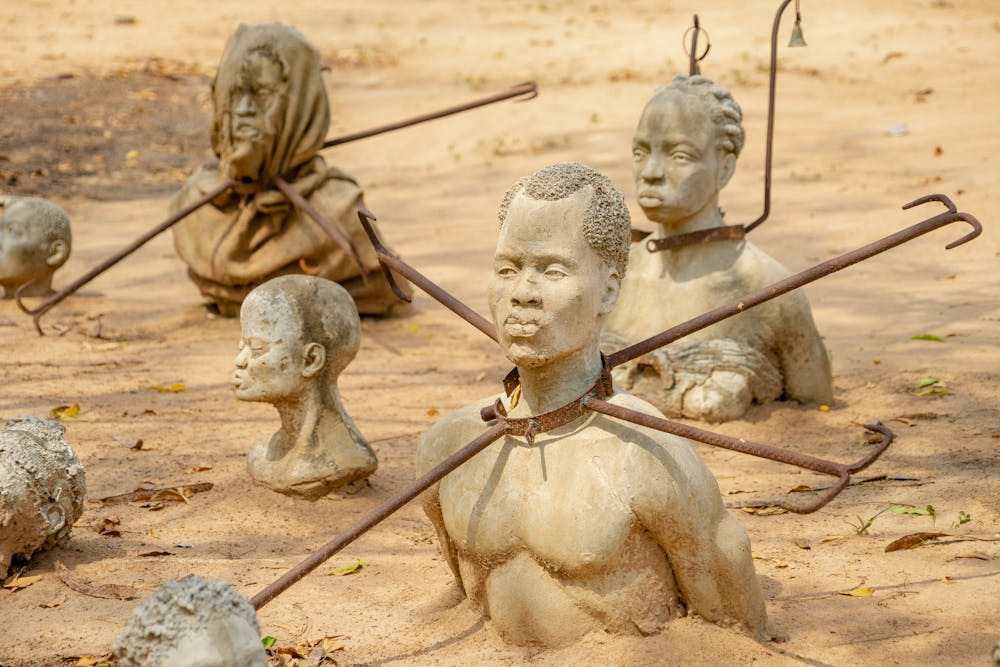
    Thousands of sculpted heads – captive African men, women, and children – meticulously created by the artist Kwame Akoto-Bamfo, emerge from the soil at the Nkyinkyim Museum, as a sacred gathering of ancestors. Together, they form a powerful monument to the horror, violence, and resistance to enslavement, as well as the ongoing work of remembrance and healing.

    Kwame Akoto-Bamfo is a Ghanaian multidisciplinary artist who engages with the histories and legacies of the transatlantic slave trade and colonialism at home and, increasingly, internationally, on both sides of the Atlantic.

    As an archaeologist who works in the field of critical heritage studies, Akoto-Bamfo’s work is important for its powerful engagement with memory, material culture and restorative justice. I feature it in a chapter of a new book that I co-edited called Architectures of Slavery: Ruins and Reconstructions.

    Who is Kwame Akoto-Bamfo?

    Akoto-Bamfo studied at the Kwame Nkrumah University of Science and Technology in Kumasi. He obtained his bachelor’s and master of fine arts degrees, both in sculpture. After graduating, the artist worked as a school teacher and a university lecturer.

    In 2015, Akoto-Bamfo rose to international fame through a series of large-scale installations. He called it ‘Nkyinkyim’ (“twisting” in the Ghanaian Twi language, as in the proverb, “Life’s journey is twisted”).


    Read more:
    Book review: how Africa was central to the making of the modern world


    Four years later, he established the ‘Nkyinkyim Museum’, a non-profit organisation known as the ‘Ancestor Project’. This open-air museum is located in Nuhalenya-Ada, a two-hour drive from Accra. It has become a space for people of African descent to engage in restorative healing through art and education.

    Nkyinkyim Museum

    At the site’s entrance, three twenty-five-foot monuments are displayed. They are made of stone, concrete and wood. The first is inspired by North and Eastern Africa, and the second by Sudano-Sahelian architecture. The third is inspired by the Forest regions in Central and West Africa.

    The collection includes multiple installations in collaboration with the local community. They illustrate “the diversity in our narratives surrounding history, philosophy, and religious beliefs”. The artist himself, demonstrates a mastery of multimedia art forms, working in cement, terracotta, brass, copper, and wood, noting “one can reach different heights with different technologies.”

    Today, the museum features a sacred healing space with a compelling display of thousands of unique concrete life size heads and 7,000 terracotta miniature sculpted heads. They include captive Africans abducted, sold and forcibly trafficked during the transatlantic slave trade.

    His sculptures capture captives’ shock, horror, anger, distress and fear—emotions. This is communicated through their facial expressions in an installation that is disturbingly evocative and profoundly haunting. It is inspired by ‘nsodie’, an Akan funerary sculpture tradition, that dates back to approximately the twelfth century. Akoto-Bamfo explains during our conversations relating to the research for book:

    I wanted to draw upon Akan belief in commemoration and remembrance after death in order to honour the young, old, men and women, who originated from various ethnic groups and who died in the Atlantic Ocean during the Middle Passage and did not get that chance.

    Each year, the annual ‘Ancestor Veneration’ ceremony takes place under the guidance of chiefs, priests, and priestess from various ethnic groups.

    Visitors are invited to participate in certain Akan rites and ceremonies – free from photography and selfies that undermine or commercialise sacred funerary art practices. Says Akoto-Bamfo:

    I am Akan, so initially I began with Akan traditional rites, but now our ceremonies welcome other African ethnic groups including the Ga-Dangme, Ewe, and Yoruba, from Ghana and Nigeria, as well as African descendant people in the African diaspora.

    In contrast, the ‘Freedom Parade Festival’ allows participants to creatively express and contribute to an evolving heritage tradition, without the specified observances. For example, painted bodily adornment applied directly onto the skin, yet without the necessary spiritual rites.

    A protest monument

    Akoto-Bamfo’s sculptures have also gained recognition beyond Ghana’s borders. For instance, the permanent installation at the Legacy Museum and National Museum for Peace and Justice in Montgomery, Alabama in the US.

    More recently, in 2021, his Blank Slate Project Monument toured throughout the United States. This included stops at Times Square in New York and the King Center in Atlanta. It depicts an enslaved ancestor, bent forward with his hands behind his back, head turned sideways, face on the ground, with a booted foot on his head.

    Akoto-Bamfo describes this work as “a noisy one — a protest piece that speaks against racist Civil War monuments.” The work was completed prior to the police killing of George Floyd that led to widespread protests in the US in 2020. It was first unveiled in a private viewing in Ghana, prior to its shipment to the United States.

    He says:

    We had a lot of discussions among those involved in the project: some feared it might incite violence, others said that it was a prediction.

    The work is interactive. It holds a removable placard that invites viewers to inscribe their reactions to the statue, which are then exhibited. Akoto-Bamfo emphasises:

    I wanted ordinary people, both individuals and communities, to relate, and to contribute to, not only towards my artwork but also to the wider ongoing discussions. As an artist, I believe that I do not have the sole right to speak. I wanted ordinary Americans to add their voices because I am already contributing.

    In Europe too, his work is featured at the 169 Museum in Germany.

    In Ghana, Akoto-Bamfo’s work was initially seen as too controversial. The artist shares:

    At first, I had to be extremely resilient because my work was concerned with the slave trade, slavery, colonialism, racism, and human rights. I embraced uncomfortable dialogue. Yet these were difficult topics for galleries and the art world at that time in Ghana.

    He adds:

    Today, however, some even view me as a spiritual leader… but I have always had an innate antipathy towards injustice. My work is not only about the past but what is unfolding now.

    Akoto-Bamfo offers a closing reflection on why this kind of memory work matters:

    I just want to use the little knowledge that I have to contribute towards the work of restorative and transformative justice.

    Rachel Ama Asaa Engmann does not work for, consult, own shares in or receive funding from any company or organisation that would benefit from this article, and has disclosed no relevant affiliations beyond their academic appointment.

    ref. Kwame Akoto-Bamfo: the Ghanaian artist using work about slavery to find justice and healing – https://theconversation.com/kwame-akoto-bamfo-the-ghanaian-artist-using-work-about-slavery-to-find-justice-and-healing-259184

    MIL OSI – Global Reports

  • MIL-OSI Global: Kwame Akoto-Bamfo: the Ghanaian artist using work about slavery to find justice and healing

    Source: The Conversation – Africa – By Rachel Ama Asaa Engmann, Associate Professor and Director of Christiansborg Archaeological Heritage Project, Associate Graduate Faculty, Rutgers University

    Thousands of sculpted heads – captive African men, women, and children – meticulously created by the artist Kwame Akoto-Bamfo, emerge from the soil at the Nkyinkyim Museum, as a sacred gathering of ancestors. Together, they form a powerful monument to the horror, violence, and resistance to enslavement, as well as the ongoing work of remembrance and healing.

    Kwame Akoto-Bamfo is a Ghanaian multidisciplinary artist who engages with the histories and legacies of the transatlantic slave trade and colonialism at home and, increasingly, internationally, on both sides of the Atlantic.

    As an archaeologist who works in the field of critical heritage studies, Akoto-Bamfo’s work is important for its powerful engagement with memory, material culture and restorative justice. I feature it in a chapter of a new book that I co-edited called Architectures of Slavery: Ruins and Reconstructions.

    Who is Kwame Akoto-Bamfo?

    Akoto-Bamfo studied at the Kwame Nkrumah University of Science and Technology in Kumasi. He obtained his bachelor’s and master of fine arts degrees, both in sculpture. After graduating, the artist worked as a school teacher and a university lecturer.

    In 2015, Akoto-Bamfo rose to international fame through a series of large-scale installations. He called it ‘Nkyinkyim’ (“twisting” in the Ghanaian Twi language, as in the proverb, “Life’s journey is twisted”).


    Read more:
    Book review: how Africa was central to the making of the modern world


    Four years later, he established the ‘Nkyinkyim Museum’, a non-profit organisation known as the ‘Ancestor Project’. This open-air museum is located in Nuhalenya-Ada, a two-hour drive from Accra. It has become a space for people of African descent to engage in restorative healing through art and education.

    Nkyinkyim Museum

    At the site’s entrance, three twenty-five-foot monuments are displayed. They are made of stone, concrete and wood. The first is inspired by North and Eastern Africa, and the second by Sudano-Sahelian architecture. The third is inspired by the Forest regions in Central and West Africa.

    The collection includes multiple installations in collaboration with the local community. They illustrate “the diversity in our narratives surrounding history, philosophy, and religious beliefs”. The artist himself, demonstrates a mastery of multimedia art forms, working in cement, terracotta, brass, copper, and wood, noting “one can reach different heights with different technologies.”

    Today, the museum features a sacred healing space with a compelling display of thousands of unique concrete life size heads and 7,000 terracotta miniature sculpted heads. They include captive Africans abducted, sold and forcibly trafficked during the transatlantic slave trade.

    His sculptures capture captives’ shock, horror, anger, distress and fear—emotions. This is communicated through their facial expressions in an installation that is disturbingly evocative and profoundly haunting. It is inspired by ‘nsodie’, an Akan funerary sculpture tradition, that dates back to approximately the twelfth century. Akoto-Bamfo explains during our conversations relating to the research for book:

    I wanted to draw upon Akan belief in commemoration and remembrance after death in order to honour the young, old, men and women, who originated from various ethnic groups and who died in the Atlantic Ocean during the Middle Passage and did not get that chance.

    Each year, the annual ‘Ancestor Veneration’ ceremony takes place under the guidance of chiefs, priests, and priestess from various ethnic groups.

    Visitors are invited to participate in certain Akan rites and ceremonies – free from photography and selfies that undermine or commercialise sacred funerary art practices. Says Akoto-Bamfo:

    I am Akan, so initially I began with Akan traditional rites, but now our ceremonies welcome other African ethnic groups including the Ga-Dangme, Ewe, and Yoruba, from Ghana and Nigeria, as well as African descendant people in the African diaspora.

    In contrast, the ‘Freedom Parade Festival’ allows participants to creatively express and contribute to an evolving heritage tradition, without the specified observances. For example, painted bodily adornment applied directly onto the skin, yet without the necessary spiritual rites.

    A protest monument

    Akoto-Bamfo’s sculptures have also gained recognition beyond Ghana’s borders. For instance, the permanent installation at the Legacy Museum and National Museum for Peace and Justice in Montgomery, Alabama in the US.

    More recently, in 2021, his Blank Slate Project Monument toured throughout the United States. This included stops at Times Square in New York and the King Center in Atlanta. It depicts an enslaved ancestor, bent forward with his hands behind his back, head turned sideways, face on the ground, with a booted foot on his head.

    Akoto-Bamfo describes this work as “a noisy one — a protest piece that speaks against racist Civil War monuments.” The work was completed prior to the police killing of George Floyd that led to widespread protests in the US in 2020. It was first unveiled in a private viewing in Ghana, prior to its shipment to the United States.

    He says:

    We had a lot of discussions among those involved in the project: some feared it might incite violence, others said that it was a prediction.

    The work is interactive. It holds a removable placard that invites viewers to inscribe their reactions to the statue, which are then exhibited. Akoto-Bamfo emphasises:

    I wanted ordinary people, both individuals and communities, to relate, and to contribute to, not only towards my artwork but also to the wider ongoing discussions. As an artist, I believe that I do not have the sole right to speak. I wanted ordinary Americans to add their voices because I am already contributing.

    In Europe too, his work is featured at the 169 Museum in Germany.

    In Ghana, Akoto-Bamfo’s work was initially seen as too controversial. The artist shares:

    At first, I had to be extremely resilient because my work was concerned with the slave trade, slavery, colonialism, racism, and human rights. I embraced uncomfortable dialogue. Yet these were difficult topics for galleries and the art world at that time in Ghana.

    He adds:

    Today, however, some even view me as a spiritual leader… but I have always had an innate antipathy towards injustice. My work is not only about the past but what is unfolding now.

    Akoto-Bamfo offers a closing reflection on why this kind of memory work matters:

    I just want to use the little knowledge that I have to contribute towards the work of restorative and transformative justice.

    Rachel Ama Asaa Engmann does not work for, consult, own shares in or receive funding from any company or organisation that would benefit from this article, and has disclosed no relevant affiliations beyond their academic appointment.

    ref. Kwame Akoto-Bamfo: the Ghanaian artist using work about slavery to find justice and healing – https://theconversation.com/kwame-akoto-bamfo-the-ghanaian-artist-using-work-about-slavery-to-find-justice-and-healing-259184

    MIL OSI – Global Reports

  • MIL-OSI Global: One year on: South Africa’s coalition government boosted optimism, but will it last?

    Source: The Conversation – Africa – By Matthias Krönke, Lecturer, University of Reading

    For the first time since the end of apartheid in 1994, the ruling African National Congress lost its parliamentary majority in 2024. After 30 years in power, it had to form a coalition with 10 other political parties to govern the country. The creation of the “government of national unity” marked a turning point in the country’s democracy.

    This development appears to have rekindled hope and positive sentiment among South Africans about the country’s future and its democratic processes.

    The period leading up to the 2024 elections was characterised by widespread pessimism. Years of economic stagnation, high unemployment, severe electricity shortages, and high-level corruption cases had taken their toll on public trust and satisfaction with the ANC’s governance. Previous analyses by Afrobarometer (a research network that conducts public attitude surveys) had consistently shown declining satisfaction with the country’s direction and the functioning of democracy.

    We are political scientists who have worked with public opinion data in South Africa for almost a decade. We analysed data from a special Afrobarometer survey just before and after the country’s 2024 election. The results show a sharp turnaround in attitudes on three issues: the direction of the country, government performance, and views on democracy.

    One of the most significant findings is the shift in citizens’ perceptions about the general direction of the country. Before the election, a mere 14% of South Africans believed the country was heading in the right direction. Post-election, this figure surged to 39%.

    South Africans’ renewed optimism after the formation of the unity government underscores the importance of electoral processes in shaping citizen perceptions of democracy and governance. Whether these sentiments are sustained will depend on a few things, including the coalition government’s ability to meet citizen expectations and address their most pressing concerns.

    The post-election optimism boost

    Afrobarometer interviewed the same group of adult South Africans before (April/May 2024) and after (August/September 2024) the election. This allowed us to track which respondents changed their views and in which direction. Here, we focus on citizens’ views of the overall direction of the country (optimism), government performance, and views on democracy.

    A surge in optimism: The data show that 35% of the population became more positive in their outlook after the election. This was consistent across gender, age, and education levels. At the same time, 4% of the population maintained their positive outlook on the country’s trajectory.

    About half (48%) continued to say that South Africa was going in the wrong direction after the election. A further 10% moved towards a negative outlook.

    Renewed faith in democratic processes: Beyond general optimism, there was a resurgence in pro-democratic attitudes. The proportion of South Africans who believe democracy is preferable to any other form of government increased from 45% before the election to 55% after. Satisfaction with the way democracy works in South Africa jumped from 36% to 59%. These levels of support for and satisfaction with democracy were the highest recorded by Afrobarometer in South Africa since 2018 and 2011, respectively.

    We found that three in 10 (29%) respondents were newly in favour of democracy after the elections. About four in 10 (39%) shifted from dissatisfaction or a neutral opinion before the election to stating they were “fairly” or “very” satisfied with the country’s democracy afterwards.

    Where are the sore losers?: In both the case of support for and satisfaction with democracy, we found that a greater proportion of poorer citizens shifted their opinions, compared to their wealthier counterparts. In contrast, there were no clear patterns of opinion change by respondents’ gender, age, level of education, or race.

    When examining the same question by party affiliation, the outcome was interesting. The share of partisans who preferred democracy increased among supporters of the ANC, the Economic Freedom Fighters and the MK Party after the election. A majority of supporters from the four major parties were satisfied with how democracy worked in the country.

    Even ANC supporters remained largely satisfied with democracy despite the party’s electoral losses. Collectively, these findings suggest a post-electoral vote of confidence in multiparty competition.

    Expectations of the new government: Citizens also appeared more hopeful about the new coalition government’s ability to tackle some of the nation’s most pressing issues. Pre-election evaluations of government performance on key services were overwhelmingly negative. The post-election wave showed some modest increases in optimism.

    Two-thirds (67%) of South Africans felt the government of national unity would be more effective in the critical area of electricity provision. There was also hope for progress in other areas; 42% expected the new government to be more effective in creating jobs. Another 41% believed it would be more successful in fighting corruption.

    Over the past year, the government seems to have met citizens’ expectations. South Africa has not experienced prolonged periods of power cuts over the past 12 months. However, the unemployment rate has remained unchanged, at 32.9%.

    Looking ahead

    The 2024 elections in South Africa seem to have served as an inflection point. It is contributing to a revival of optimism and pro-democratic sentiment. The shift from pre-election pessimism to post-election hope was palpable. Maintaining renewed public confidence, however, relies on a government’s ability to meet citizens’ expectations and deliver tangible improvements on their concerns.

    The ongoing skirmishes between the ANC and the Democratic Alliance illustrate the coalition government’s difficulty in translating agreement on a broad agenda into specific outcomes.

    The coming months and years will tell whether the unity government’s infighting ultimately squanders citizens’ goodwill.

    Matthias Krönke works for the University of Reading and consults for Afrobarometer.

    Rorisang Lekalake is affiliated with Afrobarometer.

    ref. One year on: South Africa’s coalition government boosted optimism, but will it last? – https://theconversation.com/one-year-on-south-africas-coalition-government-boosted-optimism-but-will-it-last-258497

    MIL OSI – Global Reports

  • MIL-OSI Global: One year on: South Africa’s coalition government boosted optimism, but will it last?

    Source: The Conversation – Africa – By Matthias Krönke, Lecturer, University of Reading

    For the first time since the end of apartheid in 1994, the ruling African National Congress lost its parliamentary majority in 2024. After 30 years in power, it had to form a coalition with 10 other political parties to govern the country. The creation of the “government of national unity” marked a turning point in the country’s democracy.

    This development appears to have rekindled hope and positive sentiment among South Africans about the country’s future and its democratic processes.

    The period leading up to the 2024 elections was characterised by widespread pessimism. Years of economic stagnation, high unemployment, severe electricity shortages, and high-level corruption cases had taken their toll on public trust and satisfaction with the ANC’s governance. Previous analyses by Afrobarometer (a research network that conducts public attitude surveys) had consistently shown declining satisfaction with the country’s direction and the functioning of democracy.

    We are political scientists who have worked with public opinion data in South Africa for almost a decade. We analysed data from a special Afrobarometer survey just before and after the country’s 2024 election. The results show a sharp turnaround in attitudes on three issues: the direction of the country, government performance, and views on democracy.

    One of the most significant findings is the shift in citizens’ perceptions about the general direction of the country. Before the election, a mere 14% of South Africans believed the country was heading in the right direction. Post-election, this figure surged to 39%.

    South Africans’ renewed optimism after the formation of the unity government underscores the importance of electoral processes in shaping citizen perceptions of democracy and governance. Whether these sentiments are sustained will depend on a few things, including the coalition government’s ability to meet citizen expectations and address their most pressing concerns.

    The post-election optimism boost

    Afrobarometer interviewed the same group of adult South Africans before (April/May 2024) and after (August/September 2024) the election. This allowed us to track which respondents changed their views and in which direction. Here, we focus on citizens’ views of the overall direction of the country (optimism), government performance, and views on democracy.

    A surge in optimism: The data show that 35% of the population became more positive in their outlook after the election. This was consistent across gender, age, and education levels. At the same time, 4% of the population maintained their positive outlook on the country’s trajectory.

    About half (48%) continued to say that South Africa was going in the wrong direction after the election. A further 10% moved towards a negative outlook.

    Renewed faith in democratic processes: Beyond general optimism, there was a resurgence in pro-democratic attitudes. The proportion of South Africans who believe democracy is preferable to any other form of government increased from 45% before the election to 55% after. Satisfaction with the way democracy works in South Africa jumped from 36% to 59%. These levels of support for and satisfaction with democracy were the highest recorded by Afrobarometer in South Africa since 2018 and 2011, respectively.

    We found that three in 10 (29%) respondents were newly in favour of democracy after the elections. About four in 10 (39%) shifted from dissatisfaction or a neutral opinion before the election to stating they were “fairly” or “very” satisfied with the country’s democracy afterwards.

    Where are the sore losers?: In both the case of support for and satisfaction with democracy, we found that a greater proportion of poorer citizens shifted their opinions, compared to their wealthier counterparts. In contrast, there were no clear patterns of opinion change by respondents’ gender, age, level of education, or race.

    When examining the same question by party affiliation, the outcome was interesting. The share of partisans who preferred democracy increased among supporters of the ANC, the Economic Freedom Fighters and the MK Party after the election. A majority of supporters from the four major parties were satisfied with how democracy worked in the country.

    Even ANC supporters remained largely satisfied with democracy despite the party’s electoral losses. Collectively, these findings suggest a post-electoral vote of confidence in multiparty competition.

    Expectations of the new government: Citizens also appeared more hopeful about the new coalition government’s ability to tackle some of the nation’s most pressing issues. Pre-election evaluations of government performance on key services were overwhelmingly negative. The post-election wave showed some modest increases in optimism.

    Two-thirds (67%) of South Africans felt the government of national unity would be more effective in the critical area of electricity provision. There was also hope for progress in other areas; 42% expected the new government to be more effective in creating jobs. Another 41% believed it would be more successful in fighting corruption.

    Over the past year, the government seems to have met citizens’ expectations. South Africa has not experienced prolonged periods of power cuts over the past 12 months. However, the unemployment rate has remained unchanged, at 32.9%.

    Looking ahead

    The 2024 elections in South Africa seem to have served as an inflection point. It is contributing to a revival of optimism and pro-democratic sentiment. The shift from pre-election pessimism to post-election hope was palpable. Maintaining renewed public confidence, however, relies on a government’s ability to meet citizens’ expectations and deliver tangible improvements on their concerns.

    The ongoing skirmishes between the ANC and the Democratic Alliance illustrate the coalition government’s difficulty in translating agreement on a broad agenda into specific outcomes.

    The coming months and years will tell whether the unity government’s infighting ultimately squanders citizens’ goodwill.

    Matthias Krönke works for the University of Reading and consults for Afrobarometer.

    Rorisang Lekalake is affiliated with Afrobarometer.

    ref. One year on: South Africa’s coalition government boosted optimism, but will it last? – https://theconversation.com/one-year-on-south-africas-coalition-government-boosted-optimism-but-will-it-last-258497

    MIL OSI – Global Reports

  • MIL-OSI Global: Kenya’s police still kill with impunity – what needs to be done to stop them

    Source: The Conversation – Africa – By Kamau Wairuri, Lecturer in criminology, Edinburgh Napier University

    Weeks ahead of the first anniversary in Kenya of the Gen Z-led anti-government protests that resulted in at least 60 deaths and displays of police brutality, news broke that Albert Ojwang, a young Kenyan blogger, had died in police detention. Kamau Wairuri who has studied the politics of policing in Kenya, sets out why these events aren’t outliers, what efforts have been made to reform Kenya’s security forces, and what still needs to be done.

    When did this all begin?

    Recent events are part of a long history of police brutality in Kenya that can be traced back to colonial times.

    Historians (colonial and post-colonial Kenya) such as David Anderson and Caroline Elkins present gruesome details of how state authorities brutalised indigenous Africans during colonial times.

    The colonial origins of the police – largely modelled along the approaches of the Royal Ulster Constabulary known for its brutality in Ireland – partly explains why Kenya’s policing is the way it is. The police force was never designed for service. It was designed to safeguard the interests of the white minority ruling elite.

    While there have been important changes in the architecture of policing since independence, subsequent post-colonial Kenyan regimes have adopted the same brutal approaches to stay in power. My previous work demonstrates this use of state security apparatuses to enhance the capacity of incumbents to crack down on opposition protests.

    The brutal policing experienced under the current Kenya Kwanza regime falls within this broader historical trajectory.

    The ruling elite see and use the police as their last line of defence against challenges to their misrule.

    But police brutality goes beyond the policing of politics to everyday crime control. Police violence is a common occurrence, especially against poor young men.

    What’s changed

    Kenya’s history has been marked by strong agitation for justice and reform. Again, this goes back to colonial times.

    There have been important legal and institutional changes since independence. The most important was the disbandment of the Special Branch in 1998, an intelligence unit of the police responsible for political repression. It was replaced by the National Security Intelligence Service. This then became the National Intelligence Service.

    The most important changes came about through the constitutional reform of 2010. This saw a change in the architecture of the police, including:

    Internal Affairs, a unit within the police service, is supposed to investigate police misconduct. The policing oversight agency is a civilian-led institutions with a similar mandate. Ideally, the two institutions should work together in executing crucial investigations. Internal affairs should provide access to information from within the police service that would be difficult for outsiders to access.

    The National Police Service Commission was set up to handle the management of personnel. It’s mandated to address the challenges of corruption, nepotism and negative ethnicity that have characterised recruitment into the police service.

    But it’s clear from the continued police brutality that these institutions aren’t achieving the intended effect. This means that police officers can expect to continue acting with relative impunity despite the control measures in place.

    What still needs to be done

    Policing is often imagined as the investigation of crimes, arresting suspects, and presenting them to court for prosecution and punishment if guilty. In Kenya, the actions of the police often appear to substitute for the entire criminal justice system.

    In many cases, officers go beyond the metaphor of judge, jury and executioner to also become the complainant, mortician and undertaker. For instance, Mbaraka Karanja died in police custody in 1987 and officers proceeded to incinerate his body.

    In my view, the brutality won’t end until the following steps have been taken.

    First, the National Police Service Commission needs to reclaim its mandate. It seems to have completely abdicated duty, transferring crucial responsibilities back to the inspector general of the police service. As the human resource unit of the police, the commission has an important role of professionalising the service and maintaining discipline. It’s presently not doing so.

    Second, the Internal Affairs Unit needs to be strengthened and given more autonomy. So far, it has been difficult to assess the effectiveness the unit given the secrecy that characterises the police service. A better-resourced unit will enhance investigations of police misconduct. It would unearth obscure squads within the police service and reveal evidence to help identify perpetrators.

    Third, the Independent Policing Oversight Authority needs to defend its independence and develop popular legitimacy. With its limited success in prosecuting police officers – despite the prevalence of police abuse – many Kenyans have lost confidence in it. Crucially, the authority has failed in it’s deterrence role.

    Fourth, the independence of the National Police Service needs to be safeguarded. The police service leadership continues to serve at the pleasure of the prevailing regime. This in turn shapes the priorities of the service. Inspectors-general have been forced to resign. President William Ruto confessed to having fired the director of criminal investigations when he took power. Ruto had initially claimed that the director had resigned.

    Crucially, and in fifth place, there needs to be a change in policing culture alongside broader governance culture in Kenya. Impunity is rampant across the public service. Kenya won’t have a highly accountable police force while other agencies and senior officials are operating with significant impunity.

    Identifying the levers of cultural change isn’t easy. There are many proposals to alter policing culture. These include a complete redesign of Kenya’s Penal Code to dislodge its colonial roots, transforming the training of police officers, and strengthening the policing oversight authority’s capacity to investigate cases.

    But, in my mind, a crucial starting point is citizen agitation and demand for accountability. The light that Gen Z protesters, the media and civil society organisations are shining on police abuses should be encouraged. A clear signal that Kenyans will no longer tolerate police abuse is crucial for culture change within the service and among the political elite.

    However, this needs to be understood within the reality that many Kenyans support police violence, believing it to be the most effective way of dealing with crime as my earlier research demonstrates. In another study, I note how police abuse is endorsed by politicians and religious leaders as a way of responding to crime and punishing groups of people they don’t like.

    Combined with ineffective accountability mechanisms, this popular support for police violence, both tacit and explicit, gives the police the belief that they are the thin blue line between order and chaos. That they have the popular mandate to use any means they consider necessary – often brutal violence – to keep society safe.

    In other words, the conversation on police reform requires a fundamental reframing to kick start the journey towards democratic policing. At present, we’re not only way off the mark, we seem to be heading in the wrong direction.

    Kamau Wairuri does not work for, consult, own shares in or receive funding from any company or organisation that would benefit from this article, and has disclosed no relevant affiliations beyond their academic appointment.

    ref. Kenya’s police still kill with impunity – what needs to be done to stop them – https://theconversation.com/kenyas-police-still-kill-with-impunity-what-needs-to-be-done-to-stop-them-259326

    MIL OSI – Global Reports

  • MIL-OSI United Nations: IAEA at COP29: Time to Deliver Nuclear Solutions

    Source: International Atomic Energy Agency (IAEA)

    Momentum for nuclear energy as a key driver toward net-zero is stronger than ever. Now is the time to turn last year’s historic consensus in Dubai into action, advancing nuclear solutions to ensure energy security, achieve climate targets and promote sustainable development.

    International Atomic Energy Agency (IAEA) Director General Rafael Mariano Grossi is bringing this message to the 29th United Nations Climate Change Conference (COP29).

    This year’s COP has climate finance at the top of the agenda. Building on the back of the historic inclusion of nuclear in the COP28 Global Stocktake and the first ever Nuclear Energy Summit in Brussels, Director General Grossi will attend COP29 with a call to increase climate finance for nuclear. At the Financing Low Carbon Technology, Including Nuclear Energy event on 13 November at 16:00, Director General Grossi, as well as the COP29 presidency, ministers, heads of international organizations, multilateral development banks and the private sector will discuss scaling up the financing necessary to expand all low carbon energy technologies, including nuclear power.

    In recently published projections, the IAEA increased its forecast for nuclear power generation for the fourth consecutive year. In its high-case scenario, global nuclear capacity by 2050 could reach two and a half times today’s levels, with small modular reactors (SMRs) contributing a quarter of this expansion. The United States Senior Advisor to the President for International Climate Policy, John Podesta, and Director General Grossi will host an event on Accelerating Early Deployment of Small Modular Reactors at 12:45 on 13 November.

    Throughout the two-week conference, which runs from 11 to 22 November, the IAEA will also promote the use of nuclear science and technologies for climate change adaptation and monitoring to achieve sustainable water management, protect coastal and marine ecosystems and provide food security.

    On 12 November, Director General Grossi will join leaders from UNIDO, FAO, WTO and other key sectors for a flagship event on Decarbonizing and Adapting the Cotton-to-Clothing Value Chain through Multisectoral Partnerships. The event will showcase how innovative policies, technologies and partnerships can drive decarbonization in the cotton sector and strengthen climate resilience.

    Millions worldwide still face hunger, and transforming agrifood systems through science and technology is essential to address this challenge amid changing climate conditions. An event on the joint IAEA/FAO Atoms4Food initiative will take place at the China Pavilion on 12 November to present achievements in agriculture and food security in the context of national climate adaptation efforts. 

    The Atoms4Climate pavilion will be hosted by the IAEA in the Blue Zone at COP and will showcase nuclear power, science and technology solutions for climate change mitigation, adaptation and monitoring.

    The IAEA will host and participate in more than 50 events focusing on four thematic areas: energyfood, the ocean and water.

    See the IAEA COP29 page for the complete list of IAEA and partner events. Check the individual event pages for updates on livestreaming opportunities.

    Nuclear security measures

    For the third time, the IAEA is supporting the COP host country to implement nuclear security measures during the two-week conference. In October, the Agency trained more than 100 national first responders and staff from security enforcement bodies, including through hands-on equipment training conducted at the Baku Stadium, the venue for the COP. The Agency has also supplied over 100 radiation detection devices to support the nuclear security measures throughout COP, which is expected to draw around 40 000 participants. Similar assistance was provided by the IAEA at COP27 in Sharm el-Sheikh, Egypt, and COP28 in Dubai, UAE, as part of the IAEA’s two decades worth of support offered to countries, upon their request, for nuclear security at major public events.  

    IAEA media team contacts

    IAEA experts in climate change mitigation, adaptation and monitoring will be available for interviews at COP29.

    For interview requests and other media-related questions, please contact Fredrik Dahl, IAEA Spokesperson, at Fredrik.Dahl@iaea.org and copy press@iaea.org.

    The IAEA video team will be present at COP29. B-roll footage is available here. For additional requests of B-roll of the Director General, the IAEA pavilion or specific events, please contact multimedia.contact-point@iaea.org and copy press@iaea.org.

    Registration

    To attend IAEA events in person, you must register for COP29. For media accreditation and all other details concerning the attendance of COP29, please refer to the UNFCCCC online registration page. The IAEA cannot assist with accreditation to COP29.

    Media kit

    The COP29 media kit provides information on the four key areas highlighted at the #Atoms4Climate pavilion — energyfood, the ocean and water — along with recent reports and further background information.

    The media kit also contains B-roll video footage on nuclear power and applications to tackle climate change, videos on the IAEA and climate change and high-resolution images in the IAEA Flickr account. The IAEA will take photographs at COP29 and post them on Flickr.

    This material is free to use under the copyright provisions of the IAEA Terms of Use. If you have further questions, please contact us.

    The IAEA’s explainer articles, podcasts and other resources on climate change are available on the IAEA website.

    Follow the IAEA and #Atoms4Climate on Facebook, Instagram, LinkedIn, X and Weibo for updates throughout COP29.

    MIL OSI United Nations News

  • MIL-OSI United Nations: Press Arrangements for IAEA Board of Governors Meeting, 20-22 November 2024 

    Source: International Atomic Energy Agency (IAEA)

    The IAEA Board of Governors will convene its regular November meeting at the Agency’s headquarters starting at 10:30 CET on Wednesday, 20 November, in Board Room C, Building C, 4th floor, in the Vienna International Centre (VIC). 

    Board discussions are expected to include, among others: applications for membership of the Agency; report of the Technical Assistance and Cooperation Committee; verification and monitoring in the Islamic Republic of Iran in light of United Nations Security Council resolution 2231 (2015); nuclear verification: the conclusion of safeguards agreements and of additional protocols (if any), staff of the Department of Safeguards to be used as Agency inspectors, application of safeguards in the Democratic People’s Republic of Korea, implementation of the NPT safeguards agreement in the Syrian Arab Republic, naval nuclear propulsion: Australia and naval nuclear propulsion: Brazil, and NPT safeguards agreement with the Islamic Republic of Iran; nuclear safety, security and safeguards in Ukraine; transfer of the nuclear materials in the context of AUKUS and its safeguards in all aspects under the NPT; and restoration of the Sovereign Equality of Member States in the IAEA. 

    The Board of Governors meeting is closed to the press. 

    Director General Rafael Mariano Grossi will open the meeting with an introductory statement, which will be released to journalists after delivery and posted on the IAEA website.  

    Press Conference 

    Director General Grossi is expected to hold a press conference at 13:00 CET on Wednesday, 20 November, in the Press Room of the M building. 

    A live video stream of the press conference will be available. The IAEA will provide video footage of the press conference and the Director General’s opening statement here and will make photos available on Flickr.  

    Photo Opportunity 

    There will be a photo opportunity with the IAEA Director General and the Chair of the Board, Ambassador Philbert Abaka Johnson of Ghana, before the start of the Board meeting, on 20 November at 10:30 CET in Board Room C, in the C building in the VIC. 

    Press Working Area 

    The Press Room on the M-Building’s ground floor will be available as a press working area, starting from 9:00 CET on 20 November. 

    Accreditation

    All journalists interested in covering the meeting in person – including those with permanent accreditation – are requested to inform the IAEA Press Office of their plans. Journalists without permanent accreditation must send copies of their passport and press ID to the IAEA Press Office by 14:00 CET on Tuesday, 19 November. 

    We encourage those journalists who do not yet have permanent accreditation to request it at UNIS Vienna

    Please plan your arrival to allow sufficient time to pass through the VIC security check. 

    MIL OSI United Nations News

  • MIL-OSI United Nations: IAEA Ministerial Conference to Spotlight Nuclear Science, Technology and Technical Cooperation Programme to Address Global Challenges

    Source: International Atomic Energy Agency (IAEA)

    Ministers and senior officials of governments and international organizations will convene at the International Atomic Energy Agency (IAEA) next week to discuss the role of nuclear science and technology in tackling some of the world’s most pressing challenges. The IAEA Ministerial Conference on Nuclear Science, Technology and Applications and the Technical Cooperation Programme will take place in Vienna, Austria, from 26 to 28 November 2024.

    IAEA Director General Rafael Mariano Grossi will open the conference on Tuesday, 26 November, at 09:30 CET, alongside Co-chair of the Conference Kai Mykkänen, Minister of Climate and the Environment, Finland; Co-chair of the Conference Kwaku Afriyie, Minister for Environment, Science, Technology and Innovation, Ghana; Dongyu Qu, Director General, Food and Agriculture Organization of the United Nations (FAO); Ailan Li, Assistant Director-General, Universal Health Coverage/Healthier Populations, World Health Organization (WHO); Shaimaa Al-Sheiby, Vice President for Public Sector and Strategy, the OPEC Fund for International Development; Demetrios Papathanasiou, Global Director, Energy and Extractives Global Practice, the World Bank; and Tom McCulley, Chief Executive Officer, Anglo American Crop Nutrients. This is the second Ministerial Conference of its kind.

    A ministerial declaration is expected to be adopted on 26 November, recognizing the role of nuclear science and technology and the Technical Cooperation Programme in addressing global challenges, advancing the 2030 Agenda and fostering international collaboration for peaceful purposes, with a focus on capacity building and equitable access for all Member States.

    The conference will take place in Boardroom B/M1, M Building, Vienna International Centre (VIC). The conference, including the ministerial segments, technical sessions and panels, is open to media and will be livestreamed. The provisional programme is available here.

    Nuclear applications are an integral part of the technological solution to address development challenges the world is facing today, including climate change, health, food safety and security, and water resource management. Since the first Ministerial Conference in 2018, the IAEA launched the Zoonotic Disease Integrated Action (ZODIAC), NUclear TEChnology for Controlling Plastic Pollution (NUTEC Plastics), Rays of Hope, Atoms4NetZero and, together with the FAO, the Atoms4Food initiative. Through these initiatives, the IAEA can support its Member States and mobilize resources to realize the full potential of nuclear solutions towards global goals.

    Among 1400 participants, more than 50 high-level officials, including ministers, are expected to deliver national statements. The scientific and technical programme comprises panel discussions among ministers, scientists and experts on the latest developments in nuclear science, technology and applications. Member State’s representatives will also share experiences on how the IAEA Technical Cooperation Programme has contributed to their national development.

    Accreditation

    All journalists interested in covering the meeting in person – including those with permanent accreditation – are requested to inform the IAEA Press Office of their plans. Journalists without permanent accreditation must send copies of their passport and press ID to the IAEA Press Office by 14:00 CET on Monday, 25 November. 

    We encourage those journalists who do not yet have permanent accreditation to request it at UNIS Vienna

    Please plan your arrival to allow sufficient time to pass through the VIC security check. 

    MIL OSI United Nations News

  • MIL-OSI United Nations: Press Arrangements for IAEA Board of Governors Meeting, 3-7 March 2025

    Source: International Atomic Energy Agency (IAEA)

    The International Atomic Energy Agency (IAEA) Board of Governors will convene its regular March meeting at the Agency’s headquarters starting at 10:30 CET on Monday, 3 March, in Board Room C, Building C, 4th floor, in the Vienna International Centre (VIC). 

    Board discussions are expected to include, among others: Nuclear Safety Review 2025; Nuclear Security Review 2025; Nuclear Technology Review 2025; verification and monitoring in the Islamic Republic of Iran in light of United Nations Security Council resolution 2231 (2015); the conclusion of safeguards agreements and of additional protocols; application of safeguards in the Democratic People’s Republic of Korea; implementation of the NPT safeguards agreement in the Syrian Arab Republic; NPT safeguards agreement with the Islamic Republic of Iran; nuclear safety, security and safeguards in Ukraine; transfer of the nuclear materials in the context of AUKUS and its safeguards in all aspects under the NPT; the restoration of the sovereign equality of Member States in the IAEA; and personnel matters. 

    The Board of Governors meeting is closed to the press. 

    IAEA Director General Rafael Mariano Grossi will open the meeting with an introductory statement, which will be released to journalists after delivery and posted on the IAEA website.  

    Press Conference 

    Director General Grossi is expected to hold a press conference at 13:00 CET on Monday, 3 March, in the Press Room of the M building. 

    A live video stream of the press conference will be available. The IAEA will provide video footage of the press conference and the Director General’s opening statement here and will make photos available on Flickr.  

    Photo Opportunity 

    There will be a photo opportunity with the IAEA Director General and the Chair of the Board, Ambassador Matilda Aku Alomatu Osei-Agyeman of Ghana, before the start of the Board meeting, on 3 March at 10:30 CET in Board Room C, in the C building in the VIC. 

    Press Working Area 

    Conference room M7 on the M-Building’s ground floor will be available as a press working area, starting from 09:00 CET on 3 March. Please note the change of room.

    Accreditation

    All journalists interested in covering the meeting in person – including those with permanent accreditation – are requested to inform the IAEA Press Office of their plans. Journalists without permanent accreditation must send copies of their passport and press ID to the IAEA Press Office by 14:00 CET on Friday, 28 February. 

    We encourage those journalists who do not yet have permanent accreditation to request it at UNIS Vienna

    Please plan your arrival to allow sufficient time to pass through the VIC security check. 

    MIL OSI United Nations News

  • MIL-OSI United Nations: IAEA Director General’s Speech at the Nobel Peace Prize Forum

    Source: International Atomic Energy Agency (IAEA)

    Nobel’s spotlight on our perilous path and how we change course

    I want to start by congratulating Nihon Hidankyō and the hibakusha for their Nobel Peace Prize.

    As a young diplomat almost 40 years ago, I was fortunate to be part of a UN disarmament fellowship programme and to visit Hiroshima. There, fellows had an opportunity to meet the hibakusha and I had a conversation with an ailing victim. I have carried to every meeting, to every negotiation, and to every posting, the memory this woman’s silent testimony. When I asked her about that morning in 1945, she struggled to express the horror in words. She tried to articulate some words but stayed silent. Looking at me, right into my eyes. The look in her eyes has stayed with me ever since, like a powerful reminder, a secret mandate, to work so that her suffering is never repeated.

    For decades after the Second World War, the international community has been dealing with this unique dilemma: we built robust norms and passed nonproliferation and disarmament treaties. Instead of dozens of countries armed with nuclear weapons, as was the concern in the 1960s, there are less than ten. Stockpiles of nuclear weapons have shrunk from tens of thousands to thousands.

    But on its journey through the perils of the atomic age, the world has come to a crucial crossroads. Our deep psychological connection caused by collectively seeing the horror of the consequences of nuclear war seems to be evaporating, taking with it our joint resolve to do everything possible to prevent a repetition.

    Like a giant spotlight, this year’s Nobel Peace Prize has lit up our path ahead. It has done it, by reminding us of the past, and of the consequences of ignoring the perils of nuclear weapons use.

    Context of conflicts

    To understand the important challenges we face, we must look at the global context, at what is happening around the world.  

    War has returned to Europe, and it directly involves a nuclear weapon state. The conflict in Ukraine is also an indirect confrontation between the world’s biggest nuclear weapon states, the first since the end of the Cold War. But nuclear exercises and open references to the use of nuclear weapons in the theatre of this war are increasing the risks and can not be ignored.

    In the Middle East, the conflict of the past year has ignited smoldering tensions between Israel and Iran and led to the unprecedented step of direct exchanges and attacks between the two. Here there is also a nuclear weapons dimension. On one side, the assumed presence of nuclear weapons looms in the background. On the other, the very real potential of nuclear proliferation is raising the stakes.

    We find ourselves in a harmful loop: the erosion of the restraints around nuclear weapons is making these conflicts more dangerous. Meanwhile, these conflicts are contributing to the erosion of the restraints. The vicious circle dynamic is in motion.

    An unfortunate change of direction

    Doctrines regarding the use of nuclear weapons are being revised or reinterpreted. The quantity and quality of nuclear weapon stockpiles are being increased. 

    And in some non-nuclear weapon states – states that are important in their region – leaders are asking “why not us?”. And they are asking this openly!

    At the start of the nuclear arms race, J Robert Oppenheimer described the USSR and the US as “two scorpions in a bottle” each capable of killing the other, but only by risking their own life.

    Oppenheimer’s blunt statement would later be developed and elaborated under the roof of deterrence and the more sophisticated concept of “Mutual Assured Destruction,” or MAD.

    Today, independent of the vantage point of the observer, there is widespread concern that the risk of mutual destruction through nuclear war is higher than it has been for more than a generation.

    Lessons from history

    But it does not have to be this way. We can do better. History has shown that effective dialogue among superpowers has, more often than not, led to confidence and, as a result, also to arms limitation and even disarmament. At certain moments in history, world leaders took the right decisions, to tone down, or, to use today’s parlance, to de-escalate. Let’s see:

    The end of the Cuban Missile Crisis happened thanks to the direct engagement of Soviet leader Nikita Khrushchev and US President John F Kennedy. Decades later, at the Geneva Summit of 1985, Mikhail Gorbachev and President Ronald Reagan agreed a crucial axiom: “Nuclear war cannot be won and should never be fought.” They met again the next year in Reykjavik and significant reductions in nuclear arsenals followed. Nuclear weapon reductions and the elimination of a whole category of weapon, through the Intermediate-Range Nuclear Forces, or INF, Treaty, were agreed. These steps towards rapprochement took leadership and courage. They often happened despite skepticism and voices against them.

    Diplomacy and dialogue (and the duty of nuclear weapon states)

    A return to diplomacy and dialogue is urgently needed, and this, not only in things nuclear. Shutting the other side out has never solved a problem and almost certainly aggravates it. Top leadership involvement is simply indispensable when nuclear weapons are involved. President Trump took the initiative and talked to Kim Jong Un. More of this is needed. Some have said these talks were ill prepared. I say, this is important. Nuclear weapon policy and limitations does not work bottom up. It is of course the other way around.

    We must be proactive in building the trust and protections that lower the risk of close calls and of brinkmanship, especially during today’s tensions. Not taking active steps means we rely on luck – or the assumption that the other side will show restraint – to save us from nuclear war. The longer you rely on luck, the more likely it is to run out.

    Conflict and tensions compel nations to arm themselves. Diplomacy and compromise create conditions in which they can disarm.

    The road to a nuclear weapon-free world is long and winding. The disarmament landscape is complex, and it’s worth acknowledging that. This does not diminish the responsibility nuclear weapons states have to make progress. After all, they committed themselves to this goal back in 1968, through the Non-Proliferation Treaty.

    Steps can be taken to decrease the reliance on nuclear weapons, both in their production and the scenarios for their use.

    Nuclear weapon states, through their actions at home and on the world stage, have a responsibility to avoid a scenario in which more countries seek nuclear weapons. Pushing ahead with increases in arsenals leads to despair, cynicism, and a growing skepticism about the value of past commitments. Disengagement and unilateralism fuel sentiments of vulnerability in other countries, and with that, the notion nuclear weapons could be the ultimate protection against outside threats.

    Engagement among the five permanent members of the Security Council is indispensable. Such engagement can take many different shapes, starting with direct contact among themselves, bilaterally or as a group. This dialogue, which still exists, has been reduced to a very low level, virtually without real impact. Perhaps its revival could be assisted by an international organization, or facilitated with the support of a respected, impartial leader. Therefore, it’s essential that the United Nations, other international organizations, and their leaders work effectively to ensure their continued relevance amid the changing needs of their stakeholders.

    Do not make things worse (by falling for the siren call of proliferation)

    The IAEA has played its indispensable technical role during past attempts of nuclear proliferation, particularly in the Middle East. As the difficult experiences in Iraq, Libya and Syria remind us, the draw of nuclear weapons is real and so is the geopolitical and military response.

    Today’s tensions are prompting even leaders of important counties that, so far, are in good standing with the NPT to ask: “Why shouldn’t we have a nuclear weapon too?”

    To this, I would say, “Do not make things worse.” Acquiring a nuclear weapon will not increase national security, it will do the opposite. Other countries will follow. And this will contribute to the unravelling of a nonproliferation regime that has had its ups and downs – and it still has its limitations – but none-the-less it has served humanity extraordinarily well. The problem and challenge to the NPT regime may come from those nuclear armed but also those who, while not having nuclear weapons, may feel the NPT has failed as a catalyst to disarmament.

    Weakening the non-proliferation treaty under the argument that progress on nuclear disarmament has been slow and more drastic approaches are required, would be totally misguided and may make us throw away existing international measures committing nuclear weapon states and non-nuclear weapon states in this field.

    I come from a non-nuclear weapon state. I understand the frustration that some people feel about the “haves” and “have-nots” of nuclear weapons. But I have also seen the legacy of peace and prosperity left by leaders who resisted that siren call. In the 1980s, vision, resolve and dialogue meant Brazil and Argentina changed course and did not go down the path to nuclear arms. Today, Latin America is a nuclear weapon free zone.

    Multilateral leaders: step up by stepping in

    Many wonder whether there’s still a role for multilateralism in guiding us through this maze of conflicting interests. Yes, there is. During difficult times in the past, international organizations have had a big impact on peace and security. But it only happens when leaders of these organizations get off the side lines and use their mandate and their own good offices effectively.

    We prove our relevance in extraordinary times.   

    Each organization has different tools, a different mandate, a different membership, and each of their leaders will determine how to act. I can speak for the IAEA.  We have nuclear science at our core, and we are the world’s nuclear weapons watchdog. Let me give you an example:

    For almost three years, Ukraine, the world and the IAEA have been confronted with a completely unprecedented situation – never before has a military conflict involved the seizure of a nuclear power plant and been fought among the facilities of a major nuclear power programme.

    At the beginning of the war, Ukraine’s biggest nuclear power plant – the biggest nuclear power plant in Europe, with nearly 6 gigawatts of installed capacity – was taken by Russia. This established a hotspot in the middle of a combat zone. The chance of an incident – or accident – causing terrible radiological consequences became real.

    Observing this from the outside was never, in my mind, an option. Staying on the sidelines and later reflecting on “lessons learned” may have been the more traditional – or expected – path for an international organization. But to me this would have been a dereliction of duty. So, we leaned into our core mission, crossed the front lines of war, and established a permanent presence of IAEA experts at all Ukraine’s nuclear power plants. That makes us the only international organization operating independently in occupied territory. We are informing the world of what’s going on and reducing the chance that a radiological incident enflames the conflict and causes even more devastation.

    We did the same by going to Kursk when a Russian nuclear reactor was at risk of coming into the line of fire. I am in constant communication with both sides.

    I have been meeting with President Zelenskyy, and President Putin regularly. Nuclear safety and security during this conflict must have the buy-in and continued involvement of both leaders. Talking to only one of them would not achieve this important goal. At the same time, I am keeping an open dialogue with leaders on all continents and briefing the UN Security Council. When it comes to nuclear safety in Ukraine it has been possible to build a level of agreement that is rare during the divisions of this conflict. Where there is agreement, there is hope for more agreement.

    Ukraine is not our only hotspot.

    In Iran, the IAEA’s job is to verify the exclusively peaceful nature of a growing nuclear programme. Iran has now enriched uranium to a level that is hard to justify. It has not yet answered the IAEA’s questions completely and it has made our work more difficult by taking away some of our cameras and blocking some of our most experienced safeguards inspectors from going into the country. This has caused concern and led to a pattern of mistrust and recriminations. In diplomacy, progress often requires prompting, catalyzing, and suggesting ways forward. This presents a role for an impartial, honest and effective broker. It is a role I, in my capacity as the IAEA’s Director General, have been playing. In fact, I returned from my latest visit to Tehran just a few weeks ago where I presented alternatives and ideas to reduce the growing tensions, and hopefully to retain Iran within the NPT and the non-proliferation norms.

    The danger of playing it safe

    When it comes to working on behalf of peace and security, playing it safe is dangerous.

    Silence and indifference can be deadly.

    Dag Hammerskjold, the second Secretary General of the United Nations, said: “It is when we all play safe that we create a world of utmost insecurity.”

    A new path

    This week, the Norwegian Nobel Committee looked beyond today’s conflicts. In its own way, it did not play it safe. Instead, it shined a light on the horrors of nuclear war and the people who have been warning us about them for many decades.

    In doing that, the Nobel Committee, Nihon Hidankyō and the hibakusha have illuminated the danger of the path we are now on.

    We have to make a new path.

    First, the leaders of the nuclear weapon states must recognize the need for a responsible management of their nuclear arsenals. Experiences from the past confirm that even at times of crisis and conflict it has been possible to recognize the unique terminal power of these weapons and the responsibility that comes with it. What Kennedy, Khrushchev, Reagan, Gorbachev, or Trump did by reaching out to a nuclear-armed adversary, sets a precedent, a useful one. Such contacts, either bilateral or at the P5 level could possibly be facilitated by a competent broker. These are the first steps to bringing down the tone so that nuclear sabre rattling recedes and the commitments to the unequivocal undertakings to move towards a nuclear free world can be fulfilled.

    Secondly, an iron-clad resolve to observe and strengthen the global non-proliferation regime needs to be adopted. Nuclear weapon and nuclear non-weapon states must work together to ensure the non-proliferation of nuclear weapons.

    Ladies and gentlemen,

    We need to walk through perilous times by recognizing limitations and keeping our eyes on our common objectives.

    Nuclear disarmament cannot be imposed on the nuclear armed.

    Realism is not defeatism. Diplomacy is not weakness.

    Difficult times call for enlightened leadership, at the national level, and at the international level as well.

    Putting the international system back on track is within our reach. World leaders, including those at the top of the multilateral system, have a duty and an irrevocable responsibility to work towards this.  

    Personally, I am convinced. Perhaps, because the secret mandate I received that day in Hiroshima from a hibakusha burns in me, stronger than ever. Thank you.

    MIL OSI United Nations News

  • MIL-OSI Africa: Kwame Akoto-Bamfo: the Ghanaian artist using work about slavery to find justice and healing

    Source: The Conversation – Africa – By Rachel Ama Asaa Engmann, Associate Professor and Director of Christiansborg Archaeological Heritage Project, Associate Graduate Faculty, Rutgers University

    Thousands of sculpted heads – captive African men, women, and children – meticulously created by the artist Kwame Akoto-Bamfo, emerge from the soil at the Nkyinkyim Museum, as a sacred gathering of ancestors. Together, they form a powerful monument to the horror, violence, and resistance to enslavement, as well as the ongoing work of remembrance and healing.

    Kwame Akoto-Bamfo.

    Kwame Akoto-Bamfo is a Ghanaian multidisciplinary artist who engages with the histories and legacies of the transatlantic slave trade and colonialism at home and, increasingly, internationally, on both sides of the Atlantic.

    As an archaeologist who works in the field of critical heritage studies, Akoto-Bamfo’s work is important for its powerful engagement with memory, material culture and restorative justice. I feature it in a chapter of a new book that I co-edited called Architectures of Slavery: Ruins and Reconstructions.

    Who is Kwame Akoto-Bamfo?

    Akoto-Bamfo studied at the Kwame Nkrumah University of Science and Technology in Kumasi. He obtained his bachelor’s and master of fine arts degrees, both in sculpture. After graduating, the artist worked as a school teacher and a university lecturer.

    In 2015, Akoto-Bamfo rose to international fame through a series of large-scale installations. He called it ‘Nkyinkyim’ (“twisting” in the Ghanaian Twi language, as in the proverb, “Life’s journey is twisted”).


    Read more: Book review: how Africa was central to the making of the modern world


    Four years later, he established the ‘Nkyinkyim Museum’, a non-profit organisation known as the ‘Ancestor Project’. This open-air museum is located in Nuhalenya-Ada, a two-hour drive from Accra. It has become a space for people of African descent to engage in restorative healing through art and education.

    Nkyinkyim Museum

    At the site’s entrance, three twenty-five-foot monuments are displayed. They are made of stone, concrete and wood. The first is inspired by North and Eastern Africa, and the second by Sudano-Sahelian architecture. The third is inspired by the Forest regions in Central and West Africa.

    Sculptures at the museum entrance. Kwame Akoto-Bamfo

    The collection includes multiple installations in collaboration with the local community. They illustrate “the diversity in our narratives surrounding history, philosophy, and religious beliefs”. The artist himself, demonstrates a mastery of multimedia art forms, working in cement, terracotta, brass, copper, and wood, noting “one can reach different heights with different technologies.”

    Today, the museum features a sacred healing space with a compelling display of thousands of unique concrete life size heads and 7,000 terracotta miniature sculpted heads. They include captive Africans abducted, sold and forcibly trafficked during the transatlantic slave trade.

    An installation of the heads of enslaved people. Kwame Akoto-Bamfo

    His sculptures capture captives’ shock, horror, anger, distress and fear—emotions. This is communicated through their facial expressions in an installation that is disturbingly evocative and profoundly haunting. It is inspired by ‘nsodie’, an Akan funerary sculpture tradition, that dates back to approximately the twelfth century. Akoto-Bamfo explains during our conversations relating to the research for book:

    I wanted to draw upon Akan belief in commemoration and remembrance after death in order to honour the young, old, men and women, who originated from various ethnic groups and who died in the Atlantic Ocean during the Middle Passage and did not get that chance.

    Each year, the annual ‘Ancestor Veneration’ ceremony takes place under the guidance of chiefs, priests, and priestess from various ethnic groups.

    The museum displays 7,000 terracotta sculpted heads. Kwame Akoto-Bamfo

    Visitors are invited to participate in certain Akan rites and ceremonies – free from photography and selfies that undermine or commercialise sacred funerary art practices. Says Akoto-Bamfo:

    I am Akan, so initially I began with Akan traditional rites, but now our ceremonies welcome other African ethnic groups including the Ga-Dangme, Ewe, and Yoruba, from Ghana and Nigeria, as well as African descendant people in the African diaspora.

    In contrast, the ‘Freedom Parade Festival’ allows participants to creatively express and contribute to an evolving heritage tradition, without the specified observances. For example, painted bodily adornment applied directly onto the skin, yet without the necessary spiritual rites.

    A protest monument

    Akoto-Bamfo’s sculptures have also gained recognition beyond Ghana’s borders. For instance, the permanent installation at the Legacy Museum and National Museum for Peace and Justice in Montgomery, Alabama in the US.

    More recently, in 2021, his Blank Slate Project Monument toured throughout the United States. This included stops at Times Square in New York and the King Center in Atlanta. It depicts an enslaved ancestor, bent forward with his hands behind his back, head turned sideways, face on the ground, with a booted foot on his head.

    The Blank Slate Monument in New York. Roshi Sariaslan

    Akoto-Bamfo describes this work as “a noisy one — a protest piece that speaks against racist Civil War monuments.” The work was completed prior to the police killing of George Floyd that led to widespread protests in the US in 2020. It was first unveiled in a private viewing in Ghana, prior to its shipment to the United States.

    He says:

    We had a lot of discussions among those involved in the project: some feared it might incite violence, others said that it was a prediction.

    The work is interactive. It holds a removable placard that invites viewers to inscribe their reactions to the statue, which are then exhibited. Akoto-Bamfo emphasises:

    I wanted ordinary people, both individuals and communities, to relate, and to contribute to, not only towards my artwork but also to the wider ongoing discussions. As an artist, I believe that I do not have the sole right to speak. I wanted ordinary Americans to add their voices because I am already contributing.

    In Europe too, his work is featured at the 169 Museum in Germany.

    The effects of enslavement are still felt today. Kwame Akoto-Bamfo

    In Ghana, Akoto-Bamfo’s work was initially seen as too controversial. The artist shares:

    At first, I had to be extremely resilient because my work was concerned with the slave trade, slavery, colonialism, racism, and human rights. I embraced uncomfortable dialogue. Yet these were difficult topics for galleries and the art world at that time in Ghana.

    He adds:

    Today, however, some even view me as a spiritual leader… but I have always had an innate antipathy towards injustice. My work is not only about the past but what is unfolding now.

    Akoto-Bamfo offers a closing reflection on why this kind of memory work matters:

    I just want to use the little knowledge that I have to contribute towards the work of restorative and transformative justice.

    – Kwame Akoto-Bamfo: the Ghanaian artist using work about slavery to find justice and healing
    – https://theconversation.com/kwame-akoto-bamfo-the-ghanaian-artist-using-work-about-slavery-to-find-justice-and-healing-259184

    MIL OSI Africa

  • MIL-OSI Africa: One year on: South Africa’s coalition government boosted optimism, but will it last?

    Source: The Conversation – Africa – By Matthias Krönke, Lecturer, University of Reading

    For the first time since the end of apartheid in 1994, the ruling African National Congress lost its parliamentary majority in 2024. After 30 years in power, it had to form a coalition with 10 other political parties to govern the country. The creation of the “government of national unity” marked a turning point in the country’s democracy.

    This development appears to have rekindled hope and positive sentiment among South Africans about the country’s future and its democratic processes.

    The period leading up to the 2024 elections was characterised by widespread pessimism. Years of economic stagnation, high unemployment, severe electricity shortages, and high-level corruption cases had taken their toll on public trust and satisfaction with the ANC’s governance. Previous analyses by Afrobarometer (a research network that conducts public attitude surveys) had consistently shown declining satisfaction with the country’s direction and the functioning of democracy.

    We are political scientists who have worked with public opinion data in South Africa for almost a decade. We analysed data from a special Afrobarometer survey just before and after the country’s 2024 election. The results show a sharp turnaround in attitudes on three issues: the direction of the country, government performance, and views on democracy.

    One of the most significant findings is the shift in citizens’ perceptions about the general direction of the country. Before the election, a mere 14% of South Africans believed the country was heading in the right direction. Post-election, this figure surged to 39%.

    South Africans’ renewed optimism after the formation of the unity government underscores the importance of electoral processes in shaping citizen perceptions of democracy and governance. Whether these sentiments are sustained will depend on a few things, including the coalition government’s ability to meet citizen expectations and address their most pressing concerns.

    The post-election optimism boost

    Afrobarometer interviewed the same group of adult South Africans before (April/May 2024) and after (August/September 2024) the election. This allowed us to track which respondents changed their views and in which direction. Here, we focus on citizens’ views of the overall direction of the country (optimism), government performance, and views on democracy.

    A surge in optimism: The data show that 35% of the population became more positive in their outlook after the election. This was consistent across gender, age, and education levels. At the same time, 4% of the population maintained their positive outlook on the country’s trajectory.

    About half (48%) continued to say that South Africa was going in the wrong direction after the election. A further 10% moved towards a negative outlook.

    Renewed faith in democratic processes: Beyond general optimism, there was a resurgence in pro-democratic attitudes. The proportion of South Africans who believe democracy is preferable to any other form of government increased from 45% before the election to 55% after. Satisfaction with the way democracy works in South Africa jumped from 36% to 59%. These levels of support for and satisfaction with democracy were the highest recorded by Afrobarometer in South Africa since 2018 and 2011, respectively.

    We found that three in 10 (29%) respondents were newly in favour of democracy after the elections. About four in 10 (39%) shifted from dissatisfaction or a neutral opinion before the election to stating they were “fairly” or “very” satisfied with the country’s democracy afterwards.

    Where are the sore losers?: In both the case of support for and satisfaction with democracy, we found that a greater proportion of poorer citizens shifted their opinions, compared to their wealthier counterparts. In contrast, there were no clear patterns of opinion change by respondents’ gender, age, level of education, or race.

    When examining the same question by party affiliation, the outcome was interesting. The share of partisans who preferred democracy increased among supporters of the ANC, the Economic Freedom Fighters and the MK Party after the election. A majority of supporters from the four major parties were satisfied with how democracy worked in the country.

    Even ANC supporters remained largely satisfied with democracy despite the party’s electoral losses. Collectively, these findings suggest a post-electoral vote of confidence in multiparty competition.

    Expectations of the new government: Citizens also appeared more hopeful about the new coalition government’s ability to tackle some of the nation’s most pressing issues. Pre-election evaluations of government performance on key services were overwhelmingly negative. The post-election wave showed some modest increases in optimism.

    Two-thirds (67%) of South Africans felt the government of national unity would be more effective in the critical area of electricity provision. There was also hope for progress in other areas; 42% expected the new government to be more effective in creating jobs. Another 41% believed it would be more successful in fighting corruption.

    Over the past year, the government seems to have met citizens’ expectations. South Africa has not experienced prolonged periods of power cuts over the past 12 months. However, the unemployment rate has remained unchanged, at 32.9%.

    Looking ahead

    The 2024 elections in South Africa seem to have served as an inflection point. It is contributing to a revival of optimism and pro-democratic sentiment. The shift from pre-election pessimism to post-election hope was palpable. Maintaining renewed public confidence, however, relies on a government’s ability to meet citizens’ expectations and deliver tangible improvements on their concerns.

    The ongoing skirmishes between the ANC and the Democratic Alliance illustrate the coalition government’s difficulty in translating agreement on a broad agenda into specific outcomes.

    The coming months and years will tell whether the unity government’s infighting ultimately squanders citizens’ goodwill.

    – One year on: South Africa’s coalition government boosted optimism, but will it last?
    – https://theconversation.com/one-year-on-south-africas-coalition-government-boosted-optimism-but-will-it-last-258497

    MIL OSI Africa

  • MIL-OSI Africa: Kenya’s police still kill with impunity – what needs to be done to stop them

    Source: The Conversation – Africa – By Kamau Wairuri, Lecturer in criminology, Edinburgh Napier University

    Weeks ahead of the first anniversary in Kenya of the Gen Z-led anti-government protests that resulted in at least 60 deaths and displays of police brutality, news broke that Albert Ojwang, a young Kenyan blogger, had died in police detention. Kamau Wairuri who has studied the politics of policing in Kenya, sets out why these events aren’t outliers, what efforts have been made to reform Kenya’s security forces, and what still needs to be done.

    When did this all begin?

    Recent events are part of a long history of police brutality in Kenya that can be traced back to colonial times.

    Historians (colonial and post-colonial Kenya) such as David Anderson and Caroline Elkins present gruesome details of how state authorities brutalised indigenous Africans during colonial times.

    The colonial origins of the police – largely modelled along the approaches of the Royal Ulster Constabulary known for its brutality in Ireland – partly explains why Kenya’s policing is the way it is. The police force was never designed for service. It was designed to safeguard the interests of the white minority ruling elite.

    While there have been important changes in the architecture of policing since independence, subsequent post-colonial Kenyan regimes have adopted the same brutal approaches to stay in power. My previous work demonstrates this use of state security apparatuses to enhance the capacity of incumbents to crack down on opposition protests.

    The brutal policing experienced under the current Kenya Kwanza regime falls within this broader historical trajectory.

    The ruling elite see and use the police as their last line of defence against challenges to their misrule.

    But police brutality goes beyond the policing of politics to everyday crime control. Police violence is a common occurrence, especially against poor young men.

    What’s changed

    Kenya’s history has been marked by strong agitation for justice and reform. Again, this goes back to colonial times.

    There have been important legal and institutional changes since independence. The most important was the disbandment of the Special Branch in 1998, an intelligence unit of the police responsible for political repression. It was replaced by the National Security Intelligence Service. This then became the National Intelligence Service.

    The most important changes came about through the constitutional reform of 2010. This saw a change in the architecture of the police, including:

    Internal Affairs, a unit within the police service, is supposed to investigate police misconduct. The policing oversight agency is a civilian-led institutions with a similar mandate. Ideally, the two institutions should work together in executing crucial investigations. Internal affairs should provide access to information from within the police service that would be difficult for outsiders to access.

    The National Police Service Commission was set up to handle the management of personnel. It’s mandated to address the challenges of corruption, nepotism and negative ethnicity that have characterised recruitment into the police service.

    But it’s clear from the continued police brutality that these institutions aren’t achieving the intended effect. This means that police officers can expect to continue acting with relative impunity despite the control measures in place.

    What still needs to be done

    Policing is often imagined as the investigation of crimes, arresting suspects, and presenting them to court for prosecution and punishment if guilty. In Kenya, the actions of the police often appear to substitute for the entire criminal justice system.

    In many cases, officers go beyond the metaphor of judge, jury and executioner to also become the complainant, mortician and undertaker. For instance, Mbaraka Karanja died in police custody in 1987 and officers proceeded to incinerate his body.

    In my view, the brutality won’t end until the following steps have been taken.

    First, the National Police Service Commission needs to reclaim its mandate. It seems to have completely abdicated duty, transferring crucial responsibilities back to the inspector general of the police service. As the human resource unit of the police, the commission has an important role of professionalising the service and maintaining discipline. It’s presently not doing so.

    Second, the Internal Affairs Unit needs to be strengthened and given more autonomy. So far, it has been difficult to assess the effectiveness the unit given the secrecy that characterises the police service. A better-resourced unit will enhance investigations of police misconduct. It would unearth obscure squads within the police service and reveal evidence to help identify perpetrators.

    Third, the Independent Policing Oversight Authority needs to defend its independence and develop popular legitimacy. With its limited success in prosecuting police officers – despite the prevalence of police abuse – many Kenyans have lost confidence in it. Crucially, the authority has failed in it’s deterrence role.

    Fourth, the independence of the National Police Service needs to be safeguarded. The police service leadership continues to serve at the pleasure of the prevailing regime. This in turn shapes the priorities of the service. Inspectors-general have been forced to resign. President William Ruto confessed to having fired the director of criminal investigations when he took power. Ruto had initially claimed that the director had resigned.

    Crucially, and in fifth place, there needs to be a change in policing culture alongside broader governance culture in Kenya. Impunity is rampant across the public service. Kenya won’t have a highly accountable police force while other agencies and senior officials are operating with significant impunity.

    Identifying the levers of cultural change isn’t easy. There are many proposals to alter policing culture. These include a complete redesign of Kenya’s Penal Code to dislodge its colonial roots, transforming the training of police officers, and strengthening the policing oversight authority’s capacity to investigate cases.

    But, in my mind, a crucial starting point is citizen agitation and demand for accountability. The light that Gen Z protesters, the media and civil society organisations are shining on police abuses should be encouraged. A clear signal that Kenyans will no longer tolerate police abuse is crucial for culture change within the service and among the political elite.

    However, this needs to be understood within the reality that many Kenyans support police violence, believing it to be the most effective way of dealing with crime as my earlier research demonstrates. In another study, I note how police abuse is endorsed by politicians and religious leaders as a way of responding to crime and punishing groups of people they don’t like.

    Combined with ineffective accountability mechanisms, this popular support for police violence, both tacit and explicit, gives the police the belief that they are the thin blue line between order and chaos. That they have the popular mandate to use any means they consider necessary – often brutal violence – to keep society safe.

    In other words, the conversation on police reform requires a fundamental reframing to kick start the journey towards democratic policing. At present, we’re not only way off the mark, we seem to be heading in the wrong direction.

    – Kenya’s police still kill with impunity – what needs to be done to stop them
    – https://theconversation.com/kenyas-police-still-kill-with-impunity-what-needs-to-be-done-to-stop-them-259326

    MIL OSI Africa

  • MIL-OSI United Nations: IAEA Mission Observes Commitment to Safety at Research Reactor in Malaysia, Recommends Further Improvement

    Source: International Atomic Energy Agency (IAEA)

    An IAEA team of experts visited Malaysia’s nuclear research reactor, the Reaktor TRIGA PUSPATI, during an Integrated Safety Assessment for Research Reactors mission. (Photo: Nuklear Malaysia)

    An International Atomic Energy Agency (IAEA) team of experts said Malaysia is committed to the safe operation of its sole nuclear research reactor, the Reaktor TRIGA PUSPATI (RTP). The team also identified the need to further enhance the effectiveness of the reactor’s safety committee, the management of refurbishment and modernization of the reactor’s safety systems and components, and operating procedures.

    The five-day Integrated Safety Assessment for Research Reactors (INSARR) mission to the RTP facility, which concluded on 20 June, was conducted at the request of Malaysian Nuclear Agency (Nuklear Malaysia). The mission team comprised three experts from Slovenia, South Africa, and Thailand, and two IAEA staff.

    RTP is located in Bangi, Selangor, about 30 kilometres south of Kuala Lumpur. Two INSARR missions were conducted at RTP in 1997 and 2014. Since then, the reactor has undergone modifications, including replacement of the rotary rack, refurbishment of the supervisory control and data acquisition (SCADA) systems and the upgrading of the stack monitoring system.

    RTP was constructed in 1979 and began operation in 1982. RTP was designed for various fields of nuclear research, education and training, and it incorporates facilities for neutron and gamma radiation studies, as well as isotope production and sample activation.

    The INSARR team visited the reactor and its associated facilities and met with the research reactor staff and management. “Nuklear Malaysia has shown a commitment to safety by requesting an IAEA INSARR mission,” said Kaichao Sun, team leader and Nuclear Safety Officer at the IAEA. “Ageing management of reactor systems and components that are important to safety can be challenging. Effective application of the IAEA safety standards, including the establishment of effective leadership and management for safety and the utilization of operating experience feedback, helps address this challenge.”

    The mission team made recommendations and suggestions to Nuklear Malaysia for further improvements, including the need for:

    • Improving the reactor safety committee’s oversight of all activities important to safety, including reactor modifications and operational safety programmes such as refurbishment and modernization of the reactor’s safety systems and components;   
    • Strengthening procedures to respond to abnormal situations and events, such as loss of electrical power, fire and earthquakes;      
    • Establishing procedures for learning from operating experience; and     
    • Strengthening radiological protection practices by improving the classification of different areas of the workplace.  

    “The INSARR mission is a valuable opportunity for us to engage in a peer-review process,” said Julia Abdul Karim, Director of Technical Support Division at Nuklear Malaysia. “It enables us to benchmark our programmes and activities against the IAEA safety standards and the international best practices and to strengthen our operational safety of our research reactor.”

    Background

    INSARR missions are an IAEA peer review service, conducted at the request of a Member State, to assess and evaluate the safety of research reactors based on IAEA safety standards. Follow-up missions are standard components of the INSARR programme and are typically conducted within two years of the initial mission. General information about INSARR missions can be found on the IAEA website.

    The IAEA Safety Standards provide a robust framework of fundamental principles, requirements, and guidance to ensure safety. They reflect an international consensus and serve as a global reference for protecting people and the environment from the harmful effects of ionizing radiation.

    MIL OSI United Nations News

  • MIL-OSI United Nations: Press Arrangements for IAEA Board of Governors Meeting, 9-13 June 2025

    Source: International Atomic Energy Agency (IAEA)

    The International Atomic Energy Agency (IAEA) Board of Governors will convene its regular June meeting at the Agency’s headquarters at 10:00 CEST on Monday, 9 June, in Board Room C, Building C, 4th floor, in the Vienna International Centre (VIC). 

    Board discussions are expected to include, among others: Annual Report for 2024; strengthening of the Agency’s technical cooperation activities: Technical Cooperation Report for 2024; Report of the Programme and Budget Committee; verification and monitoring in the Islamic Republic of Iran in light of United Nations Security Council resolution 2231 (2015); staff of the Department of Safeguards to be used as Agency inspectors; Safeguards Implementation Report for 2024; application of safeguards in the Democratic People’s Republic of Korea; implementation of the NPT Safeguards Agreement in the Syrian Arab Republic; NPT Safeguards Agreement with the Islamic Republic of Iran; nuclear safety, security and safeguards in Ukraine; transfer of the nuclear materials in the context of AUKUS and its safeguards in all aspects under the NPT; designation of members to serve on the Board in 2025–2026; provisional agenda for the 69th regular session of the General Conference; restoration of the sovereign equality of Member States in the IAEA; and representation of other organizations at the 69th regular session of the General Conference.

    The Board of Governors meeting is closed to the press. 

    IAEA Director General Rafael Mariano Grossi will open the meeting with an introductory statement, which will be released to journalists after delivery and posted on the IAEA website.  

    Press Conference 

    Director General Grossi is expected to hold a press conference at 12:30 CEST on Monday, 9 June, in the Press Room of the M building. 

    A live video stream of the press conference will be available. The IAEA will provide video footage of the press conference and the Director General’s opening statement here and will make photos available on Flickr.  

    Photo Opportunity 

    There will be a photo opportunity with the IAEA Director General and the Chair of the Board, Ambassador Matilda Aku Alomatu Osei-Agyeman of Ghana, before the start of the Board meeting, on 9 June at 10:00 CEST in Board Room C, in the C building in the VIC. 

    Press Working Area 

    The Press Room of the M building’s ground floor will be available as a press working area, starting from 09:00 CEST on 9 June.

    Accreditation

    All journalists interested in covering the meeting in person – including those with permanent accreditation – are requested to inform the IAEA Press Office of their plans. Journalists without permanent accreditation must send copies of their passport and press ID to the IAEAPress Office by 14:00 CEST on Friday, 6 June. 

    We encourage those journalists who do not yet have permanent accreditation to request it at UNIS Vienna

    Please plan your arrival to allow sufficient time to pass through the VIC security check. 

    The time for the press conference was updated from an earlier version. 

    MIL OSI United Nations News

  • MIL-OSI United Nations: Press Arrangements for IAEA Board of Governors Meeting, 16 June 2025

    Source: International Atomic Energy Agency (IAEA)

    The IAEA Board of Governors will convene a meeting at the Agency’s headquarters starting at 10:00 CEST on Monday, 16 June, in Board Room C, Building C, 4th floor, in the Vienna International Centre (VIC).

    The meeting is convened by the Chair of the Board following a request from the Permanent Mission of the Russian Federation for “an urgent session of the IAEA Board of Governors on the matter related to the Israeli attacks against the Iranian nuclear facilities that are under the IAEA safeguards”.

    The Board of Governors meeting is closed to the press.

    Photo Opportunity 

    There will be a photo opportunity with the IAEA Director General Rafael Mariano Grossi and the Chair of the Board, Ambassador Matilda Aku Alomatu Osei-Agyeman of Ghana, before the start of the Board meeting, on 16 June at 10:00 CEST in Board Room C, in the C building in the VIC. 

    Accreditation and Press Working Area:

    The Press Room on the M-Building’s ground floor will be available as a press working area starting from 9:00 CEST on 16 June.

    Journalists are requested to register with the Press Office by 08:00 CEST on Monday, 16 June. Please email press@iaea.org.

    MIL OSI United Nations News

  • MIL-OSI United Nations: IAEA Director General’s Introductory Statement to the Board of Governors

    Source: International Atomic Energy Agency (IAEA)

    (As prepared for delivery)

    As the armed conflict in Ukraine enters its fourth year, the nuclear safety and security situation throughout the country continues to be highly precarious. The presence of the IAEA at all Ukrainian nuclear facilities has been and continues to be an invaluable asset to the international community and must be preserved.

    The IAEA remains present at Ukraine’s nuclear power plant facilities. Difficult conditions have in the past month complicated and delayed one rotation of experts, which was safely completed in recent days. Back in December, a drone hit and severely damaged an IAEA official vehicle during a rotation. As I reported to you in the special Board meeting shortly afterward, staff survived this unacceptable attack unharmed, but the rear of the vehicle was destroyed. Other episodes followed, confirming the dangerous situation.

    Around Ukraine, the Khmelnitsky NPP, the Rivne NPP and the South Ukraine NPP, continue to operate amid serious challenges, including on the electricity infrastructure, a major risk to the reliable and stable supply of power crucial for the safe operation of NPPs. The electrical grid’s ability to provide a reliable off-site power supply to Ukrainian NPPs was further reduced by damage sustained following military attacks in November and December 2024, a mission of IAEA experts that visited and assessed seven critical electrical substations concluded late last year. Considering the seriousness of the situation, I visited the Kyivska electrical substation last month to observe the damage sustained first hand. On what was my 11th visit to Ukraine since the start of the war, I also met with President Volodymyr Zelenskyy, reiterating the IAEA’s commitment to supporting nuclear safety and security in Ukraine and our readiness to support the country’s plans to expand nuclear power at Khmelnytskyy NPP. Consultations with Moscow have also taken place and will continue, in the interest of nuclear safety and security at Zaporizhzhya Nuclear Power Plant.

    At Ukraine’s Zaporizhzhya Nuclear Power Plant (ZNPP), where the 6 reactor units are in cold shutdown, the status of the off-site power supply remains extremely vulnerable. For about one week ZNPP had to rely on a single off-site power line following the loss of its only remaining back-up line, confirming the extremely fragile situation. 

    Last month at the Chornobyl site a drone caused significant damage to the structure built to prevent any radioactive release from the reactor damaged in the 1986 accident and to protect it from external hazards. Although this attack did not result in any radioactive release, it nevertheless underlines the persistent risk to nuclear safety during this military conflict.

    Since the Board gathered for its last regular meeting in November 2024, the Agency has arranged 31 deliveries of nuclear safety, security and medical equipment and supplies to Ukraine, bringing the total so far to 108 deliveries valued at more than EUR 15.6 million. The Agency also has initiated the first phase of its support on safety and security of radioactive sources in Ukraine.

    We are grateful to all 30 donor states and the European Union for their extrabudgetary contributions, and I encourage those who can, to support the delivery of the comprehensive assistance programme, for which EUR 22 million are necessary.

    As reflected in my latest report to the Board on Nuclear Safety, Security and Safeguards in Ukraine, I would like to reiterate that all the IAEA’s activities in Ukraine are being conducted in line with relevant resolutions of the UN General Assembly and of the IAEA policy-making organs.

    Madame Chairperson,

    In February, I travelled to Fukushima to participate in collecting water samples off the coast of the Fukushima Daiichi Nuclear Power Station. I did this together with scientists from China, Korea and Switzerland as part of additional measures to promote transparency and build trust in the region during the ongoing release of ALPS-treated water from the plant. Additional measures focus on expanding international participation and transparency, allowing hands-on independent measurements of the concentration level of the water. This work is conducted within agreed parameters set by the IAEA in its role as an independent, impartial and technical organization.  IAEA officials and experts from laboratories from China, France, the Republic of Korea, and Switzerland also sampled ALPS -treated water – prior to dilution – from measurement/confirmation tanks on the premises at the site. The IAEA has maintained its independent monitoring and analysis efforts, confirming that tritium concentrations in the discharged batches remain far below operational limits.

    In December 2024, an IAEA Task Force concluded that the approach TEPCO, and the Government of Japan are taking continues to align with international safety standards.

    While in Japan, I also visited facilities where soil removed after the Fukushima Daiichi Nuclear Power Station accident is safely stored, managed, and recycled, an effort the IAEA has been supporting by working to ensure it meets international safety standards.

    You have before you the Nuclear Safety Review 2025 and the Nuclear Security Review 2025. Both documents present, in their respective areas, an analytical overview, the global trends, and the Agency’s main activities in 2024. They also identify the top priorities for the years ahead.

    This month the inaugural meeting of the Nuclear Security Working Group established under the Nuclear Harmonization and Standardization Initiative’s Regulatory Track will identify nuclear security topics of common interest amongst participating States and share regulatory approaches, good practices and lessons learned in ensuring the security of SMRs.

    Our preparatory work in advance of the launch of Atomic Technology Licensed for Applications at Sea (ATLAS) later this year is progressing. ATLAS will provide a framework to enable the peaceful maritime uses of nuclear technology, a prospect that is generating significant interest.

    Contracting Parties to the Joint Convention on the Safety of Spent Fuel Management and on the Safety of Radioactive Waste Management (Joint Convention) later this month will participate in the 8th Review Meeting to study National Reports with the aim of improving safety in radioactive waste and spent fuel management.

    December saw the start of a new project supporting the establishment of sustainable regulatory infrastructure for radiation safety and the security of radioactive material in Central East Asia and the Pacific Islands.

    In June, Romania will host ConvEx-3, the IAEA’s highest level and most complex emergency exercise. In the event of an incident with transboundary implications, Member States will be called upon to implement a harmonized response and therefore this exercise will have a particular focus on regional collaboration.

    The International Conference on Nuclear and Radiological Emergency Preparedness and Response will be held in December in Riyadh in the Kingdom of Saudi Arabia.

    Madame Chairperson,

    Today, 417 nuclear power reactors operating in 31 countries make up almost 377 gigawatts of installed capacity, providing just under 10 per cent of the world’s total electricity and a quarter of its low-carbon supply.

    It is clear that countries are turning more and more to nuclear energy. In the IAEA’s high case scenario, global nuclear electricity generating capacity is seen increasing two and a half times by 2050.  Delivering on that promise will require public support. That is why the first IAEA International Conference on Stakeholder Engagement for Nuclear Power Programmes will gather governments, industry and practitioners from around the world in the final week of May. Mayors of municipalities with nuclear power facilities from around the world will share their experiences. No one is better placed to assess the impact and contribution to the community of nuclear facilities than those living there.

    Following our first Nuclear Stakeholder Engagement School, hosted by the Abdus Salam International Centre for Theoretical Physics in Trieste, Italy last November, we are now planning two more later this year. In addition, we have also established a new Stakeholder Engagement Advisory Service, which will help countries assess and strengthen their stakeholder engagement programmes.

    The use of Artificial Intelligence (AI) is rapidly evolving and growing in all spheres of life, including in nuclear science and technology. AI data centres require a lot of energy and nuclear reactors provide clean, reliable, and adaptable options, including in the form of SMRs and micro reactors.  Meanwhile, the integration of AI into the nuclear sector offers the chance to streamline operations across the nuclear power project life cycle. In this context the IAEA will host the International Symposium on Artificial Intelligence and Nuclear Energy this December. We look forward to welcoming as many of you as possible to this important and first-of-a-kind event here at the Agency’s headquarters.

    Within the Secretariat we are also intent on making the most of AI while mitigating its risks, therefore we have established official guidelines, a portal and a community of practice.

    Our work on fusion continues apace with the publication of Experiences for Consideration in Fusion Plant Design Safety and Safety Assessment.

    Madame Chairperson,

    The Nuclear Technology Review before you highlights key advancements in nuclear applications that support Member States in addressing critical priorities. This year’s review places particular emphasis on innovations in food safety and authenticity, energy security, early disease detection and cancer treatment, environmental sustainability, and advanced manufacturing.

    In November, the IAEA hosted the Ministerial Conference on Nuclear Science, Technology and Applications and the Technical Cooperation Programme. The Ministerial Declaration recognized both the critical role of nuclear science, technology, and applications in tackling global challenges, and the important role of the Technical Cooperation programme as a key mechanism in transferring, expanding and further accelerating Member State access to nuclear technology, materials, equipment and expertise for peaceful purposes.

    I am pleased to report the IAEA’s technical cooperation programme achieved an implementation rate of 86% in 2024. We provided our emergency assistance to Türkiye and Syria, assessing damage to civil structures following the earthquakes and building the capacities of Turkish and Syrian experts in non-destructive testing. We initiated procurement to reinstate X-ray and laboratory services in Grenada and Honduras in the aftermath of Hurricane Beryl and Tropical Storm Sara, and we aided oil-spill clean-up efforts in Trinidad and Tobago.

    In 2024, the Rate of Attainment for contributions to the TC Fund was 95%, underscoring Member States’ commitment to our work. To ensure resources for the TC programme are sufficient, assured and predicable, I urge Member States to contribute on time, and in full, to the TC Fund.

    Our flagship initiatives are making progress across the globe. Under Atoms4Food, about 27 countries from all regions have officially requested support. Member States have pledged almost EUR 9 million, two thirds of which was contributed by Japan to support livestock production in Côte d’Ivoire, food safety in Mauritania, and molecular laboratories in Vietnam, among other projects.

    Our network of international partnerships has grown with Memoranda of Understanding having been signed with Anglo American, CGIAR, and the Inter-American Institute of Cooperation in Agriculture (IICA). The partnership with Anglo American focuses on combating soil salinization through climate-smart agricultural practices.

    While I was in Japan last month, I signed a partnership with Sumitomo Corporation, one of the world’s largest integrated trading companies, to cooperate particularly in the area of sustainable uses of nuclear related technologies for multiple areas, including healthcare, shipping, fusion and capacity building efforts.  

    Under Rays of Hope, the Anchor Centre in Argentina held its first capacity-building event to strengthen paediatric radiotherapy services in Latin America and the Caribbean, creating a regional network for knowledge exchange and support.

    In January 2025, the IAEA conducted its first national-level quality assurance audit in diagnostic radiology, reviewing 16 hospitals in Qatar.

    The International Conference on Advances in Radiation Oncology (ICARO-4) will take place in the first week of June, focusing on emerging radiotherapy techniques to address global health challenges.

    Under the Zoonotic Disease Integrated Action (ZODIAC), a novel surveillance technology for high-risk pathogens was transferred to the IAEA’s Animal Production and Health Laboratory in November and will soon be passed on to Member States. New funding pledges from the Republic of Korea, Portugal, and Japan are supporting ZODIAC’s coordinated research projects in Asia and Africa, as well as the development of AI-driven platforms for zoonotic disease monitoring.

    Under NUTEC Plastics 104 Member States are engaged in microplastic monitoring, with 42 developing recycling technologies. Four countries in Asia-Pacific and Latin America have validated radiation-based upcycling technology at lab scale, with private sector collaboration helping to build up operations. China is developing a pilot-scale facility, bringing the total number of countries promoting the technology to nine.

    In November this year, the International High-Level Forum on NUclear TEChnology for Controlling Plastic Pollution (NUTEC-Plastics): Scaling Solutions and Partnerships for Global Impact will take place in the Philippines. I thank the Philippines Government for hosting this important milestone.

    The Global Water Analysis Laboratory Network (GloWAL) baseline survey has received 85 responses from 65 countries, informing future activities. Its first coordination meeting for the Spanish-speaking Latin America and the Caribbean is underway.

    Under ReNuAL 2, the construction of new greenhouses in Seibersdorf is nearing completion and the modernized laboratories will be ready to welcome staff soon.  

    Madame Chairperson,

    Regarding the issue of Iran’s nuclear programme, you have before you my latest report on verification and monitoring in the Islamic Republic of Iran in light of United Nations Security Council Resolution 2231 (2015).

    Following my last report, Iran’s stockpile of uranium enriched up to 60% U‑235 has increased to 275 kg, up from 182 kg in the past quarter. Iran is the only non-nuclear weapon State enriching to this level, causing me serious concern.

    It has been four years since Iran stopped implementing its nuclear-related commitments under the Joint Comprehensive Plan of Action (JCPOA), including provisionally applying its Additional Protocol and therefore it is also four years since the Agency was able to conduct complementary access in Iran.

    You also have before you my report on the NPT Safeguards Agreement with the Islamic Republic of Iran. Iran says it has declared all nuclear material, activities and locations required under its NPT Safeguards Agreement. However, this statement is inconsistent with the Agency’s findings of uranium particles of anthropogenic origin at undeclared locations in Iran. The Agency needs to know the current location(s) of the nuclear material and/or of contaminated equipment involved.

    There is also a discrepancy in the material balance of uranium involved in uranium metal production experiments conducted at Jaber Ibn Hayan Mutlipurpose Laboratory, for which Iran has not accounted.

    Having stated it had suspended such implementation, Iran still is not implementing modified Code 3.1, which is a legal obligation for Iran.

    I am seriously concerned that the outstanding safeguards issues remain unresolved. They stem from Iran’s obligations under its Comprehensive Safeguards Agreement and need to be resolved for the Agency to be in a position to provide assurance that Iran’s nuclear programme is exclusively peaceful.

    I deeply regret that Iran, despite having indicated a willingness to consider accepting the designation of four additional experienced Agency inspectors, did not accept their designation.

    There has been no significant progress towards implementing the Joint Statement of 4 March 2023. I call upon Iran urgently to implement the Joint Statement through serious engagement.

    In response to the Board’s request in its resolution of November 2024, I will produce a comprehensive and updated assessment on the presence and use of undeclared nuclear material in connection with past and present outstanding issues regarding Iran’s nuclear programme.

    High-level engagement is indispensable to making real progress. My visit to Tehran last November, and meetings with President Masoud Pezeshkian and Foreign Minister Abbas Araghchi indicate that there may be room for constructive compromises. I hope to see them again soon and pursue effective dialogue and tangible results.

    The Board has before it for approval a draft Additional Protocol for Saint Vincent and the Grenadines.

    I have made it a priority to strengthen the legal framework for safeguards. Since the last Board meeting in November, Oman, Mongolia, Cyprus, Saint Vincent and the Grenadines and Zambia have amended their original Small Quantities Protocols and Saudi Arabia has rescinded its original SQP. The number of States with safeguards agreements in force remains 191, and 143 of these States have additional protocols in force. I call upon the remaining three States Parties to the Treaty on the Non-Proliferation of Nuclear Weapons without comprehensive safeguards agreements to bring such agreements into force without delay. I also encourage States that have not yet concluded additional protocols to do so as soon as possible, and I reiterate my repeated calls for the remaining 14 States with SQPs based on the original standard text to amend or rescind them as soon as possible. Let me assure you that I will continue to use my good offices to strengthen the indispensable legal framework on which the continued peaceful uses of nuclear science and technology rest.

    The IAEA continues to monitor the Democratic People’s Republic of Korea’s nuclear programme.

    The Agency has observed that the 5MW(e) reactor at Yongbyon resumed operation in mid-October 2024, following a shutdown period of approximately 60 days. This shutdown is assessed to be of sufficient length to refuel the reactor and start its seventh operational cycle. Strong indicators of preparations for a new reprocessing campaign, including the operation of the steam plant serving the Radiochemical Laboratory, have been observed.

    In late-January 2025, the DPRK released photographs of General Secretary Kim Jong Un visiting “the nuclear material production base and the Nuclear Weapons Institute”. The depicted centrifuge cascades and infrastructure are consistent with the layout of a centrifuge enrichment facility and with the structure of the Yongbyon Uranium Enrichment Plant. This development follows the DPRK’s publication in September 2024 of photographs of an undeclared enrichment facility at the Kangson Complex. The undeclared enrichment facilities at both Kangson and Yongbyon, combined with General Secretary Kim’s call for “overfulfilling the plan for producing weapons-grade nuclear materials,” are of serious concern. There are indications that the uranium enrichment plants at Kangson and Yongbyon continue to operate, and there are indications that the light water reactor (LWR) at Yongbyon continues to operate. Additions to the support infrastructure have been observed adjacent to the LWR.

    There were no indications of significant changes at the Nuclear Test Site at Punggye-ri, which remains prepared to support a nuclear test.

    The continuation and further development of the DPRK’s nuclear programme are clear violations of relevant UN Security Council resolutions and are deeply regrettable. I call upon the DPRK to comply fully with its obligations under relevant UN Security Council resolutions, to cooperate promptly with the Agency in the full and effective implementation of its NPT Safeguards Agreement and to resolve all outstanding issues, especially those that have arisen during the absence of Agency inspectors from the country. The Agency continues to maintain its enhanced readiness to play its essential role in verifying the DPRK’s nuclear programme.

    Concerning the safety of the LWR, we lack the necessary information to make an assessment. Safety should always be a paramount consideration when operating a reactor. Nuclear safety is a sovereign responsibility of the State and the IAEA supports the States in this area.

    Following the change of Government in the Syrian Arab Republic towards the end of 2024, I have written to the new Minister of Foreign Affairs and Expatriates. I requested cooperation with the Agency to enable us to fulfill our obligation to verify nuclear material and facilities under Syria’s safeguards agreement. I conveyed the importance of continuing and reinforcing cooperation between Syria and the Agency to address unresolved issues. Clarifying these issues remains essential to Syria demonstrating its commitment to nuclear non-proliferation and international peace and security.

    I hope to be able to engage with the new government soon. Bringing total clarity to the situation regarding past activities in this field in Syria is indispensable to the realization of current efforts to modernize the country and put it on a firm path to peace and development.

    In April and May, the IAEA will participate in the Third Preparatory Meeting for the 2026 Review Conference of the Nuclear Non-Proliferation Treaty (NPT) in New York.

    Madame Chairperson,

    The IAEA’s Marie Sklodowska‑Curie Fellowship Programme has been expanding the talent base for the nuclear field since 2020 with 760 female students and graduates from 121 Member States so far having been supported in studying in 72 countries. In the current, fifth cycle, we selected 200 candidates from 109 countries. I would like to thank Member States that have contributed so far. For this programme to continue accepting new fellowship candidates it urgently needs further support. I ask those who can, to support this endeavor. 

    This year, we have planned three Lise Meitner Programme cohorts, in Argentina, Canada and Japan. They are focused on nuclear power, advanced nuclear technologies and research reactors.

    I am happy to report that we have reached parity, women now make up half the staff in the professional and higher categories. This is up from about 30% when I took office in 2019.

    I thank Member States who have paid their regular budget contributions, including some who paid in advance. It is important that all Member States pay their contributions in a timely manner. This will ensure liquidity of the regular budget throughout the year, allowing the Agency to carry out its activities effectively.

    You recently received for your consideration my proposed programme and budget for the 2026-2027 biennium.

    It has been prepared with due consideration of the constraints of the prevailing financial environment. Despite increasing demands and higher operational costs, I have decided for the third time in a row to propose a zero real growth budget. The proposal maintains balance among the different programmes and emphasises my commitment to ensuring our resources are managed with discipline, efficiency and restraint so that we maximize the impact of the Agency’s work.

    This being our first Board meeting of 2025, I want to conclude by saying that I look forward to making 2025 a successful year in which the IAEA benefits all Member States as we advance our common goals of peace and development.

    MIL OSI United Nations News

  • MIL-Evening Report: What is a ‘bunker buster’? An expert explains what the US dropped on Iran – and what might happen now

    Source: The Conversation (Au and NZ) – By James Dwyer, Lecturer, School of Social Sciences, University of Tasmania

    The jagged silhouette of a B2 stealth bomber seen during a 2015 flyover in the US. Jonathan Daniel / Getty Images

    Late on Saturday night, local time, the United States carried out strikes against Iranian nuclear enrichment sites at Fordow, Natanz and Isfahan, marking its open participation in the conflict between Iran and Israel.

    The US says it fired 30 submarine-launched missiles at the sites in Natanz and Isfahan, as well as dropping more than a dozen “bunker buster” bombs at Fordow and Natanz.

    The kind of bomb in question is the extremely destructive GBU-57 Massive Ordance Penetrator, or MOP, which weighs around 13.5 tonnes.

    The attacks raise a lot of questions. What are these enormous bombs? Why did the US feel it had to get involved in the conflict? And, going forward, what does it mean for Iran’s nuclear ambitions?

    What are ‘bunker busters’, and why are they used?

    Bunker busters are weapons designed to destroy heavily protected facilities such as bunkers deep underground, beyond the reach of normal bombs.

    Bunker busters are designed to bury themselves into the ground before detonating. This allows more of the explosive force to penetrate into the ground, rather than travelling through the air or across the surface.

    Iran’s nuclear enrichment sites at Fordow, Natanz and Isfahan are built deep underground. Estimates suggest that Fordow for example could be 80m beneath the surface, and capped with layers of reinforced concrete and soil.

    What is the MOP?

    The bunker buster used in this particular operation is the largest in the US arsenal. Leaving aside nuclear weapons, the MOP is the largest known buster buster in the world.

    Weighing some 13.5 tonnes, the MOP is believed to be able to penetrate up to 60 metres below ground in the right conditions. It is not known how many the US possesses, but the numbers are thought to be small (perhaps 20 or so in total).

    We also don’t know exactly how many were used in Iran, though some reports say it was 14. However, it is likely to be a significant portion of the US MOP arsenal.

    Why does only the US possess this capability?

    The US is not the only state with bunker-busting weaponry. However, the size of MOP means it requires very specialised bombers to carry and drop it.

    Only the B2 stealth bomber is currently able to deploy the MOP. Each B2 can carry at most two MOPs at a time. Around seven of America’s 19 operational B2s were used in the Iran operation.

    There has been some consideration whether large transport aircraft such as the C-130 Hercules could be modified to carry and drop the MOP from its rear cargo doors. While this would allow other countries (including Israel) to deploy the MOP, it is for now purely hypothetical.

    Why has the US (apparently) used them in Iran

    The Trump administration claims Iran may be only a few weeks from possessing a nuclear weapon, and that it needed to act now to destroy Iranian nuclear enrichment sites. This claim is notably at odds with published assessments from the US intelligence community.

    However, Israel lacks bunker busting weaponry sufficient to damage the deeply buried and fortified enrichment sites at Fordow, Natanz and Isfahan.

    An F-15E Strike Eagle releases a GBU-28 ‘bunker buster’ laser-guided bomb, a smaller equivalewnt of the 13,600 kg GBU-57 ‘Massive Ordnance Penetrator’ believed to have been used in Iran.
    Michael Ammons / US Air Force

    Only the MOP could do the job (short of using nuclear weapons). Even then, multiple MOPs would have been required to ensure sufficient damage to the underground facilities.

    The US has claimed that these sites have been utterly destroyed. We cannot conclusively say whether this is true.

    Iran may also have other, undeclared nuclear sites elsewhere in the country.

    Iran’s reaction

    The US has reportedly reached out to Iran via diplomatic channels to emphasise that this attack was a one-off, not part of a larger project of regime change. It is hard to say what will happen in the next few weeks.

    Iran may retaliate with large strikes against Israel or against US forces in the region. It could also interrupt shipping in the Strait of Hormuz, which would affect a large portion of global oil shipments, with profound economic implications.

    Alternatively, Iran could capitulate and take steps to demonstrate it is ending its nuclear program. However, capitulation would not necessarily mean the end of Iran’s nuclear ambitions.

    The value of nuclear weapons

    Perhaps a greater concern is that the attack will reinforce Iran’s desire to go nuclear. Without nuclear weapons, Iran was unable to threaten the US enough to deter today’s attack.

    Iran may take lessons from the fate of other states. Ukraine (in)famously surrendered its stockpile of former Soviet nuclear weapons in the early 1990s. Russia has since felt emboldened to annex Crimea in 2014 and launch an ongoing invasion in 2022. Other potential nuclear states, such as Iraq and Gadaffi’s regime in Libya, also suffered from military intervention.

    By contrast, North Korea successfully tested its first nuclear weapon in 2006. Since then there has been no serious consideration of military intervention in North Korea.

    Iran may yet have the ability to produce useful amounts of weapons-grade uranium. It may now aim to buy itself time to assemble a relatively small nuclear device, similar in scale to the bombs used in Hiroshima and Nagasaki.

    Depending on what facilities and resources have survive the US strikes, the attack has likely reinforced that the only way the Iranian regime can guarantee its survival is to possess nuclear weapons.

    James Dwyer does not work for, consult, own shares in or receive funding from any company or organisation that would benefit from this article, and has disclosed no relevant affiliations beyond their academic appointment.

    ref. What is a ‘bunker buster’? An expert explains what the US dropped on Iran – and what might happen now – https://theconversation.com/what-is-a-bunker-buster-an-expert-explains-what-the-us-dropped-on-iran-and-what-might-happen-now-259508

    MIL OSI AnalysisEveningReport.nz

  • MIL-OSI Africa: Qatar Partakes in Meeting of International Follow-up Committee on Libya

    Source: Government of Qatar

    Berlin, June 21, 2025

    The State of Qatar participated in the meeting of the International Follow-up Committee on Libya, which was held in the German capital, Berlin.

    HE Special Envoy of the Minister of Foreign Affairs, Ambassador Faisal bin Abdullah Al Hanzab represented the State of Qatar at the meeting.

    In his speech at the meeting, His Excellency reaffirmed the State of Qatar’s steadfast commitment to continue to work with regional and international partners to achieve sustainable peace in Libya and support Libyan national institutions in a manner that serves the aspirations of the brotherly Libyan people, achieve national reconciliation, and build the Libyan state.

    His Excellency also emphasized the State of Qatar’s full support for Libya’s sovereignty, independence, and territorial integrity, along with the importance of creating appropriate conditions for holding fair and transparent parliamentary and presidential elections based on a consensual constitutional framework.

    His Excellency added that the State of Qatar values the United Nations-led process, the efforts of the United Nations Support Mission in Libya, and the role of the Special Representative of the Secretary General.

    MIL OSI Africa

  • MIL-OSI Africa: Economic Community of West African States (ECOWAS) and partners strengthen Ghana’s capacity to monitor and report on women, peace and security commitments through the continental results framework


    Download logo

    The ECOWAS Commission, through its Directorate of Humanitarian and Social Affairs (DHSA), in collaboration with the Ministry of Gender, Children and Social Protection of the Republic of Ghana, successfully hosted a three-day national capacity-building workshop on the Continental Results Framework (CRF) for Women, Peace and Security (WPS) from the 10th to 12th of June 2025, in Accra. The workshop was part of ECOWAS’s continued efforts to support Member States in institutionalizing robust, data-driven mechanisms for tracking and reporting on the implementation of United Nations Security Council Resolution 1325 and related WPS commitments. It forms part of the broader ECOWAS Peace, Security and Governance (EPSG) Project, co-financed by the European Union and the German Government (BMZ), and implemented by GIZ.

    Delivering remarks on behalf of Dr Sintiki Tarfa Ugbe, the Director, Humanitarian and Social Affairs of the ECOWAS Commission, Mr. Olatunde Olayemi welcomed participants and reaffirmed the Commission’s commitment to inclusive peace and security. “Ensuring the full-fledged contributions of women is sine qua non,” he noted. He emphasized that ECOWAS’s adaptation of the African Union CRF into a simplified regional framework is key to achieving more effective monitoring, implementation, and reporting on WPS across West Africa.

    Mrs. Josiane Sombo, representing the West Africa Network for Peacebuilding (WANEP), highlighted the role of civil society as co-creators of peace and custodians of accountability. She noted that the CRF is not merely a technical tool; but a moral and political commitment and as civil society, they remain committed to ensuring that evidence-based, inclusive, and collaborative reporting is embedded in WPS monitoring systems.

    Speaking on behalf of the German Federal Ministry for Economic Cooperation and Development (BMZ), Ms. Paulina Hawkins reiterated Germany’s strong support for feminist development cooperation. She highlighted that the workshop represents a vital step in localizing regional frameworks and enhancing national ownership of the WPS agenda. “For the CRF is not just a reporting mechanism, but a strategic instrument for institutional transformation,” she added.

    The European Union Delegation to Ghana, represented by Davide Messina, emphasized that the EPSG Project reflects the EU’s long-standing partnership with ECOWAS to promote inclusive governance and gender-responsive peacebuilding. He highlighted that the training is more than capacity-building but should be seen as an investment in a stable, peaceful, and prosperous West Africa.

    Delivering the opening remarks on behalf of the Ministry of Gender, Children and Social Protection, Ms. Faustina Acheampong Akua Frempomaa underscored Ghana’s leadership in WPS implementation. With the GHANAP II and the Gender Equity Act of 2024, Ghana is setting new standards for institutional accountability. “This workshop provides a timely opportunity to enhance our national reporting systems and align with regional WPS frameworks,” the representative affirmed.

    Over 40 participants, including government officials, civil society representatives, security sector personnel, and technical working group members, were trained on the application of the simplified CRF tool and questionnaire. Through participatory sessions and practical exercises, stakeholders strengthened their capacity to monitor WPS indicators, track progress, and contribute meaningfully to Ghana’s national and regional WPS reports. The workshop concluded with a renewed commitment to inter-agency collaboration and institutionalizing the CRF within national monitoring and evaluation systems. Ghana joins seven other Member States – Côte d’Ivoire, Nigeria, Benin, Liberia, The Gambia, Senegal and Togo that have hosted similar national CRF trainings as part of ECOWAS’s regional strategy to enhance WPS accountability mechanisms.

    Distributed by APO Group on behalf of Economic Community of West African States (ECOWAS).

    MIL OSI Africa

  • MIL-OSI Africa: Medal award ceremony for the 9th Nigerian company of the Economic Community of West African States (ECOWAS) mission to The Gambia


    Download logo

    The 9th Nigerian Company (NIGCOY 9) of the ECOWAS Mission in The Gambia was deployed as part of the mission on the 26th of June 2024. After completing the required period of service in the area of operation, its members were awarded the ECOWAS Peace Medal at a ceremony held on the 9th of May 2025.

    This distinction honours their invaluable contribution, their sacrifices, their unwavering dedication and their constant commitment to peace, stability and security in the west coast region of The Gambia.

    The ceremony took place in the presence of Her Excellency Mrs Miatta Lilly French, ECOWAS Special Representative and Head of Mission in The Gambia, the Gambian Minister of Defence, the Honourable Sering Modou and many high-ranking civilian and military figures.

    In their speeches, the speakers unanimously praised the exemplary commitment of the NIGCOY, as well as its decisive contribution to the maintenance of peace and order in the country. The Special Representative particularly congratulated the company commander on the perfect organisation of the parade, while highlighting the unit’s humanitarian actions and constant support for the Gambian people.

    The presence of the representative of the Chief of Staff of the Armed Forces, Lieutenant-General MO Cham, the Chief of Staff of the Gambian Army, commanders of the defence and security forces, and representatives of the local communities, underlined the strength of the ties between the Gambian Armed Forces and the Nigerian-Iranian contingent.

    Finally, Mission Headquarters presented NIGCOY with an official citation in recognition of its essential role in preserving peace and stability in the West African sub-region.

    Distributed by APO Group on behalf of Economic Community of West African States (ECOWAS).

    MIL OSI Africa

  • MIL-OSI Africa: Prime Minister, Minister of Foreign Affairs Meets Iranian Foreign Minister

    Source: Government of Qatar

    Istanbul, June 21, 2025

    HE Prime Minister and Minister of Foreign Affairs Sheikh Mohammed bin Abdulrahman bin Jassim Al-Thani met Saturday with HE Minister of Foreign Affairs of the Islamic Republic of Iran, Dr. Abbas Araqchi. The meeting was held on the margin of the 51st Session of the Council of Foreign Ministers of the Organization of Islamic Cooperation (OIC), currently taking place in Istanbul, Turkey.

    Discussion during the meeting focused on the latest developments in the region, particularly the continued Israeli aggression against the territory of the sisterly Islamic Republic of Iran.

    In this context, HE the Prime Minister and Minister of Foreign Affairs reiterated the State of Qatar’s strong condemnation and denunciation of the Israeli aggression against Iranian territory, considering it a flagrant violation of Iran’s sovereignty and security, and a clear breach of the rules and principles of international law.

    His Excellency stressed the need for concerted regional and international efforts to de-escalate tensions and resolve disputes through diplomatic means, affirming that the State of Qatar is making strenuous efforts with its partners to return to the path of dialogue to address outstanding issues and consolidate security and peace in the region and the world.

    MIL OSI Africa

  • MIL-OSI Africa: Qatar Participates in 51st Session of OIC Council of Foreign Ministers in Istanbul

    Source: Government of Qatar

    Istanbul, June 21, 2025

    The State of Qatar is participating in the ongoing 51st session of the Council of Foreign Ministers of the Organization of Islamic Cooperation (OIC), currently taking place in Istanbul, Turkiye.

    HE Prime Minister and Minister of Foreign Affairs, Sheikh Mohammed bin Abdulrahman bin Jassim Al-Thani is heading Qatar’s delegation to the session.

    The meetings are addressing the latest developments in the region, with a particular focus on the situation in the Gaza Strip and the occupied Palestinian territories, as well as the continued Israeli aggression against the sisterly Islamic Republic of Iran and its serious regional and international implications.

    The discussions also center on ways to de-escalate tensions and resolve disputes through diplomatic means, with the aim of promoting security, peace, and stability in the region and the wider world.

    MIL OSI Africa

  • MIL-OSI Africa: IAEA Director General Meets with GCC Ambassadors

    Source: Government of Qatar

    Vienna, June 21, 2025

    HE Director General of the International Atomic Energy Agency (IAEA), Rafael Grossi met today with Their Excellencies ambassadors of the Gulf Cooperation Council (GCC) countries accredited to the IAEA.

    During the meeting, the GCC ambassadors conveyed the GCC members’ concerns over the current situation and their special interest in the safety of nuclear facilities, especially those geographically close to GCC countries. They emphasized the need to ensure the highest levels of preparedness and preventive measures.

    The GCC ambassadors emphasized the pivotal role played by the IAEA in enhancing preventive security at the regional and international levels and following up on the technical and operational obligations of countries under the comprehensive safeguards system.

    They warned of the serious consequences of targeting nuclear facilities, both human and environmental, as this poses a direct threat to radiological safety and the international nuclear safeguards system, as well as a clear violation of international law and international humanitarian law.

    MIL OSI Africa

  • MIL-OSI Video: Deputy Minister Kenny Morolong attends the Funeral Service of the Late Sibusiso Aserie Ndlovu

    Source: Republic of South Africa (video statements)

    Deputy Minister in the Presidency, Mr Kenny Morolong attends the Funeral Service of the Late Sibusiso Aserie Ndlovu

    https://www.youtube.com/watch?v=UgBfTnQIDtU

    MIL OSI Video

  • MIL-OSI Canada: Canada partners with First Nations, Inuit and Métis on 3 new Indigenous-led climate projects in developing countries

    Source: Government of Canada News

    June 21, 2025 – Ottawa, Ontario – Global Affairs Canada

    Indigenous Peoples have a strong connection to the natural world, and their leadership is key in tackling climate change. That is why Canada is committed to working in true partnership with Indigenous Peoples for inclusive and collaborative climate action by supporting Indigenous-led projects and Indigenous leadership on climate resilience here at home and in the most vulnerable regions of the world.

    Today, on National Indigenous Peoples Day, the Honourable Randeep Sarai, Secretary of State (International Development), in collaboration with Indigenous partners, announced $5.1 million in federal funding over 2 years to support 3 new Indigenous-led initiatives that will help build climate resilience and support climate action by Indigenous Peoples in South America, Africa and the Indo-Pacific region. These initiatives will be designed and implemented in partnership with First Nations, Inuit and Métis in Canada and Indigenous Peoples abroad.

    The new projects are as follows:

    Our Collective Futures: Indigenous Peoples Partnering for Lands and Waters: The Assembly of First Nations will partner with Indigenous Peoples in the Indo-Pacific to strengthen climate resilience centering on the needs of Indigenous Peoples and their self-determined priorities for climate and biodiversity action. This will be done through knowledge-sharing and capacity-building to develop and implement climate solutions and will increase access to these solutions for Indigenous Peoples, in particular women and youths, who are disproportionately affected by climate change. This project builds on local efforts led by the Asia Indigenous Peoples Pact.

    The Indigenous Climate Action Partnership: The Inuit Circumpolar Council (Canada) will aim to increase the climate resilience of Indigenous Peoples in developing countries by fostering partnerships, shared learning and mutual support in climate adaptation work and advocacy skills. The project will highlight Indigenous-led nature-based solutions through learning experiences on the land and connect Indigenous leaders around the world.

    A World of Wahkohtowin: The Métis National Council will collaborate with Indigenous Peoples in Colombia and Zambia to co-create culturally relevant climate adaptation strategies that are deeply connected to the identities of the Nations and Peoples involved.  Rooted in the value of wahkohtowin— a Cree word meaning kinship and interconnectedness—this work emphasizes the importance of building respectful, reciprocal relationships across Nations. The initiative aims to reduce poverty by safeguarding the livelihoods and resources that Indigenous communities depend on while also supporting gender equality and on-site learning.

    This announcement is being made during Canada’s National Indigenous History Month, a time to recognize and honour the rich histories, cultures and contributions of First Nations, Inuit and Métis, as well as deepen our understanding of Indigenous Peoples in Canada and around the world.

    MIL OSI Canada News

  • MIL-OSI Africa: Pan-African Youth Take the Lead at CorpsAfrica’s 2025 All-Country Conference in Nairobi

    In a powerful convergence of hope, action, and purpose, more than 1,000 young change-makers, policymakers, philanthropists, and development partners from across Africa came together in Nairobi on Wednesday to mark the opening of CorpsAfrica’s (www.CorpsAfrica.org) 2025 All-Country Conference (ACC 2025).

    Download document (1): https://apo-opa.co/3ZIHAbQ

    Download document (2): https://apo-opa.co/3ZJ4Pm9

    Under the theme ‘Leading with Ubuntu: African Youth Transforming the Continent,’ speakers at the ACC 2025 unanimously called for African governments to institutionalize youth volunteerism as a pillar of national development. They urged policymakers to create enabling environments while aligning volunteer programs with broader socio-economic objectives, including job creation, civic engagement, and education.

    “At a time when Africa’s youth are calling for meaningful opportunities and a voice in shaping their future, we stand firm in our belief that they are the solution. Our vision is to cultivate a generation of African leaders—rooted in community and committed to sparking sustainable change from the grassroots up,” said Liz Fanning, Founder and CEO of CorpsAfrica.

    CorpsAfrica’s ACC 2025 is the organisation’s flagship biennial gathering, uniting diverse stakeholders to champion and accelerate youth-driven development across Africa. Building on the momentum of the ACC 2023 in Kigali, Rwanda, this year’s five-day summit aims to elevate the role of African youth—not just as leaders of tomorrow but as present-day catalysts for community-led, youth-driven transformation.

    Hosted at the Kenya School of Government, ACC 2025 brings together CorpsAfrica Volunteers, alumni, and staff from all 11 operating countries—Kenya, Malawi, Ghana, Rwanda, Morocco, Senegal, Ethiopia, Uganda, The Gambia, South Africa, and Côte d’Ivoire —marking a continental milestone in celebrating the power of volunteerism, African philanthropy, and youth innovation.

    “Since 2011, we’ve deployed over 1,000 African volunteers to under-resourced rural communities—not to impose solutions, but to listen, collaborate, and implement low-cost, high-impact community-led projects rooted in Indigenous knowledge. These aren’t just projects; they’re transformative platforms for human-centered design and asset-based community development,” emphasized Dr. Samora Otieno, CorpsAfrica’s Chief of Programs.

    The results speak volumes: CorpsAfrica volunteers have spearheaded more than Over 10,500 social and economic activities and 425 small-scale, high-impact community projects since 2021, improving the lives of nearly 2 million people. From education and clean water access to food security and youth entrepreneurship, these grassroots efforts tackle Africa’s most pressing challenges—one community at a time.

    CorpsAfrica’s ACC 2025 convenes in Nairobi at a pivotal moment, as Africa’s youth champion calls for expanded access to employment, entrepreneurship, and meaningful economic inclusion. Africa is the world’s youngest continent, with more than 70% of sub-Saharan Africa’s population under the age of 30 – yet faces a youth unemployment crisis of staggering proportions.

    For example, Kenya’s youth unemployment rate exceeds 38%, while Nigeria and South Africa grapple with even higher rates of 42% and 46% respectively.

    The conference aligns with global recognition of volunteerism’s transformative potential—including the UN Volunteers’ 2022 State of the World’s Volunteerism Report, which urges nations to formally recognize volunteer time as a measurable national economic asset.

    “We must reframe volunteerism – not as unpaid work, but as transformative leadership and professional development that accelerates public service for the 21st century” emphasized Dr. Patricia King’ori-Mugendi, Country Director of CorpsAfrica/Kenya. ”

    CorpsAfrica envisions ACC 2025 as the catalyst for a fundamental shift—harnessing African philanthropy to scale grassroots innovation across the continent. The June 16-20, 2025 gathering embodies Ubuntu principles through its commitment to pan-African knowledge exchange and collaborative action.

    Beyond conventional conferences, ACC 2025 delivers actionable outcomes: from youth investment policy dialogues to hands-on social enterprise incubators and community innovation demonstrations. This initiative re-frames the youth empowerment conversation, positioning volunteerism not as an alternative but as a strategic springboard to meaningful employment, entrepreneurial success, and values-driven leadership.  

    Participants attended robust professional development workshops and received a professional certificate to accelerate their careers on completion of their Volunteer service and become CorpsAfrica Alumni.

    The Government of Kenya reaffirmed its commitment to youth empowerment and innovation during the conference. Hon. Salim Mvurya, Cabinet Secretary for Youth Affairs, Creative Economy and Sport, challenged African nations to break free from donor dependency, urging a collaborative approach where governments, local businesses, diaspora networks, and communities jointly invest in youth volunteerism programs that deliver tangible opportunities, social inclusion, and dignity.

    ‘Africa’s youth have spoken with unmistakable clarity,’ Mvurya declared. ‘They want jobs – not handouts; platforms – not patronage; and action – not promises. As policymakers, we recognize this reality. Young people aren’t waiting – they’re building. CorpsAfrica’s model proves what happens when we equip youth with both trust and tools to lead.’

    As the premier organization equipping young Africans to lead sustainable change in their communities, CorpsAfrica demonstrates a transformative model of development – conceived by Africans, led by Africans, and implemented by  Africans.

    ‘The All-Country Conference sends a clear message to our youth. As Africa’s true transformation architects, your place isn’t just in boardrooms – it’s in villages, farms, classrooms, and clinics. Real leadership begins where people live, work, and struggle@, concluded Dr. King’ori-Mugendi.

    CorpsAfrica is redefining volunteerism as a powerful professional pathway. By embedding service into education curricula, employment systems, and national development frameworks, CorpsAfrica is creating an ecosystem where community-driven solutions become Africa’s sustainable growth engine.

    Distributed by APO Group on behalf of CorpsAfrica.

    About CorpsAfrica:
    Founded in 2011, CorpsAfrica recruits and trains ambitious young Africans to serve as volunteers in remote, under-resourced communities in their own countries. These volunteers facilitate small-scale, high-impact projects that are identified by local people and designed through a process of community-led development and human-centered design. Learn more at www.CorpsAfrica.org.

    MIL OSI Africa