Category: Africa

  • MIL-OSI Europe: Answer to a written question – Violence against Coptic girls and women in Egypt – E-001341/2025(ASW)

    Source: European Parliament

    The High Representative/Vice-President is well aware of the situation of religious minorities and women and girls’ rights in the Arab Republic of Egypt.

    The EU engages regularly with Egyptian authorities on the implementation of Egypt’s national and international commitments in the area of human rights and the rule of law and freedom of religion or belief.

    Human rights remain a priority in the EU’s relationship with Egypt. The Association Agreement[1] and the partnership priorities mutually agreed in June 2022[2] define the political framework for the EU’s bilateral relations with Egypt, where both parties commit to ‘ further promote democracy, fundamental freedoms, and human rights, gender equality and equal opportunities. ’

    This is also referenced in the Joint declaration of the Strategic and Comprehensive Partnership[3]. In addition, the EU supports capacity-building and legal assistance initiatives, responding to multiple forms of discrimination that Coptic women experience — including access to justice, social services, and public representation.

    The EU continues to engage with the Egyptian authorities and systematically raises issues of concern through its diplomatic channels in the framework of different bilateral dialogues or in multilateral fora.

    The visit to Egypt by the EU Special Representative for Human Rights from 4 to 5 November 2024 was an additional opportunity to raise human rights concerns, including legislative reforms related to all forms of violence against women and girls, in addition to freedom of religion and belief[4].

    • [1] https://eur-lex.europa.eu/legal-content/EN/TXT/HTML/?uri=OJ:L:2004:304:FULL.
    • [2] https://data.consilium.europa.eu/doc/document/ST-2803-2022-ADD-1/en/pdf.
    • [3] https://enlargement.ec.europa.eu/news/joint-declaration-strategic-and-comprehensive-partnership-between-arab-republic-egypt-and-european-2024-03-17_en.
    • [4] https://www.eeas.europa.eu/delegations/egypt/eu-special-representative-human-rights-mission-egypt_en?s=95.
    Last updated: 26 May 2025

    MIL OSI Europe News

  • MIL-OSI Europe: Answer to a written question – Expulsion by Morocco of members of the International Association of Jurists for Western Sahara – E-001450/2025(ASW)

    Source: European Parliament

    On Western Sahara, the EU’s position is to strongly support the efforts made by the United Nations (UN) to continue the political process aiming to reach a just, realistic, pragmatic, lasting and mutually acceptable political solution, based on compromise and in accordance with the UN Security Council resolutions.

    The EU is vocal on the importance it gives to the upholding of human rights within its own borders and across the world. Questions regarding human rights are addressed in the framework foreseen under the EU-Kingdom of Morocco Association Agreement[1] and other regular exchanges with the Moroccan authorities. In addition, the EU conducts a regular dialogue with civil society and non-governmental organisations that closely monitor human rights issues.

    Finally, given Morocco’s membership in the United Nations Human Rights Council for the 2023-2025 period, the EU expects additional opportunities to engage with the country on the respect and protection of human rights.

    • [1] https://eur-lex.europa.eu/legal-content/FR/ALL/?uri=CELEX%3A22000A0318%2801%29.
    Last updated: 26 May 2025

    MIL OSI Europe News

  • India now exports trains to the world: PM Modi in Dahod

    Source: Government of India

    Source: Government of India (4)

    Prime Minister Narendra Modi on Monday emphasized the transformative growth of India’s railway sector over the past decade, underscoring the expansion of metro services and the introduction of semi-high-speed trains like the Vande Bharat Express.
     
    Addressing a public event in Dahod, PM Modi announced the launch of a new Vande Bharat Express connecting Ahmedabad to Veraval, further strengthening connectivity in the state. He noted that Vande Bharat trains now run on nearly 70 routes across India, reflecting the country’s rapid strides in modern transport infrastructure.
     
    “The progress of India’s railways is directly linked to our technological advancements. Today, coaches and locomotives are manufactured domestically, reducing our dependence on imports,” the Prime Minister said.
     
    PM Modi stated that India has emerged as a global exporter of railway equipment, exporting metro coaches to Australia and train coaches to England, Saudi Arabia, and France. He also added that Mexico, Spain, Germany, and Italy are among the countries importing railway-related components from India.
     
    “Passenger coaches made in India are being used in Mozambique and Sri Lanka. Our locomotives are now reaching multiple countries, a testament to the growing strength of the ‘Make in India’ initiative,” he said.
     
    The Prime Minister said that a strong railway network not only enhances passenger convenience but also accelerates industrial and agricultural growth. Highlighting Gujarat’s development, he said that several parts of the state, which earlier had only narrow-gauge and slow-moving trains, have now been brought into the mainstream with expanded connectivity.
     
    PM Modi announced the inauguration of new railway routes, including a key express service between Dahod and Valsad, which he said would greatly benefit the tribal regions of the state.
     
    Focusing on local development, the Prime Minister said the newly set-up rail factory in Dahod will manufacture 9,000-horsepower locomotives, some of the most powerful engines in India. He informed that each locomotive produced will carry the name ‘Dahod’, turning the city into a key manufacturing hub.
     
    “Hundreds of locomotives will be built here in the coming years, creating large-scale employment opportunities for local youth,” he said.
     
    He added that this development would also boost small-scale industries and MSMEs that supply railway components, paving the way for economic growth in surrounding regions.
     
    “This transformation will benefit not just factory workers but also farmers, livestock owners, shopkeepers, and laborers, ensuring inclusive economic progress,” the Prime Minister added.
  • MIL-OSI New Zealand: Health and safety risks need to be a top priority for all operators

    Source: Maritime New Zealand

    Maritime NZ is reaffirming to commercial operators the need to understand and meet their health and safety obligations, including when staff are sent to work overseas.

    This comes after Sealord was sentenced for failing in its duty of care, by allowing its workers to be exposed to asbestos while working on-board the vessel, Will Watch. It was owned by an overseas subsidiary of Sealord.

    “It is good to see Sealord take accountability and plead guilty prior to a trial needing to take place,” Maritime NZ’s General Manager Investigations, Pete Dwen says.

    At the time the exposed asbestos was reported, the vessel was operating out of Mauritius and New Zealand based Sealord employees were being seconded (job placement) to work on it.  

    While crew were seconded from Sealord, they were subject to the terms and conditions of their New Zealand employment agreement.

    Maritime NZ investigated this because Sealord failed to ensure the safety of its workers prior to them leaving to undertake the work.

    “Sealord failed in its responsibility to keep its workers safe,” Pete Dwen says.

    “There should have been better consultation between Sealord and United Fame Investments (who is the subsidiary vessel owner) about the risks the asbestos posed to the workers. Sealord also should have done more to identify the risks or hazards the exposure to asbestos fibres on-board presented to its workers,” he says.

    Senior staff members at Sealord monitored the vessel’s health and safety operations and provided input to its operating procedures. This oversight should have identified the issues with asbestos on Will Watch.  

    Maritime NZ guidance, states it is up to operators and other business that work on ships to manage asbestos; and operators have a general duty to eliminate or minimise exposure to airborne asbestos in the workplace.

    “On top of the New Zealand guidelines and legislation, the International Maritime Organization says ‘asbestos should be managed properly,’ if identified,” Pete Dwen says.

    Sealord failed to carry out adequate asbestos risk assessments, effectively consult with its subsidiary on the risks associate with it, and keep its workers safe.

    When Maritime NZ raised issues around the asbestos, Sealord stated it did not believe it posed a risk.

    “Understanding the risks on-board a vessel is important for operators. Everyone deserves to be safe at work, and be protected against risks such as asbestos.

    “Employers need to know the safety of staff is their responsibility, even if the workers are sent elsewhere and are not directly under their supervision,” Pete Dwen says.

    MIL OSI New Zealand News

  • MIL-OSI Africa: What’s on the cybersecurity horizon: Kaspersky shares cybersecurity trends for the Middle East, Turkiye and Africa

    Source: Africa Press Organisation – English (2) – Report:

    JOHANNESBURG, South Africa, May 26, 2025/APO Group/ —

    At its annual Cyber Security Weekend for the Middle East, Turkiye and Africa (META) region, Kaspersky (www.Kaspersky.co.za) Global Research and Analysis Team presented cybersecurity trends, including ransomware, advanced persistent threats (APTs), supply chain attacks, mobile threats, AI and IoT developments.

    Kaspersky experts constantly track highly sophisticated attacks. Specifically, they are monitoring 25 APT groups currently active in the META region, including well-known ones such as SideWinder, Origami Elephant, and MuddyWater. The rise of creative exploits for mobile and further development of techniques aimed at evading detection are among the trends Kaspersky is seeing in these targeted attacks.

    On a broader level, the first quarter of 2025 showed that Turkiye and Kenya had the highest number of users affected by web incidents (online threats) – 26.1% and 20.1% respectively. They were followed by Qatar (17.8%), Nigeria (17.5%) and South Africa (17.5%).

    Ramsomware remains one of the most destructive cyberthreats. According to Kaspersky data, the share of users affected by ransomware attacks increased by 0.02 p.p to 0.44% from 2023 to 2024 globally. In the Middle East the growth is 0.07 p.p. to 0.72%, in Africa: 0.01 p.p. growth to 0.41%, in Turkiye 0,06 p.p. growth to 0.46%. Attackers often don’t distribute this type of malware on a mass scale, but prioritise high-value targets, which reduces the overall number of incidents. While ransomware is not increasing largely, that doesn’t mean that it becomes less dangerous.

    In the Middle East ransomware affected a higher share of users due to rapid digital transformation, expanding attack surfaces and varying levels of cybersecurity maturity. Ransomware is less prevalent in Africa due to lower levels of digitisation and economic constraints, which reduce the number of high-value targets. However, as countries like South Africa and Nigeria expand their digital economies, ransomware attacks are on the rise, particularly in the manufacturing, financial and government sectors. Limited cybersecurity awareness and resources leave many organisations vulnerable, though the smaller attack surface means the region remains behind global hotspots.

    Ransomware trends

    • AI tools are increasingly being used in ransomware development, as demonstrated by FunkSec, a ransomware group that emerged in late 2024 and quickly gained notoriety by surpassing established groups like Cl0p and RansomHub with multiple victims claimed in December alone. Operating under a Ransomware-as-a-Service (RaaS) model, FunkSec employs double extortion tactics — combining data encryption with exfiltration — targeting sectors such as government, technology, finance, and education in Europe and Asia. The group’s heavy reliance on AI-assisted tools sets it apart, with its ransomware featuring AI-generated code, complete with flawless comments, likely produced by Large Language Models (LLMs) to enhance development and evade detection. Unlike typical ransomware groups demanding millions, FunkSec adopts a high-volume, low-cost approach with unusually low ransom demands, further highlighting its innovative use of AI to streamline operations.
    • In 2025, ransomware is expected to evolve by exploiting unconventional vulnerabilities, as demonstrated by the Akira gang’s use of a webcam (http://apo-opa.co/4kgMYLu) to bypass endpoint detection and response systems and infiltrate internal networks. Attackers are likely to increasingly target overlooked entry points like IoT devices, smart appliances or misconfigured hardware in the workplace, capitalising on the expanding attack surface created by interconnected systems. As organisations strengthen traditional defenses, cybercriminals will refine their tactics, focusing on stealthy reconnaissance and lateral movement within networks to deploy ransomware with greater precision, making it harder for defenders to detect and respond in time.
    • The proliferation of LLMs tailored for cybercrime will further amplify ransomware’s reach and impact. LLMs marketed on the dark web lower the technical barrier to creating malicious code, phishing campaigns and social engineering attacks, allowing even less skilled actors to craft highly convincing lures or automate ransomware deployment. As more innovative concepts such as RPA (Robotic Process Automation) (http://apo-opa.co/3YXevJq) and LowCode (http://apo-opa.co/3YZwrmB), which provide an intuitive, visual, AI-assisted drag-and-drop interface for rapid software development, are quickly adopted by software developers, we can expect ransomware developers to use these tools to automate their attacks as well as new code development, making the threat of ransomware even more prevalent.

    “Ransomware is one of the most pressing cybersecurity threats facing organisations today, with attackers targeting businesses of all sizes and across every region, including META. Ransomware groups continue to evolve by adopting techniques, such as developing cross-platform ransomware, embedding self-propagation capabilities and even using zero-day vulnerabilities that were previously affordable only for APT actors. There is also a shift toward exploiting overlooked entry points — including IoT devices, smart appliances, and misconfigured or outdated workplace hardware. These weak spots often go unmonitored, making them prime targets for cybercriminals,” said Sergey Lozhkin, Head of META and APAC regions in Global Research and Analysis Team at Kaspersky. “To stay secure, organisations need a layered defense: up-to-date systems, network segmentation, real-time monitoring, robust backups, and continuous user education”.

    Kaspersky encourages organisations to follow these best practices to safeguard their assets:

    • Always keep software updated on all the devices you use to prevent attackers from exploiting vulnerabilities and infiltrating your network.
    • Focus your defense strategy on detecting lateral movements and data exfiltration to the Internet. Pay special attention to outgoing traffic to detect cybercriminals’ connections to your network. Set up offline backups that intruders cannot tamper with. Make sure you can access them quickly when needed or in an emergency.
    • Provide your SOC team with access to the latest threat intelligence and regularly upskill them with professional training. Use the latest Threat Intelligence (http://apo-opa.co/4mxFxRu) information to stay aware of the actual Tactics, Techniques, and Procedures (TTPs) used by threat actors.
    • Enable ransomware protection for all endpoints. There is a free Kaspersky Anti-Ransomware Tool for Business (http://apo-opa.co/4kbrz6f) that shields computers and servers from ransomware and other types of malware, prevents exploits and is compatible with already installed security solutions.

    To protect the company against a wide range of threats, use solutions from the Kaspersky Next (http://apo-opa.co/4mPmnqL) product line that provide real-time protection, threat visibility, investigation and response capabilities of EDR and XDR for organisations of any size and industry. Depending on your current needs and available resources, you can choose the most relevant product tier and easily migrate to another one if your cybersecurity requirements are changing.

    MIL OSI Africa

  • MIL-OSI Africa: Al Ahli Tripoli and APR win again, Basketball Africa League (BAL) playoffs in South Africa set

    Source: Africa Press Organisation – English (2) – Report:

    KIGALI, Rwanda, May 26, 2025/APO Group/ –Al Ahli Tripoli v MBB (https://apo-opa.co/4jl5OzN)
    Nairobi City Thunder v APR (https://apo-opa.co/43ulBq3)

    STANDINGS: https://BAL.NBA.com/standings  

    MIL OSI Africa

  • MIL-OSI Africa: Rock art and tomb discoveries in Morocco reveal ancient connections to the wider world

    Source: The Conversation – Africa – By Hamza Benattia, Prehistory, Universitat de Barcelona

    When people think of ancient burials in North Africa, they often picture Egypt’s pyramids and monuments. But new discoveries show that north-western Africa also has a deep and fascinating prehistoric past.

    Map of the Tangier Peninsula and main sites mentioned. H Benattia.

    Morocco’s Tangier Peninsula is particularly interesting. The peninsula sits at Africa’s north-western edge, where the Mediterranean Sea meets the Atlantic Ocean. At just 14 kilometres from Europe across the Strait of Gibraltar, this area has long been a natural crossroads between continents and cultures.

    I’m an archaeologist and PhD student who specialises in north Africa’s later prehistoric periods, between 3800 BC and 500 BC. My research explores how ancient communities responded to environmental changes, and how they moved and connected with other communities across regions.

    The assumption to date has been that the Tangier Peninsula was uninhabited and isolated in late prehistoric times. As part of my PhD research I wanted to explore whether this was true, or whether the area had simply been overlooked by previous archaeological work.

    Through the Kach Kouch and Tahadart Archaeological Projects, we studied both the Atlantic and Mediterranean zones of the peninsula.

    Team members Arnau Pou, Andrea González and Eusebio Medina taking measurements at a cist burial.

    Our goal was to revisit the region using modern archaeological methods and technologies, including radiocarbon dating. To understand how this region may have been connected to the wider world in prehistoric times, we used Geographic Information System software to model possible ancient communication routes and surveyed the landscape through satellite and drone imagery. At a later stage, alongside a team of early career Moroccan archaeologists from the National Institute of Archaeology and Heritage, we carried out field surveys and excavations.

    What we discovered exceeded all expectations. Far from being empty and isolated, the Tangier Peninsula is filled with evidence that people lived, died and held ceremonies there over thousands of years.

    Our hope is that our findings will reframe north-western Africa as a cultural crossroads that has connected regions for thousands of years. This region could reshape our understanding of later prehistory across the Atlantic and Mediterranean worlds.

    A prehistoric ritual and funerary landscape

    Our study, published in African Archaeological Review, presents the discovery of dozens of new archaeological sites, including prehistoric burials, rock art sites and standing stones.

    Distribution of rock art. H Benattia.

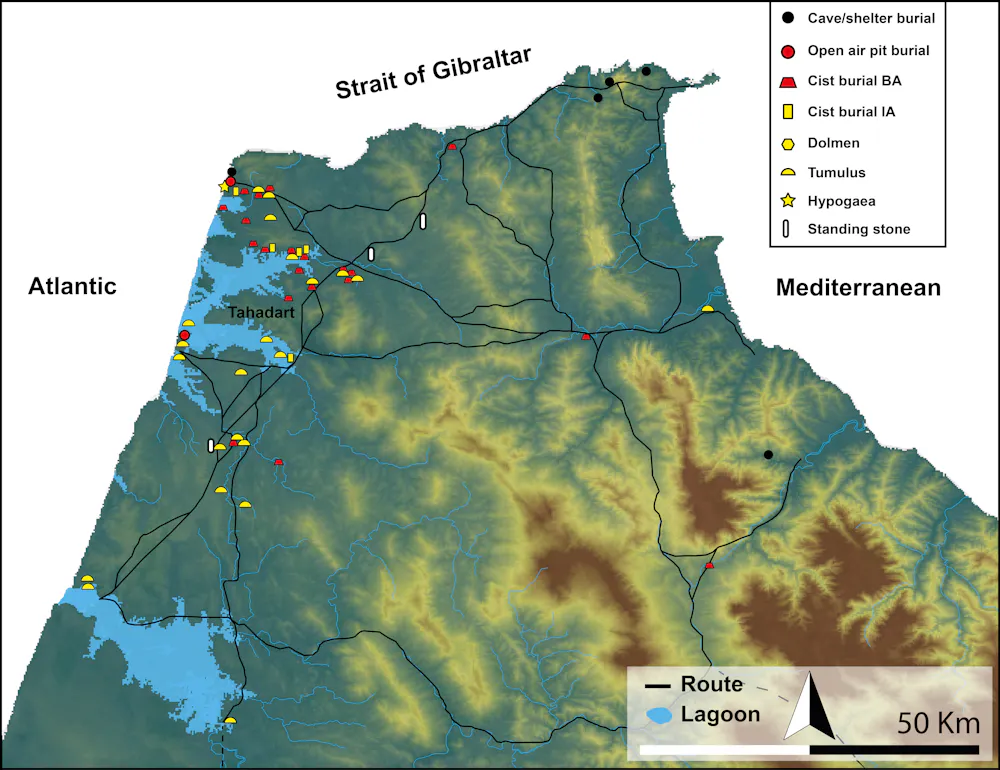
    Distribution of burials, standing stones and communication routes. H Benattia.

    Until now, research on rock art and burials in north Africa focused on areas like the Nile Valley, the Sahara or the Atlas Mountains. Our discoveries reveal that Morocco’s north-western coast was a major cultural hub in the Bronze Age, over 4,000 years ago.

    The diversity of burial practices, ritual sites, symbolic rock art and unique megalithic monuments reflect a rich prehistoric heritage that transcends modern geographic, political and cultural boundaries. It also highlights the longstanding exchanges and contacts of this region with the Mediterranean, the Atlantic and the Sahara.

    One of the most remarkable sites we excavated is at Daroua Zaydan, near modern-day Tangier. There we uncovered a cist burial, a small stone chamber made from four upright stone slabs covered by a larger stone slab. A crescent-shaped arrangement of stones likely marked the access to the burial chamber.

    Excavation process of the Daroua Zaydan cist burial.

    Although the grave had been looted in the past, we recovered several human bones outside the cist. One of them was radiocarbon dated to 2118–1890 BC. This date aligns with similar burial traditions across the Strait of Gibraltar in Iberia, and with Early Bronze Age settlement activity at Kach Kouch, about 65km south-east of Daroua Zaydan.

    Cist cemeteries had been documented in the region before, but most were excavated during the early to mid-20th century. At the time, archaeologists didn’t have the methods that can now shed light on important details such as how they were built and when they were used. Daroua Zaydan marks the first radiocarbon-dated cist burial in north-west Africa.

    Monuments, ritual deposits and Atlantic connections

    Our findings suggest the existence of a complex prehistoric ritual landscape at the Tangier Peninsula. This landscape was likely connected to other areas of the Atlantic and Mediterranean through a shared ritual and symbolic “language”.

    Ballintober type sword recovered from the bed of the river Loukkos and currently held at the Staatliche Museen zu Berlin. Claudia Plamp.

    One clue is a Bronze Age sword found in the 1920s in the Loukkos river. It was likely made in Britain or Ireland and may have arrived in Africa through Atlantic exchange networks. The sword was likely deliberately thrown to the river — a ritual practice documented along rivers in Atlantic Europe. This suggests that communities in northern Morocco were part of a broader cultural and symbolic world that connected the late prehistoric Atlantic.

    The stone circle at Mzoura. H Benattia.

    Another example is the stone circle at Mzoura, made up of 176 standing stones. This site, excavated in the 1930s, is unique in north Africa. But it closely resembles other stone circles in Atlantic Europe like Stonehenge. During our fieldwork we also discovered new standing stones and rock art, located along prehistoric communication routes. This suggests they may have been used as territorial markers or ritual sites.

    Dotted composition at Ghar el Manzla. Enhanced with DStretch.

    Before our research, a single painted rock shelter, that of Magara Sanar, was known in north-western Morocco. We have now documented 17 painted and 5 engraved rock shelters.

    The variety of symbols and scenes includes dotted patterns, geometric lines and human-shaped figures. They suggest strong links to Iberian, Atlantic and Saharan prehistoric art.

    Human-shaped figures and dotted composition at Ghar Dchar Alouch. Enhanced with DStretch.

    Why this matters

    Looted cist burial at Oued Ksiar.

    Our research does more than just fill a blank spot on the archaeological map. It opens up new avenues for archaeological exploration in the region. The Tangier Peninsula is home to a rich and largely undocumented late prehistoric heritage. It deserves more attention from researchers, policymakers and the wider public.

    Further protection measures are necessary as the region is undergoing rapid urban development. Tourism is growing and there’s been extensive looting. We hope our work will lead to more archaeological investigations, including new excavations and radiocarbon dating of key sites.

    – Rock art and tomb discoveries in Morocco reveal ancient connections to the wider world
    – https://theconversation.com/rock-art-and-tomb-discoveries-in-morocco-reveal-ancient-connections-to-the-wider-world-256931

    MIL OSI Africa

  • MIL-OSI Africa: Do you live near a dam holding mine waste? 6 questions to ask

    Source: The Conversation – Africa – By Charles MacRobert, Associate Professor, Stellenbosch University

    Mining is essential to modern lifestyles. Copper, iron and other mined products are vital to the products many people take for granted, like electronic devices. Being able to buy these goods quite easily may give a person a false sense of how difficult it is to extract the elements they’re made of.

    Mining involves the removal of mineral-rich rock from the ground and processing it to extract the high-value minerals. Depending on the mineral, this quantity can be as low as a few grams in a tonne of rock.

    For example, removing a tiny quantity of platinum from rock requires finely grinding the rock. The fine material that remains once the platinum is removed is known as tailings.

    Every mining operation produces tailings. This can be coarse, like instant coffee granules, or fine, like cocoa powder. Tailings are typically mixed with water to form a liquid slurry that can be pumped and transported easily.

    Slurry is kept in specially designed tailings dams. The designs are unique and depend on what is being mined and the local area.

    Unfortunately, the history of mining is stained with examples of poorly managed dams that collapse, spilling the slurry, which is sometimes toxic. This can cause serious environmental, social and economic damage.

    Kafue River before contamination by copper mine waste. De Agostini/Getty Images

    One such mine disaster happened in February 2025 in Zambia at the Sino-Metals Leach Zambia copper mine. Over 50 million litres of toxic waste flowed over the dam’s wall into the Mwambashi River. From there it flowed into one of the largest and longest Zambian rivers, the Kafue.

    The pollution travelled further than 100km from the dam, contaminating the river, and killing fish and livestock on nearby farms. The Zambian government had to shut down municipal water to the city of Kitwe to protect residents from consuming the polluted water.

    This should not have happened, because steps have been taken to ensure proactive management of dams. In 2020, the Global Industry Standard on Tailings Management introduced a new set of safety measures and standards.

    Many mines are proactively embracing these standards. This enhances community trust in tailings dams. But other mines are not engaging with communities that might be affected by dams. Or communities may feel unsure what to ask the mines.

    We are geotechnical engineers who have studied tailings dam collapses. Here, we outline six questions people living near mines should ask mine management to ensure they understand the key hazards and risks in their communities.

    1. How far will the slurry flow?

    Each tailings dam has a zone of influence. This is determined by analysing what would happen if the slurry breached the dam walls and started to flow out. It is an estimate of the area which would be swamped by tailings if the dam failed.

    Generally, tailings disasters have caused significant damage up to a distance of 5km from the dam. If the tailings slurry gets into a river, it can flow hundreds of kilometres downstream.


    Read more: Burst mining dam in South Africa: what must be done to prevent another disaster


    Zones of influence are often determined for extreme events, like once in a lifetime storms or large earthquakes. But zones of influence could also include places affected by dust or water pollution from the mine.

    If you can see a tailings dam from where you live or work you should consider yourself within the zone of influence.

    2. Who is responsible for the dam?

    Clearly defined roles and responsibilities for day-to-day operation should be in place in every mine. There should be suitably qualified engineers appointed to carry out monitoring and maintenance of the dam. There need to be enough qualified people to cope with the size of the dam.

    The management structure should set out how day-to-day issues related to the tailings dam are discussed between workers on the ground in mines and top management, and how solutions are found. Mines should also keep audit and inspection reports on their tailings dams, and records should be kept over the long term (because tailings dams are often operational for several decades).

    3. What about the environment?

    Mines should have plans to reduce the impact that tailings dams have on the environment. These would have been informed by public participation. The plans must state what monitoring is in place to measure the impacts of dust and water (groundwater and surface water).

    The true extent of impacts only becomes apparent once the mine starts operating. So, the public should hold mines accountable for commitments made. Mines should satisfy communities that monitoring is continuing to identify and track the dam’s environmental impacts.

    Closure plans should also be continuously communicated to mining-affected communities. This will assure the community that when the miners leave, they won’t be left with a dangerous dam near their homes, with no one to look after it.

    4. Will the tailings dam be safe when it rains?

    A common way that tailings dams fail is when water or slurry washes over the dam sidewalls. This washes away the support. It is known as overtopping, and can happen in storms or if too much tailing is pumped into the dam.

    Overtopping is best managed by keeping the water a certain distance below the dam wall. Mine management must measure this regularly and control how much tailing they pump to the dam. Their task is to make sure that even in a severe storm the level will stay well below the top of the dam wall.

    5. Has the dam always behaved as expected?

    Small failure incidents such as sloughs, slides and bulges where dam walls move but no slurry is released can occur. Mines should investigate and report these, detailing likely causes and mitigation measures implemented.

    Publicly available satellite imagery can easily show where mine tailings dams are becoming unstable. Mines should be transparent and provide explanations for these to avoid any speculation over whether the dam is stable or not.

    6. What alterations have been made?

    Sometimes dams must be changed to accommodate changes in mining or the extraction process. These changes could include how fast the dam is being built, moving the position of the dam wall, or placing material at the base of the wall to stabilise it.

    The unexpected consequences of alterations to a tailings dam could be water seeping out and creating damp spots, leading to dam walls sagging or cracking. If left unchecked this can lead to structural failure.

    When substantial changes are made to a dam’s design, mines need to demonstrate that sufficient consideration has gone into making these changes.

    – Do you live near a dam holding mine waste? 6 questions to ask
    – https://theconversation.com/do-you-live-near-a-dam-holding-mine-waste-6-questions-to-ask-256517

    MIL OSI Africa

  • MIL-OSI Africa: Secretary-General’s message on the occasion of Africa Day [scroll down for French version]

    Source: United Nations – English

    n Africa Day, we celebrate a continent rich in heritage, vibrant in diversity and remarkable in its contributions to our global community.

    Africa is home to the world’s youngest population and fast becoming a powerhouse in renewable energy and technological innovation.

    Yet, Africa bears the scars of historic injustices.  The legacies of slavery, colonialism, apartheid, and systemic racism still cast long shadows, and entrenched inequalities affect Africans and people of African descent to this day.

    This year’s theme calls for confronting these shameful legacies. I renew my call for reparatory justice that is grounded in accountability, reconciliation and equity. 

    The Pact for the Future, adopted in September, urges greater African representation – particularly at the Security Council – and reforms to the international financial system to support African countries with financing and debt relief. The Pact, through the Global Digital Compact, also seeks to close the digital divide and promote the responsible use of AI technologies.

    At a time when barriers are being erected, Africa leads by example. The African Continental Free Trade Area promises to usher in a new era of economic integration, opening the door to jobs, growth and prosperity.

    At the same time, we must support Africa’s efforts to expand its clean-energy sector, and ensure that the minerals that are critical to the renewables revolution benefit Africans first and most.

    Throughout, we will continue standing with Africa to silence the guns, tackle terrorism, and safeguard human rights for all.

    On this Africa Day, let us recommit to not only addressing past wrongs, but also to building a sustainable future for the people of Africa grounded in peace, dignity, and opportunity for all.

    ***
    En cette Journée de l’Afrique, nous célébrons un continent qui se distingue par son riche patrimoine, son éclatante diversité et ses formidables apports à la communauté internationale.

    L’Afrique abrite la population la plus jeune du monde et s’impose peu à peu comme un poids lourd des énergies renouvelables et de l’innovation technologique.

    Pourtant, l’Afrique porte encore les stigmates des injustices passées. Le spectre de l’esclavage, du colonialisme, de l’apartheid et du racisme systémique hante toujours le continent, et les Africains et les personnes d’ascendance africaine restent en proie à des inégalités profondément ancrées.

    Le thème de cette année nous exhorte à regarder en face cet héritage honteux et je demande une nouvelle fois que soit mise en place une justice réparatrice fondée sur la responsabilité, la réconciliation et l’équité.

    Le Pacte pour l’avenir, adopté en septembre, invite instamment à accroître la représentation de l’Afrique, notamment au sein du Conseil de sécurité, et à réformer le système financier international pour qu’il puisse mieux répondre aux besoins des pays africains en matière de financements et d’allègement de la dette. Ce Pacte, par l’intermédiaire du Pacte numérique mondial, vise également à réduire la fracture numérique et à promouvoir l’utilisation responsable des technologies d’intelligence artificielle.

    À l’heure où sont érigées de nouvelles barrières, l’Afrique montre l’exemple. Ainsi, la Zone de libre-échange continentale africaine promet de faire entrer le continent dans une nouvelle ère d’intégration économique, en ouvrant la voie à l’emploi, à la croissance et à la prospérité.

    Parallèlement, nous devons soutenir l’action menée par l’Afrique pour développer le secteur des énergies propres et veiller à ce que les Africains soient les premiers à bénéficier des minéraux qui sont au cœur de la révolution des énergies renouvelables.

    Jusqu’au bout, nous resterons mobilisés aux côtés de l’Afrique pour faire taire les armes, lutter contre le terrorisme et protéger les droits humains de toutes et tous.

    En cette Journée de l’Afrique, réaffirmons notre engagement non seulement à réparer les torts du passé, mais aussi à construire pour les peuples d’Afrique un avenir durable, fondé sur la paix, la dignité et l’égalité des chances pour tous.

    ***
     

    MIL OSI Africa

  • MIL-OSI Global: Rock art and tomb discoveries in Morocco reveal ancient connections to the wider world

    Source: The Conversation – Africa – By Hamza Benattia, Prehistory, Universitat de Barcelona

    When people think of ancient burials in North Africa, they often picture Egypt’s pyramids and monuments. But new discoveries show that north-western Africa also has a deep and fascinating prehistoric past.

    Morocco’s Tangier Peninsula is particularly interesting. The peninsula sits at Africa’s north-western edge, where the Mediterranean Sea meets the Atlantic Ocean. At just 14 kilometres from Europe across the Strait of Gibraltar, this area has long been a natural crossroads between continents and cultures.

    I’m an archaeologist and PhD student who specialises in north Africa’s later prehistoric periods, between 3800 BC and 500 BC. My research explores how ancient communities responded to environmental changes, and how they moved and connected with other communities across regions.

    The assumption to date has been that the Tangier Peninsula was uninhabited and isolated in late prehistoric times. As part of my PhD research I wanted to explore whether this was true, or whether the area had simply been overlooked by previous archaeological work.

    Through the Kach Kouch and Tahadart Archaeological Projects, we studied both the Atlantic and Mediterranean zones of the peninsula.

    Our goal was to revisit the region using modern archaeological methods and technologies, including radiocarbon dating. To understand how this region may have been connected to the wider world in prehistoric times, we used Geographic Information System software to model possible ancient communication routes and surveyed the landscape through satellite and drone imagery. At a later stage, alongside a team of early career Moroccan archaeologists from the National Institute of Archaeology and Heritage, we carried out field surveys and excavations.

    What we discovered exceeded all expectations. Far from being empty and isolated, the Tangier Peninsula is filled with evidence that people lived, died and held ceremonies there over thousands of years.

    Our hope is that our findings will reframe north-western Africa as a cultural crossroads that has connected regions for thousands of years. This region could reshape our understanding of later prehistory across the Atlantic and Mediterranean worlds.

    A prehistoric ritual and funerary landscape

    Our study, published in African Archaeological Review, presents the discovery of dozens of new archaeological sites, including prehistoric burials, rock art sites and standing stones.

    Until now, research on rock art and burials in north Africa focused on areas like the Nile Valley, the Sahara or the Atlas Mountains. Our discoveries reveal that Morocco’s north-western coast was a major cultural hub in the Bronze Age, over 4,000 years ago.

    The diversity of burial practices, ritual sites, symbolic rock art and unique megalithic monuments reflect a rich prehistoric heritage that transcends modern geographic, political and cultural boundaries. It also highlights the longstanding exchanges and contacts of this region with the Mediterranean, the Atlantic and the Sahara.

    One of the most remarkable sites we excavated is at Daroua Zaydan, near modern-day Tangier. There we uncovered a cist burial, a small stone chamber made from four upright stone slabs covered by a larger stone slab. A crescent-shaped arrangement of stones likely marked the access to the burial chamber.

    Although the grave had been looted in the past, we recovered several human bones outside the cist. One of them was radiocarbon dated to 2118–1890 BC. This date aligns with similar burial traditions across the Strait of Gibraltar in Iberia, and with Early Bronze Age settlement activity at Kach Kouch, about 65km south-east of Daroua Zaydan.

    Cist cemeteries had been documented in the region before, but most were excavated during the early to mid-20th century. At the time, archaeologists didn’t have the methods that can now shed light on important details such as how they were built and when they were used. Daroua Zaydan marks the first radiocarbon-dated cist burial in north-west Africa.

    Monuments, ritual deposits and Atlantic connections

    Our findings suggest the existence of a complex prehistoric ritual landscape at the Tangier Peninsula. This landscape was likely connected to other areas of the Atlantic and Mediterranean through a shared ritual and symbolic “language”.

    One clue is a Bronze Age sword found in the 1920s in the Loukkos river. It was likely made in Britain or Ireland and may have arrived in Africa through Atlantic exchange networks. The sword was likely deliberately thrown to the river — a ritual practice documented along rivers in Atlantic Europe. This suggests that communities in northern Morocco were part of a broader cultural and symbolic world that connected the late prehistoric Atlantic.

    Another example is the stone circle at Mzoura, made up of 176 standing stones. This site, excavated in the 1930s, is unique in north Africa. But it closely resembles other stone circles in Atlantic Europe like Stonehenge. During our fieldwork we also discovered new standing stones and rock art, located along prehistoric communication routes. This suggests they may have been used as territorial markers or ritual sites.

    Before our research, a single painted rock shelter, that of Magara Sanar, was known in north-western Morocco. We have now documented 17 painted and 5 engraved rock shelters.

    The variety of symbols and scenes includes dotted patterns, geometric lines and human-shaped figures. They suggest strong links to Iberian, Atlantic and Saharan prehistoric art.

    Why this matters

    Our research does more than just fill a blank spot on the archaeological map. It opens up new avenues for archaeological exploration in the region. The Tangier Peninsula is home to a rich and largely undocumented late prehistoric heritage. It deserves more attention from researchers, policymakers and the wider public.

    Further protection measures are necessary as the region is undergoing rapid urban development. Tourism is growing and there’s been extensive looting. We hope our work will lead to more archaeological investigations, including new excavations and radiocarbon dating of key sites.

    Hamza Benattia, director of the Tahadart Archaeological Project, received funding from the National Institute of Archaeology and Heritage of Morocco (INSAP), the Prehistoric Society Research Fund, the Stevan B. Dana Grant of the American Society of Overseas Research, the Mediterranean Archaeological Trust Grant, the Barakat Trust Early Career Award, the Centre Jacques Berque Research Grant, the Institute of Ceutan Studies Research Fund and the University of Castilla La Mancha.

    ref. Rock art and tomb discoveries in Morocco reveal ancient connections to the wider world – https://theconversation.com/rock-art-and-tomb-discoveries-in-morocco-reveal-ancient-connections-to-the-wider-world-256931

    MIL OSI – Global Reports

  • MIL-OSI Global: Do you live near a dam holding mine waste? 6 questions to ask

    Source: The Conversation – Africa – By Charles MacRobert, Associate Professor, Stellenbosch University

    Mining is essential to modern lifestyles. Copper, iron and other mined products are vital to the products many people take for granted, like electronic devices. Being able to buy these goods quite easily may give a person a false sense of how difficult it is to extract the elements they’re made of.

    Mining involves the removal of mineral-rich rock from the ground and processing it to extract the high-value minerals. Depending on the mineral, this quantity can be as low as a few grams in a tonne of rock.

    For example, removing a tiny quantity of platinum from rock requires finely grinding the rock. The fine material that remains once the platinum is removed is known as tailings.

    Every mining operation produces tailings. This can be coarse, like instant coffee granules, or fine, like cocoa powder. Tailings are typically mixed with water to form a liquid slurry that can be pumped and transported easily.

    Slurry is kept in specially designed tailings dams. The designs are unique and depend on what is being mined and the local area.

    Unfortunately, the history of mining is stained with examples of poorly managed dams that collapse, spilling the slurry, which is sometimes toxic. This can cause serious environmental, social and economic damage.

    One such mine disaster happened in February 2025 in Zambia at the Sino-Metals Leach Zambia copper mine. Over 50 million litres of toxic waste flowed over the dam’s wall into the Mwambashi River. From there it flowed into one of the largest and longest Zambian rivers, the Kafue.

    The pollution travelled further than 100km from the dam, contaminating the river, and killing fish and livestock on nearby farms. The Zambian government had to shut down municipal water to the city of Kitwe to protect residents from consuming the polluted water.

    This should not have happened, because steps have been taken to ensure proactive management of dams. In 2020, the Global Industry Standard on Tailings Management introduced a new set of safety measures and standards.

    Many mines are proactively embracing these standards. This enhances community trust in tailings dams. But other mines are not engaging with communities that might be affected by dams. Or communities may feel unsure what to ask the mines.

    We are geotechnical engineers who have studied tailings dam collapses. Here, we outline six questions people living near mines should ask mine management to ensure they understand the key hazards and risks in their communities.

    1. How far will the slurry flow?

    Each tailings dam has a zone of influence. This is determined by analysing what would happen if the slurry breached the dam walls and started to flow out. It is an estimate of the area which would be swamped by tailings if the dam failed.

    Generally, tailings disasters have caused significant damage up to a distance of 5km from the dam. If the tailings slurry gets into a river, it can flow hundreds of kilometres downstream.


    Read more:
    Burst mining dam in South Africa: what must be done to prevent another disaster


    Zones of influence are often determined for extreme events, like once in a lifetime storms or large earthquakes. But zones of influence could also include places affected by dust or water pollution from the mine.

    If you can see a tailings dam from where you live or work you should consider yourself within the zone of influence.

    2. Who is responsible for the dam?

    Clearly defined roles and responsibilities for day-to-day operation should be in place in every mine. There should be suitably qualified engineers appointed to carry out monitoring and maintenance of the dam. There need to be enough qualified people to cope with the size of the dam.

    The management structure should set out how day-to-day issues related to the tailings dam are discussed between workers on the ground in mines and top management, and how solutions are found. Mines should also keep audit and inspection reports on their tailings dams, and records should be kept over the long term (because tailings dams are often operational for several decades).

    3. What about the environment?

    Mines should have plans to reduce the impact that tailings dams have on the environment. These would have been informed by public participation. The plans must state what monitoring is in place to measure the impacts of dust and water (groundwater and surface water).

    The true extent of impacts only becomes apparent once the mine starts operating. So, the public should hold mines accountable for commitments made. Mines should satisfy communities that monitoring is continuing to identify and track the dam’s environmental impacts.

    Closure plans should also be continuously communicated to mining-affected communities. This will assure the community that when the miners leave, they won’t be left with a dangerous dam near their homes, with no one to look after it.

    4. Will the tailings dam be safe when it rains?

    A common way that tailings dams fail is when water or slurry washes over the dam sidewalls. This washes away the support. It is known as overtopping, and can happen in storms or if too much tailing is pumped into the dam.

    Overtopping is best managed by keeping the water a certain distance below the dam wall. Mine management must measure this regularly and control how much tailing they pump to the dam. Their task is to make sure that even in a severe storm the level will stay well below the top of the dam wall.

    5. Has the dam always behaved as expected?

    Small failure incidents such as sloughs, slides and bulges where dam walls move but no slurry is released can occur. Mines should investigate and report these, detailing likely causes and mitigation measures implemented.

    Publicly available satellite imagery can easily show where mine tailings dams are becoming unstable. Mines should be transparent and provide explanations for these to avoid any speculation over whether the dam is stable or not.

    6. What alterations have been made?

    Sometimes dams must be changed to accommodate changes in mining or the extraction process. These changes could include how fast the dam is being built, moving the position of the dam wall, or placing material at the base of the wall to stabilise it.

    The unexpected consequences of alterations to a tailings dam could be water seeping out and creating damp spots, leading to dam walls sagging or cracking. If left unchecked this can lead to structural failure.

    When substantial changes are made to a dam’s design, mines need to demonstrate that sufficient consideration has gone into making these changes.

    The authors do not work for, consult, own shares in or receive funding from any company or organisation that would benefit from this article, and have disclosed no relevant affiliations beyond their academic appointment.

    ref. Do you live near a dam holding mine waste? 6 questions to ask – https://theconversation.com/do-you-live-near-a-dam-holding-mine-waste-6-questions-to-ask-256517

    MIL OSI – Global Reports

  • MIL-OSI Russia: Alexey Likhachev became an Honorary Doctor of SPbPU

    Translation. Region: Russian Federal

    Source: Peter the Great St Petersburg Polytechnic University – Peter the Great St Petersburg Polytechnic University –

    A solemn ceremony of presenting the mantle and diploma of the Honorary Doctor of SPbPU to the General Director of the State Corporation Rosatom Alexey Likhachev took place at Peter the Great St. Petersburg Polytechnic University.

    The ceremonial event opened with the performance of the Polytechnic University anthem by the SPbPU youth choir “Polyhymnia”.

    It is especially gratifying that this important event is taking place in the year of the 80th anniversary of the Russian nuclear industry, to the development of which Polytechnicians made a significant contribution. Such names as Abram Fedorovich Ioffe, Isaak Konstantinovich Kikoin, Abram Isaakovich Alikhanov, Yuliy Borisovich Khariton, Nikolay Leonidovich Dukhov are inscribed in gold letters in the history of the development of Russian science. Today, Polytechnic University and Rosatom, under the leadership of Alexey Evgenievich, closely cooperate for the benefit of the development of Russian nuclear technologies: both in education and in science. By order of Rosatom, our Institute of Power Engineering annually graduates more than 250 specialists in the field of nuclear energy, thermal power engineering, electric power engineering and power engineering. Together with Rosatom, we are successfully implementing the project of the advanced engineering school “Digital Engineering”, acting in the interests of the technological leadership of our country, – emphasized the rector of SPbPU, academician of the Russian Academy of Sciences Andrey Rudskoy.

    The members of the SPbPU Academic Council unanimously voted to award the title to Alexey Likhachev on April 28 this year. The Scientific Secretary of the Polytechnic University Dmitry Karpov presented the new honorary doctor.

    If we try to pick three key words that would define the spirit of modern scientific and technological development in Russia, these words should be: professionalism, leadership and Victory. And these are the words that come to mind when we talk about the State Corporation Rosatom. For the Polytechnic University, whose history is closely connected with the nuclear project, participation in the development of nuclear energy is one of the key, strategic areas of work. And scientific and industrial cooperation with the national leader in several related industries at once is a great honor and responsibility for the university, – noted Dmitry Karpov.

    Cooperation between the Rosatom State Corporation and SPbPU, which is one of the flagship universities and its long-term strategic partner, is actively developing. This is a significant amount of work carried out by the Institute of Mechanical Engineering, Materials and Transport, the Institute of Power Engineering, the Physics and Mechanical Engineering Institute, the Advanced Engineering School “Digital Engineering” and other university structures. This is significant international cooperation, in particular, in the interests of the Turkish and Egyptian nuclear energy. This is the training of specialists in a wide range of engineering and technical areas of training – primarily in nuclear, energy, mechanical engineering and construction specialties. This is a cell of the Rosatom Student Council, whose activists participate in organizing meetings with representatives of the corporation’s enterprises, technical tours of production facilities, strategic sessions as part of the university’s career events and other activities. In the context of the 80th anniversary of the nuclear industry, about 40 events are planned at the Polytechnic University, covering more than 4,000 people.

    Dmitry Karpov named several completed projects. An optimal design of a vibrating screen for cleaning drilling mud was developed by order of NPO Centrotech. The project was a real breakthrough in the industry: with a target vibration acceleration of 7 g, engineers from PISh SPbPU designed a product that exceeded these parameters in just six months. The results of digital modeling were confirmed from the first factory test of the prototype – the vibration acceleration was 8.2 g. The product and its modifications have been successfully used for many years now.

    A digital twin of the VVER-1000 fuel assembly with an anti-debris filter and mixing grids was developed by order of JSC TVEL. Due to digital design and additive manufacturing, the filtration efficiency has been increased tenfold, and the created models, virtual test benches and testing grounds will significantly reduce costs and improve the quality and speed of further developments.

    At the request of the Mayak production association, for the first time in engineering practice, the architecture of a highly adequate multiphysical digital model of a furnace for vitrification of high-level radioactive waste has been developed.

    By order of JSC TsKBM, key proprietary technological equipment for the ODU-150 hydrogen production unit was developed. The design solutions of the created key hydrogen technology devices are the starting point in the development of a new generation of equipment and future medium- and large-tonnage devices for the hydrogen, petrochemical, and nitrogen industries.

    At the request of the composite division of Rosatom, a technology for the production of filaments from continuous carbon fiber was developed, and the customer received pilot equipment. On the official website of the corporation, this installation is listed among the most important achievements of Rosatom in 2024.

    At the enterprise of the State Corporation Rosatom — JSC Proryv — the URANIA data and process management system for computational and experimental scientific research was put into operation. It is based on the CML-Bench® Digital Platform — an in-house development of the Engineering Center of our university.

    In 2023, under the leadership of Alexey Evgenievich, the State Corporation approved the Unified Digital Strategy, which became the most important step towards accelerating the digital transformation of the industry, including ensuring import substitution. In this regard, Dmitry Karpov noted that specialists from SPbPU and the All-Russian Research Institute of Experimental Physics developed the national GOST “Computer models and modeling. Digital twins of products. General provisions” – the world’s first document regulating the relevant activities.

    The scale of the projects of the State Corporation Rosatom is truly astounding. And it is quite obvious that the management of such a system is the lot of rare leaders and true professionals. This entire vast field – from the development and implementation of advanced technologies, solving the most complex multidisciplinary problems of the world level to the transfer of unique competencies and the organization of expert discussion platforms – all this and much more became possible, including thanks to the personal professionalism and leadership of Alexey Evgenievich. Perhaps, being a leader is destiny. Destiny to be born in Arzamas-75 – Sarov, the city-forming enterprise of which is the Russian Federal Nuclear Center. And, having gone the way of an engineer, politician, adviser and Deputy Minister of Economic Development of Russia, still to head the State Atomic Energy Corporation Rosatom. And to become a leader, ensuring its brilliant victories, – emphasized Dmitry Karpov.

    Students in the uniform of the Polytechnic University of the early 20th century brought in a doctoral robe and cap, the Polyhymnia choir performed the Gaudeamus anthem. Andrei Rudskoi presented Alexei Evgenievich with a book about honorary doctors of the Polytechnic University, which has a page dedicated to the CEO of the state corporation Rosatom.

    It is a great honor for me to receive this title from one of the leading technical universities in the country, which stands at the origins of the Russian engineering school. St. Petersburg Polytechnic University is a forge of personnel for the nuclear industry, and we highly value the contribution of its teachers, scientists and students to the development of advanced technologies. I am confident that our partnership will continue to contribute to breakthrough achievements in nuclear energy, medicine and new materials, – said Alexey Likhachev in his response speech.

    Alexey Likhachev also met with students studying at the Institute of Power Engineering. He spoke about the development of the State Corporation’s systemic cooperation with universities, how contacts with students are built, and shared Rosatom’s corporate values. The Polytechnicians spoke about the activities of the Rosatom student council cell, asked questions about the prospects for the development of nuclear science and the training of personnel for the corporation’s high-tech projects.

    You are the future not only of Rosatom and the nuclear industry, but of the entire country. It is you who will manage enterprises, represent the industry on the international stage and develop our technological power. Therefore, such meetings with students are of particular value: we get to know each other better and understand to whom we are transferring responsibility for the future, Alexey Likhachev emphasized.

    Please note: This information is raw content directly from the source of the information. It is exactly what the source states and does not reflect the position of MIL-OSI or its clients.

    MIL OSI Russia News

  • MIL-OSI Russia: International tournament Inter Football Cup: sport, friendship, Vyshka!

    Translation. Region: Russian Federal

    Source: State University Higher School of Economics – State University Higher School of Economics –

    © Higher School of Economics

    On May 18, the Higher School of Economics hosted the international football tournament Inter Football Cup, in which HSE students and staff from all over the world took part for the third year in a row. This event became a real holiday not only for football fans, but also for everyone who wants to make new acquaintances and immerse themselves in an atmosphere of friendship and unity.

    The football tournament is held with the support of Directorates of Internationalization And Department of Physical Education HSE University. Opening the event, department lecturer Artem Yemelyanov congratulated everyone on the sports festival and wished them to demonstrate their best sports skills and team spirit. Director Center for Support and Career of International Students and Graduates Zhanna Sorokina noted that for the first time, not only student teams are participating in the tournament, but also a team formed from international specialists – foreign teachers and research staff of the university.

    This time, 12 teams met on the field, bringing together representatives of more than 50 countries – from Australia to Ethiopia, from Italy to India. Each match was a real battle, full of emotions and excitement. The participants not only demonstrated their football skills, but also shared the cultural traditions of their countries, which added a special flavor to the tournament. “This is not just football, it is a great chance to take a break from studying, warm up and relax, and also meet our friends and students from other faculties,” shared Ikenna Mbatha (Nigeria) from Institute for Statistical Research and Economics of Knowledge HSE. His team, despite losing in the semi-finals, had unforgettable impressions and made many new acquaintances.

    “This is not my first time participating in the tournament, and it is one of the best events that the university organizes for international students,” says Bernard Baako (Ghana) Faculty of Economic Sciences“Such drive, such emotions – it’s an amazing release!”

    As the tournament organizers note, the number of participants increases every year, which indicates a growing interest in the sporting event. “We are glad to see how students from different countries unite through sport. This is important not only for their socialization, but also for creating a friendly atmosphere at the university,” noted Zhanna Sorokina.

    Marco Mellina (Italy), Research Fellow Schools of Historical Sciences, said that he was a big football fan and, having just learned about the tournament, persuaded his colleagues to participate. The team of international specialists was extremely happy to spend the day at the stadium and impose a fight on their opponents. Even the rain that began during the final games did not spoil the mood of those gathered. The players’ passion in the fight for prize places was uncontrollable, once again confirming the truth of the classic formula of big-time sports: “The match will take place in any weather.”

    The tournament ended with a spectacular finale in which the team Faculty of Social Sciences defeated the team Institute of Cognitive Neurosciences — another debutant of the tournament. But, as many participants noted, the main thing is not the victory, but participation and the opportunity to meet new people.

    Benjamin Sarpong (Ghana), captain of the winning team, boasted that he has won the cup for the second year in a row: at the Inter Football Cup 2024, he was a prize winner as part of the team of the preparatory department for foreign citizens. “Today I personally scored two goals, and they determined the outcome of the final game! I am absolutely happy!” admitted Ben.

    The HSE Inter Football Cup has once again proven its importance as a platform for cultural exchange and friendship, and the participants are looking forward to the next tournament.

    Please note: This information is raw content directly from the source of the information. It is exactly what the source states and does not reflect the position of MIL-OSI or its clients.

    MIL OSI Russia News

  • MIL-OSI Russia: China hosts symposium on traditional cultures along the Silk Road

    Translation. Region: Russian Federal

    Source: People’s Republic of China in Russian – People’s Republic of China in Russian –

    Source: People’s Republic of China – State Council News

    BEIJING, May 26 (Xinhua) — A 2025 symposium on the protection, development and application of traditional cultures along the Silk Road opened in Xi’an, capital of northwest China’s Shaanxi Province, on Friday.

    The symposium, co-organized by the Shaanxi Provincial People’s Government, the Provincial Department of Education and Northwest University (NWU), brought together more than 100 experts from higher education institutions in China, Kazakhstan, Tajikistan, Turkmenistan, Uzbekistan, Egypt, Morocco and the United Kingdom.

    The event included the opening ceremony of the Intelligent Perception Laboratory for Situational Awareness in Countries Along the Silk Road, aimed at enhancing the level of cooperation between research organizations in China, Central Asia and Arab countries.

    Speaking at the symposium, SZU Rector Sun Qingwei introduced those present to the university’s achievements in research related to the Great Silk Road.

    The Silk Road served as a channel for trade and economic interaction and civilizational exchanges between the East and the West, and in modern times it has gained new vitality. Sun Qingwei called on the two sides to make joint efforts to deeply integrate production, education, research and application.

    The main theme of the symposium is “The Great Silk Road: civilizational mutual learning and innovation in culture.” Within its framework, two sub-forums were held on issues of Chinese-Arab and Chinese-Central Asian civilizational exchanges. -0-

    MIL OSI Russia News

  • MIL-OSI Security: U.S. Forces Conduct Strikes Supporting Somali National Army, Targeting al-Shabaab

    Source: United States AFRICOM

    In support of a military operation led by the Federal Government of Somalia, U.S. Africa Command (USAFRICOM) conducted airstrikes against al-Shabaab on May 21, 2025. 

    The airstrikes, backing a Somali-led operation, occurred approximately 27 miles northwest of Kismayo, Somalia.

    AFRICOM’s operational efforts are critical to countering transnational threats, and supporting the Federal Government of Somalia’s offensive posture against violent extremist organizations ensures the promotion of regional security and advancement of national interests.  

    Al-Shabaab has proven both its will and capability to attack U.S. forces.

    AFRICOM, alongside the Federal Government of Somalia and Somali Armed Forces, continues to take decisive action to degrade al-Shabaab’s ability to plan and conduct attacks that threaten the U.S. homeland, our forces, and our citizens abroad.

    Specific details about units and assets will not be released to ensure continued operations security.

    U.S. Africa Command, one of 11 U.S. Department of Defense combatant commands with an area of responsibility covering 53 African states, more than 800 ethnic groups, over 1,000 languages, vast natural resources, a land mass that is three-and-a-half times the size of the U.S., and nearly 19,000 miles of coastland. Working alongside its partners, AFRICOM counters transnational threats and malign actors, strengthens security forces and responds to crises.

    MIL Security OSI

  • MIL-OSI: eSports Betting Sites: Thunderpick Named the Best eSports Bookie in the US

    Source: GlobeNewswire (MIL-OSI)

    New York City, NY, May 26, 2025 (GLOBE NEWSWIRE) —

    The world of competitive gaming has exploded in popularity, and with it, eSports betting has become a top choice for US bettors.

    Among the many platforms vying for attention, Thunderpick stands out for its robust offerings and user-friendly interface. With a strong focus on eSports markets and competitive odds, it caters directly to fans of games like CS:GO, League of Legends, and Dota 2.

    JOIN THE TOP-RANKED ESPORT BETTING SITE: THUNDERPICK

    Whether you’re a casual viewer or a seasoned bettor, Thunderpick delivers an experience designed to match your level of involvement. 

    Backed by a secure platform and exciting promotions, it’s quickly becoming a favorite across the US.

    Why Thunderpick Stands Out for US eSports Bettors

    Thunderpick is purpose-built for the modern eSports enthusiast, making it a top choice for players in the United States. The platform supports a wide variety of eSports titles, from globally dominant games like Counter-Strike and Dota 2 to emerging favorites such as Valorant and Overwatch 2. This diversity ensures bettors can always find the matchups they care about.

    One of Thunderpick’s core strengths lies in its intuitive betting interface, which makes it simple to place single bets, accumulators, and even live wagers with just a few clicks. Real-time match updates and dynamic odds make in-play betting especially engaging, adding a strategic layer to the excitement of watching your favorite teams compete.

    US players will appreciate the sleek, mobile-optimized design that works flawlessly on both iOS and Android devices. Whether you’re at home or on the move, Thunderpick makes it easy to keep up with the action. The site’s speed and responsiveness ensure you never miss a betting opportunity, even in fast-paced games.

    Beyond its technical features, Thunderpick also excels in offering promotions tailored to eSports fans. Its generous welcome bonus, reload offers, and seasonal competitions help players get more value from every wager. These rewards can be especially enticing during major tournaments like The International or the League of Legends World Championship.

    Thunderpick also maintains a strong commitment to responsible gaming, offering tools like deposit limits and self-exclusion for users who want more control over their betting habits. Combined with SSL encryption and a well-regarded reputation, this creates a trustworthy and secure environment.

    GET 100% MATCH WELCOME BONUS UP TO $600 AT THUNDERPICK

    Getting Started at the Top eSports Betting Sites in the US

    Signing up with Thunderpick is fast, simple, and optimized for US users. The process starts by visiting the Thunderpick website or downloading the mobile app, available for both iOS and Android. From there, you’ll be prompted to create an account using your email address and a secure password.

    1. Register Your Account: Visit the Thunderpick website and click the “Sign Up” and enter your email, username, and password.
    2. Verify Your Email: Check your inbox for a verification link and confirm your identity.
    3. Deposit Funds: Head to the cashier section and choose from a range of US-friendly payment methods like credit cards, Skrill, or other eWallets.
    4. Claim Your Bonus: Make your first deposit to activate the 100% match welcome bonus up to $600.
    5. Place Your First Bet: Browse the eSports section, select your game and odds, and confirm your wager.

    From registration to first bet, the entire process takes just minutes. Thunderpick’s user dashboard is clean and well-organized, helping new users feel right at home. It also offers betting guides and FAQs to support less experienced players.

    Once your account is active, you can explore a vast array of betting markets across different eSports titles.

    Best Games to Bet on at US eSports Sites

    eSports betting thrives on the popularity and competitive nature of the games themselves. In the US, bettors gravitate toward certain titles that consistently offer engaging action and well-established professional leagues.

    At the top of the list is Counter-Strike: Global Offensive (CS:GO), known for its balanced gameplay and international tournaments like ESL and BLAST Premier. Thunderpick offers a rich menu of betting markets for CS:GO, including match winner, map handicap, and total rounds.

    League of Legends (LoL) is another standout title. With major events like the LCS and the World Championship, it provides numerous betting opportunities and high viewer engagement. Thunderpick supports various markets, including first blood, total kills, and tower takedowns.

    Dota 2, backed by Valve and home to the massive prize pool of The International, is a mainstay in US eSports betting. Thunderpick offers comprehensive coverage, with options for outright winners, individual maps, and series length.

    Valorant, a relatively new entry from Riot Games, has quickly built a competitive scene. Events like VCT Masters attract thousands of bettors, and Thunderpick covers them in detail with markets like spike defusals and headshot percentages.

    For those who enjoy tactical gameplay, Rainbow Six Siege and StarCraft II provide unique mechanics and deep strategies. Thunderpick includes these games, ensuring niche fans are not left behind.

    Thunderpick Mobile eSports Betting Experience

    Mobile betting has become a critical feature for US users, and Thunderpick excels in delivering a smooth, reliable experience across devices. The mobile-optimized version of the site doesn’t require a separate app, offering instant access through any browser on iOS or Android. This web-based approach ensures users can start betting without lengthy downloads or installations.

    The mobile interface mirrors the desktop site in both design and functionality, preserving intuitive navigation and lightning-fast performance. Thunderpick’s responsive layout adjusts seamlessly to different screen sizes, so every feature, from game selection to account settings, is always within easy reach.

    One standout mobile feature is live betting. Real-time odds updates and in-play options remain fully accessible, even on smaller screens. This is ideal for users who want to place strategic bets while watching matches on Twitch or YouTube on the same device.

    Bonuses and Rewards at Top eSports Sites in the United States

    In the competitive eSports betting market, bonuses and ongoing promotions play a pivotal role in attracting and retaining US users. Thunderpick sets itself apart by offering a comprehensive suite of rewards tailored specifically to eSports fans.

    At sign-up, users are welcomed with a 100% match bonus up to $600. This generous welcome offer allows new bettors to double their initial deposit, providing a strong starting bankroll for exploring the site’s wide range of eSports markets.

    But Thunderpick doesn’t stop at the initial bonus. The platform regularly runs reload promotions, offering extra value for repeat deposits. These reloads often align with major eSports events, giving users extra motivation to stay engaged.

    Loyalty is rewarded through Thunderpick’s tiered VIP program. This system offers cashback, exclusive promotions, and early access to new features or events. US players who bet frequently on games like CS:GO or Dota 2 can unlock high-tier benefits faster than on most competitor sites.

    Thunderpick also hosts seasonal tournaments and leaderboard contests, where users compete for cash prizes and bonus credits. These events encourage ongoing participation and create a community-driven betting atmosphere.

    Ready to Join the Best US eSports Betting Sites?

    Thunderpick has earned its reputation as one of the best eSports betting sites for US players, thanks to its focus on game variety, mobile performance, and player rewards. Whether you’re betting on CS:GO or exploring new titles like Valorant, the platform delivers seamless access and top-tier functionality.

    Its mobile site makes on-the-go betting easy, while robust bonuses ensure players get real value from their activity. Security is baked into every feature, with advanced protections that keep user data and funds safe.

    Thunderpick doesn’t just serve eSports fans, it elevates the entire experience. From intuitive design to real-time odds and community engagement tools, it’s clear why this brand leads the US market.

    If you’re ready to dive into the world of eSports betting, Thunderpick offers a secure, rewarding, and exciting platform to get started.

    Editorial Note

    This article is provided solely for informational and entertainment purposes. Nothing within should be interpreted as legal, financial, or professional advice. Readers should carry out their own research before participating in any gambling activities or signing up with any online casinos mentioned. 

    Gambling Caution

    Online gambling comes with financial risks and may lead to addictive behavior or monetary loss. We urge all readers to gamble responsibly. If you or someone you know is struggling with gambling, professional help is available. The National Council on Problem Gambling (NCPG) can be contacted at 1-800-522-4700 or visited online at www.ncpgambling.org.

    21+ only. It is up to each individual to verify whether online gambling is permitted under their local, state, or federal laws. Neither the publisher, the authors, nor any syndication partners condone or support unlawful gambling. Participation in online gambling is done at the reader’s own discretion and risk.

    Affiliate Transparency

    This article may include affiliate links. If you click on a link and make a purchase or register, a commission may be earned, at no extra cost to you.

    Syndication and Liability Disclaimer

    Any third-party publishers, media platforms, or syndication partners that republish this content do so understanding that it is meant for informational purposes only. These entities are not responsible for the legality, accuracy, or interpretation of the material.

    Contact Data

    Thunderpick

    https://thunderpick.io

    support@thunderpick.io

    #1517, Hamchako, Nzwani, Comoros COM1010

    Attachment

    The MIL Network

  • MIL-OSI Africa: Deputy President pays courtesy visit to French President Macron

    Source: South Africa News Agency

    Deputy President Paul Mashatile paid a courtesy visit to French President Emmanuel Macron at his residence, the Palais de l’Élysée, in Paris, on Thursday. 

    He was accompanied by Ministers, Deputy Ministers, and business leaders from both South Africa and France.
    The meeting followed a successful SA-France Investment Conference where commitments were made to upscale trade relations between the two countries. 

    According to the Deputy President’s Office, South Africa remains committed to a global trade and investment environment that aims for sustainable and impactful global economic growth, despite the geopolitical challenges.

    “The meeting with President Macron focused on strengthening trade and diplomatic cooperation as well as cooperation in multilateral fora. 

    “The importance of economic cooperation between the two countries is about bridging the gap between the south and north, thereby creating a trade equilibrium,” the statement read. 

    During the meeting, the Deputy President indicated that the presence of over 400 French companies employing over 65 000 South Africans is a testimony to the value proposition that South Africa offers. 

    “However, the Deputy President noted that in the past two years, there has been a decline in bilateral trade, underpinned by a decline in both imports and exports. 

    “Therefore, it was prudent that South Africa intensifies efforts to increase bilateral trade through business-to-business engagements.”

    The inaugural SA-France Investment Conference is viewed as a step in the right direction to expand on existing cooperation and identify new areas of cooperation with a specific focus on trade and investment. 

    The conference will continue a biennial basis to further take stock of established partnerships and explore other areas of cooperation. 

    “In response, President Macron welcomed the Deputy President and his delegation and appreciated the decision of South Africa to strengthen trade and bilateral relations.”

    He reiterated the commitment for France and South Africa to continue to work together in various multilateral platforms for diplomacy and peace. 

    President Macron also confirmed that he will be coming to South Africa to attend the Group of 20 (G20) Leaders’ Summit in November this year.

    The two leaders agreed that this engagement will further cement the bonds between the business sectors in South Africa and France and further unlock more potential investments. 

    Deputy President Mashatile is currently in Paris for a working visit focused on strengthening South Africa’s longstanding bilateral relations with France. 

    READ | Deputy President in France for a working visit

    This visit aims to expand existing cooperation projects and identify new areas for collaboration, particularly in trade and investment. – SAnews.gov.za

    MIL OSI Africa

  • MIL-OSI Africa: SAHPRA approves first mpox diagnostic kit to boost access to testing

    Source: South Africa News Agency

    The South African Health Products Regulatory Authority (SAHPRA) has announced the approval of the first WHO Emergency Use Listing (EUL) for a test kit for mpox. 

    This approval represents a significant advancement in enhancing global access to mpox testing through a reliance process.

    According to SAHPRA, the emergency use authorisation for the Alinity m MPX assay, developed by Abbott Molecular and licensed to Abbott Laboratories South Africa, is a crucial step in expanding diagnostic capabilities during mpox outbreaks. 

    Since the outbreak began in May 2024, South Africa has reported about 31 infections, including six cases recorded this year and three deaths.

    SAHPRA stressed that rapid and accurate testing is essential for early detection, timely treatment, and effective containment of the virus. 

    This is after the Centre for Disease Control and Prevention (Africa CDC) declared Mpox a Public Health Emergency of Continental Security (PHECS) in Africa in August 2024. 

    “For SAHPRA to have listed this assay promptly after the WHO PQ EUL [WHO prequalification Emergency Use Listing], it marks a significant milestone in improving global access to mpox testing by leveraging regulatory reliance mechanisms,” CEO of SAHPRA, Dr Boitumelo Semete-Makokotlela, said. 

    Currently, SAHPRA only considers molecular RT-PCR (reverse transcription polymerase chain reaction) tests for approval, which involve nasal swab samples. 

    The watchdog also noted that the Africa CDC and World Health Organisation (WHO) have indicated that there are no independently validated antigen rapid diagnostic test (RDT) kits available in the market that demonstrate a minimum clinical sensitivity of 80%, suitable for mpox testing in Africa.

    This means mpox antigen and antibody rapid test kits, including self-test kits, are not recommended for use.

    For more details on the regulatory requirements for mpox diagnostics, go to Issue No.: MD01-2024/25 v1. – SAnews.gov.za

    MIL OSI Africa

  • MIL-OSI Africa: More farm murder victims are African, Police Minister

    Source: South Africa News Agency

    Police Minister Senzo Mchunu has moved to correct what he describes as a longstanding misrepresentation in the reporting of farm murders in South Africa, stating that Black victims have historically included the majority of the affected.

    “The history of farm murders in the country has always been distorted and reported in an unbalanced way; the truth is that farm murders have always included African people in more numbers,” Mchunu said.

    Mchunu made the remarks, when he was presenting the fourth quarter crime statistics of the previous financial year (1 January 2025 – 31 March 2025) in Pretoria, on Friday.

    The report showed a notable decrease in farm attacks, with six incidents recorded in the fourth quarter, compared to 12 in the previous quarter.

    The victims included two farm owners, two farm employees, one farm manager, and one farm dweller.

    While the South African Police Service (SAPS) does not categorise crime statistics by race, Mchunu addressed the racial aspect in response to recent claims of a “White genocide” in the country.

    “The two farm owners that were murdered during the fourth quarter were African and not White. Further to that, the two farm employees and one farm manager were also African – it is the one farm dweller that was White.

    “Last quarter, we reported that a total of 12 farm murders had been reported, with one farm owner having been murdered. Notable progress has been made in respect of investigations into these cases, and a number of arrests have been made,” Mchunu said.

    Mchunu reiterated the SAPS’s commitment to prioritising all types of crimes with urgency; as well as to conduct thorough investigations to ensure that justice is ultimately served.

    He further highlighted the government’s commitment to the National Rural Safety Strategy, which aims to create a safe and secure environment in rural areas.

    “We have appeared before the Parliamentary Portfolio Committee multiple times to account for our efforts. The National Rural Safety Strategy is designed to create a safe and secure environment in rural areas, and we are committed to fully implementing it.

    “As from this year, when we release the first quarter results, we will include a number of other categories of crime in the country, to show a fuller picture. For an example, killings in rural and urban areas, instead of just on commercial farms, but for now, our statistics are based on commercial farms,” the Minister said.

    No land grabbing in the country

    Mchunu also sought to dispel misconceptions about so-called “land grabbing” in South Africa.

    While confirming that land invasions do occur, he rejected the notion that they reflect government policy.

    “Land invasions are not government policy but are by and large acts of desperation for land by African people who find themselves landless and in need to settle. It is sporadic and it remains unlawful, hence the cases and investigations thereof,” he explained.

    Mchunu stressed that the policy of expropriation without compensation is a lawful and systematic effort to resolve the issue of landlessness.

    “My colleague in the Department of Land Reform and Rural Development, [Minister Mzwanele Nyhontso], has expressed concern about the misuse of the term ‘land grab’ and will provide further clarification next week,” Mchunu said. – SAnews.gov.za

    MIL OSI Africa

  • MIL-OSI Africa: SA National Petroleum Company officially open for business

    Source: South Africa News Agency

    Minister of Mineral and Petroleum Resources, Gwede Mantashe, has declared the South African National Petroleum Company (SANPC) as open for business and ready for investors.

    The Minister was delivering remarks at the official launch of SANPC in Johannesburg, on Friday.

    The new state-owned enterprise (SOE) is an amalgamation of PetroSA, the South African Gas Development Company (iGas) and the Strategic Fuel Fund Association.

    It is aimed at enhancing South Africa’s energy security, reducing dependence on imported petroleum products and ensuring more effective management of the country’s petroleum assets.

    “The real issue is ensuring energy security in the country. In the wake of evolving global trends, including the push to shift away from fossil fuel usage, the SANPC is expected to operate in an increasingly volatile, unpredictable and polarised world. 

    “The local refining capacity is also quite critical. Reviving PetroSA is important, SAPREF is important and therefore, if there are people who want to partner with us…we are open for business, we are open for partnerships and we are open for people who want to invest,” he said.

    The Minister highlighted that the demand for fossil fuels is expected to grow, despite the “shift in demand towards cleaner sources of energy production”.

    “To this end, the SANPC is expected to oversee strategic planning, coordination, and governance of the country’s petroleum resources, and thereby contribute to the country’s sustainable development and inclusive economic growth.

    “For the entity to generate revenue for self-sustainability and sufficiency, it must take advantage of the strategic partnerships and national capabilities in the energy industry to champion energy supply and investment in associated infrastructure,” he said.

    The Minister emphasised the need for good governance and leadership at the SOE.

    “To enable the entity to deliver on its mandate, we had to ensure good governance, and in so doing, reduce both the operational and financial risks; hence, we swiftly appointed the board of directors, an interim CEO, as well as the non-executive directors in April last year. 

    “Since then, tremendous work has been done in winding down the outstanding matters and getting governance arrangements going.

    “For the entity to succeed, it must have a strong leadership with vision, common objectives, and the ability to develop managerial capacity. It is equally important for all employees to foster a new culture and a sense of community that encourages collaboration and teamwork, as well as transparent and honest communication. 

    “A task at hand for all of us is to ensure that the entity remains financially sustainable and independent in order to fulfil its developmental mandate,” Mantashe concluded. – SAnews.gov.za

    MIL OSI Africa

  • MIL-OSI Africa: SIU secures preservation order against jazz maestro

    Source: South Africa News Agency

    Friday, May 23, 2025

    The Special Investigating Unit (SIU) has secured a preservation order from the Special Tribunal against renowned jazz musician Selaelo Selota – barring him from selling a luxury vehicle allegedly purchased with misappropriated money.

    According to the SIU, the Mercedes Benz vehicle was purchased with National Lotteries Commission (NLC) funds which were meant for “building an old-age home and for providing elderly care in different provinces”.

    “The SIU’s investigation uncovered that Selota’s luxury vehicle was purchased using funds diverted from three NPOs [non-profit organisations] that received NLC grants under suspicious circumstances,” the corruption busting unit said.

    The three NPOs are:
    •    Matieni Community Centre had applied for R20 million in September 2017 and was granted R23 million – R3m more than requested – on 16 Oct 2017. They received R20 million from NLC in November and transferred R5.975 million to Mbidzo Development Programme
    •    Lethabong Old Age Home received R20 million from NLC in November 2017 and transferred R15 million to Mbidzo Development Programme
    •    War Against Rape and Abuse received R20 million from the NLC during December 2017 and transferred R5 million to Mbidzo Development Programme

    “On 18 January 2018, Mbidzo Development Programme deposited R104,600.01 to a car dealership to purchase a Mercedes-Benz. Subsequently, on 23 January 2018, Mbidzo Development Programme paid the remaining R300,000 to finalise the transaction. The vehicle was registered to Selota shortly after.

    “The order of the Special Tribunal is part of implementing SIU investigation outcomes and consequence management to recover financial losses suffered by State institutions because of corruption or negligence. The order forms part of a broader investigation into corruption involving NLC grants intended for community development projects.

    “The SIU is empowered to institute a civil action in the High Court or a Special Tribunal to correct any wrongdoing uncovered during investigations caused by corruption, fraud, or maladministration. In line with the Special Investigating Units and Special Tribunals Act 74 of 1996, the SIU refers any evidence pointing to criminal conduct it uncovers to the National Prosecuting Authority (NPA) for further action,” the SIU said. – SAnews.gov.za

    MIL OSI Africa

  • MIL-OSI Africa: SA, Tanzania research funders sign landmark MoU to deepen bilateral scientific cooperation

    Source: South Africa News Agency

    The National Research Foundation (NRF) and the Tanzania Commission for Science and Technology (COSTECH) have signed a memorandum of understanding (MoU) aimed at strengthening and expanding their scientific partnership.

    This agreement was signed during the 13th Annual Meeting of the Global Research Council (GRC), which was hosted by Saudi Arabia’s King Abdulaziz City for Science and Technology (KACST) in collaboration with the Research, Development and Innovation Authority (RDIA) this week.

    According to the NRF, this new MoU establishes a strategic framework for enhanced cooperation in science, technology, and innovation, including the social sciences and humanities. 

    Rooted in principles of equality, reciprocity, and mutual benefit, it marks a significant milestone in a long-standing relationship that has fostered impactful collaboration between the two institutions.

    This move recognises the importance of science, technology, and innovation (STI) and its strong systems in promoting the growth and competitiveness of national economies and thereby improving the socio-economic standards of life in both countries. 

    Both the research funders have agreed that the MoU will serve as a reflection of their mutual intention to cooperate, coordinate, and combine their resources, experience, and expertise to effectively execute their mandates.

    CEO of the NRF, Dr Fulufhelo Nelwamondo, said this partnership reaffirms the NRF’s commitment to advancing scientific excellence and innovation through strategic continental partnerships. 

    “With COSTECH, we are not only strengthening bilateral research cooperation but building shared capabilities that will benefit both our societies in areas critical to sustainable development,” said Nelwamondo. 

    The bilateral partnership between the NRF and COSTECH began following an intergovernmental agreement signed in 2011. 

    In 2012, the two organisations jointly launched a call for collaborative research proposals, resulting in the co-funding of 15 projects across priority areas such as health, information and communication technology (ICT), palaeontology, nanomaterials, and agricultural value addition. 

    This programme facilitated collaboration among 54 research institutions, including four outside Africa and led to the training of 11 doctoral and seven postdoctoral students, alongside 27 peer-reviewed publications.

    It also enabled mobility exchanges for over 30 researchers and academics.

    “This MoU reflects the spirit of mutual respect and shared purpose that defines the relationship between COSTECH and the NRF. 

    “Together, we are co-creating knowledge, advancing innovation, and jointly addressing the development challenges and opportunities that our countries and the broader region face,” said Director General of COSTECH, Dr Amos Nungu.

    In addition to bilateral efforts, both the NRF and COSTECH are active partners in regional and multilateral initiatives. 

    COSTECH hosts two OR Tambo Africa Research Chairs at Sokoine University of Agriculture and the Nelson Mandela African Institution of Science and Technology. 

    It has also participated in joint initiatives under programmes such as the African–Japanese Collaboration (AJ-CORE), the Long-term Europe–Africa Water-Energy-Food Nexus (LEAWEF), and the COVID-19 Africa Rapid Grant Fund.

    Tanzania also participates in the u’GOOD Research Programme, coordinated by the NRF and implemented in partnership with Foundation Botnar and the Human Sciences Research Council. 

    In addition, both NRF and COSTECH play an active role in the Global Research Council through participation in its Sustainable Development Goals (SDG) Pilot Initiative and contributing to its governance structures.

    The MoU provides a platform to co-develop programmes that enhance research excellence, support innovation ecosystems, and contribute to sustainable development across Africa. – SAnews.gov.za

    MIL OSI Africa

  • MIL-OSI Africa: Sexual offences and commercial crime remain a concern

    Source: South Africa News Agency

    While the latest statistics has shown a significant progress in crime fighting, with a decrease in most major crime categories recorded in the fourth quarter of the previous financial year, sexual offences and commercial crime remain a concern.

    Police Minister Senzo Mchunu presented the quarterly crime statistics, covering the period from 1 January to 31 March 2025, which reflect both encouraging improvements and areas requiring intensified efforts.

    The report showed reductions across multiple crime categories. However, sexual offences, including rape and contact sexual offences, as well as commercial crimes, recorded increases during the quarter.

    The country’s four most crime-affected provinces, Gauteng, KwaZulu-Natal, Western Cape, and Eastern Cape, contributed the majority of murder cases nationwide.

    Among the 30 police stations with the highest murder rates, include 13 registered lower incidents, while two stations recorded no change.

    The report also saw the murder of 22 police officers, including six killed while on duty and 16 off duty. Of these, Gauteng alone recorded 10 of these cases.

    “This is not just a loss to the SAPS but to the entire nation. An attack on a police officer is an attack on the state, and those responsible will face the full might of the law,” Mchunu warned.

    90-day GBVF blitz launched

    In a bid to combat ongoing increase in sexual offences, Mchunu reported that the Justice, Crime Prevention and Security Cluster (JCPS), has launched a 90-day Gender – Based Violence and Femicide blitz (GBV+F blitz), which commended on 1 May 2025.

    Mchunu said the initiative includes the revival of the Inter-Ministerial Committee on GBVF, which is tasked with coordinating government interventions, resolving systemic bottlenecks, and ensuring measurable progress.

    He said the National Joint Operational and Intelligence Structure (Nat Joints) is leading frontline safety and protection efforts.

    The statistics showed an increase in reported rape cases, with Gauteng and KwaZulu-Natal contributing 19.1% and 19.9% respectively to the national total. However, five provinces, including Eastern Cape, Gauteng, Limpopo, North West, and Western Cape, recorded declines in rape cases.

    “While GBVF affects all genders, women remain disproportionately affected by rape, assault with intent to do grievous bodily harm (assault GBH), and murder,” Mchunu noted.

    Over 4 000 illegal firearms registered

    According to the report, firearms remain the most frequently used instruments in the commission of murder, followed by knives.

    A total of 4 023 cases involving illegal possession of firearms and ammunition, were recorded during the quarter under review, a 2.7% increase compared to the same period last year.

    Mchunu commended Operation Shanela for its ongoing success in delivering the results, which led to the seizure of 128 illegal firearms, and 82 arrest in just the past week.

    “One of our stated priorities, is the eradication of illegal firearms and the tightening of control over legally owned firearms,” Mchunu said.

    Increase in commercial crimes

    The country has also recorded 4.7% increases in commercial crimes, with 1,581 counts recorded in the fourth quarter.

    Gauteng and Western Cape recorded the seven highest numbers, with 12,074 cases reported in Gauteng, while 7,244 reported in Western Cape.

    Mchunu commended the Directorate for Priority Crime Investigation (DPCI) for their continued efforts, which led to 656 suspects appeared in court, including 364 linked to from serious organised crime, 220 from serious commercial crime, and 72 from serious corruption.

    ‘We urge the DPCI to remain steadfast in executing their constitutional mandate,” Mchunu said.

    Nine percent decrease in stock-theft crimes

    The report revealed an 8,9% decrease in stock-theft crime, which the Minister described as a serious threat to the agricultural sector and rural livelihoods.

    “Stock-theft is one of the priority crimes for the police, as it not only threatens the financial stability of the country’s agricultural sector but undermines the livelihoods of countless families who depend on livestock for their sustenance and economic well-being.

    “Back in March, we convened a stakeholder engagement in the Free State – this was well attended by various stakeholders from the Free State, KZN, Limpopo and Eastern Cape. The focus of the engagement was to engage those largely affected by stock-theft on the measures employed by the SAPS and to engage on what can be done in strengthening those measures,” the Minister said.

    He said the engagement was successful, and the department has full confidence in the various Stock Theft Units throughout the country.

    Mchunu also highlighted that the police recently recovered stolen livestock in Qumbu, Matatiele, Maclear and Tsolo, during their operations.

    The recovered livestock included 231 cattle to the value of R 2,7 million, 81 sheep worth over R 160 000, and 78 goats worth over R 150 000.

    “We commend the various teams for this, and we urge them to remain vigilant and to continue in their efforts to fight stock theft,” Mchunu said.– SAnews.gov.za
     

    MIL OSI Africa

  • MIL-OSI Africa: Office of the Premier disputes claims that some of its senior managers are unqualified

    Source: South Africa News Agency

    Friday, May 23, 2025

    The North West Office of the Premier has confirmed that all 45 of its senior managers are qualified and meet the requirements for the positions they hold at the time of their appointments. 

    This comes after a Public Service Commission (PSC) report revealed that only 68% of the senior managers in the Premier’s Office possess suitable qualifications.

    In addition, reports indicate that 31 out of 348 senior managers across 12 departments in the provincial government do not have the necessary qualifications for their roles.

    However, according to the Premier’s Office, after discussions with the PSC, it was determined that certain information regarding the suitability of some managers was inaccurately recorded during a survey on senior management qualifications.

    “The Office of the Premier can confirm that qualifications relating to all senior managers have been authenticated, and they all meet the minimum entry requirements into the senior management service.

    “An updated report in relation to this matter will be shared with the Public Service Commission.” 

    North West Premier Lazarus Kagiso Mokgosi has expressed his commitment to professionalising the public service and fostering ethical leadership, which includes accountability and transparency. – SAnews.gov.za
     

    MIL OSI Africa

  • MIL-OSI Africa: Government mourns loss of lives during Diepkloof protest

    Source: South Africa News Agency

    Friday, May 23, 2025

    Government has expressed regret at the loss of the lives of two people who died during violent protests in Diepkloof, in Gauteng, this week.

    On Monday, residents blocked roads, looted trucks, and clashed with police during a housing protest in that area.

    GCIS Acting Director-General, Nomonde Mnukwa, expressed confidence that the law will take its course for those who perpetrated the violence.

    “We strongly condemn the violence and looting that took place in Diepkloof and extend our heartfelt condolences to the families of the two individuals who lost their lives. Every life lost under such circumstances is one too many, and we deeply mourn this tragedy.

    “We are confident that law enforcement authorities will conduct a thorough investigation into the events of Monday to ensure those responsible are held accountable and to help prevent similar incidents in the future. Government has full confidence in the ability of the South African Police Service to act decisively and lawfully,” she said.

    Citizens are called on to conduct protests within the ambit of the law.

    “Government acknowledges and upholds the constitutional right of all South Africans to protest and express their grievances. However, such actions must be conducted peacefully and within the confines of the law. The right to protest does not extend to acts of criminality, violence, or the infringement of the rights and safety of others.

    “Government calls on all citizens to exercise their rights responsibly, and to uphold the values of democracy, dialogue, and mutual respect. Violent acts and destruction not only weaken the legitimacy of genuine causes but also threaten the safety and livelihoods of innocent members of the community,” the GCIS said in a statement. – SAnews.gov.za

    MIL OSI Africa

  • MIL-OSI Africa: WC Education urges parents to check if the login details are correct for online admissions

    Source: South Africa News Agency

    Friday, May 23, 2025

    The Western Cape Department of Education (WCDE) is urging parents to prepare their login information for the online admissions system ahead of the offers being made.

    “There is always a flurry of excitement, nerves, and anticipation on this date, and not being able to log in because of a forgotten password can be extremely frustrating,” the statement read. 

    The admissions window for Grade R, 1, or 8 in 2026 closed on 15 April 2025. Since then, schools have been implementing their admission policies to select successful candidates.

    According to the provincial department, schools will start to make offers of acceptance to parents from 30 May 2025. 

    Parents will then be required to confirm their acceptance by 17 June 2025.

    “We also ask parents to make sure that they have provided their correct contact details on the system. Every year, we encounter difficulties communicating with parents whose contact details have changed since they made their initial application, but who have not informed the department.

    “As a result, a place for a learner might be available, but the parents are not aware if they have not checked the system or have been uncontactable via phone.” 

    A step-by-step guide to updating login details is now available on the admissions website to assist parents.

    Meanwhile, parents can also contact the WCED call centre on 0861 819 919 or visit their education district office to update their contact details.

    “Don’t wait. Ensure that your login and contact details are correct today.” 

    The online admissions system, as well as more information about admissions, is available on the WCED website: https://www.westerncape.gov.za/education/service/learner-admissions.SAnews.gov.za
     

    MIL OSI Africa

  • MIL-OSI: Fortinet Named a Challenger in the 2025 Gartner® Magic Quadrant™ for Security Service Edge

    Source: GlobeNewswire (MIL-OSI)

    SUNNYVALE, Calif., May 23, 2025 (GLOBE NEWSWIRE) —

    News Summary

    Fortinet® (NASDAQ: FTNT), the global cybersecurity leader driving the convergence of networking and security, today announced it has been recognized as a Challenger in the Gartner® Magic Quadrant™ for Security Service Edge (SSE). This recognition follows Fortinet’s recent placement as a Leader and the highest in ability to execute in the 2024 Gartner® Magic Quadrant™ for SD-WAN for the fourth consecutive year — we believe this further validates Fortinet’s vision and execution in delivering a unified SASE platform.

    “We continue to demonstrate strong momentum, innovation, and growth in the SSE market,” said Nirav Shah, Senior Vice President, Products and Solutions at Fortinet. “We believe Fortinet’s placement in the Challengers quadrant is a testament to our growing adoption, positive customer feedback, aggressive roadmap execution with monthly releases, and ever-expanding market share. Our focus is on delivering real outcomes through flexible deployment models, seamless integration with existing infrastructure, and consistent AI-powered security wherever users connect.”

    A Differentiated SSE Experience
    With FortiSASE, Fortinet delivers the most unified, flexible, and intelligent solution on the market today, enabling secure access from anywhere while reducing complexity, enhancing user experience, and strengthening security across hybrid environments. Key differentiators include:

    • Unified solution: Unlike many fragmented offerings, FortiSASE is built on a single operating system, FortiOS, a unified management console, endpoint agent, and centralized data lake. This cohesive architecture ensures consistent security policy enforcement and streamlined operations across all environments from on-premises to the cloud. The integration of Fortinet Secure SD-WAN with cloud-delivered SSE, and digital experience monitoring (DEM) under one platform provides comprehensive visibility and control, reducing complexity and potential security gaps.
    • Flexible connectivity: FortiSASE offers unparalleled flexibility to accommodate a wide range of organizational needs by supporting BYOD, contractors, agent-based, and agentless devices, as well as third-party SD-WAN solutions, facilitating seamless integration into existing infrastructures. Fortinet is also investing in building its own global cloud infrastructure, further enhancing performance, scalability, and control across its SASE services. Fortinet Sovereign SASE gives organizations flexibility and control over their data, especially in regulated sectors like finance and healthcare. Organizations can also integrate FortiSASE with Fortinet’s WLAN/LAN portfolio to secure thin edge locations without the need for additional appliances or agents, ensuring comprehensive protection even in resource-constrained environments.
    • Intelligent innovation: FortiSASE, powered by FortiGuard AI-Powered Security Services, delivers broad protection through integrated capabilities like secure web gateway (SWG), universal zero-trust network access (ZTNA), cloud access security broker (CASB), Firewall-as-a-Service (FWaaS), and remote browser isolation (RBI), all managed from a single unified console. Security teams can enforce zero-trust policies to manage access and data flows to generative AI (GenAI) apps, gaining visibility into usage patterns, destinations, and enabling enterprise-wide AI governance.

    What Customers Are Saying About FortiSASE
    In addition to this latest Gartner acknowledgement, Fortinet was the only vendor to be recognized with the Gartner® Peer Insights™ Customers’ Choice Recognition two years in a row for Security Service Edge. In the 2025 Gartner® Peer Insights™ Voice of the Customer, security service edge (SSE), FortiSASE customers had this to say:

    “Elevating user experience with FortiSASE: perfect features and functionality”
    We use SIA (secured internet access) and SPA (secured private access) functionality of FortiSASE and the overall experience is exceptionally great.

    “Reliable SSE with ZTNA solution with breadth of design options”
    Secure and reliable internet access for all hybrid users. Secure users regardless of their access location. Our overall experience with the solution is great and users are happy from the day we deployed this endpoint on their machines.

    “Best of the breed cloud delivered security solution to secure hybrid workforce”
    This solution allows us to accommodate growing user count without compromising performance. The solution provides robust security features, which include web filtering to provide protection against web-based threats. The Solution provides secure access to users irrespective of their location, Users are allowed to access the internet or servers post compliance checks. Our overall experience is highly positive.

    Additional Resources

    GARTNER is a registered trademark and service mark of Gartner, Inc. and/or its affiliates in the U.S. and internationally, Magic Quadrant is a registered trademark of Gartner, Inc. and/or its affiliates and is used herein with permission. All rights reserved.

    Gartner does not endorse any vendor, product or service depicted in its research publications, and does not advise technology users to select only those vendors with the highest ratings or other designation. Gartner research publications consist of the opinions of Gartner’s research organization and should not be construed as statements of fact. Gartner disclaims all warranties, expressed or implied, with respect to this research, including any warranties of merchantability or fitness for a particular purpose.

    Gartner, Magic Quadrant for Security Service Edge, By Charlie Winckless, Thomas Lintemuth, Dale Koeppen, 20 May 2025

    Gartner, Magic Quadrant for Data Center Switching, By Andrew Lerner, Simon Richard, Nauman Raja, Jorge Aragon, Jonathan Forest, 31 March 2025

    Gartner, Magic Quadrant for Cyber-Physical Systems Protection Platforms, By Katell ThielemannWam VosterRuggero Contu, 12 February 2025

    Gartner, Magic Quadrant for Email Security Platforms, By Max Taggett, Nikul Patel, Franz Hinner, Deepak Mishra, 16 December 2024

    Gartner, Magic Quadrant for Access Management, By Brian Guthrie, Nathan Harris, Abhyuday Data, Josh Murphy, 2 December 2024

    Gartner, Magic Quadrant for SD-WAN, By Jonathan Forest, Karen Brown, Nauman Raja, 30 September 2024

    Gartner, Magic Quadrant for Endpoint Protection Platforms, By Evgeny Mirolyubov, Franz Hinner, Deepak Mishra, Satarupa Patnaik, Chris Silva, 23 September 2024

    Gartner, Magic Quadrant for Privileged Access Management, By Abhyuday DataMichael KelleyNayara SangiorgioFelix GaehtgensPaul Mezzera, 9 September 2024

    Gartner, Magic Quadrant for Single-Vendor SASE, By Andrew Lerner, Jonathan Forest, Neil MacDonald, Nat Smith, Charlie Winckless, 3 July 2024

    Gartner, Magic Quadrant Security Information and Event Management, By Andrew Davies, Mitchell Schneider, Rustam Malik, Eric Ahlm, 8 May 2024

    Gartner, Magic Quadrant for Enterprise Wired & WLAN Infrastructure, By Tim Zimmerman, Christian Canales, Nauman Raja, Mike Leibovitz, 6 March 2024

    Note: Fortinet acquired Perception Point in December 2024. Perception Point was recognized in the 2024 Magic Quadrant for Email Security Platforms

    “Fortinet was recognized in 11 different Magic Quadrant reports including being named an Honourable Mention in Magic Quadrant for Data Center Switching, for Access Management, and for Privileged Access Management.”

    Gartner, Voice of the Customer for Security Service Edge, Peer Contributors, 27, September 2024. Gartner, Voice of the Customer for Security Service Edge, Peer Contributors, 29, September, 2023

    About Fortinet
    Fortinet (Nasdaq: FTNT) is a driving force in the evolution of cybersecurity and the convergence of networking and security. Our mission is to secure people, devices, and data everywhere, and today we deliver cybersecurity everywhere our customers need it with the largest integrated portfolio of over 50 enterprise-grade products. Well over half a million customers trust Fortinet’s solutions, which are among the most deployed, most patented, and most validated in the industry. The Fortinet Training Institute, one of the largest and broadest training programs in the industry, is dedicated to making cybersecurity training and new career opportunities available to everyone. Collaboration with esteemed organizations from both the public and private sectors, including Computer Emergency Response Teams (“CERTS”), government entities, and academia, is a fundamental aspect of Fortinet’s commitment to enhance cyber resilience globally. FortiGuard Labs, Fortinet’s elite threat intelligence and research organization, develops and utilizes leading-edge machine learning and AI technologies to provide customers with timely and consistently top-rated protection and actionable threat intelligence. Learn more at https://www.fortinet.com, the Fortinet Blog, and FortiGuard Labs.

    Copyright © 2025 Fortinet, Inc. All rights reserved. The symbols ® and ™ denote respectively federally registered trademarks and common law trademarks of Fortinet, Inc., its subsidiaries and affiliates. Fortinet’s trademarks include, but are not limited to, the following: Fortinet, the Fortinet logo, FortiGate, FortiOS, FortiGuard, FortiCare, FortiAnalyzer, FortiManager, FortiASIC, FortiClient, FortiCloud, FortiMail, FortiSandbox, FortiADC, FortiAgent, FortiAI, FortiAIOps, FortiAgent, FortiAntenna, FortiAP, FortiAPCam, FortiAuthenticator, FortiCache, FortiCall, FortiCam, FortiCamera, FortiCarrier, FortiCASB, FortiCentral, FortiCNP, FortiConnect, FortiController, FortiConverter, FortiCSPM, FortiCWP, FortiDAST, FortiDB, FortiDDoS, FortiDeceptor, FortiDeploy, FortiDevSec, FortiDLP, FortiEdge, FortiEDR, FortiEndpoint FortiExplorer, FortiExtender, FortiFirewall, FortiFlex FortiFone, FortiGSLB, FortiGuest, FortiHypervisor, FortiInsight, FortiIsolator, FortiLAN, FortiLink, FortiMonitor, FortiNAC, FortiNDR, FortiPAM, FortiPenTest, FortiPhish, FortiPoint, FortiPolicy, FortiPortal, FortiPresence, FortiProxy, FortiRecon, FortiRecorder, FortiSASE, FortiScanner, FortiSDNConnector, FortiSEC, FortiSIEM, FortiSMS, FortiSOAR, FortiSRA, FortiStack, FortiSwitch, FortiTester, FortiToken, FortiTrust, FortiVoice, FortiWAN, FortiWeb, FortiWiFi, FortiWLC, FortiWLM, FortiXDR and Lacework FortiCNAPP. Other trademarks belong to their respective owners. Fortinet has not independently verified statements or certifications herein attributed to third parties and Fortinet does not independently endorse such statements. Notwithstanding anything to the contrary herein, nothing herein constitutes a warranty, guarantee, contract, binding specification or other binding commitment by Fortinet or any indication of intent related to a binding commitment, and performance and other specification information herein may be unique to certain environments.

    The MIL Network

  • MIL-OSI United Kingdom: ARU sharpens the focus on African photography

    Source: Anglia Ruskin University

    A photograph by Patrick Chilaisha, which will be on display in Lusaka next month

    Anglia Ruskin University (ARU) is playing a role in establishing Zambia’s first-ever international photographic festival, which aims to give a platform to African photography within the continent.

    The first Bakashimika International Photography Festival, taking place in the capital Lusaka between 12-18 June, is currently the only international photography festival in southern Africa.

    Bakashimika will showcase bold, innovative work that reflects contemporary African narratives; spotlighting both emerging and established photographers from Zambia and neighbouring countries.

    With 20 exhibitions and more than 40 photographers from Angola, Congo, Zimbabwe, Nigeria and South Africa, as well as Zambia, the festival will celebrate photography as a powerful tool for storytelling, cultural expression, and connection.

    Bakashimika is being supported through Anglia Ruskin University’s QR impact planning funding, recognising the festival’s potential to shift the creative and cultural landscape in the region.

    Dr Kerstin Hacker from Anglia Ruskin University (ARU) has been researching visual self-governance in Zambia since 2008 and has collaborated with Geoffrey Phiri, former Chairperson of the Zambian National Visual Arts Council, to organise exhibitions and workshops for emerging photographers in the country since 2016.

    “Currently there are no international networking opportunities for photographers and lens-based artists in southern Africa, let alone Zambia itself. This festival is about creating space for southern African stories, promoting south-to-south engagement, achieving global visibility, and nurturing the next generation of African photographers.

    “The festival will celebrate indigenous African visual storytelling and spark a new wave of creative talent and visual self-governance in Zambia. Bakashimika also aims to be a meeting place for Zambian, southern African and international photographers, educators and industry experts.”

    Dr Hacker, Senior Lecturer in Photography at ARU

    Alongside Dr Kerstin Hacker and Geoffrey Phiri, the festival is organised by Edith Chiliboy, the artistic director and a leading voice in Zambia’s photography scene, and Patrick Chilaisha, operational director of Bakashimika, who is shaping the festival’s digital presence.

    The week-long celebration of lens-based art begins on 12 June and will include exhibitions, artist talks, workshops, screenings, and portfolio reviews. For further information, visit https://bakashimika.com

    MIL OSI United Kingdom

  • MIL-OSI USA: Three Sentenced for $30 Million COVID-19 Unemployment Fraud

    Source: US State of California

    Three individuals were sentenced yesterday for their participation in a scheme to defraud the Georgia Department of Labor (GaDOL), out of tens of millions of dollars in benefits meant to assist unemployed individuals during the COVID-19 pandemic.

    Macovian Doston, 31, of Vienna, Georgia, was sentenced to 15 years in prison followed by three years of supervised release and ordered to pay restitution in an amount to be determined at a later date.

    Shatara Hubbard, 36, of Warner Robins, Georgia, was sentenced to 6 years in prison followed by three years of supervised release and ordered to pay restitution in an amount to be determined at a later date.

    Torella Wynn, 33, of Cordele, Georgia, was sentenced to one year in prison followed by three years of supervised release and ordered to pay restitution in an amount to be determined at a later date.

    According to court documents and evidence presented in court, from March 2020 through November 2022, Doston, Hubbard, Wynn and their co-conspirators caused more than 5,000 fraudulent unemployment insurance (UI) claims to be filed with the GaDOL, resulting in at least $30 million in stolen benefits.

    To execute the scheme, the defendants and their co-conspirators created fictitious employers and fabricated lists of purported employees using personally identifiable information (PII) from thousands of identity theft victims and filed fraudulent unemployment insurance claims on the GaDOL website. The conspirators obtained PII for use in the scheme from a variety of sources, including by paying an employee of an Atlanta-area health care and hospital network to unlawfully obtain patients’ PII from the hospital’s databases, and by purchasing PII from other sources over the internet. Using victims’ PII, Doston, Hubbard, Wynn and their co-conspirators caused the stolen UI funds to be disbursed via prepaid debit cards mailed to various locations.

    “The defendants orchestrated a $30 million fraud by using stolen identities to obtain thousands of unemployment insurance payouts under false pretenses,” said Matthew R. Galeotti, Head of the Justice Department’s Criminal Division. “The Criminal Division will continue to aggressively combat complex frauds that waste public funds. I thank the prosecutors and our law enforcement partners for their diligence and dedication to seeking justice for the United States.” 

    “Macovian Doston, Shatara Hubbard, and Torella Wynn engaged in a scheme to defraud the GaDOL by creating several fictitious employer accounts. After creating the fictitious accounts, the defendants submitted thousands of fraudulent UI claims to GaDOL to obtain UI benefits in the names of identity theft victims and other unwitting individuals who were not entitled to such benefits. The identity theft victims and unwitting participants were purported employees of several fictitious companies, which were created to execute this fraud scheme. We will continue to work with our law enforcement partners to protect the integrity of the UI system from those who exploit this benefit program,” said Special Agent-in-Charge Mathew Broadhurst of the Southeast Region, U.S. Department of Labor, Office of Inspector General.

    “These sentences underline our dedication to holding people accountable who exploit federal relief programs for personal gain,” said Special Agent in Charge Jonathan Ulrich of the U.S. Postal Service Office of Inspector General. “As proven in this case, our criminal investigators and the legal teams at the Department of Justice will diligently pursue anyone who attempts to commit fraud and exploit programs created to help legitimate people and businesses affected by the global pandemic.”   

    “DHS OIG will continue to investigate the misuse of COVID pandemic funds and together with our law enforcement partners, hold fraudsters accountable.” said U.S. Department of Homeland Security (DHS) Inspector General Joseph V. Cuffari, PH.d.

    The court previously sentenced four other co-conspirators that were charged in the Nov. 8, 2022 indictment. In Oct. 2024, Tyshion Nautese Hicks, 32, of Vienna, Georgia was sentenced to 12 years in prison followed by three years of supervised release. In Sept. 2024, Kenya Whitehead, 37, of Cordele, Georgia was sentenced to 28 months in prison followed by three years of supervised release. In Oct. 2024, A’Darrion Alexander, 29, of Warner Robins, Georgia was sentenced to 18 months in prison followed by three years of supervised release. In May 2024, Membrish Brown, 29, of Vienna, Georgia was sentenced to 18 months in prison followed by three years of supervised release. 

    DOL-OIG, IRS-CI, USPS-OIG, USPIS, USSS, HSI, and DHS-OIG investigated the case.

    Trial Attorneys Lyndie Freeman, Siji Moore, Matthew Kahn, and Andrew Jaco of the Criminal Division’s Fraud Section prosecuted the case.

    On May 17, 2021, the Attorney General established the COVID-19 Fraud Enforcement Task Force to marshal the resources of the Department of Justice in partnership with agencies across government to enhance efforts to combat and prevent pandemic-related fraud. The Task Force bolsters efforts to investigate and prosecute the most culpable domestic and international criminal actors and assists agencies tasked with administering relief programs to prevent fraud by, augmenting and incorporating existing coordination mechanisms, identifying resources and techniques to uncover fraudulent actors and their schemes, and sharing and harnessing information and insights gained from prior enforcement efforts. For more information on the department’s response to the pandemic, please visit www.justice.gov/coronavirus.

    Anyone with information about allegations of attempted fraud involving COVID-19 can report it by calling the Department of Justice’s National Center for Disaster Fraud (NCDF) Hotline via the NCDF Web Complaint Form at www.justice.gov/disaster-fraud/ncdf-disaster-complaint-form. 

    MIL OSI USA News

  • MIL-OSI Security: Three Sentenced for $30 Million COVID-19 Unemployment Fraud

    Source: United States Department of Justice Criminal Division

    Three individuals were sentenced yesterday for their participation in a scheme to defraud the Georgia Department of Labor (GaDOL), out of tens of millions of dollars in benefits meant to assist unemployed individuals during the COVID-19 pandemic.

    Macovian Doston, 31, of Vienna, Georgia, was sentenced to 15 years in prison followed by three years of supervised release and ordered to pay restitution in an amount to be determined at a later date.

    Shatara Hubbard, 36, of Warner Robins, Georgia, was sentenced to 6 years in prison followed by three years of supervised release and ordered to pay restitution in an amount to be determined at a later date.

    Torella Wynn, 33, of Cordele, Georgia, was sentenced to one year in prison followed by three years of supervised release and ordered to pay restitution in an amount to be determined at a later date.

    According to court documents and evidence presented in court, from March 2020 through November 2022, Doston, Hubbard, Wynn and their co-conspirators caused more than 5,000 fraudulent unemployment insurance (UI) claims to be filed with the GaDOL, resulting in at least $30 million in stolen benefits.

    To execute the scheme, the defendants and their co-conspirators created fictitious employers and fabricated lists of purported employees using personally identifiable information (PII) from thousands of identity theft victims and filed fraudulent unemployment insurance claims on the GaDOL website. The conspirators obtained PII for use in the scheme from a variety of sources, including by paying an employee of an Atlanta-area health care and hospital network to unlawfully obtain patients’ PII from the hospital’s databases, and by purchasing PII from other sources over the internet. Using victims’ PII, Doston, Hubbard, Wynn and their co-conspirators caused the stolen UI funds to be disbursed via prepaid debit cards mailed to various locations.

    “The defendants orchestrated a $30 million fraud by using stolen identities to obtain thousands of unemployment insurance payouts under false pretenses,” said Matthew R. Galeotti, Head of the Justice Department’s Criminal Division. “The Criminal Division will continue to aggressively combat complex frauds that waste public funds. I thank the prosecutors and our law enforcement partners for their diligence and dedication to seeking justice for the United States.” 

    “Macovian Doston, Shatara Hubbard, and Torella Wynn engaged in a scheme to defraud the GaDOL by creating several fictitious employer accounts. After creating the fictitious accounts, the defendants submitted thousands of fraudulent UI claims to GaDOL to obtain UI benefits in the names of identity theft victims and other unwitting individuals who were not entitled to such benefits. The identity theft victims and unwitting participants were purported employees of several fictitious companies, which were created to execute this fraud scheme. We will continue to work with our law enforcement partners to protect the integrity of the UI system from those who exploit this benefit program,” said Special Agent-in-Charge Mathew Broadhurst of the Southeast Region, U.S. Department of Labor, Office of Inspector General.

    “These sentences underline our dedication to holding people accountable who exploit federal relief programs for personal gain,” said Special Agent in Charge Jonathan Ulrich of the U.S. Postal Service Office of Inspector General. “As proven in this case, our criminal investigators and the legal teams at the Department of Justice will diligently pursue anyone who attempts to commit fraud and exploit programs created to help legitimate people and businesses affected by the global pandemic.”   

    “DHS OIG will continue to investigate the misuse of COVID pandemic funds and together with our law enforcement partners, hold fraudsters accountable.” said U.S. Department of Homeland Security (DHS) Inspector General Joseph V. Cuffari, PH.d.

    The court previously sentenced four other co-conspirators that were charged in the Nov. 8, 2022 indictment. In Oct. 2024, Tyshion Nautese Hicks, 32, of Vienna, Georgia was sentenced to 12 years in prison followed by three years of supervised release. In Sept. 2024, Kenya Whitehead, 37, of Cordele, Georgia was sentenced to 28 months in prison followed by three years of supervised release. In Oct. 2024, A’Darrion Alexander, 29, of Warner Robins, Georgia was sentenced to 18 months in prison followed by three years of supervised release. In May 2024, Membrish Brown, 29, of Vienna, Georgia was sentenced to 18 months in prison followed by three years of supervised release. 

    DOL-OIG, IRS-CI, USPS-OIG, USPIS, USSS, HSI, and DHS-OIG investigated the case.

    Trial Attorneys Lyndie Freeman, Siji Moore, Matthew Kahn, and Andrew Jaco of the Criminal Division’s Fraud Section prosecuted the case.

    On May 17, 2021, the Attorney General established the COVID-19 Fraud Enforcement Task Force to marshal the resources of the Department of Justice in partnership with agencies across government to enhance efforts to combat and prevent pandemic-related fraud. The Task Force bolsters efforts to investigate and prosecute the most culpable domestic and international criminal actors and assists agencies tasked with administering relief programs to prevent fraud by, augmenting and incorporating existing coordination mechanisms, identifying resources and techniques to uncover fraudulent actors and their schemes, and sharing and harnessing information and insights gained from prior enforcement efforts. For more information on the department’s response to the pandemic, please visit www.justice.gov/coronavirus.

    Anyone with information about allegations of attempted fraud involving COVID-19 can report it by calling the Department of Justice’s National Center for Disaster Fraud (NCDF) Hotline via the NCDF Web Complaint Form at www.justice.gov/disaster-fraud/ncdf-disaster-complaint-form

    MIL Security OSI