Category: Africa

  • MIL-OSI Africa: US-Africa relations under Biden: a mismatch between talk and action

    Source: The Conversation – Africa – By Christopher Isike, Director, African Centre for the Study of the United States, University of Pretoria

    In his first year in office, US president Joe Biden committed to resetting US-Africa relations based on a doctrine of equal partnership.

    He sent his secretary of state, Antony Blinken, to Kenya, Côte d’Ivoire and Nigeria. The visit was used to outline the administration’s policy outlook towards Africa. It laid the ground for the official US-Africa policy commitment that Blinken launched the following year in South Africa.

    Since then, there have been high level engagements between the US and African countries to deepen ties. They included visits by top cabinet members of the administration: vice-president Kamala Harris, secretary of defence Lloyd Austin and treasury secretary Janet Yellen. First lady Jill Biden also came.

    Biden hosted a well attended US-Africa Leaders Summit in Washington DC in December 2022. Kenyan president William Ruto paid a state visit to the White House in May.

    Yet our view, which is based on years of studying and writing on US and Africa relations, is that the Biden administration has not fulfilled its commitment to resetting US-Africa relations based on an equal partnership. It hasn’t recognised Africa’s growing agency in international affairs.

    We argue that there has been a mismatch between the rhetoric and practice of an equal partnership. For example, African leaders or the African Union were not consulted about the agenda of the 2022 US-Africa Leaders Summit. This was also the case with the US’s Africa strategy.

    This reflects the traditional paternalistic relationship of the US with Africa.


    Read more: Joe Biden in Africa: US president has ignored the continent for his entire term — why he’s visiting Angola


    Biden is due to visit Angola in December – his only African visit as president. A much more encouraging message of equal partnership would have been delivered if the US-Africa Leaders Summit, for example, had been held at the African Union headquarters in Ethiopia. Biden would have then been able to engage with African leaders in the continent early in his term.

    A full diary of engagements

    There are a number of positive indicators of Biden’s commitment to reset relations with Africa.

    August 2022: The first tangible step was through the US Strategy Toward Sub-Saharan Africa. This presented a shift in emphasis from great power politics (vis-a-vis China and Russia in Africa) and Trump’s America First diplomacy, to one of mutual respect and partnership (at least on paper) under Biden.

    Priorities included fostering open societies, delivering democratic and security dividends, advancing pandemic recovery and economic opportunity, and supporting the climate agenda.

    December 2022: The US-Africa Leaders Summit in Washington DC was attended by 49 African leaders, three months after the release of the Africa strategy. The focus was on

    strengthening ties with African partners based on principles of mutual respect and shared interests and values.

    Biden pledged US$55 billion in investments until 2025 to advance goals that aligned with shared priorities. The US is said to have allocated 80% of said funds.

    The US used the summit to formally announce its support for the African Union’s membership of the G20. This was realised when the AU officially joined the G20 as a permanent member in 2023.

    November 2023: Biden hosted Angolan president João Lourenço at the White House on an official visit. They discussed cooperation on the economy, security, energy, transport, telecommunications, agriculture and outer space.

    May 2024: Kenyan president William Ruto’s state visit was the first by an African leader in more than 15 years.

    September 2024: US ambassador to the United Nations Linda Thomas-Greenfield announced US support for Africa getting two permanent seats on the UN security council.

    Finally, Biden’s visit to Angola, set for the first week in December would be the first by a US president since 2015.

    What’s gone wrong

    It’s possible to see serious flaws in the US approach towards Africa set against the expectation of an equal partnership.

    Firstly, the US has attempted to undermine African agency through its bid to pressure African countries to condemn Russia’s invasion of Ukraine. Many African countries chose non-alignment.

    Secondly, the US championing two seats for Africa on the security council looks commendable on the surface. But the lack of veto power perpetuates power imbalances between Africa and the current permanent security council members – the US, France, the UK, Russia and China.

    US vice-president Kamala Harris visited Zambian president Hakainde Hichilema in 2023. Salim Dawood/AFP via Getty Images.

    The question again is how equal the partnership is if Africa will be a junior member of the security council.

    Thirdly, there has been a lack of joint agenda setting. African countries have made no input into US-Africa strategy or the US-Africa Leaders Summit.

    Failing to consult African leaders, institutions and civil society on the continent’s own priorities reflects the same old practice of imposing priorities on African states. It looks like a continuation of the usual passing off of American national interests as African interests.

    Fourthly, there have been challenges in implementing what’s set out in the US Strategy Toward Sub-Saharan Africa. These have included inadequate resource allocation.


    Read more: US-Africa trade deal turns 25 next year: Agoa’s winners, losers and what should come next


    Fifth, the Biden administration has used the Africa Growth and Opportunity Act (Agoa) as diplomatic leverage over African countries. For example, in October 2023 it announced the removal of Uganda, Niger, Gabon and Central African Republic from the beneficiaries. Earlier, the administration removed Ethiopia, Guinea, Mali and Burkina Faso. These countries were removed from Agoa for not complying with US human rights and political demands.

    Between February and March 2024, the US Congress also considered the US-South Africa Bilateral Relations Bill, which risks South Africa’s exclusion from Agoa because of Pretoria’s position on the Israel/Palestine conflict.

    Lastly, the fact that Biden is only visiting Africa in the last days of his presidency suggests Africa is not a priority. The fact that only one African head of state has been afforded a state visit to Washington reinforces this thinking.

    If the US is serious about equal partnership, it mustn’t treat Africa as an afterthought. It must always consult African states in shaping policies that affect them and the continent.

    Ruth Kasanga, a postgraduate student in the Department of Political Sciences and Research Assistant at the African Centre for the Study of the United States, University of Pretoria, made contributions to this article.

    – US-Africa relations under Biden: a mismatch between talk and action
    – https://theconversation.com/us-africa-relations-under-biden-a-mismatch-between-talk-and-action-242307

    MIL OSI Africa

  • MIL-OSI: BW Energy Limited – Prospectus approved for listing of bonds

    Source: GlobeNewswire (MIL-OSI)

    BW Energy Limited – Prospectus approved for listing of bonds

    Reference is made to the announcement by BW Energy Limited (the “Company”) on 7 June 2024 about the successful completion of a new senior unsecured bond issue with an initial issue amount of USD 100 million with ISIN NO 0013259663 (the “Bonds”).

    The Financial Supervisory Authority of Norway has today approved a prospectus prepared by the Company in connection with the application for admission to trading and listing of the Bonds on the Euronext Oslo Børs. The admission to listing of the bonds is expected on or about 4 November 2024.

    The prospectus will be made available on the company’s website: www.bwenergy.no/investors/


    For further information, please contact:

    Brice Morlot, CFO BW Energy, +33.7.81.11.41.16 ir@bwenergy.com


    About BW Energy:

    BW Energy Limited is a growth E&P company with a differentiated strategy targeting proven offshore oil and gas reservoirs through low risk phased developments. The Company has access to existing production facilities to reduce time to first oil and cashflow with lower investments than traditional offshore developments. The Company’s assets are 73.5% of the producing Dussafu Marine licence offshore Gabon, 100% interest in the Golfinho and Camarupim fields, a 76.5% interest in the BM-ES-23 block in, a 95% interest in the Maromba field in Brazil and a 95% interest in the Kudu field in Namibia, all operated by BW Energy. Total net 2P+2C reserves and resources were 580 million barrels of oil equivalents at the start of 2024.

    This information is subject to the disclosure requirements pursuant to Section 5-12 of the Norwegian Securities Trading Act.

    The MIL Network

  • MIL-OSI Global: US-Africa relations under Biden: a mismatch between talk and action

    Source: The Conversation – Africa – By Christopher Isike, Director, African Centre for the Study of the United States, University of Pretoria

    In his first year in office, US president Joe Biden committed to resetting US-Africa relations based on a doctrine of equal partnership.

    He sent his secretary of state, Antony Blinken, to Kenya, Côte d’Ivoire and Nigeria. The visit was used to outline the administration’s policy outlook towards Africa. It laid the ground for the official US-Africa policy commitment that Blinken launched the following year in South Africa.

    Since then, there have been high level engagements between the US and African countries to deepen ties. They included visits by top cabinet members of the administration: vice-president Kamala Harris, secretary of defence Lloyd Austin and treasury secretary Janet Yellen. First lady Jill Biden also came.

    Biden hosted a well attended US-Africa Leaders Summit in Washington DC in December 2022. Kenyan president William Ruto paid a state visit to the White House in May.

    Yet our view, which is based on years of studying and writing on US and Africa relations, is that the Biden administration has not fulfilled its commitment to resetting US-Africa relations based on an equal partnership. It hasn’t recognised Africa’s growing agency in international affairs.

    We argue that there has been a mismatch between the rhetoric and practice of an equal partnership. For example, African leaders or the African Union were not consulted about the agenda of the 2022 US-Africa Leaders Summit. This was also the case with the US’s Africa strategy.

    This reflects the traditional paternalistic relationship of the US with Africa.


    Read more:
    Joe Biden in Africa: US president has ignored the continent for his entire term — why he’s visiting Angola


    Biden is due to visit Angola in December – his only African visit as president. A much more encouraging message of equal partnership would have been delivered if the US-Africa Leaders Summit, for example, had been held at the African Union headquarters in Ethiopia. Biden would have then been able to engage with African leaders in the continent early in his term.

    A full diary of engagements

    There are a number of positive indicators of Biden’s commitment to reset relations with Africa.

    August 2022: The first tangible step was through the US Strategy Toward Sub-Saharan Africa. This presented a shift in emphasis from great power politics (vis-a-vis China and Russia in Africa) and Trump’s America First diplomacy, to one of mutual respect and partnership (at least on paper) under Biden.

    Priorities included fostering open societies, delivering democratic and security dividends, advancing pandemic recovery and economic opportunity, and supporting the climate agenda.

    December 2022: The US-Africa Leaders Summit in Washington DC was attended by 49 African leaders, three months after the release of the Africa strategy. The focus was on

    strengthening ties with African partners based on principles of mutual respect and shared interests and values.

    Biden pledged US$55 billion in investments until 2025 to advance goals that aligned with shared priorities. The US is said to have allocated 80% of said funds.

    The US used the summit to formally announce its support for the African Union’s membership of the G20. This was realised when the AU officially joined the G20 as a permanent member in 2023.

    November 2023: Biden hosted Angolan president João Lourenço at the White House on an official visit. They discussed cooperation on the economy, security, energy, transport, telecommunications, agriculture and outer space.

    May 2024: Kenyan president William Ruto’s state visit was the first by an African leader in more than 15 years.

    September 2024: US ambassador to the United Nations Linda Thomas-Greenfield announced US support for Africa getting two permanent seats on the UN security council.

    Finally, Biden’s visit to Angola, set for the first week in December would be the first by a US president since 2015.

    What’s gone wrong

    It’s possible to see serious flaws in the US approach towards Africa set against the expectation of an equal partnership.

    Firstly, the US has attempted to undermine African agency through its bid to pressure African countries to condemn Russia’s invasion of Ukraine. Many African countries chose non-alignment.

    Secondly, the US championing two seats for Africa on the security council looks commendable on the surface. But the lack of veto power perpetuates power imbalances between Africa and the current permanent security council members – the US, France, the UK, Russia and China.

    The question again is how equal the partnership is if Africa will be a junior member of the security council.

    Thirdly, there has been a lack of joint agenda setting. African countries have made no input into US-Africa strategy or the US-Africa Leaders Summit.

    Failing to consult African leaders, institutions and civil society on the continent’s own priorities reflects the same old practice of imposing priorities on African states. It looks like a continuation of the usual passing off of American national interests as African interests.

    Fourthly, there have been challenges in implementing what’s set out in the US Strategy Toward Sub-Saharan Africa. These have included inadequate resource allocation.


    Read more:
    US-Africa trade deal turns 25 next year: Agoa’s winners, losers and what should come next


    Fifth, the Biden administration has used the Africa Growth and Opportunity Act (Agoa) as diplomatic leverage over African countries. For example, in October 2023 it announced the removal of Uganda, Niger, Gabon and Central African Republic from the beneficiaries. Earlier, the administration removed Ethiopia, Guinea, Mali and Burkina Faso. These countries were removed from Agoa for not complying with US human rights and political demands.

    Between February and March 2024, the US Congress also considered the US-South Africa Bilateral Relations Bill, which risks South Africa’s exclusion from Agoa because of Pretoria’s position on the Israel/Palestine conflict.

    Lastly, the fact that Biden is only visiting Africa in the last days of his presidency suggests Africa is not a priority. The fact that only one African head of state has been afforded a state visit to Washington reinforces this thinking.

    If the US is serious about equal partnership, it mustn’t treat Africa as an afterthought. It must always consult African states in shaping policies that affect them and the continent.

    Ruth Kasanga, a postgraduate student in the Department of Political Sciences and Research Assistant at the African Centre for the Study of the United States, University of Pretoria, made contributions to this article.

    Samuel Oyewole is affiliated with Federal University Oye-Ekiti, Nigeria.

    Christopher Isike does not work for, consult, own shares in or receive funding from any company or organisation that would benefit from this article, and has disclosed no relevant affiliations beyond their academic appointment.

    ref. US-Africa relations under Biden: a mismatch between talk and action – https://theconversation.com/us-africa-relations-under-biden-a-mismatch-between-talk-and-action-242307

    MIL OSI – Global Reports

  • MIL-OSI Global: Gaza: can the UN suspend Israel over its treatment of Palestinians? It’s complicated, but yes

    Source: The Conversation – UK – By Aidan Hehir, Reader in International Relations, University of Westminster

    Where is the UN?” is a question that has often been asked since the start of Israel’s military offensive in Gaza. As the death toll rises and the conflict spreads, the UN appears woefully unable to fulfil its mandate to save humanity “from the scourge of war” – as it was set up to do.

    While the UN secretary-general, António Guterres, has repeatedly condemned Israel – and been banned from the country for his pains – his pleas have been ignored. Attempts by the UN to sanction Israel have also failed. UN sanctions require the UN security council’s consent. The US has used its power as a permanent member to veto draft resolutions seeking to do so.


    Read more:
    Hard Evidence: who uses veto in the UN Security Council most often – and for what?


    There have also been calls to suspend Israel from the UN. On October 30, the UN special rapporteur on the right to food, Michael Fakhri, called on the UN general assembly to suspend Israel’s membership because, as he said: “Israel is attacking the UN system.”

    Francesca Albanese, UN special rapporteur on human rights in the Palestinian territories is reported to have told a news conference the same day that the UN should “consider the suspension of Israel’s credentials as a member of the UN until it ends violating international law and withdraws the ‘clearly unlawful’ occupation.”

    But suspending a member is more complicated and politically fraught than many appreciate.

    Israel and the UN

    For decades, Israel’s relationship with the UN has been fractious. This is primarily because of the UN’s stance on what it refers to as Israel’s “unlawful presence” in what it defines as
    “occupied territories” in Palestine. In the past 12 months of the latest conflict in Gaza, this relationship has deteriorated further.

    Many have argued that Israel has repeatedly violated UN resolutions and treaties, including the genocide convention during its campaign in Gaza. Some UN officials have accused Israel – and certain Palestinian groups – of committing war crimes. Israel has also come into direct conflict with UN agencies – some 230 UN personnel have been killed during the offensive, and many governments and UN officials have alleged that Israel deliberately targeted UN peacekeepers in Lebanon.

    But the enmity between Israel and the UN came to a head on October 28, when the Israeli parliament, the Knesset, banned the UN Relief and Works Agency for Palestine Refugees (Unrwa) from operating inside Israel, sparking a wave of condemnation.

    The UN’s powers

    Given this open hostility towards the UN, it is not surprising that some are now calling for Israel’s membership to be suspended.

    But can the UN legally suspend a member? The answer is yes. Under articles 5 and 6 of the UN charter a member state may be suspended or expelled if it is found to have “persistently violated the Principles contained in the present Charter”.

    But articles 5 and 6 both state that suspension and expulsion require the consent of the general assembly as well as “the recommendation of the security council”. As such, suspending Israel requires the consent of the five permanent security council members: the US, UK, China, Russia and France.

    And, given the US’s past record and current president Joe Biden’s affirmation of his “ironclad support” for Israel, this is effectively inconceivable. But while it is, therefore, highly unlikely that articles 5 or 6 will be invoked against Israel, there remains a potentially feasible option.

    The South Africa precedent

    At the start of each annual general assembly session, the credentials committee reviews submissions from each member state before they are formally admitted. Usually, this is a formality, but on September 27 1974, the credentials of South Africa – which was then operating an apartheid system – were rejected.

    Tanzanian ambasador to the UN, Salim A. Salim, announces that South Africa has been suspended fdrom the UN, November 1974.
    Teddy Chen/photograph courtesy of the United Nations

    Three days later, the general assembly passed resolution 3207 which called on the security council to, “review the relationship between the United Nations and South Africa in light of the constant violation by South Africa of the principles of the Charter”.

    A draft resolution calling for South Africa’s expulsion was eventually put to the security council at the end of October, but it was vetoed by the US, the UK and France.

    However, on November 12, the president of the general assembly, Algeria’s Abdelaziz Bouteflika, ruled that given the credentials committee’s decision and the passing of resolution 3207, “the general assembly refuses to allow the delegation of South Africa to participate in its work”. South Africa remained suspended from the general assembly until June 1994 following the ending of apartheid.

    It is important to note that South Africa was not formally suspended from the UN, only the general assembly. Nonetheless, it was a hugely significant move.

    A viable solution?

    Could the same measure be applied against Israel and would it be effective? The South Africa case shows it is legally possible. It would also undoubtedly send a powerful message, simultaneously increasing Israel’s international isolation and restoring some much needed faith in the UN.

    The 79th session of the UN general assembly began in September, so it’s too late for the credentials committee to reject Israel. But this could conceivably happen prior to the 80th session next year, if there was sufficient political will. But this is a big “if”.

    Though a majority of states in the general assembly are highly critical of Israel, many do not want the credentials committee to become more politically selective because they fear this could be used against them in the future. Likewise, few want to incur the wrath of the US by suspending its ally.

    As ever, what is legally possible and what is politically likely are two very different things.

    Aidan Hehir does not work for, consult, own shares in or receive funding from any company or organisation that would benefit from this article, and has disclosed no relevant affiliations beyond their academic appointment.

    ref. Gaza: can the UN suspend Israel over its treatment of Palestinians? It’s complicated, but yes – https://theconversation.com/gaza-can-the-un-suspend-israel-over-its-treatment-of-palestinians-its-complicated-but-yes-242559

    MIL OSI – Global Reports

  • MIL-OSI Russia: Interest of foreign citizens in studying at HSE is growing: results of 2024/25 admissions and the start of a new campaign

    Translation. Region: Russian Federation –

    Source: State University Higher School of Economics – State University Higher School of Economics –

    The steady growth of interest in studying at HSE, especially among applicants from the CIS and Asia, speaks to the high quality of Russian education. This year, as part of a separate competition for foreign citizens, 2,267 students were enrolled in all HSE campuses for the 2024/25 academic year, which is 14% more than last year.

    November 1st starts Admission campaign for foreign citizens planning to enter in 2025. The results of the 2024/25 admissions campaign for foreign applicants were previously announced.

    HSE Vice-Rector Victoria Panova commented on the growing demand for Russian higher education, emphasizing the campaign’s success: “There are a number of factors that explain the interest in studying at HSE. Applicants and their parents are attracted by the opportunity to receive a high-quality, world-class education in various fields of study. HSE occupies leading positions in national and international rankings. Our graduates are in demand in most sectors of the labor market and can count on a very high level of salary already at the start of their careers, which is proven, among other things, by first place in the ranking of universities with the best reputation among employers by Forbes Education“.

    Having received a diploma from the National Research University Higher School of Economics, a graduate receives a ticket to a world of great opportunities and a wide range of modern, well-paid professions.

    Total number of applicants

    The number of applications for undergraduate and graduate programs has also increased this year: 33.3% more applications for undergraduate programs and almost twice as many for graduate programs. At the same time, the ratio of the number of enrolled students to the number of applications has decreased, which indicates that the requirements for international applicants have increased. Among the first-year undergraduate students of 2024/25, as in the previous year, the majority are from Kazakhstan, Kyrgyzstan, China and Turkmenistan. The number of students from Moldova, Vietnam and Armenia has increased. In the graduate program, there has been a noticeable increase in the number of enrolled citizens of Pakistan, Nigeria, Ghana, Afghanistan and Bangladesh, while the number of applicants from Kazakhstan, Uzbekistan, India and Kyrgyzstan has decreased.

    What areas do foreign applicants choose?

    Among the most popular areas for international undergraduate students are still “Design”, “Business Management” And “Economy”. Master’s programs are in demand “Data Analytics for Business and Economics”, “International Relations: European and Asian Studies” And “Finance”.

    Alexander Deev, Director of Talent Abroad, notes: “The 2024/25 admissions campaign was a success, and this was made possible by the coordinated work of all HSE campuses. We are proud that HSE attracts truly talented applicants not only from Russia, but also from around the world. Thanks to the unified admissions system, international applicants do not need to take exams at each individual campus, or travel or fly in, which makes the process more convenient and creates equal opportunities for everyone.”

    Please note: This information is raw content directly from the source of the information. It is exactly what the source states and does not reflect the position of MIL-OSI or its clients.

    MIL OSI Russia News

  • MIL-OSI Security: Combined Joint Operations from the Sea Centre of Excellence Hosts Maritime Security Regimes Roundtable

    Source: United States Navy (Fleet Command)

    by Commander, U.S. 2nd Fleet Public Affairs

    31 October 2024

    The Combined Joint Operations from the Sea Centre of Excellence (CJOS COE) hosted the Maritime Security Regimes Roundtable on Oct. 29-30, 2024, gathering key stakeholders to address global maritime security challenges and foster collaboration across sectors.

    CJOS regularly collaborates with industry and academic institutions, bridging military and civilian expertise to stay at the forefront of technological advancements and conceptual thinking. This year’s theme was “Maritime 360: Securing Our Seas in an Increasingly Complex and Connected World,” which highlighted the critical importance of cooperation in facing global maritime threats. Military officials, government authorities, industry leaders, and academic representatives gathered for discussions that emphasized the wide-ranging concerns of today’s maritime security environment.

    During his opening remarks, Vice Adm. Doug Perry, commander, U.S. 2nd Fleet, commander, Joint Force Command Norfolk, and director, CJOS COE, acknowledged the diverse group of participants.

    “It is imperative that we focus on maritime security at every level of our future planning,” said Perry. “Our robust maritime network is an advantage that our adversaries cannot match, and we grow stronger with every opportunity we have to work together.”

    The event featured a two-day agenda. The first day focused on both ongoing and emerging maritime threats, including discussions on the Red Sea, Arctic and Baltic security, and challenges in the South China Sea and Gulf of Guinea. The discussions incorporated both military and commercial perspectives, ensuring a comprehensive approach to maritime security.

    The second day shifted to industry and technological innovations, with presentations on advanced maritime technologies and their applications for current and future security needs. By incorporating these forward-looking solutions, the roundtable aimed to enhance the readiness and resilience of maritime forces.

    “The Alliance must maintain that collective advantage – our governments and our people demand it,” said Perry. “Maintaining an international rules-based order as a guiding global principle, requires us to tackle our challenges together. Not just with the force of our militaries, but with diplomacy, advice from our scholars, the ingenuity of our industry, and the will of our free people as represented by our governments.”

    Leaders from Maritime Security Working Groups closed the event with updates on their accomplishments throughout the year, reinforcing the importance of collective action in maintaining a secure maritime domain.

    CJOS COE, established in May 2006, plays a pivotal role in advancing maritime-based joint operations within NATO. Based in the United States, it is the only Centre of Excellence headquartered in the country and one of 30 NATO-accredited centers worldwide. Representing 13 nations, the organization focuses on driving innovation, concept development, and the formulation of doctrine and standards in support of NATO’s goals.

    “We have a long-standing, close, and hugely successful partnership that is central to CJOS’ efforts to help foster a prosperous and safe maritime environment,” said Commodore Philip Nash, Royal Navy, deputy director, CJOS COE. “Combining our strengths creates new perspectives and solutions to meet the global maritime security challenges facing our NATO Alliance today.”

    As an independent entity, CJOS COE is not part of NATO’s Command structure but serves as a critical resource, leveraging the expertise of its 13 sponsoring nations and its close relationship with U.S. Fleet Forces and U.S. 2nd Fleet. This collaboration ensures that NATO’s maritime forces remain agile and capable of adapting to evolving threats.

    CJOS COE’s partnerships with Allied Command Transformation, Allied Maritime Command, and other NATO Centres of Excellence to further enhance its ability to foster cooperation across borders. These efforts ensure that NATO’s maritime forces remain at the cutting edge of modern military doctrine and technology.

    With a team of 25 permanent staff members, CJOS COE maintains the flexibility to respond quickly to the evolving needs of its stakeholders. This diverse group brings a wide range of perspectives, enhancing the Centre’s ability to shape future maritime strategies effectively.

    Through its commitment to collaboration, innovation, and the sharing of best practices, CJOS COE continues to strengthen NATO’s maritime capabilities, ensuring the Alliance remains ready to meet the challenges of modern maritime operations.

    MIL Security OSI

  • MIL-OSI: Tomarket Launches First FarmingPool in Telegram Ecosystem to Unlock Early Rewards For Users

    Source: GlobeNewswire (MIL-OSI)

    VICTORIA, Seychelles, Oct. 31, 2024 (GLOBE NEWSWIRE) — Tomarket, a prominent mini-app in the TON ecosystem, has launched a new feature, FarmingPool, designed to enhance user engagement and facilitate community rewards. As the first FarmingPool on Telegram, this initiative aims to connect Tomarket’s users with carefully vetted projects, providing an efficient platform for earning crypto rewards.

    Through FarmingPool, users can stake Tomarket’s official token, $TOMA, or complete referral tasks to earn points and participate in airdrops from selected projects. FarmingPool creates additional earning opportunities, allowing all users to capitalize on new ventures from the outset. Additionally, Tomarket leverages its substantial traffic to support project growth by connecting users with high-quality initiatives. This approach not only enhances individual earning potential but also fosters a vibrant and thriving community.

    With a mission to build a community-focused ecosystem, Tomarket has announced that 80% of TOMA tokens will be allocated directly to the community. The Token Generation Event (TGE) for $TOMA will take place on October 31 at 23:59 (GMT+8). The TGE will use a tiered system to evaluate user activity for distribution, with users achieving L4 Bronze status or higher eligible for the airdrop—making active participation even more rewarding.

    Since its launch four months ago, Tomarket has grown exponentially, reaching over 40 million users and establishing itself as one of the top three Telegram Mini-Apps. Tomarket’s success is attributed to its tailored strategy within the Telegram and TON ecosystems, offering a unique blend of gaming and earning elements that make Web3 opportunities more accessible to Web2 users. The investments from Bitget Wallet and Foresight X have also enabled Tomarket to continually expand its offerings, leveraging its market influence to connect users with valuable digital assets.

    Looking ahead, Tomarket is soon to unveil a roadmap focused on empowering its community with richer rewards and deeper engagement.

    “Web3’s true strength lies in community-driven ecosystems,” says Miles, Tomarket’s Core Contributor. “Our roadmap will expand opportunities for users to connect, earn, and grow within the Telegram ecosystem, enhancing their experience while solidifying Tomarket as a leading force in the Telegram & TON space.”

    For more details about Tomarket’s news, users can refer to Tomarket’s Telegram announcements.

    About Tomarket

    Tomarket is your all-in-one platform for gaming, earning, and trading on Telegram & TON. No more jumping between different platforms—play games, earn tokens, and trade them all in one place. Tomarket is backed by Foresight X and Bitget Wallet. 

    For more information, users can visit:Website |  Twitter |  Telegram

    Contact

    PR team
    media@tomarket.ai

    The MIL Network

  • MIL-OSI Africa: Statement attributable to the Spokesperson for the Secretary-General – on the Democratic People’s Republic of Korea (DPRK)

    Source: United Nations – English

    he Secretary-General strongly condemns the launch today of a long-range ballistic missile by the Democratic People’s Republic of Korea (DPRK).

    The DPRK’s continued launches of missiles using ballistic missile technology are clear violations of relevant Security Council resolutions.

    The Secretary-General remains concerned about the situation on the Korean Peninsula. He has consistently called for de-escalation, the full implementation of relevant Security Council resolutions, an environment that is conducive to dialogue, and the resumption of talks. 

    Diplomatic engagement remains the only pathway to sustainable peace and the complete and verifiable denuclearization of the Korean Peninsula.

    MIL OSI Africa

  • MIL-OSI Video: Vuk’Talks Season 2 episode 25: Fikile Marakalla and Marcia Ramodika

    Source: Republic of South Africa (video statements-2)

    Fikile Marakalla, a SADEC award winner and a professional photographer alongside Marcia Ramodika, an multi award-winning publisher and author share with us how they managed to be at this level at a young age.

    https://www.youtube.com/watch?v=8PJDDrvuc4M

    MIL OSI Video

  • MIL-OSI Economics: Samsung’s Buy & Get More This Summer Promotion

    Source: Samsung

    This summer, Samsung Electronics South Africa is giving you the ultimate reason to elevate your home and lifestyle with the return of its ever-popular Buy & Get promotion under the theme ‘Get More This Summer’. Celebrating its 10th year, this annual event is more exciting than ever, offering customers the chance to transform their homes with premium Samsung home appliances while reaping rewards designed to enhance their summer experience.
     
    Running from 20 October 2024 to 12 January 2025, this year’s promotion invites customers to dream bigger, live better, and experience more. With rewards valued at up to R10,000, you can indulge in travel and/or lifestyle experiences that make your summer unforgettable. When you purchase participating Samsung home appliance products such as refrigerators or washing machines from top retailers like Hirsch’s, Game, Makro, Tafelberg, Expert, and Takealot, Samsung Store, Samsung Online, you open the door to a world of rewards that cater to your lifestyle needs.
     
    Elevate Your Home with Samsung’s Latest Innovations
    Samsung’s cutting-edge appliances, designed to fit seamlessly into your life, are at the heart of this promotion. From the beautifully crafted Bespoke AI Four Door Fridge, with its See-thru Door and Beverage Centre, to the powerful yet efficient Bespoke AI 16kg Front Loader with Eco Bubble technology, Samsung’s range of products allows you to bring both innovation and style into your home. These premium appliances aren’t just functional; they’re designed to enhance the way you live, turning your home into a sanctuary of comfort and convenience.
     
    Why you should choose Samsung
    Samsung appliances are engineered to make your life easier, allowing you to focus on what truly matters. This summer, investing in Samsung’s top-tier appliances means more than just upgrading your home—it’s an opportunity to enrich your lifestyle. With a focus on modern living and sustainability, Samsung ensures you can do more, save more, and live more. Whether it’s enjoying refreshingly cold and flavoured water from your Beverage Centre or experiencing energy-efficient laundry days, Samsung makes everyday life simpler, smarter, and more enjoyable.
     
    Rewards Tailored to Your Lifestyle
    This year, the Buy & Get More promotion offers a personalised rewards system with three exciting tiers: Gold, Silver, and Blue. The flexibility of these tiers allows you to choose rewards that perfectly match your lifestyle, whether you’re planning a holiday getaway, indulging in a shopping spree, or treating yourself to self-care experiences.
     
    Gold Tier: For those who want it all (rewards worth up to R10,000):
    A Flight Centre travel voucher valued at R5,500, plus a R4,500 voucher for a stay in luxury at Marriott/Protea, or
    A R4,500 Retail voucher, and a R5,500 Sorbet voucher to pamper yourself.
     
    Silver Tier: A taste of the finer things (rewards worth up to R6,000):
    A R3,000 Flight Centre travel voucher plus a R3,000 voucher for a stay at Marriott/Protea’s premium locations, or
    A R3,000 Retail voucher, and a R3,000 Sorbet voucher for your day of indulgence.
     
    Blue Tier: Small luxuries that make a big difference (rewards worth up to R4,000):
    A combination of both travel and lifestyle with a R1,000 Flight Centre travel voucher paired with a R2,000 a stay at Marriott/Protea voucher, and a R1,000 Sorbet voucher to relax and unwind.
     
    Imagine using your travel voucher to explore South Africa’s stunning landscapes or enjoying a quick urban escape, all while knowing your home is equipped with the best technology on the market. Samsung’s reward tiers allow you to tailor your summer experience to suit your personal tastes and desires.


    Seamless Reward Redemption
    Redeeming your reward is as effortless as your new Samsung appliance experience. We’ve simplified the process to ensure you can access your rewards with ease:
     
    BUY
    Simply purchase any participating product. Purchase on or before 12 January 2025.
     
    SCAN
    Use your phone to scan the QR Code or WhatsApp “Hi” to +27 60 042 6197 to start your redemption process. Redeem before 28 February 2025.
     
    REDEEM / REGISTER
    Start your registration process on WhatsApp before the 28 February 2025, simply follow the prompts and share your information (ID, proof of purchase and product serial number found on the product).
     
    REWARD
    Once validated, you will receive a Reward Registration Pin Code, call our concierge on service to select your reward package.
     
    Bringing More Joy to Summer Living
    “We’re delighted to bring back our Buy & Get More promotion, now in its 10th year, as a way of thanking our loyal customers,” said Mark Mackay, Head of Product: Home Appliances at Samsung Electronics South Africa. “Our focus is on helping our customers enjoy more than just the best technology—this summer, we want to enrich their lifestyle. Whether it’s planning a much-needed getaway, indulging in retail therapy, or pampering themselves, we believe these rewards resonate with our customers’ desires to create lasting memories during this season.”
     
    With Samsung’s premium appliances, you can enjoy the convenience of next-gen technology while creating a home that’s a haven of relaxation, joy, and connection. This summer, let Samsung help you do more, live better, and enjoy every moment.
     
    For more information on the Buy & Get promotion, visit https://www.samsung.com/za/offer/buy-and-get/
     

    MIL OSI Economics

  • MIL-OSI Russia: Fusion of academic and practical: students and postgraduates explore creative economy

    Translation. Region: Russian Federation –

    Source: State University Higher School of Economics – State University Higher School of Economics –

    The HSE hosted The Fourth International Forum of Young Researchers in Creative Economy. The authors of scientific papers that passed the competitive selection presented their reports: Russian and foreign researchers under 35 years of age, postgraduates and students studying the socio-economic aspects of the development of the creative economy and creative industries.

    The Fourth International Forum of Young Researchers in the Creative Economy took place on the second day of the IV International Scientific Conference “Creative Economy: Key Development Trends and State Policy”. The event is being held Institute for Statistical Research and Economics of Knowledge (ISSEZ) under the auspices of the Decade of Science and Technology in Russia, within the framework of the activities of the World-Class Scientific Center “Center for Interdisciplinary Research on Human Potential» HSE University, with the support of the Russian Ministry of Education and Science.

    The researchers studied key trends in the development of the creative economy and creative industries, digitalization of creative industries, analysis of creative clusters, creative potential of cities and regions, etc.

    Every year more and more people participate in the competition, and now the competition was serious, emphasized the forum moderator, director of the center “Russian Cluster Observatory» Institute for Statistical Studies and Economics of Knowledge, National Research University Higher School of Economics Evgeny Kutsenko.

    The three best works were awarded diplomas and prizes. Elizaveta Fainshtein from the National Research University Higher School of Economics studied the perception of visitors to various public spaces based on a semantic analysis of reviews. The jury noted the relevance of the work and its practical focus. “Such spaces are appearing in many cities in Russia, and your research shows how they can help themselves, because, of course, there is not always enough money to develop them through the state,” noted Evgeny Kutsenko.

    The work of Ivan Slipchenko from the Central University of Finance and Economics (China) was devoted to the impact of government support measures on the dynamics of China’s creative goods exports in 2016–2023. The researcher analyzed which support measures are most important and used a panel model for this purpose, which allows assessing cause-and-effect relationships.

    Timur Malikov from the National Research University Higher School of Economics studied the reasons for overtime work in the video game industry. The jury noted the deep study of the topic, as well as the high-quality fusion of academicism and practicality.

    In addition, the members of the competition committee additionally singled out four more works that they liked. A team of HSE students presented the study “Bread and Wine: Defining the Boundaries of Influence of Modern Creative Clusters in Moscow Using the Example of Spaces Near the Dmitrovskaya and Kurskaya Metro Stations”. Another team of HSE students studied the phenomenon of “catch-up” creativity in northern regions using the example of the Murmansk Region. Vitaly Saakov from the Russian State University of Economics (RINH) conducted an analysis of the creative industries of the Rostov Region. Anastasia Makukhina from the State Institute of Art Studies studied social networks as a factor in shaping demand for theatrical goods.

    In conclusion, Evgeny Kutsenko called on the contestants to refine their research in accordance with the recommendations and take part in the HSE competition next year.

    Please note: This information is raw content directly from the source of the information. It is exactly what the source states and does not reflect the position of MIL-OSI or its clients.

    MIL OSI Russia News

  • MIL-OSI Economics: The power of AI to increase access to good jobs for all

    Source: Microsoft

    Headline: The power of AI to increase access to good jobs for all

    Adopting technology, policies, and practices with disabled talent

    Business Case for Accessible Transportation. For 30% of US employees, access to employment includes travel as a part of their work. Accessible airline travel is good business. It connects disabled employees to a global economic workforce, bolsters productivity, and increases efficiency. This month, we worked with The Society for Human Resources Management Foundation (SHRM Foundation) to publish a new report on accessible air travel, A World of Work that Works for All: Accessible Airline Travel for People with Disabilities. The report provides insights into the business case for air travel and recommendations for how organizations can create more inclusive travel policies.

    Accessible formats with AI. The Royal National Institute for the Blind (RNIB), United Kingdom, developed an AI-based solution to streamline and scale its accessible document service to convert complex documents into accessible formats such as braille, large print, and audio. Azure AI and Azure Neural Voice enhance these formats with natural-sounding, conversational audio for a more engaging and accessible experience. “It’s a fundamental right to get information in a format you can access,” says Aidan Forman, Director of Technology and Digital Transformation at RNIB. “Accessible information is genuinely life-changing for blind and partially sighted people to fully participate in society.”

    Skilling to accelerate accessibility. The Assistive Technology Experience Centre by Access Tech Innovation in Lagos, Nigeria provides information, demos, and consultations on assistive technologies. The center has welcomed over 1000 visitors and partnered with local and international organizations to expand its reach. An AI for Accessibility grantee, the center has extended e-learning to more than 130 blind or low vision individuals in multiple countries.

    MIL OSI Economics

  • MIL-OSI NGOs: UK: ‘Apartheid, Occupation, Genocide’ panel event with leading international law experts on Israel/Palestine

    Source: Amnesty International –

    Amnesty International UK and the International Centre of Justice for Palestinians are hosting a panel event in central London on Tuesday 12 November with four leading international law experts to discuss the worsening human rights crisis in Israel and the Occupied Palestinian Territory.

    The expert panel – comprising Zaha Hassan, Gerhard Kemp, Itay Epshtain and Victor Kattan – will discuss how enforcing international law can help secure justice for Palestinians.

    The panellists will be available for media interviews both before and after the event.

    The event is being held at 1 Birdcage Walk in central London. Further information and tickets are available here

    Event details

    What: Amnesty International UK and the International Centre of Justice for Palestinians panel discussion with the following speakers:

    Zaha Hassan, Palestinian human rights lawyer, and former coordinator and senior legal advisor to the Palestinian negotiating team during Palestine’s bid for UN membership

    Gerhard Kemp, Professor of law at UWE Bristol Law School, and extraordinary professor of public law at Stellenbosch University, South Africa

    Itay Epshtain, Special Advisor on International Law and Humanitarian Principles to the Norwegian Refugee Council, and former director of Amnesty International Israel

    Victor Kattan, Assistant Professor of Public International Law at the University of Nottingham School of Law

    Where: 1 Birdcage Walk, Westminster, London SW1H 9JJ

    When: Tuesday 12 November 2024, 19:00-21:30

    View latest press releases

    MIL OSI NGO

  • MIL-OSI Global: Sudan’s civil war has left at least 62,000 dead by our estimate − but the true figure could be far higher

    Source: The Conversation – USA – By Sarah Elizabeth Scales, Post-Doctoral Researcher, Department of Environmental, Occupational, and Agricultural Health, University of Nebraska Medical Center

    The ongoing war in Sudan has often been overlooked amid higher-profile conflicts raging across multiple continents. Yet the lack of media and geopolitical attention to this 18-month-long conflict has not made its devastation in terms of human lives any less stark.

    Since fighting broke out in April 2023 between the Sudanese Armed Forces and the paramilitary Rapid Support Forces, both of which had been part of a power-sharing military government, the country has seen the displacement of more than 14 million people and the carving up of the country by geography and ideology.

    And while we may never know the exact death toll, the conflict in Sudan is certainly among the deadliest in the world today.

    As scholars of public health, conflict and human rights and Sudanese-American health workers, we are keenly aware of how fraught it can be to estimate mortality in war for a slew of practical and political reasons. But such estimates are of critical importance: They allow us to understand and compare conflicts, target humanitarian aid for those still at risk, trigger investigations of war crimes, bear witness to conflict and compel states and armed groups to intervene or change.

    The difficult work of counting the dead

    A profound humanitarian crisis is occurring in Sudan, characterized by ethnic cleansing, mass displacement, food scarcity and the spread of disease, complicated further by flooding in the northern states.

    Considering a death toll in such a conflict includes counting not only those who are killed as a direct result of violence – itself a difficult thing to determine in real time – but also those who have died by conflict-exacerbated factors, such as the absence of emergency care, the breakdown of vaccination programs and a lack of essential food and medicine. Estimating this latter death toll, called indirect mortality, presents its own challenge, as the definition itself varies among researchers.

    In congressional testimony, U.S. special envoy to Sudan Tom Perriello recognized the estimation challenges when noting there had been anywhere between 15,000 and 150,000 deaths in Sudan – an exceedingly wide range that was attributable, in part, to the complexity of determining indirect mortality.

    Armed Conflict Location and Event Data (ACLED), a nonprofit specializing in conflict-related data collection, has recorded an average of more than 1,200 direct conflict deaths per month in Sudan, with nearly 19,000 deaths in the first 15 months of the conflict. This figure is similar to the 20,000 deaths estimated by the Sudan Doctors Union and the 19,000 figure used by the Sudan Protection Cluster, a centralized group of U.N. agencies and NGOs that used World Health Organization data.

    ACLED sources its estimates of deaths from traditional media, reports from international NGOs and local observers, supplemented by new media such as verified Telegram and WhatsApp accounts. The Sudan Doctors Union, on the other hand, gives on-the-ground estimates of conflict deaths.

    When available, distinct data sources such as surveys, civil registers and official body counts can make an estimation more accurate. However, this data is often available only in retrospect, after the cessation of conflict. It is therefore critical to use both the available data and precedents from previous conflicts to capture a reasonable estimate of the human costs of an ongoing conflict.

    Internally displaced Sudanese children in Port Sudan, Sudan, on Jan. 3, 2024.
    Omer Erdem/Anadolu via Getty Images

    A 2010 article in The Lancet estimated that there are 2.3 indirect deaths for every direct conflict death, based on data from 24 small-scale surveys conducted in Darfur from 2003 to 2005. As such, using ACLED’s data of 18,916 direct deaths, we estimate that in the current Sudan conflict, there are an additional 43,507 indirect deaths – or more than 62,000 total deaths.

    We believe our estimate is very conservative. When estimating mortality in the ongoing conflict in Gaza, a different group of scholars, also writing in The Lancet, used a multiplier of four indirect deaths for every direct death to estimate the overall mortality there.

    Meanwhile, a report from the Geneva Declaration Secretariat showed an average of 5.8 indirect deaths for every direct death across 13 armed conflicts from 1974 to 2007.

    Using that latter multiplier, the number of indirect deaths in Sudan would jump to nearly 110,000 – meaning the total deaths in the region amount to 130,000 – double our estimate.

    This range is wide, but it acknowledges how difficult it can be to estimate indirect deaths and how they can vary significantly with the shape of a conflict.

    The Sudanese conflict in context

    For all the tremendous loss of life these numbers reflect, they surely underestimate the true human costs of the conflict.

    Sudan already had a fragile and underfunded health system before the fighting started. And compared with other ongoing conflicts such as in Gaza and Ukraine, there was already a more precarious baseline, with higher child mortality and lower life expectancy.

    Since the war in Sudan began, there have been consistent reports of mass killings, forced disappearances, sexual violence, deliberate blocking of food and medicine, and other forms of violence against civilians.

    Much of the violence is ethnically targeted, and the Darfur region – where a full-scale famine has been declared – has suffered disproportionately.

    The destruction of civilian infrastructure and interrupted aid mechanisms are preventing medicine, food, clean water and vaccinations from getting to in-need populations.

    Health care workers and facilities, not only in at-risk Darfur but also throughout the country, have been the target of attacks. Nearly 80% of medical facilities have been rendered inoperable. And at least 58 physicians have been killed, in addition to the many that were targeted in previous crises.

    Given the persistent targeting of health care systems and restricted access to humanitarian corridors, indirect deaths in Sudan are likely to grow as hospitals shut down, even in the capital Khartoum, due to bombardments, ground attacks and a lack of critical supplies.

    The costs for Sudanese children are especially alarming. Thirteen children die per day in Zamzam camp in North Darfur, according to Doctors Without Borders, mostly due to undernutrition and food scarcity.

    And nearly 800,000 Sudanese children will face severe, acute malnutrition through 2024, a condition that requires intensive care and supplemental nutrition merely to prevent death. Even before the conflict, children were severely threatened by a lack of access to care, including basic preventive care such as early immunization.

    Finally, the transmission of communicable diseases thrives in conflicts like the one in Sudan, where there has been widespread population displacement, malnutrition, limited water and sanitation, and lack of appropriate sheltering. In August, a cholera outbreak led to a spiking death rate of more than 31 deaths per 1,000 cholera cases. And instances of such disease effects are likely underestimates in a country lacking health care penetration and monitoring.

    The limitations of estimations

    The massive internal displacement of more than 14 million people in Sudan complicates the estimation of death tolls, as shifting populations make establishing baselines nearly impossible.

    Moreover, there is typically a dearth of official information collected and released during conflicts.

    So establishing a concrete estimate of the true impact of armed conflict often comes after the cessation of hostilities, when expert teams are able to conduct field studies.

    Even then, estimates will require assumptions about direct deaths, indirect-to-direct death ratio and the quality of existing data.

    But as scholars working at the intersection of public health and human rights, we believe such work, however imperfect, is necessary for the documentation of conflict – and its future prevention. And while there are many current global conflicts that require our urgent attention, the conflict in Sudan must not be lost in the mix.

    _Editor’s note: Israa Hassan, a physical medicine and rehabilitation resident at Texas Rehabilitation Hospital-Fort Worth and advocacy director at the Sudanese American Physicians Association, contributed to this article.

    Rohini J Haar receives funding from FCDO.

    Blake Erhardt-Ohren, Debarati Guha Sapir, Khidir Dalouk, and Sarah Elizabeth Scales do not work for, consult, own shares in or receive funding from any company or organization that would benefit from this article, and have disclosed no relevant affiliations beyond their academic appointment.

    ref. Sudan’s civil war has left at least 62,000 dead by our estimate − but the true figure could be far higher – https://theconversation.com/sudans-civil-war-has-left-at-least-62-000-dead-by-our-estimate-but-the-true-figure-could-be-far-higher-242073

    MIL OSI – Global Reports

  • MIL-OSI Global: World Update: how Israel’s relations with the UN hit rock bottom

    Source: The Conversation – UK – By Jonathan Este, Senior International Affairs Editor, Associate Editor

    With the clock ticking down to November 5 and what just about everyone agrees is the most consequential US presidential election in living memory, various of the Biden administration’s top brass have jetted out to the Middle East for one last try to get a deal over the line.

    The most likely area where progress could be made is the conflict in Lebanon between Israel and Hezbollah. The militant group announced the appointment of a new general secretary on October 29. Naim Qassem is, as the BBC puts it, “one of the few senior Hezbollah leaders who remains alive after Israel killed most of the group’s leadership in a series of attacks”. He is reportedly making noises about possible change in Hezbollah policy that would separate any negotiations over the conflict in Lebanon with any talks over Gaza.

    If true, it’s a major shift from the policy of recently assassinated leader Hassan Nasrallah, which previously indelibly linked a ceasefire in Gaza with the cessation of Lebanon’s rocket attacks on northern Israel. Full details of the deal remain under wraps, but a draft was leaked to Israel’s state broadcaster Kan.

    Post on X by Kann reporter, Suleiman Maswadeh, with details of a proposed Middle East peace deal.
    X

    For Israel’s part, Prime Minister Benjamin Netanyahu has said the initial phase of Israel’s operation inside Lebanon is drawing to a close. As for what comes next, the New York Times reported on October 28 that Netanyahu is “waiting to see who will succeed President Biden before committing to a diplomatic trajectory”.

    The diplomatic trajectory has been made more complicated of late by a big spat between Israel and the UN. The two have had a fractious relationship since the very start. But under the Netanyahu government, things have steadily deteriorated to the stage that Israel actually barred UN secretary general António Guterres from entering the country at the beginning of October.

    This week Israel’s parliament, the Knesset, passed a new law banning the UN relief and works agency (Unrwa) from operating on any territory it controls. Unrwa was set up after the war of 1948 to help displaced Arabs and has since morphed into what an independent review this year said was an “indispensable lifeline” for civilians in Gaza and the West Bank.

    The trouble is that the reason the independent review was reporting at all was that Israel was alleging Unrwa staff had taken part in the October 7 massacres alongside Hamas. Unwra subsequently fired nine staff members. But Israel’s contention that Unrwa is a “rotten tree entirely infected with terrorist operatives” remains unproved.

    Lisa Strömbom of Sweden’s Lund University, who has been following the conflict for many years, has traced the deterioration of relations between Israel and Unrwa over several decades. She now believes that Israel’s ban will make it nigh on impossible for Unrwa to fulfil its mission in Gaza. This can only make things worse for a civilian population in Gaza which is already trying to survive in the most difficult circumstances possible.


    Read more:
    Israel’s relations with the UN hit a new low with Unrwa ban


    The Netanyahu government’s decision to ban Unrwa has been roundly condemned on all sides. Some voices have even called for Israel’s membership of the UN to be suspended. That’s a complicated issue, writes Aidan Hehir, who has published widely on conflict resolution and treaty making.

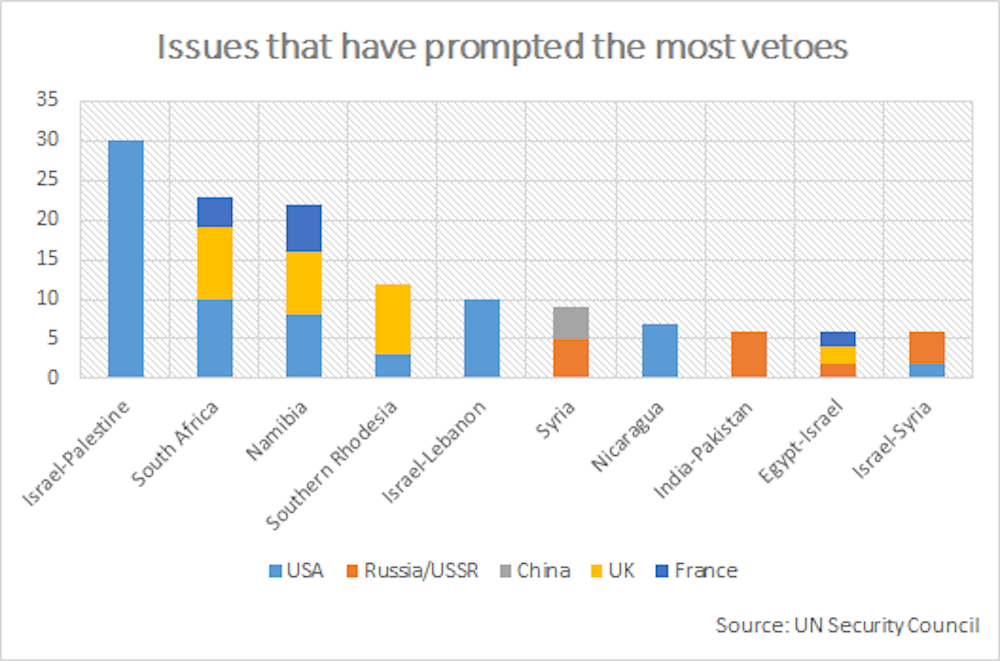
    For a start, it would need to get past the UN security council which means being subject to a veto from any one of the five permanent members (P5). We published an article on this issue some years ago with the help of UN expert Emma McClean, which looked at the issues which had prompted members of the P5 to wield their vetos. It found that Israel-Palestine was hands-down the most common issue that led to a veto – and all those vetoes had been instigated by the US.

    UN security council vetoes.
    UN security council


    Read more:
    Hard Evidence: who uses veto in the UN Security Council most often – and for what?


    So suspending Israel from the UN would appear to be a non-starter. But Hehir tells the story of the way the UN managed to circumvent the P5 and suspend South Africa in 1974 over apartheid. Having failed to get the suspension past the security council after the UK and France vetoed the move, the credentials committee of the general assembly simply refused to renew South Africa’s credentials. It remained suspended for two decades until the end of apartheid in 1994.


    Read more:
    Gaza: can the UN suspend Israel over its treatment of Palestinians? It’s complicated, but yes


    Meanwhile Israel’s assault on Gaza continues and the death toll continues to mount. Israeli Defense Forces (IDF), supported by airstrikes, continue to bombard what the IDF says are Hamas positions in the towns of Beit Lahia and Jabalia but which the Gaza health ministry say are residential buildings sheltering hundreds of civilians. On October 29, the health ministry said at least 93 people, including 25 children, were killed by an Israeli airstrike.


    Now, more than ever, it’s vital to be informed about the important issues affecting global stability. Sign up to receive our weekly World Update newsletter. Every Thursday we’ll you expert analysis of the big stories making international headlines.


    Much of the population of the north of Gaza has been evacuated south of what is known as the Netzarim corridor. Israel’s Haaretz newspaper claims that it’s part of an operation known as the “generals’ plan”, which calls for the north to be cleared of civilian residents and locked down as a military zone. This is presented as a national security measure, but Leonie Fleischmann reports that there are those who believe the military operation will be followed by an influx of Israeli settlers.

    Fleischmann points to a conference held on the Israeli side of the border with north Gaza, attended by members of Netanyahu’s Likud party as well as by several government ministers, which actively promoted the idea of settling north Gaza. Memories and historical legend mingle with ideology that holds Gaza had a Jewish population from biblical times through to 1929, when an Arab revolt killed 133 Jewish people living there and drove the rest out.

    The prospect of a land grab is clearly exercising minds at the UK foreign office. UK ambassador to the United Nations, Barbara Woodward said on October 29: “We reiterate that northern Gaza must not be cut off from the south. Palestinian civilians, including those evacuated from northern Gaza must be permitted to return. There must be no forcible transfer of Gazans from or within Gaza, nor any reduction in the territory of the Gaza Strip.”


    Read more:
    Israel’s ‘generals’ plan’ to clear Palestinians from north of Gaza could pave the way for settlers to return


    All eyes on Washington

    It’s highly unlikely that we’ll know by this time next week who has prevailed in the US presidential election. But the Middle East will be one of the first big ticket items on the Resolute desk.

    The issue has already proved to be a tricky one for Kamala Harris. Her support base is deeply divided on the issue, with large numbers of Democrats – particularly young people, as well as Muslims and black voters – unsettled by her perceived part in the Biden administration’s “steadfast” support for Israel over the past four years.

    It’s hard to tell whether these voters consider that the people of Gaza would fare any better under a Trump White House. But Natasha Lindstaedt and Faten Ghosn believe that Netanyahu’s continuing aggression in Gaza may well play out in the Republican contender’s favour.


    Read more:
    How the Middle East conflict could influence the US election – and why Arab Americans in swing states might vote for Trump


    Meanwhile, to guide us through how the two candidates are likely to approach the big foreign policy issues, we can turn to Garret Martin of the Transatlantic Policy Center at the American University in Washington.


    Read more:
    On foreign policy, Trump opts for disruption and Harris for engagement − but they share some of the same concerns


    World Update is available as a weekly email newsletter. Click here to get our updates directly in your inbox.


    ref. World Update: how Israel’s relations with the UN hit rock bottom – https://theconversation.com/world-update-how-israels-relations-with-the-un-hit-rock-bottom-242632

    MIL OSI – Global Reports

  • MIL-OSI Video: DPR Korea, Lebanon/Humanitarian, Cuba & other topics – UN Daily Press Briefing (31 Oct 2024)

    Source: United Nations (Video News)

    Noon Briefing by Stéphane Dujarric, Spokesperson for the Secretary-General.

    Highlights:
    -Democratic People’s Republic of Korea
    -UNIFIL
    -Lebanon/Humanitarian
    -Occupied Palestinian Territory
    -Ukraine
    -Security Council
    -Deputy Secretary-General
    -Cuba
    -South Sudan
    -West and Central Africa
    -World Cities Day
    -Guest briefing
    -Briefings tomorrow

    Democratic People’s Republic of Korea
    The Secretary-General strongly condemns the launch today of a long-range ballistic missile by the Democratic People’s Republic of Korea (DPRK).
    The DPRK’s continued launches of missiles using ballistic missile technology are clear violations of relevant Security Council resolutions.
    The Secretary-General remains concerned about the situation on the Korean Peninsula. He has consistently called for de-escalation and the full implementation of all relevant Security Council resolutions, as well as for an environment that is conducive to dialogue, and the resumption of talks. 
    Diplomatic engagement remains the only pathway to sustainable peace and the complete and verifiable denuclearization of the Korean Peninsula.

    UNIFIL
    In Lebanon, Blue Helmets – who remain at their positions and continue their essential work to monitor and report to us and the international community what is actually happening on the ground, tell us that intense clashes between Hizbullah and the Israel Defence Forces have been reported in the Khiam area in UNIFIL’s Sector East.
    The Israeli Defence Forces have continued to strike areas across Lebanon, including in the south, Baalbek and near Beirut, with multiple casualties reported. Hizbullah’s rocket fire has reportedly killed five people today near Metula in northern Israel.
    Yesterday, a UNIFIL position near the Blue Line, south of the Shab’a village (Sector East) sustained minor damage to its barracks and a vehicle due to a nearby explosion.
    We once again remind all involved in this conflict of the inviolability of UN premises, and those premises must be respected, as well as our peacekeepers, both uniformed and civilians.
    The intensifying hostilities are, of course, extremely concerning. We urge all actors to stop the violence immediately and avail themselves of the diplomatic initiatives to end this conflict. We continue to support efforts towards de-escalation and a diplomatic solution.
    The UN peacekeeping mission also remains focused on helping local communities. This week, they delivered essential humanitarian aid to the Municipality of Tyre amid a challenging situation in south Lebanon. The aid included medical devices as well as medicines.

    Lebanon/Humanitarian
    On the humanitarian front, as in many conflicts, children and woman bear the brunt of the ongoing hostilities.
    In a statement today, UNICEF’s Executive Director, Catherine Russell, said that 166 children have been killed in Lebanon since October 2023, that is what Lebanese authorities are telling UNICEF, while thousands of others have been injured.
    UNICEF is on the ground providing emergency psychological support to thousands of children and their caregivers.
    For its part, the UN Population Fund says the conflict is also impacting more than 10,000 pregnant women including 1,300 who are expecting to give birth soon amid significant damage to infrastructure and a health system that is extremely strained.
    The displacement crisis remains a key issue. Our humanitarian colleagues are telling us that today, the Israeli army issued new orders for people to leave their homes in several villages as well as in the Rashiedeh Palestinian refugee camp, which is located in the south. This is the first time the Israeli army has called for the evacuation of a Palestinian refugee camp in Lebanon.
    OCHA says that yesterday’s displacement orders and strikes in Baalbek and surrounding areas have forced thousands of people to flee their homes. Many of them spent the night in their vehicles.
    And yesterday, the Humanitarian Coordinator for Lebanon, Imran Riza, visited Akkar in Tripoli, which currently hosts around 70,000 people who have been forced to flee, and are in conditions that you can only imagine.

    Full Highlights: https://www.un.org/sg/en/content/noon-briefing-highlight?date%5Bvalue%5D%5Bdate%5D=31%20October%202024

    https://www.youtube.com/watch?v=M_88Ll_nbRg

    MIL OSI Video

  • MIL-OSI USA News: A Proclamation on Critical Infrastructure Security and Resilience Month,  2024

    Source: The White House

         From the energy that powers our homes to the networks that connect us and the systems that protect our health and safety, our critical infrastructure keeps our economy thriving and our communities secure.  This Critical Infrastructure Security and Resilience Month, we recommit to strengthening our country’s critical infrastructure and building an America that is safe and secure for generations to come.

         This year, I signed a National Security Memorandum to secure and enhance the resilience of United States critical infrastructure — updating the policy for the first time in a decade.  This represents the launch of a new era in protecting our infrastructure against all threats and hazards by safeguarding our strong and innovative economy and enhancing our collective resilience to disasters before they happen.  But there is more to do.  Climate change is making natural disasters more frequent, ferocious, and costly — endangering our supply chains, creating more instability for our communities, and straining the critical infrastructure Americans depend on for their livelihoods.  And we need to stay vigilant against adversaries that seek to maliciously target our critical infrastructure, including through cyberattacks.  

         To meet this moment, my Administration made a once-in-a-generation investment in our Nation’s infrastructure — creating an opportunity to build in resilience to all hazards upfront and by design.  Through my American Rescue Plan, Bipartisan Infrastructure Law, Inflation Reduction Act, and CHIPS and Science Act, we are investing billions of dollars to secure and bolster our infrastructure.  That includes improving our electric grid so that people can maintain power in any situation, elevating roads and bridges over possible flood zones, funding community resilience programs, and more.  These investments have not only helped to protect Americans — they have benefited our economy, creating jobs and new possibilities for our communities.  At the NATO summit this year, I announced an arrangement with Canada and Finland to collaborate on the production of polar icebreakers.  The partnership will advance United States economic and national security interests by strengthening our shipbuilding and industrial capacity while simultaneously opening up new trade routes and pushing back against foreign aggression and bolstering our international alliances.  This year, I also announced a United States Port Security Initiative to reverse our dependence on foreign manufactured port equipment.

         Ensuring our Nation is resilient in the face of threats also means working with other nations around the globe to build better, stronger, and more sustainable infrastructure.  At the G7 Summit in June, I was proud to announce the historic progress we have made with our Partnership for Global Infrastructure and Investment.  This initiative will strengthen United States national and economic security for Americans at home and enable sustainable economic growth for partner countries.  To date, we have mobilized $60 billion to create high-quality global infrastructure.  That comes on top of our work with the European Union and African heads of state to develop the Lobito Corridor as well as our work with the Democratic Republic of the Congo and Zambia to expand regional and global trade markets through the Port of Lobito in Angola.  We continue to pursue opportunities to expand our investments across Africa and around the world, including the Indo-Pacific, Central Asia, the Middle East, and the Western Hemisphere.  Investments like these create more shared opportunities, prosperity, and security for everyone.

         Across the Nation, America is writing the greatest comeback story we have ever known — people are putting shovels in the ground, founding new businesses, and creating hope for entire communities.  It is more important now than ever before that we remain vigilant against any threats that seek to undermine our collective security and prosperity. 

         During Critical Infrastructure Security and Resilience Month, we recommit to safeguarding and strengthening our Nation’s critical infrastructure to save lives and allow our Nation to continue doing what it does best:  creating new possibilities.

         NOW, THEREFORE, I, JOSEPH R. BIDEN JR., President of the United States of America, by virtue of the authority vested in me by the Constitution and the laws of the United States, do hereby proclaim November 2024 as Critical Infrastructure Security and Resilience Month.  I call upon the people of the United States to recognize the importance of protecting our Nation’s infrastructure and to observe this month with appropriate measures to enhance our national security and resilience.

         IN WITNESS WHEREOF, I have hereunto set my hand this thirty-first day of October, in the year of our Lord two thousand twenty-four, and of the Independence of the United States of America the two hundred and forty-ninth.

                                   JOSEPH R. BIDEN JR.

    MIL OSI USA News

  • MIL-OSI USA: Deputy Administrator Isobel Coleman on Bold Measures to Feed Africa During the World Food Prize

    Source: USAID

    DEPUTY ADMINISTRATOR ISOBEL COLEMAN: Thank you, President [Akinwumi] Adesina, for that introduction, and thank you, President [Samia Suluhu] Hassan and President [Julius Maada] Bio, for your thoughtful reflections. It is an honor to join you today, representing the U.S. Agency for International Development.

    As we’ve heard, the level of need remains great in Africa. It is one of the few regions of the world where hunger and undernourishment have continued to rise in recent years. However, Africa is also home to 12 of the 20 fastest growing economies on the planet, and the continent is poised to become the world’s second fastest-growing economic region. 

    This is a moment of great opportunity. With smart policy reforms, and increased investment and trade, we can realize the potential of this dynamic region while seriously tackling poverty, hunger and malnutrition. 

    The U.S. government’s global hunger initiative, Feed the Future, prioritizes investments in Africa – providing more than $400 million each year to drive inclusive and sustainable agriculture-led growth, improve nutrition outcomes, and build resilience. Feed the Future’s locally-led model has yielded remarkable success over its first decade. In areas where Feed the Future has worked, poverty, hunger, and child stunting all declined by 20 to 25 percent. 

    But, we know there is much more work to be done. 

    As global needs continue to far outpace available resources, USAID is focused on investing our dollars in the most impactful, cost-effective ways to maximize our impact. Under Feed the Future, we are making an effort to concentrate our work in countries and regions where we see both significant need and opportunity to drive long-term sustainable progress.  

    Through rigorous data analysis, we have identified three countries in sub-Saharan Africa – Malawi, Tanzania, and Zambia – as ripe for the kind of agricultural transformation that can lift hundreds of thousands of people out of poverty and help expand the food supply across the region and beyond. So, through an initiative we are calling Feed the Future Accelerator, we are doubling down on our investments in these three countries. We believe these countries have the potential to become regional breadbaskets helping to feed the world. 

    In partnership with the African Union, the Accelerator will allow us to support an African-led approach to tap into that potential. The governments in these countries – by implementing the smart policies and economic reforms needed to catalyze inclusive growth – are laying the groundwork to form a regional agricultural powerhouse.

    We are committed to capitalizing on this game-changing opportunity in the region. So, last month, we announced over $80 million in USAID commitments to Feed the Future Accelerator, which complements an ongoing portfolio of nearly $500 million in investments from across the U.S. government in these three countries. And, over the course of this week, we’ve seen that number grow.

    For example, on Tuesday, the Millennium Challenge Corporation announced a new $491 million compact with Zambia, with MCC providing $458 million and the Government of Zambia contributing $33 million to boost agricultural productivity and investment. And, as we ramp up our investments in these priority countries, the U.S. and other donors are also investing in the hard infrastructure that farmers need to access affordable agricultural inputs and then to transport what they grow to markets across the region. 

    Under the umbrella of the Partnership for Global Infrastructure and Investment, or PGI, we are investing in the Lobito Corridor – an ambitious infrastructure project stretching from the port of Lobito on Angola’s Atlantic coast, through the Democratic Republic of the Congo to Zambia, and on to Tanzania. These investments will directly benefit smallholder farmers and agricultural small and medium-sized enterprises by enabling them to scale up operations, create linkages to agro-processing and storage, create jobs, and drive growth. Our ambition is that this economic corridor, enhanced by our investments in the Accelerator, will raise incomes among small- and medium-sized farm holders, especially women farmers, while also contributing to regional trade and market linkages – catalyzing the kind of agricultural growth needed to enable countries not just to provide for their own people but to become major food exporters.

    And, we know that these investments in infrastructure and food security are also building greater climate resilience in a region battling the impacts of climate change. USAID has announced over $38 million in new research investments with a host of U.S. universities that will focus on developing climate-smart innovations to build resilience and support smallholder farmers in Accelerator countries specifically and across Africa more broadly.

    But, we know that the United States government cannot do this alone, which is why we are excited that the private sector is joining us in this effort, with major companies such as Bayer and ofi, one of the largest coffee suppliers in the world, investing over $150 million in Malawi, Tanzania, and Zambia. And, earlier this week, you may have heard from Bayer and ofi about the investments they are making. Bayer will invest $35 million in building a new seed production facility in Zambia, which is expected to open in March 2025. The hybrid seeds Bayer will produce will be sold across the region, contributing to a more integrated regional seed market that benefits smallholder farmers in neighboring countries. ofi, one of the largest coffee producers and exporters in Tanzania and Zambia, will invest $80 million over the next four years in Zambia and Tanzania coffee value chains. These investments will boost local economies and generate additional income for farming communities.

    This kind of partnership – with the private sector, with local African leaders, with other donors, and beyond – will be vital to our efforts. Together, we will create an engine that can help feed hungry people, not just in these three countries, but across the African continent.

    MIL OSI USA News

  • MIL-OSI Europe: Answer to a written question – Invasion and destructive impact of various pufferfish species ( Tetraodontidae ) in the Mediterranean Sea – E-001726/2024(ASW)

    Source: European Parliament

    The EU works with the General Fisheries Commission for the Mediterranean (GFCM) on the issue of the spread of Non-Indigenous Species (NIS).

    The GFCM 2030 Str ategy recognises its importance and makes its work on NIS a priority[1]. Several pilot projects and research programs, in which Member States take part, have been developed advancing data collection, information sharing and establishing comprehensive mitigation measures.

    These include a pilot study on NIS in the eastern Mediterranean and the creation of a NIS observatory. While initially focused on the east, the aim is for the observatory to eventually be expanded to the entire region.

    Regarding the compensation available to fishers, the EU provides for the funding of national initiatives under the European Maritime, Fisheries and Aquaculture Fund (EMFAF). Several Mediterranean Member States have identified the threat posed by NIS and put in place measures and solutions to combat them.

    In Cyprus, a scheme has been put in place to compensate fishers for their pufferfish catches[2]. Other Member States, such as Greece, have funded innovative projects which help turn this threat into an economic opportunity[3].

    Our Mediterranean neighbours have also been developing mitigation and adaptation measures, expanding their research on pufferfish species.

    At the 2024 GFCM Fish Forum, Tunisia and Türkiye presented pufferfish-focused research with the latter having developed the production of pufferfish leather[4].

    The EU has been financially supporting the GFCM’s capacity building work under the MedSea4Fish programme which has also focused on providing GFCM parties with support in their research and data collection on NIS, ensuring a uniform ability to combat invasion.

    • [1]  GFCM 2030 Strategy Action Plan(https://www.fao.org/gfcm/2030strategy): Target 1.4 on the need to prevent and mitigate ‘threats to fisheries and the marine environment, including plastic pollution, climate change and the expansion of non-indigenous species’
    • [2]  www.moa.gov.cy/emfaf
    • [3]  The Greek example of turning pufferfish into fishmeal is particularly relevant https://oceans-and-fisheries.ec.europa.eu/news/turning-toxic-pufferfish-invader-aquaculture-feed-2023-12-22_en#:~:text=The%20pufferfish%2C%20originating%20from%20the,to%20have%20no%20commercial%20value.https://oceans-and-fisheries.ec.europa.eu/news/turning-toxic-pufferfish-invader-aquaculture-feed-2023-12-22_en
    • [4]  https://pufferfishleather.com/

    MIL OSI Europe News

  • MIL-OSI Europe: Answer to a written question – Measures to support the Spanish and Portuguese fleets affected by the proliferation of the invasive species of Asian seaweed ( Rugulopteryx okamurae ) – E-001853/2024(ASW)

    Source: European Parliament

    The Commission is aware of the serious problems that the species Rugulopteryx okamurae is causing in various coastal areas of Andalucía and in other Spanish areas such as Ceuta and south of Portugal.

    On the basis of a risk assessment submitted by the competent Spanish authorities, Rugulopteryx okamurae was included in 2022 on the list of the invasive alien species to which priority should be given[1]. Regrettably, this invasive alga continues to expand, and has reached France and Italy in recent years.

    The affected Member States can decide how and when to provide financial support to fishers affected by invasive species through their European Maritime, Fisheries and Aquaculture (EMFAF) programme.

    This can include measures for tackling the spread of the species, as well as directly supporting fishers for example with cleaning, repairing equipment and antifouling.

    Based on the information received from the Spanish authorities, it appears that the Spanish Ministry of Environment has been working on research and plans to manage the crisis.

    The Commission has also been informed that the Spanish EMFAF Managing Authority has carried out an analysis on support options.

    The Commission is however not aware of financing decisions by this Authority. Nevertheless, the Commission has also been informed that the authorities provided de minimis State aid to the sector for the loss of fishing activity and damaged fishing gear outside the EMFAF programme.

    In the case of Portugal, the national authorities informed the Commission that no support under EMFAF was provided or is planned at this stage.

    For more information on the national/regional support measures implemented, we refer the Honourable Member to the competent authorities in the Member States.

    • [1] Commission Implementing Regulation (EU) 2022/1203 of 12 July 2022 amending Implementing Regulation (EU) 2016/1141 to update the list of invasive alien species of Union concern. OJ L 186, 13.07.2022, p. 10-13.

    MIL OSI Europe News

  • MIL-OSI United Nations: Experts of the Committee against Torture Welcome Namibia’s Commitment to the Mandela and Bangkok Rules, Ask about Harmful Traditional Practices and Lengthy Pretrial Detention Periods

    Source: United Nations – Geneva

    The Committee against Torture today concluded its consideration of the third periodic report of Namibia, with Committee Experts welcoming the State’s commitment to the Nelson Mandela and Bangkok Rules, international norms on the treatment of prisoners, and raising questions about harmful traditional practices and lengthy pretrial detention periods.

    Erdogan Iscan, Country Rapporteur and Committee Expert, welcomed the commitment of the State party to complying with the Nelson Mandela Rules and the Bangkok Rules.

    Mr. Iscan raised the issue of traditional practices that were harmful to women and girls, including the ritual of Olufuko, which involved child marriage and sexual initiation rites.  Had the State party made progress in terms of awareness-raising as well as eliminating such practices?  What further steps had been taken to prevent and criminalise the practice of forced sterilisation?

    Jorge Contesse, Country Rapporteur and Committee Expert, said pretrial detention seemed to routinely exceed legal limits, with above 50 per cent of the prison population awaiting trial.  The low usage of alternatives to detention and an unaffordable bail system seemed to be contributing to the large backlog of cases of pretrial detainees.  What measures had been adopted to address these challenges?

    Introducing the report, Yvonne Dausab, Minister of Justice of Namibia and head of the delegation, said the Namibian correctional service included human rights instruments, including the Nelson Mandela Rules, in the curriculum at its Training College.  The service had undertaken measures to renovate all the country’s correctional facilities with the aim of improving the living conditions of offenders.

    Ms. Dausab said the Government continued to conduct awareness campaigns targeting traditional and religious leaders on positive gender roles and the elimination of harmful cultural practices.  The Childcare and Protection Act 2015 had measures to protect children from harmful cultural and religious practices, strictly prohibiting child marriage in all setups.

    The delegation said Olufuko had taken on a more cultural image and profile, as opposed to a platform for sexual initiation and child marriage.  That may have been the case in the past, but this had changed over the past 10 to 15 years.  Namibia had taken steps to ensure that acts of enforced sterilisation of individuals were not carried out.

    Pretrial detention could run for any time between six to 12 months, the delegation said, and courts could decide to withdraw charges before the six-month period based on available evidence.  The State party was working to strengthen community courts and establish small claims courts to address overcrowding in prisons and holding cells. Since the report was sent, there had also been parole releases and the President had pardoned some persons.

    In closing remarks, Claude Heller, Committee Chair, said that the Committee understood that the political context in Namibia was difficult.  The Committee would make efforts to provide the State party with relevant and achievable recommendations within its concluding observations.  The Committee was interested in maintaining an open dialogue with the State party through its follow-up mechanism.

    In her concluding remarks, Ms. Dausab said Namibia was committed to addressing all forms of torture and other cruel, inhuman or degrading treatment.  More needed to be done to prevent torture, including the enactment of specific legislation criminalising it.  The Committee’s recommendations would help to enhance mechanisms to prevent torture.

    The delegation of Namibia consisted of representatives from the Ministry of Justice; Ministry of Home Affairs, Immigration, Safety and Security; Namibia Correctional Service; and the Permanent Mission of Namibia to the United Nations Office at Geneva.

    The Committee will issue concluding observations on the report of Namibia at the end of its eighty-first session on 22 November.  Those, and other documents relating to the Committee’s work, including reports submitted by States parties, will be available on the session’s webpage.  Summaries of the public meetings of the Committee can be found here, and webcasts of the public meetings can be found here.

    The Committee will next meet in public on Tuesday, 5 November at 10 a.m. to begin its examination of the second periodic report of Thailand (CAT/C/THA/2).

    Report

    The Committee has before it the third periodic report of Namibia (CAT/C/NAM/3).

    Presentation of Report

    YVONNE DAUSAB, Minister of Justice of Namibia and head of the delegation, said

    Namibia had suffered a great loss at the beginning of the year when the third President, Dr. Hage Gottfried Geingob, a strong champion of human rights, passed away on 4 February 2024.  He was greatly missed.  Additionally, Namibia was currently going through a devastating drought which had impacted food security and economic development; the Government was navigating this climate-related crisis with the assistance of developmental partners. Namibia offered a sincere apology for the non-submission of the written responses to the list of issues.

    The torture bill remained under consideration following deliberations in the National Assembly.  The Convention was directly applicable and enforceable in Namibia without the ‘domestic’ legislation.  Article 144 had been used by Namibian courts which had cited United Nations Conventions in their judgments, making their provisions applicable directly in Namibia. The Namibian Constitution prohibited torture as well cruel, inhuman or degrading treatment or punishment, and the Criminal Procedure Act of 1977 criminalised murder as well as assault, including assault with intent to cause grievous bodily harm. 

    Members of the police force, correctional service and defence force accused of using excessive force were investigated under internal complaints units and those found to have acted outside the scope of what was reasonable in the circumstances were subjected to prosecution.  The Government had also been ordered to pay damages to complainants and their families in civil matters brought due to allegations of assault or use of excessive force by law enforcement officers. 

    The Namibian Constitution prohibited arbitrary arrest or detention and required that an arrested person be brought before a court within 48 hours after the arrest.  All police officials were trained and required to inform an accused person upon arrest of their rights, reasons for their arrest, and charges against them.  The Directorate of Legal Aid within the Ministry of Justice had appointed 69 in-house lawyers across the country to represent members of society who could not afford legal representation. 

    The Government had enhanced the independence of the Ombudsman by reforming the current Ombudsman Act 1990 to make provision for the Ombudsman’s Office to be established as a separate agency in the public service, with its own budget and accounting officer.  The Office of the Ombudsman had launched a training manual against torture for law enforcement agencies, and visited and inspected places of detention, police holding cells, and correctional facilities to monitor human rights compliance.

    Namibia continued to be marred by incidents of gender-based and sexual violence, including online child sexual exploitation.  The Government had developed a national plan of action on gender-based violence 2019-2023 to address the root causes and provide a well-coordinated approach to the prevention, response, monitoring and evaluation of gender-based violence initiatives.  Additionally, Namibia had established special courts for gender-based violence offences country-wide to provide a victim-friendly environment. 

    The Government continued to conduct awareness campaigns targeting traditional and religious leaders on positive gender roles and the elimination of harmful cultural practices.  Namibia had developed and implemented a national plan of action to address violence against children.  The Childcare and Protection Act 2015 had measures to protect children from harmful cultural and religious practices, strictly prohibiting child marriage in all setups. 

    The Ombudsman had been instrumental in ensuring that the Namibian police force was adequately trained on the ‘prevention of torture training manual for police officers.’ The Namibian police force also conducted ongoing workshops to train police officers on human rights.  The Namibian correctional service included human rights instruments in its curriculum, including the Nelson Mandela Rules, at the Namibian Correctional Service Training College.  The service had undertaken measures to renovate all of the country’s correctional facilities with the aim of improving the living conditions of offenders.  The implementation of the Namibian correctional service’s health policy had brought about significant changes in managing communicable diseases such as tuberculosis, HIV and hepatitis, as well as mental health support. 

    All asylum seekers went through a refugee status determination process and those who met the criteria were granted refugee status.  If an application for refugee status was unsuccessful, the applicant was advised they could appeal the decision to the Namibian Refugee Appeal Board. Namibia was implementing the national action plan on statelessness, and a national committee had been established. The review of the legislative framework, which was a key milestone, had begun. 

    The Police Act allowed police officials to be investigated for misconduct and human right violations, inclusive of torture.  Officials found guilty of acting outside the scope of their duties were subject to laid down procedures, including arraignment before a competent court. In Namibia, the State was represented by the Prosecutor General in criminal cases; therefore, the prosecution of all allegations of torture lay with the State.  Ms. Dausab concluded by stating that the Namibian Government remained committed to protecting and promoting human rights in the country. 

    Questions by Committee Experts 

    ERDOGAN ISCAN, Committee Expert and Rapporteur, said the Committee expressed its condolences for the death of Namibia’s third President earlier this year.  The State party did not reply to the list of issues adopted by the Committee and chose to submit a report in May 2021 under the traditional reporting procedure.

    The dialogue with the State party would be conducted against this background.

    Mr. Iscan called on Namibia to continue to support the treaty body system. 

    Had measures been taken to improve prison conditions in conformity with the Nelson Mandela Rules? Research indicated that the total prison population was close to 9,000 inmates, of which 54 per cent were pretrial detainees in police custody.  Occupancy level in the prison system was 75 per cent.  Could the Committee be updated on the current situation?  Could details be provided about the health policy and practice developed by the Namibian correctional service? 

    How many individuals were currently in pretrial detention?  What was the average length of pretrial detention and steps taken to reduce its use?  Could statistical data be provided on deaths in custody; investigations carried out into these deaths; and the number of police or prison staff who had been subjected to criminal or disciplinary punishment in cases involving death in custody? Had there been cases of inter-prisoner violence, and what had been measures implemented in such incidents?

    The Committee noted that corporal punishment was prohibited in schools by the Basic Education Act of 2020, but it still lacked an explicit prohibition in the home. What was the current status of the Correctional Service Act 2012 with respect to explicitly prohibiting corporal punishment following the Supreme Court’s judgment of 5 April 1991?  What steps were being taken to totally prohibit corporal punishment in all settings and develop campaigns for awareness raising?

    Could data on all complaints received by the Ombudsman and the number of complaints received by the Internal Investigation Directorate be provided?  How many of these complaints were investigated and how many resulted in disciplinary sanctions?  Had the perpetrators been punished with appropriate penalties commensurate with the gravity of the crime?  How many complaints had been received concerning sexual abuse and the exploitation of refugees by public officials or non-governmental workers at the Osire refugee camp?  Had these complaints been investigated and prosecuted and had victims obtained redress? 

    The Caprivi high treason trial ended in September 2015 and the Committee noted that about 30 persons were found guilty and sentenced to various imprisonment terms; 79 persons were found not guilty and released from custody.  Could

    information on investigations into or prosecutions of members of the Namibian police force regarding alleged acts of torture of suspected participants in the secession attempt in the Caprivi region in 1999 be provided?  What steps had been taken by the authorities to investigate reports of enforced disappearances in the context of the liberation struggle, including the disappearance of former members of the Southwest Africa People’s Organization?  Had alleged victims and their families obtained redress?

    Was the legislation on excessive use of force compatible with the Convention, as well as the basic principles on the use of force and firearms by law enforcement officials?  Were the reports of excessive use of force by law enforcement officers investigated promptly, effectively and impartially?  Were the perpetrators prosecuted and, if convicted, punished with commensurate penalties?  Were victims of violations remedied adequately?  The Committee had received allegations that members of the police force detained and sexually abused sex workers.  What was the State party’s response to these reports? 

    The Committee took note of the Joint Communication by a group of Special Procedure mandate holders, who examined the document which evaluated the “Joint Declaration by the Federal Republic of Germany and the Republic of Namibia: United in remembrance of our colonial past, united in our will to reconcile, united in our vision of the future”, dated June 2021, and developed observations in connection with international human rights law.  It was understood that follow-up negotiations were ongoing between Namibia and Germany.

    With respect to traditional practices that were harmful to women and girls, including the ritual of Olufuko, which involved child marriage and sexual initiation rites, had the State party made progress in terms of awareness-raising as well as eliminating such practices?  What further steps had been taken to prevent and criminalise the practice of forced sterilisation?  What measures were in place to ensure that all acts of violence that targeted persons on the basis of their sexual orientation or gender identity were properly and promptly investigated and prosecuted? 

    It was reported that the Supreme Court issued a ruling last year recognising the right of spouses of Namibian citizens to regularise their immigration status based on same-sex marriages.  Later, parliament passed legislation banning same-sex marriages.  If enacted, it could nullify the Supreme Court ruling.  What was the current status of this legislation? The Committee had received information that the High Court issued a decision on 21 June 2024, which declared the common law offences of sodomy and unnatural sexual offences unconstitutional. It seemed that the State party continued to criminalise same-sex relationships and the Government had lodged an appeal against this decision which was currently pending before the Supreme Court.  What was the current situation? 

    Could the State party clarify its policy, legislation and practice with respect to prisons, hospitals, schools and institutions that engaged in the care of children, older persons or persons with disabilities?  What was the legal permissibility and use of the measures such as seclusion, physical and chemical restraints, and other restrictive practices? Were net beds and cage beds used in psychiatric and social welfare institutions?  Did the Office of the Ombudsman have unrestricted access to monitor these institutions?  Had any progress been achieved in regard to protecting the human rights of older persons?

    The Committee noted the commitment of the State party to complying with the Nelson Mandela Rules and the Bangkok Rules.  Could the State party clarify its policy, legislation and practice with respect to solitary confinement?  What was the incommunicado detention regime in Namibia?  If the State party maintained this practice, under what circumstances was incommunicado detention authorised and what was the competent organ to authorise incommunicado detention?  Would the State party consider abolishing incommunicado detention? 

    Could Namibia comment on the status of the recommendation to ratify the Optional Protocol to the Convention, and other international instruments to which it was not a party?  Was there any update in this regard? 

    JORGE CONTESSE, Committee Expert and Rapporteur, said torture was currently not a specific criminal offence in Namibia and Namibian law did not expressly criminalise any other forms of cruel, inhuman or degrading treatment or punishment.  Could information be received on the status of the draft prevention of torture bill?  What amendments to the bill sought to bring it further into line with the State party’s obligations under the Convention, as previously recommended by the Committee, including provisions that criminalised the acquiescence and complicity of State officials, or officials acting in an official capacity, to acts of torture?  Were acts amounting to torture subject to a statute of limitations?  Were there any cases where Namibia had invoked the Convention directly before domestic courts? 

    What initiatives had been taken by the State party to enshrine in its legislation fundamental legal safeguards, in particular the right to have access to a lawyer, including the right to access free and effective legal aid; the right to receive a medical examination by an independent physician; the right for individuals, at the time of arrest, to be informed of their rights; the right to be brought promptly before a judge; the right to notify a person of one’s choice of one’s deprivation of liberty; and the obligation of the authorities to maintain detention registers at places of detention?  Were there any cases in which the authorities had failed to comply with these safeguards?  How many such complaints had been registered and what was their outcomes? 

    Were there any cases in which disciplinary measures were taken against officials found responsible for violations?  What complaints mechanisms were available to report violations, and how did they function in practice?  Could the State party specify the circumstances in which a right to counsel could be waived?

    The 2022 annual report of the Ombudsman described visitation and inspection of places of detention in Namibia, noting that some of the most appalling facilities had been closed.  When this happened, where were the detainees who had been held there sent?  What was the timetable for the cleaning and renovation of these facilities?  Pretrial detention seemed to routinely exceed legal limits, with above 50 per cent of the prison population awaiting trial.  In addition, the reported shortcomings in the criminal justice system, such as the significant delays between arrest and trial, the low usage of alternatives to detention, and an inaccessible and unaffordable bail system, seemed to be the contributing factors to the large backlog of cases of pretrial detainees.  What measures had been adopted to address these shortcomings and challenges?

    It was understood that the child justice bill, which had not yet been adopted, endorsed 14 years of age to be considered criminally responsible and abolished the common law presumption.  What was the status and content of the bill?  What measures were adopted to ensure that children were not detained in detention centres for adults?  The Committee understood that no legal provision authorised the Ombudsman to make unannounced visits to places of detention; would the new legislation provide the Ombudsman with such power? 

    Violence against women, including rape, domestic violence, sexual exploitation and abuse of children, and violence against women from indigenous communities, continued to be extremely high, and the root causes of such violence had not been adequately addressed.  According to the national gender-based violence baseline study, “most drivers of gender-based violence were relationship factors that were deeply entrenched within socio–cultural norms and escalated to societal level factors.” What concrete measures had the State party adopted to address these issues, including policies and plans to address ongoing challenges; the number of complaints of gender-based, domestic, or sexual violence received by the authorities; the number of investigations and prosecutions undertaken regarding gender-based, domestic or sexual violence; and the protection and support services available to victims?

    The recommendation to remove the crime of sodomy as a ground for entry refusal into Namibia remained unaddressed.  What measures would the State party adopt to address this and other pending concerns? Could data be provided on the number of asylum applications received during the period under review, the number of successful applications, and the number of asylum seekers whose applications were accepted because they had been tortured or might be tortured if returned to their country of origin? 

    What were the existing appeals mechanisms and other mechanisms in place to identify individuals in need of international protection?  What was the procedure followed when a person invoked this right? Were individuals facing expulsion informed of their right to seek asylum and appeal a deportation decision?  How many stateless persons were living in the country?  What measures were being taken by the State party to mitigate the risk of torture or ill treatment faced by stateless persons. 

    How many law enforcement officials, prison staff, military officers, investigators, judicial personnel and border guards had attended educational programmes which included instruction on the provisions of the Convention against Torture?  How were officers were trained on investigating and handling forms of prohibited ill treatment, like cruel, inhuman or degrading treatment?  To what extent was the Ombudsman responsible for training other law enforcement agencies on investigating torture claims?  What specific initiatives were in place to train officials to prevent the traumatisation of victims of torture or ill treatment.  What steps had been taken to improve methods of investigation, including training programmes on non-coercive interrogation techniques?  Had any training programmes been developed for judges, prosecutors, forensic doctors and medical personnel dealing with detained persons on detecting and documenting the physical and psychological signs of torture?

    Responses by the Delegation 

    The delegation said any international instrument that Namibia ratified became part of their system. Namibia took the work of the treaty bodies very seriously.  Namibia’s prison capacity across the country was around 5,400.  The bed capacity was around 4,700.  Since the report was sent, there had been parole releases, persons had completed their sentences, and the President had pardoned some persons. Pretrial detention could run for any time between six to 12 months.  There was no deliberate attempt on the part of the State to keep people in pretrial detention; the authorities were trying to clear them as quickly as possible to decongest prison facilities. 

    Namibia did not have inter-prison violence in the form that was premeditated, organised, or gang related.  There were isolated incidents of inter-prison fights which were dealt with quickly.  In the rare instances when these incidents occurred, the prisoners would be separated from each other.  Namibia had made a proposal to improve community service orders. 

    It was agreed that the Ombudsman needed to be extricated from the Ministry of Justice. However, there was no evidence that there had been any interference in the work of the Ombudsman.  The Ombudsman bill was ready to go before the National Assembly for Legislative Consultation, which would help with establishing the Office of the Ombudsman.  Currently in Namibia, the Ombudsman was at the level of a judge.  Whether there should be a fixed-term or the security of tenure of the Ombudsman was currently under debate.  Since his appointment, the Ombudsman had been quite vocal about his findings and his displeasure at the conditions of prisons.  The Ombudsman had unfettered access to those facilities; however, unannounced visits could be impractical.  Namibia was doing enough to ensure those institutions which had the mandate to investigate violations of human rights were able to be supported in their work. 

    There had been no prosecutions for prostitution or sex work in Namibia.  There was some fairly outdated legislation, but these laws had not been activated because the State did not feel they were consistent with the spirit of the Namibian Constitution.  Namibia was constantly working on reforming legislation which offended the values of the Constitution.

    The Joint Declaration was the result of an open and frank conversation in Namibia’s National Assembly, reflecting the gravity of the first genocide which took place in Namibia during the twentieth century. 

    Olufuko had taken on a more cultural image and profile, as opposed to a platform for sexual initiation and child marriage.  That may have been the case in the past, but this had changed over the past 10 to 15 years.  Namibia had taken steps to ensure that acts of enforced sterilisation of individuals were not carried out.  The discussion around the reform of abortion and sterilisation was ongoing.  Namibia was concerned about the number of cases of persons who identified as persons of the lesbian, gay, bisexual, transgender and intersex community, who had lost their lives.  However, the State could not say that these crimes happened specifically due to their sexual orientation.  All of those incidents of people who had been killed over the past few months were being investigated and prosecutions would take place. 

    Homosexuality in Namibia was not a crime. 

    Namibia had an excellent proposal for child justice.  The State had engaged in extensive consultation with and received feedback from the United Nations Children’s Fund.  Early next year, the child justice bill would be considered in the Assembly.  Children were kept in facilities separate from adults, and were provided with significant social support.  Gender-based violence was a concern for Namibia.  Every year, the State commemorated the 16 days of violence against women.  There was increasing collaboration between the State and civil society organizations to increase visibility.  The text and the language of legislation combatting rape had been strengthened in 2022, as had the domestic violence legislation. 

    Questions by Committee Experts 

    ERDOGAN ISCAN, Committee Expert and Rapporteur, said the Committee appreciated the fact that they had a high-level delegation here, headed by the Minister in the lead-up to the country’s elections, and wished Namibia all the best in their democratic elections.  The Committee needed information on the reflection of policy and legislation in practice, which was why statistical information was important. 

    Could the State party inform the Committee on the policies, legislation and practices on counter-terrorism measures?  It was a fundamental obligation of States to fight terrorism, while still respecting human rights and the rule of law. 

    Could information be provided on the legislative and executive measures under the state of emergency?  Did they comply with the absolute and non-derogable prohibition of torture? 

    JORGE CONTESSE, Committee Expert and Rapporteur, said it was necessary to have a specific crime which defined the contours of torture.  What were the requirements that members of parliament had, which resulted in seven years of there being no torture bill?  It seemed that the child justice bill moved down the minimum age of criminal responsibility to 12 years; how was this consistent with human rights law? 

    Responses by the Delegation

    The delegation said Namibia’s President could declare a state of emergency in situations where there were natural disasters or threats to the State.  At no time had the declaration of a state of emergency suspended the prohibition of torture or the protection of fundamental rights and freedoms.

    Persons who engaged in terrorist activities against Namibia inside or outside of the State could face life imprisonment.  Law enforcement agencies recently attended training on counterterrorism, which reinforced the obligation to protect human rights and the rule of law.

    The anti-torture bill included definitions of torture and other cruel, inhuman or degrading treatment that were in line with the Convention.  The bill included punishments of imprisonment of varying lengths for acts of torture and other cruel, inhuman or degrading treatment.

    The child justice bill had been developed after broad consultation with international partners. It set the age of criminal responsibility at 12 years, considering the domestic context.

    International human rights instruments ratified by the State were applicable directly before the courts, and the International Covenant on Civil and Political Rights had been applied in one case.

    The Refugee Recognition and Control Act called for compliance with due process regarding detention and expulsions of asylum seekers.  Asylum seekers could be represented by legal practitioners in appeals to detention and expulsion procedures.  Namibia respected the principle of non-refoulement.

    The Government was working to regularise the status of stateless persons.  Under the birth outreach programme, teams had been deployed to rural areas to facilitate birth registration.  Bills promoting civil registration, regularisation and statelessness determination were being considered in Parliament.  Namibia was exerting efforts to eradicate statelessness.

    The Namibian police had conducted investigations into alleged cases of enforced disappearance conducted by two individuals with Angolan citizenship.  These cases had been finalised.  A bill had been developed on the training of police and military officers.  Training was aligned with the Istanbul Protocol and developed skills in investigating allegations of torture and helping victims to access redress. Police officers could not question suspects before informing them of their rights.

    The Constitution prohibited corporal punishment and State legislation prohibited such punishment in school settings.  Schools were mandated to create mechanisms that allowed learners to report incidents of corporal punishment.  In August 2024, a teacher was relieved of his duties following reports of him engaging in corporal punishment of learners.  Parents and guardians needed to respect children’s right to dignity.

    The State party had established an appeal committee and set up regulations to prevent the abuse of legal aid resources.  There had been an increase in applications for legal aid this year, with the number of applications for legal aid having increased to more than 10,000.  Measures were in place to respond to this increase in applications.

    The Mental Health Act of 1973 was outdated and used language that was not consistent with the Convention on the Rights of Persons with Disabilities.  A new bill dealing with mental health had been proposed, which set regulations regarding the limited use of seclusion, coercive methods, and restraint of persons with disabilities, and promoted de-escalation techniques.  The bill called for coercive methods to be removed within two hours at most.  There was a clear prohibition of forced sterilisation of women with mental disabilities in the bill.  It was expected to be finalised next year.

    Questions by Committee Experts 

    ERDOGAN ISCAN, Committee Expert and Country Rapporteur, said that the State’s Constitution and legislation determined that statements made as a result of torture were inadmissible in a court of law.  Were there examples of court cases in which courts had found that evidence was inadmissible because it was obtained through torture?  Had there been investigations into allegations that evidence used in the Caprivi trials was obtained through torture?

    The Committee welcomed that the State party had accepted the simplified reporting procedure, which provided for improved cooperation between the State party and the Committee.  However, the State party had submitted its last report under the traditional procedure. Mr. Iscan called on the State party to submit its next report under the simplified procedure.

    The State party had failed to respond to the Committee’s previous concluding observations and the report on follow-up to concluding observations.  The Committee hoped that the State party would respond to the next concluding observations within the given timeframe.

    JORGE CONTESSE, Committee Expert and Country Rapporteur, said that the torture bill had been pending for a number of years.  The definition of torture within the proposed legislation was very good; it was identical to that of the Convention.  Were there any persons who had been specifically convicted of the crime of torture using the Convention?  It was critical that the anti-torture bill addressed the issues of the statute of limitations and universal jurisdiction.  Article eight of the bill addressed extraterritorial jurisdiction, not universal jurisdiction.

    There was a discrepancy between international human rights law and the child justice bill. What was the domestic context that prevented Namibia from setting the age of criminal responsibility at 14? 

    There was another discrepancy between Namibia’s law on refugee control and international human rights law, which defined the prohibition of non-refoulement as absolute. Why was refoulement allowed in certain circumstances?

    There was a lack of information provided by the State party on allegations of sexual assault by police officers against asylum seekers.  Asylum seekers reportedly lived in settlements with poor conditions. Could the delegation comment on these issues?

    Trafficking in persons reportedly remained prevalent in Namibia.  The rate of reported cases seemed very low, and there was limited progress in investigations and convictions for these cases, with only two convictions between 2014 and 2019.  What progress had been made in tackling trafficking in persons?

    How would the State party address challenges that prevented the Ombudsperson from making unannounced visits to places of detention?

    Another Committee Expert said unannounced inspections of places of detention were an international standard.  The State party needed to reconsider its position on this issue.  Were there time limits for pretrial detention?  It was very impressive that it had been deemed unconstitutional to implement solitary confinement.

    Responses by the Delegation

    The delegation said the State party noted the Committee’s comments regarding the simplified reporting procedure.  There were court cases in which evidence obtained through torture was deemed inadmissible.  In such cases, additional investigations were undertaken into the identified acts of torture.

    The State party also noted the Committee’s concerns and suggestions regarding the anti-torture bill.  Namibia wished to comply with international best practices regarding non-refoulement. Legislation on deportations intended to protect Namibia from external threats while respecting the principle of non-refoulement.

    All allegations of trafficking in persons were taken very seriously.  The judicial system was independent and competent, but had limited resources, which was influencing the rate at which trafficking cases were processed. The State party was exerting efforts to prevent trafficking in persons.

    Any allegations of sexual assault and crimes against the refugee community were investigated. The State party was not aware of allegations of poor conditions in asylum shelters; it would investigate any such allegations if it received them.

    Pretrial detention could be implemented for six to 12 months, and courts could decide to withdraw charges before the six-month period based on available evidence.  The State party was working to strengthen community courts and establish small claims courts to address overcrowding in prisons and holding cells.

    The delegation had taken note of the Committee’s comments regarding unannounced visits to places of detention.  There were no cases in which attempted unannounced visits had been blocked.  The State party would continue conversations on the age of criminal responsibility.

    The Constitutional Court had decided that the implementation of solitary confinement at one prison had been unconstitutional, however, the judgement had not made the implementation of solitary confinement unconstitutional in all contexts.  The imposition of solitary confinement needed to respect legal safeguards and the fundamental freedoms of those subjected to it.

    Questions by a Committee Expert 

    JORGE CONTESSE, Committee Expert and Country Rapporteur, asked if there were examples in which refugees or asylum seekers had threatened national sovereignty. What was the Refugee Control Act trying to address in this regard?  What were the reasons behind setting the age of criminal responsibility at 12?  The possibility of unannounced visits was an effective way to prevent torture and ill treatment in places of detention. Mr. Contesse called for such visits to be conducted.

    Responses by the Delegation

    The delegation said Namibia’s law on refugee control anticipated potential crimes committed by refugees and asylum seekers.  There had been no incidents thus far in which a refugee had threatened national security, but there needed to be a law in place to address such an act.  The domestic court system was sufficiently able to analyse the constitutionality of the Refugee Control Act.

    Concerns had been raised that increasing the age of criminal responsibility would make young children more likely to engage in criminal acts.  The State party noted the Committee’s discomfort regarding this legislation.

    The Ombudsperson was independent and had the opportunity to propose unannounced visits to places of detention.  It and all State actors, as well as civil society, had access to prisons in Namibia. Representatives of the African Union had written extensive reports on prison conditions, which helped the State party to improve these conditions.  Civilians had also taken the State to court concerning prison conditions.

    There were no examples of court cases in which findings of torture had been made, but there were cases in which crimes against humanity had been recognised.  The State party took on board the Committee’s concerns regarding the torture bill.

    Concluding Remarks 

    CLAUDE HELLER, Committee Chair, said that the Committee understood that the political context in Namibia was difficult.  It would make efforts to provide the State party with relevant and achievable recommendations within its concluding observations.  The Committee was interested in maintaining an open dialogue with the State party through its follow-up mechanism.  The dialogue had been rich and was conducted in a constructive spirit.

    YVONNE DAUSAB, Minister of Justice of Namibia and head of the delegation, said the State party had provided information on the efforts it had made to implement the Convention.  The Committee’s recommendations would help to enhance mechanisms to prevent torture. Namibia was committed to addressing all forms of torture and other cruel, inhuman or degrading treatment. More needed to be done to prevent torture, including the enactment of specific legislation criminalising it. The State party was committed to protecting the rights of its people, in consideration of the domestic context. Ms. Dausab closed by thanking the Committee and all who had contributed to the dialogue.


    Produced by the United Nations Information Service in Geneva for use of the media; 
    not an official record. English and French versions of our releases are different as they are the product of two separate coverage teams that work independently.


    CAT24.020E

    MIL OSI United Nations News

  • MIL-OSI Economics: DG Okonjo-Iweala encourages members to continue advancing trade and development work

    Source: World Trade Organization

    DG Okonjo-Iweala acknowledged the progress made in supporting greater integration of LDCs into global trade, but emphasized that much more remains to be done, and that today’s dynamics around trade offer new opportunities to do so. “Challenges are mounting, though trade has been resilient. There are also opportunities to integrate LDCs into global trade and we should not let these opportunities pass us by. Let’s work together to ensure results,” she said.

    DG Okonjo-Iweala pointed to the ongoing efforts on exploring a way forward on agriculture negotiations. She also noted that 86 members have ratified the Agreement on Fisheries Subsidies and invited members who have not done so to complete the ratification process as soon as possible.

    Around 70 delegates from LDCs and their development partners participated in the event. They examined ways to revitalize the WTO’s trade and development discussions. They also explored opportunities and challenges LDCs face in joining global supply chains, participating in digital trade and facilitating the green transition.

    The General Council Chair, Ambassador Petter Ølberg of Norway, noted members’ interests in reinvigorating the work of the WTO’s Committee on Trade and Development and in making Aid for Trade, including technical assistance, more useful to address the challenges of today. He also referred to the ongoing discussions on industrial policy. “Today’s South-South Dialogue is particularly timely in paving the way towards a successful development retreat next year,” he said.

    The Coordinator of the LDC Group, Ambassador Kadra Ahmed Hassan of Djibouti, said: “Our dialogue brings members together to explore what more can be done for greater integration of LDCs into global trade, and what we can collectively achieve for the multilateral trading system.” She recognized the need to support greater participation of LDCs in global supply chains.

    “Implementation of trade facilitation measures, digitalization of import and export transactions are among the factors that can help LDCs grasp opportunities in global supply chains,” she said. She also highlighted the need for continued support to LDCs to help them develop digital ecosystems, become more resilient to extreme weather events and adjust to trade-related climate measures.

    Ambassador Chenggang Li of China said: “China has always been committed to the development dimensions of WTO work. We are encouraged by the development outcomes from MC13 and committed to working with all members to deliver more pragmatic development outcomes for MC14.”

    Representing one of the key pillars of China’s LDCs and Accessions Programme, the South-South Dialogue on LDCs and Development aims to strengthen LDCs’ participation in the multilateral trading system. There are currently 45 LDCs, of which 37 are WTO members and five are in the process of accession.

    More information on the event is available here.

    Share

    MIL OSI Economics

  • MIL-OSI Economics: Per Jacobsson Lecture 2024 — Ngozi Okonjo-Iweala: “Delivering on new global challenges: How can we keep multilateral coherence whilst re-imagining the multilateral trading system?”

    Source: WTO

    Headline: Per Jacobsson Lecture 2024 — Ngozi Okonjo-Iweala: “Delivering on new global challenges: How can we keep multilateral coherence whilst re-imagining the multilateral trading system?”

    Excellencies, Dear Raghu, Minouche, Maury, ladies and gentlemen, friends,
    Thank you. What an honor to follow in the footsteps of previous Per Jacobsson lecturers – all the more so in this 80th anniversary year of the Bretton Woods Conference.
    We are living in troubled times – something Per Jacobsson knew well. So far as trade is concerned, the times are not only troubled, they are tense. Trade is sometimes blamed and scapegoated for poor outcomes that really derive from macroeconomic, technology, or social policy, for which trade is not responsible.
    Trade policies and tools are being deployed not just to solve trade-related problems, but also to try to address security and geopolitical concerns.
    As unilateral measures or threats thereof become increasingly widespread, trade policy has been getting more restrictive. In recent months, the US, the EU, Turkey, and Canada have introduced new tariffs and countervailing duties on Chinese electric vehicles and other products, including steel. China has countered with WTO disputes and measures against EU products such as dairy, pork, and brandy. 
    These are among the over 130 new trade-restricting measures recorded by the WTO Secretariat since the start of this year. This number represents an 8% increase to the stockpile of over 1600 restrictive measures introduced between 2009 and 2023, which as of last year were already affecting over 10% of world goods trade. In addition, WTO members initiated 210 trade remedy investigations in the first half of 2024 – nearly as many as in all of 2023. While not all will culminate in the imposition of duties, investigations have a well-documented chilling effect on trade. And I haven’t even mentioned subsidies yet. 
    Frictions are manifesting as trade disputes. Six of the eight WTO disputes initiated this year deal with green technologies, particularly electric vehicles.
    I hope we are not on a path that leads back to the sort of economic disorder that came before Bretton Woods – disorder that was followed by political extremism and war.
    It was precisely to avoid a repeat of such circumstances that the multilateral economic institutions were created. My concern today is that we have forgotten this lesson – that we have forgotten the good these institutions have done.
    Walking away from the legacy of Bretton Woods, including the trading system, would diminish the world’s ability – collectively and at the national level – to respond to problems affecting people’s lives and opportunities.
    I will argue that there is a better path forward: re-imagining the global trading system and the rest of the multilateral economic architecture to help us meet the technological, environmental, social and geopolitical challenges of our time. To succeed, its various components must work in concert – an idea we have come to call ‘coherence’.
    In the 1940s, the overall thrust of coherence was that trade, reconstruction financing, and monetary policymaking need to be in harmony with each other, and anchored in institutions and rules across countries, to promote growth, prosperity, and peace.
    Today, delivering lasting improvements to people’s lives and livelihoods requires us to solve problems of the global commons.
    The notion of coherence across different policy areas would have made sense to Per Jacobsson. His convictions about sound money, and its importance for durable growth and recovery, were shaped by his own experiences. As a young man he saw the collapse of global economic integration amid the First World War. From his position at the League of Nations in the 1920s, he witnessed the failed attempts by leading economies to establish effective international coordination on global finance and trade – a memory that echoes uncomfortably today.
    We know what happened when the downturn came at the end of the decade. Vicious circles emerged: of falling output, deflation, banking and financial crises, trade protectionism and retaliation, and exchange rate chaos. Countries retreated into increasingly isolated economic blocs.
    The experience of those years was seared into the consciousness of the officials who gathered in Bretton Woods in July 1944. US Treasury Secretary Henry Morgenthau opened the conference by looking back at what he called “the great economic tragedy of our time.” I quote “We saw currency disorders develop and spread from land to land, destroying the basis for international trade and international investment and even international faith. In their wake, we saw unemployment and wretchedness — idle tools, wasted wealth. We saw their victims fall prey, in places, to demagogues and dictators. We saw bewilderment and bitterness become the breeders of fascism and, finally, of war.”
    What Bretton Woods delivered
    The genius of Bretton Woods was that it turned the vicious circles of the 1930s into virtuous ones, by recognizing that macro-financial stability, reconstruction and development, and trade went hand-in-hand.
    Instead of beggar-thy-neighbor policies, countries would treat trade, monetary issues, and even domestic macro-economic policies as matters of common interest.
    Instead of excessively rigid or chaotically fluctuating currencies, there would be orderly, rules-based management of exchange rates and balance of payments problems.
    Instead of underinvestment, there would be long-term financing for reconstruction and expanding productive capacity.
    Instead of quantitative restrictions, prohibitive tariffs, and bilateral clearing, there would be a coordinated lowering of trade barriers, and freedom to undertake international payments and current account transactions.
    The idea of coherence across policy fields, with trade as a unifying theme, was baked into the system from day one. Promoting the “balanced growth of international trade” is written into the founding mandates of both the IMF and the World Bank – not as an end in itself, but as a means to higher employment, productivity, and incomes.
    The trade leg of the stool, alongside the Bank and the IMF, was supposed to be the International Trade Organization, but it ran aground in the US Congress. A parallel negotiating process in 1947 produced the General Agreement on Tariffs and Trade, which was nominally temporary and did not require Congressional ratification. Successive rounds of GATT negotiations substantially reduced barriers to trade. The growing number of “contracting parties” used the GATT to resolve and avoid trade disputes. By the 1960s, global trade was growing faster than output.
    The decades that followed Bretton Woods and the Marshall Plan delivered a breathtaking recovery from the devastation of the Second World War.
    Strong growth in the 1950s and 1960s saw per capita incomes in Western Europe and Japan begin to converge with those in the United States.
    Major European currencies achieved full convertibility in 1958, when Per Jacobsson was leading the IMF.
    These gains, however, were largely confined to industrialized countries.
    Most newly independent developing countries continued to lose ground in relative terms, as they struggled with declining terms of trade for their commodities.
    But a handful of poor economies in East Asia started trying to use increasingly open external markets to pursue export-led development.
    Discordance and reinvention: the 1970s and 1980s
    Coherence gave way to discordance in the 1970s, with the oil shocks, stagflation, the advent of floating exchange rates, and a wave of emerging market debt crises.
    By the mid-1980s, the success of the so-called Asian tigers had become a compelling example, inspiring many developing country governments to pivot from inward-oriented to export-oriented development strategies.
    At the international level, growing frustration with ad hoc protectionism and “à la carte” approaches to GATT strictures created demand for more rules-based trade cooperation.
    The Uruguay Round negotiations from 1986 to 1994 broadened the reach of multilateral trade rules to cover services and intellectual property, filled longstanding gaps with respect to agriculture and textiles, and unwound much of the protectionism that had emerged in the preceding years.
    The nominally provisional GATT was transformed into the World Trade Organization, with a binding dispute resolution mechanism that enhanced the predictability offered by its expanded rulebook.
    The preamble to the Marrakesh Agreement establishing the WTO opened up new vistas for the organization, defining its purpose as using trade not just to raise living standards and create jobs but to advance sustainable development – thus introducing environmental concerns that were absent in the 1940s.
    1990 to 2020: A “golden period of economic development”, but clouds on the horizon
    The Uruguay Round and the end of the Cold War would mark a second era of coherence and virtuous circles across the trading system, the World Bank, and the IMF. And this time, the benefits were spread much more widely across countries and people.
    The WTO became an anchor for outward-oriented economic reforms in many emerging markets and developing economies.
    Increasingly open and predictable trade became a stronger driver of development, productivity, specialization and scale.
    Better macro-financial policies bolstered growth – and trade performance – in many emerging markets and developing countries. So did improved human capital and physical infrastructure.
    Trade and modern supply chains became powerful sources of disinflationary pressures.
    Market-oriented reforms in China, Eastern Europe, India and other developing economies brought them into the increasingly global division of labor. Trade boomed, incomes rose, and poverty plummeted.
    Between 1995 and 2022, as low- and middle-income economies nearly doubled their share in global exports from 16 to 32%, the share of their populations subsisting on less than US$2.15 per day fell from 40% to under 11%. Over 1.5 billion people were lifted out of extreme poverty.
    Since 1995, per capita incomes in low- and middle-income countries have nearly tripled, and global per capita income increased by approximately 65 percent.
    For the first time since the industrial revolution two centuries earlier, per capita incomes in rich and poor countries began to converge.
    Gains for poor countries did not come at the expense of rich ones. Examining the United States since 1950, researchers at the Peterson Institute for International Economics (PIIE) have shown that international trade boosted the economy by the equivalent of $2.6 trillion in 2022, or about 10% of GDP. The gains from trade would be even larger for small, open advanced economies.
    In a Foreign Affairs piece this year, Dev Patel, Justin Sandefur, and Arvind Subramanian called the years between 1990 and the start of COVID-19 pandemic in 2020, I quote, “history’s most golden period of economic development”.   They argue that the rapid increase in trading opportunities was “perhaps the most important enabler” of convergence.
    Research from our new World Trade Report backs them up: the pace of income convergence of low- and middle-income economies is strikingly correlated with their participation in global trade, as measured by a size-adjusted ratio of trade to GDP. Our simulations suggest falling trade costs account for as much as one-third of the convergence.
    To be clear, the period was not golden for everyone. Developing countries with lower trade participation or greater commodity-dependence – mostly in Africa, Latin America and the Caribbean, and the Middle East – lagged on convergence. And in some rich countries, many people felt left behind, and their frustration started to fuel a political backlash against trade.
    Multilateral rule-making on trade began to falter, with the failure of the Doha Round of WTO negotiations.
    Nevertheless, in 2008 and 2009, when the world economy faced its worst financial crisis since the 1930s, the system worked.
    International markets stayed broadly open. The rules and norms of the multilateral trading system helped governments contain protectionist pressures.
    Alongside fiscal and monetary support, trade was a powerful shock absorber. Crisis-hit countries could rely on predictable market access elsewhere to absorb their excess supply, preventing growth and development from getting derailed.
    The WTO, the World Bank, and the IMF also worked together productively on the macro-micro policy nexus.
    For instance, when trade finance dried up during the credit crunch, despite being extremely low-risk, the three institutions joined hands to encourage G20 members and international financial institutions to step in with a $250 billion support package.
    Since the financial crisis, the multilateral trading system, with the WTO at its core, has continued to deliver economic benefits, despite rising geopolitical tensions and tariffs between the US and China, the disabling of the Appellate Body, and the failure to reach agreements in long-running negotiations such as those on agriculture. Global trade kept reaching new highs through the 2010s, and over 75% of global goods trade continued – and continues today – to operate on core WTO tariff terms.
    When COVID-19 hit in 2020, the norms and rules of the multilateral trading system mostly did their job again. Trust in trade was damaged by initial missteps, as governments enacted export restrictions on medical supplies and vaccines. But governments generally refrained from widespread protectionism, allowing food and other essentials to flow across borders to where they were needed. Goods trade rebounded strongly from the lockdowns and was soon setting new records. Cross-border supply chains churned out products needed to fight the pandemic, from face masks to vaccines. Trade in digitally-delivered services boomed, propelled by the same technologies that allowed so many of us to work from home.
    Goods and especially services trade are now well above pre-COVID levels.  Last year, global trade was worth a near-record $30.5 trillion, in a $105-trillion world economy.
    Re-imagining the Multilateral Trading System with coherence
    As we saw at the outset, however, these successes did not forestall the challenges we now face in global trade. While trade has been largely resilient, signs of fragmentation are now visible.
    So it’s not difficult to imagine a return of vicious circles – trade restrictions, efficiency losses, slower growth, higher prices, costs imposed by extreme weather and food insecurity, and public frustration and anger.
    Allowing the vicious circles to take hold and the world to fragment into isolated trading blocs would be costly. The WTO has estimated longer term global GDP losses in the order of 5% were the world to fragment into two like-minded trading blocs. IMF estimates are in the order 7%. We cannot afford this!
    And that is why we need to re-imagine the multilateral trading system to solve modern challenges and address modern vulnerabilities.
    This means re-imagining coherence as well. Trade alone was insufficient in 1944, and trade alone is insufficient to build the more secure, sustainable, and inclusive world we want today.  The way forward for trade will increasingly be about “WTO and” – trade in tandem with other issues, and policies that support the original vision of coherence and do not misuse trade tools, for coercion, as a weapon, or to undermine competition.
    Our unfinished business from 1944 was elegantly illustrated by a recent blog post from IMF chief economist Pierre-Olivier Gourinchas and his team.
    They showed that China’s growing and contentious trade surplus, and the US’s widening trade deficit, are the result of domestic macro-economic forces, rather than the product of trade and industrial policies.
    “Homegrown surpluses and deficits call for homegrown solutions,” they argued, suggesting demand-boosting measures in China and fiscal consolidation in the US.
    As for concerns over industrial policy, they said the right response was to strengthen WTO rules, not to restrict trade.
    They cited the WTO’s recent China Trade Policy Review which showed new data of billions of dollars in subsidies going to manufacturing. Urging China to be more transparent about its subsidies.
    The blog shows the coherence mandate in action but it also illustrates how even today, the global trading system is paying a price for shortcomings of macro-economic policy.
    As Sylvia Ostry, one of my predecessors at this podium, said in 1987, “Trade policy is no substitute for macro policy.”
    Let’s now turn to the new trade agenda, and look at three areas where future prospects for people and the planet require trade to be re-imagined, and complemented by other policy levers pulling in the same direction.
    First, the environmental agenda, above all climate change and getting to net zero by mid-century.
    Trade is indispensable to deploy low-carbon technologies globally. Trade lets countries share the burden of developing new green tech. Scale economies and competitive pressures associated with trade help drive down unit costs, making it possible for renewables to undercut fossil fuel energy.
    Trade also allows us to leverage ‘green comparative advantage’, a concept that our chief economist, Ralph Ossa, has done much to advance. The idea is straightforward: just as individuals and countries can reap economic gains by specializing in what they are relatively good at, the world can reap environmental gains if countries specialize in what they are relatively green at.
    If countries with abundant clean energy can produce more energy-intensive goods and services, while importing energy-light products from places where clean energy is scarce, and vice versa, global emissions fall much more than they would have absent that trade. And in fact research from the University of Zurich  suggests that as much as one-third of global emissions reductions could come from this kind of specialization linked to green comparative advantage.
    As Ricardo Hausmann at Harvard has observed, fossil fuels are cheap to transport, but wind and solar energy are not. This makes parts of Africa, Central Asia, and Latin America with high green energy potential attractive destinations for investment in energy-intensive industries, including the production of green hydrogen.
    Global cooperation on internalizing carbon costs would incentivize greener sourcing everywhere. Nevertheless, we are already seeing moves in the right direction as in Kenya, which has attracted a billion-dollar investment to build a geothermal-powered low-carbon data center.
    Parenthetically, a similar dynamic exists for water, provided it is valued correctly. A recent report of the Global Commission on the Economics of Water, which I co-chair, shows that with trade one can also promote the notion of a hydrological comparative advantage. Trade can help mitigate water scarcity by allowing countries with abundant hydrological resources to specialize in producing water-intensive products for export to water-scarce nations.  Such virtual water trade offers agricultural export opportunities, for example, to those regions including countries in Africa with under-utilized ground water resources and land.
    But just as environmental policy coordination could accelerate climate action, policy fragmentation could weaken it.  There is a genuine risk that trade frictions associated with carbon pricing, green subsidies, and other climate policies will escalate into trade restrictions and retaliation, harming emissions reduction as well as trade.
    We should seek to pre-empt such frictions and disputes by establishing shared frameworks for trade and climate policy. The goal would be to maximize emissions reduction and green innovation, while minimizing negative spillovers, trade tensions, and wasted public resources on subsidy races that most countries may not even afford to participate in.
    To this end, the WTO Secretariat is coordinating a carbon pricing task force comprised of the IMF, World Bank, OECD, UNCTAD, and UNFCCC, where we are working to develop shared carbon metrics and ultimately a global carbon pricing framework against which we can benchmark national policies to aid interoperability of approaches. We have also joined hands with the IMF, the OECD, and the World Bank to explore approaches to enhance greater transparency with respect to subsidies. And we are working with the steel industry to help them promote interoperability in decarbonization standards, reducing transaction costs and facilitating trade and investment in green steel.
    Reforming the over $1.2 trillion in direct global annual fossil fuel subsidies, the $630 billion in trade-distorting agricultural support, and the $22 billion in harmful fisheries subsidies (which the WTO Fisheries Subsidies Agreement is delivering) should be a no-brainer. Some of the resources freed up could be repurposed to support green innovation and a just transition for poor countries.
    The second set of opportunities for the Multilateral Trading System deals with diversifying and decentralizing supply chains – and doing so in a manner that brings in countries and communities that remain on the margins of the global division of labor.
    More diversified global production networks would enhance supply security in an increasingly shock-prone world, while extending the benefits of trade to places and people that have not shared adequately in them. Greater diversification would also help lower the geopolitical temperature around supply chain relationships, by making them harder for any single country to weaponize.
    As the pandemic and the war in Ukraine made abundantly clear, overconcentration makes supply chains vulnerable in a crisis.
    The advent of COVID-19, concentrated minds on the fact that 80% of world vaccine exports came from only ten countries. This meant export restrictions in a few of them severely disrupted global access to vaccines – especially to Africa, which relied on imports for 99% of its jabs.
    Decentralizing value chains and building up pharmaceutical production capacity in Africa and other developing country regions for instance would make the global supply base more resilient in the event of future pandemics, whilst more closely integrating these regions in to world trade, and making them part of a more prosperous and healthy world.
    Critical minerals is another sector where there are major opportunities to mitigate concerns about overconcentration in mining and especially processing, while stimulating growth in developing countries. 
    Exports of minerals critical for the low-carbon transition, like lithium, cobalt, nickel, and rare earths, have grown rapidly to reach USD 320 billion in value in 2022, and are set to increase much more in the years ahead. Africa, for example, represents 40% of estimated global reserves of cobalt, manganese, and platinum; and 12% of world exports of critical minerals, but only 3.8% of exports of processed minerals.
    By investing in processing these minerals within the regions including in Central Asia and Latin America where they are found, we can promote value addition and job creation while removing supply bottlenecks that currently threaten to hold back the low-carbon transition.
    Furthermore, to the extent that this process is powered by green hydrogen and other kinds of clean energy, it would harness the green comparative advantage I mentioned earlier and thereby help the developing regions increase their share in world trade.
    It would be green growth and green trade – the ‘re-globalization’ we want.
    Finally, there are areas where cross-border commerce is flourishing, but where new rules are necessary to foster predictability and lower barriers to entry for smaller businesses and developing economies.
    The fastest growing segment of international trade is in services delivered across borders via computer networks. Trade in digitally-delivered services – everything from streaming video to remote consulting – has quadrupled since 2005, reaching $4.25 trillion in value last year. These services have become an increasingly important driver of growth and job creation.
    The commercialization of artificial intelligence promises to further accelerate digital trade. A forthcoming WTO report describes how AI could reduce trade and transaction costs, improve supply chain logistics, and shift countries’ comparative advantages.
    I always say the future of trade is digital, but the future of protectionism could be as well. Imports of digital services could become as contentious as manufactured imports have, or more so – inviting digital barriers that are even simpler to put in place than their counterparts for trade in physical goods.
    Putting in place some basic rules for digital trade would reduce the risks of such reversals. The 90-odd members participating in plurilateral e-commerce negotiations at the WTO are now looking to conclude a first phase agreement on a series of practical measures to facilitate digital trade, from common rules for e-signatures and payments, to paperless trading, and consumer protection. Tougher issues like cross-border data flows – a critical element in AI – will be dealt with in a second phase of negotiations.
    Delivering on this agenda for the future will involve strengthening all of the WTO’s functions: monitoring and transparency, negotiations, and dispute settlement.
    With respect to our dispute settlement system, we are working to reform it. The reform process has wide buy-in, and talks are advancing, including on issues like appeal review and accessibility to ensure that developing countries can use the system. There are delicate issues here around how national security exceptions will be handled – it is going to take work!
    We will need to negotiate and implement new rules in important areas like the environment. Some members are showing the way: New Zealand, Costa Rica, Switzerland, and Iceland recently agreed to liberalize trade in a list of hundreds of environmental goods, and they are trying to get others to join.
    We are working on getting an Agreement on Investment Facilitation for Development, negotiated by three-quarters of our membership, into the WTO rulebook. This agreement will help developing economies attract FDI by simplifying investment-related procedures and sweeping away red tape.
    We will also need to review existing rules to make them fit for purpose. Instead of members doing an end run around our Agreement on Subsidies and Countervailing Measures to introduce industrial policies, it would be better to update that agreement. It actually dates back to 1994 – seven years before China joined the WTO,  [a time when climate concerns were barely on the radar screen, and the conventional wisdom was that state-owned enterprises were a fading relic of a bygone era]. Members could decide to create space for subsidizing the green transition. Shared ground rules would help minimize negative spillovers and related trade tensions, while maximizing efficiency in the use of public resources. 
    Excellencies, ladies, and gentlemen. Let me now conclude.
    As I said at the start, these are tense times for trade. There are political dynamics outside our control. But we can treat the challenges we face as opportunities to re-imagine the global trading system.
    We can build global resilience whilst making the system more supportive of inclusive growth and environmental sustainability.
    We can make existing trade rules more fit for purpose rather than go around or against them and we can make new rules fit for the time.
    We can help developing countries left behind by the recent wave of global economic integration.
    We can have interdependence without overdependence.
    While nothing is ever easy at the WTO, we are moving in the right direction. We will manage what we can manage. Control what we can control. But we will need your help.
    Over the past eight decades, the multilateral economic architecture, including the trading system, has delivered a great deal for the world. We have reinvented it before. We can do so again, for people and planet.
    Nelson Mandela once wrote that “after climbing a great hill, one only finds that there are many more hills to climb.” I ask you, let’s climb these hills together.
    Thank you.

    Share

    MIL OSI Economics

  • MIL-OSI Africa: African health ministers, delegates adopt declaration on climate change and health

    Source: Africa Press Organisation – English (2) – Report:

    HARARE, Zimbabwe, October 31, 2024/APO Group/ —

    Health ministers and delegates from 20 African countries today adopted a landmark declaration to enhance climate resilience within health systems and address the profound health impacts of climate change on the continent.

    The Harare Declaration, endorsed during the first Climate and Health Africa Conference (CHAC), calls for immediate and collaborative action from a wide array of stakeholders—including governments, academic institutions, funding agencies and civil society—to combat the detrimental health effects of climate change and improve the well-being of African populations.

    Speaking at the official opening of the conference, President Emmerson Mnangagwa of Zimbabwe said, “Climate change is not merely an environmental disaster. It is a public health emergency and I firmly believe the recommendations from this conference will pave the way for a healthier and more sustainable continent, where no one and no place is left behind”.

    The declaration which aligns with the newly WHO adopted framework for building climate-resilient and sustainable health systems in the African region, was endorsed by health ministers and representatives from countries engaged in the WHO-led Alliance for Transformative Action on Climate and Health Initiative (ATACH) and over 500 participants at CHAC.

    “Our region deals with multiple climate-induced emergencies every year. Ensuring health systems resilience is key. I applaud the commitments taken by health policy makers to build climate-resilient health systems that can adapt to and mitigate the impacts of climate change,” said Dr Matshidiso Moeti, WHO Regional Director for Africa.  

    Africa faces an escalating burden of climate-sensitive diseases, with increasing transmission of vector- and waterborne illnesses. Recent statistics reveal a 14% rise in malaria transmissions in 2023, potentially putting an additional 147-171 million people at risk by 2030. Additionally, 18 African countries reported cholera outbreaks linked to natural disasters, contributing to a staggering 836 600 cases between January 2023 and March 2024, alongside widespread malnutrition and population displacement.

    Recognizing the disproportionate burden of climate-related health risks faced by African populations, the declaration presents a comprehensive strategy to address these challenges. It emphasizes the need to strengthen research and knowledge generation by investing in studies that assess the specific impacts of climate change on health in Africa and identify effective interventions. Enhancing policy and decision-making is also crucial by integrating climate change considerations into national health policies and strategies to ensure that health is prioritized in climate action plans.

    The declaration also highlights the importance of improving surveillance and early warning systems to track climate-related health risks, enabling timely and effective responses.

    Additionally, it calls for building climate-resilient health systems by enhancing the capacity of health infrastructures to adapt to and mitigate the impacts of climate change, including through necessary upgrades and workforce training.

    During CHAC, the WHO Regional Office for Africa, in collaboration with the Wellcome Trust, hosted a high-level meeting to promote collaboration among health and climate stakeholders. The meeting was an opportunity to evaluate countries implementation of past Conference of the Parties (COP) commitments and define a roadmap for climate and health in Africa.

    With support from WHO, 29 African countries have joined ATACH, signaling dedication to safeguarding the health and well-being of their population.  The WHO-Wellcome Trust side event provided delegates with a platform to discuss actionable strategies for integrating health priorities into global climate frameworks and strengthening inter-ministerial collaboration.  

    The Climate and Health Africa conference is hosted by the Centre for Sexual Health, HIV and AIDS Research (CeSHHAR) Zimbabwe in collaboration with the Zimbabwean Ministry of Environment, Climate and Wildlife, the Ministry of Health and Child Care and the WHO Regional Office for Africa amongst other partners.

    MIL OSI Africa

  • MIL-OSI New Zealand: Save the Children – World more dangerous than ever for children with crimes in conflict at highest ever in 2023

    Source: Save the Children

    The number of grave violations committed against children in war rose 15% in 2023 to the highest level since reporting started in 2005 with the biggest increases in Sudan and the occupied Palestinian territory, according to new report by Save the Children [1].
    The report Stop the War on Children – Pathways to Peace  analysed the number of verified grave violations against children in conflict since such records began, with the crimes including killing, maiming and abduction, sexual violence, recruitment into armed groups, attacks on schools and hospitals, and denial of humanitarian access to children.
    The report found 31,721 documented cases of grave violations against children [2] in conflict took place in 2023, which equated to an average of 86 crimes against children per day, eclipsing the previous record set in 2022.
    The largest total number of crimes were committed in the occupied Palestinian territory where 8,434 grave violations were verified – a quarter of the total number – and a 170% jump on the year before. This was followed by the Democratic Republic of Congo (with 3,805 verified cases, up from 2,420 cases in 2022) and Somalia (with 2,290 verified cases, slightly down from 2,783 cases in 2022).
    The biggest relative increase in grave violations was recorded in Sudan, where cases increased fivefold since 2022 from 317 cases to 1,759 cases.
    An horrific 11,338 cases of killing and maiming of children in conflict were documented around the world in 2023, representing a 31% rise compared to the previous year. This was the equivalent to an average of 31 children per day – an entire classroom – losing their life or being maimed. More than a third were Palestinian children.
    Incidents of denial of humanitarian access – another grave violation against children in conflict – also reached an historic high with 5,158 incidents in 2023, compared to 3,931 the previous year – and more than 11 times higher than a decade ago. The occupied Palestinian territory recorded 3,250 incidents of denial of humanitarian access in 2023, the highest number ever recorded in any conflict setting.
    The report also revealed that the last three decades have witnessed a staggering increase in the number of children living under the weight of war, with the number reaching 473 million children – or 19% of the world’s child population – in 2023 [3]. This share has nearly doubled from around 10% of the world’s child population in the mid-1990s, as children’s right to protection in conflict continued to be obliterated [4]
    The report analysed global military spending and found it rose to $2.4 trillion in 2023 – or more than the entire GDP of Italy – while investments in peace and conflict prevention dwindled. The economic impact of violence, including the costs of prevention, containment, and addressing its consequences, has steadily risen, reaching $19.1 trillion in purchasing power parity (PPP) terms in 2023.
    Sharmarke-, a 12-year-old boy living in Puntland, Somalia, lost his brother in the ongoing conflict in his homeland and yearns for peace. He said:
    “If I had one wish, it would be for peace in Somalia. Peace is something that we have been without for so long that many of us don’t even know what it feels like. I wish for a country where families like mine don’t have to run from their homes in fear, where children can go to school without being afraid. Somalia has been broken by war, and it’s time for us to heal.”
    Inger Ashing, CEO of Save the Children International, said:
    “This report is devastating and leaves no doubt that the world is getting more dangerous for children. For so much of humanity we have seen progress on children’s rights and their protection, but in countries at war, the situation is sharply declining.
    “We are seeing global military spending continuing to climb, while investments in conflict prevention are on the decline. The consequences of this misplaced focus are devastating. Ongoing conflicts in the DRC, occupied Palestinian territory, Sudan, and Ukraine, and so many other countries, have witnessed a horrific escalation in attacks against children, schools, and hospitals.
    “These violations have ignited a global outcry and yet we haven’t seen any real and meaningful pledges for peace.
    “States must take action. They need to uphold standards of conduct in conflict. They must hold perpetrators to account. They must protect humanitarian access. They need long term plans for peace. And they need to support children’s resilience and recovery. The future of millions of children depends on immediate and decisive global action.”
    Gudrun Østby, Research Professor at the Peace Research Institute Oslo, said:
    “The documented cases of crimes against children in conflict zones are horrific, yet these figures likely only scratch the surface. With an estimated 473 million children-or 19% globally -living in conflict areas, each of these children has a unique story and conflict experience.”
    “Over the past few decades, the number of children living in conflict settings has risen steadily. The global share of children at risk due to conflict has nearly doubled since the 1990s. Now, more than ever, the need to protect the millions of children in conflict zones is both critical and urgent.”
    Save the Children’s analysis also uncovered an alarming number of UN member states have signed onto less than half of the international legal and political instruments that provide protection children in conflict. As many as 43 UN members, or more than 20%, many of which are involved in armed conflict, have failed to sign or endorse more than six of the twelve instruments, showing a large gap in commitment to child protection. At the same time, arms sales continue to fuel conflicts, with weapons being transferred to actors notorious for violating children’s rights [5].
    Peaceful childhoods are a critical part of building peaceful societies. As government leaders and civil society, including activists, survivors, and young people, prepare to meet at the inaugural Global Ministerial Conference on Violence Against Children in Colombia next month, this report highlights the urgent need for intensified global action to combat violence against children in conflict and build a safer future for children worldwide. Despite the degradation of the rules-based order, there are reasons for optimism, including advancements in accountability, effective implementation practices, and growing popular mobilization for peace and safety for children.
    NOTES:
    • [1] Analysis by Save the Children of the 2024 United Nations annual report of the Secretary-General on children and armed conflict, based on data reported and verified in 2023. The analysis also draws on previous Save the Children mapping of the number of grave violations in the reports on children and armed conflict from 2005-23. Unlike the annual UN reports on children and conflict, we have included verified incidents of military use of hospitals and schools under the grave violation attacks on schools and hospitals when we add up the grave violations in each conflict setting.
    • [2] The six grave violations against children: the UN Security Council has identified six grave violations against children in situations of armed conflict: killing and maiming of children; recruitment or use of children in armed forces and groups; rape and other forms of sexual violence against children; abduction of children; attacks against schools and hospitals; and denial of humanitarian access to children. These grave violations were defined on the basis of their egregious nature and their severe impact on children’s wellbeing. In addition to the six violations, the annual UN has verified cases of detention of children since 2012 and presented them in the report.
    • [3] Updated data on the number of children living in conflict zones conducted by the Peace Research Institute (PRIO), Oslo based on Uppsala Conflict Data Program’s Georeferenced Event Dataset (UCDP GED) cross-referenced with population data from Gridded Population of the World (GPW) and from the UN (2023).
    • [4] Figure 2, page 5. The share was 9,7% in 1995.
    • [5] Including the Safe Schools Declaration, Paris Commitments and the Explosive Weapons in Populated Areas (EWIPA) declaration.

    MIL OSI New Zealand News

  • MIL-Evening Report: Moderators protect us from the worst of the internet. That comes at huge personal cost

    Source: The Conversation (Au and NZ) – By Alexandra Wake, Associate Professor, Journalism, RMIT University

    Shutterstock

    Unless you’re a moderator for a local community group discussing garbage collections or dog park etiquette, you are unlikely to fully understand the sheer volume and scale of abuse directed at people online.

    But when social media moderation and community management is part and parcel of your daily work, the toll on people and their loved ones can be enormous. Journalists, often early in their careers, can be on the receiving end of torrents of abuse.

    If they come from culturally or linguistically diverse backgrounds, that reluctance to report can be even higher than other colleagues.

    There’s growing employer concern about how moderating confronting content can affect people’s wellbeing. Employers also have a duty to keep their staff safe at work, including online.

    The ABC wanted to understand what this looked like in practice. Its internal survey data shows just how bad the problem has become for moderators who are employed to keep audience members safe when contributing to online discussions.

    What did the ABC find?

    In 2022, the ABC asked 111 staff who were engaged in online moderation as part of their jobs to self-report the frequency of exposure to potentially harmful experiences.

    First it was important to understand just how long people were spending online moderating content. For those who had to moderate content every day, 63% they did it for less than an hour and a half, and 88% moderated for less than three hours.

    The majority of staff surveyed saw potentially harmful content every week.

    71% of moderators reported seeing denigration of their work weekly, with 25% seeing this daily.


    Read more:
    Can human moderators ever really rein in harmful online content? New research says yes


    Half reported seeing misogynistic content weekly, while more than half said they saw racist content weekly.

    Around a third reported seeing homophobic content every week.

    In the case of abusive language, 20% said they encountered it weekly.

    It’s a confronting picture on its own, but many see more than one type of this content at a time. This compounds the situation.

    It is important to note the survey did not define specifically what was meant by racist, homophobic or misogynistic content, so that was open to interpretation from the moderators.

    A global issue

    We’ve known for a few years about the mental health problems faced by moderators in other countries.

    Some people employed by Facebook to filter out the most toxic material and have gone on to take the company to court.

    In one case in the United States, Facebook reached a settlement with more than 10,000 content moderators that included U$52 million (A$77.8 million) for mental health treatment.

    In Kenya, 184 moderators contracted by Facebook are suing the company for poor working conditions, including a lack of mental health support. They’re seeking U$1.6 billion (A$2.3 billion) in compensation.

    The case is ongoing and so too are other separate cases against Meta in Kenya.

    In Australia, moderators during the height of the COVID pandemic reported how confronting it could be to deal with social media users’ misinformation and threats.

    A 2023 report by Australian Community Managers, the peak body for online moderators, found 50% of people surveyed said a key challenge of their job was maintaining good mental health.

    What’s being done?

    Although it is not without its own issues, the ABC is leading the way in protecting its moderators from harm.

    It has long worked to protect its staff from trauma exposure with a variety of programs, including a peer support program for journalists. The program was supported by the Dart Centre for Journalism and Trauma Asia Pacific.

    But as the level of abuse directed at staff increased in tone and intensity, the national broadcaster appointed a full-time Social Media Wellbeing Advisor. Nicolle White manages the workplace health and safety risk generated by social media. She’s believed to be the first in the world in such a role.

    As part of the survey, the ABC’s moderators were asked about ways they could be better supported.

    Turning off comments was unsurprisingly rated as the most helpful technique to promote wellbeing, followed by support from management, peer support, and preparing responses to anticipated audience reactions.

    Turning off the comments, however, often leads to complaints from at least some people that their views are being censored. This is despite the fact media publishers are legally liable for comments on their content, following a 2021 High Court decision.

    Educating staff about why people comment on news content has been an important part of harm reduction.

    Some of the other changes implemented after the survey included encouraging staff not to moderate comments when it related to their own lived experience or identity, unless they feel empowered in doing so.

    The peer support program also links staff others with moderation experience.

    Managers were urged to ensure that self-care plans were completed by staff to prepare for high-risk moderation days (such as the Voice referendum). These includes documenting positive coping mechanisms, how to implement boundaries at the end of a news shift, debriefing and asking staff to reflect on the value in their work.

    Research shows one of the most protective factors for journalists is being reminded that the work is important.

    But overwhelmingly, the single most significant piece of advice for all working on moderation is to ensure they have clear guidance on what to do if their wellbeing is affected, and that seeking support is normalised in the workplace.

    Lessons for others

    While these data are specific to the public broadcaster, it’s certain the experiences of the ABC are reflected across the news industry and other forums where people are responsible for moderating communities.

    It’s not just paid employees. Volunteer moderators at youth radio stations or Facebook group admins are among the many people who face online hostility.

    What’s clear is that any business or volunteer organisation building a social media audience need to consider the health and safety ramifications for those tasked with maintaining those platforms, and ensure they build in support strategies.

    Australia’s eSafety commissioner has developed a range of publicly available resources to help.


    The author would like to acknowledge the work of Nicolle White in writing this article and the research it reports.

    Alexandra Wake is a member of Dart Asia Pacific, having previously served as a director of its Board. She is currently a joint recipient of an Australian Research Council Discovery Grant, Australian Journalism, Trauma and Community.

    ref. Moderators protect us from the worst of the internet. That comes at huge personal cost – https://theconversation.com/moderators-protect-us-from-the-worst-of-the-internet-that-comes-at-huge-personal-cost-241775

    MIL OSI AnalysisEveningReport.nz

  • MIL-OSI China: China’s top legislator holds talks with speaker of Zambia’s National Assembly

    Source: China State Council Information Office

    China’s top legislator Zhao Leji held talks with Speaker of Zambia’s National Assembly Nelly Mutti in Beijing on Wednesday.

    Zhao, chairman of the National People’s Congress (NPC) Standing Committee, said that China is ready to work with Zambia to implement the important consensus reached by the two heads of state, take the opportunity of the 60th anniversary of the establishment of diplomatic ties to closely forge synergy between high-quality Belt and Road cooperation and Zambia’s eighth national development plan, deepen the traditional friendship and all-round practical cooperation, and work together to build an even closer China-Zambia community with a shared future.

    Noting that the exchange and cooperation between the legislative bodies of China and Zambia is an important part of the friendly relations between the two countries, Zhao said the NPC of China is willing to work with Zambia’s National Assembly to continuously strengthen exchanges at various levels and in various fields.

    Zhao called on both sides to continue to deepen political mutual trust, firmly support each other, and further build the political foundation of bilateral relations. He thanked Zambia for its firm support to China on issues concerning China’s core interests and major concerns.

    Based on the functions and responsibilities of the legislative body, the two sides should promote the promulgation and revision of relevant legal documents to provide legal guarantees for practical cooperation, Zhao said.

    Zhao also called on the two sides to actively promote international cooperation, step up coordination in multilateral mechanisms, strengthen communication and coordination on international multilateral institutional reforms, tackling climate change and other issues, and work together to practice true multilateralism.

    The two sides should jointly implement the outcomes of the Beijing Summit of the Forum on China-Africa Cooperation, advance relevant work in a solid and steady manner, and ensure early harvests, Zhao added.

    Noting that China is a good and trustworthy partner, Mutti expressed the willingness to deepen cooperation in various fields. She said the National Assembly of Zambia is willing to strengthen communication and cooperation with the NPC of China on multilateral occasions, and play an active role in promoting the in-depth development of Zambia-China relations. 

    MIL OSI China News

  • MIL-OSI China: Chinese medical team donates medical equipment to Tanzania’s hospital

    Source: China State Council Information Office 3

    The 27th Chinese medical team to Tanzania has donated video laryngoscopes to the anesthesiology department of Muhimbili National Hospital (MNH), the country’s leading medical facility.

    According to an MNH statement released Wednesday, the equipment, valued at about 150,000 yuan (around 21,000 U.S. dollars), will aid the anesthesiology department in transitioning from broad to precision anesthesia techniques.

    The hospital expressed gratitude to the Chinese medical team for its longstanding technical guidance and medical assistance, saying the video laryngoscopes are “a timely help” that will enhance patient safety during anesthesia and address a persistent challenge in the department.

    Zhang Junqiao, the team leader and anesthesiologist, said that the team identified an urgent need for visual equipment like video laryngoscopes within the department.

    The Chinese medical team will remain committed to ongoing support for Tanzania, he added.

    MIL OSI China News

  • MIL-OSI Australia: Minister Shorten doorstop interview at Services Australia, Mount Barker

    Source: Ministers for Social Services

    E&OE TRANSCRIPT

    SUBJECTS: $241 million in outstanding Medicare payments owed to Australians; MP’s declaration of flights; academic pressure on politicians re: abortion laws.

    REBECCA SHARKIE, MEMBER FOR MAYO: I’d like to now welcome the Minister for NDIS, Government Services Minister Bill Shorten, who I – I’m allowed to have favourites, the Minister is my favourite Minister in the government. There we go. Mic drop over to you.

    BILL SHORTEN, MINISTER FOR THIS NDIS AND GOVERNMENT SERVICES: Look, it is great to be in Rebecca Sharkie’s electorate of Mayo. The truth of the matter is, Rebecca is one of the hardest working members of Parliament. She’s highly respected in all parts. And I was very keen to come and visit, hear her issues on the ground. It’s great to be here at Service Australia and the NDIA office. The Services Australia staff here look after over 100 people every day, making sure that people can get their pensions, their entitlements, their Medicare. And it’s fantastic, what this hard-working team do.

    It’s also great to be here with staff from the National Disability Insurance Agency. The NDIS is changing hundreds of thousands of lives for the better. There’s been a lot of change. We’re making the scheme better. We’re making it true to its original purpose. We’re ensuring it’s sustainable. But all of that happens because we’ve got great people. So, the fact that call waiting times in Centrelink are down, processing payment times are now shorter in Medicare because of the hard work. And in the NDIS, we’re getting better outcomes for people daily, is due to hard work in Commonwealth public servants here in Mount Barker.

    But I’m not just here to listen and not just here to say thank you to the public servants who look after people when they’re vulnerable or in distress. I’ve got some good news for South Australians and good news for Australians generally, during a cost-of-living crisis. At the moment, there is $241 million of Medicare payments which people have accrued. In other words, the money is there for them. There’s 930,000 of our fellow Australians, from every corner of this continent and all walks of life, who actually are entitled to get rebates for the health system. They just haven’t collected them.

    In South Australia alone, there’s $19 million, just basically sitting in the government bank accounts for 73,800 South Australians who, all they have to do is because we don’t have their current bank details, we can’t just automatically send it to them. So, this is good news, but it’s also a request. People should go to the myGov website or the myGov app, link up their Medicare card to their myGov account, and then make sure that the bank details are up to date. You will receive any outstanding money within three working days. That’s all you’ve got to do. Like, if finding treasure was this easy, we’d all be treasure hunters.

    But the reality is we’ve got a national treasure. It’s called Medicare. It’s there to help people defray the costs of their health system. And what we find is that there’s $241 million which people legitimately can claim, just tell us your bank account details and then we will pay you. And you know, when you think about a million people and a quarter of $1 billion, that’s not small change. For some people, I think the average that’s owed is about $260, which is just great. But some people, there’s thousands of people who are owed tens of thousands of dollars. So, my request, my plea, my invitation is, go online to myGov, download the myGov app, link up the Medicare card, make sure you’ve got your bank details up to date, and then if you’re owed money, bang, in three days, it’s in your account. This process will take you about ten minutes if you have to set up a myGov account and link it to Medicare. It’s a lot quicker if you’ve already got your myGov app and Medicare linked. Just update your bank details. Anyway, that’s good news and happy to take questions on this or any other matter.

    JOURNALIST: How did this get uncovered in the first place?

    SHORTEN: Well, it’s always been a thing. I’m just not sure my predecessors always talked about it. I want the money which is the money of the Australian people to be in Australian people’s bank accounts. So, it is possible, you know, you change banks, you can lose track of different things that you put in. You’re not sure. So, I can understand how in busy lives and changing details, thinking about whether or not the government’s got your current bank account details, it’s probably not your number one issue. If you’ve got to, you know, feed the dog, get the kids to school, you know, go to work. But it’s 241 million. We’ve been pushing this a bit to get money back to people. Since the end of last year, we have reunited $117 million with Australians who had outstanding payments, but literally, you don’t have to go on a treasure hunt. Just go to myGov. It’s your money. We just want to try and give it to you. Please just update your bank details.

    JOURNALIST: It might be possible that scammers might jump on this and try.

    SHORTEN: Oh yeah. One thing, listen, there’s a lot of – you know, scammers are wicked, wicked people. Um, and you know, international scammers, terrible. Don’t open a link. We won’t be sending you a link to open. You go to myGov website, you download the myGov app. We won’t be sending you a link to click and open. Do not click a link. You go to myGov website, and you go to the myGov app. Download that.

    JOURNALIST: Is there a certain age group which is owed significantly more than others?

    SHORTEN: Well, the Millennials. The Millennials, Gen Z. There is about 224,000 Gen Z-ers who are owed some money, so that’s the biggest group. But what is interesting when you look at the age cohorts are there’s children, so, through their parents, Gen Z is the biggest group, but it’s right up to people in their 80s. So everywhere in Australia, there’s 930,000 people who are owed money. And literally, it’s not that hard to get. You’ve just got to sort of prioritize it for about ten minutes of your life. I’m not saying you might well be up to date with your Medicare payments, so that’s good, that doesn’t mean you get any more. But for 930,000 of our fellow citizens, it’s just there. Like, it’s like picking apples off a tree.

    JOURNALIST: And this obviously isn’t just in the last financial year. Has this been accruing over time?

    SHORTEN: It accrues over time, yes. I mean, this year, last financial year, this nation of ours paid out $30 billion in Medicare payments, but there’s a quarter of a billion which is ready to be paid, which hasn’t been collected.

    JOURNALIST: As you said, this keeps happening. Do processes perhaps need to be a bit more streamlined?

    SHORTEN: Yeah, we do so – well, the good news is we’re taking a lot of government services online so we can digitally notify a lot of people. Until we had the myGov app, once upon a time, you’d get, you know, myGov, “you have mail”. And that was sort of almost like a nightmare for people because they’d have to try different systems. Very clunky. You’d have to go to the site. The myGov app is great. It’s in the Google shop, just download it. So, we can notify people digitally. We’ve got 30 different campaigns on campuses to let students know, but I think this is something which we can more proactively push, which is why we’re doing it today. We’re doing it in Rebekha Sharkie’s electorate. She has people in Mount Barker, 795 who are owed some money. They’ve just got to update their bank registration details.

    JOURNALIST: It doesn’t run out. Does the government going to hold on to these?

    SHORTEN: Yeah, we’re not spending it. No, there’s no there’s no due date where then it’s garnisheed. It just builds up. But let’s just get it out the door. Cost of living crisis. This is this is really good practical stuff, by the way. It’s not inflationary. This is money which has already been accrued, banked, allocated. We just need to help people reunite with it.

    JOURNALIST: On other matters if that’s okay. Minister. Police are currently investigating the death of a woman in Port Augusta, apparently living with quite significant disability, but wasn’t on the NDIS. She was just living in squalor. How can something, how does someone fall through the cracks like this? Or is the onus on the person with the disability to get onto the NDIS?

    SHORTEN: First of all, this woman’s passing is a tragedy. I understand she was about 26. It’s just tragic. That’s the first point I’d want to make. People with disabilities are vulnerable. It’s a tragedy when someone dies. As I understand in 20 – I’ve only just heard about this matter – in 2017, there was an initial expression of interest to be on the scheme. Then documentation was sent back, and then nothing more was ever heard. South Australian police, you know, they’re the professionals. We’re going to let them investigate. Obviously, we want to see what the findings are. But I think this is an issue not just for government. You know, the great people here or, you know, a local member can’t know what’s going on behind the fence and behind the door in every house. But communities, we’ve all got to look after each other, look out for each other more. Um, and sometimes people with disabilities can be socially isolated, or they might just have a relationship, and if that breaks down, then no one cares. So, I think it is a tragedy and a disaster. And the challenge here, though, is how do we as a community make sure that if someone isn’t seen for a while, what are we doing about it? So, I think this is not just one on government. This is one on all of us, to keep an eye out for each other.

    JOURNALIST: When there is a request to NDIS and you don’t hear back, are steps taken to follow up or is that it?

    SHORTEN: I don’t know what the system was in 2017. Yeah, we do follow up and we do go back to people. But at the end of the day, if someone doesn’t want to persist with an application, you’re not going to make them. It’s not compulsory to be on the NDIS.

    JOURNALIST: Do you think there needs to be more independent processes or safeguards for people to report concerns?

    SHORTEN: I think the question really is, and I’ll be interested in what the South Australian police say, from 2017, who knew about her circumstances? That’s a pretty relevant question, isn’t it? I don’t expect every politician in Australia to know every one of 110,000 adults in their electorate, but one thing they have in some states are community visitor programs. There’s a role also here for the state government. I know Nat Cook is a very conscientious Minister, though. I don’t think there’s a better Disability Minister in the country at the state level. But I think that we need to have a discussion with councils because councils often know where – I mean, maybe I don’t know if anything could have been done to avoid this death. I don’t know. But generally, your council bylaw officers often know where the dodgy houses are. They know what’s happening. I think community visitor programs are very good, where you’ve got volunteers who want to just pop in and check in on people. I think the community generally needs to notice if your neighbours aren’t around, or if they haven’t seen them in a while. What we do though, of course when we get someone who seeks a plan, is we have red flags. So, if you get to sit down and you want your individual plan, we look at their social circumstances. Are they vulnerable where they might just have a carer as a relationship or just one person? o that’s something we certainly take into account in the planning stage, but it’s not compulsory to be on the NDIS.

    JOURNALIST: Do you think this was an extreme case or do you are you concerned with how many others there might be out there like this?

    SHORTEN: It’s an extreme case, but I also am concerned, and it might be rare, but that doesn’t make it acceptable. But let’s let South Australian police see what they say and recommend will, of course. Watch the findings.

    JOURNALIST: We just might move on to the whole Qantas saga at the moment and the whole flights. Peter Dutton now has admitted to taking flights from Gina Rinehart. Do you think MPs are going to be looking at their flight logs?

    SHORTEN: First of all, let’s go to the heart of the matter. The Prime Minister has done everything according to the rules that are in place. He’s made that clear. He’s also made clear that he didn’t approach Alan Joyce for upgrades. That’s the sort of – that’s where this this debate started. Now, of course, it’s cascading into the adequacy of reporting, you know, the role of upgrades. Just two observations. The Liberals have been holding themselves out to be pretty pure and pretty holier than thou, but then it turns out they’ve got problems.

    This reminds me of when Malcolm Turnbull went on the attack, when he was an opposition leader, and there was a whistleblower who I believe was called Godwin Grech and said somehow Kevin Rudd had done something wrong on a used car scheme and it was just wrong. So, I think oppositions need to be very careful about playing the man and going after the Prime Minister because they, I think, have their own problems. They clearly don’t live in a glass house.

    But the other observation I want to make is this I think politicians work incredibly hard. I think they’re very committed. They want to make a difference. I think the opposition fascination with airlines lets the big issue of cost of living off the hook. You know, I’m here today with Rebecca. We want to talk about, how do we get money, which people are owed, in their pockets so they’ve got a little bit more for Christmas. So, you know, I think the opposition’s sort of made a meal of this. They’ve held themselves up to be saintly and they’re not. And I think they’re in danger of overreaching. And maybe they might even shoot themselves in the foot.

    JOURNALIST: But do you do you think that the Prime Minister, by using terminology like he didn’t call Alan Joyce, he could have cleared it up by clarifying it from the outset?

    SHORTEN: Well, first of all, there’s been a book written. Everyone got excited about that. Or at least Mr. Albanese’s enemies did. He’s cleared it up. We want to get on with talking about cost of living.

    JOURNALIST: Sorry, one quick question. Do you recall working with a Professor Joanna Howe?

    SHORTEN: Not in the Parliament, no. Way back when I was a union official, I don’t really recall, but that would be 20 years ago.

    JOURNALIST: This is a question from another network, but there was, she was championing an anti-abortion bill lately, and she’s admitted to pressuring a politician to abandon a pair vote. Your thoughts on, you know, an academic trying to pressure MPs to vote a certain way?

    SHORTEN: Listen, I’ve accused of being ambitious. I’ve been ambitious for the Australian people, but I’ve never been ambitious enough to run for the South Australian parliament. I think Peter Malinauskas is outstanding. I’m not really wanting to get into South Australia and the entrails of South Australian politics. I do make this point about a woman’s right to choose nationally. I think Mr. Dutton needs to come out and be very clear that if he was ever elected Prime Minister, he wouldn’t use federal powers to roll back the protections that women have to accessing our safe and healthy treatment.

    JOURNALIST: Sorry, Minister, I just have to take you back to the flights. Can I ask, does Bridget McKenzie have anything to question for, any questions to answer? If she hasn’t declared flights, should she be found in contempt of the Senate?

    SHORTEN: Oh, man, the Senate. We have enough time in the Reps. I think the point here is that the Liberals got on their high horse, and they’ve been throwing a lot of mud, but I think what’s ended up is they’ve ended up with most of it on their own face.

    MIL OSI News

  • MIL-OSI Africa: Secretary-General’s message on World Cities Day: “Youth Climate Changemakers: Catalyzing Local Action for Urban Sustainability” [scroll down for French version]

    Source: United Nations – English

    n this World Cities Day, we recognize the role of young people in driving climate action and shaping urban futures.

    With more than half of the world’s population and 70 per cent of global greenhouse gas emissions, cities are at the forefront of the climate crisis. And they need the energy and vision of youth leading the charge for change.

    From grassroots movements to innovation labs, young people are pushing for ambitious climate action.  They are championing renewable energy integration, green jobs, clean public transportation, and climate adaptation measures – contributing to shape sustainable cities where everyone can thrive.

    We must amplify their voices, invest in their ideas, and promote their meaningful participation in urban decision-making. By empowering young people, we can accelerate climate action and drive global progress for the Sustainable Development Goals.

    As we mark World Cities Day, let us celebrate the power of youth to build green, resilient and inclusive cities that meet the needs and aspirations of future generations.

    ***
    À l’occasion de la Journée mondiale des villes, nous saluons le rôle des jeunes dans l’action climatique et la construction de l’avenir des villes.

    Abritant plus de la moitié de la population mondiale, les villes produisent 70 % des émissions mondiales de gaz à effet de serre : elles sont donc en première ligne de la crise climatique. Elles ont besoin des idées et du dynamisme des jeunes, qui mènent la charge du changement.

    Des mouvements locaux aux laboratoires d’innovation, les jeunes réclament une action climatique ambitieuse. Ils militent pour une intégration des énergies renouvelables, des emplois verts, des transports publics propres et des mesures d’adaptation aux changements climatiques – autant de contributions à la construction de villes durables où chaque personne peut s’épanouir.

    Nous devons relayer le message des jeunes, investir dans leurs idées et promouvoir leur participation véritable à la prise de décisions en matière d’urbanisme. En leur donnant les moyens d’agir, nous pouvons accélérer l’action climatique et faire avancer la réalisation des objectifs de développement durable au niveau mondial.

    À l’occasion de la Journée mondiale des villes, célébrons le pouvoir des jeunes de construire des villes vertes, résilientes et inclusives, qui répondent aux besoins et aux aspirations des générations futures.

    MIL OSI Africa