Category: Africa

  • MIL-OSI: Friday afternoons in December are the most dangerous time to drive, Allstate Canada data shows

    Source: GlobeNewswire (MIL-OSI)

    MARKHAM, Ontario, Oct. 29, 2024 (GLOBE NEWSWIRE) — Winter weather in Canada can present drivers with unique and challenging conditions. In fact, recent collision claims data from Allstate Insurance Company of Canada (“Allstate”) reveals December, January, and November are respectively the top three highest volume months for insurance claims due to a collision. Friday afternoons in December are particularly problematic when the company analyzed its data from the last two years.

    It’s possible the increase in collisions is the result of drivers navigating multiple factors. These can include stress from work near the end of the year, excitement to start the weekend, holiday preparations, fewer daylight hours, slippery roads, reduced visibility, or a combination of factors can create a challenging time for many Canadian drivers.

    “Anyone can get a little rusty from one year to another, and even forget to apply some basic adjustments while at the wheel as the weather becomes colder,” said Odel Laing, Agency Manager at Allstate. “Combine that with a packed holiday schedule and the risk of a collision can rise. We’re releasing this data to help drivers be aware of the increased risks on the road as we approach the end of 2024. The holiday season is busy enough without the added task of dealing with a collision.”

    While not all provinces mandate winter tires, Allstate recommends them. The performance of all-season tires can begin to drop when the temperature is below 7 degrees Celsius, which can affect stopping distances and vehicle control.

    Car Collision Data
    Allstate claims data shows that colder weather conditions contribute to a significant increase in road accidents, for instance:

    • Fridays, followed by Thursdays, are the days of the week with the highest number of incidents that result in customers submitting a claim.
    • December is the worst month for car collisions, followed by January and then November.
    • Half of all incidents (50%) occur in the afternoon, between noon and 6 pm.
    • The three most common reasons for making a collision-related claim are due to rear-end crashes, hit to a parked car, and changing lanes.

    An ‘Annual Learning Curve’ for Canadian Winter Drivers
    Regardless of skill level or how much experience one has on the road, Canadian winters require an adjustment to driving routines year after year. Here are five reminders to put into practice this winter:

    • Keep an eye on weather reports and have winter tires installed before the temperature drops to below 7 degrees Celsius.
    • Slow down and keep a reasonable distance from the vehicle in front of you.
    • Always signal turns and lane changes early so other vehicles know your intentions.
    • Understand your car’s safety systems, but avoid relying on them by practicing defensive driving.
    • Review your car insurance policy and roadside assistance coverage.

    Allstate automotive claims information referenced above is based on internal analysis of data collected from September 1, 2022 to August 31, 2024.

    For more information on collision claims data, visit the Allstate blog.

    About Allstate Insurance Company of Canada
    Allstate Insurance Company of Canada is a leading home and auto insurer focused on providing its customers prevention and protection products and services for every stage of life. Serving Canadians since 1953, Allstate strives to reassure both customers and employees with its “You’re in Good Hands®” promise. Allstate is committed to making a positive difference in the communities in which it operates through partnerships with charitable organizations, employee giving and volunteerism. To learn more, visit www.allstate.ca. For safety tips and advice, visit www.goodhandsadvice.ca.

    For more information, please contact:
    Jessica Hoffeldt
    Agnostic on behalf of Allstate Insurance Company of Canada
    (647) 269-7438
    jhoffeldt@thinkagnostic.com

    Maude Gauthier (Quebec only)
    Capital-Image on behalf of Allstate Insurance Company of Canada
    (514) 915-9469
    mgauthier@capital-image.com

    Chad Heard
    Manager of Public Relations
    (905) 475-4536
    cheard@allstate.ca

    The MIL Network

  • MIL-OSI Economics: Lumma/Amadey: fake CAPTCHAs want to know if you’re human

    Source: Securelist – Kaspersky

    Headline: Lumma/Amadey: fake CAPTCHAs want to know if you’re human

    Attackers are increasingly distributing malware through a rather unusual method: a fake CAPTCHA as the initial infection vector. Researchers from various companies reported this campaign in August and September. The attackers, primarily targeting gamers, initially delivered the Lumma stealer to victims through websites hosting cracked games.

    Our recent research into the adware landscape revealed that this malicious CAPTCHA is spreading through a variety of online resources that have nothing to do with games: adult sites, file-sharing services, betting platforms, anime resources, and web apps monetizing through traffic. This indicates an expansion of the distribution network to reach a broader victim pool. Moreover, we discovered that the CAPTCHA delivers not only Lumma but also the Amadey Trojan.

    Malicious CAPTCHA in ad networks

    To avoid falling for the attackers’ tricks, it’s important to understand how they and their distribution network operate. The ad network pushing pages with the malicious CAPTCHA also includes legitimate, non-malicious offers. It functions as follows: clicking anywhere on a page using the ad module redirects the user to other resources. Most redirects lead to websites promoting security software, ad blockers, and the like – standard practice for adware. However, in some cases, the victim lands on a page with the malicious CAPTCHA.

    Examples of sites redirecting the user to a CAPTCHA

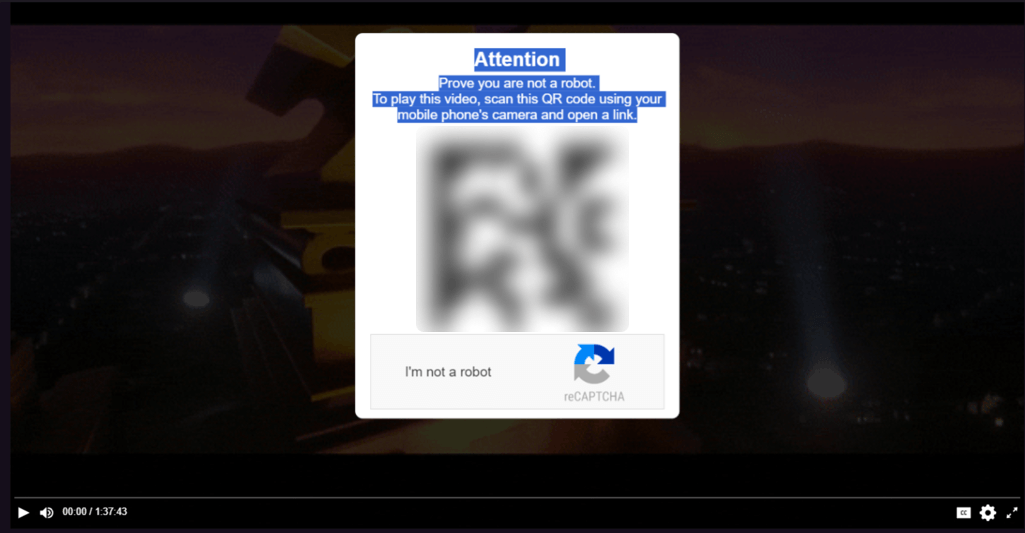
    Unlike genuine CAPTCHAs designed to protect websites from bots, this imitation serves to promote shady resources. As with the previous stage, the victim doesn’t always encounter malware. For example, the CAPTCHA on one of the pages prompts the visitor to scan a QR code leading to a betting site:

    CAPTCHA with QR code

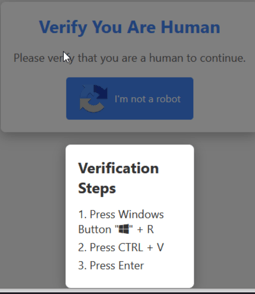
    The Trojans are distributed through CAPTCHAs with instructions. Clicking the “I’m not a robot” button copies the line powershell.exe -eC bQBzAGgAdABhAMAIgA= to the clipboard and displays so-called “verification steps”:

    • Press Win + R (this opens the Run dialog box);
    • Press CTRL + V (this pastes the line from the clipboard into the text field);
    • Press Enter (this executes the code).

    CAPTCHA with instructions

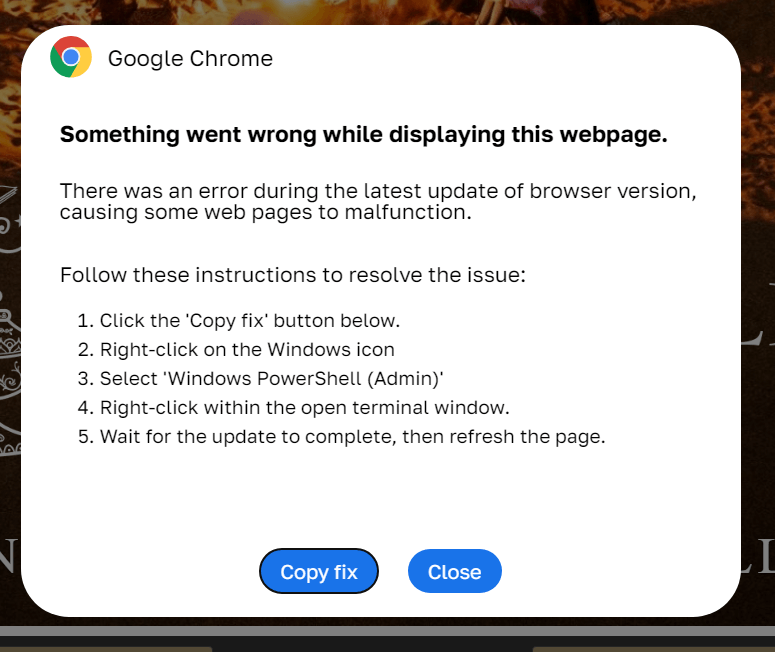
    We’ve also come across similar instructions in formats other than CAPTCHAs. For instance, the screenshot below shows an error message for a failed page load, styled like a Chrome message. The attackers attribute the problem to a “browser update error” and instruct the user to click the “Copy fix” button. Although the page design is different, the infection scenario is identical to the CAPTCHA scheme.

    Fake update error message

    The line from the clipboard contains a Base64-encoded PowerShell command that accesses the URL specified there and executes the page’s content. Inside this content is an obfuscated PowerShell script that ultimately downloads the malicious payload.

    Payload: Lumma stealer

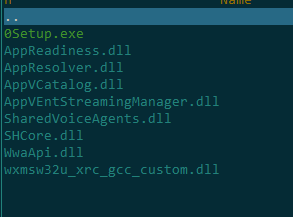
    Initially, the malicious PowerShell script downloaded and executed an archive with the Lumma stealer. In the screenshot below, the stealer file is named 0Setup.exe:

    Contents of the malicious archive

    After launching, 0Setup.exe runs the legitimate BitLockerToGo.exe utility, normally responsible for encrypting and viewing the contents of removable drives using BitLocker. This utility allows viewing, copying, and writing files, as well as modifying registry branches – functionality that the stealer exploits.

    Armed with BitLocker To Go, the attackers manipulate the registry, primarily to create the branches and keys that the Trojan needs to operate:


    That done, Lumma, again using the utility, searches the victim’s device for files associated with various cryptocurrency wallets and steals them:

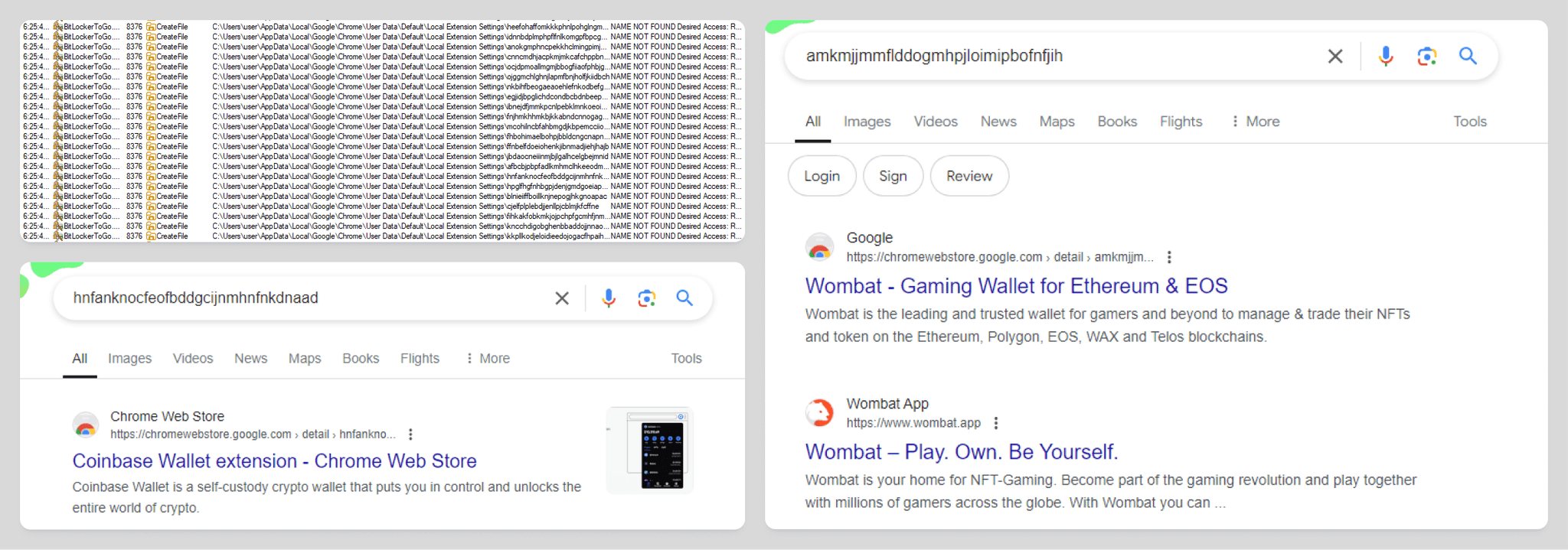
    Then, the attackers view browser extensions related to wallets and cryptocurrencies and steal data from them:

    Following this, the Trojan attempts to steal cookies and other credentials stored in various browsers:

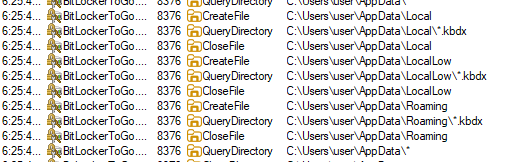
    Finally, the malware searches for password manager archives to steal their contents as well:

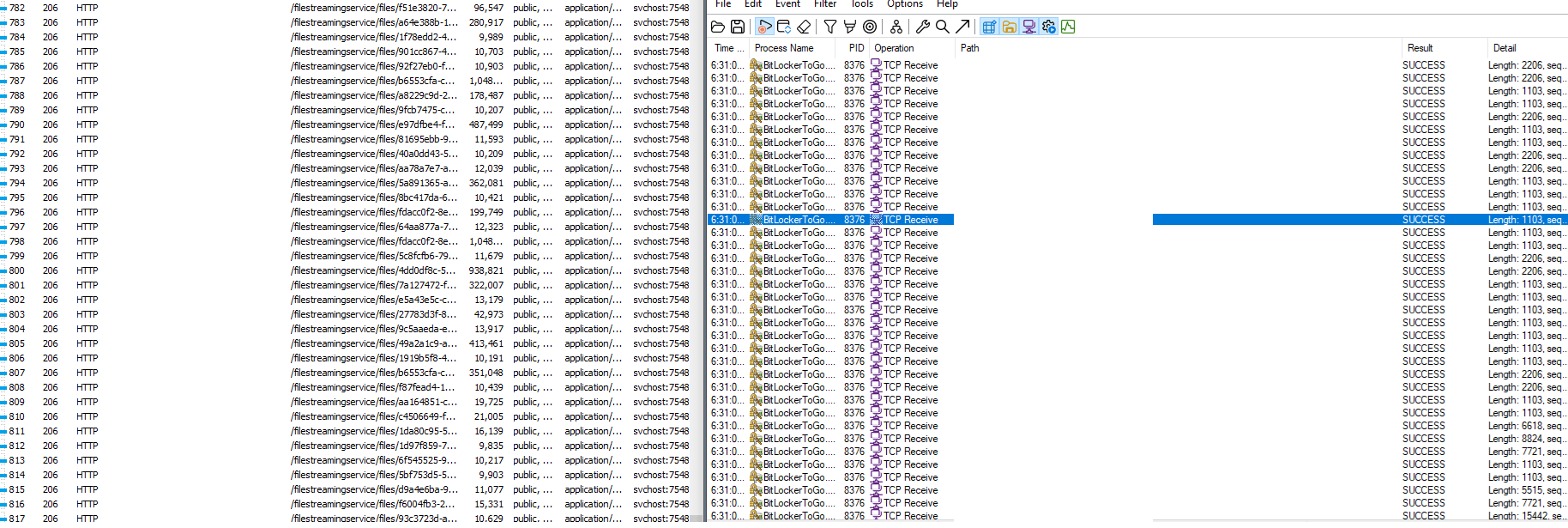
    Throughout the data collection process, the Trojan tries to use the same BitLocker To Go to send the stolen data to the attackers’ server:

    Once the malware has found and exfiltrated all valuable data, it starts visiting the pages of various online stores. The purpose here is likely to generate further revenue for its operators by boosting views of these websites, similar to adware:

    Payload: Amadey Trojan

    We recently discovered that the same campaign is now spreading the Amadey Trojan as well. Known since 2018, Amadey has been the subject of numerous security reports. In brief, the Trojan downloads several modules for stealing credentials from popular browsers and various Virtual Network Computing (VNC) systems. It also detects crypto wallet addresses in the clipboard and substitutes them with those controlled by the attackers. One of the modules can also take screenshots. In some scenarios, Amadey downloads the Remcos remote access tool to the victim’s device, giving the attackers full access to it.

    Snippet of Amadey code used in this campaign

    Statistics

    From September 22 to October 14, 2024, over 140,000 users encountered ad scripts. Kaspersky’s telemetry data shows that out of these 140,000, over 20,000 users were redirected to infected sites, where some of them saw a fake update notification or a fake CAPTCHA. Users in Brazil, Spain, Italy, and Russia were most frequently affected.

    Conclusion

    Cybercriminals often infiltrate ad networks that are open to all comers. They purchase advertising slots that redirect users to malicious resources, employing various tricks to achieve infections. The above campaign is of interest because (a) it leverages trust in CAPTCHA to get users to perform unsafe actions, and (b) one of the stealers makes use of the legitimate BitLocker To Go utility. The malware works to enrich its operators both by stealing victims’ credentials and crypto wallets, and by exploiting online stores that pay money for traffic to their websites.

    Indicators of compromise

    e3274bc41f121b918ebb66e2f0cbfe29
    525abe8da7ca32f163d93268c509a4c5
    ee2ff2c8f49ca29fe18e8d18b76d4108
    824581f9f267165b7561388925f69d3av

    MIL OSI Economics

  • MIL-OSI United Nations: Displacement in Sudan Crosses 11 Million as Devastating Crisis Reaches New Heights: IOM Chief 

    Source: International Organization for Migration (IOM)

    Port Sudan, 29 October – Good morning, I am glad to be able to speak with you this morning live from Port Sudan.  

    I arrived here yesterday on a four-day visit, into a deteriorating security situation with alarming reports of new atrocities. I have heard distressing detail from our teams on the ground of the conditions faced by ordinary Sudanese people whose lives have been thrown into turmoil by this conflict. 

    The situation here in Sudan is catastrophic. There is simply no other way to put it. Hunger, disease and sexual violence are rampant. For the people of Sudan, this is a living nightmare.  

    This is an underreported conflict situation, and we must pay it more attention. Millions are suffering, and there is now the serious possibility of the conflict igniting regional instability from the Sahel to the Horn of Africa to the Red Sea.  

    Yesterday, UN Secretary-General Antonio Guterres shone the spotlight on this suffering, calling it an ‘utter humanitarian catastrophe’. 

    Eighteen months have passed since fighting erupted between the Sudanese Armed Forces and the Rapid Support Forces. Outside forces are now ‘fueling the fire’ which is intensifying the conflict. 

    The suffering is growing by the day, with the Secretary-General reporting yesterday that almost 25 million people are now requiring assistance. 

    In recent days, we have heard utterly shocking reports of mass killings and sexual violence in villages in Al Jazirah State in the east of the country. 

    Throughout this year, Sudan has been world’s largest displacement crisis.  

    Today I can share that we will release new figures this week showing the displacement number has hit 11 million. That’s up 200,000 just since September.  

    Another 3.1 million people have traveled across borders to flee the fighting. In total, nearly 30 per cent of Sudan’s population has been displaced.  

    More than half of those displaced are women, and more than a quarter of them are children under the age of five. Think about that for a moment, that is a huge number of extremely vulnerable women and children on the move. 

    Many have been forced to flee repeatedly, with little to no access to shelter, much less to their livelihoods and the ability to get basic necessities.   

    The scale of this displacement – and the corresponding humanitarian needs – grows every day. Half the country’s population needs help. They don’t have access to shelter, to clean drinking water, to health care. Disease is spreading fast. 

    One in every two Sudanese is struggling to get even the minimal amount of food to survive. Famine conditions have taken hold in North Darfur, and millions struggle to feed themselves every day. 

    I saw some of that suffering yesterday, in a visit to the Arbaat dam area about 40 kilometers from Port Sudan.  

    After heavy rains in August, a spillway collapsed. The resulting flood killed at least 148 people and devastated homes, livestock, and infrastructure.  

    This devastation would be bad enough if it weren’t coming on top of a conflict that continues to rage and is becoming worse by the day – and one that has dramatically impacted the delivery of humanitarian assistance.  

    The safety of aid workers is often threatened. Access restrictions and bureaucratic impediments continue to be imposed.  

    People are dying because of this.  

    The parties to this conflict must do what they have pledged to do – and what international humanitarian law requires – protect civilians, and ensure safe, swift and unimpeded access to life-saving assistance.    

    What we also need, most desperately, is the help of the international community.  

    Sudan is easily the most neglected crisis in the world today. The collective failure to act means the devastation risks spilling over into neighboring countries.  

    At a conference in Paris this past April, the international community made generous pledges. But that appeal is only 52 per cent funded. And though IOM has been able to help nearly 3 million people since the war started, our part of the response plan is only 20% funded.  

    With the proper amount of funding, there is much we can do to alleviate the suffering, to help people get shelter and proper sanitation, to feed them and protect them.  

    But our progress will always be limited as long as war continues to be waged.  

    All wars are brutal, but the toll of this one is particularly horrifying, and the recent killings and appalling human rights violations in Aj Jazirah state were yet another example. Since last year, reports of rape, torture and ethnically motivated violence have been far too common. Indiscriminate attacks are killing civilians, including young children.    

    Some of the areas of most severe need remain cut off entirely, with no access to humanitarian aid. 

    The potential long-term impact of this catastrophic crisis is simply staggering. Education will be set back decades. The health and well-being of children will be stunted. Livelihoods will be permanently ruined. A generation will live in the shadow of trauma. 

    And the immense tragedy about it all is that a peaceful Sudan has the capacity to take care of itself. Its people are resilient, and their natural resources are immense.  

    So while I’m here today to raise awareness of the needs and to highlight the cost of this displacement crisis, what IOM really wants – what every person in the world should want – is for the guns in Sudan to fall silent.  

    The humanitarian response must be scaled up, and we call on the donor community to support this effort. 

    I echo the Secretary General in calling for: 

    An end to hostilities; 

    Protection for civilians; 

    and access for humanitarian agencies so that aid can flow.  

    We will not allow Sudan to be forgotten. But its people need peace, now.  

    ***

    For more information please contact: 

    In Port Sudan: Lisa George, lgeorge@iom.int       
    In Cairo: Joe Lowry, jlowry@iom.int 
    In Geneva: Kennedy Okoth, kokoth@iom.int 

    MIL OSI United Nations News

  • MIL-OSI Asia-Pac: Prime Minister Shri Narendra Modi addresses Rozgar Mela

    Source: Government of India (2)

    Prime Minister Shri Narendra Modi addresses Rozgar Mela

    It is a matter of great joy to have handed over appointment letters for government jobs to 51 thousand youth in the Rozgar Mela, Best wishes to all the youth who are taking a step towards nation building:PM

    It is our commitment that the youth of the country should get maximum employment: PM

    Today India is moving towards becoming the third largest economy in the world: PM

    We promoted Make in India in every new technology,We worked on self-reliant India: PM

    Under the Prime Minister’s Internship Scheme, provision has been made for paid internships in the top 500 companies of India: PM

    Posted On: 29 OCT 2024 11:53AM by PIB Delhi

    The Prime Minister Shri Narendra Modi addressed the Rozgar Mela and distributed more than 51,000 appointment letters to newly appointed youth in Government departments and organizations via videoconferencing today. Rozgar Mela highlights the Prime Minister’s commitment to prioritizing employment generation. It will empower the youth by providing them with meaningful opportunities to contribute to nation-building.

    Addressing the occasion, the Prime Minister noted the auspicious occasion of Dhanteras and conveyed his best wishes on the occasion. Underlining that this year’s Diwali would be a special one, the Prime Minister said that it is the first Diwali since Lord Shri Ram has been seated in his magnificent temple in Ayodhya after 500 years. He said that several generations have waited for this Diwali, while many have sacrificed their lives for it or faced adversities. The Prime Minister  emphasized that the present generation is extremely fortunate to witness and become a part of such celebrations. In the atmosphere of festivity, said the Prime Minister, 51,000 youth are being handed out recruitment letters for government jobs. He congratulated the new recruits and conveyed his best wishes to them.

    The Prime Minister highlighted that offering permanent Government jobs to lakhs of youths has been a legacy which is continuously going on. He added that lakhs of youths were handed appointment letters even in the states being governed by BJP and NDA allies. Shri Modi emphasized that in Haryana there is a festive atmosphere with 26,000 youths getting jobs by the newly formed government . Shri Modi said their Government in Haryana had a special identity of giving jobs without any expense or recommendation. He greeted the 26,000 youths of Haryana who will be handed over their appointment letters today apart from 51,000 jobs in today’s Rozgar Mela. 

    The Prime Minister reiterated the government’s commitment that the youth of the country should get maximum employment. Noting that the policies and decisions of the government have a direct impact on job creation, the Prime Minister highlighted the development of expressways, highways, roads, rail, ports, airports, laying of fiber cables, setting up of mobile towers and expansion of new industries in all parts of the country. Referring to laying of water and gas pipelines, establishing of new schools, colleges and universities and reducing logistics cost by spending on infrastructure, Shri Modi said that it is not only benefitting the citizens but also creating new job opportunities. 

    Recalling his visit to Vadodara in Gujarat yesterday, the Prime Minister mentioned inaugurating an aircraft manufacturing facility for the defence sector. He said that thousands of citizens would get direct employment while MSME industries would hugely benefit from the manufacturing of spare parts and other equipment, creating a huge network of supply chains. Noting that a single aircraft comprises 15,000 to 25,000 parts, Shri Modi emphasized that thousands of smaller factories would play an active role in fulfilling the demands of a mega factory, thereby benefiting India’s MSMEs. 

    The Prime Minister remarked that whenever a scheme is launched, the focus is not just only on the benefits accrued to the citizens, but also develop an entire ecosystem of employment generation using it as a medium by thinking in a broader scope. Citing an example of PM Suryaghar Muft Bijli Yojana, he said  in the last 6 months, around 2 crore customers had registered for the scheme, more than 9,000 vendors were associated with scheme, solar panels were already installed in more than 5 lakh houses and in the near future, there was a plan to create 800 Solar villages as model under this scheme. He also noted that 30,000 people had undergone training for roof-top solar installation as well. Therefore, he added, this one scheme of PM Suryaghar Muft Bijli Yojana has created a host of employment opportunities for manufacturers, vendors, assemblers and repairers across the country.

    Noting that the Khadi industry of India has been transformed by the policies of the government in the last 10 years and impacted the people in the villages, the Prime Minister informed that Khadi Gram Udyog’s business has surpassed 1.5 lakh crores today. Drawing parallels from 10 years ago, the Prime Minister exclaimed that the sale of Khadi has grown up to 400 percent, thereby benefiting artists, weavers and businesses and also creating new employment opportunities. Shri Modi also touched upon the Lakhpati Didi scheme where new employment and self-employment opportunities are provided to rural women. “More than 10 crore women have joined self-help groups in the last decade”, he added, noting that 10 crore women are now engaged in economic activities. He credited the support provided by the government in every step and reiterated the commitment to creating 3 crore lakhpati didis. “More than 1.25 crore women have already become Lakhpati Didis so far making their annual income above Rs 1 lakh”, he added.

    The Prime Minister stated that India is moving towards becoming the world’s third-largest economy. Reflecting on the country’s progress, he noted the inquisition by the youth of India who often ask why the country didn’t achieve this pace earlier. Underlining that the answer lies in the lack of clear policies and intent in previous governments, the Prime Minister pointed out that India had been lagging behind in several sectors, particularly technology. He recalled that India used to wait for new technologies from around the world and what was considered outdated in the West would eventually reach the nation. He pointed out the long withstanding belief that modern technology could not be developed in India not only set India back in terms of growth but also deprived the country of crucial job opportunities. 

    Highlighting the steps taken to free the country from this old thinking, the Prime Minister stated that efforts were initiated to break free from this old mindset in sectors like space, semiconductors, electronics and electric vehicles by promoting Make in India. The Prime Minister underscored the importance of technological advancement and investment, adding that the PLI scheme was launched to bring new technology and foreign direct investment to India, which has accelerated job creation when combined with the Make in India initiative. He noted that every sector is now receiving a boost providing opportunities for youth across different fields. “Today, India is witnessing massive investment, and record opportunities are being created”, he said, adding that in the last eight years, over 1.5 lakh startups have been launched, making India the world’s third-largest startup ecosystem. He further added that these sectors are offering our youth a chance to grow and gain employment.

    The Prime Minister reiterated that the government is very focused on skill development today to increase the capacity of the youth of India. Therefore, he added, Government started missions like Skill India and youth were being trained in many skill development centers. Shri Modi remarked that arrangements were made to ensure that India’s youth need not have to wander for experience and opportunity. Citing the Pradhan Mantri Internship Yojana, Shri Modi said provisions were made for paid internships in the top 500 companies of India, where every intern would be given Rs 5,000 per month for one year. He added the Government’s target  was to ensure one crore youth get internship opportunities in the next 5 years. This, he said, would give the youth a chance to connect with the real-life business environment in different sectors and add a beneficial experience to their career.

    The Prime Minister remarked that the Indian government was creating new opportunities to make it easier for Indian youth to get jobs abroad. Citing the recently released Germany’s  Skilled Labour Strategy for India, Shri Modi informed that Germany had increased the number of visas given to skilled Indian youth every year from 20 thousand to 90 thousand. He added that India’s youth will benefit greatly from this. Shri Modi also mentioned that India had signed agreements related to migration and employment with 21 countries in recent years, including countries like Japan, Australia, France, Germany, Mauritius, Israel, UK and Italy, apart from Gulf countries. He noted that every year 3 thousand Indians can get a 2-year visa to work and study in the UK while 3 thousand Indian students will get the opportunity to study in Australia. “India’s talent will not only give direction to India’s progress but also to the world’s progress”, exclaimed Shri Modi. He added that India was moving ahead in that direction.

    Shri Modi emphasized that the role of the government today was to create a modern system where every youth gets an opportunity and can fulfill their aspirations. Therefore, he urged the newly appointed youths in various positions that their goal should be to provide maximum facilities to the youth and citizens of India.

    The Prime Minister emphasized the crucial role of taxpayers and citizens in securing government jobs and stated that the government exists because of the citizens and is appointed to serve them. He reiterated that the primary duty is to serve the nation, be it in the position of a postman or a professor. Shri Modi underlined that the new recruits have joined the government at a time when the country has resolved to become developed. Therefore, said the Prime Minister, to achieve this goal, we must excel in every sector and contribute fully. He urged the new recruits to not only perform well but to strive for excellence. “Government employees in our country should set an example recognized worldwide”, he asserted. The Prime Minister stressed that the nation has high expectations from them and said that these expectations must be met to deliver on the commitments.

    The Prime Minister remarked on the new journey that appointees are embarking on with their positions, urging them to always remain humble and to maintain the habit of learning throughout their journey. He highlighted the availability of various courses for government employees on the iGOT Karmayogi platform and encouraged them to utilize this digital training module at their convenience. “Once again, I congratulate the candidates receiving their appointment letters today”, the Prime Minister concluded. 

    Background

    Rozgar Mela is being organized at 40 locations across the country with new recruits joining the Central Government across various Ministries and Departments such as the Department of Revenue, Department of Higher Education, Ministry of Home Affairs, Ministry of Defence, Ministry of Health and Family Welfare among others.

    Newly appointed recruits will have the opportunity to undertake foundational training through ‘Karmayogi Prarambh,’ an online module available on the iGOT Karmayogi portal. Over 1400 e-learning courses are available which will equip recruits with essential skills to serve in their roles effectively and work towards building a Viksit Bharat.


    ***

    MJPS/SR/TS

    (Release ID: 2069104) Visitor Counter : 77

    MIL OSI Asia Pacific News

  • MIL-OSI Video: Sudan, Middle East, Lebanon/Israel & other topics – Daily Press Briefing (28 Oct) | United Nations

    Source: United Nations (Video News)

    Noon Briefing by Stéphane Dujarric, Spokesperson for the Secretary-General.

    Highlights:
    -Secretary-General travel /Colombia
    -Sudan
    -Sudan/humanitarian
    -Middle East
    -Deputy Secretary-General
    -Lebanon/Israel
    -Lebanon/humanitarian
    -Occupied Palestinian territory
    -Gaza
    -Ukraine
    -Philippines
    -Abyei
    -Sahel and Lake Chad region
    -Briefings today and tomorrow

    Secretary-General travel /Colombia
    The Secretary-General will travel to Cali, in Colombia, to attend the high-level segment of the16th meeting of the Conference of Parties to the Convention on Biological Diversity (COP16). And he is heading out this afternoon.
    On Tuesday, in Cali, he will deliver remarks at the opening of the plenary session of the COP. In his remarks, he is expected to highlight that nature is life, and yet we are waging a war against it – a war where there can be no winner. He is expected to stress that biodiversity is humanity’s ally, and that we must move from plundering to preserving. He will also call for the promises made at the Framework adopted two years ago in Montreal to be turned into actions.
    While attending COP16, the Secretary-General will also meet and engage in discussions with Indigenous people and local communities, as well as other representatives of society, including youth groups and women’s groups. He will also meet with President Gustavo Petro of Colombia.
    On the sidelines of the COP, the Secretary-General will speak at an event on plastic pollution organized by the UN Environment Programme.
    And we expect the Secretary-General back in New York on Wednesday evening.

    Sudan
    In an open session this morning, the Secretary-General briefed the Security Council on the situation in Sudan. As you know, Security Council resolution 2736 that was adopted in June requested that the Secretary-General make recommendations to protect civilians in Sudan. He submitted that to the Security Council last week.
    In his remarks, Mr. Guterres outlined three key priorities from his recommendations: First, both sides must immediately agree to a cessation of hostilities; secondly, that civilians must be protected, and his third priority is related to the flow of humanitarian aid.
    Mr. Guterres added that at present, the conditions do not exist for the successful deployment of a UN force to protect civilians in Sudan.
    However, he said, he stands ready to engage with the Council and others on the range of operational modalities that can meaningfully contribute to the reduction in violence and the protection of civilians.
    Moreover, he urged the Council to continue supporting his Special Envoy, Ramtane Lamamra in his diplomatic efforts.
    Mr. Guterres spoke at length about the humanitarian situation and the suffering in Sudan, which is growing by the day. He also spoke of the shocking reports of mass killings and sexual violence in villages in Aj Jazirah State in the eastern part of the country.

    Sudan/Humanitarian
    The Office for the Coordination of Humanitarian Assistance is expressing concerns at escalating armed violence in Aj Jazirah State.
    Joyce Msuya, our Acting Under-Secretary-General for Humanitarian Affairs says that we received horrific reports of entire villages being attacked, with civilians killed, detained and displaced in huge numbers, and those reports talk about actions between October 20th and 25th. During that time, the Rapid Support Forces reportedly launched a major assault across 30 towns and villages and towns in Aj Jazirah State.
    An estimated 47,000 people have fled the fighting, including to other parts of Aj Jazirah State. We and our partners are continuing to provide assistance to nearly 40,000 people who have sought shelter in Gedaref and Kassala states.
    Those displaced by the violence urgently need food, shelter, health care and protection support. Many of the wounded also need medical attention.
    We and our partners are concerned about civilians who remain trapped in those areas and are unable to escape due to insecurity and fear of abduction, as well as those on the move in search of safety, protection and urgent assistance.
    Also, to flag that the Director General of the International Migration agency, Amy Pope, began today a three-day visit to assess the rapidly deteriorating humanitarian situation and the increasing displacement crisis. The visit in Sudan will focus on rallying international support for the humanitarian response, ensuring that the ongoing crisis in Sudan remains at the forefront of global attention. The Director General will visit various displacement sites to engage directly with impacted communities.

    Full Highlights: https://www.un.org/sg/en/content/noon-briefing-highlight?date%5Bvalue%5D%5Bdate%5D=28%20October%202024

    https://www.youtube.com/watch?v=gLkC0_Y0uHE

    MIL OSI Video

  • MIL-OSI Video: Sudan & South Sudan – UN Chief’s Briefing | United Nations

    Source: United Nations (Video News)

    Briefing by António Guterres, Secretary-General of the United Nations, on Sudan and South Sudan – Security Council, 9761st meeting

    ——————————
    “Madam President, Excellencies,
    I thank the Council for the opportunity to discuss the utter humanitarian catastrophe engulfing Sudan.

    Eighteen months have passed since brutal fighting erupted between the Sudanese Armed Forces and the Rapid Support Forces.

    The suffering is growing by the day, with almost 25 million people now requiring assistance.

    The people of Sudan are living through a nightmare of violence — with thousands of civilians killed, and countless others facing unspeakable atrocities, including widespread rape and sexual assaults.

    In recent days, we have heard shocking reports of mass killings and sexual violence in villages in Aj Jazirah State in the east of the country.

    They are also enduring a nightmare of hunger — as more than 750,000 people face catastrophic food insecurity and famine conditions take hold in displacement sites in North Darfur, while millions struggle to feed themselves every day.

    They are confronting a nightmare of disease — with cholera, malaria, dengue fever, measles and rubella spreading fast.

    A nightmare of collapsed infrastructure — with vital health systems, transportation networks, water and sanitation systems, supply routes and agricultural production grinding to a halt.

    A nightmare of displacement — the largest displacement crisis in the world, with more than 11 million people fleeing since April last year, including nearly 3 million who have crossed into neighbouring countries.
    A nightmare of extreme weather — with nearly 600,000 people affected by heavy rains and floods this summer.

    And Sudan is, once again, rapidly becoming a nightmare of mass ethnic violence, in particular with the dramatic escalation of fighting in El Fasher.

    Madam President,

    We have consistently appealed to both sides to end the fighting and come to the negotiating table.

    But instead of lowering tensions, they are escalating military action.

    Meanwhile, outside powers are fuelling the fire.

    We face the serious possibility of the conflict igniting regional instability from the Sahel to the Horn of Africa to the Red Sea.

    Resolution 2736 adopted earlier this year sent a strong signal.

    But we need action on the ground.

    The resolution requested me to make recommendations to protect civilians in Sudan, which I submitted to this Council last week.

    Allow me to outline three key priorities.

    First — both sides must immediately agree to a cessation of hostilities.

    Such an agreement should be translated into local ceasefires and humanitarian pauses — creating new avenues of dialogue, and laying the ground for a comprehensive ceasefire.

    At the same time, diplomatic efforts must be intensified to finally bring an end to the conflict — including support to implement the commitments in the Jeddah Declaration.

    My Personal Envoy, Ramtane Lamamra, is working around the clock with that objective.

    He convened the parties in Geneva to enhance humanitarian access and strengthen the protection of civilians in Sudan.

    And he supported the coordination of mediation initiatives, in collaboration with regional partners — in particular, the African Union’s High-Level Panel.

    I urge this Council to continue supporting his efforts, and encourage effective engagement with regional partners like the African Union, the Intergovernmental Authority on Development, the League of Arab States, and other key ones.

    And I salute the efforts of the African Union and IGAD towards an inclusive Sudanese political dialogue, which would provide an important platform for civilians — including women — to speak out about the importance of ending the war and lend their voices towards a peaceful and democratic future.

    Which brings me to my second point — civilians must be protected.

    We need this Council’s support to help protect civilians in line with human rights and international humanitarian law — including the parties’ own commitments in the Jeddah Declaration.

    The parties to the conflict bear the primary responsibility to ensure the protection of civilians and come to the negotiation table.

    I am horrified by the Rapid Support Forces’ continued attacks against civilians in El Fasher and surrounding areas, which include displacement sites where famine conditions have been confirmed.

    And I am also horrified by reports of attacks against civilians perpetrated by forces affiliated with the Sudanese Armed Forces in Khartoum, and by continuing mass civilian casualties due to apparently indiscriminate airstrikes in populated areas.

    The perpetrators of serious violations of international humanitarian law must be held accountable” [Excerpt].

    Full remarks [as delivered]: https://www.un.org/sg/en/content/sg/statement/2024-10-28/secretary-generals-remarks-the-security-council-sudan-bilingual-delivered-scroll-down-for-all-english-and-all-french

    https://www.youtube.com/watch?v=dENMe2efAQg

    MIL OSI Video

  • MIL-OSI Europe: EIB approves a €300 million loan to Red Eléctrica for the construction of Salto de Chira hydroelectric power plant in the Canary Islands

    Source: European Investment Bank

    • Salto de Chira is a cutting-edge strategic project for the island of Gran Canaria, which combines a pumped-storage hydroelectric power plant of 200 MW installed power capacity and a desalination plant.
    • It will strengthen Gran Canaria’s electricity system, providing a fundamental back-up to guarantee energy security and electricity supply, critical issues for citizens and businesses.
    • The project contributes to the integration of renewable energies on the island and reflects the important role the EIB is playing in consolidating Spain as the country of renewables.

    The European Investment Bank (EIB) has approved a €300 million loan to finance the construction of the Salto de Chira pumped-storage hydroelectric power plant being built by Red Eléctrica, a subsidiary of Redeia, in Gran Canaria.

    The Salto de Chira power plant will use a system of two water reservoirs at different heights to store or deliver energy from renewable energies according to the needs of the electricity system. It will have a installed power capacity of 200 MW and energy storage capacity of 3,5GWh, making possible to take advantage of surplus renewable production, which would otherwise be lost, at times when the system needs it. In this way, it will contribute to the quality and security of the electricity supply and to greater integration of renewable energies into the electricity system on the island of Gran Canaria. The project also includes the construction of a seawater desalination plant to contribute to water storage, which is also expected to have a positive impact on farming communities’ access to irrigation water.

    “We are delighted to join forces with Red Eléctrica to support the construction of the Salto de Chira hydroelectric power plant. This project is key to ensuring energy autonomy and driving the green transition in Gran Canaria,” said Jean-Christophe Laloux, Director General of Operations in the European Union at the EIB. “The project will improve electricity supply quality and security on the island using existing resources and reflects the EIB’s commitment to territorial cohesion and climate action, two of our strategic priorities.”

    The investment takes part entirely in the Canary Islands, a cohesion and outermost region. It is expected to have a positive impact on the local economy by driving growth and job creation, and firmly backs the EIB Group’s commitment to economic, social and territorial cohesion.

    Commenting on the agreement, the CEO of Redeia, Roberto García Merino, highlighted the importance of this project and of storage in advancing the penetration of renewable energies,  “storage will be one of the key elements in the energy transition, providing flexibility and manageability to the electricity system to integrate large amounts of renewable energies, thus contributing to electrification and access to renewable energy, which is especially important for an electricity system like the Canary Islands, which is isolated and therefore more vulnerable’.

    Once finalized, the pumped-storage hydroelectric power plant will be a fundamental tool for the operation of the system, providing it with the flexibility essential for the substitution of fossil energy sources and the safe and reliable integration of renewable resources, mitigating the interconnection difficulties of the Canary Islands’ electricity systems.

    This project contributes to the decarbonisation objectives of the European Green Deal. It is also part of the EIB’s action plan to support REPowerEU in ensuring energy security and reducing EU dependence on fossil fuel imports.

    Operation of the Salto de Chira pumped-storage plant

    The plant will use two of Gran Canaria’s existing reservoirs, Chira and Soria, to create an electricity-generating waterfall. It will that harnesses the renewable energy stored in the form of water in the upper reservoir to produce energy through an underground hydroelectric plant, reducing its impact on the environment.

    At times of peak renewable energy generation, the excess power will be used to pump water from the lower reservoir (Soria) to the upper one (Chira), storing this energy in the form of water. The water will then be used to generate electricity at times of high demand and low electricity generation from renewable sources.

    The project includes the construction of a seawater desalination plant that will be used to fill the reservoirs and will directly benefit the development of farming communities in the area thanks to the water not needed for the operation of the plant.

    The EIB and energy security

    In 2023, the EIB Group signed more than €21 billion in financing for energy security in Europe. In the same year, it allocated €4.5 billion to this goal in Spain, financing projects in areas including renewable energy, energy efficiency, power grids and storage systems. These investments are helping Europe speed up its transition to sustainable energy and reduce its reliance on fossil fuel imports.

    In July 2023, the EIB Board of Directors raised the amount earmarked for REPowerEU projects to €45 billion. REPowerEU is the plan designed to end Europe’s dependence on fossil fuel imports. To boost financing for the EU manufacturing industry, the EIB will also expand the range of eligible sectors to include leading strategic technologies with net-zero carbon emissions, as well as extraction, processing and recycling of critical raw materials. The additional financing will be disbursed between now and 2027. In total, it is expected to mobilise more than €150 billion in investment in the target sectors.

    Find out more about the EIB’s support for the energy sector here.

    Background information

    EIB

    The European Investment Bank (ElB) is the long-term lending institution of the European Union, owned by its Member States. It finances sound investments that further EU policy objectives. EIB projects bolster competitiveness, drive innovation, promote sustainable development, enhance social and territorial cohesion, and support a just and swift transition to climate neutrality.

    The EIB Group, consisting of the EIB and the European Investment Fund (EIF), reported total financing signatures in Spain of €11.4 billion in 2023, approximately €6.8 billion of which went to climate action and environmental sustainability projects. Overall, the EIB Group signed €88 billion in new financing in 2023.

    Red Eléctrica

    Red Eléctrica is the sole transmission agent and operator of the electricity system in Spain. Created in 1985, it is the first TSO in the world, being the first company dedicated exclusively to the operation of the electricity system and the transmission of electricity; a model currently implemented in 22 of the 27 countries of the EU.

    A subsidiary of Redeia, manager of essential electricity and telecommunications infrastructures, Red Eléctrica’s mission has always been to guarantee a safe and quality electricity supply and to develop a reliable electricity transmission grid to provide a service that is essential for households, companies and public services. It is now also a fundamental pillar of Spain’s ecological transition process, developing the grids necessary for this transformation and operating the system for an efficient and safe integration of renewable energies.

    MIL OSI Europe News

  • MIL-OSI USA: Administrator Samantha Power at a Swearing-in Ceremony for Emily Coffman-Krunic as Mission Director for Bosnia and Herzegovina

    Source: USAID

    ADMINISTRATOR SAMANTHA POWER: Dobro jutro [good morning], here. Dobar dan [good evening], there. 

    It’s really great to be part of this event. Jim [Hope], really lovely to hear from your perspective. Jim has most recently been our Mission Director in Ukraine, and this is the first ceremony that I’ve had the chance to hear him emcee. But, it’s great to hear from a fellow Mission Director what these ceremonies mean. Certainly, they mean the world to us. 

    Ambassador [Michael] Murphy, as much as you think you know about Emily, you are about to learn much more. You will have a lot more ammo to use in various interagency deliberations. But, I want to thank you for joining and doing so in the spirit you did, I’ve actually – we haven’t had the chance to meet in person – but I devour your cables and your tweets. But above all, I have the greatest respect for just how you have not taken the easy path there and really stood. I think, very strongly in the face of an awful lot of resistance and many many headwinds – for not only American values but ultimately for the dignity of the people of the country and of the region. Really, really grateful to you for that. I’ve admired you from afar for a long time. 

    I do want to recognize – and Emily and I just talked about the tragedy of the historic floods that have really besieged really small communities in Bosnia and Herzegovina, very specifically Jablanica and Konjic. I know that Ambassador Murphy and Emily are already working with affected communities to support recovery efforts and even visited and met with the affected people. That means the world, I’m sure, to them, that someone has their back. But, our thoughts, of course, go out to those communities. There’s a lot coming at the people of Bosnia and Herzegovina, and when the floods pile on, it must be very overwhelming. So again, just a reflection of how much the American people care about the people of the country, and you all are incredible ambassadors for that. 

    Emily has a full house here today, in person and online, and maybe breaking some records if we add up all the miles traveled for each of the family members. But, we have her father Daniel and her mother Blanche, beaming in on the screen. And, here in the audience, we have her sisters Elizabeth, Ginny, and Julie. Ginny flew in all the way from England, and, incredibly, Julie has made the time to be here today after spending the past few weeks helping hurricane recovery efforts in western North Carolina. 

    And again, the parallel between what happens in Bosnia and the extremity of that and what happens here is just a reminder of the universality, sadly, of these challenges these days. 

    Thank you to the sisters, you seem like an incredibly close-knit group. I was like, “Are you thinking of visiting?” And they were like, “Ah, we’ve been there many times, you know!” So, I know Emily is incredibly lucky to have you in her corner. 

    We’re also joined by Emily’s children, of course – by Adrian, who studies engineering at the University of North Florida, and Emily’s daughter Stella, who began her own studies recently in anthropology in Amsterdam. I know that through your lives you’ve had to make big changes often to accommodate mom’s spirit of public service – leaving schools, and friends, and communities. So, thank you for your own sacrifices. You are the reason your mom does everything she does. So, thank you. 

    Alright, this is your life portion. 

    Emily was born in Jacksonville, Florida, to two parents we just got to see, who instilled in her the value of helping others. Her mom was a nurse before becoming a great caretaker for her four daughters, and then her mom worked at a local school. Emily’s dad was a pilot in the Navy and then a lawyer. 

    As a child, Emily was a go-getter who loved adventure, apparently. Although she was not the oldest, I’m told that she was the one who always directed the games among the girls. Emily went on to earn her degree in philosophy from Texas Christian University, before working at Merrill Lynch, where she saved up enough money to keep fueling her adventures. 

    She went to Guatemala for three months to learn Spanish and to Chile for six months to teach English to children of the indigenous Mapuche people, where she caught the spark, I guess, for international development work. Emily went on to earn her master’s in international peace and conflict resolution at American University, while also volunteering at the International Rescue Committee. 

    One day, Emily heard that the Organization for Security and Cooperation in Europe, OSCE, was looking for people to support Bosnia and Herzegovina’s very first municipal elections since the war. The country, as all of you know, had emerged from a horrific conflict with the signing of the U.S.-brokered Dayton Accords just the year before, and tensions were high as elections neared – with the question of whether the Dayton agreement could result in lasting peace and whether democracy really could be meaningfully ushered in. 

    Emily still had two months left in her degree program, but everyone she talked to, including the professors whose classes she would be skipping out on, said, “You have to do this. This is too important not to do.” 

    But, she was conflicted, because she was clearly a better student than I was. And so, she called her dad, and he was the last person she just had to make sure that she wasn’t doing something crazy. Her dad, Dan, of course, was worried about her going to war-torn Bosnia – again, the bullets had barely ceased firing, and this election was really soon after the war had ended.

    But, Emily asked him, and he expressed some reluctance, you know, given that the headlines had recently been very grim. But, Emily asked him, “Dad, what exactly were you doing when you were 27?”

    And his answer was, “I guess I was flying jets off aircraft carriers in the ocean…”

    So, Emily went on, booked her ticket with everybody’s full support. As you heard, she went on to work in Bosnia and Herzegovina for eight years, eventually joining the World Conference of Religions for Peace, one of USAID’s partners in Bosnia and Herzegovina as the Chief of Party.

    Emily knew that for development efforts to be effective there, after such vicious inter-ethnic conflict, there needed to be enhanced communication and cooperation. The demonization across lines had been very, very intense.

    Muslims, Croats, Bosnian Serbs, Orthodox Christians, Catholics, Jews – everyone kind of had to come together in dialogue. So, as you heard again from Ambassador Murphy, she and her team founded this inter-religious council of Bosnia and Herzegovina, and it really has, over the years, worked to mobilize faith leaders, faith communities, in service of reconciliation and rebuilding. 

    The work has never been easy. The demons, not only from the wars of the 1990s, but dating even further back, loom large. The misinformation which really impedes, you know, the ability to sustain, sometimes, that trust that those encounters can breed – all of that makes it immensely challenging.

    But, Emily continued to help the council members establish common ground and find productive ways to work together. Over these last decades, this Council has played an important role on everything from organizing youth reconciliation, to addressing gender-based violence, to facilitating the protection of holy sites for all groups.

    I think this shows a characteristic that has defined Emily’s work over the years. Even in incredibly difficult environments where the odds seem low of succeeding, she has managed to help people see that there is a path forward, if they can come together.

    In Rwanda, Emily arrived at a time when the democracy team’s funding had been nearly zeroed out for two years in a row. The Mission was actually considering stopping all democracy and governance programming. But, Emily understood that supporting democracy, again as Ambassador Murphy reinforced, was, in fact, fundamental to advancing development. 

    To make enduring progress on any front, developmentally, citizens have to be empowered to demand and work toward the change that they want in their own communities. They also have to be able to, through raising their voice at the ballot, be able to get rid of leaders who are corrupt or governing poorly and in a way that isn’t bettering the lives of citizens. 

    In the words of Joseph Rurangwa, an FSN in Rwanda, Emily “fought for DG’s identity” – fought for democracy and governance’s identity. Apparently, she worked day and night to convince partners, donors, and colleagues that democracy and governance was worth the investment. 

    Emily went to battle, and Emily won. The Mission in Rwanda didn’t just revitalize the small democracy team that Emily had come to lead. It created an entirely new standalone democracy and governance office. The office went from having two activities in other portfolios to an entire portfolio of 13 democracy and governance activities: from training journalists, to hosting election roundtables for citizens and human rights training for Rwandan youth, to even creating the Mission’s first-ever activity supporting the LGBTQI+ community in Rwanda. Joseph says, “Emily steered the boat in troubled waters, and with her at the helm, 800,000 flowers bloomed all at once.” 

    In Jordan, where Emily started as the Democracy, Rights, and Governance Office Director and ultimately became the Deputy Mission Director, she helped manage a portfolio completely unknown to her: water. Water is a huge, huge issue, as everyone knows. For Jordan, specifically, the country is the third most water scarce country in the entire world. And, while a country is considered to face water scarcity when it has less than 500 cubic meters of water per person per year, Jordan has just one-fifth of that. Just to give you a sense of the magnitude of this challenge. And water, as we know, again, all of us, from our own lives, is necessary for just about everything. 

    Jordan’s water portfolio is the largest budget for any single portfolio for USAID, and it is also a country – one of the few countries in the world – where USAID finances large infrastructure projects. So, it was a huge task, and though Emily had no formal background in water, she quickly became fluent in everything from project finance to major infrastructure construction. One colleague at the time says, “Emily came to the job with so much humility and curiosity. It really inspired all of us to feel like we were all in this together.”

    Emily led the team as they took on two tasks. First, while Jordan had an existing water sharing agreement with its neighbor Israel, Emily knew that in spite of the complex relationship between the countries, they could and should share more water. 

    So, she and the team helped negotiate an agreement in which the two countries agreed to double the volume of water that they shared. This was a historic agreement that spared further water rationing in Jordan. But, Emily also knew that to meet the scale of need, Jordan needed to develop its own desalination ability, turning saltwater into drinkable water. So, she oversaw the design and procurement of the third-largest desalination project in the world, leading it through political negotiations, financial hurdles, and technical discussions, as donors, partners, diplomats, and elected officials came together to achieve a workable plan. Emily’s efforts paid off. 

    USAID was able to catalyze nearly $3 billion against our $300 million pledge from donors like the Development Finance Corporation, the European Union, and the Islamic Development Bank. When construction is complete, slated to be in about five years, the project will pump newly desalinated water from the south of Jordan, 280 miles uphill, to the population centers of Jordan, who need the water for daily life – through pipes that are so big that you can actually drive a car through them. This single desalination project will meet a full 40 percent of Jordan’s water needs, transforming its water security.

    Emily has spent the past year, of course, applying the skills that she honed leading these kinds of ambitious projects in difficult environments in the Mission in Bosnia and Herzegovina, where she returned to serve as Deputy Mission Director. We are told that the first two weeks that Emily was back on the ground in Bosnia and Herzegovina, she met every single person at the Mission, from the Ambassador to the Foreign Service Officers to the Foreign Service Nationals to the cleaning staff, to get to know all of those who are part of her new team.

    When it was announced that she was going to be the new Mission Director, her predecessor, Courtney Chubb – an extraordinary Mission Director in her own right – but as Courtney described it, when word went out that she was going to be promoted, the Ambassador was completely overjoyed. And, as Courtney put it, “I’ve never seen so many smiles on the faces of our Mission staff.”

    And just to say a word about that Mission staff and having a chance to engage you all directly, you’re extraordinary. Our Foreign Service Nationals – as Courtney and I discussed when I was on the ground there on a visit, and Emily and I just discussed – you all are really some of the leading lights in the world. The amount you know, the amount you have achieved, the amount you have circumnavigated, all that stands in your way to make the peace enduring and to try to strengthen checks and balances and institutions. Many of our FSNs in Bosnia and Herzegovina have been there more than 20 years, some more than 30 years. It’s just an incredible team. And to have as a Mission Director, as you do, someone who so values you and recognizes how much she has to learn from you every day, that’s the best kind of teamwork that can be expected.

    So, there is no better person, I think, in something of a returning home, second home really, to Emily but for Emily Coffman-Krunic to be taking the helm as the Mission Director in Bosnia and Herzegovina.

    Bosnia and Herzegovina is a special place. It is a country whose people continue to experience incredible hardship. I talked earlier about the flooding, but there’s a lot of man-made disasters happening in Bosnia and Herzegovina, because so many elected leaders do not put their people first. Some do, and they are extraordinary, what they put up with as well.

    But, when institutions don’t work always on behalf of the people, it makes what the people do to make development happen even more impressive. And, the efforts that the people of Bosnia and Herzegovina have made, initially, to rebuild, to revitalize, to grow, really speak just to the resilience of all communities, and it’s an inspiration for those of us who only get to visit every now and then. 

    Since 1996, the U.S. government has provided more than $2 billion, including $1.5 billion from USAID alone, in assistance in efforts to support, again, those on the ground who are building a democratic and inclusive European country. One of the most complicated government structures in the world, makes things very, very challenging. It is hard, often, for leaders to agree on the kinds of basic policies or basic initiatives that the people really expect from them. When they agree, it can be very challenging to operationalize those efforts. But nonetheless, again, there is so much good that is happening on the ground. 

    The virulent nationalism that lives on, usually most vocally in those who don’t know how to or don’t care to deliver basic services for the citizens of the country, continues to threaten the progress that has been made. We see the direct targeting of NGOs and development partners. We see attacks on independent media. We see, basically, threats to this effort to build a strong, independent, and vibrant European country, which is so clearly what young people in the country want. 

    USAID has an incredibly important role to play in support of the whole country team’s effort to push back against these challenges. We are working to counter harmful nationalistic rhetoric and narrative, with the goal of strengthening the security and the dignity for individuals and for communities within the country. We are expanding our work with independent media, with civil society, with investigative journalists. We are working to contribute to economic development, to help the private sector drive growth, and to include all groups like LGBTQI+ communities, women and Roma populations, in the progress that the people of Bosnia and Herzegovina are trying to drive. 

    Now, Emily, I want to end these remarks on something your son Adrian told us. We asked Adrian what it was like to grow up and to travel the world with you. And Adrian said, “I always knew that what my mom did was helping people. It made me want to be a better person.” 

    So, Emily, I think it’s safe to say you’ve made so many of us here want to be better people, even I, just listening to your journey, but also seeing what you’ve been doing on the grounds in Bosnia and Herzegovina, and in Jordan, just during my time here. And, what I love about your spirit is you never give up. You don’t care about the odds. You just invest body and soul, bring questions and not answers in the first instance, empower your teams, and you have one of the best teams in the world there, as you well know, and you do it all with an eye to future generations and what would mean the most. 

    So, we are thrilled that you’re our Mission Director in Bosnia and Herzegovina, and I look forward to making it official and swearing you in. Congratulations.

    MIL OSI USA News

  • MIL-OSI China: Xi, Zambian president Hichilema exchange congratulations on 60th anniversary of ties

    Source: People’s Republic of China – State Council News

    Xi, Zambian president Hichilema exchange congratulations on 60th anniversary of ties

    BEIJING, Oct. 29 — Chinese President Xi Jinping and Zambian President Hakainde Hichilema on Tuesday exchanged congratulatory messages on the 60th anniversary of diplomatic ties between the two countries.

    In his message, Xi noted that over the past 60 years since the establishment of diplomatic relations, China-Zambia ties have withstood the test of changes in the international landscape, and the two sides have consistently upheld genuine friendship and joined hands for shared progress.

    In recent years, China and Zambia have seen frequent high-level exchanges, continuously deepened political mutual trust, achieved fruitful outcomes in practical cooperation, and have been supporting each other on issues involving each other’s core interests and major concerns, bringing benefits to the two countries and peoples, he said.

    Xi also recalled that President Hichilema attended in September the Beijing Summit of the Forum on China-Africa Cooperation (FOCAC), during which the two presidents jointly made strategic guidance for the future development of bilateral relations.

    Noting that he prizes the development of China-Zambia relations, Xi expressed his willingness to work with President Hichilema to take the anniversary as an opportunity to carry forward traditional friendship, cement mutual support, strengthen all-round cooperation, jointly advance the modernization drives of the two countries along the new journey in the new era, solidify the China-Zambia comprehensive strategic cooperative partnership and build an even closer China-Zambia community with a shared future.

    In his message, Hichilema said that the 60th anniversary of diplomatic ties is an important milestone in Zambia-China relations.

    The bilateral partnership, based on mutual respect, win-win cooperation and common prosperity, has made significant contributions to the respective development of the two countries, he said.

    Noting that cooperation projects such as the Tanzania-Zambia Railway and the Kafue Gorge Lower Hydropower Station have achieved remarkable results, Hichilema said his country will continue to support major initiatives such as the Belt and Road cooperation and work with China to build a community with a shared future for mankind.

    Hichilema added that he is ready to work with Xi to create a better future and push for greater development of Zambia-China all-weather friendship and their comprehensive strategic cooperative partnership.

    MIL OSI China News

  • MIL-OSI USA: Administrator Samantha Power at the Donors’ Conference to Support the Displaced and Refugees in the Sahel and Lake Chad Basin

    Source: USAID

    ADMINISTRATOR SAMANTHA POWER: Hello. Thank you all for being here – and a particular thanks to the Organization of Islamic Cooperation and the King Salman Humanitarian Aid and Relief Center for bringing us together. 

    You’ve heard already about the overlapping crises in the Sahel and the Lake Chad Basin region – violence raging, floods surging, children starving. 

    So today, I’m announcing that the United States will contribute more than $572 million dollars to humanitarian efforts in Burkina Faso, Cameroon, Chad, Mali, Niger, and Nigeria. This new funding brings total U.S. humanitarian assistance to more than $1.2 billion in the region this fiscal year. These resources will help our partners provide badly needed basics like food, water, shelter, and health care. 

    This aid, and all of the aid fellow donors are generously committing today, has the potential to save lives. But, it will not fulfill that potential if the assistance can’t safely reach the people who need it most. 

    You know all too well the barriers facing humanitarians in the region. Burdensome and costly requirements for transporting aid; bans on cash assistance; deliberate blockades by armed extremists and the armies combating them; atrocities against civilians.

    So, all of us gathered today should contribute not only the resources needed for humanitarian response, but we must also use our collective influence to demand an environment that allows safe and unhindered delivery of that assistance across the region. 

    Thank you again to all of the donors who are stepping up. As we speak, lives are hanging in the balance, and we have to work together to do everything we can to protect them. 

    Thank you so much.

    MIL OSI USA News

  • MIL-OSI USA: Acting Deputy Administrator Michele Sumilas During the World Bank Annual Meetings

    Source: USAID

    The below is attributable to Deputy Spokesperson Shejal Pulivarti:‎

    From October 23 through 25, Acting Deputy Administrator Michele Sumilas participated in various engagements during the World Bank Annual Meetings. Throughout the week, she engaged USAID’s partners on shared priorities, including boosting food security and climate action, as well as collaborating on humanitarian assistance.

    On Wednesday, Acting Deputy Administrator Sumilas represented USAID at a signing ceremony, where Secretary of the Treasury Janet L. Yellen and Ukrainian Minister of Finance Sergii Marchenko marked the intention of the United States to join G7 efforts to make lending available to Ukraine, and provide a $20 billion U.S. loan to Ukraine that will be repaid by proceeds derived from Russia’s frozen assets. 

    Acting Deputy Administrator Sumilas then participated in a roundtable hosted by the Coalition on Disaster Resilient Infrastructure (CDRI), which featured Ministers from Angola, Bhutan, Chad, Comoros, India, Nigeria, and Madagascar. The roundtable provided an opportunity for participants to discuss how the Coalition can be responsive to infrastructure needs in Africa. 

    On Thursday, Acting Deputy Administrator Sumilas met with Denmark’s State Secretary for Development Policy Lotte Machon to discuss cooperation on food security, climate action, advancing democracy, and joint efforts on humanitarian assistance in Gaza and Ukraine. 

    The Acting Deputy Administrator also participated in a fireside chat, along with Norway’s Minister of International Development Anne Beathe Tvinnereim and Investisseurs & Partenaires (I&P’s) Jean-Michel Severino, Chair of the Supervisory Board, at the Financing for Agricultural Small-and-Medium Enterprises in Africa (FASA) Fund Launch, hosted by the Embassy of Norway. USAID and Norway announced that the United Kingdom and Republic of Korea have joined USAID as partners in the FASA Fund, which will help unlock additional commercial capital. In addition, Norway and USAID announced that Investisseurs and Partenaires (I&P) – a pioneering impact investment group dedicated to financing and supporting African entrepreneurs while strengthening entrepreneurial ecosystems across the African continent – was competitively selected as the FASA fund manager. 

    On Friday, Acting Deputy Administrator Sumilas met with the United Kingdom’s Second Permanent Under-Secretary Nick Dyer to discuss U.S.-UK shared priorities. She also met Brazil’s Ambassador to the United States Maria Luiza Viotti to discuss key development priorities of Brazil’s G20 presidency, including the Global Alliance Against Hunger and Poverty to include recognition of Brazil’s support for their role in Multi-National Security Support Missions in Haiti, and continued efforts to aid Venezuelan migrants and refugees in Brazil. 

    MIL OSI USA News

  • MIL-OSI Africa: Afreximbank Announces Investment Conference in Kisumu, Kenya to Strengthen Sub-Sovereign Participation in Intra-African Trade

    Source: Africa Press Organisation – English (2) – Report:

    CAIRO, Egypt, October 28, 2024/APO Group/ —

    In a bid to strengthen the role of Africa’s sub-sovereign governments in driving intra-African trade and investment, and the successful implementation of the African Continental Free Trade Area (AfCFTA), African Export-Import Bank (Afreximbank) (www.Afreximbank.com), in collaboration with the County Government of Kisumu and the United Cities and Local Governments of Africa (UCLG Africa) is organising  the fourth edition of the African Sub-Sovereign Governments Network (AfSNET) Conference.

    The Conference will take place in Kisumu City, Kenya, from 25 to 27 November, under the theme ‘Leveraging the AfCFTA for Sustainable Trade and Investment: A Development Pathway for African Sub-Sovereigns.’ A key feature of the event will be an exhibition aimed at promoting trade at a local level, to be preceded by an investment promotion training on the first day.

    One of the key objectives of the conference is to foster greater collaboration in promoting trade, development and investment initiatives among African sub-sovereigns, aligned with AfCFTA’s goals.

    Mrs. Kanayo Awani, Executive Vice President Intra African Trade and Export Development, Afreximbank who will be speaking at the Investment Conference noted:

    “Afreximbank partnered with the Forum of Regions of Africa (FORAF), an organ of the UCLG Africa under the AfSNET initiative to ensure its products and interventions for trade and investment promotion are accessible both at the local and sub-sovereign level. This resulted in the announcement of US$ 2 billion in financing to tackle the pressing financing challenges faced by sub-sovereigns and businesses.”

    Mrs. Awani explained that Afreximbank will be leveraging the successes of the third AfSNET Investment Conference held during the Intra Africa Trade Fair (IATF2023) in

    Cairo, Egypt offering sub-sovereign governments the opportunity to showcase investment projects to potential investors and financiers, further strengthening the Bank’s commitment to facilitating impactful investments across the continent.

    While inviting delegates to participate in the forum, Kisumu County Governor H.E. Prof. Peter Anyang’ Nyong’o said:

    “Africa’s economic renaissance is hinged on unbridling the developmental capacity of local governments and increasing decentralization. Despite the gains made in decentralization in recent decades, African local governments still have low administrative and fiscal capacity to realize the much-needed local economic development. AfSNET, an innovative tool of the Afreximbank, therefore comes in handy to bridge that gap and allow sub sovereigns to accelerate and improve the quality of economic growth in Africa. Its vision aligns with the aspirations of the African Sub Sovereigns umbrella organisation UCLG Africa to support  decentralised governments access and participation in continental and international financial markets while also supporting the development of their fiscal capacities. As the Governor of Kisumu, it gives me great pleasure to warmly invite all the delegates to come and interact and share in the social and cultural passion of Kisumu and to experience our boundless economic opportunities.”

    Mr. Jean Pierre Elong Mbassi, Secretary General, United Cities and Local Governments of Africa while outlining UCLG’s mandate remarked:

    “Among the mandates of UCLG Africa is to assist its members to attract investments in sub-national and local governments so as to improve the living conditions of the populations, economic activities and businesses established within their territories. UCLG Africa supports its members in adopting local economic development policies and strategies that investment plans derive from, and that gives impetus to public and private business development.”

     The fourth AfSNET conference will provide Kisumu County Government and the Lake Victoria region economic block an opportunity to present their development strategies and projects for consideration to investors attending the Conference.

    The inaugural AfSNET conference, held in Durban, South Africa, on the margins of the second Intra-African Trade Fair (IATF2021) in 2021, attracted more than 80 delegates while the second, organised in collaboration with the Nigeria Governors’ Forum in Abuja in September 2022, drew more than 150 delegates.

    The third conference, co-hosted with UCLG Africa in November 2023 on the sidelines IATF2023 in Cairo, had more than 250 participants and resulted in deals valued at more than USD$1.5 billion being signed.

    AfSNET was established by Afreximbank as a platform for promoting intra-African trade and investment, educational and cultural exchanges and the fostering of effective engagement among sub-sovereigns in Africa’s development and prosperity in the context of the AfCFTA.

    MIL OSI Africa

  • MIL-OSI NGOs: Global law firm’s flawed human rights assessment of Saudi Arabia’s World Cup 2034 bid raises ‘deep concern’

    Source: Amnesty International –

    AS&H Clifford Chance’s assessment contains no substantive discussion of Saudi’s extensive and relevant abuses

    11 human rights groups, football supporters and worker organisations join forces to voice deep concern

    ‘FIFA must insist on a proper assessment and meaningful human rights strategy or its flagship tournament will be tarnished by severe human rights violations’ – Steve Cockburn

    A flawed human rights assessment of Saudi Arabia’s FIFA 2034 World Cup bid by AS&H Clifford Chance – part of the global partnership of London-based law firm Clifford Chance – leaves the global firm at risk of being linked to abuses which result from the tournament, 11 organisations said today.

    AS&H Clifford Chance, which is based in Riyadh and sits within Clifford Chance’s integrated global partnership, produced an “independent human rights context assessment” that was published by FIFA and has helped pave the way for Saudi Arabia to be confirmed on 11 December as the 2034 hosts, as is widely expected to happen.

    The assessment contains no substantive discussion of extensive and relevant abuses in Saudi Arabia documented by multiple human rights organisations and UN bodies. It formed the basis of Saudi Arabia’s human rights strategy for the tournament, which Amnesty International described as a “whitewash”.

    The 11 organisations – which include a Saudi Arabian diaspora organisation, Gulf human rights groups, and labour organisations, as well as Football Supporters Europe, Amnesty and Human Rights Watch – wrote to Clifford Chance’s Global Managing Partner setting out in detail all of their concerns with the statement, and invited the authors to publish an updated report. The firm, which says that it works in partnership with “some of the world’s leading NGOs and civil society organisations”, said in response last week that it would be “inappropriate” to offer any further comment on the report and shared a link to publicly available company policies.

    Dire human rights record

    Saudi Arabia’s already dire human rights record has deteriorated under the de facto rule of Crown Prince Mohammed bin Salman, who has presided over a soaring number of mass executions, torture, enforced disappearance, severe restrictions on free expression, repression of women’s rights under the male guardianship system, LGBTI+ discrimination, and the killing of hundreds of migrants at the  Saudi Arabia-Yemen border. The country’s abusive Kafala (labour sponsorship) system, as well as the prohibition on trade unions and lack of enforcement of labour laws continues to lead to the widespread exploitation of migrant workers.

    The organisations have warned Clifford Chance that, through the production of its human rights assessment by AS&H Clifford Chance, there is a risk that the firm could be linked to potential adverse human rights impacts resulting from a Saudi Arabia-hosted tournament.

    In their memorandum to Clifford Chance the organisations set out and requested comment on three overarching concerns about the assessment. Taken together, these fatally undermine the report’s claim to provide an independent assessment of the human rights context in Saudi Arabia, relevant to the hosting and staging of the 2034 World Cup.

    • AS&H Clifford Chance agreed to a decision by FIFA and the Saudi Arabian Football Federation to effectively exclude analysis of Saudi Arabia’s record on multiple critical human rights such as freedom of expression, LGBTI+ discrimination, the prohibition of trade unions, or forced evictions – either because Saudi Arabia has not ratified the relevant treaties or because the Saudi Arabian Football Federation did not accept them as “applying”. Any assessment that does not recognise these as relevant human rights risks for a World Cup in Saudi Arabia cannot be considered credible.
    •  The assessment made highly selective use of the findings of UN bodies on Saudi Arabia, leaving out damaging judgements. For example, it fails to reference one UN body’s concern at receiving reports that “torture and other ill-treatment are commonly practised in prisons”, or another which notes that “women and girls who are victims of sexual abuse risk facing criminal proceedings if they press charges”. It does not mention that Saudi Arabia is currently facing a labour complaint at the UN brought by Building and Woodworkers International, an international trade union. No reports by UN Special Rapporteurs are included meaning, for example, there is no reference to the imposition of the death penalty in relation to the Crown Prince’s flagship giga-project NEOM, or the murder of Saudi Arabian journalist Jamal Khashoggi.
    • There is no evidence that AS&H Clifford Chance consulted external experts, such as people who might be affected by human rights abuses linked to the tournament, Saudi Arabian human rights experts or organisations, international human rights organisations, or trade unions. No work by such groups is referenced. The report, for example, ignores Amnesty’s 2024 91-page report ‘Playing a Dangerous Game? Human Rights Risks Linked to the 2030 and 2034 FIFA World Cups’.

    Amnesty has written to FIFA asking it to confirm on what basis the organisation agreed with the Saudi Arabian Football Federation to limit the scope of the rights assessment conducted by AS&H Clifford Chance. As of 25 October, FIFA had not responded.

    James Lynch, FairSquare co-director, said: 

    “It has been clear for more than a year now that FIFA is determined to remove all potential obstacles to make sure it can hand Saudi Arabia’s Crown Prince Mohammed bin Salman the 2034 World Cup. By producing a shockingly poor report, AS&H Clifford Chance, part of one of the world’s largest law firms that makes much of its human rights expertise, has helped to remove a key final stumbling block.”

    Julia Legner, Executive Director of ALQST for Human Rights, a Saudi Arabian diaspora organisation, said:

    “AS&H Clifford Chance had the chance to write a credible assessment of risks that are relevant to the 2034 World Cup. Instead, they have produced an artificially limited, misleading and overly positive perspective, that serves only to whitewash the reality of abuse and discrimination faced by Saudi Arabia’s citizens and residents.”

    Steve Cockburn, Amnesty International’s Head of Labour Rights and Sport, said:

    “The severe risks of hosting the 2034 World Cup in Saudi Arabia are clear and well-known – without huge reforms, critics will be arrested, women and LGBTI+ people will face discrimination, and workers will be exploited on a massive scale. It is incredible that AS&H Clifford Chance omitted such glaring risks from its assessment and scandalous that FIFA paved the way for them to do so. FIFA must now insist on a proper assessment and meaningful human rights strategy or its flagship tournament will inevitably be tarnished by severe human rights violations.”

    Martha Waithira, Equidem investigator, said:

    “As a former domestic worker in Saudi Arabia from Kenya, I know that women like me are often treated like slaves. Women especially face sexual and other gender abuse. I’m in regular contact with workers in horrific situations in Saudi Arabia. Now, the hundreds of thousands of people expected to arrive in Saudi Arabia to build stadiums and clean hotels ahead of the World Cup are at great risk of severe exploitation and even death. How can these realities have escaped AS&H Clifford Chance’s attention?”

    Stated commitments to human rights

    The Independent Context Assessment Prepared for the Saudi Arabian Football Federation in relation to the FIFA World Cup 2034’ can be found on FIFA’s website. FIFA’s Human Rights Policy, adopted in 2017, outlines its responsibility to identify and address adverse human rights impacts of its operations, including taking adequate measures to prevent and mitigate human rights abuses.

    Clifford Chance is one of the world’s largest law firms. It has made multiple commitments concerning its human rights responsibilities, including in its company code. The firm states on its global website that its client base in Saudi Arabia, delivered “through AS&H Clifford Chance” includes “key Saudi Ministries and government-owned entities as well as a wide range of government owned, privately and publicly held Saudi and international businesses, listed companies and financial institutions.” These Saudi clients include the Public Investment Fund. AS&H Clifford Chance is a joint venture between Clifford Chance and AS&H that has been registered in Saudi Arabia since 2023. It is integrated within Clifford Chance’s global firm, “follows [the global firm’s] processes and practices”, and employs a number of Clifford Chance partners, including a “Senior Clifford Chance partner”. The Independent Context Assessment refers readers to the global Clifford Chance website.

    Full list of signatories:

    FairSquare

    ALQST for Human Rights

    Amnesty International

    The Army of Survivors

    Building and Woodworkers International

    Equidem

    Football Supporters Europe

    Gulf Centre for Human Rights

    Human Rights Watch

    Middle East Democracy Center

    Migrant-Rights.org

    MIL OSI NGO

  • MIL-OSI Video: National Police Commissioner provides update on crime combatting operations across the country

    Source: Republic of South Africa (video statements-2)

    The National commissioner of the SAPS General Fannie Masemola to provide update on crime combatting operations across the country

    https://www.youtube.com/watch?v=A68AbNODuUI

    MIL OSI Video

  • MIL-OSI Africa: Somaliland elections: what’s at stake for independence, stability and shifting power dynamics in the Horn of Africa

    Source: The Conversation – Africa – By Brendon J. Cannon, Associate Professor, Khalifa University

    Somaliland is due to hold a presidential election on 13 November 2024.

    The results of the election will be important for two main reasons. First, what the leadership outcome will mean for Somaliland’s democratic credentials. Second, it will have implications for Somaliland’s push for recognition as an independent state.

    Thirty-three years ago, Somaliland declared its unilateral withdrawal from the Somali Union. It is an independent state in reality but unrecognised in law. Like other unrecognised states such as Taiwan, it doesn’t fly a flag at the United Nations in New York. It also suffers from a lack of access to global financing, and humanitarian and development aid, most of which must come via Mogadishu.

    Somaliland’s determination to achieve recognition was evident in January 2024 when it signed an agreement with neighbouring Ethiopia. Under this deal, Ethiopia would get access to the sea via a 19km strip of coastline, possibly near the port of Berbera (though three sites have been identified), and Addis Ababa would recognise Somaliland’s statehood. The agreement, which has yet to be ratified, was met with a storm of protests, including from Somalia.

    Somaliland is run by the ruling party, Kulmiye, which is led by Muse Bihi Abdi, Somaliland’s president since 2017. The party has been in power since 2010. The main opposition party is Waddani (also spelled Wadani), led by Abdirahman Mohamed Abdilahi (or Ciro/Irro).

    I have carried out a decade of research and fieldwork in Somaliland. In my view, this election carries weight in terms of Somaliland’s democratic health, as well as its prospects for peace and stability – within its borders and in the region.

    Somaliland’s democracy, like all democracies, relies on giving politicians and parties the chance to win elections. It is the voters who will decide who gets to run Somaliland next, and they face a clear choice between Kulmiye and Waddani.

    Political landscape

    Somaliland’s 2024 presidential election will be a test of its democratic institutions and a critical moment in its quest for independence.

    Kulmiye can point to milestones on the road to Somaliland’s recognition. It was in power when Somaliland and Taiwan (Republic of China) recognised one another and swapped diplomats.

    The party can also claim success for a strategy to get support from western states for Somaliland’s formal recognition. This includes the staffing and funding of Somaliland’s overseas missions in London, Washington DC and Dubai, among others. These act as non-accredited embassies for the country.

    Their work resulted in a non-official visit to Washington, DC by Bihi in 2022. The same year, a UK parliamentary delegation visited Hargeisa.

    Somaliland and Ethiopia also reached their agreement in January 2024. This is the closest Somaliland has come to gaining official recognition from another state.


    Read more: Somaliland has been pursuing independence for 33 years. Expert explains the impact of the latest deal with Ethiopia


    Like the ruling party, the opposition party Waddani fully supports the agreement with Ethiopia. It sees recognition from Somaliland’s huge neighbour – which also happens to host the headquarters of the African Union – as a first step to gaining official recognition.

    However, based on my recent interviews with a Waddani official, the party is likely to adopt a broader approach if it wins the upcoming election. Instead of focusing solely on western states like the US and the UK, Waddani plans to approach African and global south states, such as Senegal and Kenya, for support.

    This potential shift reflects an understanding that both regional and global dynamics are changing.

    Waddani’s broader diplomatic strategy is reinforced by its recent coalition with KAAH (the Somali acronym for Alliance for Equity and Development). KAAH is a young political association rather than a formal political party. Somaliland has a constitutional limit of three official parties.

    KAAH was formed, in part, by experienced politicians. In building a coalition, Waddani and KAAH hope to displace Somaliland’s current third party, the Justice and Welfare Party.

    KAAH’s support is partially based in Somaliland’s eastern region, which has experienced violent upheavals in recent years. This coalition promises to better incorporate the eastern regions and clans into the government should Waddani win.

    Regardless of the outcome of the election, one issue unites Somaliland’s political parties: the push for independence.

    Regional implications

    A peaceful election would reinforce Somaliland’s claim as a stable, democratic entity.

    Mogadishu should not expect any winds of change to blow from Hargeisa if Waddani wins. Three generations and counting have been raised in a de-facto independent Somaliland and they remember the violent dissolution from the Somali Union. This included the bombing of Hargeisa, the destruction of Berbera port and the displacement of thousands of people. Somalilanders largely support independence.

    Neither Waddani nor Kulmiye will be wishy-washy on this issue. And there will be forward movement on the Ethiopia-Somaliland agreement. This is likely to lead to increased tensions in the Horn region. As it is, Ethiopia and Somaliland are disturbed by the prospect of a resurgent Somalia supported by Egypt with arms and troops.


    Read more: Somaliland crisis: delayed elections and armed conflict threaten dream of statehood


    There won’t be a shooting war – Mogadishu still has far too many problems with al-Shabaab, clan infighting and a lack of resources and training. But history shows that states take extreme measures if they feel existentially threatened.

    Mogadishu’s stance is to retake Somaliland at all costs. And it has much of the world’s tacit support for its “one Somalia” policy. That makes Somaliland a textbook case of an existentially threatened state.

    Risks that lie ahead

    There are some risks of instability regardless of who wins the election.

    The Isaaq clan controls much of the political and economic landscape. This may intensify tensions, especially if minority clans feel sidelined. Waddani’s promise of inclusivity may appeal to marginalised groups, but clan-based grievances have grown over the past decade.

    There’s also the risk of unrest among Isaaq loyalists if power shifts too much. And allegations of electoral fraud or voter suppression could fuel protests.

    After 2022’s violent postponement due to election disputes, maintaining peace will require transparency, clan reconciliation and careful oversight to prevent renewed conflict.

    Despite these risks, Somaliland is again (better late than never) going to the polls. Regardless of who wins, this is good news for Somaliland and its ongoing push for independence recognition.

    – Somaliland elections: what’s at stake for independence, stability and shifting power dynamics in the Horn of Africa
    – https://theconversation.com/somaliland-elections-whats-at-stake-for-independence-stability-and-shifting-power-dynamics-in-the-horn-of-africa-242131

    MIL OSI Africa

  • MIL-OSI United Kingdom: UK statement for 75th session of the UNHCR Executive Committee

    Source: United Kingdom – Executive Government & Departments

    UK general statement delivered by the UK’s Permanent Representative to the WTO and UN, Simon Manley, at the 75th session of the UNHCR Executive Committee, October 2024.

    Thank you, Chair, High Commissioner,

    Let me start by paying tribute to those humanitarians who have so tragically lost their lives in the past year – not least among them the UNHCR colleagues whom we have lost in the course of their duties in Lebanon. They have paid the ultimate price in their labour for peace and humanitarianism.

    We are deeply concerned about the escalating humanitarian situation in the Middle East and in Lebanon. The UK emphasises all parties’ obligation to comply with international humanitarian law and to ensure protection for civilians and civilian infrastructure. My government has been clear: the fighting must stop, the hostages must be freed, and there must be safe and free humanitarian access to those in need.

    Turning to the themes of the Executive Committee, as we face future uncertainties and ever-increasing global displacement, we need to continue to work in solidarity and in unity to find solutions. Forcibly displaced persons demand and expect that the international community takes responsibility.

    My government’s commitment to multilateralism and multilateral solutions is clear and deep-rooted. The UK will work hand-in-hand with UNHCR to respond to the growing list of protracted and emerging crises. We will tackle climate and nature emergencies and global development challenges together, by working for peace and promoting global economic development and growth to develop sustainable solutions. And we welcome the High Commissioner’s recent visit to London and the contact he has had with UK Ministers.

    But clearly, the situation in countries of origin needs international attention too. We need to address root causes and invest in early anticipatory action that builds resilience and independence. We need partnerships that promote local leadership. And we need to empower women and girls.

    Where needs arise, UNHCR must continue to provide protection for the most vulnerable. But clearly, more predictable and more sustainable support is needed so that increasingly stretched resources can be used more efficiently to keep pace with rising needs. UNHCR’s ongoing commitment to reform, efficiencies and effectiveness is an important part of this.

    The UK is committed to seeking sustainable solutions together. Not just because inclusion in national systems is the right thing to do, but also because it is the smart thing to do. And we support national ownership and the leadership of hosting countries, who I want to recognize here for their generosity, where this is in refugees’ best interests.

    This is why, at last year’s Global Refugee Forum, the UK highlighted the need to look beyond traditional humanitarian partnerships to galvanize joint sustainable action. And we have been working hard with our partners over the last ten months to put those commitments into action.

    We must be led by the needs of displaced people wherever and whenever we find them. But I want to point to two specific crises which demand our attention. Firstly, Russia’s brutal invasion of Ukraine in flagrant breach of the UN Charter. This year, the UK provided £100 million in humanitarian assistance and like my Czech colleague I want to pay tribute to the British people who have extended sanctuary to almost 300,000 Ukrainians since the start of the invasion.

    And Sudan which is perhaps the world’s most severe humanitarian crisis with almost 25 million people in need of assistance. Thank you, High Commissioner, for speaking out so clearly about the scale and horror of the conflict. We have provided almost £100m in assistance for Sudan this year.

    And finally, on statelessness, we are grateful to UNHCR for its leadership of the I Belong campaign. The achievements are a strong foundation on which to launch the Global Alliance, which the UK is honoured to join. We know statelessness can be ended, and we look forward to working with others on this shared mission.

    I’ll end by reiterate the UK’s gratitude to all UNHCR staff who tirelessly provide assistance to those who need it, so often in such difficult and dangerous circumstances. Let us, through the Executive Committee, show them our sustained support.

    Thank you.

    Updates to this page

    Published 28 October 2024

    MIL OSI United Kingdom

  • MIL-OSI NGOs: Nigeria: Escalation of mob violence emboldens impunity

    Source: Amnesty International –

    • At least 555 victims of mob violence recorded over the last decade
    • Upsurge of blasphemy killings fueled by alleged incitement from clerics
    • Allegations of corruption and policing failures perpetuating violence

    The failure of the Nigerian authorities to protect lives has led to a growing escalation of mob violence over the last decade, as people increasingly take law into their hands and carry out so- called ‘jungle justice,’ said Amnesty International Nigeria in a new report. 

    Instantly Killed: How Law Enforcement failures exacerbate wave of mob violence in Nigeria documents how victims accused of theft, blasphemy, shoplifting and witchcraft are beaten, tortured and killed with impunity and suspected perpetrators almost always get away with it. 

    Between January 2012 to August 2023, Amnesty International recorded at least 555 victims of mob violence (how many killed), from 363 documented incidents across Nigeria. Over the period of this investigation 57 people were killed by violent mobs; 32 were burnt alive, 2 persons were buried alive, while 23 people were tortured to death.

    “The menace of mob violence is perhaps one of the biggest threats to the right to life in Nigeria. The fact that these killings have been happening for a long time, with few cases investigated and prosecuted, highlights the authorities’ shocking failure to uphold and fulfil their obligation to protect people from harm and violence,” said Isa Sanusi, Director Amnesty International Nigeria.

    “The failure of law enforcement agencies, especially the Nigeria Police Force, to prevent mob violence, investigate allegations of torture and killings, and bring suspected perpetrators to justice, is empowering mobs to kill. The problem is compounded by weak and corrupt legal institutions and systems.” 

    Isa Sanusi, Director Amnesty International Nigeria

    Amnesty International’s research details cases of victims of mob violence that include at least 13 women, six children, and two people with actual or perceived mental health illnesses and/or psycho-social or intellectual disabilities. Cases of mob violence were documented in each of Nigeria’s six geopolitical zones: South-South (82), South-East (43), South-West (98), North-Central (42), North-West (100), and North-East (26).

    In the southern parts of Nigeria, mob violence is mostly targeted at those accused of theft, of taking part in rituals or practising witchcraft. In northern Nigeria, it is mostly used against those accused of blasphemy and often endorsed by religious clerics. 

    Those with mental health conditions and psycho-social disabilities are consistently targeted by violent mobs that use their disabilities to make false accusations against victims and to justify lynching them. 

    “It is appalling that mob violence is gradually becoming the norm, often meted out in crowded areas, such as motor parks, market areas and busy roads. Victims were always tortured including by beating, stoning, or via the use of improvised weapons like sticks and metal rods,” said Isa Sanusi.

    Many of the victims of mob violence were targeted because of their social status, identities as members of religious or other minority groups. Other reasons for targeting victims include attempts to curtail the rights to freedom of expression, and freedom from discrimination due to gender or specific conditions, including against women, children, and people with psycho-social disabilities.

    MIL OSI NGO

  • MIL-OSI Global: Somaliland elections: what’s at stake for independence, stability and shifting power dynamics in the Horn of Africa

    Source: The Conversation – Africa – By Brendon J. Cannon, Associate Professor, Khalifa University

    Somaliland is due to hold a presidential election on 13 November 2024.

    The results of the election will be important for two main reasons. First, what the leadership outcome will mean for Somaliland’s democratic credentials. Second, it will have implications for Somaliland’s push for recognition as an independent state.

    Thirty-three years ago, Somaliland declared its unilateral withdrawal from the Somali Union. It is an independent state in reality but unrecognised in law. Like other unrecognised states such as Taiwan, it doesn’t fly a flag at the United Nations in New York. It also suffers from a lack of access to global financing, and humanitarian and development aid, most of which must come via Mogadishu.

    Somaliland’s determination to achieve recognition was evident in January 2024 when it signed an agreement with neighbouring Ethiopia. Under this deal, Ethiopia would get access to the sea via a 19km strip of coastline, possibly near the port of Berbera (though three sites have been identified), and Addis Ababa would recognise Somaliland’s statehood. The agreement, which has yet to be ratified, was met with a storm of protests, including from Somalia.

    Somaliland is run by the ruling party, Kulmiye, which is led by Muse Bihi Abdi, Somaliland’s president since 2017. The party has been in power since 2010. The main opposition party is Waddani (also spelled Wadani), led by Abdirahman Mohamed Abdilahi (or Ciro/Irro).

    I have carried out a decade of research and fieldwork in Somaliland. In my view, this election carries weight in terms of Somaliland’s democratic health, as well as its prospects for peace and stability – within its borders and in the region.

    Somaliland’s democracy, like all democracies, relies on giving politicians and parties the chance to win elections. It is the voters who will decide who gets to run Somaliland next, and they face a clear choice between Kulmiye and Waddani.

    Political landscape

    Somaliland’s 2024 presidential election will be a test of its democratic institutions and a critical moment in its quest for independence.

    Kulmiye can point to milestones on the road to Somaliland’s recognition. It was in power when Somaliland and Taiwan (Republic of China) recognised one another and swapped diplomats.

    The party can also claim success for a strategy to get support from western states for Somaliland’s formal recognition. This includes the staffing and funding of Somaliland’s overseas missions in London, Washington DC and Dubai, among others. These act as non-accredited embassies for the country.

    Their work resulted in a non-official visit to Washington, DC by Bihi in 2022. The same year, a UK parliamentary delegation visited Hargeisa.

    Somaliland and Ethiopia also reached their agreement in January 2024. This is the closest Somaliland has come to gaining official recognition from another state.


    Read more:
    Somaliland has been pursuing independence for 33 years. Expert explains the impact of the latest deal with Ethiopia


    Like the ruling party, the opposition party Waddani fully supports the agreement with Ethiopia. It sees recognition from Somaliland’s huge neighbour – which also happens to host the headquarters of the African Union – as a first step to gaining official recognition.

    However, based on my recent interviews with a Waddani official, the party is likely to adopt a broader approach if it wins the upcoming election. Instead of focusing solely on western states like the US and the UK, Waddani plans to approach African and global south states, such as Senegal and Kenya, for support.

    This potential shift reflects an understanding that both regional and global dynamics are changing.

    Waddani’s broader diplomatic strategy is reinforced by its recent coalition with KAAH (the Somali acronym for Alliance for Equity and Development). KAAH is a young political association rather than a formal political party. Somaliland has a constitutional limit of three official parties.

    KAAH was formed, in part, by experienced politicians. In building a coalition, Waddani and KAAH hope to displace Somaliland’s current third party, the Justice and Welfare Party.

    KAAH’s support is partially based in Somaliland’s eastern region, which has experienced violent upheavals in recent years. This coalition promises to better incorporate the eastern regions and clans into the government should Waddani win.

    Regardless of the outcome of the election, one issue unites Somaliland’s political parties: the push for independence.

    Regional implications

    A peaceful election would reinforce Somaliland’s claim as a stable, democratic entity.

    Mogadishu should not expect any winds of change to blow from Hargeisa if Waddani wins. Three generations and counting have been raised in a de-facto independent Somaliland and they remember the violent dissolution from the Somali Union. This included the bombing of Hargeisa, the destruction of Berbera port and the displacement of thousands of people. Somalilanders largely support independence.

    Neither Waddani nor Kulmiye will be wishy-washy on this issue. And there will be forward movement on the Ethiopia-Somaliland agreement. This is likely to lead to increased tensions in the Horn region. As it is, Ethiopia and Somaliland are disturbed by the prospect of a resurgent Somalia supported by Egypt with arms and troops.


    Read more:
    Somaliland crisis: delayed elections and armed conflict threaten dream of statehood


    There won’t be a shooting war – Mogadishu still has far too many problems with al-Shabaab, clan infighting and a lack of resources and training. But history shows that states take extreme measures if they feel existentially threatened.

    Mogadishu’s stance is to retake Somaliland at all costs. And it has much of the world’s tacit support for its “one Somalia” policy. That makes Somaliland a textbook case of an existentially threatened state.

    Risks that lie ahead

    There are some risks of instability regardless of who wins the election.

    The Isaaq clan controls much of the political and economic landscape. This may intensify tensions, especially if minority clans feel sidelined. Waddani’s promise of inclusivity may appeal to marginalised groups, but clan-based grievances have grown over the past decade.

    There’s also the risk of unrest among Isaaq loyalists if power shifts too much. And allegations of electoral fraud or voter suppression could fuel protests.

    After 2022’s violent postponement due to election disputes, maintaining peace will require transparency, clan reconciliation and careful oversight to prevent renewed conflict.

    Despite these risks, Somaliland is again (better late than never) going to the polls. Regardless of who wins, this is good news for Somaliland and its ongoing push for independence recognition.

    Brendon J. Cannon does not work for, consult, own shares in or receive funding from any company or organisation that would benefit from this article, and has disclosed no relevant affiliations beyond their academic appointment.

    ref. Somaliland elections: what’s at stake for independence, stability and shifting power dynamics in the Horn of Africa – https://theconversation.com/somaliland-elections-whats-at-stake-for-independence-stability-and-shifting-power-dynamics-in-the-horn-of-africa-242131

    MIL OSI – Global Reports

  • MIL-OSI NGOs: Echoes from Darfur Sudan

    Source: Médecins Sans Frontières –

    One and a half years into the conflict in Sudan, refugees are still fleeing to eastern Chad in search for safety, where they arrive at camps in dire conditions. Access to clean water, sanitation and healthcare facilities is limited. We met Aziz, Youssef, Salwa, and Amina to hear their stories of fleeing the Darfur region of Sudan and survival in eastern Chad.

    Aziz Adam, displaced from West Darfur

    “My family is incomplete here. My mom, my dad, seven of us siblings- there’s nine of us in total. But the war separated us. Some of my family made it out of West Darfur, but the rest haven’t joined us yet. 

    We fled in a state of panic, terrified of the war. We didn’t have time to take anything with us, and some of us even arrived barefoot. 

    We walked 20 kilometres to get here, on foot. Along the way, we encountered the Rapid Support Forces who threatened us. Some of the young men traveling with us were accused of belonging to the Masalit tribe. They were arrested and killed. We thought we would die too. I couldn’t imagine we’d survive.

    The memories of fleeing stay with me. When I think about the tragedies, what pain we left behind, there’s no way I can go back.

    But I hear some people say they would rather return to the war in Sudan than endure the hell we face in the camp.

    I got here in July of last year, so it’s been almost a year, and now I’m 24 years old. Our situation is tragic. We left one difficult situation, only to find ourselves in an even worse one. 

    We lack the basic necessities for living— drinking water and food. It’s been four or five months in Iridimi camp since we last received any food aid. 

    Now, my family and I are desperate. We need education, healthcare, and a better future. But the reality we live in is bleak. I feel stuck, caught between Sudan, where the future is uncertain, and Chad, where I don’t belong.”

    Salwa Saleh, displaced from South Darfur

    “We used to live an urban life, but we’ve been displaced from our cities. It’s hard to accept living in a camp. And even some of my family members are still in Sudan. They always say they won’t leave because Sudan is their country. We all hope the war will end soon, we all want to return to our homeland.

    The war took us by surprise. We left in such a rush that we didn’t have time to take any of our important belongings or memories. I left behind so many beautiful things in Nyala. My children lost their father; now they are orphans. To get here we had to journey from Nyala to Tina, and that usually takes two days. But it took us four. We passed through areas of fighting between the Rapid Support Forces and the Sudanese Armed Forces. It was terrifying and exhausting.

    I’ve been in this camp for a year and two months. Living here, it’s like living in a house without walls or a fence. We still suffer from a lack of food, clean drinking water, proper education, hospitals, and medical care.

    Before the war, we would go to work and return home to our children. We could easily meet our needs. But since the war started, life has become much more difficult. I hope for the day when life returns to normal, when we find security and stability. When our children can go back to their schools.

    I hope for a better future for my children. When the war in Sudan ends, I dream of having the chance to travel, completing my education, learning new languages, and finding a job. I want to provide for my children and support my family.”

    Youssef Mohamed, displaced from North Darfur

    “I think constantly, which makes it hard to sleep. My family is far away, the war is ongoing, and every day brings news of more deaths. I have my wife and two children, a boy and a girl, but they are all in Kabkabiya, about 156 kilometres west of El Fasher.

    I’ve been here for about eight months, and I’m originally from North Darfur, 57 years old now. I came here to Iriba in east Chad coming from Adre, looking for work, but unfortunately, I couldn’t find a job. I left my family behind for this, so it’s difficult. My wife, my brothers, and sisters are scattered in different places. My children have been out of school for almost a year. They haven’t studied since last June. The war has destroyed everything.

    I’ve been living with diabetes for 12 years. Before the war, I would go to Khartoum for treatment. I was in Khartoum when the war broke out. I spent a month there, then moved to Gezira State for five months before heading to El Fasher. Along the way, I faced harassment, beatings, threats, and humiliation from the armed forces.

    As a diabetic, I need regular medical care, including eye, liver, and kidney tests every three months. But since coming here, I haven’t found any of these services. The treatment for diabetes is either too expensive or unavailable in Chad. I also need a specific diet, but here, things like vegetables and fruits are hard to find.

    Before the war, I had my own office in the market and was the principal of a school. I used to grow beans, sesame, and maize, but the war disrupted all of that.

    Educating my children is the most important thing for me now, but they are still in Kabkabiya, and I don’t know their fate. Sometimes there are airstrikes, and I worry they might be hit because the area is at war.
    My mother, brother, and sisters live in Shaqra, but even there, no place in Sudan is safe from the shells. I brought with me only a few photos of my children and family, as well as some teaching materials on flash drives.

    I hope to return to Sudan. I want my children to go to school, for my family to be stable, and for Sudan to be better than it was before.”

    Amina Suleiman, displaced from Central Darfur

    “The war started in Zalingei, where I’m from, on 15 April 2023- the same day it started in Khartoum. We kept hoping it would end, but it didn’t. What I witnessed in Zalingei and during our displacement will never leave me. The memories are etched in my mind, and they haunt our children too. They are playing with sticks, pretending they have weapons. Children are living with the trauma of war.

    In Sudan, we used to hide under beds to shield ourselves from the bombings. Those memories are painful, but here, we face even greater hardships. I’m 24 now, and I don’t know if I have a future. The children here, some are two or three years old, they deserve something better.

    I’ve been living in this camp for a year and a month, since 4 August 2023. Life here is hard. We’ve only received financial aid five times since we arrived. And food and water are scarce. We normally get them every two days, but even sometimes it’s after waiting four days.

    There are no jobs here, even for those of us who are educated. Our situation is critical. We’re also facing a health crisis. There is no health centre in the camp. We don’t have specialist doctors for heart or eye diseases, and many are suffering, including women needing obstetric care. In our previous camp, that health centre didn’t have medicines.

    We need psychological support. Many of us have lost family members to the war. People are missing, scattered across Sudan, or still in Darfur. The war has torn us apart, separating us from our loved ones. All of us here in the camp are missing someone.

    If I had the choice, I’d rather return to Sudan, even if it meant dying there. That would be better than dying in this camp.”

    MIL OSI NGO

  • MIL-OSI NGOs: FIFA/Saudi Arabia: Global law firm’s flawed human rights assessment of Saudi Arabia’s World Cup 2034 bid raises ‘deep concern’

    Source: Amnesty International –

    AS&H Clifford Chance’s assessment contains no substantive discussion of Saudi’s extensive and relevant abuses

    11 human rights groups, football supporters and worker organisations join forces to voice deep concern

    ‘FIFA must insist on a proper assessment and meaningful human rights strategy or its flagship tournament will be tarnished by severe human rights violations’ – Steve Cockburn

    A flawed human rights assessment of Saudi Arabia’s FIFA 2034 World Cup bid by AS&H Clifford Chance – part of the global partnership of London-based law firm Clifford Chance – leaves the global firm at risk of being linked to abuses which result from the tournament, 11 organisations said today.

    AS&H Clifford Chance, which is based in Riyadh and sits within Clifford Chance’s integrated global partnership, produced an “independent human rights context assessment” that was published by FIFA and has helped pave the way for Saudi Arabia to be confirmed on 11 December as the 2034 hosts, as is widely expected to happen.

    The assessment contains no substantive discussion of extensive and relevant abuses in Saudi Arabia documented by multiple human rights organisations and UN bodies. It formed the basis of Saudi Arabia’s human rights strategy for the tournament, which Amnesty International described as a “whitewash”.

    The 11 organisations – which include a Saudi Arabian diaspora organisation, Gulf human rights groups, and labour organisations, as well as Football Supporters Europe, Amnesty and Human Rights Watch – wrote to Clifford Chance’s Global Managing Partner setting out in detail all of their concerns with the statement, and invited the authors to publish an updated report. The firm, which says that it works in partnership with “some of the world’s leading NGOs and civil society organisations”, said in response last week that it would be “inappropriate” to offer any further comment on the report and shared a link to publicly available company policies.

    Dire human rights record

    Saudi Arabia’s already dire human rights record has deteriorated under the de facto rule of Crown Prince Mohammed bin Salman, who has presided over a soaring number of mass executions, torture, enforced disappearance, severe restrictions on free expression, repression of women’s rights under the male guardianship system, LGBTI+ discrimination, and the killing of hundreds of migrants at the  Saudi Arabia-Yemen border. The country’s abusive Kafala (labour sponsorship) system, as well as the prohibition on trade unions and lack of enforcement of labour laws continues to lead to the widespread exploitation of migrant workers.

    The organisations have warned Clifford Chance that, through the production of its human rights assessment by AS&H Clifford Chance, there is a risk that the firm could be linked to potential adverse human rights impacts resulting from a Saudi Arabia-hosted tournament.

    In their memorandum to Clifford Chance the organisations set out and requested comment on three overarching concerns about the assessment. Taken together, these fatally undermine the report’s claim to provide an independent assessment of the human rights context in Saudi Arabia, relevant to the hosting and staging of the 2034 World Cup.

    • AS&H Clifford Chance agreed to a decision by FIFA and the Saudi Arabian Football Federation to effectively exclude analysis of Saudi Arabia’s record on multiple critical human rights such as freedom of expression, LGBTI+ discrimination, the prohibition of trade unions, or forced evictions – either because Saudi Arabia has not ratified the relevant treaties or because the Saudi Arabian Football Federation did not accept them as “applying”. Any assessment that does not recognise these as relevant human rights risks for a World Cup in Saudi Arabia cannot be considered credible.
    •  The assessment made highly selective use of the findings of UN bodies on Saudi Arabia, leaving out damaging judgements. For example, it fails to reference one UN body’s concern at receiving reports that “torture and other ill-treatment are commonly practised in prisons”, or another which notes that “women and girls who are victims of sexual abuse risk facing criminal proceedings if they press charges”. It does not mention that Saudi Arabia is currently facing a labour complaint at the UN brought by Building and Woodworkers International, an international trade union. No reports by UN Special Rapporteurs are included meaning, for example, there is no reference to the imposition of the death penalty in relation to the Crown Prince’s flagship giga-project NEOM, or the murder of Saudi Arabian journalist Jamal Khashoggi.
    • There is no evidence that AS&H Clifford Chance consulted external experts, such as people who might be affected by human rights abuses linked to the tournament, Saudi Arabian human rights experts or organisations, international human rights organisations, or trade unions. No work by such groups is referenced. The report, for example, ignores Amnesty’s 2024 91-page report ‘Playing a Dangerous Game? Human Rights Risks Linked to the 2030 and 2034 FIFA World Cups’.

    Amnesty has written to FIFA asking it to confirm on what basis the organisation agreed with the Saudi Arabian Football Federation to limit the scope of the rights assessment conducted by AS&H Clifford Chance. As of 25 October, FIFA had not responded.

    James Lynch, FairSquare co-director, said: 

    “It has been clear for more than a year now that FIFA is determined to remove all potential obstacles to make sure it can hand Saudi Arabia’s Crown Prince Mohammed bin Salman the 2034 World Cup. By producing a shockingly poor report, AS&H Clifford Chance, part of one of the world’s largest law firms that makes much of its human rights expertise, has helped to remove a key final stumbling block.”

    Julia Legner, Executive Director of ALQST for Human Rights, a Saudi Arabian diaspora organisation, said:

    “AS&H Clifford Chance had the chance to write a credible assessment of risks that are relevant to the 2034 World Cup. Instead, they have produced an artificially limited, misleading and overly positive perspective, that serves only to whitewash the reality of abuse and discrimination faced by Saudi Arabia’s citizens and residents.”

    Steve Cockburn, Amnesty International’s Head of Labour Rights and Sport, said:

    “The severe risks of hosting the 2034 World Cup in Saudi Arabia are clear and well-known – without huge reforms, critics will be arrested, women and LGBTI+ people will face discrimination, and workers will be exploited on a massive scale. It is incredible that AS&H Clifford Chance omitted such glaring risks from its assessment and scandalous that FIFA paved the way for them to do so. FIFA must now insist on a proper assessment and meaningful human rights strategy or its flagship tournament will inevitably be tarnished by severe human rights violations.”

    Martha Waithira, Equidem investigator, said:

    “As a former domestic worker in Saudi Arabia from Kenya, I know that women like me are often treated like slaves. Women especially face sexual and other gender abuse. I’m in regular contact with workers in horrific situations in Saudi Arabia. Now, the hundreds of thousands of people expected to arrive in Saudi Arabia to build stadiums and clean hotels ahead of the World Cup are at great risk of severe exploitation and even death. How can these realities have escaped AS&H Clifford Chance’s attention?”

    Stated commitments to human rights

    The Independent Context Assessment Prepared for the Saudi Arabian Football Federation in relation to the FIFA World Cup 2034’ can be found on FIFA’s website. FIFA’s Human Rights Policy, adopted in 2017, outlines its responsibility to identify and address adverse human rights impacts of its operations, including taking adequate measures to prevent and mitigate human rights abuses.

    Clifford Chance is one of the world’s largest law firms. It has made multiple commitments concerning its human rights responsibilities, including in its company code. The firm states on its global website that its client base in Saudi Arabia, delivered “through AS&H Clifford Chance” includes “key Saudi Ministries and government-owned entities as well as a wide range of government owned, privately and publicly held Saudi and international businesses, listed companies and financial institutions.” These Saudi clients include the Public Investment Fund. AS&H Clifford Chance is a joint venture between Clifford Chance and AS&H that has been registered in Saudi Arabia since 2023. It is integrated within Clifford Chance’s global firm, “follows [the global firm’s] processes and practices”, and employs a number of Clifford Chance partners, including a “Senior Clifford Chance partner”. The Independent Context Assessment refers readers to the global Clifford Chance website.

    Full list of signatories:

    FairSquare

    ALQST for Human Rights

    Amnesty International

    The Army of Survivors

    Building and Woodworkers International

    Equidem

    Football Supporters Europe

    Gulf Centre for Human Rights

    Human Rights Watch

    Middle East Democracy Center

    Migrant-Rights.org

    MIL OSI NGO

  • MIL-OSI United Kingdom: Calling on garden waste customers in Plympton!!

    Source: City of Plymouth

    Unfortunately, due to internal issues we are unable to pick up garden waste collections in the Plympton Erle and Plympton Chaddlewood area tomorrow (Tuesday 29 October).

    But don’t worry – collections have been rescheduled for Friday!

    We are sorry for the inconvenience.

    See the below list of roads that are impacted:

    MIL OSI United Kingdom

  • MIL-OSI: Ormat Commences Commercial Operation of Bottleneck Storage Facility in California, Delivering 80MW/320MWh of Energy Storage Capacity

    Source: GlobeNewswire (MIL-OSI)

    RENO, Nev., Oct. 28, 2024 (GLOBE NEWSWIRE) — Ormat Technologies Inc. (NYSE: ORA), a leading renewable energy company, announces the successful commencement of commercial operations for its largest energy storage facility, the Bottleneck project. This 80MW/320MWh Battery Energy Storage System (BESS), located in the Central Valley of California, will provide energy, capacity, and ancillary services to San Diego Gas & Electric (SDG&E) under a 15-year Power Purchase Agreement (also known as a Tolling Agreement) signed in 2022.

    The Bottleneck project is expected to be eligible for a 40% Investment Tax Credit, which the Company plans to monetize by the end of the year. The project represents Ormat’s continued commitment to strategically growing its Energy Storage segment in the key California energy market.

    Doron Blachar, CEO of Ormat Technologies, stated, “We are happy to announce the commencement of operations at Ormat’s Bottleneck Battery Storage Facility. This milestone reflects our dedication to expanding our energy storage portfolio in strategic U.S. markets while improving our profitability. With the addition of Bottleneck, we now operate 270MW/638MWh of storage projects and we have six additional projects currently under construction with a total capacity of 355MW/920MWh, demonstrating our strong development capabilities and commitment to achieving our 950MW-1050MW/2.5GWh-2.9GWh 2028 portfolio capacity target.” 

    Blachar continued, “The addition of the Bottleneck project, supported by a 15-year PPA, brings long-term contracted revenues with improved margins to our Storage segment. We look forward to continuing to support the state of California with our premium renewable power generation and energy storage solutions as the state continues to advance towards its clean energy goals.”

    ABOUT ORMAT TECHNOLOGIES

    With over five decades of experience, Ormat Technologies, Inc. is a leading geothermal company and the only vertically integrated company engaged in geothermal and recovered energy generation (“REG”), with robust plans to accelerate long-term growth in the energy storage market and to establish a leading position in the U.S. energy storage market. The Company owns, operates, designs, manufactures and sells geothermal and REG power plants primarily based on the Ormat Energy Converter – a power generation unit that converts low-, medium- and high-temperature heat into electricity. The Company has engineered, manufactured and constructed power plants, which it currently owns or has installed for utilities and developers worldwide, totaling approximately 3,400MW of gross capacity. Ormat leveraged its core capabilities in the geothermal and REG industries and its global presence to expand the Company’s activity into energy storage services, solar Photovoltaic (PV) and energy storage plus Solar PV. Ormat’s current total generating portfolio is 1,500MW with a 1,230MW geothermal and solar generation portfolio that is spread globally in the U.S., Kenya, Guatemala, Indonesia, Honduras, and Guadeloupe, and a 270MW energy storage portfolio that is located in the U.S.

    ORMAT’S SAFE HARBOR STATEMENT

    Information provided in this press release may contain statements relating to current expectations, estimates, forecasts and projections about future events that are “forward-looking statements” as defined in the Private Securities Litigation Reform Act of 1995. All statements, other than statements of historical facts, included in this press release that address activities, events or developments that we expect or anticipate will or may occur in the future, including such matters as our projections of annual revenues, expenses and debt service coverage with respect to our debt securities, future capital expenditures, business strategy, competitive strengths, goals, development or operation of generation assets, market and industry developments and the growth of our business and operations, are forward-looking statements. When used in this press release, the words “may”, “will”, “could”, “should”, “expects”, “plans”, “anticipates”, “believes”, “estimates”, “predicts”, “projects”, “potential”, or “contemplate” or the negative of these terms or other comparable terminology are intended to identify forward-looking statements, although not all forward-looking statements contain such words or expressions. These forward-looking statements generally relate to Ormat’s plans, objectives and expectations for future operations and are based upon its management’s current estimates and projections of future results or trends. Although we believe that our plans and objectives reflected in or suggested by these forward-looking statements are reasonable, we may not achieve these plans or objectives. Actual future results may differ materially from those projected as a result of certain risks and uncertainties and other risks described under “Risk Factors” as described in Ormat’s annual report on Form 10-K filed with the Securities and Exchange Commission (“SEC”) on February 23, 2024, and in Ormat’s subsequent quarterly reports on Form 10-Q that are filed from time to time with the SEC.

    These forward-looking statements are made only as of the date hereof, and, except as legally required, we undertake no obligation to update or revise the forward-looking statements, whether as a result of new information, future events or otherwise.

    Ormat Technologies Contact:
    Smadar Lavi
    VP Head of IR and ESG Planning & Reporting
    775-356-9029 (ext. 65726)
    slavi@ormat.com
    Investor Relations Agency Contact:
    Alec Steinberg or Joseph Caminiti
    Alpha IR Group
    312-445-2870
    ORA@alpha-ir.com

    The MIL Network

  • MIL-OSI Global: Why donors should ask local communities what matters to them while deciding what success looks like

    Source: The Conversation – USA – By Erin K. McFee, Professor of Practice of Climate Security, National Defense University

    Members of the Leonor Cuadras cooperative sort nursery-grown oysters in La Reforma, Mexico, in December 2023. Jonathan Röders, CC BY-ND

    Have you ever asked a teacher whether something will be on an upcoming test to decide whether to closely pay attention to a particular lesson? Taken the long way back from a lunch break to get enough exercise to meet a goal monitored by a fitness app? Logged on to a virtual meeting to be seen showing up, even as you worked on other tasks?

    It’s human nature to adapt your behavior to meet evaluation criteria – even when meeting those targets comes at the expense of attaining more meaningful goals. Most donors, whether they are governments providing foreign aid, foundations making grants or individual people who give nonprofits money, expect or demand reports on what was accomplished with their funding. And what is measured for that purpose and how it’s measured tend to shape entire programs – often missing the mark on what truly matters to the communities involved.

    While spending years conducting fieldwork everywhere from Colombia to the Kenya-Uganda border as a political anthropologist and a political scientist, we’ve witnessed firsthand the absurdities of the bureaucratic hoops people must jump through to access vital aid. We’ve watched both genuine efforts to abide by the guidelines donors set and the cynical exploitation of them. We have also spent years engaged in international development efforts, both with and through nonprofits that sought to resolve some of the world’s most intractable problems.

    There’s a glaring and crucial question we’ve rarely heard asked when projects are being designed: What does success look like to the people meant to benefit from development funding?

    Promoting environmental sustainability

    We conducted an exploratory field study in La Reforma, a small coastal town located in the Mexican state of Sinaloa.

    We focused on the Leonor Cuadras Oyster Aquaculture Cooperative, a locally led initiative supported by the seafood company Marine Edén and SUCEDE, a Mexican nongovernmental organization that’s dedicated to promoting individual, social and environmental well-being in La Reforma and other nearby communities.

    This particular project sought to create jobs for women in La Reforma, while promoting environmental sustainability through oyster farming. The cooperative’s objectives included empowering women, fostering collective work and contributing to local environmental restoration by improving water quality through oyster filtration. Traditional metrics for projects like this would tally labor hours, harvest size and jobs created – all important but incomplete insights into the whole story.

    Our study was unusual because it was designed as an exploratory effort to help shape future metrics in a participatory manner. We sought to understand the cooperative’s internal dynamics and challenges so we could create metrics that reflected what the cooperative members wanted and needed.

    After several weeks of fieldwork, multiple focus group discussions and eight interviews with people involved in the cooperative in the last quarter of 2023, we found that success is not solely defined by the number of oysters they produce or the dollar signs next to their names in a report submitted to donors.

    In their view, success is framed around dignity, gender equity and the well-being of their families and the environment. We also learned that their work together had increased a sense of collective commitment to the project and each other.

    Measuring success in terms that make sense to locals

    Most donors love numbers. They want to know how many people attended an event, how much money was spent, how many widgets were produced. But while such outcomes are easily measurable, they are not always meaningful.

    In La Reforma, the women who belong to the Leonor Cuadras cooperative told us that they define success differently. Their primary goal isn’t just to grow oysters. They see their co-op as a tool for social transformation, not just a source of income.

    One woman we’ll call Aurelia to protect her anonymity proudly shared that working with the cooperative has proved that “we can do things on par with men.”

    Julia, another cooperative member, put it this way: “We are not just working for ourselves – we are working for the future of our families and our community.”

    This version of success includes improving their family’s prospects and safeguarding their marine environment for future generations. As the oysters they grow naturally filter and clean the bay’s waters, so too does their collaborative work improve the social fabric of this violence-affected community in ways that won’t show up on a balance sheet.

    Finding participatory approaches

    When donors impose their own frameworks and set their own goals for the projects they fund, they usually miss what truly defines success for local communities. In La Reforma, the women are acquiring technical skills related to oyster farming, but they seem to see more value in the empowerment that comes with leading a project that reflects their realities and needs.

    If the cooperative’s donors had chosen to focus on traditional production metrics, such as the number of participants, the scale of the harvest and the hours of labor involved, they would have surely overlooked the deeper social shifts, such as women’s leadership in a male-dominated profession or a greater commitment to collective well-being.

    What if, instead of dictating outcomes from the start, donors worked collaboratively with communities to define success? The cooperative’s members want independence. They hope that someday they will run their own oyster farms or support other aquaculture initiatives. These are aspirations that don’t fit into traditional donor checkboxes. But that kind of approach is critical for the project’s sustainability.

    Some donors and development agencies are beginning to integrate this approach. For example, the International Organization for Migration consults with community members when writing performance reviews. Some donors have embraced an approach called trust-based philanthropy, which largely removes reporting burdens altogether. They focus instead on collaborative relationships with their grantees.

    What is measured matters. It can shape the goals and the limits of projects long before a single dollar is spent.

    Setting goals that are more relevant to local conditions requires a radical shift in how development projects are designed and evaluated. Rather than imposing predetermined outcomes, we believe that it is crucial to ask of the communities and individuals on the ground: What does success look like to you?

    Erin McFee is the founder and president of the Corioli Institute, which conducted this study. The research for this article was funded by the UK Research and Innovation Future Leader Fellows Program. The views expressed in this article are those of the author and do not reflect official policies or positions of the National Defense University, the Department of Defense or the U. S. government.

    Jonathan Röders is Director of Projects & Programs at the Corioli Institute, which conducted this study. His contribution to this research was funded by UK Research and Innovation.

    ref. Why donors should ask local communities what matters to them while deciding what success looks like – https://theconversation.com/why-donors-should-ask-local-communities-what-matters-to-them-while-deciding-what-success-looks-like-241196

    MIL OSI – Global Reports

  • MIL-OSI Europe: Enhanced partnership in trade and the digital and green transition were discussed during Nigerian Vice President’s visit to Sweden

    Source: Government of Sweden

    Enhanced partnership in trade and the digital and green transition were discussed during Nigerian Vice President’s visit to Sweden – Government.se

    Please enable javascript in your browser

    Published

    On 17–18 October, Nigerian Vice President Kashim Shettima visited Sweden to enhance cooperation in trade and investment, regional security and global issues. Minister for Foreign Affairs Maria Malmer Stenergard hosted the visit, which is an important step in strengthening the ties between the countries – not least by exploring new opportunities for cooperation in business and innovation.

    • When Nigerian Vice President Kashim Shettima visited Sweden, Minister for Foreign Affairs Maria Malmer Stenergard hosted the visit.

      Photo: Frida Drake/Government Offices

    • Minister for International Development Cooperation Benjamin Dousa had a separate meeting with and Minister of Communications, Innovation and Digital Economy Bosun Tijani.

      Photo: Frida Drake/Government Offices

    • Minister for Energy, Business and Industry and Deputy Prime Minister Ebba Busch met Nigerian Vice President Kashim Shettima and discussed trade issues.

      Photo: Frida Drake/Government Offices

    “Nigeria is undertaking an extensive green and digital transition and there are great opportunities for Swedish companies to contribute. Nigeria is a major regional and global power with a rapidly growing population. It was very valuable to have the chance to discuss enhanced cooperation in trade with Vice President Shettima, who also demonstrated impressive knowledge of Swedish history,” said Ms Malmer Stenergard.

    Nigeria is an important trade partner to Sweden in sub-Saharan Africa and is expected to be the world’s third most populous country by 2050. Sectors such as energy, information and communication technologies, environmental technology, urban planning and infrastructure hold special interest – areas in which Sweden has much to offer. At present, around 40 Swedish companies operate in Nigeria and provide solutions ranging from 5G-technology and sustainable transport to renewable energy. This cooperation is paving the way for further Swedish investments and partnerships in the country.

    “As a forerunner in an IT-driven economy in various sectors, Nigeria is well-positioned to become West Africa’s technological hub. There are numerous newly started businesses and technological development and innovation centres that showcase a rapidly growing industry. This is an opportunity that Swedish companies cannot afford to miss,” said Minister for International Development Cooperation Benjamin Dousa.

    Mr Shettima and his delegation met with several Swedish companies and other key actors during their visit to Sweden. The delegation included Executive Governor of Plateau State Caleb Manasseh Mutfwang, Nigerian Minister of Foreign Affairs Yusuf Tuggar and Minister of Communications, Innovation and Digital Economy Bosun Tijani. 

    Mr Shettima was also received by the Crown Princess and met with Prime Minister Ulf Kristersson, where issues regarding enhanced exchange and common global challenges were discussed. He also met with Minister for Energy, Business and Industry and Deputy Prime Minister Ebba Busch to discuss trade issues. Trade and investment, regional security and global issues were discussed during a lunch with Ms Maria Malmer Stenergard. Mr Dousa had a separate meeting with Mr Tijani. 

    MIL OSI Europe News

  • MIL-OSI Global: What you need to know about clonazepam, the drug found in Liam Payne’s hotel room

    Source: The Conversation – UK – By Michael Cole, Professor of Forensic Science, Anglia Ruskin University

    Early toxicology reports suggest that former One Direction singer Liam Payne had several drugs in his system when he fell to his death from a hotel balcony in Buenos Aires, Argentina. These include pink cocaine (which comprises several drugs), cocaine, benzodiazepine and crack.

    While the type of benzodiazepine wasn’t mentioned in the toxicology report, it is known that the police found a blister pack of clonazepam in the singer’s hotel room.

    Although there has been a general fall in the use of benzodiazepines, clonazepam has bucked that trend. The reason for this is unclear, but it could be the drug’s potency. It is not without reason that on the street it is sometimes referred to as “super Valium”.

    Clonazepam was first approved by the US Food and Drug Administration in 1975. It is used to treat a range of conditions, including epileptic seizures, muscle spasms, anxiety and panic disorders. Doses range from 0.5mg to 2mg in tablet or liquid forms. (By comparison, a teaspoon of sugar weighs about 5,000mg.) It is also 20 times more potent than diazepam (Valium), with 0.5mg of clonazepam being equivalent to 10mg diazepam.

    The onset time for clonazepam – that is, the time to have an effect – is an hour or more. Xanax, also a benzodiazepine, starts to act within ten minutes, while Valium takes between 15 and 60 minutes.

    Although slower to start acting, the effects of clonazepam are longer lasting than many benzodiazepines. For example, the half-life (the time taken for the body to reduce the amount of drug in the body by 50%) of Xanax is six to 25 hours, of Valium 48 hours and clonazepam up to 54 hours.

    In recreational use, tablets are powdered and then snorted. The drug enters the bloodstream through the membranes in the nose. Taken this way the drug is faster to act and more is available in the bloodstream to have an effect.

    The drug is thought to work by enhancing the activity of a brain chemical (neurotransmitter) called Gaba. It dampens brain activity by blocking the signals between neurons. Boosting Gaba is known to reduce anxiety, promote relaxation and help with sleep.

    Steady rise

    Recently there has been a rise in the use and misuse of clonazepam in the UK. Prescriptions for the drug increased by 12% in 2023. The UK Rehab website states: “The rise in clonazepam addiction reflects a larger trend in the misuse of prescription medications, a public health crisis that has escalated into epidemic proportions in some regions.”

    Google searches for clonazepam have increased, with a particular interest in the drug in parts of the US. There are also reports of new polydrug mixtures containing clonazepam, such as karkoubi, which has been reported in Algeria and Morocco, mixing clonazepam with cannabis and tobacco.

    Taking clonazepam is not without dangers. Even under medical supervision, people can develop tolerance to it and become dependent.

    Doctors tend to prescribe low doses and then gradually increase the dose until the desired therapeutic effect is achieved. However, if the drug is taken over long periods (four weeks is often cited) people can become dependent. Withdrawal symptoms – such as tremors, sweating and nausea – are then experienced when the patient stops taking the drug.

    Clonazepam also causes side-effects that can include trouble speaking, feeling sleepy, a slower heartbeat and excitability. Although rarer, some people hallucinate.

    When mixed with other drugs or alcohol, the problems are compounded. For example, mixing with opiates and opioids (for example, codeine, methadone, morphine, oxycodone and tramadol) or alcohol can lead to sedation, slower breathing and heart rate, coma and even death.

    Taking drugs in combination is known to be extremely dangerous. More than 93% of drug deaths in Scotland in 2021 involved more than one drug.

    With these potential dangers, clonazepam is tightly controlled internationally. In the UK, it is a class C drug under the Misuse of Drugs Act. Other class C drugs include GHB, tramadol, cathinone and anabolic steroids.

    But tough laws alone will not stop drugs from being misused. So when people choose to take drugs, including clonazepam, it is important that they understand what the drug might do and what the risks might be.

    Michael Cole receives funding and “in kind” support from the European Union and a number police forces and forensic science organisations around the world to carry out research.

    ref. What you need to know about clonazepam, the drug found in Liam Payne’s hotel room – https://theconversation.com/what-you-need-to-know-about-clonazepam-the-drug-found-in-liam-paynes-hotel-room-241853

    MIL OSI – Global Reports

  • MIL-OSI Europe: SEK 50 million in humanitarian assistance to Sudan

    Source: Government of Sweden

    SEK 50 million in humanitarian assistance to Sudan – Government.se

    Please enable javascript in your browser

    Press release from Ministry for Foreign Affairs

    Published

    The humanitarian crisis in Sudan is the largest in the world, with around half of the country’s population in need of humanitarian assistance. The Swedish Government has now decided to provide an additional SEK 50 million in humanitarian assistance. Women and children are particularly vulnerable in the current crisis. This assistance aims particularly at helping vulnerable children and meeting women’s needs related to sexual and reproductive health and rights (SRHR).

    “The humanitarian situation in Sudan is disastrous. Millions of people are in need of emergency support, care and protection – none more so than the millions of children who are vulnerable, and those affected by the critical situation as regards SRHR. The Government is now increasing Sweden’s humanitarian assistance to Sudan by SEK 50 million. The conditions for humanitarian organisations to reach affected people also need to be greatly improved, which the Government is continuing to work for,” says Minister for International Development Cooperation and Foreign Trade Benjamin Dousa.

    “The situation in Sudan is the most extensive humanitarian crisis right now, which unfortunately is easily forgotten. As is always the case, women and children are most severely affected. We are targeting our assistance where it’s needed the most, which is currently in Sudan,” says Gudrun Brunegård, development assistance policy spokesperson for the Christian Democrats.

    “Children are affected especially severely by the critical conditions and warrant special protection. I’m proud that Sweden is scaling up its humanitarian assistance to Sudan,” says Joar Forssell, foreign policy spokesperson for the Liberal Party.

    SEK 30 million is being allocated to the United Nations Children’s Fund (UNICEF). UNICEF’s humanitarian activities in Sudan aim to provide children with health and medical care, and they also support initiatives for nutrition, water and sanitation in areas severely affected by the conflict.

    SEK 20 million is being allocated to the United Nations Population Fund (UNFPA). In light of the increase in sexual and gender-based violence during the civil war and the lack of access to health and medical care, UNFPA’s humanitarian activities in Sudan are helping address the SRHR-related needs of women, girls and adolescents, including through the prevention of sexual and gender-based violence and support to people who have been subjected to violence.

    Press contact

    Sweden’s support to Sudan

    With these additional funds, Sweden’s total support – from the Government and the Swedish International Development Cooperation Agency (Sida) – to the civilian population in Sudan in 2024 amounts to SEK 709 million. This consists of SEK 489 million in humanitarian assistance and SEK 220 million in long-term development cooperation.

    Sweden’s humanitarian support in Sudan is distributed between a number of civil society organisations, UN agencies and the International Red Cross and Red Crescent Movement. The assistance is going to health and medical care, life-saving food assistance, water and sanitation, and protection and shelter for families who have been forcibly displaced from their homes.

    Sweden is also providing humanitarian assistance to neighbouring countries Chad and South Sudan, which helps to meet the humanitarian needs of Sudanese refugees.

    MIL OSI Europe News

  • MIL-OSI: PR – Bitget Reports Strong Q3 2024 Performance, Strengthening Its Position as the 4th Largest Crypto Exchange

    Source: GlobeNewswire (MIL-OSI)

    VICTORIA, Seychelles, Oct. 28, 2024 (GLOBE NEWSWIRE) — Bitget, a leading global cryptocurrency exchange and Web3 company, has released its Q3 2024 Transparency Report, showcasing significant advancements in user growth, token offerings, and strategic initiatives. With a strong focus on enhancing financial accessibility and advancing blockchain technology, Bitget has reinforced its position as one of the top global players in the crypto industry.

    Key Q3 2024 Highlights:

    1. Surpassing 45 Million Users and Strengthening Market Position In Q3 2024, Bitget achieved a milestone by surpassing 45 million registered users globally, placing it as the 4th largest crypto exchange by trading volume. The platform’s user base growth, up by 400% since last year, was fueled by innovative product offerings and expansion into new regions, including Africa, South Asia, and Southeast Asia. The company’s focus on accessibility and user-centric design aligns with its mission of enabling financial freedom for all.
    2. Expanding Token Offerings and Staking Opportunities Bitget added 72 new token listings in Q3, bringing its lineup to over 800 tokens and 900+ spot trading pairs. Among the new listings, POL, DRIFT, WUSD, REEF, and MOTHER stood out with the highest Total Value Locked (TVL) growth. Bitget’s Pre-market platform continued to attract early traders, featuring 12 tokens like CATI, MOCA, HMSTR, DOGS, and ZKL in Q3, with 53,800 traders participating and a cumulative transaction volume of $23 million.
    3. Additionally, Bitget’s PoolX staking platform, launched in April, has become a popular choice among users, offering high-yield staking options. In Q3, PoolX recorded over 94,805 participants, with the total staked amount doubling from Q2 to reach $2.3 billion USD. Popular pools include BGB, BTC, ETH, and USDT, providing users with new avenues to earn rewards on the platform.
    4. Commitment to the TON Ecosystem and Strategic Investments As part of its $30 million joint investment with Foresight Ventures into The Open Network (TON) ecosystem, Bitget has supported the rapid expansion of Telegram-based projects, including DOGS, Hamster Kombat, and Notcoin. With nearly 1 billion Telegram users worldwide, TON’s ecosystem has seen exponential growth, making Bitget a vital entry point for users interested in TON-based projects and decentralized applications.
    5. Strategic Partnership with LALIGA to Drive Web3 Adoption Bitget expanded its footprint in sports by forming a multi-million dollar partnership with LALIGA. This collaboration aims to increase crypto awareness and Web3 adoption across Eastern Europe, Southeast Asia, and LATAM, leveraging LALIGA’s massive global audience to attract a new wave of crypto enthusiasts. This partnership aligns with Bitget’s mission to bring blockchain technology to mainstream audiences.
    6. Enhanced Token-Discovery Through Nansen Collaboration Bitget collaborated with Nansen to refine its token-discovery strategies. By leveraging on-chain data and community insights, Bitget offers traders an advanced toolkit for identifying promising tokens. The strategic approach, combined with Nansen’s analytical tools, led to 240 new token listings since April, making it one of the most active exchanges in early-stage token offerings.

    Gracy Chen, CEO of Bitget, commented on the report: “Our growth in Q3 2024 reflects our commitment to creating an accessible, secure, and innovative trading platform for users worldwide. By continuously expanding our offerings, supporting impactful projects, and forming strategic partnerships, Bitget is helping shape the future of blockchain and finance. We remain focused on our mission to drive financial freedom and to empower the next billion users through accessible and user-friendly digital solutions.”

    Bitget’s success in Q3 2024 shows its growing influence in the crypto industry, marked by strategic initiatives, innovative products, and a commitment to user engagement. Looking ahead, Bitget is bound to continue its mission of bridging the gap between centralized and decentralized finance while expanding its global reach.

    For more information, visit Bitget Blog.

    About Bitget

    Established in 2018, Bitget is the world’s leading cryptocurrency exchange and Web3 company. Serving over 45 million users in 150+ countries and regions, the Bitget exchange is committed to helping users trade smarter with its pioneering copy trading feature and other trading solutions, while offering real-time access to Bitcoin price, Ethereum price, and other cryptocurrency prices. Formerly known as BitKeep, Bitget Wallet is a world-class multi-chain crypto wallet that offers an array of comprehensive Web3 solutions and features including wallet functionality, token swap, NFT Marketplace, DApp browser, and more.

    Bitget is at the forefront of driving crypto adoption through strategic partnerships, such as its role as the Official Crypto Partner of the World’s Top Football League, LALIGA, in EASTERN, SEA and LATAM market, as well as a global partner of Turkish National athletes Buse Tosun Çavuşoğlu (Wrestling world champion), Samet Gümüş (Boxing gold medalist) and İlkin Aydın (Volleyball national team), to inspire the global community to embrace the future of cryptocurrency.

    For more information, visit: Website | Twitter | Telegram | LinkedIn | Discord | Bitget Wallet

    Risk Warning: Digital asset prices are subject to fluctuation and may experience significant volatility. Investors are advised to only allocate funds they can afford to lose. The value of any investment may be impacted, and there is a possibility that financial objectives may not be met, nor the principal investment recovered. Independent financial advice should always be sought, and personal financial experience and standing carefully considered. Past performance is not a reliable indicator of future results. Bitget accepts no liability for any potential losses incurred. Nothing contained herein should be construed as financial advice. For further information, please refer to our Terms of Use.

    A photo accompanying this announcement is available at https://www.globenewswire.com/NewsRoom/AttachmentNg/661a75c4-26df-4658-b301-5c44925c9290

    The MIL Network

  • MIL-OSI Europe: AFRICA/SOUTH AFRICA – Resignation and appointment of the Metropolitan Archbishop of Johannesburg

    Source: Agenzia Fides – MIL OSI

    Monday, 28 October 2024

    Vatican City (Agenzia Fides) – The Holy Father has accepted the resignation from the pastoral governance of the Metropolitan Archdiocese of Johannesburg (South Africa), presented by His Exc. Msgr. Buti Joseph Tlhagale, O.M.I. The Holy Father has appointed His Eminence Cardinal Stephen Brislin, currently Metropolitan Archbishop of Cape Town as Metropolitan Archbishop of Johannesburg (South Africa). (EG) (Agenzia Fides, 28/10/2024)
    Share:

    MIL OSI Europe News

  • MIL-OSI Europe: ASIA/IRAN – Archbishop of Tehran: Putting aside the designs of supremacy is key to restoring peace

    Source: Agenzia Fides – MIL OSI

    OFMConv

    Tehran (Agenzia Fides) – “We must abandon the aspiration to assert our supremacy and stop investing time, energy and resources in techniques and strategies that distance us from the light,” says Conventual Franciscan Dominique Joseph Mathieu, Archbishop of Tehran-Ispahan of the Latins and future Cardinal and stresses that this is the key to restoring peace in the Middle East and in the world.The Iranian capital, where Archbishop Mathieu exercises his ministry, was hit on the night between Friday and Saturday by an air strike by the Israeli armed forces, along with other areas of the country. The Israeli attack on Iran, coordinated with the United States, hit military targets. According to the Anbamed website, the assessment of the attack has divided opinions in Israel and Tehran: “Netanyahu claims to have given Iran a lesson it will not forget, while the opposition says it was a theatrical action to show firmness, but that in reality it was ‘a caress’, as the minister himself, Ben Gvir, described it. The same type of debate continues in Tehran. But the spiritual leader Khamenei has warned against maximalist and minimalist exaggerations.” “Pope Francis – affirms Archbishop Mathieu in a conversation with Fides Agency – constantly reminds us of the urgency of putting an end to wars, which only bring death and darkness. It is time to face conflicts with courage and transparency. Only through authentic encounter with the other can the spark of fraternity emerge in our common home, which God, made love, has entrusted to us.” Tehran’s politicians and military maintain their position that there will be a reaction, according to the Anbamed website: “Israeli intelligence services say that Tehran could launch up to 100 ballistic missiles in retaliation.” Today, a meeting of the Security Council is also being held in New York, convened by Iran and supported by Russia, China and Algeria. It seems that the possibility of not being absorbed by the vortex of violence is suspended in the prevalence of political options that recognize the prospect of a truce and the end of reprisals as the only realistic way out of the chaos and end the pain of entire peoples. Archbishop Mathieu, who will be created a cardinal by Pope Francis on December 7, concludes: “by walking together, despite our differences, we can be true witnesses of peace. Let us not limit ourselves to dreaming about it: let us build it with concrete actions of reconciliation and unity.” The Archdiocese of Tehran-Ispahan of the Latins is responsible for the pastoral care of all Catholics (approximately 2,000 faithful) of the Latin rite in Iran, divided into 4 parishes. (GV) (Agenzia Fides, 28/10/2024)
    Share:

    MIL OSI Europe News

  • MIL-OSI United Kingdom: PM speech in Birmingham: 28 October 2024

    Source: United Kingdom – Executive Government & Departments

    Prime Minister Keir Starmer makes a speech in Birmingham.

    It’s always great to be here in Birmingham. A city that is at the heart, not just of our country but also – our plans for growth – as we announced two weeks ago £500m worth of new investment in battery storage will create the jobs of the future right here. And that’s a snapshot of the Britain we are building this week and beyond. 

    Our economy – stabilised. 

    The foundations – fixed. 

    Hope in the future – restored.  

    Another step taken on the long, difficult, but resolute path that we will walk.

    Towards a Britain returned to the service of working people.

    I said on the steps of Downing Street – the day after the election that this would be a government for the working people of this country. 

    That, when the cameras stopped rolling. When that black door closed. We would carry their hopes and aspirations with us. 

    That the basic, completely reasonable desire to want a better future for your family. That would become the driving purpose of this Government. 

    Now, I will never stand here and tell you to feel better, if you don’t. And I will never ask you to feel grateful for what you should expect as a given.  

    Trust in my project to return Britain to the service of working people can only be earned through actions not words: Change must be felt. 

    But every decision we have made. Every decision that we will make in the future will be made with working people in our minds’ eye. People who have been working harder and harder for years, just to stand still. 

    People doing the right thing maybe still finding a little bit of money to put away. Paying their way – even in the cost-of-living crisis but who feel this country no longer gives them or their children a fair chance. 

    People stuck on an NHS waiting list whose town centre is blighted by anti-social behaviour who can’t afford to buy a place they call home or can’t afford the home they have, because of the mortgage bombshell. 

    And people who feel ignored as their lives, no matter how hard they work slide into greater insecurity. Scared of the postman coming down the path – will it be another bill I can’t afford?

    People like that video, we just watched. [Political content removed]

    I know some people want to have a debate about this and I know there will always be the exception that proves the rule. Welcome to the wonders of a diverse country!  

    But I also know that the working people of this country know exactly who they are and that – they are the golden thread that runs through our agenda. Every single one of our national missions is about delivering for them. 

    And we are getting on with the job. That’s why we reformed planning rules to get Britain building again – restore the dream of home ownership.  

    It’s why we ended junior doctor strikes to lift the pressure on our NHS. Start cutting waiting lists. 

    It’s why we stopped the riots with tough sentences for violent thugs. 

    Launched a Border Security Command to smash the people-smugglers. 

    Switched on Great British Energy to get Putin’s boot off our throat. Make our country more secure. Create good jobs – right across the country. 

    And it’s also why we’ve started the work of changing our economy. Stabilising it. Fixing its foundations. 

    But also – changing how it works for them. An employment bill that will finally make work pay.  That will contribute to growth and raise living standards for working people. A direct response to the cost-of-living crisis, we were elected to tackle for them. Because let me tell you, it is working people who pay the price when their Government fails to deliver economic stability. They’ve had enough of slow growth, stagnant living standards and crumbling public services.

    They know that austerity is no solution. And they’ve seen the chaos when politicians let borrowing get out of control.

    We choose a different path. Honest, responsible, long-term decisions in the interests of working people.

    Because it’s stability that means we can invest. And reform that will maximise that investment. £63 billion worth of investment secured from business two weeks ago – a record-breaking show of confidence in our plan for growth.  

    That’s investment that will create tens of thousands of jobs. Good jobs – in every corner of the country. 

    I know some people will recoil when we say we have to take the tough decisions needed to fix the foundations. 

    This doesn’t happen by accident it’s because business can see we are fixing the foundations. Everyone who finds damp in their house – know they have a decision. Paint over it or strip it out, pull off the plaster, deal with it once and for all. 

    So, I will defend our tough decisions all day long.

    It’s the right thing for our country. The only way you get the investment we need. Stability. Investment. Reform.

    That is how we fix the NHS, rebuild Britain, and protect the payslips of working people, delivering on our mandate of change.  

    That’s what the Budget this week will be about.  It’s what every week of this Government will be about. 

    A Budget for working people, from a government for working people. Because returning Britain to their service, that’s our fundamental cause – and it never changes. 

    It will also be the first budget delivered by a woman – ever. That is a moment of pride. That is a moment of pride. When Rachel Reeves stands up – she will be making history – young women and girls will watching across the country. They will look up – and they will notice.   

    It will also be a Budget which will show to the British people that we won’t be distracted from our task.  

    We will stick to our long-term plan.  Run towards the tough decisions, rip-off the short-term sticking plasters, so we can lead our country finally but decisively out of this ‘pay-more, get less’ doom-loop [political content removed].

    Of course there will still be tough decisions. Rebuilding Britain and delivering growth, that will take the skills and effort of all of us. 

    That is why this Budget will also Get Britain Working. It will pave the way for reforms that tackle the root causes of economic inactivity, make sure – that those who can work, do work. 

    [Political content removed] we will always help those who cannot support themselves, but the UK is the only G7 country where economic inactivity is still higher than it was before Covid.

    That is not just bad for our economy, it’s also bad for all those who are locked out of opportunity. So the Chancellor will announce £240 million in funding to provide local services that can help people back into work, and the dignity it brings.

    A Britain that works for working people. With all those who can, playing their part.

    We will also be ruthless in clamping down on government waste, just as we will be ruthless on clamping down on tax avoidance, so the British people that every penny counts.

    Every single person in this country had to do that during the cost-of-living crisis and government must be no different. 

    And frankly, when we’re asking broader shoulders to carry a higher burden on tax, that determination to be more productive and efficient in government, that’s the very least their contribution deserves.  

    Look – nobody wants higher taxes, just like nobody wants public spending cuts. But we have to be realistic about where we are as a country. This is not 1997, when the economy was decent but public services were on their knees.  And it’s not 2010, where public services were strong, but the public finances were weak. We have to deal with both sides of that coin.

    These are unprecedented circumstances, but the budget the Chancellor will deliver on Wednesday, will prevent devastating austerity in our public services and prevent a disastrous path for our public finances.

    [Political content removed]  

    And yes – things are worse than we could possibly have expected during the election – the Budget will set that out very clearly. 

    I mean – just look at the state of our prisons last week.

    [Political content removed]

    On Rwanda, asylum hotels, propping up failing train companies [Political content removed] .  An economy riddled with weakness on productivity and investment. A state that needs urgent modernisation to face down the challenge of a volatile world.  

    A country where people don’t just lack faith in politicians to fix any of this but also wonder – whether Britain can. Whether we still have the resources to move forward or whether decline is now an incurable disease.

    [Political content removed]

    I expect to be judged on my ability to deal with this. I expect to be judged on my ability to deal with it. Politics is always a choice. So we won’t hide from our decisions on Wednesday or for that matter, any day. 

    Besides, as I said two weeks ago at our International Investment Summit we have huge assets in this country. Leading positions in the industries of the future:

    Clean energy, artificial intelligence, life sciences, the creative industries, a technology sector that is the envy of Europe. A heritage steeped in science, trade and innovation. And values. Values deep in the bones of this nation and which say, to the world – this country is open for business. This country respects diversity and difference under the same flag. 

    We are still the country, known all around the world for our pragmatism and our creativity, the ingenuity and industry of our people and so if we do grasp the nettle on our economy, if we do fix those foundations, stick to those values and deliver the change working people need we won’t just get through this – better days are ahead. 

    Seriously – this is an economic plan that will change long-term British growth for the better. We are tackling the biggest challenges in our economy.  

    Higher investment – we’re dealing with it.

    Planning – we’re reforming it.

    The labour market – we’re getting people back to work, but also making sure work pays. 

    On competition – we’re stripping out the needless regulation that holds back private investment and all of this built on that foundation of economic stability. This is what fixing the foundations means.  

    What delivering change means. Everyone in this country will benefit from this. Everyone can wake up on Thursday and see that a new future is being built. A better future. But I tell you now – what we can’t do. Is waste any more time. 

    Politics is a choice and it’s time to choose a clear path.  

    It’s time to embrace the harsh light of fiscal reality. So we can come together behind a credible, long-term plan.  

    It’s time we ran towards the tough decisions because ignoring them set us on the path of decline. 

    It’s time we ignored the populist chorus of easy answers because we saw what happens if you reject the constraints of economic stability and we’re never going back to that. 

    That is our choice. Stability – to prevent chaos.

    Borrowing that will drive long-term growth.

    Tax rises – to prevent austerity and rebuild public services.

    We choose – to protect working people.

    We choose – to get the NHS back on its feet.

    We choose – to fix the foundations reject decline and rebuild our country with investment. 

    And while I’m sure you understand I can’t get into individual measures before Wednesday. I will say this. 

    If people want to criticise the path we choose – that’s their prerogative. But let them then spell out a different direction. 

    If they think the state has grown too big let them tell working people which public services they would cut. 

    If they think tax rises are unfair let them tell working people which taxes they’d raise instead. 

    If they don’t see our long-term investment in infrastructure as necessary let them explain to working people how they would grow the economy for them. 

    [Political content removed]

    Because I have said it before and I will say it again the time is long overdue for politicians in this country, to level with you, honestly about the trade-offs this country faces. 

    To stop insulting your intelligence with the chicanery of easy answers. Working people know that hard choices are necessary. 

    [Political content removed]

    They lived through the cost-of-living crisis so they know that the things they want from us:

    Protecting their living standards. 

    Rebuilding our nation.

    Fixing our public services.

    They know – that this can only be achieved alongside economic stability. There are no short-cuts. 

    No, what they want to see on Wednesday is a country on a different path. Making different choices. They don’t want to pay the price anymore, in times of crisis because our economic foundations are weak and they don’t want to see the proceeds of growth which could serve their family, their community, their public services – instead – always serving those at the top. 

    They want change and that is what they will get. 

    Because that is the mandate we were elected to deliver and the only path consistent with our driving purpose to return Britain to the service of working people.

    That purpose also runs through the priorities we set out in our manifesto. 

    The national missions which capture the hope working people have for the future of our country. Look – there is a paradox in politics at the moment.  

    All around the world, traditional values. Democratic values. Values that have underpinned the way countries like ours have operated for years. The pragmatism that is part of our identity, it’s under attack. 

    Why? 

    Because people – working people most of all have lost faith it can still deliver for their family. And yet, at the same time, what people want from politics that hasn’t changed. 

    People want a stable economy, they want their country to be safe, their borders secure. Economic security, national security, border security. Those are still the foundations everything rests upon. 

    And then beyond that they want exactly what those national missions promise. 

    A growing economy.

    Safer streets.

    Clean British energy in their home. 

    Opportunities for their children.

    And an NHS that is there when they need it. 

    I know populism preys on the fears people have that these things no longer belong to them.  But I have never felt the right response is to ignore those concerns rather than showing that they can still be delivered. 

    So I am never going to pick just one of these missions – and say that’s everything because every single one of them matters to working people. And for the same reason – I will never turn away from them either. 

    In fact, because I know actions speak louder than words because I expect to be judged by the British people.  

    In the coming weeks, on every mission, we will publish clear ambitions for this Parliament and we will also track our progress against them, so that every single person in this country can see exactly how we measure up to things that matter to them. 

    [Political content removed]

    They want to see us build 1.5m homes, make sure a record number of children start school ready to learn, raise living standards so that there is more cash in their pocket, restore confidence crime will be punished. Guaranteed neighbourhood policing in every community. 

    Make our energy system more secure by harnessing clean British energy, accelerating towards net-zero. 

    And on our NHS, they want us to cut waiting times dramatically and meet the 18-week target – that is still the best benchmark for an NHS that is back on its feet facing the future, once more – a beacon of pride to the world.

    These are my priorities for change and I won’t change course.  

    The budget will light the way and we will use the power of government.

    Stability, investment and reform, partnership across the whole of society, galvanised by clear objectives.

    To deliver on the priorities of the British people.  

    The foundations – fixed.  

    Public services – renewed. 

    A country rebuilt by investment.

    Released from decline.

    Returned once more.

    To the service of working people. 

    Now that is the course we set this week.

    That is the driving purpose of this government.

    That is the change we will deliver.

    Thank you very much.

    Updates to this page

    Published 28 October 2024

    MIL OSI United Kingdom