Category: Africa

  • MIL-OSI: Bishop Street Underwriters Acquires Aerospace Insurance Managers from Hallmark Financial

    Source: GlobeNewswire (MIL-OSI)

    NEW YORK, July 01, 2025 (GLOBE NEWSWIRE) — Bishop Street Underwriters (“Bishop Street”), a RedBird Capital Partners portfolio company, today announced that it has acquired Aerospace Insurance Managers (“AIM”), a general aviation insurance services provider, from Hallmark Financial (“Hallmark”). This acquisition marks Bishop Street’s entry into the aviation insurance market, strengthening its differentiated MGA platform with an expanded portfolio of specialized client solutions. Financial terms of the deal were not disclosed.

    AIM provides general aviation coverage for aircraft hull, aircraft and airport liability, with a focus on small aircrafts flown for pleasure or business, as well as hangar owners, FBO operators, private and municipal airports, and flight school and charter operators. Operating across 47 states, AIM will benefit from the resources and commitment to underwriting profitability offered by the Bishop Street platform, enabling improved service quality for clients and new business expansion opportunities. AIM’s 16-person team will continue to offer A+ rated coverage and be led by Sean Kelley, Vice President – Chief Underwriting Officer, and Randy Kasen, Vice President – Business Development and Operations, providing quality underwriting services to clients across the country.

    “AIM is entering an exciting new chapter, powered by access to new strategic partners and capital resources,” said Sean Kelley. “Joining the Bishop Street platform significantly strengthens our team’s capabilities, allowing us to expand our reach and positioning us to grow our business while continuing to provide top-tier client service.”

    Randy Kasen added, “Bishop Street has created a strong home base for operators like us, who provide tailored services to specific audiences and want access to a wider spectrum of resources and business development opportunities. The team’s commitment to innovation and growth couldn’t be more complementary to our goals for the future of AIM, and we look forward to seeing what comes next.”

    “We are pleased to welcome AIM to Bishop Street, maintaining our positive momentum and setting the stage for our continued expansion,” said Chad Weber, President of Bishop Street. “The team brings specialized expertise, strong capacity partners and an excellent reputation to our platform, further diversifying our portfolio and advancing our commitment to aligning with the best of the best in the insurance industry.”

    Mike Zabik, Partner of RedBird Capital, said, “The acquisition of AIM adds another high-performing, niche insurance provider to the portfolio to complement the firm’s existing business lines and create opportunities to continue scaling Bishop Street’s unique platform. Bishop Street continues to grow rapidly, fueled by opportunistic acquisitions and a unique ability to execute on strategic lift outs of specialty underwriting teams. Following the acquisition of AIM, Bishop Street has successfully completed three carrier carveouts in less than two years.”

    This acquisition follows a series of key strategic developments for Bishop Street, including the acquisitions of Landmark Underwriting, Ethos Specialty’s Transactional Liability unit, Conifer Insurance Services, Ahoy!, an investment in Verve Services and the establishment of partnerships with Skyward Specialty Insurance and Topsail Re.

    Raymond James & Associates, Inc. served as the exclusive financial advisor and Olshan Frome Wolosky LLP provided legal counsel to Hallmark. Fried, Frank, Harris, Shriver & Jacobson LLP and McDermott Will & Emery LLP provided legal counsel to Bishop Street Underwriters.

    About Bishop Street
    Bishop Street Underwriters, a RedBird Capital portfolio company, seeks to partner with Managing General Agents (“MGAs”) as well as niche underwriting teams. Bishop Street aims to combine their best-in-class (re)insurance executive team’s vision with RedBird’s strong track record, expertise and network in the financial services sector to build a differentiated platform that is uniquely positioned to capitalize on secular growth tailwinds in the industry. For more information, please go to www.bishopstreetuw.com.

    About RedBird Capital Partners
    RedBird Capital Partners is a private investment firm that builds high-growth companies with strategic capital solutions to founders and entrepreneurs. The firm currently manages $12 billion in assets on behalf of a global group of blue chip institutional and family office investors. Founded in 2014 by Gerry Cardinale, RedBird integrates sophisticated private equity investing with a hands-on business building mandate that focuses on three core industry verticals – Financial Services, Sports and Media & Entertainment. Over his 30-year investment career, Cardinale has partnered with founders and entrepreneurs to build some of the most iconic growth companies in their respective industries. For more information, please go to www.redbirdcap.com.

    Media Contacts
    Bishop Street 
    Dan Gagnier
    Gagnier Communications
    bishopstreet@gagnierfc.com
    646.569.5897
    The MIL Network

  • MIL-OSI NGOs: Greenpeace welcomes new global initiative to advance tax reform on the super-rich

    Source: Greenpeace Statement –

    Sevilla, Spain – Spain,  Brazil and South Africa today launched a coalition to advance work on taxing the super-rich at the 4th International Conference on Financing for Development in Sevilla. The coalition reaffirmed political commitments to pursue effective taxation of the super-rich. They also signalled growing support for international tax negotiations at the UN that are gaining momentum.

    In response, Fred Njehu, Global Political Lead for Greenpeace’s Fair Share campaign, said[1]: “Financing is urgently needed for climate action and public services, not for polluting space travel and luxury weddings. This new coalition of governments working to tax the super-rich adds to the growing global momentum to make the world’s wealthiest pay their fair share. People are fed up with billionaires’ greed eroding the environment and communities we depend on. It’s time for world leaders to listen and act.”

    Last week Greenpeace Italy together with UK Action group Everyone hates Elon unfolded a banner reading ‘If you can rent Venice for your wedding, you can pay more tax’ on Piazza San Marco, ahead of Jeff Bezos’s reportedly multi-million dollar wedding in Venice.

    In a survey commissioned by Greenpeace International and Oxfam International across 13 countries, 86% of respondents want governments to close tax loopholes that benefit the super-rich and international corporations, and to use the increased revenue for public services.[2] 

    “Ultimately, we urge world leaders to support the on-going UN Tax Convention process as a global multilateral platform that will shape and determine the future of taxation, one rooted in equity and justice,” added Njehu.

    ENDS

    Notes:

    [1] Fred Njehu is with Greenpeace Africa, based in Nairobi, Kenya.

    [2] The research was conducted by first-party data company Dynata in May-June, 2025, in Brazil, Canada, France, Germany, Kenya, Italy, India, Mexico, the Philippines, South Africa, Spain, the UK and the US, with approximately 1200 respondents in each country and a theoretical margin of error of approximately 2.83%. Together, these countries represent close to half the world’s population. Greenpeace / Oxfam – PPP survey results

    Contacts:

    Tal Harris, Global Media Lead – Stop Drilling Start Paying campaign, Greenpeace International. +41-782530550, [email protected]  

    Lee Kuen, Global Comms Lead – Fair Share campaign, Greenpeace International. +601112527489, [email protected]

    Greenpeace International Press Desk, +31 (0)20 718 2470 (available 24 hours), [email protected]

    MIL OSI NGO

  • MIL-OSI USA: ‘The Ability to Give and Receive Love’: Researchers Look at Effects of Acceptance, Rejection

    Source: US State of Connecticut

    Even at 90 years old, Ronald P. Rohner still works 365 days a year.

    That’s holidays, weekends, sick days, and everything in between, he says. But the professor emeritus and director of the Center for the Study of Interpersonal Acceptance and Rejection knows he’s not going to be able to keep pace forever – no matter how much he wants.

    He’s picked Sumbleen Ali ’21 Ph.D., a research scientist at the Center and an assistant professor at SUNY Oneonta, to carry on the Center’s global mission, as they seek to advance research on Interpersonal Acceptance-Rejection Theory, known as IPARTheory, and continue to expand its reach worldwide.

    It’s part of what the two have put into their latest book, “Global Perspectives on Parental Acceptance and Rejection: Lessons Learned from IPARTheory,” published this spring.

    Rohner and Ali sat with UConn Today recently to talk about interpersonal acceptance and rejection, what started Rohner’s study of it, and what their advice is for lay people.

    IPARTheory, short for Interpersonal Acceptance-Rejection Theory, has a global reach with thousands of downloads from people worldwide. This map from late May shows the latest reach. (Contributed art)

    How did you get started with this research?

    Rohner: It all came from a passage in this 1956 book that was my favorite textbook when I was an undergraduate. The author said that, in general, rejected children tend to be fearful, insecure, attention seeking, jealous, hostile, and lonely. Because of some previous experiences I’d had working in Morocco, I thought that wouldn’t be true. That may be true for Americans, but that’s not true for people all over the world – especially the people I’d encountered in Morocco in the 1950s. One of my first assignments in graduate school was to use the cross-cultural survey method, that’s when you draw a sample of societies from around the world and code them in a certain way to see what’s true and not true for people worldwide. When I did the analysis, I discovered that some of what was said in my undergraduate book was true and some of it wasn’t. That completely captured my attention. Every class thereafter during my graduate career if I could possibly fit it in, I built on that initial cross-cultural study, and when I came to UConn in 1964, I continued doing these kinds of cross-cultural studies to find out what we’re really like as human beings.

    What are some of the things you’ve found?

     
    Rohner: We’ve worked with several hundred thousand people over the past 60-some-odd years on every continent except Antarctica, and while doing that, we’ve learned many lessons about what we’re like and not like as human beings. The beauty of the work we do is that we can now empirically document three things, among others. First, humans everywhere – in any place in the world that we’ve found so far – understand themselves to be cared about or not cared about in the same four ways. So far, no exceptions. Second, if you feel the person or people who are most important to you – these are usually parents when we’re kids and intimate partners when we’re adults, but there could be others like teachers or coaches – if you feel that person doesn’t really want you, appreciate you, care about you, love you, if you feel rejected by that person, most people will respond in exactly the same way. A cluster of 10 things start to happen. We get anxious, insecure. We have anger problems. Our self-esteem is impaired. Children can have issues of cognitive distortions, in which they start to think about themselves in distorted ways. The third important lesson comes from Sumbleen’s work.

    Ali: I came to UConn as a psychology student and enjoyed working with Ron so much that I decided to pursue a graduate degree in human development and family sciences. In conversations about IPARTheory, we developed an argument that parental acceptance and rejection might be rooted in our shared biocultural evolution, and I wanted to investigate how that shows up in the brain. This became the focus of my dissertation – the first in affective neuroscience at UConn – under the guidance of my Ph.D. advisors, Preston Britner and Ron Rohner. The research examined how early parental experiences shape emotional regulation. We scanned the brains of students who reported either parental acceptance or rejection while they played a simulated ball-tossing game designed to mimic social exclusion. Those with rejection histories showed more activity in areas linked to emotion and memory, suggesting they were re-experiencing past rejection. Participants who felt loved showed more activation in regions tied to rational thinking, possibly reframing the experience. Now, we’re analyzing resting-state brain data to see whether differences in brain connectivity appear even without an external task.

    Why is this research so important?

     
    Rohner: If you bang your thumb, it’s going to hurt. Two weeks from now you’re going to remember that when you did that, it hurt – but you’re probably not going to feel the pain. With rejection, though, every time you think about it for the rest of your life, it can light up your brain in the same way it did when it was happening. I sometimes say the childhood of rejected kids can bully them for the rest of their lives. A rejected child who as an adult gets into an intimate relationship with a partner who is patient and has other supportive traits can help the rejected person to start feeling cared about, maybe for the first time in her or his life. That can go a long way, but we haven’t found anything yet that completely erases those experiences of early childhood.

    Really, there aren’t any exceptions?

     
    Ali: IPARTheory does identify a group of people we call ‘affective copers.’ These are individuals who might have experienced rejection from their parents or one parent, but they don’t show psychological maladjustment to the same degree that other rejected individuals do because they had a buffer in their life, like a grandparent, an intimate partner, a friend, or a sibling who provided them with love and shelter and protection.

    Rohner: We’re exploring this theory of ‘affective copers’ because if we can find out what helps some people then maybe clinicians and other professionals can use that information with their clients to help them overcome their feelings of rejection. We have clinical partners all over the world – in the courts, schools, clinical settings. IPARTheory is being applied everywhere to help people with custody issues, parental alienation, etcetera. The reason this has become so widespread around the world is because it works for people everywhere.

    People experience rejection all the time. How do how do some get through these situations better than others?

     
    Rohner: Someone like a bus driver, for instance, you don’t really care about them, so if they’re snotty to you, you’re going to get irritated, but it will roll off easier. If you’re ostracized from a peer group, that hurts too, and it’ll light up the brain but it’s not going to have the same long-term effects as being hurt by an attachment figure. We have an adage in IPARTheory that we call the ‘emotional moon phenomenon’ that says: ‘Sometimes I’m happy, sometimes I’m blue. My mood all day depends on my relationship with you.’ An attachment figure for us in IPARTheory is someone with whom your feelings of happiness and welfare are to some extent dependent on your relationship with that other person. When things are going well between you and them, times are great. When things start going out of whack, you get upset and stay that way. That’s an attachment figure. The bus driver is not an attachment figure. The breakup of even a bad intimate relationship is painful and will have an enduring effect for many people for a long time, but if you come from a loving family when that relationship ends there will be a period of upset, but you’ll tap the resilience from your prior background to get you through the hard times.

    Do you have any advice for lay people?

    Rohner: There’s no single experience in human life that’s more important, that has greater impact over the entire course of your life than the experience of being cared about by the people who are most important to you. That’s the fundamental lesson behind all of this. I don’t care what somebody says about what’s going on in a relationship, it’s what you feel is going on that makes the difference in your life.

    Ali: Early experiences of parental love, acceptance, or rejection leave children with far more than just memories. They fundamentally shape how children, and the adults they become, perceive themselves, relate to others, and make sense of the world. To that end, we have to keep working to understand why some parents love their children versus why others don’t, the ability to give and receive love. Our goal is for people to better understand themselves and understand those around them. Through our research and advocacy, we want to build a better community and foster healthy interpersonal relationships by improving our understanding of one another.

    MIL OSI USA News

  • MIL-OSI Africa: Government reaffirms commitment to support agricultural extension services

    Source: South Africa News Agency

    Agriculture Minister John Steenhuisen has reaffirmed government’s unwavering commitment to agricultural extension services, highlighting their pivotal role in fostering inclusive rural development, ensuring food security, and facilitating vital knowledge transfer.

    Steenhuisen made the commitment at the centenary celebration of the establishment of formal agricultural extension services in the country.

    The Minister also officially opened the 58th annual conference of the South African Society for Agricultural Extension (SASAE) and Agricultural Extension Week, currently underway in Kempton Park, Johannesburg.

    This historic centenary coincides with the inaugural South African Agricultural Extension Week and the 58 Conference of the South African Society for Agricultural Extension.

    The annual conference of SASAE aims to address critical issues in agricultural extension and development.

    This year’s conference is held under the theme: “Leveraging innovation and technology to enhance Extension and Advisory Services for sustainable agriculture, improved livelihoods and food security.”

    The week-long event includes field visits to eight diverse agricultural projects, ranging from rooftop urban farming at Morningside Mall, to hemp farming, egg production, and both crop and livestock farming, amongst others.

    During the conference, delegates will also engage with scientific presentations delivered by extension practitioners, professors, and doctoral researchers from top South African universities, to further enhance agricultural production and intensify the national fight against hunger and food insecurity.

    In his keynote address on Monday, Steenhuisen said the centenary marks not only a historic achievement since the establishment of formal extension services in South Africa in 1925, but also a “renewed commitment to ensuring that agricultural extension remains at the heart of inclusive rural development, food security, and knowledge transfer in our country.”.”

    “Agriculture is the bedrock of South Africa’s economy and society. It ensures food security, supports rural livelihoods, and drives employment. However, it is the work of our extension practitioners that truly unlocks the potential of our producers, particularly smallholders who depend on support, advice, and innovation,” Steenhuisen said.

    He also emphasised that extension practitioners provide practical, tailored advice that helps producers improve productivity, adopt sustainable practices, manage risks, and access markets.

    The Minister underscored the critical role extension practitioners play in providing practical, tailored advice that helps producers improve productivity, adopt sustainable practices, manage risks, and access markets.

    “Their role underpins the entire agricultural value chain, which contributes about 12% to the national gross domestic product (GDP). Notably, the agricultural sector grew by 15,8% in the first quarter of 2025 – a growth driven in no small part by the work done by extension practitioners.”

    Support for smallholders

    To enhance support for producers, particularly smallholders, Steenhuisen announced the rollout of the Smallholder Horticulture Empowerment and Promotion (SHEP) approach, implemented in partnership with the Japan International Cooperation Agency (JICA).

    “This “market-oriented agriculture” model is already bearing fruit, with 18 extension officers trained in Japan last year and another 20 scheduled to depart this October. The department will also prioritise assistance to women, youth, and persons with disabilities in the agricultural sector as these groups often face the greatest barriers.

    “To support this, the department will employ 260 assistant agricultural practitioners this year, strengthening its capacity to deliver extension services. The department’s Farmer Field School (FFS) initiative, supported by the Food and Agriculture Organization (FAO), is also being expanded from its current base in Limpopo, Mpumalanga, and Northern Cape,” the Minister said.

    He further emphasised the need to make agriculture a career of choice for young people by showing them its breadth, “from agritech and agro-processing to entrepreneurship and policy.” – SAnews.gov.za

    MIL OSI Africa

  • MIL-OSI United Kingdom: Eco-schools celebrate in Heaton Park after making their communities cleaner and greener

    Source: City of Manchester

    School pupils gathered in their hundreds in Heaton Park (27 June) to celebrate their hard work and dedication in making their school communities eco-friendly.

    Over 200 pupils from across 14 schools in Manchester took part in the celebrations with their teachers and community leaders to officially recognise their schools as being one of many that has led the way in making their communities cleaner and greener for everyone. Colleges and nurseries have also taken part with 19, 607 participants across the city taking the initiative to protect the environment by being involved in the Eco-Schools programme and gaining their prestigious Green Flag accreditation.  

    The momentous day was packed with engaging workshops and hands-on activities such as Biodiversity workshops with the RHS Nature Park Team, Sow the City and Lancashire Wildlife Trust, exploring the rich ecosystems in Heaton Park. Read Manchester and Literacy Champions led an inspiring poetry session and Plastic Shed shared innovative ways to reduce waste.

    It was followed by guided historical walks hosted by Bike It, Walk It (In Our Nature) and planting stations and sports-themed eco games in collaboration with Keep Manchester Tidy, promoting active and sustainable lifestyles. Pupils also shared their feedback about the programme as part of supporting Manchester becoming a Child Friendly City before sharing a “Big Picnic Lunch” with other pupils and staff.  

    Eco-journalist and documentary-maker, Sarah Roberts, delivered a captivating keynote, sharing her journey and encouraging young people to become environmental storytellers and changemakers not just in the UK, but like her own efforts in Iceland and Namibia.  

    Known as Eco-Schools, the event gets its name from a steadfast programme since 1994, empowering young people to take several actionable steps in improving the environment for their schools and local communities as part of Keep Britain Tidy. 

    Out of the seven-step framework, it calls for schools to focus on topics; from healthy living, biodiversity, waste, energy, global citizenship and litter. Following a period of evaluation and monitoring, schools can then apply for Eco-School accreditation, or Green Flag status, to formally recognise their hard-earned achievements. Manchester currently has 30 provisions who have proudly accomplished Green Flag status – with 10 at Distinction level.  

    The programme has seen 2,984 pupils have gardening lessons, organise 150 litter picks and have collected 211 litter bags, and one school even initiated a total ban on single use plastic in 2023/24. Keep Manchester Tidy are ensuring that these incredible outcomes continue by helping to fund the various schools that choose to participate in the Eco-Schools programme.  

    Eco-Schools are just one part of environmental action that the Clean and Green MCR campaign has encouraged across the city. Through multi-million-pound investments, the campaign has already rolled out replacement litter bins, improved green spaces and implemented new road safety measures near schools. 

    As Manchester continues to make its mark as a an officially recognised Child Friendly City by UNICEF, the Eco-Schools programme is a significant milestone in the city’s journey toward sustainability and youth-led environmental action. 

    The celebration brought together schools from across Manchester, including Prospect House Specialist Support Primary, Bowker Vale Primary, Old Moat Primary to Included Learning, Claremont Primary, Divine Mercy, and Withington Girls School. Each school has worked tirelessly to achieve Eco-Schools status, embedding sustainability into their curriculum, school culture, and community outreach. 

    Find out more about Eco-Schools and how they are championing cleaner, greener communities and how to take part in the programme to achieve Green Flag status.  

    Councillor Lee-Ann Igbon, Executive Member for Vibrant Neighbourhoods, said: “This celebration of Eco-Schools is a testament to the power of young people to lead the way in environmental change. Their creativity, commitment, and collaboration are shaping a greener, more sustainable Manchester. We must continue to support and encourage them as we champion our city as a Child Friendly City for every child and as the new generation eco-friendly champions.” 

    Fabiola Cotton, Head of Design Technology and Eco Society Lead at Withington Girls’ School, said: “We are very proud to have such a dedicated group of pupils actively involved in our Eco Society. The group champions sustainability and environmental awareness across the school, helping to organise whole school events with a strong eco focus. Just this month, for example, all pupils took part in a giving activity that include making jewellery from recycled plastic and running a ‘swap shop’ to share clothes, toys and books. 

    “A real strength of our school is recognising our role as global citizens – understanding our impact and proactively contributing to both local and international communities. Our 20 years of partnership with social development projects in The Gambia, alongside regular pupil-led fundraising for a range of charities, exemplifies this commitment. Our school community, consistently demonstrate compassion, respect and a strong sense of personal responsibility, reflecting the very ethos of Withington.” 

    Shay Smith, 10, from Prospect House Primary School, said: “It was good taking part in the Eco-Schools programme. It was fun, because we fed pigs and we learned to plant and grow vegetables. We also got the chance to visit London and won an award as part of the Jamie Oliver Good Food Awards for sustainability.  

    “We also did recycling at school and we all supported each other by helping the school every day. My family is proud of all the hard work I’ve done.” 

    MIL OSI United Kingdom

  • MIL-OSI: Automotive Tire Pressure Monitoring System Market Set to Hit USD 8.94 Billion in 2024, Accelerating Ahead with a Robust 12.91% CAGR Through 2032 | AnalystView Market Insights

    Source: GlobeNewswire (MIL-OSI)

    San Francisco, USA, July 01, 2025 (GLOBE NEWSWIRE) — Market Dynamics

    The Automotive Tire Pressure Monitoring System (TPMS) market was valued at US$ 8,940.29 million in 2024 and is projected to grow at a robust CAGR of 12.91% from 2025 to 2032, reflecting increasing global emphasis on vehicle safety and performance. This impressive growth trajectory is fueled by a combination of regulatory mandates and consumer demand for enhanced driving safety. As underinflated tires contribute to poor fuel efficiency, tire wear, and accident risk, TPMS is becoming a crucial component in modern vehicles.

    Regulatory mandates across developed economies such as the United States, European Union, Japan, and China have made TPMS installation mandatory in all new vehicles. These regulations are significantly propelling market demand, particularly for Direct TPMS (DTPMS), which offers higher accuracy compared to Indirect TPMS (ITPMS). Furthermore, with the rise in global vehicle production and sales, especially in emerging markets where automotive demand is rapidly increasing, the adoption of Tire Pressure Monitoring Systems (TPMS) as a standard safety feature is becoming more widespread. In 2022, global motor vehicle production reached 85.4 million units, marking a 5.7% increase from 2021, according to the European Automobile Manufacturers Association. Many countries have introduced regulatory mandates requiring TPMS installation to enhance road safety by providing drivers with real-time tire pressure information, thereby reducing the risk of accidents caused by underinflated tires.

    Unlock exclusive insights with our detailed sample report (Please enter your Corporate Email ID to get priority access@ https://www.analystviewmarketinsights.com/request_sample/AV4027

    Key Attributes:

    Report Attributes Details
    No. of Pages 269
    Forecast Period 2025 – 2032
    Estimated Market Value (USD) in 2025 $8,940.29 Million
    Compound Annual Growth Rate (CAGR) 12.91%
    Regions Covered North America (U.S., and Canada)
    Europe (Germany, UK, France, Italy, Spain, The Netherlands, Sweden, Russia, Poland, Rest of Europe)
    Asia Pacific (China, India, Japan, South Korea, Australia, Indonesia, Thailand, Philippines, Rest of APAC)
    Latin America (Brazil, Mexico, Argentina, Colombia, Rest of LATAM)
    The Middle East and Africa (Saudi Arabia, UAE, Israel, Turkey, Algeria, Egypt, Rest of MEA)

    Key Drivers

    1. Stringent Safety Regulations:
      Government regulations worldwide mandating the use of TPMS in new vehicles are a major growth driver. For instance, the U.S. National Highway Traffic Safety Administration (NHTSA) requires TPMS in all passenger vehicles sold post-2007. Similarly, the European Union and countries like China, South Korea, and Japan have enforced comparable safety mandates, accelerating market adoption.
    2. Increasing Focus on Fuel Efficiency:
      Properly inflated tires reduce rolling resistance, which leads to better fuel efficiency. As consumers and fleet operators look to cut fuel costs, TPMS has become a vital tool. In commercial fleets, particularly, optimizing tire pressure can result in substantial savings on fuel and tire maintenance.
    3. Growing Vehicle Production:
      The post-pandemic recovery of the global automotive industry and the continued expansion of electric vehicle (EV) production contribute significantly to TPMS demand. EVs, often equipped with the latest safety tech, are more likely to include TPMS as a standard feature.
    4. Technological Advancements:
      The market is witnessing innovations such as battery-less TPMS, wireless sensors, and systems integrated with advanced driver-assistance systems (ADAS). These enhancements not only improve system reliability but also reduce maintenance requirements, making TPMS more appealing to OEMs and consumers alike.

    Restraints

    1. High Initial Costs:
      TPMS, especially direct systems with individual sensors on each tire, can increase the overall vehicle cost. This price sensitivity is a significant deterrent in cost-conscious markets, particularly in entry-level and budget vehicle segments.
    2. Maintenance and Repair Challenges:
      TPMS components are prone to damage during tire replacement or servicing. Additionally, battery-powered sensors have a limited lifespan, typically around 5-10 years, which may require costly replacements.
    3. Lack of Consumer Awareness in Developing Markets:
      In regions such as parts of Africa, Southeast Asia, and Latin America, awareness regarding the benefits of TPMS is relatively low. This hampers adoption, despite the system’s proven advantages in safety and efficiency.

    Opportunities

    1. Aftermarket Growth:
      The aftermarket TPMS segment presents vast potential, especially as older vehicles are retrofitted to meet safety standards or improve performance. Rising e-commerce penetration is also making it easier for consumers to purchase and install aftermarket solutions.
    2. Electric and Autonomous Vehicles:
      The rising trend of connected vehicles, EVs, and autonomous cars paves the way for more sophisticated tire pressure and health monitoring systems. Manufacturers are developing smart TPMS integrated with telematics and real-time data analytics, providing broader vehicle management capabilities.

    Market segmentation :

    GLOBAL AUTOMOTIVE TIRE PRESSURE MONITORING SYSTEM MARKET, BY PRODUCT TYPE- MARKET ANALYSIS, 2019 – 2032

    • Direct
    • Indirect

    GLOBAL AUTOMOTIVE TIRE PRESSURE MONITORING SYSTEM MARKET, BY VEHICLE TYPE- MARKET ANALYSIS, 2019 – 2032

    • Passenger Vehicles
    • Commercial Vehicles

    GLOBAL AUTOMOTIVE TIRE PRESSURE MONITORING SYSTEM MARKET, BY COMPONENT- MARKET ANALYSIS, 2019 – 2032

    • Sensors
    • Transmitters
    • Receivers
    • Display Units
    • Control Units

    GLOBAL AUTOMOTIVE TIRE PRESSURE MONITORING SYSTEM MARKET, BY SALES CHANNEL- MARKET ANALYSIS, 2019 – 2032

    • OEM
    • Aftermarket

    Regional Insights

    North America

    North America remains a leading market for TPMS, primarily driven by regulatory enforcement and high consumer awareness. The U.S. is the dominant player due to early legislation mandating TPMS and widespread OEM adoption. The region is also a hotspot for aftermarket sales, supported by a well-established automotive service ecosystem.

    Europe

    Europe follows closely, with countries like Germany, France, and the U.K. leading TPMS penetration. The region’s strong focus on vehicle safety and environmental concerns (such as CO2 emission reduction) has fostered widespread TPMS adoption. Moreover, the European Union’s General Safety Regulation (GSR) continues to enforce TPMS requirements across all new vehicle segments.

    Asia-Pacific

    The Asia-Pacific region, led by China, Japan, South Korea, and India, is emerging as the fastest-growing market. China’s TPMS mandate for new vehicles starting 2019 has significantly boosted local demand. Additionally, rising disposable incomes, rapid urbanization, and growing automotive manufacturing hubs in India and Southeast Asia offer enormous growth potential. However, aftermarket awareness and infrastructure still lag behind developed markets.

    Latin America & Middle East Africa

    These regions are in the nascent stages of TPMS adoption. While vehicle ownership is rising, the lack of strict safety norms and consumer education limits the market. Nonetheless, growing automotive imports and gradual economic development are creating long-term opportunities.

     Looking For a Detailed Full Report? Please review it here @ https://www.analystviewmarketinsights.com/reports/report-highlight-automotive-tire-pressure-monitoring-system-market

    Reasons to Invest in the TPMS Market

    1. Global Regulatory Support:
      With safety becoming non-negotiable, TPMS has become a compliance requirement in many parts of the world. Investors can bank on this long-term regulatory support driving consistent demand.
    2. EV Integration and Smart Mobility:
      As electric and smart vehicles become mainstream, integrated TPMS solutions are evolving. These systems go beyond just pressure monitoring—providing tire temperature, wear analysis, and real-time alerts through mobile apps or vehicle dashboards. The synergy with ADAS and IoT provides avenues for value-added services and recurring revenue.
    3. High Growth Potential in Aftermarket:
      Millions of vehicles worldwide still operate without TPMS. This opens a vast aftermarket potential, especially in regions where regulations have recently come into effect or are under proposal. Startups and component suppliers focusing on plug-and-play solutions can capitalize on this underserved segment.
    4. Rising OEM Collaborations and Strategic Partnerships:
      Tier-1 suppliers are collaborating with vehicle manufacturers to embed next-gen TPMS as part of their safety and telematics packages. This trend ensures steady B2B revenue streams and fosters innovation in customized solutions.
    5. Advancements in Sensor Technology:
      The evolution of MEMS (Micro-Electro-Mechanical Systems) and sensor miniaturization is reducing costs while improving performance. This technological edge is lowering entry barriers for new players and making TPMS feasible even for low-cost vehicles.
    6. Fleet Management Optimization:
      For commercial fleets, TPMS offers tangible benefits in maintenance planning, fuel efficiency, and downtime reduction. As logistics and transport companies digitize operations, TPMS becomes an integral component of their fleet health systems—driving up volume demand.

    Related Links

    Wafer-Level Chip Scale Package Market

    Silicon on Insulator Market

    Semiconductor Gas Delivery System Market

    Rapid Thermal Processing Equipment Market

    Plasma Etching Equipment Market  

    The MIL Network

  • MIL-OSI Africa: African Development Bank Approves $474.6 Million Loan to support South Africa’s Infrastructure Governance and Green Growth

    The Board of Directors of the African Development Bank Group (www.AfDB.org) has approved a $474.6 million loan for South Africa’s Infrastructure Governance and Green Growth Programme (IGGGP). This financing marks a significant milestone in the country’s transition toward a sustainable, low-carbon economy.

    This IGGGP is the second phase of the Bank’s strategic support for South Africa’s Just Energy Transition. It builds on the success of the $300 million Energy Governance and Climate Resilience Programme, approved in 2023, which delivered key reforms that bolstered financial stability and increased renewable energy capacity.

    Structured around three interconnected pillars: enhancing energy security through power sector restructuring, supporting a low-carbon and just transition, and improving transport efficiency – the IGGGP is designed to accelerate South Africa’s green transformation and promote inclusive, resilient growth. South Africa’s Minister of Finance, Enoch Godongwana,  described the Bank’s support as valuable. 

    “Our country faces the significant challenge of energy shortages, leading to loadshedding, as well as significant transport bottlenecks, which have been detrimental to growing our economy and achieving our developmental aspirations. With your partnership, our government has committed itself to stay the course and implement these critical reforms in the energy and transport sectors, while endeavoring to achieve our international commitments on climate change and our JET objectives,” he said.

    The IGGGP also places strong emphasis on green industrialization, skills development, and job creation, including support for electric vehicle manufacturing and green hydrogen production. Recent estimates from the IMF show that South Africa’s Just Energy Transition could boost the country’s GDP growth by 0.2 to 0.4 percentage points annually between 2025 and 2030.

    “This approval represents more than financing — it’s a blueprint for Africa’s energy future,” said Kennedy Mbekeani, African Development Bank Group’s Director General for Southern Africa. “South Africa’s success in building a just, green, and inclusive energy system demonstrates that sustainable development and economic growth can go hand in hand.”

    This financing includes targeted grant components to promote energy efficiency initiatives and advance rail sector reforms. Key priorities include accelerating vertical separation and establishing an investment framework to revitalize South Africa’s freight and logistics systems. These efforts are expected to strengthen competitiveness of the transport sector and contribute to regional integration and economic growth across the Southern African Development Community.

    As an advanced economy in Africa and a regional power hub, South Africa’s success in its energy transition could catalyze similar transformations across the continent. Its experience integrating renewable energy, modernizing its grid, and implementing just transition policies will provide valuable lessons for other African nations pursuing sustainable development goals.

    The initiative incorporates comprehensive environmental and social safeguards, with a particular focus on gender and youth empowerment. Women will constitute 70% of the beneficiaries of the expanded Social Employment Fund, and dedicated youth skills programmes will equip the next generation for emerging opportunities in the green economy.

    The success of the IGGGP will contribute to several United Nations Sustainable Development Goals, including affordable and clean energy (SDG 7), decent work and economic growth (SDG 8), industry, innovation, and infrastructure (SDG 9), and climate action (SDG 13).

    The African Development Bank’s support forms part of a historic $2.78 billion international financing package that includes $1.5 billion from the World Bank, €500 million from Germany’s KfW, up to $200 million from Japan’s JICA, and an expected $150 million from the OPEC Fund. This coordinated financing underscores the global significance of South Africa’s energy transition, particularly under its G20 presidency. The programme aligns with South Africa’s updated Nationally Determined Contributions under the Paris Agreement, which targets reducing greenhouse gas emissions to 398–510 million tons of CO₂ equivalent by 2025 and 350–420 million tons by 2030.

    Distributed by APO Group on behalf of African Development Bank Group (AfDB).

    Additional Image: https://apo-opa.co/3G4EecH

    Media contact:
    Emeka Anuforo,
    Communication and External Relations Department,
    media@afdb.org

    About the African Development Bank Group:
    The African Development Bank Group is Africa’s premier development finance institution. It comprises three distinct entities: the African Development Bank (AfDB), the African Development Fund (ADF) and the Nigeria Trust Fund (NTF). On the ground in 41 African countries with an external office in Japan, the Bank contributes to the economic development and the social progress of its 54 regional member states. For more information: www.AfDB.org

    MIL OSI Africa

  • MIL-OSI Africa: GAIA AFRICA Appoints Mena Imasekha as General Manager

    GAIA AFRICA (https://GAIAAfricaClub.com ), the premier private business club for Africa’s most influential women leaders, is pleased to announce the appointment of Ms. Mena Imasekha as General Manager, effective immediately. Since its founding in 2018, GAIA AFRICA has become a leading force in the empowerment of female decision-makers across Africa. The Club has facilitated over $10 million in member-to-member business value since 2021, reflecting the power of intentional community and strategic collaboration. 

    Mena joined GAIA AFRICA in June 2021 as Business Development & Operations Manager, where she played a pivotal role in the club’s growth, member engagement, and optimising operations across core business units. Her appointment reflects GAIA AFRICA’s ongoing commitment to excellence in leadership and community-building for women across the continent. 

    An accomplished strategist with a strong background in operations, Mena brings over 15 years of experience spanning wellness, e-commerce, non-profit, and financial services. Her multidisciplinary career has included leadership roles in online sales strategy, social impact fundraising, and executive wellness programming, all with a consistent focus on systems thinking and growth. 

    She previously served as Strategy & Communications Manager at the crowdfunding platform 234Give.com, where she led successful CSR campaigns in partnership with top corporates including FBN Capital, Stanbic IBTC, and Sterling Bank. She has also held advisory and executive positions at Women Impacting Nigeria and Mega Plaza. 

    Mena holds a BSc in Biology from Imperial College London, with further certifications in Integrative Health Coaching and CMAE’s Club Management MDP 1 & MDP 2. Her approach to leadership is rooted in a passion for strategic thinking, wellness and social transformation. 

    “Mena’s deep operational insight and commitment to GAIA’s vision of empowering and supporting female decision makers, make her the right leader for this next chapter,” said Olatowun Candide-Johnson, Founder and CEO of GAIA AFRICA. “She brings not only technical excellence but commitment and a powerful sensitivity to the evolving needs of our members.” 

    In her new role, Mena will oversee day-to-day operations, strategy, and strategic partnerships across GAIA AFRICA and its affiliated lifestyle brand, GABY Lagos. She will report to the CEO, who continues to lead on broader strategic initiatives and future growth for the company. 

    Distributed by APO Group on behalf of Gaia Africa.

    Media Contact: 
    GAIA AFRICA Communications 
    Email: bizops@gaiaafricaclub.com  
    Website: https://GAIAAfricaClub.com 

    MIL OSI Africa

  • MIL-OSI Europe: Audiences

    Source: The Holy See

    Audiences, 01.07.2025

    This morning, the Holy Father Leo XIV received in audience:
    – Archbishop Odelir José Magri, M.C.C.J., of Chapecó, Brazil;
    – Archbishop Gil Antônio Moreira of Juiz de Fora, Brazil;
    – Archbishop Gilberto Alfredo Vizcarra Mori, S.J., of Trujillo, Peru;
    – Bishop Giovanni d’Ercole, F.D.P., emeritus of Ascoli Piceno, Italy;
    – His Eminence Cardinal Pedro Ricardo Barreto Jimeno, S.J., emeritus of Huancayo, Peru, president of the Ecclesial Conference of Amazonia (CEAMA);
    – His Eminence Cardinal Jaime Spengler, O.F.M., archbishop of Porto Alegre, Brazil, president of the Latin American Episcopal Conference (CELAM), with: His Eminence Cardinal Filipe Neri António Sebastião do Rosário Ferrão, archbishop of Goa and Damão, India, president of the Federation of Asian Bishops’ Conferences (FABC); His Eminence Cardinal Fridolin Ambongo Besungu, O.F.M. Cap., archbishop of Kinshasa, Democratic Republic of the Congo, president of the Symposium of Episcopal Conferences of Africa and Madagascar (SECAM); Bishop Lizardo Estrada Herrara, O.S.A., titular of Ausuccura, auxiliary of Cuzco, Peru, secretary general of CELAM; Msgr. Josef Sayer:
    – His Eminence Cardinal Blase Joseph Cupich, archbishop of Chicago, United States of America;
    – Members of the Ordinary Synod of Bishops of the Syriac Patriarchal Church of Antioch.

    MIL OSI Europe News

  • MIL-OSI Europe: Audiences

    Source: The Holy See

    Audiences, 01.07.2025

    This morning, the Holy Father Leo XIV received in audience:
    – Archbishop Odelir José Magri, M.C.C.J., of Chapecó, Brazil;
    – Archbishop Gil Antônio Moreira of Juiz de Fora, Brazil;
    – Archbishop Gilberto Alfredo Vizcarra Mori, S.J., of Trujillo, Peru;
    – Bishop Giovanni d’Ercole, F.D.P., emeritus of Ascoli Piceno, Italy;
    – His Eminence Cardinal Pedro Ricardo Barreto Jimeno, S.J., emeritus of Huancayo, Peru, president of the Ecclesial Conference of Amazonia (CEAMA);
    – His Eminence Cardinal Jaime Spengler, O.F.M., archbishop of Porto Alegre, Brazil, president of the Latin American Episcopal Conference (CELAM), with: His Eminence Cardinal Filipe Neri António Sebastião do Rosário Ferrão, archbishop of Goa and Damão, India, president of the Federation of Asian Bishops’ Conferences (FABC); His Eminence Cardinal Fridolin Ambongo Besungu, O.F.M. Cap., archbishop of Kinshasa, Democratic Republic of the Congo, president of the Symposium of Episcopal Conferences of Africa and Madagascar (SECAM); Bishop Lizardo Estrada Herrara, O.S.A., titular of Ausuccura, auxiliary of Cuzco, Peru, secretary general of CELAM; Msgr. Josef Sayer:
    – His Eminence Cardinal Blase Joseph Cupich, archbishop of Chicago, United States of America;
    – Members of the Ordinary Synod of Bishops of the Syriac Patriarchal Church of Antioch.

    MIL OSI Europe News

  • MIL-OSI Africa: Call for municipalities to harness innovation for service delivery

    Source: South Africa News Agency

    Call for municipalities to harness innovation for service delivery

    Municipalities across South Africa have been urged to adopt innovative technologies and foster a culture of innovation as an essential step towards enhancing service delivery and building a more responsive local government in the country.

    During the keynote address at the 2nd Municipal Innovation Recognition Awards (MIRA) held in Durban on Monday, Deputy Minister of Science, Technology, and Innovation Nomalungelo Gina emphasised that adopting innovative technologies is not optional, but essential. 

    The Deputy Minister believes this is particularly true for rural municipalities that continue to face longstanding development challenges.

    She pointed to recent reports by the Auditor-General, highlighting persistent underperformance in municipalities, and said that repeating outdated methods will not yield different results.  

    “Innovation allows us to leapfrog to better outcomes,” she said. 

    “New technologies disrupt the status quo, reduce costs, and streamline processes, ultimately empowering citizens and restoring public trust in local government.”

    The MIRA awards are an initiative of the Department of Science, Technology and Innovation (DSTI), the University of KwaZulu-Natal (UKZN), and the South African Local Government Association (SALGA). 

    The awards recognise municipalities that demonstrate leadership in applying innovative solutions to improve essential services such as water provision, waste management, and citizen engagement.

    Gina encouraged municipalities to embed innovation as a standard way of working. 

    “We must transform the culture of our municipalities to embrace new ideas, smarter tools, and evidence-based approaches to delivering services. Innovation is not a luxury reserved for metros; it is a necessity for every municipality, including those in rural areas,” she said.

    The awards are informed by the Municipal Innovation Maturity Index (MIMI), which was introduced in 2021 as a decision-support tool to assess the innovation capacity of municipalities. 

    In 2025, a total of 57 towns participated in the rollout of MIMI, and all received awards at the ceremony.

    Trailblazers 

    Among the trailblazers were the City of Cape Town, which received the Trailblazing Innovation Award for its Digital Wayleave Management System, which consolidates and streamlines development-related permissions into a single, web-based platform.  

    The City of Tshwane, Emalahleni, eThekwini, and Waterberg District Municipality received Special Recognition Awards for achieving Innovation Maturity Level 4, indicating that their innovation processes are consistent, well-managed, and embedded within their respective municipalities.

    Municipalities such as Vhembe, Waterberg, Modimolle-Mookgopong, and uMgungundlovu were also honoured for successfully applying innovation within specific departments. 

    Although not yet institutionalised across the entire municipality, their innovation efforts are considered promising and repeatable.
    The Deputy Minister congratulated all the winners of MIRA 2025 and encouraged more municipalities to follow suit. 

    “This recognition should inspire others to embark on their innovation journeys. In the future, we want to see all municipalities reaching the required innovation threshold, and I believe we are getting closer to that reality.”

    Municipal Innovation Fund

    A key milestone at the event was the official launch of the Municipal Innovation Fund (MIF), a dedicated funding instrument designed to support municipalities in developing and implementing innovative projects that enhance basic service delivery.  

    The Fund, which is managed by the Technology Innovation Agency (TIA) of the Department of Science and Innovation (DSI), will provide up to R3 million per project to qualifying municipalities for the development and scaling up of technologies that deliver measurable community impact.

    According to the department, funding will be prioritised for municipalities that have reached Level 4 or higher on the MIMI scale and that have demonstrated sound governance and clean audits.

    Approved projects must be implemented through dedicated accounts with regular reporting on progress, financial management, and community benefits.

    The ceremony also featured addresses by representatives of the University of KwaZulu-Natal, SALGA President Councillor Bheke Stofile, eThekwini Mayor Councillor Cyril Xaba, and Deputy Minister of Cooperative Governance and Traditional Affairs, Dr Namane Dickson Masemola. – SAnews.gov.za

    Gabisile

    MIL OSI Africa

  • MIL-OSI Africa: SA, US strengthen working relations

    Source: South Africa News Agency

    SA, US strengthen working relations

    The Deputy Minister of Trade, Industry and Competition, Zuko Godlimpi, has engaged with the Assistant United States Trade Representative responsible for Africa, Connie Hamilton, on the sidelines of the recently held United States of America-Africa Summit in Luanda, Angola.

    The meeting followed the submission by South Africa on a proposed Framework Deal with the US on 20 May 2025, which outlines measures to enhance mutually beneficial trade and investment relations with the US.

    The submission of the Framework Deal was immediately followed by an engagement between President Cyril Ramaphosa and President Donald Trump in Washington on 21 May 2025.

    The Framework Deal addresses US concerns relating to, among others, non-tariff barriers, trade deficit, and commercial relations though two-way procurement or import of strategic goods. It aims to also resolve long-standing market access issues of interests to both sides, and to promote bilateral investments in a mutually beneficial manner.

    South Africa is also seeking, through the Framework Deal, to have some of the key export products exempted from the Sections 232 duties, including autos and auto parts, and steel and aluminium through tariff rate quotas.

    South Africa is also seeking the maximum tariff application of 10%, as a worst-case situation. The Framework also seeks exemption for small and medium enterprises, counter-seasonal products and products that the US does not have productive capacity for.

    South Africa used the meeting with the US to continue to raise its concerns with the impact of the reciprocal tariffs, especially on African countries. 

    In this regard, one of the key issues that emerged from the meeting is that the US is developing a trade-matters template that will be the basis for its engagements with countries in sub-Saharan Africa. 

    It was advised that the template will be shared as soon as it has gone through the internal approval processes within the US Administration. South Africa welcomed this indication and expressed preparedness to engage with the said template once finalised.

    In view of this development, including the limited time between now and the deadline for the expiry of the 90-day pause, scheduled for 9 July 2025, African countries, including South Africa, have advocated for the extension of the 90-day deadline to enable countries to prepare their proposed Deals in accordance with the new template. 

    “In this regard, we are of the view that South Africa may need to re-submit its Framework Deal in accordance with the new template. It is thus expected that the deadline may be shifted.

    “We urge South African industry to exercise strategic patience and not take decisions in haste, and that government will continue to use every avenue to engage the US government to find amicable solutions to safeguard South African interests in the US market,” said Trade, Industry and Competition Minister, Parks Tau. – SAnews.gov.za

    Edwin

    MIL OSI Africa

  • MIL-OSI Africa: Health sector forum reaffirms anti-corruption stance

    Source: South Africa News Agency

    Health sector forum reaffirms anti-corruption stance

    The Health Sector Anti-Corruption Forum (HSACF) has reaffirmed its commitment to accountability, transparency and fighting corruption at its quarterly meeting held last week.

    The forum comprises stakeholders, including law enforcement agencies, the Health Professional Council of South Africa (HPCSA), civil society groups, private sector organisations and government.

    The meeting held presentations from the Directorate for Priority Crime Investigation (DPCI, also known as the Hawks), the Special Investigating Unit (SIU), the National Prosecuting Authority (NPA), and the Council for Medical Schemes (CMS).

    “The Hawks reported on the status of 106 cases, with 21 currently under investigation, two on the court roll and 69 awaiting decisions from the NPA. These cases involve approximately R3 billion, with R11.8 million already recovered in cash and assets.

    “The SIU highlighted its success in preventing losses exceeding R6 billion, including R3.1 billion in actual losses and R1.6 billion in potential losses through referrals to provincial health departments. 

    “The SIU also identified 54 fraudulent medico-legal claims and closed 97 investigations, referring cases worth R689 million to the Legal Practice Council, R279 million to the Legal Practitioners’ Fidelity Fund, and R412 million to the NPA for further action,” the SIU said in a statement.

    The NPA presented its progress on some 18 priority cases.

    “From SIU referrals, under Proclamation 23 of 2020, which focuses on COVID-19-related corruption, the NPA has enrolled 125 cases, finalised 83, and is pursuing 32 still on the court roll.

    “The CMS shared details of its investigations into medical schemes, including inquiries into Foodmed Medical Scheme regarding governance issues, GEMS and Polmed for multivitamin scheme irregularities, Optivest Health Services for overcharging, and Sizwe Hosmed Medical Scheme for compliance breaches,” the statement read.

    Furthermore, a “whole of society” approach was touted as important for combatting corruption in the country.

    “This aligns with the National Development Plan’s vision of a corruption-free South Africa. The forum emphasised the need for continued vigilance, stronger preventive measures, and swift prosecution to eliminate fraud and maladministration in the health sector. 

    “The HSACF remains dedicated to fostering transparency and accountability, ensuring that public resources are protected and used effectively for the benefit of all South Africans,” the statement concluded. – SAnews.gov.za

    NeoB

    MIL OSI Africa

  • MIL-OSI Africa: Operation Shanela nets 15 248 suspects

    Source: South Africa News Agency

    Operation Shanela nets 15 248 suspects

    Operation Shanela has netted over 15 000 suspects around the country in its latest sting, said the South African Police Service (SAPS).

    As part of a nationwide move to combat and prevent crime, 15 248 suspects were arrested for various crimes.  

    These crime-fighting activities included tracking operations, roadblocks, high visibility patrols, stop and searches, as well as tracing of wanted suspects. 

    According to the police, 2 441 wanted suspects were arrested for various serious and violent crimes such as murder, attempted murder, rape, business and house robberies. Additionally, 170 suspects were arrested for murder with KwaZulu-Natal recording the highest figure (47), followed by Gauteng (34) and the Western Cape (32).

    Police also arrested 106 suspects for attempted murder and 145 people for rape. A total 233 drug dealers were arrested, while 2 234 suspects were arrested for being in possession of drugs, with the highest arrests in the Western Cape (1 214).

    The long arm of the law also caught up with 96 suspects, who were arrested for being in the illegal possession of firearms while 1 460 illegal foreign nationals were also arrested.

    Additionally, 772 drivers were arrested for drunken driving, said the SAPS in a statement on Monday.

    Under recoveries and confiscations, police registered the following successes: 
    •    115 firearms were confiscated in the past week
    •    2 394 rounds of ammunition were also confiscated
    •    81 hijacked and stolen vehicles were also recovered during this week’s operations. 

    Highlights of major takedowns and other successes include the following:

    •    Eastern Cape: On 23 June 2025, six-armed extortion suspects were shot and killed in a shootout with police on the R61 between Mthatha and Ngcobo.
    •    Northern Cape: Police seized illicit cigarettes worth R2.8 million in a storage facility at Groblershoop in Upington, on 23 June 2025
    •    KwaZulu-Natal: Police recovered drugs worth over R10 million and arrested a 37-year-old foreign national during an intelligence-led operation, on 25 June 2025
    •    Free State: Police arrested three suspects on charges of kidnapping and rescued a 19-year-old Kamogelo Baukudi in Wepener, on 27 June 2025
    •    Western Cape: Anti-Gang Unit arrested a 68-year-old man for unlawful possession of seven different calibre firearms and ammunition in Gulden Crescent, Cape Town, on 23 June 2025
    •    Limpopo: Police arrested a 40-year-old man for the gruesome murder of his 87-year-old mother after her body parts were found in plastic buckets in Sebora Village in the Mashashane area, on 28 June 2025.
    •    Last week alone, the SAPS Anti-Kidnapping Task Team rescued a 30-year-old man and arrested three kidnappers during an operation in Germiston. In a separate case, on 27 June 2025, Gauteng police rescued an 82-year-old Businessman and arrested five suspects aged between 25 and 31 years in Roodepoort.

    “Police will continue with their operations by asserting the authority of the state to ensure the safety and security of all South Africans and visitors to the country,” the police said. – SAnews.gov.za

    Edwin

    MIL OSI Africa

  • MIL-OSI Africa: Lamola highlights investment challenges at international financing development conference

    Source: South Africa News Agency

    Lamola highlights investment challenges at international financing development conference

    International Relations and Cooperation Minister, Ronald Lamola, has underscored the persistent difficulties that hinder private investment, underscoring political and regulatory volatility as matters of primary concern. 

    “Frequent policy shifts, coupled with weak institutions and inconsistent regulatory frameworks, create a climate of uncertainty that undermines investor confidence. This unpredictability hampers long-term planning and complicates risk assessments,” he said on Monday. 

    The Minister was speaking at the 4th International Conference on the Financing for Development Summit, which is taking place in Seville, Spain. The gathering kicked off on Monday. 

    Lamola, the head of the South African delegation, delivered a speech at a multi-stakeholder roundtable themed: “Revitalising International Development Cooperation”.

    The event aims to address new and emerging issues in development financing, emphasising the need to fully implement the Sustainable Development Goals (SDGs).

    Lamola called for a unified approach to building institutional capacity, coherence in policy, and independent regulatory bodies. 

    “We need robust investment protection laws to foster investor confidence. Without these safeguards, we are undermining our own potential for growth.”

    The Minister further elaborated on macroeconomic fragility, emphasising that high inflation, currency instability, and unsustainable debt burdens restrict governments’ abilities to provide incentives for investment. 

    To restore stability, he said leaders must adopt prudent fiscal and monetary policies. 

    Lamola believes that improving debt management and collaborating with development finance institutions can create an environment where private investment flourishes.

    Pointing out the limitations posed by underdeveloped financial markets, Lamola highlighted the necessity of expanding local capital markets. 

    “Governments must prioritise regulatory reforms and infrastructure improvements to unlock the potential of our economies. 

    “Supporting fintech innovation and promoting financial inclusion are pivotal in creating a more accessible financing landscape.”

    Building capacity to attract investment

    The Minister also addressed the significant infrastructure gaps that plague many developing nations, which further deter investment. 

    “Inadequate transport and energy infrastructure increase operational costs and evaporate profitability. 

    “We need strategic infrastructure planning, informed by private sector insights, to mobilise the capital necessary for development.”

    He noted that many initiatives falter due to weak design and a lack of feasibility assessments. 

    “We must invest in building technical capacity within the public sector. Establishing dedicated project preparation facilities will significantly increase the attractiveness of investment opportunities,” he urged.  

    To level the playing field for investors, Lamola stressed the importance of improving governance and regulatory certainty. 

    “Simplifying investment-related regulations and reducing bureaucratic hurdles can greatly enhance investor confidence.  

    “We must create an environment where potential investors feel secure in their commitments.”

    The Minister also stressed the importance of developing national sustainable finance strategies to align financial flows with environmental, social, and governance (ESG) criteria. 

    “We must define what constitutes a sustainable investment. Robust taxonomies and disclosure standards can enhance transparency and credibility in the market.”

    He also highlighted the crucial role of Multilateral Development Banks (MDBs) in fostering a conducive investment environment. 

    “MDBs can offer credit enhancements, support project preparation, and co-finance investments alongside private capital.  

    “Their involvement can significantly increase the viability of projects in emerging markets.”

    The Minister expressed optimism about the potential for collaboration in driving sustainable development through private investment. 

    “Together, we can create a future where every dollar invested unlocks new opportunities, tackles pressing challenges, and builds a more sustainable world.” 

    The event highlighted a collective commitment from governments, private sector representatives, and development institutions to work together to revitalise international development cooperation and attract the much-needed private investment that can empower developing nations in their growth journey. – SAnews.gov.za

    Gabisile

    MIL OSI Africa

  • MIL-OSI Submissions: Haiti on the brink: Gangs fill power vacuum as current solutions fail a nation in crisis

    Source: The Conversation – Canada – By Greg Beckett, Associate Professor of Anthropology, Western University

    Haiti is facing a multifaceted crisis unlike any in the country’s modern history.

    Haiti recently marked the one-year anniversary of Haiti’s Presidential Transitional Council’s (CPT) new government — an internationally backed effort to restore governance in the country after Prime Minister Ariel Henry was ousted by gangs.

    But rather than charting a path to stability, the CPT remains mired in dysfunction as Haiti’s crisis deepens with no end in sight. Armed gangs now control most of the capital, more than a million Haitians have been displaced and half the country faces acute food insecurity.

    Criminal gangs have taken control of most of the capital city of Port-au-Prince and significant parts of the country. Since 2021, gangs have killed more than 15,000 people and forcibly displaced over a million people.

    Beyond the security situation, there is a dire humanitarian emergency as more than half the country faces severe food insecurity.

    The United Nations says the country may be reaching a point of no return and risks falling into “total chaos.”

    Haitian friends tell me their whole country feels as blocked as the barricaded streets and choke points used by the gangs to control the capital.

    A security crisis paralyzing everything

    The impasse is undoubtedly shaped by entrenched gang violence. Armed groups have been used by political players for political ends in Haiti for decades.

    But now, new, well-organized armed gangs have emerged as political entities in their own right.

    For example, the G9 Alliance, the most notorious of gangs — actually a federation of gangs — is led by former police officer Jimmy “Barbecue” Chérizier.

    Chérizier presents himself on social media as a revolutionary figure fighting the elites, but in the streets of Port-au-Prince most, see him as a violent criminal.

    Last year, the G9 merged with rivals to form a coalition called Viv Ansamn (Live Together). Led by Chérizier and others, the group forced Prime Minister Ariel Henry from power. Henry had become prime pinister after the assassination of Haiti’s last elected head of state, President Jovenel Moïse, in July 2021, despite himself being implicated in the assassination.

    Both Henry and Moïse were accused of paying gangs to maintain control.

    Viv Ansamn’s takeover of the capital confirms gangs have become an autonomous political force. They have since expanded their power through their control over fuel supplies, critical infrastructure and key choke points.

    It’s telling that the gangs have become so powerful despite the presence of a UN-approved, Kenya-led Multinational Security Support (MSS) mission. The mission has been in Haiti since shortly after Henry was forced out of power.

    But with limited scope and funding from donor countries, including the United States, Canada and Ecuador, the mission has failed to achieve any major successes. Indeed, by the UN’s own estimates, gang violence continues to have a “devastating impact” on the population, despite the presence of the mission.

    Last month, the U.S. government designated Viv Ansamn and Gran Grif, Haiti’s two most powerful armed gangs, as terrorist organizations. Canada and others have also imposed sanctions on politicians and gang leaders, and perhaps this could lead to more sanctions against those who most directly benefit from the crisis. But for residents of Port-au-Prince, little has changed on the ground, where many feel the gangs are holding the country hostage.

    Democratic vacuum with no clear path forward

    A common saying in Haiti goes like this: peyi’m pa gen leta, my country has no state. Once a criticism of a particular government, it now feels literal. Haiti has no elected national officials.

    The CPT was established by the Organization of American States after Henry’s ousting, but has has done little to restore democracy. Elections are impossible under the current security conditions.

    Instead, the CPT has become another obstacle to resolution. Mired in internal conflict, some members have been accused of bribery. With no framework for political compromise, the council reflects a system where some key players actually benefit from the political impasse.

    Governing structures that can’t govern

    Haiti is now in uncharted territory. The CPT operates in a legal vacuum, making decisions without a clear mandate or authority.

    Still, the council is moving forward with a controversial plan to rewrite the Haitian constitution. The proposed changes will fundamentally alter Haiti’s government structure, including abolishing the senate and the prime minister, allowing presidents to hold consecutive terms, changing election procedures and allowing dual citizens and Haitians living abroad to run for office.

    This constitutional reform highlights the paradox at the heart of Haiti’s crisis: an institution with questionable legitimacy is attempting to redesign the very framework that would determine its own authority.

    These aren’t just procedural problems: they represent fundamental questions about who has the authority to govern and how decisions get made in a country where democratic institutions have always been fragile.

    International responses miss the mark

    International groups, including the UN, the Organization of American States and the Core Group that includes the United States, Canada and France, have overseen Haiti’s politics for decades. But their influence has often backfired. Many in Haiti see the international community as directly responsible for the current crisis.

    Whatever internal problems have given rise to the current crisis, the role played by the international community in Haiti has undoubtedly contributed to the impasse.

    The MSS mission is a stop gap at best and a liability at worst. It is insufficient for the scale of the crisis.

    Some observers have called for a full UN peacekeeping mission, but there is little support for it and such a mission would likely face resistance within Haiti given the country’s fraught history with international interventions.

    Can the international community undo the damage it has already done? And can Haiti make it through the impasse without the international community?

    Beyond the impasse: What needs to change

    There are no easy solutions. Addressing gang violence without legitimate governing institutions won’t create lasting stability. Yet the path to a legitimate government remains unclear as organizing elections without basic security is unrealistic.

    The international community must stop treating Haiti as a series of separate crises requiring separate responses. The current piecemeal approach treats symptoms while ignoring the underlying causes that block political resolutions.

    For Haitians, the stakes could not be higher. The question isn’t whether change is needed, but whether the international community and Haitian leaders can move beyond the impasse before the situation deteriorates even further.

    Greg Beckett receives funding from the Social Sciences and Humanities Research Council of Canada.

    ref. Haiti on the brink: Gangs fill power vacuum as current solutions fail a nation in crisis – https://theconversation.com/haiti-on-the-brink-gangs-fill-power-vacuum-as-current-solutions-fail-a-nation-in-crisis-257948

    MIL OSI

  • MIL-OSI Submissions: How pterosaurs learned to fly: scientists have been looking in the wrong place to solve this mystery

    Source: The Conversation – Global Perspectives – By Davide Foffa, Research Fellow in Palaeobiology, University of Birmingham

    Ever since the first fragments of pterosaur bone surfaced nearly 250 years ago, palaeontologists have puzzled over one question: how did these close cousins of land-bound dinosaurs take to the air and evolve powered flight? The first flying vertebrates seemed to appear on the geological stage fully formed, leaving almost no trace of their first tentative steps into the air.

    Taken at face value, the fossil record implies that pterosaurs suddenly originated in the later part of the Triassic period (around 215 million years ago), close to the equator on the northern super-continent Pangaea. They then spread quickly between the Triassic and the Jurassic periods, about 10 million years later, in the wake of a mass extinction that was most likely caused by massive volcanic activity.

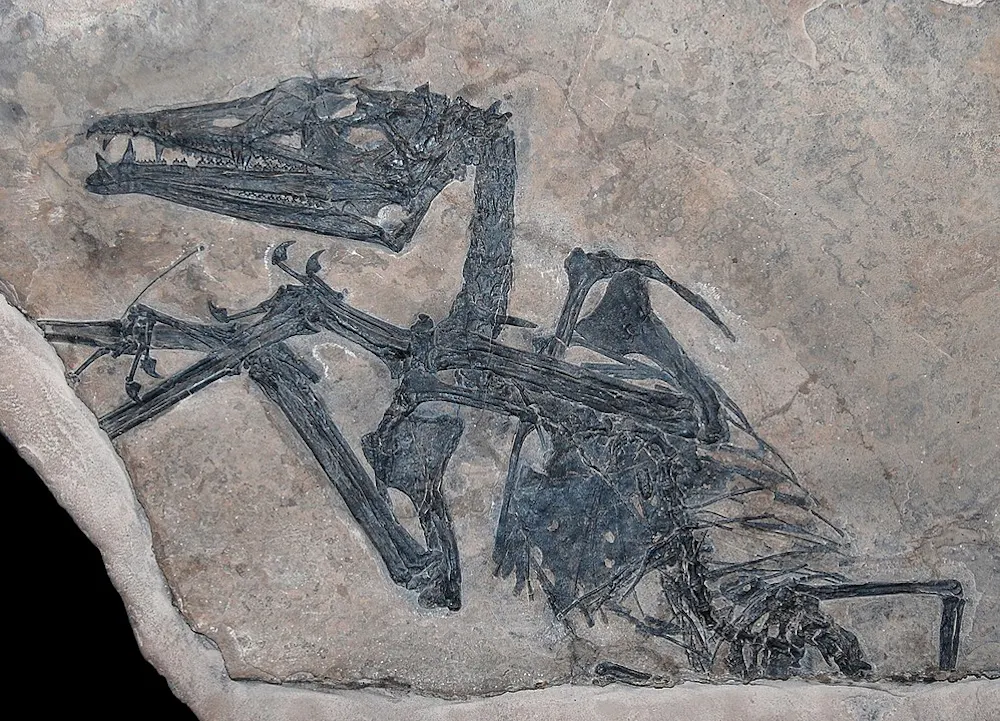
    Most of the handful of Triassic specimens come from narrow seams of dark shale in Italy and Austria, with other fragments discovered in Greenland, Argentina and the southwestern US. These skeletons appear fully adapted for flight, with a hyper-elongated fourth finger supporting membrane-wings. Yet older rocks show no trace of intermediate gliders or other transitional forms that you might expect as evidence of pterosaurs’ evolution over time.

    There are two classic competing explanations for this. The literal reading says pterosaurs evolved elsewhere and did not reach those regions where most have been discovered until very late in the Triassic period, by which time they were already adept flyers. The sceptical reading notes that pterosaurs’ wafer-thin, hollow bones could easily vanish from the fossil record, dissolve, get crushed or simply be overlooked, creating this false gap.

    Eudimorphodon ranzii fossil from Bergamo in 1973 is one of many pterosaur discoveries from southern Europe.
    Wikimedia, CC BY-SA

    For decades, the debate stalled as a result of too few fossils or too many missing rocks. This impasse began to change in 2020, when scientists identified the closest relatives of pterosaurs in a group of smallish upright reptiles called lagerpetids.

    From comparing many anatomical traits across different species, the researchers established that pterosaurs and lagerpetids shared many similarities including their skulls, skeletons and inner ears. While this discovery did not bring any “missing link” to the table, it showed what the ancestor of pterosaurs would have looked like: a rat-to-dog-sized creature that lived on land and in trees.

    This brought new evidence about when pterosaurs may have originated. Pterosaurs and lagerpetids like Scleromochlus, a small land-dwelling reptile, diverged at some point after the end-Permian mass extinction. It occurred some 250 million years ago, 35 million years before the first pterosaur appearance in the fossil record.

    Scleromochlus is one of the lagerpetids, the closest known relatives to the pterosaurs.
    Gabriel Ugueto

    Pterosaurs and their closest kin did not share the same habitats, however. Our new study, featuring new fossil maps, shows that soon after lagerpetids appeared (in southern Pangaea), they spread across wide areas, including harsh deserts, that many other groups were unable to get past. Lagerpetids lived both in these deserts and in humid floodplains.

    They tolerated hotter, drier settings better than any early pterosaur, implying that they had evolved to cope with extreme temperatures. Pterosaurs, by contrast, were more restricted. Their earliest fossils cluster in the river and lake beds of the Chinle and Dockum basins (southwest US) and in moist coastal belts fringing the northern arm of the Tethys Sea, a huge area that occupied today’s Alps.

    Scientists have inferred from analysing a combination of fossil distributions, rock features and climate simulations that pterosaurs lived in areas that were warm but not scorching. The rainfall would have been comparable to today’s tropical forests rather than inland deserts.

    This suggests that the earliest flying dinosaurs may have lived in tree canopies, using foliage both for take-off and to protect themselves from predators and heat. As a result of this confined habitat, the distances that they flew may have been quite limited.

    Changing climates

    We were then able to add a fresh dimension to the story using a method called ecological niche modelling. This is routinely used in modern conservation to project where endangered animals and plants might live as the climate gets hotter. By applying this approach to later Triassic temperatures, rainfall and coastlines, we asked where early pterosaurs lived, regardless of whether they’ve shown up there in the fossil record.

    Many celebrated fossil sites in Europe emerge as poor pterosaur habitat until very late in the Triassic period: they were simply too hot, too dry or otherwise inhospitable before the Carnian age, around 235 million years ago. The fact that no specimens have been discovered there that are more than about 215 million years old may be because the climate conditions were still unsuitable or simply because we don’t have the right type of rocks preserved of that age.

    In contrast, parts of the south-western US, Morocco, India, Brazil, Tanzania and southern China seem to have offered welcoming environments several million years earlier than the age of our oldest discoveries. This rewrites the search map. If pterosaurs could have thrived in those regions much more than 215 million years ago, but we have not found them there, the problem may again lie not with biology but with geology: the right rocks have not been explored, or they preserve fragile fossils only under exceptional conditions.

    Our study flags a dozen geological formations, from rivers with fine sediment deposits to lake beds, as potential prime targets for the next breakthrough discovery. They include the Timezgadiouine beds of Morocco, the Guanling Formation of south-west China and, in South America, several layers of rock from the Carnian age, such as the Santa Maria Formation, Chañares Formation and Ischigualasto Formation.

    Pterosaurs were initially confined to tropical treetops near the equator. When global climates shifted and forested corridors opened, pterosaurs’ wings catapulted them into every corner of the planet and ultimately carried them through one of Earth’s greatest extinctions. What began as a tale of missing fossils has become a textbook example of how climate, ecology and evolutionary science have come together to illuminate a fragmentary history that has intrigued paleontologists for over two centuries.

    Davide Foffa is funded by Marie Skłodowska-Curie Actions: Individual (Global) Fellowship (H2020-MSCA-IF-2020; No.101022550), and by the Royal Commission for the Exhibition of 1851–Science Fellowship

    Alfio Alessandro Chiarenza receives funding from The Royal Society (Newton International Fellowship NIFR1231802)

    Emma Dunne does not work for, consult, own shares in or receive funding from any company or organisation that would benefit from this article, and has disclosed no relevant affiliations beyond their academic appointment.

    ref. How pterosaurs learned to fly: scientists have been looking in the wrong place to solve this mystery – https://theconversation.com/how-pterosaurs-learned-to-fly-scientists-have-been-looking-in-the-wrong-place-to-solve-this-mystery-259063

    MIL OSI

  • MIL-OSI Submissions: Digital government can benefit citizens: how South Africa can reduce the risks and get it right

    Source: The Conversation – Africa (2) – By Busani Ngcaweni, Visiting Adjunct Professor, Wits School of Governance, University of the Witwatersrand

    The digital revolution is reshaping governance worldwide. From the electronic filing of taxes to digital visa applications, technology is making government services more accessible, efficient and transparent.

    South Africa is making progress in its digital journey. In 2024 it climbed to 40th place out of 193 countries, from 65th place in 2022, in the United Nations e-Government Index. This improvement makes the country one of Africa’s digital leaders, surpassing Mauritius and Tunisia.

    South Africa has identified more than 255 government services for digitisation. Already, 134 are available on the National e-Government Portal. This achievement is remarkable. Nevertheless, the shift to digitisation comes with challenges and risks.

    Some countries have weakened the state’s role by rapidly outsourcing key government functions. But South Africa has the opportunity to build a model of digital transformation that strengthens public institutions rather than diminishes them.

    New technologies must bring tangible benefits for citizens. Digital transformation can improve public administration. But, if mismanaged, it could burden taxpayers with costs.

    Benefits

    Digital transformation comes at a cost. This is particularly true if the state fails to use its procurement power to negotiate reasonable prices. Infrastructure upgrades, cybersecurity measures, software licensing and system maintenance require substantial financial investment.

    The question is whether these expenses are a necessary step towards a more efficient and accessible government.

    Two South African examples illustrate that digital transformation can save money and enhance service delivery quality.

    The first is the South African Revenue Service. Its goal is to ensure that taxpayers and tax advisers can use the service from anywhere and at any time. The changes made more than a decade ago show that digital systems can yield substantial financial gains. After introducing e-filing in 2006, the revenue service streamlined tax processes, reduced inefficiencies and led to higher compliance rates. Ultimately this led to improved revenue collection.

    Similarly, digitising social grant payments has had a number of positive effects. In a chapter of a recent edited volume on public governance, my colleagues and I wrote a case study about how the South African Social Security Agency used basic technologies and platforms like WhatsApp and email to process a grant during the COVID pandemic. It allowed over 14 million people to apply, paid grants to over 6 million beneficiaries during the first phase of the project.

    South African Social Security Agency annual reports show that over 95% of grant beneficiaries receive their payouts electronically through debit cards, instead of going to cash points. This improves security and lets beneficiaries decide when to get and spend their money.

    There are fears that automation could result in massive job losses. But global experience has shown that digitalisation does not necessarily lead to large-scale retrenchments. Instead it can shift the nature of work to other responsibilities.

    The South African Social Security Agency provides a compelling case. Its transition to digital grant payments did not lead to job losses. Similarly, the expansion of e-filing at the revenue service has not resulted in workforce reductions. In both cases efficiencies improved.

    These cases highlight that digital transformation is reshaping roles rather than displacing employees. Public servants are moving into areas such as cybersecurity, data analysis and AI-driven decision-making.

    Shortcomings and pitfalls

    A number of inefficiencies are at play in government services.

    Firstly, most government digital operations still work with outdated paper-based systems. The lack of a uniform digital identity creates bureaucratic inefficiencies and delays.

    Secondly, fragmented procurement of equipment in government has led to duplicated efforts, increased costs and fruitless expenditure.

    Thirdly, different departments often use isolated and incompatible digital systems. This reduce the mutual benefits of digital transformation. The State IT Agency has been blamed for inefficiencies, procurement failures and questionable spending.

    Fourthly, South Africa’s public service remains fragmented. Citizens still struggle to access government services seamlessly. They often move between departments to complete what should be a single transaction.

    Without a centralised system, departments operate in isolation, duplicating efforts, increasing costs and eroding public trust.


    Read more:
    South Africa’s civil servants are missing skills, especially when it comes to technology – report


    Fifth, a lack of skills. Increasing reliance on digital tools requires expertise in data analytics, cloud computing and automation. Many public servants lack the training to take on these new roles. The National Digital and Future Skills Strategy was introduced in September 2020 to bridge this gap, but its effectiveness depends on its implementation.

    Introducing it in 2020 at the height of the COVID-19 pandemic forced government to make digital leaps which otherwise might have taken longer. To sustain services, technology had to be rapidly adopted, including basic things like holding Cabinet meetings online, using a system rapidly developed by the State Information Technology Agency.

    Sixth, security concerns complicate the transformation. As government systems become digital, they become vulnerable to cyberattacks. South Africa must put in place cybersecurity infrastructure to prevent identity theft, data breaches and service disruptions. A cyberattack on one department could affect the entire public sector.

    What needs to be done

    Government must streamline procurement, improve coordination and eliminate inefficiencies to ensure interdepartmental collaboration.

    A single, integrated e-government platform would:

    • cut red tape

    • reduce queues

    • increase efficiency.

    Government needs to upskill civil servants and improve their digital literacy.

    Government must create a seamless e-government system that connects services while protecting citizens’ personal information. The success of digitalisation depends on technological advancements as well as the level of trust citizens have in government systems. Without strong security measures, transparency and accountability, even the most sophisticated digital tools will fail to gain public confidence.

    South Africa has the chance to demonstrate that a strong, capable state can successfully integrate technology while safeguarding public interests. It should take full advantage of offers by Microsoft, Amazon and Huawei to support digital skills training in the public sector in a way that does not advantage one company’s technologies over others. Choices of technology must be user-centric, not based on preferences of accounting officers and chief information officers. Leaders of public institutions must be measured on their ability to digitally transform their organisations.

    Busani Ngcaweni is affiliated with the National School of Government, Wits and Johannesburg Universities.

    ref. Digital government can benefit citizens: how South Africa can reduce the risks and get it right – https://theconversation.com/digital-government-can-benefit-citizens-how-south-africa-can-reduce-the-risks-and-get-it-right-254089

    MIL OSI

  • MIL-OSI Submissions: Digital government can benefit citizens: how South Africa can reduce the risks and get it right

    Source: The Conversation – Africa (2) – By Busani Ngcaweni, Visiting Adjunct Professor, Wits School of Governance, University of the Witwatersrand

    The digital revolution is reshaping governance worldwide. From the electronic filing of taxes to digital visa applications, technology is making government services more accessible, efficient and transparent.

    South Africa is making progress in its digital journey. In 2024 it climbed to 40th place out of 193 countries, from 65th place in 2022, in the United Nations e-Government Index. This improvement makes the country one of Africa’s digital leaders, surpassing Mauritius and Tunisia.

    South Africa has identified more than 255 government services for digitisation. Already, 134 are available on the National e-Government Portal. This achievement is remarkable. Nevertheless, the shift to digitisation comes with challenges and risks.

    Some countries have weakened the state’s role by rapidly outsourcing key government functions. But South Africa has the opportunity to build a model of digital transformation that strengthens public institutions rather than diminishes them.

    New technologies must bring tangible benefits for citizens. Digital transformation can improve public administration. But, if mismanaged, it could burden taxpayers with costs.

    Benefits

    Digital transformation comes at a cost. This is particularly true if the state fails to use its procurement power to negotiate reasonable prices. Infrastructure upgrades, cybersecurity measures, software licensing and system maintenance require substantial financial investment.

    The question is whether these expenses are a necessary step towards a more efficient and accessible government.

    Two South African examples illustrate that digital transformation can save money and enhance service delivery quality.

    The first is the South African Revenue Service. Its goal is to ensure that taxpayers and tax advisers can use the service from anywhere and at any time. The changes made more than a decade ago show that digital systems can yield substantial financial gains. After introducing e-filing in 2006, the revenue service streamlined tax processes, reduced inefficiencies and led to higher compliance rates. Ultimately this led to improved revenue collection.

    Similarly, digitising social grant payments has had a number of positive effects. In a chapter of a recent edited volume on public governance, my colleagues and I wrote a case study about how the South African Social Security Agency used basic technologies and platforms like WhatsApp and email to process a grant during the COVID pandemic. It allowed over 14 million people to apply, paid grants to over 6 million beneficiaries during the first phase of the project.

    South African Social Security Agency annual reports show that over 95% of grant beneficiaries receive their payouts electronically through debit cards, instead of going to cash points. This improves security and lets beneficiaries decide when to get and spend their money.

    There are fears that automation could result in massive job losses. But global experience has shown that digitalisation does not necessarily lead to large-scale retrenchments. Instead it can shift the nature of work to other responsibilities.

    The South African Social Security Agency provides a compelling case. Its transition to digital grant payments did not lead to job losses. Similarly, the expansion of e-filing at the revenue service has not resulted in workforce reductions. In both cases efficiencies improved.

    These cases highlight that digital transformation is reshaping roles rather than displacing employees. Public servants are moving into areas such as cybersecurity, data analysis and AI-driven decision-making.

    Shortcomings and pitfalls

    A number of inefficiencies are at play in government services.

    Firstly, most government digital operations still work with outdated paper-based systems. The lack of a uniform digital identity creates bureaucratic inefficiencies and delays.

    Secondly, fragmented procurement of equipment in government has led to duplicated efforts, increased costs and fruitless expenditure.

    Thirdly, different departments often use isolated and incompatible digital systems. This reduce the mutual benefits of digital transformation. The State IT Agency has been blamed for inefficiencies, procurement failures and questionable spending.

    Fourthly, South Africa’s public service remains fragmented. Citizens still struggle to access government services seamlessly. They often move between departments to complete what should be a single transaction.

    Without a centralised system, departments operate in isolation, duplicating efforts, increasing costs and eroding public trust.


    Read more:
    South Africa’s civil servants are missing skills, especially when it comes to technology – report


    Fifth, a lack of skills. Increasing reliance on digital tools requires expertise in data analytics, cloud computing and automation. Many public servants lack the training to take on these new roles. The National Digital and Future Skills Strategy was introduced in September 2020 to bridge this gap, but its effectiveness depends on its implementation.

    Introducing it in 2020 at the height of the COVID-19 pandemic forced government to make digital leaps which otherwise might have taken longer. To sustain services, technology had to be rapidly adopted, including basic things like holding Cabinet meetings online, using a system rapidly developed by the State Information Technology Agency.

    Sixth, security concerns complicate the transformation. As government systems become digital, they become vulnerable to cyberattacks. South Africa must put in place cybersecurity infrastructure to prevent identity theft, data breaches and service disruptions. A cyberattack on one department could affect the entire public sector.

    What needs to be done

    Government must streamline procurement, improve coordination and eliminate inefficiencies to ensure interdepartmental collaboration.

    A single, integrated e-government platform would:

    • cut red tape

    • reduce queues

    • increase efficiency.

    Government needs to upskill civil servants and improve their digital literacy.

    Government must create a seamless e-government system that connects services while protecting citizens’ personal information. The success of digitalisation depends on technological advancements as well as the level of trust citizens have in government systems. Without strong security measures, transparency and accountability, even the most sophisticated digital tools will fail to gain public confidence.

    South Africa has the chance to demonstrate that a strong, capable state can successfully integrate technology while safeguarding public interests. It should take full advantage of offers by Microsoft, Amazon and Huawei to support digital skills training in the public sector in a way that does not advantage one company’s technologies over others. Choices of technology must be user-centric, not based on preferences of accounting officers and chief information officers. Leaders of public institutions must be measured on their ability to digitally transform their organisations.

    Busani Ngcaweni is affiliated with the National School of Government, Wits and Johannesburg Universities.

    ref. Digital government can benefit citizens: how South Africa can reduce the risks and get it right – https://theconversation.com/digital-government-can-benefit-citizens-how-south-africa-can-reduce-the-risks-and-get-it-right-254089

    MIL OSI

  • MIL-OSI Submissions: Somaliland’s 30-year quest for recognition: could US interests make the difference?

    Source: The Conversation – Africa (2) – By Aleksi Ylönen, Professor, United States International University

    More than three decades after unilaterally declaring independence from Somalia, Somaliland still seeks international recognition as a sovereign state. Despite a lack of formal acknowledgement, the breakaway state has built a relatively stable system of governance. This has drawn increasing interest from global powers, including the United States. As regional dynamics shift and great-power competition intensifies, Somaliland’s bid for recognition is gaining new currency. Aleksi Ylönen has studied politics in the Horn of Africa and Somaliland’s quest for recognition. He unpacks what’s at play.


    What legal and historical arguments does Somaliland use?

    The Somali National Movement is one of the main clan-based insurgent movements responsible for the collapse of the central government in Somalia. It claims the territory of the former British protectorate of Somaliland. The UK had granted Somaliland sovereign status on 26 June 1960.

    The Somali government tried to stomp out calls for secession. It orchestrated the brutal killing of hundreds of thousands of people in northern Somalia between 1987 and 1989.

    But the Somali National Movement declared unilateral independence on 18 May 1991 and separated from Somalia.

    With the collapse of the Somali regime in 1991, the movement’s main enemy was gone. This led to a violent power struggle between various militias.

    This subsided only after the politician Mohamed Egal consolidated power. He was elected president of Somaliland in May 1993.

    Egal made deals with merchants and businessmen, giving them tax and commercial incentives to accept his patronage. As a result, he obtained the economic means to consolidate political power and to pursue peace and state-building. It’s something his successors have kept up with since his death in 2002.

    What has Somaliland done to push for recognition?

    Successive Somaliland governments continue to engage in informal diplomacy. They have aligned with the west, particularly the US, which was the dominant power after the cold war, and the former colonial master, the UK. Both countries host significant Somaliland diaspora communities.

    The US and the UK have for decades flirted with the idea of recognising Somaliland, which they consider a strategic partner. However, they have been repeatedly thrown back by their respective Somalia policies. These have favoured empowering the widely supported Mogadishu government to reassert its authority and control over Somali territories.

    This Somalia policy has been increasingly questioned in recent years, in part due to Mogadishu’s security challenges. In contrast, the Hargeisa government of Somaliland has largely shown it can provide security and stability. It has held elections and survived as a state for the last three decades, though it has faced political resistance and armed opposition.


    Read more:
    Somaliland elections: what’s at stake for independence, stability and shifting power dynamics in the Horn of Africa


    As new global powers rise, Somaliland administrations have pursued an increasingly diverse foreign policy, with one goal: international recognition.

    Hargeisa hosts consulates and representative offices of Djibouti, Ethiopia, Kenya, Taiwan, the UK and the European Union, among others.

    The government has also engaged in informal foreign relations with the United Arab Emirates. The Middle Eastern monarchy serves as a business hub and a destination of livestock exports. Many Somalilanders migrate there.

    Somaliland maintains representative offices in several countries. These include Canada, the US, Norway, Sweden, the UK, Saudi Arabia, Turkey and Taiwan. Hargeisa has alienated China because it has collaborated with Taiwan since 2020. Taiwan is a self-ruled island claimed by China.

    On 1 January 2024, Somaliland’s outgoing president Muse Bihi signed a memorandum of understanding with Ethiopian prime minister Abiy Ahmed for increased cooperation. Bihi implied that Ethiopia would be the first country to formally recognise Somaliland. The deal caused a sharp deterioration of relations between Addis Ababa and Mogadishu.

    Abiy later moderated his position and, with Turkish mediation, reconciled with his Somalia counterpart, President Hassan Mohamud.

    What’s behind US interest in Somaliland?

    The US, like other great powers, has been interested in Somaliland because of its strategic location. It is on the African shores of the Gulf of Aden, across from the Arabian Peninsula. Its geographical position has gained currency recently as Yemeni Houthi rebels strike maritime traffic in the busy shipping lanes. Somaliland is also well located to curb piracy and smuggling on this global trade route.

    The US Africa Command set up its main Horn of Africa base at Camp Lemonnier in Djibouti in 2002. This followed the 11 September 2001 attacks.


    Read more:
    Somaliland’s quest for recognition: UK debate offers hint of a sea change


    In 2017, China, which had become the main foreign economic power in the Horn of Africa, set up a navy support facility in Djibouti. This encouraged closer collaboration between American and Somaliland authorities. The US played with the idea of establishing a base in Berbera, which hosts Somaliland’s largest port.

    With Donald Trump winning the US presidential election in 2024, there were reports of an increased push for US recognition of Somaliland. This would allow the US to deepen its trade and security partnerships in the volatile Horn of Africa region.

    Since March 2025, representatives of the Trump administration have engaged in talks with Somaliland officials to establish a US military base near Berbera. This would be in exchange for a formal but partial recognition of Somaliland.

    What are the risks of US recognition of Somaliland?

    Stronger US engagement with Somaliland risks neglecting Somalia.

    Mogadishu depends on external military assistance in its battle against the advancing violent Islamist extremist group, Al-Shabaab. It also faces increasing defiance from two federal regions, Puntland and Jubaland.

    US recognition would reward Hargeisa for its persistent effort to maintain stability and promote democracy. However, it could encourage other nations to recognise Somaliland. This would deliver a blow to Somali nationalists who want one state for all Somalis.

    Aleksi Ylönen is affiliated with the Center for International Studies, Iscte-Instituto Universitário de Lisboa, and is an associate fellow at the HORN International Institute for Strategic Studies.

    ref. Somaliland’s 30-year quest for recognition: could US interests make the difference? – https://theconversation.com/somalilands-30-year-quest-for-recognition-could-us-interests-make-the-difference-255399

    MIL OSI

  • MIL-OSI Submissions: Is Kenya’s president safe in a crowd? Security expert scans VIP protection checklist

    Source: The Conversation – Africa (2) – By Douglas Lucas Kivoi, Principal Policy Analyst, Governance Department, The Kenya Institute for Public Policy Research and Analysis (KIPPRA)

    Protecting any president requires multiple layers of intelligence, physical security and rapid response security protocols. Exact operational details are classified, but there are global best practices in VIP protection.

    The issue of presidential protection in Kenya has become particularly relevant following an incident in early May 2025 when someone in a crowd threw a shoe at President William Ruto during a public event, hitting his hand.

    I have studied policing and security policies in Kenya for over 15 years, interacting closely with the country’s security protocols. In my view this incident exposed several critical security lapses around the elite officers tasked with protecting the president.

    The security of the president is a critical issue in Kenya. The country is exposed to terror groups like the Somalia-based Al-Shabaab and other criminal networks in the region.

    In 2021, a businessman embedded himself into the presidential motorcade and drove into then president Uhuru Kenyatta’s official residence. In 2017, an unidentified man who was said to have illegally accessed the highly protected state house grounds was shot dead by presidential guards.

    There are multiple layers to Kenya’s protection protocols. They include National Intelligence Service officers, the Kenya Defence Force, Presidential Escort Police officers drawn from the highly trained General Service Unit, bomb disposal experts and regular police officers. Their deployment depends on the nature of the presidential engagement.

    While the shoe incident may be passed off as simply embarrassing, it should serve as a wake-up call to tighten security protocols around the president without necessarily compromising his public engagement with citizens.

    What’s in place

    Prior to any presidential visit across the country, security teams conduct a thorough reconnaissance of the destination. This includes coordinating with local policing agencies, clearing airspace, mapping secure transport routes and identifying nearby medical facilities in case of emergencies.

    Presidential motorcade routes are pre-planned and a dry run is made. This often includes mapping alternative routes to avoid predictability should there be assailants along a presidential route. It is common to see some roads temporarily closed and security officers conducting sweeps for any threats or explosives. In areas deemed high risk, counter security sniper teams are covertly deployed in strategic areas.

    Cases of attacks on presidential motorcades are rare in Kenya. However, in 2002 during presidential campaigns, angry opposition supporters stoned then president Daniel Moi’s motorcade. In November 2021, an angry mob hurled rocks at then deputy president Ruto’s motorcade.

    The National Intelligence Service and Presidential Escort Unit covertly scout locations in advance, assessing potential security vulnerabilities. Crowd sizes, and entry and exit points for the head of state are mapped out in advance.

    In cases where meetings are held in town halls or huge tents, attendees are screened using metal detectors and/or physical searches. Uniformed and plainclothes security officers embed themselves in the crowd to monitor any threats.

    The president and any dignitaries accompanying him have at least three layers of security.

    The inner ring consists of close protection officers who are always within an arm’s length of the president to physically thwart any threats. The middle ring has armed security guards who watch for, among others, sudden movements and abnormal behaviour within the crowd. The outer ring consists of regular police and paramilitary units from the General Service Unit who secure the outside perimeter.

    The presidential motorcade is a coordinated convoy of heavily armoured vehicles. It includes lead and chase cars, communication units and emergency response teams. Traffic is managed by local traffic police officers to ensure unobstructed movement. Routes are kept confidential until necessary.

    The president’s security may opt to use a decoy vehicle if there is a security threat, to confuse and derail potential risk sources. In all these cases, there is a contingent of specialised General Service Unit officers, called the Recce unit, that always accompanies the president.

    Kenya’s presidential security precautions follow standard VIP security protection like those for heads of state across the world. However, in some neighbouring countries, for instance, presidents move in heavily armed military convoys. This has not been seen in Kenya.

    If a potential threat is detected, the president is immediately shielded and whisked away to a secure vehicle or evacuated by air in high-risk events. In such cases, the Kenya Defence Forces secures the president.

    Despite stringent security measures, incidents can occur. For instance, in March 2025, a British tourist was fatally hit by a vehicle in Ruto’s motorcade. This prompted investigations and reviews on motorcade safety protocols.

    Such events highlight the challenges of balancing presidential security with public safety, especially in densely populated urban areas.

    Security failures

    The shoe-throwing incident targeting Ruto highlighted five major failures in presidential protection protocols.

    First, crowd screening and access control failures. The alleged assailant was very close to the president, suggesting an inadequate distance between the crowds and the president. The inner ring of security also failed to spot the perpetrator raising a shoe in the air to use as a projectile. This indicates weak front-row eye sweeps and scans by the president’s security.

    Second, there was an apparent delay in security response. The elite officers around the president should have subdued the alleged attacker within seconds. It could mean most had their eyes on the president or cameras, as opposed to scanning the crowds for any sudden movements.

    Third, security allowed the president to stand too close to a crowd that hadn’t been screened. Best practices require a no-go zone of three to five metres for individuals who have not been scanned or screened.

    Fourth, there was an apparent gap in intelligence and threat assessment. Aggressive or agitated people next to the president should draw the attention of security officers. Plainclothes security officers are usually deployed to monitor crowd behaviour. It isn’t enough to rely on uniformed officers.

    Undercover agents are critical for flagging pre-attack signals, such as nervousness or repeated adjustments of positions.

    Fifth, there was no clear evacuation plan for the president. After the incident, the president continued speaking. In high-risk scenarios, protocols often demand instant relocation of the president to a secure vehicle or helicopter, where the military takes over and airlifts him to safety.

    What should change

    Kenya’s presidential security detail may be forced to:

    • increase standoff distance between the president and crowds

    • deploy more plainclothes officers to blend in and monitor crowds around the president

    • mandate stricter screening of those in close proximity to the president

    • conduct more frequent security risks drills for rapid neutralisation of potential threats.

    The exact details of presidential security in Kenya are confidential. However, the overarching structure aims to provide comprehensive protection to the president while maintaining public safety and order during official engagements. No security protocol is 100% foolproof. But a balance needs to be struck between overly aggressive crowd control and accessibility.

    Douglas Lucas Kivoi does not work for, consult, own shares in or receive funding from any company or organisation that would benefit from this article, and has disclosed no relevant affiliations beyond their academic appointment.

    ref. Is Kenya’s president safe in a crowd? Security expert scans VIP protection checklist – https://theconversation.com/is-kenyas-president-safe-in-a-crowd-security-expert-scans-vip-protection-checklist-256268

    MIL OSI

  • MIL-OSI Submissions: Iran and Ethiopia have a security deal – here’s why they signed it

    Source: The Conversation – Africa (2) – By Eric Lob, Associate Professor of Politics and International Relations, Florida International University

    Ethiopia and Iran signed a memorandum of understanding (MOU) on 6 May 2025. Under it, their national police agencies will cooperate on security and intelligence. This will include combating cross-border crime, sharing intelligence and building capacity. They will also share experiences and training.

    For Iran, the MOU marks a significant step towards strengthening relations with a regional power that’s strategically located in the Horn of Africa.

    Tehran has been using its security apparatus and military capabilities to establish and expand political and economic ties with countries in Africa. This has included drone transfers to the Ethiopian government that helped it turned the tide of the Tigray war, a separatist struggle in the country’s north that took place from 2020 to 2022.

    Iran has also supplied the Sudanese army with surveillance and combat drones. These have been used against the paramilitary Rapid Support Forces in Sudan’s ongoing civil war.

    The agreement is important for Ethiopia for two reasons.

    Firstly, it’s likely to enable the Ethiopian government in Addis Ababa to combat ethnic militias more effectively. It faces increasing internal instability, including tensions with hostile factions of the separatist Tigray People’s Liberation Front.

    Secondly, the agreement comes after a meeting in Addis Ababa between the Ethiopian police chief, Demelash Gebremichael, and a delegation from Iran’s regional rival, the United Arab Emirates (UAE). The exchange concentrated on investigating and extraditing cross-border criminals.

    Addis Ababa’s willingness to work with regional rivals in the Middle East shows its pragmatic approach to foreign relations. Ethiopia needs all the friends it can muster as an embattled and weakened state. Since the Tigray war, it has battled the rise of ethnic militias and confronted economic adversity. It is also facing renewed hostility with neighbouring Eritrea.

    What Iran stands to gain

    Since 2016, Ethiopia has been a gateway for Iran to gain a foothold in the Horn of Africa. That year, other countries in the region severed relations with Iran. This followed Tehran’s disengagement from sub-Saharan Africa under Hassan Rouhani, who served as president from 2013 to 2021, and his prioritisation of a nuclear deal with the US.

    The severing of ties was also a byproduct of geopolitical pressure exerted by Saudi Arabia and the UAE on countries in the region. The Middle Eastern states wanted to reduce, if not eliminate, Iran’s presence in the Horn of Africa and Red Sea to limit its support for Houthi rebels in the ongoing Yemeni civil war.


    Read more:
    Iran’s intervention in Sudan’s civil war advances its geopolitical goals − but not without risks


    Ethiopia was the first country in sub-Saharan Africa to establish relations with Iran during the 1960s. It was also one of its top trading partners on the continent before and after the 1979 Iranian Revolution.

    Strategically and ideologically, this special relationship was based on the pro-western and anti-communist stances of their monarchs: the Shah of Iran Mohammad Reza Pahlavi, who ruled from 1941 to 1979, and Emperor Haile Selassie, who was in power from 1930 to 1974.

    After the revolution, Iran-Ethiopia relations revived under Mahmoud Ahmadinejad, who served as Iranian president from 2005 to 2013. He pursued an active Africa policy to mitigate Iran’s international isolation and circumvent US sanctions.

    After Rouhani initially downgraded these relations, they were renewed during his second term. This followed US withdrawal from the nuclear deal.

    Relations firmed when Ebrahim Raisi, who served as Iranian president from 2021 to 2024, delivered military drones and other aid to Addis Ababa during the Tigray war.

    What’s in it for Ethiopia

    Ethiopia is facing increasing instability and uncertainty. The Tigray war has depleted the state’s resources. There is an economic crisis caused by rising inflation and unemployment.

    Addis Ababa continues to confront ethnic tensions. Hostile factions of the Tigray People’s Liberation Front remain. It also faces tensions with the Amhara Fano militia, which initially fought alongside the government against Tigrayan forces. Forced disarmament policies and ongoing land disputes caused the militia to take up arms against the government.


    Read more:
    Somaliland-Ethiopia port deal: international opposition flags complex Red Sea politics


    Ethiopian prime minister Abiy Ahmed also faces growing opposition and resistance from his own ethnic group, the majority Oromo, and their Oromo Liberation Army. The reason for their discontent is Abiy’s imposition of centralised rule on their regional state within a federal system.

    The security and intelligence cooperation with Iran could allow Addis Ababa to combat ethnic militias more effectively.

    It would also enable Ethiopia to prepare for another possible war against neighbouring Eritrea.

    Ethiopia and Eritrea normalised relations and fought together against Tigrayan forces. However, tensions between the two countries have been brewing again. These have been triggered by two factors. First, the conditions of the 2022 Pretoria peace agreement caused Eritrea to maintain forces inside Ethiopia. Second are the ambitions of Addis Ababa to acquire a Red Sea port in Somaliland, a breakaway region of Somalia. Eritrea has supported Somalia’s opposition to the deal.

    Regional power games

    This isn’t the first time that Ethiopia has tried working with two regional rivals – Iran and the UAE. The UAE is also among its top trading partners, along with Saudi Arabia.

    In 2016, Ethiopia was the only country in the Horn of Africa that didn’t cut ties with Iran, though it was under pressure from the UAE and Saudi Arabia to do so. The decision was taken by Abiy’s predecessor, Hailemariam Desalegn, whose term ran from 2012 to 2018.

    During the Tigray war, Ethiopia received military drones and other assistance from Iran and the UAE, alongside Turkey.

    The civil war in Sudan has presented an even more complicated story. Ethiopia has vacillated between engaging with the Rapid Support Forces and the Sudanese Armed Forces at different points in the conflict.

    For its part, Iran has supported the Sudanese army. The UAE has backed the paramilitary Rapid Support Forces.

    Ethiopia’s efforts to strengthen its security ties with Iran and the UAE show a unique case of convergence between regional rivals that have otherwise remained on opposite sides of conflicts in countries like Yemen and Sudan.

    Eric Lob does not work for, consult, own shares in or receive funding from any company or organisation that would benefit from this article, and has disclosed no relevant affiliations beyond their academic appointment.

    ref. Iran and Ethiopia have a security deal – here’s why they signed it – https://theconversation.com/iran-and-ethiopia-have-a-security-deal-heres-why-they-signed-it-256486

    MIL OSI

  • MIL-OSI Submissions: Black holes spew out powerful jets that span millions of light-years – we’re trying to understand their whole life cycle

    Source: The Conversation – Africa (2) – By Gourab Giri, Postdoctoral researcher, University of Pretoria

    An artistic representation of what a giant cosmic jet the size of the distance between the Milky Way and Andromeda could look like. Author provided, CC BY-SA

    There is a supermassive black hole at the centre of nearly every big galaxy – including ours, the Milky Way (it’s called Sagittarius A*). Supermassive black holes are the densest objects in the universe, with masses reaching billions of times that of the Sun.

    Sometimes a galaxy’s supermassive black hole “wakes up” due to a sudden influx of gas and dust, most likely supplied from a neighbouring galaxy. It begins eating up lots of nearby gas and dust. This isn’t a calm, slow or passive process. As the black hole pulls in material, the material gets superheated on a scale of millions of degrees, far hotter than the surface temperature of our Sun, and is ejected from the galaxy at near-light speeds. This creates powerful jets that look like fountains in the cosmos.

    The accelerated high-speed plasma matter prompts these “fountains” to emit radio signals that can only be detected by very powerful radio telescopes. This gives them their name: radio galaxies. While black holes are common, radio galaxies are not. Only between 10% and 20% of all galaxies exhibit this phenomenon.

    Giant radio galaxies are even less common. They account for only 5% of all radio galaxies and take their name from the fact that they reach enormous distances. Some radio galaxies’ jets reach nearly 16 million light-years. (That’s almost six times the distance between the Milky Way and the Andromeda galaxy.) The largest jet discovered spans nearly 22 million light-years across.


    Read more:
    South African telescope discovers a giant galaxy that’s 32 times bigger than Earth’s


    But how do these structures cover such enormous distances? To find out, I led a study in which we used modern supercomputers to develop models that simulated behaviour of giant cosmic jets within a mock universe, constructed on the basis of fundamental physical laws governing the cosmos.

    This allowed us to observe how radio jets propagate over hundreds of millions of years – a process impossible to track directly in the real universe. These sophisticated simulations provide deeper insights into the life cycle of radio galaxies, highlighting the differences between their early, compact stages and their later, expansive forms.

    Understanding the evolution of radio galaxies helps us unravel the broader processes that shape the universe.

    Supercomputing

    Cutting-edge technology was key to this study.

    Sensitive observations from world-class radio telescopes like South Africa’s MeerKAT and LOFAR in the Netherlands have recently led to several discoveries of cosmic fountains.


    Read more:
    MeerKAT: the South African radio telescope that’s transformed our understanding of the cosmos


    However, modelling their origins has been challenging. Tracking events over millions of years is impossible in real-time.

    That’s where supercomputers come in. These high-performance computing systems are designed to process massive amounts of data. They can perform complex simulations at incredible speeds. In this study, their power was crucial for modelling the evolution of giant radio jets over millions of years.

    The necessary supercomputing power was provided by South Africa’s Inter-University Institute for Data Astronomy, a network comprising the University of Pretoria, the University of Cape Town and the University of the Western Cape.

    Our universe is governed by fundamental forces like gravity, which can be described through mathematical formulas. These formulas, essentially numbers, are fed into supercomputers to create a simulated “mock universe” that follows the same physical laws as the real cosmos. This allows scientists to experiment with how jets from supermassive black holes evolve over time. With their immense processing power, supercomputers can simulate millions of years of cosmic jet evolution in just a month.

    Key takeaways

    Gravity is the dominant force in the universe, pulling heavier matter and dragging nearby lighter matter. If gravity were the only force at play, the universe might have collapsed by now. Yet we see galaxies, galaxy clusters and even life itself thriving. We suspect that these cosmic fountains play a key role in solving the mystery of how this happens.

    By releasing thermal and mechanical energy, they heat up the surrounding collapsing gas, counteracting gravity and maintaining a balance that sustains cosmic structures.

    Our models also shed light on why some radio galaxies’ jets bend sharply, forming an “X” shape in radio waves instead of following a straight trajectory, and revealed the conditions under which giant fountains can continue growing even in dense cosmic environments (that is, in a galaxy cluster).

    The study also suggests that giant radio galaxies may be statistically more common than previously believed. There are potentially thousands of undiscovered giant cosmic fountains. Thanks to world-class telescopes like MeerKAT and LOFAR – and the power of supercomputers – there’s plenty more to explore as we try to understand our universe.

    The research on which this article is based required extensive collaboration with an international team, including Jacinta Delhaize from the University of Cape Town, Joydeep Bagchi from Christ University, India, and DJ Saikia from the Inter-University Centre for Astronomy and Astrophysics in India. Essential contributions by Kshitij Thorat and Roger Deane from the University of Pretoria also played a crucial role in shaping the study.

    Gourab Giri does not work for, consult, own shares in or receive funding from any company or organisation that would benefit from this article, and has disclosed no relevant affiliations beyond their academic appointment.

    ref. Black holes spew out powerful jets that span millions of light-years – we’re trying to understand their whole life cycle – https://theconversation.com/black-holes-spew-out-powerful-jets-that-span-millions-of-light-years-were-trying-to-understand-their-whole-life-cycle-250073

    MIL OSI

  • MIL-OSI Submissions: Ancient DNA reveals Maghreb communities preserved their culture and genes, even in a time of human migration

    Source: The Conversation – Africa (2) – By Giulio Lucarini, Senior Researcher, Institute of Heritage Science, National Research Council (CNR)

    Doukanet el Khoutifa, Tunisia, where some of the remains were found. Giulio Lucarini, CC BY-NC-ND

    The Neolithic period began in southwest Asia around 12,000 years ago. It marked a major shift in human history as societies transitioned from hunting and gathering to farming. This sparked migrations across Europe and dramatically reshaped the continent’s gene pool.

    For a long time, North Africa was seen as a passive participant in this transformation. The dominant narrative suggested that farming economies never fully took root there.

    Some studies proposed that North African communities actively resisted agriculture, except perhaps in the Nile Delta and the western Maghreb (modern-day Morocco). They continued to rely on land snails, wild plants, and hunting for survival. Only later, they also began herding domesticated sheep, goats, and cattle, introduced from southwest Asia.

    Genetic studies have only recently tested this reconstruction in North Africa. This has never been done in the eastern Maghreb (modern-day Tunisia and eastern Algeria) – until now.

    A burial at one of the study sites, SHM-1 (Hergla) in Tunisia.
    Simone Mulazzani, CC BY-NC-ND

    As an Africanist archaeologist, I specialise in the study of ancient societies across Mediterranean Africa and the Sahara. My focus is on how humans adapted to their environments and the rise of food production in these regions. I recently conducted research in the eastern Maghreb alongside an international team of archaeologists, geneticists, and physical anthropologists to trace ancient population movements.

    Our new study has just been published in Nature. We analysed the ancient genomes (complete DNA sequences) of nine individuals who lived in the eastern Maghreb between 15,000 and 6,000 years ago.

    This may seem like a small sample. But, in the field of ancient DNA research, even a few well-preserved genomes can provide significant insights. They serve as reference points for tracing genetic lineages and identifying ancestral connections.

    By adding genetic evidence to broader archaeological findings, we reconstructed patterns of population continuity, interaction and change over thousands of years.

    Our results were striking. It’s clear from these genomes that some influence from farmers did reach north Africa from across the Mediterranean. But much of the genetic makeup of the eastern Maghreb populations remained rooted in their ancient foraging heritage.

    This challenges the long-held narrative about migration into and out of north Africa before and during the Neolithic. It deepens our understanding of the past and highlights the incredible complexity of human movement and cultural exchange.

    As we continue to unravel the genetic legacy of our ancestors, studies like this remind us of the complexity of human history. They show that the history of agriculture in the Mediterranean was not merely one of population replacement. Rather, it was a tale of cultural exchange, adaptation and continuity.

    And researching these ancient human movements is more than just a matter of understanding history. It also provides insights into the patterns of migration and adaptation that can help us understand similar processes today.

    Extraction and analysis

    A map of the eastern Maghreb showing the study sites (1: Afalou Bou Rhummel; 2: Djebba; 3: Doukanet el Khoutifa; 4: SHM-1, Hergla)
    Giulio Lucarini, CC BY-NC-ND

    We worked with ancient genomes extracted from human skeletal remains housed in museum or heritage institution collections. They came from excavations at four sites Afalou Bou Rhummel, Djebba, Doukanet el Khoutifa and SHM-1 (Hergla), all in the eastern Maghreb.

    We chose the specimens because they were well-preserved, which is not always the case with ancient DNA.

    The analysis found that some of the sampled individuals possessed European farmer ancestry around 7,000 years ago. Europeans contributed some genes to the region – but no more than 20% per individual.

    Excavation of human remains at Doukanet el Khoutifa, Tunisia.
    Giulio Lucarini, CC BY-NC-ND

    This is a modest genetic influence compared to ancient western Maghreb populations where, at some sites, European farmer ancestry can reach as high as 80%.

    Our findings suggest that food-producing economies were introduced to the eastern Maghreb not by a large-scale replacement of the population (as seen in Europe) but more gradually. Change happened through sporadic migrations, mixing of cultures, and the spread of knowledge.

    Across sea and land

    One of the most intriguing discoveries was the genetic trace of European hunter-gatherers found in one individual from Djebba, Tunisia, dating to around 8,000 years ago. This suggests that early European and north African populations could interact via seafaring routes across the Strait of Sicily.

    Researchers have long known that cultural exchange took place across the Mediterranean. We see this from the spread of technologies such as the so-called pressure technique – a method of shaping stone tools by carefully applying force with a pointed implement rather than striking the stone directly.

    The discovery in Tunisia of obsidian (volcano glass) from Pantelleria, a small island in the Strait of Sicily, strengthens the link between the Mediterranean’s northern and southern shores.

    Prehistoric wooden artefacts are seldom preserved over time. This may explain the absence of boat remains from this period in North Africa. However, dugout canoes from similar periods found in central Italy (Bracciano Lake) suggest that seafaring skills were well established around the Mediterranean. While there is no direct evidence linking these specific canoes to connections between Europe and North Africa, they support the idea that navigation was within the technological capabilities of the time.

    Our study is the first time the connections suggested by this existing evidence have been substantiated genetically.


    Read more:
    Discovery of 5,000-year-old farming society in Morocco fills a major gap in history – north-west Africa was a central player in trade and culture


    Another exciting aspect of our study is the identification of early Levantine (modern southwest Asia)-related ancestry in the eastern Maghreb. This was detected in human remains dated to around 6,800 years ago. It’s a genetic signature that postdates the arrival of European farmer ancestry by several centuries. It likely reflects the movement of people associated with early pastoralism, who introduced domesticated animals, such as sheep and goats, to the region.

    Backing up archaeological evidence

    It is especially rewarding to see the genetic evidence aligning with the archaeological record. This underscores the value of multidisciplinary research in uncovering past human dynamics.

    What emerges overall is a region of strong genetic and cultural resilience, consistent with archaeological evidence.

    Giulio Lucarini receives funding for this study from the National Research Council of Italy (CNR) and ISMEO – International Association for Mediterranean and Oriental Studies, Italy. He is affiliated with the National Research Council of Italy, Institute of Heritage Science (CNR-ISPC).

    This study resulted from a collaboration between the following institutions: Harvard University, USA; the Max Planck Institute, Germany; the National Research Council of Italy (CNR); the Institut National du Patrimoine (INP), Tunisia; the Centre National de Recherche Préhistorique, Anthropologique et Historique (CNRPAH), Algeria; the Institut de Paléontologie Humaine (IPH), France; the University of Vienna, Austria; Sapienza University of Rome, Italy; and ISMEO – International Association for Mediterranean and Oriental Studies, Italy.

    ref. Ancient DNA reveals Maghreb communities preserved their culture and genes, even in a time of human migration – https://theconversation.com/ancient-dna-reveals-maghreb-communities-preserved-their-culture-and-genes-even-in-a-time-of-human-migration-248338

    MIL OSI

  • MIL-OSI Submissions: Dinosaur tracks, made 140 million years ago, have been found for the first time in South Africa’s Western Cape

    Source: The Conversation – Africa (2) – By Guy Plint, Professor Emeritus, Earth Sciences, Western University

    Guy Plint examines one of the dinosaur tracks, which is above his head. Annemarie Plint, CC BY-NC-ND

    Dinosaurs have captured people’s imagination ever since their bones and teeth were first scientifically described in 1822 by geologist and palaeontologist Gideon Mantell in England.

    Dinosaur bones have taught us a great deal about these animals from the “age of dinosaurs”, the Mesozoic Era, which stretched from approximately 252 million years ago to 65 million years ago. However, there’s something especially appealing about a different kind of dinosaur fossil: their tracks, which show researchers what the animals were doing while they were alive.

    Ichnology is the study of tracks and traces and, since 2008, the Cape South Coast Ichnology Project has documented more than 370 vertebrate tracksites on South Africa’s southern coast. These sites are from the Pleistocene Epoch, which stretched from approximately 2.6 million years ago to 11,700 years ago, much more recent than the Mesozoic.

    We knew that this coastline contained Mesozoic sedimentary rocks, some of which include non-marine sediments that could potentially preserve dinosaur tracks. We are both familiar with dinosaur tracks from our research in Canada, so we decided to investigate the possibility of tracks in South Africa’s Western Cape.

    We found some – and, once we knew what to look for, it was evident that the tracks were not rare. In a new paper published in the journal Ichnos, we describe our findings in detail, presenting evidence of tracks of sauropods (enormous plant-eating dinosaurs) and possibly ornithopods (another group of large herbivorous dinosaurs).

    The tracks were found in a rugged, remote, breathtakingly spectacular coastal setting. They were made by dinosaurs in a variety of estuarine settings. Some were walking on sandy, inter-tidal channel bars. Others walked on the bottom of tidal channels, their feet sinking down into soft mud forming the bed of the channel. Other vague “squishy” structures were formed by dinosaurs wading, or even wallowing in the muddy fill of abandoned channels.

    These tracks are around 140 million years old, from the very beginning of the Cretaceous period when the African and South American tectonic plates were starting to pull apart. Southern Africa has an extensive record of Mesozoic vertebrate fossils, but that record ends at around 180 million years ago in the Early Jurassic with the eruption of voluminous lava flows. To the best of our knowledge, all the southern African dinosaur tracks known until now are from the Triassic and Jurassic periods, so they pre-date these eruptions.

    That means these tracks are not only the first from the Western Cape. They also appear to be the youngest – that is, the most recent – thus far reported from southern Africa.

    Knowing where to look

    After deciding to hunt for potential dinosaur tracks, we visited a few likely sites on the Cape south coast in 2022, choosing areas with non-marine deposits of the appropriate age, mostly in the eastern coastal portion of the Western Cape. We found a few promising spots on that visit and, in 2023, undertook a dedicated examination.

    Large horizontal bedding surface exposures in this area are very rare. We knew that, if we were to find dinosaur tracks, they would be evident mostly in profile in vertical cliff exposures.


    Read more:
    Footprints take science a step closer to understanding southern Africa’s dinosaurs


    In the public imagination a dinosaur trackway extends across a level surface and toe impressions are visible. Some may also know that the infill of dinosaur tracks can occur on what are today the ceilings of overhangs or cave roofs. However, there are also distinctive features that allow tracks to be identified in profile. That’s because the animals’ footfalls deformed underlying layers in a distinctive manner.

    The problem is that other mechanisms, such as earthquakes, are capable of generating broadly similar deformation structures.

    The deposits we were examining had probably also been affected by seismic activity. The challenge was for us to differentiate between the two types of deformation.

    The Early Cretaceous rocks that we examined had been studied and reported on decades ago, and the deformation structures had been attributed to origins such as earthquakes rather than living organisms. Since then, however, scientists have developed a better appreciation of what dinosaur tracks look like in profile.

    After careful examination, our conclusion was straightforward: both dinosaur-generated and earthquake-generated types of deformation were present in the Cretaceous rocks.

    One of the sauropod tracks identified by the researchers. Scale bar is 20 cm.
    Guy Plint, CC BY-NC-ND

    Further evidence that we were looking at dinosaur tracks comes from the region’s bone fossil record. Cretaceous bone material has been reported from the region, mostly in the Kirkwood area in the Eastern Cape province. Two dinosaur bones have also been reported from the Knysna area in the Western Cape. One of these, a theropod tooth, was found – and correctly identified – by a 13-year-old boy.


    Read more:
    Dinosaur tracksite in Lesotho: how a wrong turn led to an exciting find


    Clearly, dinosaurs were present in the Western Cape area. That means our discovery of ichnological evidence of their presence is not entirely surprising, but it is still extremely exciting.

    Keep exploring

    Our team plans to keep exploring deposits of suitable age in the region for evidence of more dinosaur tracks. We also hope that our discovery will inspire a new generation of dinosaur trackers to continue the quest and keep exploring.

    The authors do not work for, consult, own shares in or receive funding from any company or organisation that would benefit from this article, and have disclosed no relevant affiliations beyond their academic appointment.

    ref. Dinosaur tracks, made 140 million years ago, have been found for the first time in South Africa’s Western Cape – https://theconversation.com/dinosaur-tracks-made-140-million-years-ago-have-been-found-for-the-first-time-in-south-africas-western-cape-250660

    MIL OSI

  • MIL-OSI Submissions: The first fossil thrips in Africa: this tiny insect pest met its end in a volcanic lake 90 million years ago

    Source: The Conversation – Africa (2) – By Sandiso Mnguni, Honorary Research Associate, University of the Witwatersrand

    The fossil thrips discovered in the Orapa Diamond Mine. Dr Sandiso Mnguni, CC BY-NC-ND

    Thrips are tiny insects – their sizes range between 0.5mm and 15mm in length and many are shorter than 5mm. But the damage they cause to crops is anything but small. A 2021 research paper found that in Indonesia “the damage to red chilli plants caused by thrips infestation ranges now from 20% to 80%”. In India, various thrips infestations in the late 2010s and early 2020s “damaged 40%-85% of chilli pepper crops in Karnataka, Andhra Pradesh and Telangana”.

    In Africa, a number of thrips species feed on sugarcane and have been known to damage nearly 30% of the crop in a single hectare of a farm. High rates of destruction have been recorded in Tanzania and Uganda on onion and tomato crops.

    Now it’s emerged that thrips are hardly new to the African continent and the southern hemisphere more broadly. South Africa’s first and only Black palaeoentomologist, Sandiso Mnguni, who studies fossil insects, recently described a fossil thrips from Orapa Diamond Mine in Botswana that’s more than 90 million years old. He discussed his unique fossil find with The Conversation Africa.

    What are thrips and how do they cause damage?

    Thrips, also known as thunderflies, thunderbugs or thunderblights, are small, slender and fragile insects. They can be identified by their typically narrow, strap-like, fringed and feathery wings. Over time, they have also evolved distinctive asymmetrical rasping-sucking mouthparts consisting of a labrum, labium, maxillary stylets and left mandible. Most species use these to feed primarily on fungi. Some feed on plants and eat the tender parts of certain crops like sugarcane, tomatoes, pepper, onions, avocado, legumes and citrus fruits, focusing on the buds, flowers and young leaves.

    This, along with their habit of accidentally distributing fungal spores while feeding or hunting, makes them destructive crop pests. They tend to feed as a group in large numbers, causing distinctive silver or bronze scarring on the surfaces of stems or leaves.

    However, not all thrips are harmful. A small fraction of the 6,500 species that have already been described so far are pollinators of flowering plants; and a handful are predators or natural enemies of moths and other smaller animals such as mites.

    Larva, pupa and adult Weeping fig thrips (Gynaikothrips uzeli)
    fcafotodigital

    Tell us about the fossil thrips you’ve discovered

    This is the first time that a fossil thrips has been recorded anywhere in Africa – or the entire southern hemisphere.

    The Orapa Diamond Mine in Botswana is one of the most important fossil deposits on the continent. It’s about 90 million years old, dating back to the Cretaceous period.


    Read more:
    Fossil beetles found in a Botswana diamond mine help us to reconstruct the distant past


    The deposit is situated 960 metres above sea level in the Kalahari Desert, about 250km due west of Francistown in Botswana, and 824km away from Johannesburg in South Africa. It was first discovered in 1967 and started producing carat diamonds in 1971.

    Roughly 90 million years go, steam and gas caused a double eruption of diamondiferous kimberlites. These are vertical, deep-source volcanic pipes that form when magma rapidly rises from the Earth’s mantle, carrying diamonds and other minerals up to the surface. They create a distinctive rock formation that gets studied by geologists. This explosive volcanic eruption formed a deep crater lake at the centre of the mine.

    Mining excavations during the 1980s and earlier uncovered and exposed fine-grained sedimentary rocks containing well preserved fossil plants and insects. These have already been studied by many researchers in the past. At the time, geology and palaeontology researchers from what was then the Bernard Price Institute, which has since been renamed the Evolutionary Studies Institute, at the University of the Witwatersrand in Johannesburg, were invited to collect the fossil material.

    Although some of the material has been studied in the past, the fossil thrips hadn’t yet been put under the microscope. And that’s just what we did. By using its body characteristics and comparing it to living thrips, we can say for sure that it’s a thrips. But we didn’t give it a formal scientific name because it doesn’t have enough characteristics to classify it at the species level and describe it either as a new species or one that still exists today.

    We think that the thrips either flew into the palaeolake that was formed by the volcanic eruption or was transported there through grass from a bird’s nest.

    Why is this useful to know?

    This discovery sheds light on the biodiversity and biogeography of thrips and many other groups of insects during a time when we know flowering plants that heavily relied on insect pollination were rapidly diversifying. This plant-insect reciprocal interaction goes back to the Devonian period, a time when there was a large super-continent called Gondwana. That’s when the first land plants evolved and dominated the Earth, and inadvertently led to many groups of insects, including thrips, diversifying to keep up with drastic changes in their preferred plant diets and habitats due to the dramatic environmental and climatic changes.


    Read more:
    Fossil insects help to reconstruct the past: how I ended up studying them (and you can too)


    The fossil find also contributes to a more accurate documentation of life on Earth during the Cretaceous and helps scientists in reconstructing the past environment and climate in Botswana.

    Hopefully there are more fossil insects waiting to be discovered in Botswana and elsewhere in Africa, to keep improving our picture of this long-ago world, and preserve the heritage of our continent.

    Sandiso Mnguni receives funding from the GENUS: DSTI-NRF Centre of Excellence in Palaeosciences (Grant 86073). He is affiliated with the Agricultural Research Council Plant Health and Protection (ARC-PHP) and the Sophumelela Youth Development Programme (SYDP).

    ref. The first fossil thrips in Africa: this tiny insect pest met its end in a volcanic lake 90 million years ago – https://theconversation.com/the-first-fossil-thrips-in-africa-this-tiny-insect-pest-met-its-end-in-a-volcanic-lake-90-million-years-ago-249077

    MIL OSI

  • MIL-OSI Video: Minister Lamola joined by Deputy Minister Masondo during the Debt Sustainability Side event at FfD4.

    Source: Republic of South Africa (video statements)

    Minister Lamola joined by Deputy Minister Masondo during the Debt Sustainability Side event at FfD4.

    https://www.youtube.com/watch?v=iTHFya0efsE

    MIL OSI Video

  • MIL-OSI Video: Minister Lamola joined by Deputy Minister Masondo during the Debt Sustainability Side event at FfD4.

    Source: Republic of South Africa (video statements)

    Minister Lamola joined by Deputy Minister Masondo during the Debt Sustainability Side event at FfD4.

    https://www.youtube.com/watch?v=iTHFya0efsE

    MIL OSI Video

  • MIL-OSI Africa: African Union Commission Chairperson’s Congratulatory Message on Democratic Republic of the Congo (DRC) Independence Day


    Download logo

    The Chairperson of the African Union Commission, H.E. Mahmoud Ali Youssouf, extends warm congratulations and best wishes to the government and people of the Democratic Republic of the Congo (DRC) as they celebrate their 65th Independence Day.

    This historic occasion marks the liberation of the Congolese people from colonial rule and the birth of a sovereign nation with immense potential. The DRC’s rich cultural heritage, vast natural resources, and resilient people remain a cornerstone of Africa’s development and unity.

    As we celebrate this milestone, we commend the DRC’s efforts in promoting peace, stability, and regional integration. The African Union remains committed to supporting the DRC in its pursuit of sustainable development, democratic governance, and the well-being of its people.

    As you celebrate this day, may the spirit of patriotism and Pan-Africanism guide the nation toward a brighter future.

    Distributed by APO Group on behalf of African Union (AU).

    MIL OSI Africa

  • MIL-OSI Africa: Somalia Independence Day Message from the Chairperson of the African Union Commission


    Download logo

    The Chairperson of the African Union Commission, H.E. Mahmoud Ali Youssouf, extends his warmest congratulations to the Government and people of the Federal Republic of Somalia on the occasion of the 65th anniversary of their independence.

    The Chairperson recalled that this historic day stands as a proud testament to the unity, resilience, and determination of the Somali people, who on 1 July 1960 came together in pursuit of sovereignty, dignity, and self-determination. The journey since has been marked by courage, perseverance, and a commitment to building a peaceful, democratic, and prosperous Somalia.

    “As you commemorate this important milestone, I pay tribute to the generations of Somalis whose sacrifices made this day possible. I reaffirm the African Union’s enduring solidarity with Somalia as you continue to advance your national priorities,” said the Chairperson.
    May this Independence Day renew the spirit of unity among the Somali people and inspire a new generation to carry forward the legacy of those whose vision and bravery secured independence.

    Happy Independence Day to the Federal Republic of Somalia.

    Distributed by APO Group on behalf of African Union (AU).

    MIL OSI Africa