Category: AM-NC

  • MIL-OSI China: China’s vice premier calls for consolidation of poverty alleviation work

    Source: People’s Republic of China – State Council News

    YINCHUAN, June 19 — Chinese Vice Premier Liu Guozhong has called for unremitting work to consolidate and expand China’s poverty alleviation achievements, and to optimize regular rural support policies.

    Liu, also a member of the Political Bureau of the Communist Party of China Central Committee, made the remarks during a research trip to Shanxi Province, Gansu Province and the Ningxia Hui Autonomous Region from Monday to Thursday.

    After declaring that it had eradicated absolute poverty in 2021, China dedicated a five-year transition period to consolidating and building on the outcomes of its poverty alleviation campaign, and to integrating those outcomes with rural vitalization.

    Noting that only six months of this transition period remain, Liu urged action to strengthen the monitoring of emergencies such as diseases and disasters, as well as action to mitigate possible risks. Poverty alleviation efforts in industries must be tailored to local conditions, Liu said, urging intensified work to stabilize employment and boost incomes for those who have emerged from poverty.

    Follow-up assistance for people who participated in the country’s relocation and resettlement program should be strengthened, he said, also noting the necessity of strengthening collaboration between the country’s eastern and western regions, and of deepening targeted assistance from the central government.

    At a symposium during his trip, he urged the establishment of a stratified and classified assistance system for rural low-income populations and underdeveloped areas during the approaching post-transition period. On the basis of safeguarding the bottom line to prevent large-scale relapse into poverty or the occurrence of poverty, rural revitalization efforts should be advanced across the board, he said.

    Liu also emphasized the importance of completing summer harvest work effectively to ensure a full-year bumper grain harvest.

    MIL OSI China News

  • MIL-OSI United Kingdom: Oaklands Farm Solar Park development consent decision announced

    Source: United Kingdom – Executive Government & Departments

    Press release

    Oaklands Farm Solar Park development consent decision announced

    The Oaklands Farm Solar Park application has today been granted development consent by the Secretary of State for Energy Security and Net Zero.

    Oaklands Farm Solar Park

    The application will comprise of the construction and operation of a solar farm plus energy storage with associated infrastructure and connection to the grid. 

    The application was submitted to the Planning Inspectorate for consideration by Oaklands Farm Solar Limited on 8 February 2024 and accepted for examination on 5 March 2024.  

    Following an examination during which the public, statutory consultees and interested parties were given the opportunity to give evidence to the Examining Authority, recommendations were made to the Secretary of State on 19 March 2025.   

    This is the 94th energy application out of 158 applications examined to date and was again completed by the Planning Inspectorate within the statutory timescale laid down in the Planning Act 2008.   

    Local communities continue to be given the opportunity of being involved in the examination of projects that may affect them. Local people, the local authority and other interested parties were able to participate in this six-month examination.   

    The Examining Authority listened and gave full consideration to all local views and the evidence gathered during the examination before making its recommendation to the Secretary of State.  

    The decision, the recommendation made by the Examining Authority to the Secretary of State for Energy Security and Net Zero and the evidence considered by the Examining Authority in reaching its recommendation are publicly available on the project pages of the National Infrastructure Planning website.  

    Journalists wanting further information should contact the Planning Inspectorate Press Office, on 0303 444 5004 or 0303 444 5005 or email:   

    Press.office@planninginspectorate.gov.uk

    Updates to this page

    Published 19 June 2025

    MIL OSI United Kingdom

  • MIL-OSI United Kingdom: Closure of loophole to keep terrorists and extremists out of the UK

    Source: United Kingdom – Executive Government & Departments

    News story

    Closure of loophole to keep terrorists and extremists out of the UK

    A law has been introduced to prevent British citizenship being reinstated to people considered a national security risk following a successful initial appeal.

    National security will be strengthened under a new law to prevent British citizenship being reinstated to individuals considered a risk following a successful initial appeal.

    The Deprivation of Citizenship Orders (Effect during Appeal) Bill will ensure that citizenship is not automatically reinstated after a successful appeal until all further appeals are exhausted—protecting the public from potential threats.

    The bill addresses a gap in the law identified by the Supreme Court, where it confirmed people automatically regain their British citizenship if their initial appeal is successful – even before further appeals have been determined.

    This could mean individuals who the government still considers a risk to the UK’s national security can either be released from immigration detention or return to the UK whilst further appeals are still possible or are ongoing.

    This change will also prevent a person from having British citizenship reinstated and then renouncing any other nationalities. This would mean any future decision to deprive their citizenship following a successful further appeal, could not be made as it would unlawfully render them stateless, meaning they could also not be deported from the UK or prevented from returning if they were already overseas.

    Security Minister Dan Jarvis said:

    Protecting our national security and keeping the British public safe is the first duty of this government and the foundation of our Plan for Change. The power to deprive someone of their British citizenship is an essential tool, and helps protect us from some of the most dangerous people.

    We must close this gap in the law and prevent British citizenship being reinstated to individuals until all appeals have been determined. This is the right thing to do if we believe someone is a threat to our national security, and it will make Britain safer.

    Deprivation decisions on ‘conducive to the public good’ grounds are taken only in the most serious cases by the Home Secretary, where it is in the public interest to do so because of the individual’s conduct or the threat they pose to the UK.

    The change in the law follows the similar approach taken in asylum and human rights appeals cases, where asylum is not granted to a person appealing a rejection until all further appeals, up to the Court of Appeal, have been determined. 

    This narrowly focussed bill, consisting of two clauses, makes no change to a person’s existing right to appeal any decision to remove their British citizenship, and doesn’t widen the reasons for which a person could be deprived of their citizenship.

    Updates to this page

    Published 19 June 2025

    MIL OSI United Kingdom

  • MIL-OSI United Nations: 19 June 2025 Departmental update Re-building trust and a new financing framework: H20 Summit to set the stage for G20 health priorities

    Source: World Health Organisation

    Leading G20 policy-makers, global health experts and representatives from both the private and public sectors are meeting in Geneva from 19–20 June for the annual Health20 Summit (H20) organized by the G20 Health & Development Partnership and co-hosted by the World Health Organization (WHO).

    The Summit comes at a critical moment for global health amid geopolitical shifts, economic uncertainty, and shock funding cuts to development aid. It will focus on the future of global health and finance, and explore how to build resilience, trust, and sustainability into health systems.

    This year marks the conclusion of the first cycle of G20 meetings, which began in 1999 as a forum for Finance Ministers and Central Bank Governors of industrialized and developing countries to discuss global economic and financial stability.

    The H20 Summit, which has been held annually since the first G20 Health Ministers Meeting in Germany in 2017, will explore strategies to secure the role of health and development in the next cycle starting in 2026, under the leadership of the United States of America.

    Outcomes from the two-day deliberations will inform both the upcoming UN General Assembly’s fourth high-level meeting on noncommunicable diseases (NCDs) in September and the G20 health ministers and leaders’ summit in South Africa this November.

    “WHO thanks the H20 for its advocacy at this critical time in global health. Severe disruptions to funding and changing disease burdens require new partnerships and approaches, including an increased focus on promoting health and preventing disease,” said Dr Tedros Adhanom Ghebreyesus, WHO Director-General. “WHO is working with all health and development partners, and supporting the G20, to help countries pivot from aid dependency to greater self-reliance in mobilizing domestic resources to deliver the health services their people need.”

    Dr Ghebreyesus delivered the keynote address. Other high-level speakers included: H.E. Dr Jaleela bint Alsayed Jawad Hasan, Minister of Health, Kingdom of Bahrain; H.E. Dr Jean Kaseya, Director General, Africa CDC; H.E. Dr Hanan Al Kuwari, Advisor to the Prime Minister for Public Health Affairs; Former Minister of Health, Qatar H.E. Prof Orazio Schillaci, Minister of Health, Italy; Dr Pakishe Aaron (PA) Motsoaledi, Minister of Health, South Africa; and Dr Sania Nishtar, CEO, GAVI.
     

    Key reports launched at the event

    The first NCDs and Mental Health Global Legislators Report, which offers a toolkit for parliamentarians to advance preventative global health goals; and a second, The health taxonomy report that provides a first framework for a health investment tool aimed at fostering a shared understanding and common language between governments, companies, and investors, to help drive future health financing. This report is pertinent in light of the landmark health financing resolution adopted at last month’s World Health Assembly.

    Under the theme ‘Reimagining partnerships & building back public trust in global health’ participants at the Summit will discuss the status of global health financing and why public-private partnerships are essential for future progress. The H20 Summit is unique in offering an inclusive and collaborative platform where the traditional global health community can intersect with decision-makers from politics and finance, with the purpose of elevating public health within the G20’s broader development agenda.

    NCDs such as cancers, diabetes, and chronic respiratory diseases account for more than 43 million deaths each year and are on the rise. Mental health conditions including anxiety, depression, psychosis and self-harm, affect close to 1 billion people worldwide and represent a significant long-term risk to economic growth and security. The NCD and health taxonomy reports offer relevant and actionable recommendations for legislators and governments to close the NCD financing gap.

    H.E. Dr Jaleela bint Alsayed Jawad Hasan, Minister of Health, Kingdom of Bahrain, said: “I welcome the NCDs and Mental Health Global Legislators Report launched at the H20 Summit. It is a timely contribution that demonstrates the role of parliamentarians in translating health commitments into lasting impact. As global health systems adapt to complex and evolving challenges, the Kingdom of Bahrain is advancing a model grounded in inclusive governance, robust legislation, and strategic investment.”

    On financing specifically, Dr Agnes Soucat, Director of Health and Social Protection, Agence Française de Développement said: “We must differentiate between health funding and health financing. A health taxonomy already exists for operational costs but not for capital costs, which is what investors are most interested in.”
     

    Note to editors

    The G20 Health & Development Partnership is a not-for-profit advocacy organization representing over 27 global health organizations from across the public and private sector and academia aiming to ensure G20 countries coordinate their current and future health innovation strategies to tackle the growing global burden of communicable and noncommunicable diseases and promote the delivery of the United Nations Sustainable Development Goals by 2030 with a focus on SDG3 ‘health and well-being for all’ and SDG17 ‘strengthening partnerships’.

    MIL OSI United Nations News

  • MIL-OSI United Nations: 19 June 2025 Departmental update Civil society shapes global health at WHA78

    Source: World Health Organisation

    With the theme “One World for Health,” WHA78 brought together Member States and other stakeholders to address major health priorities, including the Pandemic Agreement, antimicrobial resistance, climate-related health risks, and noncommunicable diseases.

    A key development was the growing inclusion of civil society in the policy-making process. “Civil society is not only identifying critical challenges – it is contributing actionable, community-informed solutions,” said Taina Nakari, WHO’s lead for civil society engagement. “This is central to building trust and delivering results that meet the needs of populations.”

    One of the main vehicles for strengthening civil society is the WHO Civil Society Commission, launched to support more systematic and inclusive civil society participation in global health governance. The Commission brings together over 400 organizations and individuals to co-develop policy inputs, share knowledge, and identify entry points into WHO processes.

    “We’ve built a space where civil society can speak with one voice while honouring our diversity,” said Lisa Hilmi, Co-Chair of the Commission and CORE Group, Executive Director.

    “We’re not just advising WHO,” added fellow Co-Chair and Medwise Solutions Director of Research and Evaluation, Ravi Ram. “We’re helping shape the way civil society engages in global health governance.”

    In parallel with the Commission’s work, WHO also supported over 60 non-State actors –including NGOs, foundations, and associations – in delivering more than 200 formal statements to Member States. Nearly 50 official side events provided additional platforms for dialogue and collaboration. While these organizations are not all members of the WHO Civil Society Commission, their engagement is an important avenue to ensure more inclusive and participatory decision-making across WHO processes.

    Another notable example was the high-level side event, “Securing Investments in Global Health: Time for a New Approach,” co-hosted by Save the Children, Medicus Mundi, World Vision, and the Government of Germany. Civil society representatives emphasized the need to reform global health financing by:

    • moving beyond traditional aid models;
    • strengthening domestic health financing;
    • leveraging multisectoral partnerships and innovation; and
    • reaffirming global solidarity amidst declining development assistance and weakening multilateralism.

    “We organized this event to underscore that sustainable financing for health is not only a technical necessity – it’s a matter of equity, accountability, and long-term impact,” said Tara Brace-John, Head of Policy, Advocacy and Research, Save the Children Fund. “Civil society brings grounded perspectives that can help policy-makers design solutions that prioritize health systems and deliver for the people who need them most.”
     

    Strengthening civil society’s policy influence

    WHA78 also featured the second Global Parliamentary Dialogue, convening legislators from around the world to discuss how parliaments can support health priorities through inclusive, accountable governance. During the session, the WHO Civil Society Commission introduced its flagship report: “Civil Society Engagement in the Development of World Health Assembly Resolutions.”

    The report offers practical guidance – including a checklist and real-world case studies – for systematically involving civil society throughout the resolution process.

    “This report is the result of extensive consultation and shared learning across regions,” said Kjeld Steenbjerg Hansen, a member of the WHO Civil Society Commission and Past-Chair of the European Lung Foundation (ELF). “It provides Member States with practical tools to engage civil society from the beginning and systematically throughout the resolution – from early input to final negotiations – while also emphasizing the political value of more inclusive and participatory policy-making.”

    Parliamentarians were encouraged to support the uptake of the report in their national and regional platforms, helping translate civil society perspectives into policy outcomes.
     

    Looking beyond the Assembly

    WHO’s engagement with civil society extends well beyond formal meetings. In May 2025, more than 500 civil society participants joined WHO’s Epidemic and Pandemic Intelligence – Information Network (WHO–EPI-WIN) technical briefing on the public health risks of avian influenza. Speakers at the session:

    • shared real-time updates on outbreak risks;
    • briefed civil society organizations on WHO preparedness and response;
    • explored how civil society organizations can support emergency response efforts; and
    • strengthened pathways for collaboration.

    Civil society also participated in similar sessions on the Universal Health and Preparedness Review (UHPR), antimicrobial resistance (AMR), the Interim Medical Countermeasures Platform, the WHO Investment Round, and access to safe, effective, and quality-assured health products. These engagements reflect WHO’s commitment to ensuring civil society is not only informed but also actively involved in shaping global public health.

    Their growing involvement in WHO governance helps ensure that health decisions are more inclusive, responsive, and effective, especially for those most affected.

    MIL OSI United Nations News

  • MIL-OSI Canada: Case of Missing Sullivan Children Added to Rewards Program

    Source: Government of Canada regional news

    The Province is offering a reward of up to $150,000 for information about the disappearance of siblings Lilly and Jack Sullivan.

    On May 2, the RCMP started a missing persons investigation for Lilly, 6, and Jack, 4, after family members could not locate the children in their home or on the property in Lansdowne Station, Pictou County.

    Family members reported they last saw Lilly inside the home and could hear Jack on the morning of May 2. The investigation has confirmed that both Lilly and Jack were with family members on the afternoon of May 1.

    “The disappearance of Jack and Lilly Sullivan is felt across the province and beyond, and my heart goes out to the family, the community and everyone who has been working to find these children since Day 1,” said Becky Druhan, Attorney General and Minister of Justice. “Police and investigators are working tirelessly to find answers, and I urge anyone with information to please share this with the RCMP as soon as possible.”

    Lilly Sullivan is described as four feet tall and weighing 60 pounds, with light brown hair and hazel eyes. At the time of her disappearance, Lilly was believed to be wearing a pink Barbie top, pink rubber boots with rainbow print and carrying a cream-coloured backpack with strawberry print.

    Jack Sullivan is described as three feet six inches tall and weighing 40 pounds, with dark blonde hair and hazel eyes. At the time of his disappearance, Jack was believed to be wearing a pull-up diaper, black Under Armour jogging pants and blue rubber boots with dinosaur print.

    Anyone with information regarding this crime should call the Rewards for Major Unsolved Crimes Program at 1-888-710-9090. People who come forward with information must provide their name and contact information and may be called to testify in court. All calls will be recorded.

    People who prefer to remain anonymous can call Crime Stoppers of Nova Scotia at 1-800-222-TIPS (8477).


    Quick Facts:

    • the Rewards for Major Unsolved Crimes Program is an additional tool to help police in major unsolved crime cases
    • the reward amount will be based on the investigative value of the information provided
    • including this case, there are now 122 active cases in the program
    • employees of law enforcement and correctional agencies are not eligible to collect this reward

    Additional Resources:

    Cases under the Rewards for Major Unsolved Crimes Program are listed at: https://novascotia.ca/just/Public_Safety/Rewards

    MIL OSI Canada News

  • MIL-OSI USA: Berkeley County man arrested on 11 Child Sexual Abuse Material* chargesRead More

    Source: US State of South Carolina

    (COLUMBIA, S.C.) – South Carolina Attorney General Alan Wilson announced the arrest of Nathan Dwayne Reed, 25, of Hanahan, S.C., on 11 charges connected to the sexual exploitation of a minor. Internet Crimes Against Children (ICAC) Task Force investigators with the Attorney General’s Office made the arrest. Investigators with the Charleston County Sheriff’s Office, Homeland Security Investigations, Mount Pleasant Police Department, and Goose Creek Police Department, all also members of the state’s ICAC Task Force, assisted with this investigation.


    Investigators received a CyberTipline report from the National Center for Missing and Exploited Children (NCMEC), which led them to Reed. Investigators state Reed distributed files of child sexual abuse material.


    Reed was arrested on June 17, 2025. He is charged with 11 counts of sexual exploitation of a minor, second degree (§16-15-405), a felony offense punishable by up to 10 years imprisonment on each count.


    The case will be prosecuted by the Attorney General’s Office.


    Attorney General Wilson stressed all defendants are presumed innocent unless and until they are proven guilty in a court of law.


    * Child sexual abuse material, or CSAM, is a more accurate reflection of the material involved in these heinous and abusive crimes. “Pornography” can imply the child was a consenting participant.  Globally, the term child pornography is being replaced by CSAM for this reason.

    MIL OSI USA News

  • MIL-OSI Africa: From Strategy to Action: African Development Bank and Google Explore Africa’s Artificial Intelligence (AI) Future at the 2025 Annual Meetings

    Source: Africa Press Organisation – English (2) – Report:

    One side event at the African Development Bank Group’s (www.AfDB.org) 2025 Annual Meetings unpacked the use of Artificial Intelligence (AI) as a powerful tool to advance inclusive and sustainable development across the African continent.

    Held under the theme: “The AI Revolution: How Will AI Support the Delivery of the African Development Bank’s 2024–2033 Ten-Year Strategy and the Transformation of African Economies?”, the 90-minute session convened leading voices from across sectors. The event was co-hosted with Google AI Research.

    At the heart of the discussion was the question: What will it take for Africa to become AI-ready? which was the central theme of the high-level panel discussion as part of the event.

    In his opening remarks, Solomon Quaynor, Vice-President for Private Sector, Infrastructure & Industrialization of the African Development Bank underscored the critical role of digital transformation in shaping Africa’s future: “AI is not a luxury—it’s a necessity for Africa’s competitiveness, resilience, and long-term prosperity,” he said.

    Caroline Kende-Robb, Senior Director of Strategy and Operational Policies at the Bank, framed the conversation within the context of the Bank’s 2024–2033 Ten-Year Strategy (https://apo-opa.co/3ZFWakh).

    She stressed that “Investing in youth and data infrastructure is no longer optional—these are the foundations upon which Africa must build its AI future.”  Her remarks echoed the strategy’s call to leapfrog development through innovation, anchored in African realities and driven by African talent.

    Following her intervention, Abdoulaye Diack, Program Manager at Google AI Research Africa, highlighted the transformative potential of AI to address structural challenges and unlock progress in agriculture, education, climate adaptation, and public health.

    Diack emphasized the importance of contextualizing AI for African environments, warning that “without local data and inclusive models, Africa risks becoming a passive consumer rather than an active creator of AI solutions.”

    Ibrahim Kalil Konaté, Côte d’Ivoire’s Minister of Digital Transition and Digitalization, advocated for regional coordination and harmonized policy frameworks to enable responsible, cross-border implementation of AI technologies.

    Robert Skjodt, Group CEO of Raxio Group, focused on the critical need for robust digital infrastructure—especially local data centers—to support the scale and speed required for Africa’s AI ambitions.

    Ousmane Fall, Director of Private Sector Transaction Support at the Bank, called for the development of bankable, scalable digital infrastructure projects that can attract long-term investment.

    Moustapha Cissé, CEO of Kera Health Platforms, and a respected pioneer in African AI research, stressed the need for ethical frameworks and AI systems that reflect African social, cultural, and healthcare contexts.

    Muthoni Karubiu, Chief Operations Officer at Amini, concluded the panel with a call to enhance data sovereignty, especially in the context of agriculture and climate action, by ensuring access to localized and context-specific environmental data.

    Harnessing the power of AI for Africa’s success

    A strong consensus emerged across the panel – for Africa to harness AI effectively, it must focus on three foundational pillars:

    – Human Capital: Equip the next generation with AI literacy and professional expertise.

    – Data Infrastructure: Build the digital backbone for connectivity, storage, and secure data exchange.

    – Localized Data: Train AI systems on African realities, including languages, culture, and societal needs.

    With Africa holding just 1.3% of global data storage capacity and lagging in digital readiness, speakers agreed that the continent is at a crossroads and must urgently make the choice to invest now, or risk falling further behind.

    As Africa moves forward in artificial intelligence, the African Development Bank reaffirms its commitment to shaping a digital future that is inclusive, sovereign, and anchored in shared prosperity.

    For more information or to revisit this session, click here (https://apo-opa.co/4eu3i9P)

    – on behalf of African Development Bank Group (AfDB).

    Contact:
    Chara Tsitoura
    Communication and External Relations
    media@afdb.org

    Media files

    Download logo

    MIL OSI Africa

  • MIL-OSI Africa: G Wellness Company Limited Partners with Wyndham Hotels & Resorts to Launch the First Internationally Branded Hotel in Banjul, The Gambia

    Source: Africa Press Organisation – English (2) – Report:

    G Wellness Company Limited, a subsidiary of MP Trading Group, is proud to announce its strategic partnership with Wyndham Hotels & Resorts (www.WyndhamHotels.com), the world’s largest hotel franchising company, to debut the first internationally branded resort in Banjul, The Gambia, under the globally recognized Ramada by Wyndham brand.

    This landmark development marks a significant milestone for The Gambia’s growing tourism and hospitality sector, reinforcing its status as a rising destination in West Africa. Located on the Atlantic coast, The Gambia is known for its vibrant culture, rich history, and natural beauty. As the smallest country on mainland Africa, it has made impressive strides in recent years to position tourism as a key pillar of national development. In 2019 alone, the country welcomed over 620,000 visitors, with the government continuing to invest in infrastructure and travel-related services to boost its global appeal.

    The new Ramada Resort by Wyndham Banjul will be situated in the popular coastal town of Kotu, a well-established tourist hub known for its scenic beaches and lively local markets. Conveniently located approximately 22 kilometers from Banjul International Airport and about 15 kilometers from Banjul city center, the resort will feature 65 elegantly appointed guest rooms, an all-day dining restaurant, lounge bar, ocean-view swimming pool, wellness spa, and meeting facilities — offering both leisure and business travelers an elevated stay experience.

    “Partnering with Wyndham Hotels & Resorts for this landmark project in Banjul marks an important milestone for us,” said Mr. Manish Tilokani, Chairman of MP Trading Group. “Bringing the first internationally branded resort in The Gambia is a meaningful step in our growth, and with Ramada by Wyndham, we are committed to delivering high-quality hospitality standards. We look forward to welcoming guests to the resort by mid-2026.”

    “This collaboration with G Wellness Company Limited represents a significant addition to our portfolio in West Africa,” said Govind Mundra, Head of Development – Middle East & Africa at Wyndham Hotels & Resorts. “It reflects our ongoing focus on expanding into high-potential, underserved markets and supporting our partners in delivering trusted, branded hospitality. We value our relationship with Mr. Manish and his team and see strong potential for further development across the region.”

    – on behalf of Wyndham.

    Contact:
    Mr. Manish Tilokani
    G Wellness Company Limited
    Phone: +220 336 5900
    E-mail: emailmanishtilokani@gmail.com

    Media files

    Download logo

    MIL OSI Africa

  • MIL-OSI USA: ICYMI: NY Times Opinion: “Senator Padilla: The Trump Administration Handcuffed Me, but I Refuse to Stay Silent”

    US Senate News:

    Source: United States Senator Alex Padilla (D-Calif.)

    ICYMI: NY Times Opinion: “Senator Padilla: The Trump Administration Handcuffed Me, but I Refuse to Stay Silent”

    NY Times Op-Ed

    Padilla: “If this administration is willing to handcuff a U.S. senator, imagine what it is willing to do to any American who dares to speak up.”

    WASHINGTON, D.C. — In case you missed it, U.S. Senator Alex Padilla (D-Calif.), Ranking Member of the Senate Judiciary Immigration Subcommittee, published an op-ed in the New York Times this morning following his forcible removal from Secretary of Homeland Security Kristi Noem’s press conference, where he was thrown to the ground and handcuffed after attempting to ask a question.

    Padilla blasted President Trump’s unprecedented militarization of Los Angeles and warned against the immense consequences of the Trump Administration’s increasingly callous anti-immigrant rhetoric and actions, not only for hardworking immigrants essential to our communities and economy, but for the fundamental democratic rights of Americans across the country. He called Trump’s manufactured crisis in Los Angeles a “warning shot” and a “wake-up call” for his Republican colleagues and the American people to speak up against Trump’s egregious continued abuse of power.

    Key Excerpts:

    • If you watched what happened to me or Mr. Lander these past few days and thought this was about any one politician or altercation, you are missing the point. If this administration is willing to handcuff a U.S. senator, imagine what it is willing to do to any American who dares to speak up. If that’s what can happen when the cameras are on, imagine what is already happening in communities across the country when the cameras are off. Today, it’s immigrants on the receiving end of Donald Trump’s outrage machine. Tomorrow, it could be anyone.
    • As the proud son of immigrants from Mexico who came to California to pursue the American dream, I am living proof of the promise this country provides to all of us. Where else can the son of a housekeeper and a short-order cook become a senator? But I also know that America’s promise doesn’t happen by accident. It happens because throughout our history ordinary people have called out our country’s contradictions and called on the government to live up to the principles of equality established at our founding.
    • As we’ve seen in Los Angeles, public safety is not the point — the spectacle is. Americans are living through a historic moment of presidential overreach. With a cabinet of yes-men and underqualified attack dogs surrounding him — from the D.H.S. Secretary to the F.B.I. director to the secretary of defense — Mr. Trump is now testing the boundaries of his power. And he’s using the theatrics around his immigration policies to do it.
    • If you thought any of this administration’s theatrics in Los Angeles these past few weeks was truly about immigrants, it’s time to wake up. If federal troops can deploy to Los Angeles against the wishes of the governor, the mayor and even local law enforcement, they can do the same tomorrow in your hometown. This is a fundamental threat to the rule of law nationwide.
    • Democracy doesn’t fall from any one decision or any one attack. It falls from a thousand cuts that slowly erode our fundamental freedoms. It falls when good people see our democracy sliding backward but still choose to say nothing.
    • To any American wondering if democracy is lost or if they can ever make a difference, I’d say this: If the Trump administration was this scared of one senator with a question, imagine what the voices of tens of millions of Americans organizing will do. No one is coming to save us but us.

    Senator Padilla has been outspoken in calling out the Immigration and Customs Enforcement (ICE) raids in Los Angeles and Trump’s misguided deployment of the National Guard and U.S. Marine Corps. This past weekend, Padilla led the entire Senate Democratic Caucus in demanding that President Trump immediately withdraw all military forces from Los Angeles and cease all threats to deploy the National Guard or active-duty servicemembers to American cities. Last week, Padilla and Senator Adam Schiff (D-Calif.) demanded answers regarding the Trump Administration’s decision to deploy approximately 700 Marines to Los Angeles. Padilla has spoken at a spotlight hearing and on the Senate floor multiple times to blast President Trump for manufacturing a crisis by launching indiscriminate ICE raids across Los Angeles and deploying the National Guard and active-duty servicemembers to the region. He also joined all Senate Judiciary Committee Democrats earlier this week in calling on Chairman Grassley to schedule Department of Homeland Security Secretary Noem for a broad oversight hearing for testimony before the committee.

    Full text of Senator Padilla’s NY Times op-ed is available here and below:

    NY Times: Senator Padilla: The Trump Administration Handcuffed Me, but I Refuse to Stay Silent

    By U.S. Senator Alex Padilla

    Growing up in the northeast San Fernando Valley of Los Angeles in the 1980s and 90s, you know what can happen if you don’t completely cooperate with law enforcement.

    Even so, it was jarring last week when, despite clearly identifying myself as a U.S. senator, I was forcibly removed from a news conference at which Kristi Noem, the secretary of homeland security, promised to “liberate” Los Angeles from our democratically elected mayor and governor. As I was thrown to the ground, handcuffed and walked down a hall while officers refused to tell me why I was being detained, my mind raced with questions.

    Where are they taking me? Am I being arrested? What will a city already on edge from being militarized think when they see their senator has just been handcuffed?

    What will my wife and our three boys think?

    I imagined similar questions were running through the mind of Brad Lander, the New York City comptroller and mayoral candidate, this week when he, too, was handcuffed by federal agents for asking them whether they had a warrant to arrest a migrant he had locked arms with. Like me, Mr. Lander had the audacity to question the legitimacy of federal actions, only to find himself pushed against a wall and detained.

    If you watched what happened to me or Mr. Lander these past few days and thought this was about any one politician or altercation, you are missing the point.

    If this administration is willing to handcuff a U.S. senator, imagine what it is willing to do to any American who dares to speak up.

    If that’s what can happen when the cameras are on, imagine what is already happening in communities across the country when the cameras are off.

    Today, it’s immigrants on the receiving end of Donald Trump’s outrage machine. Tomorrow, it could be anyone.

    We have seen this playbook before. In fact, it’s what drew me to politics in the first place, back in 1994. I had just earned my mechanical engineering degree from the Massachusetts Institute of Technology, with my sights set on a lucrative career in engineering, but life had a different plan for me. I returned home from school to find hateful TV ads and a statewide ballot called Proposition 187, a proposal targeting immigrant families and communities like mine. It was the result of a Republican governor who was up for re-election and who had turned to scapegoating immigrants to try to improve his declining political standing.

    As the proud son of immigrants from Mexico who came to California to pursue the American dream, I am living proof of the promise this country provides to all of us. Where else can the son of a housekeeper and a short-order cook become a senator? But I also know that America’s promise doesn’t happen by accident. It happens because throughout our history ordinary people have called out our country’s contradictions and called on the government to live up to the principles of equality established at our founding.

    And so I got involved. Alongside friends and family, I marched against the vile anti-immigrant rhetoric that was growing in California. Because of the movement that started in the 1990s, a generation of diverse leaders have come of age in California. Today, we celebrate immigrants — knowing full well that California has become the fourth-largest economy in the world, not despite our immigrants but because of them.

    So when Mr. Trump began to face a groundswell of criticism a few weeks ago for his unpopular Medicaid cuts, failed tariff wars and embarrassing public breakup with a billionaire adviser, I suspected that it wouldn’t be long before he broke out the same tired anti-immigrant tactics to distract the public. Raids intensified, detentions skyrocketed and Mr. Trump’s narrative of crisis escalated in the hopes of diverting attention from his political failures.

    If the administration were primarily targeting dangerous criminals, as some White House officials have claimed, there would be no debate. But new reporting shows that less than 10 percent of immigrants taken into ICE custody since October have serious criminal convictions. They may be undocumented, but who are they? Oftentimes, they’re hardworking cooks, day laborers, carwash employees, farmworkers and construction workers. Many are the same people Mr. Trump declared essential workers during the Covid-19 pandemic.

    But as we’ve seen in Los Angeles, public safety is not the point — the spectacle is. Americans are living through a historic moment of presidential overreach. With a cabinet of yes-men and underqualified attack dogs surrounding him — from the D.H.S. Secretary to the F.B.I. director to the secretary of defense — Mr. Trump is now testing the boundaries of his power. And he’s using the theatrics around his immigration policies to do it.

    That’s why when Angelenos gathered to protest these injustices, the administration labeled them “insurrectionists,” deliberately twisting dissent into something dangerous to use as a pretext for repression.

    So if you thought any of this administration’s theatrics in Los Angeles these past few weeks was truly about immigrants, it’s time to wake up. If federal troops can deploy to Los Angeles against the wishes of the governor, the mayor and even local law enforcement, they can do the same tomorrow in your hometown. This is a fundamental threat to the rule of law nationwide.

    What’s happening in Los Angeles is a warning shot. But I pray it can also be a wake-up call — for my Republican Senate colleagues who have stayed silent in the face of their colleague’s handcuffing, but also for Americans of every stripe who think they’re insulated from Mr. Trump’s power grabs because they’re not immigrants or because they’re not from a blue state.

    Democracy doesn’t fall from any one decision or any one attack. It falls from a thousand cuts that slowly erode our fundamental freedoms. It falls when good people see our democracy sliding backward but still choose to say nothing.

    Even as I’ve seen the authoritarian instincts of this administration up close, I know America is not past saving. True liberation doesn’t come through military occupation. It comes through democratic participation — participation like what we saw this past weekend, when millions of Americans came out to protest this administration’s abuse of power.

    To any American wondering if democracy is lost or if they can ever make a difference, I’d say this: If the Trump administration was this scared of one senator with a question, imagine what the voices of tens of millions of Americans organizing will do. No one is coming to save us but us.

    MIL OSI USA News

  • MIL-OSI United Kingdom: Care for those with learning disabilities or autistic people

    Source: United Kingdom – Executive Government & Departments

    Press release

    Care for those with learning disabilities or autistic people

    New guidance published today will provide a boost in the quality of care for people with a learning disability or autistic people

    • New guidance published today to ensure health and care staff have skills to provide care for people with a learning disability and autistic people
    • Oliver McGowan Mandatory Training on Learning Disability and Autism named after teenager who died in 2016 after having severe reaction to medication given to him against family’s wishes

    • Training will aim to tackle health inequalities faced by people with a learning disability and autistic people, who face poorer health outcomes than general population

    People with a learning disability and autistic people will get safer, more personalised care as the government publishes new guidelines for health and care providers to train staff.

    The Oliver McGowan code of practice on statutory learning disability and autism training aims to ensure staff have the right skills to provide care and boost understanding of the needs of these groups of people.

    It sets out the standards that providers are expected to meet to be compliant with the law and help make sure patients are kept safe.

    Those with a learning disability or autistic people face poorer health outcomes than the general population, and it is crucial that health and social care staff have the right knowledge and skills to tackle these inequalities.

    The training and the Code of Practice are named after Oliver McGowan, an 18-year-old from Bristol with a mild learning disability who died following a severe reaction to medication given to him against his and his family’s strong wishes.

    Under the law, health and care providers registered by the Care Quality Commission have a requirement to ensure staff have the appropriate training.

    Minister of State for Care, Stephen Kinnock said:

    I pay tribute to Paula McGowan OBE and Tom McGowan and their incredible campaign to improve the care of people with a learning disability and autistic people after the tragic death of their son, Oliver.

    Through their work, they have shown admirable dedication, commitment and passion – Oliver’s memory and legacy lives through them.

    This government recognises the appalling health inequalities faced by people with a learning disability and autistic people.

    Everyone deserves to receive high-quality, empathetic and dignified care but this cannot be achieved if staff do not have the right training. The Oliver McGowan Code of Practice published today will be a boost for anyone with a learning disability or autistic people, their families and loved ones.

    Paul and Tom McGowan said:

    The publication of the Code of Practice marks a deeply emotional and significant milestone for us and will ensure Oliver’s legacy will continue to make a difference by safeguarding people with a learning disability and autistic individuals from the same preventable failings that he tragically endured.

    The Code establishes a comprehensive legal framework for the delivery of the training, promoting consistency and a deeper understanding across health and social care services.

    We are profoundly grateful to cross party politicians for their unwavering support and especially to Baroness Sheila Hollins, whose leadership has been pivotal in advancing this important work.

    Our heartfelt thanks extend to everyone within the NHS and social care sectors, to our expert trainers, and to individuals with a learning disability and or autism, along with their families and carers. This is a true example of what meaningful change looks like, giving a voice to those who are not always seen or heard, creating a lasting impact that will continue to transform lives for the better.

    Tom Cahill CBE, National Director, Learning Disability and Autism NHS England said:

    We know that often the quality of care and support for people with a learning disability and autistic people has not been good enough and we are determined to make this better  .

    This code of practice – a result of Paula and Tom McGowan’s tireless dedication – will mean all NHS staff have the training and support they need to reduce inequalities and give people with a learning disability or autistic people the care they deserve.

    Rebecca Bushell-Bauers, Care Quality Commission Director for people with a learning disability and autistic people said:

    Today highlights Paula and Tom McGowan’s tireless campaigning in their son’s name for better care for autistic people and people with a learning disability.

    We are dedicated to advocating for and improving the health and care outcomes for people with learning disabilities and autistic people. The code of practice will further support us in assessing and inspecting whether health and social care providers are training their carers and staff to support autistic people and people with a learning disability appropriately and hold them to account to ensure they are delivering good, informed and safe care.

    Baroness Hollins said:

    I am delighted that, following my amendment to the 2022 Health and Care Act, the Oliver McGowan Code of Practice has now been laid before Parliament. This milestone supports the requirement that health and care staff complete training that equips them to better care for people with a learning disability and autistic people.

    I pay special tribute to Paula and Tom McGowan, whose tireless advocacy in memory of their son, Oliver, has led to lasting change including through the Code and training in his name. This is a vital step towards tackling health inequalities and improving care across health and social care services.

    The training will be backed by funding as part of the Learning and Development Support Scheme for adult social care in Autumn 2025.

    Any adult social care providers who arrange for training for their staff between April 2025 and March 2026 will be reimbursed for the costs.

    The Health and Care Act 2022 set out a legal requirement for CQC health and care providers to ensure staff receive appropriate training in caring for those with a learning disability or autistic people.

    Oliver McGowan was repeatedly prescribed antipsychotic medications despite medical notes highlighting his severe adverse reactions to these drugs and against his and his family’s wishes.

    Healthcare staff consistently failed to understand how autism presented alongside epilepsy and did not make the adjustments needed to accommodate for his needs.

    Oliver died after developing a severe side effect to the medication which caused brain damage, and after life support was withdrawn by his parents, he died on 11 November 2016.

    Oliver’s parents, Paula and Tom McGowan, have campaigned for better training for health and care staff to improve understanding of the needs of people with a learning disability or autistic people.

    Updates to this page

    Published 19 June 2025

    MIL OSI United Kingdom

  • MIL-OSI United Kingdom: Rapist who filmed assault has sentence increased

    Source: United Kingdom – Executive Government & Departments

    Press release

    Rapist who filmed assault has sentence increased

    A man who raped a woman and shared a video of his assault with other people has had his sentence increased, following intervention by the Solicitor General.

    Gagandeep Gulati (20), from Hounslow, West London, has had his sentence increased by three years after the Solicitor General Lucy Rigby KC MP, referred the case to the Court of Appeal under the Unduly Lenient Sentence scheme.  

    The Court heard that Gulati found the victim near Jubilee Square in Leicester city centre and coerced her to go to Castle Gardens where he raped and sexually assaulted her.  

    Gulati’s movements were captured by CCTV, which led detectives to an accommodation where he was arrested. 

    During police enquiries, Gulati claimed that he had been raped and assaulted by the victim. However, detectives found that he had filmed his attack on the victim and shared the footage with other people.  

    The Solicitor General Lucy Rigby KC MP said: 

    Gagandeep Gulati’s rape of a vulnerable young woman before sharing his awful crimes with other people was sickening.

    I welcome the court’s decision to increase his sentence following my intervention.

    On 28 March 2025, Gagandeep Gulati was sentenced to six years’ imprisonment for rape, assault by penetration, sexual assault, and sharing or threatening to share an intimate photograph or film.   He was also placed on the sex offender register for life.

    On 19 June 2025, judges increased Gulati’s sentence to nine years, while imposing concurrent sentences for the assault by penetration and sexual assault of four years and six months respectively after it was referred to the Court of Appeal under the Unduly Lenient Sentence scheme.

    Updates to this page

    Published 19 June 2025

    MIL OSI United Kingdom

  • MIL-OSI Security: Man jailed for life for drugging and raping 10 women as judge commends Met officers

    Source: United Kingdom London Metropolitan Police

    A senior judge has praised the Metropolitan Police Service following one of the most challenging and complex investigations conducted by detectives to bring a serial rapist to justice.

    The case demonstrates the Met’s ongoing commitment to keeping women and girls safe and work to eradicate sexual violence, largely at the hands of predatory men.

    Zhenhao Zou, 28 (20.02.97), of Churchyard Row, Elephant and Castle, was convicted of drugging and raping women both in the UK and China in March 2025. A jury found him guilty of 28 offences in total, including counts of voyeurism, possession of an extreme pornographic image, possession of a drug to commit a sexual offence and false imprisonment.

    On Thursday, 19 June, he was sentenced at Inner London Crown Court to a life sentence. He will have to serve a minimum of 24 years.

    The lengthy sentence reflects justice for the women who are victim-survivors of Zou and is testament to the extraordinary lengths gone to by investigators, who left no stone unturned in their pursuit to take a dangerous sexual predator off the streets.

    Following the sentencing hearing, officers paid tribute to the brave victim-survivors, who have always remained at the very heart of the investigation.

    During the sentencing hearing, the judge commended Met detectives DC Jack Woods and DC Oliver Colville, while paying tribute to the whole prosecution team.

    Commander Kevin Southworth, of the Metropolitan Police Service, said: “First and foremost, our thoughts have always been with the courageous victim-survivors of Zou’s heinous and predatory crimes.

    “Thanks to the remarkable efforts of our officers and prosecutors, a dangerous and cowardly offender has been handed a life sentence. I hope the fact Zou can no longer harm others serves as a small amount of comfort to the women who have suffered immeasurably.

    “I would also like to take this opportunity to stress that our investigation remains open and we continue to appeal to anyone who may think they have been a victim of Zou. Please come forward and speak with our team – we will treat you with empathy, kindness and respect.”

    The investigation

    Before his arrest in January 2024, Zou was a student at University College London (UCL) since 2019 and prior to that studied at Queen’s University Belfast.

    Zou used social media platforms and dating websites to target victim-survivors – all of which are believed to be of Chinese heritage. He lured women to his accommodation under the pretence of having a drink or studying and then plied them with drinks laced with drugs.

    He filmed himself as he raped the woman as they lost consciousness.

    Met investigators watched hundreds of these disturbing videos as they built a case of evidence against Zou. It was after analysis of this graphic and disturbing material that it became apparent that he had not only committed offences in London, but also in his home country of China too.

    The prosecution team were unable to identify all of the victim-survivors captured, so relied on this video evidence to present a compelling case during the trial. Officers also meticulously pulled together over 4000 documents to leave no doubt in the jury’s mind about Zou’s guilt.

    Alongside this, they downloaded around six and a half terabytes worth of data from Zou’s phones and laptops, which included around nine million messages. This is the equivalent to 1,664 hours of footage and is one of the biggest cases the Met’s digital forensics lab has ever dealt with.

    Met officers spent months trawling through messages to understand Zou’s pattern of offending, scrupulously translating them into English from Simplified Chinese.

    The appeal

    Following Zou’s conviction, investigators shared that they believed Zou’s offending was much wider than the eleven rapes he was convicted of. They made a direct appeal to unidentified victim-survivors to come forward and seek specialist support.

    Securing justice for the victim-survivors of Zou and putting him behind bars has been at the forefront of detective’s minds since the start of the investigation. To secure a conviction through a fair trial, officers made the decision not to appeal for further victim-survivors ahead of conviction. Sharing specific information relating to his offending may have caused the case to collapse, leaving Zou to offend again. By appealing post-conviction, the Met was able to share the fullest details to support potential victim-survivors coming forward.

    Since the appeal in March 2025, 24 women have made reports to the police. These continue to be investigated thoroughly by a dedicated team of officers. Following the sentencing hearing, the team will continue to liaise with the Crown Prosecution Services around potential future charges.

    Detectives continue to keep an open mind about the identities of unidentified victim-survivors but have been keen to speak to women from the Chinese student community – they may have been living in London between 2019-2024 or met Zou while he was living in China.

    So far, investigators have not received any reports from women who met Zou while he was living in Belfast but remain in contact with Police Service Northern Ireland. They continue to encourage any current or former Northern Ireland residents who have concerns to come forward and speak to officers.

    Saira Pike, of the Crown Prosecution Service, said: “Zou is a serial rapist and a danger to women. His life sentence reflects the heinous acts and harm he caused to women and the danger he posed to society.

    “We have always been determined to seek justice for both the unidentified and identified victims in this case. We used an evidence-led approach that relied on the video recordings of Zou to ensure this dangerous predator faced justice.

    “The prosecution team worked with the police for over a year to pick apart an unprecedented amount of footage and web chats showing his meticulous planning and the horrifying execution of his crimes.

    “Following the police appeal, we will continue to review and consider any further charges to ensure that he is held accountable and seek justice for all victims.

    “I’d like to take this opportunity to once again express my heartfelt thanks to the courageous women who came forward to report Zou’s horrific crimes. They have been incredibly strong and brave – there is no doubt that their evidence helped us to secure his conviction, and the life sentence handed to him today.”

    How to contact the police and independent support agencies:

    Reports relating to Zhenhao Zou can be made online via the Major Incident Public Portal (MIPP): https://mipp.police.uk/operation/01MPS25X38-PO1 . The MIPP is also available in Simplified Chinese https://mipp.police.uk/operation/01MPS25X38-PO2, so it is as accessible as possible for potential victim-survivors.

    If you wish to speak to Met detectives or make a report relating to Zou, you can also contact police via email on survivors@met.police.uk

    You can also make a report to police by calling 101 from within the UK, quoting reference 2904/04FEB25.

    If you live in England or Wales and have been affected by this case and would like to seek support from specialist agencies, please contact the independent charity Rape Crisis via their 24/7 Rape and Sexual Abuse Support Line or call them on 0808 500 2222. Specially trained staff are there to listen, answer questions and offer emotional support.

    MIL Security OSI

  • MIL-OSI Security: Man jailed for drugging and raping 10 women as judge commends officers

    Source: United Kingdom London Metropolitan Police

    A senior judge has praised the Metropolitan Police Service following one of the most challenging and complex investigations conducted by detectives to bring a serial rapist to justice.

    The case demonstrates the Met’s ongoing commitment to keeping women and girls safe and work to eradicate sexual violence, largely at the hands of predatory men.

    Zhenhao Zou, 28 (20.02.97), of Churchyard Row, Elephant and Castle, was convicted of drugging and raping women both in the UK and China in March 2025. A jury found him guilty of 28 offences in total, including counts of voyeurism, possession of an extreme pornographic image, possession of a drug to commit a sexual offence and false imprisonment.

    On Thursday, 19 June, he was sentenced at Inner London Crown Court to a life sentence. He will have to serve a minimum of 24 years.

    The lengthy sentence reflects justice for the women who are victim-survivors of Zou and is testament to the extraordinary lengths gone to by investigators, who left no stone unturned in their pursuit to take a dangerous sexual predator off the streets.

    Following the sentencing hearing, officers paid tribute to the brave victim-survivors, who have always remained at the very heart of the investigation.

    During the sentencing hearing, the judge commended Met detectives DC Jack Woods and DC Oliver Colville, while paying tribute to the whole prosecution team.

    Commander Kevin Southworth, of the Metropolitan Police Service, said: “First and foremost, our thoughts have always been with the courageous victim-survivors of Zou’s heinous and predatory crimes.

    “Thanks to the remarkable efforts of our officers and prosecutors, a dangerous and cowardly offender has been handed a life sentence. I hope the fact Zou can no longer harm others serves as a small amount of comfort to the women who have suffered immeasurably.

    “I would also like to take this opportunity to stress that our investigation remains open and we continue to appeal to anyone who may think they have been a victim of Zou. Please come forward and speak with our team – we will treat you with empathy, kindness and respect.”

    The investigation

    Before his arrest in January 2024, Zou was a student at University College London (UCL) since 2019 and prior to that studied at Queen’s University Belfast.

    Zou used social media platforms and dating websites to target victim-survivors – all of which are believed to be of Chinese heritage. He lured women to his accommodation under the pretence of having a drink or studying and then plied them with drinks laced with drugs.

    He filmed himself as he raped the woman as they lost consciousness.

    Met investigators watched hundreds of these disturbing videos as they built a case of evidence against Zou. It was after analysis of this graphic and disturbing material that it became apparent that he had not only committed offences in London, but also in his home country of China too.

    The prosecution team were unable to identify all of the victim-survivors captured, so relied on this video evidence to present a compelling case during the trial. Officers also meticulously pulled together over 4000 documents to leave no doubt in the jury’s mind about Zou’s guilt.

    Alongside this, they downloaded around six and a half terabytes worth of data from Zou’s phones and laptops, which included around nine million messages. This is the equivalent to 1,664 hours of footage and is one of the biggest cases the Met’s digital forensics lab has ever dealt with.

    Met officers spent months trawling through messages to understand Zou’s pattern of offending, scrupulously translating them into English from Simplified Chinese.

    The appeal

    Following Zou’s conviction, investigators shared that they believed Zou’s offending was much wider than the eleven rapes he was convicted of. They made a direct appeal to unidentified victim-survivors to come forward and seek specialist support.

    Securing justice for the victim-survivors of Zou and putting him behind bars has been at the forefront of detective’s minds since the start of the investigation. To secure a conviction through a fair trial, officers made the decision not to appeal for further victim-survivors ahead of conviction. Sharing specific information relating to his offending may have caused the case to collapse, leaving Zou to offend again. By appealing post-conviction, the Met was able to share the fullest details to support potential victim-survivors coming forward.

    Since the appeal in March 2025, 24 women have made reports to the police. These continue to be investigated thoroughly by a dedicated team of officers. Following the sentencing hearing, the team will continue to liaise with the Crown Prosecution Services around potential future charges.

    Detectives continue to keep an open mind about the identities of unidentified victim-survivors but have been keen to speak to women from the Chinese student community – they may have been living in London between 2019-2024 or met Zou while he was living in China.

    So far, investigators have not received any reports from women who met Zou while he was living in Belfast but remain in contact with Police Service Northern Ireland. They continue to encourage any current or former Northern Ireland residents who have concerns to come forward and speak to officers.

    Saira Pike, of the Crown Prosecution Service, said: “Zou is a serial rapist and a danger to women. His life sentence reflects the heinous acts and harm he caused to women and the danger he posed to society.

    “We have always been determined to seek justice for both the unidentified and identified victims in this case. We used an evidence-led approach that relied on the video recordings of Zou to ensure this dangerous predator faced justice.

    “The prosecution team worked with the police for over a year to pick apart an unprecedented amount of footage and web chats showing his meticulous planning and the horrifying execution of his crimes.

    “Following the police appeal, we will continue to review and consider any further charges to ensure that he is held accountable and seek justice for all victims.

    “I’d like to take this opportunity to once again express my heartfelt thanks to the courageous women who came forward to report Zou’s horrific crimes. They have been incredibly strong and brave – there is no doubt that their evidence helped us to secure his conviction, and the life sentence handed to him today.”

    How to contact the police and independent support agencies:

    Reports relating to Zhenhao Zou can be made online via the Major Incident Public Portal (MIPP): https://mipp.police.uk/operation/01MPS25X38-PO1 . The MIPP is also available in Simplified Chinese https://mipp.police.uk/operation/01MPS25X38-PO2, so it is as accessible as possible for potential victim-survivors.

    If you wish to speak to Met detectives or make a report relating to Zou, you can also contact police via email on survivors@met.police.uk

    You can also make a report to police by calling 101 from within the UK, quoting reference 2904/04FEB25.

    If you live in England or Wales and have been affected by this case and would like to seek support from specialist agencies, please contact the independent charity Rape Crisis via their 24/7 Rape and Sexual Abuse Support Line or call them on 0808 500 2222. Specially trained staff are there to listen, answer questions and offer emotional support.

    MIL Security OSI

  • MIL-OSI Banking: Secretary-General of ASEAN delivers Opening Remarks at the Pre-Event Dinner of AMMSTI-21, in Jakarta

    Source: ASEAN

    Dr. Kao Kim Hourn, Secretary-General of ASEAN, this evening delivered Opening Remarks at the Pre-Event Dinner of the 21st ASEAN Ministerial Meeting on Science, Technology and Innovation (AMMSTI-21), where he reaffirmed the critical role of AMMSTI in guiding ASEAN’s STI progress over nearly five decades. SG Dr. Kao also highlighted the ASEAN 2045: Our Shared Future, calling for inclusive innovation, digital transformation, and global partnership, all of which are core to AMMSTI’s agenda moving forward.
     
    Download the full opening remarks here.


    The post Secretary-General of ASEAN delivers Opening Remarks at the Pre-Event Dinner of AMMSTI-21, in Jakarta appeared first on ASEAN Main Portal.

    MIL OSI Global Banks

  • MIL-OSI United Kingdom: Victoria and Albert Street completion concludes major highway and transport upgrades

    Source: City of Derby

    One of Derby City Centre’s key routes has completed a major overhaul, connecting key city centre sites like Becketwell Live, The Condor apartment complex and Derby Market Hall.

    The transport improvements – which will enhance appearance, improve air quality, and encourage more sustainable journeys – concluded with the resurfacing of Corporation Street, Victoria Street and Albert Street

    Among the improvements are wider footpaths and a new segregated cycle lane, making it much easier for residents and visitors to choose low-emission, active travel options to move through the heart of the city centre.

    Improved bus bays, coupled with the segregated cycle lane and a permanent one-way system will allow for improved traffic flow and lower emissions, benefitting the health of visitors and residents alike. Bus users will also benefit from new street lighting around bus stops, making them a safer, more comfortable place to wait.

    New living roof bus shelters will be installed, making the area more visually appealing and providing food sources and habitats for a wide variety of pollinating insects.

    On top of the green bus shelters, the area will also benefit from an extensive greening programme, with new planters being installed to give a fresh, vibrant feel to this vital city centre route. The public realm enhancements will also complement the proposed improvements on Osnabruck Square.

    A number of benches have been incorporated into these new planters, giving visitors a place to sit and enjoy a greener city centre.

    The completion of this scheme also marks the end of Transforming Cities programme in Derby, after Derby and Nottingham City Councils secured £161m from the Government’s Transforming Cities Fund. This project has seen improvements made to local transport infrastructure around the city. improving sustainable transport, supporting growth and encouraging more low carbon journeys.

    Councillor Carmel Swan, Cabinet Member for Climate Change, Transport and Sustainability, said: 

    I’m delighted that work on Corporation Street, Victoria Street and Albert Street is now complete. This has been a very visible scheme for the city and now people will be able to see the benefits.

    A vital element of the Transforming Cities schemes, is creating an environment where we can make the city centre a healthier place for our communities to live, work and enjoy.

    We can also now celebrate the completion of the Transforming Cities programme, which has delivered infrastructure improvements across the city. I’m proud of all that we have achieved throughout this project, but rest assured we will continue to champion sustainable and active travel as we continue to deliver a greener Derby.

    MIL OSI United Kingdom

  • MIL-OSI United Kingdom: International Day for the Elimination of Sexual Violence in Conflict: Joint Statement to the OSCE

    Source: United Kingdom – Executive Government & Departments 3

    Speech

    International Day for the Elimination of Sexual Violence in Conflict: Joint Statement to the OSCE

    Acting Ambassador Deirdre Brown delivers a joint statement marking the 2025 International Day for the Elimination of Sexual Violence in Conflict.

    Thank you, Madam Chair.

    I am delivering this statement on behalf of Canada, Iceland, Liechtenstein, Norway, Switzerland, Ukraine and my own country the United Kingdom.

    Today, on 19 June, we mark the International Day for the Elimination of Sexual Violence in Conflict. We pay tribute to victims, survivors and those around the world who dedicate their lives to ending conflict-related sexual violence.

    Madam Chair, the global scale and trajectory of conflict-related sexual violence (CRSV) cases in recent years is deeply concerning. In the OSCE region, we have continued to see evidence of conflict-related sexual violence committed by Russian forces against Ukrainian civilians and prisoners of war, indicating its potential use as a tactic of war. This has been documented by successive Moscow Mechanism reports, ODIHR Interim Reports and other independent monitoring.

    It is vital that we, the international community, take effective action to end impunity for conflict-related sexual violence. Sexual violence in all forms must stop, all perpetrators must be held accountable, and survivors must be supported.

    The UN Security Council’s resolutions on prevention and response to CRSV are important mechanisms in this regard. Multilateral cooperation and international initiatives such as the International Alliance on Preventing Sexual Violence in Conflict and the OSCE’s mandated work on prevention and accountability for Sexual and Gender-Based Violence in Armed Conflict highlight the importance of working together towards internationally agreed standards on accountability and support to survivors.

    We strongly support the priorities of Ukraine’s 2025 chairpersonship of the International Alliance, and its specific focus on raising awareness of sexual violence in conflict settings, strengthening international support for survivors, and mobilising global efforts towards justice.

    It is important that conflict-related sexual violence is tackled as part of wider global action to end all forms of gender-based violence, achieve gender equality and the empowerment of women and girls in all their diversity, implement global Women, Peace and Security commitments, empower women’s rights organisations, and promote and defend comprehensive sexual and reproductive health and rights for all.

    Madam Chair, participating States must continue to work together to promote international action to address and prevent conflict-related sexual violence. We must work to ensure that survivor-centred approaches are at the heart of our collective international response, and that survivors including children born of conflict-related sexual violence receive the support and protection they need.

    Updates to this page

    Published 19 June 2025

    MIL OSI United Kingdom

  • MIL-OSI USA: Representative Adriano Espaillat Condemns the Attack Against United States Senator Alex Padilla by Sec. Noem’s Security Personnel

    Source: United States House of Representatives – Congressman Adriano Espaillat (NY-13)

    WASHINGTON, DC Representative Adriano Espaillat(NY-13), Chair of the Congressional Hispanic Caucus (CHC) issued the following statement condemning the assault against U.S. Senator Alex Padilla (D-CA) at a press conference held by Homeland Security Secretary Kristi Noem in Los Angeles.

    “Today, Sen. Alex Padilla was shoved, tackled, handcuffed and detained while attempting to fulfill his constitutional duties,” said Espaillat. 

    “That in itself would be a scandal, but the assailants were staff working for Kristi Noem, the secretary of Homeland Security. This escalation is dangerous and unacceptable.

    “The Congressional Hispanic Caucus stands with our brother, Alex Padilla, a leader who represents all Californians.

    “We demand a full investigation into Padilla’s attackers and call for Secretary Noem’s resignation — it is painfully clear she is not fit to helm this critical agency.”

    ###

    Representative Espaillat is the first Dominican American to serve in the U.S. House of Representatives and his congressional district includes Harlem, East Harlem, West Harlem, Hamilton Heights, Washington Heights, Inwood, Marble Hill and the north-west Bronx. First elected to Congress in 2016, Representative Espaillat is serving his fifth term in Congress. Representative Espaillat currently serves as a member of the influential U.S. House Committee on Appropriations responsible for funding the federal government’s vital activities and serves as Ranking Member of the Legislative Branch Subcommittee of the committee during the 119th Congress. He is Chairman of the Congressional Hispanic Caucus (CHC), a member of the Congressional Progressive Caucus (CPC), and serves as a Senior Whip of the Democratic Caucus. To find out more about Rep. Espaillat, visit online at https://espaillat.house.gov/

    Media inquiries: Candace Person at Candace.Person@mail.house.gov 

    MIL OSI USA News

  • MIL-OSI USA: MATSUI STATEMENT ON THE ISRAEL-IRAN CONFLICT

    Source: United States House of Representatives – Congresswoman Doris Matsui (D-CA)

    SACRAMENTO, CA – Today, Congresswoman Doris Matsui (CA-07), released the following statement on the Israel-Iran conflict.


    “I am watching events in Iran and Israel with deep concern for the lives that are now in harm’s way,” said Congresswoman Matsui. “Iran’s nuclear program and hardline regime are unquestionably a grave danger to Israel’s security and threat to regional stability. Israel is our longtime ally and we must work with all of our regional partners to prevent a wider escalation that will undermine Israel’s security and risk an expansion of this conflict. Now more than ever, we must reject the false choice between strength and diplomacy—America must lead with urgency to de-escalate tensions and forge a durable, diplomatic resolution that ensures lasting peace and prevents nuclear proliferation.”

    # # #

    MIL OSI USA News

  • MIL-OSI Global: Extreme weather’s true damage cost is a mystery – that’s a problem for understanding storm risk

    Source: The Conversation – USA – By John Nielsen-Gammon, Regents Professor of Atmospheric Sciences, Texas A&M University

    Hail can be destructive, yet the cost of the damage often isn’t publicly tracked. NOAA/NSSL

    On Jan. 5, 2025, at about 2:35 in the afternoon, the first severe hailstorm of the season dropped quarter-size hail in Chatham, Mississippi. According to the federal storm events database, there were no injuries, but it caused $10,000 in property damage.

    How do we know the storm caused $10,000 in damage? We don’t.

    That estimate is probably a best guess from someone whose primary job is weather forecasting. Yet these guesses, and thousands like them, form the foundation for publicly available tallies of the costs of severe weather.

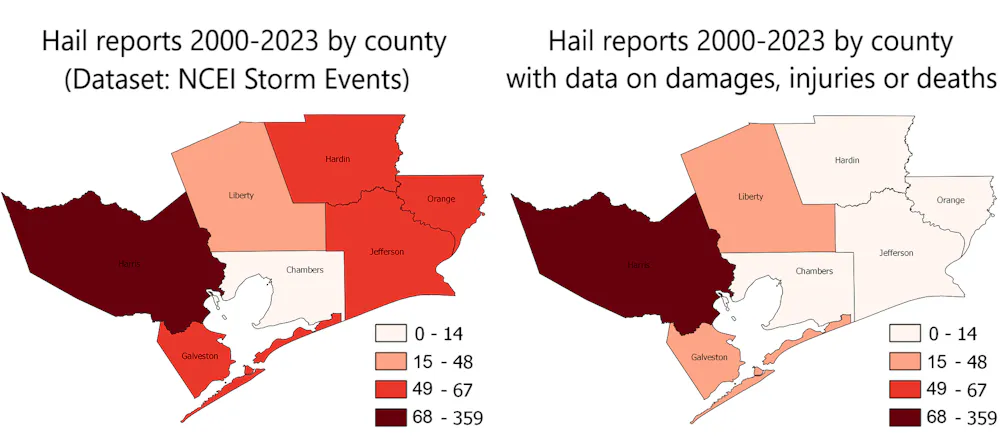
    If the damage estimates from hailstorms are consistently lower in one county than the next, potential property buyers might think it’s because there’s less risk of hailstorms. Instead, it might just be because different people are making the estimates.

    Hail damage in Dallas in June 2012.
    Rondo Estrello/Flickr, CC BY-SA

    We are atmospheric scientists at Texas A&M University who lead the Office of the Texas State Climatologist. Through our involvement in state-level planning for weather-related disasters, we have seen county-scale patterns of storm damage over the past 20 years that just didn’t make sense. So, we decided to dig deeper.

    We looked at storm event reports for a mix of seven urban and rural counties in southeast Texas, with populations ranging from 50,000 to 5 million. We included all reported types of extreme weather. We also talked with people from the two National Weather Service offices that cover the area.

    Storm damage investigations vary widely

    Typically, two specific types of extreme weather receive special attention.

    After a tornado, the National Weather Service conducts an on-site damage survey, examining its track and destruction. That survey forms the basis for the official estimate of a tornado’s strength on the enhanced Fujita scale. Weather Service staff are able to make decent damage cost estimates from knowledge of home values in the area.

    They also investigate flash flood damage in detail, and loss information is available from the National Flood Insurance Program, the main source of flood insurance for U.S. homes.

    Tornadoes in May 2025 destroyed homes in communities in several states, including London, Ky.
    AP Photo/Timothy D. Easley

    Most other losses from extreme weather are privately insured, if they’re insured at all.

    Insured loss information is collected by reinsurance companies – the companies that insure the insurance companies – and gets tabulated for major events. Insurance companies use their own detailed information to try to make better decisions on rates than their competitors do, so event-based loss data by county from insurance companies isn’t readily available.

    Losing billion-dollar disaster data

    There’s one big window into how disaster damage has changed over the years in the U.S.

    The National Oceanic and Atmospheric Administration, or NOAA, compiled information for major disasters, including insured losses by state. Bulk data won’t tell communities or counties about their specific risk, but it enabled NOAA to calculate overall damage estimates, which it released as its billion-dollar disasters list.

    From that program, we know that the number and cost of billion-dollar disasters in the United States has increased dramatically in recent years. News articles and even scientific papers often point to climate change as the primary culprit, but a much larger driver has been the increasing number and value of buildings and other types of infrastructure, particularly along hurricane-prone coasts.

    Critics in the past year called for more transparency and vetting of the procedures used to estimate billion-dollar disasters. But that’s not going to happen, because NOAA in May 2025 stopped making billion-dollar disaster estimates and retired its user interface.

    Previous estimates can still be retrieved from NOAA’s online data archive, but by shutting down that program, the window into current and future disaster losses and insurance claims is now closed.

    Emergency managers at the county level also make local damage estimates, but the resources they have available vary widely. They may estimate damages only when the total might be large enough to trigger a disaster declaration that makes relief funds available from the federal government.

    Patching together very rough estimates

    Without insurance data or county estimates, the local offices of the National Weather Service are on their own to estimate losses.

    There is no standard operating procedure that every office must follow. One office might choose to simply not provide damage estimates for any hailstorms because the staff doesn’t see how it could come up with accurate values. Others may make estimates, but with varying methods.

    The result is a patchwork of damage estimates. Accurate values are more likely for rare events that cause extensive damage. Loss estimates from more frequent events that don’t reach a high damage threshold are generally far less reliable.

    The number of severe hail reports in southeast Texas listed in the National Centers for Environmental Information’s storm events database is strongly correlated with population. The county with the most reports and greatest detail in those reports is home to Houston. Hailstorms in the three easternmost counties are rarely associated with damage estimates.
    John Nielsen-Gammon and B.J. Baule

    Do you want to look at local damage trends? Forget about it. For most extreme weather events, estimation methods vary over time and are not documented.

    Do you want to direct funding to help communities improve resilience to natural disasters where the need is greatest? Forget about it. The places experiencing the largest per capita damages depend not just on actual damages but on the different practices of local National Weather Service offices.

    Are you moving to a location that might be vulnerable to extreme weather? Companies are starting to provide localized risk estimates through real estate websites, but the algorithms tend to be proprietary, and there’s no independent validation.

    4 steps to improve disaster data

    We believe a few fixes could make NOAA’s storm events database and the corresponding values in the larger SHELDUS database, managed by Arizona State University, more reliable. Both databases include county-level disasters and loss estimates for some of those disasters.

    First, the National Weather Service could develop standard procedures for local offices for estimating disaster damages.

    Second, additional state support could encourage local emergency managers to make concrete damage estimates from individual events and share them with the National Weather Service. The local emergency manager generally knows the extent of damage much better than a forecaster sitting in an office a few counties away.

    Third, state or federal governments and insurance companies can agree to make public the aggregate loss information at the county level or other scale that doesn’t jeopardize the privacy of their policyholders. If all companies provide this data, there is no competitive disadvantage for doing so.

    Fourth, NOAA could create a small “tiger team” of damage specialists to make well-informed, consistent damage estimates of larger events and train local offices on how to handle the smaller stuff.

    With these processes in place, the U.S. wouldn’t need a billion-dollar disasters program anymore. We’d have reliable information on all the disasters.

    John Nielsen-Gammon receives funding from the National Oceanic and Atmospheric Administration and the State of Texas.

    William Baule receives funding from NOAA, the State of Texas, & the Austin Community Foundation.

    ref. Extreme weather’s true damage cost is a mystery – that’s a problem for understanding storm risk – https://theconversation.com/extreme-weathers-true-damage-cost-is-a-mystery-thats-a-problem-for-understanding-storm-risk-257105

    MIL OSI – Global Reports

  • MIL-OSI Global: New start date for the Anthropocene proposed – when humans first changed global methane levels

    Source: The Conversation – UK – By Vincent Gauci, Professorial Fellow, School of Geography, Earth and Environmental Sciences, University of Birmingham

    Robsonphoto/Shutterstock

    Humans have been reshaping the environment for at least 10,000 years. But the Anthropocene is the name given to the specific period of Earth history during which humans have had a global effect on the planet’s climate and ecosystems. Despite formal rejection as a geological epoch, it’s widely understood within academic research as useful shorthand for the age of human interference in the Earth system.

    Various dates have been proposed for when the anthropocene effectively began, from the early 17th century to the mid-20th century, when the first atomic weapons were detonated. My new research into atmospheric methane concentration supports the idea of an early date, when European arrival in the Americas first had a notable impact on the atmosphere, but slightly before previous estimates.

    Ice cores – cylinders of ice drilled from glaciers and ice sheets – provide important evidence of historical changes in the global atmospheric composition. It is from these records that a date for the Anthropocene’s pre-industrial beginnings was first proposed in 2015 by two Earth systems scientists at the University College London, Simon Lewis and Mark Maslin.

    They suggested that an unprecedented drop in the level of CO₂ in the atmosphere that was recorded in ice cores – known as the “Orbis spike” – dates back to 1610. This unusually low level reflects additional atmospheric CO₂ absorption into trees from forest regrowth in the Americas following European arrival in the late 1400s.


    Get your news from actual experts, straight to your inbox. Sign up to our daily newsletter to receive all The Conversation UK’s latest coverage of news and research, from politics and business to the arts and sciences.


    From European arrival in 1492 and colonisation in the 1500s, the introduction of disease, mostly smallpox, resulted in demographic collapse of around 50 million people across the Americas. Lewis and Maslin proposed that, as millions of hectares of farmland went untended, forests could regrow and this increased CO₂ removal from the atmosphere.

    This happened in sufficient quantities to be recorded in glacial ice. And that change became a global marker for the start of the so-called Anthropocene.


    Read more:
    Why the Anthropocene began with European colonisation, mass slavery and the ‘great dying’ of the 16th century


    My own research into changing methane concentrations indicates that the Anthropocene began slightly earlier than that, in 1592. Ice core records show a minimum atmospheric methane concentration exactly 100 years after explorer Christopher Columbus first set foot in the Americas. This, I believe, strengthens support for the hypothesis put forward by Lewis and Maslin a decade ago.

    In a paper published in Nature Reviews, Earth and Environment, I consider the effects of global fluctuations in how trees and forests exchange methane. Methane is a greenhouse gas that is around 80 times more powerful than carbon dioxide over a 20-year period. Crucially, methane has a short lifetime of just under ten years, so any ice core record will be far more responsive to changes to the methane cycle than that of longer-lived CO₂.


    Read more:
    Methane is pitched as a climate villain – could changing how we think about it make it a saviour?


    Trees are a methane sink

    So what’s the link to trees? Trees and their woody bark surfaces, despite their biologically inert appearance when compared to leaves, are important interfaces of methane exchange. In swamps and forested floodplains like the Amazon, they are exit points of methane to the atmosphere from the saturated soils where the methane is formed by anaerobic soil microbes.

    However, last year, my team uncovered how the more extensive areas of forest growing on free-draining soils interact with atmospheric methane. The trees host microbes that directly remove methane from the atmosphere.

    This is one of two mechanisms that, together, might explain an unprecedented drop in atmospheric methane concentrations recorded in Antarctic ice cores in the first century following European arrival in the Americas. This would support Lewis and Maslin’s idea that regrowing forests in that period had global effects.

    With more trees growing on abandoned farmland, there was more woody tree surface area in contact with the atmosphere. This meant more methane being taken up by the microbes they host.

    Measuring methane uptake of trees.
    Vincent Gauci, CC BY-NC-ND

    The second mechanism relates to how trees intercept incoming rainfall. Some rainfall is re-evaporated before reaching the soil. Any rain reaching the soil may then be taken up by tree roots and released back to the atmosphere. The rest moves into the soil or washes off into rivers and wetlands.

    It is possible that the spike in forest regrowth led to more evaporation and transpiration. So more water was released by the trees back to the atmosphere and less washed off over the soil surface.

    This limited water flowing into wetlands. Those wetlands are a major methane source. So a small shrinkage in wetland area, combined with more trees absorbing atmospheric methane, could have reduced the atmospheric methane concentration and explain the minimum methane levels observed in 1592.

    When exactly the Anthropocene began may be an argument that has been overtaken by the decision to not label it a new epoch. Indeed, it’s possible that forest clearance for early agriculture by humans around 5,000-8,000 years ago in the mid-Holocene, (a period of relative climate stability in the Neolithic period) contributed to the atmospheric methane increase observed in Antarctic ice from that time.

    As well as an ancient trace of human influence over our forests, the ice core methane records provide a chance to evaluate newly discovered processes operating in the world’s forests. This is something I’m now investigating with my colleague Peter Hopcroft, a palaeoclimate modeller at the University of Birmingham.

    Whether through forest clearances for early agriculture or through the effects on forests of massive depopulation of Indigenous peoples following European contact, these traces of our past influence point to something significant: that there has always been an intimate and evolving connection between humanity and the natural world. A connection so fundamental that, for the vast span of our existence as a species, we have been inseparable from nature itself.


    Don’t have time to read about climate change as much as you’d like?

    Get a weekly roundup in your inbox instead. Every Wednesday, The Conversation’s environment editor writes Imagine, a short email that goes a little deeper into just one climate issue. Join the 45,000+ readers who’ve subscribed so far.


    Vincent Gauci receives funding from or has received funding from the Natural Environment Research Council, The Royal Society, Spark Climate Solutions, AXA Research Fund, Defra and the JABBS Foundation.

    ref. New start date for the Anthropocene proposed – when humans first changed global methane levels – https://theconversation.com/new-start-date-for-the-anthropocene-proposed-when-humans-first-changed-global-methane-levels-258834

    MIL OSI – Global Reports

  • MIL-OSI Global: Britain’s plan for defence AI risks the ethical and legal integrity of the military

    Source: The Conversation – UK – By Elke Schwarz, Professor of Political Theory, Queen Mary University of London

    Autonomous technology on the battlefield may not look like ‘killer robots’, but still has huge ethical implications. TSViPhoto/Shutterstock

    In an unstable geopolitical climate, the UK’s strategic defence review focused on improving national resilience, from critical infrastructure security to technology and innovation. Many of the review’s recommendations have to do with transforming defence through artificial intelligence (AI) and autonomy, to make the armed forces “ten times more lethal”.

    These recommendations and investments – drones, autonomous systems and £1 billion for a “digital targeting web” that would connect weapons systems – may well make the armed forces more lethal. But this comes at a risk to the ethical and legal integrity of the military.

    A key part of international humanitarian law is the principle of precautions in attack. This requires that those planning an attack must do everything they feasibly can to ensure that targets are of a military nature. Similar is the principle of distinction, which mandates that civilians must never become a target.

    In armed conflict, these principles are meant to protect civilians. They require human judgement — the ability to weigh up context, intent and likely outcomes. But how might they be upheld when humans are embedded in AI systems, which prioritise speed and scale in decision-making and action?


    Get your news from actual experts, straight to your inbox. Sign up to our daily newsletter to receive all The Conversation UK’s latest coverage of news and research, from politics and business to the arts and sciences.


    An AI-enabled digital targeting web, like the one proposed in the strategic review, connects information (sensors) and action (weapons), enabling faster identification and elimination of potential targets. These webs would be able to identify and suggest possible targets considerably faster than humans. In many cases, leaving soldiers with only a few minutes, or indeed seconds, to decide whether these targets are appropriate or legitimate in legal or ethical terms.

    One example already in use is the Maven Smart System, which was recently procured by Nato. This system could make it possible for small army teams to make up to “1,000 tactical decisions an hour”, according to a report by the US thinktank the Center for Security and Emerging Technology.

    Legal scholars have argued that the prioritisation of speed with AI in conflict “leaves little room for human judgement” or restraint.

    Unlike other technologies used in war, AI is more than an instrument. It is part of a cognitive system of humans and machines, which makes human control a lot more complicated than operating a fleet of tanks.

    Proponents of autonomous weapons and AI targeting systems often argue that this technology would make warfare more precise, dispassionate and humane. However, military ethics scholar Neil Renic and I have shown how it can instead lead to an erosion of moral restraint, creating a war environment where technological processes replace moral reasoning.


    Read more:
    Silicon Valley’s bet on AI defence startups and what it means for the future of war – podcast


    Training the data

    The strategic defence review lauds autonomy as providing “greater accuracy”, but this is complicated by technical and human limitations. Instead of providing greater accuracy in targeting, AI-enabled systems threaten to undermine the principle of distinction and precaution.

    AI systems also bear technical challenges for something as complex and dynamic as warfare. AI-supported systems are only as good as the data on which they are trained. Appropriate, comprehensive and up-to-date data is hard to come by in conflict, and dynamics can change quickly.

    This is particularly true in urban conflicts. Understanding the complexities of a situation on the ground is difficult enough for human military personnel, without bringing in AI.

    New AI models, in particular, bear risks. AI large language models are known to “hallucinate” – produce outputs that are erroneous or made up. As these systems are integrated into defence, the risks of technological failure become more pronounced.

    AI could significantly speed up targeting technology.
    Yuri A/Shutterstock

    There is also a considerable risk of this technology enabling uncontrolled escalation and conflict at speed – what scholars have described as a “flash war”. Escalation from crisis to war, or escalating a conflict to a higher level of violence, could come about due to erroneous indications of attack, or a simple sensor or computer error.

    Consider an AI system alerting commanders of a hostile tank approaching a border area. With potentially only minutes to spare, time for verification of the incoming information is sparse. Commanders may “prioritise rapid response over thorough analysis”. If the tank turns out to be a school bus, this response could have further retaliatory consequences.

    Unpredictable systems could also give leaders false impressions of their capabilities, leading to overconfidence or encouraging preemptive attacks. This all may lead to greater global instability and insecurity.

    Responsible AI

    The UK government has shown that it is aware of some of these risks. Its 2022 report on responsible AI in defence emphasised ethics in the use of AI. It specified that the deployment “of AI-enabled capabilities in armed conflict needs to comply fully with [international humanitarian law]”, including the principles of distinction, necessity, humanity and proportionality.

    The report also notes that responsible and ethical use of AI systems requires reliability and human understanding of the AI system and its decisions.

    The strategic defence review, on the other hand, notes that the speed with which technologies develop is outpacing regulatory frameworks. It says that “the UK’s competitors are unlikely to adhere to common ethical standards in developing or using them”.

    This might be so, but it should not open the door to a less ethical and responsible development or use of such systems by the UK. Ethics is not only about how we treat others, but also about who we are.

    The UK still has an opportunity to shape global norms around military AI — before a generation of unaccountable systems becomes the default. But that window for action is closing rapidly.

    Elke Schwarz is affiliated with the International Committtee for Robot Arms Control (ICRAC)

    ref. Britain’s plan for defence AI risks the ethical and legal integrity of the military – https://theconversation.com/britains-plan-for-defence-ai-risks-the-ethical-and-legal-integrity-of-the-military-258149

    MIL OSI – Global Reports

  • MIL-OSI Global: Iran air strikes: Republicans split over support for Trump and another ‘foreign war’

    Source: The Conversation – UK – By Richard Hargy, Visiting Research Fellow in International Studies, Queen’s University Belfast

    After returning early from the G7 summit in Canada, Donald Trump met with his national security team to be briefed on the escalating Israel-Iran conflict. It became clear that Trump was considering direct US military support for the Israelis.

    This has the potential to cause a split among the president’s supporters between the Republican hawks (traditional interventionists) on one side and the Maga isolationists on the other.

    During his three presidential campaigns, Trump condemned former presidents for leading America into “ridiculous endless wars”. This isolationist tilt won him plaudits with his base of those who supported him for his populist promises to “make America great again” (Maga).

    In their work on US attitudes to foreign policy and US overseas involvement, Elaine Kamarck and Jordan Muchnick of the Brookings Institution – a non-profit research organisation in Washington – looked at a range of evidence in 2023.


    Get your news from actual experts, straight to your inbox. Sign up to our daily newsletter to receive all The Conversation UK’s latest coverage of news and research, from politics and business to the arts and sciences.


    They found Republicans supporting less global involvement from the US had increased from 40% to 54% from 2004 to 2017. At that time only 16% of voters supported increasing US troop presence abroad, and 40% wanted a decrease, they found. They related this change in attitudes to Trump’s foreign policy position.

    Fast forward to his second term, and many in the Maga camp are fiercely opposed to Trump’s current posturing about leading the US into another conflict in the Middle East. Over the past few days the White House has doubled down on the line that Trump keeps repeating: “Iran can not have a nuclear weapon”.

    As Trump edges closer to committing the US to joining Israel in air strikes on Iran, Steve Bannon, a staunch Trump ally, argued that allowing the “deep state” to drive the US into conflict with Iran would “blow up” the coalition of Trump support.

    Meanwhile, Conservative podcaster Tucker Carlson denounced those Republicans supporting action against Iran as “warmongers” and said they were encouraging the president to drag the US into a war.

    Congresswoman Majorie Taylor Greene, in an unusual break with Trump, openly criticised the president’s stance on the Israel-Iran conflict, writing on X: “Foreign wars/intervention/regime change put America last, kill innocent people, are making us broke, and will ultimately lead to our destruction.”

    Other prominent Republican senators, including Josh Hawley and Rand Paul, have urged the president to avoid US involvement in an offensive against Iran.

    Another Republican congressman, Thomas Massie, has gone even further. He has joined with a coalition of Democrats in filing a House resolution under the War Powers Resolution of 1973, which would seek to prevent Trump from engaging in “unauthorized hostilities” with Iran without Congressional consent.

    These Republicans may believe their views are popular with their electoral base. In an Economist/YouGov poll in June 2025, 53% of Republicans stated that they did not think the US military should get involved in the conflict between Israel and Iran.

    But Donald Trump does seem to enjoy widespread support in the US for his position that the US cannot allow Iran to develop a nuclear weapon. According to CNN data analysis, 83% of Republicans, 79% independents, and 79% of Democrats, agree with the president’s position on this issue. This slightly confusing split suggests there could be US voter support for air strikes, but it’s clear there would not be that same support for troops on the ground.

    Resistance from ultra-Trump die-hards, however, might put them on the wrong side of the president in the long-term. Greg Sargent, a writer at The New Republic magazine, believes that, “people become enemies of Trump not when they substantively work against some principle he supposedly holds dear, but rather when they publicly criticize him … or become an inconvenience in any way”.

    So why is Trump, to the dismay of many from within the Maga faithful, seemingly abandoning the anti-war tenet of his “America first” doctrine? Jacob Heilbrunn, editor of The National Interest magazine, thinks that “now that Israel’s assault on Iran appears to be successful, Trump wants in on the action”.

    The president has several prominent Republican hawks urging him to do exactly that, and order the US Air Force to deploy their “bunker-buster bombs”“ to destroy Iran’s underground arsenals. One of these is Senator Lindsey Graham.

    Earlier this week on Fox News, he told Trump to be “all in … in helping Israel eliminate the nuclear threat. If we need to provide bombs to Israel, provide bombs. If we need to fly planes with Israel, do joint operations.”

    Former Republican Senate leader Mitch McConnell is also advocating US military action. He told CNN: “What’s happening here is some of the isolationist movement led by Tucker Carlson and Steve Bannon are distressed we may be helping the Israelis defeat the Iranians,” adding that its “been kind of a bad week for the isolationists” in the party.

    Donald Trump talks about potential involvement in air strikes.

    The same Economist/YouGov poll mentioned earlier showed that the stance taken by these Republicans – that Iran poses a threat to the US – is a position shared by a majority of GOP voters, with 69% viewing Iran as either an immediate and serious threat to the US, or at least somewhat of a serious threat.

    Always an interventionist?

    Some believe that Trump’s evolving attitude towards American military involvement in the worsening crisis in the Middle East, however, is not a volte-face on isolationism, or an ideological pivot to the virtues of attacking Iran. Ross Douthat of the New York Times has observed that Trump “has never been a principled noninterventionist” and that “his deal-making style has always involved the threat of force as a crucial bargaining chip”.

    It is always difficult to fully determine what Trump’s foreign policy doctrine actually is. It is useful, however, to reflect on some of the president’s overseas actions from his first term.

    In April 2018, following a suspected chemical weapons attack by the forces of Syrian president Bashar al-Assad in a Damascus suburb, Trump ordered US air strikes in retaliation for what he called an “evil and despicable attack” that left “mothers and fathers, infants and children thrashing in pain and gasping for air”.

    This led the editor-in-chief of The Atlantic magazine, Jeffrey Goldberg, to describe Trump as “something wholly unique in the history of the presidency: an isolationist interventionist”.

    Richard Hargy does not work for, consult, own shares in or receive funding from any company or organisation that would benefit from this article, and has disclosed no relevant affiliations beyond their academic appointment.

    ref. Iran air strikes: Republicans split over support for Trump and another ‘foreign war’ – https://theconversation.com/iran-air-strikes-republicans-split-over-support-for-trump-and-another-foreign-war-259314

    MIL OSI – Global Reports

  • MIL-OSI Global: Could trees know when the summer solstice is?

    Source: The Conversation – UK – By Andrew Hacket-Pain, Senior Lecturer, School of Environmental Sciences, University of Liverpool

    cashcashcash/Shutterstock

    People have been celebrating the summer solstice with elaborate rituals since prehistoric times. But humans aren’t the only species to take mark June 21 as a special time. Studies are showing the summer solstice is an important cue for plants too.

    Recent studies, including one of my own, have proposed that trees may use the longest day of the year as a key marker for their growth and reproductive cycles. The solstice seems to act like a calendar reminder for trees.


    Many people think of plants as nice-looking greens. Essential for clean air, yes, but simple organisms. A step change in research is shaking up the way scientists think about plants: they are far more complex and more like us than you might imagine. This blossoming field of science is too delightful to do it justice in one or two stories.

    This story is part of a series, Plant Curious, exploring scientific studies that challenge the way you view plantlife.


    For example, at the solstice, trees growing in cold places slow down the creation of new wood cells and focus their energy on finishing already formed but still incomplete cells. This ensures trees have time to complete cell construction before winter hits. Incomplete cells are damaged by freezing winter temperatures, rendering them useless for water transport the following year.

    Along similar lines, trees use the solstice to fine-tune the “winding down”, or senescence, of their leaves in preparation for autumn. Senescence allows the tree to reabsorb critical nutrients from the leaves before they fall. This process is timed to balance missing out on sunlight from “winding down” too early, against leaving it too late and losing nutrients if still-green leaves are killed by autumn frosts.

    Stonehenge has been part of summer solstice celebrations since ancient times.
    Ria Sh/Shutterstock

    Satellite observations of forests, and controlled experiments in greenhouses, reveal that warmer temperatures immediately prior to the solstice cause the onset of leaf browning to start earlier that autumn. In contrast, warmer temperatures just after the solstice slow down the senescence process.

    This means a longer transition period from green to fully brown leaves. This fine-tuning enables trees to extend the period of photosynthesis in years when temperatures stay warmer for longer, so they don’t miss out on these favourable conditions.

    But not all scientists is convinced. From an evolutionary perspective, the solstice may not be the best seasonal marker for timing these transitions. For example, in forests in the far north, leaves do not appear until early June, only days before the solstice, and the growing season can extend late into October. In these forests, using the solstice to initiate the winding down process makes little sense for trees that have only just started growing for the year.

    Nevertheless, there is more consensus about plants using the solstice to synchronise reproduction.

    In many plants, especially trees from the temperate mid-latitudes, the number of seeds they produce varies dramatically year on year, known as masting. A large European beech tree can produce hundreds of thousands of seeds in a bumper year (a “mast event”) and forgo reproduction altogether in other years.

    Beech trees vary their annual seed production in step, often on a continental scale. They do this to increase the efficiency of their reproduction.

    Beech trees coordinate their reproduction.
    Gabriele Rohde/Shutterstock

    A small moth, Cydia fagiglandana, lays its eggs in beech flowers. When the grubs hatch, they eat and destroy the developing seeds. Cycles of famine and bumper years help protect their seeds from these moths.

    UK beech trees typically lose less than 5% of their seeds to Cydia because the cycles starve the moths into low numbers ready for masting years. But when trees are out of sync, seed loss can increase to over 40%.

    For decades we have known that beech mast events happen in the year after a warm summer. These warmer temperatures trigger an increase in the formation of flower buds. More flower buds usually lead to a greater crop of seeds that autumn.

    Scientists have long puzzled over how beech trees across Europe seem to use the same seasonal window to control mast events. Their seed production is determined by temperatures in late June and early July, irrespective of where they grow in Europe. But how can a beech tree know the date?

    In my team’s 2024 study, we showed that they use the solstice as a seasonal marker. As soon as the days start to shorten after the solstice, beech trees across Europe seem to simultaneously sense the temperature.

    Anywhere temperatures are above average in the weeks following the solstice can expect to have a mast event the next year. Weather conditions in the weeks before the solstice, by contrast, seem to be irrelevant. As seen on weather maps, warm and cool spells tend to occur simultaneously over large areas.

    This allows beech trees to maximise the synchrony of their reproduction, whether that is investing in a mast year (warm temperatures), or forgoing reproduction for a year (low temperatures). Using a fixed marker like the solstice is the key to achieving this synchrony, and the benefits that come from it.

    Note how bumper seed crops and failures tend to be regionally synchronised, and occasionally occur as pan-European events.
    Andrew Hacket Pain, CC BY-NC-ND

    The evidence for this phenomenon has come from observations across dozens of forests across Europe. However, my research group is collaborating with about a dozen other groups in Europe to test this effect by manipulating the temperature of beech branches before and after the solstice at different sites. Ongoing research I am involved with seems to show flowering genes are activated at the summer solstice.

    Also, studies into the circadian rhythms of plants show they have mechanisms in their molecules that allow them to detect and respond to tiny changes in day length. This is the basis for that extraordinary scale of synchronised reproduction.

    If the weather is warm over the next month or so, then there is a good chance that beech trees in your local area will have heavy seed crops next autumn. What’s more, trees across the UK and into northern and central Europe will probably be doing the same.

    Andrew Hacket-Pain has received funding from UKRI, Defra and the British Council.

    ref. Could trees know when the summer solstice is? – https://theconversation.com/could-trees-know-when-the-summer-solstice-is-259309

    MIL OSI – Global Reports

  • MIL-OSI Russia: Secular gossip from 200 years ago. Who is the subject of the exhibition “Gossip” at the Tropinin Museum

    Translation. Region: Russian Federal

    Source: Moscow Government – Government of Moscow –

    The chamber exhibition “Gossip. What Muscovites talked about 200 years ago” is dedicated to the citizens of the first half of the 19th century, their everyday life and conversations. Moscow of that time was very different from today, representing a mixture of urban development, gardens, vegetable gardens and estates. In the crowded and diverse city one could find both European sophistication and the simplicity dear to the Russian heart. This was the Moscow of Pushkin, Griboyedov and Tropinin.

    Especially for “Moscow Culture”, the exhibition curator Ekaterina Arkhipova conducted a tour and shared the stories of the heroes.

    Prologue

    What did they talk about in the English Club, the Noble Assembly, the Bolshoi Theatre and the drawing rooms? These places served as centres of social life and exchange of opinions. Here they discussed the latest events, literary novelties and, most importantly, personal stories. Aristocrats, military men, artists and writers, adventurers, gamblers, duelists and just eccentrics – who were they, the heroes of the society columns, whose lives occupied the attention of Muscovites at the end of the 18th – first half of the 19th century?

    Monk Pimen – Dmitry Blagovo

    Belonging to an ancient noble family, Dmitry Blagovo, a man of unusual destiny, lived through the reign of four emperors: Nicholas I, Alexander II, Alexander III and Nicholas II. Having lost his father early, he remained in the care of his grandmother Elizaveta Yankova, née Rimskaya-Korsakova, who gave him an excellent home education.

    Dmitry Dmitrievich moved in high society, was a regular at the salon of the famous poetess Evdokia Petrovna Rostopchina. He was going to marry one of her daughters, Lydia, but literally on the eve of the wedding, to everyone’s amazement, he married 18-year-old Nina Uslar, a girl from the family of a Russified German professor. All of Moscow was gossiping about this event. Lydia Rostopchina was inconsolable and never married again.

    After several years of a cloudless family life, misfortunes rained down on Blagovo. First, in 1861, his little son and heir died, and in the same year, his beloved grandmother passed away. A year later, his wife fell in love with another man and left her husband with their daughter, and soon Dmitry Dmitrievich’s mother died. All these events shocked Blagovo so much that he decided to do something that shocked secular Moscow no less than his marriage had done: he gave his wife a document in which he took all the blame on himself, so that she could divorce him and remarry (however, the Holy Synod allowed the dissolution of the marriage only after 20 years). Blagovo retired to the Nikolo-Ugreshsky Monastery near Moscow as a novice, which again shocked the Moscow and St. Petersburg aristocracy. In 1880, he transferred to the Tolga Monastery and took monastic vows under the name Pimen. Four years later, he was elevated to the rank of archimandrite and appointed rector of the Russian Embassy Church of St. Nicholas the Wonderworker in Rome. He served there until his death in 1897.

    Poor Lisa

    The story of the main character of Nikolai Karamzin’s sentimental tale is usually considered fictional, but poor Liza’s contemporaries, the then residents of Moscow, perceived her as a real person. The tale was read by very different women – from refined aristocrats to poor bourgeois women.

    Karamzin’s Liza lived near the Simonov Monastery, which at that time was not within the city limits. The place was very secluded. But after the publication of the story in 1792 and its resounding success, the pond near the monastery began to be called Liza’s. Secular pilgrimages began to be made to it, dates began to be arranged near it, and numerous inscriptions appeared on the trees around it. One of the most famous reads: “Here Erastov’s bride threw herself into the pond. Drown yourself, girls: there is enough room in the pond!” The area around was also given the girl’s name, Liza’s Slobodka, Liza’s Street and Liza’s Dead End appeared. Kiprensky painted her famous portrait as if he really knew her. Poor Liza was on the lips of Muscovites for many years – so the story became not just a literary event, but also a cultural and social phenomenon, and its heroine moved from the pages of the book into real life. Now on this site there is a modern residential complex with a park and a pond, which immediately received the popular name Lizin Pond – in honor of the old “literary” pond.

    American – Count Fyodor Tolstoy

    Another incredible personality is Count Fyodor Ivanovich Tolstoy, nicknamed the American, Leo Tolstoy’s cousin. He was a living legend not only of old Moscow, but of all Russian literature of the 19th century. In Alexander Griboyedov’s comedy Woe from Wit, the high society public easily recognized the extravagant count in the “night robber and duelist” who returned from Kamchatka as an Aleut.

    His life was full of jokes and adventures. A desperate gambler and even a sharper, a womanizer, a brawler and a duelist, he was always distinguished by excellent health and endurance, but at the same time by a tendency to violence, fights and recklessness. The desire for adventure prompted Fyodor Ivanovich to take part in a round-the-world voyage on the sloop Nadezhda in 1803 under the command of Captain-Lieutenant Ivan Fyodorovich Kruzenshtern. This was the first round-the-world voyage under the Russian flag. On board, Tolstoy behaved defiantly: he provoked quarrels, threw parties with card games, and in one of the ports he bought a tame monkey and taught it various tricks, which caused him to seriously quarrel with the commander of the expedition. He was forced to arrest his subordinate several times and eventually landed the uncontrollable Tolstoy on Kamchatka. From there, the Count reached the Aleutian Islands, where he spent several months among the natives. At that time, he decorated himself with numerous tattoos, which he later proudly showed off. Upon returning from the trip, he received his nickname.

    The affairs of the heart of Tolstoy the American were also unusual. Despite numerous affairs with socialite ladies, he married a simple gypsy – a camp singer Avdotya Tugaeva. The family had 12 children, 10 of whom died in infancy. Every time one of the children died, Tolstoy put a note in his diary “quits”, believing that God punished him with the death of his children for each of the 11 people he killed in duels. The greatest blow to him was the death of his beloved daughter Sarah. The girl was incredibly beautiful and talented, but did not live to see 18. Fyodor Ivanovich spent most of his last years in Moscow, living alone with his daughter Praskovia, the only surviving of all his children. In old age, he became devout and prayed a lot, atoning for the sins of his youth.

    “Moscow Grannies” – Opinion Leaders

    Some of the most colorful figures in Griboyedov’s Moscow, whose opinions were highly respected in the first half of the 19th century, were, as Alexander Pushkin called them, “Moscow grandmothers.” Probably the most famous, authoritative and eccentric of them was Nastasya Dmitrievna Ofrosimova. A lady of iron character and iron will, she had an incredible gift of persuasion, knew everything about everyone, expressed herself with sharp directness and belonged to the type of people who endlessly give value judgments, numerous pieces of advice and always know how to do the right thing. This “grandmother” had a colossal influence in society. In fact, she ruled it, in some ways even decided destinies. Mothers of noble families introduced their daughters to her and asked for her blessing and assistance in society for them.

    Contemporaries described her as a very rude old woman of masculine build, tall, with a stern dark face, black eyes and even a moustache. The general’s wife Nastasya Dmitrievna was herself a general in a skirt both in her own home and in all of Moscow. Evil tongues claimed that she personally “kidnapped” her husband from his house in order to get married. Despite numerous jokes, everyone without exception respected her and trembled before her. She became the prototype of two minor literary characters. Griboyedov presented Nastasya Dmitrievna in the image of the quarrelsome old woman Anfisa Nilovna Khlestova, the sister of Famusov’s late wife. And Leo Tolstoy in “War and Peace” depicted her almost under her real name – as Maria Dmitrievna Akhrosimova, an imperious and straightforward, but fair Moscow lady and godmother of Natasha Rostova.

    Love and Death on the Battlefield. Margarita Naryshkina and Alexander Tuchkov

    A poignant romantic story is connected with the youngest of the five Tuchkov brothers, Alexander Alexeevich. When they met Margarita Naryshkina, she was married to a certain Pavel Lasunsky, a despot and tyrant who abused his wife in every possible way. Once he brought her to a nervous breakdown, after which the Naryshkin family obtained a divorce for their daughter in the Holy Synod. Having met the handsome officer Alexander Tuchkov, Margarita fell in love at first sight. Having learned about the divorce, he proposed, but her parents were afraid of another unsuccessful marriage. Only several years later did they manage to get married.

    Margarita loved her chosen one so much that, probably sensing the imminent tragedy, she obtained the monarch’s permission to be with her husband in the active army. During the Battle of Borodino, he was mortally wounded, and they couldn’t even carry him off the battlefield. Alexander Tuchkov’s body was never found, although Margarita personally searched for it. Later, at her own expense, she built the Church of the Savior Not Made by Hands on the site of her husband’s presumed death. Soon their little son died, after which Tuchkova took monastic vows and in 1840 became the abbess of the Spaso-Borodino Monastery. This romantic story struck the young Marina Tsvetaeva at the time, and she wrote the famous poem “To the Generals of the Twelfth Year”, which became a popular romance at the end of the 20th century.

    Epilogue

    Although Moscow was different and time was slower, without television and the Internet, people, their customs and passion for gossip remain very similar after centuries. You can easily see this by coming toexcursion on the exhibition “Gossip. What Muscovites talked about 200 years ago.” Tickets to the V.A. Tropinin Museum and Moscow artists of his time can be purchased at mos.ru.

    Get the latest news quicklythe city’s official telegram channel Moscow.

    Please note: This information is raw content directly from the source of the information. It is exactly what the source states and does not reflect the position of MIL-OSI or its clients.

    Please Note; This Information is Raw Content Directly from the Information Source. It is access to What the Source Is Stating and Does Not Reflect

    https: //vv.mos.ru/nevs/ite/155463073/

    MIL OSI Russia News

  • MIL-OSI Russia: Since the start of the renovation program, about six million square meters of housing have been built in the capital

    Translation. Region: Russian Federal

    Source: Moscow Government – Government of Moscow –

    Since the start of the renovation program, about six million square meters of housing have been built in the capital. This was announced at the XXVIII St. Petersburg International Economic Forum by Deputy Mayor of Moscow for Urban Development Policy and Construction Vladimir Efimov.

    “In more than seven years since the renovation program began, the city has built a total of about six million square meters of housing. This volume will allow Muscovites to receive new apartments from about 1,300 old houses. New residential complexes are located in all districts of the capital. In particular, 63 houses were built in the Eastern Administrative District under the renovation program, 56 in the South-Eastern District, and 55 new buildings in the Northern District,” said Vladimir Efimov.

    For new residents, the renovation program creates a comfortable urban environment with landscaped and green courtyards.

    “Residential complexes were built in 89 districts of the capital. The leader in the number of houses built under the renovation program was Lyublino – 17 new buildings appeared there. The apartments are handed over for occupancy with a finished improved finish, so Muscovites do not have to waste time on additional repairs. The first floors in the new buildings were designed as non-residential – pharmacies, shops, leisure centers and other social and household facilities are opened there,” added the Minister of the Moscow Government, head of the capital’s Department of Urban Development Policy Vladislav Ovchinsky.

    All residential complexes under the renovation program are being built taking into account the criteria of a barrier-free environment. Wide passages in entrances, vestibules and elevator halls are located on one level, without high steps, and pedestrian passages in the courtyard are designed so that it is comfortable for both parents with strollers and people with disabilities to move around.

    Earlier, Sergei Sobyanin said that another 131 sites were included in the renovation programconstruction of houses.

    The renovation program was approved in August 2017. It concerns about a million Muscovites and provides for the resettlement of 5,176 houses. Sergei Sobyanin ordered to increase the pace of implementation of the program intwice.

    Moscow is one of the leaders among regions in terms of construction volumes. High rates of housing construction correspond to the goals and initiatives of the national project “Infrastructure for life”.

    Get the latest news quicklyofficial telegram channel the city of Moscow.

    Please note: This information is raw content directly from the source of the information. It is exactly what the source states and does not reflect the position of MIL-OSI or its clients.

    Please Note; This Information is Raw Content Directly from the Information Source. It is access to What the Source Is Stating and Does Not Reflect

    https: //vv.mos.ru/nevs/ite/155497073/

    MIL OSI Russia News

  • MIL-OSI Africa: Tanzania celebrates and honors Akinwumi Adesina’s impactful legacy as President of the African Development Bank

    Source: Africa Press Organisation – English (2) – Report:

    The Government of the United Republic of Tanzania, on 14 June, has honored the President of the African Development Bank Group (www.AfDB.org) Dr Akinwumi Adesina describing him as “a visionary leader, a tireless son of Africa who has dedicated his life to transform the narrative of the continent.”

    President Samia Suluhu Hassan praised Adesina’s vital role in the development of her country’s economy, singling out large-scale infrastructure projects financed by the Bank.

    During a two-day visit to Tanzania that began on Friday, Bank president Dr Akinwumi Adesina was invited on a tour of some of the Bank-financed infrastructure projects that are transforming Tanzania’s economy and strengthening its regional and international roles. This includes a new international airport and a major highway that encircles the administrative capital of Dodoma.

    The Tanzanian leader highlighted projects in other sectors, such as agriculture and energy, that are financed by the Bank.

    “This is in addition to the construction of a modern Standard Gauge Railway line that will link Tanzania to Burundi and the Democratic Republic of Congo,” said President Suluhu Hassan.

    The African Development Bank Group has invested $9 billion in Tanzania since it started its operations in the country in 1971. Total financial support over the last 10 years under Adesina’s leadership stands at $4.73 billion, equivalent to 53% of the Bank’s lending to Tanzania over the past 54 years.

    “On behalf of the people of Tanzania, I express our gratitude to the African Development Bank for being a dependable partner of our country’s development journey,” the Tanzanian President said.

    Referencing the Bank’s transformative impact, Tanzania’s President Samia Suluhu Hassan told Adesina, “Your visionary leadership has brought significant socio-economic change to Tanzania and across Africa.”

    To cheers from the crowd President Suluhu Hassan announced, “I have accepted a recommendation by the Ministry of Works to rename the Dodoma Outer Ring Road as the Dr Akinwumi Adesina Road.”

    Adesina, accompanied by his wife, Grace Yemisi Adesina, was visibly moved to tears.

    The newly named 112-kilometer dual carriageway is a strategic link in the Cape to Cairo continental corridor. It will decongest Tanzania’s fast-growing administrative capital and enhance regional connectivity.

    The Bank provided $138 million in funding for the project, with an additional $42 million from the Africa Growing Together Fund and $34.69 million from the Government of Tanzania.

    Earlier, Adesina surprised the crowd when he delivered a lengthy portion of his speech in Kiswahili, the national language of Tanzania, which is widely spoken in East and Central Africa. After recognizing all dignitaries in Kiswahili, he went on to thank President Suluhu Hassan for the warm and generous hospitality accorded to him, first in the City of Peace, Dar es Salaam, and in the attractive city of Dodoma.

    “Mheshimiwa Rais Samia Suluhu Hassan, ningependa kukushukuru kwa mapokezi yako ya upendo na ukarimu tuliopewa jana katika jiji la amani, Dar es Salaam na hapa pia katika jiji lenye mvuto la Dodoma. Nimefurahi sana kuwa hapa Dodoma,” Adesina said as the crowd cheered him on.

    Earlier, on Friday 13 June, Adesina was awarded a Doctor of Science Honorary Degree (Honoris Causa) from the prestigious University of Dar es Salaam.

    The citation highlighted Adesina’s leadership and “lifelong dedication to public service, evidence-based policymaking, and pan-African progress.”

    It read further: “Dr Adesina exemplifies the rare blend of academic brilliance, visionary leadership, and practical impact that honorary doctorates are meant to recognize. His emphasis on inclusive growth, innovation, and economic resilience makes him a beacon of integrity, excellence, and servant leadership.”

    The honorary degree was bestowed on Adesina by the Chancellor of the University and former President Jakaya Mrisho Kikwete, who said, “I would like to tell Tanzanians, the African Development Bank has been a major anchor of Tanzania’s development sector. When it comes to infrastructure, no institution comes close to the African Development Bank.”

    Addressing the graduating class, Adesina spoke of his humble beginnings, emphasizing resilience, character, and unity. “Success cannot be achieved alone,” he said, inviting the students to rise, link hands, and repeat together: “Together, we will succeed and make a difference.”

    In his congratulatory remarks, Finance Minister Mwigulu Nchemba said, “Tanzania is proud to stand among the nations celebrating this remarkable journey and enduring legacy.”

    From Dar es Salaam, Adesina, accompanied by former President Kikwete and Finance Minister Nchemba, took the Standard Gauge Railway train for the three-hour, 450-kilometre journey to Dodoma.

    The African Development Bank Group has established a syndication strategy to mobilize $1.2 billion in conjunction with Deutsche Bank, Société Générale, and other partners for the 651-kilometre extension of the electrified Standard Gauge Railway that will connect Tanzania to Burundi and the Democratic Republic of Congo.

    The project financing, signed during the 2024 Africa Investment Forum Market Days and includes more than $85 million from the Bank’s concessional financing window, the African Development Fund, a mix of Partial Credit Guarantees totaling $994.3 million across some sections of the railway, complemented by $247 million from the Government of Tanzania in counterpart financing. Initial disbursement from the African Development Fund and partner, the OPEC Fund, is expected by July 2025.

    Adesina said, “This railway line is a cornerstone of East Africa’s regional integration vision, aimed at delivering a modern, cost-effective, and high-capacity transport system anchored on the port of Dar es Salaam and linking landlocked nations.”

    “Our shift from traditional road systems to integrated transport solutions is helping position Tanzania as a key logistics and trade hub in the region,” he added.

    Accompanied by Adesina, President Suluhu Hassan travelled across more than 30 kilometers of the Dodoma Outer Ring Road, stopping along the way at the Bank-funded Msalato International Airport which is expected to be completed by the end of 2026. The state-of-the-art airport features a 3.6-kilometre landing strip—one of the longest in East Africa, with a capacity to accommodate Airbus A380 aircraft.

    The African Development Bank has provided over $198 million to finance the Msalato International Airport project with $23 million coming from the African Development Fund and $50 million from the African Grow Together Fund.

    – on behalf of African Development Bank Group (AfDB).

    Media contact:
    Christin Roby
    Regional Communication Officer for East Africa
    Communication and External Relations
    Email: media@afdb.org

    About the African Development Bank Group:
    The African Development Bank Group is Africa’s premier development finance institution. It comprises three distinct entities: the African Development Bank (AfDB), the African Development Fund (ADF) and the Nigeria Trust Fund (NTF). On the ground in 41 African countries with an external office in Japan, the Bank contributes to the economic development and the social progress of its 54 regional member states. For more information: www.AfDB.org

    Media files

    Download logo

    MIL OSI Africa

  • MIL-OSI Banking: Phillips 66 releases 2025 Sustainability and People Report

    Source: Phillips

    HOUSTON–(BUSINESS WIRE)– Phillips 66 (NYSE: PSX) released its 2025 Sustainability and People Report today, demonstrating the company’s approach to helping supply the world’s growing energy needs while advancing projects to reduce emissions and foster growth.
    “This report showcases our achievements in 2024 and the dedication of our employees to our transformative strategy,” said Phillips 66 Chairman and CEO Mark Lashier, “We are committed to delivering affordable, reliable energy and investing in high-return projects that reduce emissions intensity, strengthen asset reliability and provide growth opportunities. We will continue to pursue strategic investments that align with our vision of being the leading integrated downstream energy provider.”
    This year’s publication highlights the company’s 2024 sustainability performance and its approach to building a high-performing organization including:

    Reporting a 15% reduction in Scope 1 and 2 greenhouse gas (GHG) emissions intensity and an 8% reduction in Scope 3 emissions intensity compared to 2019 baseline levels.
    Expanding methane disclosures to align with shareholder feedback.
    Achieving a 38% reduction in injuries from serious incidents.
    Fostering career development through learning resources designed to meet unique employee needs.

    Phillips 66 has published annual sustainability metrics and information since the company was founded in 2012. The company is committed to providing transparent and meaningful disclosures relating to its workforce practices and sustainability initiatives, including important performance data.
    To read Phillips 66’s 2025 Sustainability and People Report, go to phillips66.com/sustainability.
    About Phillips 66
    Phillips 66 (NYSE: PSX) is a leading integrated downstream energy provider that manufactures, transports and markets products that drive the global economy. The company’s portfolio includes Midstream, Chemicals, Refining, Marketing and Specialties, and Renewable Fuels businesses. Headquartered in Houston, Phillips 66 has employees around the globe who are committed to safely and reliably providing energy and improving lives while pursuing a lower-carbon future. For more information, visit phillips66.com or follow @Phillips66Co on LinkedIn.
    Cautionary Statement for the Purposes of the “Safe Harbor” Provisions of the Private Securities Litigation Reform Act of 1995 — This news release contains forward-looking statements within the meaning of the federal securities laws. Words such as “anticipated,” “estimated,” “expected,” “planned,” “scheduled,” “targeted,” “believe,” “continue,” “intend,” “will,” “would,” “objective,” “goal,” “project,” “efforts,” “strategies,” “priorities” and similar expressions that convey the prospective nature of events or outcomes generally indicate forward-looking statements. However, the absence of these words does not mean that a statement is not forward-looking. Forward-looking statements included in this news release are based on management’s expectations, estimates and projections as of the date they are made. These statements are not guarantees of future events or performance, and you should not unduly rely on them as they involve certain risks, uncertainties and assumptions that are difficult to predict. Therefore, actual outcomes and results may differ materially from what is expressed or forecast in such forward-looking statements. Forward-looking statements contained in this release include, but are not limited to, statements regarding progress made on sustainability goals and GHG emissions targets and investment in employee development and team building. Factors that could cause actual results or events to differ materially from those described in the forward-looking statements include: the possibility that Phillips 66 may not fully realize the expected benefits of the announced transaction; the risk of any unexpected costs or expenses resulting from the announced transaction; changes in governmental policies relating to NGL, crude oil, natural gas, refined petroleum or renewable fuels products pricing, regulation or taxation, including exports; the company’s ability to timely obtain or maintain permits, including those necessary for capital projects; fluctuations in NGL, crude oil, refined petroleum products, renewable fuels, renewable feedstocks and natural gas prices, and refined product, marketing and petrochemical margins; the effects of any widespread public health crisis and its negative impact on commercial activity and demand for the company’s products; changes to government policies relating to renewable fuels and greenhouse gas emissions that adversely affect programs including the renewable fuel standards program, low carbon fuel standards and tax credits for biofuels; liability resulting from pending or future litigation or other legal proceedings; liability for remedial actions, including removal and reclamation obligations under environmental regulations; unexpected changes in costs or technical requirements for constructing, modifying or operating the company’s facilities or transporting its products; the company’s ability to successfully complete, or any material delay in the completion of, any asset disposition, acquisition, shutdown or conversion that it may pursue, including receipt of any necessary regulatory approvals or permits related thereto; unexpected technological or commercial difficulties in manufacturing, refining or transporting the company’s products, including chemical products; the level and success of producers’ drilling plans and the amount and quality of production volumes around the company’s midstream assets; risks and uncertainties with respect to the actions of actual or potential competitive suppliers and transporters of refined petroleum products, renewable fuels or specialty products; changes in the cost or availability of adequate and reliable transportation for the company’s NGL, crude oil, natural gas and refined petroleum or renewable fuels products; failure to complete definitive agreements and feasibility studies for, and to complete construction of, announced and future capital projects on time or within budget; the company’s ability to comply with governmental regulations or make capital expenditures to maintain compliance; limited access to capital or significantly higher cost of capital related to the company’s credit profile or illiquidity or uncertainty in the domestic or international financial markets; damage to the company’s facilities due to accidents, weather and climate events, civil unrest, insurrections, political events, terrorism or cyberattacks; domestic and international economic and political developments including armed hostilities, such as the war in Eastern Europe, instability in the financial services and banking sector, excess inflation, expropriation of assets, and changes in fiscal policy, including interest rates; international monetary conditions and exchange controls; changes in estimates or projections used to assess fair value of intangible assets, goodwill and properties, plants and equipment and/or strategic decisions or other developments with respect to the company’s asset portfolio that cause impairment charges; substantial investments required, or reduced demand for products, as a result of existing or future environmental rules and regulations, including greenhouse gas emissions reductions and reduced consumer demand for refined petroleum products; changes in tax, environmental and other laws and regulations (including alternative energy mandates) applicable to our business; political and societal concerns about climate change that could result in changes to the company’s business or increase expenditures, including litigation-related expenses; the operation, financing and distribution decisions of joint ventures that the company does not control; the potential impact of activist shareholder actions or tactics, and other economic, business, competitive and/or regulatory factors affecting the company’s businesses generally as set forth in Phillips 66’s filings with the Securities and Exchange Commission. Phillips 66 is under no obligation (and expressly disclaims any such obligation) to update or alter its forward-looking statements, whether as a result of new information, future events or otherwise.

    Source: Phillips 66

    MIL OSI Global Banks

  • MIL-OSI United Kingdom: Preventing avoidable deaths in custody

    Source: Scottish Government

    Members of expert group to oversee reforms announced.

    Details of an expert group that will help drive reforms to prevent avoidable deaths in custody have been announced.

    Justice Secretary Angela Constance is leading the Ministerial Accountability Board overseeing the implementation of actions to address the recommendations of Sheriff Collins’ Fatal Accident Inquiry report into the deaths of Katie Allan and William Lindsay (also known as William Brown) at HMP & YOI Polmont. The first meeting of the Board was held on Thursday (19 June).

    Bringing a wealth of experience from third sector, legal, operational, research and health backgrounds, the members of the Board will provide support to mitigate challenges and ensure action is delivered as quickly as possible. Engaging with families will also be a central part of the Board’s role, to ensure lived experience is integral to reform.

    The Board is an interim measure until the National Oversight Mechanism – an independent national oversight body for all deaths in custody, separate from the Government – is established over the coming year. It will take on responsibility for overseeing implementation of the FAI actions along with its other responsibilities.

    Ms Constance said:

    “Action is already being taken to prevent avoidable deaths in custody but it is essential that these reforms are driven at pace to make lasting change.

    “The members of the Ministerial Accountability Board are all leaders in their fields and will bring invaluable expertise and experience across a wide range of sectors to make sure the promise of reform is delivered.

    “Engaging with families will be a vital part of the Boards role to ensure that lived experience remains central to the action taken.”

    Background             

    The Ministerial Accountability Board members are:

    Sam Gluckstein, Head of the UK National Preventive Mechanism.

    Sarah Armstrong, Professor of Criminology at University of Glasgow, SCCJR researcher and co-author of ‘Nothing to See Here’.

    Phil Wheatley, British prison officer, formerly the Director General of the National Offender Management Service and before that, the Director General of HM Prison Service.

    Professor Nancy Loucks OBE, Chief Executive of Families Outside and co-chair of the Independent Review into Deaths in Prison Custody, Chair to the DiPC Family Reference Group.

    Nicky Brown, Head of Service at Public Defence Solicitors office.

    Dr Sarah Couper, Public Health Scotland, lead consultant for mental health.

    MIL OSI United Kingdom

  • MIL-OSI United Kingdom: Leicester set for over £80m in transport improvement funding

    Source: City of Leicester

    AROUND £80 million of Government funding is set to be invested in an ambitious programme of local transport improvements across Leicester over the next five years.

    Leicester City Council has been allocated £59 million of Local Transport Grant funding for the four years from 2026, following the Chancellor’s 2025 Spending Review.

    Although detailed guidelines are yet to be published, the long-term funding will allow the city council to plan and deliver and local transport improvements and services up until 2030.

    City Mayor Peter Soulsby said: “The recent announcement of Local Transport Grant funding up until 2030 is very welcome. It will provide the funding certainty needed to make long-term and ambitious plans to maintain and improve the city’s transport network for all users.

    “It will allow us to build on the successes of our local Transforming Cities programme and the major investment being made in the city’s bus services in recent years.”

    Additional government grant funding for highways maintenance, as well as specific funding from the Bus Service Improvement Plan and Active Travel England grant schemes, supporting walking and cycling, is expected to be confirmed later this year.

    Meanwhile, the city council has set out the local transport projects that will be delivered over the coming year using a range of Government grants already allocated and totalling almost £22 million.

    Over £9.3 million for the Government’s Bus Service Improvement Plan grant will support the purchase of up to 48 new electric buses, helping the city move closer to its target of having a fully electric bus network in place by 2030.

    The popular Hop! Bus service – which provides a free to use and fully electric bus shuttle service to key locations around the city centre – will also continue to be funded.

    The remaining £12.6 million of Government grant funding allocation for 2025/26 will be invested in range of highways maintenance and local transport improvement schemes over the next 12 months.

    These include major planned resurfacing and maintenance schemes on Melton Road and Aylestone Road; a rolling programme of pedestrian crossing improvements across the city; and highway access improvements supporting new housing and other developments at key regeneration sites including Ashton Green and the St George’s Cultural Quarter.

    A new maintenance programme to replace street lighting columns and illuminated street signs will also get under way; a neighbourhood improvement fund will be established to support local public realm improvements; and improvements to routes for walkers, wheelers and cyclists will be carried out at Orwell Drive, Newstead Road, Abbey Gate and Knighton Drive.

    The planned transport investment programme for 2025-26 is due to be considered at the next meeting of the council’s Economic Development, Transport and Climate Emergency scrutiny commission on Wednesday 25 June.

    MIL OSI United Kingdom