NewzIntel.com

    • Checkout Page
    • Contact Us
    • Default Redirect Page
    • Frontpage
    • Home-2
    • Home-3
    • Lost Password
    • Member Login
    • Member LogOut
    • Member TOS Page
    • My Account
    • NewzIntel Alert Control-Panel
    • NewzIntel Latest Reports
    • Post Views Counter
    • Privacy Policy
    • Public Individual Page
    • Register
    • Subscription Plan
    • Thank You Page

Category: Americas

  • MIL-OSI Global: What causes the powerful winds that fuel dust storms, wildfires and blizzards? A weather scientist explains

    Source: The Conversation – USA – By Chris Nowotarski, Associate Professor of Atmospheric Science, Texas A&M University

    When huge dust storms like this one in the Phoenix suburbs in 2022 hit, it’s easy to see the power of the wind. Christopher Harris/iStock Images via Getty Plus

    Windstorms can seem like they come out of nowhere, hitting with a sudden blast. They might be hundreds of miles long, stretching over several states, or just in your neighborhood.

    But they all have one thing in common: a change in air pressure.

    Just like air rushing out of your car tire when the valve is open, air in the atmosphere is forced from areas of high pressure to areas of low pressure.

    The stronger the difference in pressure, the stronger the winds that will ultimately result.
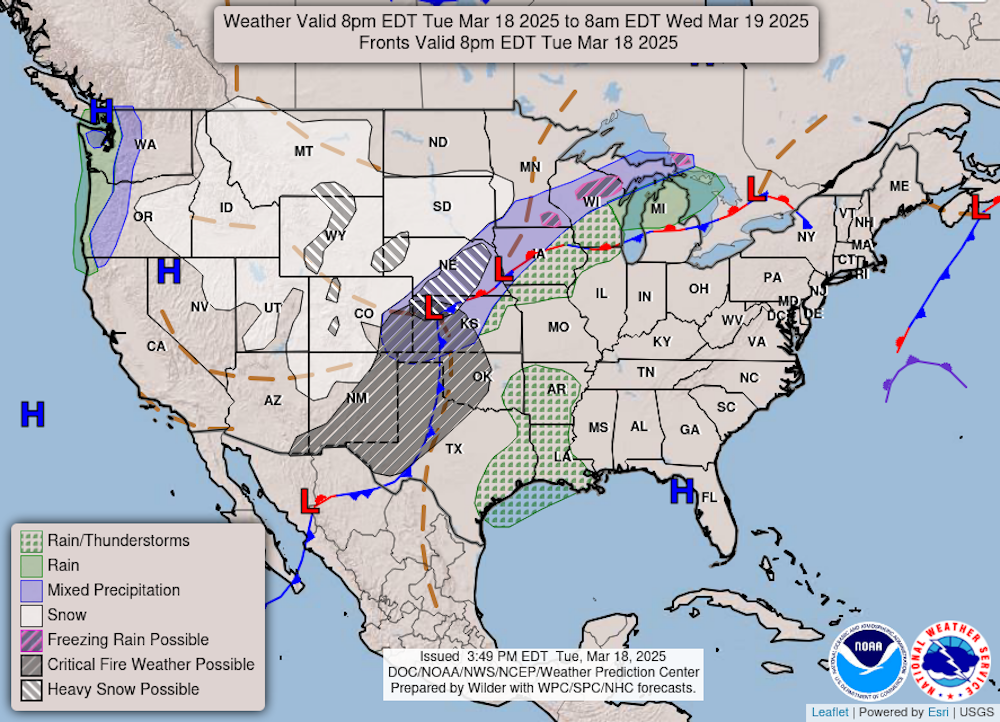
    On this forecast for March 18, 2025, from the National Oceanic and Atmospheric Administration, ‘L’ represents low-pressure systems. The shaded area over New Mexico and west Texas represents strong winds and low humidity that combine to raise the risk of wildfires.
    NOAA Weather Prediction Center

    Other forces related to the Earth’s rotation, friction and gravity can also alter the speed and direction of winds. But it all starts with this change in pressure over a distance – what meteorologists like me call a pressure gradient.

    So how do we get pressure gradients?

    Strong pressure gradients ultimately owe their existence to the simple fact that the Earth is round and rotates.

    Because the Earth is round, the sun is more directly overhead during the day at the equator than at the poles. This means more energy reaches the surface of the Earth near the equator. And that causes the lower part of the atmosphere, where weather occurs, to be both warmer and have higher pressure on average than the poles.

    Nature doesn’t like imbalances. As a result of this temperature difference, strong winds develop at high altitudes over midlatitude locations, like the continental U.S. This is the jet stream, and even though it’s several miles up in the atmosphere, it has a big impact on the winds we feel at the surface.

    Wind speed and direction in the upper atmosphere on March 14, 2025, show waves in the jet stream. Downstream of a trough in this wave, winds diverge and low pressure can form near the surface.
    NCAR

    Because Earth rotates, these upper-altitude winds blow from west to east. Waves in the jet stream – a consequence of Earth’s rotation and variations in the surface land, terrain and oceans – can cause air to diverge, or spread out, at certain points. As the air spreads out, the number of air molecules in a column decreases, ultimately reducing the air pressure at Earth’s surface.

    The pressure can drop quite dramatically over a few days or even just a few hours, leading to the birth of a low-pressure system – what meteorologists call an extratropical cyclone.

    The opposite chain of events, with air converging at other locations, can form high pressure at the surface.

    In between these low-pressure and high-pressure systems is a strong change in pressure over a distance – a pressure gradient. And that pressure gradient leads to strong winds. Earth’s rotation causes these winds to spiral around areas of high and low pressure. These highs and lows are like large circular mixers, with air blowing clockwise around high pressure and counterclockwise around low pressure. This flow pattern blows warm air northward toward the poles east of lows and cool air southward toward the equator west of lows.

    A map illustrates lines of surface pressure, called isobars, with areas of high and low pressure marked for March 14, 2025. Winds are strongest when isobars are packed most closely together.
    Plymouth State University, CC BY-NC-SA

    As the waves in the jet stream migrate from west to east, so do the surface lows and highs, and with them, the corridors of strong winds.

    That’s what the U.S. experienced when a strong extratropical cyclone caused winds stretching thousands of miles that whipped up dust storms and spread wildfires, and even caused tornadoes and blizzards in the central and southern U.S. in March 2025.

    Whipping up dust storms and spreading fires

    The jet stream over the U.S. is strongest and often the most “wavy” in the springtime, when the south-to-north difference in temperature is often the strongest.

    Winds associated with large-scale pressure systems can become quite strong in areas where there is limited friction at the ground, like the flat, less forested terrain of the Great Plains. One of the biggest risks is dust storms in arid regions of west Texas or eastern New Mexico, exacerbated by drought in these areas.

    A dust storm hit Albuquerque, N.M., on March 18, 2025. Another dust storm a few dats earlier in Kansas caused a deadly pileup involving dozens of vehices on I-70.
    AP Photo/Roberto E. Rosales

    When the ground and vegetation are dry and the air has low relative humidity, high winds can also spread wildfires out of control.

    Even more intense winds can occur when the pressure gradient interacts with terrain. Winds can sometimes rush faster downslope, as happens in the Rockies or with the Santa Ana winds that fueled devastating wildfires in the Los Angeles area in January.

    Violent tornadoes and storms

    Of course, winds can become even stronger and more violent on local scales associated with thunderstorms.

    When thunderstorms form, hail and precipitation in them can cause the air to rapidly fall in a downdraft, causing very high pressure under these storms. That pressure forces the air to spread out horizontally when it reaches the ground. Meteorologists call these straight line winds, and the process that forms them is a downburst. Large thunderstorms or chains of them moving across a region can cause large swaths of strong wind over 60 mph, called a derecho.

    Finally, some of nature’s strongest winds occur inside tornadoes. They form when the winds surrounding a thunderstorm change speed and direction with height. This can cause part of the storm to rotate, setting off a chain of events that may lead to a tornado and winds as strong as 300 mph in the most violent tornadoes.

    How a tornado forms. Source: NOAA.

    Tornado winds are also associated with an intense pressure gradient. The pressure inside the center of a tornado is often very low and varies considerably over a very small distance.

    It’s no coincidence that localized violent winds from thunderstorm downbursts and tornadoes often occur amid large-scale windstorms. Extratropical cyclones often draw warm, moist air northward on strong winds from the south, which is a key ingredient for thunderstorms. Storms also become more severe and may produce tornadoes when the jet stream is in close proximity to these low-pressure centers. In the winter and early spring, cold air funneling south on the northwest side of strong extratropical cyclones can even lead to blizzards.

    So, the same wave in the jet stream can lead to strong winds, blowing dust and fire danger in one region, while simultaneously triggering a tornado outbreak and a blizzard in other regions.

    Chris Nowotarski receives funding from the National Science Foundation (NSF), National Aeronautics and Space Administration (NASA), and theDepartment of Energy (DOE).

    – ref. What causes the powerful winds that fuel dust storms, wildfires and blizzards? A weather scientist explains – https://theconversation.com/what-causes-the-powerful-winds-that-fuel-dust-storms-wildfires-and-blizzards-a-weather-scientist-explains-252639
    MIL OSI – Global Reports –

    March 21, 2025
  • MIL-OSI Global: Insomnia can lead to heart issues − a psychologist recommends changes that can improve sleep

    Source: The Conversation – USA – By Julio Fernandez-Mendoza, Professor of Psychiatry and Behavioral Health, Neuroscience, and Public Health Sciences, Penn State

    Better sleep hygiene habits may help with insomnia. Tetra Images via Getty Images

    About 10% of Americans say they have chronic insomnia, and millions of others report poor sleep quality. Ongoing research has found that bad sleep could lead to numerous health problems, including heart disease.

    Dr. Julio Fernandez-Mendoza is a professor of psychiatry and behavioral health, neuroscience and public health sciences at Penn State College of Medicine. He discusses the need for sleep, why teenagers require more sleep than adults, and how you can get a good night’s sleep without medications.

    Julio Fernandez-Mendoza discusses heart health and sleep.

    The Conversation has collaborated with SciLine to bring you highlights from the discussion that have been edited for brevity and clarity.

    How much sleep is enough for adults and for adolescents?

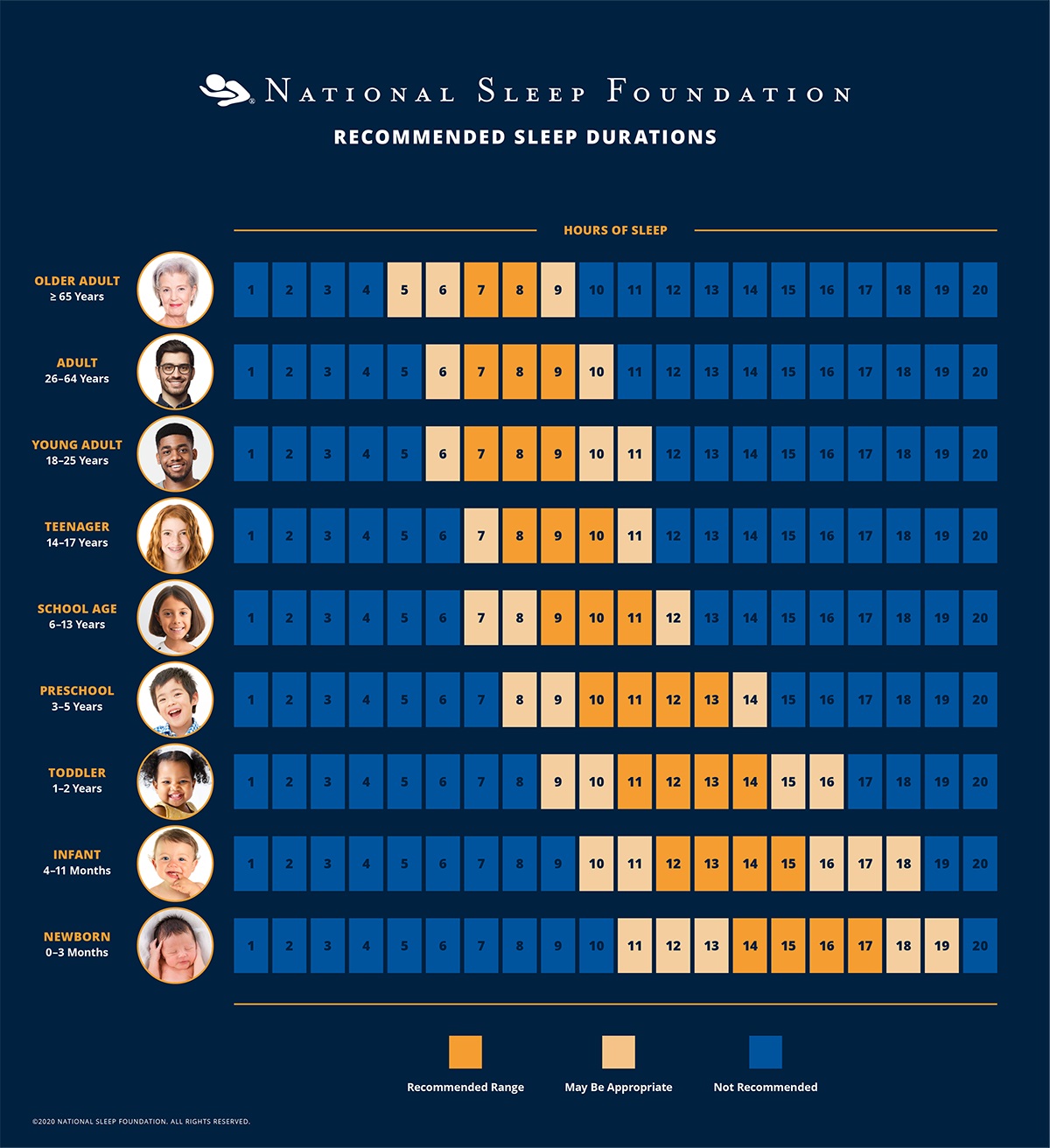
    Julio Fernandez-Mendoza: Adults who report getting about seven to eight hours of sleep per night generally have the best health, in terms of both physical and mental health, and longevity.

    But that recommendation changes with age. Adults over age 65 may need just six to seven hours of sleep per night. So older people, if otherwise healthy, should not feel anxious if they’re getting just six hours. Young people need the most – at least nine hours – and some younger children may need more.

    How can insufficient sleep harm our health?

    Fernandez-Mendoza: Our team was the first to show that those complaining about insomnia – difficulty falling or staying asleep – were more likely to have high blood pressure and be at risk for heart disease.

    In both teens and adults, we found that insomnia and shortened sleep may lead to elevated stress, hormone levels and inflammation. These problems tend to show up before you develop heart disease.

    As we age, the recommended amount of sleep declines.
    National Sleep Foundation Copyright 2025 National Sleep Foundation, all rights reserved

    What about people who have more serious sleep problems?

    Fernandez-Mendoza: Good sleep hygiene habits include cutting down on caffeine and alcohol, quitting smoking and exercising regularly. I also recommend not skipping meals, not eating too late at night and not eating too much.

    But people with a persistent sleep problem may need to make more behavioral changes. Research studies point to a set of six rules that can improve your sleep. You can follow these changes consistently in the short term, and then choose how to adapt them into your lifestyle down the road.

    First, get up at the same time no matter what. No matter how much sleep you get. This will anchor your sleep/wake cycle, called your circadian rhythm.

    Second, do not use your bed for anything except sleep and sexual activity.

    Third, when you can’t sleep, don’t lie in bed awake. Instead, get out of bed, go into another room if you can, and do an activity that’s enjoyable or relaxing. Go back to bed only when you’re ready to sleep.

    Fourth, get going with daily activities even after a poor night’s sleep. Don’t try to compensate for sleep loss. If you have chronic insomnia, don’t nap, sleep in, or doze during the day or evening even after poor sleep the previous night.

    Fifth, go to bed only when you’re actually sleepy enough to fall asleep.

    And sixth, start with the amount of sleep you’re now getting – with the lowest limit at five hours – and then increase it weekly by 15 minutes.

    These six rules are evidence-based and go above and beyond simple sleep hygiene habits. If they don’t work, see a provider who can help you.

    Your teen isn’t lazy. There are reasons why adolescents sleep in.

    Do you have advice specifically for adolescents?

    Fernandez-Mendoza: Adolescence is a unique developmental period. It’s not just the obvious physical, emotional and behavioral changes that occur during adolescence and puberty – there are changes in a teenager’s brain that can alter their sleep patterns.

    When an adolescent goes through puberty, their internal clock changes so that their sleep schedule shifts to later hours. While it’s true that adolescents are more engaged at night because of their social relationships, there’s also biology behind why they want to stay up late – their internal clocks have shifted. It’s not just choice.

    School start times for most adolescents are at odds with that biological shift. So they don’t get enough sleep, which affects their performance in school. Research suggests that schools with later start times are more closely aligned with the science on child development and don’t put adolescents at risk by making them wake up earlier than their bodies are biologically inclined to.

    Parents can help their teens get better sleep. Set a time for kids to stop doing homework and put away electronics. Instead, they can watch TV with the family or read – something relaxing and enjoyable that will help them wind down before bed.

    You can also gradually move back their wake-up time. Start on weekends, waking them up 30 minutes earlier every day, including school days, until the child reaches the desired wake-up time. Don’t try to reshift them suddenly – for example, waking up a teenager at 5 a.m. like it’s the military – because that doesn’t work. They won’t get used to it, since it’s at odds with their internal clock. So, do it little by little. If that doesn’t work, see a clinical provider.

    What kind of treatments can a sleep clinician provide?

    Fernandez-Mendoza: People should get help if they feel they sleep poorly, if they’re fatigued during the day, or if they snore or grind their teeth. All these issues deserve attention.

    Some people may think a sleep provider just prescribes expensive medication, but that’s not true. There are behavioral, non-drug-based treatments that work. Cognitive behavioral therapy is the first-line treatment recommended for insomnia. Light therapy may also help, which is the use of a bright light therapy lamp at a given time during the day or evening, depending on the person’s sleep problem.

    Watch the full interview to hear more.

    SciLine is a free service based at the American Association for the Advancement of Science, a nonprofit that helps journalists include scientific evidence and experts in their news stories.

    Julio Fernandez-Mendoza currently receives funding from the National Institutes of Health. He sits on the Board of Directors of the Sleep Research Society, a US-based not-for-profit professional association of sleep and circadian scientists.

    – ref. Insomnia can lead to heart issues − a psychologist recommends changes that can improve sleep – https://theconversation.com/insomnia-can-lead-to-heart-issues-a-psychologist-recommends-changes-that-can-improve-sleep-251017

    MIL OSI – Global Reports –

    March 21, 2025
  • MIL-OSI Global: 5 years on, true counts of COVID-19 deaths remain elusive − and research is hobbled by lack of data

    Source: The Conversation – USA – By Dylan Thomas Doyle, Ph.D. Candidate in Information Science, University of Colorado Boulder

    National COVID-19 memorial wall for the five-year anniversary on March 11, 2025, in London, England. Andrew Aitchison/In Pictures via Getty Images

    In the early days of the COVID-19 pandemic, researchers struggled to grasp the rate of the virus’s spread and the number of related deaths. While hospitals tracked cases and deaths within their walls, the broader picture of mortality across communities remained frustratingly incomplete.

    Policymakers and researchers quickly discovered a troubling pattern: Many deaths linked to the virus were never officially counted. A study analyzing data from over 3,000 U.S. counties between March 2020 and August 2022 found nearly 163,000 excess deaths from natural causes that were missing from official mortality records.

    Excess deaths, meaning those that exceed the number expected based on historical trends, serve as a key indicator of underreported deaths during health crises. Many of these uncounted deaths were later tied to COVID-19 through reviews of medical records, death certificates and statistical modeling.

    In addition, lack of real-time tracking for medical interventions during those early days slowed vaccine development by delaying insights into which treatments worked and how people were responding to newly circulating variants.

    Five years since the beginning of COVID-19, new epidemics such as bird flu are emerging worldwide, and researchers are still finding it difficult to access the data about people’s deaths that they need to develop lifesaving interventions.

    How can the U.S. mortality data system improve? I’m a technology infrastructure researcher, and my team and I design policy and technical systems to reduce inefficiency in health care and government organizations. By analyzing the flow of mortality data in the U.S., we found several areas of the system that could use updating.

    Critical need for real-time data

    A death record includes key details beyond just the fact of death, such as the cause, contributing conditions, demographics, place of death and sometimes medical history. This information is crucial for researchers to be able to analyze trends, identify disparities and drive medical advances.

    Approximately 2.8 million death records are added to the U.S. mortality data system each year. But in 2022 – the most recent official count available – when the world was still in the throes of the pandemic, 3,279,857 deaths were recorded in the federal system. Still, this figure is widely considered to be a major undercount of true excess deaths from COVID-19.

    In addition, real-time tracking of COVID-19 mortality data was severely lacking. This process involves the continuous collection, analysis and reporting of deaths from hospitals, health agencies and government databases by integrating electronic health records, lab reports and public health surveillance systems. Ideally, it provides up-to-date insights for decision-making, but during the COVID-19 pandemic, these tracking systems lagged and failed to generate comprehensive data.

    Getting real-time COVID-19 data from hospitals and other agencies into the hands of researchers proved difficult.
    Gerald Herbert/AP Photo

    Without comprehensive data on prior COVID-19 infections, antibody responses and adverse events, researchers faced challenges designing clinical trials to predict how long immunity would last and optimize booster schedules.

    Such data is essential in vaccine development because it helps identify who is most at risk, which variants and treatments affect survival rates, and how vaccines should be designed and distributed. And as part of the broader U.S. vital records system, mortality data is essential for medical research, including evaluating public health programs, identifying health disparities and monitoring disease.

    At the heart of the problem is the inefficiency of government policy, particularly outdated public health reporting systems and slow data modernization efforts that hinder timely decision-making. These long-standing policies, such as reliance on paper-based death certificates and disjointed state-level reporting, have failed to keep pace with real-time data needs during crises such as COVID-19.

    These policy shortcomings lead to delays in reporting and lack of coordination between hospital organizations, state government vital records offices and federal government agencies in collecting, standardizing and sharing death records.

    History of US mortality data

    The U.S. mortality data system has been cobbled together through a disparate patchwork of state and local governments, federal agencies and public health organizations over the course of more than a century and a half. It has been shaped by advances in public health, medical record-keeping and technology. From its inception to the present day, the mortality data system has been plagued by inconsistencies, inefficiencies and tensions between medical professionals, state governments and the federal government.

    The first national efforts to track information about deaths began in the 1850s when the U.S. Census Bureau started collecting mortality data as part of the decennial census. However, these early efforts were inconsistent, as death registration was largely voluntary and varied widely across states.

    In the early 20th century, the establishment of the National Vital Statistics System brought greater standardization to mortality data. For example, the system required all U.S. states and territories to standardize their death certificate format. It also consolidated mortality data at the federal level, whereas mortality data was previously stored at the state level.

    However, state and federal reporting remained fragmented. For example, states had no unifom timeline for submitting mortality data, resulting in some states taking months or even years to finalize and release death records. Local or state-level paperwork processing practices also remained varied and at times contradictory.

    Death record processing varies by state.
    eric1513/iStock via Getty Images Plus

    To begin to close gaps in reporting timelines to aid medical researchers, in 1981 the National Center for Health Statistics – a division of the Centers for Disease Control and Prevention – introduced the National Death Index. This is a centralized database of death records collected from state vital statistics offices, making it easier to access death data for health and medical research. The system was originally paper-based, with the aim of allowing researchers to track the deaths of study participants without navigating complex bureaucracies.

    As time has passed, the National Death Index and state databases have become increasingly digital. The rise of electronic death registration systems in recent decades has improved processing speed when it comes to researchers accessing mortality data from the National Death Index. However, while the index has solved some issues related to gaps between state and federal data, other issues, such as high fees and inconsistency in state reporting times, still plague it.

    Accessing the data that matters most

    With the Trump administration’s increasing removal of CDC public health datasets, it is unclear whether policy reform for mortality data will be addressed anytime soon.

    Experts fear that the removal of CDC datasets has now set precedent for the Trump administration to cross further lines in its attempts to influence the research and data published by the CDC. The longer-term impact of the current administration’s public health policy on mortality data and disease response are not yet clear.

    What is clear is that five years since COVID-19, the U.S. mortality tracking system remains unequipped to meet emerging public health crises. Without addressing these challenges, the U.S. may not be able to respond quickly enough to public health crises threatening American lives.

    Dylan Thomas Doyle does not work for, consult, own shares in or receive funding from any company or organization that would benefit from this article, and has disclosed no relevant affiliations beyond their academic appointment.

    – ref. 5 years on, true counts of COVID-19 deaths remain elusive − and research is hobbled by lack of data – https://theconversation.com/5-years-on-true-counts-of-covid-19-deaths-remain-elusive-and-research-is-hobbled-by-lack-of-data-244799

    MIL OSI – Global Reports –

    March 21, 2025
  • MIL-OSI Global: Tyrannical leader? Why comparisons between Trump and King George III miss the mark on 18th-century British monarchy

    Source: The Conversation – USA – By Carla Gardina Pestana, Professor and Joyce Appleby Endowed Chair of America in the World, University of California, Los Angeles

    Are there legitimate comparisons between President Donald Trump and King George III? Rebecca Noble/Getty Images; Kean Collection/Getty Images

    George III, king of Great Britain and its colonies at the time of the American Revolution, has been maligned unfairly.

    During both the first and now the second term of President Donald Trump, commentators in the U.S. have invoked the king’s misdeeds to criticize Trump. When the president bypassed Congress to create a new government agency, appointed its head and stopped payment of millions of dollars of allocated federal funds, his critics noted that he assumed the role of Congress, a power grab that supposedly made him similar to George III. According to this criticism, the president engaged in tyranny, just as the founders accused George of doing.

    As a scholar of early America, I believe, however, that George III has gotten a bad rap. He was not the all-powerful monarch that Trump allegedly aspires to be.

    In the 1770s, the power of the British king was limited by the authority of Parliament. In that system, which Americans and others praised at the time as balanced, the king and the legislature each had specific duties and powers so that neither could control the government alone.

    George III was not an absolutist monarch, to use the language of the day for a power-hungry ruler. The English had struggled in the previous century over the extent of the king’s power. After fighting two civil wars, executing one king, and, eventually, forcing the monarch to agree to rule with Parliament rather than on his own, they believed their liberties were safeguarded.

    This system, known as limited monarchy, was the pride of Great Britain. It was also admired by the American founders. As late as 1774, in his Summary View of the Rights of British America, Thomas Jefferson praised the “free and ancient principles” of the British constitution in which “kings are the servants, not the proprietors of the people.”

    Trump has been compared with King George III by many writers and commentators; the White House on Feb. 19, 2024, issued the fake magazine cover of Trump crowned like a king.
    Various

    No kingly tyranny

    Britons, whether in Great Britain or the colonies, did fear a tyrant, a controlling and abusive leader.

    Some fears came from their study of political theory, which taught that government worked best when composed of various branches that represented the concerns of the different political classes.

    As this theory went, an unbalanced government would descend into tyranny with a too-powerful monarch; oligarchy under a dominant aristocratic class; or anarchy with the people out of control. They believed these perils could be avoided only by maintaining balance.

    Even though the British did not fear imbalance or a tyrant king in their own case, they could see the danger threatening elsewhere in Europe.

    France represented a worst-case scenario. Its absolutist kings had ruled without France’s legislature – the Estates General – for more than a century and a half at the time of the American Revolution. British poet Robert Wolseley’s often reprinted poem declared: “Let France grow proud beneath the tyrant’s lust, While the rackt people crawl and lick the dust. The mighty Genius of this isle disdains Ambitious slavery and golden chains.”

    Within a few years, Anglo-American criticism of kingly tyranny in France would be validated: That country descended into a violent revolution that resulted in decades of warfare and political violence, including the execution of the entire royal family.

    This experience confirmed for the British and Americans that a balanced system was best and that they should count their blessings.

    Why revolt?

    A list of grievances held by the American Colonies against King George III, set down in Thomas Jefferson’s first draft of the American Declaration of Independence, which ultimately included 27 grievances against the king.
    MPI/Getty Images

    If the American revolutionaries admired the British system and sought to copy it in the United States, why did they reject the link to Britain and revolt in the first place?

    Americans did not revolt against the nature of British government. Rather they objected to their changing place within the British Empire. The revolutionary crisis had a number of roots, but most of them arose out of changes in the management of the relationship between the American Colonies and the imperial center.

    From the 1760s, the British government took a more activist role in its American Colonies, limiting their geographical expansion and imposing taxes directly on the population. In the past, Colonists had been free to move west, challenged only by the indigenous residents who fought to defend their lands.

    Now the British government, aiming to put an end to these wars, blocked expansion. At the same time, to pay down the debt accrued in recent war with France – and fought in part in North America – the government levied taxes not via the Colonial legislatures, as it had before, but directly on residents. This change sparked revolt and, eventually, revolution.

    Turning on the king

    American Colonists pull down a statue of King George III in New York City during the American Revolution.
    Corbis via Getty Images

    Before 1776, the Colonists believed that George III would come to their rescue and halt these changes imposed by Parliament. They thought initially that he did not realize how the new policies affected them.

    Only in 1776 did they accept that George III supported the policy changes and would not defend their rights. It was in that context that they turned on him and declared him tyrannical, blaming him for the new policies and calling for a break with Britain. As the Declaration of Independence said: “The history of the present King of Great Britain is a history of repeated injuries and usurpations, all having in direct object the establishment of an absolute Tyranny over these States.”

    Although they complained about the tyranny of George III, their true objection was that their subordinate position within the empire gave them little leverage when opposing policies that king and Parliament agreed to impose on them.

    Once independent, the founders created a system that imitated the British model of mixed governance and created barriers – the powers of Congress and the oversight of the Supreme Court – that they hoped would safeguard their liberties against the threat of renewed tyranny.

    Carla Gardina Pestana does not work for, consult, own shares in or receive funding from any company or organization that would benefit from this article, and has disclosed no relevant affiliations beyond their academic appointment.

    – ref. Tyrannical leader? Why comparisons between Trump and King George III miss the mark on 18th-century British monarchy – https://theconversation.com/tyrannical-leader-why-comparisons-between-trump-and-king-george-iii-miss-the-mark-on-18th-century-british-monarchy-251869

    MIL OSI – Global Reports –

    March 21, 2025
  • MIL-OSI Global: Atlantic sturgeon were fished almost to extinction − ancient DNA reveals how Chesapeake Bay population changed over centuries

    Source: The Conversation – USA – By Natalia Przelomska, Research Associate in Archaeogenomics, National Museum of Natural History, Smithsonian Institution

    Sturgeon can be several hundred pounds each. cezars/E+ via Getty Images

    Sturgeons are one of the oldest groups of fishes. Sporting an armor of five rows of bony, modified scales called dermal scutes and a sharklike tail fin, this group of several-hundred-pound beasts has survived for approximately 160 million years. Because their physical appearance has changed very little over time, supported by a slow rate of evolution, sturgeon have been called living fossils.

    Despite their survival through several geological time periods, many present-day sturgeon species are at threat of extinction, with 17 of 27 species listed as “critically endangered.”

    Conservation practitioners such as the Virginia Commonwealth University monitoring team are working hard to support recovery of Atlantic sturgeon in the Chesapeake Bay area. But it’s not clear what baseline population level people should strive toward restoring. How do today’s sturgeon populations compare with those of the past?

    VCU monitoring team releases an adult Atlantic sturgeon back into the estuary.
    Matt Balazik

    We are a molecular anthropologist and a biodiversity scientist who focus on species that people rely on for subsistence. We study the evolution, population health and resilience of these species over time to better understand humans’ interaction with their environments and the sustainability of food systems.

    For our recent sturgeon project, we joined forces with fisheries conservation biologist Matt Balazik, who conducts on-the-ground monitoring of Atlantic sturgeon, and Torben Rick, a specialist in North American coastal zooarchaeology. Together, we wanted to look into the past and see how much sturgeon populations have changed, focusing on the James River in Virginia. A more nuanced understanding of the past could help conservationists better plan for the future.

    Sturgeon loomed large for millennia

    In North America, sturgeon have played important subsistence and cultural roles in Native communities, which marked the seasons by the fishes’ behavioral patterns. Large summertime aggregations of lake sturgeon (Acipenser fulvescens) in the Great Lakes area inspired one folk name for the August full moon – the sturgeon moon. Woodland Era pottery remnants at archaeological sites from as long as 2,000 years ago show that the fall and springtime runs of Atlantic sturgeon (Acipenser oxyrinchus) upstream were celebrated with feasting.

    Archaeologists uncover bony scutes – modified scales that resemble armor for the living fish – in places where people relied on sturgeon for subsistence.
    Logan Kistler and Natalia Przelomska

    Archaeological finds of sturgeon remains support that early colonial settlers in North America, notably those who established Jamestown in the Chesapeake Bay area in 1607, also prized these fish. When Captain John Smith was leading Jamestown, he wrote “there was more sturgeon here than could be devoured by dog or man.” The fish may have helped the survival of this fortress-colony that was both stricken with drought and fostering turbulent relationships with the Native inhabitants.

    This abundance is in stark contrast to today, when sightings of migrating fish are sparse. Exploitation during the past 300 years was the key driver of Atlantic sturgeon decline. Demand for caviar drove the relentless fishing pressure throughout the 19th century. The Chesapeake was the second-most exploited sturgeon fishery on the Eastern Seaboard up until the early 20th century, when the fish became scarce.

    Conservation biologists capture the massive fish for monitoring purposes, which includes clipping a tiny part of the fin for DNA analysis.
    Matt Balazik

    At that point, local protection regulations were established, but only in 1998 was a moratorium on harvesting these fish declared. Meanwhile, abundance of Atlantic sturgeon remained very low, which can be explained in part by their lifespan. Short-lived fish such as herring and shad can recover population numbers much faster than Atlantic sturgeon, which live for up to 60 years and take a long time to reach reproductive age – up to around 12 years for males and as many as 28 years for females.

    To help manage and restore an endangered species, conservation biologists tend to split the population into groups based on ranges. The Chesapeake Bay is one of five “distinct population segments” the U.S. Endangered Species Act listing in 2012 created for Atlantic sturgeon.

    Since then, conservationists have pioneered genetic studies on Atlantic sturgeon, demonstrating through the power of DNA that natal river – where an individual fish is born – and season of spawning are both important for distinguishing subpopulations within each regional group. Scientists have also described genetic diversity in Atlantic sturgeon; more genetic variety suggests they have more capacity to adapt when facing new, potentially challenging conditions.

    The study focused on Atlantic sturgeon from the Chesapeake Bay region, past and present. The four archaeological sites included are highlighted.
    Przelomska NAS et al., Proc. R. Soc. B 291: 20241145, CC BY

    Sturgeon DNA, then and now

    Archaeological remains are a direct source of data on genetic diversity in the past. We can analyze the genetic makeup of sturgeons that lived hundreds of years ago, before intense overfishing depleted their numbers. Then we can compare that baseline with today’s genetic diversity.

    The James River was a great case study for testing out this approach, which we call an archaeogenomics time series. Having obtained information on the archaeology of the Chesapeake region from our collaborator Leslie Reeder-Myers, we sampled remains of sturgeon – their scutes and spines – at a precolonial-era site where people lived from about 200 C.E. to about 900 C.E. We also sampled from important colonial sites Jamestown (1607-1610) and Williamsburg (1720-1775). And we complemented that data from the past with tiny clips from the fins of present-day, live fish that Balazik and his team sampled during monitoring surveys.

    Scientists separate Atlantic sturgeon scute fragments from larger collections of zooarchaeological remains, to then work on the scutes in a lab dedicated to studying ancient DNA.
    Torben Rick and Natalia Przelomska

    DNA tends to get physically broken up and biochemically damaged with age. So we relied on special protocols in a lab dedicated to studying ancient DNA to minimize the risk of contamination and enhance our chances of successfully collecting genetic material from these sturgeon.

    Atlantic sturgeon have 122 chromosomes of nuclear DNA – over five times as many as people do. We focused on a few genetic regions, just enough to get an idea of the James River population groupings and how genetically distinct they are from one another.

    We were not surprised to see that fall-spawning and spring-spawning groups were genetically distinct. What stood out, though, was how starkly different they were, which is something that can happen when a population’s numbers drop to near-extinction levels.

    We also looked at the fishes’ mitochondrial DNA, a compact molecule that is easier to obtain ancient DNA from compared with the nuclear chromosomes. With our collaborator Audrey Lin, we used the mitochondrial DNA to confirm our hypothesis that the fish from archaeological sites were more genetically diverse than present-day Atlantic sturgeon.

    Strikingly, we discovered that mitochondrial DNA did not always group the fish by season or even by their natal river. This was unexpected, because Atlantic sturgeon tend to return to their natal rivers for breeding. Our interpretation of this genetic finding is that over very long timescales – many thousands of years – changes in the global climate and in local ecosystems would have driven a given sturgeon population to migrate into a new river system, and possibly at a later stage back to its original one. This notion is supported by other recent documentation of fish occasionally migrating over long distances and mixing with new groups.

    Our study used archaeology, history and ecology together to describe the decline of Atlantic sturgeon. Based on the diminished genetic diversity we measured, we estimate that the Atlantic sturgeon populations we studied are about a fifth of what they were before colonial settlement. Less genetic variability means these smaller populations have less potential to adapt to changing conditions. Our findings will help conservationists plan into the future for the continued recovery of these living fossils.

    The authors do not work for, consult, own shares in or receive funding from any company or organization that would benefit from this article, and have disclosed no relevant affiliations beyond their academic appointment.

    – ref. Atlantic sturgeon were fished almost to extinction − ancient DNA reveals how Chesapeake Bay population changed over centuries – https://theconversation.com/atlantic-sturgeon-were-fished-almost-to-extinction-ancient-dna-reveals-how-chesapeake-bay-population-changed-over-centuries-241104

    MIL OSI – Global Reports –

    March 21, 2025
  • MIL-OSI Russia: Dmitry Chernyshenko: 90 international friendship clubs unite young Russians and representatives of more than 140 countries

    Translartion. Region: Russians Fedetion –

    Source: Government of the Russian Federation – An important disclaimer is at the bottom of this article.

    March 20, 2025

    International friendship clubs have opened all over Russia.

    International friendship clubs have opened all over Russia – in 89 regions of the country and in the federal territory of Sirius. The flagship project of the World Youth Festival (WYF) Directorate is aimed at strengthening international cooperation between young people from regions of Russia and foreign countries.

    According to the instructions of the President of Russia Vladimir Putin, international friendship clubs became a continuation of the program “Cultural Patronage”, during which at the 2024 WFM each foreign delegation was assigned a supervising region of the Russian Federation. Young Russians helped representatives of foreign delegations to get to know the history, traditions and culture of the peoples of our country better. Russian participants of international friendship clubs are establishing cooperation with representatives of 142 countries.

    “International friendship clubs make an important contribution to the development of the federal project “Russia in the World”, the national project “Youth and Children” and the preservation of the legacy of the World Youth Festival, which was held with the participation of Russian President Vladimir Putin. In total, 90 international friendship clubs have opened in our country since 2024. They have united young Russians and representatives of more than 140 countries. During this period, the clubs held 580 events, in which about 30 thousand people took part. Such results show that young people from various countries want to develop joint projects with children from Russia,” said Deputy Prime Minister Dmitry Chernyshenko.

    The work of international friendship clubs is structured along five tracks: media, entrepreneurship, civic activity, regional specifics, and the creation of youth communities.

    “The importance of developing international youth cooperation is confirmed by the steady interest in joint activities of representatives of the younger generation from different countries. We see how young people from Russia and abroad strive to communicate, establish friendly and partnership ties, and create joint projects and initiatives. International friendship clubs began to form in the regions of Russia in August last year, and during this time, about 17 thousand Russians and more than 12 thousand young people from abroad have joined them. This once again confirms that, despite any difficulties, young people strive to establish contacts for the sake of the future and a just world,” said the head of Rosmolodezh Grigory Gurov.

    The final openings took place in the Kursk and Bryansk regions. Thus, as part of the ceremonial event, the youth of Bryansk were addressed by their peers from partner countries – Pakistan and Belarus.

    “Today marks a milestone in our journey to strengthen people-to-people ties. Our club aims to foster constructive relationships, promote cultural understanding and celebrate the diversity of our countries. This is a wonderful way to build mutual understanding, respect and trust,” said International Friendship Club member Mustafa Aamir from Pakistan.

    The participants of the grand opening were representatives of the region’s creative youth, foreign citizens, volunteers and participants of the World Youth Festival and honored guests. During the event, representatives of creative youth from Russia and abroad performed dance and vocal numbers.

    “This event symbolizes the beginning of a new stage in the development of our international relations, cultural exchange and mutual understanding between peoples. Bryansk region has always been known for its openness and hospitality. We believe that this club will become a meeting place for people united by common interests and goals,” noted the representative of Belarus Maria Yurkova.

    The opening of the International Friendship Club of Kursk Region was attended by specialists implementing events on international cooperation, representatives of student communities, including foreign students, and activists from various fields. Within the framework of the International Friendship Club, the youth of Kursk Region interacts with young leaders from Bolivia.

    In addition, during the opening of the friendship clubs of the Kursk and Bryansk regions, ceremonies were held to award commemorative medals for contributions to the preparation and holding of the 2024 WFM.

    The World Youth Festival was held from March 1 to 7, 2024, in Sirius with the participation of Russian President Vladimir Putin. Its key goal is to develop international youth cooperation. 20,000 young leaders from 190 countries took part in the WYF-2024.

    According to the instructions of the head of state, the WFM will be held in Russia on a regular basis – once every six years, and every six years 10 thousand young people from all over the world will gather at the forum. Between these events, international thematic gatherings will be held under the auspices of the WFM.

    Please note: This information is raw content directly from the source of the information. It is exactly what the source states and does not reflect the position of MIL-OSI or its clients.

    MIL OSI Russia News –

    March 21, 2025
  • MIL-OSI: Poet Ships Advanced Optical Engine Samples to Three Global Technology Customers for AI Applications

    Source: GlobeNewswire (MIL-OSI)

    TORONTO, March 20, 2025 (GLOBE NEWSWIRE) — POET Technologies Inc. (“POET” or the “Company“) (TSX Venture: PTK; NASDAQ: POET), a leader in the design and implementation of highly-integrated optical engines and light sources for artificial intelligence networks, today announced it has fulfilled orders from three global customers for samples of its advanced optical transmit engines.

    The Company announced that it has shipped final design samples of its POET Infinity transmit product line for 400G and 800G applications to three major technology leaders. The products include 400G FR4, 800G 2xFR4 and 800G DR8 transmit formats, all assembled at our high volume production facility in Malaysia. The FR4 optical engines incorporate the multiplexer and can be paired with POET receiver engines for a highly integrated pluggable transceiver. POET’s customers have designed and are building pluggable transceivers using a two-chip solution, i.e., one transmit chip and one receive chip for 400G and three-chip solution for 800G. The receive optical engines have already been qualified and the availability of the transmit engine samples will allow the shipment of completed modules to end customers for qualification, with production orders expected in the second half of 2025.

    “Each of our customers has expressed intense enthusiasm for the results they have seen from POET’s integrated, chip-level solutions,” said Raju Kankipati, Chief Revenue Officer of POET. “The sampling of the transmit engines is the final piece that allows our customers to complete their modules and get them qualified. We are increasingly a vendor of record for these enterprises and that is how we know we are on the right track for wider adoption and greater commercial success,” said Kankipati.

    POET has previously worked with each customer on integrating the transmit and receive optical engines into their final module products. The demand for 400G and 800G modules remains strong. The demand for these three module types (400G FR4, 800G 2xFR4 and 800G DR8) is forecasted by LightCounting, a market research firm, to be about 20 million units per year for next 5 years.

    Dr. Suresh Venkatesan, POET’s Chairman & CEO added: “POET’s advantages of cost, reliability and power efficiency have gained the trust of industry leaders who look to our optical interposer-based product portfolio for solutions that can power AI development and improve optical networking.”

    IR Consultant Engagement
    The Company also announced that it is increasing its commitment to a broad-based investor relations program with a one-month trial engagement with IR Agency, LLC. During this period, IR Agency will assist POET in communicating information about the Company to relevant stakeholders and financial audiences. IR Agency will receive compensation of US$250,000 for the services rendered through the contract term.

    About POET Technologies Inc.
    POET is a design and development company offering high-speed optical modules, optical engines and light source products to the artificial intelligence systems market and to hyperscale data centers. POET’s photonic integration solutions are based on the POET Optical Interposer™, a novel, patented platform that allows the seamless integration of electronic and photonic devices into a single chip using advanced wafer-level semiconductor manufacturing techniques. POET’s Optical Interposer-based products are lower cost, consume less power than comparable products, are smaller in size and are readily scalable to high production volumes. In addition to providing high-speed (800G, 1.6T and above) optical engines and optical modules for AI clusters and hyperscale data centers, POET has designed and produced novel light source products for chip-to-chip data communication within and between AI servers, the next frontier for solving bandwidth and latency problems in AI systems. POET’s Optical Interposer platform also solves device integration challenges in 5G networks, machine-to-machine communication, self-contained “Edge” computing applications and sensing applications, such as LIDAR systems for autonomous vehicles. POET is headquartered in Toronto, Canada, with operations in Allentown, PA, Shenzhen, China, and Singapore. More information about POET is available on our website at www.poet-technologies.com.


    Forward-Looking Statements

    This news release contains “forward-looking information” (within the meaning of applicable Canadian securities laws) and “forward-looking statements” (within the meaning of the U.S. Private Securities Litigation Reform Act of 1995). Such statements or information are identified with words such as “anticipate”, “believe”, “expect”, “plan”, “intend”, “potential”, “estimate”, “propose”, “project”, “outlook”, “foresee” or similar words suggesting future outcomes or statements regarding any potential outcome. Such statements include the Company’s expectations with respect to the success of the Company’s product development efforts, the performance of its products, operations, meeting revenue targets, and the expectation of continued success in the financing efforts, the capability, functionality, performance and cost of the Company’s technology as well as the market acceptance, inclusion and timing of the Company’s technology in current and future products and expectations regarding its successful development of high speed transceiver solutions and its penetration of the Artificial Intelligence hardware markets.

    Such forward-looking information or statements are based on a number of risks, uncertainties and assumptions which may cause actual results or other expectations to differ materially from those anticipated and which may prove to be incorrect. Assumptions have been made regarding, among other things, the completion of its development efforts with its customers, the ability to build working prototypes to the customer’s specifications, the performance of the samples provided to customers, and the size, future growth and needs of Artificial Intelligence network suppliers. Actual results could differ materially due to a number of factors, including, without limitation, the failure of the samples to meet industry specs, the failure to produce optical engines on time and within budget, the failure of Artificial Intelligence networks to continue to grow as expected, the failure of the Company’s products to meet performance requirements for AI and datacom networks, operational risks in the completion of the Company’s projects, the ability of the Company to generate sales for its products, and the ability of its customers to deploy systems that incorporate the Company’s products. Although the Company believes that the expectations reflected in the forward-looking information or statements are reasonable, prospective investors in the Company’s securities should not place undue reliance on forward-looking statements because the Company can provide no assurance that such expectations will prove to be correct. Forward-looking information and statements contained in this news release are as of the date of this news release and the Company assumes no obligation to update or revise this forward-looking information and statements except as required by law.

    Neither TSX Venture Exchange nor its Regulation Services Provider (as that term is defined in the policies of the TSX Venture Exchange) accepts responsibility for the adequacy or accuracy of this release.
    120 Eglinton Avenue, East, Suite 1107, Toronto, ON, M4P 1E2- Tel: 416-368-9411 – Fax: 416-322-5075

    The MIL Network –

    March 21, 2025
  • MIL-OSI: Data Storage Corporation to Participate in the 2025 iAccess Alpha Virtual Conference

    Source: GlobeNewswire (MIL-OSI)

    MELVILLE, N.Y., March 20, 2025 (GLOBE NEWSWIRE) — Data Storage Corporation (Nasdaq: DTST) (“DSC” and the “Company”), a leading provider of multi-cloud hosting, managed cloud services, disaster recovery, cybersecurity, and IT automation, that integrates with AWS, Microsoft Azure, and Google Cloud,  today announced that its management will be participating in the iAccess Alpha Virtual Best Ideas Spring Investment Conference 2025 being held March 25 and 26, 2025.

    Why Investors Should Tune In:

    • Gain insight into DSC’s expanding footprint in cloud hosting and IT modernization.
    • Learn about the Company’s scalable, secure, and high-performance cloud solutions.
    • Understand how DSC leverages partnerships with AWS, Microsoft Azure, and Google Cloud to drive innovation.

    Chuck Piluso, CEO of Data Storage Corporation, and Chris Panagiotakos, CFO of Data Storage Corporation, will be presenting at 10:00 a.m. ET on March 25, sharing insights into DSC’s business strategy, growth trajectory, and market opportunities. Management will also participate in one-on-one meetings with investors on March 26. The live webcast of the Company’s presentation will be available at https://www.webcaster4.com/Webcast/Page/3083/52117, and a replay will be accessible afterward. The presentation will also be available on the company’s website under the “News & Events” tab, https://www.dtst.com/news-events/ir-calendar.

    For more information about the iAccess Alpha Virtual Best Ideas Spring Investment Conference 2025, or to register and schedule a one-on-one meeting with Data Storage Corporation, please visit the conference website at: https://www.iaccessalpha.com/home.

    About Data Storage Corporation
    Data Storage Corporation (Nasdaq: DTST) through its subsidiaries is a leading provider of multi-cloud hosting, fully managed cloud services, disaster recovery, cybersecurity, IT automation, and voice & data solutions. Recognizing that data migration is a critical step in transitioning from on-premises systems to the cloud, DTST provides comprehensive migration services to ensure seamless, secure, and efficient data transfer, minimizing downtime and optimizing performance.

    Through its CloudFirst platform, built on IBM Power Cloud infrastructure, DTST delivers high-performance, scalable, and secure cloud solutions with interoperability across its infrastructure partners, AWS, Microsoft Azure, and Google Cloud.

    With data centers supporting cloud platform deployments across the United States, Canada, and the United Kingdom, DTST provides mission-critical cloud services to a diverse clientele, including Fortune 500 companies, government agencies, educational institutions, and healthcare organizations.

    As a leader in the multi-billion-dollar cloud hosting and business continuity market, DTST is recognized for its expertise in cloud infrastructure, IT modernization, and data migration, enabling clients to transition to the cloud with confidence and operational continuity.

    For more information, please visit www.dtst.com or follow us on X @DataStorageCorp.

    Safe Harbor Provision

    This press release contains “forward-looking statements” within the meaning of the Private Securities Litigation Reform Act of 1995, as amended, that are intended to be covered by the safe harbor created thereby. Forward-looking statements are subject to risks and uncertainties that could cause actual results, performance or achievements to differ materially from any future results, performance or achievements expressed or implied by such forward-looking statements. Statements preceded by, followed by or that otherwise include the words “believes,” “expects,” “anticipates,” “intends,” “projects,” “estimates,” “plans” and similar expressions or future or conditional verbs such as “will,” “should,” “would,” “may” and “could” are generally forward-looking in nature and not historical facts, although not all forward-looking statements include the foregoing. Although the Company believes that the expectations reflected in such forward-looking statements are reasonable, it can provide no assurance that such expectations will prove to have been correct. These forward-looking statements are based on management’s expectations and assumptions as of the date of this press release and are subject to a number of risks and uncertainties, many of which are difficult to predict that could cause actual results to differ materially from current expectations and assumptions from those set forth or implied by any forward-looking statements. Important factors that could cause actual results to differ materially from current expectations include the Company’s ability to grow its presence in Europe. These risks should not be construed as exhaustive and should be read together with the other cautionary statements included in the Company’s Annual Report on Form 10-K, subsequent Quarterly Reports on Form 10-Q and Current Reports on Form 8-K filed with the Securities and Exchange Commission. Any forward-looking statement speaks only as of the date on which it was initially made. Except as required by law, the Company assumes no obligation to update or revise any forward-looking statements, whether as a result of new information, future events, changed circumstances or otherwise.

    Contact:
    Crescendo Communications, LLC
    212-671-1020
    DTST@crescendo-ir.com

    The MIL Network –

    March 21, 2025
  • MIL-OSI Economics: AGNICO EAGLE ANNOUNCES ADDITIONAL INVESTMENT IN CARTIER RESOURCES INC.

    Source: Agnico Eagle Mines

    Stock Symbol:  AEM (NYSE and TSX)

    TORONTO, March 20, 2025 /CNW/ – Agnico Eagle Mines Limited (NYSE: AEM) (TSX: AEM) (“Agnico Eagle”) announced today that it has agreed to subscribe for 20,770,000 units (“Units”) of Cartier Resources Inc. (“Cartier”) in a non-brokered private placement at a price of C$0.13 per Unit for total consideration of C$2,700,100 (the “Private Placement”). Each Unit is comprised of one common share of Cartier (a “Common Share”) and one common share purchase warrant of Cartier (each, an “Offering Warrant”). Each Offering Warrant entitles the holder to acquire one Common Share at a price of C$0.18 for a period of five years following the closing date of the Private Placement, subject to acceleration in certain circumstances. Closing is expected to occur on or about April 10, 2025 and is subject to certain conditions.

    Agnico Eagle currently owns, or exercises control and direction over, an aggregate of 97,022,944 Common Shares and 7,000,000 Common Share purchase warrants entitling Agnico Eagle to acquire 7,000,000 Common Shares (the “Existing Warrants”), representing approximately 26.6% of the issued and outstanding Common Shares on an undiluted basis and 28.0% of the issued and outstanding Common Shares on a partially-diluted basis (assuming the exercise of the Existing Warrants). On closing of the Private Placement, assuming that 39,432,000 Common Shares are issued by Cartier in connection with the concurrent “best efforts” private placement offering announced by Cartier, Agnico Eagle will own 117,792,944 Common Shares, 20,770,000 Offering Warrants and 7,000,000 Existing Warrants, representing approximately 27.7% of the issued and outstanding Common Shares on an undiluted basis and approximately 32.2% of the Common Shares on a partially-diluted basis (assuming the exercise of the Existing Warrants and Offering Warrants held by Agnico Eagle).

    Agnico Eagle and Cartier were party to an amended and restated investor rights agreement dated May 20, 2022 (the “Existing Agnico IRA”), pursuant to which Agnico Eagle was entitled to certain rights (subject to maintaining certain ownership thresholds), including: (a) the right to participate in certain equity financings by Cartier in order to acquire up to a 19.97% ownership interest in Cartier; and (b) the right to nominate one person (and in the case of an increase in the size of the board of directors of Cartier to 10 or more directors, two persons) to the board of directors of Cartier. In addition, Agnico Eagle Abitibi Acquisition Corp. (successor to O3 Mining Inc.), an indirect wholly-owned subsidiary of Agnico Eagle, and Cartier were party to an investor rights agreement dated April 21, 2022 (the “Existing O3 IRA”), pursuant to which Agnico Eagle Abitibi Acquisition Corp. was entitled to certain rights (subject to maintaining certain ownership thresholds), including: (i) the right to participate in certain equity financings by Cartier in order to maintain its then-current ownership interest in Cartier; and (ii) the right to nominate one person to the board of directors of Cartier.

    Immediately prior to entering into the subscription agreement in respect of the Private Placement, the Existing O3 IRA was terminated and the Existing Agnico IRA was amended and restated in order to, among other things: (a) increase the ownership interest ceiling in the participation right and top-up right from 19.97% to the greater of Agnico Eagle’s pro rata ownership interest in Cartier at the applicable time and 32%; (b) amend the nomination right to permit Agnico Eagle to nominate between one and three individuals to the board of directors of Cartier (based on certain ownership thresholds and the size of the board of directors of Cartier); and (c) grant Agnico Eagle demand registration and piggy-back registration rights in respect of the potential sale of Common Shares by Agnico Eagle.

    Agnico Eagle is acquiring the Common Shares and Offering Warrants for investment purposes. Depending on market conditions and other factors, Agnico Eagle may, from time to time, acquire additional Common Shares, common share purchase warrants or other securities of Cartier or dispose of some or all of the Common Shares, Offering Warrants, Existing Warrants or other securities of Cartier it owns at such time.

    An early warning report will be filed by Agnico Eagle in accordance with applicable securities laws. To obtain a copy of the early warning report, please contact:

    Agnico Eagle Mines Limited
    c/o Investor Relations
    145 King Street East, Suite 400
    Toronto, Ontario M5C 2Y7
    Telephone: 416-947-1212
    Email: investor.relations@agnicoeagle.com

    Agnico Eagle’s head office is located at 145 King Street East, Suite 400, Toronto, Ontario M5C 2Y7. Cartier’s head office is located at 1740, chemin Sullivan, bureau 1000, Val d’Or, Québec J9P 7H1.

    About Agnico Eagle

    Agnico Eagle is a Canadian based and led senior gold mining company and the third largest gold producer in the world, producing precious metals from operations in Canada, Australia, Finland and Mexico, with a pipeline of high-quality exploration and development projects. Agnico Eagle is a partner of choice within the mining industry, recognized globally for its leading sustainability practices. Agnico Eagle was founded in 1957 and has consistently created value for its shareholders, declaring a cash dividend every year since 1983.

    Forward-Looking Statements

    The information in this news release has been prepared as at March 20, 2025. Certain statements in this news release, referred to herein as “forward-looking statements”, constitute “forward-looking statements” within the meaning of the United States Private Securities Litigation Reform Act of 1995 and “forward-looking information” under the provisions of Canadian provincial securities laws. These statements can be identified by the use of words such as “may”, “will” or similar terms.

    Forward-looking statements in this news release include, without limitation, statements relating to the expected closing of the Private Placement (including the expected closing date), Agnico Eagle’s ownership interest in Cartier upon closing of the Private Placement and Agnico Eagle’s acquisition or disposition of securities of Cartier in the future.

    Forward-looking statements are necessarily based upon a number of factors and assumptions that, while considered reasonable by Agnico Eagle as of the date of such statements, are inherently subject to significant business, economic and competitive uncertainties and contingencies. Many factors, known and unknown, could cause actual results to be materially different from those expressed or implied by such forward-looking statements. Readers are cautioned not to place undue reliance on these forward-looking statements, which speak only as of the date made. Other than as required by law, Agnico Eagle does not intend, and does not assume any obligation, to update these forward-looking statements.

    View original content to download multimedia:https://www.prnewswire.com/news-releases/agnico-eagle-announces-additional-investment-in-cartier-resources-inc-302406980.html

    SOURCE Agnico Eagle Mines Limited

    MIL OSI Economics –

    March 21, 2025
  • MIL-OSI Canada: Parliamentary Secretary van Koeverden to announce investments to support participation in sport

    Source: Government of Canada News

    TORONTO – Parliamentary Secretary Adam van Koeverden will be in Toronto on Friday to announce funding to support participation in sport. The announcement will be made on behalf of the Honourable Steven Guilbeault, Minister of Canadian Culture and Identity, Parks Canada and Quebec Lieutenant.

    Please note that all details are subject to change. All times are local.

    The details are as follows:

    DATE:

    Friday, March 21, 2025

    TIME:

    9:00 a.m.

    Journalists looking to attend the announcement must confirm their attendance by sending their full name and the name of the media organization they represent to media@pch.gc.ca by 8 a.m. on Friday, March 21. Information on how to attend will be provided afterward.

    MIL OSI Canada News –

    March 21, 2025
  • MIL-Evening Report: Australia’s PBS means consumers pay less for expensive medicines. Here’s how this system works

    Source: The Conversation (Au and NZ) – By Bonny Parkinson, Associate Professor, Macquarie University Centre for the Health Economy, Macquarie University

    The United States pharmaceutical lobby has complained to US President Donald Trump that Australia’s Pharmaceutical Benefits Scheme (PBS) is damaging their profits and has urged Trump to put tariffs on pharmaceutical imports from Australia.

    Prime Minister Anthony Albanese defended the scheme, saying Australia’s pharmaceutical subsidy scheme was “not up for negotiation”. Opposition Leader Peter Dutton said he would also protect the PBS, which was the “envy of the world”.

    But what exactly is the PBS, and why does it matter?

    How did the PBS start?

    In the early 1900s, Australians had to pay for medicines out-of-pocket. Some could get free or cheap medicines at public hospitals or through Friendly Society Dispensaries, but otherwise access was restricted to those who could afford to pay.

    At the time, few effective medicines were available. But the development of insulin and penicillin in the 1920s made access to medicines much more important.

    The Constitution gave the federal government limited powers in the provision of health and welfare, which were largely the responsibility of the states. After World War II, the federal government wanted to expand these powers but it encountered several constitutional roadblocks.

    A rare successful referendum in 1946 changed that, enabling the National Health Act 1953 to pass. This established the PBS as we know it today.

    How does the PBS work in practice?

    The PBS covers the cost of medicines prescribed by doctors. Most are dispensed at community pharmacies (such as treatments for heart disease, the pill and antibiotics), but some more expensive ones are available at public hospitals or specialist treatment centres (such as chemotherapies and IVF medicines).

    In 2023–24 there were 930 different medicines and 5,164 brands listed on the PBS, costing the government $17.7 billion.

    The government negotiates the price of each medicine with the pharmaceutical company. Pharmacies then buy these medicines from wholesalers or companies.

    When a patient fills a prescription at a pharmacy, they pay a co-payment. The government pays the difference between the agreed price and the co-payment to the pharmacy – costs that may amount to hundreds of thousands of dollars.

    There are two co-payments: one for concession card holders ($7.70) and one for the general consumer ($31.60). When a patient hits the annual spending limit (safety net threshold), the co-payment falls to $0 for concession patients and $7.70 for the general consumer.

    Overall, patients contribute 8.4% to the total cost of the PBS, while the government pays the rest.

    How are medicine prices set?

    The PBS is split into two categories:

    – F1: new, patent-protected medicines with no competition

    – F2: medicines with multiple brands, including generics.

    F1 medicines

    To be listed on the PBS, a new medicine goes through the following process:

    1. It’s evaluated for safety, efficacy and quality.

    2. A panel of experts (including doctors, pharmacists, epidemiologists, health economists, health consumer advocates and a pharmaceutical industry representative) recommends which medicines should be listed on the PBS, based on effectiveness, safety, cost-effectiveness and the total cost on the budget of the medicine versus alternative treatments.

    3. If the panel recommends a medicine, the price and details of the listing may be further negotiated with the government. (If the panel rejects a medicine, companies may revise their application and re-submit.)

    4. Finally, the health minister, and subsequently the Cabinet, formally approves or rejects the panel’s recommendation. If approved, the medicine is listed on the PBS.

    F2 medicines

    Generic medicine companies may apply to list another brand on the PBS after a medicine loses patent protection. When this happens, the medicine moves from F1 to F2. Immediately, it incurs a mandatory price discount.

    Generic medicine companies may offer pharmacists discounts on the PBS list price (for example, ten for the price of nine). Pharmacists then encourage patients to switch to the cheaper medicine.

    Companies must disclose these discounts to the government, resulting in further price reductions.

    Is the PBS system unique?

    Australia is not special. Many countries use similar assessments to determine whether governments should subsidise new medicines, including the National Institute for Health and Care Excellence (NICE) in the United Kingdom, Canada’s Drug Agency, and Pharmac in New Zealand.

    Small differences exist, including whether the list of medicines is a positive (and they’re subsidised) or negative (meaning they’re not subsidised), whether the lists are established at the central level (such as the PBS in Australia) or local level (such as by province in Canada) or a mixture, and how co-payments are set.

    Generic medicine companies in Australia may offer pharmacists discounts on their products.
    National Cancer Institute/Unsplash

    The biggest outlier is the US. Similar to its health system, the medicines system is a complex and decentralised mix of public and private organisations, including government agencies, independent organisations, health-care providers and payers such as health insurers.

    What are the benefits of the PBS?

    The PBS ensures all Australian patients have access to highly effective medicines. This contributes to a high life expectancy, while keeping health-care costs low relative to other developed countries.

    This has been achieved by keeping prices down for both F1 and F2 medicines. By doing so, it creates room in the government budget to fund other new medicines.

    Without the PBS, either taxes or co-payments would have to increase, or fewer medicines funded.

    Other benefits include having a level playing field for all medicines, while maintaining flexibility to fund highly effective medicines for patients with unmet needs.

    What are the drawbacks of the PBS system?

    No system is without its drawbacks and risks. The PBS’s drawbacks include:

    • limited patient involvement in the process
    • the high frequency of re-submissions and delays to PBS listing
    • companies being unwilling to submit off-patent medicines for PBS listing due to high costs and low rewards
    • the ongoing lack of high-quality clinical evidence about medicines to treat rare diseases and certain patient populations, such as children.

    Another issue is medicine shortages. When PBS-listed brands aren’t available due to supply chain issues, other non-PBS listed brands may be available at full cost to the patient. Increased medicine costs can discourage patients from filling necessary prescriptions, which can have longer-term impacts on health and health expenditure.

    Finally, companies have argued Australia’s small market size plus low PBS prices can make it financially unviable to bring new medicines to Australia.

    The PBS is a crucial part of Australia’s health system, making essential medicines affordable, while keeping costs down. Like any system, it has its challenges and there is ongoing debate about whether and how the system should change.


    Read more:
    Will the US trade war push up the price of medicines in Australia? Will there be drug shortages?


    Bonny Parkinson receives funding from the Australian government to conduct evaluations of medicines to be listed on the Pharmaceutical Benefits Scheme. She also supervises students funded by PhD scholarships (received by the student, not Bonny Parkinson), including the Macquarie University Research Excellence Scholarship and Macquarie University Australian Pharmaceutical Scholarship, with support from six pharmaceutical companies: Amgen Australia, Janssen Australia, MSD Australia, Pfizer Australia, Roche Australia, and Abbvie Australia.

    – ref. Australia’s PBS means consumers pay less for expensive medicines. Here’s how this system works – https://theconversation.com/australias-pbs-means-consumers-pay-less-for-expensive-medicines-heres-how-this-system-works-252736

    MIL OSI Analysis – EveningReport.nz –

    March 21, 2025
  • MIL-OSI USA: Spring Equinox at the Lincoln Memorial: Pic of the Week

    Source: US Global Legal Monitor

    If you visit Washington, D.C., during either the spring or fall equinox, I recommend taking the opportunity to wake up early and watch the sunrise over the National Mall. On the days surrounding each equinox, the tilt of the Earth’s axis causes the sun to rise in a position along the horizon that illuminates the Lincoln Memorial’s central chamber, which usually remains dark throughout the year.

    Exterior of the Lincoln Memorial during an equinox sunrise. Photograph by Anna Price.

    In anticipation of this year’s spring equinox on March 20, I was curious to see if federal legislation has discussed this annual transition from winter to spring. It turns out that several bills and resolutions have been introduced involving this topic, ranging from designating the vernal (spring) equinox as Earth Day to recognizing Nowruz, a holiday celebrating the Persian new year.

    View of the National Mall from the Lincoln Memorial at sunrise. Photograph by Anna Price.

    During my research, I found other legislation involving celestial events, including an 1875 statute addressing the transit of Venus (Jan. 22, 1875, ch. 23, 18 Stat. 303). Documenting the transit of Venus, which occurs when “Venus is seen in silhouette against the bright face of the Sun,” was a major event used by 18th and 19th century astronomers to determine the distance between the Earth and the Sun. With these initial measurements, astronomers could more accurately determine the size of the solar system, which was a significant advancement in the fields of physics and astronomy.

    If you want to learn more, here are some Library resources on topics where law and science intersect:

    Subscribe to In Custodia Legis – it’s free! – to receive interesting posts drawn from the Law Library of Congress’s vast collections and our staff’s expertise in U.S., foreign, and international law.

    MIL OSI USA News –

    March 21, 2025
  • MIL-OSI Security: Mexican Man Indicted for False Claim to U.S. Citizenship, False Statement in Application for a Passport, and Aggravated Identity Theft

    Source: Office of United States Attorneys

    SCRANTON – The United States Attorney’s Office for the Middle District of Pennsylvania announced that Jose Arturo Perez Ramirez, age 33, a citizen of Mexico, was indicted by a federal grand jury for False Claim to U.S. Citizenship, making a False Statement in Application for Passport, and Aggravated Identity Theft. 

    According to Acting United States Attorney John C. Gurganus, the indictment alleges that Perez Ramirez applied for a U.S. Passport using the name, date of birth, place of birth, and social security number of another person to represent that he was a U.S. Citizen.  It is further alleged that in furtherance of that offense, Perez Ramirez utilized multiple means of identification of another actual person, including a state issued identification card and birth certificate.

    The matter was investigated by the U.S. Department of State Diplomatic Security Service (DOS-DSS) and United States Immigration and Customs Enforcement and Removal Operations. Assistant U.S. Attorney Sarah R. Lloyd is prosecuting the case.

    The maximum penalty under federal law for this offense is 10 years of imprisonment, a term of supervised release following imprisonment, and a fine.  A sentence following a finding of guilt is imposed by the Judge after consideration of the applicable federal sentencing statutes and the Federal Sentencing Guidelines.

    Indictments are only allegations.  All persons charged are presumed to be innocent unless and until found guilty in court.

    # # #

    MIL Security OSI –

    March 21, 2025
  • MIL-OSI: Chris Miller, Former Acting U.S. Secretary of Defense Appointed by President Trump, Joins the Draganfly Board of Directors

    Source: GlobeNewswire (MIL-OSI)

    Tampa, Florida, March 20, 2025 (GLOBE NEWSWIRE) — Draganfly Inc, (NASDAQ: DPRO) (CSE: DPRO) (FSE: 3U8A) (“Draganfly” or the “Company”), an award-winning, industry-leading drone solutions and systems developer, is proud to announce that Christopher C. Miller, former Acting U.S. Secretary of Defense under President Donald Trump, has joined the Company’s Board of Directors.

    Miller, a seasoned national security expert with decades of experience in defense and intelligence, will help guide Draganfly’s strategic initiatives in the government, defense, and aerospace sectors. His extensive leadership in military operations and national security policy aligns with Draganfly’s commitment to providing cutting-edge, American-made drone technology for critical applications.

    “Chris Miller’s experience at the highest levels of defense and national security will be invaluable to Draganfly as we continue to expand our role in government and security operations. His insights and expertise will help continue to position Draganfly as a leader in North American-made drone solutions for defense, law enforcement, and public safety,” said Cameron Chell, CEO of Draganfly.

    Miller served as the Acting U.S. Secretary of Defense, overseeing the Department of Defense during a critical transition period. Prior to that, he held senior positions at the National Security Council and Special Operations Command, where he played a key role in shaping U.S. counterterrorism strategies.

    “Draganfly is at the forefront of innovation in drone technology, and I’m honored to join the Board at such a pivotal time,” said Chris Miller. “As the demand for secure, American-made drone solutions grows, Draganfly’s commitment to innovation, safety, and strategic partnerships will be essential in supporting national security and defense initiatives. I look forward to contributing to the Company’s success.”

    Miller’s appointment strengthens Draganfly’s leadership team as the Company continues to expand its work with government and defense partners. His deep understanding of security, policy, and military operations will help Draganfly further solidify its position as a key player in the rapidly evolving drone and aerospace industries.

    For more information about Draganfly and its leadership team, visit draganfly.com.

    About Draganfly

    Draganfly Inc. (NASDAQ: DPRO; CSE: DPRO; FSE: 3U8) is a global leader in drone technology, AI, and autonomous systems, providing innovative solutions for public safety, defense, agriculture, and industrial applications. With over 25 years of experience, Draganfly is recognized for its groundbreaking contributions to the UAV industry and commitment to delivering cutting-edge, North American-made technology.

    CSE Listing
    NASDAQ Listing
    Frankfurt Listing

    Forward-Looking Statements

    This release contains certain “forward looking statements” and certain “forward-looking ‎‎‎‎information” as ‎‎‎‎defined under applicable securities laws. Forward-looking statements ‎‎‎‎and information can ‎‎‎‎generally be identified by the use of forward-looking terminology such as ‎‎‎‎‎“may”, “will”, “expect”, “intend”, ‎‎‎‎‎“estimate”, “anticipate”, “believe”, “continue”, “plans” or similar ‎‎‎‎terminology. Forward-looking statements ‎‎‎‎and information are based on forecasts of future ‎‎‎‎results, estimates of amounts not yet determinable and ‎‎‎‎assumptions that, while believed by ‎‎‎‎management to be reasonable, are inherently subject to significant ‎‎‎‎business, economic and ‎‎‎‎competitive uncertainties and contingencies. Forward-looking statements ‎‎‎‎include, but are not ‎‎‎‎limited to, statements with respect to Chris Miller’s future contributions to Draganfly; that Draganfly will continue to position as a leader in North American-made drone solutions for defense, law enforcement, and public safety; that’s Draganfly’s commitment to innovation, safety, and strategic partnerships will be essential in supporting national security and defense initiatives. Forward-‎‎‎‎looking statements and information are subject to various ‎known ‎‎and unknown risks and ‎‎‎‎‎uncertainties, many of which are beyond the ability of the Company to ‎control or ‎‎predict, that ‎‎‎‎may cause ‎the Company’s actual results, performance or achievements to be ‎materially ‎‎different ‎‎‎‎from those ‎expressed or implied thereby, and are developed based on assumptions ‎about ‎‎such ‎‎‎‎risks, uncertainties ‎and other factors set out here in, including but not limited to: the potential ‎‎‎‎‎‎‎impact of epidemics, ‎pandemics or other public health crises, including the ‎COVID-19 pandemic, on the Company’s business, operations and financial ‎‎‎‎condition; the ‎‎‎successful integration of ‎technology; the inherent risks involved in the general ‎‎‎‎securities markets; ‎‎‎uncertainties relating to the ‎availability and costs of financing needed in the ‎‎‎‎future; the inherent ‎‎‎uncertainty of cost estimates; the ‎potential for unexpected costs and ‎‎‎‎expenses, currency ‎‎‎fluctuations; regulatory restrictions; and liability, ‎competition, loss of key ‎‎‎‎employees and other related risks ‎‎‎and uncertainties disclosed under the ‎heading “Risk Factors“ ‎‎‎‎in the Company’s most recent filings filed ‎‎‎with securities regulators in Canada on ‎the SEDAR ‎‎‎‎website at www.sedar.com and with the United States Securities and Exchange Commission (the “SEC”) on EDGAR through the SEC’s website at www.sec.gov. The Company undertakes ‎‎‎no obligation to update forward-‎looking ‎‎‎‎information except as required by applicable law. Such forward-‎‎‎looking information represents ‎‎‎‎‎managements’ best judgment based on information currently available. ‎‎‎No forward-looking ‎‎‎‎statement ‎can be and actual future results may vary materially. ‎‎‎Accordingly, readers ‎‎‎‎are advised not to ‎place undue reliance on forward-looking statements or ‎‎‎information.‎

    Media Contact
    Erika Racicot
    Email: media@draganfly.com

    Company Contact
    Email: info@draganfly.com

    The MIL Network –

    March 21, 2025
  • MIL-OSI: Baker Hughes to Provide Fully Integrated Completions for Petrobras’ Offshore Fields

    Source: GlobeNewswire (MIL-OSI)

    • New solutions will support remote operations in deepwater fields
    • Technology allows real-time response to evolving well conditions across multiple zones

    HOUSTON and LONDON, March 20, 2025 (GLOBE NEWSWIRE) — Baker Hughes (NASDAQ: BKR), an energy technology company, announced Thursday a major, multi-year fully integrated completions systems contract with Petrobras. The award followed an open tender and will leverage Baker Hughes’ innovative completions technology portfolio and extensive experience in Brazil to optimize production across multiple deepwater fields.

    A range of technologies from Baker Hughes has been specifically tailored to meet the needs of Petrobras’ offshore developments. The intelligent completions technologies, combined with conventional upper and lower completions solutions, will provide remote operations capabilities and multizone control, limiting water and gas breakthroughs and reducing the risk of any costly interventions.

    “Deepwater, high pressure wells require an unmatched level of reliability, and our completion technologies have proven themselves in these harsh environments,” said Amerino Gatti, executive vice president, Oilfield Services & Equipment at Baker Hughes. “Through continual innovation, improvement and testing, and in close collaboration with Petrobras, the Baker Hughes team has pioneered new ways to help develop Brazil’s natural resources safely and efficiently for decades to come.”

    Through this agreement, Petrobras will utilize Baker Hughes’ new SureCONTROL Premium interval control valve (ICV), which provides enhanced reliability in the high flowrates of Petrobras’ offshore fields. This technology was developed to meet Petrobras’ industry-leading standards and allows operators to respond remotely to evolving well conditions across multiple zones in real time.

    Petrobras will deploy a number of additional Baker Hughes completions technologies, including SureSENS QPT ELITE downhole gauges, SureSENS B-Annulus monitoring system, SureTREAT chemical injection system, Sur-Set flow control system, Orbit Premium barrier valves, a gas lift system, REACH subsurface safety valves, DeepShield subsurface safety valves, Premier packers, screens and gravel pack system.

    Baker Hughes has played a key role in the development of Brazil’s offshore oil and gas fields for decades, and the company’s localization strategy contributes to the nation’s economy while strengthening its energy supply chain.

    Delivery will begin in late 2025.

    About Baker Hughes
    Baker Hughes (NASDAQ: BKR) is an energy technology company that provides solutions to energy and industrial customers worldwide. Built on a century of experience and conducting business in over 120 countries, our innovative technologies and services are taking energy forward – making it safer, cleaner and more efficient for people and the planet. Visit us at bakerhughes.com.

    For more information, please contact:

    Media Relations

    Brian Reynolds
    +1 346-315-6663
    brian.reynolds@bakerhughes.com

    Investor Relations

    Chase Mulvehill
    +1-346-297-2561
    investor.relations@bakerhughes.com

    The MIL Network –

    March 21, 2025
  • MIL-OSI Economics: Airbus Canada déploie le carburant d’aviation durable permettant 100 % de la capacité SAF dans tous les centres de livraison du monde

    Source: Airbus

    Headline: Airbus Canada déploie le carburant d’aviation durable permettant 100 % de la capacité SAF dans tous les centres de livraison du monde

    La première livraison de carburant aviation durable (CAD ou SAF en anglais) a récemment eu lieu sur le site A220 d’Airbus Canada, permettant aux équipes de Mirabel d’utiliser le SAF pour les vols de production, d’acceptation par les clients et d’essai.

    MIL OSI Economics –

    March 21, 2025
  • MIL-OSI Banking: Airbus Canada déploie le carburant d’aviation durable permettant 100 % de la capacité SAF dans tous les centres de livraison du monde

    Source: Airbus

    Headline: Airbus Canada déploie le carburant d’aviation durable permettant 100 % de la capacité SAF dans tous les centres de livraison du monde

    La première livraison de carburant aviation durable (CAD ou SAF en anglais) a récemment eu lieu sur le site A220 d’Airbus Canada, permettant aux équipes de Mirabel d’utiliser le SAF pour les vols de production, d’acceptation par les clients et d’essai.

    MIL OSI Global Banks –

    March 21, 2025
  • MIL-OSI Video: Attacks on media in Haiti

    Source: United Nations (Video News)

    The security situation is further deteriorating in Haiti, according to UNESCO and several media outlets. In early March, attacks on the media by armed gangs intensified, alongside rising tensions in Port-au-Prince, the capital. The United Nations Educational, Scientific, and Cultural Organization warns that the ability of journalists to disseminate accurate information is severely limited as a result.
    The attacks targeted several of the country’s most reputable newspapers and broadcasters, including Le Nouvelliste, which has survived dictatorships and disasters for more than a century.
    According to UNESCO, the increase in attacks on the media in Haiti by armed gangs that control most of the capital, Port-au-Prince, is aimed at intimidating journalists and sowing chaos.

    https://www.youtube.com/watch?v=3eJ2DB0jSdY

    MIL OSI Video –

    March 20, 2025
  • MIL-OSI Video: Training: Maximize Your ESPC Success – Review and Apply Lessons Learned

    Source: United States of America – Federal Government Departments (video statements)

    This training from the Energy Savings Performance Contracting (ESPC) Campaign, hosted on March 18th, 2025, reviews essential concepts to support ESPC projects. Discussion topics include project best practices, practitioner tips, and how to turn lessons from the ESPC Campaign training series into actionable strategies for successful project development in the public sector.

    https://www.youtube.com/watch?v=2DKD899Uhnc

    MIL OSI Video –

    March 20, 2025
  • MIL-OSI Video: Secretary Wright joins Fox Business’s Varney & Co – March 19th, 2025

    Source: United States of America – Federal Government Departments (video statements)

    https://www.youtube.com/watch?v=hKD9JTrGR7E

    MIL OSI Video –

    March 20, 2025
  • MIL-OSI Video: Secretary Wright Delivers Remarks at the 2025 ARPA-E Energy Innovation Summit

    Source: United States of America – Federal Government Departments (video statements)

    https://www.youtube.com/watch?v=21ZX9iygCzc

    MIL OSI Video –

    March 20, 2025
  • MIL-OSI Video: Celebrating #WomensHistoryMonth with #Principals of the Year! #whm #womenineducation

    Source: United States of America – Federal Government Departments (video statements)

    Donna and Tracie – the National Association of Secondary School Principals (NASSP)’s 2023 & 2025 National Principals of the Year – share that there are many ways women can step up & make history in their school communities.

    https://www.youtube.com/watch?v=6MrVufDECE8

    MIL OSI Video –

    March 20, 2025
  • MIL-OSI Video: PSA: Displacement Assistance

    Source: United States of America – Federal Government Departments (video statements)

    If you can’t stay in your home because it was damaged by the February floods in Kentucky, FEMA may be able to provide financial assistance while you look for a place to stay.

    https://www.youtube.com/watch?v=XeDYQnXrBFQ

    MIL OSI Video –

    March 20, 2025
  • MIL-OSI Video: PSA: Read Your FEMA Letter

    Source: United States of America – Federal Government Departments (video statements)

    If you applied for FEMA assistance, you would receive a letter from us. Please read the letter carefully. It’ll explain your application status and may provide details about additional information we need.

    https://www.youtube.com/watch?v=3keb2xixEf8

    MIL OSI Video –

    March 20, 2025
  • MIL-OSI Video: Retired paw-fficers! #pets #cute

    Source: United States of America – Federal Government Departments (video statements)

    On this day, we honor all our senior sniffers. We’d love to picture every good boi and gurl, but these K9 Veterans are enjoying the good life. They no longer wear the “Do Not Pet” vest, take plenty of naps, enjoy even more treats, and can play all day. We thank all these pups for their service! * 14/15 – In memoriam of (JFK) TSA K9 Tom-Magnum.*

    https://www.youtube.com/watch?v=XPjqfZm0SGc

    MIL OSI Video –

    March 20, 2025
  • MIL-OSI Video: Office of Chief Counsel Job Opportunities – Apply Today | CBP

    Source: United States of America – Federal Government Departments (video statements)

    The Chief Counsel is the chief legal officer of CBP and reports to the General Counsel of the Department of Homeland Security through the Assistant General Counsel, Borders and Transportation Security. The Chief Counsel serves as the Ethics Officer for the organization and is the principal legal advisor to the CBP commissioner and its officers.

    The Office of the Chief Counsel provides legal advice to, and legal representation of, CBP officers in matters relating to the activities and functions of CBP. The office is also responsible for reviewing proposed actions to ensure compliance with legal requirements, preparing formal legal opinions, preparing or reviewing responses in all court actions, civil or criminal, involving CBP, and developing, implementing, and evaluating nationwide programs, policies, and procedures within its functional areas.

    Apply Today ➤ https://careers.cbp.gov/s/career-paths/occ

    Instagram ➤ https://instagram.com/CBPgov
    Facebook ➤ https://facebook.com/CBPgov
    Twitter ➤ https://twitter.com/CBP
    Official Website ➤ https://www.cbp.gov

    #cbp
    #lawyer
    #attorney
    #job
    #nowhiring

    https://www.youtube.com/watch?v=fSxITLg-SYM

    MIL OSI Video –

    March 20, 2025
  • MIL-OSI Video: Views: Splashing Down On Earth

    Source: United States of America – Federal Government Departments (video statements)

    NASA astronauts Nick Hague, Suni Williams, Butch Wilmore, and cosmonaut Aleksandr Gorbunov splashed down off the coast of Florida on March 18, concluding NASA’s SpaceX Crew-9 mission to the International Space Station.

    Get the full story: https://go.nasa.gov/4bXQxTm

    https://www.youtube.com/watch?v=SuACiCr_69g

    MIL OSI Video –

    March 20, 2025
  • MIL-OSI Video: NASA’s SpaceX Crew-9 Post-Splashdown News Conference

    Source: United States of America – Federal Government Departments (video statements)

    Following the return of NASA’s SpaceX Crew-9 mission, NASA and SpaceX will hold a news conference to discuss the crew’s return and take media questions. The participants include:

    • Joel Montalbano, deputy associate administrator, NASA’s Space Operations Mission Directorate
    • Steve Stich, manager, NASA’s Commercial Crew Program
    • Bill Spetch, operations integration manager, NASA’s International Space Station Program
    • Sarah Walker, director, Dragon Mission Management, SpaceX

    NASA’s SpaceX Crew-9 mission returned to Earth on Tuesday, March 18, carrying NASA astronauts Nick Hague, Suni Williams, and Butch Wilmore, as well as Roscosmos cosmonaut Aleksandr Gorbunov, after completing a long-duration science expedition aboard the orbiting laboratory.

    Learn more about the Commercial Crew Program: https://www.nasa.gov/humans-in-space/commercial-space/commercial-crew-program/

    Credit: NASA

    https://www.youtube.com/watch?v=XJVKM90SdKs

    MIL OSI Video –

    March 20, 2025
  • MIL-OSI United Kingdom: Berge Mawson report published

    Source: United Kingdom – Executive Government & Departments

    News story

    Berge Mawson report published

    Fatal accident on board a bulk carrier at Bunyu Island anchorage, Indonesia.

    Image courtesy of Komite Nasional Keselamatan Transportasi

    Today, we have published our accident investigation report into the deaths of three stevedores in a cargo hold access space on board Berge Mawson on 27 June 2022 at Bunyu Island anchorage, Indonesia.

    Chief Inspector of Marine Accidents, Andrew Moll OBE, said:

    Cargo operations on board bulk carriers require stevedores and other shore workers to carry out tasks on board, often working separately from the crew. In this accident, it is evident that the stevedores did not have sufficient understanding of the hazards posed by coal cargoes nor, more worryingly, had they received training about the dangers associated with entering enclosed spaces.

    Although Berge Mawson’s crew were well-trained in their emergency response to enclosed space accidents, their drill scenarios did not involve shore workers who could be on board at the time. In the crew’s rush to collect rescue equipment they left the entry point to an enclosed space containing a noxious atmosphere unguarded, and this oversight tragically led to the second and third stevedores dying in a well-intentioned but misguided attempt to rescue their colleague.

    Despite international and industry guidance on the training stevedores should receive before working on bulk carriers, InterManager data shows that, of the 257 enclosed space fatalities reported between 1999 and 2023, 67 (26%) were stevedores or shore workers. To help prevent further loss of life it is essential that bulk carrier and terminal operating procedures, practices and training equip shore workers to operate safely on board the vessels they attend.

    The report, available via this link, contains details of what happened, subsequent actions taken and recommendations.

    This investigation was carried out by the UK Marine Accident Investigation Branch (MAIB) on behalf of the Isle of Man Administration in accordance with the Memorandum of Understanding between the MAIB and the Red Ensign Group Category 1 registries of Isle of Man, Cayman Islands, Bermuda and Gibraltar.

    Media enquiries (telephone only)

    Media enquiries during office hours 01932 440015

    Media enquiries out of hours 0300 7777878

    Share this page

    The following links open in a new tab

    • Share on Facebook (opens in new tab)
    • Share on Twitter (opens in new tab)

    Updates to this page

    Published 20 March 2025

    MIL OSI United Kingdom –

    March 20, 2025
  • MIL-OSI USA: Next-Generation Water Satellite Maps Seafloor From Space

    Source: NASA

    More accurate maps based on data from the SWOT mission can improve underwater navigation and result in greater knowledge of how heat and life move around the world’s ocean.
    There are better maps of the Moon’s surface than of the bottom of Earth’s ocean. Researchers have been working for decades to change that. As part of the ongoing effort, a NASA-supported team recently published one of the most detailed maps yet of the ocean floor, using data from the SWOT (Surface Water and Ocean Topography) satellite, a collaboration between NASA and the French space agency CNES (Centre National d’Études Spatiales).
    Ships outfitted with sonar instruments can make direct, incredibly detailed measurements of the ocean floor. But to date, only about 25% of it has been surveyed in this way. To produce a global picture of the seafloor, researchers have relied on satellite data.

    [embedded content]
    This animation shows seafloor features derived from SWOT data on regions off Mexico, South America, and the Antarctic Peninsula. Purple denotes regions that are lower relative to higher areas like seamounts, depicted in green. Eötvös is the unit of measure for the gravity-based data used to create these maps.NASA’s Scientific Visualization Studio

    Why Seafloor Maps Matter
    More accurate maps of the ocean floor are crucial for a range of seafaring activities, including navigation and laying underwater communications cables. “Seafloor mapping is key in both established and emerging economic opportunities, including rare-mineral seabed mining, optimizing shipping routes, hazard detection, and seabed warfare operations,” said Nadya Vinogradova Shiffer, head of physical oceanography programs at NASA Headquarters in Washington.
    Accurate seafloor maps are also important for an improved understanding of deep-sea currents and tides, which affect life in the abyss, as well as geologic processes like plate tectonics. Underwater mountains called seamounts and other ocean floor features like their smaller cousins, abyssal hills, influence the movement of heat and nutrients in the deep sea and can attract life. The effects of these physical features can even be felt at the surface by the influence they exert on ecosystems that human communities depend on.

    Mapping the seafloor isn’t the SWOT mission’s primary purpose. Launched in December 2022, the satellite measures the height of water on nearly all of Earth’s surface, including the ocean, lakes, reservoirs, and rivers. Researchers can use these differences in height to create a kind of topographic map of the surface of fresh- and seawater. This data can then be used for tasks such as assessing changes in sea ice or tracking how floods progress down a river.
    “The SWOT satellite was a huge jump in our ability to map the seafloor,” said David Sandwell, a geophysicist at Scripps Institution of Oceanography in La Jolla, California. He’s used satellite data to chart the bottom of the ocean since the 1990s and was one of the researchers responsible for the SWOT-based seafloor map, which was published in the journal Science in December 2024.
    How It Works
    The study authors relied the fact that because geologic features like seamounts and abyssal hills have more mass than their surroundings, they exert a slightly stronger gravitational pull that creates small, measurable bumps in the sea surface above them. These subtle gravity signatures help researchers predict the kind of seafloor feature that produced them.
    Through repeated observations — SWOT covers about 90% of the globe every 21 days — the satellite is sensitive enough to pick up these minute differences, with centimeter-level accuracy, in sea surface height caused by the features below. Sandwell and his colleagues used a year’s worth of SWOT data to focus on seamounts, abyssal hills, and underwater continental margins, where continental crust meets oceanic crust.
    Previous ocean-observing satellites have detected massive versions of these bottom features, such as seamounts over roughly 3,300 feet (1 kilometer) tall. The SWOT satellite can pick up seamounts less than half that height, potentially increasing the number of known seamounts from 44,000 to 100,000. These underwater mountains stick up into the water, influencing deep sea currents. This can concentrate nutrients along their slopes, attracting organisms and creating oases on what would otherwise be barren patches of seafloor.
    Looking Into the Abyss
    The improved view from SWOT also gives researchers more insight into the geologic history of the planet.
    “Abyssal hills are the most abundant landform on Earth, covering about 70% of the ocean floor,” said Yao Yu, an oceanographer at Scripps Institution of Oceanography and lead author on the paper. “These hills are only a few kilometers wide, which makes them hard to observe from space. We were surprised that SWOT could see them so well.”
    Abyssal hills form in parallel bands, like the ridges on a washboard, where tectonic plates spread apart. The orientation and extent of the bands can reveal how tectonic plates have moved over time. Abyssal hills also interact with tides and deep ocean currents in ways that researchers don’t fully understand yet.
    The researchers have extracted nearly all the information on seafloor features they expected to find in the SWOT measurements. Now they’re focusing on refining their picture of the ocean floor by calculating the depth of the features they see. The work complements an effort by the international scientific community to map the entire seafloor using ship-based sonar by 2030. “We won’t get the full ship-based mapping done by then,” said Sandwell. “But SWOT will help us fill it in, getting us close to achieving the 2030 objective.”
    More About SWOT
    The SWOT satellite was jointly developed by NASA and CNES, with contributions from the Canadian Space Agency (CSA) and the UK Space Agency. NASA’s Jet Propulsion Laboratory, managed for the agency by Caltech in Pasadena, California, leads the U.S. component of the project. For the flight system payload, NASA provided the Ka-band radar interferometer (KaRIn) instrument, a GPS science receiver, a laser retroreflector, a two-beam microwave radiometer, and NASA instrument operations. The Doppler Orbitography and Radioposition Integrated by Satellite system, the dual frequency Poseidon altimeter (developed by Thales Alenia Space), the KaRIn radio-frequency subsystem (together with Thales Alenia Space and with support from the UK Space Agency), the satellite platform, and ground operations were provided by CNES. The KaRIn high-power transmitter assembly was provided by CSA.
    To learn more about SWOT, visit:
    https://swot.jpl.nasa.gov
    News Media Contacts
    Jane J. Lee / Andrew WangJet Propulsion Laboratory, Pasadena, Calif.818-354-0307 / 626-379-6874jane.j.lee@jpl.nasa.gov / andrew.wang@jpl.nasa.gov
    2025-040

    MIL OSI USA News –

    March 20, 2025
←Previous Page
1 … 1,198 1,199 1,200 1,201 1,202 … 1,925
Next Page→
NewzIntel.com

NewzIntel.com

MIL Open Source Intelligence

  • Blog
  • About
  • FAQs
  • Authors
  • Events
  • Shop
  • Patterns
  • Themes

Twenty Twenty-Five

Designed with WordPress