Category: Americas

  • MIL-OSI USA: Cortez Masto, Cornyn Introduce Bipartisan Legislation to Eliminate Tax Breaks for Businesses Dealing in Russia

    US Senate News:

    Source: United States Senator for Nevada Cortez Masto

    Washington, D.C. – Today, U.S. Senators Catherine Cortez Masto (D-Nev.) and John Cornyn (R-Tex.) introduced bipartisan legislation to prevent businesses from claiming a foreign tax credit or deduction against taxes paid to fund the Russian government’s war machine. Currently, businesses paying taxes in foreign countries are eligible to claim a tax credit or deduction in the United States to reduce the burden of double taxation. There are certain hostile countries to which this tax credit does not apply, including North Korea and Iran, and Cortez Masto’s HONOR Act would add Russia to that list.

    In September 2023, Russia President Vladimir Putin illegally suspended the U.S-Russia Tax Treaty. Following a letter from Senators Cortez Masto and Cornyn, the United States Department of the Treasury retaliated by suspending benefits for Russian businesses and investors. The HONOR Act would take this suspension one step further and prevent businesses funding Putin’s illegal war in Ukraine from receiving tax breaks in the United States. This bill would ensure U.S. taxpayers are not subsidizing Putin’s oppressive government.

    “We should not be giving tax breaks to businesses that are funding the Putin regime. It’s that simple,” said Senator Cortez Masto. “This bipartisan legislation expands upon current Treasury Department policy, holds Russia accountable for its criminal activity in Ukraine, and protects American national security.”

    “Businesses that continue to engage with Russia are enriching Putin’s oppressive regime,” said Senator Cornyn. “This commonsense bill would force these businesses to give up their foreign tax credits and deductions for taxes paid to Russia, which subsidize the Russian war apparatus.”

    Senator Cortez Masto has consistently advocated for the U.S. to stand up to Russian aggression and support Ukrainian sovereignty. She has voted to pass bipartisan legislation to support Ukraine and helped pass bipartisan economic sanctions that were signed into law to hold Russia accountable for its illegal invasion of Ukraine. She voted in support of sanctions against Russia and its Nord Stream 2 pipeline, and she supported similar sanctions in the 2020 and 2021 National Defense Authorization Acts.  

    MIL OSI USA News

  • MIL-OSI USA: SEC Small Business Advisory Committee to Continue Discussing Challenges Facing Emerging Fund Managers, and Explore Hurdles for Small Public Companies Not Listed on a National Securities Exchange

    Source: Securities and Exchange Commission

    The Securities and Exchange Commission’s Small Business Capital Formation Advisory Committee today released the agenda for its meeting on Tuesday, Feb. 25, 2025, which will include discussion of capital raising challenges facing emerging fund managers and hurdles facing small public companies not listed on a national securities exchange. Members of the public can watch the live meeting via webcast on www.sec.gov.

    The committee, which provides advice and recommendations to the Commission on rules, regulations, and policy matters relating to small businesses, will start the morning session by hearing from SEC Office of the Advocate for Small Business Capital Formation staff, who will provide an overview of its 2024 Annual Report, which includes in-depth data on the state of capital raising activity from startup to small cap along with the office’s policy recommendations. The committee will spend the rest of the morning exploring ways to support and facilitate capital formation for emerging fund managers, building upon ideas generated during a previous committee meeting. To facilitate discussion, committee members will hear from Ashok Kamal, Executive Director at NuFund Venture Group, and Sara Zulkosky, Co-Founder & Managing Partner at Recast Capital.

    In the afternoon session, the committee will explore the challenges of small public companies not listed on a national securities exchange. Understanding the decision-points and challenges those companies face is critical to fostering access to capital for, and investor participation in, those smaller public companies. As part of the discussion, members will hear from Dan Zinn, General Counsel and Chief of Staff at OTC Markets Group.

    The full agenda, meeting materials, and information on how to watch the meeting are available on the committee webpage.

    MIL OSI USA News

  • MIL-OSI USA: Apply Now for Colorado’s Free Universal Preschool: Early February Deadlines for 2025-26 Enrollment

    Source: US State of Colorado

    DENVER — Colorado families continue shaping history, with more than 19,000 applications already submitted for Colorado Universal Preschool’s 2025-26 enrollment. This nationally recognized program provides up to 15 hours of free, high-quality preschool weekly for children in their pre-kindergarten year, with additional hours available for qualifying families. 

    “Free preschool is saving Coloradans an average of $6,100 every year while giving students the best possible start. We are thrilled that so many families have already signed up for the next school year to better prepare their child for success,” said Governor Jared Polis. 

    “Colorado’s Universal Preschool Program is transforming lives and has propelled Colorado from 27th to 7th in preschool enrollment across the nation,” said Dr. Lisa Roy, Executive Director of the Colorado Department of Early Childhood. “With over 85,600 children served in just two years, now is the time for all eligible families to apply for the upcoming school year.” 

    Key Enrollment Deadlines 

    • Feb. 5: First family-to-provider matching round deadline. Families applying by this date increase their chances of securing a top-choice preschool. 
    • Feb. 3: Pre-registration deadline for families continuing care with a participating provider, with a sibling enrolled, or with a family member employed by a provider. 
    • March 5: Final matching round deadline. After this, families can directly enroll with providers as space allows. 

    Colorado’s innovative enrollment process provides multiple pathways, including pre-registration, general registration, and direct enrollment. Families can choose from diverse settings—home-based, school-based, or community-based—to find the best fit for their child. Families can check to see when they are eligible based on their district’s kindergarten eligibility dates, using this Age Eligibility Lookup Tool. 

    Program Director Dawn Odean said, “With one in three eligible children enrolled for the upcoming year and a history of matching 90% of families with their first or second choice, it’s exciting to see that our continuous improvement and strong partnerships across the state are delivering real results for families.” 

    How to Apply Families 

    can easily apply online and explore resources at UPK.Colorado.Gov. 

    For support: 💻
    Visit: Help.Upk.Colorado.Gov 
    📧Email: universalpreschool@state.co.us 
    📲Call: 303-866-5223 (Monday–Friday, 8 a.m.–8 p.m. MST). 

    Interpreters available in 100+ languages. 

    Early Education: A Critical Investment in Colorado’s Future 

    “Investing in high-quality early education is one of the most impactful steps we can take,” said Dr. Lisa Roy, Executive Director of the Colorado Department of Early Childhood. “With 90% of brain development occurring by age five, preschool helps build essential skills for lifelong success, from early literacy to social-emotional growth. Colorado families: Don’t wait! Apply today to give your child the best possible start in this nationally celebrated program. 

    ###

    MIL OSI USA News

  • MIL-OSI USA: Cracked and Nulled Marketplaces Disrupted in International Cyber Operation

    Source: US State of California

    At Least 17M U.S. Victims Affected

    The Justice Department today announced its participation in a multinational operation involving actions in the United States, Romania, Australia, France, Germany, Spain, Italy, and Greece to disrupt and take down the infrastructure of the online cybercrime marketplaces known as Cracked and Nulled. The operation was announced in conjunction with Operation Talent, a multinational law enforcement operation supported by Europol to investigate Cracked and Nulled.

    Operation Talent Seizure Banner

    Supervisory Official Antoinette T. Bacon of the Justice Department’s Criminal Division, U.S. Attorney Trini E. Ross for the Western District of New York, U.S. Attorney Jaime Esparza for the Western District of Texas, Assistant Director Brian A. Vorndran of the FBI’s Cyber Division, Special Agent in Charge Matthew Miraglia of the FBI Buffalo Field Office, and Special Agent in Charge Aaron Tapp for the FBI San Antonio Field Office made the announcement.

    Cracked

    According to seizure warrants unsealed today, the Cracked marketplace has been selling stolen login credentials, hacking tools, and servers for hosting malware and stolen data — as well as other tools for carrying out cybercrime and fraud — since March 2018. Cracked had over four million users, listed over 28 million posts advertising cybercrime tools and stolen information, generated approximately $4 million in revenue, and impacted at least 17 million victims from the United States. One product advertised on Cracked offered access to “billions of leaked websites” allowing users to search for stolen login credentials. This product was recently allegedly used to sextort and harass a woman in the Western District of New York. Specifically, a cybercriminal entered the victim’s username into the tool and obtained the victim’s credentials for an online account. Using the victim’s credentials, the subject then cyberstalked the victim and sent sexually demeaning and threatening messages to the victim. The seizure of these marketplaces is intended to disrupt this type of cybercrime and the proliferation of these tools in the cybercrime community.

    The FBI, working in coordination with foreign law enforcement partners, identified a series of servers that hosted the Cracked marketplace infrastructure and eight domain names used to operate Cracked. They also identified servers and domain names for Cracked’s payment processor, Sellix, and the server and domain name for a related bulletproof hosting service. All of these servers and domain names have been seized pursuant to domestic and international legal process. Anyone visiting any of these seized domains will now see a seizure banner that notifies them that the domain has been seized by law enforcement authorities.

    The FBI Buffalo Field Office is investigating the case.

    Senior Counsel Thomas Dougherty of the Criminal Division’s Computer Crime and Intellectual Property Section (CCIPS) and Assistant U.S. Attorney Charles Kruly for the Western District of New York are prosecuting the case.

    Nulled

    The Justice Department announced the seizure of the Nulled website domain and unsealed charges against one of Nulled’s administrators, Lucas Sohn, 29, an Argentinian national residing in Spain. According to the unsealed complaint affidavit, the Nulled marketplace has been selling stolen login credentials, stolen identification documents, hacking tools, as well as other tools for carrying out cybercrime and fraud, since 2016. Nulled had over five million users, listed over 43 million posts advertising cybercrime tools and stolen information, and generated approximately $1 million in yearly revenue. One product advertised on Nulled purported to contain the names and social security numbers of 500,000 American citizens.

    The FBI, working in coordination with foreign law enforcement partners, identified the servers that hosted the Nulled marketplace infrastructure, and the domain used to operate Nulled. The servers and domain have been seized pursuant to domestic and international legal process. Anyone visiting the Nulled domain will now see a seizure banner that notifies them that the domain has been seized by law enforcement authorities.

    According to the complaint, Sohn was an active administrator of Nulled and performed escrow functions on the website. Nulled’s customers would use Sohn’s services to complete transactions involving stolen credentials and other information. For his actions, Sohn has been charged with conspiracy to traffic in passwords and similar information through which computers may be accessed without authorization; conspiracy to solicit another person for the purpose of offering an access device or selling information regarding an access device; and conspiracy to possess, transfer, or use a means of identification of another person with the intent to commit or to aid and abet or in connection with any unlawful activity that is a violation of federal law.

    If convicted, Sohn faces a maximum penalty of five years in prison for conspiracy to traffic in passwords, 10 years in prison for access device fraud, and 15 years in prison for identity fraud.

    The FBI Austin Cyber Task Force is investigating the case. The Task Force participants include the Naval Criminal Investigative Service, IRS Criminal Investigation, Defense Criminal Investigative Service, and the Department of the Army Criminal Investigation Division, among other agencies.

    Assistant U.S. Attorneys G. Karthik Srinivasan and Christopher Mangels for the Western District of Texas are prosecuting the case, with Assistant U.S. Attorney Mark Tindall for the Western District of Texas handling the forfeiture component.

    The Justice Department worked in close cooperation with investigators and prosecutors from several jurisdictions on the takedown of both the Cracked and Nulled marketplaces, including the Australian Federal Police, Europol, France’s Anti-Cybercrime Office (Office Anti-cybercriminalité) and Cyber Division of the Paris Prosecution Office, Germany’s Federal Criminal Police Office (Bundeskriminalamt) and Prosecutor General’s Office Frankfurt am Main – Cyber Crime Center (Generalstaatsanwaltschaft Frankfurt am Main – ZIT), the Spanish National Police (Policía Nacional) and Guardia Civil, the Hellenic Police (Ελληνική Αστυνομία), Italy’s Polizia di Stato and the General Inspectorate of Romanian Police (Inspectoratul General al Poliției Romane). The Justice Department’s Office of International Affairs provided significant assistance.

    A complaint is merely an allegation. All defendants are presumed innocent until proven guilty beyond a reasonable doubt in a court of law.

    MIL OSI USA News

  • MIL-OSI Security: Venezuelan Man Charged with Being in the United States Illegally After Having Been Previously Removed by Immigration Officials

    Source: Office of United States Attorneys

    Burlington, Vermont – The United States Attorney’s Office for the District of Vermont stated that Jorge Humberto Moreno Martinez, 34, of Venezuela, has been charged by criminal complaint with being unlawfully present in the United States after having been previously removed by immigration officials.

    On January 28, 2025, Moreno appeared before United States Magistrate Judge Kevin J. Doyle, who ordered that Moreno be detained during the pendency of this matter.

    According to court records, Moreno was previously removed from the United States by immigration officials on November 15, 2016, after he completed a three-and-a-half-year prison sentence following his New York felony conviction for burglary in the second degree. At that time, Moreno was advised and acknowledged that due to his criminal history he was prohibited from entering or attempting to enter the United States. Despite that warning, Moreno re-entered the United States and his presence in the country thereafter was in violation of U.S. law.

    Court records also state that when agents from the Department of Homeland Security attempted to arrest Moreno at a parking lot in Williston, Vermont, on January 27, 2025, Moreno fled in a vehicle, hitting three law enforcement vehicles before travelling at more than 100 miles per hour on a busy street before he was apprehended. As he drove, items were discarded from Moreno’s vehicle. Law enforcement recovered some of those items, which tested presumptively positive for cocaine base and cocaine.

    The United States Attorney’s Office emphasizes that the complaint contains allegations only and that Moreno is presumed innocent until and unless proven guilty. Moreno faces up to 20 years’ incarceration if convicted. The actual sentence, however, would be determined by the District Court with guidance from the advisory United States Sentencing Guidelines and the statutory sentencing factors.

    Acting United States Attorney Michael P. Drescher commended the investigatory efforts of the United States Department of Homeland Security, including its Homeland Security Investigations (“HSI”), Enforcement and Removal Operations (“ERO”), and U.S. Customs and Border Protection (CBP”) divisions, with assistance from the United States Drug Enforcement Administration (“DEA”).

    The prosecutor is Assistant United States Attorney Colin Owyang. Moreno is represented by Brooks McArthur, Esq.

    MIL Security OSI

  • MIL-OSI: Mitsubishi HC Capital America Shares Predictions for 2025 in the Equipment Finance Industry

    Source: GlobeNewswire (MIL-OSI)

    CHICAGO, Jan. 30, 2025 (GLOBE NEWSWIRE) — With the start of a year that is expected to have less inflation, monetary easing and more economic growth, Mitsubishi HC Capital America, the largest non-bank, non-captive finance provider in North America, has outlined six key predictions that are likely to play a significant role in shaping the equipment finance industry in 2025.

    “The convergence of economic shifts and technological advancements in 2024 has created a unique financing landscape for 2025,” said Brian Rosa, President of Commercial Finance for Mitsubishi HC Capital America. “While many organizations may take a measured approach initially, we’re seeing that those who strategically leverage financing solutions – particularly for technology and sustainability initiatives – are positioning themselves for significant growth.”

    1. Banks pull back on small business lending

    Recent Federal Reserve data shows bank lending to small businesses dropped by 18% in 2024. However, the U.S. Chamber of Commerce reports 60% of small businesses plan to make significant capital investments in 2025, up from 42% two years ago.

    This divergence creates both challenges and opportunities for small businesses looking to secure financing in 2025. Small business owners should partner with independent lenders for creative and flexible financing options to stay competitive and thrive in the new year.

    2. AI and supercomputing needs will need financing support

    Much like the infinite nature of the scale that supercomputing projects offer the world, financing these projects feels equally as infinite. Large scale computing projects involving AI or cloud computing will become more frequent and larger in 2025 and in the years to come. Driven by hyperscalers and other large companies, these projects require a significant amount of time, capital and energy to complete. “Financing models that can support project completion and scale as the project grows will be a necessary lever for tech companies to support these projects,” adds Rosa.

    3. Technology enables new financing models and competitive advantage

    “Advancements in technology are revolutionizing equipment financing through enhanced usage analytics and “as-a-service” models,” explains Rosa. “Advanced IoT and telematics now provide real-time analytics and insights, enabling both financing providers and customers to make faster, more informed decisions about equipment utilization.”

    This technology allows lenders to develop more competitive rates based on actual usage patterns, while creating new opportunities for usage-based financing structures. Beyond basic implementation, organizations that can creatively apply these technological capabilities to develop innovative financing solutions will gain a competitive edge. The winners, he says, will be those who can leverage these tools to identify market trends faster and develop flexible financing arrangements that align with true operational needs.

    4. High inventory levels will make rentals attractive

    The flexibility of short-term leases and equipment rental opportunities are helping organizations take advantage of higher inventory levels and use new technology without a large payment or significant operating expense.

    Rosa explains, “Short-term leases provide organizations with more flexibility, and the financing landscape is evolving to support this trend.” He further says that the increasing popularity of these financing models will help organizations more accurately budget for a project, allowing them to buy the equipment they need without restricting their up-front cash flow. With an increase in demand for projects and an influx of equipment that is available, Rosa projects it will be less expensive and more flexible for companies to rent equipment.

    5. Business case for sustainability remains strong

    In recent years, both U.S. and Canadian governments and corporations have pulled back on sustainability initiatives. However, the business case for sustainability remains strong and we expect corporations to continue to fund sustainability programs, says Rosa.

    He adds, “Prioritizing sustainability initiatives that have a direct business case will aid organizations in making an impact not just on the world, but also their bottom line. From financing electric vehicle projects to supporting more sustainable manufacturing in supply chains, environmentally friendly investments will drive shareholder returns on clean energy targets.”

    6. Shifting Political Dynamics in the U.S. and Canada
    New leadership in the U.S. with talks of international tariffs, along with a very fluid political environment in Canada, will impact both countries in 2025, predicts Rosa. He expects governments in both countries to take a cautious approach to determine the next steps with rate cuts as economic data is released.

    “Organizations that position themselves to take advantage of new regulations or seize new opportunities quickly will be well suited in 2025,” Rosa anticipates.

    About Mitsubishi HC Capital America

    Mitsubishi HC Capital America is a commercial finance company that has extensive capabilities throughout North America with its affiliate, Mitsubishi HC Capital Canada, combining a consultative approach and expansive digital platform to help organizations of all sizes accelerate growth. With $7.5 billion in assets and more than 800 employees, the company is the largest non-captive, non-bank commercial finance company in North America. Mitsubishi HC Capital America partners with equipment manufacturers, dealers, and distributors, as well as end customers, in providing customized financial solutions, including transportation and commercial finance. Dedicated to improving the communities where it operates, the company is committed to the United Nations Sustainable Development Goals. Visit Mitsubishi HC Capital America for more information.

    The MIL Network

  • MIL-OSI: ASUS Named One of Fortune’s World’s Most Admired Companies for the 10th Time in 2025

    Source: GlobeNewswire (MIL-OSI)

    TORONTO, Jan. 30, 2025 (GLOBE NEWSWIRE) — ASUS today announced it has been listed among Fortune’s World’s Most Admired Companies for 2025, marking the 10th time the company has earned this prestigious accolade. ASUS was recognized for its use of corporate assets, social responsibility, and long-term investment — core values that drive the company’s global competitiveness and have established it as an industry leader.

    “We are honored to be recognized by Fortune for the tenth time,” said Jonney Shih, Chairman of ASUS. “This achievement reaffirms the success of our Design Thinking approach, which prioritizes customer satisfaction as the key to driving sustainable growth. At the heart of this success is our unwavering commitment to a culture of radical truth and transparency, which empowers our teams to innovate, overcome challenges, and fully embrace revolutionary technologies like AI.”

    The World’s Most Admired Companies list is one of the most comprehensive rankings of corporate reputations compiled annually by Fortune magazine with Korn Ferry, a global organizational consulting firm. The consistent placement of ASUS on this list reflects its unwavering commitment to technological advancement and its ability to deliver products and services that meet the highest standards of quality and performance.

    ASUS has long been a leader in the tech industry, known for its relentless pursuit of user-centricity and innovation in areas like AI, gaming, and sustainability. ASUS continues to push the boundaries of innovation, as demonstrated by the launch of the new sub-1kg Zenbook A14 in Canada today. This commitment to cutting-edge technology is also reflected in its latest lineup of groundbreaking devices, including the Zenbook DUO, ROG Strix SCAR 18, and ROG Flow Z13—along with many more innovations unveiled at CES 2025. By consistently delivering industry-leading advancements, ASUS reinforces its position as a global technology pioneer.

    NOTES TO EDITORS

    Fortune Ranking: https://fortune.com/ranking/worlds-most-admired-companies/
    Zenbook A14: https://asus.com/ca-en/laptops/for-home/zenbook/asus-zenbook-a14-ux3407/
    ASUS Zenbook A14 ASUS Store Where to Buy Link: https://shop.asus.com/ca-en/zenbook-a14-ux3407-copilot-pc.html
    Zenbook DUO: https://www.asus.com/ca-en/laptops/for-home/zenbook/asus-zenbook-duo-2024-ux8406/
    ROG Strix SCAR 18: https://rog.asus.com/ca-en/laptops/rog-strix/rog-strix-scar-18-2025/
    ROG Flow Z13: https://rog.asus.com/ca-en/laptops/rog-flow/rog-flow-z13-2025/
    ASUS LinkedIn: https://www.linkedin.com/company/asus/posts/
    ASUS Pressroom: http://press.asus.com
    ASUS Canada Facebook: https://www.facebook.com/asuscanada/
    ASUS Canada Instagram: https://www.instagram.com/asus_ca
    ASUS Canada YouTube: https://ca.asus.click/youtube
    ASUS Global X (Twitter): https://www.x.com/asus

    About ASUS

    ASUS is a global technology leader that provides the world’s most innovative and intuitive devices, components, and solutions to deliver incredible experiences that enhance the lives of people everywhere. With its team of 5,000 in-house R&D experts, the company is world-renowned for continuously reimagining today’s technologies. Consistently ranked as one of Fortune’s World’s Most Admired Companies, ASUS is also committed to sustaining an incredible future. The goal is to create a net zero enterprise that helps drive the shift towards a circular economy, with a responsible supply chain creating shared value for every one of us.

    An image accompanying this announcement is available at https://www.globenewswire.com/NewsRoom/AttachmentNg/c1b7e066-031d-4bab-9d95-fd8f2fd37804

    The MIL Network

  • MIL-OSI Global: Bird flu cases surging in UK but risk to humans remains low

    Source: The Conversation – UK – By Ed Hutchinson, Professor, MRC-University of Glasgow Centre for Virus Research, University of Glasgow

    Avian influenza control zones have been put in place in England, Scotland and Wales to control the virus’s spread among birds. AlanMorris/ Shutterstock

    A human case of bird flu has recently been detected in England. This news comes just days after restrictions were put in place to curb the virus’s spread among wild birds and poultry in England and Scotland.

    Although cases of bird flu are surging among birds in the UK, the risk of the virus spreading to humans still remains extremely low. A bit of context about influenza explains why health protection agencies think this is the case.

    There are many different influenza viruses out there. They’re all related, but each specialises in infecting different types of animals.

    Each winter, humans have to deal with three different types of seasonal influenza virus – H1N1, H3N2 and influenza B viruses. Meanwhile, birds, particularly shore birds and waterfowl, contend with a huge number of their own influenza viruses.

    Most of these avian influenza viruses only afflict birds with minor infections of the airway or gut. But a small set cause more serious illness. These are called highly pathogenic avian influenza viruses (HPAIVs).

    Among the HPAIVs, the H5N1 strains stand out. H5N1 bird flu, which is largely a disease of wild birds, has been notorious since the late 1990s for causing major die-offs of poultry worldwide – and for occasionally causing serious illness in humans. Viruses evolve rapidly, and in 2020 H5N1 evolved so it could spread more aggressively in wild birds.

    The resulting outbreak tore through bird populations globally, including devastating die-offs in seabird colonies when the virus arrived in the UK in 2021. As it spread, the virus also caused outbreaks in farmed birds.

    All outbreaks ebb and flow. After mid-2023, cases of H5N1 subsided in the UK. However, the virus never fully disappeared – and in autumn 2024, cases in wild birds started increasing again. It’s very hard to keep wild birds and farmed birds apart, and infections in poultry farms soon followed.

    In the UK, the threat of H5N1 to birds is tracked through ongoing surveillance. In response to these rising cases, avian influenza prevention zones have recently been declared for England, Scotland and now Wales. These restrictions aim to reduce the risk of farmed birds getting infected. Anyone keeping birds in England, Scotland and Wales will be required to take additional measures to prevent their birds being infected – including keeping birds under cover in regions facing the greatest risk.

    Wild birds spread the virus to domestic poultry.
    Andrew M. Allport/ Shutterstock

    These prevention zones are an important intervention. But given the current outbreak’s scale in wild birds, these measures will at best only reduce the ongoing risk to farmed birds, rather than eliminating it.

    What does this outbreak mean for humans?

    Despite the serious problems H5N1 is causing for birds, the risk to humans is still very low. Because each virus is closely adapted to a particular host species, it’s really hard for bird flu to infect a human.

    When infections do occur, this is normally only in people who have close contact with birds – and even then it’s an unusual event. The recent case of bird flu in a poultry worker in England is almost certainly an example of this sort of “spillover” infection.

    It’s good to hear the affected person is currently well and that antiviral drugs – which work against these viruses – have been offered to others who may have been exposed. The control measures announced over the weekend will help reduce the risk of other people who work with poultry getting infected.

    If you don’t have close contact with either wild or farmed birds, your chances of being infected are very low indeed. Still, if you come across any dead birds (particularly waterfowl), it’s important to avoid handling them. Try to prevent pets from scavenging bird carcasses and avoid feeding pets raw bird meat from non-commercial sources. Sightings of dead or sick birds can be reported to health protection agencies.

    Because influenza viruses are killed quickly by heat, there should be no risk to the public from eating properly-cooked eggs or poultry. The UK outbreak may also cause temporary difficulties in accessing free-range eggs and an increase in egg prices – things that have already been seen in the US, which is also experiencing a major H5N1 outbreak.

    Is bird flu a problem anywhere else?

    What’s happening in the UK is just one part of an ongoing global H5N1 outbreak.

    In some regions, strains of the virus have managed to spread beyond wild birds and infect mammals as well. In South America, H5N1 is causing devastating outbreaks in seals and sea lions. In the US, it has managed to adapt to dairy cattle and is being shed in their milk.

    There have also been reported human infections. In the US, numerous farm workers have caught H5N1 from cattle, so far with relatively mild symptoms. There have also been two cases of severe illness in the US and Canada in people who caught a slightly different strain of H5N1 from birds, one of which sadly led to the patient’s death.

    These cases underscore the potential risks of H5N1 infections. But because human infections are so rare, how likely each strain of H5N1 is to cause severe disease in humans is still unclear. We also need to be on the lookout for any signs that any H5N1 strain anywhere might gain the ability to spread between humans. This would be an exceptionally unusual event – but to minimise the risk of future influenza pandemics, it’s crucial situations like this are carefully monitored.

    Nothing has been reported which suggests human-to-human transmission has occurred anywhere during the current outbreak. In the UK we have good surveillance for detecting any signs of this if it did. If wider spread did occur, the reserves of vaccines and antiviral drugs that we have in the UK would give us opportunities to intervene.

    For now, bird flu remains a very real problem, but is primarily a problem for birds. By intervening now to protect farmed birds, we hope that we can keep it that way.

    Ed Hutchinson receives funding from the Wellcome Trust and UKRI, including through the Flu:TrailMap-One Health consortium which is working to respond to the H5N1 outbreak. He has unpaid positions on the board of the European Scientific Working group on Influenza and other respiratory viruses (ESWI) and as a scientific adviser to PinPoint Medical.

    ref. Bird flu cases surging in UK but risk to humans remains low – https://theconversation.com/bird-flu-cases-surging-in-uk-but-risk-to-humans-remains-low-248350

    MIL OSI – Global Reports

  • MIL-OSI Global: Red Sea crisis: supply chain issues set to continue despite Gaza ceasefire

    Source: The Conversation – UK – By Gokcay Balci, Lecturer in Sustainable Freight Transport and Logistics, University of Leeds

    A large container ship passing through the Suez Canal in Egypt. byvalet / Shutterstock

    The world’s major shipping companies say they won’t be sending vessels back to the Red Sea any time soon despite a pledge by Iran-backed Houthi militants in Yemen not to attack them as long as the ceasefire in Gaza holds.

    French shipping and logistics company CMA CGM said in a statement on January 25 that the improved stability was “a positive but fragile sign” for the industry, and that it would continue to prioritise alternative routes.

    Since November 2023, one month after the war in Gaza began, the Houthis have launched missile and drone attacks against roughly 190 commercial and naval ships in the Red Sea’s Bab al-Mandab Strait. The group claims to have carried out attacks on vessels connected with Israel, or heading to its ports, in solidarity with Palestinians in the Gaza Strip. Though this has not always been the case.

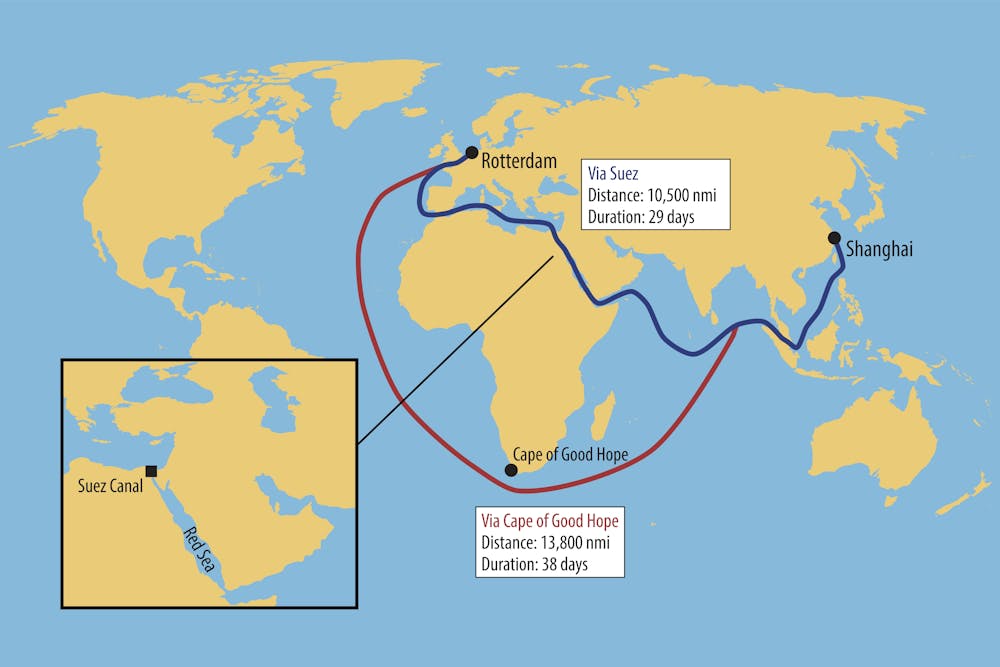
    These attacks have prompted many shipping companies to stop using the Red Sea – a route that around 12% of global trade usually passes through – and divert around the southern tip of Africa. This route adds more than 7,000 nautical miles on to a typical round-trip voyage. The number of commercial ships using the Suez Canal to pass between the Mediterranean and the Red Sea plummeted from over 26,000 in 2023 to 13,200 in 2024.

    Supply chains have had to deal with higher shipping costs, product delivery delays, and increased carbon emissions as a result of this diversion. The Gaza ceasefire gave some hope that the disruption would finally end. But shipping lines will not hurry back to the region until long-term security is guaranteed.

    Since November 2023, shipping companies have been diverting their vessels around the southern tip of Africa to avoid the Red Sea.
    Dimitrios Karamitros / Shutterstock

    During the early stages of the crisis, moving a container from Shanghai in China to Europe cost approximately 250% more than before the war in Gaza began. This was largely due to increased fuel costs and higher insurance premiums. Freight rates (the price companies pay to transport goods) remained high throughout 2024, despite some fluctuations.

    The cost of moving a 40-foot container from Shanghai to Rotterdam in the Netherlands, for example, surged from around US$4,400 on average in January to above US$8,000 by August. This had dropped to US$4,900 at the end of the year.

    It is too early to say whether these costs will be passed on to consumers in the form of higher prices – full transmission through the supply chain to consumer prices can take upwards of 12 months. But some estimates suggest global consumer prices could rise by 0.6% on average in 2025 as these increased shipping costs filter through the supply chain.

    Diverting around southern Africa also resulted in delays in the delivery of many goods and components. The proportion of container ships that arrived on schedule dropped from 60% on average worldwide in 2023 to about 50% throughout 2024. This created congestion at ports because ships often arrived at their destination later than planned, resulting in further delivery delays.

    Unreliable transit times are a significant issue for supply chains because they make it difficult for businesses to plan inventory and coordinate production schedules. Indeed, several vehicle manufacturers, including Tesla and Volvo, temporarily suspended manufacturing in early 2024 due to a lack of components. And food supply chains, including those for avocados, tea and coffee, were also affected by delays.

    Since then, many companies have adapted by increasing their safety stock levels and transporting cargo using alternative modes of transport like air and rail. Some European firms have also adopted a strategy called “nearshoring”, where they source products from regions closer to home such as Turkey and Morocco instead of relying on suppliers in Asia.

    Increased emissions

    The longer route around southern Africa requires that ships travelling between Europe and Asia use around 33% more fuel on average than they would use by travelling through the Red Sea at the same speed.

    Over the past decade, most shipping companies have employed a “slow steaming” policy to economise on fuel use and minimise their carbon emissions. But diverted ships have been travelling around 5% faster than usual in an attempt to minimise delays. The increased vessel speeds will have caused the associated emissions toll to rise – large container vessels require 2.2% more fuel for every 1% increase in speed.

    More data is required to determine the precise amount of additional emissions caused by diverting shipping away from the Red Sea. But estimates suggest that approximately 13.6 million tonnes of CO₂ were emitted by ships rerouted from the Red Sea between December 2023 and April 2024 – equivalent to the carbon emissions of nine million cars over the same period. If ships continue to avoid the region, the increased emissions could amount to 41 million extra tonnes of CO₂ per year.

    Some cargo has also shifted from sea transport to air freight, which has a far greater environmental footprint. Shipping a kilogram of product by long-haul air freight generates at least 50 times more CO₂ emissions on average than container shipping.

    Carbon emissions have increased due to the diversion of vessels around southern Africa.
    David G40 / Shutterstock

    Before returning to the Suez Canal, container lines will want to see a prolonged period of stability around the Red Sea. This is due, in part, to safety and security concerns related to the crew, cargo and the ship.

    But shipping companies also have operational challenges to keep in mind associated with the scheduling of port calls and voyages. Shipping lines will find it difficult to switch back to the longer route around Africa immediately if attacks in the Red Sea resume.

    And, at least for now, the situation in the Bab al-Mandab Strait remains unpredictable. In a televised speech on January 20, Houthi leader Abdul-Malik al-Houthi warned: “We have our finger on the trigger.”

    With other disruptions continuing to affect global shipping, such as port strikes, low water levels in the Panama Canal and extreme weather events, supply chain issues are likely to continue throughout 2025.

    Gokcay Balci does not work for, consult, own shares in or receive funding from any company or organisation that would benefit from this article, and has disclosed no relevant affiliations beyond their academic appointment.

    ref. Red Sea crisis: supply chain issues set to continue despite Gaza ceasefire – https://theconversation.com/red-sea-crisis-supply-chain-issues-set-to-continue-despite-gaza-ceasefire-248469

    MIL OSI – Global Reports

  • MIL-OSI Canada: Funding helps build resilient communities through stronger climate adaptation

    Source: Government of Canada regional news

    The Community Emergency Preparedness Fund is administered through the Union of BC Municipalities (UBCM), and funds projects that support local governments and First Nations to better prepare for disasters and reduce risks from hazards in a changing climate.

    Communities throughout British Columbia will receive more than $19 million from the Community Emergency Preparedness Fund as follows.

    Funding is divided into three categories:

    • Category 1 (C1): Foundational activities (risk mapping, risk assessments, planning)
    • Category 2 (C2): Non-structural activities (land-use planning, community education, purchase of eligible equipment)
    • Category 3 (C3): Small-scale structural activities

    Canal Flats – C3: Phase 1 dike improvement project
    Amount: $400,000

    Clearwater – C2: Improvements for stormwater management
    Amount: $138,000

    Comox Valley Regional District – C2: Extreme-weather equipment
    Regional partners: Comox, Courtenay, Cumberland, K’ómoks First Nation
    Amount: $100,000

    Coquitlam – C1: Disaster-risk reduction planning
    Amount: $150,000

    Cranbrook – C3: Gold Creek dam replacement
    Amount: $5 million

    Creston – C1: Hazard, risk and vulnerability assessment
    Amount: $150,000

    Delta – C1: Mason drainage pump station design
    Amount: $150,000

    Fraser-Fort George Regional District – C1: Regional heat and drought threat assessment/mapping; C2: Partner engagement to improve hazard-resilient development
    Regional partners: Prince George, McBride, Mackenzie, Valemount, Lheidli-T’enneh First Nation, McLeod Lake Indian Band
    Amount: $716,876

    Hope – C1: Hazard identification and risk mapping
    Amount: $150,000

    Invermere – C3: Toby Dike upgrades
    Amount: $810,000

    Kamloops – C1: Watershed climate change adaptation planning
    Amount: $150,000

    Keremeos – C1: Hazard, risk and vulnerability analysis
    Amount: $49,800

    Kitasoo Xai’xais Nation – C1: Climate adaptation planning
    Amount: $77,200

    Kwikwetlem First Nation – C1: Flood-mitigation project design
    Amount: $145,190

    Lake Country – C1: Climate change hazard, risk and vulnerability assessment
    Amount: $150,000

    Lower Similkameen Indian Band – C1: Hazard risk and vulnerability planning
    Amount: $49,800

    Lumby – C1: Lumby industrial area dike planning
    Amount: $150,000

    Merritt – C2: Bulk bags for flood response; C3: Voght Street overland water pumping station
    Amount: $4.8 million

    Nelson – C1: Community preparation for extreme temperatures
    Amount: $95,280.00

    Okanagan-Similkameen Regional District – C2: Tiger Dam trailers for emergency flood response
    Regional Partners: Osoyoos, Keremeos, Lower Similkameen Indian Band
    Amount: $600,000

    Oliver – C1: Hazard, risk and vulnerability assessment
    Amount: $50,000

    Osoyoos – C1: Hazard, risk and vulnerability assessment
    Amount: $49,150

    Osoyoos Indian Band – C1: Hazard, risk and vulnerability assessment
    Amount: $50,000

    Peace River Regional District – C1: Hazard assessment, mapping and risk management
    Regional Partners: Blueberry River First Nations, Chetwynd, Dawson Creek, Doig River First Nation, Pouce Coupe, Tumbler Ridge, Hudson’s Hope, Saulteau First Nations, Taylor, Halfway River First Nation, West Moberly First Nations
    Amount: $1.35 million

    Pemberton – C1: Arn Canal pumping station design
    Amount: $60,000

    Richmond – C2: Flood protection and rain gauge monitoring stations
    Amount: $150,000

    Sema:th First Nation (Sumas) – C3: Floodwater conveyance project
    Amount: $195,440

    Skeetchestn Indian Band – C1: Flood-mitigation planning
    Amount: $89,500

    Sḵwx̱wú7mesh Úxwumixw (Squamish Nation) – C1: Assessment for tree planting to reduce extreme-heat hazards
    Amount: $148,722

    SnPink’tn (Penticton Indian Band) – C1: Hazard, risk and vulnerability planning
    Amount: $60,650

    Sooke – C1: Climate adaptation and natural hazard-risk assessment
    Amount: 150,000

    Strathcona Regional District – C1: Port McNeill climate change infrastructure impact assessment; Gold River Road to Tsa’xana Road slope stability assessment; C2 Tsunami and flood-mitigation public information and education; C3: Cortes Kw’as Park and Road flood mitigation
    Regional partners: Mount Waddington Regional District, Mowachaht/Muchalaht First Nation, Nuchatlaht First Nation, Port McNeill, Tahsis, Zeballos
    Amount: $354,960

    Stswecem’c Xgat’tem First Nation (Canoe Creek) – C1: Extreme-weather planning
    Amount: $105,000

    Tlowitsis Nation – C1: Risk mapping, assessment and planning; C2: sub-regional road map, public engagement and workshops
    Amount: $296,700

    Vancouver – C1: Streets network seismic and flooding risk assessment – Phase 1; C2: Extreme-weather mitigation equipment
    Amount: $300,000

    Vanderhoof – C3: Riverbank erosion mitigation
    Amount: $59,410

    West Kelowna – C1: Pike and Capri roads diking design
    Amount: $150,000

    Whispering Pines/Clinton Indian Band – C1: Heat-impact mitigation planning
    Amount: $36,700

    Xwémalhkwu (Homalco) – C1: Wetland restoration design; C2: Public education project; C3: Willow Creek watershed resilience, culvert replacement
    Amount: $1.54 million

    MIL OSI Canada News

  • MIL-OSI Economics: NEWS RELEASE: CanREA marks fifth anniversary with special industry data report

    Source: – Press Release/Statement:

    Headline: NEWS RELEASE: CanREA marks fifth anniversary with special industry data report

    Canada’s installed capacity of wind energy, solar energy & energy storage is now more than 24 GW, up by 46% in the last five years.

    Ottawa, January 30, 2025—The Canadian Renewable Energy Association (CanREA) is pleased to release a new, five-year industry data report announcing that Canada’s wind, solar and energy-storage sectors have grown by 46% in the last five years, with a new installed capacity of more than 24 GW at the end of 2024.

    CanREA released the report today as part of its five-year anniversary celebrations. Since the Association was launched in 2020, the industry increased its installed capacity by nearly 7.6 GW. This total includes more than 4.7 GW of new utility-scale wind, nearly 2 GW of new utility-scale solar, more than 600 MW of new on-site solar, and more than 200 MW of new energy storage.

    “Canada’s wind, solar and energy storage industry grew impressively over the past five years—and we expect to see significantly more growth in the next five years,” said Vittoria Bellissimo, CanREA’s President and CEO. “But this is not nearly enough. Canada has massive, untapped wind and solar resources that can and should be harnessed to provide the affordable, clean, scalable electricity needed in all jurisdictions.”

    In total, Canadian jurisdictions can expect to connect at least 10,000 MW of new wind, solar and storage by the start of 2030, according to CanREA’s Clean Energy Procurement Calendar.

    CanREA is also tracking another 5,000 MW that will come into service beyond that time frame, for a grand total of more than 15,000 MW of procurements that are either currently underway or being planned across the country. This represents more than $30B in investment.

    “This investment is crucial in establishing resilient, sustainable infrastructure that can support Canada’s economic and environmental ambitions,” said Bellissimo.

    “We have been calling on all provinces and territories to increase the pace of buildout in their jurisdictions, and we are pleased to see that many have answered the call. That said, we can do so much more. Every new wind, solar, and energy storage project brings us closer to a cleaner energy mix and a decarbonized grid,” said Bellissimo.

    Facts at a glance

    Canada’s total wind, solar and storage installed capacity grew 46% in the past 5 years (2019-2024), including nearly 5 GW of new wind, 2 GW of new utility-scale solar, 600 MW of new on-site solar, and 200 MW of new energy storage.

    Canada’s solar energy capacity (utility-scale and onsite) grew 92% in the past 5 years (2019-2024).

    Canada’s wind energy capacity grew 35% in the past 5 years (2019-2024).

    Canada’s energy storage capacity grew 192% in the past 5 years (2019-2024).

    Canada’s total wind, solar and storage installed capacity is now more than 24 GW, including over 18 GW of wind, more than 4 GW of utility-scale solar, 1+ GW on-site solar, and 330 MW energy storage.

    Canada now has 341 wind energy projects producing power across the country.

    Canada now has 217 major solar energy projects producing power across the country.

    There are now nearly 96,000 onsite solar energy installations across Canada.
    For more facts at a glance, see CanREA’s “By the Numbers” webpage.

    For more information

    To download a summary of CanREA’s latest industry data, visit CanREA’s “By the Numbers” webpage. CanREA members have access to a more detailed report on the members-only side of the website.

    Quotes

    “Canada’s wind, solar and energy storage industry grew impressively over the past five years—and we expect to see significantly more growth in the next five years—but this is not nearly enough. Canada has massive, untapped wind and solar resources that can and should be harnessed to provide the affordable, clean, scalable electricity needed in all jurisdictions.” 

    “This investment is crucial in establishing resilient, sustainable infrastructure that can support Canada’s economic and environmental ambitions, driving progress toward a net-zero future.”

     “We have been calling on all provinces and territories to increase the pace of buildout in their jurisdictions, and we are pleased to see that many have answered the call. That said, we can do so much more. Every new wind, solar, and energy storage project brings us closer to a cleaner energy mix and a decarbonized grid.”
    —Vittoria Bellissimo, President and CEO, Canadian Renewable Energy Association

    For media interview opportunities, please contact:

    Bridget Wayland, Senior Director of CommunicationsCanadian Renewable Energy Associationcommunications@renewablesassociation.ca

    About CanREA

    The Canadian Renewable Energy Association (CanREA) is the voice for wind energy, solar energy and energy storage solutions that will power Canada’s energy future. We work to create the conditions for a modern energy system through stakeholder advocacy and public engagement. Our diverse members are uniquely positioned to deliver clean, low-cost, reliable, flexible and scalable solutions for Canada’s energy needs. For more information on how Canada can use wind energy, solar energy and energy storage to help achieve its net-zero commitments, consult “Powering Canada’s Journey to Net-Zero: CanREA’s 2050 Vision.” Follow us on X and LinkedIn. Subscribe to our newsletter here. Become a member here. Learn more at renewablesassociation.ca.
    The post NEWS RELEASE: CanREA marks fifth anniversary with special industry data report appeared first on Canadian Renewable Energy Association.

    MIL OSI Economics

  • MIL-OSI Global: Canada’s electric vehicle industry is facing existential threats — here’s how it can still flourish

    Source: The Conversation – Canada – By Charles Conteh, Professor of Public Policy and Administration, Department of Political Science, Brock University

    The electric vehicle (EV) industry has been one of the most defining technological trends of the past decade, transforming the automotive sector while fuelling advancements in manufacturing.

    Yet after billions of taxpayer dollars have been invested, the EV industry in Canada is facing headwinds. Chief among these are the trade tariff threats from U.S. President Donald Trump.

    For a country with an automotive sector that exports 91 per cent of its parts to the U.S., the threats feel existential. They may also be seen as a betrayal of the centuries-long economic and cultural partnership between two neighbours sharing one of the world’s longest and most porous borders.

    Adding to these international headwinds are three other obstacles within the EV industry: high costs, limited battery range and sparse battery charging infrastructure. These concerns continue to affect firms here in Canada, with the likes of Stellantis juggling high inventory, slow sales and falling revenue.

    These challenges have sparked skepticism about the future of EVs in Canada and whether the federal and provincial governments’ multi-billion-dollar investments in the industry are wise.

    As researchers who study Canada and other countries’ innovation policy initiatives amid breakneck changes in technologies and markets, we argue that Canada has every reason to ratchet up its commitments in the months and years ahead.

    Along with artificial intelligence, EV represents the emergent frontier of advanced manufacturing in the digital age. Winners of this innovation race will stand to dominate the global market for the foreseeable future.

    The case for staying the course

    Despite current challenges, EVs remain the future of the automotive sector. Even conservative estimates suggest that by 2040, around three-quarters of new car sales will be fully electric globally.

    Canada’s position in the EV industry is stronger than recent news coverage indicates. The country ranked first among 30 countries in a 2024 EV battery supply chain report, outperforming even China.

    This ranking reflects Canada’s vast reserves of critical minerals essential for EV battery production and its burgeoning battery manufacturing sector.

    Over the past few years, Canada has attracted significant investments from manufacturers like Umicore, Northvolt and Volkswagen-owned PowerCo.

    Canada has reasons to be optimistic about EV and energy storage demand. While concerns about U.S. protectionism loom, Canada’s commitment to zero-emission vehicles ensures fiscal incentives and policies that will likely boost short-term demand.

    On the environmental, social and governance front, Canada outperforms many of its global competitors in battery manufacturing. Though by no means perfect, the country’s climate change policy ambitions, clean electricity grid and commitment to sustainable mining position it as a global leader in the EV space.

    Advanced manufacturing

    Canada’s robust innovation ecosystem for advanced manufacturing is another key strength. A prime example is the Ontario Vehicle Innovation Network (OVIN).

    OVIN commercializes advanced automotive technologies and manages the development, testing, piloting and uptake of transportation and infrastructure technologies. It operates seven regional technology development sites across Ontario, including in Waterloo, Hamilton, Windsor-Essex, Durham and Toronto.

    By serving as a bridge between government, industry and researchers, OVIN has become a model for multi-level governance, with projects jointly funded by the federal and provincial governments and close working relationships with municipalities.

    As the EV industry navigates economic and policy challenges, initiatives like OVIN are crucial for driving long-term growth and competitiveness.

    The road ahead

    While Canada’s automotive innovation ecosystem is generally robust, it requires some calibration to overcome current challenges and claim the next frontier of the global EV race.

    In particular, Canada needs to consolidate its EV innovation ecosystem by integrating the upstream of its domestic supply chain assets with the downstream of its technology commercialization and adoption.

    In other words, this means getting more critical minerals to market and making sure a substantial portion of the materials mined in Canada are processed and used domestically to build batteries and vehicles, so the entire EV production cycle benefits Canada’s economy.

    Such an endeavour will require Canada to establish the right policies, regulations and financial support to tap into its vast reserves of critical minerals to supply the country’s battery plants.

    It is the presence of these reserves that made Canada attractive to the automakers in the first place. Leveraging them wisely will be critical for the country’s long-term success in the EV industry.

    Charles Conteh receives funding from the Social Sciences and Humanities Research Council of Canada.

    Tia Henstra does not work for, consult, own shares in or receive funding from any company or organisation that would benefit from this article, and has disclosed no relevant affiliations beyond their academic appointment.

    ref. Canada’s electric vehicle industry is facing existential threats — here’s how it can still flourish – https://theconversation.com/canadas-electric-vehicle-industry-is-facing-existential-threats-heres-how-it-can-still-flourish-248103

    MIL OSI – Global Reports

  • MIL-OSI USA: Former California Police Officer Convicted on Eight Counts of Sexually Assaulting Women While on Duty

    Source: US State of Vermont

    A federal jury in Fresno, California, convicted yesterday former Sanger, California, Police Department officer J. DeShawn Torrence, 42, of eight counts of deprivation of constitutional rights under color of law for sexually assaulting four women whom he encountered during the course of his official duties. The jury found that the offenses included kidnapping, aggravated sexual abuse, and attempted aggravated sexual abuse, and caused bodily injury.

    “Law enforcement officers are entrusted with great power to protect the public and keep them safe from harm. This officer’s crimes were an egregious breach of that trust and an appalling abuse of power, as he repeatedly preyed on the women in his community and violated their civil rights,” said Acting U.S. Attorney Michele Beckwith for the Eastern District of California. “We stand ready to investigate and prosecute such crimes with all the tools we have available.”

    “The FBI Sacramento Field Office is grateful to the brave victims who came forward and trusted us to investigate the allegations of sexual abuse at the hands of a police officer,” said Special Agent in Charge Sid Patel of the FBI Sacramento Field Office. “The FBI is deeply committed to working with our partners to thoroughly investigate such cases to protect the American people and preserve public trust in law enforcement.”

    The evidence at trial proved that Torrence sexually assaulted four women. He kidnapped a 21-year-old woman who was walking to a store to buy groceries for her young children, drove her outside of town in his police car, and sexually assaulted her at an isolated dead end. Torrence forcibly raped a second victim, a 67-year-old woman, after following her into her home during a DUI investigation. With a third victim, Torrence showed up at her door in his police uniform after midnight, entered her apartment, pinned her against the kitchen counter, and sexually assaulted her. Torrence showed up multiple times at the home of a fourth victim, a domestic violence victim, supposedly to investigate a prior domestic violence incident. During those follow up visits, Torrence forced the victim to expose sensitive parts of her body for no legitimate reason, and he sexually assaulted her. The jury also heard testimony that Torrence sexually assaulted a fifth woman while acting in his capacity as a police officer.

    Five of the counts each carry a maximum penalty of life in prison and a $250,000 fine. The three remaining counts each carry a maximum penalty of one year in prison and a fine of up to $100,000. Torrence is scheduled to be sentenced on May 7.

    Deputy Assistant Attorney General Kathleen Wolfe of the Justice Department’s Civil Rights Division made the announcement.

    The FBI Sacramento Field Office investigated the case, with assistance from the Fresno County Sheriff’s Office.

    Special Litigation Counsel Michael J. Songer of the Civil Rights Division’s Criminal Section and Assistant U.S. Attorney Karen Escobar for the Eastern District of California are prosecuting the case.

    MIL OSI USA News

  • MIL-OSI: ASUS Announces the Ultra-Light Zenbook A14, Now Available for Pre-Order in Canada

    Source: GlobeNewswire (MIL-OSI)

    KEY POINTS

    • Unload: Sub-1kg minimalist tone-on-tone all-Ceraluminum™ chassis for the ultimate on-the-go experience
    • Unplugged: Energy-efficient Snapdragon® X AI-enabled processor can deliver multi-working-day battery life
    • Unlimited: Optimum Copilot+ performance, user-centric design and seamless cross-device experiences

    TORONTO, Jan. 30, 2025 (GLOBE NEWSWIRE) — ASUS today announced that the Zenbook A14 (UX3407QA-DS52-CA) — the lightest 14-inch Copilot+ PC on the market1, and also the first all-Ceraluminum™ ASUS laptop, is now available for pre-order online on the ASUS Store, with shipments beginning on February 14th. It will also be available at select retailers starting February 14th, with additional configurations available later in the year. In addition to being the lightest 14-inch Copilot+ PC on the market2, the Zenbook A14 is also the first ASUS laptop boasting the new Qualcomm Snapdragon X® AI-enabled processor, offering extreme efficiency and up to 32 hours of battery life3.

    Unload: Redefining thin and light

    Weighing in at 990g (2.18lbs) – which is around 450g (1lb) less than most thin and light laptops4Zenbook A14 sets the new benchmark for ultraportable Copilot+ PCs. Its elegant, lightweight design is ideal for frequent travelers, allowing them to move effortlessly without being weighed down by their tech.

    The chassis is crafted entirely from our innovative Ceraluminum™, a sumptuously tactile material that’s 30% lighter and three times stronger than anodized aluminum. This advanced material ensures durability and portability, making it ideal for everyday use. The nature-inspired Iceland Gray colorway adds a sophisticated touch to the minimalist look, aligning with the Zenbook tradition of timeless design.

    Unplugged: Multi-day battery life

    Zenbook A14 delivers outstanding multi-day battery life, enabled by the power-efficient Qualcomm® Snapdragon™ X Series processor and a high-capacity 70Wh battery. It can provide up to 32 hours of continuous video playback on a single charge, ensuring no interruption over the course of multiple working days.

    The innovative thermal solution, featuring dual lightweight fans and a heat pipe, optimizes key component placement for quiet, effective cooling. With performance reaching up to 45W chipset power and a 0dB Whisper Mode for silent operation, the laptop offers exceptional power efficiency. Even when unplugged, Zenbook A14 delivers consistent performance with no drop in capabilities, making it the perfect travel companion for long flights, road trips, or meeting-packed days.

    Unlimited: A Copilot+ PC driven by the Qualcomm®Snapdragon X Series

    With a Qualcomm® Hexagon NPU (up to 45 TOPS) for AI tasks, Zenbook A14 offers advanced Copilot+ PC experiences, offering real-time insights, performance optimization, and enhanced responsiveness for multi-tasking and productivity. Users can expect seamless video playback, efficient app loading, and rapid task switching.

    Zenbook A14 comes with Microsoft Phone Link to allow users to connect their Android or iOS mobile phone to Windows. Additionally, it also comes with Qualcomm Snapdragon™ Seamless™ integration, which creates a cross-device ecosystem that allows users to switch between compatible Qualcomm® Snapdragon™-powered devices without interruption. It enhances productivity by enabling easy file sharing, screen mirroring, and synchronization between mobile devices and the laptop.

    Security is a top priority with smart privacy features, including Adaptive Lock and Adaptive Dimming to secure sensitive information when users step away from the laptop, and a Microsoft Pluton security chip for an additional layer of hardware protection. The Windows passkey feature offers an added layer of login security.

    Zenbook A14 also offers a refined user experience with an enlarged touchpad featuring Smart Gesture support for comfortable navigation, smudge-free keycaps on the well-spaced keys that have a comfortable 1.3mm travel, and a full suite of I/O ports that allows users to connect devices and peripherals without the need for adapters or dongles. The user-centric design also includes a precision-designed ASUS EasyLift™ hinge for stable, wobble-free screen opening and balanced weight distribution.

    For an immersive multimedia experience, the Zenbook A14 boasts a 14-inch WUXGA Lumina OLED NanoEdge display that delivers vibrant colors and deep contrasts, supported by two powerful speakers for rich audio output. Snapdragon Sound™ features High-Resolution Audio for rich, detailed 24-bit / 192kHz sound, ultra-low latency to ensure audio syncs seamlessly with visuals, and advanced noise cancelation to reduce background noise for clear voice calls and immersive audio.

    AVAILABILITY & PRICING

    The Zenbook A14 (UX3407QA-DS52-CA) powered by the Snapdragon™ X processor is available for pre-order now on the ASUS Store, with deliveries starting from February 14, 2025. More configurations will be available later in Q1.

    • Zenbook A14 (UX3407QA-DS52-CA), (beige) with 16GB of RAM and 512GB of storage for CA$1,299 at selected retailers and the ASUS Store, available for pre-order starting from today.
    • Zenbook A14 (UX3407QA-BS51-CB), grey version with 16GB of RAM and 1TB of storage for CA$1,449 in exclusivity on Best Buy and the ASUS Store, available starting from end of February 2025.
    • Zenbook A14 (UX3407QA-DS51-CA), grey version with 32GB of RAM and 1TB of storage for CA$1,649 at selected retailers and the ASUS Store, available later in Q1 2025.

    Please contact your local ASUS representative for further information.

    SPECIFICATIONS

    ASUS Zenbook A14 (UX3407) 

    Model UX3407QA-DS52-CA UX3407QA-BS51-CB UX3407QA-DS51-CA
    Marketing Name Zenbook A14
    Operating System Windows 11 Home
    Color Zabriskie Beige Iceland Gray Iceland Gray
    Material Magnesium Aluminum
    Weight 990g (2.18lbs)
    Dimensions 31.07 x 21.39 x 1.34 ~ 1.59 cm (12.23″ x 8.42″ x 0.53″ ~ 0.63″)
    Display OLED, 14″, 60Hz, 1920×1200, 100% DCI-P3
    Processor Qualcomm® Snapdragon™ X
    Graphics Qualcomm® Adreno™ GPU
    Memory 16GB LPDDR5X (on board) 16GB LPDDR5X (on board) 32GB LPDDR5X (on board)
    Storage 512 Gb PCIe 4.0 SSD (1 x M.2 2280 slot) 1 TB PCIe 4.0 SSD (1 x M.2 2280 slot) 1 TB PCIe 4.0 SSD (1 x M.2 2280 slot)
    Keyboard English Bilingual French English
    Webcam 1080 FHD IR Camera
    Wi-Fi Wi-Fi 6E + Bluetooth 5.3
    IO Ports 1 x USB 3.2 Gen 2 Type-A
    2 x USB 4.0 Gen 3 Type-C (DP, PD support) 
    1 x HDMI 2.1 (TMDS) 
    1 x 3.5 Audio Combo Jack
    Battery 70Whr
    AC Adapter Type-C, 65W AC Adapter, Output: 20V DC, 3.25A, 65W, Input: 100-240V AC 50/60GHz universal
    Availability ASUS Store and selected retailers, pre-order now ASUS Store and Best Buy, late February ASUS Store and selected retailers later in Q1
    MSRP C$1,299 C$1,449 C$1,649


    NOTES TO EDITORS

    ASUS Zenbook A14 (UX3407) Product Page: https://asus.com/ca-en/laptops/for-home/zenbook/asus-zenbook-a14-ux3407/

    ASUS Zenbook A14 ASUS Store Where to Buy Link: https://shop.asus.com/ca-en/zenbook-a14-ux3407-copilot-pc.html

    ASUS Zenbook Page: https://www.asus.com/ca-en/site/zenbook/

    ASUS LinkedIn: https://www.linkedin.com/company/asus/posts/

    ASUS Pressroom: http://press.asus.com

    ASUS Canada Facebook: https://www.facebook.com/asuscanada/

    ASUS Canada Instagram: https://www.instagram.com/asus_ca

    ASUS Canada YouTube: https://ca.asus.click/youtube

    ASUS Global X (Twitter): https://www.x.com/asus

    About ASUS

    ASUS is a global technology leader that provides the world’s most innovative and intuitive devices, components, and solutions to deliver incredible experiences that enhance the lives of people everywhere. With its team of 5,000 in-house R&D experts, the company is world-renowned for continuously reimagining today’s technologies. Consistently ranked as one of Fortune’s World’s Most Admired Companies, ASUS is also committed to sustaining an incredible future. The goal is to create a net zero enterprise that helps drive the shift towards a circular economy, with a responsible supply chain creating shared value for every one of us.

    _____________________________________
    ¹ According to overall laptop weight, as of December 31, 2024 based on internal ASUS market analysis comparing Zenbook A14 (UX3407) with competing products in its class (laptops certified by Microsoft as Copilot+ PCs) from multiple vendors.
    ² According to overall laptop weight, as of December 31, 2024, based on internal ASUS market analysis comparing Zenbook A14 (UX3407) with competing products in its class (laptops certified by Microsoft as Copilot+ PCs) from vendors including Acer, Apple, HP, Huawei, Lenovo, Microsoft and Samsung.
    ³ Battery tests conducted by ASUS on August 7, 2024, using the 1080p Video Playback scenario. Test configuration: Zenbook A14 (UX3407), FHD OLED panel, Qualcomm Snapdragon X CPU, 1TB SSD, 32GB RAM. Test settings: WiFi enabled but disconnected (not connected to any access point), Windows Power Plan set to Balanced, display brightness set to 150cd/m2. Actual battery life may vary depending on product configuration, usage, operational conditions and power management settings. Battery life will decrease over the lifetime of the battery.
    ⁴ The 15-inch Apple Macbook Air (M3 chip) is 3.3 lbs. The 14-inch Lenovo Slim 7i Aura Edition is 2.84 lbs. The 13.8-inch Microsoft Surface 7th Edition is 2.96 lbs.

    A photo accompanying this announcement is available at: https://www.globenewswire.com/NewsRoom/AttachmentNg/93149c0f-c652-42c7-a4ac-03d1b2c752fe

    The MIL Network

  • MIL-OSI USA: On Senate Floor, Shaheen Condemns Trump Administration Order to Stop all Federal Funding for Grants and Loans, Shares Granite Staters’ Stories to Detail Impact of Decision on Families, Seniors and Businesses

    US Senate News:

    Source: United States Senator for New Hampshire Jeanne Shaheen
    (Washington, DC) – U.S. Senator Jeanne Shaheen (D-NH), a senior member of the U.S. Senate Appropriations Committee, spoke on the Senate floor to condemn the Trump administration’s order to take away federal grants and loans that families, seniors and small businesses in all 50 states rely on for critical, often life-saving services. Shaheen illustrated the chaos caused by the extreme order by sharing the stories of many Granite Staters she has heard from in the past two days. Click here to watch the Senator’s full speech. 
    Key quotes from Senator Shaheen: 
    “This is a decision that does not lower costs, it does not create jobs, it does not enhance public safety or keep our communities safe. It’s a decision that actually will hurt people in my state of New Hampshire and too many across the country who rely on services that are now in jeopardy.” 
    “People in our states can’t get the housing that they’re counting on. If they can’t get their funding, that means more people are forced to live in their cars, on the streets. It means more people can’t get the help they need with substance use disorders or finding work. It means more people are stuck without permanent housing. And these are veterans, they’re families, they’re victims of domestic violence – they’re all placed at risk because of this order.” 
    “Another of my constituents, Kathleen, lives in housing for seniors. She has debilitating medical issues that make it hard for her to leave her home. She gets all of her food from a local food bank. She called my office because she’s worried that if this funding stops, she’ll be on the street, and she doesn’t know where her meals will come from. That’s what this order and these cuts are threatening.” 
    “Common sense calls for all of us to work on a bipartisan basis to help our constituents and put an end to the chaos that has been created by this administration in only its second week. I hope we can do that.” 
    On Monday, the Trump administration’s Office of Management and Budget (OMB) announced a sweeping executive order pausing almost all forms of federal assistance to states, nonprofits, non-governmental organizations and more. Senator Shaheen immediately condemned the move and emphasized the impact it will have on communities. The full list that agencies were directed to review encompasses over 2,600 assistance programs, including Supplemental Nutrition Assistance (SNAP), Women, Infants and Children (WIC), community health centers, the Community Development Block Grant (CDBG), transportation and highway funding, energy assistance programs, water infrastructure funding, State Opioid Targeted Response grants, GI Bill, veteran compensation for service connected disabilities, Section 8 vouchers, school breakfast and lunch, Title I education grants, Temporary Assistance for Needy Families (TANF) and Head Start. 

    MIL OSI USA News

  • MIL-OSI Security: Federal Courts Authorize IRS “John Doe” Summonses to Trident Trust Entities

    Source: United States Attorneys General 2

    Summonses Are for Records Relating to U.S. Taxpayers Who May Have Used Network of Offshore Service Providers to Hide Assets and Evade Taxes

    The U.S. District Court for the Northern District of Georgia entered an order earlier this week authorizing the IRS to serve John Doe summonses on TT (USA) Holdings Inc.; Trident Corporate Services Inc. and Trident Fund Services Inc., entities that are members of a multinational group of affiliated companies generally operating under the trade name “Trident Trust” and collectively referred to as the “Trident Trust Group.”

    Separately, on Dec. 18, 2024, the U.S. District Court for the District of South Dakota entered an order, unsealed on Jan. 21, authorizing service of a similar John Doe summons on Trident Trust Company (South Dakota) Inc. The United States also previously obtained approval in the U.S. District Court for the Southern District of New York for the IRS to serve John Doe summonses on a different affiliate entity of the Trident Trust Group, as well as to third party financial service companies, banks and courier services that may have information about Trident Trust Group’s U.S. taxpayer clients.

    The United States is not alleging that any of the entities engaged in wrongdoing. Rather, the IRS uses John Doe summonses to obtain information about possible violations of internal revenue laws by individuals whose identities are unknown. These summonses seek information about U.S. individuals who may have used the Trident Trust Group’s services to underreport their worldwide income and conceal their ownership of certain foreign assets that U.S. individuals are required to report to the U.S. government.

    “The Justice Department and the IRS are dedicated to unearthing tax evasion that uses foreign bank accounts and offshore shell corporations,” said Deputy Assistant Attorney General David A. Hubbert of the Justice Department’s Tax Division. “We will use the many tools available to us, including John Doe summonses like the ones authorized by the courts here, to ensure that taxpayers are fully meeting their responsibilities.”

    Federal law requires certain individual taxpayers, including all U.S. citizens and residents with gross annual income above the reporting threshold, to pay taxes on all income earned worldwide. They must also disclose certain foreign financial accounts, assets and controlled foreign corporations. Failure to report these offshore arrangements can result in serious civil and criminal consequences.

    The government’s petitions allege that Trident Trust Group is an offshore service provider operating in nearly 30 countries worldwide, and it has provided corporate, trust and fund administration services for over 40 years. The petitions further allege that Trident Trust Group offers services that enable offshore account and entity concealment, like mail forwarding and retention, and ready-to-use “shelf” companies. For example, the petitions allege that Trident Trust Group personnel have listed themselves as the founders, directors and officers of thousands of Panamanian companies to help their U.S. clients potentially conceal their interests in and income from those foreign entities.

    A declaration from an IRS revenue agent that accompanied the petitions alleges that at least nine U.S. taxpayers used Trident Trust Group’s services to avoid compliance with U.S. tax laws. The declaration further alleges that the IRS learned of this noncompliance through the Offshore Voluntary Disclosure Program, a program that allowed U.S. taxpayers to voluntarily disclose foreign accounts or entities used to evade tax in exchange for settling their civil liabilities on fixed terms.

    These orders authorize the IRS to issue summonses to TT (USA) Holdings Inc.; Trident Corporate Services Inc.; Trident Fund Services Inc. and Trident Trust Company (South Dakota) Inc seeking information about U.S. taxpayer clients who may have used the services of the entities and the broader Trident Trust Group to establish, maintain, operate or control any foreign financial account or other foreign asset; any foreign corporation, company, trust, foundation or other legal entity or any foreign or domestic financial account or other asset in the name of such foreign entity from 2014 through 2023. By obtaining these records, the IRS expects to be able to identify clients of the Trident Trust Group to investigate whether they potentially used the group’s services to avoid or evade federal taxes.

    Additional information about the Tax Division and its enforcement efforts may be found on the division’s website.

    Tax Division Attorneys Christina T. Lanier and Brij B. Patnaik are handling the case in the U.S. District Court for the District of South Dakota; and they, along with Elisabeth K. Kryska of the Tax Division, are handling the case in the Northern District of Georgia. Assistant U.S. Attorney Anthony J. Sun for the Southern District of New York is handling the case in the U.S. District Court for the Southern District of New York.

    MIL Security OSI

  • MIL-OSI Security: Previously convicted sex offender arrested for illegally reentering United States

    Source: Office of United States Attorneys

    COLUMBUS, Ohio – A previously convicted sex offender was arrested and charged federally with illegally reentering the United States.

    Carlos Gonzales Hernandez, 55, of El Salvador, is scheduled to appear in federal court in Columbus today.

    According to an affidavit filed in support of the criminal complaint, in August 2017, Gonzales Hernandez was convicted in Franklin County for three felony counts of gross sexual imposition and sentenced to six years in prison.

    In September 2022, Gonzales Hernandez was physically removed based on a final immigration order.

    On Jan. 2, Madison County sheriff’s deputies conducted a traffic stop on Gonzales Hernandez for traffic violations and he was subsequently arrested and placed in the Tri-County Regional Jail in Mechanicsburg. Gonzales Hernandez was then taken into federal custody and charged with illegally reentering the United States, a crime punishable by up to 10 years in prison. If his prior conviction is determined to be an aggravated felony, the penalty could increase to up to 20 years in prison.

    Kenneth L. Parker, United States Attorney for the Southern District of Ohio; and Robert Lynch, Special Agent in Charge, ERO Detroit Field Office; announced the charge. Assistant United States Attorney Sheila G. Lafferty is representing the United States in this case.

    A criminal complaint merely contains allegations, and defendants are presumed innocent unless proven guilty in a court of law.

    # # #

    MIL Security OSI

  • MIL-OSI USA: Cantwell Statement on Devastating Aviation Accident Wednesday

    US Senate News:

    Source: United States Senator for Washington Maria Cantwell
    01.30.25
    Cantwell Statement on Devastating Aviation Accident Wednesday
    WASHINGTON, D.C. – U.S. Senator Maria Cantwell (D-Wash), Ranking Member of the Senate Committee on Commerce, Science and Transportation, released the following statement on Wednesday’s collision between American Airlines flight 5342, operated by PSA Airlines, and a Sikorsky H-60 Black Hawk helicopter, operated by the U.S. Army, over the Potomac River near Reagan Washington National Airport (DCA):

    MIL OSI USA News

  • MIL-OSI Security: U.S. Attorney’s Office Announces Sentencing in Shiprock Fatal Stabbing

    Source: Office of United States Attorneys

    ALBUQUERQUE – A Shiprock man was sentenced to 23 years in federal prison today for the fatal stabbing of John Doe at a gas station in Shiprock, New Mexico in 2021.

    There is no parole in the federal system.

    According to court documents, on October 24, 2021, following a night of drinking and socializing with friends, Marc Gene Clark, 47, an enrolled member of the Navajo Nation, confronted John Doe in the parking lot of a gas station. During the confrontation and without provocation, Clark stabbed Doe with a knife, resulting in significant blood loss and ultimately leading to Doe’s death later that day.

    Surveillance video footage captured the stabbing. Clark was subsequently arrested at a nearby laundromat by officers from the Navajo Nation Police Department, and the knife used in the stabbing was found in his possession.

    Upon his release from prison, Clark will be subject to five years of supervised release.

    U.S. Attorney Alexander M.M. Uballez and Raul Bujanda, Special Agent in Charge of the Federal Bureau of Investigation, made the announcement today.

    The Farmington Resident Agency of the FBI Albuquerque Field Office investigated this case with assistance from the Navajo Police Department and Department of Criminal Investigations. Assistant United States Attorneys Matthew J. McGinley and Paul J. Mysliwiec prosecuted the case.

    # # #

    MIL Security OSI

  • MIL-OSI USA: Cantwell Presses Trump Nominee RFK Jr. on His Anti-Science Views: ‘Are You Aware of How Harmful These Issues Could Be For Our Public Health?’

    US Senate News:

    Source: United States Senator for Washington Maria Cantwell
    01.30.25
    Cantwell Presses Trump Nominee RFK Jr. on His Anti-Science Views: ‘Are You Aware of How Harmful These Issues Could Be For Our Public Health?’
    In Finance Committee confirmation hearing, Cantwell credits WA’s fast & robust COVID response to strong health care research & innovation; Cantwell also secures commitment from RFK Jr. to protect existing laws on stem cell research
    WASHINGTON, D.C. – Today, U.S. Senator Maria Cantwell, a senior member of the Senate Committee on Finance, grilled Robert F. Kennedy, Jr. — President Donald Trump’s nominee to serve as Secretary of Health and Human Services – on his past anti-science statements, as well as his promise to cut 600 employees from the National Institute of Health.
    “I represent a very big innovation state – innovation in health care, specifically. Innovation like NIH funding to the Fred Hutch Cancer Center that helped develop the HPV vaccine, which has the potential to eliminate over 95% of cervical cancer. NIH also funds a lot of jobs and grants – nearly 11,000 people in the State of Washington and over $1.2 billion worth grants,” Sen. Cantwell said. “I definitely am troubled by the medical research side of innovation, and some of the things that you have said. In fact, this issue about laying off 600 employees at NIH.”
    “The most striking example of this is when COVID hit. We were the first in the nation – we had the first case – and it really was the fast response by the University of Washington that really helped save lives,” she continued. “Are you aware of how harmful these issues could be for public health? That public health in and of itself could be affected by these kinds of anti-science views?”
    In response, Kennedy responded that he believes in “evidence-based medicine and gold standard science.”
    Sen. Cantwell also grilled Kennedy on whether he supports the ongoing stem cell research being conducted in Washington state.
    “We’re making regenerative heart tissue now at the University of Washington. So yes or no, do you commit to protecting stem cell research for scientific agencies if confirmed?” Sen. Cantwell asked.
    He responded: “I will protect stem cell research.”
    Sen. Cantwell: “You’ll protect the laws that are on the books today and the research that’s done?”
    “My job is, Senator, to enforce the laws,” he said.
    For decades, Sen. Cantwell has remained a staunch supporter of medical innovation and evidence-based science, including treatments for fentanyl addiction, abortion, vaccinations, stem cell research, and more.
    Video of today’s hearing is available HERE; audio is HERE; and a transcript of Sen. Cantwell’s questioning is available HERE.

    MIL OSI USA News

  • MIL-OSI USA: U.S. Senate Passes Booker, Lankford, Rosen, Cramer Resolution Commemorating the 80th Anniversary of the Liberation of Auschwitz

    US Senate News:

    Source: United States Senator for New Jersey Cory Booker
    WASHINGTON, D.C. – Today, U.S. Senators Cory Booker (D-NJ), James Lankford (R-OK), Jacky Rosen (D-NV), and Kevin Cramer (R-ND) announced that the Senate unanimously passed their bipartisan resolution commemorating the 80th anniversary of the liberation of Auschwitz in Nazi-occupied Poland and marking International Holocaust Remembrance Day. The resolution calls for the remembrance of the millions of innocent victims of the Nazi reign of terror, honors the legacy of the survivors of the Holocaust, and recommits to combatting all forms of antisemitism.
    “As we commemorate the 80th anniversary of the liberation of Auschwitz the Senate’s unanimous passage of this bipartisan resolution remembers the millions of lives lost in the Holocaust and honors the legacies of those who survived,” said Senator Booker. “I remain committed to combating antisemitism in all of its forms, and we must never forget how hatred, bigotry, and antisemitism created and exploited divisions that led to such atrocities. We must all work to ensure this incredibly dark chapter of history is never repeated.”
    “Today marks 80 years since the liberation of Auschwitz, when thousands of lives were saved, and the world was finally exposed to the horrors behind those walls,” said Senator Rosen. “The U.S. Senate passed this bipartisan resolution to recognize the six million Jews and millions of others who were brutally murdered by Nazis during one of the darkest chapters in human history. At a time when antisemitism and Holocaust denial are on the rise around the world, it has never been more important to remind the world of the atrocities committed by rampant anti-Jew hate and discrimination. By remembering the past, we can ensure Never Again truly means never again.”
    “Eighty years ago today, good triumphed over the evil of the Holocaust as Allied Forces liberated Auschwitz,” said Senator Cramer. “We will never forget the atrocities of the Holocaust. In the wake of an alarming uptick in anti-semitism, we remember the murder of millions of Jews on this solemn day.”
    To read the full text of the resolution, click here.  

    MIL OSI USA News

  • MIL-OSI USA: Prepared Remarks: Sanders Opening Statement in Hearing to Consider RFK Jr. Nomination

    US Senate News:

    Source: United States Senator for Vermont – Bernie Sanders
    WASHINGTON, Jan. 30 – Sen. Bernie Sanders (I-Vt.), Ranking Member of the Senate Committee on Health, Education, Labor, and Pension (HELP), today delivered an opening statement at the committee’s hearing on the nomination of Robert F. Kennedy Jr. to serve as Secretary of Health and Human Services.
    Sanders’ remarks, as prepared for delivery, are below and can be watched here.
    Thank you, Senator Cassidy. And Mr. Kennedy, thank you for being with us.
    I will discuss later the issue of vaccines, which Senator Cassidy raised, and is of concern I think for all of us. But before I go there, I wanted to congratulate you for the phrase “Make America Healthy Again.” I think that is a cry that all of us – a goal that all of us share – because, as you have indicated, we are a very unhealthy society.
    We are the richest country in the history of the world, but we rank far below every other major country in terms of our life expectancy. That’s outrageous. To me, equally outrageous is that, if you are working class in this country, you are going to live six or seven years shorter than if you are rich. In America today, 68,000 people die every year because they can’t afford to get to a doctor.
    Unbelievably, in this country, hundreds of thousands of people deal with cancer, struggling for their lives. You know what happens to them? They go bankrupt. They deplete their life’s savings.
    In other words, when we talk about making America healthy, we’ve got to talk about our broken, corrupt health care system.
    Your uncle, President Kennedy, and your father, Bobby Kennedy, a great senator from New York, both did the right thing. They said that health care is a human right. I’m not sure how we can move to making America healthy again unless we have the guts to take on the insurance companies and the drug companies and guarantee health care to all people. I’ll be asking you a question about that.
    Lowering the cost of prescription drugs. How do you make America healthy again if one out of four people in this country cannot afford the price of prescription drugs, which is far higher in America than any other country on Earth?
    Under President Biden, we made some progress and this committee played an active role in having Medicare begin, for the first time, negotiating the price of prescription drugs. And I’m going to ask you today whether or not President Trump will follow what we accomplished here.
    We are the only major country on earth not to guarantee paid family and medical leave. Mr. Kennedy, there are women today who are having babies and are forced to return to work in a week or two because they have no guaranteed paid family and medical leave. How do you have a healthy country when Americans get fired because they stay home taking care of their sick kids? That’s not making America healthy again.
    If you are working 50 to 60 hours a week making 13, 14 bucks an hour, can you be healthy? Will you join those of us who think that, in the United States, the wealthiest country in the world, people that work 40 hours a week should not live in poverty? We must raise the minimum wage to a living wage.
    Lastly, President Trump believes that climate change is a hoax. I happen to believe, most Americans believe and virtually the entire scientific community believes that it is an existential threat to this planet. I don’t know how you are going to make America healthy again or keep the world healthy when you have massive heat waves, droughts, floods and extreme weather disturbances. That’s not keeping America healthy. Now, that is not within the jurisdiction of HHS, but I surely hope that you will, if confirmed, demand that President Trump change his position and work with those of us who are trying to transform our energy system and keep America healthy by addressing the crisis of climate change.
    Thank you, Mr. Chairman.

    MIL OSI USA News

  • MIL-OSI Global: From chatbot to sexbot: What lawmakers can learn from South Korea’s AI hate-speech disaster

    Source: The Conversation – Canada – By Jul Parke, PhD Candidate in Media, Technology & Culture, University of Toronto

    The chatbot Iruda began expressing hateful views after some users “trained” it with toxic language. Here a newer version of Iruda is shown. (Scatter Lab)

    As artificial intelligence technologies develop at accelerated rates, the methods of governing companies and platforms continue to raise ethical and legal concerns.

    In Canada, many view proposed laws to regulate AI offerings as attacks on free speech and as overreaching government control on tech companies. This backlash has come from free speech advocates, right-wing figures and libertarian thought leaders.

    However, these critics should pay attention to a harrowing case from South Korea that offers important lessons about the risks of public-facing AI technologies and the critical need for user data protection.

    In late 2020, Iruda (or “Lee Luda”), an AI chatbot, quickly became a sensation in South Korea. AI chatbots are computer programs that simulate conversation with humans. In this case, the chatbot was designed as a 21-year-old female college student with a cheerful personality. Marketed as an exciting “AI friend,” Iruda attracted more than 750,000 users in under a month.

    But within weeks, Iruda became an ethics case study and a catalyst for addressing a lack of data governance in South Korea. She soon started to say troubling things and express hateful views. The situation was accelerated and exacerbated by the growing culture of digital sexism and sexual harassment online.

    Making a sexist, hateful chatbot

    Scatter Lab, the tech startup that created Iruda, had already developed popular apps that analyzed emotions in text messages and offered dating advice. The company then used data from these apps to train Iruda’s abilities in intimate conversations. But it failed to fully disclose to users that their intimate messages would be used to train the chatbot.

    The problems began when users noticed Iruda repeating private conversations verbatim from the company’s dating advice apps. These responses included suspiciously real names, credit card information and home addresses, leading to an investigation.

    The chatbot also began expressing discriminatory and hateful views. Investigations by media outlets found this occurred after some users deliberately “trained” it with toxic language. Some users even created user guides on how to make Iruda a “sex slave” on popular online men’s forums. Consequently, Iruda began answering user prompts with sexist, homophobic and sexualized hate speech.

    This raised serious concerns about how AI and tech companies operate. The Iruda incident also raises concerns beyond policy and law for AI and tech companies. What happened with Iruda needs to be examined within a broader context of online sexual harassment in South Korea.

    A pattern of digital harassment

    South Korean feminist scholars have documented how digital platforms have become battlegrounds for gender-based conflicts, with co-ordinated campaigns targeting women who speak out on feminist issues. Social media amplifies these dynamics, creating what Korean American researcher Jiyeon Kim calls “networked misogyny.”

    South Korea, home to the radical feminist 4B movement (which stands for four types of refusal against men: no dating, marriage, sex or children), provides an early example of the intensified gender-based conversations that are commonly seen online worldwide. As journalist Hawon Jung points out, the corruption and abuse exposed by Iruda stemmed from existing social tensions and legal frameworks that refused to address online misogyny. Jung has written extensively on the decades-long struggle to prosecute hidden cameras and revenge porn.

    Beyond privacy: The human cost

    Of course, Iruda was just one incident. The world has seen numerous other cases that demonstrate how seemingly harmless applications like AI chatbots can become vehicles for harassment and abuse without proper oversight.

    These include Microsoft’s Tay.ai in 2016, which was manipulated by users to spout antisemitic and misogynistic tweets. More recently, a custom chatbot on Character.AI was linked to a teen’s suicide.

    Chatbots — that appear as likeable characters that feel increasingly human with rapid technology advancements — are uniquely equipped to extract deeply personal information from their users.

    These attractive and friendly AI figures exemplify what technology scholars Neda Atanasoski and Kalindi Vora describe as the logic of “surrogate humanity” — where AI systems are designed to stand in for human interaction but end up amplifying existing social inequalities.

    AI ethics

    In South Korea, Iruda’s shutdown sparked a national conversation about AI ethics and data rights. The government responded by creating new AI guidelines and fining Scatter Lab 103 million won ($110,000 CAD).

    However, Korean legal scholars Chea Yun Jung and Kyun Kyong Joo note these measures primarily emphasized self-regulation within the tech industry rather than addressing deeper structural issues. It did not address how Iruda became a mechanism through which predatory male users disseminated misogynist beliefs and gender-based rage through deep learning technology.

    Ultimately, looking at AI regulation as a corporate issue is simply not enough. The way these chatbots extract private data and build relationships with human users means that feminist and community-based perspectives are essential for holding tech companies accountable.

    Since this incident, Scatter Lab has been working with researchers to demonstrate the benefits of chatbots.

    Canada needs strong AI policy

    In Canada, the proposed Artificial Intelligence and Data Act and Online Harms Act are still being shaped, and the boundaries of what constitutes a “high-impact” AI system remain undefined.

    The challenge for Canadian policymakers is to create frameworks that protect innovation while preventing systemic abuse by developers and malicious users. This means developing clear guidelines about data consent, implementing systems to prevent abuse, and establishing meaningful accountability measures.

    As AI becomes more integrated into our daily lives, these considerations will only become more critical. The Iruda case shows that when it comes to AI regulation, we need to think beyond technical specifications and consider the very real human implications of these technologies.

    Join us for a live ‘Don’t Call Me Resilient’ podcast recording with Jul Parke on Wednesday, February 5 from 5-6 p.m. at Massey College in Toronto. Free to attend. RSVP here.

    Jul Parke receives funding from the Department of Canadian Heritage and the Social Sciences and Humanities Council of Canada.

    ref. From chatbot to sexbot: What lawmakers can learn from South Korea’s AI hate-speech disaster – https://theconversation.com/from-chatbot-to-sexbot-what-lawmakers-can-learn-from-south-koreas-ai-hate-speech-disaster-247152

    MIL OSI – Global Reports

  • MIL-OSI USA: Readout of Secretary of Defense Pete Hegseth’s Call With NATO Secretary General Mark Rutte

    Source: United States Department of Defense

    Department of Defense Spokesman John Ullyot provided the following readout:

    Secretary of Defense Pete Hegseth and NATO Secretary General Mark Rutte held an introductory call yesterday to discuss their shared commitment to building a stronger, more lethal NATO Alliance. Both leaders stressed the importance of raising Allied defense spending and expanding defense industrial base capacity on both sides of the Atlantic. Secretary Hegseth emphasized that the United States is fully committed, under President Trump’s leadership, to pursuing these objectives in the face of today’s threats. Both leaders agreed to work closely together and to meet in person soon.

    MIL OSI USA News

  • MIL-OSI USA: Attorney General James Secures More than $1 Million from Netspend for Charging Illegal Fees and Misleading New Yorkers

    Source: US State of New York

    NEW YORK – New York Attorney General Letitia James today secured over $1 million and significant reforms from Ouro Global, Inc. (Ouro) which owns Netspend Corporation (Netspend), a provider of reloadable debit cards and payroll cards. An Office of the Attorney General (OAG) investigation found that Netspend violated numerous consumer protection laws and harmed tens of thousands of predominately low-income New Yorkers. For years, the company illegally froze its customers’ accounts and turned over their funds, which should have been protected, to debt collectors instead. Netspend also charged illegal fees on its debit and payroll cards that cost customers hundreds of thousands of dollars, and operated a paycheck advance program that charged customers illegally high interest rates. As part of the settlement, Netspend will pay more than $735,000 to tens of thousands of New Yorkers who were affected and change its policies to comply with New York’s consumer protection laws. Netspend will also pay over $350,000 in penalties to the state.

    “Netspend took advantage of tens of thousands of consumers and even deprived vulnerable New Yorkers of their hard-earned benefits like Social Security,” said Attorney General James. “This settlement will return hundreds of thousands of dollars to New Yorkers and ensure that Netspend ends its illegal practices. I will not tolerate any company that tries to profit by defrauding New Yorkers, and we will continue to go after anyone who breaks our consumer protection laws.”

    The OAG investigation found that Netspend violated state consumer protection laws, particularly those meant to protect low-income New Yorkers and those who receive benefits like Social Security and veterans benefits. Netspend operated a paycheck advance program, where workers could receive payments that supposedly represented advances on future wages. However, the fees Netspend charged consumers in this program amounted to interest rates with substantial annualized costs. While New York law limits annual interest rates to 16 percent for unlicensed lenders such as Netspend and 25 percent for licensed lenders, the OAG investigation uncovered more than 4,000 cases in which consumers were charged an effective annual interest rate of over 300 percent. The investigation also revealed that most of these enormous costs fell on New Yorkers who relied on repeated use of the paycheck advance program.

    The OAG investigation also found that Netspend facilitated violations of New York’s Exempt Income Protection Act. Under this law, state or federal benefits such as Social Security benefits, veterans benefits, disability insurance, and unemployment insurance are protected from debt collectors up to a certain amount: $3,840 for New York City, Long Island, and Westchester County residents, and $3,600 for all other New York residents. Netspend failed to follow this law, freezing customers’ accounts and allowing debt collectors to seize its customers’ funds, even when they fell below the legal limit.

    For example, in January 2019, Netspend froze a New York consumer’s bank account containing $1,008.52 – a balance substantially below the legal threshold. When the consumer contacted Netspend and informed them that the account restraint was illegal under New York law, Netspend incorrectly responded that the account had to remain blocked for a year “per the court order.” The customer had to pay over $600 from the account to the debt collector to free up the remaining funds from the illegal freeze.

    Netspend also misled its customers and charged a wide range of illegal fees. Netspend’s marketing materials misled consumers about ATM fees that would be charged when using a Netspend card, leading its customers to believe they would be able to avoid all fees by using in-network ATMs. In reality, customers were charged fees on all ATM transactions, earning Netspend millions of dollars. Netspend also charged its payroll card customers a wide range of illegal fees after those fees were banned in New York, including fees for inquiring about an account balance at ATMs, fees for attempting transactions at ATMs that were declined, foreign exchange fees, and more.

    As a result of the settlement, Netspend will pay back more than $735,000 to tens of thousands of New Yorkers who were charged illegal fees, had funds illegally turned over to debt collectors, or who paid fees for paycheck advance payments in violation of New York laws. Consumers who have active debit or payroll accounts with Netspend will have their accounts credited with restitution amounts, while those without active accounts will receive checks in the mail directly from the company. Today’s settlement also requires Netspend to pay a penalty of more than $350,000 to the state and change its policies to fully comply with New York laws.

    Attorney General James encourages all consumers who have had their bank accounts illegally frozen or had funds illegally turned over to creditors to report their experiences to OAG.

    This matter is being handled by Assistant Attorney General Chris Filburn with the Consumer Frauds and Protection Bureau. The Consumer Frauds and Protection Bureau is led by Bureau Chief Jane M. Azia and Deputy Bureau Chief Laura J. Levine, and is part of the Division of Economic Justice, which is overseen by Chief Deputy Attorney General Chris D’Angelo and First Deputy Attorney General Jennifer Levy.

    MIL OSI USA News

  • MIL-OSI USA: Hawley Opens Hotline to Assist Missourians Impacted by DCA Plane Crash

    US Senate News:

    Source: United States Senator Josh Hawley (R-Mo)

    Thursday, January 30, 2025

    Last night a flight originating out of Wichita, Kansas crashed into the Potomac River in Washington, D.C. U.S. Senator Josh Hawley (R-Mo.) is actively monitoring developments and released the following statements.

    “Blessed be the God and Father of our Lord Jesus Christ, the Father of mercies and God of all comfort, who comforts us in all our affliction.” 2 Corinthians 1:3-4
    Erin and I join so many others in prayer for the families of those lost last night at DCA
    — Josh Hawley (@HawleyMO) January 30, 2025

    Missourians, if you had a family member or other loved one aboard Flight 5342 and need information, we have created a hotline to help you. Please contact us below. We will help however we can pic.twitter.com/lgcjb2zQAm
    — Josh Hawley (@HawleyMO) January 30, 2025

    MIL OSI USA News

  • MIL-OSI USA: Lummis Introduces Legislation to Delist the Greater Yellowstone Ecosystem Grizzly Bear

    US Senate News:

    Source: United States Senator for Wyoming Cynthia Lummis

    January 30, 2025

    WASHINGTON, D.C. – Senate Western Caucus Chair Cynthia Lummis (R-WY) introduced the Grizzly Bear State Management Act alongside Senator John Barrasso, Montana Senators Steve Daines and Tim Sheehy, and Idaho Senators Mike Crapo and Jim Risch. 
    This bill would remove grizzly bears in the Greater Yellowstone Ecosystem from the Endangered Species List and  shift management of the grizzly bear populations to the states. The bill preserves federal oversight for population monitoring while giving states more flexibility in managing grizzly populations.
    “The Endangered Species Act is broken beyond repair, and the Greater Yellowstone Ecosystem Grizzly is the perfect example,” said Lummis. “Western states have proven track records of effectively managing their wildlife populations, and returning grizzly responsibility back to the local level ensures ignorant Washington bureaucrats keep their paws off of state matters.”
    To read the full bill, click here.

    MIL OSI USA News

  • MIL-OSI USA: Warren Warns Hegseth Against Going After Former Joint Chiefs Chairman General Milley, Demands Reinstatement of Pentagon Watchdog

    US Senate News:

    Source: United States Senator for Massachusetts – Elizabeth Warren
    January 30, 2025
    “I am concerned that the removal of the Senate-confirmed IG will result in waste, fraud, and abuse of taxpayer funds, undermine accountability, and open the door to an unprecedented politicization of the Defense Department and the armed forces.”
    Text of Letter (PDF) 
    Washington, D.C. – U.S. Senator Elizabeth Warren (D-Mass.), Ranking Member on the Senate Armed Service Subcommittee on Personnel, wrote to Secretary of Defense Pete Hegseth with concerns following the removal of the Department of Defense (DoD) Inspector General (IG), Robert Storch. Senator Warren urged Secretary Hegseth to request President Trump rescind the decision to remove the IG and called out his abuse of power. 
    Mr. Storch was one of over a dozen IG’s that were reportedly fired by President Trump in an illegal “Friday night purge.” Before the president can fire an inspector general, he must provide notice to Congress within 30 days prior, including providing “substantial rationale” for the removal. Congress received no notice, and as of today, has not received a rationale. 
    In written responses to Senator Warren, Secretary Hegseth committed “to protecting the DoD IG’s independence.” During his confirmation hearing, he promised to be a “change agent” who would make sure that “[l]eaders—at all levels—will be held accountable.” These commitments will be impossible without an independent Inspector General. 
    “[N]ow that the IG has been removed, and less than 72 hours after your swearing in ceremony, you appear to be abusing your power to weaponize the government against the President’s political enemies,” wrote Senator Warren. 
    Senator Warren also wrote with concerns that Secretary Hegseth reportedly is stripping four-star General Mark Milley, the former chairman of the joint chiefs of staff, of his security detail and clearance, as well as directing the acting IG to conduct a review board to demote him. Members of Congress already asked the DoD IG to investigate this issue in 2022. After the IG reviewed “hundreds of pages of documents, including classified and unclassified records,” the IG concluded that “further inquiry…is not warranted.” 
    Retired General Milley is also among several officials provided security due to continued threats to his life from Iran.
    “It is reckless that your actions could pave the way for Iran’s revenge. Any reopening of General Milley’s administratively determined retired grade requires prior notice to Congress, due process for General Milley, and in the case of any redetermination, the advice and consent of the Senate,” said Senator Warren.
    “I am concerned that the removal of the Senate-confirmed IG will result in waste, fraud, and abuse of taxpayer funds, undermine accountability, and open the door to an unprecedented politicization of the Defense Department and the armed forces,” concluded Senator Warren. 

    MIL OSI USA News

  • MIL-OSI USA: Hoeven, Colleagues Reintroduce Bill to Protect AM Radio in New Vehicles

    US Senate News:

    Source: United States Senator for North Dakota John Hoeven
    01.30.25
    WASHINGTON – Senator John Hoeven joined Senator Ted Cruz (R-Texas) and Senator Edward J. Markey (D-Mass.) in reintroducing the AM Radio for Every Vehicle Act that would direct the National Highway Traffic Safety Administration (NHTSA) to require automakers to maintain AM broadcast radio in their new vehicles at no additional charge.
    “AM radio is essential for North Dakotans, especially during weather-related disruptions in power. It provides dependable emergency updates, helping to keep Americans safe,” said Senator Hoeven. “Additionally, AM radio delivers entertainment from music and sports to current events. This legislation guarantees that this critical service remains in vehicles, ensuring individuals can access important information, entertainment and emergency broadcasts when needed most.”
    Joining Hoeven, Cruz and Markey in reintroducing this legislation are Senators Tammy Baldwin (D-Wisc.), John Barrasso (R-Wyo.), Marsha Blackburn (R-Tenn.), Richard Blumenthal (D-Conn.), Katie Britt (R-Ala.), Ted Budd (R-N.C.), Maria Cantwell (D-Wash.), Shelley Moore Capito (R-W.V.), Tom Cotton (R-Ark.), Kevin Cramer (R-N.D.), Steve Daines (R-Mont.), Joni Ernst (R-Iowa), Deb Fischer (R-Neb.), Chuck Grassley (R-Iowa), Josh Hawley (R-Mo.), Maggie Hassan (D-N.H.), Mazie Hirono (D-Hawaii), Jim Justice (R-W.V.), Angus King (I-Maine), Amy Klobuchar (D-Minn.), James Lankford (R-Okla.), Ben Ray Luján (D-N.M.), Cynthia Lummis (R-Wyo.), Roger Marshall (R-Kan.), Jeff Merkley (D-Ore.), Jerry Moran (R-Kan.), Chris Murphy (D-Conn.), Jack Reed (D-R.I.), Pete Ricketts (R-Neb.), Bernie Sanders (I-Vt.), Rick Scott (R-Fla.), Jeanne Shaheen (D-N.H.), Tim Sheehy (R-Mont.), Tina Smith (D-Minn.), Dan Sullivan (R-Alaska), Ron Wyden (D-Ore.), Todd Young (R-Ind.), and Jim Banks (R-Ind.)

    MIL OSI USA News

  • MIL-OSI USA: Justice Department Sues to Block Hewlett Packard Enterprise’s Proposed $14 Billion Acquisition of Rival Wireless Networking Technology Provider Juniper Networks

    Source: US State of North Dakota

    Acquisition Would Eliminate Competition Between Two of the Three Top Wireless Networking Firms, Raise Prices, and Diminish Innovation for American Businesses

    Note: View the complaint here.

    The Justice Department today sued to block Hewlett Packard Enterprise Co.’s (HPE) proposed $14 billion acquisition of rival wireless local area network (WLAN) technology provider Juniper Networks Inc. (Juniper). HPE and Juniper are the second- and third- largest providers, respectively, of enterprise-grade WLAN solutions in the United States. The complaint, filed in the Northern District of California, alleges that the proposed transaction would eliminate fierce head-to-head competition between the companies, raise prices, reduce innovation, and diminish choice for scores of American businesses and institutions, in violation of Section 7 of the Clayton Act.  

    “HPE and Juniper are successful companies. But rather than continue to compete as rivals in the WLAN marketplace, they seek to consolidate — increasing concentration in an already concentrated market,” said Acting Assistant Attorney General Omeed A. Assefi of the Justice Department’s Antitrust Division. “The threat this merger poses is not theoretical. Vital industries in our country — including American hospitals and small businesses — rely on wireless networks to complete their missions. This proposed merger would significantly reduce competition and weaken innovation, resulting in large segments of the American economy paying more for less from wireless technology providers.”

    WLAN technology — which includes hardware, software, and advanced artificial intelligence — is critical for the modern workplace. Millions of Americans today create and share company resources and access the internet from wireless-enabled devices. Retail employees wirelessly process payments and log inventory. Doctors access medical records on phones and tablets and track life-saving patient care on the go. University students take notes on their laptops and access course materials from their dorm rooms. Wireless networking is the primary means by which many employees connect to their employer’s computer network and the internet.

    As alleged in the complaint, Juniper has been a disruptive force that has grown rapidly from a minor player to among the three largest enterprise-grade WLAN suppliers in the U.S. Juniper has also introduced innovative tools that have materially decreased the cost of operating a wireless network for many customers. This competitive pressure has forced HPE to discount its offerings and invest in its own innovation. HPE recognized and tracked Juniper’s growing significance and engaged in a campaign, including mandatory training for its engineers and salespeople, to “beat” Juniper when competing for contracts. Indeed, just a month before the proposed acquisition was announced, front-line HPE salespeople were concerned that “[t]he Juniper threat [was] dire” because in dozens of opportunities Juniper was “trying to unseat” HPE. Senior HPE executives shared this view; one former HPE executive reminded his team that “there are no rules in a street fight” with Juniper and encouraged them to “kill” Juniper when going head-to-head for sales opportunities.

    Now, HPE seeks to acquire its smaller, innovative rival. The proposed transaction between HPE and Juniper, if allowed to proceed, would further consolidate an already highly concentrated market — and leave U. S. enterprises facing two companies commanding over 70% of the market: the post-merger HPE and market leader Cisco Systems Inc. This substantial lessening competition in a critically important technology market poses the precise threat that the Clayton Act was enacted to prevent.

    Hewlett Packard Enterprise Company is headquartered in Spring, Texas. Its WLAN-focused business unit is located in Santa Clara, California.

    Juniper Networks Inc. is headquartered in Sunnyvale, California. 

    MIL OSI USA News